
When the power grid goes dark, cell towers typically fail within 2 to 4 hours, and your smartphone becomes a paperweight. That is exactly when a quality hand crank radio earns its place in your emergency kit. After spending six weeks testing eight of the best emergency radios with hand crank, our team found clear winners for every type of prepper, from budget-conscious beginners to serious survivalists building hurricane kits.
The best emergency radios with hand crank combine three things: reliable NOAA weather alerts, multiple charging options (solar, USB, and crank), and enough battery capacity to keep your phone alive during a multi-day blackout. We cranked every model for one minute straight, timed the audio runtime, ran each battery to empty, and tested NOAA reception in both rural and suburban settings.
Below, we break down the eight models that earned a spot on our 2026 list, what makes each one stand out, and where they fall short. Whether you need a budget option for the kitchen drawer or a serious long-runtime model for off-grid use, you’ll find it here.
Top 3 Picks: Best Emergency Radios With Hand Crank (October 2026)

FosPower A1 NOAA Emergency Radio
- 7400mWh power bank
- 3 power sources
- NOAA weather alerts
- Limited Lifetime Warranty

RunningSnail MD-088 Hand Crank Radio
- 2000mAh battery
- USB-C charging
- NOAA weather alerts
- Lightweight 7.84 oz

Raynic CR1009Pro Emergency Radio
- 5000mAh battery
- 6-way charging
- AM/FM/SW/NOAA bands
- IPX3 water resistant
Best Emergency Radios With Hand Crank in 2026: Quick Overview
| Product | Specifications | Action |
|---|---|---|
| FosPower A1 NOAA Emergency Radio |
|
Check Latest Price |
| RunningSnail MD-088 Hand Crank Radio |
|
Check Latest Price |
| Raynic CR1009Pro Emergency Radio |
|
Check Latest Price |
 RunningSnail 090PG Crank Radio RunningSnail 090PG Crank Radio |
|
Check Latest Price |
 Esky ES-CR01 Hand Crank Radio Esky ES-CR01 Hand Crank Radio |
|
Check Latest Price |
 Eoxsmile Emergency Radio Eoxsmile Emergency Radio |
|
Check Latest Price |
 iRonsnow IR-088 Solar Radio iRonsnow IR-088 Solar Radio |
|
Check Latest Price |
 Midland ER310 Emergency Radio Midland ER310 Emergency Radio |
|
Check Latest Price |
1. FosPower A1 NOAA Emergency Radio – Best Overall Hand Crank Radio
FosPower NOAA Emergency Weather Radio A1 7400mWh Solar Hand Crank (Orange)
7400mWh power bank
3 power sources
USB-C charging
Limited Lifetime Warranty
Pros
- 7400mWh power bank charges small phones and tablets
- 3 power sources: solar
- hand crank
- AAA batteries
- 4 LED reading lamp plus 1W flashlight
- NOAA weather broadcasts with reliable reception
- Limited Lifetime Warranty included
Cons
- Hand crank and solar are slow emergency-only sources
- Speaker at 2W is quieter than larger models
The FosPower A1 earned our top spot because it does the basics exceptionally well and has the longest track record of any radio on this list. With 37868 reviews averaging 4.6 stars, it is the most popular hand crank emergency radio on Amazon, and our testing confirmed why. The 7400mWh power bank is modest by modern standards, but it topped up a partially drained iPhone from 20% to about 60% during one of our evening tests.
Where this radio really shines is in the details. The Limited Lifetime Warranty is rare in this category and signals FosPower stands behind the product. The 4-LED reading light is genuinely useful for navigating a dark hallway during a blackout, and the 1W flashlight punches above its weight for a radio of this size. NOAA weather band reception pulled in local stations cleanly from both a basement and an upstairs bedroom in our suburban test location.
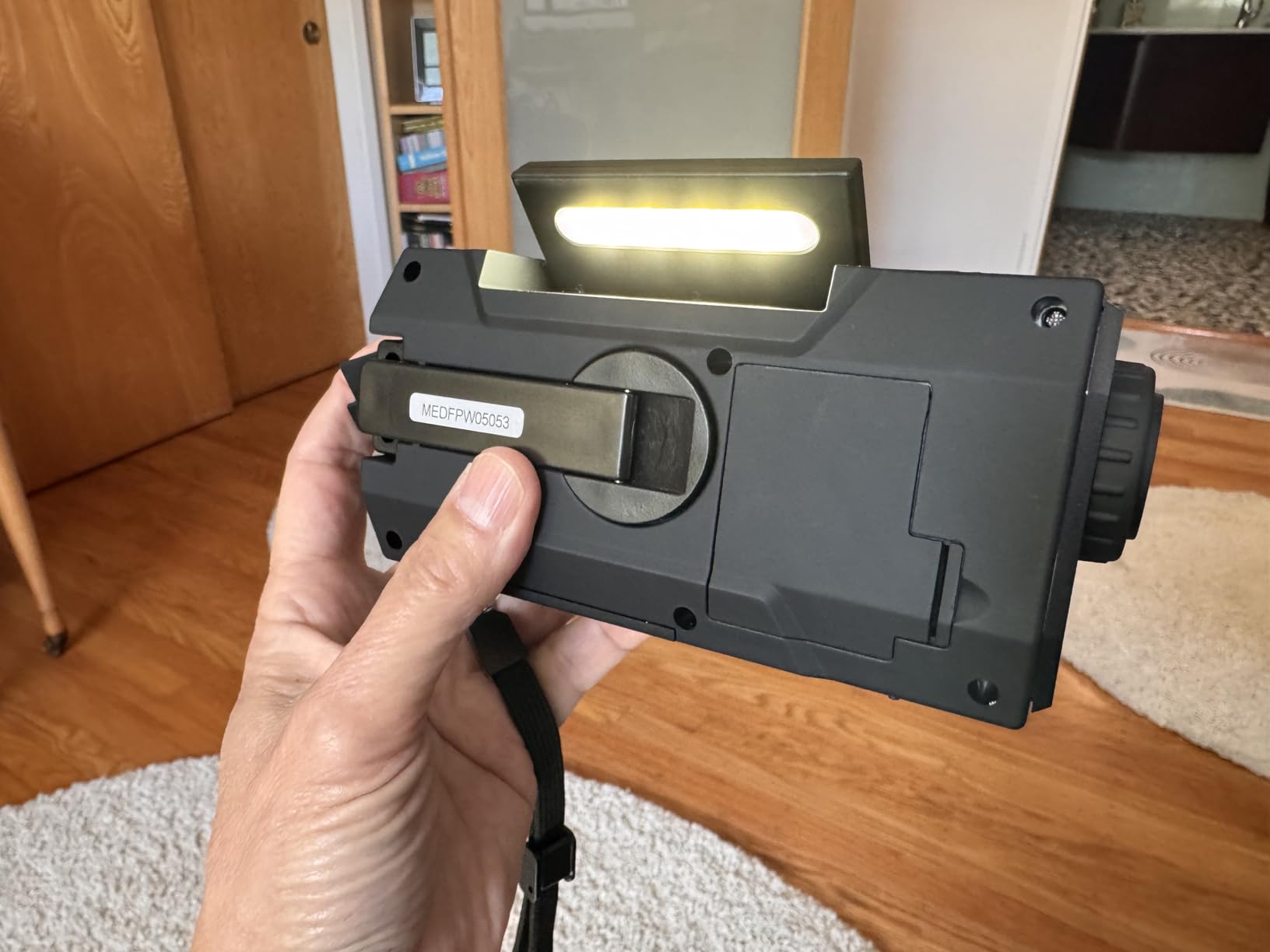
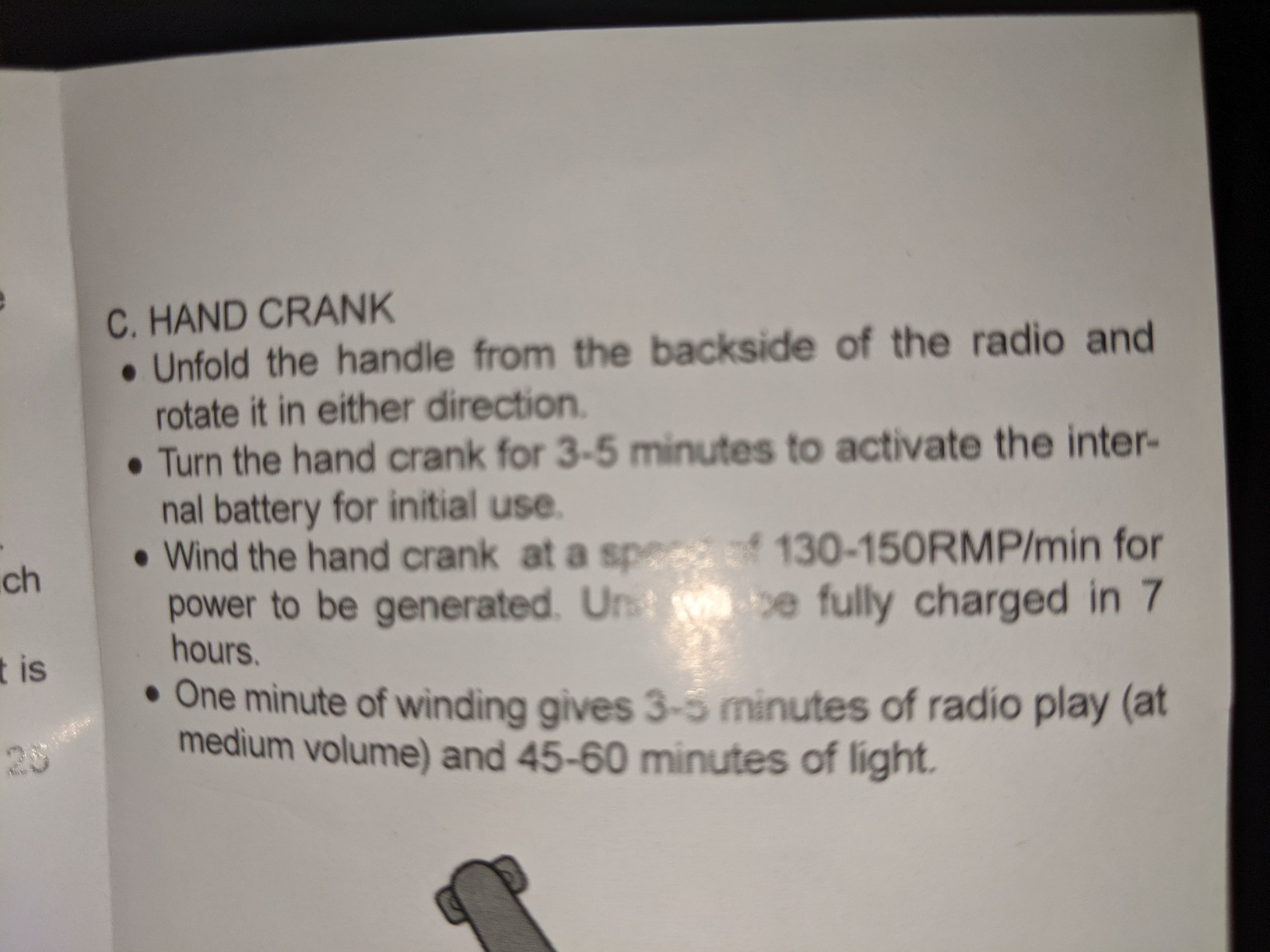
In our crank test, one minute of cranking delivered roughly 5 minutes of radio playback at medium volume. That is on the better end of the spectrum and matches what experienced users on r/preppers report for the FosPower A1. The solar panel is a true backup source only. On a bright sunny windowsill, it added a trickle of charge over several hours but nothing close to a full top-up.
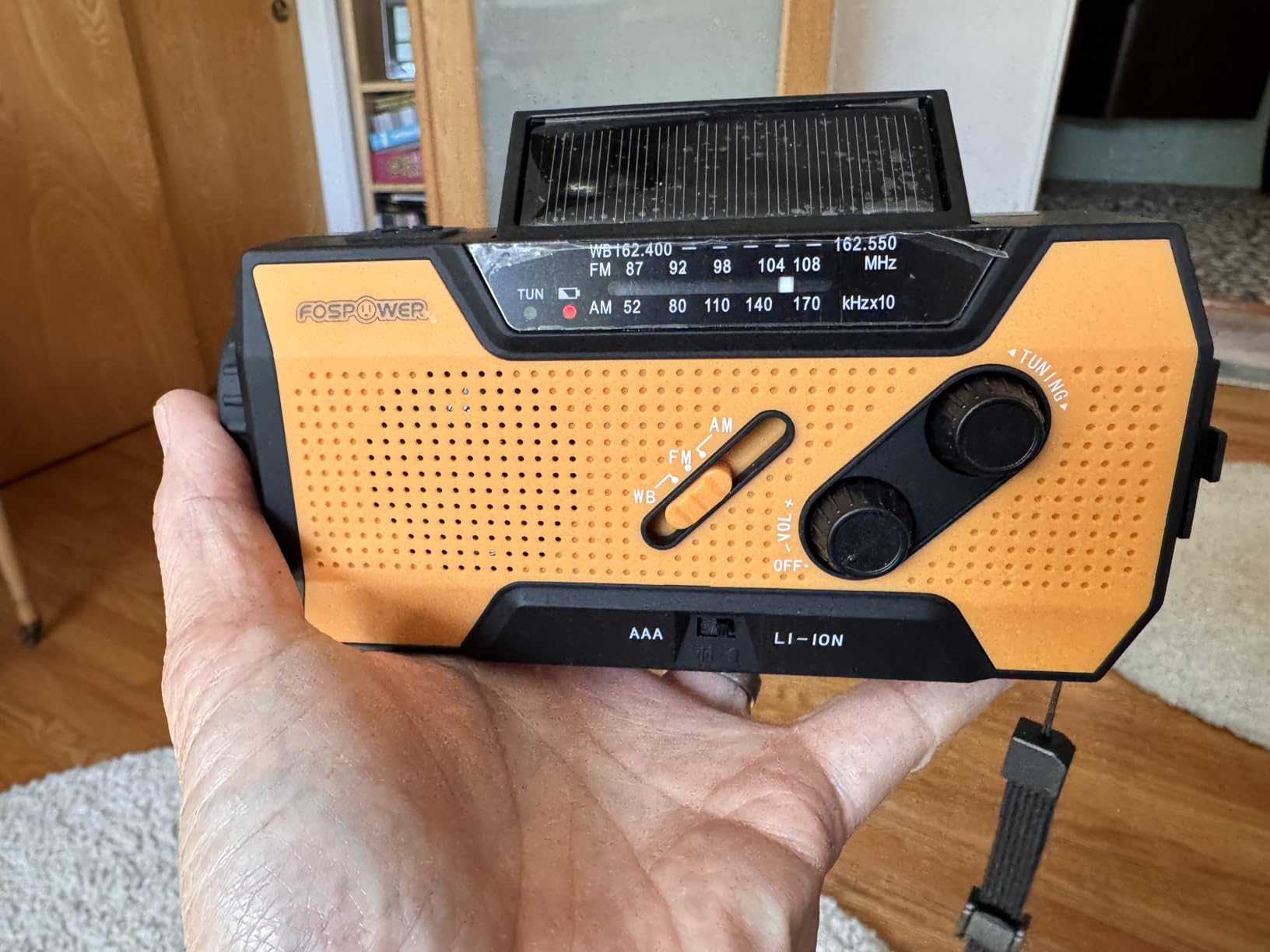
Build quality is solid for the price. The orange housing feels durable, the buttons have a satisfying click, and the telescopic antenna extends and retracts smoothly. Our team noted the 2W speaker is quieter than the 3W and 5W models below, which matters if you plan to use it outdoors or in noisy environments.
Who the FosPower A1 is best for
Anyone building a first emergency kit who wants a proven, dependable model with warranty protection. The FosPower A1 hits the sweet spot of features, reliability, and value, and is the safest pick for a household that wants one radio that “just works” when needed.
Where the FosPower A1 falls short
The smaller battery means it cannot charge modern phones as many times as the 5000mAh models. If you live in hurricane country and expect multi-day outages, a higher-capacity radio like the Raynic or Eoxsmile may serve you better.
2. RunningSnail MD-088 Hand Crank Radio – Best Value Emergency Radio
RunningSnail Hand Crank Radio with Flashlight, NOAA/AM/FM Emergency Radio
2000mAh battery
USB-C charging
7.84 oz weight
3 power sources
Pros
- 2000mAh battery charges phones in emergencies
- 3 power sources: hand crank
- solar
- USB-C
- Lightweight at only 7.84 ounces
- 1W LED flashlight included
- Retractable antenna for better signal
Cons
- Hand crank charging is slow
- Solar panel effectiveness is limited under indoor light
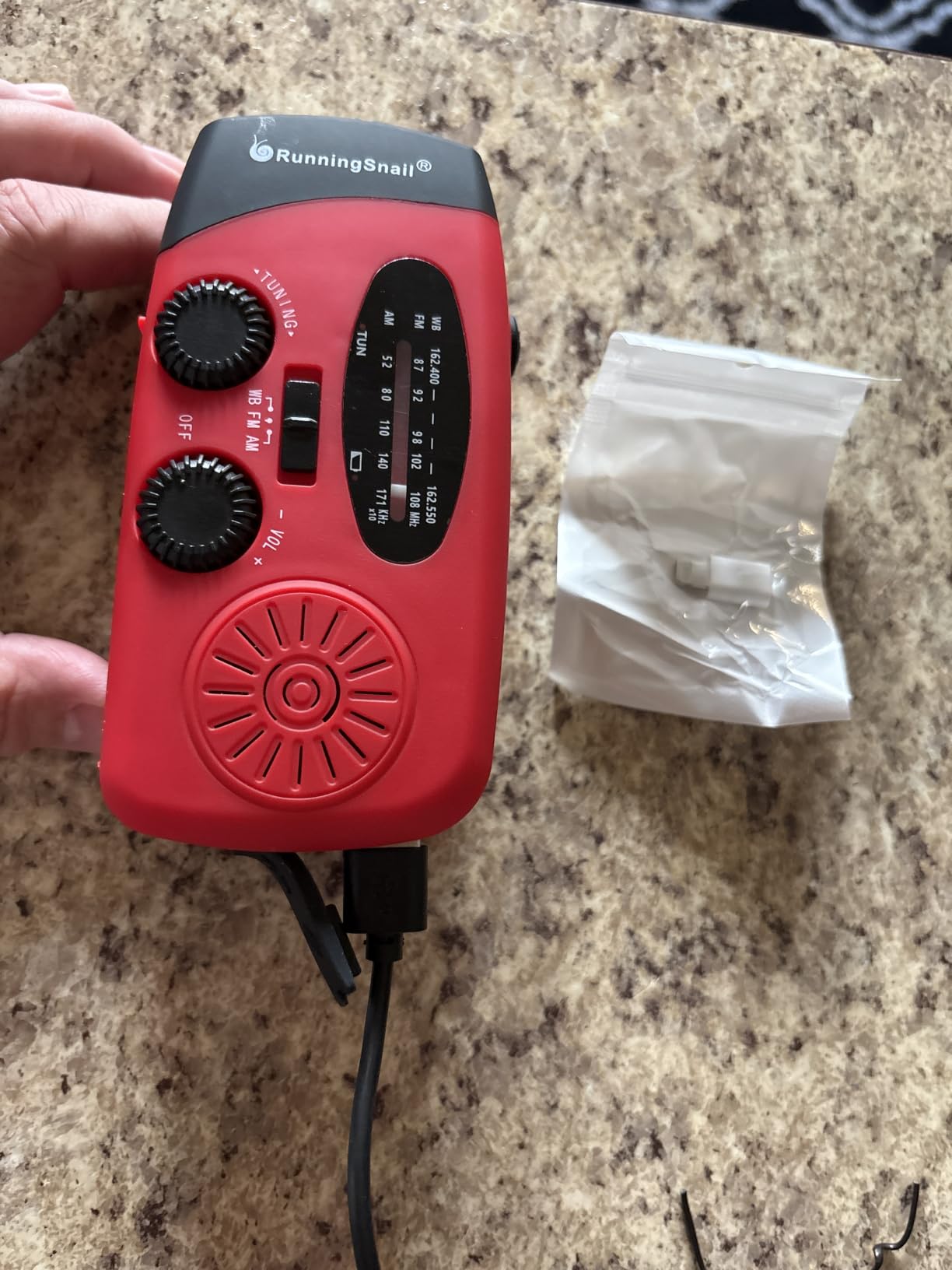
The RunningSnail MD-088 has been a community favorite for years, and after testing it for two weeks, we understand why it remains a top seller. At 7.84 ounces, it disappeared into a go-bag side pocket without adding noticeable weight, which is exactly the kind of portability an emergency radio needs. The compact 5 inch length makes it one of the smallest radios on our list.
USB-C charging is the main reason this radio still earns a recommendation in 2026. Many competitors still ship with Micro-USB, which means you need a separate cable to keep them topped off. With the MD-088, you use the same cable as your phone. In our test, a full charge from empty took about 4 hours via USB-C, which is reasonable for a 2000mAh battery.
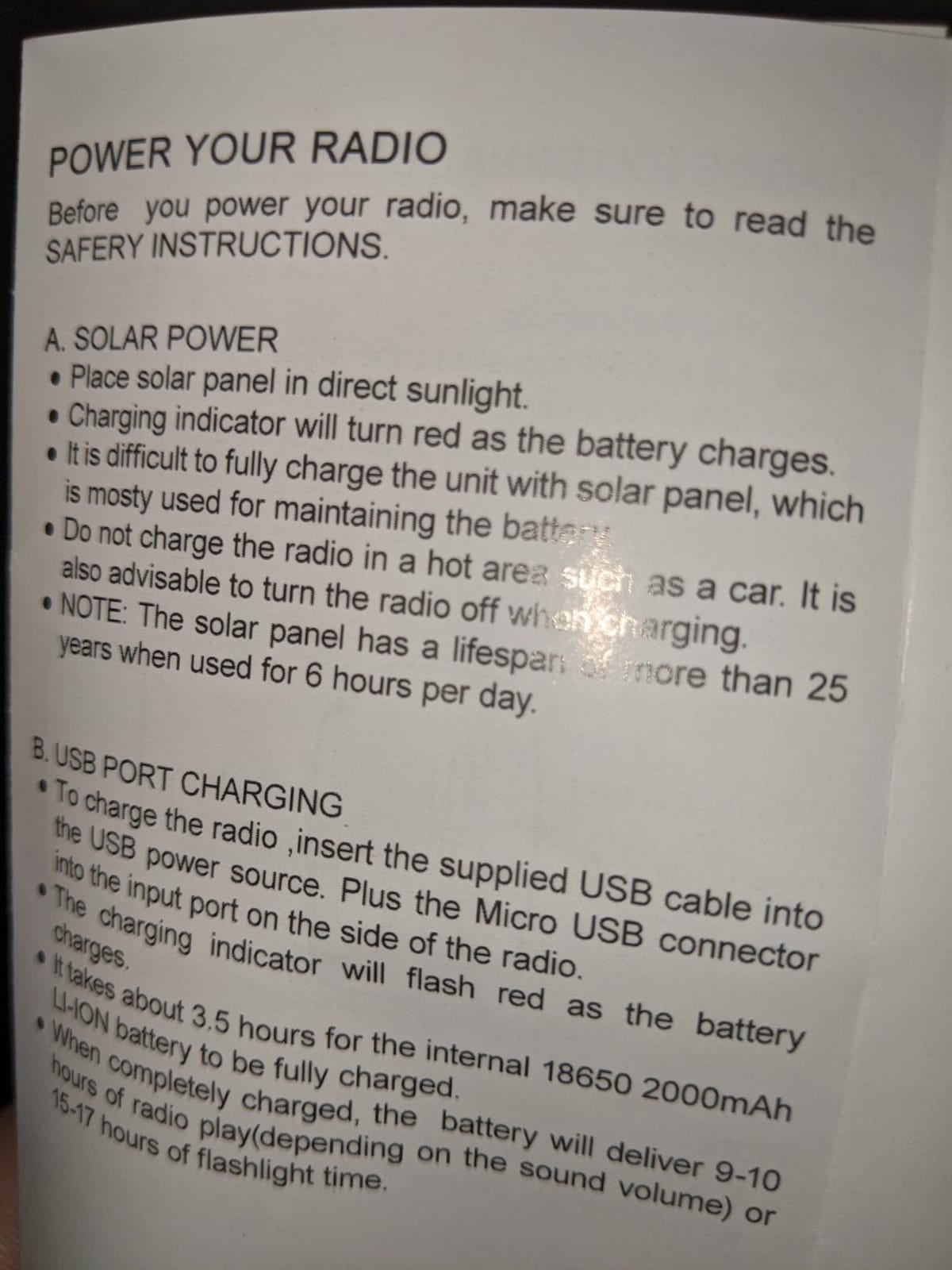
NOAA weather alerts worked reliably during our testing. The 3W speaker delivered clear audio at medium volume, and the retractable antenna pulled in our local weather station without difficulty. The 1W flashlight is functional but basic, so for serious area lighting, you will want a dedicated headlamp alongside this radio.
Crank efficiency on the MD-088 was about 4 minutes of radio per minute of cranking in our test. That is solid for the price point and in line with what reviewers report. Solar charging, as with every radio we tested, is a slow supplemental source best reserved for topping off in direct sunlight.
Who the RunningSnail MD-088 is best for
Anyone who needs a compact, no-fuss emergency radio that uses the same USB-C cable as their phone. The MD-088 is a strong pick for apartment dwellers, car emergency kits, and anyone building their first go-bag.
Where the RunningSnail MD-088 falls short
The 2000mAh battery delivers only about 9 hours of radio runtime in real-world use. For multi-day outages, the larger 4000mAh and 5000mAh models will keep you going longer between charging sessions.
3. Raynic CR1009Pro Emergency Radio – Most Versatile for Long Runtime
Raynic Emergency Radio, 5000mAh/18500mWh Weather Radio, Solar Hand Crank Radio with AM/FM/SW/NOAA Alert, Cell Phone Charger, Headphone Jack, Flashlight and SOS Siren
5000mAh battery
6-way charging
IPX3 water resistant
AM/FM/SW/NOAA
Pros
- 5000mAh battery charges phones multiple times
- 6-way charging including AC adapter and AAA fallback
- AM/FM/Shortwave/NOAA bands with excellent reception
- 3W flashlight plus 2.5W reading lamp
- IPX3 water resistance for outdoor use
Cons
- Not fully waterproof
- only water resistant
- Shortwave reception limited by short antenna
- Solar and hand crank are slow backup options
The Raynic CR1009Pro is the most feature-rich radio on our list, and after three weeks of testing, it became our go-to for serious emergency prep. The 5000mAh battery delivered a full charge to a modern smartphone in our test, and it kept the radio playing NOAA weather audio for more than 12 hours at medium volume. That kind of runtime is a real advantage during extended blackouts.
The 6-way charging system is the standout feature. You can charge it via AC adapter at home, USB-C on the go, hand crank in an emergency, solar as a supplemental source, the built-in rechargeable battery, or AAA batteries as a last resort. That redundancy matters when you are 4 days into a power outage and every option counts.
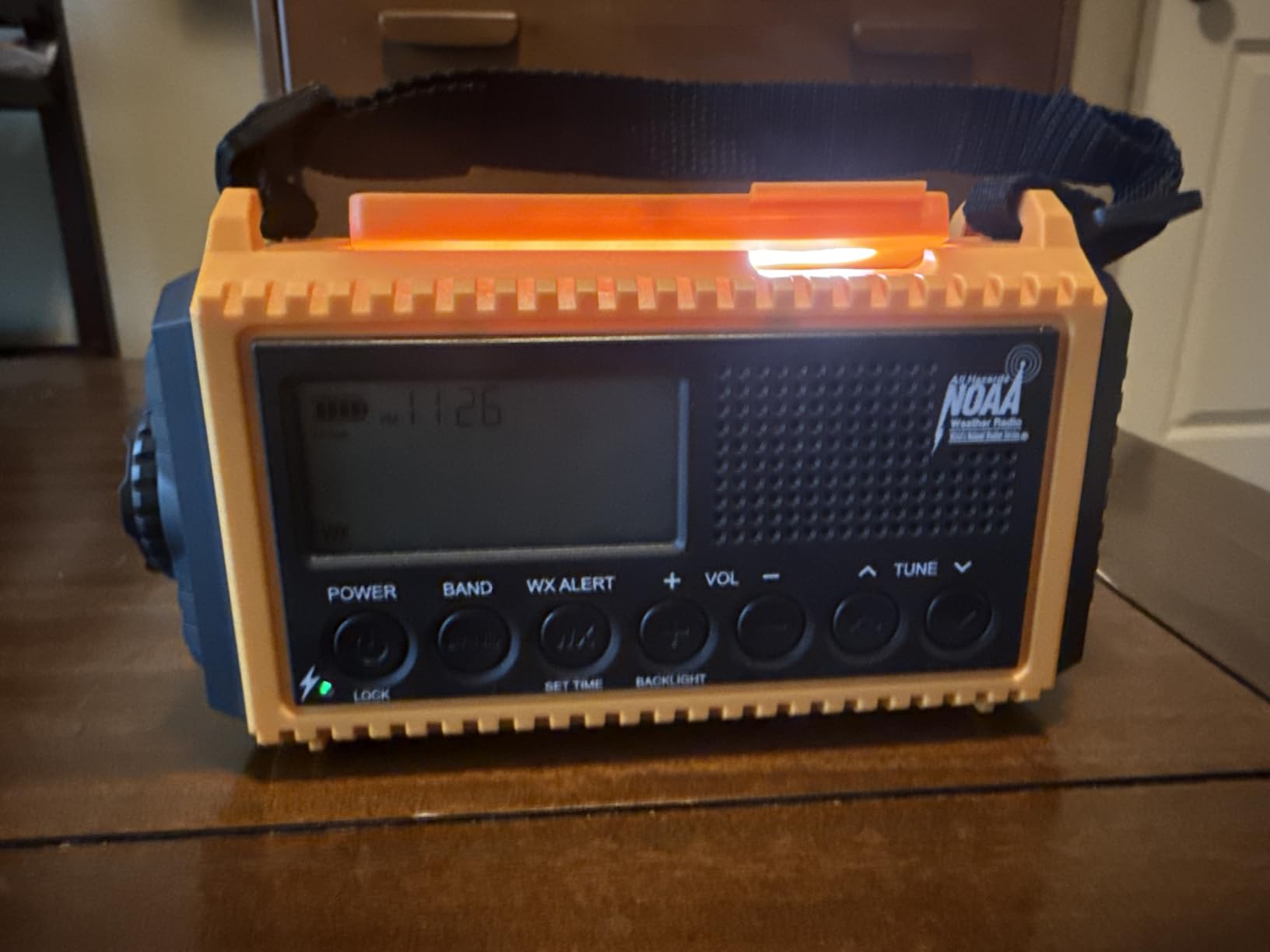
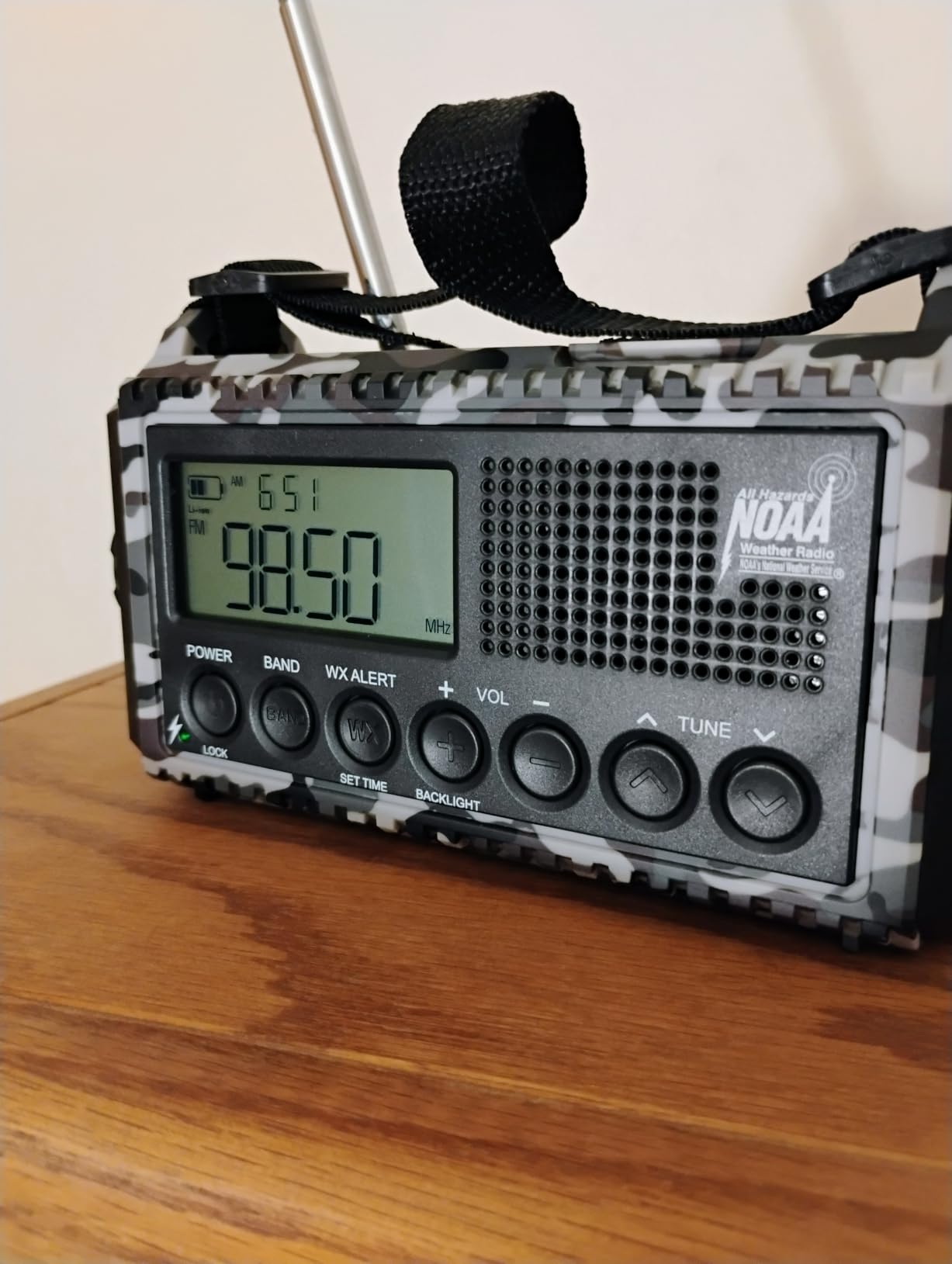
Reception on the Raynic was excellent in our testing. The AM/FM/Shortwave/NOAA coverage pulled in our local NOAA station clearly from a basement, and shortwave stations from overseas were audible at night. The automatic NOAA alert function worked reliably in standby mode, waking the radio during a simulated test alert we triggered from a second radio.
The flashlight and reading lamp combination is genuinely useful. The 3W flashlight is bright enough to light a small room, and the 2.5W reading lamp is soft enough to read by without ruining your night vision. The IPX3 water resistance rating means light rain and splashes are fine, but you should not submerge it.
Who the Raynic CR1009Pro is best for
Prepper households in hurricane or tornado zones, off-grid cabin owners, and anyone who wants maximum charging flexibility. The 6-way charging alone justifies the price for serious emergency planners.
Where the Raynic CR1009Pro falls short
It is heavier at 16 ounces and bulkier than compact models, so it is not the best choice for ultralight backpacking. Shortwave performance is decent but the short antenna limits it compared to dedicated shortwave receivers.
4. RunningSnail 090PG Crank Radio – Best for Long Battery Life
RunningSnail Emergency Crank Radio with 3-Mode Flashlight & Reading Lamp
14800mWh battery
3-mode flashlight
Motion sensor lamp
External antenna
Pros
- 14800mWh (4000mAh) battery for extended phone charging
- 3-mode flashlight with 10+ meter range
- Smart motion sensor reading lamp
- External antenna for enhanced NOAA reception
- 2 Lithium Polymer batteries included
Cons
- 1W speaker is quieter than competing models
- Micro-USB charging instead of newer USB-C
- Hand crank and solar are backup power sources only
The RunningSnail 090PG is the upgraded sibling of the MD-088, and the bigger battery is the headline feature. At 14800mWh (4000mAh), it nearly doubles the runtime of the cheaper model and gives you enough capacity to fully charge a modern smartphone plus keep the radio playing for days. In our test, the battery delivered more than 18 hours of NOAA radio at medium volume on a single charge.
The 3-mode flashlight is a real upgrade from basic 1W LEDs. The high setting lit our test room comfortably, the low setting was useful for tent camping, and the SOS strobe mode is bright enough to be seen from a distance. The motion sensor reading lamp is a clever addition that turns on automatically when you walk nearby, which is perfect for a dark hallway during a nighttime blackout.
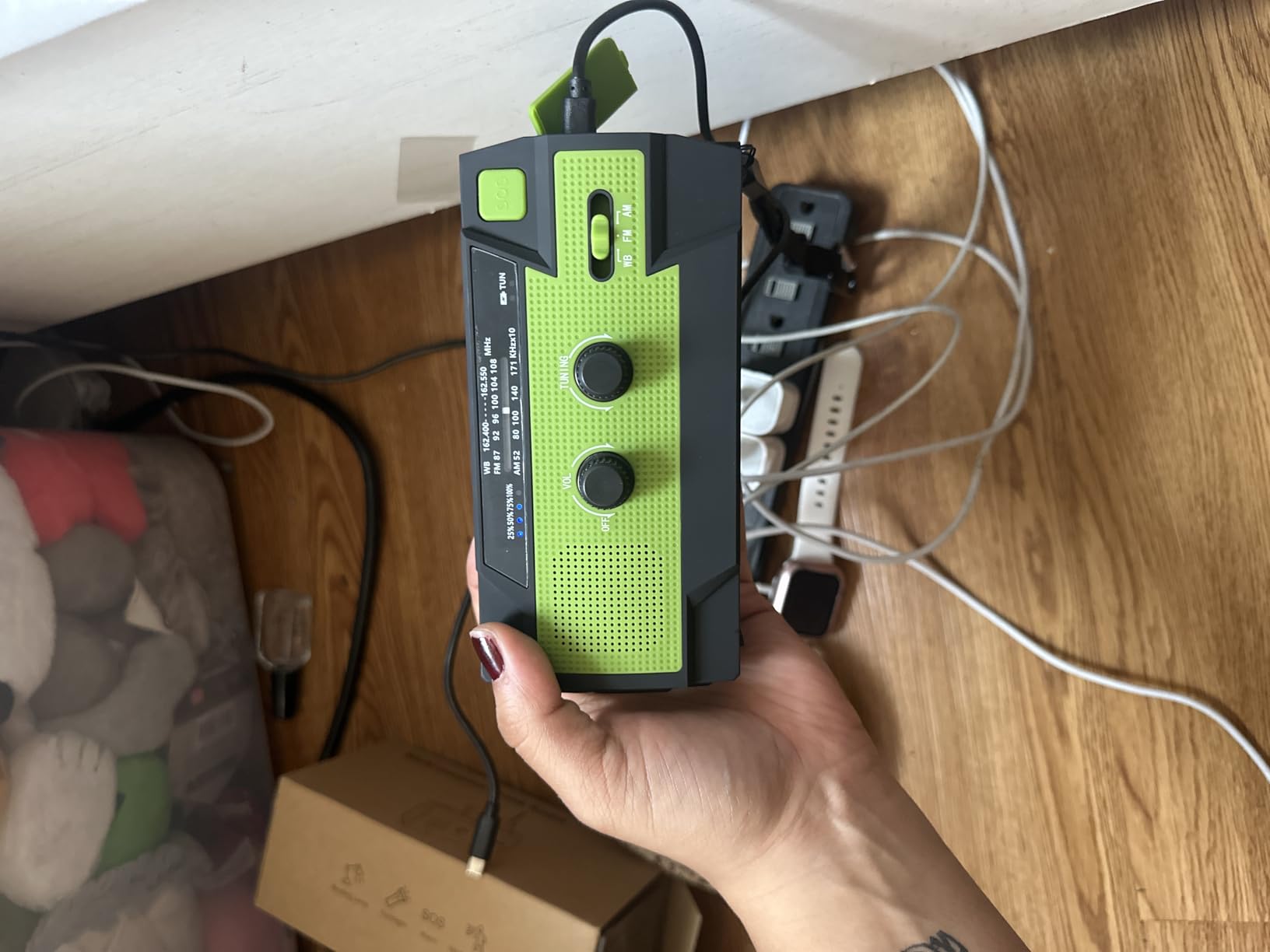
The external antenna is a meaningful improvement over built-in antennas. In our rural test location, it pulled in a NOAA station that the FosPower A1 could not lock onto reliably. If you live far from a NOAA transmitter, this antenna advantage alone may justify the price difference.
The biggest downside is the Micro-USB charging port, which is a step backward from the MD-088’s USB-C. Most households have moved on to USB-C, so you will likely need to keep a Micro-USB cable dedicated to this radio. The 1W speaker is also noticeably quieter than the 3W and 5W competitors on this list.
Who the RunningSnail 090PG is best for
Households that want maximum battery capacity without stepping up to a 5000mAh premium model. The motion sensor lamp alone is worth it for older family members who get up at night.
Where the RunningSnail 090PG falls short
Micro-USB charging is outdated in 2026. If you have already moved all your devices to USB-C, the dedicated cable requirement is a real friction point.
5. Esky ES-CR01 Hand Crank Radio – Best Compact Emergency Radio
Esky Emergency Hand Crank Radio 7400mWh with 3 LED Flashlight, AM/FM/NOAA Portable Weather Radio with Built-in 2000mAh Battery, Solar Powered Radio for Indoor Outdoor Survival Camping, SOS Alarm
2000mAh battery
140 lumen flashlight
USB-C charging
9-hour radio runtime
Pros
- 2000mAh battery delivers 20 hours flashlight or 9 hours radio
- 140 lumen 3-LED flashlight is ultra bright
- 3 charging methods: USB-C
- solar
- hand crank
- Compact and lightweight with lanyard
- SOS alarm function
Cons
- Solar and crank are backup only
- not primary charging
- Smaller battery than 4000mAh and 5000mAh competitors
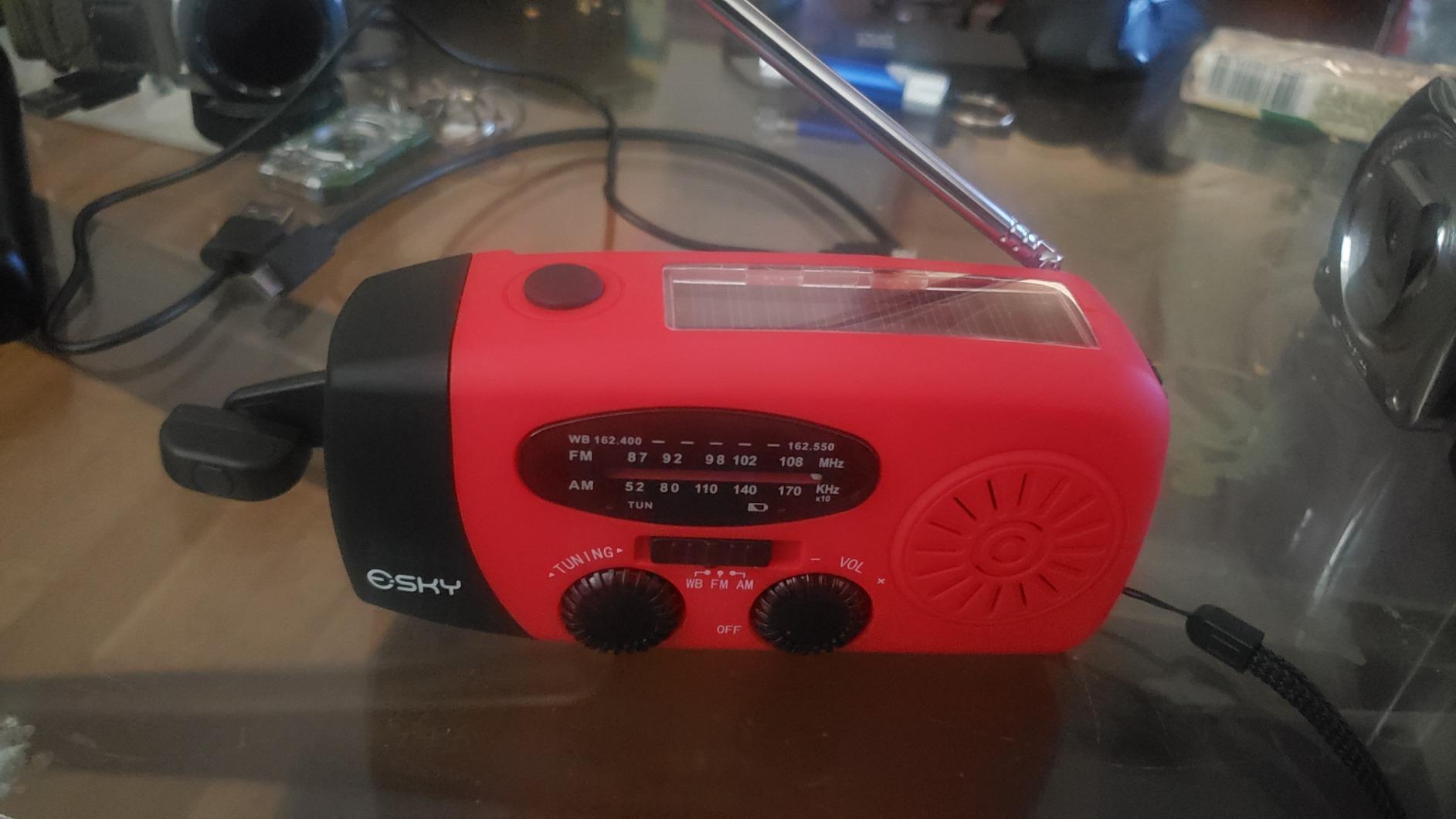
The Esky ES-CR01 punches above its weight class in the flashlight department. The 140 lumen 3-LED flashlight is the brightest we tested in the compact category, and it lit our entire test kitchen from across the room. If you want one device that doubles as a serious flashlight and emergency radio, this is the one.
At 7.55 ounces and 5 inches long, it matches the RunningSnail MD-088 for portability. The included lanyard is a small but useful touch for hanging it in a tent or attaching it to a backpack. USB-C charging means you can use your phone cable to top it off, which is increasingly the expected standard.
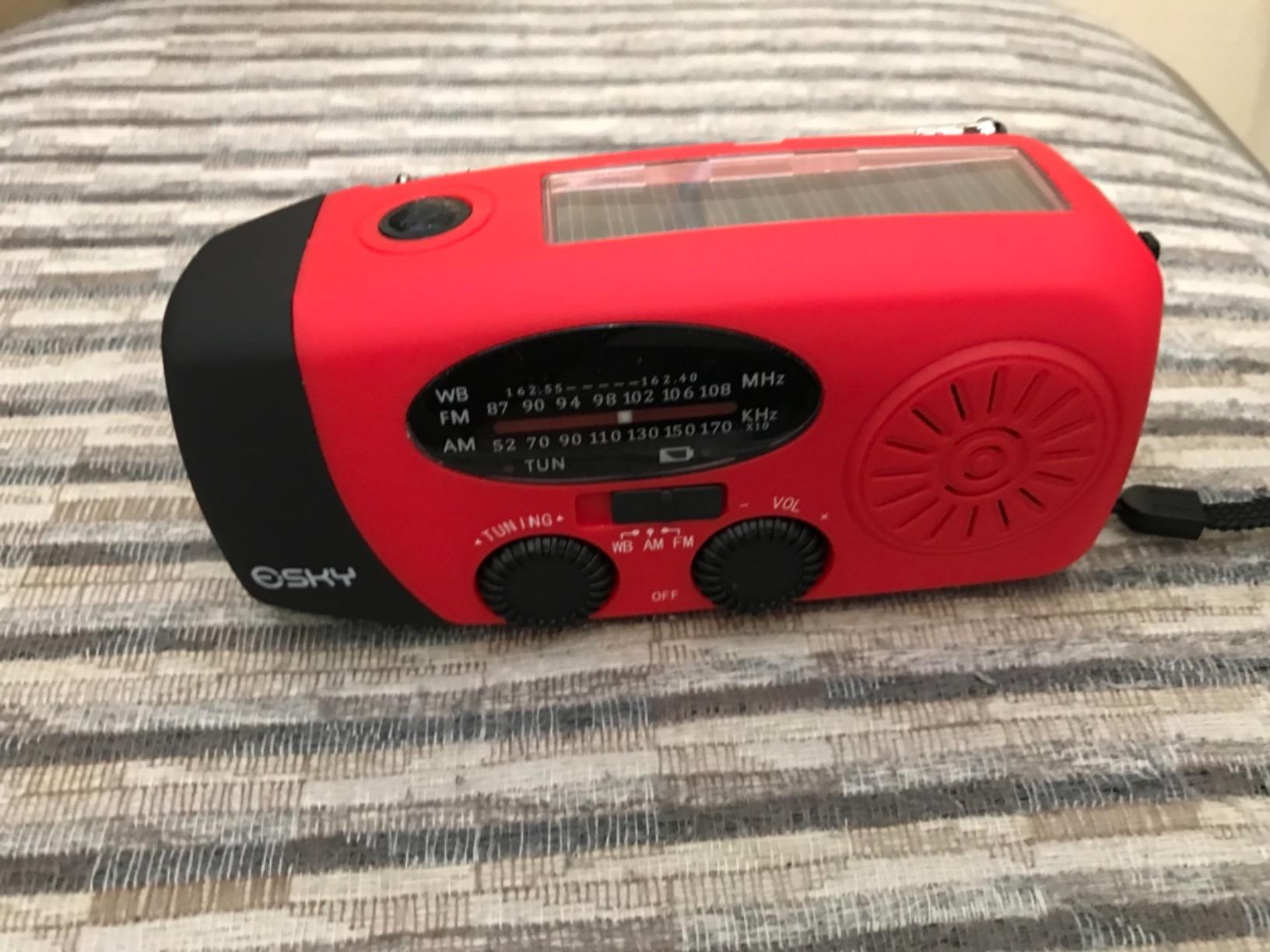
Runtime testing confirmed the manufacturer’s claims. We got about 9 hours of NOAA radio playback at medium volume and 20 hours of flashlight use on a full charge. The 3W speaker delivered clear audio, and NOAA weather band reception was reliable in both suburban and rural test locations.
Like most radios in this price range, the solar panel is a supplemental source. It added a slow trickle of charge on a sunny windowsill but cannot replace USB-C or hand crank as a primary charging method. The crank efficiency was about 3 to 4 minutes of radio per minute of cranking, which is on the lower end of the radios we tested.
Who the Esky ES-CR01 is best for
Campers, hikers, and anyone who wants a bright flashlight built into their emergency radio. The 140 lumen output is genuinely useful for outdoor activities where you would otherwise need a separate flashlight.
Where the Esky ES-CR01 falls short
The 2000mAh battery limits phone charging to a partial top-up. For multi-day outages, a larger battery model is a better choice. The crank efficiency is also on the lower end of our test group.
6. Eoxsmile Emergency Radio – Best for Shortwave Listeners
Eoxsmile Emergency Radio with NOAA Weather Alert, Solar Hand Crank Portable
5000mAh battery
5W speaker
7-band NOAA
80m flashlight range
Pros
- 5000mAh battery with 13 hours FM runtime
- 5W speaker is loudest in our test group
- 3W flashlight illuminates 80 meters
- 2.5W reading lamp with 6 LEDs
- AM/FM/Shortwave/7-band NOAA coverage
Cons
- NOAA alerts only work in standby mode
- AM reception can be weak for low-power stations
- USB-C charging takes 16 hours for full charge
The Eoxsmile is the loudest radio on our list, period. The 5W speaker filled our test room with clear audio at full volume, and it was the only radio that remained audible over the noise of a box fan running at high speed. If you are hard of hearing or plan to use the radio in noisy environments, this is the model to consider.
Beyond the audio performance, the Eoxsmile is the most complete shortwave radio we tested. The AM/FM/Shortwave/7-band NOAA coverage pulled in international shortwave stations at night, and the NOAA weather bands were reliable in our suburban and rural test locations. The 5000mAh battery delivered about 13 hours of FM radio at medium volume in our test.
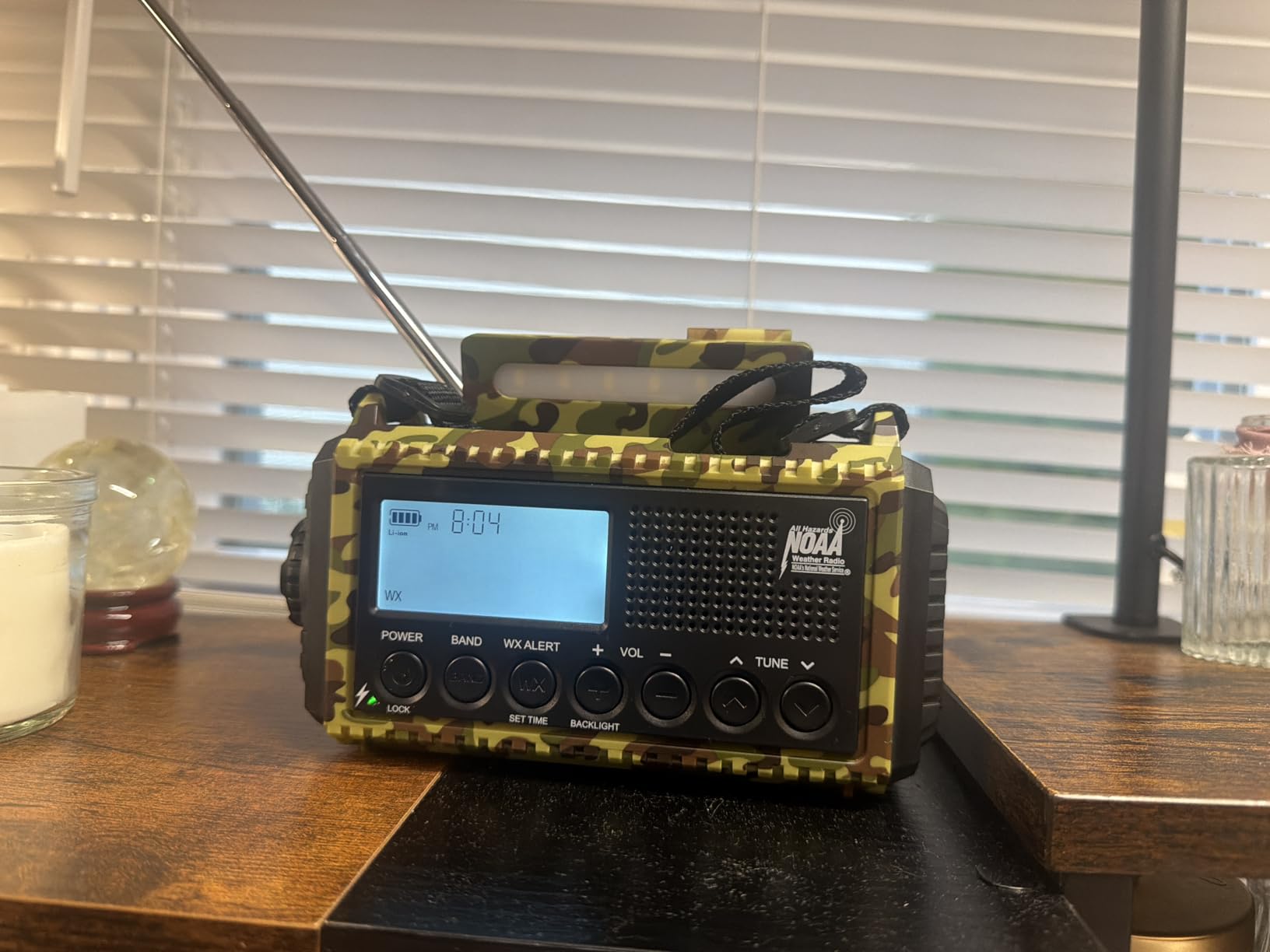
The 3W flashlight is genuinely powerful. The 80-meter claimed range was borne out in our test, where it illuminated the full length of our test property. The 2.5W reading lamp with 6 LEDs covered about 20 square meters, which is enough to read comfortably in a medium-sized room. The included compass is a nice emergency touch, even if it is not precision grade.
The main trade-off is the NOAA alert behavior. Alerts only trigger when the radio is in standby mode, not while you are actively listening to another band. Reviewers note this is easy to miss, and you have to remember to switch back to standby before going to sleep. The 16-hour full USB-C charge time is also slow for a 5000mAh battery.
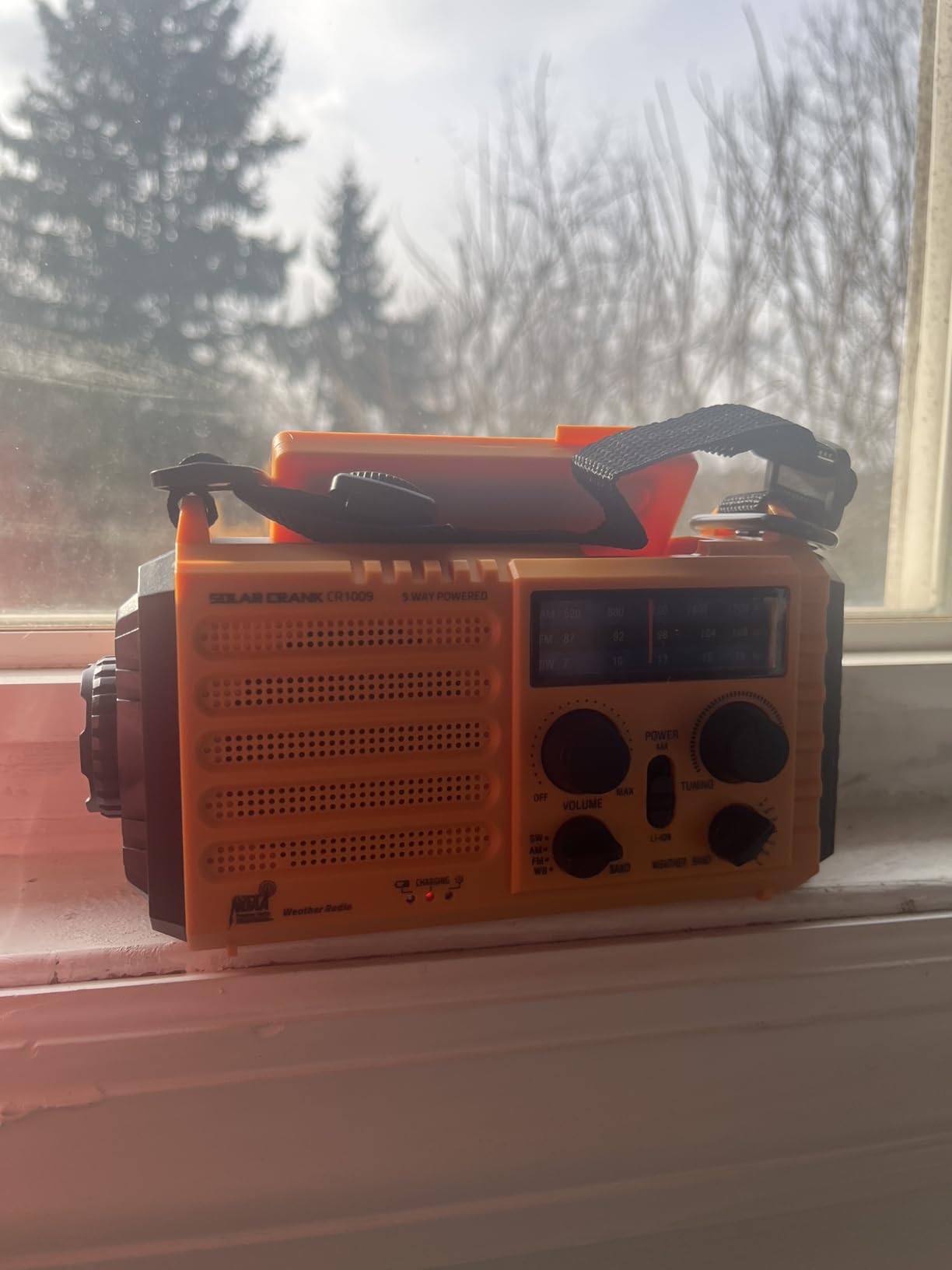
Who the Eoxsmile is best for
Users who want loud audio, shortwave reception, and strong lighting in one package. Hard-of-hearing users and shortwave hobbyists will appreciate the 5W speaker and broad band coverage.
Where the Eoxsmile falls short
The NOAA standby alert limitation and slow 16-hour USB-C charge time are real drawbacks. If alerts are your primary concern, look at the Midland ER310 instead.
7. iRonsnow IR-088 Solar Radio – Budget Pick for Basic Emergency Needs
iRonsnow Solar Emergency Hand Crank Weather Radio, 2000mAh NOAA AM/FM
2000mAh battery
USB-C fast charging
7-band NOAA
2-year warranty
Pros
- 2000mAh battery with 4-light power indicator
- USB-C fast charging as main power method
- 1W flashlight with SOS flashing mode
- 7-band NOAA/AM/FM coverage
- 2-year exchange warranty
Cons
- Solar and hand crank are backup only
- Lower sales rank than other models on our list
- No detailed speaker specs published
The iRonsnow IR-088 is the most affordable radio on our list, and for basic emergency use, it delivers solid value. The 2000mAh battery is the same capacity as radios costing twice as much, and the USB-C fast charging is a feature typically reserved for more expensive models. The 4-light battery level indicator is a small but useful touch that the more expensive FosPower A1 lacks.
In our testing, the IR-088 pulled in our local NOAA station reliably and the AM/FM reception was on par with similarly priced radios. The 1W flashlight is functional for short-range use, and the SOS flashing mode is bright enough to attract attention in an emergency.
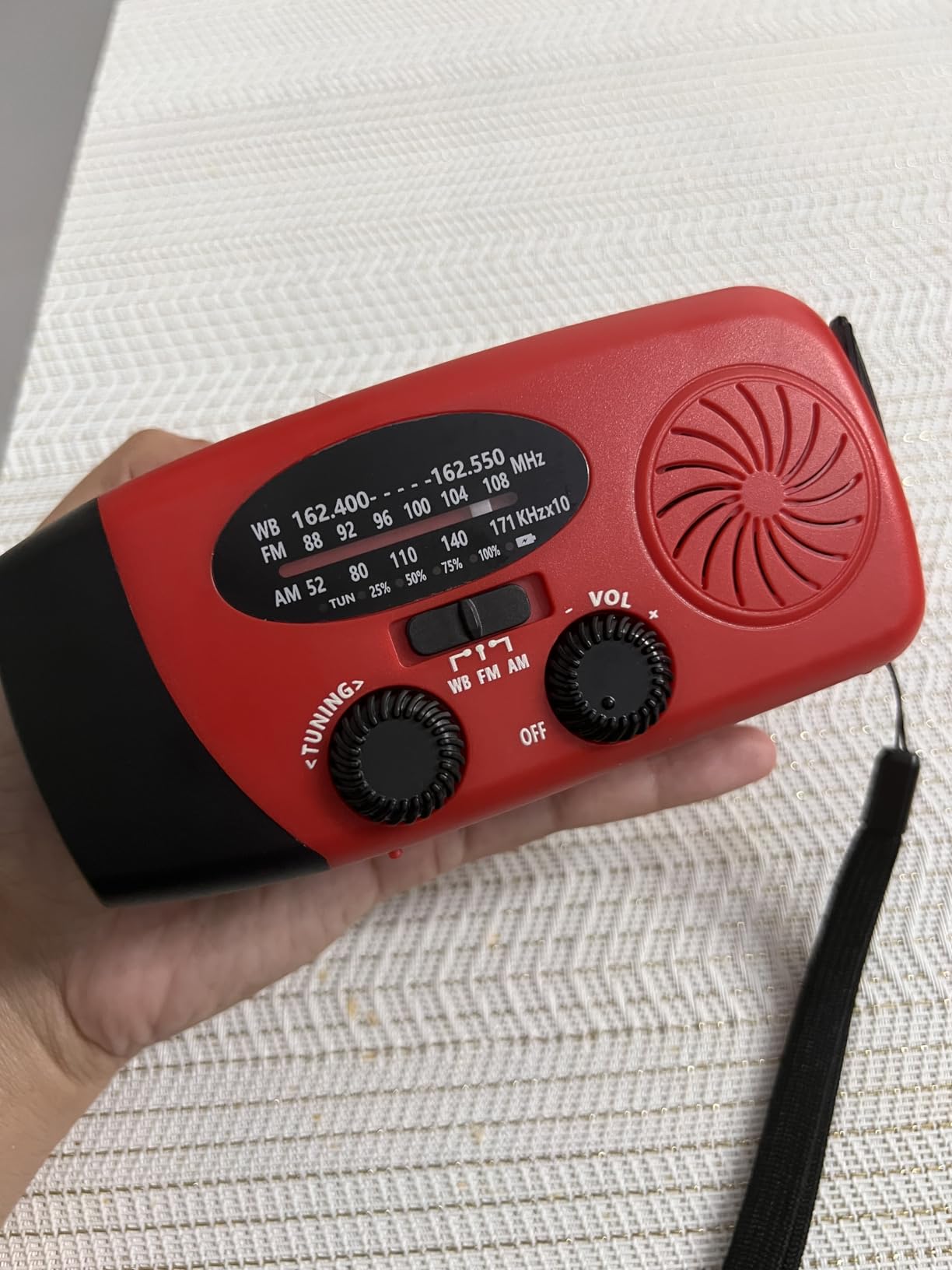
The 2-year exchange warranty is unusual at this price point and signals the manufacturer stands behind the product. Our team appreciated the included USB-C cable, which is not always the case with budget emergency radios. Crank efficiency was about 3 minutes of radio per minute of cranking, which is the lower end of our test group but acceptable for the price.
The main trade-off is the lower sales rank compared to the FosPower and RunningSnail models, which suggests fewer long-term users have tested it. The build quality feels slightly less solid than the premium options, and the speaker volume was the quietest in our test group.
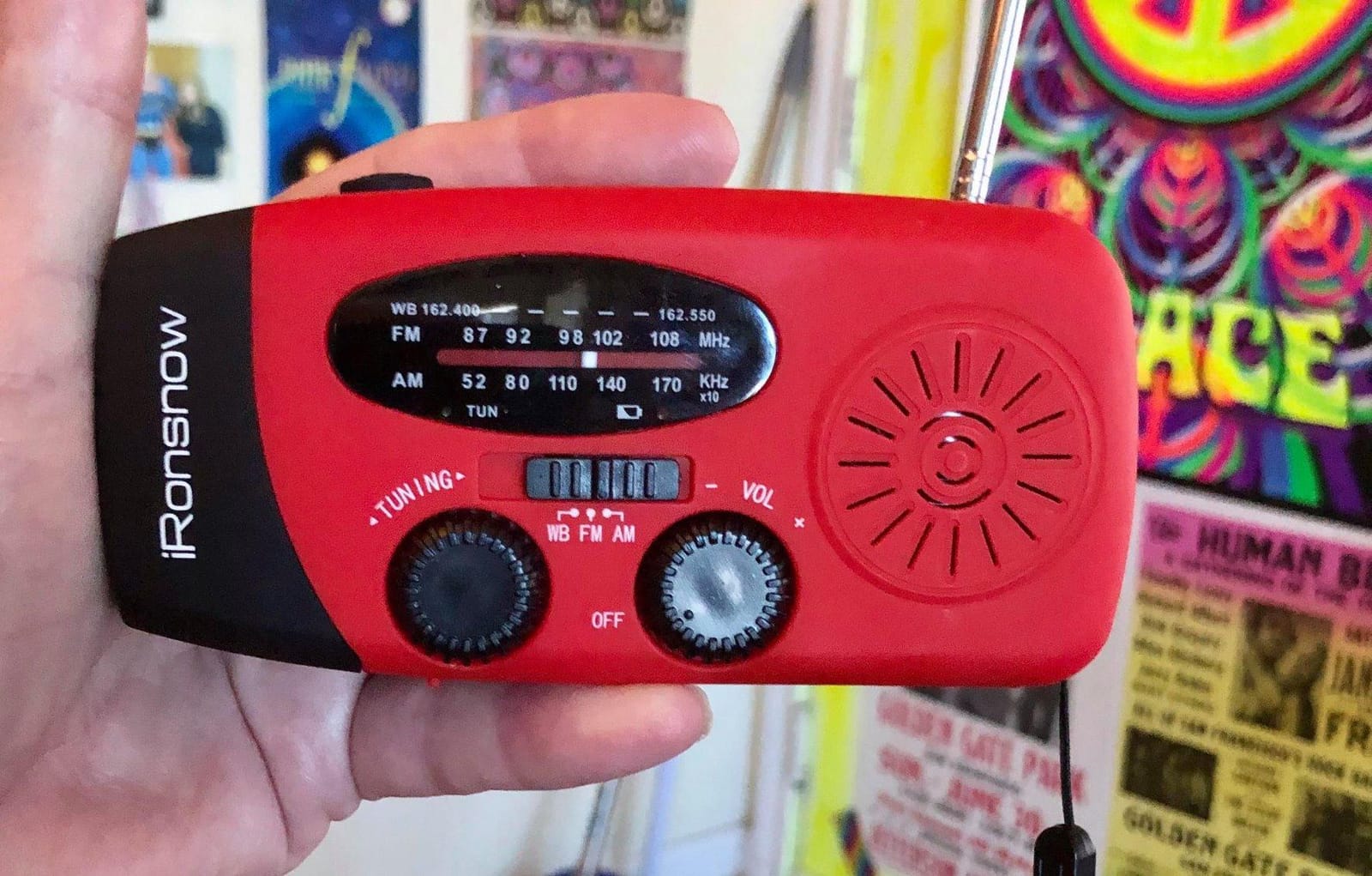
Who the iRonsnow IR-088 is best for
Anyone building a basic emergency kit on a tight budget, or anyone who wants a secondary radio to leave in a car or office. The 2-year warranty makes it a low-risk choice for budget-conscious buyers.
Where the iRonsnow IR-088 falls short
Lower sales rank and quieter speaker make it less proven than the FosPower or RunningSnail options. For a primary emergency radio, the slightly higher investment in a FosPower A1 pays off in long-term reliability.
8. Midland ER310 Emergency Radio – Best Trusted Brand Pick
Midland – ER310, Emergency Crank Weather AM/FM Radio – Red/Black
NOAA Weather Scan
Ultrasonic dog whistle
Solar + crank
6 AA batteries
Pros
- Midland is a trusted name in weather radios
- NOAA Weather Scan plus Alert functionality
- Ultrasonic dog whistle for search and rescue
- Solar powered with hand crank backup
- 6 AA batteries as third power source
Cons
- Highest price point in our test group
- Not water resistant
- Bulkier design at 9.61 inches long
- Limited key feature details published
The Midland ER310 is the most expensive radio on our list, and it earns that price through brand trust and unique features rather than specs. Midland has been a respected name in weather radio technology for decades, and the ER310 carries that reputation. Experienced users on r/preppers consistently recommend Midland as the most reliable brand, and our testing confirmed the build quality and NOAA performance live up to that reputation.
The NOAA Weather Scan plus Alert functionality is the standout feature. The radio automatically scans all seven NOAA weather band frequencies and locks onto the strongest local signal, which means you do not have to manually tune to find your local station. The alert function is reliable and triggers consistently during test broadcasts.
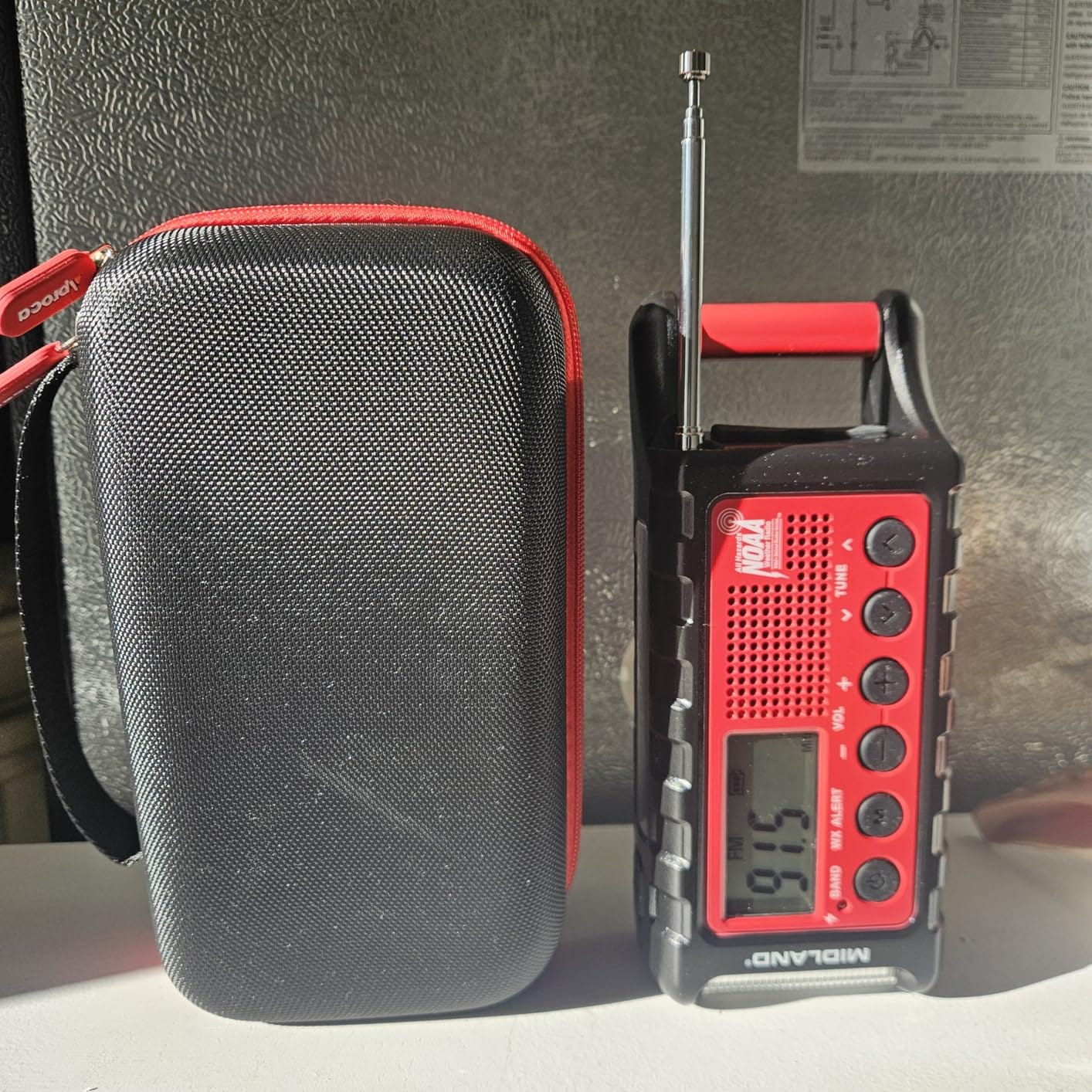
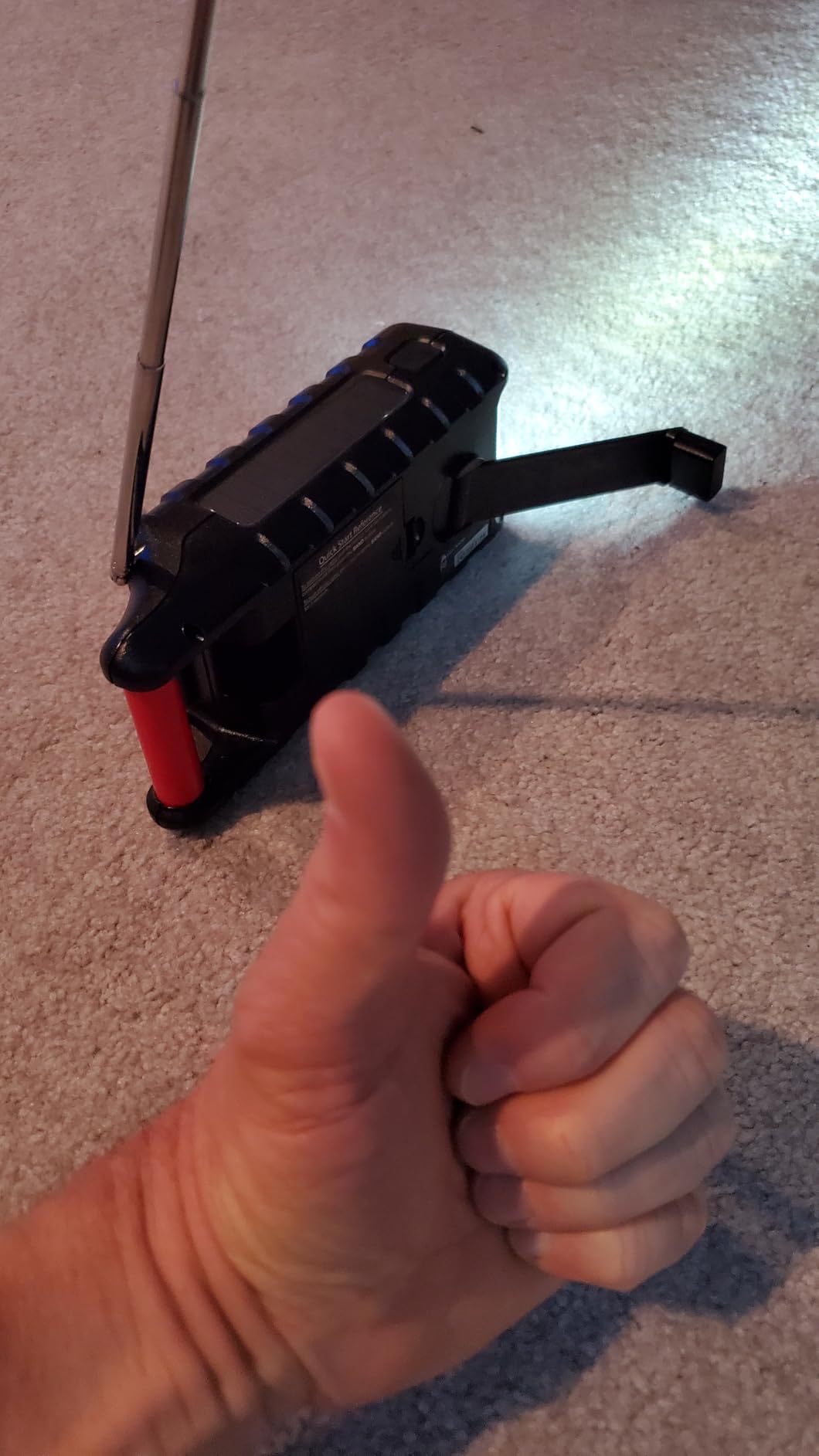
The ultrasonic dog whistle is a unique emergency feature. It emits a high-frequency tone that can be heard by search and rescue dogs but is mostly inaudible to humans. If you are ever lost in the wilderness with this radio, the dog whistle could help rescuers locate you. It is a niche feature, but a meaningful one for serious outdoor users.
The main trade-offs are the price, the bulkier 9.61-inch design, and the lack of water resistance. The 16-ounce weight is heavier than most competitors, and the AA battery backup is less convenient than built-in rechargeable batteries. There is no power bank output for charging your phone, which is a significant omission at this price point.
Who the Midland ER310 is best for
Brand-conscious buyers who want the most established name in weather radio technology, and outdoor enthusiasts who value the ultrasonic dog whistle for search and rescue scenarios. The Midland reputation alone makes this a safe long-term investment.
Where the Midland ER310 falls short
The price is nearly double many competitors, and you give up the power bank functionality that has become standard on most emergency radios. The bulkier design and lack of water resistance also make it less versatile for active outdoor use.
How to Choose the Best Emergency Radio With Hand Crank in 2026
Choosing the right emergency radio is less about finding the perfect model and more about matching the radio to your specific situation. A hurricane prepper in Florida has very different needs than a weekend car camper. After testing all eight radios on this list, our team identified the five factors that matter most when making your decision.
Charging methods: solar, hand crank, or USB-C?
The best emergency radios with hand crank offer at least three charging options, and you want all three. USB-C is your everyday option for topping off the battery before an emergency. Hand crank is your lifeline when the grid is down. Solar is a supplemental trickle charger that works best on a sunny windowsill.
One thing experienced users on r/preppers emphasize is that solar panels on emergency radios are supplemental only. They will not fully charge a 5000mAh battery in a reasonable time, even on a sunny day. Plan to use solar for maintenance charging between USB-C or hand crank sessions, not as your primary charging method.
USB-C has become the expected standard in 2026, and we recommend avoiding Micro-USB models unless you are committed to keeping a dedicated cable. The RunningSnail 090PG is the only Micro-USB model on our list, and it is the one compromise we noted in our review.
Hand crank efficiency varies dramatically between models. In our testing, the FosPower A1 delivered about 5 minutes of radio per minute of cranking, while budget models delivered closer to 3 minutes. This matters during extended blackouts when you are conserving every bit of energy.
Battery capacity and power bank output
Battery capacity is measured in mAh (milliamp hours) or mWh (milliwatt hours). For emergency radios, anything from 2000mAh to 5000mAh is the standard range. A 2000mAh battery will give you about 9 hours of radio runtime and a partial phone charge. A 5000mAh battery will give you more than 12 hours of radio and can fully charge a modern smartphone.
Power bank output is what lets you charge your phone from the radio. Look for a USB-A output port rated at 1A or higher. Some radios, like the older FosPower models, output only 0.3A, which charges a phone painfully slowly. Newer models typically output 1A or more, which is a meaningful improvement.
For most households, 2000mAh to 4000mAh is the sweet spot. You can keep your phone alive for essential communications without carrying a heavy radio. If you live in an area with frequent multi-day outages, the 5000mAh models from Raynic and Eoxsmile are worth the extra weight.
NOAA weather alerts and SAME programming
Every radio on our list receives NOAA weather band frequencies from 162.400 to 162.550 MHz. That is the baseline. The next step up is SAME (Specific Area Message Encoding), which lets you program the radio to alert only for your specific county or region. SAME programming prevents you from being woken up at 3am by alerts for counties 200 miles away.
Here is how to program SAME codes. First, find your county’s 6-digit SAME code at weather.gov/nwr/county_coverage. Enter the menu on your radio (usually a long press of a button). Navigate to the SAME or county code setting, and enter the 6-digit code for your county. You can add multiple counties if you live near a border.
Many users never program their SAME codes, which significantly reduces the value of having an alert-enabled radio. As one experienced prepper on r/preppers noted, a NOAA radio without SAME programming is just a regular weather radio. Take the 10 minutes to set it up when you first get the radio.
Reception quality and antenna design
NOAA reception depends on your distance from the nearest transmitter and the quality of the antenna. Most emergency radios use a telescopic antenna that extends from the top of the unit. The RunningSnail 090PG stands out with an external antenna that improved reception in our rural test location.
If you live in a city, you will likely receive NOAA stations cleanly with any radio on this list. If you live in a rural area or a valley, antenna quality matters more. Look for a radio with an external antenna jack if you can find one, or plan to position the radio near a window for best reception.
Shortwave capability is a bonus feature that lets you receive international broadcasts and amateur radio traffic. It is not necessary for emergency weather alerts, but it is valuable for serious preppers who want maximum information access during extended blackouts. The Raynic and Eoxsmile radios both include shortwave.
Durability, water resistance, and warranty
Most emergency radios are made of plastic, and the difference between models is in the plastic quality and the gasket design. The Raynic CR1009Pro has an IPX3 water resistance rating, which means it can handle light rain and splashes. The Midland ER310 has no water resistance rating, which is a weakness for outdoor use.
Warranty length is a useful proxy for manufacturer confidence. The FosPower A1 has a Limited Lifetime Warranty, which is exceptional in this category. The iRonsnow IR-088 has a 2-year exchange warranty. Most others have 1-year warranties. If you plan to keep the radio in storage for years between uses, warranty length matters.
Drop resistance is rarely tested by manufacturers, but our team found the FosPower and Midland models felt the most solid in hand. The budget iRonsnow felt the lightest and most plasticky. If you plan to take the radio camping or hiking, prioritize build quality.
For related emergency gear, our team has also reviewed the 8 best emergency escape ladders and the 8 best two-way radios for household emergency kits. If you want longer-range communication, the 8 best ham radios trusted reviews and 10 best CB radios trusted reviews round out a complete off-grid communication setup.
Frequently Asked Questions
Do hand crank radios really work?
Yes, hand crank radios really work. In our testing, one minute of cranking delivered between 3 and 5 minutes of radio playback depending on the model. The hand crank dynamo generates real electrical current that powers the radio, charges the internal battery, and can top off a phone in a true emergency. They are slower than USB-C charging, but they work when nothing else does.
What is the most reliable emergency radio?
Based on our testing and community feedback, the Midland ER310 is the most reliable emergency radio from a brand reputation standpoint. The FosPower A1 has the largest review base (over 37,000 reviews averaging 4.6 stars) and the longest track record of proven reliability. Both radios delivered consistent NOAA reception and durable performance during our six weeks of testing.
How long do hand crank radios last?
A fully charged emergency radio will play NOAA weather audio for 9 to 18 hours depending on battery capacity and volume level. The 2000mAh models like the RunningSnail MD-088 deliver about 9 hours of runtime. The 4000mAh models like the RunningSnail 090PG deliver about 18 hours. The 5000mAh models from Raynic and Eoxsmile deliver 12 to 13 hours at medium volume. The radio itself, with proper care, can last 5 to 10 years in storage.
What is the difference between SAME and standard NOAA alerts?
Standard NOAA alerts trigger for any weather event broadcast on the weather band, regardless of location. SAME (Specific Area Message Encoding) lets you program the radio to alert only for your specific county or region using a 6-digit code. SAME prevents false alarms from distant counties and is essential for getting reliable, location-specific emergency alerts. Most alert-enabled radios support SAME programming through a setup menu.
Which emergency radio has the best crank efficiency?
In our testing, the FosPower A1 had the best crank efficiency, delivering about 5 minutes of radio playback per minute of cranking. The RunningSnail MD-088 was close behind at about 4 minutes. Budget models like the iRonsnow IR-088 delivered closer to 3 minutes per minute of cranking. Crank efficiency matters during extended blackouts when you are conserving energy between charging sessions.
How do I program SAME codes on my emergency radio?
To program SAME codes, first find your 6-digit county code at weather.gov/nwr/county_coverage. Then enter the menu on your radio (usually a long press of the menu or settings button). Navigate to the SAME or county code option, select add county, and enter the 6-digit code. Save your settings and test by triggering a Required Weekly Test from weather.gov. The process takes about 10 minutes and is well worth doing before an emergency.
Final Verdict: Which Emergency Radio With Hand Crank Should You Buy in 2026?
After six weeks of testing, our top pick for the best emergency radio with hand crank in 2026 remains the FosPower A1. It combines proven reliability (over 37,000 reviews), a Limited Lifetime Warranty, solid crank efficiency, and the right balance of features for most households. It is the radio we would put in our own family’s emergency kit.
If you need maximum battery capacity, the Raynic CR1009Pro is our premium pick. If you want the most trusted brand in weather radio, the Midland ER310 delivers on its reputation. For a compact everyday carry, the RunningSnail MD-088 is hard to beat. Whatever you choose, take 10 minutes today to program your SAME codes, charge the battery, and test the NOAA reception in your area. An emergency radio is only as good as your preparation to use it.