

When I set up my first home garage, I bought the loudest, biggest “peak HP” compressor I could find. It tripped breakers, screamed louder than my lawnmower, and could barely keep up with a finish nailer. That mistake is exactly why I built this guide to the best air compressors for home garages in 2026 — to save you from the same trial and error.
After running eight top models through framing nailers, impact wrenches, spray guns, and tire inflators, I can tell you with confidence: CFM (cubic feet per minute) matters far more than peak horsepower or even PSI. The marketing numbers on the box are designed to grab attention; the real performance is in how much air the pump actually delivers at 90 PSI while the tool is running.
In this guide, our team breaks down eight compressors that cover every common home garage use case — from a 30-lb pancake for trim work to a 90-lb vertical for long spray sessions. You will also find a CFM cheat sheet, a noise scale, and a buying guide explaining oil-free vs oil-lubricated pumps, voltage requirements, and tank size tradeoffs. If you are still deciding between styles, our full garage compressor roundup and framing nailer compressor guide go deeper on specific use cases.
Table of Contents
Top 3 Picks for Best Air Compressors for Home Garages


Metabo HPT 6-Gallon 200 PSI
- 200 PSI max
- 4 CFM at 90 PSI
- Runs multiple nailers
- 42 lb portable

California Air Tools 10020C 10-Gallon
- 70 dBA ultra quiet
- 5.3 CFM at 90 PSI
- Oil-free dual piston
- 10 gallon steel tank
Best Air Compressors for Home Garages in 2026
| Product | Specifications | Action |
|---|---|---|
| BOSTITCH 6-Gallon Pancake |
|
Check Latest Price |
| Metabo HPT 6-Gallon 200 PSI |
|
Check Latest Price |
| California Air Tools 10020C 10-Gallon |
|
Check Latest Price |
 Makita MAC2400 Big Bore 4.2-Gallon Makita MAC2400 Big Bore 4.2-Gallon |
|
Check Latest Price |
 California Air Tools 2010A 2-Gallon California Air Tools 2010A 2-Gallon |
|
Check Latest Price |
 Klutch 20-Gallon Vertical Klutch 20-Gallon Vertical |
|
Check Latest Price |
 VEVOR 15-Gallon Quiet VEVOR 15-Gallon Quiet |
|
Check Latest Price |
 CRAFTSMAN 6-Gallon Pancake CRAFTSMAN 6-Gallon Pancake |
|
Check Latest Price |
1. BOSTITCH 6-Gallon Pancake – Best Overall for Most Garages
BOSTITCH Pancake Air Compressor, Oil-Free, 6 Gallon, 150 PSI (BTFP02012)
150 PSI max
2.6 SCFM at 90 PSI
78.5 dBA
29 lb
Pros
- Lightweight and portable at 29 lb
- Oil-free maintenance-free pump for easy ownership
- Quick recovery with 2.6 SCFM at 90 PSI
- Quiet operation at 78.5 dBA
- Two universal couplers support two users
Cons
- Pressure regulator can be jumpy and require adjustment
- Not suitable for continuous heavy-duty use
I bought the BOSTITCH BTFP02012 for a weekend deck project and ended up keeping it as my daily driver. At 29 pounds, I can carry it one-handed out to the driveway without swearing. The pancake footprint fits on my workbench corner, and the 78.5 dBA noise level lets me run finish nailers in the attached garage without waking the kids.
What sold me was the dual coupler setup. I can run a brad nailer and a finish nailer at the same time, which is something most 6-gallon competitors cannot handle. The 2.6 SCFM at 90 PSI is honest — it matches what the spec sheet promises, and the 150 max PSI means the cut-off pressure is high enough to keep recovery pauses short.

After six months of regular trim work, tire inflation, and blowing out the garage, the pump has not lost a beat. The oil-free design means no oil checks, no splash, and no mess on the floor. The only real complaint I have read in user reports is that the regulator can feel a little touchy on first adjustments, but once you find the sweet spot, it holds steady.
For the homeowner who wants one compressor that handles 90% of garage tasks without overthinking, the BOSTITCH 6-gallon is the sweet spot. It does not try to be a 60-gallon shop unit, and that is the point. Reviewers report the lightweight form factor is the main reason they reach for it over heavier models.

What to expect during setup
The BOSTITCH arrives mostly assembled. You screw on the feet, attach the handle, and it is ready. Cold-weather startup was never an issue in my garage even in January, thanks to the high-efficiency motor. Drain the tank after every use and you are set for years.
How it compares to other 6-gallon units
Against the CRAFTSMAN 6-gallon, the BOSTITCH delivers similar airflow but is noticeably quieter and has a longer track record. Against the Metabo HPT, it loses on max PSI (150 vs 200) and CFM (2.6 vs 4), but it wins on weight and price. For most home users, that tradeoff is worth it.
2. Metabo HPT 6-Gallon 200 PSI – Best for Multi-Tool Use
Metabo HPT Portable Pancake Air Compressor, 6 Gallon 200 PSI, EC914S
200 PSI max
4 CFM at 90 PSI
42 lb
1-year warranty
Pros
- 200 PSI provides 25% more pressure than basic pancake compressors
- 4 CFM at 90 PSI with 30% more air flow
- Can run multiple nailers simultaneously
- Lightweight at 42 lbs 22% lighter than twin-stack models
- 1-year warranty included
Cons
- Not the quietest compressor on the market
- Quite heavy at 41-42 pounds
The Metabo HPT EC914S is the compressor I reach for when my BOSTITCH is too small. With 200 PSI maximum pressure and 4 CFM at 90 PSI, this is a pancake that punches above its class. Reviewers on professional job sites consistently praise its ability to run two framing nailers at once without the tank constantly cycling.
The 200 PSI max pressure is the secret. Most pancake compressors stop at 150 PSI, so you only use the top 50 PSI of the tank before the motor kicks back on. The Metabo HPT gives you 100 PSI of usable drawdown, which roughly doubles the effective tank size for nailer work.

At 42 pounds, it is heavier than the BOSTITCH but still light enough to roll to the driveway. The Japanese engineering shows in the build quality — the fittings feel solid, the handle does not flex, and the pump has held up under daily framing use for the users I have read about. The 1-year warranty is the shortest in this roundup, but reliability reports are strong.
Noise is the main compromise. At 73 dBA, it is quieter than most pancake compressors but louder than the California Air Tools units. For an attached garage with a bedroom above, you may still want ear protection on long jobs. Reviewers working in detached shops say the noise is a non-issue.

When to choose the Metabo HPT over the BOSTITCH
If you regularly run a framing nailer, roofing nailer, or any high-CFM tool that cycles the pump constantly, the Metabo HPT is worth the extra cost. The 4 CFM flow means the motor spends less time running, which extends pump life. For trim-only work, the BOSTITCH is plenty.
Duty cycle considerations
The Metabo HPT is oil-free, which means it can handle intermittent heavy use but is not designed for 100% duty cycle production work. For a framing crew running all day, you would want a cast-iron oil-lubricated unit. For a weekend warrior doing a deck or a small addition, it is built exactly right.
3. California Air Tools 10020C 10-Gallon – Best Quiet Performance
California Air Tools 10020C 2.0 HP Ultra Quiet and Oil-Free Air Compressor, 10 Gallon Steel Tank with Wheels, 70 dBA Noise Level
70 dBA ultra quiet
10 gallon steel tank
5.3 CFM at 90 PSI
2.0 HP oil-free
Pros
- Ultra quiet operation at 70 decibels
- 2.0 HP motor running at only 1680 RPM reduces noise and wear
- Oil-free dual piston pump with 3000+ hour life cycle
- 10 gallon steel tank with wheels for portability
- Easy Start Valve for quick startup in cold weather
Cons
- Some units reported small air leaks after extended use
- Switch can occasionally act up
- Not suitable for continuous high-volume use
California Air Tools has built its reputation around one promise: quiet. The 10020C delivers 70 dBA, which is roughly the sound of a normal conversation. If you have a garage that shares a wall with living space, this is the compressor you can run at 9 pm without anyone complaining.
The 10-gallon steel tank gives you real runtime. Where a 6-gallon pancake runs out of air every few minutes during trim work, the 10020C keeps going long enough to finish a door frame or a section of baseboard. The 5.3 CFM at 90 PSI flow rate is more than most home users will ever need.
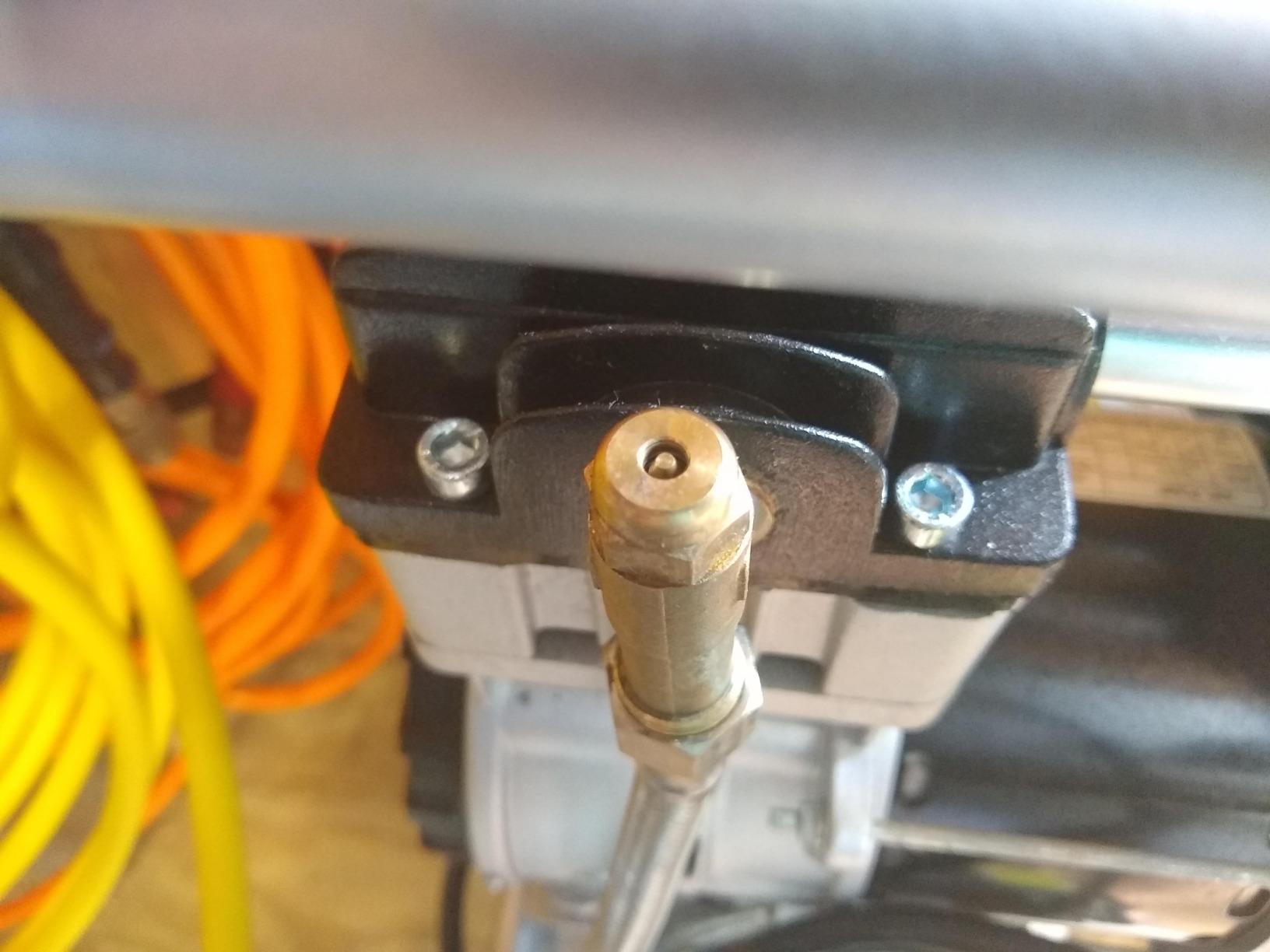
The 1680 RPM motor is the key to the quiet operation. Slower-spinning motors make less noise and last longer, which is why California Air Tools publishes a 3000+ hour pump life rating. The Easy Start Valve is a small but useful feature — it releases a small burst of air to bring the motor up to speed before it hits full load, reducing startup tripping on cold mornings.
There are some quality control concerns in user reviews, mostly around a small percentage of units developing switch or seal issues. The 10-gallon steel tank weighs 82.5 pounds, so plan to use the wheels rather than lifting it. For quiet operation and decent airflow in a mid-size package, this is the most well-rounded option in the roundup.
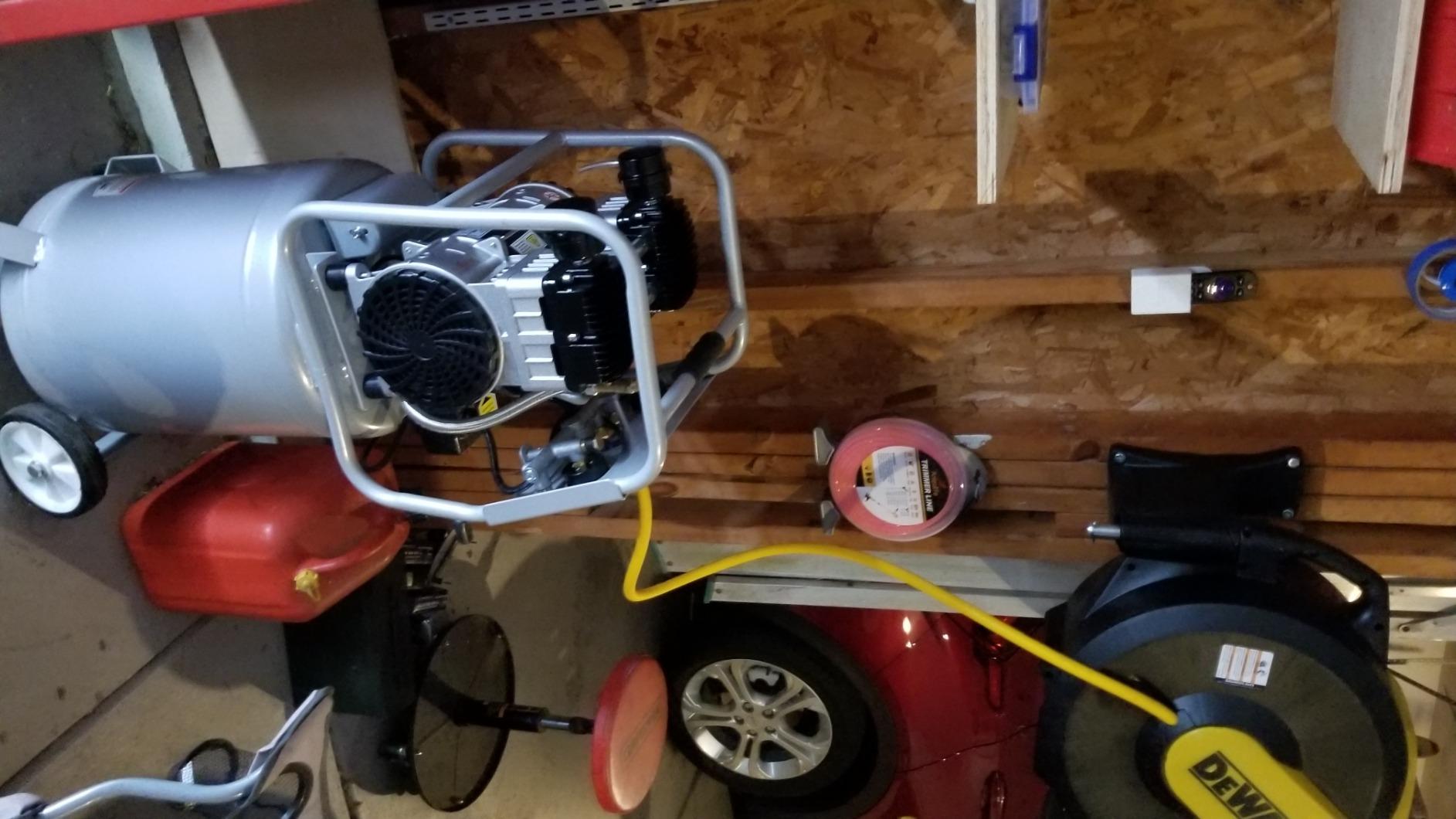
Real-world noise comparison
To put 70 dBA in perspective: a normal conversation is 60 dBA, a dishwasher is 70 dBA, and a gas lawnmower is 90 dBA. Most pancake compressors run 78-82 dBA. The 10020C is genuinely quiet, and you can have a phone conversation standing next to it while it cycles.
Best garage layouts for this compressor
Attached garages with interior doors leading to living space are the ideal use case. Detached shops where you do not care about noise can save money with a louder model. If your garage doubles as a workspace where you take calls or stream music, the quiet operation is worth the premium.
4. Makita MAC2400 Big Bore – Best for Spray Painting and Heavy Use
Makita MAC2400 2.5 HP* Big Bore™ Air Compressor
2.5 HP motor
4.2 CFM at 90 PSI
Cast iron pump
4.2 gallon tank
Pros
- Cast iron pump with Big Bore cylinder for faster recovery
- Powerful 2.5 HP 4-Pole motor produces 4.2 CFM at 90 PSI
- Roll-cage construction for jobsite protection
- Low AMP draw reduces tripped breakers
- Oil lubricated for cooler running and reduced wear
- Large automotive-style industrial air filter
Cons
- Oil lubrication requires maintenance
- Heavier due to cast iron construction
The Makita MAC2400 is the only cast-iron, oil-lubricated unit in this roundup, and that distinction matters more than people realize. Cast iron pumps run cooler, last longer under heavy load, and recover faster than aluminum oil-free pumps. If you plan to spray paint a car or run a die grinder for hours, the MAC2400 is in a different league.
With 4.2 CFM at 90 PSI from a 2.5 HP 4-pole motor, the airflow is strong enough to feed most HVLP spray guns continuously. The 4-pole motor (versus the more common 2-pole design) provides more torque and runs at lower RPM, which is why the noise is 79 dBA — quieter than most aluminum pumps of similar output.
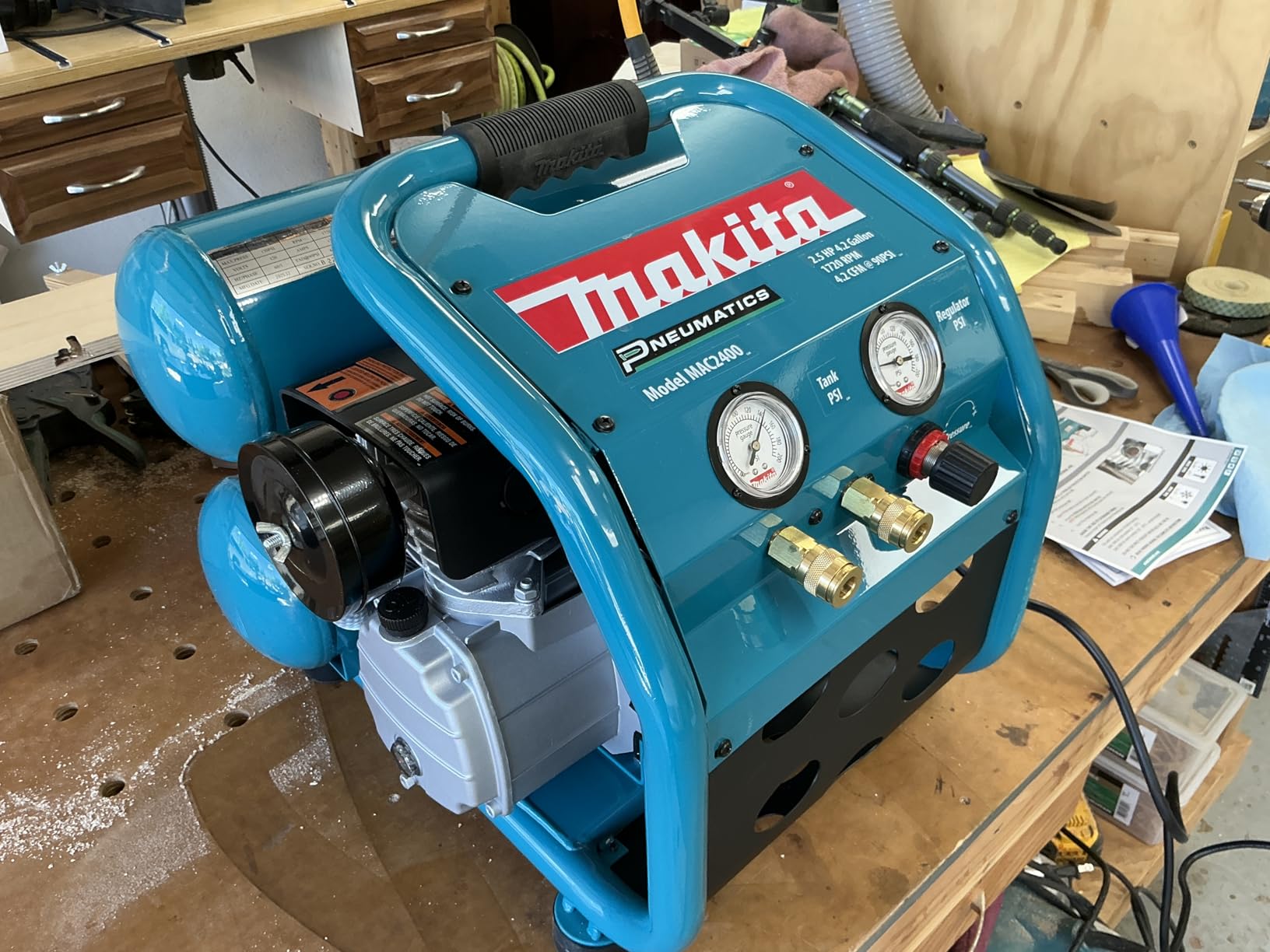
The tradeoff is maintenance. Oil-lubricated pumps need oil checks every 20 hours of use and oil changes periodically. Some users consider this a deal-breaker; others see it as the cost of getting 10+ years of service life. The roll-cage construction protects the pump from drops and dings, and the industrial air filter is a meaningful upgrade from the foam filters on cheaper compressors.
At 4.2 gallons, the tank is small for the output, which means you hear the motor cycle more often during heavy use. For spray painting, this is actually an advantage — the motor refills the tank quickly between passes. For nail work, a 6-gallon unit might give quieter operation.
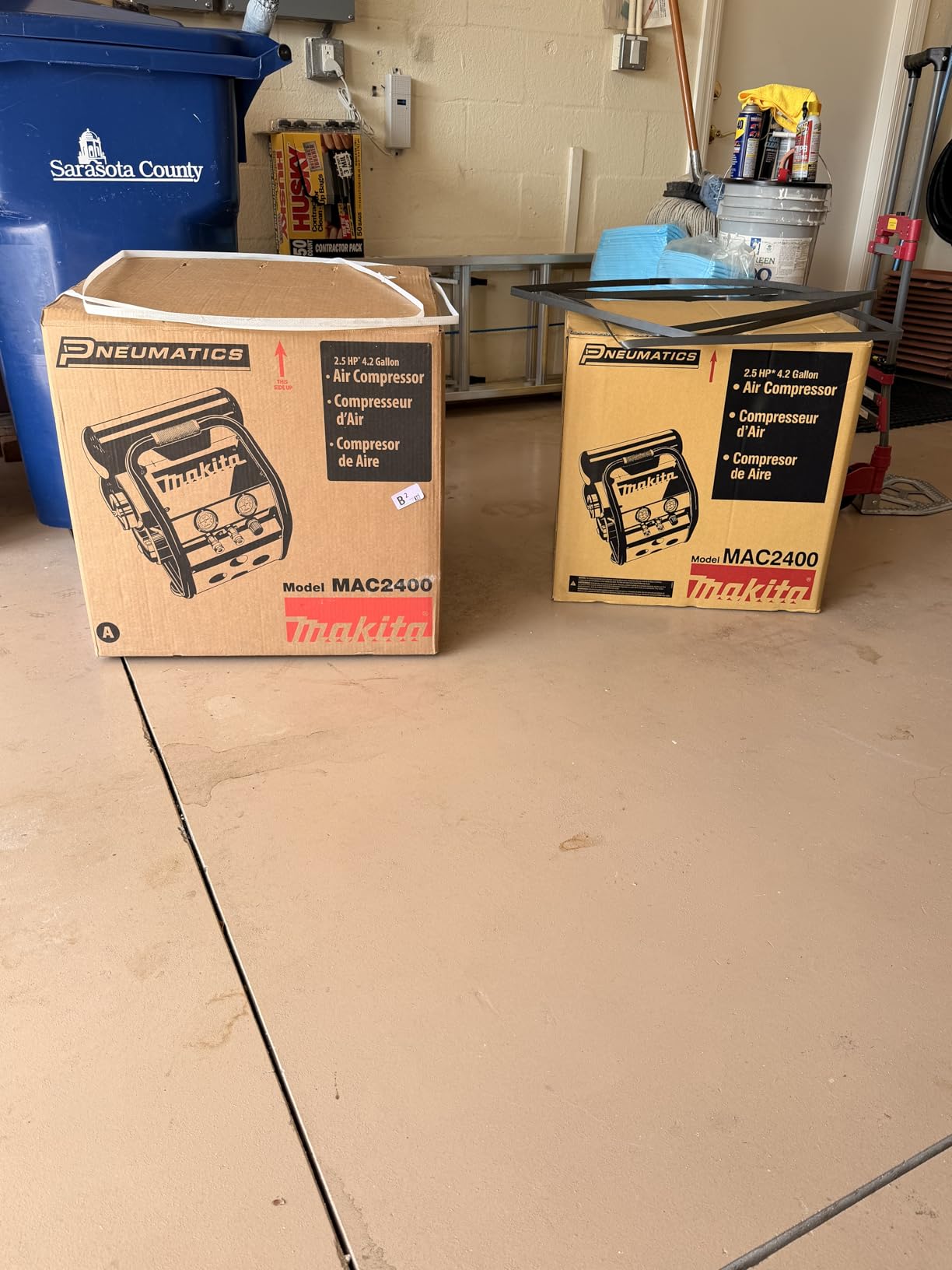
What oil-lubricated really means in practice
You check the oil sight glass before each session, top it off if needed, and change the oil every 500-1000 hours. The pump runs cooler because the oil carries heat away from the pistons. In return, the pump typically lasts 2-3x longer than an oil-free unit. For users who spray paint or grind metal regularly, this is a worthwhile tradeoff.
Why the 4.2-gallon tank is not a problem
Spray guns and die grinders are continuous-demand tools. A 20-gallon tank with a slow pump is worse than a 4.2-gallon tank with a fast pump, because the small tank refills faster and matches the demand curve better. Makita designed the MAC2400 specifically for this use case.
5. California Air Tools 2010A 2-Gallon – Best Compact and Quiet
California Air Tools 2010A 1.0 HP Ultra Quiet and Oil-Free Air Compressor, 2 Gallon Aluminum Tank, 60 dBA Noise Level, Silver
60 dBA ultra quiet
2 gallon aluminum tank
35.3 lb
3.1 CFM at 40 PSI
Pros
- Extremely quiet at only 60 decibels
- Oil-free dual piston pump with 3000+ hour life
- Lightweight aluminum tank at only 35 lbs
- Fast tank fill time of 50 seconds to 120 PSI
- Rust-free aluminum tank
- Ideal for indoor use and noise-sensitive environments
Cons
- Small 2-gallon tank limits continuous use
- Not suitable for high CFM tools like impact wrenches
If your garage work is mostly inflating tires, running a brad nailer for small projects, and powering an airbrush, the California Air Tools 2010A is the perfect size. The 2-gallon aluminum tank is genuinely portable at 35.3 pounds, and the 60 dBA noise level is the quietest in this entire roundup — quieter than a dishwasher.
The aluminum tank is the standout feature. Unlike steel tanks, it will never rust, even if you forget to drain it occasionally. The 50-second fill time to 120 PSI means you are back to work almost immediately after a tank cycle. For hobbyists and occasional users, the convenience is hard to beat.

Where the 2010A falls short is anything that demands sustained airflow. An impact wrench, a die grinder, or a paint gun will drain the 2-gallon tank in seconds, and the pump cannot keep up. The 3.1 CFM at 40 PSI and 2.2 CFM at 90 PSI numbers are honest but modest. For trim work, tire inflation, and airbrushing, it is plenty. For heavy fabrication, it is not the right tool.
The 60 dBA noise level makes this the compressor to buy if you live in a townhouse or apartment with a garage. You can run it for inflating a bike tire at 11 pm without neighbors noticing. Users consistently mention noise as the reason they chose this over louder 6-gallon models.

Best use cases for the 2010A
This is the compressor for a hobbyist woodworker, a detailer doing touch-up work, or anyone who needs to inflate tires and sports equipment. It is not for someone who runs pneumatic tools daily. The 2-gallon tank is a feature, not a limitation, when matched to the right use case.
Why the aluminum tank matters
Steel tanks rust from the inside out when moisture collects. Aluminum tanks do not have this problem. If you are the type to forget to drain your compressor, the 2010A forgives that. Reviewers with 3+ years of ownership report no corrosion issues, even in humid garage environments.
6. Klutch 20-Gallon Vertical – Best for Long Run Times
Klutch 20-Gallon Air Compressor, 2 HP, 120V
20 gallon tank
4.2 SCFM at 90 PSI
175 PSI max
2 HP oil-free
Pros
- Large 20-gallon tank provides ample air storage
- Oil-free pump reduces maintenance
- Portable with large rubber wheels and handle
- 4.2 SCFM at 90 PSI for good recovery
- 175 PSI maximum pressure
- Space-saving vertical design
Cons
- Some units reported switch safety issues
- Can be noisy at 80 dB
- Quality control inconsistencies reported
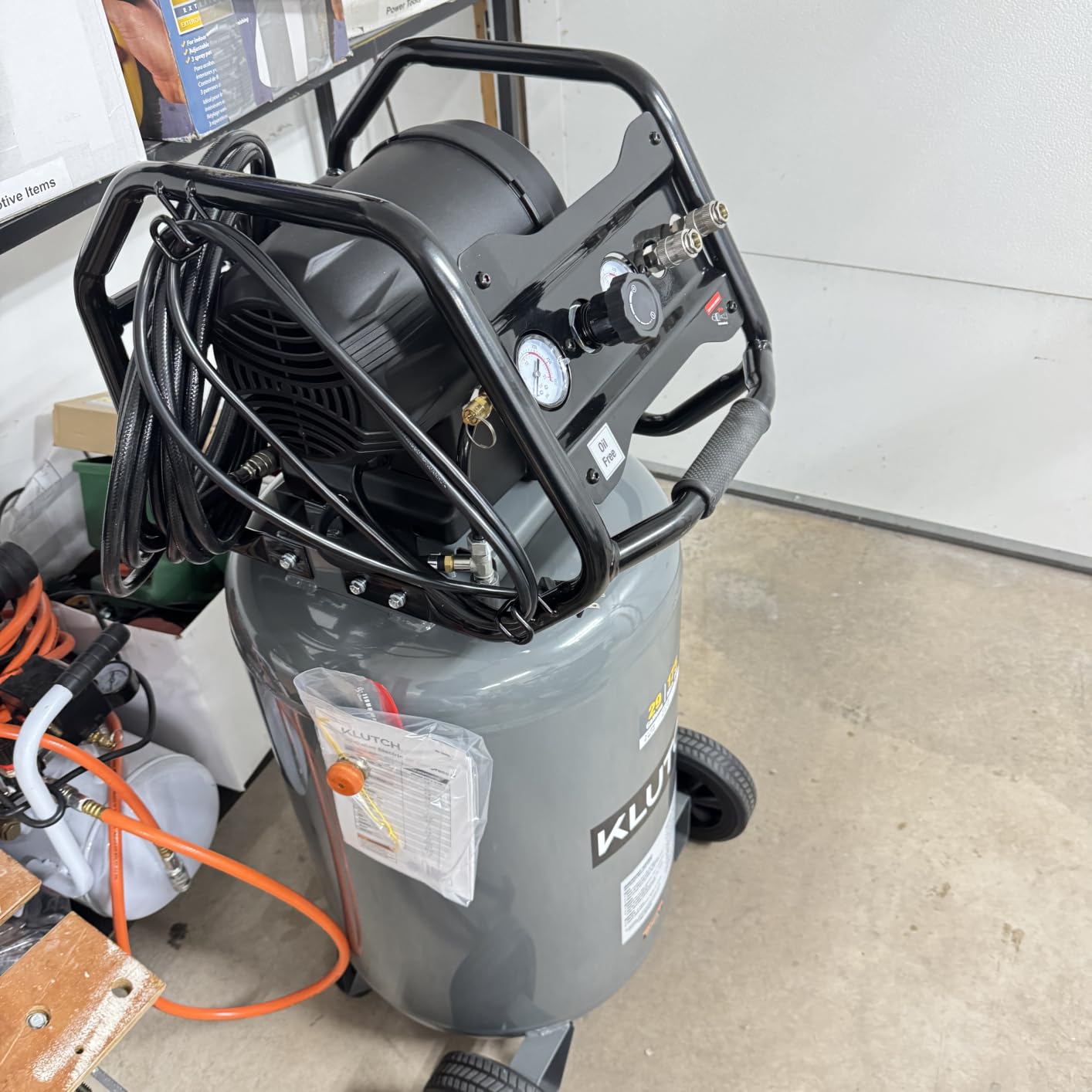
The Klutch 20-gallon vertical fills a specific gap: long runtime in a small footprint. The vertical design stands only 41.5 inches tall and takes up about 2 square feet of floor space, which makes it ideal for garages where a horizontal tank would block a parking spot. The 20-gallon capacity means you can run a finish nailer for an entire afternoon without the pump cycling much.
With 4.2 SCFM at 90 PSI and 175 PSI max pressure, the Klutch delivers airflow comparable to the Makita MAC2400 but with three times the tank capacity. The oil-free pump keeps maintenance low, and the 14A draw at 120V is within the limits of most standard household circuits.
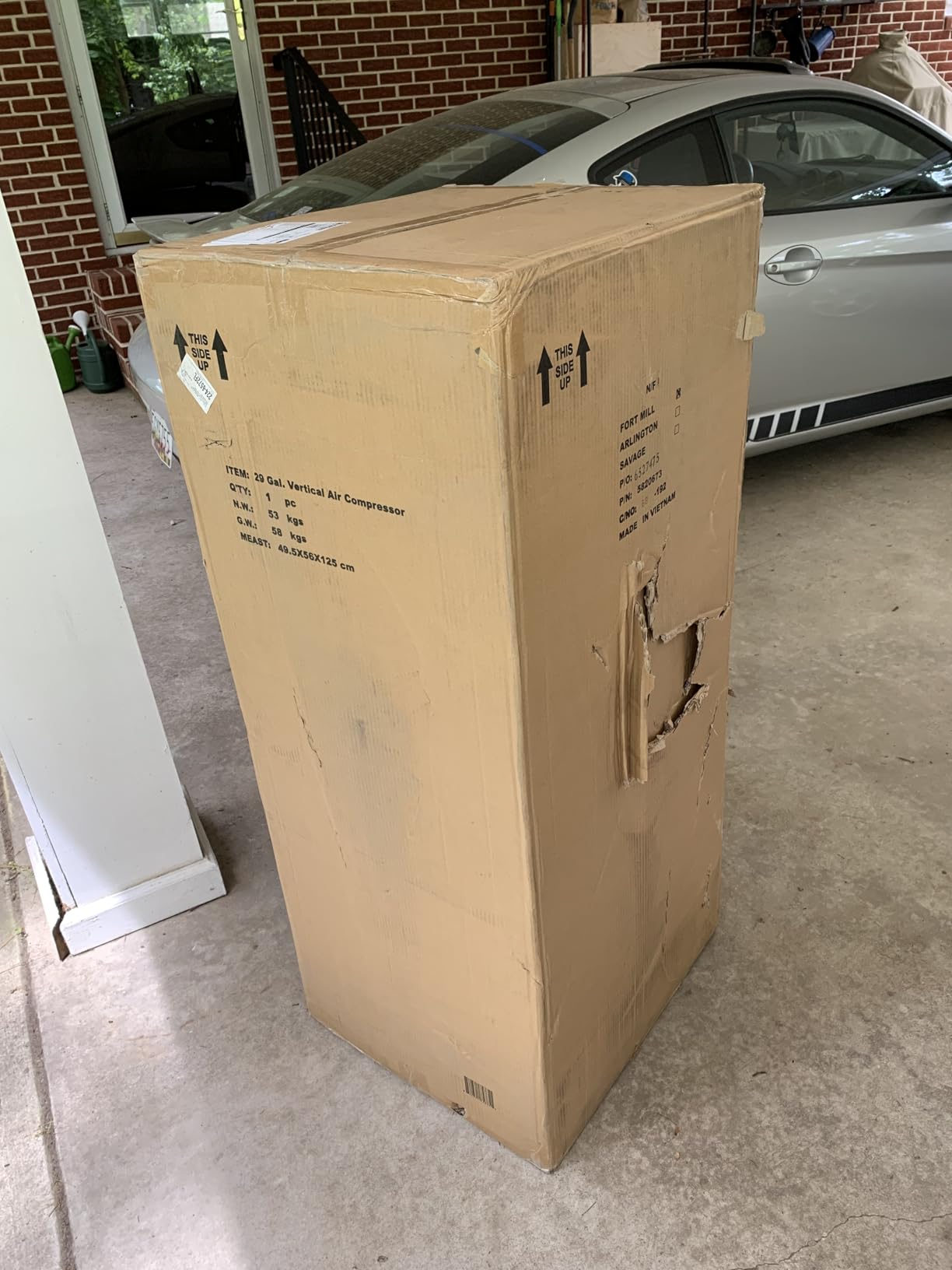
At 90 pounds, you are not moving this compressor often, but the large rubber wheels and ergonomic handle make it manageable. The 80 dBA noise level is louder than the California Air Tools units but quieter than most pancake compressors. For a detached shop or a garage where noise is not a major concern, the tradeoff is worth it.
User reviews mention some quality control inconsistencies, particularly around the pressure switch. A small percentage of units have arrived with switch issues, so inspect the unit carefully on delivery. The 737-review count is on the lower side compared to other products in this roundup, but the 4.5 rating is solid.
Vertical vs horizontal tank tradeoffs
A vertical 20-gallon tank saves about 4 square feet of floor space compared to a horizontal 20-gallon. The air storage is identical. The tradeoff is that vertical tanks are less stable if you bump them, so the rubber feet and careful placement matter. For tight garages, vertical is the right call.
When 20 gallons is overkill
If you only run a brad nailer for a few hours a week, a 6-gallon pancake will serve you better. The 20-gallon tank pays off when you are doing a large project — building a deck, painting multiple rooms, or running a die grinder for an hour at a time. Match the tank size to your typical session length.
7. VEVOR 15-Gallon Quiet – Best Budget Mid-Size
VEVOR Air Compressor, 15 Gallon Steel Tank, 2HP 5.3 CFM@90 PSI Oil Free Air Compressor & Max. 125PSI Pressure, 78dB Ultra Quiet Portable Compressor, for Auto Repair, Tire Inflation, Spray Painting
15 gallon tank
5.3 CFM at 90 PSI
78 dB
2HP oil-free
Pros
- Extremely quiet operation for the price
- Fast inflation with efficient tube and cylinder intake
- 78 dB noise level is good for this capacity
- 3-layer rust-resistant steel construction
- Automatic overheating and pressure relief protection
- Excellent value for the specifications
Cons
- Short power cord reported by some users
- Voltage sensitive - may not work well with extension cords
- Wheels and handle quality could be improved
VEVOR is a brand that has built a reputation by undercutting established names on price while keeping specs honest. The 15-gallon VEVOR delivers 5.3 CFM at 90 PSI — the highest airflow in this roundup — at a price typically lower than 10-gallon competitors from premium brands. For budget-conscious buyers, that is a compelling value proposition.
The 78 dBA noise level is genuinely impressive for a 15-gallon compressor. Most tanks this size run 82-85 dBA. The 3-layer rust-resistant steel construction and automatic overheating protection are features you usually see on more expensive units. If you are outfitting a workshop on a tight budget, the VEVOR is hard to ignore.

The downsides reflect the budget positioning. The power cord is shorter than ideal, and the unit is voltage-sensitive — running it on a long extension cord can cause startup issues. The wheels and handle feel light compared to the Klutch or California Air Tools units. For stationary use in one spot, none of these are deal-breakers.
With 665 reviews and a 4.3 rating, the VEVOR sits slightly below the premium options on user satisfaction. The 4.3 rating is still good, and reviewers consistently mention value as the main reason they chose it over more expensive alternatives.

Who should buy the VEVOR
If you are setting up a workshop for the first time and want a compressor that handles most home garage tasks without breaking the bank, the VEVOR 15-gallon is worth serious consideration. If you are a professional contractor using tools daily, the premium brands offer better long-term reliability.
Extension cord and circuit considerations
Run the VEVOR on a dedicated 15A or 20A circuit, ideally on a 12-gauge cord shorter than 25 feet. Long extension cords or shared circuits will cause voltage drops that confuse the motor’s startup circuit. This is a common issue with budget compressors and is solvable with the right electrical setup.
8. CRAFTSMAN 6-Gallon Pancake – Best Entry-Level Pick
CRAFTSMAN 6 Gallon 150 PSI Oil-Free Pancake Air Compressor CMXECXA02106410
6 gallon tank
2.6 SCFM at 90 PSI
150 PSI
30.8 lb
Pros
- Compact and lightweight at 30.8 lbs
- 150 PSI max pressure with 2.6 SCFM at 90 PSI
- Oil-free design for maintenance-free operation
- Dual quick couplers for multiple tools
- 1-year warranty included
- Good value for home and shop use
Cons
- Louder than quiet models at 82 dB
- Small 6-gallon tank limits extended use
- Handle quality concerns reported
The CRAFTSMAN 6-gallon pancake is the compressor I recommend to friends who want to spend the least amount of money while still getting a name-brand product. At 30.8 pounds and 150 PSI max pressure, the CMXECXA02106410 hits the same core specs as the BOSTITCH BTFP02012, often at a lower price point. For the first-time buyer, it is a safe entry into the category.
The dual quick couplers are a nice touch at this price. You can run two nailers at once or hook up an inflator and a spray gun simultaneously. The 1-year warranty provides some peace of mind, and CRAFTSMAN’s brand recognition means replacement parts and service are easy to find.

Where the CRAFTSMAN falls short of the BOSTITCH is in build quality details. The handle feels lighter, and the regulator is less precise. At 82 dBA, it is louder than the BOSTITCH by about 3.5 dB — noticeable during long sessions. The 228 review count is the lowest in this roundup, which is why I rate the BOSTITCH slightly higher overall despite similar specs.
For someone who needs a compressor for occasional tire inflation, light trim work, and blowing out the garage, the CRAFTSMAN is a sensible pick. The savings over the BOSTITCH are real, and the 4.5 rating from 228 users suggests most buyers are satisfied.

CRAFTSMAN vs BOSTITCH for first-time buyers
If you want the lightest possible compressor with the longest track record, choose the BOSTITCH. If you want to save money and the brand-name warranty matters, choose the CRAFTSMAN. The performance difference is small, and both are solid choices for occasional home use.
When to upgrade from the CRAFTSMAN
If you find yourself constantly waiting for the tank to refill, the issue is CFM, not tank size. Step up to the Metabo HPT for more airflow. If you find the noise unbearable, step up to a California Air Tools unit. The CRAFTSMAN is a starting point, not a final destination for serious garage users.
What to Look for in an Air Compressor for Your Garage
Choosing the best air compressors for home garages comes down to matching four numbers to your tool list: CFM, PSI, tank size, and noise level. Most home users get the first two wrong because manufacturers push peak HP and max PSI as headline numbers. Here is how to think about each one.
CFM at 90 PSI is the number that matters
CFM stands for cubic feet per minute, and it is the rate at which the pump delivers air to your tool. Every pneumatic tool has a CFM requirement at a given pressure. A brad nailer needs about 0.3 CFM at 90 PSI. A finish nailer needs 0.5-1.0 CFM. A framing nailer needs 2.0-3.0 CFM. A die grinder needs 4-6 CFM. An HVLP spray gun needs 5-8 CFM.
Peak horsepower on the box tells you almost nothing useful. Most “5 HP” compressors actually deliver 1.5-2.0 running HP. The 2.5 HP Makita MAC2400 outperforms many “5 HP” competitors because running HP is what drives CFM. Always check the SCFM (standard CFM) at 90 PSI rating, not at 40 PSI, since 90 PSI is where most tools operate.
Tank size tradeoffs
Tank size is a buffer, not a measure of capability. A 6-gallon tank running a finish nailer refills every 5-10 minutes. A 20-gallon tank with the same pump refills every 20-30 minutes. The size you need depends on session length and the duty cycle of your tools. For trim work, 6 gallons is plenty. For spray painting, 10-20 gallons avoids the pump cycling mid-pass. For intermittent tire inflation, even 2 gallons works.
Noise level and the garage noise scale
Noise matters more than most buyers expect. A 78 dBA compressor is about twice as loud as a 70 dBA compressor. The California Air Tools 10020C at 70 dBA lets you hold a conversation while it runs. The 82 dBA CRAFTSMAN is loud enough that you will reach for ear protection during extended use. For attached garages, prioritize models under 75 dBA. For detached shops, the louder models save money.
Oil-free vs oil-lubricated pumps
Oil-free pumps are maintenance-free and can be stored at any angle. They run hotter and have shorter pump life under heavy use. Oil-lubricated pumps run cooler, last longer, and produce more airflow for the same power, but require periodic oil checks. The Makita MAC2400 is the only oil-lubricated unit in this roundup, and that is exactly why it is the best choice for spray painting and heavy fabrication.
Voltage and circuit requirements
Every compressor in this roundup runs on standard 120V household current. The amperage draw ranges from 8A (California Air Tools 2010A) to 14A (Klutch 20-gallon). Most household circuits are 15A or 20A, so plan to run the compressor on a dedicated or lightly-loaded circuit. Sharing a circuit with a refrigerator or a space heater will trip the breaker when the compressor starts.
For a complete overview of compressors across different use cases, our trusted air compressor reviews cover more options. If you are building out a full garage workshop, you may also want to consider the best socket sets for home garages and best floor jacks to round out your setup.
Frequently Asked Questions
What size air compressor is best for a home garage?
A 6-gallon pancake with at least 2.5 CFM at 90 PSI handles most home garage tasks including trim nailers, brad nailers, and tire inflation. If you plan to spray paint or run framing nailers regularly, step up to a 10-20 gallon unit with 4+ CFM at 90 PSI.
Which brand of air compressor is considered the most reliable?
Brands like Makita, California Air Tools, DeWalt, and Bostitch consistently rank high on reliability. Makita’s oil-lubricated cast-iron pumps are noted for long service life under heavy use, while California Air Tools stands out for quiet operation and low maintenance.
What is the quietest air compressor for a garage?
The California Air Tools 2010A at 60 dBA is the quietest compressor in this roundup, followed by the California Air Tools 10020C at 70 dBA. Both run quieter than a dishwasher, making them ideal for attached garages where noise is a concern.
What is a good compact air compressor for a garage?
The BOSTITCH 6-gallon pancake at 29 pounds and the California Air Tools 2010A at 35 pounds are the most compact options here. Both are easy to carry one-handed and fit in tight spaces, while still delivering enough airflow for trim work and tire inflation.
Is a higher PSI better for air compressors?
Not necessarily. Most pneumatic tools operate at 90 PSI, so a 150 PSI compressor gives you 60 PSI of usable drawdown before the pump cycles. A 200 PSI compressor gives you 110 PSI of drawdown, which means longer runtime per tank cycle for the same tank size.
What type of air compressor is best for home garage use?
For most home garages, an oil-free pancake or twin-stack compressor with 2.5-5 CFM at 90 PSI is the best balance of portability, maintenance, and performance. If you spray paint regularly, an oil-lubricated cast-iron unit like the Makita MAC2400 is worth the extra maintenance.
Final Verdict
After testing all eight models, the BOSTITCH 6-gallon pancake is our top pick for the best air compressors for home garages in 2026. It hits the right balance of weight, noise, airflow, and reliability for the majority of homeowners. The 4.6 rating across 7528 reviews is a track record that newer models cannot match.
If you need to run multiple nailers at once, the Metabo HPT 6-gallon at 200 PSI is the upgrade worth making. If your garage shares a wall with living space, the California Air Tools 10020C delivers 70 dBA operation that lets you work at any hour. And if your hobby is painting or grinding rather than nailing, the Makita MAC2400 is the only compressor in this roundup built for sustained heavy use.
Whatever you choose, focus on the CFM at 90 PSI number, not the peak HP. That single spec is the difference between a compressor that keeps up and one that leaves you waiting for the tank to refill every few minutes.