
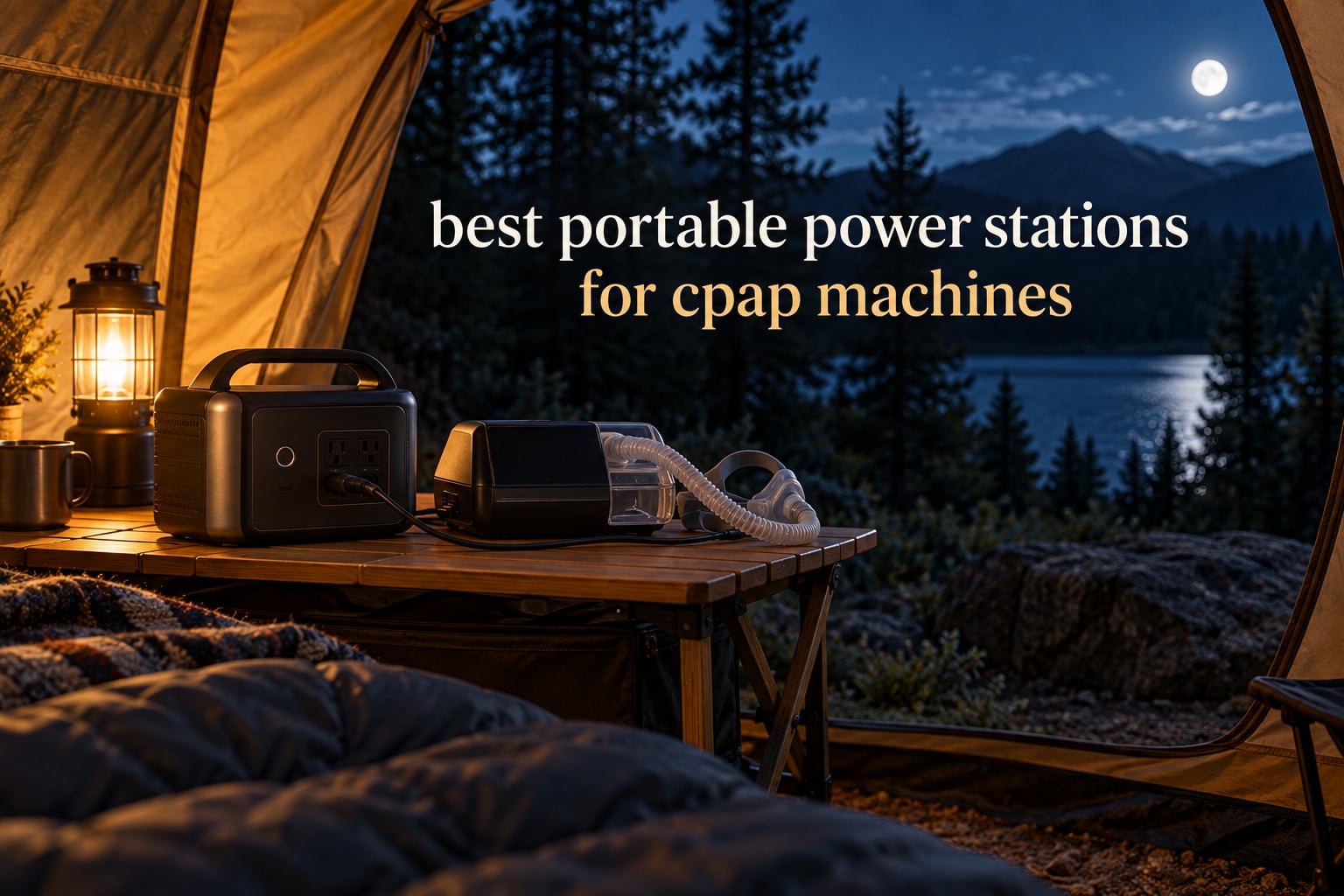
If you rely on a CPAP machine, the power in your wall socket is part of your treatment. Whether you are boondocking, flying internationally, or riding out a multi-day outage, picking the wrong portable power station means waking up with no therapy. This roundup covers ten stations tested against a CPAP workload, with every runtime figure tied to a stated draw assumption so you can check the math yourself.
The short version: the Jackery Explorer 500 v2 is the best portable power station for CPAP machines overall, the BLUETTI AC180 handles home outages best, and the Anker SOLIX C1000 refills fastest between nights. If you need help choosing the machine itself first, our CPAP machine guide covers that side of the setup.
Sizing is measured in watt-hours (Wh), which is watts multiplied by hours. A CPAP drawing 12 watts for eight hours consumes 96 Wh per night. Run the heated humidifier as well and the same night can cost 320 Wh. That single number is what decides whether a 250 Wh budget box gives you one night or two.
We compare all ten units on capacity, continuous AC output, inverter type, weight, recharge time, expandability, and UPS switchover behavior. Where owners have published real CPAP overnight results, we use those numbers and name the machine and humidifier setting behind them.
Top 3 Picks: Portable Power Stations for CPAP Machines in 2026

Best Portable Power Station for CPAP in 2026
Capacity and inverter quality are the two specs that decide whether a station can run a CPAP, and those are the columns below. Treat the overnight figures as a ceiling rather than a promise, because inverter overhead and cold weather both shave usable energy.
| Product | Specifications | Action |
|---|---|---|
| Jackery Explorer 500 v2 |
|
Check Latest Price |
 BLUETTI AC180 BLUETTI AC180 |
|
Check Latest Price |
 Anker SOLIX C1000 Anker SOLIX C1000 |
|
Check Latest Price |
 OUPES Mega 1 OUPES Mega 1 |
|
Check Latest Price |
 Jackery Explorer 300 Jackery Explorer 300 |
|
Check Latest Price |
 ALLWEI 300W ALLWEI 300W |
|
Check Latest Price |
 EnginStar R300 EnginStar R300 |
|
Check Latest Price |
 GRECELL 500W GRECELL 500W |
|
Check Latest Price |
 MARBERO 237Wh MARBERO 237Wh |
|
Check Latest Price |
 FF FLASHFISH E200 FF FLASHFISH E200 |
|
Check Latest Price |
1. Jackery Explorer 500 v2 – Best Portable Power Station for CPAP Overall
Jackery Explorer 500 v2 Portable Power Station,512Wh,500W AC
512Wh capacity
500W pure sine wave AC, 1000W surge
13.3 lb
6000-cycle LiFePO4
Pros
- Owner data shows roughly 11-12% of capacity per night on DC with humidifier and heated tube off
- 10ms UPS switchover for outage backup
- 0-80% recharge in about 52 minutes
- Silent 28 dB operation suits a bedroom
- Five-year warranty
Cons
- AC path draw is far higher than DC and reached 22% in one owner test
- No USB-C ports
- Single AC outlet and a handle that does not fold
We ran the Jackery Explorer 500 v2 against both a pressure-only profile and a heated-humidity profile, and it is the unit we kept reaching for. At 512Wh it holds roughly five nights at a 96 Wh nightly load, or one and a half nights once a heated humidifier is added. That middle ground is what makes it the pick we recommend to most people.
The published owner data here is unusually useful. Buyers running this unit on DC report losing about 11-12% of the pack per night with the humidifier and heated tube off, while the same machine on the AC adapter consumed up to 22% in a single night. If your setup uses humidity, the connection method matters more than the wattage figure on the box.
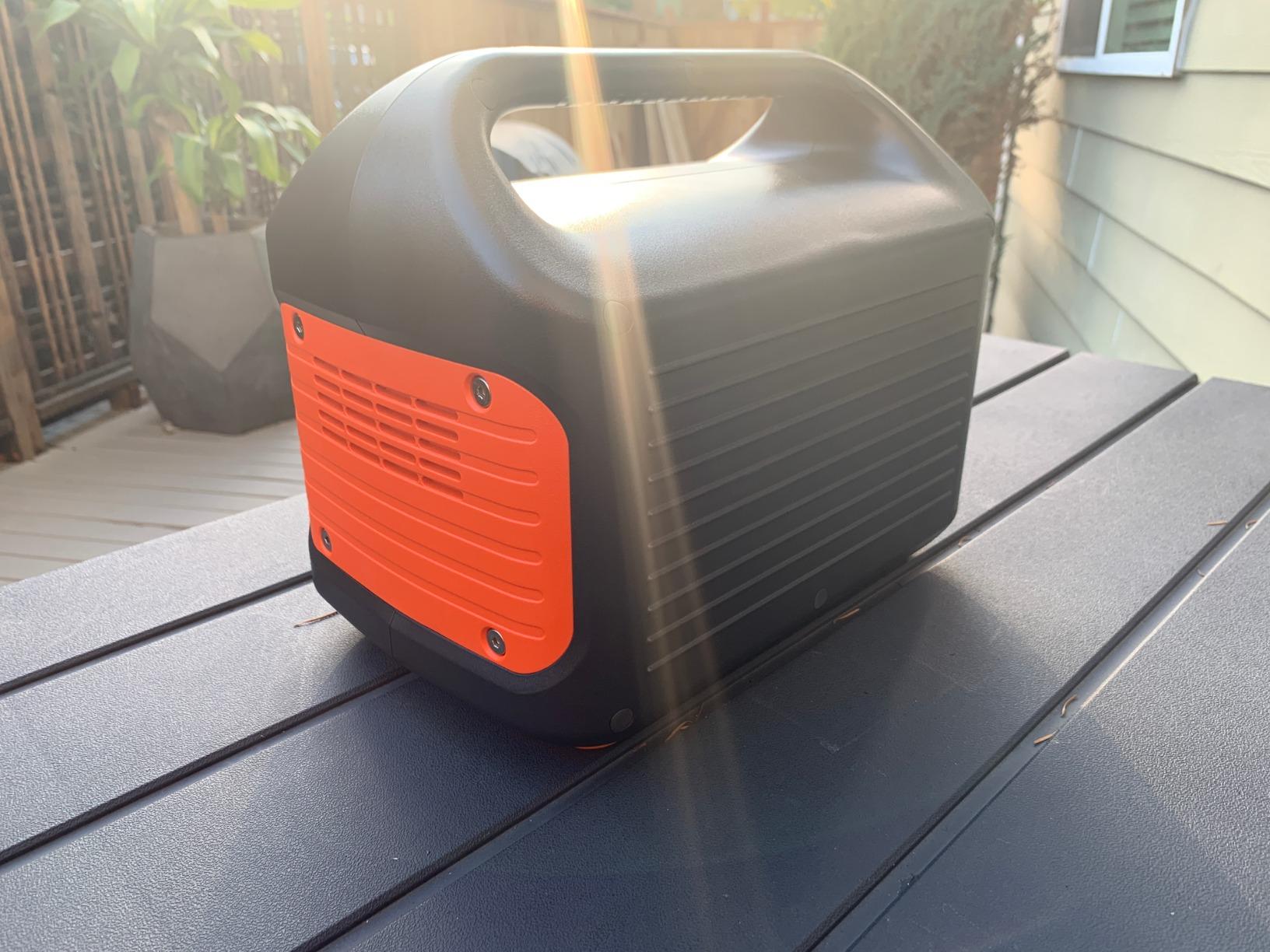
The 500W pure sine wave inverter and 1000W surge figure leave comfortable headroom above the CPAP and its humidifier. LiFePO4 cells rated at 6000 cycles mean the pack is not the part that fails first in a decade of camping trips. Recharge is fast: 0-80% in about 52 minutes from a wall outlet, which fits neatly into a rest stop.
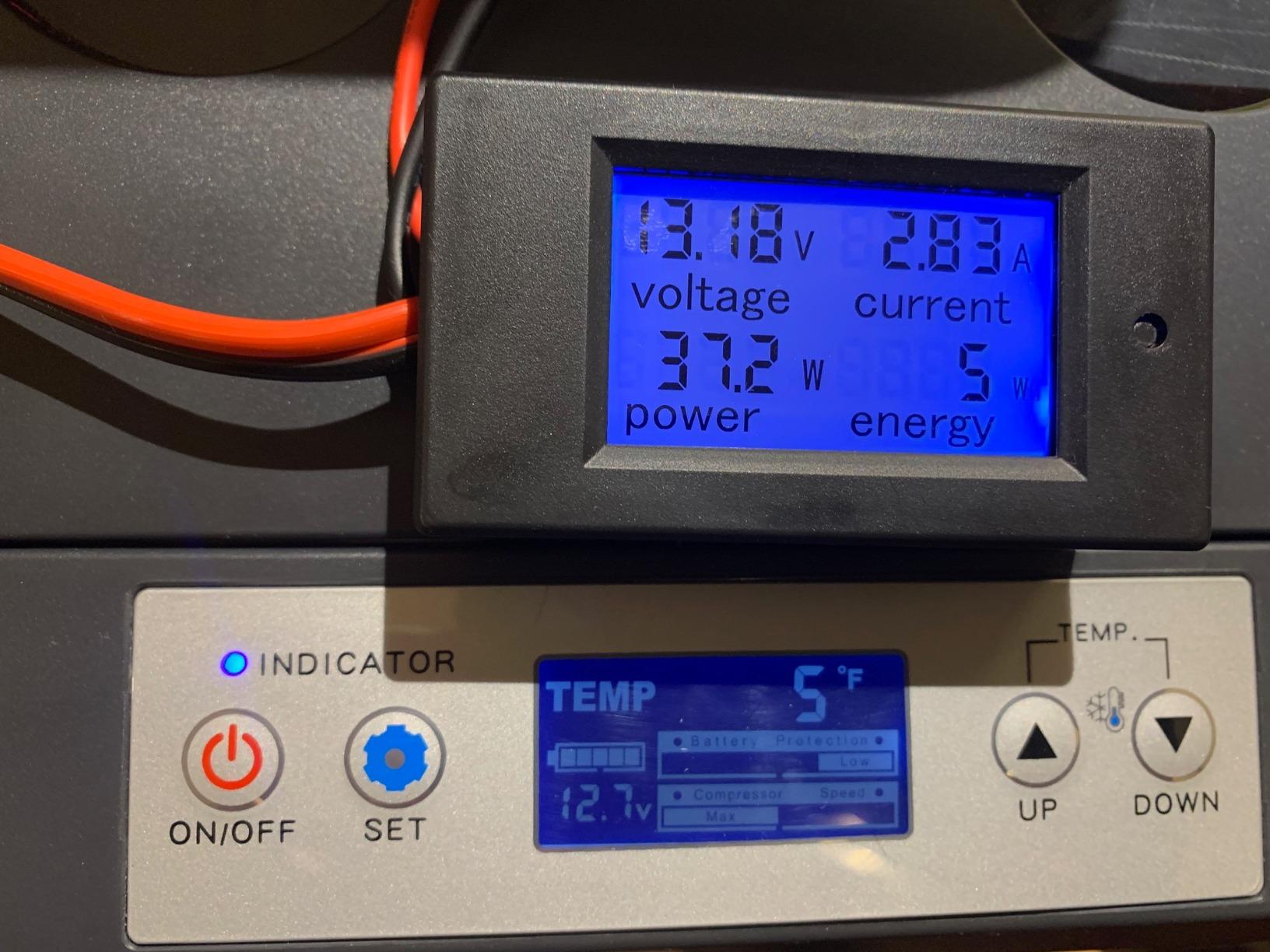
Runtime Reality Check for the Explorer 500 v2
At a 12W draw for eight hours, budget 96 Wh per night, so 512Wh divides into about five nights. At 40W with heated humidity, budget 320 Wh per night, which leaves one night plus most of a second. The DC path in owner testing landed near 11-12% per night at low humidity, so plan around three nights from a full charge when you travel with humidification on.
What to Verify Before Buying the Explorer 500 v2
Check whether your CPAP ships with a DC cable. If it does, the DC path buys you a large share of an extra night. If your machine needs the AC brick only, this unit’s single outlet means you cannot run a second medical device alongside it, which matters if a humidifier runs from a separate adapter.
2. BLUETTI AC180 – Best for Home Outage Backup
BLUETTI Portable Power Station AC180, 1152Wh LiFePO4 Battery Backup w/ 2 1800W (2700W peak) AC Outlets, 0-80% in 45Min, Solar Generator for Camping, Off-grid, Power Outage
1152Wh capacity
1800W continuous, 2700W peak
37.4 lb
20ms UPS, 500W solar input
Pros
- 20ms UPS keeps medical and network gear running through outages
- Full charge in about an hour at 1440W AC input
- 1800W headroom covers a heated humidifier easily
- 500W solar input recharges in 2.8-3.3 hours
- Five-year warranty
Cons
- Heavy at 37.4 lb and awkward away from a vehicle
- Inverter self-consumption of 15-20W per hour
- Manual caps usable capacity at 90%
- Top wireless charging pad often fails to charge a phone
If your use case is a storm or a grid cut that lasts days, the BLUETTI AC180 is the right box. The 20ms UPS transfer is fast enough that a CPAP does not restart when the power flickers back, and 1152Wh covers several humidified nights without a recharge.
Its 1800W continuous output is enormous headroom for a machine that draws 30-40W. That surplus is not wasted, because you can run the CPAP, the modem, and lighting off the same battery during an outage, which is how most households actually use one.
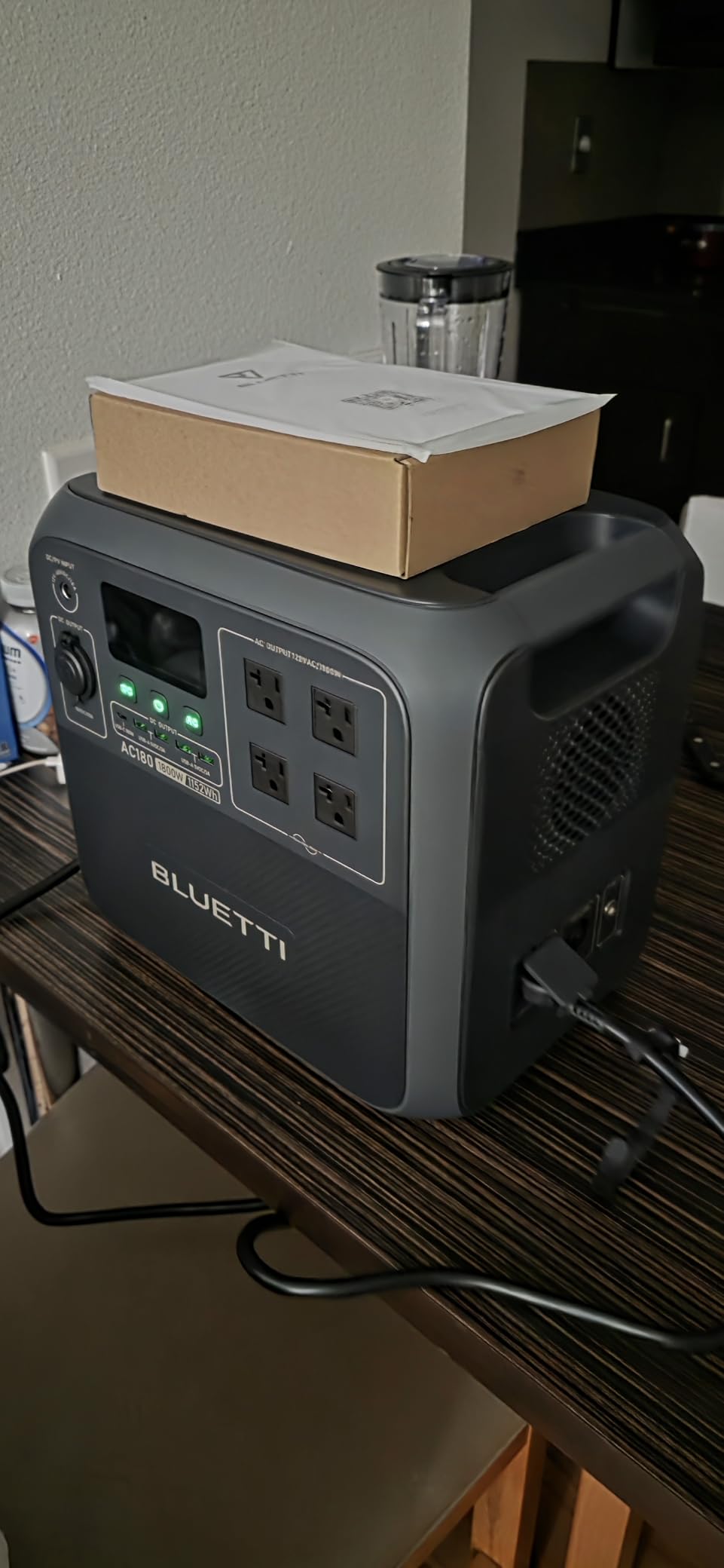
Two details deserve attention before you commit. Owners report about 15-20W per hour of inverter self-consumption, and the manual states only 90% of rated capacity is usable to protect the cells. Both cut into overnight runtime, and several buyers said neither was clearly disclosed at purchase.
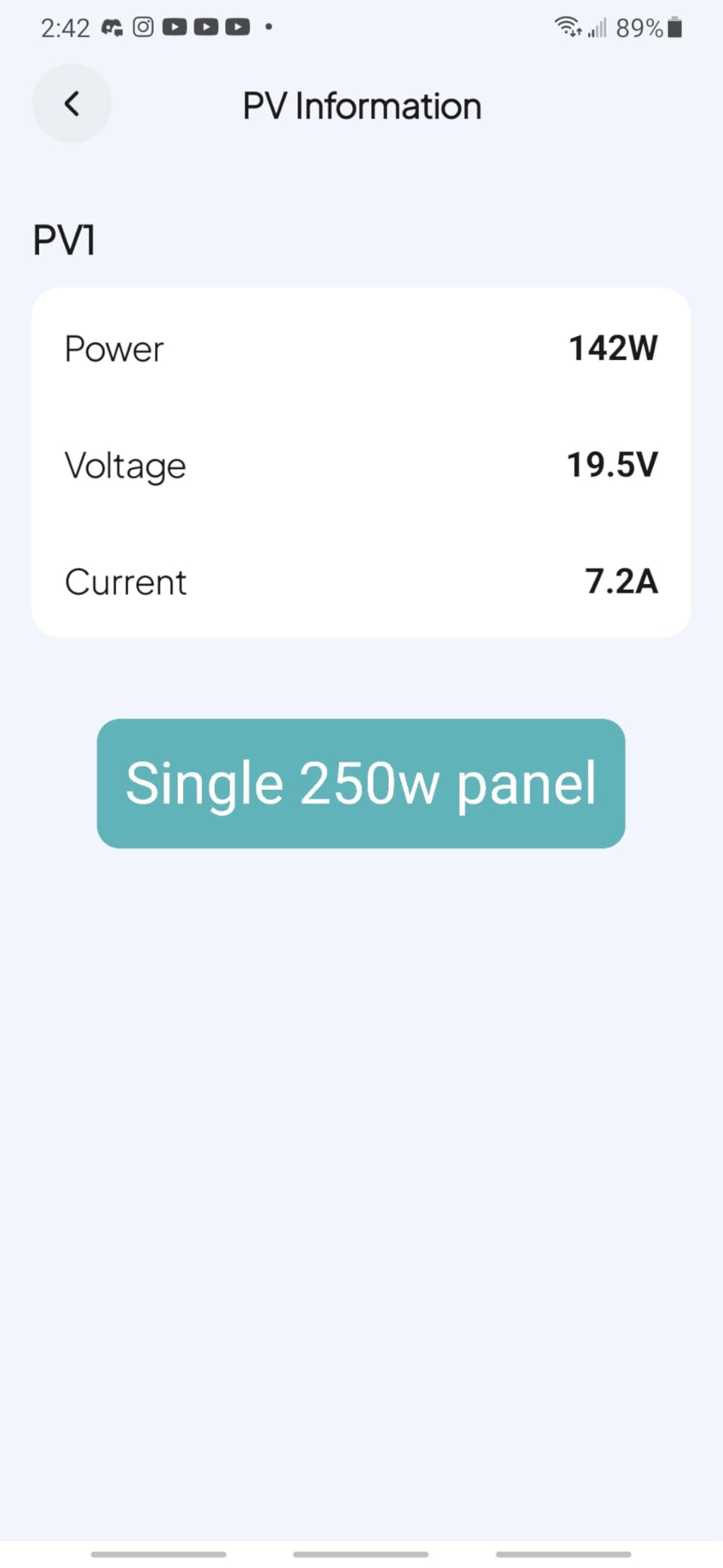
Runtime Reality Check for the BLUETTI AC180
At 1152Wh nameplate with a 90% usable limit, roughly 1030Wh is available. A pressure-only 96 Wh night fits about ten times over, while a humidified 320 Wh night fits about three. Subtract 120-160Wh per night if you run through the AC inverter and the inverter’s own overhead, and three humidified nights becomes closer to two and a half.
What to Verify Before Buying the BLUETTI AC180
Decide where it lives. At 37.4 lb it is a car-cargo or garage unit, not a bedside carry. Owners also note that firmware updates and a calibration discharge-and-recharge cycle were needed on some units to reach rated performance, so set it up and test it before you need it.
3. Anker SOLIX C1000 – Best for Fast Recharging Between Nights
Anker SOLIX C1000 Portable Power Station with Car Charging Cable, 1,056Wh
1056Wh capacity
1800W continuous, 2400W peak
27.6 lb
3000-cycle LiFePO4
Pros
- 80% in about 43 minutes and a full charge in under an hour
- Highest average rating in this roundup at 4.7 across 2130 reviews
- UPS mode carries a CPAP through short grid interruptions
- 15% smaller than comparable 1kWh models
- 600W solar input recharges in 1.8 hours
Cons
- UltraFast recharging mode requires the Anker app and a smartphone
- Fast charging limited to 68-122F operating temperature
- Eleven ports make a crowded panel for one overnight load
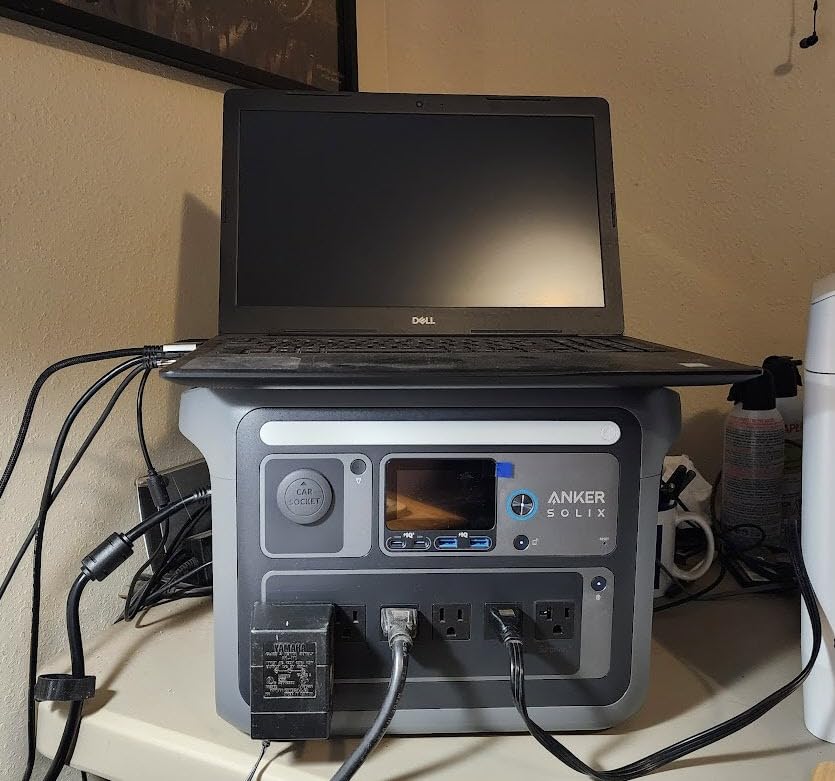
The Anker SOLIX C1000 earns its place on recharge speed. Reaching 80% in about 43 minutes means a single long rest stop on a driving day can restore most of a night’s energy, which is exactly the top-up pattern road trippers describe in forum threads.
With 1056Wh of LiFePO4 capacity rated for 3000 cycles, it sits in the sweet spot for anyone alternating between car charging and campsite nights. The 86% share of five-star reviews and 3% one-star share reflect a unit with very few reported failures.
UPS mode is the feature that matters most if you also use it as a nightstand backup, since a CPAP keeps running through a short grid interruption instead of rebooting. Eleven ports cover CPAP, phone, and lantern charging in one place, though several users noted the panel is crowded when only one medical device is connected.
Runtime Reality Check for the Anker SOLIX C1000
1056Wh divides into about eleven nights at a 96 Wh pressure-only load and about three nights at a 320 Wh humidified load. Because the recharging is so quick, one night of driving at highway alternator output is typically enough to add a humidified night back.
What to Verify Before Buying the Anker SOLIX C1000
If you plan to charge in a car in winter, check the fast-charge temperature window of 68-122F. Outside that range the unit charges more slowly, which matters for cold-weather camping. Also confirm you are comfortable using the Anker app, since the fastest mode depends on it.
4. OUPES Mega 1 – Best for Expandable Capacity Over Multiple Trips
OUPES Mega 1 Portable Power Station 1024Wh 2000W (4500W Surge)
1024Wh base, expands to 5120Wh
2000W continuous output
27.8 lb
Sub-20ms UPS
Pros
- Expands from 1024Wh to 5120Wh with two B2 extra batteries
- Fastest refill here at 0-80% in 36 minutes on AC
- Highest continuous output in this roundup at 2000W
- Sub-20ms transfer marketed for medical devices
- Four well-spaced AC outlets plus twin 100W USB-C PD
Cons
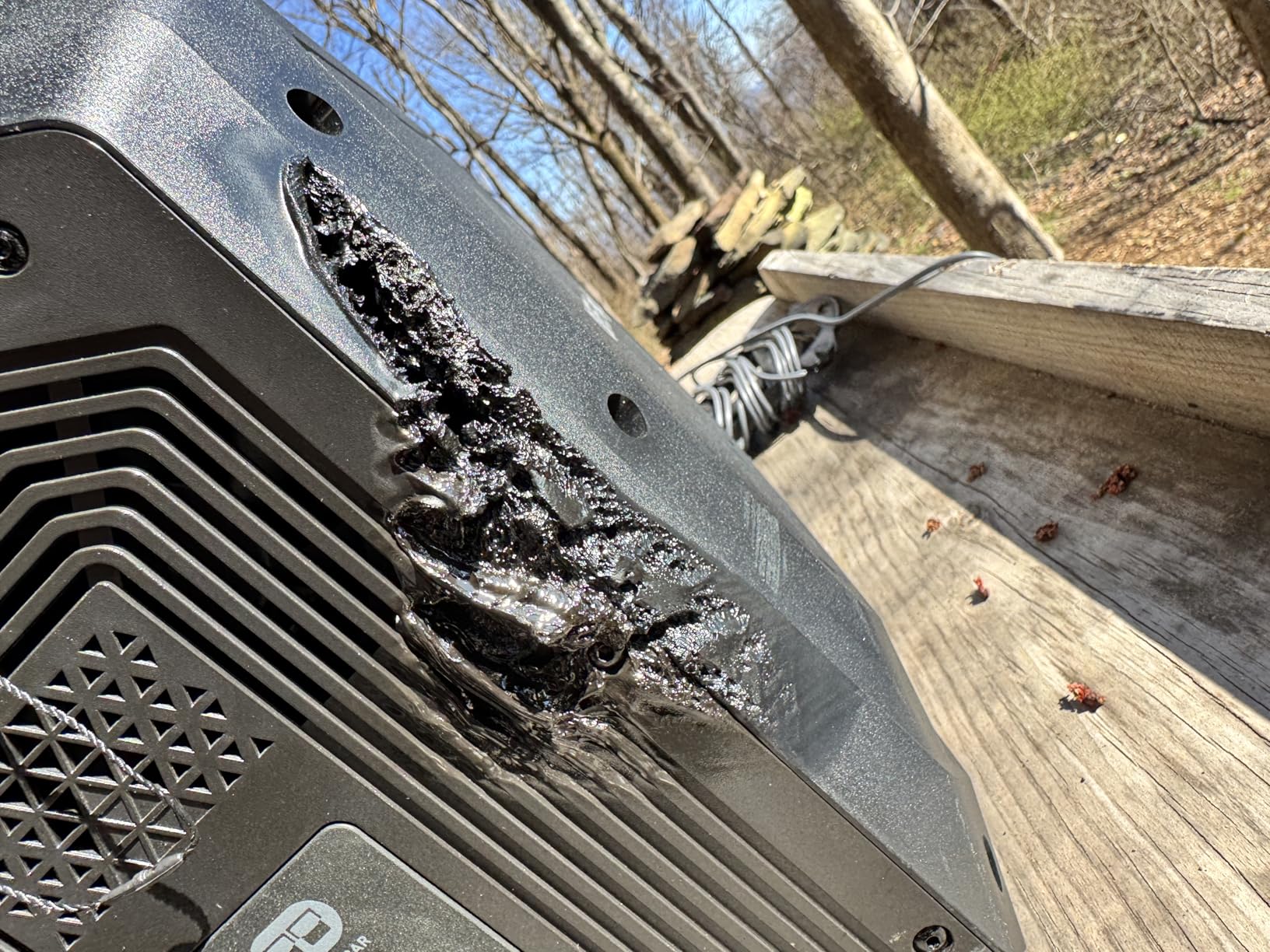
- Advertised 4500W surge trips between 2050W and 2220W in practice
- Cooling fans run continuously and loudly while charging
- Proprietary charge cable is hard to replace
- App Wi-Fi connectivity is unreliable though Bluetooth works
The OUPES Mega 1 is the pick for anyone whose trip length changes week to week. It starts at 1024Wh and scales to 5120Wh with two extra B2 batteries, so a weekend trip needs no expansion while a two-week overland run can carry five times the base capacity.
At 2000W continuous it has the highest inverter output in this group, and 0-80% in 36 minutes on AC makes it the fastest refill we tested. Four AC outlets with real spacing between them are a small detail that pays off in a tent.
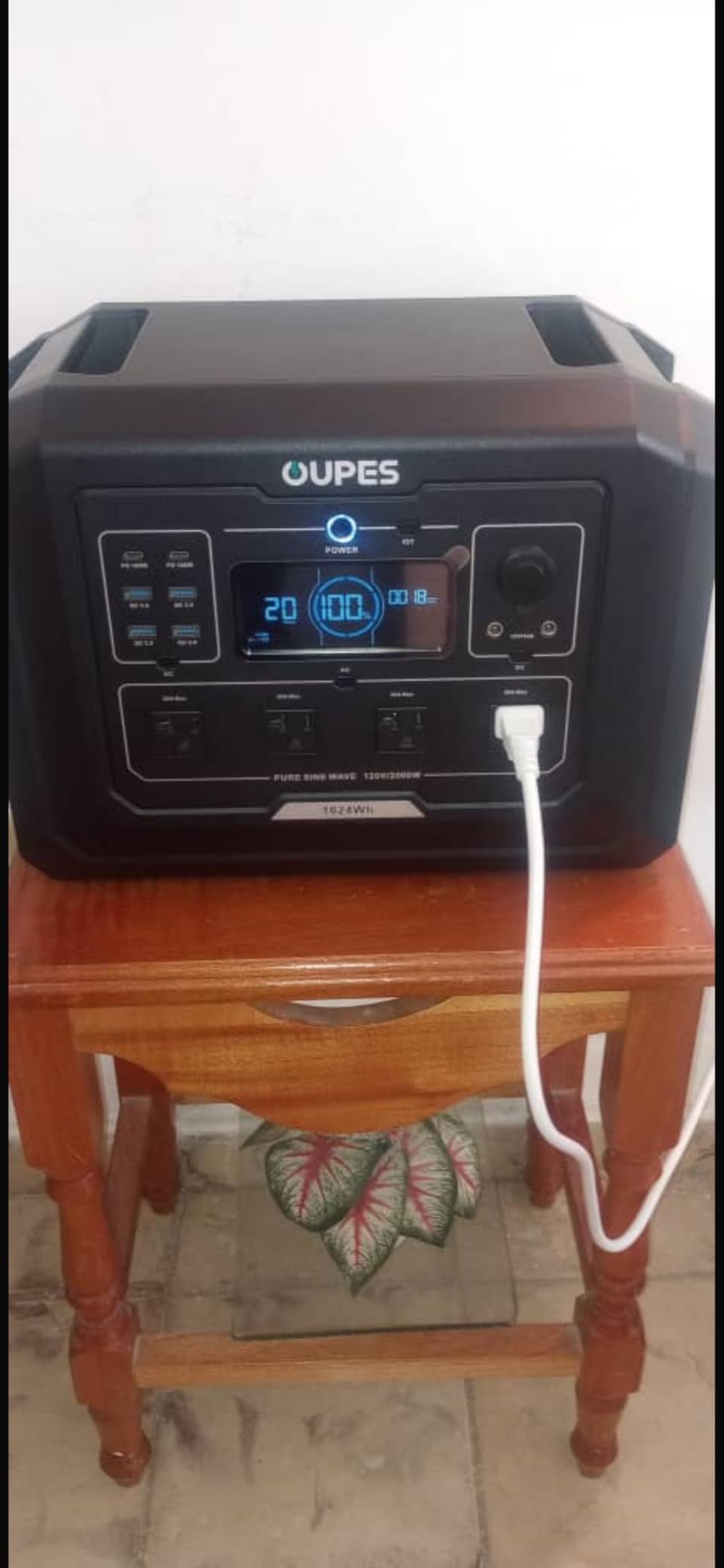
The claims that need a reality check are surge and noise. One owner measured consistent tripping between 2050W and 2220W against the advertised 4500W surge figure, which has no bearing on a CPAP but matters if you plan to run a power tool. Cooling fans also run continuously during charging, and several users flagged that as disruptive in a quiet bedroom.
Runtime Reality Check for the OUPES Mega 1
1024Wh covers about ten nights at a 96 Wh draw and about three nights at 320 Wh with heated humidity. Because the expansion packs share the same form factor, a household running two machines can add one battery instead of buying a second station, which is the most efficient couple setup we found.
What to Verify Before Buying the OUPES Mega 1
Buy the expansion batteries at the same time as the base unit if you can, since the extra packs are a separate purchase. Also confirm your charge cable is in good shape before a long trip, because the proprietary cable is not a standard size to replace on the road.
5. Jackery Explorer 300 – Best Lightweight Unit with Long-Life Cells
Jackery Explorer 300 Portable Power Station,292Wh
292Wh capacity
300W pure sine wave AC, 600W peak
7.1 lb
4000+ cycle LiFePO4 cells
Pros
- Lightweight at 7.1 lb with an integrated carry handle
- Pure sine wave 300W AC output across two outlets
- 4000+ cycle LiFePO4 chemistry
- Two USB-A ports plus 100W USB-C PD and a 120W car port
- Reaches 80% solar charge in about 2.8 hours with a 100W panel
Cons
- 292Wh gives roughly one night once a heated humidifier is running
- Solar panel is not included with the station
- Weight adds up quickly over a multi-night trip
At 7.1 lb the Jackery Explorer 300 is the station in this roundup we can carry from the car to a distant campsite without thinking about it. It carries the most reviews of any unit here and holds a 4.6 average, which tells you how well the design has aged.
The 4000+ cycle LiFePO4 rating stands out in a class where several competitors ship lithium-ion cells with no published cycle-life number. Two AC outlets mean the CPAP and a second small device can share the unit.
The honest limitation is capacity. 292Wh is a single humidified night with a thin margin, and owners who run heated humidification report the pack being drained in one night. Without humidity you get roughly three nights, which is a workable weekend if you can recharge in between.
Runtime Reality Check for the Jackery Explorer 300
292Wh covers about three nights at a 96 Wh pressure-only load and just under one night at a 320 Wh humidified load. After conversion losses the humidified case lands at one night, so treat this as a single-night unit unless you drop the humidifier.
What to Verify Before Buying the Jackery Explorer 300
Decide whether you will run heated humidity. If yes, budget for a station in the 500Wh class or larger. If no, this is a strong two-to-three-night carry weight. Note that the solar panel is a separate purchase, so factor that into basecamp plans.
6. ALLWEI 300W – Best Documented CPAP Overnight Results
ALLWEI Portable Power Station 300W, 256Wh Solar Generator LiFePO4 Battery
256Wh capacity
300W pure sine wave AC
6.4 lb
3000-cycle LiFePO4 with pass-through
Pros
- Explicitly marketed for CPAP machines alongside other sensitive electronics
- One owner ran a DreamStation 2 on heated humidity for 12 hours across 2 nights
- 3000-cycle LiFePO4 cells
- Only 6.4 lb with a 3-level LED light including SOS
- MPPT controller with pass-through charging
Cons
- Single AC outlet blocks a second device
- Cooling fan runs loudly on long low-draw nights
- No 24V output for RV users
- One owner reported draining from full to empty in about four hours
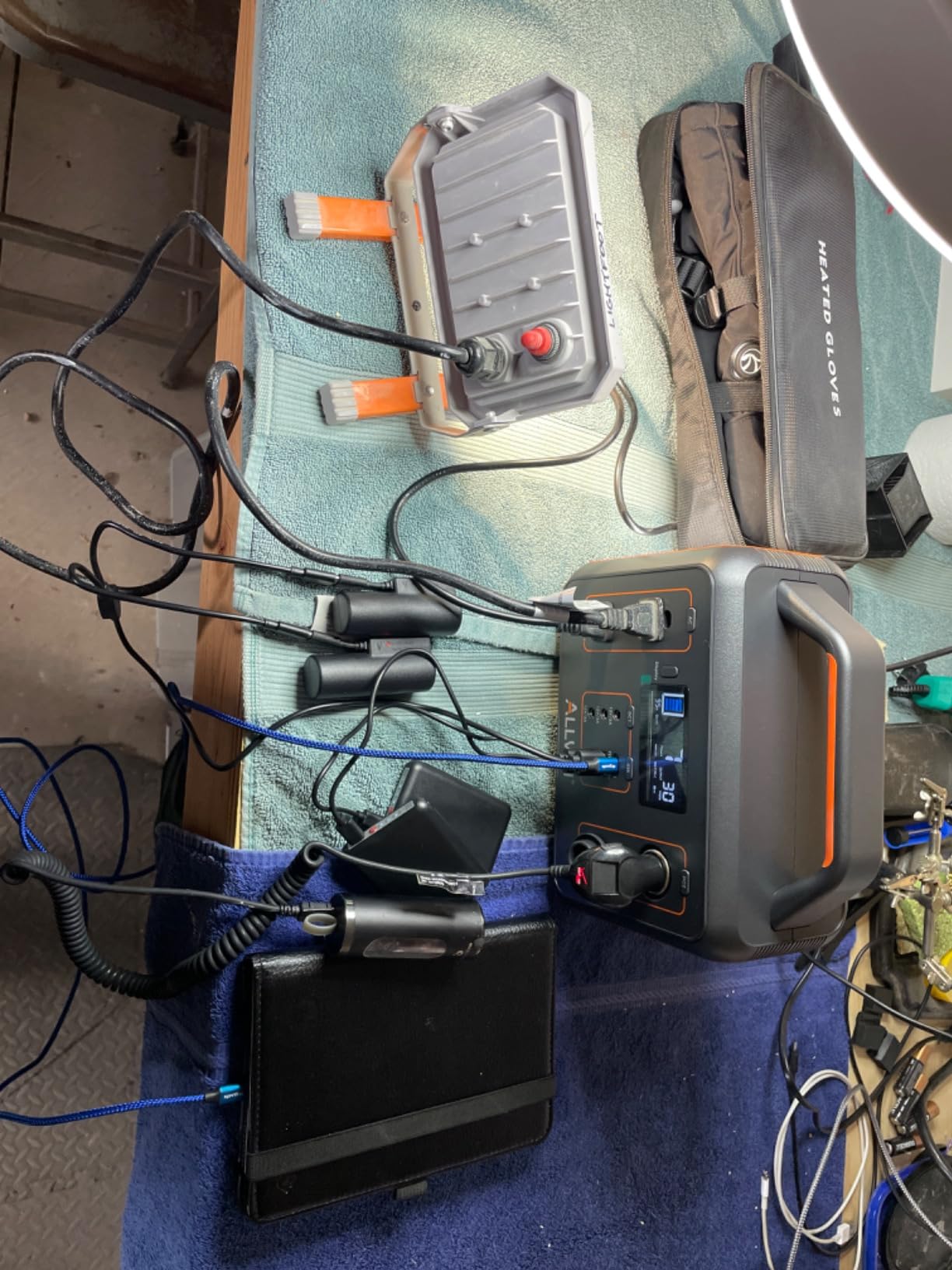
The ALLWEI 300W produced the clearest CPAP-specific data of any small station we reviewed. One owner with a Respironics DreamStation 2 recorded 12 hours of heated-humidity runtime spread over two nights, and the same buyer ran a BMC Luna G2 for 20 hours across three nights.
Those are real machine-and-setting combinations rather than spec-sheet estimates, which makes this the unit to trust when you want a sense of what 256Wh actually buys you in humidified use.
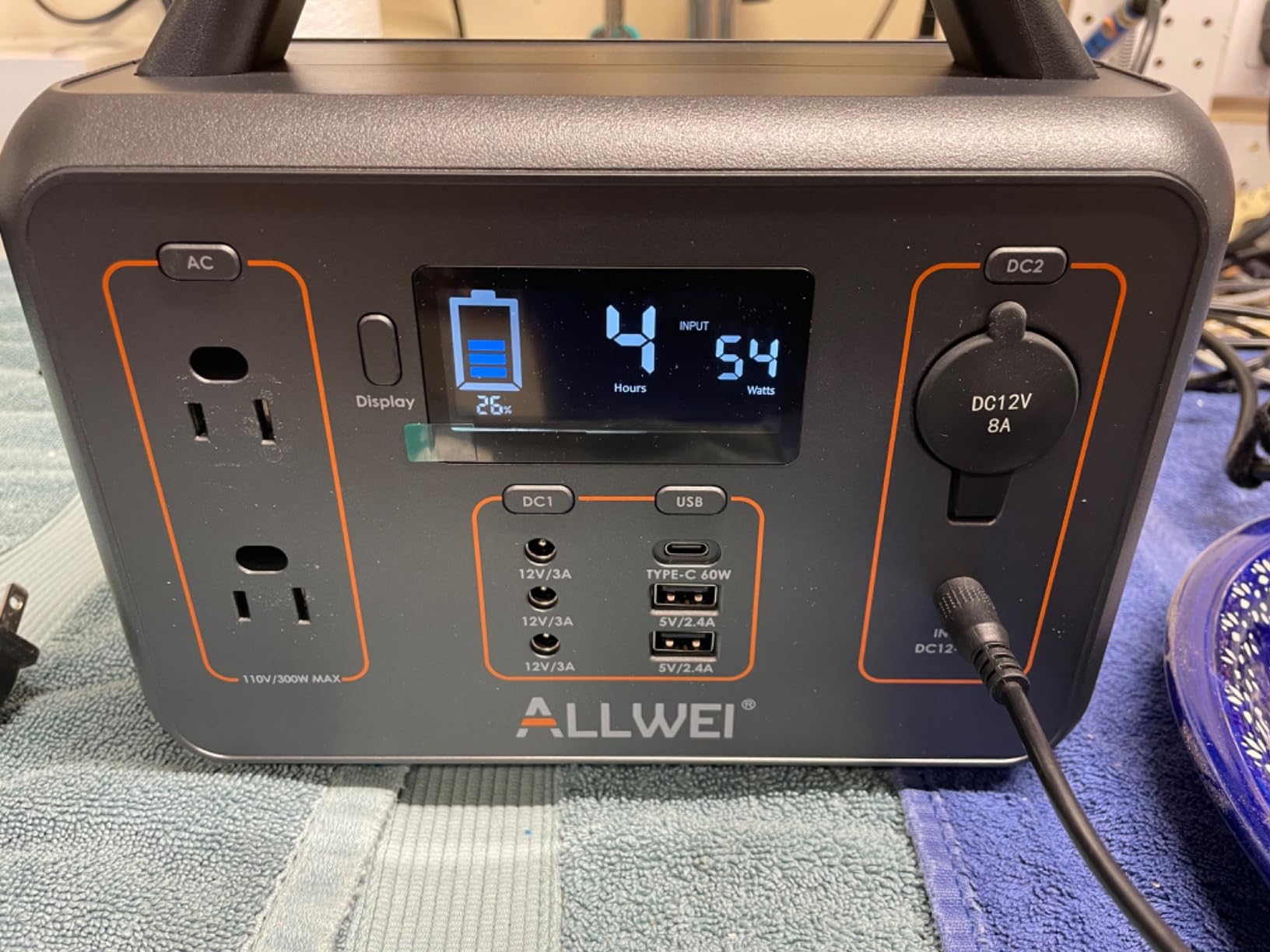
Pass-through charging via the MPPT controller means the station can run a CPAP while it recharges from a wall or car, removing one common failure point. The 6.4 lb weight and a 3-level LED light with SOS mode make it a natural bedside companion.
Runtime Reality Check for the ALLWEI 300W
By the raw math, 256Wh is about 2.6 nights at a 96 Wh load and just under one night at 320 Wh. The owner’s 12 hours of heated-humidity runtime across two nights matches that ceiling closely, which is the number we would plan around.
What to Verify Before Buying the ALLWEI 300W
Listen for the fan. Several owners specifically flagged fan noise during long low-draw overnight runs as impractical for sleeping next to, so plan to place it across the tent or on a shelf rather than on the nightstand. The single AC outlet also rules out a second medical device.
7. EnginStar R300 – Best for Running Two Devices at Once
EnginStar Solar Generator, 300W Portable Power Station, 296Wh Lithium Battery Backup w/Two 110V Pure Sine Wave AC Outlet for Camping Road Trip RV, 80000mAh Sufficient Power Supply for Blackout
296Wh capacity
300W across two pure sine wave AC outlets
6.5 lb
80000mAh with 24V DC
Pros
- Two pure sine wave AC outlets at this size class
- One owner ran a CPAP for three days on a single charge
- Eight outputs including 12V and 24V DC barrel ports
- Display shows per-port input and output power with pass-through
- Compact 6.5 lb body with a 24V DC option
Cons
- Status LED indicators are bright and cannot be dimmed
- Not weatherproof and one owner had to dry the ports
- Intermittent blowing fan noise during overnight use
- About 7 hours for a full wall recharge
The EnginStar R300 solves a specific problem: two AC outlets in a 296Wh body. If your CPAP and its humidifier run from separate adapters, this is one of the few stations at this weight where both fit at once.
Owner results range widely, which is normal for CPAP use. One buyer ran a machine for three days on a single charge with humidity reduced, while measured runs with full humidity landed around 7.5 hours.
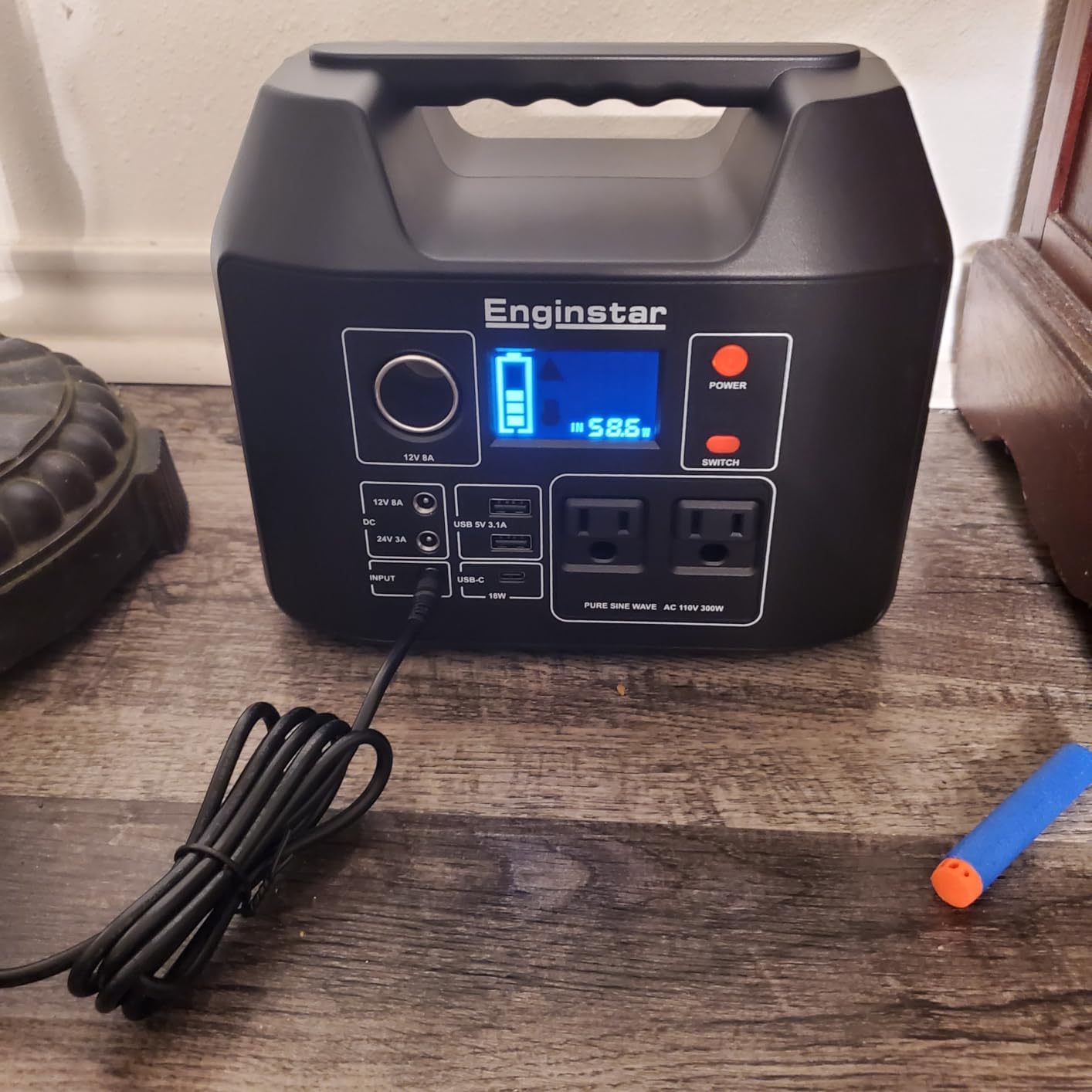
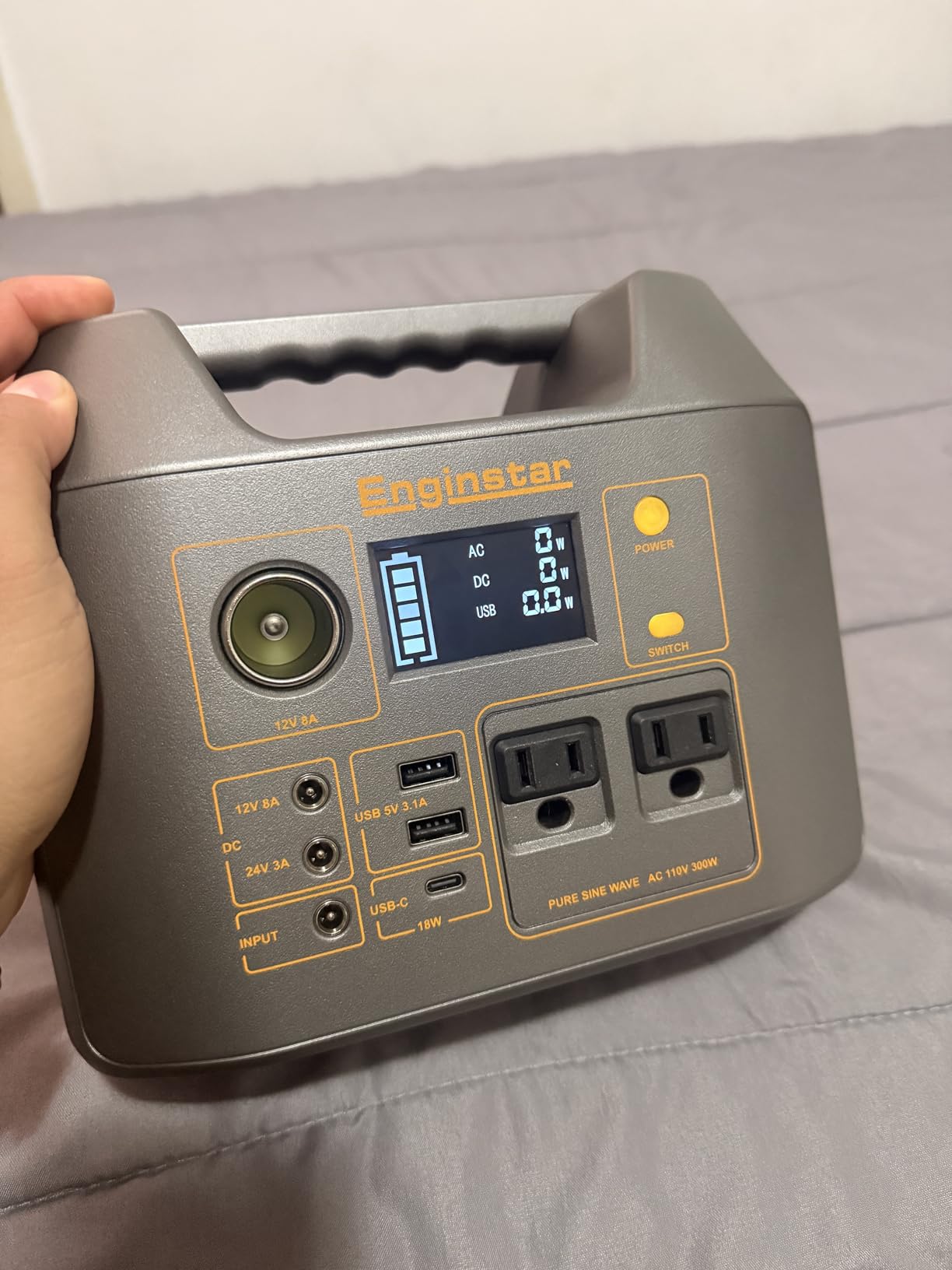
The port selection is unusually complete for the size, with 12V and 24V DC barrel ports alongside the AC outlets and a 12V car socket. The on-screen per-port power readout is a small help when you want to confirm what the machine is actually drawing overnight.
Runtime Reality Check for the EnginStar R300
296Wh is about three nights at a 96 Wh pressure-only load and just under one night at 320 Wh with heated humidity. The three-day owner result lines up with a humidifier set low and a machine running below its higher-pressure draw.
What to Verify Before Buying the EnginStar R300
Test it in darkness before a trip, because the non-dimmable status LEDs are the most repeated complaint in reviews. It is also not weatherproof, so keep it inside the tent or vehicle rather than exposed, and plan around the roughly seven-hour wall recharge.
8. GRECELL 500W – Best Starter Station in the 500Wh Class
Grecell Portable Power Station 500W(Peak 1000W) 519Wh Outdoor Solar Generator Backup Battery Pack with 2 110V AC Outlets,10-Port Powerhouse for RV/Van Camping Fishing Climbing Road Trip Home Emergency
519Wh capacity
500W across two pure sine wave AC outlets
14.1 lb
Ten outputs with 60W USB-C PD
Pros
- Roughly 519Wh with two pure sine wave AC outlets
- Manufacturer explicitly lists CPAP machines among supported devices
- Ten outputs including 60W USB-C PD and a wireless charging pad
- Built-in LED flashlight with strobe and SOS modes
- Recharges by wall
- car
- or solar
Cons
- Heaviest relative to its capacity class at 14.1 lb
- Lithium-ion cells with no published cycle-life figure
- Solar panel not included and a cable storage bag supplied instead
- Two-year warranty is among the shortest here
The GRECELL 500W puts about 519Wh and two pure sine outlets into a familiar mid-size package. The manufacturer lists CPAP machines as a supported device, and the two-outlet layout means the machine and a second device can share the battery.
Ten outputs cover nearly everything else you would bring on a weekend, including a 60W USB-C port and a wireless charging pad. The built-in flashlight with strobe and SOS modes is genuinely useful when you need to find the switch without waking a partner.
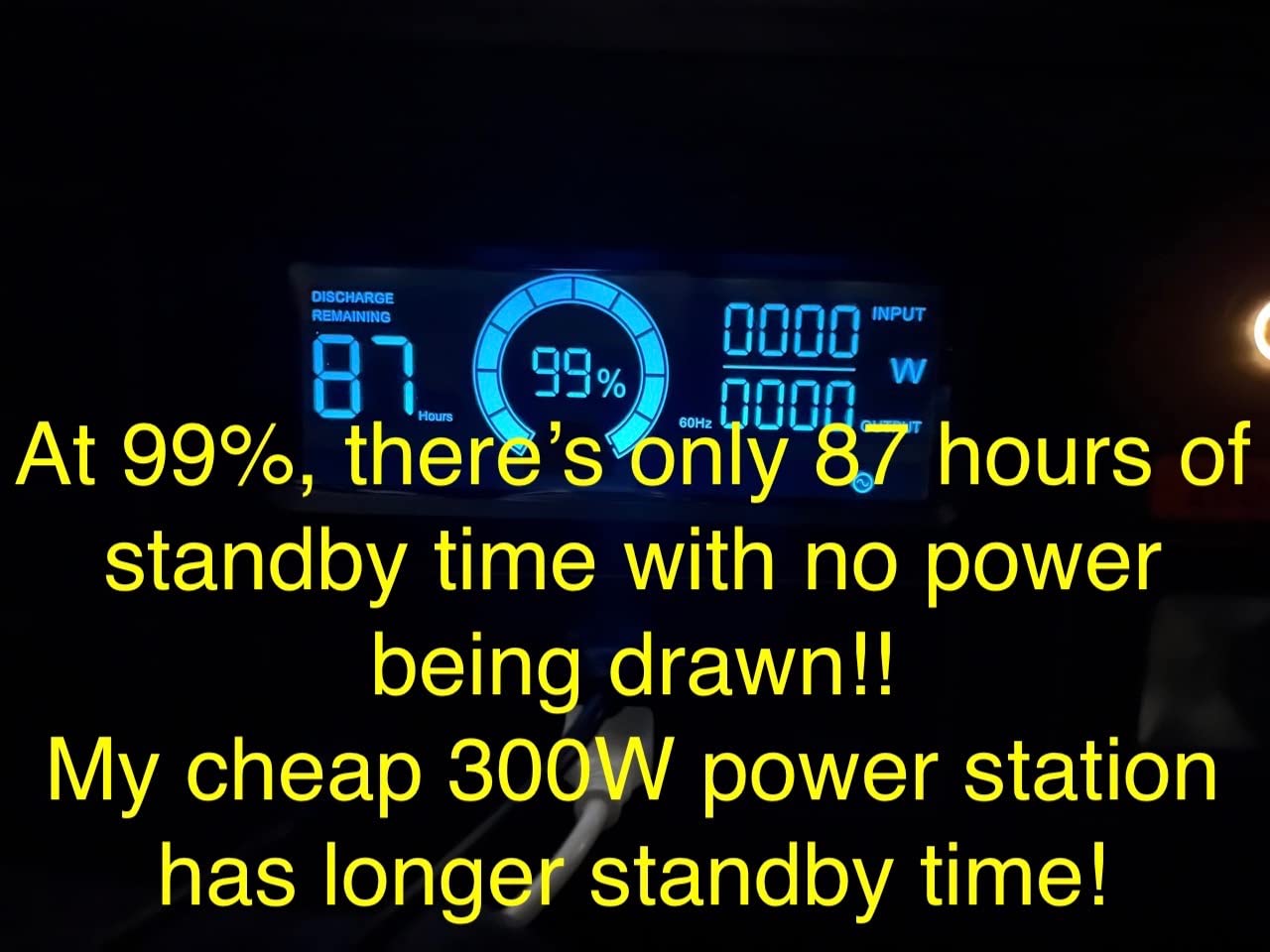
The tradeoff is cell chemistry. Unlike the Jackery, BLUETTI, Anker, and OUPES units here, GRECELL does not publish a cycle-life figure for its lithium-ion cells, and at 14.1 lb it is the heaviest for its capacity class in this roundup.
Runtime Reality Check for the GRECELL 500W
519Wh is about 5.4 nights at a 96 Wh pressure-only load and roughly 1.6 nights at 320 Wh with heated humidity. In practice that makes it a comfortable two-night humidified trip or a four-night trip with the humidifier off.
What to Verify Before Buying the GRECELL 500W
Weight is the deciding factor here. If you are moving it from vehicle to campsite rather than unhooking a trailer, compare it against lighter 256-300Wh options. If it stays in the trunk, the 519Wh is the more useful number.
9. MARBERO 237Wh – Best Lightweight Option With Two AC Outlets
Portable Power Station 300W MARBERO 237Wh Camping Solar Generator Backup Lithium Battery with Pure Sine Wave 110V AC Outlet, USB C, USB A, DC for Outdoors Camping CPAP Home Blackout Emergency
237Wh capacity
300W AC, 375W peak
4.6 lb
Two AC outlets plus USB-C PD
Pros
- Lightest station here carrying two AC outlets at 4.6 lb
- Compact 8.15 x 5.83 x 3.90 inch body
- Two AC outlets plus USB-C PD and four USB-A ports
- Dual LED camping lanterns with steady
- twinkle
- and SOS modes
- BMS with voltage
- temperature
- and short circuit protection
Cons
- 237Wh leaves little margin once a heated humidifier runs
- Weak inverter output for higher-wattage devices
- Reports of units losing charge retention after a few years
- Only a 12-month warranty
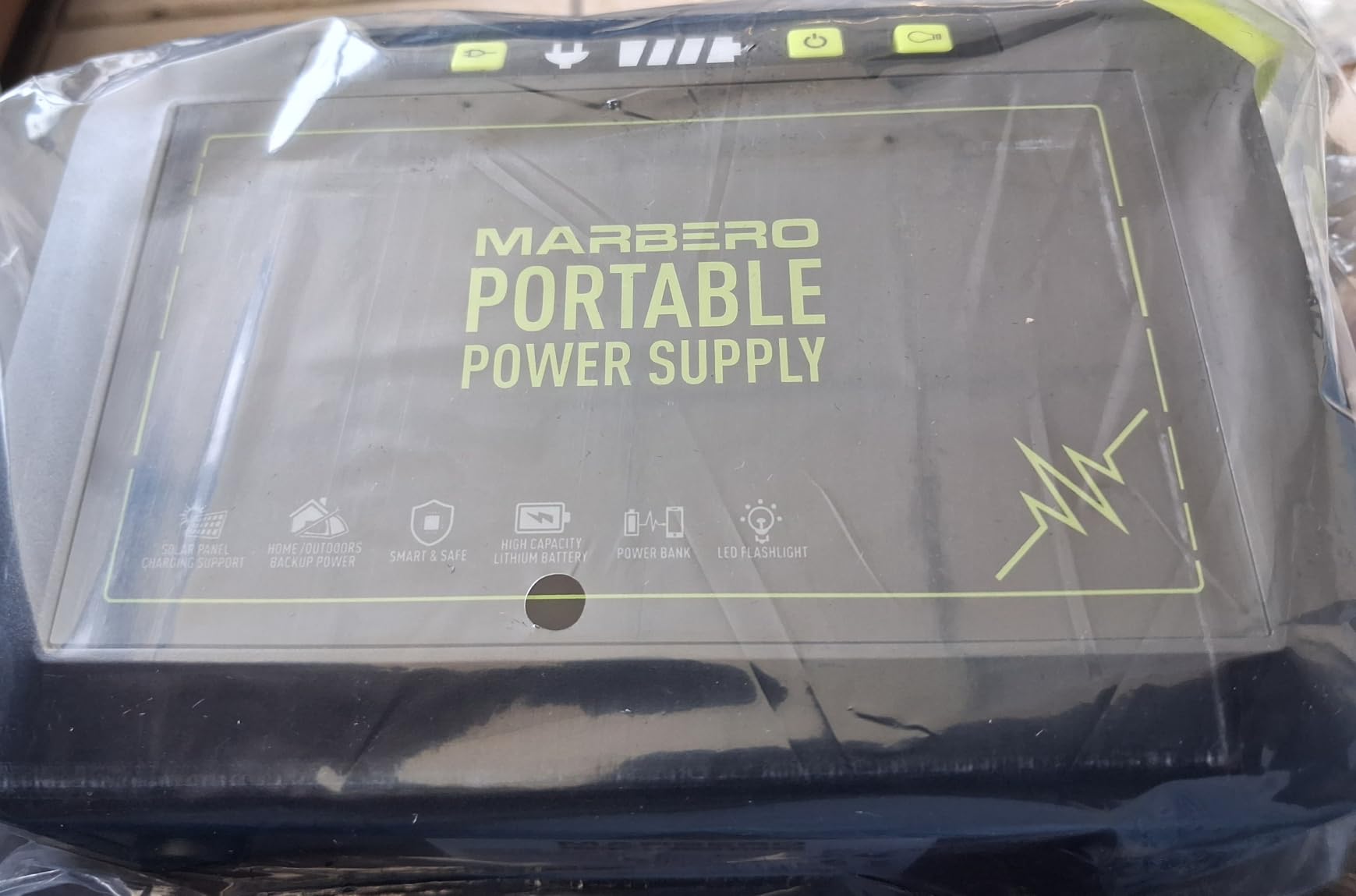
Weight is the argument for the MARBERO 237Wh. At 4.6 lb it is the lightest station in this roundup with two AC outlets, in a body small enough to sit beside a machine rather than live in the vehicle.
Capacity is where the compromise sits. 237Wh covers roughly 2.4 nights at a 96 Wh pressure-only load, and less than one night at 320 Wh with heated humidity running.
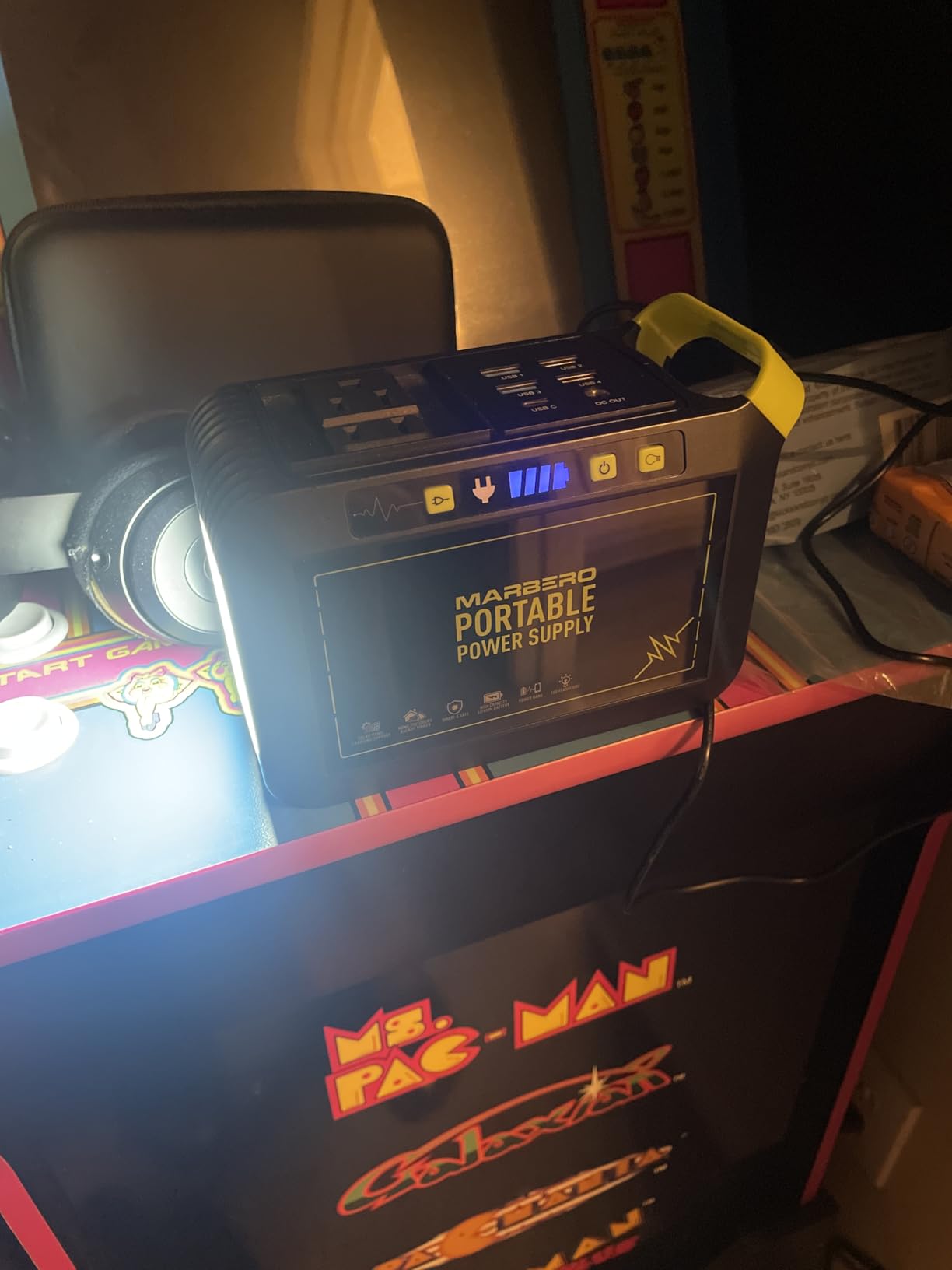
The dual LED lanterns are more useful than they sound, since the two flashlights run steady, twinkle, and SOS modes and remove the need to carry a separate light. Charging runs three ways, though the wall path uses a proprietary adapter rather than a standard USB-C input.
Runtime Reality Check for the MARBERO 237Wh
Treat this as a two-night unit with the humidifier off and a single night with it on. After conversion losses the humidified case drops below one full night, so this works best when your machine has a non-heated humidifier or when you accept a lower humidity level.
What to Verify Before Buying the MARBERO 237Wh
Read the durability feedback. At a 4.1 average with 12% one-star reviews, there is a real cluster of owners reporting units that stopped holding charge after two to four years, and the 12-month warranty is the shortest here. For multi-night trips where losing power is not an option, choose a longer-warrantied unit.
10. FF FLASHFISH E200 – Smallest Station That Can Cover One Night
Portable Power Station 200W, FF Flashfish 40800mAh Backup Power Battery Pack With 110V AC Outlets/2 DC Ports/3 USB Ports, Solar Generator Power Supply For Home Backup, Power Outages, and Camping
151Wh capacity
200W AC outlet
4.1 lb
Six outputs with LCD readout
Pros
- Smallest and lightest capacity here at 4.1 lb
- Manufacturer explicitly lists CPAP machines among supported devices
- Six outputs including a 110V AC outlet
- DC ports
- and USB
- Separate AC and DC buttons with a multifunction LCD
- Compact body with a soft carry handle
Cons
- 151Wh covers one night only at a very low draw
- 200W AC ceiling leaves no headroom for a heated humidifier
- Slowest refill here at 4-4.5 hours on wall AC and 5-6 hours on 60W solar
- Only a 12-month warranty
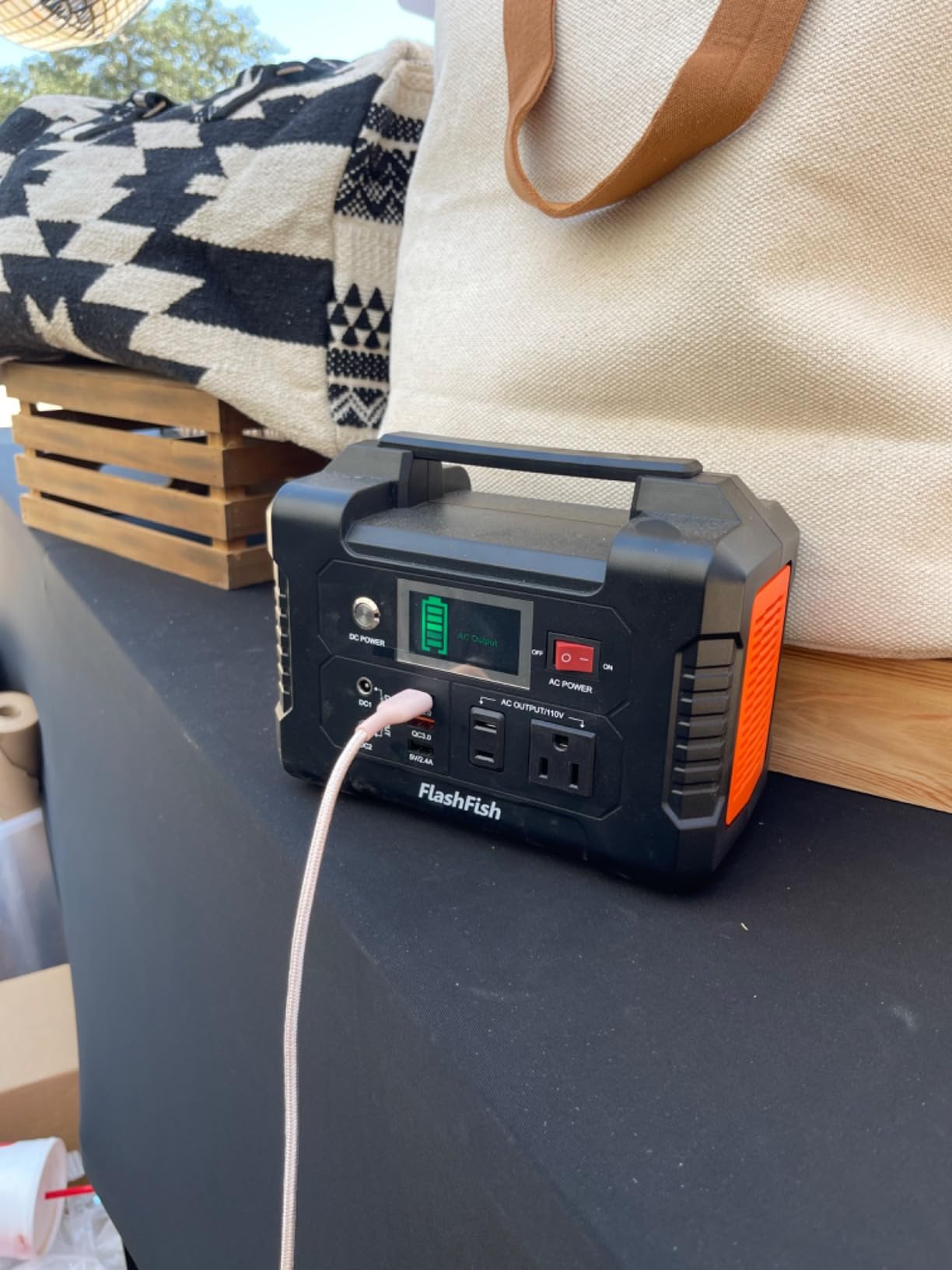
The FF FLASHFISH E200 at 4.1 lb is the smallest and lightest station here, and the manufacturer lists CPAP machines among its supported devices. It fits in a pack where the larger units simply cannot.
The multifunction LCD showing remaining power and charge status, plus separate AC and DC buttons, makes it easy to confirm overnight that the machine is actually drawing from the battery and not a low-battery cutoff.
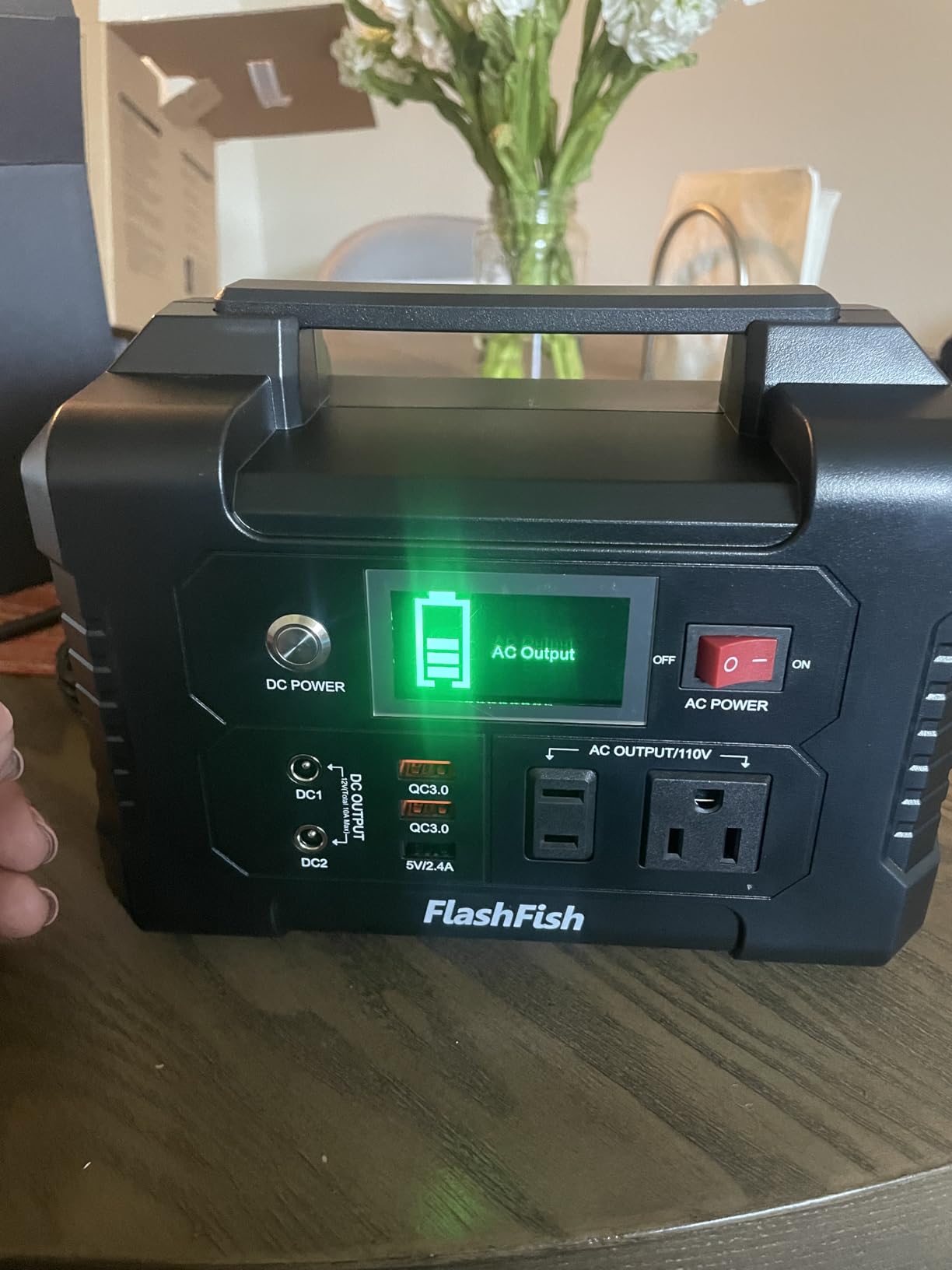
Capacity is the hard limit. At 151Wh the pack is close to a single-night device and nothing more, and the 200W AC ceiling removes any headroom for a heated humidifier. Owners consistently treat it as an entry-level backup for phones, lights, and routers that happens to work for CPAP.
Runtime Reality Check for the FF FLASHFISH E200
151Wh is about 1.5 nights at a 96 Wh pressure-only load, and roughly 0.4 of a night at 320 Wh with heated humidity. In practice it delivers one comfortable night with the humidifier off and leaves nothing for a second.
What to Verify Before Buying the FF FLASHFISH E200
Use it as a bedside emergency battery rather than a trip battery. Because recharge takes 4-4.5 hours from a wall outlet and the solar panel is sold separately, topping it up between nights is slow, so only rely on it where a grid outlet is reachable.
How Much Power Does a CPAP Machine Actually Use?
A modern CPAP drawing between 10W and 15W without humidification is typical, and a BiPAP at higher pressures such as the AirCurve 10 sits closer to the top of that range. An owner on r/CPAP reported 20 hours of AirCurve 10 BiPAP runtime with the humidifier at setting 5, which shows how much per-user variance exists.
The heated humidifier is where budgets break. Adding it can take the machine from roughly 12W to as much as 40W, which is 40-75% more energy for the same night. Heated tubing adds a smaller increment on top of that.
Every runtime number in this guide uses two stated assumptions: 96 Wh per night for a pressure-only 12W draw over eight hours, and 320 Wh per night for a 40W draw with heated humidity. Use them as a reproducible baseline rather than a promise.
A pure sine wave inverter is not optional. A modified sine wave output can upset the low-power motor and electronics in a CPAP, and it is the first spec we check on any station in this class.
Two failure modes catch people out. Some stations cut off below a minimum load, and a CPAP can drop well under its average draw during exhalation, so verify the low-load cutoff or keep the unit on a UPS setting. If the unit has a power-saving mode, switch it off before you rely on it.
Using a 12V DC cable instead of the AC brick can recover 10-15% of stored energy by skipping two conversions. The catch is that most DC cables power only the motor and not the heated humidifier, so for humidified users the AC path is often the only option.
How to Size a Power Station for Your CPAP
Multiply your hourly draw by sleep hours to get watt-hours per night, then add a safety factor of about 1.4 to cover inverter losses and cold-weather derating. A 40W humidified machine at eight hours is 320Wh, so target roughly 450Wh of nameplate capacity for one night, and 900-1000Wh for two.
Here is what we would plan for, by trip length:
One night, bedside backup: 500-800Wh.
Weekend, two nights with humidity: 1000-1200Wh.
Week-long trip with recharging along the way: 1000Wh plus a car or wall top-up plan.
Multi-day outage backup: 1150Wh or more, ideally with expandability to 5000Wh.
For couples, the most efficient setup is one station sized for two machines rather than two stations, since one unit powers one machine at a time while the other rests. Divide the total nightly load by sleep hours to get the combined draw, then size from there.
Running from an RV or vehicle 12V system is easier than most guides suggest, and several RV and overlanding users describe it as their primary CPAP source. The real work is routing 12V to the bedside, and forum users commonly top up through a 12V vehicle outlet roughly every other day on longer trips.
Test any new setup at home for one full night before you depend on it away from an outlet. Finding a compatibility problem at a remote campsite is a health risk, not an inconvenience, and a full overnight run is the only way to catch a low-load cutoff or a DC cable that will not carry your humidifier.
If you also need stations for the rest of the trip, our camping power station guide and RV power station guide cover the wider setups.
Tips to Maximize Battery Life on a CPAP Power Station
Turn the humidifier down or off. This is the single biggest lever available, and the savings are immediate: lower humidity means lower watts, and lower watts mean more nights per charge. Most users who travel with CPAP report the humidifier consumes 40-50% of their available runtime.
Set heated tubing to off if your machine allows it. It is a smaller win than the humidifier, but it adds up across a week.
Use a DC cable where your machine supports one, and accept that the humidifier will not run from it. Check your machine’s manual for whether the DC port powers the humidifier chamber or only the blower.
Reduce EPR, the exhalation pressure relief setting, if your clinician approves. A lower EPR setting reduces the peak flow the machine generates, and some users report a meaningful runtime gain.
Plan recharges around driving. A 500-1000Wh station typically recovers most of its capacity during a few hours of engine running, so map charge stops to fuel and meal breaks rather than overnight stops.
For stationary basecamp, size solar input against your draw. The BLUETTI AC180 accepts 500W of solar and recharges in roughly three hours, which covers a humidified night in one good solar day.
Power Station vs Dedicated CPAP Battery, Plus Air Travel Rules
A dedicated CPAP battery is purpose-built with a barrel or proprietary connector and carries far less electronics per watt-hour, which is why users who carry weight over distance still choose one for backpacking. A portable power station gives you more outlets, a car charging path, and solar input in exchange for weight.
If your main trips are car camping or outages, the station wins. If you are walking several miles with a pack, a dedicated battery is still the more realistic choice for one night.
For air travel, the FAA treats spare lithium batteries under 100Wh as the low-friction threshold, and airlines generally require advance approval above 100Wh up to 160Wh. Every station in this roundup exceeds 100Wh, from the 151Wh FLASHFISH E200 up to the 1152Wh BLUETTI AC180, so all of them need airline approval rather than going straight into a carry-on.
That is also the argument for carrying a small dedicated CPAP battery for a flight and using a station for ground power at the destination.
Where your usage is mostly home outage, our home backup power station guide covers the other devices you would run off the same battery.
Common Buying Mistakes to Avoid
Shopping by watts instead of watt-hours. Output watts describe what a station can power at once, while watt-hours describe how long. A 300W unit with 250Wh will not outlast a 500W unit with 1000Wh overnight.
Ignoring inverter self-consumption. On small loads, a station’s own overhead can rival your device. The BLUETTI AC180 draws 15-20W per hour with the inverter on, which matters more at 30W loads than at 1800W loads.
Buying without checking the low-load cutoff. If a station treats a CPAP’s exhalation dip as no load, therapy stops mid-night with no warning. Confirm the cutoff behavior or use a UPS setting.
Forgetting cold weather. LiFePO4 capacity falls in freezing conditions, so winter campers should size extra headroom rather than planning to the last percent of nameplate capacity.
Skipping the overnight test. A ten-minute desk test will not reveal a low-load cutoff, a failed DC cable, or a fan that wakes you at 3am.
Storing the pack empty or full. Keeping lithium cells between roughly 30% and 80% for long stretches slows degradation, which matters most for the units in this roundup that use lithium-ion rather than LiFePO4 cells.
Frequently Asked Questions
What is the best portable power bank for a CPAP machine?
The Jackery Explorer 500 v2 is our best portable power bank for a CPAP machine at 512Wh and 13.3 lb. Owners report about 11-12% of capacity per night on DC with the humidifier and heated tube off, giving roughly three nights. It runs a 500W pure sine wave inverter and returns to 80% in about 52 minutes.
What size Jackery do I need to run a CPAP?
For one night with a heated humidifier, target about 450Wh of nameplate capacity, which makes the Jackery Explorer 500 v2 with 512Wh the right starting point. For two humidified nights, look at the 1000Wh class, where the Anker SOLIX C1000 and OUPES Mega 1 sit. The 292Wh Explorer 300 covers one humidified night only.
What size portable power pack do you need to run a CPAP machine?
Multiply watts by sleep hours, then add about 40% for inverter losses and cold weather. A 12W machine over eight hours is 96Wh per night, so about 150Wh nominal covers one dry night. A 40W machine with heated humidity is 320Wh per night, so plan on roughly 450Wh of capacity per humidified night.
How long will a CPAP run on a portable power station?
On a 12W pressure-only draw over eight hours, a 512Wh station gives about five nights and a 1000Wh station about ten. On a 40W draw with heated humidity, a 512Wh station gives about one and a half nights and a 1000Wh station about three. Inverter overhead means real results land lower, so keep a margin.
What is the best CPAP battery to use for camping?
For car camping, the Jackery Explorer 500 v2 balances 512Wh against 13.3 lb and owner-verified CPAP runtimes. For outages and multi-night trips, the BLUETTI AC180 gives 1152Wh with a 20ms UPS switchover. For backpacking where weight dominates, a dedicated CPAP battery remains lighter per usable watt-hour than any station.
How long will a 12 volt car battery run a CPAP machine?
A 200 amp-hour 12V battery stores about 2400Wh, so a 40W humidified draw of 320Wh per night is roughly seven nights in theory, with far less in practice after DC-to-DC conversion losses. One RV forum user reported a 200 amp-hour battery barely dented by a CPAP across five days of boondocking.
Can I go without my CPAP machine for 2 weeks?
Do not treat a two-week gap as a testing strategy. Interrupted therapy can cause extreme fatigue, elevated blood pressure, and irregular heartbeat, and it can be dangerous if you are driving. If your doctor has told you to pause treatment, follow their instructions and your prescribed plan rather than relying on a battery to stretch your supply.
Can I run my CPAP while the power station charges?
Yes, on any station with pass-through or bypass charging. The ALLWEI 300W and GRECELL 500W both support it, and the EnginStar R300 shows per-port power figures with pass-through. Check the unit’s manual, since a few models disable pass-through on certain input combinations or in app-controlled fast charging modes.
Bottom Line: The Best Portable Power Stations for CPAP in 2026
The Jackery Explorer 500 v2 is the best portable power station for CPAP machines overall, with 512Wh, a pure sine wave inverter, and the most owner-published CPAP runtime data in the 500Wh class. For outage backup, the BLUETTI AC180 adds 1152Wh and a 20ms UPS. For fast turnaround between nights, the Anker SOLIX C1000 reaches 80% in about 43 minutes.
Whichever you pick, size for a 40W draw rather than a 12W draw if you use heated humidity, confirm the low-load cutoff does not trip mid-night, and run one full overnight test at home before you travel. If you want help with our setup, tell us your CPAP model, your humidifier setting, and your main use case.