
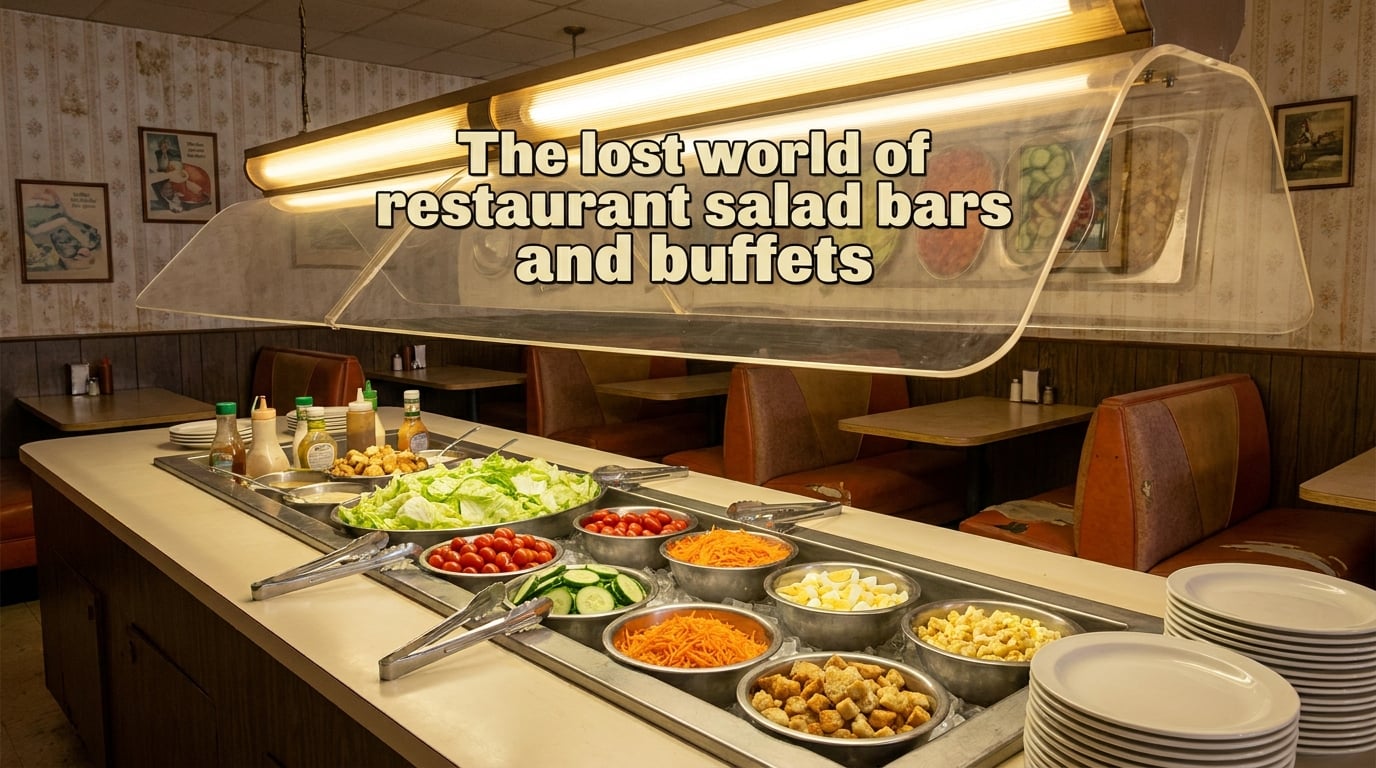
Do you remember the sound? That soft clatter of metal tongs against plastic bins, the cold mist rising from the chilled display, the faint hum of a sneeze guard doing its quiet duty. You would grab a plate — maybe it was beige, maybe it was that speckled brown that every salad bar in America seemed to share — and you would walk the line like it was your personal playground.
Restaurant salad bars and buffets were once everywhere. They were in steakhouses, in diners, in fast-food chains, in grocery stores, in hotel breakfast rooms. For decades, the serve-yourself salad bar was a defining feature of American dining out. And then, quietly at first and then all at once, they were gone.
This is the story of the lost world of restaurant salad bars and buffets — where they came from, why they flourished, why they faded, and why a whole generation still misses them. It is part history, part nostalgia trip, and part appreciation for a dining experience we may never fully get back.
Table of Contents
From Smorgasbord to Salad Bar: The Origins
Every American salad bar owes its existence, at least spiritually, to Sweden.
The smorgasbord — a Swedish buffet-style meal featuring a spread of hot and cold dishes — dates back to at least the 16th century. It was originally a way to feed guests in stages, starting with herring and moving through fish, meat, cheese, and dessert. The word itself translates roughly to “sandwich table,” though the spread was always far more elaborate than that name suggests.
The concept crossed the Atlantic in a meaningful way at the 1938 World’s Fair in New York. The Swedish pavilion featured a smorgasbord that captivated American visitors. Here was something different from the formal, waiter-driven dining experience that dominated the era. You could walk up, see your food, choose what you wanted, and go back as many times as you liked. It felt democratic and generous and just a little bit exotic.
That exhibition planted a seed. Over the next two decades, the idea of self-serve food stations began appearing in American restaurants, cafeterias, and hotel dining rooms. The smorgasbord gradually shed its Scandinavian identity and morphed into something more specifically American: the salad bar. The cold ingredients stayed, the herring mostly did not, and the concept of choice — endless, unrestricted choice — became the whole point.
Who Invented the Salad Bar?
The history of salad bars in America is messy, with multiple claimants to the title of “first.” Nobody has definitive proof, but several names come up repeatedly.
One story points to Russell Swanson, who supposedly set up a salad bar at the Sky Club Supper Club in Wisconsin in the late 1950s. The idea was simple: instead of a pre-made salad, let diners build their own from a lineup of fresh ingredients. For a supper club in the Midwest, this was reportedly a revelation.
Another claim belongs to Angelo Gangi, who ran a diner in South Florida. Gangi reportedly assembled a self-serve salad station sometime in the early 1960s, offering greens, toppings, and dressings that customers could combine however they liked. Whether Swanson or Gangi truly came first is a debate that food historians have never fully settled.
Then there is Richard Melman and his legendary Chicago restaurant R.J. Grunts, which opened in 1971 under the Lettuce Entertain You Enterprises umbrella. R.J. Grunts featured a salad bar that became famous in its own right — a sprawling, 40-item spread that drew crowds and helped cement the salad bar as a destination experience rather than just a side feature. Melman understood something important: the salad bar was not just about the food. It was about the theater of choosing.
But the man most responsible for putting salad bars into the mainstream was Norman Brinker. Brinker was a restaurant visionary who took over the Steak and Ale chain in the early 1970s and transformed it. He installed what many consider the first nationally recognized salad bar in a casual dining chain. The idea was genius: offer an all-you-can-eat salad bar as a value-add that came with the price of an entree. Customers felt like they were getting something for free. Steak and Ale thrived, and competitors took notice.
Brinker’s model spread like wildfire. Within a decade, salad bars were everywhere — and the 1980s turned them into a cultural phenomenon.
The Golden Age: Restaurant Salad Bars and Buffets in the 1980s and 1990s
If you grew up in the 1980s or 1990s, the salad bar was not a novelty. It was a fixture of everyday life.
This was the golden age of restaurant salad bars and buffets, and the era produced a roster of chains that have since become touchstones of nostalgia. Souper Salad built an entire concept around unlimited soup, salad, and baked potatoes, with locations spreading across the Sunbelt. Sweet Tomatoes (known as Souplantation in California) made the salad bar the star of the show, rotating seasonal ingredients and creative station themes that kept regulars coming back. Souplantation, founded in 1978 in San Diego, grew to nearly 100 locations and cultivated an almost cult-like following among salad enthusiasts.
Then there was the Wendy’s SuperBar — a name that still surfaces regularly in Reddit nostalgia threads on r/GenX and r/nostalgia. The SuperBar was a thing of beauty: a three-station setup featuring a salad bar, a pasta station, and a dessert bar, all for a couple of bucks. You could load up a plate with lettuce, shredded cheese, and ranch dressing, then grab a scoop of fettuccine alfredo, then circle back for pudding with gummy worms. It was chaotic, wonderful, and uniquely American. As one Redditor put it: “I personally loved the Wendy’s SuperBar.” That sentence carries more emotional weight than any marketing copy ever could.
Ruby Tuesday built its brand partly around a signature salad bar that came free with many entrees. Ponderosa and Bonanza steakhouses offered salad bars as a prelude to budget-friendly steak dinners. Old Country Buffet turned the all-you-can-eat format into a family destination, with salad bars sitting alongside fried chicken, mac and cheese, and soft-serve machines. Ryan’s Grill, Buffet and Bakery did the same, and for a time these chains were among the highest-grossing restaurant concepts in the country.
The economic model was straightforward and effective. Salad bar ingredients were cheap — lettuce, tomatoes, cucumbers, croutons, and dressing cost pennies per serving. But customers perceived enormous value because they controlled the portion, the variety, and the experience. You could go back three times. You could try something new each trip. For families on a budget, a salad bar dinner felt like abundance without the price tag.
And there was something else going on, something harder to quantify. The salad bar offered a kind of autonomy that traditional restaurant service did not. Nobody was deciding your portion size. Nobody was judging your dressing choice. You were in charge. For a country that prizes individualism, the salad bar was the perfect dining format.
The Experience We Lost: What Made Salad Bars Special
Ask anyone who grew up in the salad bar era what they remember, and you will not hear much about the food. You will hear about the experience.
There was the ritual of walking the line. You would scope out the full spread before committing to anything, scanning for the good croutons, the real bacon bits (not those red imitation ones), the blue cheese dressing that actually had chunks in it. You would develop a strategy: build a foundation of greens, add the heavy proteins, finish with a careful drizzle of dressing so the plate did not become a soup.
There were the unexpected delights. Maybe your local salad bar had soft-serve at the end. Maybe there was a baked potato station. Maybe there was a taco island in the middle that let you build a complete nacho plate while pretending you were eating a salad. The beauty was in the surprise and the possibility.
And there was the social dimension. Reddit threads on the topic overflow with memories of family dinners at Old Country Buffet, business lunches at Ponderosa, birthday celebrations at Souper Salad. The salad bar was a communal experience. You shared the space, the tongs, and the experience with strangers. There was something faintly democratic about it — everyone from truck drivers to office managers standing in the same line, building the same plates, governed by the same sneeze guard.
That sneeze guard, by the way, deserves its own mention. The curved piece of clear acrylic suspended above the food was a non-negotiable feature of every salad bar in America. It was practical, yes. But it was also iconic — a design element so universal that it became shorthand for the entire concept. When you picture a salad bar, you picture the sneeze guard.
We lost all of this. Not just the food, but the ritual, the autonomy, and the shared experience of building a meal together in a room full of strangers who were doing the exact same thing.
The Slow Decline: Why Salad Bars Started Disappearing
The decline of restaurant salad bars and buffets did not happen overnight. It was a slow erosion driven by several converging forces.
Food safety was the first major crack. Self-service food stations have always carried inherent risks. When dozens of people handle the same tongs, sneeze near the same bins, and let their sleeves dangle over the same ingredients, contamination is a statistical inevitability. Outbreaks of E. coli and salmonella linked to salad bars made headlines over the years. The 1993 Jack in the Box E. coli outbreak — while not salad bar related — intensified scrutiny on all food safety practices. Restaurants began to view salad bars as liability.
Then there was the economics. By the 2000s, fresh produce costs were rising. Labor costs were climbing. Maintaining a salad bar required constant attention — someone had to restock, rotate, and monitor the stations throughout service. For chain restaurants operating on thin margins, the salad bar increasingly looked like a cost center rather than a draw. The math that worked in 1985 did not work in 2005.
Diet culture shifted too. The low-fat craze of the 1980s and 1990s had made salad bars feel virtuous — you were eating vegetables, after all. But as diet trends moved toward low-carb, keto, and paleo philosophies, a plate of lettuce with ranch dressing no longer read as “healthy.” The Atkins diet, which surged in the early 2000s, turned salads into a carb-laden trap in the eyes of many dieters. Salad bars lost their health halo.
Germophobia played a role as well. A growing cultural awareness of bacteria, viruses, and foodborne illness made the idea of communal food stations less appealing to younger diners. The same generation that embraced hand sanitizer everywhere started to look at shared tongs with suspicion.
And then there was the rise of fast-casual dining. Chains like Chipotle, Panera, and Sweetgreen offered customizable food in a cleaner, more controlled environment. They gave customers the same sense of choice and autonomy that salad bars had provided — but with someone else building the bowl. It was the salad bar experience without the salad bar risk.
One by one, the chains started shedding their salad bars. Wendy’s phased out the SuperBar by the late 1990s. Ruby Tuesday scaled back and eventually removed its famous salad bar entirely. Souper Salad locations dwindled. The writing was on the wall.
The Final Blow: COVID-19 and the End of Self-Service
Then March 2020 happened, and everything that was already dying got finished off.
The COVID-19 pandemic was the death blow for restaurant salad bars and buffets. Almost overnight, self-service food stations became a public health nightmare. The idea of strangers breathing over shared bins of food, touching the same tongs, and crowding around a buffet line was suddenly not just unappealing — it was dangerous.
Health departments across the country issued guidance restricting or banning self-service food stations. Sneeze guards, once a reassuring symbol of cleanliness, suddenly seemed inadequate against an airborne virus. Buffets that had survived for decades were forced to shut down indefinitely.
The casualties came fast. Souplantation and Sweet Tomatoes — which operated under the same parent company — announced in May 2020 that they would not reopen any of their 97 locations. That was it. After more than 40 years in business, the chain simply ceased to exist. The closure put roughly 4,400 employees out of work and left millions of loyal customers mourning a dining experience they had assumed would always be there.
Ruby Tuesday, already struggling, filed for bankruptcy in October 2020. The salad bar that had once defined the chain was a memory. Old Country Buffet’s parent company, VitaNova Brands, had been closing locations for years, and the pandemic accelerated the collapse. Ponderosa and Bonanza, once staples of small-town America, dwindled to a handful of remaining outposts.
Even after pandemic restrictions eased, the damage was done. Customers had been conditioned to view self-service food with suspicion. The psychological barrier was real and lasting. Restaurants that had briefly shuttered their salad bars found that reopening them was not worth the cost, the regulatory headache, or the customer hesitation.
COVID-19 did not kill the salad bar single-handedly. But it delivered the blow that the food safety scares, the rising costs, and the changing diets had been softening up for decades.
What’s Left: Are There Any Salad Bar Restaurants Still Around?
A few survivors remain, though they are shadows of what once was.
Golden Corral is the most prominent holdout. The chain still operates its massive all-you-can-eat buffets, complete with salad bars, at hundreds of locations primarily across the South and Midwest. If you want the old-school buffet experience in 2026, Golden Corral is the most reliable bet.
Grocery stores have picked up some of the slack. Whole Foods, Wegmans, and some regional supermarket chains still operate salad bars and hot food bars, offering by-weight pricing that lets you build exactly what you want. These are not quite the same experience — there is no waiter, no table, no community of fellow diners — but they scratch the same itch.
A few local diners, independent steakhouses, and hotel restaurants still keep salad bars alive. They are usually small, usually in smaller towns, and usually run by owners who remember what the experience meant to people. If you find one, treasure it.
As for whether salad bars are coming back, the honest answer is: probably not in the form we remember. The economics, the food safety landscape, and the cultural expectations have all shifted too far. What we may see instead are modern reinterpretations — build-your-own-bowl concepts, automated dispensing systems, chef-attended salad stations. But the classic, help-yourself, all-you-can-eat salad bar? That era is likely over.
FAQs
Why did salad bars disappear?
Salad bars disappeared due to a combination of rising food and labor costs, food safety concerns including E. coli and salmonella risks, changing diet trends that moved away from high-carb salads, and the COVID-19 pandemic which made self-service food stations a public health liability. Chains like Souplantation and Sweet Tomatoes closed permanently in 2020.
When did salad bars become a thing?
Salad bars began appearing in American restaurants in the late 1950s and early 1960s, with claims pointing to Russell Swanson at the Sky Club Supper Club in Wisconsin and Angelo Gangi in South Florida. The concept was inspired by the Swedish smorgasbord featured at the 1938 World’s Fair in New York and became widely popular in the 1970s.
What restaurant had the first salad bar?
There is no single confirmed inventor of the salad bar. Russell Swanson at the Sky Club Supper Club in Wisconsin and Angelo Gangi in South Florida both claim early versions in the late 1950s and early 1960s. Richard Melman’s R.J. Grunts in Chicago popularized the concept in 1971, and Norman Brinker made it a national chain feature at Steak and Ale in the early 1970s.
Why aren’t there salad bars anymore?
Salad bars largely disappeared because self-service food stations became financially unsustainable and culturally unacceptable. The COVID-19 pandemic was the decisive factor, as health departments restricted shared food stations and customers grew wary of communal dining. Chains like Souplantation closed permanently, and most restaurants chose not to reopen their salad bars after pandemic restrictions lifted.
Conclusion: A Loss Bigger Than Lettuce
The lost world of restaurant salad bars and buffets is about more than croutons and ranch dressing. It is about a way of eating together that valued abundance, autonomy, and shared experience. It is about family dinners where a kid could build a plate of nothing but cheese and olives and nobody would say a word. It is about a culture that believed more choice was always better and that a good meal was something you assembled yourself.
We are not getting that world back. The forces that took it away — the costs, the safety concerns, the pandemic — are not reversing. But the memories remain, preserved in Reddit threads and dinner-table conversations and the collective nostalgia of a generation that still remembers the sound of those tongs.
That might be enough. It has to be.