
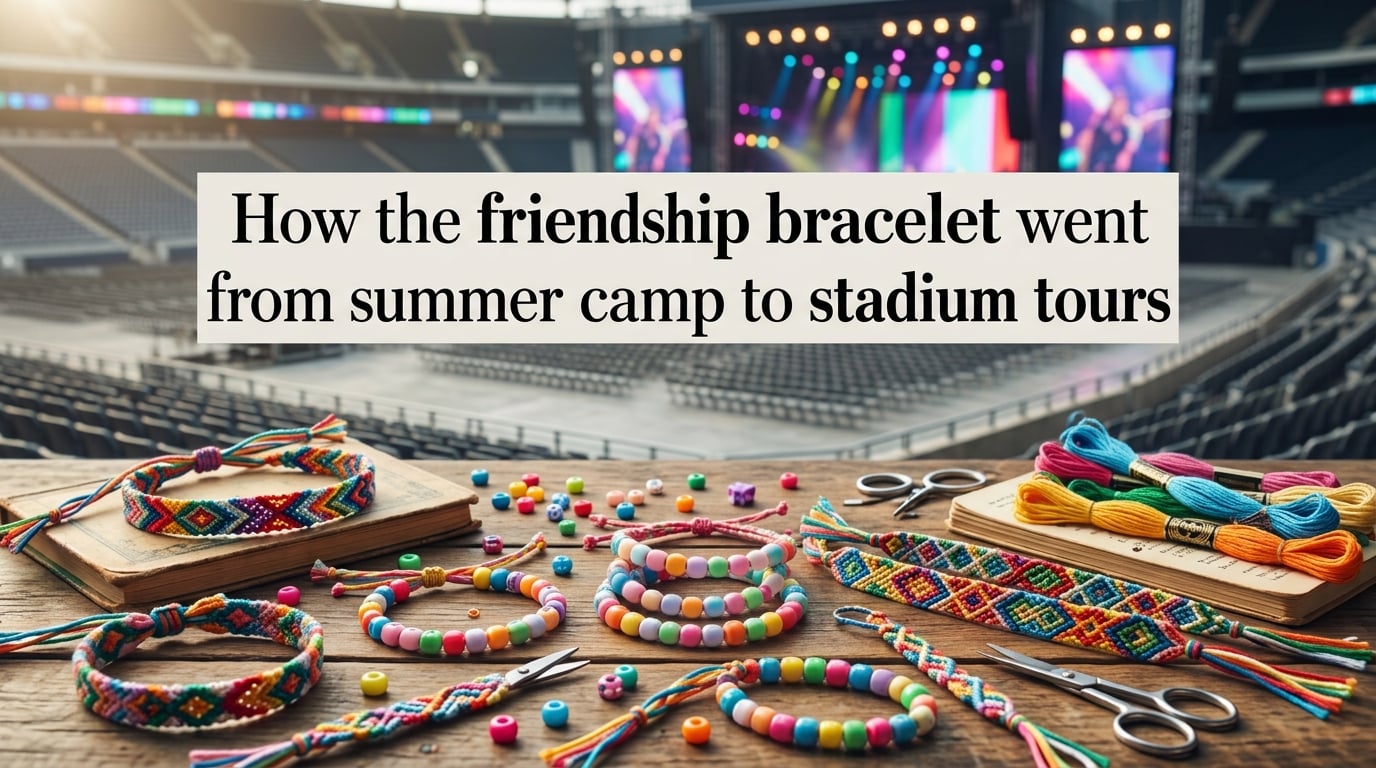
If you walked into a stadium parking lot in 2026, you would see thousands of people with arms covered in colorful beaded bracelets. Some spell out song lyrics. Others carry inside jokes, album names, or references only fellow fans would understand. The friendship bracelet went from summer camp to stadium tours faster than anyone predicted, and it became one of the defining cultural moments of the decade.
I remember sitting on a cabin porch as a kid, tying knots in embroidery floss until my fingers ached. That was just what you did at camp. You made bracelets, traded them with your bunkmates, and wore them until they frayed into nothing. Decades later, the same ritual is happening at sold-out stadium shows with tens of thousands of strangers who somehow feel like friends.
The story of how the friendship bracelet went from summer camp to stadium tours is really a story about nostalgia, community, and the way a simple piece of string can carry an enormous amount of meaning. It spans ancient civilizations, 1970s counterculture, summer camp traditions, and one Taylor Swift lyric that changed everything. Let me walk you through how we got here.
Table of Contents
Ancient Roots: Where Friendship Bracelets Really Began
Long before anyone strung beads at a summer camp, indigenous communities in Central and South America were creating intricately knotted jewelry using threads dyed with natural pigments. The friendship bracelet as we know it traces its deepest roots to the weaving traditions of Guatemala and Panama, where colorful woven and knotted bands carried cultural and spiritual significance.
Archaeologists have found evidence of decorative knotting dating back thousands of years. The Chinese developed complex knotting traditions as early as 206 BCE during the Han Dynasty, creating ornamental knots that symbolized prosperity, longevity, and good fortune. These were not just decorative. Each knot pattern told a story or carried a blessing.
In the 13th century, Arab weavers refined macrame, a knotting technique that spread across the Mediterranean and eventually into Europe. The word “macrame” itself likely comes from the Arabic word “migramah,” meaning fringe. These knotting traditions laid the technical foundation for what would eventually become the friendship bracelet.
What connected these ancient traditions was the idea that a handcrafted band could carry meaning beyond its material. A knotted thread was never just a knotted thread. It was a message, a blessing, a bond between maker and wearer. That idea would survive centuries and travel across continents before landing in the hands of American summer campers.
The Summer Camp Era: How Friendship Bracelets Became an American Tradition
The friendship bracelet arrived in the United States through the counterculture movement of the late 1960s and early 1970s. Young people disillusioned with mainstream American culture looked to indigenous and international craft traditions for inspiration. Macrame wall hangings, woven belts, and knotted bracelets became symbols of a back-to-basics, handmade ethos that rejected mass production.
By the mid-1970s, friendship bracelets had found their permanent American home: summer camp. Sleepaway camps across the country adopted bracelet making as a staple Arts and Crafts activity. The materials were cheap and accessible. A skein of embroidery floss cost pennies, and the basic knotting techniques were simple enough for an eight-year-old to learn in an afternoon.
At camp, bracelet making followed an unwritten code. You made them for people you cared about. You accepted one graciously when it was offered. And you wore it until it fell off naturally, because cutting it off was considered bad luck, or worse, a sign that the friendship was over. Some kids wore so many that the bracelets stacked from wrist to elbow, creating what camp counselors called the “bracelet tan” that lasted well past the final day of camp.
The patterns themselves became a language. The chevron, with its V-shaped zigzag, was the first pattern most campers learned. The candy stripe was simpler, just diagonal lines of alternating colors. More ambitious makers attempted diamonds, hearts, and even names spelled out letter by letter in tiny woven threads. Each pattern required different knot combinations, and mastering them was a point of pride.
What made camp bracelet culture so enduring was not the craft itself but the ritual around it. Sitting in a circle, floss draped over your knee, teaching a younger camper how to tie a forward knot. That was where friendships formed. The bracelet was just the physical evidence of a connection that had already been made.
How the Friendship Bracelet Went From Summer Camp to Stadium Tours?
The friendship bracelet went from summer camp to stadium tours because of one song. On Taylor Swift’s 2022 album “Midnights,” a track called “You’re On Your Own, Kid” includes the line: “So make the friendship bracelets, take the moment and taste it, you’ve got no reason to be afraid.” That single lyric became a cultural detonation point.
Fans, known as Swifties, took the instruction literally. When the Eras Tour launched in March 2023, attendees arrived at State Farm Stadium in Glendale, Arizona, carrying ziplock bags full of handmade beaded bracelets. They spelled out song titles, era references, cat names, and inside jokes from the fandom. The goal was to trade them with other fans throughout the night.
The trend exploded through TikTok and Instagram almost immediately. Videos of fans trading bracelets in parking lots, concourses, and seat aisles racked up millions of views within the first weekend of shows. People who had never made a bracelet in their lives were suddenly watching beading tutorials and buying alphabet beads in bulk. Craft stores reported surges in embroidery floss and bead sales that they had never seen before.
What made the phenomenon so powerful was its accessibility. You did not need VIP tickets or backstage passes to participate. A fistful of handmade bracelets costing a few dollars to produce could connect you with dozens of strangers who shared your love of the same music. In a concert environment that can feel isolating despite the crowds, the bracelets turned anonymous spectators into a community.
By the time the Eras Tour reached its second year in 2026, the bracelet tradition had become so embedded in the concert experience that it felt like it had always existed. Newcomers who had never attended a previous Taylor Swift tour assumed bracelet trading was a longstanding fandom ritual. It was not. It was barely a year old, born from one lyric and amplified by the power of social media into a global phenomenon.
The scale was staggering. At major stadium shows, individual fans reported making 50 to 100 bracelets each for trading. Multiplied across a sold-out crowd of 70,000 people, that meant millions of bracelets changing hands over the course of a single tour. Crafting supply chains felt the impact. Bead manufacturers and embroidery floss producers saw sustained demand that lasted the entire tour cycle.
The Trading Culture: Rules, Etiquette, and Stadium Stories
If you have never traded bracelets at a concert, the culture can seem confusing from the outside. The rules are unwritten but well understood within the community. You bring bracelets you made yourself. You approach people politely and offer a trade. You accept whatever is offered without judgment, because the value is in the gesture, not the craftsmanship.
The most important rule is simple: trade, do not sell. Handmade bracelets are gifts, not merchandise. When people tried to sell bracelets for profit outside venues, the community pushed back hard. The entire point of the tradition is that money does not enter the equation. You give something you made with your own hands to a stranger, and they give you something they made with theirs.
Fans describe the trading experience as transformative. Walking into a stadium nervous and alone, then leaving with 20 new bracelets and a handful of conversations that lasted the entire show. For introverts especially, the bracelet trade serves as a built-in icebreaker. You do not need to know how to small talk. You just hold up a bracelet and smile.
Not everything went smoothly. In August 2023, Levi’s Stadium in Santa Clara, California, briefly banned fans from bringing beads and bracelets inside, citing security concerns. The backlash was immediate and fierce. Fans flooded social media with complaints, and within hours, the stadium reversed the policy. It was a clear demonstration of how deeply the tradition had embedded itself in the concert experience. Banning bracelets felt to fans like banning the concert itself.
The community also had to navigate growing pains as the trend scaled. Some people brought commercially made bracelets instead of handmade ones, which felt against the spirit of the tradition. Others hoarded desirable trades instead of passing them along. But the core culture held. Most fans understood that the bracelets were about connection, not collection.
Celebrity Bracelet Moments: When Stars Joined the Tradition
The bracelet trading phenomenon was not limited to fans in the stands. Celebrities attending Eras Tour shows began participating, and their involvement amplified the trend to new heights. Selena Gomez was photographed trading bracelets with fans, reinforcing the cross-generational appeal of the tradition. Jennifer Lawrence was spotted in the crowd with a stack of bracelets climbing up her forearm.
Actress Jennifer Garner posted about her own camp bracelet nostalgia, connecting the trend to the same summer camp memories that millions of Americans shared. When celebrities with no direct connection to Taylor Swift’s inner circle participated, it validated the tradition as something bigger than a single fandom. It was a cultural moment.
Taylor Swift herself wore fan-made bracelets throughout the tour. Paparazzi photos showed her leaving venues with arms full of traded bracelets, each one a gift from a fan she had never met. That visible participation reinforced the cycle. If the artist herself valued these handmade gifts, then making and trading them was an authentic expression of fandom, not a peripheral activity.
How to Make Friendship Bracelets: A Beginner’s Guide?
If the history has you inspired to make your own bracelets, the good news is that the barrier to entry is remarkably low. The traditional camp method uses embroidery floss, which costs a few dollars for a pack of dozens of colors. The modern concert method typically uses elastic cord and alphabet beads, which are equally affordable.
For a basic woven bracelet, start by cutting three to six strands of embroidery floss, each about 24 inches long. Tie them together in a knot at the top and tape the knot to a flat surface. The simplest pattern is the forward knot: you take one strand, make a number 4 shape over the adjacent strand, then pull it through and tighten. Repeat this process across the row, switching colors as the pattern develops.
For beaded concert bracelets, the process is even simpler. Cut a length of elastic cord, string your beads in the desired order, and tie a secure double knot. Popular messages include song lyrics ( shortened to fit), album titles, era references, and simple words like “fearless” or “enchanted.” The goal is not perfection. The goal is to make something personal that another fan will want to wear.
Most experienced bracelet makers recommend making extras. You never know when you will run into someone who looks like they need one. Some fans bring 50 or more to a single show, carrying them in clear bags for easy access. The bracelets do not need to be elaborate. A simple string of beads with a single word can make someone’s entire night.
Why Friendship Bracelets Matter: The Psychology of a Comeback
The friendship bracelet revival is not just about craft or fandom. There is a genuine psychological explanation for why this particular tradition resonated so strongly in 2026. We live in an era where most of our interactions happen through screens. Text messages, social media likes, and streaming algorithms have replaced face-to-face connection for many people. A handmade bracelet is the opposite of all of that.
Psychologists who study nostalgia have found that engaging with familiar childhood activities can serve as an emotional anchor during periods of stress or uncertainty. The years following 2020 were marked by isolation, anxiety, and social disconnection for millions of people. The friendship bracelet, with its associations of simpler times at summer camp, offered a tangible way to reconnect with feelings of safety, belonging, and innocence.
There is also the matter of tactile creation. Making something with your hands produces measurable psychological benefits, including reduced anxiety and increased sense of accomplishment. In a world where most work is digital and intangible, the act of stringing beads or tying knots produces a concrete, physical result you can hold. That satisfaction is real, and it is powerful.
Finally, the trading ritual itself satisfies a deep human need for spontaneous, in-person connection. Approaching a stranger, offering a gift, and receiving one in return is a micro-interaction that builds trust and belonging. Multiply that by dozens of trades in a single night, surrounded by thousands of people doing the same thing, and you have a powerful antidote to loneliness.
FAQs
How did the friendship bracelet trend start?
Friendship bracelets trace their origins to indigenous cultures in Central and South America, where colorful knotted threads carried spiritual and cultural meaning. They became popular in the United States during the 1970s counterculture movement and were adopted as a staple summer camp craft activity. The modern stadium trading trend began when Taylor Swift released the song ‘You’re On Your Own, Kid’ on her 2022 album Midnights, which includes the lyric ‘So make the friendship bracelets.’
Why are people wearing friendship bracelets to the Eras Tour?
Fans wear and trade friendship bracelets at Eras Tour concerts because Taylor Swift’s song ‘You’re On Your Own, Kid’ includes the lyric ‘So make the friendship bracelets, take the moment and taste it.’ Swifties took this literally and began crafting beaded bracelets to trade with other fans at shows. The tradition turned stadium crowds into communities and became a defining feature of the concert experience.
What are the rules for friendship bracelets?
The main rules for concert friendship bracelets are simple: make them yourself, trade them freely, and never sell them. You offer a bracelet to another fan and receive one in return. The value is in the gesture, not the craftsmanship. You should accept any trade graciously, and handmade items are always preferred over store-bought ones.
Are friendship bracelets an American thing?
The knotting and weaving techniques behind friendship bracelets originated in indigenous Central and South American cultures and ancient Chinese knotting traditions. However, the specific tradition of making and exchanging friendship bracelets as tokens of friendship is strongly associated with American summer camp culture starting in the 1970s. The modern stadium trading trend is also primarily American, though it has spread internationally through the Eras Tour.
The String That Binds Us
The friendship bracelet went from summer camp to stadium tours because it answered a need that no app or streaming service could satisfy. People wanted to make things with their hands, give them to strangers, and feel like they belonged to something larger than themselves. A simple tradition from the 1970s, sparked by an ancient craft from thousands of years ago, found new life in one lyric and exploded into a global movement.
Whether you are at a stadium show with 70,000 people or sitting on a cabin porch with three friends, the act is the same. You make something, you give it away, and you walk away connected to another person. That is the whole story. And based on how the tradition continues to grow in 2026, it is a story that is still being written.