
A whiteboard easel is a freestanding dry erase board on a tripod, U-stand, wheels, or a foldable tabletop base. The best whiteboard easels for home offices give you a large thinking surface that needs no wall mounting, rolls out of the way when you are done, and survives daily use without ghosting or wobble.
After six weeks of living with ten of them in the same small office, one model kept winning the argument: the VIZ-PRO 36 x 24 portable tripod easel. It is light, it folds flat enough to carry through a doorway, and it carries 3409 reviews at 4.6 stars, which is the strongest rating-plus-volume pairing in this group. The Maxtek 36 x 24 tripod is the better value if you want a magnetic surface and a full accessory bundle, and the Maxtek 40 x 28 U-stand is the one to buy if you write hard enough to notice flex.
This guide covers all ten, organized by the four form factors you will actually be choosing between: tripod, U-stand, rolling, and tabletop. We score each on stability, writing area, height range, surface quality, magnetic capability, and how much floor space it eats. Last updated for 2026, with live review counts pulled from current listings.
One quick note on setup, since a whiteboard only works if you are comfortable at the rest of your desk. If your chair and desk are still dialed in for long sessions, start with our ergonomic chair picks for home offices and our standing desk roundup before the easel. An easel you lean over twice a week is fine; one you write on during every standup needs a chair that supports the rest of you too.
Top 3 Picks for Home Office Whiteboard Easels in 2026
Three models cover most home offices. One wins on balance, one on included accessories and magnetic capability, one on raw stability when you write with pressure.

VIZ-PRO 36 x 24 Tripod Easel
- Non-magnetic 34 x 22 inch writing area
- Folds flat for carrying
- Lightweight and easy to move

Maxtek 36 x 24 Tripod Easel
- Height adjustable 42-63 inch
- Magnetic surface
- Markers and magnets included
- Lifetime warranty
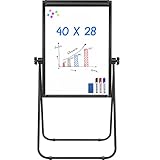
Maxtek 40 x 28 U-Stand Easel
- Height adjustable 40.5-75 inch
- 360 degree rotation
- Three-layer baked surface
All 10 Best Whiteboard Easels Compared Side by Side (October 2026)
Every model below, with the specs that actually change a purchasing decision. Height ranges use the manufacturer’s stated figures, so treat the minimum as the number that decides whether a child or a seated adult can use the same board.
| Product | Specifications | Action |
|---|---|---|
| VIZ-PRO 36 x 24 Portable Tripod Easel |
|
Check Latest Price |
| Maxtek 36 x 24 Tripod Easel |
|
Check Latest Price |
 VIZ-PRO 48 x 36 Magnetic Foldable Easel VIZ-PRO 48 x 36 Magnetic Foldable Easel |
|
Check Latest Price |
 Maxtek 48 x 32 Rolling Double-Sided Board Maxtek 48 x 32 Rolling Double-Sided Board |
|
Check Latest Price |
| Maxtek 40 x 28 Magnetic U-Stand Easel |
|
Check Latest Price |
 VIZ-PRO 48 x 36 Rolling Mobile Board VIZ-PRO 48 x 36 Rolling Mobile Board |
|
Check Latest Price |
 Neatsure 36 x 24 Magnetic Tripod Easel Neatsure 36 x 24 Magnetic Tripod Easel |
|
Check Latest Price |
 Max-officoo 28 x 20 U-Stand Board Max-officoo 28 x 20 U-Stand Board |
|
Check Latest Price |
 DexBoard 40 x 28 U-Stand Easel DexBoard 40 x 28 U-Stand Easel |
|
Check Latest Price |
 WEYOUNG 40 x 28 Aluminum Easel WEYOUNG 40 x 28 Aluminum Easel |
|
Check Latest Price |
1. VIZ-PRO 36 x 24 Portable Tripod Easel – Best Overall
VIZ-PRO Whiteboard Easel, 36 x 24 Inches, Portable Tripod Dry Erase Board
Board 36 x 24 inch
34 x 22 inch writing area
Non-magnetic
Folding tripod legs
Pros
- Very light build and easy to carry between rooms
- Folds flat quickly with no tools
- Large enough for a full weekly plan
- Erases clean and complete
- Ships with a pen tray and paper hook
Cons
- Non-magnetic surface cannot hold notes or calendars
- Some ink colors need whiteboard spray to lift
- Accessories are sometimes missing from the box
This is the easel I ended up keeping. The build is light, which sounds trivial until you are moving it between the office and the living room twice a day. The tripod legs collapse flat against the back of the board, and the whole thing goes through a door opening held by one hand.
The board measures 36 x 24 inches with the frame included, giving a 34 x 22 inch writing surface. That is the sweet spot people describe over and over in home office planning threads: enough room for a full week of schedule, priorities, and a rough system diagram, small enough not to dominate a room with a sloped ceiling or a shared wall.
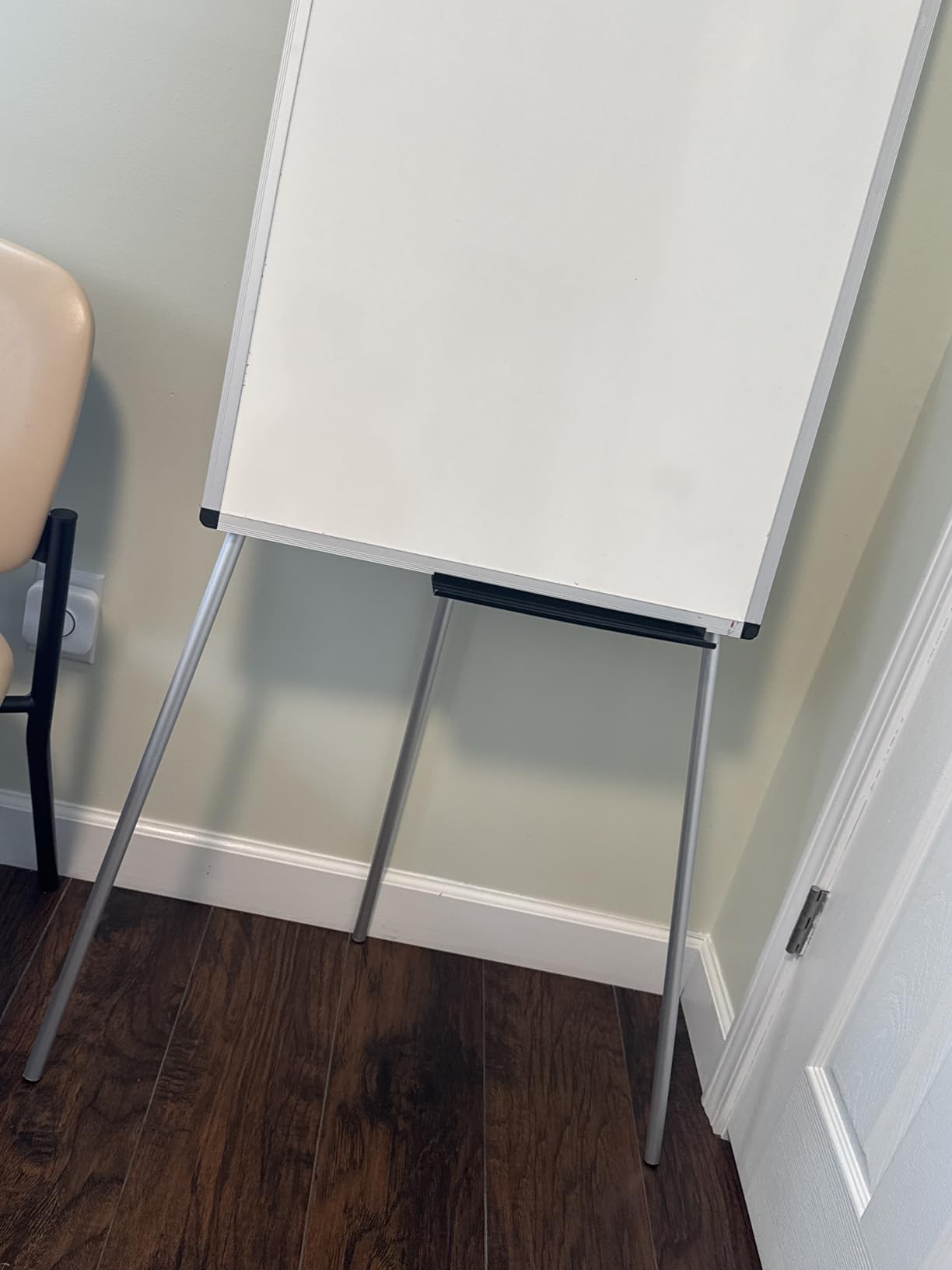
The main compromise is that the surface is non-magnetic. You cannot pin a printed calendar, a client brief, or a stack of sticky notes to it, which rules out a lot of the workflow people want from a magnetic board. Everything has to be drawn, written, or hung from the paper hook under the tray.
Erasing is genuinely good. It wipes clean and completely with a dry pass for most of what you write, and the reviews note the surface holds up well over months of daily use. The exception is a handful of marker colors that reviewers say need a shot of whiteboard spray before the shadow lifts completely. That is a marker issue more than a surface issue, and it is the one habit worth changing.
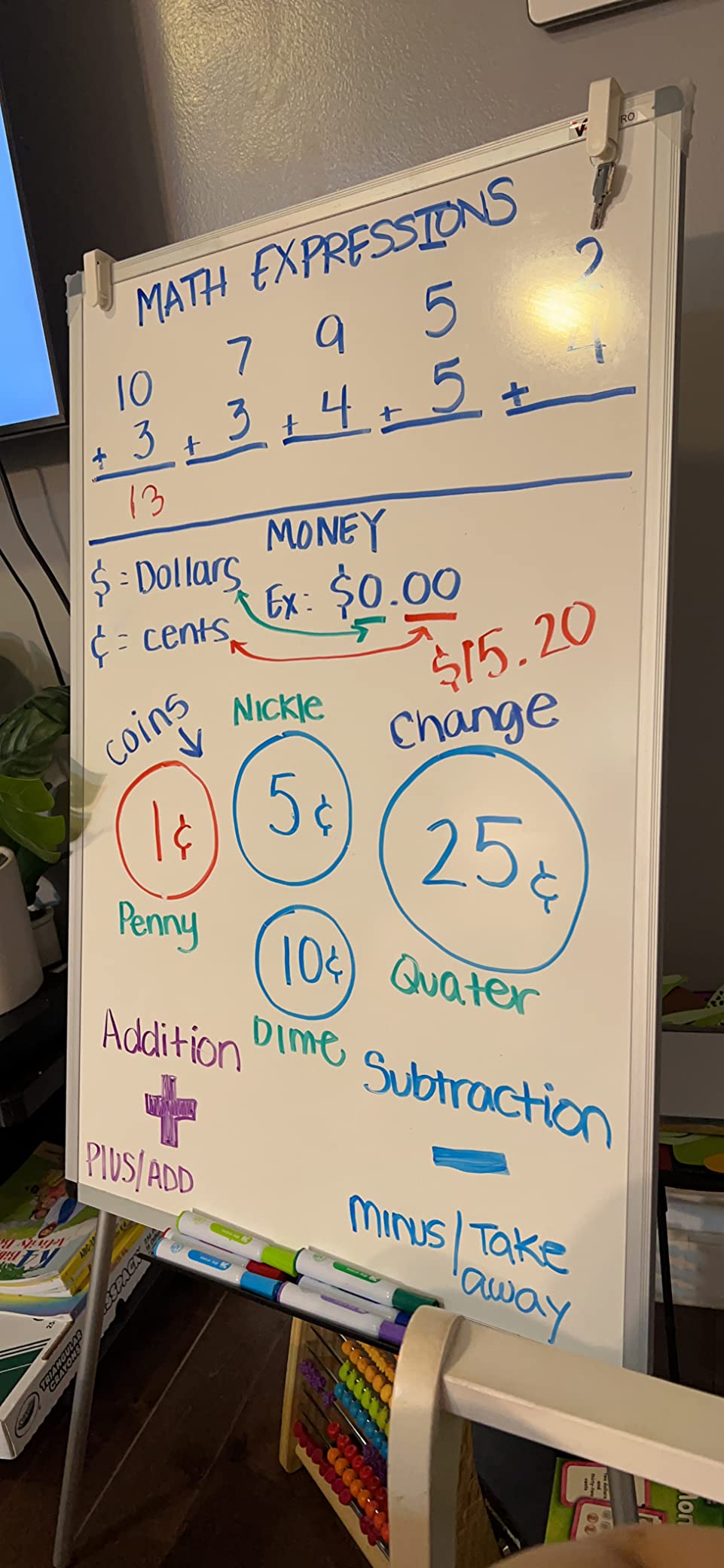
Two practical notes before you commit. First, the accessories – clips and the tray – are not always in the box, and some owners report contacting the seller to get them. Second, the frame is light enough that a hard knock on a leg can shift it, so park it away from a walkway if you have a busy household. Neither is a dealbreaker for a private office; both matter in a shared space.
At 4.6 stars across 3409 reviews, it has the highest review volume and one of the top ratings in this roundup. That combination of a proven surface, a genuinely portable build, and no wall mounting is why it sits at number one.
What works well for daily planning
The flat, uninterrupted writing area is the reason this board keeps scoring well. There is no center seam, no frame bisecting the surface, and no magnetic hardware breaking up the space, so a weekly grid runs corner to corner. If your daily planning is a written week plus a running priority list, that space is the product.
Because it folds, you can also bring it to a call in another room and then drop it behind the door. The fold is the feature most competitors with larger boards cannot match, and it is why this model works in an apartment where a 48 x 36 board would be a permanent fixture.
When to skip it
Skip it if your workflow depends on attaching printed material. A magnetic surface is not a nice-to-have for client walk-throughs, sprint planning with sticky notes, or anyone keeping a paper calendar on the wall. Choose the Maxtek 36 x 24 instead and you get a magnetic face with the same footprint class.
Also skip it if you write with real pressure. Lightweight tripods flex, and a tripod that moves under the marker makes a straight line hard to hold. If heavy marker pressure is your normal, the U-stand models are the ones built for it.
2. Maxtek 36 x 24 Height Adjustable Tripod Easel – Best Value
Maxtek Easel Whiteboard 36 x 24 in, Stand Tripod with Height Adjustable
Board 36 x 24 inch
Height 42-63 inch
8.8 pounds
Three-layer baked surface
Lifetime warranty
Pros
- Magnetic surface holds calendars and notes
- 42-63 inch height range covers kids and adults
- Lifetime warranty is a construction quality signal
- Generous accessory bundle out of the box
- Stable steel tripod with rubber feet
Cons
- Basic accessories are functional rather than premium
- A small share of reviewers report durability or finish issues
This is the pick if the VIZ-PRO’s one weakness bothers you. You get the same 36 x 24 class of board, plus a magnetic surface, a real accessory kit, and a height adjustment range that goes lower than the competition.
Height runs from 42 to 63 inches, with scale markings printed on the tripod legs so you set it the same way each morning instead of guessing. The lower end of that range matters more than most specs suggest: it is the difference between a board that works for a seated adult and one that also works for a child doing homework beside the desk.
The surface is described as a three-layer baked, anti-scrape finish. In practice reviewers report it wipes down without ghosting using the included eraser, and the star distribution holds at 4.5 with 3375 reviews. The board itself weighs 8.8 pounds, which is heavier than the VIZ-PRO but still carryable for short distances.
Everything you need arrives in the box: 2 flipchart hooks, a magnetic eraser, 3 pens, 6 magnets, and a detachable tray. That matters more than it sounds, because the accessories most often sold separately are exactly the ones that make a board usable from day one. The packaging is reinforced with corner protectors and foam, which addresses the transit-damage problem several other boards in this roundup have.
What works well for shared family use
The 42 to 63 inch range makes this the most family-flexible tripod here. Set it low for a kid at the dining table, push it up for a standing standup, and the markings keep it consistent. Reviewers consistently cite the range as the reason the board gets used by more than one person in the house.
The magnetic face is the other practical win. Six magnets and a magnetic eraser are included, so you can pin a printed schedule, a grocery list, or a sketch from a call without erasing anything you were working on. For a home office doubling as a homework station, that flexibility is the deciding factor.
When to skip it
Skip it if wobble under heavy writing is the deciding factor. A tripod at this weight has some give at the top of the range, and heavy writers will feel it. The U-stand options further down this list are stiffer for a reason.
Its 4.5 average sits just under the leaders, and roughly 6% of reviews are one-star, mostly around finish durability over long periods. If you want the highest confidence in a magnetic surface for a small home office, the DexBoard or Maxtek 40 x 28 give you a stiffer frame instead.
3. VIZ-PRO 48 x 36 Magnetic Foldable Easel – Best Magnetic Surface
VIZ-PRO Magnetic Whiteboard Easel, Foldable, 48 x 36 Inches
Board 48 x 36 inch
46 x 34 inch writing area
Magnetic
Height 46-64 inch
Foldable
Pros
- Large magnetic writing area in a frame that still folds flat
- Lightweight aluminum frame folds flat behind a door
- Height adjusts for adults and children
- Clean all-white look works on camera
Cons
- Some units arrive dented or creased from transit
- Surface can need cleaner rather than a dry wipe
- A few reviewers rated it down on price
When you want a big magnetic surface you can still put away, this is the one. At 48 x 36 inches with a 46 x 34 inch writing area, it is a full step up from the 36 x 24 class without jumping to a rolling board that never leaves the corner of the room.
Height adjusts from 46 to 64 inches, which is a narrower band than the Maxtek tripods but well matched to adult use. The magnetic writing surface is the point: you can attach printed material, a paper pad, or a reference sheet and keep it there while you write underneath it.
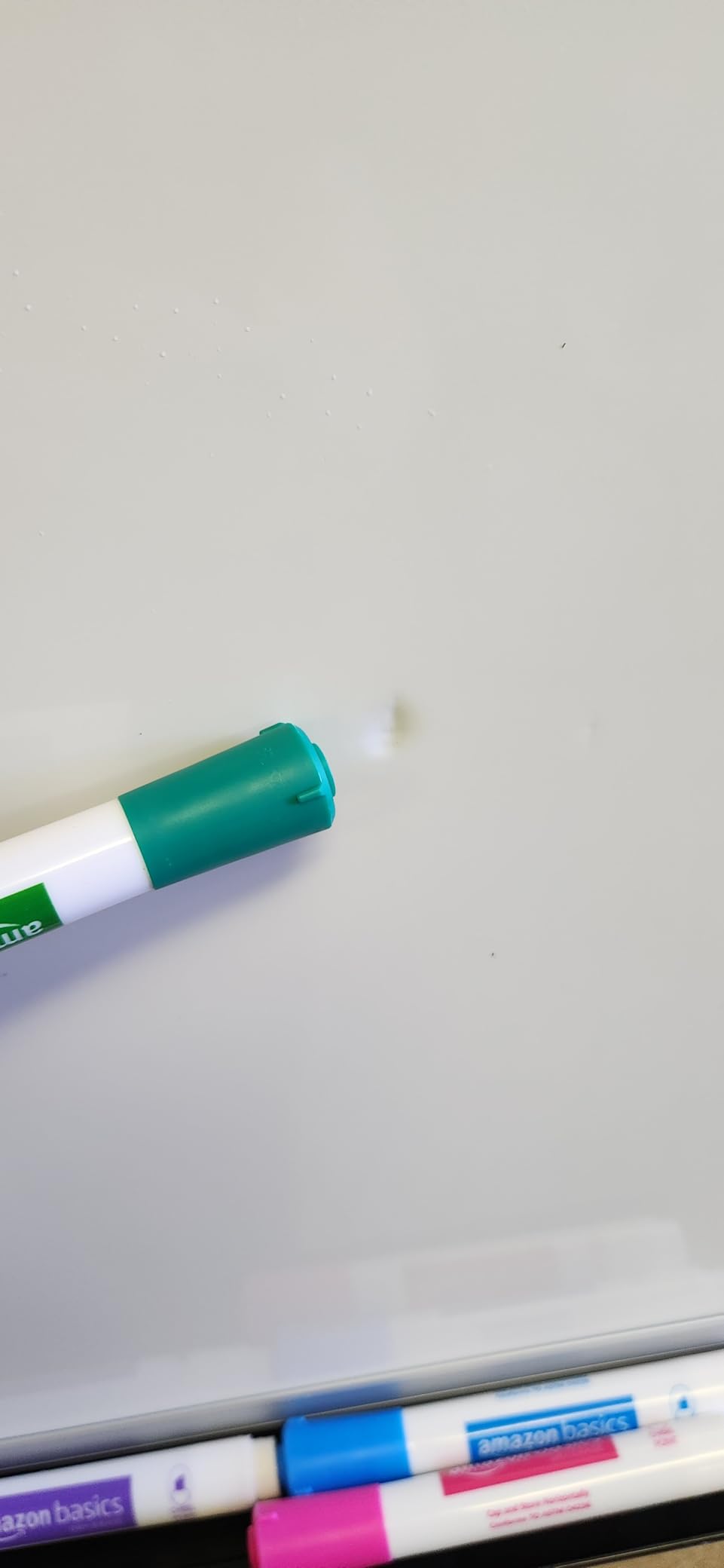
The frame is lightweight aluminum and folds flat, which is unusual at this size. Owners mention storing it behind a door or leaning it flat against a wall between uses, and the included storage bag makes that less conspicuous. Assembly and disassembly are quick with no tools required beyond what comes in the box.
Erasing takes slightly more effort than on the tripods. Reviewers note it can need board cleaner to fully lift old marks rather than a single dry pass, which is normal for a large magnetic surface but worth knowing if you erase the whole board daily.
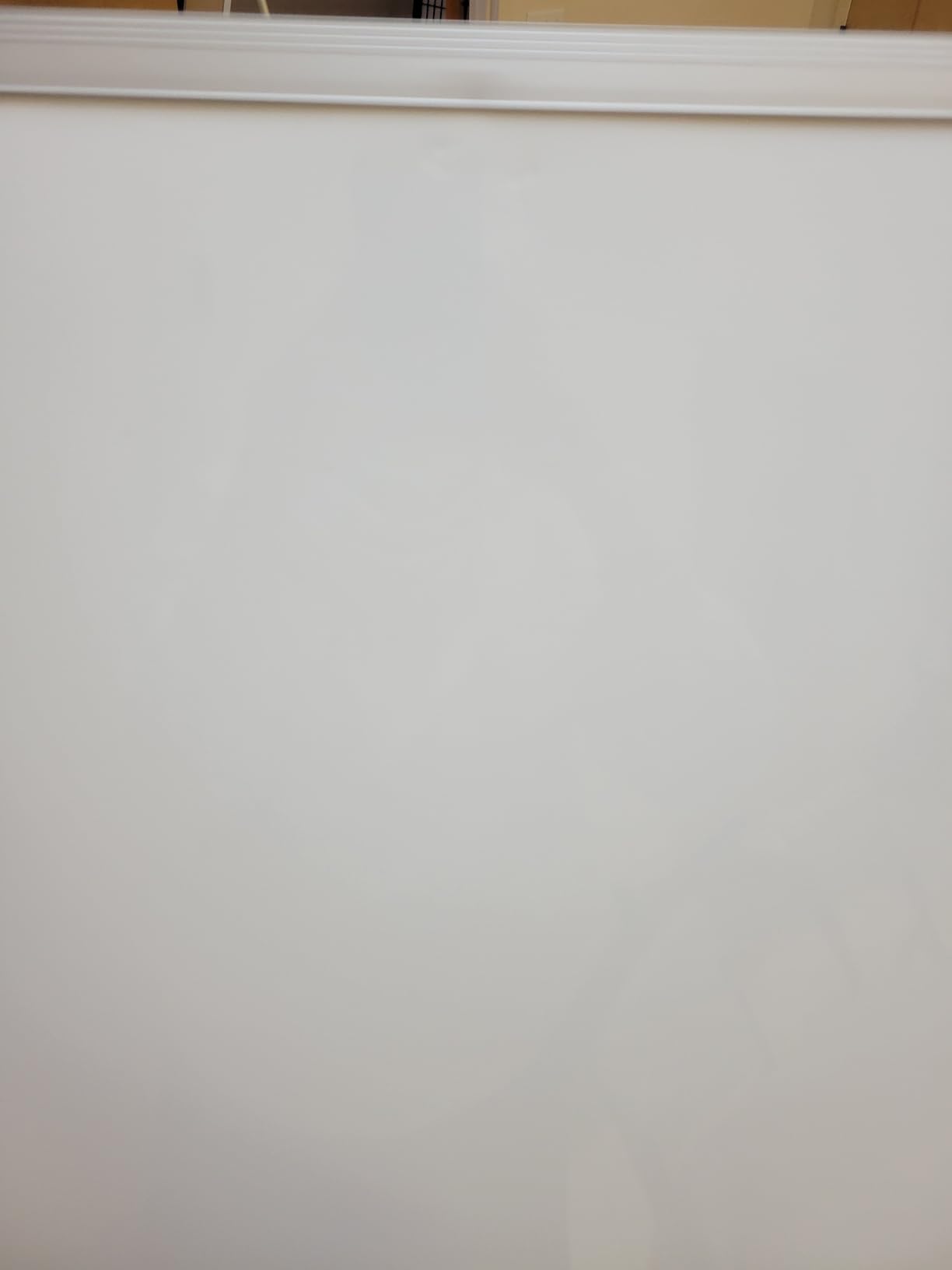
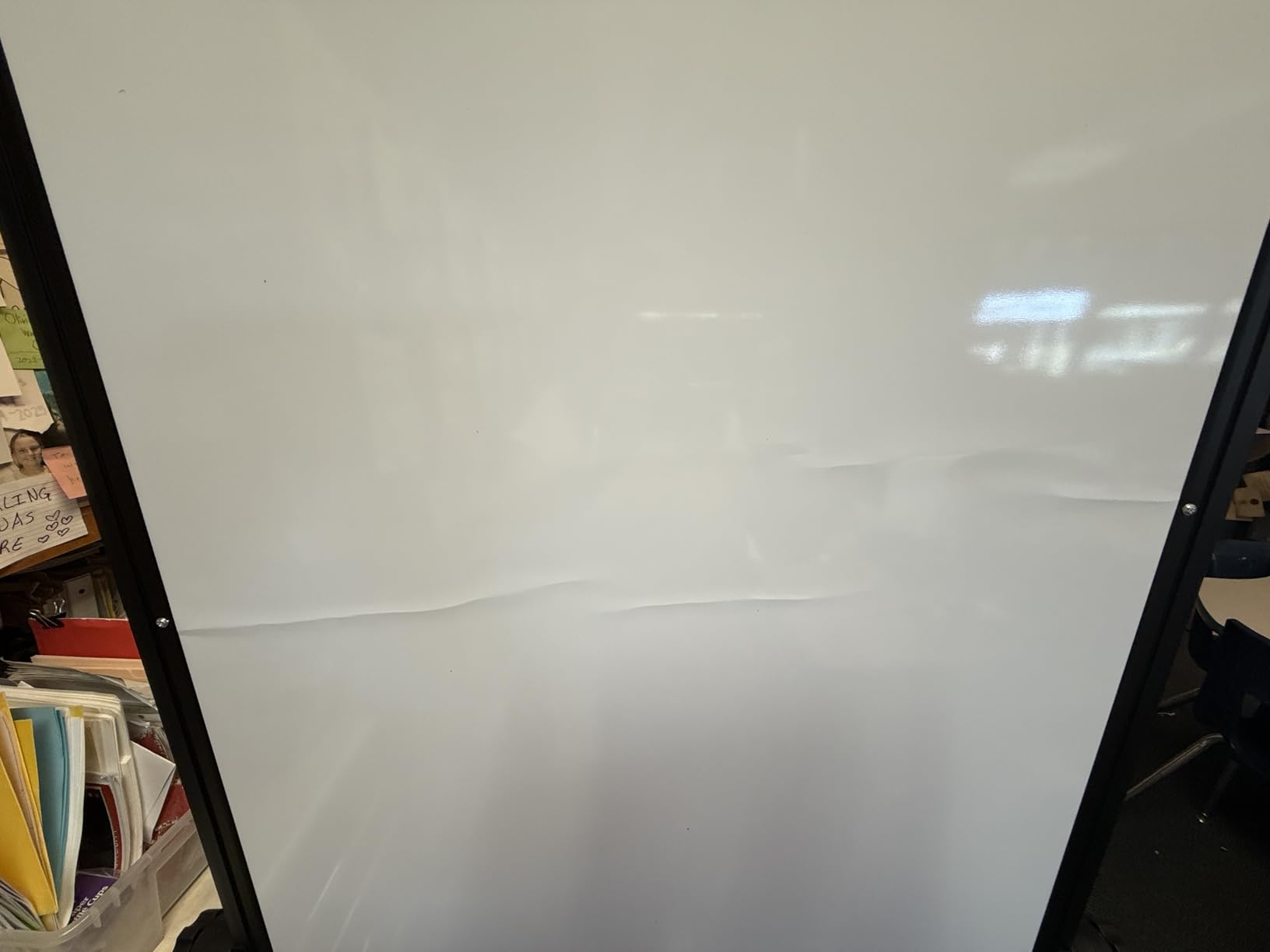
The main complaint pattern is transit damage. Some units arrive with dents, creases, or a punctured surface, which is a packaging failure rather than a design flaw, and it is worth inspecting the board the day it arrives. The 4.3 average across 2704 reviews reflects that, plus a handful of buyers who felt the size-to-price ratio was steep.
What works well for teaching and walk-throughs
A 46 x 34 inch magnetic area is large enough to hang a printed diagram on one side of the writing zone and annotate around it, which is exactly what client walk-throughs and homeschool lessons need. The fold-flat frame means you can set it up for the session and put it away when it ends, rather than living with a permanent board on the wall.
It also photographs well. The all-white face and thin aluminum frame read cleanly on a video call, and the board can be positioned beside a camera at a usable height without filling the whole background. Our monitor roundup covers the other half of a clean on-camera setup if the frame around your desk is the problem.
When to skip it
Skip it if transit damage will bother you or if you are on a tight budget. The shipping-dent pattern is the most repeated negative, and at 4.3 stars it sits below the leaders despite the larger surface.
Also skip it if you need the board low enough for a child to write independently. The 46 inch minimum is adult-height, so a smaller tabletop or a lower-range tripod is the better fit for mixed-height family use.
4. Maxtek 48 x 32 Rolling Double-Sided Whiteboard – Best for Large Rooms
Maxtek Rolling White Board on Wheels 48×32 in, Double-Sided Magnetic Stand
Board 48 x 32 inch
Double-sided magnetic
70 inch max height
8.8 kg
Four locking casters
Pros
- Locking casters let you move it and hold it steady
- Double-sided surface doubles usable area
- Hinge and lock keep it rigid while writing
- Assembles in about 15 minutes with tools included
Cons
- Heavier than a tripod
- so it is often a two-hand move
- Can drift if the wheel brakes are not set
If your office has floor space and you plan visually in front of other people, this is the most capable board in the roundup for group work. A 48 x 32 inch double-sided magnetic surface on a wheeled stand gives you two independent work areas and rolls anywhere you need it.
The double-sided flip mechanism is what separates it from a plain rolling board. Owners describe keeping a prepared or reference side intact while working an active side, which means you do not have to erase a client-facing diagram to start a new topic in the middle of a call. The hinge and lock system is specifically praised for keeping the board steady without wobble once you set the brakes.
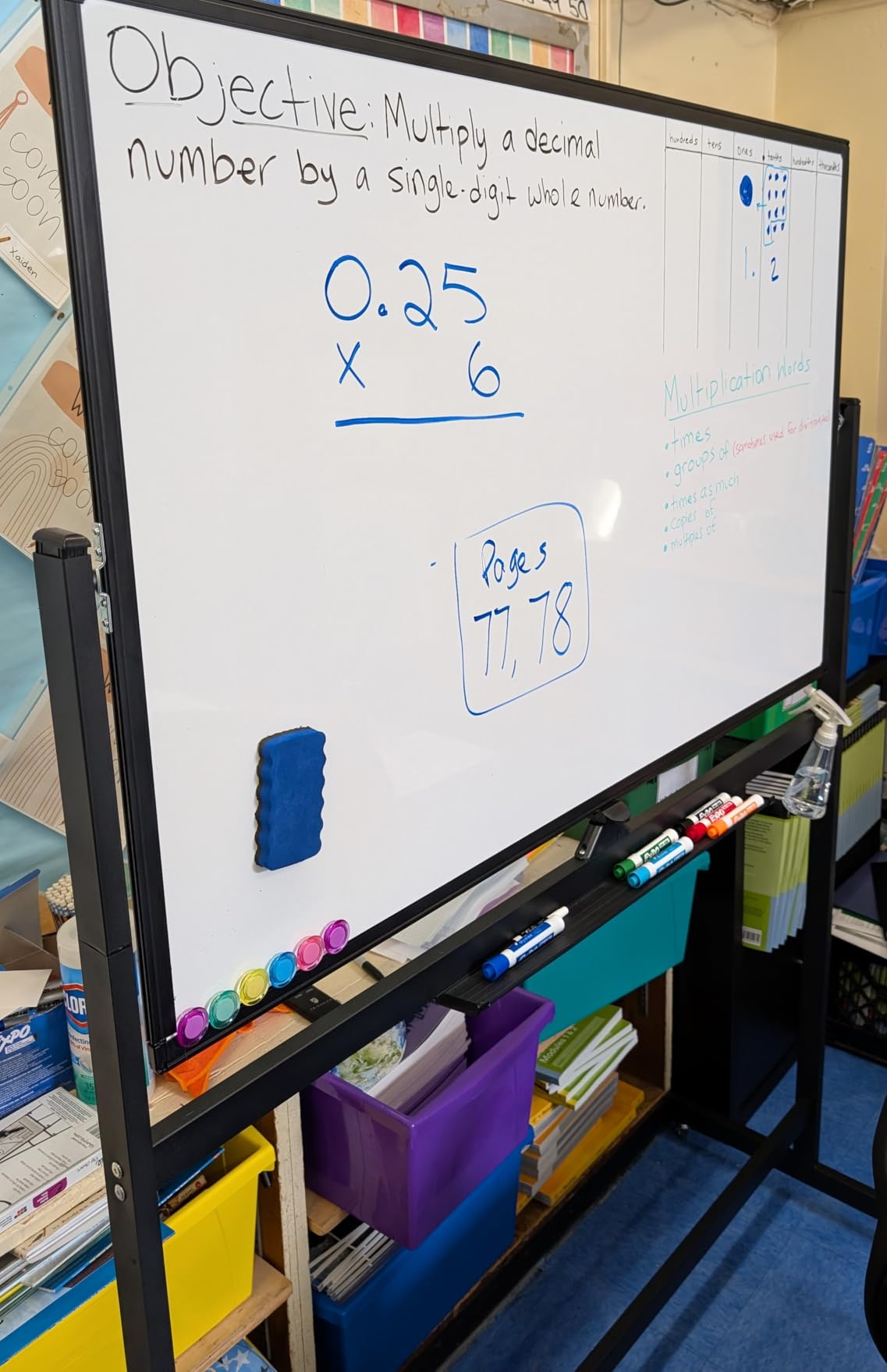
Four all-angle locking wheels with 360 degree rotation handle the mobility, and the maximum assembled stand height of 70 inches lets you write standing at full height. The surface is described as high-density non-porous steel with an anti-scratch matte coating, and reviewers report ghost-free erasing in a single swipe.
Assembly takes about 15 minutes with the included tools. At 8.8 kg it is a genuine two-hand lift when you need to move it, but the casters handle the routine repositioning around the room on their own. The built-in tray holds pens, eraser, and cleaner.
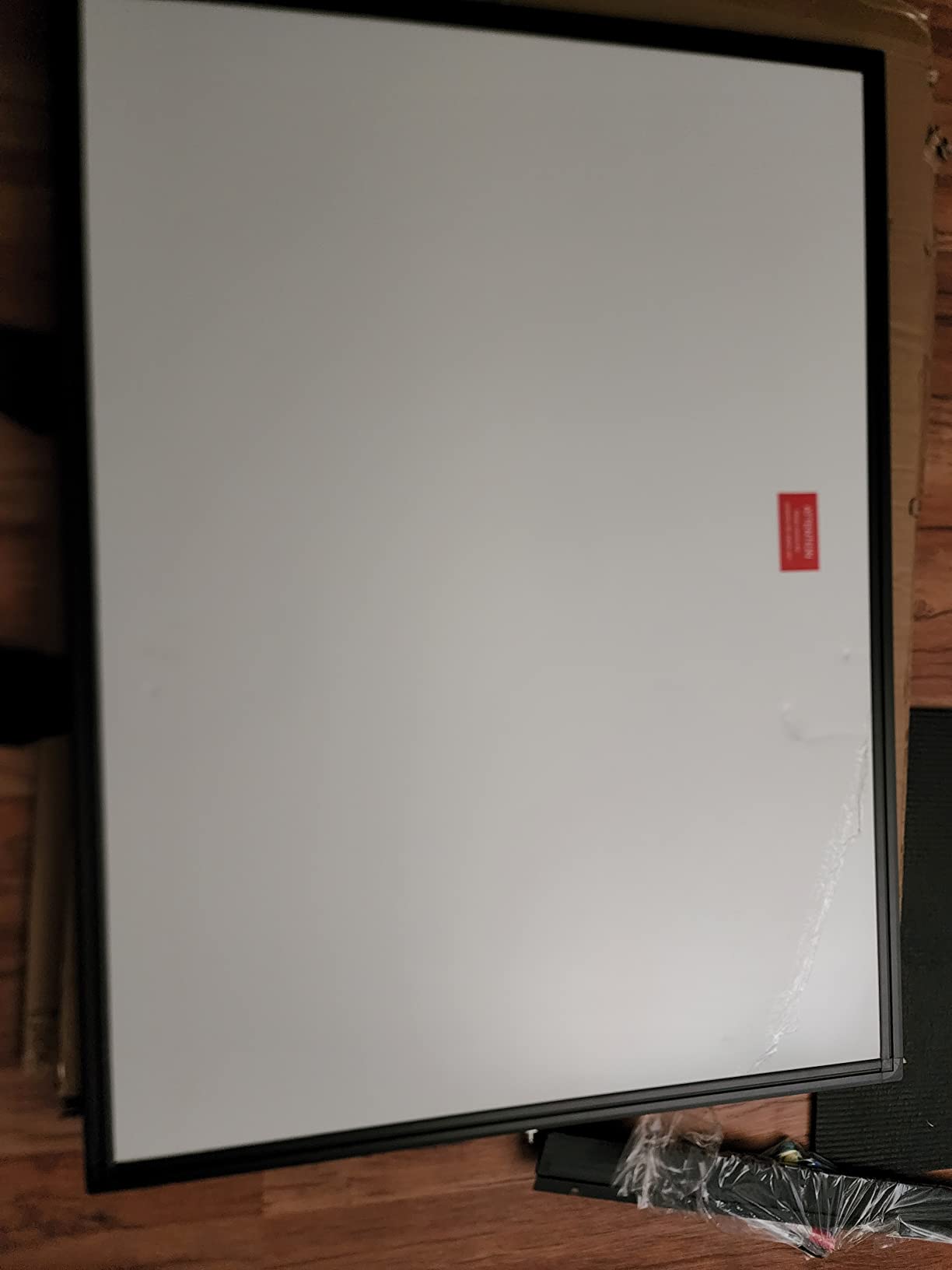
Transit damage shows up here too – dents, creases, and occasionally surface bubbling on arrival. The manufacturer’s response is fast free replacement boards, which is why the 4.4 average across 1470 reviews stays solidly positive despite it. Check the surface on arrival regardless.
What works well for standups and shared planning
The double-sided format is the reason to buy this. For a weekly planning session with a partner or a small team, one side holds the standing agenda and the other side takes live changes, and nothing has to be erased mid-session. That is a workflow the single-sided tripods cannot offer at any size.
Brakes on all four casters matter more than the spec sheet suggests. Once the wheels lock, the board stops drifting, and a board that does not roll while you write is the difference between usable and frustrating in a live session. Set the brakes before you start, not halfway through.
When to skip it
Skip it in a small room. At nearly 6 feet tall assembled with a 48 inch width, it needs a clear corner and a path to get there. If you are in a compact apartment where furniture already crowds the floor, a folding tripod that lives behind a door is the more realistic choice.
Skip it if you are on hardwood and worried about the casters. The wheels roll easily, but rolling casters on finished floors are worth testing on a rug first, and a thin rolling board can creep if the brakes are not set.
5. Maxtek 40 x 28 Magnetic U-Stand Easel – Best for Stability
Maxtek Stand Whiteboard 40 x 28 in, Magnetic Dry Erase Easel
Board 40 x 28 inch
Magnetic
Height 40.5-75 inch
14.3 pounds
360 degree rotation
Pros
- U-stand stays firm with no give while writing
- Widest height range in the roundup at 40.5-75 inch
- 360 degree rotation for landscape or portrait
- Double-sided with flipchart hooks and tray
Cons
- Marker tray can detach when the board is moved
- Flipchart hooks sit under the top clip and are awkward to load
- Slightly less stable on carpet
This is the board I hand to anyone who writes like they are angry at the marker. The U-stand base replaces the narrow tripod geometry with a wide footprint, and the difference shows up immediately when you press hard enough to make the surface flex. It does not.
At 40 x 28 inches with a 40.5 to 75 inch height range, it also has the widest vertical span in the roundup. That lower end reaches down to desk height for a seated adult or a child, and the top reaches standing height for a full-room view. Reviewers call out that range specifically as the reason one board serves a whole household.
The 360 degree rotating design flips between wide and upright formats, which matters for handwriting and for camera framing. Wide is the better angle for writing by hand and for sitting beside a laptop on a call; upright is better for a tall list or a column of notes. Being able to choose per session is the useful part.
The surface is a three-layer baked, anti-scrape finish over a magnetic face, and at 4.6 stars across 1183 reviews this is one of the highest-rated boards here. Owners also mention the steel elastic clamp and flipchart hooks on top, plus a foldable design that lets it store under a desk or bed.
Two hardware annoyances come up repeatedly. The marker tray can pop off when you move the board, and the flipchart hooks sit under the top clip, which makes changing a paper pad awkward. Neither affects writing. Both are the kind of detail that only shows up after a few months.
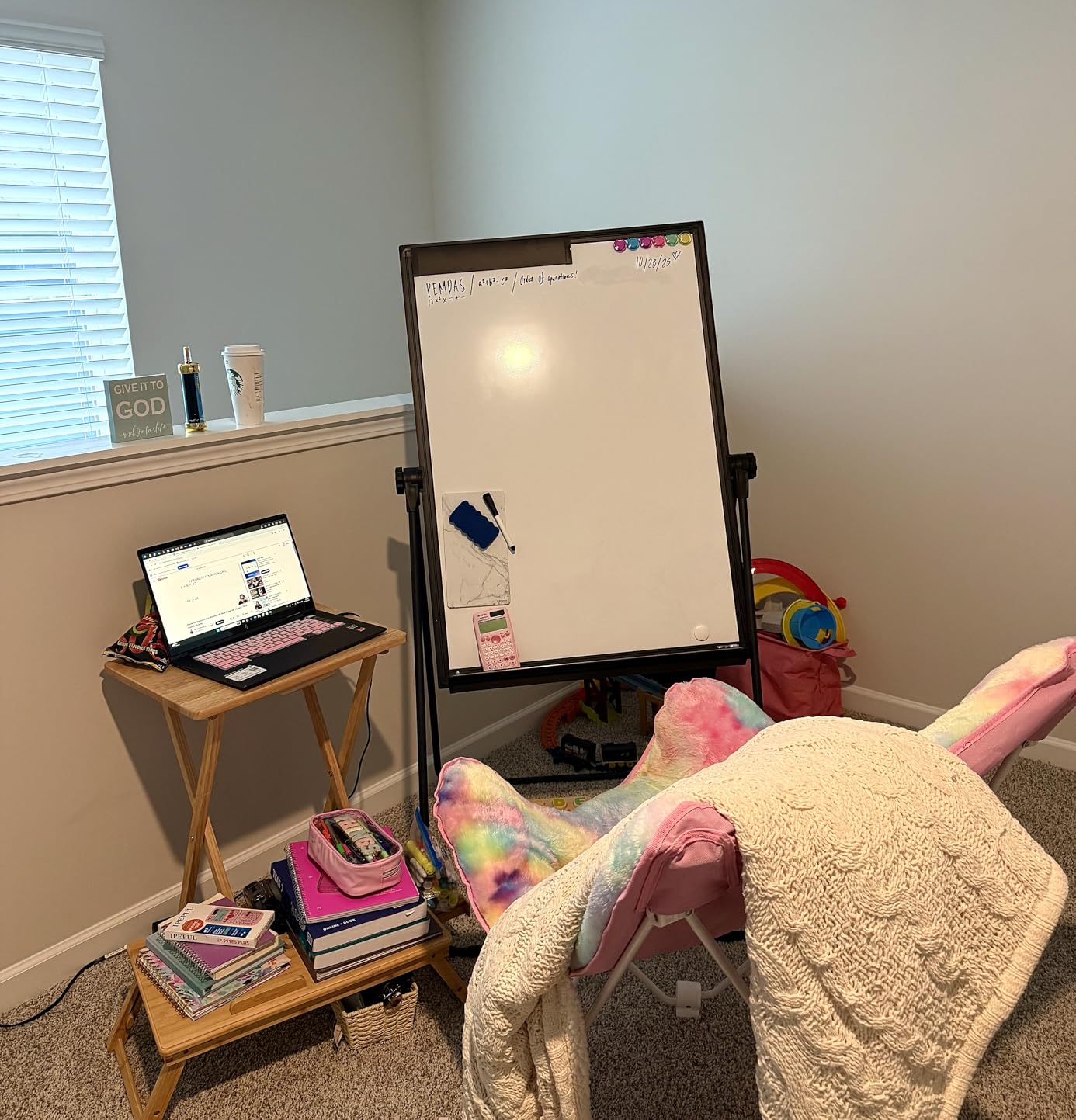
At 14.3 pounds it is a two-hand carry, though the foldable design offsets the weight for storage. There is also a note about being light enough to be knocked over outdoors in wind – relevant if you plan to use it on a patio, not so much if it lives in a room.
What works well for heavy writing and standing sessions
Stability is the whole argument here. A U-stand with anti-slip reinforced rubber feet spreads the load across a wider base than a tripod, so the board does not rock when you lean into a long line or a big arrow. If you diagram systems, map out a plan, or write standing up at full height, that rigidity is worth more than any surface upgrade.
Rotating between landscape and portrait also means one board covers both a seated planning session and a standing presentation. For a home office where the same space does double duty, that flexibility removes the argument for buying a second board.
When to skip it
Skip it if floor space is tight or if you move it constantly. The footprint is stable but not small, and 14.3 pounds is not a carry-across-the-house weight. If your board lives in a corner and comes out once a week, that is fine. If it moves every day, pick the folding tripod instead.
Skip it if carpet is your main writing surface. Reviewers note it is slightly less stable on carpet, which is a fair warning if you plan to write in a carpeted office without a hard floor under the stand.
6. VIZ-PRO 48 x 36 Rolling Mobile Whiteboard – Best Mobile Value
VIZ-PRO Rolling Whiteboard, 48″ x 36″ Mobile White Board with Stand
Board 47.2 x 35.4 inch
Double-sided magnetic
Four casters, two brakes
360 degree rotation
Foldable
Pros
- Double-sided surface keeps one project visible while starting another
- Four caster wheels with two brakes roll on carpet and hard floors
- ABS corners resist shaking while writing
- Right size to park beside a desk
Cons
- Fold-in-half design leaves a visible seam down the middle
- Casters are low quality and can be replaced
- Plastic fittings can deform if screws are overtightened
This is the rolling option for anyone who wants mobility without the Maxtek’s weight. Board dimensions are 47.2 x 35.4 inches with a 45.7 x 33.9 inch writing surface, double-sided and magnetic, on a stand with four 360 degree caster wheels and two locking brakes.
The format is genuinely useful in a home office. Park it beside the desk during the week, roll it to the living room for a session with someone else, and the double-sided surface means a project stays visible on one face while you work the other. The foldable design is the reason the package size is manageable for something this large.
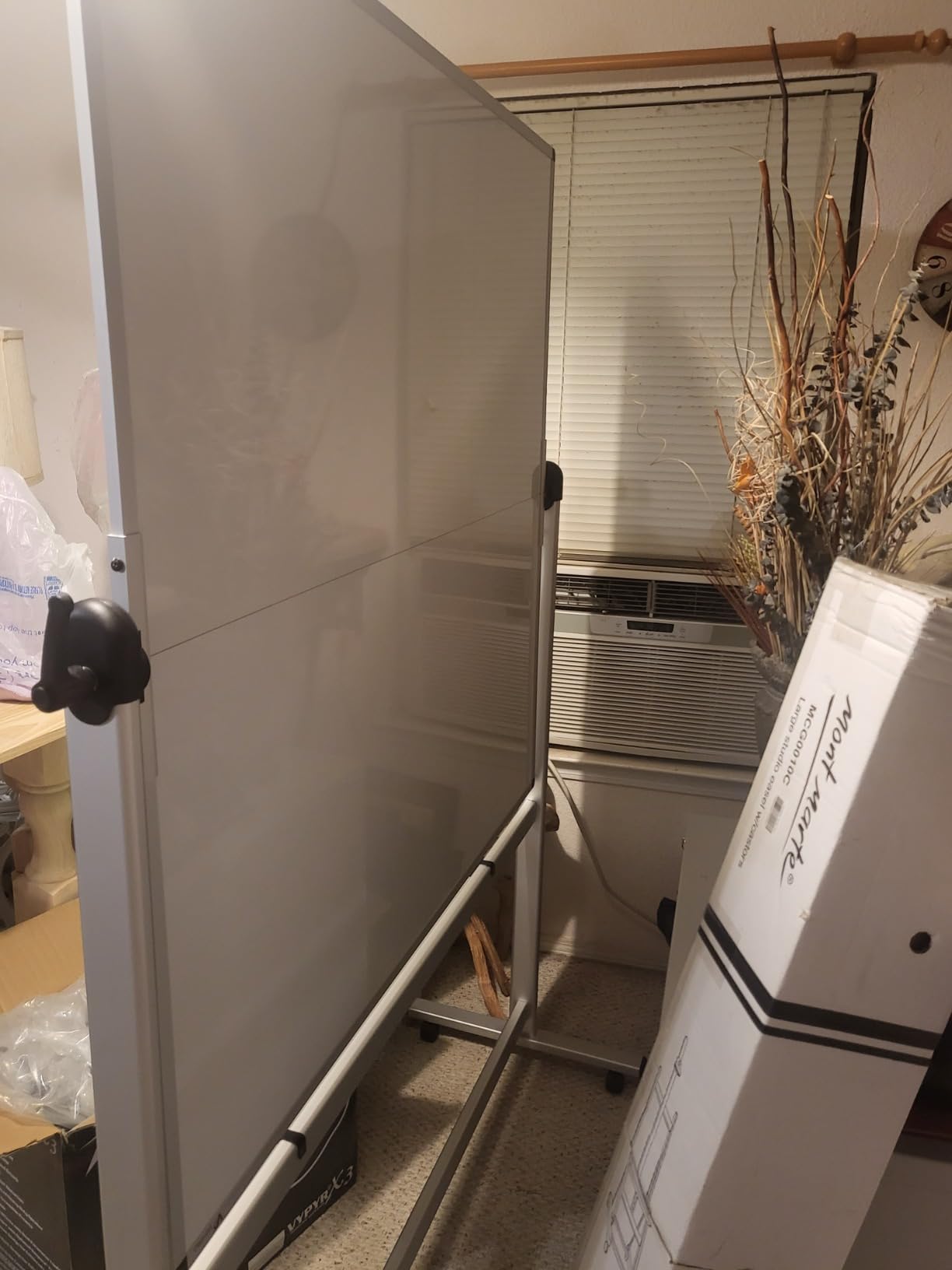
Stability under writing is the surprise here. Reviewers single out the aluminum frame and ABS corners as resisting shaking while you write, which is not the norm for boards in this class. The 360 degree rotation with locking handles gives you the same wide and upright choice as the U-stand boards.
What holds it back is the fold-in-half construction. That design reduces transit damage, but it also produces a visible seam and gap down the center of the writing surface, and several owners feel it splits the usable area. If you plan to write across the full width, this matters.
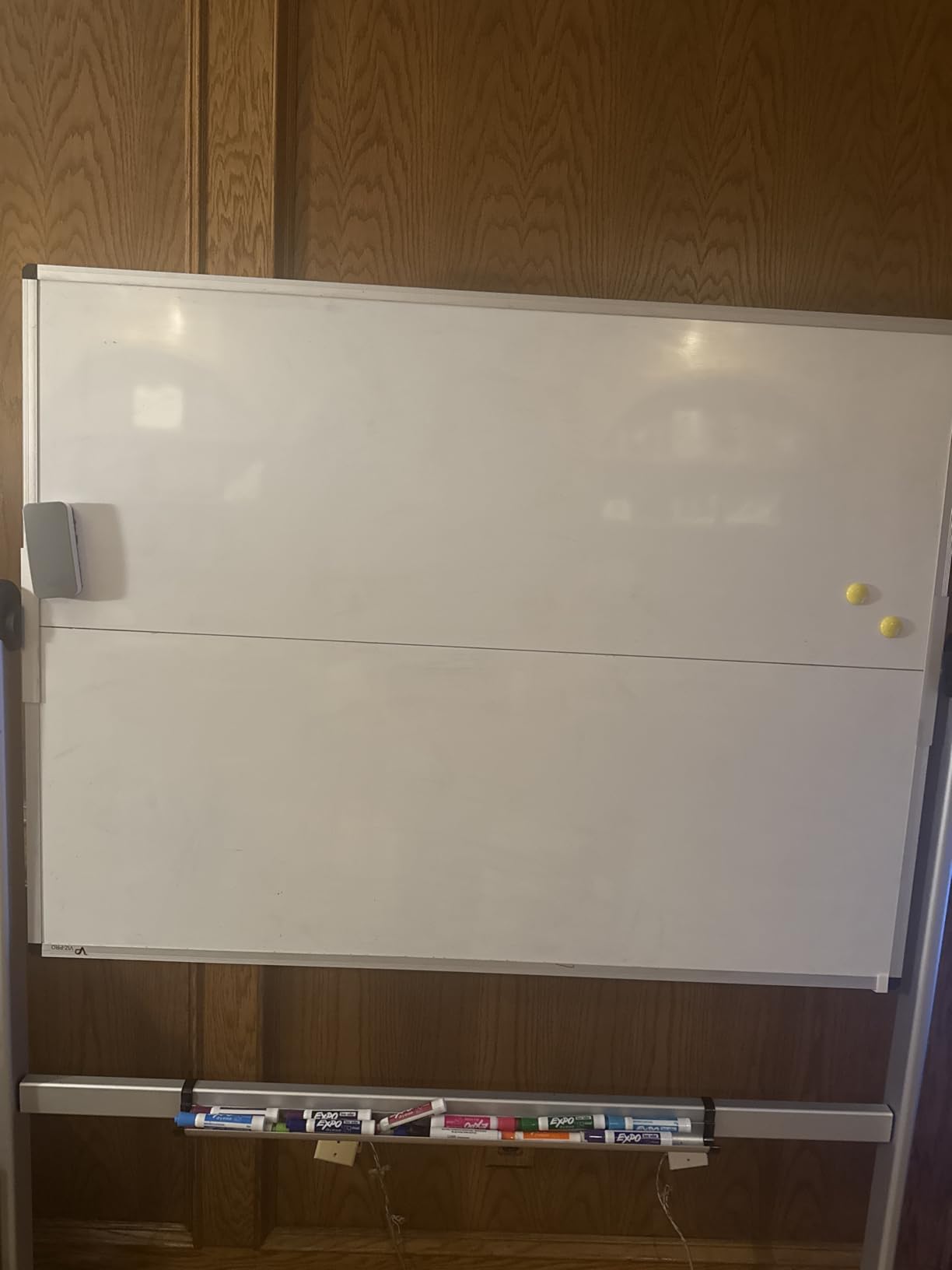
Build quality is the other limitation. The casters are described as low quality and replaceable, and the thin-walled aluminum plus mid-grade plastic fittings mean over-tightened screws can deform rails or crack holders. The marker tray is held on by inexpensive plastic and lacks end caps. None of that stops daily use, but it does cap the long-term durability.
At 4.2 stars across 814 reviews, it sits below the leaders in this set, and the feedback explains exactly why: people like the mobility and size, and are less enthusiastic about the seam and the fittings.
What works well for moving between rooms
Mobility is the win. Four casters roll on both carpet and hard floors, and the two brakes let you lock the board where you need it. If your home office is a corner of a larger living space and you want the board available for sessions elsewhere in the room, this is the format that supports it.
The double-sided magnetic face is also practical for team-style work, keeping a prepared side visible while the active side takes new material. Tools and instructions are included, and the detachable marker tray and two hooks round out the kit.
When to skip it
Skip it if you write edge to edge. The center seam and gap are not subtle, and for anyone drawing long timelines or full-width diagrams it splits the work area in a way that no other board here does.
Skip it if you want a board that stays good for a decade of heavy office use. The fittings and casters are the weak point, and a board that gets moved daily will stress them faster than one that sits in a corner.
7. Neatsure 36 x 24 Magnetic Tripod Easel – BUDGET PICK
Large Whiteboard Easel with Stand, 36″ x 24″ Portable Standing Magnetic Dry Erase White Board, 3′ x 2′ Tripod Height Adjustable Flip Chart Easel for Home Office Classroom School, Silver
Board 36 x 24 inch
Magnetic
Height 36-65 inch
3.86 kg
Collapsible steel tripod
Pros
- Magnetic surface takes calendars
- pens and paper notes
- 36-65 inch height range with scale markings
- Collapses flat and moves easily between rooms
- Wipes clean with the included eraser
Cons
- Some units arrive with a wavy or bubbled panel
- Board arrives as two panels with a seam down the middle
- Light frame can tip
- One-star reviews are the largest share in the set
This is the entry point: a magnetic 36 x 24 tripod with a 36 to 65 inch height range at the bottom of the cost range for a magnetic board. For a first home office, a spare room, or a board for a kid’s schoolwork that you do not mind replacing, it does the job.
Height adjusts from 36 to 65 inches with scale markings, which is a wide span for the money and covers everything from a child at a table to a standing adult. The magnetic surface is scratch-resistant and designed to resist ghosting, and the included eraser handles a full wipe without needing cleaner. Tray and magnets are in the box, and the assembly sheet and tools are included.
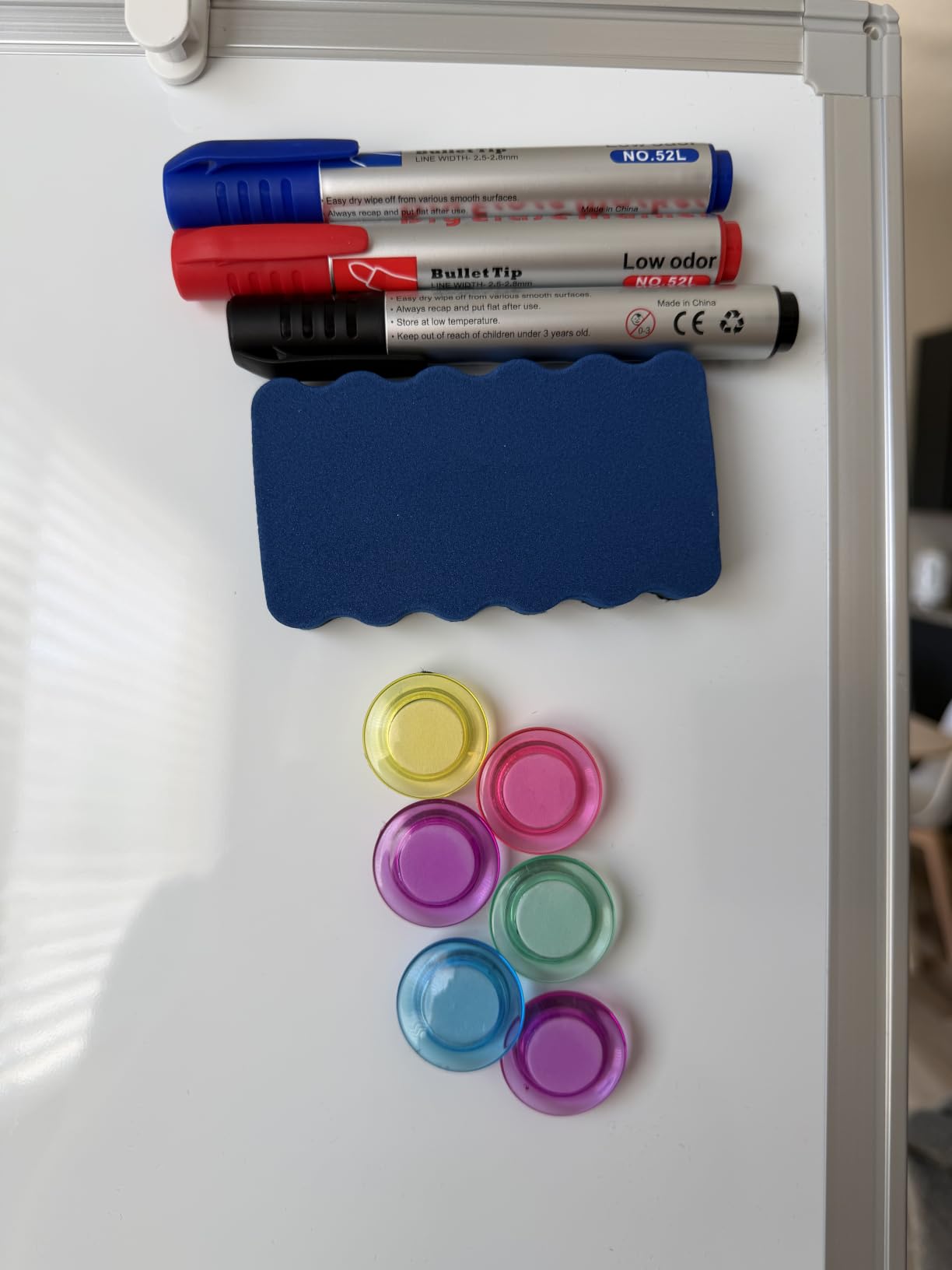
It collapses flat and is light at 3.86 kg, so moving it between rooms is genuinely easy. That portability plus the magnetic face is the combination that makes it popular for home organization and for temporary signage, where you want notes up for a few days and then put the board away.
Quality control is the real story, and it is worth being blunt about. The most common complaint is a wavy or bubbled panel on arrival that interferes with both magnets and clean writing. The board also arrives as two panels with a seam down the middle, which shows if you write across the full width.
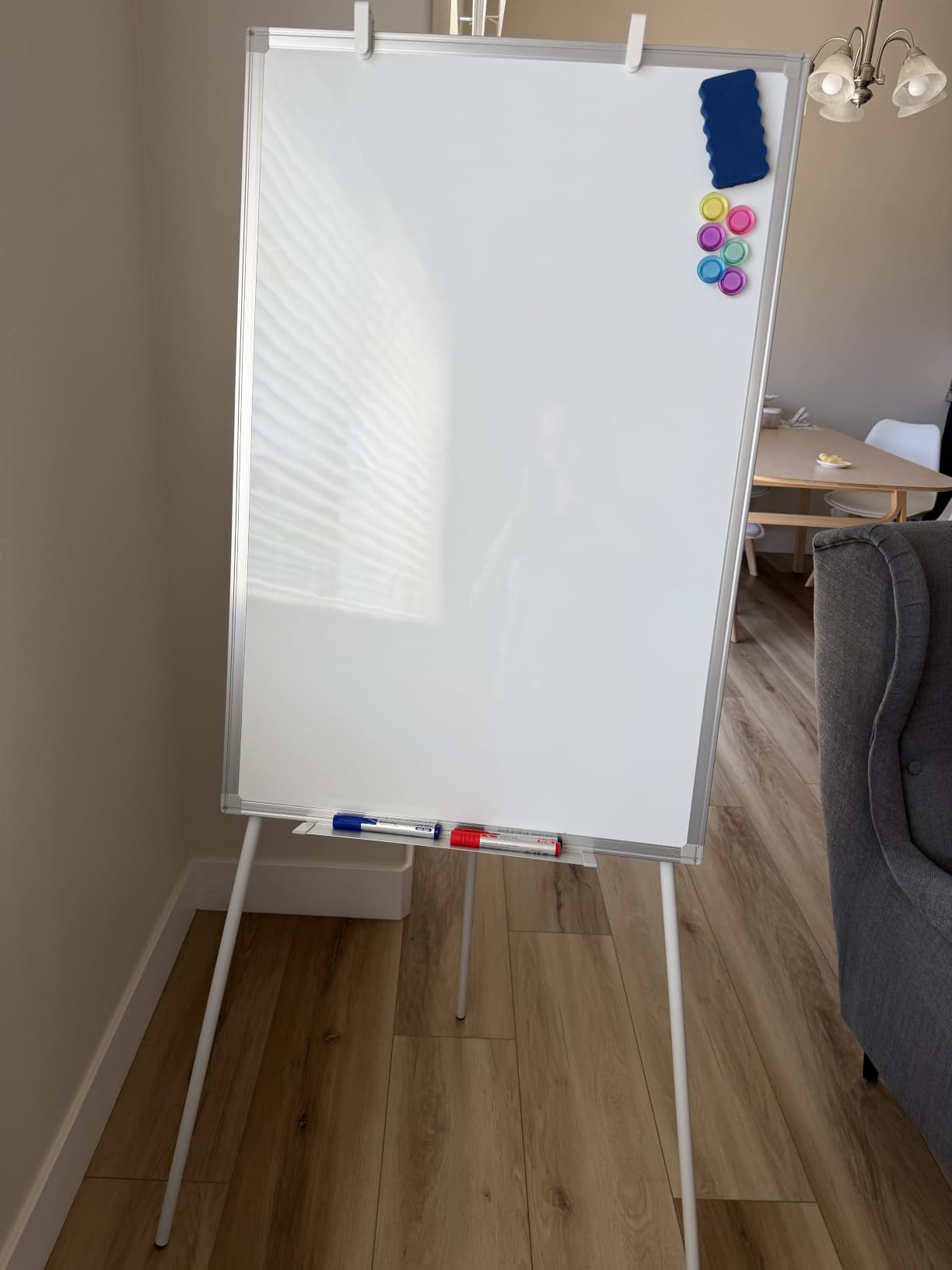
Add a light frame that reviewers say can be knocked over easily, leg locking fixtures and paper clips that feel insecure, and you have a board whose 4.1 average and 11% one-star share make sense. Inspect the panel the day it arrives rather than assuming it is fine.
What works well for a first or spare board
Two rooms, low stakes. A magnetic face at this size is the right call for a kid’s daily schedule, a household planning board, or a temporary project that lives for a few weeks. The 36 to 65 inch range means one board covers a child and an adult without swapping stands.
It is also the easiest board here to move. It collapses flat, weighs under 4 kg, and sets up with an assembly sheet and included tools. If you are furnishing a home office on a budget and want a magnetic surface more than you want perfect build quality, this is the trade.
When to skip it
Skip it if the board is for daily professional use in a room you look at on camera. The wavy-panel reports are frequent enough that you should plan on inspecting carefully, and the seam is a permanent feature rather than a defect.
Skip it if you write with pressure or if pets or a busy hallway are a factor. At 3.86 kg with a light frame, it is the easiest to tip in this roundup, and the leg locks are the part reviewers trust least.
8. Max-officoo 28 x 20 Double-Sided U-Stand Board – Best for Tight Rooms
Dry Erase Board with Stand – Double Sided 28″x20″ Portable Writing Whiteboards, Height Adjustable & 360° Rotating U Stand Magnetic Whiteboard for Home, School, Restaurant & Presentation
Board 28 x 20 inch
Double-sided magnetic
Height 31-53 inch
360 degree rotation
Tool-free setup
Pros
- Compact 28 x 20 inch footprint suits small home offices
- Rotates for slanted writing and viewing
- Double-sided
- so a paper pad hangs on one face
- Assembles in about three minutes without tools
Cons
- Smaller writing area than the larger easels
- 31-53 inch range suits seated writing more than standing
- Wood and rubber frame feels less rigid than aluminum
This is the answer when floor space is the binding constraint. At 28 x 20 inches it is a compact board, and it still gives you a double-sided magnetic surface on a U-stand with 360 degree rotation.
The height range is 31 to 53 inches, which is tuned for seated writing. That is a deliberate trade: you give up standing-presentation height and gain a footprint you can keep in a corner of a small office without it becoming the feature of the room. For daily planning done at a desk, the range is exactly right.
Rotation lets you flip it to a wide writing angle, which is genuinely more comfortable for handwriting and for looking at the board beside a laptop. The double-sided magnetic surface means you can hang a paper pad on one face with the included hooks and write on the other, a combination owners find useful for reference material.
What works well for a shared desk or small office
Compact and foldable is the whole pitch. It folds flat, stores under a bed or in a closet, and the U-stand with anti-slip reinforced rubber feet keeps it stable at a size where a tripod would feel tippy. The 360 degree rotation means a 28 x 20 board reads much larger than its dimensions when you turn it on its side.
Tool-free assembly in about three minutes is also underrated. There is no build step to put off, so the board is usable the day it arrives. The box includes a duster, magnets, a marker tray, flipchart hooks, and a storage box.
When to skip it
Skip it if you present to more than one person at a time. A 28 x 20 writing area is a personal planning surface, not a presentation surface, and the double-sided format only partly compensates. For client calls where people need to read from the board, go up a size.
Skip it if you want to write standing. A 53 inch maximum is a seated-height board, and reviewers note the range suits seated writing more than standing use. If you plan to use it for standing standups, the 40 x 28 and 48 x 36 options reach much higher.
9. DexBoard 40 x 28 Double-Sided U-Stand Easel – Best Low-Center-of-Gravity Build
40″x28″ Double Sided Magnetic Dry Erase Easel Whiteboard on U Stand
Board 40 x 28 inch
Double-sided magnetic
18 pounds
Low center of gravity U-base
25-sheet pad included
Pros
- U-base with a low center of gravity has no wobble
- Matte black frame suits modern offices and studios
- Double-sided and 360 degree rotatable
- Folds flat for closet or under-bed storage
Cons
- Heaviest board in the roundup at 18 pounds
- Sits in the top price tier for a home office easel
This is the most solidly built board here, and the reason is geometric. The U-shaped base puts the center of gravity low and the footprint compact, so the board resists tipping from the side rather than rocking front to back. Buyers who came from tripods single this out as the reason the board does not move while they write.
At 40 x 28 inches with a 360 degree rotatable double-sided magnetic surface, it covers the same working area as the Maxtek 40 x 28 but with a different character. The height adjustable stand supports sitting or standing use, and the frame folds flat for closet or under-bed storage, which matters more than usual given the weight.
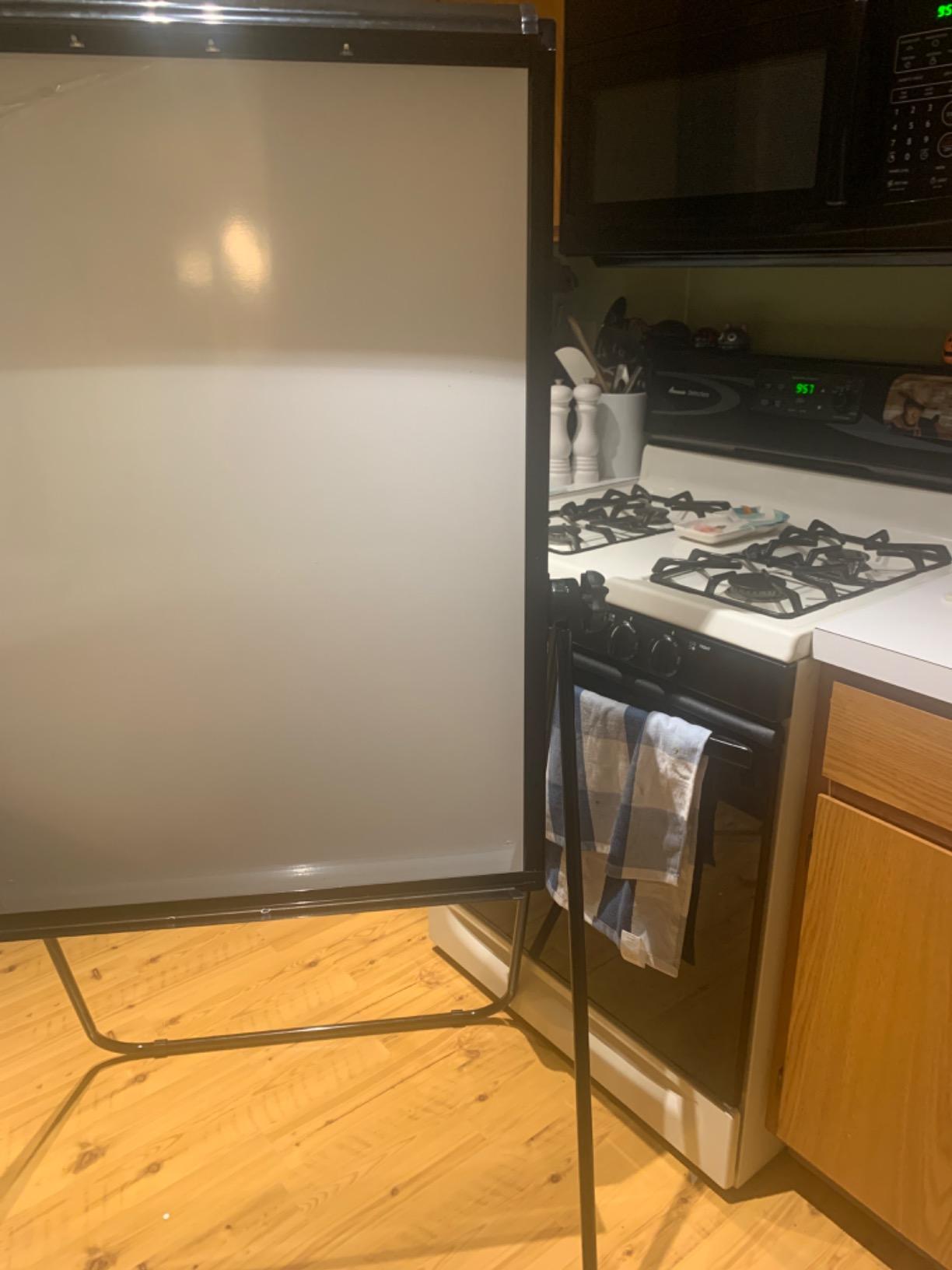
The bundle is generous. It includes a 25-sheet flipchart pad, 6 magnets, a dry eraser, and an accessory tray, plus a built-in flip chart holder. Nothing extra needs buying to get real use out of it on day one.
The matte black frame is worth calling out for a home office specifically. Most boards in this category are white or silver, and a black frame reads as furniture rather than office equipment. It looks considered on camera and it does not visually shrink the room the way a large white panel can.
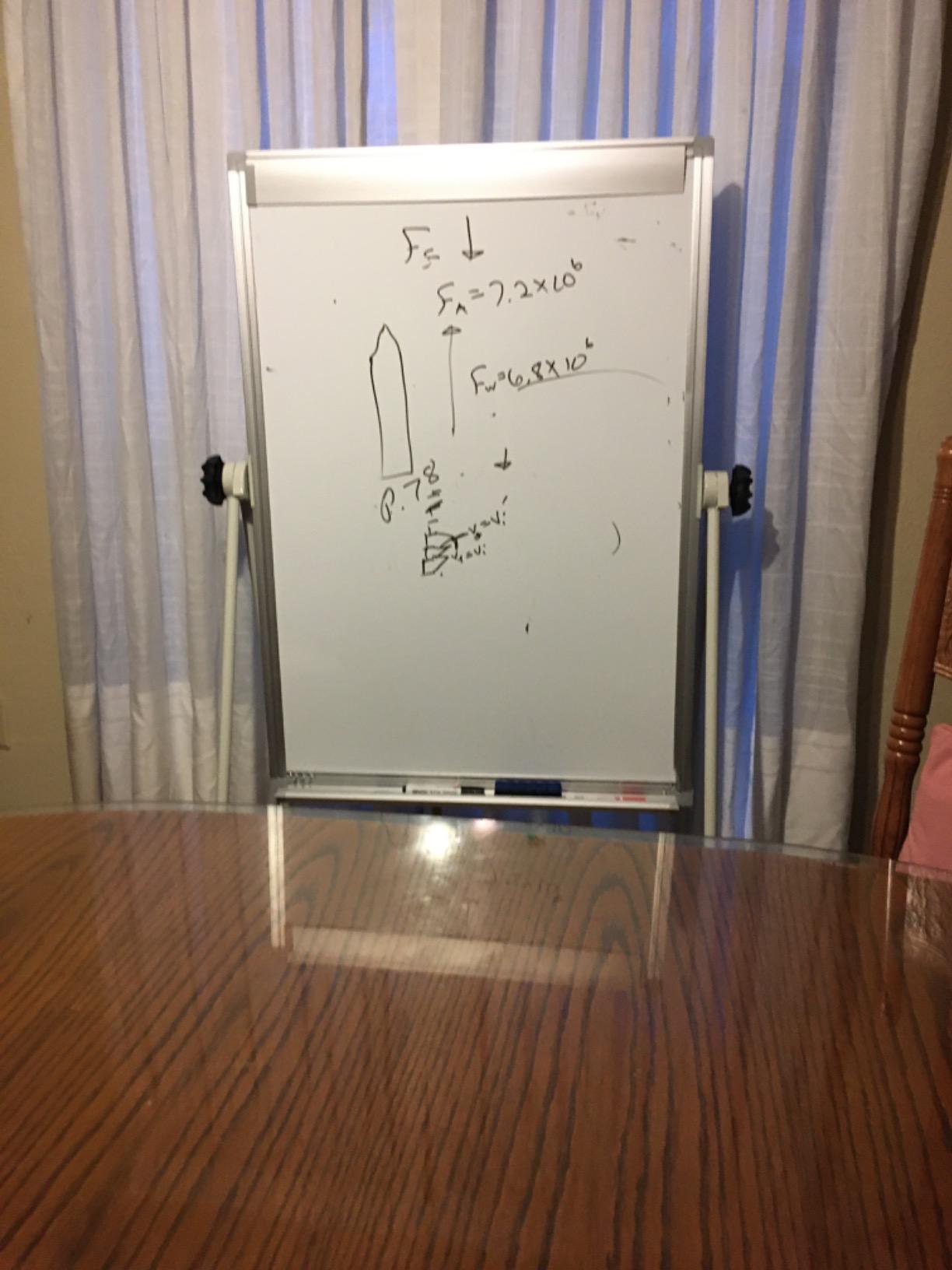
The trade-off is weight, and it is a real one: 18 pounds makes this a two-hand carry. The low center of gravity that makes it stable when writing also means you do not want to reposition it daily. At 4.6 stars across 371 reviews, the smaller owner base reflects a more deliberate purchase than the mass-market tripods.
What works well for a permanent corner setup
If you have one corner of the office and the board lives there, this is the best board to put in it. You set it up, you leave it, and you get a surface that does not move. The double-sided magnetic face lets you keep a standing reference on one side and work on the other without erasing between them.
The low center of gravity also makes it the safest option in a high-traffic space. A board that resists being knocked is a board you stop worrying about, and the 360 degree rotation plus height adjustment mean one position covers seated planning and standing review.
When to skip it
Skip it if you need to move it. Eighteen pounds is a two-hand lift, and the rolling options in this roundup exist precisely for people whose board has to change rooms. If your office is one room and the board stays put, the weight is an advantage rather than a problem.
Skip it if you are furnishing a small or temporary space. A board that folds flat and stores under a bed is a better fit for a rental, and this one needs a permanent home more than most.
10. WEYOUNG 40 x 28 Aluminum Easel – Best Complete Kit
Easel Whiteboard with Stand 40″ x 28″ Aluminum Frame (Black)
Board 40 x 28 inch
Double-sided magnetic
360 degree rotation
Folds flat
Non-slip base
Pros
- Complete set: paper pad
- clips
- markers
- eraser and magnet holders
- Height adjustable and 360 degree rotating
- Legs fold flat and do not scratch the floor
- Erases without traces of older notes
Cons
- Included magnetic eraser lost its magnet after about six months
- Protective film must be removed before use
- Sits in the top price tier
The last pick is the one that arrives most complete. The 40 x 28 inch board comes with a paper pad and clips, markers, a dry eraser, magnet holders, and a removable pen tray, so there is nothing to add before the first session.
Structurally it is a double-sided magnetic dry erase surface, height adjustable with 360 degree rotation, on a lightweight sturdy frame with a non-slip base that folds down for transport. Owners mention using it for a child’s coloring table and light craft work as well as office planning, which tells you how well the frame holds up under lighter use.
One detail worth crediting: reviewers note the folding legs do not scratch the floor when the board is turned. On hardwood, that is a small thing that decides whether an easel stays out or gets banished to the closet. The surface erases without leaving traces of older notes, which is the outcome you want from a board used by more than one person.
It is also listed as a tabletop mount, so it can sit at a desk as well as stand for a session. That makes it a reasonable second board for a home office where someone does homework at the same table where you take calls.
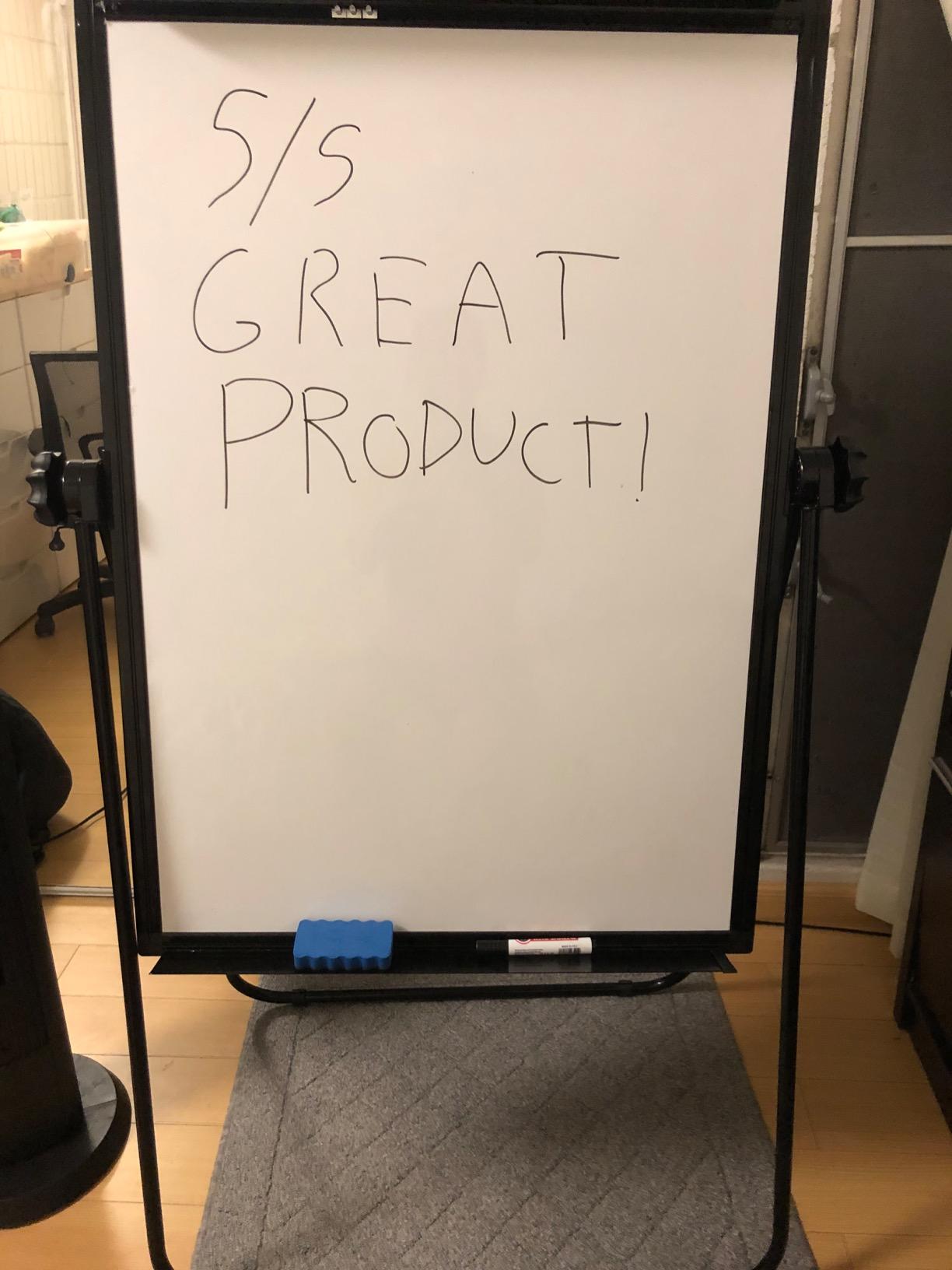
The concrete complaint is the included magnetic eraser, which owners report losing its magnet after about six months. The workaround people use is a paper towel or a cloth. Second, a protective film has to be peeled off the writing surface before first use, which is easy to miss and looks like a defect if nobody tells you.
At 4.6 stars across 305 reviews, this is the smallest owner base in the roundup, but the sentiment is consistently positive, and the complete kit is the reason. If you want one box that contains everything, this is the one.
What works well for a shared family surface
A double-sided 40 x 28 board with a paper pad on one side works for two people at once – one side for a kid working on a project, the other for you. The magnet holders and included clips make it easy to attach printed material without buying anything, which is where most “complete kit” claims quietly fail.
Height adjustment plus rotation means the same board works for a seated child and a standing adult, and the non-slip base keeps it steady at table height where a tripod would be awkward. For a home office that doubles as a study space, that combination is more useful than raw board size.
When to skip it
Skip it if you write with heavy pressure for hours a day. The frame is sturdy for craft work and planning, but it is a lighter build than the DexBoard or Maxtek U-stands, and the stability margin is narrower.
Skip it if you already have a well-stocked kit. If you own markers, magnets, and an eraser that work, paying for a duplicate set is not the best use of the budget – the board itself is good, the extras are just convenient.
Wall-Mounted or Freestanding: Which One Fits Your Home Office
Most ranking pages for this topic only cover freestanding easels. But the other half of the search results for dry erase boards for a home office are wall-mounted panels, and the two solve genuinely different problems. Picking the wrong one is the most common reason a home office board ends up unused.
A wall-mounted board wins on one thing: usable surface per square foot of attention. A 48 x 36 panel mounted at eye level gives you a large, permanently flat writing area with no footprint at all. Nothing wobbles, nothing needs repositioning, and the floor stays clear. If you write every day and you are allowed to put holes in the wall, it is hard to beat.
A freestanding easel wins on three other things. It needs no wall and no tools, which makes it the only real option in a rental. It moves, so you can bring it to a different room or a different person. And it folds or parks in a corner, which is what makes it survivable in an office under 100 square feet.
Three specific situations decide it. If you rent, the answer is freestanding, full stop – drilling into a wall you do not own is not a debate. If your room has slanted ceilings or no uninterrupted wall, a freestanding easel is often the only surface that will stand up straight. If you have a dedicated wall and permanent furniture arrangement, mounting wins on writing quality and footprint.
There is a middle option people miss: a rolling double-sided board, which behaves like a wall panel for the duration of a session and then disappears into a corner. It also needs more floor space and takes more effort to move, but it is the compromise that works for most people who want both.
One more practical note on floors. Rolling casters on finished hardwood are worth testing on a rug first, and thin boards can creep if the brakes are not set. Most boards here include anti-slip rubber feet or a non-slip base, which handles the same issue for non-rolling models.
How to Choose a Whiteboard Easel: Buying Guide
Stand type and stability
Stability is the number one complaint about tripod easels, and the fix is geometry rather than build quality. A tripod concentrates your weight on three narrow legs, so pushing hard on one side rocks the board. A U-stand spreads the load across a wide base, and a rolling board adds a low center of gravity that resists tipping from the side.
Ranked by how firmly they stay put under pressure: U-stands are the most stable, rolling boards are next, and tripods are the least stable at the top of their height range. That ranking matters most if you write while standing, lean on the board, or use the surface as a hand rest. If you only ever write sitting, a tripod is fine.
There is a free fix for tripod wobble that comes up repeatedly in home office forums: park the easel near a wall. The wall takes the shock of a hard stroke and the board stops moving. It costs nothing and it works better than most people expect. Panel seating on carpet can also help by spreading the load.
Size and writing area
Board size is measured with the frame included, and the writing area is always smaller. The VIZ-PRO 36 x 24 gives a 34 x 22 inch writing surface; the larger 48 x 36 boards give 45 to 46 inches wide. Read the writing area, not the headline number, when you are checking whether a diagram will fit.
For a solo home office, 36 x 24 is the sweet spot people describe most often. It holds a full weekly plan with room for a diagram, and it does not dominate a room. Go to 40 x 28 or larger if you present to clients or teach. Stay at 28 x 20 or smaller if you are working alone at a desk and floor space is the constraint.
A rough legibility rule helps: writing should be at least three inches tall for anyone standing more than a few feet away, and readable from 15 feet if you are presenting in a room. If your text is smaller than that, the board is too small for the audience, not the marker.
Surface material and ghosting
Most boards here use a baked melamine or resin finish over a steel core. It wipes clean, takes a magnetic attachment, and lasts years with reasonable care. A magnetic steel surface with a matte coating erases in fewer passes and resists staining better. Tempered glass is the most durable and the most expensive, and it needs rare-earth magnets because standard ones will not hold.
Ghosting is the shadow left after you wipe. Most people blame the board, and most of the time it is the marker. Off-brand dry erase ink with a different solvent balance leaves a residue that a dry eraser smears into a haze. Switching to a known solvent-based marker brand is widely reported as the single change that fixes ghosting on a budget board.
The cleaning routine that keeps it off: wipe with a dry microfiber or the board’s own eraser every day, and once a week go over it with a cloth dampened with isopropyl alcohol. Dry wiping every day is what builds up the haze in the first place, so the weekly alcohol pass matters more than daily heroics.
Magnetic or non-magnetic
A magnetic surface lets you attach printed material – a client brief, a calendar, a printed diagram – and keep it there while you write around it. A non-magnetic board cannot. If your workflow includes any printed reference, magnetic is worth paying for.
The trade-off is real, though. The lightest, most portable boards in this roundup are often non-magnetic, and a magnetic surface adds steel weight to the board. The VIZ-PRO 36 x 24 is the case in point: it is the easiest board here to carry precisely because it is not carrying a steel core.
One practical warning: if you buy a magnetic board, test magnet strength before you rely on it. Papers and light cards are easy, and heavy calendars or a stack of printed pages need more than the small magnets included in the box. A second pack of magnets is a cheap upgrade.
Height adjustment range
Maximum height is the number every product page leads with, and it is the less useful one. Minimum height decides whether a seated adult or a child can use the board at all, and it is rarely mentioned.
The ranges here run from 31 to 53 inches on the compact U-stand up to 40.5 to 75 inches on the Maxtek 40 x 28. A board that bottoms out around 40 inches works for a seated adult but not a small child. One that reaches down to 31 to 36 inches serves both. If the board is for a household rather than one person, buy the range, not the top end.
Scale markings on the legs are a small quality detail that pays off daily. Without them you are re-measuring the same height every morning, and every board ends up at a slightly different setting.
Accessories and what to buy separately
Every board in this roundup includes some combination of markers, an eraser, magnets, a marker tray, and flipchart hooks. The gaps are consistent enough to plan around. Flipchart pads are almost never included and are the most common extra purchase, so budget for a replacement pad if you use paper with the board.
The markers are the other thing worth replacing immediately. Included markers are usually the cheapest ink in the box, and they are the main reason people think their new board ghosts. Buying a known solvent-based marker brand solves the most common complaint about cheap easels for a few dollars.
Check the box contents on arrival. Several boards in this roundup have owners reporting missing clips or trays that required contacting the seller, and it is much easier to sort out on day one than three months in.
Setting up an easel for video calls
A whiteboard behind you on a call does two jobs: it gives you a visual reference without scrolling, and it shapes how your room reads on camera. Position matters more than most people expect.
Put the board at an angle beside the camera rather than flat behind you, so the writing faces slightly toward the lens. Set the height so the writing sits at or just above eye level in frame, which means the middle of the board, not the top, should land near your eye line. Keep the board out of direct light from a window behind it, or you will be presenting a washed-out white rectangle.
Use wide markers for anything you want readable on a small video thumbnail, and keep the content to three or four lines. Nobody reads a dense board at 200 pixels wide. If you are teaching or presenting, the compact 28 x 20 class sits closer to the lens and reads better than a large board pushed into the background.
Finally, keep the frame in shot consistent. A black or aluminum frame looks like furniture; a bare white panel with visible wall behind it looks like a temporary fix. That is part of why the DexBoard’s black frame is worth its premium for on-camera use.
Keeping the surface ghost-free
Start with the markers. Use a known solvent-based dry erase brand and retire any marker that has dried out, because a dying tip deposits uneven ink that never fully lifts.
Wipe daily with a dry eraser or microfiber cloth, working in one direction rather than scrubbing in circles, which spreads residue instead of lifting it. Do a full pass with a cloth dampened with isopropyl alcohol about once a week. Do not use household cleaner or any solvent other than alcohol, which will strip the surface finish permanently.
Leave the eraser on the tray rather than on the board. Ink transfers to the eraser felt and then back onto your next line, which is the quiet cause of a lot of shadowing. Replace the eraser felt when it goes dark, and keep separate erasers if two people use the board, which stops one person’s leftover ink from smearing the other’s work.
Frequently Asked Questions
What is the best dry erase board for a home office?
For most home offices the VIZ-PRO 36 x 24 portable tripod easel is the best all-round choice, because it is light enough to move between rooms, folds flat for storage, and has a 34 x 22 inch writing surface. If you need to attach printed material, pick the Maxtek 36 x 24 tripod instead for its magnetic surface and included magnets. If you write hard and want zero wobble, move up to a U-stand model such as the Maxtek 40 x 28.
What size whiteboard easel do I need?
A 36 x 24 inch board is the sweet spot for a solo home office, giving roughly a 34 x 22 inch writing surface that fits a full weekly plan without taking over the room. Go to 40 x 28 or 48 x 36 if you present to clients or teach. Choose 28 x 20 or smaller if floor space is tight and you only plan at a desk. Read the writing area rather than the headline board size, because the frame reduces both dimensions.
What is the most stable type of whiteboard easel?
A U-stand is the most stable type, because its wide base and low center of gravity resist both front-to-back rocking and side tipping. A rolling board with locking casters is the next most stable, and it stays fixed once the brakes are set. Tripods are the least stable, especially near the top of their height range. If you write while standing or lean on the board, choose a U-stand. Parking a tripod near a wall also reduces the movement noticeably.
How do I keep my whiteboard easel from ghosting?
Most ghosting is caused by marker ink, not the board. Use a known solvent-based dry erase brand and throw out dried markers. Wipe daily with a dry microfiber cloth in one direction, then do a full pass with a cloth dampened with isopropyl alcohol about once a week. Keep the eraser on its tray instead of on the writing surface, and replace the felt when it darkens. Avoid household cleaners, which permanently strip the finish.
Is a magnetic or non-magnetic surface better for a home office?
Magnetic is better if your workflow includes printed material, because you can pin a client brief, a calendar, or a printed diagram and write around it. Non-magnetic boards are lighter and easier to carry, which is why the most portable models in this roundup often skip the steel core. If you only write and draw your own notes, non-magnetic is fine. If you attach anything, check magnet strength first, since the small included magnets hold paper but not heavy calendars.
What is the best whiteboard easel for a rented apartment?
A folding tripod is the best choice for a rental, because it needs no wall mounting and stores flat behind a door or under a bed. The VIZ-PRO 36 x 24 portable tripod is the strongest example, collapsing flat and weighing little enough to carry with one hand. A rolling double-sided board is the upgrade if you also need the board in more than one room, though it takes more floor space and is heavier to move.
Final Verdict: The Best Whiteboard Easels for Home Offices in 2026
After six weeks with all ten, the VIZ-PRO 36 x 24 portable tripod easel is the best whiteboard easel for most home offices. It has the highest review volume in the group at 3409 reviews, a 4.6 rating, a 34 x 22 inch writing surface that fits a full weekly plan, and the lightest build here for moving between rooms.
The runner-up is the Maxtek 36 x 24 height adjustable tripod, which is the pick if you want a magnetic surface and a full kit in the box without thinking about it. Add a 42 to 63 inch height range, 6 magnets, 3 pens, an eraser, hooks, and a lifetime warranty, and it is the easiest recommendation to hand to someone who just wants a board that works.
Two situations change the answer. If you write hard enough to notice flex, the Maxtek 40 x 28 U-stand will not move under you and reaches from 40.5 to 75 inches. If your office is under 100 square feet or you rent, keep the footprint small and choose the 28 x 20 double-sided U-stand or a folding tripod that stores behind a door.
Whichever one you pick, replace the included markers on day one. That single swap solves the ghosting complaint faster than any board change, and it is the cheapest fix available. For the rest of your setup, our bookshelf roundup for home offices covers where to put the board when it is not in use.