
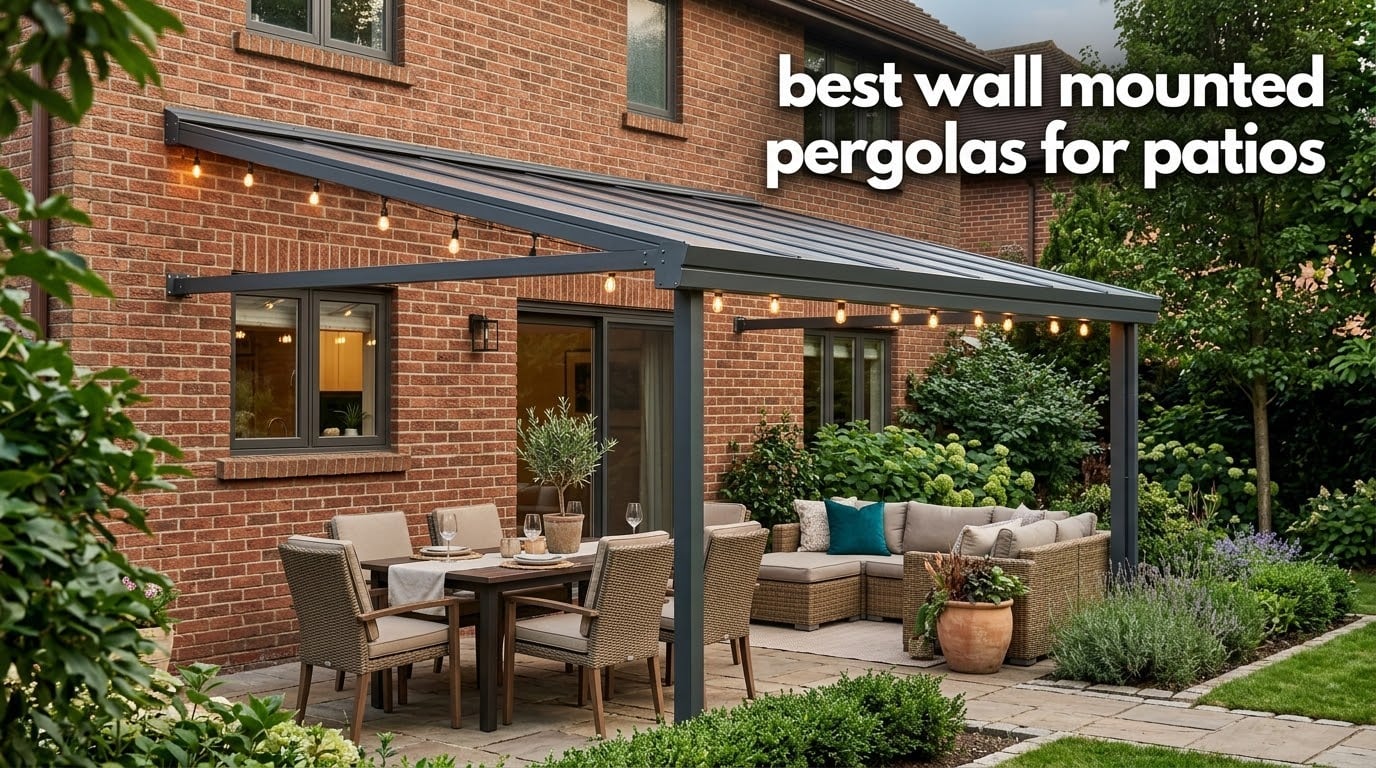
A wall mounted pergola is a shade structure fixed directly to the exterior wall of your home, usually through a ledger board or bracket bolted into studs or masonry, so the house acts as one side of the frame and only the two outer corners need posts. That single design decision frees up patio floor space, pushes shade right up against your doors, and gives you a sturdier structure in wind than a freestanding unit of the same size. The honest caveat: you are drilling into your house, and the attachment point is where water gets in when it is done badly.
Over the past few months our team compared ten of the strongest wall mounted pergolas for patios currently on the market, weighing frame gauge, roof material, published wind and snow numbers, covered square footage, and what buyers actually say after a season of use. We read the complaint sections as closely as the praise, because that is where a patio project goes wrong. If you want the wider picture on outdoor shade first, our guide to the best pergolas for patios covers freestanding options too.
What follows is a straight verdict on each unit, the honest list of who should skip it, and a practical guide to attaching one without wrecking your siding. Updated for 2026, and honest about which kits need four people and a full weekend.
Top 3 Picks: Wall Mounted Pergolas for Patios in 2026

PURPLE LEAF 9.5 x 13 Sliding Canopy
- Powder-coated aluminum frame
- Sliding locking canopy
- 123.5 sq ft coverage

Aoxun 12 x 10 Polycarbonate Lean To
- 40 mph wind rating
- 99% UV blocking roof
- Curtain and net mounts
Best Wall Mounted Pergolas for Patios in October: Quick Overview
| Product | Specifications | Action |
|---|---|---|
| PURPLE LEAF 9.5 x 13 Sliding Canopy |
|
Check Latest Price |
 Aoxun 10 x 14 Lean To Hardtop Aoxun 10 x 14 Lean To Hardtop |
|
Check Latest Price |
| Aoxun 12 x 10 Polycarbonate Lean To |
|
Check Latest Price |
 Aoxun 10 x 6 Fabric Lean To Aoxun 10 x 6 Fabric Lean To |
|
Check Latest Price |
 AECOJOY 10 x 8 Hardtop Lean To AECOJOY 10 x 8 Hardtop Lean To |
|
Check Latest Price |
 Pamapic 10 x 24 Expandable Hardtop Pamapic 10 x 24 Expandable Hardtop |
|
Check Latest Price |
 Covered Outdoor 10 x 20 Steel Lean To Covered Outdoor 10 x 20 Steel Lean To |
|
Check Latest Price |
 Breezestival 10 x 8 All-Aluminum Lean To Breezestival 10 x 8 All-Aluminum Lean To |
|
Check Latest Price |
 Domi 10 x 14 Steel Hardtop Domi 10 x 14 Steel Hardtop |
|
Check Latest Price |
 MEISSALIVVE 8 x 12 Polycarbonate Lean To MEISSALIVVE 8 x 12 Polycarbonate Lean To |
|
Check Latest Price |
1. PURPLE LEAF 9.5 x 13 Sliding Aluminum Canopy – Best Overall
PURPLE LEAF Against Wall Pergola 9.5′ X 13′ Sliding Aluminum Canopy, Beige
123.5 sq ft
Powder-coated aluminum
Sliding locking canopy
155.9L x 107W x 96.85H
Pros
- Lightweight but sturdy aluminum frame
- Sliding canopy adjusts shade versus sun
- Assembly often under 4 hours
- Modern look owners compliment
Cons
- Weak post base mounting hardware
- Occasional gashed beam or missing roller
- Some screws do not fit their holes
- Included curtains underwhelming
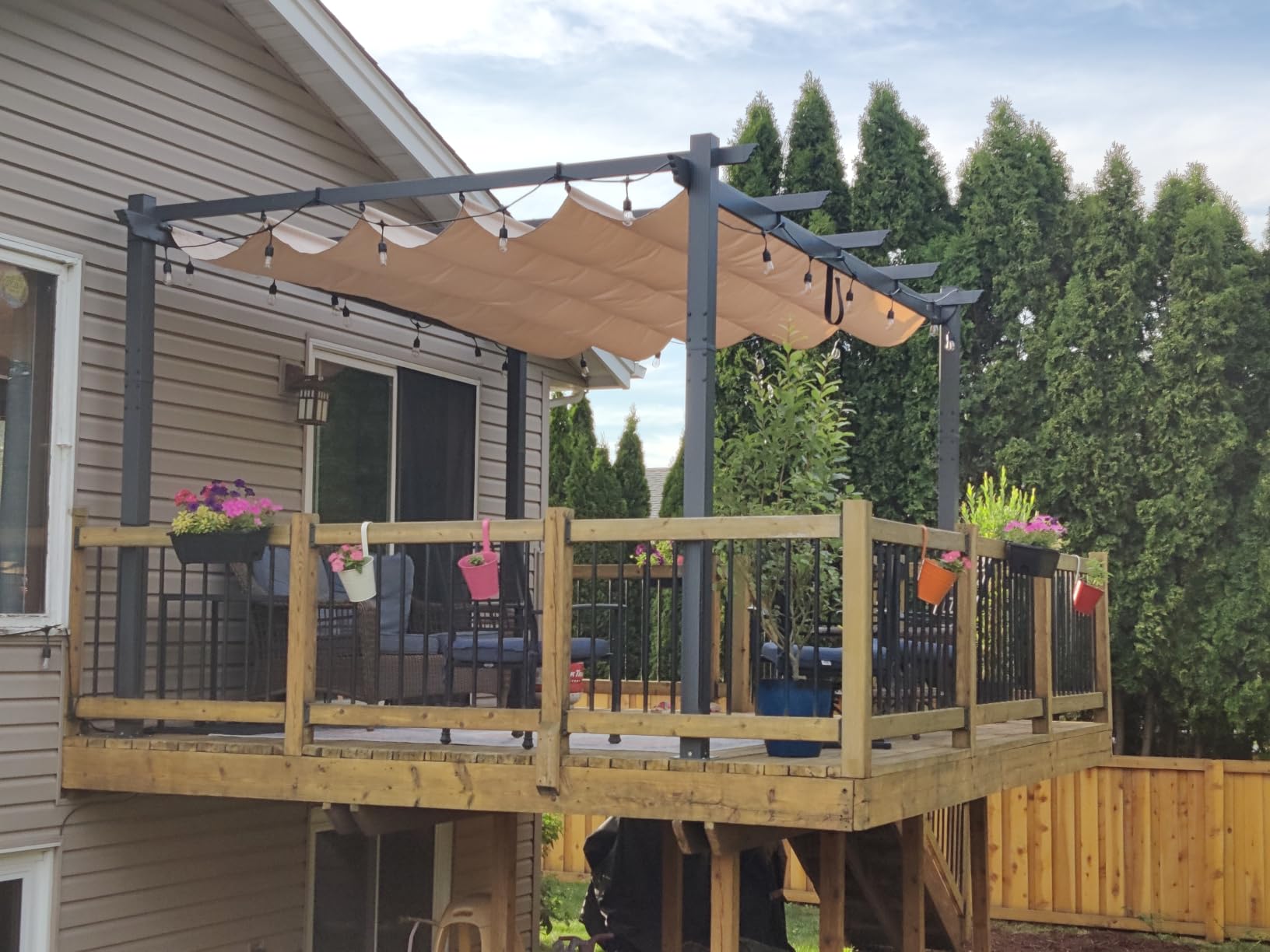
This is the unit I recommend to most people first, and the reason is simple: at 123.5 square feet it covers a genuine dining area, and the roof slides rather than sits fixed. Instead of choosing between sun and shade once, you drag the canopy along its track and lock it where you want it. Beige, Terra, Turquoise Blue and Gray are all offered, and the straight wall-side design mounts flush against the house without a rear post eating patio space.
With a 4.2 star average across 1488 reviews, it is by far the most reviewed unit in this group, and the pattern in the feedback is consistent. Buyers like the powder-coated aluminum frame, the modern look, and the fact that a second pair of hands plus a few hours is genuinely enough. The most common owner report is a real temperature drop under the canopy on hot afternoons. Our own wall mounted electric fireplaces guide covers the other half of the comfort equation if you plan to use the patio in cooler months.
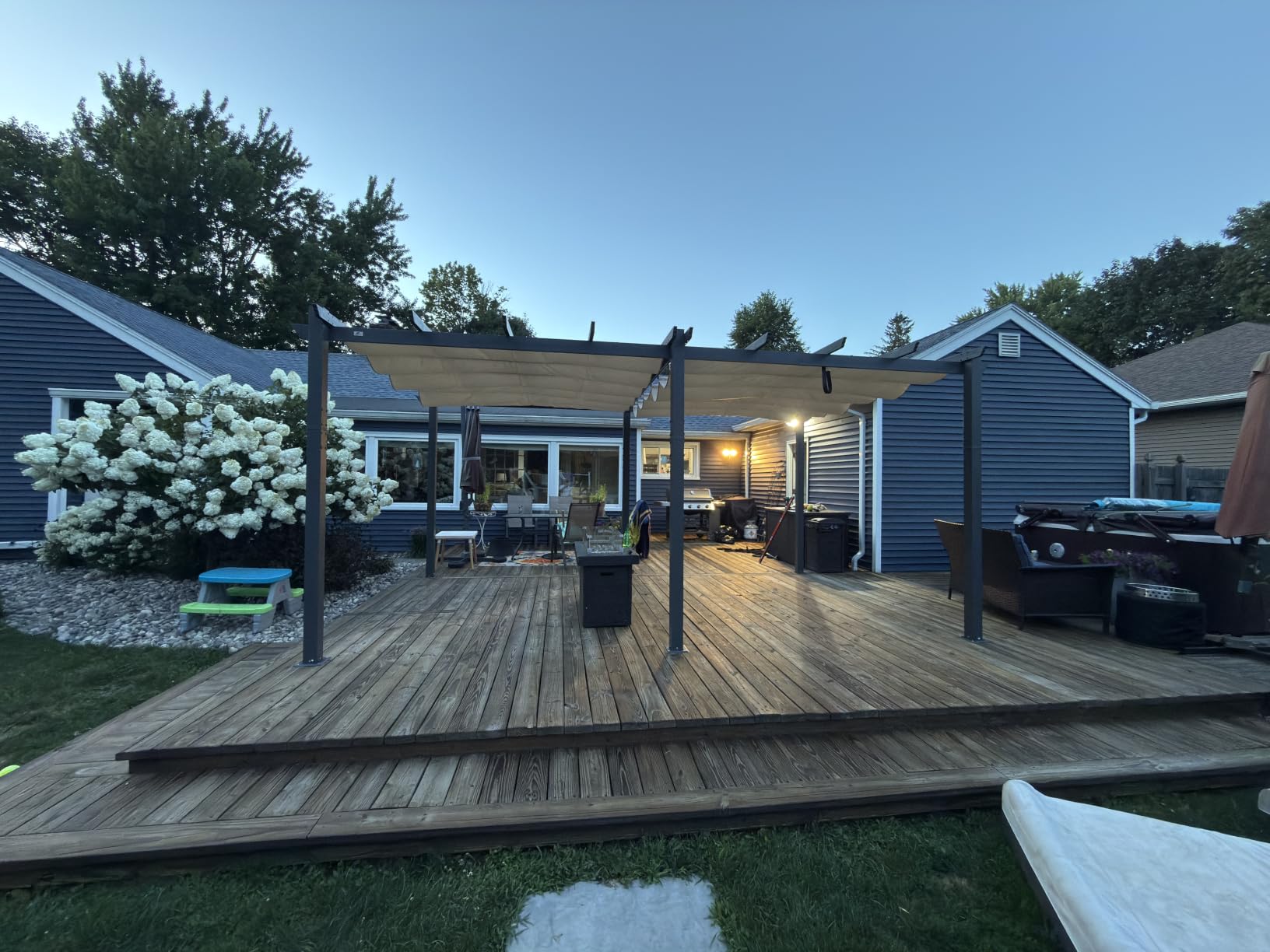
The frame is aluminum, so there is no rust cycle and no stain schedule, which matters if you are fitting it against vinyl or painted siding. Dimensions are listed at 155.9 inches long by 107 inches wide by 96.85 inches high, so measure the wall run and the patio depth before you commit. The canopy is an upgraded yarn-dyed all-weather fabric rather than cheap polyester, and that shows in how it drapes.
Where it falls short is the hardware at ground level. Reviewers repeatedly single out the base and post base mounting hardware as the weak point in an otherwise well-built frame, and a few units have shown up with a gashed beam or a missing canopy roller. The included curtains are described as usable but unremarkable. If you are in a coastal or high-wind area, read the wall mounted storage buying guide mindset here: a solid base plate and proper expansion anchors matter more than the finish.
Who this pergola suits
It suits anyone with a patio between about 100 and 130 square feet who wants adjustable shade rather than permanent cover. The sliding canopy is the differentiator: morning sun on the table, full shade by two in the afternoon, without tools. It also works well for renters of appearance, since the aluminum frame is light enough for two people to reposition the layout around and the beige finish reads neutral against most siding colors.
Because there is no rear post, the covered area stays open to the house door, which makes it a good fit for a patio that doubles as an entry path. I would also pair it with a wall-mounted fire feature or lighting later, since the open front edge makes hanging string lights simple.
Who should skip it
Skip it if you need a hard roof for rain and snow. This is fabric, so water runs off but heavy rain can pool on a stretched panel, and the canopy has to come down for winter storage, which several owners describe as awkward. Anyone buying purely for wind performance should look at a steel hardtop instead. If your post bases are going to sit on a finished paver surface with no room for a proper anchor, the base design is the weak link you would rather not troubleshoot.
2. Aoxun 10 x 14 Lean To Hardtop – Best Value
Aoxun 10′ x 14′ Lean to Gazebo Pergola with Sloping Roof for Patio, Black
120 sq ft
Galvanized steel roof
31-38 mph wind rated
163.4L x 110.7W x 100.8H
Pros
- Solid metal roof for shade and rain
- Handles wind and snowy winters
- Threaded labeled hardware
- Roof installs in place under an eave
- Fits 6-8 people
Cons
- Assembly is a two-person job
- Roof panels arrive bent or misaligned
- Fasteners need rubber washers to stop leaks
- No front gutter included
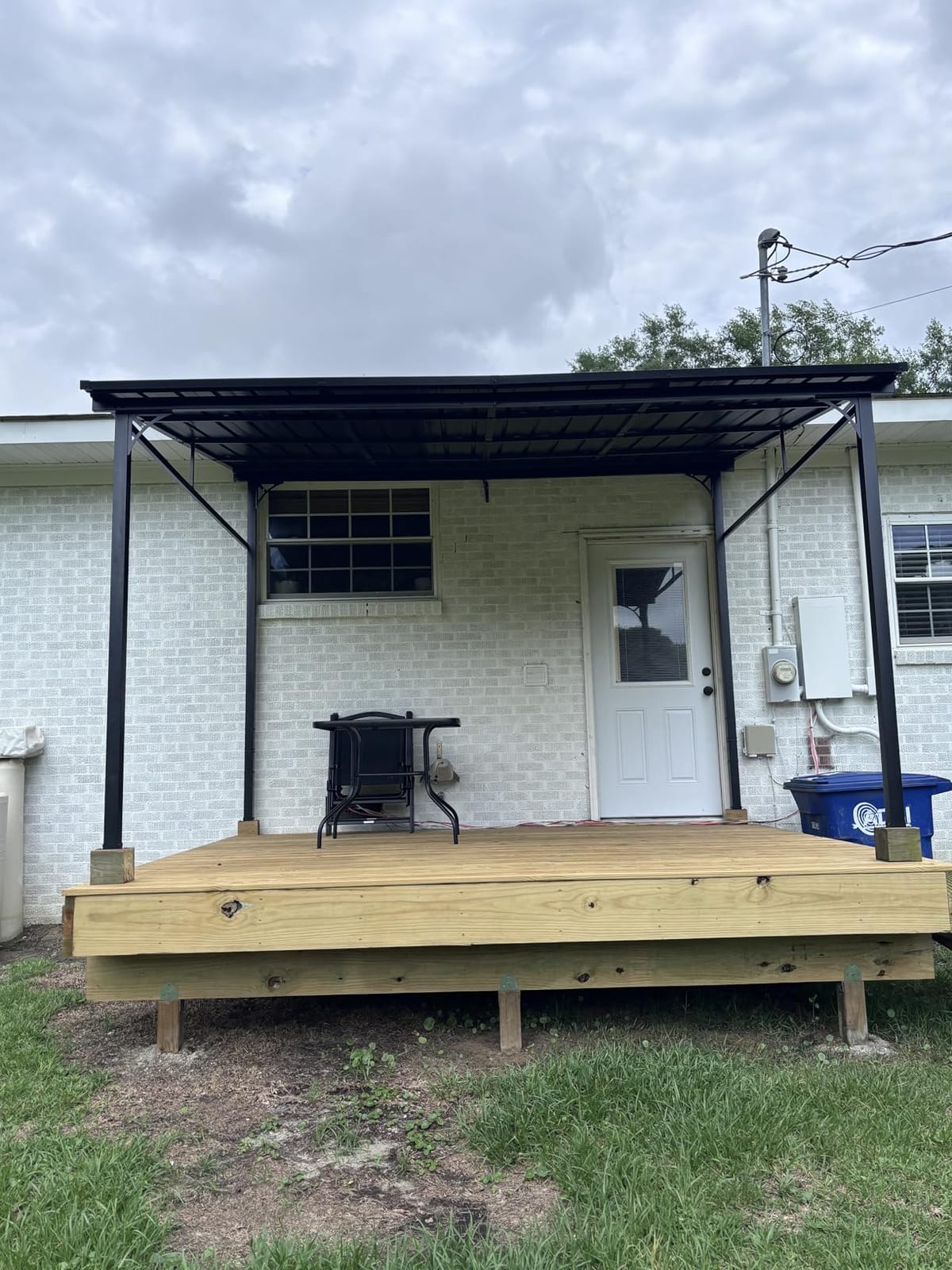
This is the value pick because it is the rare kit that gives you a genuine hard roof at a mid-range price point. The galvanized steel roof is rated for 77 lbs per square meter, which the manufacturer equates to roughly six inches of snow, and the wall and ground anchoring together support a 31-38 mph wind rating. That is a real number rather than the vague wind-resistant language so many listings use.
At 120 square feet it seats six to eight people, and the sloped roof is genuinely useful: water runs off instead of pooling, which is the failure that kills fabric canopies after a season. One design choice stands out for anyone fitting under a soffit: the roof is installed in place rather than on the ground, so you are not trying to lift a finished frame over a patio table. A builder on r/HomeImprovement flagged the rim joist question when planning his own build, which is the same structural thinking this design relies on.
Weighing in at 233.7 pounds with dimensions of 163.4 by 110.7 by 100.8 inches, this is not a one-person job. The manufacturer suggests two to four people and two to four hours, and owners generally agree. Hardware is threaded and parts are labeled, which sounds minor until you are sorting 40 fasteners on a lawn in the dark.
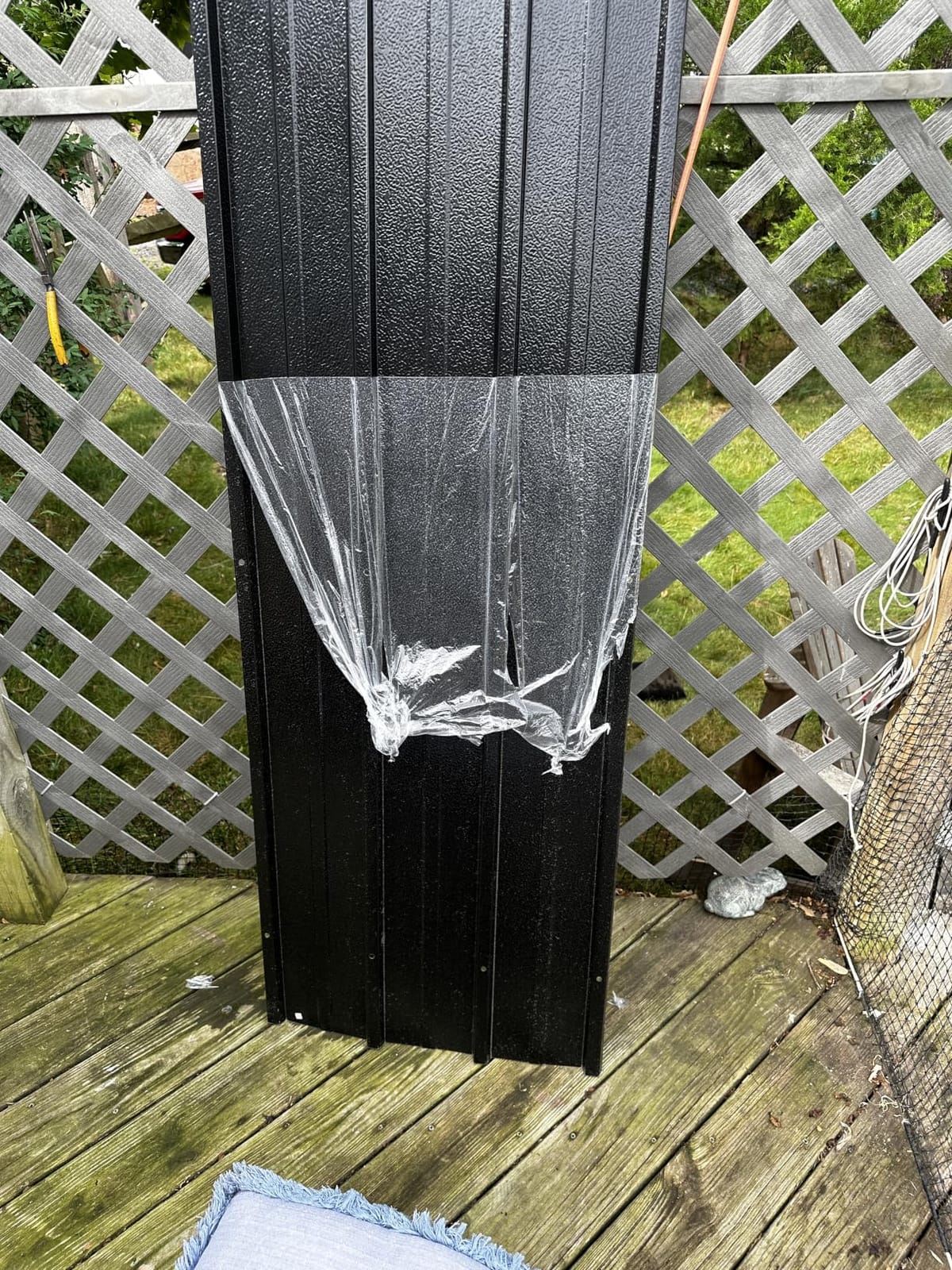
The recurring complaints are specific and worth planning around. Roof panels arrive with bent corners and misaligned holes on some units, the fasteners bite into plastic brackets without rubber or nylon washers so small leaks appear, and the protective film on the panels is slow and stubborn to peel. The sheet metal is thin enough that posts can drift out of alignment and screws can round off. There is no front gutter, so you will want to plan where water lands at the drip edge.
Who this pergola suits
It suits a family that wants outdoor dining six to eight people deep and does not want to take a canopy down every winter. Steel sheds rain, snow and shade, and the 31-38 mph rating means it can hold through the sort of gust that sends a fabric structure into the neighbor’s yard. It is a good match for a grill station or an outdoor kitchen, where a hard surface over heat and grease matters.
It also suits anyone who values clear instructions more than looks. Dark Gray, Black and several footprint options are available, but the visual language is plain modern metal, which sits easily against a brick or stone rear elevation.
Who should skip it
Skip it if you want a light-filtering roof that lets daylight into the room behind the patio. A solid steel roof makes the covered area genuinely dark. Anyone with a limited helper pool should know this is a two-person minimum job, and owners report needing several hours plus extra washers and sealant before it stopped leaking at the panel joints.
3. Aoxun 12 x 10 Polycarbonate Lean To – Most Versatile
Aoxun 12’x10′ Lean to Gazebo, Pergola with Mosquito Net and Curtains, Brown
120 sq ft
Aluminum frame
40 mph rated
99% UV blocking roof
Pros
- Lightweight aluminum with polycarbonate roof
- Blocks 99% UV and cuts 90% of solar heat
- Sloped roof drains efficiently
- Curtain and net mounting positions
- Expansion bolts included
Cons
- Must be firmly fixed to a wall or it wobbles
- Posts are thinner gauge than steel rivals
- Assembly needs several people
- Roof panels tight to slide into rails
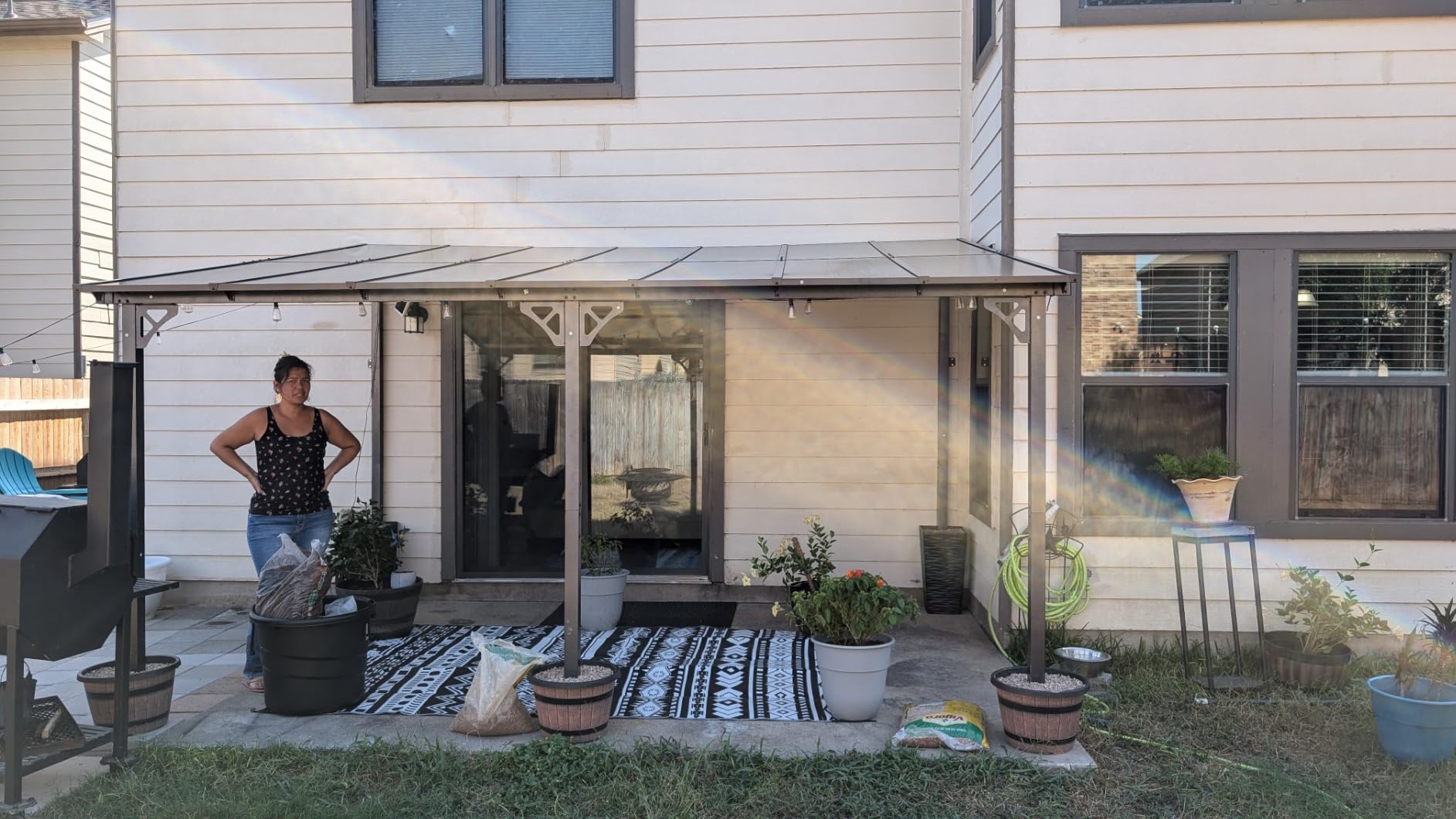
The headline spec here is the roof. The multi-walled polycarbonate blocks 99% of UV, cuts roughly 90% of solar heat and still passes 92% of light, with an operating range from minus 40 to 240 degrees. That combination is why this is the pick for anyone who wants shade without losing the outdoor brightness that makes a patio usable in the evening. It is also the highest wind rating among the aluminum-framed kits here at 40 mph, with a load capacity of about six inches of snow.
At 120 square feet, 142 inches long, 114 inches wide and 100.8 inches high, it is a generous fit for a dining table plus a grill. What owners consistently mention is the atmosphere: light comes through, the rain stays out, and the sloped roof moves water away cleanly. Mounting positions are provided for curtains and mosquito nets, which is unusual at this level and genuinely useful from late spring through early autumn.
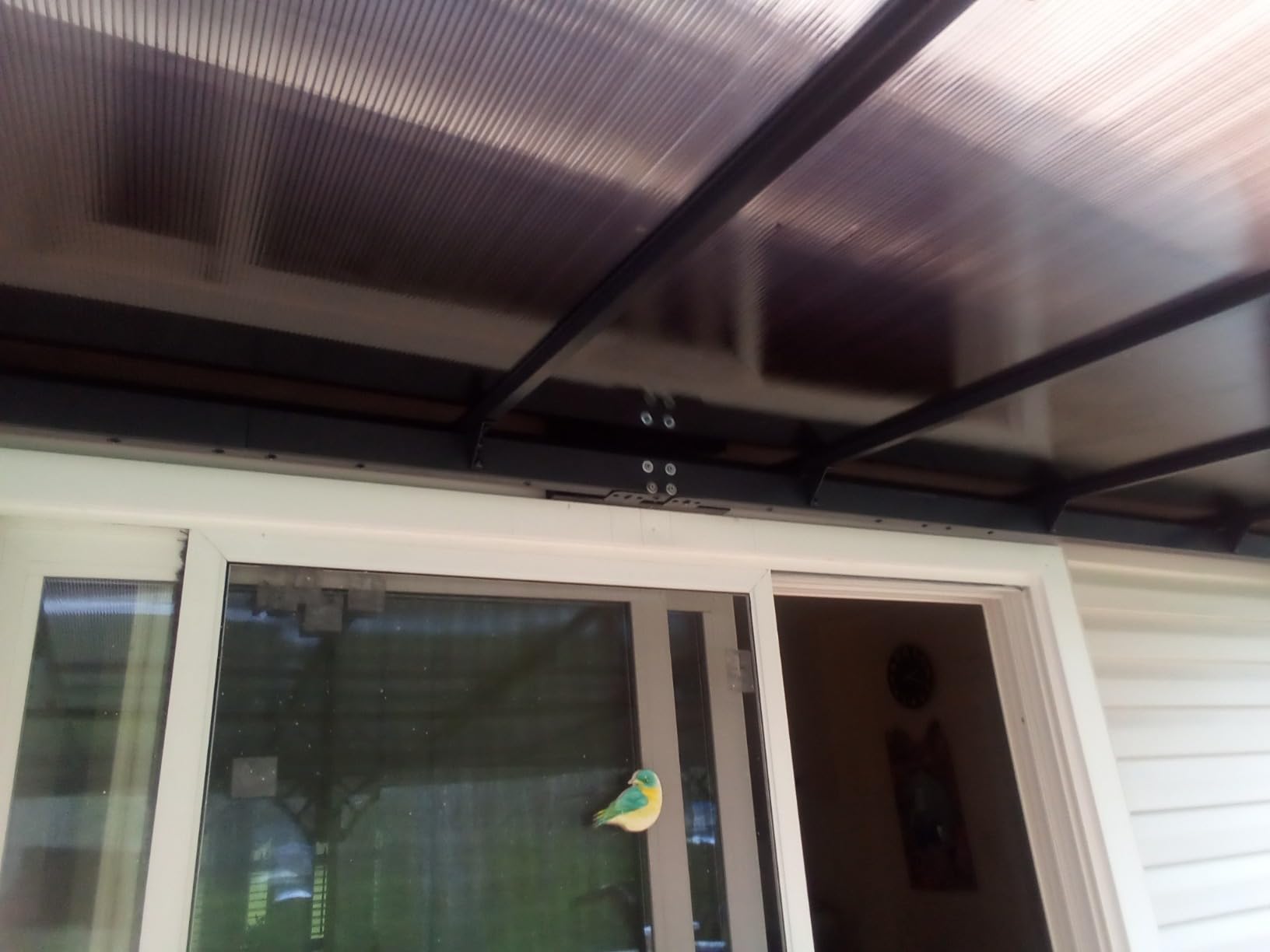
The frame is powder-coated aluminum at 160 pounds, so it is light enough to reposition and will not develop surface rust in a humid climate. Expansion bolts and wall and ground mounting hardware are included, which saves a trip. Brown and Gray are listed, along with a wide range of footprints including 10 by 14 and 8 by 10.
The critical caveat is that this is a wall-leaning structure, and owners say so directly: it wobbles if you try to use it freestanding. The second point is post gauge. For its size, the aluminum posts are thinner than the steel frames competing with it, and while the wall carries most of the load, thin posts still show in how the frame feels under a hand on a windy day. Roof panels can be tight to slide into the rails, so expect a fussy alignment step rather than a smooth push.
Who this pergola suits
It suits a patio where the covered space sits directly against a glass door or a large window, because the translucent roof keeps the room lit. Families with small children value the mosquito net mounting points. It is also a strong choice for anyone near the coast or in a wet climate, since aluminum and polycarbonate are the two materials in this list least worried about salt air.
If you like the idea of a darker, more private corner, the curtain positions let you drop fabric panels on the open sides without drilling extra structure. That makes it a flexible patio for both open summer dining and a more sheltered evening space.
Who should skip it
Skip it if you do not have a solid wall to fix it to, because the wobble reviewers describe is the whole weakness of the design. It is also the wrong pick if you expect a heavy snow load on top of the rated six inches, or if you want the heavy, permanent feel of a steel structure. Budget for at least two people, and plan the panel installation before you start rather than mid-afternoon on a Saturday.
4. Aoxun 10 x 6 Fabric Lean To – Budget Pick
Aoxun 10×6 Lean-to Gazebo,Sloped Roof Pergola Porch Canopy Awning for Patio
60 sq ft
Alloy steel frame
UPF 50+ polyester canopy
10 x 6 footprint
Pros
- Very affordable entry point for shade
- Good coverage for the cost
- Assembly is straightforward with right tools
- Survives wind when staked
- Canvas wipes clean with a hose
Cons
- Fabric pools water in heavy rain
- Some units arrive with bent tubes
- Threaded pipe ends may need bending
- Included wrenches are flimsy
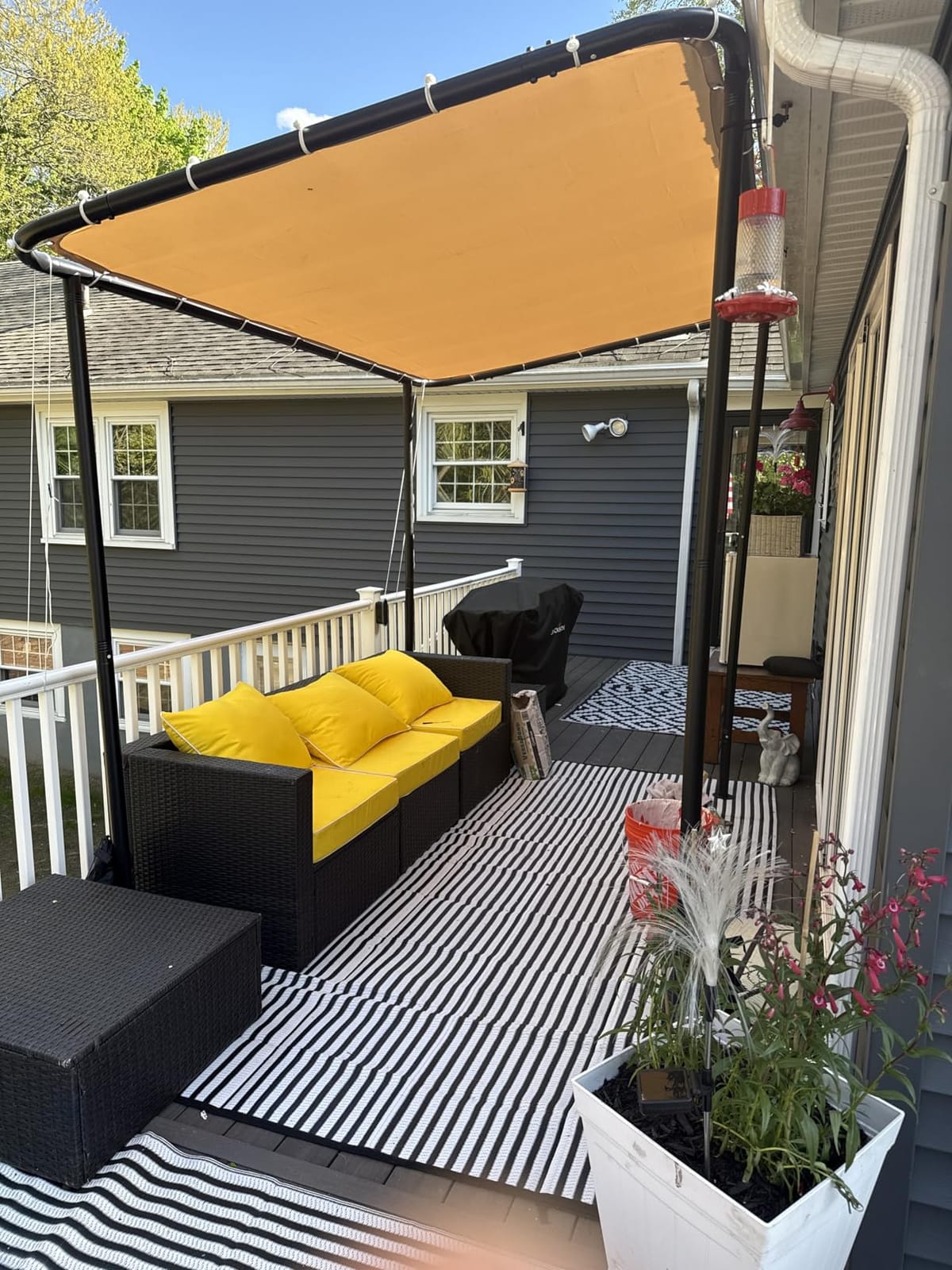
This is the one to buy if the goal is shade and nothing else. Sixty square feet of coverage, a 160g PA-coated polyester canopy rated UPF 50+, and a powder-coated corrosion-resistant steel frame with reinforced connectors. Several owners use it over a deck, a balcony or a doorway rather than a full patio, which tells you how compact the footprint really is.
Assembly is genuinely simple once you have properly sized wrenches, and the fabric cleans with a damp cloth or a hose. Sloped roof geometry is built in for drainage, and the canopy is tensioned with elastic bungee loops, so there is no motor or track system to fail. It survives wind when it is staked down, which is the honest version of that claim.
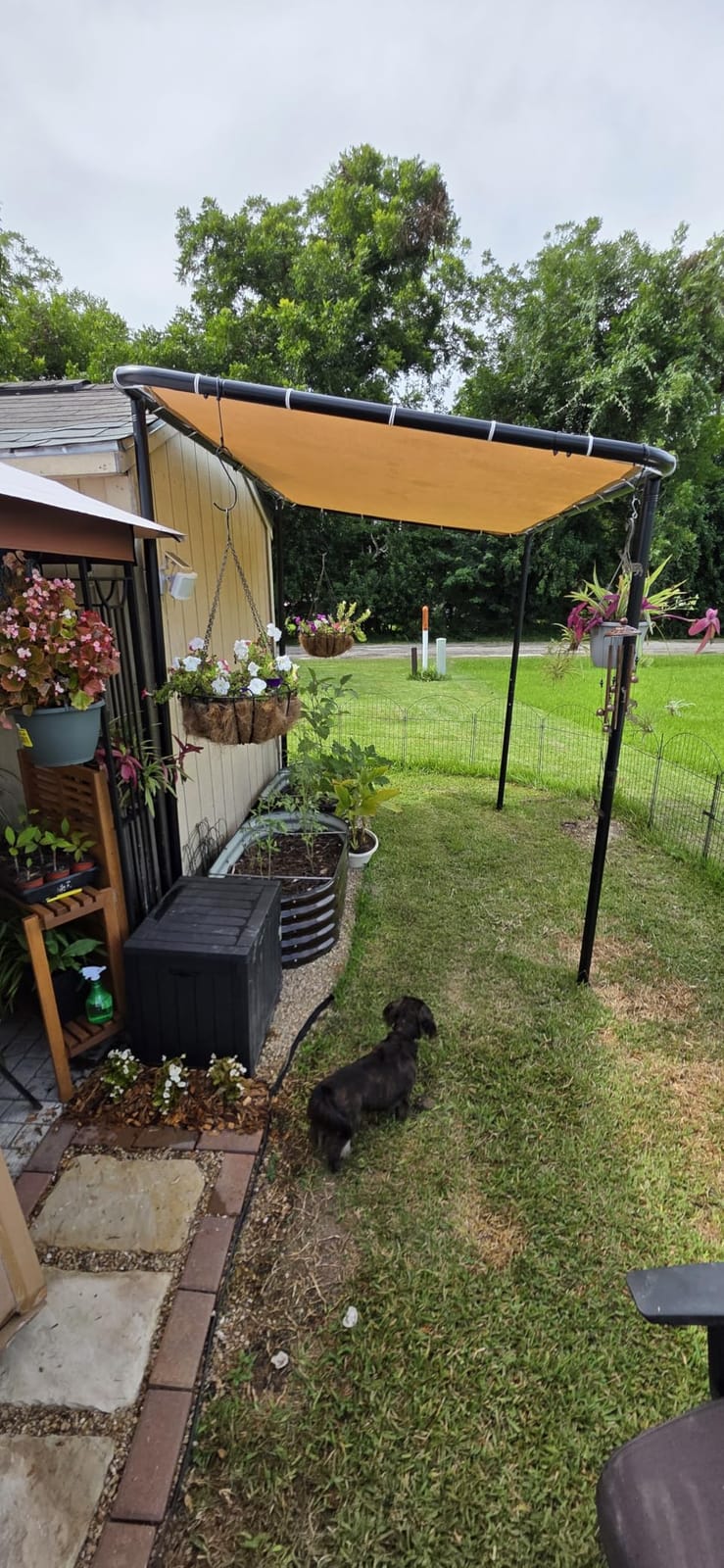
Sizing is the thing to measure twice. The listed footprint is 10 by 6 feet, and one-star feedback clusters around buyers saying it is smaller than they pictured. The listed package dimensions are 23 by 7 by 49 inches, and the shipped weight is about 25.6 kg, so plan where you will stage it before assembly. Gray, Beige and a run of larger sizes including 10×12 and 16×12 are also produced, so a slightly bigger footprint is sometimes the better buy for the same money.
The recurring negatives are honest and simple: the fabric canopy pools water during heavy rain and can sag or tear, some units show up with bent tubes and crooked frames, threaded pipe ends may need bending for a snug fit, and the included wrenches are too flimsy. Buyers recommend a power tool for the build, and the instructions outside the frame diagram are thin.
Who this pergola suits
It suits a first-time shade buyer, a balcony or side doorway where a full patio is overkill, and anyone who wants a weekend project rather than a two-day build. Owners treat it as a decor piece that makes an uncovered space look finished, and many pair string lights through the frame once it is up.
It also suits a renter or a homeowner who may move in a few years. Nothing about this unit is permanent, and the ground stakes mean it can be taken down without touching the wall.
Who should skip it
Skip it if you need rain cover you can rely on, because a sagging fabric panel under a downpour is the most common complaint in the reviews. It is also the wrong choice for anyone who wants snow load capacity or a structure that feels solid when you lean on it. And if the wall you have in mind is brick veneer with no stud line behind it, budget for a different approach entirely before ordering.
5. AECOJOY 10 x 8 Hardtop – Best for Modular Coverage
AECOJOY 10′ x 8′ Gazebo for Patio, Small Wall-Mounted Lean to Gazebo Pergola with Roof (80 Sq.Ft Shaded) on Clearance, Hard Top Heavy Duty Awnings for Decks, Backyard and More
80 sq ft
Hard top roof
About 50 mph anchored
6 lbs/sq ft load
Pros
- Cheaper than building permanent wood
- Units combine into one covered patio
- Solid hard top once mounted
- Runs about 50 mph anchored
- Video tutorials and phone support
Cons
- Roof panels feel thin
- Instructions sometimes missing from the boxes
- Weather strip slides out of the roof track
- Low front height limits head clearance
The reason this one earns its badge is expandability. Multiple units combine into a seamless larger covered patio, so if you start with 80 square feet and later want to cover a grill area or a second seating zone, you can add another footprint instead of replacing the whole thing. Buyers consistently note the hard top feels solid once it is mounted and keeps rain off patio furniture when assembled correctly.
The engineering numbers are credible. Static load is tested to 6 lbs per square foot, which the manufacturer equates to about seven inches of heavy snow, and the anchored design is rated for roughly 50 mph winds. The sloped roof detail went through six months of outdoor use testing before release, and step-by-step video tutorials plus remote technical support are offered, which matters given the documentation complaints below.
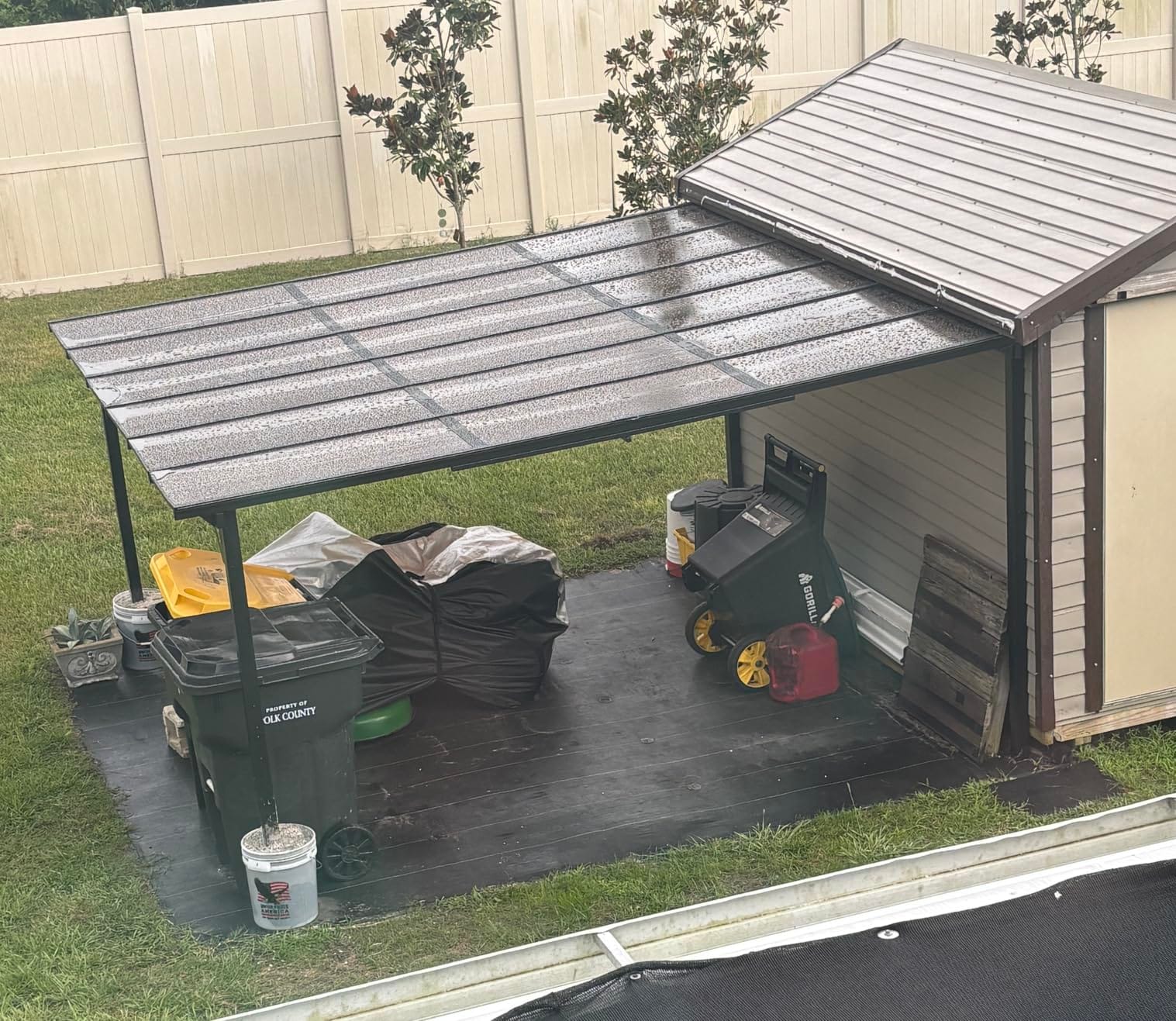
At 134.7 pounds with dimensions of 110.4 by 95.64 by 75.6 inches, this is a manageable build for two strong people, and the footprint suits a small patio without taking it over. Dark Grey, Black and White are all produced across a wide size range, so matching a second unit later is straightforward.
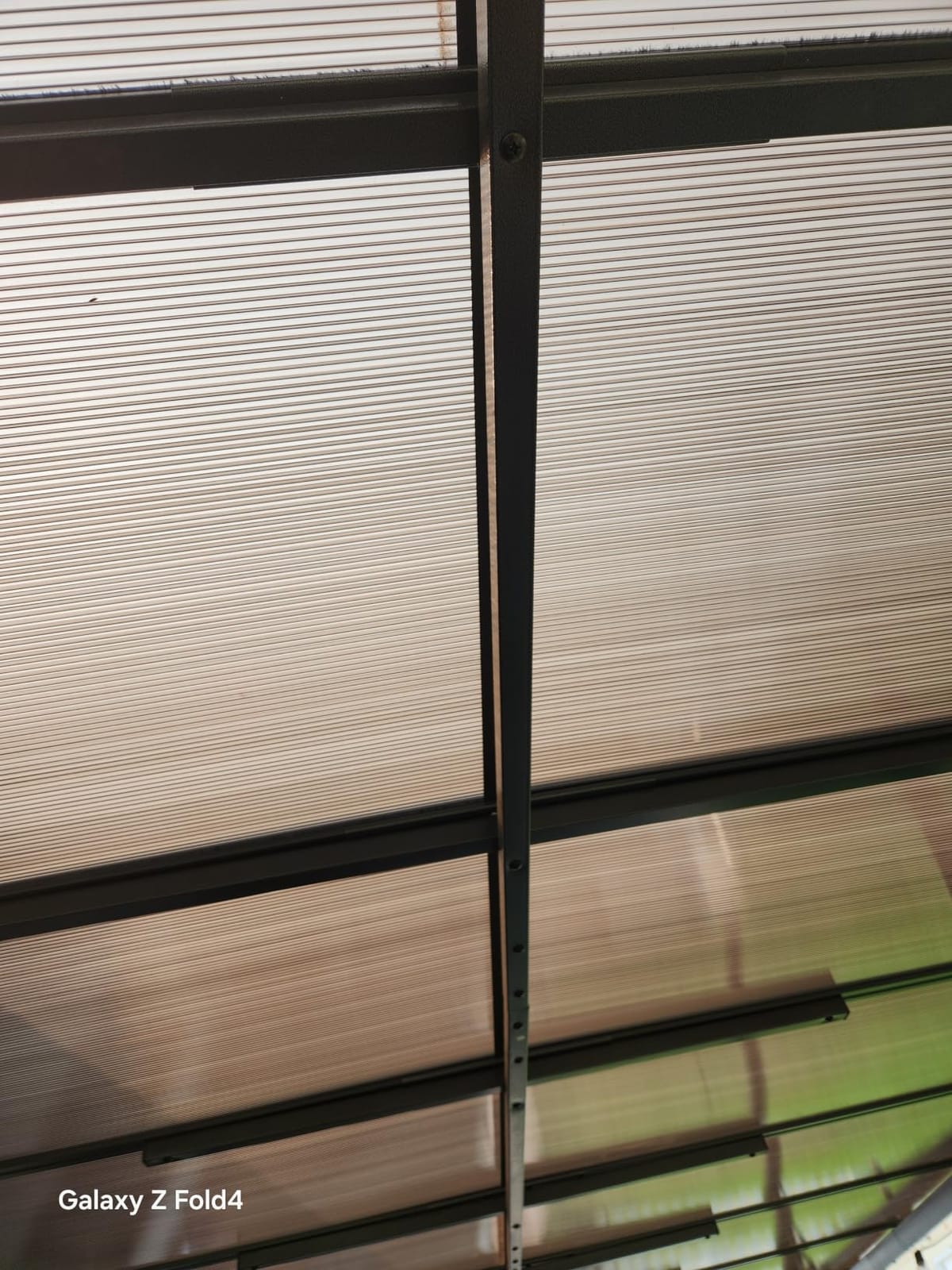
The complaints cluster on the roof and the paperwork. Some buyers find the roof panels thin and flimsy, the weather strip slides out of the roof track while you are inserting panels, and instructions have been missing from one or both boxes with video tutorials filling the gap. There are also reports of bent parts in transit and occasional leaking after a season or two, plus Phillips-head screws that are hard to tighten. The 75.6 inch height is the one that catches people: it is low at the front, so check your head clearance under any eave.
Who this pergola suits
It suits a small patio that will probably grow. If you are covering a dining spot now and want a grill station or a lounge later, the connectable format means the second unit lines up with the first. It also suits anyone who wants a hard roof for roughly the cost of a good outdoor dining set rather than a contractor-built structure.
Owners who appreciate manufacturer support do well here, because the combination of video tutorials and remote technical assistance resolves most of the documentation gaps. If you have a covered patio in mind rather than a decorative canopy, this hits the brief.
Who should skip it
Skip it if you need real height. At 75.6 inches the front edge is the lowest of any unit here, which is fine for a dining table and uncomfortable for anyone tall standing at a grill. Buyers who want a heavier feel in the roof panels should also look at a steel frame, and anyone without patience for assembly documentation needs to confirm the instruction set is complete before they start.
6. Pamapic 10 x 24 Expandable – Best for Large Patios
Pamapic 10x24FT Wall Mounted Gazebo, Hardtop Lean to Gazebo with Aluminum Frame & UV Resistant Polycarbonate Roof, Outdoor Patio Awning for Deck, Porch, Lawn & Backyard
240 sq ft
Aluminum frame
Polycarbonate roof
55 lbs/㎡ load
Pros
- Very wide 10x24 coverage from two units
- Seamless gap-free connector system
- Corrosion-resistant aluminum and polycarbonate
- Freed-up usable floor space
- Numbered labeled parts with video tutorials
Cons
- Needs a long wall and serious anchoring
- Assembly is a bigger two-piece job
- Color reads differently indoors and out
- Wind performance depends on wall and ground anchors
This is the coverage answer. Two 10 by 12 foot units joined with heavy-duty custom connectors give you a 10 by 24 footprint measuring 288 inches long by 120 inches wide and 96 inches high, with no gap between the halves. For a long, shallow patio along a rear elevation, it shades a table, a sofa and a circulation path in one structure, and the sloped pillar design means you do not need extra interior supports eating the floor.
The load rating is 55 lbs per square meter, which the manufacturer puts at roughly seven inches of snow, and the roof is UV-resistant polycarbonate hollow sheet over an aluminum frame. Those two materials together mean no rust, no stain schedule, and a light structure you can still move in pieces. Buyers highlight the connector system specifically: it produces a genuinely seamless joint rather than two structures that merely sit next to each other.
The roof is described as filtering light and heat while keeping the space cool, and the 4.4 star average reflects that satisfaction. Numbered parts, an illustrated manual and video tutorials are all included, and wall and ground mounting hardware ships with it, though expansion bolts are recommended separately. Matte dark gray pillars pair with a brown sunshade panel, and a range of other footprints from 10×10 to 12×12 is produced.
Criticism here is practical rather than quality related. A 10 by 24 footprint needs a genuinely long wall and a serious anchoring plan, and the two-piece build makes assembly a bigger job than a single unit. The color reads differently under indoor versus natural light, which is worth checking against your siding in person. And as with every wall-mounted kit, wind performance depends on anchoring at both the wall and the ground.
Who this pergola suits
It suits a long rear wall on a shallow patio, a poolside lounge strip, or a deck where one structure needs to cover a dining zone and a seating zone at once. Because the two halves bolt together with custom connectors, it also suits a buyer who wants to start with one 10 by 12 and add the second later, since the same connector system handles it.
Coastal and humid buyers should like the aluminum and polycarbonate combination, since neither corrodes. It is also a good match if you plan to run string lights or add a fan under the structure, because the height of 96 inches gives reasonable clearance.
Who should skip it
Skip it if your wall is short, since this unit needs the longest run of any pick here. It is also too big for a small patio, a side yard, or a balcony. Anyone who wants to set it up in an afternoon should pick a single-unit model instead, and anyone on a tight budget will find cheaper ways to get 240 square feet of cover.
7. Covered Outdoor 10 x 20 Steel Lean To – Best Built-In Gutter
Covered Outdoor StoneCreek 10’x20′ Lean to Gazebo, Wall Mounted Gazebo with Galvanized Steel Sloped Roof & Drainage Gutter, Heavy Duty Outdoor Pergolas for Patios, Backyard, Deck
About 200 sq ft
Galvanized steel frame
Integrated gutter
240L x 120W x 96H
Pros
- Sturdy galvanized steel build
- Built-in gutter keeps the patio dry
- Wood-look finish needs no upkeep
- Assembly parts are boxed and inventoried
- No rust reported in humid climates
Cons
- Instructions lack detail
- Roof panel holes are stubborn to align
- Top panel is thin during install
- One anchored unit flipped in a gust
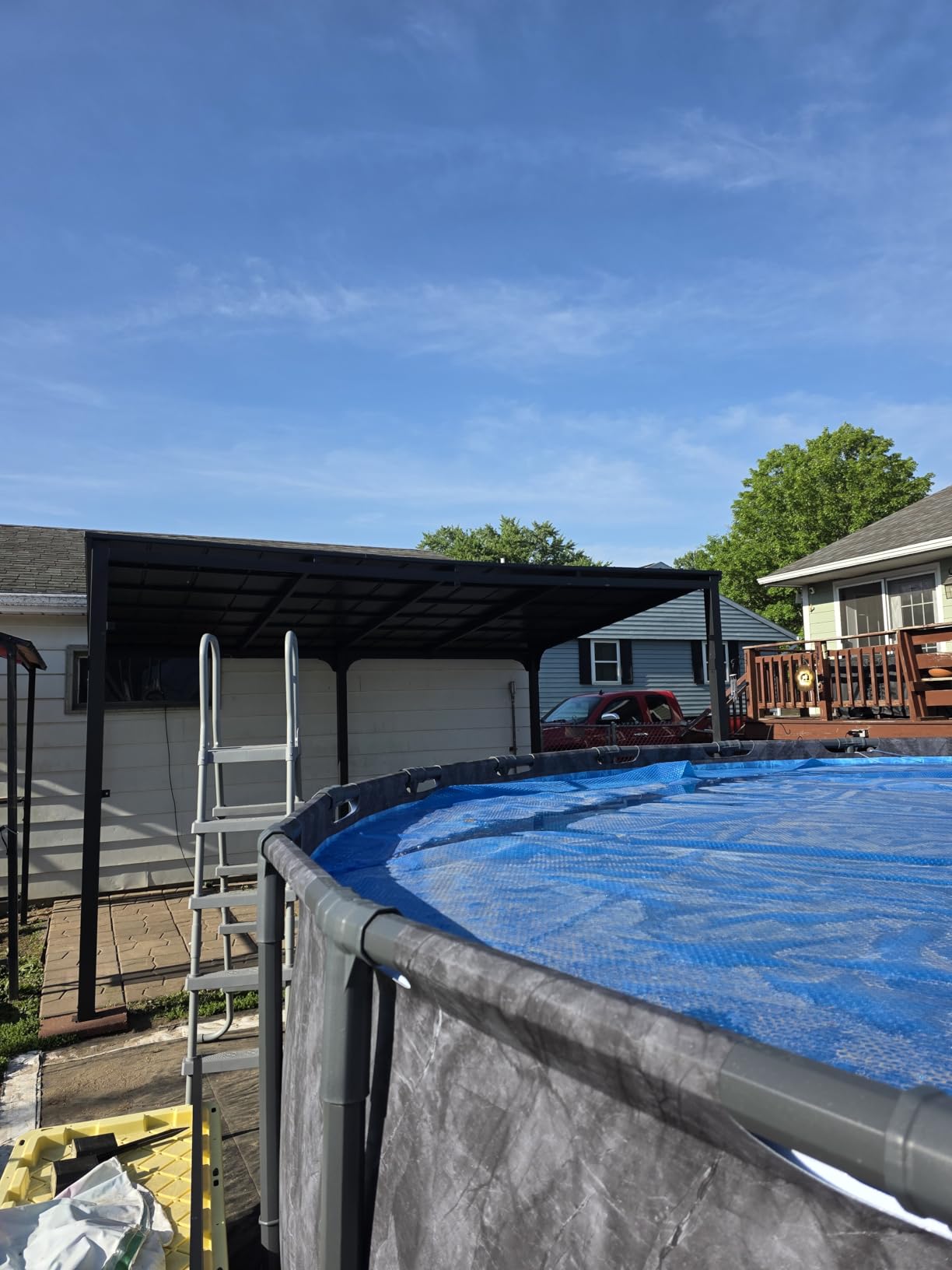
Drainage is the reason this one stands out. It has a built-in gutter system that channels water away and keeps the patio underneath dry, which is the single most practical upgrade a wall-mounted structure can have, because every other hardtop in this list leaves you solving water at the drip edge yourself. At roughly 200 square feet across a 10 by 20 footprint, it also covers a serious outdoor living area.
The frame and roof are reinforced heavy galvanized steel with a wood-look finish over the metal, so it reads warm against a patio while needing no stain or paint. Owners report no rust in humid climates, and the 4.6 star average is the highest among the wall-mounted kits here. Wall-mount fixing accessories are included, and phone support is available for setup questions. Smaller variants including 6×12 and 6×8 exist if 200 square feet is more patio than you have.
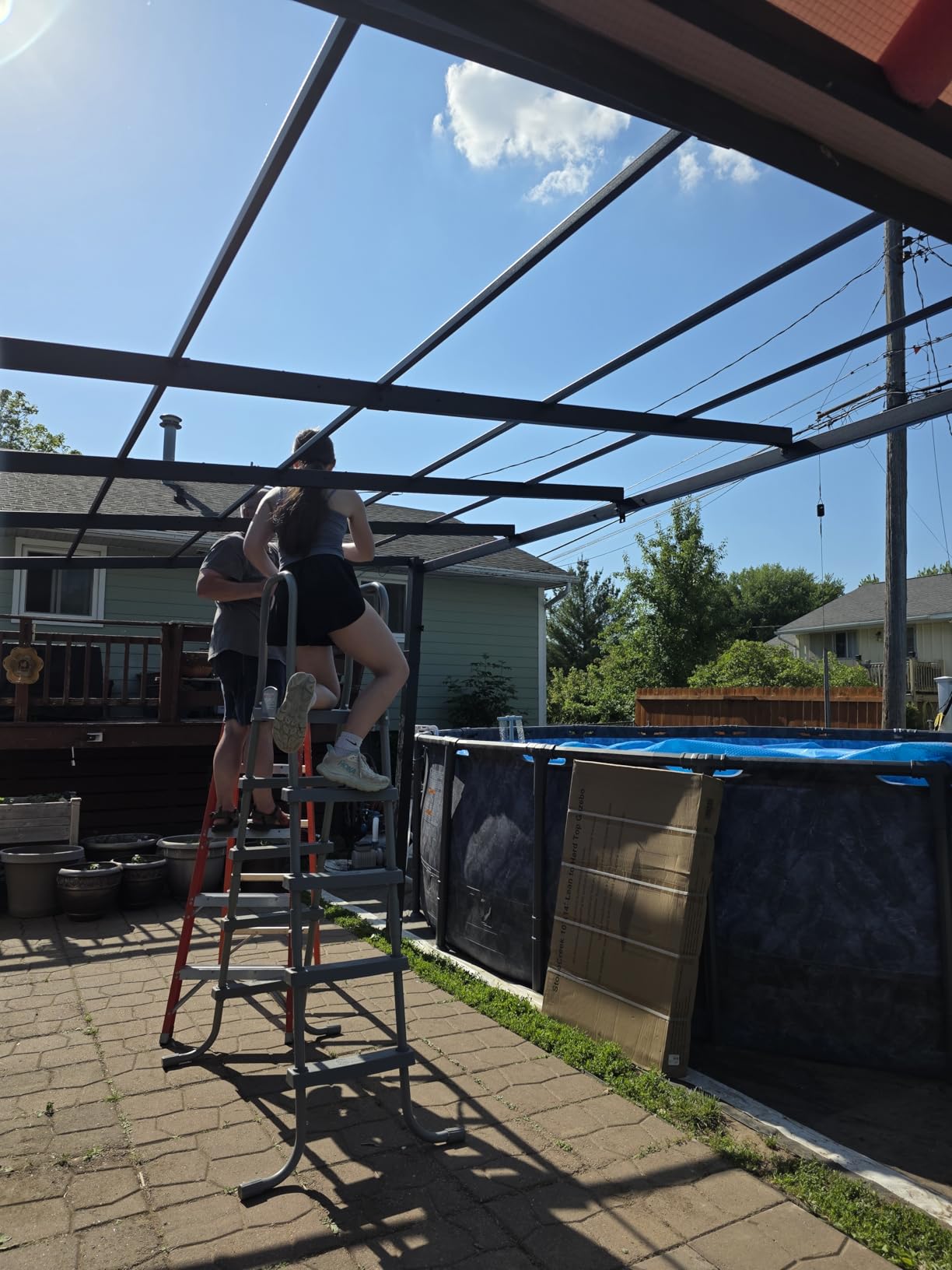
Assembly is logical and the parts arrive clearly boxed and inventoried, which owners say makes the build far less chaotic than a mixed pallet. Several report finishing in under three hours once they inventoried the parts first, and one owner needed a couple of days because the instructions lack detail. At 366 pounds, this is the second-heaviest structure here after the Domi, so plan the helper count accordingly.
Two specific assembly issues recur: roof panel holes that are stubborn to align, and a top panel thin enough to bend during installation. The most serious negative report we found involves a unit anchored to concrete that was flipped over by a wind gust, so do not treat the wall mount as a substitute for ground anchoring. The legs can be cut to fit rail-mounted installations if you need to adjust height.
Who this pergola suits
It suits anyone whose priority is keeping rain off the patio furniture and the door threshold. A working gutter is the difference between a structure you use in a shower and one you only use when it is dry, and at 200 square feet the coverage is wide enough for a full outdoor living setup with seating.
It also suits buyers who want the look of timber without the maintenance. The wood-look finish over galvanized steel gives you the warm appearance owners like with none of the stain cycle, and the reported lack of rust in humid air makes it a reasonable coastal choice.
Who should skip it
Skip it if you want a lightweight structure you can reposition, since 366 pounds is not a one-job move. Owners who are not comfortable with thin roof panel handling during assembly should also look at a heavier-gauge alternative. And if you live somewhere with serious wind exposure, read the gust reports carefully and anchor to both the wall and the ground, whatever the listing says.
8. Breezestival 10 x 8 All-Aluminum Lean To – Best Light-Filtering Roof
Breezestival 10×8 FT Lean to Gazebo Pergola, Outdoor Wall Mounted Gazebos with Polycarbonate Roof, Large Hardtop Metal Heavy Duty Awnings, Patio Canopy for Backyard, Deck, Porch (Black)
80 sq ft
All-aluminum
92% light transmittance
38 mph rated
Pros
- All-aluminum build resists rust and corrosion
- Polycarbonate passes 92% of natural light
- Sloped roof sheds water well
- Good 80 sq ft at a mid-range price
- Clear labeling with responsive support
Cons
- Must be anchored to a wall and ground
- Roof panel step needs multiple people
- Polycarbonate can crack or yellow over years
- Instructions may need extra support
The differentiator here is that the frame and the roof are both aluminum, which is rare. It means the whole structure is rust-proof and corrosion-proof with no coating to chip and no steel to touch up, and that is a genuine advantage in a humid or coastal climate. The polycarbonate panels block 99% of UV and reduce solar heat by up to 80% while still passing 92% of natural light.
Load capacity is 55 lbs per square meter, roughly six inches of snow, and wind is rated to 38 mph with both wall and ground anchoring. Temperature tolerance runs from minus 40 to 240 degrees, so it handles a northern winter as well as a southern summer. At 80 square feet it suits a small patio, a balcony, or a deck corner without dominating the space, and 10×12, 10×14, 10×16, 10×20, 8×10 and 16×10 variants are produced.
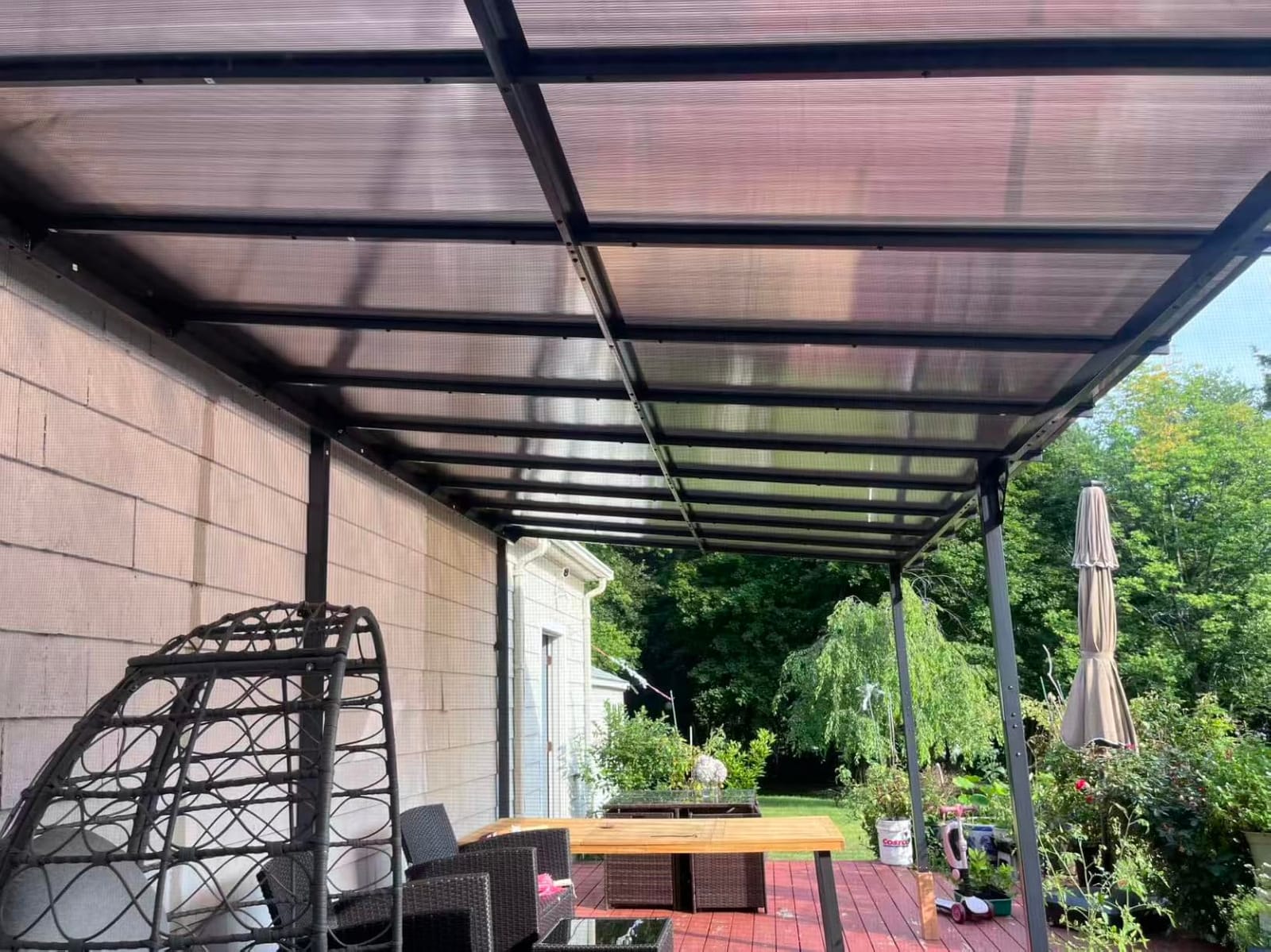
Buyer feedback centers on genuinely cool, shaded light that still reads as daylight, and on water shedding well off the sloped roof. Clear labeling, step-by-step instructions, a warranty and responsive support all get mentioned positively, which is more than several competitors manage given their documentation complaints.
The requirements are the trade-off. Anchoring to both a solid wall and the ground is not optional, and the roof panel installation is a multi-person step. Over long periods, polycarbonate panels can crack or yellow, which is the main uncertainty raised by owners, and instructions sometimes need supplementing with seller support.
Who this pergola suits
It suits a small patio or balcony where a lighter structure matters, since an all-aluminum build is easier to handle than the 279 and 366 pound steel options. It also suits anyone who wants shade without a dark room behind it, because 92% light transmittance keeps the covered area bright enough to use in the evening.
Coastal and poolside buyers should find it appealing, since aluminum is the material least bothered by salt and humidity. If you plan to hang curtains or netting later, an open frame makes that an easy add-on.
Who should skip it
Skip it if you want a solid dark canopy for evening dining, because a light-filtering roof is the whole point here and it will not deliver that. Anyone expecting zero maintenance over decades should be aware that polycarbonate panels can yellow or crack eventually. And if you do not have both a suitable wall and a place to anchor into the ground, this structure will not be stable.
9. Domi 10 x 14 Steel Hardtop – Best Wind Rating
Domi 10′ x 14′ Lean to Hardtop Gazebo Wall Mounted Patio Gazebo Pergola
143 sq ft
Dual-protected steel
60 mph rated
22 lbs/sq ft snow
Pros
- Dual galvanized and powder-coated steel
- Large 143 sq ft with generous post sizing
- Upgraded gutter channels water away
- Connectable for larger covered areas
- Strong five-star share of ratings
Cons
- Heaviest frame here at 279.5 pounds
- Needs a suitable wall to attach to
- Only Gray and Brown color options
- Footprint may not suit small patios
This has the strongest published performance numbers in the group. It is rated for 60 mph winds and 22 lbs per square foot of snow loading, which is roughly triple what the aluminum kits here claim, and the frame is dual-protected galvanized and powder-coated steel. The structure uses 3.94 inch columns with five reinforced 5.2 inch beams, which is the sort of oversizing you can feel when you shake the frame.
At 143 square feet across a 162.7 by 113.2 inch footprint, it is one of the larger single-unit options and gives you real room to move. The upgraded gutter system is designed to shed water cleanly and resist clogging, and the sloped galvanized roof throws rain and snow off quickly. Connectors let you join matching same-width gazebos later if you want to extend the covered area. The 4.4 star average carries a strong share of five-star ratings.
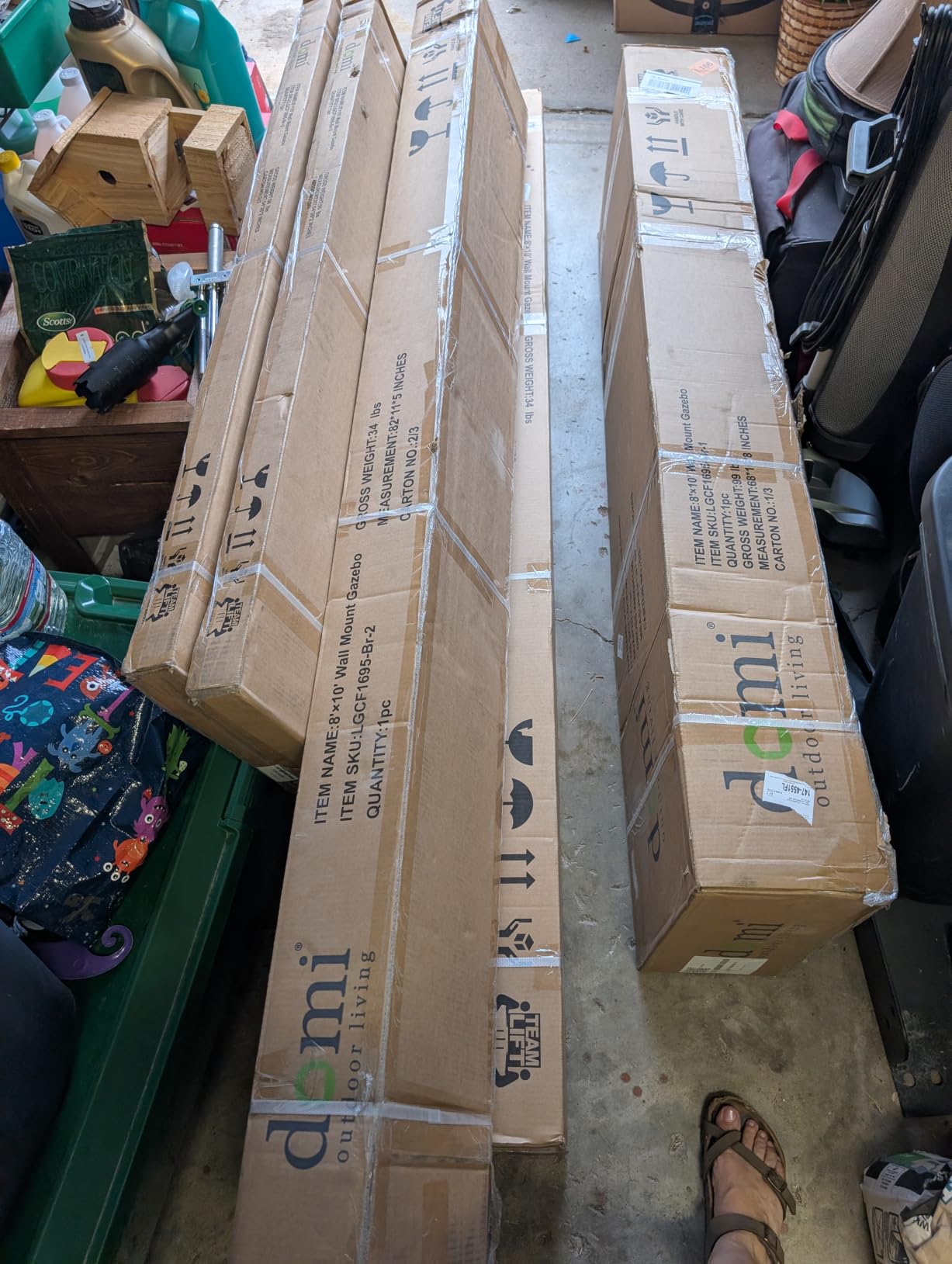
What you trade for that strength is weight. At 279.5 pounds, this is the heaviest frame in the group, and owners note that assembly needs several people. A galvanized roof also means a genuinely dark covered area, so plan lighting if you want to use the patio at night. Gray and Brown are the only color options, which is limiting if you need to match a specific siding tone.
Beyond weight, the practical constraint is the wall. This footprint needs a suitable wall to attach to and enough patio depth to clear the 162.7 inch run, so measure before ordering. If your patio is small, the coverage will feel overwhelming rather than generous.
Who this pergola suits
It suits a patio in a windy or snowy region where the alternatives do not carry a credible rating. A 60 mph wind figure and 22 lbs per square foot snow load are the numbers you want to see if your existing freestanding structure has been damaged by a storm in the past.
It also suits anyone planning a large covered outdoor living area, since 143 square feet seats a full dining set plus a lounge without feeling tight, and the connectors make a future expansion straightforward. The generous column and beam sizing means it is unlikely to be the weak link on your patio.
Who should skip it
Skip it if you have a small patio, a balcony, or a side yard, because 143 square feet needs real depth. Buyers without a capable helper group should pick something lighter, since 279.5 pounds is a genuine multi-person lift. And if you want the covered space to stay bright, a solid galvanized roof is the wrong choice.
10. MEISSALIVVE 8 x 12 Polycarbonate Lean To – Best for Narrow Patios
MEISSALIVVE 8′ x 12′ Lean to Gazebo, Wall Mounted Pergola, Sloped Roof Patio Gazebo Awning, Black
96 sq ft
Powder-coated aluminum
60 lbs/㎡ load
38 mph rated
Pros
- Strong value for a polycarbonate hardtop
- Shade and rain protection for seating
- Aluminum frame holds up in heavy snow
- Two determined people can assemble it
- Wide range of sizes and colors
Cons
- Roof panels leak if middle trim is reversed
- Panels have no sun-side orientation marker
- Unwelded anchor fitting can pop out
- Some shipments miss screws and hardware
This is the pick for a patio that is long and narrow rather than square. At 96 square feet across 142 by 94.5 inches with a height of 98 inches, it gives you a proper seating and dining zone without demanding the depth that a 12 foot wide structure needs. The powder-coated aluminum frame resists fading, rust and corrosion, and pre-drilled feet with ground stakes are included for stability.
The roof is polycarbonate reflecting 95% of UV rays, with a load capacity up to 60 lbs per square meter, wind resistance to 38 mph and snow depth capacity of about four inches. Numbered parts and clear instructions come in the box, and the manufacturer suggests a two to four hour installation with two to five people. Several owners report the frame holding up through significant snow when they added a temporary support beam underneath.
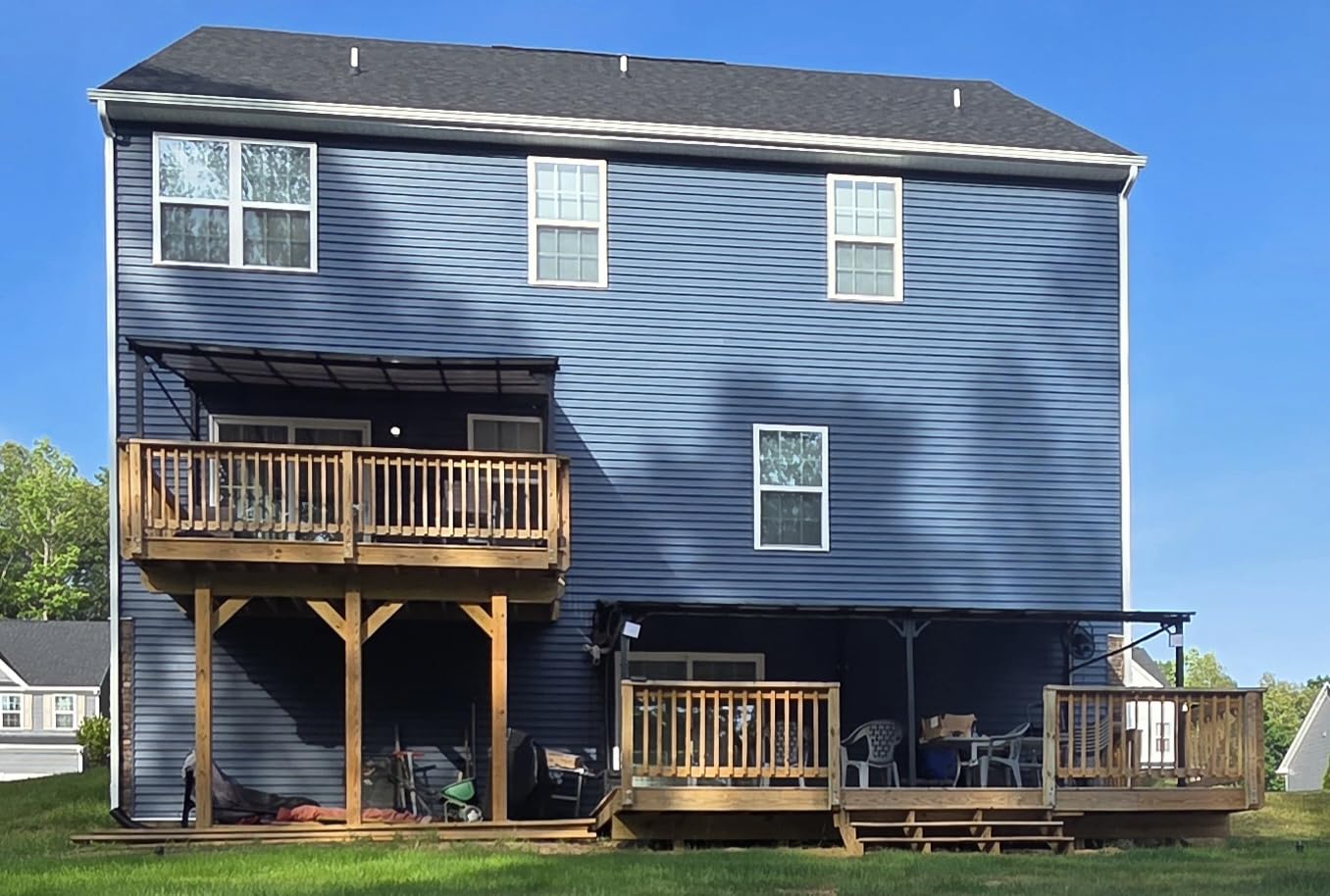
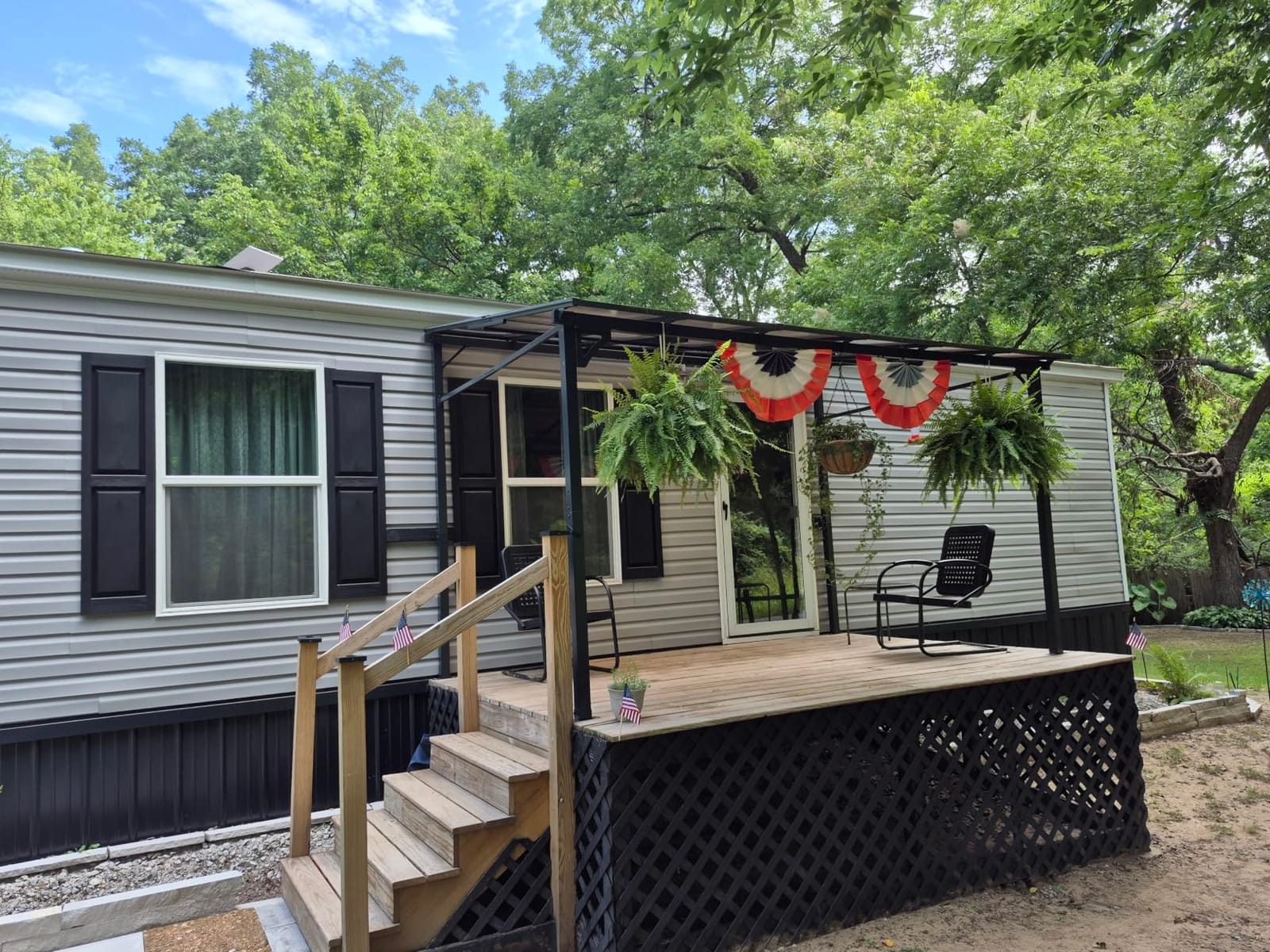
Buyers largely see this as a strong budget option that delivers real shade and rain protection for a fraction of built-pergola cost, and one determined person can assemble it solo if needed, though two is easier. Mounting on concrete with expansion screws is recommended, which follows the same anchoring logic as the larger kits. A wide range of sizes, colors and side-shelf options is produced, in Black and White.
There is one specific assembly failure that recurs and is worth knowing before you start: multi-panel roofs can leak between panels if the middle trim piece is installed backwards, and the panels carry no marking for which side should face the sun. The anchor-bolt fitting on the leg bracket is unwelded and can pop out when tightened, instructions are unclear on the orientation of several pieces, and some shipments arrive with missing screws and beat-up hardware.
Who this pergola suits
It suits a narrow side patio, a deck corner, or a small courtyard where a square structure would crowd the space. The 98 inch height gives better head clearance than the lower hardtops in this list, which matters if you are standing at a grill. For buyers comparing a broader range of shade structures, our wall mounted storage roundup uses the same format of honest pick-by-pick verdicts we have applied here.
It also suits anyone who wants the value of a hardtop without the weight of a steel frame, since 133.4 pounds is manageable. If you are in a climate with real winter snow, the 60 lbs per square meter load rating is a reassuring number, provided you brace it as some owners did.
Who should skip it
Skip it if you have never assembled a flat-pack structure before, because the roof panel orientation issue catches people out and the instructions do not flag it clearly. Anyone who needs heavy snow capacity beyond about four inches should pick a higher load rating, and if you dislike drilling into siding, neither this nor any other kit in the list is the right tool.
Wall Mounted vs Freestanding Pergolas: Which One Fits Your Patio
Short answer: a wall mounted pergola is the better choice when you already have a solid exterior wall next to the patio, you want shade right at the door, and your patio is too small to spare four post footprints. A freestanding structure is the better choice when you want the patio usable from all four sides, you have an open yard, or you do not want to touch the house at all.
The trade-off is not purely aesthetic. A wall-mounted unit ties one side to the house, so it uses less ground area and generally resists wind better, since the house is doing structural work. You give up the ability to walk around it, and you accept a permanent connection to the exterior wall. A freestanding pergola stands alone, can be moved, and does not create a fail point at the siding, but it needs four posts and more footprint for the same coverage.
Builders on r/Carpentry are split on this, and the honest reason is that attachment always creates a failure point no matter how carefully it is flashed. Homeowners on r/landscaping frequently land on freestanding for new builds where there is no natural wall relationship, and reserve wall mounting for patios that already sit tight against the house. If you are starting from scratch on a new patio, a freestanding structure usually wins.
When wall mounting is the wrong call
Skip wall mounting entirely if the wall is vinyl or aluminum siding over a thin frame with no reliable stud line, or if you rent and cannot drill. Also skip it if your patio is freestanding in the middle of the yard, since a wall-mounted unit needs a house to lean on. And if the structure would be mounted to a second-story wall or a wall above a finished basement, you are into engineering territory that needs a professional, not a kit.
One more practical exclusion: if you plan to run a heavy climber like wisteria over the frame, a wall-mounted design concentrates that weight on the attachment point. Vine weight is a genuine structural issue, so check the load rating and talk to someone who can see the wall.
How to Attach a Pergola to Your House Without Leaking
Water intrusion at the attachment point is the number one recurring complaint about attached pergolas, and experienced builders say it happens no matter how well the joint is flashed. The fix is not skipping the pergola, it is attaching it through a properly installed ledger board rather than into siding. A ledger board is a horizontal pressure-treated or structural timber that is fastened into the wall framing, and the pergola bolts to the timber, not to the vinyl.
Start by finding the wall structure. On a framed wall, drive screws or a probe to locate studs, then fasten a ledger board into every stud with structural screws. On masonry or brick veneer, the common approach described on r/houston is drilling through the brick into the studs behind it, then bolting the ledger to that. Do not anchor into brick face alone. Where a wall is only siding and sheathing, it is not a structural wall, and no pergola should hang from it.
Keep the pergola close enough to the house that the ledger has leverage, typically within 6 to 12 inches, and low enough that you are not fighting the roof overhang line or the existing gutter. When the pergola must be higher than the gutter, plan a flashing detail that directs water over the top rather than behind the frame. Reddit DIY threads repeatedly flag the conflict between an attached pergola and existing gutters as a design problem that should be solved on paper, not on the wall.
On permits, an attached structure changes the answer for many jurisdictions. Because you are fixing something to the house envelope, some building departments treat it as an addition. Ask your local authority before you drill, and expect the question to be about the attachment rather than the patio. If you are renting or in an HOA, the same conversation covers exterior modification approval.
Common attached pergola mistakes to avoid
The most common mistake is anchoring into siding instead of a ledger board into framing. The second is setting the height so the roof intersects the existing gutter line, which traps water and dumps it at the wall. The third is skipping ground anchors because the wall attachment feels sufficient, and that is exactly how a wind gust flips a structure, as one owner reported here. The fourth is skipping waterproofing entirely, or ignoring that flashing and finish details are what separate a five-year structure from a repair bill.
Also common: ordering a footprint that leaves no walkway clearance, and assuming the included hardware is enough for a masonry wall. Check whether the kit ships with expansion bolts or only wood screws, because one reviewer documented needing extra washers, sealant and a custom gutter before the roof stopped leaking. Owners also report multi-box orders, so have all the pieces on hand before you start rather than building half of it over a weekend.
What to Look for in a Wall Mounted Patio Pergola
Size and head clearance come first. Measure the wall run and the patio depth before choosing, and check the front-edge height against your eave. The AECOJOY at 75.6 inches is the lowest front clearance in this group and that is a real consideration under a soffit, while the MEISSALIVVE at 98 inches gives the most standing room. A good rule is to leave roughly three feet of walkway around a dining table and confirm the roof line clears the door and window openings behind it.
Frame material decides your maintenance cycle. Aluminum needs nothing but a rinse, which is why the PURPLE LEAF and Breezestival builds suit coastal and humid climates. Galvanized and powder-coated steel is heavier and holds a higher wind and snow rating, but it is the heavier lift at assembly. Cedar is warm to look at and blends with a garden, but it needs a regular stain schedule, and none of the kits here ship in timber.
Roof type changes the entire feel of the space. A hardtop steel roof gives full shade and a dark, private interior, which is why the Domi and Aoxun lean-tos work for evening dining. Polycarbonate passes 92% of light and blocks 99% of UV, so a covered patio stays bright enough to use and stays cool, at the cost of panels that can yellow over years. A fabric canopy is adjustable and cheap but pools water and comes down for winter.
Wind rating and anchoring are the safety items. Look for a specific number in miles per hour, not a phrase, and note whether it assumes both wall and ground anchors. Every unit here is rated between 31 and 60 mph, but the ratings assume proper anchoring, and anchoring to only one point is what leads to damage in a storm.
Drainage is where a hardtop earns its keep. A built-in gutter, as on the Covered Outdoor unit, keeps water off the patio furniture and off the wall below. Without one, plan a drip edge and a drainage path yourself, because several owners end up adding a custom gutter after the fact. Slope direction matters as much as slope angle, so check which way water runs before you position the unit against the house.
Finally, lighting, power and curtains. If you plan to use the patio after dark, look for mounting points for string lights or a place to run a cord, and note that solid metal roofs block starlight while polycarbonate does not. Curtain and mosquito net mounting positions, as on the Aoxun 12 by 10, add privacy and bug relief for the shoulder season. Outlets and USB ports are worth paying for if you will run a fan or a speaker out there.
Frequently Asked Questions
Is it a good idea to attach a pergola to my house?
It is a good idea when your patio already sits tight against a solid exterior wall and you want shade right at the door, because the house acts as one side of the frame and frees up floor space. Skip it if the wall is only siding over a non-structural frame, if you rent, or if the patio is freestanding in open yard. The main cost is the attachment point itself, which is where water intrusion happens when the ledger board and flashing are not done properly.
What are common attached pergola mistakes?
The most common mistakes are anchoring into siding instead of a ledger board bolted into studs or masonry, setting the height so the roof intersects the existing gutter line, and skipping ground anchors because the wall attachment feels sufficient. Other frequent errors include missing waterproofing and flashing at the joint, ordering a footprint that blocks the walkway, and assuming the included hardware is right for a masonry wall. Owners also report leaks at roof panel joints when panels are installed in the wrong orientation.
How close can a pergola be to the house?
Keep a wall mounted pergola within about 6 to 12 inches of the exterior wall so the ledger board has leverage and water sheds away from the siding rather than pooling at the base. Leave enough gap to fit a flashing detail and to access the wall for maintenance. The height has to clear the roof overhang line and any existing gutter, and the front edge should be high enough that you do not bump your head walking under it.
Is it cheaper to build a pergola or buy a kit?
A kit is usually cheaper in materials once you count the lumber, fasteners, roof panels and finish, and it arrives with a frame that is already sized and labeled. Building it yourself is cheaper in labor only if you already own tools and have the time, and it lets you match your patio exactly. Kits trade custom sizing for a fixed footprint, which is why measuring your patio and wall run before ordering matters so much.
What size wall mounted pergola do I need for my patio?
For a dining table for four to six people, 80 to 100 square feet of coverage is usually enough, which corresponds to footprints like 8 by 12 or 10 by 10. For a full dining set plus lounge seating or a grill station, aim for 120 to 145 square feet, such as 10 by 14 or 12 by 10. For a long shallow patio, an expandable unit like 10 by 24 covers seating, circulation and a grill in one structure. Leave roughly three feet of walkway around the furniture.
Final Verdict: Which Wall Mounted Pergola Should You Buy in 2026
After comparing all ten, the best wall mounted pergolas for patios split cleanly into three groups. The PURPLE LEAF 9.5 by 13 sliding canopy is the best overall choice, because adjustable shade and 123.5 square feet of coverage beat a fixed roof for most patios, and it carries the largest review base we analyzed. The Aoxun 10 by 14 lean to hardtop is the best value if you want a solid steel roof with a published 31-38 mph rating, and the Domi 10 by 14 takes that further with a 60 mph wind rating and 22 lbs per square foot snow load.
For large or unusual spaces, the Pamapic 10 by 24 covers a long shallow patio that nothing else on this list touches, and the Covered Outdoor 10 by 20 is the one with a built-in gutter, which is the single most useful thing a hardtop can have. If your patio is narrow, the MEISSALIVVE 8 by 12 fits depth-constrained spaces, and if you only want shade rather than weather cover, the Aoxun 10 by 6 fabric lean to is the cheapest way to finish the space.
Before any of them go up, measure your wall run and patio depth, find your studs, and decide how the pergola will clear your gutters. That planning step prevents more problems than any model choice on this list. Use the buttons above to check the current details for each pick, and start with the one that matches your square footage and your weather.