
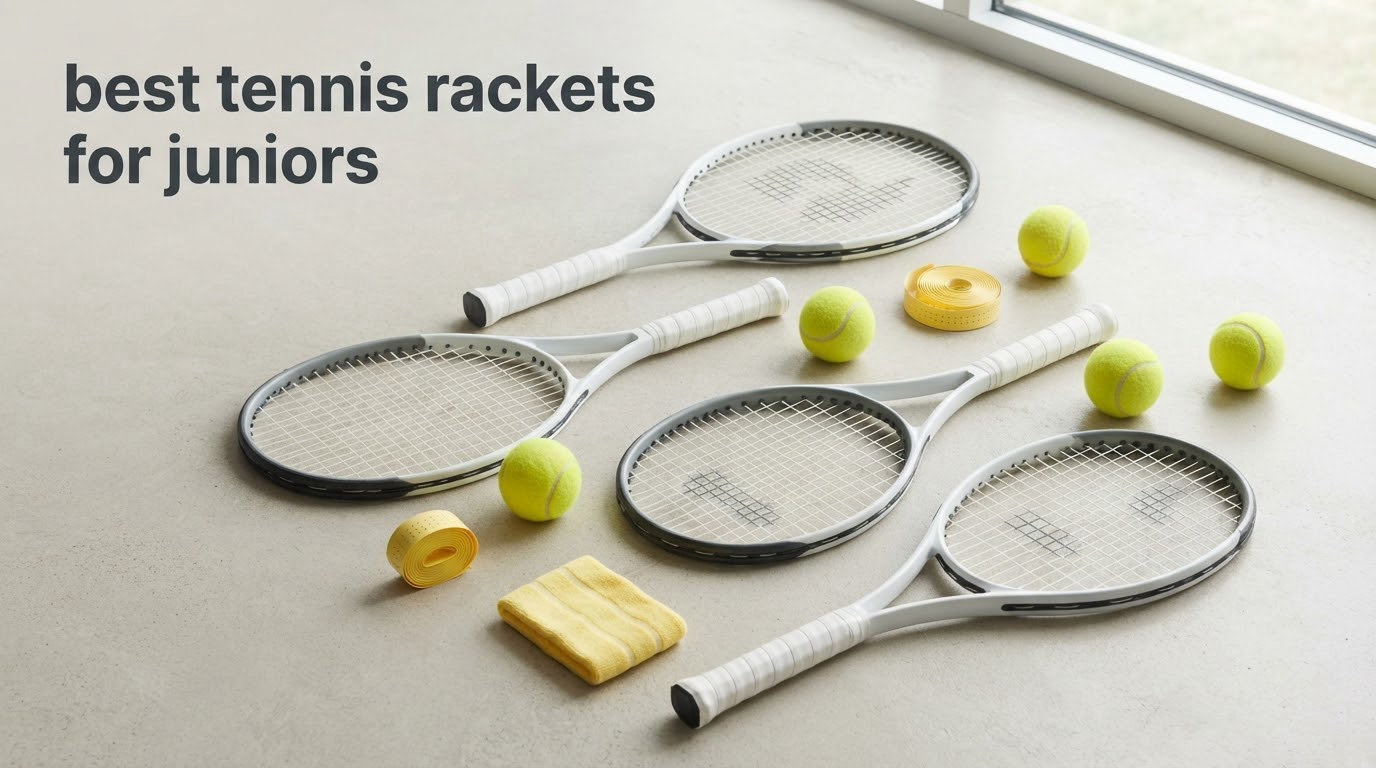
Buy the frame that matches your child’s height, not their birth year. A junior racket that is too large forces a swing a short arm cannot control, and the resulting habit is very hard to unlearn. The best tennis rackets for juniors start at 17 or 19 inches for a first racket at age three and step up through 21, 23 and 25 inches, with a full 27-inch adult frame usually arriving around age 12 or 13.
We went through twelve junior frames currently on the market, pulled the real specifications for each one, and sorted them into the age bands they actually fit. Everything below is organised by frame length, because that single number does more work than any other spec. We have linked out our best tennis shoes and best tennis shoes for plantar fasciitis as well, since a junior racket is only half of what a young player needs on court.
Two rules run through the whole guide. First, size by height band, and use age as a rough sanity check only. Second, buy for the next six months of lessons, not the next five years. A frame your child has outgrown teaches bad habits faster than an undersized one does, because the swing has to be bigger and slower to land on the ball.
Top 3 Picks: Best Junior Tennis Rackets We Recommend in 2026

HEAD Speed Junior 19 Inch
- 170 g aluminium frame
- 19 inch length
- 76 sq in head
- 3 5/8 inch grip

AMA SPORT Kids 17 to 25 Inch
- Full 17-25 inch size ladder
- oversized sweet spot
- 420D nylon strap bag

INSUM Kids Tennis Racket 19 Inch
- Lightweight frame for ages 2-4
- child-friendly grip
- cover with strap
The HEAD Speed takes the top slot because it pairs a top rating of 4.8 with the deepest review history in the group, more than five thousand ratings. The AMA SPORT set is the smarter purchase if you want one brand that covers the whole 17 to 25 inch ladder. The INSUM is the sensible entry point for a two-year-old on a tight budget.
Best Tennis Rackets for Juniors in 2026
| Product | Specifications | Action |
|---|---|---|
| HEAD Speed Junior 19 Inch |
|
Check Latest Price |
| AMA SPORT Kids 17-25 Inch Set |
|
Check Latest Price |
| INSUM Kids Racket 19 Inch |
|
Check Latest Price |
 HEAD Instinct Junior 21-25 Inch HEAD Instinct Junior 21-25 Inch |
|
Check Latest Price |
 Street Tennis Club Kids 17-19 Inch Street Tennis Club Kids 17-19 Inch |
|
Check Latest Price |
 Senston Junior 19-25 Inch Set Senston Junior 19-25 Inch Set |
|
Check Latest Price |
 Wilson US Open Jr 21 Inch Wilson US Open Jr 21 Inch |
|
Check Latest Price |
 Wilson Profile 25 Junior Wilson Profile 25 Junior |
|
Check Latest Price |
 LUNNADE Kids 19-25 Inch Set LUNNADE Kids 19-25 Inch Set |
|
Check Latest Price |
 bo wei qi Kids 17-25 Inch bo wei qi Kids 17-25 Inch |
|
Check Latest Price |
 Wilson Pro Staff Precision 23 Inch Wilson Pro Staff Precision 23 Inch |
|
Check Latest Price |
 Gamma Quick Kids 19 Inch Gamma Quick Kids 19 Inch |
|
Check Latest Price |
Frame length is the first column of thinking for every one of these. The short frames on the list are for children who are still on red or orange balls and mini courts. The 25-inch frames are the last stop before an adult racket takes over.
1. HEAD Speed Junior Tennis Racquet – Lightest First Racket for Ages 2-4
HEAD Speed 19 Junior Tennis Racquet, Green (SIOC)
19 inch length
170 g unstrung
76 sq in head
3 5/8 inch grip
Ages 2-4
Pros
- Pre-strung and ready to play out of the box
- Very light at 170 g for tiny arms
- 76 sq in head is forgiving for a first racket
- Kid-friendly grip
- Durable O-beam aluminium
Cons
- 19 inch size is outgrown quickly
- Basic recreational frame with no vibration damping
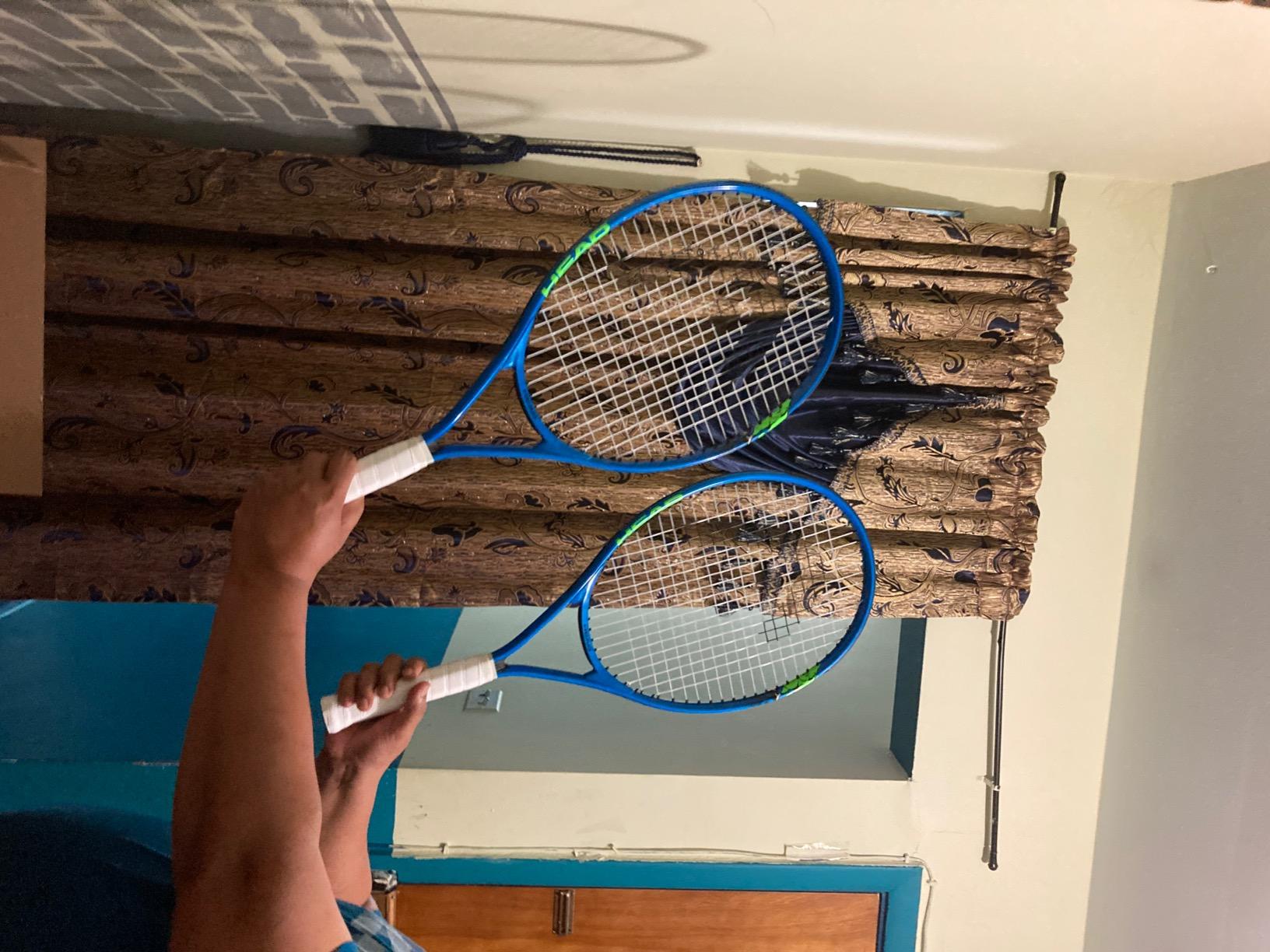
This is the racket we hand to a three-year-old. At 170 g it is one of the lightest frames in the whole list, and the 19-inch length matches a child between 35 and 39 inches tall. The head is 76 square inches, which sounds small next to the 93 square inch frames further down, but for a player who has never held a racquet a tight sweet spot is not a problem because the ball is not arriving there yet anyway.
It arrives pre-strung, which matters more than it sounds. A parent buying a first racket does not want to drop it at a shop for stringing, and plenty of beginners never get round to it. The grip at 3 5/8 inches is genuinely small, so a five-year-old’s hand fills it properly, which is the real reason contact improves in the first few sessions.
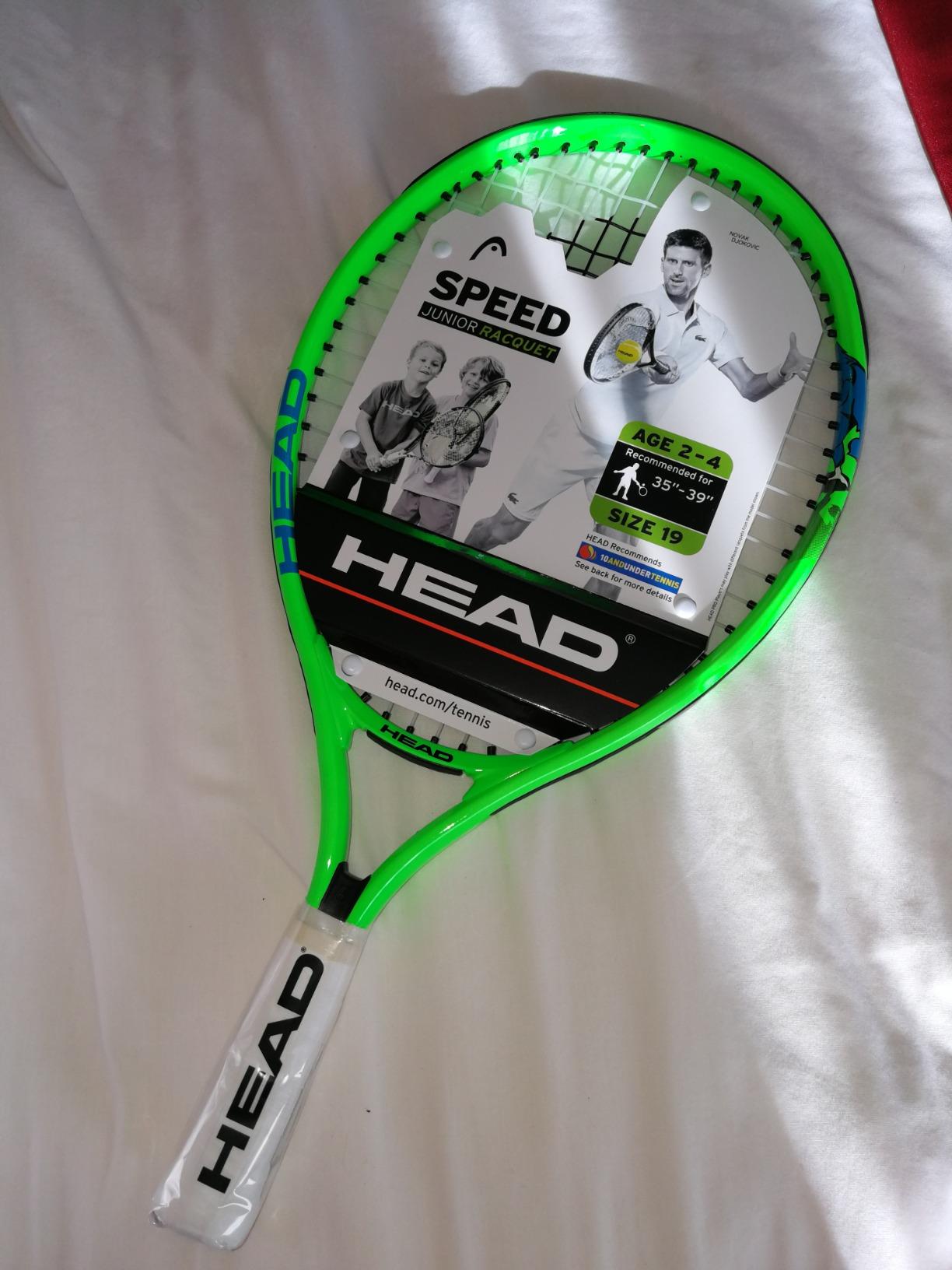
Reviews on this frame run heavily positive, with 84 percent of owners leaving five stars across more than five thousand ratings. The word that comes up most often is how quickly children move from hitting nothing to hitting something over a mini net. The construction is simple one-piece aluminium O-beam, and the honest read on that is that it survives being dropped and carted around in a bag without any complaint.
The single limitation everyone mentions is size, and it is a real one. A 19-inch frame suits ages two to four, so a child moving fast through lessons can be ready for a 21-inch within a season. Judge by height band rather than birthday: if your child has passed 40 inches, the 21-inch HEAD Instinct below is the natural step up.
When this is the right call
Choose the Speed when the child is under 40 inches tall and has never had a proper lesson. The 76 square inch head forgives off-centre contact, the weight is low enough that a short swing still sends the ball over a mini net, and the grip size genuinely fits a small hand.
It is also the racket we would trust as a hand-me-down gift, because a 19-inch frame has a long life as a practice racket. Even after a child moves up in size, this one is small enough to keep in the bag as a loaner for a younger sibling or a guest at a family match.
When to skip it
Skip it if the child is already rallying over a full net. A 76 square inch head at 19 inches gives almost no reach, and a taller child will fight the frame rather than swing through it. If they measure past 40 inches, go straight to 21 inches instead of buying 19 and outgrowing it in a term.
It is also the wrong choice for a child who already complains about wrist or elbow soreness. A slightly larger frame with a damper, such as the Senston or HEAD Instinct, absorbs more of the shock through the handle.
2. AMA SPORT Kids Tennis Racket Set – One Brand From 17 to 25 Inches
AMA SPORT Kids Tennis Racket for Junior Toddlers Starter Kit 17-25″ for Girl Pink and Boy Yellow with 420D Nylon Shoulder Strap Bag, Graffiti Pink 17″
17 to 25 inch size ladder
Oversized sweet spot
0.16 kg listed weight
420D nylon strap bag
Pros
- Widest size ladder of any pick at 17 to 25 inches
- Light enough for a toddler to swing
- Oversized head raises contact rate on fun shots
- Shoulder strap bag included
- #1 sales rank in Tennis Rackets
Cons
- Fun-focused branding rather than performance graphics
- Generic specification detail for an entry-level frame
The argument for this set is arithmetic rather than performance. A parent who buys a 19-inch frame today will need a 23-inch in two years, and this brand covers 17, 19, 21, 23 and 25 inch within one design language. That means the child keeps the same grip shape, the same colour family and the same feel as they grow, which cuts down the transition fusses.
The design leans on the ITF Play and Stay teaching philosophy, which is why the sweet spot is deliberately oversized. For a child hitting red or orange balls across a mini court, a bigger head means more balls land in it and the rally lasts longer. Long rallies are where the learning happens at that age.
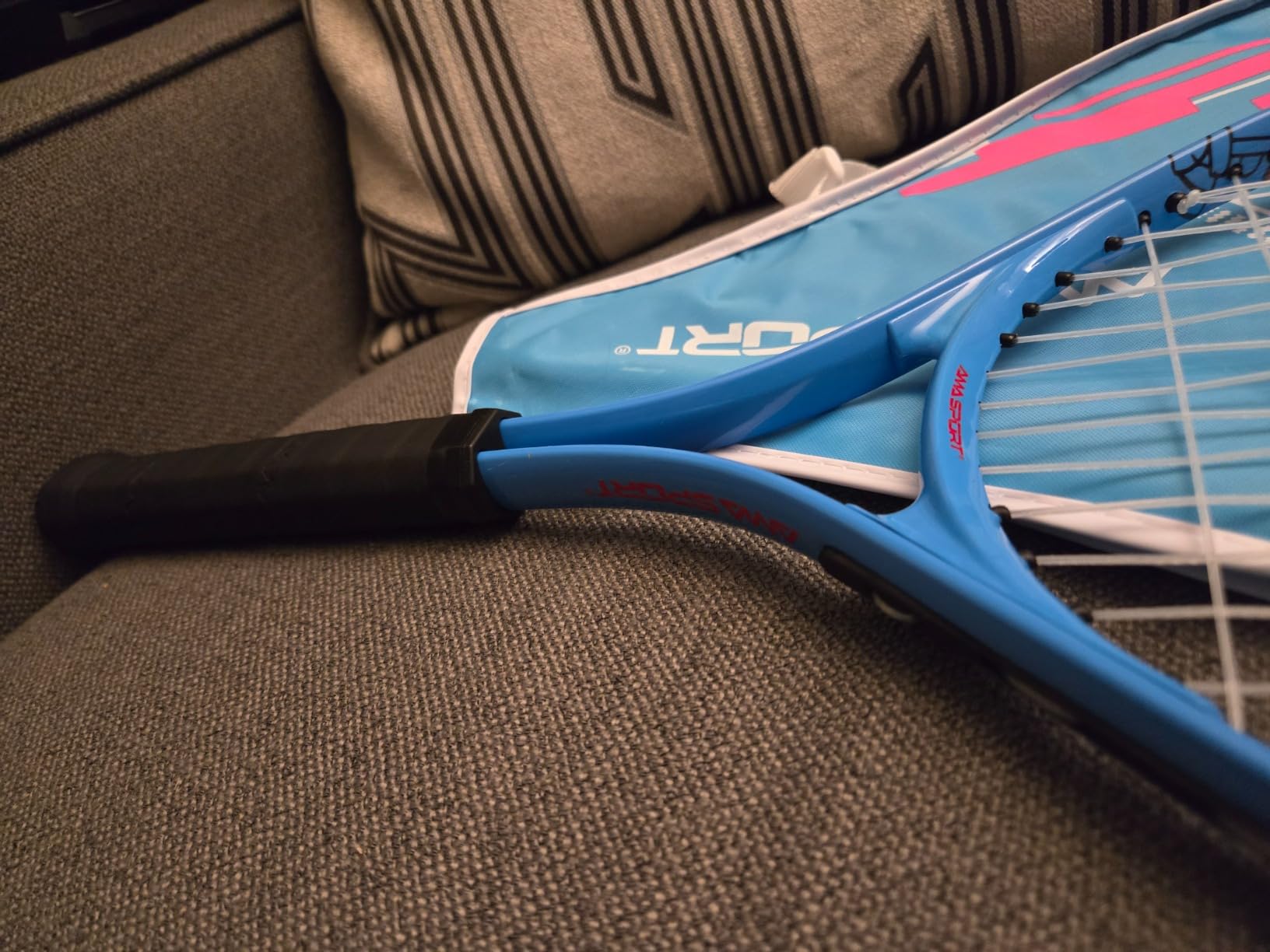
It ranks first in the Amazon Tennis Rackets category, and the 1,276 reviews average 4.7 stars with 86 percent at five stars. Reviewers keep pointing at the size range, the swing weight and the bag. Several parents mention that it works as a full set, so you are not hunting down a matching cover when the racket goes in the car.
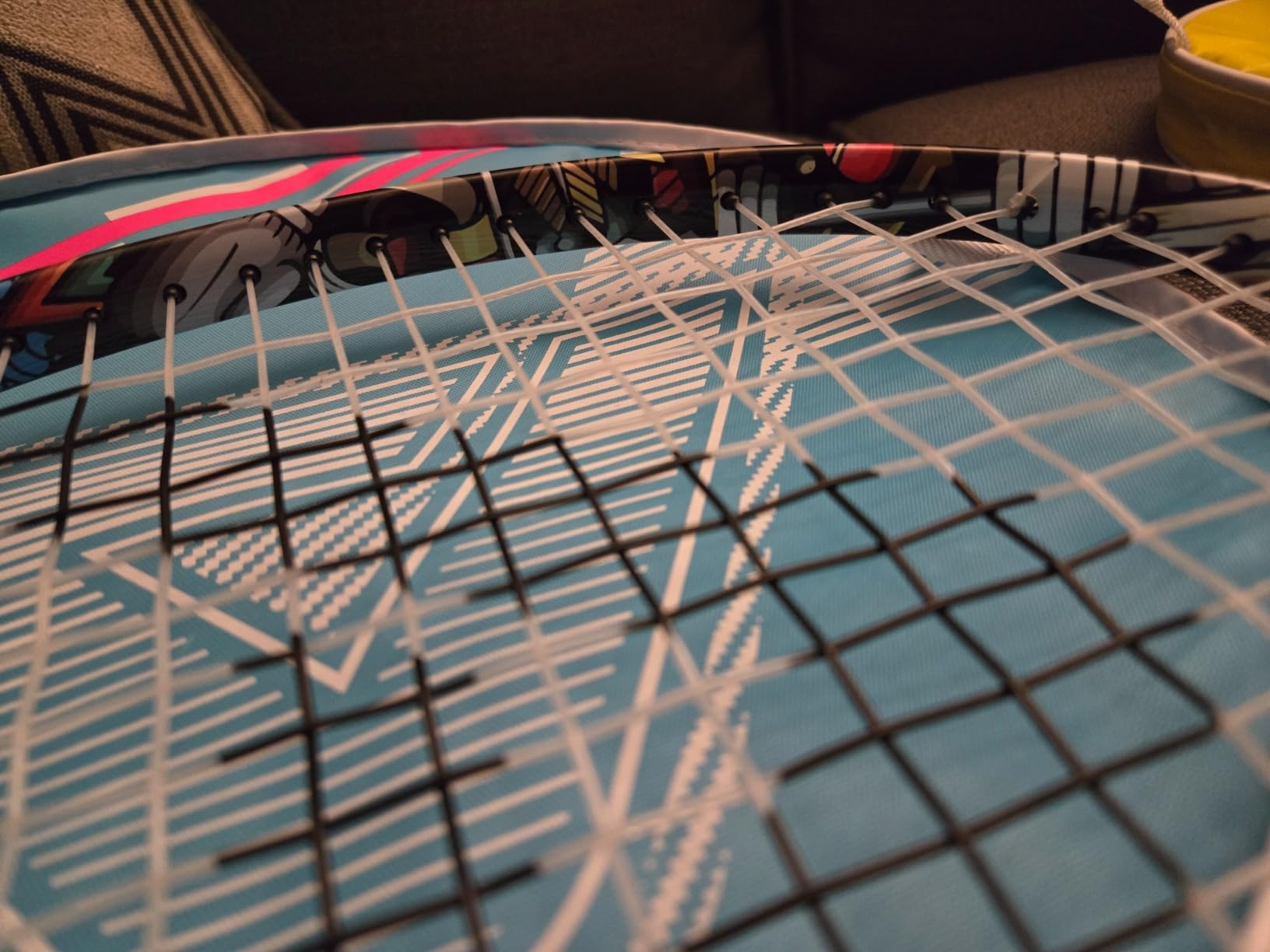
What it is not is a performance frame. The graphics are playful by design, and the spec listing is thin on frame composition detail, which is typical of an entry-level build. That is not a problem for ages three to nine, and it becomes a problem the day a coach asks for something more stable through contact.
Why the size ladder is worth paying for
Growth spurts are the reason most junior rackets end up unused. A child can go from 38 inches to 44 inches inside a school year, and a single-frame purchase leaves a gap where nothing fits. Buying a set that spans the whole range means you match the racket to the height band rather than to the birthday on file.
The 17-inch variant is the one to look at for a child under three. It is short enough for a toddler to lift with one hand and swing without wrist involvement, which is exactly what you want before a proper grip is established.
Where the frame falls short
Do not buy this for a child who has started rallying consistently on a full court with a green ball. There is no perimeter weighting or beam technology here, so the frame twists more on off-centre hits and the child starts compensating with the wrist. That is the moment to step up to a Wilson Pro Staff or a graphite junior frame.
The grip size listed for the range is unusually small, closer to a toy handle than to a junior grip. If your child is at the top of the size ladder, check that the 25-inch version still fits comfortably before committing.
3. INSUM Kids Tennis Racket – Budget Starter for the 19-Inch Band
INSUM Junior Tennis Racket, 19 Inch, Ages 2–4, with Cover
19 inch model
Ages 2-4 at 35-39 inches
4 1/8 inch grip
Cover with adjustable strap
Pros
- Light enough for children as young as two
- Cover and adjustable strap make it easy to carry
- Wide range of sizes and colours
- Holds up through lessons
- Owners rate quality above expectations
Cons
- Grip can feel slick to some small hands
- Open string bed reported as uncomfortable for very small children
- Lower category sales rank than the leaders
The INSUM is a straightforward way to get a correctly sized frame into a two-year-old’s hands. The 19-inch variant is specified for players roughly 35 to 39 inches tall, which is the correct band for ages two to four, and the frame is light enough that a child can swing it without using the shoulder to start the motion.
It arrives pre-strung with a matching racket cover and an adjustable shoulder strap, and that strap is the detail most parents mention approvingly. A four-year-old can carry their own racket to a lesson rather than handing it to a parent at the gate, and a child who owns the bag tends to be more willing to go.
Across 1,014 reviews the average is 4.7 stars, with 83 percent at five stars. The praise is consistent: correct sizing for ages three and up, low weight, and a case that survives being dragged around. Several buyers explicitly say the quality was better than they expected for a racket at this level.
The recurring criticism is the grip. A number of owners find it slicker than comparable junior frames, which matters more than it sounds, because a sweaty or nervous hand sliding on the handle is a fast route to a wrist injury in a young player. A strip of overgrip solves it for very little money.
A second note appears in a few reviews: the open string bed pattern is uncomfortable for very small children who hit the frame with their fingers as much as their hands. If the child is under three, look at a 17-inch frame with a tighter pattern instead.
Best fit and age band
This is the frame for a child between 35 and 39 inches tall who is just starting lessons on red balls. It suits indoor practice, a garden hitting wall, and any situation where a bag needs to be carried by a small person rather than an adult.
It also works well as a second racket. Having a spare means a broken string on the day of a match does not end the session, and at this size the spare fits in a small sports bag.
Reasons to buy something else
Choose a different frame if the child is a sweaty player or if the grip needs to feel secure during a full swing. The slick-handle complaint is the most common thread in the reviews, and it is easy to avoid by picking a frame with a neoprene or rubberised handle such as the Street Tennis Club model.
Past 40 inches tall, move up. The 19-inch length is the binding constraint, and no amount of head size compensates for a frame that is too short to reach across the court.
4. HEAD Instinct Junior Tennis Racquet – Three Sizes for Growth Spurts
HEAD Instinct 25 Junior Tennis Racquet, 3 7/8″ Grip
21, 23 and 25 inch sizes
8.5 ounces
3 7/8 inch grip
Head-light balance
Pre-strung
Pros
- Head-light balance reduces vibration
- Three sizes within one model line
- Feels like real sporting equipment
- Pre-strung and court ready
- Recurring choice for red-ball lessons
Cons
- 25 inch length can run large for a shorter 8 year old
- Aluminium frame is basic next to graphite juniors
- Isolated reports of a poor factory string job
The Instinct is the model we recommend most often to a parent who wants to buy once and buy properly. It comes in 21, 23 and 25 inches, each sized to a stated height band: 21 inches for players from 40 to 44 inches tall, 23 inches for 45 to 49 inches, and 25 inches for 50 to 55 inches. That mapping is printed on the product, which removes most of the guesswork.
The frame is head-light, and that single design choice does more for a young player than most spec-sheet features. A head-light balance sits lower in the hand, so the racket is easier to control through the follow-through and absorbs some of the impact before it reaches the elbow. Owners describe the feel as closer to a real tennis frame than a toy.
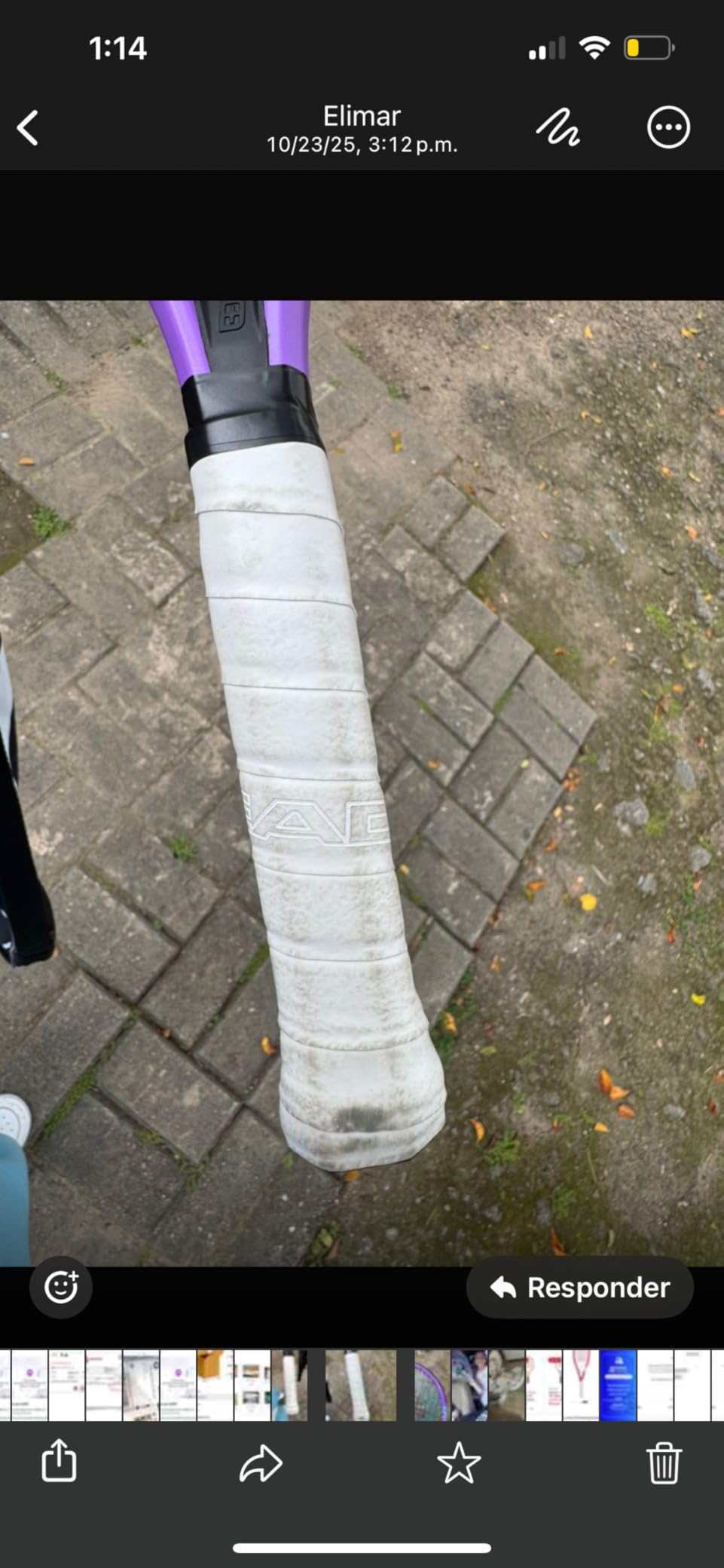
Rating quality here is excellent: 4.8 stars from 985 reviews, with 89 percent at five stars. Parents of beginners at red-ball stage mention it repeatedly as the frame a coach approved. The 8.5 ounce listed weight and 3 7/8 inch grip sit neatly between the very light toddler frames and the heavier club frames.
Criticism is thin. The most common note is that the 25-inch version feels long for an eight-year-old who is short for their age, which is a height problem rather than a quality problem. There is also an isolated report of a racket arriving with cut strings, worth checking the moment the box is opened.

Why the three-size range is the smart buy
A child between 40 and 49 inches tall will need two rackets over roughly two years, and the 21 then 23 inch steps are exactly the progression most bodies follow. Buying the 21 now and knowing the 23 is the same model removes the temptation to jump two sizes and buy something that does not fit.
Because the balance stays consistent across the range, the child does not have to relearn a swing when they move up. That continuity matters more for a seven-year-old than any incremental weight saving.
Where it does not work
It is the wrong choice if the child is already rallying on a full court at eight or nine. An aluminium frame with no beam technology twists more than a graphite or alloy frame with perimeter weighting, and a competitive junior will feel the difference in control before they can name it.
It is also the wrong choice if your child is the smallest in the group. A grip at 3 7/8 inches is close to adult proportions, and a genuinely small hand may need to go down a size rather than up.
5. Street Tennis Club Kids Racket – Coaching Videos Included
Kids Tennis Racket with Training Videos – 19 Inch Aluminum Youth Tennis Racket with Neoprene Handle for Children Age 5-12 – Learn Faster and Play Better by Street Tennis Club, Pink/White
17 or 19 inch
4.8 ounces
Neoprene handle
Thick polyester strings
Videos from an accredited pro
Pros
- Only pick with coaching videos from an accredited pro
- Very light at 4.8 ounces
- Survives being thrown around during practice
- Fun graphics
- Reach-based sizing guidance
Cons
- 30 day warranty is the shortest here
- Small grip may feel narrow for older juniors
- Limited colour range
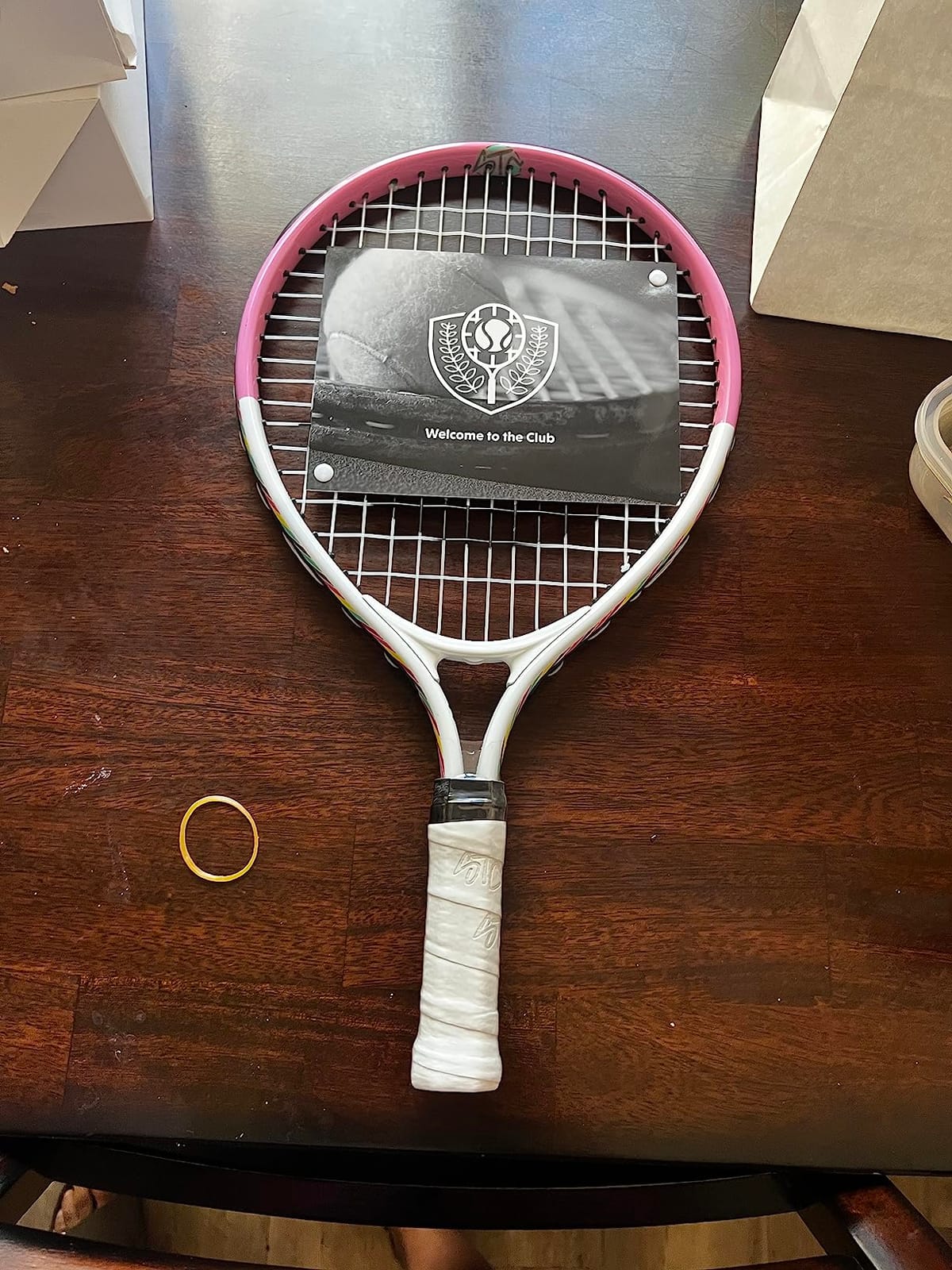
This is the only racket in the group that comes with training material. The package includes instructional videos curated by an accredited professional coach, which matters for families where neither parent has played. It turns a racket and a ball into a self-contained starter, and several owners say their child picked up the basics faster because of it.
The frame itself is deliberately modest. It is an aluminium frame with thick polyester strings, a grippy neoprene handle, and a listed weight of 4.8 ounces, which is among the lightest here. The 17-inch and 19-inch variants are sized to a child’s reach rather than to an age band, which is a more honest method for the youngest players.
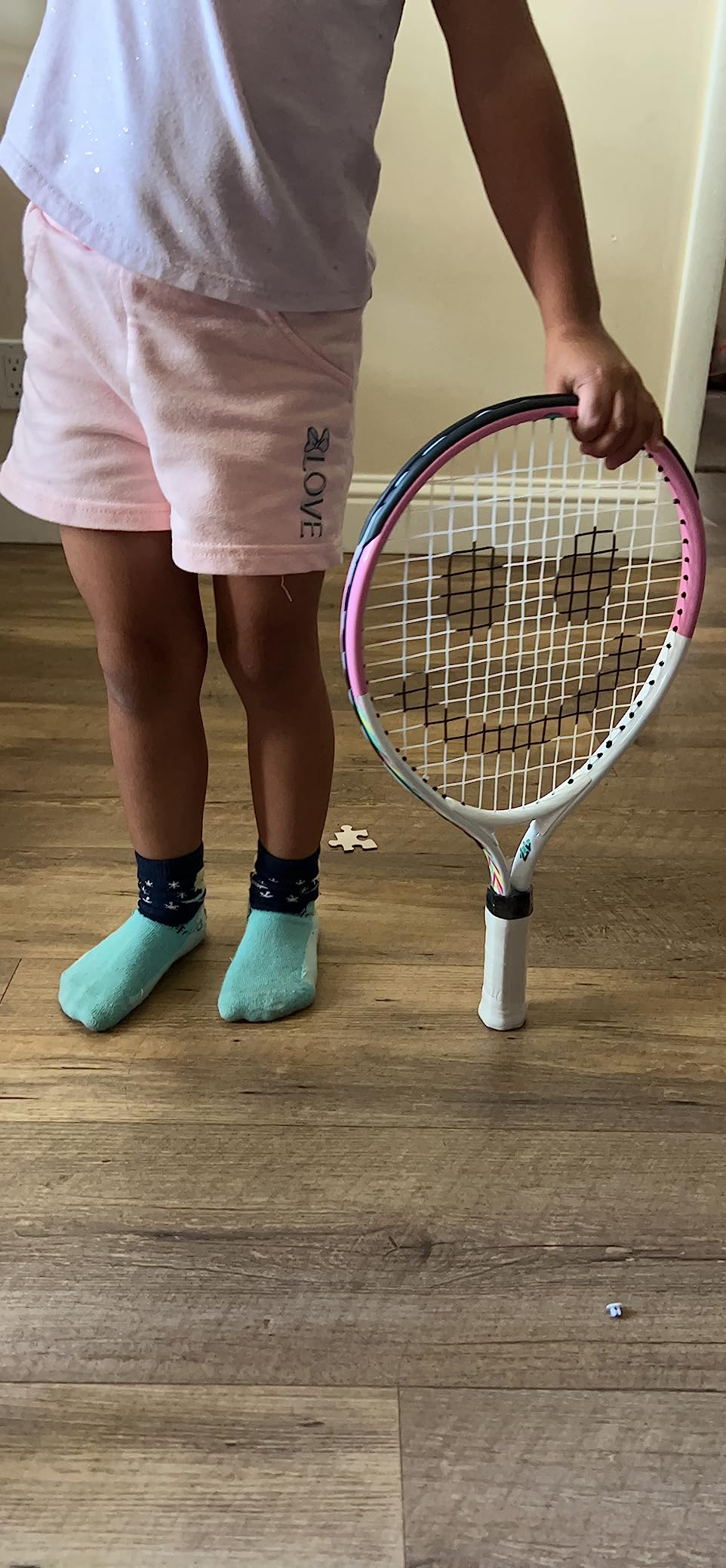
Across 849 reviews the average rating is 4.6 stars, with 79 percent at five stars. Buyers point to correct sizing, low weight and durability, and the videos get singled out repeatedly as the reason the child could practise alone. The frame is also reported to hold up when dropped or used as a boat paddle, which tells you something about the build.
Two things hold it back. The warranty is 30 days, far shorter than the one-year cover on the Wilson and HEAD frames here. And the small grip, while correct for a four-year-old, starts to feel narrow for a child around seven or eight, which is when most owners replace it.
Best for a child learning without a coach
Choose this when lessons are not on the calendar and the child is between three and six. The videos give a parent who has never held a racket a way to show a forehand and a backhand, and the low weight means a beginner can produce a real swing rather than a flick.
It is also a good club loaner. Because it is light and hard to break, it works as the racket a child uses for the first five minutes of a session while a nicer frame is being changed.
When to look elsewhere
Pass if your child is seven or older and still on a mini court. The grip size and the frame length will both be marginal, and the short warranty offers no protection if the frame cracks. The 17-inch variant is the one to choose in this line, not the 19.
Pass as well if you want a racket that can be passed to two siblings years apart. Build quality is good but not comparable to an alloy or graphite frame from a major brand.
6. Senston Junior Tennis Racket Set – The Most Complete Starter Package
Senston 19″ Junior Tennis Racquet for Kids Children Boys Girls Tennis Rackets with Racket Cover Pink with Cover Tennis Overgrip Vibration Damper
19, 23 and 25 inch sizes
About 200 g unstrung
81 sq in head
4 inch grip
Cover, overgrip and damper
Pros
- Cover
- overgrip and vibration damper all included
- 81 sq in head is generous for small players
- One-piece moulded aluminium build
- Four accessory pieces in one box
- Good all-in cost
Cons
- Listed as unstrung so strings may be needed
- Listing age range is narrower than the size ladder
- Accessory colours are random
The Senston is the most complete box in this roundup. Alongside the racket you get a cover, an overgrip and a vibration damper, which are three things you would otherwise buy separately. For a parent assembling a kit for a child starting lessons, that consolidation is the main argument for it.
The frame is a one-piece moulded aluminium construction using integration moulding, which is a durability technique rather than a performance one. The numbers are 200 g unstrung, 81 square inches of head and a 4-inch grip. An 81 square inch head is a real step up from the 76 on the 19-inch HEAD Speed and gives a noticeably bigger target.
It comes in 19, 23, 25 and 17 inch variants, so the ladder exists. The listed recommendation is children aged two to five, which is narrower than the size range implies, so check the length against your child’s height rather than trusting the age label.
Where the extras earn their keep
The overgrip is the item you will use most. It goes over the existing handle, fixes a slick grip, and can be swapped as the child grows, which delays the need for a bigger frame. The damper reduces the string vibration that travels up the arm on off-centre contact, which is the same comfort role the head-light balance plays on the HEAD Instinct.
The cover matters for a practical reason: a junior racket left in a car or a school bag takes more abuse from being dropped than from being hit. A padded cover is cheap insurance for a frame you plan to hand to a second sibling.
The stringing caveat you need to read
The listing marks this racket as unstrung, which means you may need to add strings before it can be played. Check the box on arrival, and if the bed is empty, budget a local restringing rather than assuming it is ready. Several owners buy it and only find out at the first lesson.
Also expect the accessory colours not to match the frame, since they are assigned separately. It is cosmetic, but a seven-year-old will notice immediately.
7. Wilson US Open Junior Racket – Big-Brand Styling at 21 Inches
WILSON US Open 25 Junior Recreational Tennis Racket – Blue
21 inch frame
AirLite Alloy construction
4 inch grip
0.2 kg
US Open inspired hoop
Pros
- Recognisable US Open inspired graphics
- Light AirLite Alloy frame
- Major brand name in the junior category
- Colourways match orange and green starter balls
Cons
- Thinner review base than the other leading picks
- Recreational spec with no vibration or grip technology
- Limited colour range for this size
Selling points here are partly cosmetic, and that is fine. The hoop design is inspired by the US Open, and children between six and eight are at the age where that matters. A racket that looks like the one they have seen on television is an easy sell, and colourways are matched to the orange and green starter balls used at that stage.
Underneath the graphics it is AirLite Alloy, which is Wilson’s standard lightweight junior construction, and the frame is listed at 0.2 kg. The 4-inch grip is a proper junior grip size and sits comfortably in a seven-year-old’s hand without the need for an overgrip.
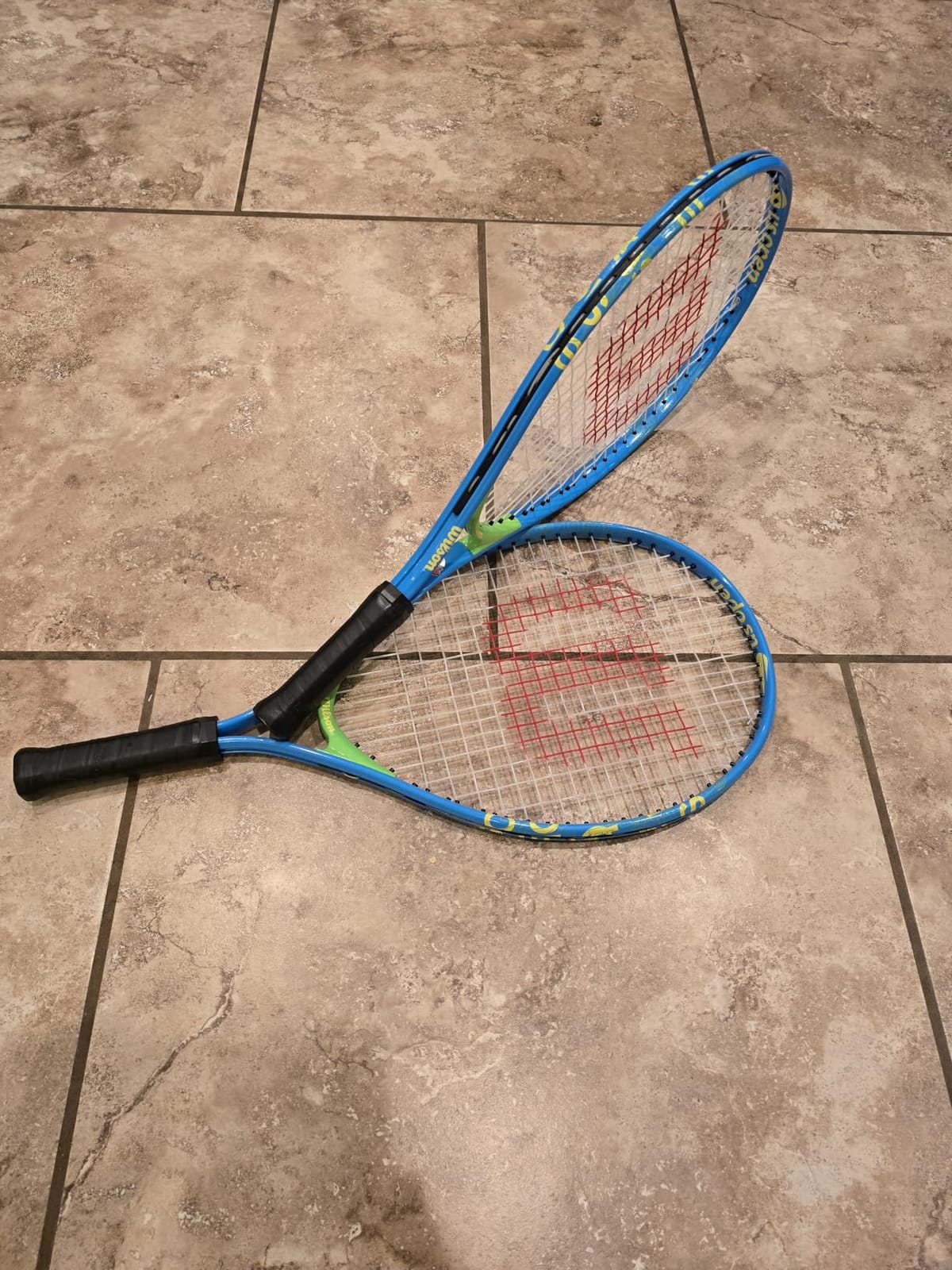
The 21-inch version carries 380 reviews at 4.7 stars, with 85 percent at five stars. Reviewers talk about the appearance, the light weight and carrying a big brand name on a junior frame. There is very little critical commentary at all, which is a sign of a straightforward product rather than a controversial one.
It is worth being honest that this is a recreational specification. There is no vibration dampening and no listed grip technology, so it is a frame to learn on. Wilson also backs it with a one-year limited warranty and ten years of spare part availability, which is unusually good cover for a junior frame.
Why parents pick this one
The reason to choose it over an equivalent unbranded frame is warranty and spares. If a grip wears through or a string breaks, the brand has a replacement channel. On a frame a child may keep for two years, that continuity is worth something.
It is also a natural choice at the transition from orange balls to green balls, because the 21-inch length pairs with the 40 to 44 inch height band where most clubs put children onto full courts.
When the spec is not enough
Look elsewhere once the child starts hitting with real pace. A recreational alloy frame with no weighting system will twist, and the correction a child makes instinctively is to swing slower. That habit is the reason many young players stall at a plateau without understanding why.
Also consider the 23-inch variant instead if the child is already near 45 inches. The 21-inch size suits shorter six to eight year olds, and buying the shorter frame for a taller child in the same band is the most common sizing mistake we see.
8. Wilson Profile 25 Junior Racket – Most Stable 25-Inch Frame for Ages 9-11
Wilson Profile 25 Junior/Youth Recreational Tennis Racket
25 inch frame
AirLite Alloy
QuadriForm technology
3 7/8 inch grip
Bumper guard
Pros
- QuadriForm stabilises the swing
- Bumper guard protects the frame
- Light enough for a 9-11 year old
- Balance of power and control
- Colourway children tend to like
Cons
- Listed unstrung so stringing may be needed
- Some owners find it lighter and thinner than expected
- Heavier-feeling grip than the cheapest junior frames
The Profile 25 is aimed at the last junior step before an adult frame, and the reason is QuadriForm Technology, which stabilises the swing through the frame rather than only through the strings. For a nine to eleven year old who is beginning to hit with intent, that stability is the feature that matters. A frame that does not twist rewards a clean swing with accuracy.
There is also a bumper guard at the top of the hoop, which protects the frame when a nine-year-old drags the racket across a car park to reach a ball. That sounds trivial until you have watched a junior frame crack at the throat. The warm and cool colour palette meets at three and nine o’clock on the frame, and parents report children pick this one themselves.
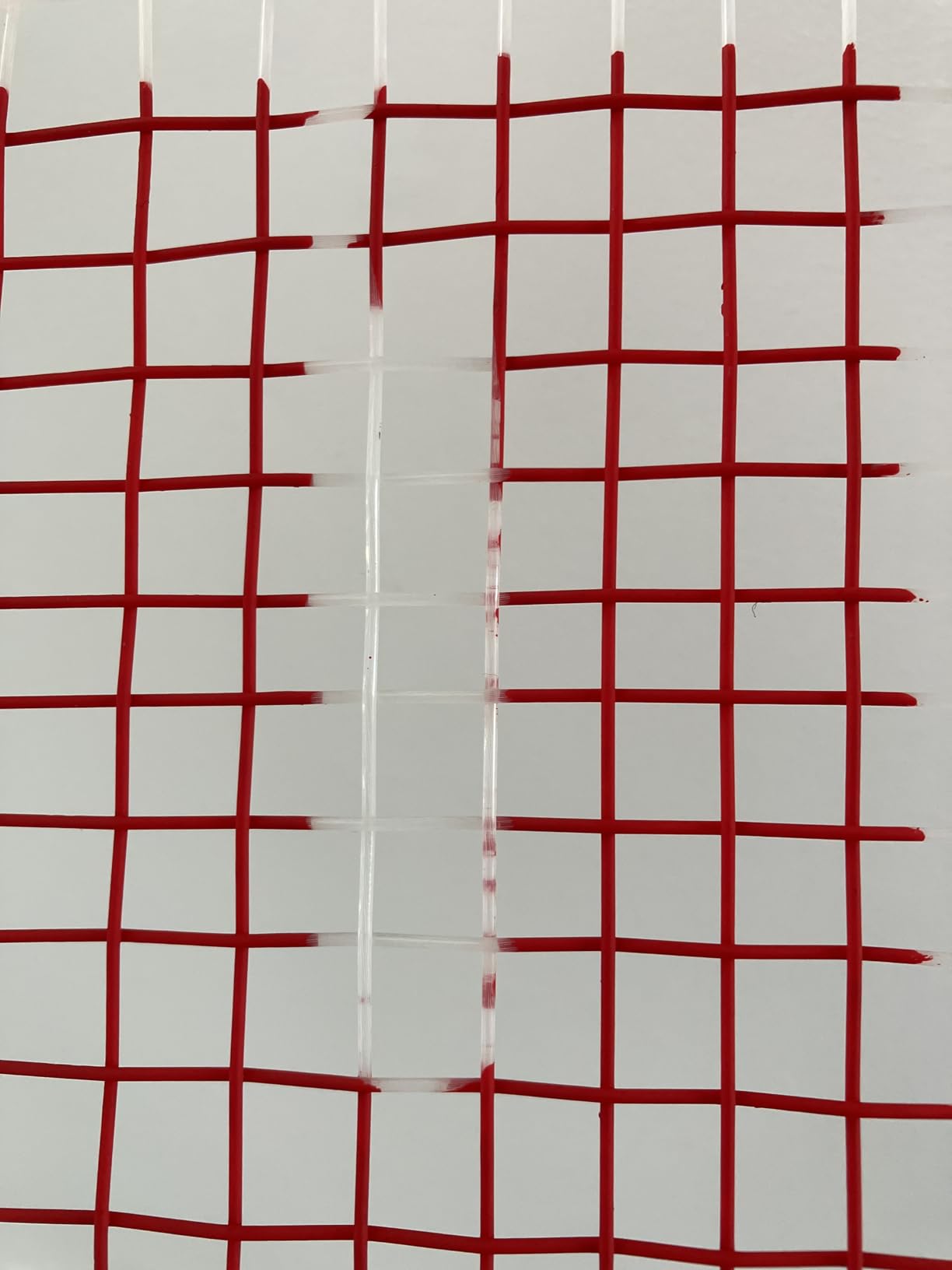
Across 348 reviews the average is 4.7 stars with 84 percent at five stars. The most common owner comment is about contact: children hit balls over the net on their first attempts, which is the outcome every parent is hoping for. Others mention the light feel and that the quality is better than expected for a junior frame.
Criticism is mild and consistent. A number of owners say it feels lighter and thinner in the hand than they anticipated, and the listing marks it unstrung, so confirm the string situation before the first lesson. It is also a step up in build quality from the toddler alloy frames, which is where the premium goes.
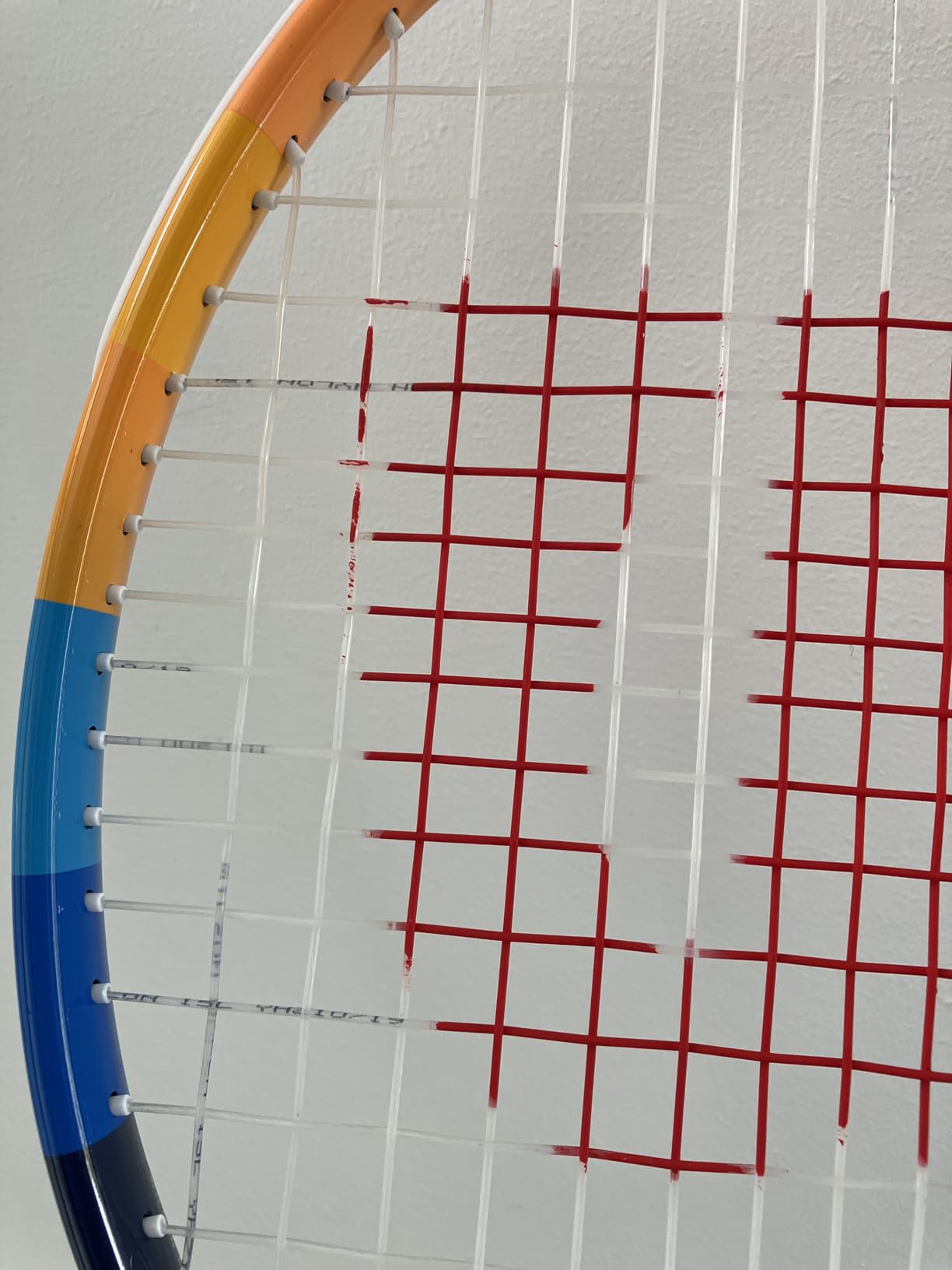
What the stabilising tech actually changes
On a twisting frame, the sweet spot moves as the ball lands away from centre, so the child has to time the shot rather than aim it. Stabilising the frame keeps the sweet spot closer to where it should be, so a nine-year-old can learn to direct the ball. That is the difference between learning tennis and learning to survive.
It is also why this is a good frame for a child moving from green balls to a real yellow ball, where pace increases and off-centre contact becomes more frequent.
When 25 inches is one step too far
Check height before buying. A 25-inch frame suits 50 to 55 inches, and a nine-year-old below 50 inches should be on 23 inches instead. The Wilson Pro Staff in this list runs to 23 inches and shares similar stabilising geometry, which makes it the natural alternative.
Skip it if your child has moved past 55 inches. At that point a 26-inch junior or a light 27-inch adult frame gives more reach, and a 25-inch will be the one slowing them down.
9. LUNNADE Kids Tennis Racket Set – Best 19 to 25 Inch Ladder for Small Hands
LUNNADE Tennis Racket for Kids Junior, 19/21/23/25 Inch Youth Tennis Racquet with Cover, Suitable for Beginner Boys and Girls Age 3-12
19, 21, 23 and 25 inch sizes
4 inch grip sized for small hands
Racket cover included
Playful colour designs
Pros
- Full size ladder for a growing child
- Grip designed for small hands
- Playful colours and graphics
- Reported to hold up over a summer of outdoor play
- Cover included
Cons
- Not suitable once a child starts rallying
- Open string bed reported as uncomfortable for very small children
- Lower review count than the market leaders
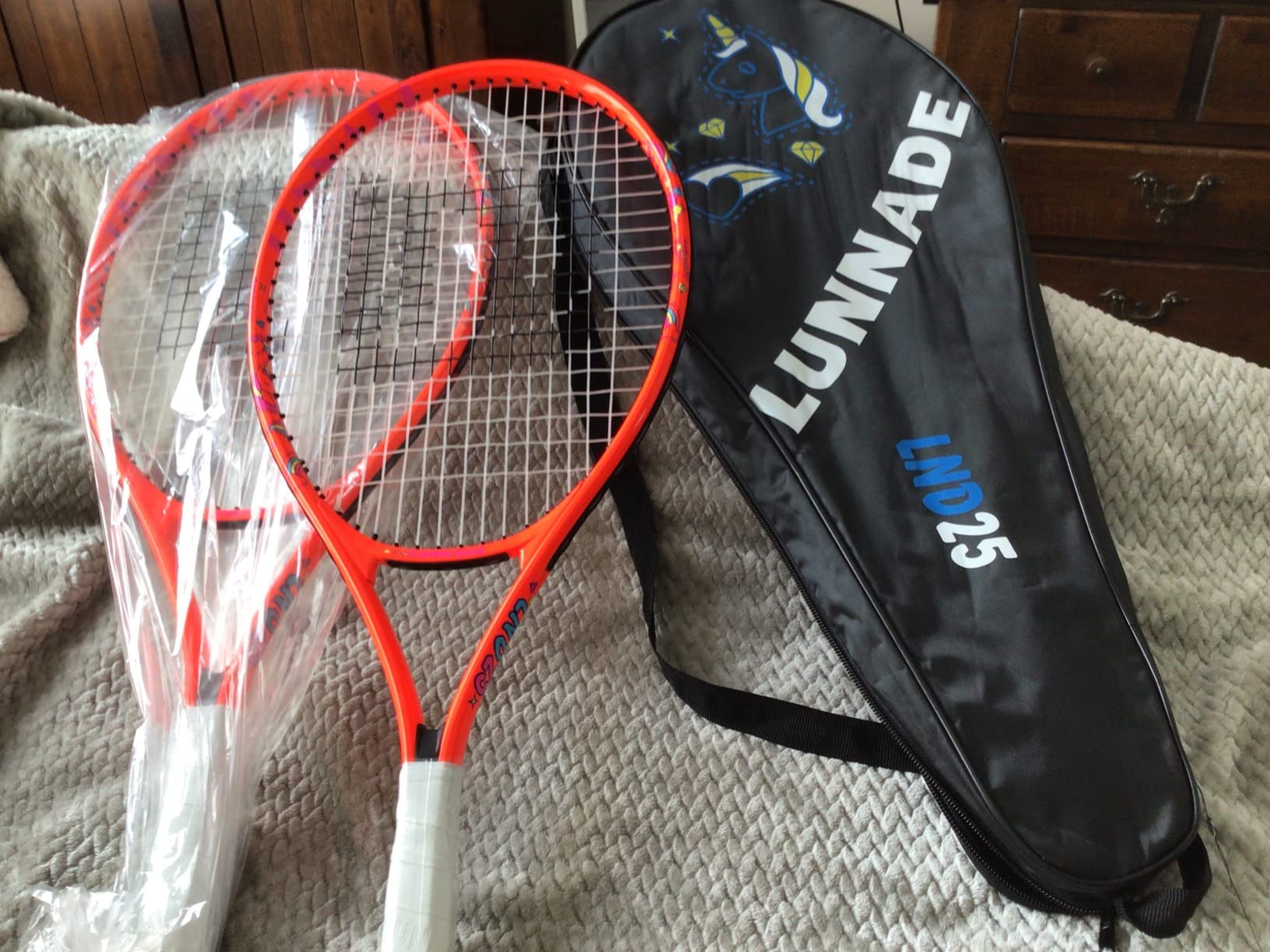
The LUNNADE set covers 19, 21, 23 and 25 inches, which is the ladder most families will actually walk. It arrives pre-strung, comes with a cover, and the 4-inch grip is designed specifically for small hands rather than being a downsized adult grip. That detail is the main reason to choose it over a generic frame at the same size.
Colours are the quiet selling point. The range includes orange, blue, yellow and pink along with graphic options, and parents report that the design is what gets a reluctant child to agree to practise. That is not a trivial factor in the under-eight age groups.
There are 288 reviews at 4.6 stars, with 81 percent at five stars. Buyers highlight accurate sizing for small children, low weight and playful designs. Several mention the frame holding up after a full summer of outdoor use, which is a fair test for a racket that spends its life on a hard surface.
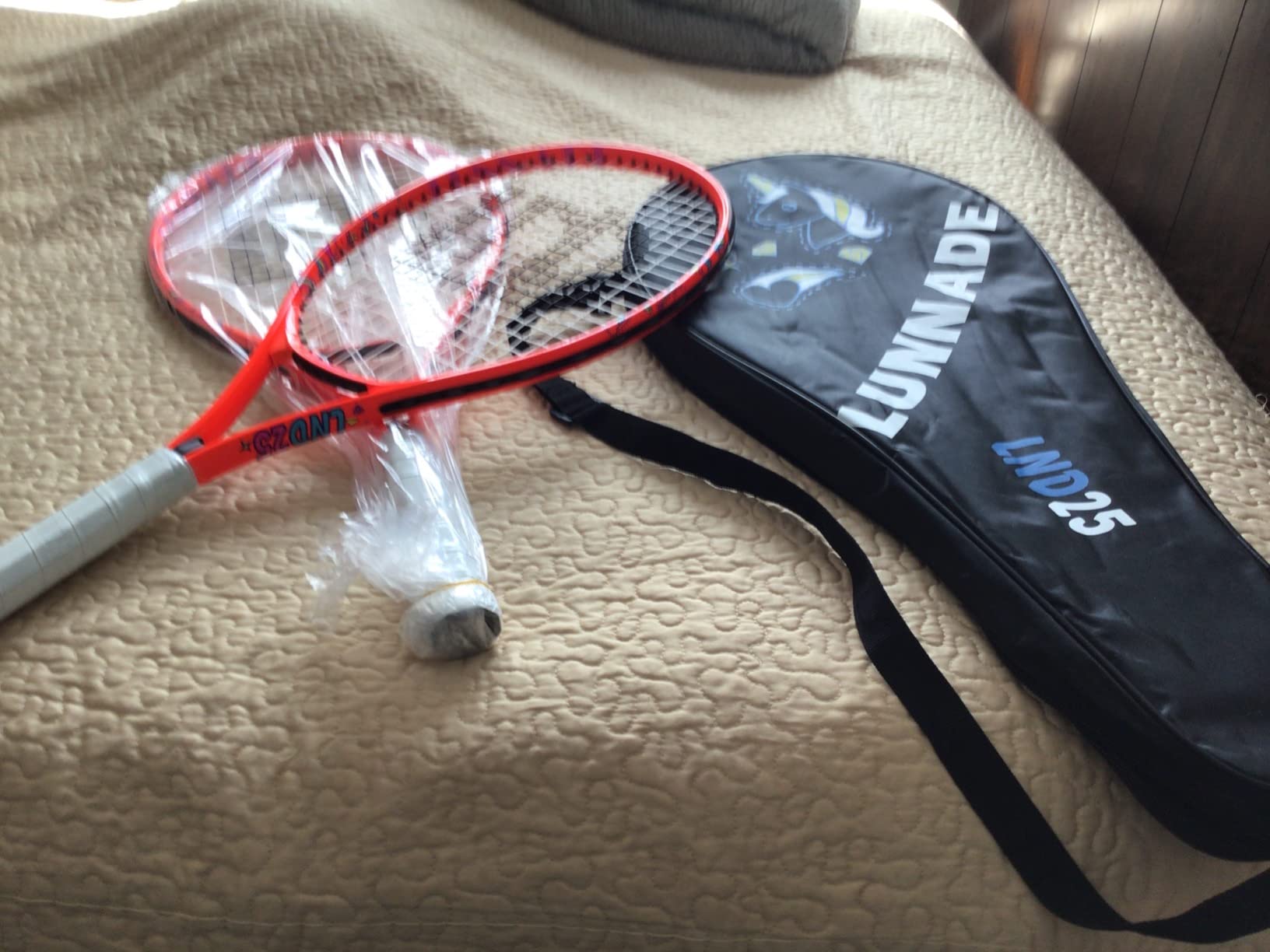
The honest limitation is that this is a beginner frame, not a training frame. The reviews are clear that it suits a child who has not yet started rallying, and once rallies begin, a frame with stabilising technology such as the Wilson Profile or Pro Staff gives a clearer return. One owner also reports the open string bed as uncomfortable for a very small child.
It is also worth noting the price of the set sits in the middle of this group rather than at the bottom, so the cover and the size ladder are what justify it over a single generic frame.
Best for two children in the same house
This is the set to buy when siblings are three years apart or less. The 19 and 23 inch pairing covers the most common gap, and because the grip and feel stay consistent, the younger child is not learning on a different frame from the one they watched their older sibling use.
The included cover also stops a racket from being abandoned in a damp changing room, which is how junior frames usually die early.
When to stop and upgrade
Move up a class of frame the moment rallies become the point. Once a child can sustain three or four shots, head size and stabilising weight start to matter more than weight saving, and the benefit of a graphite or alloy frame with perimeter weighting becomes obvious within a few sessions.
Do not hold onto it because the colour matches the child’s clothes. Beyond age eight or nine, most children care about the racket in proportion to how well it performs, and the graphics stop doing any work.
10. bo wei qi Kids Tennis Racket – Lightweight Toddler Setup for Ages 2-4
bo’weiqi 17″ Kids Tennis Racket for Aged 2-4, Lightweight Toddler Tennis Racket for Outdoor/Indoor Sports Including 1 Tennis Racket,1 Non-Slip Grip and 1 Shoulder Strap Bag Easy Carry(Pink)
17 to 25 inch range
5.28 ounces
About 66 sq in sweet spot
Non-slip grip
Strap bag included
Pros
- Very light at 5.28 ounces
- 66 sq in sweet spot raises contact rate
- Non-slip grip suits very small hands
- Shoulder strap bag lets the child carry it
- Large five-star share among reviewers
Cons
- String bed is loose and the frame feels plastic in the hand
- Not built to survive rough treatment
- Thin review base at 187 ratings
This is the pick for a child who is barely old enough to stand at a net. At 5.28 ounces it is one of the lightest frames in the roundup, and the design brief for the 17-inch variant is children aged four and below. The non-slip grip is the detail that matters most, because a toddler gripping a smooth handle will lose the racket mid-swing more often than they will hit the ball.
The 66 square inch sweet spot is small in absolute terms but correctly proportioned for the frame size, and the larger rope hole diameter is intended to make striking smoother. Shock absorbing material in the frame reduces vibration, which is useful when the ball often arrives closer to the body than intended.
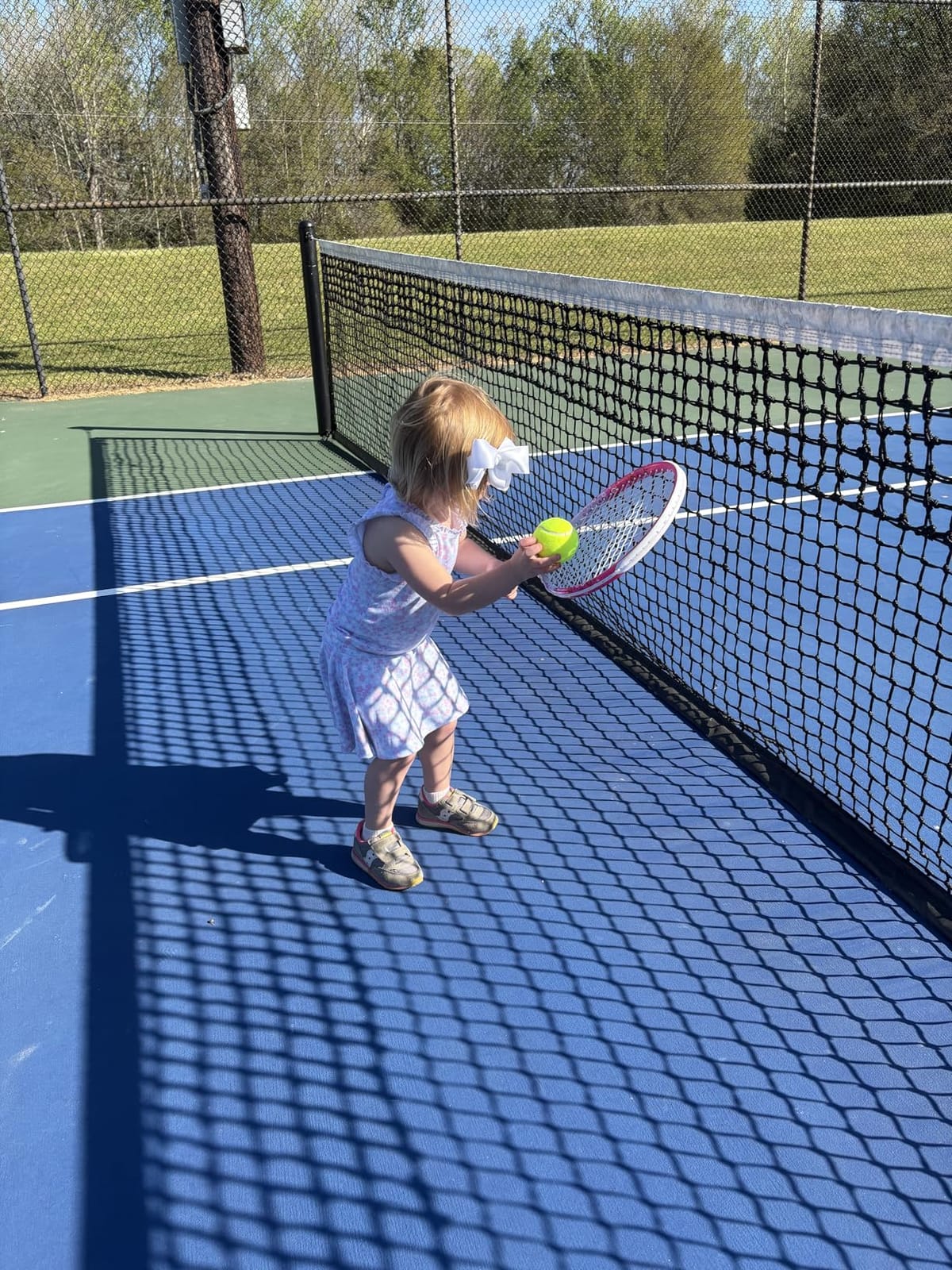
There are 187 reviews at 4.7 stars, and 88 percent are five-star ratings. Owners single out the light weight, the correct sizing for two to four year olds, and the fact that the bag and an overgrip are included in the box.
Build quality is where the criticism lands, and it is consistent. Owners describe loose strings and a frame that feels more like plastic than metal in the hand, and several make the point that it will not survive being dragged or used as a shovel. For supervised play on a court, that is fine. For a racket that will be thrown in a boot, it is not.
When a very light frame is the right call
Choose it for a child under four, or for a beginner who finds a heavier racket tiring after two rallies. At 5.28 ounces the swing comes almost entirely from the arm, which is what you want before a shoulder rotation is developed. The strap bag also removes the argument at the car door.
It is also a sensible first racket for indoor play on a hard surface, where the frame will take knocks that would end a premium frame.
When it is the wrong buy
Skip it if the child is rough with equipment or plays unsupervised near hard edges. The loose string bed and the plastic feel mean the frame will not survive that treatment, and a snapped string in the first month cancels out the low purchase price twice over.
Skip it past 40 inches tall as well. The range extends to 25 inches, but the light frame and the small sweet spot are built for the bottom of the ladder, not the top.
11. Wilson Pro Staff Precision Junior Racket – Stable Frame for Ages 7-12
Wilson Pro Staff Precision Junior 23 Tennis Racket – Black/Red
19, 21, 23 and 25 inch sizes
Perimeter Weighting System
C Beam technology
7.04 ounces
4 inch grip
Pros
- Perimeter Weighting and C Beam give real stability
- Full 19 to 25 inch range
- Pre-strung and court ready
- Positioned for the 7-8 year age band
- Strong sales rank for the Pro Staff line
Cons
- Higher one-star share than the other WILSON options
- Heavier at 7.04 ounces than most toddler frames
- Build consistency varies more than the brand average
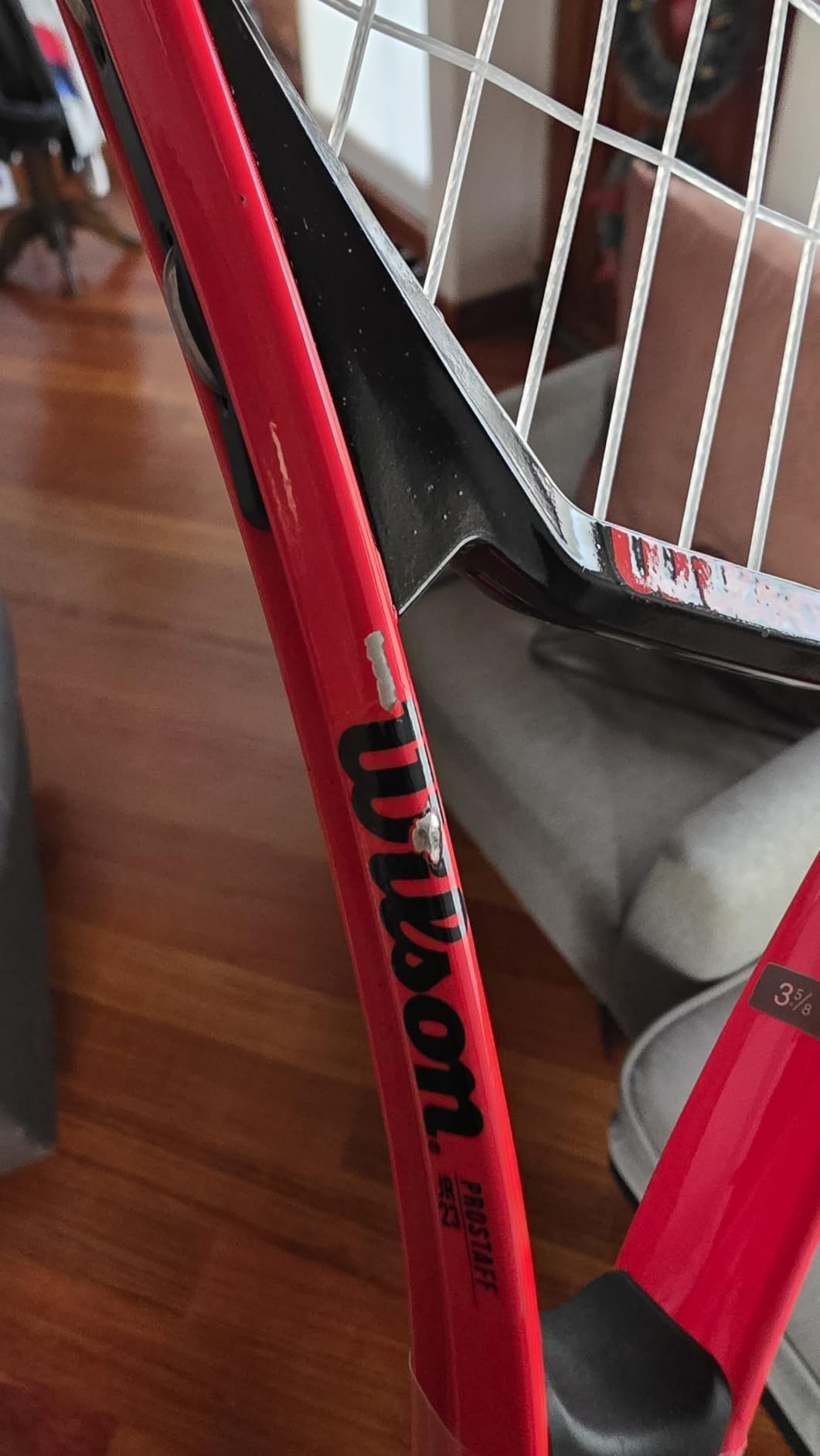
The Pro Staff Precision is the most technically built junior frame in this roundup, and the two systems doing the work are the Perimeter Weighting System and C Beam technology. Extra material at three and nine o’clock increases frame volume where it resists twisting, so the sweet spot stays put through an off-centre shot. For a child whose technique is developing fast, that is worth more than any amount of extra power.
It runs from 19 to 25 inches in this list, with the 23-inch variant specified for ages seven to eight at 58.4 cm frame length. It arrives pre-strung, and the 4-inch grip is a standard junior size that will not need replacing when the child steps up a size.
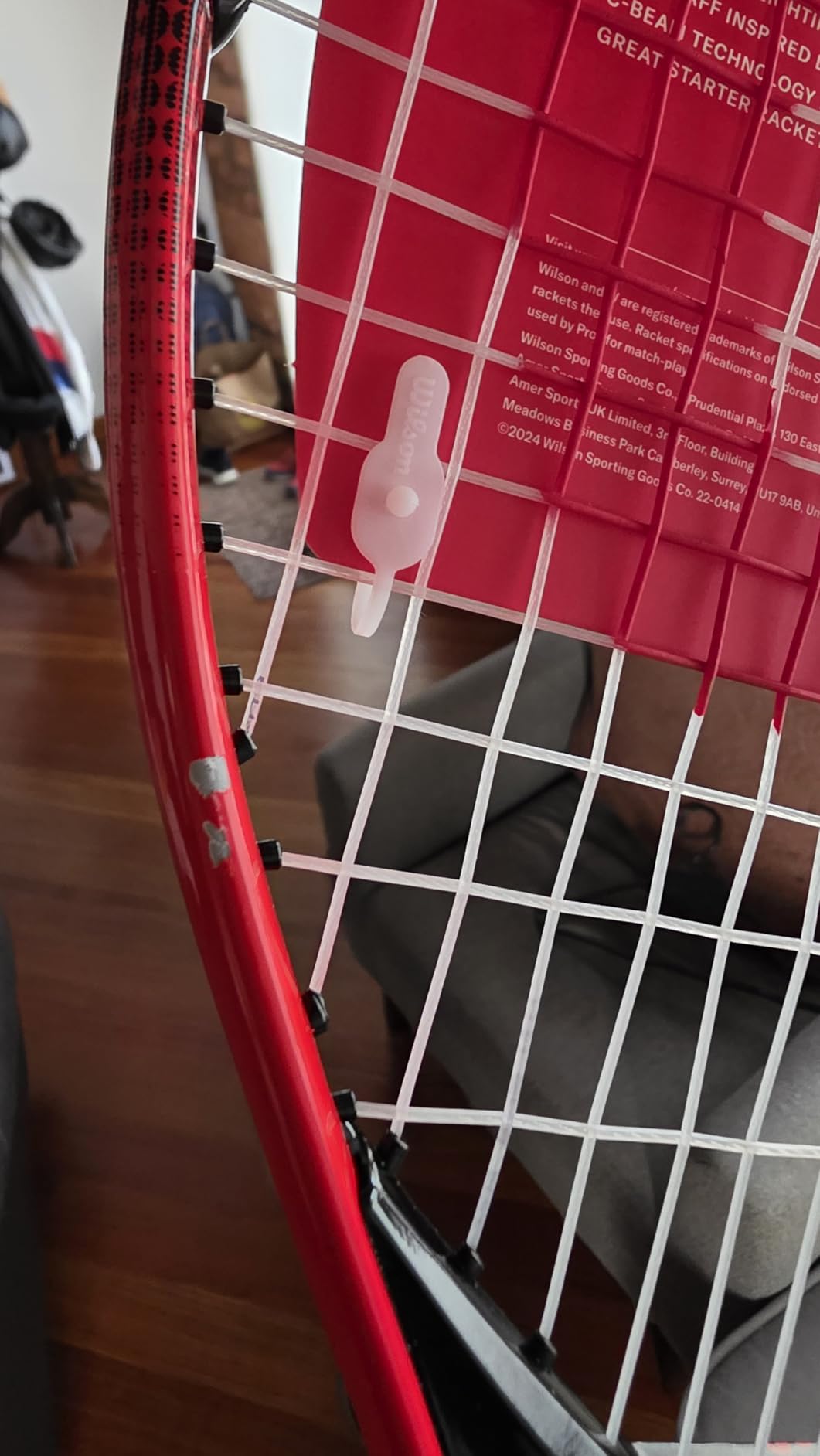
At 7.04 ounces it is heavier than the toddler frames here, and that is deliberate. Once a child is swinging with intent, a frame with too little mass feels vague in the hand, and the extra weight gives the ball something to push against. Owners also mention that the pre-strung bed is consistent enough to start lessons without a restringing trip.
It is not Prime, which is worth knowing if you need it quickly for a scheduled lesson, and the size range within a single colourway can be patchy depending on when it is restocked.
Why the beam geometry is worth the extra weight
Torque is the enemy of a developing swing. When a junior frame twists, the strings go out of alignment and the child compensates by opening the face, which sends balls sailing long. A frame that resists torque lets the child learn to aim instead, and the effect on ball placement is immediate.
It is also the reason this frame is a good transition option. The child can stay in the Pro Staff line from 19 through 25 inches without the feel changing, and a coach can see the benefit of a stable frame before the move to a 27-inch adult model.
Where the build quality varies
The one-star share is higher here than for the other Wilson frames in the group, which usually points to manufacturing variance rather than a design fault. Inspect the frame, the strings and the grip on arrival and keep the packaging until you have checked.
It is also heavier than needed for a child under six. The stabilising systems only pay off once the child is generating real racket-head speed, and below that age they simply add weight to an already tired swing.
12. Gamma Quick Kids Tennis Racket – 93 Square Inch Head for Ages 4-6
GAMMA Sports Junior Tennis Racquet: Quick Kids 21 Inch Tennis Racket – Prestrung Youth Tennis Racquets for Boys and Girls – 93 Inch Head Size – Red
19 inch frame
6.5 ounces strung
93 sq in head
4 1/8 inch grip
Limited 1-year warranty
Pros
- Largest sweet spot in the group at 93 sq in
- Light at 6.5 ounces strung
- Proportioned for children aged 10 and under
- Pre-strung
- Colour-coded size options
Cons
- Lowest sales rank in the group
- Small review sample of 165 ratings
- Generic frame with no listed grip or vibration technology
The Gamma is defined by one number: a 93 square inch head, the largest sweet spot among the twelve frames we reviewed. That is a very generous target for a junior frame, and it is the reason owners who follow the sizing guidance report that it works where an adult racket had failed their child. A big head catches more off-centre balls, which means more successful contact events, which is what keeps a beginner coming back.
It weighs 6.5 ounces strung, so it is light for its size, and the 4 1/8 inch grip is a genuine junior grip rather than a wrapped adult handle. The frame is specified for players aged ten and under and comes pre-strung. Colour coding by length makes the size obvious on the rack, which reduces buying errors in a shop.
Warranty cover is a limited one-year guarantee against manufacturer defect, excluding normal wear, abuse and modification. That is standard language and worth reading if a child is hard on equipment.
Who the oversized head suits
The 93 square inch head works best for a child between four and six who is still learning where the ball is going. It is also useful for a child returning to tennis after a long break, because the larger target shortens the distance between a swing and a successful shot.
Do not assume a big head makes a frame advanced. It makes a frame forgiving, and forgiveness is what a beginner needs. It is not a substitute for stabilising weight once the child starts hitting properly.
When a smaller head is the better buy
Move on if the child is over about six years old and rallying regularly. At that stage control starts to matter more than forgiveness, and a frame with perimeter weighting such as the Wilson Pro Staff will teach a better swing than a larger, less stable head.
The 165-review sample is also the thinnest here, and the sales rank is the lowest in the group, so the long-term parts support is thinner than at a major brand. For a first racket that is acceptable. For a racket you expect to keep for two years, weigh it.
Tennis Racket Size by Age and Height
The sizing bands below are the ones most clubs use, and they are organised by height rather than birthday:
Ages 2-4, 35-39 inches tall: 17 or 19 inch frame, red ball, mini court
Ages 4-6, 40-44 inches tall: 21 inch frame, red or orange ball, mini to 3/4 court
Ages 6-8, 45-49 inches tall: 23 inch frame, orange ball, 3/4 court
Ages 8-10, 50-55 inches tall: 25 inch frame, green ball, full court
Ages 10-12, 56-60 inches tall: 26 inch frame, green or yellow ball, full court
Ages 12 and up, 61 inches and above: 27 inch adult frame, yellow ball, full court
Height beats age because growth rates vary so much between seven and thirteen. A tall eight-year-old and a short eleven-year-old may sit in the same racket size, and the height band is the number a club coach will actually use.
There is one at-home test worth doing before you buy. Have the child stand with their arm straight down at their side and hold the racket by the middle of the handle. The tip of the frame should come close to the floor without touching it. If the tip lifts well off the ground, the frame is too long, and the child will have to shorten the swing to control it.
The ball colour is not decoration. Low-compression red, orange and green balls are the reason junior frames can be so forgiving: the balls travel slower and land with less force, so a beginner can rally before a full adult frame would be usable. Moving up a ball colour is normally a better sign of progress than moving up a racket size.
How to Choose a Junior Tennis Racket: 5 Factors
Frame length is factor one and it is close to non-negotiable. Everything else is a refinement within a length band. Once you have fixed the length, work through the following in order.
Unstrung weight
Junior frames land roughly between 170 g and 255 g unstrung. Heavier is not better for a young player, and a racket that is too heavy produces a slower swing and a tired arm, which is a fast route to a wrist complaint. A frame that feels light in the shop can feel heavy after twenty minutes, so weight the decision on a full session rather than a first swing.
Head size and sweet spot
Head size is measured in square inches and runs from about 66 sq in on the smallest frames to around 95 sq in on the most forgiving. Bigger is more forgiving at this age, so an oversize junior head is a feature rather than a compromise. Once a child is rallying properly, you want enough head size to keep contact, but not so much that the child cannot control direction.
String tension
Junior frames should be strung soft, and the practical band is roughly 18 to 22 pounds. A tighter bed feels more responsive but transmits shock into the elbow and wrist, which is the wrong trade for a growing arm. A multi-filament string at the lower end of that range is the usual coach recommendation because it also feels easier on the hand as a beginner feeds balls in.
Restringing cadence depends on how often the child plays. Roughly every three to four months for one or two sessions a week, and every one to two months for a child who plays several times a week.
Grip size
Grip size is the spec parents most often get wrong, because it is the one that cannot be adjusted. Most junior frames run to 3 5/8 or 3 7/8 inches, with 4 inches at the larger end and 4 1/8 inches on the most generous. A grip that is too big forces the child to hold the racket from the fingertips, which is where wrist injuries begin.
To measure, have the child grip the handle as if shaking hands, then measure between the base of the index finger and the base of the little finger. Add a finger width for the correct fit. A grip that is a fraction too small can be fixed with an overgrip, which is why we would always take the smaller one of two choices.
Graphite or aluminium
This is the question parents ask most and guides answer least. Aluminium frames are cheaper, heavier and more flexible, which is why nearly every frame in this roundup is aluminium. Graphite composite frames are lighter and stiffer, and they hold their shape better through impact, which is what gives a more connected feel.
The upgrade is worth making when a child starts rallying consistently, usually around ages nine to twelve. It is not worth making at ages four to six, where the low-compression balls and the short rallies mean the frame technology makes almost no difference. Forum discussion circles this question constantly, and the consensus is the same: fix the size first, then consider the material.
Whatever frame you choose, the player still needs a pair of court shoes. Lateral support matters far more to a junior’s game than any racket feature, and our tennis shoe guide covers the fit points. If the child is still at the stage of hitting balls off a wall, a ball machine for home practice is a reasonable later investment once rallies start.
Common Mistakes Parents Make and When to Move Up a Size
The most repeated error is buying a racket that is too large so the child can grow into it. Every frame here is outgrown in one to two years anyway, so the money is spent twice and the technique is damaged in between. A child compensating for a frame that is too long will swing slower and shorter, and that habit is genuinely hard to correct later.
The second mistake is buying an adult racket. It is tempting because the price looks similar, and some adult frames are marketed as lightweight. A full 27-inch frame is a 280 g-plus frame with a different balance, a smaller sweet spot relative to its length and a grip sized for an adult hand. The move to 27 inches should happen when the child is around 61 inches tall and already rallying, not before.
Third, over-stringing. Shops will happily string a junior frame tight because it feels more responsive, and a tight bed on a small frame is uncomfortable enough that the child stops playing. Ask for the low end of the range and a soft multi-filament string.
Fourth, letting colour or brand decide. The racket that gets chosen is often the one with the better graphics, and then the size is compromised to fit. Reverse the order: fix length, then weight, then grip, then let the child choose between two frames that meet the spec.
Fifth, reusing an older sibling’s racket without inspecting it. It is usually fine and it saves buying twice. Check for cracks in the frame or at the throat, look for dead or frayed strings, and replace the grip if it is worn flat, since a worn grip forces a death grip. If the frame is bent or the strings are slack, restring it before use rather than passing it on.
On replacement timing, expect a racket to last six to twelve months for an actively growing child in the 21 to 23 inch range, and longer outside a growth spurt. During a spurt, judge readiness by the at-home test rather than the calendar, and replace the racket rather than stretching the current one.
Once a child moves up out of the 25-inch range, our guide to the best tennis racquets for intermediate players covers what to look for in a 26-inch junior and a first 27-inch adult frame.
Frequently Asked Questions
What size tennis racquet is best for junior players?
Match the frame to height first. Ages 2-4 and 35-39 inches use a 17 or 19 inch frame, 40-44 inches a 21 inch, 45-49 inches a 23 inch, 50-55 inches a 25 inch, and 56-60 inches a 26 inch. A 27 inch adult frame usually arrives around 61 inches tall, usually at ages 12-14.
What tennis racket should a 7 year old use?
Most seven year olds measure 45 to 49 inches, which puts them in a 23 inch frame. That length pairs with an orange ball on a 3/4 court. Check height rather than age, and pick a light frame around 200 g with a grip no thicker than 4 inches so the child can hold it without gripping hard.
What is a good junior tennis racket for a 12-year-old?
At 12 most children are 56 to 60 inches tall, so a 26 inch junior frame is the usual answer. Choose a stable, head-light design so a fuller swing does not twist the frame. If the child already sustains rallies of several shots, a light 27 inch adult frame at 280 g or below is a sensible next step.
Is a 23 inch tennis racket too small?
No, if the child is between 45 and 49 inches tall. A 23 inch frame is too small only for a child taller than about 50 inches, because the shortfall in reach shows up on balls hit wide or deep. The more common mistake runs the other way, with parents buying a frame two sizes too long.
Can a child use an adult tennis racket?
Not below about 61 inches tall. Adult frames are longer, heavier and differently balanced, and their grips are sized for adult hands, so a younger player has to grip harder and swing slower. That combination raises the chance of wrist and elbow strain. One parent described a clear upgrade path from a 25 inch junior to a 26 inch junior, and the weight, balance and head size felt very similar between the two steps.
How often should a child get a new tennis racket?
Every six to twelve months for an actively growing child between 21 and 23 inches, and longer once the frame is 25 inches or more. The trigger is height, not the calendar. Check by standing the child with their arm straight down at their side: if the racket tip lifts well clear of the floor, the frame is too long and it is time to move up.
What grip size does a child need?
Most junior frames run to 3 5/8 or 3 7/8 inches, with 4 inches on larger 23 and 25 inch frames and 4 1/8 inches on the most generous. To measure, have the child shake hands on the handle, then measure from the base of the index finger to the base of the little finger and add a finger width.
What string tension should a junior racket use?
Roughly 18 to 22 pounds, with multi-filament string at the softer end of that range. A lower tension is more comfortable for a growing wrist and elbow and easier on a beginner hand. Restring every three to four months for one or two sessions a week, or every one to two months for a child playing several times a week.
Our Top Junior Tennis Rackets for 2026
Size the frame to the child’s height, then buy the best build you can find inside that length. For a first racket under 40 inches tall, the HEAD Speed Junior is the one we recommend: it is light, forgiving, pre-strung and carries the deepest review history here. For a 21 to 25 inch range, the HEAD Instinct covers three sizes in one model line, and the Wilson Pro Staff is the pick once rallies start and stability matters more than saving weight.
Change the racket as the height band changes, and not before. That single habit does more for a young player’s technique than any upgrade you can buy inside a size.