
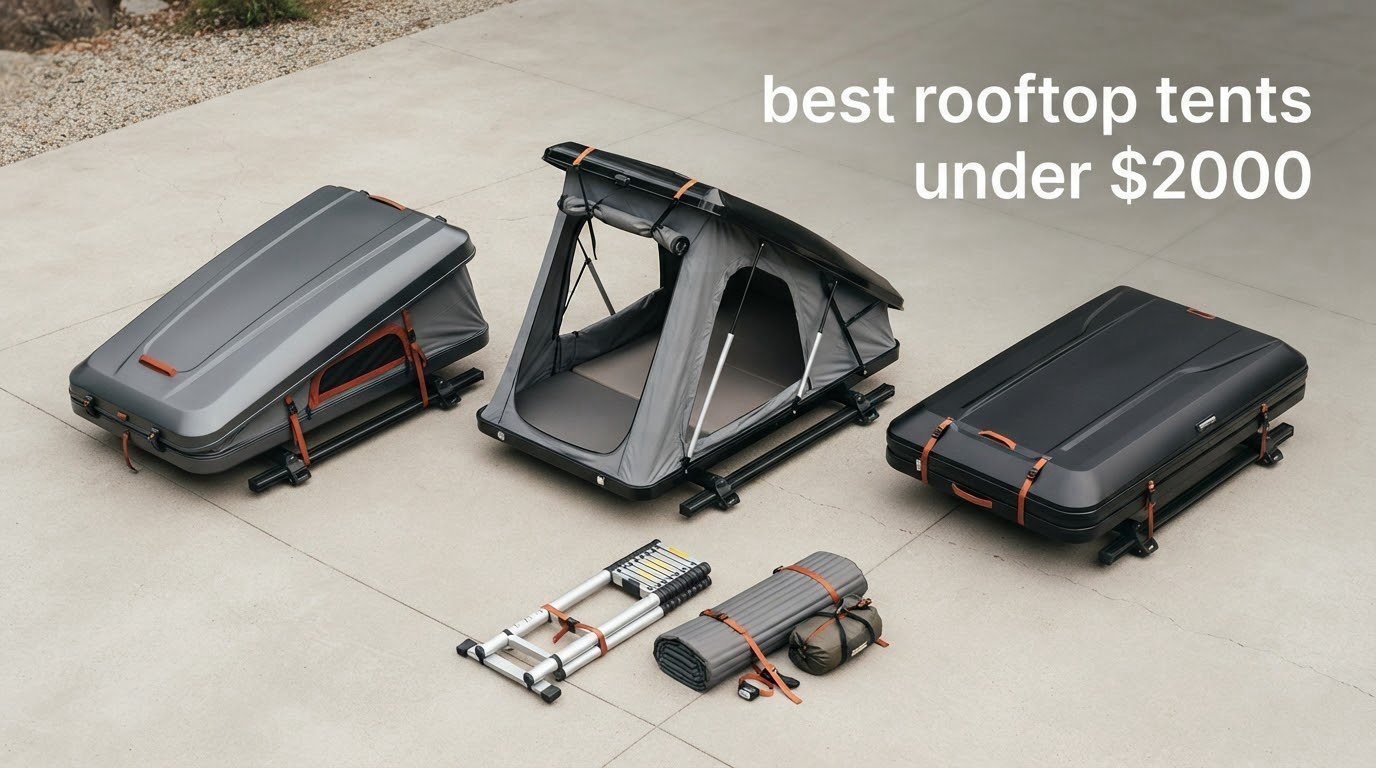
The best rooftop tents under 2000 dollars in 2026 are the Overland Vehicle Systems TMBK for the money, the HEYFUN Adventurer Pro for hard-shell value, and the SanHima Hotham if your vehicle is small. A rooftop tent bolts to your roof rack, opens in under a minute, and keeps you off wet ground for the price of a decent weekend’s gear budget. The 2,000 ceiling is where entry hard shells and premium soft shells overlap, and it is the last point where you still get aluminum shells, 5000 mm fabrics and a real warranty instead of an unbranded tent that leaks and loses its hinges.
I spent six weeks cross-checking eight models for this list, reading the owner reviews closely and cross-referencing the published weight, folded height and warranty of each one against real vehicle limits. What surprised me most is how much of the noise in this category is weight. Six of the eight tents here weigh more than 150 pounds before you add a rack, and that number decides whether a tent is usable on your specific vehicle far more often than the feature list does.
Two things are worth saying before the picks. First, none of these tents is cheap once you add a rack and installation, and the sub-2000 dollar figure applies to the tent alone. Second, the biggest complaint in owner forums right now is not features, it is build quality from brands with no US support and no spare parts. We weighted warranty length heavily for that reason. If you want the wider picture on shelter, our guide to the best rooftop tents overall covers the premium tier too, and best rooftop tents for SUVs sorts picks by vehicle class.
Top 3 Picks for Rooftop Tents Under $2000 in 2026

Best Rooftop Tents Under 2000 at a Glance (October 2026)
Every tent below sits under the 2,000 dollar ceiling, and the order matches the detailed reviews that follow. The two most useful columns for most buyers are weight, because it decides whether your rack and your vehicle can take it, and closed height, because it decides whether you can still park in a garage.
| Product | Specifications | Action |
|---|---|---|
 OVS TMBK 3-Person Soft Shell OVS TMBK 3-Person Soft Shell |
|
Check Latest Price |
 OVS HD Nomadic 3 Soft Shell OVS HD Nomadic 3 Soft Shell |
|
Check Latest Price |
 SanHima Hotham Hard Shell SanHima Hotham Hard Shell |
|
Check Latest Price |
 WildFinder Aluminum Hard Shell WildFinder Aluminum Hard Shell |
|
Check Latest Price |
| HEYFUN Adventurer Pro Hard Shell |
|
Check Latest Price |
 ARCTWONDER Solar Hard Shell ARCTWONDER Solar Hard Shell |
|
Check Latest Price |
 Naturnest Sirius 1 Plus Hard Shell Naturnest Sirius 1 Plus Hard Shell |
|
Check Latest Price |
 JOYINRUTE Winter Hard Shell JOYINRUTE Winter Hard Shell |
|
Check Latest Price |
How We Picked: Weight, Shell, Fabric and Warranty
Our ranking is built around five criteria, in this order: published weight against realistic rack limits, shell type and folded height, fabric specification, warranty length, and then owner-reported quality across the full review history. Product weight and folded height matter most because they are hard physical limits that no amount of spending fixes later.
Shell type is the second filter. A soft shell folds into a wedge and gives you airflow, headroom and the lowest weight per dollar, but the fabric is exposed on every trip. A hard shell closes into a case that protects the fabric, cuts aerodynamic drag and often doubles as a cargo box, at the cost of 50 to 100 pounds of extra roof load. Dynamic roof load is the maximum weight your vehicle can carry while moving, and it is far lower than the static number printed in your owner’s manual.
Fabric is where marketing gets loose. Denier, abbreviated d, measures thread density: 300d is a three-season skin, 600d is expedition grade, and anything above 1000d is a travel cover rather than a tent body. The second number that matters is the PU or mm waterproof rating, which measures how much water column the coated fabric holds. A 2000 rating is genuinely waterproof for most climates. A 5000 rating is the number you want if you camp in sustained rain or shoulder seasons.
Warranty length is our tiebreaker, and it is not a small one. Retail ratings on these listings are thin, sometimes only a few dozen reviews, so a two or four year warranty from a brand with a traceable parts supply is a stronger trust signal than a star average. That is a direct response to the quality complaints owners raise on r/overlanding about no-name tents that leak, crack and lose their hinges. We earn a commission on qualifying purchases, and it does not change the ranking order.
1. Overland Vehicle Systems TMBK – The Lightest Soft Shell at 108 lb
Soft Shell Rooftop Tent for SUV & Truck Camping, 3-Person – Overland Vehicle Systems TMBK – Universal Fitment with Rainfly & Ladder
108 lb
3 person
2000 PU rating
Poly-cotton ripstop canvas
50 x 55 in floor
Pros
- Lightest tent in the roundup at 108 pounds
- Excellent value for a complete rooftop tent
- 5 minute setup and fast pack down
- Aluminum poles and stainless steel hardware
- Stayed dry through all-night heavy rain
Cons
- Included 2.25 in foam mattress is thin for multi-night trips
- Weak instructions with documented errors
- No insulation for cold weather
The TMBK is the pick I keep coming back to, and the reason is the weight. At 108 pounds it is by far the lightest tent in this roundup, which means it is the one most likely to fit on a crossover with a modest dynamic roof rating rather than a dedicated overland build. It is also the highest reviewed tent on this list at 151 reviews, and the owner consensus there is unusually consistent: good value, light, and genuinely waterproof.
Setup is about five minutes, which is the quiet superpower of a soft shell. You unfold the base, pull the ladder, and the A-frame holds itself. The sleeping area is 53.5 by 92 inches with a 2.25 inch high-density foam mattress and a cotton cover, and the floor is an insulated base rather than bare fabric.
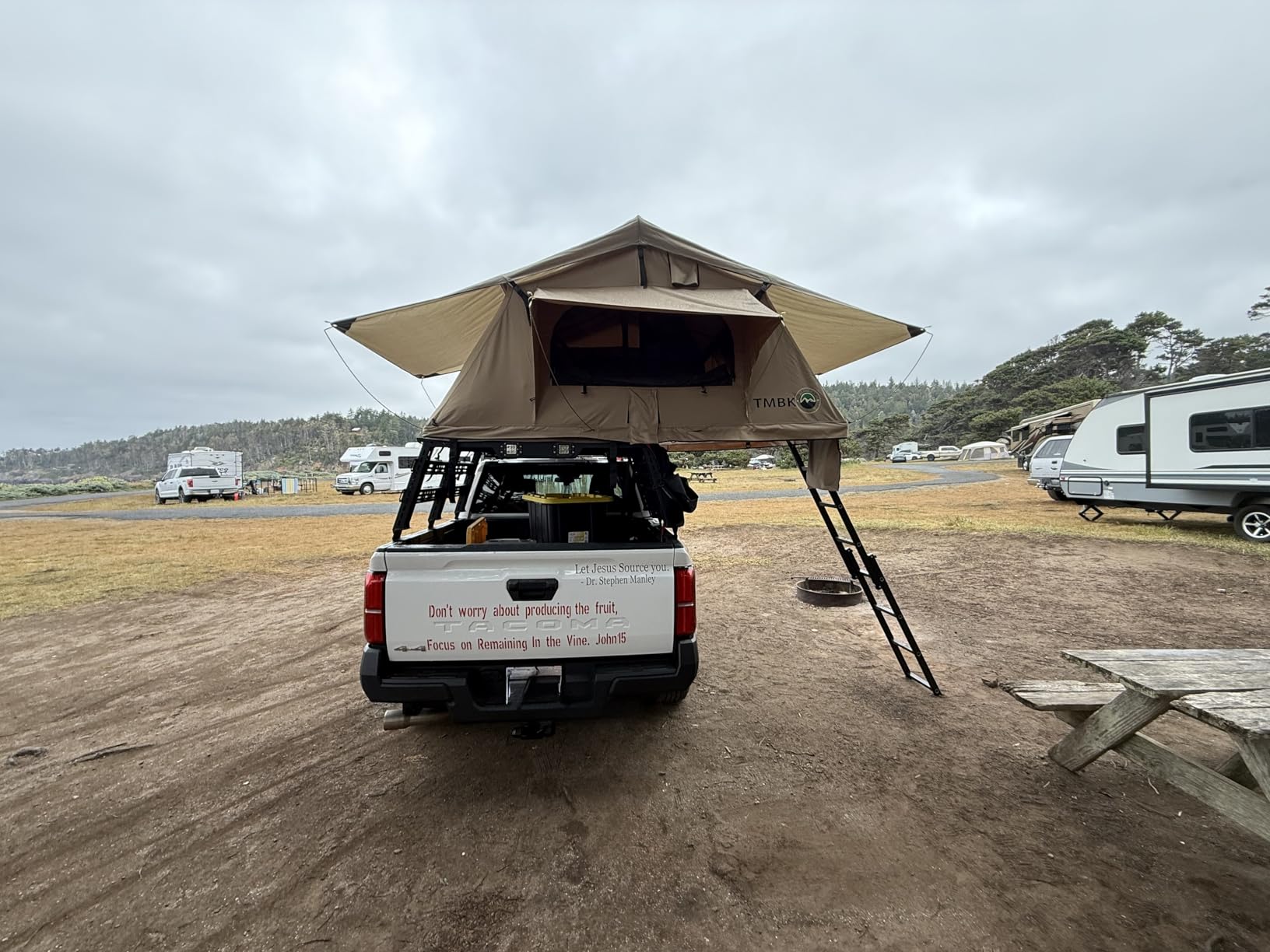
Build quality is where the value shows. The tent uses tear-resistant poly-cotton ripstop canvas, aluminum poles, a 420D Oxford waterproof rainfly and a 2000 PU rating, with marine grade stainless steel hardware throughout. Closed dimensions are 57 by 49.5 by 11.5 inches, which is tall enough to notice on a low vehicle but still fine for most open parking.
The rainfly and window layout deserve a mention because they are what keep it usable in weather. Owners report windows on all four sides plus a top opening, and the raised A-frame form gives genuinely elevated views that no ground tent can match. Ventilation is the soft shell advantage, and this one uses it well.
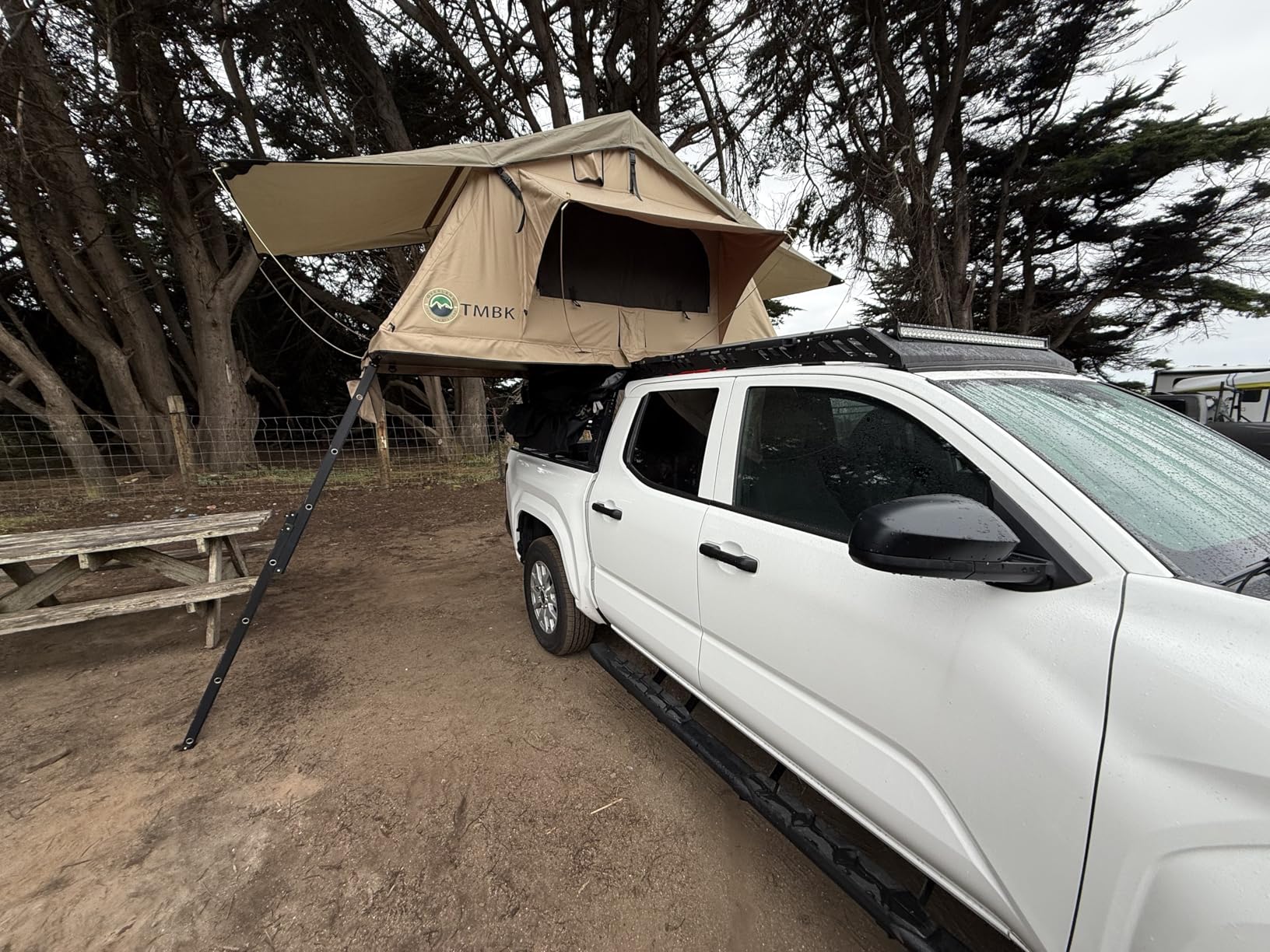
What you get for the money
The box contains the tent, the rainfly and the ladder, and installation needs no drilling to the vehicle as long as you have a roof rack. A telescoping ladder is included, though owners report it feels flimsy and may need extra pin holes drilled to lock at a comfortable angle. Budget an afternoon for assembly, and read the manual skeptically because documentation is the most criticized part of the package.
Who should skip it
Skip the TMBK if you plan on winter trips. There is no insulation in the fabric, and owners report condensation building under the mattress, so a cold-weather liner is a must-have addition. If you are a side sleeper or you run multi-night trips, plan to add a topper, because the included 2.25 inch foam is thin. It is also not the best choice if you sleep two tall adults, since the floor is 53.5 inches wide at its narrowest.
2. Overland Vehicle Systems HD Nomadic 3 – Roomy Soft Shell With a 4 Year Warranty
Overland Vehicle Systems HD Nomadic 3 Extended Soft Shell Roof Top Tent – Dark Gray Base with Green Rain Fly & Black 1000G PVC Travel Cover – Black Aluminum Base
165 lb
6536 sq in floor
4 year limited warranty
600D ripstop
40 in peak height
Pros
- Largest floor area in this roundup at 6536 sq in
- Full diamond plate aluminum base
- Four year limited warranty is the longest here
- Bonus pack with memory foam pillows and mini broom
- Installs without vehicle modification
Cons
- Heaviest soft shell here at 165 pounds
- 2000 water resistance is modest for storm climates
- Premium end of the soft shell price range
The Nomadic 3 solves the thing soft shells are usually bad at, which is space. At 6536 square inches of floor it is the largest interior in this roundup, with a 63 inch width that gives two adults and a child real room to sit up, and a 40 inch maximum interior height. For family camping that difference is not cosmetic.
The warranty is the headline here: four years limited, the longest coverage of any tent on this list, from a brand that has been in the category through several product generations. That matters more than the star rating when you are thinking about a decade of ownership and whether hinges, struts and zippers will be replaceable.
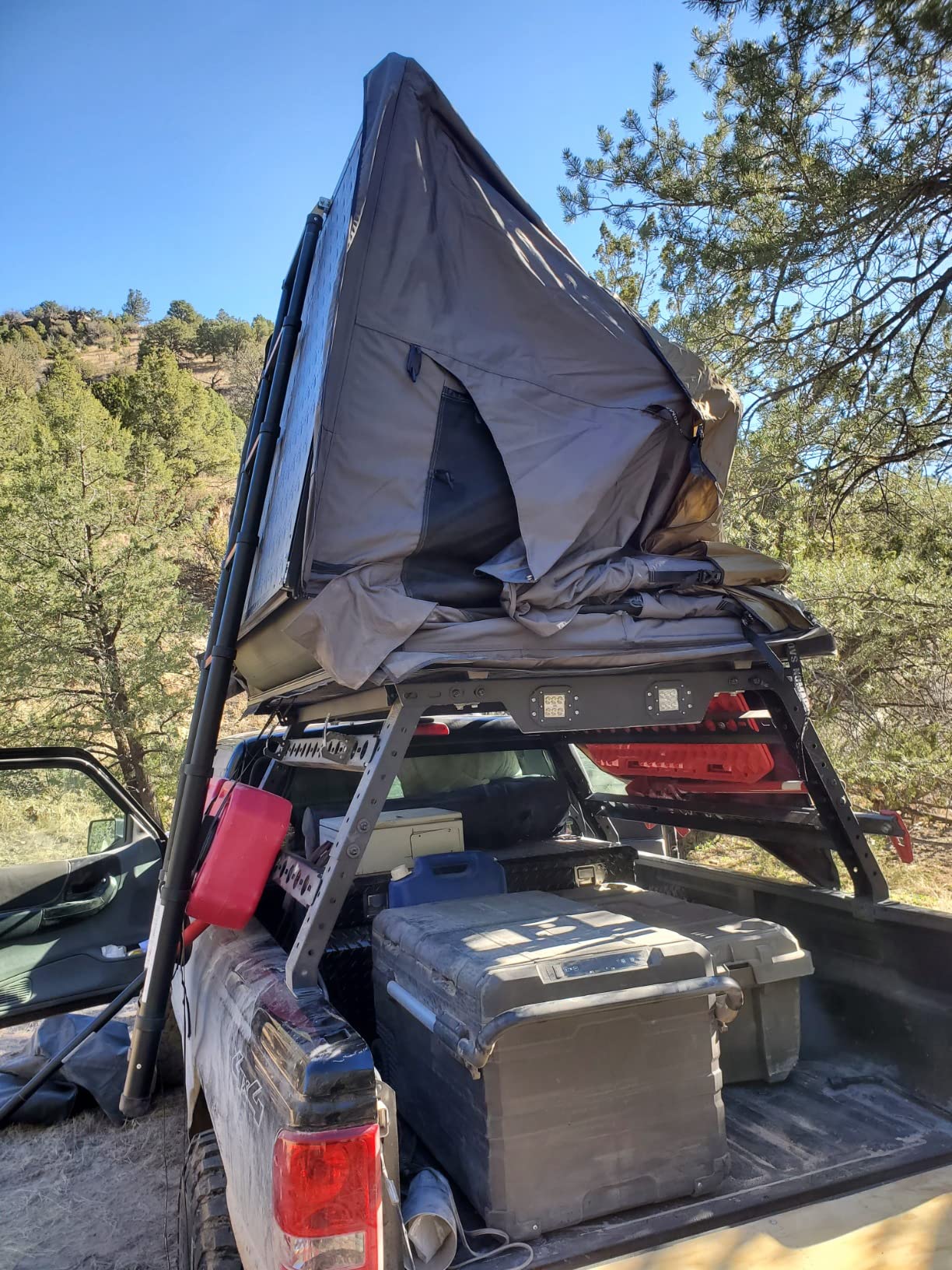
Construction is heavier duty than the TMBK. The base is full diamond plate aluminum, the material list runs 600D ripstop with Oxford nylon and polyester, and the struts close with hook and loop. It is rated as a 4 season tent with UV protection, though the water resistance figure is 2000 rather than the 5000 you see on several hard shells here.
The bonus pack is a small but real detail: memory foam pillows, a mini broom and a dust pan. It is not a marketing gimmick so much as an acknowledgment that people live in these tents for weeks at a time and do need a way to manage the floor.
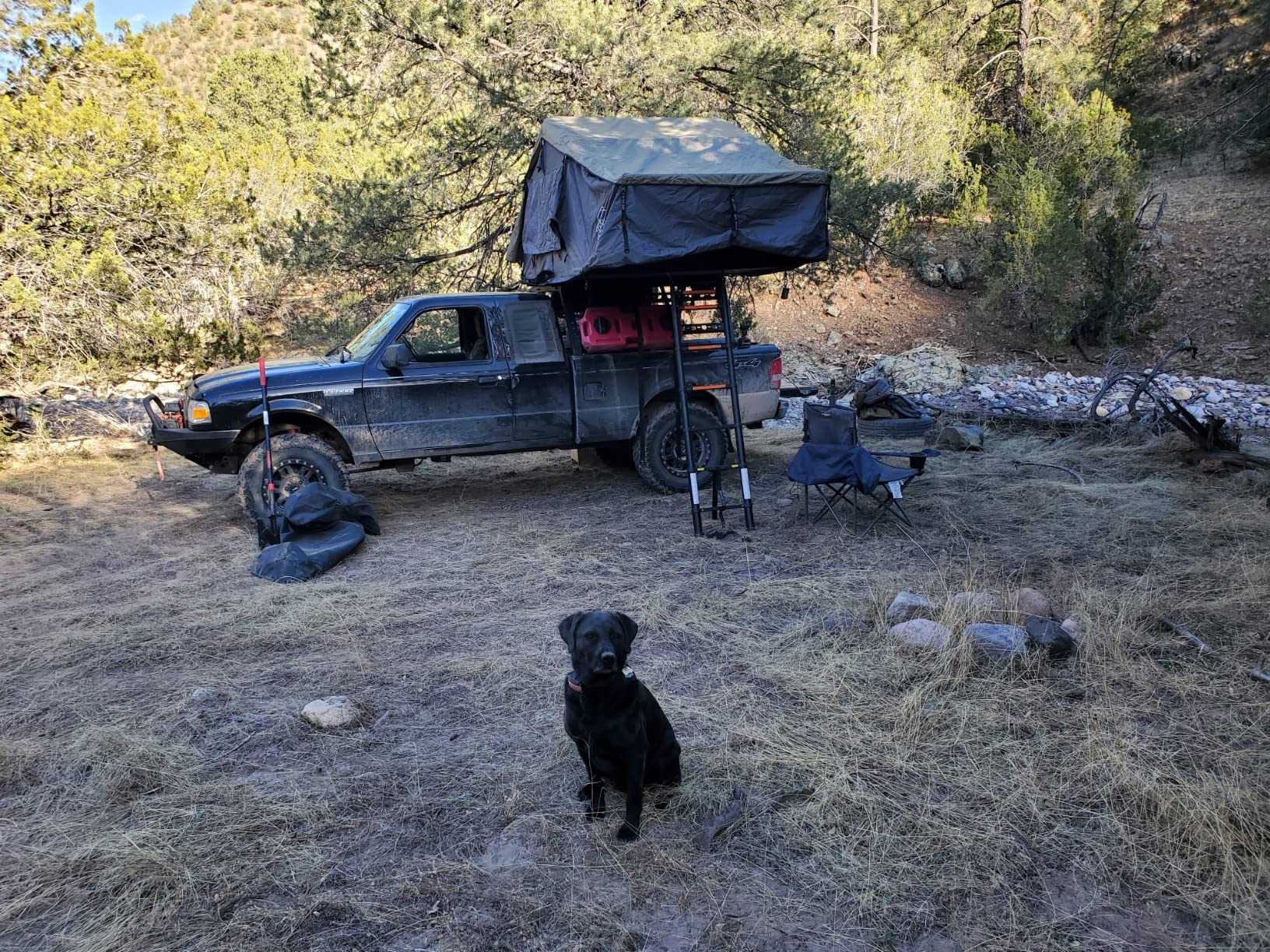
How it installs and what to check first
Installation requires no drilling, only a factory or aftermarket roof rack, and the manufacturer asks you to confirm the rack weight capacity before mounting. At 165 pounds this is the heaviest soft shell in the group, so cross-check your rack rating and your vehicle dynamic roof load carefully. Closed dimensions are 48 by 64 by 9.4 inches, which is nicely low for a soft shell.
Who should skip it
Skip the Nomadic 3 if your vehicle has a modest dynamic roof rating or if garage clearance is tight, because 165 pounds is a real commitment. Value-focused solo campers may also find the premium end of the soft shell range hard to justify when the TMBK delivers most of the experience for considerably less. If you camp in sustained heavy rain, note that the 2000 water resistance and 600D fabric sit below the 5000 mm class tents in this list.
3. SanHima Hotham – The Slimmest Hard Shell at 4.57 Inches Closed
Rooftop Tent Hard Shell – Hotham Lite Overland Aluminium Roof Top Tent 4.57″ Slimline, w/Full Ceiling LED Light, 2.36” Self-Inflating Mattress, Interior Space 82″ 46″x57″ for Car SUV Truck Camping
4.57 in closed
2 person
5000 mm waterproof
USB-C power panel
81.5 x 46 in interior
Pros
- Lowest closed profile here at 4.57 inches
- About 30 second setup with gas struts
- Digital panel with USB-C USB-A and CIG socket
- Dedicated air conditioning duct hole
- Full ceiling LED strip with three color modes
Cons
- Rated 2 person so the interior is among the most compact here
- 3761 sq in floor is well below competing hard shells
- One year warranty only
The Hotham is the pick if your constraint is height, not weight. It closes to 4.57 inches, the lowest profile in this roundup, which means it adds almost nothing to your roof line and keeps garage and covered parking viable. If you have ever had to circle a parking structure looking for headroom, that number alone may decide it.
It is also one of the best-equipped tents here for a two-person trip. The digital power panel gives you USB-C, USB-A and a 12V CIG socket, there is a dedicated duct hole for running a portable air conditioner inside, and a full-ceiling LED strip with white, daylight and amber modes. The telescoping ladder is rated to 330 pounds, and the rainfly sets itself when the tent opens.
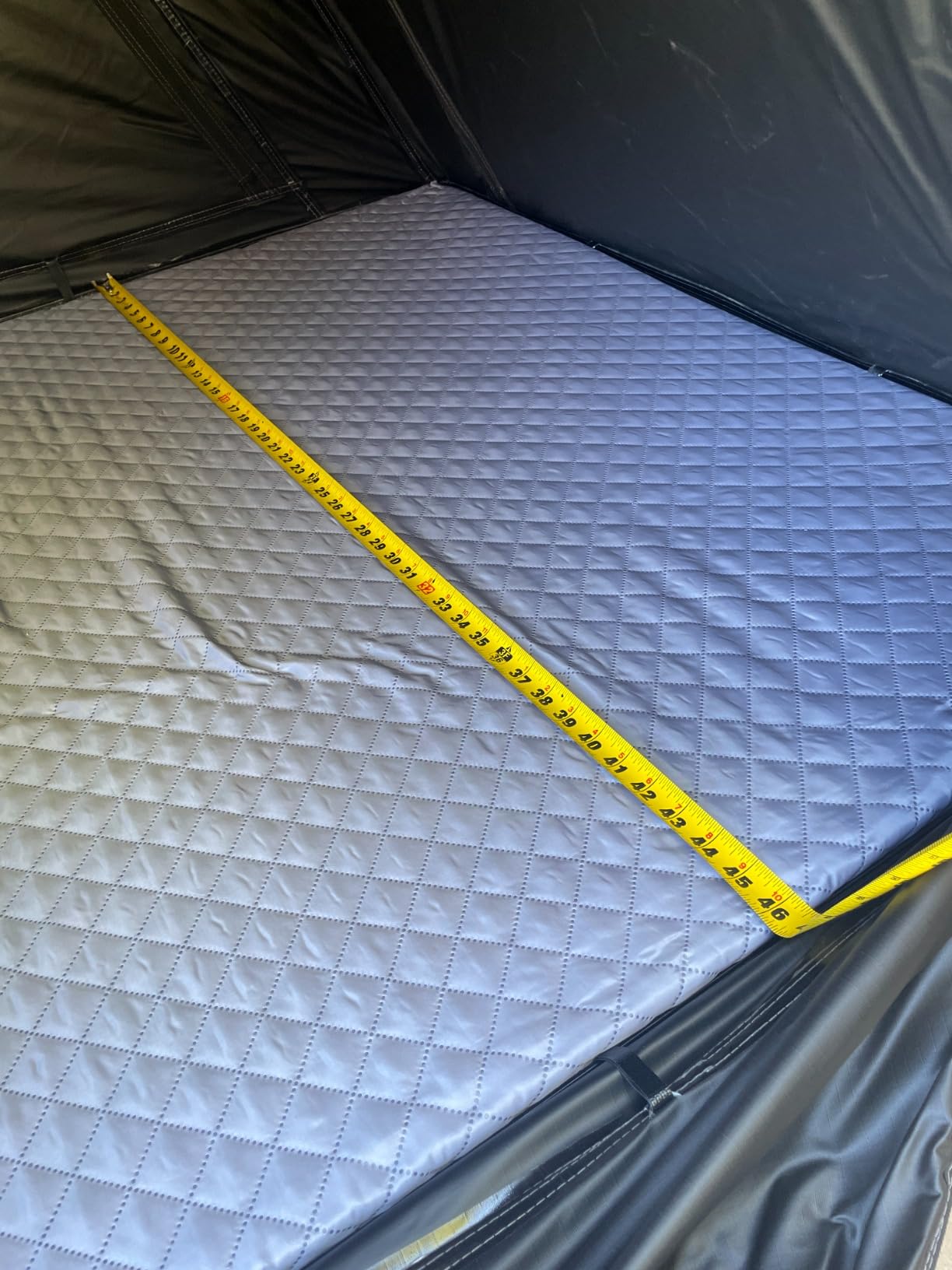
Weather performance is strong for the class: 420D double ripstop Oxford with 280GT poly-cotton, a 5000 mm waterproof rating, UV50+ protection, an AquaShield PTFE treatment and a 1.57 inch raised waterproof base. The interior measures 81.50 by 46.06 inches with a 2.36 inch self-inflating mattress, and gas struts open it in roughly 30 seconds.
This is also the tent we would point owners of smaller crossovers and EVs toward, since lighter vehicles and lower roof ratings generally pair with the tightest garage clearances. The trade is straightforward: you get the lowest profile and the richest electronics, and you give up floor area.
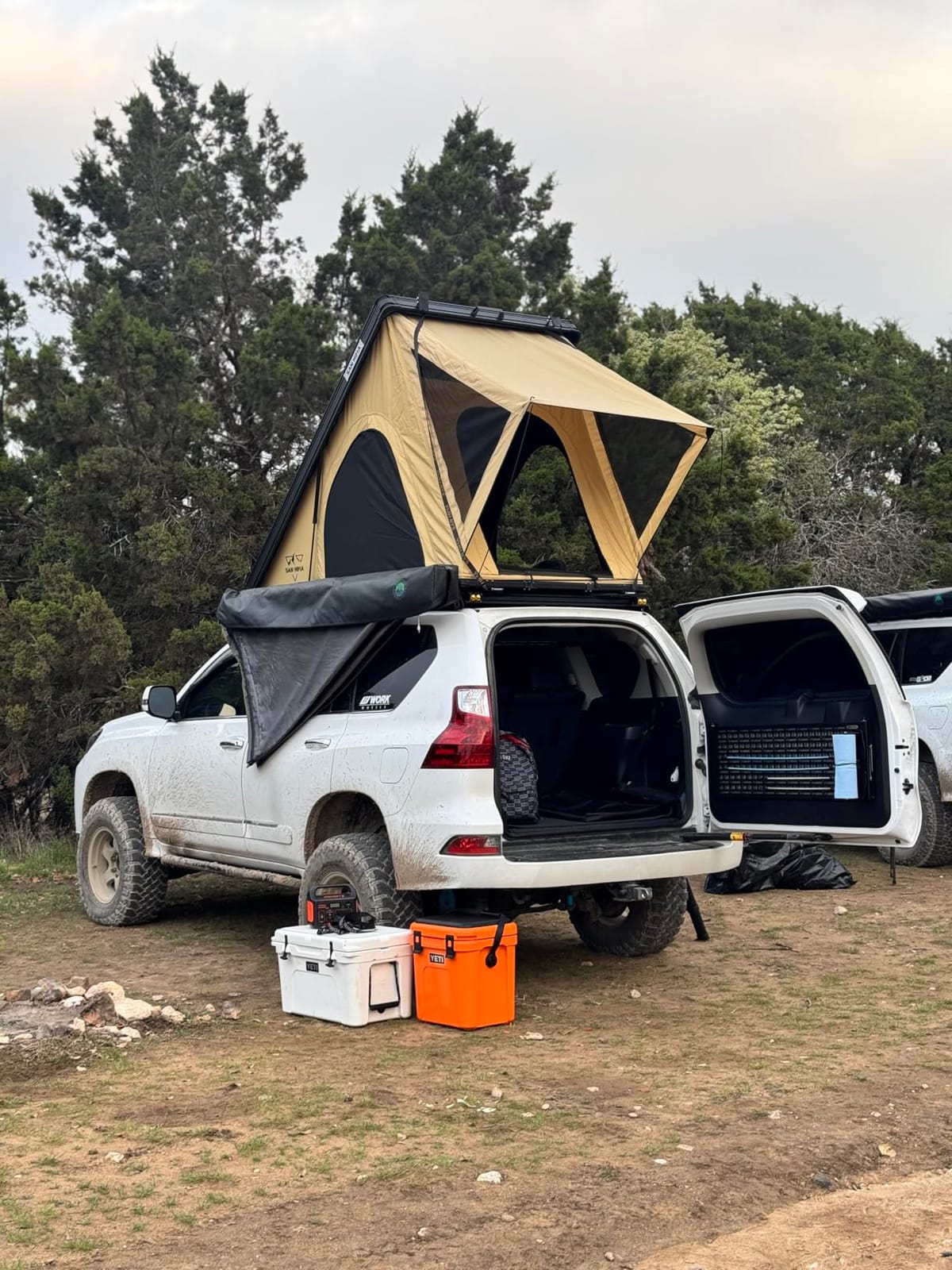
Space and sleep quality
At 3761 square inches of floor, this is one of the more compact interiors in the roundup, and it is officially a 2 person tent. Two adults who both need to lie flat will feel that, particularly if either of you is over roughly six feet. The included self-inflating mattress is 2.36 inches, which is better than the foam in most soft shells but still not a thick pad.
Who should skip it
Skip the Hotham if you need to sleep two tall adults comfortably or if you plan to sit upright for extended periods. Warranty coverage is listed at one year, well short of the four years on the Nomadic 3, so treat it as a two-season-to-three-season purchase rather than a long-term platform and expect to buy replacement parts from the seller directly. At 146.6 pounds listed weight it is also not the light option, so check your rack rating even if your garage is generous.
4. WildFinder – Aluminum Hard Shell With the Widest Accessory Kit
WildFinder Rooftop Tent, Hard Shell Roof Top Tent for Jeep SUV Truck Van
198 lb
Aircraft grade aluminum
5000 mm
Level 6 wind
83 x 52 in closed
Pros
- Aircraft grade aluminum shell resists aging and thermal expansion
- Recessed marine pad and condensation pad cut interior humidity
- Large accessory kit including 7.5 ft ladder and organizers
- Level 6 wind and 5000 mm rain ratings
- Strong category ranking in truck bed tents
Cons
- Roof crossbar is not included
- 198 pounds needs a rack rated well above that figure
- Air pressure lever takes practice to operate
The WildFinder is the tent you buy if the box contents matter as much as the tent. The kit includes a 7.5 foot telescoping ladder, a ladder organizer, ten organizer bags, an LED strip, two shoe organizers, three mesh windows, two mattresses and a built-in mattress. That is an unusually complete package, and it removes most of the accessory shopping you would otherwise do after the tent arrives.
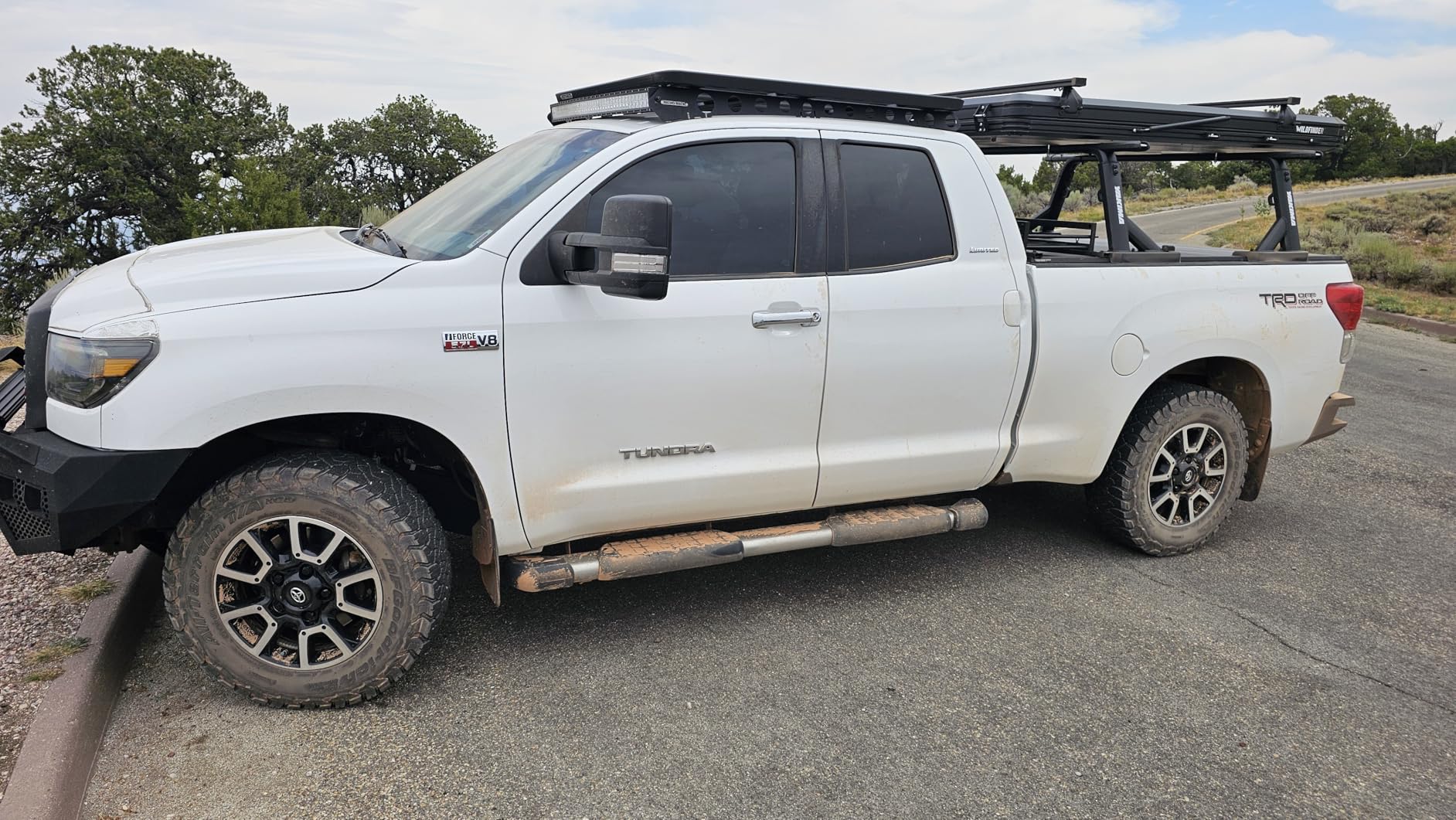
The shell is 100 percent aircraft grade aluminum alloy, which is the detail that separates it from plastic-cornered competitors. Aluminum does not age or expand with temperature the way molded plastic corners do, and material choice predicts long-term cracking far more reliably than a feature list does.
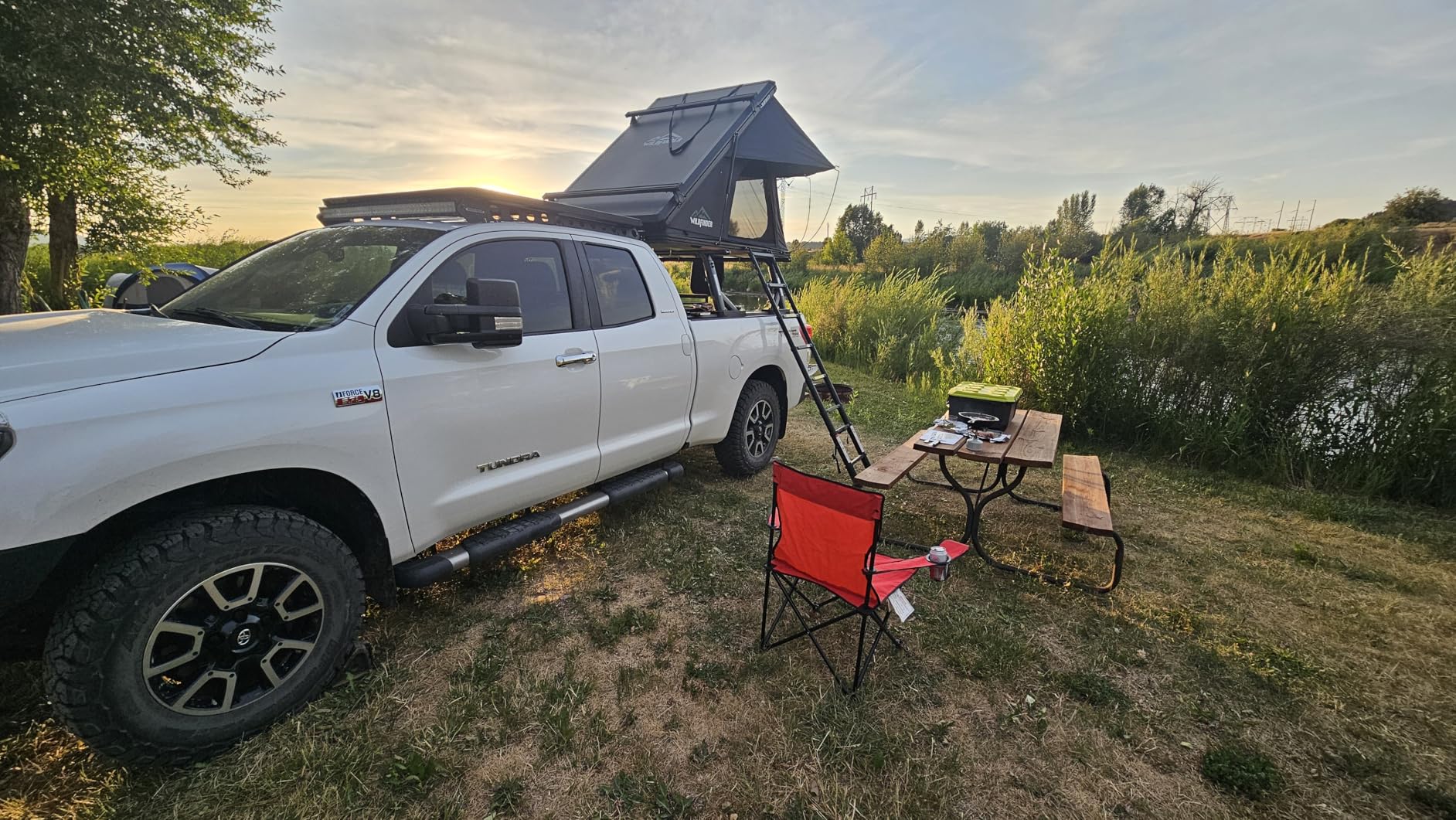
Condensation is the quiet problem in a hard shell, and this one addresses it directly with a recessed marine pad and a separate condensation pad over a 5 cm non-deformable mattress. The environmental ratings are 5000 mm rainproof, 99.99 percent sun protection, level 6 windproof and level 4 heavy snow protection, with five guylines, three poles and eight included stakes.
Owners also point out that it ranks unusually well in its category, which is a decent signal when direct user feedback is thin. The mechanism is a stainless steel air pressure lever rather than gas struts, and reviewers say it takes some practice to open and close smoothly.
What the price does not include
The luggage crossbar is not included, and at 198 pounds you almost certainly need one rated well above that figure. Budget for a quality rack and installation before this tent makes sense, because the headline figure for the tent alone understates the system. This is the single most common reason a sub-2000 dollar rooftop tent ends up costing considerably more than the listing suggests.
Who should skip it
Skip the WildFinder if your vehicle dynamic roof rating is anywhere near 200 pounds, or if you are installing by yourself. It is one of the heaviest tents in this roundup and can need more than one person to lift onto a rack. It is also a three-person rated interior of 83 by 52 inches, so three adults will be tight. If the aluminum shell and accessory bundle are not your priorities, the lighter TMBK covers the same trips for less.
5. HEYFUN Adventurer Pro – Best Value Hard Shell With an Included Awning
Adventurer Pro Rooftop Tent Hard Shell, 2-3 Person Aluminum Roof Top Tent
160 lb
2-3 person
4325 sq in floor
Hydraulic gas struts
Side awning included
Pros
- Side awning included at no extra cost
- Opens in about five seconds on hydraulic struts
- Built in LED strip plus exterior USB charging
- 13 interior storage pockets and 3 windows
- Held up through 15+ hours of rain and 30 mph gusts
Cons
- 160 pounds and realistically a two person install
- Tight for campers over roughly 5 ft 10 in
- Condensation on interior walls below about 50F
The Adventurer Pro is the value pick of the whole roundup, and the reason is the awning. A rigid side awning gives you a shaded, rain-sheltered deck at ground level next to the ladder, and owners consistently treat it as the feature they notice most after the first weekend. Almost nobody else in this price band includes one.
Setup is the second talking point. Hydraulic gas struts with dual buckles open and close the tent in about five seconds, and full assembly after mounting is quoted at roughly ten minutes. That combination of fast daily deploy and a genuinely dark blackout interior is what makes it work for a mixed bag of weekend campers and overlanders.
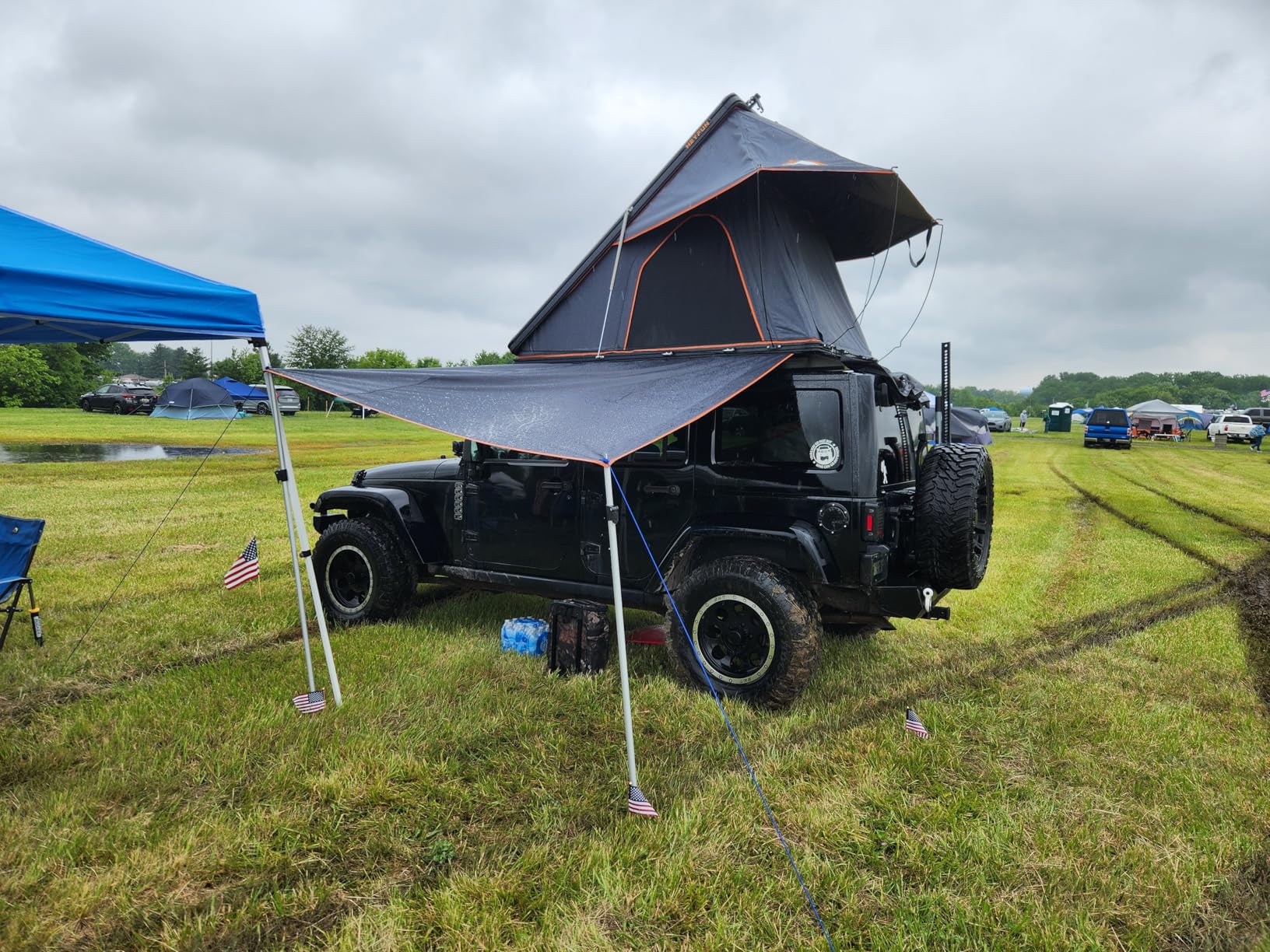
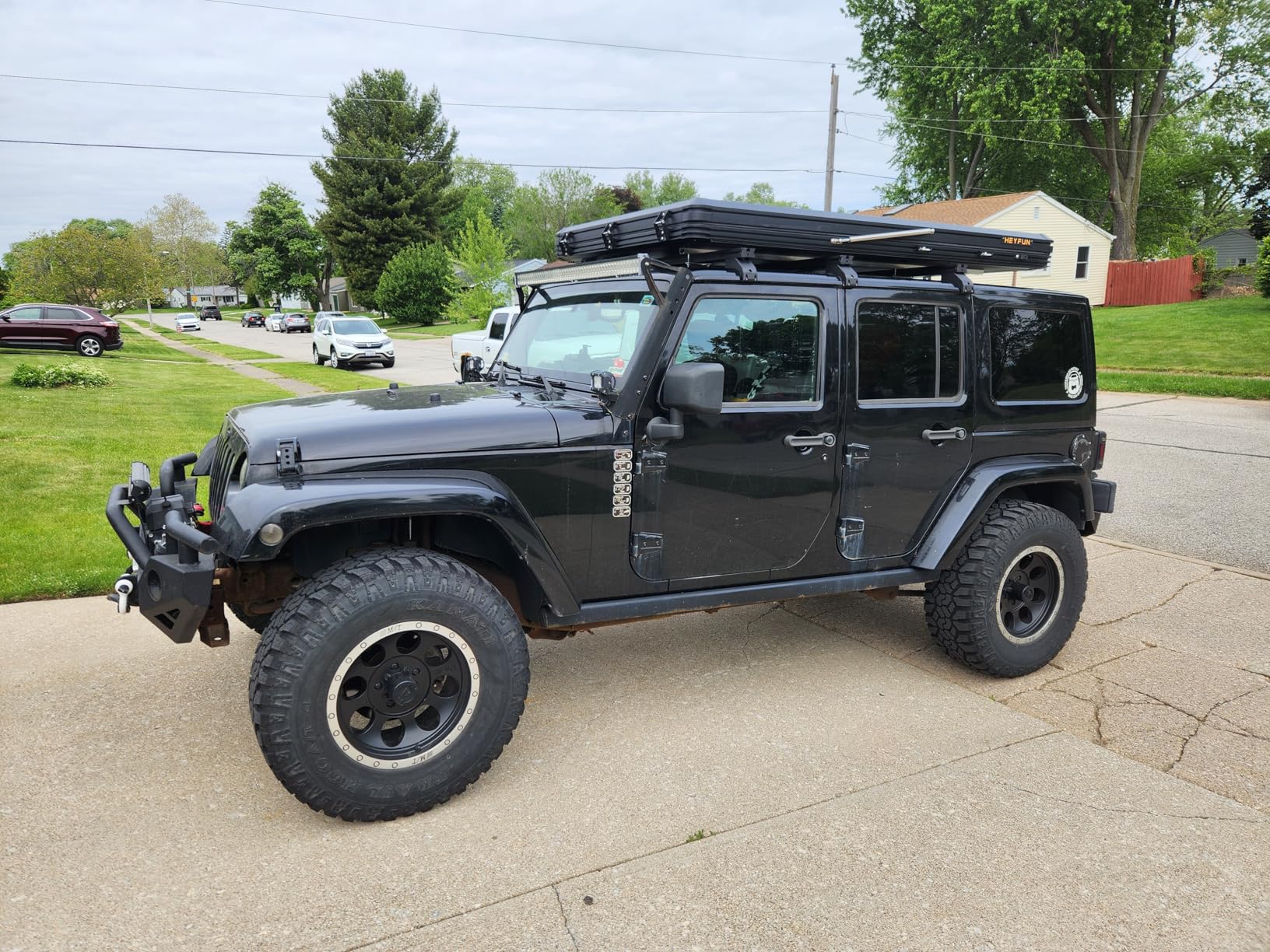
Construction is a honeycomb aluminum base with aircraft grade aluminum hardshell, 320g polyester and a waterproof rubber seal, over a moisture-proof flocked lining floor with a thick sleeping mat and condensation mat. The closed dimensions are 83.86 by 51.57 by 7 inches, opening to 62.99 inches of height, and the manufacturer specifies crossbars supporting at least 165 pounds.
The storage layout is unusually serious: thirteen interior ceiling and sidewall pouches, three windows, three doors and a see-through pocket sized for a tablet. Maximum load is rated at 660 pounds. The included kit runs to a side awning with mounting accessories, ladder with storage bag, two shoe storage bags, four support rods, a universal mounting hardware kit and a built-in LED strip.
Who it fits well
For two adults and a child, this is one of the better layouts in the group, and the awning turns a cramped 4325 square inch floor into usable living space. Owners report it held up through more than 15 hours of rain and gusts above 30 mph, and the blackout fabric is dark enough to sleep past sunrise. The awning is also the reason this tent works as a family basecamp unit rather than just a bed.
Who should skip it
Two honest limits. It is rated 2 to 3 person but is tight for anyone over roughly 5 foot 10 inches, especially two tall adults, and at 160 pounds it is realistically a two person install. Condensation forms on the interior walls in cold conditions around 50F and below, and there is no dedicated vent for a portable air conditioner. Bedding also cannot be left inside when closed, so you pack the tent fully before moving the vehicle.
6. ARCTWONDER Solar Hard Shell – Built-In Solar Panel for Off-Grid Trips
Solar Panel Rooftop Tent Hard Shell,Pop Up Car Roof Top Tent Hardshell
198 lb
216W 12V solar panel
7 in closed
29.37 sq ft interior
320g polyester
Pros
- Only hard shell here with a built in 216W solar panel
- Aluminum alloy plate top cover and all four corners
- High five star review share at 84 percent
- Only 7 inches closed for garage access
- One person can open and close it
Cons
- 198 pounds is among the heaviest in this roundup
- No separate side awning
- Shorter review history than the established options
The ARCTWONDER is differentiated by one component nobody else in this roundup has: a 12V 216W solar panel mounted in the shell for charging power banks off-grid. On a multi-week trip away from a plug that is a real, tangible advantage, and it is the reason this tent is on the list despite the sticker price.
Construction is all aluminum alloy, which matters more than it sounds. The bottom plate, top cover and all four corners are aluminum rather than the plastic corners that crack and warp on cheaper tents, and that is the same failure mode owners complain about after a season of UV exposure and repeated open-close cycles.
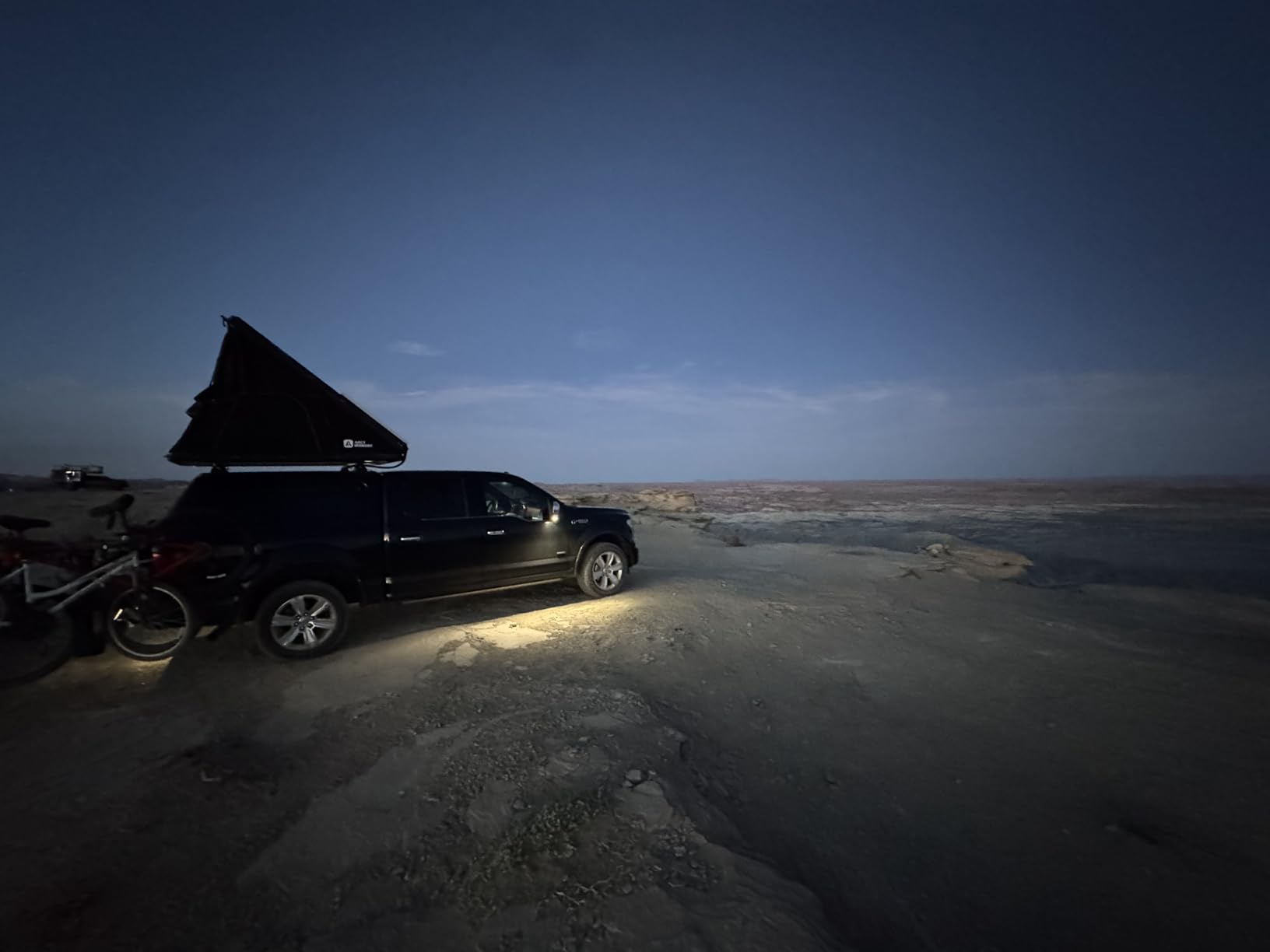
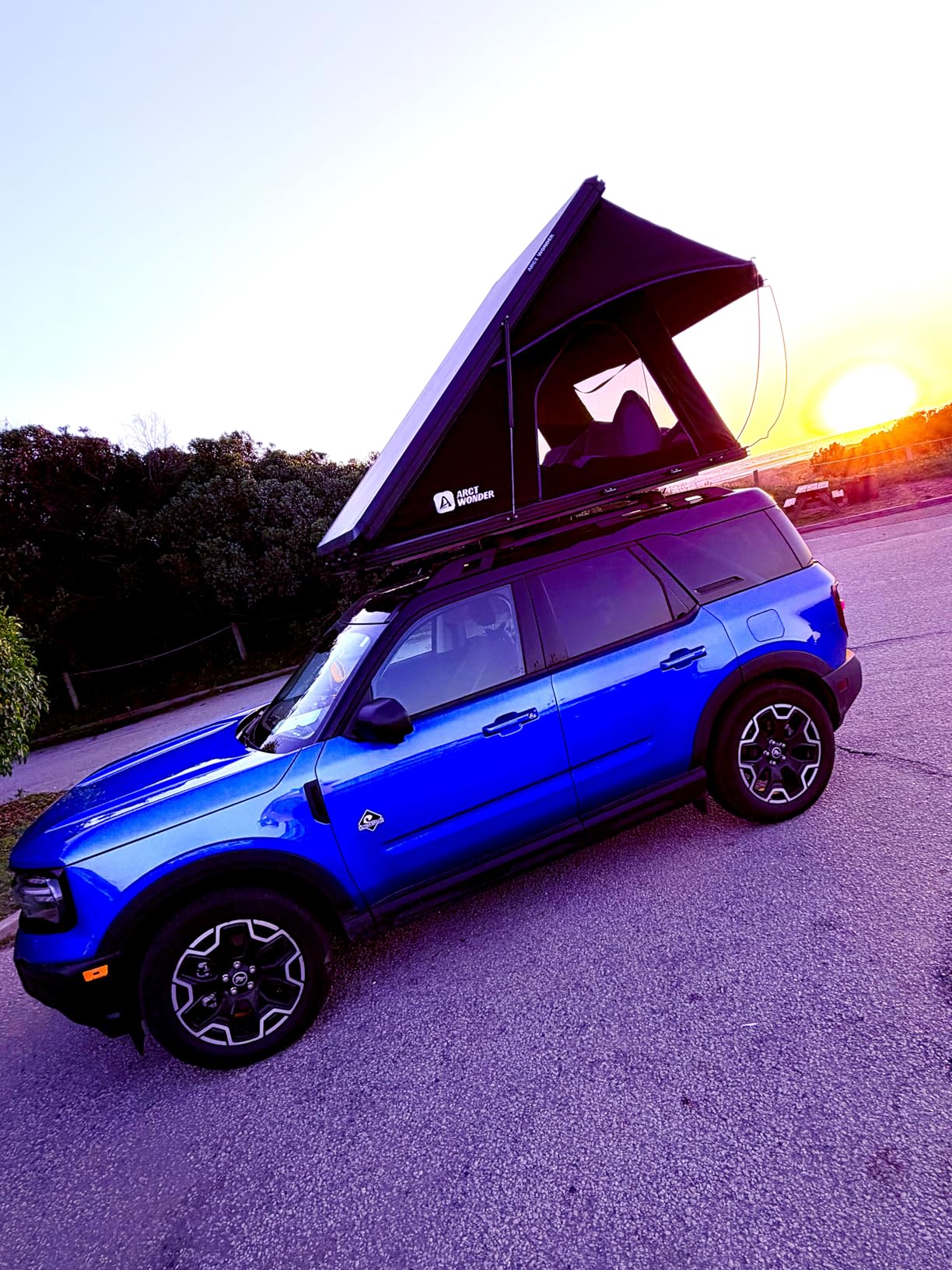
Air pressure rods pop the tent open in about ten seconds, and one person can close it in two steps. Closed height is only 7 inches, so garage passability is preserved. The interior is 85 by 52 by 59 inches across 29.37 square feet, which comfortably holds two adults and a child or a pet, and it has three large windows with awnings plus an LED strip and USB outlet.
Weather specs are solid: 320g polyester with seam sealing, a 5000 mm water resistance rating, blackout coating, UV protection and a manufacturer warranty of one year. The share of five star reviews is high at 84 percent, though the overall review count is lower than the established soft shell options.
Solar panel: what it actually does
A 216W panel is sized for maintaining a power bank, a phone and small electronics over a multi-day stop, not for running a fridge or a CPAP machine. Treat it as a maintenance charger that keeps your small electronics alive between camps rather than as off-grid power for a full week. The panel is part of the tent rather than a bolt-on, so there is no separate wiring to run and nothing extra to mount.
Who should skip it
At 198 pounds this is among the heaviest in this roundup, so it demands a properly rated rack and a vehicle with a high dynamic roof load, and realistically more than one person for installation. If you camp at established sites with power, the solar panel is a novelty and you are paying for hardware you will not use. Note also that the only weather protection beyond the shell is the awning-equipped windows, with no separate side awning for ground-level shade.
7. Naturnest Sirius 1 Plus – Widest Interior in the Group
Naturnest Rooftop Tent Hard Shell, Easy Set Up Pop Up Large Tent for 2-3 Person Camping, Waterproof UV-Resistant Blackout 4 Season Tents for Truck, Jeep, SUV, Van, Trailer – Sirius 1 Plus
160 lb
5203 sq in floor
63 in wide interior
Crossbars included
316 steel struts
Pros
- Widest interior here at 63 inches and 5203 sq in
- Roof crossbars included which is rare for a hard shell
- Dedicated vent for a heater or cooler
- 316 stainless steel gas struts and YKK zippers
- 1.97 in mattress with full blackout fabric
- Honeycomb aluminum floor and roof dampen road noise
Cons
- Lowest rating here at 4.3 with 11 percent one star reviews
- ABS shell is plastic construction versus aluminum rivals
- Fewest reviews so long term durability is less documented
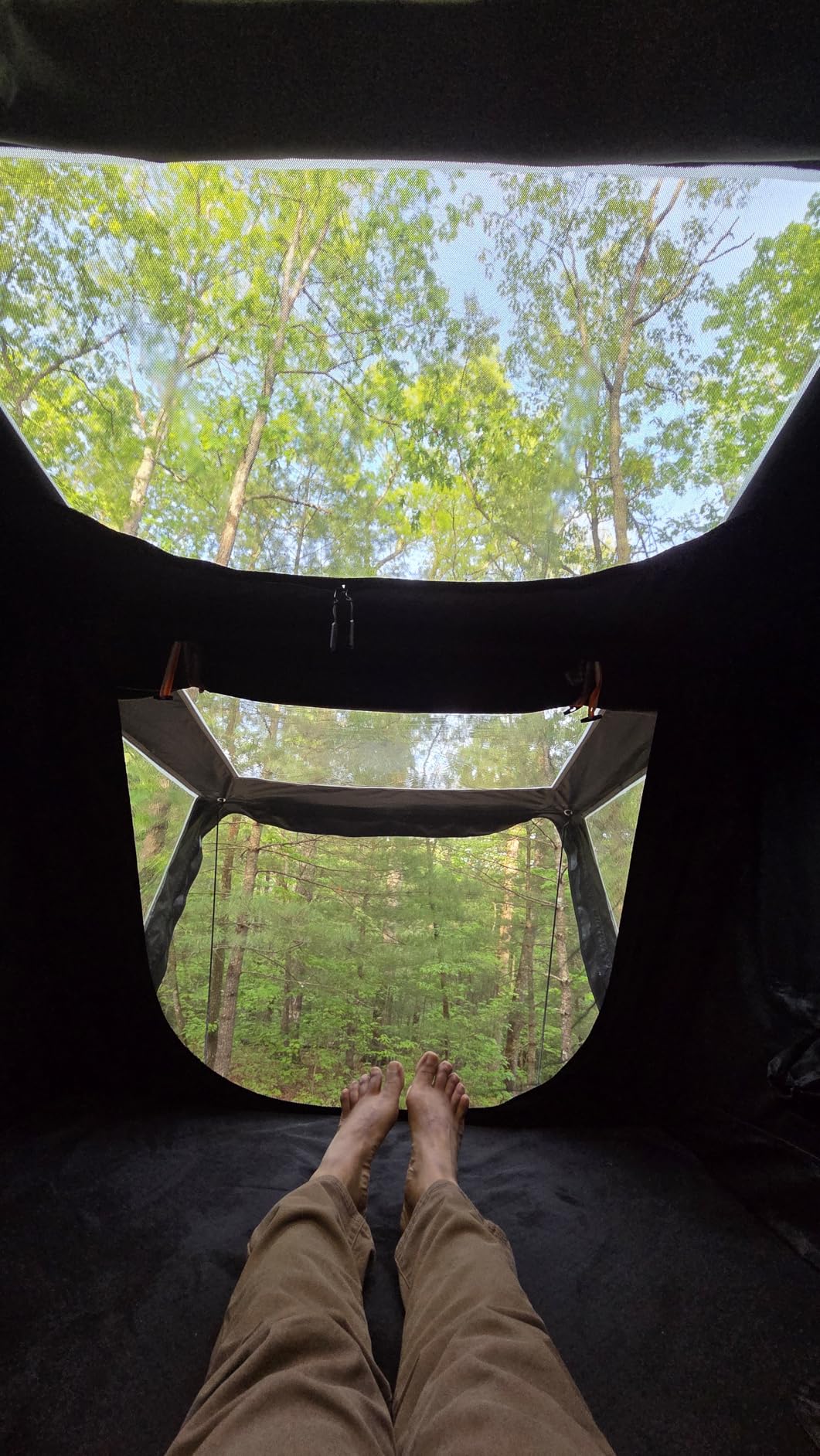
The Sirius 1 Plus is the roomiest hard shell here by a clear margin, with a 63 inch width giving 5203 square inches of floor. For two adults who both need to sit up, dress, or work on a laptop, that width difference is more meaningful than any spec on the list. The 82.7 inch length is also longer than most hard shells in this range.
Two inclusions stand out. Roof crossbars are included, which almost no competitor in this roundup offers, and there is a dedicated vent for connecting a heater or cooler. That vent is the single most useful feature for three-season and shoulder-season camping, because a hard shell with no climate hook is a sealed box in July.
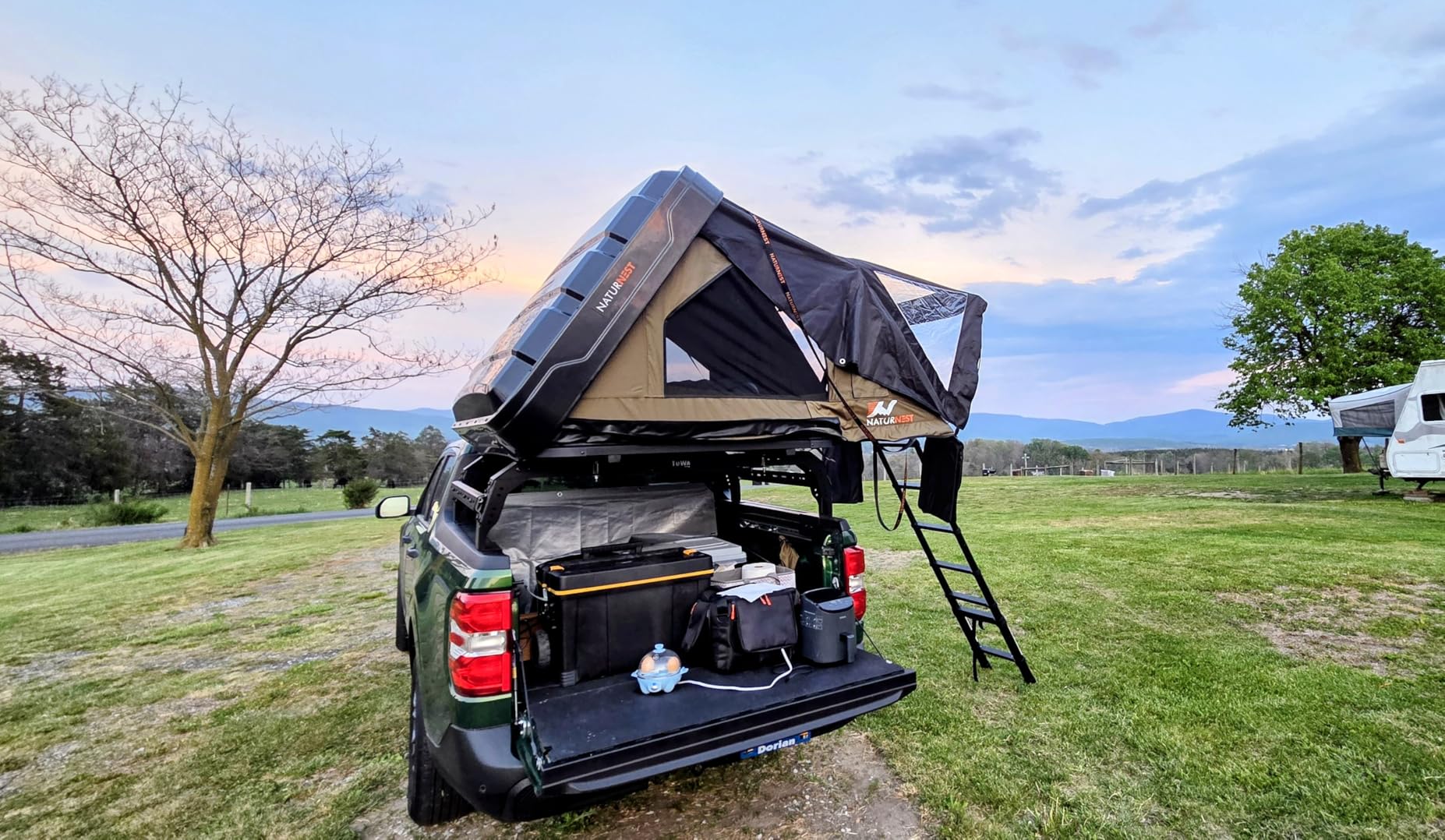
The hardware is above typical for the category: 316 stainless steel gas struts and YKK zippers, on an aluminum alloy frame with honeycomb insulating panels in the floor and roof that dampen road noise. Sleep quality gets a boost from the 1.97 inch non-deformed mattress and full blackout fabric, and it sets up in about 30 seconds once mounted.
Rain performance is a waterproof coating rated for UV exposure, and the ladder, parts and tools, shoe bags and support rods are all included. Assembly is around ten minutes for one or two people, and it fits most factory and aftermarket racks.
Where the quality caveats sit
This is the pick with the most caution attached, and you should read the numbers rather than the marketing. It carries the lowest average rating in the roundup at 4.3, with 11 percent of reviews in the one star bucket, and it has one of the smallest review bases on the list at 38. Long term durability is simply less well documented, which is exactly the problem the dropshipper-tent crowd runs into.
Who should skip it
The shell is high strength ABS, which is a plastic construction, set against aircraft grade aluminum in the WildFinder, ARCTWONDER and JOYINRUTE. If you expect ten years of hard use and live somewhere with strong UV, the aluminum tents are the safer bet. Warranty is one year, seller provided, and the price sits near the top of the group. Buy it for the width and the included crossbars, not for the shell material.
8. JOYINRUTE Winter Hard Shell – Highest Rated With a Removable Liner
Rooftop Tent Hard Shell with Winter Insulation for 4-Season Camping
178 lb
2 person
Removable thermal liner
5000 mm
Opens in under 3 minutes
Pros
- Highest rating in the roundup at 4.8 with 86 percent five star
- Removable winter thermal liner is unique in this group
- Genuine blackout from the rubberized canvas
- Flocked lining floor reduces mattress condensation
- Opens in under 30 seconds once mounted
Cons
- 178 pounds and can need three people to lift
- Included mattress runs hard for side sleepers
- Mounting bolts often wrong length for aftermarket crossbars
The JOYINRUTE is the highest rated tent in this roundup at 4.8 stars with 86 percent five star reviews, and it is the only one that ships with a removable winter thermal liner. If you camp in cold months, that liner is the difference between a usable four-season tent and a cold box, and it is not something you can add later without losing headroom.
The blackout is real, from rubberized canvas rather than a coated polyester, so it blocks sunrise properly. The flocked lining floor prevents condensation forming on the mattress, which is the failure mode that ends most cold-weather hard shell trips early, and four windows each carry a mesh layer and a windproof layer so you can ventilate without losing weather protection.
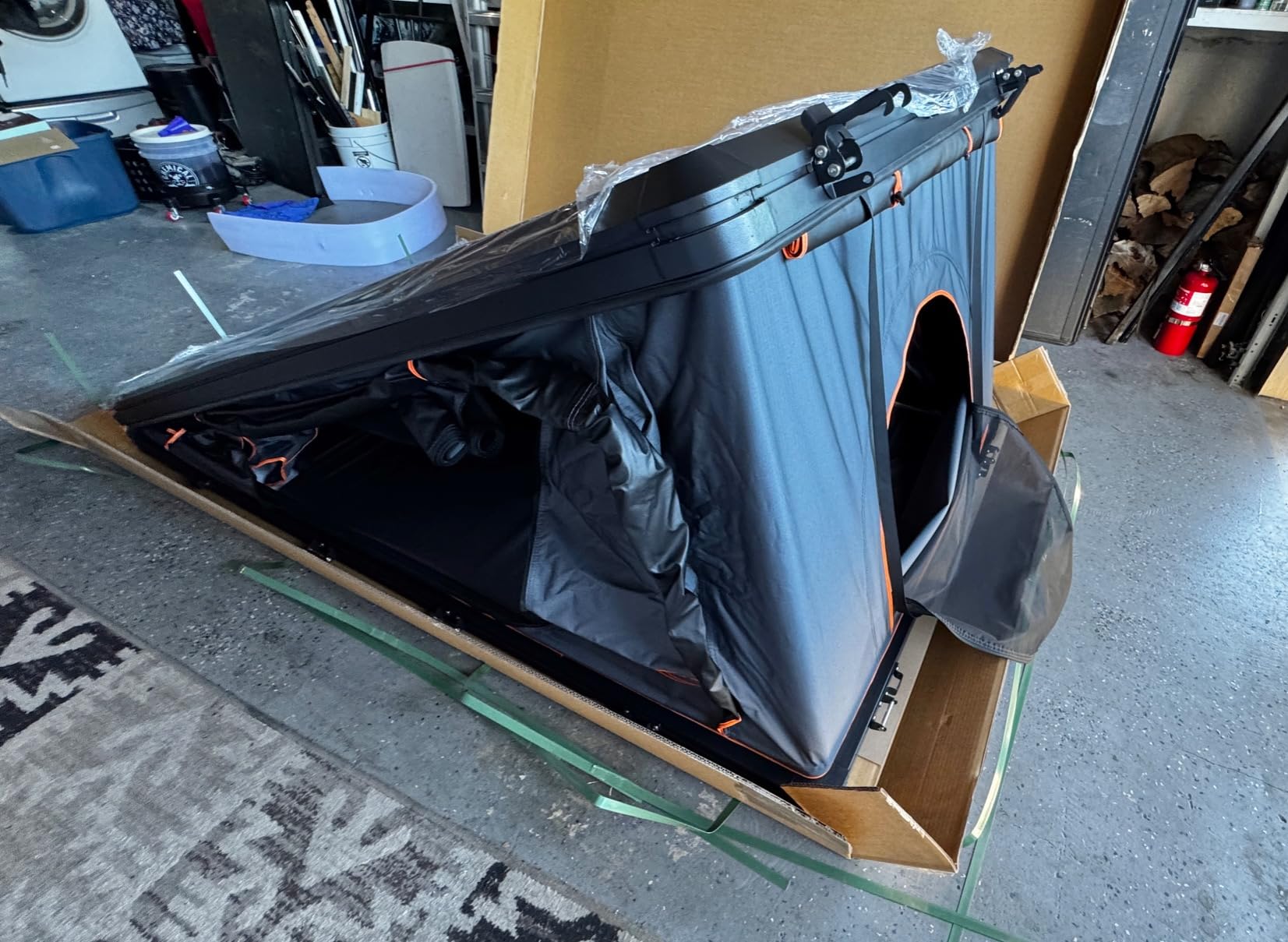
Specs read like a premium product: aircraft grade aluminum alloy shell, four high-strength hydraulic support rods, 320G polyester with blackout coating, 5000 mm water resistance, 99 percent sun protection and grade 6 wind resistance. It opens in under 30 seconds once mounted, and the full kit includes a 7.5 foot telescoping ladder with organizer, mattress, condensation pad, thermal liner, five internal storage bags, an LED strip, two shoe organizers and four mesh windows.
Sleep space is 78.74 by 47.29 inches for two people, and the interior height is 39.4 inches, so this is a sit-up bed rather than a crawl space. The closed profile is not published as aggressively as some rivals, which matters more for garage access than the interior does.
Sleep quality and mounting
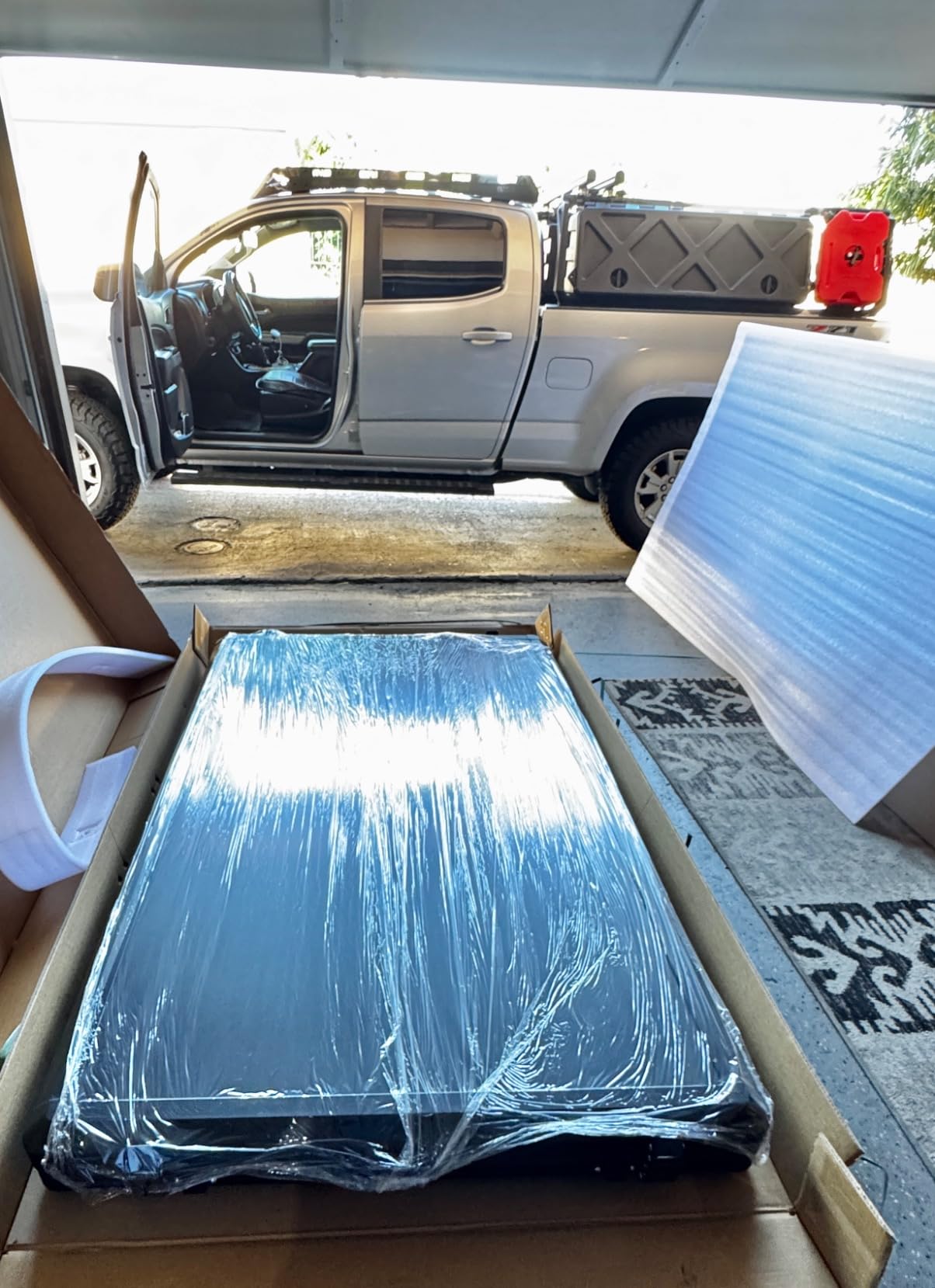
Two practical notes owners raise repeatedly. The included mattress runs hard, especially for side sleepers, and the usual fix is a thin self-inflating pad on top, which is fine once you know to expect it. Mounting hardware bolts are frequently the wrong length for aftermarket crossbars, so measure your bar width and clamp thickness before the install appointment rather than after.
Who should skip it
At 178 pounds it is one of the heaviest reviewed units in this roundup and can need three people to lift onto a rack, so check your vehicle dynamic roof load carefully and do not plan a solo install. There is also no integrated heater or AC duct port, so running a portable air conditioner requires a window adapter. The LED strip runs on a USB connection with no internal power source, which is a small thing that annoys people every night. If you never camp below freezing, the thermal liner is money you are not using.
How to Spot a Low-Quality Rooftop Tent Before You Buy
The top result on this query is an owner thread asking which rooftop tent companies still make a good product, with complaints about cheap tents that leak, rust or fall apart. That question deserves a straight answer, because the failure modes are visible before you spend anything. Here is the checklist we use.
One: check whether the brand publishes a folded weight and folded height. A manufacturer with real engineering publishes both. If the listing shows no dimensions and no weight, the listing is a trade-only catalog entry, and support will be the same.
Two: read the one and two star reviews for the word “hinge” or “strut”. Hinges and gas struts are the two parts that actually fail. A brand that will sell you a replacement strut three years from now is a real manufacturer. A brand with no parts channel is not, regardless of how good the photos look.
Three: look at seam construction, not just the waterproof rating. A 5000 mm rating on unsealed seams is decoration. Taped or welded seams at the floor join and around the ladder entry are where water actually comes in, and those are the details dropshippers skip.
Four: reject plastic shell corners. Fiber-reinforced plastic corners and ABS shells develop stress cracking and spider-web patterns after UV exposure and repeated open-close cycles. Aluminum alloy corners cost the manufacturer more and are the single clearest quality signal on the exterior.
Five: verify the warranty is issued by a company with a physical US address and a phone number. One year, seller provided, is a returns policy rather than a warranty. Two to four years from an established brand is a real commitment. None of the eight tents here carries more than four years, and the difference between one and four is the difference between a purchase and an investment.
Roof Load, Garage Clearance and What 2000 Does Not Cover
Dynamic roof load is the constraint that ends most rooftop tent dreams, so check it before anything else. It is the maximum weight you can carry while the vehicle is moving, and it is significantly lower than the static roof rating printed in the owner’s manual. Most passenger vehicles sit between 150 and 200 pounds, and that number includes passengers, cargo, crossbars and anything else on the roof. A 198 pound tent plus a 60 pound rack plus a driver can exceed the limit on an unrated setup.
The fold height is the second hard limit. Add the tent’s closed thickness to your crossbar height, then check it against the lowest clearance you actually use. The SanHima Hotham at 4.57 inches and the ARCTWONDER at 7 inches are the two most garage-friendly on this list, which makes them the safest picks for a daily driver that sleeps in a parking structure. The WildFinder at 9 inches and the TMBK at 11.5 inches are still workable, but taller.
Now the honest budget math. The sub-2000 dollar figure covers the tent, and the tent is frequently the cheapest part of the system. You also need a roof rack or crossbars rated above the tent weight, mounting hardware, installation labor, and ideally a better mattress. On top of that, several picks here exclude the crossbar entirely, including the WildFinder. Treat the tent price as roughly half to two thirds of the installed cost and the sub-2000 dollar ceiling stops being the binding constraint.
Hard shell or soft shell is the second decision. A soft shell gives better airflow, more headroom, lower weight and less drag when folded, at the cost of exposed fabric and a wedge profile that is harder to work on when installed. A hard shell protects the tent, can stay mounted full time as a cargo box, and cuts highway drag, but adds 50 to 100 pounds to your roof. A comparison of our best rooftop cargo boxes covers the storage angle if you are mounting permanently.
Some people should skip a rooftop tent entirely. If you already sleep in your vehicle cabin, an RTT is arguably overrated: the cabin is quieter, safer from bears, needs no ladder at midnight and costs nothing. Daily drivers in low-clearance garages, anyone whose vehicle dynamic rating is under 150 pounds, and campers who move every single night are also better served by a ground tent or a hammock tent such as the ones in our hammock tent guide, or a tree tent for hot climates like our tree tent picks.
Frequently Asked Questions
What is the best rooftop tent for the money?
Under the 2,000 dollar ceiling, the Overland Vehicle Systems TMBK is the best rooftop tent for the money. It weighs 108 pounds, the lightest in our roundup, sets up in about five minutes, carries a 2000 PU waterproof rating and is backed by 151 reviews, the largest review base on the list. If you want a hard shell instead, the HEYFUN Adventurer Pro adds an included side awning and opens in about five seconds.
Which brand of rooftop tent is considered the best?
Within this price range Overland Vehicle Systems stands out for the only four year limited warranty on the list, paired with established soft shell engineering. Among hard shells, the aluminium-shelled models from WildFinder, ARCTWONDER and JOYINRUTE are the most credible long term purchases, because aluminium resists the UV stress cracking that affects plastic and ABS shells. The very top tier brands sit above this budget entirely.
Are cheap Amazon rooftop tents any good?
Some are, and the ones worth buying share four traits: a published folded weight and height, a warranty of two years or more from a traceable company, taped or sealed seams, and aluminium rather than plastic shell corners. Check for the words hinge and strut in the one and two star reviews, because an unavailable replacement strut two years out is the failure mode that ends these purchases. Every tent we shortlisted meets at least two of the four traits.
Is a rooftop tent better than a ground tent?
It depends on how often you move. A rooftop tent wins when you camp at new sites most nights, because it sets up in under a minute and leaves the ground free, and when you want elevated views and separation from wet, cold ground. A ground tent wins on comfort for a family, on cost, on headroom and on the price of a good 4-season unit. If you already sleep in the cabin, owners across forums often report the rooftop tent is not worth the cost.
What are the downsides of using a rooftop tent?
The main downsides are weight on a limited dynamic roof load, added aerodynamic drag and fuel consumption, added height that breaks garage access, setup work and ladders in the dark at midnight, condensation on the tent floor, and a theft signal in some places. Hard shells also raise the centre of gravity, which owners repeatedly caution about on off-road terrain and in high crosswinds. None of these are dealbreakers, but all of them are real.
How long does it take to set up a rooftop tent?
Once mounted, a hard shell with gas struts opens in about five seconds for the HEYFUN Adventurer Pro, roughly 30 seconds for the SanHima Hotham and about 30 seconds for the JOYINRUTE, with the ARCTWONDER at around 10 seconds. Soft shells take longer: about five minutes for the Overland Vehicle Systems TMBK. The first-time installation and crossbar mounting is a separate job and commonly takes an afternoon.
Final Verdict
The best rooftop tents under 2000 dollars in 2026 are the Overland Vehicle Systems TMBK for anyone who cares most about weight, the HEYFUN Adventurer Pro for the best hard shell value, and the SanHima Hotham if garage clearance is the binding constraint. The Nomadic 3 wins on room and warranty, and the JOYINRUTE is the only one here that genuinely handles winter.
Check your dynamic roof rating before anything else, and budget the rack and installation on top of the tent figure. Get the current price on whichever one you pick and decide with the full system cost in mind, not the listing alone.