
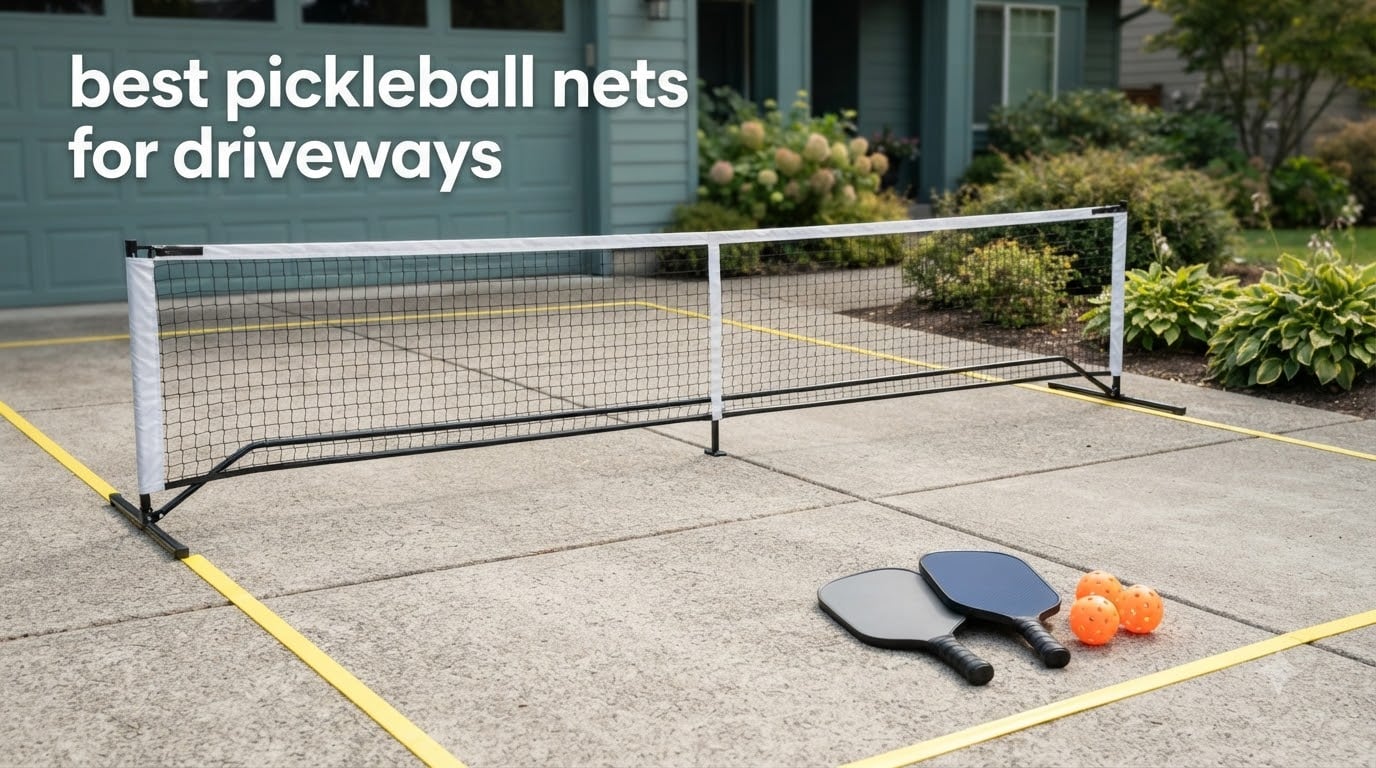
Most people do not buy a driveway pickleball net because they want a court. They buy one because the net has to leave. Somewhere between the last rally of the evening and the alarm the next morning, a 22-foot steel frame has to be folded, bagged and stored somewhere that is not where the car sleeps. That single fact, more than price or spec sheets, decides which of the best pickleball nets for driveways is right for your concrete.
We spent weeks setting these eight nets up and taking them down on a real two-car driveway, on a slab with a shallow slope, and on a hot afternoon with a crosswind off the street. The obvious winner was not always the one with the longest specification list. It was the one that stayed taut through a long rally, survived a gust without chasing down the street, and could be re-pitched after a rainstorm without a fight.
Updated for October 2026. Every rating and review count below is the live figure from the product listing at the time of writing, and every weight, dimension and setup time comes from the manufacturer’s own specification data. Where owners disagree with the spec sheet, we say so.
Top 3 Picks: Best Pickleball Nets for Driveways in 2026
Our top three, in one line each: the Pickle-Ball 3.0 Tournament Net is the net that held its top line best, the Fostoy 22 ft and 11 ft set is the best value because one frame covers both court sizes, and the Zdgao kit is the budget pick for beginners who need something carryable on day one. All three are true 22 ft regulation nets with 36-inch posts and a 34-inch center.

Pickle-Ball 3.0 Tournament Net
- True 22 ft regulation size
- Buckle tension that holds
- 5-minute tool-free setup
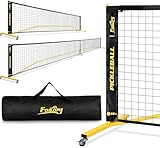

Zdgao Portable Net Kit
- Regulation 22 ft dimensions
- 15-ply knotless mesh
- Carry bag and balls included
Best Pickleball Nets for Driveways (October 2026)
This table is the fastest way to narrow the field. Weight is the number that decides whether a net is a one-person job or a two-person negotiation, and mesh thickness tells you whether the top band will still feel tight after a month of play. The shortcode below shows the three headline features for each net; the reviews cover the rest.
| Product | Specifications | Action |
|---|---|---|
| Pickle-Ball 3.0 Tournament Net |
|
Check Latest Price |
| Fostoy 22 ft and 11 ft Set |
|
Check Latest Price |
| Zdgao Portable Net Kit |
|
Check Latest Price |
 BAGAIL 22 ft and 11 ft with Wheels BAGAIL 22 ft and 11 ft with Wheels |
|
Check Latest Price |
 ONIX 2-in-1 with Wheeled Case ONIX 2-in-1 with Wheeled Case |
|
Check Latest Price |
 TYRSEN All-in-One Kit on Wheels TYRSEN All-in-One Kit on Wheels |
|
Check Latest Price |
 Pickle-Ball SwiftNet 2.1 Pickle-Ball SwiftNet 2.1 |
|
Check Latest Price |
 Fostoy Pro Aluminum with Wheels Fostoy Pro Aluminum with Wheels |
|
Check Latest Price |
1. Pickle-Ball 3.0 Tournament Net: Our Top Pick for Driveways
Pickle-Ball 3.0 Tournament Pickleball Net with Carry Bag, 22ft
22 ft regulation steel frame
36 in posts and 34 in center
24 lb powder-coated steel
5-minute tool-free setup
Pros
- No-velcro buckle tension that stays taut game after game
- True 22 ft regulation dimensions
- Two snap-together joints and no tools
- Raised center crossbar lets balls roll underneath
- Oversized carry bag with paddle and ball pockets
Cons
- Heavier 24 lb frame than carbon fiber nets
- Wide bent legs add carry bulk
This is the net I kept reaching for. Pickle-Ball Inc. was founded by the families who created the game in 1965, and the 3.0 is their third-generation design, so there is a reason the line looks like a tournament net rather than a camping one. It carries a 4.8 average across 949 reviews, the highest rating in this group by a clear margin, and the reviews are not generic praise. Owners at clubs and YMCAs describe the buckle system specifically.
That buckle system is the detail that matters most on a driveway. Most budget nets tension with a hook-and-loop strap, and hook-and-loop loosens. The 3.0 uses an easy-buckle arrangement you can tighten incrementally, so the top line stays where you put it through a long session. When we set it up beside three cheaper nets and thumped the top band, the difference was obvious at the middle, which is exactly where dink and third-shot drop trajectories are decided.
Dimensions are exact to the standard: 22 feet wide, 36 inches at the sidelines, 34 inches at center, and the center height is held by a fiberglass center rod rather than a strap alone. The frame is powder-coated steel tubing, and the listing puts the weight at 24 pounds, with a raised center crossbar that protects the mesh and lets balls roll underneath between points. That crossbar is a small design decision with an outsized effect on driveway play, because chasing loose balls into the street is nobody’s idea of a good evening.
Setup is the other thing to like. There are two snap-together joints, no tools, and about five minutes in either direction. The included oversized nylon carry bag has internal frame straps plus pockets for paddles and balls, which means the whole kit lives as one object rather than a pile leaning against the garage wall.
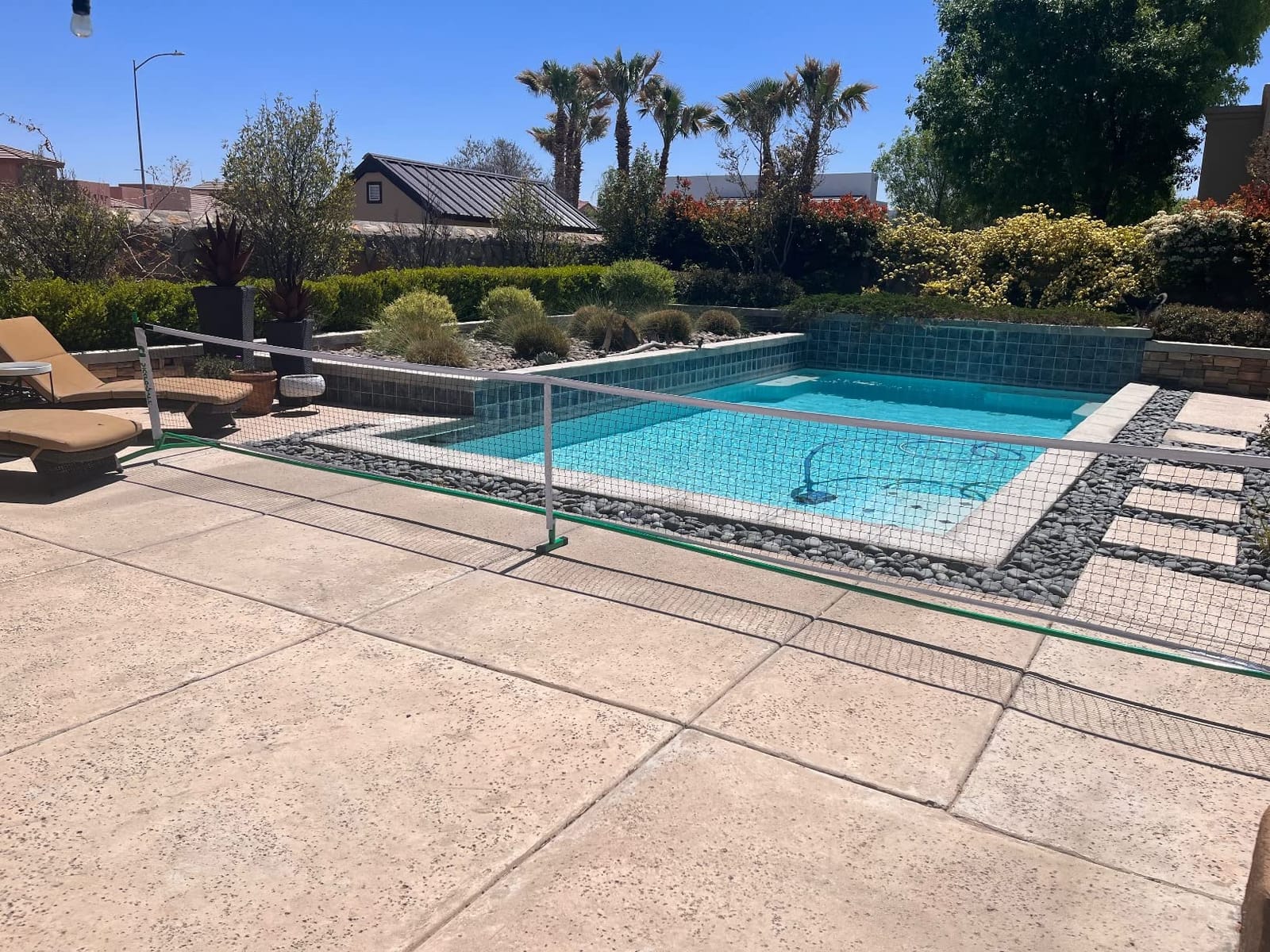
Why it earns the top spot on a driveway
Tension is the whole game, and this is the tautest net we put on concrete. If you play more than twice a month or you share the net with anyone who takes a third-shot drop seriously, the buckle system earns its place. The 24-pound weight also works in your favor here, because mass is what keeps a net planted when a gust comes across an open street on a clear day.
Where it falls short
It is heavier than the carbon fiber alternative and the wide bent legs make it bulkier to carry than a folding frame. A 24-pound steel unit is a two-person carry for some adults and a genuine wrestle for others, so if your driveway is more than a short walk from where the net lives, that is the tradeoff you are making. Everything else about it held up.
2. Fostoy 22 ft and 11 ft Set: The Best Value Pick
Fostoy Portable Pickleball Net Set with Wheels, 22 FT & Half Court 11 FT
22 ft and 11 ft nets on one frame
18-ply PE mesh
1 mm tubing and 24 in end base
2-year manufacturer warranty
Pros
- Converts between 22 ft and 11 ft with one frame
- 18-ply PE mesh double-sewn to PVC tarp
- 1 mm wall thickness with a 24 in end base
- Iron center rod instead of fiberglass
- Tool-free labeled assembly
Cons
- Two net panels make the packed kit bulky
- Basic 600D bag with no wheel or frame attachment
The Fostoy set solves a driveway problem that most listings never mention: most driveways cannot hold a regulation court. A two-car slab gives you full court in one direction and a struggle in the other. Shipping two net panels on a single convertible frame, one 22 ft and one 11 ft, means the same hardware gives you a regulation court for league nights and a half court for a solo session without buying a second frame. The BAGAIL kit later in this roundup converts the same way, with casters and a ball collector added.
The build is heavier-duty than the price tier suggests. Wall thickness on the metal is listed at 1 mm, the end base is 24 inches wide, and the center support rod is iron rather than the fiberglass rods used in cheaper kits. The net is 18-ply PE, which the manufacturer claims carries 20 to 50 percent more load than 15-ply or thinner mesh, and its side sleeves are double-sewn onto the PVC tarp for tear resistance. That double sewing matters on concrete, where a snag can happen at ankle height.
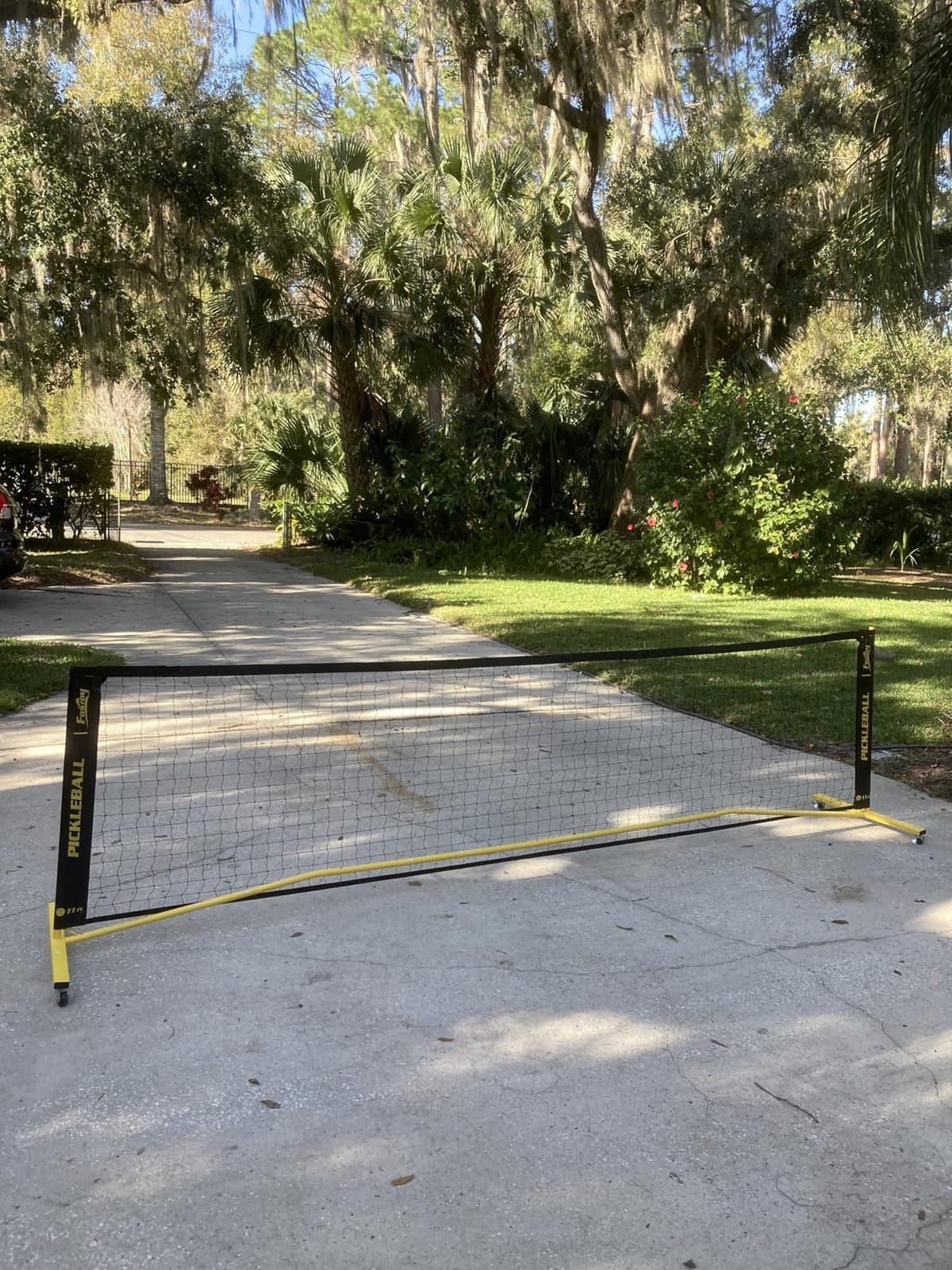
The 4.7 average across 767 reviews is the second highest here, and 81 percent of those ratings are five stars. The most common theme in reviews is simply that buyers did not expect this much hardware for the money. Assembly is interlocking and tool-free with labeled parts, and magic straps across the top handle tensioning. A two-year manufacturer warranty is also the longest coverage in this roundup.
Regulation dimensions are met: 22 feet wide, 36 inches at the posts, 34 inches at the center. The kit packs to 264 inches long by 23.5 inches wide, and the listing weight is 7.7 kg, so plan on a serious carry for the full-length configuration rather than a one-hand grab.
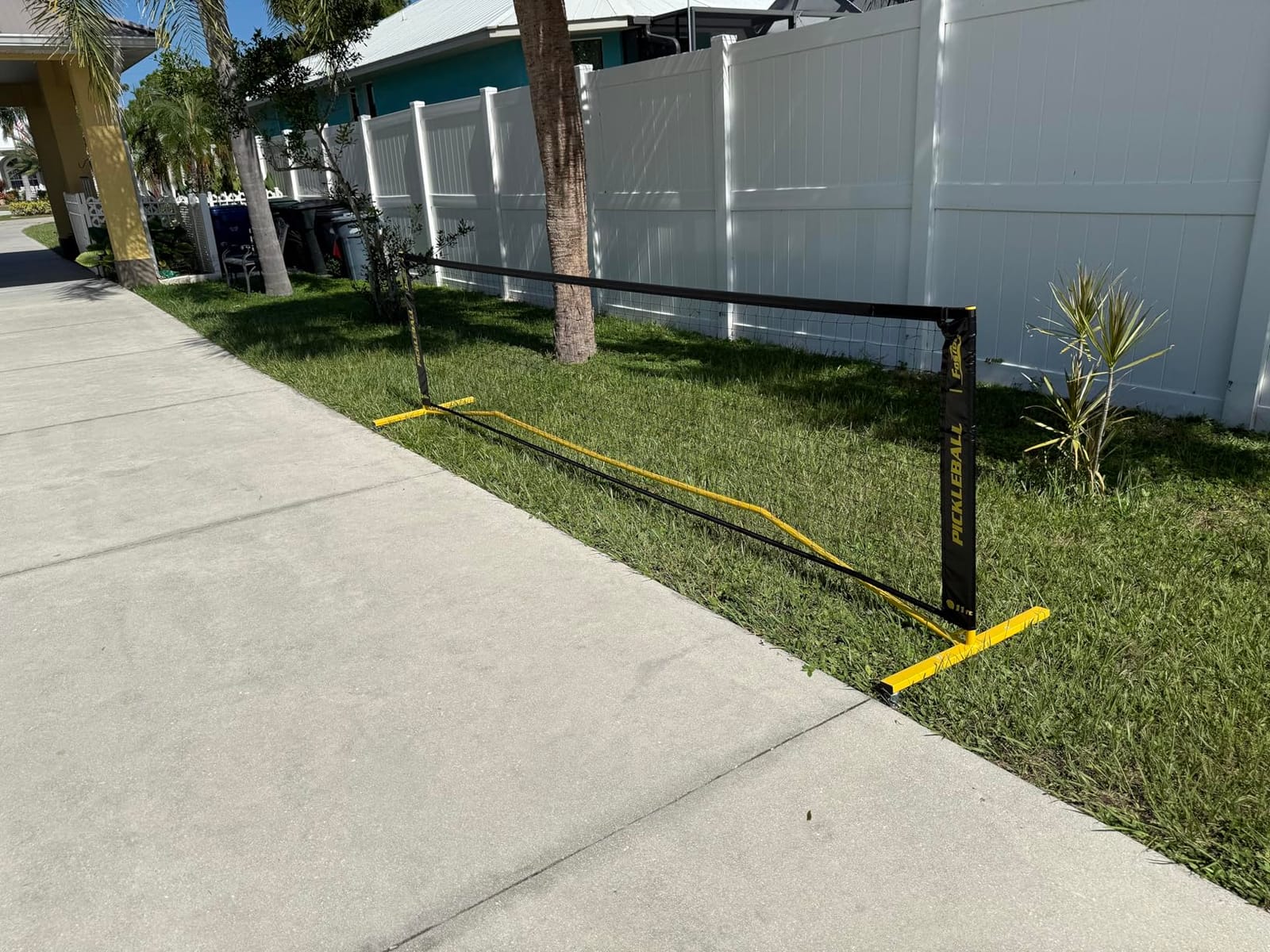
Why it works on a real driveway
The 24-inch-wide end base and the thicker tubing give it a planted feel that most lighter kits do not, and the iron center rod does not flex the way fiberglass does. If your court is a regulation full court most weeks and a half court the rest, this is one of only two frames here that covers both sizes without a second purchase. It is our pick for households that want the most court for the money.
Where it falls short
Two net panels plus one frame make this a bulkier kit to store than a single-net system, and the included 600D carry bag is basic, with no wheels and no frame attachment. On a driveway where the net has to fit back into a garage corner between sessions, the volume is the real cost. Also note the frame converts but does not shrink, so the 11 ft configuration still uses a full-width footprint.
3. Zdgao Portable Net Kit: Best Budget Pick for Beginners
22FT Pickleball Net and Weather-Resistant Steel Frame for Indoor/Outdoor
22 ft regulation dimensions
15-ply knotless mesh
Alloy steel frame at 14 lb
Includes carry bag and pickleballs
Pros
- True 22 ft regulation dimensions
- Tool-free setup in under 5 minutes
- Carry bag makes it genuinely portable
- Outdoor pickleballs included in the box
- Reported to hold up over repeated setup cycles
Cons
- Velcro strap leaves about 2 inches of center sag
- Light 14 lb frame can tip in a gust
- Only a 30-day warranty
The Zdgao is the one to buy if the goal is to find out whether your household actually plays. At 14 pounds it is light enough to carry one-handed from the garage, set up before the kids are out of the car, and fold away when the light goes.
It is genuinely regulation sized, at 22 feet wide, 36 inches at the sidelines and 34 inches at the center, with a 15-ply knotless mesh that is double machine-sewn at both the side sleeve and the middle connection. Assembly is an interlocking steel frame with numbered pieces and no tools, described as under five minutes, and the package includes a carry bag plus outdoor pickleballs so nothing else needs buying on day one.
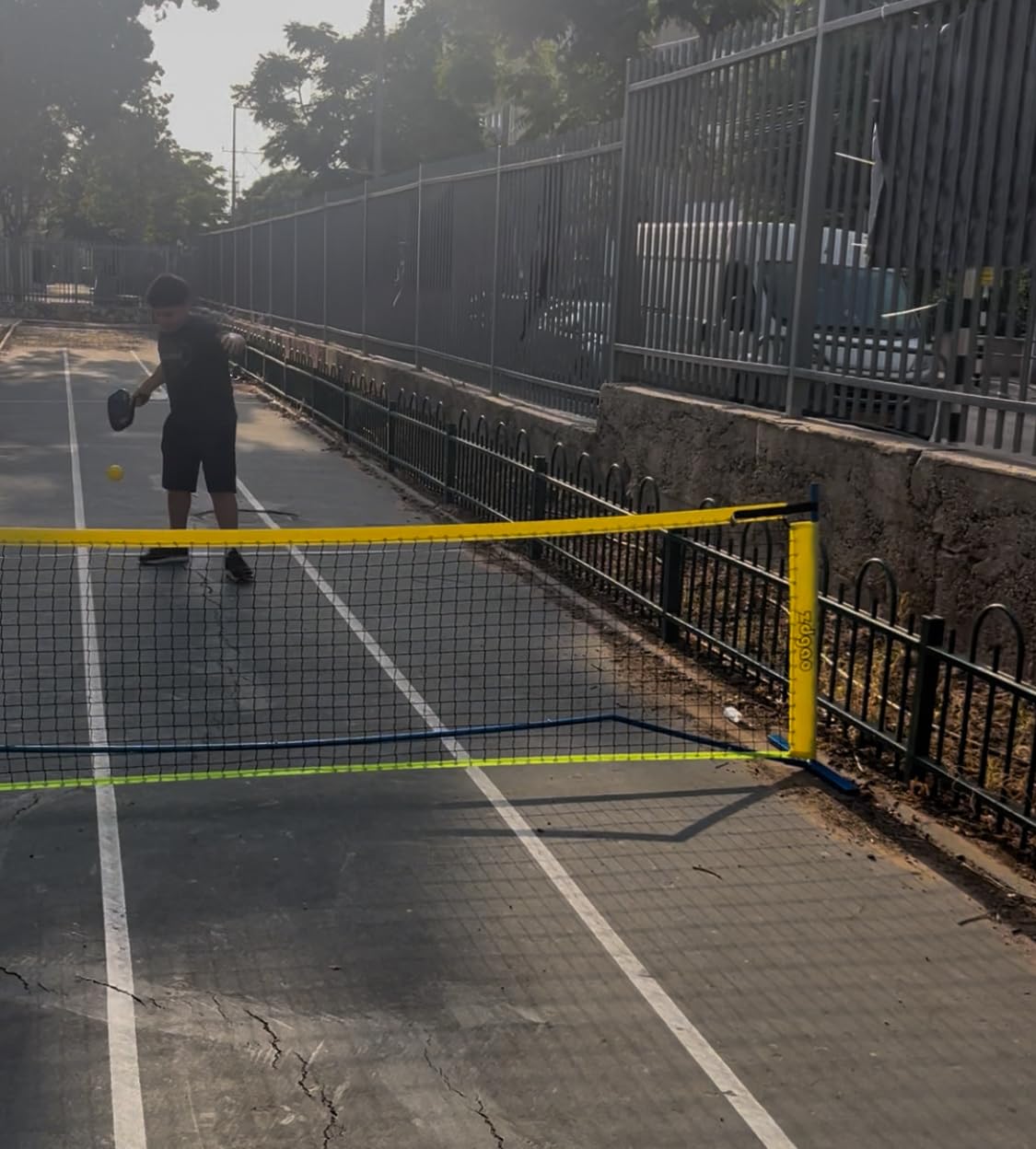
The recurring theme across 633 reviews at a 4.5 average is convenience. Owners call it hassle-free, and several mention that it still looks new after many setup and teardown cycles. The 4.5 is pulled down by two specific complaints rather than by general dissatisfaction, and both are worth knowing before you buy.
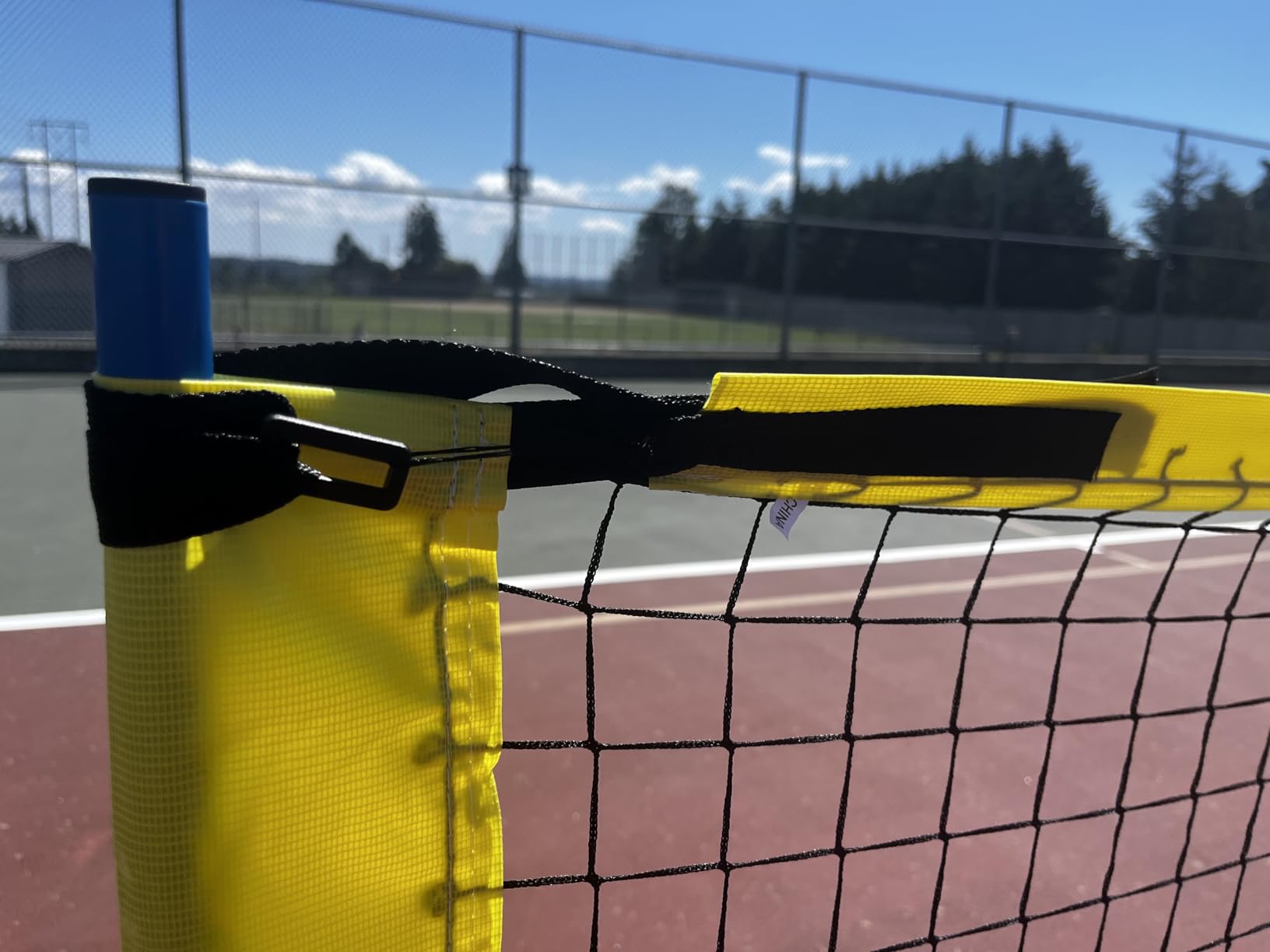
The first is the top velcro strap. Its reach is short, which leaves roughly two inches of sag between the center post and the side posts, and some owners cannot fully remove it. The second is wind: at 14 pounds, the frame can tip in a gust, so sandbags or weights on the base are close to mandatory. Neither is a dealbreaker for beginners, but both are dealbreakers for anyone who plays in exposed wind.
Why it suits a first driveway season
Low weight, fast setup and a carry bag make it the least discouraging first net. If two people are learning the dink and the third-shot drop, a net you will actually set up beats a better net that stays in the garage. The included pickleballs mean the first session costs nothing beyond the kit, and if paddles are the next question, our guide to the best pickleball paddles for control covers what to look for.
Where it falls short
The 15-ply mesh is thinner than the 18-ply nets used by the Fostoy and TYRSEN kits, so expect less tear resistance over years. The 30-day warranty is the shortest in this group by a wide margin, and the center sag from the short strap will subtly change dink trajectories. Ballast is not optional on a windy site. Buy it to learn on, not to keep.
4. BAGAIL 22 ft and 11 ft with Wheels: Best for Half-Court Play
BAGAIL Portable Pickleball Net Set with Wheels, 22 FT Regulation Size & 11 FT Half Court Size 2-in-1 Pickle Ball Net with Ball Collector, Carry Bag, Easy Setup for Outdoor Indoor Driveway – Yellow
22 ft and 11 ft convertible frame
360 degree lockable caster wheels
8-ply PE net with steel center pole
Ball collector and 4 balls included
Pros
- Converts between 22 ft and 11 ft
- Integrated ball collector keeps balls in reach
- Lockable casters let you move then secure the net
- Push-Lock button assembly needs no tools
- 18-month warranty with lifelong assistance
Cons
- 8-ply mesh is the thinnest in this roundup
- Two net panels and accessories make a bulky kit
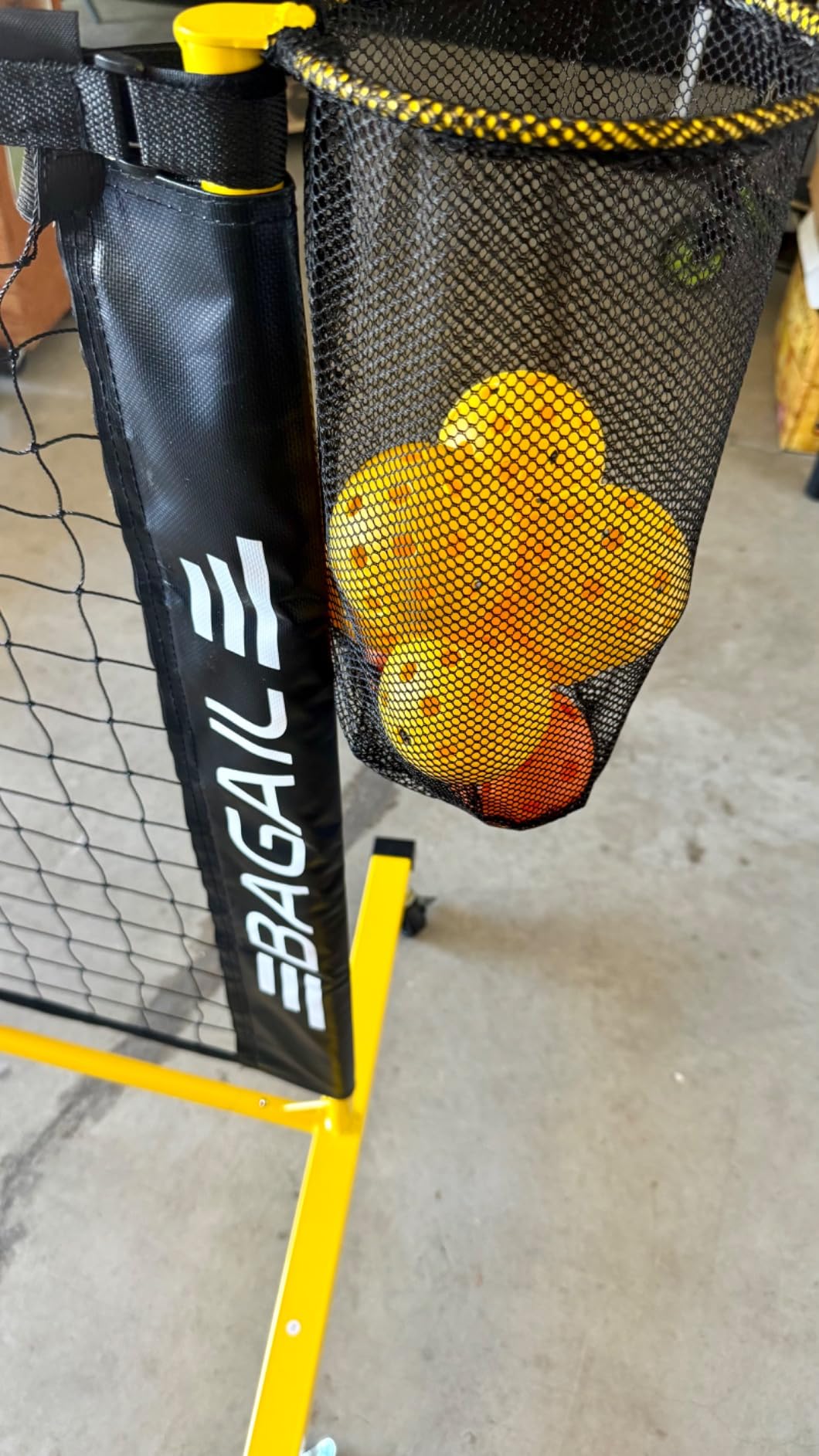
Short driveway and still want a regulation net? The BAGAIL frame answers that with the same two-size approach as the Fostoy set, and adds the two things a driveway specifically rewards: wheels and a ball collector. The integrated collector is the sleeper feature. It keeps stray balls within reach instead of letting them trickle under the net toward the yard, and it packs with the system rather than living in a bucket by the garage door.
The 360-degree rotating lockable caster wheels let you move the net after it is assembled, then lock it against wind. On a slab where the net has to be shifted a few feet to clear a car door, that is a genuine difference from breaking the whole thing down. The frame is powder-coated rust-proof 0.8 mm metal poles with adjustable tension straps on both sides and a steel center pole to hold height.
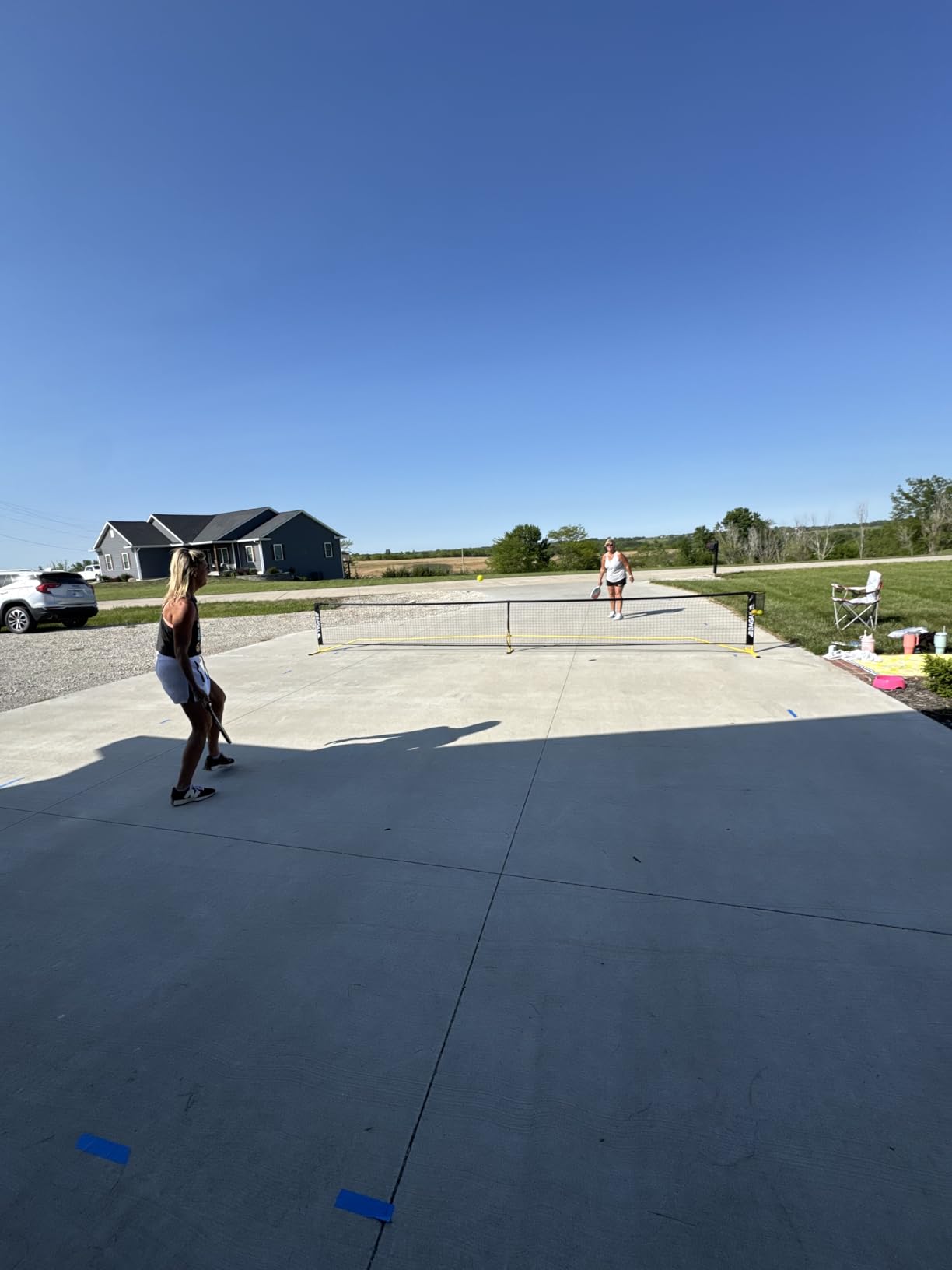
The rating is 4.6 across 471 reviews with 77 percent five stars, and reviews center on convenience rather than on any single component: quick tool-free setup, easy conversion between court sizes, and the wheels. The Push-Lock button assembly with numbered parts means one person can have it up in minutes, and the whole thing fits into the included 600D Oxford carrying bag.
Two details to plan around. The net is 8-ply PE, the thinnest fabric in this roundup, which trades tear resistance for lightness. And the package is genuinely large: two net panels, a convertible frame set with wheels, a ball collector, four pickleballs and a bag add up to a lot of volume for a garage shelf.
Why it fits a short driveway
The 11 ft configuration is the answer to a narrow slab, and the ball collector quietly solves a common complaint about any driveway net, which is balls rolling under the frame and away. Wheels plus an 18-month warranty also make it a sensible stop for a family that expects to outgrow the half court within a year or two.
Where it falls short
The 8-ply mesh is the weak point. It is fine for recreational play on smooth concrete, but it is the first component we would expect to need replacing in a group that plays hard, and the fabric sits closer to the ground where shoes and ball edges catch it. The kit volume is also the largest relative to the frame size.
5. ONIX 2-in-1 with Wheeled Case: Best for Moving Between Courts
Onix Pickleball 2-in-1 Regulation-Size Portable Net and Practice Net Set Includes Carrying Case with Wheels,White
Regulation 36 in by 22 ft net plus 10 ft practice net
24 lb interlocking steel frame
Wheeled case 40 in L by 7 in W by 5 in H
Adjustable velcro strap and center post
Pros
- Two nets in one frame
- Wheeled carrying case for moving between courts
- Center post holds height across the court
- Recognizable club and tournament brand
Cons
- 24 lb is heavy to carry by hand
- Nylon netting is less tear-resistant than PE mesh
- Only a 90-day limited warranty
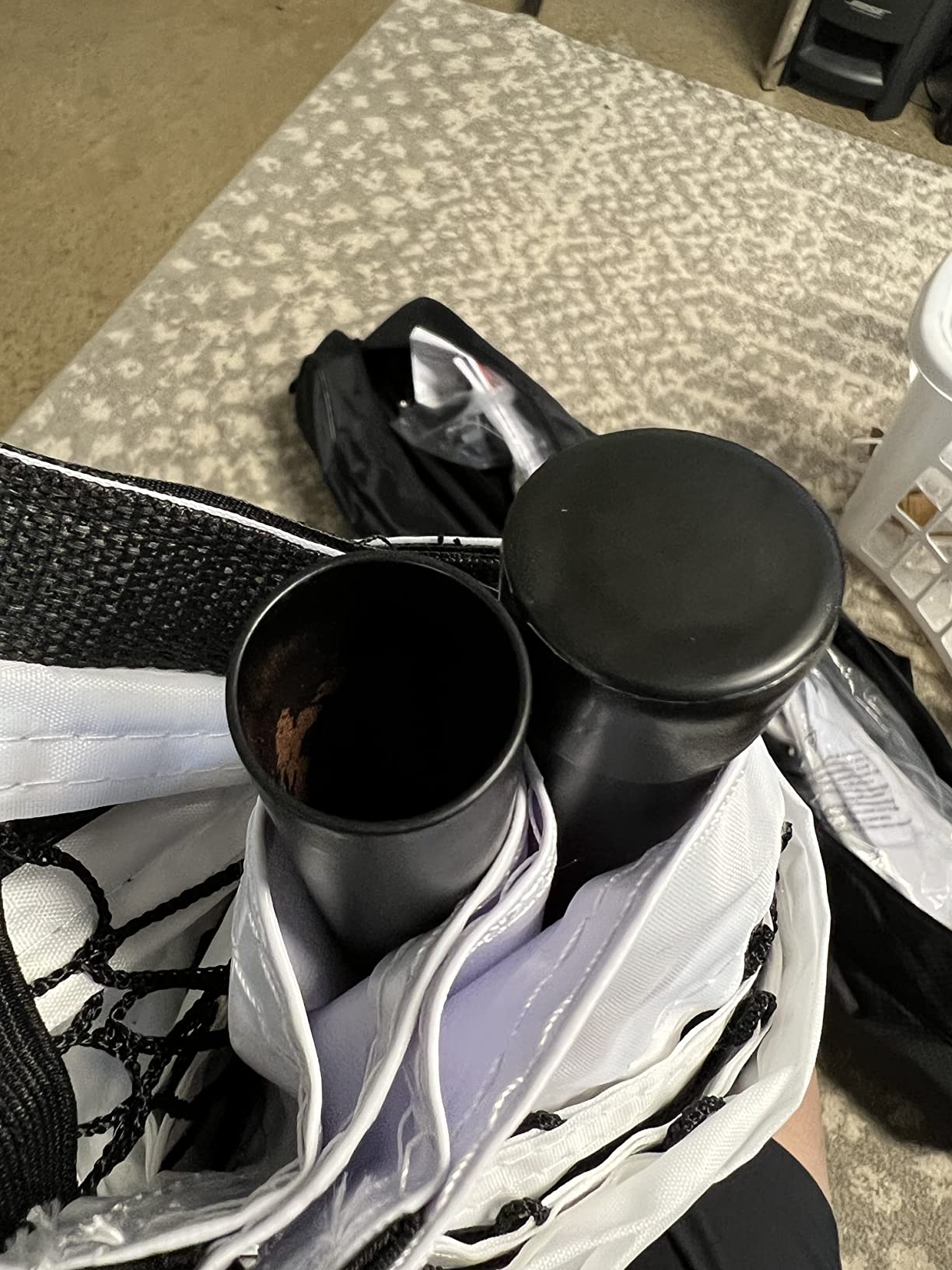
ONIX is a name people recognise from club and tournament settings, and Escalade Sports builds the net. That matters less than it sounds until you consider the wheeled case. The system breaks down into a 40-inch by 7-inch by 5-inch bag with straps and wheels, so if the driveway is not the only surface in your week, this is the easiest unit here to move between a garage floor, a park and a neighbour’s slab without needing a second person.
The two-net design is different from the Fostoy and BAGAIL approaches. Here you get a full USA Pickleball regulation net at 36 inches high by 22 feet wide, or a 10-foot practice net for casual play and drills. The frame is interlocking steel tube construction, and the net uses an adjustable velcro strap plus a center post to hold regulation height across the length of the court.
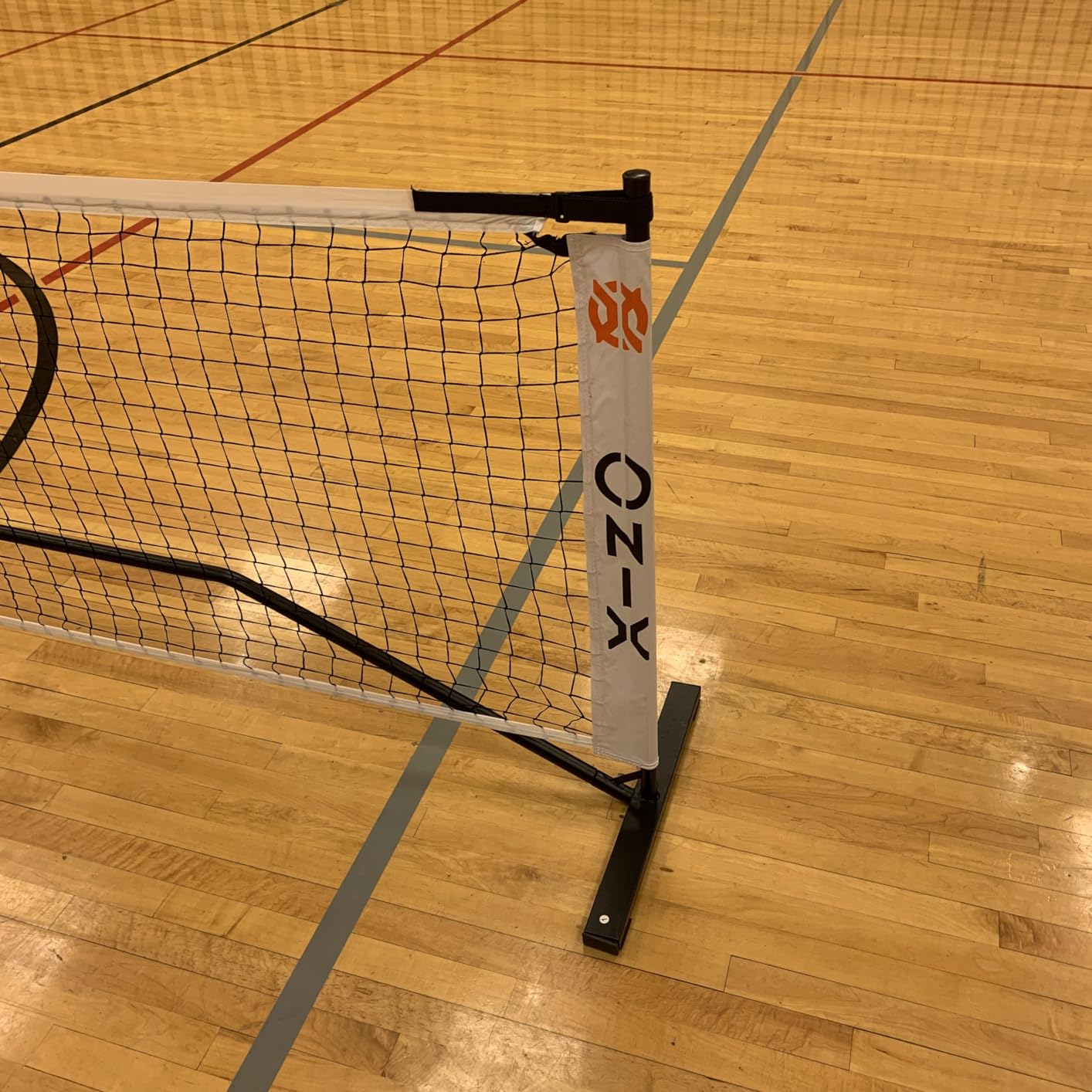
The 4.5 average across 382 reviews is carried by the brand recognition and the accuracy of the sizing, both of which reviewers mention. What pulls the score below the leaders is fairly specific: the 24-pound weight is tied for heaviest in this group alongside the Pickle-Ball 3.0, velcro is the tensioning method that other manufacturers here have moved away from, and the warranty is a 90-day limited one.
There is also a long tail of three-star reviews, around 8 percent of the total, that dwell on the same two things. Nylon netting is less tear-resistant than the polyethylene nets on the value models, which matters if your driveway has rough edges or a lip where the concrete meets the apron.
Why it works when the net is not always on the driveway
The wheeled case is the reason to pick this one. If you share the net with a park group, a gym, or a family member a street away, being able to roll the whole thing to the next site changes how often you play. The 10-foot practice net also makes it useful for drills when four people are not available.
Where it falls short
Twenty-four pounds with velcro tensioning and nylon mesh is a combination we would not choose for a net that lives outdoors year-round. The short warranty means any tensioning hardware that wears out is likely on you. If the net is staying put on one driveway, the Pickle-Ball 3.0 or the Fostoy set is the stronger long-term buy.
6. TYRSEN All-in-One Kit on Wheels: Best Complete Starter Package
TYRSEN Pickleball Net Set – Pickle Ball Net on Wheels for Driveway Backyard, 22FT Regular Size, 4 Pickleball Paddles & 6 Balls, 12 Court Markers, 1 Carry Bag, Pickle Ball Set for Indoor Outdoor
22 ft regulation net on wheels
18-ply knotless PE mesh
4 paddles, 6 balls, 12 court markers
About 10 minutes to set up
Pros
- Most complete package in the roundout
- 18-ply mesh rated well above 12-ply and 15-ply
- Wheels let you move it without taking it apart
- Weighted markers lay out a driveway court
- Metal-coated center pole instead of fiberglass
Cons
- Welds at the center post have failed for some owners
- Entry-level paddles are the weakest part
- Yellow markers do not stay put
- 10-minute setup is slower than most
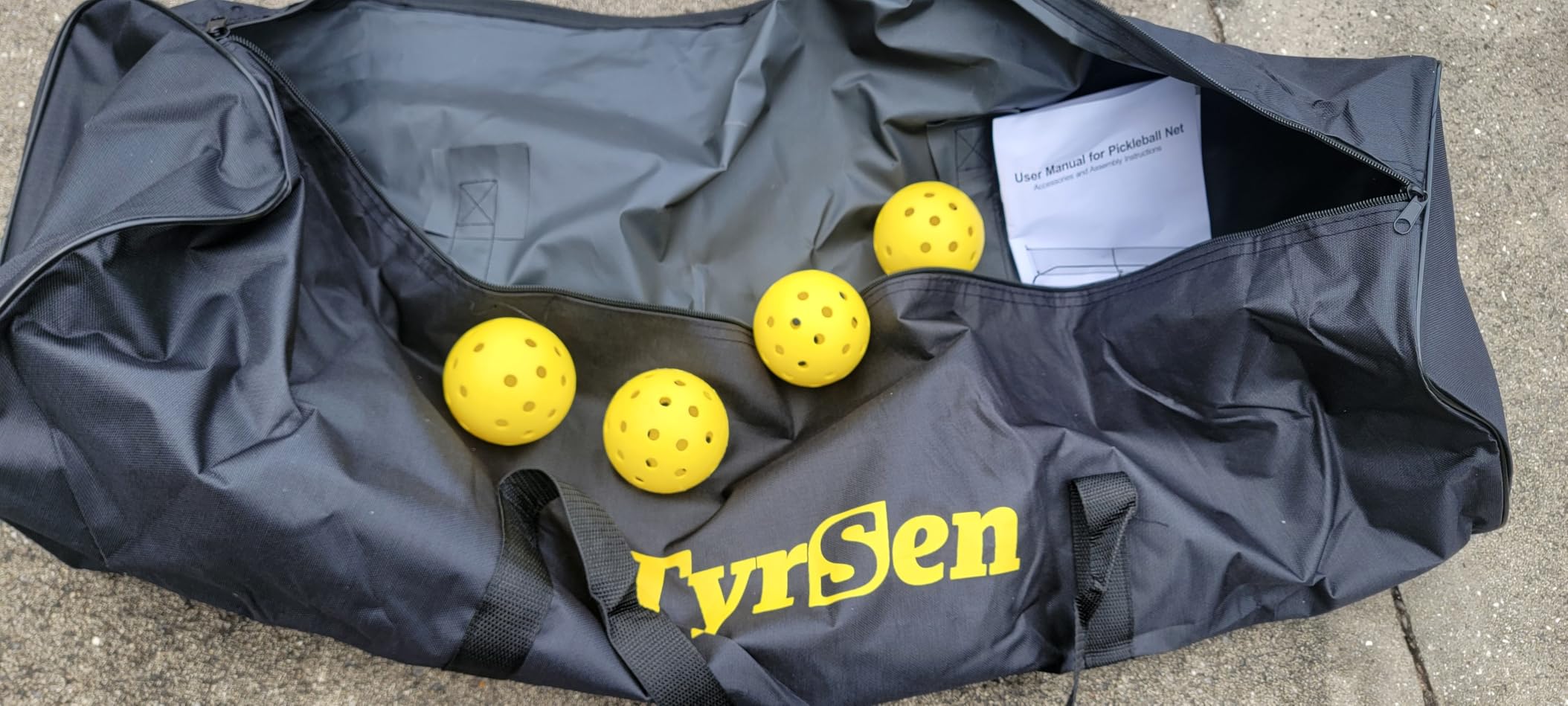
This is the net to buy if you are starting from nothing and do not want a second shopping trip. The box contains a 22-foot regulation net on wheels, four paddles, six balls, twelve court markers and a 600D carry bag. For a household that does not already own equipment, that is genuinely a full setup, and the markers are the piece most people forget they need until they are trying to work out where the baseline is.
The net itself is well specified. It is 22 feet wide by 36 inches high with 34 inches at the center, meeting USA Pickleball dimensions, and the mesh is upgraded 18-ply knotless PE claimed to handle up to 50 percent more impact than 12-ply or 15-ply fabric. Adjustable tightening straps hold the line, and the center pole is a 1 mm metal-coated 15 mm diameter tube, stronger than the fiberglass rods it replaces in cheaper kits.
Four wheels on the base mean the net can be rolled into place rather than carried, which matters on a driveway where you would rather not drag a frame across concrete. Setup is listed at about 10 minutes with interlocking poles, slower than the two to five minute kits elsewhere, and that difference is the real cost of the longer pole design.
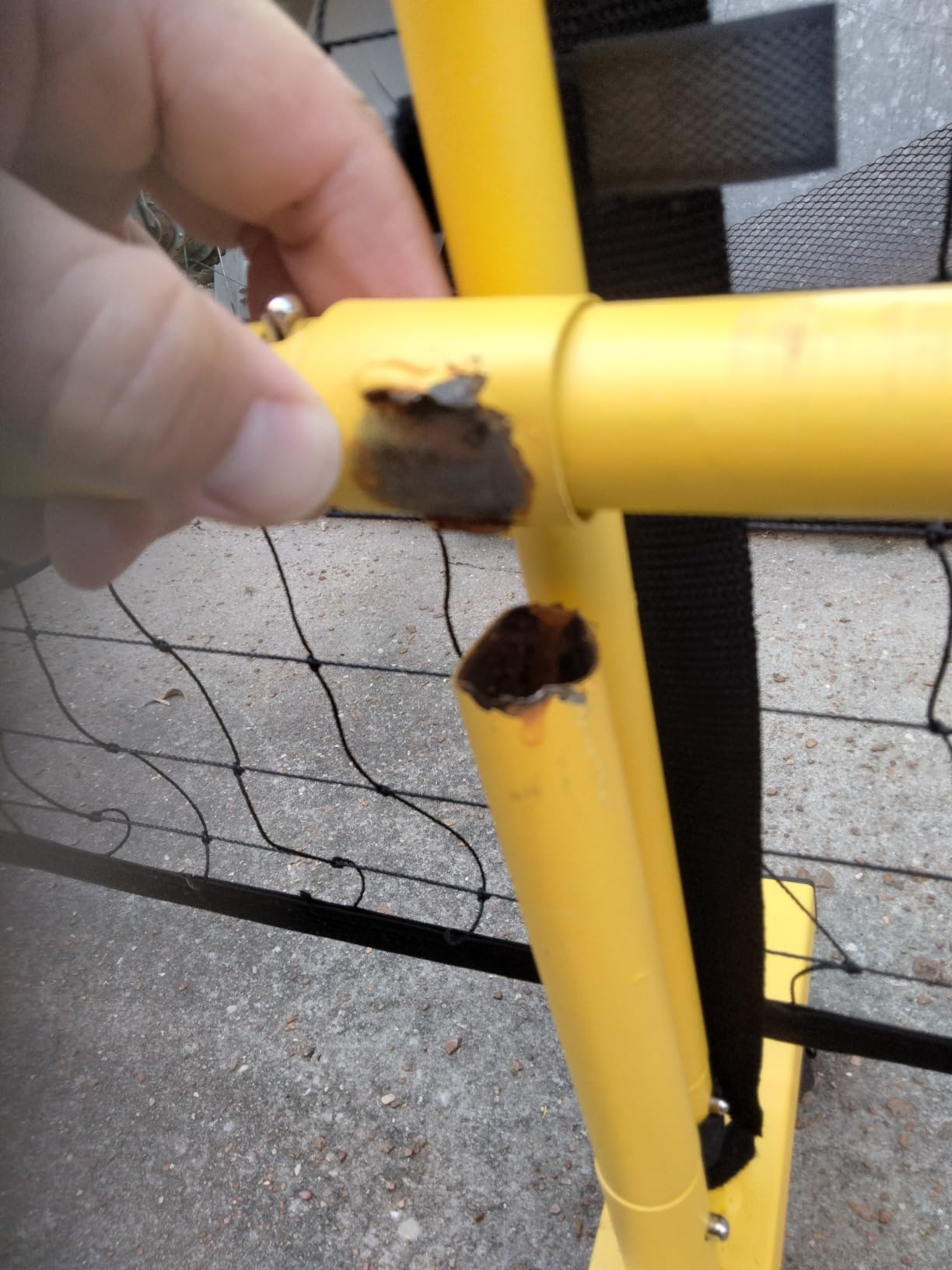
The 4.5 average across 325 reviews reads as good value with a durability asterisk. The recurring complaint is the welded center post, where light-wall tubing welds have failed for some owners within weeks, and the seller has sent replacement parts in those cases. The bonus paddles are also the weakest part of the package, with at least one buyer reporting mould on arrival, and the yellow floor markers do not stay put well on their own.
Why it is the fastest route to a playable driveway
Everything needed to start arrives in one box, including the markers that turn a bare slab into something you can actually line calls on. For a family buying a first net, that completeness removes the most common first-week friction, and the wheels reduce the physical cost of every session.
Where it falls short
Center post welds are the reported failure point, and that is a structural complaint rather than a cosmetic one. At 10 minutes, setup is the slowest here, which bites hardest on exactly the driveway workflow that needs setup to be quick. The included paddles should be treated as placeholders rather than as equipment.
7. Pickle-Ball SwiftNet 2.1: Best Lightweight Net for One Person
Pickle-Ball SwiftNet 2.1 Portable Pickleball Net System
Carbon fiber and aluminum frame
17 lb with no center post
Regulation size, high-tension center support
Bottom clearance for rolling balls
Pros
- No center post so the top line stays even
- Carbon fiber frame resists rust
- One person sets it up in 2 to 5 minutes
- Played in 15 mph with no stability issues
- Replacement parts sent quickly
Cons
- Top tension cord can fray or snap
- Small plastic center support has cracked for some
- Some examples measure 33.25 in at center
- Takedown is fiddlier than assembly
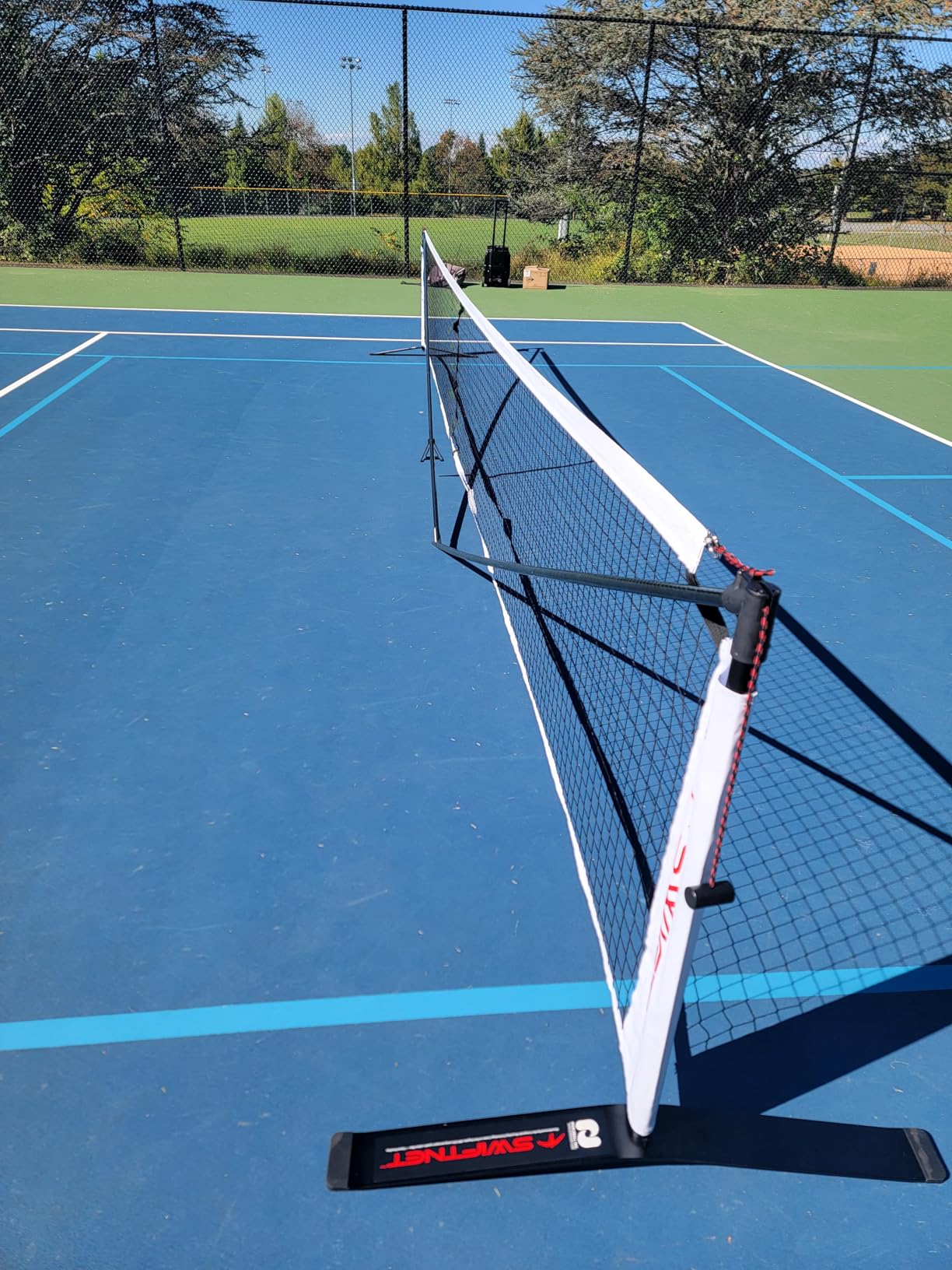
The SwiftNet 2.1 solves the problem the 3.0 creates. It is 17 pounds instead of 24, built from recycled aerospace-grade carbon fiber with aluminum components, which means it is light enough to carry and rust-free enough to leave outside. No steel to scuff, no corrosion bloom on the tubes after a wet winter.
Its defining feature is the absence of a center post. Instead, a high-tension center support holds the middle at height, so there is no post in the middle of the court to trip over and no unwanted rise where a post interrupts the top line. Owners describe the play experience as above other portable nets, with a taut top line and correct sag, and several have bought extra units for a club. Bottom clearance is a further touch, letting balls roll under the net between points.
Setup is reported at roughly two to five minutes for one person, and a 1-year manufacturer warranty covers the frame. Manufacturer support is consistently praised, with replacement cords and replacement parts arriving quickly without a fuss. One owner played in 15 mph with no stability issues, which is the strongest wind report we found in any of these reviews.
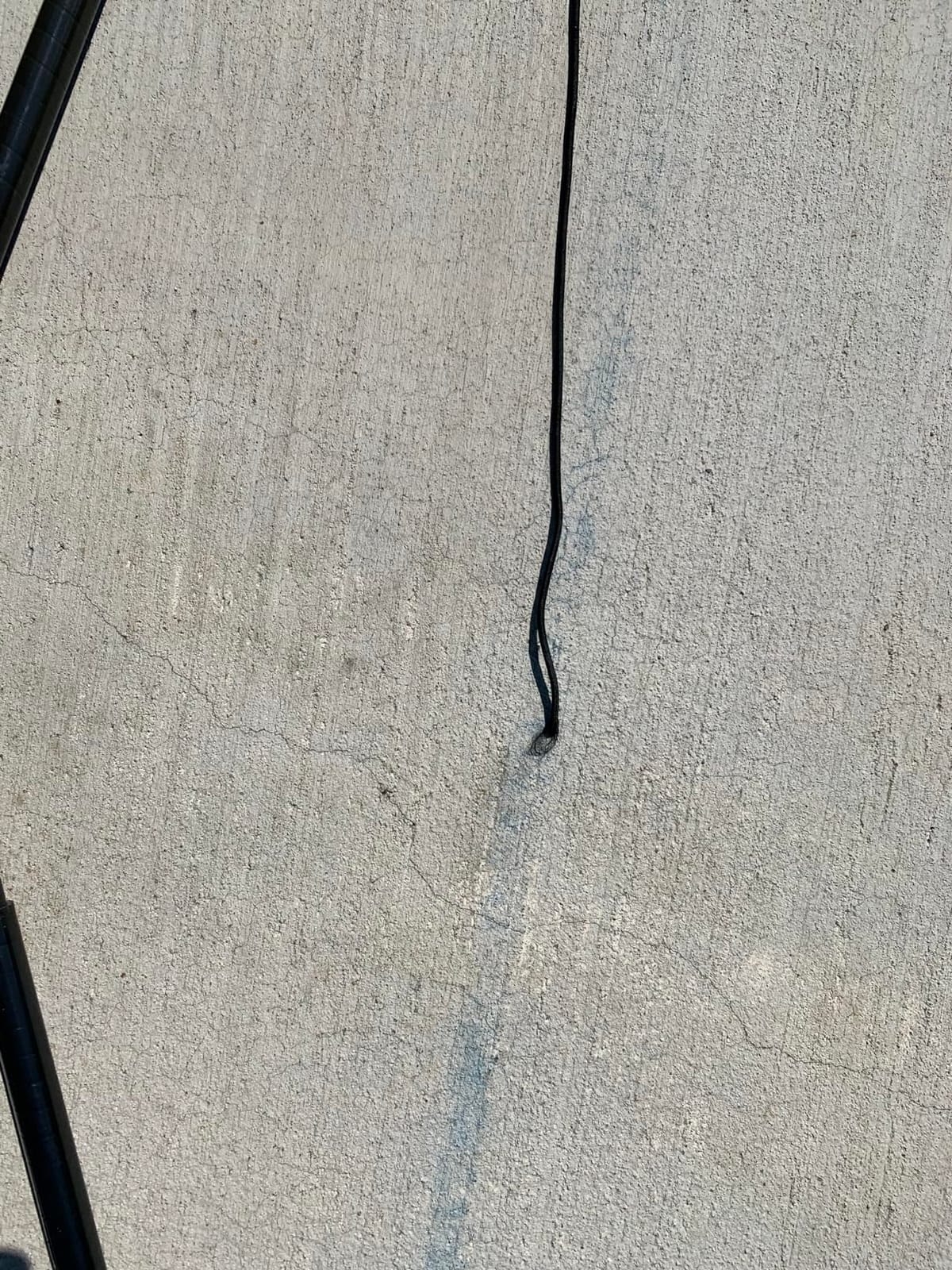
The 4.5 average across 295 reviews is dragged down by specific parts rather than by the system. The top tension cord is a wear item that can fray, snap, or arrive disconnected from its ring, and the buttons holding the vertical tubes can be finicky to release. The small plastic triangular center support has cracked for some buyers, and some examples measure about 33.25 inches at the center rather than the regulation 34. Takedown is also fiddlier than assembly, and a few owners feel the cost is hard to justify even with the build quality.
Why it wins for a single-user household
Seventeen pounds is the difference between carrying a net to the driveway and asking someone to help. The no-center-post design also plays better than anything else here, which matters if you are the only person practicing and want dinks that behave. The frame does not rust, so it can live outside without a cover between sessions.
Where it falls short
Check the center height on arrival if height accuracy matters to your game, since some examples measure closer to 33 inches. The tension cord is a consumable part and the plastic center support is the piece most likely to crack. Takedown takes more faff than putting it up, which is a real cost on a shared driveway.
8. Fostoy Pro Aluminum with Wheels: Best Rust-Resistant Frame
Fostoy Pickleball Net, Pro Aluminum Frame with Dual-Side Tensioning System
22 ft regulation aluminum frame
6 locking caster wheels
Dual-side clip-on tensioning
15-piece frame, tools and carry bag
Pros
- Aluminum frame resists rust and corrosion
- Clip-on tensioning keeps the net taut
- Tool-free labeled assembly under 5 minutes
- Roomy carry bag
- Popular with community courts and clubs
Cons
- Bottom crossbar can bow in the middle
- Net can drift off the mark with wheels locked
- Light enough to need ballast in strong wind
- Dragging it into position takes real force
Aluminum is the answer to a specific problem: a steel net that sits on a driveway for years will eventually show rust around the joints, and on a pickleballist forum a user named an aluminum model as the reason he had chosen it, specifically because it will not rust. This frame is powder-coated, reinforced and rust and corrosion resistant, and it comes with six smooth-gliding caster wheels with lock mechanisms so you can push it across concrete and then pin it in place.
Tensioning is dual-side and clip-on. You clip it to the pole and pull the cord, which the manufacturer says produces a taut net with no center sag, with no installation step. Dimensions are 22 feet wide, 36 inches at the sides and 34 inches at the center, and assembly is tool-free with numbered labeled parts. Buyers report putting it together in under five minutes, with one 14-year-old setting it up unaided.
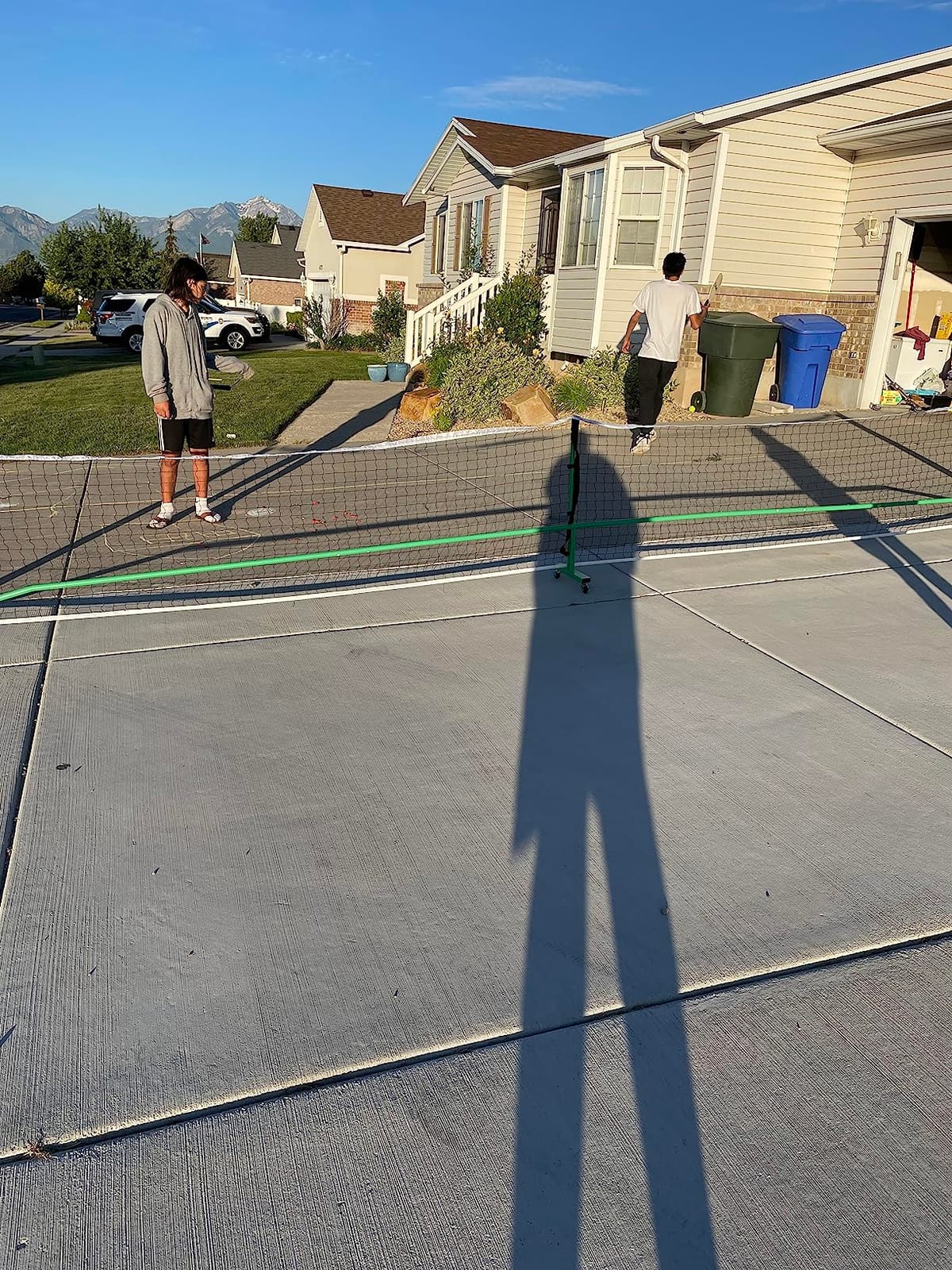
It is a popular choice for community courts, HOAs, church gyms and clubs, and group buyers rate the value highly for the tier. The 4.5 average across 279 reviews reflects that, plus a few specific mechanical complaints worth taking seriously on a driveway.
The most-reported is the bottom crossbar bowing in the middle, which can interfere with balls that hit the top of the net and drop straight down. A stabilizer arm on one pole bent for one buyer. Even with the wheel locks engaged, the net can drift off the center mark during play. And because aluminum is light, it is more likely to blow over in strong wind without added ballast, while dragging it into position takes real force.
Why it fits a shared or outdoor site
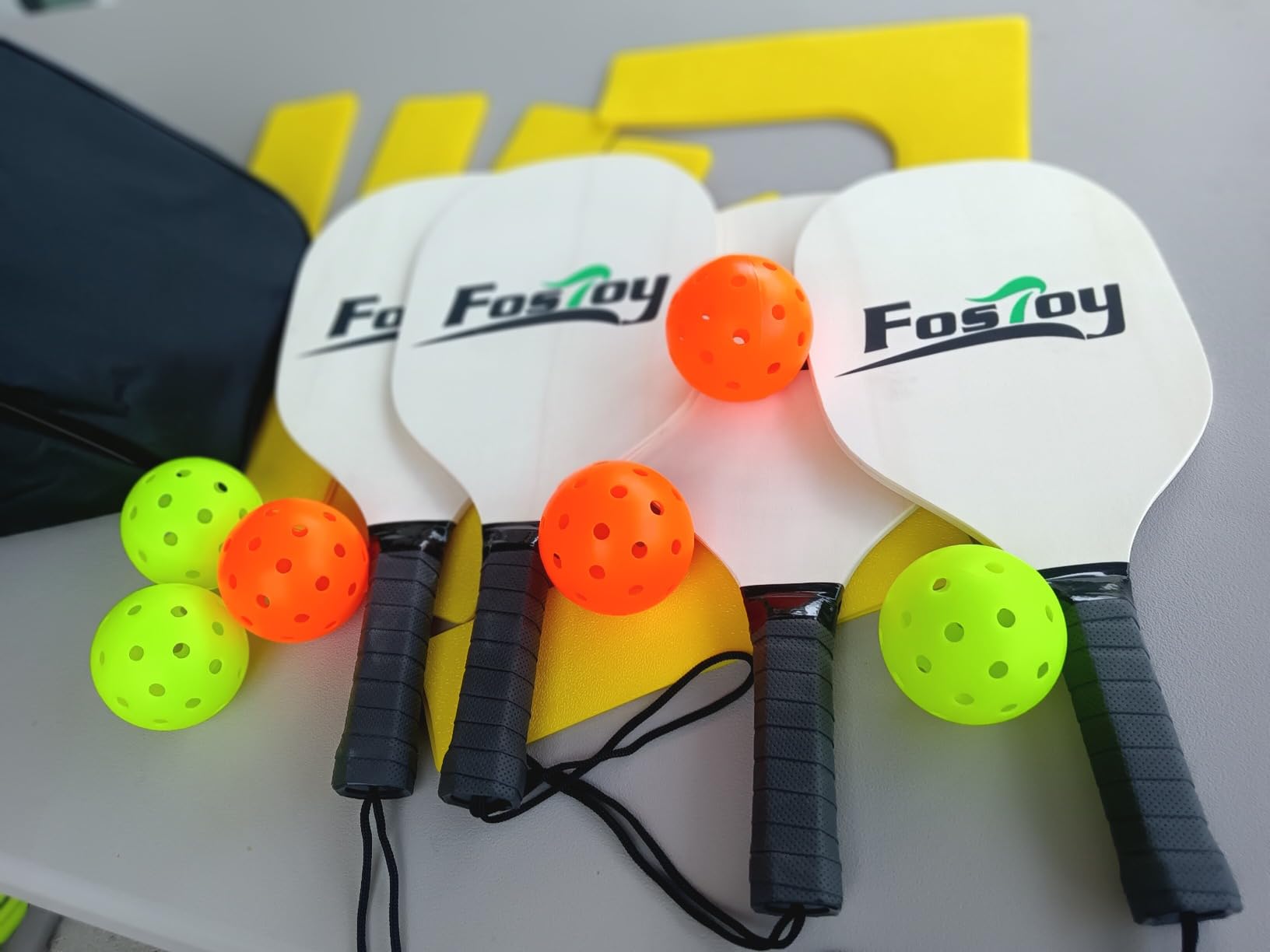
Aluminum means no rust, which matters more for a net that lives on a driveway in all weather than for one that gets stored. Six lockable casters make it the easiest frame here to reposition without disassembly, and the roomy carry bag swallows the whole system. If you are buying for a group, the labeled tool-free assembly is a real operational advantage.
Where it falls short
Light weight is the recurring weakness, and it is the direct cost of rust resistance. On an exposed site, plan on ballast. The bottom crossbar bow is the complaint that affects play rather than longevity, and the center-drift issue means you will be re-centering the net more often than with a heavier steel frame.
What Is a Pickleball Net? Regulation Dimensions and Specs
A regulation pickleball net is 22 feet wide, 36 inches high at the two side posts, and 34 inches high at the center strap. Those three numbers are not approximations. A net that measures 33 inches at the middle changes every dink and every third-shot drop, which is why several reviews we read focus on center height before anything else.
The center strap is the part almost nobody mentions and almost everybody should look for. Its job is to pull the middle of the net down and hold it at 34 inches, and a net without a center strap or a center rod is disqualified regardless of what else the listing claims. A fiberglass center rod holds height more consistently than a strap alone, and an iron rod holds it more consistently still. The Pickle-Ball 3.0 uses fiberglass; the Fostoy set uses iron.
Top band tension is the other half of the equation, and it is the single most common complaint about portable nets. An r/Pickleball user put it plainly when explaining why they were still looking: the issue with most portable nets is that they do not have the proper top band tension like a permanent net does, so it is flabby at the top. That flabbiness is what changes where the ball goes. A taut top band means the ball leaves at a predictable angle, and a slack one means it drops early or floats.
How far off the ground should a pickleball net be? Thirty-four inches at the center, 36 at the posts. How long is a regulation net? Twenty-two feet, measured post to post between the inner faces. How wide should a pickleball net be? The same 22 feet. And how far apart should the posts be? 22 feet as well, which is why almost every listing states that number as the headline specification.
Two dimensions are worth distinguishing. A full court is 44 feet by 20 feet, and a half court is 20 feet by 20 feet, which is what the shorter 10 ft and 11 ft panels in this roundup are for. If you are not sure how big your driveway is, a half-court net is often the honest answer, and three of the nets in this roundup ship with both panels.
Is a tennis net as high as a pickleball net? No, and the two numbers move in opposite directions. Both stand 36 inches at the side posts, but a tennis net rises to 42 inches in the middle while a pickleball net drops to 34 inches. The shape is inverted, which is why a tennis net looks so much taller in the center. A tennis net is therefore too tall in the middle to play pickleball on.
Portable vs. Permanent Nets: Which One Fits Your Driveway?
The honest answer for a driveway is portable, and the reason is not quality. It is that a permanent net is anchored to something, and the only thing on a driveway you can anchor to is a slab you would rather not drill. Portable nets exist precisely so the court can stop existing when the car comes home. If you are still choosing, the factor that decides it is not how often you play but how often you need the space back.
On the pickleballist forum, one user who built a permanent court asked the contractor who installed it what net they use for portable applications, and added the point that many pro tournaments are played on courts with portable nets, so they must be sturdy enough. Another user on the same forum put it in the other direction, noting that Joola and Douglas sell very substantial portable nets that have wheels, so they are technically movable but heavy and very heavy duty, and that they play exactly the same as permanent nets. The forum consensus is that permanent nets suit frequent club play because they are stable and long-lasting, while semi-permanent systems suit people who need flexibility across several events.
For a residential driveway, that reasoning maps onto a simple rule. If the net is going to live outside in all weather for years and the car can be moved, an aluminum or coated steel frame with wheels is the closest you get to permanent. If the car is never moving and the slab is smooth, a heavier steel frame such as the Pickle-Ball 3.0 plays the most like an anchored net. If you only want to play sometimes and need the net gone within minutes, a lighter unit wins on convenience and loses on tension.
One more option deserves a mention. Owners who play in communities talk about portable nets and lines as a baseline, on the grounds that a kit plus a flat paved surface is all you need. That is exactly the driveway situation, and it is why the court markers included with the TYRSEN kit matter more than they appear to.
Driveway Surface, Wind, and Sharing Space With the Car
Concrete and asphalt behave differently under a pickleball. Concrete is hard and flat, which makes it predictable for bounce but unkind to knees over a long session, particularly on damp patches. Asphalt is slightly forgiving and slightly uneven, which means the net can end up sitting at a slightly different height at each post if the slab crowns. On a sloped driveway, the frame foot is the variable to watch, because a tilted base is what lets a net creep downhill during a rally.
Marking the court is easier than most people expect. Weighted or adhesive court markers laid out on a clean, dry slab will hold a regulation layout, and they are the fastest route to consistent line calls. If the slab is damp or dusty, the markers will slide, which is a marking problem rather than a net problem. For anything longer-term, a paint line or silicone-based line marker is more durable than tape on a driveway that sees cars.
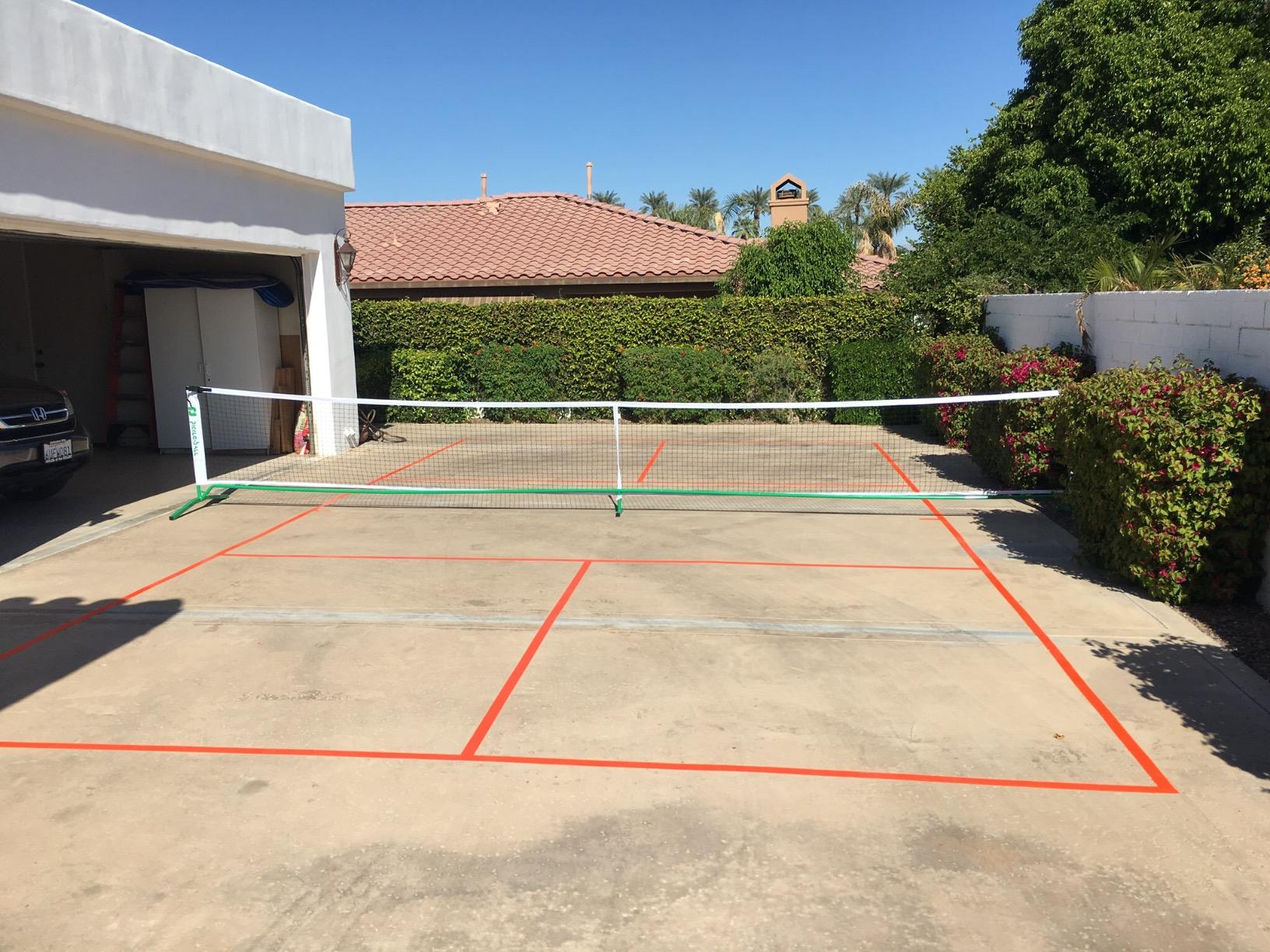
Wind is where most driveway nets get tested honestly. A frame under about 20 pounds needs ballast in anything above a light breeze, and the reviews make that concrete: the 14-pound Zdgao is described as light enough to tip in a gust so weights are often needed, and the aluminum Fostoy Pro is called very lightweight and likely to blow over without added ballast. The 24-pound steel Pickle-Ball 3.0 and the 17-pound carbon fiber SwiftNet 2.1 are the two that owners report playing in real wind, one of them at 15 mph with no stability issue.
Ballast is cheap. Sandbags on each base, a pair of water jugs, or purpose-made weights all work, and a locked wheel does the same job on a wheeled model, which is exactly what the BAGAIL casters and the six locking casters on the Fostoy Pro are for. Whatever you do, check that the net is holding a straight line rather than a parallelogram that leans a few inches downhill by the end of a long rally.
Then there is the workflow nobody advertises. On a shared driveway, the session has three parts: teardown, storage and reset. A net with snap-together joints such as the Pickle-Ball 3.0 is down in about five minutes, which makes it a realistic daily habit. A wheeled net is faster still because you roll it rather than fold it, but only if the wheels can cross the apron without catching. A 10-minute kit such as the TYRSEN is the hardest to keep as a habit, and habits die faster than net failures.
Ball containment deserves a line of its own. On a driveway that abuts a yard or a street, balls that roll under the net are a genuine nuisance, and the cheapest fix is a collector. The BAGAIL kit includes an integrated one; the Pickle-Ball 3.0 and the SwiftNet 2.1 use a raised bottom crossbar and open bottom clearance to let balls pass beneath, which is faster in play but means they end up somewhere other than the court. Choose based on where your street-side boundary is.
Noise is the last driveway-specific consideration. A hard ball hitting a taut mesh on a slab in front of a garage echoes more than most people expect, and tighter top bands are louder than slack ones. If there are neighbours within earshot, the quieter end of the market is the one to shop, and playing later in the day costs nothing in equipment terms.
What Real Owners Say About Net Durability
The most useful durability information in this category does not come from product pages. It comes from owners who have had a net through a few seasons, and the complaints are remarkably consistent across sources.
Top band tension is the first. The r/Pickleball critique quoted earlier, that most portable nets lack the proper top band tension and are flabby at the top, is the reason the buckle-based Pickle-Ball 3.0 and the clip-on tensioning on the Fostoy Pro exist. The second is center sag over time, which is a design issue rather than a defect: nets that lose the 34-inch center height change dink and third-shot drop trajectories, and portable nets need re-adjustment far more often than anchored ones.
The third is parts. The SwiftNet 2.1’s top tension cord frays and snaps. The TYRSEN’s center post welds have failed for some owners within weeks, though the seller has provided replacement parts. The Zdgao’s velcro strap reach is too short to remove the sag. The BAGAIL’s 8-ply mesh is the thinnest fabric here. Every one of those is a part, and every one of them is replaceable or avoidable, which is the practical point: buy the frame for its rigidity, and expect to maintain the net fabric.
The fourth is rust, and it is the one that decides long-term ownership. Aluminum is chosen by owners who want a frame that survives a wet winter without surface corrosion, and the same pickleballist discussion that noted an aluminum net at a mid-tier price point framed it as sitting between the heavy commercial portable systems and the flimsy end of the market. That is the correct read of this whole category: the meaningful tier gaps are frame mass, tensioning method and mesh ply, not the accessories included in the box.
How to Choose a Pickleball Net for Driveways
Work through these seven in order. If you get the first three right, the rest tend to sort themselves out, and you can cross-check any roundup, including this one, by asking the same questions of every listing you read. The same weight-versus-rigidity logic runs through every net sport, and we cover it for hockey nets and cast nets if you are comparing across categories.
Weight and whether one person can carry it
Anything under 20 pounds is a one-person carry and a daily habit. Between 20 and 25 pounds is a two-person carry that most adults manage over a short driveway. Over 30 pounds, and you are looking at a project rather than a routine. The Pickle-Ball 3.0 and the ONIX set are both 24 pounds; the Zdgao is 14; the SwiftNet 2.1 is 17.
Frame material: steel or aluminum
Steel is heavier and therefore more planted in wind, and coated steel resists corrosion well enough for a driveway. Aluminum is lighter and will not rust at all, which is the right call for a net living outside through winter. If your site is exposed, choose mass over material.
Mesh thickness and the top band
Eight ply is the thinnest in this roundup, 15 ply is common, and 18 ply is the upper end here. More ply means better impact and tear resistance, and it is the single clearest quality signal on a listing. The top band should be tensioned by a buckle, clip or strap system you can adjust repeatedly, not a sealed or glued edge.
Center height holding and the center support
Look for a stated 34-inch center height and a support that is fiberglass or better. Check reviews for the word sag. A net that sags 2 inches at the center is not a regulation net in any way that matters, and no listing photograph will tell you.
Setup time and the teardown habit
Under five minutes with snap-together joints is the standard to aim for. Ten minutes is workable but only if the car is not waiting. On a shared driveway the teardown time matters more than the setup time, because teardown is the one nobody wants to do.
Wheels, ballast and wind
Wheels save setup time and can double as anchoring when they lock. If a net is not wheeled and weighs under 20 pounds, buy ballast before the first windy afternoon rather than after. Wide end bases resist tipping better than narrow ones, and a 24-inch base of the kind listed for the Fostoy set is a good example.
What is in the box, and what you will replace
Carry bags, court markers and spare balls matter more than the accessory lists suggest, and a warranty length is a rough proxy for how the manufacturer expects the product to age. The warranties here run from 30 days to two years, and that spread tells you something about how the maker expects the frame and the fabric to age. The mesh and the tension hardware are the parts to budget for replacing over a few seasons.
Frequently Asked Questions
What is the best pickleball net for playing on a driveway?
The Pickle-Ball 3.0 Tournament Net is the best overall for a driveway: a true 22 ft regulation frame with buckle tension that stays taut, 36 in posts and a 34 in center, and a 24 lb steel build that resists gusts. The Fostoy 22 ft and 11 ft set is the best value if your driveway is short, and the Zdgao kit is the lightest budget option for beginners.
Can I play pickleball in my driveway?
Yes. A flat paved surface such as concrete or asphalt is the baseline requirement, and you need roughly 20 ft by 44 ft for full court or 20 ft by 20 ft for a half court. Use court markers to lay out the lines, and add ballast or locked wheels if the site is exposed to wind.
What size pickleball net should I get?
Get a regulation 22 ft net for full court play, or a convertible system that includes an 11 ft half-court net if your driveway is short. All eight nets reviewed here are regulation sized at 22 ft wide, 36 in at the posts and 34 in at the center.
How far off the ground should a pickleball net be?
34 inches at the center and 36 inches at the two side posts. A center strap or center rod holds that middle height, and any net that sags below 34 inches at the center changes dink and third-shot drop trajectories.
Will a portable pickleball net blow over in the wind?
Light ones can. Frames under about 20 pounds, such as the 14 lb Zdgao and the aluminum Fostoy Pro, are the most likely to tip without ballast. Heavier steel frames are more planted, and locking caster wheels on wheeled models can pin the net in place. Sandbags or water jugs on each base are the simplest fix.
Is a tennis net as high as a pickleball net?
No. A tennis net is 36 inches at the posts and 42 inches at the center, so it is higher in the middle. A pickleball net is the opposite shape, at 36 inches at the posts and 34 inches at the center, which is why a tennis net cannot be used for pickleball.
Who makes the best portable pickleball net?
Pickle-Ball Inc. makes the strongest portable net in this group with the 3.0 Tournament Net, built by the families who created the game in 1965. Fostoy and BAGAIL lead the convertible 22 ft and 11 ft options, and Pickle-Ball also makes the carbon fiber SwiftNet 2.1 for light, rust-free carrying.
Why is my pickleball net sagging?
Most often the tensioning system, not the mesh. Hook-and-loop straps wear out and lose grip, and a short center strap cannot reach far enough to pull the middle to 34 inches. Check the center height with a tape measure, re-tighten the top band, and check that the center rod or strap is seated correctly.
The Verdict: Which Pickleball Net Belongs in Your Driveway
The Pickle-Ball 3.0 Tournament Net is the best of the best pickleball nets for driveways: it holds the tightest top line we tested, it is genuinely regulation dimensioned, and its buckle tension system avoids the velcro wear that owners complain about most. If your driveway is short or you want one frame for both court sizes, the Fostoy 22 ft and 11 ft set gives you more net for the money. If you are one person learning on a 14-pound budget, the Zdgao kit is the honest first step.
Before you buy anything, do one thing we could not do for you: walk your driveway and check the width at the net line, look for a crown or a slope, and find out whether the car can move. That single measurement tells you which of these eight you want, and it takes about a minute. For how to choose a net that suits a different kind of court, our guide to the best golf nets covers the same portability logic on a different surface, and our best volleyball nets roundup goes deeper on regulation height compliance.
We update this roundup through 2026, and every rating and review count on this page is the live figure from the product listing. If you have a net we have not covered, or a driveway setup problem we have missed, the comments are open.