
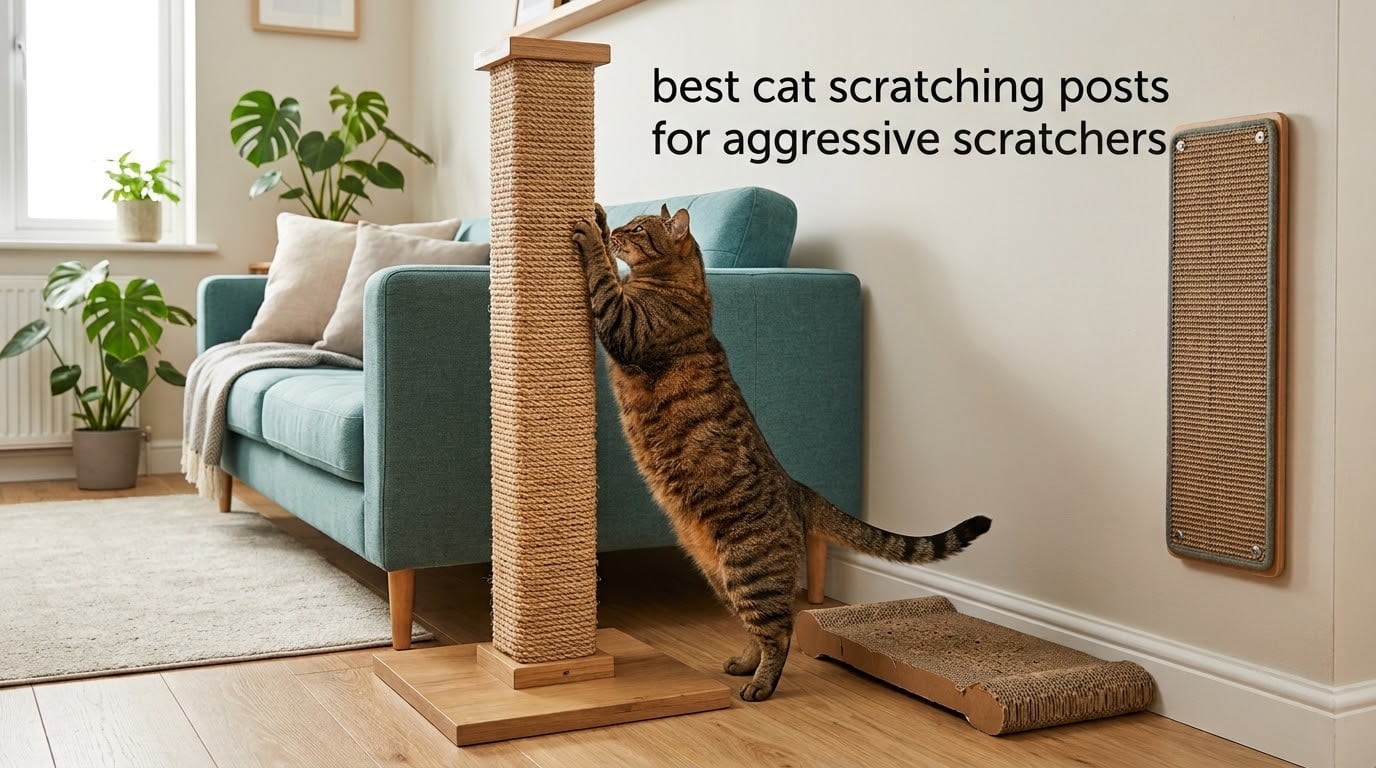
Most cheap scratching posts do not fail because the cat dislikes them. They fail because a heavy clawing cat strips a thin surface, works the post sideways, and goes back to the sofa in under a week. The fix is narrow and specific: a post tall enough for a full-body vertical stretch, a base heavy and wide enough that it will not slide or tip, and a dense woven surface that does not unravel under force.
Sisal is the surface that survives aggressive scratchers, and that is not a matter of taste. The fiber shreds in a satisfying way, resists claw snag better than carpet, and holds together far longer than corrugated cardboard or jute twine. Height and base weight matter just as much as the material, because a cat that cannot fully extend into a post scratches it at an angle, wears one side through, and moves on.
This guide covers the best cat scratching posts for aggressive scratchers we could find, ranked by how well each one holds up when a cat puts real body weight behind the claw. We looked at surface durability, base width and mass, height against full stretch, whether the surface can be replaced instead of discarded, claw-safety, and how much debris it leaves behind. Ten posts made the list, from a 45 inch sisal tower built for Maine Coons down to a wall-mounted board for renters who cannot add floor furniture.
A word on the cat rather than the owner: scratching is not misbehavior. Cats strip the worn outer husk from each claw, stretch the spine and shoulder muscles, and deposit scent to mark territory. A post that is tall, stable and correctly surfaced absorbs all three, and the sofa stops being the target. If you also want to spend on play and enrichment, our cat exercise wheel reviews cover a good complement for cats with more energy than furniture to spare.
Our Top 3 Picks for Aggressive Scratchers in 2026
SmartCat Ultimate Scratching Post
- 32 inch woven sisal post
- 16 x 16 inch wood base
- Holds up to hard clawing

Best Cat Scratching Posts Compared in 2026
| Product | Specifications | Action |
|---|---|---|
| SmartCat Pioneer Pet Ultimate Scratching Post |
|
Check Latest Price |
| MidWest Feline Nuvo Grand Forte Scratching Post |
|
Check Latest Price |
| AGYM 32 Inch Sisal Cat Scratching Post |
|
Check Latest Price |
 Amazon Basics Sturdy Sisal Scratching Post Amazon Basics Sturdy Sisal Scratching Post |
|
Check Latest Price |
 COUNER 45 Inch Extra Tall Sisal Post COUNER 45 Inch Extra Tall Sisal Post |
|
Check Latest Price |
 Fopetfy 33 Inch Sisal Scratching Post Fopetfy 33 Inch Sisal Scratching Post |
|
Check Latest Price |
 7 Ruby Road Wall Mounted Cat Scratcher 7 Ruby Road Wall Mounted Cat Scratcher |
|
Check Latest Price |
 Woochpet Palm Tree Scratching Post Woochpet Palm Tree Scratching Post |
|
Check Latest Price |
 Ahomdoo 34 Inch Cotton Rope Scratching Post Ahomdoo 34 Inch Cotton Rope Scratching Post |
|
Check Latest Price |
 PAWZ Road 32 Inch Sisal Scratching Post PAWZ Road 32 Inch Sisal Scratching Post |
|
Check Latest Price |
How We Tested Posts Against a Heavy Scratcher
Every post on this list was judged against the same six criteria, because a scratching post that is great for a gentle kitten can be useless for a cat that throws its whole body at the surface. These are the things that decide whether a post lasts a month or several years.
Surface durability under force. A heavy scratcher pulls downward with the shoulder and hind legs driving, which puts far more load on the wrap than a light scratch. Woven sisal sheet or panel construction holds together better than loose rope wound around a core, and both outlast corrugated cardboard by a wide margin.
Base stability and tip resistance. We looked at footprint width, base weight, and whether anything anchors the post. A 15 inch or wider base and a mass of 8 pounds or more is the range where hard jump-offs stop moving the unit. Anything lighter than that shifts, and a shifting post is both a durability failure and a tipping hazard.
Height against a full stretch. The post should be at least as tall as the cat standing on its hind legs. Short posts force the cat to stretch at an angle, which wears one side through far faster than the whole surface.
Replacement cost over 12 months. This is where cheap posts quietly get expensive. Cardboard replaced every few months can cost more per year than a single sisal post that lasts. We favoured posts with a replaceable or re-wrappable surface for that reason, and noted honestly where a surface has to be thrown away with the frame.
Claw safety. Loose sisal fibers, frayed rope ends and worn wood cores can catch a claw. A tightly woven surface attached without glue or staples scores better here, and a wall-fixed design scores best of all because nothing can move.
Mess. Cardboard sheds crumbs, rope frays into string fragments, and plush caps trap hair. Low-debris surfaces matter most in small apartments and for owners who are already tired of sweeping.
1. SmartCat Pioneer Pet Ultimate Scratching Post – Best Overall for Aggressive Scratchers
SmartCat Pioneer Pet Ultimate Scratching Post (Beige)
32 inch tall
Woven sisal on wood
16 x 16 inch base
Two-screw assembly
Pros
- 32 inch height allows a full-body vertical stretch
- Wide 16 x 16 inch base resists tipping under hard scratching
- Woven sisal does not snag claws the way carpet does
- Backed by more than 34000 ratings
Cons
- Sisal surface is not replaceable so the whole post is discarded when worn
- Fixed screw-together assembly rather than tool free
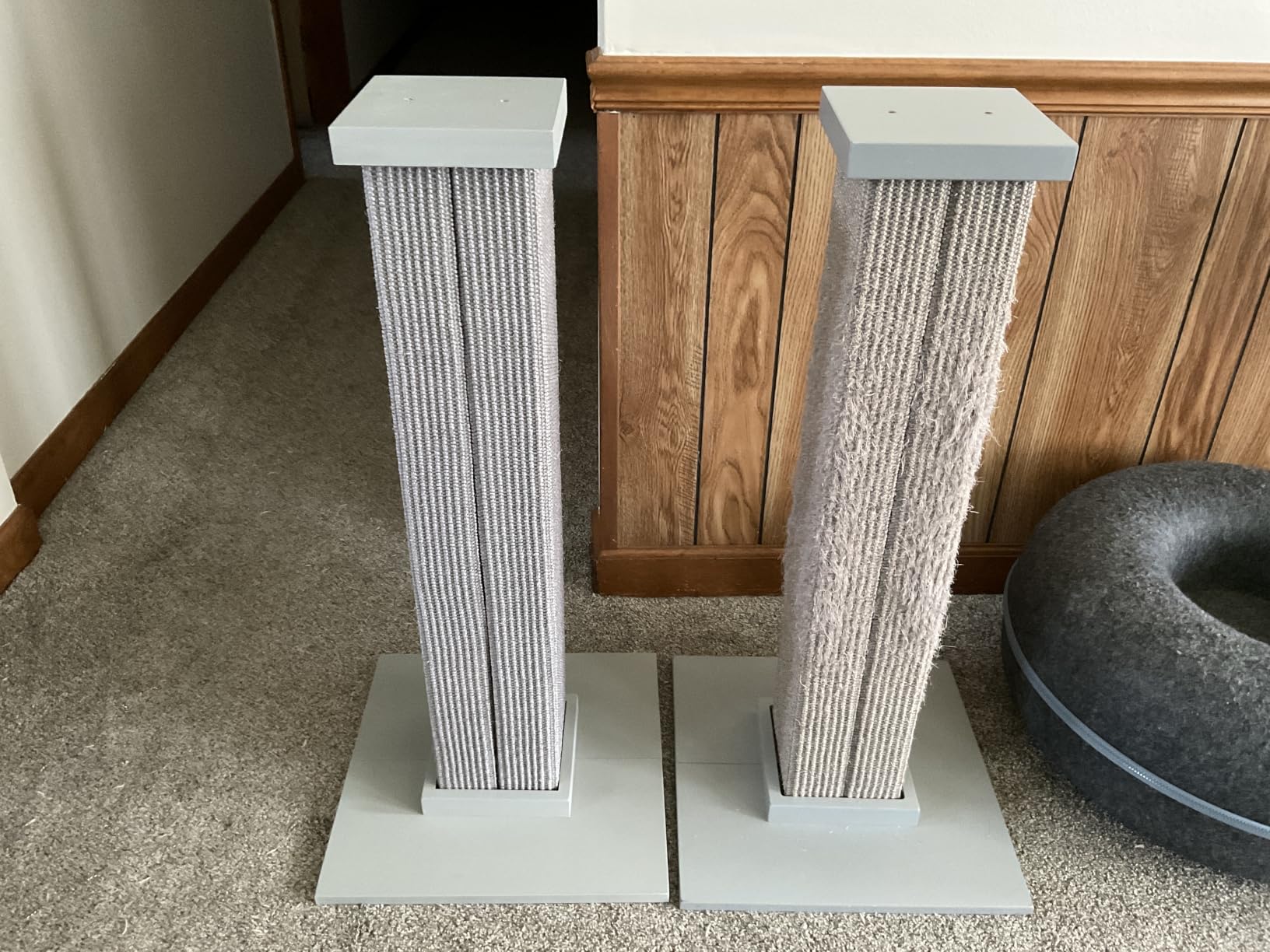
This is the post we recommend to almost anyone whose cat destroys cheap scratchers. It has been on the market since 2004, it holds a 4.7 average across more than 34,000 ratings, and the two reasons reviewers keep naming are the same two reasons it survives: a tightly woven sisal surface and a 16 by 16 inch wood base.
The 32 inch height is the number that matters most. It is tall enough for a cat to rear up, extend fully from floor to tip, and work the post top to bottom without bending sideways. That full stretch is what wears the surface evenly instead of chewing out one flank, and it is also the motion cats are actually trying to complete.
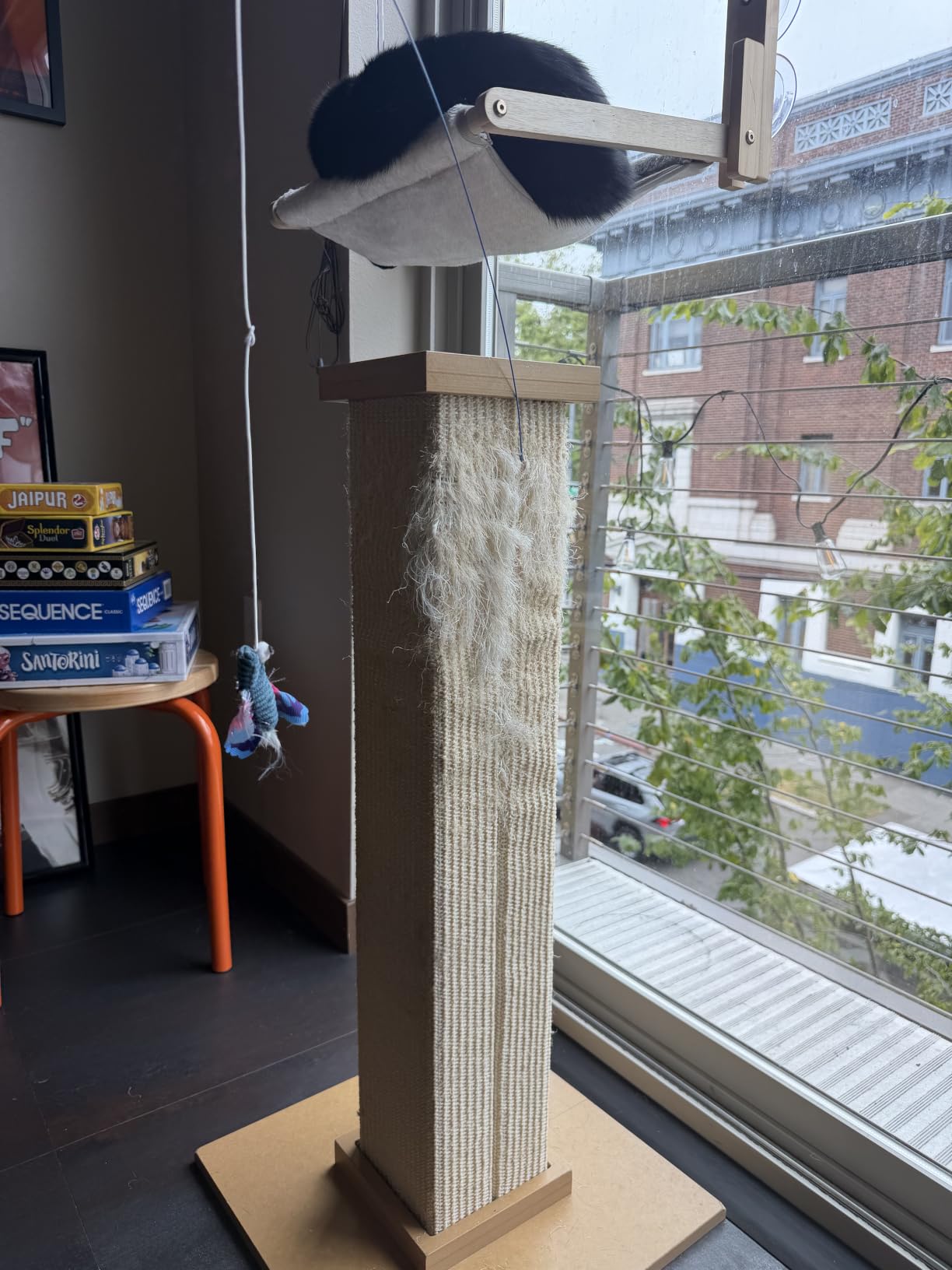
The base is 16 inches square, which is wide enough that a cat launching off the top shifts it rather than tipping it. Reviewers of large cats repeatedly credit that footprint as the reason the post stayed put while smaller, lighter posts in the same household got shoved across the floor.
Sisal is a better surface than carpet here for a hard scratcher. It shreds in a way that satisfies the cat, and the tight weave is less likely to catch and hold a claw than carpet fibers, which is a genuine safety advantage for a cat that puts force into every stroke.
Why it holds up to hard clawing
The surface is woven sisal rather than wound rope, and that difference decides longevity. Woven construction does not unravel when the outer fibers are pulled off, so the post looks worn rather than destroyed, and the cat can keep scratching the same column for years. Reviews of rope-wrapped competitors in the same category more often describe fraying and a loose, disheveled wrap after a few months.
There is no replacement path, though, and that is the honest drawback. Once the sisal thins to the core you replace the entire post, not the surface. If you want a unit you can re-wrap or refresh, the wall-mounted board further down the list does that better.
Who should look elsewhere
It is a single-purpose post with no perch, no cave and no play features, so a cat whose scratching is tangled up with lounging and climbing will want a second piece of furniture alongside it. The 16 inch square base also takes a real bite out of a small living room, and the two-screw assembly needs an actual screwdriver rather than a hand-tightened knob.
2. MidWest Homes for Pets Feline Nuvo Grand Forte – Best Premium Post for Large and Multi-Cat Homes
MidWest Homes for Pets Feline Nuvo Grand Forte Scratching Post, 41 Inches Tall, Heavy-Duty Sisal Post with Wide Base, Thick Brown Faux Fur, for Large and Multi-Cat Households
41 inch tall
Extra thick sisal wrap
19 x 19 inch base
Faux fur cap
Pros
- Tallest strong-claw option at 41 inches for a full vertical stretch
- Extra thick post on a 19 x 19 inch base for multi-cat homes
- 4.8 average rating with 91 percent five-star reviews
- Faux fur cap gives a soft perch
- Spot-cleanable cover
Cons
- Bulky 19 inch footprint uses more floor space
- Heaviest unit at nearly 20 pounds so it is hard to move
- Faux fur cap traps hair
Pick this one when you have a large cat, an overweight cat, or more than one cat sharing the same room. At 41 inches it is tall enough for a Maine Coon to stretch completely, and the post itself is noticeably thicker than the standard 3 to 4 inch column, which means more fiber for a hard scratcher to dig into.
It carries the highest average rating in this roundup at 4.8, with 91 percent of reviews at five stars. Multi-cat households are the recurring theme in that feedback: owners credit the height and the heavy base with keeping both cats working the post instead of the arm of the sofa.
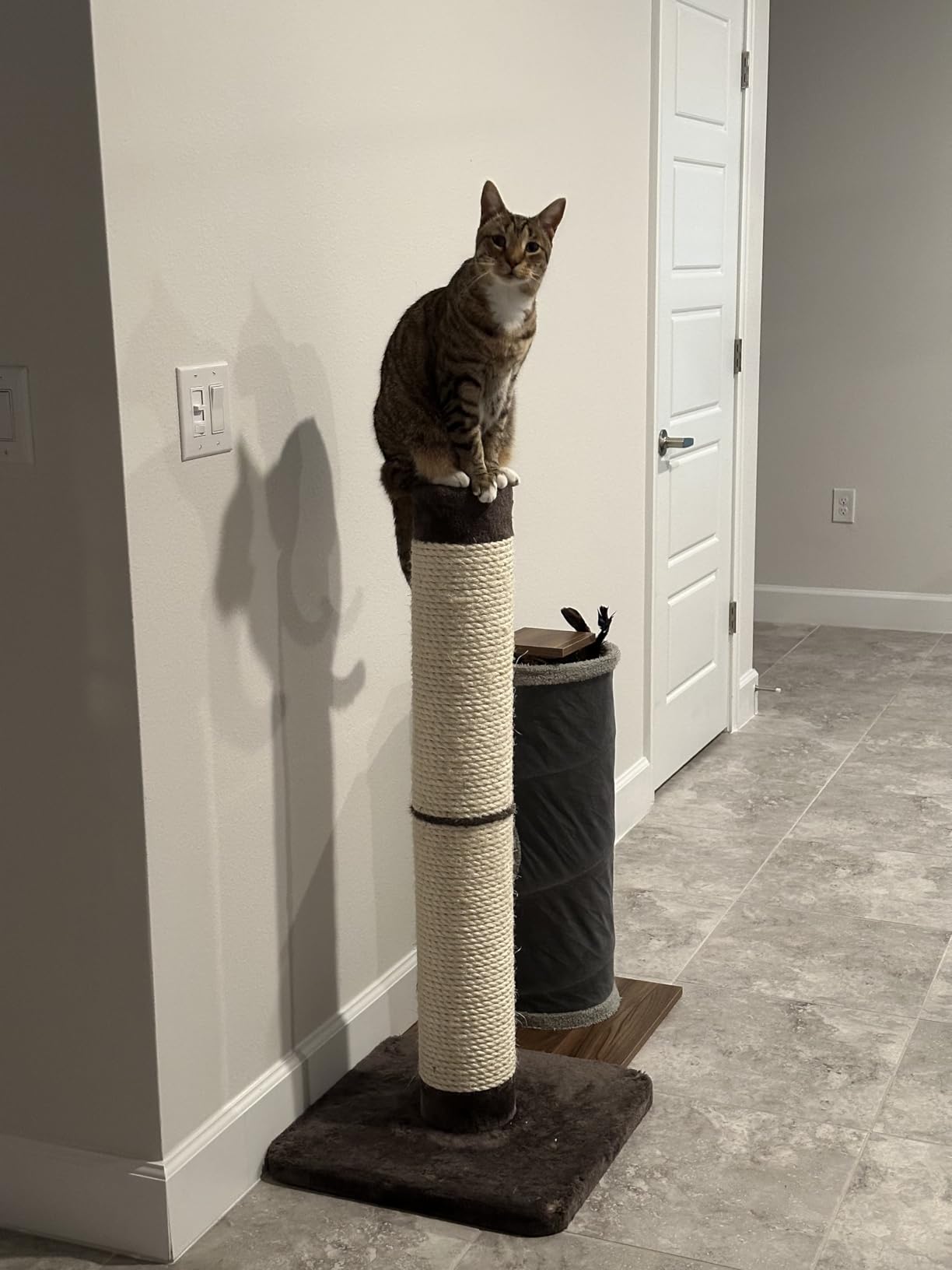
The 19 by 19 inch base is the widest here and the unit weighs nearly 20 pounds once assembled. That mass is not a marketing number, it is the difference between a post that stays put when a 15 pound cat drops off the top and one that skids across hardwood. For a home with a large cat throwing real force at the surface, the extra footprint is worth the floor space it consumes.
The faux fur cap on top is a softer touch that most buyers did not expect to use and then end up relying on, since it gives a tired cat a lookout after a scratching session. It is also the least durable part of the build, since plush traps hair and needs an occasional spot clean.
How it handles multiple cats
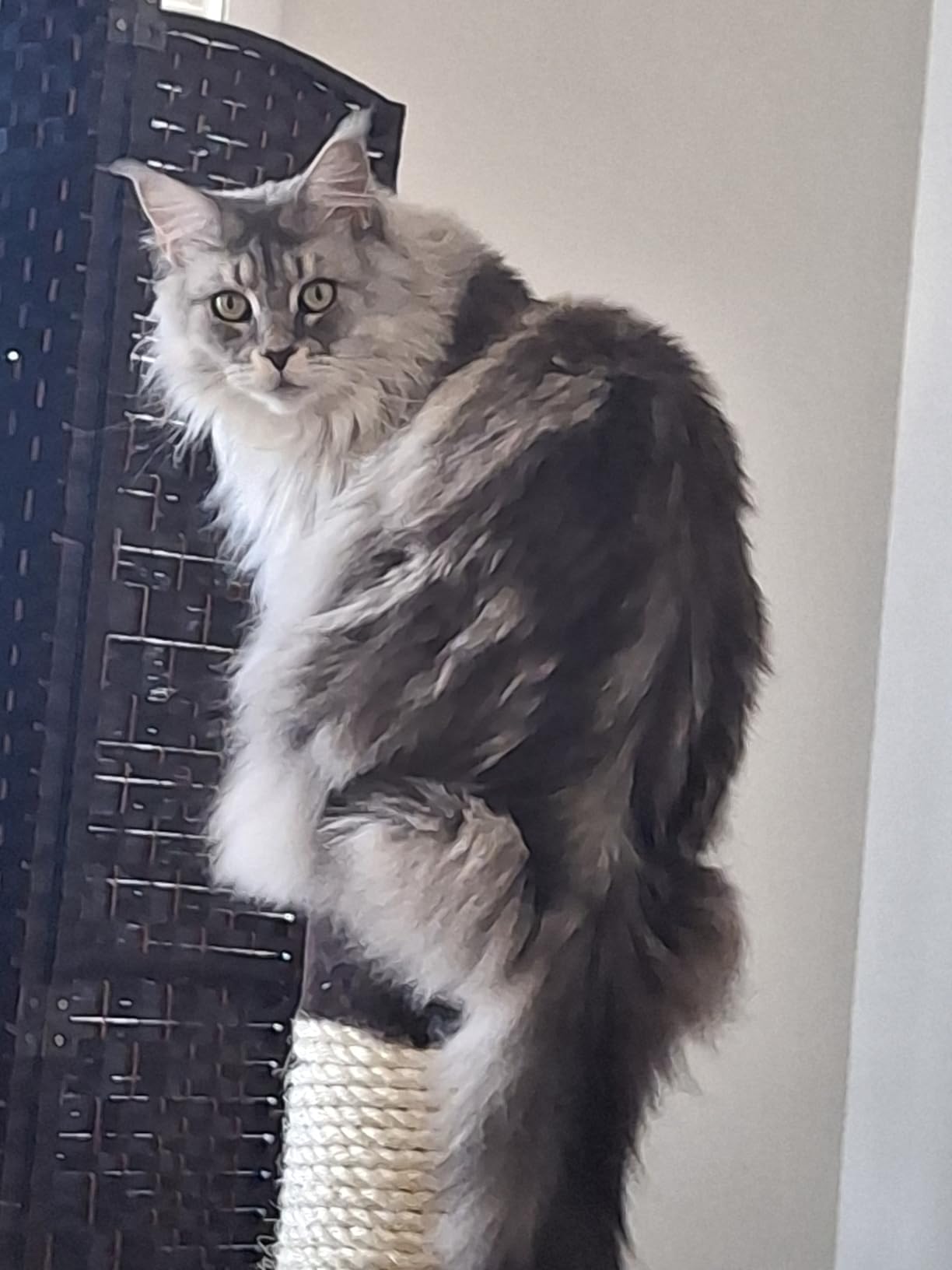
Two cats on one post is realistic here in a way it is not on a slim column, because the post is thick enough for a cat to work the upper section while another works the lower. A single narrow post with one small base ends up with two cats taking turns and one of them walking off to find a sofa instead.
At 41 inches the stretch length is also the longest in the group, which matters most for the biggest cats. If your cat reaches up on its hind legs and still cannot touch the top of the post, no amount of surface quality will keep it engaged. For large-breed nutrition and sizing questions our Maine Coon food guide goes into the size side of that picture.
Where it falls short
Nearly 20 pounds and a 19 inch footprint is a lot of furniture to give up in a studio apartment, and the weight makes it genuinely awkward to move when you want to sweep underneath. The faux fur cover also needs maintenance that a plain sisal column does not, and it is the part most likely to need replacing first.
3. AGYM 32 Inch Sisal Cat Scratching Post – Best Value for Heavy Clawing
AGYM Cat Scratching Post for Indoor Cats, 32Inch Sisal Cat Scratcher, Beige
Woven sisal panels
32 inch tall
15 x 13.8 inch base
Wood construction
Pros
- Woven sisal panels do not unravel after months of use
- Holds up in multi-cat homes with no visible wear
- Wood build rather than cardboard adds real durability
- No paper or cardboard debris on the floor
- Five-minute assembly with a tool included
Cons
- Shortest tall option here at 32 inches for very large breeds
- Hanging ball toy is usually destroyed within days
- Plush mid-band adds slight bulk
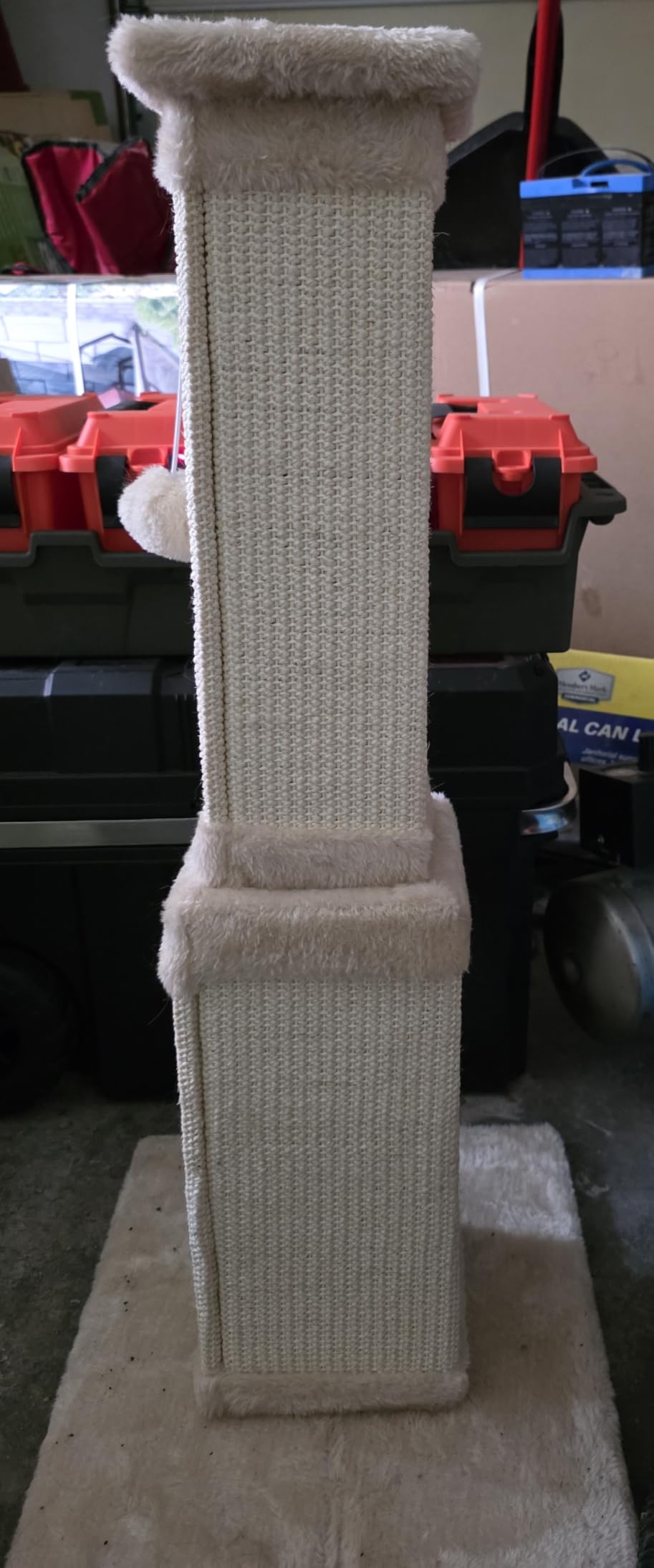
This is the pick we send people who have already replaced several posts and want to stop. The construction choice is the whole story: woven sisal panels wrapped over a wood frame rather than rope wound around a core, and wood rather than cardboard for the structure underneath.
Because the sisal is a sheet and not a twisted wrap, pulling the outer fibers off does not unravel the column. Reviewers describe it as looking worn rather than wrecked after months, and one multi-cat owner reports seven cats working the post with no visible wear. The same sheet construction is why you will not find cardboard crumbs on your floor, which matters if the debris is part of why you hated the last one.
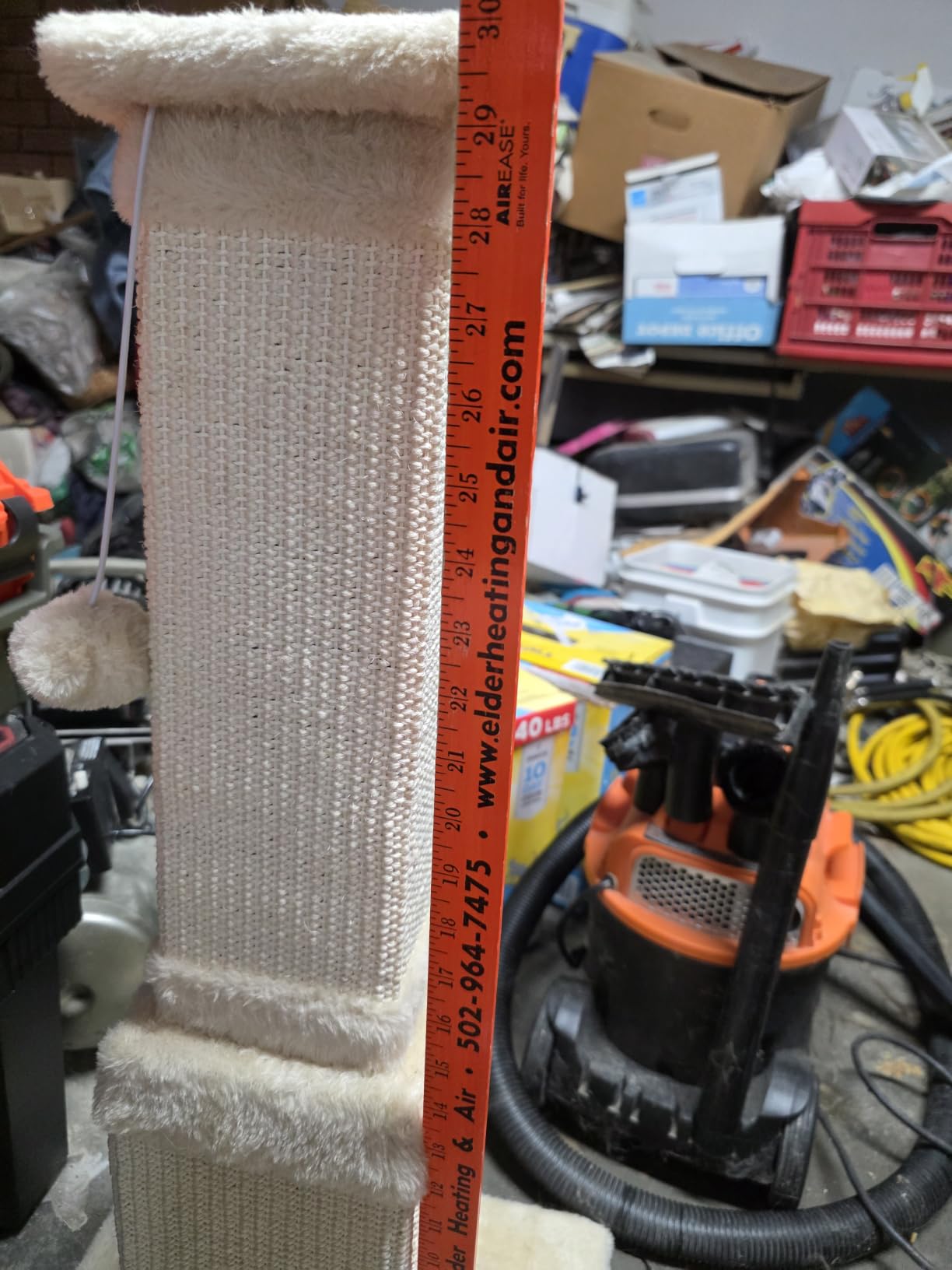
The base is 15 by 13.8 inches and the unit weighs close to 10 pounds, which is enough mass to stay put through a hard top-to-bottom scratch. Buyers also report that it brought claw length down and cut furniture scratching within weeks of putting it next to the sofa, which is the actual outcome you are buying.
It is a 32 inch post, which sits at the shorter end of the tall options here. That is fine for most cats and kittens, but a very large breed standing on its hind legs may still scratch at an angle, and the surface will wear unevenly as a result.
Why woven panels outlast wound rope
Wound rope works by friction. Each strand is twisted around the core, and a hard scratcher pulls individual fibers out of the twist, which loosens the strand and then unravels it. Fabric or panel construction interlocks the fibers instead, so the surface frays and thins but keeps its shape, and the cat has a consistent column to work against.
The practical difference shows up in the debris. Rope posts shed string fragments that end up in the corners of the room, and a sheet-wrapped surface does not. If a low-mess post is a requirement rather than a nice-to-have, that is the single strongest argument for this one.
Who it does not suit
Anyone with a 20 pound Maine Coon who needs real vertical reach should look at the 41 and 45 inch posts instead. The hanging ball toy is close to disposable, and while owners tend to treat it as a bonus rather than a feature, expect it to be chewed apart in a matter of days with a strong cat.
4. Amazon Basics Sturdy Sisal Scratching Post – Most Versatile With a Wall Strap
Amazon Basics Sturdy Cat Scratching Post for Indoor Cats & Kittens, Classic Single Post with Sisal Rope, Jute Fiber, Wood Base, Large (35.4″H), Brown
35.4 inch tall
Jute rope wrap
15.75 inch wood base
Includes wall strap
Pros
- Best selling post in the category with over 9300 ratings
- Heavy enough for multiple cats to scratch from above and below
- 35.4 inch height suits kittens and large breeds
- Includes a wall anchoring strap and spare dangle toy
- Top perch adds a second use
Cons
- Jute frays sooner than tightly woven sisal
- Some lateral wobble on fast dismounts without the strap
- Confusing assembly instructions
- Elastic toy breaks early with heavy play
When a cat destroys a low-cost scratcher in under a week, the usual answer is to buy a heavier one. This is the heaviest budget option in this roundup at just over 16 pounds, and it has sold more units than anything else in the category with a 4.5 average across more than 9,300 ratings.
Two details separate it from the cheap posts people cycle through. The base is a proper 15.75 inch wood square, and it ships with a wall anchoring strap, which is unusual at this tier and directly addresses the wobble that reviewers otherwise report when a cat leaps off the top at speed.
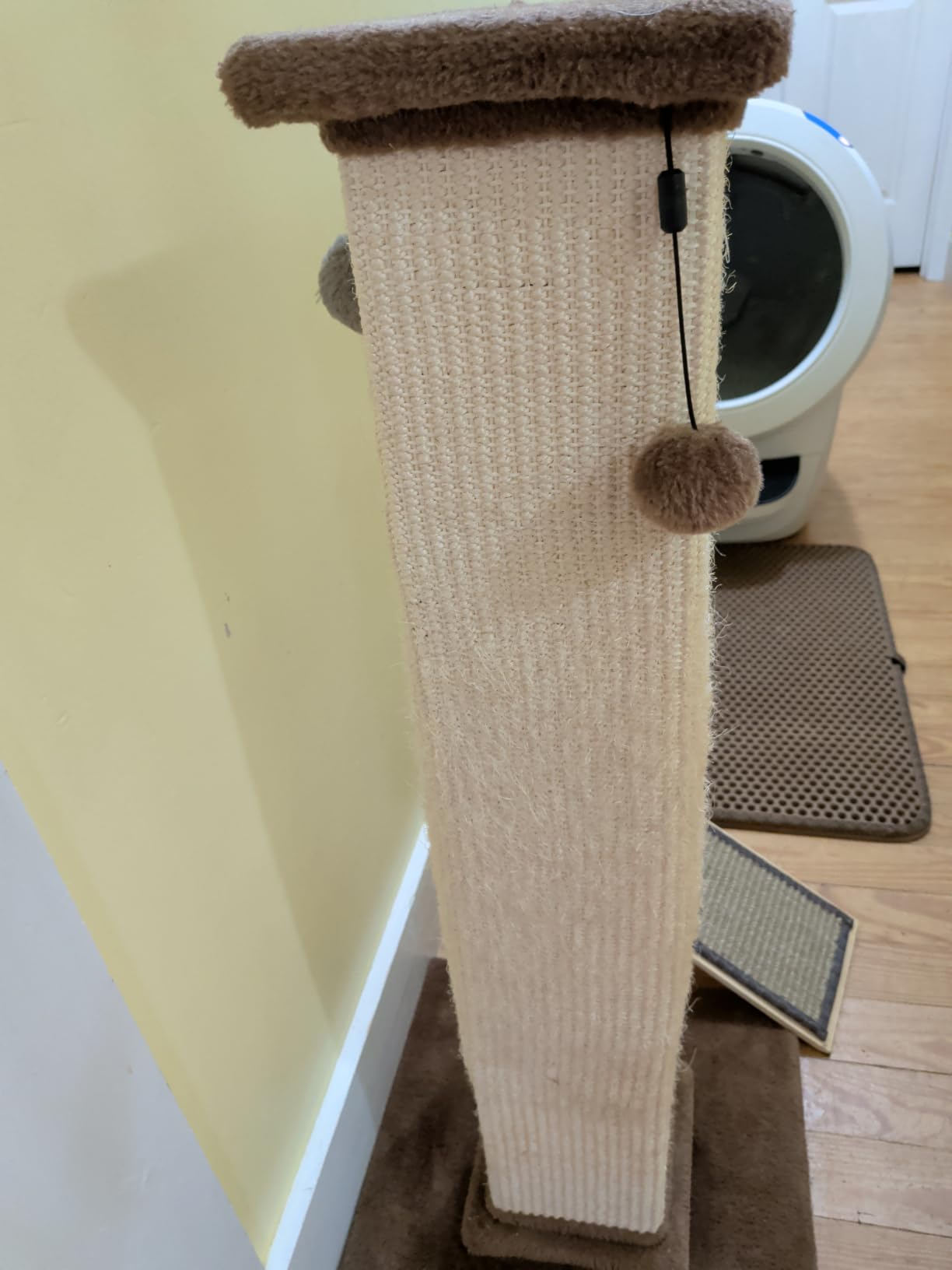
At 35.4 inches it handles a wide range of cats, from a kitten to a large adult, and the perch on top gives a second function. Owners of large cats and multi-cat homes say it finally broke the habit of attacking curtains and furniture, which is a more meaningful signal than any single specification.
The honest limitation is the surface. It is natural jute fiber rope rather than tightly woven sisal, and jute is less wear resistant. It frays visibly sooner, which is exactly the failure mode aggressive scratchers trigger fastest, and a rope wrap can eventually loosen enough for a claw to catch in a strand.
When the wall strap matters
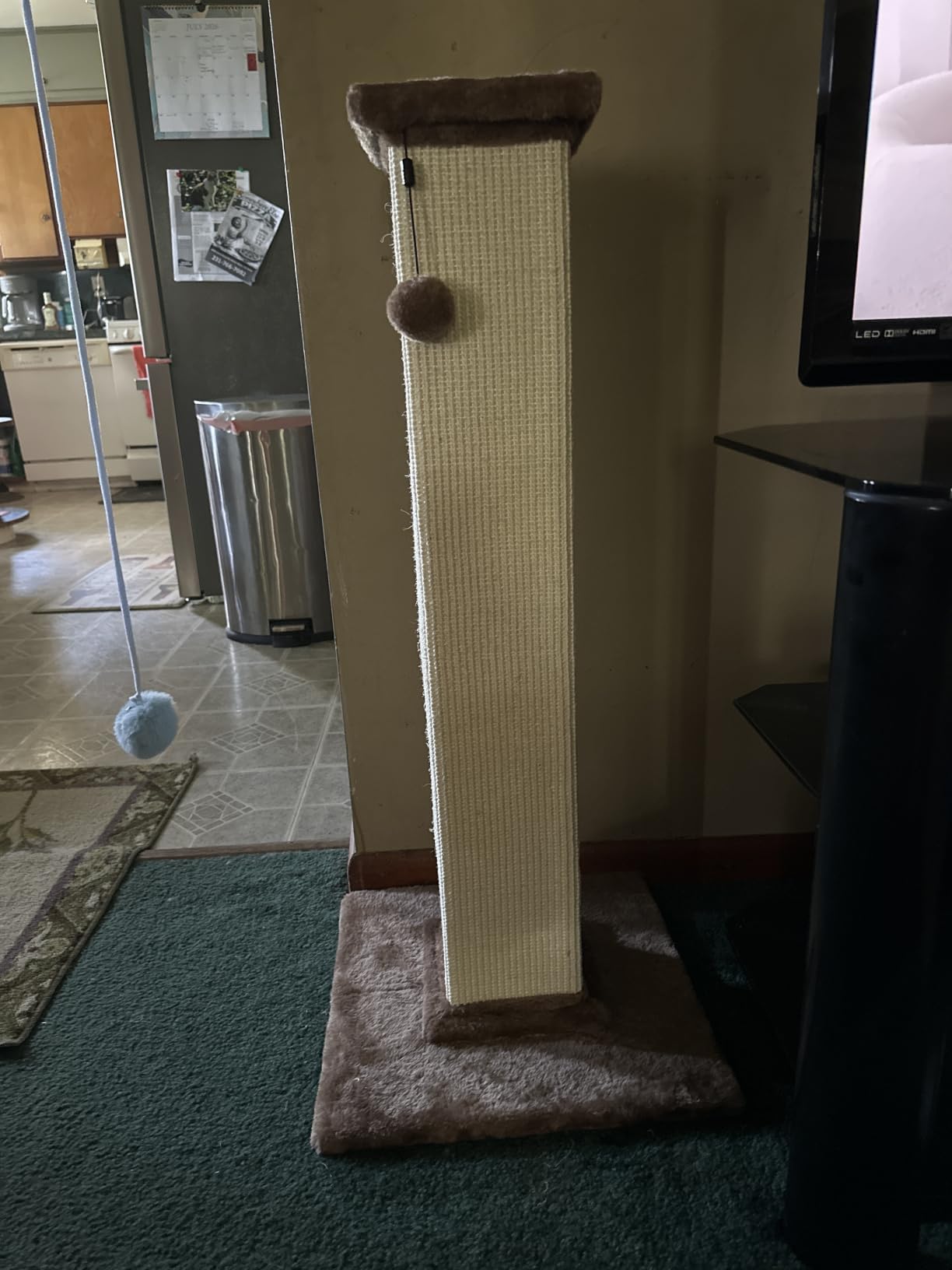
The strap is the difference between a post that stays put and one that rocks. Without it, some buyers report lateral movement when a cat dismounts at speed, and a moving post concentrates wear in one spot at the base, which shortens its life faster than the surface does. Fix the strap to a stud and that complaint largely disappears.
Assembly is the other weak point. The picture instructions confuse a number of first-time builders enough that roughly half an hour solo is common, so set aside the time and assemble it where you want it to live rather than dragging it across a room afterward.
Where it ranks against the picks above it
It is a strong first post or a solid second post for another room, and the multi-cat weight is a real advantage. It is not the choice for a cat that shreds a rope wrap in a fortnight, because jute will fray before sisal fabric would, and the elastic hanging toy is the first component to fail with heavy play.
5. COUNER 45 Inch Extra Tall Sisal Post – Best for Maine Coons and Large Breeds
45” Extra Tall Cat Scratching Post for Large,Heavy Duty Scratcher Tree
45 inch tall
100 percent natural sisal
8.8 pound base
3.5 inch shaft
Pros
- Tallest post here at 45 inches for Maine Coon stretching
- Natural sisal is denser and sheds less than jute
- Weighted 8.8 pound base on a 15.8 inch footprint
- Five built-in play elements plus a silicone groomer
- Eucalyptus grain top reads as furniture
Cons
- Narrow 3.5 inch shaft is less comfortable for a full stretch
- Many moving parts that can work loose with play
- Smallest review base in this group
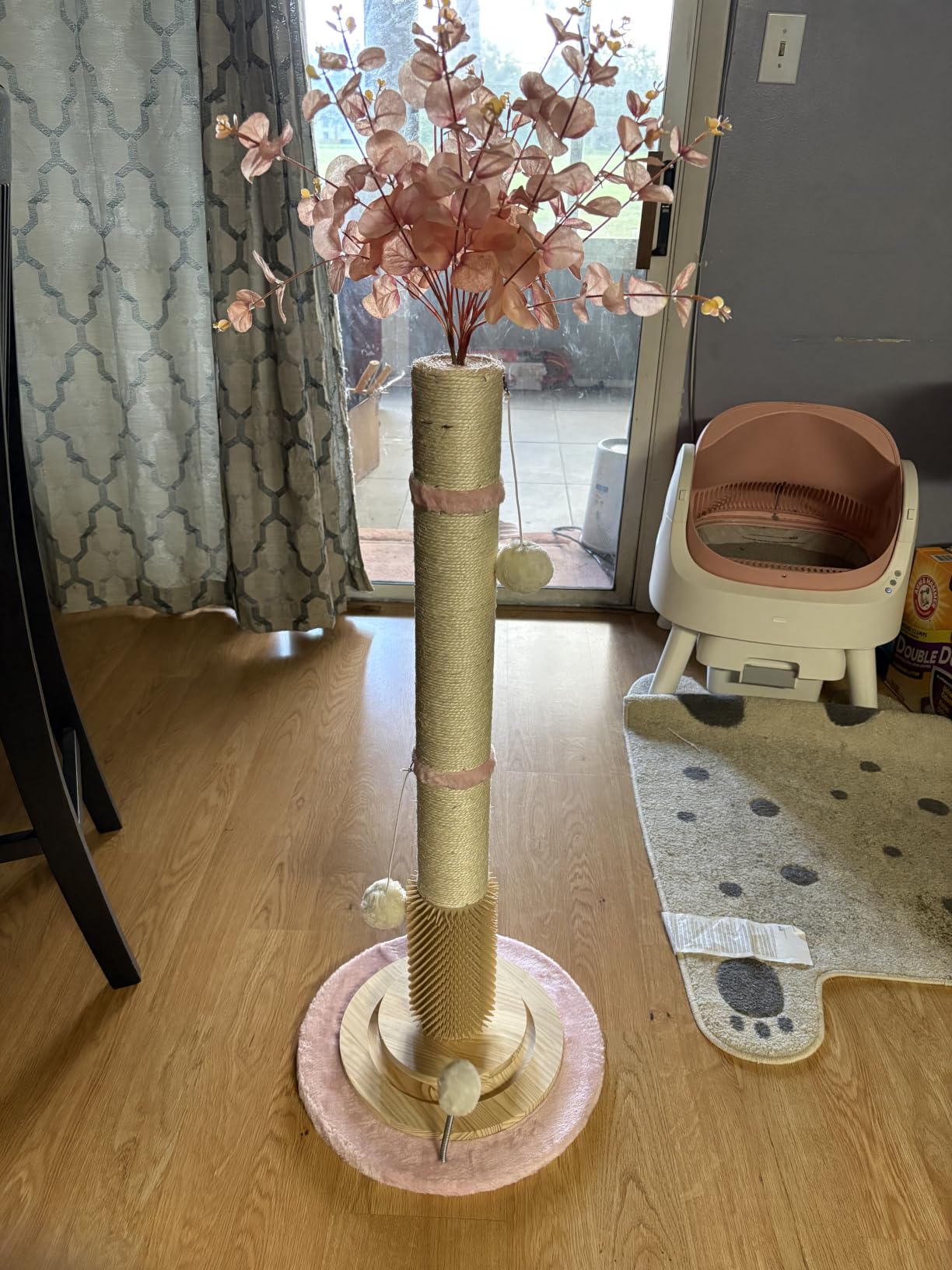
This is the one to buy for a very large cat. At 45 inches it is the tallest post we reviewed, and the height plus a weighted 8.8 pound base on a 15.8 inch footprint is the combination that reviewers of large, hard-scratching cats point to as the deciding factor.
The surface is 100 percent natural sisal described as denser and more wear resistant than ordinary jute, which is the right material at this height because you are not going to want to replace a 45 inch post every few months. The 3.5 inch shaft gives a full-body stretch for a Maine Coon standing upright.
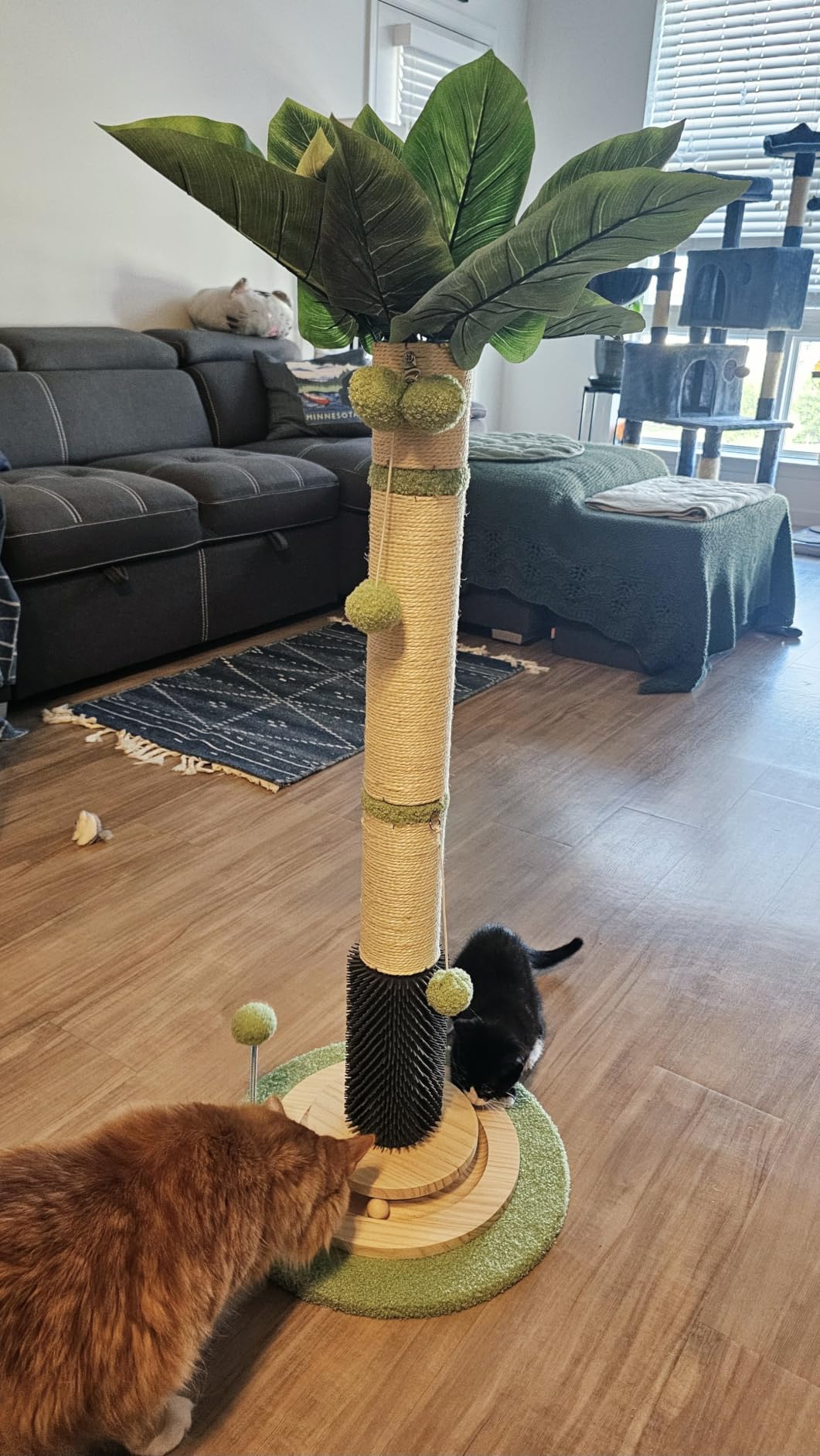
It also doubles as a play station, with a solid pine ball turntable, two rotating wooden balls, two hanging balls and a spring ball, plus a silicone self-groomer at the base for brushing loose fur. The eucalyptus grain finish on the top is a small touch that keeps it from looking like a pet supply in a living room.
Where it falls down is the ratio of shaft width to overall height. A 3.5 inch column on a 45 inch post means a cat braces its body around something relatively narrow, and reviewers with big cats note that a 5 inch shaft feels more comfortable for a full stretch. The five play features are also a lot of moving parts for a cat that treats toys as something to be destroyed.
How to check whether you need this height
Stand your cat on its hind legs next to the post before you buy. If the tips of its front paws land below the top of the wrapping, a 32 or 34 inch post will be scratched at an angle and will wear through unevenly on one side. If the cat can reach the top with room to spare, a shorter post works fine and gives you back floor space.
At 45 inches you also need to plan the footprint. This is a tall, narrow object in a corner, which is the least disruptive place to put it, but the base is wide enough that it needs real clearance from a wall you need to walk past. Our senior cat food guide covers size and mobility changes that also affect how high a cat can comfortably reach.
Who should pick something else
Small apartments with low ceilings are a poor fit, and so is anyone who wants a minimal object in the room. Cats that shred hanging toys will have a field day with the ball track and spring, and the smallest review base in this group means less long-term evidence behind it than the picks above it.
6. Fopetfy 33 Inch Sisal Post – Best Widest Surface for Full-Body Stretching
Fopetfy Cat Scratching Post 33 Inch for Indoor Cats, Tall Cat Scratcher with 100% Natural Sisal, Large Stable Base & 5 Inch Wide Post, Cat Scratch Post for Large Cats, Full-Body Stretching, Grey
5 inch wide post
Woven sisal sheet
15.7 inch square base
Reinforced core
Pros
- Widest post in the group at 5 inches for a whole-body surface
- Woven sisal sheet frays far less than wound rope
- 15.7 inch square base shows no wobble under hard scratching
- Reinforced middle section and connection points
- Assembles in under five minutes
Cons
- Sisal is a thinner sheet so it wears faster under sustained heavy clawing
- Hanging plush balls are fragile with hard play
- Shortest of the tall-post options at 33 inches
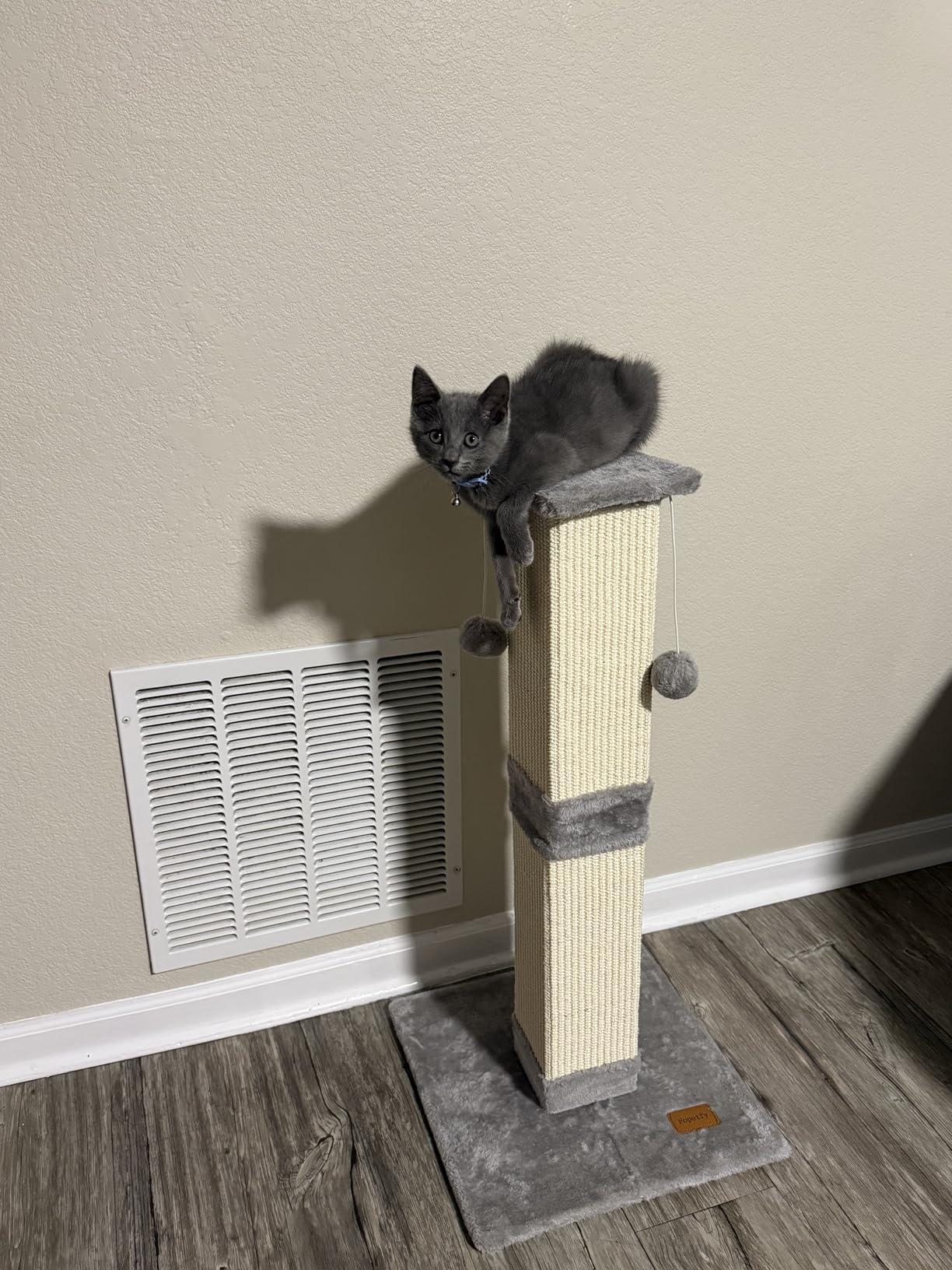
The number that sets this post apart is five inches of post width. Everything else here runs 3 to 4 inches, and a wider column lets a cat lay its whole body against the surface rather than bracing around a narrow pole, which is both more comfortable and more satisfying to scratch.
It is also one of the few posts in this roundup reported as showing no wobble at all on hard scratching, which is a direct result of the 15.7 inch square base and the reinforced middle section. Owners with several aggressive scratchers say the redirection was almost immediate, with cats moving off an office chair within minutes.
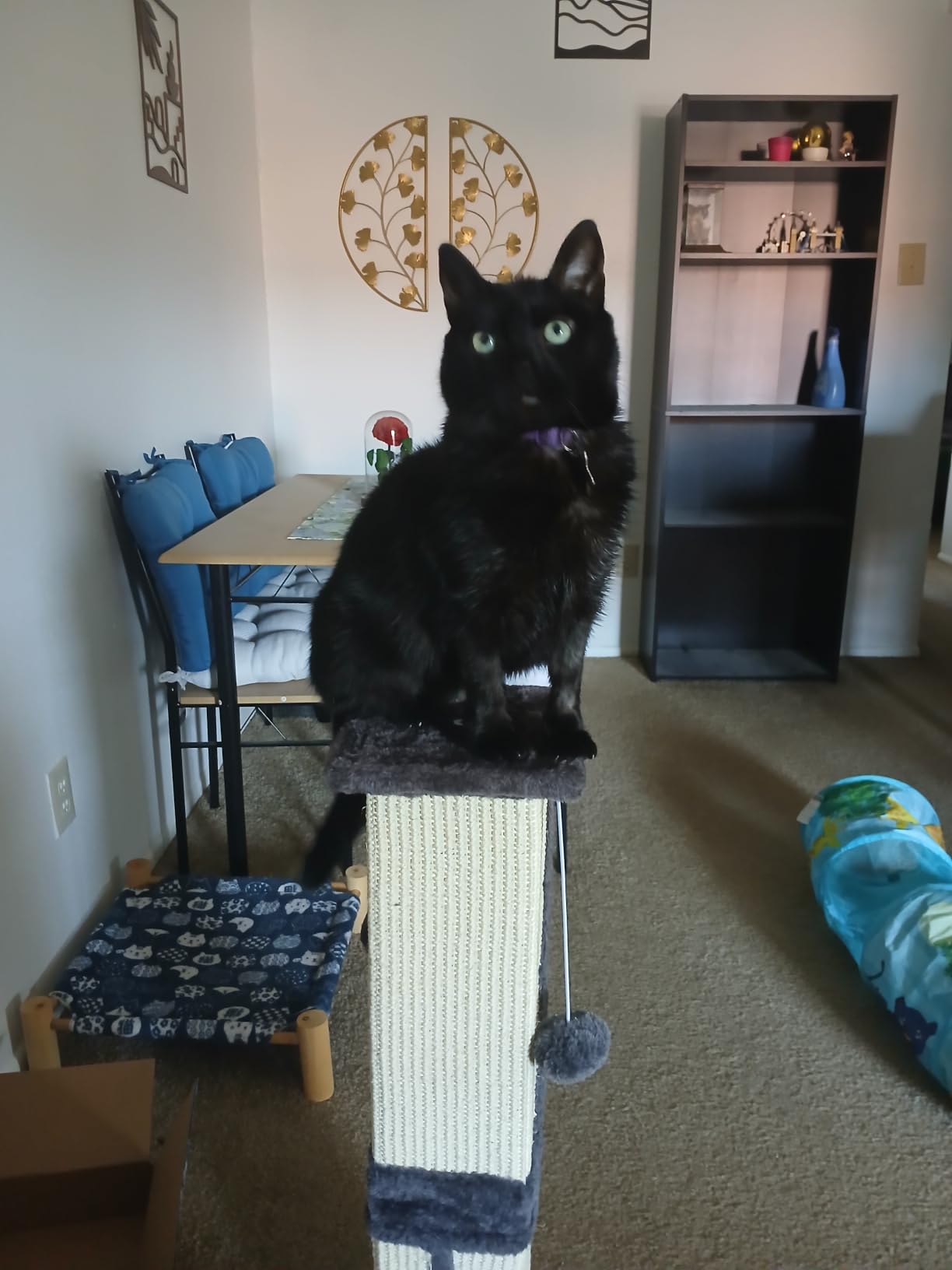
The woven sisal sheet frays far less than a wound rope and leaves fewer string fragments on the floor, and the bark-like texture gives a different grip that cats respond well to. Assembly takes under five minutes and it sits evenly on tile, which is worth noting if you have hard floors.
There is a real trade-off, though. The sisal is applied as a sheet rather than a thick wound wrap, so there is less fiber depth to work through, and one multi-cat owner reported visible wear at six months. For a sustained heavy scratcher that matters more than the width does.
Width versus height for a heavy scratcher
These two measurements pull in opposite directions and you have to choose which one your cat needs more. A 33 inch post at 5 inches wide gives a broad, comfortable surface for a cat that likes to stretch flat against it, while a 41 or 45 inch post at 3.5 inches gives reach for a large cat that scratches upright. Most cats want both and the honest answer is that one post rarely delivers both.
My rule is to look at how the cat currently damages your furniture. Upholstery scratched vertically at the arm suggests reach matters most. A door panel scratched across a broad flat face suggests the cat wants width. If the damage is broad and low, this post is the better match.
What to watch as it wears
Because the sheet is thinner, check the surface every couple of months in the middle section where force concentrates. Once you can see the core color through the sisal, or a claw starts catching at the edge of a worn patch, the post needs attention rather than more use.
The hanging plush balls are the first thing to go with hard play, and they are not structural, so losing them does not affect the scratching function. If the post is going in a room where a cat does not use hanging toys, the small saving in frustration is worth it.
7. 7 Ruby Road Wall Mounted Cat Scratcher – Best for Renters and Small Rooms
7 Ruby Road Wall Mounted Cat Scratcher, Replaceable Sisal Scratching Post
Wall mounted
Projects 2.5 inches
Replaceable sisal mat
29.5 inch surface
Pros
- Wall fixed so nothing can tip wobble or slide
- Replaceable mat extends the life of the board
- Projects 2.5 inches so it takes no floor space
- Solid pine and birch plywood rather than particleboard
- Sisal attached with no glue or staples
- Height can be raised as a kitten grows
Cons
- Requires drilling and a stud or drywall anchors
- Shortest surface here at 29.5 inches
- Replacement mats sold separately
- Smallest review base in the group
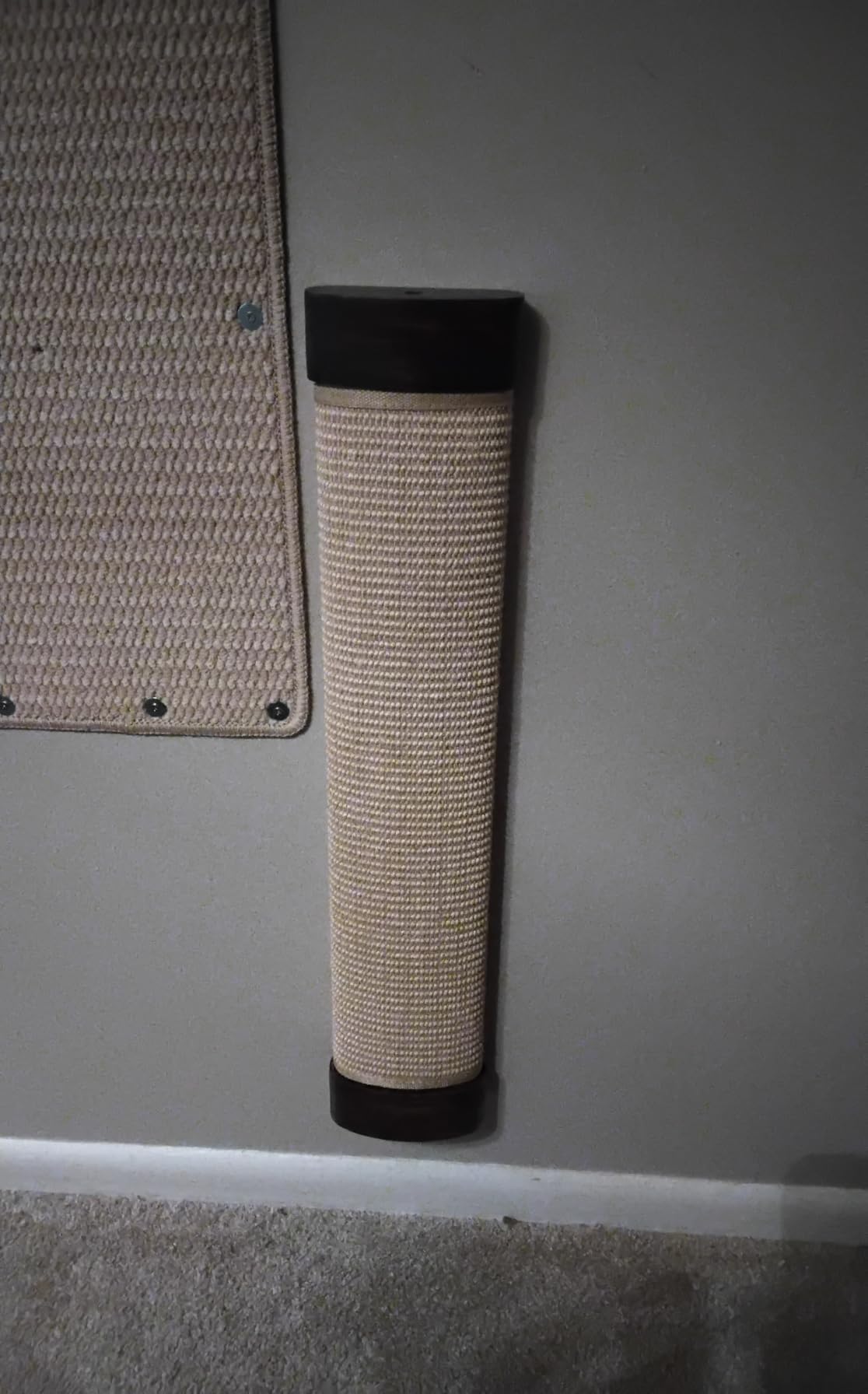
A wall-mounted board is the most stable answer to aggressive scratching that exists, because a post fixed to a wall cannot tip, wobble or slide no matter how hard a cat pulls. This one has the highest share of five-star ratings in the roundup, and that is mostly down to the fact that it does not move.
It projects only 2.5 inches from the wall, so it takes no floor space and creates no trip hazard in a tight room. The 29.5 inches of unbroken woven sisal give a full vertical stretch, and because it is wall fixed you can mount it higher as a kitten grows.
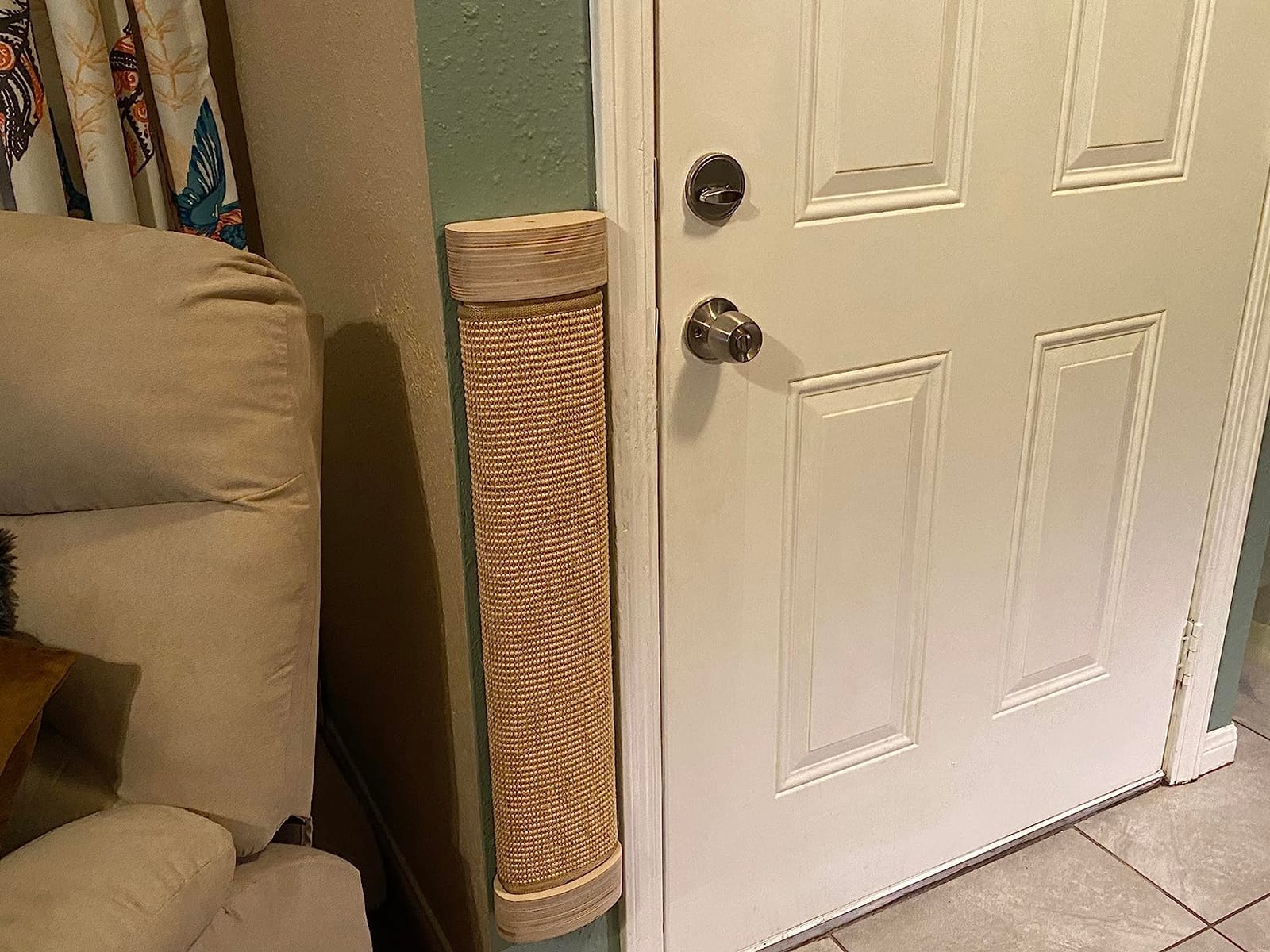
The build is solid pine and birch plywood, and the sisal attaches with no glue and no staples, so there is nothing for a determined cat to pick loose or chew at. When you move out, two small holes is the total damage. If you have ever had a post slide across hardwood the moment a cat jumped off, this is the upgrade that solves it.
The reason it earns a place on an aggressive-scratcher list is the replaceable mat. When the surface wears, you swap the mat rather than discarding the whole board, which is the single biggest cost lever available in this roundup over a 12 month window.
Why replaceable surfaces change the math
Every fixed-surface post has an end point, and when it arrives you either re-wrap it or throw it away. A wall board with a swappable mat turns a two year replacement into a much smaller recurring cost, and it also means a worn board is never a reason to go without a scratching surface at all.
Two practical notes. The replacement mats are a separate purchase, so read the refill availability before you commit, and the mat is held on with hook-and-loop fasteners, which is what makes the swap possible but also means a determined cat can peel at the corner. Check the edge every few months.
What you give up for that stability
It requires drilling into a wall stud or using drywall anchors, and the anchors are not included, so that is a hardware run before you start. At 29.5 inches it is shorter than the tall floor posts, and in a large multi-cat home you will want two so the cats are not queueing for one stretch of wall.
8. Woochpet Palm Tree Scratching Post – Best Compact Design for Apartments
Woochpet Tall Cat Scratching Post,Cat Toys,Cat Scratcher Tree for Large Cat
35 inch sisal trunk
Palm leaf design
16.5 inch base
Ball track and pom poms
Pros
- Palm tree styling doubles as room decor
- Tightly wrapped sisal is gentle on claws and tough enough for daily sharpening
- Five play elements keep a cat engaged
- Compact vertical footprint saves floor space
- 4.7 average rating
Cons
- Lightest frame here at 5.5 pounds so jumping may shift it
- Decorative leaves and pom poms are not structural
- Shorter trunk than the 41 and 45 inch options
- More hanging parts means more that can break
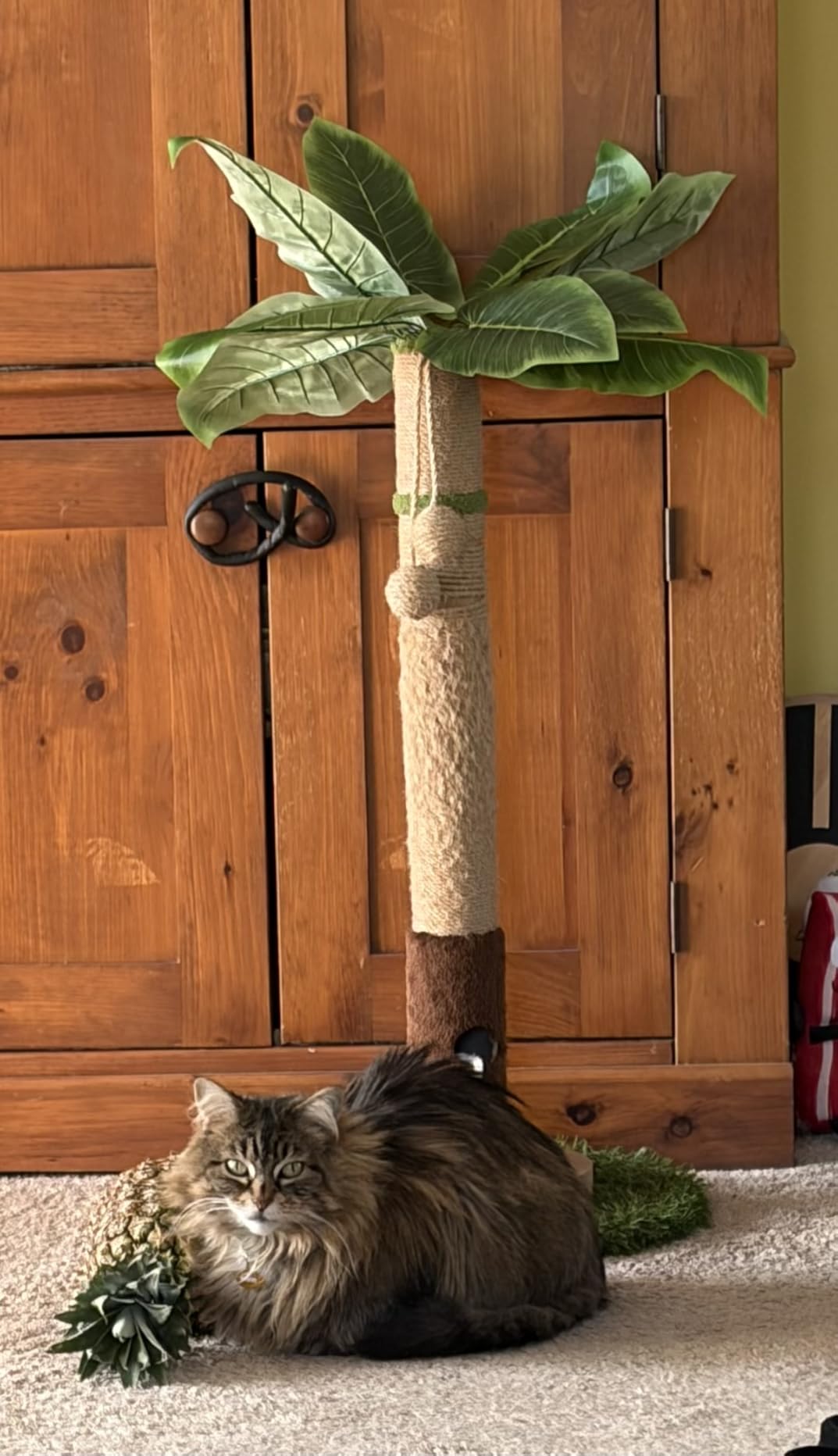
This is the post to buy when the scratching problem is real but a bare column will not suit the room. The palm tree styling with artificial leaves reads as decor, and the trunk is wrapped in tightly wound natural sisal that is both tough and gentle on claws.
It is compact at 16.5 inches square and 35 inches tall, which is a small footprint for a scratching surface that still allows a full vertical scratch. For an apartment where a 19 inch tower would dominate the corner, the trade is worth making.
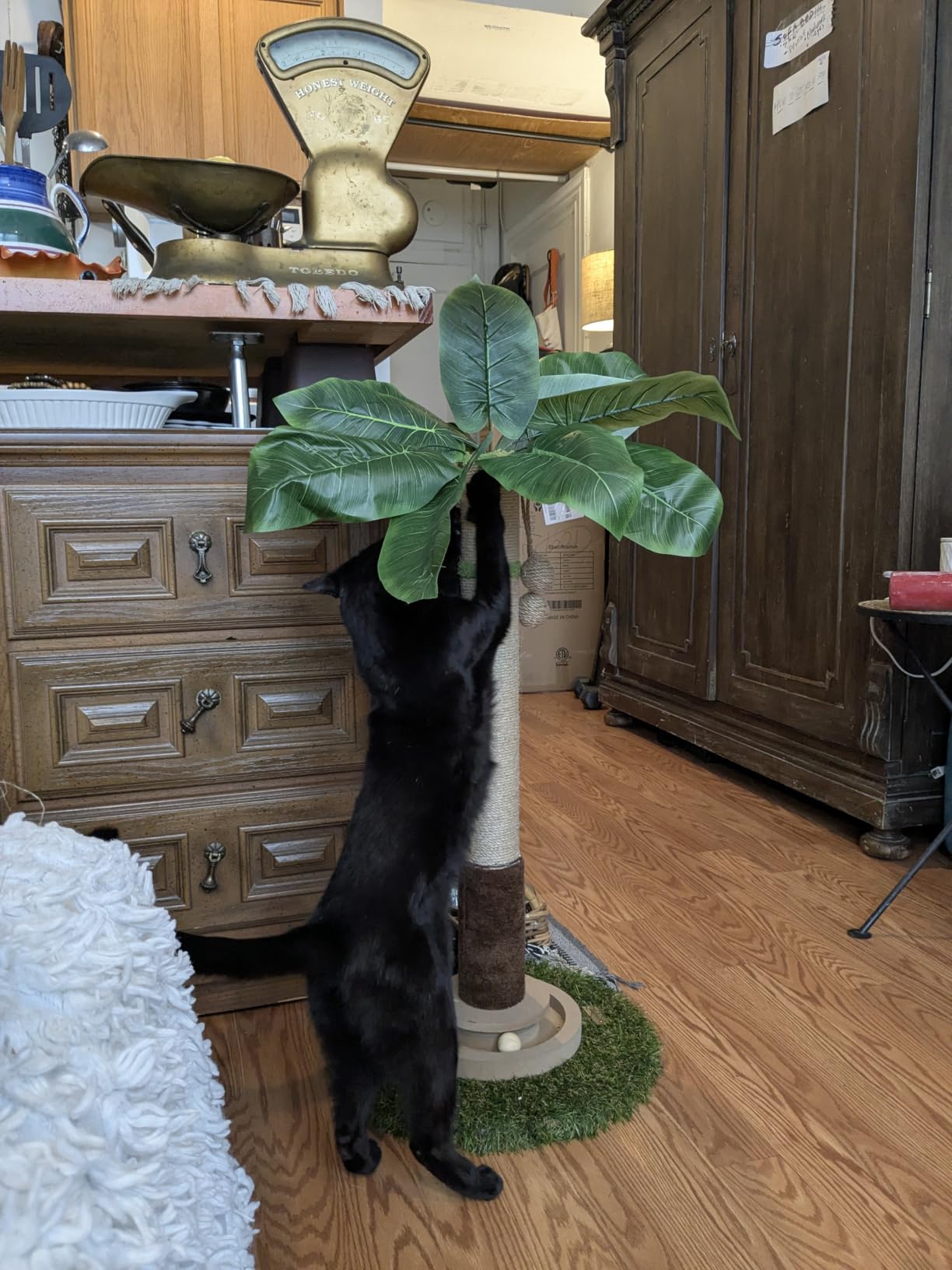
There are five play elements: a rolling ball track on the base, dangling pom poms, and a mouse in a pouch. For a cat that scratches hard and then wants to hunt, having the play built into the same footprint is genuinely useful, and it is one of the reasons a cat adopts a post quickly.
The weakness is mass. At 5.5 pounds this is the lightest frame in the group, so a cat that leaps off the top can shift it, particularly on hardwood or tile. If your scratcher is a jumper, anchor it or accept that it will creep across the room.
Is a decorative post strong enough
The structural parts are better than the styling suggests. The trunk is real tightly wrapped sisal, the base is described as heavy duty with smooth edges, and the materials are non-toxic, so what you are losing is mass rather than surface quality. The leaves and pom poms are decorative and will be chewed, which is fine as long as your cat does not swallow pieces.
Where it will not serve is a very large cat. A 35 inch trunk gives less stretch than the 41 and 45 inch options, and combined with the light base that means a big cat is more likely to knock it over than to use it properly. For large cats, weight and height together are the deciding factors.
Best way to use it in a small room
Put it in a corner near a window so the cat has a view while it scratches, and set it on a non-slip rug or mat if the floor is slick. The ball track needs a few inches of clearance so the rolling balls have somewhere to go, and that is also where a lot of the play value comes from.
One more thought on mess: the ball track collects hair and fur over time and needs the occasional lift and clean. If hair on a floor toy would bother you, this is the wrong pick, and the plain sisal columns are easier to maintain.
9. Ahomdoo 34 Inch Cotton Rope Scratching Post – Best for Low-Mess Homes
Ahomdoo 34-Inch Tall Cat Scratching Post for Large Cats, Stable Base, Gray
34 inch tall
Thick cotton rope
Plush lookout top
Steady base
Pros
- Extra tall post gives large breeds room for a full stretch
- Thick cotton rope is softer on paws and frays less than sisal
- Leaves fewer loose fibers on the floor than rope wrapped posts
- Minimalist profile uses less bulk than a cat tree
- Assembles in about five minutes
Cons
- Cotton rope is less satisfying to many cats than natural sisal
- Lightest build at 7.5 pounds so big cats can shift it
- Listed package dimensions do not match the 34 inch height
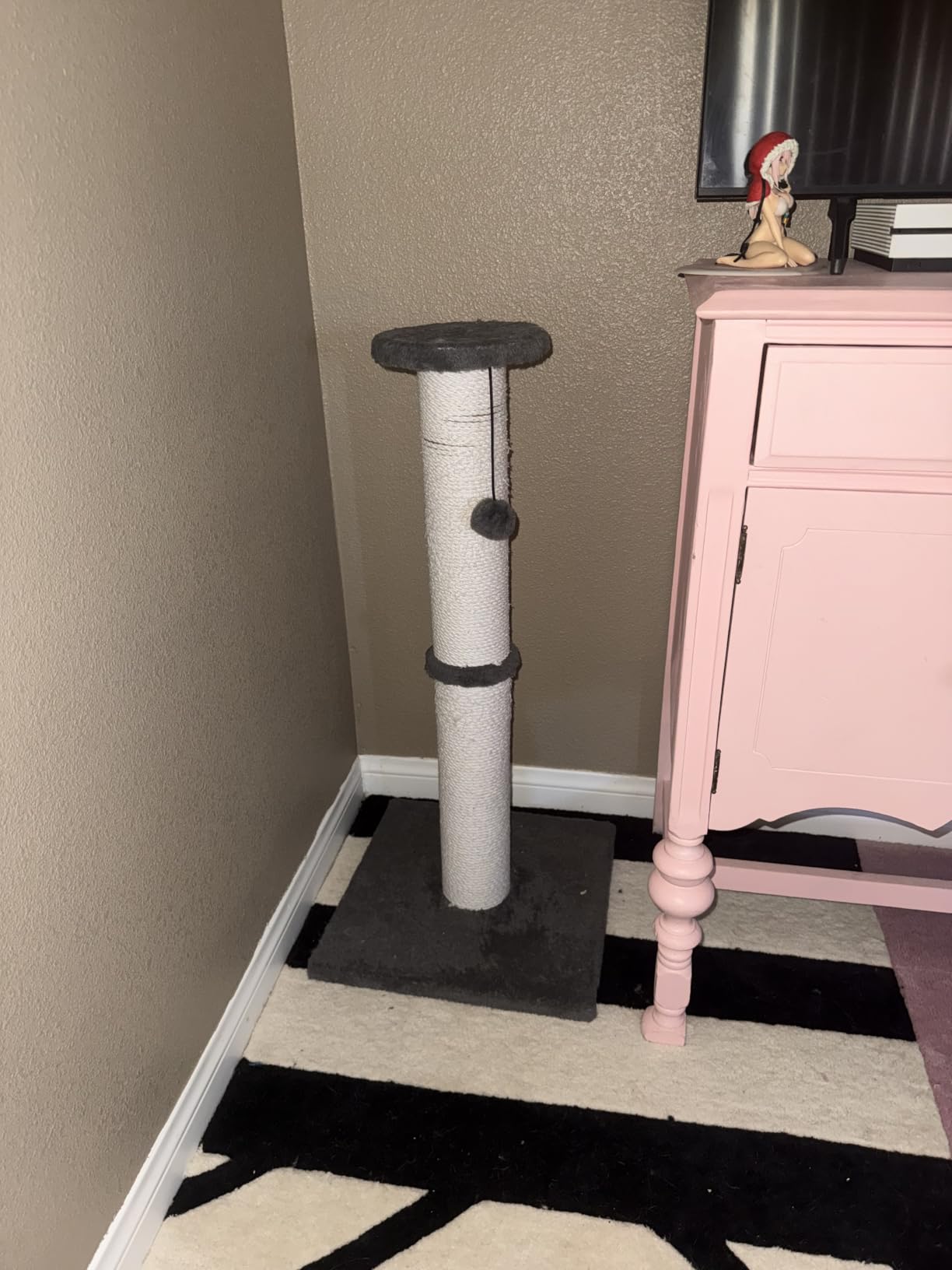
If the reason you keep replacing posts is the debris, this is the post to look at. The wrapping is thick cotton rope rather than sisal, and owners report it leaving noticeably fewer loose fibers on the floor than twine or cardboard scratchers, while still fraying and loosening less over time.
At 34 inches it is one of the taller options, and it is marketed specifically at large breeds such as Maine Coons and Ragdolls that need room to stand, reach and get a full-body stretch. The plush top gives kittens somewhere to rest and adults a lookout perch.
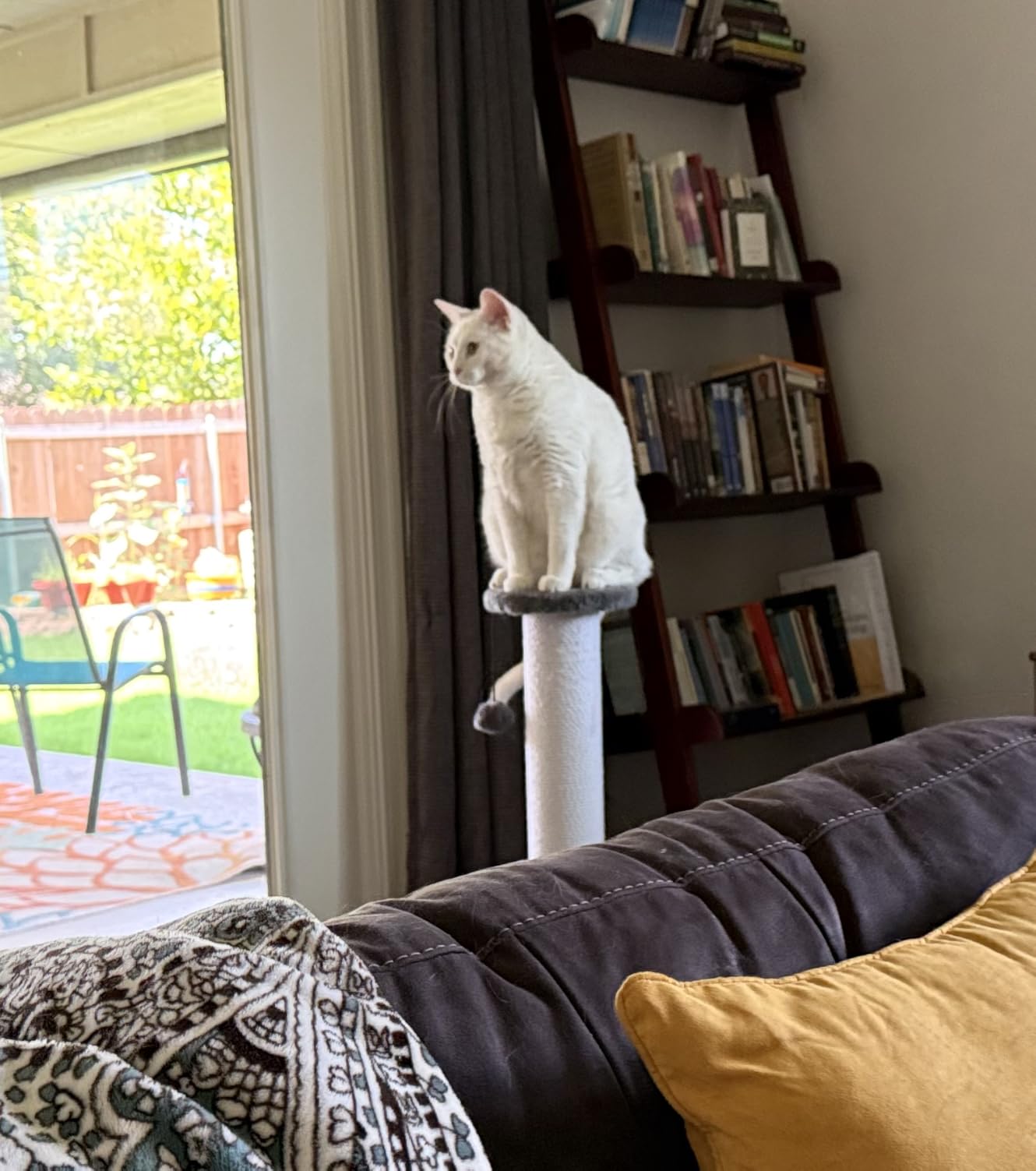
The minimalist profile is a real advantage in a small room, because it uses less bulk than a full cat tree while still delivering a vertical stretch. The dangling ball and mouse toys sway when tapped, which adds an interactive element without a large footprint.
Two honest problems. Cotton rope is a different texture from sisal, and some cats simply prefer the harsher natural fiber, so a cat that has previously ignored everything except sisal may ignore this too. And at 7.5 pounds it is light, so a large cat launching off the plush top can shift it.
When a softer surface is the better call
There is a small group of cats that will not use a hard sisal surface at all, particularly older cats with tender paw pads and kittens still teething. A thick cotton rope is softer on the paw and often gets used by cats that walk past a sisal post, so it is worth having one in the house as a second surface even if the main post is sisal.
The mess difference is real but not absolute. Cotton still sheds fibers, just fewer and shorter ones, so you will want to sweep around the base weekly rather than dealing with a pile of debris. Put a washable mat or runner under it if you want to make cleanup a lift and carry job.
Check the listed dimensions before ordering
The listing package dimensions do not match the stated 34 inch post height, which is a cataloguing quirk rather than a different product. Measure the post once it is assembled before you decide where it goes, because the tallest posts in this category are rarely where you expect to put them.
For a cat that will shred anything soft, the sisal picks further up this list are the safer buy. This one earns its place by solving a cleanup problem, not by being the toughest surface available.
10. PAWZ Road 32 Inch Sisal Post – Best Starter Post for Kittens and Adults
PAWZ Road Large Cat Scratching Post 32″ Tall Black Cat Scratcher
32 inch tall
100 percent natural sisal
16 x 16 inch plush base
Top perch plank
Pros
- 16 inch plush covered base stays put when large cats jump on it
- 32 inch height suits a kitten through to a large adult
- Natural sisal withstands tough claws and keeps cats off couches
- Top plank doubles as a lookout perch
- Simple two-screw assembly
Cons
- Lowest average rating in the group at 4.4
- Plain design has no wall anchoring option
- Hanging bird toy is a short-lived accessory
- Shorter than most tall posts at 32 inches
This is the sensible first post for a household that does not yet have a known scratching problem, and the value is in the base. The 16 by 16 inch wooden platform is covered in plush cloth, which gives grip on hard floors and stops a cat sliding off the side mid-scratch.
The surface is 100 percent natural sisal rope, described as durable enough for tough claws, and at 32 inches it covers the range from a kitten to a large adult. The top plank doubles as a perching and observation spot, and the whole thing goes together with two screws.
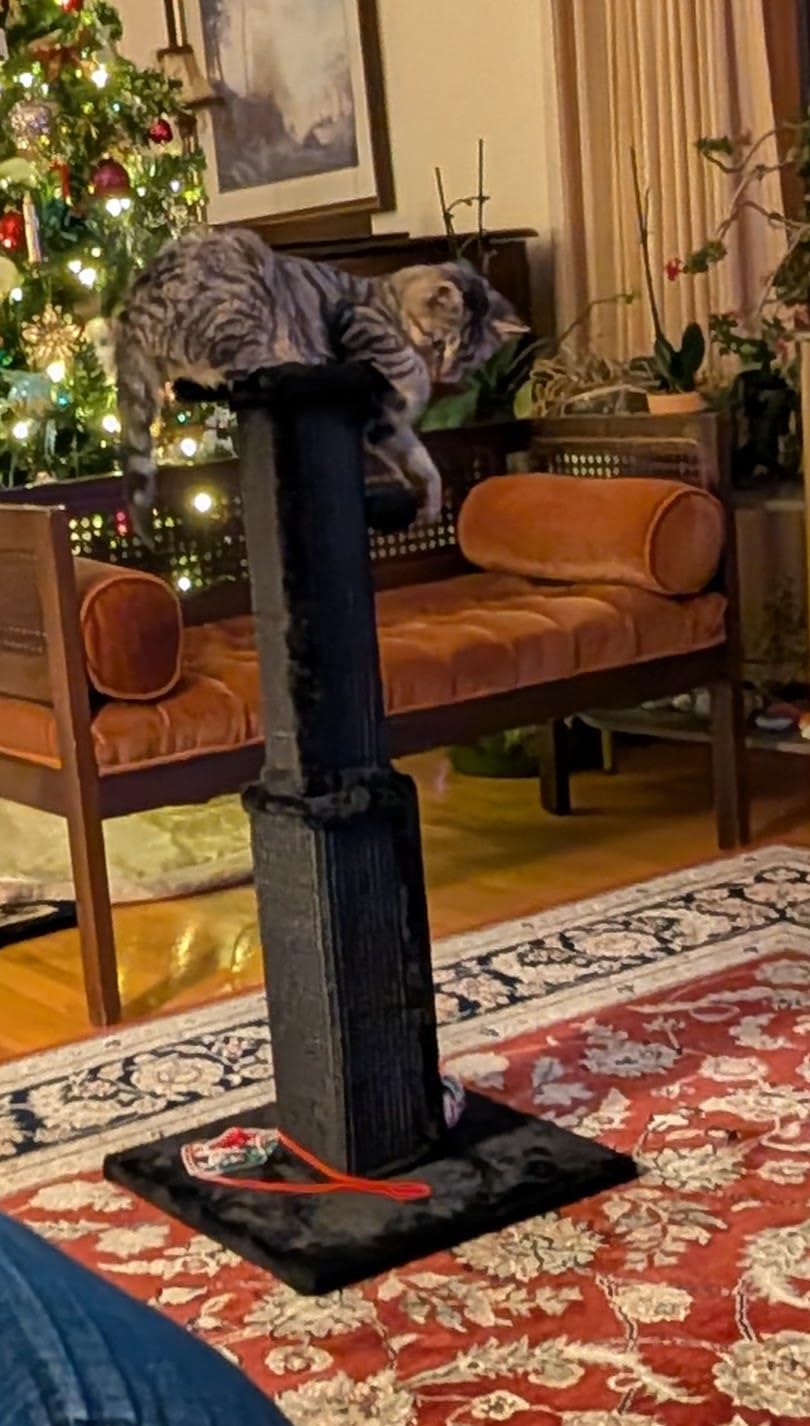
Buyers credit the plush covered base with the stability, and the natural sisal wrap with keeping claws off couches, which is the outcome that matters. For a cat that has never had a dedicated post, the perch on top gives it a reason to climb up rather than treating the column as an obstacle.
It has the lowest average rating in this roundup at 4.4, with a 6 percent one-star share, and the complaints cluster around the same two things: the 32 inch height is shorter than most of the tall options, and the hanging bird toy does not survive long with a cat that plays hard.
Is it durable enough for an aggressive scratcher
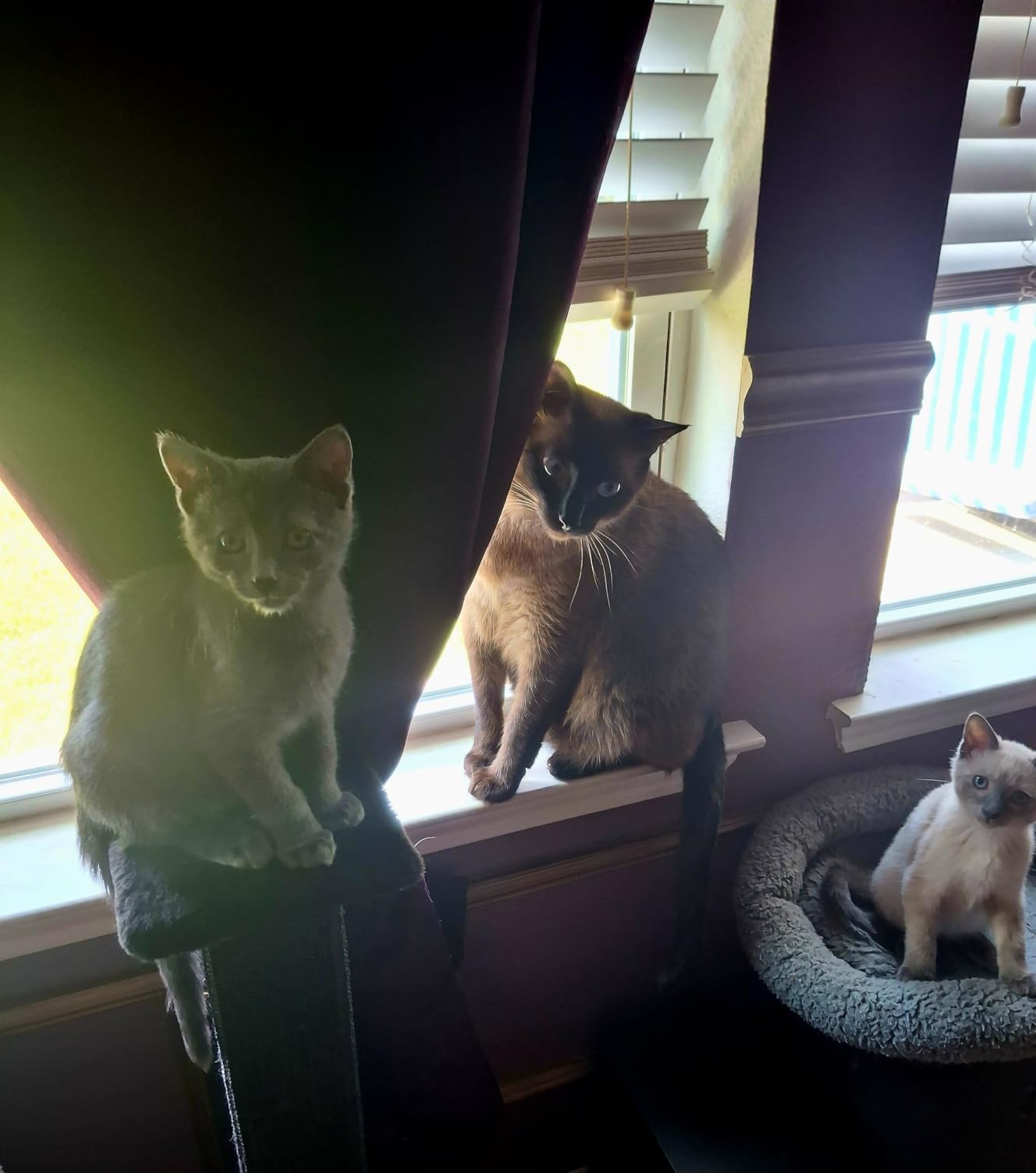
The base and surface hold up, but the height is the limiting factor. A 32 inch post is fine for a cat that scratches at middle height, and increasingly marginal for a cat that rears up and reaches as high as it can. If the damage on your furniture is concentrated at the top, a taller post will be used and this one will be ignored.
There is also no wall anchoring on this design. For a cat that jumps aggressively off the perch, a post with an anchor strap, such as the Amazon Basics option, is the safer and steadier arrangement, and the difference shows up over a year of daily use.
When it makes more sense to step up
If you are buying for a large or overweight cat, or for two or more cats, skip this and go to a taller post with a heavier base. The plush base on this one is a good idea that is not quite enough mass to absorb a hard dismount from a big cat.
Ignore the listed item weight on the product page, which is clearly a data error, and judge the build by the 16 inch base and the wood construction. Our heavy-use product testing approach is the same one we apply here: look at what fails first under real force, not at the styling.
Why Aggressive Scratchers Shred Cheap Posts
Aggressive scratchers do not set out to destroy a post. They are doing four specific things a cheap post cannot accommodate, and once you know which one applies to your cat, the fix is obvious.
The post is too short. A cat that cannot fully extend into a post scratches at an angle and wears through one side. Measure the cat standing on its hind legs and buy a post at least that tall.
The surface is too soft. Corrugated cardboard and thin jute shred in days under hard clawing. Expect a lifespan measured in weeks rather than years, and treat the purchase as a consumable rather than a solution.
The base is too light. A post under about 8 pounds on a base narrower than 14 inches will shift, and a shifting post concentrates wear in one spot. Weight, footprint, or an anchor strap, solves it.
The material is simply not the cat’s. Cats have firm preferences, and the honest truth is that some cats only scratch cardboard. Owners on cat forums describe the frustration of buying beautiful sisal posts that nobody touches while a cheap cardboard pad gets flattened weekly. Buying the material your cat already chooses is more effective than buying the one the reviews recommend.
Add to that the cost arithmetic. A low-cost cardboard pad replaced every three months costs more over a year than a single sisal post that lasts, which is why a heavily shredding cat should move up a tier rather than keep replacing a cheap option. It is the same logic as buying a deeper cutting board once instead of a thin one three times.
Sisal, Cardboard, Carpet or Rope: Which Surface Survives
Dense woven sisal is the best material for aggressive scratchers, and the difference in expected lifespan between surfaces is large enough to change your buying decision.
Sisal fabric or woven panel. Longest lasting of the common surfaces. It frays and thins with use but does not unravel, holds shape through years of hard scratching, and is less likely to catch a claw than carpet because the fibers are tightly interlaced.
Sisal rope and jute rope. Wound strands give strong resistance and good leverage because the cat can hook a claw into a groove and pull, but the twist is also the weak point. A hard scratcher pulls fibers out of the strand, the strand loosens, and a claw can eventually catch in it. Expect fraying to show well before the surface is spent.
Corrugated cardboard. The cheapest option and the messiest, with crumbs that travel across the room. Good for kittens and for redirecting a cat onto a surface at all, but a cardboard post is a short-term purchase against a heavy scratcher. Check for a chemical smell on arrival and reject it if there is one.
Carpet. Soft on paws and long lasting, often quoted at up to two years, but fibers can snag a claw and the texture can transfer to your own home carpet, which encourages scratching the floor instead of the post.
Wood and plywood cores. Not a scratch surface on their own, but the material of the frame matters. Dense hardwood or birch plywood resists splitting under force where particleboard and thin cardboard delaminate. For a post you build yourself, those are the materials to use, sealed with a non-toxic coating.
Burlap is worth skipping for a hard scratcher. It shreds fast and its rough weave is where claws most often catch. A hanging jute scratcher is the same trade: satisfying for the cat, poor value against a strong scratcher.
How to Get Your Cat to Actually Use the New Post
The most common reason a good scratching post gets ignored is not quality, it is placement. The most repeated piece of advice on cat forums is to put the post directly next to the furniture being destroyed, not in a corner across the room where you would prefer it to live.
Put it beside the damage. Set the post a foot or two from the sofa corner your cat is working on. Scratching is location-specific, and a post two rooms away asks the cat to break a habit it has already built.
Rub their front paws into it. Pick your cat up, take their front paws, and run them down the surface repeatedly until they take over. Do this every day for the first week. It is the single most effective habit-building step there is, and it is where most owners give up too early.
Use catnip, then switch to treats. Catnip gets a cat to investigate, but it wears off fast. Once the cat is using the post, reward the behavior with a treat every time you catch them on it, which is what turns an accident into a routine.
Protect the furniture the same day. Double-sided tape on the arms and corners of the sofa makes the surface unpleasant and stops the habit from continuing in the meantime. Do not rely on a spray alone while you wait for the post to win.
Run two or three posts in different rooms. A working multi-post household is common on forums: one tall post in the bedroom, one tower with several scratch surfaces by a window, and another in the room where the damage happens. Cats scratch in several places, not one.
Add height the cat actually wants. For a lot of cats, the thing that finally redirected scratching was solving a separate problem, such as a window perch the cat could sit on while watching outside.
Do not chase the cat away from the furniture while it is doing it, and never punish. A calm redirection toward the post within a few seconds of the scratching starting works far better than any deterrent applied after the fact.
Safety, Wear-Through and When to Replace a Post
A post that is being scratched hard deserves an inspection every couple of months, because the failure modes that matter are claw snag, splintering and toppling rather than appearance.
Claw snag. A claw that catches in a loose rope strand or a peeling sisal edge can injure the paw and teach the cat to avoid the post. Run your hand along the surface: if you can catch a fingernail on a fiber, a claw will too. Sand the edge or replace the surface.
Wear-through. When you can see the wood or cardboard core through the wrapping, the post is done. Check the middle section first, since that is where force concentrates, and check the lower third where cats often work from a crouch.
Splinters. A wood core exposed by heavy scratching can dry out and split. Feel along the top edge and the join between the post and the base. If it feels rough or you can see cracked grain, retire it rather than letting a cat find the sharp edge.
Toppling. The most common injury is a cat landing under a post that shifted as they dismounted. If the base moves at all when you push the top sideways, it is not heavy or wide enough. Wall-mounting solves this completely, and a base 15 inches or wider with a mass of 8 pounds or more solves it most of the time.
Before you discard a post, consider re-wrapping it. A wooden core that is structurally sound can be stripped and re-covered with fresh sisal rope, which extends its life for a fraction of a replacement and keeps a familiar scent and texture in place. If a post has a replaceable or reversible surface, that does the same job without tools.
Never declaw a cat to solve furniture scratching. It is a painful mutilation of the last joint of each toe, it removes the cat’s ability to defend itself, and it does not stop scratching behavior, it just removes the reason your furniture is not the target.
What Type of Scratching Post Do Cats Like Best?
Cats like tall vertical posts most, and they like a stable weighted base second. Orientation matters more than brand, and the single most important measurement is height: the post should be at least as tall as your cat standing on its hind legs.
There are five main types, and the aggressive-scratcher answer is usually a combination of more than one:
Tall vertical sisal post. The best option for hard clawing. It supports a full-body stretch, holds the most surface, and survives years of force when the wrap is woven rather than loose rope.
Wall-mounted board. The most stable and the best for renters, small rooms and multi-cat homes, because nothing can tip. Look for a replaceable surface.
Horizontal board or lounger. For a cat that stretches flat rather than upright. It must be wider than the cat, and it needs a non-slip backing or it slides on hard floors.
Cat tree or tower with integrated sisal. Scratching, perching and lookout in one footprint, which is often what finally redirects a cat that ignores a bare post. Check for a wide base or anti-toppling hardware, especially with a large cat.
Cardboard pad or honeycomb scratcher. Cheap, light, and messiest. Fine for kittens and for a cat that will not use anything else. Expect to replace it several times a year against a heavy scratcher.
Beyond type, four things decide whether a post works for an aggressive scratcher. Base mass and footprint come first, and the practical threshold is a base 15 inches or wider on a post weighing 8 pounds or more, or a wall fix. Height comes second, measured against the cat’s own full stretch.
Size by cat next. A post under 12 inches is wasted on an adult cat, and a 20 pound Maine Coon needs a 40 inch or taller column to scratch at full extension. For an overweight cat, weight and height matter together, because the same force that shifts a light post also sends a heavy cat into the floor.
For multi-cat households, one post is not enough. Two cats will queue for a single column, and the loser goes back to the sofa. A tall post plus a horizontal board plus a wall-mounted board in two or three rooms covers the full range of preferences, and rotation is more effective than trying to find one perfect post.
Finally, calculate cost over 12 months rather than looking at the sticker. A low-cost cardboard pad replaced quarterly costs more per year than one sisal post, and a post with a replaceable mat or a re-wrappable core costs least of all over a multi-year window. For a cat that destroys posts on a schedule, that calculation is the whole decision.
If your cat also needs enrichment to burn off the energy that drives the scratching, our heavy-use product testing notes cover the same method we use here: watch what fails first under real force, and ignore the styling.
Frequently Asked Questions
What type of scratching post do cats like best?
Most cats prefer a tall vertical post, and among those a tight woven sisal surface rated for heavy clawing. Cats scratch to shed the outer husk of each claw, to stretch the spine and shoulders, and to leave scent, and a post at least as tall as the cat standing on its hind legs lets them complete all three. Stability comes second: a base 15 inches or wider on a post weighing 8 pounds or more, or a wall-mounted board, keeps the post from shifting under force.
What is the best material for scratching posts for cats?
Dense woven sisal is the best material for an aggressive scratcher. The fibers shred in a way that satisfies a cat, do not unravel when scratched, and are less likely to catch a claw than carpet. Sisal fabric or woven panel construction outlasts wound sisal rope, which loosens as fibers are pulled from the twist. Corrugated cardboard is the cheapest and shortest-lived option and sheds crumbs, while carpet is soft on paws but can snag claws.
Do cats prefer cardboard or sisal?
It depends entirely on the individual cat, and that preference overrides any general rule. Most cats in the forums we read actively choose cardboard even when their owners prefer sisal, and some cats refuse a sisal post they are surrounded by. The practical approach is to give the cat the material it already picks, then add a taller, heavier sisal post beside the damaged furniture so the long-term habit has somewhere better to go.
How tall should a cat scratching post be?
At least as tall as your cat standing on its hind legs with its front paws extended. A shorter post forces the cat to scratch at an angle, which wears one side of the surface through far faster than the whole column and leaves the post looking damaged while part of it is unused. A 32 to 35 inch post suits most adult cats, while large breeds such as Maine Coons generally need 40 inches or more.
When should I replace my cat’s scratching post?
Replace or re-wrap it when the surface is worn through to the core, when a claw can catch in a loose fiber, or when the wood core starts to feel rough or show cracked grain. Check the middle section and the lower third first, since that is where force concentrates. A post that shifts or wobbles when you push the top sideways is also a safety problem and should be anchored, wall-mounted or replaced with something heavier.
What to put on a sofa to stop a cat from scratching?
Double-sided tape is the most reliable option, applied to the sofa arms and corners the cat is working on. Other approaches include upside-down carpet runners, sandpaper sheets, fitted scratch shields and washable covers. Protect the furniture the same day you introduce a new post, because a deterrent that arrives after months of scratching rarely overrides an established habit.
The Bottom Line on Cat Scratching Posts for Aggressive Scratchers
A cat that shreds a cheap post in a week is not misbehaving and neither are you. Four things decide whether the next one survives: a surface dense enough to take force, a base heavy and wide enough not to move, a height that lets a full-body stretch, and a cost per year you would actually accept.
Our picks cover those cases. The SmartCat Pioneer Pet Ultimate is the best all-round post for aggressive scratchers, with a 32 inch woven sisal column on a 16 inch base. Go taller and heavier for a large cat or a multi-cat home, choose the wall-mounted board when floor space or tipping is the issue, and replace the post rather than the frame whenever a replaceable surface exists. Put it next to the sofa, and the sofa stays intact.