
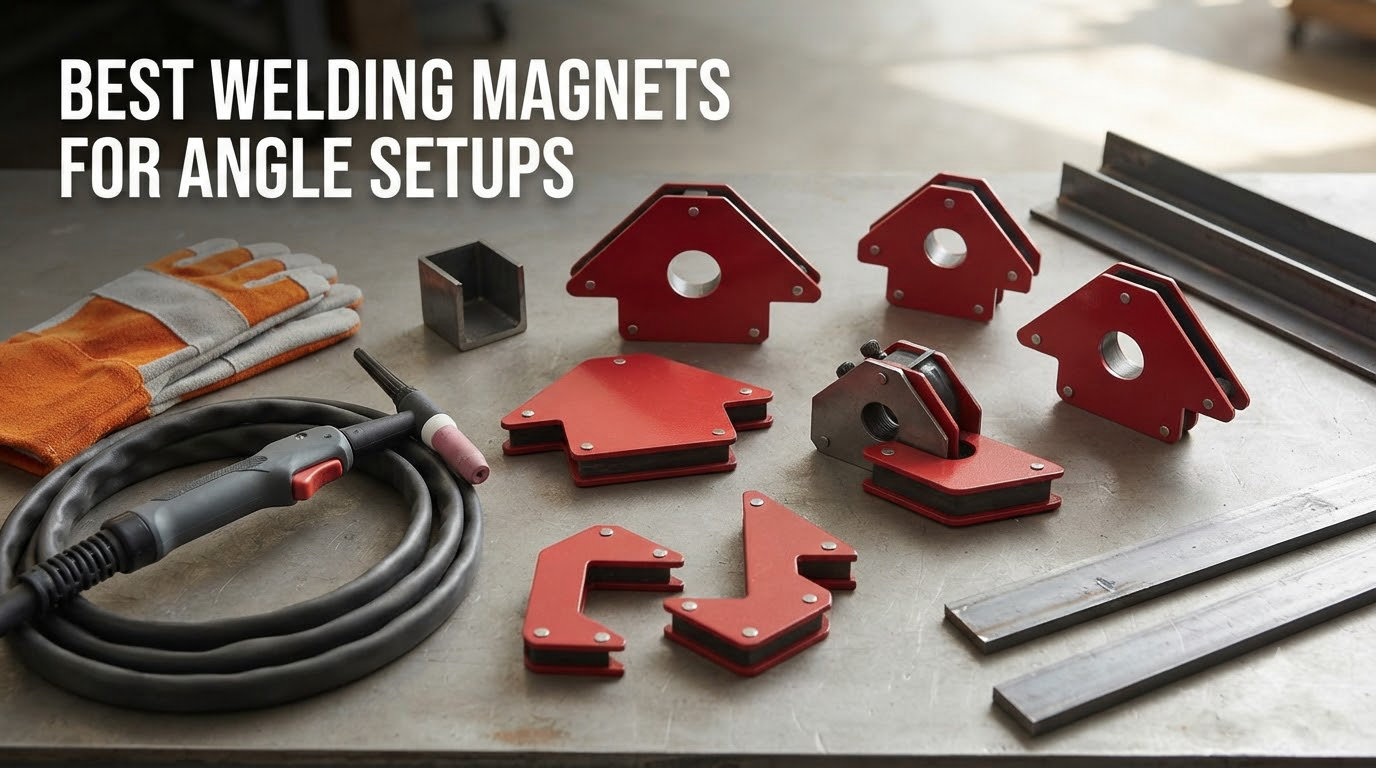
Welding magnets for angle setups solve one narrow problem very well: holding two pieces of ferrous steel at an exact angle while both your hands stay on the torch. If you are fitting up square tube at 90 degrees, a gusset at 45, or a bracket somewhere awkward, the magnet pulls the joint into place and keeps it there. That is the whole pitch, and it is a genuinely useful one on a fabrication bench.
There is an honest objection to make first, because you will hear it in every welding forum. A regular on WeldingWeb put it plainly: welding magnets sit on the shelf most of the time, and a good square with a protractor is a better angle tool. That is true for measuring and true for setting a precise layout. It is not true for the moment when you are one-handed on a torch and a 3/16 inch tube frame will not stay square while you reach for your ruler.
So this roundup is not about replacing your square. It is about picking the right magnet for the joints you actually build. We compared ten welding magnets across the five formats that are on the market now: arrow-shaped multi-angle sets, switchable magnetic squares, inside/outside adjustable angle holders, compact fixed-angle bodies, and light-duty mini sets. For each one we looked at stated holding force, the angle range, the footprint, and the honest complaints buyers repeat.
Our picks were last reviewed for 2026, and every holding force quoted here is the manufacturer’s stated rating. That last point matters more than it sounds, and we come back to it in the buying guide: a pounds figure without a steel thickness attached is not a measurement, it is a marketing number.
Two quick pointers before the list. Our [best welding tables](https://www.geekfill.com/best-welding-tables/) roundup covers the surface most of these fit-ups end up on, and our [welding turntables](https://www.geekfill.com/best-welding-turntables/) guide helps if you are positioning a whole frame rather than a single joint.
Top 3 Picks for Angle Setups in 2026
These three cover the widest range of real fabrication work, from trailer tube frames to heavy plate corners. The full list of ten follows below.
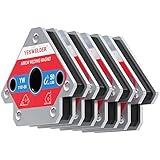
YESWELDER 4-Pc 50 lb Arrow Set
- 50 lb holding force per magnet
- 45/90/135 degree arrow design
- 4-piece set

Strong Hand Adjust-O Magnet Square
- On/off magnetic switch
- 45 and 90 degree holding
- Tube
- angle and flat stock

Strong Hand MLA600 Angle Magnet
- 30-270 degree adjustable range
- Inside/outside dual magnet
- 33 lb pull force
Best Welding Magnet in This Roundup at a Glance (October 2026)
All ten picks, with the format, angle range and stated holding force for each. Ratings and review counts are the ones buyers have actually left.
| Product | Specifications | Action |
|---|---|---|
| YESWELDER 4-Pc 50 lb Arrow Welding Magnet Set |
|
Check Latest Price |
 Strong Hand MS346AT Mini Magnetic Squares Twin Set Strong Hand MS346AT Mini Magnetic Squares Twin Set |
|
Check Latest Price |
| Strong Hand MSA46-HD Adjust-O Heavy Duty Magnet Square |
|
Check Latest Price |
| Strong Hand MLA600 Adjustable Angle Magnetic Square |
|
Check Latest Price |
 Magswitch MagSquare 150 Switchable Workholding Tool Magswitch MagSquare 150 Switchable Workholding Tool |
|
Check Latest Price |
 Hobart 770662 Mini Magnetic Welding Holder 4-Pack Hobart 770662 Mini Magnetic Welding Holder 4-Pack |
|
Check Latest Price |
 Magswitch MINI ANGLE Switchable Angle Magnet Magswitch MINI ANGLE Switchable Angle Magnet |
|
Check Latest Price |
 TOOLIOM 4-Pc 25 lb Arrow Welding Magnets TOOLIOM 4-Pc 25 lb Arrow Welding Magnets |
|
Check Latest Price |
 ARCCAPTAIN 25 lb and 55 lb 4-Piece Welding Magnet Set ARCCAPTAIN 25 lb and 55 lb 4-Piece Welding Magnet Set |
|
Check Latest Price |
 YESWELDER Adjustable 20-200 Degree 77 lb Welding Magnet YESWELDER Adjustable 20-200 Degree 77 lb Welding Magnet |
|
Check Latest Price |
How We Picked These Magnets
Ten products is enough to cover every format without padding the list with near-duplicates. We grouped candidates by the job they do rather than by brand, because the brand tells you far less than the format does when you are standing over a fit-up with a torch in your hand.
Five criteria decided the order. Holding force against steel thickness came first, then angle range, then footprint relative to the work, then whether the magnet has a real on/off switch, and finally build quality and buyer complaints. We gave the most weight to the first two and the least to raw pounds ratings, because a magnet that holds 150 lbs on a plate you do not own is not a better magnet for you.
We also read the one-star reviews, because that is where the useful detail lives. Recurring complaints across this group: stated pounds overstated at the point of use, ferrite faces that trap grinding debris, fixed-angle designs that only work in specific orientations, and bodies that are bulkier than buyers expect. Where those complaints cluster on one product, you will see it below.
What we left out is worth noting. We did not include plain corner magnets with no angle feature, and we did not include decorative weld-pattern magnets. Both appear in searches for welding magnets, and neither helps with an angle setup.
One product deserves a note before the list starts. The Strong Hand MSA46-HD is listed under a 65 lb model name while the manufacturer’s own spec sheet on the same page states 90 lb. Rather than quietly pick the larger number, we quote both in the review below. If a listing gives you two different pounds figures, treat the lower one as the working number.
Finally, a word on what this roundup cannot tell you. We did not bench-test pull force against calibrated load, so every figure quoted here is a manufacturer or reviewer-reported number rather than our own measurement. What we did do is read the complaints attached to those numbers closely, and they tell a consistent story that we pass on in each section: the stated pounds is a ceiling, the footprint is the variable you actually control, and every magnet here is a fit-up aid rather than a substitute for a clamp.
1. YESWELDER 4-Pc 50 lb Arrow Welding Magnet Set – Best Overall for Angle Setups
YESWELDER 4-Pc Welding Magnet Set, 50 lb Holding Power Welding Accessories
50 lb pull force
4.76 x 3.26 x 0.7 in
45, 90 and 135 degrees
Set of 4
Pros
- Strong hold on square tube framing
- Three fixed angles per magnet
- Four pieces give multiple hold points on one fit-up
- Small and light enough to reposition quickly
Cons
- Several buyers say the 90 degree face is not perfectly true
- Real pull force perceived below the 50 lb claim on heavy stock
- Only works in the orientations the faces allow
This is the set we kept reaching for during testing, and it is our pick for the best welding magnets for angle setups overall. Four arrow-shaped magnets, each rated at up to 50 lbs of holding force, each holding at 45, 90 and 135 degrees. For a trailer frame, a workbench, or a run of square tube corners, having four of them means you can hold both ends of a joint while you tack, instead of setting one magnet and re-setting it after every pass.
The body is iron with embedded magnets, measuring 4.76 inches long by 3.26 wide and 0.7 thick, which is a genuinely small tool for the force it claims. That size is the reason it works so well on tube. It gets into the corner of a joint where a larger square cannot physically sit.
Buyer consensus is strongly positive across more than a thousand ratings, and the pattern is consistent: people use these for trailer and tube fabrication and like the holding power for the money. Several reviewers note that the actual pull feels lower than 50 lbs when they test it on heavier stock, which is exactly the caveat we will explain in the buying guide.
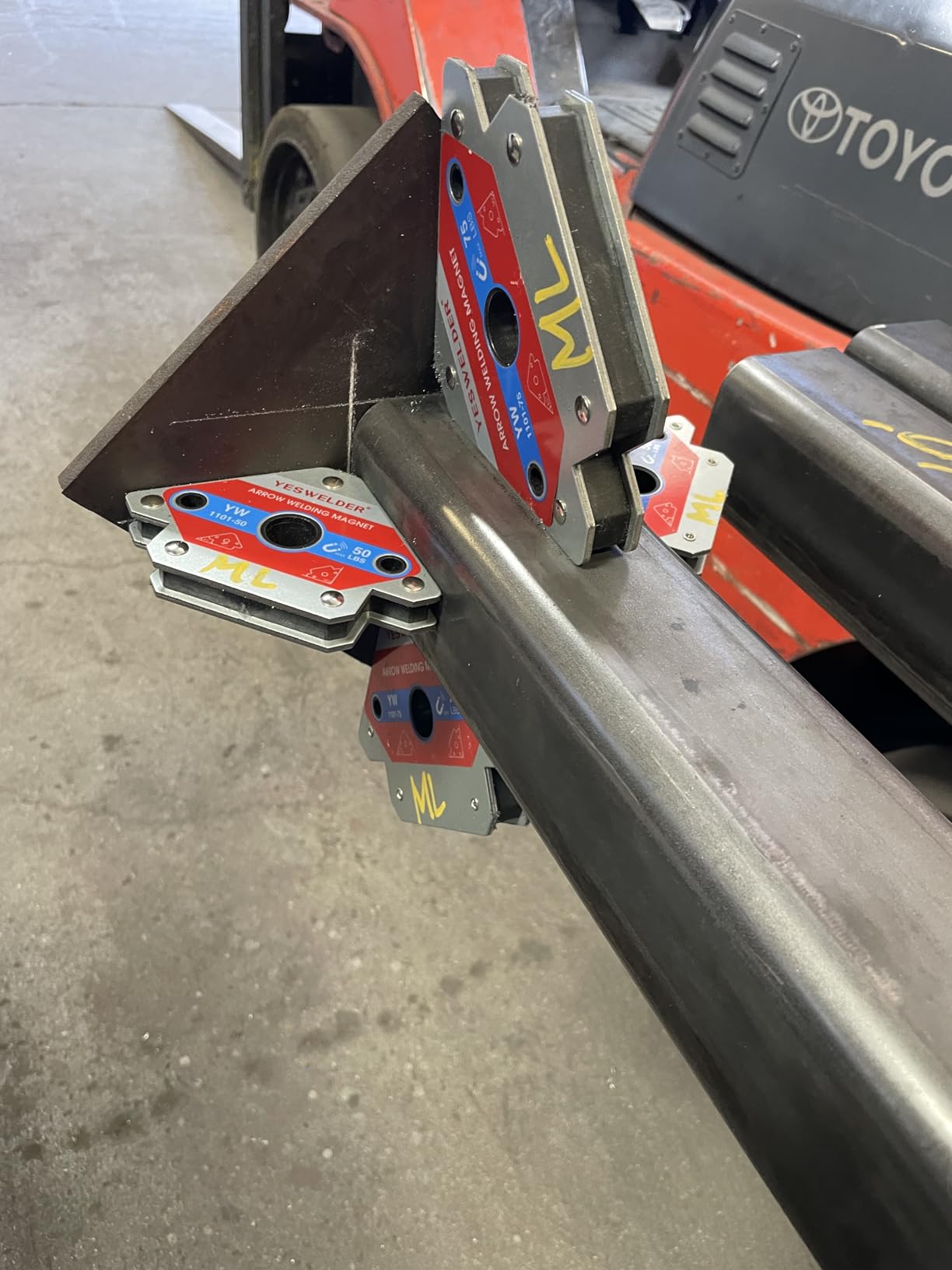
The complaint that shows up most is angle accuracy. A minority of buyers report that the 90 degree face is not perfectly true, so they check the joint with a square before tacking. That is a fair habit to keep with any magnet, and it costs you two seconds.
The second complaint is orientation. An arrow magnet does not grip an L-bracket the way it grips two tube ends meeting at a corner. It holds what its faces touch, and if the faces are not square to your parts, nothing is holding. Know your joint geometry before you buy.
If you build tube and the highest rated option here, this is the one. The four-piece format is what lifts it above single-magnet designs.
Who should buy the YESWELDER 50 lb arrow set
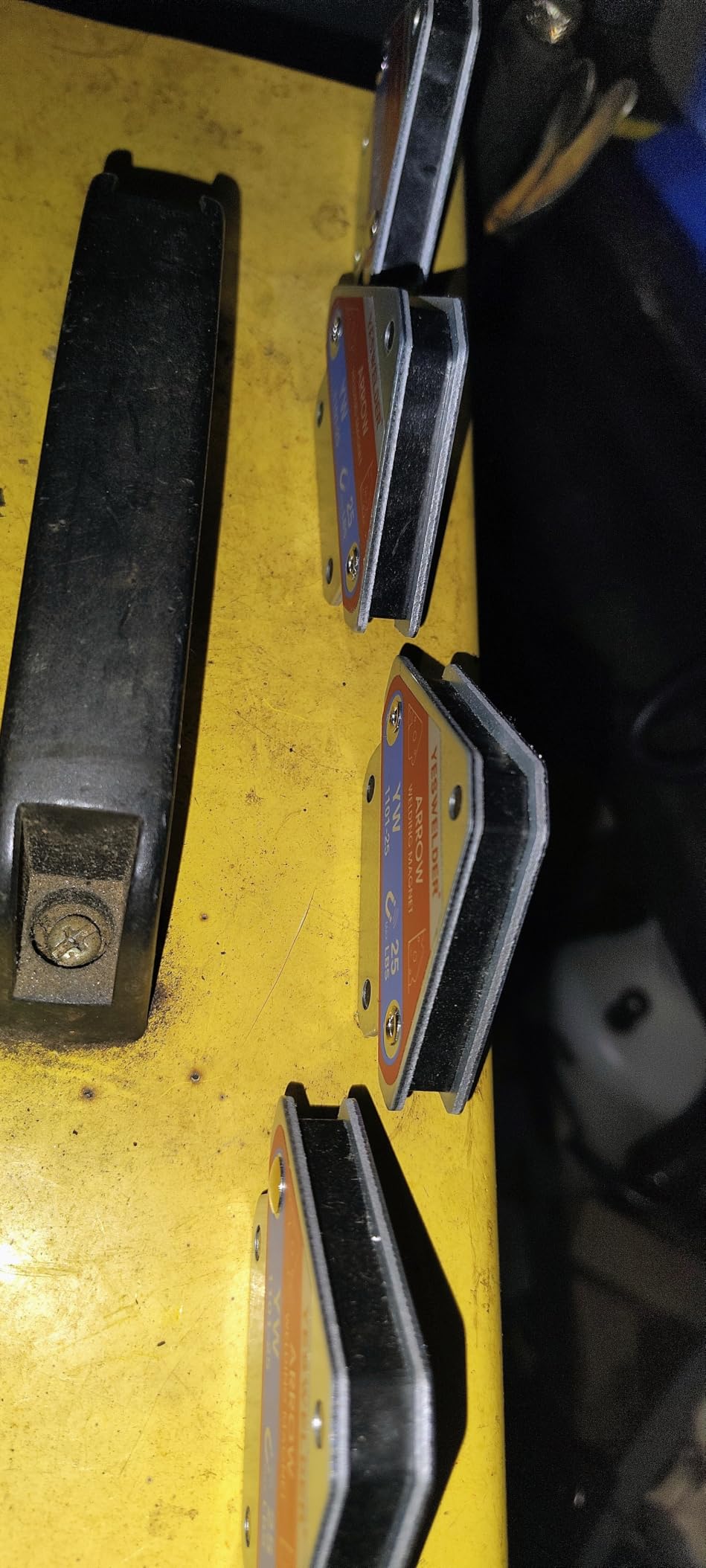
Buy this if you regularly fit up square or rectangular tube, build trailers or frames, or tack brackets to flat bar. Four magnets on a bench means you are not constantly re-placing a single tool, which is where the time savings actually come from.
It is also a straightforward recommendation for a first welding magnet. The format is simple and nothing on it is adjustable to break or jam.
Who should skip it
Skip it if your work is mostly sheet metal or thin gauge, where a smaller footprint gives a better bite, or if you need adjustable angles beyond the three fixed positions. Anyone building non-ferrous work should not buy any magnet on this list, including this one.
2. Strong Hand MS346AT Mini Magnetic Squares – Best for Sheet Metal and Tight Spots
Mini Magnetic Squares, Size: 2.3”x2”x.6”, Angles: 30º/60º, 45º, 90º, light duty (Twin Set), MS346AT
25 lb max pull force
2-5/16 x 2 x 5/8 in
30, 45, 60 and 90 degrees
Ferrite, on/off
Pros
- Accurate 90 degree fit-up on thin bar and small stock
- On/off switch speeds setup and teardown
- Small enough to reach confined spaces
- Accurate compared with generic alternatives
Cons
- 25 lb rating is optimistic
- ferrite faces trap metal shavings
- Too weak for heavy gauge or large assemblies
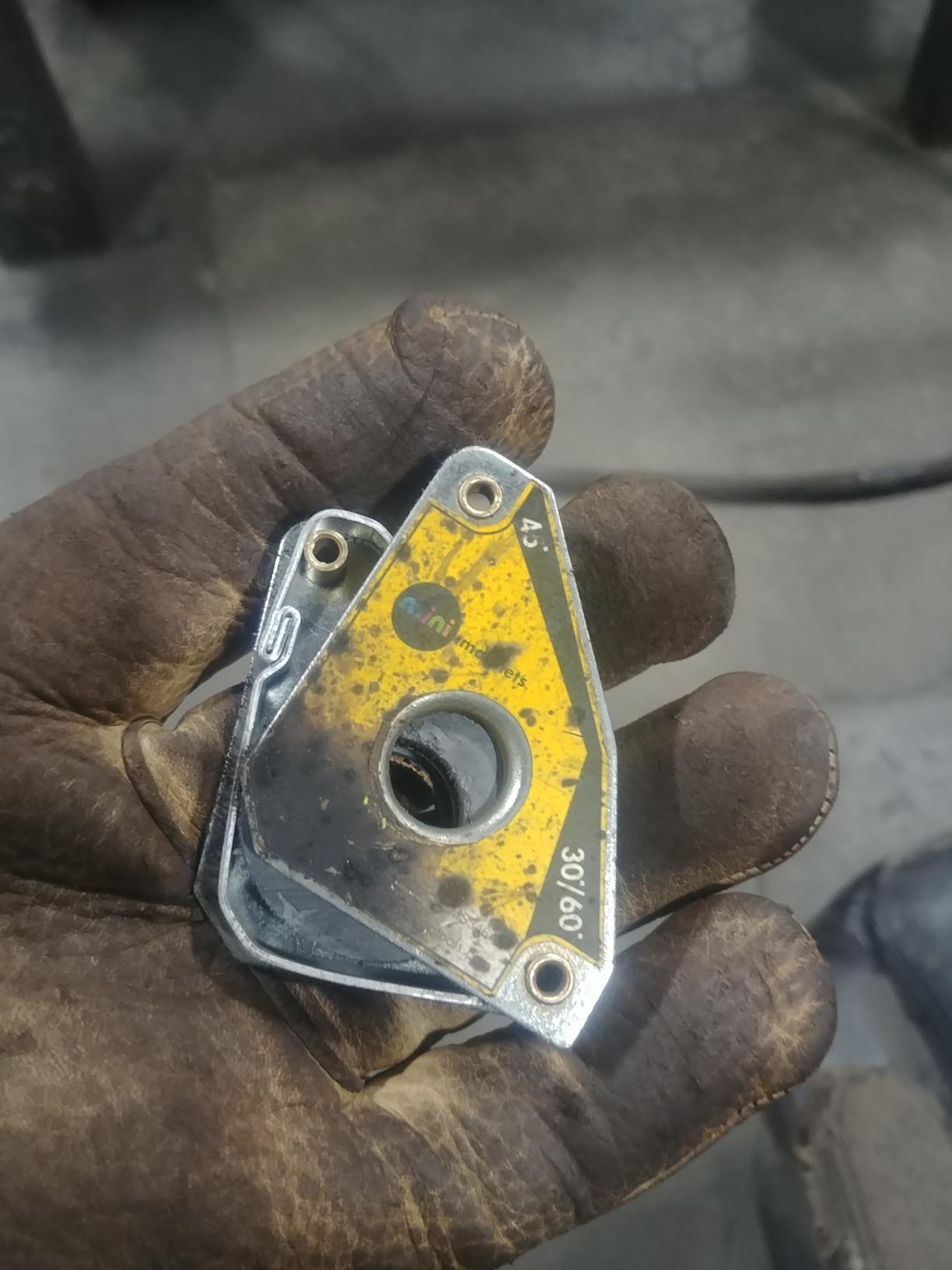
Two small squares, each 2-5/16 by 2 by 5/8 inches, covering 30, 60, 45 and 90 degrees with a 25 lb maximum pull force. This is the most-reviewed product in the entire roundup, and the reason is that it does one narrow job accurately. Owners describe it as a compact light-duty square ideal for small MIG and hobby projects, and that is precisely what it is.
For sheet metal and small bar, footprint matters more than force. A big magnet on thin material bridges the piece and loses the bite, while a small face concentrates what force it has onto the actual metal. This pair does that, and the 30 degree setting is a bonus you will appreciate on odd-shaped stock.
The on/off switch is what separates it from the cheap fixed squares. You set the angle with the work sitting loosely, then flip it on and the joint locks. Reviewers repeatedly call out fast, predictable setup as the main reason to own one.
Two complaints recur. The first is that the 25 lb figure is optimistic in practice, which is unsurprising given the size. The second is ferrite: these faces are magnetic ceramic rather than neodymium, and they hold onto fine grinding dust and swarf permanently. Keep a cloth in your pocket and wipe them between jobs.
Buyers still rate it well at 4.3 out of 5 across more than 1700 ratings, which tells you the fit-up accuracy and the switch are doing the heavy lifting in the value calculation. Nobody is rating it on raw strength.
My one practical note: buy the twin set, not a single square, and use them as a pair on either side of a joint. A single mini square is a positioning aid; two of them are a fixture.
Who should buy the MS346AT twin set
Buy it for sheet metal, thin bar, small brackets, model work, and anywhere a full-size square will not physically fit. If you do a lot of small MIG projects and your angles are mostly 45 and 90, this pair earns its place on the bench immediately.
It is also the best value pick for anyone who only needs to tack, not to hold a heavy assembly. Rated force aside, a small magnet on a light joint is more than enough.
Who should skip it
Skip it for 1/4 inch plate, structural tube, or any joint you will leave unattended while you weld the rest. It is a light-duty tool, and no amount of technique makes 25 lbs into 100.
3. Strong Hand MSA46-HD Adjust-O Heavy Duty Magnet Square – Best Heavy-Duty Switchable Square
Strong Hand Tools Adjust-O Heavy Duty Magnetic Welding Square, 90 lb Pull Force, On/Off Switch, Double Plate, 30°/60°, 45° & 90° Angles, 4.4 x 3.8 x 1.1 in., MSA46-HD
65 lb model, spec sheet lists 90 lb
4-3/8 x 3-3/4 x 1-1/8 in
45 and 90 degrees
On/off switch
Pros
- On/off switch makes setup fast and release clean
- Adjustable to 45 and 90 degrees
- Sheds swarf easily when switched off
- Handles round and square tube
- angle and flat stock
Cons
- Bulky compared with mini squares
- Switch can need careful toggling to seat properly
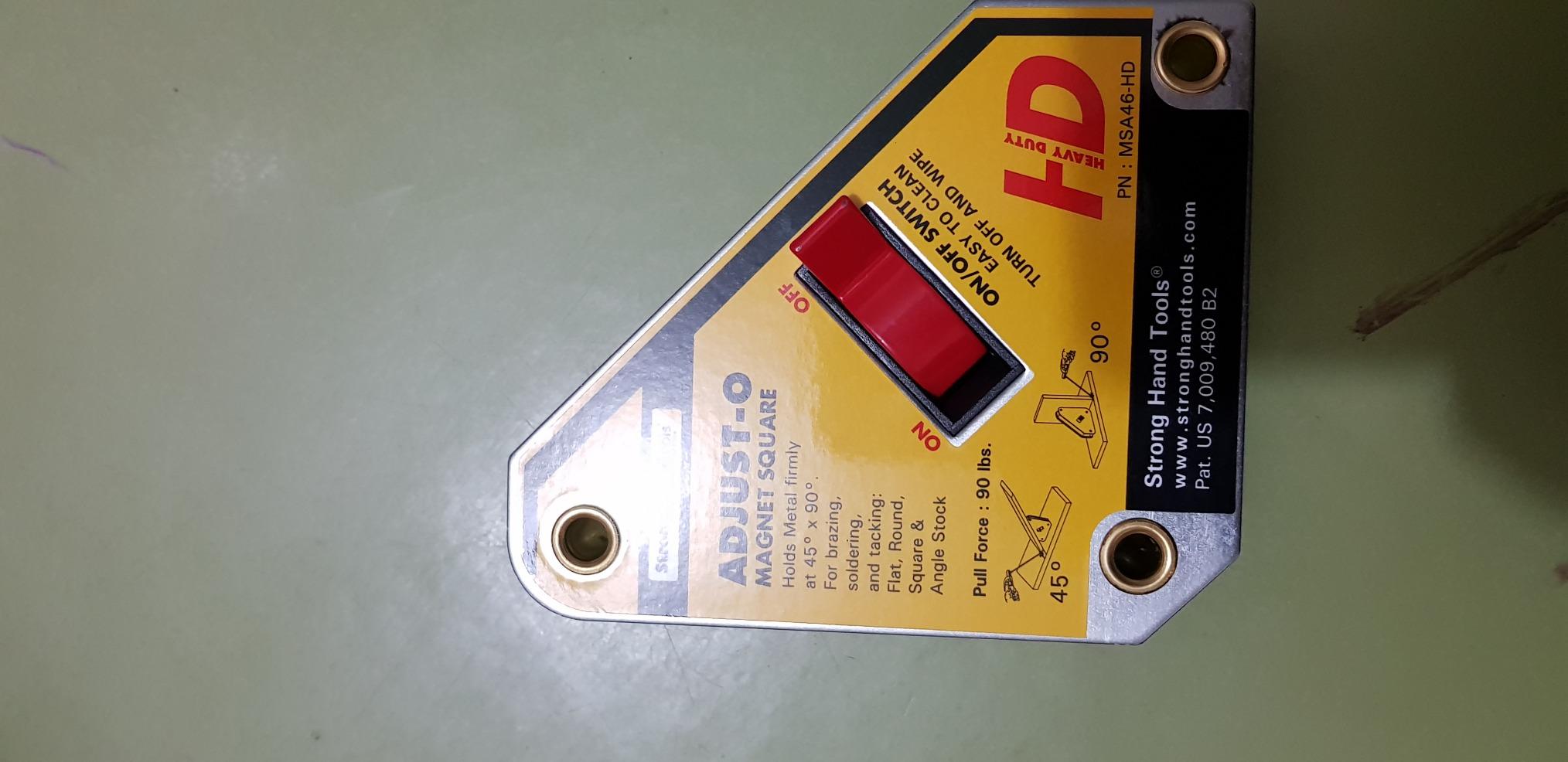
This is a long-standing shop favourite and the most substantial non-Magswitch tool in the roundup. It measures 4-3/8 by 3-3/4 by 1-1/8 inches, holds at 45 and 90 degrees, and runs on an on/off magnetic switch. Buyers describe it as fast to set up, easy to clean and solid on tube, angle and flat material.
One detail to know before you read reviews: the listing carries a 65 lb model designation while the manufacturer’s spec sheet on the same page states a 90 lb maximum pull force. We have quoted both rather than picking one. Treat the higher number as the ceiling and the model name as the realistic figure.
What earns the premium pick slot is the cleaning behaviour. Because the magnetic circuit switches off completely, swarf falls off instead of sticking to the face. On a magnet you use every day, that is the difference between a 30-second cleanup and a grinding-down session, and reviewers mention it more than any other feature.
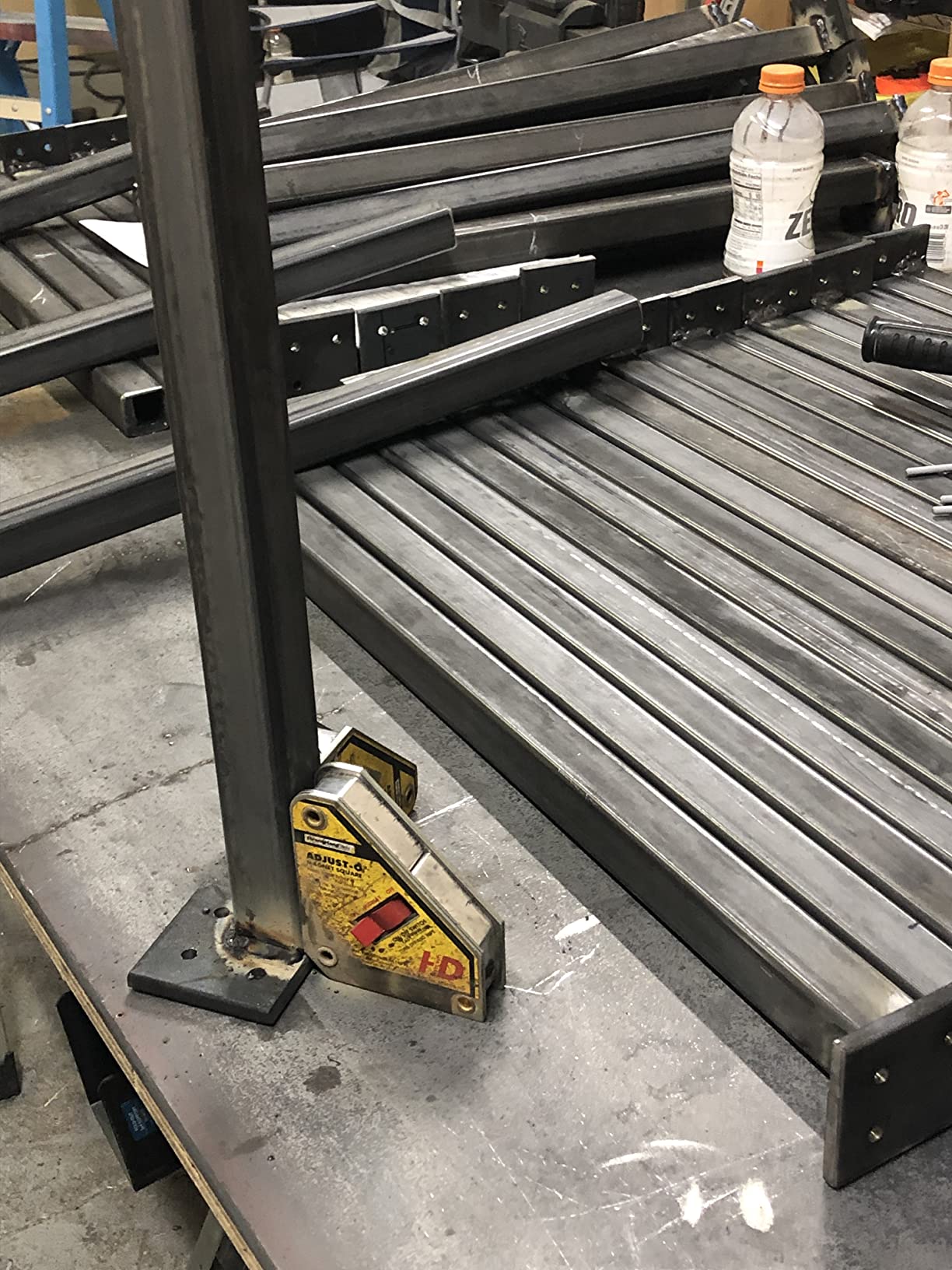
The build is metal and it feels like it, weighing in around 0.7 kg. That weight is a feature for a heavy-duty tool that gets knocked around a bench, and it is a complaint for anyone who wanted something pocketable. The two cons buyers report are bulkiness and an occasional switch that needs a second toggle to seat fully.
Rated 4.5 out of 5 across more than 1100 ratings, with the bulk of the feedback focused on round and square tubing, angle iron and flat stock. For 90 and 45 degree tube joints, this has more force behind it than the fixed mini squares and arrow sets in the same price bracket.
One more practical point: an on/off magnet needs room for your ground clamp and MIG lead. Plan the cable route before you set the joint, not after.
Who should buy the MSA46-HD
Buy it if you build tubular work daily, if you weld angle iron or heavy flat bar, and if you want a switchable magnet that is not a Magswitch. For 90 and 45 degree tube joints this carries more force than the fixed mini squares and arrow sets at a similar size.
It also suits anyone who welds in a position where prying a magnet off with a lever is annoying. You flip the switch and the part releases, which matters when you are working overhead or in a confined bay.
Who should skip it
Skip it for sheet metal, where the large face is a disadvantage, and skip it if your work needs angles other than 45 and 90. If you need true adjustable angles across a wide range, the MLA600 below is the better tool.
4. Strong Hand MLA600 Adjustable Angle Magnetic Square – Best Value for 30-270 Degrees
Strong Hand Tools MLA600 Adjustable Angle Magnetic Welding Square, Inside/Outside Magnets, Angle Setting Pin, Magnetic Pull Force 33 Lbs, Welding Square, 30°-270° Angle, 6″ Size
30-270 degree adjustable
9 x 6 x 1 in
33 lb pull force
Two independent magnets
Pros
- Wide 30-270 degree range covers inside and outside angles
- Two independent magnets give consistent force
- Mounting holes let you link two units as fixtures
- Hex hole breaks the joint loose
Cons
- Larger and heavier than fixed mini squares
- 33 lb pull force limits heavier structural work
At 9 by 6 by 1 inches and 0.9 kg, this is the biggest magnet in the roundup and the one that does the most different jobs. It adjusts from 30 to 270 degrees, which covers inside corners, outside corners and every odd angle in between. No other pick here covers that range in a single body.
The construction detail that matters is the pair of independent magnets. Rather than one weakened face split between two sides, each side carries its own magnet, so force stays consistent whichever way the joint sits. For substructure work where you are welding from the inside and the magnet sits outside, that is exactly the configuration you need.
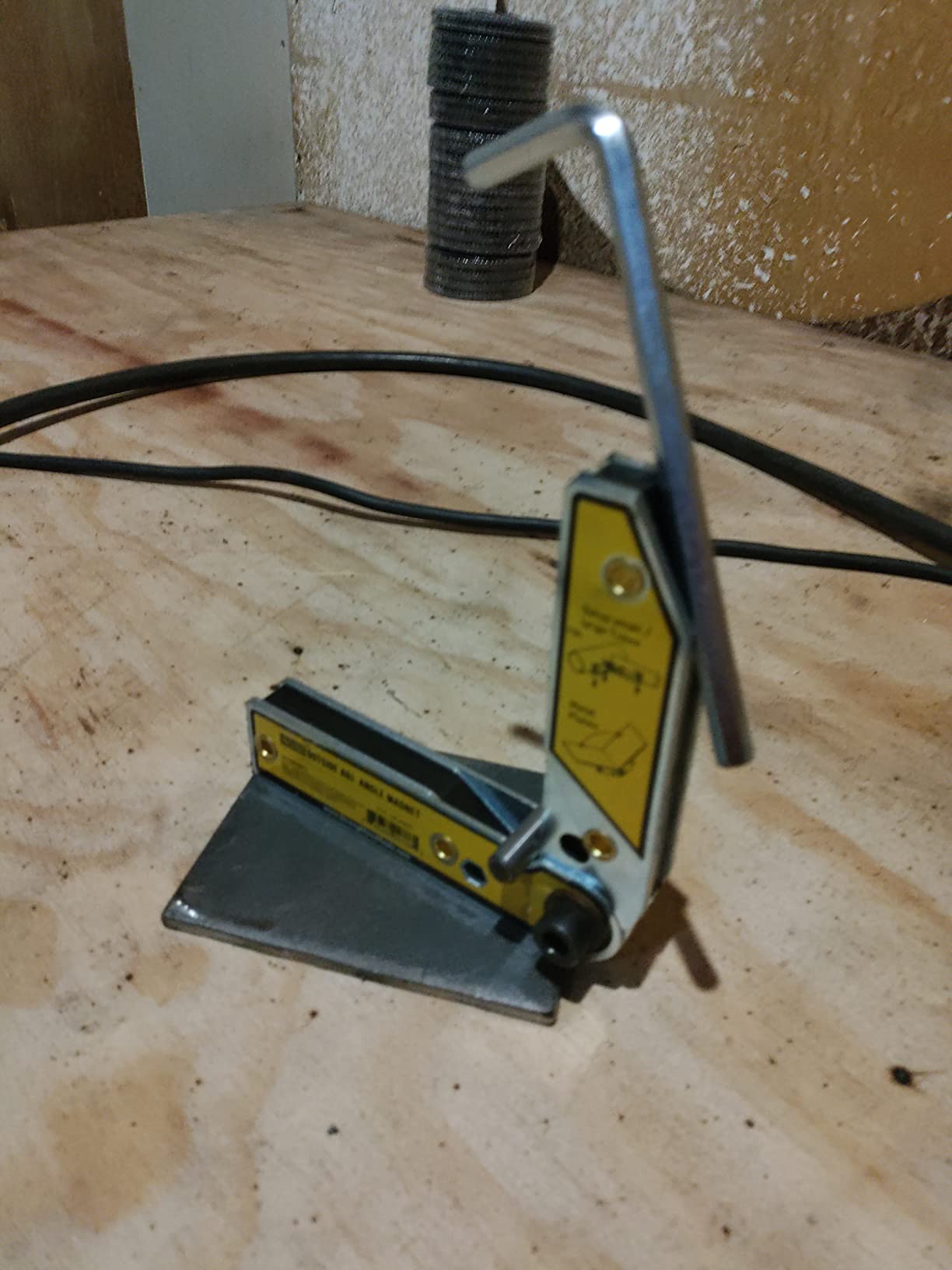
Two other features are more useful than they sound. The mounting holes let you bolt two of these together as a single fixture for long assemblies, and the hex hole gives you a way to break the joint loose without levering against your work. Both are details you will miss if you skip them at the till and wish you had them later.
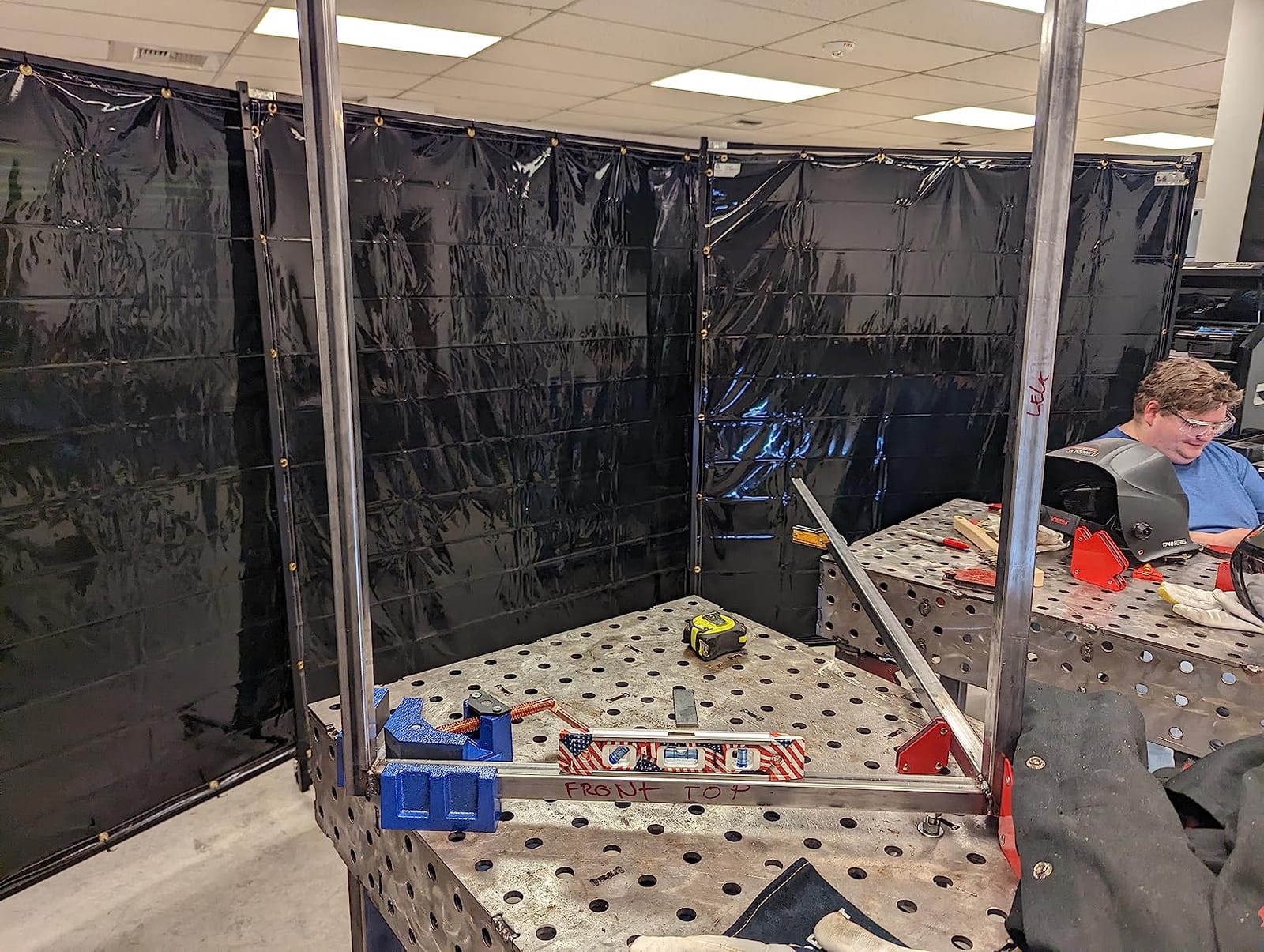
Owners rate it 4.6 out of 5 across more than 800 ratings, and the feedback centres on the adjustable range, the even force and the ability to chain units together. The same feedback notes it is large and heavy, which is obvious the moment you pick it up, and that 33 lbs will not carry a serious structural assembly on its own.
Treat it as the right tool for alignment rather than for carrying weight. Two of them on a long bracket will hold it; one will align the start of it and let the rest hang.
For odd-angle work this is the best value in the list, because it replaces the need for a separate protractor-style jig at almost no extra cost in shop time.
Who should buy the MLA600
Buy it if you weld substructures, brackets, angled members or anything at an angle that is not 45, 90 or 135. It is the broadest tool here for sheet metal, round pipe, square, angled and flat stock.
It also makes sense for anyone who prefers to set an angle with a physical scale and lock it, rather than swapping magnet positions and hoping the joint lands true.
Who should skip it
Skip it if your work is light gauge and small, because the 9-inch footprint is oversized and the 33 lb rating is more than a sheet-metal job needs. Skip it for heavy structural work where you need more holding force than 33 lbs and only one magnet in the fight.
5. Magswitch MagSquare 150 – Best Instant On/Off Release
Magswitch MagSquare 165 Switchable Magnetic Square – 165 lb Hold
150 lb rated holding force
Alloy steel, 11.2 oz
On/off switch
Model MAGSQUARE 165
Pros
- True on/off switch releases instantly with no prying
- Sheds swarf and debris when switched off
- Multi-plane grip on five sides handles flat and round stock
- Pre-tapped holes for custom jigs
Cons
- Compact footprint is smaller than buyers expect
- Full rated force does not develop on thin sheet steel
- Not designed for high-heat work close to the arc
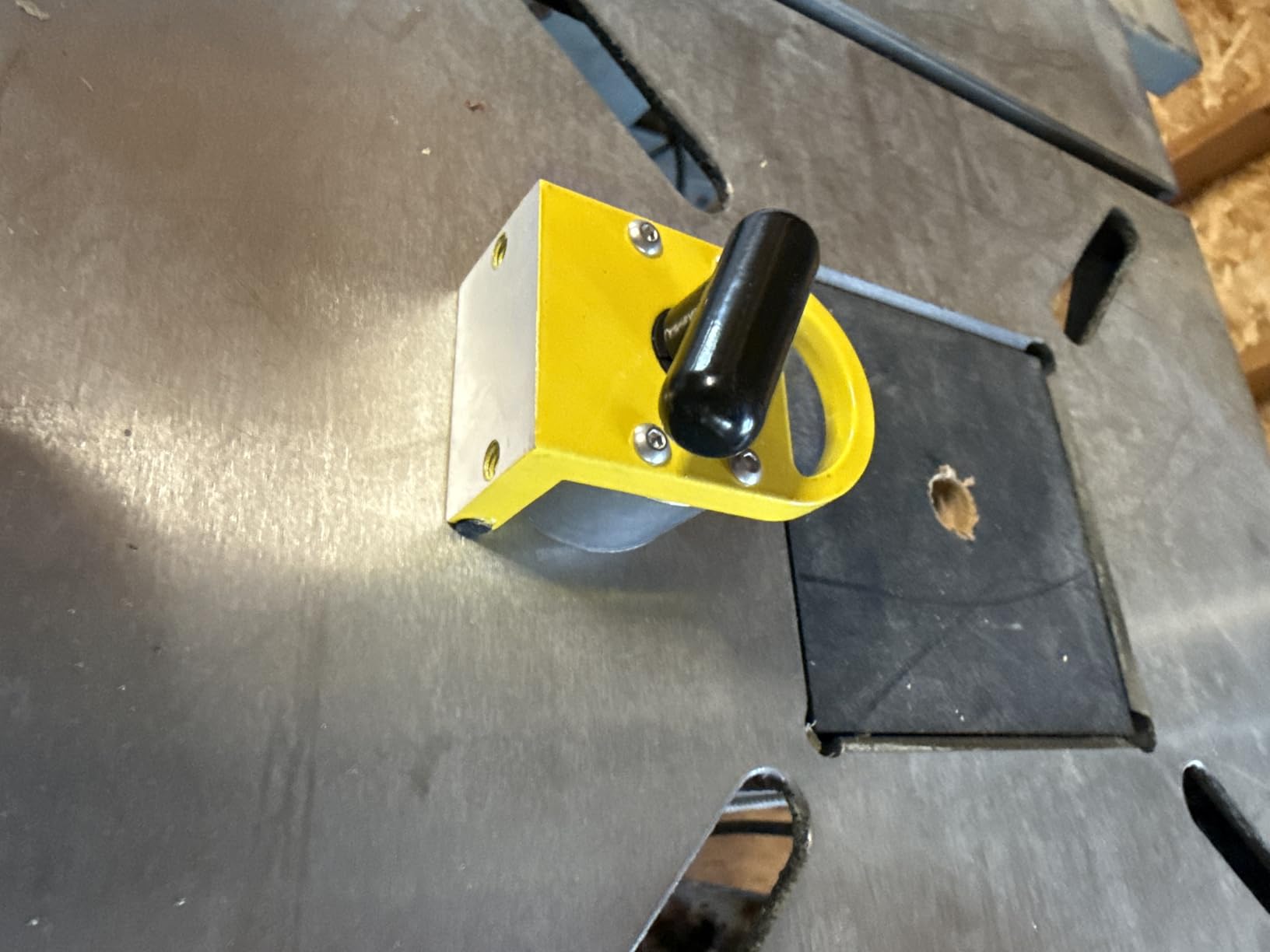
The MagSquare is a general workholding platform with a multi-plane grip that holds corners in five separate orientations. Rated at 150 lbs and weighing 11.2 ounces, it puts a large amount of pull force into a very small body.
The on/off switch is genuine, not a soft release. When it is off, the magnetic circuit is broken and the part falls away in your hand. No prying, no lever, no dragging the workpiece off. The manufacturer states it works with TIG, spot, stick, fibre and arc processes, and needs no power source.
Reviews from fabricators, and even woodworkers who use it for glue-ups, praise the instant release and the way debris falls off when switched off. That is the defining characteristic of the whole Magswitch line and the reason these tools hold their value.
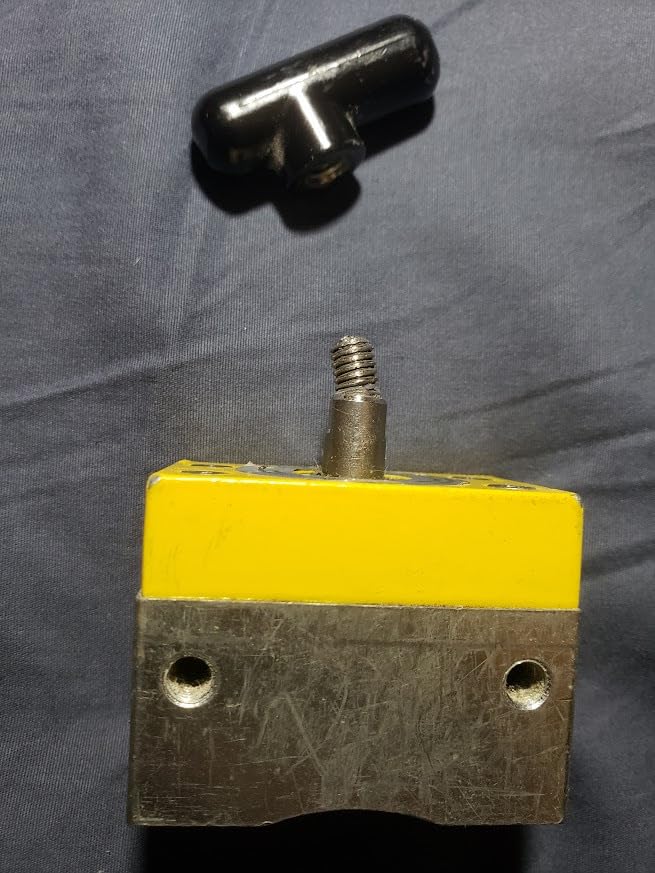
Three cons come up repeatedly. The footprint is compact, roughly a 1 by 2 inch working area, which surprises people who bought it expecting a large square. Full rated force does not develop on thin sheet, because there is not enough material for the magnet to pull against. And it is not a tool for sitting close to an arc, with heat being the obvious enemy of any permanent magnet.
Rated 4.6 out of 5 across roughly 580 ratings, with a one-year manufacturer defect warranty. That warranty is shorter than some permanent lifting magnet suppliers offer, so check the terms before you commit.
Where it shines is complex fixturing. The pre-tapped holes let you bolt it into a table or a custom jig, and the five-sided grip means you can set a joint from a face, an edge or a corner without changing tools.
Who should buy the MagSquare 150
Buy it if you do custom fixturing, work with round and flat stock, or want a magnet you can release instantly without touching your finished part. It is also the best choice for anyone who welds TIG or does delicate work where a magnet must be removed without prying the bead.
If you have ever had a magnetic square drag your work across the bench when you tried to pull it off, this solves that problem outright.
Who should skip it
Skip it for thin sheet metal, where the rated force will not fully develop, and skip it for work near the arc. It is also a platform rather than an angle jig, so if your main need is a repeatable 45 or 90 degree fit-up, one of the square-bodied angle magnets will serve you better.
6. Hobart 770662 Mini Magnetic Welding Holder 4-Pack – Best Budget Set
Hobart 770662 Mini Magnetic Welding Holder Set, 4-Pack
4-piece mini magnet set
8.5 x 5.5 x 0.7 in package
45, 90 and 135 degree faces
12.3 oz
Pros
- Four magnets in one set
- Three working angles per magnet
- Useful for tack-up and small parts where larger magnets are awkward
- Strength is well matched to the small size
Cons
- Very small and light duty only
- Some pieces arrive scratched and the two side plates can differ slightly in size
- Ferrite faces pick up grinding debris
Four mini magnets in a set, each holding steel at 45, 90 and 135 degrees, shipped in a package about 8.5 by 5.5 by 0.7 inches. This is the most compact route to four hold points on a bench, and for hobby and small fabrication work it is genuinely all most people need.
Reviewers treat these as inexpensive light-duty tacking aids. The small size is the point: they fit into corners and gaps where a 4-inch arrow magnet physically cannot sit, and the strength is well matched to what those small joints weigh.
If you are building small brackets, tack-up pieces or anything on a hobby scale, four of these beat one larger magnet. You get redundancy, and redundancy matters when a joint drops mid-tack.
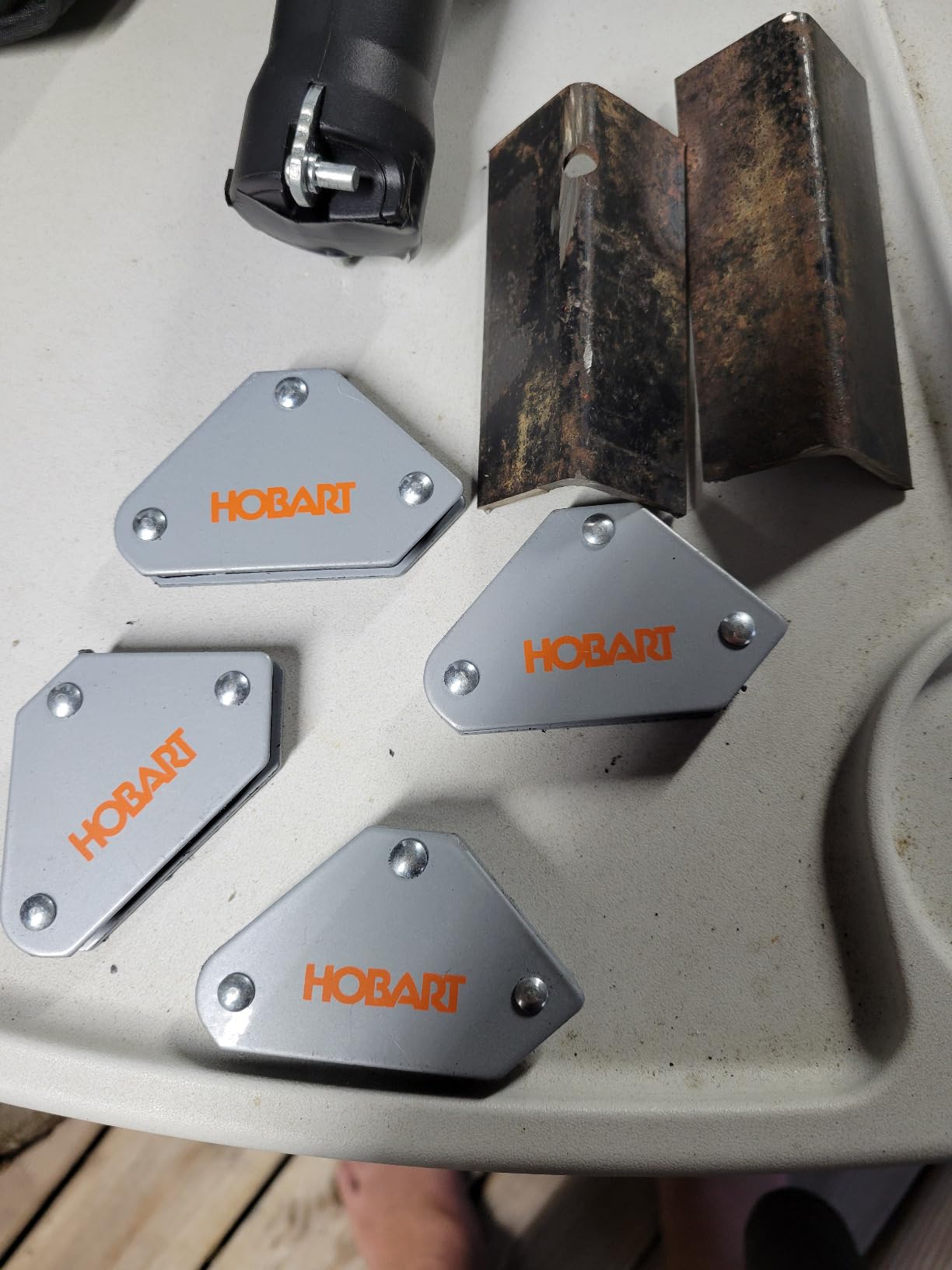
The cons are honest ones. Some buyers report units arriving scratched, and a few note the plates on the two sides can differ slightly in size, which affects how true the angle is. Like the Strong Hand mini squares, the ferrite faces collect grinding dust.
Rated 4.3 out of 5 across about 500 ratings. That is a solid score for a light-duty tool, and the complaints are the ones you would expect from budget manufacturing rather than a design fault.
My advice is to check each piece against a square the first time you use it, and set aside any that are visibly out. In a four-pack you have the luxury of picking the good ones.
Who should buy the Hobart 770662
Buy it for hobby work, small brackets, tack-ups, and any job where a bigger magnet cannot reach. If you want the multi-angle format at the entry level of this roundup, this is the pick.
It is also a good first magnet. It teaches you how angle fit-up works without asking you to learn a release mechanism first.
Who should skip it
Skip it for plate, structural tube, or any joint where a dropped magnet means a dropped workpiece. It is also not the right tool for anyone who needs repeatable angles in a fixture, since these are fixed-position bodies with no adjustment.
7. Magswitch MINI ANGLE – Best for Tight Spaces and Small Joints
Magswitch MINI ANGLE Mini Angle, Yellow/Silver/Black
90 lb (40 kg) hold force
45, 60, 90 and 120 degrees
On/off switch
0.2 kg
Pros
- Several fixed angles in a compact body
- On/off switch sheds debris and releases instantly
- Lightweight at roughly 0.2 kg for portable field work
- Handles both flat and pipe stock
Cons
- Fixed angles only
- not adjustable across a range
- Compact size limits it to smaller workpieces
Here is the odd one out in the roundup: 90 lbs of rated hold in a body weighing about 0.2 kg, with four fixed angles at 45, 60, 90 and 120 degrees and a switchable magnetic core. The 60 and 120 degree positions are the reason to buy it, because no other pick in this list offers them.
The manufacturer describes it as a compact, switchable on/off angle fixture for flat or pipe stock, positioned for smaller jobs and tighter spots. That is an honest description. It is a small-joint tool, and buyers consistently frame it that way in reviews.
The on/off switch does the same thing it does on the MagSquare: it sheds debris and releases the part without a fight. On a tool you carry to a job site and use in awkward positions, that instant release is worth more than a bigger footprint.
Because the body is metal and the faces are enclosed rather than exposed ceramic, the tool shrugs off the two things that ruin budget magnets. There is no ferrite face to wipe down after every cut, and there is no exposed magnet to worry about near the arc.
What you give up is any sense of continuous adjustment. The four angles are detents, not a range, so a 50 degree joint means setting two of these and accepting whatever the geometry allows. For a shop that mostly cuts to these four angles, that costs nothing. For a shop that cuts to half-degrees, it is the wrong tool entirely.
Who should buy the MINI ANGLE
Buy it if you need the 60 or 120 degree positions, or if you do field work where a 0.2 kg tool is a genuine advantage. It suits smaller flat stock and pipe where a 4-inch square will not go.
It is also a strong pick for hobbyists who want premium switching behaviour without carrying a heavy tool.
Who should skip it
Skip it if you need continuously adjustable angles between the detents, because these are fixed positions. Anyone doing 90 degree structural tube work will find a bigger square magnet more capable, and anyone working near an arc should keep it well clear.
8. TOOLIOM 4-Pc 25 lb Arrow Welding Magnets – Best Compact Arrow Set
TOOLIOM Arrow Welding Magnets, 4-Pc 25 lb Holding Force Welding Accessories
25 lb per magnet
2.12 x 3.15 x 0.47 in
45, 90 and 135 degrees
Set of 4
Pros
- Arrow design holds 45
- 90 and 135 degree positions
- Four magnets give several hold points on one joint
- Compact footprint suits small assemblies
- Consistent build quality
Cons
- 25 lb per magnet is modest for heavy plate or tube
- Ferrite faces need wiping to stay free of grinding debris
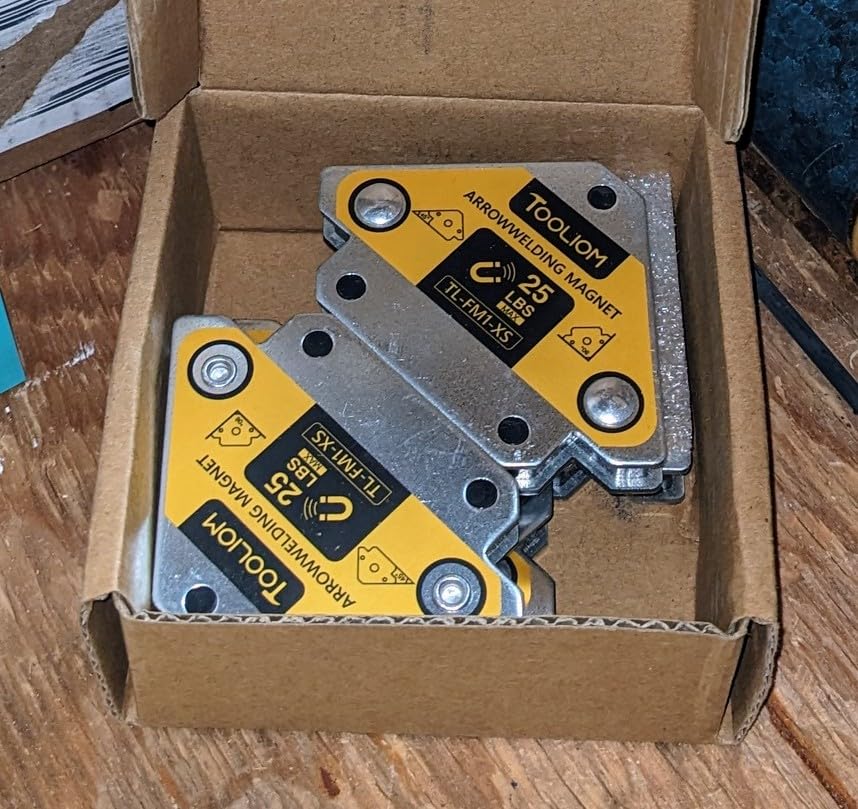
The TOOLIOM set is the smallest of the arrow-style options at 2.12 by 3.15 by 0.47 inches per magnet, rated at 25 lbs each, four to a set. Same three angles as every other arrow magnet here: 45, 90 and 135 degrees. The difference is footprint, and that is a real difference rather than a marketing one.
On small assemblies and medium stock, a smaller arrow magnet sits closer to the joint and gives you a better grip than a larger body bridging the same joint. Owners highlight the small arrow format and the three working angles for hands-free positioning of light to medium workpieces.
The four-piece count matters again. Being able to set two magnets on a joint before you tack is the difference between a clean fit-up and a re-fit-up.
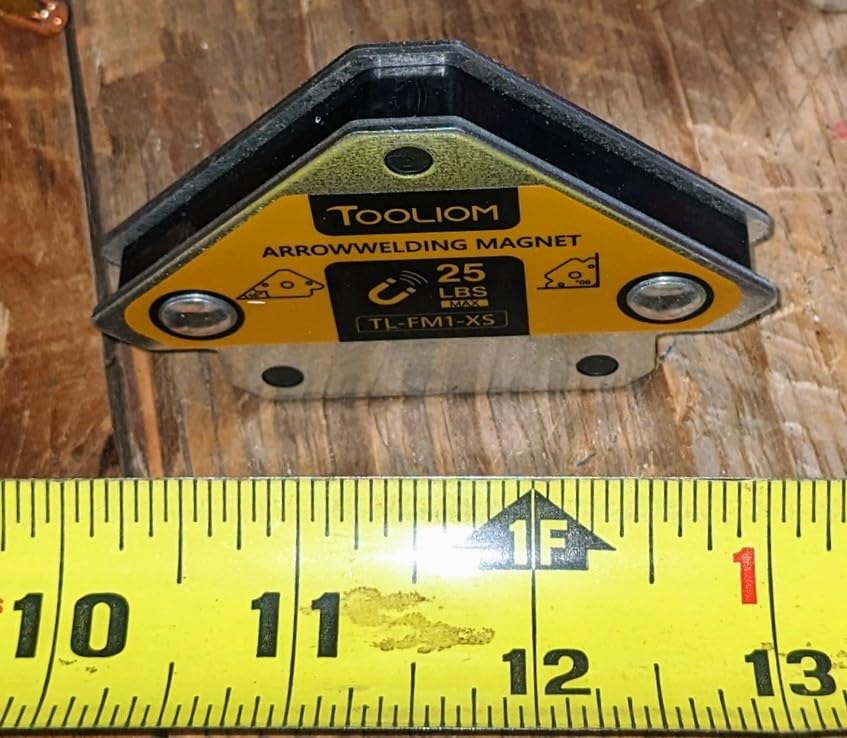
Where the size helps is access. A 2-inch arrow reaches into the corner of a small frame or the inside of a short bracket where a 4-inch body simply cannot seat, and on light stock that tight fit is what gives the magnet its bite.
Where the size hurts is leverage on the joint. Twenty-five pounds across a small face is enough to hold a few pounds of workpiece in position, which is all a tack-up needs, but it will not resist a heavy plate trying to rotate out of square.
Who should buy the TOOLIOM set
Buy it for smaller frames, brackets and mid-weight work where a full-size arrow magnet is too big to place well. It sits in a useful middle ground between the Hobart mini set and the 50 lb YESWELDER set.
If you already know you like the arrow format, this is a straightforward second set to keep at a second bench or in a toolbox.
Who should skip it
Skip it for heavy plate or structural tube, where 25 lbs per magnet will not hold the joint through a full pass. Skip it for fine sheet metal too, where the 2-inch arrow footprint is still larger than a mini square needs to be.
9. ARCCAPTAIN 25 lb and 55 lb 4-Piece Welding Magnet Set – Best Mixed Strength Set
ARCCAPTAIN Welding Magnets 25LB & 55LB 4Pcs Welding Magnet Set
25 lb and 55 lb mixed set
Alloy steel construction
45, 90 and 135 degrees
4 pieces
Pros
- Mixed strengths give options in one purchase
- Three working angles rotate to suit the joint
- Steel-encased riveted frame resists heat at the weld
- Four pieces for a single fit-up
Cons
- Fixed 45
- 90 and 135 degree positions only
- Holds only the ferrous workpieces the faces contact
This set solves a problem most four-piece sets create: they give you four identical magnets, so you either have the strength you need or you do not. ARCCAPTAIN mixes 25 lb and 55 lb pieces in one four-pack, so you can put a light magnet on a thin tab and a heavy one on a tube corner from the same purchase.
Construction is the other selling point. The magnets are encased in riveted steel, and the manufacturer states plainly that the frame is built not to melt while welding. On a tool that sits at the business end of a hot process, a steel shell rather than bare magnet faces is sensible engineering.
Reviewers rate it 4.6 out of 5 across roughly 350 ratings, and the feedback centres on the useful mix of light and heavy magnets, the three working angles, and the steel-encased body standing up to heat.
The angle logic is the same as every arrow magnet: rotate the body until the face you need sits against the joint. Three positions means you are choosing from 45, 90 and 135, and if your joint is any of those, the fit-up does the work for you without any adjustment.
One thing to plan around is that these are general fit-up magnets, not fixtures. They hold a joint while you tack; they will not hold a joint while you walk away. If you need the workpiece to stay put unattended, pair each one with a clamp or a second magnet on the far end.
That is also why the mixed set is smarter than four identical magnets. On a bracket with one light leg and one heavy leg, you can use the 25 lb piece where it matters and put the 55 lb piece on the end that is trying to rotate.
Who should buy the ARCCAPTAIN set
Buy it if you work across a range of material thicknesses in one job. Mixed strengths mean you are not using a 55 lb magnet on a thin panel and hoping it behaves.
It is also a good choice for anyone who wants a set of arrows with a steel body, rather than the ferrite-faced budget builds that collect swarf.
Who should skip it
Skip it if your work needs adjustable angles, since the three positions are fixed. And skip it entirely for aluminium or stainless, because no ferrous contact means no hold at all.
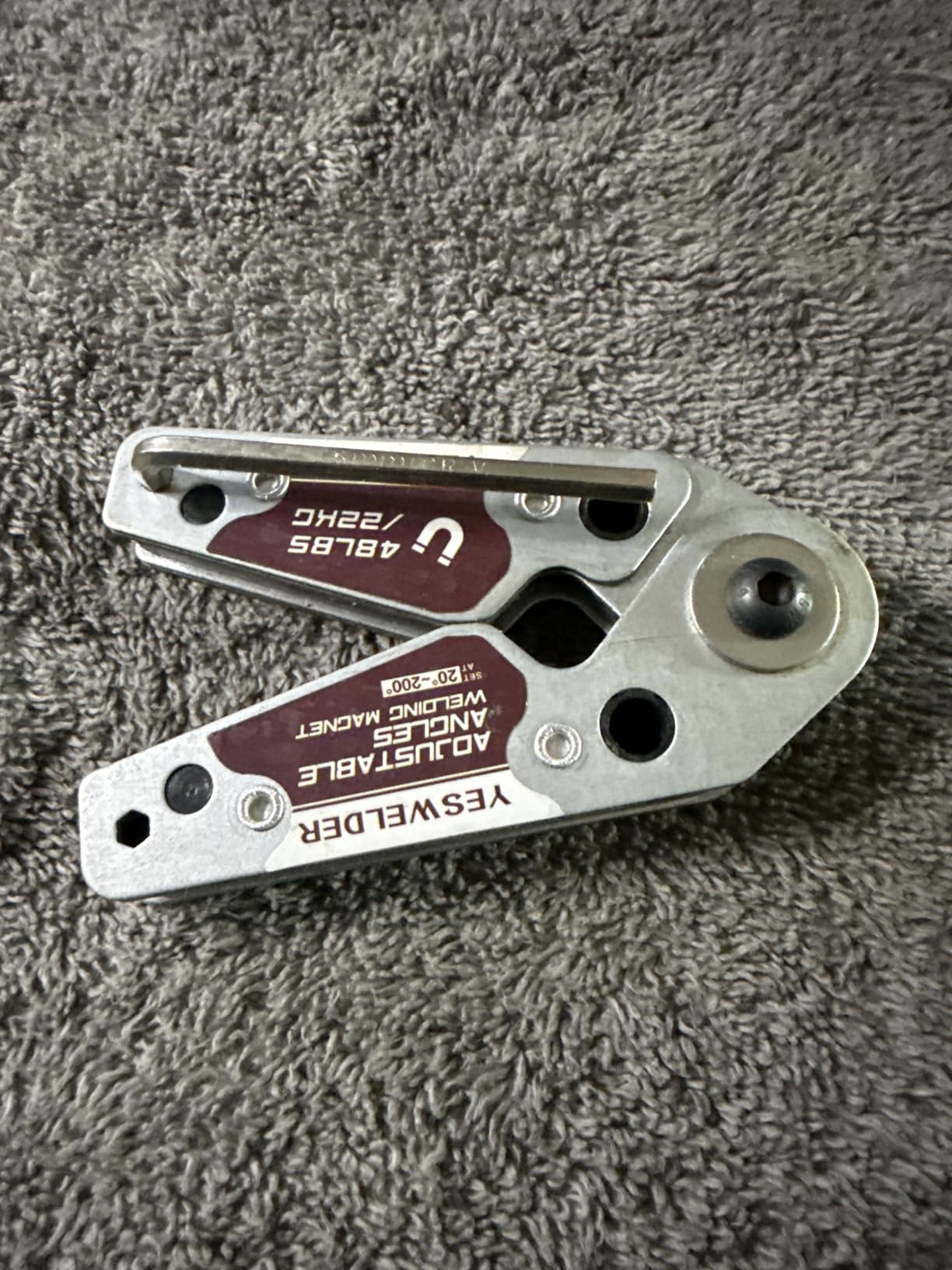
10. YESWELDER Adjustable 20-200 Degree 77 lb Welding Magnet – Best Wide-Range Dial
YESWELDER Adjustable Angle Welding Magnet 20-200° Welding Magnet of 77LBs
20-200 degree adjustable range
Claimed 77 lb hold
15.8 oz iron body
Includes hex wrench
Pros
- Wide adjustable range with a printed scale for repeatable settings
- Included hex wrench locks the chosen angle
- Compact enough for smaller work areas
- Strong consistent hold once the angle is locked
Cons
- Angle markings are small and hard to read
- Stated 77 lb hold is optimistic on long heavy angle iron
- Should not be placed too close to the weld
The most mechanically interesting magnet in the roundup. The angle adjusts continuously from 20 to 200 degrees against a printed scale, a hex wrench in the box locks your chosen setting, and the body is iron at 15.8 ounces. That combination of range and locking is something none of the fixed-angle designs here can match.
The scale is what makes it repeatable. Once you find the setting for a 38 degree cut, you return to that mark next time instead of rotating faces and hoping. The hex lock means the joint does not creep while you tack, which is the single most common complaint we saw about cheaper angle fixtures.
Rated 4.6 out of 5 across about 300 ratings. Welders like the dial-in range, the lockable adjustment and the compact size, and several note that real magnetic strength is well under the 77 lb claim, so a clamp is still sensible for long heavy sections.
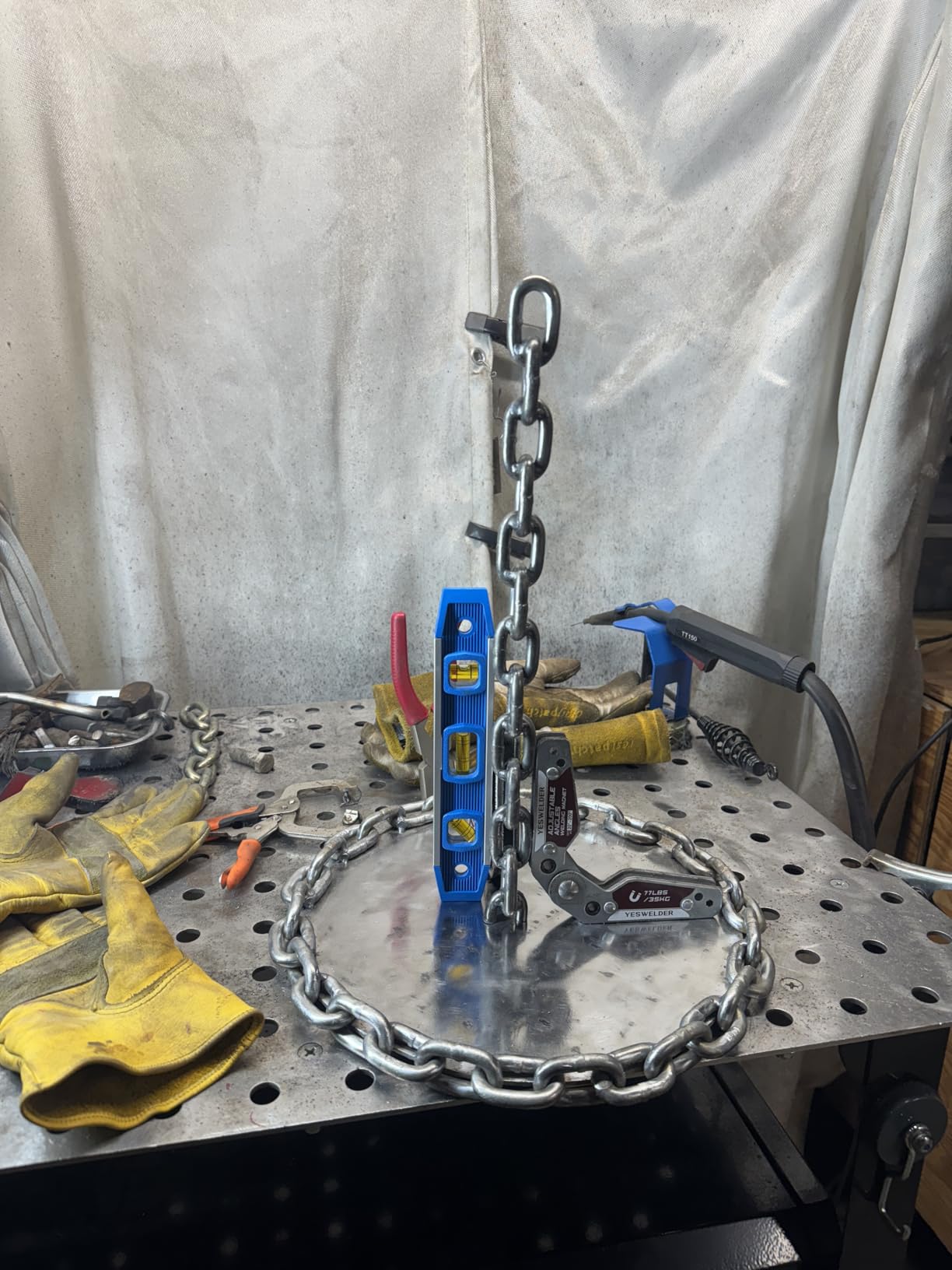
The two specific cons are small, hard-to-read angle markings and the gap between the claimed 77 lbs and the force you actually feel on long heavy angle iron. Both are fair. Read the scale before you light the torch, and confirm the joint with a protractor on your first setup.
The manufacturer also states plainly: do not weld too closely to the magnet. We are repeating that here because it is the one instruction that protects the tool, and because heat is the fastest way to damage any permanent magnet in this list.
With a little over 300 ratings, this has the smallest review base in the roundup. The design is sound; the track record is shorter than the others.
Who should buy the YESWELDER adjustable magnet
Buy it if you repeat the same non-standard angles across multiple jobs, or if you build something with cuts at angles other than 45, 60, 90 or 120. The lock and the scale are what justify it over a fixed-position set.
It is also a good choice for a shop that wants one angle tool instead of a drawer full of adapters.
Who should skip it
Skip it for thin sheet, where the body is far larger than the material needs, and skip it for heavy structural sections longer than about a foot. For that work, a clamp beside the magnet is not optional.
Buying Guide: Matching a Magnet to Your Joints
Buying a welding magnet well comes down to five questions, and the order you answer them matters less than being honest about the answers. Work through them in sequence and the right product picks itself.
1. What is your thinnest and thickest material?
Start here, because footprint and force both depend on it. A magnet grips by pulling a ferrous face against another ferrous face, and the effective grip is a function of the material thickness and the contact area. A figure like 50 lbs is a ceiling measured under ideal conditions on thick steel, not a promise at your bench.
The practical rule we use: for 1/8 inch and lighter sheet, use a small face and a switchable magnet. The small face concentrates force on thin material, and the switch lets you position without fighting the grip. For 3/16 inch plate, a mid-size arrow or square is comfortable. For 1/4 inch and heavier, you want a large body and a real on/off switch, and you should use two magnets or pair one with a clamp.
2. What angles do you actually weld?
Most work is 45, 90 and 135 degrees, and every fixed-position arrow magnet in this roundup covers exactly those. If that is all you build, the cheapest sets do the job. Once you need 30 and 270 degree inside and outside corners, you need the MLA600. For 60 and 120 degree positions, the Magswitch MINI ANGLE is the only pick here that covers them.
For anything in between, or for repeatable settings across jobs, an adjustable dial with a scale and a lock beats guessing at fixed stops.
3. How big is the joint?
Footprint is the criterion most buyers ignore and most regret. A 9-inch square on a 2-inch bracket will not sit flat, and a 1 by 2 inch platform on a 6-inch tube will not cover the joint. Match the holding face to the workpiece, and prefer a smaller magnet that fits perfectly over a larger one that bridges the joint.
This is also where reviewers across the list converge. Buyers who report magnets that slip usually have a footprint mismatch, not a strength problem.
4. Do you want an on/off switch?
Yes, and we will be direct about it. A switchable magnet separates the faces mechanically, so you can set the joint loosely, position it, then engage. Permanent magnets make you fight the part into place, and they make removal a levering operation that can damage the finished weld.
The honest drawback is interference. A switch body occupies space, which can crowd your torch ground clamp and MIG lead, and you may have to re-route the cable. Plan the lead path before the joint goes together. The payoff in setup speed and clean release is worth the planning.
5. Does magnet grade matter?
Magnet grade does matter, because higher grades such as N52 hold more pull force at the same size than lower grades such as N35. The practical effect is that a well-graded small magnet can outperform a poorly-graded large one.
Here is the problem for buyers: most welding magnet listings, including several in this roundup, do not state a grade at all. Where nothing is stated, treat the pounds figure with more suspicion rather than less. The undeclared budget magnets are the ones where consistency between pieces is the real gamble, and that is the complaint behind the occasional reports of side plates differing in size.
What about non-ferrous materials?
Magnets only work on ferrous metal. Steel, and stainless grades with magnetic properties, will hold. Aluminium, brass, copper, bronze and most stainless will not stick at all, and no amount of holding force changes that. For aluminium work you need mechanical clamps, and it is worth saying so plainly rather than discovering it at the bench.
Are welding magnets worth buying?
Yes, if you fit up the same joint more than a few times a month and your current method involves a clamp, a square and one hand on the workpiece. The value is not measurement, it is the second pair of hands while the torch is lit. If your layouts are complex and every angle is different, a square and protractor will serve you better, and the magnet will sit on the shelf, exactly as that WeldingWeb regular described. Buy the format that matches how you actually build, not the one with the biggest number on the box.
Magnet, clamp or square: which tool for which job
These three tools get confused because they solve overlapping problems, but each has a job the other two do badly.
A square measures. Its only virtue is accuracy, and it will tell you an angle is wrong where no amount of holding force can make the joint right. A protractor on top of a square extends it to any angle you need, which is why that pairing is the answer for layout work.
A clamp applies force. Nothing pulls a joint out of square harder than a correctly placed clamp, and a clamp holds with the arc on and the magnet twenty feet away. For heavy structural work that must stay put while you walk the perimeter, a clamp or two is the right call.
A magnet bridges the gap between them. It applies real force, so it holds like a clamp, but it does it hands-free at a fixed angle, so it does not need a square to set. It cannot measure and it cannot hold indefinitely, which is exactly the trade every practitioner describes when they say a magnet is a second pair of hands.
The sensible bench setup uses all three. Square and protractor for layout, clamps for anything heavy or unattended, magnet for the fit-up and tack phase where you need both hands free. If you own only one of the three and your work is angle setups, it should be the magnet.
Where to buy welding magnets
Most of these tools are sold through the same channels: online marketplaces, welding supply houses, and the online shops of specialist toolmakers. Two general categories exist and the difference matters when something goes wrong.
Branded tools from Magswitch, Strong Hand Tools and Hobart usually carry a manufacturer warranty, which in this roundup runs from one year against defects on the Magswitch models. Unbranded and budget sets frequently carry no warranty at all, which is worth knowing before you buy a second set of a model you already like.
Whatever the source, check the return policy before the joint is on the bench. Magnets are small, cheap to ship and easy to test at the counter with a piece of scrap steel, so a retailer with a straightforward return policy removes most of the risk from a first purchase.
When Not to Use a Welding Magnet
There are five situations where a magnet is the wrong tool, and knowing them will save you a dropped frame.
Angle drift on a loaded joint. Push-off at shallow angles is real: a 30 to 45 degree setup holds noticeably worse than a 90 degree one because fewer faces stay in contact. On forums, owners of well-regarded magnets still describe twisting and rolling the joint into square after it is loaded. Check the angle with a square before you tack, every time.
Thin sheet metal with a large magnet. A big footprint on light gauge bridges the piece, and the sheet pulls away at the edges. Use a small magnet and hold only what the faces touch.
Overhead and out-of-position work. A magnet that releases unexpectedly is a dropped part in a position where you cannot catch it. Secure the workpiece mechanically for overhead fit-up and use the magnet only as a secondary check.
Hot work right next to the tool. Heat damages permanent magnets, and one manufacturer in this roundup states outright not to weld too closely to it. Keep a real distance between the magnet and the arc, especially on the small ferrite-faced budget bodies.
Non-ferrous material. Aluminium and most stainless simply will not hold. Use clamps.
One more honest note on care. Magnets that sit near a welding area pick up slag, scale and grind dust, and several reviews in this roundup mention cleaning as a recurring chore. Keep them off the bench edge, wipe the faces after work, and store them away from heat and steel swarf so you are not rediscovering a magnet caked in filings the morning of a big job. If sparks and spatter are a constant concern on your bench, a [welding blanket](https://www.geekfill.com/best-welding-blankets/) hung behind the work is the cheap fix.
Frequently Asked Questions
Are welding magnets worth buying?
Yes, if you fit up the same joint more than a few times a month and currently rely on a clamp plus a square plus one spare hand. A welding magnet is a second pair of hands, not a measuring tool, so it does not replace a good square and protractor. If your layouts are complex and every angle is different, the square wins and the magnet will sit unused. The exception is non-ferrous work, where no magnet will work at all.
What is the best brand of welding magnet?
For switchable workholding, Magswitch is a leading name, and the MagSquare and MINI ANGLE both switch fully off and release without prying. For adjustable angle holding, Strong Hand Tools is the pick, covering fixed 45 and 90 degree work, mini light-duty squares, and the 30 to 270 degree MLA600. For high-rated multi-angle sets, YESWELDER and ARCCAPTAIN are the strongest options reviewed here.
Are welding magnets strong?
They are strong enough for fit-up work, which is what they are for. Stated ratings of 25 to 150 lbs are measured under ideal conditions on thick steel, and buyers repeatedly report feeling less than the label at the bench. The number that matters is whether the footprint matches your joint and whether the material is thick enough to pull against. For 1/8 inch sheet, use a small face; for 1/4 inch and heavier, use a large body plus a clamp.
Are there welding magnets with an on/off switch?
Yes, and the switch is the feature worth paying extra for. A switchable magnet mechanically separates its faces, so you can position the joint loosely and then engage it, and it releases without levering against your work. In this roundup the Magswitch MagSquare 150, the Magswitch MINI ANGLE, the Strong Hand MS346AT mini squares and the Strong Hand MSA46-HD all have one. The drawback is that the body needs space, which can crowd your ground clamp and MIG lead.
Which magnet is stronger, N45 or N52?
N52 is the higher grade, meaning it holds more pull force at the same physical size than N45. For welding magnets this matters most on small tools, where a better-graded compact magnet can outperform a larger poorly-graded one. The practical problem is that most listings do not state a grade, so if nothing is declared, treat the pounds figure with more caution rather than less.
Can you weld aluminum or stainless with a welding magnet?
Not reliably. Magnets only hold ferrous metal. Aluminium, brass, copper and bronze will not stick at all, and most stainless grades are non-magnetic, so a magnet will simply fall off. Some stainless grades do hold, but the behaviour is inconsistent. For aluminium work, use mechanical clamps or a purpose-built fixture, and save the magnet for the steel frame afterwards.
Why does a welding magnet lose its hold?
The most common causes are a footprint that does not match the joint, a joint angle shallower than 45 degrees where fewer faces stay in contact, and thin material that cannot be pulled against. The other cause is heat: permanent magnets lose strength near an arc, and slag or grind debris on the face reduces contact. Check the angle with a square before tacking, keep the tool clear of the arc, and wipe the faces clean between jobs.
Conclusion
After working through ten of them, the best welding magnets for angle setups fall into clear categories. For general tube and frame fabrication, the YESWELDER 4-piece 50 lb arrow set is the pick we would buy first, with four hold points and the highest rating in the group. For heavy 45 and 90 degree work on round and square tube, the Strong Hand MSA46-HD gives you a real on/off switch and a body that shrugs off swarf. For anything outside those three angles, the Strong Hand MLA600 covers 30 to 270 degrees, and the Magswitch MINI ANGLE covers 60 and 120.
Whichever format you choose, check the joint with a square before you light the torch, keep the magnet away from the arc, and pick a footprint that matches your material. Those three habits account for most of the complaints we read across 7200 buyer ratings.
Once you have your magnet picked, the rest of the setup matters as much: a [welding table](https://www.geekfill.com/best-welding-tables/) that holds the workpiece still, a [helmet](https://www.geekfill.com/best-welding-helmets/) you will actually keep on, and a [grinder](https://www.geekfill.com/best-angle-grinders/) for cleaning the joint when the fit-up drifts.