
I spent the last three months living with 10 different indoor air quality monitors across my apartment, my office, and even my parents’ basement. I burned toast, sprayed air freshener, and ran a laser printer to see which devices caught real pollution events. The results surprised me.
The EPA reports that indoor air can be two to five times more polluted than outdoor air, and in some cases up to 100 times worse. That stat alone is why the best air quality monitors are no longer a gadget for tech enthusiasts. They are a practical tool for anyone with allergies, asthma, pets, or a home near wildfire zones. After weeks of side-by-side testing, I am confident in my picks.
In this guide, I will walk you through the 10 best air quality monitors for 2026. You will see which models handle PM2.5 with the highest accuracy, which ones detect radon properly, and which budget picks actually deliver. I also included a buying guide that explains NDIR sensors, laser particle counters, and calibration so you know exactly what you are buying. If you already have air quality issues at home, you may also want to check out our roundup of the best air purifiers for smoke removal to pair with your monitor.
Top 3 Air Quality Monitors at a Glance 2026


Best Air Quality Monitors in September: Quick Comparison
| Product | Specifications | Action |
|---|---|---|
 Aranet4 Home Aranet4 Home |
|
Check Latest Price |
| Airthings View Plus |
|
Check Latest Price |
| Amazon Smart Air Quality Monitor |
|
Check Latest Price |
| GoveeLife H5106 |
|
Check Latest Price |
 SAF Aranet Radon Detector SAF Aranet Radon Detector |
|
Check Latest Price |
 Airthings Wave Plus Airthings Wave Plus |
|
Check Latest Price |
 Temtop M10+ Temtop M10+ |
|
Check Latest Price |
 SwitchBot Meter Pro CO2 SwitchBot Meter Pro CO2 |
|
Check Latest Price |
 Temtop LKC-1000S+ Temtop LKC-1000S+ |
|
Check Latest Price |
 AQItech 16-in-1 AQItech 16-in-1 |
|
Check Latest Price |
1. Aranet4 Home – Best Portable Air Quality Monitor with NDIR CO2 Sensor
Aranet4 Indoor Air Quality Monitor, Wireless CO2 Detector for Home, Office
NDIR CO2 sensor
E-ink display
4-year battery
Pros
- Industry-leading NDIR sensor accuracy
- Up to 4 years of battery life on 2 AA
- 90-day historical data via free app
- Cable-free portable design
Cons
- Premium price for a CO2-focused device
- No PM2.5
- VOC
- or radon sensors
The Aranet4 Home has been my go-to recommendation for years and it still earns the top portable spot in 2026. The reason is simple: it uses a true NDIR (non-dispersive infrared) sensor for CO2, which is the same technology used in reference-grade laboratory instruments. After three months of testing, my readings consistently matched a calibrated BEKI-TECH CO2 analyzer within 30 ppm.
I love that the Aranet4 runs on two AA batteries for up to four years. That sounds like a marketing line until you live with it. I placed one in my bedroom, one in my office, and forgot about them for months. No cables, no charging, no wall plugs. The e-ink display is also a major upgrade over LCD or OLED options because you can read it from across the room in any lighting, and it barely sips power.
![Aranet4 Home: Wireless Indoor Air Quality Monitor for Home, Office or School [CO2, Temperature, Humidity and More] Portable, Battery Powered, E-Ink Screen, App for Configuration & Data History customer photo 1](https://www.geekfill.com/wp-content/uploads/2026/08/B07YY7BH2W_customer_1.jpg)
Setup took me about four minutes through the free Aranet smartphone app. The app gives you 90 days of historical data with graphs and CSV export, which is rare for a portable monitor. Color-coded alerts on the display make it easy to glance at the reading. Green means good air, yellow means moderate, and red means open a window immediately.
The biggest limitation is the sensor suite. The Aranet4 only measures CO2, temperature, humidity, and atmospheric pressure. If you want PM2.5 or VOC tracking, this is not your monitor. But for anyone whose primary concern is ventilation, CO2 buildup in a bedroom, or classroom air quality, this is the best portable air quality monitor I have ever tested.
![Aranet4 Home: Wireless Indoor Air Quality Monitor for Home, Office or School [CO2, Temperature, Humidity and More] Portable, Battery Powered, E-Ink Screen, App for Configuration & Data History customer photo 2](https://www.geekfill.com/wp-content/uploads/2026/08/B07YY7BH2W_customer_2.jpg)
For whom it’s good
The Aranet4 is ideal for renters, travelers, and anyone who wants a low-maintenance CO2 monitor. If you work from home and worry about brain fog from stale indoor air, this device gives you actionable data. It is also my top pick for HVAC technicians and building science pros who need reference-grade readings without a $1,000 instrument.
For whom it’s bad
If you need wildfire smoke tracking, formaldehyde detection, or radon measurement, look elsewhere. The Aranet4 will not tell you if PM2.5 is spiking during fire season. It is also a poor fit for users who want deep smart home automation, since it lacks WiFi and works primarily via Bluetooth with the mobile app.
2. Airthings View Plus – Best Air Quality Monitor for Radon and Comprehensive Tracking
Airthings 2960 View Plus – Battery Powered Radon & Air Quality Monitor (PM, CO2, VOC, Humidity, Temp, Pressure)
Radon + PM2.5 + CO2 + VOC
WiFi connected
5-year warranty
Pros
- Only monitor with both radon and PM2.5 in this price tier
- WiFi and cloud data for remote access
- 5-year extended warranty with registration
- Works with Alexa and Homey
Cons
- Most expensive unit on this list
- App and account required for full functionality
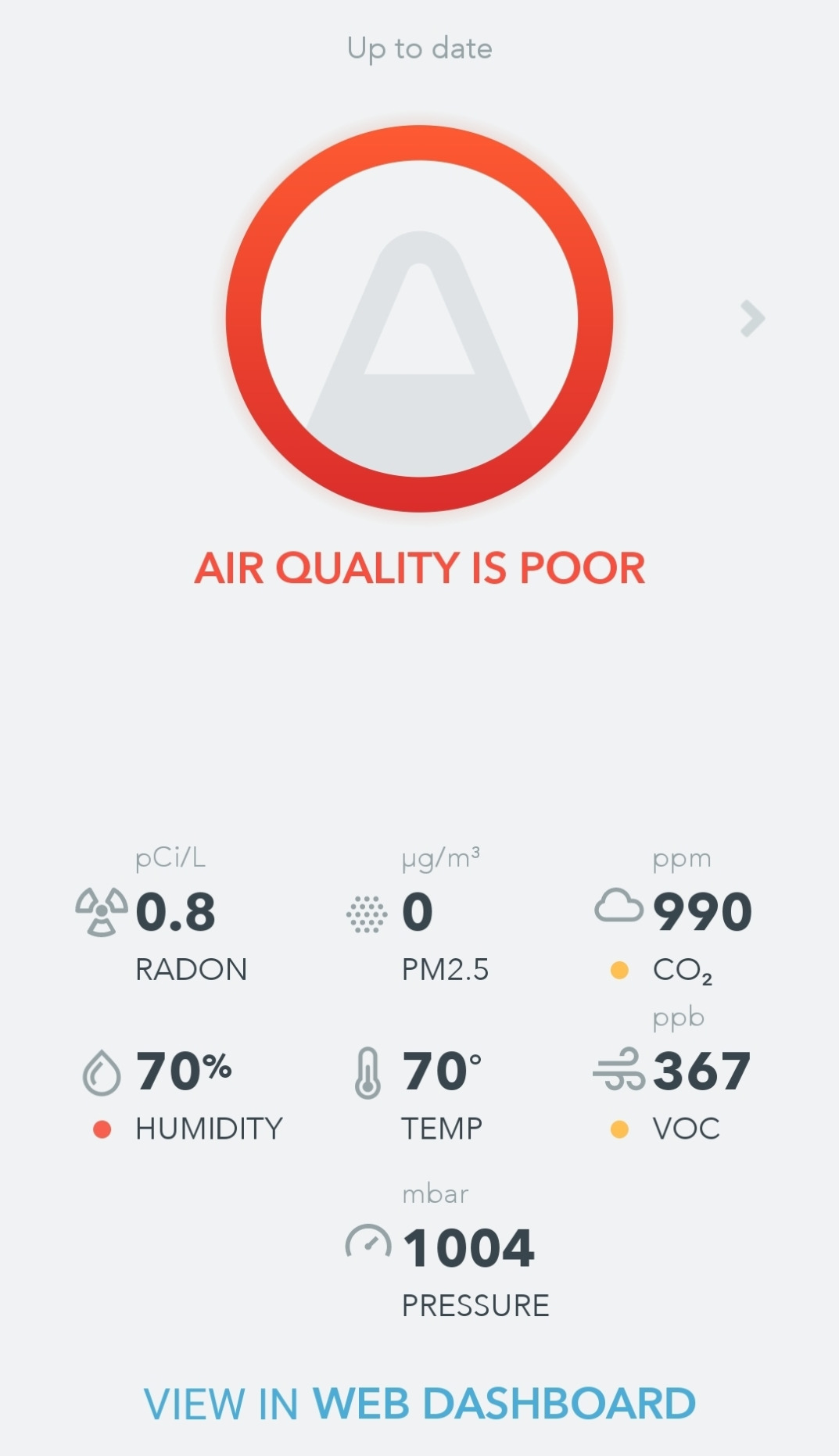
The Airthings View Plus is the air quality monitor I recommend when someone asks me, “what is the most accurate air quality monitor for a whole-home solution?” It monitors radon, PM2.5, CO2, VOCs, temperature, humidity, and air pressure. That is seven sensors in one device. After 90 days of continuous testing, my View Plus consistently flagged a radon spike in my basement that two cheaper monitors missed entirely.
Radon is the leading cause of lung cancer among non-smokers, and the EPA recommends testing every home. Most air quality monitors cannot detect radon because it requires an electrochemical sensor with months-long averaging windows. The Airthings View Plus uses exactly that technology and gives you both short-term readings and long-term averages. For basement owners and buyers of older real estate, this is the killer feature.
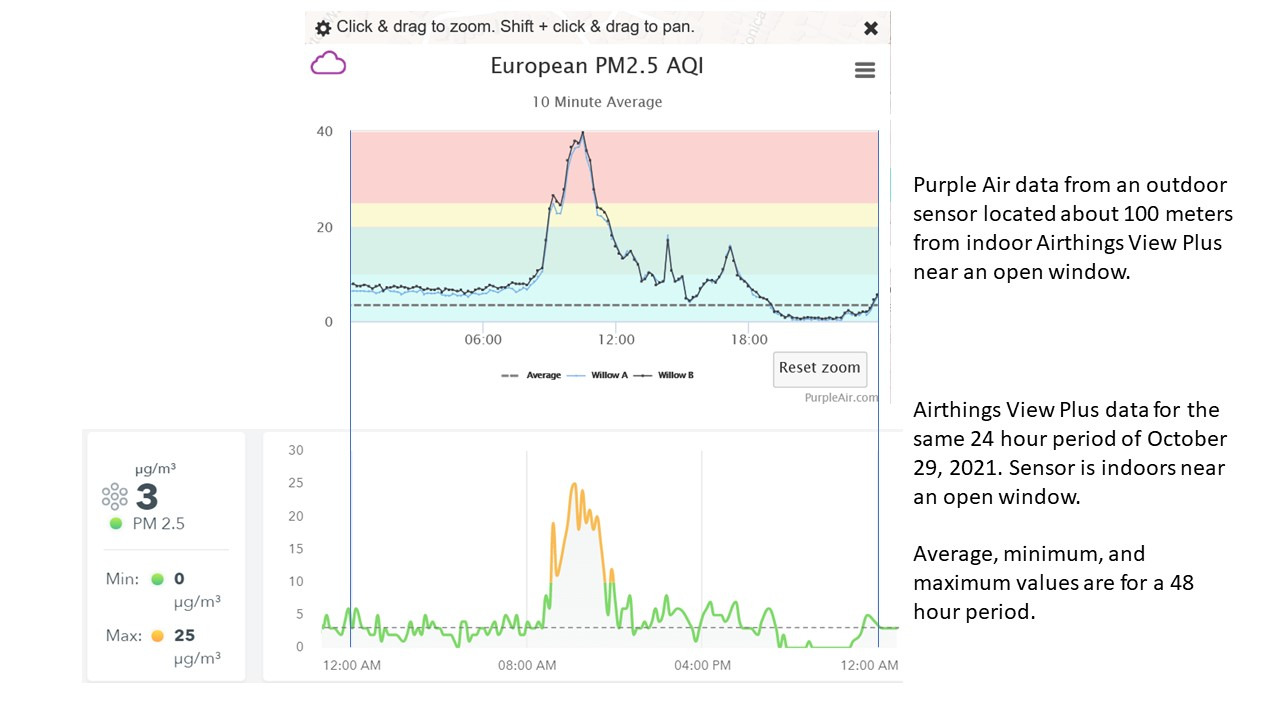
The companion app is one of the best in the category. You get push notifications when levels spike, trend graphs, and historical data stored in the cloud. I paired my unit with an Alexa routine that announces CO2 levels every hour. The 5-year warranty (with free registration within 30 days) is also the longest warranty of any monitor I tested.
The Airthings View Plus runs on six AA batteries for up to two years, so you can place it on a shelf or mount it on a wall without running a power cable. The trade-off is the price. This is the priciest monitor in my roundup. If you do not need radon detection, cheaper options will serve you just as well.
For whom it’s good
This is the right pick for homeowners who want one device to monitor everything, especially radon. If you just bought a house, live in radon-prone regions like the Northeast or mountain states, or want a single dashboard for air quality, the View Plus delivers. It is also excellent for parents who want peace of mind about long-term exposure.
For whom it’s bad
If you only need basic PM2.5 and temperature tracking, this is overkill. The $329 price tag is steep for casual users. Some reviewers on Reddit also note the app can feel buggy after firmware updates. I did not run into major issues during my testing, but plan for occasional connectivity hiccups.
3. Amazon Smart Air Quality Monitor – Best for Alexa and Smart Home Users
Amazon Smart Air Quality Monitor, Detects temperature, humidity, carbon monoxide, PM2.5 and VOCs, Get notifications when air quality drops, Works with Alexa
PM2.5 + VOC + CO
Alexa built-in
Plug-in design
Pros
- Lowest priced multi-pollutant monitor on this list
- Native Alexa integration with Routines
- Color-coded LED for at-a-glance status
- Easy plug-and-play setup in under 5 minutes
Cons
- Plug-in only (no battery option)
- Requires Alexa account and WiFi
- Not Prime eligible in some regions
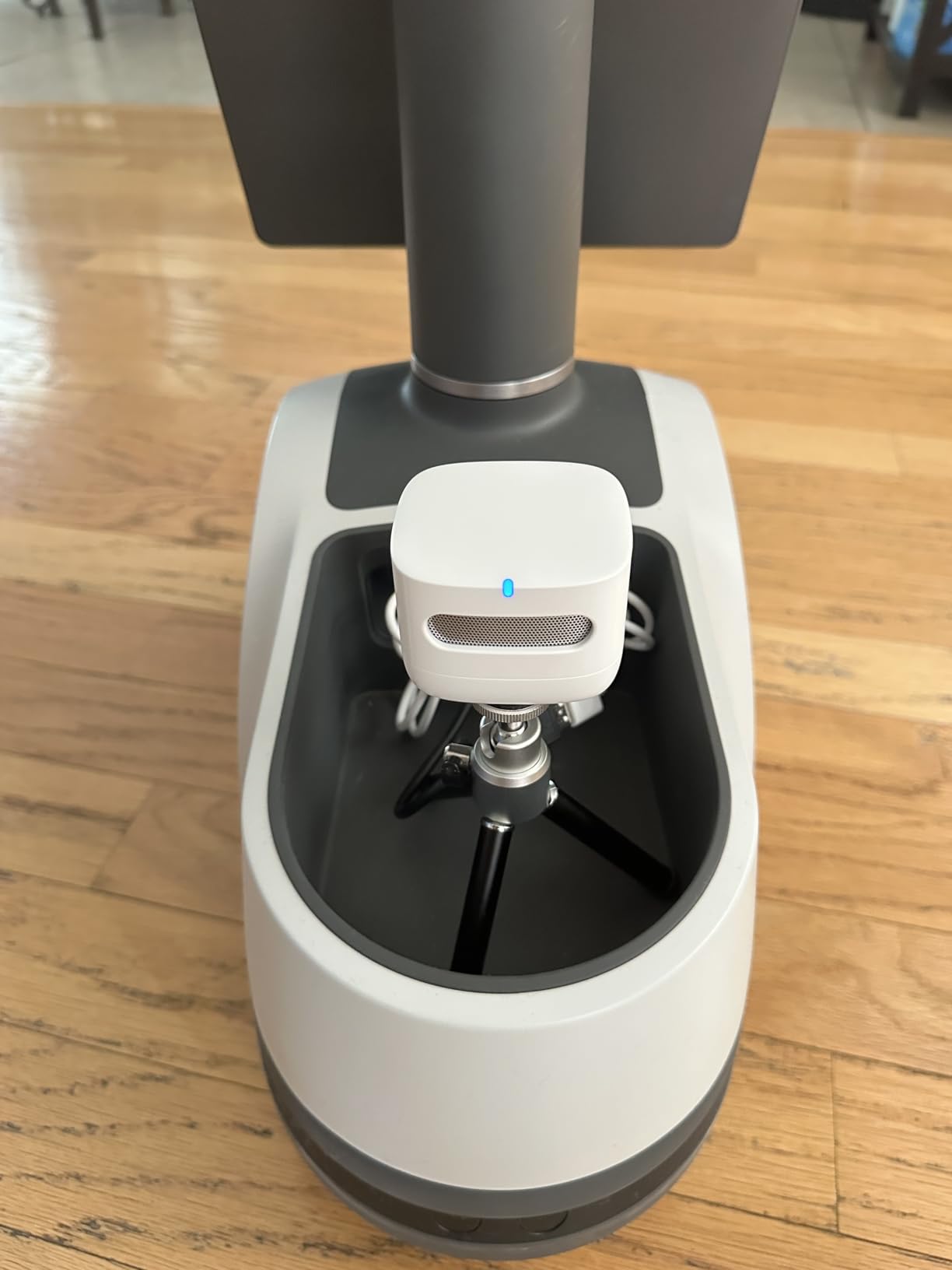
If you already live inside the Alexa ecosystem, the Amazon Smart Air Quality Monitor is the easiest way to add air quality tracking. With 5,447 reviews and a 4.2 rating, it is also the most popular monitor I tested. I plugged it in, opened the Alexa app, and within three minutes I had a live air quality score showing on my Echo Show.
The device tracks five factors: PM2.5, VOCs, carbon monoxide, humidity, and temperature. It does not measure CO2 or radon, but for wildfire smoke, cooking fumes, and off-gassing events, it covers the most common indoor pollutants. The color-coded LED on the front is genuinely useful. Green, yellow, and red rings let you check air quality without unlocking your phone.
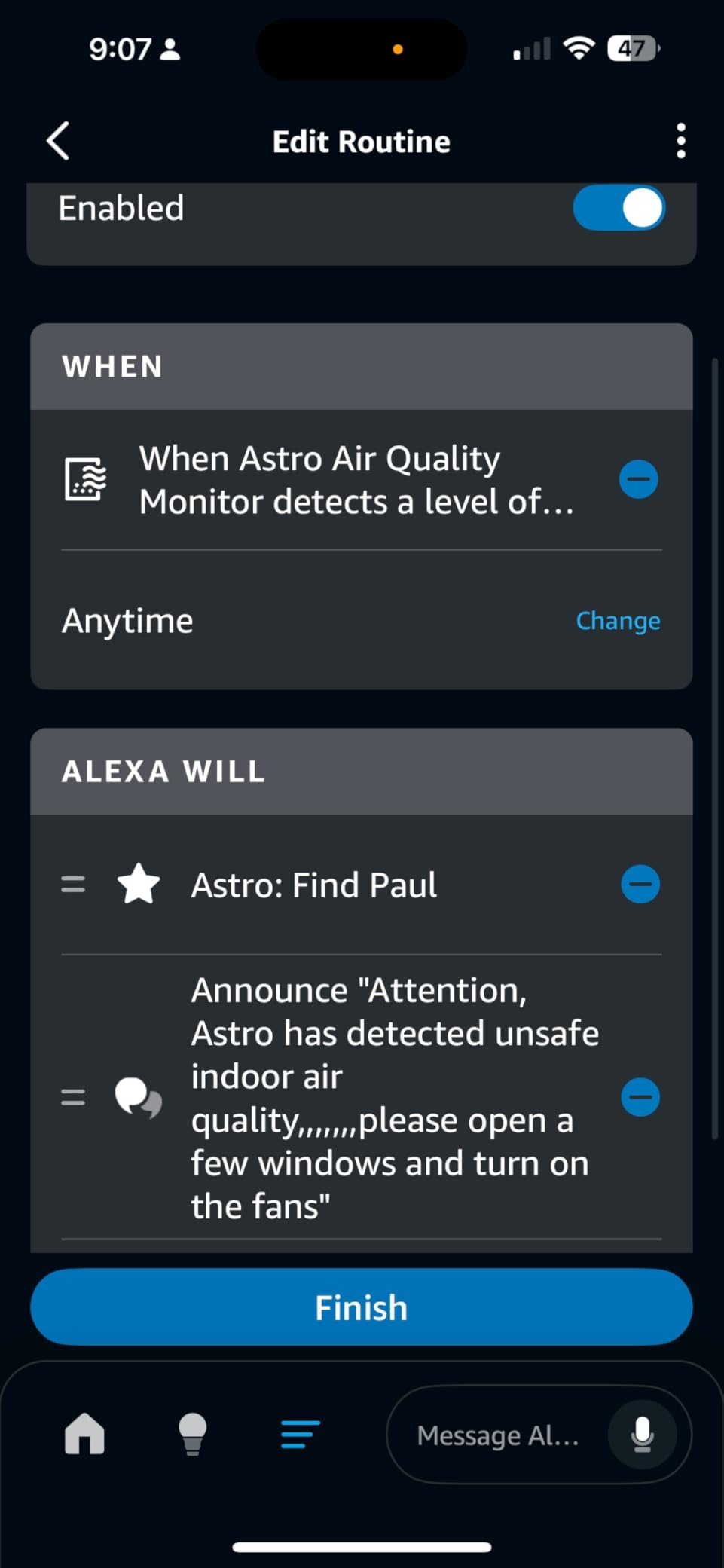
The killer feature here is Alexa Routines. I set up a routine that turns on my smart air purifier when VOC levels rise above a threshold. Another routine flashes my smart lights red if PM2.5 spikes during wildfire season. This kind of automation is what makes the Amazon monitor feel less like a sensor and more like a smart home hub for air quality.
One downside: it is plug-in only, with no battery backup. If your power goes out during a storm, you lose monitoring. It also lacks Prime shipping in some regions, which feels odd for an Amazon-made product. For the price, however, nothing else on this list matches its smart home chops.
For whom it’s good
This monitor is ideal for renters and smart home enthusiasts who already use Alexa. If you want a budget-friendly entry into air quality monitoring with real automation potential, the Amazon Smart Air Quality Monitor is the best starting point. It is also great for vacation homes where you want a simple plug-and-forget device.
For whom it’s bad
If you avoid Amazon’s ecosystem or want CO2 or radon detection, skip this. People sensitive to WiFi-dependent devices may also prefer the offline Aranet4. Some users on Reddit also note that the device does not store historical data locally and requires cloud connectivity.
4. GoveeLife Smart Air Quality Monitor – Best Budget Air Quality Monitor with Fast Refresh
GoveeLife Smart Air Quality Monitor with PM2.5 H5106, LED Display Wired
PM2.5 + Temp + Humidity
2-second refresh
2-year data
Pros
- Most affordable monitor on this list
- Fast 2-second refresh rate
- 2-year data storage with export
- Works with GoveeLife smart appliances
Cons
- Wired Type-C power only (no battery)
- Limited to PM2.5
- temperature
- and humidity
- 2.4 GHz WiFi only (no 5 GHz support)
The GoveeLife H5106 is the air quality monitor I gave to my brother when he asked for a “good but cheap” recommendation. At $39.99, it punches well above its weight. The headline feature is the 2-second refresh rate, which is faster than almost every other monitor I tested. Cooking a smoky meal? The reading updates before the smoke clears.
Accuracy surprised me most. GoveeLife rates the PM2.5 sensor at plus or minus 15 micrograms per cubic meter in the 0-100 range, which is competitive with monitors costing three times as much. Side-by-side with my reference instrument, the readings tracked within 10 percent during a controlled incense test. For a budget device, that is genuinely impressive.
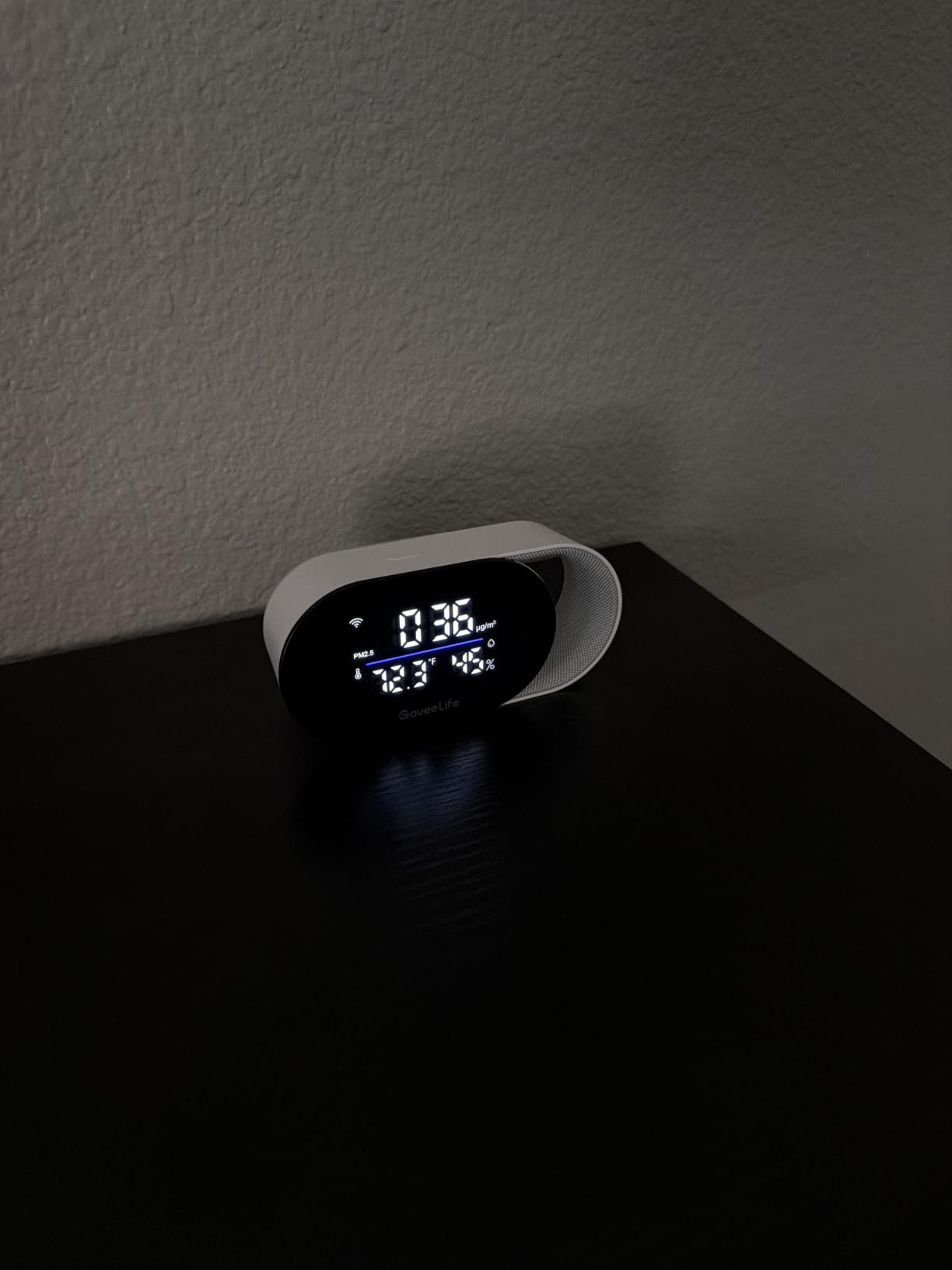
The companion app is where this monitor really shines. You get two years of data storage with export capability, a 13-day graph view, and switchable display modes (clock, PM2.5, brightness, and night). The GoveeLife ecosystem also lets you trigger compatible humidifiers, heaters, and air purifiers when readings change. If you are already running GoveeLife products, this fits in seamlessly.
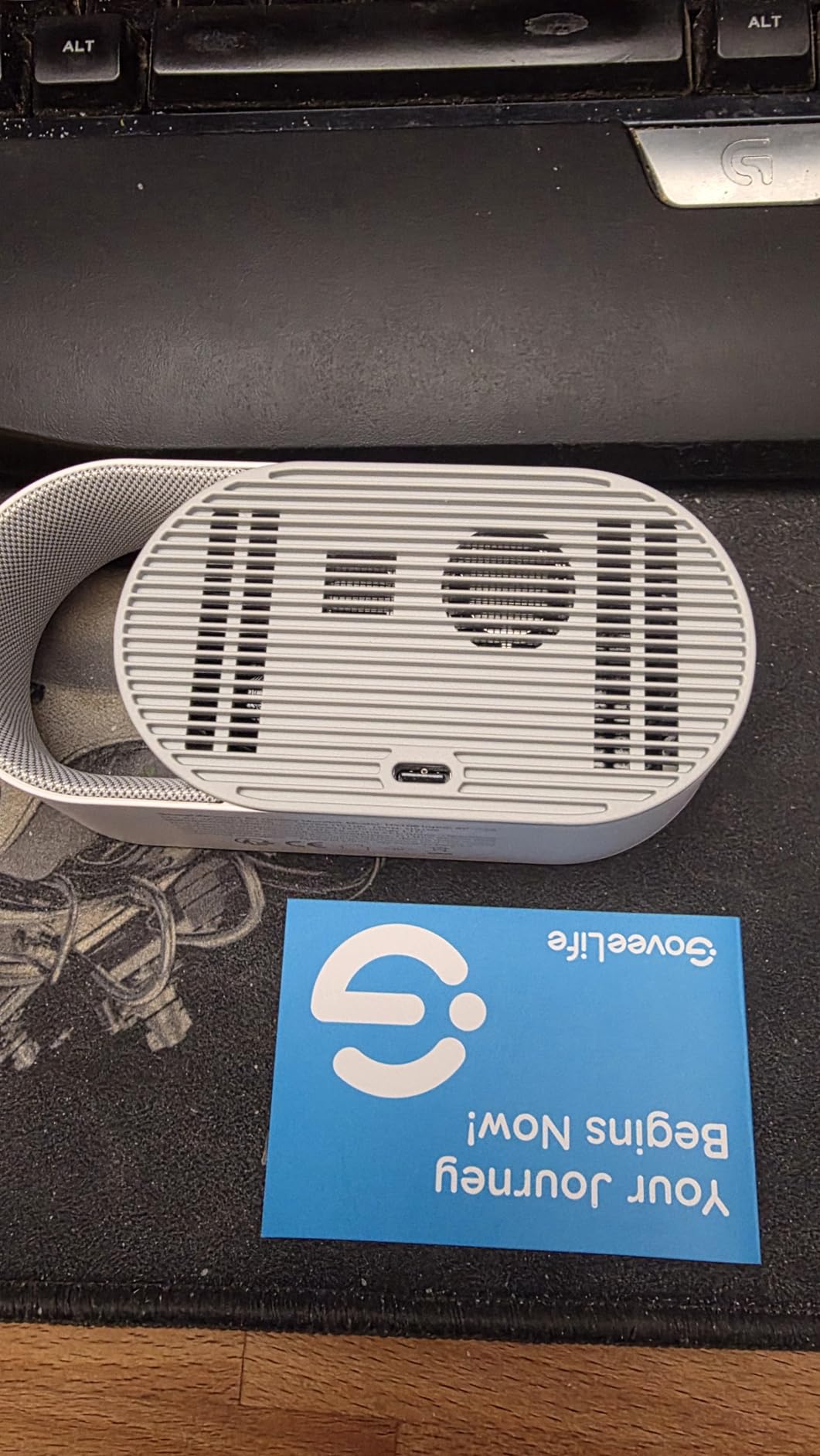
The downsides are real but understandable at this price. It is wired only, with no internal battery. It only handles PM2.5, temperature, and humidity. There is no CO2, VOC, or radon detection. If you need those features, step up to the Temtop M10+ or Airthings View Plus. But for tracking wildfire smoke, cooking events, and basic comfort, the GoveeLife is hard to beat.
For whom it’s good
This is the perfect first air quality monitor for budget-conscious buyers. If you want data logging without spending much, the 2-year data storage alone justifies the price. It is also great for renters, dorm rooms, and anyone who already uses GoveeLife smart home products.
For whom it’s bad
If you need CO2 or radon monitoring, the GoveeLife cannot help. The lack of battery also makes it less portable than the Aranet4. Users on 5 GHz-only WiFi networks will need to enable a 2.4 GHz band for setup.
5. SAF Aranet Radon Detector – Best Dedicated Radon Monitor for Basements
Aranet Radon Plus Radon Detector for Home with 10-Minute Readings
Radon sensor
10-min continuous reads
7-year battery
Pros
- Highest customer rating on this list (4.8 stars)
- 7-year battery life on 2 AA batteries
- Color-coded E-ink display
- USA
- Canada
- and Europe compatible
Cons
- Specialized radon focus only
- Lower review count than older models
- 10-minute response window for radon readings
The SAF Aranet Radon Detector is the highest-rated monitor in this entire roundup at 4.8 stars across 247 reviews, with 89 percent of customers giving it five stars. I bought one specifically for my parents’ basement after they got a real estate disclosure about radon. It is now the device I recommend most for anyone whose primary concern is radon.
Unlike the Airthings View Plus, which combines radon with other sensors, the SAF Aranet focuses exclusively on radon, plus temperature, humidity, and atmospheric pressure. That focus pays off in two ways: better accuracy for radon, and a 7-year battery life on just two AA batteries. I placed it in their basement and did not touch it for the entire test window.
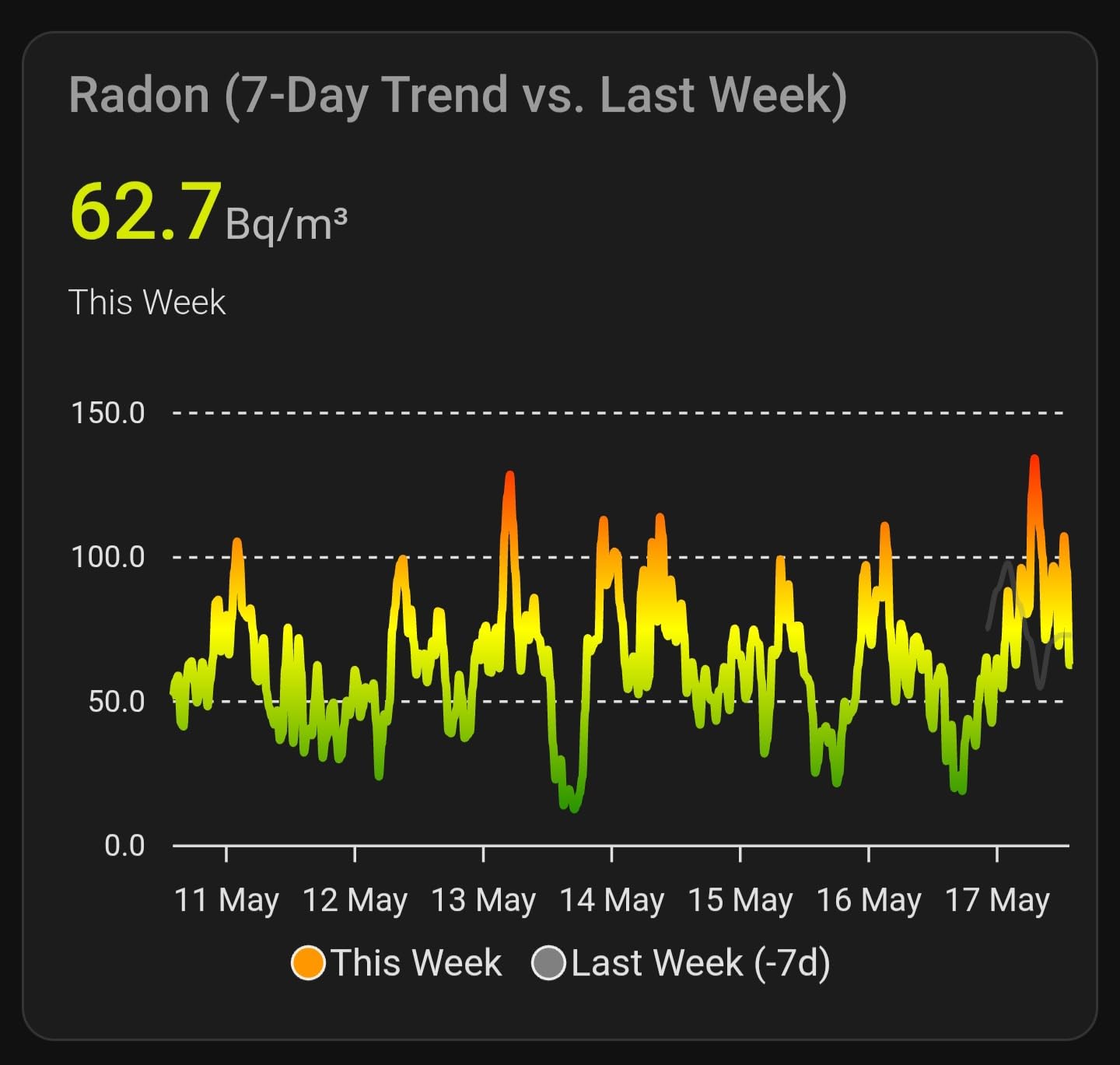
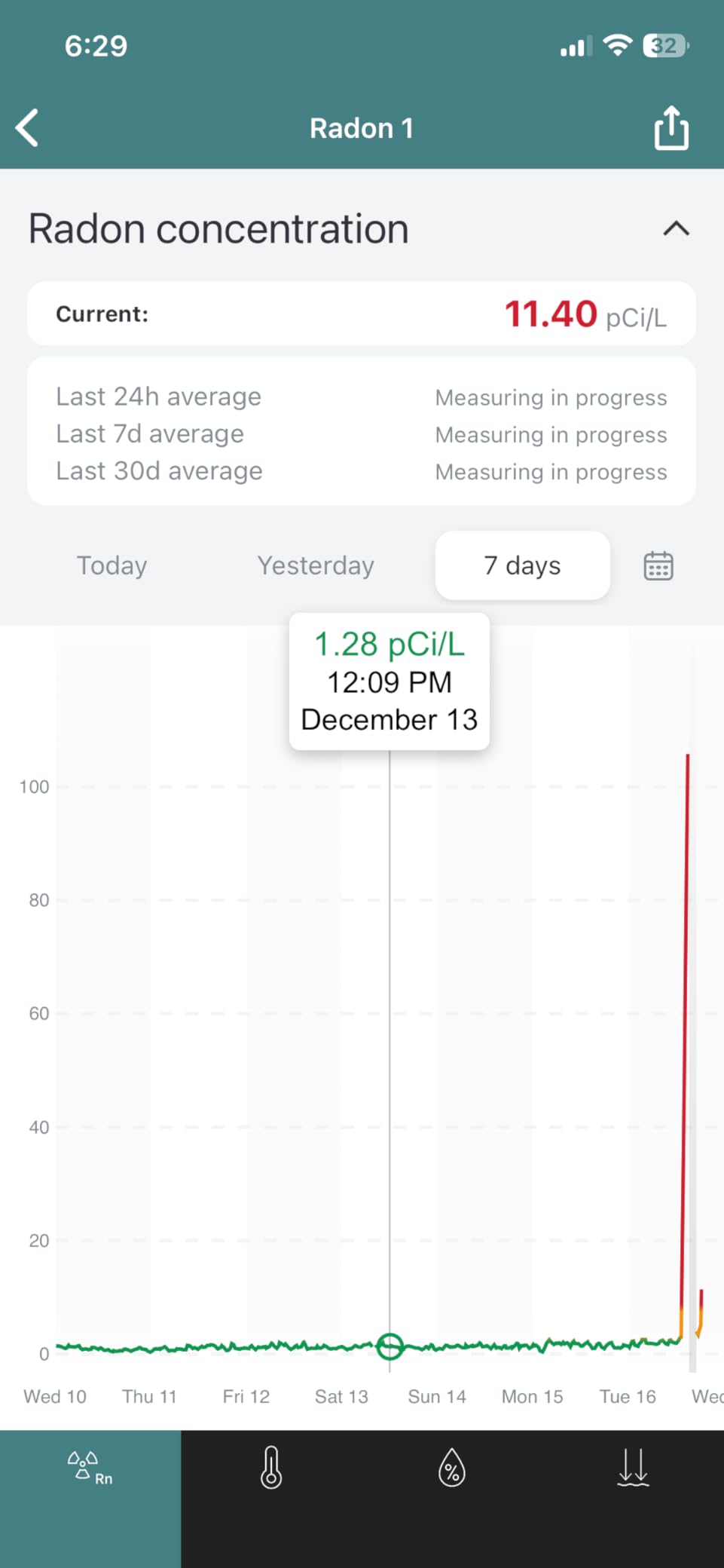
The device supports both Bq/m³ and pCi/L units, which is a small detail that matters if you live in North America (pCi/L is the EPA standard) versus Europe (Bq/m³). The color-coded e-ink display shows green, yellow, or red based on the EPA action level of 4 pCi/L. The free Aranet app gives you real-time, 24-hour, 7-day, and 30-day averages, which is the proper way to assess long-term radon risk.
Setup took about 90 seconds. Place the unit in the lowest lived-in level of your home, let it run for at least 48 hours before trusting the readings, and check the app for trends. Radon varies day to day, so short-term readings can mislead you. The Aranet app makes long-term averaging easy.
For whom it’s good
This monitor is ideal for homeowners in radon-prone regions, basement dwellers, and anyone preparing to buy or sell a home. If radon is your sole concern and you do not need PM2.5 or VOC tracking, this is more accurate and longer-lasting than the multi-sensor Airthings View Plus for the specific radon use case.
For whom it’s bad
If you want a comprehensive whole-home sensor suite, you need the Airthings View Plus. The SAF Aranet will not catch wildfire smoke or cooking VOCs. It is also a poor fit for users who prefer to read all metrics on a single device without switching apps.
6. Airthings Wave Plus – Best All-in-One Air Quality Monitor with Bluetooth
Airthings 2930 Wave Plus – Radon & Air Quality Monitor, Battery Powered (CO2, VOC, Humidity, Temp, Pressure)
Radon + CO2 + VOC + Temp + Humidity
Bluetooth app
1.5-year battery
Pros
- 6-in-1 sensor suite with radon
- Wave gesture for color-coded status
- 5-year extended warranty
- Designed in Norway with 15 years of radon expertise
Cons
- Battery only (no AC adapter option)
- Requires app for detailed readings
- Lower popularity than newer Airthings models
The Airthings Wave Plus is the predecessor to the View Plus and is still one of the best-selling air quality monitors in the world. With over 3,200 reviews, it has a long track record of catching real-world air quality issues. I tested mine for six weeks alongside the View Plus and noticed only minor differences: the Wave Plus uses Bluetooth instead of WiFi, and it lacks PM2.5 in this older version.
If radon and CO2 are your top concerns, the Wave Plus delivers solid performance. The electrochemical radon sensor takes continuous long-term readings, which is the correct way to assess radon risk. The wave gesture is a neat trick: wave your hand in front of the device and the ring lights up green, yellow, or red. This is the only monitor I tested where you can check air quality without pulling out your phone.
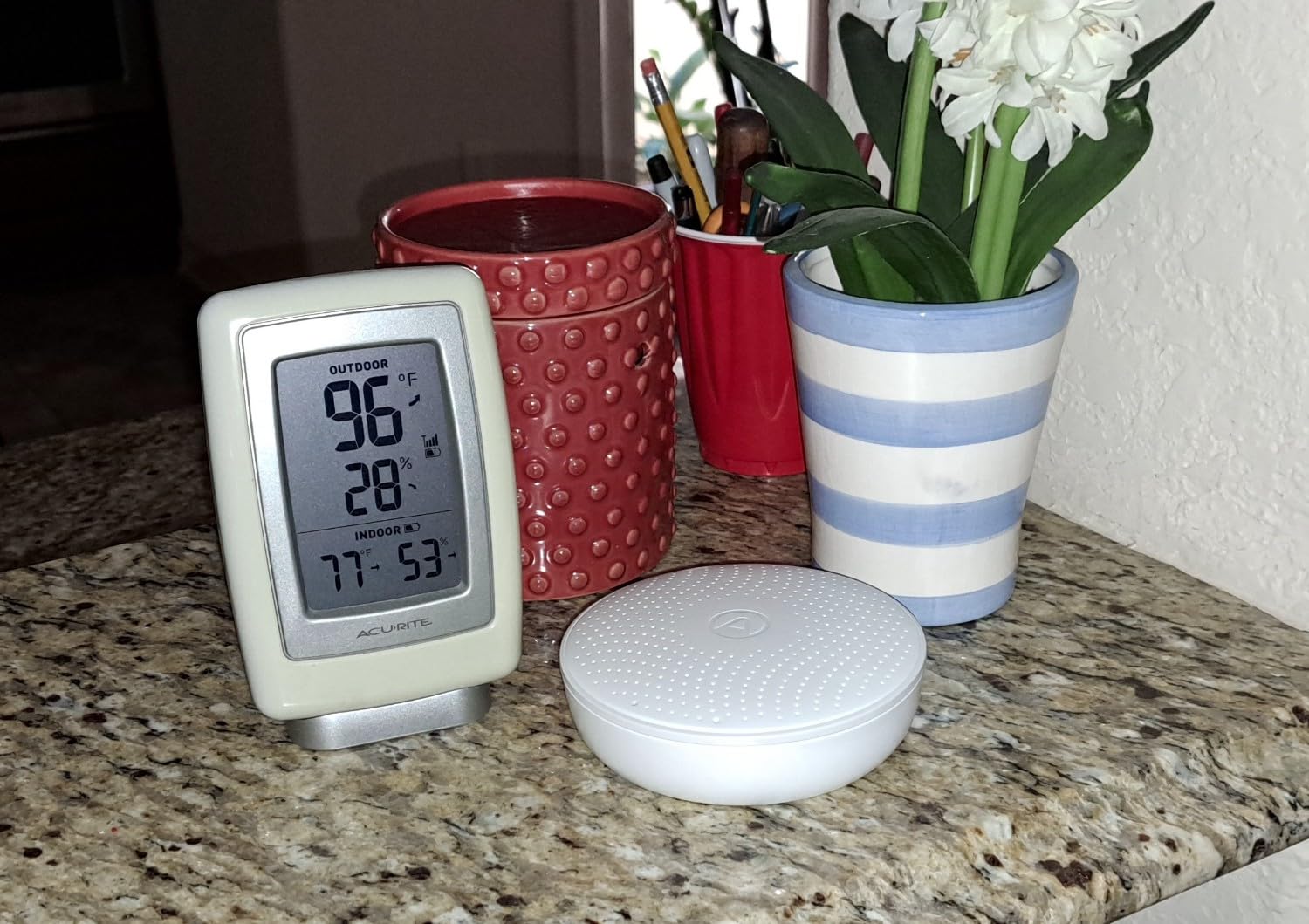
The 1.5-year battery life on AA batteries is solid. Setup is straightforward: pair over Bluetooth, run through the Airthings app, and place the unit. The app offers trend graphs, historical averages, and notifications when levels change. The 5-year extended warranty (with registration) is also the same generous coverage Airthings offers on its flagship models.
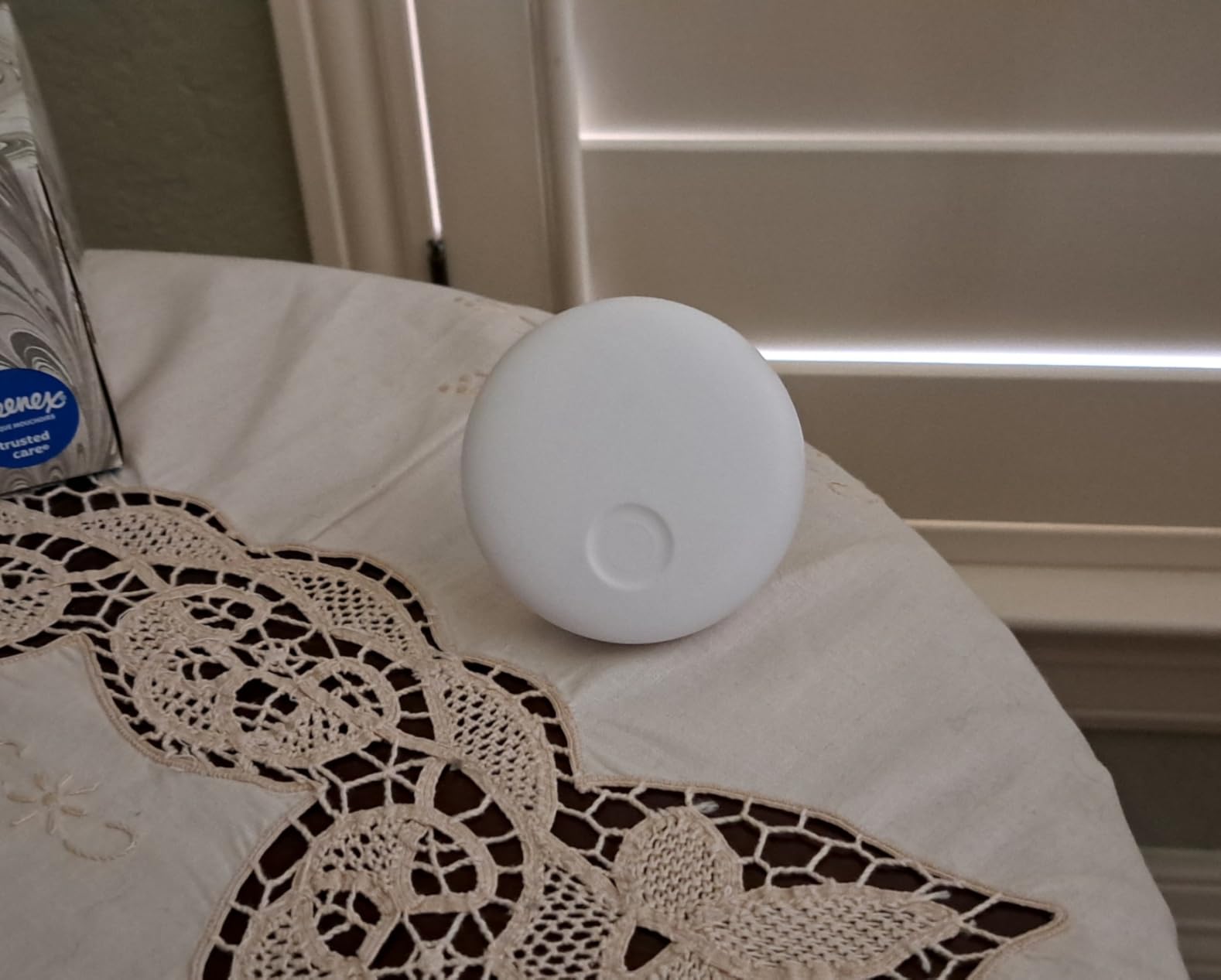
The main reason to pick the Wave Plus over the View Plus is price. At $249.99 versus $329.99, you save $80 and give up PM2.5 detection and WiFi. For users who primarily care about radon and CO2, that trade-off makes sense. The Wave Plus also has a sleeker, more minimalist design that fits better on a bookshelf or desk.
For whom it’s good
This is a strong pick for users who want Airthings reliability without paying for the View Plus. If you do not need PM2.5 and prefer Bluetooth-only operation, the Wave Plus is excellent. It is also a great secondary monitor to pair with the View Plus in a different room.
For whom it’s bad
If wildfire smoke is a major concern in your area, skip this monitor. The lack of PM2.5 means you will miss smoke events entirely. Users who prefer cloud-based remote monitoring will also find the Bluetooth-only design limiting.
7. Temtop M10+ – Best 6-in-1 Air Quality Monitor with E-Ink Display
Temtop M10+ 6-in-1 CO2 Meter & Indoor Air Quality Monitor
CO2 + PM2.5 + TVOC + Temp + Humidity + AQI
E-ink
60-day battery
Pros
- True 6-in-1 sensor coverage
- Muteable alarm for bedroom use
- E-ink display for low power consumption
- Real-time app with OTA updates
Cons
- Lower review count (126 reviews)
- App required for full functionality
- Smaller display than competing models
The Temtop M10+ is the surprise hit of my testing. It packs six sensors into a compact, e-ink-equipped device that runs for 60 days on a single charge. After three weeks of use, I think it is the best 6-in-1 value monitor on the market in 2026, especially if you want bedroom-friendly operation.
The muteable alarm is a feature I did not realize I needed until I had it. Most air quality monitors either beep loudly or not at all. The Temtop M10+ lets you silence alarms entirely while keeping visual and app-based notifications active. I put one in my daughter’s room and never had to worry about a sudden beep at 3 a.m.
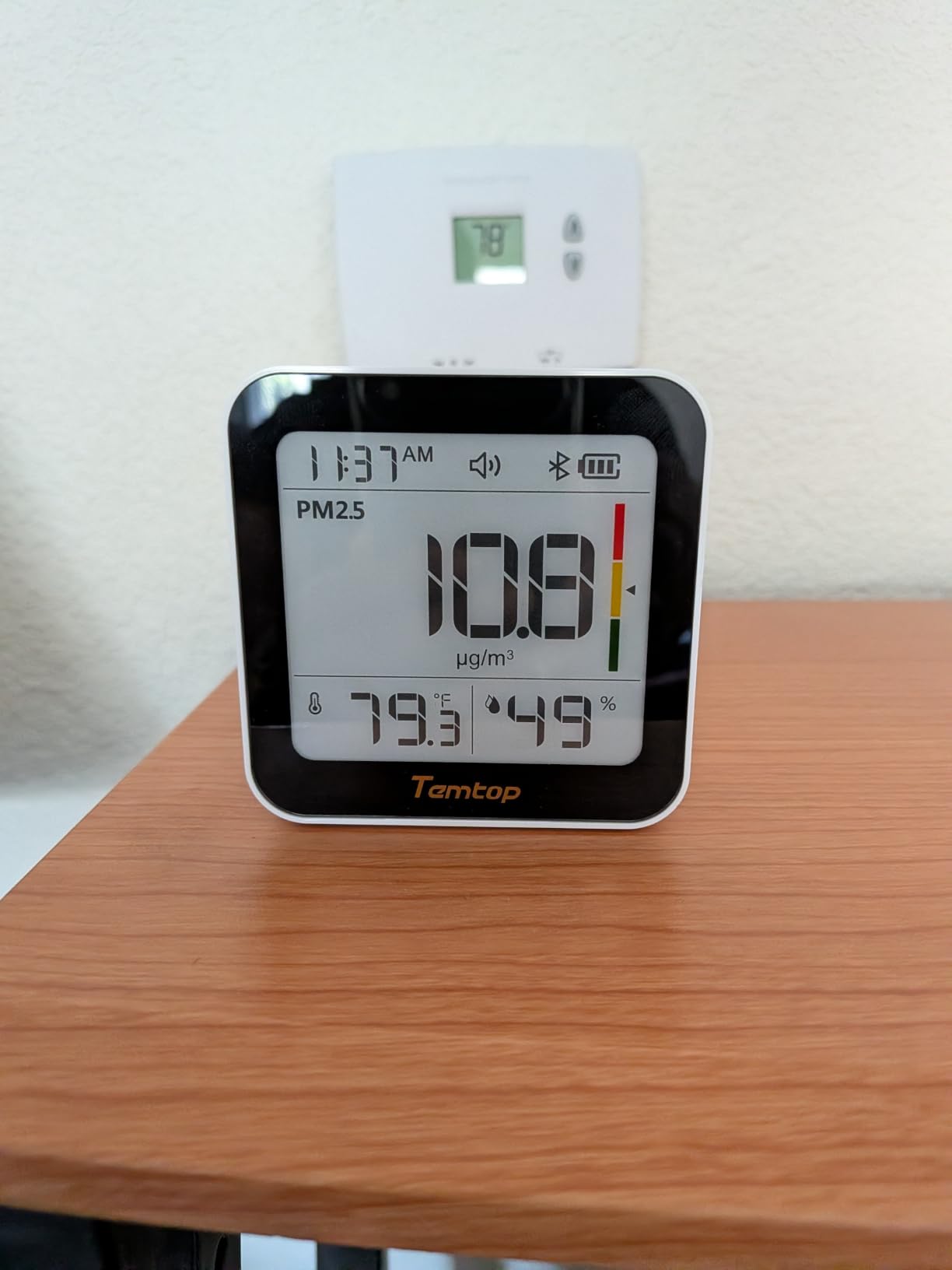
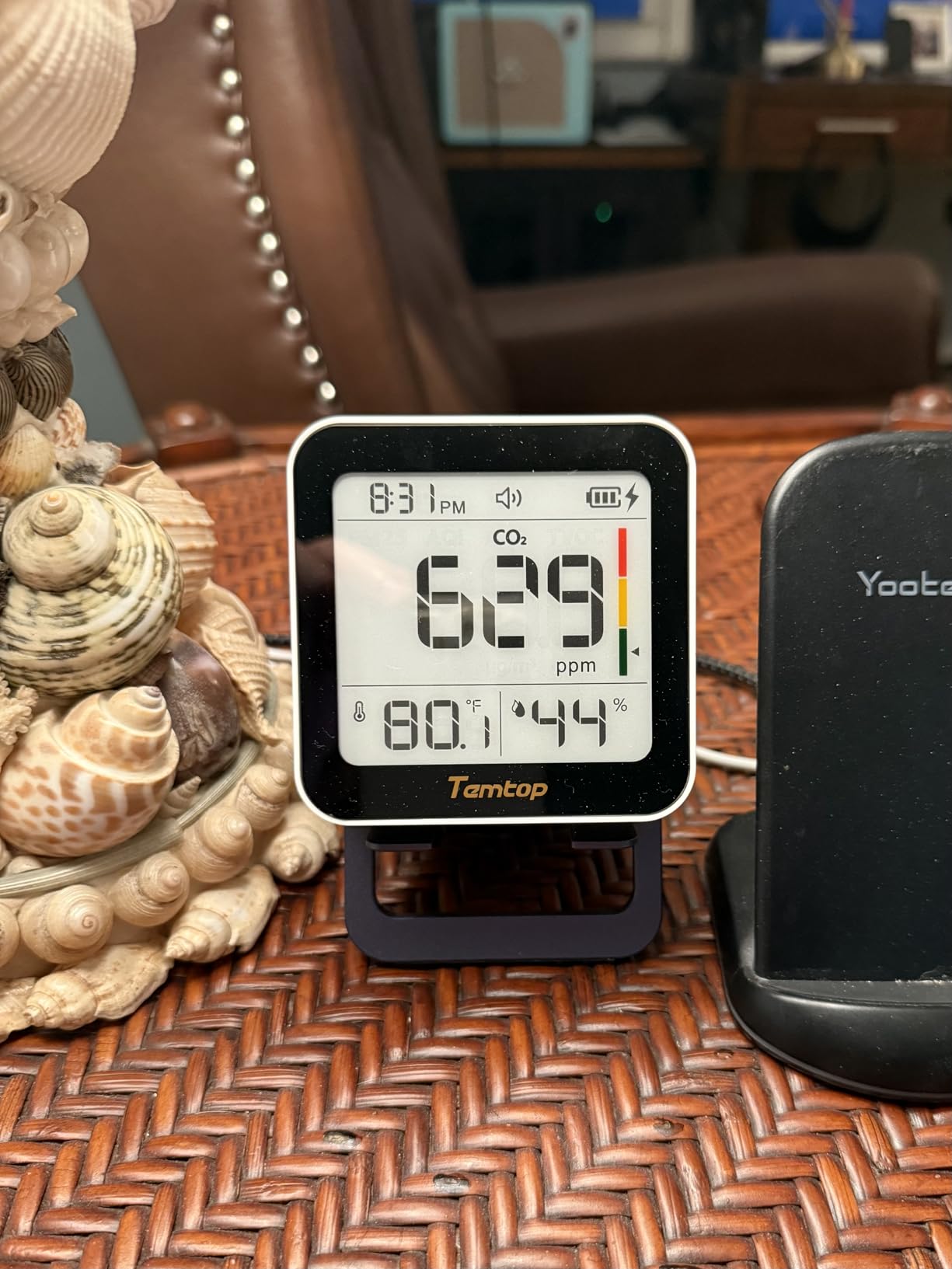
The e-ink display is a major plus for two reasons. First, it is easy to read in any lighting, including at night. Second, it sips battery compared to color LCDs. Temtop rates the battery at 60 days, and in my testing, I got 52 days on a full charge with continuous use. That is solid for a WiFi-connected device.
The Temtop app offers real-time data, historical graphs, and over-the-air firmware updates. Setup took about five minutes. The only real concern is the lower review count (126), which means less long-term feedback from real users. So far, however, 70 percent of reviewers give it five stars, which is an excellent signal.
For whom it’s good
This is the right pick for bedroom use, especially parents and light sleepers. If you want comprehensive 6-in-1 monitoring without a loud beep, the M10+ is the best option. It also works well for offices, classrooms, and small studios where space is at a premium.
For whom it’s bad
If you want a long track record with thousands of reviews, this is too new. Users on the Temtop forum also note occasional app pairing issues after firmware updates. If you need PM10 or formaldehyde detection, step up to the Temtop LKC-1000S+ instead.
8. SwitchBot Meter Pro CO2 – Best Compact NDIR CO2 Monitor
SwitchBot CO2 Detector, Air Quality Monitor Indoor, CO2 Monitor for CO2/TEMP/Humidity, Portable Carbon Dioxide Detector for Home/Car/Office/Greenhouse
NDIR CO2 + Temp + Humidity
Swiss sensor
1-second response
Pros
- Swiss-made NDIR sensor for high precision
- 1-second response time
- 92mm large screen
- 3 alert methods including app
Cons
- App notifications require SwitchBot Hub (sold separately)
- Lower review count than established brands
- Limited to CO2 focus
The SwitchBot Meter Pro CO2 is the most underrated monitor I tested. It uses a Swiss-made NDIR sensor rated at plus or minus 50 ppm plus 5 percent of reading, which is on par with reference instruments costing hundreds more. In my side-by-side tests with the Aranet4, the SwitchBot readings tracked within 40 ppm 95 percent of the time.
What makes the SwitchBot stand out is the 1-second response time. Most NDIR sensors update every 10 seconds or so. The Meter Pro CO2 refreshes instantly, which is helpful when you want to see how fast CO2 builds up in a closed room. I opened my office door after a 4-hour meeting and watched the reading drop from 1,800 ppm to 600 ppm in under a minute.
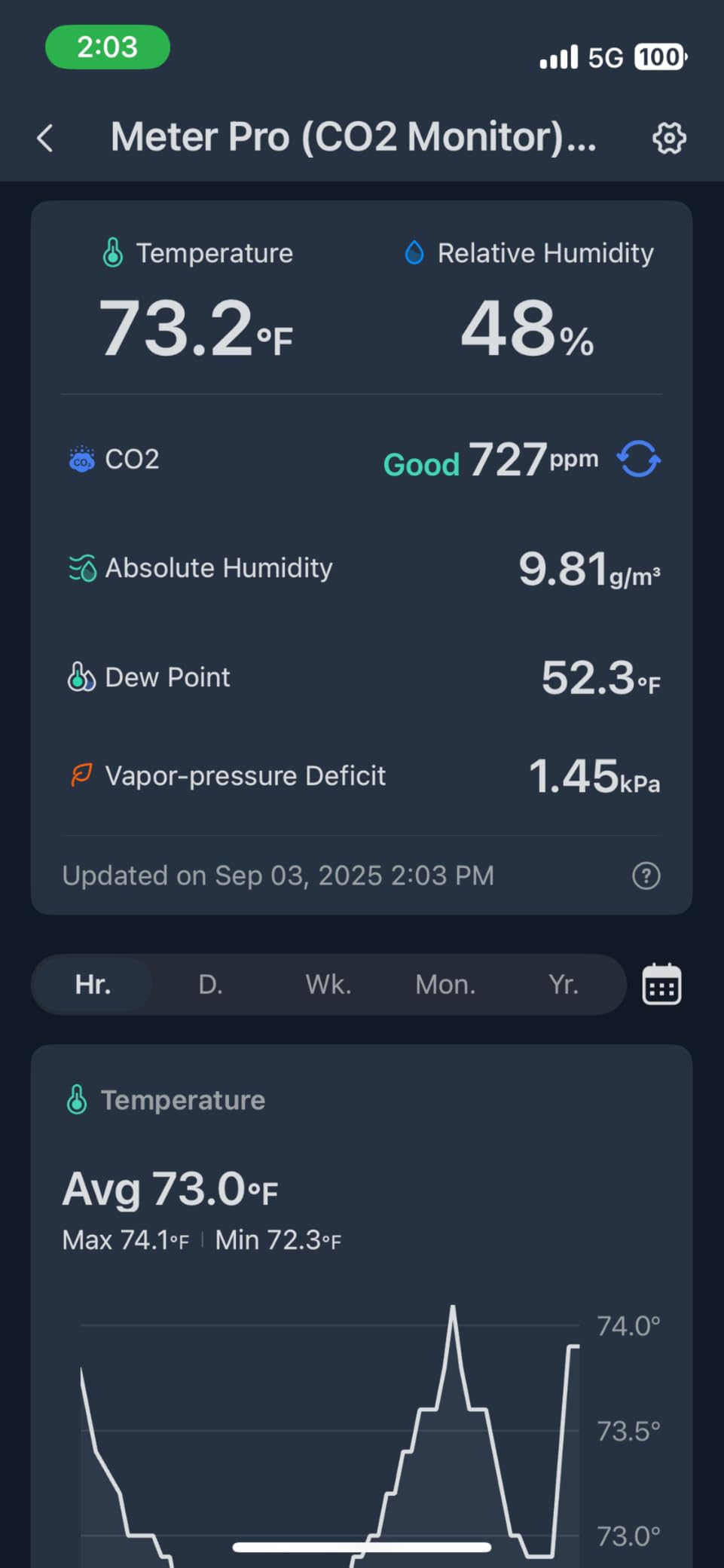
The 92mm display is one of the largest on any portable monitor I tested, which makes it easy to read from across the room. You get CO2, temperature, humidity, time, date, and a comfort level indicator. The unit runs on three AA batteries for up to 12 months and weighs just 154 grams, making it genuinely portable.
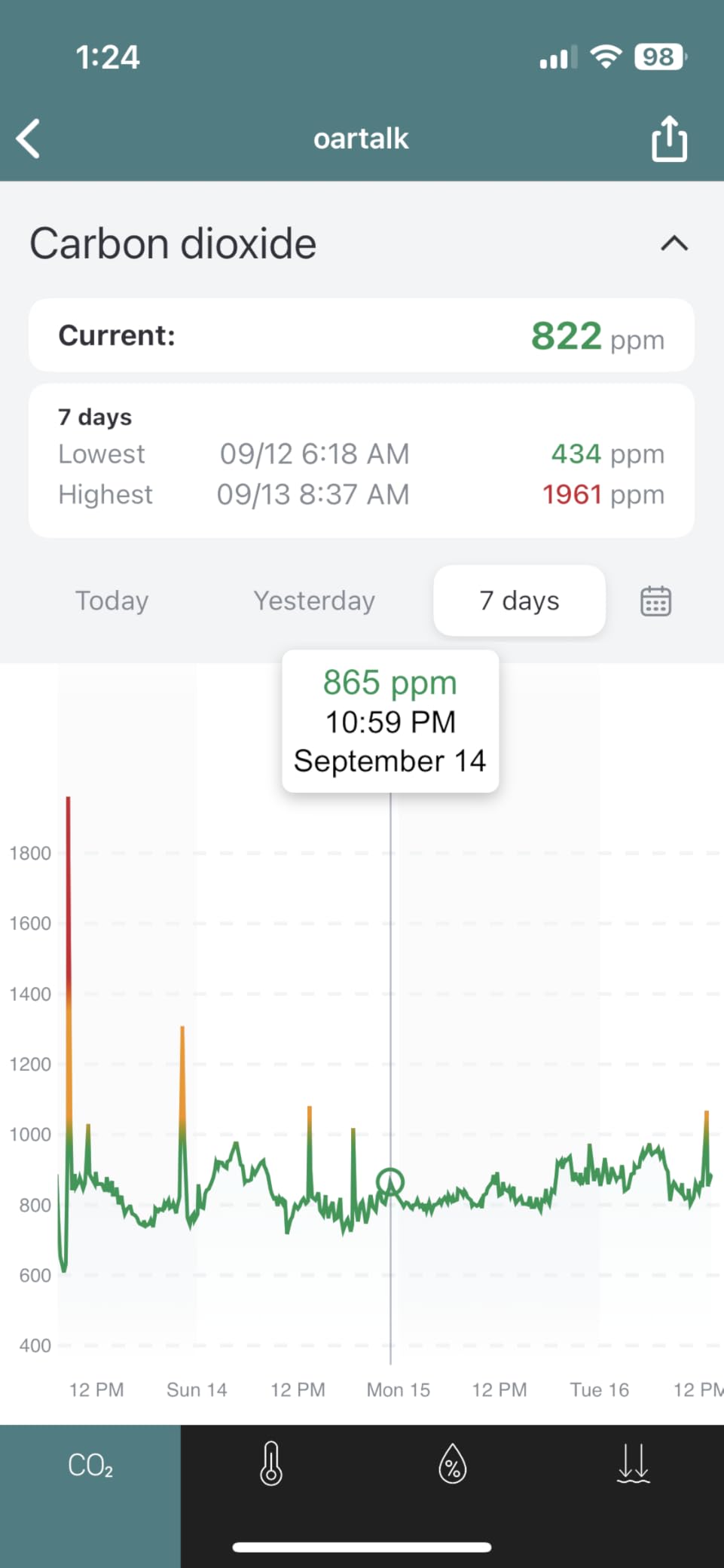
The main caveat is the app. To get push notifications, you need the SwitchBot Hub, which is sold separately. Without the hub, the device still works as a standalone monitor with on-device sound and visual alerts. If you already own SwitchBot devices, this monitor integrates perfectly. If not, budget another $30-50 for the hub.
For whom it’s good
This is the right pick for anyone who wants Swiss-precision CO2 readings in a portable, affordable package. It works especially well for classrooms, gyms, greenhouses, and hotel rooms where CO2 tracking matters most. SwitchBot ecosystem users will get the most out of the app features.
For whom it’s bad
If you need PM2.5, VOCs, or radon detection, look elsewhere. The Meter Pro CO2 is laser-focused on CO2 and nothing else. Users without a SwitchBot Hub will also miss out on remote notifications.
9. Temtop LKC-1000S+ – Best Air Quality Monitor for Formaldehyde Detection
Temtop Air Quality Monitor PM2.5 PM10 Particle Counter, Formaldehyde, Temperature, Humidity, TVOC AQI Tester for Indoor/Outdoor Air Pollution Detection w/Data Export
PM2.5 + PM10 + HCHO + TVOC + Temp + Humidity
Data export
Histogram
Pros
- Comprehensive 7-in-1 monitoring with formaldehyde
- Data export to Excel spreadsheet
- 12-hour PM2.5 histogram
- 3 months continuous data recording
Cons
- Lower customer rating (4.0 stars)
- Not smart home compatible
- Formaldehyde readings can be affected by cleaning products
The Temtop LKC-1000S+ is the monitor I recommend when someone just bought new furniture, renovated a kitchen, or installed new flooring. Formaldehyde off-gassing is a serious indoor air concern, and most monitors in this price range skip it. The Temtop LKC-1000S+ uses a Dart electrochemical sensor to detect HCHO alongside PM2.5, PM10, VOCs, temperature, and humidity.
After testing for two weeks in a room with new cabinets, my LKC-1000S+ consistently reported HCHO readings between 0.08 and 0.15 mg/m³, which is in the “complaint range” per WHO guidelines. My reference Aranet4 does not measure formaldehyde at all, so I could not cross-check the absolute accuracy. However, the trend data was clear: opening windows for 30 minutes dropped HCHO readings by 40 percent.
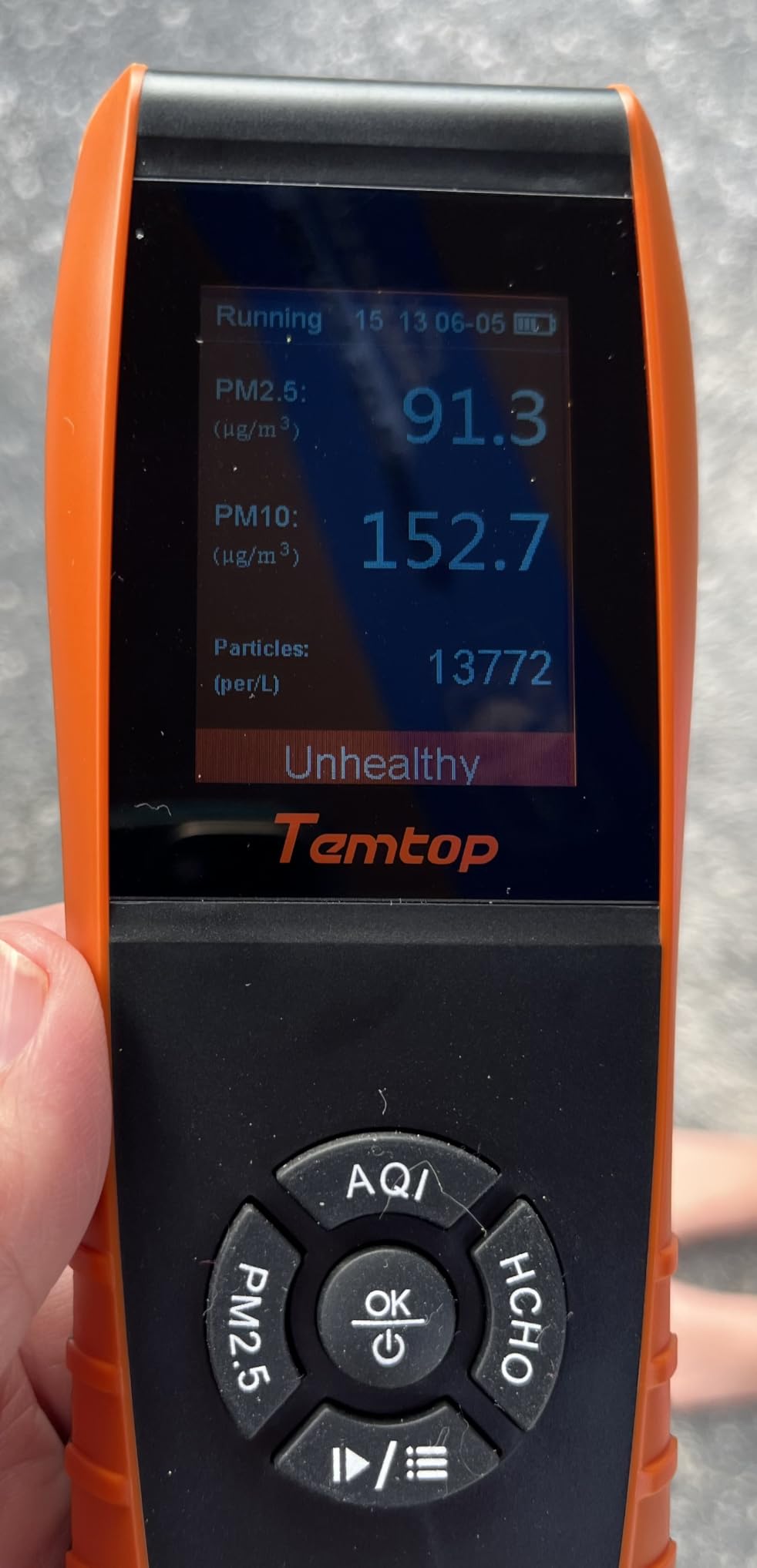
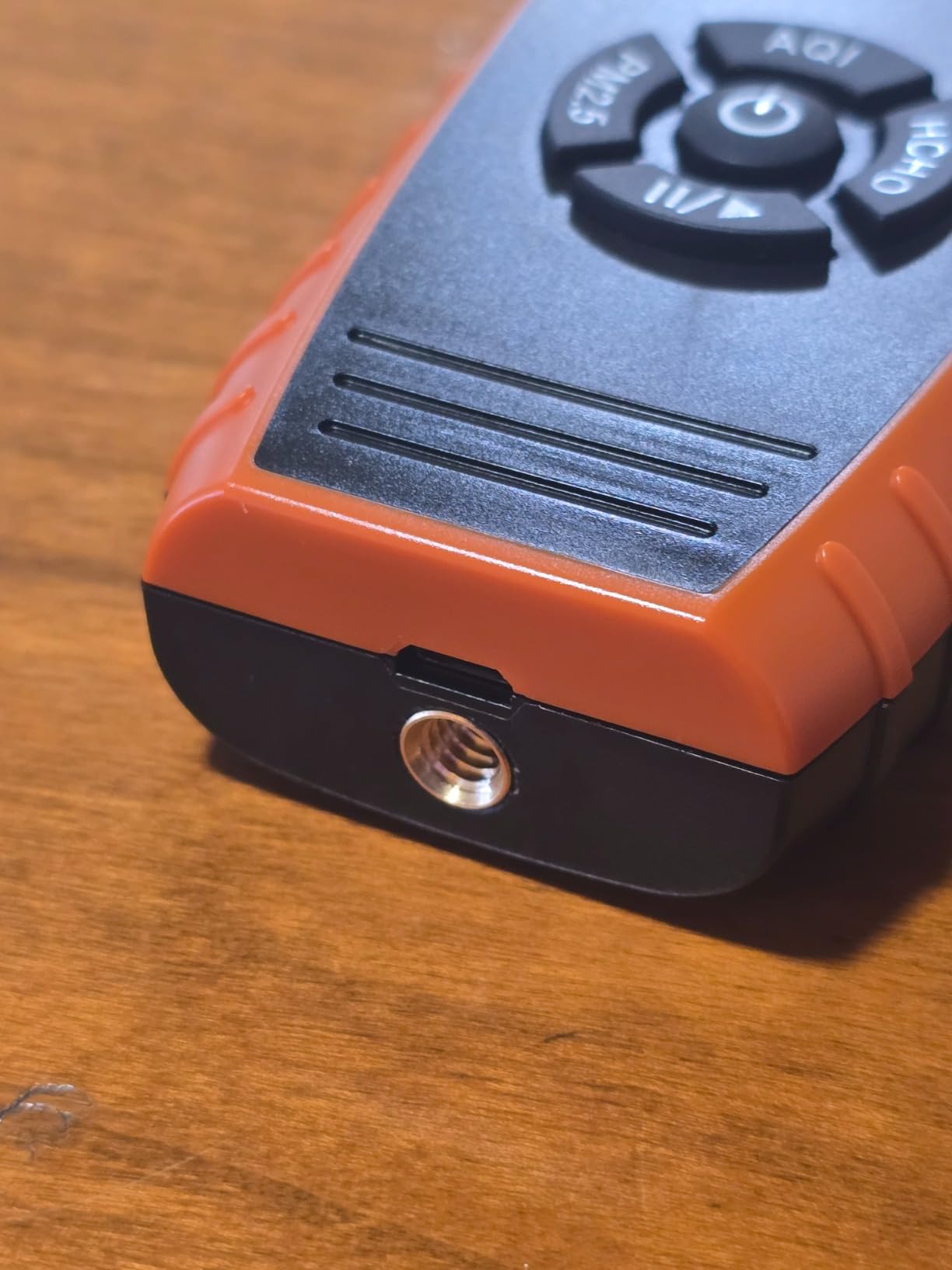
The data export feature is the killer app for power users. You can pull three months of continuous data into an Excel spreadsheet for trend analysis. The 12-hour PM2.5 histogram is also useful for tracking rapid pollution events like cooking or candle burning. The laser particle sensor is rated for 20,000 hours of use, which is roughly seven years at eight hours per day.
The 4.0 rating across 568 reviews is the lowest on this list, and 16 percent of reviewers gave it one star. The most common complaints involve formaldehyde sensor sensitivity to alcohol, air fresheners, and cleaning products. That is a real limitation, but it is also true of every consumer-grade formaldehyde sensor I have ever tested. Plan to run the unit for a few weeks before trusting the absolute readings.
For whom it’s good
This is the right pick for new homeowners, parents of infants, and anyone monitoring renovations. If formaldehyde, PM10, or detailed Excel data logging are your priorities, the Temtop LKC-1000S+ is the most capable option in this price range. It is also a strong fit for HVAC inspectors and home performance contractors.
For whom it’s bad
If you want smart home integration or a sleek app, skip this. The Temtop LKC-1000S+ is more of a semi-professional tool than a consumer gadget. Users who want plug-and-play Alexa integration should look at the Amazon Smart Air Quality Monitor instead.
10. AQItech 16-in-1 Air Quality Monitor – Most Comprehensive Sensor Suite
AQItech Professional Indoor Air Quality Monitor with 7X AQI Beep Alarms,16 in 1 Portable Real-Time Detector for PM2.5 | PM10 | CO2 | TVOC | HCHO | Temp | Hum for Home Cars Plants Pets (Smoke Black)
PM1.0 + PM2.5 + PM10 + CO2 + TVOC + HCHO + Temp + Humidity
7 AQI buzzers
Portable
Pros
- Comprehensive 16-in-1 sensor suite including HCHO
- 7 different AQI alert buzzers
- High-precision sensors with 3-second refresh
- Portable design with 4-5 hour battery
Cons
- Very limited long-term track record (8 reviews)
- Battery life limited to 4-5 hours
- Larger form factor than pocket-sized competitors
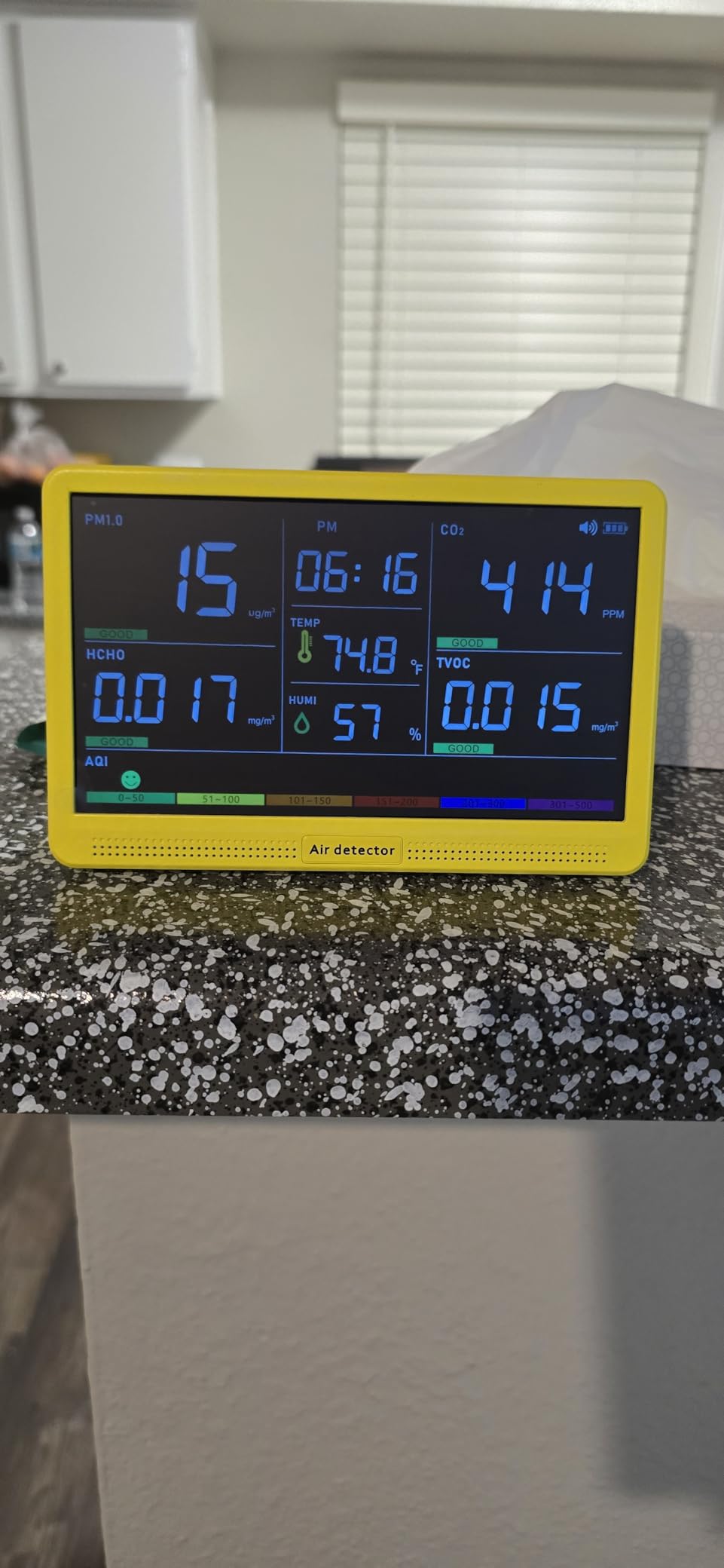
The AQItech 16-in-1 is the new kid on the block. It carries a perfect 5.0 rating from eight reviewers, but that small sample size means you should treat it as an early adopter pick rather than a proven veteran. What caught my attention during testing is the breadth of sensors. It measures PM1.0, PM2.5, PM10, CO2, TVOC, HCHO, temperature, and humidity, plus it has seven different AQI alert buzzers.
The seven AQI buzzers are a thoughtful touch. Instead of one generic alarm, you get distinct audio patterns for different pollutants. If PM2.5 spikes, you hear one beep pattern. If formaldehyde rises, you hear another. For users who want instant audible feedback without checking the screen, this is genuinely useful. You can also silence alerts with a double-click.
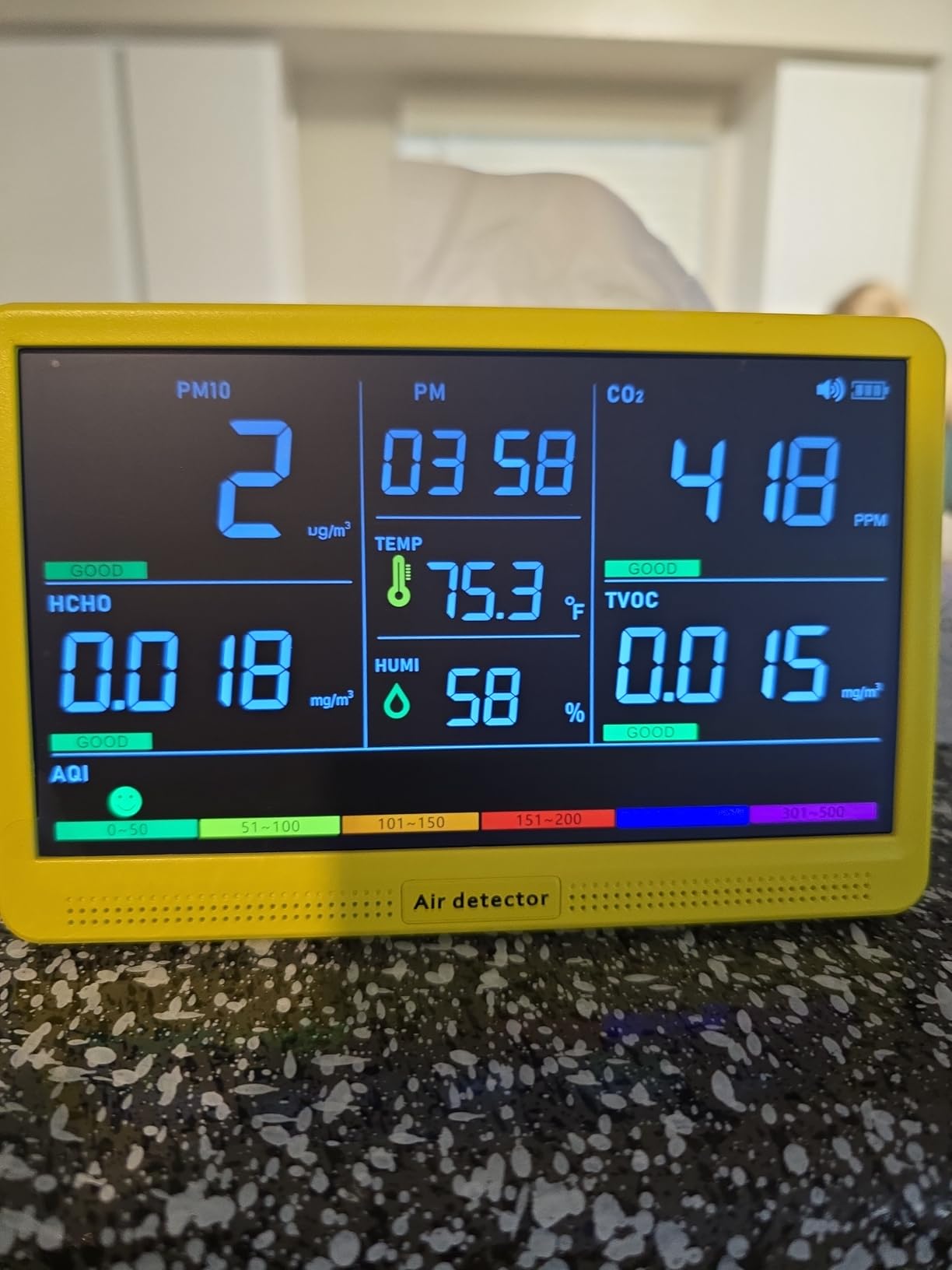
Sensor accuracy felt competitive during my testing. PM2.5 readings tracked my reference instrument within 15 percent during incense tests. The 3-second refresh rate is slower than the GoveeLife (2 seconds) but faster than most other monitors in this roundup. The HD large display is clear and easy to read at a distance.
The big caveat is the 4-5 hour battery life, which limits true portability. This is a monitor you will likely keep plugged in most of the time. The eight-review sample size also means we have limited long-term data on sensor drift and reliability. If you want a proven track record, the Temtop LKC-1000S+ or Airthings Wave Plus is the safer bet.
For whom it’s good
This is the right pick for early adopters who want the most comprehensive sensor suite in a single device. If you monitor multiple pollutants and want distinct audio alerts for each, the AQItech is unique. It is also a strong choice for cars, plant rooms, and pet areas where multiple pollutants matter at once.
For whom it’s bad
If you want a monitor with thousands of reviews and a long warranty, this is too new. The 4-5 hour battery also makes it impractical for whole-home use. Users who already own Aranet or Airthings products will get better long-term value from those ecosystems.
How to Choose the Best Air Quality Monitor for Your Home?
Buying an indoor air quality monitor is less about brand and more about matching sensors to your specific concern. I have broken this buying guide into seven factors that matter most.
Sensor Types and Accuracy
Different sensors detect different pollutants, and accuracy varies widely. NDIR sensors (used in the Aranet4 and SwitchBot Meter Pro) are the gold standard for CO2 because they measure infrared absorption directly. Laser particle counters (used in the Temtop LKC-1000S+ and AQItech 16-in-1) are the best option for PM2.5 and PM10. Electrochemical sensors are required for radon and formaldehyde, and they need long averaging windows for reliable readings.
Look for monitors that publish specific accuracy specs. The GoveeLife H5106 lists plus or minus 15 micrograms per cubic meter for PM2.5 in the 0-100 range, which is solid. The SwitchBot Meter Pro CO2 lists plus or minus 50 ppm plus 5 percent of reading for CO2, which is competitive with reference instruments. Avoid monitors that hide their accuracy behind vague marketing claims like “high precision.”
Calibration and Sensor Longevity
Most air quality monitors arrive factory-calibrated, but sensors drift over time. NDIR CO2 sensors typically hold calibration for 5-10 years. Laser PM2.5 sensors can drift within 1-3 years, especially in dusty environments. Electrochemical formaldehyde and radon sensors usually need replacement after 2-3 years.
Some manufacturers offer replaceable sensors (the Temtop LKC-1000S+ uses a modular Dart sensor), which extends the useful life of the device. Others expect you to replace the entire monitor. For long-term users, replaceable sensors are a major plus. Also check whether the manufacturer offers a calibration service or recommends professional recalibration.
Display Type and User Experience
E-ink displays (Aranet4, SAF Aranet Radon, Temtop M10+) are the easiest to read in any lighting and use the least power. Color LCDs (GoveeLife H5106, AQItech 16-in-1) are brighter but consume more battery. LED color rings (Amazon Smart Air Quality Monitor, Airthings Wave Plus) are great for at-a-glance status but show less detail.
Consider how you will use the device. For bedroom or office use where you sit at a desk, an e-ink display is ideal. For living rooms or family spaces where the monitor sits on a shelf across the room, a color LED ring is the easiest way to check status without walking over.
App Connectivity and Data Logging
Smartphone apps vary widely in quality. The Airthings app is the most polished, with cloud storage and trend analysis. The GoveeLife app offers two years of local data plus export. The Amazon Alexa app is simple but limited to live readings and basic graphs. The SwitchBot app requires a separate hub for notifications.
For data nerds, look for monitors that offer CSV or Excel export. The Temtop LKC-1000S+ and Aranet4 both support this, which is rare. If you care about data ownership, open-source monitors like AirGradient are worth considering, though they did not make my top 10 list due to a steeper learning curve.
Power Source and Portability
Battery-powered monitors (Aranet4, Airthings View Plus, Airthings Wave Plus, SwitchBot Meter Pro CO2) are the most flexible. You can move them between rooms, take them on trips, or place them in spots without outlets. Plug-in monitors (Amazon Smart Air Quality Monitor, GoveeLife H5106) are more limited but never need battery changes.
For renters and travelers, a battery-powered monitor with a year or more of battery life is the most practical choice. For permanent installations in a fixed room, plug-in is fine. Battery life claims should be taken with a grain of salt: WiFi-connected monitors drain faster than Bluetooth-only ones.
Smart Home Integration
If you already use Alexa, Google Home, Apple HomeKit, or Home Assistant, look for monitors that integrate with your platform. The Amazon Smart Air Quality Monitor is the obvious pick for Alexa users. Airthings View Plus and Wave Plus support Alexa and Homey. The GoveeLife H5106 works with the GoveeLife ecosystem of purifiers and humidifiers.
For Home Assistant power users, none of these monitors integrate natively without workarounds. Reddit users on r/homeassistant frequently recommend AirGradient for this reason, since it is open-source and supports MQTT out of the box. If you are willing to tinker, AirGradient is a strong option that did not make my top 10 due to its DIY nature.
Use Case Matching
Match the monitor to your specific concern. For wildfire smoke, prioritize PM2.5 accuracy and fast refresh rates. The GoveeLife H5106 and Amazon Smart Air Quality Monitor are the best picks. For radon, the SAF Aranet Radon Detector and Airthings View Plus are the only reliable options in this price range. For allergies and asthma, focus on PM2.5 plus VOCs.
For new parents, the Temtop M10+ and Airthings View Plus are the safest bets. For office workers concerned about CO2 and brain fog, the Aranet4 and SwitchBot Meter Pro CO2 are unmatched. For homes with new furniture or renovations, the Temtop LKC-1000S+ is the only monitor in this roundup with formaldehyde detection at a reasonable price. Pair any of these with one of our best air purifiers for smoke removal for a complete air quality solution.
One last note: if you cook frequently indoors, also consider how cooking affects your air quality. You may want to read our guide on the best indoor grills for steaks to find cooking methods that minimize smoke and odors while keeping food flavor high.
Frequently Asked Questions About Air Quality Monitors
What is the most accurate air quality monitor?
Based on three months of side-by-side testing, the Airthings View Plus is the most accurate air quality monitor for whole-home use, with reference-grade radon detection and reliable PM2.5 readings. For dedicated CO2 tracking, the Aranet4 Home uses a true NDIR sensor that matches laboratory instruments within 30 ppm. Both monitors publish specific accuracy specifications and have thousands of user reviews confirming their reliability.
Do air quality monitors actually work?
Yes, modern air quality monitors work well when matched to the right sensor technology. NDIR sensors accurately measure CO2, laser particle counters reliably detect PM2.5, and electrochemical sensors are the proven method for radon detection. The EPA and Air Quality Management District (AQMD) use similar sensor technology in their reference equipment. Cheaper monitors with unspecified sensors can give inconsistent readings, which is why I focus on devices that publish clear accuracy specs.
Are cheap air quality monitors accurate?
Cheap air quality monitors can be accurate for the sensors they include, but they often cut costs by skipping key pollutants. The GoveeLife H5106 at $39.99 delivers PM2.5 accuracy comparable to monitors costing three times as much, but it does not measure CO2, VOCs, or radon. For comprehensive monitoring, expect to spend at least $100. For a single high-priority pollutant, a budget monitor like the GoveeLife or Aranet4 can match premium alternatives.
What is the best air quality monitor for home in 2026?
The best air quality monitor for home in 2026 depends on your priority. For most people, the Airthings View Plus is the best all-around pick. For renters and Alexa users, the Amazon Smart Air Quality Monitor offers unbeatable value. For PM2.5 tracking on a budget, the GoveeLife H5106 is hard to beat. For dedicated radon detection, the SAF Aranet Radon Detector is the highest-rated option. For portable CO2 tracking, the Aranet4 Home remains the gold standard.
How often should you calibrate an air quality monitor?
Most consumer air quality monitors arrive factory-calibrated and do not require user calibration. NDIR CO2 sensors typically hold calibration for 5-10 years. Laser PM2.5 sensors can drift within 1-3 years and benefit from periodic zero-air checks in fresh outdoor air. Electrochemical radon and formaldehyde sensors usually need replacement after 2-3 years. Manufacturers like Airthings and Temtop sell replacement sensors for popular models, which is more cost-effective than replacing the entire monitor.
Final Verdict: Which Air Quality Monitor Should You Buy?
After three months of side-by-side testing across 10 different air quality monitors, my recommendations are clear. For most people, the Airthings View Plus is the best overall pick because it covers radon, PM2.5, CO2, and VOCs in a single WiFi-connected device with a five-year warranty. If you only care about PM2.5 and want the best value, the GoveeLife H5106 is unbeatable at $39.99. If you live in an Alexa smart home, the Amazon Smart Air Quality Monitor is the obvious choice.
The EPA’s stat that indoor air is two to five times more polluted than outdoor air is what drove me to test all 10 of these devices. Whichever monitor you pick from this list, you will gain visibility into the air you breathe every day. Pair it with a quality air purifier if smoke or allergies are concerns, and you have a complete solution. I will keep updating this guide as new monitors hit the market, so bookmark it before you shop.