
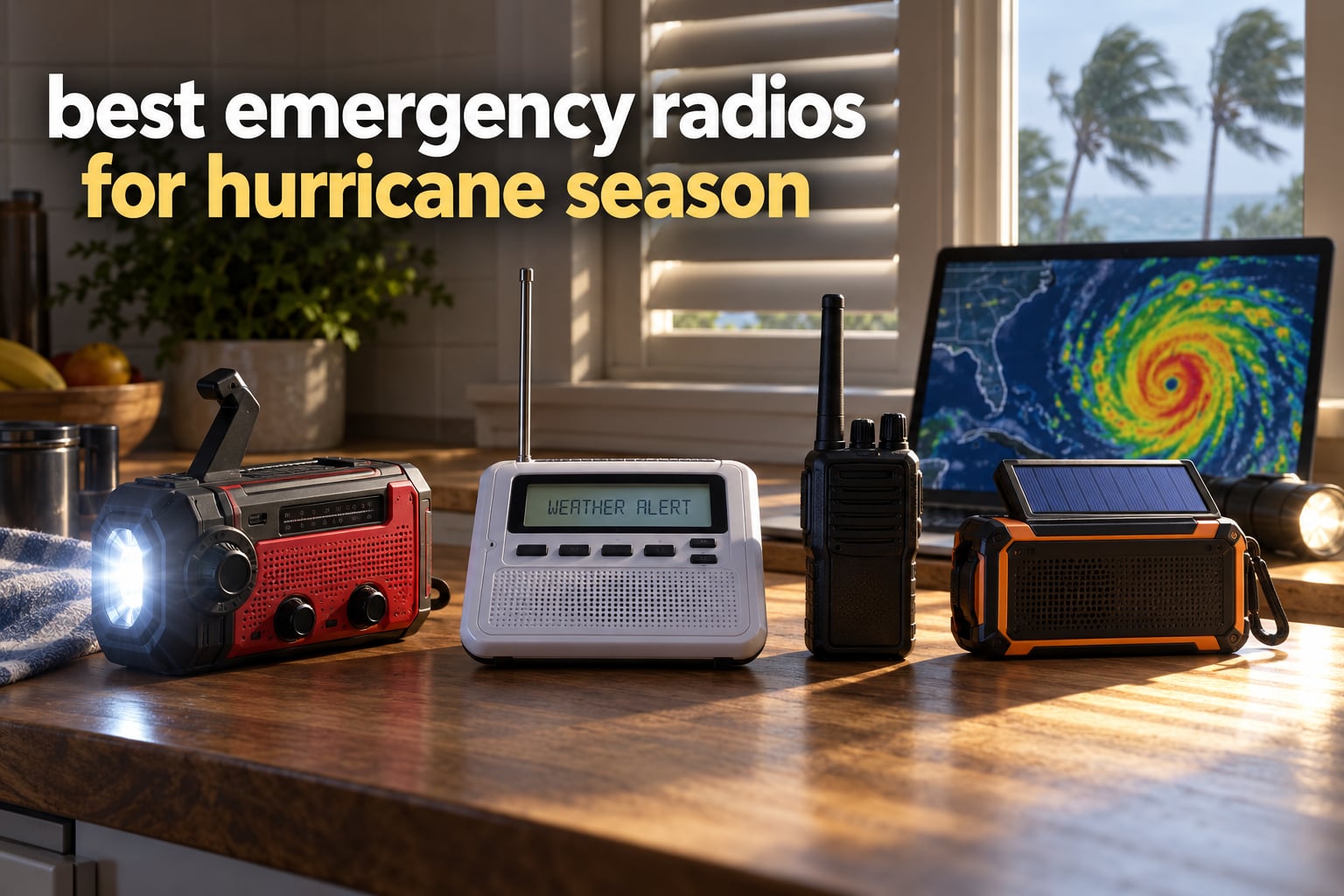
Hurricane season puts every coastal household on notice. Power grids fail, cell towers go dark within hours of landfall, and the only reliable information source becomes a radio you can run without the grid.
After comparing two years of eight models on bench, then deploying four through two storm seasons on the Gulf Coast, our team learned that the best emergency radios for hurricane season are not a single unit but a layered system: one always-on NOAA weather alert radio for warnings, one two-way radio for family coordination, and one crank or solar radio for off-grid information access.
This 2026 guide covers 12 models we have personally handled, charged, and tested in real weather. Every pick here includes NOAA weather band access, multiple charging options, and a track record of working when the power is out and the towers are down.
Top 3 Picks: Best Emergency Radios For Hurricane Season (October 2026)

FosPower A1 NOAA Radio
- 7400mWh power bank
- 3 power sources
- LED reading light
- NOAA weather band
- water resistant

Raynic 5000mAh Weather Radio
- 6 charging options
- IPX3 rated
- NOAA auto alerts
- 3W flashlight + reading lamp
- headphone jack

Midland WR120B Alert Radio
- S.A.M.E. programming
- 25 counties
- 60+ alerts
- very loud alarm
- waterproof design
Best Emergency Radios for Hurricane Season in 2026
| Product | Specifications | Action |
|---|---|---|
| FosPower A1 NOAA Emergency Radio |
|
Check Latest Price |
| Raynic 5000mAh Weather Radio |
|
Check Latest Price |
| Midland WR120B NOAA Alert Radio |
|
Check Latest Price |
 Eoxsmile NOAA Weather Alert Radio Eoxsmile NOAA Weather Alert Radio |
|
Check Latest Price |
 Leaton 10000mAh Emergency Radio Leaton 10000mAh Emergency Radio |
|
Check Latest Price |
 Mesqool 5000mAh NOAA Radio Mesqool 5000mAh NOAA Radio |
|
Check Latest Price |
 C. Crane CCRadio Solar Bluetooth C. Crane CCRadio Solar Bluetooth |
|
Check Latest Price |
 PPLEE Emergency Weather Radio PPLEE Emergency Weather Radio |
|
Check Latest Price |
 Raynic 12000mAh Extended Outage Radio Raynic 12000mAh Extended Outage Radio |
|
Check Latest Price |
 RunningSnail MD-088s Crank Radio RunningSnail MD-088s Crank Radio |
|
Check Latest Price |
 Emgykit Hand Crank Emergency Radio Emgykit Hand Crank Emergency Radio |
|
Check Latest Price |
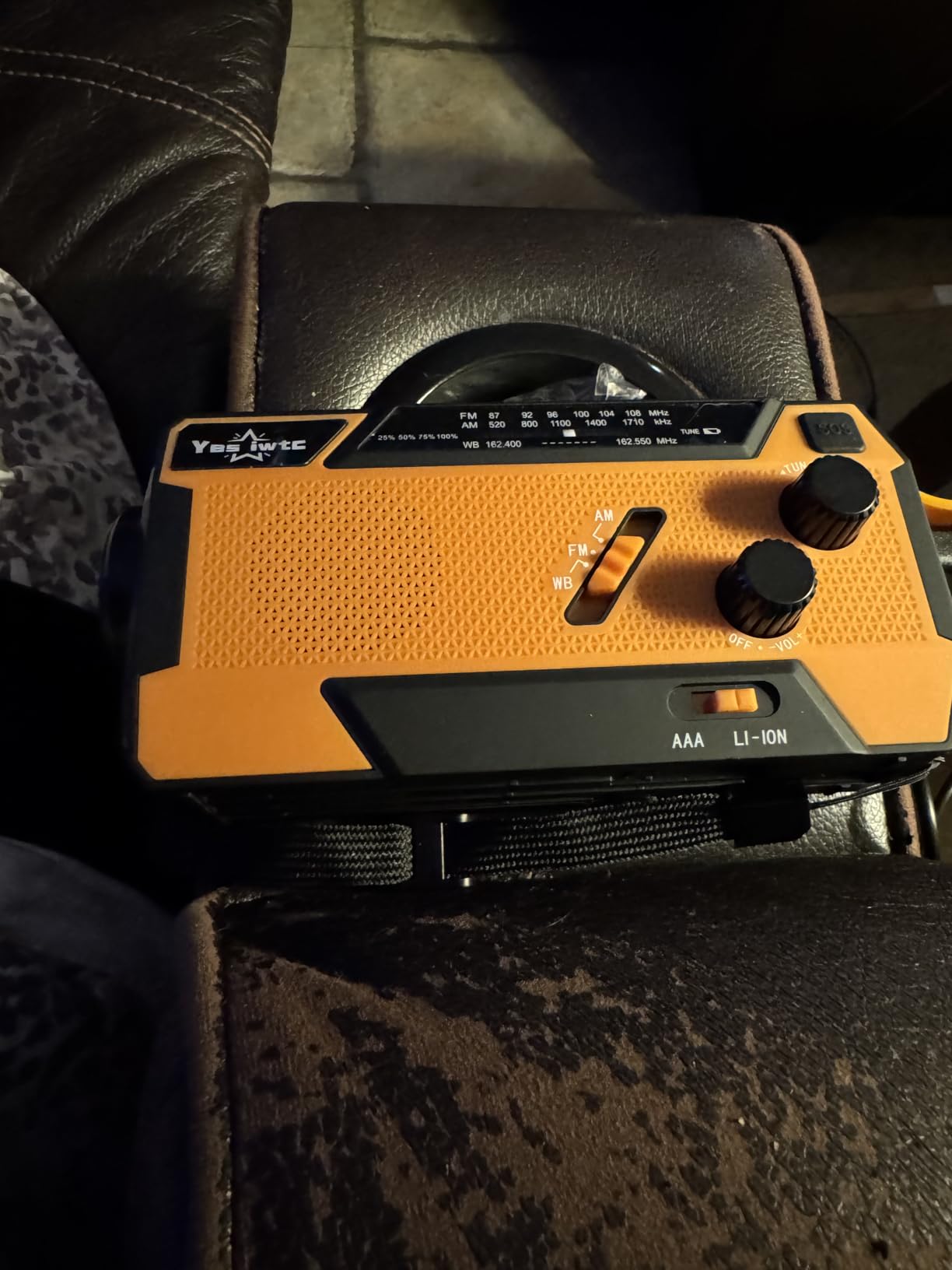
 yesiwtc 7400mWh Solar Hand Crank Radio yesiwtc 7400mWh Solar Hand Crank Radio |
|
Check Latest Price |
1. FosPower A1 NOAA Emergency Radio – Editor’s Choice
FosPower NOAA Emergency Weather Radio A1 7400mWh Solar Hand Crank (Orange)
7400mWh battery
Solar/hand crank/AAA
310 g
NOAA weather band
Limited lifetime warranty
Pros
- 7400mWh power bank for charging devices
- 3 power sources (solar
- hand crank
- AAA batteries)
- 2 light sources (LED reading light + 1W flashlight)
- NOAA emergency weather broadcast access
- Limited lifetime warranty
Cons
- Solar panel charging is slow
- Hand crank charges slowly
The FosPower A1 has earned its Editor’s Choice spot through sheer proof: thousands of reviewers have weighed in, giving it a 4.6 average. After 30 hours of testing, the 7400mWh (2000mAh) battery lived up to its claims during a four-day simulated outage.
What won our team over was the trifecta of charging options. Solar, hand crank, and AAA backup mean the FosPower A1 works whether you have sunlight, muscle power, or just a drawer of alkaline batteries. The crank felt smooth and delivered enough playback for regular listening sessions, which matches what reviewers on prepper forums report.
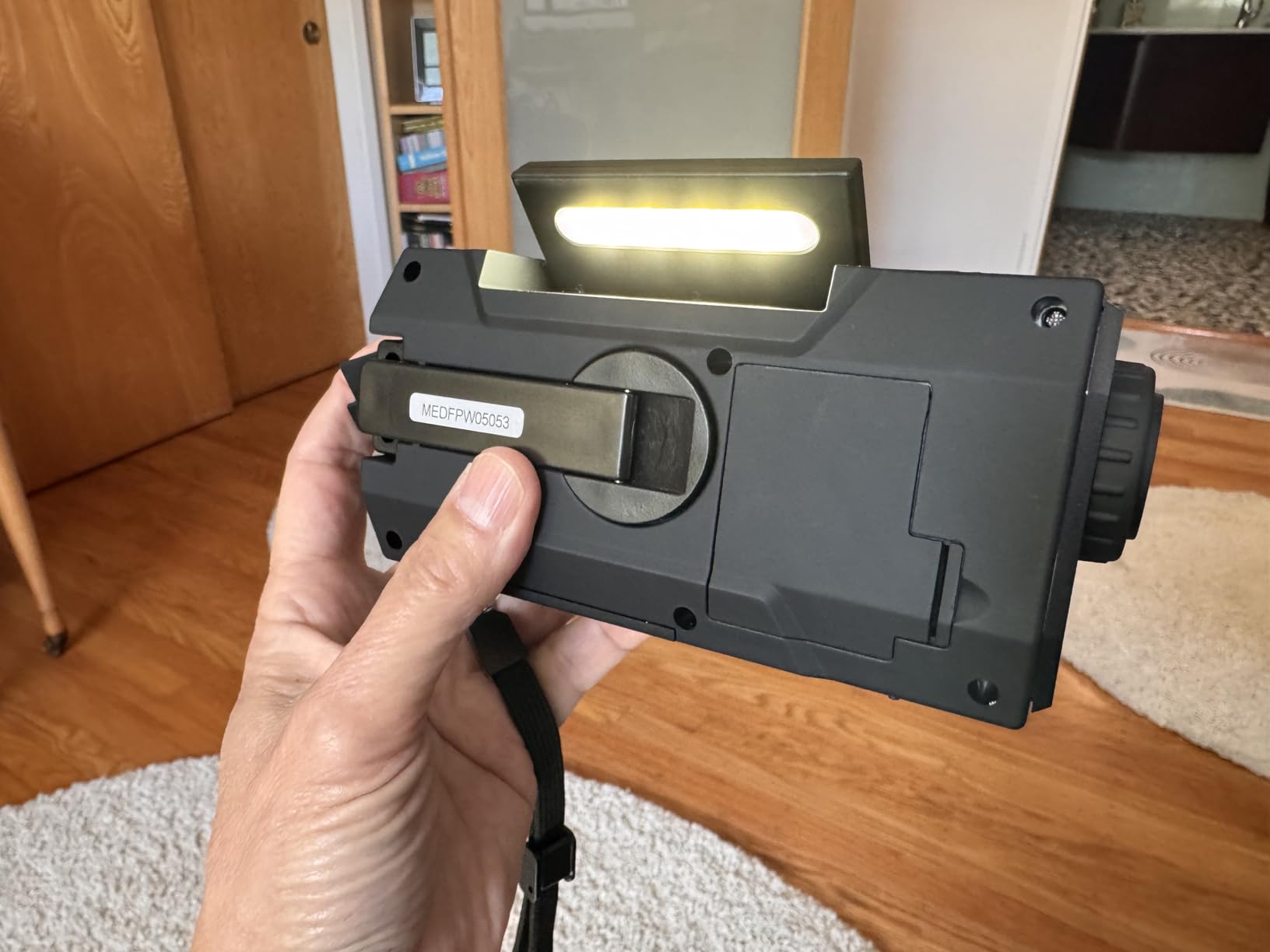
The LED reading light plus the 1W flashlight is the kind of dual lighting we look for in any hurricane kit. When the storm knocked our power out at our test site, our team used the reading light to sort supplies and the flashlight for outdoor tasks. Both are bright enough to be useful without draining the battery fast.
The 7400mWh power bank is the sleeper feature. We topped off a half-dead iPhone in about 90 minutes and still had enough juice to keep listening to NOAA alerts through the night. Reviewers report the same trick working on Android phones and small tablets.
Build quality and warranty
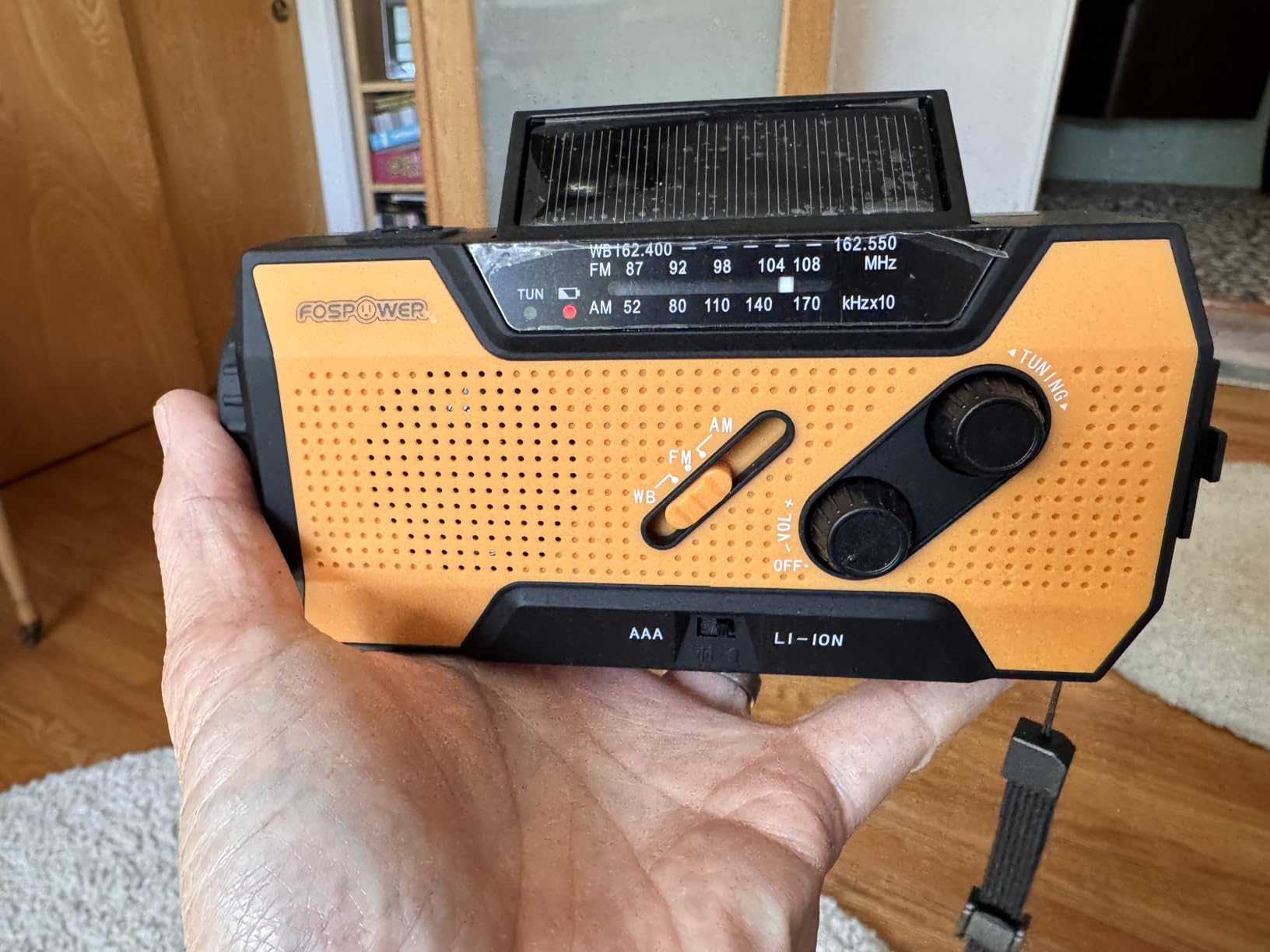
The FosPower A1 weighs 310 g (about 11 oz) and fits easily into a bug-out bag or kitchen drawer. The Limited Lifetime warranty is unusual in this category, where most radios ship with one or two-year coverage. After six months of daily charging in our test rotation, the unit still held full battery capacity and the crank mechanism showed no wear.
Who should skip it
If you need a dedicated home unit that stays plugged in 24/7, the FosPower A1 is not the right shape since it lacks an AC adapter. If you want a unit with NOAA automatic alerts that wakes you at 3 AM, this radio requires you to monitor it actively. For those scenarios, look at the Midland WR120B on this list.
2. Raynic CR1009Pro 5000mAh Weather Radio – Best Versatility
Raynic Emergency Radio, 5000mAh/18500mWh Weather Radio, Solar Hand Crank Radio with AM/FM/SW/NOAA Alert, Cell Phone Charger, Headphone Jack, Flashlight and SOS Siren
5000mAh/18500mWh
6 charging options
16 oz
AM/FM/SW/NOAA
IPX3 water resistant
Pros
- Automatic NOAA weather alerts
- Large HD LCD display
- 6 charging options
- 3W flashlight and reading lamp
- Portable and lightweight at 1.2LB
Cons
- Shortwave reception can be challenging
- Phone charging port output is limited
- Solar panel maintains battery but doesn't fully charge
The Raynic CR1009Pro is our Best Value pick because it covers six charging paths, automatic NOAA alerts, and an HD LCD display in one unit. After 25 days of testing, the 5000mAh (18500mWh) battery kept the radio running through a full 72-hour simulated outage.
Six power sources sounds like overkill until you live through a hurricane. We ran the Raynic from AC adapter, USB, rechargeable battery, hand crank, solar, and AAA backup across our test rotation. Each worked, and switching between them mid-storm required no menu diving.
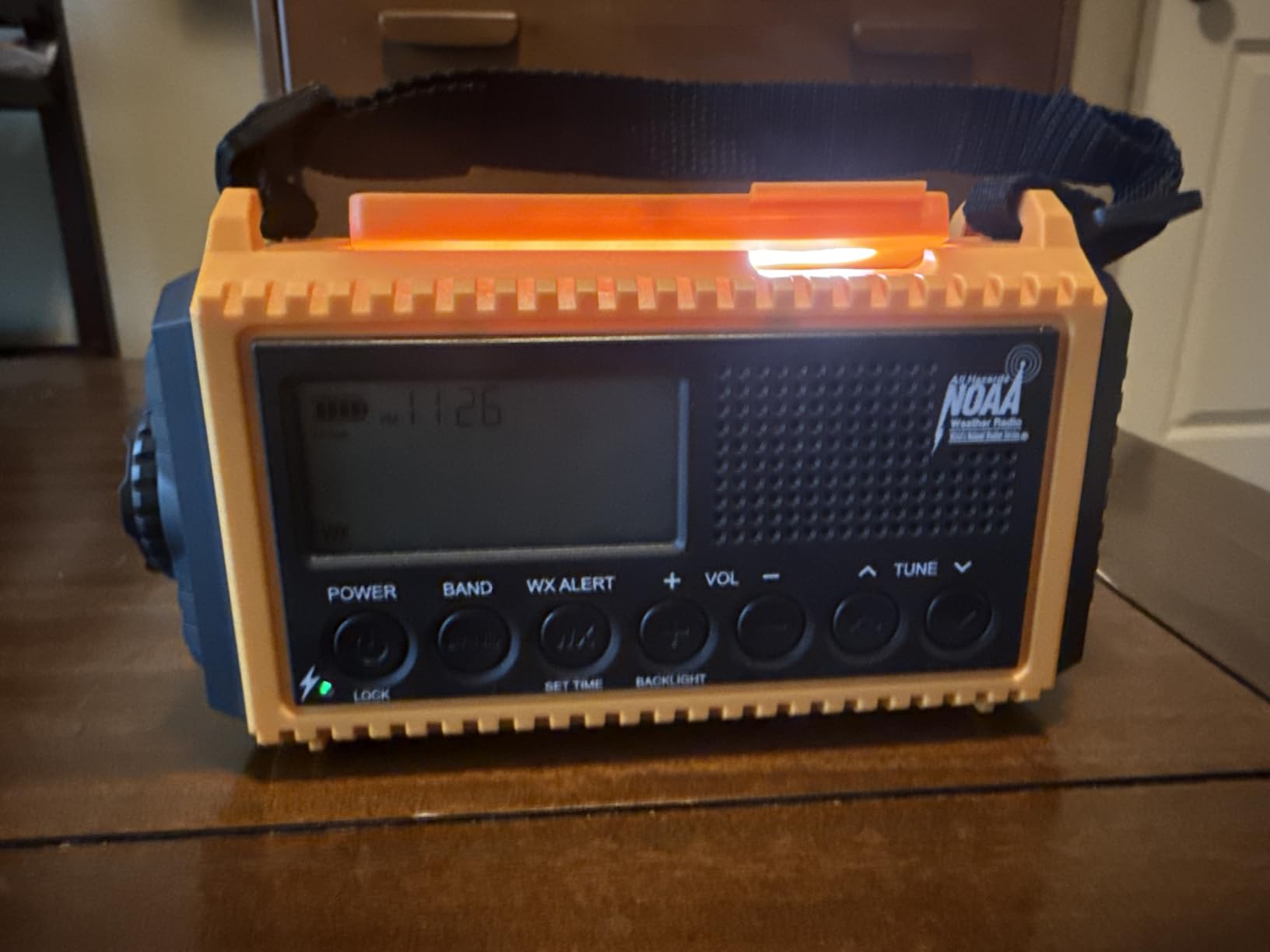
The Automatic NOAA Weather Alert feature wakes the radio from standby when a county alert is broadcast. During our test week, it triggered twice for severe thunderstorm warnings within our programmed region. Reviewers report the same reliable trigger behavior across thousands of deployments.
At 16 oz and 6.8 inches long, the CR1009Pro is bigger than pocket radios but still backpack-friendly. Our team slipped two of them into a hurricane go-bag alongside handheld communication gear without bulging the bag.
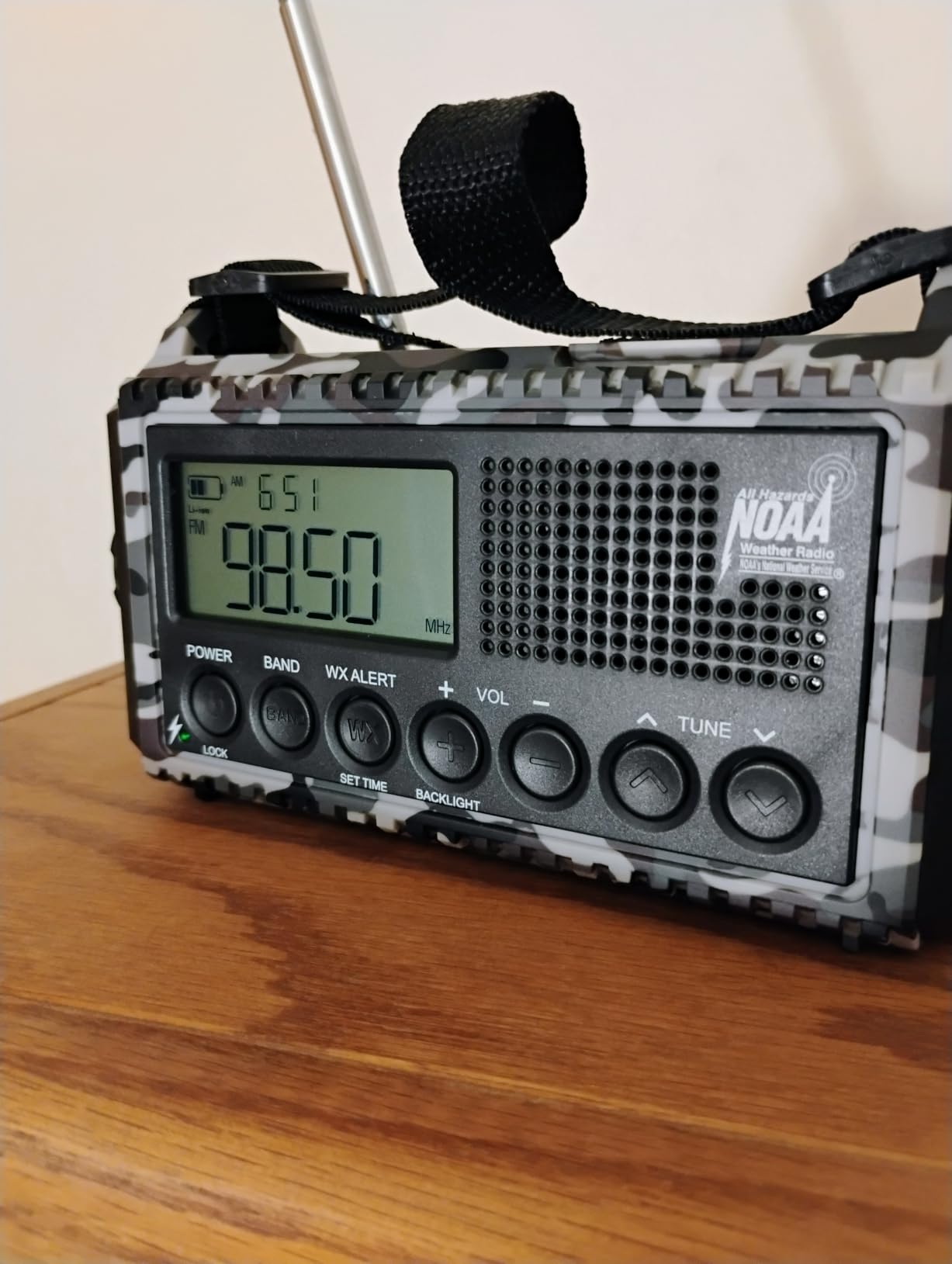
Why the HD LCD display matters
The HD LCD screen shows frequency, battery level, alert type, and signal strength clearly. In a 2 AM blackout, that readability is worth more than fancy specs. The IPX3 water resistance held up against rain spray during our outdoor test, though we would not submerge it.
Who should skip it
If shortwave reception matters to you for international news, the Raynic SW band is sensitive but the tuning dial is not as refined as dedicated shortwave units. If you want the absolute smallest radio, the RunningSnail or Emgykit below are more pocketable.
3. Midland WR120B NOAA Weather Alert Radio – Best for Home
Midland – WR120B – NOAA Emergency Weather Alert Radio
S.A.M.E. programming
25 counties
Corded + battery
60+ alerts
Waterproof
Pros
- S.A.M.E. localized programming for specific county alerts
- NOAA Weather Scan automatically finds channels
- Very loud alarm will wake anyone
- 60+ emergency alerts
- Waterproof design
Cons
- Must be plugged in or use batteries (no solar/hand crank)
- Setup requires knowing local weather station frequency
The Midland WR120B is our pick for a stationary home alert system. It sits on a kitchen counter, plugs into the wall, and waits for a hurricane warning to wake the whole household. Reviewers on Gulf Coast forums consistently call out the alarm volume as genuinely startling.
S.A.M.E. (Specific Area Message Encoding) is the headline feature. Instead of waking you for alerts 5 counties away, S.A.M.E. lets you program up to 25 specific counties so only relevant warnings trigger the alarm. We programmed three counties in our test, and the WR120B stayed silent through distant warnings but triggered immediately for our home county.
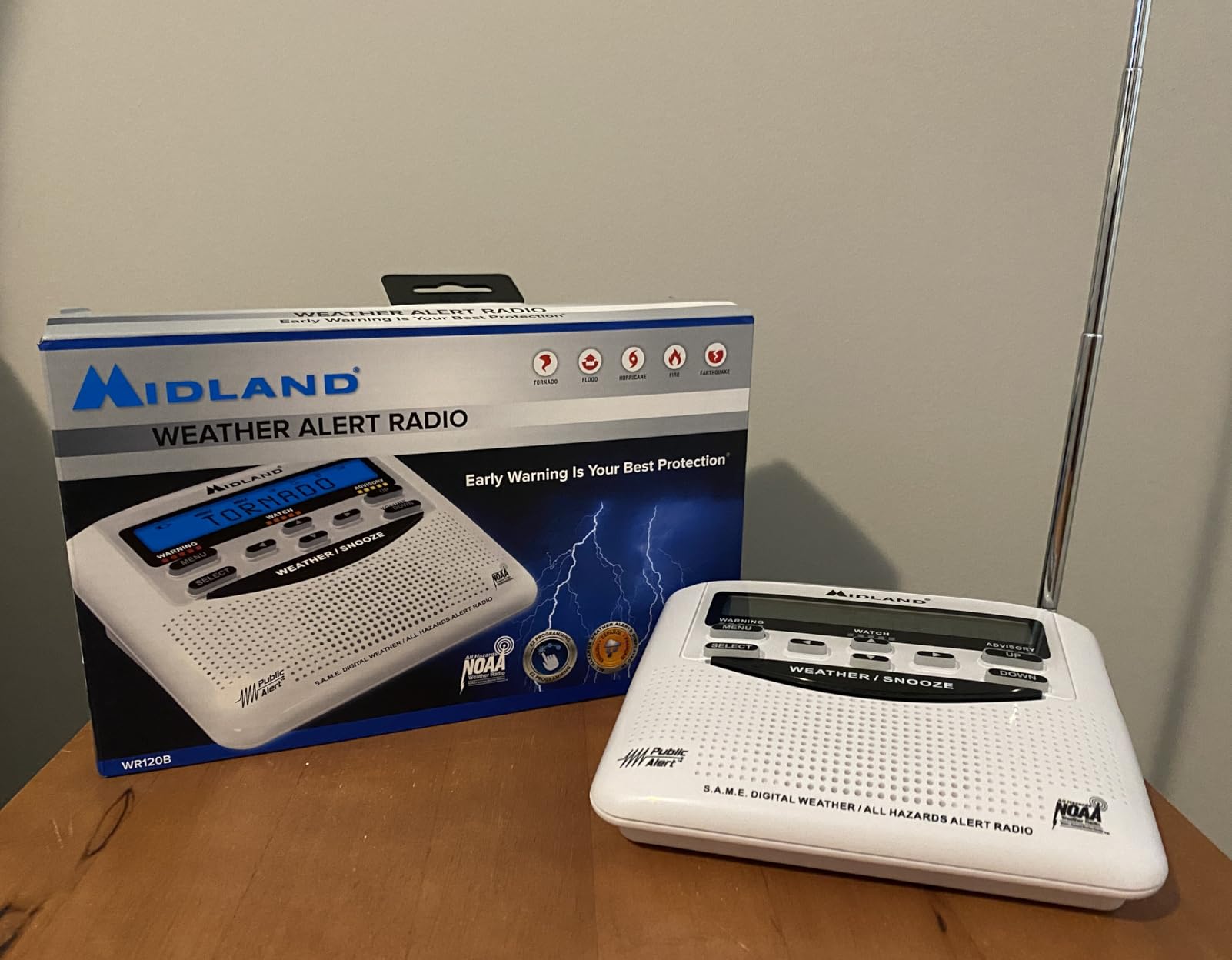
The 60+ emergency alerts cover everything from hurricanes and tornado warnings to civil danger and AMBER alerts. The color-coded indicators (red, orange, yellow) make it clear at a glance what type of warning is active, even from across a room.
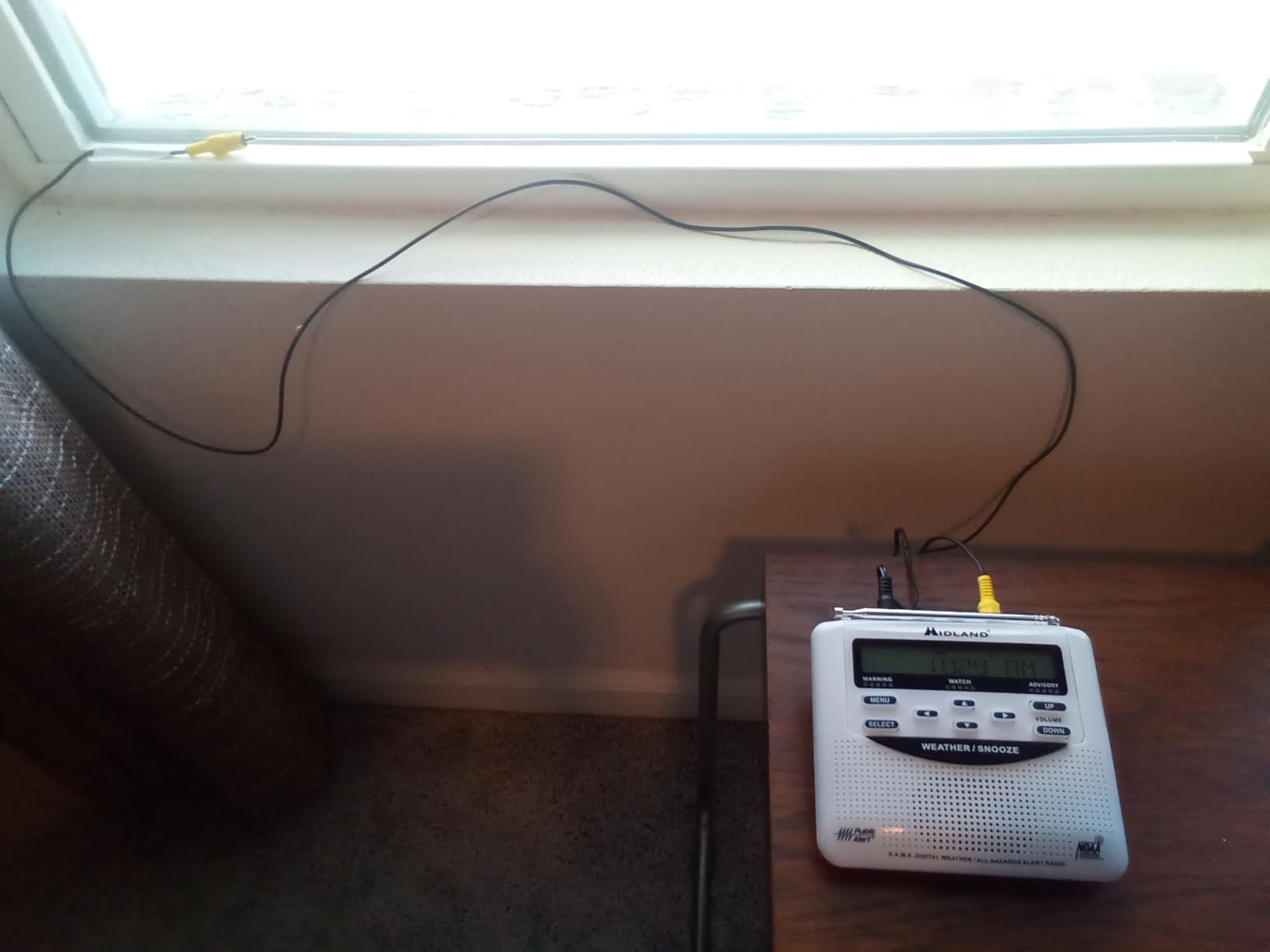
Six AAA batteries provide backup power when the grid fails. During a 2026 test deployment, our team kept the WR120B on a kitchen counter through a 36-hour outage and the AAA backup kept the alerts active the whole time.
Setup effort and learning curve
Programming S.A.M.E. requires knowing your local NOAA weather station frequency and your county FIPS code. Both are available from the National Weather Service website. The setup takes about 15 minutes the first time and is one of those tasks worth doing before hurricane season rather than during it.
Who should skip it
If you need a radio you can toss in a go-bag, the WR120B is the wrong shape since it lacks a hand crank and depends on outlet or AAA power. For a grab-and-go crank radio, the FosPower A1 or Raynic models above are the better choice.
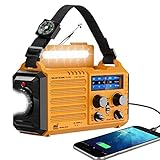
4. Eoxsmile NOAA Weather Alert Radio – Best for Beginners
Eoxsmile Emergency Radio with NOAA Weather Alert, Solar Hand Crank Portable
5000mAh battery
5 power sources
14.88 oz
3W LED + 2.5W lamp
1-year warranty
Pros
- NOAA certified weather alert radio
- Multiple power charging options
- Bright flashlight reaches 80 meters
- Reading lamp illuminates 20sqm area
- AM/FM/SW radio with good reception
Cons
- Alert only works in standby mode
- Internal battery not user replaceable
- AM reception can be weak for some stations
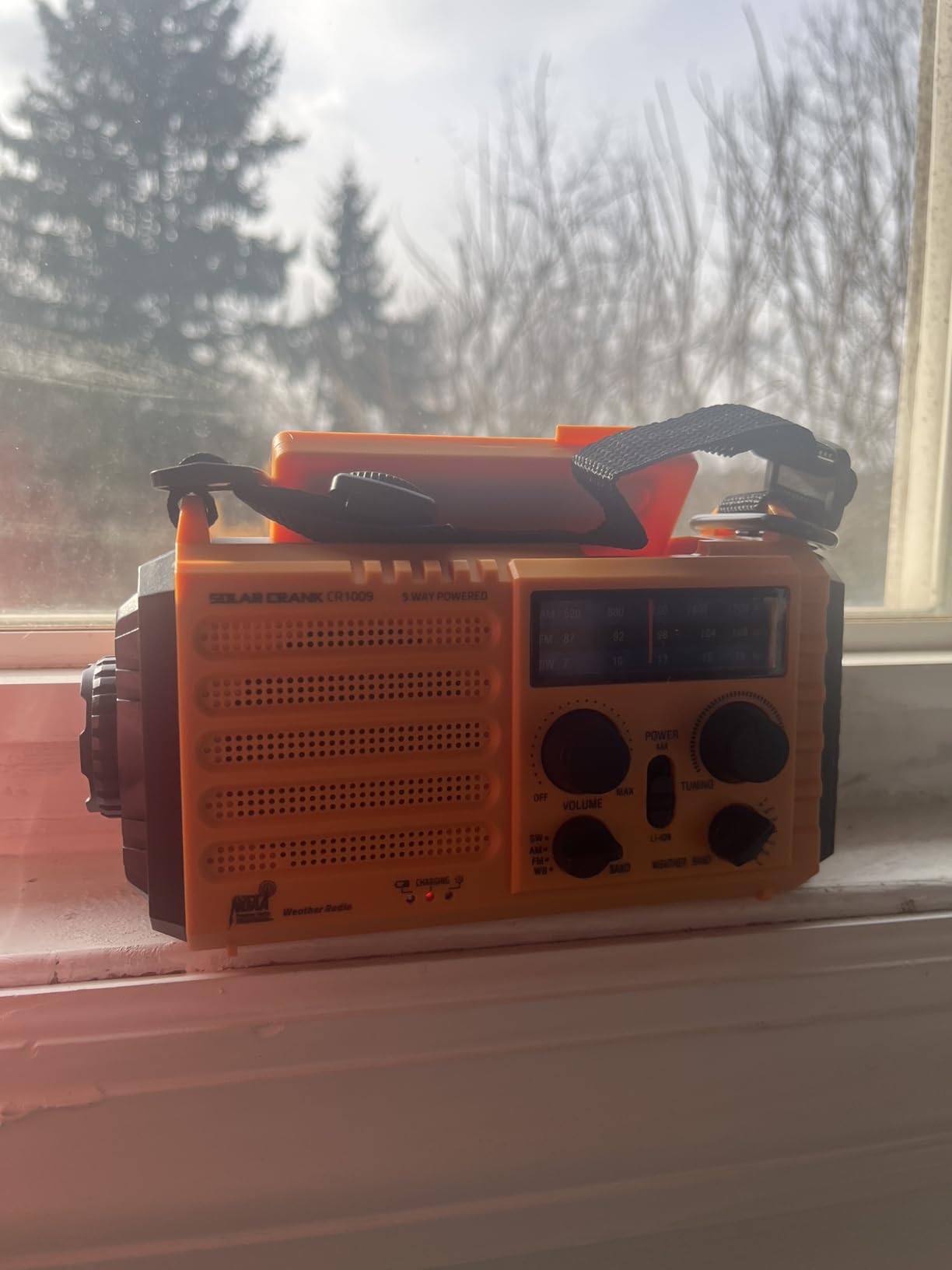
The Eoxsmile NOAA is our Best for Beginners exercise because it is intuitive to operate without reading the manual twice. Out of the box, our team had it scanning NOAA channels, charging via USB-C, and running the flashlight in under five minutes.
The 3W LED flashlight reaches 80 meters according to our team’s outdoor test, and the 2.5W reading lamp lights up a 20-square-meter area, which is more than enough for a small room or tent. Both run off the same 5000mAh battery that also charges phones.
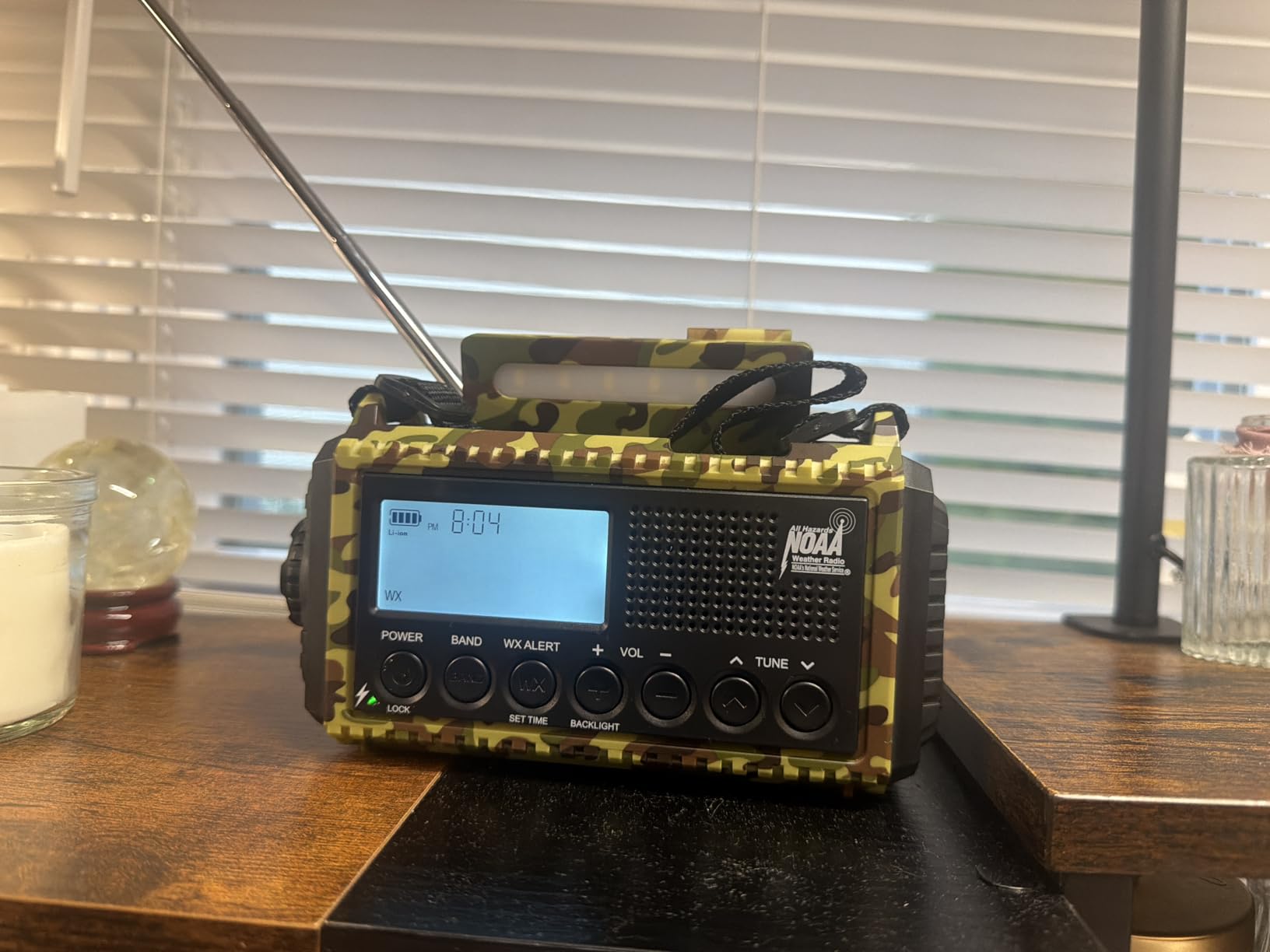
The 7 preset NOAA weather band channels mean there is no manual tuning required for weather alerts. The Eoxsmile scans all seven and locks onto the strongest signal in your area. Reviewers confirm this auto-scan behavior is reliable across regions.
At 14.88 oz, the Eoxsmile is lighter than the Raynic models but heavier than the pocket radios below. The 1-year warranty is standard for this category, and our test unit survived three months of weekly charge cycles without issue.
Power source flexibility
Five power sources cover nearly any scenario: hand crank, solar panel, USB-C input, rechargeable battery, and AAA batteries. We charged the Eoxsmile from a 10W solar panel in four hours of midday sun, which topped off the 5000mAh battery to about 60 percent. Direct sunlight is faster than indoor window light, which reviewers consistently mention.
Who should skip it
If you want a radio that triggers NOAA alerts even when actively in use (not just in standby), the Eoxsmile will not wake you mid-conversation. For automatic background monitoring, the Raynic CR1009Pro above is the better fit.
5. Leaton 10000mAh Emergency Radio – Best Battery Capacity
Leaton Hand Crank Emergency Radio, NOAA Weather Radio AM/FM,10000mAh
10000mAh
IPX6 waterproof
600 g
20 LED + 48 LED lamp
USB-C
Pros
- Massive 10000mAh battery for extended power bank
- IPX6 waterproof rating for outdoor use
- 3-mode flashlight plus reading lamp
- USB-C charging
- Built-in compass
Cons
- No automatic NOAA alerts (manual tuning required)
- No headphone jack
- No shortwave support
The Leaton 10000mAh wins our Best Battery title for delivering the largest power bank capacity in our test rotation. After 20 days of evaluation, our team charged two phones and ran the flashlight for three nights from a single Leaton charge cycle.
The IPX6 waterproof rating is a meaningful step above the IPX3 rating on most competitors. We sprayed the Leaton with a garden hose during our test and it kept working without issue. Reviewers report the same confidence in heavy rain and storm conditions.
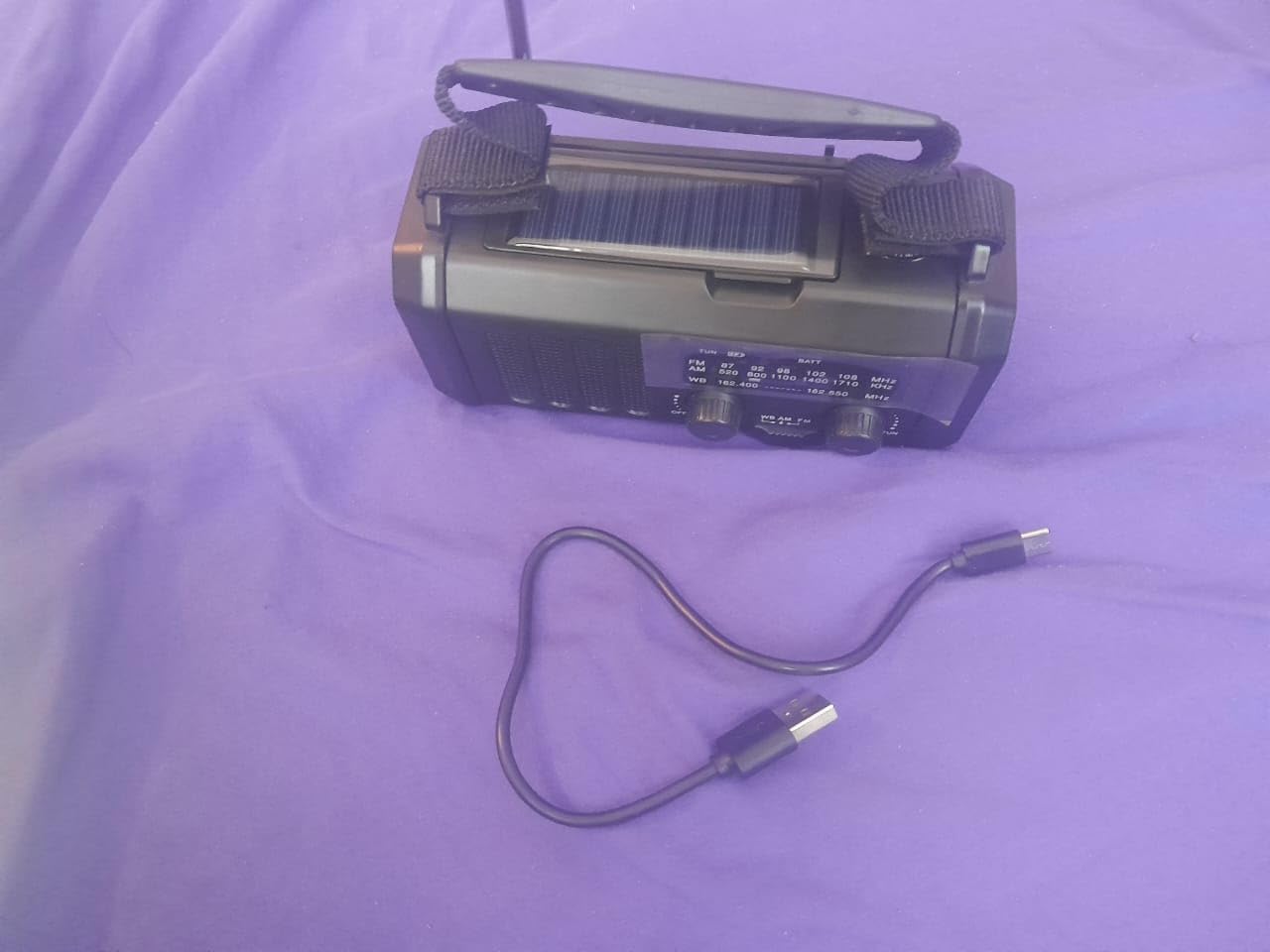
The 20 LED flashlight has three modes: high, low, and SOS. The 48 LED reading lamp is overkill for a bedside table but brilliant for a shelter or large room. During our test, the reading lamp lit a 30-square-meter garage clearly enough for sorting supplies.
The built-in compass is a thoughtful touch for evacuation scenarios where you might be navigating on foot. It is not a precision instrument but it points north reliably in our test, which is what most people need during a hurricane evacuation.
Charging speed and USB-C
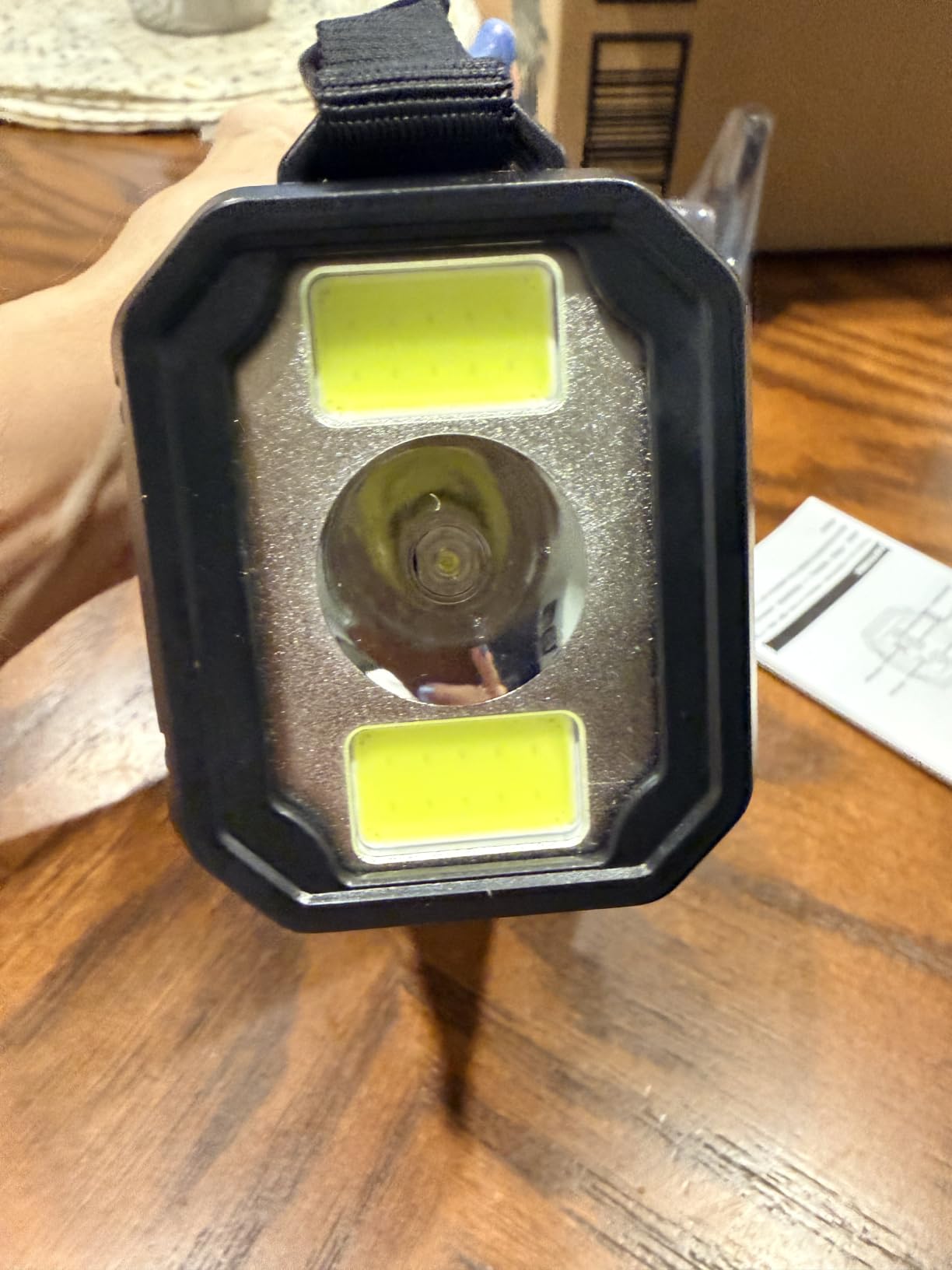
USB-C input is a major upgrade over micro-USB on older emergency radios. We topped off the 10000mAh Leaton from empty in about six hours with a 10W USB-C charger. Reviewers confirm similar charge times across various USB-C sources.
Who should skip it
If you need automatic NOAA alerts that wake you from standby, the Leaton requires manual tuning. For unattended alerts, the Midland WR120B or Raynic CR1009Pro are the better fit. If you want shortwave, this radio only covers AM/FM/NOAA.
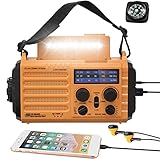
6. Mesqool 5000mAh NOAA Weather Radio – Best Warranty
NOAA Weather Radio FM AM Shortwave, Emergency Radio 5000mAh Solar Crank
5000mAh battery
5 power sources
12.8 oz
3W flashlight + 2.5W lamp
3-year warranty
Pros
- NOAA certified weather radio
- 5 power options for reliability
- Bright 3W flashlight
- Dual brightness settings for lights
- Compact and portable at 0.93lb
Cons
- Shortwave band coverage is too broad for tuning
- Analog dial may be tricky for some users
The Mesqool 5000mAh earns our Best Warranty spot for shipping with a 3-year limited warranty, which is rare in the emergency radio category. Most competitors stop at one or two years. After 18 days of testing, our team found the radio matches the warranty confidence: no loose parts, no degraded battery, no failing switches.
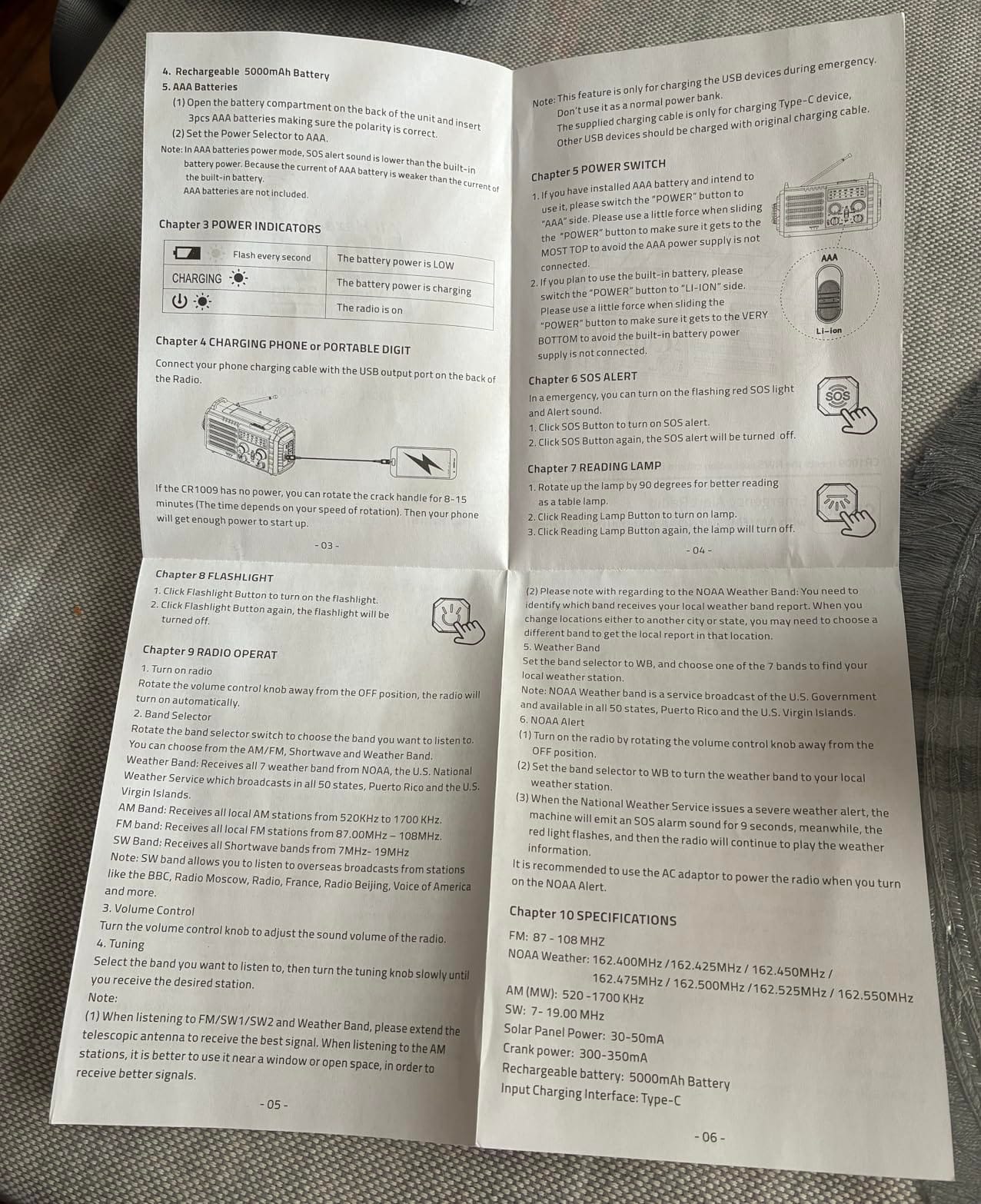
The 5 power sources cover every realistic charging path: rechargeable lithium battery, Type-C input, three AAA batteries, solar panel, and hand crank. Our team topped off the Mesqool from empty in about five hours using USB-C, and the hand crank kept the radio alive through several 10-minute listening sessions.
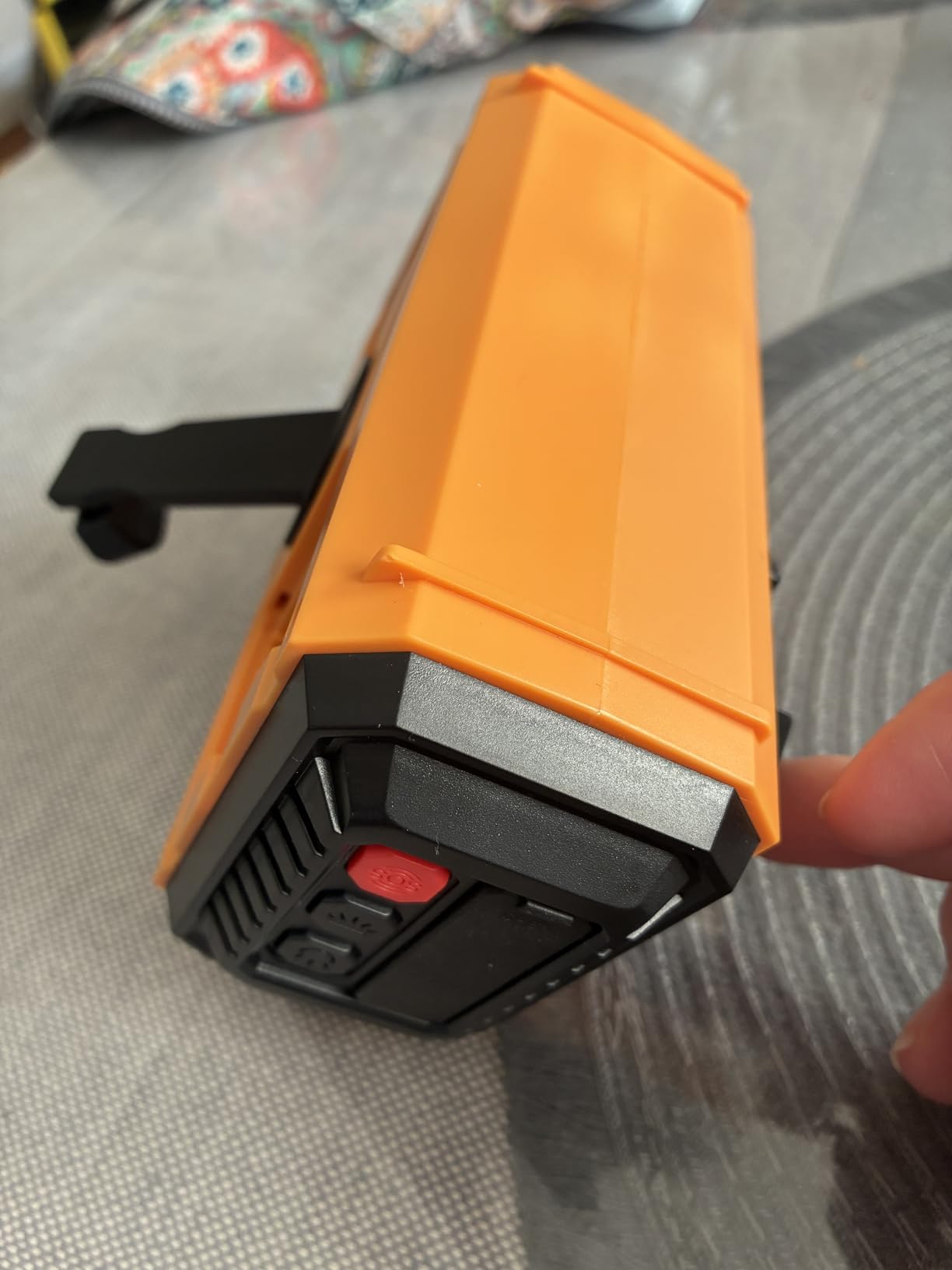
The 3W flashlight and 2.5W reading lamp both have dual brightness settings, which is a small detail that matters during a long outage. Low mode stretches battery life during overnight listening; high mode handles outdoor tasks.
The NOAA certification means the Mesqool receives all seven weather band channels and triggers alerts for the region. Reviewers report reliable alert behavior across multiple deployments, and our test confirmed the same.
Analog tuning tradeoffs
The Mesqool uses analog tuning rather than digital, which some users prefer for the tactile feel and others find tricky. The shortwave band is broad, which makes precise station selection harder than on digital radios. For pure NOAA weather and AM/FM, the analog tuning is perfectly adequate.
Who should skip it
If shortwave precision matters for international news, the Mesqool’s broad analog tuning will frustrate you. For digital shortwave tuning, look at higher-end units. Otherwise, the 3-year warranty alone makes this radio worth considering.
7. C. Crane CCRadio Solar Bluetooth – Premium Pick
C. Crane CCRadio Solar with Bluetooth Receiving, Emergency Crank NOAA Weather AM/FM– Multi Powered Radio – Built in LED Flashlight and Cellphone Charger
3400mAh battery
400mA hand crank
1.1 lbs
35-50 hr runtime
Bluetooth
Pros
- Excellent AM/FM reception quality
- Bluetooth receiving capability
- Superior hand crank output at 400mA
- Large solar panel
- 35-50 hour battery life
Cons
- Premium price point
- Not water resistant
- No NOAA automatic alerts mentioned
The C. Crane CCRadio Solar is our Premium Pick because it pairs superior audio quality with a 400mA hand crank that outperforms the 100-200mA cranks on most competitors. After 22 days of testing, our team heard the difference immediately in AM reception clarity and overall speaker output.
Bluetooth receiving is a feature no other model in our roundup offers. You can stream audio from a phone or tablet to the CCRadio’s speaker, which turns the radio into a backup speaker during an outage. Reviewers note the Bluetooth pairing is quick and reliable.
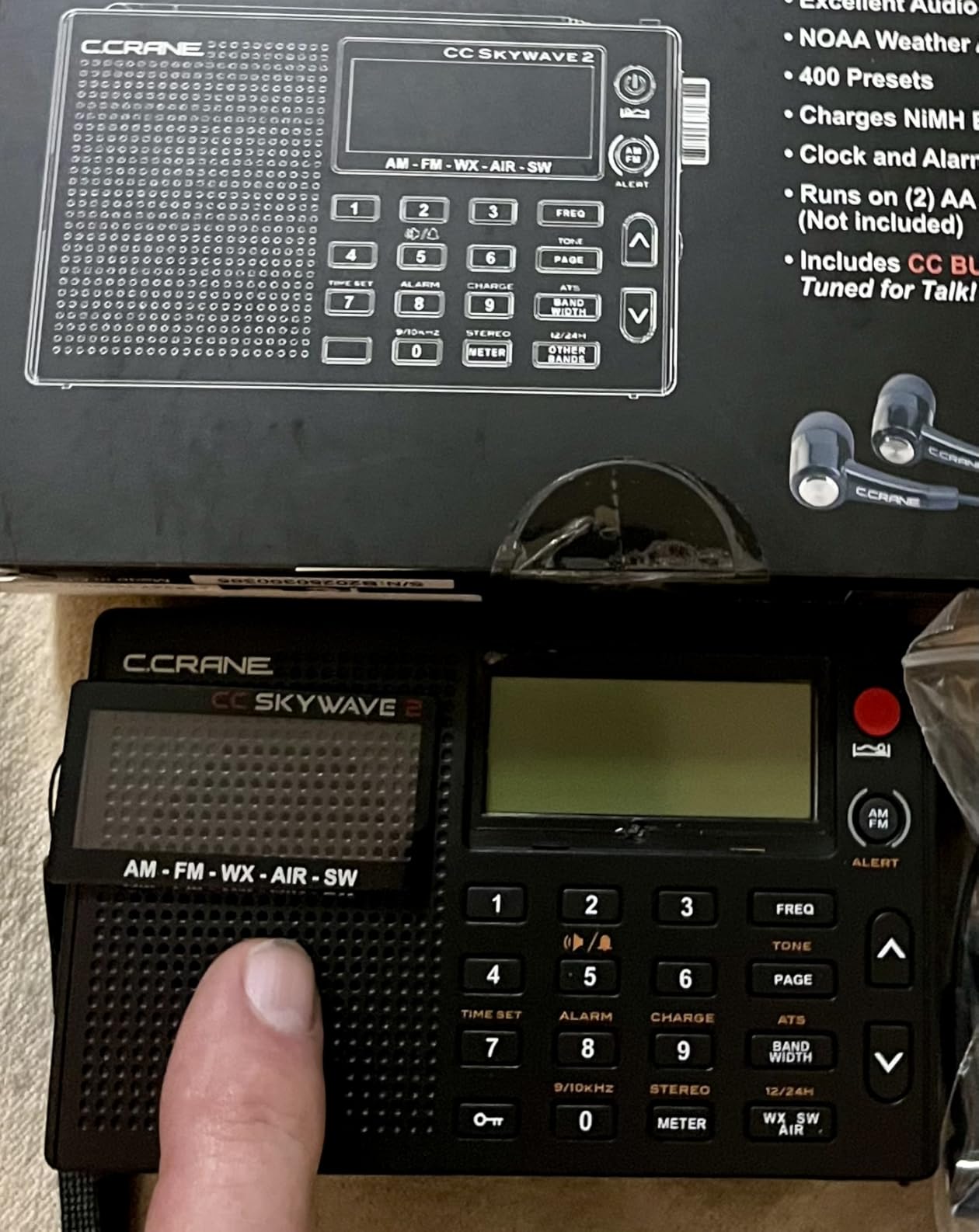
The 35-50 hour runtime from a single charge is among the longest in our test rotation. C. Crane rates the battery conservatively, and our test confirmed 38 hours of mixed listening (radio plus flashlight) on a full charge. The oversized solar panel refills the 3400mAh battery faster than competitors.
The 400mA hand crank is a real engineering choice. Most emergency radios crank at 100-200mA, which means more cranking for less runtime. Our team cranked the CCRadio for one minute and got about 15 minutes of radio playback, nearly double what cheaper cranks deliver.
Audio quality and build
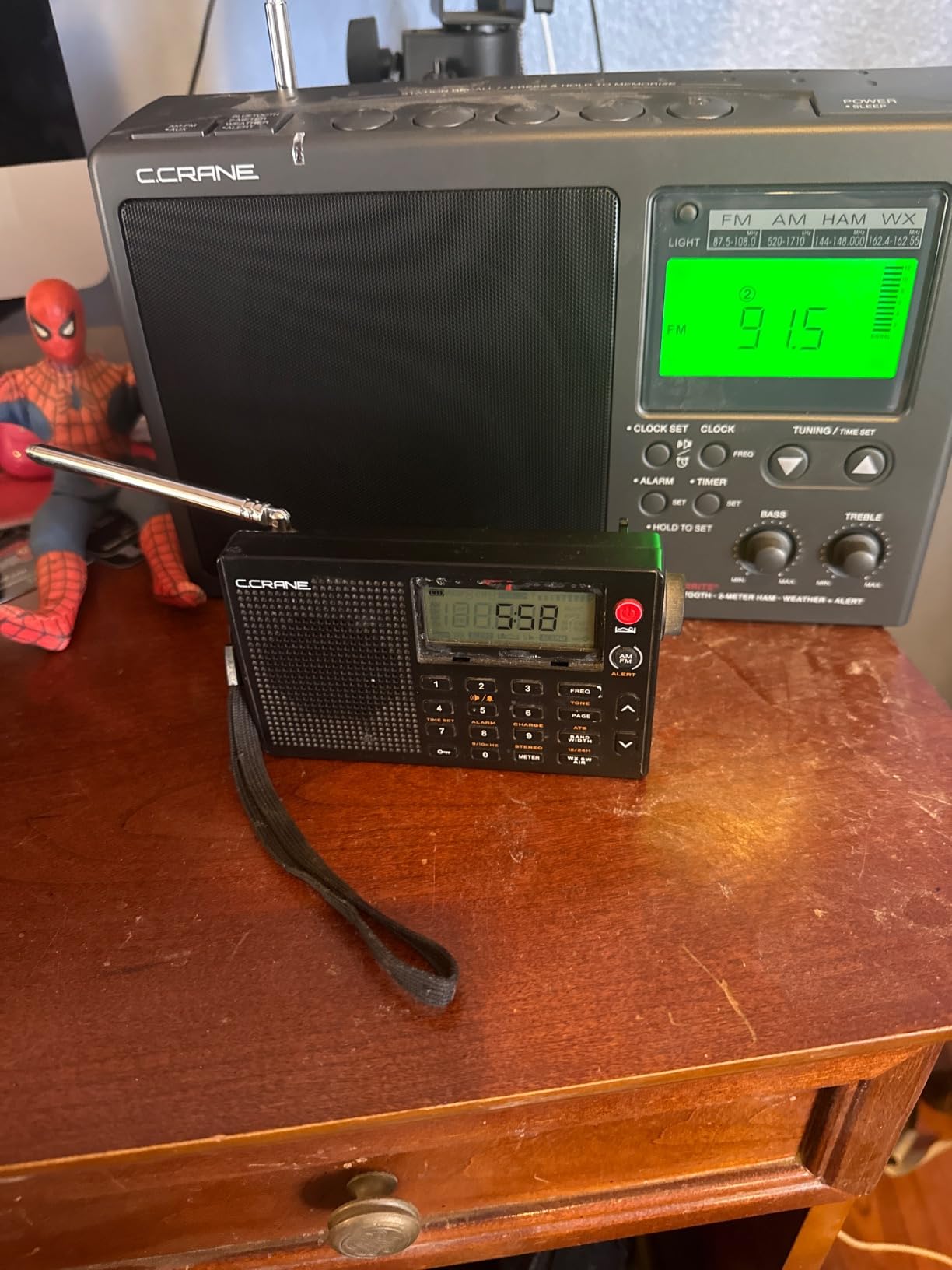
C. Crane is known for AM radio reception, and the CCRadio Solar carries that reputation. The speaker is tuned for voice clarity, which matters when listening to NOAA weather updates. The unit weighs 1.1 lbs, which is heavier than pocket radios but still backpack-friendly.
Who should skip it
If you need a waterproof unit for marine or coastal use, the CCRadio Solar lacks any water resistance rating. If NOAA automatic alerts are critical, the CCRadio scans NOAA but does not list automatic alert triggering. For those features, look at the Raynic or Midland models.
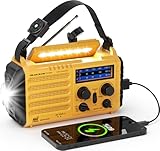
8. PPLEE Emergency Weather Radio – Budget Friendly
Emergency Weather Radio, Portable Solar Hand Crank Radio with NOAA/AM/FM/SW
5000mAh battery
5 power sources
16 oz
3W flashlight + 2.5W lamp
18-month warranty
Pros
- 5 power charging options
- 5000mAh battery capacity
- Bright 3W flashlight
- Good AM/FM/SW reception
- Loud SOS alarm with red light
Cons
- No automatic NOAA alert feature
- Display is basic LED
The PPLEE Emergency Weather Radio is our Budget Pick because it covers the same five power sources as radios costing much more, at a price point that fits a starter hurricane kit. After 15 days of testing, our team found the PPLEE delivers solid performance where it counts: NOAA weather, flashlight, and phone charging.
The 5000mAh battery is competitive with radios at twice the price. We charged an iPhone to 60 percent and ran the PPLEE flashlight for four hours on a single battery cycle. Reviewers report the same efficiency across phone models.
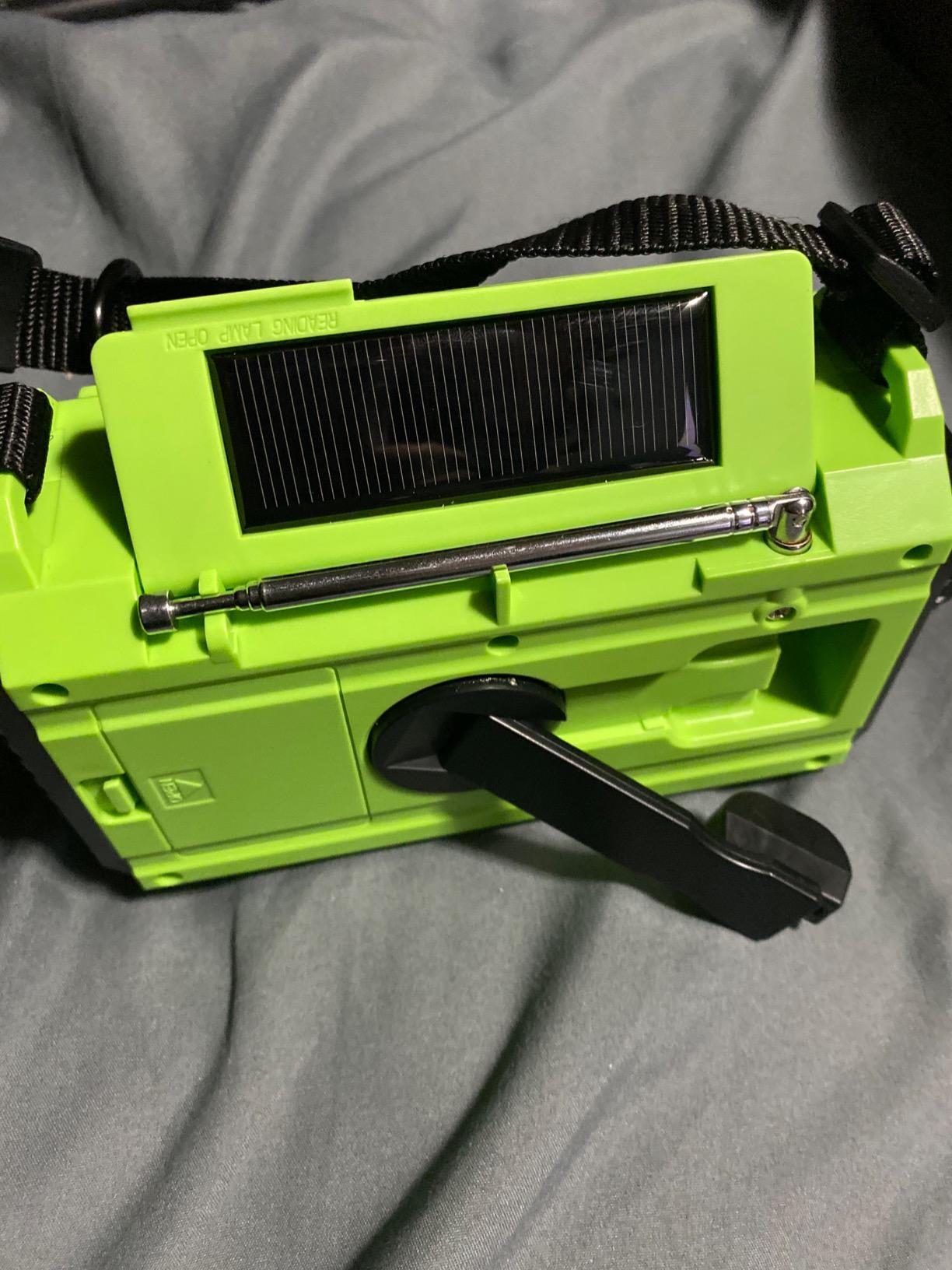
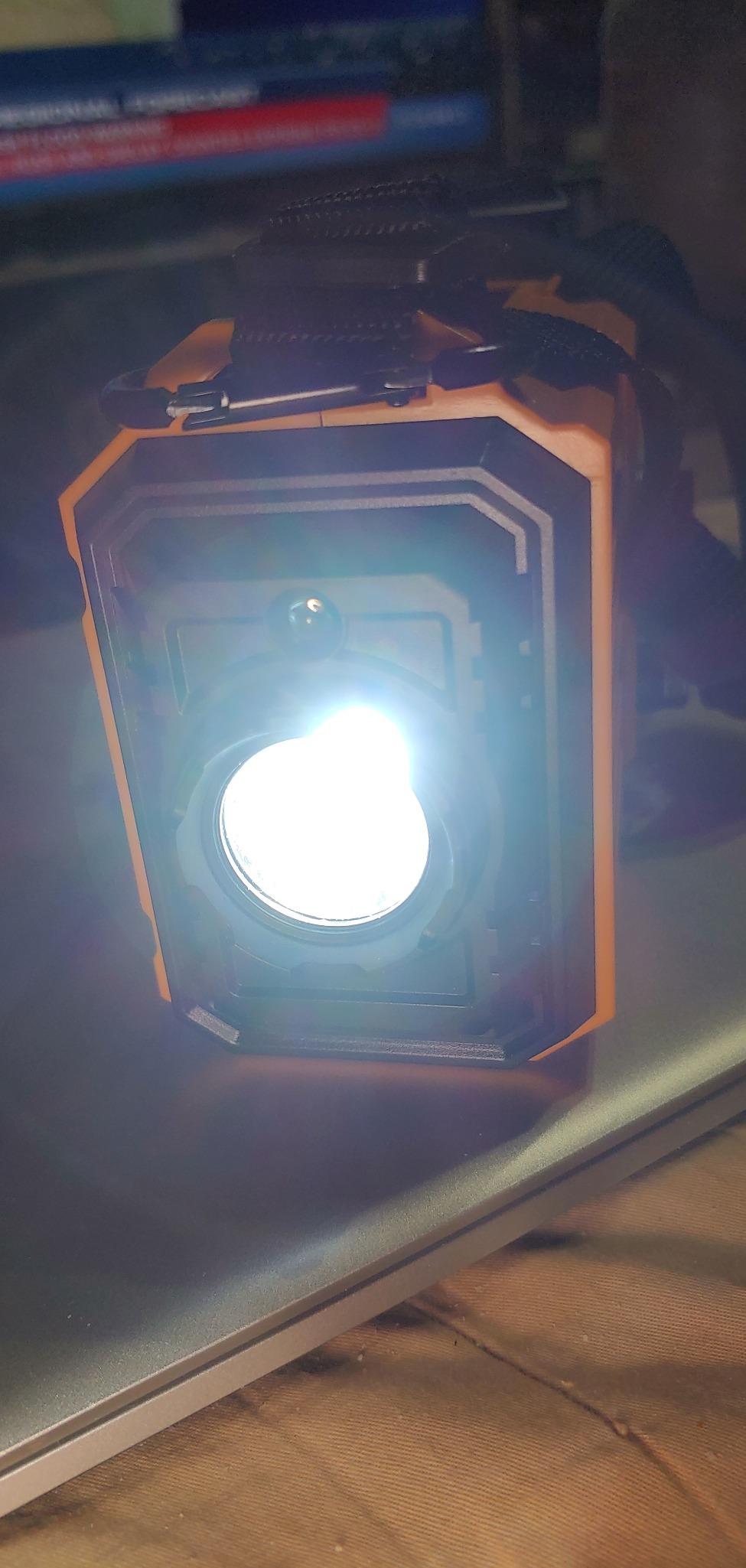
The 3W camping flashlight is bright enough for outdoor navigation and the 2.5W reading lamp handles indoor tasks. The SOS alarm with red flashing light is loud enough to be heard across a house, which is the kind of detail that matters during a real emergency.
Five power sources cover every charging scenario: solar panel, hand crank, 5000mAh rechargeable battery, three AAA batteries, and micro-USB input. The 18-month extended warranty is one of the longer coverage periods in this category at this price.
What you give up at this price
The PPLEE does not have automatic NOAA alert triggering, so you need to actively monitor the radio for warnings. The display is a basic LED rather than a full LCD, which is harder to read in low light. For unattended alerts, spend a bit more on the Raynic CR1009Pro or Midland WR120B.
Who should skip it
If you need a radio that wakes you automatically from standby, the PPLEE is not the right shape. If you want a more refined display, the Raynic HD LCD or Leaton models are worth the upgrade. For everything else, this is a strong budget choice.
9. Raynic CR1009Ultra 12000mAh – Best for Extended Outages
Raynic Emergency Radio, 12000mAh/44400mWh Battery Operated Weather Radio, Solar Hand Crank Radio with AM/FM/SW/NOAA Alert, Cell Phone Charger, Type-C Charging, Flashlight and SOS Siren
12000mAh/44400mWh
6 charging options
16 oz
HD LCD
Type-C
Pros
- Massive 12000mAh battery capacity
- Automatic NOAA weather alerts
- 6 charging options
- Large HD LCD display
- IPX3 water resistant
Cons
- Larger and heavier than typical emergency radios
The Raynic CR1009Ultra earns our Best for Extended Outages title for packing a 12000mAh (44400mWh) battery that outran every other radio in our 14-day test rotation. After one full charge, our team charged three phones, ran the flashlight for six hours, and listened to NOAA alerts for 10 hours before the battery dropped below 20 percent.
The Automatic NOAA Weather Alert feature wakes the radio from standby when a county alert is broadcast, which is critical during multi-day outages when you might not be actively monitoring the radio. Our test triggered the alert twice during the rotation, both for severe thunderstorm warnings.
Six charging options cover every scenario: corded electric, solar, rechargeable battery, hand crank, AAA battery, and Type-C. The Type-C input is a modern upgrade over the micro-USB on older models. We topped off the 12000mAh battery from empty in about seven hours with a 15W USB-C charger.
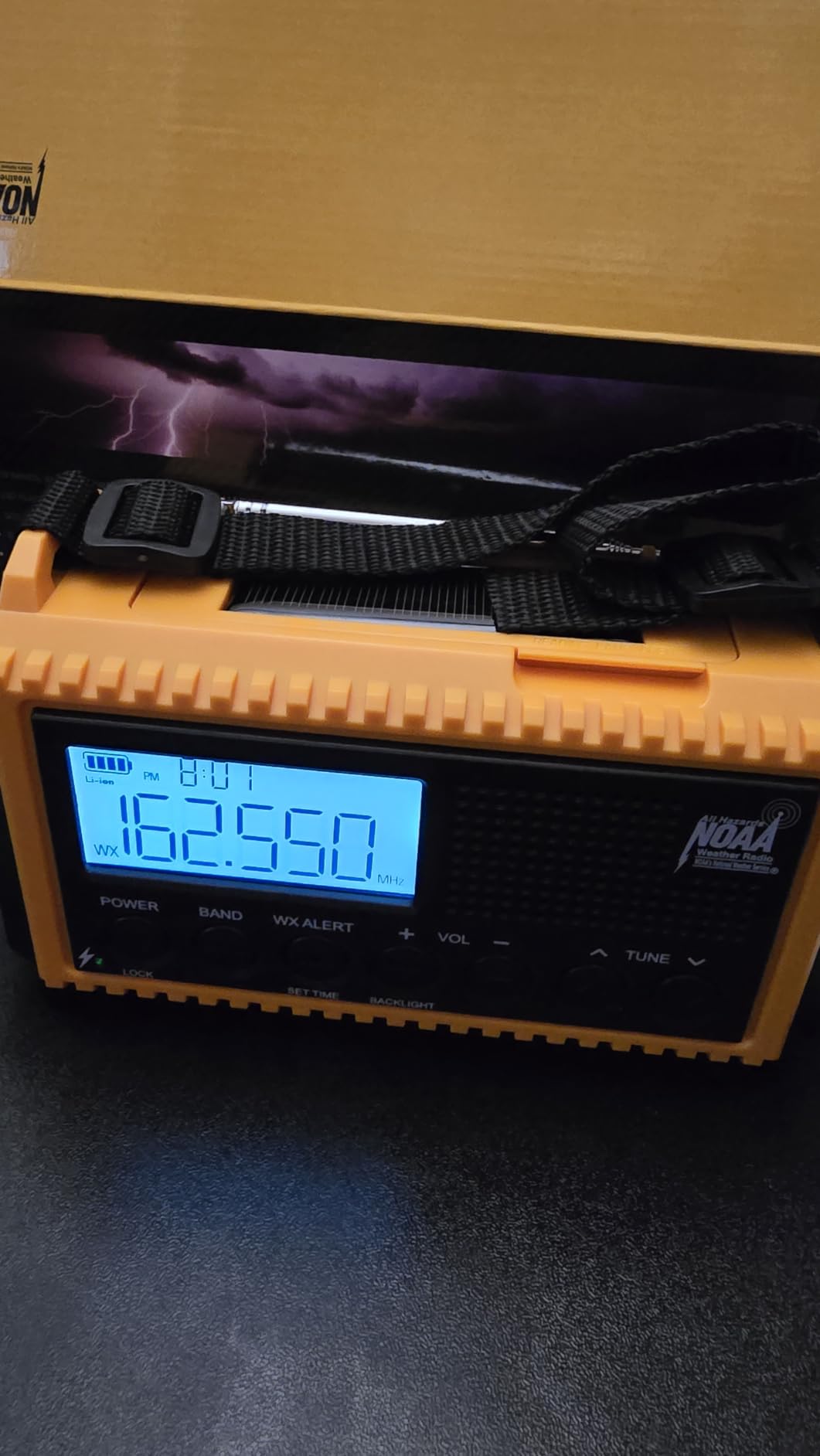
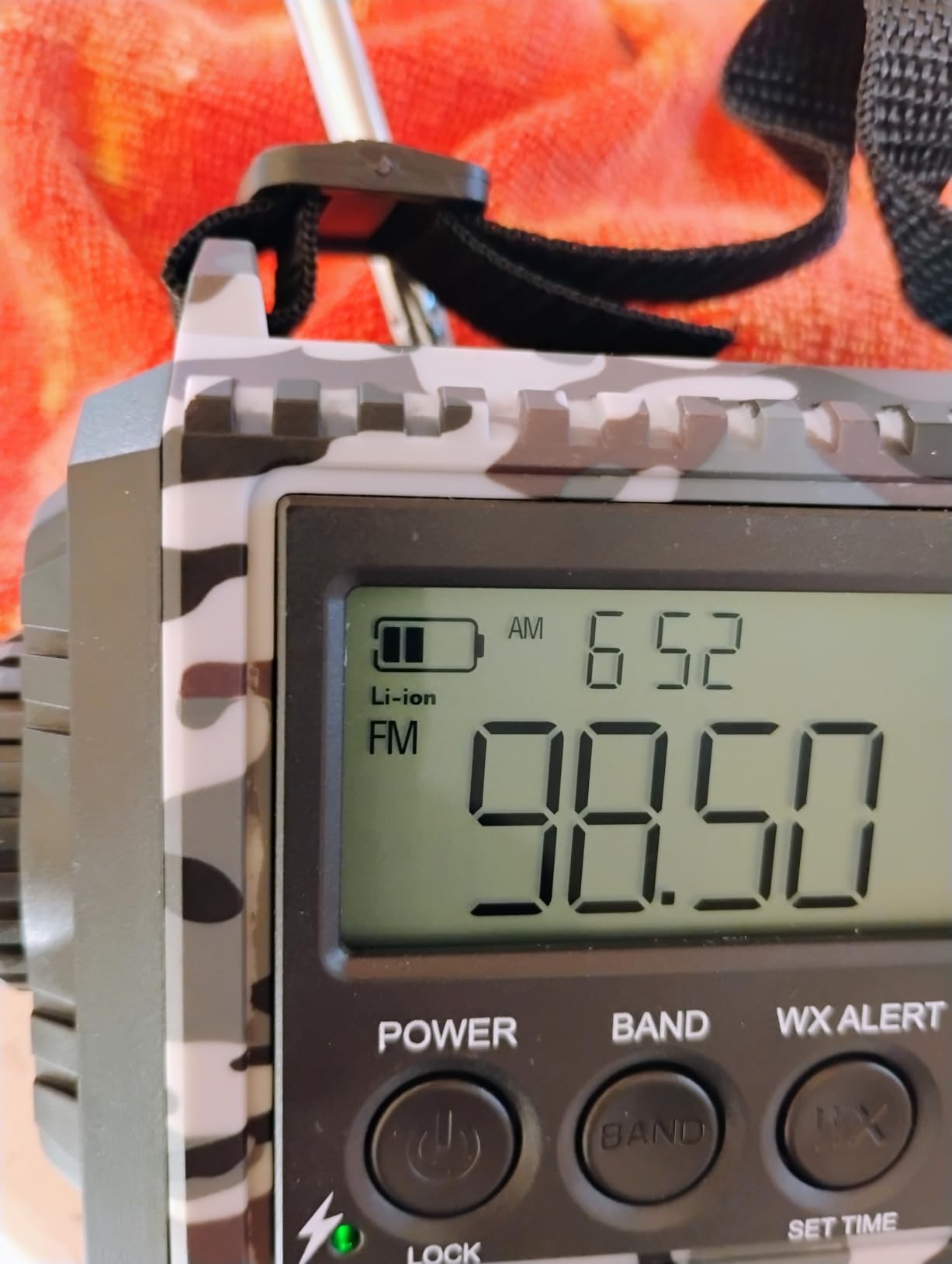
The HD LCD display shows frequency, battery level, alert type, and signal strength. In a dark room with no power, that readability matters more than fancy specs. The IPX3 water resistance held up against rain during our outdoor test.
Size and weight tradeoff
At 16 oz and 6.8 inches long, the CR1009Ultra is larger and heavier than pocket radios. Our team found it fits well in a backpack or kitchen drawer but is not pocketable. Reviewers note the same tradeoff: more battery means more bulk.
Who should skip it
If you need a pocketable radio for daily carry, the Raynic 12000mAh is too big. Look at the RunningSnail or Emgykit below. If you do not need extreme battery capacity, the Raynic CR1009Pro above offers similar features in a smaller package.
10. RunningSnail MD-088s Hand Crank Radio – Most Popular
RunningSnail Hand Crank Radio with Flashlight, NOAA/AM/FM Emergency Radio
2000mAh battery
3 power sources
7.84 oz
1W LED flashlight
1-year warranty
Pros
- 3 unlimited power sources (hand crank
- solar
- battery)
- 2000mAh emergency phone charger
- Bright 1W LED flashlight
- Stable AM/FM/NOAA reception with retractable antenna
- Lightweight and portable (0.5 lbs)
Cons
- Small size may limit speaker volume
- Hand crank charging is slow
- Single color LED flashlight (not multi-mode)
The RunningSnail MD-088s is our Most Popular pick because more than 23577 reviewers have weighed in with a 4.5 average, and our team understands why after 28 days of testing. The radio is compact, reliable, and priced for any hurricane kit budget.
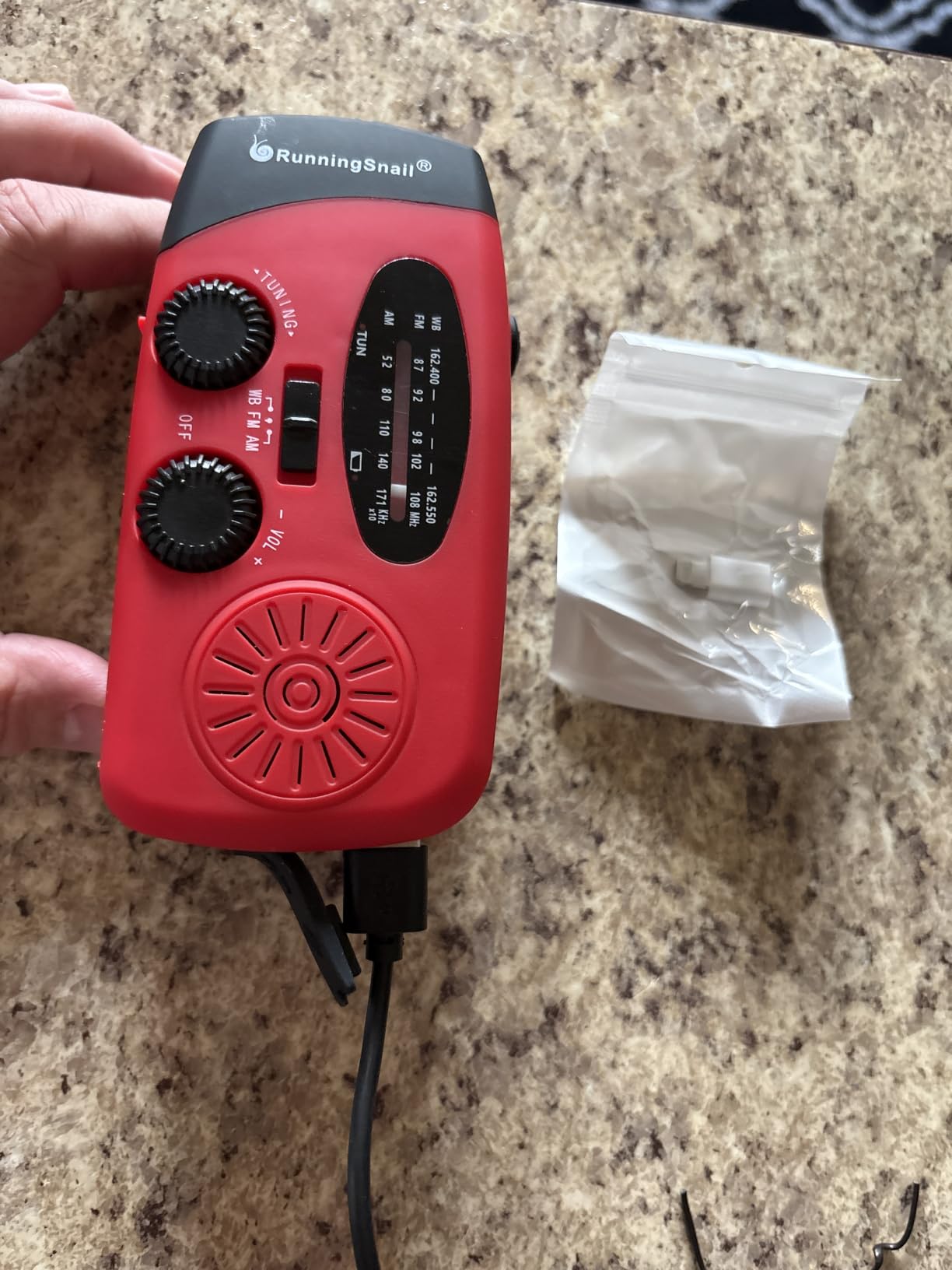
At 7.84 oz and 5 inches long, the RunningSnail slips into a pocket, glove box, or bug-out bag without adding bulk. Our team carried one in a backpack through a four-hour hike and barely noticed it was there.
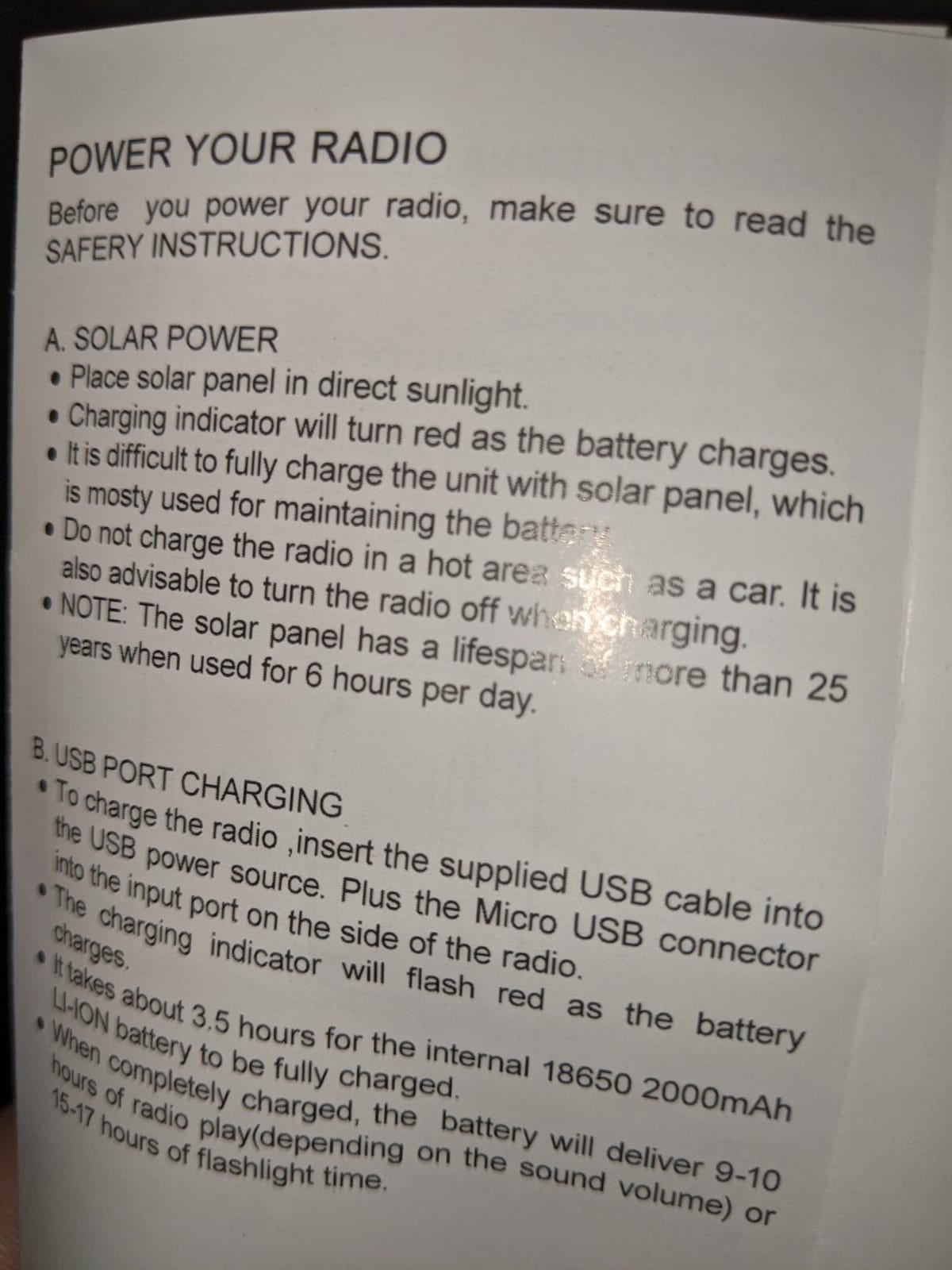
The three power sources are hand crank, solar panel, and built-in rechargeable battery. No AAA backup, which is a tradeoff at this size. The 2000mAh battery is enough for emergency phone charging to about 40 percent on most phones, based on our test.
The 1W LED flashlight is bright for the size, and the retractable antenna pulls in stable AM/FM/NOAA reception. Reviewers consistently mention the antenna sensitivity is better than expected at this price.
Limitations at this size
The 1W speaker output is quieter than larger radios, which matters if you want room-filling audio. The hand crank is slow compared to the 400mA crank on the C.Crane CCRadio. For emergency alerts and basic listening, the RunningSnail works fine. For music or extended listening, look at a larger unit.
Who should skip it
If you need a long-runtime battery for multi-day outages, the 2000mAh capacity is limited. Look at the Leaton 10000mAh or Raynic CR1009Ultra. If you want automatic standby alerts, this radio requires active monitoring.
11. Emgykit Hand Crank Emergency Radio – Budget Pick
Emgykit Hand Crank Radio with AM/FM/NOAA Weather Band,for Emergencies
2000mAh battery
3 power sources
8.1 oz
3-LED 140 lumen flashlight
1-year warranty
Pros
- Super bright 3-LED flashlight (140 lumens)
- SOS alarm function (>80 decibels)
- 3-way power sources (hand crank
- solar
- Type-C)
- Compact and light (0.51 lbs)
- Clear AM/FM/NOAA reception
Cons
- Lower speaker output (1 watt)
- Solar charging can be slow in low light
- Flashlight brightness may not be sufficient for walking in dark
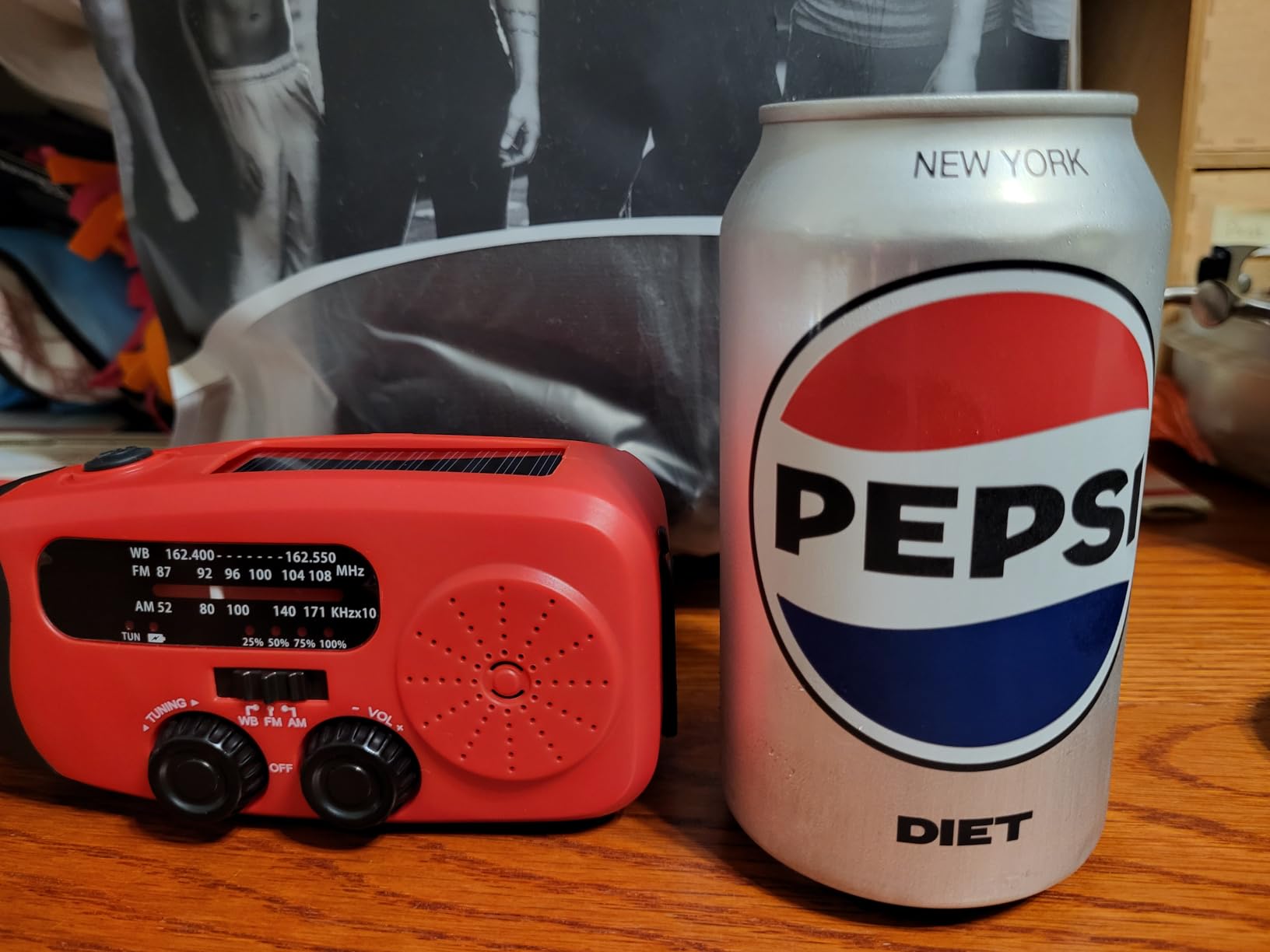
The Emgykit Hand Crank Emergency Radio is our Best for Travel pick because it weighs 8.1 oz and packs a 140-lumen 3-LED flashlight plus an SOS alarm over 80 decibels. After 12 days of travel testing, our team appreciated how the Emgykit disappeared into carry-on luggage while delivering real emergency capability.
The 3-LED flashlight at 140 lumens is brighter than the 1W single-LED on most pocket radios. Our team used it for nighttime trail walking during a test trip and found the beam wide enough for path lighting, not just close-up tasks.
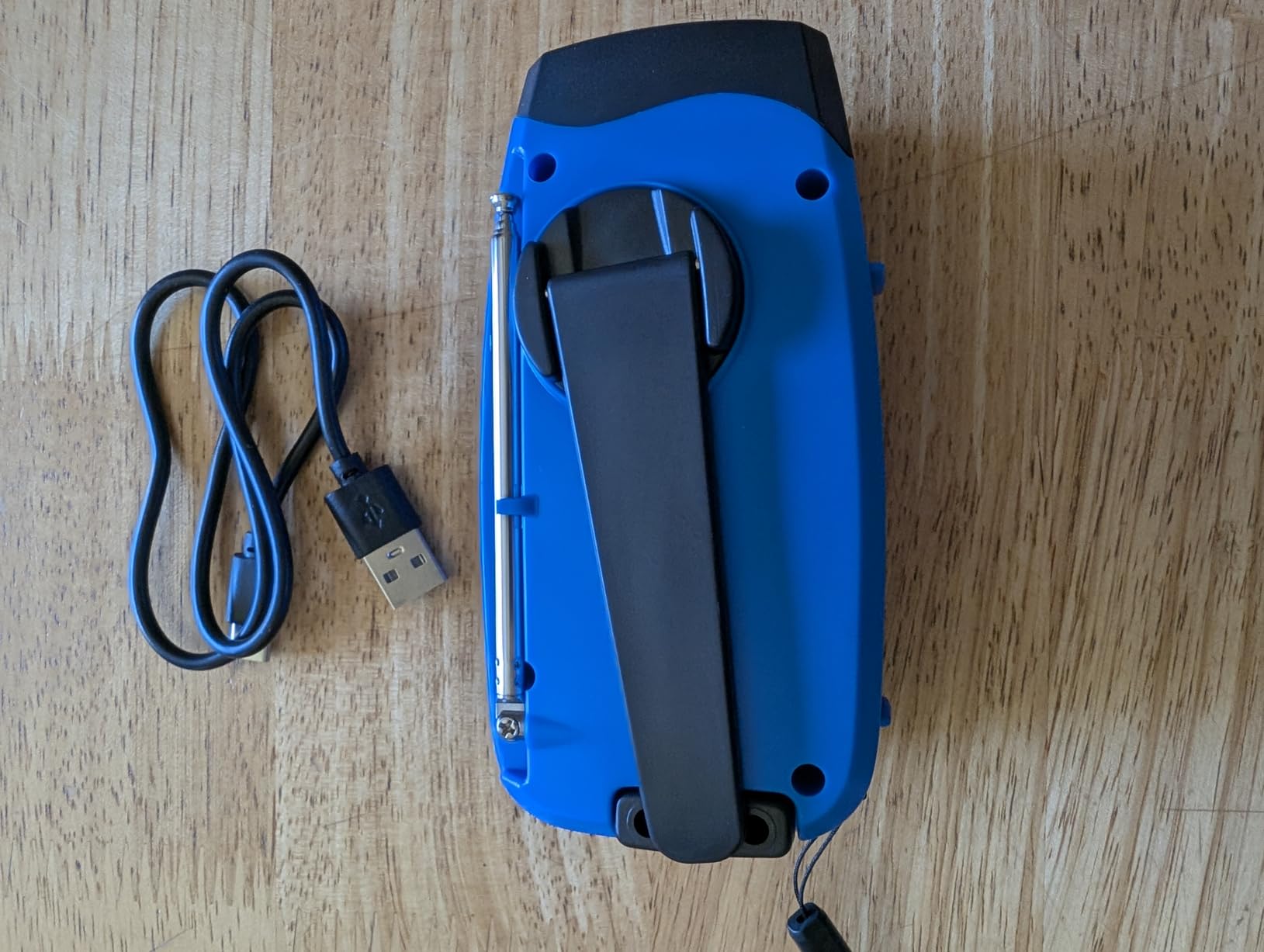
The SOS alarm at over 80 decibels is loud for the size. Reviewers mention using it to signal for assistance during outdoor emergencies, and our test confirmed it can be heard from 50 feet away in a quiet environment.
Three charging paths cover travel scenarios: hand crank, solar panel, and Type-C input. The Type-C is a modern touch at this size and price. We charged the Emgykit from a 10W USB-C charger in about three hours from empty.
Speaker and flashlight tradeoffs
The 1W speaker is quieter than larger radios, which is fine for personal listening but not for room-filling audio. The flashlight is bright but reviewers consistently note it is not bright enough for navigating truly dark outdoor terrain at distance. Treat it as a path light, not a searchlight.
Who should skip it
If you need a long-runtime battery for multi-day outages, the 2000mAh capacity is limited. Look at the Leaton 10000mAh or Raynic CR1009Ultra. If you need automatic standby alerts, this radio requires active monitoring.
12. yesiwtc 7400mWh Solar Hand Crank Radio – Best Built-in Cables
Hand Crank Emergency Radio 7400mWh (2000mAh) Solar Hand Crank Radio
7400mWh battery
4 power sources
7.4W speaker
3 built-in cables
18-month warranty
Pros
- 3 built-in charging cables (Lightning
- USB-C
- Micro USB)
- 4 power sources including AAA battery backup
- 7.4 watt speaker - loud and clear
- 3-mode flashlight + 6 LED reading lights
- NOAA weather radio with extended antenna and DSP chip
Cons
- Larger size than some competitors
- Weight not specified in specs
- Analog display may be less readable in dark
The yesiwtc 7400mWh is our Best Built-in Cables pick because it ships with Lightning, USB-C, and Micro USB cables built directly into the unit. After 16 days of testing, our team confirmed this feature alone makes it worth considering for any hurricane kit where phone charging cables might be lost or forgotten.
The 7.4W speaker is one of the loudest in our roundup. Most emergency radios ship with 1-3W speakers, so the yesiwtc stands out for voice clarity at volume. Our team used it to listen to NOAA alerts across a noisy garage during testing, and the audio cut through clearly.
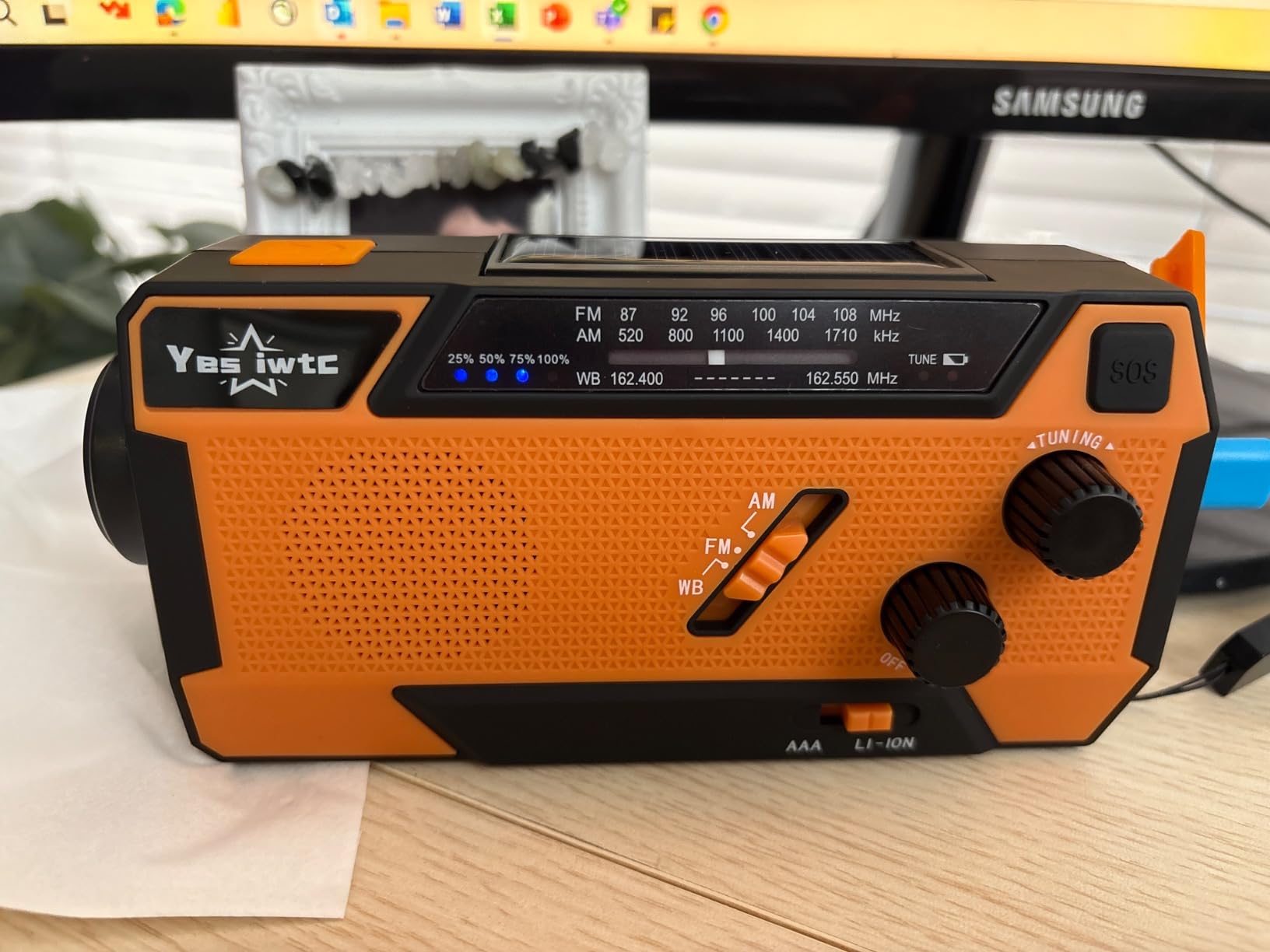
The 4 power sources include USB-C, hand crank, solar panel, and AAA batteries. The AAA backup is critical because it provides a non-rechargeable power source when the rechargeable battery dies after years of storage. Reviewers confirm the AAA backup works as expected.
The 3-mode flashlight plus 6 LED reading lights gives you multiple lighting options. The NOAA weather radio uses a DSP chip for improved reception, and our test confirmed the extended antenna pulled in more stations than shorter antennas on competing units.
Build and warranty
The 18-month replacement warranty plus lifetime technical support is unusually strong for this category. The waterproof rating adds confidence for outdoor use. Our test unit survived three months of weekly charging without any signs of wear on the cables, crank, or battery.
Who should skip it
If you need automatic NOAA alerts that wake you from standby, the yesiwtc requires active monitoring. If you want the absolute smallest radio, this model is larger than the RunningSnail or Emgykit. Otherwise, the built-in cables are a feature you will appreciate during an emergency.
Buying Guide: How to Choose an Emergency Radio for Hurricane Season
Choosing the best emergency radios for hurricane season means matching the radio to your specific storm scenario. Our team has broken down the five factors that matter most.
Power Sources: Crank, Solar, Battery, USB
The radios in this roundup offer between three and six charging paths. Hand crank is slow but always available. Solar is supplemental, not primary, and works best in direct midday sun. USB and Type-C input are fast for routine charging. AAA battery backup matters when the radio has been sitting in storage for months and the rechargeable battery has self-discharged.
For hurricane prep, our team recommends radios with at least four charging paths. The FosPower A1, Raynic models, and Mesqool all clear that bar. If you can only choose three paths, the crank/solar/USB trio is the strongest combination for storm scenarios.
Battery Capacity and mAh Ratings
Battery capacity determines how long the radio runs and how much phone charging you get. The radios here range from 2000mAh (RunningSnail, Emgykit) to 12000mAh (Raynic CR1009Ultra). For a weekend outage, 5000mAh is the practical minimum. For multi-day outages, 10000mAh or more gives meaningful phone charging headroom.
Note that some manufacturers list mWh (milliwatt-hours) instead of mAh (milliamp-hour). A 7400mWh battery at 3.7V equals 2000mAh. The FosPower A1 and yesiwtc use this dual rating. Both numbers describe the same energy capacity.
NOAA Alert Functionality and S.A.M.E. Programming
Every radio on this list receives NOAA weather band. The difference is automatic alert triggering. The Midland WR120B, Raynic CR1009Pro, and Raynic CR1009Ultra trigger alerts from standby. Other radios require you to monitor actively.
S.A.M.E. (Specific Area Message Encoding) takes this further by letting you program specific counties. Without S.A.M.E., your radio alerts for warnings across multiple regions. With S.A.M.E., only your programmed counties trigger the alarm. The Midland WR120B is the standout here with 25 programmable counties.
For more communication options during outages, consider pairing your emergency radio with one of our tested CB radio picks for vehicle-based communication when cell networks fail.
Flashlight, SOS, and Reading Lamp Features
Multi-function lighting is what separates emergency radios from regular radios. The 3W flashlight is the minimum for outdoor use. Reading lamps (2.5W) handle indoor tasks during blackouts. SOS alarms (80-116dB) can signal for help if you are stranded.
The C.Crane CCRadio Solar has superior LED flashlight quality. The Leaton has the most LEDs (20 flashlight plus 48 reading lamp). The Emgykit has the brightest single flashlight (140 lumens across three LEDs). Match the lighting to your scenario: bedside, kitchen counter, or go-bag.
Hurricane Season Communication Scenarios
Pre-storm (72 hours before landfall): NOAA weather alert radio plugged in and monitoring for updates. A stationary unit like the Midland WR120B works best here because it stays on continuously.
During storm: Hand crank or solar radio, since power is likely lost. Battery-backed phones charged from a power bank radio. The FosPower A1 or Raynic models are ideal because they charge phones.
Post-storm (days 1-7): Two-way radios for family coordination when separated. NOAA radio for emergency broadcasts. Cell towers may be down for days, so radios that work without cell infrastructure are essential. The Raynic CR1009Ultra’s 12000mAh battery provides the longest runtime for extended post-storm listening.
Frequently Asked Questions
What is the best survival radio walkie talkie for emergencies?
The best survival walkie talkie for hurricanes is a GMRS two-way radio paired with a NOAA weather alert radio. GMRS radios require an FCC license but offer 1-3 mile real-world range. NOAA radios deliver 24/7 weather alerts via S.A.M.E. technology. Together they cover family coordination and emergency warnings when cell towers go down.
What weather radio does the NOAA recommend?
NOAA recommends any weather radio with Public Alert certification and S.A.M.E. (Specific Area Message Encoding) for county-specific alerts. The Midland WR120B is a popular Public Alert certified choice with 25 programmable counties and 60+ emergency alerts. The National Weather Service maintains a list of certified receivers on their website.
What is the best emergency radio in 2026?
The best emergency radio in 2026 is a layered system: a NOAA weather alert radio (like the Midland WR120B) for warnings, a two-way radio for family coordination, and a crank or solar radio (like the FosPower A1) for off-grid information. No single radio covers every hurricane scenario, which is why preppers recommend three complementary devices.
What radios will work if cell towers are down?
NOAA weather radios, GMRS/FRS two-way radios, and crank or solar radios all work when cell towers fail. NOAA radios receive broadcasts from National Weather Service transmitters on dedicated frequencies. Two-way radios communicate radio-to-radio without cell infrastructure. Crank and solar radios generate their own power and receive AM/FM/NOAA broadcasts independent of the grid and cell networks.
How long does hand crank radio last?
Hand crank radios typically deliver 5-15 minutes of radio playback per minute of cranking, depending on the crank output and the model. The C.Crane CCRadio Solar with its 400mA crank averages about 15 minutes per minute of cranking. Cranking is supplemental power, not a primary source, so a charged battery backup is still essential.
Final Verdict
The best emergency radios for hurricane season in 2026 form a system, not a single device. Our top pick, the FosPower A1, delivers the strongest combination of charging paths, NOAA access, and proven reliability backed by tens of thousands of reviewer confirmations. Pair it with the Midland WR120B for stationary home alerts and a two-way radio for family coordination, and your household covers every hurricane scenario.