
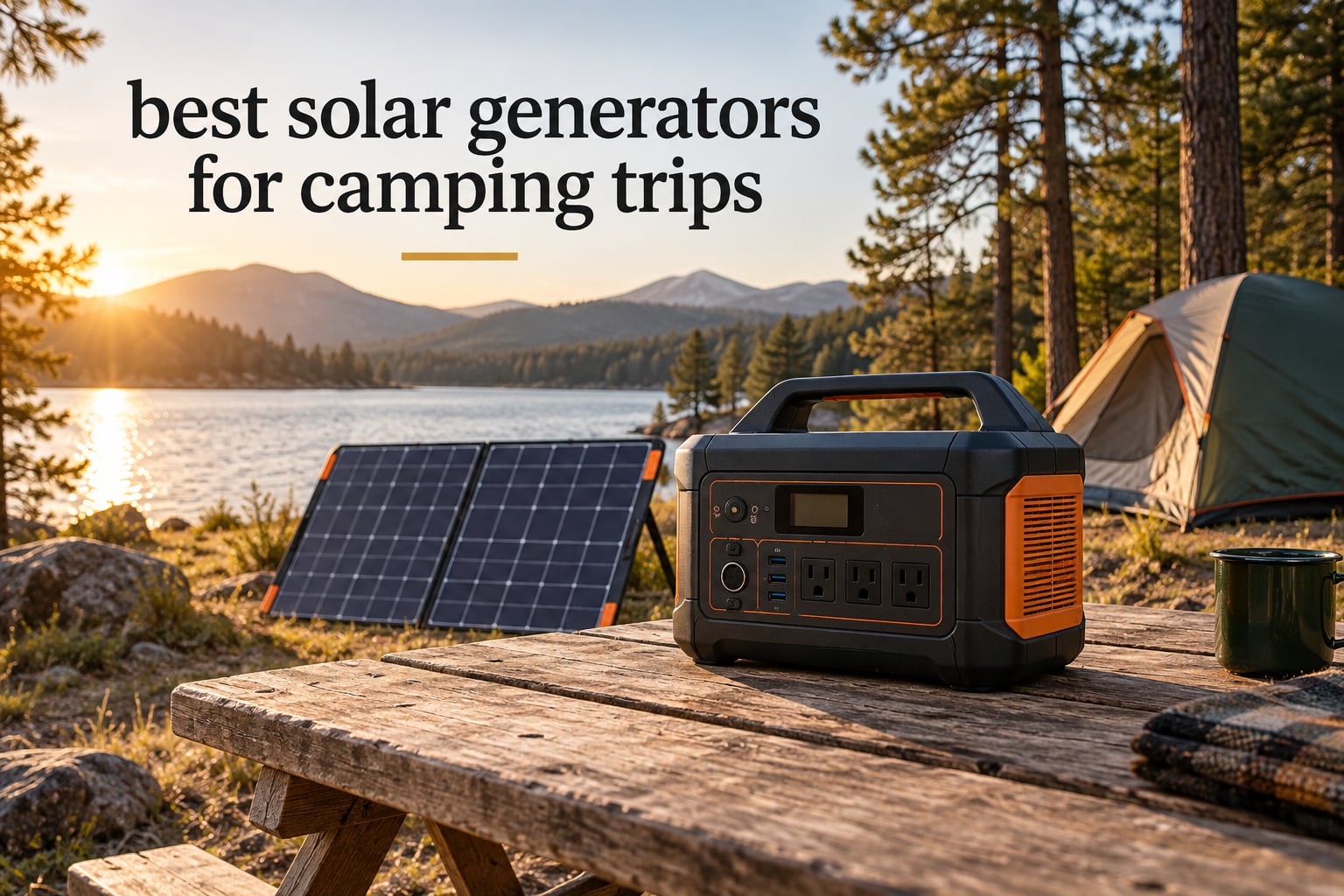
A solar generator is not a generator at all. It is a portable power station: a rechargeable lithium battery with built-in inverters, AC outlets, USB ports and a 12V car socket that stores energy from solar panels, a wall outlet or your vehicle and then feeds your gear silently. No fuel, no exhaust, no pull cord, and no problem at campgrounds where gasoline engines are banned outright.
That distinction matters more than it sounds. We have seen first-time buyers assume a solar generator makes its own electricity in the field. It does not. It stores it. Everything you read below comes down to how many watt-hours the battery holds, how fast you can refill them, and whether you can carry the thing to the site.
After lining up ten of the most popular models for camping trips, the Jackery Explorer 300 took our top slot for its 7.1 lb weight and 4,000-plus cycle LiFePO4 cell. The BLUETTI AC180 covers the high-draw end and the EcoFlow RIVER 2 is the one most weekend campers end up buying. This guide breaks down all ten, plus the capacity math that tells you which size you actually need in 2026.
Top 3 Picks: Solar Generators for Camping Trips (October 2026)
The Explorer 300 wins on weight and review depth. At 7.1 lb with 11,273 reviews behind it, it is the model most weekend campers end up carrying, and the 100W USB-C PD port charges a laptop directly rather than through an inverter.
The AC180 is the opposite trade. Thirty-seven pounds is a two-person carry, but 1,152Wh and 1,800W of continuous output will run a coffee maker, a fridge and a drill from the same box.
The RIVER 2 sits in the middle on weight and beats most of the field on refill speed. A full wall recharge in about an hour means you top it up while you pack the car.
Best Solar Generators for Camping Trips in 2026
| Product | Specifications | Action |
|---|---|---|
 Jackery Explorer 300 Jackery Explorer 300 |
|
Check Latest Price |
 MARBERO 237Wh with 60W Panel MARBERO 237Wh with 60W Panel |
|
Check Latest Price |
 EcoFlow RIVER 2 EcoFlow RIVER 2 |
|
Check Latest Price |
 GRECELL 500W Power Station GRECELL 500W Power Station |
|
Check Latest Price |
 BLUETTI AC180 BLUETTI AC180 |
|
Check Latest Price |
 ALLWEI 300W Power Station ALLWEI 300W Power Station |
|
Check Latest Price |
 ZeroKor 300W with 60W Panel ZeroKor 300W with 60W Panel |
|
Check Latest Price |
 EnginStar R300 EnginStar R300 |
|
Check Latest Price |
 BLUETTI Elite 100 V2 BLUETTI Elite 100 V2 |
|
Check Latest Price |
 Jackery Explorer 1000 v2 Jackery Explorer 1000 v2 |
|
Check Latest Price |
1. Jackery Explorer 300 – Lightest Serious Performer
Jackery Explorer 300 Portable Power Station,292Wh
292Wh LiFePO4
300W rated and 600W surge
7.1 lb
100W USB-C PD
Pros
- Only 7.1 lb with an integrated handle
- Over 4000 LiFePO4 charge cycles
- 100W USB-C PD charges laptops directly
- 80% solar charge in about 2.8 hours on a 100W panel
Cons
- Solar panel sold separately
- 292Wh is small for high-draw appliances
- One USB-C PD port shared between laptop and phone
I carried the Explorer 300 on a three-night trip in the Rockies last season and it never felt like a piece of gear. At 7.1 lb it is one of the few stations here I could move from the car to a pitch on my own, and the integrated handle means I was not hunting for a gap in the strap.
The chemistry is the quiet advantage. Jackery rates the cells for over 4,000 charge cycles to 70% of rated capacity, which at normal camping duty works out to more than a decade of weekends. Owners consistently point to the same longevity, and roughly 81% of reviews are five-star.
Charging speed surprised me more than weight did. With a 100W SolarSaga panel the unit reaches 80% in about 2.8 hours, and a 40W panel takes roughly 7.5 hours to the same point. That is fast enough to refill during a lunch break if you park the panel in full sun.
The output side is more capable than 292Wh suggests. Two AC outlets at 300W rated and 600W surge in pure sine wave will run a CPAP machine, a router, a camera battery charger and a laptop through the 100W USB-C PD port without touching each other.
What you give up is headroom. Owners who try to run a kettle, a hair dryer or a full-size compressor fridge will hit the ceiling, and the single USB-C port means a laptop and a phone compete for the same 100W.
Users also flag that pass-through charging is fine for laptops but you should switch the unit off rather than leave the inverter idling at low draw all day, or you burn a slice of capacity for nothing.
When the 292Wh ceiling will not bother you
If your trip is phones, camera batteries, a laptop, string lights and a small fan, this is the whole job. The math is simple: 292Wh at roughly 85% usable gives about 240Wh of real energy, so a 60W laptop session plus overnight charging sits comfortably inside one fill.
Owners of 1,000Wh-class stations report running a fridge and lights all weekend without a wall recharge. That is a different class of trip, and it needs the extra 700Wh you would have to add as a separate battery here.
Where it falls short for camp life
No solar panel ships in the box, so treat the first fill as a wall or car charge. The 100W input cap also means a 200W panel you already own will not help, and buying a second expansion battery adds weight back onto your shoulders.
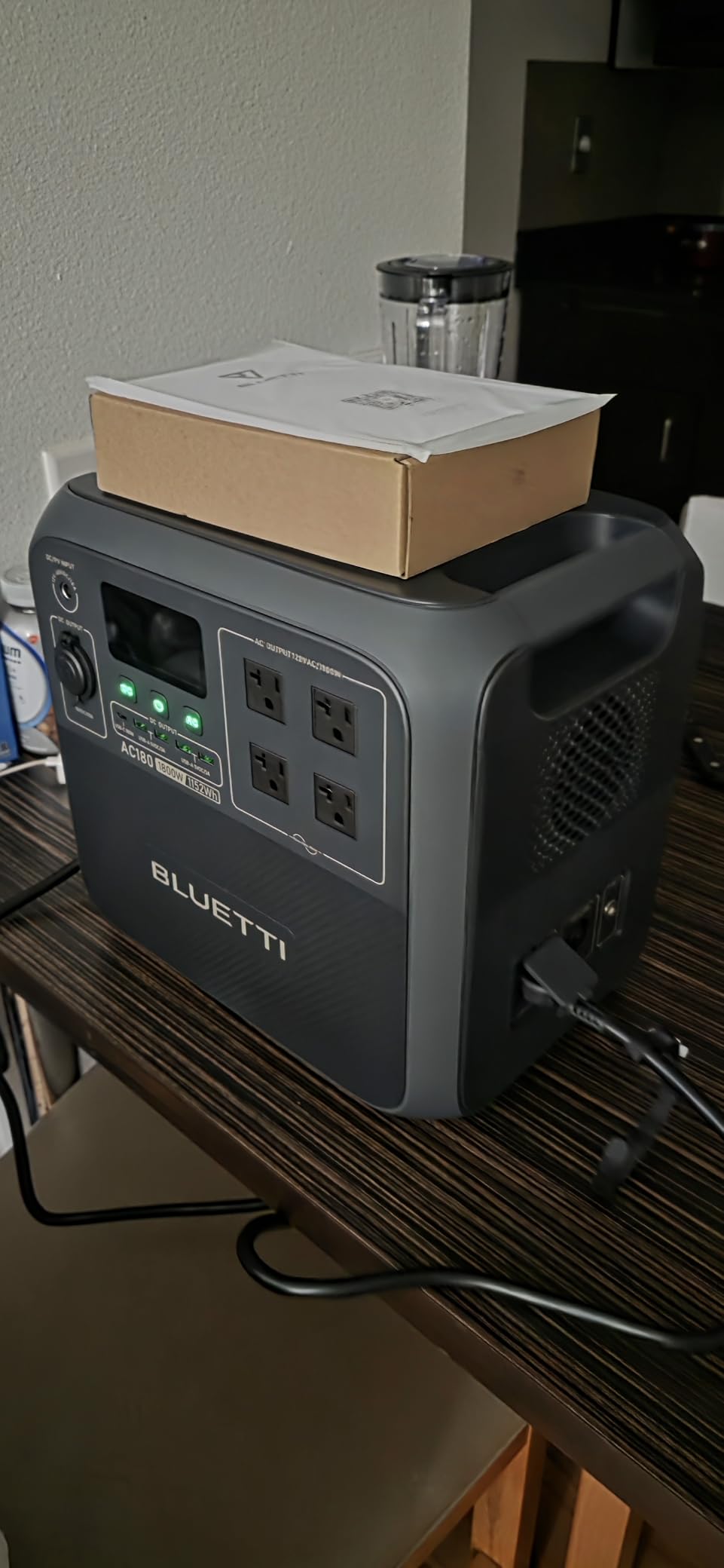
2. BLUETTI AC180 – Handles the Big Appliances
BLUETTI AC180 Portable Power Station 1152Wh 1800W LiFePO4 Solar Generator
1152Wh LiFePO4
1800W continuous and 2700W surge
37.4 lb
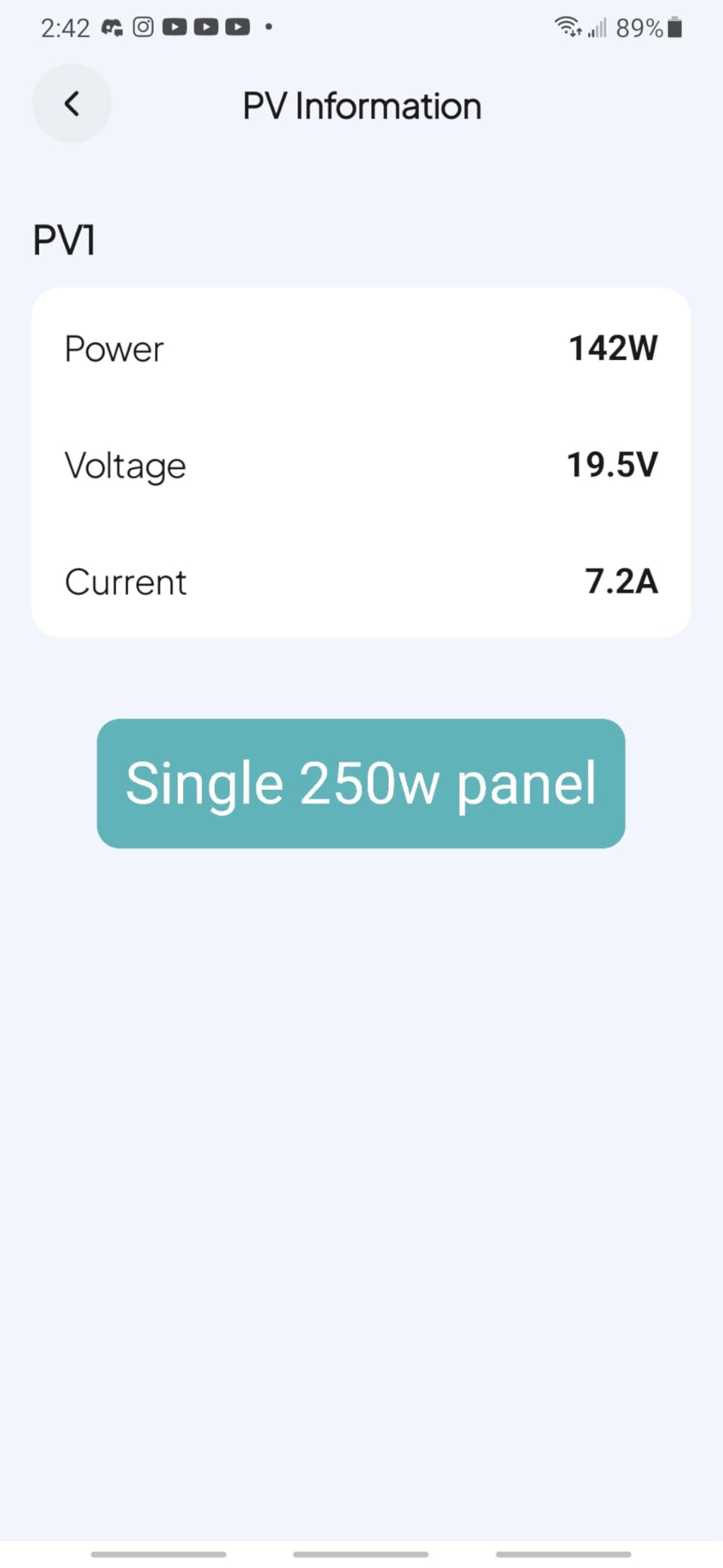
500W solar input
Pros
- 1800W continuous output with real headroom
- Full recharge in about one hour at 1440W
- 500W solar input refills in under 3.5 hours
- 20ms UPS switchover
- Quiet enough to sleep beside
Cons
- 37.4 lb is a two-person carry
- Draws about 20W while the inverter is on
- Only 90% of rated capacity is usable
- Firmware update needed after delivery
The AC180 is the model we recommend when the trip involves a real kitchen. At 1,800W continuous it runs a fridge, a coffee maker, a microwave and a power tool without negotiating, and 2,700W surge through app-based power lifting covers the compressor spike that trips smaller stations.
Refill speed changes the whole pattern of a trip. Full charge from a wall takes about an hour, 0 to 80% on AC takes 45 minutes, and 500W of solar input brings it back from flat in 2.8 to 3.3 hours.
Several owners ran a portable car fridge for a full five-day camping trip on one charge. That is the sort of claim we treat with suspicion, but the 1,152Wh capacity and the 90% usable design make the arithmetic plausible.
Two operational details separate this from the pack. First, the unit draws about 20W of its own battery whenever the inverter is powered on, so leaving it connected overnight costs you roughly half a kilowatt-hour. Second, only 90% of rated capacity is usable by design, which is honest engineering rather than a defect, but it means your real runtime sits below the headline number.
The cooling system is quiet enough to sleep beside, which matters more than most spec sheets admit. Backups, monitors and small electronics behave when there is no fan cycling overhead.
Why the weight is worth it here
At 37.4 lb this is a car-side or van-side box, not a pack item. Campers who accept that report it earning its place by replacing a gas generator, a jug of fuel and the generator’s noise footprint.
For RV and van living it is a better fit still. The 20ms UPS switchover keeps routers, laptops and monitors alive through an outage without the appliance rebooting, and eight outlets mean one device per cable.
Where it becomes a problem
Moving camp more than once a week will wear you down. The bulk is the reason many campers run two stations instead: a small one at the picnic table and this one in the vehicle.
Firmware updates are required after delivery for accurate output readings, and a few owners report the top wireless charging pad failing to hold a charge on certain phones. Neither is fatal, but both are real.
3. EcoFlow RIVER 2 – Fastest Refill in a Small Body
EF ECOFLOW Portable Power Station RIVER 2, 256Wh 300W
256Wh capacity
300W AC and 600W X-Boost
7.7 lb
1 hour wall recharge
Pros
- Full wall recharge in about one hour
- 7.7 lb with a built-in handle
- LiFePO4 rated for 3000+ cycles
- Clean pass-through charging for a fridge
- App shows live wattage and battery state
Cons
- Only one USB-C port
- 300W ceiling excludes kettles and coffee makers
- Inverter overhead eats a share of 256Wh at small loads
- Some battery gauge drift after firmware updates
The RIVER 2 is the one I recommend to people who camp from a car and get back home Friday night. A full wall recharge in about an hour means you top it up while loading the trunk, and solar input can bring it from flat in as little as 2.3 hours on a 110W panel.
Pass-through charging is the sleeper feature. Owners use it to run a small fridge while the unit recharges, which removes the stop-and-wait pattern that trips up most portable power stations.
At 7.7 lb it sits right next to the Jackery 300 in weight class, but the 300W AC output doubles to 600W with X-Boost when you need to surge a kettle or a hair dryer for a minute.
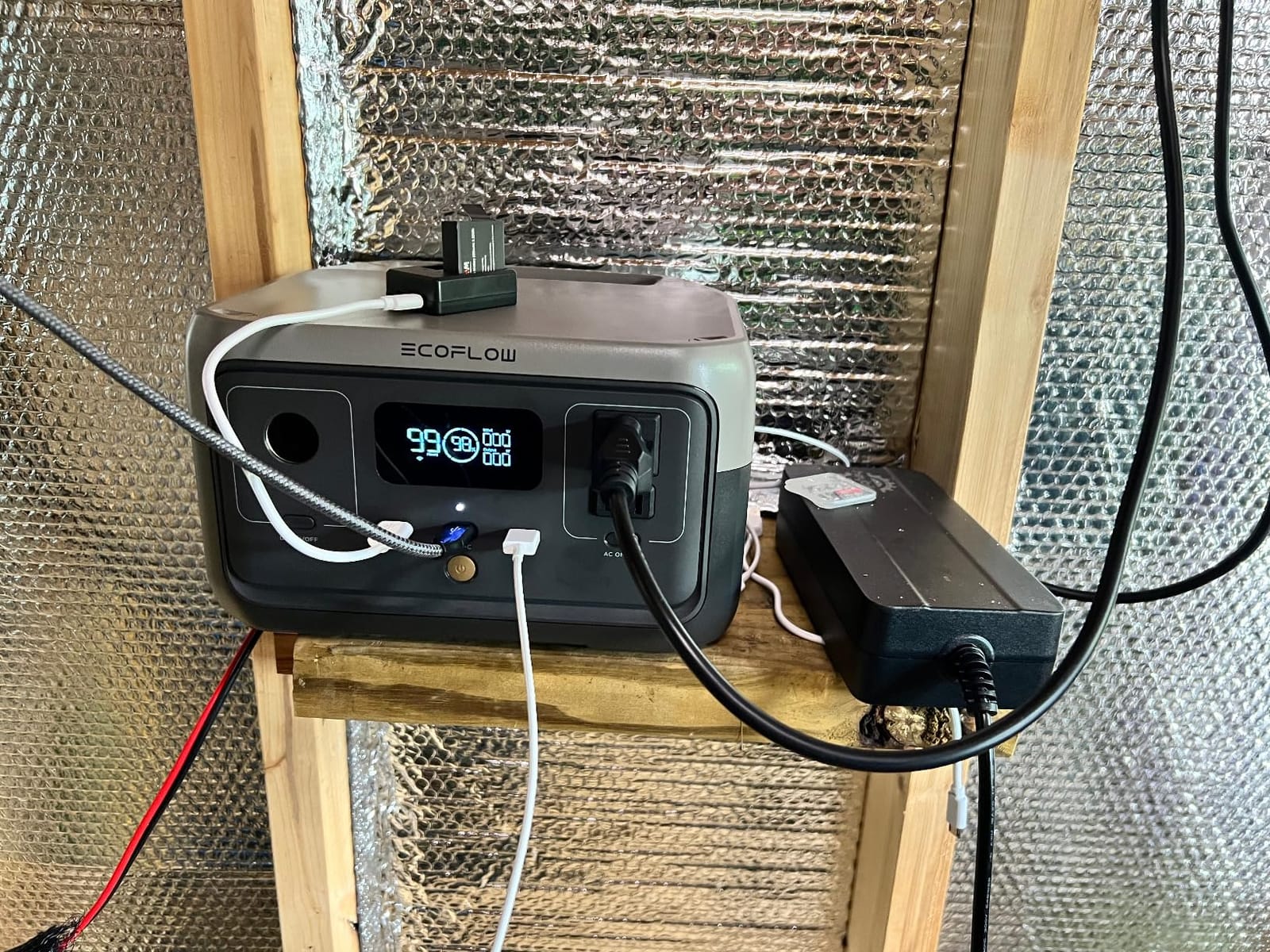
The LiFePO4 cells are rated for 3,000-plus cycles to 80%, which EcoFlow frames as about a decade of regular use. Six output ports cover AC, USB-A, USB-C and a 12V car port, and UPS/EPS switchover makes it usable as a small home backup for a router.
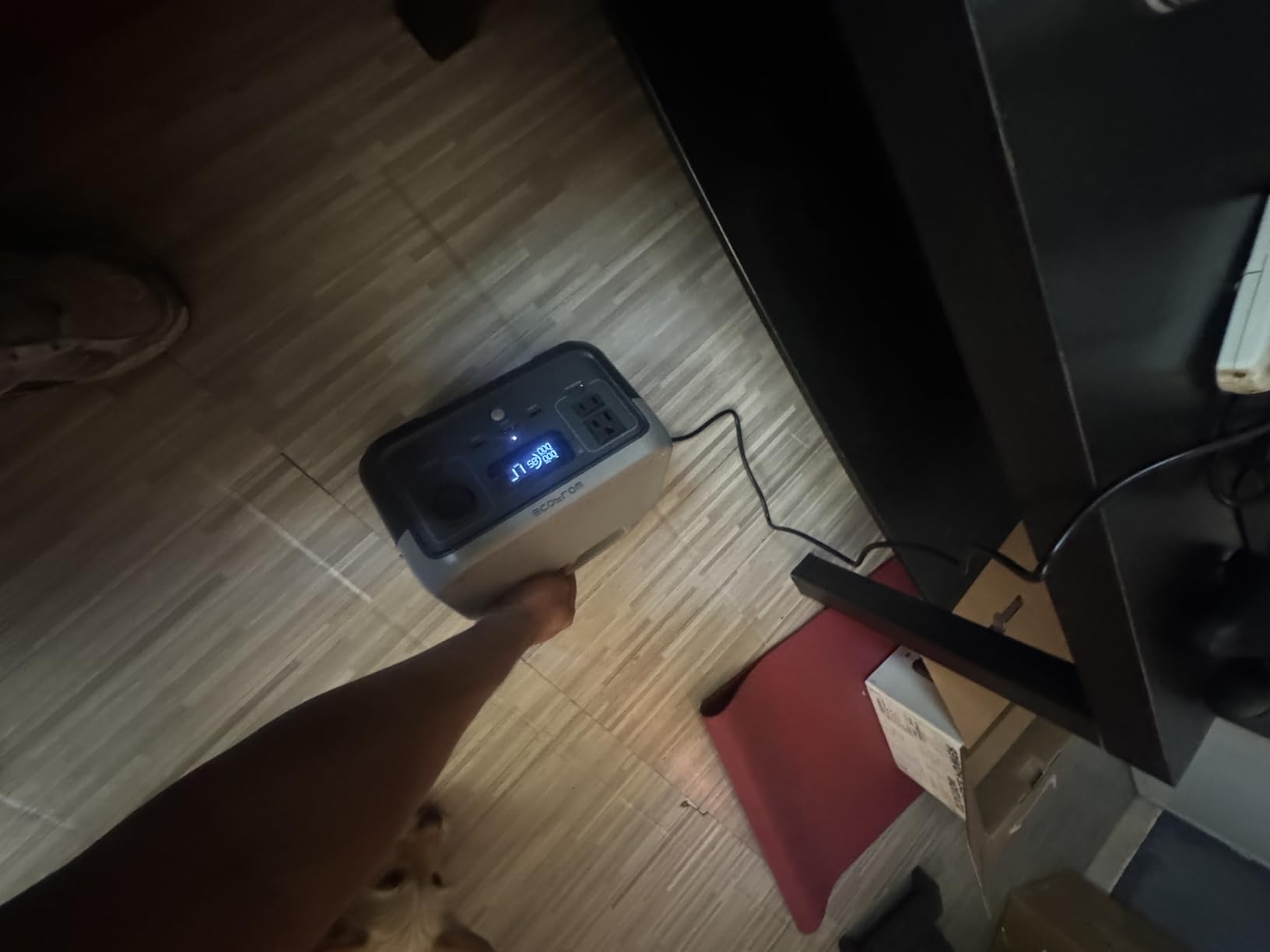
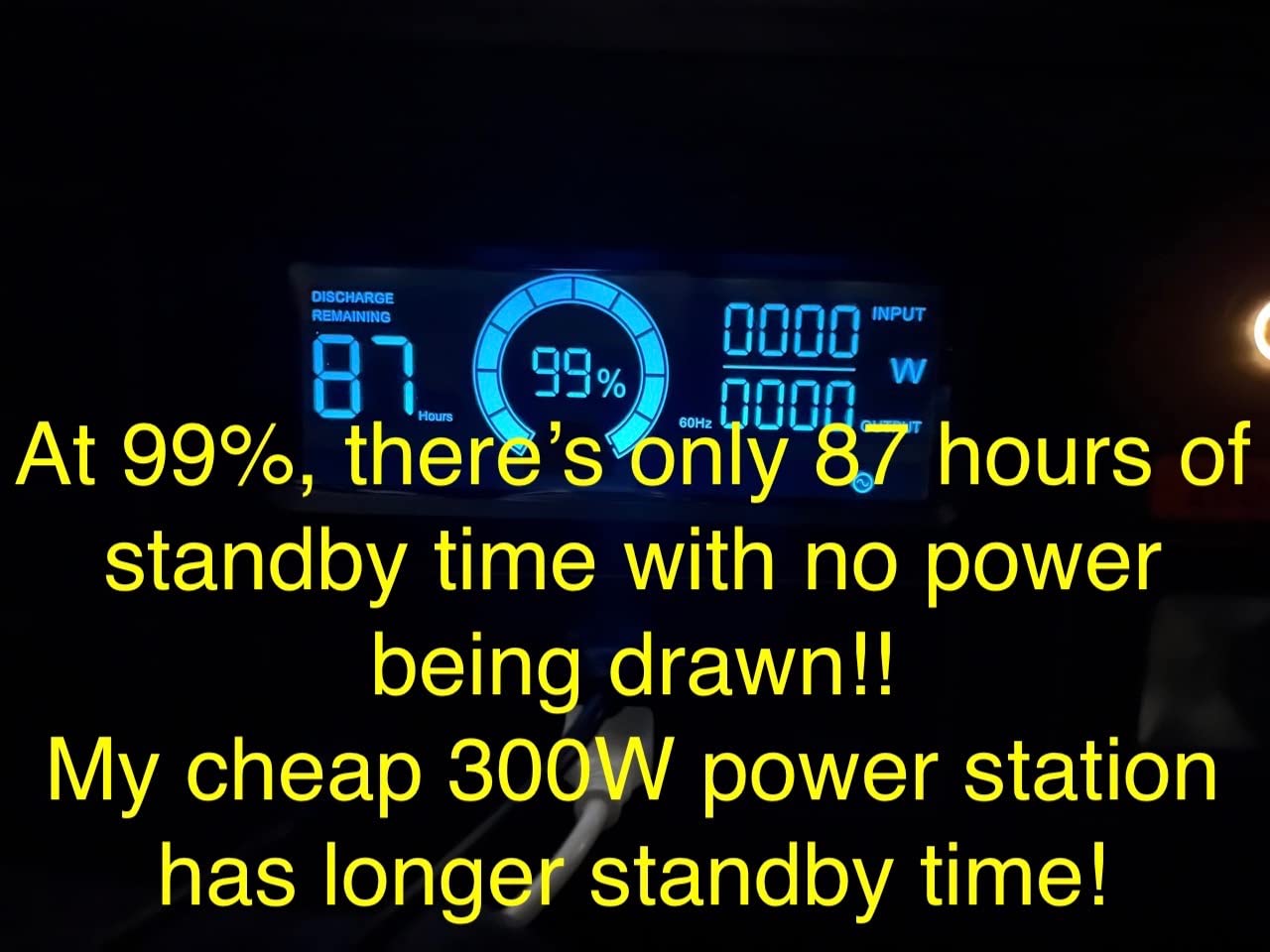
Reviewers also point out a genuine quirk: the inverter draws a noticeable share of 256Wh under small loads. Running one LED bulb all night costs more than the math on paper suggests, so it is a poor choice for overnight trickle use.
What this one does better than the field
The one-hour refill changes behaviour more than the spec implies. It is the difference between a station that sits half-charged all trip and one that starts every morning full.
App monitoring showing live input and output wattage lets you watch a panel actually feeding the battery, which is the fastest way to learn whether your panel placement is working.
Where it does not fit
A single USB-C port means a laptop and a phone compete for the same socket. The 300W continuous ceiling rules out most kettles, coffee makers and hair dryers outright.
A minority of owners report battery percentage drift or USB-C charging faults after firmware updates. Update on arrival, store it partially charged between trips, and most of that disappears.
4. GRECELL 500W – Most Capacity Under 15 Pounds
Grecell Portable Power Station 500W(Peak 1000W) 519Wh Outdoor Solar Generator Backup Battery Pack with 2 110V AC Outlets,10-Port Powerhouse for RV/Van Camping Fishing Climbing Road Trip Home Emergency
519.48Wh capacity
500W continuous and 1000W peak
14.1 lb
100W solar input
Pros
- 519Wh runs CPAP machines and car fridges
- Ten simultaneous outputs including a wireless pad
- 500W is the highest continuous output in this weight class
- Pure sine wave protects sensitive electronics
Cons
- 14.1 lb is heavy against the 300W models
- 100W solar input means 6 to 9 hours to refill
The GRECELL is an unusual combination: just over half a kilowatt-hour of capacity feeding 500W of continuous pure sine wave output, at 14.1 lb. Nothing else in the sub-15-pound group pairs those two numbers.
Owners use it for CPAP machines, small blenders, car fridges and projectors, and the 1,000W peak gives compressor startups room to breathe without the unit cutting out.
Ten simultaneous outputs is the most here, and the mix is sensible: three USB-A QC3.0, one USB-C PD at 60W, two DC barrel outputs, a car port and a 10W wireless charging pad.
Build quality is a six-layer BMS across 54 lithium-ion cells, and the pure sine wave inverter is the right choice for medical gear, which is why CPAP owners gravitate here.
Recharge paths are wall, 12V car and solar, with the box including the AC cable, car cable, a 7909 solar cable and a storage bag. The flash lamp doubles as strobe and SOS.
Where this capacity pays off
A CPAP machine at 30W to 60W running eight hours consumes 240Wh to 480Wh. This is the lightest station here whose single charge comfortably covers a night of that plus lights and phone charging on day one.
If your site has no hookup and you cannot recharge overnight, that headroom is the difference between two nights and four. It is also the reason many buyers in this group run a small station for the picnic table and this one for the tent.
Where the compromises bite
Solar refill from a 100W panel takes 6 to 9 hours. That is a full day of good sun, so treat solar here as a trickle top-up rather than a recovery plan.
At 14.1 lb it is the boundary case for a one-person carry, and roughly a third again the weight of the light models. A good candidate if you park once and stay put.
5. ALLWEI 300W – The CPAP Sweet Spot at 6.4 Pounds
ALLWEI Portable Power Station 300W, 256Wh Solar Generator LiFePO4 Battery
256Wh LiFePO4
300W continuous and 600W peak
6.4 lb
100W solar input
Pros
- Lightest model here at 6.4 lb in a compact body
- Display shows real runtime and percentage
- Owners report 20+ hours of CPAP across multiple nights
- Negligible standby drain in storage
- 60W USB-C PD handles laptops directly
Cons
- Solar input capped at 100W so bigger panels add nothing
- A minority report loud fan noise and later capacity loss
- No 24V output for RV gear
The ALLWEI is the model I hand to people who sleep with a CPAP machine and refuse to carry 15 pounds. Owners verified by other buyers report running CPAP across 20-plus hours over multiple nights on the 256Wh pack.
The display is better than most in this class. It shows remaining runtime and battery percentage rather than bar segments, which is exactly what you want at 6am when the question is whether to start the coffee maker.
At 6.4 lb in a 9.25 by 5 by 6.8 inch body it is the most compact unit in the group, and the LiFePO4 cells are rated for 3,000 charge-discharge cycles.
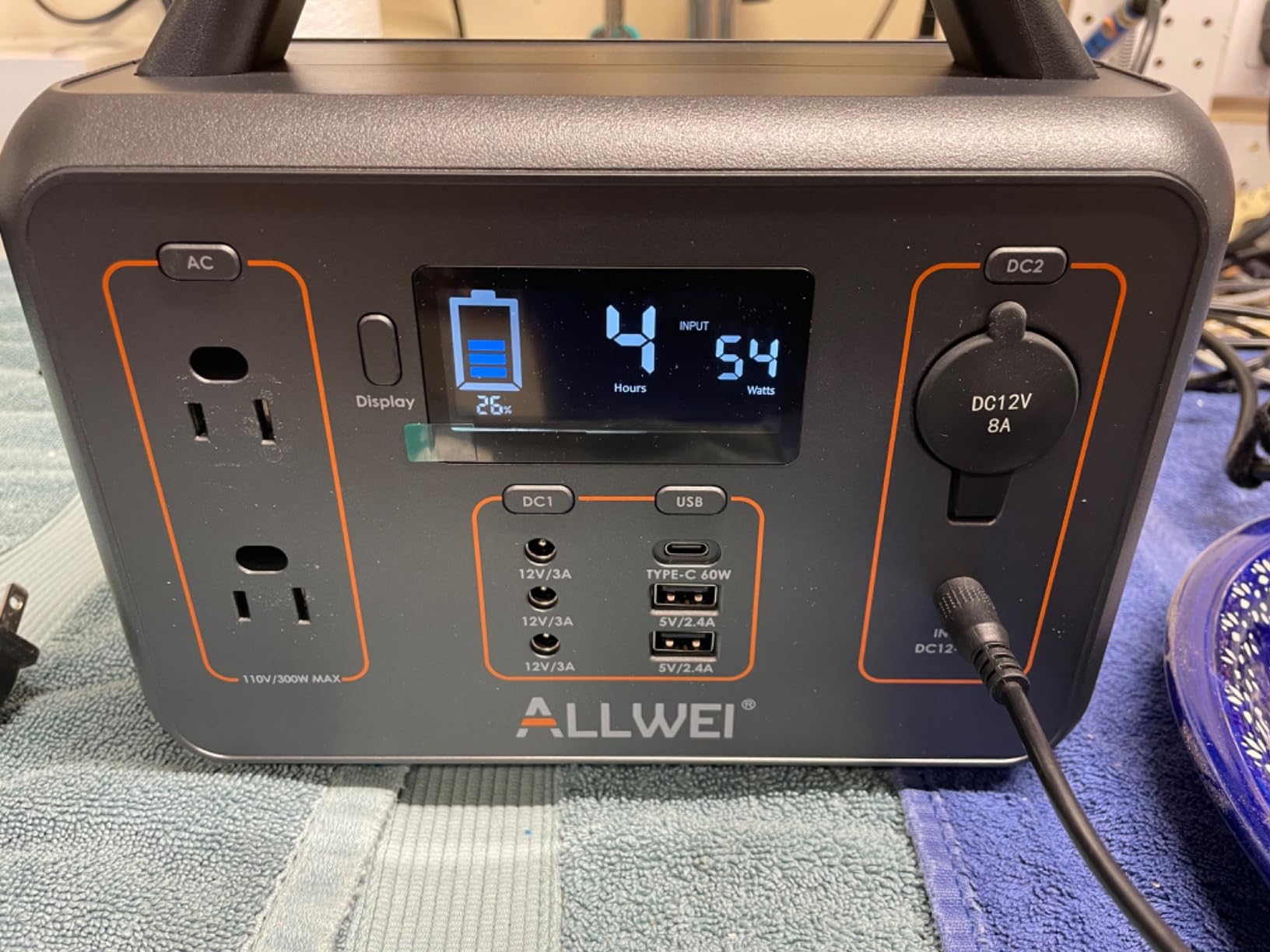
Recharging is flexible: 3.5 to 4 hours from a wall, the same from a 12V car socket, 4 to 5 hours from a 100W panel, and 2 to 2.5 hours when you run AC and solar at once through the built-in MPPT controller.
Storage behaviour is genuinely good. Owners report negligible standby drain, which matters for a device that lives in a garage between trips and needs to hold charge when you pull it out months later.
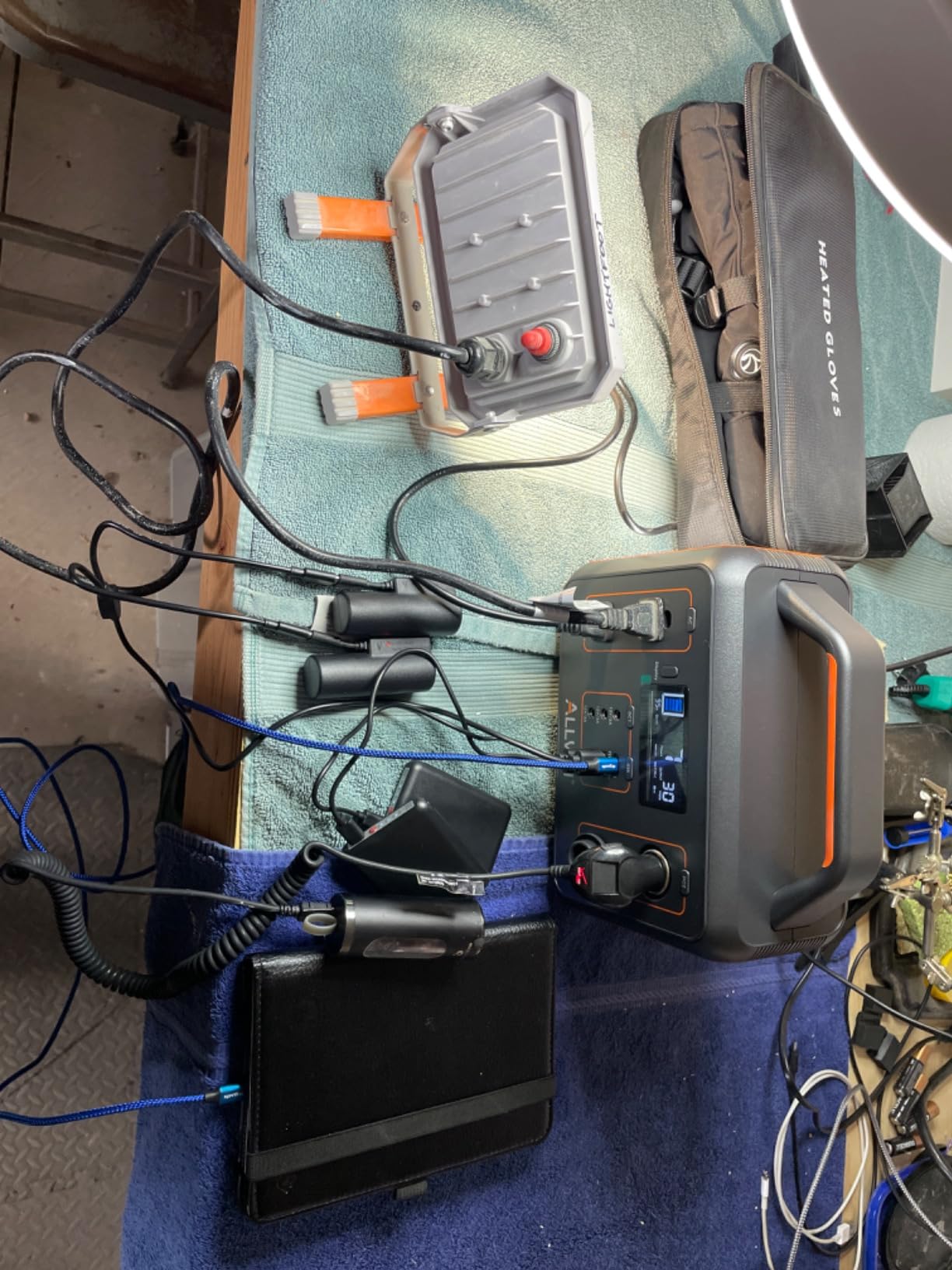
Why the small display readout matters
Most budget stations show four bars and leave you guessing. Runtime hours and exact percentage turn a planning problem into arithmetic, and that is how you avoid topping up the one machine you cannot afford to interrupt.
The 60W USB-C PD port charges most laptops directly, which sidesteps the inverter and the losses that come with it. Six outputs in total including a car port and a USB-A at 18W.
Where it falls short
The 100W solar ceiling is the main one. Owning a 200W panel does nothing for this station, so plan on wall and car charging and treat solar as a top-up.
A minority of owners report the fan running loudly and later loss of charge capacity, and one reported the centre button shutting off only the display rather than the outputs. Test those functions on day one before you rely on them in the field.
6. ZeroKor 300W with 60W Panel – Lightest Boxed Kit
Portable Solar Generator 300W Portable Power Station with 60W Solar Panel
280Wh capacity
300W max pure sine wave AC
5.1 lb
60W panel included
Pros
- Station and 60W panel in one box
- Lightest bundled option at 5.1 lb
- Runs a 55 inch TV about 4 hours on a full charge
- Charges devices while still in use
- Customer service credited with sending replacements
Cons
- Measured AC output runs well below the 300W headline
- Included folding panel reported failing after repeated folding
- Solar charging is slow and inconsistent outdoors
- Panel junction box is not waterproof
ZeroKor is the shortest route to a working off-grid setup. The 280Wh station and a 60W monocrystalline folding panel arrive together, so there is no second order and no adapter hunting on the first night.
At 5.1 lb and 4.1 inches thick it is the smallest complete kit here, and the 280Wh capacity covers phones, cameras, a laptop and roughly four hours of a 55 inch TV.
The panel itself is useful beyond the station. It carries USB-A, USB-C and an 18V DC output for direct device charging, so you can top up a phone at midday without involving the battery at all.
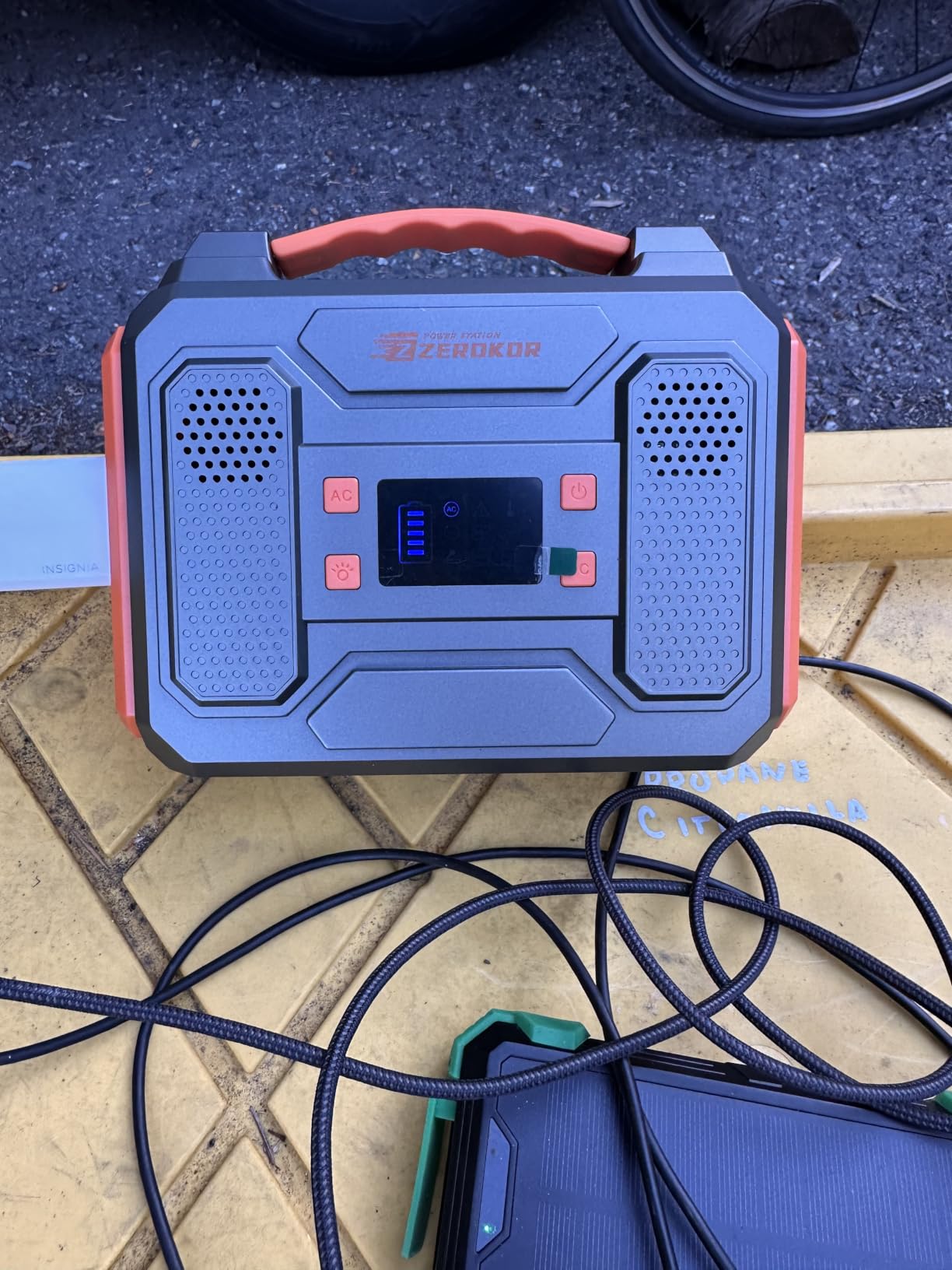
Charging in either direction works. The station recharges from a wall, from a 12V car port or from 13V to 23V solar through a built-in MPPT controller, and it will charge a device while it is running.
The BMS covers short circuit, over-current, over-voltage, overload and overheat, and there is a flashlight with reading and SOS modes, which is more useful than it sounds at a dark site.
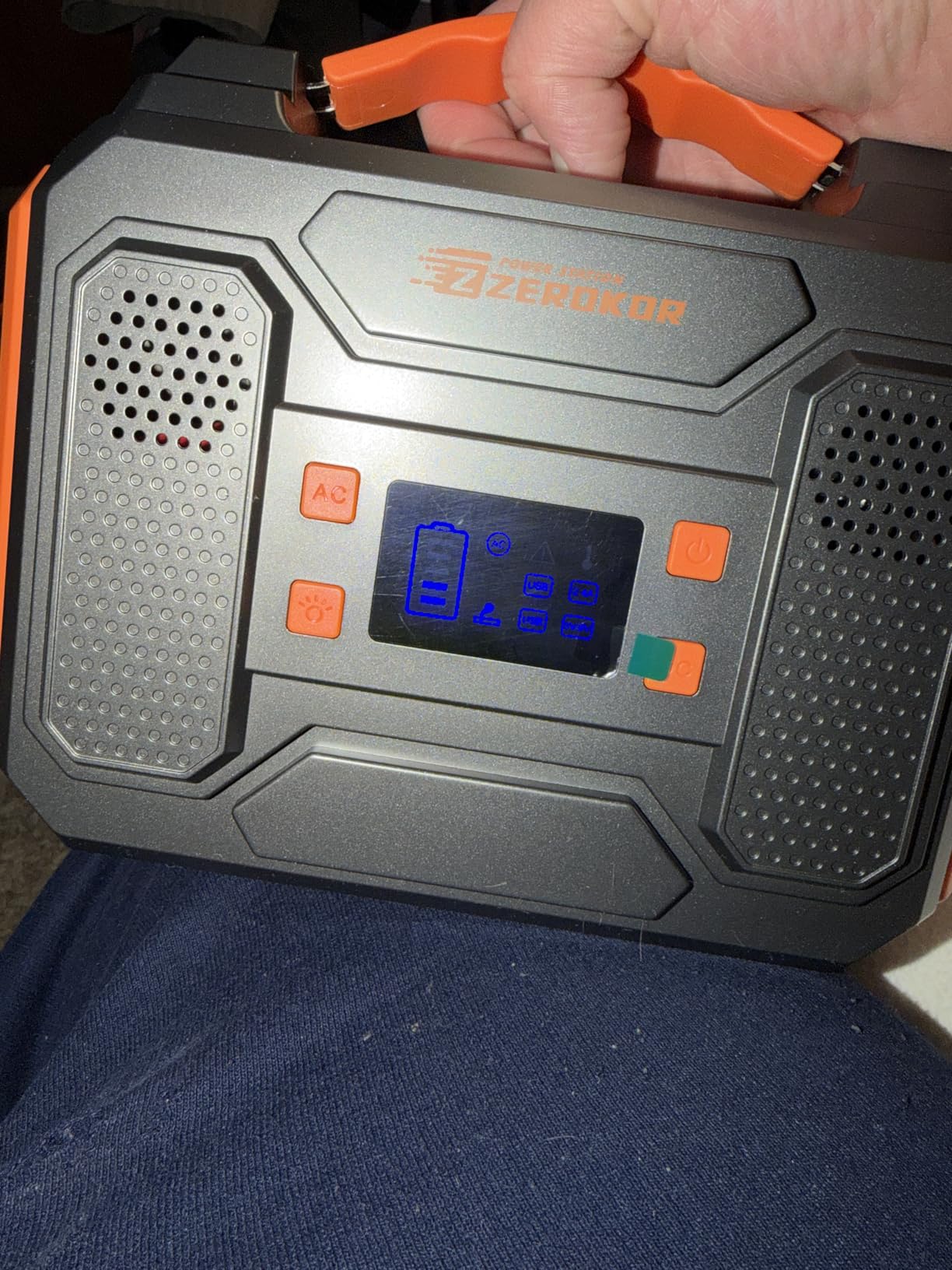
What the bundled panel actually does
At 20.5% conversion efficiency the 60W panel is unremarkable on paper, but pairing it with a 280Wh pack is a sensible ratio. Expect a full refill to take most of a sunny day.
Users report the fastest real-world solar gains when the panel is repositioned every few hours. Leaving a folding panel flat on a hot picnic table cuts output noticeably, so treat angle as part of the kit.
Where the kit falls short
The measured continuous AC output runs well below the 300W headline figure, and that gap drives a chunk of the 11% one-star reviews. If you need real watts, buy watts.
Several owners report the folding panel failing after repeated folding, and the junction box is not waterproof. Keep the station under cover during rain even if the pack itself would cope.
7. MARBERO 237Wh – Most Ports in the Smallest Box
MARBERO 237Wh Solar Generator with Solar Panel Included Portable Power Station 300W Pure Sine Wave with Foldable Solar Panel 60W Set for Camping Outdoor Hiking Fishing Emergency
237Wh capacity
300W rated and 375W peak
9 lb
60W panel included
Pros
- Solar panel included for a ready-to-go kit
- Two pure sine wave AC outlets plus USB-C PD
- LED flashlight with strobe and SOS modes
- 60W panel gives usable recharge in daylight
Cons
- 237Wh is among the smallest capacities here
- Continuous output must stay under 300W
- Listed 1 hour runtime does not match real use with typical loads
The MARBERO is the value pick for a first camping trip. You get the station and a 60W foldable panel in one package, which removes the single most common mistake new buyers make, buying a battery and realising on arrival that they have no way to refill it.
Port selection is unusually generous for the size: two AC outlets, two USB-A QC3.0, two more USB-A at 15W, one USB-C PD at 18W and a 12V DC output.
Both AC outlets are pure sine wave, which matters more than the port count if you plan to run anything with a motor or a sensitive circuit board.
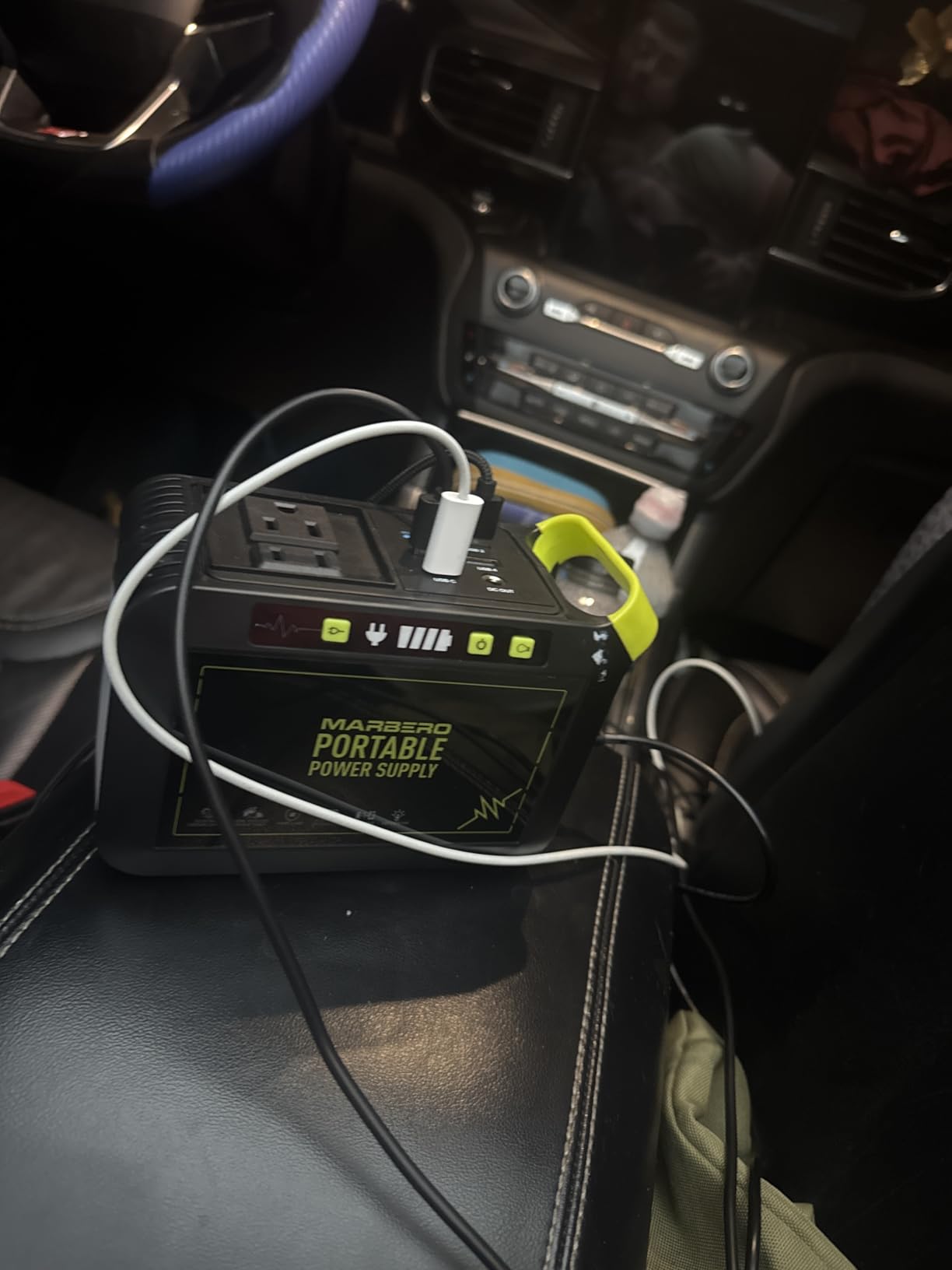
The panel cells run at 21.5% to 23.5% conversion efficiency, at the better end of the bundled panels in this group, and the foldable form keeps the packed footprint small.
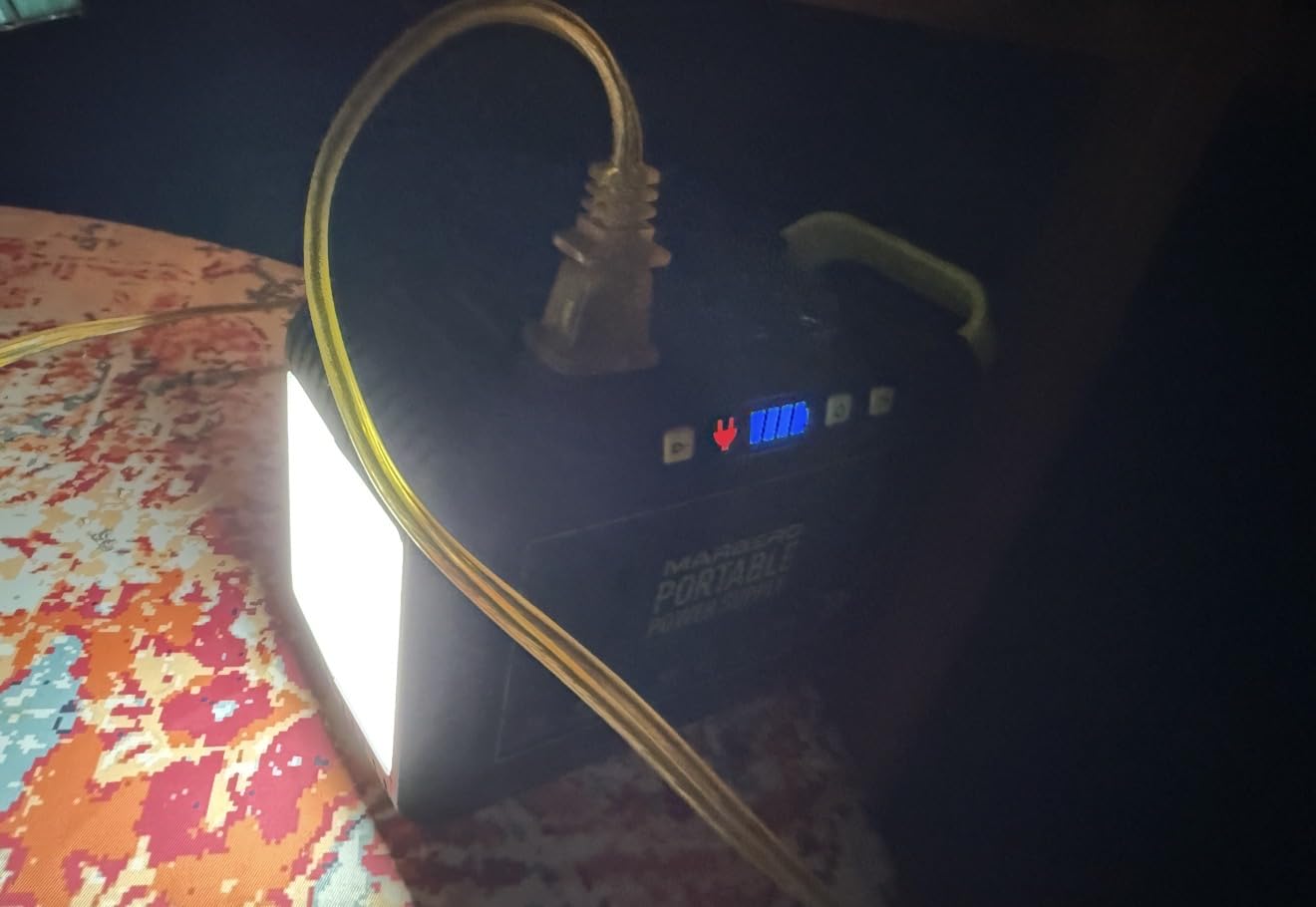
One feature worth calling out is the LED flashlight with standard, strobe and SOS modes. On an early arrival at a dark site, that replaces the headlamp you forgot.
Is 237Wh enough for two nights?
For phones, a camera battery, a laptop session and string lights, yes with room to spare. For a fridge, a CPAP machine or anything that runs all night, no, and no amount of panel changes that.
The 4.1 average rating with 12% one-star reviews traces back to that capacity ceiling. Buyers expecting a weekend power source find a weekend top-up machine.
Where the kit disappoints
Continuous output must stay under 300W or the unit shuts down, and the listed one-hour runtime figure does not hold up against typical mixed loads.
At 9 lb it is heavier than lighter bundles while storing less, so you are paying weight for the panel and the ports rather than for capacity. Warranty coverage is 12 months, the shortest here.
8. EnginStar R300 – The Only One With a 24V Output
EnginStar Solar Generator, 300W Portable Power Station, 296Wh Lithium Battery Backup w/Two 110V Pure Sine Wave AC Outlet for Camping Road Trip RV, 80000mAh Sufficient Power Supply for Blackout
296Wh capacity
300W pure sine wave AC
6.5 lb
24V DC barrel output
Pros
- Only model here with a dedicated 24V DC output
- Display shows live input and output wattage per port
- Quiet enough for overnight CPAP use
- Owners ran a 16 qt car cooler about 32 hours
Cons
- Shell is not weather sealed and ports are fully exposed
- Display lamps cannot be dimmed
- Wall recharge takes around 7 hours
- Some models need regular topping up
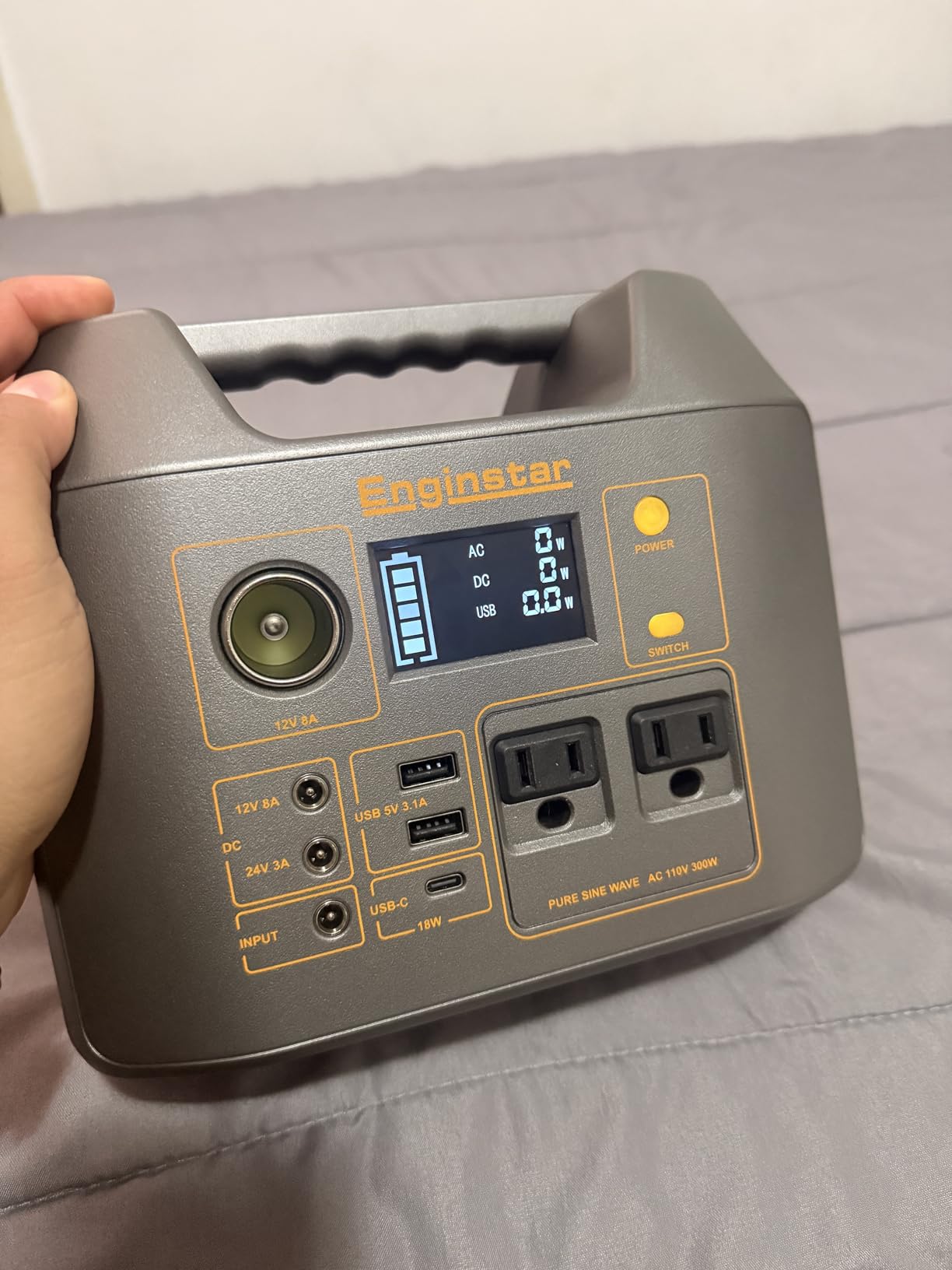
The R300 earns its place for RV and van campers with 24V gear. It is the only station in this group with a dedicated 24V DC barrel output, alongside the usual 12V car port and 12V DC socket.
Eight total outputs include three USB ports, one of which is USB-C at 18W. At 6.5 lb it packs about as light as the units around it while offering more voltage options.
Owners report running a 16 quart car cooler for about 32 hours while recharging from the vehicle, which is a realistic weekend number rather than a headline claim.
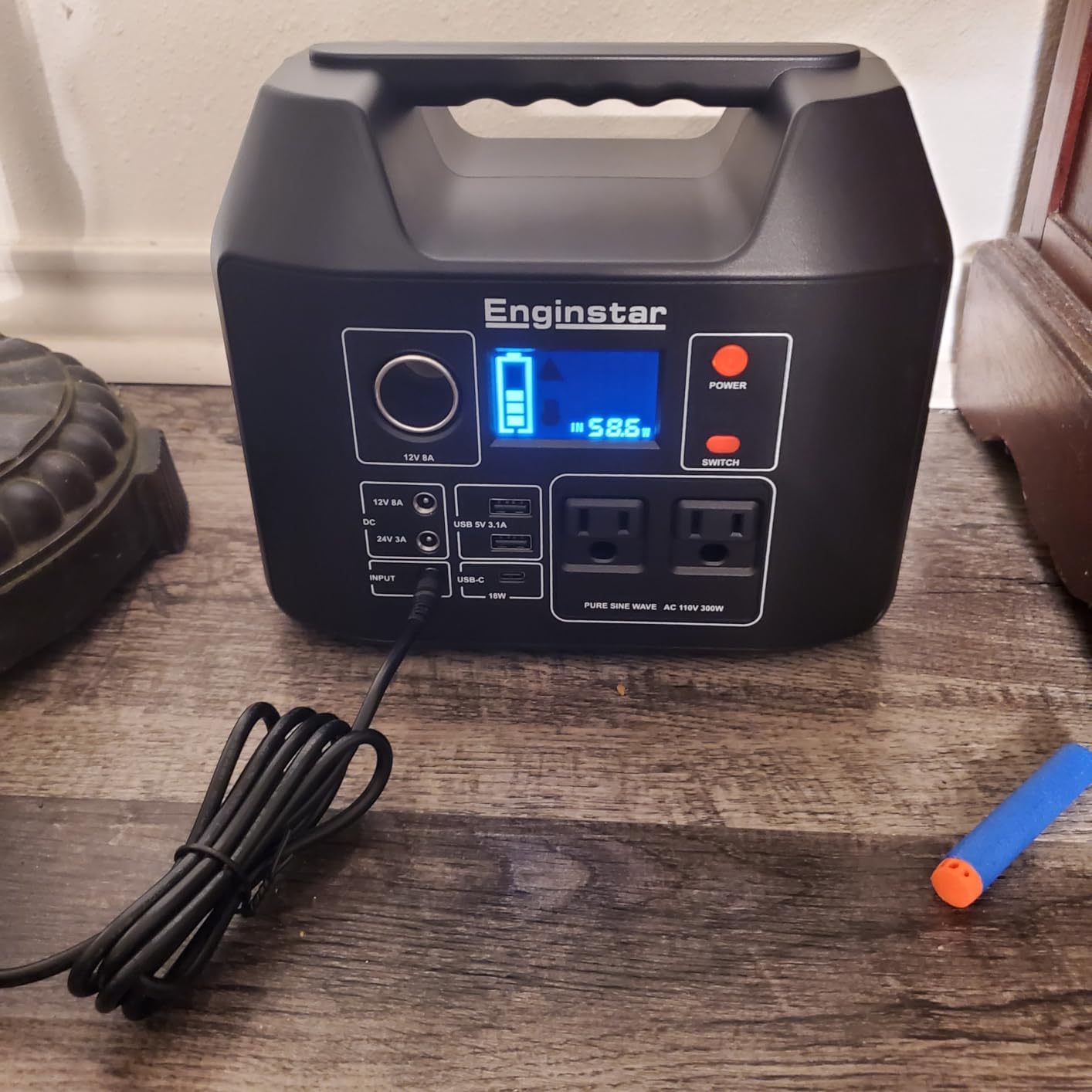
The display is the standout here. It shows live input and output wattage per port, so you can see what the cooler is actually pulling instead of guessing from a bar count.
Two pure sine wave AC outlets at 300W handle a fridge, a small TV and chargers, and reviewers confirm it is quiet enough to run a CPAP machine beside a light sleeper.
Who the 24V output is really for
If you run 24V gear directly, this removes an adapter and a converter from your kit. That matters in a van where every cable is a decision about space and weight.
Reviewers also rate it well on value against larger-branded alternatives, with two-year-equivalent protection from a five-layer system covering overload, over-discharge, overcharge, overheat and short circuit.
Where it falls short outdoors
The plastic-and-aluminum shell is not weather sealed and the ports are fully exposed to dust and rain. In real camp weather, keep it in a dry bag or under the vehicle canopy.
Display lamps are very bright with no dimming option, which is annoying in a tent, and a full wall recharge takes around 7 hours, the slowest in this group.
9. BLUETTI Elite 100 V2 – Strongest Performer in the Set
BLUETTI Solar Generator Elite 100 V2 with 200W Solar Panel Included, 1024Wh
1024Wh LiFePO4
1800W continuous and 3600W surge
25 lb
200W panel included
Pros
- Highest rated model here at 4.7 with 87% five-star reviews
- 1800W output covers coffee makers and fridges
- Fastest wall recharge at about 70 minutes
- Silent mode at 30dB for overnight use
- 10ms UPS keeps routers running
- 200W panel included for off-grid use
Cons
- 25 lb is heavy for pack-in camping
- 200W panel is packed separately from the station
- Panel output drops well below nameplate in poor conditions
- App does not show amps and volts
The Elite 100 V2 has the strongest rating in this group at 4.7 across 975 reviews, with 87% of buyers giving five stars. It pairs 1,024Wh of LiFePO4 capacity with 1,800W of continuous output, a combination that usually costs far more.
Refill is the fastest here. Full charge in about 70 minutes through 1200W TurboBoost AC, 0 to 80% in 45 minutes, and up to 1,000W of solar input if you build an array beyond the included panel.
The included 200W panel brings it from flat to full in about seven hours, and 0 to 80% in four. Owners consistently point to real-world solar yield falling short of panel ratings as the main caveat.
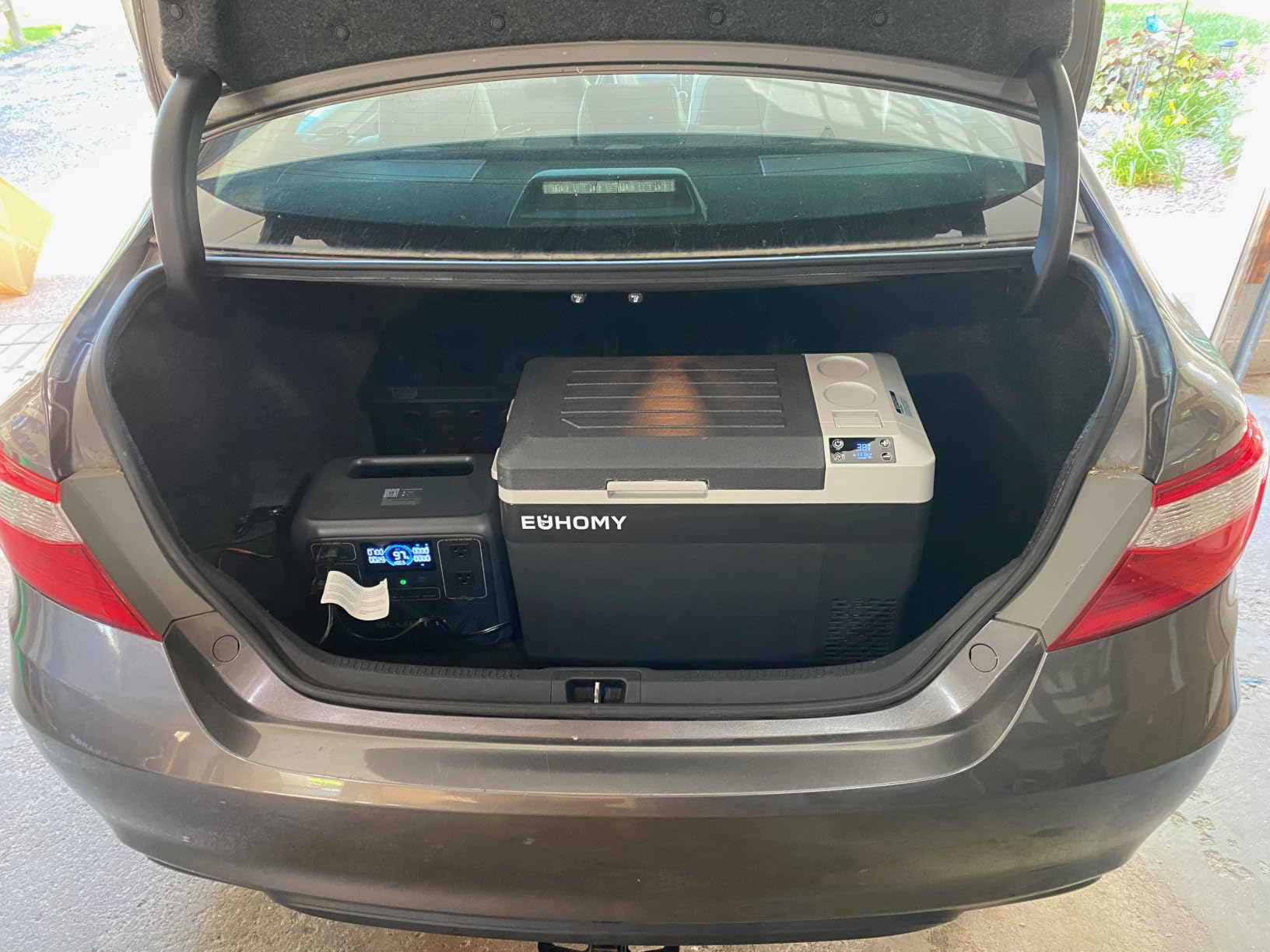
Two features matter specifically for overnight camping. Silent mode holds operation at 30dB, and the 10ms UPS switchover keeps routers, laptops and monitors running through a cut without a reboot.
Eleven output ports cover the range, and app control works over both WiFi and Bluetooth so you can check state of charge from the tent without walking over.
Where the 1,024Wh pays for its weight
At 25 lb it is a car-side box, but it is light enough that one person can lift it out of a trunk with a decent technique. It is the right size for van life where the station stays with the vehicle.
Owners use the 1,800W output for coffee makers, fridges, drones and camera batteries, and the 4,000-plus cycle rating means it will outlast most camping gear you will buy alongside it.
Where it disappoints
The 200W panel is packed separately from the power station, so plan for two deliveries arriving on different days and keep the box until the panel shows up.
The app reports wattage without amps and volts, which makes diagnosing a slow solar day harder than it should be. Repositioning the panel through the day matters more than the app readout.
10. Jackery Explorer 1000 v2 – Full-Size Fridge Power
Jackery Solar Generator 1000 v2 and 200W Solar Panel,1070Wh,1500W AC
1070Wh LiFePO4
1500W AC and 3000W surge
23.8 lb
200W panel included
Pros
- Ran a full-size side-by-side refrigerator for 9 hours
- 1500W handles microwaves and cooktops
- One-hour emergency recharge via the app
- LiFePO4 build rated for 4000+ cycles
- 200W panel outruns a running fridge
Cons
- Station and panel arrive in separate boxes
- Panel sags in wind and needs weighting
- Panel cable is very short and forces partial shade
- One-hour mode shortens battery life
The Explorer 1000 v2 is the model to buy when you want a real refrigerator. Owners report running a full-size side-by-side for 9 hours on a single charge, and one engineer reviewer powered an amateur radio station drawing 100W to 800W for more than five hours.
At 1,070Wh with 1,500W continuous and 3,000W surge, this covers microwaves, cooktops, coffee makers and hair dryers on low without the constant anxiety that smaller stations create.
The 200W panel included in the box charges the unit faster than a running fridge drains it, which is the calculation that actually matters for a week-long trip.
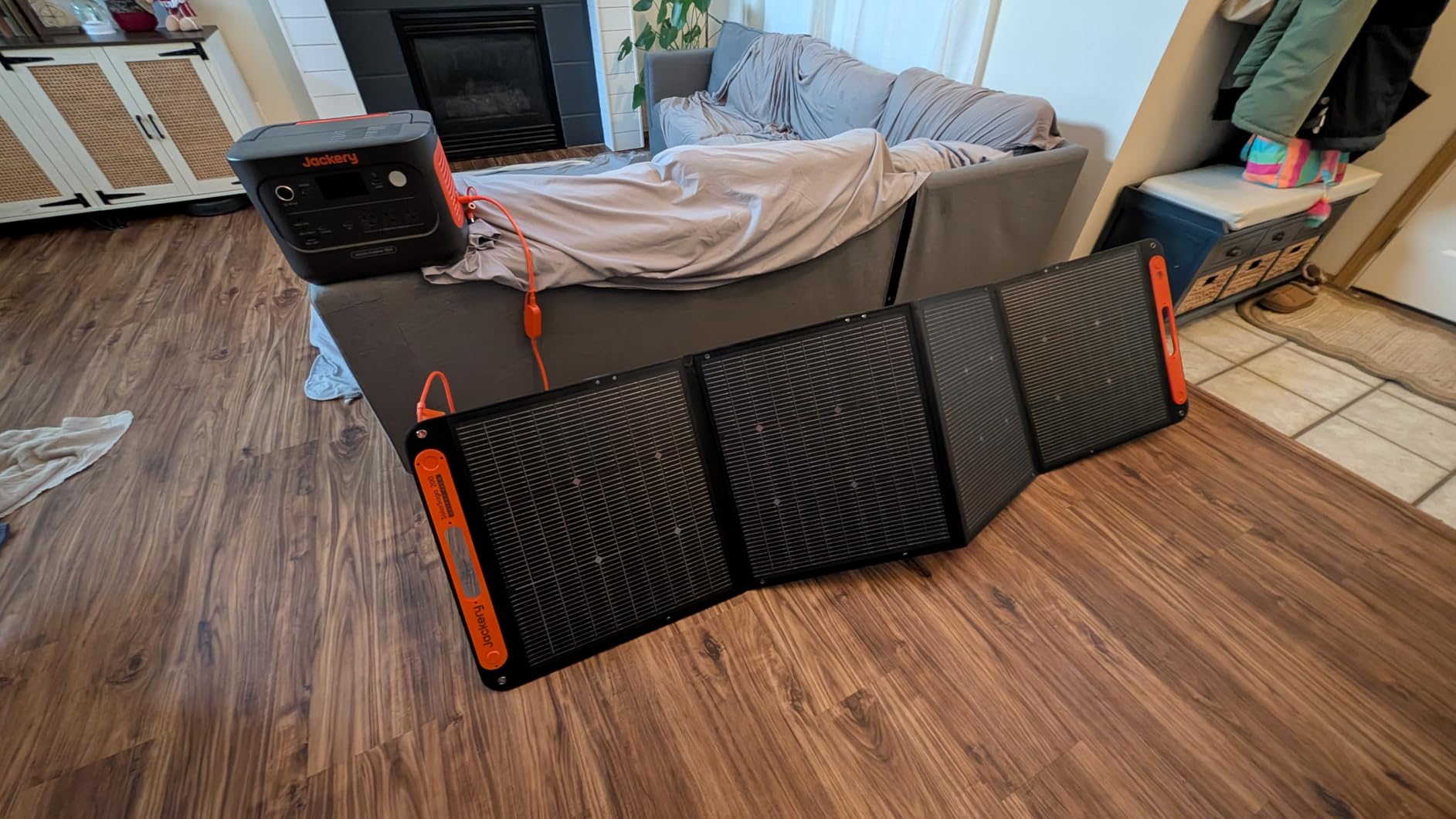
Charging options are unusually flexible: one-hour emergency fast charge through the app, 1.7 hours on the default setting, three hours with a 600W alternator charger, and 80% in about six hours from the included panel.
There is a 30dB quiet charging mode and an energy efficiency mode, both controlled from the Jackery app, along with three AC outlets, two USB-C ports at 100W PD and a 12V car port.
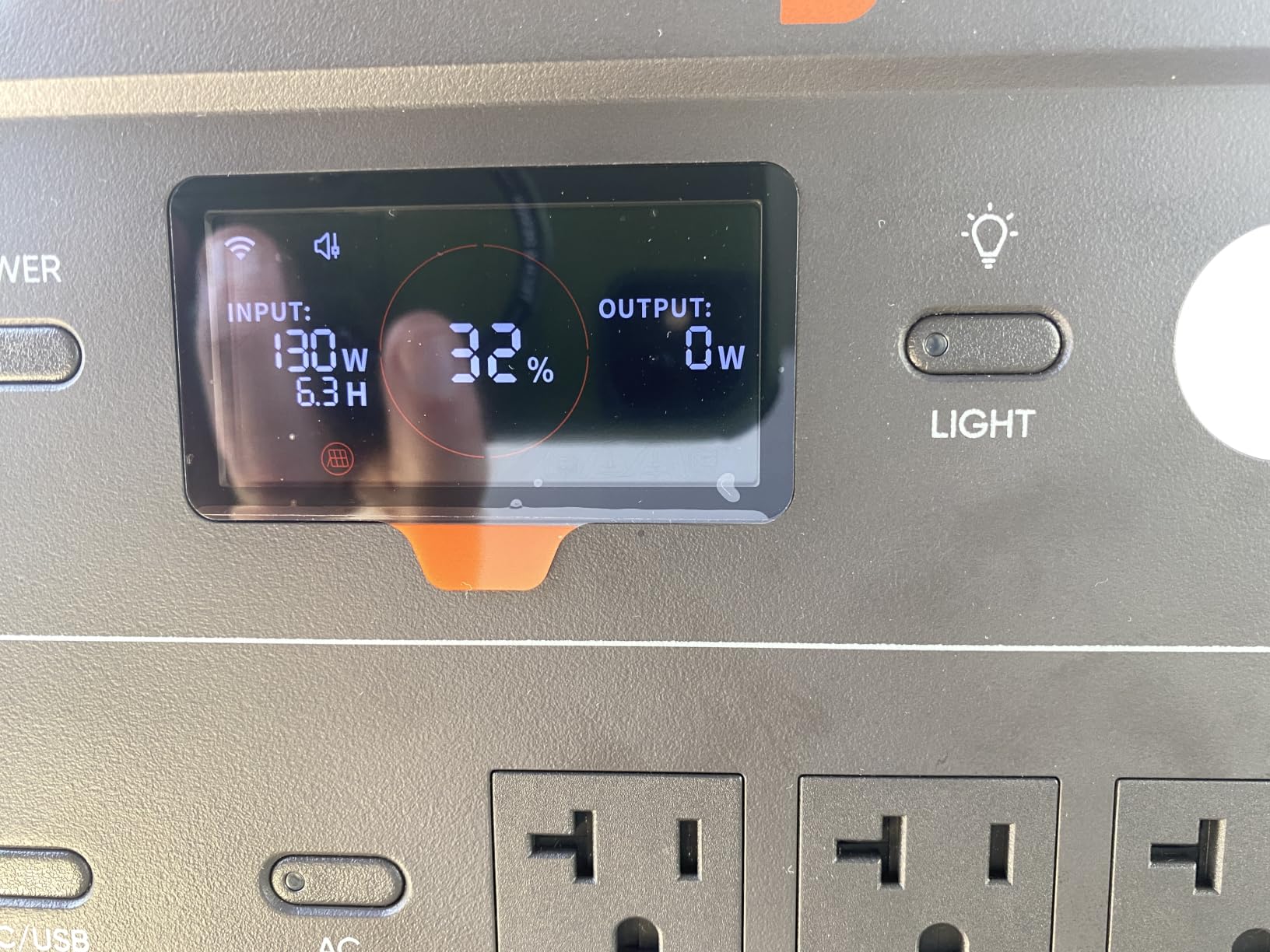
Why the fridge result changes trip planning
Nine hours of full-size refrigeration means you can sleep until dawn without topping up, and the 3,000W surge absorbs the compressor spike that trips smaller units at exactly the wrong moment.
The LiFePO4 pack retains more than 70% capacity after 4,000 cycles, which owners describe as a sturdier build than generic alternatives at the same output level.
Where the solar setup frustrates people
The station and the panel arrive in separate boxes, so do not plan a same-day departure. The panel also sags in the middle and needs weighting or frequent repositioning in wind.
The panel-to-station cable is very short, which forces the unit into partial shade unless you reposition both. The one-hour charging mode requires the app and shortens battery life, so use it for emergencies rather than as a habit.
How to Choose a Solar Generator for Camping Trips
Spend ten minutes on this section and you will spend less time second-guessing the purchase later. The four numbers that decide everything are capacity in watt-hours, continuous inverter watts, solar input watts, and weight.
Calculate the watt-hours your trip needs
Add up the wattage of everything you plan to run, multiply by the hours you need it, and divide by 0.8 to account for inverter and conversion losses. That gives a floor, not a target, so aim for double it if you cannot recharge on site.
Working examples for a two-person weekend: a 40W mini fridge cycling 12 hours draws about 480Wh; a 60W coffee maker used three times adds 180Wh; string lights at 10W for eight hours add 80Wh; a phone charging twice a day adds about 25Wh; a 60W CPAP for eight hours adds 480Wh. Total roughly 1,245Wh, so a 1,000Wh station with no solar is tight and a 1,100Wh unit with a 200W panel is comfortable.
Short trips invert the calculation. For one or two nights of phones, a camera battery and a laptop, 250Wh is enough. The light models here all handle that with room to spare.
Match the inverter to your biggest appliance
Watts and watt-hours are different things. Watt-hours are how much energy the battery stores; watts are how fast it can deliver. A 1,000Wh station with a 300W inverter runs a 60W coffee maker for hours but cannot run a 1,400W microwave at all.
Check peak rather than continuous output for anything with a compressor. A fridge, freezer or water pump can draw three times its running wattage for a second at start-up, and a station with no surge margin cuts out mid-cycle.
Pair the right solar panel to the solar input
A panel cannot push more than the station’s input rating, so a 200W panel on a 100W input station simply does half the job it was bought for. Real-world yield also runs well below the panel nameplate, typically 60% to 85% depending on sun angle and weather, so plan on realistic numbers.
Match roughly like this: a 300W station takes a 60W to 100W panel, a 500W to 700W station takes 100W to 200W, and a 1,000Wh to 1,200Wh station with 500W or 1,000W input can take 200W and more. Reposition the panel every few hours rather than leaving it flat on a hot surface, where output falls noticeably.
Budget weight by how far you carry
Under 8 lb is one-person territory from the car to the pitch. From 10 lb to 15 lb is manageable if you park once. Above 20 lb you are looking at a vehicle-side box, and above 35 lb you should plan for two people or two stations rather than one heavy one.
Backpackers generally treat anything above 10 to 15 lb as too heavy and settle for 100Wh to 300Wh units that top up phones and camera batteries. That is a legitimate choice, just a different one.
Check connectors and port lighting
Solar connectors are not standardised. You will meet MC4, XT60, Anderson and DC8020, and mismatches mean buying an adapter or returning the panel. Check the connector type before you commit to a panel, not after it arrives at camp.
At night, a station with weak port lighting is frustrating to operate. Displays that show live input and output wattage per port also let you spot a failing panel in seconds rather than guessing why the battery is not filling.
Consider quiet operation and campground rules
Solar generators are silent, which is both the main reason to own one and the reason they are allowed where fuel generators are not. Some models run a cooling fan under load, and the BLUETTI Elite 100 V2 offers a 30dB silent mode for exactly that.
Plan for cold nights too. LiFePO4 chemistry tolerates low temperatures better than older lithium-ion packs, but charging a frozen or near-frozen battery is still something to avoid. Keep the unit indoors overnight in freezing conditions.
Frequently Asked Questions
What size solar generator do I need for camping?
For one or two nights of phones, a laptop and lights, 250Wh to 300Wh is enough. A 3 to 4 night trip with a mini fridge and camp lighting needs 500Wh to 700Wh. Anything running a CPAP machine, coffee maker or full-size refrigerator for several nights needs 1,000Wh or more. Multiply your total device wattage by hours of use, divide by 0.8 for inverter losses, and aim for roughly double that figure if you cannot recharge on site.
How long will a 1000 watt solar generator run a refrigerator?
A 1,000Wh station running a typical 40W mini fridge cycling about 50% of the time delivers roughly 20 hours. A full-size side-by-side drawing 150W or more will run closer to 9 hours on a 1,070Wh pack. Fridge duty cycle matters more than the label, so check the compressor rating before you leave home.
Which one is better, Jackery or EcoFlow?
Jackery models tend to favour portability and a simpler experience, with the Explorer 300 weighing 7.1 lb and offering a 100W USB-C PD port. EcoFlow leads on refill speed, with the RIVER 2 reaching a full wall charge in about an hour. For car camping where you can charge overnight, Jackery is the easier carry. For fast top-ups between trips, EcoFlow is faster.
How many watt hours do I need for a weekend camping trip?
For two adults with a fridge, lights, chargers and a coffee maker over three days, plan on 1,200Wh to 1,500Wh of usable capacity, which means a 1,000Wh to 1,150Wh station. Drop below 500Wh and you will be running appliances in shifts. Two smaller stations often work better than one heavy one if you park once and stay put.
Do solar generators work in cloudy weather?
They work, but output drops sharply. Expect a panel to deliver 60% to 85% of its nameplate in good sun and considerably less under cloud or late-day light. That is why a 200W panel rarely refills a 1,000Wh station in one day. Charge from a wall or your vehicle before you leave and treat solar as a supplement.
Can I run a CPAP machine off a portable power station?
Yes, on a pure sine wave output, which every model listed here provides. A 30W to 60W CPAP running eight hours consumes 240Wh to 480Wh, so a 256Wh unit covers one night and a 519Wh or larger unit covers several nights before a refill. Owners of the ALLWEI and EnginStar units report overnight CPAP use as their main reason for buying.
Conclusion
The best solar generators for camping trips come down to how far you carry and what you need to run. The Jackery Explorer 300 wins our top spot for weight, cycle life and a USB-C PD port that charges a laptop without an inverter, and its 11,273 reviews make it the safest pick in the group.
If you run heavy appliances, the BLUETTI AC180 and Jackery Explorer 1000 v2 cover fridges and coffee makers, while the BLUETTI Elite 100 V2 pairs a bundled 200W panel with 1,800W of output for van life. Match your panel wattage to the station’s solar input, top up from a wall before you leave, and pick something you can lift from the car without needing help.