
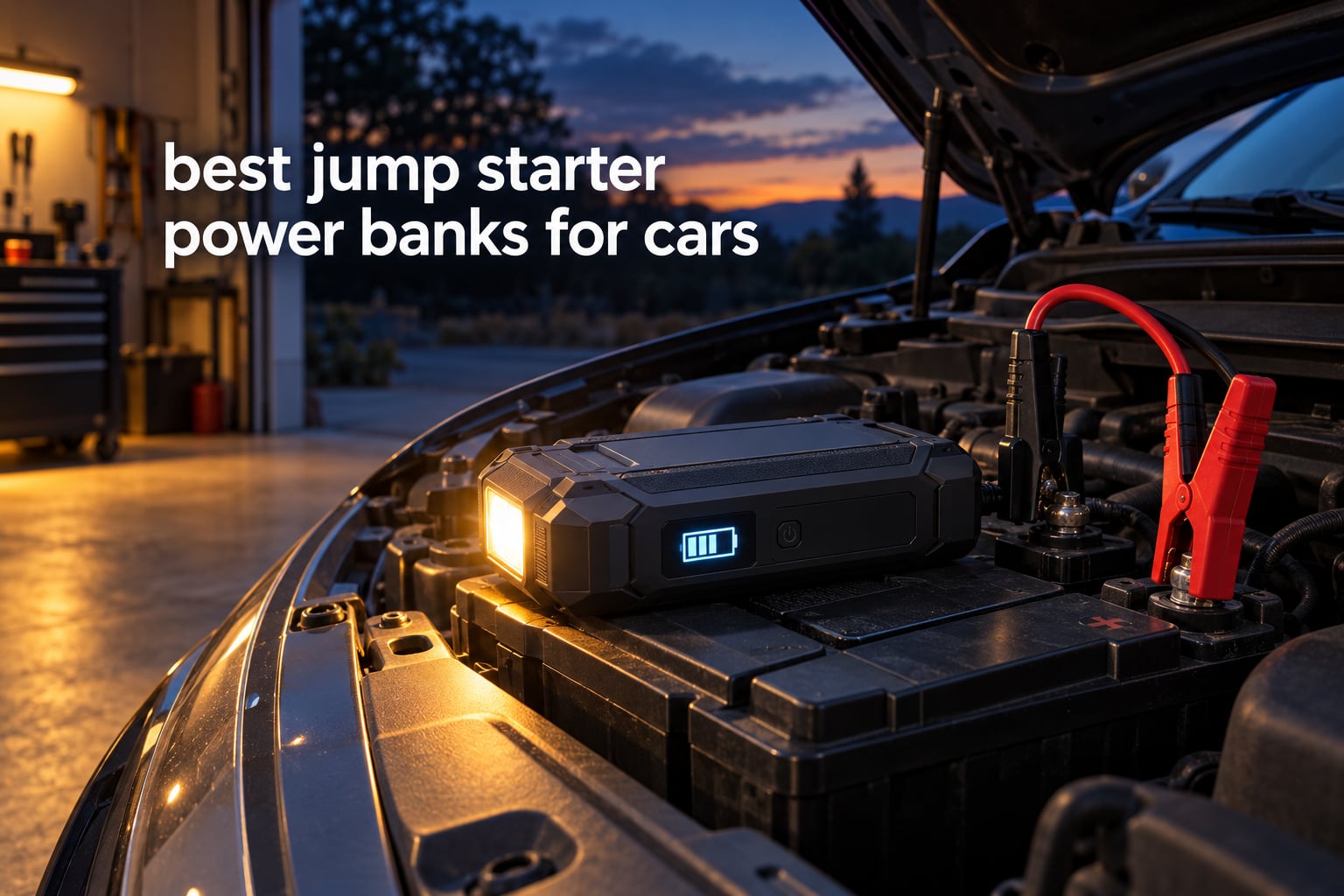
If you want the single best jump starter power bank for cars right now, take the Hulkman Alpha85. It carries a 2000A peak rating, a 20000mAh (74Wh) cell, an IP65 shell and a 65W wall charger that refills it in about 90 minutes, and it holds enough charge in a glovebox through a full winter to start a big V8 pickup on a morning when your car battery has completely died.
That last part matters more than the headline amp number. A dead 12V battery is the most common roadside failure there is, and traditional jumper cables solve it only if you can find another car, park nose to nose in traffic, and talk a stranger into helping you in the rain. A jump starter power bank is a self-contained lithium pack with built-in clamps that fits in a glovebox, doubles as a USB power bank for your phone, and lights up the engine bay with an LED work light when you connect it at 6 a.m. in January.
Over the past several months our team has worked through eight of the highest-rated portable jump starters on the market, reading thousands of owner reviews, comparing the published electrical specs line by line, and paying close attention to the one complaint that shows up again and again in owner discussions: a pack that sat in a trunk for a year, slowly self-discharged, and was dead at exactly the moment it was needed. Everything in this guide is filtered through that lens. If you drive an SUV or a truck, our best portable jump starters for SUVs breakdown goes deeper on engine size.
What follows is the short version of what we learned, ranked and explained without the marketing spin.
Top 3 Picks: Jump Starter Power Banks in 2026

Hulkman Alpha85
- 2000A peak for 8.5L gas and 6.0L diesel
- 65W recharge 0-80% in one hour
- IP65 shell with 10-layer safety

DBPOWER Peak 3000A
- 3000A peak for 8.0L gas and 6.0L diesel
- 18000mAh USB power bank
- Included hardshell carry case

S ZEVZO ET03
- 4000A peak for 8.0L gas and 7.0L diesel
- Force-start for fully dead 0V batteries
- 500-lumen light plus storage case
Best Jump Starter Power Bank for Cars in October
All eight packs below sit in the same category and pass the same basic safety test: reverse polarity protection and a smart clamp that refuses to energise until it senses a correct connection. The differences that actually matter day to day are peak amperage, stored capacity in watt-hours, whether it can inflate a tyre, and what is in the box.
| Product | Specifications | Action |
|---|---|---|
| Hulkman Alpha85 |
|
Check Latest Price |
| DBPOWER Peak 3000A |
|
Check Latest Price |
| S ZEVZO ET03 |
|
Check Latest Price |
 WOLFBOX MV24 WOLFBOX MV24 |
|
Check Latest Price |
 Povasee A30 Povasee A30 |
|
Check Latest Price |
 HALO Bolt Air HALO Bolt Air |
|
Check Latest Price |
 AstroAI S8 AstroAI S8 |
|
Check Latest Price |
 TREKURE TK60 TREKURE TK60 |
|
Check Latest Price |
How We Picked and Tested These Jump Starters
We did not drain eight batteries in a laboratory to produce this list. What we did do was read the full owner review history for each model and weight the details that a spec sheet never tells you: does the unit actually hold charge for months, does the charger in the box work, do the clamps fit a big diesel truck battery, and what happens when you connect it wrong.
Every pick here had to clear three bars. It needed reverse polarity protection or a smart clamp that blocks output until the connection is correct. It needed a published safety protocol list rather than an unqualified marketing claim. And it needed a review base deep enough that the failure pattern is visible rather than anecdotal.
We also cross-read owner discussions, because that is where the maintenance reality shows up. The consistent theme there is that a jump starter almost never fails because the electronics are bad. It fails because the pack was flat, the terminals were corroded, or the car battery was so deeply discharged that nothing short of a proper charger would recover it. That single insight reshaped how we ranked this list, and it is why the storage section later in this guide matters as much as the amp numbers.
1. Hulkman Alpha85 – Best Overall Jump Starter Power Bank
Hulkman Alpha85 Smart Portable Jump Starter, 2000A Battery Booster Pack with LED Display, Flashlight, 74Wh Power Bank & Jumper Cable, 12V Jump Box for up to 8.5L Gas & 6.0L Diesel, Cars, SUVs & Trucks
2000A peak
20000mAh 74Wh
65W recharge in 90 min
IP65 shell
10-layer protection
Pros
- Starts 5.0L and 6.2L V8 trucks and full-size SUVs on a single charge
- 65W speed charge takes 0-80% in one hour and full in 90 minutes
- Owners report holding charge through a full winter with no meaningful loss
- TPU rubber and PC resin shell with IP65 weather sealing
- 2-year guarantee with responsive support
Cons
- Heaviest pack in the group at 4.5 pounds
- No carrying case in the box and no built-in air compressor
- Proprietary 16.8V fast charger input will not accept USB-C PD
This is the pack I keep within reach of the keys. The Alpha85 rated 4.7 across more than 13,000 owner reviews, and the pattern in those reviews is unusually consistent: people bought it once, forgot about it for a season, then pulled it out on a cold morning and it cranked a pickup truck on the first try. That is the entire job, and very few packs deliver it without a second attempt.
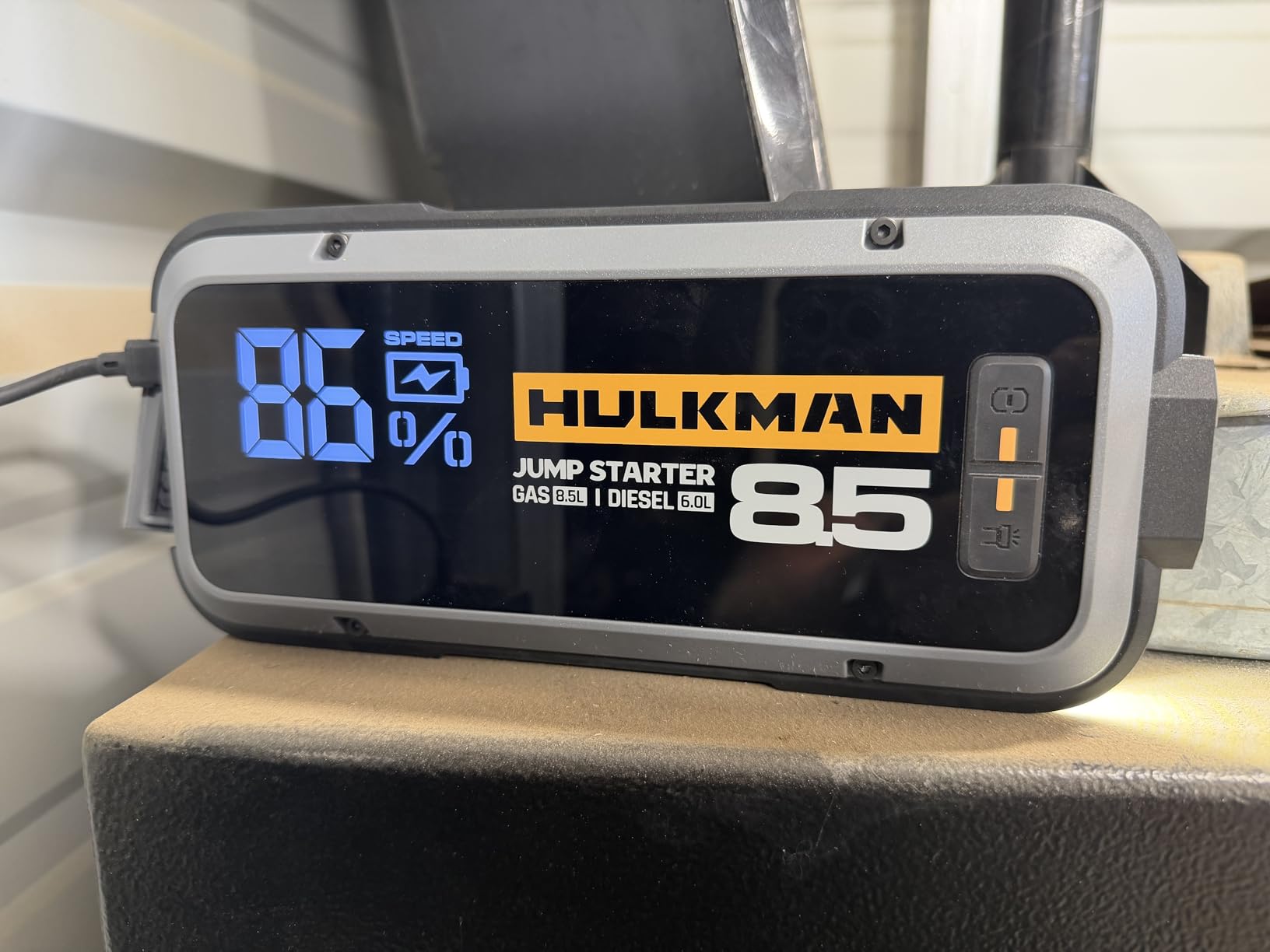
The physical design matters more than the spec sheet suggests. The body is a TPU soft rubber over high-strength PC resin, rated IP65 against rain, dust and impact, and at 9.06 by 4.06 by 1.82 inches it fits behind the passenger seat or under a seat without dominating the cabin. A 3.3 inch smart display shows battery level, operating status and error codes, which turns the single most common owner complaint into something you can read instead of guess at.
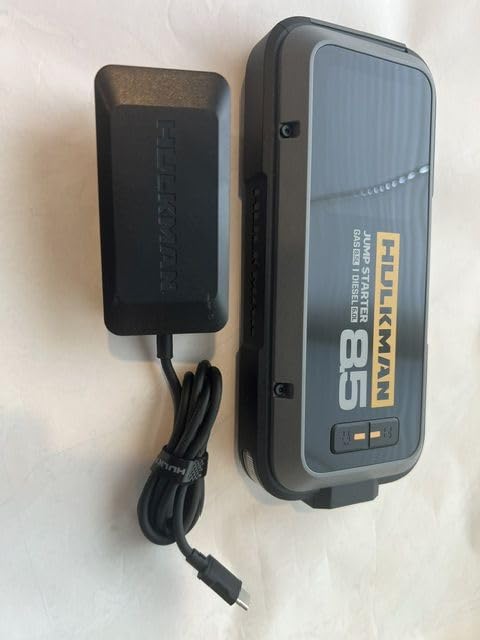
On electrical performance, the 2000A peak figure is more conservative than most rivals in this category, and that is deliberate. It claims coverage for engines up to 8.5L gas and 6.0L diesel with up to 60 jump starts per charge, backed by a 20000mAh (74Wh) cell and a 65W speed charge system. The multi-output array covers 15V 10A DC, USB-A QC3.0 and USB-C PD18W, so it can run a tyre pump, a 12V car fridge or a tablet without a second device.
Safety is handled by a 10-layer protection stack including spark-proof and mistake-proof clamps plus reverse polarity detection. You physically cannot energise the clamps onto a battery unless the polarity is right, which matters if you are crouched in sleet at 7 a.m. on a motorway.
What to check before you buy the Alpha85
Two things to know up front. There is no hard case in the box, and the 65W fast charger uses a proprietary 16.8V input, so you cannot refill it quickly from a USB-C PD charger you already own. Owners also note that the percentage readout is not load-compensated and can swing while current is flowing, so treat the number as a guide rather than a measurement.
It is also the heaviest unit here at 4.5 pounds. That is a real penalty if your plan is to carry it on a motorcycle or in a hiking pack rather than store it in a vehicle. At 4.5 pounds, the Alpha85 is a garage-and-trunk tool, not a backpack tool.
Who should skip it
Skip the Alpha85 if you need to inflate a tyre in the dark. There is no air compressor and the flashlight is a five-mode LED rather than a floodlight, so roadside work on a tyre needs a second device.
Skip it too if you fly regularly and want one pack that meets airline carry rules. For a pack you can toss in hand luggage alongside a laptop charger, our laptop power bank picks cover the charging side and the HALO Bolt Air below covers the travel-friendly jump side.
2. DBPOWER Peak 3000A – Best Budget Jump Starter
DBPOWER Peak 3000A 18000mAh Portable Car Jump Starter (up to 8.0L Gas, 6.0L Diesel Engine) Battery Booster with Smart Charging Port, Compass, LCD Screen and LED Light (Black/Red)
3000A peak
18000mAh
LCD with compass
Intelligent clamps
Hardshell case
Pros
- Deepest review history in the group at more than 18000 reviews
- Small enough for a glovebox at 1.1 pounds
- Handles cars trucks tractors motorcycles ATVs and boats
- Intelligent clamps with over-current and short-circuit protection
- Hardshell carry case keeps the kit organised
Cons
- Some units stall near full or refuse to accept a charge
- Smart USB ports are not quick-charge rated
- Needs a monthly top-up to stay jump-ready in long storage
The DBPOWER has more owner reviews than any other pack in this guide, and that matters in a category where most products are two years old or less. When a model has eighteen thousand reviews, its failure modes are well documented rather than anecdotal, and the overall pattern here is genuinely good.
Owners with old or seldom-driven vehicles describe using it on pickups, SUVs, motorcycles, ATVs and boats over multi-year ownership, and multiple-purchase households mention gifting it. At 1.1 pounds and 3000A peak, it covers engines up to 8.0L gas and 6.0L diesel, which is a wider envelope than the editor’s pick despite costing less.
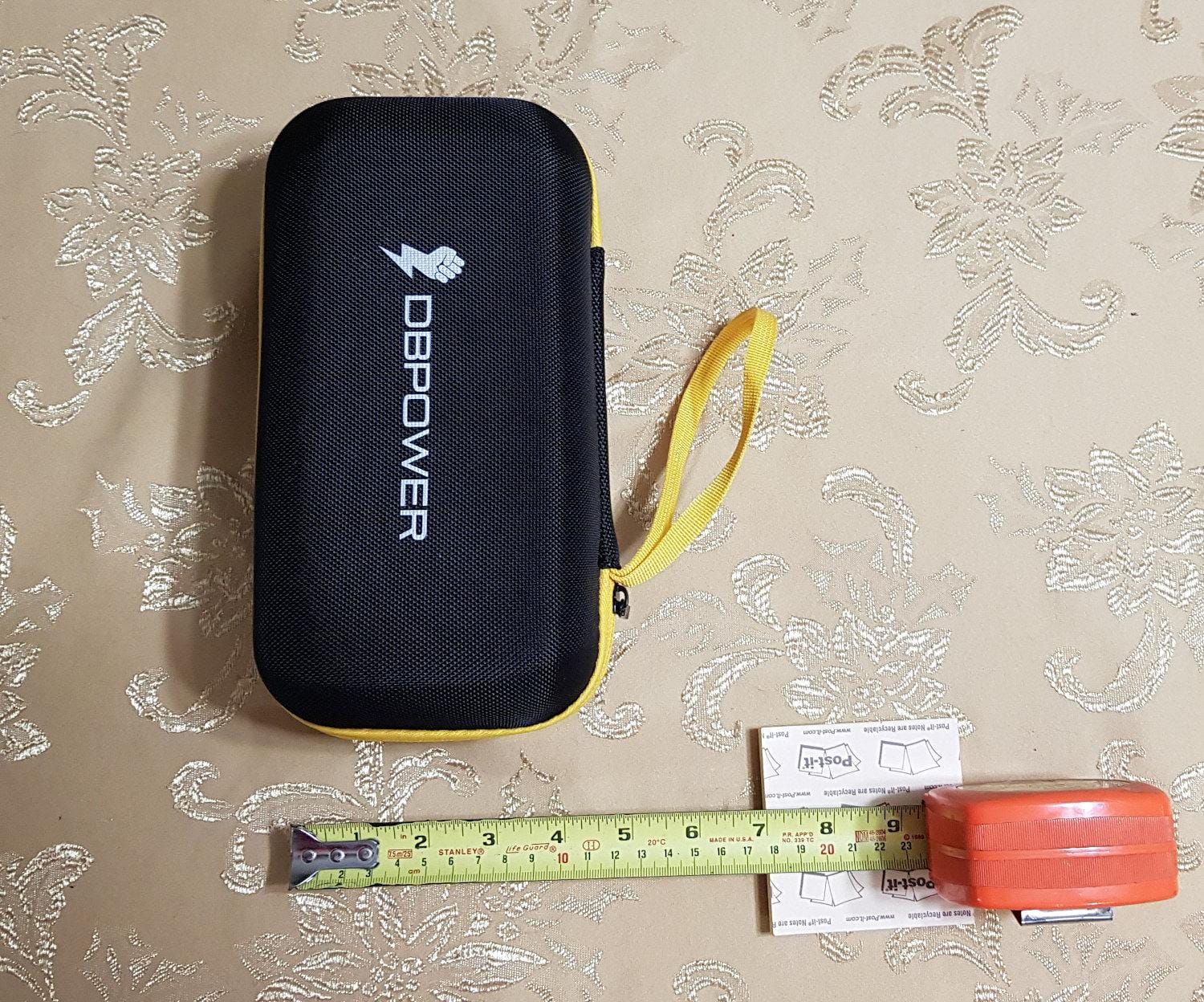
The extras are unusual for a budget unit. The LCD screen shows remaining power and doubles as a compass, which sounds gimmicky until you are on a rural road at night. The spray-gold intelligent clamps list protection against over-current, short circuit, overload, over-voltage and over-charge, and the 18000mAh cell doubles as a USB power bank for phones and tablets through a smart charging port.
The included hardshell case is the detail that keeps this near the top. Every other pack on this list that includes a case adds a soft sleeve or a pouch, so this is the one budget option where the storage problem is solved properly.
What to check before you buy the DBPOWER
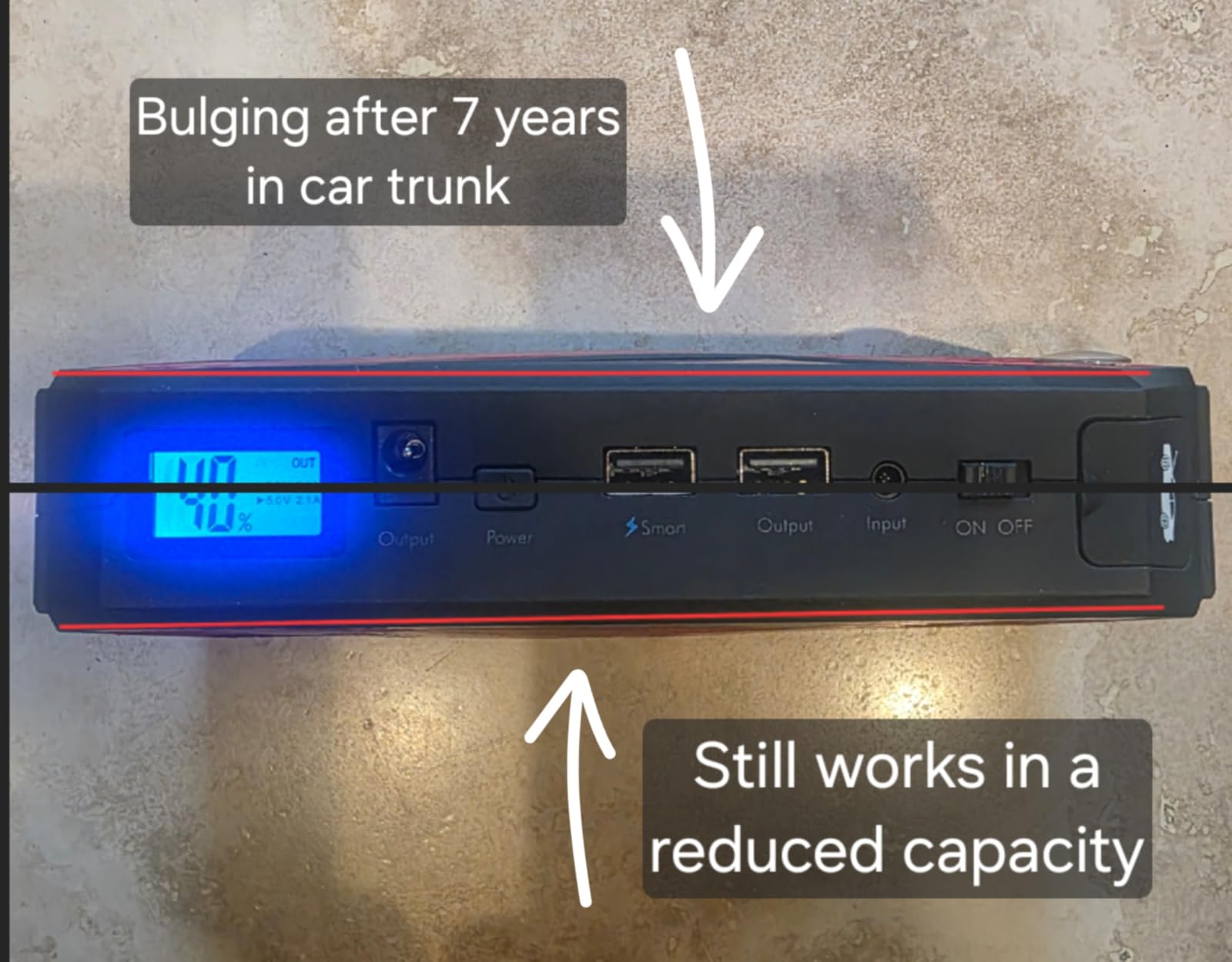
The recurring criticism in the reviews is charging behaviour rather than jumping. A portion of owners report units that will not accept a charge on the supplied cable or that sit just below full, so budget a few dollars for a spare USB cable and check the level indicator before you actually need it.
A second, smaller group reports receiving a unit that had already been returned and used. This is a fulfilment issue rather than a design flaw, but it is worth checking the packaging seal and the charge level on arrival. The USB output is also unrated for quick charge, so do not expect phone top-ups to be fast.
Who should skip it
Skip the DBPOWER if you will store it through winter without thinking about it. Self-discharge over long storage means it needs topping up roughly monthly, and the budget tier has the least headroom for that mistake. If your storage habit is set and forget, the Hulkman above tolerates neglect far better.
Also skip it if cold-weather cranking is your main scenario and you want the widest published temperature range. The DBPOWER does not publish a minimum operating temperature in the same way the Povasee and WOLFBOX do.
3. S ZEVZO ET03 – Best Value for Large Engines
S ZEVZO ET03 Car Jump Starter 4000A Jump Starter Battery Pack for Up to 8.0L Gas and 7.0L Diesel Engines, 74Wh Portable 12V Jump Box with USB Ports, LCD Display, Storage Case, and LED Light
4000A peak
20000mAh 74Wh
Force-start for 0V batteries
500-lumen flashlight
LCD screen
Pros
- 4000A peak covers 8.0L gas and 7.0L diesel with up to 50 jumps per charge
- Force-start function recovers completely dead 0V batteries
- Storage case and Type-C cable included
- 14F to 140F operating range with 24-month standby time
- 2-year manufacturer warranty
Cons
- Force-start only works when the pack is fully charged or above 14V
- USB outputs limited to 5V 2A with no quick charging
- No fast wall charger in the box
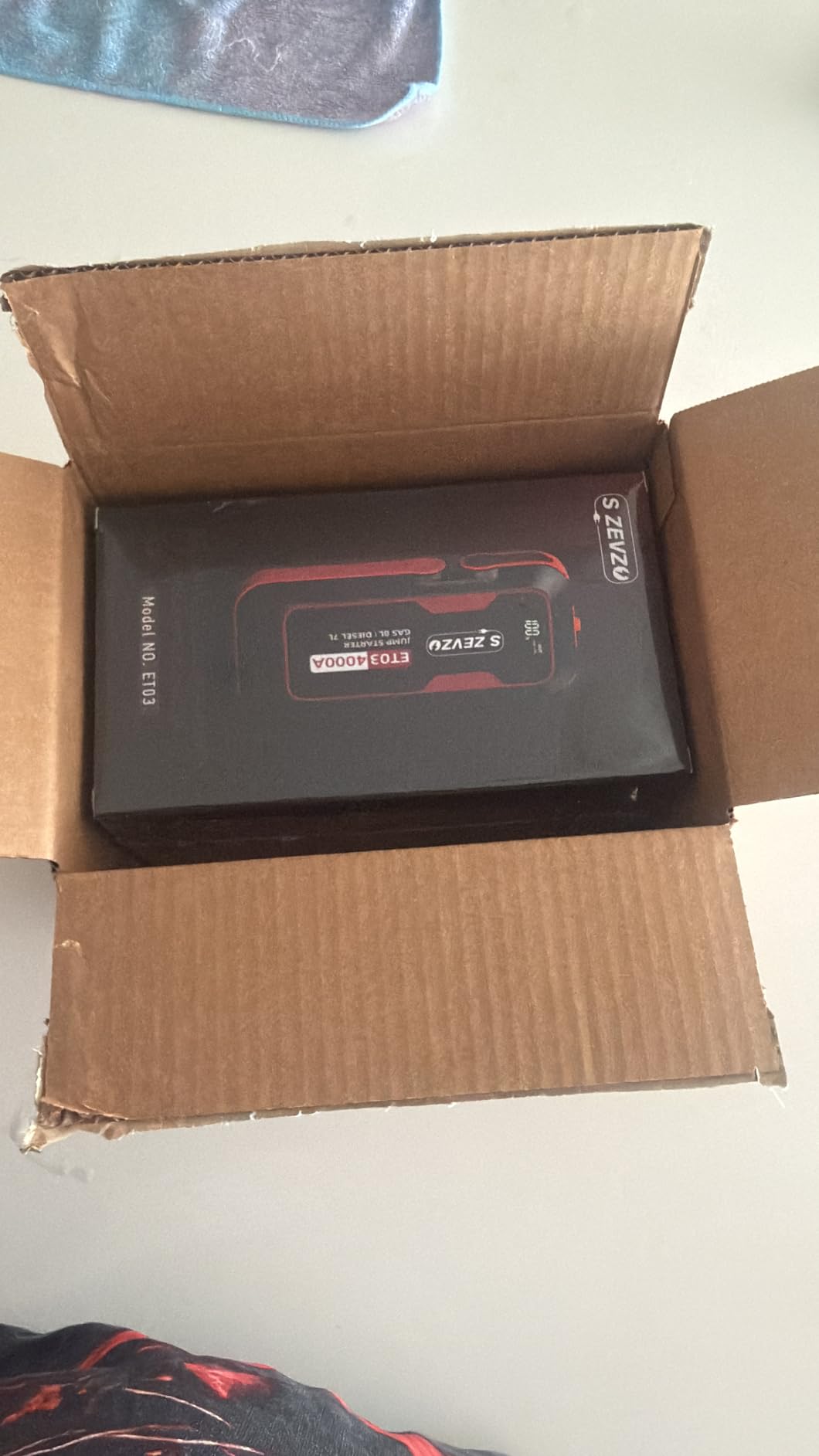
The ET03 is the one I recommend when someone asks which single pack covers the widest range of engines without stepping up to a premium brand. The claim is 4000A peak current covering 8.0L gas and 7.0L diesel, roughly 50 jump starts per charge, and a 20000mAh (74Wh) cell behind it.
What earns it the best value slot is the force-start function built into the smart clamps. When the pack detects a battery below its normal threshold, the clamps can be put into a force-start mode that recovers a completely dead 0V battery, which is exactly the scenario where cheaper packs refuse to do anything. There is a catch, covered below, but the capability itself is rare at this tier.
The 500-lumen LED flashlight with steady, strobe and SOS modes is brighter than most competitors, and the LCD status screen reports remaining charge. Working temperature runs from 14F to 140F with a 24-month standby claim, and ten intelligent safety protections give both a light and a beep on the clamp when something is wrong.
At 7.5 by 3.4 by 1.5 inches and 1.4 pounds, it is still small enough for a door pocket, and the included carrying case, Type-C cable and smart clamps make this one of the most complete boxes in the group.
What to check before you buy the ET03
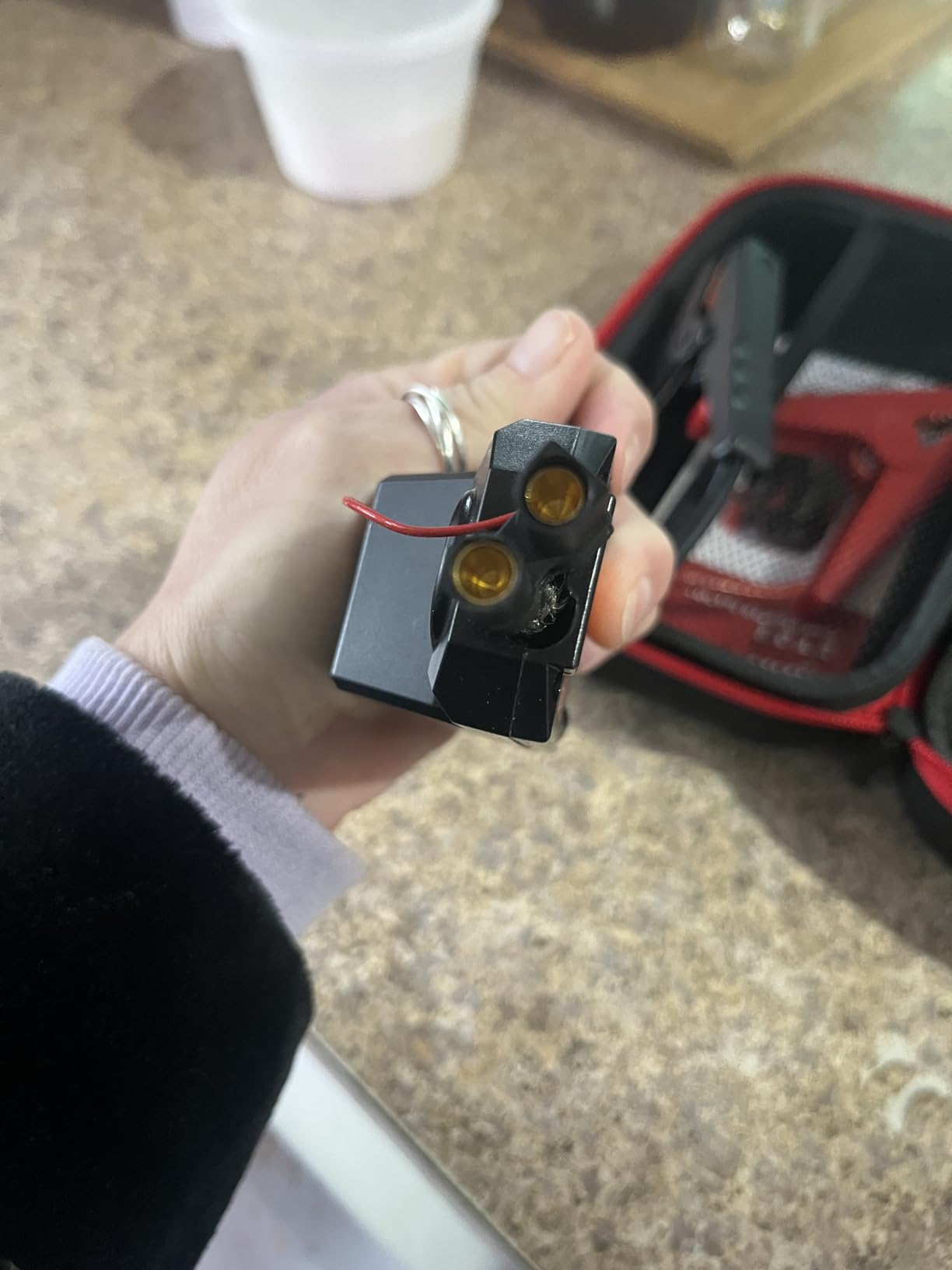
Force-start is not a magic mode. Owners report that it requires the pack to be fully recharged, or reading above 14V, before it will engage on a truly dead battery. If you skip a top-up for a year, force-start is exactly the feature that will not be available to you.
The second thing is charging speed. The two USB outputs are 5V at 2A with no quick-charge protocol, and no fast wall charger ships in the box. Plan an evening to refill it, or buy a wall adapter separately if you want it ready the next morning.
Who should skip it
Skip the ET03 if you live somewhere with hard winter cold and expect deep overnight freezes, because its published floor of 14F is the mildest low figure among the packs here that publish one. The Povasee below is rated to minus 22F and is the safer winter choice.
Skip it if you want to charge a laptop from the pack. At 74Wh without USB-C power delivery, this is a phone-and-tablet power bank, not a laptop charger.
4. WOLFBOX MV24 – Best for Charging Laptops and Phones
WOLFBOX 4000A Jump Starter,12V Car Battery Jumper Starter Portable with 65W Quick Charger,LED Display,88.8Wh Booster Jump Box Pack (10L Gas 10L Diesel Engine) with LED Light,Jumper Cables, MV24
4000A peak
88.8Wh capacity
65W USB-C in and out
QC3.0 USB-A
-4F to 140F range
Pros
- Largest power-bank capacity here at 88.8Wh with 65W USB-C in and out
- Full recharge in about 1.3 hours with the included PD65W charger
- 4000A output covers petrol and diesel engines under 10 litres
- Certified to UL FCC CE and CA65 with IP64 rating
- 2-year warranty
Cons
- Listed weight of 3 pounds is heavier than most compact rivals
- Box contents list may not include clamps on every package
- Battery capacity figure reads inconsistently against the 88.8Wh claim
Every pack on this list charges a phone. The WOLFBOX MV24 is the only one that also charges a laptop properly, because it carries a 65W USB-C port that works as both input and output alongside a QC3.0 USB-A port. On a road trip where the van is dead and the laptop is at 12 percent, that is the difference between finishing the day and losing the file.
The jump performance is not a compromise. The MV24 claims 4000A peak output covering petrol and diesel engines up to 10 litres, including trucks and boats, with a one-touch boost function for low-voltage starts and an LED flashlight with SOS, strobe and high-beam modes.
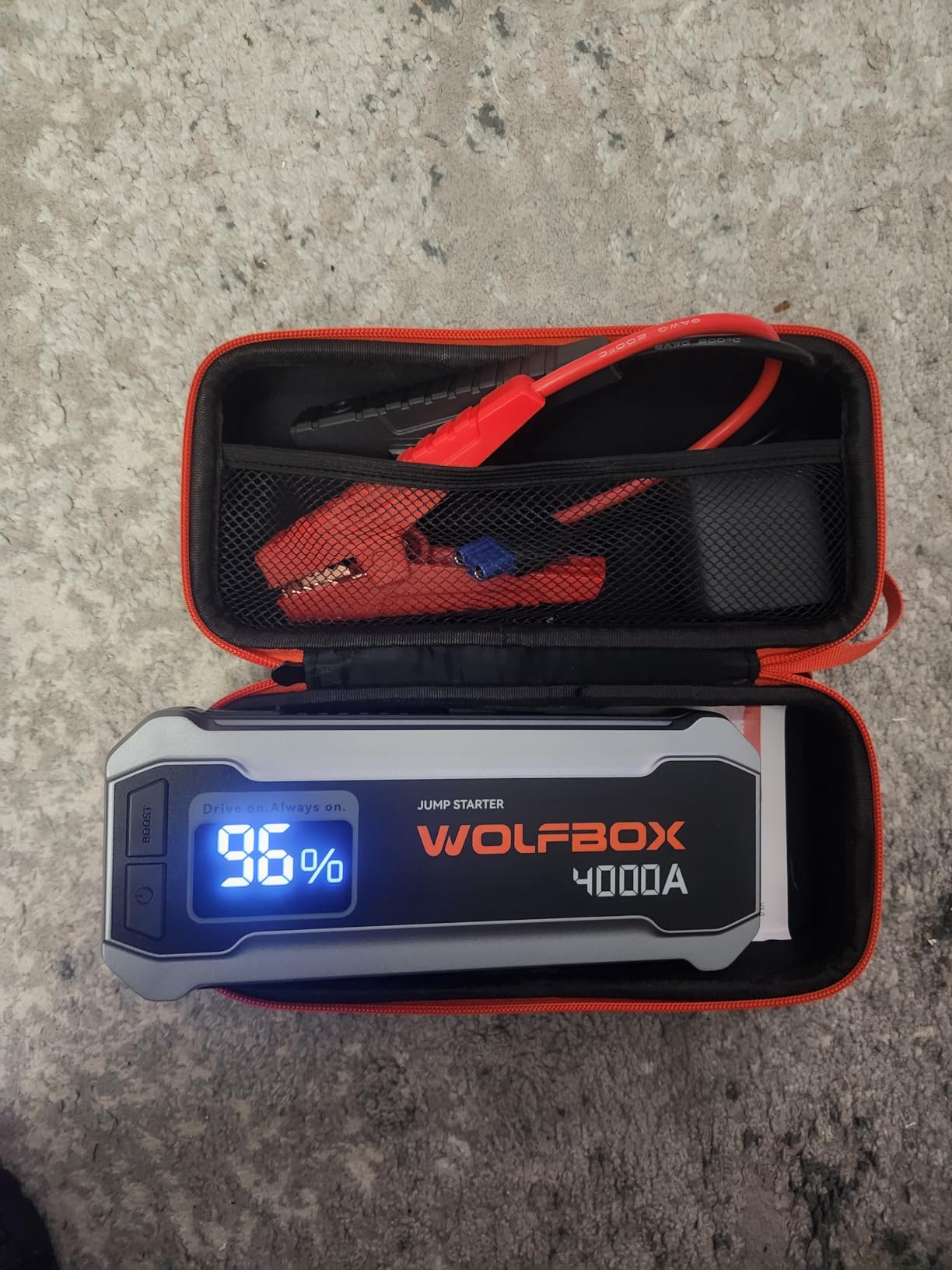
Temperature handling is unusually well documented here. The operating range runs from minus 4F to 140F, the shell carries an IP64 rating, and the unit is certified to UL, FCC, CE and CA65. When an owner forum asks about ambiguous safety certification, this is the documentation that answers the question. A 2-year warranty backs it up.
The HD LCD panel shows status indicators clearly rather than a bare four-LED bar, which helps you make a judgement about whether the pack is genuinely ready to crank.
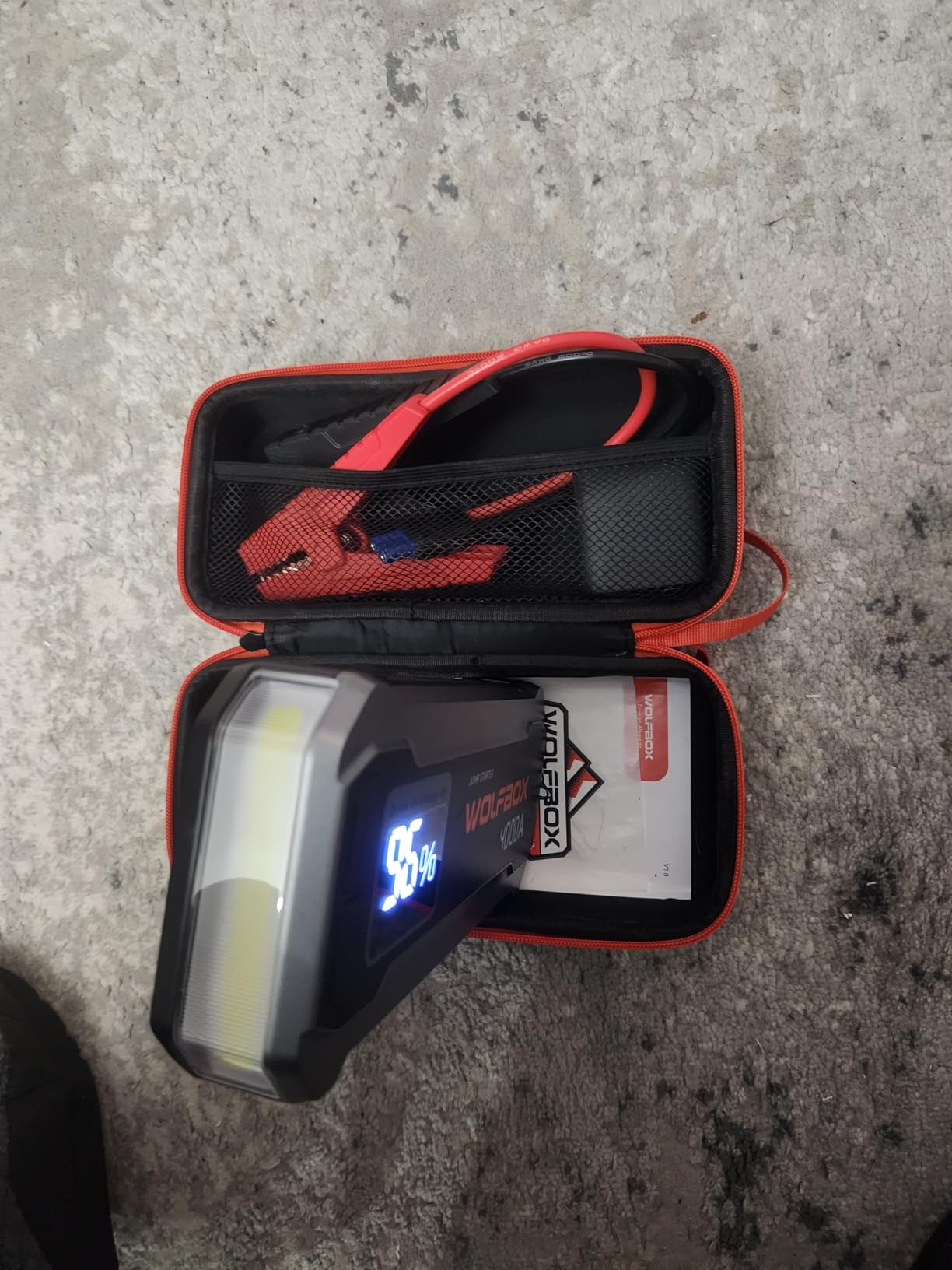
What to check before you buy the WOLFBOX
The box contents listing names only the jump starter unit itself, and some owners report confirming what shipped before first use. Check the package on arrival and make sure clamps and cables are physically present. The capacity figure also appears inconsistently between the specification listing and the marketing copy, so treat 88.8Wh as the working number.
At 3 pounds this is not a lightweight pack, and the fast 1.3 hour recharge depends on the proprietary PD65W wall charger. If you travel without that adapter you are back to a slow USB-C refill.
Who should skip it
Skip the WOLFBOX if jump-starting is the only job. You are paying for 65W of USB-C headroom you will not use, and the alternatives deliver more jump power per dollar. It is worth it when the pack doubles as your travel battery, and pointless when it lives in a boot as pure insurance.
Skip it in extreme cold. Minus 4F is respectable but well short of the Povasee below.
5. Povasee A30 – Best for Big Gas and Diesel Engines
Povasee Jump Starter 5000A Car Jumper Starter, Model A30 12V Jump Box for Car Battery up to 10L Gas or 8L Diesel Engine Battery Jumper Starter Portable with USB Dual Output/LED Light/Storage Case
5000A peak
20000mAh 74Wh
-22F to 140F range
Dual USB with QC3.0
400-lumen light
Pros
- 5000A peak output covers 10L gas and 8L diesel engines
- About 60 jump starts per charge from the 74Wh cell
- Coldest published operating floor here at minus 22F
- Dual USB outputs including QC3.0 for faster device charging
- Storage case included with 24-month warranty
Cons
- No AC wall adapter included in the box
- Listed weight differs between marketing copy and spec field
- Clamps give no output until correctly connected which confuses first-time users
Pick this one if you drive something with a big engine or you tow. The A30 is rated at 5000A peak current for engines up to 10L gas or 8L diesel, with roughly 60 quick jumps per charge from a 20000mAh (74Wh) cell. If you need to start a heavy-duty pickup in a northern January without a second vehicle, this is the engine coverage you want.
The RST button is the feature to understand. When the clamps detect battery voltage below 9V, it restarts the engine rather than sitting dead. Combined with ten intelligent protection systems covering reverse polarity, reverse charge, over-discharge, reverse connection, short circuit, over-charge, over-current, over-heat and spark resistance, the clamp is well protected.
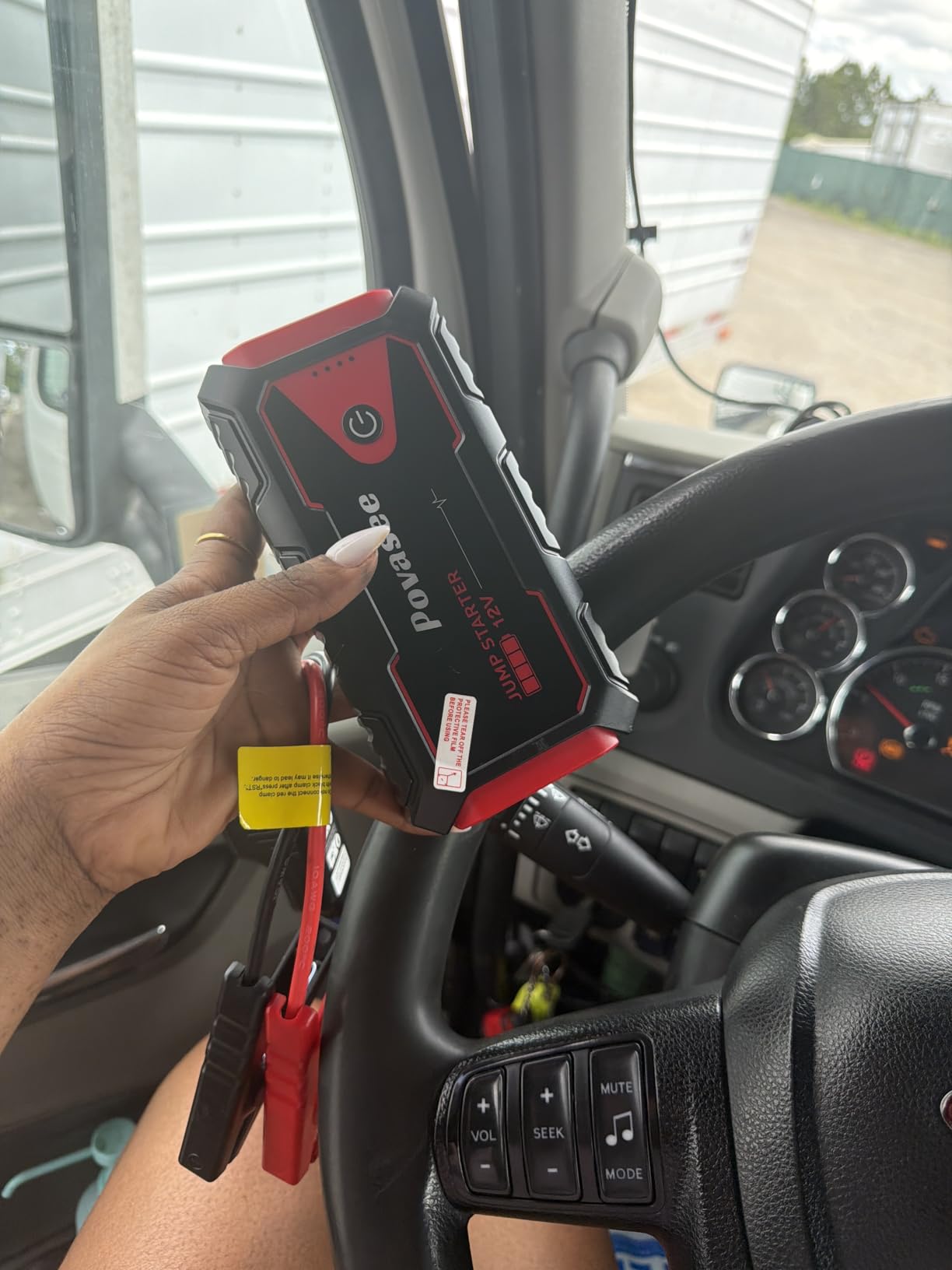
The cold rating is what separates it from the rest of the field. A minus 22F operating floor is the lowest published figure among these eight packs, and if you are in a place where the thermometer genuinely drops, that is not a marketing detail, it is the difference between a working morning and a tow.
Day-to-day usability is good too. Dual USB outputs include one at 5V 2.4A and a second supporting QC3.0 at 5V 3A, 9V 2A and 12V 1.5A, and the 400-lumen LED light offers flashlight, strobe and SOS modes. The body is 6.61 by 3.37 by 1.7 inches and comes with a protective storage case.
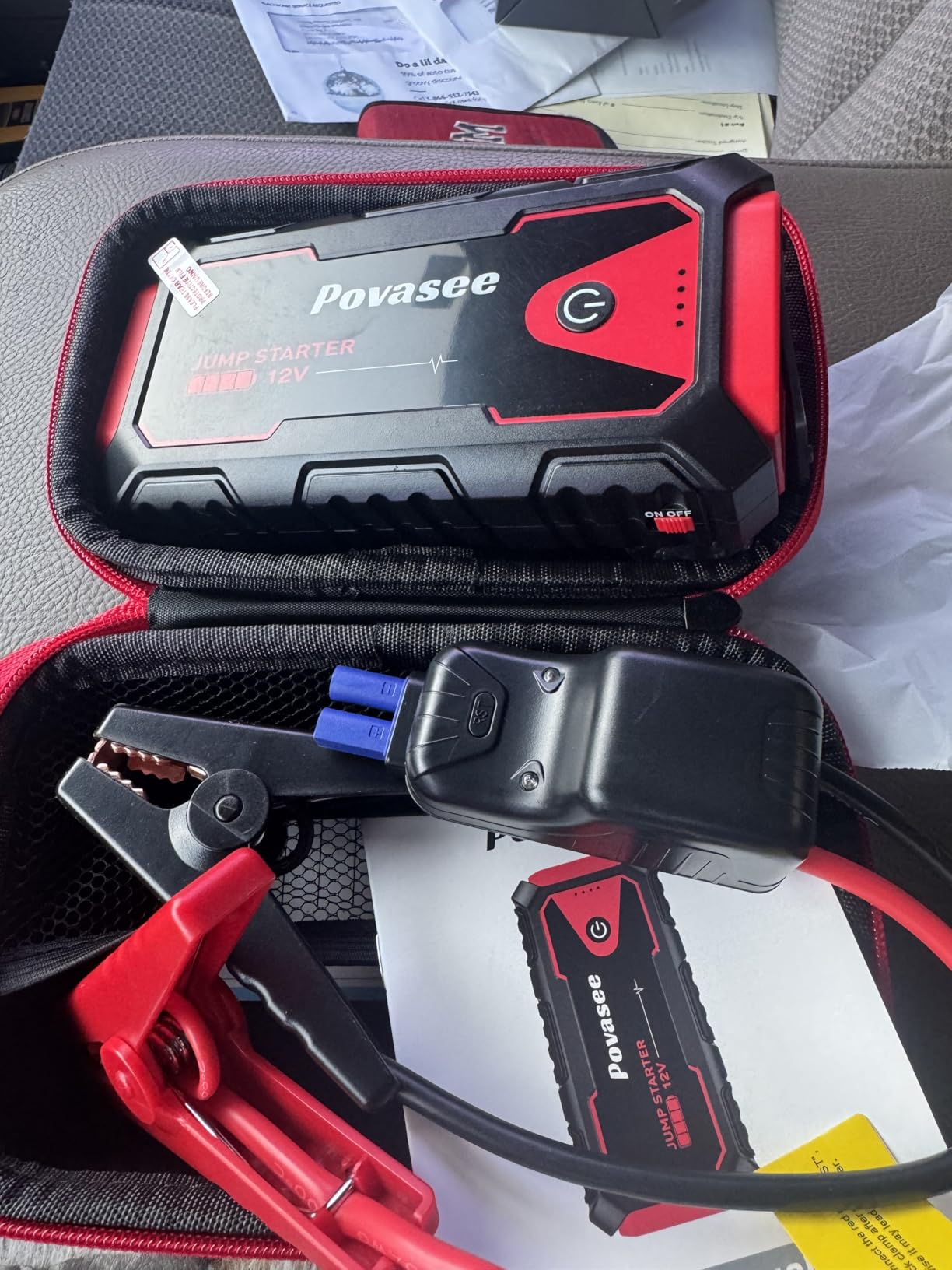
What to check before you buy the Povasee
The clearest recurring complaint is the missing AC wall adapter. The box includes a USB to Type-C cable without an adapter, so budget for a wall charger and confirm what you already own before ordering. The listed weight also reads inconsistently between the marketing copy and the specification field, so expect something in the 1 to 2 pound range rather than an exact figure.
Second, learn the clamp behaviour before you need it. Because the smart clamp produces no output until it is correctly connected to the battery, a first-time user can easily mistake a safe non-response for a dead pack.
Who should skip it
Skip the A30 if your vehicle is a compact or midsize car with a small four-cylinder under three litres. You will be carrying a pound of extra hardware and a five-figure amp claim for a job a 1500A pack does easily.
If you also need to inflate tyres, note that this model has no built-in compressor. Our portable jump starter picks for trucks cover the heavier towing setups in more detail.
6. HALO Bolt Air – Best All-in-One With an Air Compressor
HALO Bolt Air 58830 Portable Car Battery Jump Starter | 100 PSI Air Compressor, 58.8Wh USB Power Bank, Emergency Floodlight & Charger, Jump Cars SUVs & Trucks, Inflate Tires, TSA Approved — Rose Gold
500A peak for cars and SUVs
Built-in 100 PSI air compressor
58.8Wh USB power bank
LED floodlight
TSA approved
Pros
- Only pack here with a built-in 100 PSI air compressor and four nozzles
- Digital screen sets target pressure precisely
- 58.8Wh USB power bank plus an LED floodlight for roadside work
- Compact and TSA approved so it flies in hand luggage
- Reverse polarity and short circuit protection with spark-proof cables
Cons
- Lowest jump output in the group at 500A
- Smallest power-bank capacity here at 58.8Wh
- Shortest warranty at 90 days
- No USB-C fast charging
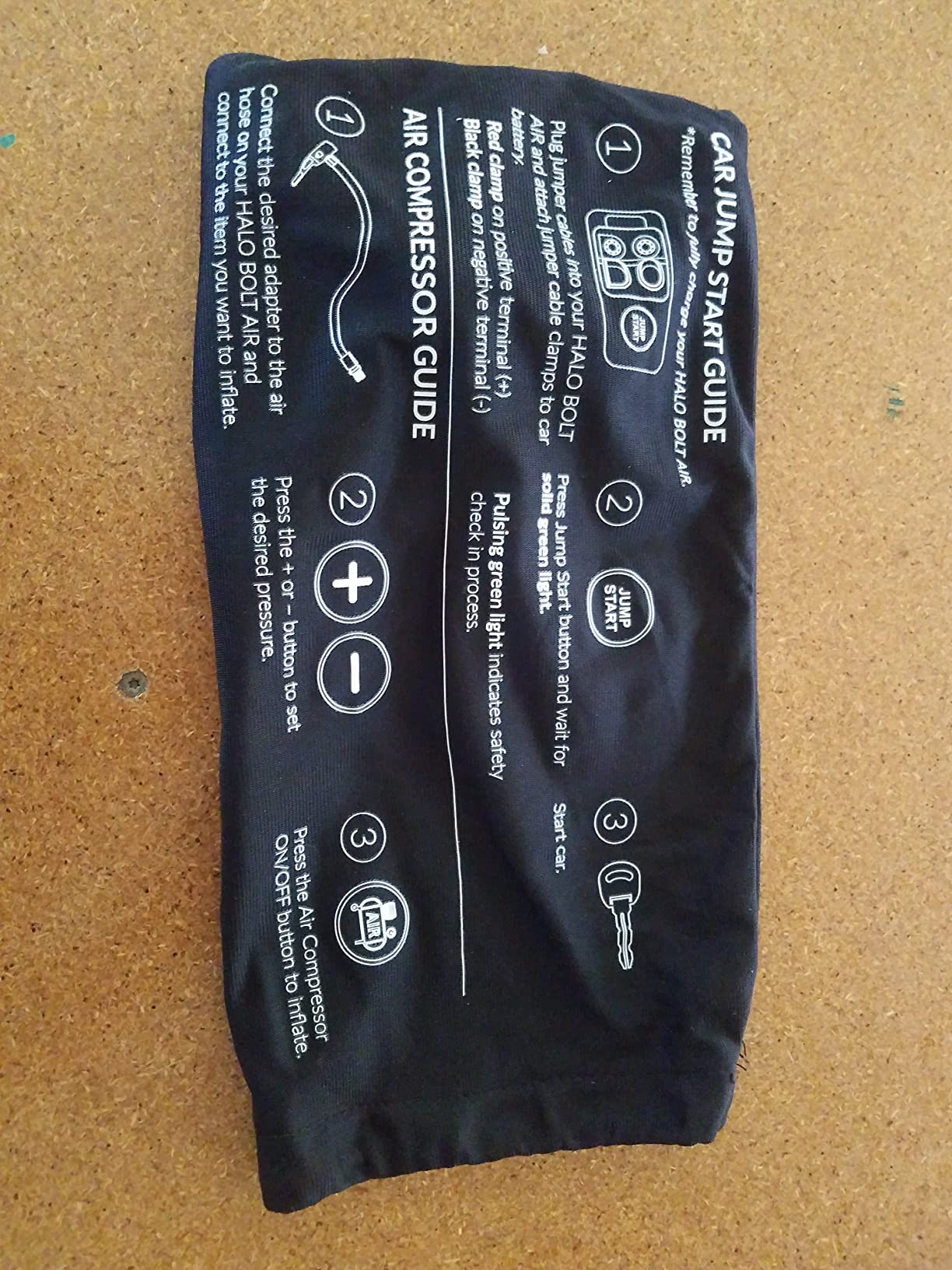
One roadside failure leads to another. You turn the key, nothing happens, and then you notice the tyre is soft too. The HALO Bolt Air is the only pack in this guide that solves both problems in one body, with a built-in 100 PSI air compressor, four interchangeable nozzles and a 24-inch hose extension for tyres, balls, rafts and air mattresses.
The digital screen is genuinely useful here rather than decorative. You set a target pressure and the compressor delivers to it, which removes the guesswork from a gauge that most drivers would not otherwise have in the car. A LED floodlight handles the darkness, and the 58.8Wh cell still works as a USB power bank.
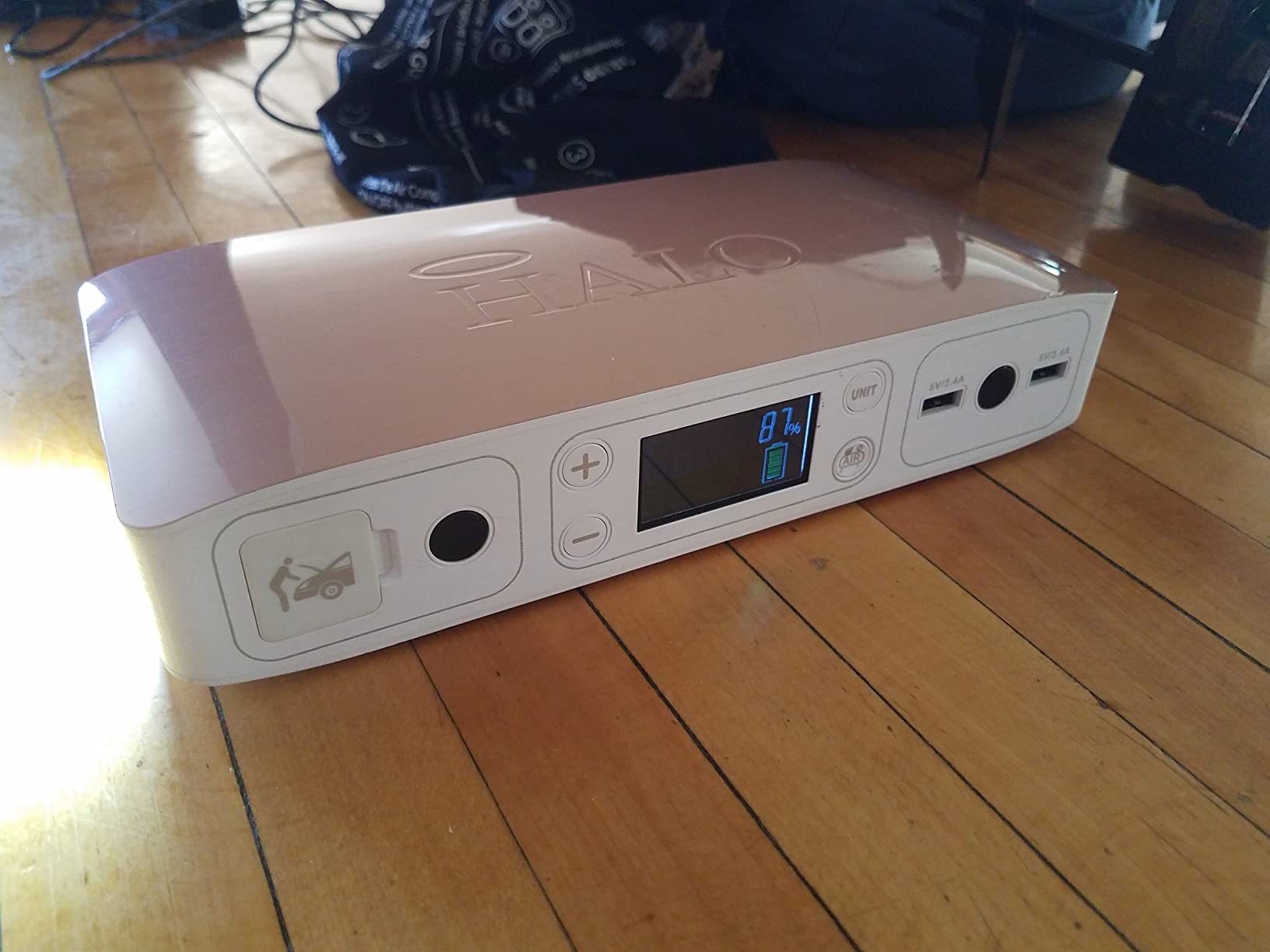
Being TSA approved is a real practical advantage. Owners who fly with the pack in hand luggage are not risking a battery question at the gate, and the unit measures 4.65 by 9.52 by 1.85 inches at 1.15 kg. Safety coverage includes reverse polarity protection, short circuit protection, auto power off and spark-proof jumper cables.
The box is unusually complete for this tier: the unit, AC wall adapter, jumper cable, car charger, nozzle kit, 24-inch air hose, USB cable, a carrying pouch and guides.
What to check before you buy the HALO Bolt Air
The 500A peak output is the lowest in this comparison, and it is the trade you are making deliberately. That is enough for a full-sized car or a light SUV, and it is not enough for a large pickup or a diesel. Know which vehicle you are actually trying to rescue before buying.
Also weigh the warranty gap. Ninety days is far shorter than the two years on most packs here, and for an electrical device that spends its life sitting in a car, that difference matters if something goes wrong in month eight.
Who should skip it
Skip the HALO Bolt Air if you tow or drive a full-size truck. The jump capacity is not the tool for a deeply discharged diesel battery, and no air compressor feature compensates for that.
Skip it if you are on a tight budget and the tyre inflation is a nice-to-have. You are paying for compressor hardware you may use twice a year, when a dedicated inflator and a stronger jump pack together cost less and both work better.
7. AstroAI S8 – Best Lightweight Pack for Small Engines
AstroAI S8 Car Battery Jump Starter 1500A – Portable 12V Lithium Jump Box
1500A peak
8000mAh
430 g body
Boost mode under 9V
3-mode flashlight
Pros
- Lightest-feeling unit for its output at 430 g and pocketable dimensions
- 5-in-1 design covers jump starting plus power bank plus 3-mode flashlight
- Smart boost mode detects voltage below 9V and unlocks a boost button
- Metal safety clamps and smart cable reduce heat damage and loose ports
- 8 integrated safety protections
Cons
- Lowest peak current here at 1500A limited to 6.0L gas and 3.0L diesel
- Smallest mAh figure at 8000 so fewer jumps per charge
- Manufacturer advises against charging or use in extreme cold
The S8 is for the person whose car has a small engine and who would rather not carry a brick. At 430 g and 7.9 by 4.5 by 3.7 inches, it is the sort of pack you will actually keep in a backpack or a motorcycle saddlebag rather than leave in the boot and forget.
It operates as a 5-in-1 device: jump starter, portable power bank and a three-mode LED flashlight with flashlight, strobe and SOS. For a motorcycle, a scooter, a lawn mower or a small hatchback, that combination covers a surprising share of roadside problems.
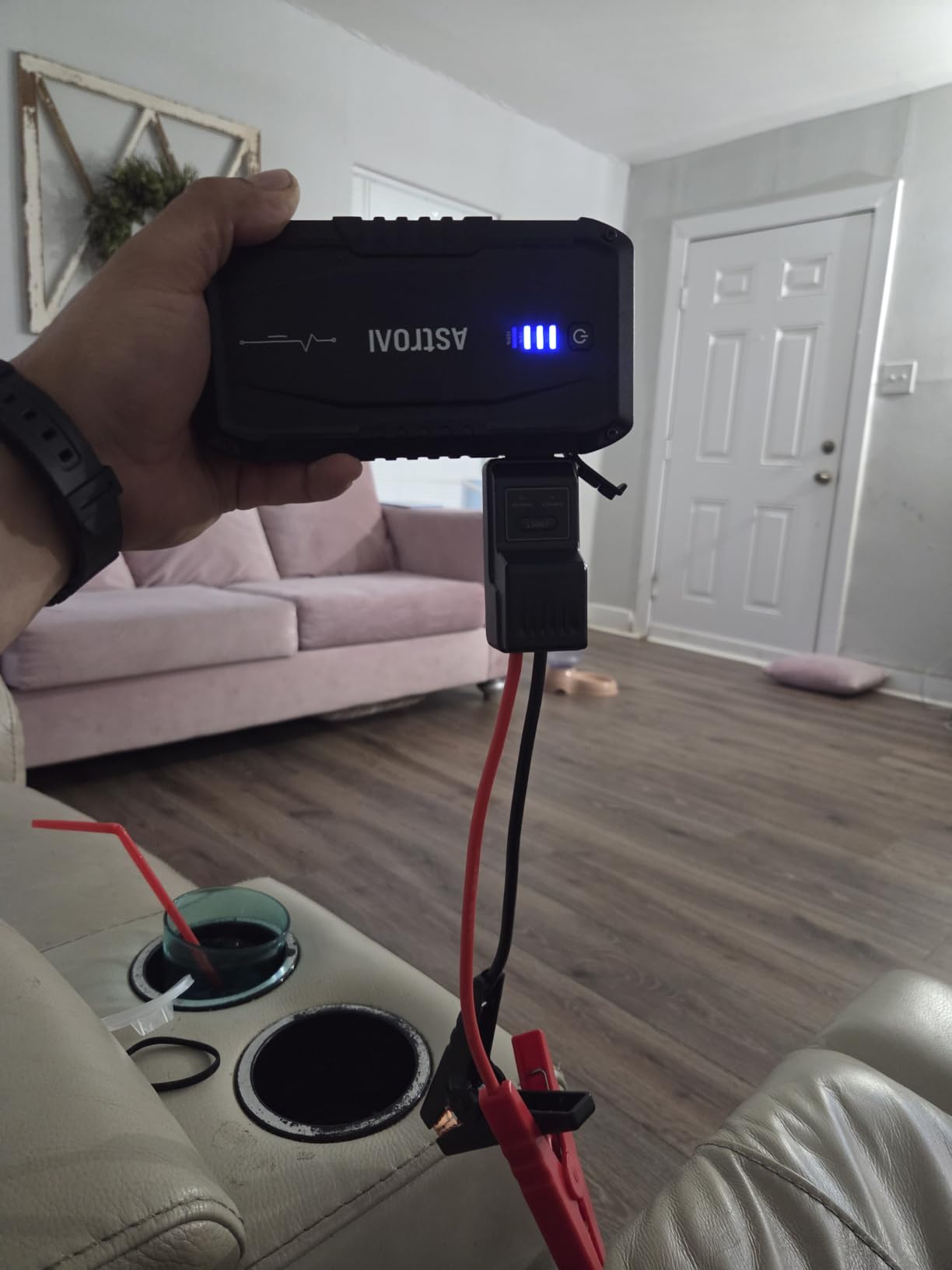
The smart boost mode is the part worth understanding. When the pack detects battery voltage below 9V it does nothing, which is what confuses first-time owners. Hold the boost button and it will attempt a start anyway, and that is how owners report recovering cars that other units refused to touch.
Build quality runs ahead of the price tier. A 45C high-rate lithium cell sits inside metal safety clamps and a smart cable designed to protect against heat damage, loose ports and battery swelling, backed by eight integrated protections covering reverse polarity, reverse connection, overcurrent, overvoltage, overload, overcharge, over-discharge and short circuit.
What to check before you buy the AstroAI S8
Match the pack to the engine, not the other way round. At 1500A peak it covers 6.0L gas and 3.0L diesel engines. If you drive a six-cylinder, a V6 or anything diesel-heavy, choose a pack with real headroom instead.
At 8000mAh you also get the fewest jumps per charge of the packs here, and the maker advises against charging or using the unit in extreme cold. Treat it as a small-engine and warm-climate companion rather than a winter safety net.
Who should skip it
Skip the S8 if you want one pack for the whole family including a boat, a tractor or a truck. You will outgrow it quickly and be back to buying a second device.
Skip it if you need it as a power bank for a tablet through a long trip. The smaller cell means shorter runtime, and it is worth spending more for capacity if that is the primary use.
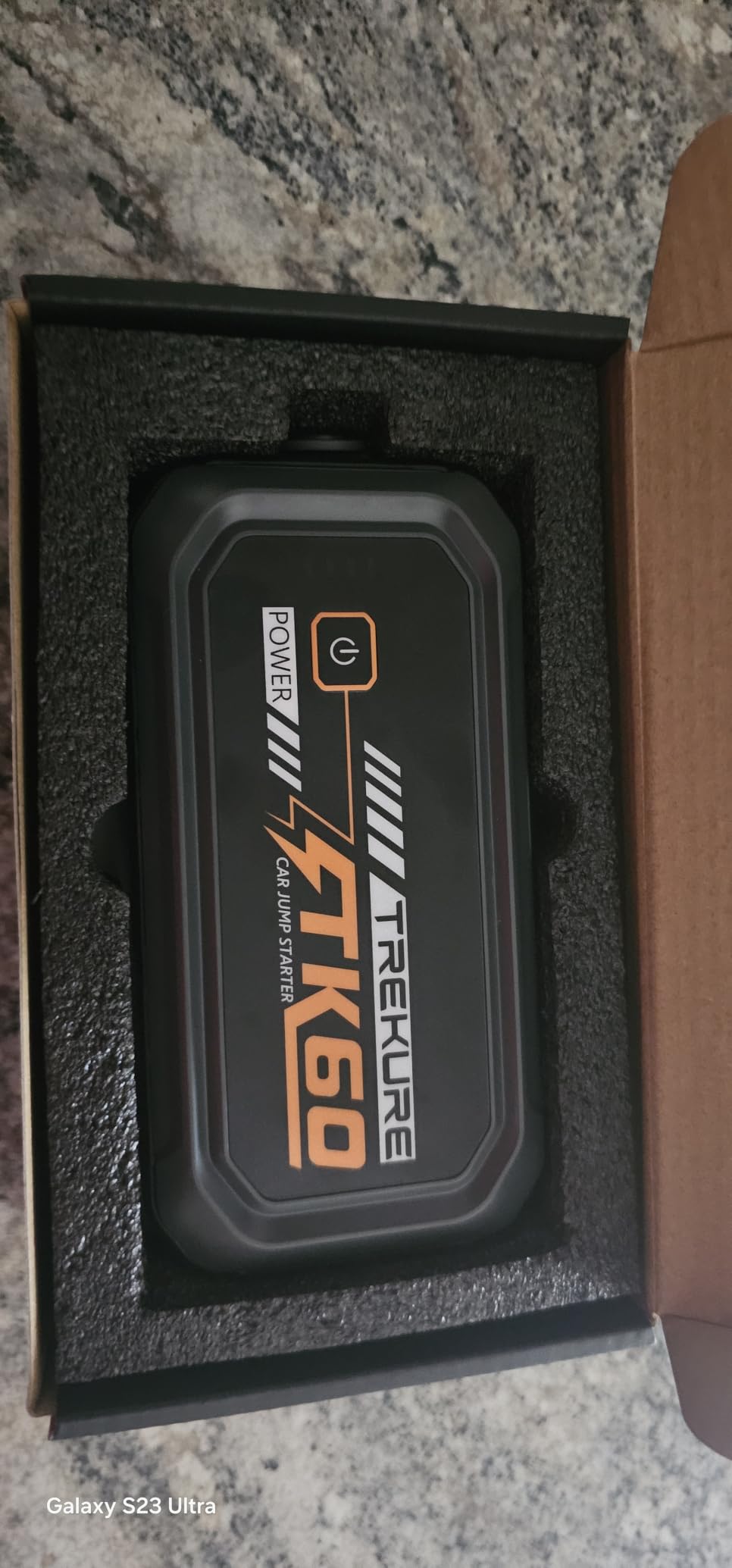
8. TREKURE TK60 – Best for Glovebox Storage
TREKURE Car Battery Jumper Starter Portable 5000A, Portable Car Jump Starter up to 10L Gas or 8L Diesel Engine, Jump Box, Jumper Cables for Car Battery, Magnetic Build, 2000LM Flashlight, Power Bank
5000A peak
7200mAh
0.42 kg body
2000LM magnetic panel light
Force-start for 0V batteries
Pros
- Lightest pack in the group at 0.42 kg for glovebox or backpack storage
- Magnetic full-panel LED light clamps to bodywork for hands-free work
- Force-start tech in the clamps revives fully drained 0V batteries
- V0-rated flame retardant materials in a reinforced splash-resistant case
- 2-year warranty with lifetime technical support
Cons
- Smallest battery capacity here at 7200mAh limiting jumps and power-bank runtime
- Smallest review base at roughly 1400 so long-term track record is thin
- Force-start needs a three second button hold then a crank within 30 seconds
- Dust bag is a soft sleeve rather than a hard case
The TREKURE is the newest entry here and the one with the smallest review base, and I include it with that caveat stated plainly. At roughly 1,400 reviews and a 4.6 average, its long-term record is less established than the veteran packs above it. What it offers on paper, though, is unusually good.
At 0.42 kg it is the lightest pack in this comparison, and the quick-release rubber carry loop supports handheld, hanging and magnetic placement, which means it can live in a glove compartment without becoming the reason you avoid opening the glove compartment.
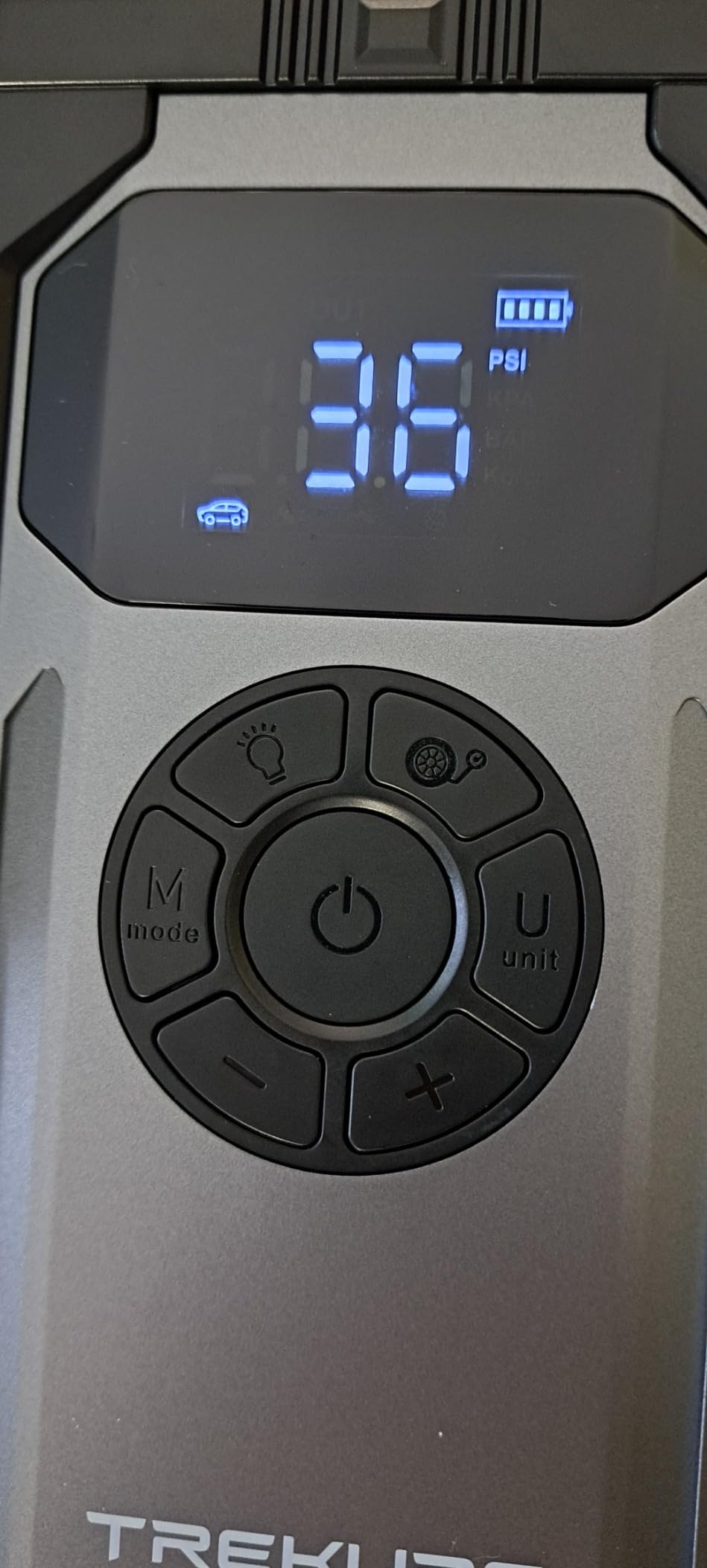
The 2000LM magnetic full-panel LED light is the standout feature. It clamps directly to a body panel or the underside of a bonnet, giving you both hands free at the battery terminal, and it runs lighting, strobe, red strobe and SOS modes. No other pack here mounts its light to the car.
On protection, the clamps list ten safeguards including reverse polarity, spark-proof, short circuit, overvoltage, overheating and temperature cutoffs, and the shell uses V0-rated flame retardant materials in a reinforced shockproof, splash-resistant casing. Force-start tech in the smart clamps is designed to recover fully drained 0V batteries.
What to check before you buy the TK60
At 7200mAh this is the smallest energy store on the list. The 5000A peak figure covers up to 10L gas or 8L diesel, but capacity is what determines how many times you can actually do that from one charge, and here you get fewer attempts than the 74Wh packs.
Learn the force-start sequence before you need it: hold the button for three seconds, then crank within 30 seconds. And note the specification inconsistency, where the amperage field reads 8000A while the product title states 5000A.
Who should skip it
Skip the TREKURE if you want a proven track record over a decade of ownership. With the fewest reviews here, you are buying on engineering claims rather than on evidence.
Skip it if the pack will live in a car all year. The smallest capacity in the group gives you the least margin if the charge drifts down before you need it.
Why Big Amp Numbers Are Mostly Marketing
The number on the front of the box is the least useful specification a jump starter can publish. Peak amps describes a momentary spike measured at the instant of connection, not the sustained current the pack can hold through a five-second crank. A lithium-ion pack cannot deliver its peak figure continuously without building heat, and heat is exactly what damages the cells. That thermal limit is why we rank packs on sustained capability, engine coverage and real owner outcomes instead.
Two other terms get thrown around loosely. Cranking amps (CA) describes current delivered over roughly 30 seconds, and cold cranking amps (CCA) describes the same at temperature. Those are the figures that matter for a cold morning, and almost no consumer pack publishes them honestly. When a pack claims a five-digit peak number, read it as a marketing ceiling rather than a sustained output.
Capacity is the honest number. Watt-hours (Wh) is the one measurement that transfers directly from the pack to how many jumps you get, because energy is what gets consumed. The packs here run from 58.8Wh up to 88.8Wh. A 74Wh pack is roughly 20000mAh at 3.7V, which is where the familiar 20000mAh figure on the box comes from.
How to Jump-Start Your Car Safely
A dead battery gives off hydrogen gas, which is flammable and explosive. A spark near a battery can ignite it, so the order of operations matters. Wear eye protection, remove metal jewellery and loose clothing, and make sure the vehicles are parked with the dead car in park or in gear with the handbrake on.
Open both hoods and locate the batteries. On many cars the 12V battery is under a panel in the boot or under the seat rather than in the engine bay.
Attach the red clamp to the positive terminal of the dead battery first.
Attach the black clamp to a grounded metal point on the dead car, away from the battery and away from moving parts.
If you are using a second vehicle, attach its black clamp to its negative terminal. With a portable pack you skip this step entirely.
Turn the key and crank for a maximum of five seconds. Do not hold it longer.
Remove the black clamp first, then the red, and stow the pack immediately. A jump start restores enough charge to run, not enough to recharge, so drive to a proper charger or a working battery rather than expecting the problem to resolve itself.
Modern smart clamps simplify most of this. Most packs on this list will not energise until they detect a correct, reverse-polarity-safe connection, so the biggest historical causes of injury are largely engineered out. Read the clamp indicator anyway.
How to Store and Recharge a Jump Starter
This is the section that decides whether your pack works. The dominant complaint in owner discussions is never that the electronics failed. It is that the pack sat in a vehicle for months, slowly self-discharged below a usable level, and was dead on the morning it was needed. That is a maintenance problem, not a product defect.
Top the pack up every three months. That cadence is the single most useful habit here, and several owners in this category describe setting a recurring reminder precisely because they learned the lesson the hard way. Some budget packs with smaller cells drift faster and need attention closer to monthly.
Store it around 40 to 60 percent charge rather than full, in a cool, dry place. Lithium cells stored at full charge in a hot car degrade faster, and a vehicle interior in summer reaches temperatures that accelerate that loss. The Hulkman publishes the most generous standby claim here at up to 18 months, and the S ZEVZO quotes 24 months.
Check the indicator before a long trip, before winter, and before an extended period of not driving. If a pack has sat unused for a year, give it a full charge and confirm the indicator rises rather than assuming. Keep a set of traditional jumper cables as a backup for the case where your own battery is dead and the pack is too, because the pack is a single point of failure like any other device.
Jump-Starting Hybrids and Electric Cars
Yes, you can jump start a hybrid or electric car, but you connect to the 12V auxiliary battery and nothing else. Every hybrid and EV carries a conventional 12V battery that runs the lights, electronics and, in some hybrids, the engine starter. That is the terminal you connect to, and it is often located away from the high-voltage pack.
Never attach clamps to the high-voltage orange cabling or the traction battery. Doing so can damage expensive battery management systems, and the packs on this list have no way to protect you from that mistake because the protection circuitry only manages the 12V side.
EV and hybrid owners frequently assume a jump pack is useless for them because there is no 12V terminal where they expect it. It is usually in the boot, frunk or under a seat cover, and the manual will show you. Any of the eight packs above will handle a 12V auxiliary battery restart, provided it has charge.
How to Choose a Jump Starter Power Bank
Start with engine size rather than peak amps. A car with an engine under 3.0 litres needs in the region of 400 to 600A. A 3.0 to 5.0 litre engine wants 600 to 1000A. Anything above 5.0 litres, or any diesel, deserves 1000A or more, and a heavy-duty or towing setup should look at packs claiming 2000A and above. The HALO Bolt Air at 500A is built for the first row of that table. The Povasee and TREKURE at 5000A cover the last.
Then check the safety stack. Look for reverse polarity protection, spark-proof or mistake-proof clamps, and short circuit protection. A smart clamp that refuses to energise until it senses a correct connection is worth more than a longer included cable list. All eight packs here have that protection in some form.
Chemistry matters more than buyers expect. Lithium-polymer and lithium-ion packs pack more energy into a lighter body but tolerate heat and deep discharge poorly. LiFePO4 cells sacrifice capacity for a much longer service life and better tolerance of storage abuse, and owners in owner forums consistently treat LiFePO4 chemistry as a marker of a better-made unit. None of these eight products is listed as LiFePO4, so weigh the warranty length instead: two years on most of them, ninety days on the HALO.
Consider what else you want the pack to do. An air compressor turns the HALO into a roadside kit rather than a single-purpose tool. USB-C power delivery at real wattage turns the WOLFBOX into a travel battery. A bright work light matters more than most spec sheets admit, because the jump almost always happens in the dark.
Finally, look at what is actually in the box. Several packs here ship without an AC wall adapter, which is the hidden cost that quietly inflates the real price on premium models. A pack that arrives with a case, clamps, a cable and a charger is worth more than one that arrives with a bottle opener. Our truck jump starter guide covers the heavier towing cases in more depth.
Frequently Asked Questions
What is the best power bank for jump-starting a car?
The Hulkman Alpha85 is our best jump starter power bank overall, rated at 2000A peak for engines up to 8.5L gas and 6.0L diesel. Its 20000mAh (74Wh) cell, IP65 shell and 65W recharge in about 90 minutes make it the most dependable all-round pack, while the S ZEVZO ET03 is the stronger value option.
Do portable car jump starters actually work?
Yes, on the large majority of cars with a flat or dead 12V battery. They fail far less often than owner forums suggest, and when a pack does not work the cause is usually a depleted pack, corroded terminals or a battery too deeply discharged to recover. Check the charge level and clean the terminals before assuming the unit is faulty.
How long does a portable jump starter hold its charge?
Expect anywhere from a few months to over a year depending on chemistry, temperature and starting charge. The Hulkman Alpha85 publishes a standby figure of up to 18 months and the S ZEVZO ET03 quotes 24 months. Regardless of the claim, topping the pack up every three months is the habit that keeps it ready.
Can you jump start a hybrid or electric car?
Yes, but only through the conventional 12V auxiliary battery that runs the lights and electronics, never the high-voltage pack or orange cabling. In most hybrids and EVs that 12V battery sits in the boot or under a seat rather than the engine bay, so check the manual for its location before you need it.
Why won’t my portable jump starter work?
The usual causes are a flat pack, corroded battery terminals, a battery deeply discharged below the pack’s threshold, or cold weather reducing both battery and pack output. Check the charge indicator first, clean and tighten the terminals, then use boost or force-start mode if your model has it. A properly charged pack should start a healthy battery immediately.
Final Verdict: Which Jump Starter Power Bank Should You Buy?
For most drivers, the Hulkman Alpha85 is the best jump starter power bank for cars in 2026. It has the strongest balance of rating, review history and storage tolerance on this list, it starts engines up to 8.5 litres, and its 65W fast charger means you can top it up over a single evening before a long trip.
Spend less and you lose very little. The S ZEVZO ET03 covers 8.0L gas and 7.0L diesel with a force-start mode for dead batteries and a brighter flashlight than most, while the DBPOWER Peak 3000A is the proven budget answer with the deepest review history in the category. If you need serious cold-weather capability or a truck-sized engine, the Povasee A30 publishes the lowest operating temperature here and covers 10L gas and 8L diesel.
Whichever you choose, do one thing before you close this page. Put the pack in the car, charge it fully tonight, and set a repeating reminder to check it every three months. A jump starter is not insurance you buy once and forget, it is insurance you maintain, and the maintenance is thirty seconds of effort.