
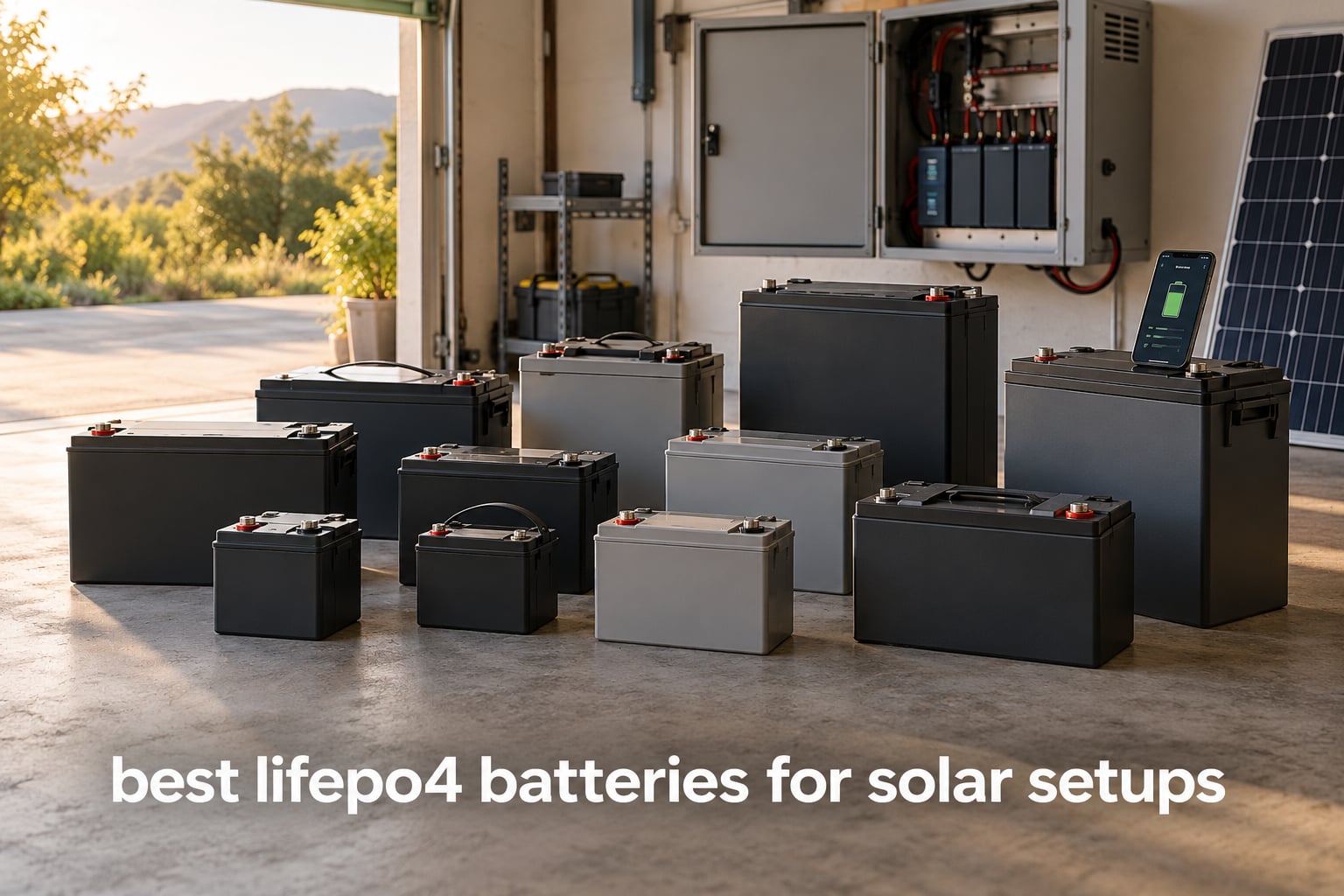
Solar panels only make power when the sun is up, so a battery bank decides how much of that afternoon surplus you actually get to use. Picking the wrong one means paying twice: once for the battery, and again for a converter, a fusing upgrade or a second bank six months later.
We spent weeks reading spec sheets, owner reports and DIY solar forum threads on twelve finished LiFePO4 batteries, then sorted them by the tier they actually suit. If you want the wider picture on chemistry first, our lithium solar battery guide and deep cycle battery guide cover the basics that sit underneath this list.
Top 3 Picks: LiFePO4 Battery Picks for Solar Setups in 2026
Three batteries cover most of what people actually build. The LiTime 12V 230Ah is the one we would put in an RV or a small cabin, the ECO-WORTHY Cubix100 48V is the right call for a whole-home array, and the VATRER 12V 300Ah is the only pick here that can genuinely charge through a hard winter.

LiTime 12V 230Ah LiFePO4
- 2944Wh Group 4D at 46 lbs
- Bluetooth 5.0 state-of-charge monitoring
- 200A BMS with low-temp charge pause
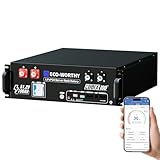
ECO-WORTHY Cubix100 48V 100Ah
- 51.2V 5.12kWh rack-mount module
- UL9540 and UL1973 listed
- CAN and RS485 inverter communication

VATRER 12V 300Ah Self-Heating
- Built-in self-heating for sub-freezing charge
- 3840Wh at 54.7 lbs
- 5000+ cycles at 100% depth
Best LiFePO4 Batteries for Solar Setups at a Glance (October 2026)
Twelve batteries, three voltage tiers, one table. Use the capacity and voltage columns to work out which rows even apply to your inverter, then read the full write-up for the pick that fits your box and your winter.
| Product | Specifications | Action |
|---|---|---|
| LiTime 12V 230Ah LiFePO4 |
|
Check Latest Price |
| ECO-WORTHY Cubix100 48V 100Ah |
|
Check Latest Price |
| VATRER 12V 300Ah Self-Heating |
|
Check Latest Price |
 ECO-WORTHY EnergyRock 12V 280Ah Two Pack ECO-WORTHY EnergyRock 12V 280Ah Two Pack |
|
Check Latest Price |
 LiTime 12V 460Ah Group 8D LiTime 12V 460Ah Group 8D |
|
Check Latest Price |
 dumfume 12V 200Ah LiFePO4 dumfume 12V 200Ah LiFePO4 |
|
Check Latest Price |
 LiTime 12V 320Ah Mini LiTime 12V 320Ah Mini |
|
Check Latest Price |
 PUPVWMHB 12V 300Ah LiFePO4 PUPVWMHB 12V 300Ah LiFePO4 |
|
Check Latest Price |
 ECO-WORTHY 12V 314Ah ECO-WORTHY 12V 314Ah |
|
Check Latest Price |
 HumsiENK 12V 100Ah Group 24 HumsiENK 12V 100Ah Group 24 |
|
Check Latest Price |
 SUPER EMPOWER 12V 100Ah SUPER EMPOWER 12V 100Ah |
|
Check Latest Price |
 DC HOUSE 12V 100Ah Bluetooth DC HOUSE 12V 100Ah Bluetooth |
|
Check Latest Price |
1. LiTime 12V 230Ah LiFePO4 – The Best Overall Pick for Solar
Litime 12V 230Ah LiFePO4 Lithium Battery for RV, Travel Trailer, Solar
2944Wh
46 lbs
200A BMS
Bluetooth 5.0
Group 4D footprint
Pros
- Bluetooth monitoring gives clear state-of-charge and charge-rate data
- Long Bluetooth range compared with most competing smart batteries
- Compact Group 4D footprint at 46 lbs makes installs far easier than lead-acid
- Deep-discharge capacity close to the full rating on RV fridge and trolling duty
Cons
- Companion app can stop updating while the battery is charging and needs a reconnect
- Charge current is unlimited so some RV chargers need upgrading
- Non-heated variant only pauses charging in the cold rather than warming itself
- Some arrive asleep and need a LiFePO4 charger to wake them
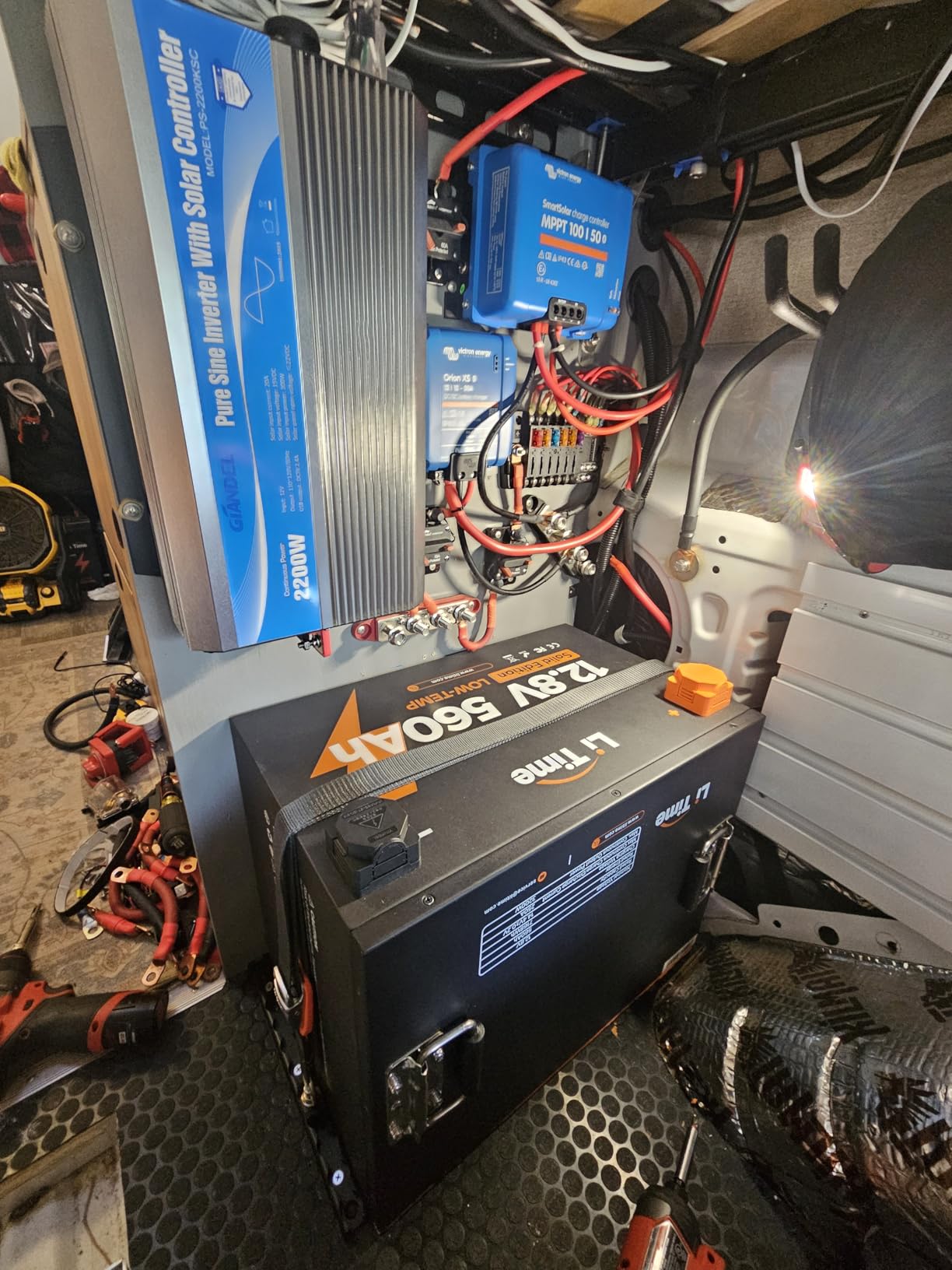
This is the battery we kept coming back to while sorting the field, because it does the unglamorous things well. A 200A battery management system, 2944Wh of stored energy and a Group 4D case that measures 19.02 by 6.69 by 9.45 inches, all at 46 pounds. That weight matters more than most spec sheets admit: it is roughly a third of what the lead-acid group it replaces weighs, so a two-person lift and a standard Group 4D box are realistic rather than aspirational.
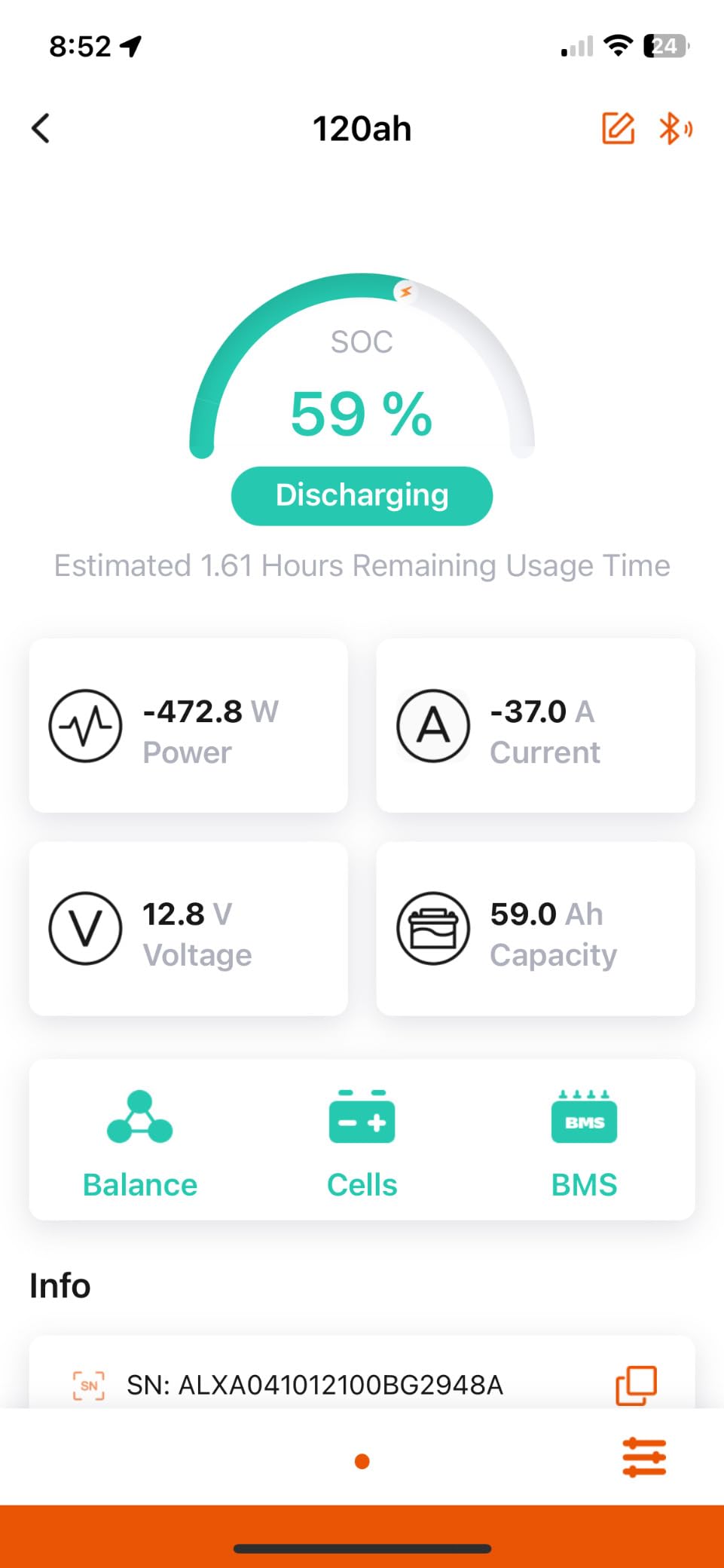
The Bluetooth 5.0 app is the part that changes daily behaviour. It reports state of charge, pack voltage and live current, and the connection range is noticeably longer than most competing smart batteries, which means you can check the bank from outside the compartment rather than crawling under a van.
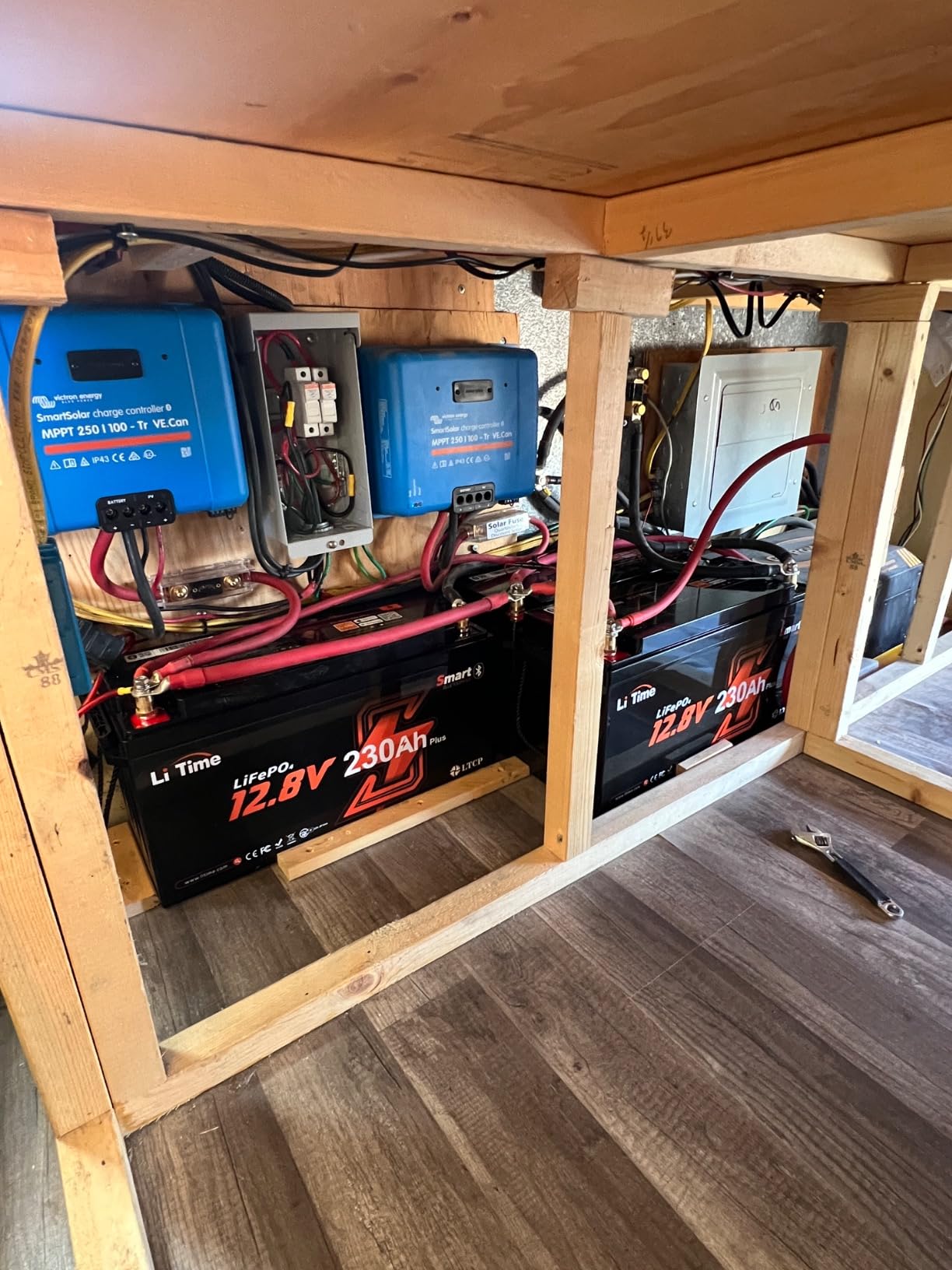
The cycle data is the least glamorous line and probably the most important. LiTime rates this pack at 4,000-plus deep cycles with a ten-year rated lifespan, and the battery is expandable 4P4S to sixteen batteries for a 48V 920Ah, 47.1kWh system. That ceiling is what makes it a good first purchase even for people who know a bigger house is coming in two years.
Two things to plan around. The pack is not self-heating, so below 32F the BMS pauses charging rather than warming the cells, and the listed warranty description is two years even though the rated lifespan figure is ten. Neither is a dealbreaker, but both should shape where you mount it.
Who this battery suits
It suits RV, van and camper installations where a fridge, lighting and a small inverter need to run overnight on solar alone, and it suits small cabins with a similar overnight load. The Bluetooth monitoring also makes it a good first lithium build, because you can see what the bank is doing instead of guessing from a voltage light.
It is a reasonable choice for anyone replacing a tired lead-acid group who wants roughly three times the usable capacity from the same physical footprint without rewiring the box.
Who should buy something else
Skip it if your install is in a climate where solar charging is the whole point between November and March, because there is no internal heater here. Skip it too if you run a non-lithium RV converter, since unlimited charge current from an old converter is the fastest way to nuisance-trip the BMS.
Anyone needing more than about 3kWh should look at the 320Ah mini or the 460Ah Group 8D instead of planning a parallel bank from day one, because a single larger unit means fewer connections to fail.
2. ECO-WORTHY Cubix100 48V 100Ah – Best for Whole-Home Off-Grid Arrays
ECO-WORTHY Cubix100 48V 100Ah LiFePO4 Lithium UL9540 Server Rack Battery
51.2V 100Ah / 5.12kWh
UL9540 and UL1973 listed
CAN and RS485
103 lbs
Pros
- Holds real capacity matching the 5.12kWh rating when tested
- CAN and RS485 talk to Victron and other inverters once cabled correctly
- Rack form makes parallel expansion to larger systems straightforward
- Support reported fast including a prepaid return label when a unit had a balancing problem
Cons
- No on-device display so all status data depends on the app or an external monitor
- Mobile app is basic and lacks time-to-full and time-remaining estimates
- One unit arrived with cells out of balance and CAN comms not negotiating with a Victron Cerbo GX
- Heavy at 103 lbs per rack module
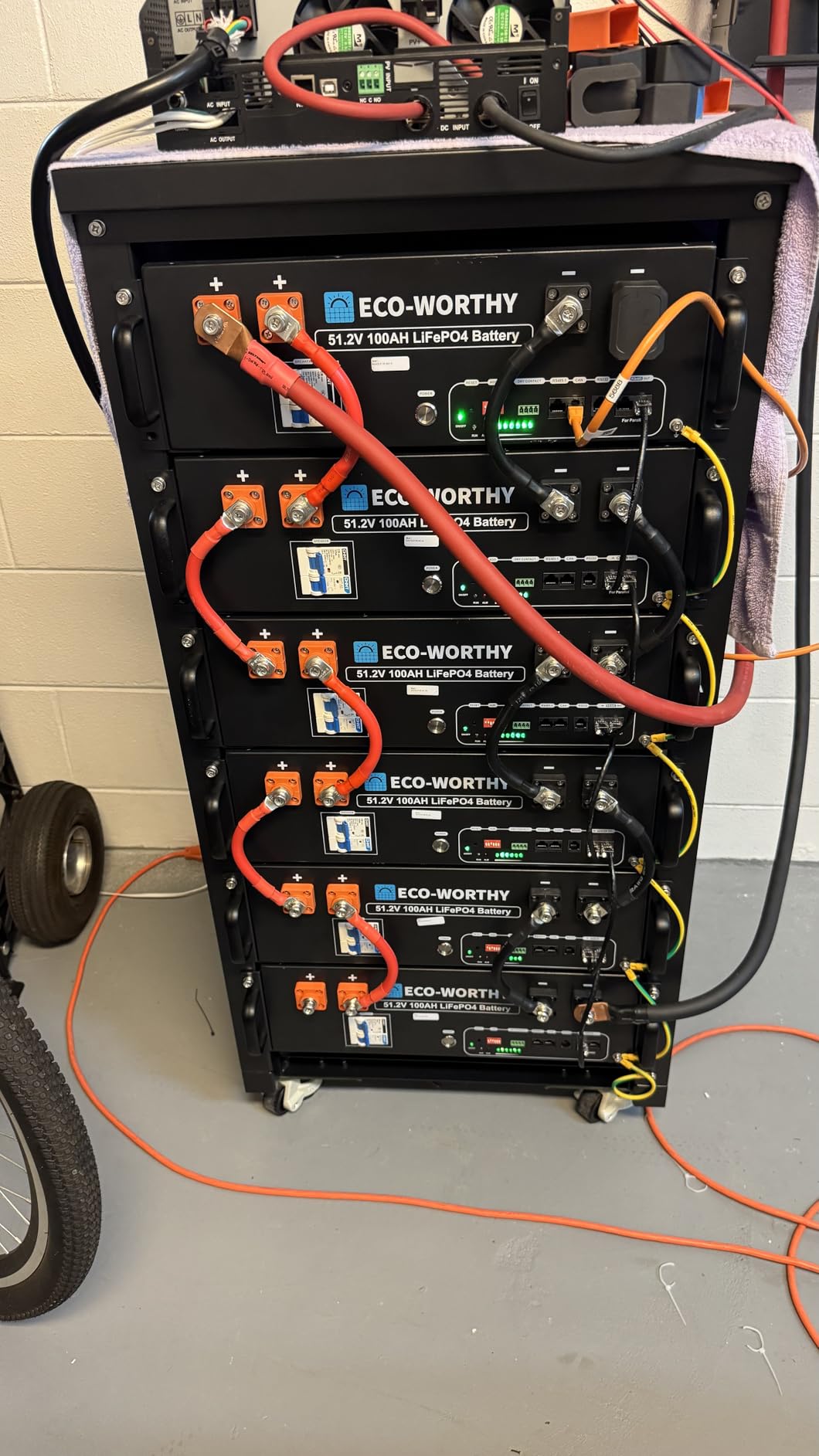
If your inverter runs on 48V, this is the pick. Most of the batteries in this roundup are 12V modules meant to be combined, which means a parallel bank and a second layer of decision-making. The Cubix100 is already a 51.2V nominal rack module holding 100Ah, so each one is a meaningful step rather than a building block.
The certification story is what separates it. It is listed to UL9540, UL1973 and CEC, tested by Intertek, and built on Grade A cells. That matters more than it sounds: UL1973 is the battery-level standard that a utility-scale conversation actually recognises, and it is the difference between a listing you can point at in a permit application and a marketing claim.
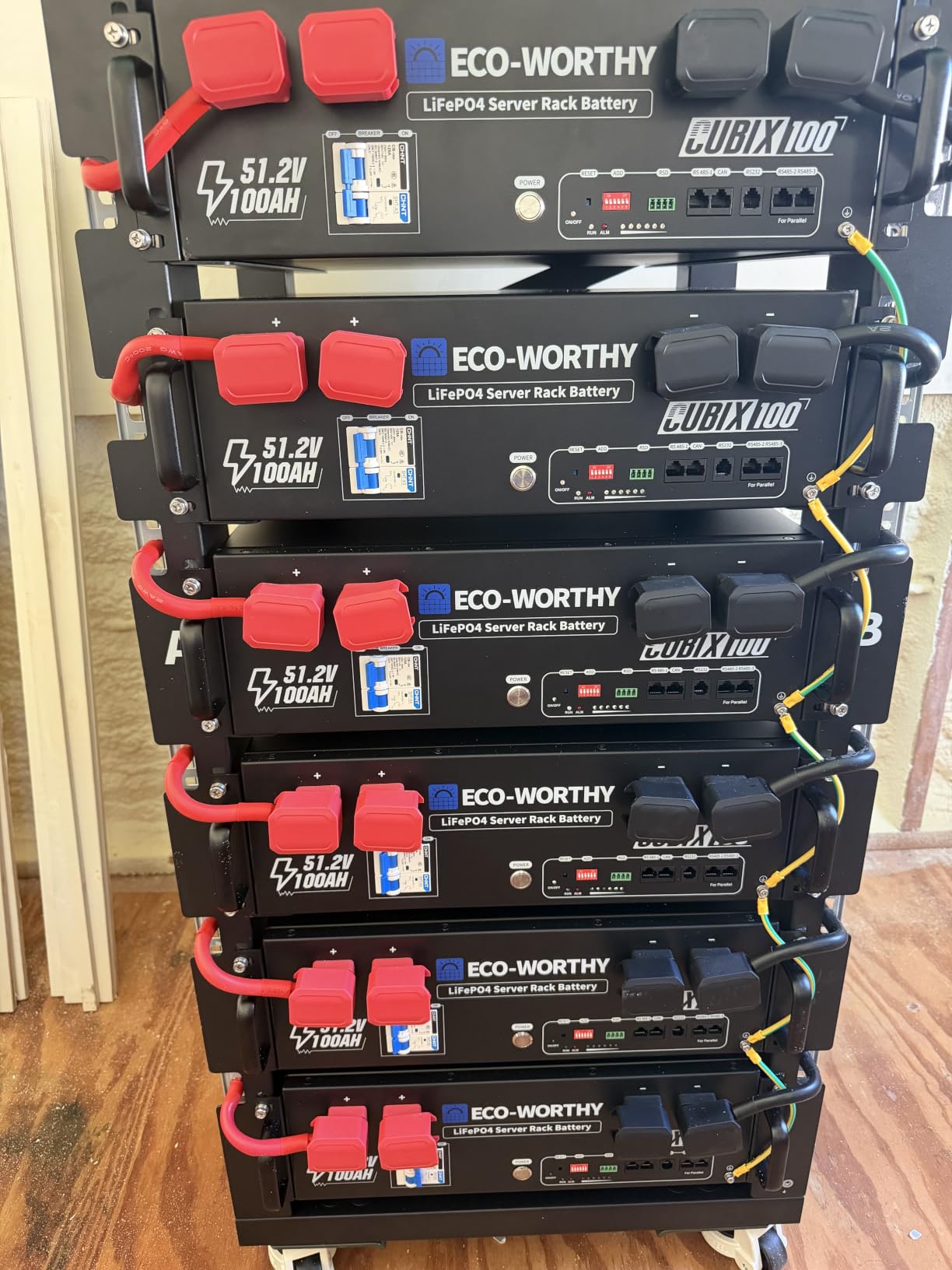
Communication is the second strength. Integrated CAN and RS485 across multiple protocols means the battery can speak to a Victron or similar inverter directly, and the kit ships with parallel and communication cables, grounding wires, terminal covers, screws and a manual. Parallel expansion runs to 32 modules for 163.8kWh, and the rack form mounts vertically at 22.09 by 19.02 by 5.63 inches.
Bluetooth and Wi-Fi monitoring through the ECO-WORTHY app cover the basics. The warranty is a ten-year limited one, which is the longest on this list and the only real answer to a buyer who plans to keep a bank past a decade.
Who this battery suits
It suits people running a genuinely off-grid house, typically 10 to 13kWh a day, who want a 48V array and a bank that can grow in clean increments. It also suits anyone whose inverter prefers CAN bus over the more common RS485-only approach, because the negotiation is already handled at the factory.
Backup-only installs that want a decade of service life also land here, since the ten-year limited warranty outlasts everything else we looked at.
Who should buy something else
It is the wrong pick for a small RV or a single cabin, where a 103-pound rack module is more hardware than the job needs. It is also wrong for anyone who wants to read state of charge from the front of the battery, because there is no on-device display at all.
Budget the app accordingly. Owners describe it as basic and missing time-to-full and time-remaining estimates, so a smart shunt is the sensible companion purchase for a bank this size.
3. VATRER 12V 300Ah Self-Heating – Best for Cold Climate Charging
12.8V 300Ah Self-Heating LiFePO4 Lithium Battery with APP Monitoring
3840Wh
Built-in self-heating
54.7 lbs
App monitoring
5000+ cycles
Pros
- Built-in self-heating allows real cold-weather charging and discharging
- Light at 54.7 lbs for a 300Ah unit
- App gives current
- voltage
- temperature and cycle count
- Strong owner ratings across RV
- marine and off-grid solar use
Cons
- Smaller review base than the competing 300Ah listings
- Not intended for series connection in golf carts
- Self-heating draws power from the bank when the pack is very low
- Hot surface during heating means care is needed around the case
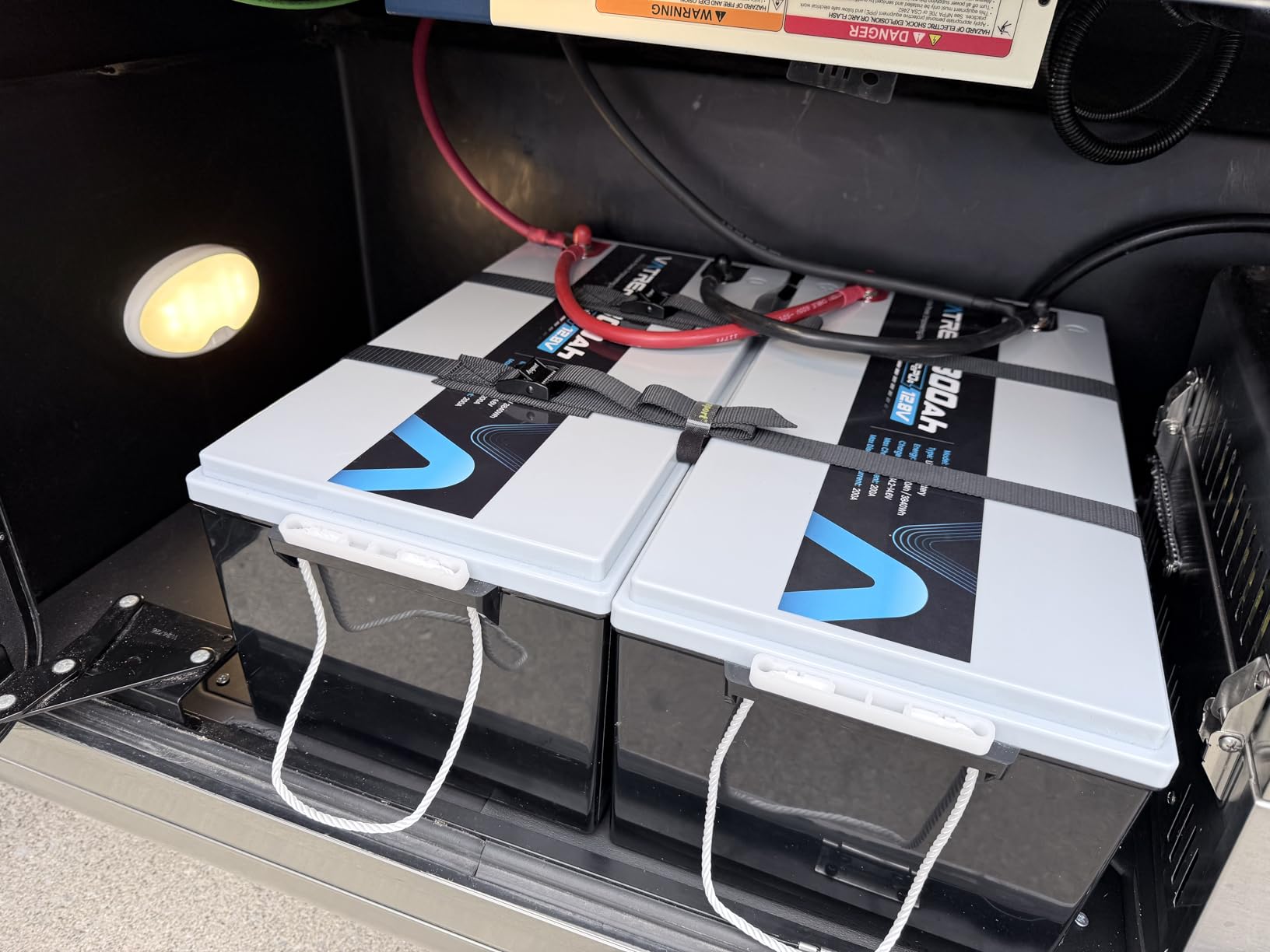
Every other battery in this roundup handles cold by refusing to charge. This one heats itself. The built-in self-heating function keeps charging and discharging smooth in low temperatures, which in a snowy climate is the difference between a bank that fills in February and a bank that does not.
Underneath the heater it is a straightforward 12V 300Ah pack rated at 3840Wh, weighing 54.7 lbs in a 15.12 by 7.64 by 9.76 inch case. The cycle claim is 5,000-plus charge and discharge cycles at 100% depth of discharge, which is the most aggressive figure in this list and worth reading with the caveat that cycle claims are only as good as the depth they were measured at.
App monitoring covers current, voltage, temperature and cycle count, and the BMS handles overcharge, over-discharge, high and low temperature, overcurrent and short-circuit protection on Grade A cells. For most people that is the full feature set they were hoping Bluetooth would give them, without needing a separate monitor.
Two honest limits. The heating element pulls from the bank itself when the pack is very low, so a deeply depleted battery in a freezing shed needs a mains charger before the sun helps. And the case runs hot while the heater works, so it wants clearance.
Who this battery suits
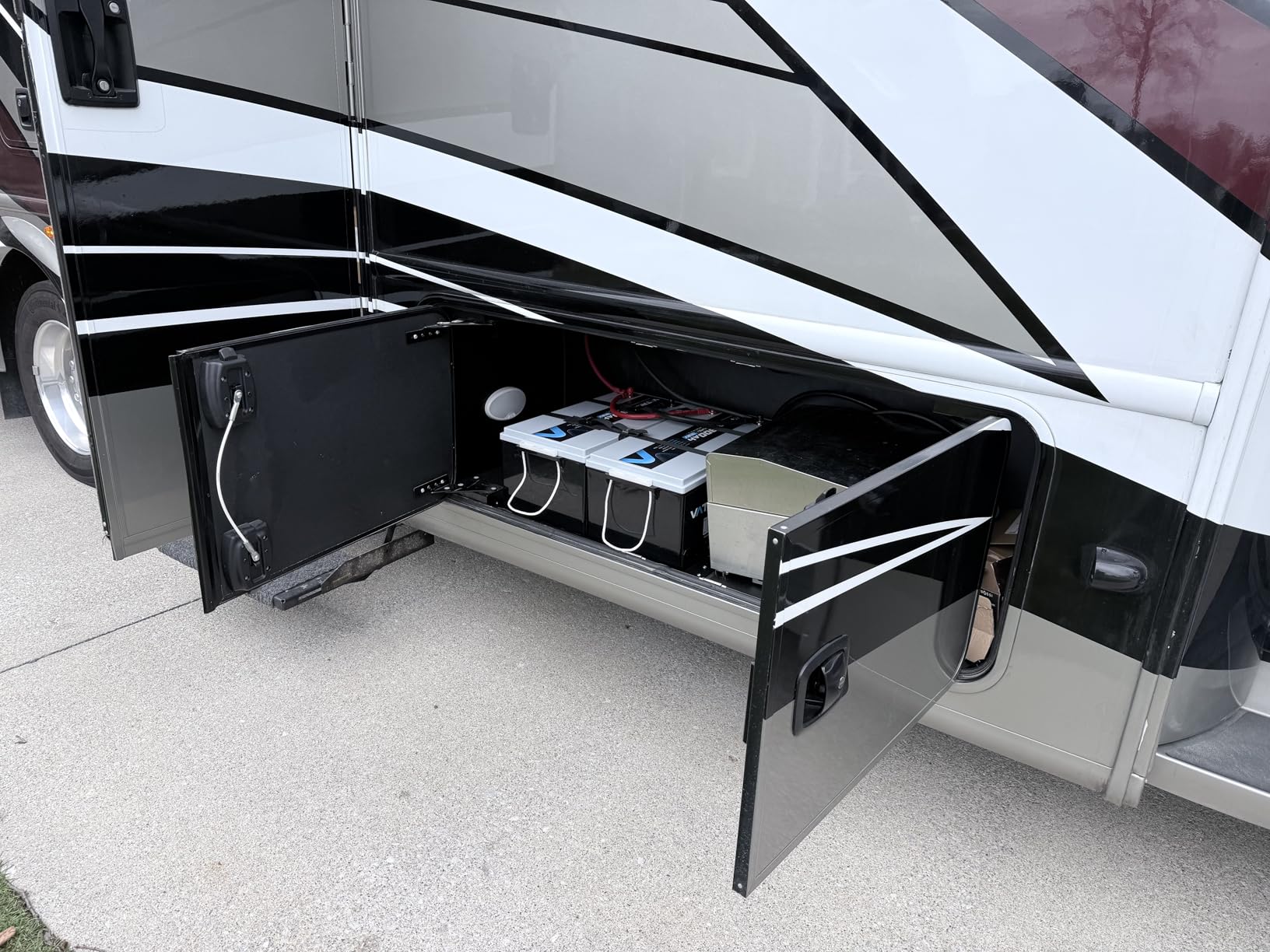
It suits cold-region installs where the array underproduces for months, and any user who has had a bank refuse to charge on a sunny winter morning. Off-grid cabins, snow-country garages and unheated RV storage all fit that description.
It also suits anyone who wants 3840Wh in a pack light enough for one person to handle, since 54.7 lbs is light for a 300Ah lithium unit.
Who should buy something else
It is a poor match for a golf cart or other series-string application, which the manufacturer explicitly does not recommend. And if you want a long public track record, 77 reviews is a small base to draw comfort from, so treat the rating as promising rather than proven.
If your winters are mild and your bank stays above freezing in a garage, you can spend the difference on a larger capacity unit instead of a heater you will rarely switch on.
4. ECO-WORTHY EnergyRock 12V 280Ah Two Pack – Best Value per Amp-Hour
ECO-WORTHY EnergyRock 12V 280Ah 2 Pack LiFePO4 Lithium Battery Metal Case
Two 12V 280Ah units at 3584Wh each
200A BMS
Metal case
Bluetooth 5.1
Pros
- Two 280Ah units give 560Ah at a per-amp-hour cost reviewers consider hard to beat
- Bluetooth app shows per-cell balance
- charge amperage and state of charge in real time
- Metal case adds durability and fire resistance over earlier plastic enclosures
- Mounting feet let it install directly without a separate battery box
Cons
- Newer metal-case revision behaves differently from the earlier plastic design
- BMS cut-off near 14.2V can make 24/7 off-grid charge controllers overshoot
- First charge out of the box can take a very long time
- Heavy at about 61 lbs per module
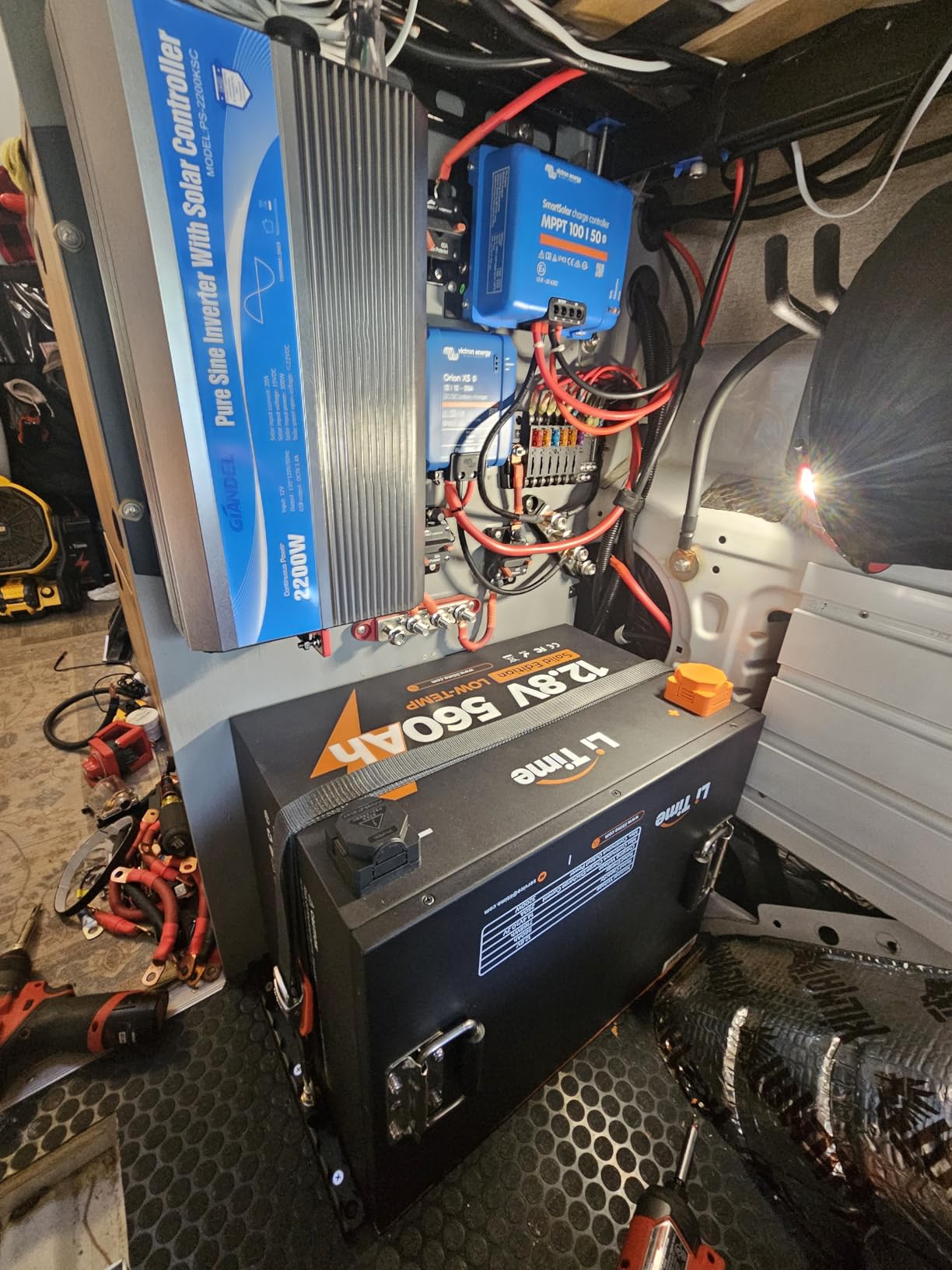
Two batteries in one box of metal changes the arithmetic. Each unit is a 12V 280Ah pack storing 3584Wh, so you get 560Ah and roughly 7.1kWh as a matched pair, which is the point: identical modules of the same revision are far easier to balance than two different batteries bought years apart.
The enclosure was upgraded in June 2026 to a metal case for heat resistance and fire protection, with internal cell holders and four mounting feet so the batteries install without a separate box. Total pair weight is 137 pounds, and each measures 16.54 by 9.65 by 8.64 inches.
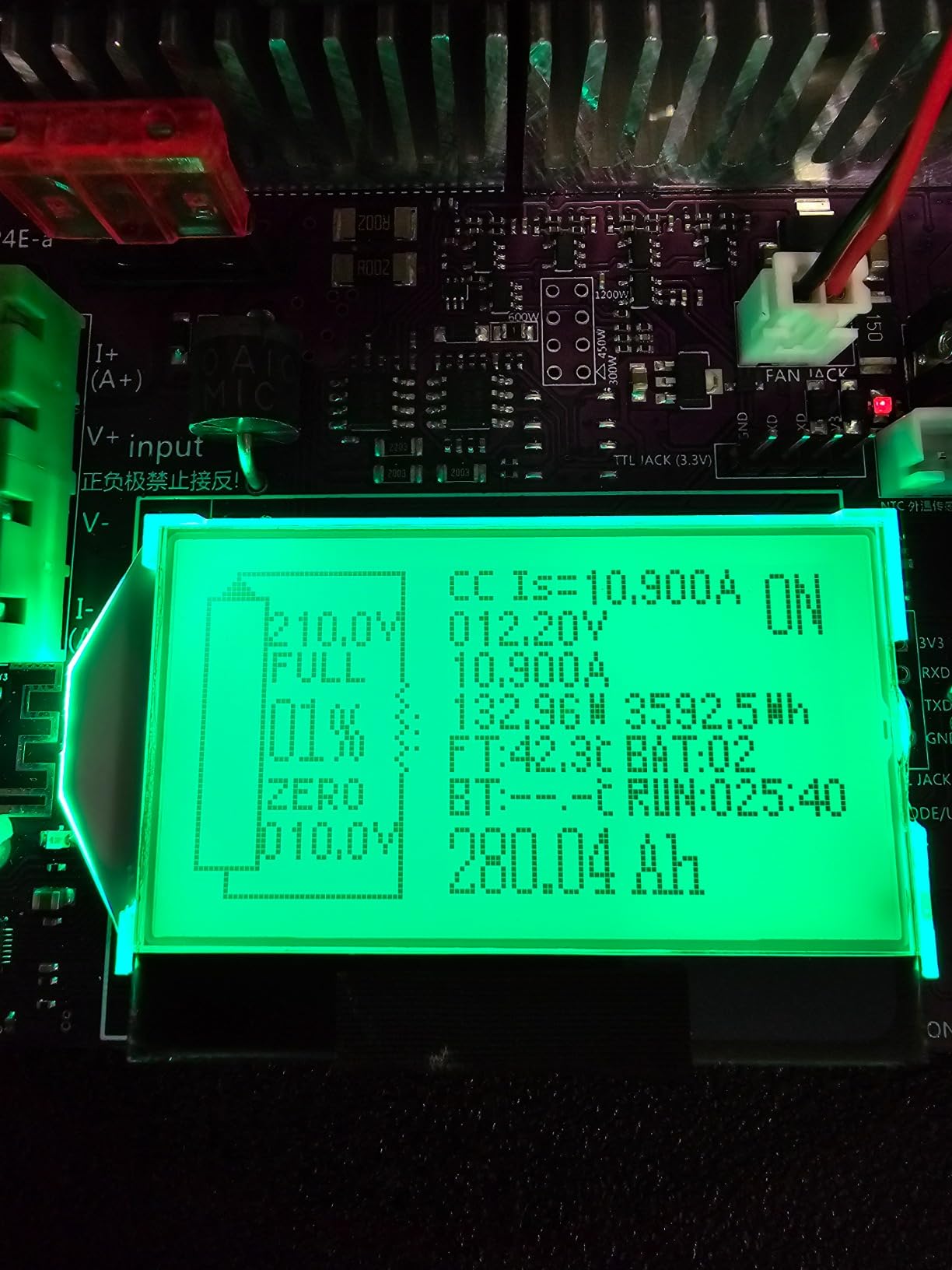
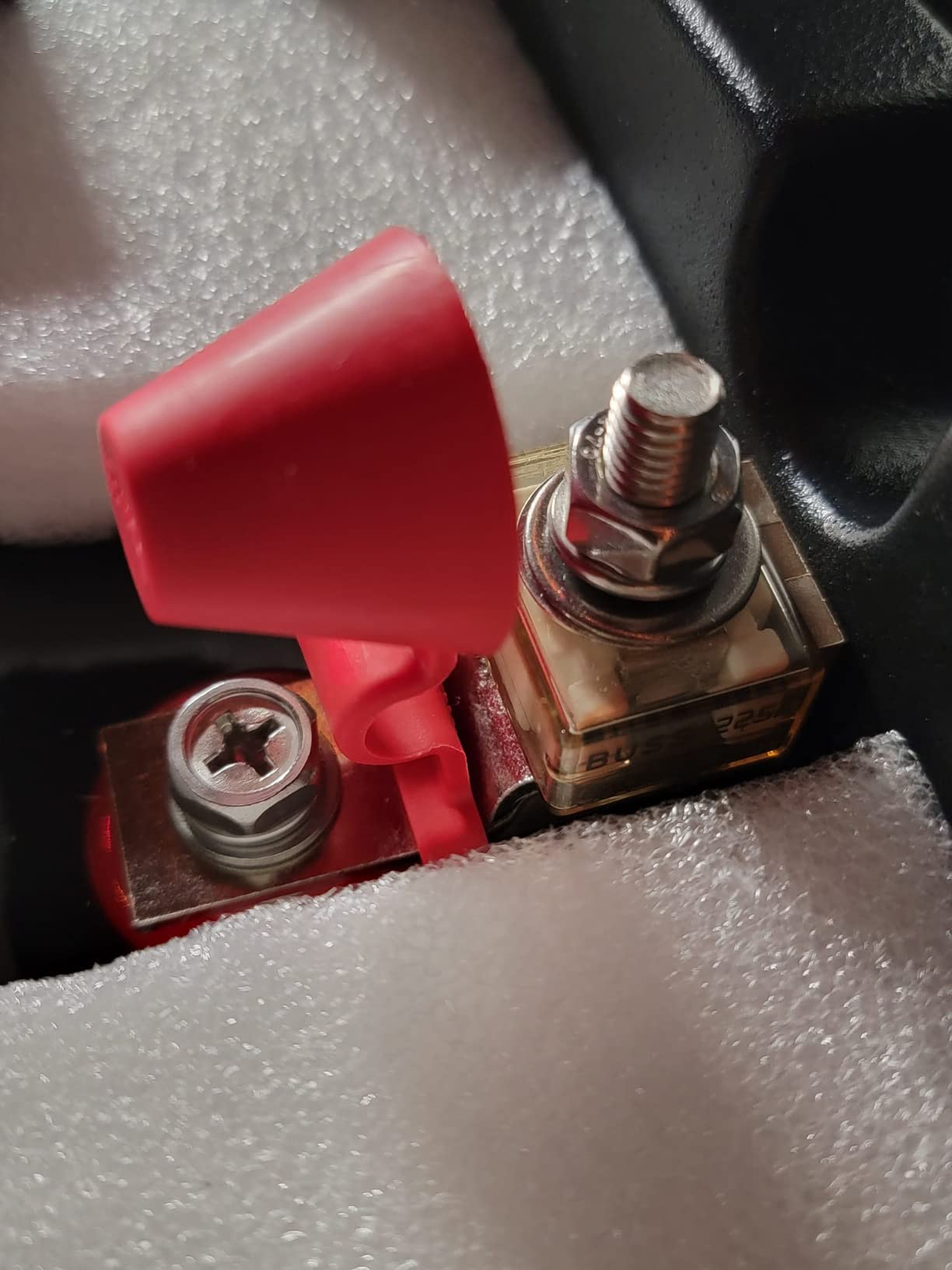
Bluetooth 5.1 monitoring reaches roughly 15 metres and shows per-cell balance and charge current, which is precisely the information that tells you whether a parallel bank is actually sharing load. A weak-current on and off power switch on the case makes installation and maintenance safer than working around live terminals.
The cells are Grade A with a 200A BMS covering overcharge, over-discharge, overcurrent, short-circuit and temperature protection, and the shell is rated shock and vibration resistant for RV and off-road use. The warranty runs three years.
Who this battery suits
It suits builders who want a two-battery bank from day one at a sensible cost per amp-hour, and anyone who values a metal enclosure over a plastic case for fire resistance and physical durability. Shock and vibration resistance also makes it a natural fit for a trailer or boat.
It suits people who plan to add a second pair later, since matched revisions are the whole point of buying them together.
Who should buy something else
It is the wrong choice if you are upgrading from an earlier plastic-case ECO-WORTHY, because the metal revision has different BMS behaviour and owners who mix revisions report confusion. The two packs should be treated as a matched set.
It also needs careful charge controller setup. A cut-off near 14.2V can make some 24/7 off-grid controllers overshoot and cycle appliances, so budget time to tune the absorption voltage by hand rather than trusting defaults.
5. LiTime 12V 460Ah Group 8D – Best Single-Unit 12V Capacity
Litime 12V 460Ah Group 8D Lithium LiFePO4 Battery for RV Marine Solar
5.89kWh class
250A BMS
Group 8D case
86 lbs
100% usable depth
Pros
- Delivers roughly 460Ah of usable capacity in a Group 8D case smaller than owners expected
- Owners report running rooftop AC units overnight and still starting the day full on solar
- Build quality is serviceable and internals are neatly assembled
- Large weight drop versus the lead-acid banks it replaces frees tongue and payload capacity
Cons
- Very heavy so it needs at least two people and solid handling
- Taller form factor means some battery boxes have to be replaced or modified
- Some chargers need a manual reconnect before they resume
- Monitoring functions differ between capacity tiers in the app
One battery instead of five is the entire argument here. The 460Ah Group 8D stores 5.89kWh in a case measuring 20.47 by 10.59 by 8.66 inches, and owners consistently report a real usable figure that matches the label rather than a marketing number.
The 250A BMS runs on EV-grade cells, and the rated 100% depth of discharge while staying above 12.8V is unusually honest for a listing. It is CE and RoHS compliant and backed by AIG product liability insurance, and it expands 4P4S for larger backup capacity.
For rooftop air conditioning duty this is the pick. People running a 12k BTU rooftop unit overnight and still waking up to a full bank on solar is the most common owner report, and the 86-pound weight is roughly a quarter of what a 460Ah lead-acid bank of that capacity would weigh.
Weight is still the number to plan around at 86 pounds, and the height is the other. Both are handling problems rather than electrical ones, but they decide whether a job goes smoothly.
Who this battery suits
It suits anyone whose load is heavy and concentrated, like rooftop air conditioning, a well pump or a workshop with a large saw. It also suits people who have been bitten by parallel bank problems and would rather have fewer, larger connections to make.
Weight-sensitive installs benefit too, since shedding lead-acid weight frees up payload and tongue capacity in a trailer or truck.
Who should buy something else
It is a poor fit for a small boat or a single-person lift, and anyone whose existing Group 8D box is short on clearance will be replacing the box as part of this job. Measure before you commit.
Do not mix it with a differently sized LiTime pack expecting the app to behave identically, because monitoring functions differ between capacity tiers.
6. dumfume 12V 200Ah LiFePO4 – Best Expandable 200Ah Option
Dumfume 12V 200Ah LiFePO4 Lithium Battery 200A BMS 2560Wh IP65
2560Wh
200A smart BMS
IP65
58.9 lbs
4S4P to 40.96kWh
Pros
- High real usable capacity in a compact package roughly 60% lighter than lead-acid
- 200A BMS with sub-50ms overcurrent and sub-100 microsecond short-circuit cutoffs
- Expandable 4S4P for larger off-grid or home storage banks
- Owners report it powers RV fridges
- microwaves and rooftop ACs for hours on solar
Cons
- Several units arrived partly discharged and need a full charge to 14.6V before performing
- Sparse documentation for inexperienced installers
- A small share of units were reported failing after about a year in campervan service
- No Bluetooth or app monitoring
The published cycle figures on this one are the most detailed in the roundup: 4,000-plus cycles at 100% depth, 6,000-plus at 80% and 15,000-plus at 60%. That kind of depth-specific disclosure is exactly what a careful buyer looks for, because a cycle number without a depth beside it means very little.
Under the hood it is a 12V 200Ah pack storing 2560Wh with a 200A smart BMS, IP65 dust and water protection and UL and UN38.3 certified cells. Overcharge cut-off is 14.6V plus or minus 0.2V, over-discharge cut-off 9.2V plus or minus 0.2V, and the protection response is genuinely fast at under 50ms for overcurrent and under 100 microseconds for a short circuit.
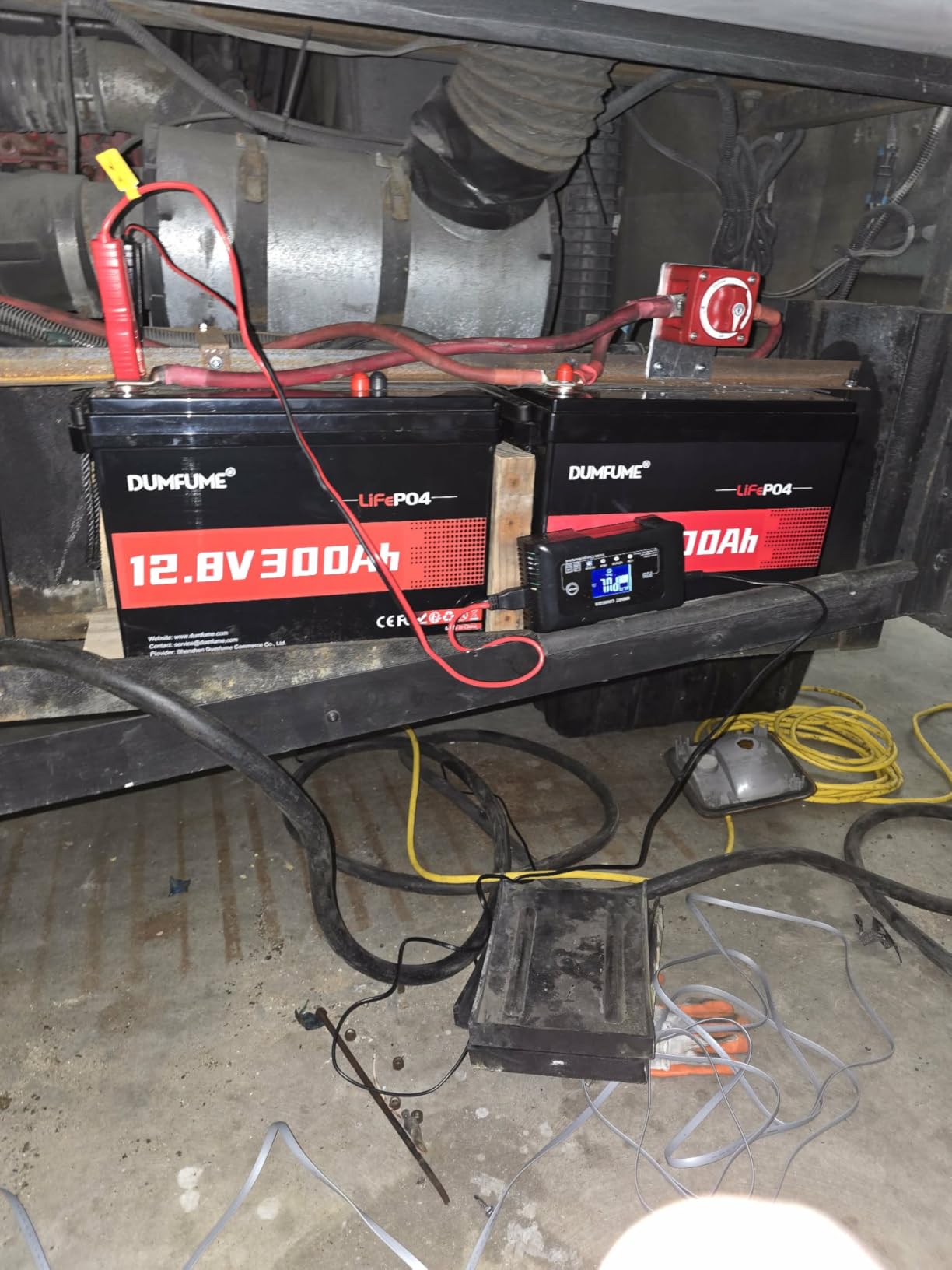
The expansion ceiling is the standout: 4S4P to sixteen batteries, which is 51.2V, 800Ah and 40.96kWh. That is the largest 12V-family ceiling in this list, and it means a 200Ah starter bank does not box you in. The warranty is five years, and the case is 21.06 by 8.07 by 8.46 inches at 58.9 pounds.
Owners run fridges, microwaves and even 12k BTU rooftop units on it, and the weight saving over lead-acid is around 60%.
Who this battery suits
It suits people who want a 200Ah-class pack now and a real expansion path later, and buyers who care more about published cycle data and certification than about an app. UL and UN38.3 certified cells are a genuine plus for anyone filling out paperwork.
It also suits installers who like a 200A BMS with a 58.9-pound unit, since one owner ran 120A loads without any trouble.
Who should buy something else
It is the wrong pick for cold installs, because charging is disabled below 32F and only resumes above 41F. Discharge still works down to minus 4F, but a bank that will not accept charge through a January solar window is a problem in exactly the places that need lithium most.
Skip it if you want phone-based telemetry, since monitoring is absent by design, and note that several units arriving partly discharged has caught out a lot of first-time buyers who assumed they were faulty.
7. LiTime 12V 320Ah Mini – Best Compact High-Capacity Pick
Litime 12V 320Ah Mini Lithium LiFePO4 Battery for RV Solar Home Backup
4096Wh mini form
57.2 lbs
2560W peak
Bluetooth 5.0
5-year warranty
Pros
- Compact form factor fits where a 300Ah unit would not while still delivering 4096Wh
- Bluetooth monitor gives accurate state-of-charge and runtime estimates
- Owners report charging from empty to full in a couple of hours with a 50A charger
- Consistently described as exceeding expectations on RV and off-grid duty
Cons
- Some LiTime chargers need to be power-cycled to resume charging
- App data can be confusing when batteries are grouped in series or parallel
- Still heavy for its capacity class
- Tall form factor can require replacing an existing battery box
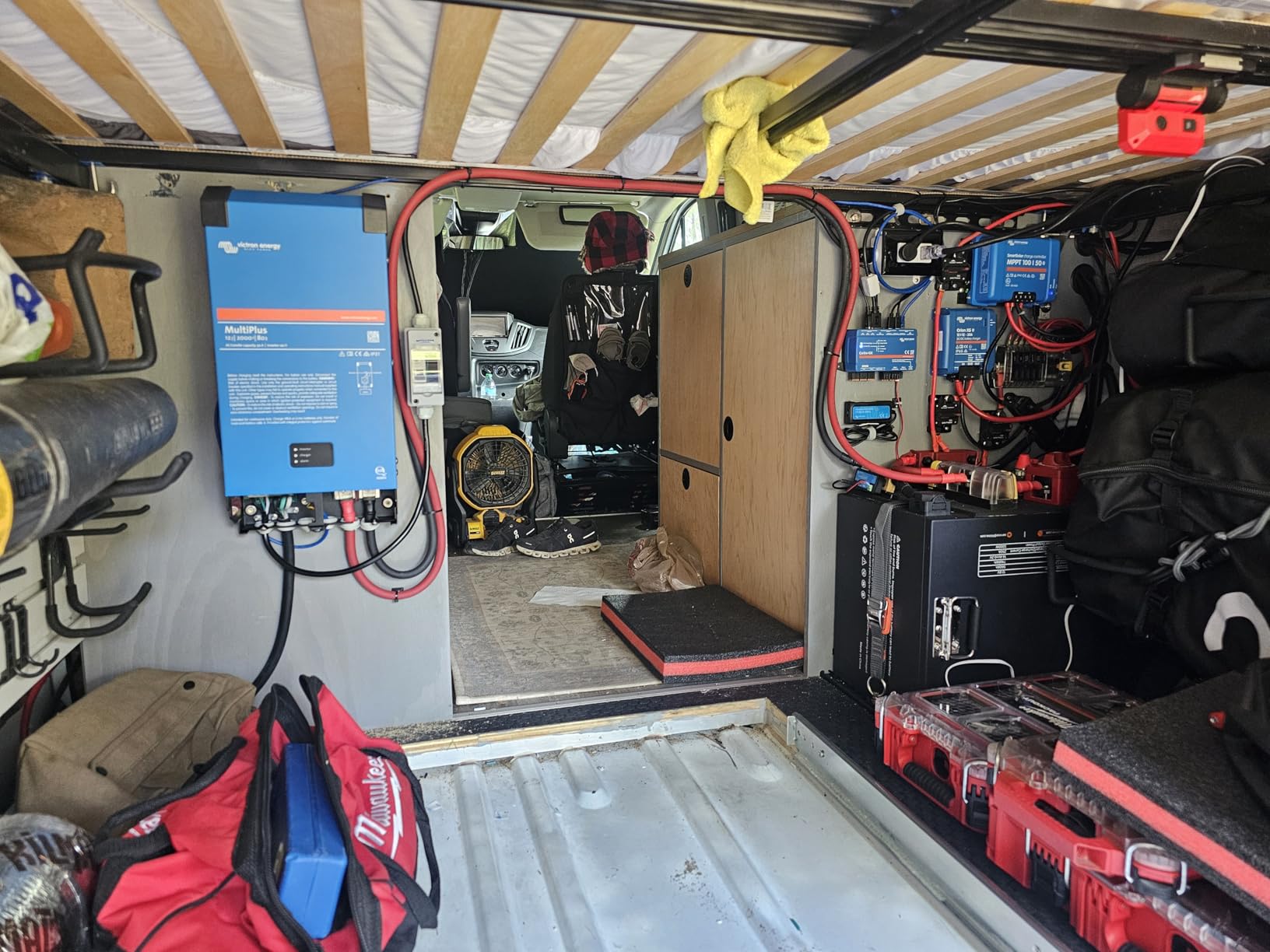
This is the answer to the most common problem in this category, which is a box that physically will not take a 300Ah battery. The mini case delivers 4096Wh while measuring 15.12 by 7.64 by 9.76 inches and weighing 57.2 pounds, roughly a third smaller than a 12V 300Ah unit and lighter than three 100Ah lead-acid batteries.
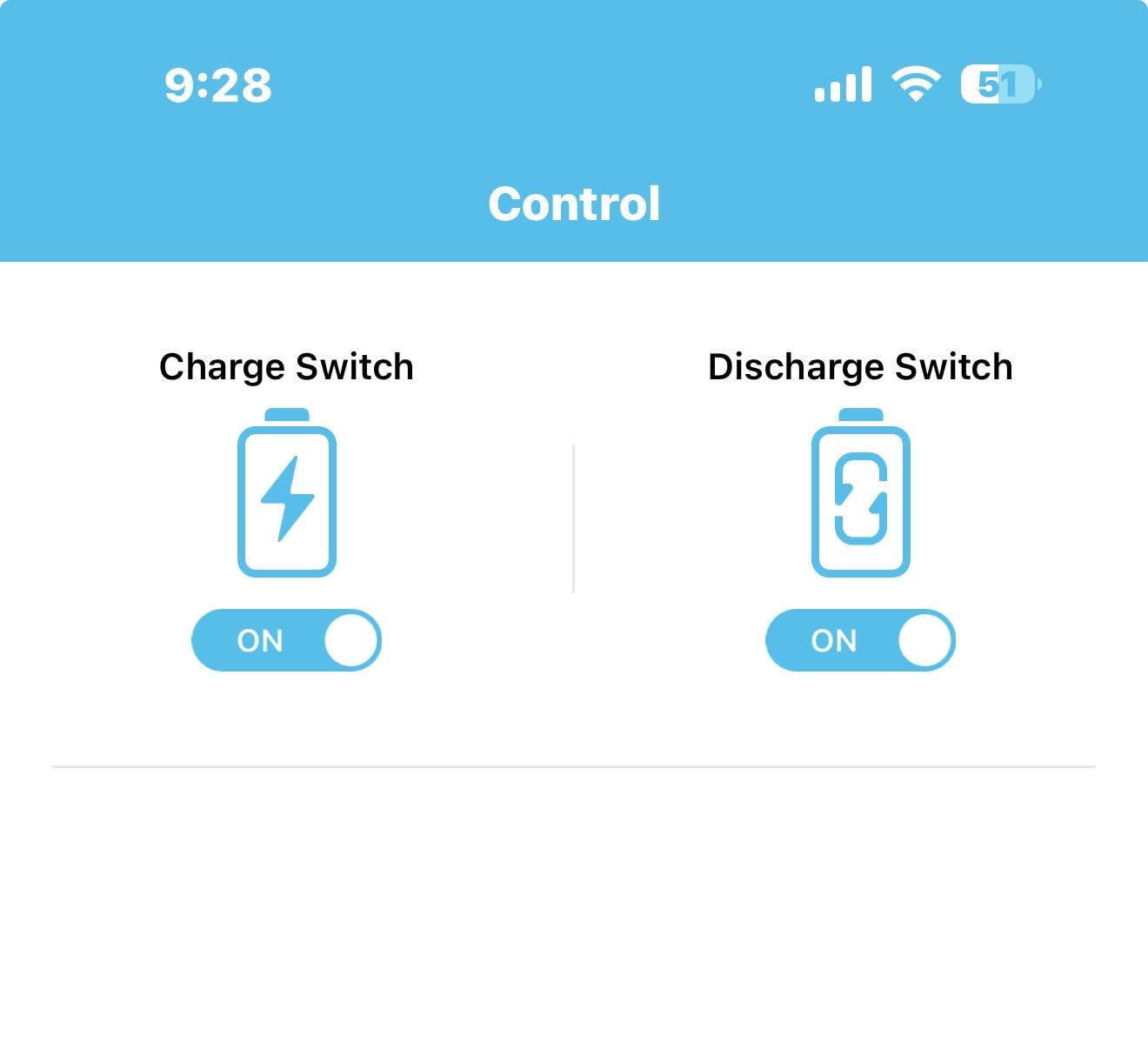
Peak output is rated at 2560W, so a decent inverter can be paired without drama, and the Bluetooth 5.0 app reports voltage, state of charge and performance with a remote on and off function. That remote switch is a small feature that pays off during a wiring job.
Cells are EV-grade and rated across a 4,000 to 15,000 cycle range with a ten-year lifespan, protected by more than 20 BMS functions including low-temperature cut-off. The warranty is five years, which sits comfortably in the middle of this field.
Owners report filling it from empty in a couple of hours on a 50A charger, which tells you something about the charge acceptance these cells have.
Who this battery suits
It suits RV, van and trailer builders who have measured their battery box and found a standard 300Ah will not fit. It also suits anyone who wants more than 4kWh from a single unit without climbing into Group 8D territory.
Owners running mixed series and parallel banks will like the remote on and off, provided they read bank-level numbers from a smart shunt rather than the phone app.
Who should buy something else
It is a frustrating pick if your LiTime charger needs power-cycling to resume, and support responses on that issue are reported as limited. Confirm your charger works with lithium before ordering rather than after.
It is also still 57.2 pounds and 9.76 inches tall, so it is not a small-battery solution for anyone working solo in a tight compartment.
8. PUPVWMHB 12V 300Ah LiFePO4 – Best for Awkward Mounting Positions
PUPVWMHB 12V 300Ah LiFePO4 Lithium Battery, Bluetooth LifePO4 Battery, Upgraded 200A BMS, 3840Wh Rechargeable Lithium Battery with Low Temp Cut off, Perfect for RV Solar Marine Solar Panel Camping
3840Wh
200A BMS
59 lbs
13.58 by 7.48 by 9.64 inches
Bluetooth telemetry
Pros
- 3840Wh in a compact 59 lb case that fits tight RV and boat compartments
- 200A BMS handles high inverter loads without dropping out
- Bluetooth app exposes useful per-bank telemetry including cycle count
- Can be mounted in any orientation for boat and RV installs
Cons
- Small and relatively new listing so long-term durability data is thin
- No built-in state-of-charge display and everything depends on the phone app
- Needs a LiFePO4-aware charger and low-temp charge limiting reduces usable winter solar
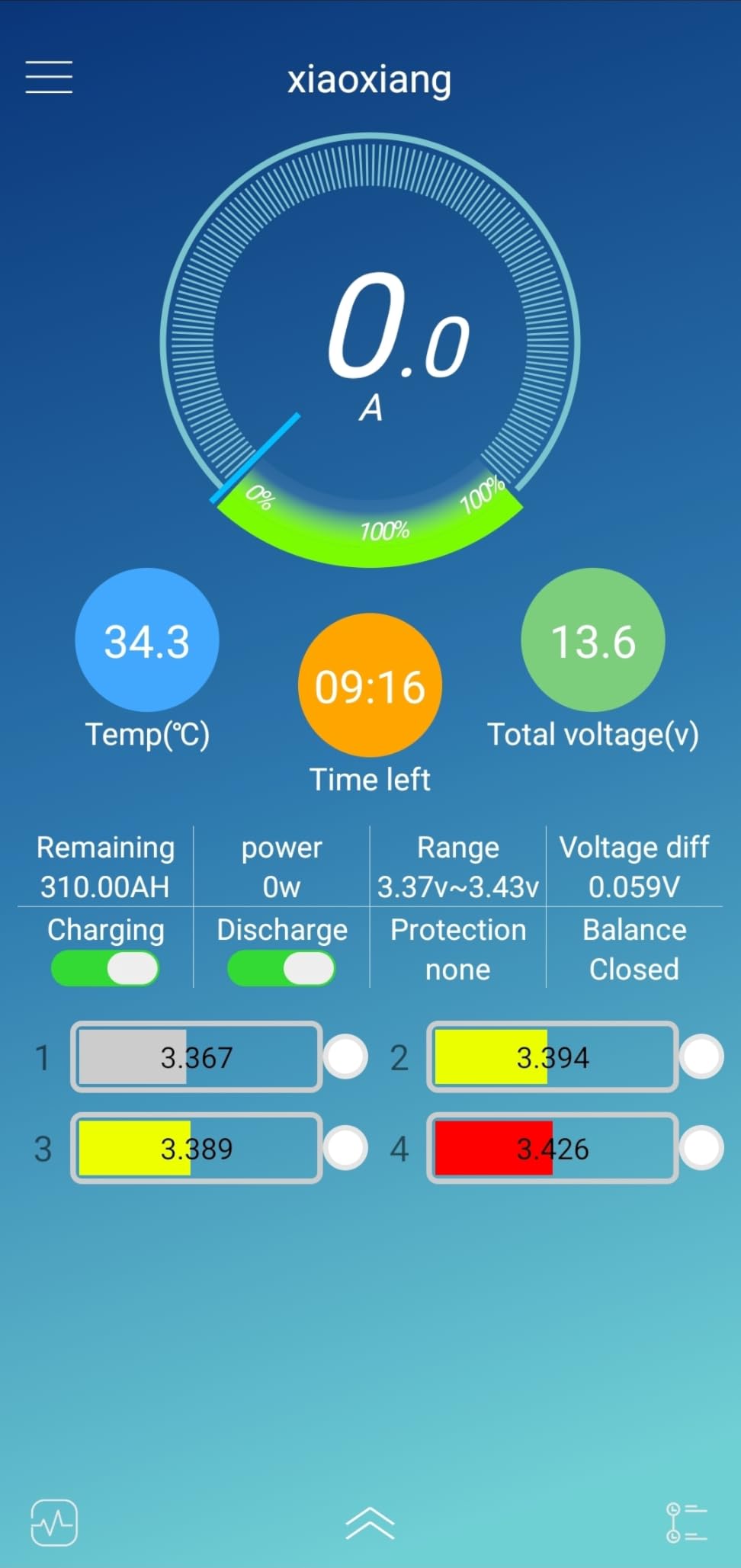
The distinguishing feature is orientation. This 3840Wh pack is safe to mount in any orientation, which in a boat bilge, a trailer floor or a camper with a low ceiling is worth more than another hundred amp-hours would be.
It fits a 13.58 by 7.48 by 9.64 inch footprint at 59 pounds, runs a 200A BMS, and reports current, voltage, temperature and cycle count over Bluetooth. Cycle count in the app is the detail that separates it from most listings at this price, because it lets you see how hard the bank is actually being worked.
The durability promise is specific: cell capacity stays above 80% after 2,000 cycles. The cells are UL tested, the chemistry contains no heavy or rare metals, and the expansion ceiling is generous at 51.2V, 1200Ah, 61.44kWh and 40.96kW of maximum load. Warranty is five years.
There is a low-temperature charge cut-off as standard, which is correct chemistry behaviour rather than a flaw.
Who this battery suits
It suits boat and RV installers working in compartments where orientation is not negotiable, and anyone with a 200A-plus inverter who wants headroom on the continuous discharge side. Telemetry including cycle count makes it a good choice for people who like watching their bank rather than guessing.
The 61.44kWh expansion ceiling also makes it sensible as a starter for a system that will grow into a full off-grid array.
Who should buy something else
It is a weaker bet for anyone planning to keep the install for a decade, because 251 reviews on a relatively new listing is a thin base for long-term durability claims. Buy a second unit in the future and expect to mix revisions.
Cold-region owners should also weigh the alternatives, since the charge cut-off reduces usable solar exactly when solar is scarcest, and there is no local display as a fallback when the app is out of range.
9. ECO-WORTHY 12V 314Ah – Best for Reading State of Charge Without a Phone
ECO-WORTHY 12V 314AH LiFePO4 Lithium Battery Bluetooth with SOC LEDs, Low Temp Protection, 4019WH, 200A BMS Up to 15000 Deep Cycle for Off-Grid, RV, Solar Power System, HomeBackup
4019.2Wh
200A BMS
LED state-of-charge display
60.4 lbs
3-year warranty
Pros
- Roughly triples the usable watt-hours of a 100Ah lead-acid setup at a similar weight
- On-case LED display shows charge percentage and fault status without a phone
- Long Bluetooth range and an app owners describe as reliable after recent updates
- Tested on the bench and measured at or above spec by multiple buyers
Cons
- Bluetooth current readings reported as roughly 6-7x the true value on some units
- A first unit cut charging off at 13.9V and never reached full until replaced
- Customer service response times reported as slow on warranty issues
- App data is basic and cell balance occasionally needs attention
Most smart batteries in this category make you open an app to find out what the battery is doing. This one has a built-in LED state-of-charge and status display with a buzzer fault alert on the case, which is a genuinely useful thing to have when the battery is in the dark underside of a bus.
Capacity is 4019.2Wh nominal, upgraded from a 300Ah platform in April 2026, with a 200A BMS covering high and low voltage, overload and temperature protection. It weighs 60.4 pounds and measures 16.3 by 8.5 by 10.2 inches, using Grade A cells.
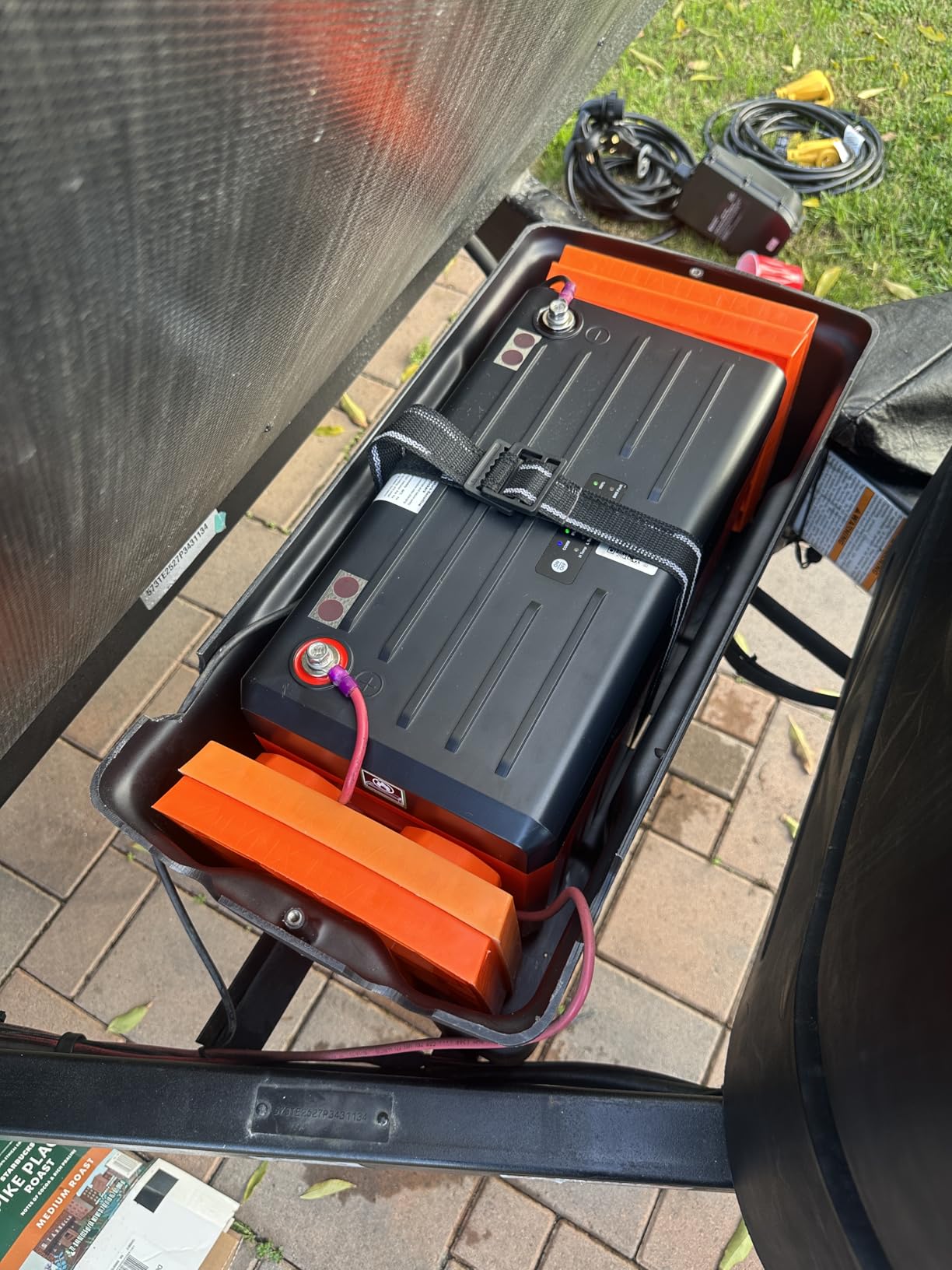
Buyers bench-tested these and measured them at or above spec, and report handling repeated deep discharge to about 20% without trouble. Charging cuts off below 19.4F, and expansion runs 4P2S or 2P4S up to 32.15kWh.
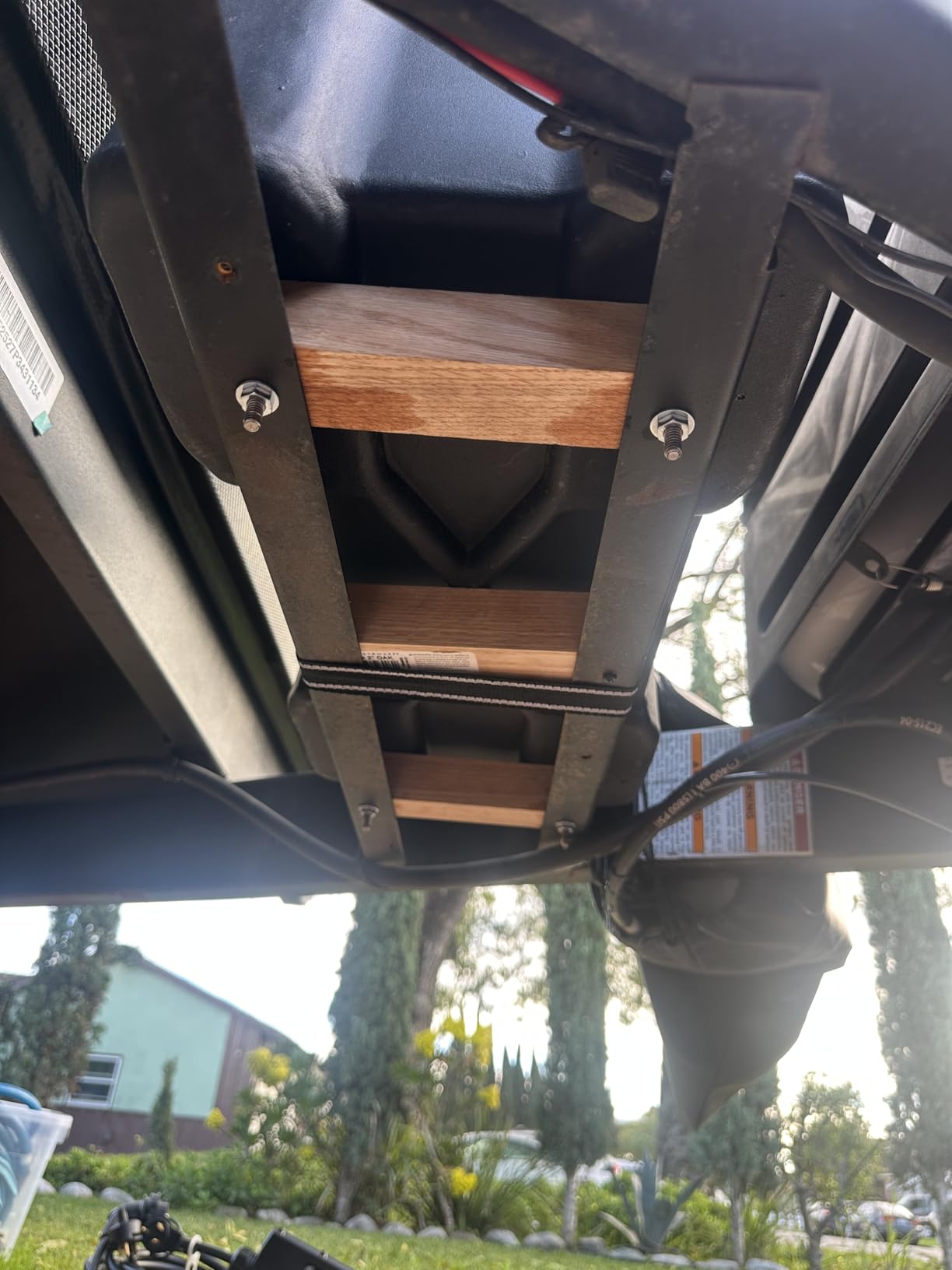
There is a fair bit to be careful about. Some units report Bluetooth current readings roughly six to seven times the true measured value, and one first unit cut charging off at 13.9V and never reached full until it was replaced.
Who this battery suits
It suits installers who want a local state-of-charge readout for daily checks without pulling out a phone, and cold-region users, because a charge cut-off at 19.4F is meaningfully lower than the 32F threshold on most of the 200Ah and 300Ah units here.
It also suits people replacing a 100Ah lead-acid setup who want roughly triple the usable watt-hours at a comparable weight.
Who should buy something else
It is a poor fit for anyone who trusts the app as their primary instrument, since current readings are reported as badly inflated on some units. Use a smart shunt for anything load-related.
The three-year warranty is also the shortest on this list, and owners report slow response on warranty issues, so factor that into the decision if you expect to run this bank for a decade.
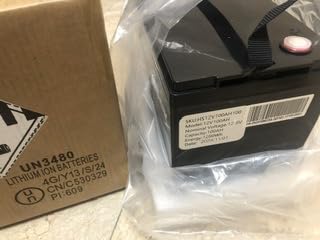
10. HumsiENK 12V 100Ah Group 24 – Best Lightweight Bluetooth Option
HumsiENK 12V 100Ah LiFePO4 Lithium Battery with Bluetooth (Group 24) 1280Wh
1280Wh
19.7 lbs
100A smart BMS
Bluetooth
IP65
5-year warranty
Pros
- Very light at under 20 lbs while still delivering full Group 24 capacity
- Bluetooth app gives real-time voltage
- temperature and state-of-charge data
- Direct fit for Group 24-31 boxes with no complex wiring
- Wide operating range from minus 20C to 70C
Cons
- App-only monitoring with no local state-of-charge display on the case
- Cold-weather charging is cut back by the BMS rather than actively heated
- Generic branding and limited long-term review history for this specific listing
At 19.7 pounds this is the lightest 100Ah Group 24 in the roundup, and that is a real advantage in a compartment where you are working alone. It still delivers the full 1280Wh of a 12V 100Ah, with a 100A smart BMS and Bluetooth reporting voltage, temperature and state of charge.
It is a direct fit for Group 24-31 boxes at 6.6 by 10.2 by 8.2 inches, with insulating caps and M8 hardware in the box. The operating range is a genuine plus at minus 20C to 70C with automatic low-temperature shutdown, and the cells are A+ grade, UL tested, FCC and CE certified with IP65 protection.
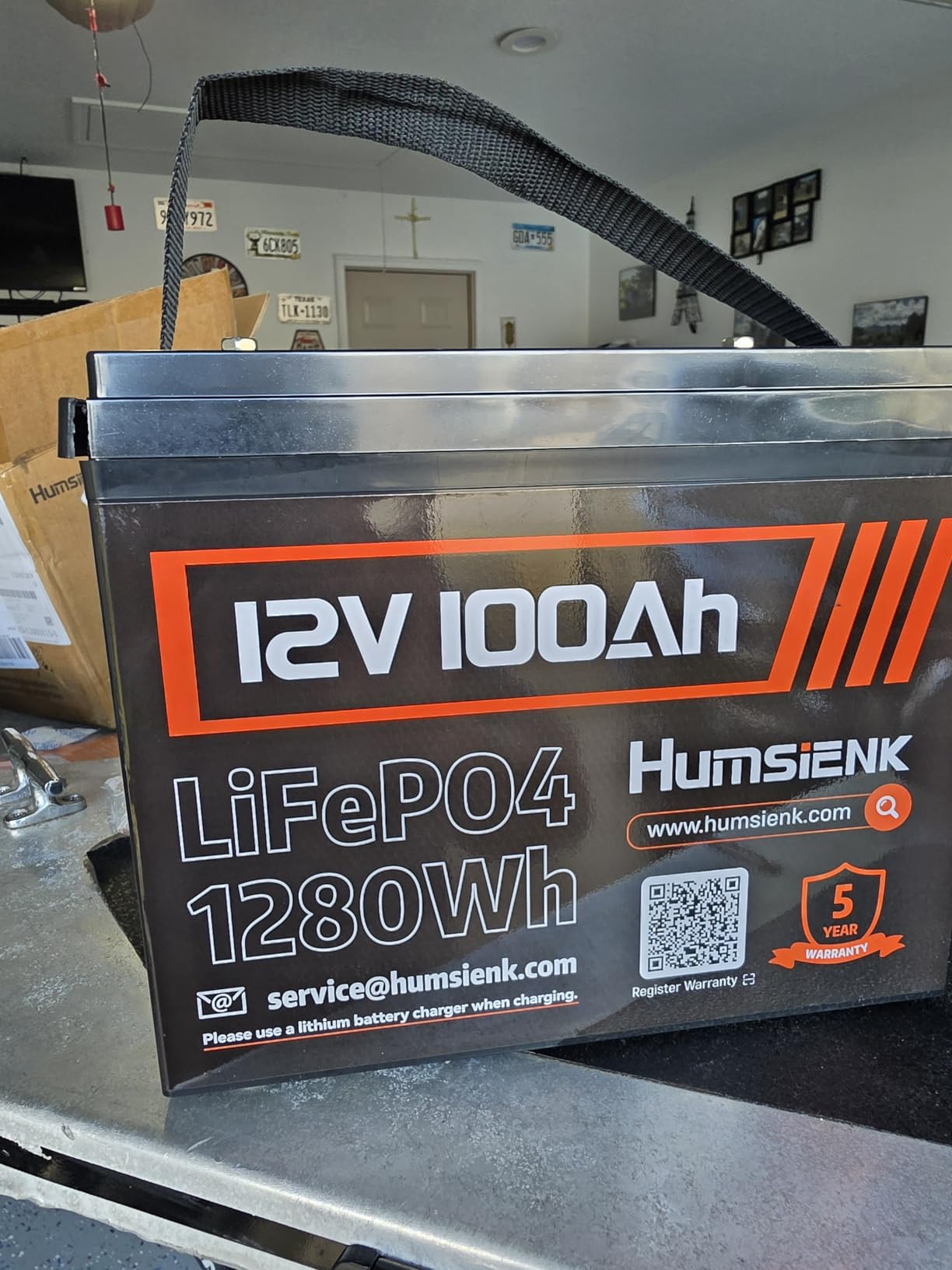
Expansion runs 4S4P for setups up to 48V and 20.48kWh, and the cycle figure quoted is up to 15,000. The warranty is five years, which is longer than several nominally similar units.
Owners consistently highlight the weight saving and the clean Group 24 fit as the two things that matter in a real install.
Who this battery suits
It suits small systems where 1.28kWh is genuinely enough, such as a shed, a boat accessory bank, a trolling setup or a backup bank for a few essential circuits. It also suits single-person installs where a 40-pound alternative would need a second pair of hands.
For anyone replacing lead-acid in a Group 24-31 box, the drop-in fit with no rewiring is the deciding factor.
Who should buy something else
It is the wrong choice if you need real cold-weather charging, since the BMS cuts charge back rather than heating the pack. Discharge tolerance is not the same as charge tolerance, and that distinction catches people out every winter.
There is no local state-of-charge display, so it depends entirely on the app, and the generic branding with a shorter review history for this specific listing is a reason to buy a spare rather than build the whole bank on one.
11. SUPER EMPOWER 12V 100Ah – Best No-Frills Group 24 Drop-In
12V 100Ah LiFePO4 Battery, Group 24 Deep Cycle for RVs & Trolling Motors
1280Wh
21.6 lbs
100A BMS
40 milliohms internal resistance
5-year warranty
Pros
- True drop-in Group 24 fit with M8 terminals and no box modification
- Only 21.6 lbs
- a big weight saving over the lead-acid it replaces
- Grade A cells and a 100A BMS cover the usual deep-cycle protections
- Low-temperature charge protection prevents cold-weather cell damage
Cons
- No Bluetooth or app monitoring on this variant
- Not designed for engine starting or cranking
- Needs a LiFePO4-specific charger and cold climates require working around the BMS charge lockout
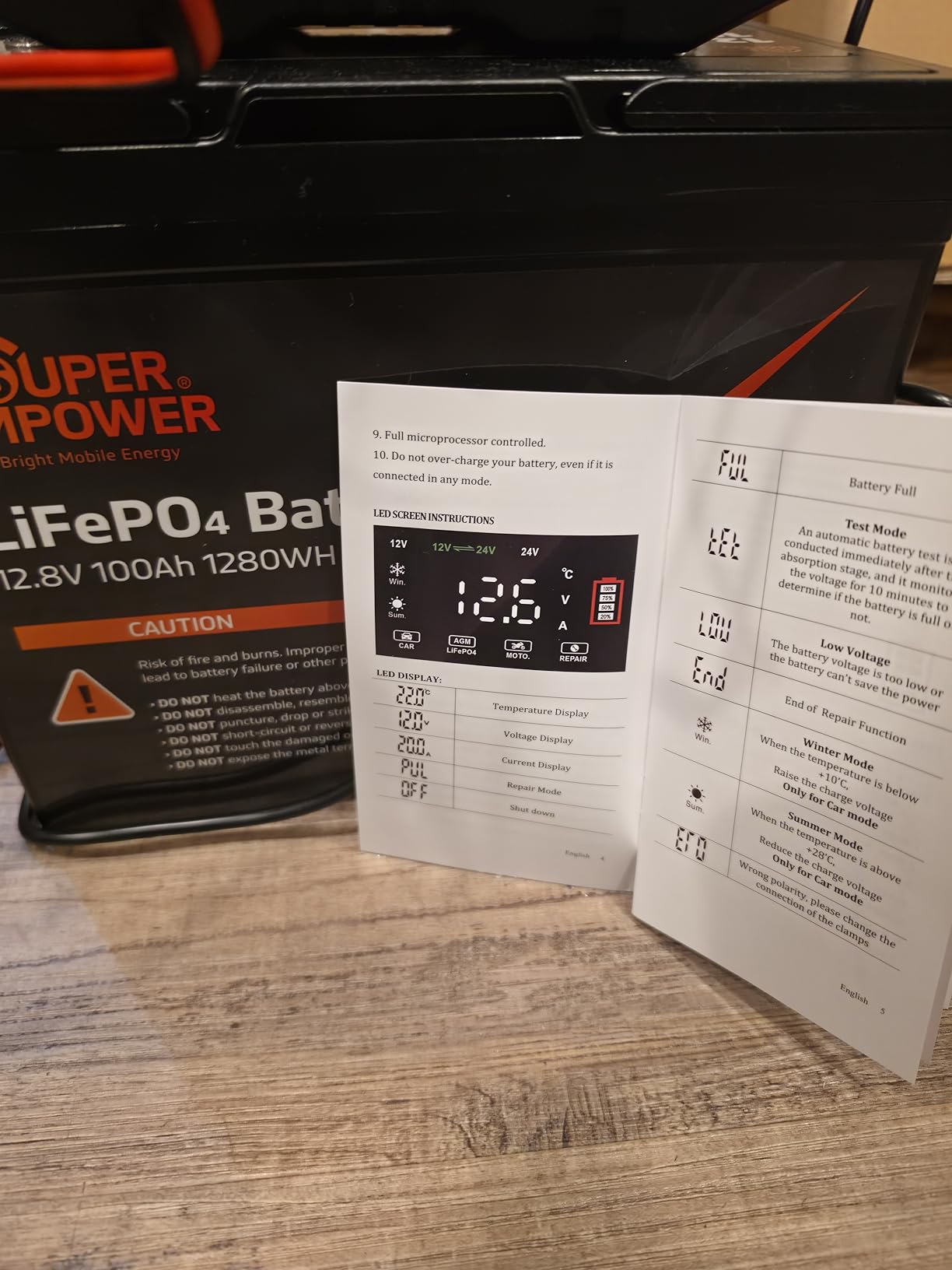
This is the simplest battery in the roundup and that is the feature. A 12V 100Ah Group 24 storing 1280Wh at 21.6 pounds, with Grade A cells, a 100A integrated BMS and full protection against overcharge, over-discharge, overcurrent, short circuit and temperature extremes.
The listed internal resistance of 40 milliohms is a useful number that most listings hide, and four cells at 12.8V nominal is the standard layout. It measures 6.49 by 10.24 by 8.98 inches with M8 terminals, so it drops into a standard box without modification.
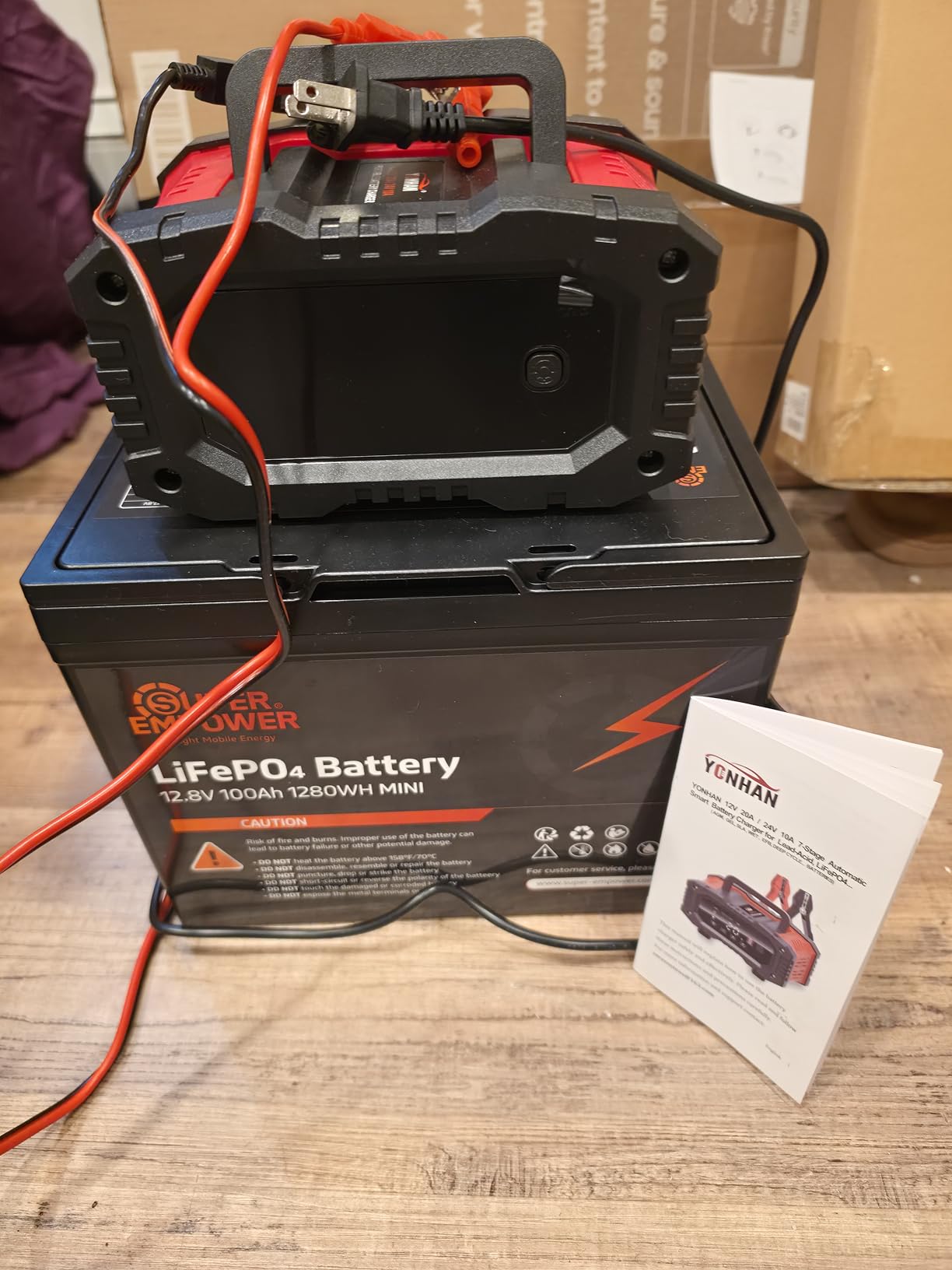
Temperature behaviour is properly documented: charging pauses below 32F, discharge stops at minus 4F, and charging resumes above 41F. Expansion runs 4S4P to 51.2V, 400Ah and 20.48kWh, and the warranty is five years.
The lack of Bluetooth is not an oversight so much as a trade, and reviewers treat it that way. If you want a readout, buy a smart shunt for a few tens rather than paying for it in every battery.
Who this battery suits
It suits a straightforward build: a Group 24 box, a LiFePO4-aware charger and no interest in apps. It also suits anyone who wants to keep the physical footprint of lead-acid, since the terminals and dimensions are conventional.
Five-year warranty support is reported as responsive, which is a reasonable comfort when there is no app or display to fall back on.
Who should buy something else
It is a poor choice for cold-region charging because of the 32F lockout, and it is explicitly not designed for engine starting, so keep it on a deep-cycle circuit rather than a cranking one.
It is also the wrong pick if you want remote monitoring. That is a real gap for a battery you will depend on while away from home.
12. DC HOUSE 12V 100Ah Bluetooth – Best for Trolling Motors and Marine Use
DC HOUSE 12V 100Ah Bluetooth LiFePO4 Trolling Motor Lithium Battery
1280Wh
23.8 lbs
100A BMS
Bluetooth 5.1 with per-cell data
3-year service
Pros
- Close to standard Group 24 sizing so most battery boxes accept it
- Bluetooth app reports per-cell voltage
- state of charge and current with fault alerts
- Light enough at 23.8 lbs to install solo in most RV and boat compartments
- Strong trolling motor and marine performance with 100A BMS headroom
Cons
- Sits roughly 0.32 in taller than a standard Group 24 which can matter in tight boxes
- Bluetooth range is only 5-10 meters which limits monitoring from nearby cabins
- Cold-weather charging is blocked rather than heated
- Only a 3-year service commitment
- 4P4S configurations are not allowed and expansion is capped at 8 batteries
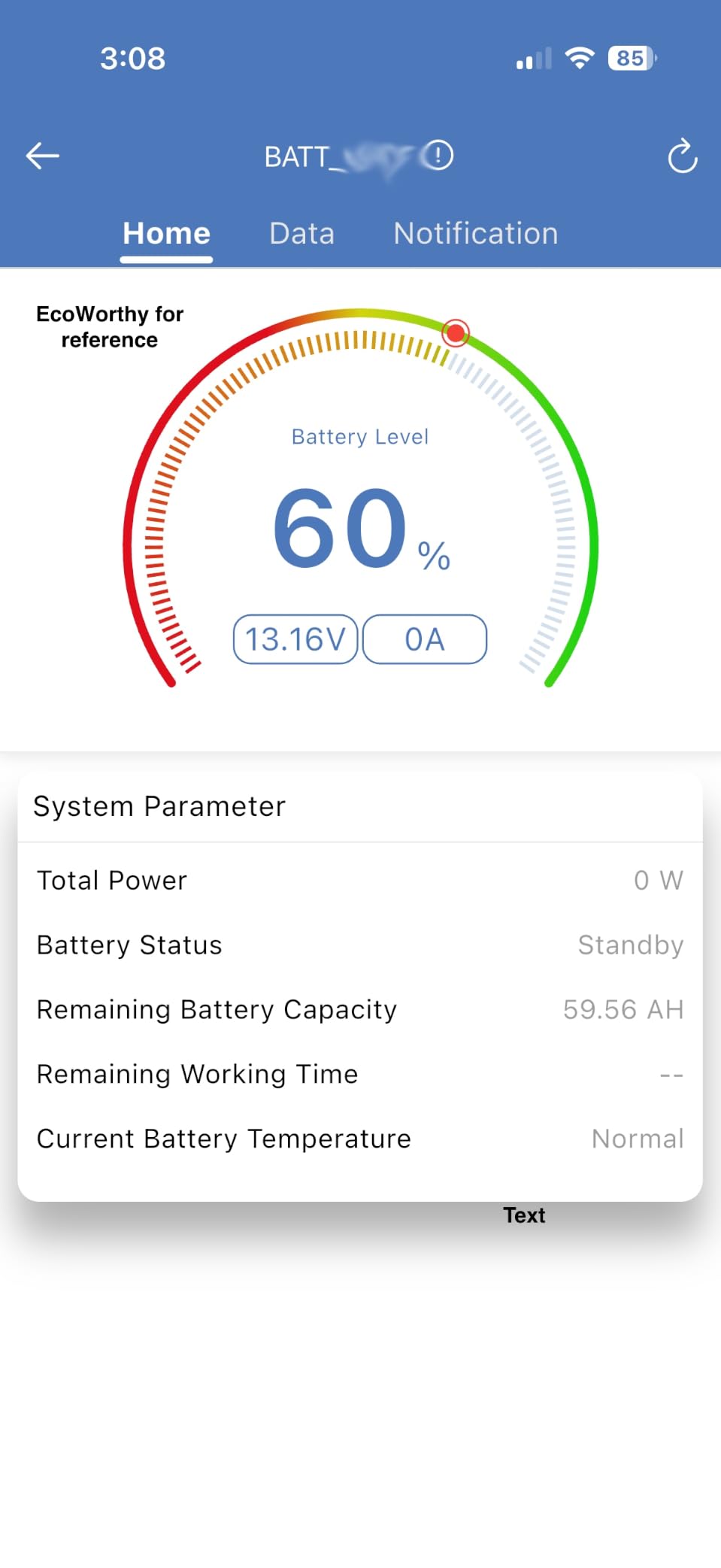
The per-cell fault page is what sets this apart at the 100Ah tier. The Bluetooth 5.1 app shows per-cell voltage, state of charge and current alongside a dedicated fault page with push notifications, so a weak cell gets flagged before it becomes a failed bank.
It uses Class A cells behind a 100A BMS, is UL and UN38.3 certified, and is rated up to 15,000 cycles with a ten-year service life claim. At 23.8 pounds it is still light enough to install solo in most boat and RV compartments.
Temperature handling is careful: charging cuts below 19.4F, discharge cuts below minus 4F, and the pack auto-recovers at 32F. Marine and trolling motor performance is the standout owner report, with 100A of BMS headroom for a motor that genuinely asks for it.
Two structural limits are worth planning around. The case sits about 0.32 inches taller than a standard Group 24, and 4P4S is not permitted, so expansion is capped at eight batteries across 4 series or 4 parallel.
Who this battery suits
It suits trolling motor and general marine work, where 100A of continuous discharge and a fault page that names the weak cell are worth more than extra capacity. It also suits RV builders who want a real Group 24 fit rather than something merely close to it.
The 19.4F charge cut-off is the friendliest cold-weather threshold among the 100Ah units here, which helps anyone charging on a late autumn trip.
Who should buy something else
It is a poor fit for a bank that needs to grow past eight batteries, and for anyone who wants to check state of charge from a cabin a few metres away, because the Bluetooth range is only 5 to 10 metres.
The three-year service commitment is the shortest warranty here, and the extra 0.32 inches of height is worth measuring against a shallow box before you order.
The Honest Downsides of LiFePO4 Batteries
Lithium iron phosphate is the right chemistry for almost every solar install, and it still has four real drawbacks worth planning for.
Cold charging is the big one. Charging a lithium iron phosphate cell below freezing plates lithium onto the anode, and the damage is permanent. Every battery here handles it by cutting charge off somewhere between 19.4F and 32F, so a winter system needs a self-heating pack or an insulated enclosure, not just a good battery.
Upfront cost. The sticker price is several times lead-acid. The honest comparison is cost per cycle, where lithium wins comfortably over a decade, but the cheque on day one is real and it is the reason people end up with under-sized banks.
No true 100% depth of discharge. Although several listings advertise full depth, reserving 10 to 20% protects cycle life and gives the BMS a working margin. Plan usable capacity at 80%, not 100%.
Parallel banks need matched modules. Builders on DIY solar forums repeatedly report batteries taking turns in parallel rather than sharing load evenly, which wears one unit out early. Buy identical modules from the same revision, verify balance with an external shunt, and do not mix a new battery into an old bank.
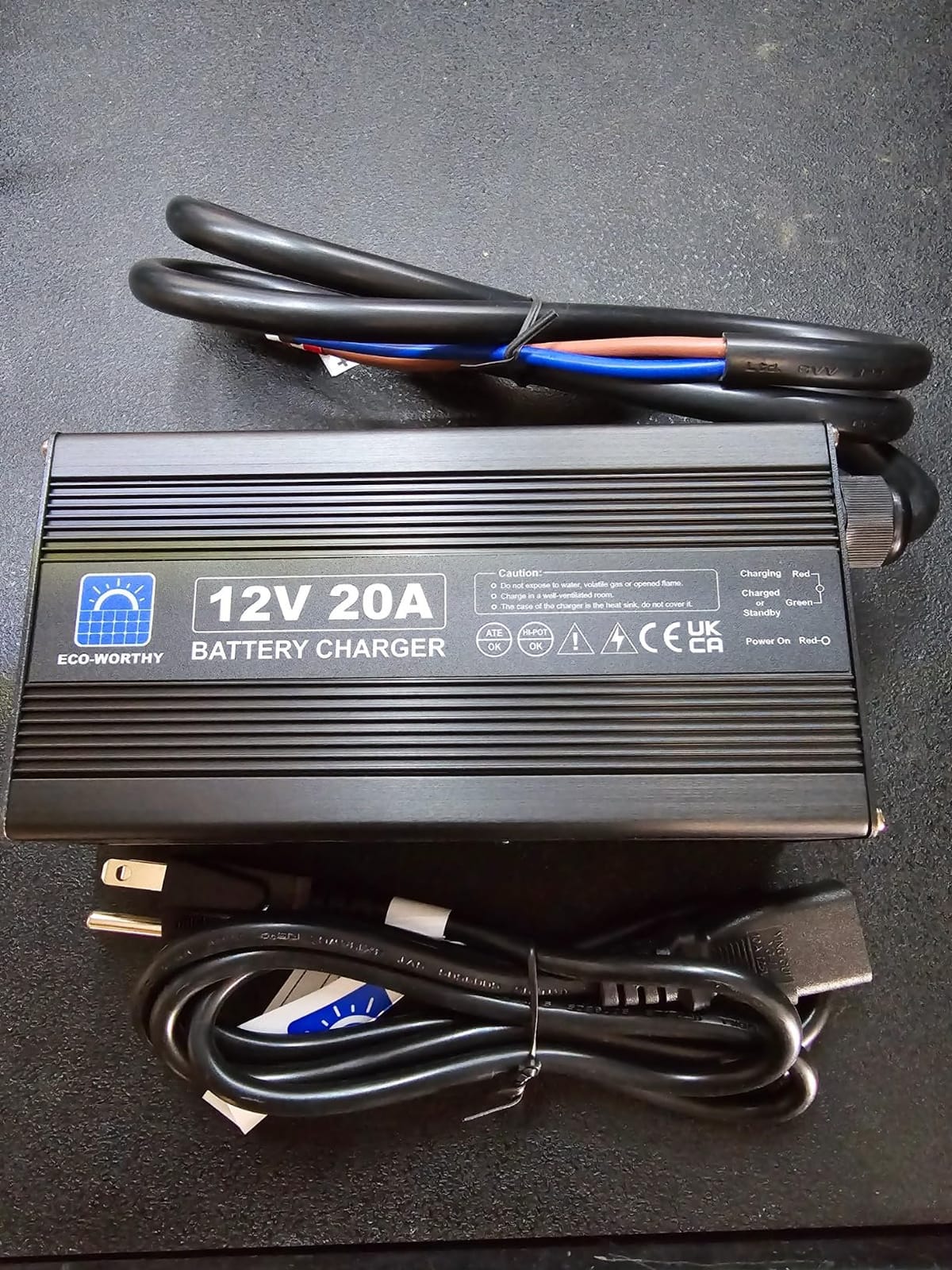
One more practical item: a lead-acid converter will not do. A lithium-compatible charger or a charge controller in lithium mode is required, and a state-of-charge gauge designed for lead-acid will read wrong forever.
How to Size a LiFePO4 Battery Bank for Solar
Sizing starts with daily consumption in kilowatt-hours, not amp-hours. A household drawing 10 to 13kWh a day, which is a realistic figure for a fully off-grid house with a well pump and appliances, needs far more storage than the panel count alone suggests.
Work through it in four steps. First, measure your nightly kWh use, meaning what the house draws after sunset. Second, choose your autonomy in days, typically two for a cabin and one for a system with a generator backup. Third, divide by 0.8 for realistic depth of discharge. Fourth, divide again by roughly 0.9 to cover conversion and wiring losses.
So 10kWh nightly over two days is 20kWh, divided by 0.8 is 25kWh, divided by 0.9 is about 27.8kWh of bank. A 12V 230Ah pack gives you 2.94kWh, so you are looking at something close to ten of them, or three of the 12V 460Ah units, or a 48V rack array scaled to the same total.
Voltage is the second decision. A 12V system is simplest and cheapest for small loads. 24V halves the current for the same power, which reduces cable losses dramatically. 48V is the right choice for whole-home arrays and anything above roughly 3kW of inverter capacity, because current at that scale is where cable size becomes a real cost. Our off-grid cabin battery guide covers the loads-versus-array side of that calculation.
For panels, a usable rule of thumb is roughly 100W of solar per 100Ah of 12V bank, more generously 200W per 100Ah in a sunny location. A single 12V 200Ah lithium battery holding 2.56kWh is comfortably replenished by about 400W of panel, and a full day of that battery needs closer to 1kW if you want it refilled by mid-afternoon. A 12V 300Ah pack holding 3.84kWh wants roughly 600W for a full refill. Above that you are effectively running a small grid-tied array.
Count on real-world solar yield rather than nameplate. Peak sun hours vary from about two in a cloudy northern winter to six in high desert summer, and that spread is bigger than any difference between two battery brands.
Cold-Climate Charging: What to Check Before Winter
There are three ways to handle cold charging, and only one of them is built into the battery.
The most common is a low-temperature cut-off. On the batteries in this roundup, that threshold ranges from 19.4F on the ECO-WORTHY 314Ah and the DC HOUSE 100Ah, up to 32F on most of the 200Ah and 300Ah units, with charge resuming between 32F and 41F. It is safe and it costs you winter solar.
The better option is self-heating, which the VATRER 12V 300Ah provides internally. It is the only battery here that can charge in genuine cold rather than refusing to.
The third is external. A heated battery box or a warm indoor location keeps cells above freezing without paying for heated cells, and it works with any battery on this list. For a garage or shed install in a snowy region it is often the cheapest real answer.
Note the asymmetry while you decide: discharge tolerance is far better than charge tolerance. Several units here discharge to minus 4F, so a bank can run your house through a cold snap, it just cannot be refilled by solar until it warms up.
Red Flags When Buying a LiFePO4 Battery
Four checks separate a good battery from a white-label rebrand, and none of them require a microscope.
No published cycle life at a stated depth of discharge. A bare “6000 cycles” claim with no depth beside it is marketing. The dumfume listing in this roundup states 4,000-plus at 100%, 6,000-plus at 80% and 15,000-plus at 60%, which is what a real datasheet looks like.
Certification claims that stop at UL. Look for UN38.3 for transport and UL1973 for the battery itself, ideally with a named test lab. The ECO-WORTHY Cubix100 goes further with UL9540, UL1973 and CEC listing tested by Intertek.
A vague battery management system. A real BMS datasheet states continuous and peak current, temperature cut-off values, and how many units may be run in parallel. If none of that is published, assume the parallel limit is one.
Brands that share a factory. DIY solar builders report that PowerQueen, LiTime, ReDoDO and TimeUSB are the same manufacturer buying from the same production line. That is not automatically bad, but it means a warranty claim is only as good as that one company’s support desk, and a “different” brand is not an independent second opinion.
One last trust signal worth weighing: buyers in this category are unusually good at spotting brands that only publish positives. Honest published failure reports, like the ones we included in each write-up, are a better signal than a perfect review section.
Frequently Asked Questions
Which LiFePO4 battery is best for solar power?
For most solar setups the LiTime 12V 230Ah is the best overall choice, pairing 2944Wh, a 200A BMS and Bluetooth monitoring in a 46-pound Group 4D case. For whole-home 48V arrays use the ECO-WORTHY Cubix100, and for sub-freezing charging use the VATRER 12V 300Ah self-heating pack.
What are the downsides of LiFePO4 batteries?
The four real drawbacks are cold charging, higher upfront cost than lead-acid, no true 100% usable depth of discharge, and the need for matched modules when running batteries in parallel. Most batteries simply stop accepting charge between 19.4F and 32F rather than risking permanent cell damage.
What is the lowest temperature a LiFePO4 battery can tolerate?
Discharge is usually rated down to minus 4F, but charging must be protected. Most units here cut charge off between 19.4F and 32F and resume between 32F and 41F. The VATRER 12V 300Ah self-heating pack is the one option that warms itself instead of refusing to charge.
How many solar panels do I need for a 200Ah lithium battery?
A 12V 200Ah lithium battery stores about 2.56kWh. Roughly 400W of solar replenishes it over a full day, while 1000W gets it from empty to full in a single good afternoon. Size on peak sun hours in your location rather than panel nameplate.
Do LiFePO4 batteries work well in parallel?
They do, but only with matched modules from the same revision. Builders report batteries taking turns rather than sharing load, which wears one unit out early, so use identical batteries, keep the parallel count within the BMS limit and verify balance with an external shunt rather than the phone app.
The Verdict on the Best LiFePO4 Batteries for Solar Setups
The LiTime 12V 230Ah remains our pick for most people: 2944Wh, a 200A BMS, real Bluetooth telemetry and a Group 4D footprint that weighs 46 pounds. It is the battery we would put in an RV, a van or a small cabin and be able to explain in one sentence why.
For a whole-home off-grid array, the ECO-WORTHY Cubix100 48V is the better answer because it is listed to UL9540 and UL1973, speaks CAN bus to the inverter and carries a ten-year limited warranty. For anyone whose solar season starts in November, the VATRER 12V 300Ah self-heating pack is the only one of the twelve that will actually take a charge below freezing.
Whatever you choose, size the bank from your nightly kilowatt-hours, keep usable capacity at 80%, buy matched modules for any parallel run, and confirm your charger is lithium-aware before the battery arrives. Those four decisions matter more than the brand name on the case.