
I still remember the first time someone said “I love you” to me over text. My stomach dropped, then soared, then dropped again because I had no idea how to respond in a way that matched the weight of those three words on a screen.
That moment is so different from how my parents met, fell in love, and built their marriage. They had to call a landline, hope no one picked up, and stumble through real-time vulnerability. I had a read receipt staring back at me while I overthought a response for twenty minutes.
This is the story of how we got here. Over the past three decades, texting has fundamentally rewired the way we say “I love you,” express intimacy, and even end relationships. I’ve researched the timeline, pulled insights from forums where thousands of people share their real experiences, and tracked how each technological shift changed our emotional vocabulary.
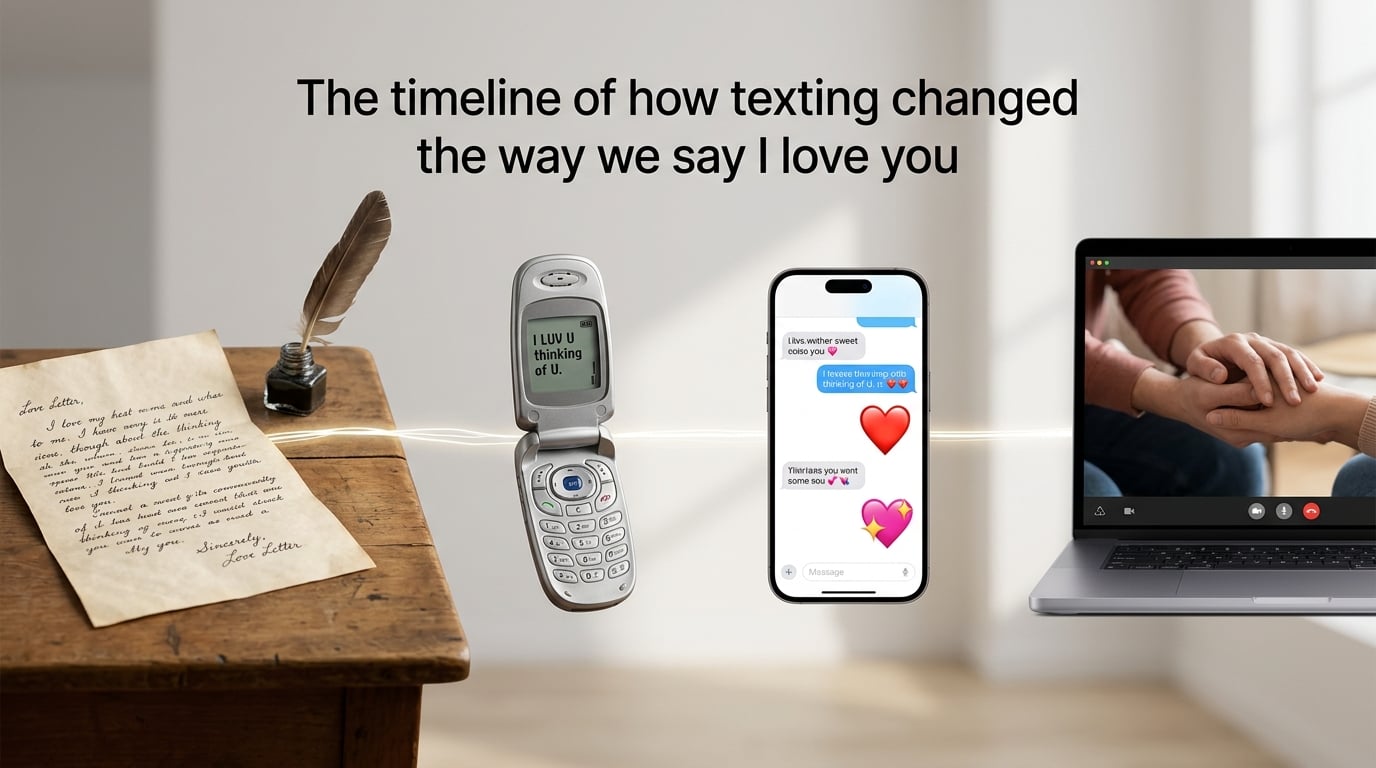
Here’s the complete timeline of how texting changed the way we say I love you, from the days of love letters to the age of ambient intimacy, and what it means for anyone navigating love today.
Table of Contents
How Texting Changed the Way We Say I Love You? The Complete Timeline
The journey from love letters to heart emojis spans roughly thirty years, but the emotional impact of each shift is massive. Let me walk you through the four major eras that shaped how we express love through our phones.
Pre-1992: Love Letters and Landline Calls
Before texting existed, declaring love required courage on a different scale. You either wrote a letter and waited days or weeks for a reply, or you called someone’s house phone and prayed their family wasn’t listening.
My mom told me she said “I love you” to my dad for the first time over a rotary phone, in the basement, with her siblings walking around upstairs. The vulnerability was physical and immediate. You couldn’t edit your voice. You couldn’t delete and retype. You had to say it and live with the silence that followed.
Letters offered a different kind of bravery. You could pour your heart onto paper, rewrite it, and mail it, but you also had no idea when (or if) a response would arrive. The anticipation itself was part of the ritual.
1992-2007: The SMS Revolution
The first text message was sent in 1992, and for the next fifteen years, SMS slowly crept into romantic communication. By 2005, I remember friends exchanging “I miss u” and “luv u” on T9 keypads, one careful letter at a time.
This era changed three things about how we say I love you:
It removed the physical presence requirement for emotional declarations.
It introduced the concept of the “saved message,” where sweet texts could be archived forever.
It created response time as a metric people started interpreting emotionally.
People began saying “I love you” via text earlier than they ever would have in person. The screen offered a layer of safety. You could say the words and then hide behind a phone if the response wasn’t what you hoped for.
2007-2014: Smartphones and Constant Connection
The iPhone launched in 2007, and everything accelerated. Suddenly we had full keyboards in our pockets, unlimited texting plans, and apps designed specifically for romantic connection.
This is when “good morning” texts became a daily ritual and “I love you” started appearing at the end of every evening message. The volume of communication exploded, but so did the emotional weight placed on tiny digital moments.
Couples began expecting constant updates throughout the day. The absence of a text became meaningful. A late reply became a source of anxiety. Love started to look less like a single declaration and more like an ongoing stream of small digital confirmations.
2014-Present: The Era of Ambient Intimacy
Today we live in what researchers call “ambient intimacy,” a state of constant low-level connection where partners share memes, voice notes, location updates, and TikToks throughout the day without needing to formally “talk.”
The phrase “I love you” is still powerful, but it’s no longer the only signal. Sending a song, reacting to their Instagram story with a heart, or simply being online at the same time has become part of the modern love language. The way texting changed the way we say I love you isn’t just about the words anymore. It’s about the entire texture of daily digital presence.
The Speed of Digital Intimacy
One of the biggest shifts is how fast intimacy now develops. In my parents’ generation, saying “I love you” might come after six months of dating. Today, people report saying it after two weeks, or even after a long weekend of constant texting.
This acceleration isn’t necessarily bad, but it does change what those words mean. When you’re texting someone every hour, the emotional buildup is compressed. You learn someone’s humor, their schedule, and their fears through their messages before you’ve even sat across from them at dinner.
The result is that “I love you” can arrive faster, feel more inevitable, and carry different weight than it did when love had to be earned through rare in-person moments. Digital intimacy lets us fall in love through screens, and that changes the timeline for everything that follows.
Texting Anxiety and the Read Receipt Problem
If you’ve ever stared at “Read 2:47 PM” for an hour wondering what went wrong, you already know how texting created new forms of relationship anxiety.
The read receipt is a tiny feature with massive psychological impact. It tells you your message was seen, but it tells you nothing about whether the recipient is busy, asleep, overwhelmed, or simply choosing not to respond. Our brains fill that gap with worst-case scenarios.
Forum users describe this anxiety constantly. On r/relationship_advice, one person wrote: “I can handle a ‘no,’ but I can’t handle being left on read for six hours. My brain convinces myself the entire relationship is over.” This kind of spiraling is a uniquely modern phenomenon. Before read receipts, you simply didn’t know if your letter arrived. Now we have partial information, and that’s often worse than no information at all.
The solution isn’t to turn off read receipts for everyone. It’s to recognize that response time is a poor proxy for emotional investment. Someone who takes three hours to reply might be the most devoted partner you’ve ever had.
The Role of Emojis in Expressing Love
Do emojis count as expressions of love? This question comes up constantly in forums, and the answer is more nuanced than you might expect.
A heart emoji, a kissy face, or even a well-placed 🥺 can absolutely communicate affection. But context matters. A string of heart emojis at the end of “good morning” carries different weight than a heart emoji sent ironically during an argument.
What emojis really do is soften the ambiguity of text. Without vocal tone or facial expression, plain words can feel cold. Emojis and voice notes fill that gap. Many couples now have “our emojis,” little inside jokes built up over months of texting that only they understand. That’s a form of intimacy all its own.
Voice notes deserve special mention here. They sit between text and phone call, giving you tone and personality without the pressure of real-time conversation. A 12-second voice note saying “I love you, by the way” can feel more intimate than the same words typed out.
Ghosting, Situationships, and Digital Breakups
Texting didn’t just change how we start relationships. It fundamentally changed how we end them.
Ghosting, the practice of simply disappearing without explanation, is essentially a texting-era phenomenon. Before smartphones, you couldn’t vanish from someone’s life quite so cleanly. There were mutual friends, shared spaces, and the social cost of disappearing. Now you can block a number and become unreachable in a single tap.
Situationships, undefined romantic connections that linger in a gray zone, are also a product of this era. When you can text someone at 2 AM but never define the relationship, you create a strange new category of almost-intimacy that previous generations didn’t have to navigate.
Then there’s the “forever text” phenomenon. Those early “I love you” messages, the good morning texts from three years ago, the inside jokes, they all live forever in someone’s phone. Long after a relationship ends, the words remain. That permanence changes how seriously people take what they type.
Long-Distance Love in the Digital Age
Long-distance couples have always existed, but texting (along with video calls) has made sustaining long-distance love more possible than ever before.
Daily texting check-ins, shared photo dumps, and synchronized Netflix watching have become the backbone of long-distance relationships. Partners who used to rely on weekly phone calls can now feel close multiple times a day.
The lesson here is that digital intimacy isn’t a lesser form of connection. For many couples, it’s the only form available, and it works. The way texting changed the way we say I love you is, for long-distance couples, a genuine gift. It allows love to survive across oceans and time zones in ways that would have been unthinkable thirty years ago.
For more on the lighter side of modern communication habits, check out these humorous texting truths that anyone glued to their phone will recognize.
Frequently Asked Questions
What is the 3 6 9 rule in relationships?
The 3 6 9 rule suggests that every two weeks, couples should plan a date night, every six weeks a getaway, and every nine months a major trip together. It’s a pacing tool, not a hard rule.
What is a normal timeline to say I love you in a relationship?
Most people say I love you between three and six months into a relationship, though texting has shortened this window significantly. Some couples now exchange those words within weeks of meeting.
How has text messaging changed the way we communicate?
Text messaging made communication constant, asynchronous, and archived. We now stay in touch throughout the day without needing real-time conversation, and our words are saved indefinitely.
Is saying I love you over text less meaningful?
Not necessarily. Studies and forum discussions suggest context matters more than medium. A heartfelt text I love you from a long-term partner carries the same weight as the words spoken aloud.
How do you handle texting anxiety in a new relationship?
Turn off read receipts if they trigger you, communicate your response time expectations early, and remember that reply speed is rarely a reflection of how someone truly feels about you.
Final Thoughts on How Texting Changed the Way We Say I Love You
Looking at this whole timeline, I keep coming back to one thought: texting didn’t ruin romance. It expanded it.
Yes, we lost some things. We lost the buildup of waiting for a letter, the nervous courage of a phone call, the certainty that came with saying “I love you” face to face. In exchange, we gained the ability to fall in love with someone across the world, to send “I love you” at 2 AM when the feeling hits, and to keep a permanent record of the words that mattered most.
How texting changed the way we say I love you isn’t a story of decline. It’s a story of adaptation. We built new rituals around good morning texts, voice notes, and meme-based affection. We learned to navigate read receipts, response time pressure, and digital breakups. We created new vocabulary for love that previous generations never needed.
If you’re navigating a relationship today, here’s what I’d suggest. Don’t treat text declarations as lesser than in-person ones. Don’t read too much into response time. And don’t be afraid to say “I love you” over text when the moment feels right, because sometimes the screen is exactly where the courage lives.
The timeline of how texting changed the way we say I love you is still being written. Every day, millions of people send those three words into the digital void and hope they land somewhere real. As long as those words still carry weight, romance hasn’t disappeared. It just moved to a smaller screen.