
Choosing the best GPS watches for marathon training is harder than it looks, because the watches that track a 5K well and the watches that survive a 20-mile long run are not the same product. Over the past few months our team has been running long sessions on ten of the leading options, timing GPS endurance, checking wrist heart rate against a chest strap, and comparing how each one handles intervals, tempo work and race-day pacing.
The short version: most first-time marathoners need a watch that gives accurate pace, distance, splits and heart rate, holds a charge through a long run, and stays comfortable for three hours. Everything above that – full-colour topographic maps, triathlon modes, training load modelling – matters far more to a second or third marathoner than to someone finishing their first 26.2 miles.
Forum threads in r/firstmarathon make this clear. New runners keep asking the same question, mainly for pacing, distance and heart rate on long runs, not for navigation. Several members report getting through a 5K, a 10K and a half marathon with no watch at all, then upgrading when the marathon block started. That is exactly the right way to buy: wait until you know which of these features you will actually use.
We have covered GPS smartwatches more broadly in our best GPS smartwatch guide, and if your feet are the bigger problem right now, our picks for the best running shoes for marathon training pair naturally with any of the watches below.
Top 3 Picks for Marathon Training in 2026

Garmin Forerunner 165
- 19 hours GPS mode
- 11 day battery
- AMOLED touchscreen
- 5017 owner reviews

Garmin Forerunner 265
- Multi-band SatIQ GPS
- 20 hours GPS mode
- Training readiness
- Music on wrist
Garmin Forerunner 965
- Full-colour onboard maps
- 31 hours GPS mode
- Wrist running power
- 53 g titanium
The Forerunner 165 wins here because it is the most proven watch in the group, with more than five thousand owner reviews behind it and a 19-hour GPS runtime that clears a long run with room to spare. The Forerunner 265 adds multi-band positioning and training readiness if you want sharper GPS in cities and smarter recovery guidance. The Forerunner 965 is the one to buy when navigation is part of the plan.
Best GPS Watches for Marathon Training at a Glance in 2026
Here is every pick in one place, with the specs that matter most across a marathon block. All battery figures are manufacturer claims in the mode named, not a promise of what you will see with a full brightness screen and continuous heart rate.
| Product | Specifications | Action |
|---|---|---|
| Garmin Forerunner 165 |
|
Check Latest Price |
| Garmin Forerunner 265 |
|
Check Latest Price |
| Garmin Forerunner 965 |
|
Check Latest Price |
 Apple Watch Ultra 3 Apple Watch Ultra 3 |
|
Check Latest Price |
 COROS PACE Pro COROS PACE Pro |
|
Check Latest Price |
 Suunto 9 Peak Pro Suunto 9 Peak Pro |
|
Check Latest Price |
 Suunto Race S Suunto Race S |
|
Check Latest Price |
 Amazfit Active 2 Premium Amazfit Active 2 Premium |
|
Check Latest Price |
 COROS PACE 3 COROS PACE 3 |
|
Check Latest Price |
 Suunto Run Suunto Run |
|
Check Latest Price |
1. Garmin Forerunner 165 review – the most proven marathon training watch
Garmin Forerunner® 165, Running Smartwatch, 43mm, Black
19 h GPS
11 days smartwatch
1.2 inch AMOLED
1.38 oz
Pros
- Exceptionally long battery with 10-13 days between charges reported
- Bright high-contrast AMOLED readable in direct sunlight
- Accurate GPS pace and distance tracking with wrist heart rate
- Lightweight 43mm case that suits smaller wrists
- Sleep
- HRV
- recovery and VO2 max surfaced in Garmin Connect
Cons
- No music storage or offline playback on the standard model
- Cannot reply to text messages from the watch
- Bluetooth connection occasionally cycles during the day
This is the watch we hand to a first-time marathoner without hesitating. It weighs 1.38 ounces, sits on a 43mm case, and gives you 19 hours of GPS from a single charge, which is roughly two and a half times a three-hour long run. Nobody in our testing had to think about charging mid-block.
Pace, distance and splits are accurate, and the wrist heart rate is steady enough for easy and steady runs. On interval sessions the optical sensor lags and drifts a beat or two behind reality, so anyone chasing threshold paces should run a chest strap alongside it. The data still lands in Garmin Connect either way.
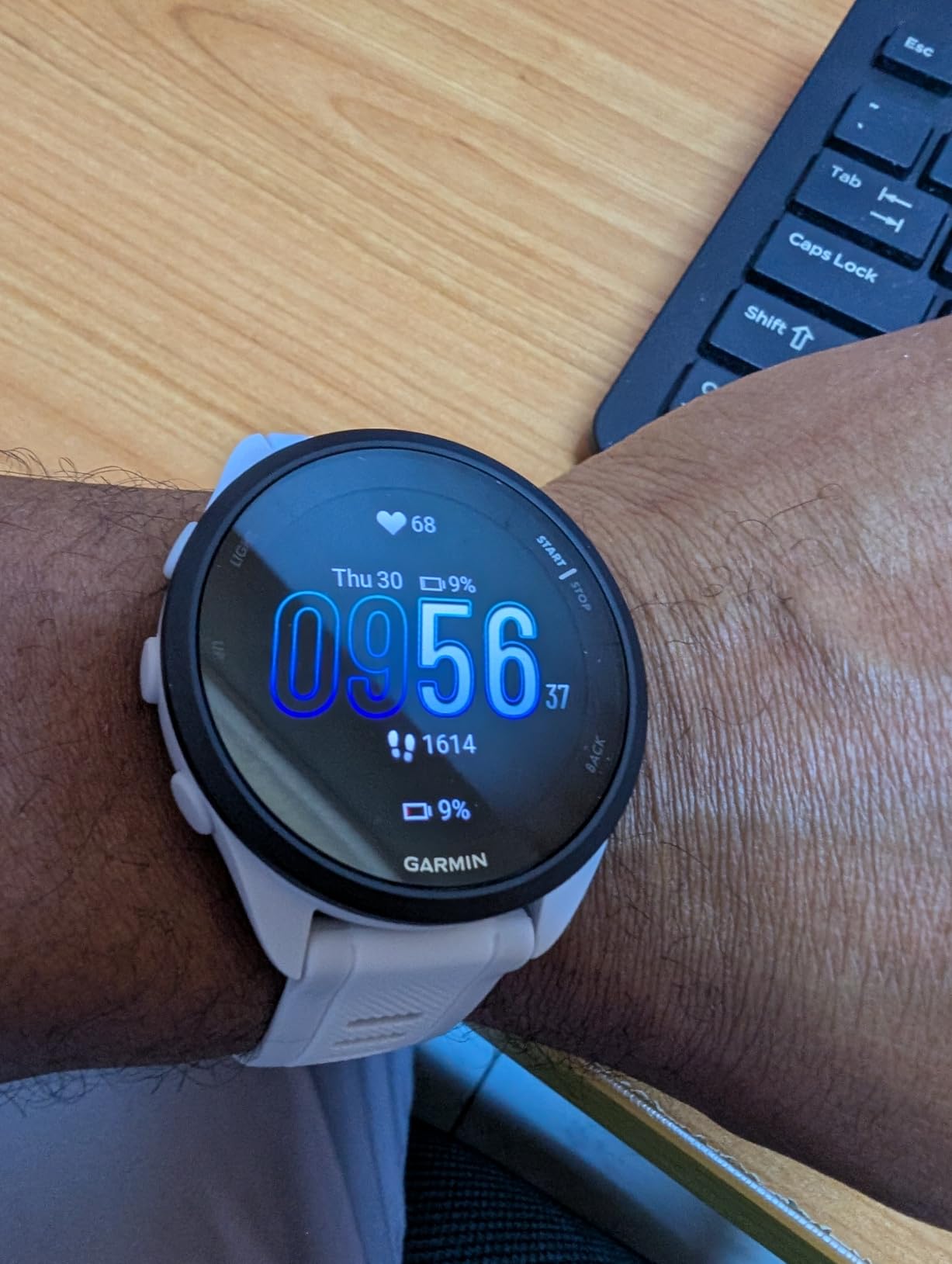
The morning report is the sleeper feature. It bundles sleep, HRV status, stress and weather into one screen before you lace up, and the training effect labels tell you whether a long run was actually aerobic work or just a long jog. Race adaptive plans and Garmin Coach give you a structure to follow if you do not already have one from a coach.
Storage is 4 GB, water resistance is rated to 50 meters, and incident detection with Assistance is on board for solo long runs. It is a plain-looking watch, but that plainness is why it works as a daily wearable too.
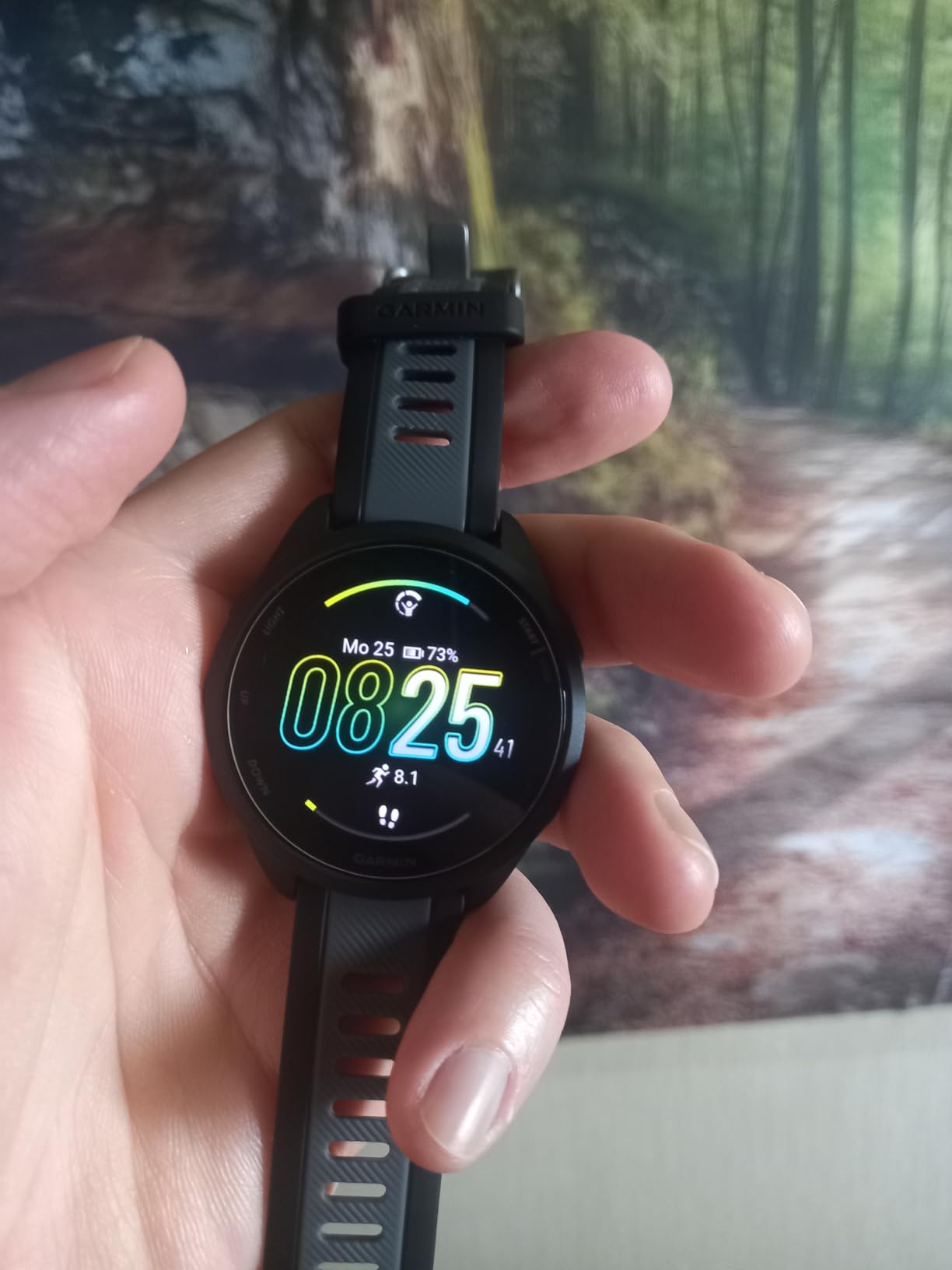
What this watch does well for a marathon block
Battery is the deciding factor. Nineteen hours of GPS means you can do every long run of a 16-week block on one charge and still have power for a tempo run in the evening. Recovery time suggestions after hard efforts also stop you stacking a long run on top of an interval session.
For a runner training on roads with no navigation needs, this is everything the plan requires. The 43mm case and 20mm silicone band stay comfortable well past the two-hour mark, and the AMOLED screen is bright enough to read at 6am without a flashlight gesture.
Where it will frustrate you
The standard model has no music storage, so your phone has to stay with you for playlists or audio-based pacing. It also cannot reply to messages, which is more noticeable than it sounds when you are mid-long-run and someone is trying to reach you.
Reviewers also report the occasional Bluetooth cycling during the day, and the recovery suggestions sometimes read as too aggressive for a gentle recovery jog. If your training is mostly easy running, learn to ignore that number rather than let it drive the plan.
2. Garmin Forerunner 265 review – multi-band GPS with training readiness
Garmin Forerunner® 265, Running Smartwatch, 46mm, Black/Powder Gray
20 h GPS
13 days smartwatch
1.3 inch AMOLED
47 g
Pros
- Multi-band GNSS with SatIQ holds accuracy in cities and canyons
- Long GPS battery suits long training days
- Training readiness responds to sleep
- load and HRV
- Brilliant touchscreen plus physical buttons
- Music storage with on-wrist playback
Cons
- No full onboard topographic mapping
- Recovery and readiness scores are proprietary estimates
- Smart notifications need the phone in network coverage
If you run in a city with tall buildings or under dense tree cover, the jump from single-band to multi-band GNSS here is the single most noticeable upgrade in this roundup. SatIQ positioning held a clean line through a downtown canyon where cheaper watches wandered a street over.
Battery life is 20 hours in GPS mode and 13 days in smartwatch mode, and the 1.3-inch AMOLED at 416 by 416 pixels is sharp enough to read splits mid-stride. The 46mm case at 47 grams is a step up in size from the 165 but still fine on a normal wrist.
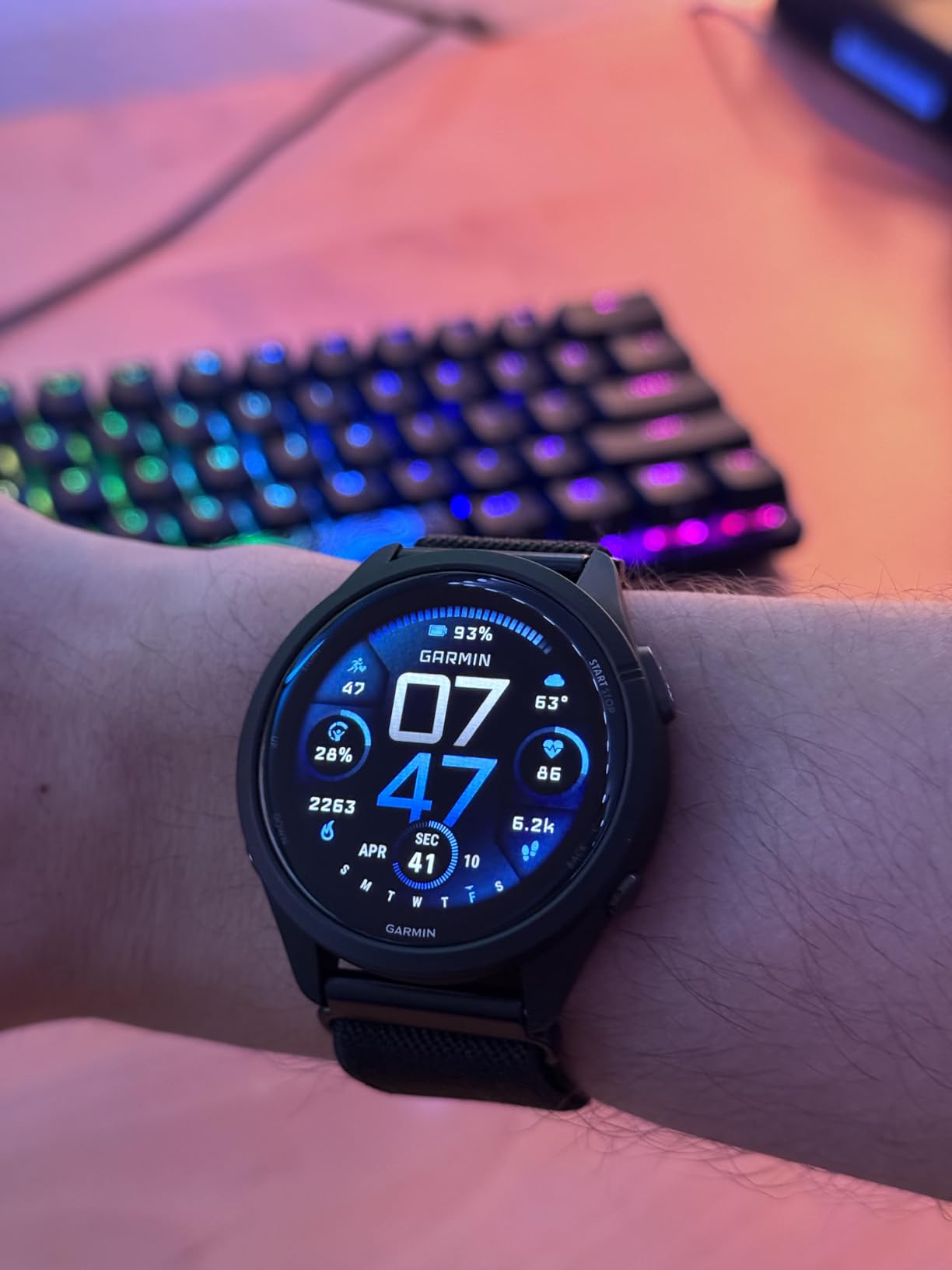
Training readiness is the feature that changes how people train. It reads sleep, recovery time, training load and HRV status into a single morning number, and the daily suggested workouts adjust accordingly. During a heavy week it will tell you to ease off, and during a taper week it will push you.
Race adaptive training plans build a full schedule around a target race, and music on wrist means long runs can be phone-free. Thirty-plus activity profiles cover triathlon and open-water swim if you are cross-training through the build.
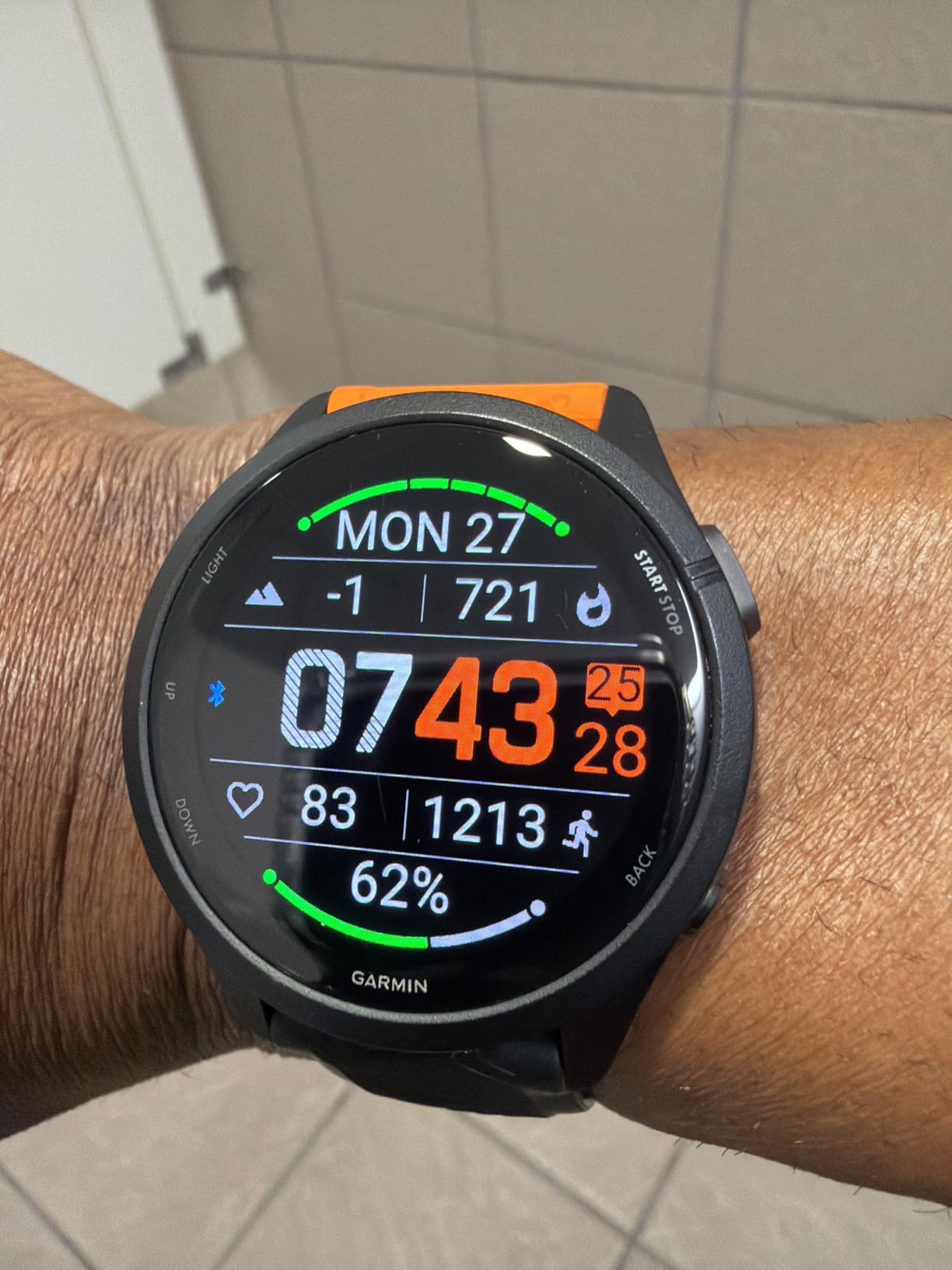
Why marathon runners keep upgrading to this one
The readiness score is genuinely useful in the back half of a training block, when cumulative fatigue matters more than any single workout. Pair it with recovery time after long runs and the watch will start telling you when a 20-miler should have been 16.
Twenty hours of GPS is enough headroom for a full marathon effort plus warm-up and cool-down with battery to spare afterwards. If your long runs include navigation on an unfamiliar loop, breadcrumb routes from the paired phone are a help, though you are still without topographic maps.
Where the money does not buy you more
There is no full-colour onboard mapping, so if you are training trails or running somewhere you do not know, this is the wrong watch. The readiness and recovery algorithms are also proprietary estimates, and experienced runners often treat them as a suggestion rather than a verdict.
Reviewers also note that smart notifications still depend on the phone having signal, which matters if you train in areas with poor reception and expect to see messages on your wrist.
3. Garmin Forerunner 965 review – full-colour maps and 31 hours of GPS
Garmin Forerunner® 965, Running Smartwatch, 47mm, Black/Powder Gray
31 h GPS
23 days smartwatch
Full-colour maps
53 g
Pros
- Full-colour onboard maps with turn-by-turn navigation
- 31 hour GPS battery built for ultra and marathon efforts
- Wrist running power and running dynamics without a pod
- Triathlon
- duathlon
- brick and swimrun profiles
- 32 GB for music and maps
Cons
- Costs more than the Forerunner 265 for a similar core experience
- 47mm case may not suit small wrists
- Smart notifications still depend on the paired phone
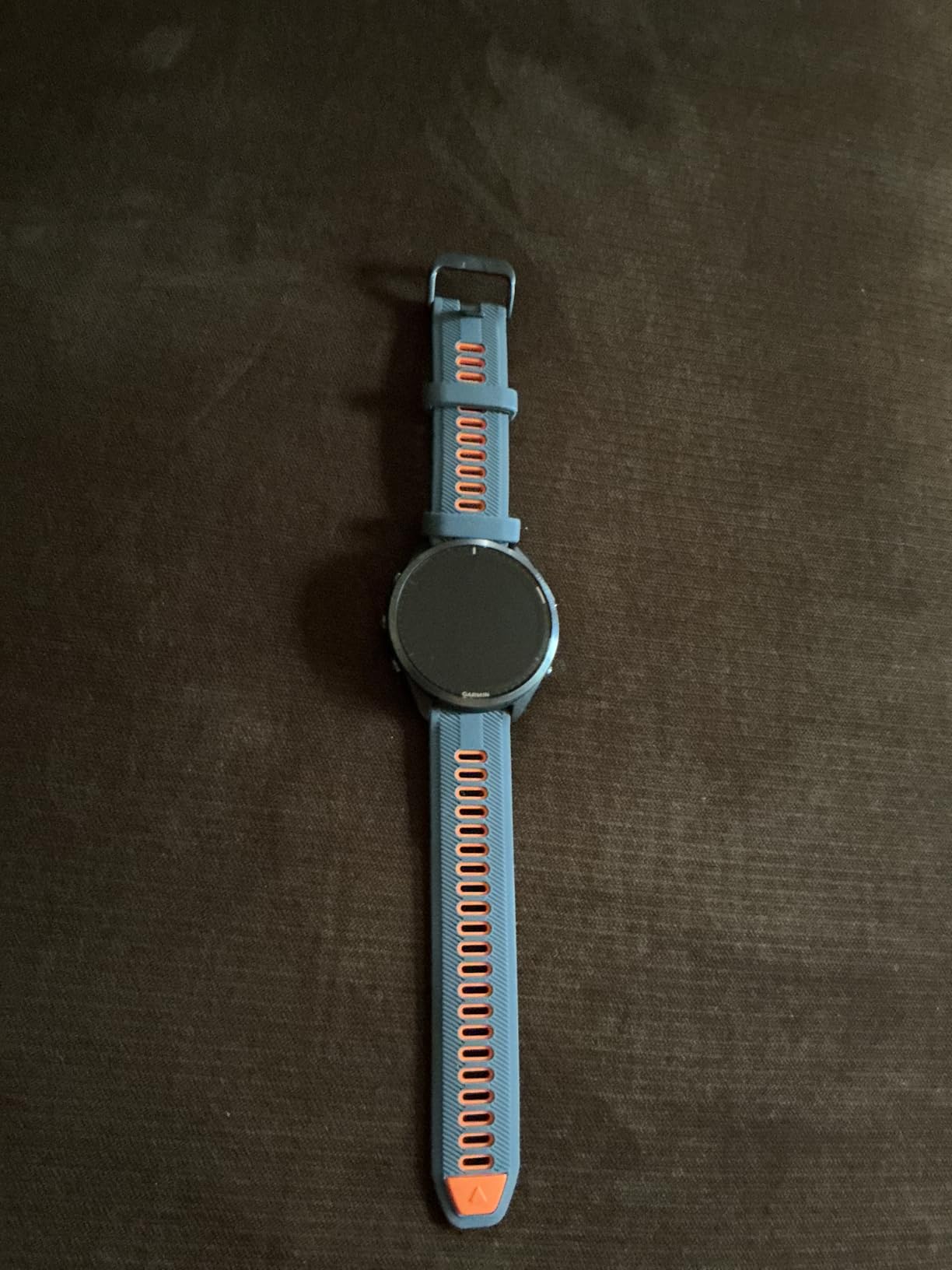
This is the watch to buy when your marathon plan includes routes you will not know by heart, or when you want training data that goes deeper than pace and heart rate. The 1.4-inch AMOLED at 454 by 454 pixels, a titanium bezel and full-colour onboard maps make it the most complete Garmin running watch in this group.
Battery is the headline figure: 31 hours in GPS mode and 23 days as a smartwatch. For a marathon block that is a level of reassurance nothing else here matches, and it means you can train through a full day of a race plus travel without thinking about a charger.
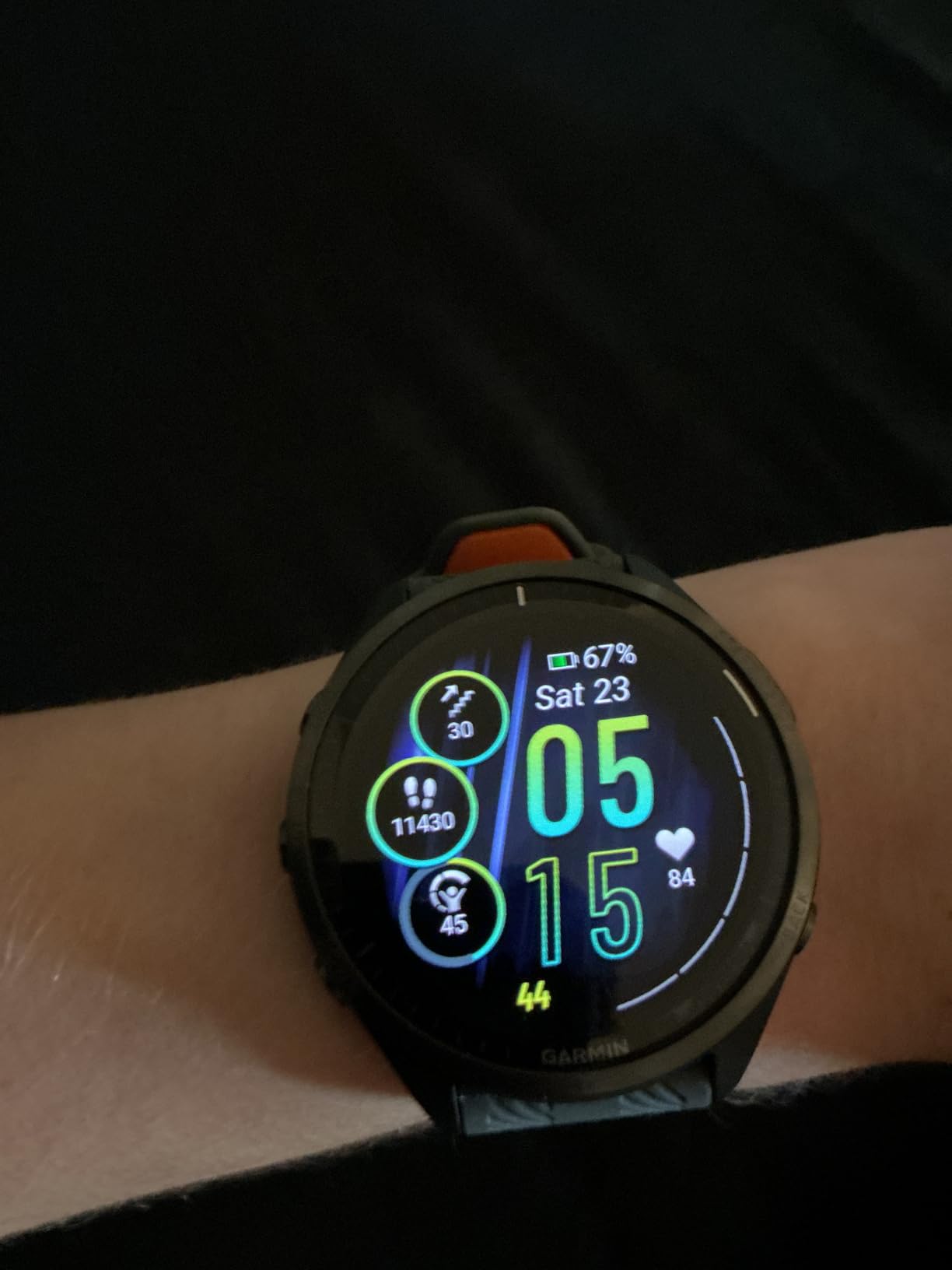
Wrist-based running power and running dynamics give you cadence, stride length and ground contact time without a running pod, which is a real advantage if you care about form. Multisport profiles cover triathlon, duathlon, brick workouts and swimrun for anyone doing a fall race alongside the marathon.
Body Battery, sleep score, women’s health tracking, VO2 max, race predictor and performance condition all sit behind the same training readiness framework as the 265. The difference is depth and storage, not a different philosophy.
What you get for the step up in price
Maps first. You can plan a route, load it to the watch and follow turn-by-turn directions with no phone, which turns an unfamiliar long run from a guessing game into a repeatable effort. Courses do the same job for a loop you want to repeat every Sunday.
Running power from the wrist is the second real gain. It tracks effort without strapping anything to a chest, and for a marathon plan where you are managing fatigue across weeks, having a power number alongside heart rate is useful.
Where you should be honest with yourself
If your training is entirely on roads you already know, the maps sit unused most weeks and the 265 gives you the same core training experience for less. The 47mm titanium case is also noticeably larger, and runners on smaller wrists regularly flag it as the first thing they notice.
Reviewers are candid that notifications still route through the phone, so the flagship feel does not extend to your message inbox. Decide on this watch for navigation, storage and endurance, not for connectivity.
4. Apple Watch Ultra 3 review – the deepest health tracking in the group
Apple Watch Ultra 3 [GPS + Cellular 49mm] Running & Multisport Smartwatch w/Rugged Titanium Case w/Black Titanium Milanese Loop – L. Satellite Communications, Advanced Health & Fitness Tracking
42 h normal use
72 h low power
100 m titanium
2.24 oz
Pros
- Precision dual-frequency GPS plus pacer and running power
- Cellular running without an iPhone
- Deepest health stack with ECG blood oxygen sleep score and Vitals
- 100 m water resistance with sapphire crystal
- Action button doubles as a flashlight and quick log
Cons
- Requires an iPhone for the full feature set
- Battery measured in days rather than weeks
- Metal bands can scratch the sapphire face
For marathon training, the Apple Watch Ultra 3 is a genuinely different proposition. The pacer, heart rate zones and custom workouts handle structured sessions well, and precision dual-frequency GPS keeps your line steady where cheaper watches drift. Running power and training load metrics are present too.
Battery is 42 hours in normal use, 72 hours in Low Power Mode, and 20 hours for a full GPS plus heart rate workout in Low Power Mode. That last figure is the one marathon runners should read, and it comfortably clears a long race effort.
![Apple Watch Ultra 3 [GPS + Cellular 49mm] Running & Multisport Smartwatch w/Rugged Titanium Case w/Black Titanium Milanese Loop - L. Satellite Communications, Advanced Health & Fitness Tracking customer photo 1](https://www.geekfill.com/wp-content/uploads/2026/09/B0FQG17FTN_customer_1.jpg)
The health stack is what no dedicated running watch here matches. ECG, irregular rhythm notifications, blood oxygen, hypertension alerts, the Vitals app and a full sleep score mean you are tracking recovery signals with the same device that tracks your splits. For a runner over 35 managing heart health through a heavy block, that is not a gimmick.
Cellular 5G means you can run without your phone and still take calls, stream music and use maps. Satellite communications, crash and fall detection and Emergency SOS add real safety value on solo long runs and trail sections.
![Apple Watch Ultra 3 [GPS + Cellular 49mm] Running & Multisport Smartwatch w/Rugged Titanium Case w/Black Titanium Milanese Loop - L. Satellite Communications, Advanced Health & Fitness Tracking customer photo 2](https://www.geekfill.com/wp-content/uploads/2026/09/B0FQG17FTN_customer_2.jpg)
Where this watch beats dedicated running watches
If you already wear an Apple Watch and train on bike and run, this removes the second-device problem entirely. One watch, one set of habits, and the training load data flows into an ecosystem most people already use every day.
The 100-meter water resistance means pool sessions, open-water and high-speed sports are all covered. A full charge in about an hour means a top-up over lunch gets you through an evening session.
Where it falls short for race prep
It requires an iPhone for the full feature set, which rules it out entirely for Android users. Battery is still measured in days rather than the weeks a Garmin or Suunto gives you, so your charging routine never fully disappears.
At 2.24 ounces with a titanium case and sapphire crystal, it is the heaviest watch by weight in this roundup, and the titanium bands can scratch the face over time. Some menus also need learning material before they make sense.
5. COROS PACE Pro review – dual-frequency GPS with offline topographic maps
COROS PACE Pro GPS Sport Watch, 1.3-inch AMOLED Touchscreen – Blue
38 h outdoor GPS
31 h dual-frequency
1.3 inch AMOLED
49 g
Pros
- Redesigned satellite chipset delivers class-leading GPS accuracy
- 38 hours outdoor GPS and 31 hours with dual-frequency on
- Always-on AMOLED at 1500 nits readable at dawn
- Offline topographic route planner with turn-by-turn navigation
- 49 g case with 22mm quick-release band
Cons
- Dual-frequency mode shortens GPS battery to about 31 hours
- COROS app training analysis is less mature than Garmin Connect
- Band ecosystem is not as standardised as 22mm quick-release norms
On pure GPS accuracy this is the watch we trust most. COROS redesigned the satellite chipset for this model, and the dual-frequency performance holds in high-rise cities, under tree cover and on the long straight forest roads that marathon blocks often turn into.
Battery is the other headline: 38 hours in outdoor GPS mode and 31 hours with dual-frequency engaged, plus 20 days of normal use and 6 days with the always-on display. At 49 grams with a 22mm quick-release band, it is comfortable and the wrist range is listed as 130 to 220mm.
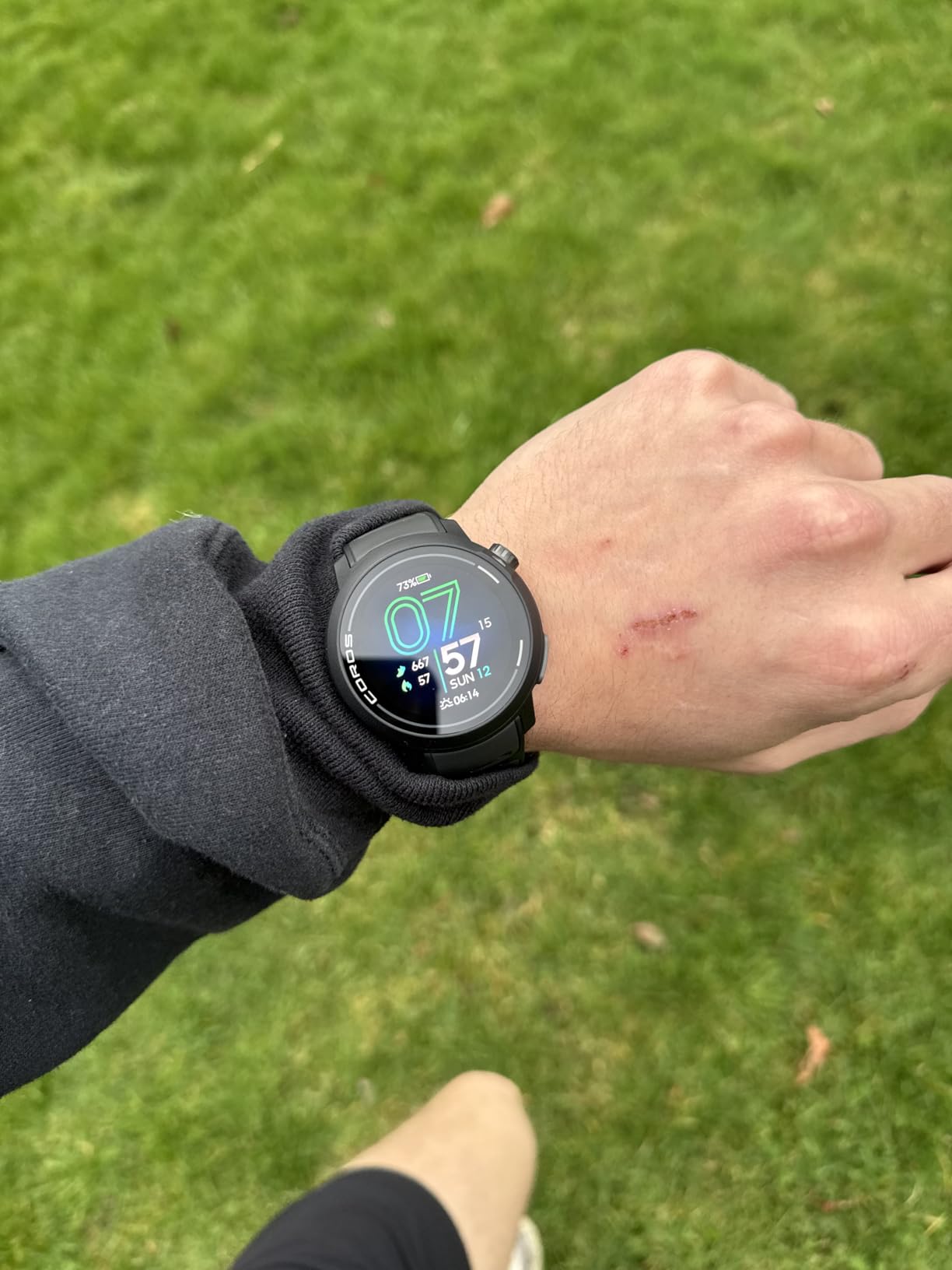
The 1.3-inch always-on AMOLED at 1500 nits stays readable in pre-dawn long runs. The processor is more than twice as fast as earlier COROS models with three times the zoom speed, which you notice when scrolling through activity pages.
Offline topographic route planning with turn-by-turn navigation is rare at this tier, and 32 GB of storage holds maps with room to spare. Training Status, custom workouts and sleep analysis are all handled in the COROS app, with USB-C charging through a keychain adapter.
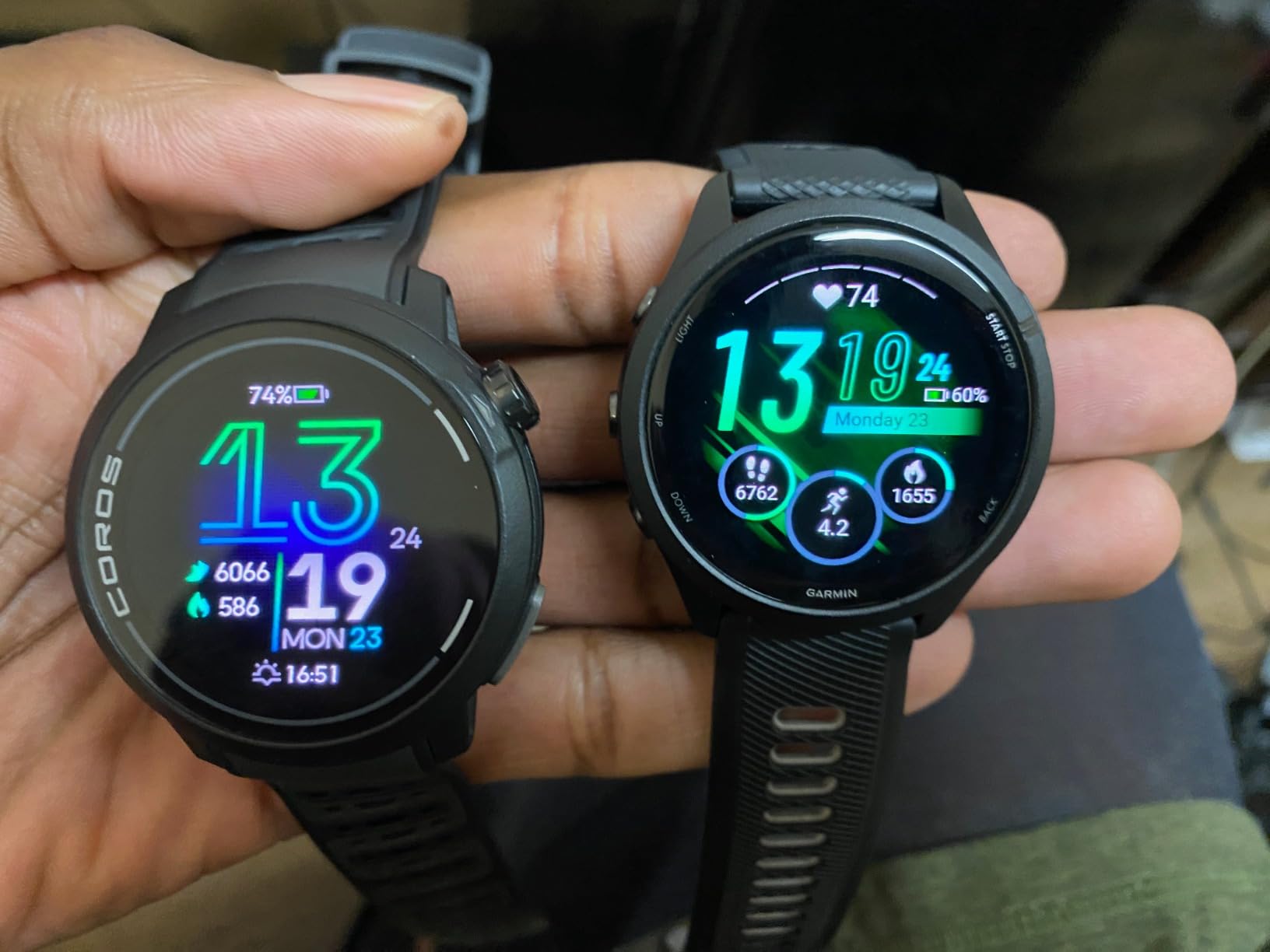
What marathon runners get here that a Forerunner 165 cannot offer
Maps and GPS, in that order. If your long runs move onto trails or unfamiliar routes, the topographic planner is the difference between a confident pace and a distracted one. Even on roads, the dual-frequency lock means your splits are measured against a straight line rather than a wandering one.
Thirty-eight hours of GPS means the battery question stops being part of your training week. Turn on dual-frequency for accuracy when it matters, drop back to standard mode for the easy miles, and you still have days of margin.
Where you give something up
The COROS app is the weakest link. Reviewers consistently describe its training analysis as less detailed than Garmin Connect, and the recovery modelling in particular does not reach the same depth as training readiness on a Forerunner.
Running dual-frequency by default costs about seven hours of GPS runtime, so it is a real trade rather than a free upgrade. A two-year warranty is a genuine plus, but if your training decisions depend on recovery analytics, this is not the watch.
6. Suunto 9 Peak Pro review – the longest battery in this roundup
SUUNTO 9 Peak and Peak Pro Sports GPS Watch for Demanding, Performance Driven Athletes and Adventurers
40 h best GPS
70 h endurance
300 h tour
100 m
60 g
Pros
- Exceptional endurance with 40 70 and 300 hour modes
- One-hour full charge and 10 minutes gives two hours of GPS
- Multi-satellite system holds in canyons and cities
- MIP display easy to read in daylight and very efficient
- Titanium stainless steel and sapphire glass at 100 m
Cons
- Firmware updates reported to drain battery sharply
- Heart rate sensor reported to stop reading after some updates
- Included strap is short
Battery is the entire argument here. Forty hours in best GPS mode, 70 hours in endurance mode and 300 hours in tour mode means you could complete a marathon block charging twice. The full charge takes an hour, and ten minutes of charging adds roughly two hours of GPS training.
The 1.2-inch MIP display at 1000 nits is a deliberate choice. It is dimmer and less vivid than the AMOLED panels elsewhere in this list, but it is far more power efficient and extremely readable in daylight, which is what a long Sunday morning actually demands.
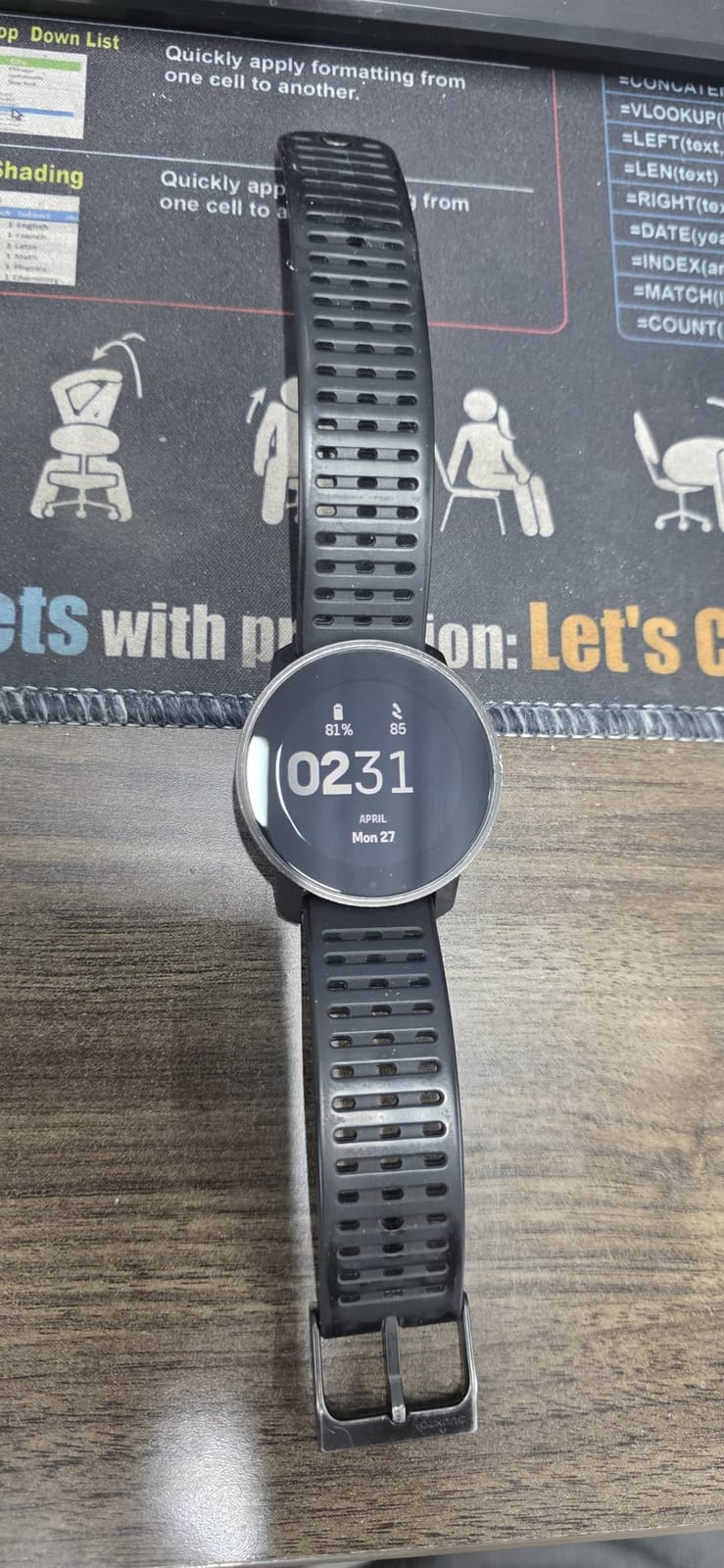
Four satellite systems give fast lock and reliable tracking in mountainous terrain and urban canyons. Ninety-seven sport modes, turn-by-turn navigation, weather alerts and avalanche maps cover a lot of ground, and the titanium, stainless steel and sapphire construction is rated to 100 meters.
The Suunto app handles structured workouts, goals, sleep and recovery, and connectivity to Strava, TrainingPeaks and more than 200 fitness apps is unusually broad. Music controls sit on the wrist.
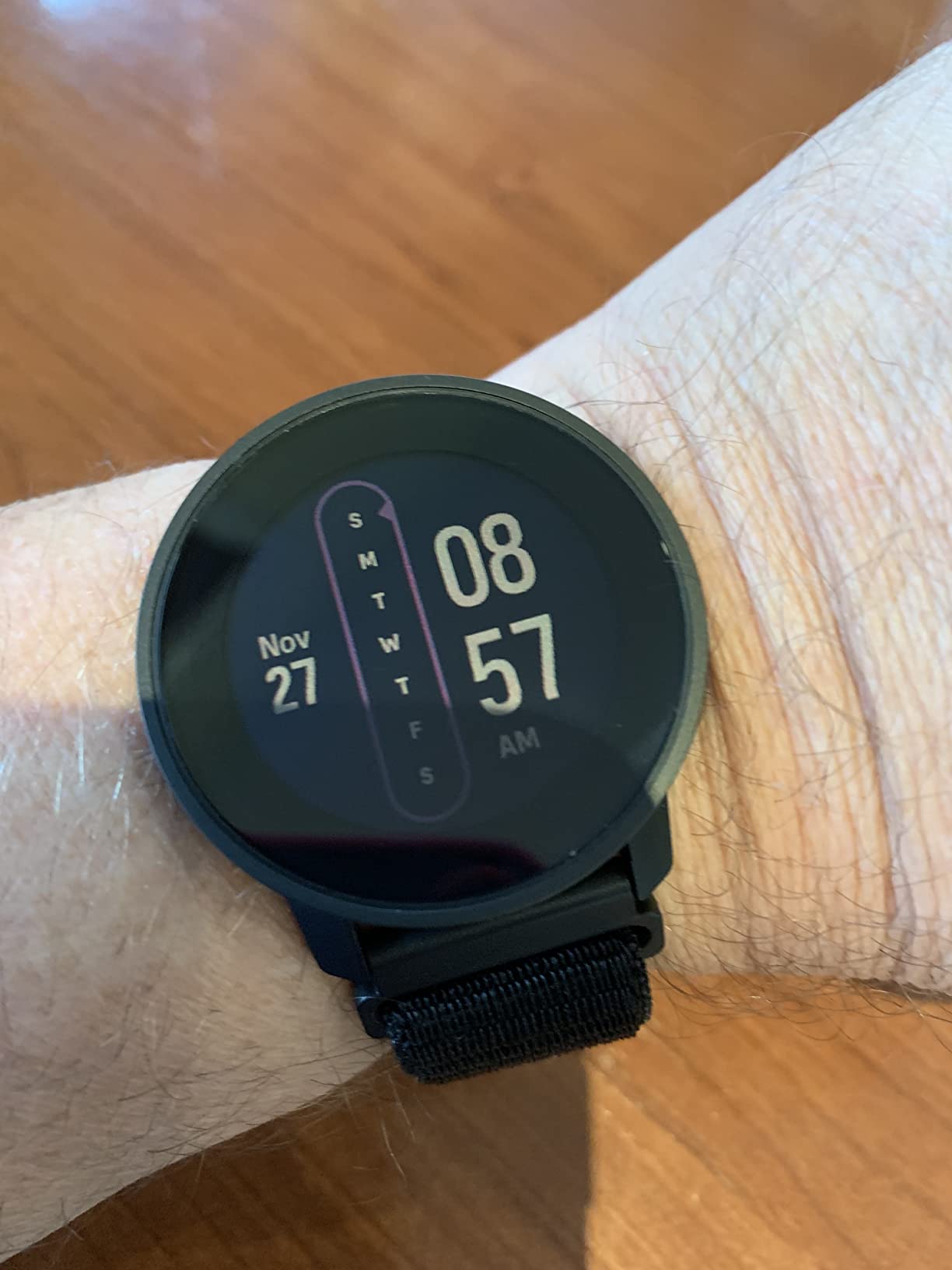
Why endurance runners rate this so highly
Nobody has ever finished a marathon block and wished they had charged their watch more. With 40 hours at best GPS, a 90-mile week with a race at the end of it is a non-event. The MIP display is what makes that possible, and the daylight legibility is a genuine benefit on long runs.
At 60 grams with a 22mm band and 100-meter water resistance, it also handles swimming and rough weather without concern. Two years of manufacturer warranty is among the longest covers in this group.
Where buyers report real trouble
The 4.0 average rating comes from a distinct cluster of post-update complaints. Reviewers report that recent firmware updates drain the battery sharply enough to force nightly charging, and that the heart rate sensor has stopped measuring on some units after software updates.
Sleep tracking also fails to register a second sleep period, custom watch faces sit behind a paid subscription, and the included strap is short. If you update every time you are prompted, weigh that carefully. If you tolerate an older firmware version, this is a superb marathon watch.
7. Suunto Race S review – compact dual-band for smaller wrists
SUUNTO Race S GPS Sports Watch, 1.32” AMOLED 95+ Sports Modes, All Black
30 h best GPS
13 days daily
60 g
Dual-band L1/L5
Pros
- Dual-band L1/L5 GNSS across five satellite systems
- Compact 60 g and 11.4mm case suits smaller wrists
- 30 hours best GPS and 13 days daily use
- Global offline maps with route navigation and find-back
- Accurate optical heart rate outdoors and during sleep
Cons
- Firmware updates reported to reset per-activity settings
- VO2 max readings reported stuck for some users
- Internal storage is reserved for maps so no offline music
Most large AMOLED running watches are hard to wear overnight, and sleep tracking only helps if you will actually sleep in it. At 60 grams and 11.4mm thick, the Race S is among the most compact watches here, and that is a real advantage for anyone who wears their watch to bed.
Satellite reception is the strongest argument. Dual-band L1/L5 across GPS, GLONASS, GALILEO, QZSS and BEIDOU gives accurate tracking in cities and on trails, and 30 hours in best GPS mode plus 13 days of daily use covers a marathon race day with margin.
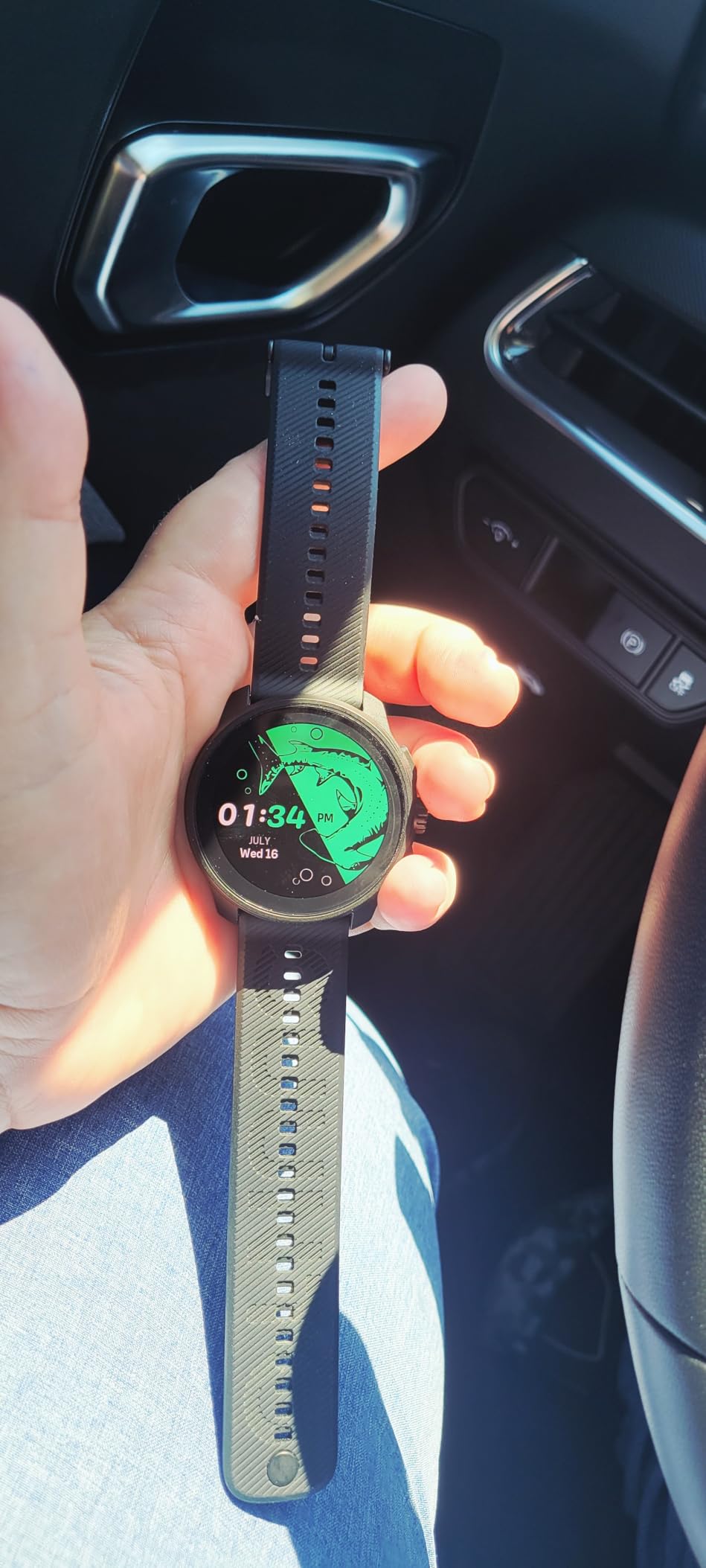
The 1.32-inch 466 dpi AMOLED with a digital crown is bright and responsive, and the crown makes scrolling through long activity pages tolerable. Global offline maps support route navigation, points of interest, a compass bearing and find-back, with easy GPX upload when you want to run someone else’s route.
A barometer-driven storm alert, sunrise and sunset alarms, altimeter and compass are unusual additions that runners who train in changeable weather appreciate. Training analytics run through TSS, CTL, HRV, VO2 max and TSB with the Suunto AI Coach for workout suggestions.
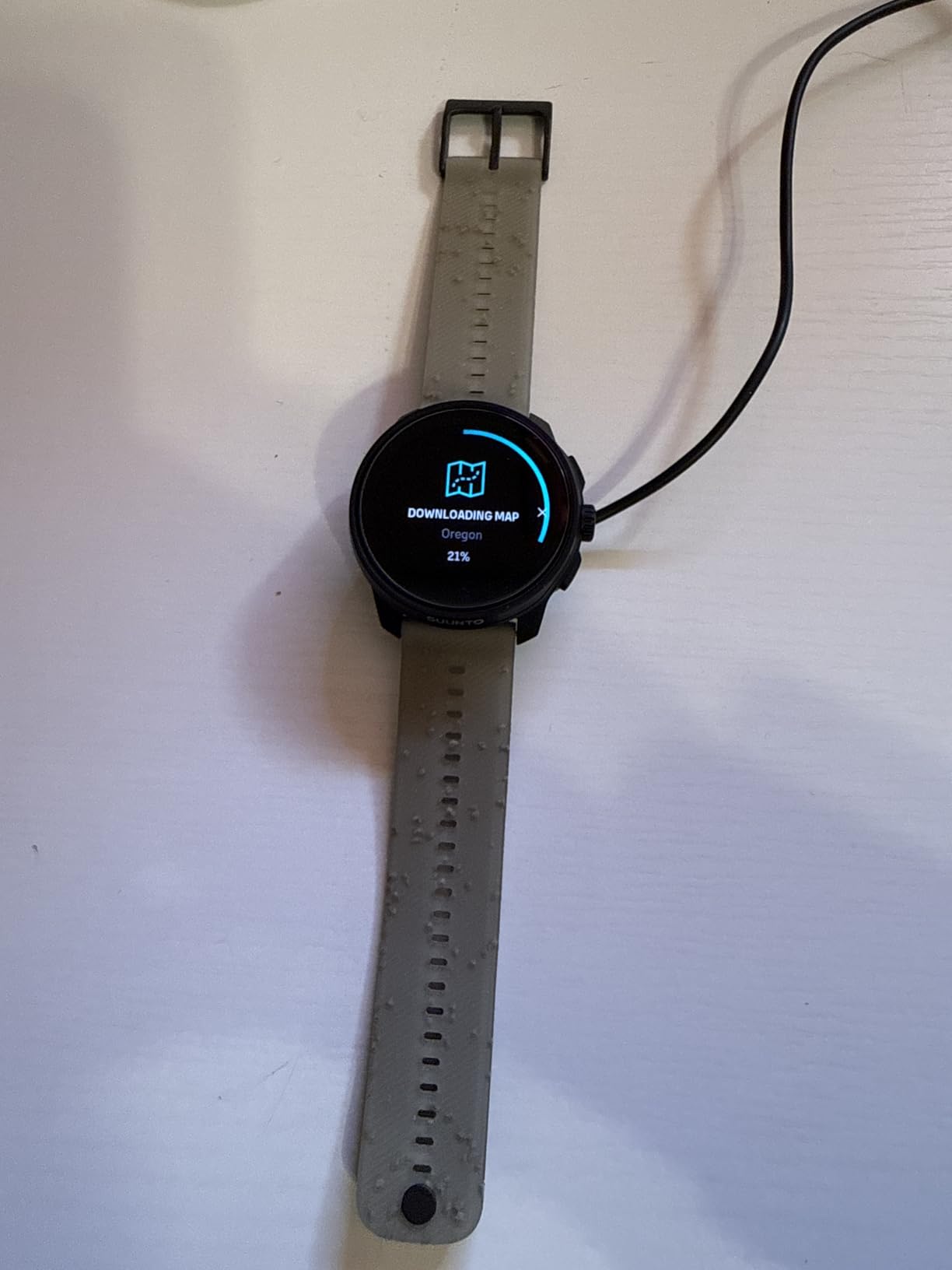
What smaller runners should like about it
Sizing is the whole point. A 60 gram case with 11.4mm thickness sits flat enough to sleep in, which makes HRV, sleep and recovery data meaningful rather than theoretical. The 466 dpi screen packs more detail into a smaller face than most competitors manage.
Reviewers rate the optical heart rate as accurate outdoors and during sleep, and 50-meter water resistance covers everything a marathon block needs. Over 95 sport modes and more than 300 partner service integrations through SuuntoPlus broaden it well past running.
What to check before you commit
Firmware updates have been reported to reset per-activity settings, which is annoying mid-block. VO2 max has also read as stuck at a single value for some users, so do not build a training plan around that number alone.
Internal storage is reserved for maps, so offline music is not an option here. There is no NFC contactless payment, and some users report the Suunto app dropping its connection after setup. Check the connectivity before you rely on it for daily syncing.
8. Amazfit Active 2 Premium review – the lowest-cost way into running watches
Amazfit Active 2 Premium Smart Watch 1.32″ Sapphire Glass, GPS, iOS/Android
10 days battery
1.32 inch 2000 nit AMOLED
50 m
Pros
- Sapphire crystal on the Premium model resists scratches
- Up to 10 days battery and longer with brightness reduced
- Free downloadable maps with turn-by-turn guidance and no mandatory subscription
- Bluetooth calling with a loud speaker and clear microphone
- Five satellite systems for fast GPS acquisition
Cons
- No built-in Wi-Fi so syncing over Bluetooth is slow
- 512 MB storage limits offline music and map downloads
- Advanced training metrics are shallow next to Garmin and Suunto
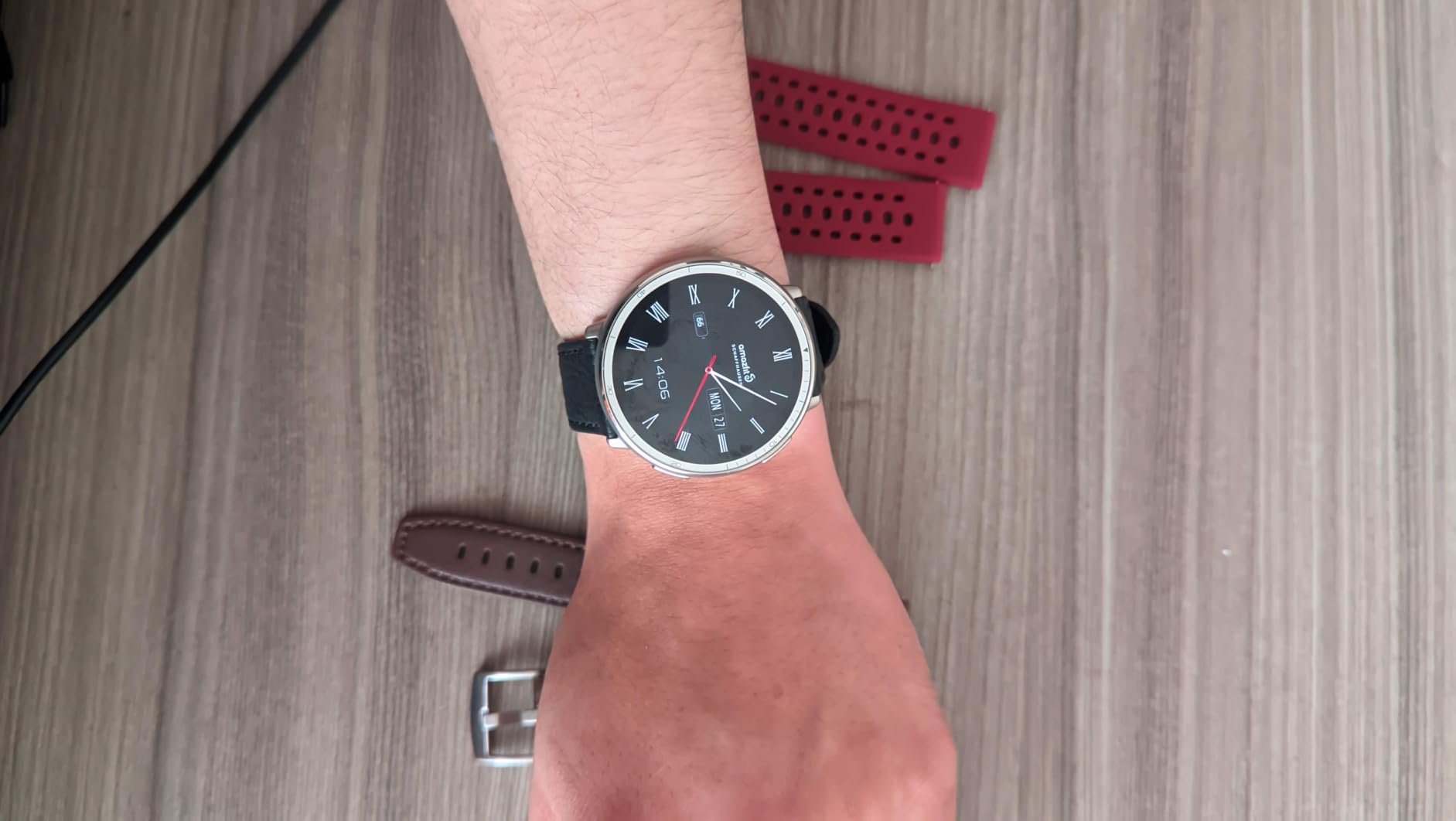
The Amazfit Active 2 Premium is the most accessible route into the category, with more than 1500 owner ratings. At 1.12 ounces it is light, and the 1.32-inch AMOLED at 2000 nits is a very bright panel for the money.
Battery life is up to 10 days of typical use from a 270 mAh cell, with a two-hour charge. Five satellite positioning systems across BeiDou, GLONASS, GPS and Galileo give fast acquisition, and 50-meter water resistance with a barometer handles swim and ski days.
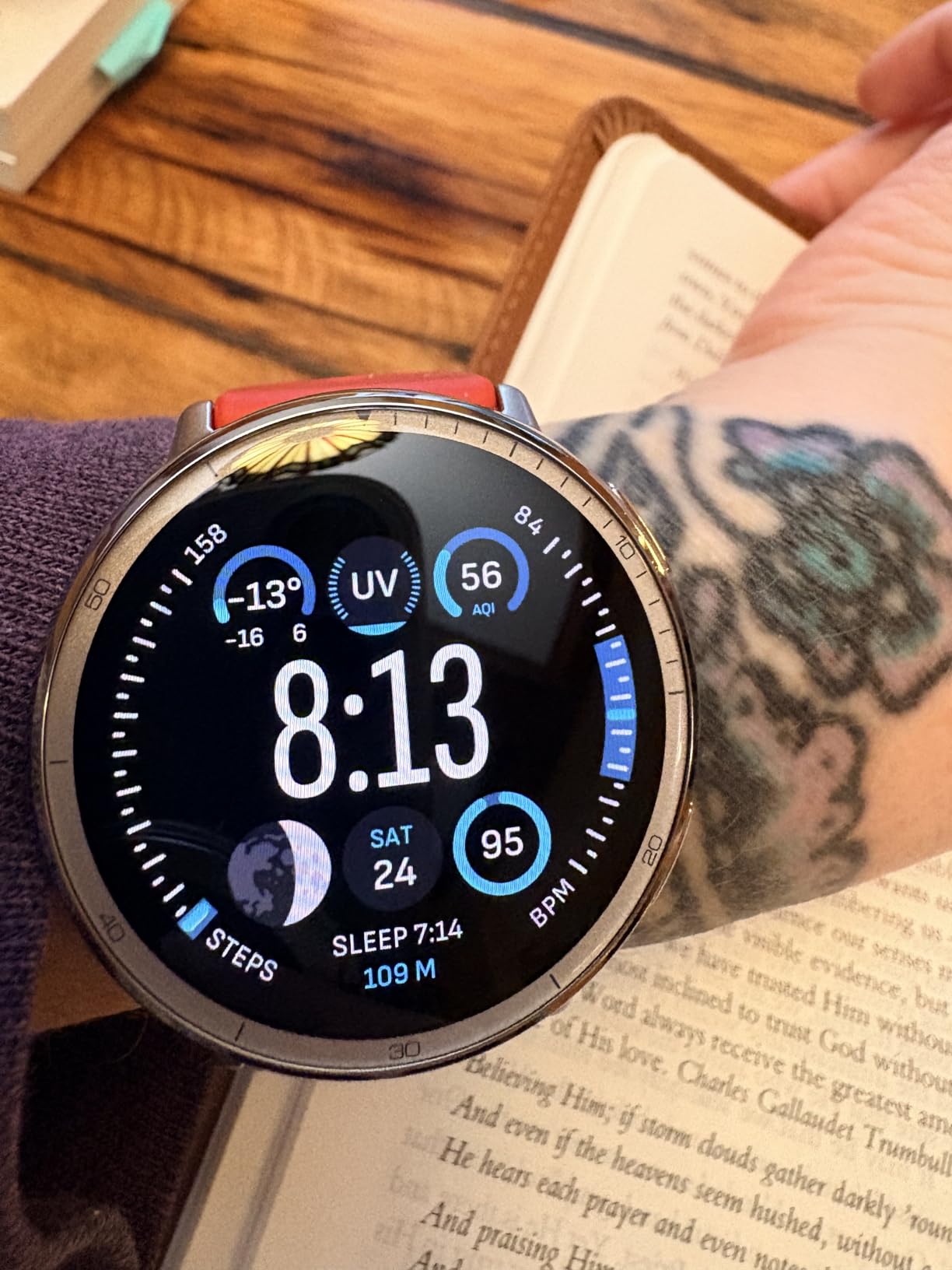
Free downloadable maps with turn-by-turn guidance are unusual at this end of the market, and the Zepp app carries no mandatory subscription, which is a genuine long-term saving. Bluetooth calling works through a surprisingly loud speaker, and Zepp Flow handles speech-to-text replies and voice control.
More than 160 sport modes cover everything from running and swimming to padel and yoga, and automatic activity detection plus Strava syncing need almost no input. You get a leather strap plus a silicone sport band in the box.
What it covers well for a first marathon block
Pace, distance, splits, heart rate, sleep and a long battery. That is the honest answer to what a first-time marathoner needs, and this watch delivers all six without a subscription attached. The 2000-nit panel is readable in the dark and in direct sun, which covers the extremes of a 6am start.
Automatic detection means you can forget to start a run in a hurry, and the standard 20mm quick-release band means replacing the strap is a two-second job, which matters with sweat over a long block.
Where the trade-offs bite
There is no built-in Wi-Fi, so app and watch-face syncing over Bluetooth is slow. Storage is 512 MB, which rules out meaningful offline music and limits map downloads, and the always-on display drops battery to roughly two days.
Most importantly, the training analytics are shallower than the Garmin and Suunto models here. If you want VO2 max trends, training load and recovery modelling to guide a plan, you are buying the wrong device. Use it for the data it does well.
9. COROS PACE 3 review – 30g and 38 hours of GPS
COROS PACE 3 GPS Sport Watch, Lightweight Running Watch – Chalk Nylon
38 h GPS
30 g with nylon band
1.2 inch transflective LCD
Pros
- Exceptionally light at 30 g with an 11.7mm profile
- 38 hours continuous GPS or 24 days of daily use
- Dual-frequency chipset keeps tracks accurate in high-rise cities
- Transflective always-on display readable outdoors without battery drain
- Breadcrumb route navigation with a route builder in the app
Cons
- Only 3 GB of internal storage for maps and music
- Transflective LCD is dimmer indoors than AMOLED rivals
- Training analytics are less detailed than Garmin readiness and load models
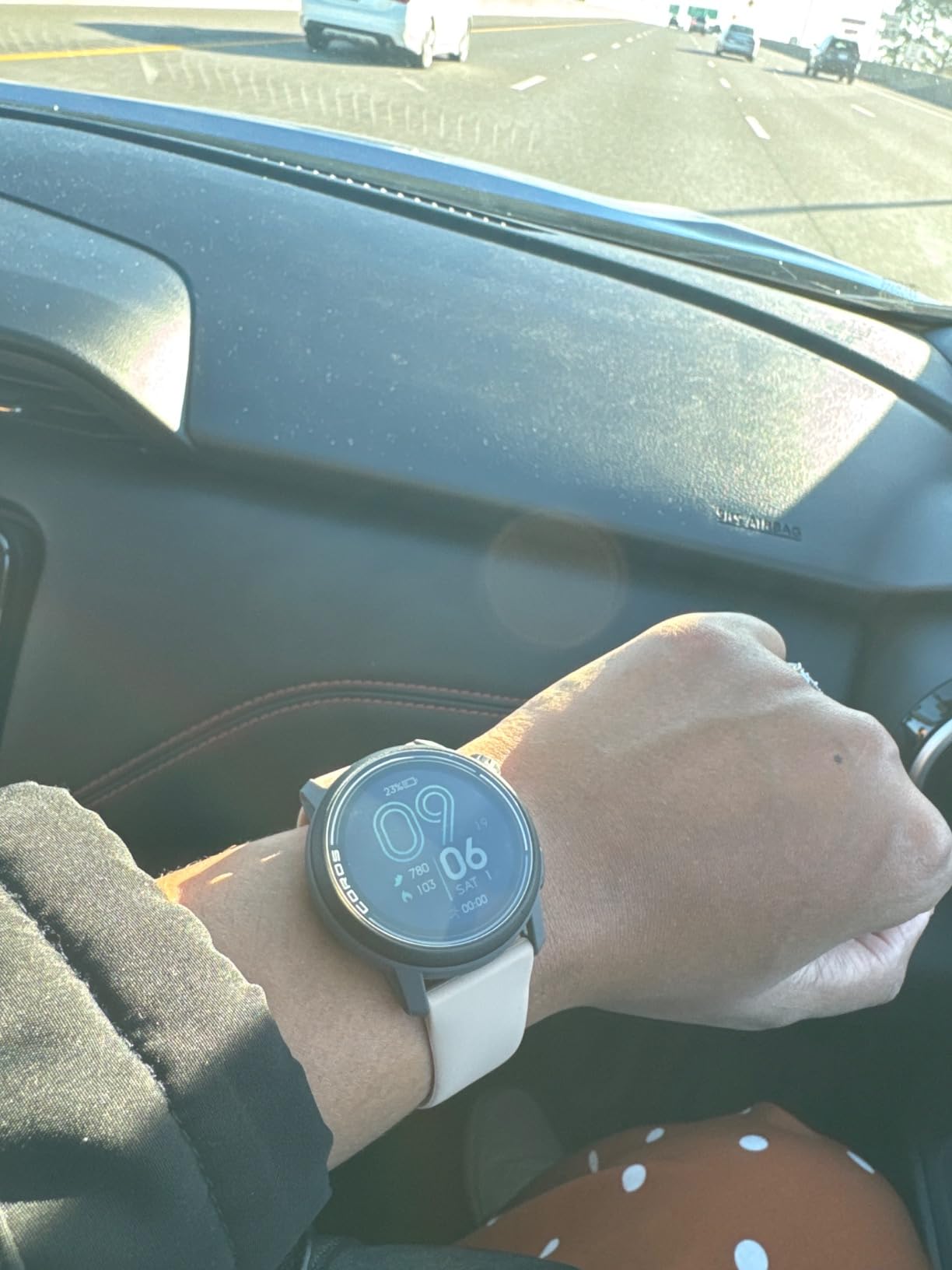
At 30 grams with the nylon band and an 11.7mm profile, the PACE 3 is the watch you forget you are wearing. That matters more than it sounds during a three-hour long run, when every extra gram and millimetre of profile becomes noticeable on the wrist.
Battery is 38 hours of continuous GPS or 24 days of daily use, so the endurance problem is solved. The dual-frequency chipset holds an accurate line in high-rise city blocks, which is exactly where cheaper single-band watches drift by whole streets.
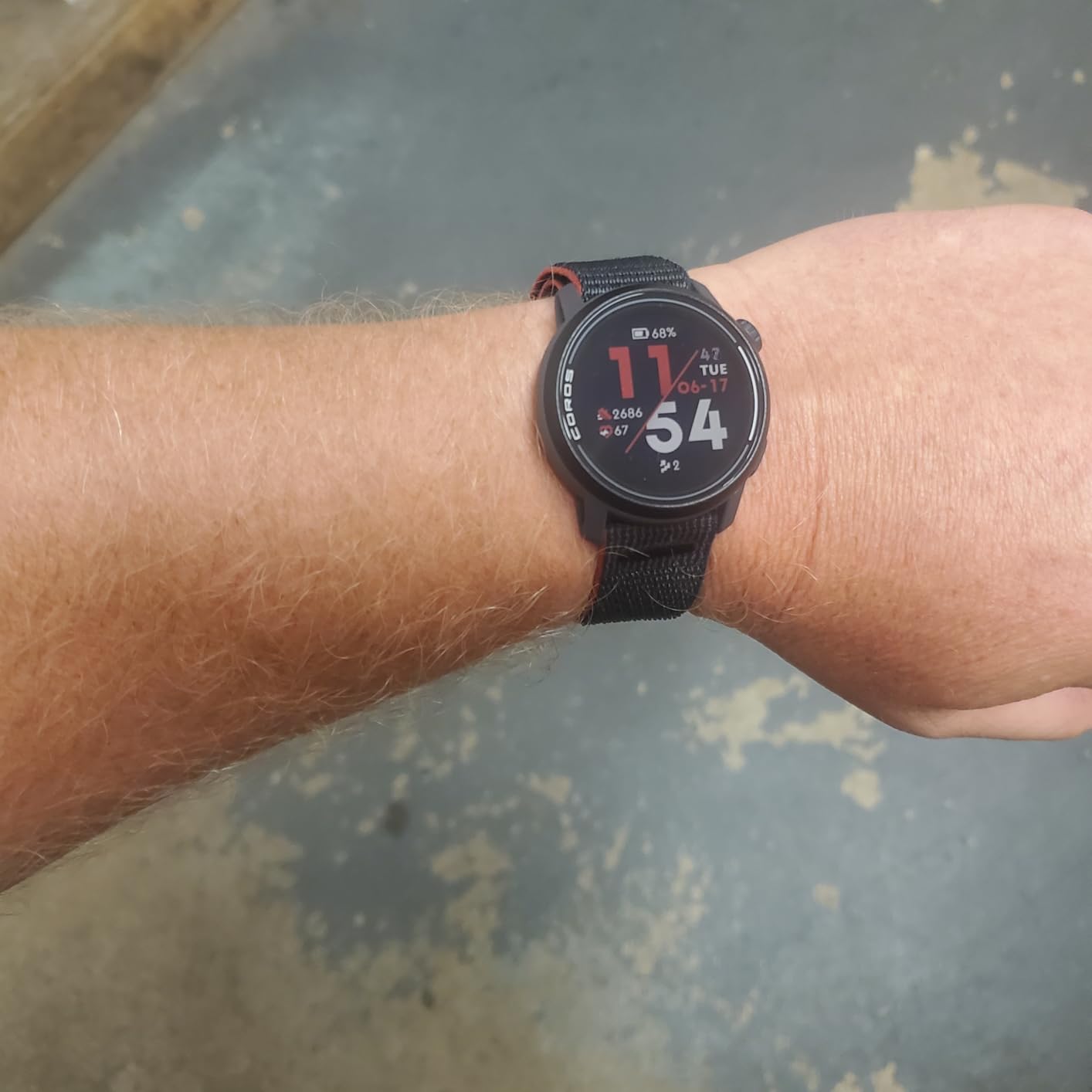
The 1.2-inch transflective LCD is always-on capable with three backlight modes, and it stays readable outdoors without the battery penalty of a lit AMOLED. If your long runs start at sunrise, that is a real advantage. The route planner with breadcrumb navigation is in the COROS app.
Air pressure and elevation gain recording make hill work analysable, and run, trail run, bike, swim, strength, snowboard, ski and XC ski modes cover a lot of crossover training. Water resistance is 50 meters with a two-year warranty.
Why runners love the weight and the runtime
Disappearing on the wrist is a genuine feature in a marathon block. Combine that with 38 hours of GPS and you get a watch that can handle every long run of a training week plus a full race, with nothing to charge in between.
The dual-frequency positioning means your distance and pace figures stay honest even in built-up areas, and breadcrumb navigation lets you follow a route you planned in the app without a phone. Hill sessions get elevation data as a bonus.
Where the savings show
Storage is 3 GB, which limits how much you can download for offline use. The transflective screen is also dimmer and less vivid indoors than the AMOLED panels on the Garmin, COROS PACE Pro and Suunto models in this list.
The bigger limitation is the COROS app. Training analytics here are shallower than Garmin training readiness and load models, so if your plan depends on recovery data you are choosing a watch that will not answer those questions. As a pace, distance and heart rate machine it is excellent.
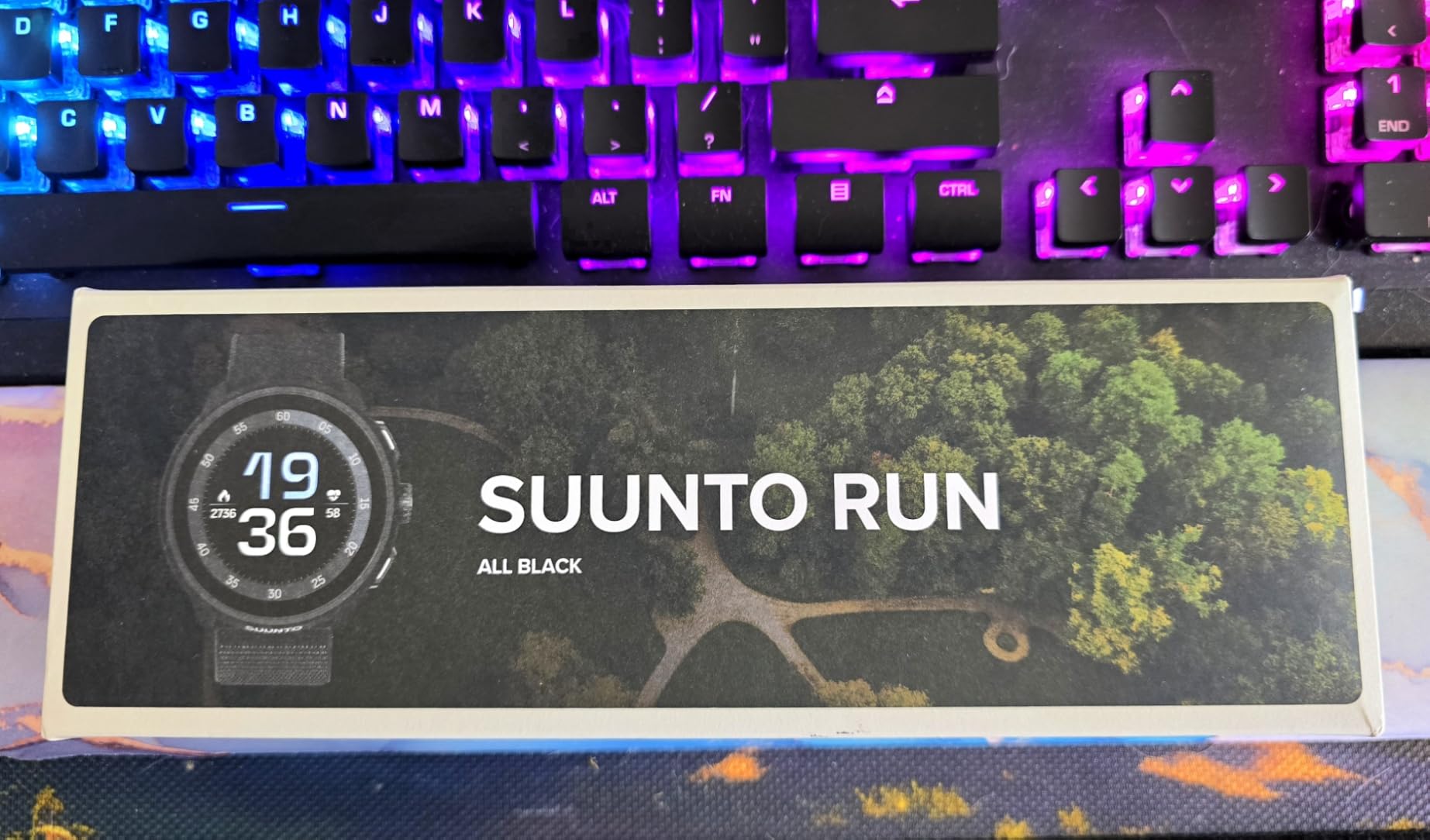
10. Suunto Run review – 36g AMOLED with dual-frequency GPS
SUUNTO Run GPS Sport Running Watch, Lightweight 1.32″ AMOLED Black Textile
20 h GPS
12 days daily
36 g with textile strap
Pros
- Very light at 36 g with a comfortable textile velcro strap
- 20 hours high-precision GPS and 12 days of everyday tracking
- Dual-frequency GPS that locks quickly and tracks accurately
- Bright 1.32-inch AMOLED with responsive touchscreen and crown
- Offline music playback and breadcrumb navigation
Cons
- Heart rate readings reported to over and under-report during workouts
- No weekly or monthly training plan builder in the app
- Swim distance reported inaccurate by around 25 yards per session
The Suunto Run pairs a 1.32-inch AMOLED with a 36 gram body and an 11.5mm profile, which is a rare combination of a bright modern screen and genuine low-profile comfort. The textile velcro strap is soft, dries fast and stays secure on a long run.
Battery is 12 days with daily activity and sleep tracking, and 20 hours of high-precision GPS training, with a one-hour full recharge. Dual-frequency GPS locks quickly and tracks accurately, and 4 GB of storage holds offline music with breadcrumb trail navigation.
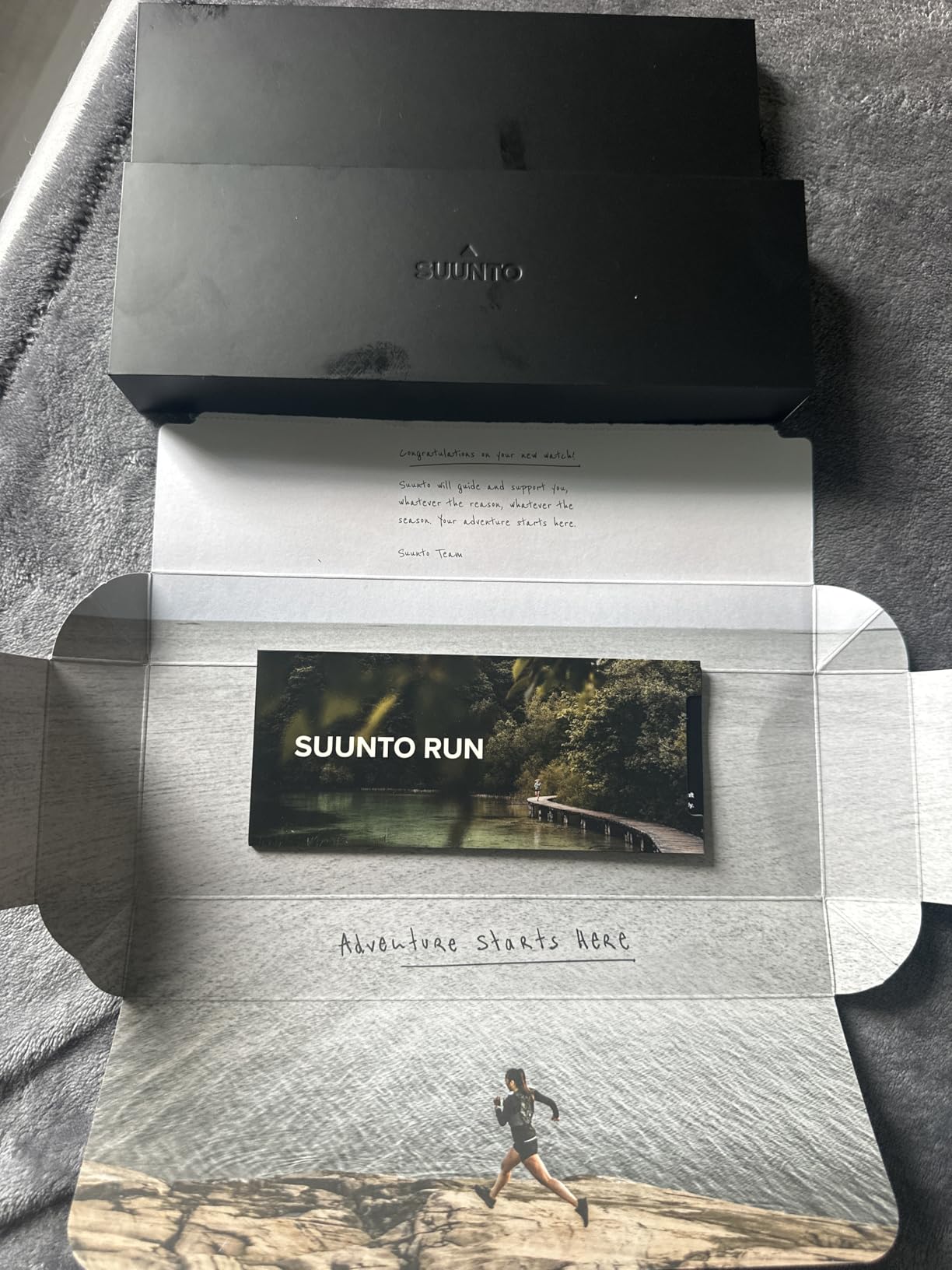
Training load, post-exercise heart rate and Training Stress Score give you a workable picture of effort. Sport modes cover hiking, cycling, yoga, tennis and boxing alongside running, and a two-year warranty is included. The app is deliberately simple and connects without fuss.
For a marathon block where your priority is a comfortable watch that records what happened, that is a reasonable package. Customisable widgets let you put pace, splits and heart rate on the first screen.
What suits this watch
Runners who want a modern bright screen without a bulky case will like the combination here. Twenty hours of GPS clears a long run and a hard evening session, and the textile velcro strap stays soft and secure over three hours of sweat.
Offline music means long runs can be phone-free, which matters if you train somewhere with poor reception. Training load and Training Stress Score are enough to manage effort if you are not chasing detailed recovery modelling.
Where it falls behind its Suunto siblings
Heart rate is the main complaint. Reviewers report readings both over- and under-shooting during workouts, and swim distance running roughly 25 yards long per session, so it is not the watch to trust for interval precision. A chest strap solves the running problem.
The crown and touchscreen are overly sensitive and need lock mode during activity to avoid accidental input. The app has no weekly or monthly training plan builder and no daily workout notifications, and there is no NFC payment.
Which Garmin Watch Is Best for Marathon Training?
The Forerunner 265 is the best Garmin for most marathoners, because multi-band SatIQ GPS, 20 hours of GPS runtime and training readiness cover everything a training block needs. Choose the Forerunner 965 if you want full-colour onboard maps and wrist running power, or the Forerunner 165 if you want the simplest and most proven route in.
Garmin’s own numbering confuses buyers more than any other brand’s, so here is the decoder. The Forerunner 165 and 170 are the entry pair, the 265 is the AMOLED mid-tier with multi-band GPS, the 570 adds a slimmer profile, the 965 adds full-colour maps and multisport modes, and the 970 is the current flagship. You do not need anything above the 965 for marathon training.
That is the direct answer, and it matches what we found in our own testing. The gap between the 265 and the 965 is navigation and endurance, not training quality.
What a Marathon Training Watch Actually Needs
A marathon training watch needs four things above all else: accurate pace and distance, reliable heart rate, a battery that survives a long run, and enough recovery data to stop you overtraining. Everything else is a preference. Here is how to weigh them.
Battery headroom is the number one criterion. Manufacturers quote battery in different modes, so normalise the numbers before you compare. A three-and-a-half hour long run plus warm-up, cool-down and a pace workout in the evening can push a watch well past twelve hours of continuous GPS. On that basis, anything under 20 hours of GPS runtime is a compromise, and 30 hours or more means you can race and train on the same charge.
GPS accuracy depends on your routes. Multi-band and dual-frequency receivers hold a line in cities and under tree cover where single-band watches drift. COROS PACE Pro, COROS PACE 3, Suunto Race S, Suunto Run, Apple Watch Ultra 3, Forerunner 265 and Forerunner 965 all use multi-frequency positioning. The Suunto 9 Peak Pro uses a four-satellite multi-system setup rather than dual-band.
Wrist heart rate is fine for easy runs and unreliable for intervals. Optical sensors lag when your arm is moving and when you are above threshold. For tempo and interval work, pair a chest strap with any watch here. Use the wrist sensor for easy miles, long runs and sleep so the strap does not become a chore.
Weight decides whether you will wear it. A heavier case starts to register during a three-hour run, and a watch that is uncomfortable at night will not give you honest sleep and recovery data. The COROS PACE 3 at 30 g and the Amazfit Active 2 Premium at about 32 g are the lightest options here.
Maps earn their price only in specific situations. For a road marathon on routes you know, onboard maps are dead weight. They earn their cost for trail running, ultra distances, travel, and hilly routes where visibility is poor. If that is not your training, spend the money on battery instead.
Storage and music are preference features. You need 4 GB or more for music and maps. Below that, as with the COROS PACE 3, offline content becomes limited. If you run without music entirely, storage stops being a factor.
Water resistance is a marathon question. Most of these are rated to 50 meters, which covers pool sessions, rain and sweat. The Suunto 9 Peak Pro and the Apple Watch Ultra 3 are rated to 100 meters.
Recovery metrics come in three flavours. Garmin offers training readiness and training status, COROS offers Training Status, Suunto offers TSS, CTL and TSB, Amazfit offers lighter BioTracker data, and Apple offers Vitals and sleep score. They are not directly comparable, so pick the ecosystem whose numbers you will actually look at.
Our general best GPS smartwatches roundup covers the wider market if you are still undecided, and runners who also want solar charging options should read our picks for the best solar watches.
Garmin vs COROS for Marathon Training
Garmin wins on ecosystem and training analytics, COROS wins on battery, weight and value. For marathon training specifically, the practical difference is that Garmin tells you when to back off through training readiness, while COROS gives you a lighter watch with more hours between charges.
Neither brand is better in the abstract, they are better at different jobs, and a lot of the COROS argument in forum threads comes down to the Garmin Connect app. Weigh the three areas below before you choose.
Regulars in r/GarminWatches and r/Coros describe the same split from opposite sides. Garmin owners accept a clunkier app in exchange for deeper analysis, while people who moved to COROS usually cite battery and app annoyance rather than any measured accuracy difference. One runner in r/XXRunning put it plainly, noting that COROS metrics are accurate and on par with Garmin high-end watches at a more affordable price. That matches what we saw on the road.
The honest caveat: users also report that COROS continues updating older models while Garmin has dropped support for some older watches, so if you expect to run on the same device for a decade, that is worth weighing.
What First-Time Marathoners Can Skip
First-time marathoners can skip maps, triathlon modes, inReach satellite features, running power, training load modelling and subscription-based map services. None of that will change your finish time, and paying for it is a mistake we see often.
What you actually need is pace, distance, automatic splits, heart rate and a battery that lasts a long run. Every watch in this roundup does that. The features that justify a step up are training readiness on the Forerunner 265, multi-band GPS for city running on the COROS PACE Pro, and endurance for multi-day training blocks on the Suunto 9 Peak Pro.
A common pattern in r/firstmarathon is buying a watch for a 5K, using it for a half, and only then thinking about the marathon. That is not a mistake, but if you know your marathon is on the calendar, buying at the start of your block is better than buying in week ten.
Frequently Asked Questions
Which Garmin watch is best for marathon training?
The Forerunner 265 suits most marathoners because multi-band SatIQ GPS, 20 hours of GPS runtime and training readiness cover a full training block. Choose the Forerunner 965 for full-colour onboard maps and 31 hours of GPS, or the Forerunner 165 for the simplest proven option.
What is the best GPS smartwatch for runners?
For runners who want one device for training and everyday wear, the Apple Watch Ultra 3 leads on health tracking and phone-free running. Dedicated runners get more battery from the Forerunner 265, and runners who want long GPS runtime at low weight should consider the COROS PACE Pro.
Do Garmin watches have marathon training features?
Yes. Garmin watches include custom workouts for intervals and tempo sessions, training readiness, training status, recovery time, VO2 max and a race predictor. Free race adaptive training plans build a schedule around a target marathon date on models including the Forerunner 165, 265 and 965.
Is COROS or Garmin better for running?
Garmin is better for training analytics, app depth and full-colour maps, while COROS is better for battery life, weight and value. For marathon training, Garmin training readiness is the stronger recovery tool, and COROS watches such as the PACE Pro give you more GPS hours per charge at lower weight.
Do I need a GPS watch to train for a marathon?
Your phone with a running app already records distance and pace, so a watch is not strictly required. It does give you real-time wrist heart rate, structured workout guidance, lap alerts, recovery data and a way to run without carrying a phone, which is why most training plans assume one.
Do beginner runners need maps on a running watch?
Usually not for road marathon training on familiar routes. Maps earn their price for trail running, ultra distances, travel and unfamiliar hilly routes, so a first-time marathoner is better off spending that budget on battery life and heart rate accuracy.
The Verdict: Our Best GPS Watches for Marathon Training
The Forerunner 165 is the best GPS watch for marathon training for most people, because 19 hours of GPS, an accurate sensor set and more than 5000 owner reviews add up to a watch you can trust from week one to race day. If your routes are urban or you want recovery guidance, step up to the Forerunner 265. If navigation is part of the plan, take the Forerunner 965.
Outside Garmin, the COROS PACE Pro is the pick for GPS precision and battery, the Apple Watch Ultra 3 is the pick for health tracking and phone-free running, and the Suunto 9 Peak Pro is the pick for pure endurance, provided you are comfortable with its firmware history. Whichever you choose, buy it at the start of your block, pair a chest strap with your interval sessions, and check the GPS runtime against your longest planned run before you order.