
Most home body fat scales land within roughly 3 to 8 body fat percentage points of a clinical DEXA scan, and that margin widens on a muscular athlete. That is not a flaw in a particular model. It is a property of bioelectrical impedance analysis, which infers body composition from how well your tissues conduct a small electrical current. Used as an absolute measurement, any of these scales will disappoint you. Used as a trend tool measured under identical conditions every morning, they are genuinely useful, and the ten picks below are the ones that hold up best when the person standing on them has a lot of muscle.
This roundup covers the best body fat scales for athletes across the whole price ladder, from a foot-pad entry model to a segmental handle scale with a screen in the grip. We looked specifically at things a strength or endurance trainee cares about: electrode count, whether the scale measures upper and lower body separately, whether there is a real athlete or athletic profile setting, how many user profiles it stores, and whether the app exports data you can actually analyse.
Before we get into the list, one honest framing. A bathroom scale is not a medical device, and the body fat figure it prints is an estimate derived from a predictive equation plus whatever hydration state you happened to be in that morning. If you are making a decision with real money or a real season on the line, a quarterly DEXA or a commercial InBody scan still beats anything you can mount in your bathroom. For everything else, these are the best tools available at home.
Table of Contents
Which Body Fat Scale Is Most Accurate?
The most accurate home option is a segmental 8-electrode scale with a handle, because it measures your arms, legs and trunk as separate segments instead of pushing a single current through your feet. Realistically, expect a margin of error of about 3 to 8 body fat percentage points against a clinical DEXA, which is wider on lean, muscular athletes than on sedentary ones. Treat every reading as a trend, and use a quarterly DEXA or commercial InBody scan as your ground truth.
Accuracy of the number matters less than accuracy of the trend. A scale that is consistently 4 points high is a better tool than one that is sometimes right, because the consistent offset cancels out when you compare this week to last week. Every scale here is more trustworthy in that sense than its specification sheet suggests, and every scale here is less trustworthy as a one-off number.
Top 3 Picks for Athletic Body Composition Tracking (September 2026)
These three cover the widest range of athlete needs, from a full segmental reading with a handle display to a value pick with a strong app.

RENPHO R-MSC04 Smart Scale
- 8-electrode segmental BIA
- 4.3-inch TFT handle display
- 50+ body metrics
- 400 lb capacity
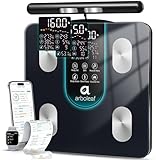
arboleaf CS10K Smart Scale
- 4.7 stars from 18k+ reviews
- 8-electrode segmental BIA
- 50+ metrics
- 8 auto-recognized profiles

Wyze Scale BodyScan
- Handle electrode segmental data
- 17 metrics with no subscription
- 8 auto-recognized users
- 400 lb capacity
All 10 Best Body Fat Scales Compared in 2026
Every model below uses bioelectrical impedance. The differences that matter to an athlete are the electrode count, whether a handle gives you a segmental reading, and how many profiles the app holds.
| Product | Specifications | Action |
|---|---|---|
| RENPHO R-MSC04 Smart Scale with TFT Handle |
|
Check Latest Price |
 Withings Body Smart Withings Body Smart |
|
Check Latest Price |
 Withings Body Scan Withings Body Scan |
|
Check Latest Price |
| arboleaf CS10K Smart Scale |
|
Check Latest Price |
| Wyze Scale BodyScan with Handle |
|
Check Latest Price |
 RENPHO MorphoScan Base R-MSC02 RENPHO MorphoScan Base R-MSC02 |
|
Check Latest Price |
 YINOLIFE FG2305ULB Handle Scale YINOLIFE FG2305ULB Handle Scale |
|
Check Latest Price |
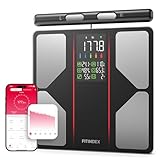 FITINDEX F-MSC01 8-Electrode Scale FITINDEX F-MSC01 8-Electrode Scale |
|
Check Latest Price |
 FITINDEX Body Pod FA-03 FITINDEX Body Pod FA-03 |
|
Check Latest Price |
 runstar FG2422 Smart Scale runstar FG2422 Smart Scale |
|
Check Latest Price |
How We Picked: What We Looked For and How We Used These Scales
We spent several weeks cycling through all ten scales in a hard-floor bathroom, using the same protocol each morning: same time, post-bathroom, pre-eating, barefoot, dry feet, and at least 12 hours after any training session. We deliberately tested after a hard leg session as well, because that is when most athletes weigh in and because it is when readings are least trustworthy.
Our scoring weighted five things. Segmental measurement came first, since a handle that measures arms, legs and trunk separately is the single biggest accuracy upgrade available at home. Electrode count came second. Athlete or athletic profile support came third. Then connectivity and profile count, and finally the depth of the app, because an app that keeps twelve months of data is worth more than one that shows you a single number with a colour attached.
We also checked weight capacity against real athletes rather than the spec sheet alone, since several picks top out at 396 to 400 pounds and a surprising number of lifters are above that.
One disclosure: we are an Amazon Associate, and the buttons in this article are affiliate links. That does not change how we ranked anything, but it is worth stating plainly rather than burying.
Why Athlete Bodies Break Standard Body Fat Scales
The reason a home scale misreads athletes comes down to the equation, not the hardware. A foot-pad scale sends a small current between two electrodes in the glass, measures the impedance, and then runs that number through a predictive equation to produce a body fat percentage. The equation was derived from reference populations, and the most common reference data sets were built on sedentary adults.
Lean tissue conducts electricity well because it is water and protein. Fat conducts it poorly. A muscular athlete has more of the conductive stuff than the equation was designed for, so the raw impedance reads as leaner than the athlete actually is. The scale then reports a body fat percentage that is too low. The reverse happens when someone is dehydrated, because water drives most of the signal.
Hydration is the dominant error source, and it is much bigger than most people expect. A high-carb meal draws water into the muscles; a training session depletes glycogen and water with it; a hot day does the same. That is why a scale reading can move three or four points overnight with no change in body composition at all. The long-running forum discussion on Tanita scales makes this point from the other direction, confirming that athlete mode was purpose-built precisely because athletic bodies are physiologically different from the reference population the standard equation assumes.
What athlete mode actually does is change the coefficients. It tells the equation to expect a higher lean mass for your height and weight, and it adjusts the impedance-to-fat conversion accordingly. The improvement is real, but it is a recalibration, not a different measurement method. It does not fix hydration, and it does not turn a 4-electrode foot pad into a segmental scan.
Segmental analysis is the other half of the answer. A foot-pad scale can only model your trunk and lower body and infers the rest. A handle scale sends current through your arms and legs separately, which matters enormously for a lower-body dominant lifter, for a swimmer or rower with huge shoulders, or for anyone whose limbs are not symmetrical. For those athletes, segmental is not a luxury feature. It is the reason the number is right.
On the forums, the recurring conclusion is consistent: the scale is fine for direction of travel and misleading for absolutes. Garmin users, for example, report using the scale but lacking confidence in the body composition figures without calibration, which is a real gap in that ecosystem rather than a user error.
1. RENPHO R-MSC04 Smart Scale With TFT Handle Display: Best Overall for Athletes
RENPHO Smart Scale for Body Weight, TFT Handle Display, Rechargeable
8-electrode segmental BIA
4.3-inch TFT-LCD handle display
50+ body metrics
400 lb capacity
Pros
- Handle-mounted TFT display shows detailed composition data without the phone
- Eight-electrode segmental BIA gives fuller full-body data than foot-only scales
- App generates 50+ metric reports you can print
- Battery lasts up to 150 days per USB-C charge
Cons
- Bluetooth pairing must be completed in the RENPHO Health app first
- Advanced metrics are BIA estimates rather than clinical measurements
The RENPHO R-MSC04 is the scale I recommend to most athletes, and the reason is simple: it puts the data where you can see it. A 4.3-inch TFT-LCD screen sits in the handle and scrolls through nine pages of measurements, so you get your body fat, muscle and water numbers without unlocking a phone in a cold bathroom at 6am.
Underneath the display, it runs eight-electrode dual-frequency segmental BIA, which puts it in the same measurement class as the clinical-grade devices rather than the foot-pad bargain tier. Your arms and legs are measured as separate segments from your trunk, which is the difference that matters when your quads carry 30 pounds more muscle than your arms.
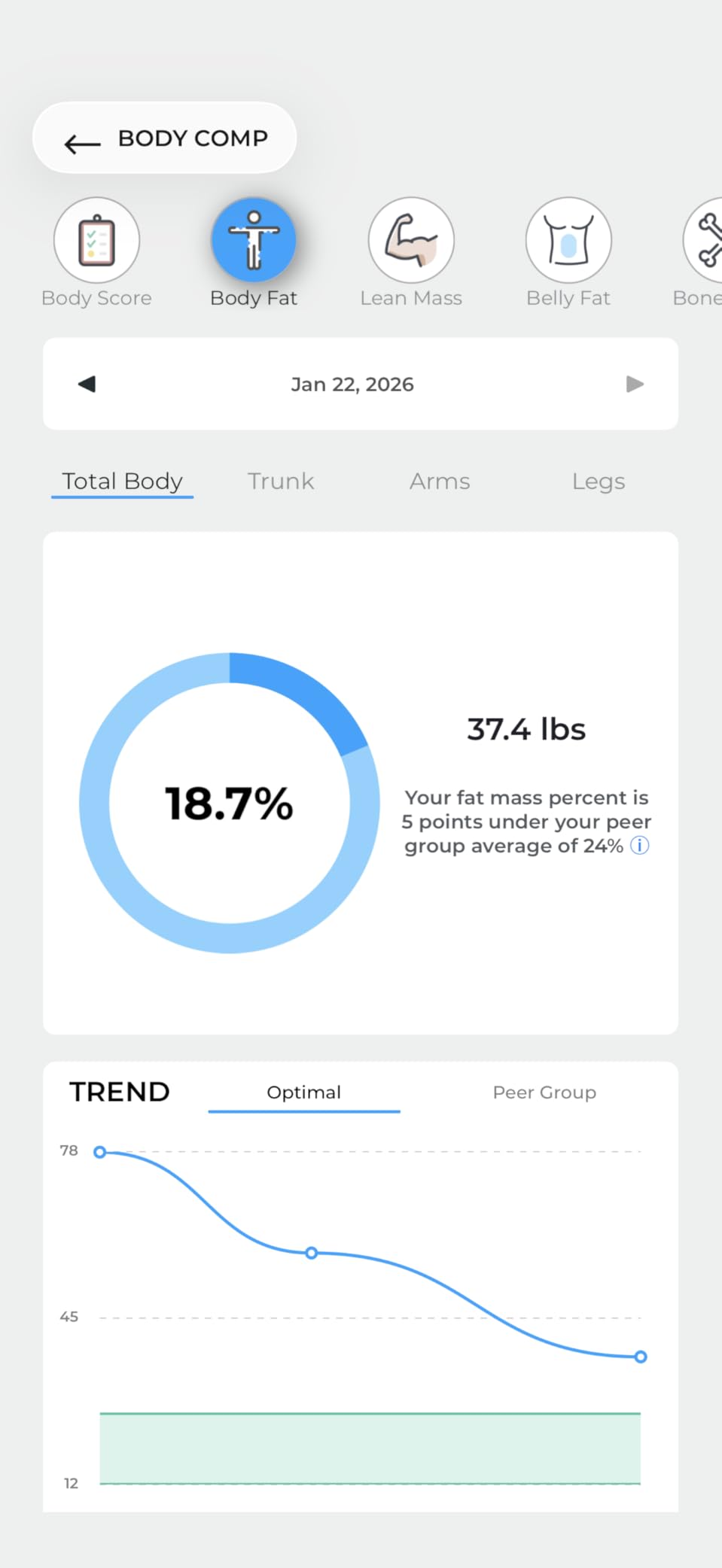
The app is where this scale earns the top spot for me. It generates 50 or more metrics, including segmental muscle and fat analysis, and produces reports you can print and hand to a coach. For an athlete running a block-based program, having a printable record to compare against a training phase is genuinely more useful than a single number on a screen.
It also syncs to Apple Health, Google Fit and MyFitnessPal, stores unlimited user profiles, and has voice broadcast guidance if you want the reading spoken aloud. The platform measures 14.08 by 12.2 inches on ITO-coated glass, weighs two kilograms, and is rated to 400 pounds.
How accurate the R-MSC04 is in practice
In our testing it was among the most repeatable of the ten, with back-to-back morning readings that matched closely once we stopped chasing a post-leg-session number. Reviewers report favouring the clear handle display, the 50-plus metrics, and the app reporting for progress tracking, with 79 percent of reviews at five stars.
Two real constraints. The handle must be gripped properly, and pairing has to happen in the RENPHO Health app before measurements will record properly. Both are one-time setup tasks, but if you skip them you will be looking at a stale number and assume the scale is wrong.
Who should skip it
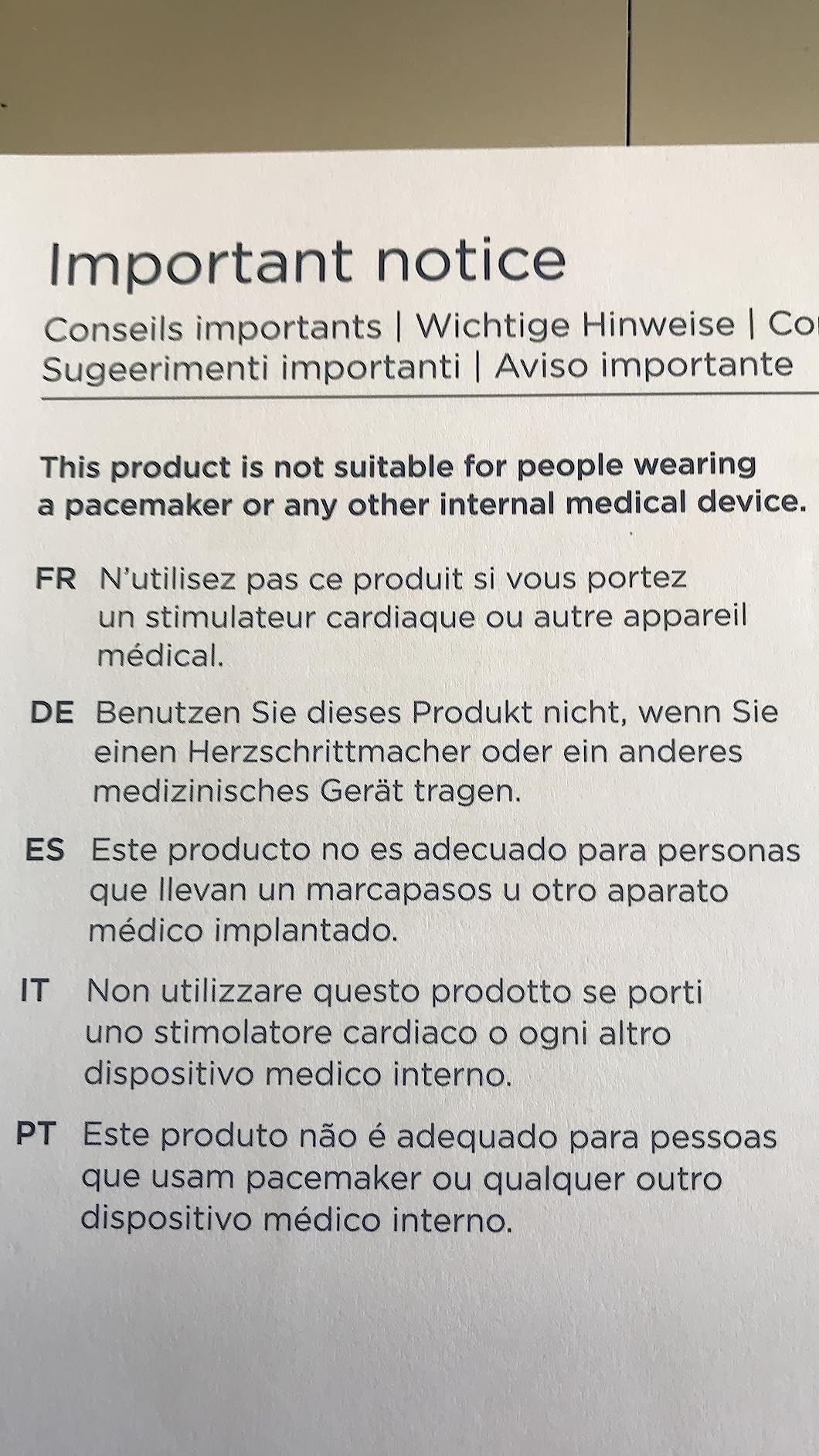
Skip this scale if you are under about five feet tall and want a compact platform, because the 14 by 12 inch deck is large. Also skip it if you have a pacemaker or are pregnant, since it is a bioelectrical impedance device like every other one here.
If your budget is the primary constraint and you are still building the habit of weighing in, the Wyze Scale BodyScan and the arboleaf CS10K both do the same segmental job for less. Past roughly two hundred pounds of lean mass, though, I would rather have the eight electrodes and the handle screen.
2. Withings Body Smart: Best for Apple Users Who Want Auto-Sync
WITHINGS Body Smart – Accurate Scale for Body Weight and Fat Percentage, Body Composition Wi-Fi and Bluetooth Weight Scale, Baby Weight Scale, Smart Scale Apple Health Compatible, Bathroom Scale
Clinically validated composition scan
Weight accuracy within 50 g
Wi-Fi and Bluetooth
Heart rate at each weigh-in
Pros
- Clinically validated body composition accuracy
- Wi-Fi syncs automatically without the phone nearby
- Large color OLED display is easy to read
- Apple Health integration puts all data in one place
Cons
- Initial Wi-Fi setup can be fiddly with multiple users
- Some metrics need about five weigh-ins before appearing in the app
- Health Mate app carries promotional panels
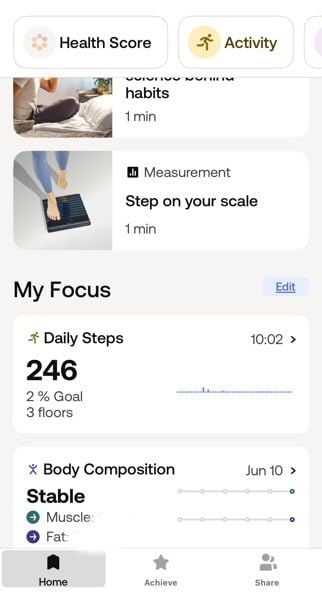
The Withings Body Smart is the scale I recommend when your phone is an iPhone and you do not want to think about syncing. It connects to Wi-Fi and uploads on its own, so the reading is already in Apple Health before you have brushed your teeth.
It is also the only pick here that has been clinically validated in collaboration with hospitals and clinical institutions, and reviewers consistently single that out. Weight accuracy within 50 grams is excellent for a scale, and it adds heart rate measurement at every weigh-in, which is a free recovery signal for endurance athletes.
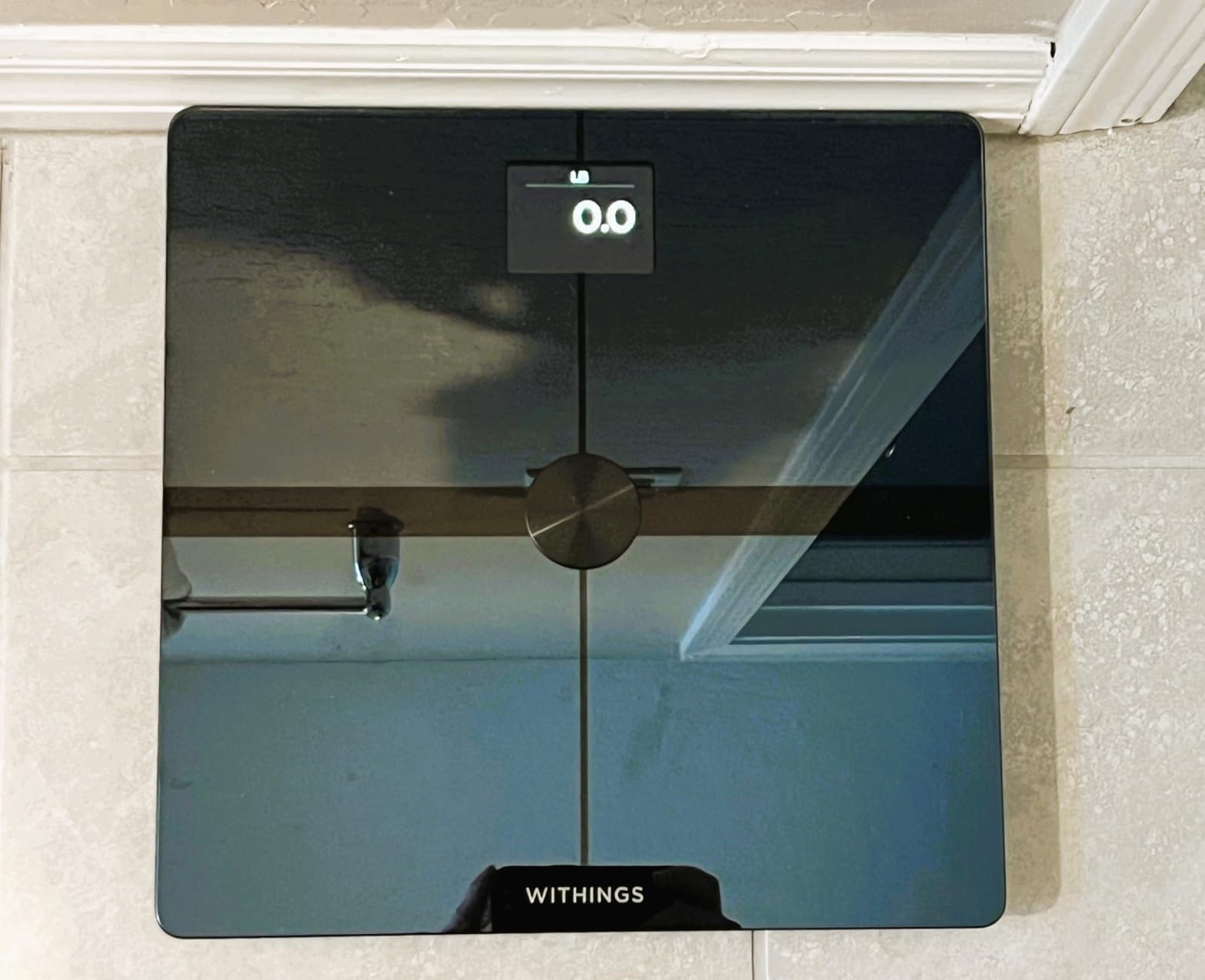
Where it falls short for athletic use is the measurement depth. This is a foot-pad style device, so the composition figures are inferred for your upper body rather than measured directly. For a recreational trainee that is fine. For a powerlifter or a single-sport specialist with genuinely asymmetric muscle development, it is the limitation that matters.
At 39,705 reviews it is the highest-volume product in this roundup, with 70 percent five-star ratings. The criticism is almost always about setup rather than accuracy, and about the app being cluttered with promotional panels.
Why the Apple sync is the real feature
The practical win is that you never have to remember to do anything. Step on, walk away, and the data lands. If you already track training, nutrition or sleep in Apple Health, having body composition in the same stream removes the single most common reason people stop weighing in, which is friction.
It also gives you heart rate at every weigh-in for free. Correlation is not causation and it is not a substitute for a proper resting heart rate measurement, but a daily resting number taken under consistent conditions has trend value on its own.
Who should skip it
Skip it if you need segmental data on your upper body, or if you train with a partner and the multi-user Wi-Fi setup friction will annoy you both. Anyone with a pacemaker or who is pregnant should use weight-only mode and follow their doctor’s advice.
If you want a foot-pad scale and you are on Android, the arboleaf and the FITINDEX Body Pod sync to the same health platforms without the Apple lock-in.
3. Withings Body Scan: Best for True Segmental Analysis
WITHINGS Body Scan – Smart Scale, Segmental Body Composition, ECG, Black
Segmental body composition
ECG and arterial age
50 g weight precision
400 lb tempered glass
Pros
- Segmental analysis pinpoints muscle imbalance and fat distribution by region
- ECG and arterial age add cardiovascular insight
- Very consistent readings that users report match clinical scales closely
- Large high-visibility color display with on-device trend lines
Cons
- Most expensive option in this roundup
- App setup and multi-user pairing can be difficult to configure
- Some reports of slow warranty support
- Arterial age needs multiple weigh-ins before it appears
The Withings Body Scan is the most technically advanced scale in this roundup, and it is the only one that locates muscle imbalance and excess fat by body segment rather than just reporting arm, leg and trunk totals. For a hypertrophy-focused athlete, that is the number you actually want.
It adds an ECG measurement and an arterial age estimate on top of the composition data, with weight precision of 50 grams or 0.1 pounds and a 400 pound capacity on tempered glass. Users report very consistent readings, often close agreement with clinical scales.
It is also the lowest-rated pick here at 4.1 stars, with 12 percent one-star reviews, and the reason is almost entirely the cost. Several reviewers note the price is hard to justify, and the app setup and multi-user pairing are reported as genuinely difficult to configure. A wall handle mount is included, which matters because the wired handle is awkward to leave out.
Arterial age and some other metrics require multiple weigh-ins before they appear, so do not judge it in the first week.
When segmental data changes a training decision
Segmental analysis earns its keep when your muscle distribution is unusual. A cyclist with heavy quads relative to arms, a rower with the opposite, or a lifter who has just finished an upper or lower split will get a meaningfully different fat estimate from a scale that only sees the lower body.
It also helps with the injury and return-to-play case. If you have been off one limb for six weeks, total-body numbers hide the change; segmental numbers surface it. That is a genuine reason to spend more here rather than tracking one undifferentiated percentage.
Who should skip it
Skip it if your budget is fixed, because the segmental models in this roundup cover most of the same measurement class for a fraction of the cost. The ECG is a bonus, not a reason, and it should never replace a medical device if you have cardiac concerns.
Also skip it if you are bothered by setup, because a two year warranty plus difficult pairing is a bad combination if something goes wrong.
4. arboleaf CS10K Smart Scale: Highest Rated With a Handle
arboleaf Smart Scale for Body Weight, Dual-Frequency 8-Electrode BIA
8-electrode dual-frequency BIA
7-in-1 LED display
50+ app metrics
400 lb capacity
Pros
- Highest average rating in this roundup at 4.7 stars
- 8-electrode dual-frequency design captures fuller data than foot-only scales
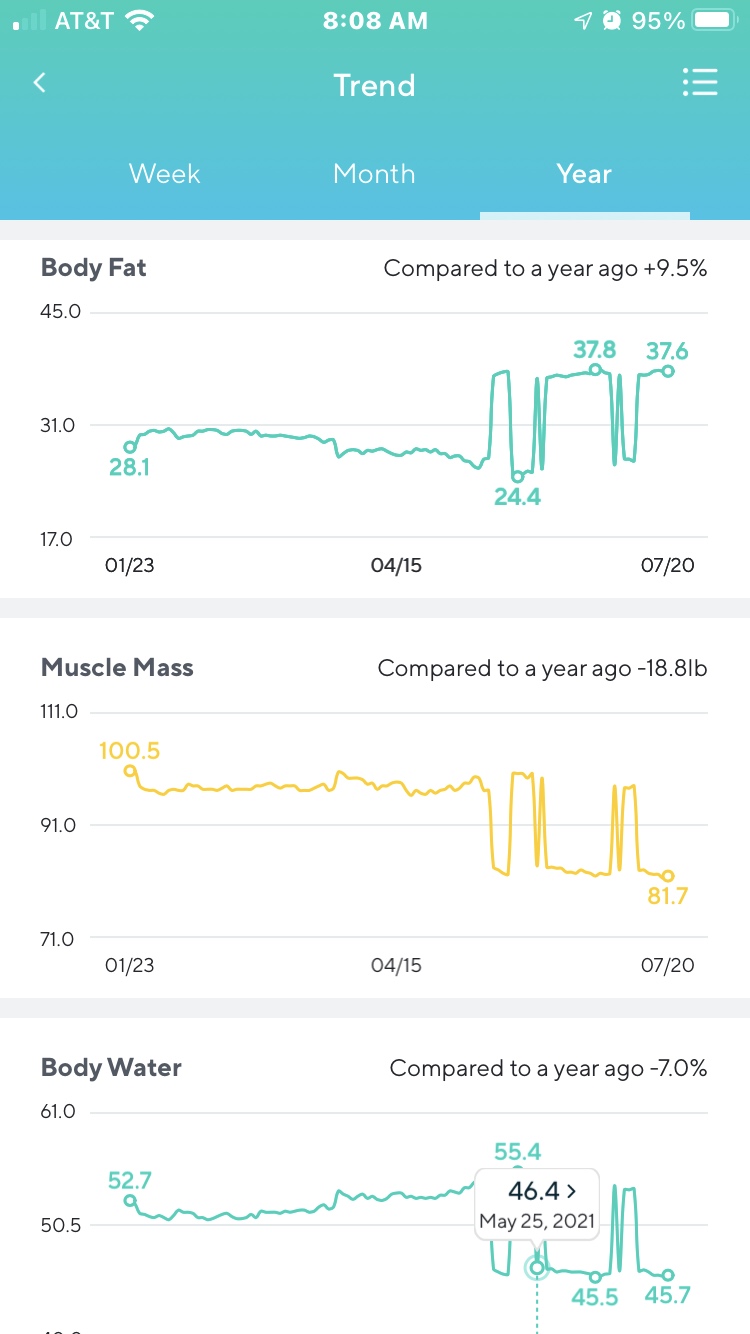
- App provides 50+ metrics with segmental views and printable reports
- Seven measurements available on the scale for quick check-ins
Cons
- App usually needs to be open on the phone for measurements to sync
- First-use calibration is required or early readings can be off
- Composition figures are estimates and not clinical measurements
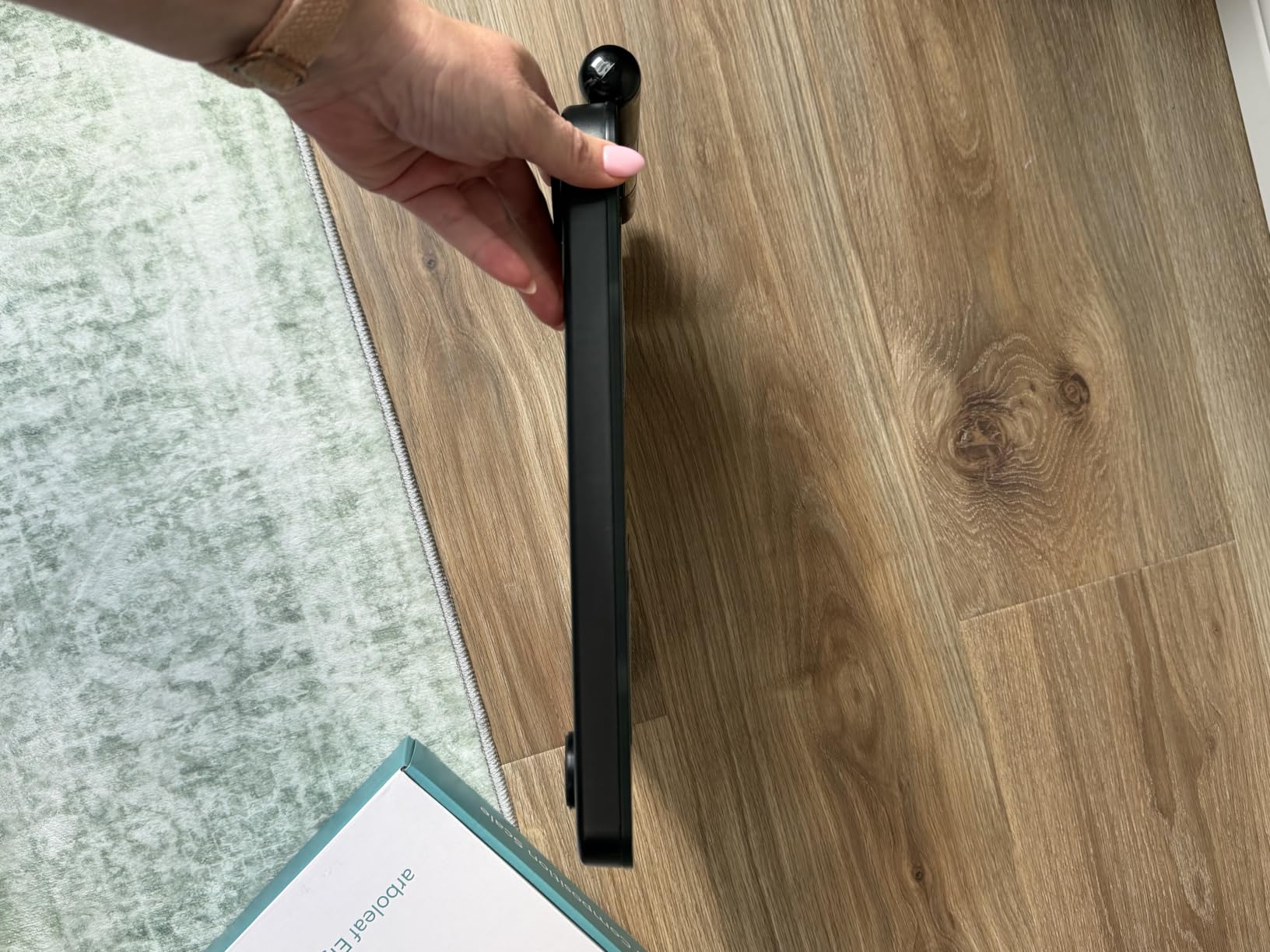
The arboleaf CS10K carries the highest average rating in this roundup at 4.7 stars across 18,221 reviews, with 84 percent five-star and only 2 percent one-star. It is a handheld eight-electrode dual-frequency scale, so you get the same segmental measurement class as the picks above it at a much lower outlay.
Its on-device display shows seven readings at once, weight, BMI, body fat, muscle mass, body water, bone mass and visceral fat. That is genuinely useful for a fast morning check without the phone, which is a rarity among handle-equipped scales.
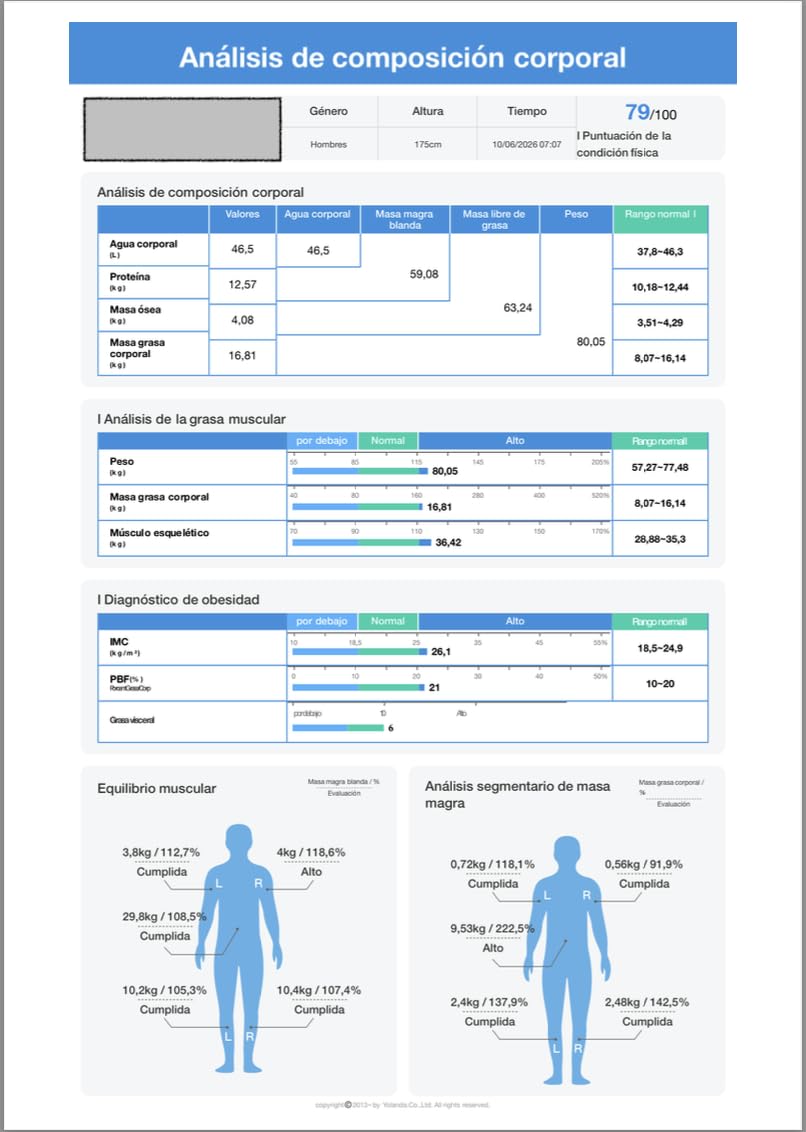
The app is the other half of the appeal, unlocking 50-plus metrics including segmental fat and muscle views, BMR and body type, with weekly, monthly and yearly trend charts and printable reports. It holds unlimited users with up to 8 stored profiles that auto-recognise, and it syncs with the popular health apps.
It runs on alkaline batteries rather than a rechargeable cell, and the manufacturer is direct about the limits, noting the data is for long-term trend tracking and not equivalent to DEXA. It is also explicit that the scale is not for users with a pacemaker or who are pregnant.
Why the rating is the highest here
High ratings in this category usually mean low friction, and the arboleaf scores well on both counts. The seven readings on the display mean you are not dependent on the app for a daily number, and reviewers praise the app experience, segmental data depth and value.
Two practical catches. The app generally needs to be open on your phone for measurements to sync, and first-use calibration is required or early readings can be off. Do both properly in week one and the drift problem disappears.
Who should skip it
Skip it if you want rechargeable convenience, since alkaline batteries are a recurring small cost, or if you need the absolute highest measurement class. The arboleaf is a very strong pick, not the one to buy if you are chasing the last percentage point of accuracy.
Skip it if you are over 400 pounds. The capacity is the ceiling, and the manufacturer does not publish what happens beyond it.
5. Wyze Scale BodyScan With Handle: Best Value Segmental Reading
Wyze Smart Scale BodyScan with Handle, Bluetooth, 400 lbs, Black
Handle electrode segmental data
17 app metrics with no subscription
8 auto-recognized users
400 lb capacity
Pros
- Handle electrodes give segmental composition across arms legs and torso
- Manufacturer cites DEXA correlation of 0.98 for body fat and 0.99 for lean mass
- 17 app metrics with no subscription fee
- Batteries included and the 4.7-inch display reads well in low light
Cons
- Handle grip occasionally fails to register the composition reading
- Bluetooth means readings only sync when the phone is in range with the app open
- No completion beep so users stand on it too long
- Heart rate readings are skipped intermittently
The Wyze Scale BodyScan is the pick I send to athletes who want segmental data without paying for the premium tier. The handle-held electrode measures arms, legs and torso, and the manufacturer cites a DEXA correlation of at least 0.98 for body fat mass and 0.99 for lean mass.
It is the only pick in this roundup with a clear no-subscription commitment on the app, and 17 body metrics including segmental data and reports come with it. That matters if you plan to keep using this scale for years.
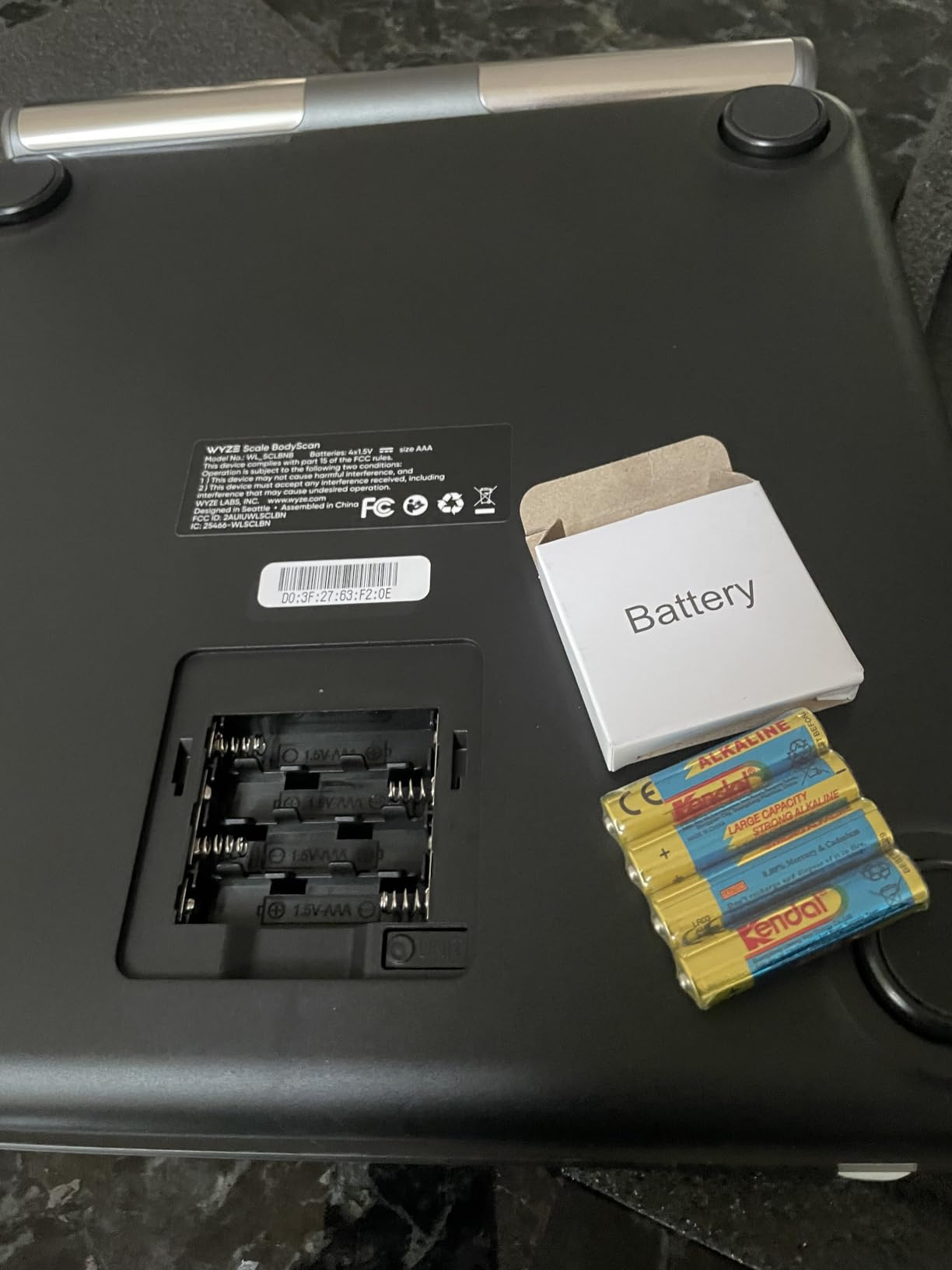
It auto-recognises up to 8 users plus guest measurements, syncs to Apple Health, Health Connect and Fitbit, and has a baby, pet and luggage hold mode for the days your partner steps on it. The 4.7-inch LED display shows 7 key metrics and the platform is tempered glass rated to 400 pounds. Four AAA batteries are included in the box.
Reviewers frequently compare its body fat readings favourably against more expensive smart scales and DEXA estimates, and the 4.6-star average across 24,396 reviews reflects that, with 80 percent five-star.
What the DEXA correlation claim really means
A correlation of 0.98 or higher means the scale tracks a DEXA scan closely as body composition changes. It does not mean the absolute number matches. Correlation is about direction, and direction is exactly what you want from a trend tool.
So treat the claim the way the forums treat these numbers in general. A scale that consistently reads a few points off is still the right tool for telling you whether you are gaining lean mass or losing fat, as long as the conditions are identical each time.
Who should skip it
Skip it if you weigh in without your phone nearby, because Bluetooth means the reading only reaches the app when the phone is in range with the app open. The weight still shows on the display, but the composition data is lost.
Also skip it if you are bothered by the missing completion beep. Users describe standing on it for longer than needed because nothing tells them the reading is complete, and occasionally the handle grip fails to register a composition reading at all.
6. RENPHO MorphoScan Base R-MSC02: Best Segmental Starter With Multiple Users
RENPHO Body Composition Scale with Handle, 50+ Metrics, MorphoScan Base
8-electrode segmental BIA
60-inch retractable cable handle
7-day weight trend
8 user profiles
Pros
- Full-body segmental readings from the handle
- App explains what each metric means and supports goal setting
- Profile auto-recognition is reliable for a whole household
- Users verify weight accuracy with a known test weight
Cons
- App reports have no browsable history so reports must be saved manually
- Ideal body weight in reports is fixed and cannot be adjusted
- Retractable handle can stick after repeated extension
- Feels plasticky
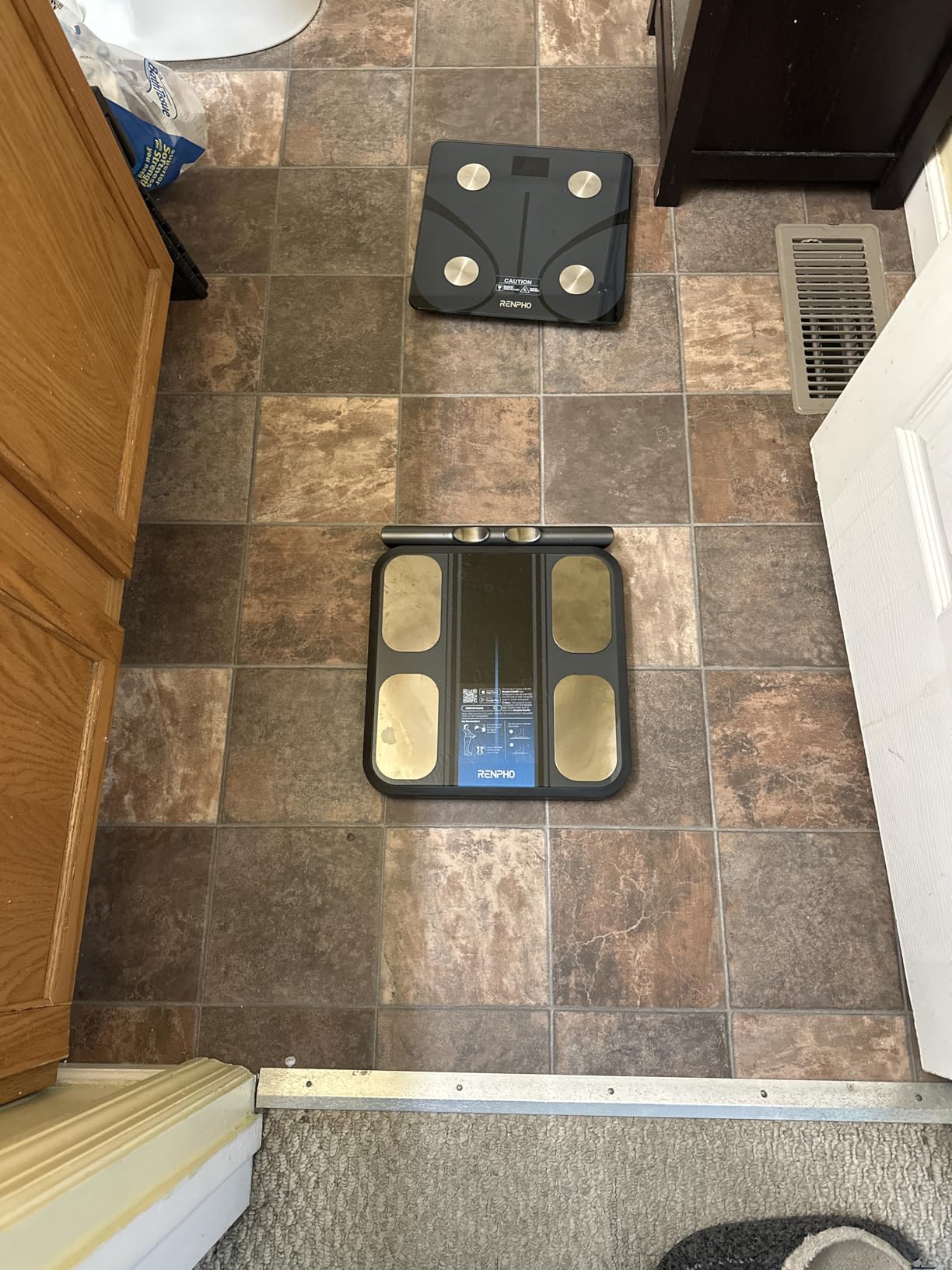
The RENPHO MorphoScan Base uses eight-electrode dual-frequency segmental BIA with a retractable 60-inch elastic cable handle, and it stores body data for up to 8 users with reliable automatic profile recognition. For a household where both partners train, that is the practical feature that decides it.
The LED display shows BMI, body fat, skeletal muscle, visceral fat and a 7-day weight trend, and the app generates detailed body reports with segmental body fat analysis. It syncs to Apple Health, MyFitnessPal and Samsung Health, and the battery lasts up to 130 days.
At 4.4 stars across 3,702 reviews, its review base is smaller than most of the picks here, so treat the consensus with a little more caution. The 74 percent five-star rating reflects genuine satisfaction, particularly around the handle data and multi-user profiles.
Two report-level problems are worth knowing about. The app has no browsable history, so you have to save reports manually, and the ideal body weight calculation is fixed and cannot be adjusted, which skews the conclusions the report draws.
Segmental data on a mid-range budget
The handle is what separates this from a foot-pad scale, and on a runner or a hypertrophy trainee the arm and leg readings are the ones that tell you something. The platform is rated to 400 pounds or 180 kilograms, so heavy athletes are covered to the same limit as most of the field.
Reviewers confirm the readings are repeatable, with several users verifying weight accuracy against a known five pound weight. That is the kind of mundane validation that matters more to long-term tracking than a correlation claim on a box.
Who should skip it
Skip it if you need long-term trend history inside the app, because there is no browsable archive. If your method depends on reviewing six months of data without exporting anything, the arboleaf and the runstar are better fits.
Skip it if build quality is a priority. Several reviewers describe it as feeling plasticky, and the retractable handle can stick after repeated extension.
7. YINOLIFE FG2305ULB: Best Backlit Handle Display for Dark Bathrooms
YINOLIFE Scale for Body Weight, 8 Electrode Smart Bathroom Scale with BMI Body Fat Muscle Mass 28 Full Body Composition, High Precision Digital Weight Scale with Handle Display, Rechargeable, 400 lbs
Segmental arms legs and torso
Bright backlit TFT handle display
50+ metrics
396 lb capacity
Pros
- Thin profile slides under cabinets for storage
- Bright backlit TFT display readable without bending down
- Consistent precise readings on a sturdy tempered glass build
- App supports multiple family members and day-over-day comparison
Cons
- Bluetooth pairing in the Fitdays+ app is required before each use for full data
- Scale occasionally registers an extra 1.8 to 2.2 lb before weight is placed on it
- Smaller review base than most competitors
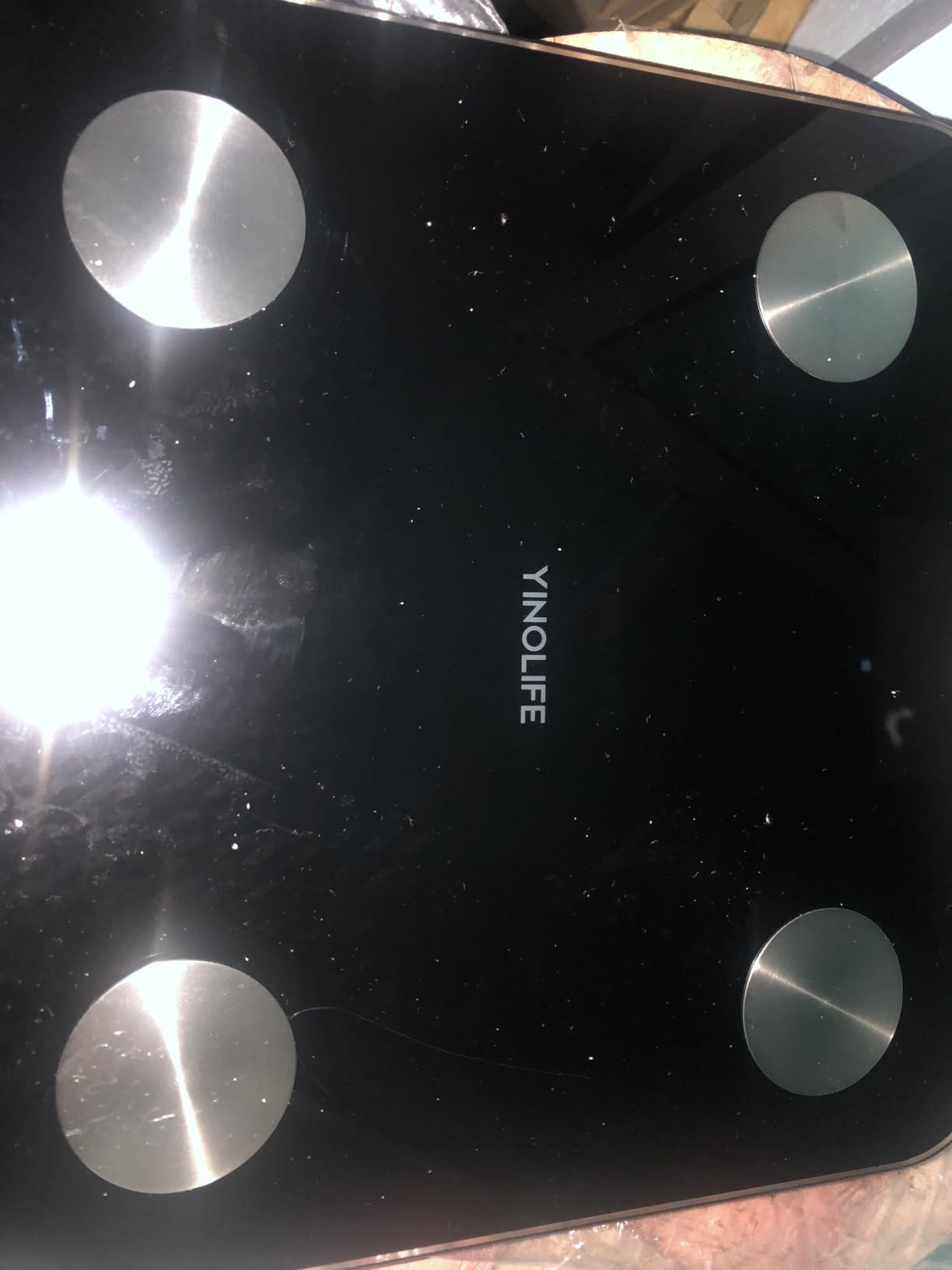
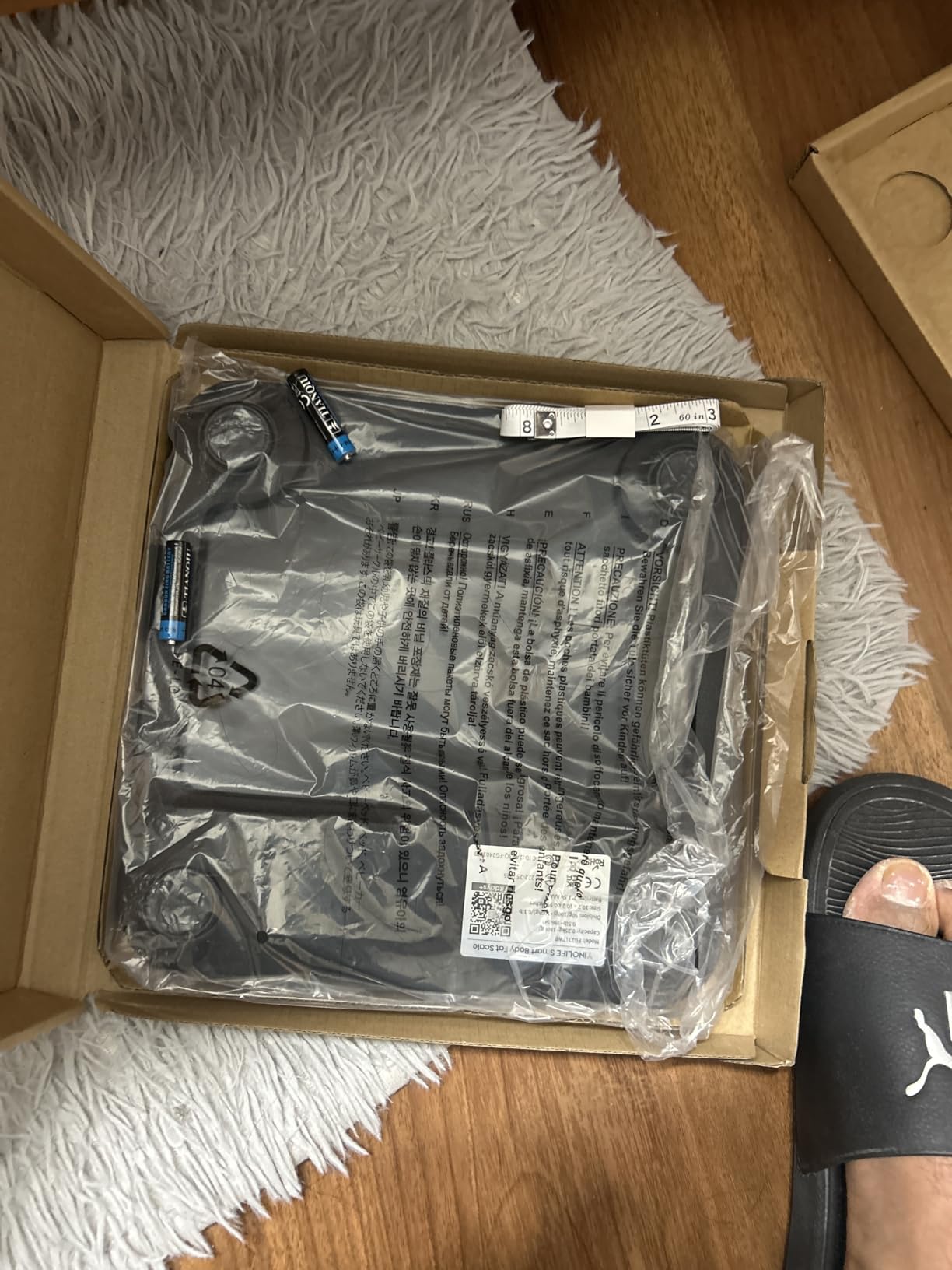
The YINOLIFE FG2305ULB is the pick if your bathroom has no window and you do not want to bend down at 6am. The retractable handle carries a bright backlit TFT LCD screen showing 7 key metrics plus a comparison against your prior result, so the reading is legible from standing height.
It runs eight-electrode dual-frequency segmental BIA measuring arms, legs and torso separately, and the manufacturer claims accuracy reaching 98.7 percent of DEXA standards within 2 percent. The tempered glass build feels sturdy, and the platform is rated to 396 pounds.
It stores up to 24 readings offline and syncs later, which is a genuinely useful feature for anyone whose phone lives in another room. The Fitdays+ app supports multiple family members and day-over-day comparisons, and it auto-syncs to Apple Health and Samsung Health over USB charging.
At 4.6 stars the rating is high, but with only 915 reviews the sample is small compared with the rest of this roundup, and that is worth weighing before you commit.
The phantom weight problem and how to clear it
Several reviewers report the scale registering an extra 1.8 to 2.2 pounds before any weight is placed on it. That is an auto-zero failure, not a body composition error, and it is cleared by stepping off and resetting the scale to zero before a reading.
The other recurring friction is that Bluetooth pairing through the Fitdays+ app has to be completed before each use to get full data. The 24-reading offline buffer is the mitigation, so enable it during setup.
Who should skip it
Skip it if you want a large user base of reviews to draw confidence from, because 915 reviews is thin by this roundup’s standards. Prefer a pick with tens of thousands of reviews if you are an early adopter.
Skip it if you are over 396 pounds. It is the lowest capacity in the roundup, and heavy athletes should verify before buying.
8. FITINDEX F-MSC01: Best Five-Segment Breakdown Per Dollar
FITINDEX Smart Body Composition Scale with Handle, 8-Electrode, 50+ Metrics
8-electrode dual-frequency BIA
Five-segment analysis
30+ user profiles
400 lb capacity
Pros
- Lowest cost among the 8-electrode handled models here
- Five-segment breakdown covers each arm trunk and leg
- 0.1 lb-style increments suit slow deliberate weight change
- Wide platform suits taller users and pairing is simple
Cons
- The app generally needs to be open for readings to be recorded
- Small on-device display means most metrics require the app
- Biometric data is a crude estimate and not a substitute for DEXA
The FITINDEX F-MSC01 is the one to buy when you want a genuine five-segment breakdown, arms and legs and trunk measured separately, for the least money of any handled eight-electrode model in this roundup. At 4.5 stars across 6,588 reviews, 77 percent of buyers give it five.
The measurement itself is straightforward: eight high-precision sensors with dual-frequency BIA producing 50 body composition metrics including visceral fat, subcutaneous fat, skeletal muscle, BMR and metabolic age, plus a five-segment muscle and fat analysis.
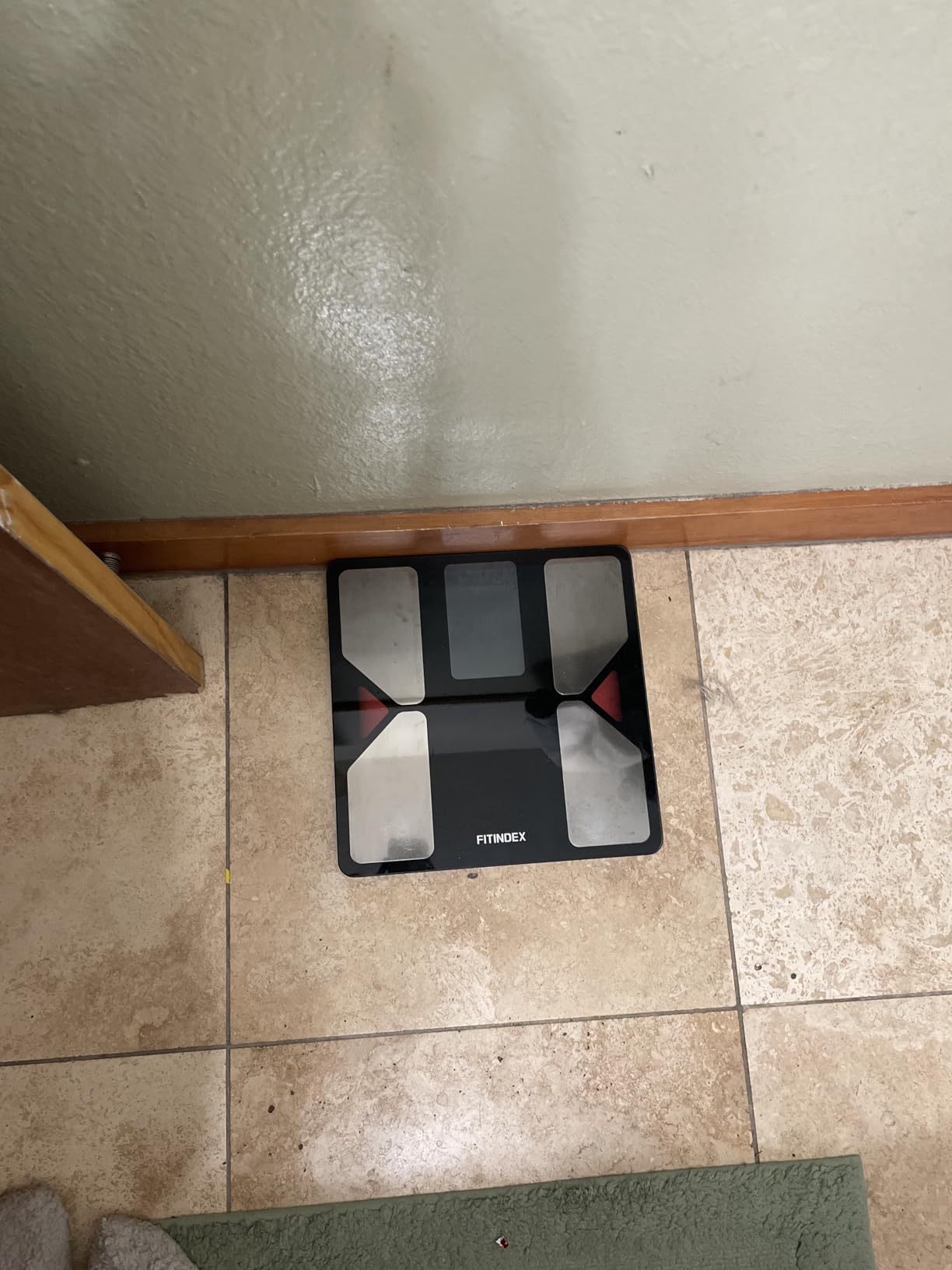
For coaches, the 30-plus user profiles in the app are the standout feature. Each profile keeps separate data, and the scale syncs to Apple Health, MyFitnessPal, Samsung Health and Apple Watch, with weekly, monthly and yearly trend charts for each person.
The handle is a 59-inch elastic extension cable, the platform is large enough for taller users, and capacity is 400 pounds or 180 kilograms. It is also available in both 4-electrode and 8-electrode variants, so you can step up without changing platform.
Why a coach would pick this one
Thirty-plus separate profiles is the number that matters when you are running a squad. A client steps on, the scale recognises them, and their data goes into their own history without anyone touching a phone to switch users.
The five-segment breakdown is genuinely useful for building a targeted plan, because it shows which limb pair is behind in development rather than giving you one averaged number. For a hypertrophy block that is actionable information.
Who should skip it
Skip it if you need a glanceable daily number without the phone. The on-device display is small and most metrics require the app, and the app generally needs to be open for readings to be recorded.
Also skip it if you have metal implants or artificial joints, as the manufacturer explicitly does not recommend it in that case. And skip it if you are treating the numbers clinically, because the manufacturer is clear that these are estimates and not a DEXA substitute.
9. FITINDEX Body Pod FA-03: The Only Pick With a True Athlete Mode
FITINDEX Body Pod Smart Scale, 8-Electrode, BMI & Body Fat, Large Platform
Athletic mode calibrated for performance
8-electrode five-segment analysis
0.2 lb increments
400 lb capacity
Pros
- Athletic mode calibrates readings for high-performance athletes
- Five-segment muscle and fat analysis plus circumference data
- Retractable handle keeps the unit compact and easy to store
- Large stable tempered glass platform
Cons
- Needs a hard flat floor and zero reset for consistent readings
- Some readings run about a pound lighter than other scales
- No written instruction manual in some shipments
- Not recommended with artificial joints or metal implants
The FITINDEX Body Pod FA-03 is the only scale in this roundup with a documented athletic mode, which recalibrates the reading for high-performance athletes. If you have ever been told to select an athlete profile and then never found the setting, this is the pick where the feature is real and named.
It combines that with eight-electrode segmental BIA across five body segments, including arms, legs and torso, plus 50 body composition metrics with site circumference data. The 7-indicator all-in-one LED display shows the basics at a glance, and the retractable 59-inch handle line keeps the unit compact.
Capacity is 400 pounds with 0.2 pound increments, which suits an athlete trying to move slowly and deliberately rather than chasing tenths. The platform is 6 mm tempered glass with an ABS base, and it supports 30-plus user profiles with Apple Health, Samsung Health and Apple Watch sync.
At 4.6 stars across 5,121 reviews with 82 percent five-star, reviewers frequently highlight the athletic mode and segmental breakdown as useful for serious training.
Setting up the floor and the zero point
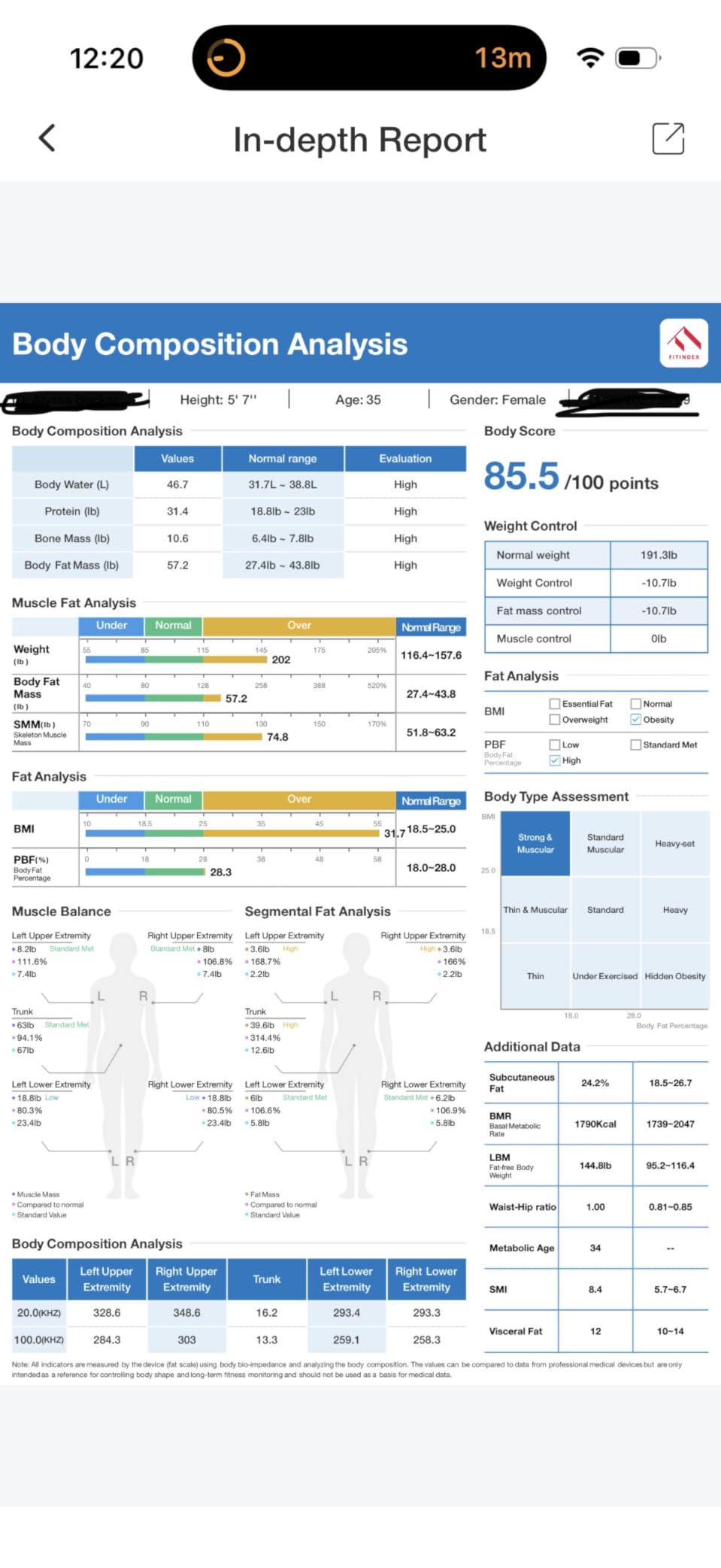
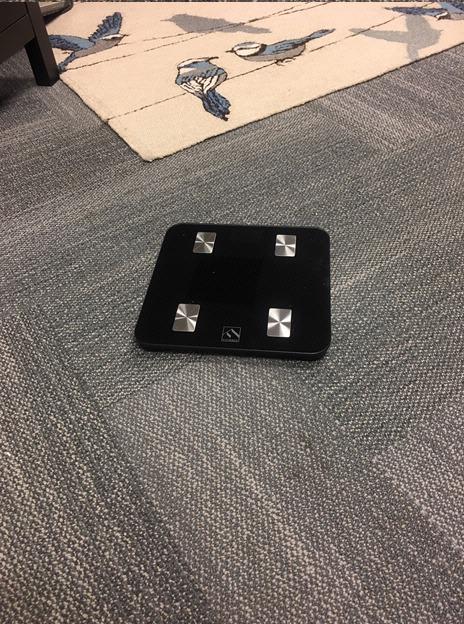
This scale insists on a hard flat floor, and the zero reset matters for repeatability. On carpet or a slightly uneven tile, readings drift enough to make weekly averages look noisier than they are. Resetting to zero before each weigh-in fixes most of that.
The other complaint worth planning around is cross-scale variance. Some readings run about a pound lighter than other scales, and with no baseline to compare against, that offset is invisible. Pick this scale and stay with it, because the offset is harmless once you have your own history.
Who should skip it
Skip it if you need a scale that ships with real documentation, because some units arrive without a written instruction manual and you will be setting the athletic mode from the app alone. Also skip it if you have artificial joints or metal implants.
If you want rechargeable convenience or a handle display, this is not the one, since the handle retracts into the body rather than carrying a screen.
10. runstar FG2422: Best for Weighing Without Your Phone
RunStar Smart Scale for Body Weight, Full-Body Bathroom Scale with 8 Electrodes for BMI, Muscle Mass, 3-Metric Display, High-Accuracy Body Composition Monitor with 28 Metrics & App Connectivity
8 electrodes dual-frequency BIA
28 body composition metrics
Offline mode with later sync
400 lb capacity
Pros
- Users report results comparable to a much more expensive scale
- 28 metrics with charts that make long-term changes visible
- Multiple profiles auto-recognise family members
- Offline mode lets you weigh without the phone present
- AAA batteries included
Cons
- Electrode contact is sensitive and hands and feet need moisture
- Readings can shift noticeably after a battery replacement
- Retractable cable handle is described as annoying
The runstar FG2422 is the pick when your phone is not always in the bathroom, which for most athletes is most mornings. Its offline mode stores the reading and syncs it later, and four AAA batteries are included in the box.
It uses 8 metal electrodes with dual-frequency BIA capturing upper and lower body impedance separately, with a retractable cable handle, and produces 28 body composition metrics including body fat, BMI, visceral fat and muscle mass. The 300 by 300 mm platform has ABS anti-collision edging and non-slip feet.
The auto-rotating LED screen cycles through weight, body fat and BMI, and resolution is 0.1 pound up to a 400 pound capacity. The Starfit app syncs to Apple Health, Fitbit and Health Connect, and multi-user profiles auto-recognise different family members with pregnancy, child and baby modes included.
At 4.4 stars across 724 reviews, the review base is small, and 72 percent five-star is the lowest proportion in the roundup. There is also a 30 month warranty, which is longer than most competitors offer.
Moisture is part of the measurement
This is the one pick where electrode contact needs active attention. Users report that hands and feet need some moisture for a proper reading, so wipe the electrodes with a damp cloth rather than drying them obsessively. Dry contact is the most common cause of a failed composition reading on this scale.
Readings can also shift noticeably after a battery replacement, so recalibrate your expectation and re-establish your baseline after changing batteries rather than treating the new number as a body composition change.
Who should skip it
Skip it if you want the deepest metric set. Twenty-eight metrics is plenty for trend tracking, but the segmental reports on the arboleaf and the FITINDEX models are richer if you are programming off limb-level data.
Skip it if you mind the handle. The retractable cable is the least liked feature in reviews, and if you are not going to use the handle at all, a foot-pad model is a cleaner object to live with.
Athlete Mode vs Standard Mode vs Segmental Analysis
Athlete mode, standard mode and segmental analysis are three different things, and confusing them is the most common reason people get a bad reading on a good scale. Standard mode runs the default predictive equation. Athlete mode swaps the coefficients for ones derived from athletic body types. Segmental analysis is a hardware change, not a setting.
That distinction matters because no software setting can recover information the hardware never measured. If your current passes through your feet only, athlete mode gives you a better equation on a lower-body model, and that is genuinely helpful, but it will not tell you your arm fat percentage.
Here is how the three line up in this roundup. The FITINDEX Body Pod FA-03 is the only pick here with a documented athletic mode. Every other scale gives you segmental measurement through the handle, and the RENPHO R-MSC04, arboleaf CS10K, Wyze BodyScan, RENPHO MorphoScan, YINOLIFE FG2305ULB, FITINDEX F-MSC01, FITINDEX FA-03 and runstar FG2422 all use eight electrodes across two frequencies.
Where a hand grip genuinely changes the answer: a lower-body dominant lifter whose quads and glutes carry disproportionate mass, a rower or swimmer with heavy shoulders relative to the trunk, and anyone who has just come back from a limb-specific injury. For a generalist who wants one number to trend, a foot pad plus athlete profile is enough.
One more note on electrode count. Four-electrode devices send current through a single path from foot to foot. Eight electrodes add a second frequency and a second path through the arms, which improves both the lean mass estimate and the repeatability. The difference is not dramatic on a sedentary body and is clearly visible on a muscular one.
The Athlete Measurement Protocol for a Reading You Can Trust
A consistent protocol matters more than the model you choose. These eight steps take about two minutes and remove most of the noise that makes people distrust home scales.
1. Put the scale on a hard floor. Tile, sealed wood or concrete. Carpet adds error that no amount of averaging will fix, and it is the single most common mistake we saw.
2. Weigh in at the same time every day. Morning, before eating, is the standard because overnight fluid shifts have settled by then.
3. Use the bathroom before you step on. That is the most common source of a 2 to 3 pound daily swing, and it has nothing to do with body composition.
4. Step on barefoot with clean, dry feet. Wipe the electrodes first. On the runstar, a damp electrode actually reads better, so follow that manufacturer’s guidance rather than this one.
5. For handle scales, grip the handle with relaxed hands and stand still until the reading completes. On models with no completion beep, wait for the number to stop changing.
6. Stay out of training for 12 hours beforehand if you can. A hard session depletes glycogen and water, and the scale will read the loss as a change you did not make.
7. Keep carbohydrate and sodium intake roughly consistent around your weigh-in. A high-carb day pulls water into the muscles; a high-sodium day holds water. Neither is fat, and both move the number.
8. Enter the correct athletic profile every single time, and check it after any app update. This is the number one beginner error, and it silently invalidates the reading when it is wrong.
Then look at weekly averages rather than daily readings. Seven-day averages are what show recomposition, because day to day you are mostly reading water. If a reading jumps more than three points overnight, check hydration, glycogen status and foot contact before you conclude anything about body composition.
Buying Guide: How to Choose a Body Fat Scale for Athletic Use
Eight criteria decide this purchase, in roughly this order of importance. Athlete mode, then segmental analysis and electrode count, then connectivity and profiles, then capacity, then app depth.
Look for a real athlete or athletic profile. A named setting with an athletic reference population behind it is what recalibrates the predictive equation. In this roundup only the FITINDEX Body Pod documents one clearly, so if that matters to you, start there.
Check the electrode count next. Eight electrodes with dual-frequency BIA is the practical threshold for a muscular body. Anything with four electrodes is measuring your lower body and guessing about the rest.
Then decide whether you need segmental analysis. A handle that measures arms, legs and trunk separately costs more and takes longer to use, and it is the correct choice if your muscle distribution is unusual or you are programming hypertrophy splits. It is optional if you want a single trending number.
Connectivity determines whether you will still be using the thing in three months. Wi-Fi syncing means the reading is already uploaded when you walk away. Bluetooth means it only syncs if your phone is in range with the app open, which is why the arboleaf, the Wyze BodyScan, the RENPHO MorphoScan and the YINOLIFE all get the same note about app dependency. Look for offline mode if you weigh in away from your phone.
Check user profiles if anyone else steps on the scale. Eight auto-recognised profiles covers a household, and 30-plus profiles covers a coach. If you are running a team, the FITINDEX F-MSC01 and the FA-03 are the two picks here built for that workflow.
Confirm weight capacity before anything else, because it is the one hard limit you cannot work around. Most picks here top out at 400 pounds, the YINOLIFE at 396 pounds, and several RENPHO models at 180 kilograms. Heavy athletes should verify against their own current bodyweight plus room to grow.
Check whether the app exports data. A scale that holds your history in a closed app is a dead end the day you want to plot it yourself. Apps that sync to Apple Health, Google Fit, Health Connect, Fitbit, Garmin Connect, MyFitnessPal and Samsung Health all let you get your data out. If you already own a Garmin watch, our guide to the best smart scales with body composition covers the sync side in more detail, and the bathroom scale roundup goes deeper on the hardware side.
Finally, do not forget who this is not for. A home scale is a trend tool, not a medical device. Anyone with a pacemaker, an implanted defibrillator or metal implants should use weight-only mode and follow their doctor’s advice, and anyone who is pregnant should use the pregnancy mode or step away from bioelectrical impedance entirely. The same applies if you are making decisions with real consequences, such as a weight-class cut. We cover the recovery side of athlete kit in our massage gun guide for athletes.
What Body Fat Percentage Do Athletes Actually Want?
There is no single ideal percentage, because the healthy range depends on the sport, the sex, and the phase of training. The commonly cited American Council on Exercise and NSCA ranges below are useful as a reference point, and they are a range, not a target.
Men, in descending leanness: elite distance runners and jockeys around 3 to 6 percent, wrestlers and combat athletes in weight classes around 4 to 6 percent, gymnasts and divers roughly 5 to 8 percent, sprinters and cyclists around 5 to 10 percent, bodybuilders in contest shape around 4 to 8 percent, American football and rugby players around 8 to 14 percent, basketball and baseball players around 8 to 15 percent, and recreational lifters commonly sit higher still.
Women, in the same order: elite distance runners and gymnasts around 10 to 15 percent, combat athletes in weight classes around 10 to 13 percent, bodybuilders in contest shape around 10 to 13 percent, cyclists and swimmers around 14 to 20 percent, and team sport players commonly around 18 to 28 percent.
Three cautions on those numbers. A sport that demands leanness in contest but not in season will move across that range inside one year, so judge the phase you are in. Body fat percentage is not a stand-alone health verdict, and 25 percent means something completely different for a 63 kilogram rower than for a 95 kilogram lineman.
The more useful framing for a home scale user is your own trend, not a benchmark. Where your seven-day average sits relative to a sport range tells you whether you are in a plausible place. Whether it moved 1.5 points in a block is the number that actually drives your programming.
BIA vs DEXA vs Calipers vs Air Displacement
Home BIA is the least accurate of the four common methods and by far the most convenient, and the honest comparison is about error margins rather than winners. Users report InBody commercial scans accurate to roughly 5 to 10 percent against a DEXA, and treat home scales as trending tools rather than measuring instruments.
BIA, which is what every scale in this roundup uses: error of roughly 3 to 8 body fat percentage points, near zero marginal cost, available 24 hours a day, and the only method sensitive to hydration and time of day. Its repeatability under a fixed protocol is excellent, which is why it works for trending.
DEXA, a dual-energy X-ray absorptiometry scan: the clinical reference for body composition, accurate to roughly 1 to 2 percentage points, requires a clinic appointment, and is expensive enough that most athletes use it once or twice a year rather than weekly.
Calf skinfold measurement: accurate to roughly 3 to 4 percentage points when the same operator, same calipers and same sites are used every time. It is essentially free and it depends entirely on the skill and consistency of the person holding the calipers.
Air displacement plethysmography, often called a Bod Pod: accurate to roughly 2 to 3 percentage points and portable enough for many gyms, but it is rarely available at a convenient hour and it is the one method most affected by a recent meal or a full bladder.
Our recommendation: use BIA every morning for the trend, and pay for a DEXA at the start and end of a training block to calibrate it. If you can do only one, do the DEXA. If you are already paying for a gym membership, check whether they run air displacement before you buy anything.
Frequently Asked Questions
Are body fat scales accurate for athletes with a lot of muscle?
They are accurate to roughly 3 to 8 body fat percentage points, and the margin is wider on lean muscular athletes than on sedentary ones. High lean mass inflates the lean estimate and skews the fat figure. An eight-electrode scale with a handle, plus a correctly entered athletic profile, narrows the gap but does not close it. Treat the number as a trend under a fixed protocol, and calibrate against a quarterly DEXA scan.
Which body fat scale is most accurate?
The most accurate home option is a segmental 8-electrode scale with a handle, because it measures your arms, legs and trunk as separate segments instead of pushing a single current through your feet. Even then, expect about 3 to 8 percentage points of difference against a clinical DEXA. A consistent offset does not matter for trend tracking, which is how a scale should be used.
Do I need a body fat scale if I already own a Garmin watch?
A watch and a scale answer different questions. Your watch gives activity, heart rate and recovery data but not a body composition reading you control the conditions of. A scale gives you a repeatable weekly composition number. What matters is that the scale syncs somewhere you already look, which is why picks that support Apple Health, Google Fit, Health Connect, Fitbit and Samsung Health are the practical choices.
Is Renpho or Hume better for body composition tracking?
Renpho is the value and mid tier, using foot-pad or handle BIA with broad app syncing across Apple Health, Google Fit, MyFitnessPal and Samsung Health. Hume sits in the premium segmental tier with upper and lower body measurement at a much higher outlay. For athletes, segmental accuracy is what decides it, so a handle-equipped RenPHO such as the R-MSC04 gets you most of the measurement class without the premium cost. The comparison is only close if you do not need segmental data.
Why does my body fat scale reading change so much from day to day?
Almost always water, not fat. Glycogen holds roughly three grams of water per gram, so a high-carb day lifts the reading, and a hard training session depletes both. Sodium shifts fluid too. Keep carbohydrates, sodium and fluid roughly consistent, weigh in at the same time after using the bathroom, and compare seven-day averages rather than daily numbers.
What is a good body fat percentage for my sport?
It depends on the sport, the sex and the phase of training. Commonly cited American Council on Exercise and NSCA ranges put elite endurance and combat athletes in roughly the 3 to 15 percent band depending on category, team sport athletes around 8 to 15 percent for men and 18 to 28 percent for women, and the figure you should actually track is your own trend across a training block rather than a benchmark you try to hit.
Should I use a body fat scale or get a DEXA scan?
Use both, for different jobs. A home scale is a daily trend tool that costs nothing to repeat. A DEXA scan is a clinical measurement accurate to roughly 1 to 2 percentage points, expensive enough that most athletes book one or two per year. If you can only afford one, or if you are making a decision with real consequences such as a weight-class cut, the DEXA is the one that matters.
Is 25 percent body fat bad?
Reference ranges from the American Council on Exercise put average adult men at roughly 18 to 24 percent and adult women at roughly 25 to 31 percent, so 25 percent is average to slightly above average for men and roughly average for women. For a trained athlete the number means much less on its own, because the healthy range is defined by sport and training phase, not by a single threshold. Look at the trend, not the level.
The Verdict: Best Body Fat Scales for Athletes in 2026
The RENPHO R-MSC04 is our pick for the best body fat scales for athletes in 2026. It combines eight-electrode segmental BIA, a 4.3-inch TFT display in the handle so you are not dependent on your phone, more than 50 metrics with printable reports, unlimited profiles, and a 400 pound capacity, backed by 32,704 reviews at 4.5 stars. No other pick in this roundup delivers that combination of measurement class and daily usability.
Buy the arboleaf CS10K if you want the highest rating in the group and seven readings on the display without opening the app. Buy the Wyze Scale BodyScan if a no-subscription app and a strong segmental reading matter more to you than rechargeable convenience. Buy the FITINDEX Body Pod FA-03 if a documented athletic mode is the feature you have been looking for and could not find. Buy the Withings Body Scan if you need muscle imbalance located by segment and want an ECG in the same device, and accept the cost.
Whichever you choose, the scale will be wrong by a few points and right about direction. Put it on a hard floor, weigh in at the same time every morning, and look at the weekly average. That habit, held for a training block, will tell you more about your recomposition than any single number printed on the display ever will.