
Most basement gyms have a ceiling you cannot move, and that single fact decides which racks are even worth looking at. Standard power racks run 82 to 90 inches tall, which rules them out under a 7 foot ceiling before you even start. Here is the short version: the best power racks for low ceilings are the Titan Fitness T-2 Series Short Power Rack at 71 inches, the FLYBIRD SR1 at 83 inches, and the Titan T-3 short squat stand at 73.5 inches.
We spent weeks measuring specs, reading owner reviews and comparing footprints for ten racks that actually clear a low ceiling. Some are floor-standing steel, some fold flat into a wall, and a few are open half racks with no overhead structure at all. The right pick depends far more on your ceiling number and your own height than on any spec sheet.
If your low-clearance room doubles as a garage, our best power racks for garage gyms guide covers the taller full cages. This roundup is for everyone stuck working under a 6 foot 6 inch or 7 foot ceiling. For general home setups, we also rank the best power racks for home gyms separately.
Top 3 Picks for Low-Ceiling Training in 2026
Three racks earned the shortlist after we weighed ceiling fit, steel gauge, capacity and how much of the review base backs the claims. The T-2 wins on pure low-ceiling fit, the FLYBIRD SR1 on adjustability per square foot, and the Mikolo folding rack on accessories included.
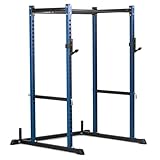
Titan T-2 Series Short Power Rack
- 71 inch rack height
- 14-gauge 2x2 inch uprights
- 850 lb rackable capacity
- Pin and pipe safeties

FLYBIRD SR1 Adjustable Squat Rack
- 22 height settings
- 16.7 inch safety arms
- 950 lb capacity
- Compact footprint

Mikolo Folding Wall Mounted Rack
- Folds flat in 15 seconds
- 13-gauge 2x2 inch steel
- 1000 lb capacity
- 89 inch pull-up bar
Best Power Racks for Low Ceilings (September 2026)
Here is the full lineup of the best power racks for low ceilings we tested, ordered as we recommend them. Heights are the manufacturer figures, and they are the number to measure against your own ceiling before anything else.
| Product | Specifications | Action |
|---|---|---|
| Titan Fitness T-2 Series Short Power Rack |
|
Check Latest Price |
| FLYBIRD SR1 Adjustable Squat Rack |
|
Check Latest Price |
| Mikolo Folding Wall Mounted Squat Rack |
|
Check Latest Price |
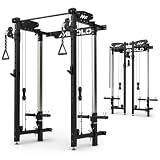 Mikolo Folding Rack with Cable Crossover Mikolo Folding Rack with Cable Crossover |
|
Check Latest Price |
 Signature Fitness Fitvids Fold-In Rack Signature Fitness Fitvids Fold-In Rack |
|
Check Latest Price |
 PRx Performance Folding Power Rack PRx Performance Folding Power Rack |
|
Check Latest Price |
 HARISON Heavy Duty Half Rack and Bench HARISON Heavy Duty Half Rack and Bench |
|
Check Latest Price |
 Titan Fitness T-3 Series Short Squat Stand Titan Fitness T-3 Series Short Squat Stand |
|
Check Latest Price |
 PASYOU Adjustable Squat Power Rack PASYOU Adjustable Squat Power Rack |
|
Check Latest Price |
 Goimu WM3-V4 Folding Squat Rack Goimu WM3-V4 Folding Squat Rack |
|
Check Latest Price |
How Much Ceiling Clearance You Actually Need
Budget a full 12 inches of open air above the tallest point of your rack. A 71 inch rack wants roughly an 83 inch ceiling, and a 78.5 inch rack wants about 90 inches. Anything tighter and you are scraping your head every time you unrack the bar.
Measure the lowest point of your ceiling first, not the average. Garage door tracks, dropped ceiling tiles, light fixtures, ducting and joists all sit lower than the framing. In older garages, tracks commonly eat four to six inches of usable height right where you need the top upright, and that is the number most product pages never mention.
Then subtract in this order: ceiling clearance, minus the rack height, minus the width of a barbell collar and knurling if you plan to rack a loaded bar near the top, minus at least 12 inches of head clearance. If you also want overhead pressing inside the rack, you need the bar path plus your own reach on top of that, which is where a lot of 7 foot ceilings run out.
Quick matchups by ceiling height, using the racks in this roundup:
84 inch (7 foot) ceiling: the Titan T-2 at 71 inches, the Titan T-3 squat stand at 73.5 inches, the Signature Fitness fold-in at 78.5 inches, and the FLYBIRD SR1 at 83 inches all work if the ceiling is flat. The PRx at 90 inches does not.
78 inch (6 foot 6 inch) ceiling: only the Titan T-2 at 71 inches and the HARISON half rack leave usable overhead air. A 78.5 inch rack is effectively a ceiling kisser here.
72 inch (6 foot) ceiling: the T-2 is the only rack on this list that fits with real headroom, and the HARISON half rack works because it has no top structure at all. The PASYOU at 58 inches is another option for light work.
One more detail: garage door tracks run along the ceiling near the wall, and a wall-mounted rack folds into exactly that zone. Before drilling, check the track height above the spot you plan to use. A rack that mounts fine on paper can still collide with the track every time the door comes down.
1. Titan Fitness T-2 Series Short Power Rack – Best Overall for Low Basements
Titan Fitness T-2 Series Short 71″ Navy Power Rack, 850 LB Rackable Capacity, Skinny Pull Up Bar, Pin and Pipe Safeties, Standard J-Hooks, for Home Garage Gym Weightlifting and Strength Training
71 inch rack height
14-gauge 2x2 inch uprights
850 lb rackable capacity
Skid more than 1 sq ft
Pros
- Genuinely short at 71 inches
- Stable once loaded with plates
- Heavy 14-gauge 2x2 inch steel
- Accepts a wide range of Titan attachments
- Pin and pipe safeties are solid for solo work
Cons
- J-hook and safety holes are not numbered
- J-hooks sit under an inch from the bar sleeve
- Coating chips over time
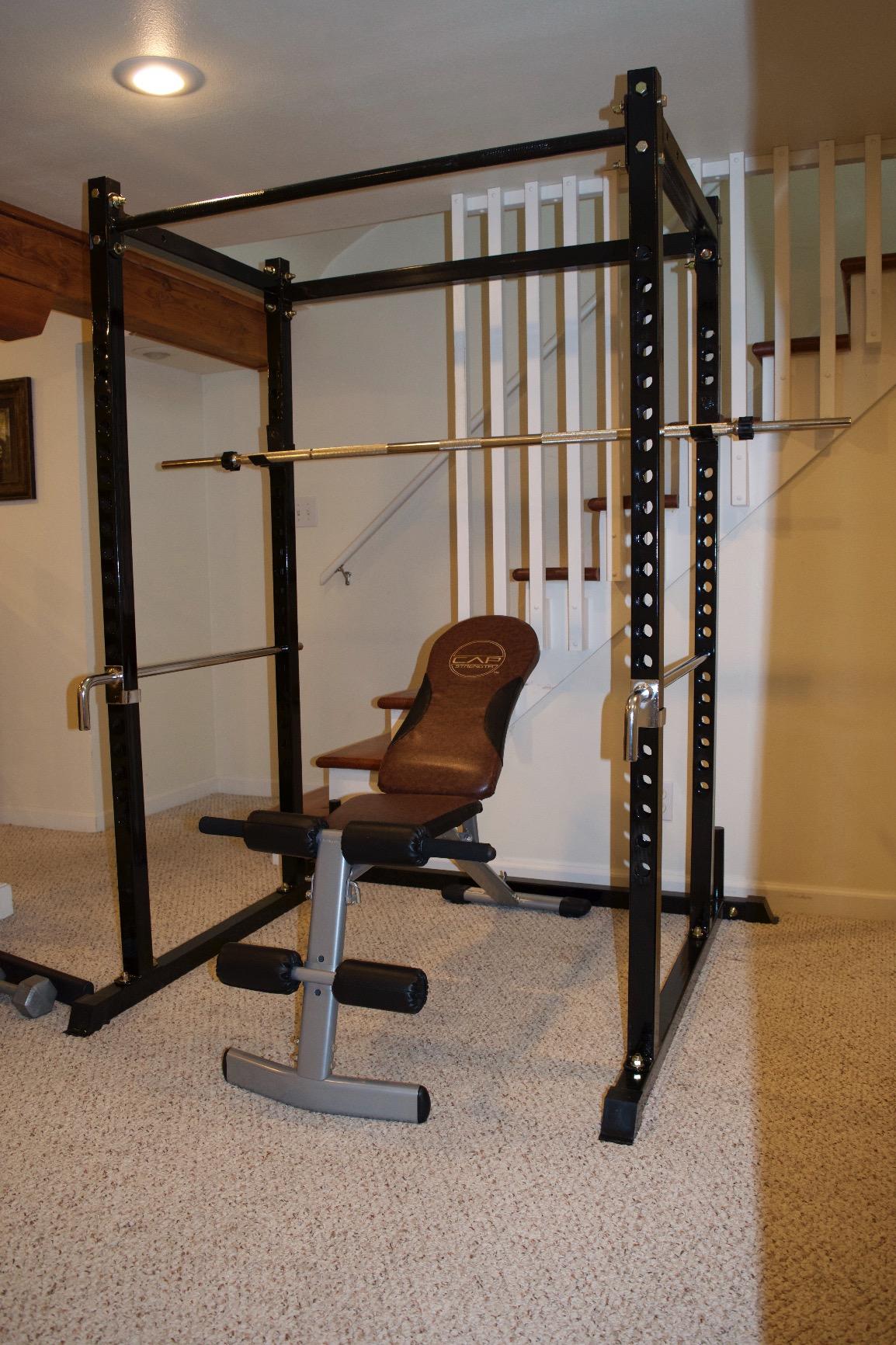
This is the rack we kept coming back to. The T-2 ships in two heights, and the 71 inch version is the one built for a low ceiling. Owners running 80 and 81 inch basements report it fits without drama, and several mention it does not wobble even on carpet once the plates are on.
What earns it the top spot is the combination of honest clearance and real weight. The uprights are 14-gauge 2×2 inch laser-cut steel with side bracings, J-hooks are rated at 1000 lb, and the rackable capacity is 850 lb with a total capacity of 2200 lb once you count the storage pegs. That is far more than most sub-72 inch racks in this roundup.
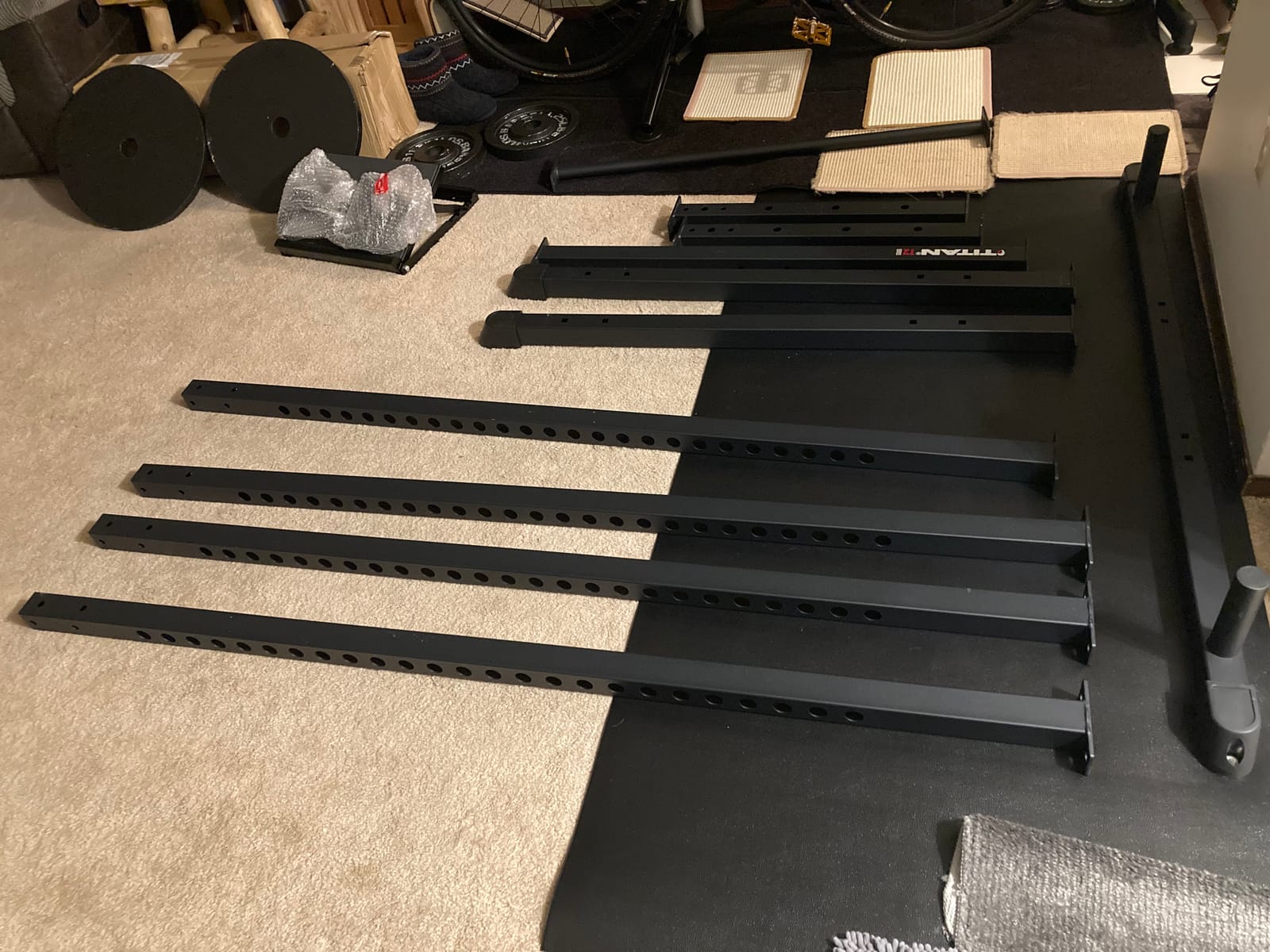
The pull-up situation is the one compromise. The front crossmember doubles as a single skinny 1.25 inch diameter bar rather than a wide flat bar, which is fine for a strict grip but not for anyone who wants to attach a belt or a rope. The bar still sits at the very top of the frame, so pull-up headroom is limited in a 6 foot 6 inch room.
Rear plate storage pegs take 1.25 inch diameter Olympic plates, which is useful in a basement where floor space is the scarcest resource. There is a taller 83 inch version of the same model, so if you ever move to a room with more headroom you are not stuck with a one-use rack.
Will your ceiling actually clear it
At 71 inches, the T-2 needs a ceiling of roughly 83 inches to leave a workable 12 inch of head clearance. That makes it the most forgiving of the full racks here. It fits 7 foot basements, 6 foot 10 inch rooms and most older garages with the door tracks on a different wall.
In a 6 foot 6 inch ceiling it becomes the rack you should be buying, because almost nothing else on this list has 12 inches to spare at that height. Our one warning: check the J-hook hole pattern against your bar and your height before you commit, since the holes are not numbered and you will be marking positions with tape on day one.
What you give up by buying it
The J-hooks leave less than an inch of clearance from the bar sleeve, so re-racking a loaded power bar without a spotter is a genuine two-person job. That is a safety and convenience issue, not a stability one.
Assembly is roughly a two-person afternoon, and reviewers report occasional missing washers or slightly bent frame parts on delivery, plus powder coat chipping that exposes bare steel over time. Budget an hour to inspect and touch up the coating before you load it.
2. FLYBIRD SR1 Adjustable Squat Rack – Budget Pick for Small Rooms
FLYBIRD SR1 Squat Rack with Pull-Up Bar, Multi-Functional Power Rack for Home Gym, 22 Safety Position Height & Adjustable Width for 6/7ft Barbells, Includes Extended J-Hooks & Landmine Attachment
83 inch height
2x2 inch steel
950 lb capacity
22 height settings
Pros
- Open half-rack design needs no overhead clearance
- Very compact footprint for the strength it delivers
- 22 height settings plus width adjustment
- 16.7 inch safety arms give generous catch space
- Reinforced frame minimizes wobble
Cons
- No top crossmember so overhead work is limited
- Setup depends on the instructions and video
- Included landmine and band pegs are add-ons not cage features
The SR1 rates 4.6 across 309 reviews with 81 percent five-star ratings, and that consistency is why it sits so high. It is one of the most consistent racks in this roundup, and owners consistently single out three things: compact size, adjustability, and safety arms longer than the budget norm.
Twenty-two height settings sit on 1 inch standard hole spacing, which matters more than it sounds. A narrow hole pitch means finer bench and squat height matching, and for lifters under 5 foot 8 inches who need lower J-hooks, that difference is the whole ballgame.
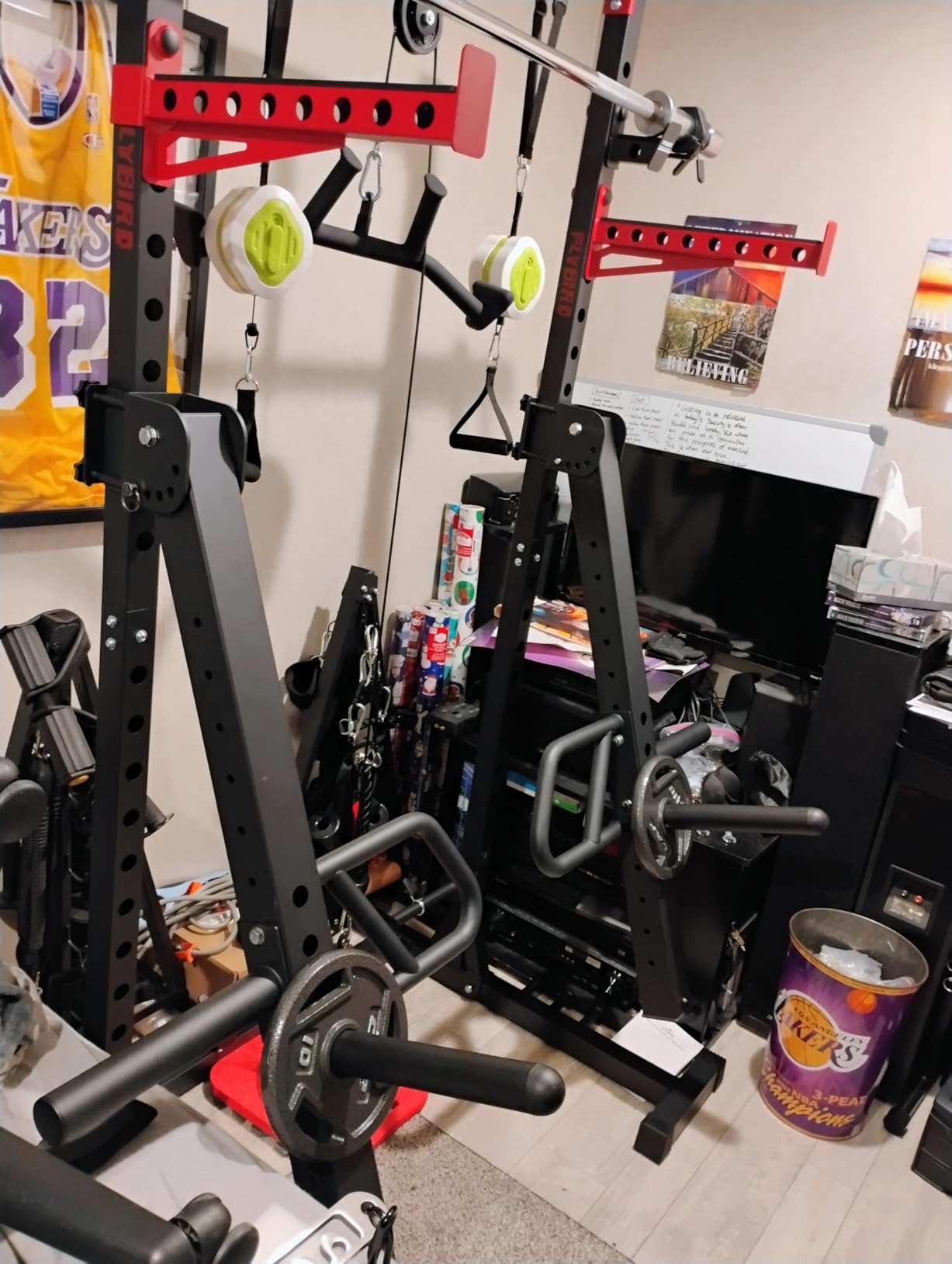
The width adjustment is the underrated feature. It fits both 6 foot and 7 foot barbells, so a single rack handles competition bars and shorter training bars without swapping hardware. Steel is 2×2 inch commercial grade rated to 950 lb, with 16.7 inch extended safety arms on 1.2 inch square steel with protective liners.
It also includes a landmine attachment, six resistance band pegs and a foam-padded pull-up bar, which is a lot of included function for a compact frame. The whole footprint is about one square meter, so it fits a spare bedroom or a basement corner without taking the room.
Who this open design suits
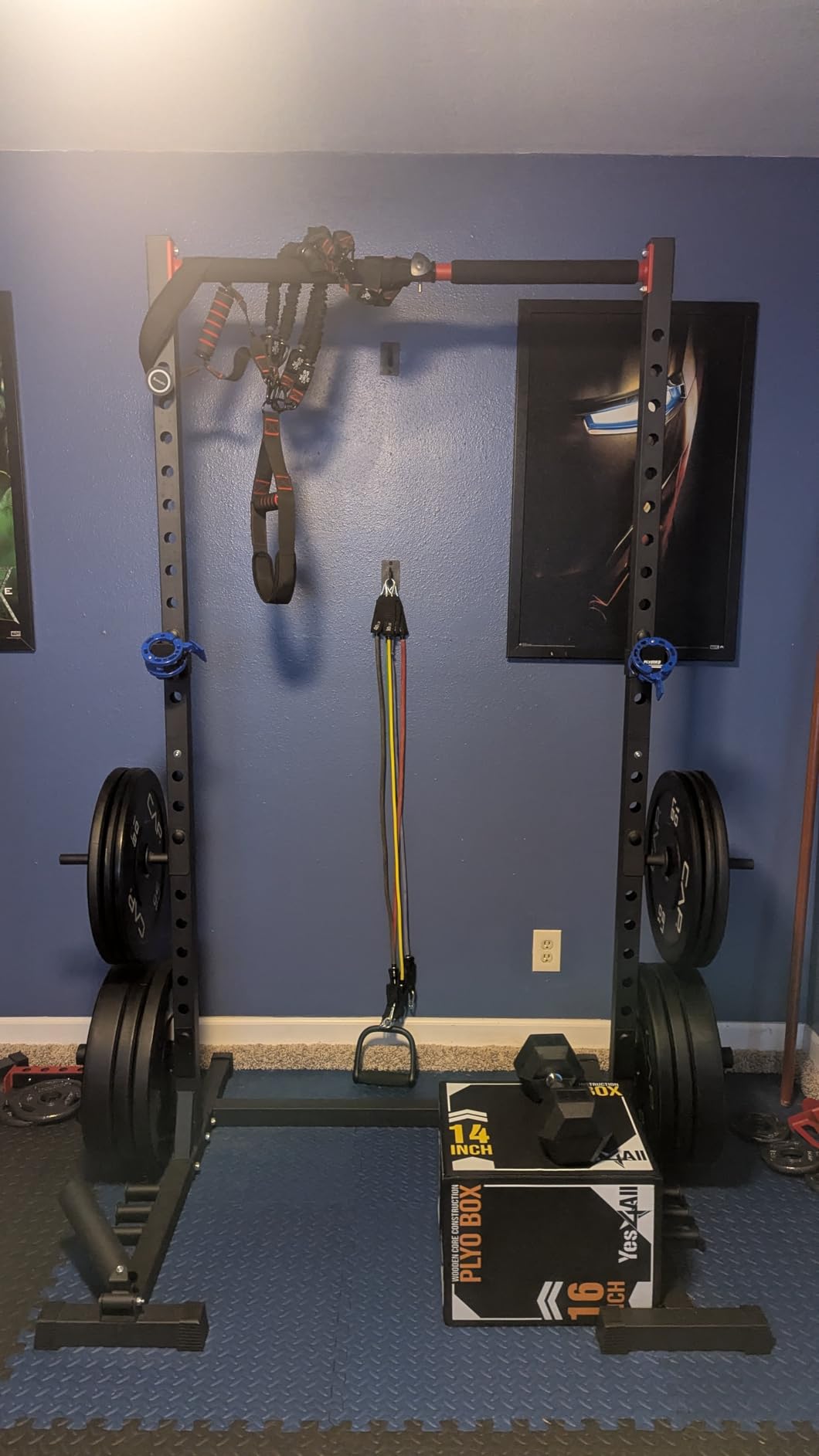
Because there is no overhead cage, ceiling height stops being a constraint in the way it is with a full rack. You can squat, bench, rack a bar and use the landmine in a room where a four-post frame simply would not go.
That makes it the safest buy for a genuinely low ceiling. It is also the best option for beginners who will not be doing heavy overhead work for months, since the 16.7 inch arms give a long catch window while they learn to squat.
Where the open frame falls short
Without a top crossmember you give up strict pull-ups on a wide bar, dips from the frame, and overhead pressing inside the rack. If pull-ups matter to you, this is not the frame, and the T-2 or the Mikolo folding rack serve that need better.
Setup depends heavily on the instructions and the walkthrough video, which reviewers flag as the main point of friction. A 1-year warranty is the shortest in the roundup, so register the rack and keep the box if you can.
3. Mikolo Folding Wall Mounted Squat Rack – Most Versatile for Tight Rooms
Mikolo 2″ x 2″ Folding Wall Mounted Squat Rack, 1000 Pounds Capacity Power Rack with Safety Catches, Pull Up Bar, J Hooks and Landmine Attachment, Space-Saving Home Gym(Black
Folds to 2 inch deep
13-gauge 2x2 inch steel
1000 lb capacity
89 inch pull-up bar
Pros
- Folds to about 2 inch off the wall in about 15 seconds
- Sturdy and stable once mounted
- Wide lag-bolt slots tolerate off-center studs
- Generous attachment bundle
- Legs adjust for uneven floors
Cons
- Installation instructions and diagrams are confusing
- Mounting must account for the fold clearance
- Branded bench safety-bar attachment has been hard to source
At 4.7 from 239 reviews with 82 percent five-star ratings, this is one of the best-rated racks here. Owners in genuinely tight rooms describe it as the complete answer, and one documented setup was a 98 square foot workshop gym. The reason is simple: it disappears.
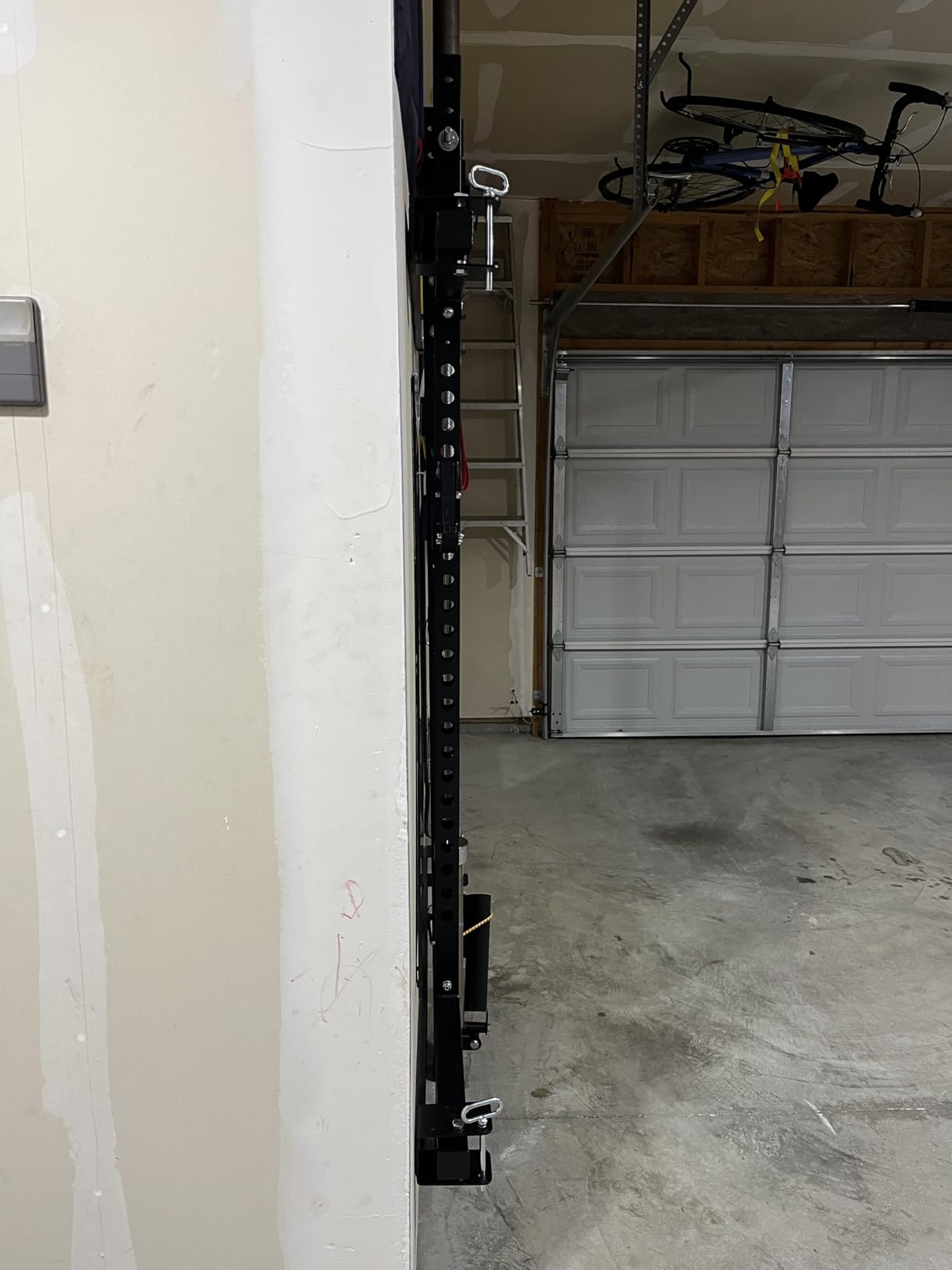
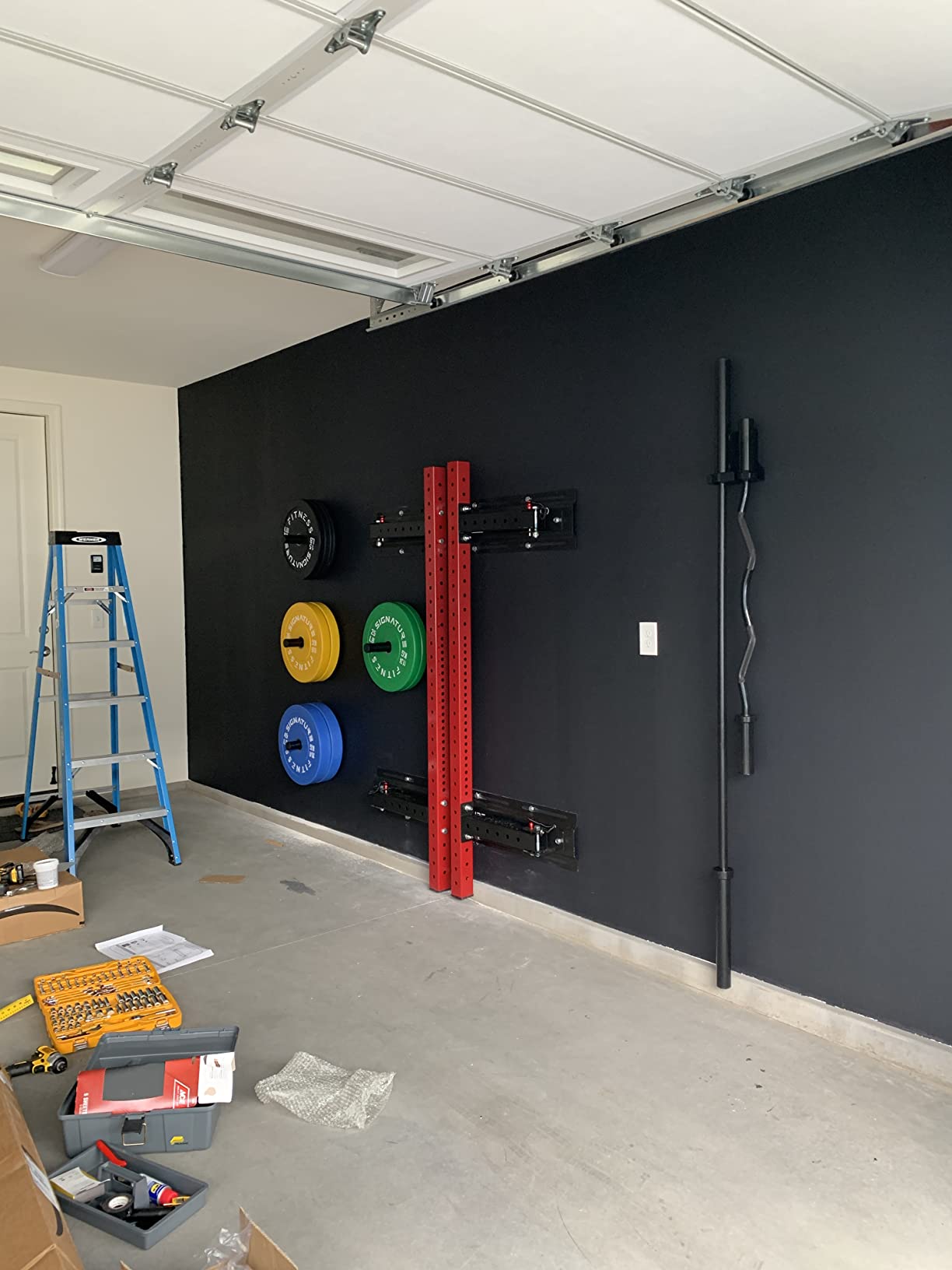
Folded, it measures 47 by 2 by 85.8 inches, which is essentially two inches of intrusion. Open, it is 47 by 19.7 by 85.8 inches. The transition takes about 15 seconds, so you can train in the evening and have your garage back for the car the next morning.
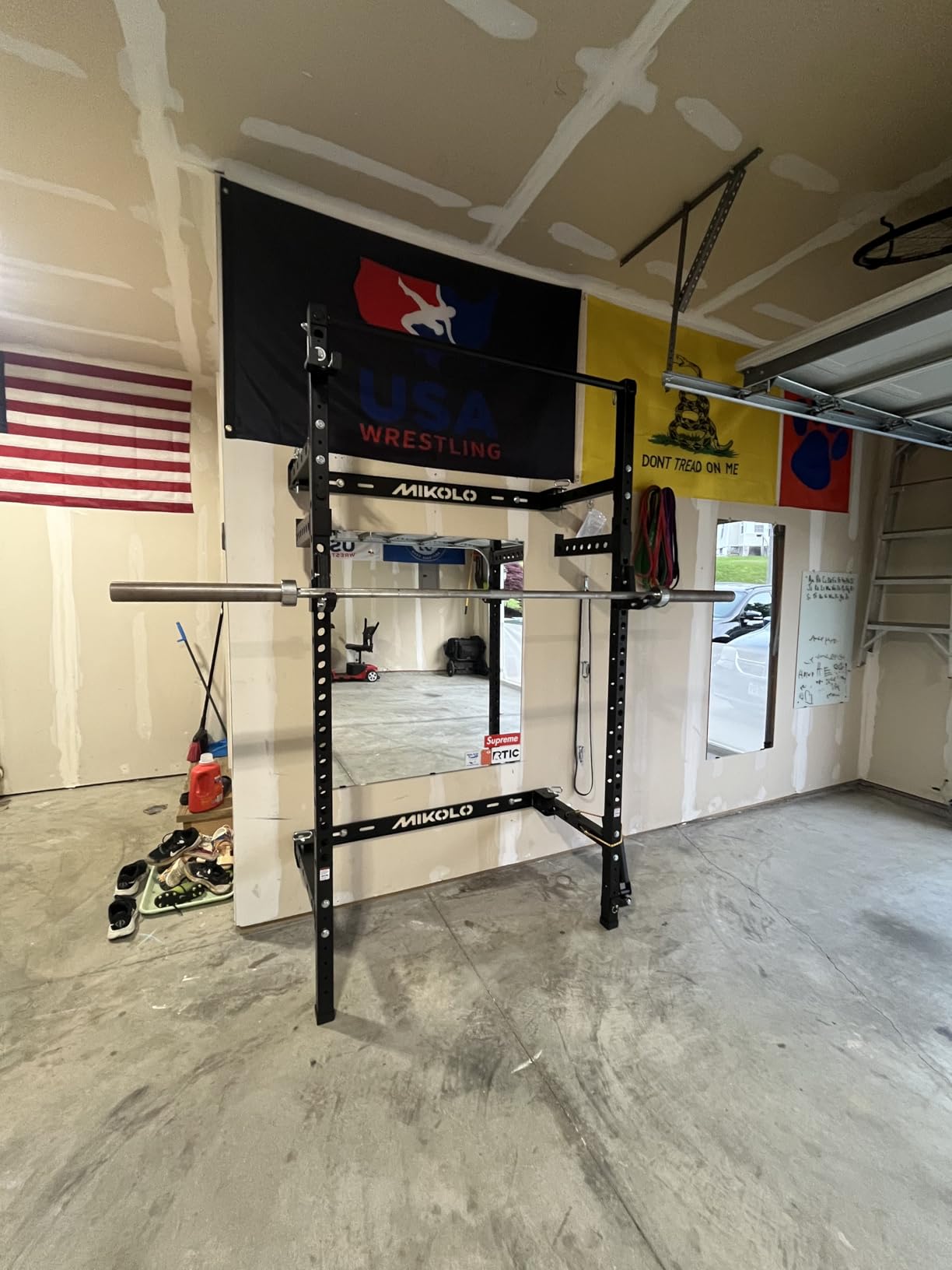
Underneath the folding mechanism it is serious steel: 2×2 inch 13-gauge uprights rated to 1000 lb, with a textured powder coat finish. J-cups carry UHMW plastic inserts, which is kinder to your bar knurling than bare steel, and the legs have vertical adjustability for floors that are not level.
The accessory bundle is unusually generous for a rack at this level. You get J-hooks, a quick-attach pull-up bar reaching 89 inches off the ground, safety bars, a 360-degree dual-size T-bar row attachment that accepts both Olympic and standard bars, a wall-mount stringer and metal studs.
Read the mounting instructions twice
This is the single most repeated complaint in the reviews, and it is not about the rack. It is about the printed measurements, which are referenced to points that do not match what most people measure. Several buyers had to remount after realizing the diagram did not account for the fold path.
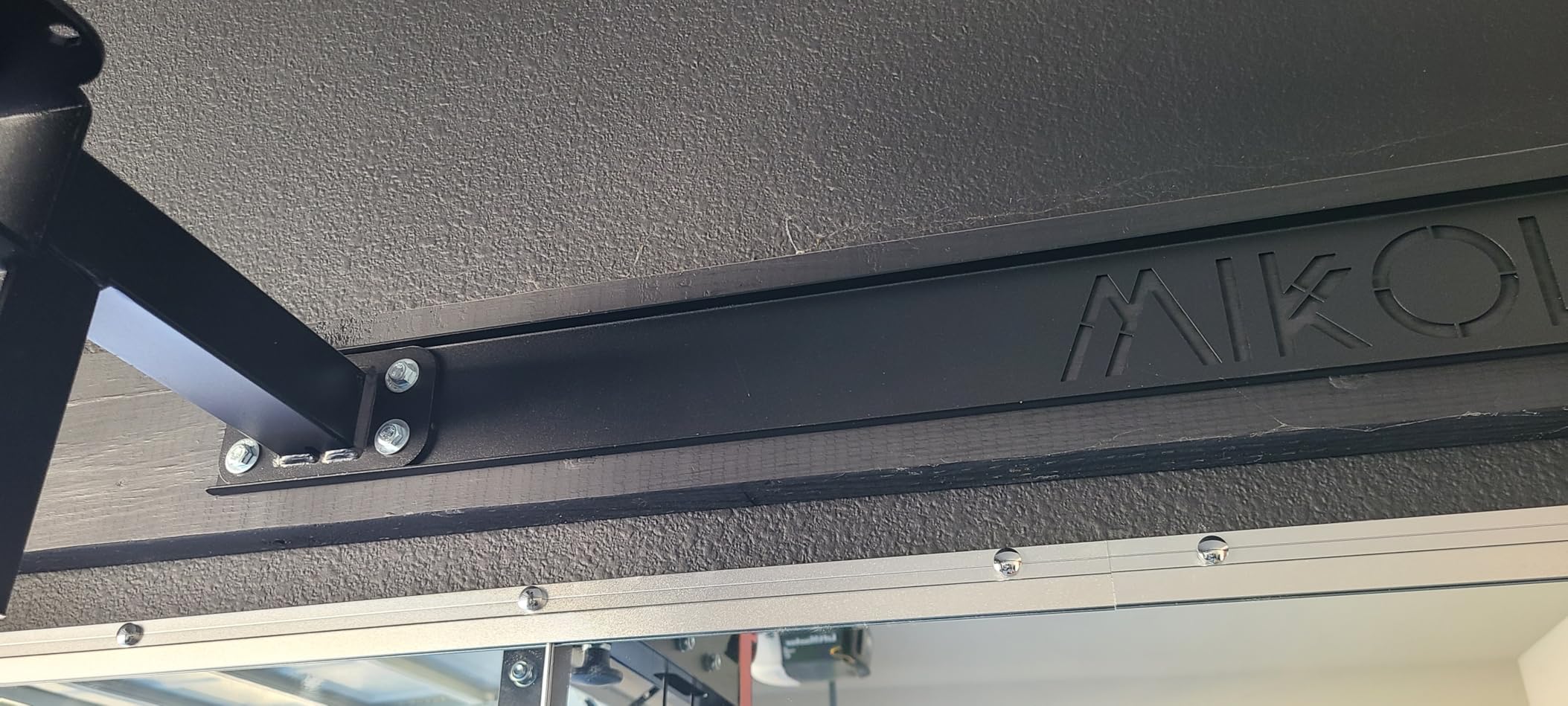
Find your studs, mark the fold clearance in full before drilling, and confirm the wall has framing capable of holding a loaded rack. The wide lag-bolt slots are forgiving of an off-center stud, which saves you when the wall is not where the diagram assumes.
What the height means for a low ceiling
At 85.8 inches tall, this is not a short rack in the sense the T-2 is short. It solves low ceilings by removing the footprint, not the height. If your ceiling is under 88 inches, mounting this one is tight.
Its real advantage is that the folding action gives you an entire training area back. If your constraint is floor space rather than headroom, this is the strongest pick here, and the 2-year warranty plus a complimentary parts replacement service are the best support terms in the roundup.
4. Mikolo Folding Squat Rack with Cable Crossover – Best for Five-Mode Training
Mikolo Folding Squat Rack, Wall Mounted Power Rack with Cable Crossover Machine & LAT Pull Down, Functional Trainer with 5 Adjustable Function Modes, for Home Gym and Space Saving(Black)
9.5 sq ft open and 3 sq ft folded
Five training modes
Dual 1:1 pulleys
1000 lb capacity
Pros
- Collapses from 9.5 sq ft down to 3 sq ft
- Five modes cover rack half rack trainer and crossover
- Dual independent pulleys allow two people to train
- Wall mounts plus adjustable feet cut wobble
- 15-position single-handed pulley adjustment
Cons
- Heavier and more complex to install
- 1:1 cable ratio is far less efficient than a weight stack
- Bulkier open footprint than a dedicated squat rack
If you want a rack and a functional trainer in the same footprint, this is the one. It runs in five modes: folded, semi-open, power rack, functional trainer and cable crossover. The claim of supporting more than 80 exercises is about the mode switching, not the accessory count.
Capacity is 1000 lb on 2×2 inch 14-gauge steel, with reinforced screw-in wall mounts and four adjustable ground support feet. Owners who have it installed describe it as extremely stable, and the feet are what separate it from lighter wall racks that shake on every pull-up.
Dual independent 1:1 pulleys mean two people can work at once, or you can run supersets without swapping between a stack and a cable. Pulley height adjusts one-handed across 15 positions, which saves a lot of time when you are switching from a low row to a high press.
The pull-up bar is detachable and the J-hooks are described as premium, so you get a genuine top pull-up option rather than a strap. The 1-year manufacturer warranty is shorter than the plain Mikolo folding rack, which is worth weighing against the feature list.
When the five modes are worth it
They are worth it if you plan to do lat pulldowns, cable rows and presses alongside barbell work in a room too small for a separate machine. A dedicated squat rack gives you none of that, and a stand-alone functional trainer doubles your footprint.
If you are only lifting barbells, the modes are wasted weight. You would be carrying 150 lb of machine and installation effort for functions you never use. We think of this rack as a space-saving gym rather than a space-saving rack.
What the tradeoffs cost you
Installation is meaningfully harder than a simple wall-mounted rack, and the 1:1 cable ratio means a stack of plates feels far heavier than a commercial weight stack would. Nobody buying this expects commercial cable efficiency.
It is also bulkier than a dedicated squat rack even in rack mode, and the 4.4 rating with 69 percent five-star is more mixed than the simpler Mikolo model, which fits the greater complexity. Our best power racks with lat pulldowns guide covers dedicated pulley setups if cables are the priority.
5. Signature Fitness Fitvids Wall Mounted Fold-In Rack – Best for Heavy 3×3 Steel
Signature Fitness 3” x 3” Wall Mounted Fold-in Power Cage Squat Rack with Adjustable Pull Up Bar and J Hooks – Space-Saving Home Gym, Red
78.5 inch height
3x3 inch 11-gauge steel
1000 lb capacity
47 adjustment holes
Pros
- Folds completely flat against the wall
- Shortest rack height here at 78.5 inches
- 3x3 inch 11-gauge steel is the heaviest used
- 47 holes with Westside spacing
- UHMW-coated J-hooks protect knurling
Cons
- Lowest rating here at 4.1 with a real one-star slice
- Very low sales rank and limited field history
- Heaviest unit at 158 lb so installation takes two people
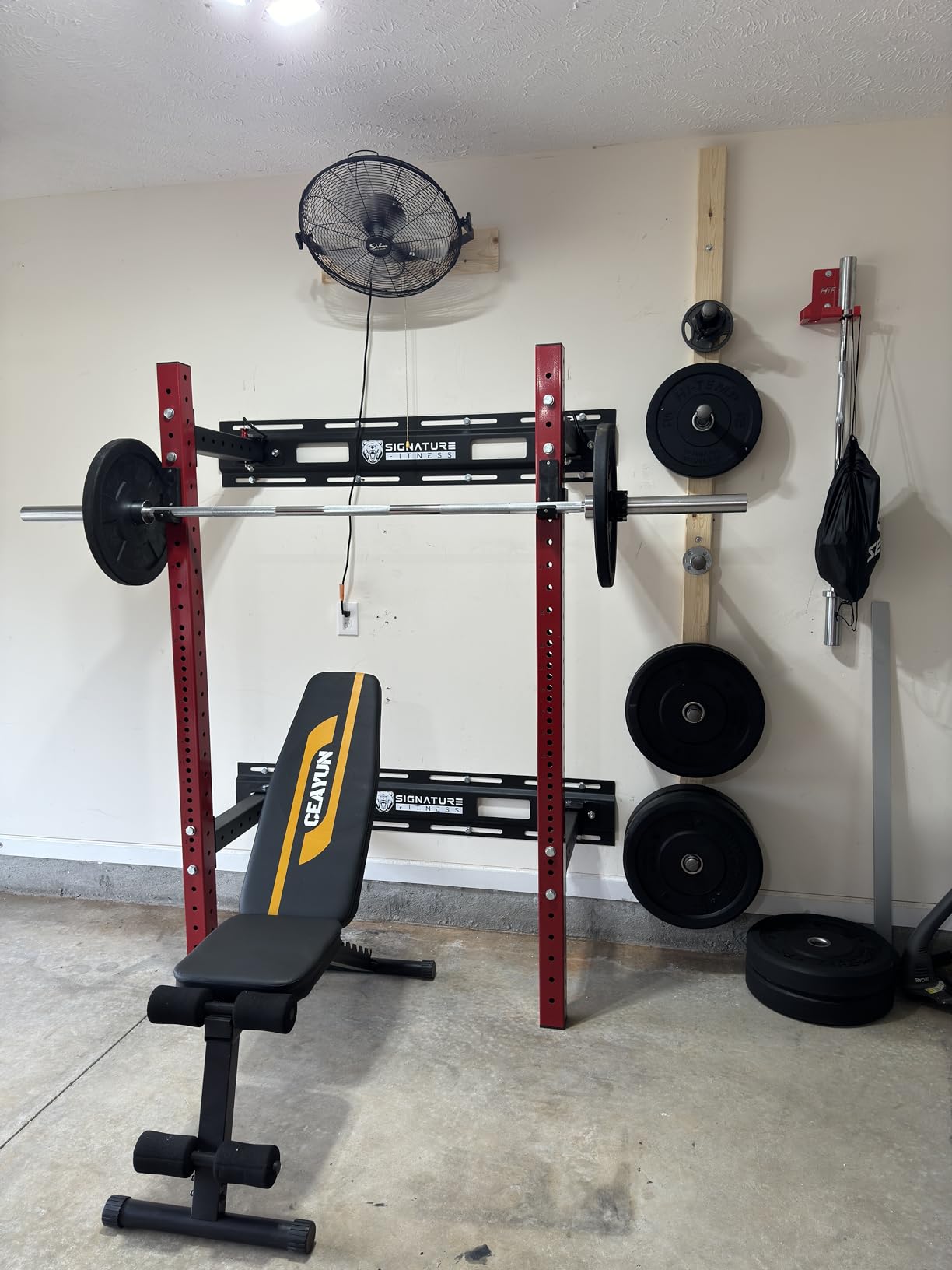
The steel is the headline here. Built from 3×3 inch 11-gauge steel rated to 1000 lb, this is the thickest material in the roundup, and 11-gauge is a full step heavier than the 12-gauge and 14-gauge used by most competitors. It is 158 lb, which tells you something before you read a single review.
At 78.5 inches it is also the shortest framed rack on this list, which makes it a genuine option under an 88 inch ceiling once you allow headroom. It folds flat against the wall, so the footprint question disappears just like the other wall racks here.
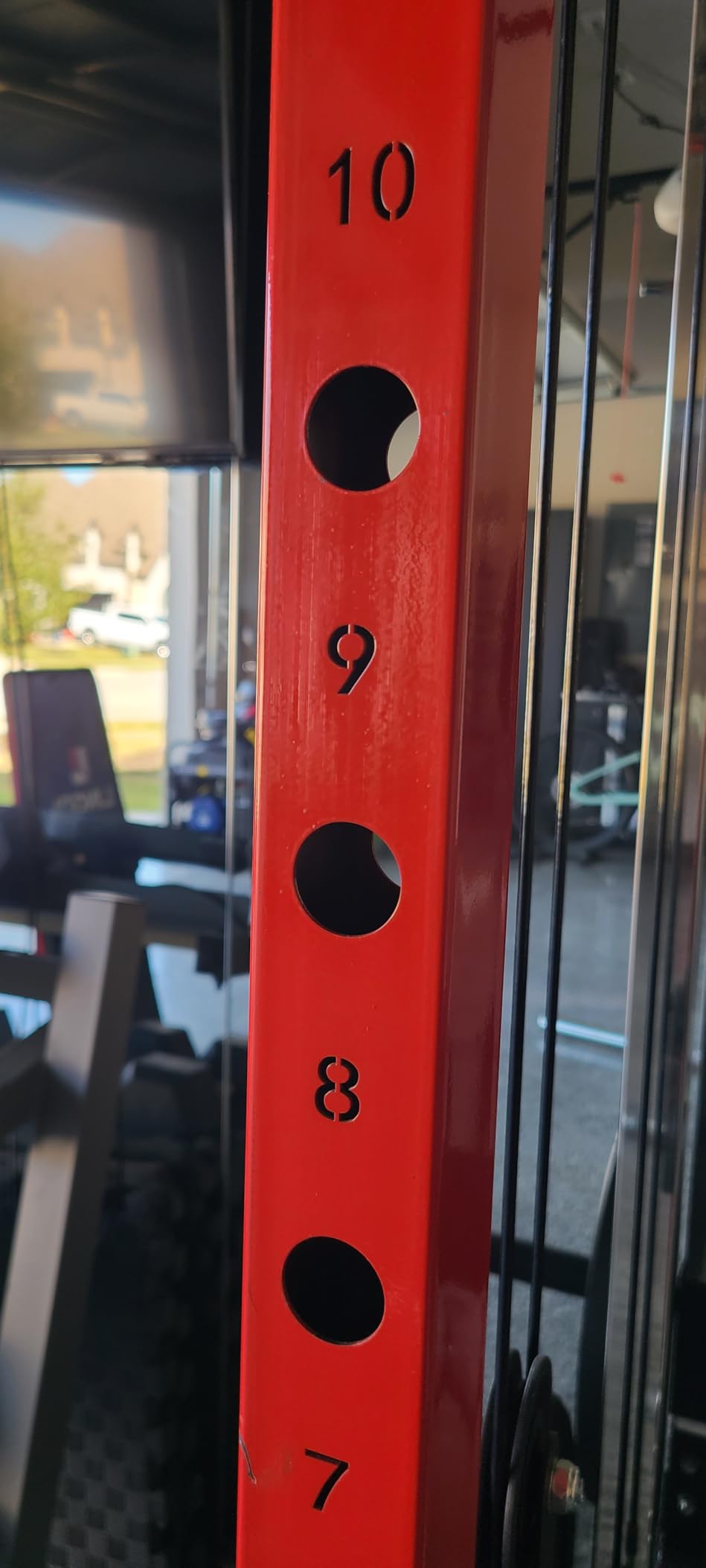
Forty-seven vertical adjustment holes use Westside spacing on the bottom half of each upright. That is the spacing serious powerlifters program bar positions to, and it is rare at this height and in this price class. J-hooks are UHMW-coated, and the pull-up bar adjusts in height rather than being fixed to the top.
Both J-hooks and safety spotter arms position fully, and the whole thing carries a 2-year manufacturer warranty. On paper this is the most over-specified rack in the roundup for anyone who cares about steel thickness.
Why the rating is the lowest here
At 4.1 from 113 reviews, with 9 percent one-star and 7 percent two-star, this is the only rack in the roundup where the negative slice is substantial. Buyers who get it working report a dependable core, and the critical group clusters around installation and fitment problems.
The very low sales rank adds context: this is the least battle-tested option we list, with far fewer owners putting stress on it than the Titan or FLYBIRD racks. That is a risk, not a defect, and you are buying heavier steel with less field history behind it.
Who should consider it
If you squat heavy, care about long-term steel fatigue and have a stud wall you trust, the 3×3 inch 11-gauge frame is genuinely better than anything else at this height. The Westside hole spacing is a real long-term benefit for programmed lifts.
But at 158 lb, plan a two-person install and a clear path to the mounting wall. If you rent, or your studs are old balloon framing, a lighter free-standing rack will save you a weekend and a drill bit. Our garage gym rack guide goes deeper on free-standing options.
6. PRx Performance Wall Mounted Folding Power Rack – Best Rated Overall
PRx Performance Wall Mounted Folding Power Squat Rack – Heavy Duty Adjustable Pull Up Bar, Space Saving Home Gym Equipment with Durable J-Cups, Ideal for Weight Lifting and Strength Training – Black
Folds to 6.75 inch deep
1000 lb capacity
Pull-up bar to 90 inch
14-gauge steel
Pros
- 4.8 stars with 90 percent five-star
- Folds to only 6.75 inch deep
- Reported sturdy with no wobble
- Installs to 16 or 24 inch on-center studs
- Simple twist-pin adjustments
Cons
- Tallest unit here at 90 inches
- Installation takes several hours and two people
- Spotter arms and bench sold separately
The PRx has the highest rating in the entire roundup at 4.8, with 90 percent five-star and only 2 percent one-star. Owners describe it in consistently short terms: sturdy, easy to install, easy to stow, durable. There is essentially no negative sentiment to explain away.
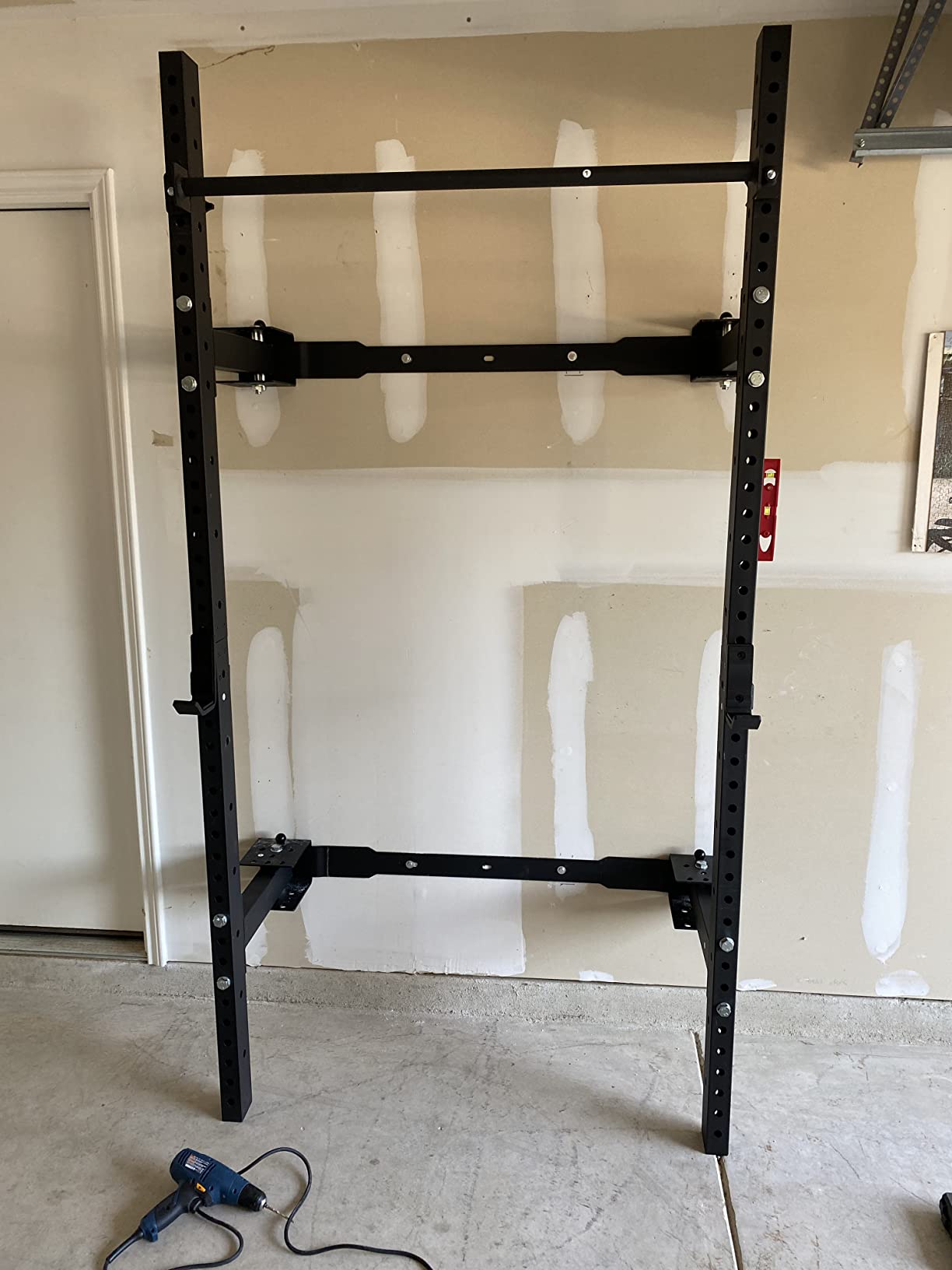
It folds to 49 by 90 by 6.75 inches and extends to 49 by 90 by 27.5 inches. That is the shallowest fold of any wall rack here, which means you give up less than 7 inches of depth when it is stowed, and the pull-up bar adjusts by twist pin all the way to 90 inches.
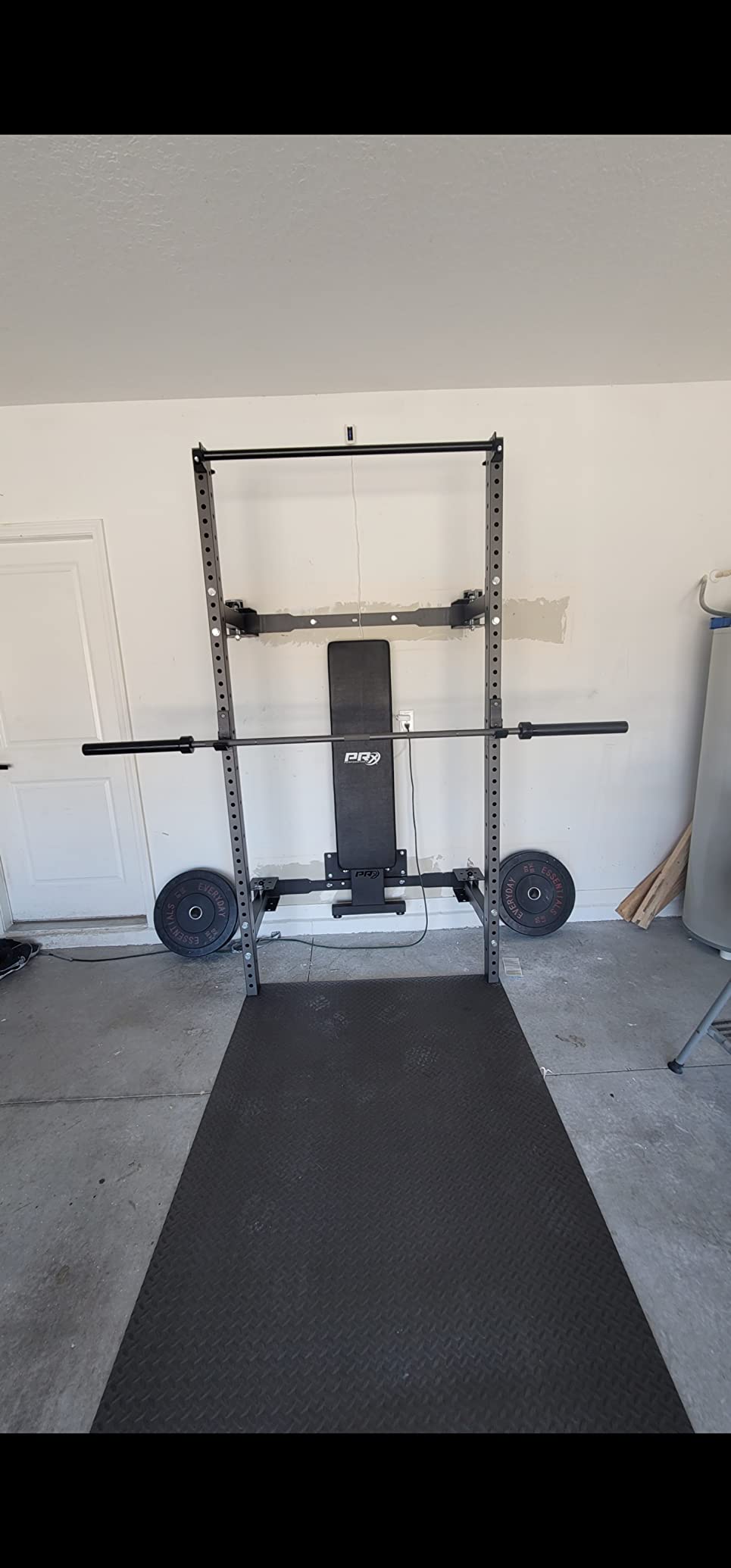
Capacity is 1000 lb on 14-gauge steel with 10mm plastic-coated J-cups. The coating is thick enough to matter on knurling, and owners report no wobble even on a sloped garage floor, which is the situation that derails most wall racks.
It mounts to standard wall studs at either 16 or 24 inches on center, which covers the overwhelming majority of standard framing. Hardware, instructions and a step-by-step install video are included, and it arrives well packed in a single box.
The height problem nobody mentions
At 90 inches, this is the tallest rack in the roundup. That makes it a poor fit for a 7 foot ceiling and a non-starter under 6 foot 10 inches, which defeats the purpose of a low-ceiling roundup. We include it because the rating is exceptional and because it solves a related problem well.
If your low ceiling is caused by a small room rather than a low ceiling, the PRx is a strong pick. You reclaim nearly the entire footprint when folded, keep a real pull-up bar, and give up nothing on steel feel. It is the answer for short-ceiling rooms where every square foot counts.
What you need to know before ordering
Installation takes several hours and is realistically a two-person job. A 123 lb rack hanging on a wall is unforgiving of a mis-marked stud, so measure twice and use a stud finder rather than a tape measure alone.
Spotter arms and a bench are separate PRx accessories, so budget for safeties if you are training alone. For cable work, our best power racks with pulley systems guide covers integrated pulley frames.
7. HARISON Heavy Duty Half Rack and Bench – Best for Very Low Ceilings
HARISON Heavy Duty Squat Rack, Adjustable Barbell Rack, Multi-functional Dip Bar Station Weight Lifting Bench Press for Home Gym
No overhead structure
650 lb capacity
10 height levels
65 lb unit weight
Pros
- No overhead cage so ceiling height is not a constraint
- Solid and stable despite more hardware than some premium units
- Ten height and ten width adjustment levels
- Owners modify it to bench as well as squat
- Good welds and correctly drilled mounting holes
Cons
- Lowest weight capacity here at 650 lb
- Spotter arms do not raise high enough for benching or drop low enough for squat safeties
- Arms extend outward too far for tight rooms
This is the answer when the ceiling is genuinely too low for anything overhead. There is no top structure at all, so ceiling height stops being a variable. If your room has 6 foot 6 inches or less of clearance, a half rack is the only category that works without compromise.
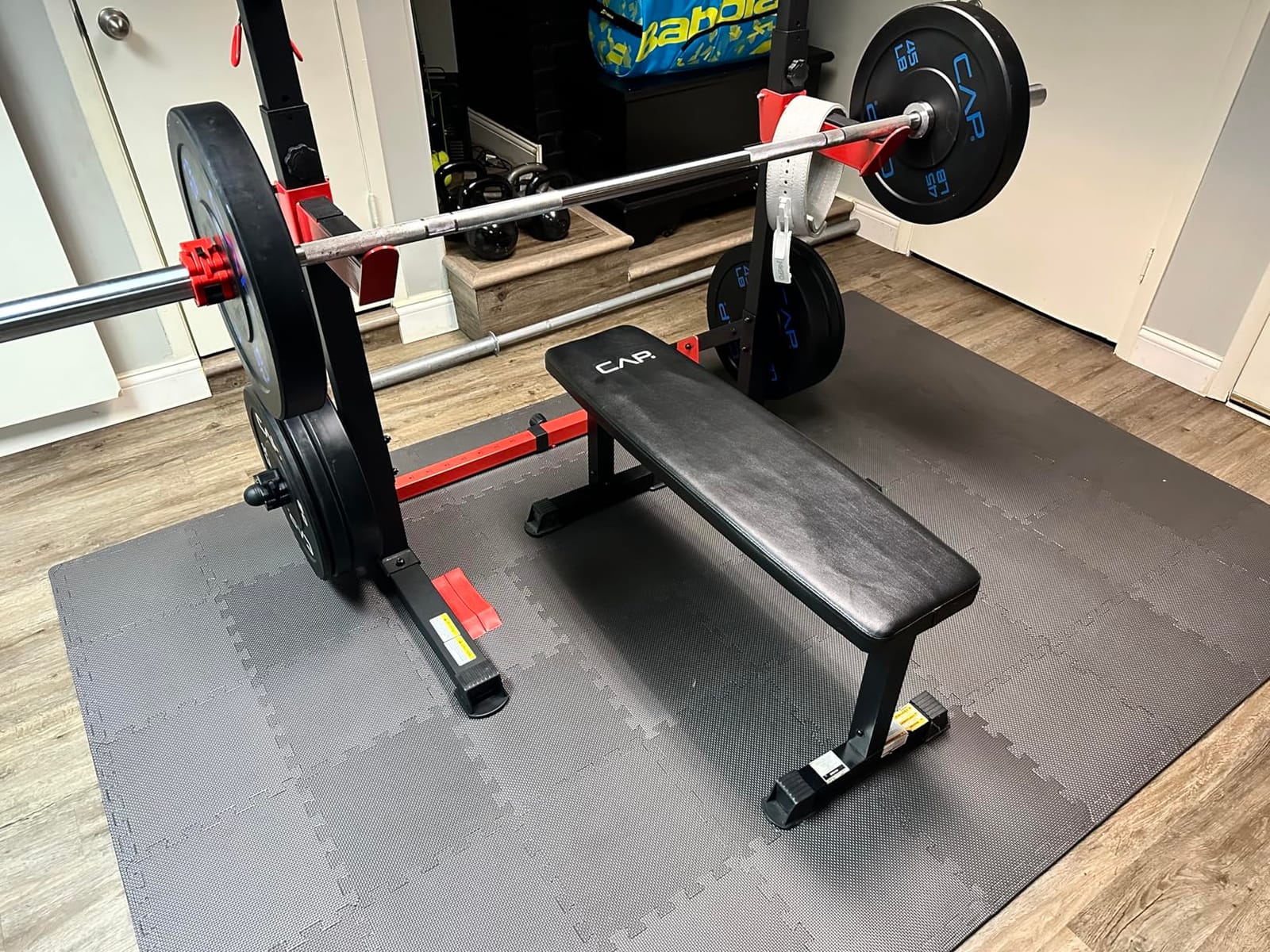
The frame uses 3 inch thick square tube on a main structure weighing 65 to 70 lb, with triangular stabilization, an H-shaped base and a safety locking system. Reviewers consistently describe the welds, paint and drilled holes as good, which is unusual at this level.
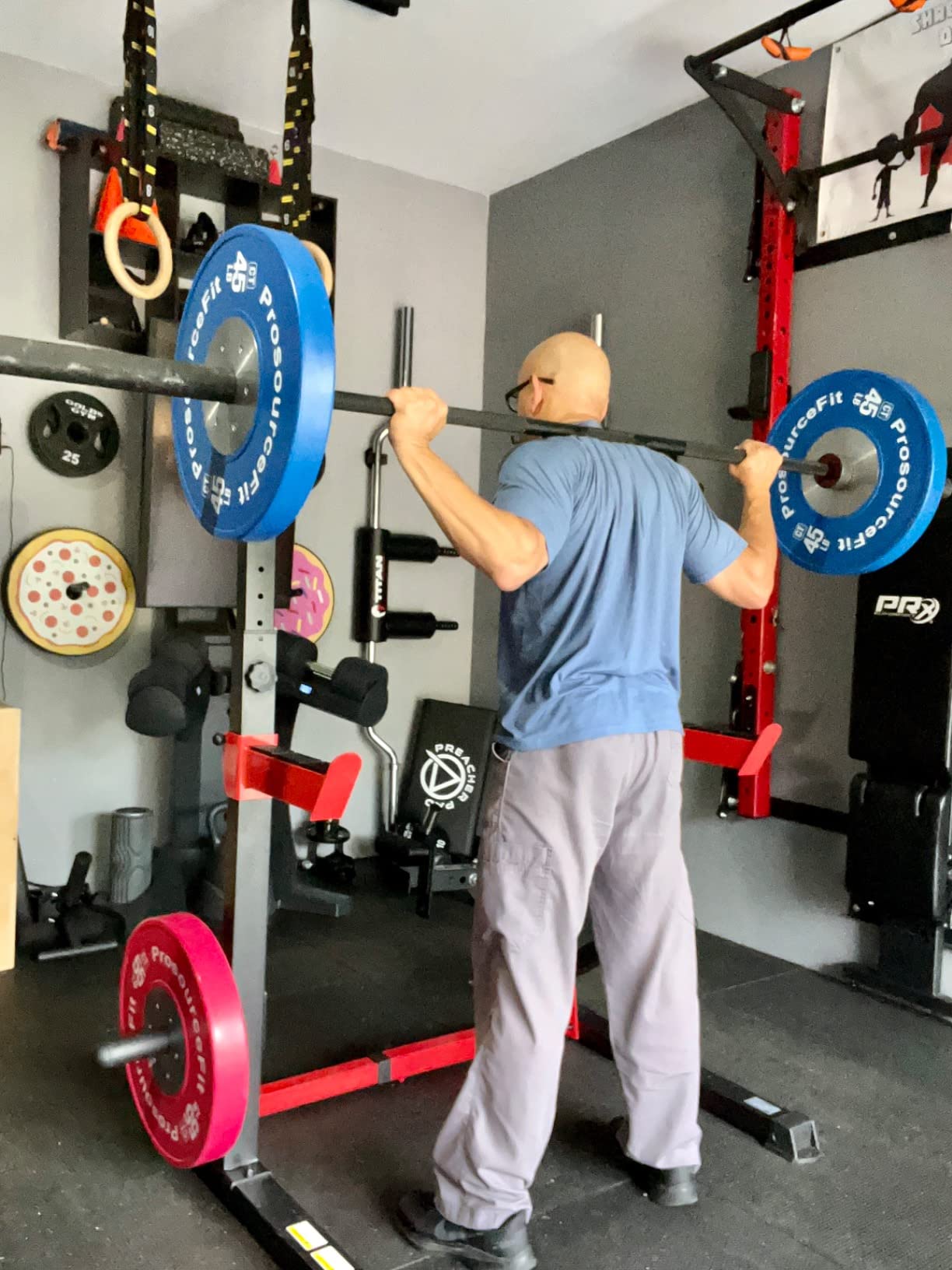
Adjustment is unusually broad for a half rack: 10 height levels spanning 51.22 to 68.95 inches, 10 width levels from 28.37 to 46.1 inches, and 5 spotter arm positions from 27.97 to 35.85 inches. Owners use it as a 4-in-1 bench press stand, barbell rack, dip station and pull-up rack.
That width range is what makes it work for different body sizes, and it explains the repeat feedback that owners modify it into a bench setup rather than treating it as squat-only. Non-slip foot pads help on finished floors.
What works well in a low room
Everything that does not need vertical space works. Squats, deadlift variations from the rack, barbell rows, landmine work, dips and band work all function, and the compact footprint suits a spare room, a finished attic or a basement corner.
If you are under 5 foot 8 inches, the 51 inch lowest J-hook position is genuinely useful. Most full racks bottom out well above that, so shorter lifters get far more usable range from this frame than from anything else in the roundup.
Where it is the wrong pick
Capacity is 650 lb, the lowest in this roundup, which rules it out for advanced powerlifting. The spotter arms are the bigger problem: owners repeatedly report they are too short at the top for comfortable benching and too high at the bottom to act as squat safeties, and they protrude awkwardly in a tight room.
With 48 reviews it also has the smallest sample here, so treat the consensus cautiously. Customer service is repeatedly praised, and a 30-day trial plus included tools and guidance video soften the risk. Buy this one for squats and general strength work, not for heavy triples.
8. Titan Fitness T-3 Series Short Squat Stand – Best for Low-Clearance Squatting
Titan Fitness T-3 Series Short Squat Stand with J-Hooks, 1000 LB Rated
73.5 inch height
1000 lb rated
All 10-gauge steel
Westside hole spacing
Pros
- Shortest freestanding unit at 73.5 inches
- 144 lb of all 10-gauge steel
- 1000 lb rated and very stable
- Westside hole spacing
- No floor bolting required
Cons
- Only 2x3 Titan attachments fit
- Fewer accessories than 3x3 Titan racks
- Spotter arms and top brace sold separately
This is the clearest low-ceiling recommendation we found. Owners with 76 inch and sub-7 foot basements report that a 6 foot 3 inch lifter can squat comfortably on it, and one buyer explicitly chose it over a Rogue Monster Lite for the same heavy gauge construction at a fraction of the cost.
At 73.5 inches and 144 lb, it is all 10-gauge steel, which is heavier than anything else in this roundup including the 3×3 inch 11-gauge Signature unit. Rated to 1000 lb, it takes 300 lb dropped on the spotter arms without noticeable movement.
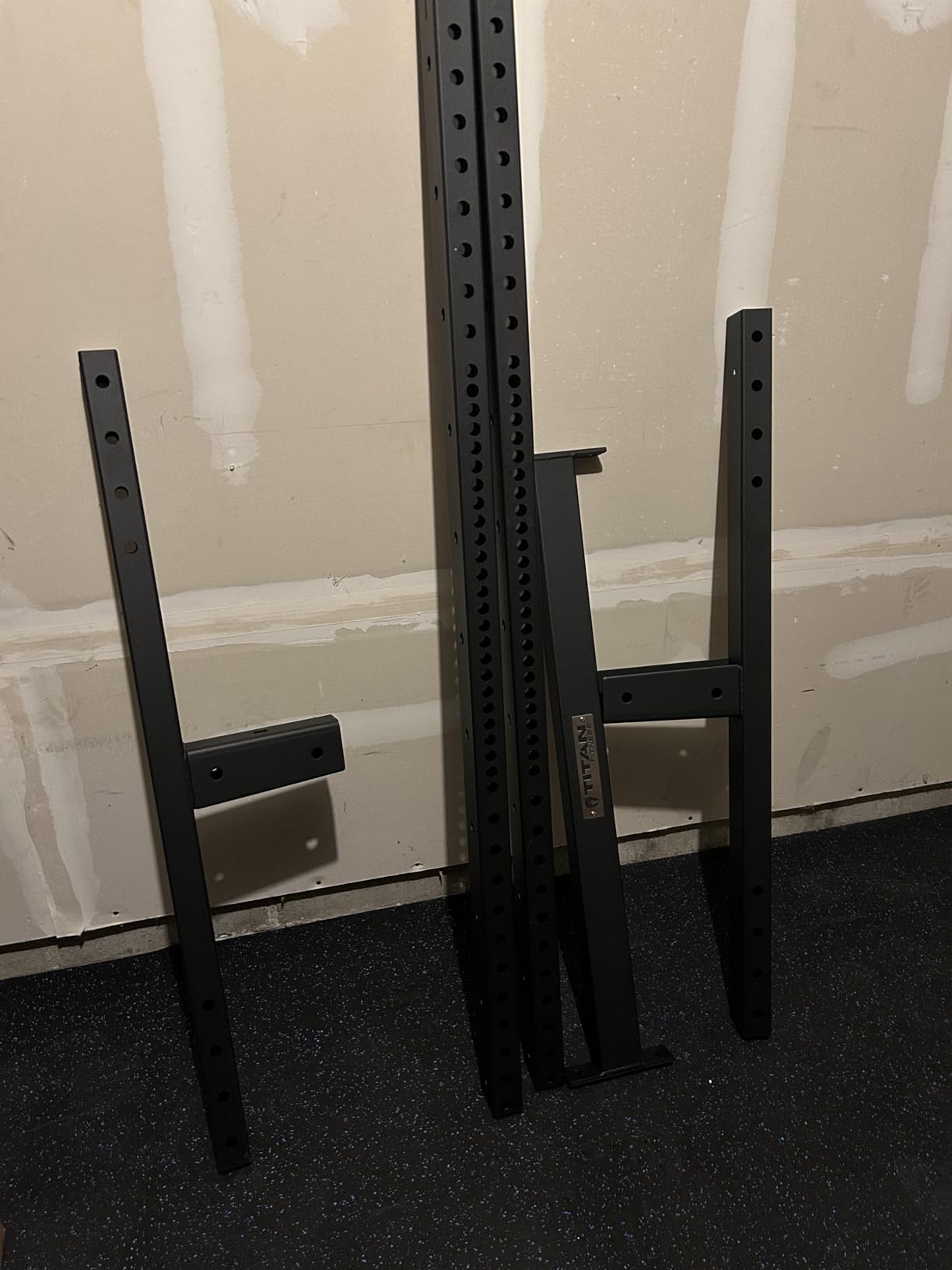
Hole spacing follows the Westside pattern, with 2 inch spacing above and below the bench and clean pull zone and 6 inch side hole spacing. That is the programming standard powerlifters use, and it is unusual on a stand at this height. The footprint is 47 by 48 inches, and no floor bolting is required.
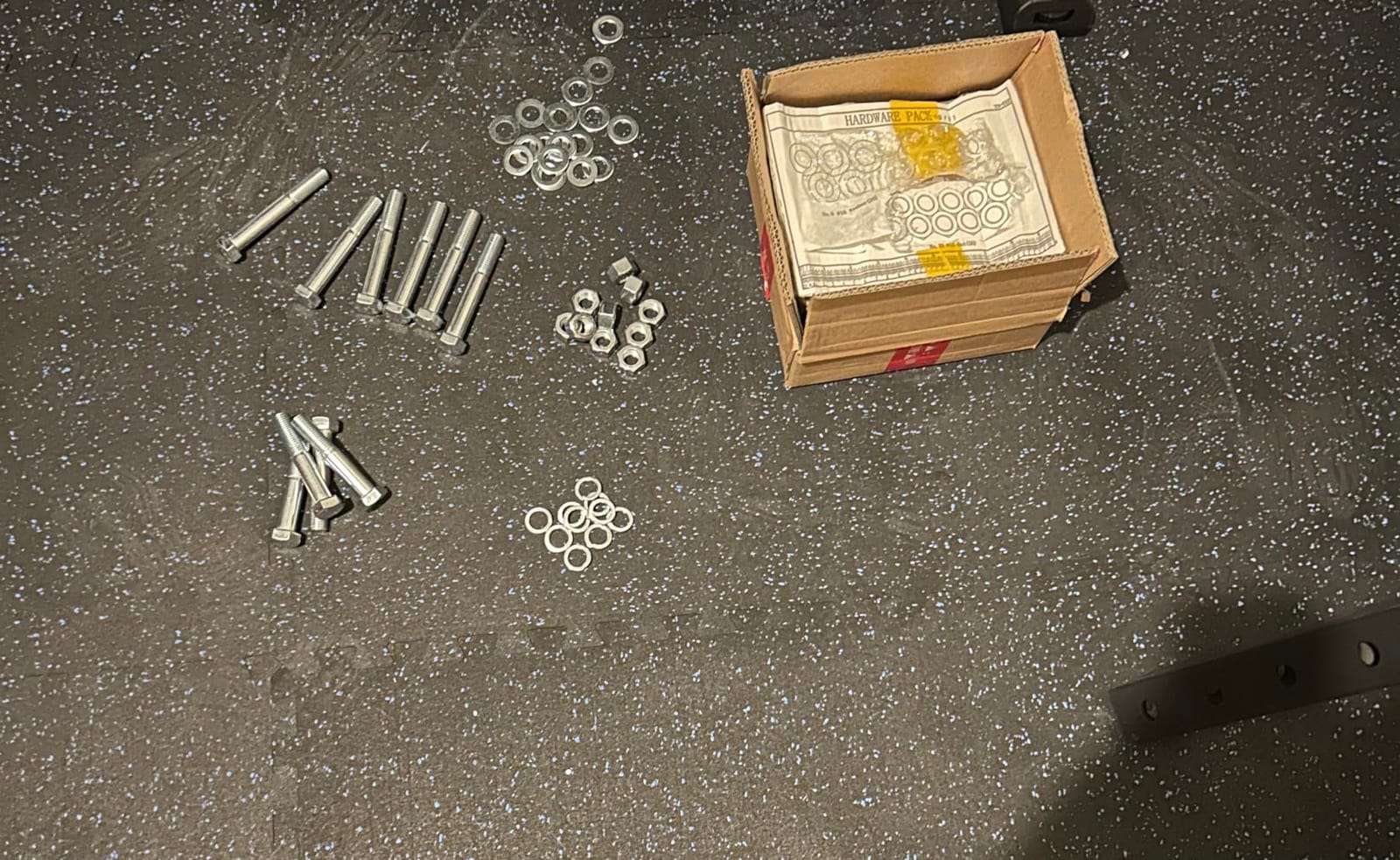
It is also a bolt-together design, so you can take it down and store it between sessions. That matters in a basement where the same room serves as a laundry area on weekdays. All assembly hardware is included.
Height fit for real basements
At 73.5 inches the T-3 needs roughly an 85 inch ceiling, so it works in a 7 foot basement with 10 inches of headroom. In a 6 foot 6 inch room it is tight, and in a 6 foot room it is out. The T-2 at 71 inches is the pick for those shorter rooms.
The important trade is that you give up the pull-up bar entirely unless you buy the top brace separately. For a lifter who squats and presses but does not need strict pull-ups, that is a fair deal for this much steel and this little height.
Watch the attachment ecosystem
Because it is a 2×3 short stand with 5/8 inch holes, only 2×3 Titan attachments fit, and the hole diameter rules out some 3×3 accessories. There are simply fewer compatible parts than on the wider Titan racks, and owners note this as the main limitation.
Spotter arms and the top brace are sold separately, so the full number is higher than the base. J-hooks also have a small amount of side-to-side play out of the box. At 144 lb it is the heaviest item here, so moving it is a two-person task.
9. PASYOU Adjustable Squat Power Rack – Best Value
PASYOU Adjustable Squat Power Rack for Home Gym, Total 2400 LBS
58 inch height
10.8 sq ft footprint
2400 lb total capacity
63 lb unit weight
Pros
- Short 58 inch height and one of the smallest footprints here
- Sturdy and stable for its weight class
- Safety bars are longer than comparable compact racks
- Good welds and heavy-duty packaging
- Includes a free ratcheting wrench
Cons
- Stability is less convincing at heavier loads
- Adjustable width still runs narrow for a large user
- Some units arrive with bent parts or incomplete welds
- Published width figures in the product graphic are misleading
The PASYOU is the value entry point, and with 314 reviews it has one of the largest review bases in the roundup. At 4.3 stars with 64 percent five-star, the rating is more mixed than the Titan or FLYBIRD racks, which is consistent with what it is built for.
At 58 inches tall and about 10.8 square feet, it is one of the smallest frames here, and that is genuinely useful in a 6 foot room where nothing else fits. Capacity is listed at 2400 lb total, split between 1800 lb in the lower position and 600 lb on the J-hook.
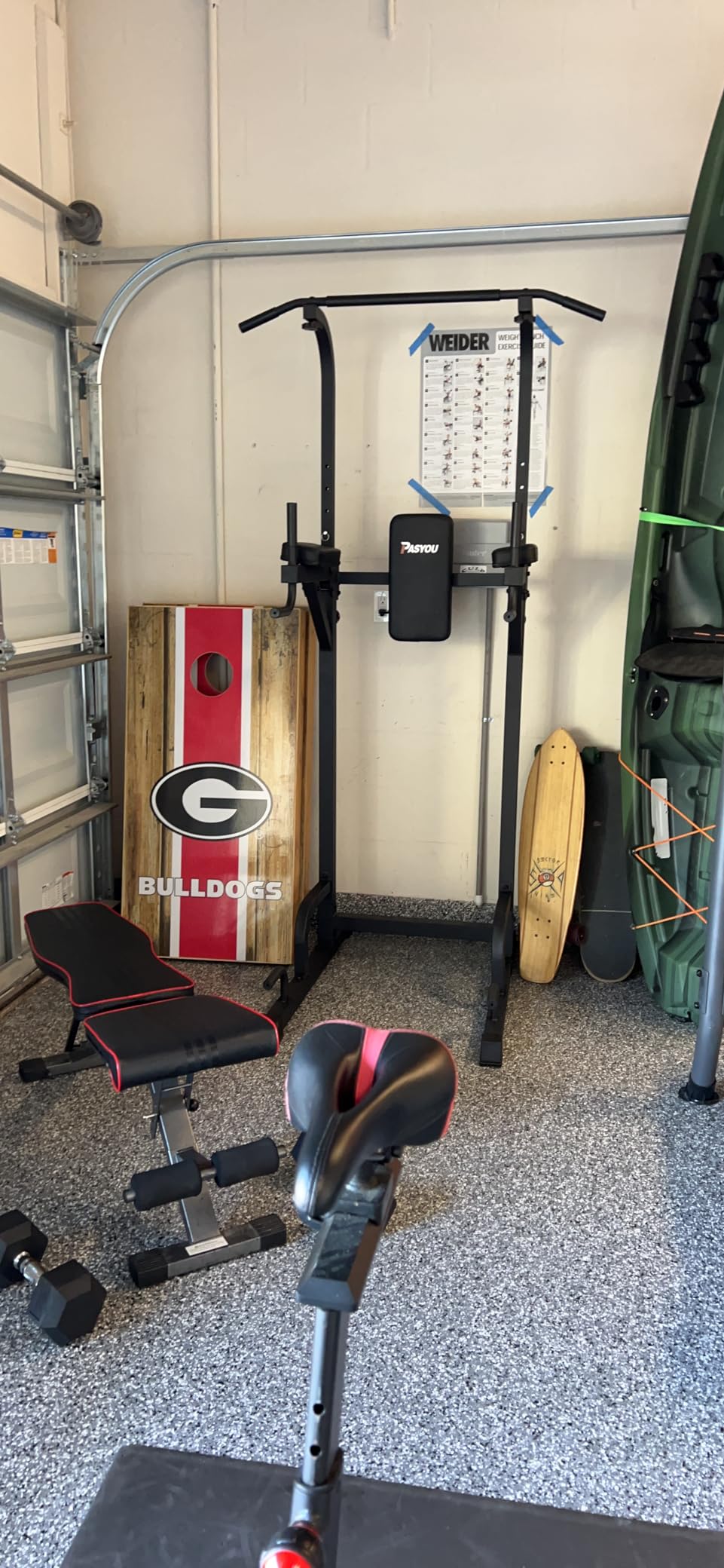
That 600 lb J-hook figure is the number to read carefully, because it is lower than the headline suggests and closer to the 650 lb ceiling on the HARISON half rack. Owners shopping lighter alternatives report this was the heaviest and most solidly welded unit they found at the money.
Reinforced alloy steel, a dual frame, non-slip stability foot pads, built-in push-up handles and spotter arms are all included. It supports squats, bench press, push-ups, dips and band work, and comes with a free ratcheting wrench and itemized instructions.
Who gets the most out of it
Light to moderate lifters building a first home gym in a genuinely small room. The 58 inch height clears anything, the 63 lb weight keeps it portable, and it collapses small enough to move out of the way when the room doubles as something else.
It is also a good first step for someone training alone without safeties yet, since the spotter arms are included rather than sold separately. The ratcheting wrench alone saves you a tool trip on assembly day.
Where the limits show
Stability is the honest limit. Heavier lifters find it wanting, and the adjustable width still runs narrow for a tall or large user even at its widest setting. Bench bars are described as thin, though functional.
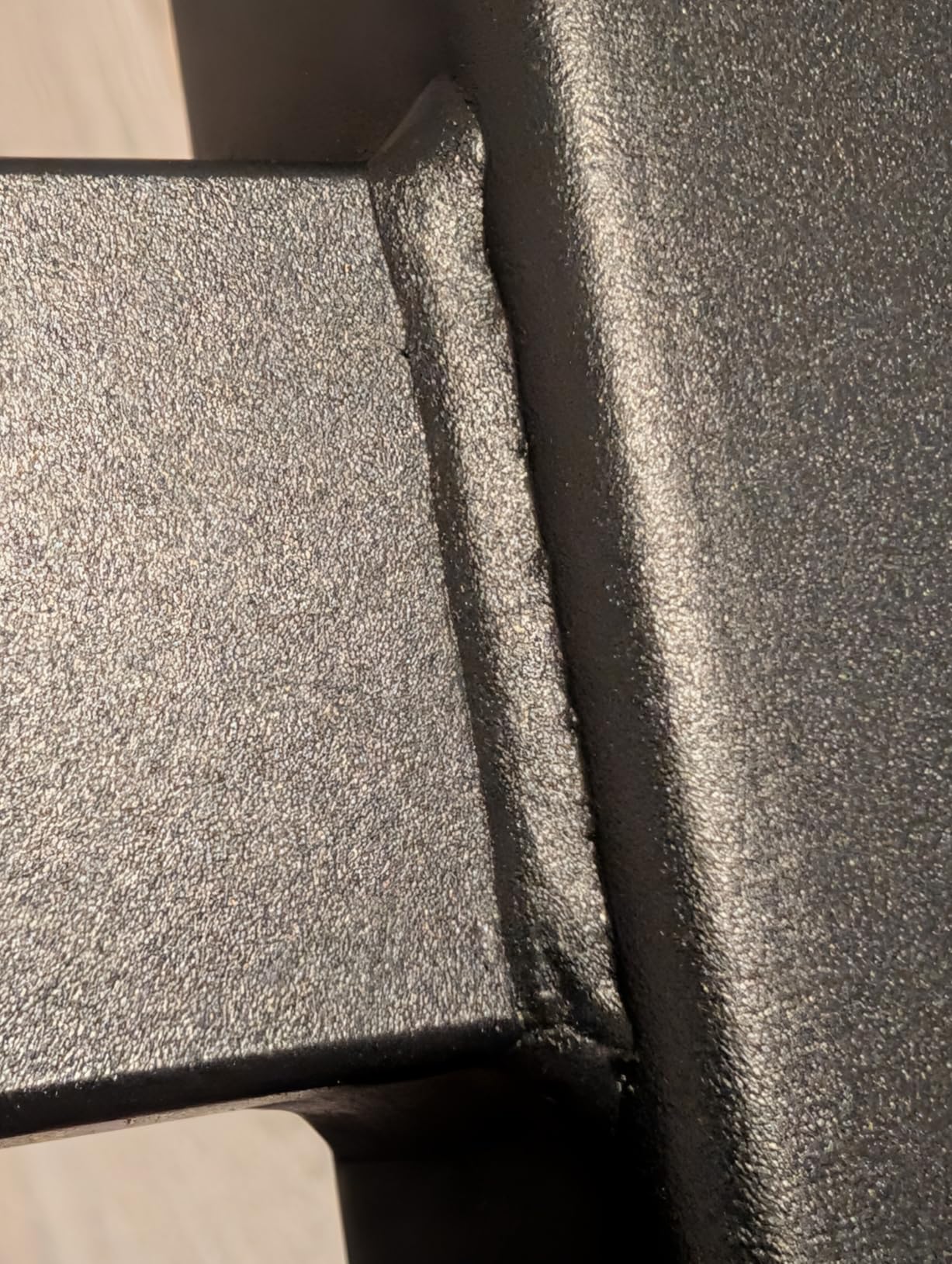
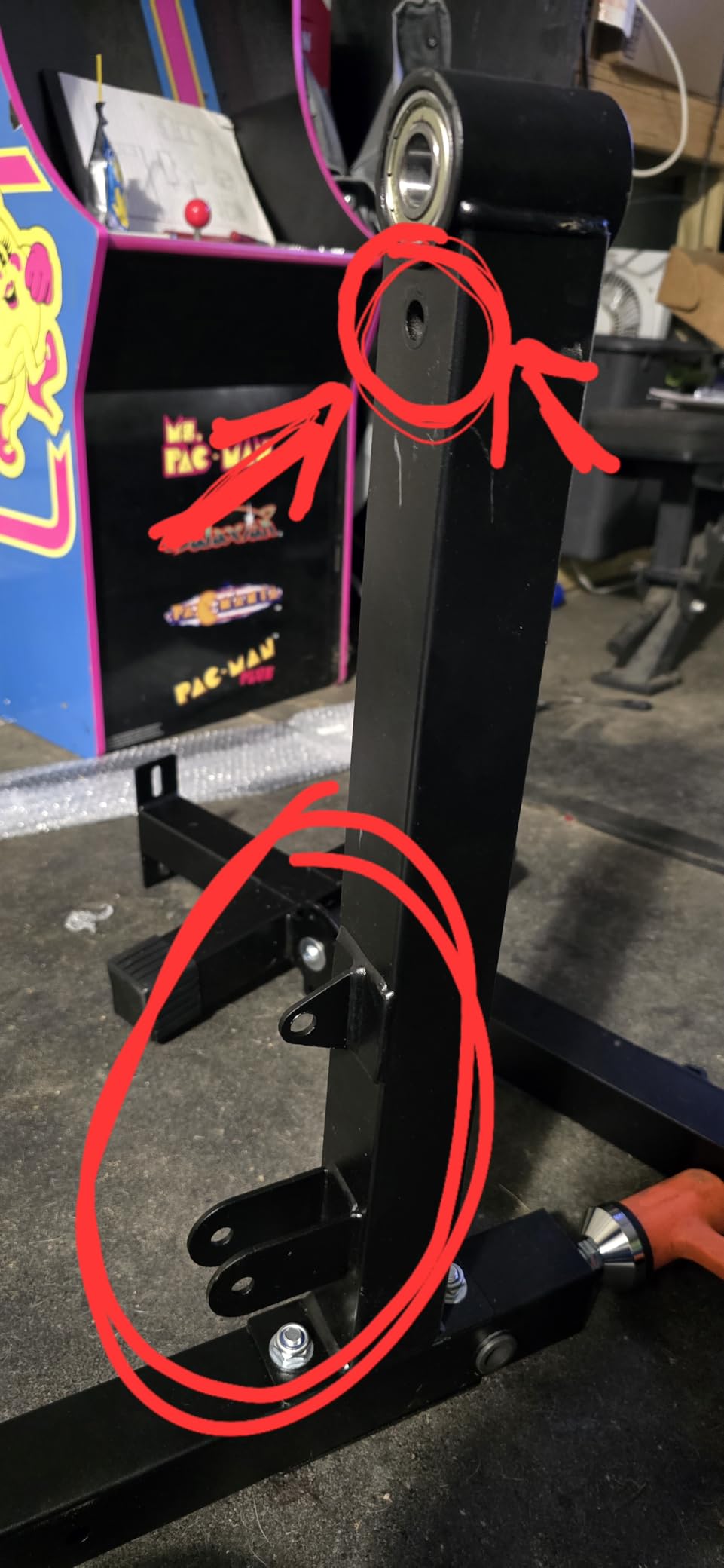
Some examples arrive with bent parts, incomplete welds or a shattered adjustment knob, and the published width figures in the product graphic are misleading. Support is responsive when problems are reported, which is the main reason the rating holds at 4.3. Buy it for a spare room, not a serious squatting program.
10. Goimu WM3-V4 Folding Squat Rack – Best for Dual Cable Workouts
GOIMU WM3-V4 Folding Squat Rack, Wall Mounted Power Rack with Dual Independent Pulley System, Functional Trainer with 5 Adjustable Function Modes for Space Saving (WM3 Folding Cage Black)
4.3 sq ft folded and 12.3 sq ft open
Five training modes
Dual 1:1 cables
2000 lb tension
Pros
- Best-selling item here at number 5 in Strength Training Power Cages
- Five modes in one unit
- Rear rack section is genuinely solid at 225 lb loaded on hooks and safeties
- Folds tightly enough to keep two cars in a garage
- Landmine attachment included
Cons
- Pulley system is excessively resistant and needs greasing
- Instructions are poor and mounting hardware will not enter wood framing
- Some reports of unresponsive customer service
The Goimu is the best-selling item in this roundup, ranking number 5 in Strength Training Power Cages, which is notable for a rack with only 54 reviews. Sales rank and review count measure different things, and the rank here reflects recent sales velocity rather than a long owner history.
It collapses to 4.3 square feet and expands to 12.3 square feet, in five configurations: folded, semi-open, half rack, functional trainer and cable crossover. The rack structure itself is the solid part, with owners loading 225 lb across both J-hooks and safety arms without strain.
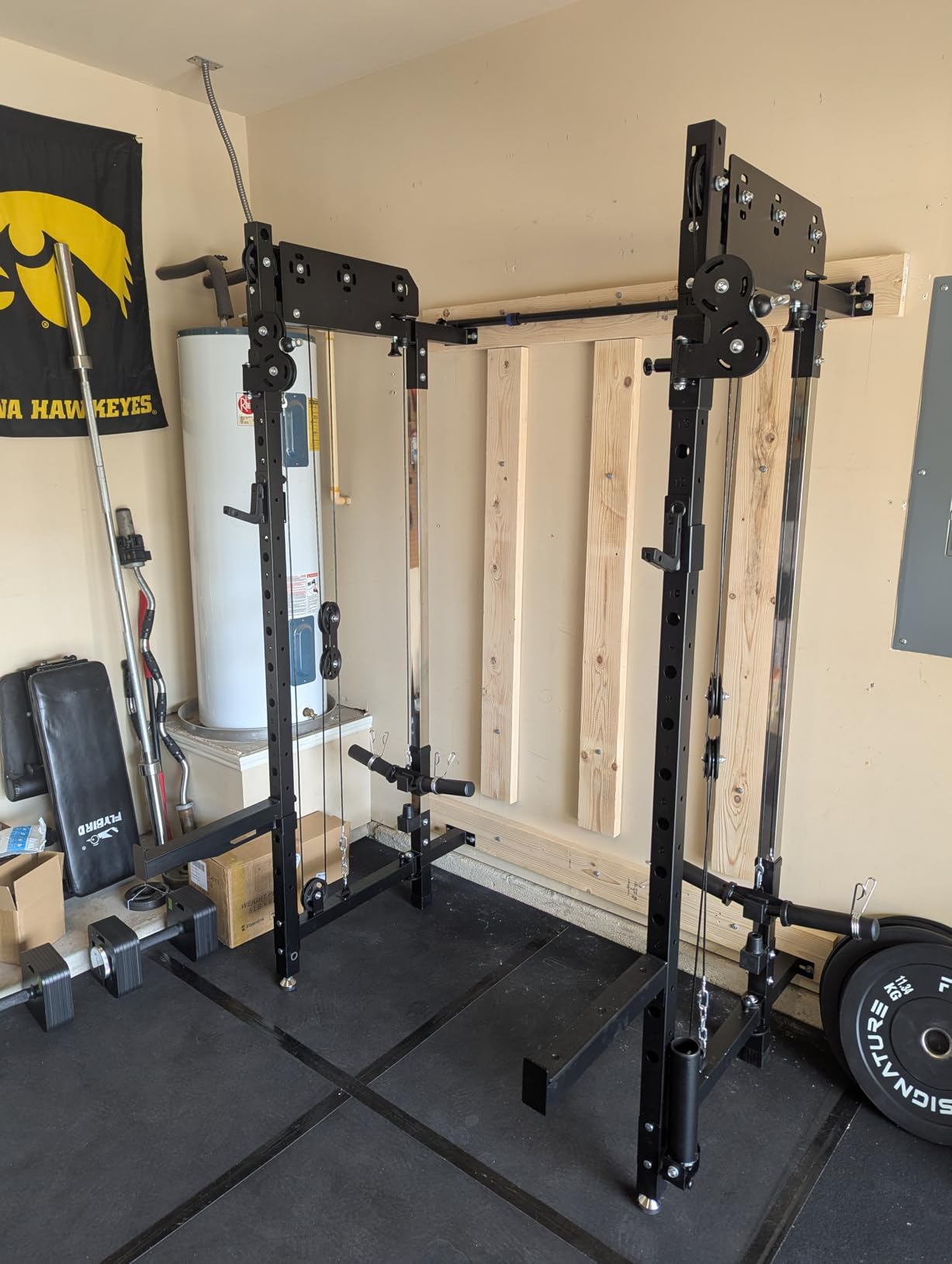
Two independent 1:1 cable machines let two people train at once, and 15 pulley heights adjust single-handed. A detachable pull-up bar, quick-swap J-hooks, safety arms and an included landmine round out the package, with 2000 lb of supported cable tension.
The fold is tight enough that owners report keeping two cars in the same garage. It arrives in two boxes, so plan where you will stage them before you start, and check the wall for concrete before you open a box of fasteners.
Strength where it counts
The rack portion is better than the rating suggests. The rear rack section is described as genuinely solid, the steel holds a realistic training load without complaint, and the dual independent cables mean partner training without a second machine or a weight stack.
If cables are a priority and you have a wall you can drill into, the feature set is hard to argue with. The 1-year warranty is standard, and the accessory package means you are not shopping for a landmine or a T-bar row separately.
Plan the installation carefully
The instructions are widely described as inadequate, with several owners describing four steps that each contain a long list of sub-steps. Realistically this is a two-person, multi-hour assembly, and that is before the mounting problem below.
The included mounting hardware will not work into wood framing. Lag screws into concrete are required, or you have to add backing boards yourself, which turns a two-hour job into a weekend project. The pulley system is also excessively resistant and benefits from greasing or a silicone spray, and the pull-up bar does not reliably stay in its grooves once tightened. Some examples arrive with a shorter cable, a non-gliding arm or a torn handle.
Buying Guide: How to Choose a Low-Ceiling Power Rack
Measure the real ceiling first. The lowest point of your ceiling, minus door tracks, joists, fixtures and ducting, is the only number that matters. Add 12 inches of head clearance to the rack height, and that is your ceiling requirement. If the arithmetic does not work, a shorter rack or an open half rack is the only honest answer.
Decide whether height or footprint is your real problem. Wall-mounted folding racks solve floor space while staying tall. Short freestanding racks solve height. Open half racks solve both by giving up overhead work entirely. Most people in old basements need the second, and people in small apartments with normal ceilings need the first.
Pick the rack type. A full power rack gives you four uprights, a top pull-up bar and unlimited bar positions, and it is the only option that supports overhead pressing inside the frame. A half rack gives up the top crossmember, which frees up ceiling height and floor space in exchange for losing strict pull-ups and rack-dipped movements. A squat stand goes further and drops the enclosure almost entirely. A folding wall rack is a full rack that happens to disappear when you are not using it.
Check steel gauge before anything else. Lower gauge numbers mean thicker steel, and the spread in this roundup is wide. The T-3 short stand and the PRx use 10 and 14-gauge construction with 3×3 inch tubing or heavier, while several budget racks use 2×2 inch 14-gauge steel. Thicker steel resists flex and weld fatigue over years of heavy loading, but it also costs weight, dollars and sometimes wall clearance during installation.
Treat footprint and stability as a trade. Wider bases and heavier units resist tipping on rack pulls and dips, but a wide base eats floor area you may not have. Bolt-down racks remove the wobble question entirely and are the right call in an owned home. Renters cannot bolt, which pushes toward heavier free-standing steel, and the 144 lb T-3 and 158 lb Signature unit are both free-standing for exactly that reason.
Count accessories before you buy. Spotter arms and safeties are not universal. The T-3 sells its top brace and spotter arms separately, and the PRx does not include safeties or a bench. A rack that ships with 16.7 inch safety arms or pin and pipe safeties in the box saves both money and a second delivery.
Read the pin spacing and J-hook position. Westside spacing with 1 inch hole pitch gives finer bench-height matching than a 4 to 6 inch pitch, which matters most for lifters under 5 foot 8 inches. A 51 inch lowest hook position is the single most useful spec for a shorter lifter in a low-ceiling room, and almost nobody thinks to check it.
Frequently Asked Questions
What is the recommended ceiling height for a power rack?
Allow at least 12 inches of clearance above the top of your rack for safe unracking, so a 71 inch rack needs roughly an 83 inch ceiling and a 78.5 inch rack needs about 90 inches. Measure the lowest point of your ceiling rather than the framing, since garage door tracks, joists and light fixtures often sit several inches lower than you expect.
What power rack is best for small spaces?
For small rooms where floor area matters most, a folding wall-mounted rack such as the Mikolo 1000 lb model is the strongest pick, since it folds to about 2 inches deep in around 15 seconds. If the ceiling itself is the constraint rather than the floor, a half rack with no overhead structure works at heights where a full cage cannot.
Is a 7 ft ceiling too low?
No, a 7 foot or 84 inch ceiling works well with a rack built for it. The Titan Fitness T-2 at 71 inches, the Titan T-3 squat stand at 73.5 inches, the Signature Fitness fold-in at 78.5 inches and the FLYBIRD SR1 at 83 inches all fit under 84 inches if the ceiling is flat. Standard 82 to 90 inch racks are the ones that rule it out.
What are good power racks for people under 80 inches tall?
Shorter lifters care most about the lowest available J-hook position and the pin spacing, not the overall rack height. The HARISON half rack drops to a 51.22 inch lowest setting, and the FLYBIRD SR1 offers 22 height positions at 1 inch spacing. The T-2 Series and T-3 short models are also comfortable for lifters in that range.
Can you do pull ups on a short power rack?
Yes, with limits. Pull-up height is set by the top of the frame, so the taller wall racks in this roundup, such as the PRx at 90 inches and the Mikolo folding rack with an 89 inch bar, give you far more clearance than the 71 inch T-2 or the 73.5 inch T-3 squat stand, which has no top bar at all unless you buy the brace separately.
Do short power racks wobble?
Shorter racks wobble when the base is narrow and the steel is light, not because of their height. The T-2 stays steady once loaded with plates, and the T-3 uses 144 lb of 10-gauge steel for the same reason. Wall-mounted models like the Mikolo and Signature units are the least mobile option of all, since the wall absorbs the movement.
Conclusion: Matching the Rack to Your Ceiling
For most low-basement and low-ceiling situations, the Titan Fitness T-2 Series Short Power Rack at 71 inches is the best power rack for low ceilings we found, because it is the only full rack here that leaves usable overhead air under a 6 foot 6 inch ceiling while still offering 850 lb of rackable capacity and 14-gauge 2×2 inch steel.
Choose the FLYBIRD SR1 when floor area matters more than a top pull-up bar, the Mikolo folding rack when you want a full cage that disappears into the wall, and the Titan T-3 squat stand when you squat heavy in a tight 7 foot room. Measure your lowest ceiling point, subtract the door tracks, and buy the rack that leaves 12 inches to spare.