
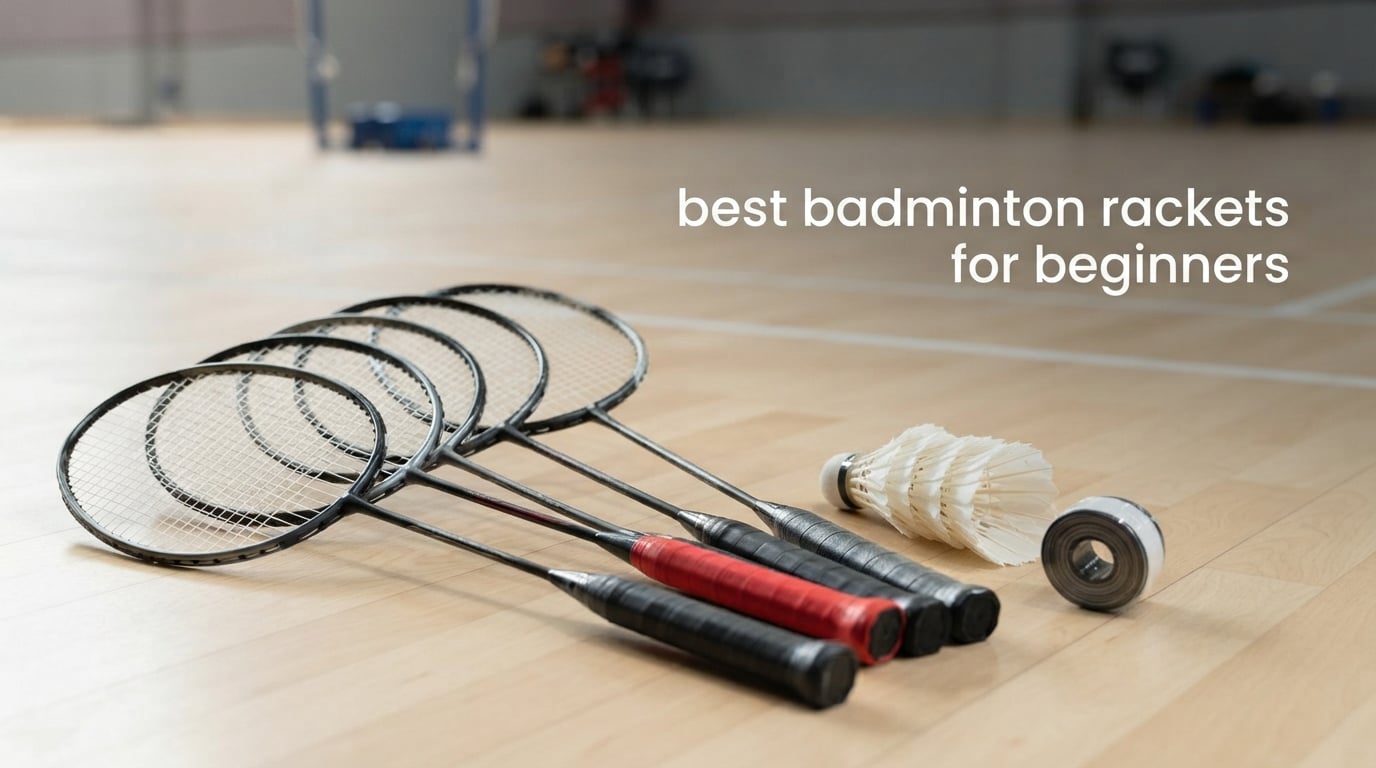
The best badminton racket for beginners is the Yonex Nanoray 10F Hi-Flex. At 77 g it sits in the 5U weight class, it arrives pre-strung, and its flexible graphite frame makes forgiving contact possible within the first hour of play. It is also the most proven beginner racket in this roundup, with a 4.5-star rating across more than 21k reviews.
Most people buying their first racket ask the wrong question. They want the most powerful frame, the stiffest shaft, or the same model a club player uses. What actually matters is how quickly the racket lets you hit a decent shot while your technique is still forming.
That comes down to four things: total weight, where the weight sits, how flexible the shaft is, and how forgiving the string bed is. Get those right and a beginner racket generates power from an unfinished swing and shrugs off off-centre hits. Get them wrong and the first few months disappear into timing drills instead of actual rallies.
We compared ten beginner and entry-level rackets across weight, balance, materials, string tension and grip sizing, and read the review patterns on each. The shortlist covers everything from a single graphite racket to full four-player kits, so it covers school PE classes, family backyard play and your first club season too. If you are still working out what else you need for a first session, our beginner badminton sets guide covers the rest of the kit.
Top 3 Picks: Best Badminton Rackets for Beginners in 2026
The Nanoray 10F wins on proven reliability and the lightest frame in the group. The Astrox Smash is the sharpest-handling single racket here, and the HIRALIY kit is the only pick that gets a whole household or a PE class playing in one order.
Quick Overview: Best Badminton Rackets for Beginners in 2026
| Product | Specifications | Action |
|---|---|---|
 Yonex Nanoray 10F Hi-Flex Yonex Nanoray 10F Hi-Flex |
|
Check Latest Price |
 Yonex Astrox Smash Yonex Astrox Smash |
|
Check Latest Price |
 HIRALIY 4-Racket Kit HIRALIY 4-Racket Kit |
|
Check Latest Price |
 Senston Carbon Composite Set of 2 Senston Carbon Composite Set of 2 |
|
Check Latest Price |
 Yonex Astrox Attack 9 Yonex Astrox Attack 9 |
|
Check Latest Price |
 Senston 90g Backyard Set Senston 90g Backyard Set |
|
Check Latest Price |
 Zalava 4-Pack 4U Carbon Zalava 4-Pack 4U Carbon |
|
Check Latest Price |
 Senston N80 Carbon 79g Pair Senston N80 Carbon 79g Pair |
|
Check Latest Price |
 Kawasaki Carbon Set of 2 Kawasaki Carbon Set of 2 |
|
Check Latest Price |
 Banvih 4-Racket Outdoor Set Banvih 4-Racket Outdoor Set |
|
Check Latest Price |
1. Yonex Nanoray 10F Hi-Flex – Best Overall for Beginners
YONEX Nanoray Light 18i Graphite Badminton Racquet (Black)
Weight: 77 g
Frame: Graphite
Pre-strung
Grip: 3 3/4 in
Pros
- Very light 77 g frame reduces arm fatigue
- Ready to play out of the box
- Well-balanced forgiving hitting feel
- Grip sizing suits most adult hands
- Long-running bestseller with huge review base
Cons
- Basic feel next to premium Yonex frames
- Standard string tension limits smash power
This is the racket we keep coming back to for a first purchase. It weighs 77 g, which is lighter than almost everything else on this list, and the whole frame and shaft are graphite rather than aluminium. That combination is what makes it easy to swing for long stretches without the forearm ache that ends a beginner’s session early.
It ships pre-strung, so there is no stringing job and no shop visit before your first hit. The isometric-style head spreads impact across more strings than a conventional round frame, which is the mechanical reason mistimed shots still travel over the net instead of dropping into the net.
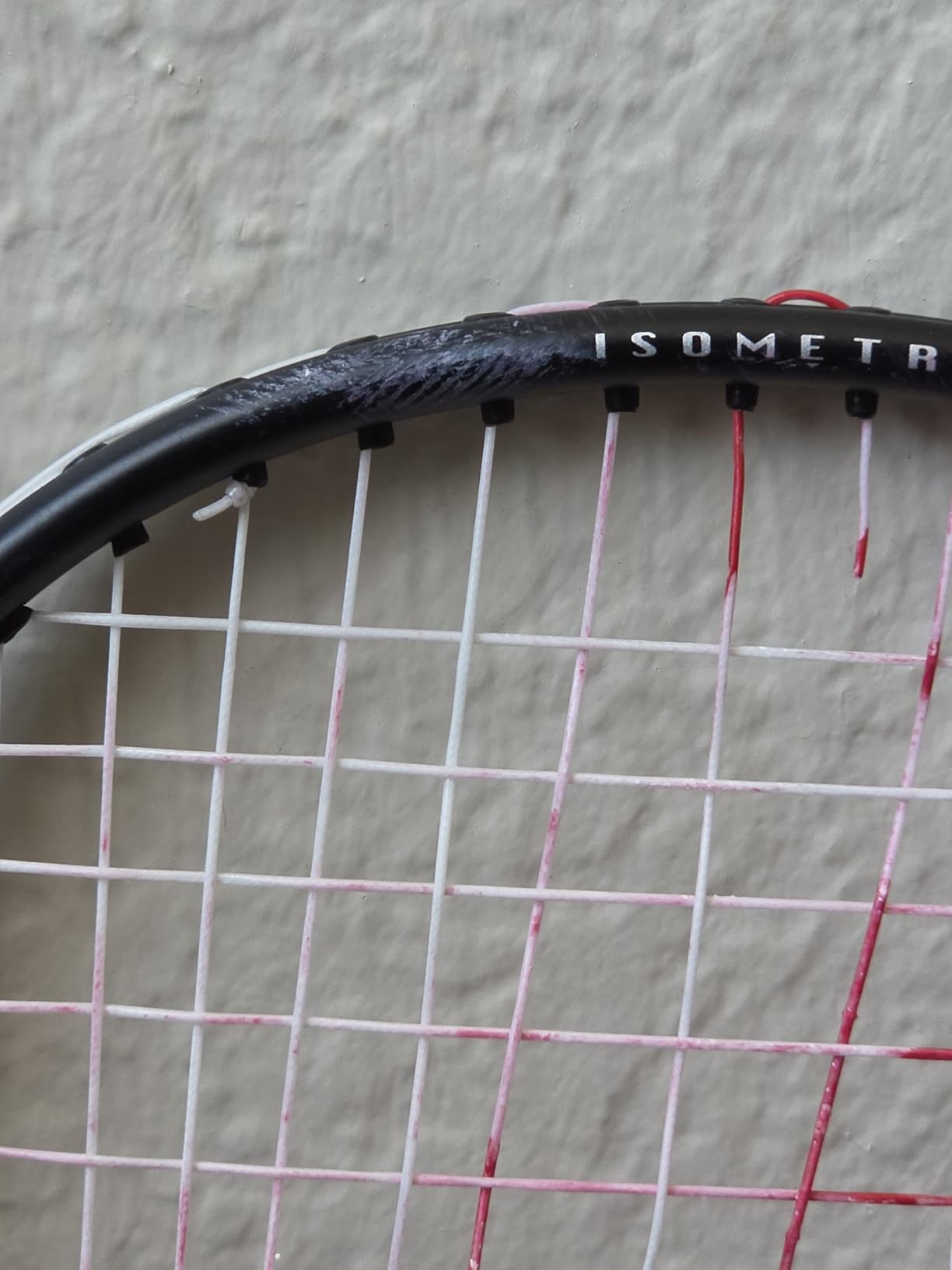
Grip size is listed at 3 3/4 inches, which is the right fit for most adult hands and noticeably better for beginners than a narrow junior handle. A grip that is too small forces you to squeeze to control the racket, and that tension in the forearm is the fastest route to wrist discomfort in a new player.
What you give up is refinement. Reviewers repeatedly note that the frame feels basic next to a premium Yonex racket, and the factory string tension is modest, so smash power is limited. For your first six months that is not a compromise. It is the reason you can still be hitting clears in month five instead of giving up in month two.
Check the grip size and total weight before you order
Two numbers decide whether this racket suits your hand, and both are printed in the spec sheet. Grip at 3 3/4 inches suits most adult men and plenty of women, but if your palm is narrow a smaller handle is easier on the fingers. Weight at 77 g is genuinely light, so it is a good match for anyone whose arm tires quickly.
Why it is not the right pick for everyone
If you already play regularly and want more punch on overheads, the factory tension will feel soft and you will outgrow it. Players chasing power on a smash should look at a head-heavy frame instead. And if you want a racket that grows with you through several restring cycles at high tension, this entry-level frame is not built for that.
2. Yonex Astrox Smash – Best Handling in a Single Racket
YONEX Astrox Lite 27i Graphite Strung Badminton Racket with Full Racket Cover (Blue) | for Intermediate Players | 77 Grams | Maximum String Tension – 30lbs
Weight: 77 g
Shaft: Slim graphite
Head: Isometric
Skill: Intermediate
Pros
- Slim shaft generates fast swing speed
- Isometric head enlarges the sweet spot
- Control Support Cap gives a flat secure grip
- Stays quick through long rallies
- Cover included
Cons
- Listed as unstrung so stringing is required
- Rotational Generator geometry suits intermediate players more than first-timers
The Astrox Smash carries the highest average rating of the single rackets here, and the reason shows up in the reviews: it handles. The slim shaft slices through the air, so beginners get to the shuttle faster without having to change their technique, which makes rallies last longer and practice sessions more satisfying.
The isometric head is the headline feature and it is a genuine beginner benefit, not marketing. A larger effective hitting area means a shot struck slightly off-centre still goes where you aimed, so you keep points alive long enough to understand why you lost them.
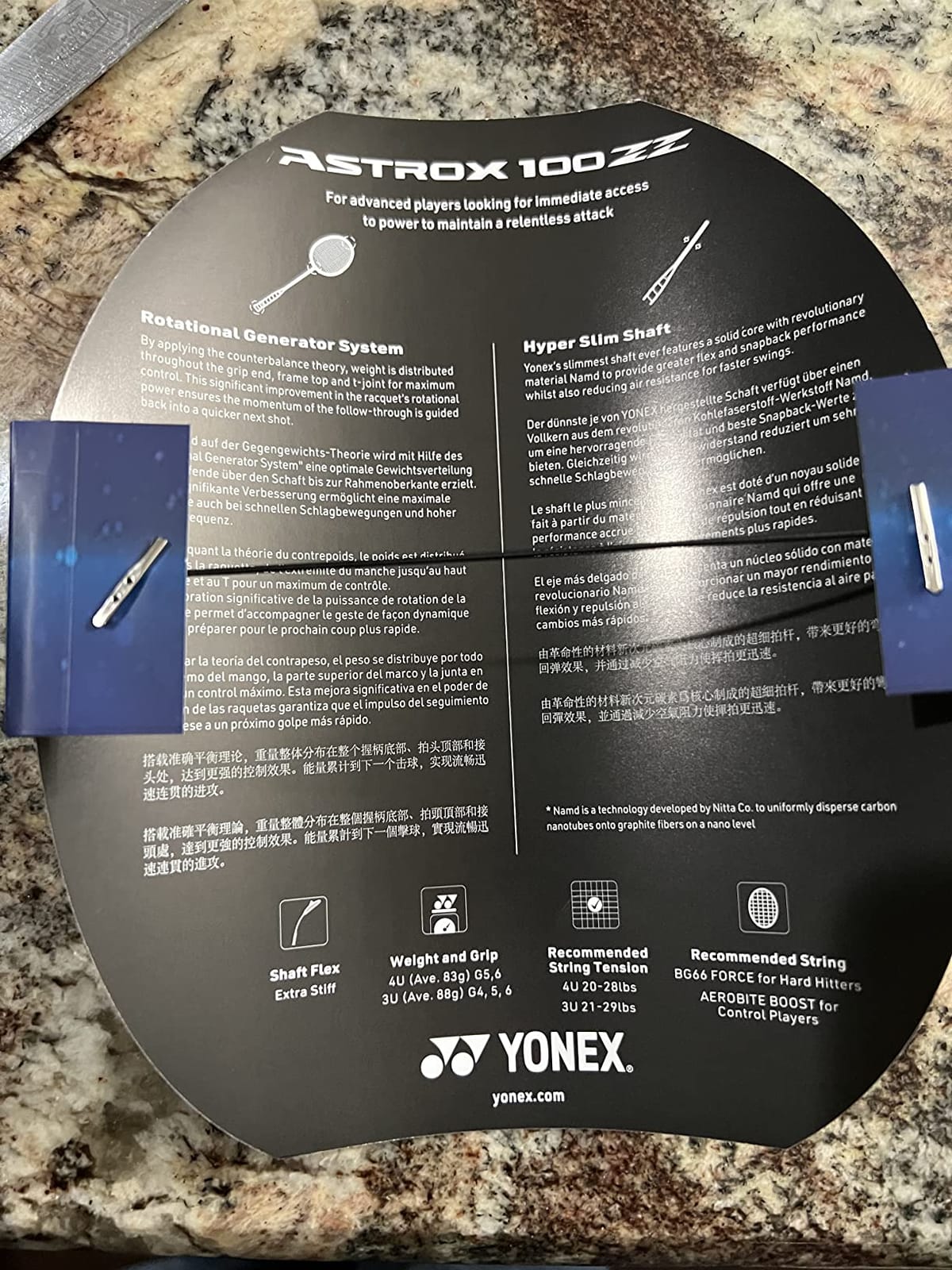
At 77 g it is the same weight class as our top pick, and the Control Support Cap gives you a wide flat surface under your fingers, which improves grip security during fast exchanges at the net. The racket cover is included, a small thing that matters if you plan to keep it in a car boot.
There is one real catch. This listing is unstrung, so you need a stringing job before the first hit, and budget for that step in your first-week plan. The Rotational Generator balance is also aimed at a player who already has a swing, so a total first-timer may find it less stable than the Nanoray until technique arrives.
Ask your shop to string it at a low beginner tension
Since it arrives unstrung, the stringer decides your sweet spot size. Ask for roughly 18 to 22 pounds rather than a high tension. Lower tension enlarges the effective hitting area and makes the frame feel more forgiving, which is exactly what a first-year player needs. Keep the tension record, because you will want to re-string at the same setting as you improve.
Where it falls short for a first racket
The cost of getting it ready to play makes it a worse one-racket choice than a pre-strung model. The rotational balance also rewards a swing that is already coordinated, so a player still building timing can find it twitchier than the Nanoray. If you want zero setup and maximum forgiveness on day one, this is the wrong pick.
3. HIRALIY 4-Racket Kit – Most Versatile and PE Classes
HIRALIY Badminton Set, 4 Rackets, 12 Birdies, 1 Carrying Bag, 4 Grip Tapes
Set of 4
Pre-strung
Frame: Ferroalloy
4.3 oz per racket
Pros
- Complete four-player kit with birdies and bag
- Light 4.3 oz rackets reduce fatigue
- Integrated T-joint keeps the frame steady
- PU grip tapes absorb sweat
- Top-selling racket category listing
Cons
- Ferroalloy is less powerful than carbon
- Included nylon birdies are basic
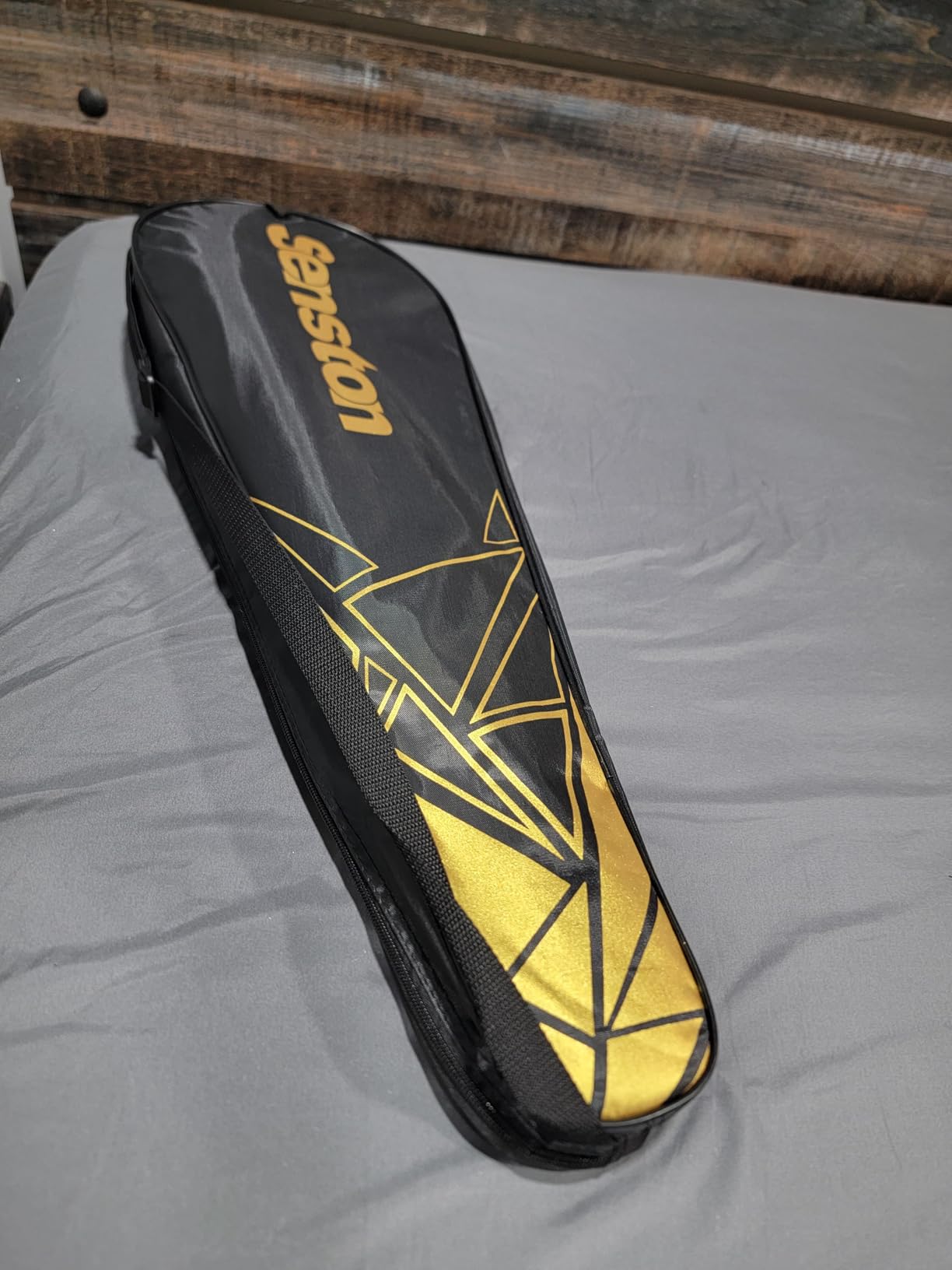
This is the practical answer for anyone who wants more than one player hitting. You get four rackets, 12 nylon birdies, four PU grip tapes and a carry bag, which covers a family, a group of housemates or a school PE class without a second shopping trip for accessories.
Each racket weighs 4.3 ounces, so the swing weight is light and forgiving. The one-piece tempered ferroalloy frame uses an integrated T-joint, which is the detail that matters here: two-piece budget frames tend to rattle and loosen at the joint, and this construction resists that.
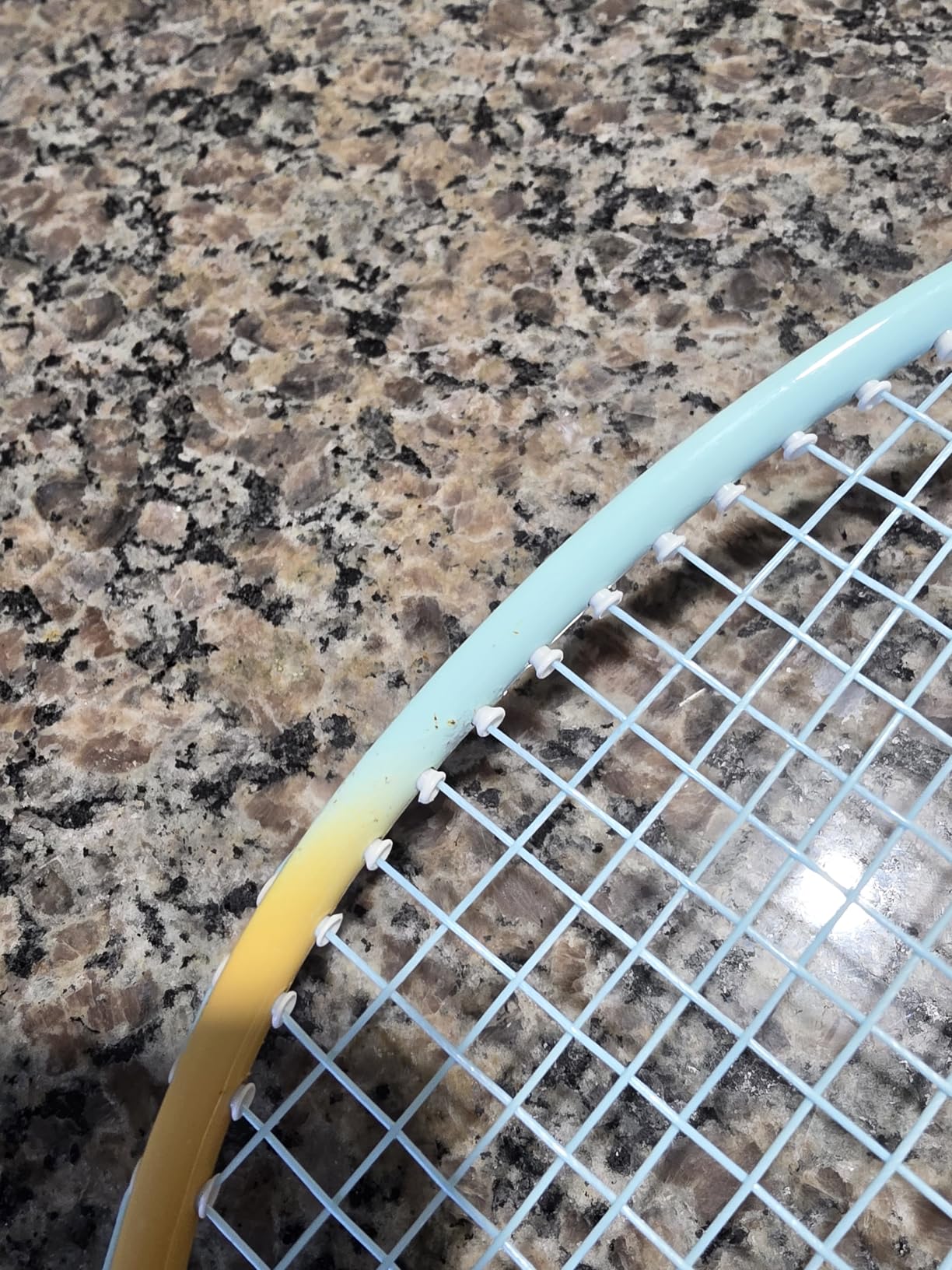
The PU grip tapes are genuinely useful for beginners. A fresh tacky overgrip keeps the handle from slipping in a sweaty hand, and grip slippage is a leading cause of the off-centre contact that frustrates new players. Replacing a tape costs a fraction of replacing a racket, so this is a kit you can keep alive for years.
Be realistic about what ferroalloy gives up. It is softer and less powerful than carbon or graphite, so you will not be generating elite pace, and the nylon birdies are the cheap plastic kind that most players replace within weeks. For family rallies in a garden, neither matters very much.
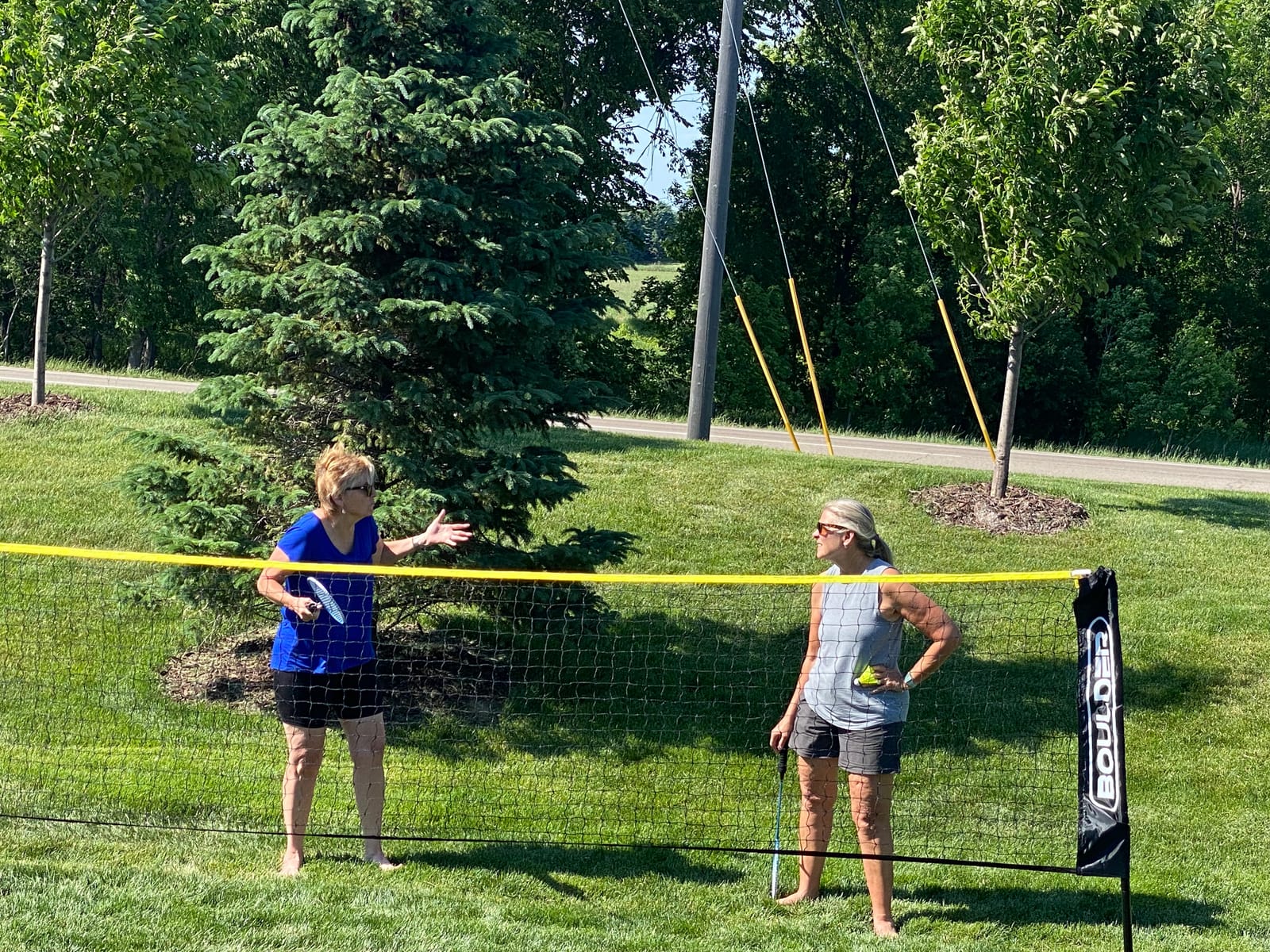
Check that four rackets is really what you need
The value of this kit is entirely in the count. If you are one player learning on your own, four rackets is three more than you will ever hold, and a single better frame serves you better. If you are buying for a household, a PE class, or a doubles group that plays regularly, this is the most efficient option on the list by a wide margin.
Where it falls short for a single beginner
Steel and ferroalloy frames transmit less feedback and less power than graphite, and a total beginner who is already struggling to clear the net will find the ceiling lower. The birdies are also the weak point. Plan to add a tube of feather or better nylon shuttles once you are playing regularly, because the included plastic ones wear out fast.
4. Senston Carbon Composite Set of 2 – Best Two-Player Carbon Pair
Senston Carbon Composite Badminton Set of 2, Lightweight, with Bag
Set of 2
Frame: Carbon composite
Pre-strung
Listed: 2.5 oz
Pros
- Carbon composite frame at about 90 g per racket
- Pre-strung and immediately playable
- Non-slip grip with two spare grip tapes
- Carry bag fits the whole kit
- Good string tension retention
Cons
- Included nylon birdies are poor quality
- Not built for tournament-level play
- Some reports of early frame or string damage
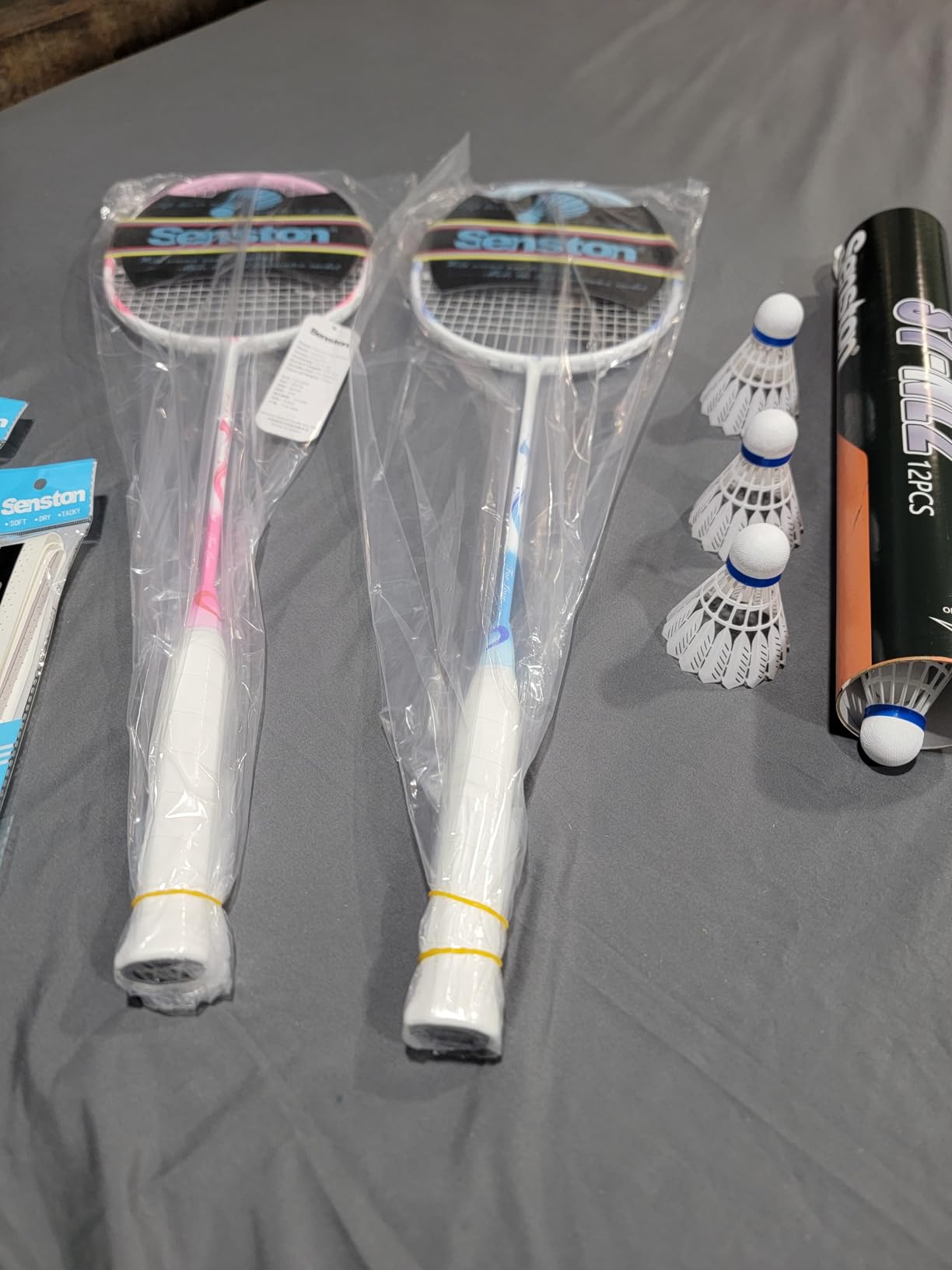
A two-racket set makes sense if you play with one other person, whether that is a partner, a spouse or a housemate who will actually swing a racket with you. The carbon composite frame is a real step up in feel from the ferroalloy kits, and the listed weight keeps sessions comfortable over a long evening.
Both rackets arrive pre-strung, and the non-slip handle comes with two replacement grip tapes already in the bag. For a beginner that is a complete first session without a shopping list, and the two-player format means the bag carries everything you need to the park in one trip.
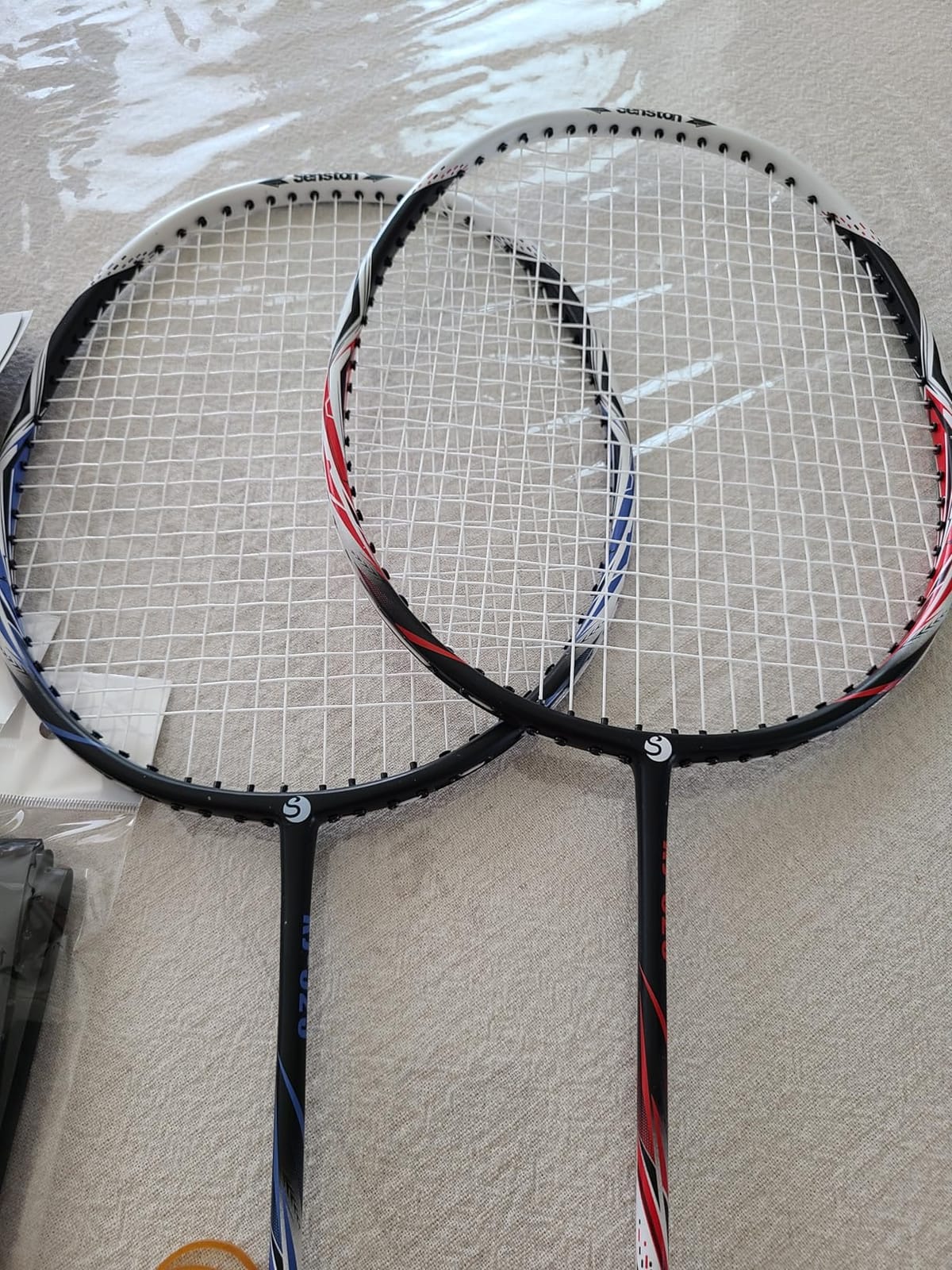
Reviewers describe the balance as comfortable and note that the string tension holds up over repeated rallies, which is what keeps a set usable past the first month. That matters more than it sounds, because a beginner swings harder than they think while learning a clear.
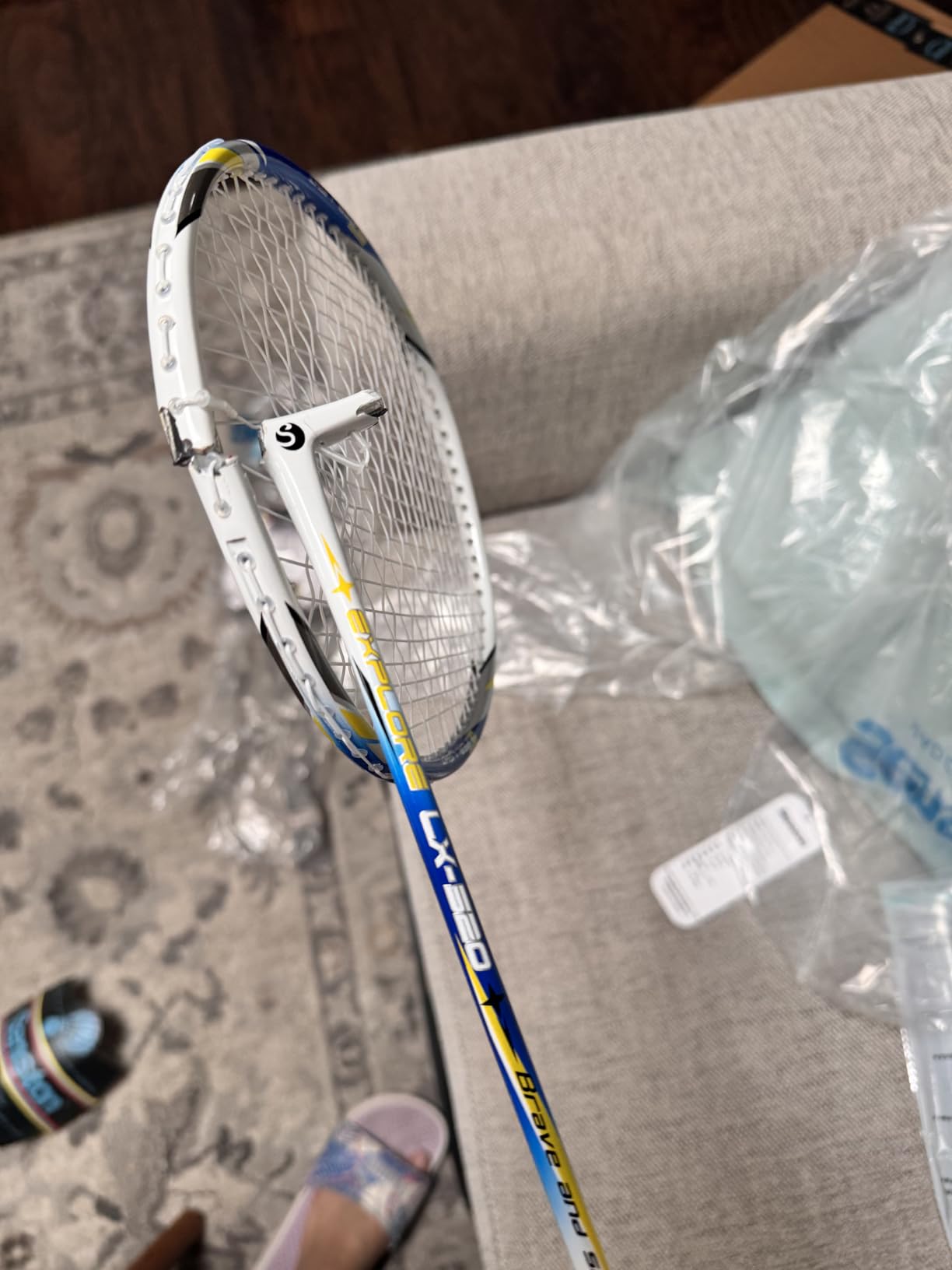
The complaints cluster around the birdies and durability. The included nylon shuttles are widely criticised, and a small number of buyers report a frame or string failing within a month or two. That is a minority pattern, but if you are buying for a shared racket situation, expect to replace the strings once early on.
Count the players before you choose a set of two
Two rackets is a right-sized purchase for a fixed partner and a poor one for a rotating group. If three or four people will play, the four-racket kit covers everyone and costs less per head. Also decide where the birdies will come from, because the shuttles in this set are the weakest component and you will want your own tube shortly.
Where it falls short for a serious beginner path
At roughly 90 g this sits at the heavier end of the beginner range, and heavier is not always kinder to a wrist that is not yet strong. It is also not engineered for club-level or tournament play, so if you expect to move quickly into league sessions and want a frame that grows with you, look at a graphite single racket instead.
5. Yonex Astrox Attack 9 – Best for Head-Heavy Power
Yonex Badminton Racquet Astrox Attack 9 Pearl White G4 4U(80GMS-32LBS) (Made in India)
Weight: 80 g
Frame: Graphite
Balance: Head-heavy
Pre-strung
Pros
- Head-heavy balance drives clears and smashes
- Light 80 g frame stays agile at the net
- Isometric head controls off-centre shots
- Durable graphite build for hard rallies
- Pre-strung in several colour options
Cons
- May need restringing for club-level play
- Some find the stroke response less crisp
Where most beginner rackets on this list are head-light or neutral, the Attack 9 puts the mass toward the head. That is the balance you want if your first frustration is not clearing the net, because a head-heavy frame carries momentum through the swing and produces more power from the same swing speed.
It stays light at 80 g, which keeps the frame agile for net play and fast defensive reactions. The isometric head supports control on off-centre shots, and the built-in T-joint and high-durability solid frame are rated to take repeated hard rallies without the joint loosening.
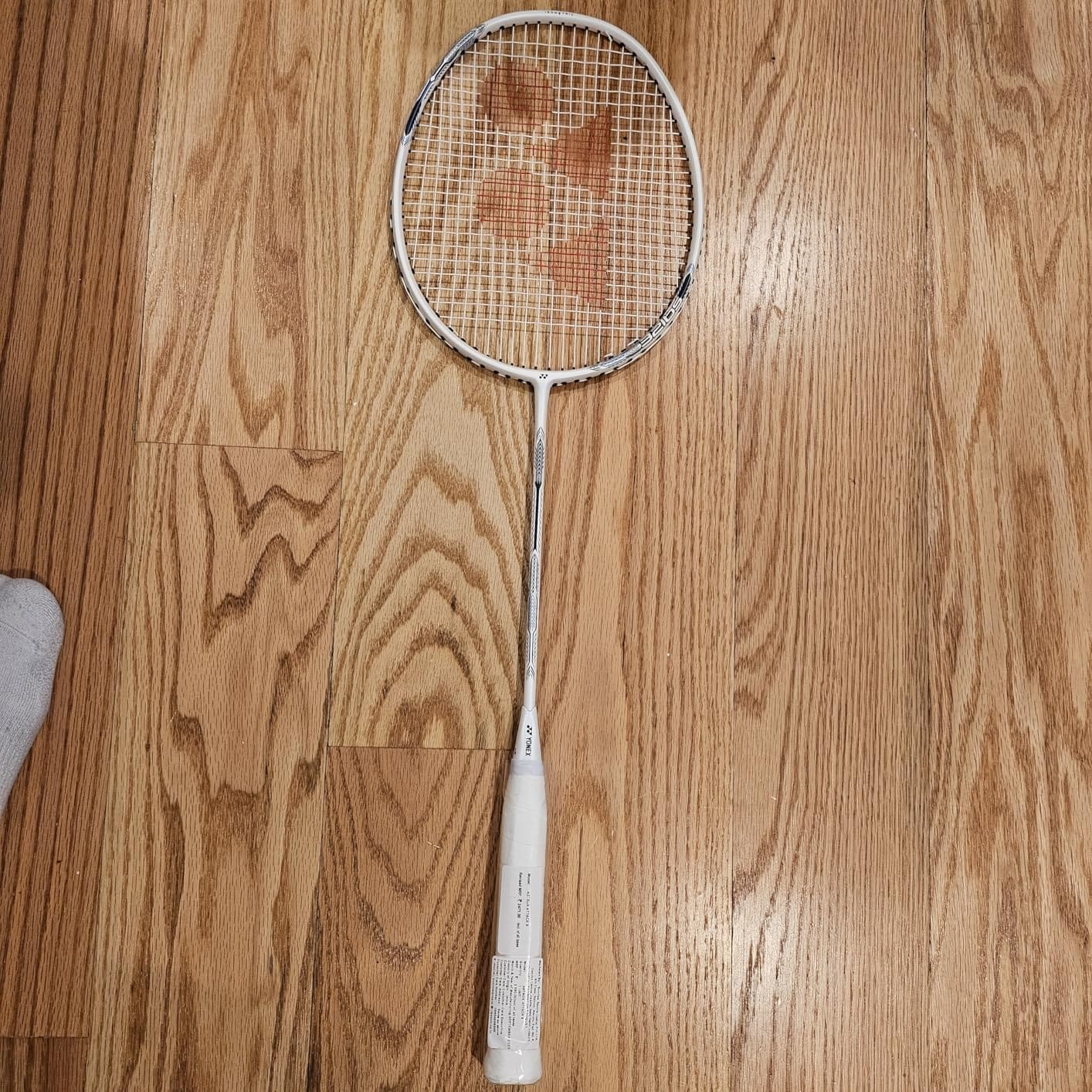
Grip size is listed at 4 1/2 inches, which is a noticeably larger handle than most of the rackets here. That is a real consideration, because a handle that is too large forces a cramped grip and that tension shows up in the forearm by the end of a session.
Reviewers describe it as a beginner-to-intermediate step up rather than a first racket. Several mention restringing before regular club play, and a minority find the stroke response less crisp than they expected. If your technique is still forming, the extra power can hide a lot of rough swings, which is exactly what you want early on.
Check the handle size and your net clearance
Two things to verify. First, the 4 1/2 inch grip is larger than the 3 3/4 inch standard on the Nanoray, so if your hand is small this will feel stretched rather than secure. Second, a head-heavy balance suits a player whose problem is power; if your problem is control at the net, a neutral frame will progress faster.
Where it falls short for a first racket
The balance is deliberately power-weighted, so a new player with an uncoordinated swing can find it harder to turn quickly in defence. The 4.2-star average also reflects some buyers feeling the response was not as crisp as they hoped. For a player who is already returning to the sport and wants immediate power, that trade is worth it. For a total novice, it is not.
6. Senston 90g Backyard Set – Best for Rough, Kid-Handled Play
Senston Badminton Rackets Set of 2 – Lightweight Carbon Fiber Composite Racquets for Beginners & Casual Play, with 3 Shuttlecocks & Carry Bag(Green+White)
Frame: Carbon composite
Weight: about 90 g
One-piece T-joint
Skill: Beginner
Pros
- Light carbon composite beats old metal rackets
- One-piece frame avoids rattling and loosening
- Secure grip on hard swings
- Holds up under rough play from children
- Bag and birdies ready to go
Cons
- Paint chips when the frame scrapes ground
- Included nylon birdies fly poorly
- Not designed for aggressive smashes
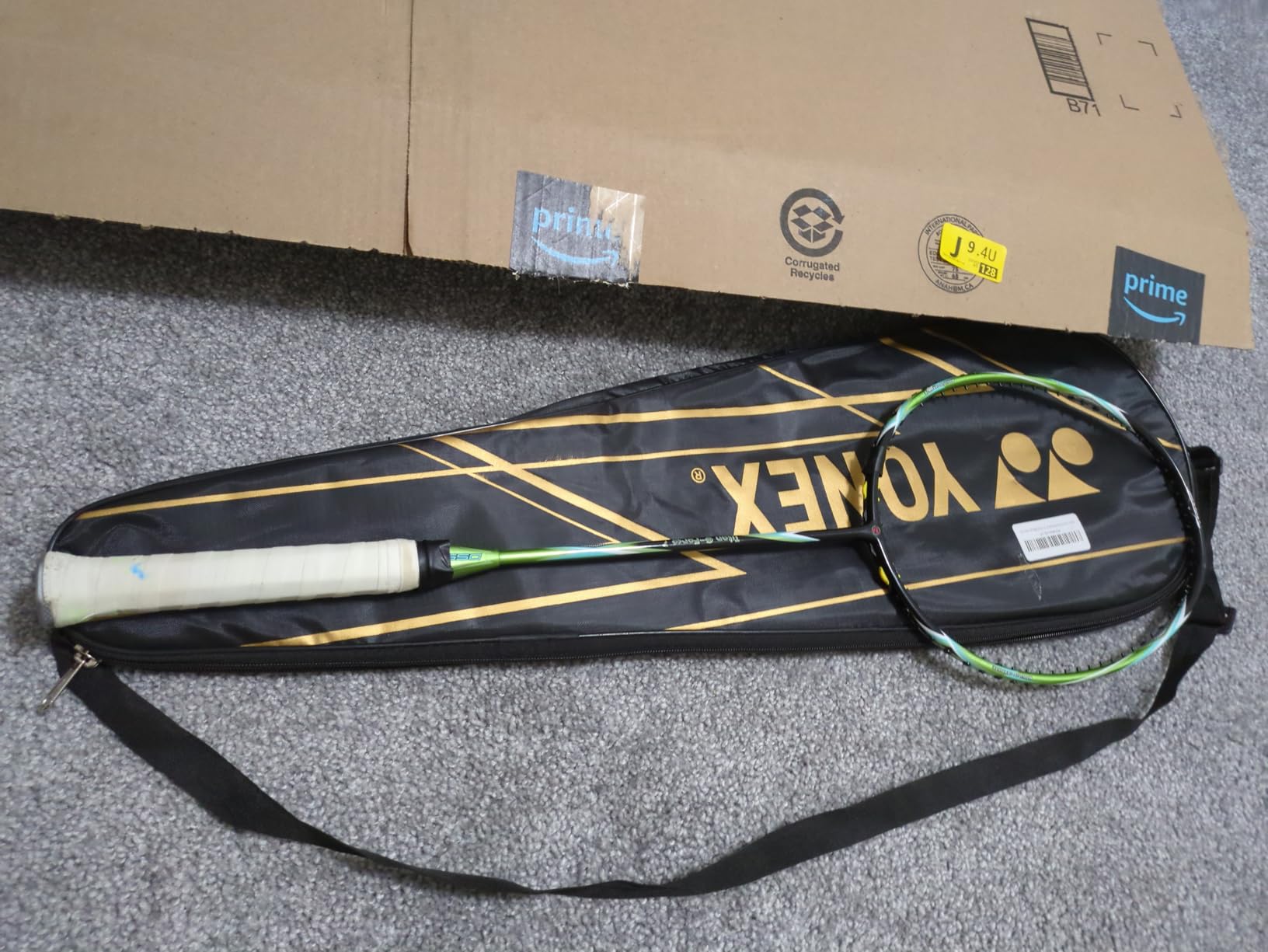
This is the set to buy when rackets will be dropped, scraped along concrete and handled by children. The carbon composite frame at roughly 90 g per racket is a big step up from the old-school metal rackets most people inherit, and the one-piece construction with an integrated T-joint is what keeps it from rattling and twisting.
One-piece matters more than it sounds. Two-piece frames rely on a joint to hold the head and shaft together, and that joint is the first thing to fail under casual abuse. Reviewers consistently describe this set as a dramatic improvement over metal rackets for exactly that reason.
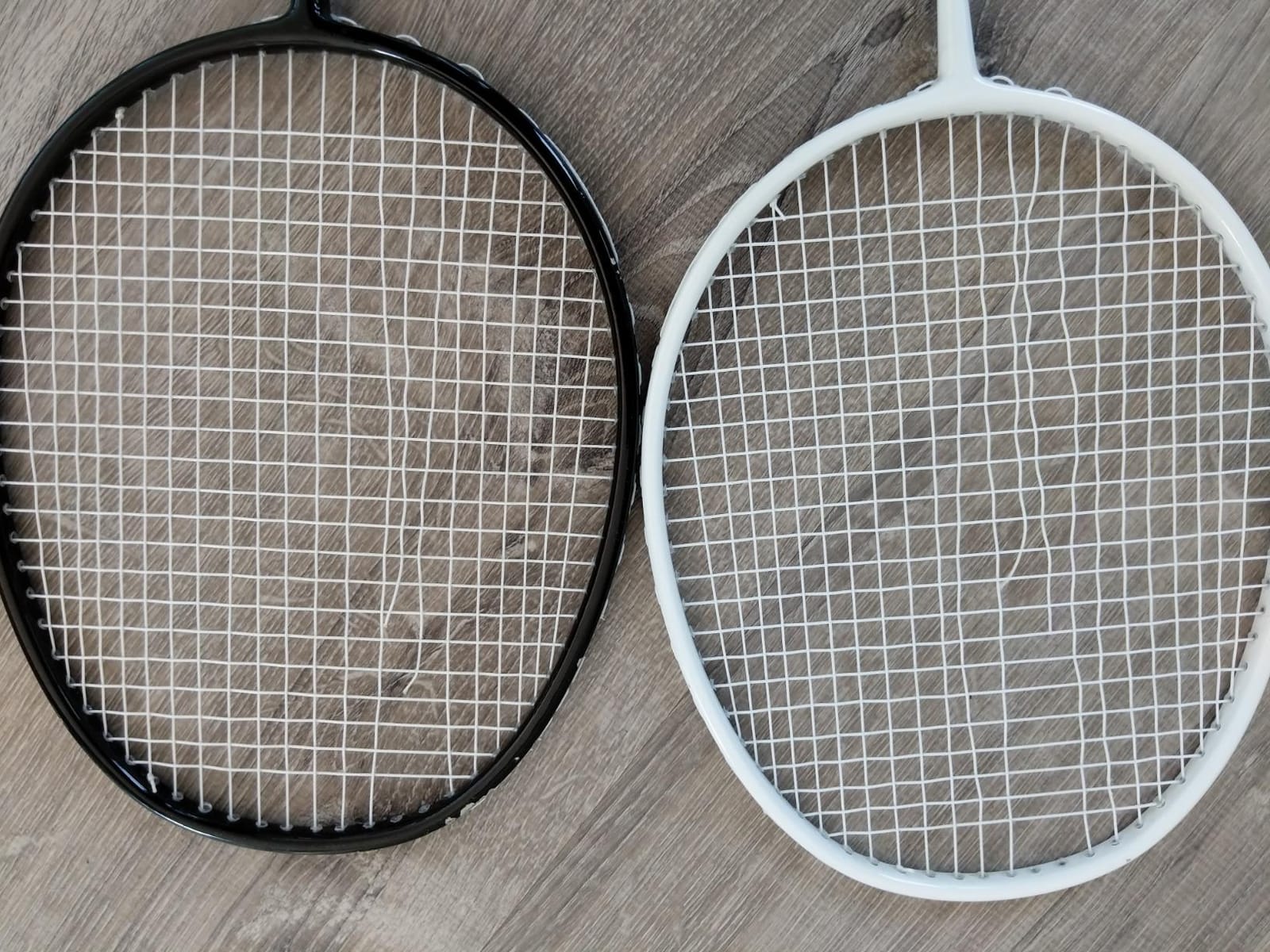
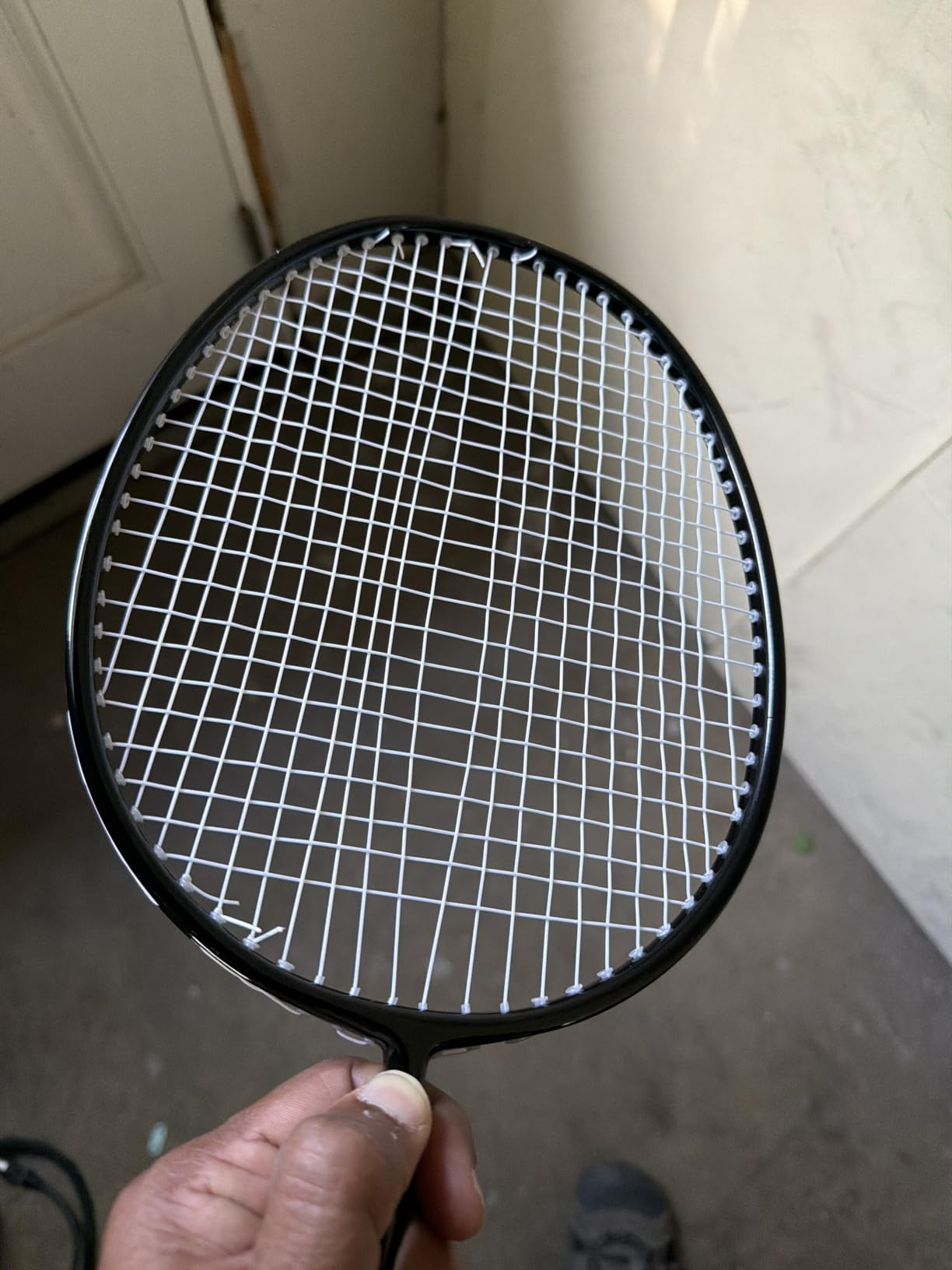
There is an isolated pattern of string breakage reported within weeks, and the brand’s customer service replaced the affected units. The paint also chips when a frame scrapes the ground, which is cosmetic rather than structural but worth knowing if appearance matters to you.
Plan to replace the birdies. The included nylon shuttles are poorly moulded and fly badly, though the bright colours are genuinely easy to spot in long grass, which saves retrieval time in a garden. Everything fits inside the included carry bag, which is the whole point of a grab-and-go set.
Check the surface you will be playing on
This set is built for outdoor recreational play, and the design choices reflect that. If you are hitting against a fence or on rough concrete, the durability holds. If you are moving to a proper court and starting to hit harder with intent, the frame is not designed for aggressive smashes and the strings will feel soft sooner.
Where it falls short for a developing player
At roughly 90 g it is one of the heavier frames here, and a smaller child working on fundamentals may find it tiring over a long session. The one recurring functional complaint is the quality of the included birdies, so budget for a proper shuttle tube rather than planning around these.
7. Zalava 4-Pack 4U Carbon – Best for School and Club Groups
Zalava Professional Badminton Rackets Set, Lightweight Badminton Racquets, 4U Badminton Set 4 Pack, Carbon Fiber, for Beginners, Advanced Players, Teens, Family Fun & Outdoor Activities
Set of 4
4U at 82 g
String tension 24 lbs
100% carbon
Pros
- Full carbon frames with built-in T-joint
- Very light 82 g 4U rating relieves strain
- Beginner-friendly 24 lb factory tension
- Grips pre-wrapped by professionals
- 1-year warranty and spare overgrips
Cons
- Highest cost in this group
- Only three feather birdies included
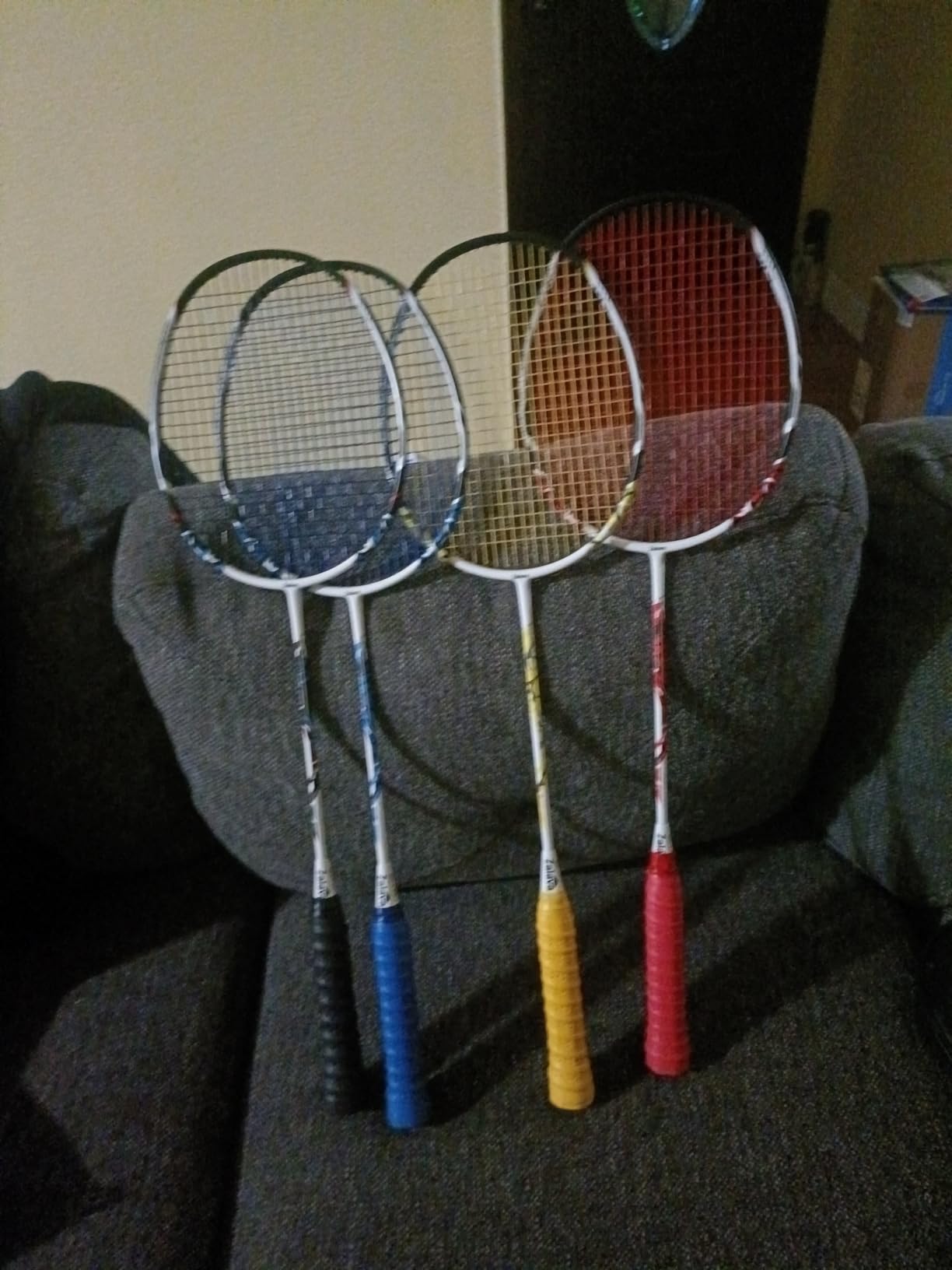
This is the most explicitly specified racket set here, and that is exactly why it suits organised groups. The 4U rating and the 82 g per-racket weight are stated outright, so when you are buying for a PE class or a club group you are not guessing at sizing the way you would with a generic kit.
The factory string tension of 24 lbs sits in a range that works for beginners and still supports improving players, which means one purchase can serve a group with mixed ability for a season or more. The pro-wrapped anti-slip overgrips remove a genuine beginner stumbling block: wrapping a handle correctly is fiddly, and a badly wrapped grip twists during play.
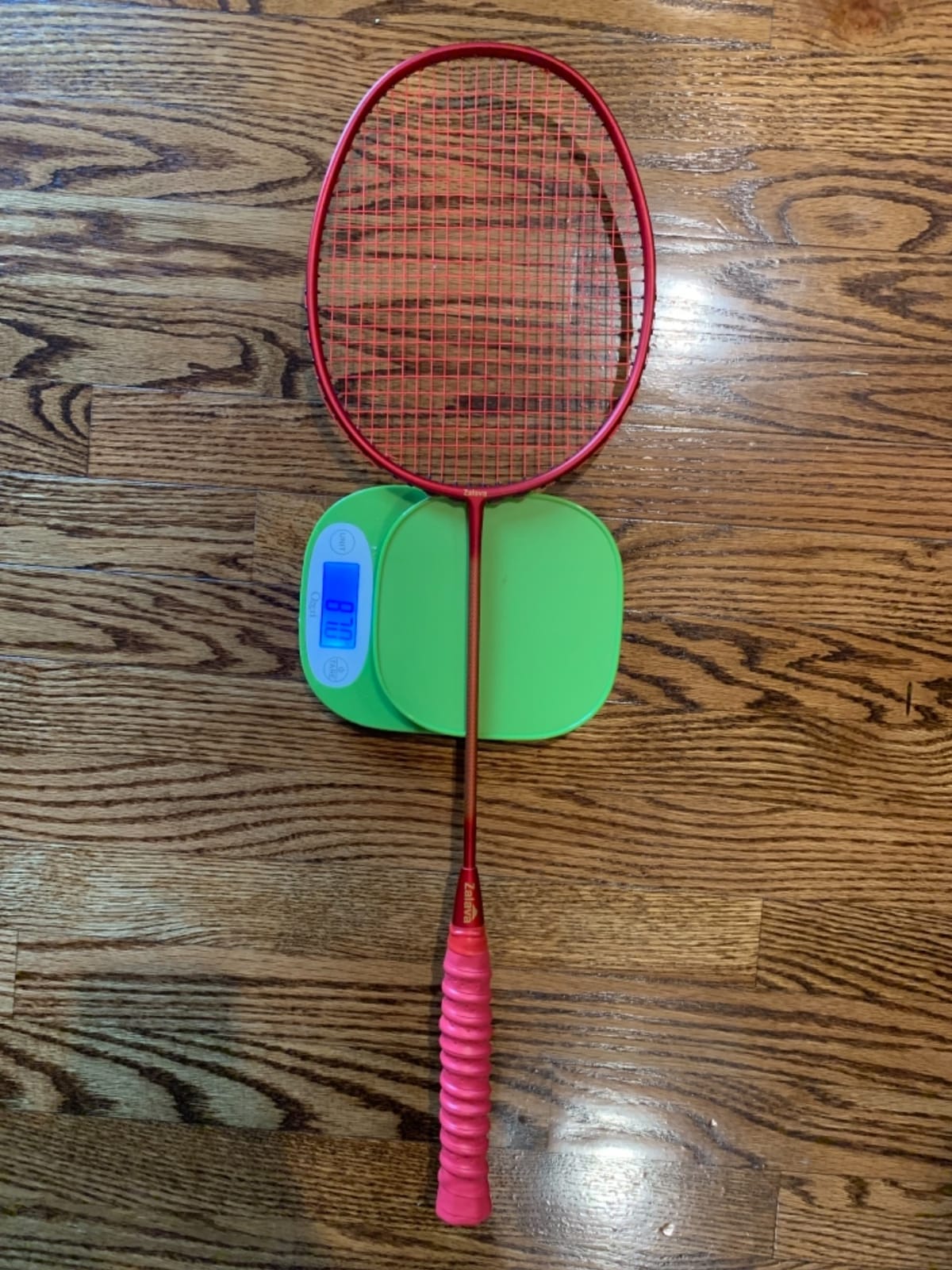
Full 100% carbon construction with a built-in T-joint is the durability story here. Carbon frames resist deforming under impact, and the joint design keeps the head aligned when a new player swings hard and lands off-centre, which is most of the time in month one.
The pack contains four rackets, two bags, three feather shuttlecocks and four replacement overgrips, plus a 1-year warranty. Only three feather birdies is a thin supply for regular doubles, so plan on adding shuttles. It is also the most expensive option in this roundup, so the value depends entirely on needing all four frames.
Work out how many players the four frames serve
This set is priced per racket well above the metal kits, so it only makes sense when you genuinely need four. A coach buying for a school class, a club running a social session, or a family group playing doubles all benefit. A single solo learner would get far more value from one good graphite racket and a tube of shuttles.
Where it falls short
It is the wrong purchase for a lone beginner, mostly because of cost, and the 24 lb factory tension is firmer than the low-tension feel that most first-year players find easiest. Newcomers who are worried about arm strain should know that tension sits at the firmer end of the beginner range, so this rewards a player who is already building strength.
8. Senston N80 Carbon Pair – Best Lightweight Carbon Upgrade
Senston N80 Carbon Fiber Badminton Racket 79g Lightweight 2-Player Set
Set of 2
5U at 75-79 g
Full carbon
Restringable to 28 lbs
Pros
- Genuinely light 75 to 79 g carbon frames
- Isometric head gives a forgiving sweet spot
- Pyramid frame profile cuts air resistance
- Pre-strung and restrable to 28 lbs
- Two carry bags included
Cons
- Priced well above entry-level rackets
- Design leans toward progressing players
The N80 is the lightest material construction in this roundup, and that distinction matters. Carbon at 75 to 79 g is a genuine weight class below almost everything else here, and lower mass means less forearm fatigue across a long session, which is the single most common reason beginners stop playing.
The isometric square head enlarges the effective hitting area, and the pyramid frame profile is shaped to cut air resistance so the racket head accelerates faster through a swing. Those two features combine into a frame that is forgiving and quick, which is a good pairing for a player still developing timing.
It arrives pre-strung and can be restrung up to 28 lbs as technique improves. That upgrade ceiling matters for anyone who knows they will be playing beyond a year: the same frame works for a beginner at moderate tension and for a stronger swing at a higher one, so this is a two-stage purchase rather than a single-season one.
The honest caveat is that this is priced above the entry-level options and the design leans toward players who are progressing rather than absolute first-timers. If you are unsure whether you will stick with badminton, a cheaper graphite racket is a lower-risk place to find out.
Check the restring ceiling if you expect to progress
Being restrable to 28 lbs is the number to look for if you can see yourself playing regularly. It means the frame has headroom: you start at a moderate tension as a beginner and move up as your swing produces consistent power. Rackets that are only strung once at a low tension tend to feel dead once your technique arrives.
Where it falls short for a first racket
It costs more than the entry-level single rackets, and at 75 to 79 g some players find the frame almost too light, feeling less solid on contact than a neutral or head-heavy build. If you like the feeling of mass through the swing, a graphite frame around 80 g will feel more substantial in the hand.
9. Kawasaki Carbon Set of 2 – Best Set With Feather Shuttlecocks
Badminton Rackets, Professional Graphite Shaft Badminton Set of 2 for Backyard, with 2 Lightweight Carbon Badminton Racquets/3 Badminton Shuttlecocks/2 Racquet Overgrips/1 Carry Bag
Set of 2
95 g per racket
Carbon frame
Skill: Beginner
Pros
- Light carbon frames hold up over months
- One-piece exterior with internal T-joint
- Interchangeable grips and carry bag
- Feather shuttles included
- Suits beginners and advanced players
Cons
- String tension runs high for total beginners
- Some sets arrive with plastic rather than feather birdies
- Only a 45-day warranty
Almost every budget set on this list includes plastic nylon birdies, which is why this one stands out. Feather shuttlecocks are included, and they fly and behave quite differently, which makes them a much better teacher for a beginner who wants to develop real shot technique rather than getting used to a slow plastic shuttle.
Each racket weighs 95 g, so this is the lightest-feeling recommendation for anyone who wants a frame that is noticeably less demanding on the arm. The one-piece exterior with an internal T-joint gives good stability and control, and the interchangeable grips let you swap a worn handle without replacing the racket.
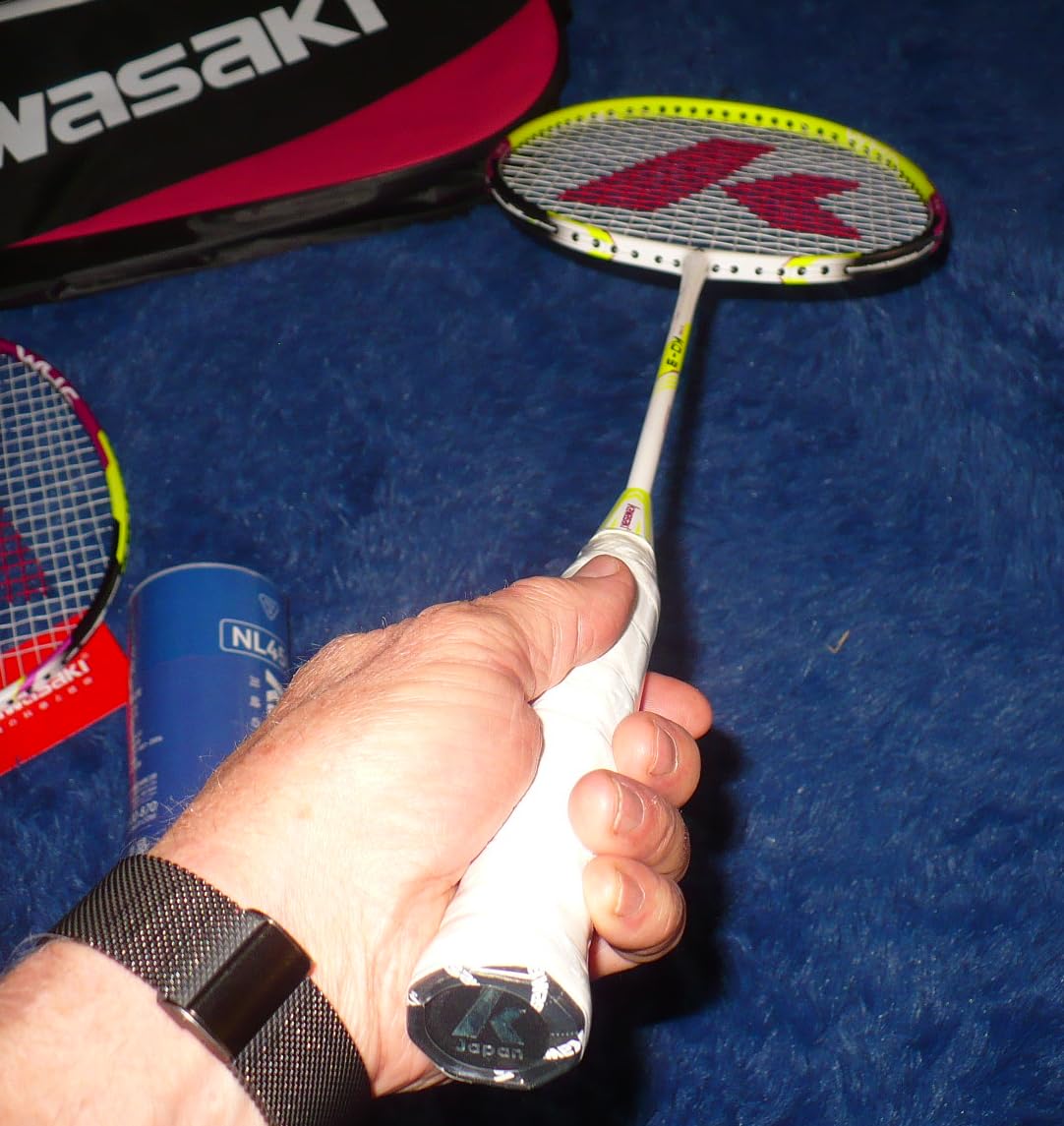
There is a real quality control inconsistency in the reviews. One buyer reported receiving plastic rather than feather shuttles, so check the contents on arrival and keep the listing in your order history in case you need to raise it. The 45-day warranty is also the shortest of any set here, which is worth knowing before you rely on it.
Buyers who play regularly in the yard describe the frames as comfortable and durable over months of use. A long-term player did note that the current build feels cheaper beside an older Kawasaki racket, which is a fair comparison for anyone who already owns one from years ago.
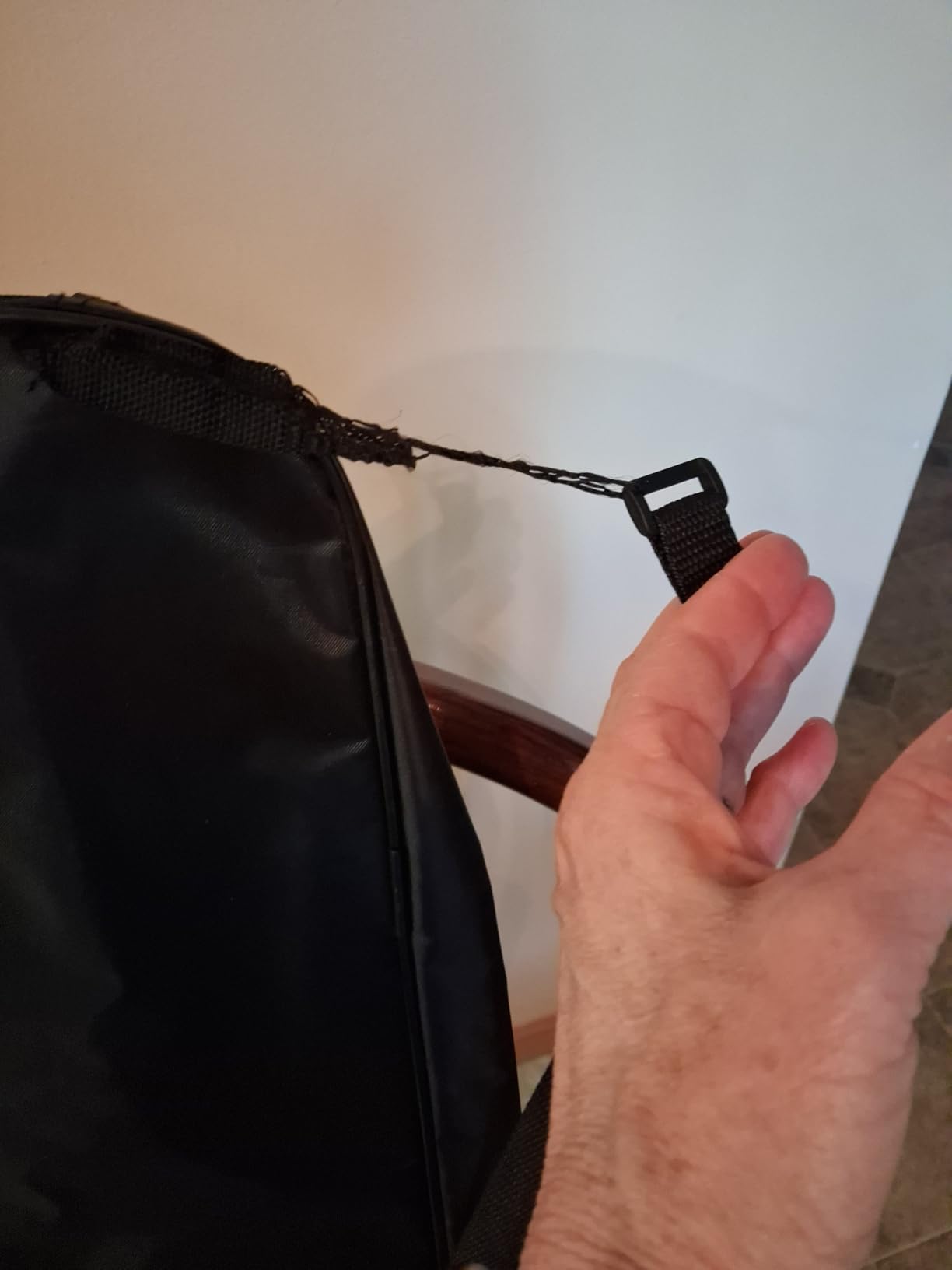
Verify the birdies and the tension once it arrives
Two checks on day one. Confirm the shuttlecocks really are feather, because a set arriving with plastic changes the whole feel of practice. Then ask a shop to look at the string tension, which reviewers describe as a little high for a total beginner, and have it dropped to a lower setting if your first sessions feel effortful.
Where it falls short
At 95 g this is among the heavier frames here, and heavier rackets fatigue a developing arm faster during long sessions. The short warranty and the occasional contents mismatch also make it a slightly riskier pick than a set sold with a longer guarantee. If you are a total beginner, drop the tension before you start.
10. Banvih 4-Racket Outdoor Set – Best for Family and Beach Play
Banvih 4-Racket Badminton Set – Outdoor Beach Yard Camping Games for Family
4 rackets and paddles
12 mixed-speed birdies
Wood frames
Ages 5 and up
Pros
- Mixed-speed birdies suit different ages in one game
- Complete package with paddles and bag
- Weather-resistant frames and strings
- Light and easy for children and adults
- Works at beach lawn yard or campsite
Cons
- Wood is the least refined material in this group
- Handles can slide off
- Birdies need replacing after regular play
This set exists for a specific situation: a mixed-age group playing outdoors on grass, sand or a campsite where a court does not exist. The frames and strings are built to resist warping in sun or sand, which is the failure mode that ruins ordinary rackets left in a garden shed.
The mixed-speed birdies are the genuinely clever part. You get two slow and ten fast, so a five-year-old and an adult can rally in the same game, and slower shuttles are also what a first-timer needs to build a swing. That removes the single biggest barrier to family badminton, which is that adult shuttles are too fast for children.
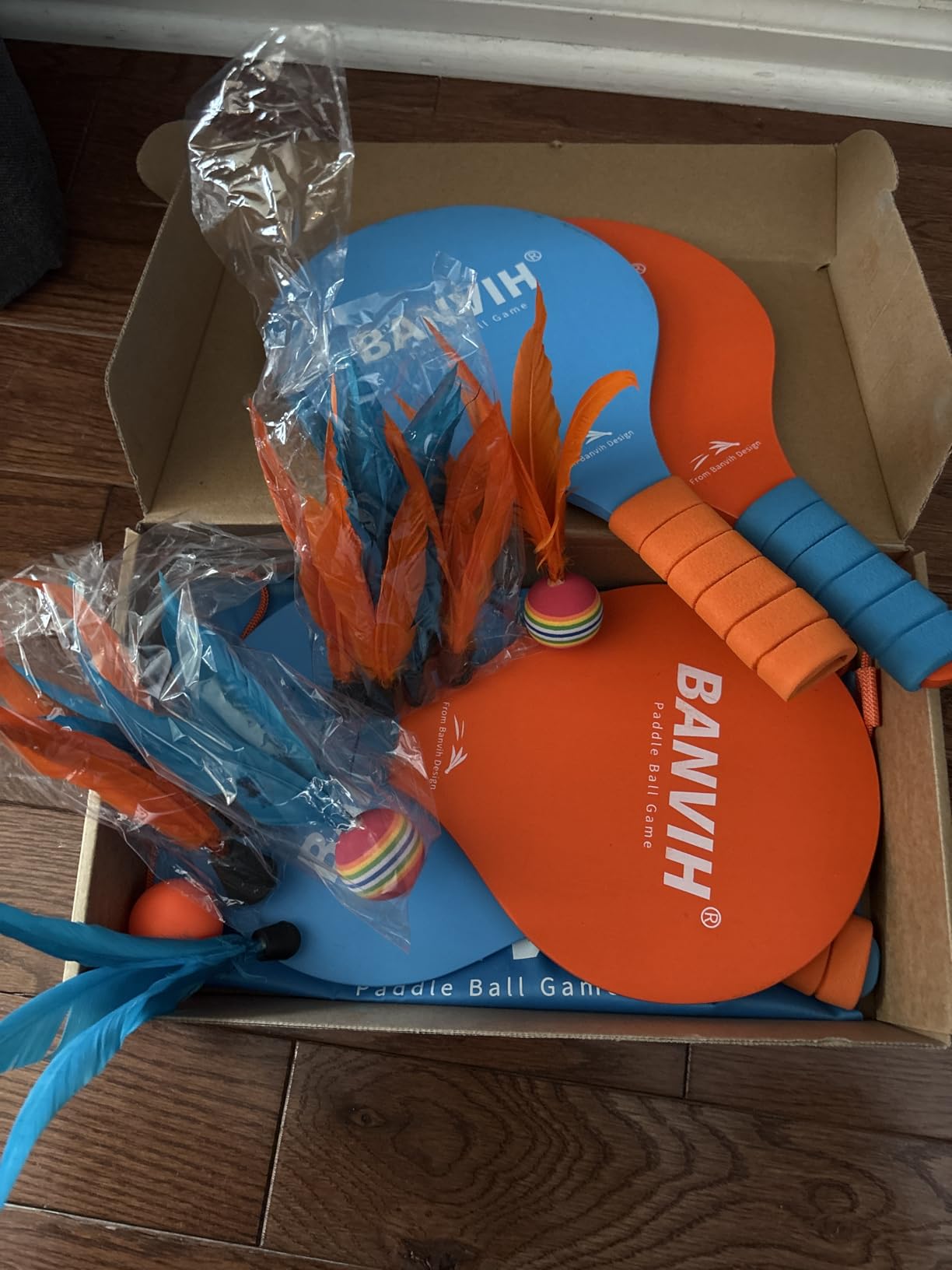
It is also a multi-game set, adding two low-elasticity waterproof paddle balls so the group has something to do when the birdies are done. The drawstring bag keeps everything together for transport, and reviewers consistently describe the whole package as fun and complete rather than as a performance purchase.
The trade-off is honest and worth stating. Wood is the least refined material in this roundup, one buyer considered the set overpriced for what it is, and handles that slide off are a recurring complaint. The birdies also wear out with regular use, so treat the shuttles here as starters rather than a long-term supply.
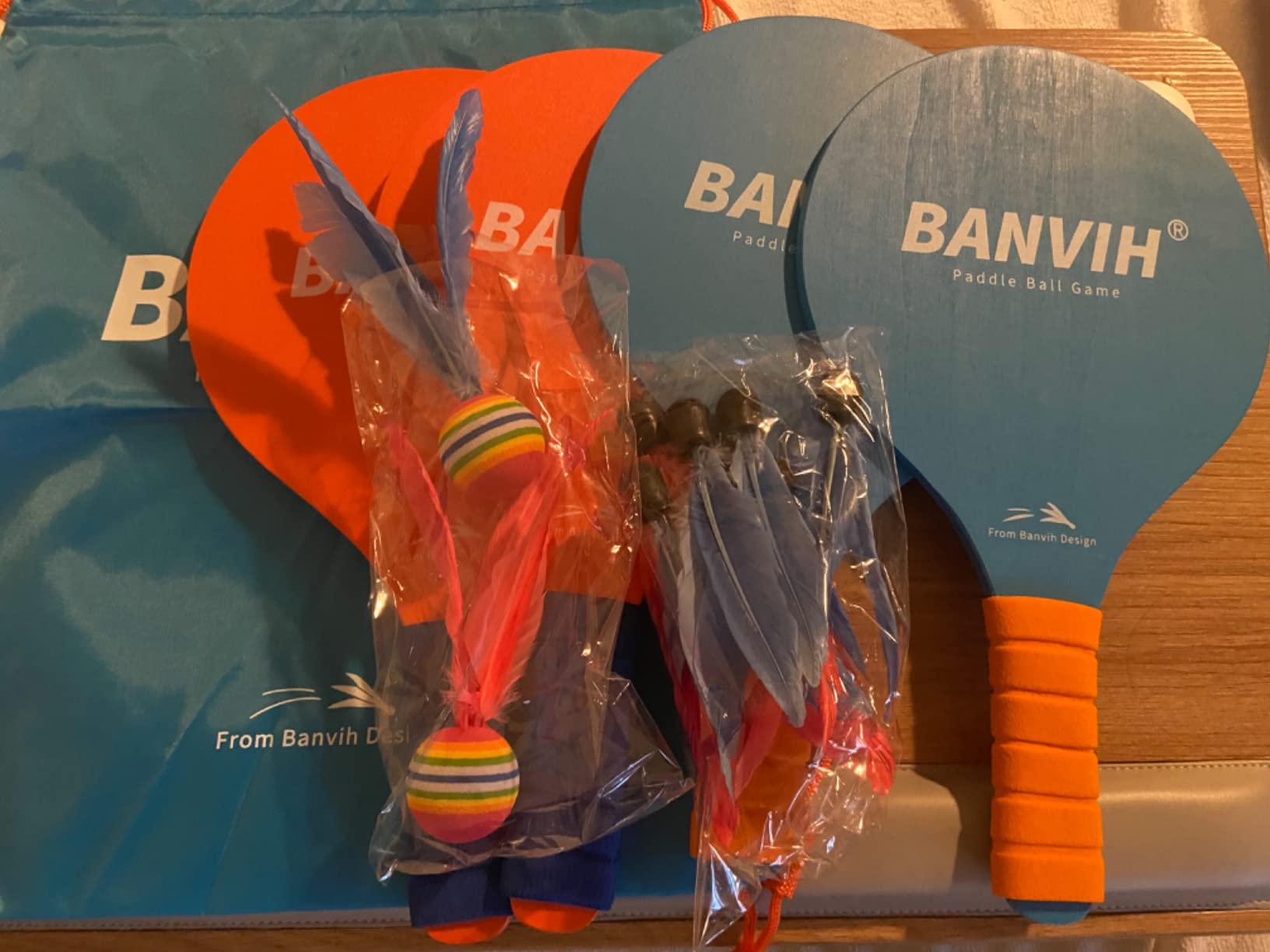
Check the ages playing together
This is the only pick here built for children as young as five alongside adults, and the mixed-speed shuttles are the reason. If your household spans a wide age range, that feature is worth more than frame technology. If everyone playing is an adult who wants to improve, a single graphite racket is a much better use of your money.
Where it falls short
Wood frames transmit the least feedback and the least power here, and they are not the material you want for learning to clear the net with control. The handles that slide off are a real problem for younger players with less grip strength, so wrap an extra overgrip over the top if that happens. This is a play kit, not a training racket.
Badminton Racket Buying Guide for Beginners in 2026
Most of the specification confusion beginners hit comes from four terms that look interchangeable and are not. Here is how each one changes how a racket feels, and what to look for when you read a spec sheet.
3U vs 4U vs 5U: which weight class should a beginner use?
The U rating is a weight class, where a lower number means a heavier racket. For a beginner the answer is nearly always 4U or 5U, and most coaching guidance points at a frame somewhere around 80 to 85 g.
3U (85-89 g): more solid on contact and better for players who already generate power. Heavier on the arm, so it is a poor first choice for a new player.
4U (80-84 g): the safest default for most beginners. Enough mass to feel like a racket, light enough for long sessions. The Zalava 4U set at 82 g is the clearest example in this roundup.
5U (75-79 g): the lightest class and the least tiring. The Nanoray 10F at 77 g and the Senston N80 at 75 to 79 g sit here. Great for fast doubles and for anyone whose arm tires quickly.
Plainer version: if you are unsure, choose 4U in the low 80s. It is the class most beginner ranges are built around, and the difference between 4U and 5U is far less important than the difference between a 95 g frame and a 78 g one.
Balance point: head-light, even or head-heavy?
Balance is where the weight sits, and it decides what kind of shot the frame makes easy.
Head-light: quick to turn and fast in defence. This is the most beginner-friendly balance because it makes reacting to a fast shuttle possible.
Even: a neutral middle ground that suits doubles and mixed ability groups.
Head-heavy: generates the most power on clears and smashes but is slower to swing. The Yonex Astrox Attack 9 is the head-heavy option here, and it suits a player whose problem is power rather than control.
Shaft flexibility and string tension
A flexible shaft bends during the swing and acts like a spring, adding power to a swing that has not finished yet. That is precisely what a beginner needs, and it is the main reason a graphite or carbon frame feels more powerful than a stiff metal one.
String tension works the same way in reverse. Lower tension, roughly 18 to 22 lbs, enlarges the effective sweet spot and makes the racket feel forgiving. Higher tension shrinks it and rewards precise timing. Beginners should start at the lower end, and a 24 lb factory setting, as on the Zalava set, is already at the firmer boundary of comfortable for a novice.
Grip size and head shape
Grip size is measured in inches and it is the easiest thing to get wrong. A handle that is too small makes you squeeze, and that tension travels straight into the wrist and forearm. Most adult rackets here sit at 3 3/4 inches, with 3 1/4 inches for smaller hands, 4 inches for larger hands and 4 1/2 inches on the Astrox Attack 9. A junior racket is a genuine option for children rather than an adult frame that is simply smaller in weight.
Head shape matters less than beginners expect. An isometric head has a squarer profile and a larger effective hitting area, which forgives off-centre contact. Most of the rackets here use one, and the practical result is that mistimed shots stay in play long enough for you to learn from them.
What to avoid as a first racket
Three mistakes dominate the forum complaints we reviewed. Buying a tournament-grade frame full of stiff shaft and high tension is the first: those rackets are built for a player who already generates 300 watts of smash, and they feel dead and tiring to everyone else. Buying a heavy aluminium racket is the second, because the weight adds arm strain without adding the power that justifies it.
The third is the most common of all: worrying that a cheap racket means a bad start. It does not. Feedback in community threads is consistent that a low-cost racket is genuinely fine for the first months, and the real difference a more expensive frame makes is tolerance of off-centre hits, not raw power. Buy one pre-strung racket at the weight class that matches your hand, play for a season, and upgrade when you know what you want to change. Our badminton sets roundup covers the rest of the first-session kit.
Frequently Asked Questions
Should I get a 3U or 4U racket?
For most beginners, 4U at around 80 to 85 g is the safe default. 3U frames run 85-89 g and feel more solid on contact but fatigue the arm faster, which is a poor trade when you are still learning. If you are unsure, choose 4U, and go lighter toward 5U only if you know your arm tires quickly.
What is a good beginner racket?
A good beginner racket is light, forgiving and pre-strung. Look for a frame around 80 to 85 g in the 4U class, an isometric head for a larger sweet spot, a flexible shaft that adds power to an unfinished swing, and low string tension around 18 to 22 lbs. Grip size matters as much as weight for comfort.
What type of badminton racket is best for beginners?
An entry-level graphite or carbon frame is the best type for beginners because the material is light and the shaft flexes, producing power from imperfect technique. Aluminium and steel kits are more durable and cheaper but transmit less power. Buy one pre-strung racket rather than a multi-racket set unless several people will play.
Is Yonex or Li-Ning better?
Both are respected badminton brands and both make beginner frames, so the deciding factors are weight, balance and grip fit rather than the badge. The beginner picks in this roundup lean on Yonex models such as the Nanoray 10F because they state weight and balance clearly and arrive pre-strung. Judge any brand the same way: check the weight class and shaft feel first.
Is Astrox or Nanoflare better?
For a beginner, both Yonex families work and the choice is mostly about handling. Astrox models are typically built with a head-heavy balance for power, while Nanoflare models are built fast and head-light for quick exchanges at the net. A beginner who struggles to clear the net may prefer Astrox, while one who plays doubles and reacts quickly may prefer Nanoflare.
What should I look for when buying a badminton racket?
Check six things: total weight and U class, whether the balance is head-light or head-heavy, shaft flexibility, string tension, grip size, and the size of the sweet spot. A light frame of 75 to 85 g reduces arm strain, a head-light or even balance improves manoeuvrability, a flexible shaft adds power without technique, lower tension enlarges the sweet spot, and a grip that fits your hand prevents wrist pain.
Final Verdict: Which Beginner Racket Should You Buy?
The Yonex Nanoray 10F Hi-Flex is our pick for the best badminton racket for beginners, at 77 g, pre-strung and rated 4.5 stars by more than 21k buyers. If you want sharper handling, the Astrox Smash is the alternative, and if several people need to play at once, a four-racket kit covers everyone in one order.
Play with it for a season before you change anything. When you do upgrade, a carbon frame that restrings to a higher tension is the natural next step, and a proper overgrip costs a fraction of a new racket while improving grip and control immediately.