
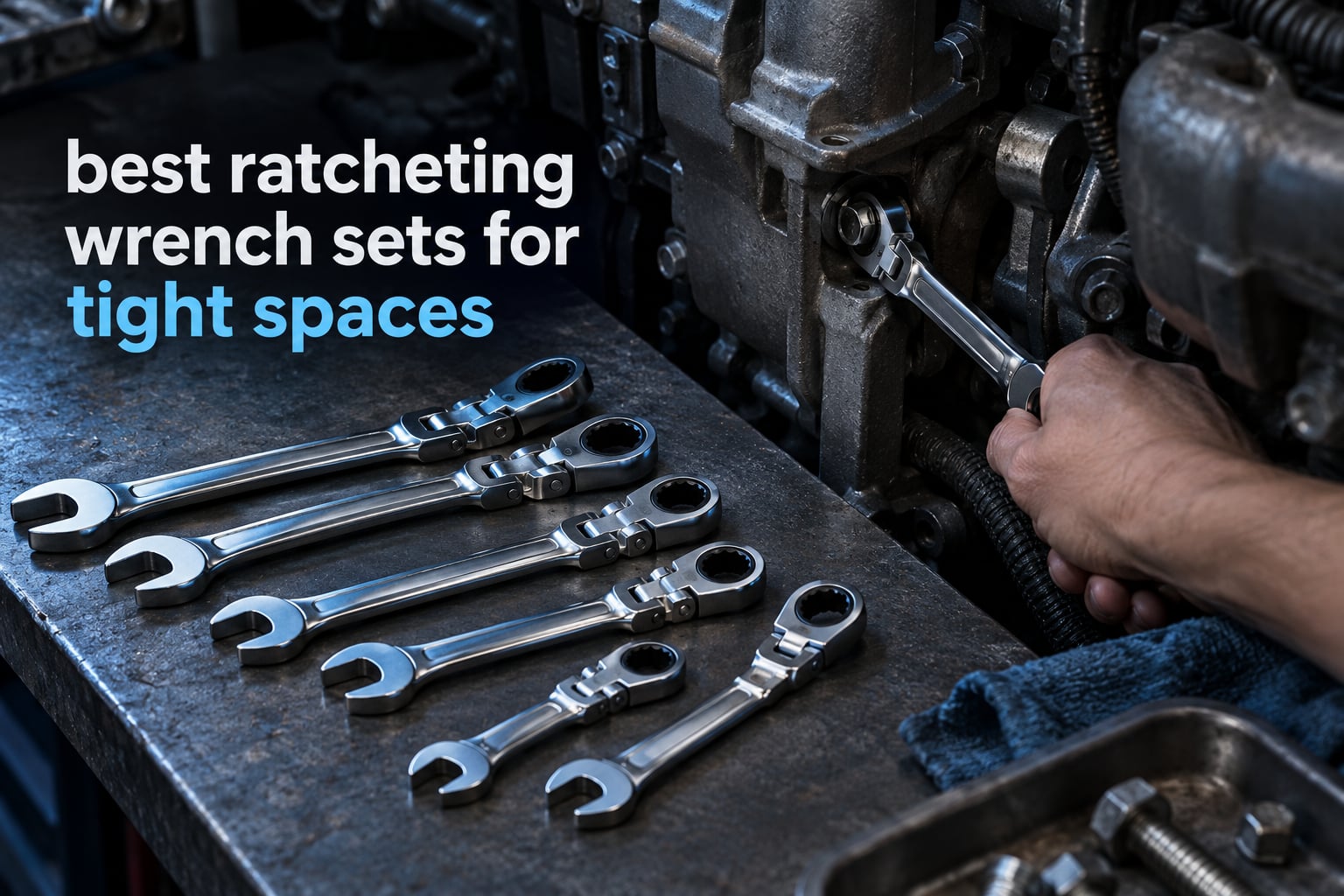
A standard combination wrench needs about 30 degrees of clearance before you can lift it off a fastener and swing it back. In a gap where your knuckles only have 2 inches of room to move, that geometry means the tool simply does not fit, and you end up reaching for a different fastener, a different tool, or an angle grinder you never intended to use.
A ratcheting wrench set solves this by putting a small gear train inside the box end. The wrench stays meshed with the fastener while you reposition, so the arc it needs shrinks to 5 degrees on a 72-tooth mechanism and 4 degrees on a 90-tooth one. That is the difference between a job you can finish and a job you abandon halfway through.
We compared ten of the strongest options available now for our best ratcheting wrench sets for tight spaces picks, weighing swing arc, form factor, size coverage, and the grip geometry that decides whether a stubborn fastener gets rounded off. Two of the sets here carry full lifetime warranties, one pairs a 4-degree arc with a pivoting flex head, and one covers metric from 8mm to 19mm with no skipped sizes. Read on for the details, including the failure modes nobody mentions in the marketing copy.
Editors note: we built this list around what reaches a fastener in a real gap rather than around piece count. A 5-piece set that fits beats a 24-piece set that does not, and that ranking shows up several times below.
Top 3 Picks: Best Ratcheting Wrench Sets for Tight Spaces (October 2026)
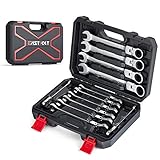
The Eastvolt 12-Piece Flex-Head Set earns our Editor’s Choice because it is a metric-only set with unbroken coverage from 8mm to 19mm, and it pairs that with a 72-tooth gear delivering a 5-degree arc on a flex head that pivots a full 180 degrees.
GEARWRENCH’s 14-Piece Stubby set takes the premium slot. Its off-corner loading box end is a genuinely different grip geometry, not marketing filler, and the short beam reaches spots where nothing else on this list will physically sit. CRAFTSMAN’s 20-Piece set rounds out the top three with a 90-tooth mechanism at a 4-degree arc, the tightest fixed-head swing in the group, backed by a full lifetime warranty.
Eastvolt 12-Piece Flex-Head Set
- 72-tooth ratchet
- 5-degree swing arc
- Complete 8mm to 19mm metric coverage
- 180-degree flex head
- Forged chrome vanadium

GEARWRENCH 14-Piece Stubby Set
- 72-tooth stubby design
- Off-corner loading box end
- 7 SAE plus 7 metric sizes
- Limited lifetime warranty

CRAFTSMAN 20-Piece 90-Tooth Set
- 90-tooth ratchet
- 4-degree arc swing
- 20 SAE and metric sizes
- Full lifetime warranty
Best Ratcheting Wrench Sets for Tight Spaces (October 2026)
Every set below appears in the same format: the form factor that determines what it can reach, the tooth count and swing arc that determine how little room it needs, and the size coverage you will actually reach for.
| Product | Specifications | Action |
|---|---|---|
| Eastvolt 12-Piece Flex-Head Set |
|
Check Latest Price |
 Amazon Basics 5-Piece Flex-Head Set Amazon Basics 5-Piece Flex-Head Set |
|
Check Latest Price |
| GEARWRENCH 14-Piece Stubby Set |
|
Check Latest Price |
 DURATECH 8-Piece Stubby Set DURATECH 8-Piece Stubby Set |
|
Check Latest Price |
| CRAFTSMAN 20-Piece 90-Tooth Set |
|
Check Latest Price |
 SUZUME 24-Piece Flex-Head Set SUZUME 24-Piece Flex-Head Set |
|
Check Latest Price |
 VEVOR 24-Piece Flex-Head Set VEVOR 24-Piece Flex-Head Set |
|
Check Latest Price |
 WORKPRO 22-Piece Flex-Head Set WORKPRO 22-Piece Flex-Head Set |
|
Check Latest Price |
 DISEN 24-Piece 90-Tooth Set DISEN 24-Piece 90-Tooth Set |
|
Check Latest Price |
 WORKPRO 8-Piece Stubby Set WORKPRO 8-Piece Stubby Set |
|
Check Latest Price |
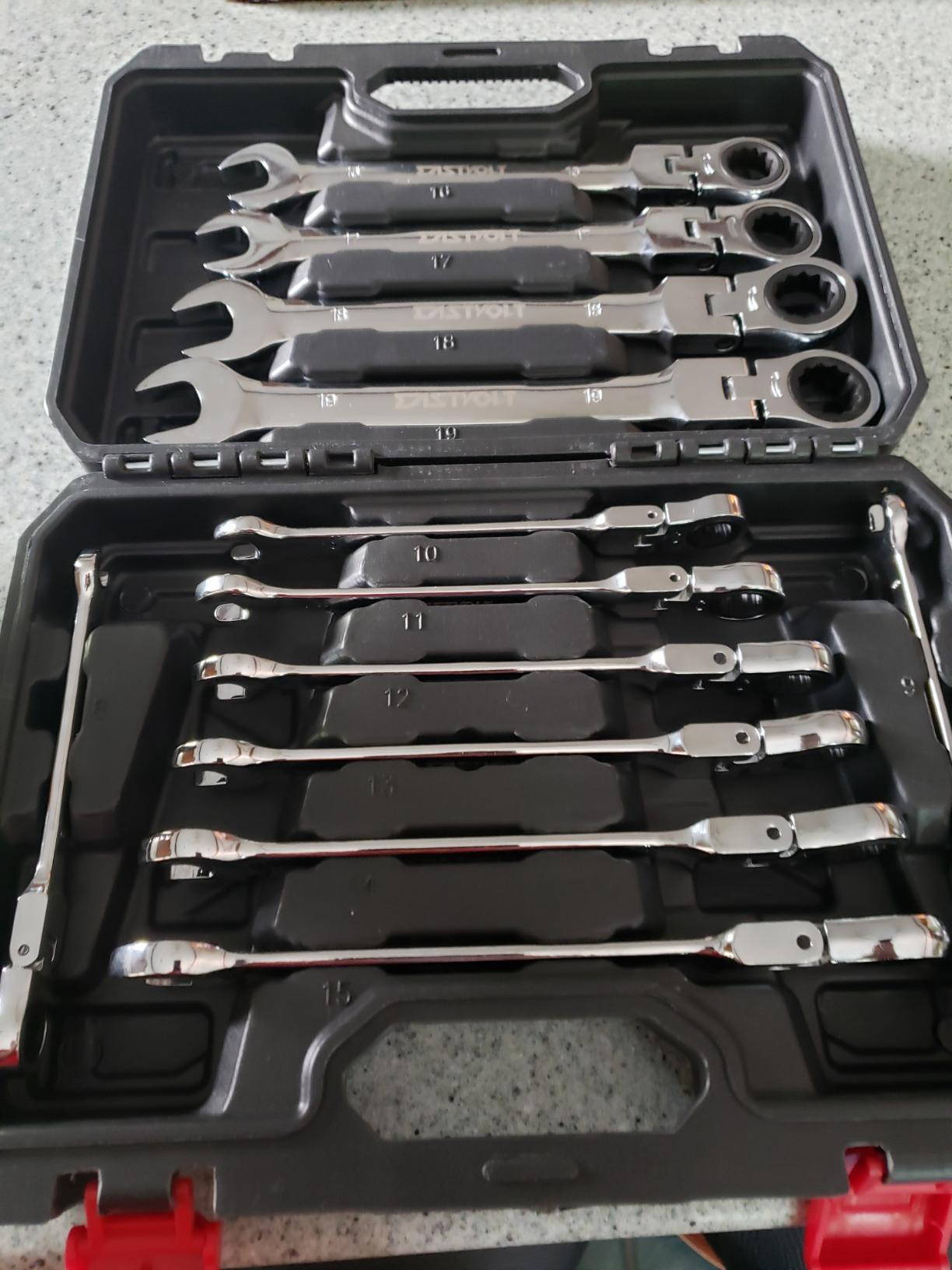
1. Eastvolt 12-Piece Flex-Head Ratcheting Wrench Set – Best Overall Metric Coverage
Eastvolt 12-Piece Flex-Head Ratcheting Wrench Set, Metric 8mm-19mm, Combination Ended Spanner kits, Chrome Vanadium Steel with Toolbox, EVHT1201
12 pcs metric flex head
72-tooth, 5-degree swing arc
8mm to 19mm
Forged chrome vanadium
Pros
- 5-degree swing arc from a 72-tooth gear
- 180-degree flex head reaches awkward angles
- Forged chrome vanadium with mirror polish
- Unbroken 8mm to 19mm metric coverage
Cons
- Metric only
- so SAE fasteners need another set
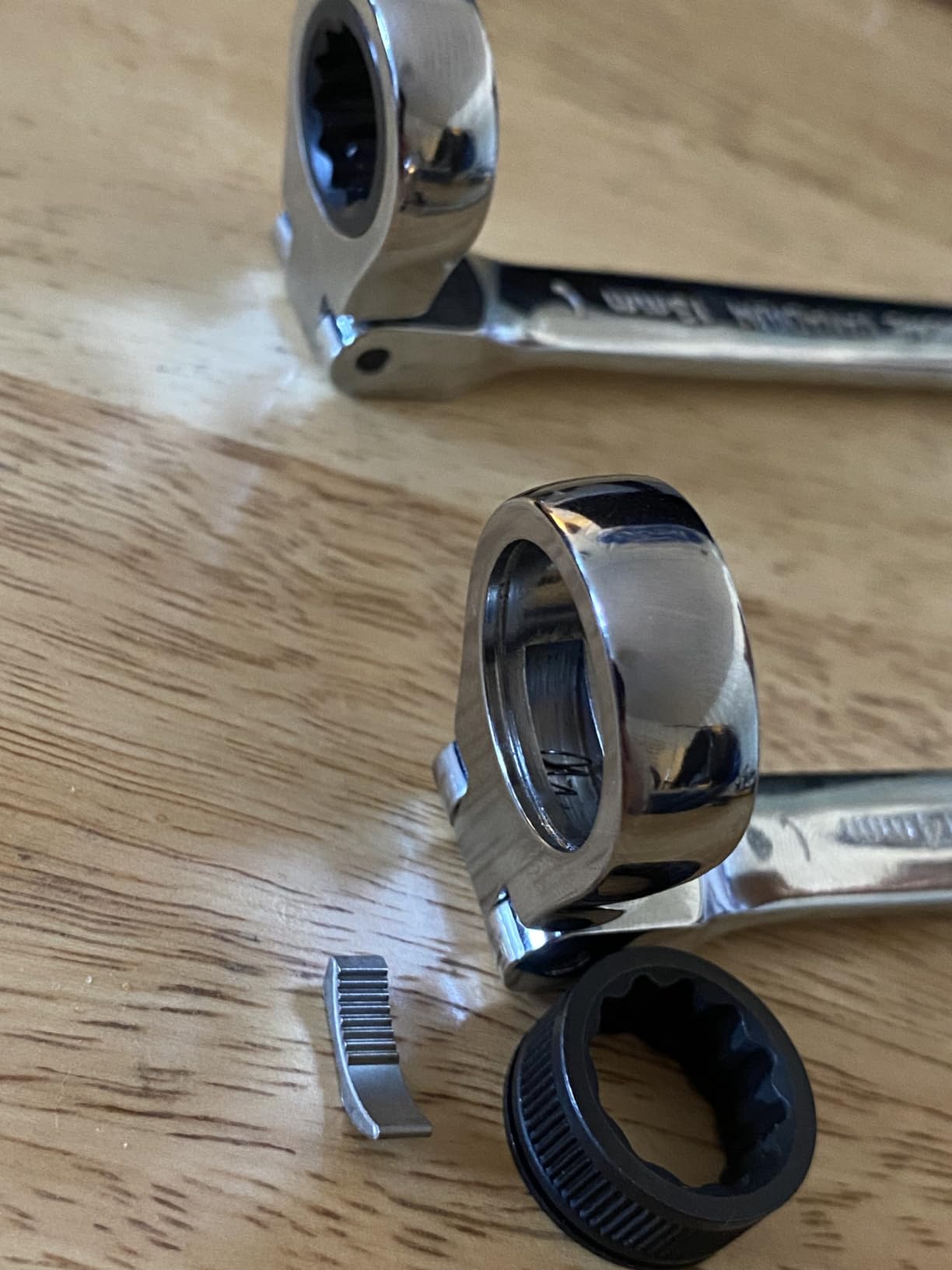
- Fixed pivots cannot be retightened when play develops
The set that stays in my bag is the Eastvolt. Twelve sizes, 8mm through 19mm, with nothing skipped in between, and that completeness matters more than any of the individual features. Most metric flex sets in this category quietly omit 8mm or 15mm, and you discover that at the worst possible moment.
The 72-tooth gear needs only a 5-degree working arc, which is enough to work in the gap between an engine block and a strut tower or behind a wall-mounted boiler. The 180-degree flex head tilts through the full range, so I can angle the handle away from the fastener instead of trying to get my knuckles into a spot that was never going to fit a human hand.
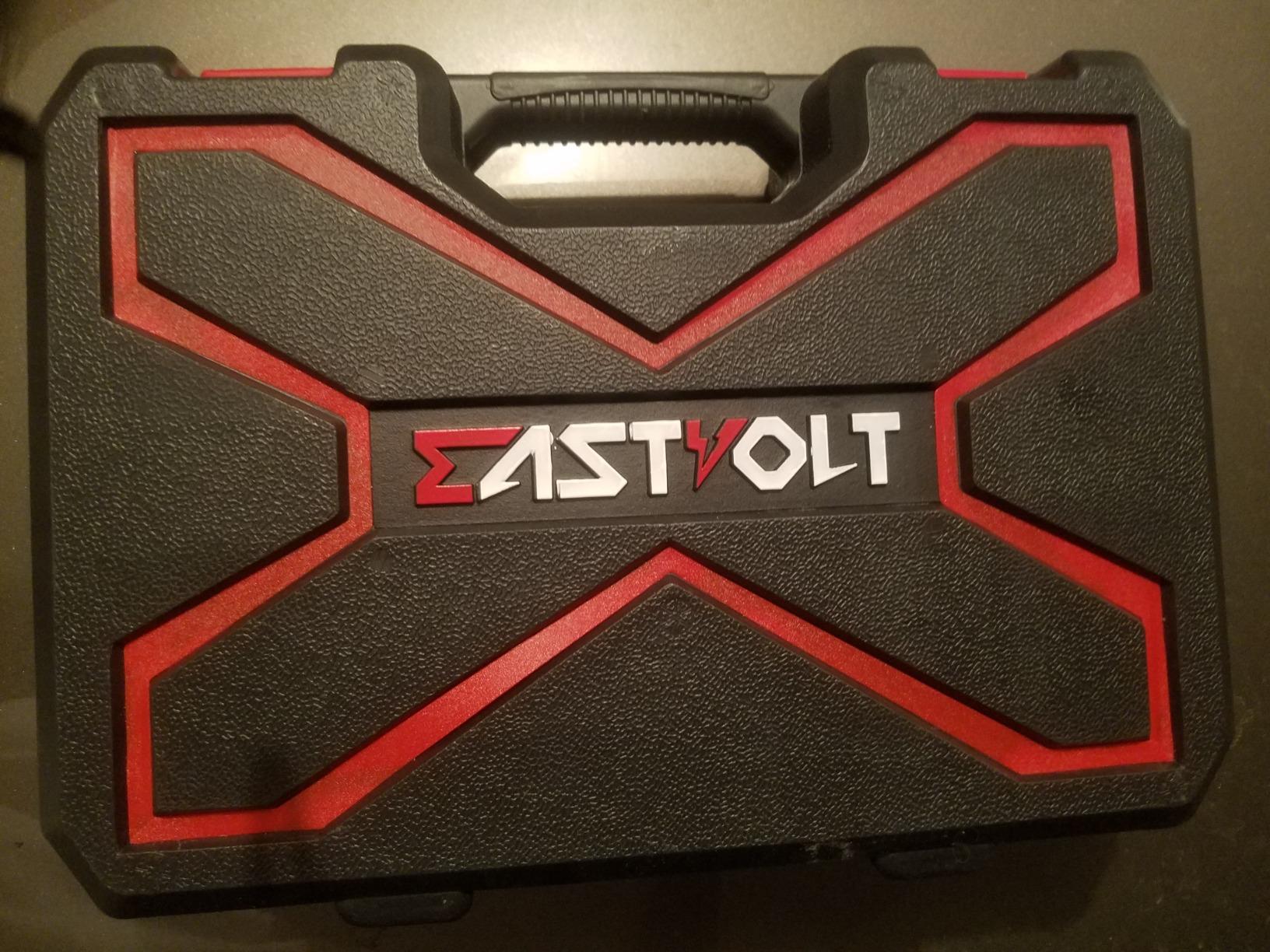
Construction is forged chrome vanadium with a mirror polished surface, and reviewers consistently report that it holds that finish after months of greasy work. The ratchet action itself is the part I look at hardest, and 3452 reviews averaging 4.7 stars with 81 percent at five stars is about as consistent a signal as this category produces.
The one real limitation is that it is metric only. If your work touches American vehicles or older plumbing, you will need a second set for SAE sizes, which is why the dual-standard sets later in this list are worth a look.
How it handles stubborn fasteners
The ratchet holds its engagement through the full stroke rather than skipping teeth halfway through a turn, which is what lets you apply steady pressure to a fastener that has been sitting in a damp engine bay since the vehicle was new. Reviewers describe the mechanism as smooth with no perceptible drag, and that smoothness is what preserves the gear teeth over time.
Because the head is a flex design, the pivot takes the side load rather than the box end itself. That is a fair trade for this kind of work, though it is not the arrangement you want for breaking a seized nut at high torque, where a fixed head is generally stronger.
Where it falls short
Full-length handles rule it out of the very tightest slots. If your gap is so narrow that a 9-inch handle cannot physically rotate, you need a stubby design, and the handle length on this set is standard length rather than short.
The flex pivots are fixed rather than hex-key adjustable, so if the pivot develops play over years of service you cannot retighten it. Popular Mechanics flagged stiff flex heads needing a hex key on a competing stubby set, and if that kind of serviceability matters to you, the WORKPRO sets below have it built in.
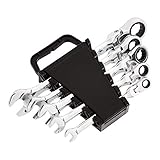
2. Amazon Basics 5-Piece Flex-Head Ratcheting Set – Budget Pick
Amazon Basics 72-Tooth Ratcheting Combination Wrench Set, Chrome Vanadium Steel Flex Head, 5-Piece Metric, 180° Flexible
5 pcs metric flex head
72-tooth, 5-degree swing arc
Drop forged chrome vanadium
8.86 inches long
Pros
- Low entry cost for a flex-head ratchet set
- Head tilts a full 180 degrees
- 72-tooth gear needs only a 5-degree arc
- Chrome finish wipes clean easily
Cons
- Only five metric sizes with real gaps
- No SAE sizes in this configuration
- Alloy steel listed rather than pure chrome vanadium
This is the set I recommend to anyone who wants to try the concept before committing to a full set. Five sizes, a real 180-degree flex head, and the same 5-degree arc you would find on far more expensive tools. The mechanism works exactly as advertised.
Where it falls short is coverage. At 8mm, 10mm, 13mm, 14mm, and 17mm, the gaps are large enough that you will reach for a size you do not have fairly often. That is precisely the complaint in reviews, and it is why we treat this as a starter set rather than a primary one.
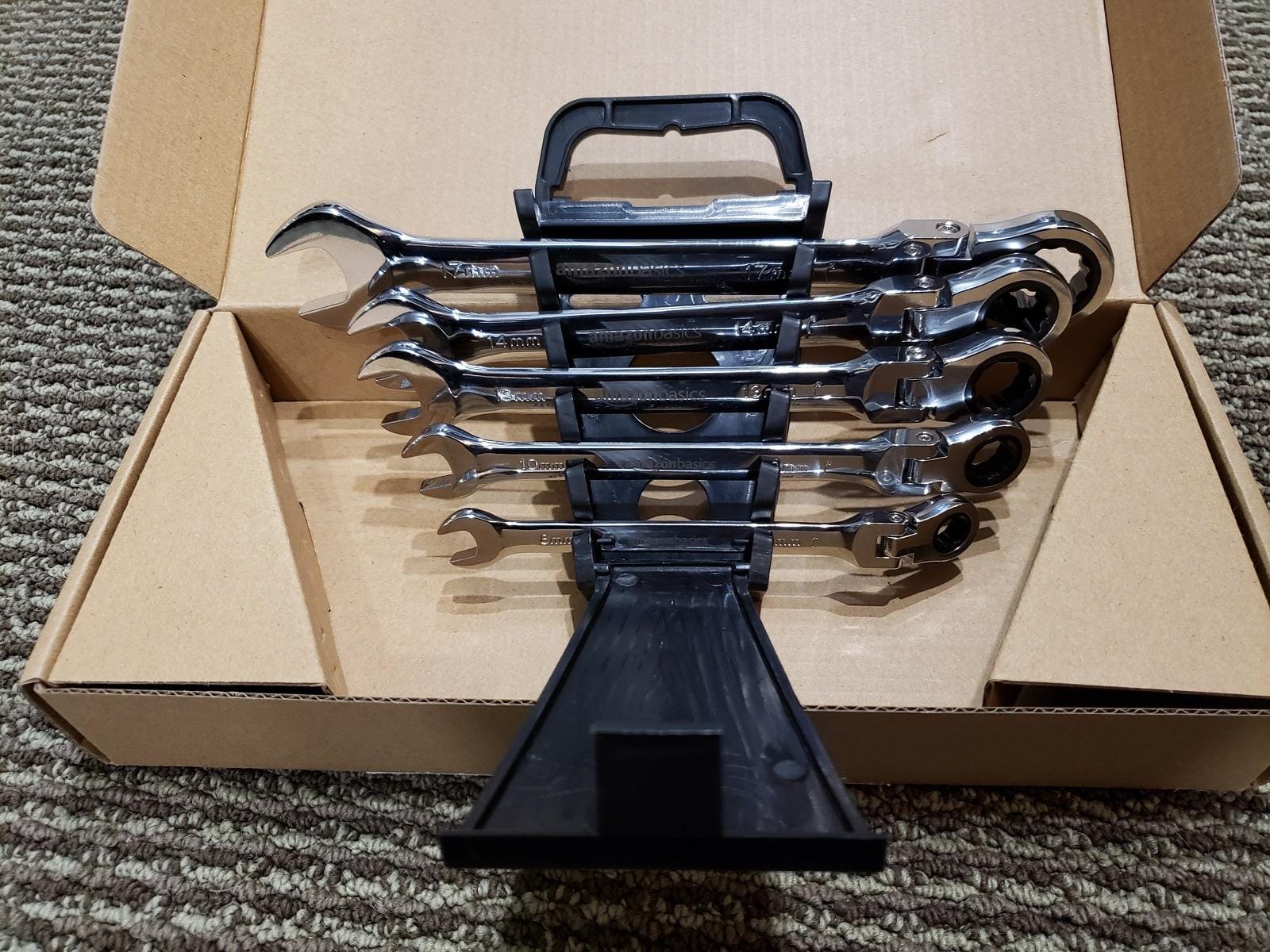
Build quality is drop forged and hardened chrome vanadium steel, with a chrome finish that resists corrosion and wipes down without fuss. Across 5772 reviews the average sits at 4.5 stars, with 74 percent at five. That is the highest review volume of any set here, which also means the criticism is well documented rather than anecdotal.
The listed dimensions come in at 8.86 inches, short enough that it clears gaps a full-length set would not. That shorter overall length is part of why it handles confined spaces better than its sparse size list suggests.
How it handles stubborn fasteners
The 72-tooth gear engages cleanly and the drive holds through a stroke without walking off the fastener flats. On moderately corroded hardware it behaves like a much pricier set, and reviewers point to the tooth engagement as the reason it feels solid at low torque.
Because the box end is a 12-point pattern, it will slip on a heavily rounded or seized bolt faster than a radius-corner design would. For hardware that is merely stiff rather than destroyed, it is fine.
Where it falls short
Five sizes is the core problem. This set answers what a ratcheting wrench does but not whether you have what you need on a given job, and the missing 11mm and 12mm are common sizes on European fasteners.
There is also no SAE coverage and no storage solution in the box, so the wrenches tend to end up loose in a drawer where they rattle against each other and chip at the polished finish.
3. GEARWRENCH 14-Piece Stubby Ratcheting Set – Best Pro-Grade Stubby
GEARWRENCH 14 Pc 72T Stubby Ratcheting SAE/mm Combination Wrench Set|85206
14 pc stubby combination
72-tooth ratchet box end
SAE and metric
12-point off-corner loading
Pros
- Stubby length reaches spots standard wrenches cannot
- Off-corner loading reduces fastener rounding
- Dual SAE and metric in one set
- Standard limited lifetime warranty
Cons
- Included half case is cheap and does not shut properly
- Costs more than generic metric-only stubby sets
The off-corner loading box end is the feature that separates this from every other stubby on the list. Rather than seating fully on the fastener flats, the geometry contacts closer to the corners so the load lands on the strongest part of the hex. In practice that is the difference between a fastener that comes off clean and one that turns into a rounded lump.
With seven SAE and seven metric sizes in a short stubby body, this is the set professional mechanics on the forums name most often, and the 4.8 star average across 1459 reviews with 89 percent at five stars supports that reputation. Multiple verified reviews specifically report that the ends do not slip.
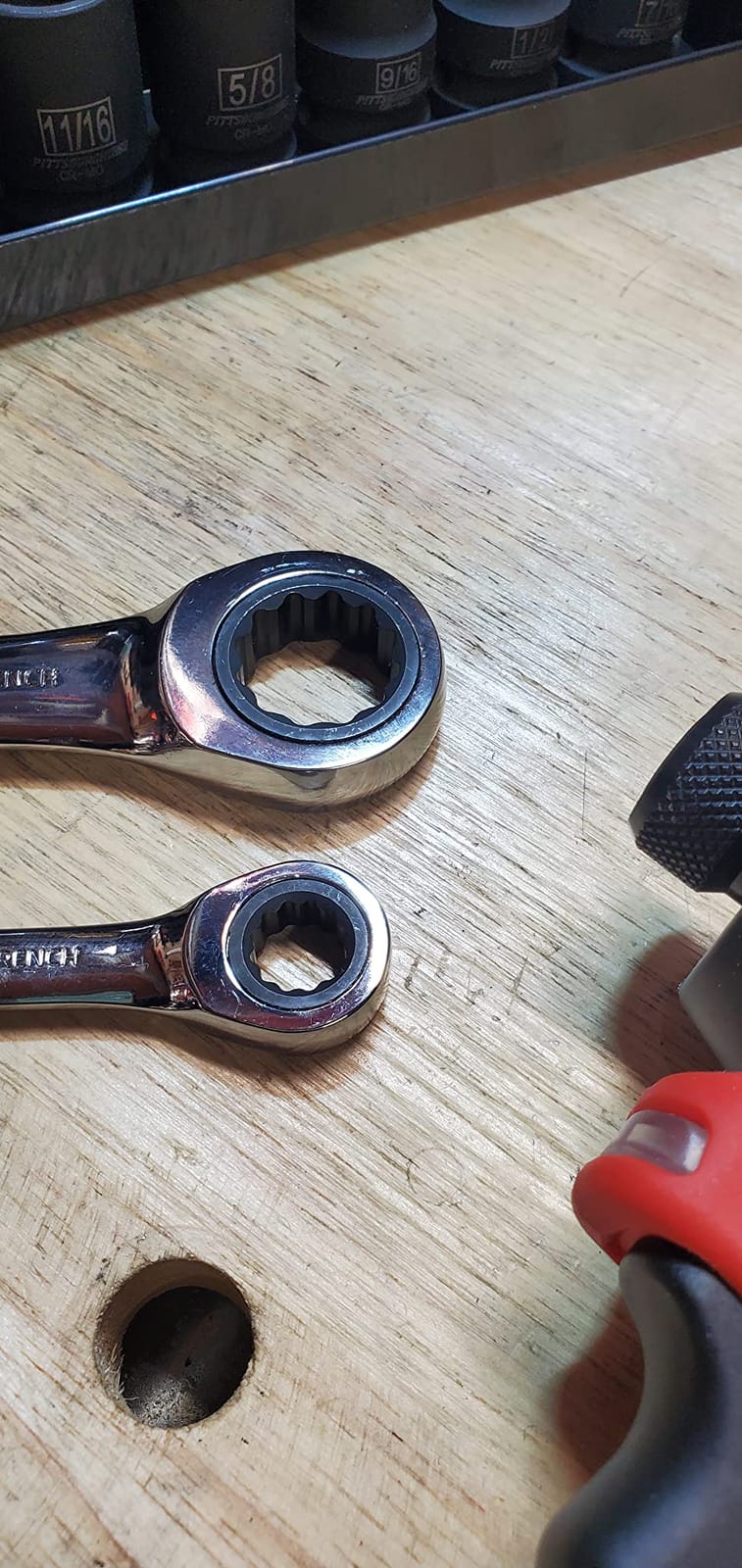
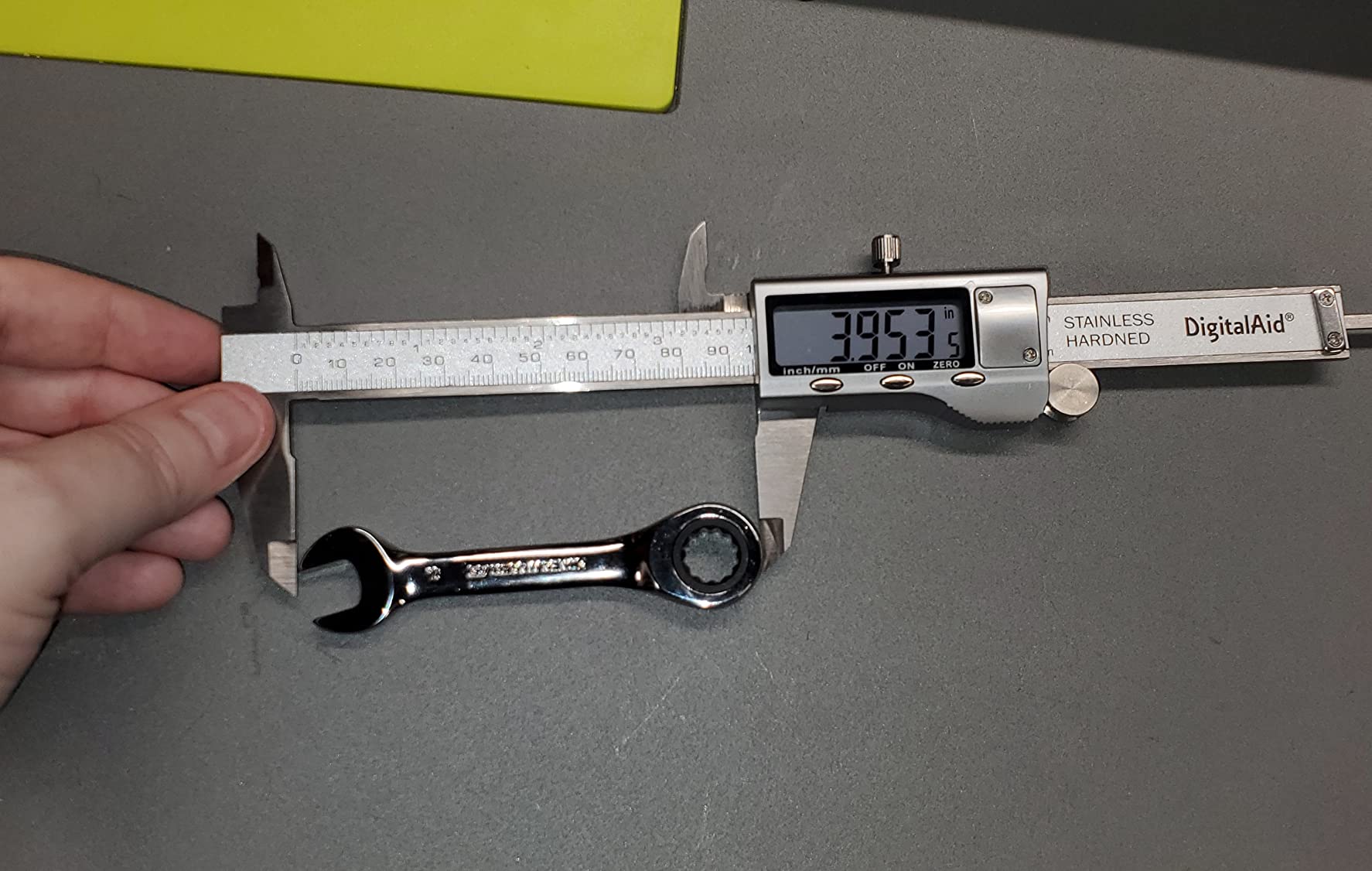
The thin head and thin beam are doing the accessibility work here. The box end itself is narrow enough to pass between components where a standard 12-point head simply cannot seat, which is a different kind of fit problem than handle length.
Every wrench has a hang hole at the open end, and the set carries a standard limited lifetime warranty from the manufacturer. Those are small details that matter in a working shop where tools get hung, dropped, and counted.
How it handles stubborn fasteners
This is where the off-corner geometry pays off. Rusty, painted-over, or slightly rounded fasteners that would strip on a conventional 12-point pattern tend to hold here, because the contact points are where the metal is thickest.
Stubby wrenches do give up some leverage compared with full-length handles, so for a truly seized fastener the open end on a longer set is still the better first attempt. The ratchet box end is for speed and access, not for maximum torque.
Where it falls short
The included case is the weak point, and reviewers say it plainly: the case is cheap and does not close properly, so it protects the wrenches poorly in a bag. Budget for a roll or hang rack separately.
Coverage is also selective. Seven SAE sizes from 3/8 to 3/4 inch and seven metric sizes from 10mm to 18mm leaves out both ends of each range, so a 19mm or a 9/16 inch job needs a different tool.
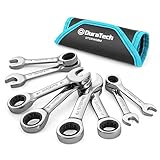
4. DURATECH 8-Piece Metric Stubby Set – Best Lightweight Stubby
DURATECH Stubby Ratcheting Combination Wrench Set, Metric, 8-piece
8 pcs metric stubby
72-tooth, 5-degree swing arc
10, 11, 13, 14, 16, 17, 18, 19mm
Heat-treated chrome vanadium
Pros
- Short stubby beam reaches fasteners standard wrenches cannot
- Smooth ratchet action that survives being dropped
- Roll-up pouch keeps the set together in a travel bag
- High-polish finish wipes grease away easily
Cons
- Missing common 8mm and 15mm sizes
- Metric only
- Flip-over reversing means no lever switch
The DURATECH is the pick for anyone whose work involves carrying tools rather than owning them. Eight metric sizes from 10mm to 19mm in a roll-up pouch, and the whole thing disappears into a laptop bag the way a full set never does.
Reversing works by flipping the wrench over, which needs no lever and therefore has no lever to catch on a bracket, a harness, or your own hand. Reviewers confirm the ratcheting action is smooth and strong, with several noting it has survived being dropped onto concrete.
The 72-tooth gear still gives a 5-degree working arc, and the shorter beam design is what does the real work in confined areas. Where the Eastvolt is about coverage and this one is about how little space the whole package occupies.
Heat-treated chrome vanadium steel with a polished, corrosion-resistant surface is the standard construction for this category, and at 684 reviews averaging 4.7 stars with 82 percent at five, the finish and action hold up consistently in reports.
How it handles stubborn fasteners
The flip-over reversing design means you set direction by turning the wrench over, which is unambiguous in a dark engine bay where a small lever might be hard to find. There is also nothing to bump by accident, and that reliability matters more than it sounds.
Because the reversing is flip-based rather than lever-based, the drive stays engaged through the flip in a way that lever designs cannot. Seized hardware still needs a breaker bar, but you will not lose your place mid-strike.
Where it falls short
The missing 8mm and 15mm are the recurring complaint, and both are common sizes on Japanese and European fasteners. A set with a full run of sizes is the better single-set purchase if you can accept the extra length.
With eight sizes it is also the smallest metric-only option here, so most owners end up buying a second set shortly after. It works best as a portable companion rather than a primary kit.
5. CRAFTSMAN 20-Piece 90-Tooth Set – Best Warranty Coverage
CRAFTSMAN Ratchet Wrenches Set, 20 Pc, 90 Tooth SAE/Metric Ratcheting Wrench Set with Case, 4 Degree Arc Swing (CMMT87220)
20 pc SAE and metric
90-tooth, 4-degree arc swing
12-point box ends
Full lifetime warranty
Pros
- Tightest fixed-head arc swing on the list at 4 degrees
- Smooth ratcheting with no noticeable back drag
- Slim handle and 12-point ends that fit modern fasteners
- Backed by a full lifetime warranty
Cons
- Fixed ratcheting heads instead of 180-degree flex heads
- One report of a 10mm head separating under repeated use
The CRAFTSMAN takes a different approach than most of this list. The box ends are fixed rather than pivoting, and the gear runs 90 teeth for a 4-degree arc swing. More teeth means a finer gear and a tighter arc, which is exactly what you want when the gap is measured in millimetres rather than inches.
Twenty sizes across both standards is genuinely useful coverage. Ten SAE from 1/4 to 3/4 inch including 11/32, and ten metric from 6mm to 18mm with 9mm included, is a spread that covers most household and automotive fasteners without a second set.
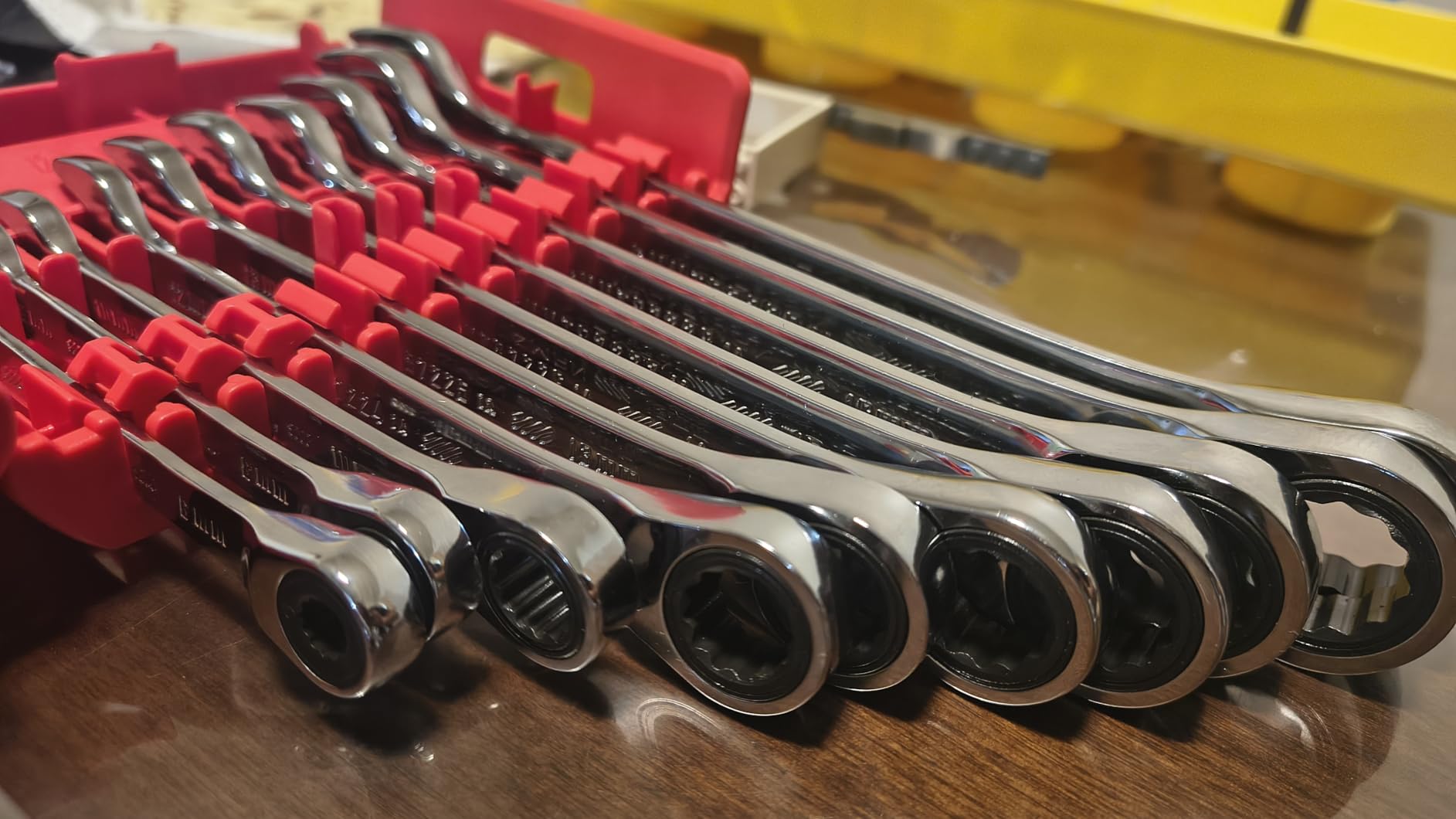
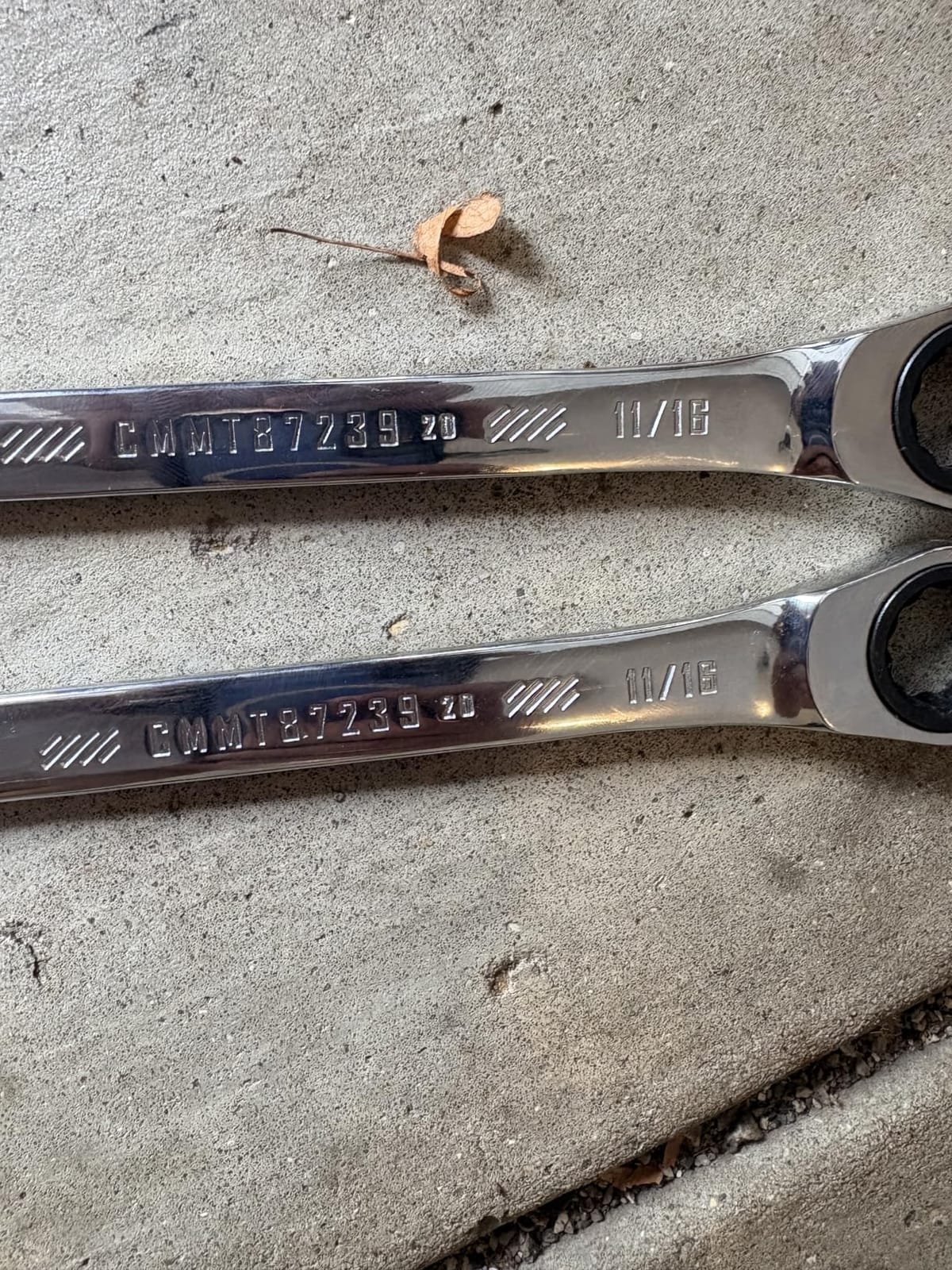
Reviews mention large markings for quick size identification, which sounds minor until you are trying to identify a wrench by feel in a dark footwell. The 12-point box ends seat quickly on modern fasteners and the chrome finish handles corrosion well.
At 4.8 stars from 600 reviews with 89 percent at five, this is the highest-rated set with a full lifetime warranty in our group, and reviewers frequently compare the finish and feel favourably against premium Husky sets.
How it handles stubborn fasteners
The fixed head is the stronger arrangement here, and that is not a small point. A pivot joint is always the weakest link in a flex design, so when you are applying real force to a corroded bolt, having no joint in the load path is a meaningful advantage.
The 12-point pattern seats quickly, which shortens the ratchet stroke on seized hardware. It is not off-corner loading, so on a badly rounded fastener it will slip sooner than the GEARWRENCH would.
Where it falls short
No flex head means it cannot angle the handle away from an obstruction. For a fastener tucked behind a pipe or inside a crowded engine bay, you will need to position the wrench correctly rather than pivot around the problem, and that is a real access compromise.
A small number of reviews report a 10mm head separating under repeated heavy use. It is an isolated report rather than a pattern, but it is worth knowing given the lifetime warranty is the main argument for this set.
6. SUZUME 24-Piece Flex-Head Set – Best Size Coverage With No Skips
SUZUME 24-piece Flex Head Ratcheting Wrench Set Metric & SAE 180° flexible
24 pcs flex head metric and SAE
72-tooth, 5-degree swing arc
Black nickel coating
15,000 cycle fatigue tested
Pros
- Metric 8-19mm plus SAE 1/4-7/8 inch with no skipped sizes
- Black nickel coating resists rust in greasy or damp conditions
- 180-degree flex head handles cramped chassis and motorcycle clearances
- Portable rack organizer keeps sizes sorted
Cons
- Standard length
- so not suited to the tightest engine bay gaps
- Less proven long term than established brands
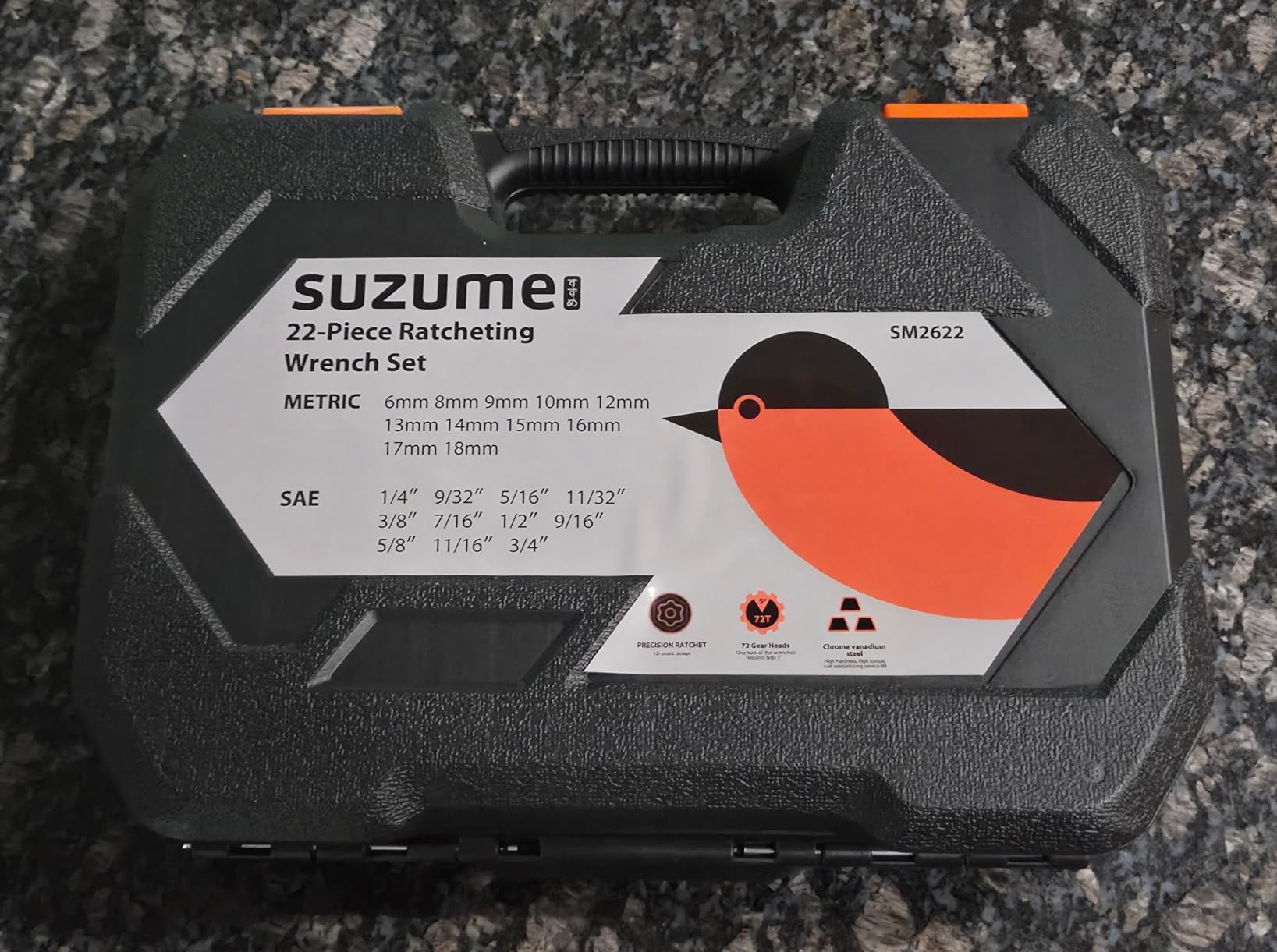
No skipped sizes is the line SUZUME makes and, as far as the spec sheet goes, delivers. Metric 8 through 19mm and SAE 1/4 through 7/8 inch, every size in both ranges represented. That directly answers the most common complaint in the forums, where premium sets leave out common fasteners and force a separate purchase.
The gears are fatigue tested to stay locked past 15,000 cycles and hold position past 20,000, which is a more concrete durability claim than most listings in this category make. The 180-degree flex head handles the cramped clearances around a motorcycle chassis or inside a chassis rail where a fixed head cannot get an angle.
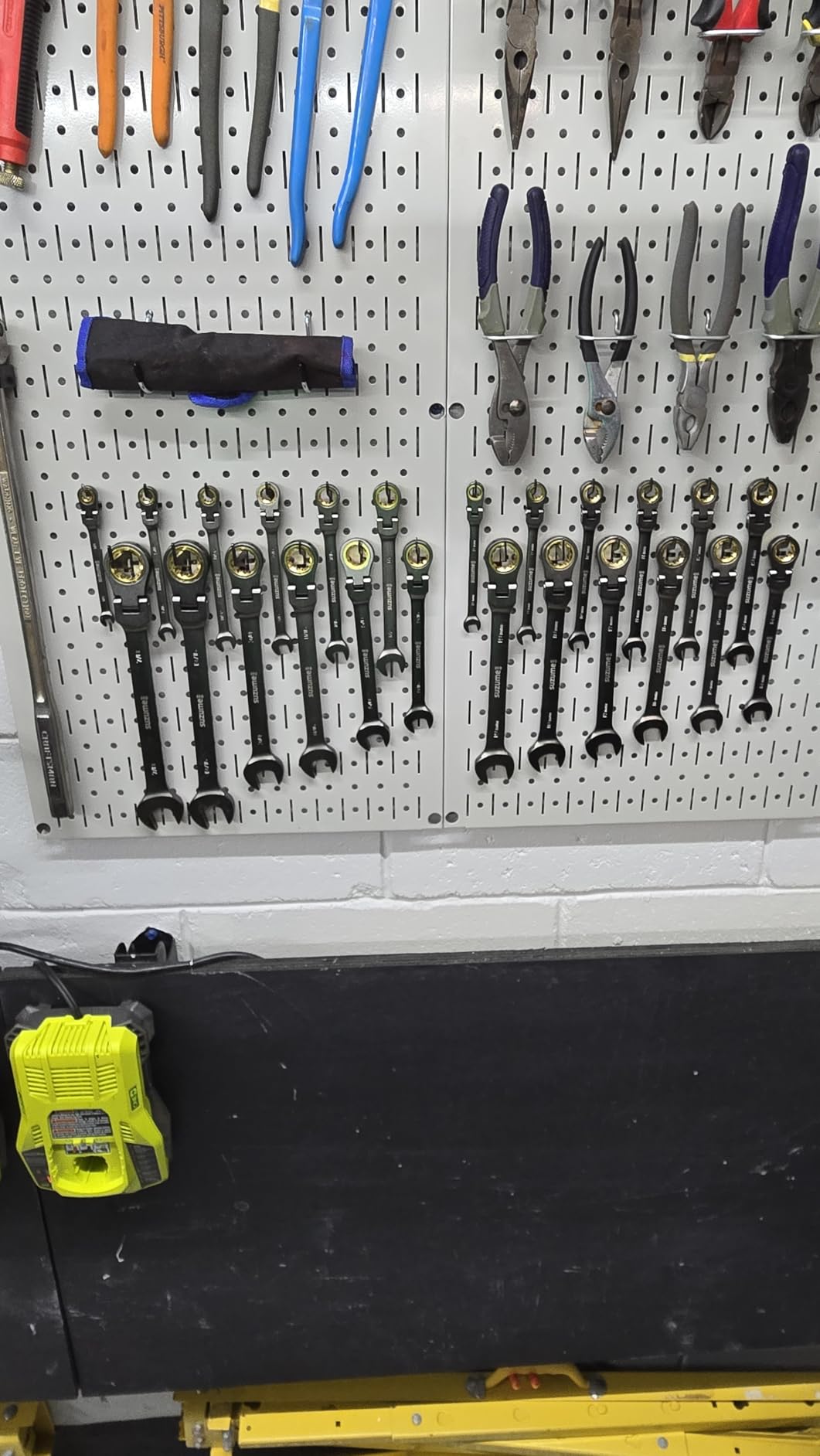
Black nickel coating is the finish here, and it holds up in greasy or damp environments where a polished chrome surface would be fine for a while and then start to pit. At 514 reviews averaging 4.7 stars with 84 percent at five, the complaints are limited and specific rather than general.
The handle-equipped wrench rack organizer is a genuine convenience. Hanging the set up keeps sizes visible and stops the 24 pieces from migrating across a workshop bench over a season of use.
How it handles stubborn fasteners
The 72-tooth gear at a 5-degree arc is the mainstream figure, so this set is not buying you tighter access than a standard flex-head set. What it buys is the confidence that when you find the right size, it is actually in the set.
The flex head means the handle can be angled clear of surrounding components, which on a chassis or in an engine bay is often the difference between reaching the fastener and not.
Where it falls short
Standard-length handles are the limitation. In the very narrow slots a stubby set is designed for, this set will not fit, no matter how good the gear is.
This is also a newer brand with less long-term reputation than GEARWRENCH or CRAFTSMAN. If you want a warranty you can rely on for a decade rather than a fatigue cycle count, that matters.
7. VEVOR 24-Piece Flex-Head Set – Best Organized Case
VEVOR 24-piece Ratcheting Wrench Set with 180° Flex Head, Anti-Slip Tooth, Combination Wrench Sets with Organizer Box, Metric 8-19mm & SAE 1/4-7/8″, Nickel Plating
24 pcs flex head metric and SAE
72-tooth, 5-degree micro-swing
Nickel plating
Labeled custom-fit case
Pros
- Complete 24-piece metric and SAE coverage for daily repairs
- Smooth 5-degree ratcheting cuts hand movement in tight spaces
- Flex head pivots around obstructions for recessed angles
- Labeled custom-fit case keeps tools in place
- Rust-proof nickel plating for humid or oily shops
Cons
- Heaviest set here at 9.6 pounds
- Flex heads can develop play over long service intervals
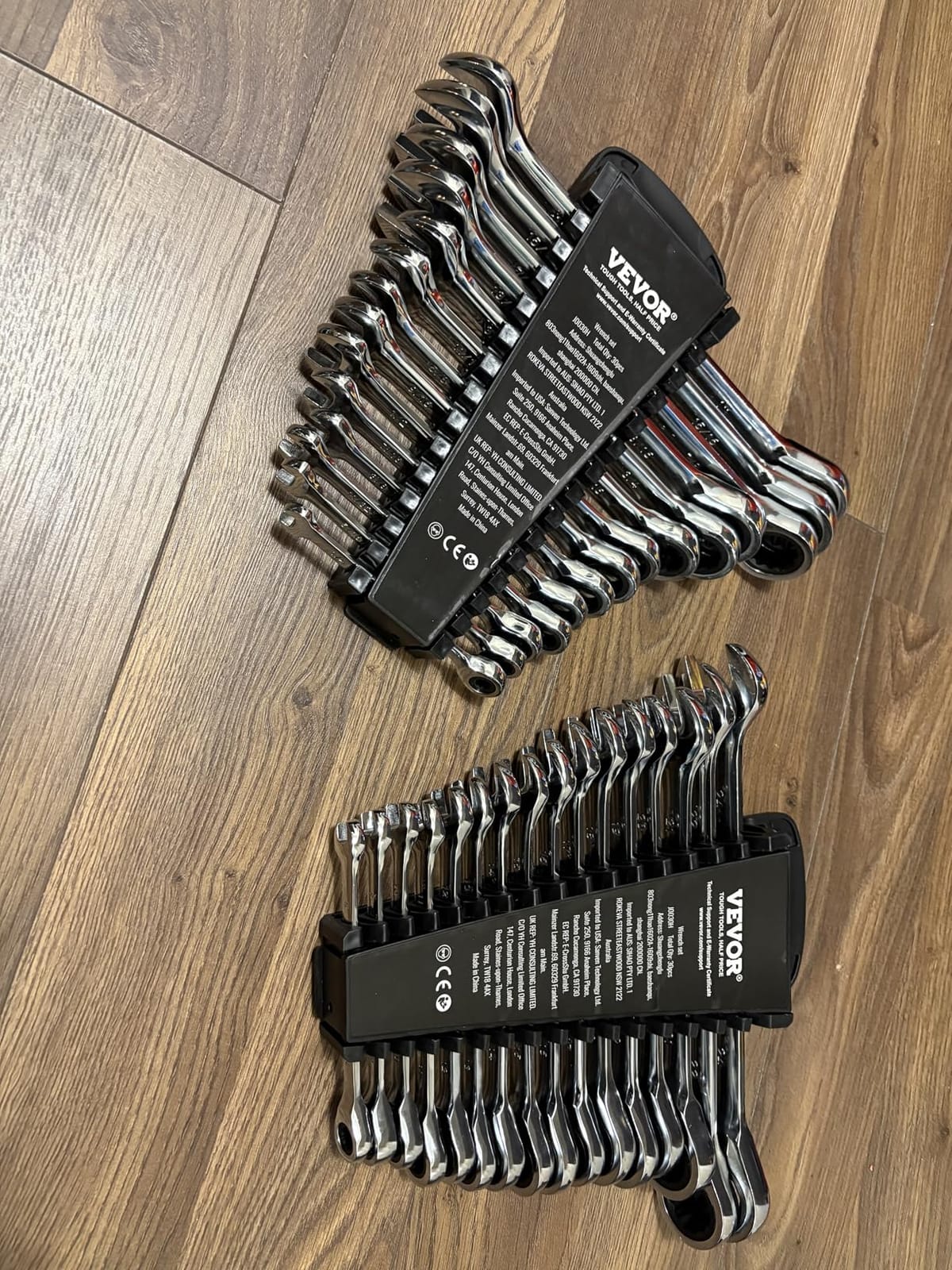
Storage is the thing that separates this set from most of its competitors. The custom-fit labeled case has a dedicated slot for each of the 24 pieces, which means you can see at a glance which size is missing rather than discovering the gap when the fastener is already off.
Coverage matches the big sets here: metric 8 to 19mm and SAE 1/4 to 7/8 inch in one box. The reinforced steel body uses a chrome vanadium ratchet head with a rust-proof finish, and the 72-tooth gear runs a 5-degree micro-swing.
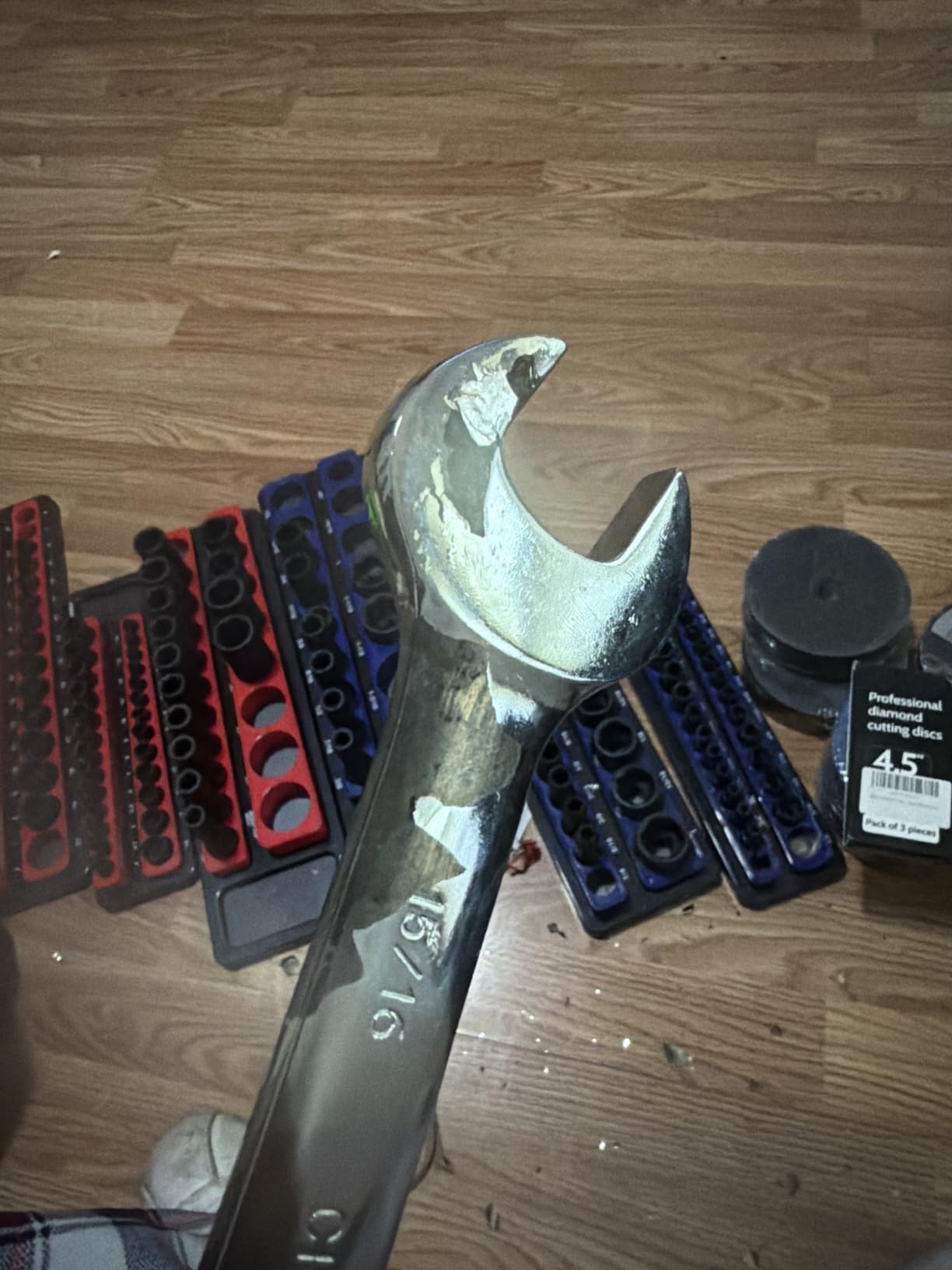
Anti-slip grip teeth are the specified mechanism, meaning the teeth are shaped to bite into the fastener rather than glide off it. Reviewers single out the smooth flex head movement and the labeled case as the two features they notice most in daily use.
At 335 reviews the average is 4.6 stars with 82 percent at five. The lower-scoring share is small and mostly about build consistency rather than any single failing mechanism.
How it handles stubborn fasteners
The anti-slip tooth profile does the work that off-corner loading does on other sets, seating more positively on a fastener that has been sitting in place for years. Combined with the 5-degree arc, it means fewer dropped attempts on a stiff bolt.
The open end handles the high-load cases where you need leverage, and the flex head lets you get an angle on hardware tucked behind other components without moving the whole tool.
Where it falls short
Weight is the honest drawback. At 9.6 pounds this is by a wide margin the heaviest set we tested, and that is obvious when you carry it from the car to the house.
Several reviews note that flex heads can develop play over long service intervals. If you work on ratcheting wrenches daily and want a head you can retighten, the WORKPRO sets use hex-key secured pivots instead.
8. WORKPRO 22-Piece Flex-Head Set – Best Anti-Slip Grip
WORKPRO 22-piece Ratcheting Wrench Set with 180° Flex Head, Anti-Slip
22 pcs flex head, metric and SAE
180-degree pivoting head
Anti-slip tooth design
Chrome vanadium, black coating
Pros
- Flex head holds position and can be retightened with a hex key
- Light precise ratcheting pressure that grabs bolts well
- Wrenches measured true to size with no fit issues
- Angled box end works where straight wrenches will not fit
- Sturdy case with solid latches
Cons
- 7mm and 11mm sizes are skipped and must be bought separately
- Case is bulky for a small vehicle or apartment
Serviceability is the underrated feature here. The flex heads are held by hex-key screws that can be tightened as needed, so when the pivot develops play after a few years of work you fix it in a minute instead of replacing the wrench. Most competing flex heads are sealed.
The anti-slip tooth design is rated by the manufacturer at 30 percent better grip than a hexagon spanner, and reviewers describe the ratcheting pressure as light and precise. That matters in tight spaces because you can feel the engagement without forcing a large handle through a narrow arc.
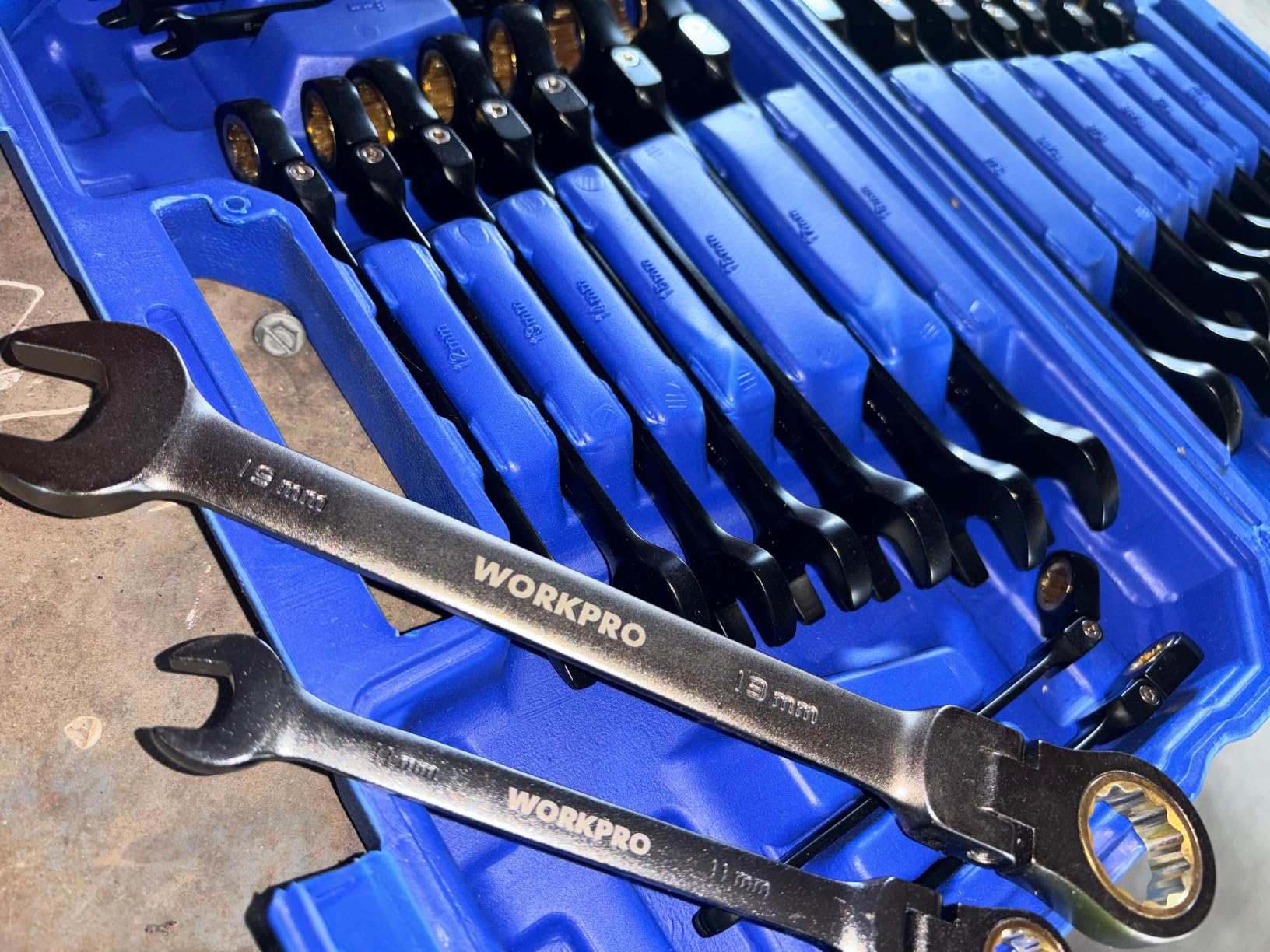
Chrome vanadium steel with a black electrophoretic coating applied after phosphating gives good corrosion resistance, and 458 reviews averaging 4.8 stars with 88 percent at five reflect a consistently satisfied buyer base.
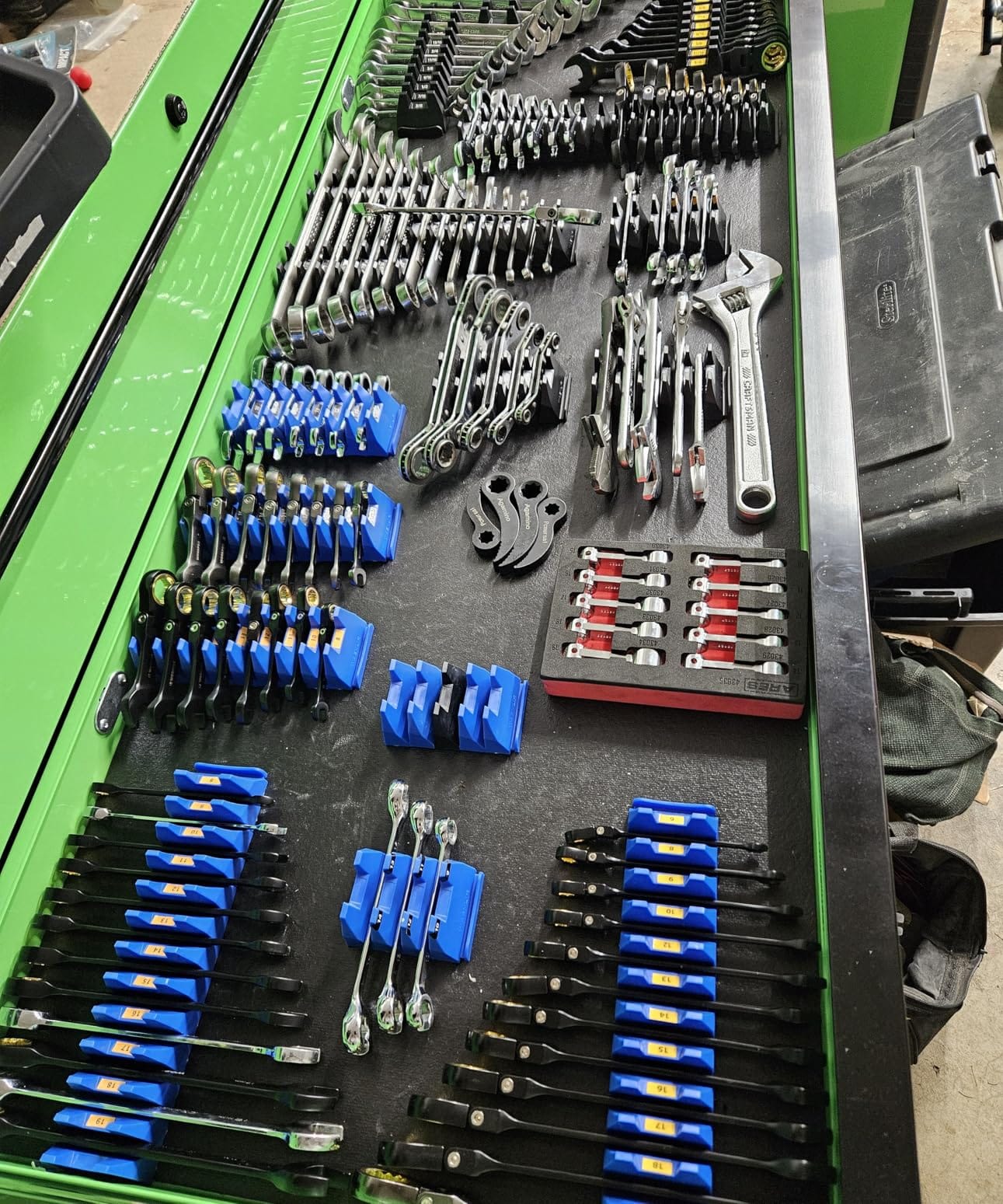
The sizes run 6 to 18mm metric across 11 pieces and 1/4 to 3/4 inch SAE across 11, with hang holes at the open ends and a sturdy included toolbox with solid latches.
How it handles stubborn fasteners
The light ratcheting pressure is the characteristic worth understanding. A stiff ratchet feels powerful but demands more hand travel, and in a 2-inch gap that travel is what you do not have. This one engages and releases with minimal movement.
Reviewers also report the wrenches measure true to size, so a wrench that fits will actually seat flat on the fastener rather than rocking, which is half the battle on a rounded or corroded head.
Where it falls short
The 7mm and 11mm gaps are the standing complaint, and both are common on smaller fasteners. You can buy them separately as individual wrenches, but it is an extra step.
Case bulk is the other recurring note. The included box is sturdy with good latches, but it is a large box for a 22-piece set, and carrying it in a small car takes up the boot.
9. DISEN 24-Piece 90-Tooth Flex-Head Set – Best 4-Degree Flex Swing
DISEN Ratcheting Wrenches Set 90 Tooth Flex-Head with Nickel Plating 24 Pcs
24 pcs flex head, metric and SAE
90-tooth, 4-degree swing arc
Nickel-plated chrome vanadium
Open end plus ratcheting box end
Pros
- 90-tooth ratchet gives a very tight 4-degree arc in narrow spaces
- Nickel plating resists corrosion and rust
- Complete metric and SAE coverage with organizer racks
- Open end handles high-torque work while the box end drives nuts quickly
Cons
- Manufacturer warns against using the box end on seized or very old nuts
- Highest share of 1-star ratings in the group
- Closing spring can break under extreme load
This is the only set here that pairs a 4-degree swing arc with a 180-degree flex head. Most 90-tooth sets in this category use a fixed box end, so you are choosing between the tight arc and the pivoting head elsewhere. DISEN gives you both, which is a genuinely useful combination for very narrow gaps at odd angles.
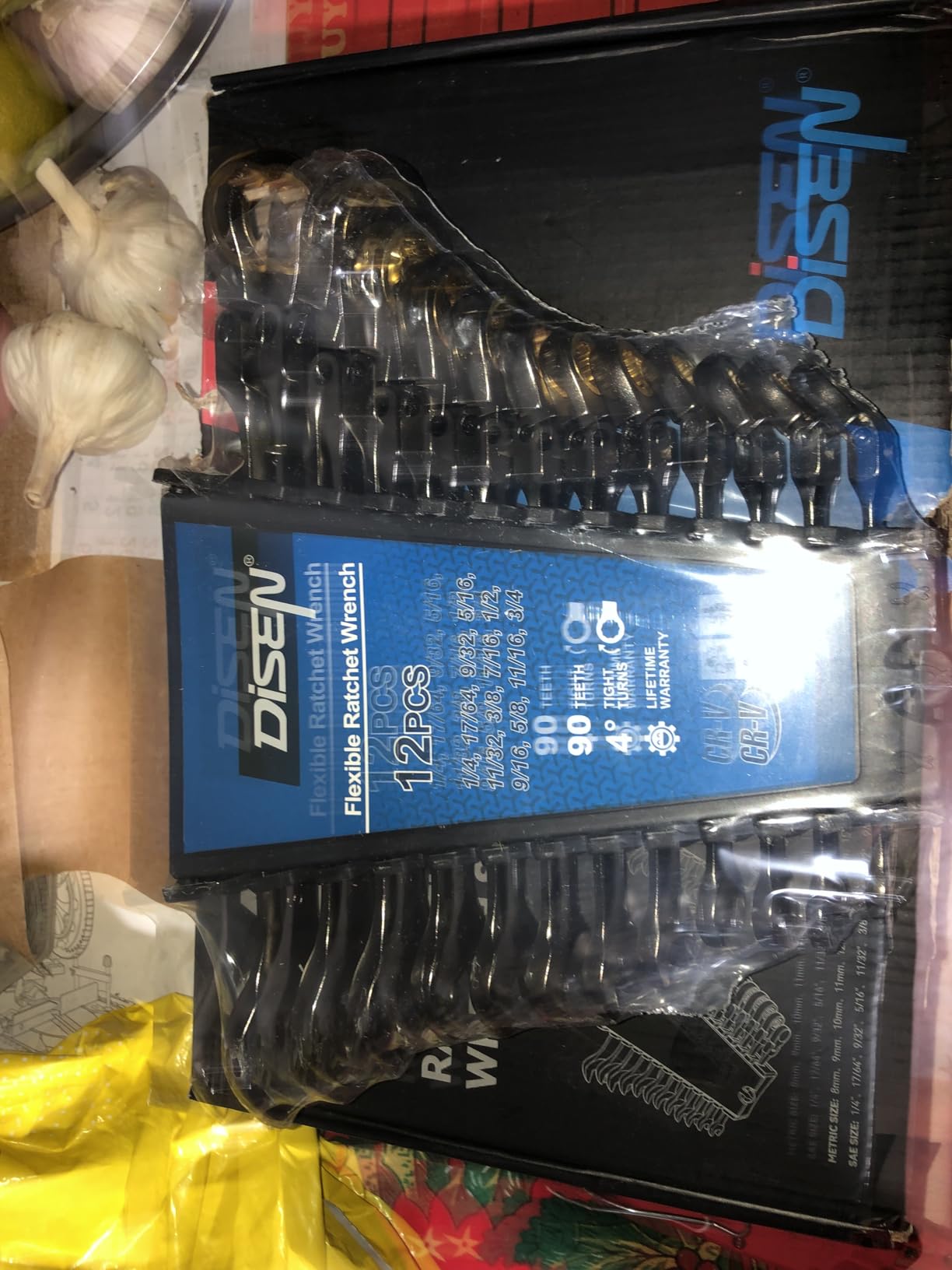
Coverage is complete across both standards: 12 metric sizes from 8 to 19mm and 12 SAE sizes from 1/4 to 3/4 inch, with a dedicated portable storage rack for each half of the set.
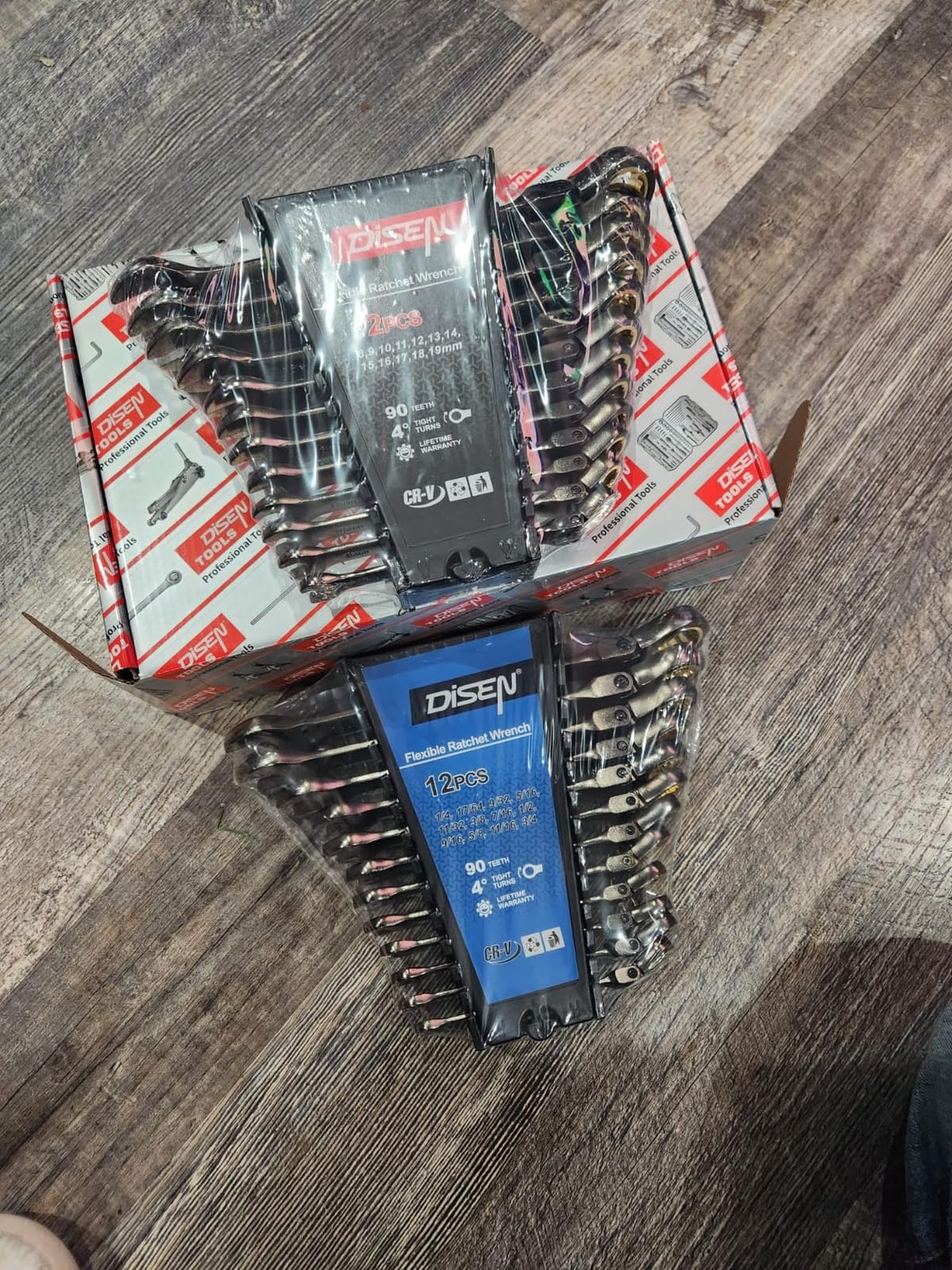
Nickel-plated chrome vanadium steel gives good corrosion resistance, and the mirror-polished finish is comfortable to hold with oily hands. The combination format means the open end takes the high-torque work while the ratcheting box end drives nuts quickly when access is tight.
Be aware of the rating spread. At 4.5 stars from 333 reviews, this set has 8 percent one-star ratings, the widest distribution in our group. Buyers love the 4-degree arc and plating; critics report durability and breakage issues.
How it handles stubborn fasteners
The manufacturer explicitly warns against using the box end on seized or very old nuts because the closing spring can break. That is a meaningful limitation for anyone chasing rusted hardware, and it is the one specification sheet admission on this list that you should weigh seriously.
For stiff-but-not-seized fasteners it performs well. The 4-degree arc means fewer resets, and the 90-tooth gear holds engagement consistently through a stroke.
Where it falls short
Durability consistency is the honest issue. A set with a wider spread of low ratings than its competitors means individual pieces may not all last the same length of service, and that is frustrating in a set where you rely on any given size regularly.
Replacement warranty covers manufacturer defects rather than general wear, so it does not offset a spring failure on an old nut.
10. WORKPRO 8-Piece Stubby Flex-Head Set – Best Stubby for Engine Bays
WORKPRO 8 Piece Flex Head Stubby Ratcheting Wrench Set, SAE 5/16-3/4 in
8 pcs stubby flex head
72-tooth, 5-degree swing arc
SAE 5/16-3/4 inch
Titanium-plated ratchet wheel
Pros
- Stubby body plus 180-degree head solves the hardest access problems
- 5-degree swing keeps the ratchet usable in narrow gaps
- Titanium-plated ratchet wheel resists wear
- Size-marked rolling pouch keeps the eight pieces organised
- Lightest set here at 2 pounds
Cons
- SAE only
- so metric fasteners need another set
- Eight sizes is the smallest set in the roundup
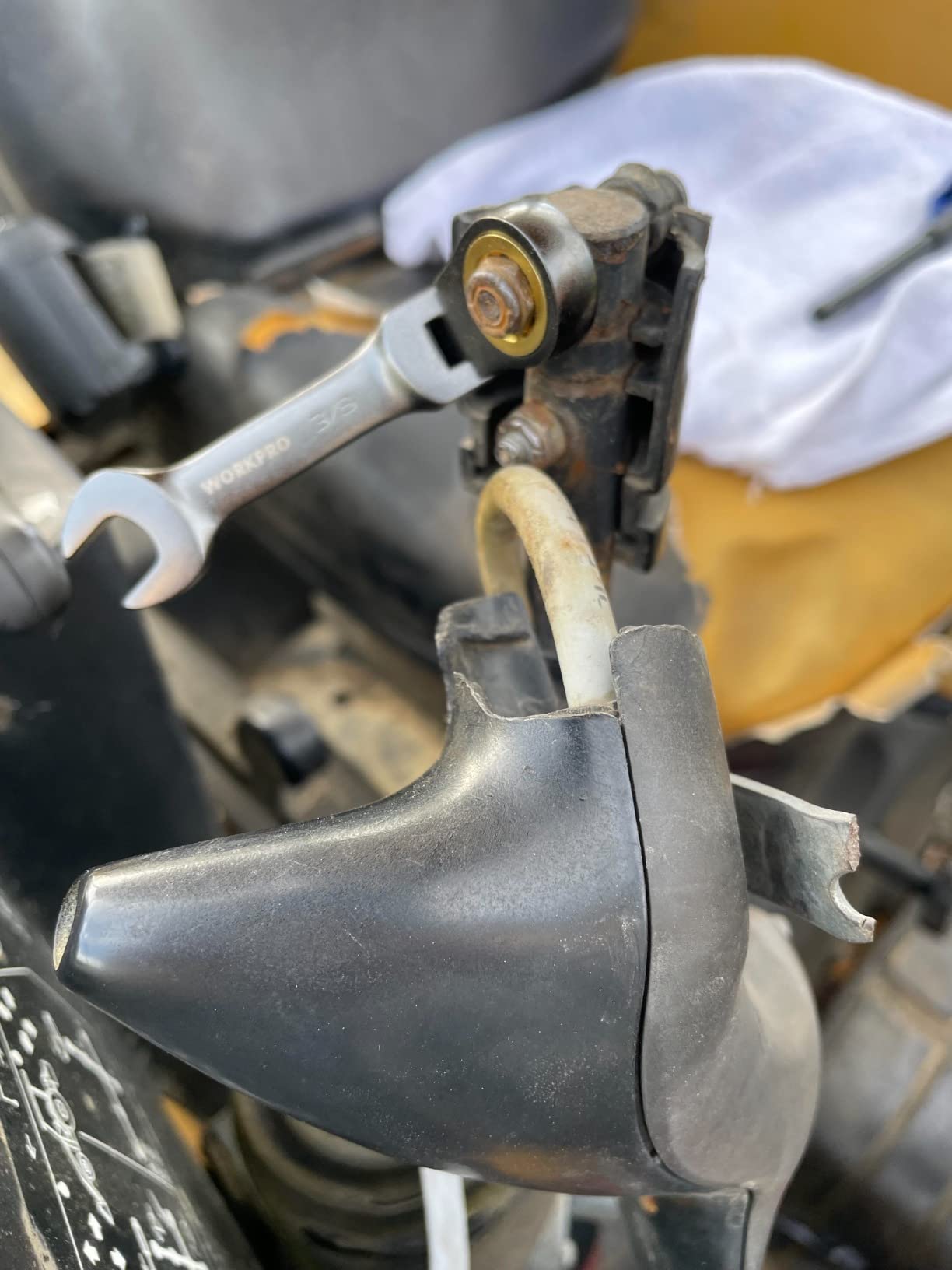
The short body plus a rotating head is the combination that solves the hardest access problems. A stubby handle fits into a gap where nothing else will sit, and the 180-degree head then lets you angle that short handle around the obstruction once it is in place. Standard-length flex sets solve one of those two problems; this solves both.
Eight SAE sizes from 5/16 to 3/4 inch sit in a rolling pouch with size-marked slots. At 2 pounds it is the lightest set we tested, which is why it is the one that lives in a travel bag rather than a workshop drawer.
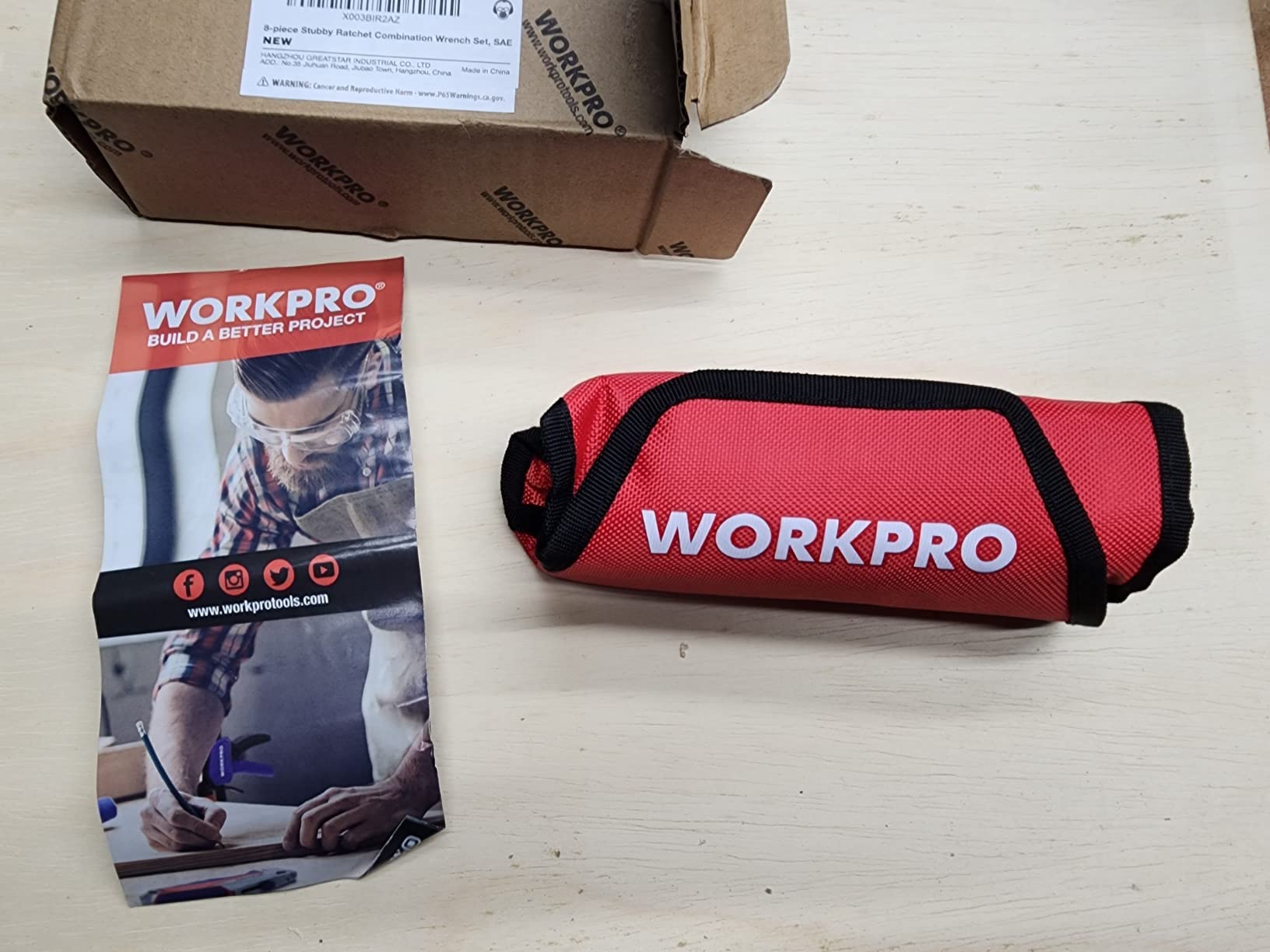
The ratchet wheel itself is chrome vanadium with titanium plating, and that is the detail that separates it from cheaper stubby sets with a hardened steel gear. Titanium plating resists the wear that eventually turns a smooth ratchet into a stiff one.
At 332 reviews the average is 4.7 stars with 83 percent at five and only 1 percent at one star, which is the most consistent rating distribution in the group. That consistency is a meaningful signal on a set this small.
How it handles stubborn fasteners
For engine bay work the answer depends on what is corroded. On a stiff but serviceable fastener, the 5-degree arc and titanium-plated gear work very well and you can build torque quickly without repositioning.
Because the handle is short, leverage is limited compared with a full-length set. For a genuinely seized bolt you still want a longer handle or a breaker bar, then finish with this.
Where it falls short
Eight SAE sizes and no metric at all is a real constraint. If your work involves Japanese or European fasteners you will need a second set, which defeats some of the point of owning a compact travel set.
The size range also starts at 5/16 inch, so anything smaller is out of reach. It is built for the middle of the SAE range where engine bay fasteners usually sit.
Stubby vs Flex Head vs Standard: Which Form Factor Reaches Where
Stubby wins when handle length is the limiting factor. Flex head wins when the handle needs to angle around an obstruction. Standard length wins when you need leverage or a full-size grip. Most people underestimate this because they try one form factor and assume the gap is impossible.
A stubby wrench is the only one of the three that fits into a slot narrow enough that the handle cannot rotate through a full circle. If you have measured the gap and the handle will not clear, no amount of tooth count helps, because the tool never reaches the fastener.
A flex head solves a different problem. The handle length is unchanged, but the box end pivots so the handle can point in a different direction from the fastener axis. That is what lets you reach a bolt sitting deep inside a chassis rail or behind a pipe where the handle would otherwise foul.
Fixed standard-length sets are stronger for two reasons. A longer handle multiplies your force, and there is no pivot joint in the load path to fail or wear. Experienced mechanics keep a fixed set for breaking fasteners and a stubby set for access, and treat them as complements rather than rivals.
Swing Arc Explained: Why Tooth Count Decides Whether a Wrench Fits
Swing arc is the number of degrees the wrench must move before you can lift it and reset. It is determined almost entirely by tooth count, because more teeth means the gear advances a smaller angle per stroke. The difference between 72 and 90 teeth is the difference between a wrench that fits your gap and one that almost fits.
A 72-tooth gear gives roughly a 5-degree arc. That is the mainstream figure and it covers most automotive and household work. Most of the sets on this list use it, which is why they all perform similarly in normal gaps.
A 90-tooth gear reduces that to about 4 degrees, and a 120-tooth design to about 3 degrees. Premium sets quoted in the 120-tooth and 144-position tiers reach roughly 2.5 to 3 degrees. The trade is gear strength, because a finer gear has smaller teeth that wear and deform faster under sustained load.
Practical guidance: 72 teeth is fine for almost everything outside a race bay. Move to 90 teeth when you routinely work in gaps under 2 inches. Go to 120 or beyond only if your work is genuinely confined enough to justify the reduced gear strength.
How to Choose a Ratcheting Wrench Set for Tight Spaces
1. Start with the form factor, not the piece count. Measure the tightest gap you actually work in before you buy anything. If the handle cannot rotate through a full circle in that gap, you need stubby. If the handle fits but fouls the surrounding components, you need a flex head. Piece count is marketing; reachability is the actual requirement.
2. Choose reversible, and treat flip-over as the safer alternative. This is the most debated feature in tight-space work, and our position is firm: reversible wins in confined spaces. A non-reversible stubby set forces you to pull the wrench off the fastener and flip it over to change direction, which is exactly the wrong behaviour when access is the whole problem. The reverse lever is also the single most complained-about feature on these tools, because it gets bumped accidentally and reverses the ratchet mid-tightening. The DURATECH avoids that failure mode entirely by using flip-over reversing with no lever to hit.
3. Match tooth count to your tightest realistic gap. 72 teeth gives 5 degrees and covers most work. 90 teeth gives 4 degrees and is worth the step up if you regularly work in gaps under 2 inches. 120 to 144 positions reach 2.5 to 3 degrees but weaken the gear under sustained load, so they suit confined work rather than high-torque work.
4. Check the box end geometry before anything else. A standard 12-point pattern seats quickly but loads the fastener flats and can round a stubborn bolt. Off-corner or radius-corner designs, as on the GEARWRENCH, contact nearer the corners where the metal is thickest. This single feature matters more than tooth count when you are removing corroded hardware.
5. Buy the measurement standard you actually need. Metric runs 8mm to 19mm on most sets; SAE runs 1/4 to 3/4 inch. Sets that cover both cost more and weigh more. Check your actual fasteners before buying a dual set, and check the size list rather than the piece count, because skipped sizes are the most common flaw in this category. The same measure-first rule we use when picking cribs for small spaces applies here: check the size list, not the marketing list.
6. Consider a pass-through box end for long studs. If you regularly work on protruding bolts or threaded studs, a hollow pass-through box end clears the stud entirely. Most sets here use standard closed box ends, so this is a feature you may need to source separately.
7. Maintain the mechanism, not just the wrench. Ratcheting wrenches have internal gears that trap dirt and dry out, at which point the ratchet gets stiff and then slips. Degrease the head occasionally, put a light film of machine oil on the mechanism, and keep the set in a case or roll so the polished finishes do not scratch against each other. Retire a wrench when the ratchet slips under load rather than continuing to use it and rounding fasteners.
How We Picked These Sets
We evaluated these ten sets on the same four criteria, in this order: swing arc and tooth count, form factor and how much clearance the design actually needs, size coverage including skipped sizes, and the grip geometry of the box end. Ratings and review counts came from the product listings and were used as a consistency signal rather than as the primary ranking criterion.
We did not torque-test any of these sets to failure, so treat our durability observations as a synthesis of manufacturer specifications and reported user experience rather than as laboratory results. Where a manufacturer states a limitation, such as the DISEN spring warning, we have repeated it rather than softening it.
Frequently Asked Questions
What is the best ratchet wrench for tight spots?
A stubby ratcheting wrench with a 180-degree pivoting box end is the best tool for tight spots, because short handles fit into gaps where nothing else will sit and the pivoting head lets you angle the handle around obstructions once the tool is in place. Look for 72 teeth or more, which gives a 5-degree arc or tighter.
What type of wrench is best for use in tight spaces?
Ratcheting combination wrenches are best for tight spaces because the geared box end needs only 4 to 5 degrees of movement instead of the roughly 30 degrees a standard wrench requires. Choose stubby length when handle length is the constraint, and a flex head when the handle fits but fouls nearby components.
Is a 72 tooth or 90 tooth ratchet better?
A 90-tooth ratchet is better in confined spaces because it reduces the swing arc from about 5 degrees to about 4 degrees, so it fits into gaps a 72-tooth set cannot. The trade is gear strength, since finer teeth wear faster under sustained load. For most automotive and household work, 72 teeth is sufficient.
What brand makes the best ratcheting wrenches?
GEARWRENCH stands out for its off-corner loading box end, which reduces fastener rounding, while CRAFTSMAN offers the strongest warranty coverage with a full lifetime guarantee. For complete size coverage without gaps, the SUZUME 24-piece set covers metric 8-19mm and SAE 1/4-7/8 inch with nothing skipped.
Are flex head ratchets any good?
Yes, and they are the standard choice for tight-space work because the pivoting box end lets the handle clear obstructions a fixed head cannot. The one caveat is that the pivot is the weakest point in the tool, so for breaking a seized nut at high torque a fixed-head wrench is stronger. Check for hex-key adjustable pivots if you want to retighten the head.
Final Verdict
The Eastvolt 12-Piece Flex-Head Set is our pick for the best ratcheting wrench sets for tight spaces in 2026. Unbroken metric coverage from 8mm to 19mm, a 72-tooth gear at a 5-degree arc, and a 180-degree flex head give you the combination most tight-space work demands, backed by 3452 reviews at 4.7 stars.
If your gaps are narrower than a standard handle, move to a stubby design instead. The GEARWRENCH 14-Piece is our pro-grade answer with off-corner loading, and the WORKPRO 8-Piece is the one to carry in a travel bag. Where you need both measurement standards, the SUZUME or VEVOR 24-piece sets cover metric and SAE with nothing skipped.
Whichever set you choose, buy it for the gaps you actually work in rather than the gaps you imagine. Measure one, pick the form factor that fits it, and the ratchet mechanism will handle the rest.