
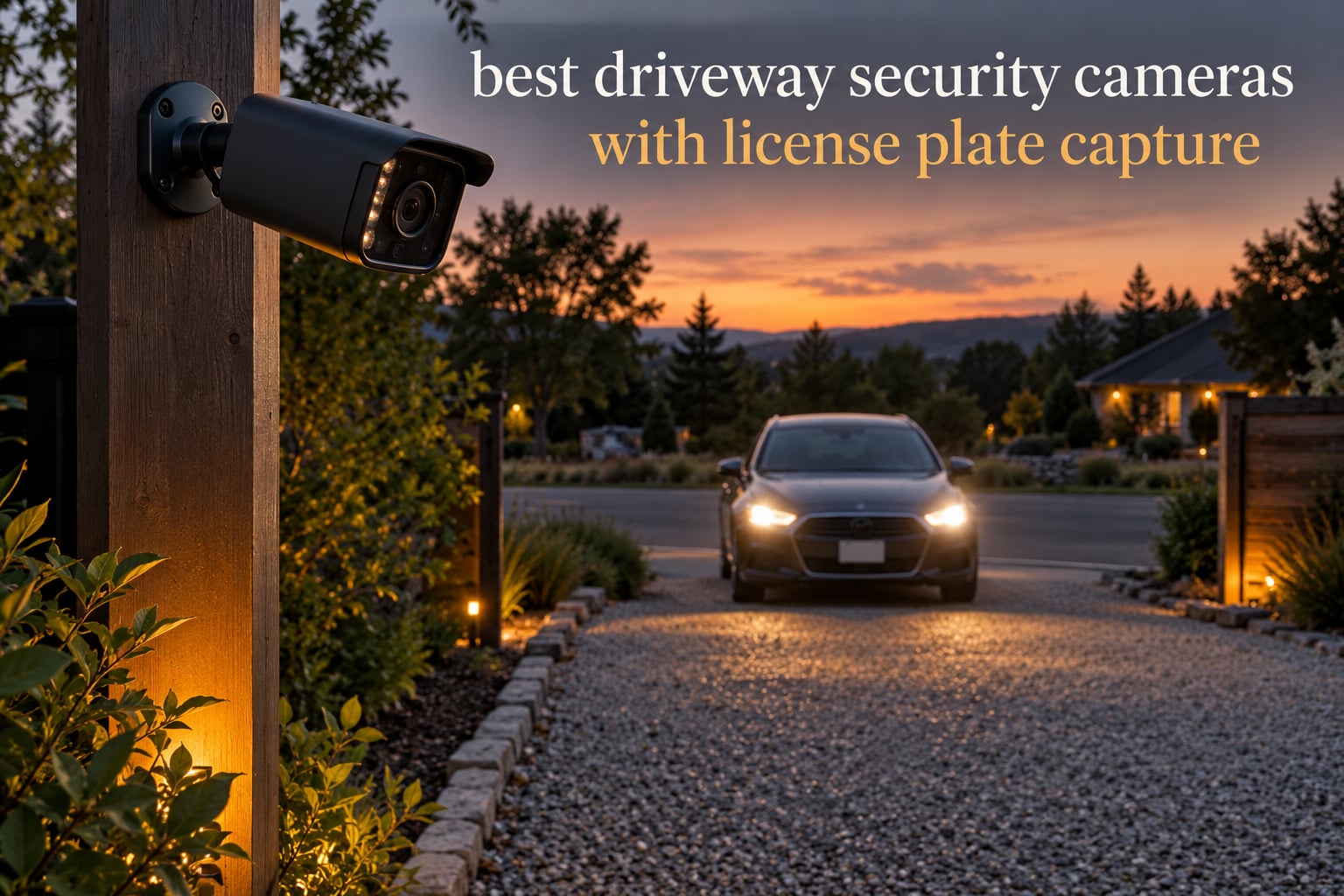
Most driveway cameras can spot a car at 100 feet and still fail to read the plate on it. That gap is the whole reason people end up with footage they can look at but never act on, and it is the filter we applied when building the best driveway security cameras with license plate capture roundup below.
Every camera here has a dedicated license plate recognition algorithm built into the camera body, not an app that guesses. We compared ten of them on lens reach, sensor size, dynamic range, night illumination, weather sealing and how each one handles a vehicle arriving at speed.
Our short version: if your driveway ends at a road or a gate, you want a fixed-lens or varifocal bullet camera with optical zoom, wide dynamic range and infrared illumination, wired over PoE to a recorder. If you are covering a long rural drive with no mains power, the trade-offs get harder, and we cover that in the power section below.
We also link our broader outdoor security camera picks if you also need general yard coverage, since plate cameras are deliberately bad at it.
Top 3 Picks for Driveway License Plate Capture (October 2026)
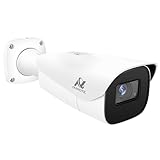
ONWOTE BA40-LPR832 LPR PoE Camera
- 4MP 2592x1520 sensor
- 8-32mm motorized varifocal lens
- Documented 23ft-98ft ANPR range
- 120dB WDR with low-light sensor

Anpviz IPC-B7340WD-5X-LPR-1
- 4MP LPR bullet
- 2.7-13.5mm 5X motorized lens
- 132ft IR night vision
- IP67 and IK10 vandal-proof
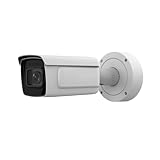
Hikvision DeepinView 4MP ANPR Moto
- 4MP ANPR bullet
- 8-32mm varifocal lens
- 140 dB WDR
- 164ft EXIR night vision
Best Driveway Security Cameras With License Plate Capture in October
All ten cameras below are dedicated LPR models rather than repurposed bullet cameras. Where a manufacturer publishes a plate-read distance, we quote it; where it does not, we say so rather than guessing.
| Product | Specifications | Action |
|---|---|---|
| ONWOTE BA40-LPR832 LPR PoE Camera |
|
Check Latest Price |
| Anpviz IPC-B7340WD-5X-LPR-1 |
|
Check Latest Price |
| Hikvision DeepinView 4MP ANPR Moto |
|
Check Latest Price |
 LTS LXIP9943LPR-50R Pro-X LTS LXIP9943LPR-50R Pro-X |
|
Check Latest Price |
 Vivotek IB9387-LPR 5MP Vivotek IB9387-LPR 5MP |
|
Check Latest Price |
 Vivotek IP816A-LPC-40 Vivotek IP816A-LPC-40 |
|
Check Latest Price |
 GeoVision GV-LPC2011 GeoVision GV-LPC2011 |
|
Check Latest Price |
 Vivotek IP9165-LPCKIT-S1-V2 Kit Vivotek IP9165-LPCKIT-S1-V2 Kit |
|
Check Latest Price |
 Uniview HC121 TCR-08S-Z28 Uniview HC121 TCR-08S-Z28 |
|
Check Latest Price |
 Uniview PKC2640 Z80-P Uniview PKC2640 Z80-P |
|
Check Latest Price |
1. ONWOTE BA40-LPR832 – Best Overall License Plate Recognition PoE Camera
ONWOTE License Plate Recognition PoE IP Camera Wired, 8-32mm Motorized Lens
4MP 2592x1520 at 30fps
8-32mm motorized varifocal lens
23ft-98ft ANPR range
IP67 aluminum housing
Pros
- Documented 23ft to 98ft ANPR working distance
- 4MP 2592x1520 sensor with 1/1.8 inch low-light sensor
- 120dB WDR plus DarkFighter low-light processing
- IP67 sealed aluminum housing for permanent outdoor mounting
- Local microSD recording up to 256GB
Cons
- Only pairs with ONWOTE TD Series recorders
- Requires a wired PoE Ethernet run to the camera
- Narrow 47 degree viewing angle covers little per camera
This is the camera I would put on my own driveway, and the reason is simple: it is the only model in the group that publishes a plate-recognition working distance. The listing states a recommended ANPR range of 23 feet to 98 feet, which lets you size the camera to the driveway instead of guessing.
The 8-32mm motorized varifocal at f/1.6 does the real work. At the wide end you cover a driveway mouth and a gate; at the long end you concentrate enough detail on a plate to read it. Because the lens is motorized, that adjustment happens from the recorder or browser after the camera is already mounted and aimed, which is when you actually know where the car stops.
The 1/1.8-inch sensor is larger than most of the sensors in this roundup, and combined with the DarkFighter processing and 120dB WDR it holds up when a car pulls in with headlights pointed at the lens. Infrared reach is listed at 100 feet, which covers most residential approaches.
The tradeoff is ecosystem lock. This camera configures only with ONWOTE TD Series recorders, so if you already run a different NVR you are starting over. That is a real cost in time and hardware, and worth weighing against the lens flexibility before you commit.
Is the documented 23ft-98ft range reliable in practice?
The figure is a manufacturer recommendation, not an independent test, and it assumes reasonable mounting height, a clear line of sight and roughly head-on vehicle approach. Ask for a sample frame at your driveway length before you finalise the install.
The 47-degree viewing angle also means one camera covers far less ground than a typical outdoor bullet. Plan on a second unit for the full drive, or accept a tight corridor of coverage.
Who should skip this camera?
Skip it if you already own a recorder from another brand and are not willing to add ONWOTE hardware. There is no third-party path into this camera, and that is not a preference, it is a hard compatibility wall.
It is also not the right pick for a very long unlit rural drive. 100 feet of infrared reach is generous but it does not stretch to a 300 foot driveway, and no single bullet camera does.
2. Anpviz IPC-B7340WD-5X-LPR-1 – Best for Long Night IR Reach
Anpviz License Plate Recognition/LPR PoE Camera, 2.7-13.5mm Motorized Lens
4MP 2688x1520 at 30fps
2.7-13.5mm 5X motorized varifocal
132ft IR night vision
IP67 and IK10
Pros
- 1/1.3 inch sensor rated near 0 Lux for night plate capture
- 5X motorized varifocal lens for remote aiming
- 120dB true WDR against headlight backlight
- H.265+ compression and microSD up to 512GB
- IK10 vandal-proof housing rated down to -40C
Cons
- Only compatible with Anpviz NVR recorders
- Requires a separate PoE and NVR setup
- microSD card not included
This camera has the best night hardware in the group on paper. The 1/1.3-inch sensor, stated sensitivity of 0.0003 lux in colour and 0.0001 lux in black and white, plus 132 feet of infrared illumination, is the specification stack you want when a car arrives at 2am with no driveway lighting.
The 2.7-13.5mm lens covers a 5X motorized zoom range, which is wider than most rivals here and lets one body handle both a close gate and a distant house. The 120dB true WDR figure is the one that matters most for plate work, because headlights and dawn glare are the failure mode owners complain about repeatedly.
It is also the most rugged unit we looked at. IP67 plus an IK10 vandal rating and a stated operating range of -40C to 60C covers the climate range that most consumer cameras are never rated for.
We want to be straight about the reviews here. This listing has a single 1-star review reporting only that the unit did not work, with no detail on the failure. That sample is far too small to conclude anything about reliability, and you should treat it as one unlucky unit rather than a pattern.
There is also a hard ecosystem limit: this camera configures only with a specific list of Anpviz NVRs. Verify your recorder model against the compatibility list before ordering anything.
How much night performance do you actually gain?
The gap between this sensor and a small 1/2.8-inch sensor shows up as image noise at low light, and noise is what smears plate characters into an unreadable block. A larger sensor at the same lens length is one of the few reliable ways to buy night plate reads.
Infrared range alone does not guarantee a readable plate. Retroreflective plates bounce IR light straight back at the camera, which is why glare off the plate surface is the most cited night failure in the owner forums. Wide dynamic range plus a controlled illuminator is what fixes it.
Where this camera will disappoint you
The NVR lock-in is the biggest one. There is no app-only or third-party recorder route, so you are buying into a closed system whether you want to or not.
It is also not a good fit for a small front porch or a short suburban driveway. You would be paying for long-range optics you never use, and you would need a second camera for coverage anyway.
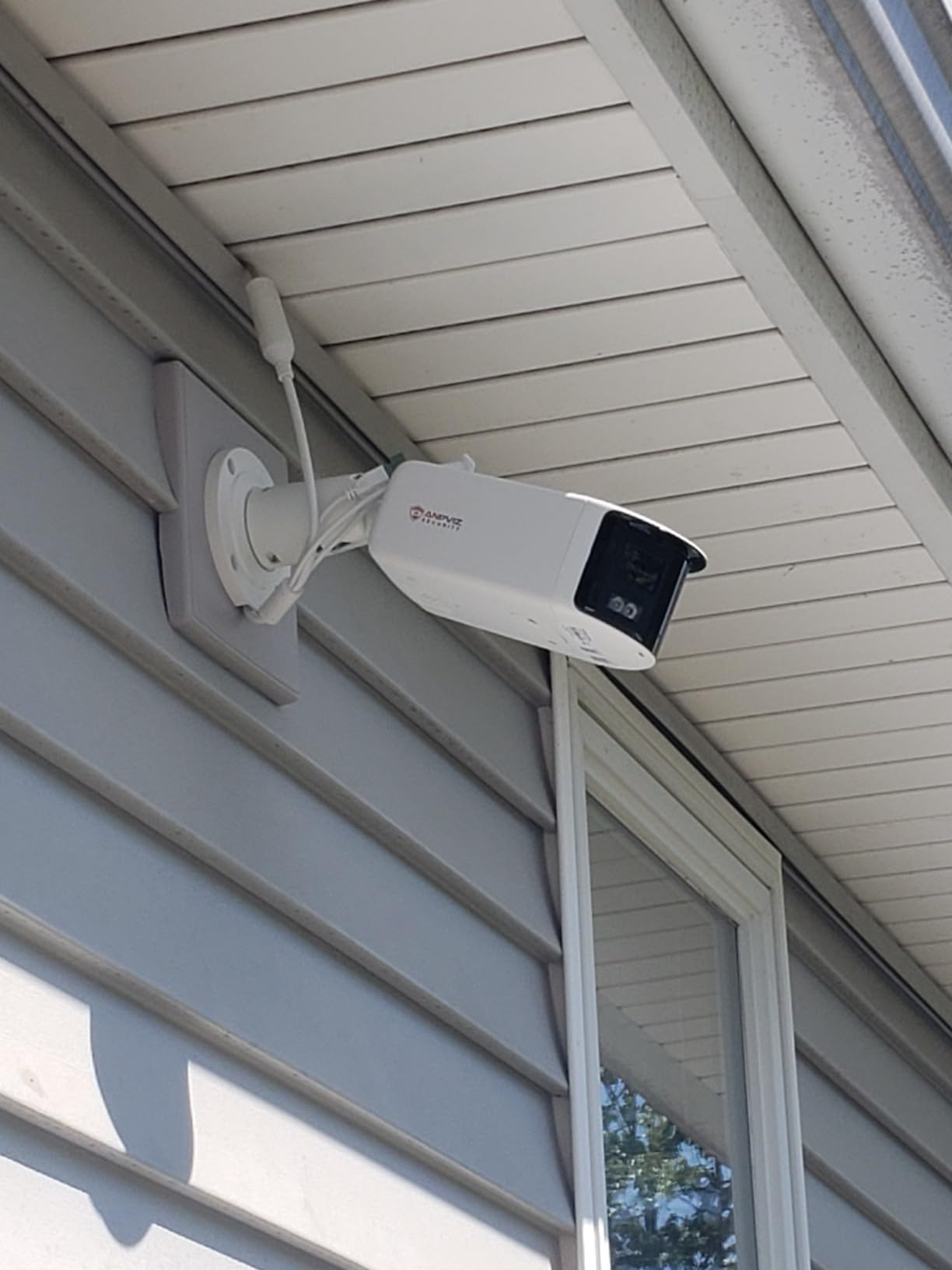
3. Hikvision DeepinView iDS-2CD7A46G0/P-IZHS – Best Against Headlight Backlight
iDS-2CD7A46G0/P-IZHS(Y) 4MP DeepinView ANPR Moto Camera with License Plate Recognition, 8-32MM Varifocal Lens Bullet POE IP Camera, H.265+, DarkFighter, 140 dB WDR, Water & Dust Resistant IP67 IK10
4MP ANPR bullet
8-32mm varifocal lens
140 dB WDR
164ft EXIR night vision
Pros
- Highest dynamic range in the group at 140 dB for backlit plates
- Longest stated night illumination reach at 164 feet
- DarkFighter low-light tech removes the need for extra driveway lighting
- 8-32mm varifocal covers a driveway mouth and a distant gate
- H.265+ cuts storage and bandwidth at 4MP
Cons
- Sold by a third-party brand rather than Hikvision directly
- Firmware and NVR pairing must be verified before purchase
- No published plate read accuracy or capture speed figure
The headline number on this one is 140 dB of wide dynamic range, the highest figure anywhere in this roundup. When a car comes up the drive with its headlights already on, a conventional camera blows out the front of the vehicle and the plate with it. Very wide dynamic range is the specific fix for that, and it is why this camera suits the night arrival scenario better than anything else here.
The 8-32mm varifocal lens gives you a genuine range, from a wide look at the driveway mouth down to a tight read on a plate further back. Infrared reach is listed at 164 feet, the longest in the group, and the EXIR illuminator is designed for even coverage rather than a hot central spot.
DarkFighter low-light processing means you can likely skip the extra driveway floodlight many owners add, which matters because a floodlight on a driveway also triggers far more shadow alerts and more moths at the lens.
Two caveats before you buy. This is a DeepinView model sold through a third-party brand rather than through Hikvision directly, so confirm firmware support and recorder pairing in advance. And the listing publishes no plate-read accuracy or capture-speed figure, so you are buying on imaging specification alone.
Is 140 dB WDR the number that decides a plate read?
Not by itself. Dynamic range handles the contrast between a lit headlight and a dark plate, but the character detail still comes from resolution and lens reach. Treat it as the difference between a readable image and a white blob, not as a substitute for optical zoom.
It matters most at night and at dawn, when a car approaches nearly head-on. For a side-on daylit pass, the same camera would perform fine with a far less capable sensor.
What you need to plan before installing this one
It requires a wired RJ45 PoE run and a compatible recorder, so budget for cable and a mounting point with power nearby. If your driveway camera location has no mains power and no network path, this camera cannot go there.
Also verify the exact recorder model. Hikvision ecosystem cameras are widely supported, but this particular model number is the one to confirm rather than assume.
4. LTS LXIP9943LPR-50R Pro-X – Best for Very Long Driveways
Generic LTS LXIP9943LPR-50R PRO-X IP 4MP 98ft IR License Plate Recognition LPR NDAA Bullet Camera
4MP 2688x1520 at 30fps
10-50mm varifocal lens
98ft IR range
IP67, ONVIF, PoE+
Pros
- 10-50mm varifocal gives the longest reach in this group for long drive reads
- 4MP 2688x1520 with 0.002 lux low-light sensitivity
- 98ft IR range
- ONVIF compatibility for third-party recorders
- Local microSD up to 256GB as a standalone fallback
Cons
- Motion-only alerting with no vehicle-specific alerts stated
- Published dimensions appear to describe the retail box
- No published LPR read accuracy or capture speed
The 10-50mm varifocal is the reason this camera earns a place. At 50mm it concentrates far more detail on a plate than any other lens in this roundup, which makes it the most sensible choice for a driveway where the car is 80 or 100 feet from the camera when it stops.
Underneath it is a 1/1.8-inch progressive scan sensor at 4MP, with stated sensitivity of 0.002 lux and 98 feet of matrix infrared illumination. Video metadata collection is supported, which matters if you plan to search NVR footage by vehicle attributes rather than by timestamp.
This is also the most open unit in the group. It speaks ONVIF, accepts 12V DC, 24 VAC or PoE+, and keeps up to 256GB on a microSD card, so it can record locally even if the recorder is down. For anyone who wants evidence they can export without a cloud account, that matters.
It is also NDAA compliant, which is irrelevant for a private driveway but useful if you install at a farm or a small commercial yard. Owners of large properties may want our farm security camera picks alongside it.
Two real limitations. The alert type is listed as motion only, with no vehicle-specific or plate-specific alerting, so you will get motion events rather than car events. And the published dimensions of 26 x 13 x 12 inches almost certainly describe the retail box rather than the camera body.
How much does a 50mm lens actually help?
Focal length is the single biggest lever on plate readability that buyers ignore. Going from a 10mm to a 50mm lens is roughly a five times increase in image magnification, and magnification converts distant pixels into legible characters.
The cost is field of view. At 50mm this camera sees a narrow corridor, so it works as a second camera aimed down the drive rather than as your only driveway view.
Where it will fall short
If you need a camera that pings your phone when a specific car arrives, the motion-only alerting is a downgrade from the vehicle-specific alerts some competitors offer. You would need software on the recorder side to add that intelligence.
It is also the wrong shape of camera for a short urban driveway where a car is 20 feet from the lens. You would gain reach you have no use for and lose the wide view.
5. Vivotek IB9387-LPR – Best for International Plates
Vivotek IB9387-LPR 5MP IR License Plate Recognition Outdoor Network Bullet Camera with Motorized 2.7~13.5mm Vari-Focal Lens, Remote Focus, RJ45 Connection
5MP license plate capture
2.7-13.5mm motorized varifocal
Plate support for 70+ countries
IP66, IP67 and IK10
Pros
- 5MP is the highest resolution in this roundup
- Plate recognition supported across 70+ countries
- Motorized 2.7-13.5mm vari-focal with remote focus for post-install aiming
- Dual IP66 and IP67 sealing plus IK10 vandal rating
- Centralized list management runs inside the camera
Cons
- Plate-read distance and IR performance are not quantified
- Professional NVR integration needed for list matching
- Highest-tier hardware in the roundup
This is the highest resolution camera in the group at 5MP, and that is not a marketing line. Resolution is the raw material of a plate read, and at long driveway distances the extra pixels are what separate a legible plate from a guess.
The reason we would pick it for a specific scenario is the 70-plus-country plate database. If your street sees rental vehicles, commercial imports or visitors from several jurisdictions, recognition coverage matters as much as pixel count. A camera that only recognises local formats will quietly return nothing on half the cars you see.
Optically it is well specified, with a 2.7-13.5mm varifocal at f/1.4-2.8 and remote focus, so you can fine-tune the aim from a remote interface after the camera is up. The housing carries both IP66 and IP67 sealing along with an IK10 vandal rating, which is about as well protected as an outdoor bullet gets.
Centralised list management running inside the camera is a genuine architectural advantage. Whitelist and blacklist matching happens at the edge rather than on a separate server, so the system has fewer single points of failure.
What the listing does not give you is a plate-read distance or a night performance figure. With no customer feedback on this listing, you are buying on the specification sheet and the platform alone.
Does 5MP matter more than the lens?
Neither one rescues a bad mount. A 5MP camera at a wide angle from 150 feet away still produces an unreadable plate, while a 4MP camera on a proper telephoto at 50 feet reads cleanly every time.
What the extra resolution buys you is headroom. It lets you crop digitally into a region of the frame without losing detail, which is useful when you want one camera to cover both a wide scene and a specific capture zone.
Who this is not for
This is an infrastructure purchase. It expects a professional recorder or video management system and someone comfortable configuring list matching inside that platform.
If you want a camera you can unbox, mount and check from a phone on day one, this is the wrong end of the market.
6. Vivotek IP816A-LPC-40 – Best Against Headlight Glare
VIVOTEK | IP816A-LPC-40 920X1080 (1080P), VARI-Focal 12-40MM, 30 P-iris WDR Pro SNV 3DNR Remote Back Focus EIS 60 fps Snapshot Focus Corridor View License Plate Capture
1920x1080 at 30fps
12-40mm varifocal with P-iris
Built-in headlight filter
WDR Pro 100 dB
Pros
- Built-in headlight filter blocks visible light glare from lit plates
- 12-40mm varifocal with P-iris and remote back focus for driveway tuning
- WDR Pro rated at 100 dB for extreme contrast
- 60 fps single-stream mode improves odds of catching a moving plate
- Snapshot focus corridor view suits narrow approach lanes
Cons
- Only 2MP resolution and 60 fps is limited to one-stream mode
- No IP weather rating is published for this model
- Two-way audio adds wiring and cost without helping plate capture
This camera does something none of the others do explicitly, and it is the reason it is here. It has a built-in headlight filter that blocks visible light before it hits the sensor, which attacks the specific night failure everyone complains about: a retroreflective plate lit by headlights bouncing light straight into the lens.
The 12-40mm varifocal with a P-iris lens and remote back focus is well matched to a driveway. P-iris gives a more even focus across the frame than a fixed-aperture lens, and remote back focus lets you correct sharpness from a browser once the camera is mounted at its final angle.
Snapshot focus corridor view is purpose-built for narrow approach lanes, which is exactly the geometry of a private drive. WDR Pro is rated at 100 dB, and electronic image stabilisation helps when the camera is on a long pole or a pole that moves in wind.
The resolution is the compromise. This is a 2MP 1920×1080 sensor, among the lowest in the group, and the 60 fps mode works only in single-stream mode, so you give up a second stream to get the frame rate that helps with moving vehicles.
No IP weather rating is published for this model in the listing, which for a camera destined for an exposed driveway is a genuine gap. Ask for it before you commit.
What does a headlight filter actually do?
License plates are retroreflective by design. They return light toward its source, which is exactly why they read well from a police cruiser and blow out from a home camera placed badly. A filter that reduces the visible-light component keeps the plate from clipping to white.
It is a hardware fix for a problem that software tone mapping can only partly hide. On a night driveway with headlights, this is worth more than an extra two megapixels.
Where the 2MP limit bites
At short driveway distances 2MP is fine. At longer distances, where you are cropping into the frame to read a plate, the resolution ceiling arrives early and the characters start to break apart.
Two-way audio on this model is the one feature that adds wiring and cost without serving plate capture at all. If you only want plates, that cost buys you nothing.
7. GeoVision GV-LPC2011 – Best Budget Dedicated LPR Camera
GEOVISION GV-LPC2011 2 MP Color IR WDR POE Reflective License Plates Recognition Network Outdoor Bullet Camera with 3~9mm varifocal Lens, 3X Zoom, RJ45 Connection
1920x1080 color CMOS
3-9mm varifocal with 3x zoom
IR up to 35ft
IP67 weatherproof
Pros
- Entry-level dedicated LPR model
- 3-9mm varifocal with 3x zoom covers typical driveway approaches
- IP67 weatherproof and vandal-proof housing
- Defog mode helps with condensation in cold and humid conditions
- Super low lux sensor with wide dynamic range for backlit plates
Cons
- Reads reflective plates only
- Vehicle capture capped at 60 km/h which is the lowest limit here
- Short 35ft IR range
- Only 2MP with a narrow 3-9mm lens
This is the most affordable dedicated license plate recognition camera we found, and for a short suburban driveway it does a reasonable job. The 3-9mm varifocal with 3x zoom is a modest range, but a car pulling into a typical driveway is close enough for it to work.
It is a true LPR model rather than a repurposed bullet camera, and the reflective plate recognition is real. The spec also lists recognition for vehicles travelling at 60 km/h, or 37 mph, or slower, which covers almost every residential approach.
Two features are quietly useful. Defog mode helps in cold climates where a driveway camera lens fogs up overnight, and the super low lux 1/2.8-inch sensor with wide dynamic range handles the backlit daytime case better than the resolution would suggest.
There are hard limits and you should read all three. It recognises reflective plates only, so non-reflective plates will not register at all. Capture speed is capped at the lowest limit in this group. And the infrared range is 35 feet, which is fine for a short drive and useless for a long one.
Is this enough for a normal suburban driveway?
Yes, if your car stops within roughly 30 feet of the camera and most plates on your street are standard reflective design. That is the majority of residential installs in the United States and the UK.
The 3-9mm lens will not stretch much further. If your drive is longer than that, look at the LTS 10-50mm or the ONWOTE 8-32mm instead of trying to make this reach.
Where it will fall short
Non-reflective plates are the dealbreaker for some states and for a lot of European formats. If your street has a mix, expect blank results on a portion of vehicles.
The 35-foot night range also means a car arriving late at a long drive is a shape in the dark rather than a plate. Daylight behaviour and night behaviour here are very different.
8. Vivotek IP9165-LPCKIT-S1-V2 – Best Complete Kit
IP9165-LPCKIT-S1-V2 Outdoor 2MP License Plate Recognition (LPR) Kit, 35M IR, 60 MPH, 10°~30°, Street
Complete LPR kit
2MP sensor
35m IR range
10-30 degree field of view
Pros
- Complete LPR kit rather than a bare camera
- Highest capture speed rating in the group at 60 mph
- 35m IR range covers deep unlit approaches
- 10-30 degree adjustable field of view isolates the plate area
- H.265 compression lowers storage and bandwidth cost
Cons
- 2MP resolution is among the lowest in the roundup
- Kit format ties you to the specified recorder and cabling
- Generic brand listing with unclear warranty routing
The pitch here is simplicity. This comes as a complete LPR package rather than a camera alone, which for a first-time installer means fewer things to source separately and fewer ways to end up with a camera that does not talk to your recorder.
The specification choices are aimed straight at street-level monitoring. A 10 to 30 degree adjustable field of view is unusually narrow, and narrow is correct for plate work because it concentrates the frame on the lane where the car drives. The 60 mph capture speed rating is the highest here.
Infrared reach of 35 metres, roughly 115 feet, is the third longest in this roundup behind the 164ft and 132ft units, and it covers a deep driveway or an unlit street approach that would defeat the GeoVision’s 35 feet.
The 2MP sensor is the weak point, and it is the lowest resolution in the group. A narrow field of view partly compensates, because those pixels are being spent on a small area rather than a wide scene, but you are still working with less raw detail than the 4MP and 5MP units here.
One buying caution: this is listed under a generic brand with Vivotek named as the manufacturer, so confirm what warranty and support routing actually apply before you commit to a full kit purchase.
Why does a narrow field of view matter this much?
Because a plate occupies a small fraction of a wide frame. At a 90-degree horizontal angle you are spending most of your pixels on grass, sky and fence. Narrowing to 20 degrees is roughly a five times concentration of detail onto the road surface.
That concentration is why dedicated LPR cameras look so much worse at general security than a normal bullet, and why installers keep telling buyers they need a dedicated camera for faces and a dedicated camera for plates.
What to verify before installing the kit
Check exactly what the kit includes. A kit that includes a recorder is useful; a kit that assumes a specific recorder model you do not own is an expensive mistake.
Also confirm cabling distance. 60 mph plate capture is impressive but useless if the camera ends up 200 feet from your recorder with no switch between them.
9. Uniview HC121 TCR-08S-Z28 – Best for Fast Moving Vehicles
HC121@TCR-08S-Z28 – UNV 2MP 4X LPR IR Camera (Starlight, License Plate Recognition, PoE, 1080P, 60fps).
2MP starlight sensor
4X motorized zoom
1080P at 60fps
Integrated IR illumination
Pros
- 60fps streaming improves the odds of capturing a sharp frame from a fast car
- Starlight sensor plus integrated IR for night plate capture
- Motorized zoom lens simplifies aiming at a fixed driveway vantage point
- Algorithm reads plate numbers and vehicle body colours
- Compact body suits a tight mounting spot
Cons
- Sold under a generic listing rather than a supported channel
- Only 2MP resolution which is below the modern plate capture norm
- Requires an external video recorder with no standalone recording option
Frame rate is the underrated factor here. A car travelling past at 40 mph covers about 59 feet in one second, and at 30fps you are sampling that motion roughly 30 times. Raising the frame rate to 60 doubles your chance of catching one frame where the characters are sharp rather than smeared.
The Uniview runs 1080P at 60fps from a starlight sensor with integrated infrared illumination, which makes it one of the cleaner night packages here. The motorized zoom gives you remote aiming, which matters when the camera is on a pole or a soffit you cannot easily reach again.
The built-in algorithm goes beyond characters. It recognises plate numbers, vehicle body colours and vehicle features, which makes searching through footage far faster than scrubbing by timestamp when you are looking for a specific red van.
The 2MP resolution is the limitation, and it is a meaningful one for a modern plate camera. Motion blur and low resolution are separate failure modes, and this unit addresses the first while leaving the second.
It also requires an external recorder with no standalone option described, so it is a component in a system rather than a camera you can add on its own.
Does frame rate fix motion blur?
Not entirely. Frame rate helps because you are more likely to record one frame where the car is between positions rather than always landing mid-move, but a shutter that is too slow will blur every single frame regardless.
The real control is shutter speed, and most recorders expose a manual or semi-manual shutter setting for exactly this reason. Set it faster than the auto mode would choose and the plate sharpens noticeably.
Where this model is the wrong fit
If your driveway traffic is slow, a car arriving and stopping rather than passing at speed, the 60fps advantage largely disappears.
The generic listing is also a support question. Before buying, confirm who handles warranty claims for this model number, because it is not sold through the manufacturer’s own channel.
10. Uniview PKC2640 Z80-P – Best for Driveway Entrances and Gates
UNV LPR (License Plate Recognition) Camera(PKC2640@Z80-P).
4MP all-weather imaging
Plate capture up to 80 km/h
IR or white light illumination options
External recorder connection
Pros
- Handles vehicles up to 80 km/h which covers gated community traffic
- 4MP all-weather imaging for consistent captures
- Choice of infrared or white light illuminators for the location
- Designed for parking lot entrances and gated community roads
Cons
- Listed under a generic brand so the support path is unclear
- No dimensions
- lens focal range or ingress rating published
- Requires an external recorder with no local storage described
This is the pick for a gated community entrance, a shared parking lot or a driveway where cars pass through rather than stop. The headline figure is plate capture at vehicle speeds up to 80 km/h, roughly 50 mph, which is the fastest rating in this roundup.
Its 4MP all-weather imaging is pitched for consistent capture across changing conditions, which is what you want at an entrance where dawn, midday sun and night all happen on the same camera.
The illuminator choice is the genuinely useful feature for a driveway. Infrared suits a dark lane where you want the plate lit without disturbing neighbours, while white light gives you colour information and a visible deterrent at the gate. Being able to pick per location matters more than it sounds.
The listing is thin on detail, and we will not dress it up. No dimensions, no lens focal range and no ingress rating are published, so you are buying on the capture specification rather than on physical fit. That makes this a poor choice for a DIY install where the mounting hole matters.
It also requires an external recorder with no local storage described, so plan the storage side of the system before you commit to the camera.
When is 80 km/h capture actually needed?
Mostly not on a private driveway. Cars arrive at a house at walking pace. The 80 km/h rating earns its keep at a gate or a community entrance where traffic keeps moving and nobody stops for you.
If your scenario is a car arriving at night and wanting a visitor alert, this capability is surplus. If it is a shared entrance with passing traffic, it is the reason to pick this unit.
What you need to confirm first
Ask for the lens focal length and the ingress rating before ordering. A camera with no published weather rating should not go on an exposed driveway post without that answered.
Also confirm the recorder pairing. The description references a compatible video recorder but does not name a model, and installation dead ends are the most common reason these projects stall.
Can Security Cameras Read License Plates at Night?
Yes, but the four variables that decide it are illumination type, infrared behaviour, dynamic range and shutter speed, not the megapixel count alone. Get any one of them wrong and a perfectly good 4MP camera produces a bright unreadable blob.
First, the illumination. A camera with a visible white light or spotlight gives you colour plates and better contrast, and the downside is that it washes out at close range and draws attention. Pure infrared is invisible to the eye and works at greater range, but it renders plates as high-contrast shapes with no colour.
Second, the infrared glare problem. Plates are retroreflective, so they return infrared light straight back at the lens. Mounted at the wrong angle, a plate at night becomes the brightest object in the frame and clips to white. Mounting higher and offset, so the light strikes the plate at an angle rather than reflecting straight back, fixes most of it. That is also why the Vivotek IP816A ships with an explicit headlight filter.
Third, wide dynamic range. A car arriving with headlights on creates a scene with an extremely bright source and a very dark subject, and ordinary dynamic range will render the plate as a silhouette against the glare. The 120dB and 140dB figures in this roundup are not marketing decoration, they are the difference between a visible plate and a black rectangle.
Fourth, shutter speed and motion blur. This is the failure nobody in the consumer guides mentions. A plate is not unreadable because the camera cannot see it; it is unreadable because a slow shutter smears the characters horizontally while the car moves. A night plate read fails on exposure time far more often than on resolution.
The practical answer, then, is a fixed or varifocal camera with true wide dynamic range, a fast shutter you can set manually, and either IR illumination or a white light aimed across the plate at an angle rather than at it.
Where to Mount a Plate Camera on a Driveway
Mount the plate camera closer to the roadway than you think you need to, not further away on the house. This is the advice that recurs most often in the enthusiast forums, and it is where most wasted purchases come from.
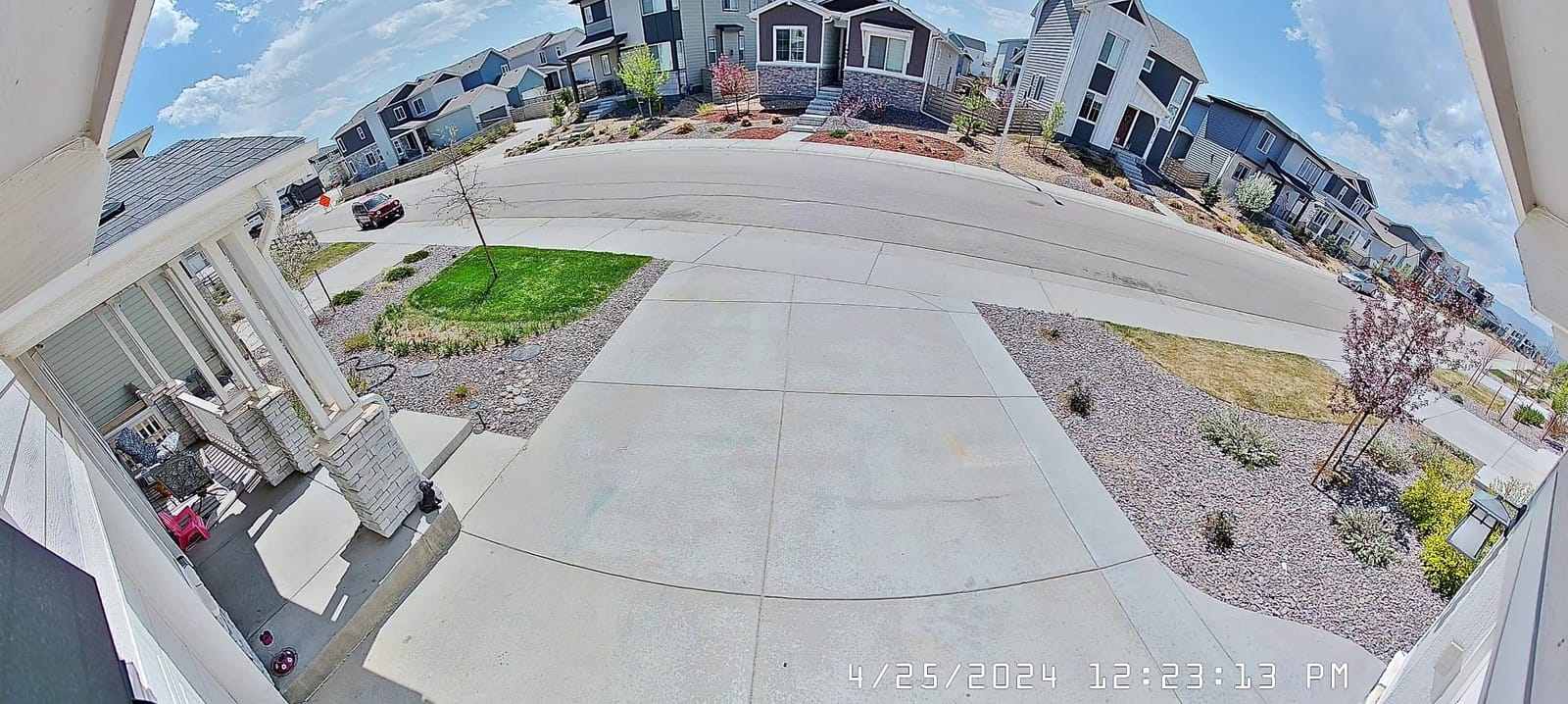
A camera on the house looking down the drive views every car from a steep rear angle at long range. That angle means small plates, more occlusion from the vehicle itself, and more distance for motion blur to accumulate. A camera on a post near the entrance views the car nearly head-on at close range, which is the geometry plate recognition actually needs.
The ipcamtalk advice that gets repeated is to bury PoE cable out to a lamp post or a gate post near the road and mount the camera there. It is more work than clipping a camera under an eave, and it is the difference between a readable plate and a suggestion of one.
On height, aim for somewhere between 8 and 12 feet. Higher reduces occlusion from shrubs and vehicles but increases the top-down angle that flattens the plate. Lower catches more faces, which is useful if you also want identification, but more foliage gets in the way.
On angle, cross the traffic rather than staring down the barrel of it. A camera looking across the lane sees the plate at an angle for longer, which gives more frames of partial view. A camera looking straight down the approach gets a full frontal plate for a very short window.
Finally, check your backlight before you mount. If the sun or the street lights sit behind the camera, the plate faces into shadow. Wide dynamic range helps but does not rescue a badly chosen angle.
Wired PoE vs Battery and Solar for a Driveway Camera
Every camera in this roundup is wired PoE, and that is not an accident. A driveway is the worst mounting position in the whole property for a battery camera, and the reasons are measurable rather than theoretical.
A typical driveway sees multiple vehicle passes per hour, and every pass triggers detection, which triggers recording, which drains the pack. Owner reports in the security communities describe a claimed multi-year battery lasting closer to 4 to 10 weeks on a busy driveway. Cold weather compounds it, because battery chemistry loses capacity in winter exactly when you most want coverage.
There is a second problem that is specific to plate capture. Long-range plate reads generally mean a narrow field of view, which means the camera has to be aimed and stay aimed. Battery cameras are moved, bumped and knocked off their mounts by gardeners, and a camera that drifts a few degrees loses its calibration entirely.
Solar helps with the charge problem and not with the others. The panel still needs an unshaded position, and the camera above it still needs to stay exactly where you aimed it.
PoE also removes the Wi-Fi failure mode, which is the most common complaint on long properties. The driveway camera is always at the far end of the house, which is exactly where the home Wi-Fi signal runs out.
Our verdict: for a driveway where plate capture is the goal, run cable. If trenching to the far end of a drive is not realistic, the honest alternative is a battery camera that alerts you to a vehicle approaching and a cheaper wide-angle camera for general coverage, not a battery camera pretending to be a telephoto lens.
If you also want the audible deterrent side of a driveway system, our perimeter alarm and long-range driveway system picks cover that half of the problem.
Storage, Evidence and Skipping the Subscription
For footage you may need to hand to police or an insurer, local storage is the better choice, and every camera here supports some form of it. A microSD slot keeps recording on the device itself, and an NVR keeps it on a box you own in your house.
Several units in this roundup carry a microSD slot as a standalone fallback. The ONWOTE supports up to 256GB, the Anpviz up to 512GB, and the LTS up to 256GB. That means you can record without a recorder at all in some setups, which is genuinely useful for a single-camera driveway.
On a recorder, the models with local microSD plus NVR support give you belt and braces. If the recorder fails, the card in the camera often still holds recent footage.
What to check before you commit is export. You want the ability to pull one clean clip with a timestamp and hand it over, rather than needing the vendor playback interface or a paid plan to retrieve anything. Buyers in the forums treat vendor-locked export as a real problem when an insurance claim is involved.
Most of these cameras are ONVIF-compatible or tied to a specific recorder, and both approaches can avoid a recurring cloud fee entirely. The trade-off is that remote access then runs through your own network or a vendor app reaching your recorder, not through a hosted service.
Compression also matters for retention. Several models here use H.265 or H.265+, which cuts bitrate at the same resolution and roughly doubles how many days you can keep on a given drive. On a camera that records continuously, that is the difference between a week and a fortnight.
For broader camera choices across the house, our general home security camera roundup covers the non-LPR side.
Privacy and the Law for Homeowner Plate Capture
A camera on your own driveway, recording the public road or your own property, sits in a different legal category from a police automatic plate reader network, and the difference is worth understanding before you buy.
Your camera does not connect to a police ALPR network on its own. Manufacturer systems store plate reads on hardware you control, and that data is yours, subject to ordinary rules about recording areas where you have no expectation of privacy. Pointing the lens at a neighbour’s property or at a neighbour’s driveway is a different matter and is worth avoiding.
The genuine concern raised in the communities is not your camera uploading to anyone. It is that stored plate data is sensitive, because a plate is a persistent identifier for a person. Anyone who can access your recorder or your account can search every vehicle that passed, including vehicles with no connection to your property.
So the practical advice is unglamorous: use strong account passwords, enable two-factor authentication, keep the recorder physically secured, and export and delete old footage on a schedule. Set up plate-triggered alerts that notify you rather than logs that quietly accumulate.
On sharing, if you do hand footage to police or an insurer, keep the original file with its native timestamp and do not edit it. Record the camera’s physical location and the date, because a gap in the story is what causes problems later.
If you want the deterrent side of driveway security without recording plates at all, outdoor lighting and perimeter detection cover a lot of the same ground. Our smart fence camera picks sit at the property edge rather than the plate.
Frequently Asked Questions
How far away can a security camera read a license plate?
Most consumer outdoor cameras detect a vehicle at 100 feet or more but only produce a readable plate at roughly 30 feet. Extending that range requires optical zoom and a narrow field of view, which is why dedicated LPR cameras carry varifocal lenses in the 8-32mm and 10-50mm range. Owner reports on ipcamtalk put a practical ceiling near 50 feet on a Reolink Z4E, and purpose-built 4MP units are specified for a 40-60 foot band when mounted correctly.
What security camera can read license plates?
A camera built with a dedicated LPR or ANPR algorithm rather than a repurposed outdoor bullet. In this roundup that means the ONWOTE BA40-LPR832, the Anpviz IPC-B7340WD-5X-LPR-1, the Hikvision DeepinView iDS-2CD7A46G0/P-IZHS, the LTS LXIP9943LPR-50R and the Vivotek IB9387-LPR. Look for a varifocal or motorized lens, 4MP or higher, and a stated wide dynamic range figure of 100 dB or more.
Can security cameras read license plates at night?
Yes, when four things line up: infrared or white light illumination, a wide dynamic range figure above 100 dB to survive headlight backlight, a shutter fast enough to avoid motion blur, and a mount angle that stops the retroreflective plate bouncing glare straight into the lens. Night fails most often on exposure time and glare rather than on resolution. A headlight filter, as on the Vivotek IP816A, addresses the glare problem in hardware.
Which security camera is best for recognizing license plates?
For most driveways the ONWOTE BA40-LPR832 is the strongest all-round choice because it publishes a recommended ANPR working distance of 23 to 98 feet, which lets you size the lens to your drive. For the longest driveways the LTS LXIP9943LPR-50R wins on its 10-50mm varifocal. For night arrivals with headlights, the Hikvision DeepinView leads on 140 dB wide dynamic range.
Do I need a separate camera for license plates and for general security?
In most cases yes. Plate capture needs a narrow field of view, optical zoom and a fast shutter, all of which destroy the wide scene coverage you want from a security camera. Experienced installers describe faces and plates as tasks needing dedicated hardware. Plan on one telephoto LPR camera aimed at the vehicle approach plus a separate wide camera for the yard, rather than expecting one body to do both jobs.
The Verdict: Which Driveway Camera Should You Buy?
Start with the ONWOTE BA40-LPR832. It is the only camera in this roundup that tells you the distance range it is designed to read plates at, and for most driveways that number matches the job.
Move to the LTS LXIP9943LPR-50R if your drive is long enough that the car stops 80 feet out, and to the Hikvision DeepinView if the main worry is a car arriving at night with headlights on.
Whatever you pick, run PoE, mount it near the roadway rather than on the house, set the shutter faster than the automatic mode chooses, and keep the footage on hardware you own. Those four decisions do more for plate capture than any resolution figure on a box.
We have covered 2026 camera releases and the full outdoor market in our broader outdoor security camera guide if you need the wider coverage cameras alongside the plate readers.