
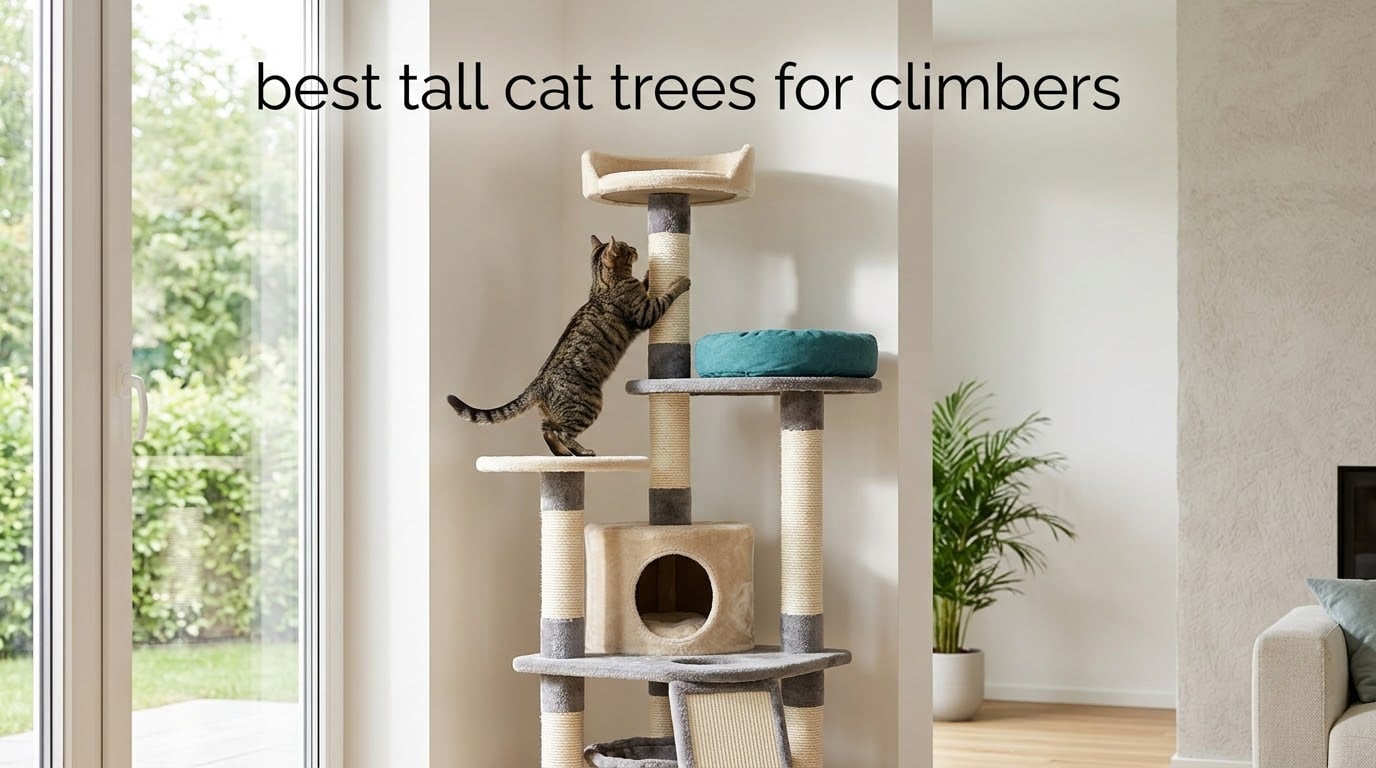
Most cats are born climbers and then spend their entire indoor life on the floor. That mismatch is why a scratching post on legs rarely gets used and why the sofa arm gets the abuse instead. A tall tree gives a climbing cat height, vantage points and a proper vertical territory, all in one footprint.
That is the whole premise behind this roundup of the best tall cat trees for climbers. We went through twelve of the tallest cat towers on the market, checked the real dimensions rather than the marketing adjectives, and ranked them on the three things that actually decide whether a climbing cat uses a tree: total height, how solid it feels under a heavy landing, and whether the platforms are big enough to lie down on at the top.
Most of the SERP for this keyword is forum threads and vendor pages, and the numbers they quote contradict each other. Owners on r/CatAdvice are still searching for a sturdy tree over 150cm that fits their room, and r/MaineCoon owners keep repeating the same test: if you can rock it with your hand, it is not a heavy duty cat tree. We built the whole guide around fixing that confusion.
We also skipped anything that advertised a huge height on a base too narrow to carry it. If you want the short version, the Yaheetech 70in sits at number one, the BestPet tower is the budget climb, and the Yaheetech 79in is the one for multi-cat homes. We explain why in each section, and we tell you plainly which trees we would pass on.
If your cat is a Maine Coon or another heavy breed, our guides on the best cat trees for Maine Coons and the best cat trees for large cats go deeper on platform sizing and load capacity.
Top 3 Picks for the Best Tall Cat Trees for Climbers (October 2026)
The Yaheetech 70in wins overall because it pairs a real 70 inch climbing height with a 22 x 22 inch footprint and 40 pounds of FSC-certified wood, and it has been reviewed tens of thousands of times. The BestPet 70in is the cheapest route to height in this list, while the Yaheetech 79in gives you nine sisal posts and room for three or four cats at once.

Yaheetech 70in Multi-Level Cat Tree
- 70 inch height
- 22 x 22 inch base
- 40.2 lb
- FSC-certified wood frame

BestPet 70in Dark Gray Cat Tower
- 70 inch height
- rated to 44 lb
- Two hideaway beds and a ladder
- 21.2 x 21.2 inch footprint

Yaheetech 79in 9-Post Cat Tree
- 79 inch height across 5 levels
- Nine sisal posts and a scratching ramp
- Anti-toppling wall strap included
Best Tall Cat Trees for Climbers in 2026
Every tree below was measured against the same criteria: real height, real base footprint, weight of the unit itself, and how the frame is anchored. Product weight matters more than most guides admit, because a heavy base is the cheapest way to stop a top-heavy tower from rocking.
| Product | Specifications | Action |
|---|---|---|
| Yaheetech 70in Multi-Level Sturdy Cat Tree |
|
Check Latest Price |
| BestPet 70in Dark Gray Cat Tower |
|
Check Latest Price |
| Yaheetech 79in 9-Post Cat Tree |
|
Check Latest Price |
 Feandrea 81.1in Large Cat Tower Feandrea 81.1in Large Cat Tower |
|
Check Latest Price |
 Heybly 75.2in Large Cat Tower Heybly 75.2in Large Cat Tower |
|
Check Latest Price |
 PETEPELA 95-107in 5-Tier Tower PETEPELA 95-107in 5-Tier Tower |
|
Check Latest Price |
 Globlazer F70 Pro 70in Tower Globlazer F70 Pro 70in Tower |
|
Check Latest Price |
 PEQULTI 83-108in 5-Level Tower PEQULTI 83-108in 5-Level Tower |
|
Check Latest Price |
 TQEW 50-120.5in Adjustable Tower TQEW 50-120.5in Adjustable Tower |
|
Check Latest Price |
 FUKUMARU 6-10 ft 6-Level Tower FUKUMARU 6-10 ft 6-Level Tower |
|
Check Latest Price |
 Globlazer 83in F83 Tower Globlazer 83in F83 Tower |
|
Check Latest Price |
 Gitelsnour 71in Large Cat Tree Gitelsnour 71in Large Cat Tree |
|
Check Latest Price |
1. Yaheetech 70in Multi-Level Sturdy Cat Tree – The All-Rounder
Yaheetech 70in Multi-Level Sturdy Cat Tree, Condo, Sisal Scratching Posts
70 in tall on a 22 x 22 in base, 40.2 lb
FSC wood, three sisal posts
Condo and top perch
Pros
- FSC-certified wood with minimal odor
- Three sisal posts at different heights
- Compact 22 x 22 inch footprint for the height
- Over 40000 reviews showing long-term use
Cons
- Some reviews report top joints loosening with heavier adult cats
- Designed around 1-3 small to medium cats
I keep coming back to this one because it does the boring things right. Seventy inches of climbing height sits on a 22 x 22 inch base that weighs 40.2 pounds, and that combination is rarer than it should be at this level of the market. A narrow base under a tall frame is exactly the configuration that produces the wobble owners complain about in every forum thread.
The FSC-certified wood construction also means there is no strong new-car smell, which matters more than any feature when you are assembling a 40 pound object in a small room. Three sisal-wrapped posts sit at different heights, so a cat can scratch low, mid or high and still be on the structure rather than on your sofa arm.
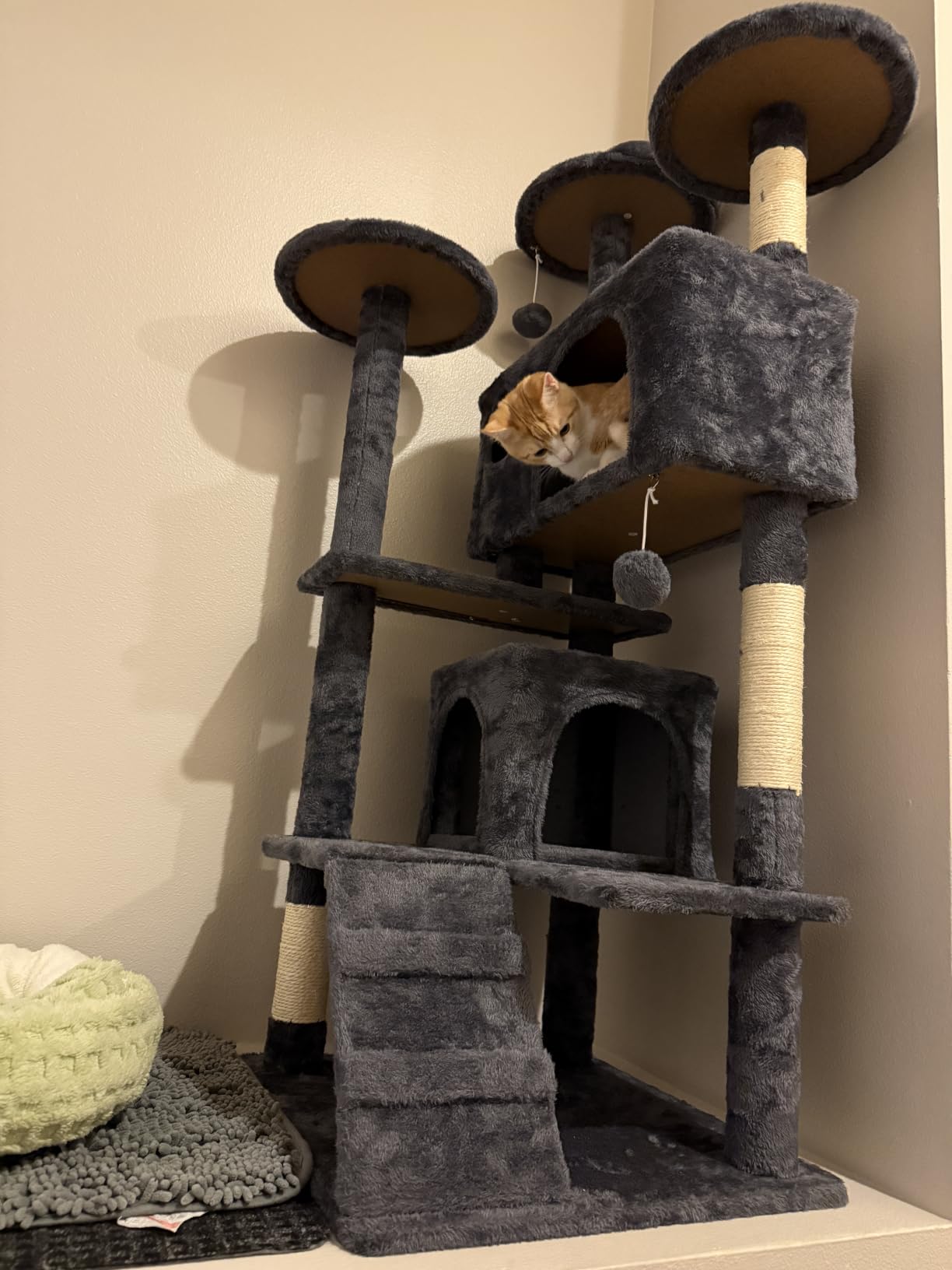
The condo and the top perch are the two spots cats actually settle on. Reviews repeatedly describe cats using the condo within minutes of the tree going up, and the top perch comes with a dangling ball that keeps a lot of climbing cats occupied at height.
What I would watch: the manufacturer lists this for one to three kittens or small to medium cats, and a small number of reviews mention top sections or joints loosening once a genuinely heavy adult cat starts using it. Check the hardware every few months if your cat pushes off hard on the way down.
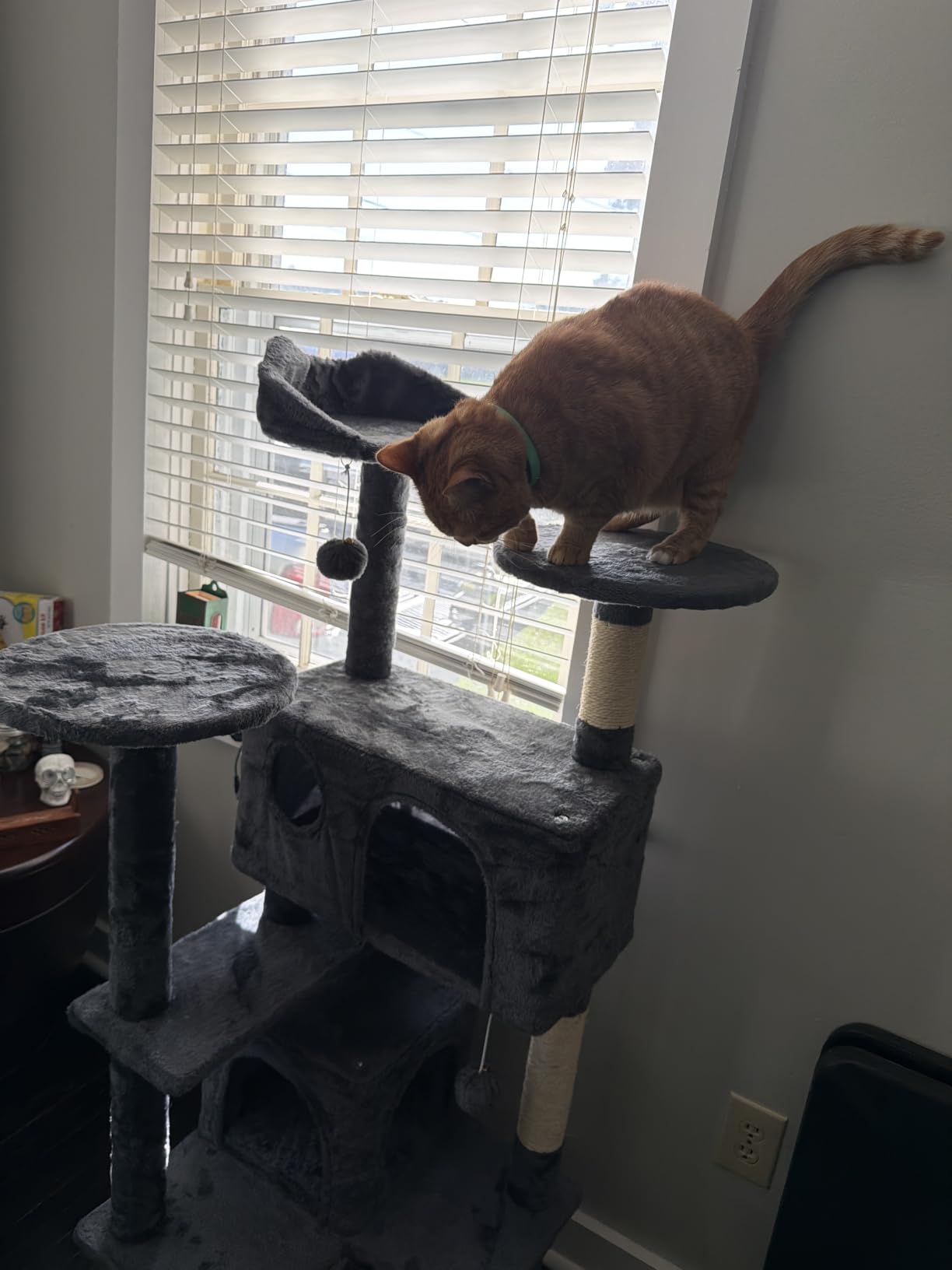
Check these before you commit
Measure the height of your ceiling and the width of the room it will stand in. At 70 inches with a 22 inch square footprint it needs a corner, not a walkway, and the top perch needs a few inches of clearance above it so a cat landing from a jump does not clip the ceiling.
It weighs 40.2 pounds, so plan the assembly location before the box is open. Two people and roughly half an hour is realistic, and the pieces stack bottom-up.
When to skip it
If your cat is a 20 pound Maine Coon, look at the Heybly or the FUKUMARU instead, both of which are built around heavier loads. This tree is designed for small to medium cats and it is honest about that.
If you live in a rental with no drilling permission, the tension-mounted options further down will serve you better. This one relies on its own weight.
2. BestPet 70in Dark Gray Tower – The Budget Climb
BestPet | 70″ Cat Tree Tower | Dark Gray | Sturdy Multi-Level Cat Tree
70 in tall, 32 lb, 21.2 in square base
Rated to support cats up to 44 lb
Two hideaways and a ladder
Pros
- Rated for cats up to 44 lb
- Two hideaways plus a ladder give multiple routes
- Assembles in roughly 20 minutes
- Corner-friendly vertical footprint
Cons
- Slim support posts make it wobble for larger cats
- Staple joints loosen as the structure is used
- Condo openings can face the wrong way after assembly
This is the cheapest way to get a climbing cat to 70 inches, and for a household of small to medium cats it genuinely does the job. At 32 pounds with a 21.2 inch square base it is the lightest and smallest of the tall freestanding options here, which makes it far easier to move between rooms than most.
Two soft hideaways that double as beds plus a ladder give a cat more than one way up and more than one way down, and owners on thecatsite have made the point that descent matters as much as ascent. A cat that is unsure coming down will avoid the tree altogether.
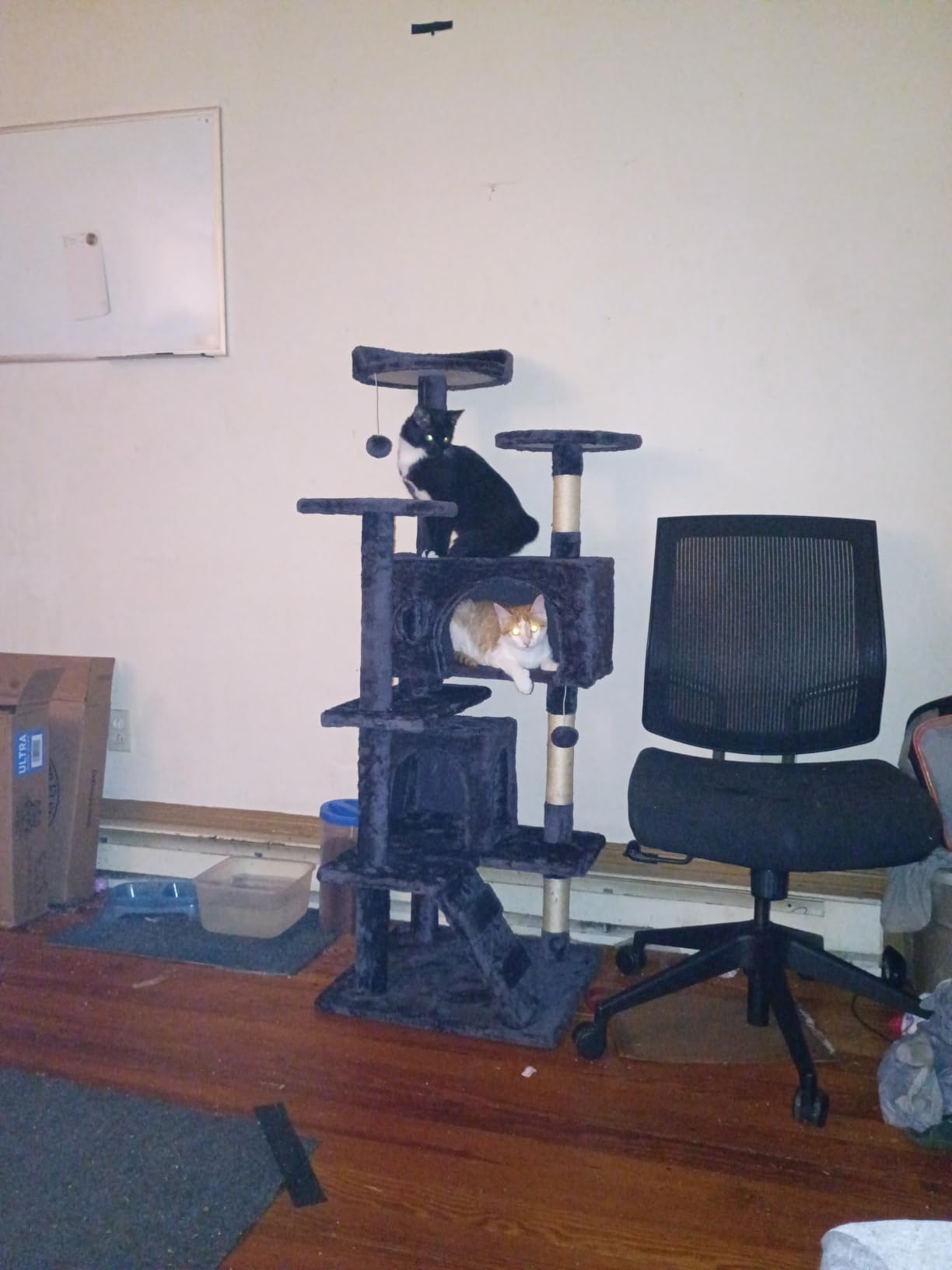
The stated capacity is 44 pounds, which sounds reassuring, but the frame is what gives out. Reviewers most often mention wobble with larger active cats and staple joints loosening over time, so treat the capacity number as a headline rather than a guarantee.
Assembly is genuinely quick, closer to 20 minutes than an evening, and the hanging toys and sisal surfaces are the parts cats notice first. One assembly quirk to know: the condo openings can end up facing the wrong way depending on how the pieces orient.
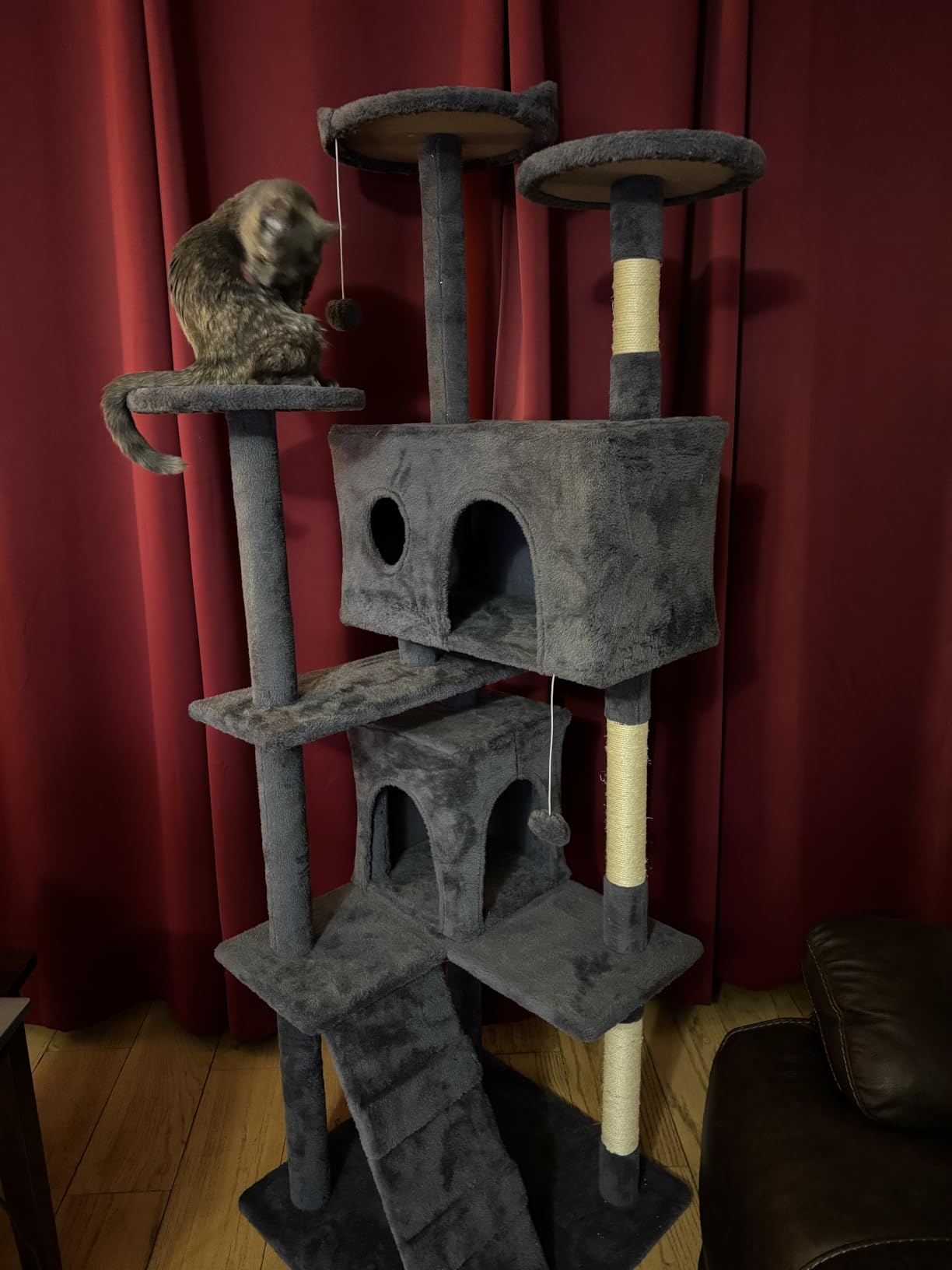
Who this tower actually suits
Small and medium cats up to about 12 pounds, in a home where the tree will not be pushed against by a door or a busy hallway. Multiple height options exist in this range if you want a shorter version for a kitten room.
Kittens are the sweet spot here. They use the ladder, they climb up and down constantly, and the light frame is an advantage when a 5 pound cat throws itself off the top perch at speed.
When to spend more instead
If your cat is heavy, or if you already know your cat rocks a tree with its paws when it lands, this is the wrong pick. The 79in Yaheetech adds a wall strap, and the Heybly is built around an oversized base plate and a 47.6 pound frame.
It also uses staple joints rather than screws at several points, so if you are the type to re-tighten hardware every few months, budget for that.
3. Yaheetech 79in 9-Post Tower – Built for Three or Four Cats
Yaheetech 79in Multi-Level Tall Cat Tree for Multiple Cats with sisal Posts
79 in across 5 levels, 42 lb, 23 in square base
Nine sisal posts plus a ramp
Anti-toppling strap
Pros
- Nine sisal posts give exceptional scratching coverage
- Two condos and three cat-ear perches for 3-4 cats
- Anti-toppling wall strap included
- Cat-ear perches look good in a living room
Cons
- Posts are only about 2.5 inches and can flex
- Two levels sit flush with no step between them
- Assembly is tedious with many small pieces
Height is the headline, but the nine sisal rope posts are what separate this from every other 79 inch tower on the market. In a multi-cat home, scratching is a territorial behaviour, and nine separate posts spread up the structure means four cats can scratch at once without queueing for the same column.
The layout is two condos, one fluffy basket and three cat-ear shaped top perches across five levels, on a 23 x 23 inch base weighing 42 pounds. That is a properly proportioned footprint for 79 inches, which is not something you can say about every tower in this price bracket.
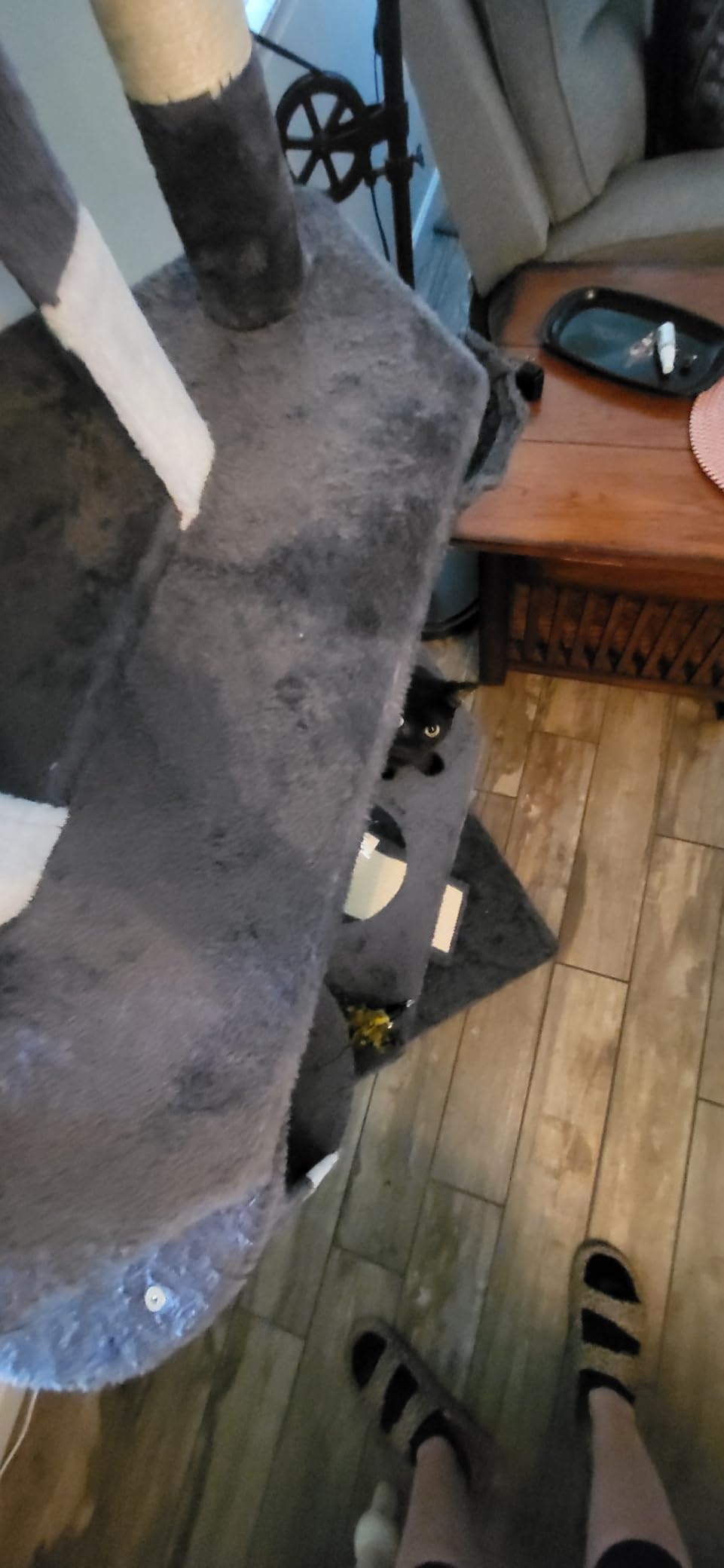
It also includes an anti-toppling strap, which is a small detail that matters enormously in a room with a door that gets opened quickly. Wall-anchoring a tall tree turns a wobble risk into a non-issue, and only some brands in this roundup include the hardware.
The construction is FSC-certified, CARB P2-compliant particle board, which sounds like a downgrade from solid wood and in durability terms it is one, but the finish and screw joints are tight. r/cats owners have noted that solid wood frames generally feel more substantial, and that is fair.
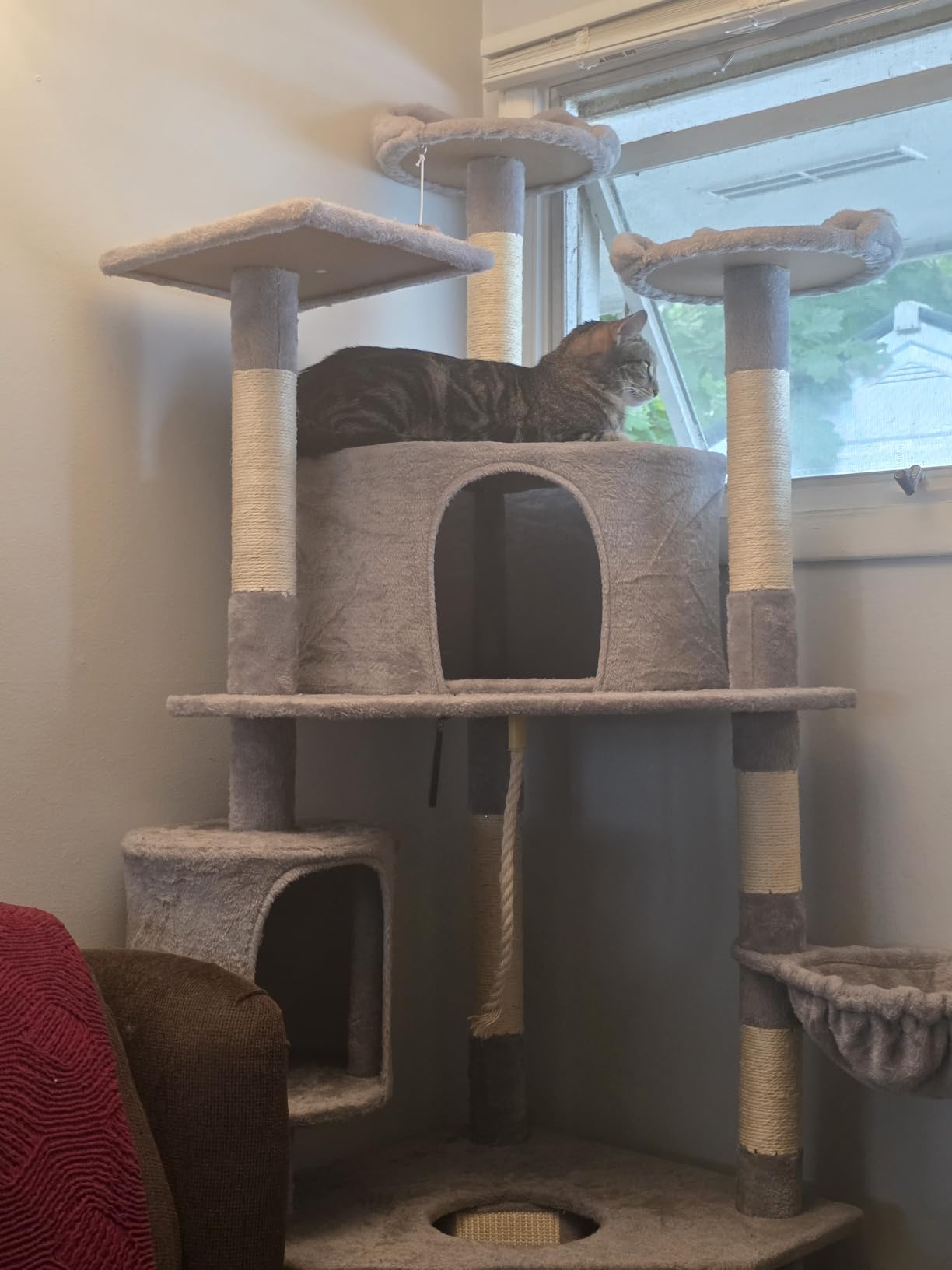
Check the gaps between levels
Two levels sit flush with each other, so there is no step between them. A cat can go from one platform straight across with no place to pause, which is difficult for older cats, kittens and anything with a slight limp. Measure the jump for your specific cat if you have more than one.
The hammock and the smaller condo are tight for large adult cats. For a household of four medium cats this is an excellent fit. For two 20 pound cats it is not.
What we would want improved
The posts are around 2.5 inches in diameter and reviewers do report flex, particularly at the top. A post that flexes under a hard landing is a warning sign even if the frame holds.
Assembly is tedious because of the number of small pieces. Budget an hour, lay the parts out first, and assemble away from the wall you intend to anchor to.
4. Feandrea 81.1in Cat Tower – Short Steps for Older Cats
Feandrea Cat Tree, 81.1-Inch Large Cat Tower, Multi-Level Condo, Smoky Gray
81.1 in tall, 40.6 lb, L-shaped 80 x 23 x 19 in
Levels spaced 12-16 in apart,14 scratching zones
Pros
- Close level spacing works for senior and less agile cats
- 14 scratching zones spread across every level
- Reinforced base handles 20+ lb cats
- Rated for up to 6 cats at 15.4 lb each
Cons
- Cave interiors are fiddly to assemble
- Some buyers report thinner pillars than earlier versions
- Very large footprint for a tall tower
This is the one to buy for an older cat, and the reason is spacing rather than height. At 81.1 inches with levels only 12 to 16 inches apart, it is the shortest-rung climb in this roundup, which is exactly what a cat with reduced mobility needs to get to a top perch and get back down again.
Fourteen scratching zones are distributed across every level, including a scratching ramp and ladder, so the cat never has to commit to a full-height climb just to scratch. The structure is rated for up to six cats at 15.4 pounds each, and a reinforced base with an included anti-tip kit holds under 20 pound cats.
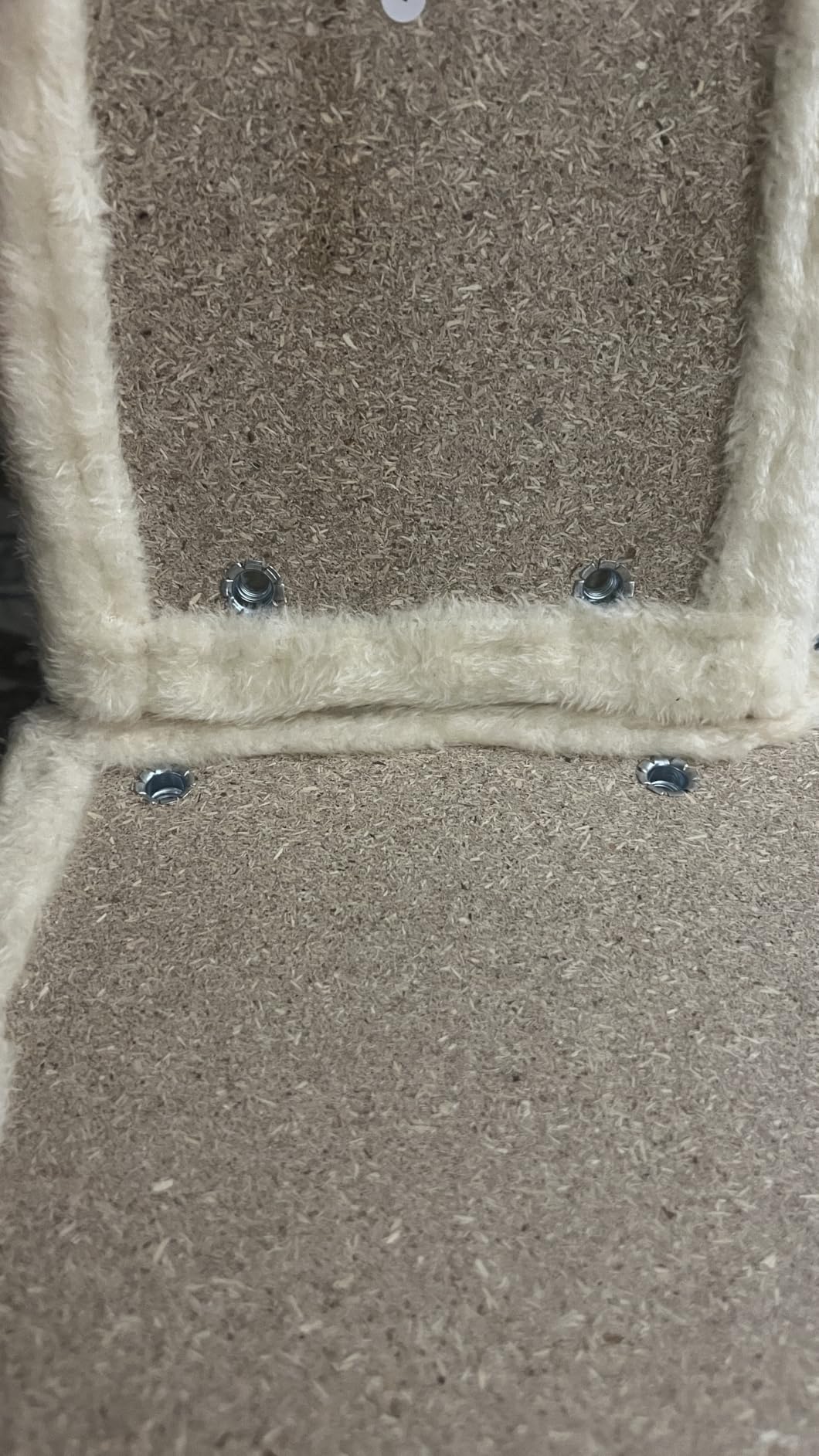
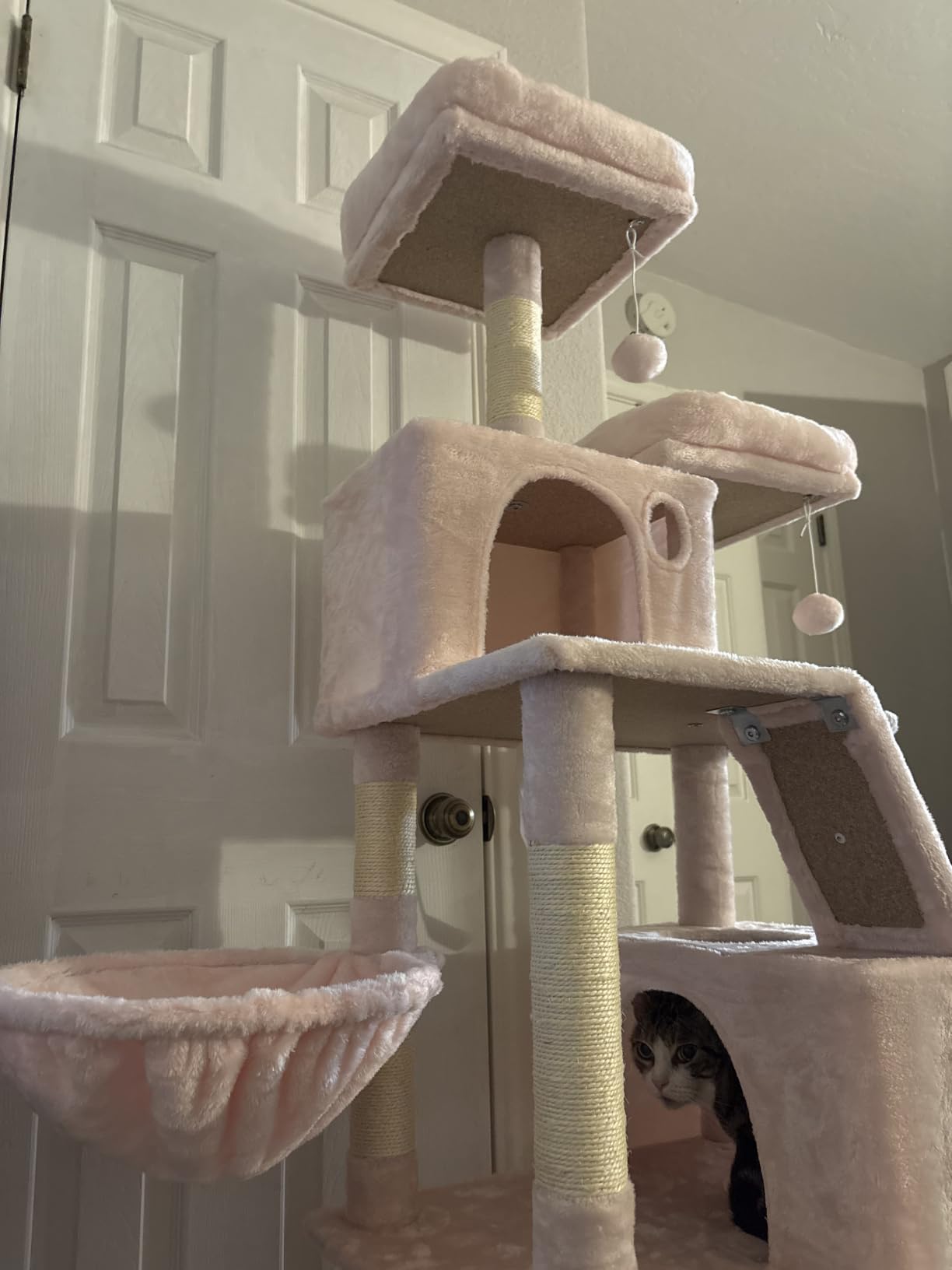
Two padded perches, two caves, a hammock and pompom toys fill out the middle. The hammock is where a lot of cats end up napping at height, which is a decent indicator that the tree is being used as vertical territory rather than as gym equipment for two weeks.
It holds a 4.6 star average across more than 5,500 owner reviews, which puts it near the top of this group. If you read one set of reviews on this list carefully, make it this one.
Plan the footprint carefully
This is an L-shaped structure measuring 80.12 x 23.23 x 19.09 inches, and it is by far the largest floor footprint of the freestanding options. It wants a corner or a long wall, and you should measure the route from your door to that corner before you commit.
The ramp scratcher is an optional piece. Some cats ignore it entirely, and if yours does, leave it off rather than letting a 19 inch deep object jut into the walkway.
Where it falls short
Cave interiors are fiddly to assemble, and a few buyers report thinner pillars and smaller bases than earlier Feandrea versions. If you are replacing an older Feandrea and you liked the build, check a photo of the actual unit rather than the listing image.
For a pure vertical climber who never leaves the top perch, the 83 inch Globlazer further down offers more height in a narrower, more angular footprint.
5. Heybly 75.2in Large Cat Tower – Wide Perches, Heavy Base
Heybly Tall Cat Tree for Large Cat, 75.2-inch Multi-Level Cat Tower HCT038G
75.2 in tall, 47.6 lb, 21.7 x 17.7 in base
Oversized base plate
Two widened top perches
Pros
- Widest perches in this roundup for large cats
- Enlarged base plate improves stability on jumps
- Heaviest build in the set at nearly 48 lb
- Double-door condo suits multi-cat homes
Cons
- Heaviest and least portable option here
- Costs more than comparable towers of similar height
Most tall trees fail large cats on two counts: the top platform is too small to lie across, and the base is not heavy enough to survive a 20 pound cat launching off the top. This one is engineered against both problems, with an oversized 21.7 x 17.7 inch base plate and two widened top perches at 21.7 x 17.8 and 21.7 x 9.8 inches.
At 47.58 pounds it is the heaviest unit we looked at. That is not a marketing number, it is a stability number, and it is why this tower holds still when a heavy cat drops onto it from two levels up.
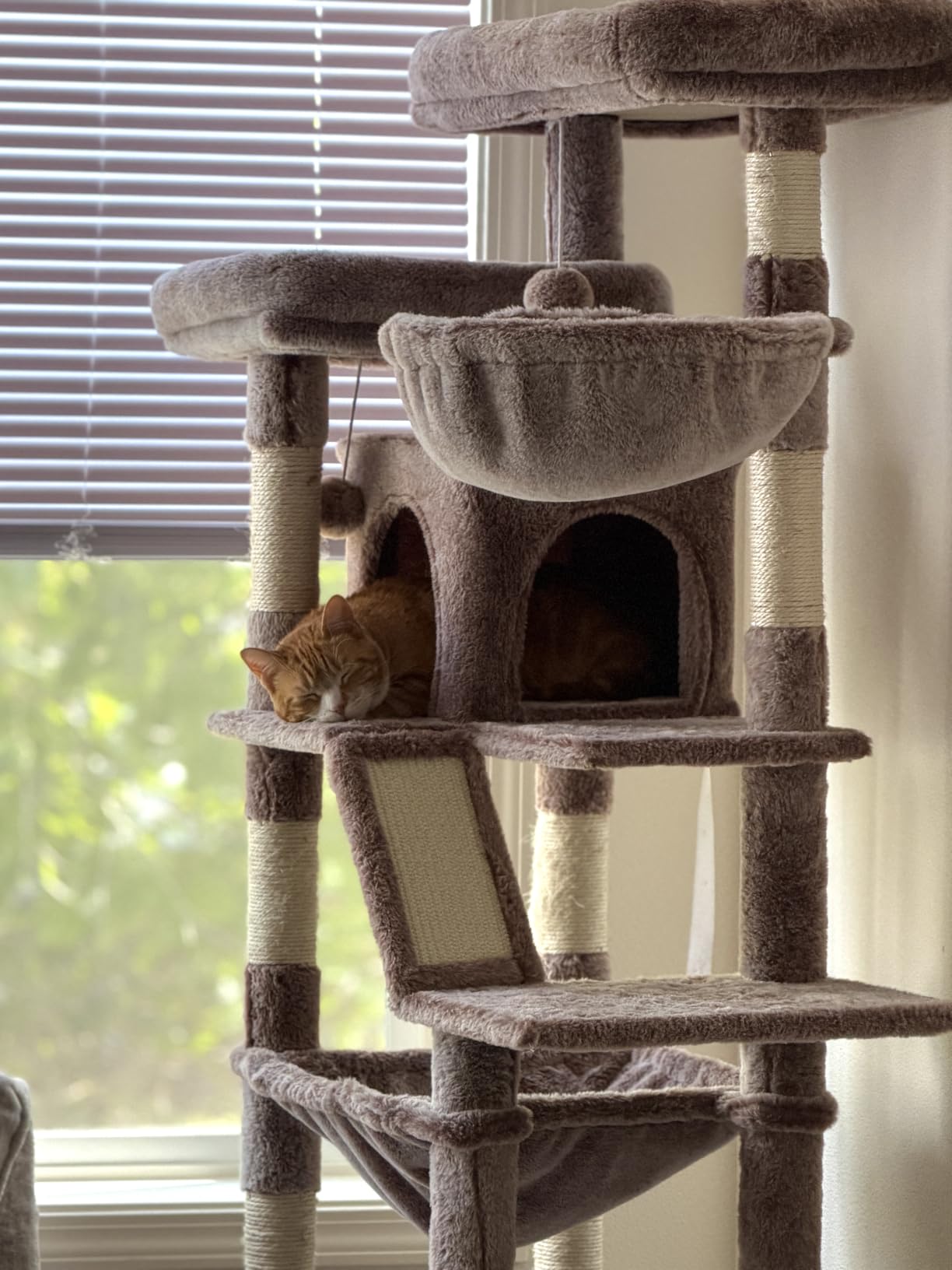
The base plate is advertised as 24 percent larger in footprint than earlier versions of the same model, which tells you the manufacturer has been fixing the actual complaint. A roomy double-door cat house gives a large cat a hide without squeezing in sideways.
Sisal posts and sisal ramps run through the middle levels, so a big cat has a grippy route rather than a bare plastic or carpet column to negotiate on the way down.
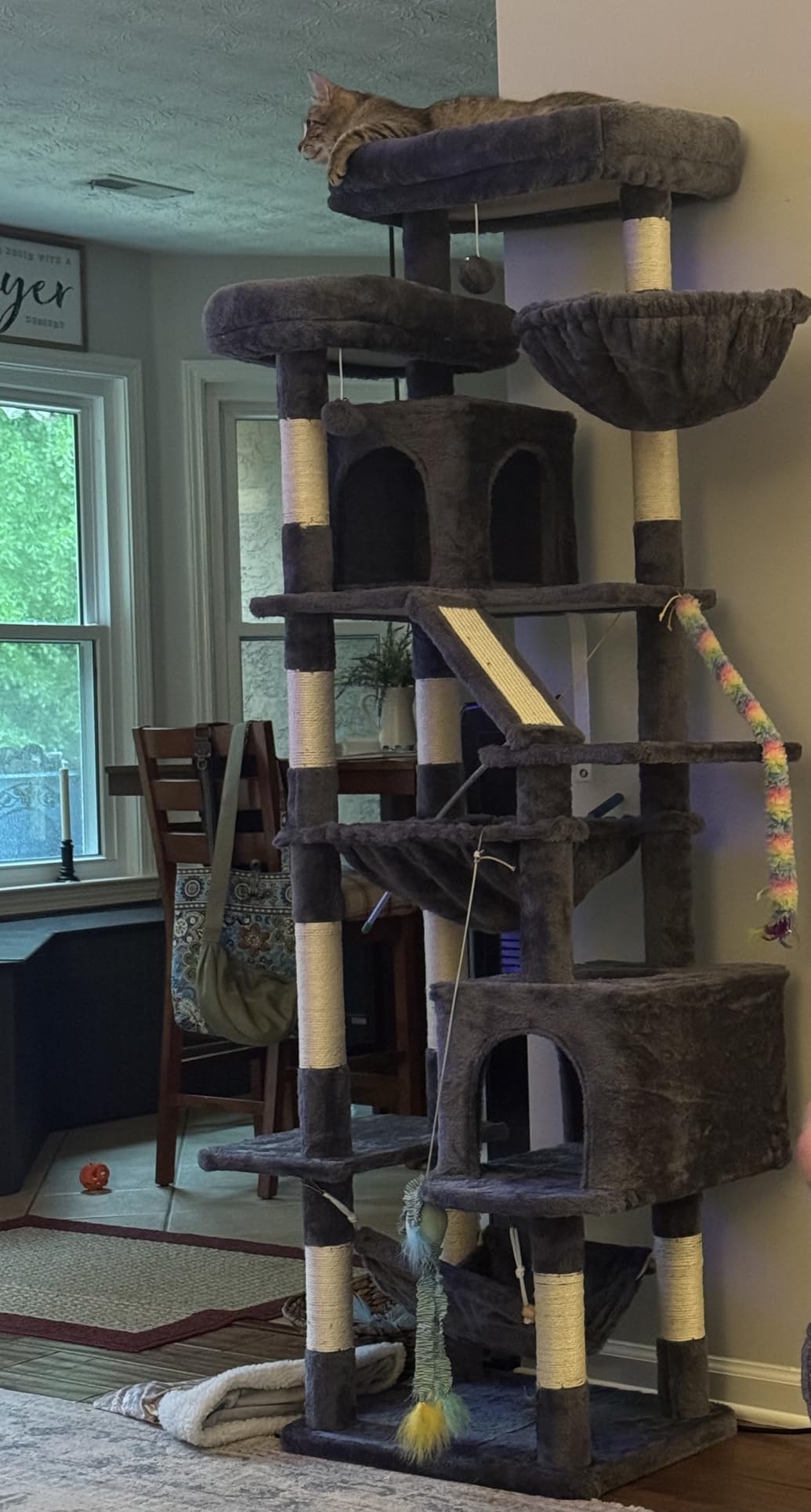
Why the perch size matters more than the height
A cat does not stay on a perch it cannot fit on. A 21.7 inch top platform lets a large cat stretch out flat, which is where you will find it for most of the day. Many competing towers at similar heights top out with perches barely larger than the cat.
If you have a Maine Coon, this is the geometry you want. Our guide to the best cat trees for large cats goes deeper into platform dimensions.
What you give up
Nearly 48 pounds is the least portable object in this roundup. If you are renting and expect to move, plan the two-person carry before the box arrives rather than after.
It also sits at the upper end of what this category asks for, so it is not the pick if you are simply furnishing a first apartment for one small kitten.
6. PETEPELA 95-107in 5-Tier Tower – Height in a Narrow Footprint
PETEPELA 5-Tier Floor to Ceiling Cat Tree, 95-107In Tall Cat Tower Beige
Adjustable 95-107 in tall, 19.2 lb
3.5 in diameter sisal posts
Narrow 17.3 x 9.4 in base
Pros
- Smallest footprint here at under 10 inches deep
- Tension rod adjusts from 95 to 109 inches
- Thick 3.5 inch posts resist flexing
- Light enough for one person to reposition
Cons
- Manufacturer recommends kittens and small to medium cats only
- Ceiling fit is tight at the 95 inch minimum
The problem this solves is floor space. A 17.3 x 9.4 inch footprint means you can put this tower in a corner where a 23 inch square base simply will not fit, and still give your cat 95 inches of climb. In a narrow room or a double-height space with a tight corner, that trade is worth making.
Height is set by a tension rod that adjusts the total from 95 to 109 inches, and assembly takes about ten minutes. The posts are 3.5 inches in diameter, noticeably thicker than the 2.5 inch posts used on many rival towers, and they resist the flexing that makes climbing cats wary of a route.
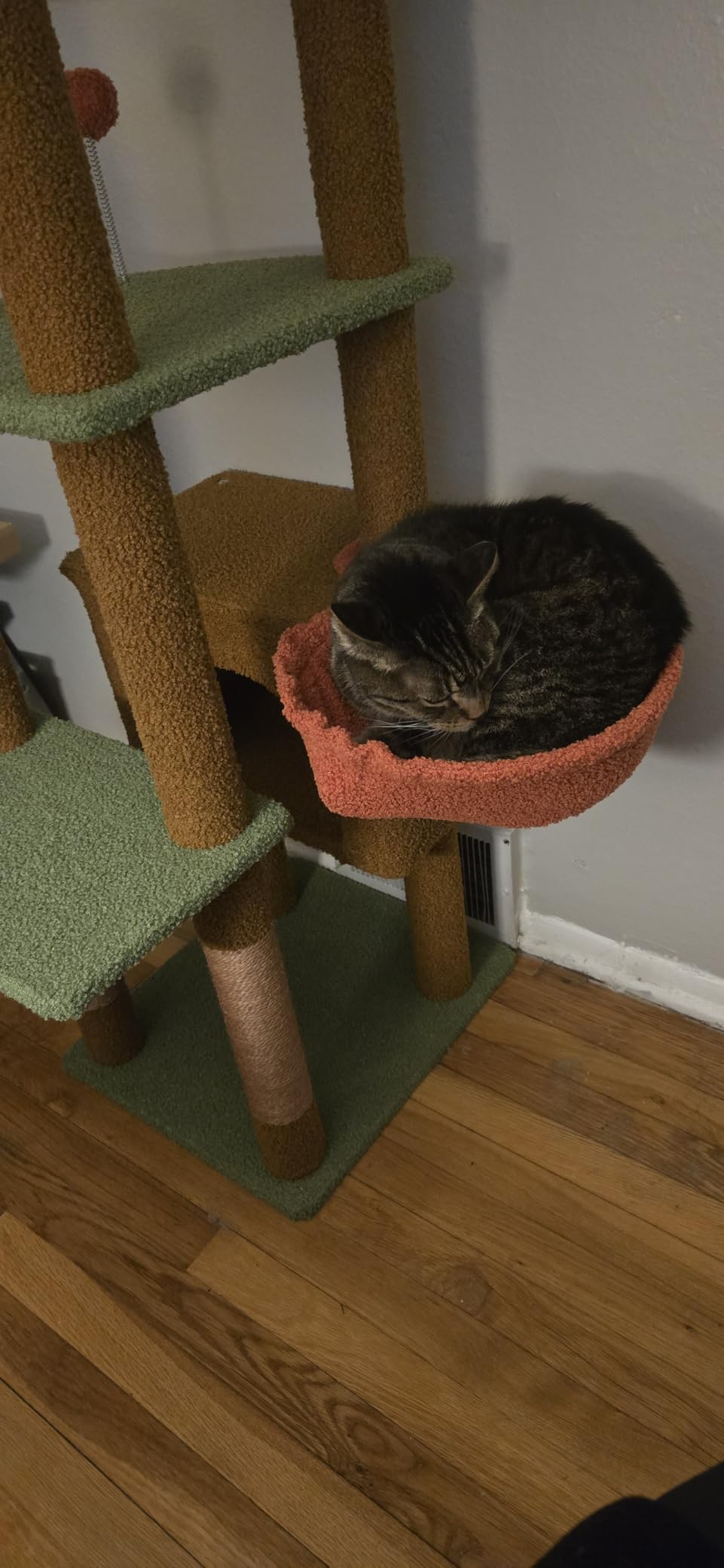
Five tiers are spaced 17.3 inches apart, which is a comfortable stride for an average adult cat. The top round bed and a dangling ball give the summit somewhere to land, and the plush and sisal wrapping keeps the grip consistent the whole way up.
At 19.18 pounds it is by far the easiest to move. One person can shift it from the living room to the bedroom when you want to see whether novelty fades.
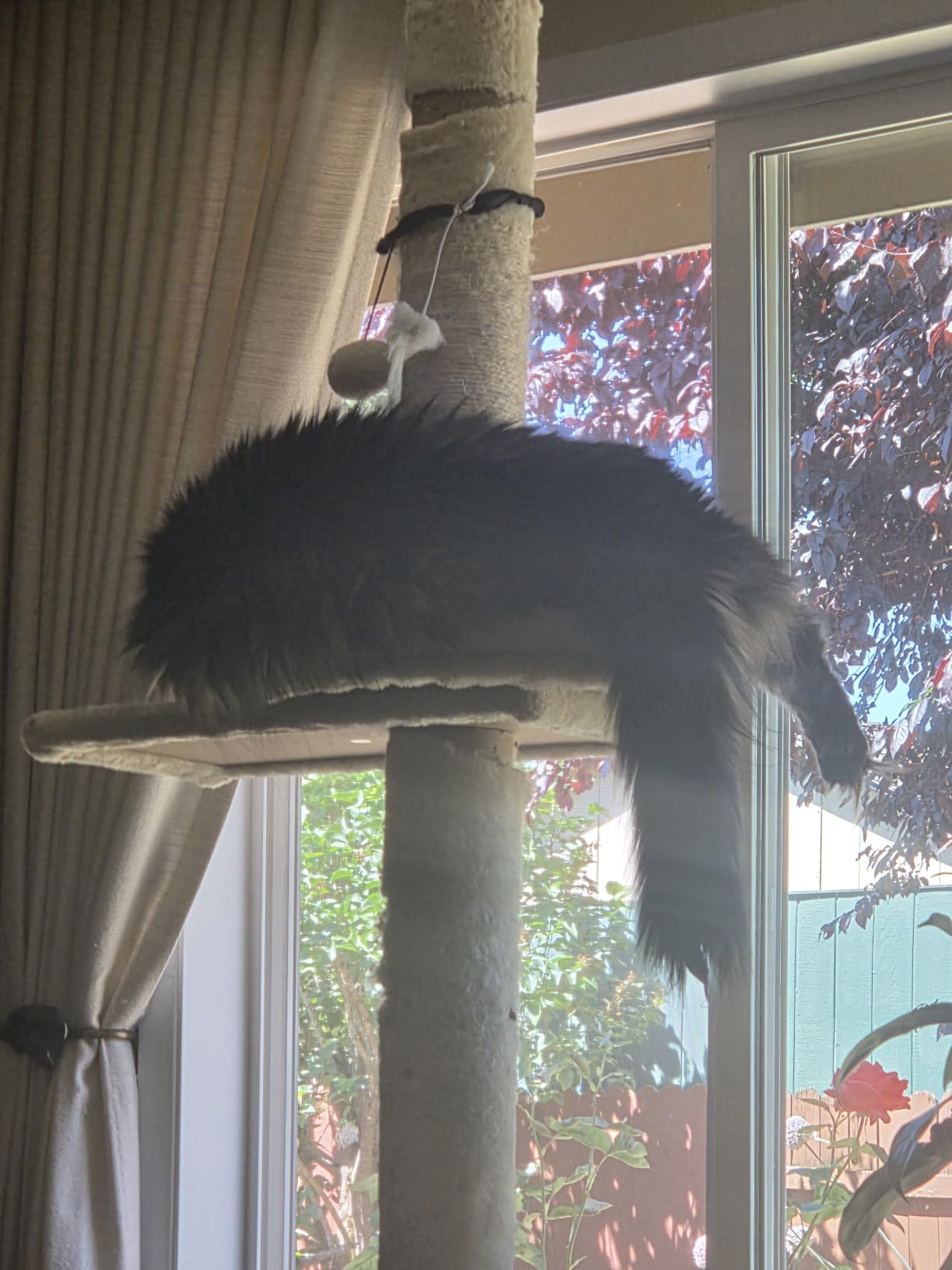
Measure your ceiling before anything else
The minimum height is 95 inches, so this needs a tall room. If your ceiling is under 8 feet, this will not fit and neither will most floor-to-ceiling tension units. Measure first, because an adjustable tower that cannot reach your ceiling is just a very tall freestanding frame.
Our guide to the best cat trees for small apartments covers the freestanding alternatives when ceiling height is the constraint.
Know the weight limit
The manufacturer recommends this for kittens and small to medium cats, and notes that cats over 20 pounds can overload the topmost post. That is a direct spec, not our opinion, and it rules the tree out for most Maine Coons.
For a heavy cat in a tight space, the TQEW further down handles far more load with a comparable narrow base and a much wider height range.
7. Globlazer F70 Pro 70in Tower – Two Routes to the Top
Globlazer F70 Pro Heavy Duty Cat Tree Tower for Indoor Cats Large Adult
70 in tall, 36.5 lb, 21.7 x 17.7 in base
Removable top perch
Large square hammock
Pros
- Highest-rated tower in this roundup at 4.7 stars
- Removable and washable top perch cover
- Well machined parts with no misaligned holes
- Two climbing routes and cubbies for multi-cat homes
Cons
- Shorter-pile plush may wear before deeper carpet
- Top perch fits one large cat rather than two
- Hanging toys are not indestructible for kittens
This is the build quality pick. At 4.7 stars with 85 percent five-star reviews it has the highest average rating of anything we tested, and the reason is visible in the parts: well machined boards, screw holes that line up, and a frame that does not need adjusting after the first week.
Two independent climbing routes up the tower is the feature most climbing cats care about. With four natural sisal posts and a sisal scratching board spread across both routes, a second cat can climb without following the first one up the same column.
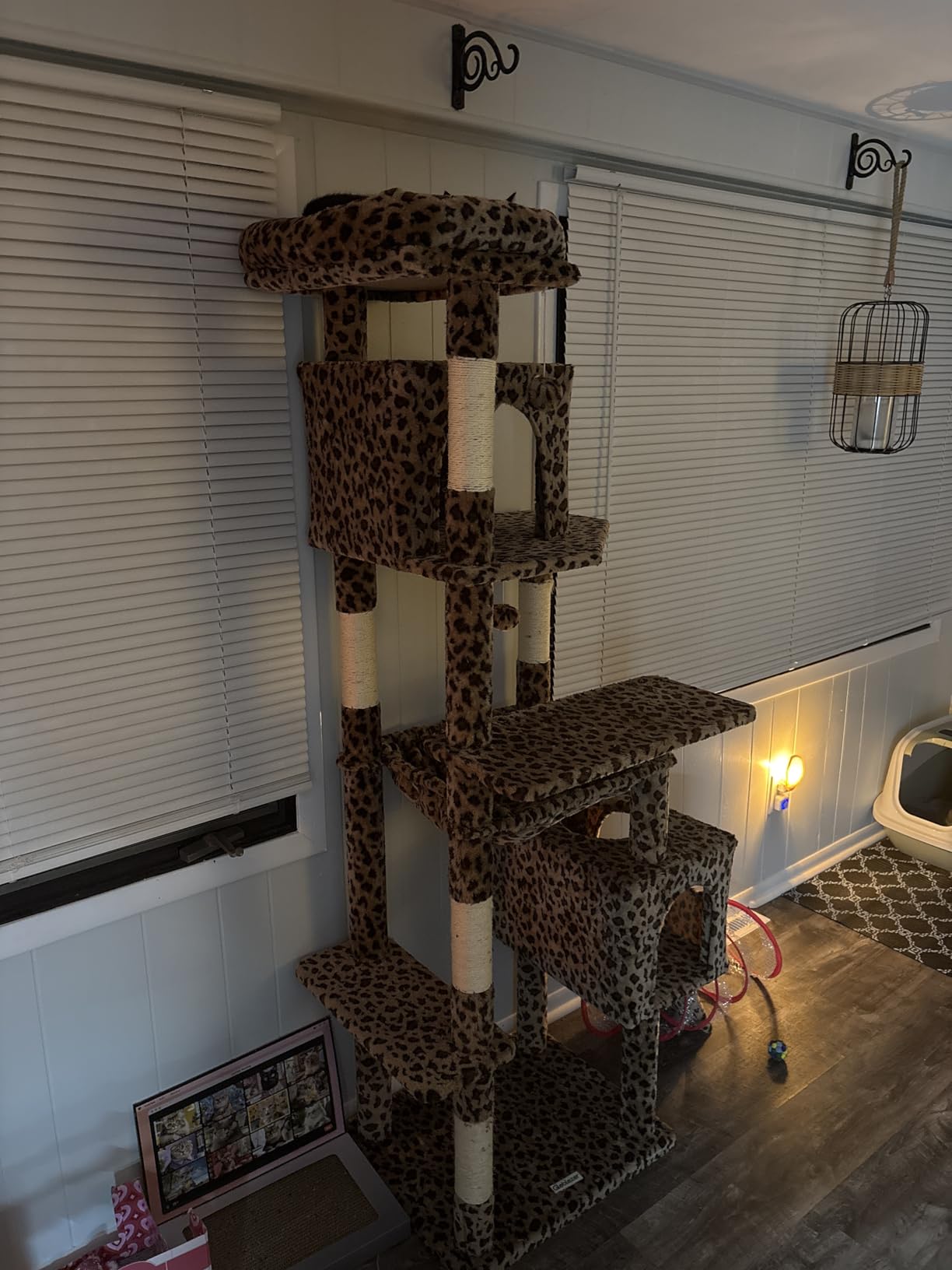
The top perch is enlarged and detachable, and the cover comes off for washing, which matters more than it sounds. Plush cat trees get abandoned because they smell, and a removable washable cover is the difference between a tree that is still used in year two and one that ends up in a corner.
Below it sit a spacious square hammock sized for adult cats, a roomy condo and two cubbies. The hammock is the spot owners most often report their large cats using immediately.
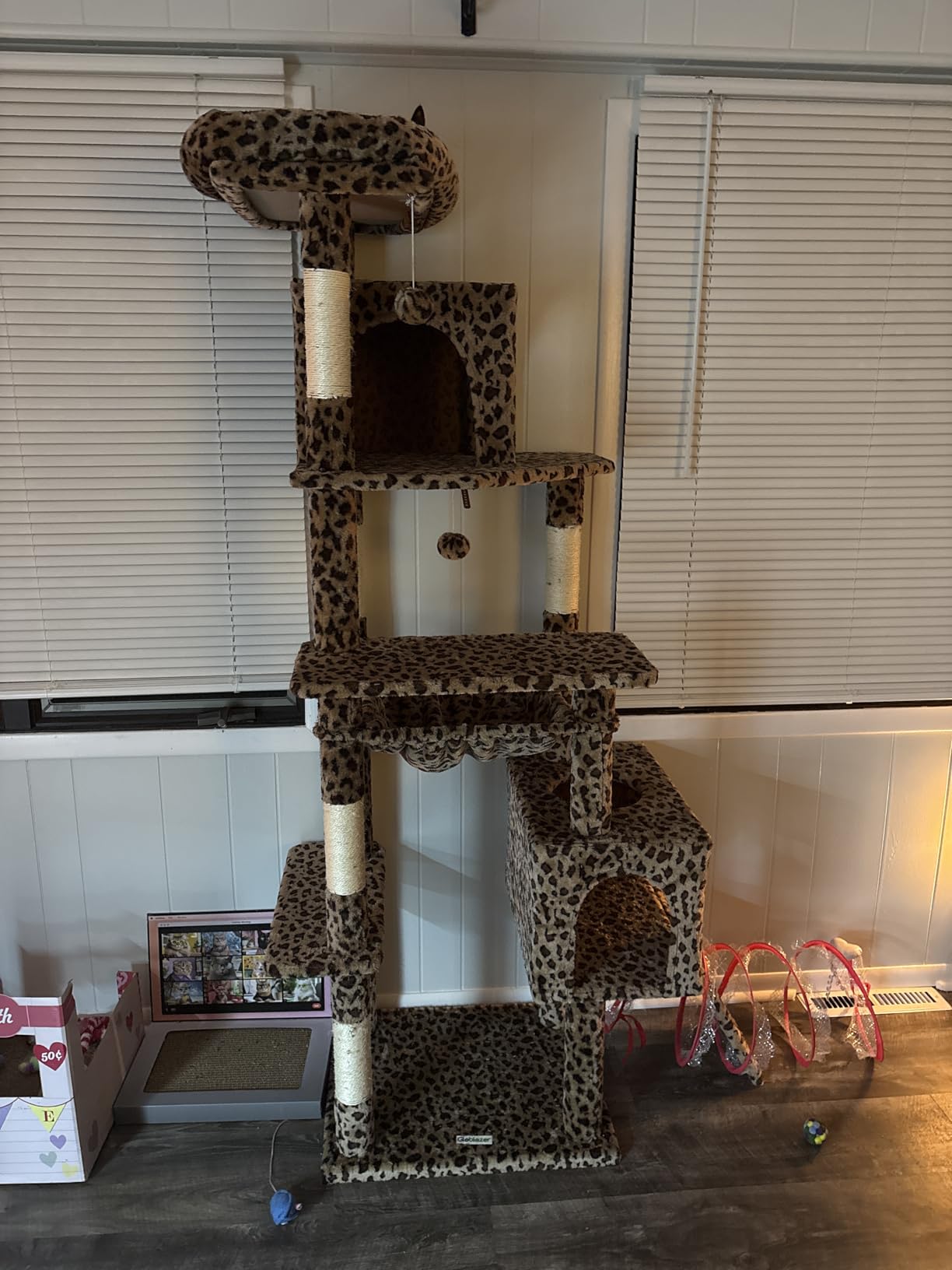
Is 70 inches enough height
For most adult indoor cats, yes. Seventy inches with an adult sitting at the top puts a climber well above furniture height and close to eye level with a person standing in the room, which is the observation height most cats prefer.
Only a cat that is a truly obsessive vertical climber, or a home with a 9 foot ceiling, needs more. Those cases are covered by the floor-to-ceiling units later in this guide.
What to check on arrival
There is a mild initial odor on unpacking, which reviews describe as minimal. Leave it in a ventilated room for a day before the cat gets on it, particularly if you have more than one cat and a cautious one.
Also note the hanging toys are not indestructible. If you have kittens, remove the string toys for the first few months or supervise the first sessions.
8. PEQULTI 83-108in 5-Level Tower – No Drilling Required
PEQULTI Floor to Ceiling Cat Tree, Adjustable 83-108in 5-Level Tower, Beige
Adjustable 82-108 in tall, 15.8 x 9.5 in base
3.6 in diameter scratching post
No-drill tension mount
Pros
- No drilling required so it suits rental apartments
- Wide 82-108 inch adjustment range
- Cat scratching ladder adds roughly 30 percent stability
- Narrow 15.8 x 9.5 inch base frees floor space
Cons
- Requires ceiling contact so it needs a tall room
- Some buyers note the beige finish varies
If you cannot drill into your walls, a tension-mounted tower is the answer, and this is the most flexible version of one. Interchangeable post sections let you configure it from 82 to 108 inches, so one unit can live in a 7 foot room now and a 9 foot room later without a new purchase.
The scratching post is 3.6 inches in diameter and the base measures only 15.8 x 9.5 inches, narrower than almost every freestanding tower here. In a small apartment that footprint is the whole selling point.
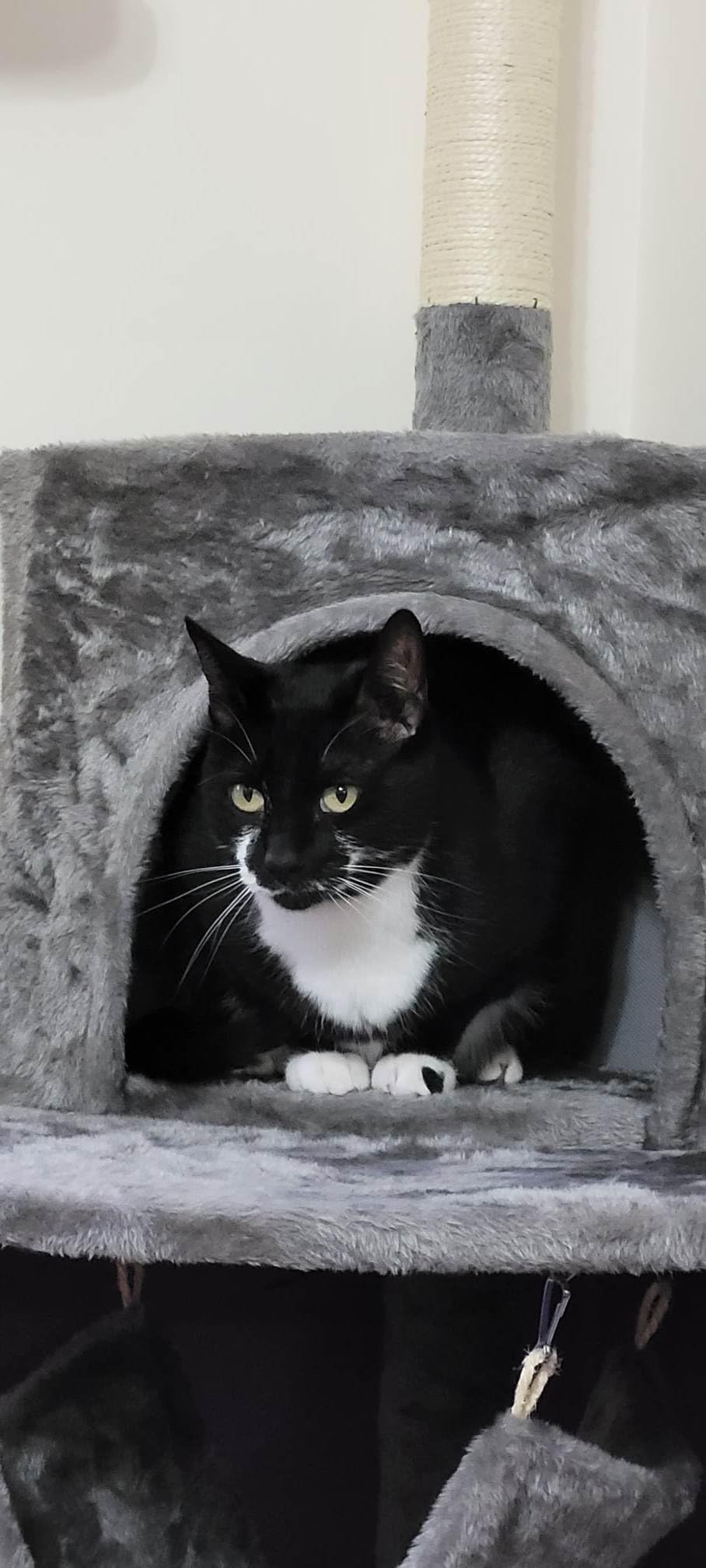
The addition that sets this apart is the cat scratching ladder, which doubles as a diagonal brace and adds roughly 30 percent stability to the frame. Reviews consistently credit the ladder with making the tower feel noticeably steadier than a plain vertical pole.
Five levels carry a cat condo and a cozy hammock. Because it is tension-mounted, the load travels into the ceiling rather than the floor, so the whole thing moves very little when a cat jumps off the top.
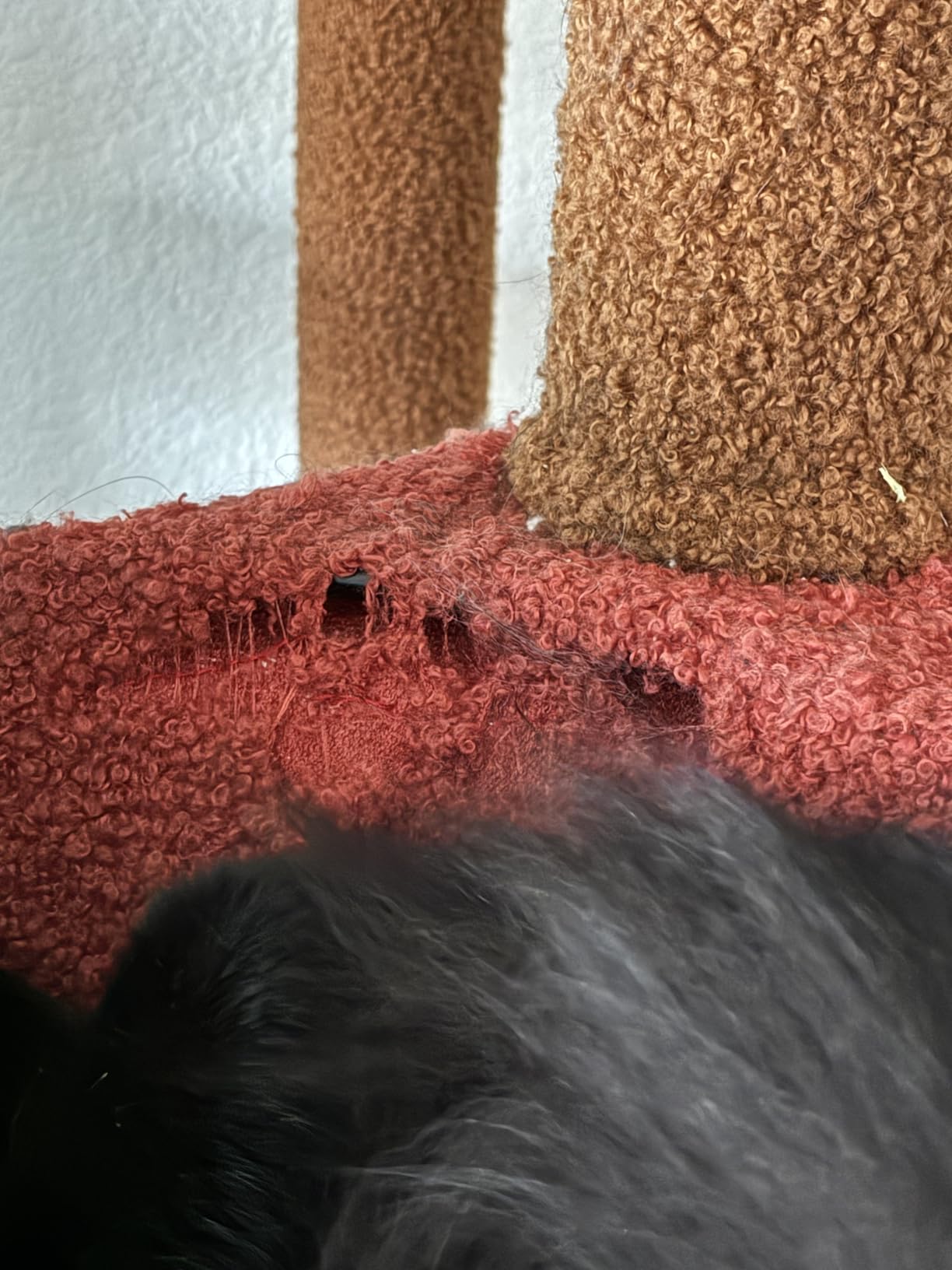
Check that your ceiling can take it
Tension mounts need a flat, solid ceiling and a full contact point. If your ceiling has a light fixture, a fan or a beam in the way, the plate may not sit flat, and that is the most common reason these towers wobble. Measure and mark the plate position before you start.
Also confirm you have the vertical room. At a 108 inch maximum, you need at least that much headroom available in the spot you are installing it.
What we would watch
Weight is not specified in the listing, which is unusual for a floor-to-ceiling unit and worth asking about. If your cat is heavy, the rated-capacity models further down are a safer bet.
Some buyers note the finish varies from the beige shown in the listing. If colour matching matters to you, expect a small difference from the product photos.
9. TQEW 50-120.5in Adjustable Tower – The Widest Height Range
Floor to Ceiling Cat Tree Height (50-120.5in) Adjustable Cat Tower 5 Tier Hemp Scratching Post High Cat Tree Sturdy Activity Tree Indoor Outdoor Cat Scratching Post Activity Center
Adjustable 50-120.5 in tall, 35.3 lb
Rated to support up to 140 lb
Three-screw ceiling plate
Pros
- Widest height range of any tower here
- reaching about 10 feet
- Three-screw ceiling plate holds steadier than plunger mounts
- Includes gloves tools non-slip mats and extra toys
- Modular post lengths match almost any ceiling
Cons
- Clear plastic capsule bed is frequently ignored by cats
- Wood platform pads are slippery on the way down without added adhesive carpet
- Shelf-to-shelf gaps can be too wide for smaller or senior cats
The single widest range in this roundup, from roughly 50 inches up to 120.5 inches, and it needs no drilling. Modular post sections of different lengths combine in different configurations, so the same unit works in a low-ceiling room and in a double-height space.
The anchoring is where the engineering went. Instead of a single screw or a plunger, the top plate uses three heavy-duty steel screws, and the frame is rated to support up to 140 pounds. On a 10 foot tower that difference is the whole ballgame, and reviewers consistently single out the steadiness.
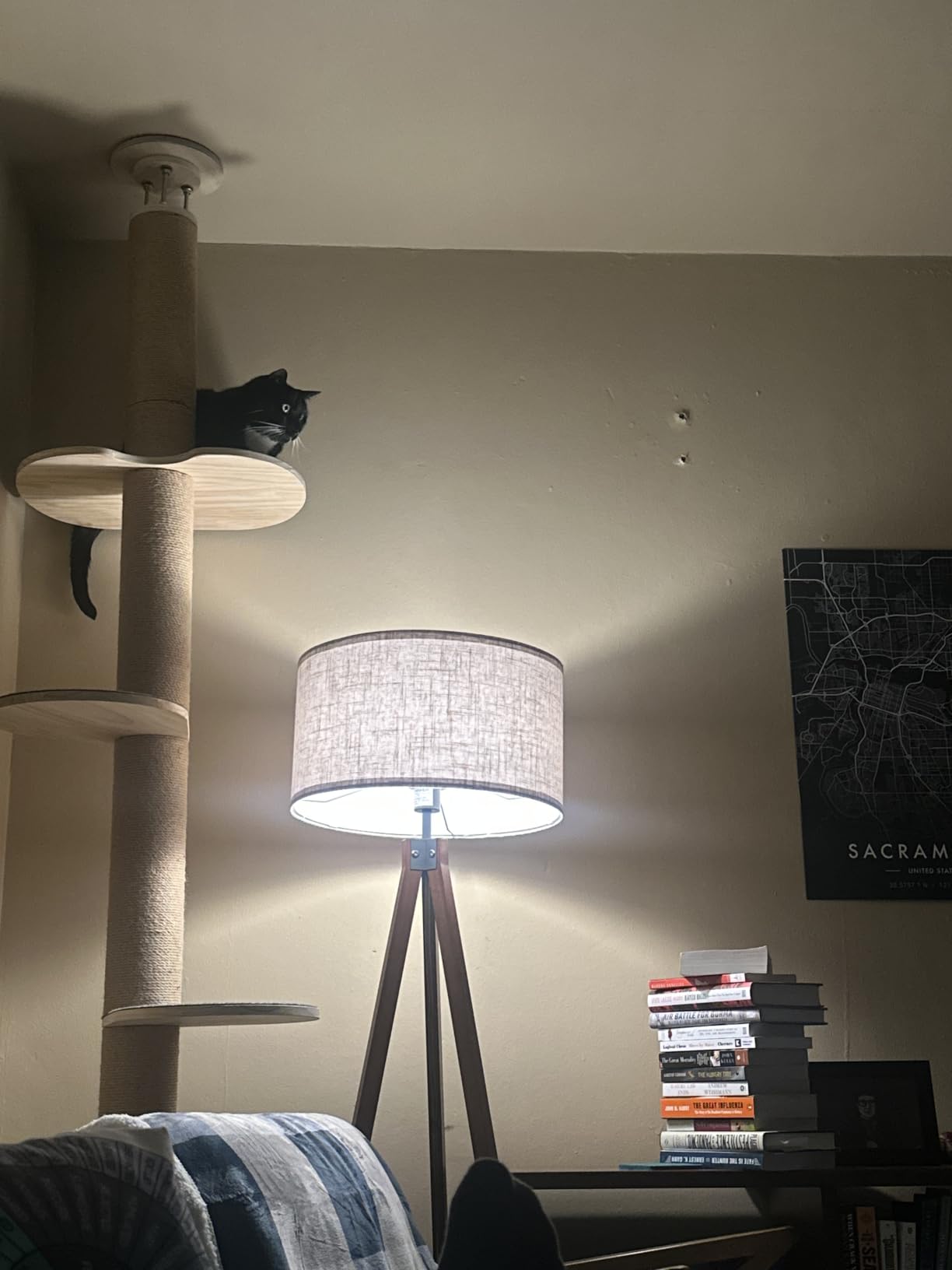
Eight sisal posts at 12 cm diameter give the most scratching surface of any adjustable model here, available in 5-tier and 4-tier configurations. The box includes gloves, tools, non-slip mats and extra toys, which is a generous kit for a floor-to-ceiling build.
Construction is CARB-certified pine wood, durable PVC and natural sisal rope. A hammock, a space capsule bed and a viewing perch fill the upper levels, and the viewing perch is the one to place in front of a window.
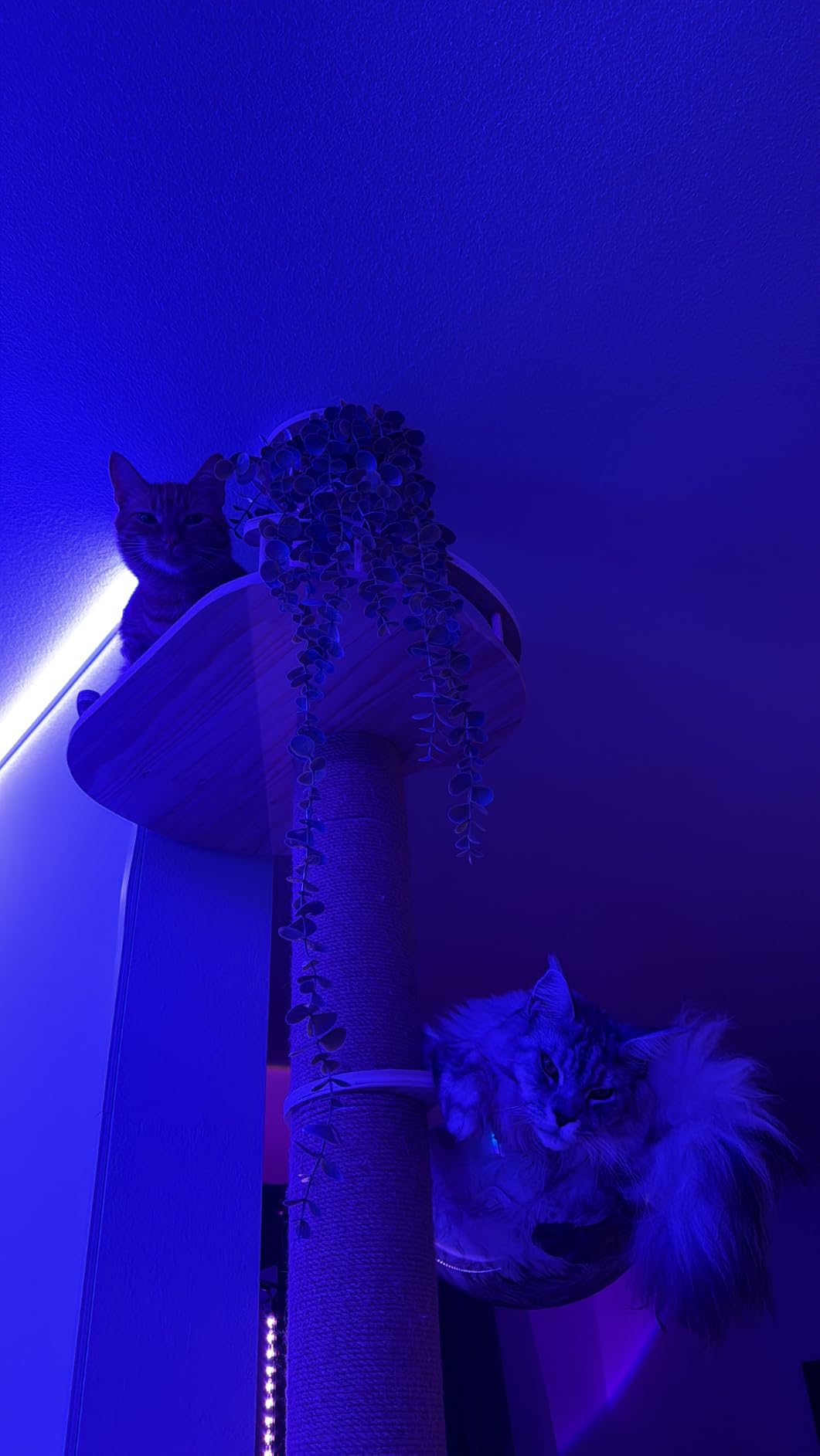
When the full height range earns its place
Owners of a 9 foot ceiling get something a 95 inch tension pole simply cannot deliver. The same product can also be configured short for a standard room, which makes it the safest single purchase if you are not certain about your ceiling height.
At 140 pounds rated load it is also one of the few units here with a published capacity high enough for a large Maine Coon at the top.
Honest complaints
The clear plastic capsule bed is frequently ignored by cats, so do not count it as a selling feature for your particular cat. Platform pads are wood and can be slippery on the descent unless you add the included adhesive carpet or non-slip mats.
Shelf-to-shelf gaps can be too wide for smaller or senior cats in the taller configurations, so check the spacing against your cat if you are buying for an older animal.
10. FUKUMARU 6-10 ft 6-Level Tower – Six Levels and a 145 lb Column
FUKUMARU Floor to Ceiling Cat Tree, 6-10 ft, 6 Level, Grey
6 levels adjustable 6-10 ft, 35.1 lb
5 in support column rated to 145 lb
Rubber wood plywood and jute, felt shelf mats
Pros
- Most levels in the set at six across a 6-10 ft range
- Rated to 145 lb on a 5 inch support column
- Wax-coated shelves wipe clean
- Machine-washable faux-fur hammock
Cons
- Widest footprint of the floor-to-ceiling models at 33 x 23 in
- Among the most expensive options in this roundup
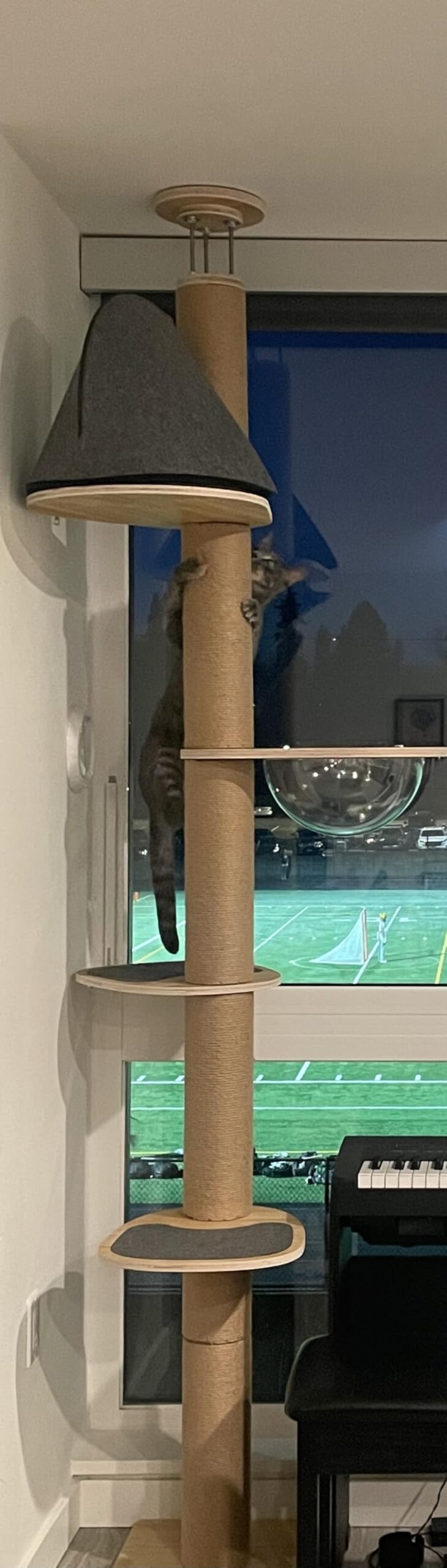
This is the answer to what is the best cat tree for heavy cats. The 5 inch support column is rated to 145 pounds, and the top structure uses three reinforced screw rods, so a 20 pound Maine Coon at the summit is well inside the engineering envelope rather than at the limit.
Six levels is more than any other tower here, adjustable from 6 to 10 feet by adding or removing middle columns. That means a single product covers a standard ceiling and a double-height room, and the extra columns are the reason there are six separate perches rather than three.
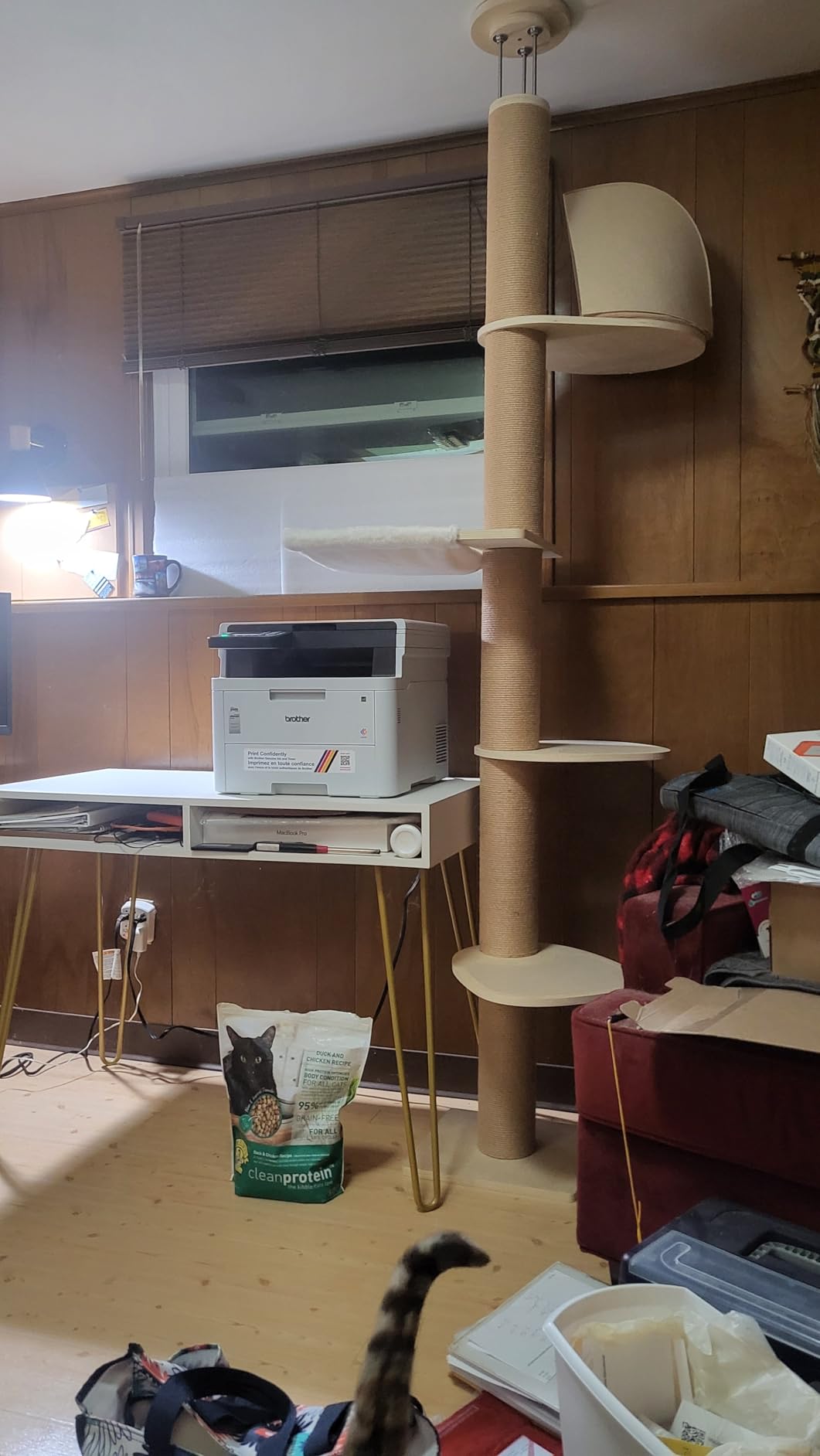
Cleaning is where it beats most plush rivals. The shelves are wax-coated rubber wood plywood that wipes down, felt mats sit on the viewing shelves so claws do not slide, and the extra-large hammock is machine washable. In a multi-cat household that removes the smell problem that ends up condemning a tree.
There is a 360-degree transparent capsule, a semi-enclosed condo and a view perch, so the cat has somewhere to sit, somewhere to hide and somewhere to watch the room.
Where the footprint becomes the problem
Published dimensions are 33 x 23 inches, the widest of any floor-to-ceiling model in this guide, even though the base plate itself is 14 x 14 inches and the extra width comes from the upper shelves. Measure the room carefully and make sure the top of the tower is not over a walkway.
The flip side is that the wide shelves are usable. There is nowhere for a cat to sit on this tower and feel cramped, which is a real advantage in a large-breed household.
Is the premium tier justified
It sits at the expensive end of this roundup, and the case for it is specific: a heavy cat, a tall room, and an owner who does not want to reassemble hardware every year. Buyers cite loading-tested stability and easy-clean finishes as the reasons they are satisfied.
For a smaller or lighter cat, the PEQULTI covers the same adjustable concept at a lower tier without a published load rating that high.
11. Globlazer 83in F83 Tower – Nine Sisal Posts
Globlazer Giant Cat Tree for Indoor Large Cats, 83in, F83, Dark Grey
83 in tall, 36.5 lb, 37 x 17.7 in footprint
55 x 45 cm fan-shaped platform,9 sisal posts
Pros
- Nine sisal posts give the most scratching coverage among freestanding options
- Stable under 20+ lb cats without wall anchoring
- Offset levels suit cats that hop between platforms
- Wall anchor strap included
Cons
- Cave doorways are sized for medium cats so large cats must crouch
- Lower cave roof has a climb-through hole
- Some perches are not square to the frame
At 83 inches this is one of the tallest freestanding towers in the roundup, and the top perch nearly reaches a standard ceiling. The trapezoidal base with multiple support points is what keeps it from rocking, and owners report it standing firm under 20 pound cats even before the included wall anchor strap goes on.
Then there are the nine natural sisal posts, the highest scratching coverage of any freestanding model we looked at. For a cat whose main job is to redirect clawing away from your furniture, that matters more than another condo.
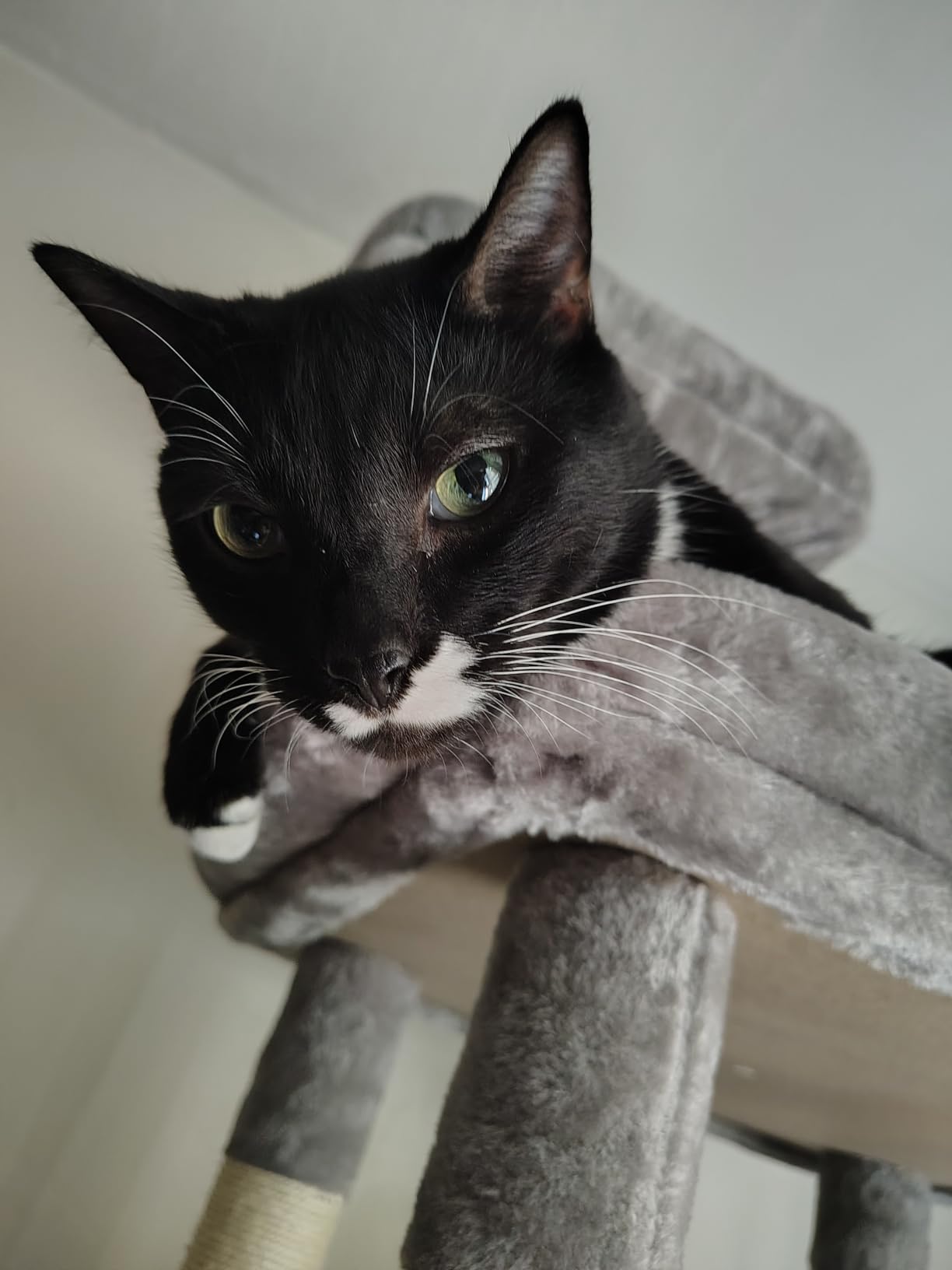
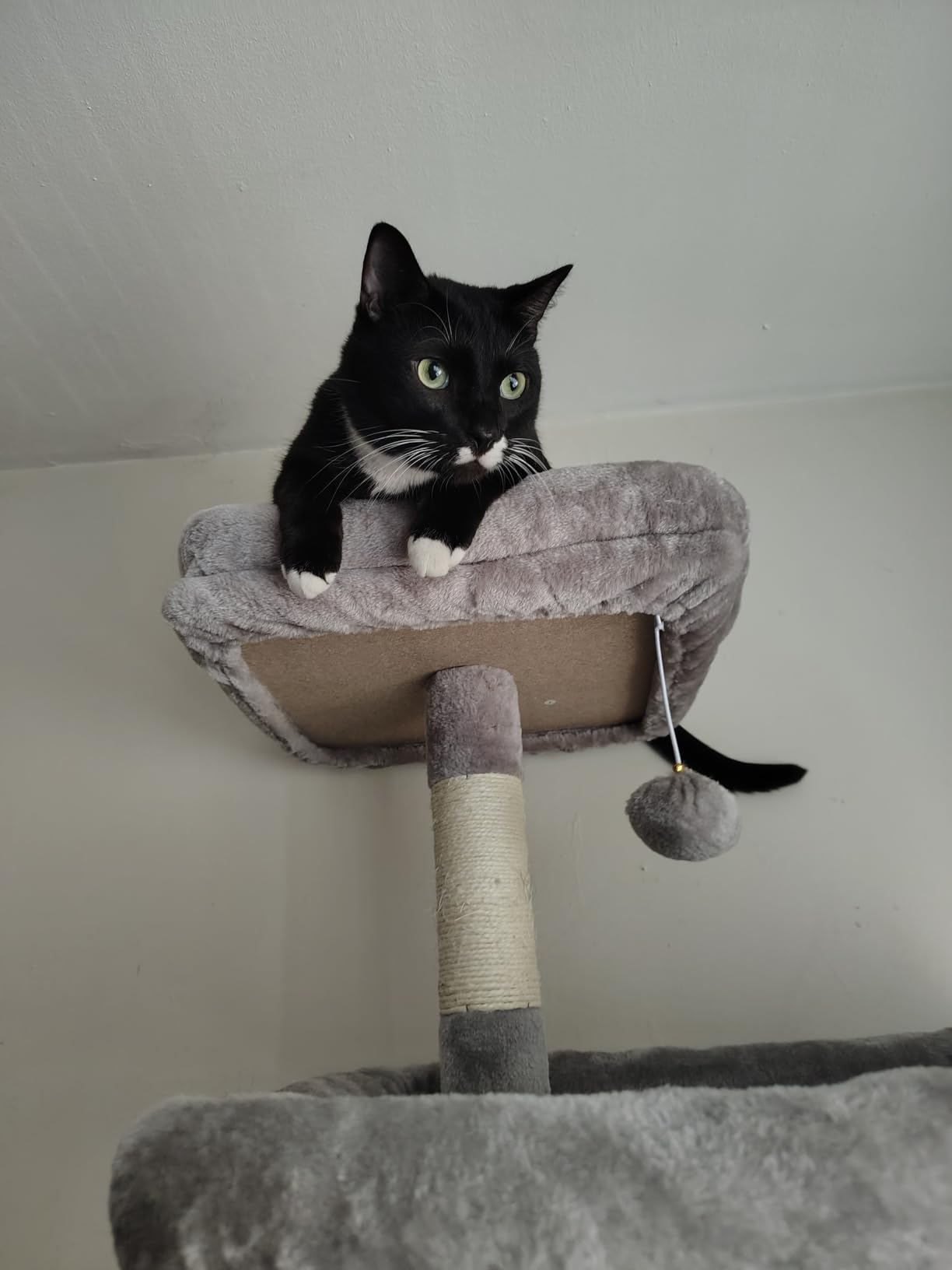
A 55 x 45 cm fan-shaped extra-large platform gives a large cat room to stretch out at height, and the levels are deliberately offset so a cat can hop between them rather than making a single committed leap. That is a real advantage for a declawed or older cat that does not want to jump gaps.
Hanging mouse toys and dangling balls fill the middle levels. The design is closer to a climbing gym than a condo, and it rewards a cat that actually wants to move vertically.
Mind the cave openings
The two enlarged condos have doorways sized for medium cats, so a large cat has to crouch to get inside. A cat that will not duck will not use the condo, and you may be left with a tall structure that is climbed but never slept in.
The roof of the lower cave has a climb-through hole, which is a clever second route but means it cannot double as a flat window perch. Know that before you position it in front of glass.
Placement matters here
Some perches are not square to the frame, so the tower cannot sit flush against a wall. Give it a few inches of clearance and use the wall anchor strap to the stud, not into drywall alone. This is the one product in the roundup where anchoring into a stud is genuinely worth doing.
For heavier cats, the FUKUMARU further up publishes a higher rated load on a wider column.
12. Gitelsnour 71in Large Cat Tree – Two Caves and Two Platforms
Gitelsnour Cat Tree, 71” Tower for Large Cat with Scratching Post, GCT032G
71 in tall, 42.8 lb, 21.7 x 17.7 in base
Two sisal boards, 2 plush caves, 2 top platforms
Anti-tipping wall straps included
Pros
- Tied for the highest rating in the roundup at 4.7 stars
- Two-point hammock attachment reduces sag and breakage
- Sturdy enough for 25-30 lb cats once assembled
- Clear instructions and extra hardware in the box
Cons
- Posts are thinner than many competing towers
- Narrow base relative to its height so anchoring is advisable
- Plush fabric is thin and a bracket can bend when moving
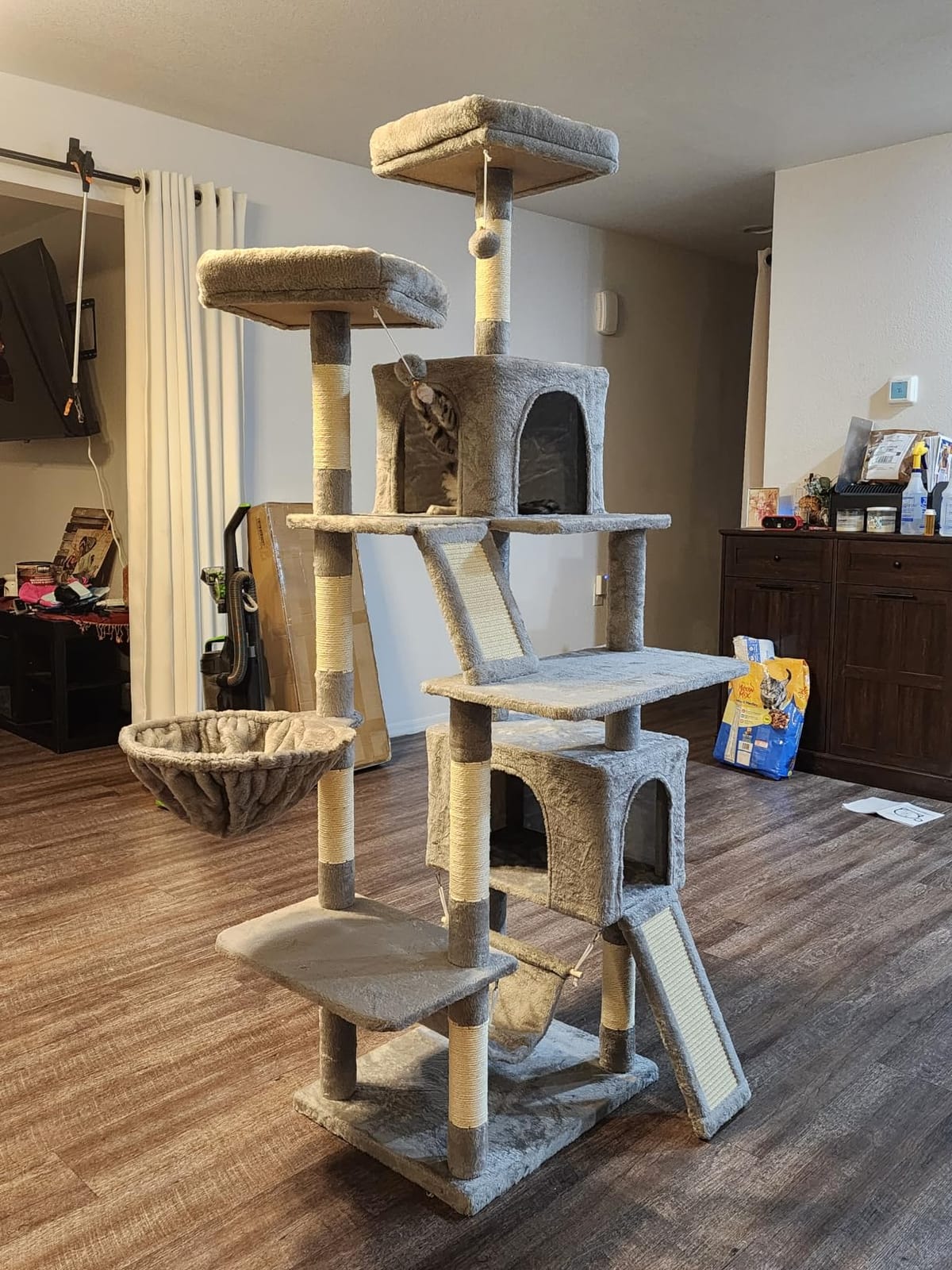
Two plush caves and two top platforms is an unusual amount of enclosed and elevated space in a 71 inch tower, and it suits a cat that treats hiding as a serious activity. The deep hanging basket and hammock fill in between, and both are genuinely used rather than decorative.
The build detail that stands out is the hammock attachment. It uses two attachment points rather than one, which reduces the sag and breakage that owners of cheaper models complain about within months. Instructions are clear and extra hardware is included in the box.
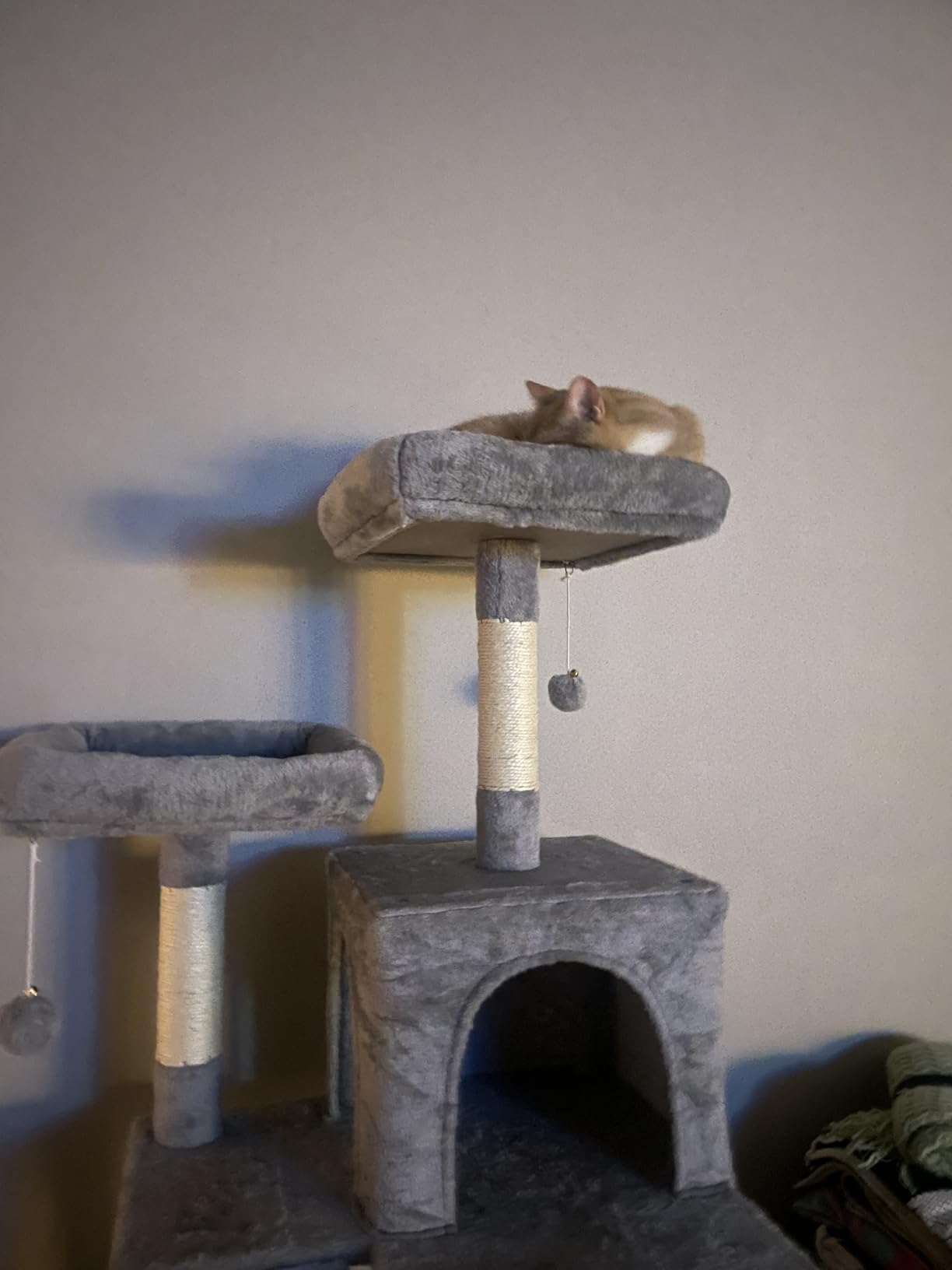
At 42.8 pounds the frame is heavy, and owners report it sturdy enough for 25 to 30 pound cats once assembled. Two independent sisal scratching boards sit on the structure, which is a good configuration for two cats that scratch at the same time.
The anti-tipping wall straps are in the box, and with this one you should use them. The base is 21.7 x 17.7 inches against a 71 inch height, which is a narrower stance than we would like for a cat this heavy.
Check the post thickness
Posts here are thinner than on many competing towers, and that is a long-term durability concern even though the frame itself feels solid. If your cat climbs by gripping the posts and swinging rather than jumping rung to rung, look at the PETEPELA or PEQULTI with 3.5 and 3.6 inch posts instead.
If your cat jumps level to level, thin posts are much less of an issue, because the load goes through the platform rather than the column.
What to expect on assembly
Clear instructions and spare hardware in the box, which is better than most. Build it where it will stand, because 42.8 pounds plus the bracket strength is not a combination you want to test halfway up a staircase.
One honest note: the plush fabric is thin and a bracket bent during a move for at least one buyer, and the colour listed as black arrives dark gray. Neither is a dealbreaker, but both are worth knowing before you build.
How Tall Should a Cat Tree Be for Climbers?
The ideal height for a cat tree is 55 to 75 inches for a healthy adult indoor cat, and that range resolves most of the conflicting advice you will find online. Below 55 inches a climber reaches furniture height and often stops there. Above 75 inches only matters in a home with a tall ceiling, a very large cat, or a climber that genuinely wants a vantage point above the room.
Here is how we would set the target for different cats, reconciling the numbers that appear across buying guides.
Kittens and small cats under 12 months: 25 to 40 inches. A kitten that high has plenty to do, and a full-height tower is harder to climb safely at that age.
Average adult cat, healthy: 50 to 60 inches. This is the most common recommendation and it works for a cat that is fit and confident.
Active climber or large and heavy breed: 55 to 75 inches minimum, and 75 to 90 inches if the ceiling allows. Maine Coons jump higher and need a top perch wide enough to lie on.
Senior or low-mobility cat: total height matters less than level spacing. Look for 12 to 16 inches between platforms, as the Feandrea in this list demonstrates.
Double-height or loft space: 83 to 120 inches, using a tension-mounted or modular tower that can be configured to the actual ceiling.
Is a taller cat tree better? Only when the extra height comes with the base width and platform size to carry it. A 95 inch tree on a 15 inch base is a worse purchase for most cats than a 70 inch tree on a 22 inch base, and that single comparison explains most of the disappointment in the forum threads we read.
Stability: Why Tall Cat Trees Tip Over
Tall cat trees tip over because height multiplies every wobble in the base, and because most manufacturers scale height up while scaling the base far less. A rocking tree is the single most cited defect in owner feedback, ahead of scratching posts wearing out and hardware loosening.
The rule of thumb owners use conversationally, and which no guide formally states, is roughly a base footprint whose width is at least a quarter to a third of the total height. A 6 foot tree wants a base around 18 to 24 inches on each side, which is why the 22 inch base on the Yaheetech 70in and the 23 inch base on the Yaheetech 79in hold still, while a 15 inch base on a 100 inch tower does not.
Product weight matters for the same reason. Heavier is steadier, and the heaviest units in this roundup at 47.6 pounds and 42.8 pounds feel noticeably more planted than the 32 pound models. That is not a quality judgement on the lighter ones, it is a physics one.
Finally, anchor anything past about 70 inches. Five of the twelve products here include an anti-toppling or anti-tip strap or kit. Use it, and fix it into a stud rather than into drywall alone. The wobble test that r/MaineCoon owners describe is the fastest way to check any tree, in a shop or the moment it arrives: push the top perch sideways with your hand. If you can move it, your cat moving there at speed will move it further.
Floor-to-Ceiling vs. Freestanding vs. Wall-Mounted
Floor-to-ceiling tension mounts give the most height and the smallest footprint, but they need a tall room, a flat ceiling and a solid contact point. Freestanding towers fit anywhere and can be moved, but they are limited by the base width you can afford. Wall-mounted shelves leave the floor completely clear and can follow your ceiling height exactly, at the cost of installation.
For most households a freestanding tower between 70 and 83 inches is the right default. It is tall enough for a climbing cat, wide enough to be stable, and light enough that two people can carry it to a different room.
Choose a tension mount if your room is narrow, your ceiling is 8 feet or higher, and you cannot drill. Choose wall shelves if you have several cats and want an adjustable climbing route you can extend later, but only anchor into studs and check the adhesive ratings carefully.
On how tall is too tall: a tower should stop short of the ceiling by at least 6 to 8 inches. A cat launching onto a top perch that is flush with the ceiling has nowhere to place its head, and owners report exactly this as a landing problem. Also measure your doorway and stairwell before ordering, because a boxed 83 inch tower is wider than the tower looks.
Platform Size and Why Most Tall Trees Are Unusable
A tall tree is only as good as the top platform, and most tall trees have a top perch that is barely larger than the cat sitting on it. A cat will perch briefly and then come down, because lying down at height is the entire reward. For a large cat, aim for a top platform of at least 14 to 16 inches on a side.
The Heybly, with perches at 21.7 x 17.8 and 21.7 x 9.8 inches, and the Globlazer F83, with a 55 x 45 cm fan-shaped platform, are the two widest summit spaces here. The Globlazer F70 Pro fits one large cat on top rather than two, which is worth knowing in a two-cat household.
Check the condos too. A cave is only useful if your cat will actually enter it, and the F83 tower has doorways sized for medium cats, so a large cat has to crouch. If your cat ignores sleeping spaces but uses the top perch exclusively, buy for the perch and skip the condo count.
Finally, check the gaps. Level spacing of 12 to 16 inches is comfortable for a healthy adult, while wider gaps suit a confident jumper and frustrate a kitten, a senior or a cat with balance issues. The Feandrea 81.1in is the reference here for short-rung climbing.
Setup and Anti-Tip Anchoring in Six Steps
Most wobble complaints trace back to assembly rather than design, and these six steps fix most of them. Budget 30 to 60 minutes for a tall freestanding unit, and two people for anything over 40 pounds.
Assemble in the final location. Measure the route from the door to that spot first. Most returns on tall trees are sizing problems, not quality problems.
Lay out and label every part before you start. Count the posts, platforms and hardware against the list, and do not discover a missing screw after the frame is upright.
Build bottom-up and seat each platform fully. Push until the joint closes completely, then tighten every accessible screw. Staples and loose dowels are the main reason joints shift within months.
Check level in both directions. If the tower leans at all, shim the low foot with a thin piece of card or a furniture pad before tightening anything else.
Anchor the top to a stud. Fit the included anti-tip strap or kit, and locate a stud with a detector rather than guessing. Drywall anchors alone will not hold a 70 inch tree under a jumping cat.
Run the wobble test before the cat does. Push the top perch sideways and forwards with your hand. Any movement means the fix is tighter hardware, a wider base, or a better anchor, not time.
For a tension-mounted tower, steps one through three are the same. Skip the stud anchor, confirm the ceiling plate sits flat with no fixture in the way, and tighten the tension mechanism evenly so the frame is plumb before the cat tests it.
Buying Guide: What to Check Before You Buy
Frame and base first. FSC-certified or solid wood is more durable than plain particle board in a way owners consistently report, and product weight tells you more about stability than any advertised capacity number. A stated weight capacity is useful only alongside a base footprint.
Platforms next. Measure the top perch against your cat’s full stretched length, not its sitting length, and check level spacing if you have a kitten, a senior or a cat with balance issues.
Scratching posts come down to diameter and material. Thicker posts resist flexing and give a bigger cat something to grip, and sisal is what most cats prefer over carpet or jute. Count the posts rather than the zones, because a scratching ramp counts as one and a post counts as one.
Cleaning is the factor most often ignored and most often regretted. Removable washable cushion covers and wipe-clean shelves decide whether the tree is still in use in year two or abandoned because it smells.
Finally, measure the room. Ceiling clearance, floor footprint, doorway width, and the distance from the nearest wall if you are anchoring. A cat that hits its head on the way onto the top perch will stop using the tree within a week.
Frequently Asked Questions
What is the ideal height for a cat tree?
For a healthy adult indoor cat, 55 to 75 inches is the ideal height, and that range resolves most conflicting advice online. Below 55 inches a climbing cat reaches furniture height and often stops. Average adult cats do well at 50 to 60 inches, while large breeds and true climbers need 75 to 90 inches and a wide top perch. Total height matters less than level spacing for senior cats, so look for 12 to 16 inches between platforms.
How tall is too tall for a cat tree?
A cat tree is too tall when the top perch sits within about 8 inches of the ceiling, because a cat landing on it has nowhere to put its head. Height is also wasted if the base cannot support it: a 95 inch tree on a 15 inch base is less usable than a 70 inch tree on a 22 inch base. As a general rule keep 6 to 8 inches of ceiling clearance and pair any tree over 70 inches with a wall anchor.
How do I stop my cat tree tipping over?
Four things fix a rocking tree. First, check the base footprint against the height and aim for a base width at least a quarter to a third of the total height. Second, re-tighten every screw and fully seat each platform, since loose joints are the usual culprit. Third, shim the floor so the unit is level in both directions. Fourth, fit the anti-tip strap included with most tall trees and anchor it into a stud rather than drywall.
What is the best cat tree for heavy cats?
The best cat trees for heavy cats publish a rated load and use a wide support column. The FUKUMARU 6 to 10 foot tower rates a 5 inch column to 145 pounds, and the TQEW adjustable tower is rated to 140 pounds with a three-screw ceiling plate. For heavy cats that also need a wide summit, the Heybly has the largest top perches in this roundup. Platform size matters as much as capacity, since a cat will not stay on a perch it cannot fit on.
Is a taller cat tree better?
No, not on its own. A taller tree is only better when the extra height is matched by a wider base, a sturdier frame and a top platform big enough to lie on. Height adds reach, but stability comes from the base-to-height ratio and unit weight. In most homes a freestanding tower between 70 and 83 inches is the sweet spot, while taller tension-mounted designs make more sense in narrow rooms with high ceilings.
Conclusion: The Best Tall Cat Trees for Climbers in 2026
For most households the Yaheetech 70in is the pick, because 70 inches of climb on a 22 inch, 40 pound base is the ratio that keeps a tree still, and it has been tested by more owners than anything else we looked at. Multi-cat homes should go to the Yaheetech 79in for its nine sisal posts, and older or less agile cats fit the Feandrea 81.1in with its 12 to 16 inch level spacing.
Large breeds belong on the Heybly or the FUKUMARU, and narrow rooms with tall ceilings are what the tension-mounted units are for. Whatever you choose, measure the ceiling, measure the base, run the wobble test before your cat does, and anchor anything past 70 inches into a stud.
That is the short version of the best tall cat trees for climbers in 2026. Height gets a cat interested, but stability and platform size are what keep it coming back.