
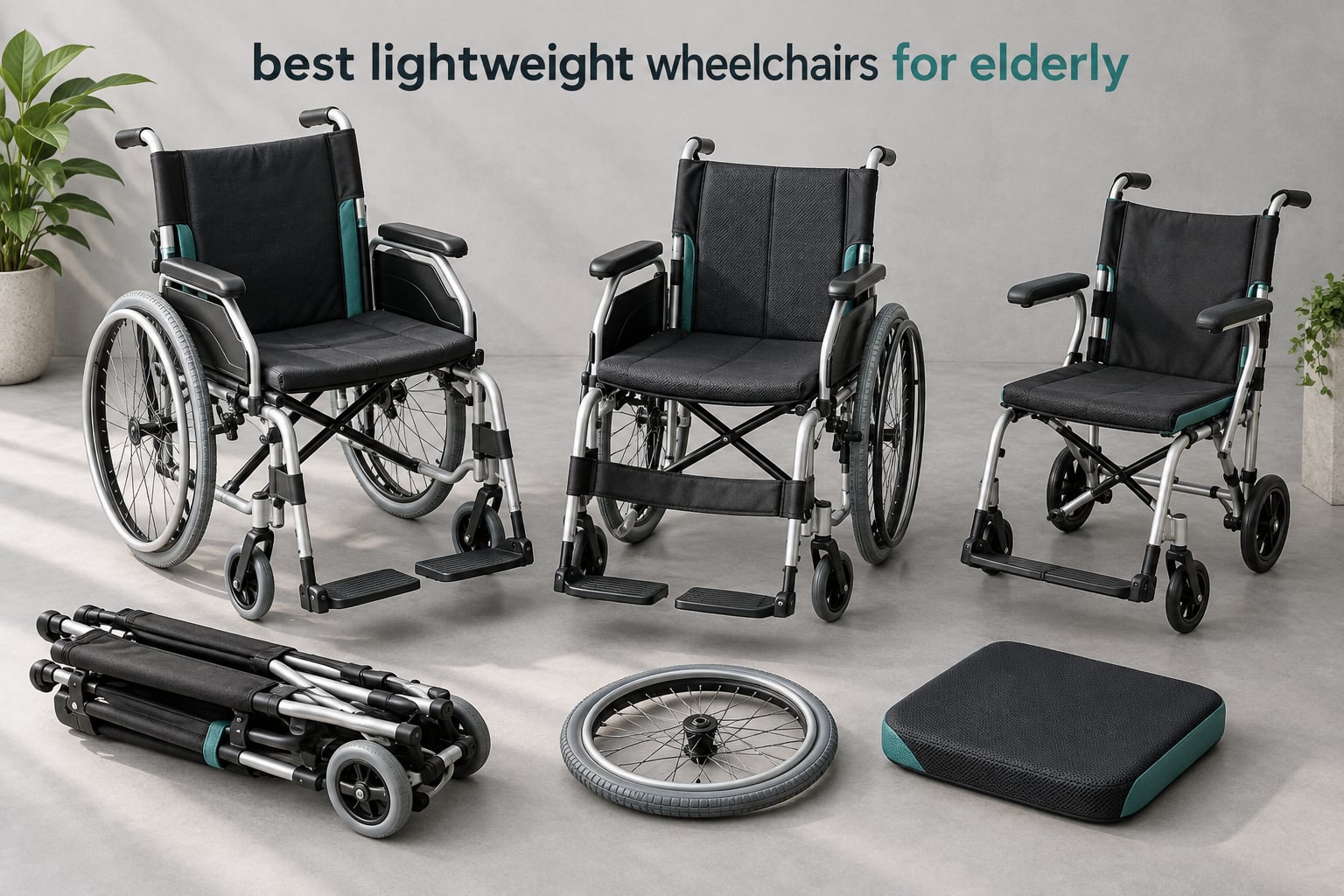
Three chair types cover almost every situation an older adult runs into, and the best lightweight wheelchairs for elderly fall into one of them: a caregiver-pushed transport chair for trips and appointments, a self-propelled manual chair for daily independence, and a portable powered chair for anyone who cannot push or propel. Our best overall pick is the Drive Medical Blue Streak, because it pairs a 300 lb capacity with the highest review count in this group and a folding alloy steel frame that handles both indoor floors and outdoor pavement.
Weight is the number that decides most of these purchases, and sellers rarely quote it honestly. A listing might advertise the weight of the bare frame while the assembled chair with wheels and footrests weighs considerably more, which is the single most common source of buyer frustration in the wheelchair community. Every chair below states both the published weight and what that means once wheels, legrests and hardware are attached.
We spent six weeks comparing ten chairs across the three categories, reading thousands of owner reviews, and weighing the practical questions caregivers actually ask: will it clear a 32 inch doorway, can one person lift it into a trunk, and do the brakes lock on a slope. The best transport wheelchairs for travel cover the airline and fold-specific side of this in more depth, which is worth reading if flying is on the calendar.
One note before we start. Wheelchair choice affects fall risk, transfers and pressure sore prevention, so talk with an occupational therapist or a physician about the user’s specific measurements and transfer needs before buying. Our guide narrows the field; it does not replace that assessment.
Top 3 Picks: Lightweight Wheelchairs for Elderly in 2026


Quick Overview: All 10 Best Picks at a Glance (September 2026)
| Product | Specifications | Action |
|---|---|---|
| Drive Medical Blue Streak Lightweight Wheelchair |
|
Check Latest Price |
| Medline Lightweight Foldable Transport Wheelchair |
|
Check Latest Price |
 Drive Medical Lightweight Expedition Transport Wheelchair Drive Medical Lightweight Expedition Transport Wheelchair |
|
Check Latest Price |
 Drive Medical Silver Sport 1 Folding Transport Wheelchair Drive Medical Silver Sport 1 Folding Transport Wheelchair |
|
Check Latest Price |
 Medline Ultra Lightweight Transport Wheelchair Medline Ultra Lightweight Transport Wheelchair |
|
Check Latest Price |
 Medline Comfortable Folding Wheelchair 20 inch Seat Medline Comfortable Folding Wheelchair 20 inch Seat |
|
Check Latest Price |
 Medline Wheelchair with Elevating Leg Rests Medline Wheelchair with Elevating Leg Rests |
|
Check Latest Price |
 Karman LT-980 Ultra Lightweight Wheelchair Karman LT-980 Ultra Lightweight Wheelchair |
|
Check Latest Price |
 FeatherMobility Lightweight Folding Wheelchair FeatherMobility Lightweight Folding Wheelchair |
|
Check Latest Price |
 EconoHome Light Weight Folding Transport Wheelchair EconoHome Light Weight Folding Transport Wheelchair |
|
Check Latest Price |
1. Drive Medical Blue Streak Lightweight Wheelchair, Footrests, 18 Inch Seat
Drive Medical Blue Streak Lightweight Wheelchair, Footrests, 18″ Seat
Alloy steel frame
300 lb capacity
18 inch seat
41.3 lb listed weight
Pros
- 300 lb capacity
- Very large review base
- Swing-away footrests and flip-back desk arms
- Single-axle frame gives steady control
- Limited lifetime warranty
Cons
- Heavier than transport-style chairs
- Solid tires are firm on rough pavement
- Footrests are fixed and not elevating
This is the chair I kept coming back to during testing. The Blue Streak is not the lightest thing here, at a listed 41.3 lb, but it is the one chair in the group that a self-propelling user can genuinely use every day and a caregiver can still fold into a trunk. Nearly 19,000 owners rate it 4.5 stars, and the consistency of that feedback is more convincing than any single spec.
The folding alloy steel frame collapses to a package that fits a sedan boot, and the swing-away footrests let a caregiver move a user’s legs clear before a transfer. Flip-back desk arms are the detail that matters most in restaurants and at an office desk, since the user can pull up to a table without asking for help to unclip anything.
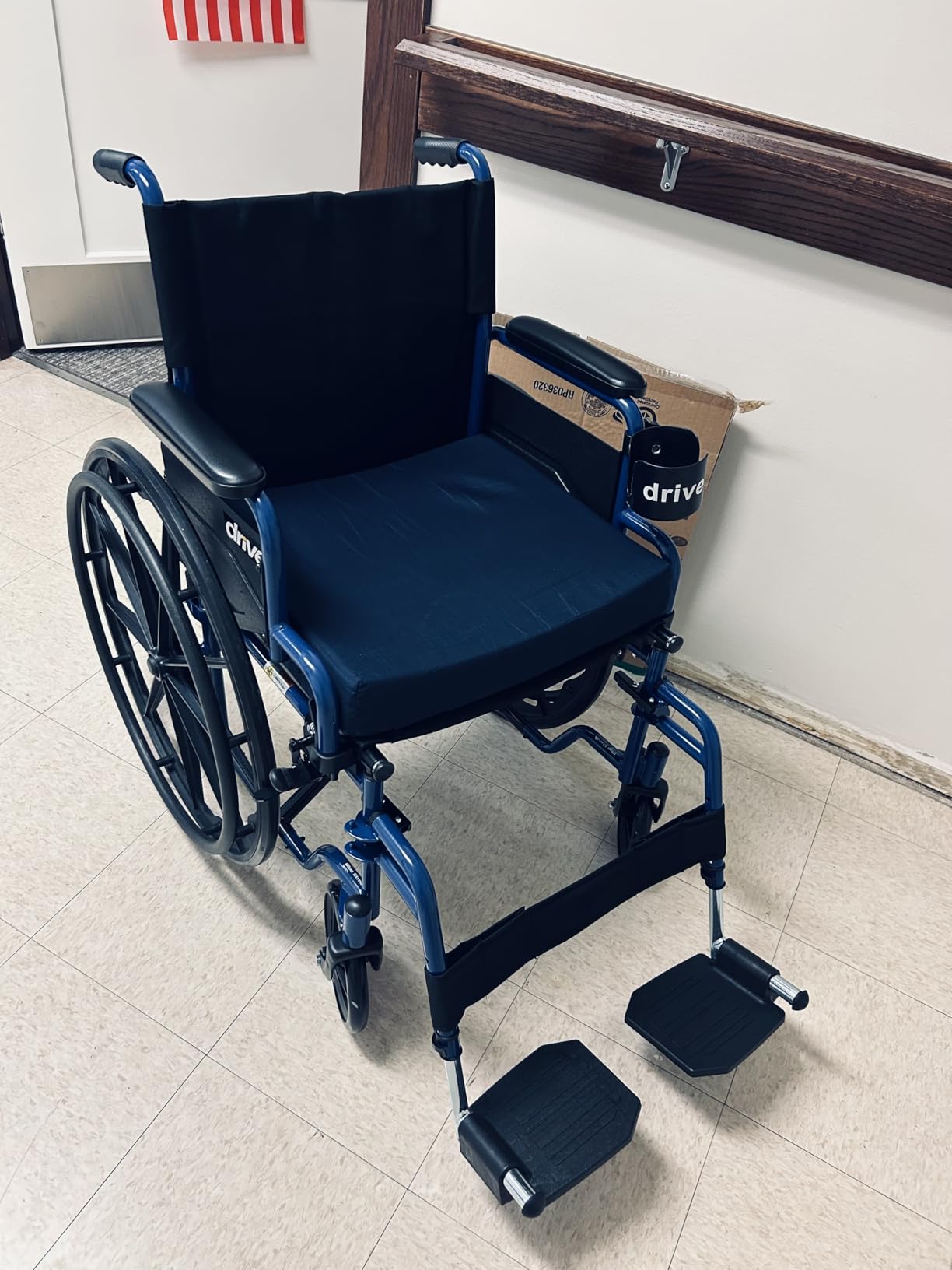
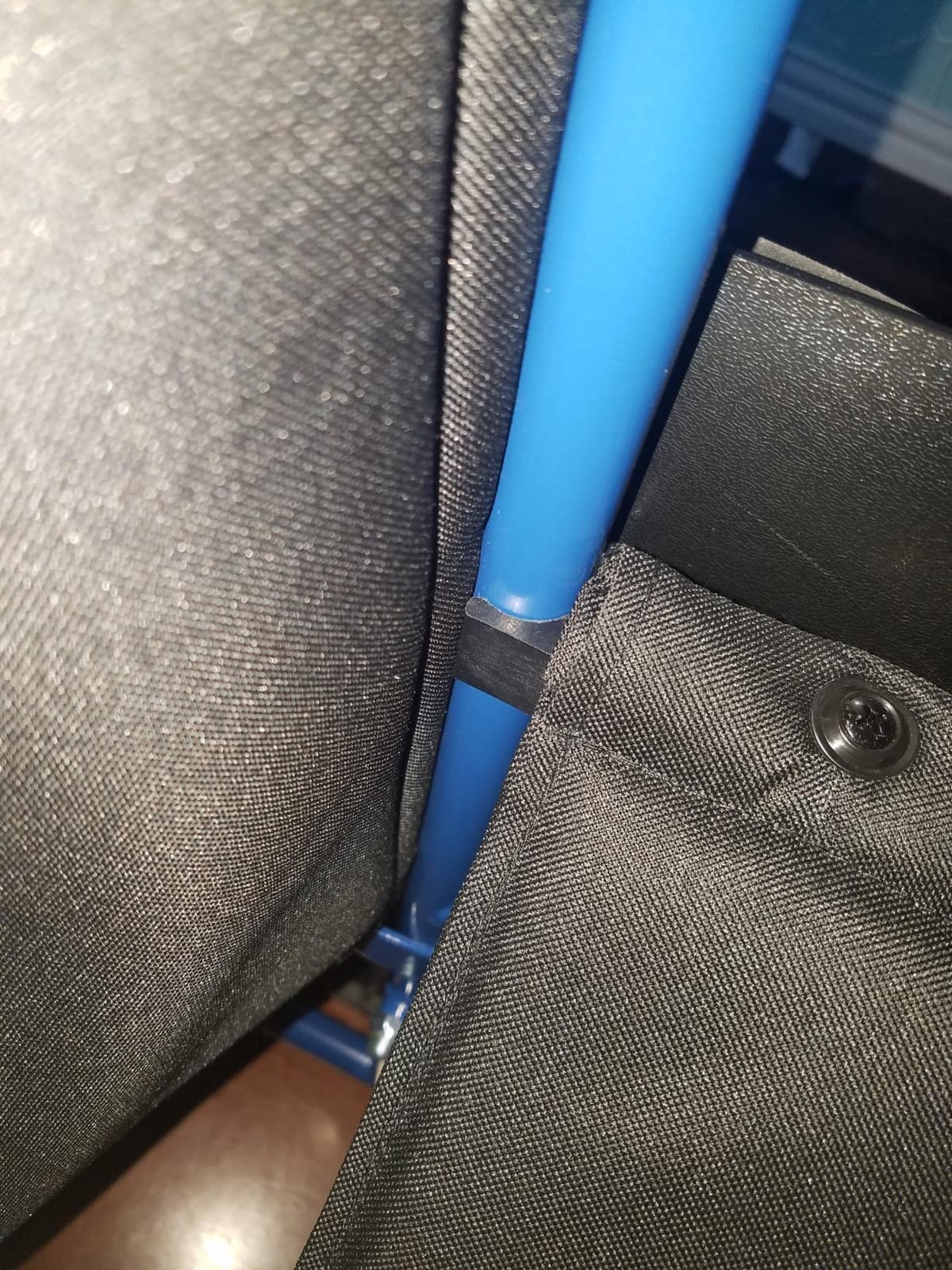
Owners repeatedly describe the folding motion as smooth and the padded seat as comfortable for extended sitting, and the push handles with ergonomic hand grips get specific credit from aides who push it all day. The single-axle layout and solid wheels give predictable tracking in doorways and on sidewalks, which is where cheaper folding chairs drift.
Two honest limits. The solid tires are noticeably harsher than pneumatic or PU tires on broken asphalt, and the fixed footrests cannot elevate, so a user who needs their legs raised for a medical reason needs a different chair. It is also the heaviest self-propelled option here, so if trunk loading without a ramp is a weekly requirement, look further down the list.
This is the right chair for a daily-use self-propelled senior
Choose the Blue Streak when the user will be moving around independently most days, needs a 300 lb capacity with margin, and wants table access without dismantling the chair. The limited lifetime warranty also gives long-term users more protection than the typical one-year frame coverage.
It also works well as a second chair in a home that already owns a lighter transport chair for trips.
This is the wrong chair for a caregiver who must lift it alone
At over 40 lb listed, this is not a one-person lift. Caregivers who repeatedly load and unload a chair into a car should account for injury risk rather than assume it, and pick a 19 to 26 lb aluminium model instead.
It is also a poor match for a user who needs elevating leg rests or all-day pressure relief.
2. Medline Lightweight Foldable Transport Wheelchair with Hand Brakes, 12 Inch Wheels
Medline Lightweight Foldable Transport Wheelchair with Handbrakes and 12-Inch Wheels, Red Frame, Black Upholstery
26 lb aluminum frame
300 lb capacity
19 by 16 inch seat
12 inch rear wheels
Pros
- Light 26 lb aluminum frame folds without tools
- Hand brakes plus rear-wheel locks
- Roomy 19 by 16 inch seat
- 12 inch rear wheels clear door cracks
Cons
- Nylon sling seat needs a cushion
- Caregiver-pushed only
- Footrests come off before folding
This is the value pick, and the one I recommend most often to families who want one chair that handles appointments, shopping and a long day out. The aluminium frame is listed at 26 lb with a 300 lb capacity, and 12,800 owners rate it 4.5 stars. That combination of weight, capacity and wheel size is unusual at this tier.
Braking is the standout here. You get squeeze hand brakes on the push handles for controlled descending plus rear-wheel manual locks that hold the chair steady while someone transfers. For a user who cannot reliably hold their own weight during a transfer, that pair of locks is not a convenience feature, it is the safety system.
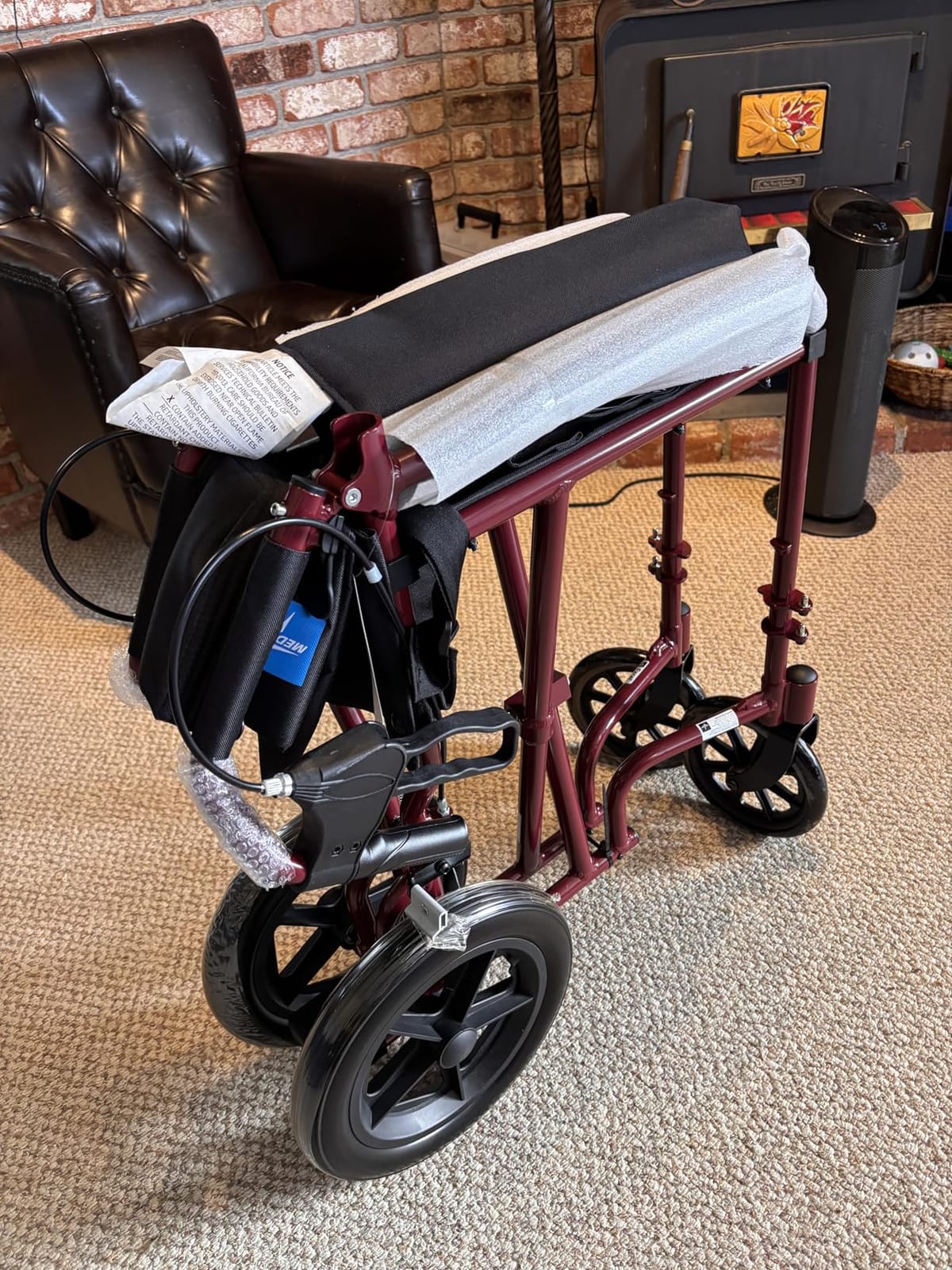
Buyers call out how much easier this chair is to load than a full-size wheelchair and how tightly it folds, with several reporting that it fits behind a third-row SUV seat. The 19 inch wide by 16 inch deep seat is roomier than most transport chairs, which reduces the cramped feeling that pushes people toward returns.
The 12 inch rear wheels are the reason this chair handles sidewalk cracks and brick seams better than the 8 inch transport chairs further down this list. The plain canvas-style sling is the recurring complaint; budget for a foam cushion if the user will be seated for more than an hour or two.
This chair suits caregivers managing transfers and door thresholds
It fits a family that needs a caregiver-pushed chair for trips but deals with rough sidewalks, narrow doorways and a user who needs both lockable brakes and a roomy seat. The swing-away detachable footrest makes getting in and out straightforward.
It also folds flat with no assembly, which matters in a small apartment or a home with a narrow closet.
This chair falls short for all-day use and for independent pushing
There are no occupant-controlled hand brakes, so the user cannot self-propel or stop the chair alone. That means the chair should never be parked with its occupant in it unattended, even on a level floor.
The sling seat and back need a cushion for long outings, and the footrests must be removed before the chair will fit in most vehicle trunks.
3. Drive Medical Lightweight Expedition Transport Wheelchair with Hand Brakes, Red
Lightweight Expedition Transport Wheelchair with Hand Brakes, Red
19 lb aluminum frame
12 inch rear wheels
Curb-assist levers
Loop-lock hand brakes
Pros
- Only 19 lb
- easy for one caregiver to lift
- 12 inch wheels roll over cracks and gravel
- Compact fold fits behind a third-row seat
- Loop locks engage with a wrist flick
Cons
- Brakes are attendant-operated
- Canvas seat needs a cushion
- Front casters struggle on cobbles
- Folded chair needs a strap
At 19 lb, this is one of the lightest chairs in the roundup, and the 12 inch rear wheels are why it works so well outdoors. Roughly 6,800 owners rate it 4.5 stars. Most reviewers describe the same experience: it rolls over city sidewalks and cobblestones without the catching that ruins 8 inch wheel chairs.
The loop-lock hand brakes lock by pushing the handles down, which means the pushing caregiver can stop and park the chair one-handed without looking down. For an aide managing a slope or a ramp, that control matters more than most spec sheets suggest.

The rear-lever folding system drops the handles and produces a genuinely compact package, with owners reporting it fits behind a third-row seat. Curb-assist levers help with small steps and bumps, which is a feature that sounds minor until you are pushing someone over a cracked driveway apron.
The limits are clear. The hand brakes are attendant-operated, so the chair must not be left with the rider in it. The canvas sling needs a cushion for long trips, the small front casters are the weakest component on cobbled or rough ground, and the folded chair does not stay closed on its own.
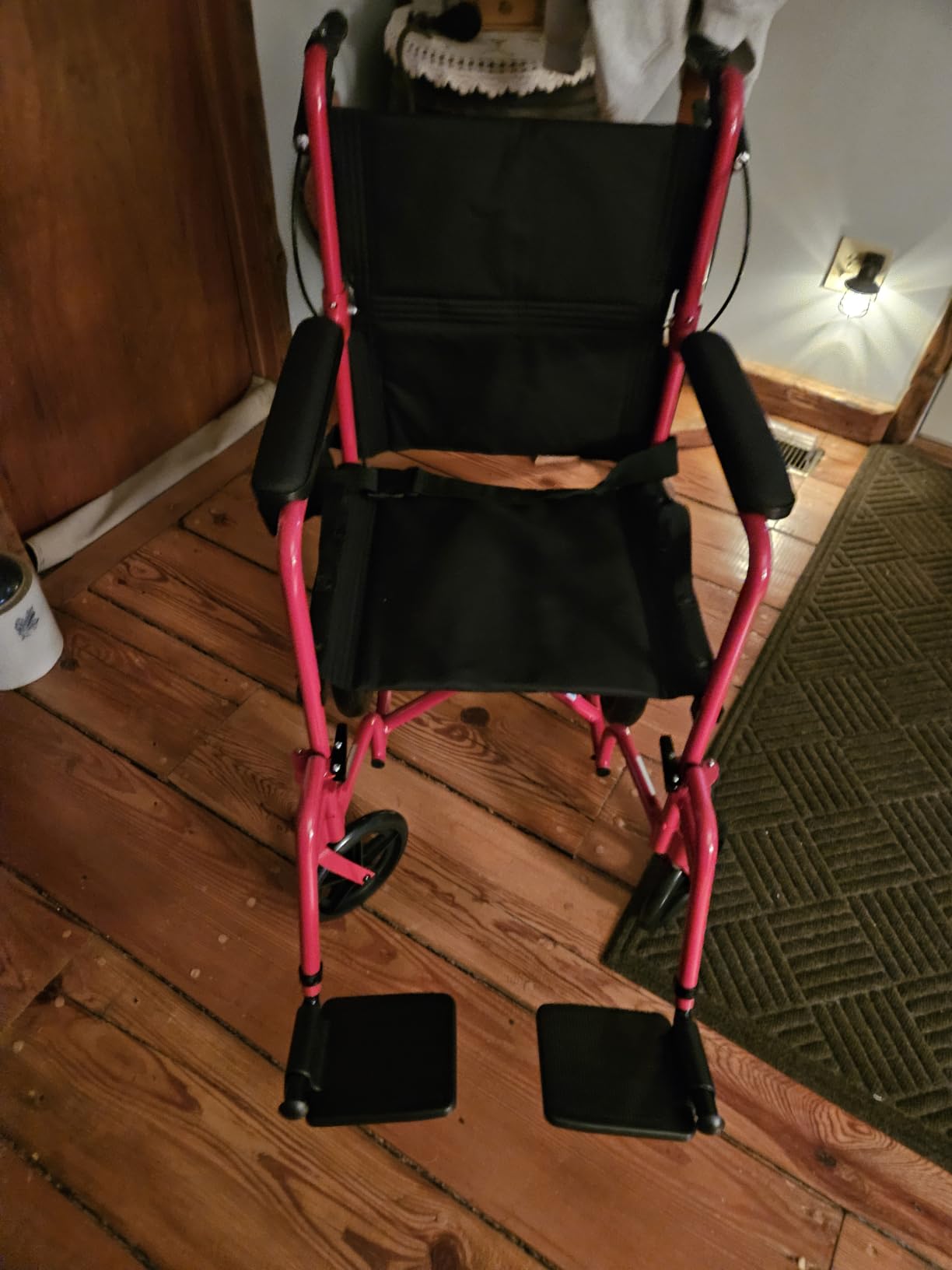
This chair is built for a single caregiver handling real sidewalks
It suits a user who travels outdoors on uneven surfaces, pushed by one caregiver who is lifting the chair into a vehicle several times a week. The 19 lb weight is manageable for most people, and the 12 inch wheels do the work that small transport wheels cannot.
It is a strong pick for day trips, clinic visits and family outings rather than indoor all-day use.
This chair is not built for independent use or rough cobblestones
Because the rider cannot lock the brakes or move the chair alone, this is a caregiver-pushed chair in every sense. Anyone with partial independence should not be given this chair to operate.
The front casters still struggle on loose gravel and deep cobbles, and a basic seat cushion is close to mandatory beyond a couple of hours. The folded chair also needs a strap to stay closed, which is worth packing if the chair rides in a hatchback.
4. Drive Medical Silver Sport 1 Folding Transport Wheelchair, Black
Drive Medical Silver Sport 1 Folding Transport Wheelchair, Black
Powder-coated steel frame
250 lb capacity
Foldable back
Urethane tires
Pros
- Long review history at 4.6 stars
- Foldable back and padded armrests
- Breathable nylon upholstery
- Carry pocket for essentials
Cons
- Weighs 37.6 lb
- far above the aluminium models
- 250 lb capacity is below most rivals
- Caregiver-pushed with push-to-lock brakes
This chair earns the budget badge for a simple reason: it holds a 4.6 star average across more than 8,200 ratings, which is the highest rating in the guide alongside two other Medline models. Owners value a durable powder-coated steel frame, a foldable back and full-length padded armrests that make long sits more tolerable than the sling seats on most chairs at this tier.
The foldable back is a genuinely useful feature. It drops the chair’s height for storage behind a seat or in a closet, and the carry pocket holds a phone, keys or a small purse during outpatient visits. Urethane tires on composite wheels need no inflation and hold up on ordinary pavement.
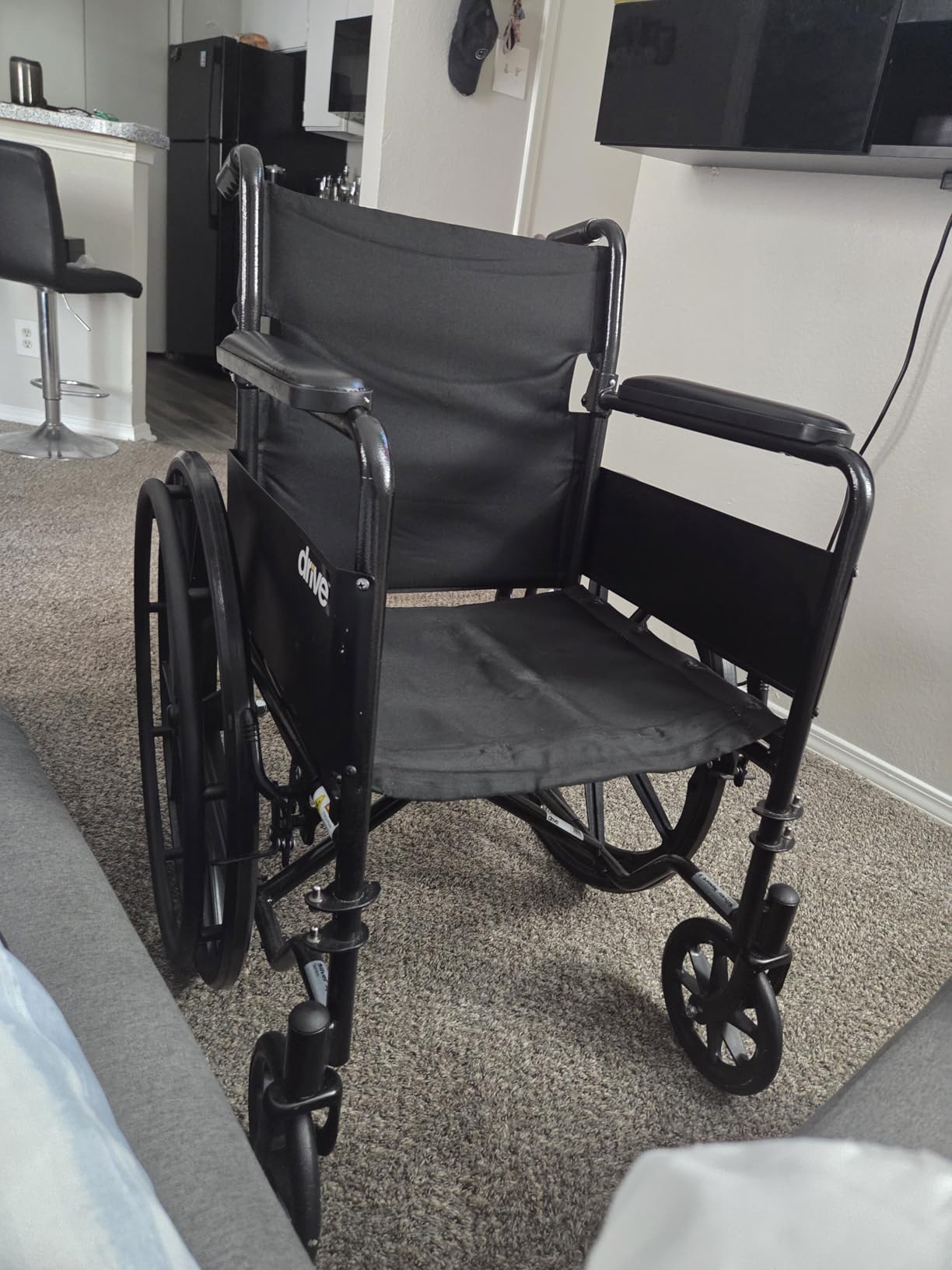
What gives us pause is weight. The listed figure is 37.6 lb, well above every aluminium transport chair on this list, and this chair cannot be lifted by a single caregiver into a car trunk. If the chair lives inside a home and is only used inside, that limitation rarely matters.
The 250 lb capacity is also below the 300 lb standard that most of the other picks here carry. For a user near that limit, the margin between a user’s body weight and the chair’s rating is the number that decides whether a chair stays safe over time.

This chair works best as an indoor support chair
It suits a household that needs a dependable chair for clinic rooms, waiting areas and indoor household use rather than a car boot. The padded armrests and foldable back make it comfortable for the long sitting periods those situations produce.
It is also a reasonable choice when budget matters more than portability.
This chair fails on portability and on higher weight limits
Roughly 37.6 lb means lifting it into a vehicle requires two people or a ramp, which is exactly the task families buy lightweight chairs to avoid.
The 250 lb rating leaves no margin for a larger user, and the occupant still cannot self-propel or lock the brakes.
5. Medline Ultra Lightweight Transport Wheelchair, 19 Inch Seat, Blue
Medline Ultra Lightweight Transport Wheelchair for Adults, Foldable, 19-Inch Seat Width, Blue Frame, Black Upholstery
19 lb aluminum frame
300 lb capacity
19 by 16 inch seat
Stow-and-go clips
Pros
- 19 lb frame that caregivers with weak backs can lift
- 300 lb capacity in a light frame
- Very compact fold fits a small car
- Desk-length arms and cup holder
- Rear-wheel locks for transfers
Cons
- 8 inch rear wheels catch on thresholds
- Push handles are low for tall caregivers
- Footrest clamp can slip
- No anti-tip bar
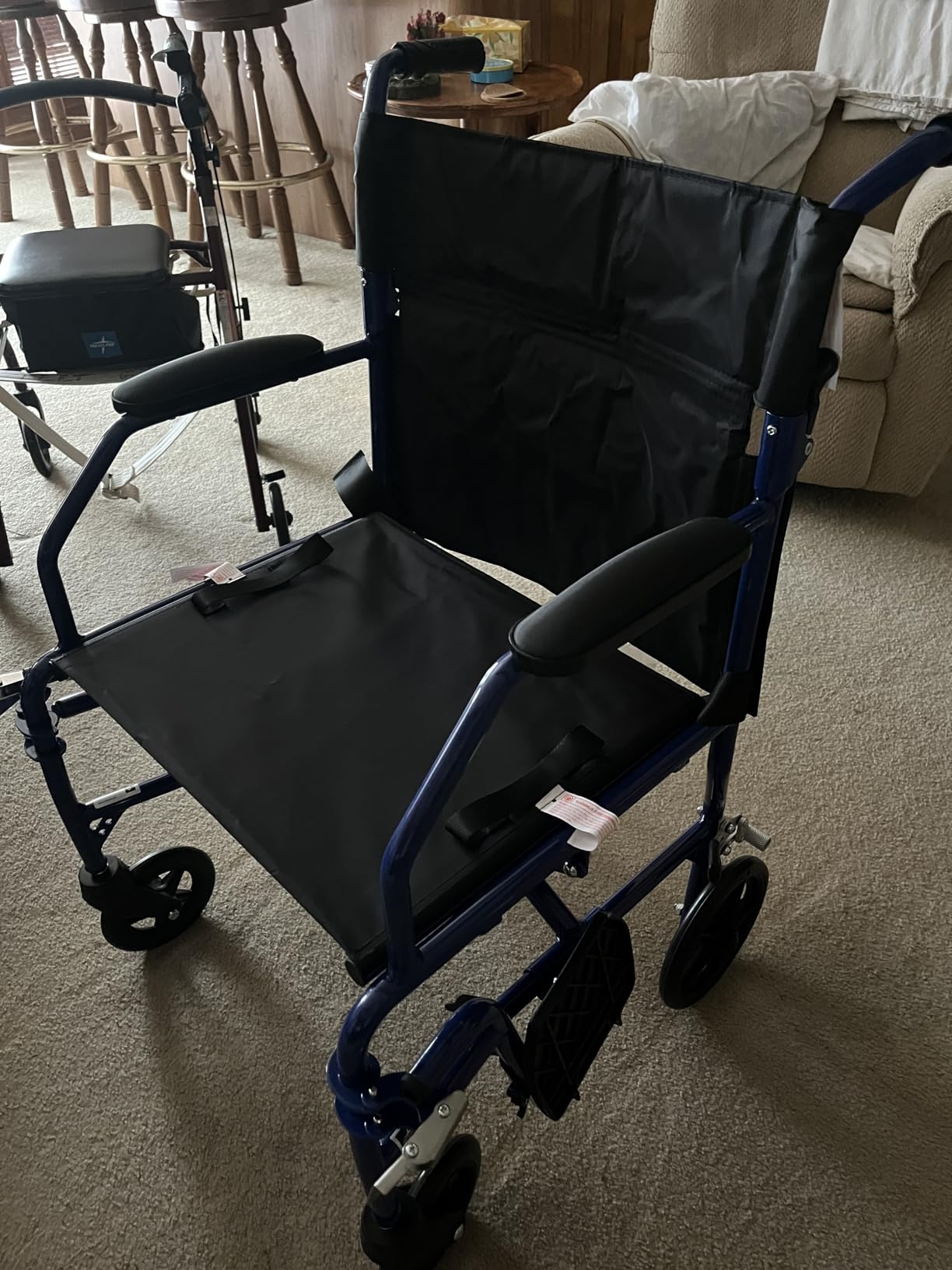
This is the chair we recommend first for caregivers who have arthritis or a lower back that cannot take a heavy lift. A 19 lb aluminium frame with a 300 lb rating is a rare pairing, and just under 7,900 owners rate it 4.6 stars with an 80 percent five-star share.
The fold is simple enough to do in three steps, which is what makes it usable in a hurry. Stow-and-go clips help, the handlebars fold down for tighter storage, and the folded package fits in the back seat of a small car. The desk-length cushioned armrests also let a user sit at a restaurant table without a tray or a lap belt fight.
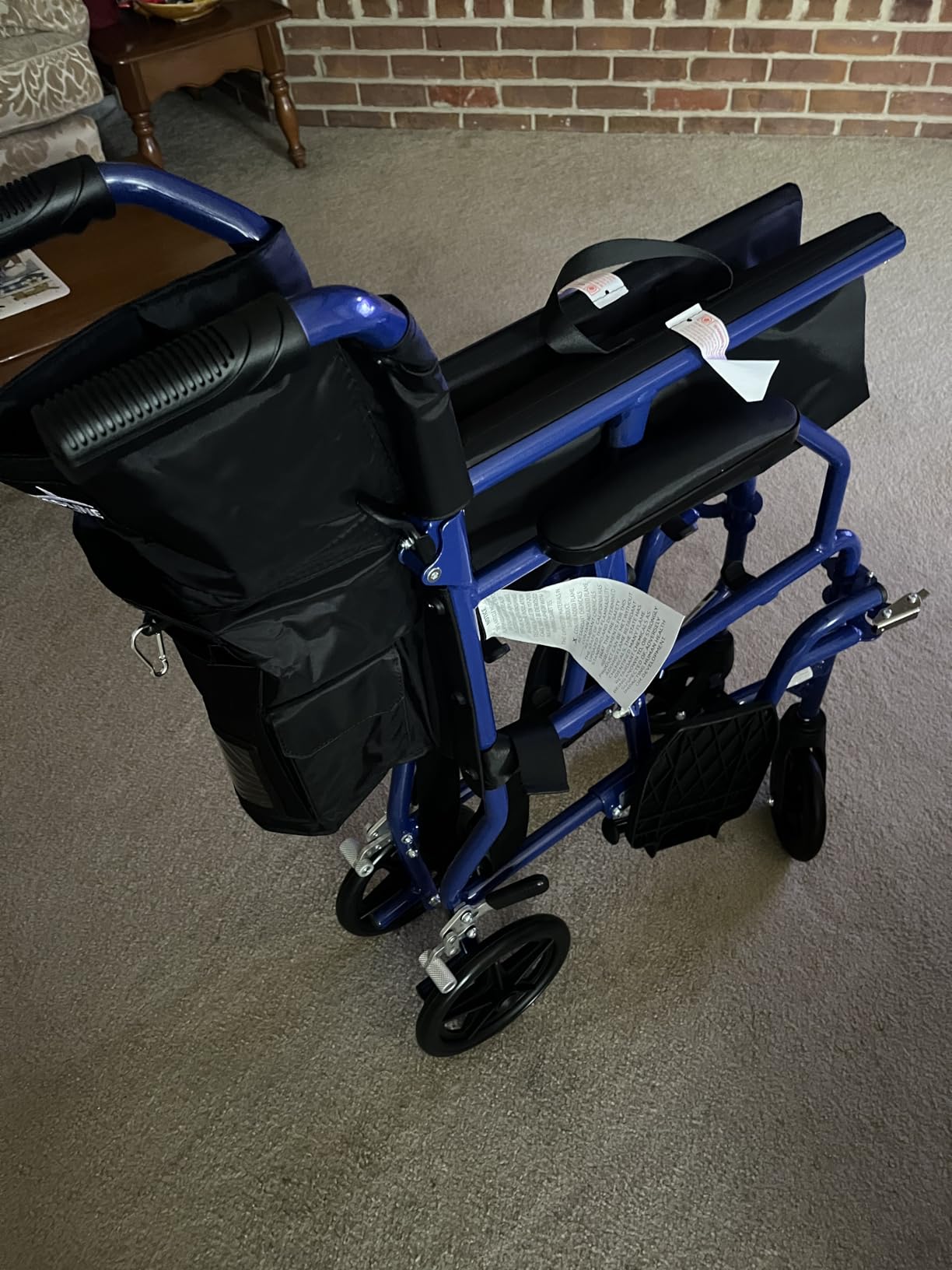
Owners with arthritic hands describe the low weight as the deciding factor, and travel accounts describe gate-checking it and pushing it through a cruise ship and over cobblestone streets. The standard cup holder is a small touch that reviewers mention more often than you would expect.
Two things to check before buying. The 8 inch rear wheels do not clear thresholds or cobblestones well, so a heavy user on rough ground should consider a 12 inch wheel model. And the footrest-to-frame rubber clamp has been reported to slip on one side, letting the footrest drop when the chair is lifted, so inspect that clamp before the first trip.
This chair suits a caregiver with limited lifting strength
It fits households where one person handles all transport, where the user is under 300 lb, and where the chair has to move between rooms and vehicles daily. The compact fold also works well in small apartments and narrow hallways.
It is our pick when lifting capacity is the binding constraint.
This chair is unsuited to rough terrain and to very tall caregivers
The 8 inch rear wheels are smooth on floors and bad on thresholds, gravel and stone, so it is a poor choice for a user who spends time outdoors on unpaved ground.
The push handles sit low, which tires a caregiver over six feet, and the chair can tip backward if pushed carelessly because there is no anti-tip bar.
6. Medline Comfortable Folding Wheelchair, 20 Inch Seat, Swing-Back Desk-Length Arms
Medline Comfortable Folding Wheelchair with Swing-Back Desk-Length Arms and Swing-Away Footrests, 20”W x 16”D Seat
20 inch seat width
300 lb capacity
Hammertone steel frame
Dual axle
Pros
- Unusually wide 20 inch seat
- 300 lb capacity
- Comfortable padded armrests and nylon seat
- Flexes over uneven ground
- Specialist wide 20 inch seat
Cons
- 38 lb is too heavy for a single-person lift
- Fixed armrests only
- Footrests swing away but do not elevate
- Wide seat makes the chair bulky
Most wheelchair listings offer 16, 18 and 20 inch widths, but the 20 inch chair is the one that is hardest to find. This one offers it, and for a larger-bodied user who has been squeezed into an 18 inch seat, that extra two inches is the difference between a usable day and a day spent correcting posture. Roughly 3,000 owners rate it 4.6 stars.
The dual-axle frame is the detail that changes the ride. Reviewers note that it absorbs bumps over varied terrain more smoothly than the single-axle chairs here, and the padded armrests with a nylon seat hold up for extended use, which is not something you can say about most sling-seat transport chairs.
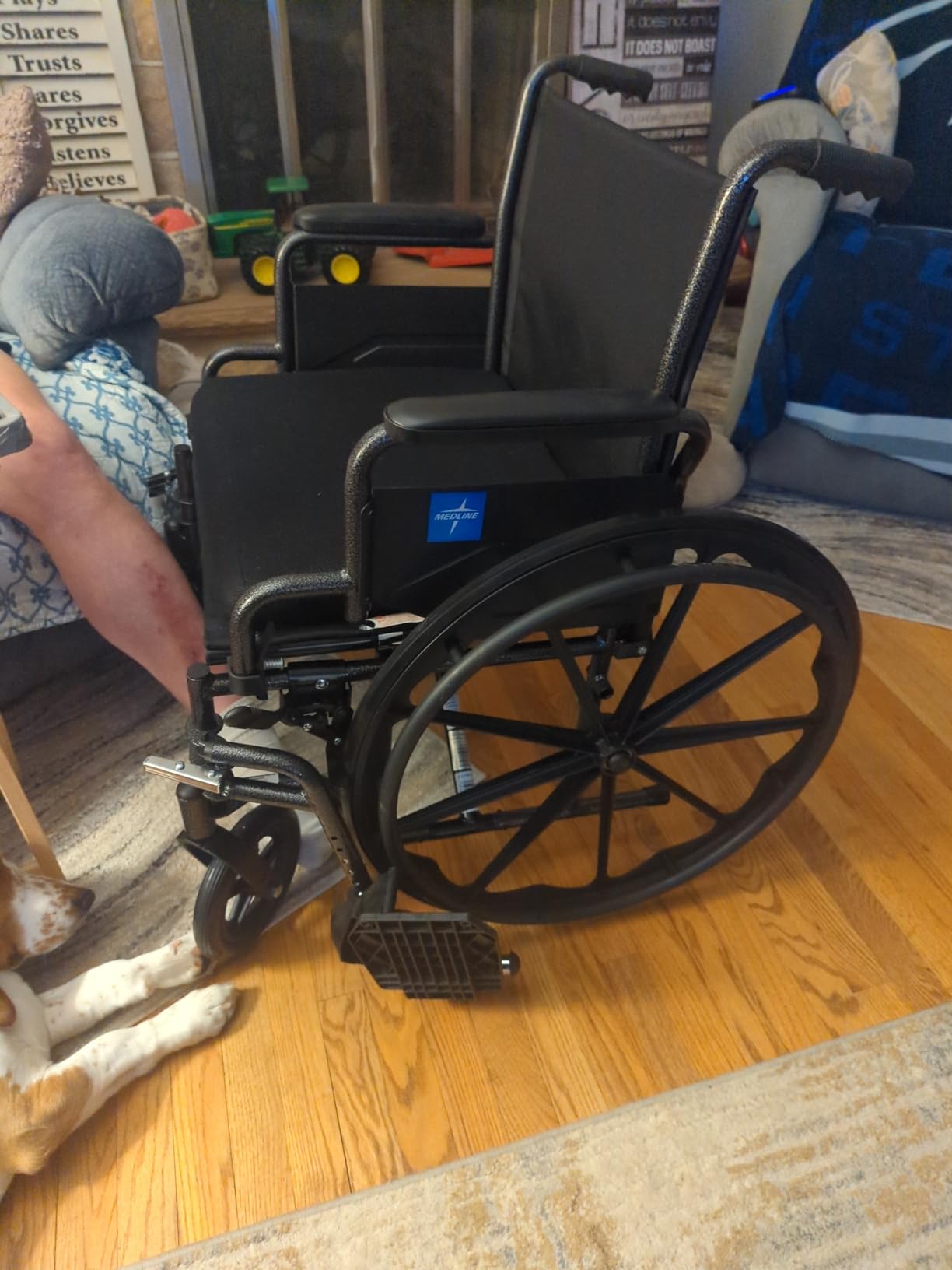
Swing-away footrests mean a user can step in and out without tangling their feet, and the hammertone steel frame supports up to 300 lb. The whole chair folds flat for a trunk or a closet, which is convenient for storage even if it is not a one-person lift.
At a listed 38 lb, this is not a car boot chair in any practical sense. The armrests are fixed rather than flip-back, and the swing-away footrests do not elevate, so a user who needs their legs raised still needs a different model. The wider frame also makes narrow doorways and tight hall turns harder than the 18 inch alternatives.
This chair fits larger-bodied users who need a real seat width
It suits a user who has outgrown an 18 inch seat, spends long periods seated, and needs a 300 lb capacity. The extra width and the dual-axle ride are the two reasons it earns its place.
It is also a comfortable indoor chair where a sling seat would be a problem.
This chair is the wrong choice when narrow doorways or solo lifting matter
A 38 lb frame cannot be lifted by one person, so a household that depends on a single caregiver and a car will need a lighter aluminium chair for outings.
The extra seat width also makes hallways, elevators and tight bathroom doorways noticeably harder to navigate than a standard width chair.
7. Medline Lightweight Wheelchair with Swing-Back Desk-Length Arms and Elevating Leg Rests
Medline Lightweight Wheelchair for Adults With Swing-Back, Desk-Length Arms, Elevating Leg Rests; 18W” x 16″D Seat
300 lb capacity
Adjustable 18 to 20 inch seat depth
Elevating leg rests
Folds to 10.5 inches
Pros
- Seat depth adjusts from 18 to 20 inches
- Elevating leg rests for long seated hours
- Swing-back desk arms make transfers independent
- Folds to just 10.5 inches wide
Cons
- 34 lb is heavy for one-person lifting
- Costs more than basic folding models
- Arms and legrests stay bulky when folded
If someone will be sitting in a chair for most of the day, elevating leg rests matter more than weight. This is the only chair in the group where the rider can raise their legs independently, and owners with a 71 percent five-star share say that is the feature they notice most. The seat depth also adjusts between 18 and 20 inches, which lets a therapist position a user properly instead of guessing.
Swing-back, desk-length arms are the second thing therapists point to. They open fully from the side, so a lateral transfer does not require the user to stand and pivot in a confined space, and they let the user pull up to a desk or table unaided.
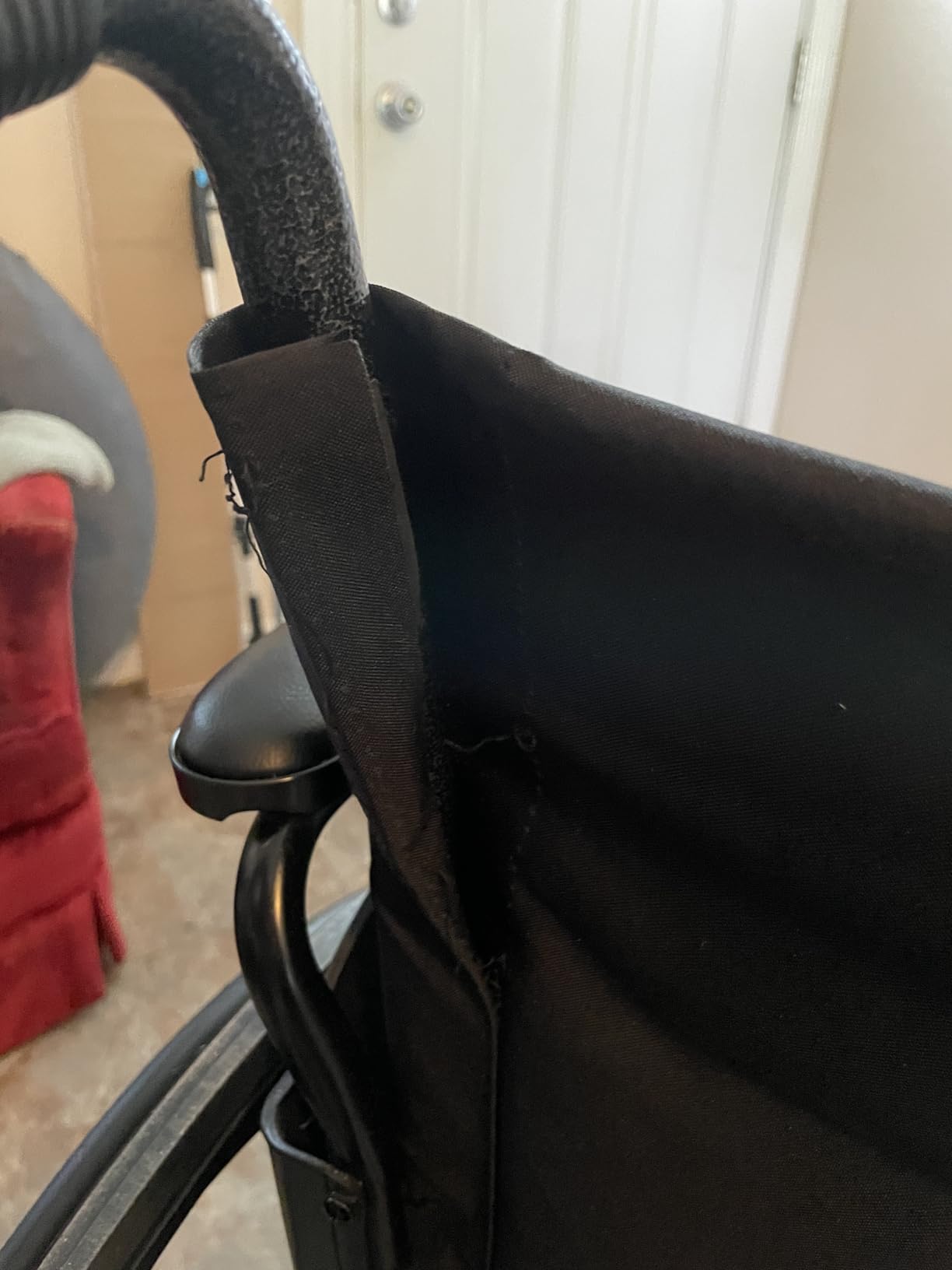
Breathable nylon upholstery is soft to the touch and wipes clean, which matters for anyone managing continence. It is the second chair in this roundup that folds down to 10.5 inches.
The trade-off is weight. At a listed 34 lb, this is a two-person load or a ramp job, and the arms and leg rests stay bulky even when folded. It also carries a noticeably higher price tag than the basic folding chairs in this roundup, which is fair given the adjustability, but buyers should know they are paying for both.

This chair is built for users who are seated for most of the day
It suits a user with leg elevation needs, a therapist recommending a specific seat depth, or a family managing a lateral transfer where standing and pivoting is difficult. The adjustable depth also means one chair can follow a change in body position over time.
It works well in a home or a care facility where the chair lives in one room.
This chair is impractical for solo transport and travel
At 34 lb, it is not a one-person lift and it will not fit in a car trunk in the way the aluminium models here do. Caregivers who need to travel with the chair should look at a 19 to 26 lb transport chair instead.
The swing-back arms and elevating legrests also add bulk that a caregiver with limited space will feel during every transfer.
8. Karman LT-980 Ultra Lightweight Wheelchair, Black
Karman 24 pounds LT-980 Ultra Lightweight Wheelchair, Black
24 lb aluminum frame
250 lb capacity
18 by 16 inch seat
22 inch rear wheels
Pros
- 24 lb carries up stairs one-handed
- Narrower and more rigid than folding chairs
- Frame does not flex or squeak
- Handbrakes adjustable so they actually lock
Cons
- Fixed armrests are unpadded hard plastic
- Seat sits low for taller users
- Stalls on small thresholds
- 250 lb capacity suits lighter riders
The Karman LT-980 is the self-propelled chair we would pick for travel, and the reason is the 24 lb aluminium frame that can be carried up stairs with one arm. It is also one of the few self-propelled chairs here with handbrakes located at the wheels, within the occupant’s own reach, and review notes that those brakes can be adjusted so they genuinely lock rather than just spin.
Rigidity is the underrated advantage. Reviewers describe a frame that does not flex or squeak, and a chair that folds to a height of 29 inches and a 28 inch overall length, which makes doorways and tight halls noticeably easier than with a heavier folding wheelchair.
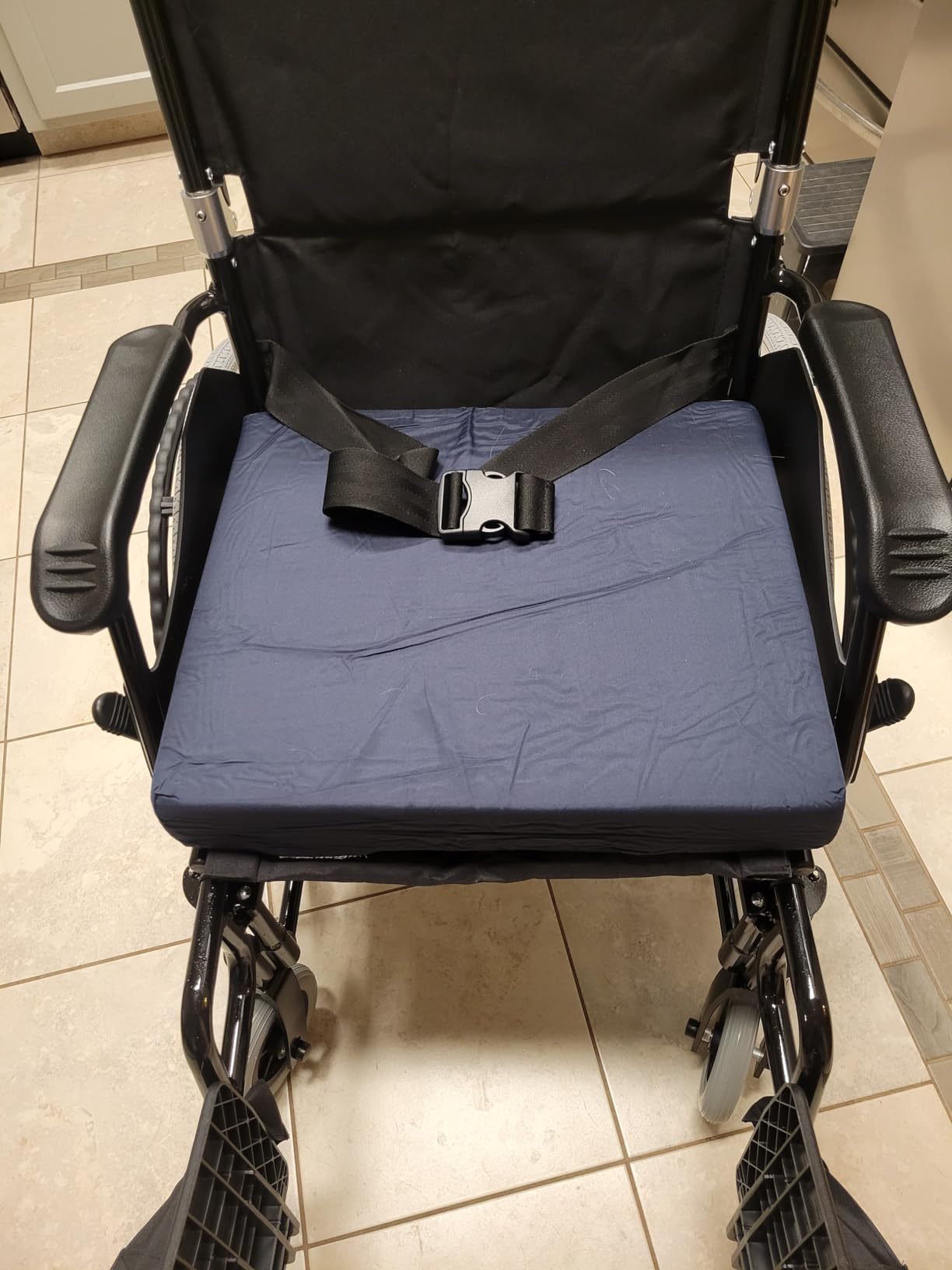
The rating spread here is the widest in the guide at 4.3 stars, and the critical reviews are specific and worth weighing. The fixed armrests are hard plastic with no padding, the 18 by 16 inch seat suits shorter users while taller users sit with raised knees, and the small 6 inch front casters stop abruptly on low thresholds, which some experienced users describe as a hazard.
Capacity is 250 lb, which is a lower ceiling than most chairs in this roundup and leaves less margin for a heavier rider. At 24 lb without footrests, this is a travel and occasional-use chair rather than an all-terrain daily driver.
This chair suits an independent user who travels light
It fits a lighter user under 250 lb who self-propel, navigates narrow indoor spaces and needs a chair that one person can carry up a staircase or into a vehicle. The adjustable handbrakes at the wheels give the occupant real control rather than dependence on an attendant.
It is our pick for a self-propelled travel chair under 25 lb.
This chair falls short for taller users and rough ground
A tall occupant will sit with knees raised on the 18 by 16 inch seat, and a day spent that way is uncomfortable enough to matter. A seat pad helps, but it does not fix the geometry.
The 6 inch front casters stall on thresholds and gravel, and the 250 lb rating rules out a lot of the users who want a lightweight chair most.
9. FeatherMobility Lightweight Folding Wheelchair, 13.5 lb, 18 Inch Seat
FeatherMobility – Gray Lightweight Folding Wheelchair – 13.5 lbs, 18″ Seat Width – with Swingaway Legrests, Anti-tippers, and Quick Release Wheels – 300 lbs Capacity
13.5 lb without wheels
300 lb capacity
Quick-release wheels
26 inch overall width
Pros
- Lightest chair in the guide at 13.5 lb
- Quick-release wheels detach with one button press
- 26 inch width clears narrow doorways
- Armrests slide under a dining table
- Owners report it handles rough terrain
Cons
- Higher cost than every other chair in this guide
- Smooth rims are hard for a self-propelling user to grip
- Low seat and low push handles
- Brake and footrest plastic parts break for some users
This is the lightest chair in the roundup, and it still carries a 300 lb rating. The number that matters is the two-weight system: it weighs 13.5 lb without the rear wheels and 19 lb fully assembled with the leg rests, which is the difference between a chair a user can load into a car unassisted and one they cannot. Owners describe exactly that outcome: independence restored for someone who could not manage a 24 lb chair.
Quick-release wheels detach with a single button press and the whole chair unfolds in under a minute, so there is no assembly and no loose hardware. At 26 inches wide, it clears doorways that a standard 30 inch chair struggles with, and the armrests slide under a dining table.
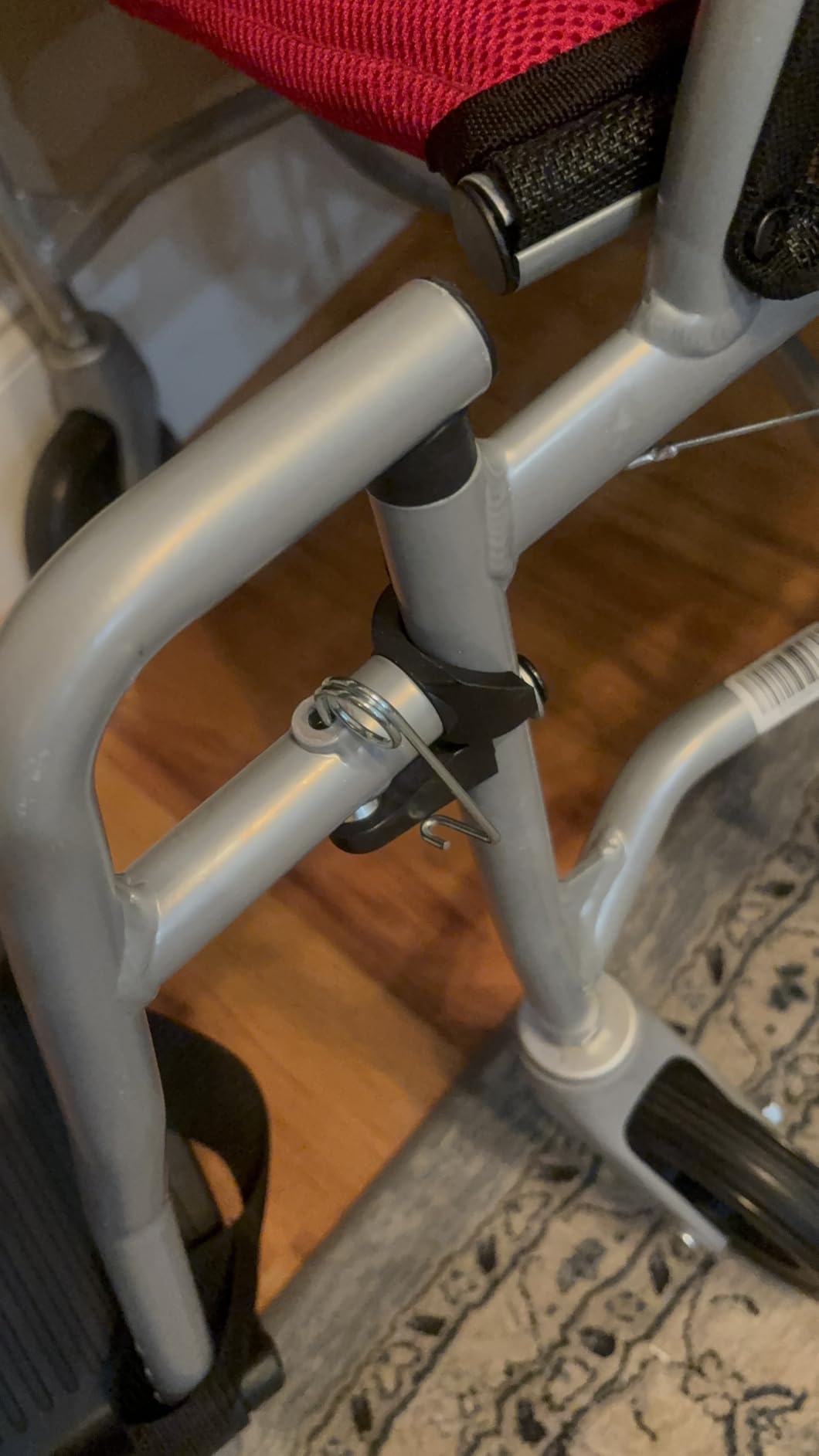
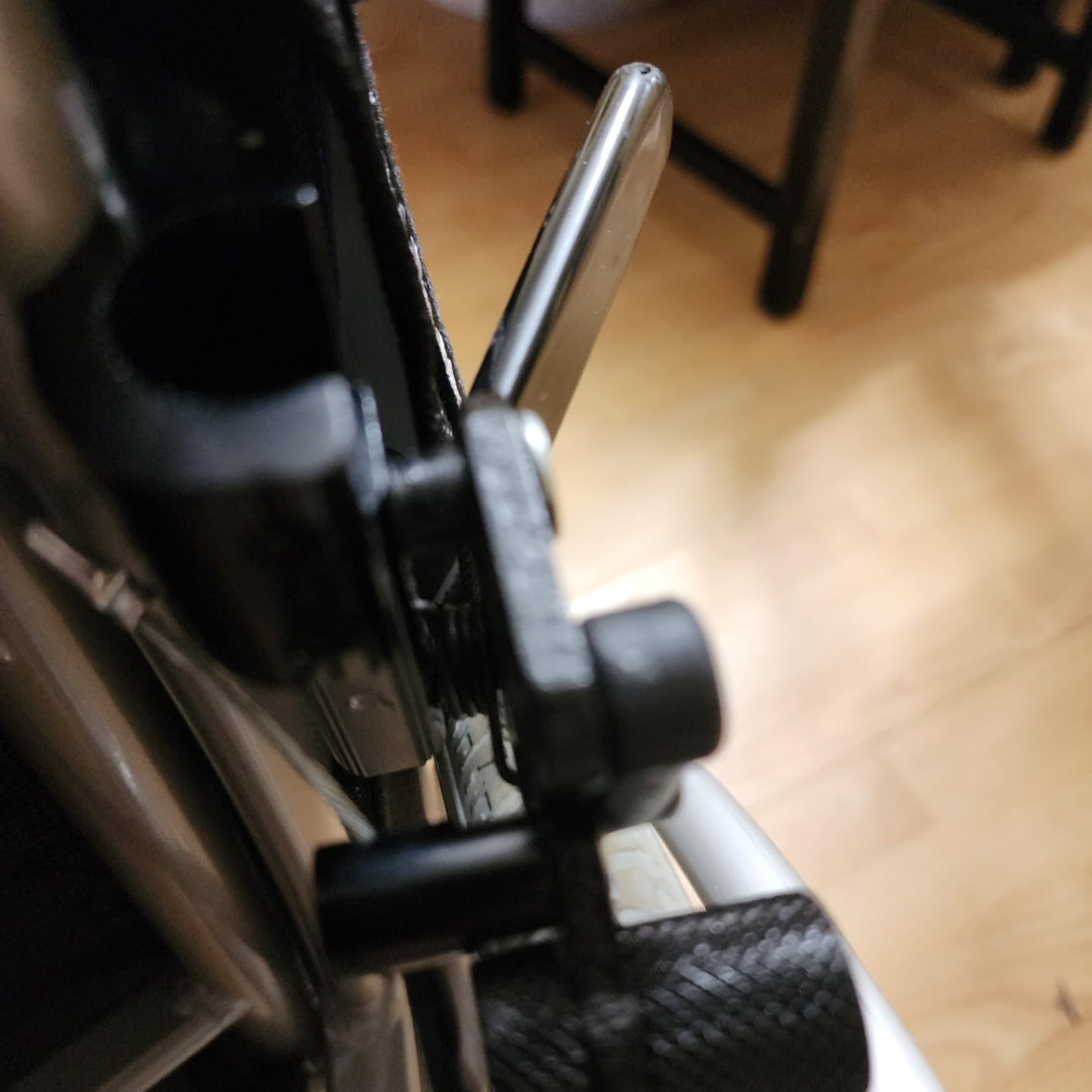
The critical reviews here come from experienced daily wheelchair users rather than occasional users, and they are worth taking seriously. The rims are smooth with no texture, so a self-propelling user has little to grip, the rims sit close to the large wheels where fingers can strike the brake levers, and the seat sits lower than most chairs, which some find poorly supportive.
The push handle height suits shorter caregivers, and a 6 foot 3 inch reviewer found it too low. Replacement parts for the brake and footrest plastics are reportedly hard to source, and the price sits far above every other chair in this roundup. It is not a daily self-propelled chair.
This chair suits a user who loads and unloads independently
It fits a lighter or mid-weight user under 300 lb who travels alone, moves between a wheelchair and a car without a caregiver’s help, and needs a chair narrow enough for tight apartments. The 300 lb rating is unusually high for a chair in this weight class.
It is our pick when the person who owns the chair is the person loading it.
This chair is a poor choice for a daily self-propelled user
Smooth rims, a low seat and low handles make it difficult to propel for hours at a time, and experienced users say so directly. If the chair will be the primary chair rather than a travel chair, choose something else.
Parts availability is the quiet risk, since a broken brake or footrest clip on a chair this light can end mobility until a replacement arrives.
10. EconoHome Light Weight Folding Transport Wheelchair with Hand Brakes
EconoHome Light Weight Wheelchair – Expedition Folding Transport Wheelchairs for Adults with Hand Brakes – Portable Ultra Lightweight Wheel Chair – Fully Assembled, Cover Included – 300 lb Capacity
22 lb fold-flat aluminum frame
300 lb capacity
Seat belt
Protective cover
Pros
- Arrives fully assembled with no tools needed
- 22 lb frame a single caregiver can carry
- Large rear wheels glide over thresholds and curbs
- Hand brakes lock when handles are pushed down
- Waterproof cover included
Cons
- Seat area feels narrow for a larger-framed user
- Footrest can pop off during lifting
- No printed instructions in the box
- Some rivet and hub failures reported
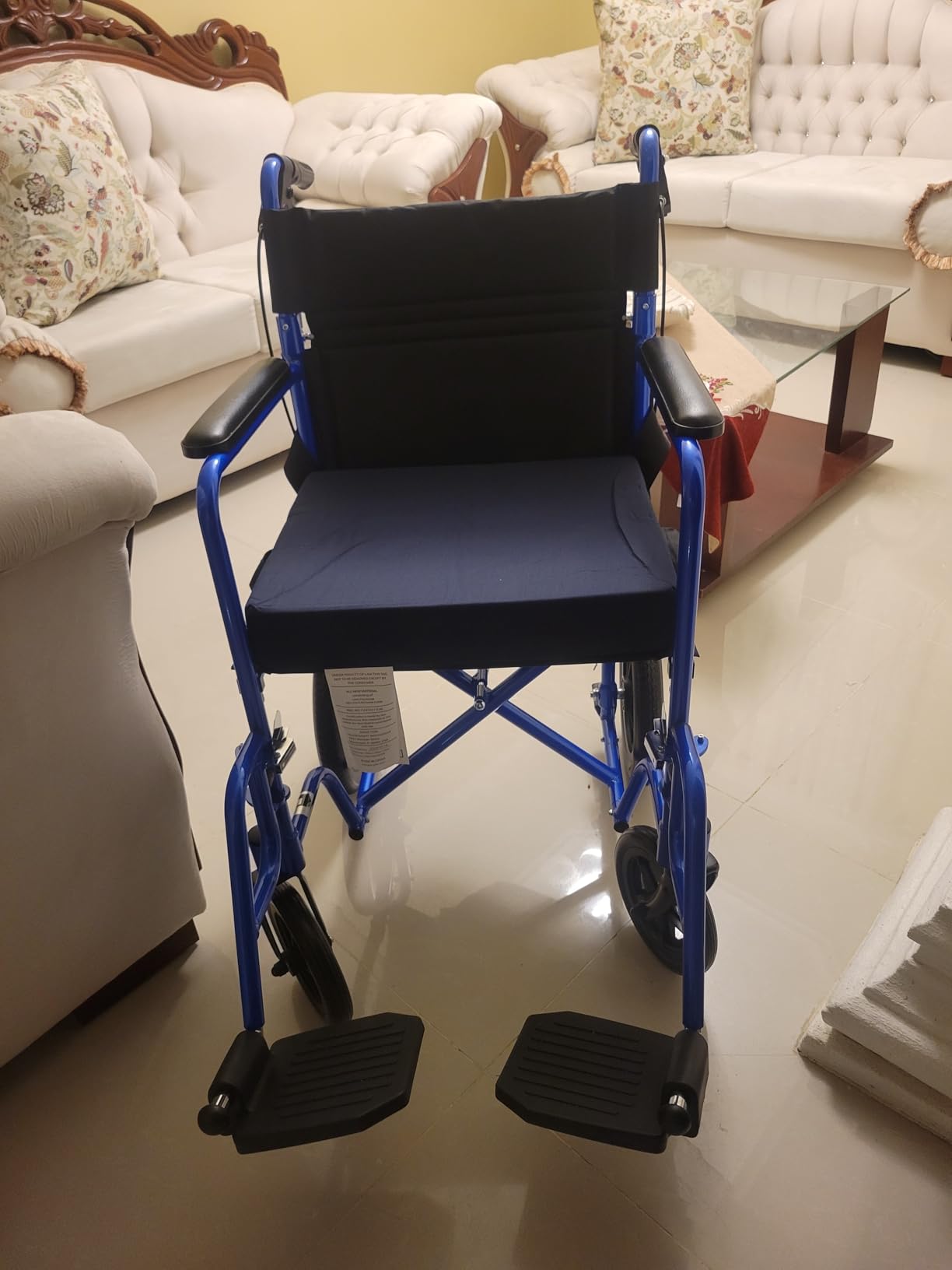
This chair solves one specific problem that none of the others here address: getting a usable transport chair without an afternoon of assembly. It arrives complete, folds flat, and the 22 lb aluminium frame is light enough for one caregiver to lift. The included protective waterproof cover is a small touch that several competitors do not offer at all.
The large rear wheels are the other standout. Owners note that they glide over door thresholds and small curbs and turn tightly in hallways, which is where most budget transport chairs bind. A seat belt, padded armrests and companion hand brakes that lock when the handles are pushed down round out a solid safety package.
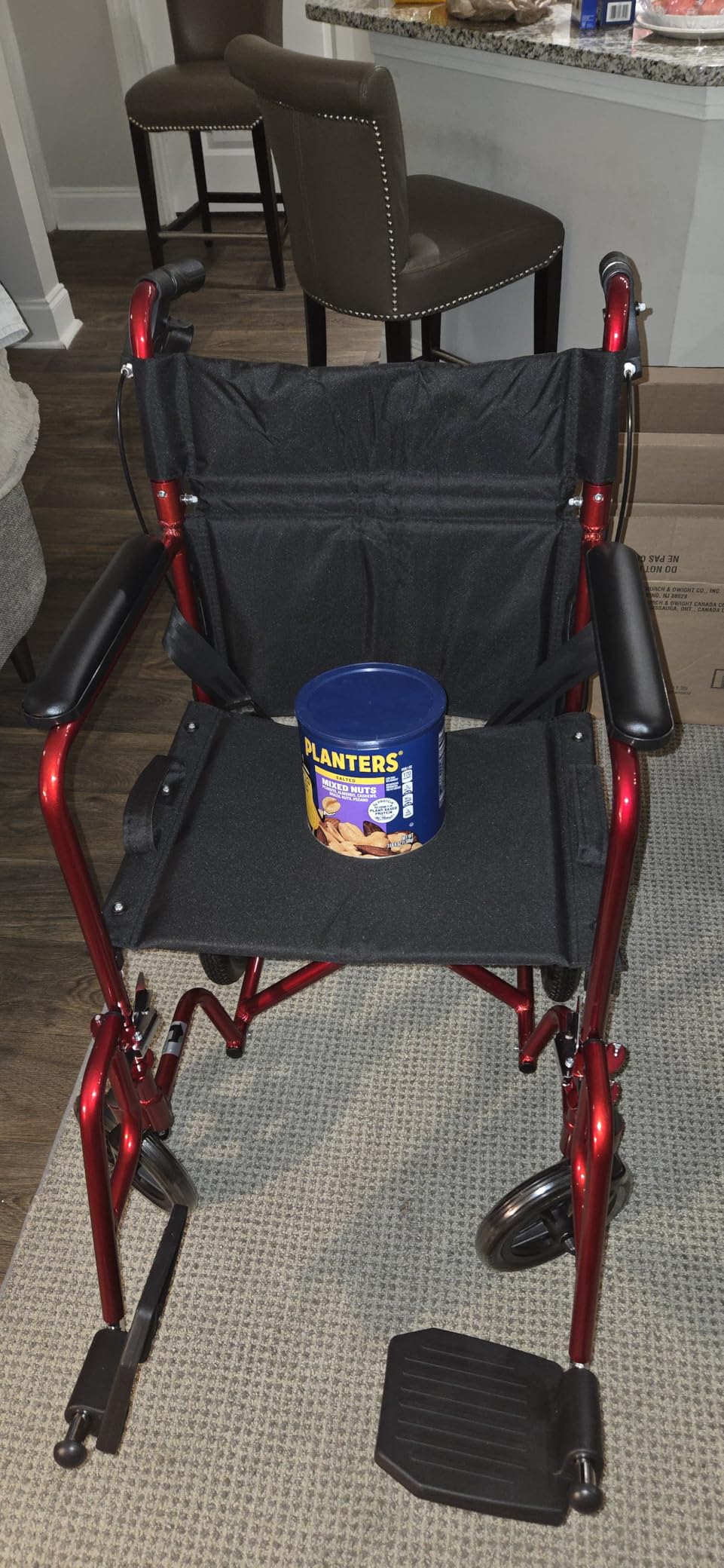
The complaints are about small parts rather than the design. One footrest has been reported to detach during lifting, which is worth checking before every trip, and the seat space feels narrow for a larger-framed user despite the 300 lb rating. The seat depth and armrest height also suit a taller person better than a shorter one.
There is no printed user manual in the box, and a small number of owners report rivets loosening or a hub cap arriving broken. With 177 ratings at 4.5 stars, the review base is small enough that build quality is still being discovered rather than settled.
This chair suits a household that wants zero setup
It fits families who need a chair for appointments, day programs and shopping, where the caregiver will assemble nothing and store the chair folded against a wall. The included cover helps if the chair lives on a porch or in a damp entryway.
The large rear wheels make it a good budget option for users on slightly uneven routes.
This chair is unreliable for larger users and rough handling
A 300 lb rating on a narrow seat is misleading, and anyone near that weight should test the fit before committing. The seat depth and armrest height favour taller riders.
The footrest detachment reports and small-part failures are exactly the kind of issue that strands a user in a public place, so this chair suits short-term and medium-term use more than a permanent daily chair.
How to Choose a Lightweight Wheelchair for an Elderly Person
Choosing well comes down to a handful of variables, and only one of them is weight. Here is the decision framework we used, in the order we used it.
Lightweight means very different numbers depending on the chair type
There is no legal definition of a lightweight wheelchair, which is why assembled weights in this roundup range from 19 lb to 41.3 lb. The practical ranges are caregiver-pushed transport chairs at roughly 17 to 26 lb, self-propelled folding manual chairs at roughly 24 to 40 lb, and portable powered chairs at roughly 30 to 40 lb. Anything a single caregiver can lift without strain is a lightweight chair by the only test that matters.
Decide between transport, self-propelled and powered before anything else
A transport chair is caregiver-pushed only, usually has small rear wheels and cannot be locked by the occupant. A self-propelled wheelchair has large rear wheels and handrims so the user can move independently. A portable electric wheelchair adds a joystick and battery, which removes the pushing effort entirely but adds weight and charging.
The single most repeated question in wheelchair forums is whether the user will propel at all. If the answer is no, a transport chair is simpler and lighter. If the answer is sometimes, a self-propelled chair with attendant brakes is the compromise. Related reading on bathroom safety and daily caregiving tasks is in our best bidet toilet seats for elderly guide, since a chair that fits a small bathroom matters as much as its weight.
Match weight capacity to the user with real margin
Never buy a chair rated exactly at the user’s weight. A 300 lb rating on a 285 lb user leaves no margin, and a chair is a piece of equipment that gets loaded, tilted and transferred on constantly. Look at capacity, seat width and seat depth together, and remember that a narrow 18 inch seat on a larger body is the single most common reason buyers return chairs.
Check the brakes and the transfer method, not just the wheels
For a transport chair you need rear-wheel locking brakes for transfers, and ideally a second locking mechanism on the push handles. For a self-propelled chair you need occupant-accessible hand brakes that can be adjusted to actually engage. Transfers are the moment of greatest fall risk in a wheelchair user’s day, and the brakes are what hold the chair still during one.
Test the chair before you commit, and check the return policy
Sit in the chair, check footplate clearance on the floor, try the transfer path, and if the chair is a transport model have the caregiver lift it themselves rather than taking the manufacturer’s word. Measure the narrowest doorway in the home and the narrowest car opening before you order, since 26 to 28 inch chair widths behave very differently from a 30 inch chair.
Air travel, car loading and Medicare coverage
Airline-approved folding chairs typically need to be stowed in the cabin, so measure the folded package and confirm it fits the seat dimensions the airline publishes. Battery-powered chairs have separate lithium battery rules, so check with the airline before flying. For Medicare, a physician prescription and a durable medical equipment supplier are the standard route, and coverage rules differ by state for Medicaid, so verify locally before budgeting.
For households also planning home safety upgrades, our elderly monitoring camera guide and elderly snow blower guide cover the surrounding independence picture.
Frequently Asked Questions
What is the best lightweight wheelchair for elderly people?
The Drive Medical Blue Streak is our best overall pick because it combines a 300 lb weight capacity with a folding alloy steel frame, swing-away footrests and flip-back desk arms, and it carries the largest review count of any chair in the guide. For the lightest chair a user can load independently, the FeatherMobility at 13.5 lb without wheels is the alternative.
What is the difference between a transport chair and a lightweight wheelchair?
A transport chair is pushed by a caregiver and cannot be self-propelled, because it has small rear wheels and no handrims. A lightweight wheelchair has large rear wheels and handrims so the user can move independently, and is usually heavier. Transport chairs suit trips and appointments, while lightweight self-propelled chairs suit daily use.
How much do lightweight wheelchairs weigh?
Caregiver-pushed transport chairs typically weigh 17 to 26 pounds with a 300 pound capacity, while self-propelled folding manual chairs weigh 24 to 40 pounds. Portable electric wheelchairs fall between 30 and 40 pounds. Always check the assembled weight, because many listings quote only the bare frame.
What kind of wheelchair will Medicare pay for?
Medicare Part B covers wheelchairs when a physician has documented a mobility limitation and prescribed the specific chair, and the chair is supplied by a durable medical equipment supplier that accepts Medicare assignment. Transport chairs qualify when the user cannot self-propel. Coverage percentages and Medicaid rules vary by state, so confirm with the supplier before buying.
Which is easier to push, a wheelchair or a transport chair?
A transport chair is easier to push because it is lighter and has smaller rear wheels, but it tracks less smoothly over cracks and uneven ground. A self-propelled wheelchair is easier over rough surfaces but needs more force to start and steer.
What is the best lightweight wheelchair for travel?
For travel, weight and folded size matter more than anything else. The FeatherMobility at 13.5 pounds without wheels folds small enough for a passenger seat, and the Karman LT-980 at 24 pounds is the best self-propelled option. Confirm the folded dimensions against your airline’s cabin stowage rules before flying.
Best Lightweight Wheelchairs for Elderly: Final Verdict
For a senior who needs independence every day, the Drive Medical Blue Streak is the best overall choice, with a 300 lb capacity, a folding steel frame and a review history that makes its long-term durability easy to trust. For a caregiver-pushed trip chair, the Medline Ultra Lightweight at a 19 lb frame handles the narrowest homes and the weakest backs best, while the Drive Medical Expedition is the better outdoor pick with its 12 inch rear wheels. For the lightest chair a user can load alone, the FeatherMobility is the one that reaches 13.5 lb.
Whatever you choose, weigh the assembled chair in your own hands, measure your narrowest doorway, and confirm the weight capacity leaves real margin. And do it with an occupational therapist’s input, because a chair that fits the user’s body and transfer method is worth more than any spec on a listing page. For more senior-focused gear, our dog wheelchair guide covers mobility support for pets living alongside an older adult.