
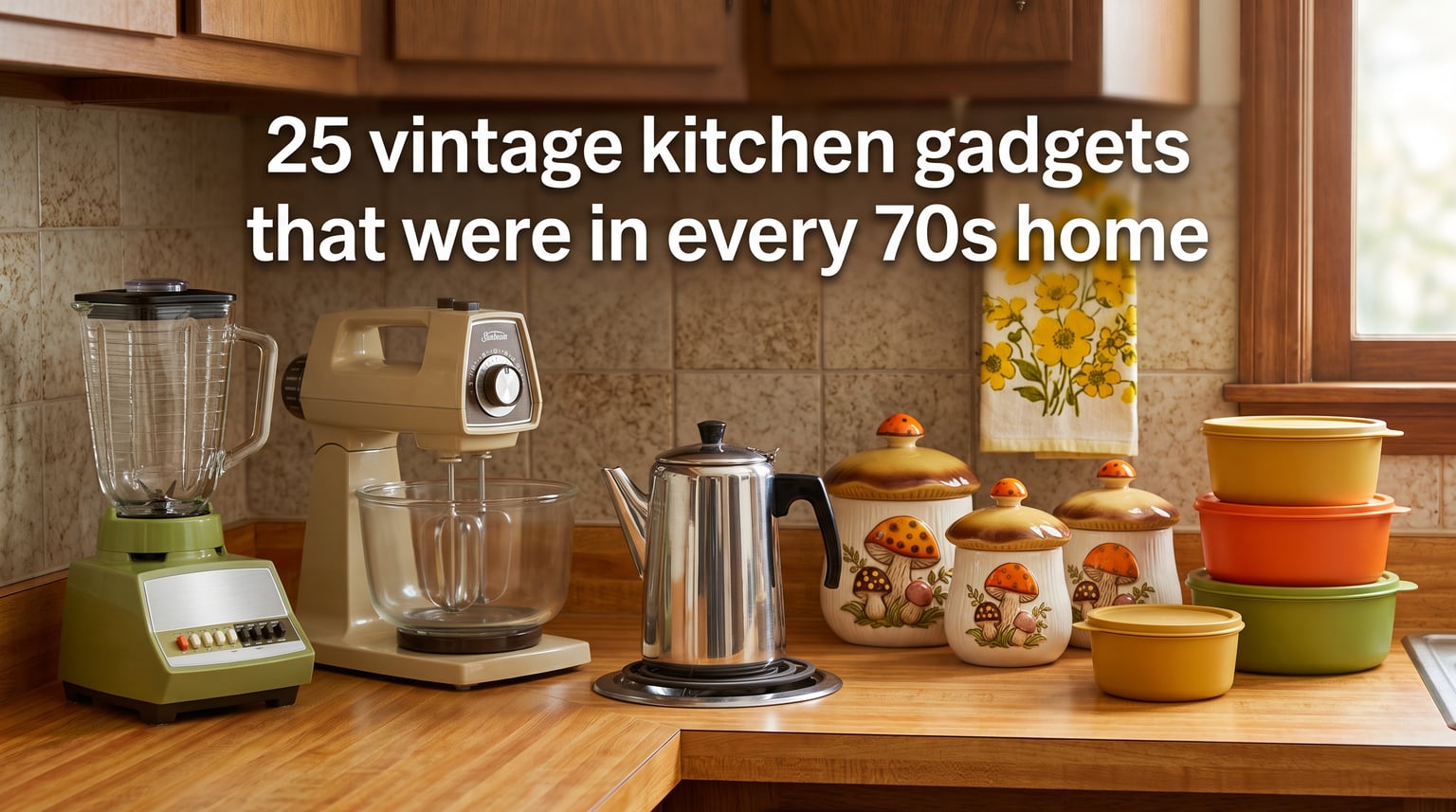
Step into any 1970s kitchen and you would instantly know where you were. The smell of percolated coffee, the warm glow of harvest gold appliances, and the cheerful rattle of Tupperware being pulled from a cabinet. These were rooms with real personality.
Our team spent weeks digging through old catalogs, forum threads, and family photo albums to put together this list of 25 vintage kitchen gadgets that were in every 70s home. Whether you grew up in that decade or just love retro kitchenware, these items tell the story of how America cooked, entertained, and lived.
The 1970s was a special time for kitchen design. Homes featured avocado green, burnt orange, and harvest gold color schemes that screamed warmth and comfort. It was the era of fondue parties, Tupperware gatherings, and gadgets designed to make cooking feel fun rather than like a chore.
From the iconic Cuisinart food processor to whimsical mushroom-shaped canisters, vintage kitchen gadgets from the 70s are now highly sought after by collectors. Some are making a real comeback in modern kitchens. Let us take a nostalgic walk through all 25.
Table of Contents
25 Vintage Kitchen Gadgets That Were in Every 70s Home
1. The Avocado Green Blender
Nothing said 1970s kitchen quite like an avocado green blender sitting proudly on the counter. This was the signature color of the decade, and nearly every major appliance manufacturer offered their models in this distinctive shade.
My grandmother had one that she used every single morning for fruit smoothies long before they were called smoothies. These blenders were built heavy, with glass pitchers and motors that could crush ice without flinching.
Brands like Oster, Hamilton Beach, and Waring dominated the market. The avocado green finish was not just a color choice. It was a lifestyle statement that tied the whole kitchen together with matching toaster, mixer, and can opener.
Today, collectors hunt for these blenders in working condition. A well-preserved avocado green blender can sell for anywhere from $30 to $80 depending on the brand and condition. Many Reddit users in the r/vintage community still use theirs daily and report that the motors outlast anything made today.
2. Harvest Gold Stand Mixer
If avocado green was not your thing, harvest gold was the other defining kitchen color of the era. A harvest gold stand mixer was the centerpiece of many 70s kitchens, usually a KitchenAid model that could handle everything from bread dough to cake batter.
These mixers were genuine workhorses. The all-metal construction meant they could run for hours without overheating. My mother received one as a wedding gift in 1974 and it still works perfectly to this day.
The harvest gold finish has become one of the most recognizable vintage kitchenware colors. Interior designers in 2026 are actually bringing this shade back, pairing it with white subway tiles and natural wood accents for a retro-modern look.
Collectible value for a working harvest gold KitchenAid mixer ranges from $100 to $250. Non-working models still fetch $40 to $60 because people use them as decorative pieces.
3. The Stovetop Percolator
Before drip coffee makers took over, the stovetop percolator was how America made its morning coffee. These stainless steel or aluminum pots heated water until it bubbled up through a basket of grounds, producing a strong, distinctive brew.
Every 70s home had one. Brands like Farberware, Corning Ware, and Presto dominated the market. The familiar blorping sound of a percolator working away on the stove is burned into the memory of anyone who grew up in that decade.
Coffee from a percolator tastes different from modern drip coffee. It is stronger, sometimes bitter, but deeply flavorful. Many coffee enthusiasts in 2026 are rediscovering percolators for exactly this reason.
You can still find vintage Farberware percolators at thrift stores and estate sales for $10 to $25. They are simple machines with almost nothing to break, which is why so many from the 70s still work perfectly.
4. The Counter-Mounted Electric Can Opener
The counter-mounted can opener was a permanent fixture in every 70s kitchen. These devices bolted right under the cabinet and swung out when you needed them. No more cranking a manual opener by hand.
My dad installed ours in 1972 and it was still going strong twenty years later. Brands like Rival, Proctor-Silex, and Black and Decker made the most popular models. They came in the full range of 70s colors including avocado, harvest gold, and coppertone.
What made these can openers special was their convenience. You just placed the can, pressed a lever, and the opener did the rest. It would shut off automatically when the lid was cut.
Forum users on r/GenX frequently mention missing the satisfying mechanical whir of these openers. Modern handheld electric openers just do not compare to that built-in, permanent feel.
5. The Electric Knife
Remember the buzzing sound of an electric knife carving the Thanksgiving turkey? Every 70s kitchen had one of these gadgets tucked away in a drawer, ready for holiday meals and Sunday roasts.
Electric knives featured two serrated blades that moved back and forth rapidly. They made cutting through thick bread loaves, roasts, and even foam cushions surprisingly easy. Black and Decker and GE were the dominant brands.
These knives were the ultimate entertaining tool. If you were hosting a dinner party in the 70s, your electric knife was coming out to carve that beef Wellington or spiral ham.
While electric knives have largely been replaced by quality manual knives in modern kitchens, vintage models in working condition sell for $15 to $40 online. They are popular among collectors who remember Sunday dinners with the family.
Party and Entertaining Essentials
6. The Fondue Set
No single item captures the spirit of 70s entertaining quite like the fondue set. Every home had one, tucked in a closet and brought out for parties where guests gathered around a pot of bubbling cheese or oil.
The classic fondue set included a ceramic or metal pot, a portable burner, and long forks with colored handles. You would spear cubes of bread, meat, or fruit and dip them into the communal pot.
Fondue parties were social events. They were interactive, communal, and fun. Everyone gathered around the table, sharing stories while dipping bread into melted Gruyere and Emmentaler.
The fondue craze faded in the 1980s but never fully died. In 2026, fondue is experiencing a genuine revival. Vintage fondue sets in good condition sell for $20 to $50, and new sets are being manufactured to meet renewed demand.
As one Reddit user in r/vintage put it, bringing back fondue night is the easiest way to make a dinner party feel special again.
7. The Hot Air Popcorn Popper
The hot air popcorn popper was a revolution in 70s snacking. Instead of making popcorn on the stove or using Jiffy Pop, you could now pop corn with nothing but hot air. No oil required.
Presto and West Bend made the most iconic models. The popcorn shot out of a chute into a waiting bowl, warm and fluffy. It felt like magic to kids growing up in that decade.
Movie night in the 70s meant the popcorn popper came out. You would melt butter in the little cup on top and drizzle it over the fresh popcorn. It was an event, not just a snack.
Vintage hot air poppers are still relatively easy to find at thrift stores. They typically sell for $10 to $25. Many people in 2026 prefer them over microwave popcorn because they avoid the chemicals and let you control your own seasonings.
8. The Milkshake Maker
The home milkshake maker was every kid’s dream gadget. These small electric mixers had a metal cup and a spinning shaft that turned ice cream and milk into a thick, creamy shake in seconds.
Hamilton Beach made the most iconic models, and they often came in chrome finishes that looked like something from a soda fountain. Some versions were even designed to look like mini versions of the professional milkshake machines at diners.
Saturday afternoon milkshakes were a ritual in many 70s households. The sound of the mixer, the clinking of the metal cup, and the anticipation of that first sip through a paper straw. It was pure joy.
Working vintage milkshake makers sell for $30 to $75 online. They are popular with collectors who want to recreate the soda fountain experience at home.
9. The Hot Dog Cooker
Yes, a dedicated appliance just for cooking hot dogs. The 70s were a magical time. These small electric cookers could prepare up to six hot dogs simultaneously using steam or rollers.
Some models even had a compartment for warming buns. You just loaded the machine, pushed a button, and a few minutes later you had perfectly steamed hot dogs ready for the family.
The Hot Dogger by Rival was one of the most popular models. It was designed specifically for families and pitched as the easiest way to make a quick dinner that kids would actually eat.
While single-purpose appliances fell out of favor in later decades, there is something charming about a device dedicated entirely to one food. Vintage hot dog cookers sell for $20 to $45 among collectors who appreciate the kitsch factor.
10. The Gelatin Mold
The gelatin mold was the queen of 70s potluck dinners. Every home had at least one ring-shaped mold, and the recipes ranged from fruit Jell-O to savory tomato aspic. Yes, tomato aspic was real and people ate it.
Tupperware made some of the most popular gelatin molds. They came with lids for easy refrigerator storage and had decorative patterns that imprinted designs onto the set gelatin.
The process of unmolding a Jell-O salad was nerve-wracking. You had to dip the mold in warm water, place a plate on top, flip it quickly, and hope it released cleanly. Success was met with applause.
While savory gelatin recipes have mercifully faded from fashion, vintage Tupperware gelatin molds are still collected for their bright colors and durable construction. They typically sell for $8 to $20.
Food Storage and Preservation
11. The Tupperware Collection
No discussion of vintage kitchen gadgets 70s would be complete without Tupperware. The colorful plastic containers were everywhere, and the Tupperware party was a genuine social phenomenon that defined the decade.
A Tupperware party worked like this. A host invited friends and neighbors to her home. A Tupperware consultant demonstrated the products, and everyone placed orders. It was part social event, part shopping experience, and entirely 70s.
The classic Tupperware collection included the Wonderlier bowls, the pie taker, the pickle keeper, and the legendary Tupperware jug with the burp seal. That signature burp when you sealed a container was the sound of freshness being locked in.
Collectors in 2026 pay premium prices for vintage Tupperware in good condition. Complete sets in original colors like sheers, pastels, and the iconic orange and yellow can sell for $50 to $150. Rare promotional pieces go for even more.
Reddit’s r/vintage community regularly features Tupperware collections, with users sharing stories of inherited sets that are still going strong after 50 years of daily use.
12. The Ceramic Butter Dish
The ceramic butter dish was a small but essential part of every 70s kitchen. These were not plain white dishes. They came in earthy colors, featured mushroom patterns, or were shaped like animals.
The butter dish sat on the counter or table, always within reach. It was a decorative item that also served a practical purpose. Many families kept their butter at room temperature so it was always soft and spreadable.
Popular designs included the Corning Ware Cornflower pattern and various stoneware options with harvest gold or avocado green glazes. Some had wooden lids for a more natural, earthy look.
Vintage ceramic butter dishes are easy to find at estate sales and flea markets. Prices typically range from $5 to $20 depending on the pattern and condition.
13. The Egg Coddler
The egg coddler was a small porcelain cup with a lid that you used to cook eggs gently in boiling water. Royal Worcester made the most famous versions, decorated with cheerful patterns.
Using an egg coddler was simple. You buttered the inside, cracked an egg into it, put the lid on, and placed it in a pan of simmering water. A few minutes later you had a perfectly coddled egg.
This was a gentler way to cook eggs than boiling them in their shells directly. The result was a soft, silky egg that you could season and eat right out of the coddler.
Egg coddlers were popular in the 60s and 70s but fell out of favor as faster cooking methods took over. Vintage Royal Worcester coddlers sell for $10 to $30 and are prized by collectors of English kitchenware.
14. The Spice Carousel
The spice carousel was a rotating rack that held pre-filled jars of common spices. You just gave it a spin and grabbed what you needed. It was the 70s version of organized cooking.
These carousels typically held 16 to 20 spices and sat on the counter or mounted under a cabinet. The jars were labeled with the spice name and often featured a flip-top lid for easy shaking or spooning.
What made the spice carousel special was the visual appeal. Seeing all those colorful spices arranged in a perfect circle felt orderly and satisfying. It made even the most basic kitchen feel like a professional setup.
Brands like McCormick and Tone’s sold pre-filled carousers, and empty versions were available for those who wanted to fill their own. Vintage carousels in good condition sell for $15 to $35 today.
15. The Canister Set
Every 70s counter had a canister set, usually four matching containers labeled Flour, Sugar, Coffee, and Tea. These were both functional storage and kitchen decor, tying the whole color scheme together.
The most popular canister sets came in ceramic with avocado green, harvest gold, or burnt orange finishes. Some featured mushroom motifs, owl designs, or geometric patterns that screamed 1970s.
Canister sets were often wedding gifts. A couple setting up their first kitchen in the 70s could expect to receive at least one set from a well-meaning relative.
The Merry Mushrooms canister set from Sears is one of the most iconic and collectible versions. Complete sets in good condition can sell for $40 to $80 among collectors of vintage kitchenware.
Quirky Cooking Tools
16. The Cuisinart Food Processor
The Cuisinart food processor arrived in American kitchens in 1973 and changed everything. This was the gadget that made professional-style food preparation accessible to home cooks for the first time.
Julia Child endorsed it. James Beard endorsed it. Every cooking magazine was writing about it. The Cuisinart could slice, dice, shred, knead, and puree in seconds. Tasks that used to take 20 minutes now took 20 seconds.
The original Cuisinart came with a motor base, a bowl, a metal blade, slicing disks, and shredding disks. It was heavy, powerful, and built to last. Many original models from the 70s are still functioning today.
My aunt bought one in 1975 and it still works. She uses it every Thanksgiving for pie crust and has never needed a replacement. That kind of longevity is almost unheard of in modern appliances.
Vintage Cuisinart food processors from the 70s in working condition sell for $50 to $120. They are valued not just as collectibles but as genuinely useful kitchen tools that outlast newer models.
17. The Cookie Press
The cookie press was a gadget for making shaped cookies without rolling and cutting dough. You loaded the barrel with dough, attached a shaped disk, and pressed the handle to extrude perfectly formed cookies onto a baking sheet.
Marcato and Mirro made the most popular models. The disk designs included Christmas trees, stars, flowers, and other festive shapes that made holiday baking feel magical.
Using a cookie press required some practice. You had to press firmly and lift straight up to get clean shapes. But once you got the hang of it, you could produce dozens of spritz cookies in minutes.
Vintage cookie presses with multiple original disks sell for $10 to $25. They are popular among bakers who want to recreate classic holiday cookie platters with authentic designs.
18. The Melon Baller
The melon baller was a small scoop with a handle that carved perfect little balls out of cantaloupe, honeydew, and watermelon. It sounds simple, but in the 70s, melon balls were a key component of fruit salads and party platters.
Every hostess worth her salt served melon balls at brunches and showers. They looked elegant in a bowl, especially when mixed with grapes and berries for a colorful fruit salad.
The tool itself was straightforward. A small, rounded scoop on one end and sometimes a slightly larger one on the other for different sized balls. Some had decorative handles in harvest gold or avocado green.
While melon ballers have never truly disappeared, they are far less common in modern kitchens. Vintage versions sell for $5 to $15 and remain perfectly functional tools.
19. The Manual Meat Grinder
The manual meat grinder was a heavy cast-iron device that clamped onto the edge of your kitchen table. You fed meat through the top and cranked the handle to grind it into whatever fineness you needed.
These grinders were common in households where families made their own sausage, meatloaf, or hash. The grinding process was physical work, but the results were superior to anything you could buy pre-ground at the store.
My grandfather used his every Sunday morning to make fresh breakfast sausage. The sound of metal grinding against metal is a core memory for anyone who grew up around these devices.
Vintage cast-iron meat grinders are built like tanks and virtually indestructible. They sell for $15 to $40 and many home cooks in 2026 prefer them over electric grinders for their durability and easy cleanup.
20. The Hand-Crank Pasta Machine
The hand-crank pasta machine brought Italian cooking into American homes during the 70s. Marcato Atlas made the most iconic model, a chrome machine that rolled and cut fresh pasta dough into sheets, fettuccine, or linguine.
Making pasta from scratch was a gourmet activity in the 70s. It felt sophisticated and worldly. Running dough through the rollers, watching it get thinner and smoother with each pass, was deeply satisfying.
The Atlas machine was simple but precise. You adjusted the roller gap with a dial on the side and turned the crank with one hand while feeding dough with the other. It took practice but produced restaurant-quality results.
Original Marcato Atlas machines from the 70s sell for $40 to $80 and are still fully functional. Many pasta enthusiasts consider the older models superior to newer versions because of their heavier construction.
Decorative and Novelty Items
21. The Merry Mushrooms Canister Set
The Merry Mushrooms were not just a canister set. They were an entire kitchen coordinate line sold by Sears in the early 1970s. The design featured red-capped mushrooms with white spots on a cream background.
The collection included flour, sugar, coffee, and tea canisters, plus matching spoon rests, cookie jars, napkin holders, salt and pepper shakers, butter dishes, and even wall clocks. A fully equipped Merry Mushrooms kitchen was the height of 70s decor.
My grandmother’s kitchen was entirely Merry Mushrooms. Every time I see that pattern at an estate sale, I am instantly transported back to her kitchen table with its mushroom-print tablecloth and matching curtains.
Complete Merry Mushrooms canister sets in excellent condition sell for $40 to $80. Individual pieces like the cookie jar can fetch $25 to $50. The full coordinated collection is a holy grail for vintage kitchen collectors.
22. Owl Salt and Pepper Shakers
Owls were everywhere in the 70s, and salt and pepper shakers were no exception. These novelty shakers came in ceramic, wood, and even plastic. Some were realistic, others were cartoonish, and all were charming.
The owl trend was part of the broader back-to-nature movement of the decade. Earthy, woodland creatures decorated everything from wall art to kitchen canisters. The kitchen felt connected to nature, even in the suburbs.
Every 70s kitchen had at least one set of novelty salt and pepper shakers. Owls were the most popular, but you also saw roosters, mushrooms, tomatoes, and grapes represented on dining tables across America.
Vintage owl salt and pepper shaker sets sell for $8 to $25 depending on material and condition. Ceramic sets from well-known makers like Napco or Lefton can command higher prices among dedicated collectors.
23. The Chicken-Shaped Timer
The chicken-shaped kitchen timer was part alarm clock, part decorative figurine. You twisted the top to set the minutes, and when time was up, it rang loudly enough to hear from the next room.
These timers came in bright colors, usually red or yellow, with painted details that gave them personality. Some models had a wind-up mechanism and others were spring-loaded. They sat on the counter between uses, adding a touch of whimsy to the kitchen.
The clicking sound of the timer counting down was a familiar background noise during baking sessions. Kids loved watching the chicken while waiting for cookies to finish. It built anticipation in a way that phone timers simply cannot match.
Vintage chicken timers in working condition sell for $10 to $25. They remain popular as both functional timers and decorative pieces for retro-styled kitchens.
24. Jell-O Mold Rings
The Jell-O mold ring deserves its own entry separate from the gelatin mold because of how central it was to 70s food culture. These were specifically designed ring-shaped molds for creating the towering, jewel-toned Jell-O salads that defined the decade.
A proper 70s Jell-O salad combined gelatin with fruit cocktail, marshmallows, shredded carrots, or cottage cheese. The finished mold was turned out onto a plate and served as either a side dish or a dessert. Sometimes both.
The presentation was everything. A well-made Jell-O mold was wobbly, glossy, and festive. It was the dish everyone talked about at potlucks, church suppers, and family reunions.
Aluminum Jell-O mold rings from the 70s sell for $5 to $15. Bundt pans also doubled as Jell-O molds and remain widely available, but vintage aluminum rings with decorative patterns are the most authentic choice for retro recipes.
25. The Ceramic Spoon Rest
The ceramic spoon rest was the finishing touch on every 70s counter. This small, flat dish sat next to the stove and held your cooking spoon between stirs. It kept the counter clean while adding a decorative element.
Spoon rests came in every imaginable design. Mushrooms, owls, roosters, sunflowers, and geometric patterns were all popular. The colors always matched the rest of the kitchen, whether that was harvest gold, avocado green, or burnt orange.
It was one of those small items that made a kitchen feel complete. You did not realize how much you needed a spoon rest until you had one, and then you could not imagine cooking without it.
Vintage ceramic spoon rests sell for $5 to $15 and remain genuinely useful items. Many home cooks in 2026 still use them, proving that some 70s kitchen gadgets were simply good design that never needed improving.
Why These Gadgets Disappeared
The shift away from 70s kitchen gadgets happened gradually but for several clear reasons. Design trends moved toward sleek, minimalist aesthetics in the 1980s and 1990s. Stainless steel and white replaced avocado green and harvest gold.
Safety also played a role. Many 70s appliances lacked modern safety features like auto-shutoff, grounded plugs, and heat-resistant handles. Energy efficiency standards made older electric models obsolete.
The cultural shift toward multi-function gadgets also hurt single-purpose items. Why own a hot dog cooker when a microwave could do the job and also heat everything else? Convenience won out over personality.
Finally, planned obsolescence became the norm. Products were no longer built to last decades. As 70s appliances broke down, replacements were cheaper, lighter, and less distinctive. Kitchens became uniform and characterless.
As one Reddit user in r/GenX lamented, modern kitchens all look the same with their stainless steel appliances and granite countertops. Nothing has personality anymore.
The 70s Kitchen Comeback Trend in 2026
Here is the good news. The 70s kitchen aesthetic is experiencing a genuine revival in 2026. Interior designers and home cooks are rediscovering the warmth, color, and character that defined the decade.
Avocado green appliances are being reissued by major brands. Harvest gold and burnt orange are appearing in paint collections and kitchen accessories. Retro design is no longer just nostalgia. It is a recognized style movement.
Where to Find Vintage 70s Kitchen Gadgets
If you want to start your own collection, here are the best places to look:
Thrift stores and estate sales are goldmines for 70s kitchenware. Prices are lowest here and the selection is often surprising. Check the housewares section for canisters, timers, and small appliances.
Online marketplaces like eBay and Etsy offer the widest selection. You can search by specific brand, pattern, or item type. Prices are higher than thrift stores but the convenience and variety are unmatched.
Flea markets and antique malls combine the thrill of the hunt with curated selections. Many vendors specialize in mid-century and 70s kitchen items, making it easy to find matched sets.
Facebook Marketplace and local buy-nothing groups sometimes yield amazing finds from people clearing out their parents’ homes. Be ready to move quickly when you spot something good.
Are Vintage 70s Kitchen Gadgets Safe to Use?
This is an important question that almost no competitor addresses. The short answer is that it depends on the item and how you plan to use it.
Non-electric items like ceramic canisters, melon ballers, and cookie presses are generally safe to use as-is. Just check for chips, cracks, and signs of wear that could harbor bacteria.
Electric appliances need more careful evaluation. Check the power cord for fraying, ensure plugs are intact, and test on a GFCI-protected outlet first. Some older appliances lack modern grounding and may need reconditioning by a professional.
Avoid using vintage cookware with damaged nonstick coatings or lead-glazed ceramics for food storage. When in doubt, display the item rather than cook with it.
Many vintage appliance enthusiasts on Reddit recommend having older electric items inspected and rewired before regular use. The few dollars spent on safety are well worth preserving a beloved gadget for years to come.
Which Vintage Kitchen Gadgets Are Worth Collecting?
Not every 70s kitchen item is worth hunting down. Our team recommends focusing on these categories for the best combination of utility and collectible value:
Durable appliances like KitchenAid mixers, Cuisinart food processors, and Farberware percolators are top picks. They were built to last, many still work, and they perform as well as or better than modern equivalents.
Coordinated sets like Merry Mushrooms or matching avocado green collections have strong collectible value because they represent complete design visions. Even partial sets are worth acquiring if you find them.
Novelty items like owl shakers, chicken timers, and fondue sets are fun, affordable, and instantly recognizable. They make great conversation starters and are perfect entry points for new collectors.
Tupperware is in a category of its own. The cultural significance, durability, and brand recognition make vintage Tupperware a smart collectible that continues to appreciate in value.
FAQs
What gadgets were popular in the 1970s?
The most popular 1970s kitchen gadgets included the Cuisinart food processor, stovetop percolators, avocado green blenders, fondue sets, hot air popcorn poppers, Tupperware collections, electric knives, counter-mounted can openers, harvest gold stand mixers, and milkshake makers. Novelty items like owl salt and pepper shakers, Merry Mushrooms canisters, and chicken-shaped timers were also in nearly every home.
What are classic 1960s kitchen gadgets?
Classic 1960s kitchen gadgets included the original Tupperware containers, Corning Ware casserole dishes with the cornflower pattern, early electric mixers, pressure cookers, ice cube trays with levers, meat tenderizers, and fondue pots which gained popularity late in the decade. Many 60s items carried over into the 70s with updated colors and designs.
What accessories were popular in the 1970s?
Popular 1970s kitchen accessories included ceramic canister sets in avocado green and harvest gold, novelty salt and pepper shakers featuring owls and mushrooms, spoon rests, spice carousels, Merry Mushrooms coordinated decor lines, retro kitchen clocks, patterned tablecloths, and decorative wall clocks. Earthy tones and whimsical designs defined the era.
What are iconic things from the 70s?
Iconic things from the 70s include avocado green and harvest gold appliances, Tupperware parties, fondue sets, disco music, bell-bottom pants, macrame wall hangings, mushroom-themed decor, shag carpet, wood-paneled walls, and earth-tone color schemes. In the kitchen specifically, percolators, electric knives, and Jell-O mold rings were cultural touchstones.
Are vintage 70s kitchen appliances safe to use today?
Non-electric vintage kitchen items like ceramic canisters, cookie presses, and melon ballers are generally safe with a thorough cleaning. Electric appliances should be inspected for frayed cords, damaged plugs, and proper grounding before use. Have older electric items checked by a qualified technician and always use them on a GFCI-protected outlet. Avoid using ceramics with unknown glazes for food storage.
Where can I find vintage 70s kitchen gadgets?
You can find vintage 70s kitchen gadgets at thrift stores, estate sales, flea markets, antique malls, eBay, Etsy, Facebook Marketplace, and local buy-nothing groups. Thrift stores and estate sales offer the best prices, while online marketplaces provide the widest selection and the ability to search for specific brands and patterns.
Bringing the 70s Kitchen Spirit Back
These 25 vintage kitchen gadgets that were in every 70s home represent more than just old stuff. They tell the story of a decade when kitchens had warmth, color, and genuine personality.
The vintage kitchen gadgets 70s collectors prize today were built to last and designed to delight. Whether you are hunting for an avocado green blender at an estate sale or displaying Merry Mushrooms canisters on your counter, you are keeping a piece of that history alive.
So dig through those boxes in the attic. Check the shelves at your local thrift store. Ask your parents what happened to that old fondue set. The 70s kitchen is waiting to come home, and 2026 might just be the perfect year to bring it back.