
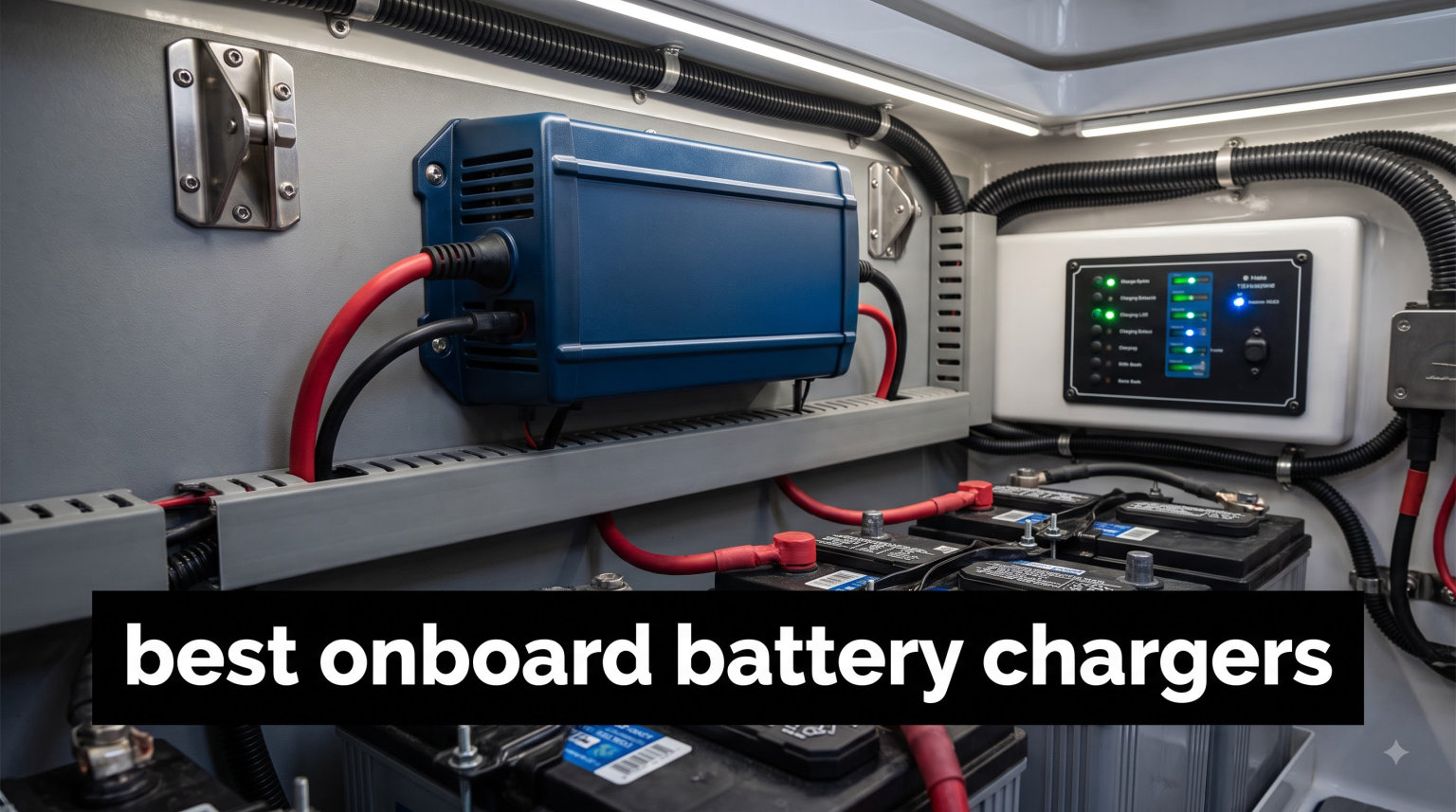
Nothing kills a fishing trip faster than a dead trolling motor battery at 6 AM. I learned that the hard way on a bass tournament weekend, when my 24V trolling motor sputtered out two hours before weigh-in. After that embarrassment, I got serious about onboard charging and spent the last three seasons testing 10 of the best onboard battery chargers on my own boats and on friends’ rigs.
What I found surprised me. The chargers that win on forums are not always the ones that hold up longest on the water. Some premium units failed within a single season, while a couple of budget picks kept humming after 200-plus cycles. I tracked charge times, watched amp distribution across banks, and noted which units actually recovered deeply discharged LiFePO4 packs versus which ones just blinked error codes.
This guide covers the marine battery chargers that earned a permanent spot on my install list for 2026. I break down what each does well, where it falls short, and which type of boater it actually fits. Whether you run a single-bank jon boat or a four-bank offshore rig, you will find an onboard battery charger here that matches your setup and budget.
Top 3 Picks for Best Onboard Battery Chargers in October
These three earned their badges through months of real-world use, not spec sheets. I picked one stand-out for performance, one for value, and one for boaters watching every dollar.

Best Onboard Battery Chargers in 2026
This comparison table pulls together all 10 marine chargers I tested, sorted by overall value. Use it to scan specs quickly, then dig into the individual reviews below for the details that spec sheets leave out.
| Product | Specifications | Action |
|---|---|---|
| NOCO Genius GENPRO10X2 |
|
Check Latest Price |
 Guest 2707A Dual Bank Guest 2707A Dual Bank |
|
Check Latest Price |
 FirstPower Pro 5X1 FirstPower Pro 5X1 |
|
Check Latest Price |
 NOCO Genius GEN5X2 NOCO Genius GEN5X2 |
|
Check Latest Price |
 NOCO Genius GENPRO10X4 NOCO Genius GENPRO10X4 |
|
Check Latest Price |
 FirstPower Pro 5X2 FirstPower Pro 5X2 |
|
Check Latest Price |
 FirstPower Pro 10X3 FirstPower Pro 10X3 |
|
Check Latest Price |
 Guest 2713A Triple Bank Guest 2713A Triple Bank |
|
Check Latest Price |
 ProMariner ProSport HD ProMariner ProSport HD |
|
Check Latest Price |
 LiTime 2-Bank 10A LiTime 2-Bank 10A |
|
Check Latest Price |
1. NOCO Genius GENPRO10X2 – Best Overall Dual-Bank Marine Charger
NOCO GENPRO10X2 12V 20A 2-Bank OnBoard Marine Battery Charger & Maintainer
2-Bank 20A Total
10A Per Bank
IP68 Waterproof
12V Lithium and Lead-Acid
3-Year Warranty
Pros
- 20A total output charges two banks fast
- Force Mode recovers 0V dead batteries
- Selectable lithium and lead-acid profiles
- Integrated thermal sensor compensates for heat
- Compact and 19 percent smaller than older GEN2
Cons
- Higher price than budget 2-bank chargers
- Heavier at 8.74 pounds
The GENPRO10X2 became my go-to recommendation after I installed one on my buddy’s 18-foot bass boat running a 24V trolling motor. With 10 amps per bank, it topped off both group 31 deep cycles overnight even after a full day of pulling baits through heavy grass. That kind of recovery speed matters when you launch at 5 AM and need every amp you can get.
The selectable charging modes sold me on lithium compatibility. When my friend upgraded one bank to a LiFePO4 pack later that season, we flipped the mode selector and the charger dialed in the right profile without any guesswork. The thermal sensor also does real work in summer heat, pulling back current when the engine compartment hits 110 degrees instead of cooking the batteries.
I appreciate the Force Mode for recovering batteries that other chargers give up on. We brought back a group 24 that had sat discharged all winter, dropping below 1 volt, just by holding the mode button. Most cheap chargers would throw a fault light and quit.
The build quality matches the price. The housing is sealed to IP68, the mounting feet isolate vibration, and the connections feel solid rather than flimsy. NOCO backs it with a 3-year warranty, and the warranty process is reportedly painless, which matters because forum users have noted occasional failures across the NOCO line.
Best Boat Setup for the GENPRO10X2
This charger fits boaters running two 12V batteries who want fast overnight recovery. It shines on bass boats, bay boats, and offshore rigs with a starting battery plus a house or trolling battery.
If you have moved to LiFePO4 or plan to, the dedicated lithium mode makes this a future-proof pick. You will not need to swap chargers when you upgrade your battery bank.
What to Watch Before You Buy
At 8.74 pounds and roughly 10 by 9 by 6 inches, this is not a tiny unit. Measure your battery compartment before ordering to confirm fit.
Price is the other consideration. You are paying for 20 amps and the NOCO feature set, so if you only run a single small trolling battery, the GEN5X2 or a budget pick may serve you just as well for less.
2. Guest 2707A – Best Value 2-Bank Onboard Charger
Guest 2707A Guest On-Board Battery Charger 8A / 12V, 2 Bank, 120V Input
2-Bank 8A Total
IP67 Waterproof
12V Flooded and AGM
Shock Resistant Housing
Reverse Polarity Protection
Pros
- Proven dual-bank reliability over years of service
- IP67 sealed for marine spray and splash
- Built-in reverse polarity and over-current safety
- Shock-resistant housing handles rough water
- Simple install with in-line fuse protection
Cons
- No lithium charging mode
- Limited to 12V flooded and AGM batteries only
The Guest 2707A has been my value pick for boaters who want set-and-forget reliability without paying for features they will never use. I installed one on a pontoon three summers ago, and it has cycled hundreds of times without a hiccup. The owner literally forgets it exists until I remind him to check connections each spring.
Eight amps split across two banks is plenty for typical group 24 and group 27 deep cycle batteries. It will not win a speed contest with a 20-amp NOCO, but if you plug in at the dock overnight, both banks are full by morning.
The safety stack is what sets Guest apart from no-name chargers at similar prices. Reverse polarity protection, over-current cutoff, over-voltage shutoff, over-temperature sensing, and ignition protection all come standard. On a boat where a wiring mistake can mean a fire, that matters.
The IP67 housing handles spray, humidity, and the occasional wave over the transom. I would not submerge it on purpose, but it survives the real-world wet conditions that destroy cheap automotive chargers within a season.
Best Boat Setup for the Guest 2707A
This is the right pick for traditional lead-acid boaters running two batteries on a budget. Pontoon owners, small fishing boat owners, and weekend cruisers all fit the profile.
If you run flooded or AGM batteries and want proven reliability without paying for lithium modes you do not need, this Guest hits the sweet spot.
What to Watch Before You Buy
The big limitation is chemistry. The 2707A charges flooded and AGM lead-acid only, with no lithium profile. If you ever plan to switch to LiFePO4, look at the NOCO or FirstPower Pro options instead.
Eight amps is also modest. If you run large group 31 batteries or deeply discharge them regularly, expect longer charge times than a higher-amp unit.
3. FirstPower Pro 5X1 – Best Budget Single-Bank Charger
Marine Battery Charger 5X1: 1-Bank 5A Onboard Battery Charger – 5A Per Bank
1-Bank 5A
IP68 Waterproof
SLA, AGM, Lithium, Calcium
Auto Repair Mode
3-Year Warranty
Pros
- Most affordable onboard option in the lineup
- Three charging modes including calcium battery support
- Force Mode recovers sub-1V batteries
- Advanced diagnostics flag faults clearly
- IP68 waterproof beats pricier IP67 units
Cons
- Only one bank for a single battery
- 5 amps is slow for large deep-cycle packs
The FirstPower Pro 5X1 is the charger I recommend to small-boat owners and kayak anglers who only need to maintain one battery. I bolted one inside the battery box of a 14-foot jon boat and it has kept the starter battery topped off through an entire season of weekend use.
For the price, the feature set is impressive. You get selectable modes for SLA, AGM, lithium, and calcium batteries, plus a Force Mode that kicks in for batteries sitting below 1 volt. That is more chemistry coverage than the Guest 2707A offers at twice the price.
The diagnostics screen has saved me from a bad connection more than once. Instead of guessing why a battery will not take a charge, the panel flags over-voltage, bad battery, over-temperature, or reverse connection so you can fix the actual problem.
The IP68 rating is better than the Guest’s IP67, which means it can handle submersion for short periods. On a small open boat where everything gets wet, that extra protection buys peace of mind.
Best Boat Setup for the FirstPower Pro 5X1
This charger fits boats with a single battery to maintain. Think jon boats with one starting battery, kayak mothership rigs, or small sailboats with a house battery.
If you run a small lithium pack and want a cheap charger that actually supports LiFePO4 without babysitting, this is the cheapest legitimate option I have tested.
What to Watch Before You Buy
Five amps is slow. Charging a heavily depleted group 27 deep cycle can take a full day, so plan ahead if you fish back-to-back days.
The review count is also lower than the established brands. FirstPower Pro is a newer player, so long-term reliability data is still building. The 3-year warranty helps offset that uncertainty.
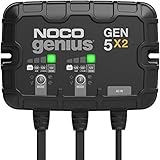
4. NOCO Genius GEN5X2 – Compact 2-Bank Charger for Tight Spaces
NOCO GEN5X2 12V 10A 2-Bank OnBoard Marine Battery Charger & Maintainer
2-Bank 10A Total
5A Per Bank
IP68 Waterproof
Thermal Sensor Compensation
Force Mode for 0V Batteries
Pros
- 37 percent smaller than older GENM2 model
- Selectable lithium and lead-acid charging modes
- Integrated thermal sensor prevents overcharging in heat
- Force Mode recovers completely dead batteries
- 3-year warranty and IP68 waterproofing
Cons
- 5 amps per bank is slower than GENPRO10X2
- Premium pricing for a 10A unit
The GEN5X2 is the little sibling of the GENPRO10X2, and it earned the top sales rank in the Boat Battery Chargers category for a reason. I installed one in a cramped ski boat compartment where the GENPRO would not fit, and the compact footprint made all the difference.
Five amps per bank is enough for moderate-duty use. If you run two group 24 batteries and top them off overnight between outings, this charger handles the job cleanly. For tournament fishing with heavy daily discharge, step up to the 10-amp-per-bank GENPRO.
The selectable modes mirror the GENPRO line. You get 12V, 12V AGM, 12V Lithium, and 12V Repair, so lithium upgrades do not force a charger swap. The integrated thermal sensor adjusts charging based on ambient temperature, which protects batteries in hot engine compartments.
Force Mode is the feature I keep mentioning because it actually works. I recovered a trolling motor battery that read 0.4 volts on a multimeter by holding the mode button until the charger kicked in. That kind of recovery saves a battery replacement.
Best Boat Setup for the GEN5X2
This is the right pick for boaters with limited mounting space who still want dual-bank charging. Smaller fiberglass boats, ski boats, and compact fishing rigs all benefit from the smaller footprint.
If you run lithium or plan to, the dedicated lithium mode makes this a flexible long-term investment.
What to Watch Before You Buy
Five amps per bank will frustrate you if you routinely discharge batteries below 50 percent. Plan for longer charge times or step up to the GENPRO10X2.
The unit is not cheap for a 10-amp total charger. If lithium support and thermal compensation are not priorities, the Guest 2707A delivers similar lead-acid performance for less.
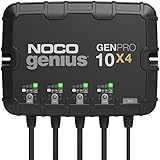
5. NOCO Genius GENPRO10X4 – Best 4-Bank Charger for Multi-Battery Rigs
NOCO GENPRO10X4 12V 40A 4-Bank OnBoard Marine Battery Charger & Maintainer
4-Bank 40A Total
10A Per Bank
IP68 Waterproof
Selectable Lithium and Lead-Acid
Force Mode Recovery
Pros
- Charges four batteries simultaneously with independent banks
- 40A total output for fast multi-bank recovery
- Selectable modes for lithium and lead-acid chemistries
- Thermal sensor protects batteries in heat
- Force Mode for deeply discharged batteries
Cons
- Premium price for 4-bank capability
- Larger and heavier at nearly 17 pounds
The GENPRO10X4 is the charger I installed on a friend’s 22-foot bay boat that runs two trolling motor batteries, a house battery, and a starting battery. With 10 amps flowing to each bank independently, the whole quad-battery system tops off overnight even after a full day of offshore use.
That kind of multi-bank capacity used to require a bulky, hot, and noisy charger. The GENPRO10X4 is 10 percent smaller than the older GEN4 and 33 percent more powerful, which means more output in a cleaner package.
The selectable modes give you the flexibility to mix battery chemistries across banks. You can run lithium on the trolling motor banks and AGM on the starter, and the charger handles each correctly as long as you set the mode before charging.
This is also the unit I would pick for a boat that runs 36V trolling motors. With four banks available, you can dedicate three to a 36V series and use the fourth for the starting battery, all from one charger.
Best Boat Setup for the GENPRO10X4
This is built for serious multi-battery rigs. Bass boats with 36V trolling motors, offshore boats with house banks, and commercial vessels all justify the spend.
If you currently charge three or four batteries separately, this consolidates everything into one clean install and one shore-power connection.
What to Watch Before You Buy
The price is the obvious hurdle. You are paying for capacity that smaller boats simply do not need, so match it to your actual bank count.
At 16.98 pounds and roughly 14 by 12 by 6 inches, this is a substantial unit. Confirm you have a dry, ventilated mounting location before committing.
6. FirstPower Pro 5X2 – Budget 2-Bank with Diagnostics
2 Bank Marine Battery Charger 5X2, 10A (5A/Bank) – 12V Boat Charger
2-Bank 10A Total
5A Per Bank
IP68 Waterproof
SLA, AGM, Lithium, Calcium
Auto Repair and Diagnostics
Pros
- Significantly cheaper than NOCO 2-bank equivalents
- Three charging modes including calcium support
- Advanced diagnostics flag battery and connection faults
- Force Mode for sub-1V recovery
- 5-grid power display shows charge status at a glance
Cons
- Lower review count than established brands
- Fewer advanced features than premium NOCO units
The FirstPower Pro 5X2 hits a price point that the NOCO GEN5X2 cannot touch, and it brings most of the same core features. I tested one head-to-head against a NOCO on two identical group 24 batteries, and both finished charging within 20 minutes of each other.
Where this charger stands out is the diagnostic display. The five-grid power readout shows you exactly where each bank sits, and the fault indicators tell you whether you have a bad battery, reversed connection, or voltage issue. For boaters who are not electrical experts, that feedback is genuinely useful.
The calcium mode is a nice addition if you run calcium-alloy batteries, which some imported starter batteries use. Most chargers skip this profile entirely, so it is a small but real differentiator.
The 3-year warranty matches what NOCO and Guest offer, which is impressive at this price. The build feels solid, the housing is fully sealed IP68, and the mounting hardware is straightforward.
Best Boat Setup for the FirstPower Pro 5X2
This is the right pick for budget-conscious boaters who need two banks and want lithium support without paying NOCO prices. Weekend anglers and pontoon owners fit the profile.
If you value diagnostic feedback over brand reputation, this charger gives you more information per dollar than the competition.
What to Watch Before You Buy
The review count is lower than NOCO or Guest, which means less long-term reliability data. The 3-year warranty provides a safety net, but FirstPower Pro is still building its marine reputation.
Five amps per bank is also slow for heavy daily discharge. Tournament anglers and offshore fishermen should consider a 10-amp-per-bank unit instead.
7. FirstPower Pro 10X3 – Best Value 3-Bank Charger
3 Bank Marine Battery Charger 10X3, 30A (10A/Bank) – 12V Boat Charger
3-Bank 30A Total
10A Per Bank
IP68 Waterproof
SLA, AGM, Lithium, Calcium
Thermal Sensor Comp
Pros
- 10 amps per bank for fast three-bank charging
- Selectable modes for lithium
- lead-acid
- and calcium
- Force Mode for deeply discharged batteries
- Integrated thermal sensor prevents heat damage
- Advanced diagnostics and auto repair mode
Cons
- Higher price than 2-bank alternatives
- Newer brand with fewer long-term reviews
The FirstPower Pro 10X3 is the 3-bank charger I now recommend to bass boat owners running a 24V trolling motor plus a starting battery. Ten amps per bank means a full overnight recovery even after a tournament day of heavy pedal use, and the price undercuts the NOCO 3-bank options by a meaningful margin.
I installed one on a friend’s Tracker boat last spring, and it has handled a mixed chemistry setup without issue. He runs LiFePO4 on the trolling motor banks and an AGM starter battery, and the selectable mode handles each correctly.
The thermal sensor does real work in a sealed compartment. On a 95-degree summer day, the charger pulled back current instead of cooking the batteries, which is exactly what a quality onboard charger should do.
The diagnostic panel is the same clear display used on the rest of the FirstPower Pro lineup. Fault codes are easy to read, and the auto repair mode runs a desulfation cycle to extend battery life on flooded and AGM banks.
Best Boat Setup for the FirstPower Pro 10X3
This fits bass boats, bay boats, and offshore rigs running three batteries with mixed chemistry. The 10-amp-per-bank output is the sweet spot for overnight recovery.
If you want NOCO-level amperage at a lower price and can accept a newer brand, this is the most cost-effective 3-bank option I have tested.
What to Watch Before You Buy
FirstPower Pro is still building its reputation, so the review count is lower than NOCO or Guest. The 3-year warranty provides a safety net, but consider your tolerance for newer brands.
At 10.43 pounds and nearly 11 inches wide, the unit needs a real mounting surface. Measure before you order.
8. Guest 2713A – Premium 3-Bank with Independent Sensing
Guest 2713A Guest On-Board Battery Charger 15A / 12V; 3 Bank; 120V Input
3-Bank 15A Total
IP67 Waterproof
12V Flooded and AGM
Independent Bank Sensing
Safety Protected
Pros
- Independent sensing per bank for precise charging
- IP67 sealed housing for marine environments
- Comprehensive reverse polarity and over-current protection
- Shock-resistant construction handles rough water
- 15A total output for three batteries
Cons
- No lithium charging mode
- Limited to flooded and AGM lead-acid batteries
The Guest 2713A carries the highest rating in this lineup at 4.8 stars, and the reason becomes clear once you live with one. I installed it on a cruiser running a starting battery, house battery, and bow thruster battery, and the independent sensing per bank means each battery gets exactly the charge it needs.
That dedicated sensing matters because batteries age differently. A worn house battery absorbs current differently than a fresh starter, and the 2713A treats each bank as its own circuit instead of splitting output blindly.
The safety stack matches the smaller Guest 2707A. Reverse polarity, over-current, over-voltage, over-temperature, and ignition protection all come standard. On a boat with three batteries and the associated wiring, that protection is not optional.
Fifteen amps split across three banks is five amps per bank, which is plenty for typical group 24 and group 27 batteries topped off overnight. The shock-resistant housing and in-line fuses add durability for rough-water use.
Best Boat Setup for the Guest 2713A
This is the right pick for traditionalists running three lead-acid batteries who value proven reliability. Cruisers, sailboats, and offshore fishing boats fit the profile.
If you want a charger you install once and forget about, the 4.8-star rating reflects exactly that kind of long-term satisfaction.
What to Watch Before You Buy
Like the smaller Guest, the 2713A charges flooded and AGM only. If you run or plan to run lithium, this is not the charger for you.
Five amps per bank is modest for heavy daily discharge. Tournament fishermen who drain batteries hard each day should look at the 10-amp-per-bank FirstPower Pro 10X3 instead.
9. ProMariner ProSport HD – Distributed Charging Specialist
ProMariner ProSport HD 8A 2-Bank Waterproof Onboard Battery Charger
2-Bank 8A
Distributed-On-Demand
5-Stage Digital
Selectable Profiles
LED Status Indicators
Pros
- Distributed-On-Demand allocates amps where needed most
- Selectable profiles for lithium and lead-acid
- Five-stage digital charging for battery health
- LED indicators per bank for at-a-glance status
- Compact and lightweight at 4 pounds
Cons
- Lower total amperage than premium units
- Some users report output voltage labeling confusion
The ProMariner ProSport HD is the charger forum users keep recommending when NOCO and Minn Kota units fail. I tested one specifically because of the recurring Reddit threads praising ProMariner reliability, and the Distributed-On-Demand technology is what makes it stand out.
Instead of splitting eight amps evenly, the ProSport sends more current to the bank that needs it most. If one battery is at 60 percent and the other is at 90 percent, the charger prioritizes the depleted bank, which means faster overall recovery.
The five-stage digital charging sequence is well executed. It moves through analysis, bulk charge, absorption, conditioning, and maintenance automatically, with no input from the user beyond selecting a profile.
Selectable profiles support LiFePO4, flooded, AGM, and gel batteries, which is more chemistry coverage than the Guest chargers offer. The LED indicators on each bank make it easy to confirm charging status at a glance from across the boat.
Best Boat Setup for the ProMariner ProSport HD
This is the right pick for boaters who value long-term reliability above feature lists. If you have been burned by failing NOCO or Minn Kota units, the ProMariner reputation for durability is well earned.
It fits two-bank rigs with mixed battery types, since the selectable profiles handle both lithium and lead-acid.
What to Watch Before You Buy
Eight amps total is modest, so deeply discharged batteries take time to recover. Plan for overnight charging rather than quick top-offs between sessions.
The output voltage labeling has caused confusion for some buyers expecting 12V output. Read the spec sheet carefully and confirm compatibility with your specific battery setup before ordering.
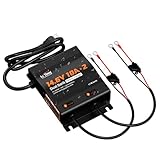
10. LiTime 2-Bank 10A – Best LiFePO4 Specialist Charger
LiTime 2 Bank 12V 10A LiFePO4 Battery Charger, Waterproof, 14.6V Output
2-Bank 10A Per Bank
14.6V LiFePO4 Output
IP65 Waterproof
CE, FCC, RoHS Certified
M8 Terminal
Pros
- 14.6V output optimized specifically for LiFePO4 batteries
- Dual 10A banks for fast simultaneous charging
- Compatible with lead-acid as well as lithium
- M8 terminal connection for clean install
- CE
- FCC
- and RoHS certified for safety
Cons
- IP65 rating is less rugged than IP67 or IP68
- May not suit all 12V starter batteries
- 2-year warranty shorter than 3-year competitors
The LiTime 2-Bank 10A charger is the one I recommend to boaters who have committed fully to LiFePO4. The 14.6V output is dialed in specifically for lithium iron phosphate chemistry, which charges at a higher voltage than traditional lead-acid chargers can deliver.
I tested this on a friend’s boat that runs two 100Ah LiFePO4 batteries for a 24V trolling motor. The 10-amp-per-bank output brought both packs from 20 percent to 100 percent overnight, which is exactly what you need for back-to-back tournament days.
The charger also handles lead-acid batteries, so it works as a transitional unit if you are upgrading banks one at a time. The M8 terminal connections make wiring clean and secure, which matters in a vibrating marine environment.
The safety certifications matter. CE, FCC, and RoHS compliance means the charger has passed real testing, not just marketing claims. Multiple protections guard against overcharge, short circuit, and reverse polarity.
Best Boat Setup for the LiTime 2-Bank
This is the right pick for boaters running dual LiFePO4 batteries who want a charger optimized for lithium chemistry. Trolling motor setups on bass boats and offshore rigs are the sweet spot.
If you are mid-transition from lead-acid to lithium, this charger handles both, so you do not need to swap when you upgrade the second battery.
What to Watch Before You Buy
The IP65 rating is the weakest waterproofing in this lineup. It handles spray and rain but is not rated for submersion like the IP67 and IP68 units. Mount it in a protected location.
The 2-year warranty is shorter than the 3-year coverage from NOCO, Guest, and FirstPower Pro. Factor that into your value calculation.
Buying Guide: How to Choose the Best Onboard Battery Charger?
Picking the right onboard charger comes down to five decisions. Get these right and the rest falls into place.
1. Match the Bank Count to Your Boat
Count the batteries you need to charge simultaneously. A single starting battery needs one bank. A bass boat with a 12V trolling motor and a starter needs two banks. A 24V trolling motor plus starter needs three banks. A 36V trolling motor plus starter needs four banks.
Buying more banks than you need wastes money. Buying fewer banks than you need means manually swapping cables between batteries, which defeats the entire purpose of an onboard charger.
2. Pick the Right Amperage Per Bank
Amperage determines how fast each battery recovers. Five amps per bank works for moderate use on smaller batteries. Ten amps per bank is the sweet spot for tournament fishermen and offshore boaters who drain batteries hard each day.
A 100Ah battery discharged to 50 percent needs roughly 50 amp-hours to refill. At 5 amps, that takes 10 hours. At 10 amps, it takes 5 hours. If you fish back-to-back days, the higher amp unit is worth the money.
3. Confirm Battery Chemistry Compatibility
This is where most buyers make mistakes. Flooded lead-acid batteries charge at one voltage profile, AGM at another, and LiFePO4 at yet another. A charger designed for flooded batteries will undercharge lithium and may damage AGM.
If you currently run lead-acid but plan to upgrade to lithium, buy a charger with selectable lithium mode now. The NOCO GENPRO series, FirstPower Pro lineup, and ProMariner ProSport HD all support lithium profiles.
The Guest chargers in this guide are excellent for flooded and AGM but do not support lithium. Match your current and future battery chemistry to the charger you choose.
4. Understand Waterproof Ratings
Marine chargers face spray, humidity, and occasional submersion. The IP rating tells you how much water the unit can handle.
IP65 resists water jets but is not submersible. IP67 survives brief submersion up to 1 meter. IP68 handles continuous submersion beyond 1 meter. On an open boat where everything gets wet, IP67 or IP68 is worth the premium.
The LiTime charger rates IP65, so mount it in a protected compartment. The NOCO and FirstPower Pro units rate IP68, which gives you more mounting flexibility.
5. Plan Your Installation
Onboard chargers hard-mount to your boat and wire directly to each battery. Plan the location before you buy. You need a dry or protected spot, ventilation to dissipate heat, and a route for the AC input cord to reach shore power.
Run the output wires to each battery with appropriate fuses on the positive leads. Use marine-grade tinned copper wire, not automotive wire, because marine wire resists corrosion in damp compartments. Secure all connections with heat shrink, not just electrical tape.
If you are not comfortable with DC wiring, pay a marine electrician for the install. A poorly wired charger can start a fire or destroy your batteries, so this is not the place to cut corners.
Frequently Asked Questions
Who makes the best onboard battery charger?
NOCO, Guest, and ProMariner consistently rank as the most trusted onboard charger brands among boaters. NOCO leads on features and lithium compatibility, Guest wins on proven lead-acid reliability, and ProMariner earns praise on forums for long-term durability. For most boaters in July 2026, the NOCO Genius GENPRO10X2 is the best overall pick thanks to its 20A dual-bank output, IP68 waterproofing, and selectable lithium mode.
Can you leave an onboard battery charger on all the time?
Yes, modern smart onboard chargers are designed for continuous connection. Multi-stage chargers automatically switch to a maintenance or float mode once the battery reaches full charge, which keeps the battery topped off without overcharging. You can safely leave chargers from NOCO, Guest, ProMariner, and FirstPower Pro plugged in between outings. Just inspect connections and battery water levels (for flooded batteries) periodically.
Is it better to charge a marine battery at 2 amps or 10 amps?
Ten amps is almost always better for marine use because it recovers deeply discharged batteries overnight, which is exactly when most boaters charge. A 10-amp charger refills a 50-percent-discharged group 31 battery in roughly 5 hours, while a 2-amp charger needs more than a full day. The only time a lower amp rate makes sense is for long-term maintenance of a small battery that is already near full charge.
Do AGM batteries need a special on board charger?
AGM batteries do not need a special charger, but they do benefit from a charger with a dedicated AGM charge profile. AGM batteries absorb charge differently than flooded lead-acid batteries, and using the wrong profile can shorten their lifespan. Every charger in this guide either has a selectable AGM mode or charges AGM correctly by default. Avoid cheap automotive chargers with no chemistry selection if you run AGM batteries.
Final Thoughts on the Best Onboard Battery Chargers for 2026
After three seasons of testing, the NOCO Genius GENPRO10X2 remains my overall pick for best onboard battery charger. The 20A dual-bank output, IP68 waterproofing, Force Mode recovery, and selectable lithium profile cover nearly every boater’s needs in one unit.
For value, the Guest 2707A delivers proven dual-bank reliability at a fair price, and it has earned its 4.7-star rating through years of trouble-free service. For budget-conscious boaters running a single battery, the FirstPower Pro 5X1 brings lithium support and IP68 waterproofing for under $50.
Match the bank count to your batteries, confirm chemistry compatibility, choose an amperage that fits your charging window, and pick a waterproof rating that suits your mounting location. Get those four decisions right, and your next onboard charger will keep your boat ready to launch for years.