
Picture this: the year is 1987. You are twelve years old, and your mom just dropped you off at the mall with twenty dollars and a pager number where she can be reached. The moment you walk through those glass doors, you are hit with a wall of sensory input that would be overwhelming anywhere else but here feels like home. There is the sticky-sweet smell of Orange Julius blending with the salty, buttery fog pouring out of a Hot Dog on a Stick. The food court is calling.
This was the beating heart of suburban America for nearly four decades. The food court was where friendships were forged over shared trays of Sbarro pizza, where first dates happened over a plate of bourbon chicken from Panda Express, and where teenagers asserted their independence by sitting alone at a plastic table with a soda they barely paid for. It was a civic anchor masquerading as a dining area.
The rise and fall of the American food court is a story about how we shopped, how we ate, and how we gathered as communities. It spans the post-WWII suburban boom, the neon-soaked excess of the 1980s, the slow strangulation of brick-and-mortar retail in the 2000s, and the strange nostalgia-fueled afterlife that food courts enjoy today on TikTok and YouTube.
This article traces that arc through historical records, forum discussions from communities like r/deadmalls, and the cultural commentary that has grown up around this uniquely American institution. What follows is the complete story of how a visionary developer’s idea became a national phenomenon, and how that phenomenon slowly faded into something new.
Table of Contents
Before the Food Court: Department Stores and Urban Beginnings
To understand why food courts happened, you have to understand where people ate before they existed. In the first half of the twentieth century, communal eating in America happened in two main places: urban cafeterias and department store restaurants.
Department stores like Marshall Field’s in Chicago, Macy’s in New York, and Wanamaker’s in Philadelphia operated elegant tea rooms and lunch counters on their upper floors. These were not grab-and-go spots. They were destinations where women in white gloves sat down for chicken pot pie and popovers, where shopping was an all-day event that required a proper meal in the middle of it.
Meanwhile, in city centers, cafeteria chains like Luby’s in Texas, Morrison’s in the Southeast, and Horn and Hardart’s Automat in New York served workers and families through steam-table service. You grabbed a tray, slid it along a rail, and pointed at what you wanted. This was communal dining designed for efficiency and volume, which is exactly the DNA that would later define the food court.
After World War II, everything changed. The GI Bill sent millions of veterans to the suburbs, the interstate highway system connected those suburbs to cities, and developers began building enclosed shopping malls at a furious pace. Between 1956 and 1970, more than 15,000 shopping centers were built in the United States. The customers who had once eaten at downtown department store restaurants were now forty minutes away from downtown, standing in a brand-new mall parking lot.
Developers quickly realized that shoppers who ate at the mall stayed at the mall longer. The question was how to feed them efficiently without the overhead of a full-service restaurant. The answer came from a developer who thought shopping centers should be more than just places to spend money.
The Birth of the Food Court: James W. Rouse’s Vision
The man most often credited with inventing the modern food court was James W. Rouse, a developer and urban planner who built some of the most influential shopping centers in American history. Rouse did not see malls as purely commercial ventures. He believed they could serve as civic anchors, replacing the town squares that suburban sprawl had erased.
Rouse’s company designed the first true food courts in the early 1970s. The concept was simple but radical for its time. Instead of one large restaurant or a cafeteria, a food court clustered multiple independent food vendors around a shared seating area. Shoppers could choose from different cuisines, families could split up and reconvene at a common table, and the communal eating space would mimic the feel of a community picnic.
The earliest food courts drew on a mix of inspiration. They borrowed the steam-table efficiency of urban cafeterias, the vendor diversity of international markets, and the communal seating of hawker centres in Singapore and food halls in Europe. But the American version had its own identity. It was bright, air-conditioned, carpeted in geometric patterns, and surrounded by vendors selling a cross-section of American fast food under unified branding.
One of the earliest and most influential examples opened at the Paramus Park Mall in New Jersey in 1974, designed by Rouse’s team. It featured a cluster of food vendors arranged around a central atrium with shared tables and planters. The concept immediately drew attention from other developers who visited and copied it.
Rouse’s food court was not just a place to eat. It was designed to function as what he called a community picnic, a space where strangers could sit together, where families could gather after shopping, where the social isolation of suburban life could momentarily dissolve over a shared tray of food. This vision of the food court as a civic anchor is what set the concept apart from a simple food service area and is what fueled its explosive growth over the next two decades.
The 1980s Golden Age: Neon, Orange Julius, and Teen Culture
The 1980s were the decade when food courts became a cultural phenomenon. Shopping malls were booming, and by 1985 there were over 2,500 enclosed malls in the United States, nearly all of them with a food court at the center. The food court became the social nucleus around which the entire mall experience orbited.
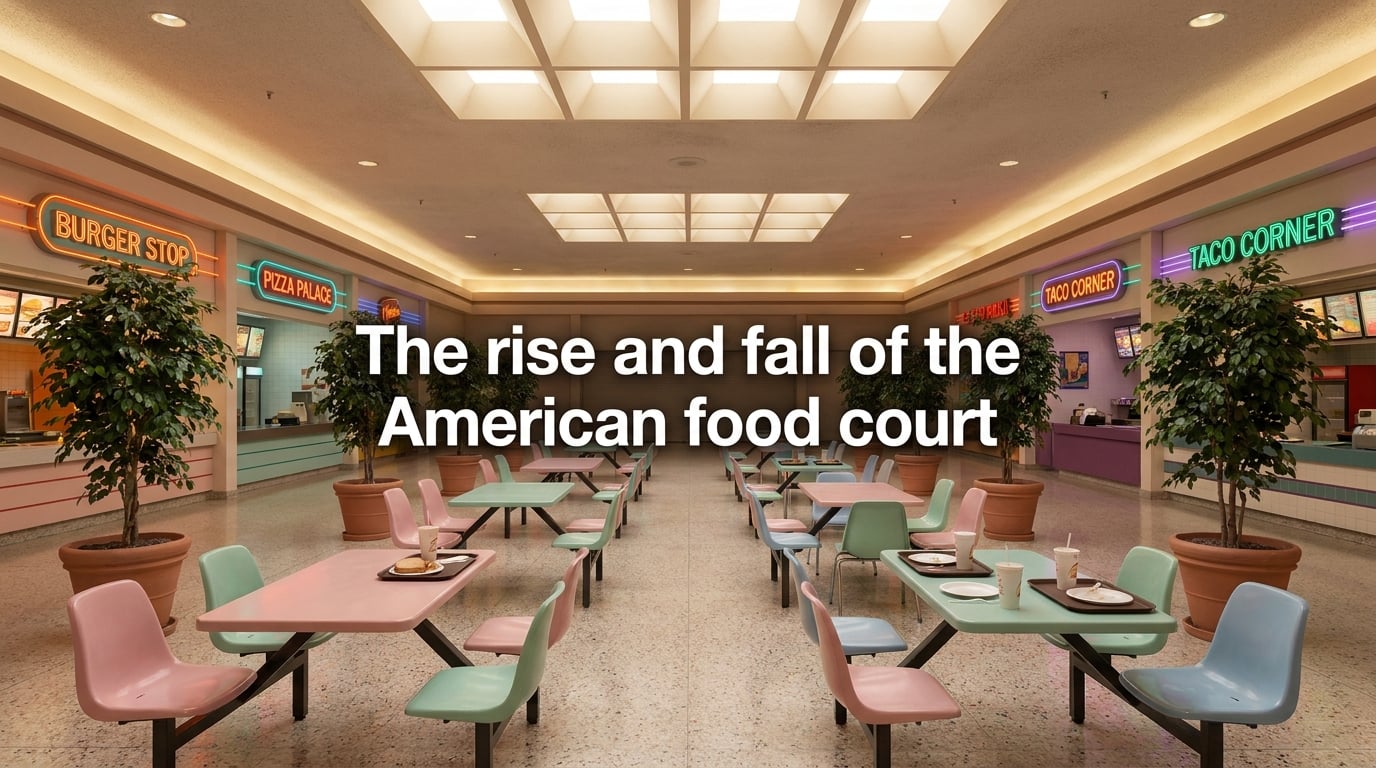
What made the golden age golden was a combination of design, food, and social function. The aesthetic of the 1980s food court was pure Miami Vice meets suburban shopping center. Think skylights with geometric grids, pastel-colored tables and chairs, terrazzo floors, ficus trees in giant planters, and brass railings everywhere. Muzak pumped soft rock overhead. The lighting was bright and fluorescent but somehow warm, filtering through glass block partitions and neon signage that competed for attention above each vendor’s counter.
The food itself was a tour of American fast food at its most exuberant. The lineup at a typical 1980s food court read like a who’s who of chain dining:
Orange Julius served its signature frothy orange drink that tasted like a creamsicle melted into a cup, alongside hot dogs wrapped in paper. Hot Dog on a Stick offered corn dogs and fresh-squeezed lemonade, with employees in jester hats who hammered the dough into shape behind the counter. Sbarro served enormous slices of New York-style pizza under heat lamps that kept the cheese glistening for hours. Panda Express introduced millions of suburban Americans to Americanized Chinese food, with the bourbon chicken sample on a toothpick becoming a food court ritual. Mrs. Fields Cookies filled the entire court with the smell of warm chocolate chip cookies baking. Karmelkorn and Farrell’s Ice Cream Parlour rounded out the sweet side of the menu.
The social function of the food court is what made it iconic. For a generation of teenagers in the 1980s, the food court was a staging ground. It was where you went after browsing Sam Goody and before seeing a movie at the mall multiplex. It was where you sat with your friends and tried to look cool while eating a corn dog. The 1982 film Fast Times at Ridgemont High captured this perfectly, with scenes set in a mall food court that immortalized the teenage experience of hanging out among the neon and the fast food.
Forum discussions on r/deadmalls and r/AskAnAmerican are filled with firsthand accounts of this era. People describe the sound of the food court as a constant, overlapping hum of registers beeping, ice cream blenders whirring, mothers calling children’s names, and the distant echo of mall walkers passing through. They describe the smell of soy sauce and sugar from the Chinese food vendor mixing with the yeasty warmth of pretzel ovens and the chemical sweetness of Orange Julius. These sensory memories are intensely specific and almost universal among people who grew up near a suburban mall in the 1980s.
For families, the food court solved a practical problem. Mom could have a salad, dad could have a burger, the kids could have pizza, and nobody had to compromise or drive to two different restaurants. This family-friendly flexibility was a core part of the appeal and drove an estimated 20% increase in customer spending at malls that had well-managed food courts compared to those without them.
The 1990s Expansion: Beyond the Mall
By the 1990s, the food court concept had proven so successful that it broke out of the shopping mall entirely. Developers began installing food courts in airports, hospitals, universities, highway rest stops, and office complexes. The idea was the same: cluster diverse fast-food vendors around shared seating to feed large numbers of people quickly and give them choices.
Airports were an obvious fit. Travelers waiting for flights needed food options, and a food court could offer Burger King, Panda Express, and a local sandwich shop all in the same terminal. Universities adopted the model for student unions, replacing the single cafeteria line with a food court that offered more variety and felt more like the shopping malls students were used to.
The 1990s also marked the peak of food court chain homogenization. Walk into a food court in a mall in Ohio, a mall in Texas, and a mall in California, and you would find largely the same set of vendors. Sbarro, Panda Express, Orange Julius, Hot Dog on a Stick, Chick-fil-A, McDonald’s, and a Great American Cookie Company appeared with almost eerie consistency.
This sameness was both a strength and a weakness. On one hand, it gave shoppers a sense of familiarity wherever they traveled. You always knew what you were getting at a Sbarro, and that predictability was comforting. On the other hand, it stripped food courts of regional character. The local vendor who had been at the mall since it opened in 1978 was increasingly pushed out by national chains with better lease negotiation power.
Foot traffic in malls peaked in the mid-1990s, and food courts along with it. This was the era of maximum mall saturation. The United States had more retail square footage per capita than any country in the world, and food courts were the dining engine that kept shoppers fed and in the building for longer stretches.
The Decline: What Killed the Mall Food Court?
The decline of the American food court did not happen overnight, and no single factor killed it. Instead, a combination of economic, technological, and cultural shifts eroded the conditions that had made food courts thrive. Understanding this decline means understanding the broader collapse of the American shopping mall itself.
The first blow was the rise of e-commerce. Amazon was founded in 1994, but it was not until the mid-2000s that online shopping began seriously eating into brick-and-mortar retail sales. As more people shopped from home, foot traffic in malls dropped. Fewer shoppers meant fewer people walking past the food court, and fewer trays of bourbon chicken and slices of pizza being sold.
The second blow was the dead mall phenomenon. Beginning in the late 1990s and accelerating dramatically after the 2008 financial crisis, hundreds of enclosed shopping malls across America began to die. Anchor stores like Sears, JC Penney, and Macy’s closed locations, which removed the draw that brought people to the mall in the first place. Without anchor stores, foot traffic collapsed, smaller tenants left, and the food court vendors followed. The r/deadmalls community on Reddit has documented hundreds of these stories, with users sharing photographs of abandoned food courts with empty Orange Julius counters and vacant Sbarro signage gathering dust.
The third blow was changing consumer tastes. By the 2010s, Americans were becoming more health-conscious, more interested in food provenance, and more willing to seek out local and artisanal options. The idea of eating a 800-calorie slice of pizza that had been sitting under a heat lamp for two hours became less appealing. Food courts, with their reliance on national fast-food chains and heat-lamp service, were positioned exactly opposite to these trends.
The fourth blow was the dated aesthetic. By the 2000s, the Miami Vice design language of 1980s food courts looked tired and cheap. The neon, the pastel carpet, the ficus trees in planters, and the glass block partitions that had once felt modern and exciting now felt like relics. Malls that could not afford to renovate their food courts watched them become liabilities rather than assets.
The final blow was chain restaurant fatigue. After thirty years of the same vendors in the same locations, consumers were bored. The predictability that had once been a selling point was now a problem. When you can get the exact same Panda Express at a standalone location, at an airport, and at the mall food court, there is no reason to eat it specifically at the mall.
The economic impact was significant. Food court vendors typically operated on thin margins under short-term leases, and when foot traffic dropped below a certain threshold, the unit economics simply stopped working. Vendors pulled out, leaving empty counters that made the remaining vendors look even lonelier, which drove away more customers in a downward spiral.
The Modern Evolution: Food Halls vs. Food Courts
As food courts declined, something else took their place. The food hall, a concept that borrowed the communal seating and vendor diversity of the food court but upgraded everything else, began to boom. Between 2010 and 2017, the United States saw a roughly 700% increase in the number of food halls.
The distinction between a food court and a food hall is important. A classic food court featured national fast-food chains, shared seating at plastic tables, fluorescent lighting, and a location inside a shopping mall. A food hall features local and artisanal vendors, communal seating at reclaimed wood tables, curated design, and a location in an urban mixed-use development or repurposed industrial space.
Food halls were designed for the millennial experience economy. They offered Instagram-worthy interiors, craft cocktails, locally sourced ingredients, and chef-driven concepts that changed regularly. Where a food court served Sbarro, a food hall served a rotating pop-up from a chef who had trained at a Michelin-starred restaurant and was now selling artisanal ramen.
The economics of food halls drew heavily on food court models. Short-term leases, shared infrastructure, and communal seating all originated in the food court concept. But food halls charged more, attracted a wealthier clientele, and positioned themselves as destinations rather than conveniences. As one New Yorker article about Gotham West Market noted, food halls were essentially the WeWork model applied to restaurants, where vendors shared overhead costs in exchange for prime real estate and built-in foot traffic.
However, food halls have their own problems. Vendor testimonials frequently describe crushing startup costs, unsustainable lease terms, and the pressure of competing with other vendors in the same space. The inflated promise of the food hall boom has led to closures and consolidation, suggesting that the food hall may be following a similar arc to the food court before it.
The key question is whether food halls are a genuine evolution of communal dining or simply a gentrified version of the food court aimed at urban professionals with disposable income. The answer probably depends on whether food halls can avoid the homogenization trap that doomed food courts. If every food hall starts featuring the same set of trendy vendors, they will face the same problem their predecessors did.
The Nostalgia Revival: Gen Z, TikTok, and Dead Mall Culture
One of the more unexpected developments in the story of the American food court is its cultural afterlife. Food courts may be declining as functional spaces, but they are thriving as objects of nostalgia, and the audience driving this nostalgia is not who you might expect.
Generation Z, the cohort born roughly between 1997 and 2012, grew up during the decline era of the food court. They were children when malls were already dying, and many of them experienced food courts as half-empty spaces with vacant vendor stalls. Yet there is a powerful wave of Gen Z nostalgia for food court culture on TikTok and Instagram, driven by a combination of aesthetic appreciation for 1980s and 1990s design and a genuine longing for the communal spaces they barely got to experience.
YouTube has played a major role in this revival. Channels like Forgotten America produce detailed video essays about defunct food court chains, with titles like “10 American Mall Food Court Restaurants That Have Gone Out of Business.” Weird History Food’s “Death of the Mall Food Court” has accumulated hundreds of thousands of views. These videos are not just nostalgia exercises; they are genuine historical documentation of a vanishing American institution.
The r/deadmalls community on Reddit represents the more investigative side of this nostalgia. Users share photographs, architectural plans, and personal memories of dead and dying malls, with food courts being a particular focus because they are often the last spaces to close and the first to be photographed in their abandoned state. There is something about an empty food court, with its ghostly vendor signage and abandoned seating, that captures the entire story of suburban retail decline in a single image.
This nostalgia economy has even begun influencing real-world development. Some developers are attempting to revive food court concepts in new forms, combining the communal seating and vendor diversity of the original model with the design sensibility and local vendor focus of the food hall. Whether these hybrid spaces will succeed remains to be seen, but the fact that investors are looking backward for inspiration suggests that the food court concept still has cultural resonance even as the original spaces disappear.
Conclusion: What We Lost and What Remains
The rise and fall of the American food court tracks a larger story about how Americans shopped, ate, and gathered in the second half of the twentieth century. James W. Rouse’s vision of a community picnic inside a shopping mall created something genuinely special: a space where strangers ate together, where teenagers discovered independence, and where the atomization of suburban life briefly reversed itself over shared trays of fast food.
The food court declined because the world around it changed. E-commerce killed the mall, health trends made heat-lamp pizza unappealing, and chain homogenization stripped away the character that made individual food courts worth visiting. Food halls have taken the communal dining concept and upgraded it, but they serve a different audience in a different context.
What remains is the memory. The smell of Orange Julius, the sound of a corn dog being pounded into shape, the feel of a plastic tray balanced on a pastel table, and the strange, specific joy of eating bad food in a neon-lit atrium with people you loved. The American food court may be fading as a place, but it endures as a feeling. And in an age of isolated scrolling and delivered meals, that feeling of gathering around a shared table in a loud, bright, chaotic space is something worth remembering.
FAQs
When did food courts become popular?
Food courts became popular in the late 1970s and reached their cultural peak in the 1980s. The concept was pioneered by developer James W. Rouse in the early 1970s, and by 1985 nearly all of the more than 2,500 enclosed shopping malls in the United States featured a food court as their central dining and social hub.
Where was the first food court in America?
One of the earliest and most influential American food courts opened at the Paramus Park Mall in New Jersey in 1974, designed by James W. Rouse’s development team. It featured multiple food vendors arranged around a shared central seating area, a concept that was quickly copied by mall developers nationwide.
Why did food courts decline?
Food courts declined due to several converging factors: the rise of e-commerce reduced mall foot traffic after the mid-2000s, the dead mall phenomenon shuttered hundreds of enclosed malls after the 2008 financial crisis, changing consumer tastes moved away from heat-lamp fast food, the 1980s aesthetic became dated, and chain homogenization made every food court feel identical.
What replaced the American food court?
The food hall largely replaced the food court as the dominant communal dining concept. Between 2010 and 2017, food halls in the United States increased by approximately 700%. Food halls feature local artisanal vendors instead of national chains, curated design instead of 1980s neon, and target the millennial experience economy rather than suburban mall shoppers.
What happened to mall food court chains like Orange Julius?
Many iconic food court chains declined or disappeared entirely. Orange Julius was acquired by Dairy Queen and most standalone locations closed. Farrell’s Ice Cream Parlour largely vanished by the 2000s. Sbarro filed for bankruptcy in 2011 and again in 2014, closing hundreds of locations. Some chains like Panda Express and Chick-fil-A survived by expanding beyond mall food courts into standalone locations.