
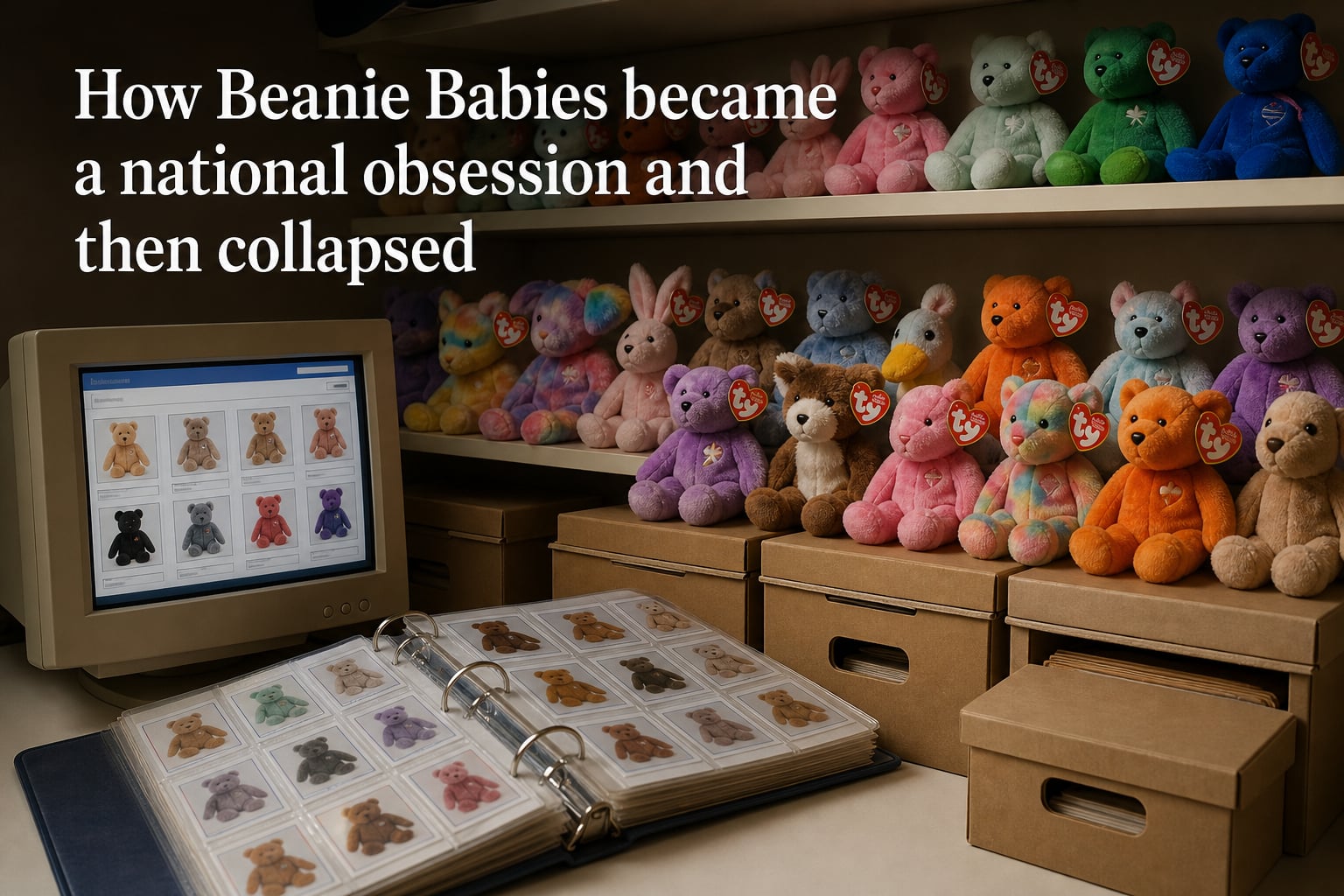
How Beanie Babies became a national obsession and then collapsed is a story about a small stuffed toy becoming an investment fantasy. Ty Warner introduced the pellet-filled toys in 1993, and a combination of limited availability, retirement announcements, collector culture, and the early internet turned them into a nationwide craze before demand fell apart in the late 1990s.
The short version is simple: people wanted Beanie Babies because they looked scarce and seemed likely to become more desirable tomorrow. Once enough buyers treated them as assets rather than toys, the secondary market depended on the next buyer paying more; when that belief broke, the bubble had no stable foundation.
For many readers, this is also a 90s nostalgia phenomenon with a more uncomfortable side. Families collected together, stores dealt with intense demand, and many collections are still sitting in closets because the promised payoff never arrived.
Beanie Babies in one sentence: They were stuffed animals filled with plastic pellets, created by Ty Warner in 1993, that became a collecting fad and a textbook example of speculative behavior.
Table of Contents
Beanie Babies became a national obsession and then collapsed because scarcity met speculation.
Beanie Babies did not become famous simply because they were cute. Ty Inc. made availability feel limited, retired characters, and gave collectors concrete details to track, including heart-shaped swing tags, tush tags, poems, and birthdays.
Those details made each toy feel like part of a system. A shopper was not merely choosing a plush animal; they were trying to complete a set, spot a future rarity, or avoid missing a character that might disappear from stores.
The obsession ended when scarcity could no longer support the investment story. More people were trying to sell, buyers became less certain that a retired or unusual toy would gain value, and the market exposed the difference between a hopeful listing and a completed sale.
The direct answer is that five forces drove the boom.
- Deliberate scarcity: Retiring characters made availability feel temporary.
- Collecting mechanics: Names, tags, poems, birthdays, and variants turned simple toys into checklist items.
- Social proof: Seeing other families hunt for them made collecting look sensible and urgent.
- Early online trading: eBay and collector sites connected local demand into a national secondary market.
- Investment thinking: Buyers began to assume future demand would reward them for holding rather than enjoying the toy.
None of those forces is unusual by itself. The unusual part was how tightly they reinforced each other: scarcity created discussion, discussion brought in buyers, and buyers treated rising attention as proof that the toys should be collected even more aggressively.
The story began in 1993 with an unusual stuffed-toy design and a focused business strategy.
Ty Warner created Beanie Babies in 1993. Their plastic-pellet filling gave them a softer, underfilled feel than a conventional stuffed animal, and each character came with a recognizable tag carrying a poem and birthday information.
That design offered a low-barrier collectible. A child could pick a favorite animal, while an adult could notice the label, the series, the tag condition, and the possibility of a complete collection.
At first, the line did not have the force of a national craze. The pivotal shift was the decision to turn controlled availability into a reason to pay attention.
Ty Inc. made retirement mean “buy now or miss it.”
In Beanie Baby language, a retirement meant that a character would no longer be made. That word transformed an ordinary production decision into an event, because collectors read it as a deadline.
What “retired” meant: A retired Beanie Baby was a character Ty Inc. said it would stop producing. Retirement did not automatically make an item rare or desirable, but it created the feeling that future supply was fixed.
A fixed supply can matter when collectors genuinely want an item. During the craze, though, retirement also became a marketing signal that invited speculation before anyone could know whether lasting collector demand would exist.
Small retailers and collectors felt that pressure at the same time. A shop that had a sought-after delivery could attract traffic, while a shopper who arrived late could feel that an opportunity had vanished.
The tags turned condition into part of the product.
The heart-shaped swing tag and the tush tag mattered because they created visible markers of completeness. Collectors used tag protectors, and community discussions still stress that intact tags can matter far more to collector interest than a toy with worn or missing tags.
This focus on condition had a psychological effect as well. Protecting a tag made a toy feel less like something to play with and more like something that should be preserved, cataloged, and eventually passed to another buyer.
Production errors and tag variations added another layer. Some collectors looked for them as possible rarities, but an error is not automatically valuable; a real market needs informed buyers who agree that the variation matters.
The craze spread from local shops to national culture because people copied visible demand.
Beanie Babies flourished in a social environment where the hunt was easy to see. People heard that a particular character was hard to find, saw other collectors searching, and concluded that the attention itself meant the toy had unusual importance.
That is social proof: when we are unsure how much something is worth, we often treat the behavior of other people as evidence. A crowded shop, a collector’s binder, or a story about a sought-after toy could make holding back feel like a mistake.
Collectors were buying a story about the future, not just a toy.
The strongest message was not “this is a nice stuffed animal.” It was “this will be harder to get later,” a claim that encouraged buyers to imagine their future selves being grateful they acted now.
That future-focused story changed the meaning of ordinary collecting. Instead of choosing one character for affection, some people acquired duplicates, saved packaging and tags, and placed a family hobby inside a financial narrative.
Forum recollections capture the split clearly. Some adults now return to Beanie Babies to reconnect with childhood or to heal a sense of missing out, while others remember collections that became sources of stress, resentment, or long-term clutter.
Fear of missing out made regional scarcity feel personal.
Limited local availability can make a national product seem even more special. If one store did not have a character, a collector could assume it had already become rare rather than recognizing that distribution and timing can differ from one shop to another.
That uncertainty sent people searching across neighborhoods and talking to other shoppers. The work of hunting became part of the reward: finding a desired Beanie Baby felt like evidence of skill, luck, or inside knowledge.
As the frenzy grew, the same scarcity that created excitement also made relationships harder. Research from collector discussions records parents and children bonding over the hunt, followed by conflict once debt, resale expectations, or disputes over ownership entered the picture.
Warning: A difficult-to-find item is not the same as an investment. Temporary scarcity can come from distribution, a sudden rush of buyers, or a manufacturer’s announcement, and none of those facts proves long-term demand.
The early internet made local hype measurable, tradable, and much bigger.
eBay and collector websites gave the Beanie Baby craze a national feedback loop. A toy that seemed ordinary in one place could be presented online as scarce, and collectors could search, trade, compare, and speculate without relying only on local shops.
The internet did not invent the desire to collect. It made the secondary market more visible, which made it easier for buyers to mistake a handful of attention-grabbing transactions or listings for a dependable market.
The secondary market is where resale happens after the original sale.
Secondary market: This is the market where owners sell to other collectors rather than buying from the maker or a regular retailer. Its values depend on actual buyers, condition, authenticity, and lasting collector interest.
A healthy secondary market can help hobbyists find missing pieces. It becomes dangerous when the resale conversation overwhelms the original reason people wanted the object, because new buyers may arrive mainly to sell to later buyers.
Beanie Babies had all the ingredients for that shift. There were retirement announcements, lists of variations, discussion of tags, and online spaces where every unusual detail could be treated as possible evidence of exceptional value.
Asking prices were never the same thing as market value.
This is one of the most useful lessons from collector communities. A high eBay asking price is a seller’s wish, not proof that a buyer paid it; completed sales, repeat demand, condition, and authenticity tell a more meaningful story.
Guidebooks also helped create confidence during the boom, but forum accounts note that many published value predictions were wildly inaccurate. A printed claim can look authoritative even when its estimate is based on a market that is already cooling or on very thin evidence.
The same distinction applies to supposed errors. A tag discrepancy might attract conversation, but it needs documentation and buyers who care about it before it becomes more than an interesting manufacturing detail.
Counterfeits and confusion made a speculative market even weaker.
When an item is treated as a prize, imitation and misinformation become more tempting. Counterfeits, unclear provenance, and exaggerated claims about variants make it harder for ordinary families to know what they have.
That uncertainty is especially harmful when buyers are thinking like investors. A collectible market needs trust in condition and authenticity; when people cannot confidently distinguish one item from another, the promised resale story gets less credible.
The peak arrived in 1998 and 1999, when the collecting hobby had become a bubble.
A bubble forms when people buy an asset mainly because they expect someone else to want it at a higher level later. It does not require every buyer to be cynical; many participants can sincerely love the item and still be swept into expectations that cannot hold.
Bubble: A bubble is a period when expectations of future resale rise much faster than the underlying reason people want an item. It breaks when enough buyers stop believing that demand will keep rising.
By 1998 and 1999, Beanie Babies had become more than a personal hobby for many people. They were discussed as a future nest egg, a collection to preserve, or a chance to get ahead through knowledge of retirements and variants.
That was the dangerous turn. A plush toy can be a beloved collectible, but it does not produce income, and its resale depends entirely on someone else wanting the same character with enough intensity to buy it from you.
The investment claim was powerful because it made waiting feel smart.
If a collector believes an item will be more desirable later, not opening it or not playing with it can feel prudent. The tag protector, the stored box, and the untouched duplicate become symbols of discipline rather than reminders that the hoped-for future is uncertain.
People who entered early could sometimes recover their effort through reselling, but forum accounts also note that small gains did not necessarily cover the time, searching, storage, and long-term risk. The public stories of successful resellers were much easier to notice than the quiet losses.
This is a familiar pattern in speculative waves. Visible wins recruit attention, while the people holding unwanted inventory have little reason to advertise their disappointment.
The collapse happened when supply, doubt, and falling demand broke the scarcity story.
The crash was not caused by one single announcement. It came from a chain reaction: more people held toys to resell, the number of willing new buyers weakened, confidence in guidebook claims and online hype declined, and the market could no longer act as if every retirement created permanent scarcity.
The Beanie Baby craze ended through four connected changes.
- More owners wanted to sell: A speculative market needs buyers arriving faster than holders exit. Once selling became common, the imbalance was hard to ignore.
- Demand became less urgent: Collectors could no longer assume every character or variation would gain a larger audience later.
- Scarcity lost its magic: Retirement announcements mattered less when people saw how many owners had preserved similar toys for resale.
- Confidence failed: When people questioned the investment premise, the reason to stockpile duplicates disappeared with it.
The essential problem was supply relative to demand, not whether every individual toy had been produced in the same quantity. A product can be retired and still have too many owners hoping to sell it to too few people who want to buy.
That is why the phrase “they are worth nothing” is too blunt but points toward a real lesson. Many Beanie Babies retain sentimental or modest collector interest, yet most did not sustain the extraordinary resale expectations created at the height of the boom.
The aftermath left closets full of memories and unrealistic expectations.
Collector communities repeatedly mention families with large collections still stored away. Keeping them is not irrational if the toys carry memories of childhood, relatives, or a shared pastime; the problem begins only when storage is justified by an unsupported belief that the market must return.
A commonly cited character can become a symbol of the crash because it appears in so many stories about supposed rarity. Yet community guidance is clear that a name appearing in an article or online listing does not create demand on its own.
There were also emotional consequences. Forum discussions include accounts of people who lost substantial savings, couples arguing over debts, and adults still embarrassed that a family pastime was presented as a financial plan.
Warning: Do not judge a collection by nostalgia, a headline, or one ambitious online listing. If you are curious about collector interest, look for recent completed sales of authenticated items in the same condition and accept that demand can change.
Beanie Babies still matter because they show how ordinary collectibles become extraordinary stories.
The craze is useful as a cultural case study because it combines marketing, community, technology, and emotion. Scarcity did not work alone; it worked because people could talk about it, see evidence of other people caring, and imagine a future reward for joining in.
It also shows why nostalgia should be separated from investment. A toy can be personally important, fun to collect, and worth preserving without being a reliable store of value.
The psychology was herd behavior mixed with a desire for control.
Collecting can bring order to uncertainty. There are sets to complete, tags to check, small victories to record, and a community that shares the same vocabulary.
During the Beanie Baby boom, investment language added a second promise: not only could you complete a collection, but you could also make the “right” decision before everyone else. That promise is especially persuasive when other people appear to be doing the same thing.
The result was herd behavior. Each new sign of popularity felt like confirmation, even though it may only have reflected the same shared expectation passing from one person to the next.
Modern collectible fads repeat the pattern without being identical.
Current waves around toys, trading cards, digital collectibles, and character-driven releases can echo parts of the Beanie Baby story. Limited runs, online discussion, resellers, and fear of missing out can all turn enjoyment into speculation quickly.
The comparison should not erase differences between markets. It is more useful as a checklist: ask who actually wants the item, whether demand exists beyond resale talk, how much supply may reach the market, and whether you would still enjoy owning it if resale disappeared.
That last question is the best defense. If the answer is yes, collecting may remain a satisfying hobby; if the answer is no, the purchase rests mostly on a belief about other people’s future behavior.
Responsible collecting starts with enjoyment, research, and a realistic exit plan.
People still collect Beanie Babies for nostalgia, tag variations, character favorites, and the pleasure of rebuilding a childhood set. There is nothing wrong with that, provided the collection is treated as a hobby first.
A sensible collector can follow five simple rules.
- Buy what you like: Choose characters or themes you would be happy to keep.
- Check condition carefully: Tags, wear, authenticity, and storage affect collector interest.
- Research completed sales: Separate real transactions from optimistic listings.
- Question rarity claims: Retirement, an error, or a dramatic story does not guarantee demand.
- Set a hobby limit: Do not put savings, debt payments, or future plans behind a collectible trend.
These rules apply well beyond Beanie Babies. They help keep the pleasure of collecting separate from the pressure of predicting a market.
The key lesson is that scarcity can spark a craze, but demand must last for value to last.
Beanie Babies became a national obsession because Ty Inc. turned a distinctive toy into a scarce, trackable collectible just as the early internet made hype and resale visible to everyone. They collapsed because the investment narrative depended on continuing enthusiasm from future buyers, and that enthusiasm could not keep growing forever.
The toys still have meaning for people who loved the hunt, remember a family tradition, or enjoy the characters themselves. Their history is not a joke about gullible collectors; it is a clear reminder that ordinary people can be drawn into a bubble when emotion, scarcity, and social proof all point in the same direction.
Beanie Babies FAQs answer the most common questions about the boom and bust.
Why were people obsessed with Beanie Babies?
People were drawn to Beanie Babies because Ty Inc. made them feel scarce through retirements, distinctive tags, and collectible characters. The hunt was social, and eBay plus collector sites made demand visible nationwide. As resale talk grew, many buyers began to see a toy collection as a possible investment rather than simply a hobby.
How did the Beanie Baby craze come to a crashing end?
The craze ended when too many owners expected to sell and too few new buyers shared the same confidence. Retirement announcements and online hype could not create permanent demand, guidebook predictions lost credibility, and the secondary market exposed the gap between ambitious listings and completed sales.
Why are most Beanie Babies not highly valuable now?
Most Beanie Babies do not have strong resale demand because many people preserved them for the same hoped-for future sale. A retired character or tag variation does not create lasting collector interest by itself. Condition, authenticity, and recent completed sales matter, but sentimental value is often the main reason families keep them.
Do people actually make money selling Beanie Babies?
Some early resellers and knowledgeable collectors made gains, but that does not mean the line was a dependable investment. Time spent searching, storing, and selling matters, and most owners could not rely on demand at the scale imagined during the boom. Collecting for enjoyment is a more realistic approach.
Are Beanie Baby errors and rare tags automatically valuable?
No. An error or tag difference can be interesting, but it has value only when informed collectors recognize it, the item is authentic, and buyers are actively seeking it. Online claims and high asking prices are not enough evidence; recent completed sales for comparable items are more useful.
Beanie Babies became a national obsession and then collapsed, leaving a lasting warning about hype.
How Beanie Babies became a national obsession and then collapsed comes down to a powerful loop: scarcity encouraged collecting, collecting encouraged speculation, and speculation encouraged more buying until the next buyer could no longer be assumed. The crash did not erase the memories people made with the toys, but it did expose the limits of treating a mass-market collectible as a financial plan.
If you have a collection, start with what it means to you rather than what an old promise said it might become. Preserve the pieces you enjoy, research any unusual item with care, and let nostalgia be nostalgia.