
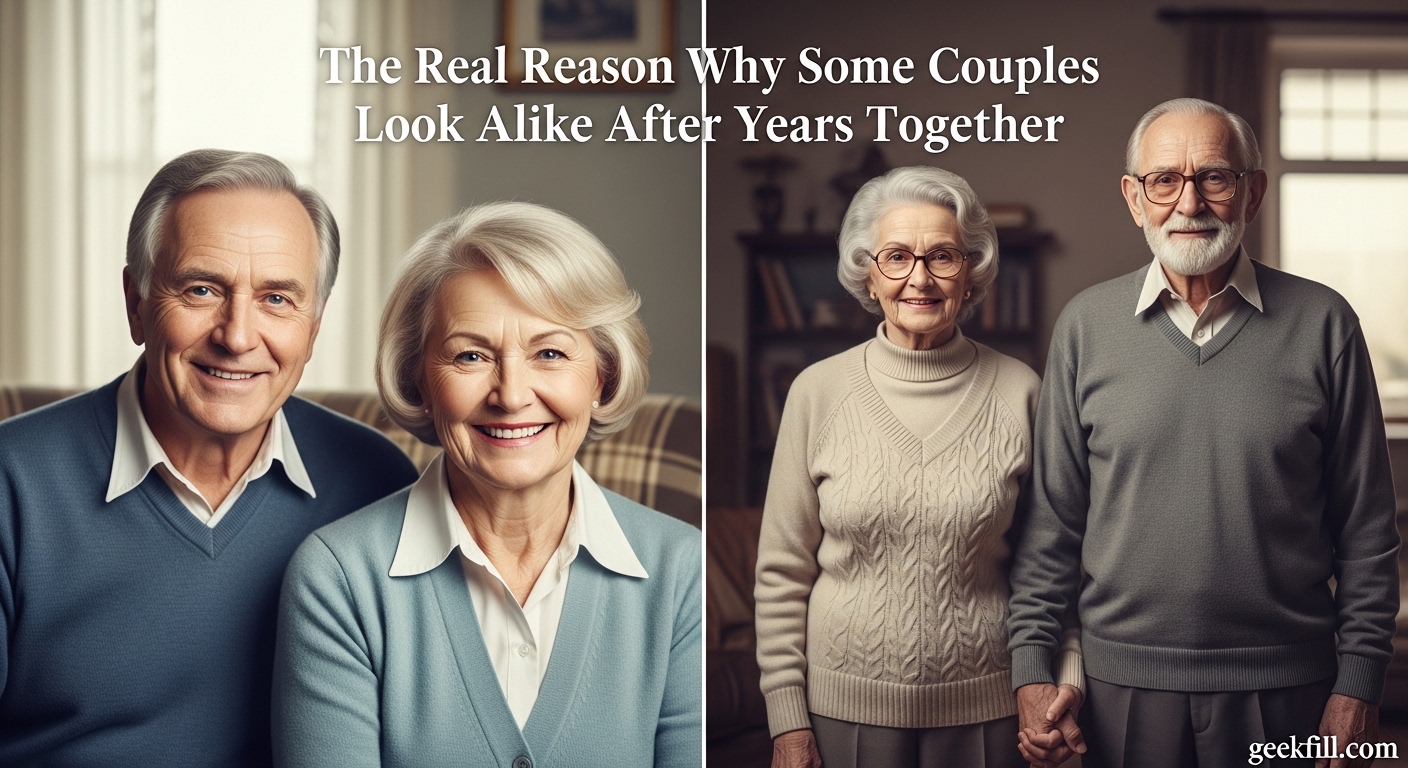
Have you ever been stopped by a stranger asking if you and your partner are siblings? You’re not alone. I’ve heard this question countless times over my 12-year relationship. At first, it felt insulting. Then it became an inside joke. Now I understand the science behind it.
Why do couples look alike after years together? The short answer is that couples look alike due to a combination of subconscious attraction patterns and shared life experiences. Research shows that partners are more genetically similar than random strangers from the start. They also share environments, diets, and decades of mirroring each other’s facial expressions.
Here’s what you’ll discover in this article:
- The fascinating history of the 1987 study that started this conversation
- Five proven reasons why couples develop similar appearances
- Whether couples actually grow more alike over time (the answer may surprise you)
- Whether lookalike couples have better relationships
- Answers to common questions from people experiencing this phenomenon
Table of Contents
The Science Behind Why Couples Look Alike
The idea that couples grow to look alike has fascinated scientists for decades. It all started with a groundbreaking 1987 study by psychologist Robert Zajonc at the University of Michigan. Zajonc analyzed photographs of married couples taken at various points in their relationship. His conclusion? Couples who had been married for 25 years looked more similar than newlyweds.
Zajonc proposed that years of sharing emotions led to similar wrinkle patterns and expressions. The theory made intuitive sense. We mimic our partners’ facial expressions constantly. Over decades, those repeated muscle movements should etch similar lines into our faces.
But here’s where it gets interesting. In 2020, researchers at Stanford University decided to test this theory using modern technology. They analyzed over 500 photos of couples taken at the beginning and end of their relationships. Their conclusion? Couples do not actually grow to look more alike over time.
Dr. Michal Kosinski, who led the Stanford study, explained that what Zajonc observed was likely an illusion. Older couples simply looked more similar because they were both aging. The aging process creates universal changes like wrinkles and gray hair. These changes make everyone look more similar, not just couples.
The current scientific consensus is more nuanced. Couples don’t converge in appearance over time. Instead, they start out more similar than random pairs. The real mystery is why we choose partners who already look like us.
Why Do Couples Look Alike After Years Together: 5 Key Reasons
Reason 1: Assortative Mating and Initial Attraction
The primary reason couples look alike is something called assortative mating. This is the tendency to choose partners who are similar to ourselves in various traits. Height, education, socioeconomic background, and yes, facial features.
A 2017 study published in PLOS Genetics analyzed the genomes of 825 non-Hispanic white American couples. The researchers found that married couples were significantly more genetically similar than randomly selected pairs. They shared genetic predictors for traits like height and even educational attainment.
This isn’t a conscious decision. Nobody goes on a first date thinking, “I hope they have similar genetic markers to me.” The similarity happens at a subconscious level. We’re drawn to people who feel familiar and comfortable.
The genetic similarity between spouses is estimated to be equivalent to that of fourth cousins. That’s a remarkably close genetic relationship for people with no known family connection. Our genes may be nudging us toward certain faces before our conscious minds get involved.
Reason 2: Sexual Imprinting and Parental Resemblance
Here’s a slightly uncomfortable truth. Research suggests we’re often attracted to partners who resemble our opposite-sex parent. This phenomenon is called sexual imprinting.
The theory comes from animal studies. Young animals form a template of what a suitable mate looks like based on their parents. This helps them choose genetically compatible partners while avoiding close relatives. Humans appear to follow similar patterns.
A 2003 study published in Evolution and Human Behavior found evidence for this effect. Researchers showed participants photos of their partners alongside photos of their parents. Participants were able to match their partner to their opposite-sex parent more accurately than chance would predict.
This doesn’t mean everyone marries someone who looks exactly like their mother or father. The resemblance is usually subtle. It might be a similar jawline, eye shape, or smile. But these small similarities add up when both partners show parental resemblance.
Our childhood experiences shape our attraction patterns in ways we don’t fully understand. The parent we bonded with becomes an unconscious template for future partners.
Reason 3: Implicit Egotism and Self-Resemblance
One of the strangest findings in relationship psychology is that we’re attracted to faces that resemble our own. This phenomenon is called implicit egotism. We unconsciously favor things connected to ourselves, including similar-looking faces.
In a fascinating 2010 study, researchers created digital morphs of participants’ faces blended with strangers’ faces. Participants rated these self-based morphs as more attractive than pure stranger faces. The effect was subtle but statistically significant.
The researchers proposed that we find self-resembling faces comforting and trustworthy. We’ve spent our entire lives looking at our own reflection. A face that shares our features triggers positive associations automatically.
This creates a fascinating scenario. If I’m attracted to someone who looks like me, and my partner is attracted to someone who looks like them, we end up with two people who look similar to each other. Both of us are seeking self-resemblance, which produces mutual resemblance.
This also explains why couples often don’t notice their own similarity. They’re not attracted to similarity per se. They’re each attracted to self-resemblance, which happens to create mutual similarity.
Reason 4: Shared Environment and Lifestyle Factors
Even if couples start with different appearances, their shared environment works to make them more alike. Couples who live together develop remarkably similar habits over time.
Diet is a major factor. Partners eat the same meals, shop at the same grocery stores, and develop shared food preferences. If one partner starts a health kick, the other often follows. If one develops a sweet tooth, tempting treats appear in the house for both.
A 2016 study in the journal Social Science and Medicine found that couples’ body mass indexes become more correlated over time. Partners influence each other’s eating patterns, exercise habits, and health behaviors. These changes affect weight, body composition, and overall appearance.
Sun exposure is another factor. Couples who vacation together, garden together, or spend time outdoors together receive similar amounts of UV radiation. This leads to matching tans, sun damage patterns, and skin aging.
Even stress levels synchronize. When one partner experiences chronic stress, the other often develops similar stress patterns. Stress affects sleep quality, skin condition, weight distribution, and facial tension. Over years, these shared stress responses create physical similarities.
Reason 5: Empathic Mimicry and Shared Expressions
Humans are natural mimics. We unconsciously mirror the body language, speech patterns, and facial expressions of people we spend time with. This empathic mimicry builds rapport and emotional connection.
Couples who have been together for years have mimicked each other’s expressions thousands of times. When she laughs at a joke, he laughs too, using the same facial muscles. When he’s worried, she mirrors his furrowed brow. These micro-moments add up over decades.
Research published in the journal Emotion found that long-term partners develop synchronized emotional responses. When shown the same stimuli, experienced couples showed similar facial muscle movements measured by electromyography. Their faces were literally moving in unison.
The cumulative effect of these shared expressions may influence facial structure. While the Stanford study debunked major convergence, some researchers believe subtle changes still occur. Repeated muscle use strengthens certain facial muscles. Over decades, couples who smile together may develop similar smile lines.
Beyond faces, couples adopt similar postures, walking styles, and gestures. These body language similarities contribute to the overall impression of physical resemblance. When two people move through the world the same way, they look more alike.
Do Couples Actually Grow to Look More Alike Over Time?
This is where we need to separate myth from reality. The popular belief that couples grow to look alike over time is mostly false. The 2020 Stanford study put this theory to rest using advanced facial recognition technology.
Researchers analyzed 517 couples, comparing photos taken at the beginning of their relationships to photos taken years later. The couples had been together anywhere from 20 to 69 years. Using machine learning algorithms to analyze facial features, the researchers found no evidence of convergence.
The study was remarkably thorough. They used two different facial analysis techniques to measure similarity. Neither method showed couples becoming more alike over time. The correlation between initial similarity and later similarity remained constant.
Dr. Kosinski explained that our perception of older couples looking alike is an illusion. Aging creates universal changes. Wrinkles, gray hair, and changes in skin elasticity affect everyone. When two people both undergo these universal aging changes, they appear more similar to each other by default.
The 1987 Zajonc study was groundbreaking for its time. But it relied on human observers rating similarity. Human judgment is susceptible to bias. The Stanford study used objective computational analysis, providing more reliable results.
This doesn’t mean shared environment has zero effect. It just means the effect is much smaller than previously believed. The dominant factor in couple similarity is the initial selection of a similar-looking partner.
Do Lookalike Couples Stay Together Longer?
A natural follow-up question is whether looking alike predicts relationship success. Do couples who resemble each other have happier, longer-lasting relationships?
The research here is mixed and fascinating. Some studies suggest similarity is beneficial. The more partners resemble each other in values, personality, and appearance, the more comfortable they feel. Shared experiences and mutual understanding come more easily.
However, a 2008 study in the journal Personal Relationships found a counterintuitive result. Couples who were too similar in personality reported lower relationship satisfaction. Some differences create interest and complementarity.
Regarding physical similarity specifically, the evidence is limited. A few small studies have examined this question directly. One study found that couples who resembled each other reported slightly higher relationship quality. But the effect size was small.
Physical similarity may be more of a side effect than a cause. The same factors that make us choose similar-looking partners (genetic compatibility, shared background, similar environments) also predict relationship stability. The similarity itself may not be the active ingredient.
Dr. Justin Lehmiller of the Kinsey Institute suggests that the correlation between similarity and relationship success is overstated. What matters more is how couples handle differences, not how many similarities they share.
The bottom line? Looking alike won’t save a troubled relationship. And looking different won’t doom a healthy one. Similarity is fascinating psychologically, but it’s not destiny.
FAQs
Why do long-term couples start to look alike?
Long-term couples appear to look alike due to a combination of subconscious attraction to similar features (assortative mating), shared environments and lifestyles, and empathic mimicry of each other’s expressions. However, recent research shows that couples don’t actually grow more alike over time. They start out more similar than random pairs, and this initial similarity becomes more noticeable as they age.
Why do couples eventually look alike?
The appearance of growing alike is largely an illusion of aging. As couples age together, they both undergo universal changes like wrinkles and gray hair. These aging patterns make everyone look more similar. Additionally, shared diets, sun exposure, stress levels, and decades of mimicking each other’s expressions contribute to perceived similarity.
Do couples who look alike stay together longer?
Research on this question is mixed. Some studies show slight correlations between similarity and relationship satisfaction. However, the effect is small. Physical similarity is likely a side effect of shared backgrounds and environments rather than a cause of relationship success. Relationship quality depends more on communication and compatibility than on appearance.
Is it normal for couples to look like siblings?
Yes, it’s completely normal. Studies show that couples are often as genetically similar as fourth cousins. This genetic similarity, combined with assortative mating (choosing partners who look like us), creates the sibling-like resemblance many couples experience. It’s a common phenomenon with no negative implications for the relationship.
What is the 2 2 2 rule for couples?
The 2 2 2 rule is a relationship guideline suggesting couples should go on a date every two weeks, spend a weekend away every two months, and take a week-long vacation every two years. This rule helps maintain relationship quality by ensuring regular quality time together.
What is the 7 7 7 rule for couples?
The 7 7 7 rule suggests that couples should try something new every 7 days, have a proper date every 7 weeks, and take a vacation together every 7 months. These rules are designed to keep relationships fresh and prioritize connection amid busy schedules.
Conclusion: Why Do Couples Look Alike After Years Together
So why do couples look alike after years together? The answer combines psychology, biology, and a touch of optical illusion. Couples look alike because they start out more similar than random pairs, not because they grow to resemble each other.
The five key reasons are assortative mating (subconscious attraction to similar features), sexual imprinting (attraction to parent-like traits), implicit egotism (attraction to self-resembling faces), shared environments and lifestyles, and empathic mimicry of expressions. These factors work together before and during the relationship.
If you’ve been told you look like your partner, rest assured this is completely normal. The genetic similarity between spouses is equivalent to that of fourth cousins. Your subconscious knew what it was doing when it selected someone who feels familiar.
The phenomenon isn’t about narcissism or anything problematic. It’s about the deep biological and psychological mechanisms that guide human attraction. Understanding these mechanisms helps us appreciate the complexity of love and partnership. If people mistake you for siblings, just smile and tell them you have excellent taste in both partners and family.