
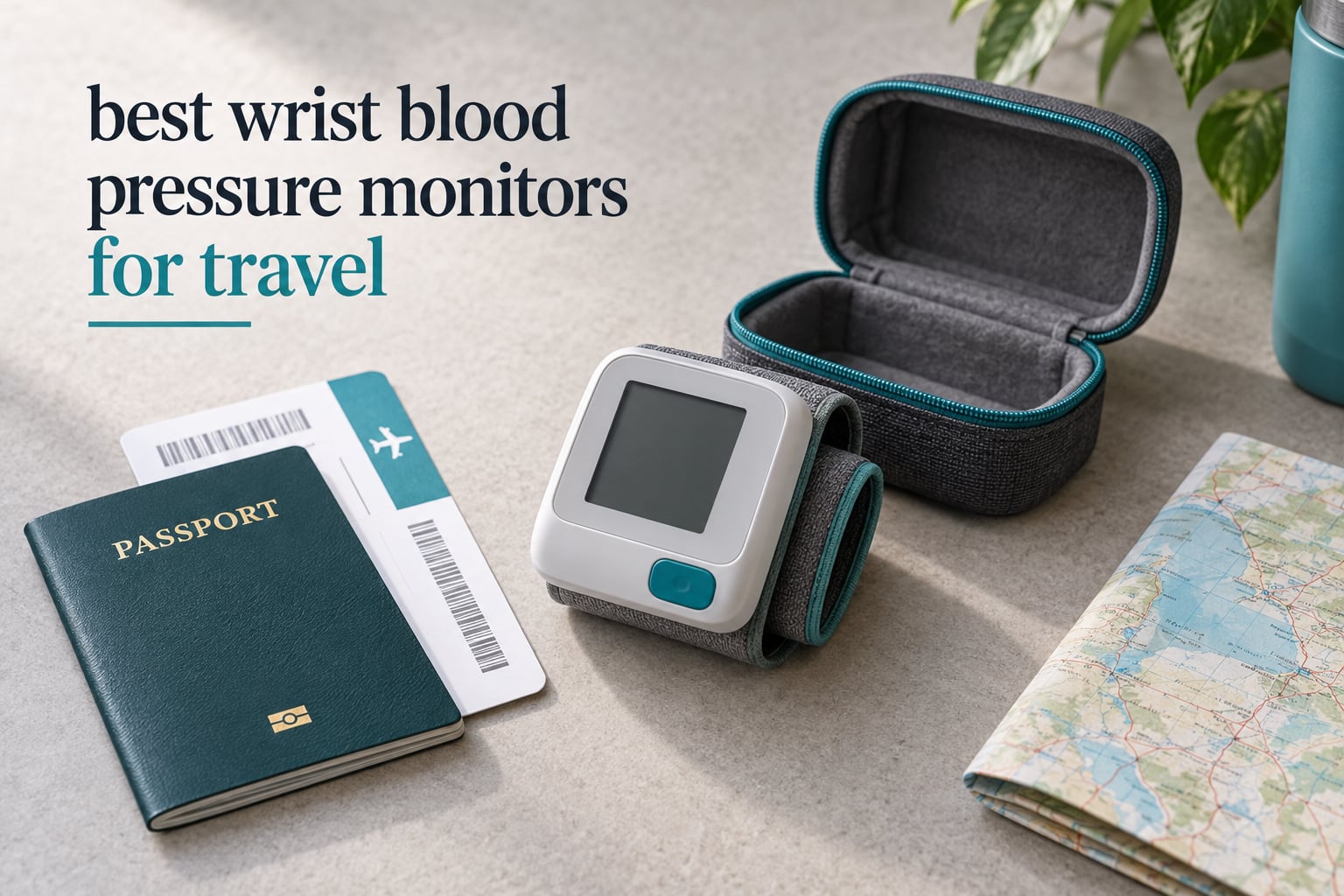
The best wrist blood pressure monitor for travel is the Oklar W1101L, a rechargeable unit that measures in about 35 seconds, stores 240 readings for two users, and weighs 3.59 ounces. Blood pressure moves while you travel, and a wrist monitor is the only type small enough to check in a carry-on, a road trip, or a cruise cabin.
That matters more than it sounds. Dehydration, jet lag, salt-heavy airline food, stress, and cabin altitude all push readings upward, and if you take blood pressure medication you need a way to know whether it is still doing its job between appointments. An upper arm monitor is more accurate, but it is also bulky and position-sensitive in a way that makes it miserable to use mid-journey.
We compared ten wrist monitors across power source, cuff range, memory, and pack size, and we read the technical specifications and review patterns for each. We also worked through the parts nobody mentions: how to hold the cuff, what to do with a reading that looks wrong at 30,000 feet, and how to check any of these devices against a clinic reading before you trust it.
If you are building a home setup instead, our guide to the best blood pressure monitors for home use covers the upper arm options in more depth. Everything below is organized around the trip.
A quick word on limits. These are home monitors, not diagnostic devices. Do not change or stop any medication based on a reading from this article, and talk to your clinician about what your numbers should mean for you.
Top 3 Picks for Travel in 2026

Oklar Wrist BP Monitor
- Rechargeable Type-C power
- 240 reading dual-user memory
- Voice broadcast
- 4.92-8.46 inch cuff

Omron Gold Wireless Wrist
- Bluetooth app sync
- 200 readings per user
- Morning average indicator
- 5.3-8.5 inch cuff

MBUPAI Rechargeable Wrist Monitor
- USB rechargeable
- 180 readings for 2 users
- Voice readout
- Hard storage case
All 10 Best Wrist Blood Pressure Monitors for Travel Compared in 2026
Every pick below appears in the table, the full write-up, and the short list of who each one suits. Battery type and cuff range matter more on a trip than they do at home, so those are the two columns worth reading first.
| Product | Specifications | Action |
|---|---|---|
| Oklar Rechargeable Wrist Monitor |
|
Check Latest Price |
 Paramed Wrist Monitor with Carrying Case Paramed Wrist Monitor with Carrying Case |
|
Check Latest Price |
| Omron Gold Wireless Wrist Monitor |
|
Check Latest Price |
| MBUPAI Rechargeable Wrist Monitor |
|
Check Latest Price |
 Homedics Wrist Monitor with Storage Case Homedics Wrist Monitor with Storage Case |
|
Check Latest Price |
 Omron 7 Series Wireless Wrist Monitor Omron 7 Series Wireless Wrist Monitor |
|
Check Latest Price |
 Scian Wrist Monitor with 180 Reading Memory Scian Wrist Monitor with 180 Reading Memory |
|
Check Latest Price |
 HealthSmart Premium Wrist Monitor HealthSmart Premium Wrist Monitor |
|
Check Latest Price |
 Beurer Bluetooth Smart Wrist Monitor Beurer Bluetooth Smart Wrist Monitor |
|
Check Latest Price |
 LotFancy Wrist Monitor with Carrying Case LotFancy Wrist Monitor with Carrying Case |
|
Check Latest Price |
1. Oklar Wrist BP Monitor: Rechargeable, Two Users, Voice Readout
Oklar Wrist Blood Pressure Monitor, FDA Cleared Rechargeable BP Machine
Rechargeable Type-C
240 readings for 2 users
4.92-8.46 inch cuff
3.59 oz
Pros
- Built-in rechargeable battery with USB Type-C charging
- Large LED backlit display readable in low light
- Voice broadcast so you hear results without reading the screen
- Dual user memory of up to 240 readings
- Compact 3 inch footprint with an adjustable cuff
Cons
- Charging adapter not included in the package
- About 1 in 10 reviews is a 1-star rating
- Readings depend on holding the wrist at heart level
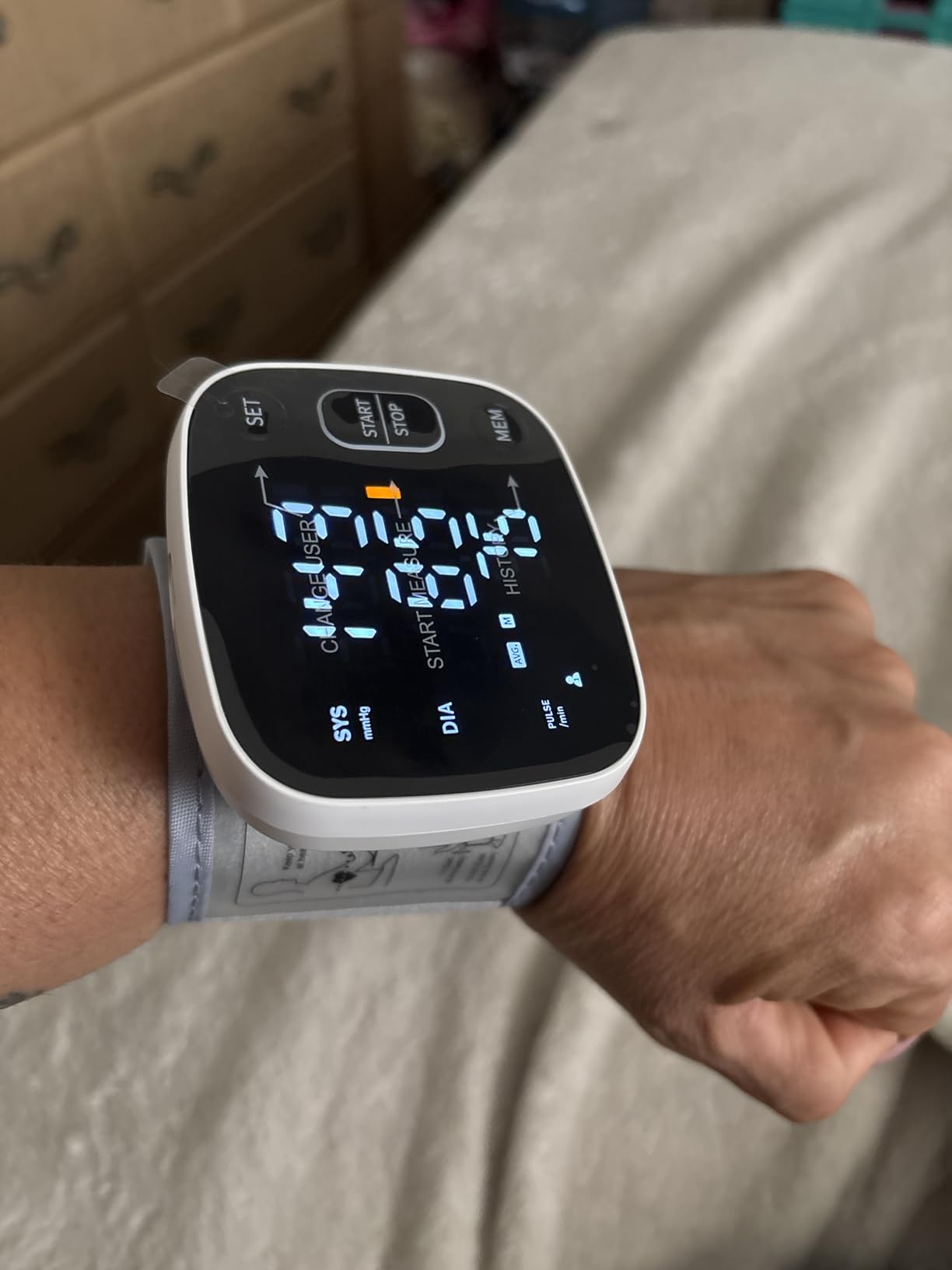
The Oklar is the one I keep in my bag. It runs about 35 seconds from button press to number, weighs 3.59 ounces, and measures 3.03 by 2.55 by 2.63 inches, which means it disappears into a jacket pocket or the side pocket of a small bag. The rechargeable lithium cell is the real travel feature: no hunting for batteries in an airport shop at 11pm.
The counterweight to the rechargeable design is that no charging adapter ships in the box. A USB Type-C cable is included, so a laptop or power bank handles it, and the manufacturer lists a 2-3 hour style turnaround on comparable units.
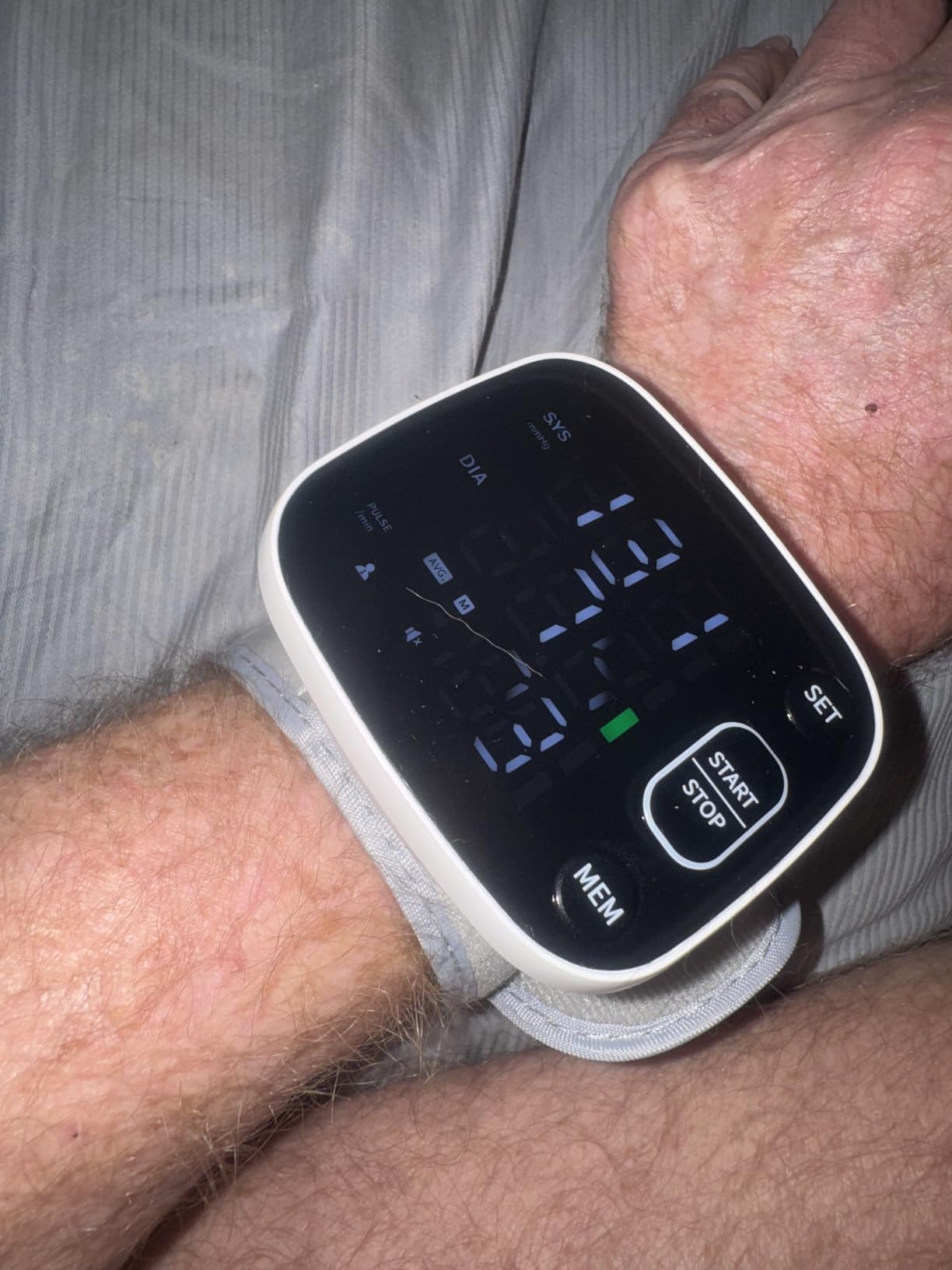
Storage is unusually generous. Dual user mode holds up to 240 readings, so two people traveling together can each keep a separate log on one device, which is far more than most wrist monitors in this set offer. The cuff adjusts from 4.92 to 8.46 inches, one of the wider ranges here, so it fits a broad spread of wrist sizes.
Two display features earn their place on the road. The LED backlight is bright enough to read in a dark cabin or a night bus, and the voice broadcast reads results aloud with adjustable volume, which is useful if your eyes are not what they were ten years ago. The device also powers itself off after 60 seconds of inactivity, so a forgotten reading in a hotel room will not flatten the battery before you wake up.
What to check before you pack it
Charge it fully the night before you fly and again the night before you land. A full charge gives you far more checks than a single trip needs, and the Type-C port means any modern cable in your bag will work. Download nothing, set up nothing: there is no app to pair, which on a roaming connection abroad is an advantage rather than a limitation.
Measure your wrist circumference with a tape measure or a strip of paper before you travel and compare it against the 4.92-8.46 inch range. If you sit near the top of that range, the cuff fits snugly. If you are well under it, a loose cuff is the most common source of a falsely high wrist reading.
Where it falls short
About 1 in 10 of its 32k+ reviews is a 1-star rating, which is the highest single-star share of the best-reviewed units here. Reviewers who rate it that way tend to point at reliability and consistency rather than the feature set, so if you are the type who will panic over a single odd number, take two readings and write down both.
Accuracy is the other limitation, and it is not unique to this device but worth stating plainly. Wrist monitors measure at the radial artery, closer to the heart in the arterial tree than the brachial artery in the upper arm, so the result is only trustworthy when the cuff sits at heart level. Hold the wrist up while the 35-second cycle runs and this unit is a genuinely useful travel companion.
2. Paramed Wrist Monitor: The Kit That Comes With a Case
PARAMED Automatic Wrist Blood Pressure Monitor: Blood-Pressure Kit of Bp Cuff + 2AAA and Carrying case – Irregular Heartbeat Detector & 90 Readings Memory Function & Large Display
Carrying case included
90 reading memory
5.3-7.6 inch cuff
8 oz
Pros
- Durable carrying case included in the box
- Two AAA batteries included so it works immediately
- Large LCD display readable across a range of lighting
- 90 reading memory function
- Irregular heartbeat detection
Cons
- Cuff range of 5.3-7.6 inches is narrower than most competitors here
- Runs on disposable AAA batteries rather than a rechargeable cell
- Readings are sensitive to wrist height and stillness
The Paramed is sold as a kit, and that framing is the point. You get the monitor, two AAA batteries, a manual, a quick start guide, and a durable carrying case, all in one box. For travel, a case is not a luxury. It is the difference between a monitor that survives a trip and one that ends up scratched in a seat pocket.
With 25k+ reviews averaging 4.2 stars, this is one of the most proven designs in the category, and the consistency of the review pattern is telling. People buy it, it works, and the most common remark is that they keep using it.
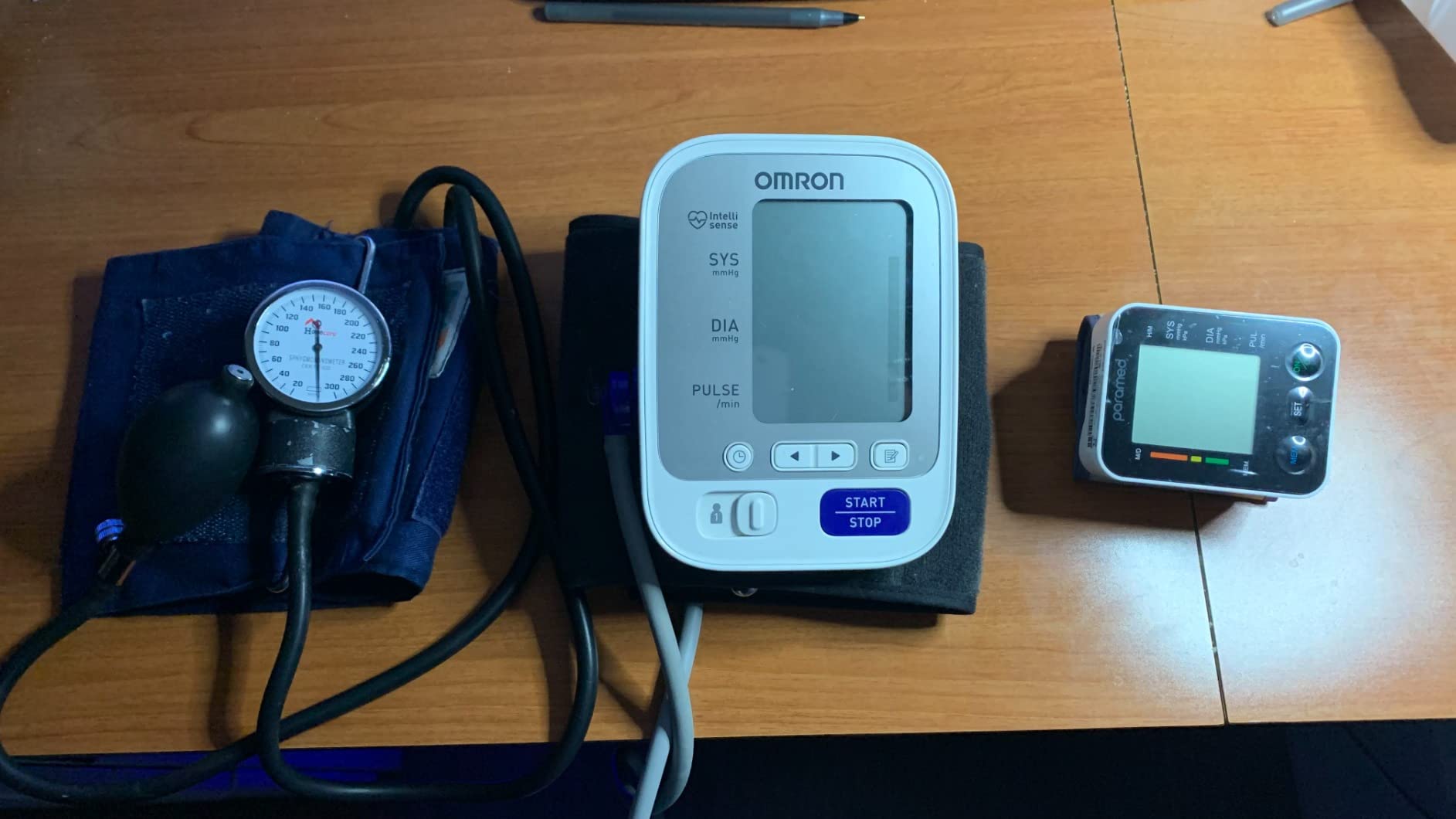
Irregular heartbeat detection runs during the measurement cycle and flags an uneven pulse pattern, which is a useful thing to have when a reading lands in a strange hotel and you want to know whether the number or the rhythm is the anomaly. The 90-reading memory function stores results with no user separation, so the log is single-person even though the box looks generous.
The cuff is universal from 5.3 to 7.6 inches. That is the narrowest upper limit among the mid-priced units here, and it is the first thing to check if you have a broad wrist. A cuff that is too small is a reliable way to generate a reading that is higher than your true pressure.

What to check before you pack it
Measure your wrist and confirm you fall inside 5.3 to 7.6 inches. If you are near 7.6 or above, this is not the right cuff and no amount of technique will fix the fit. Two AAA batteries are included, but buy a spare pair because disposable cells are the one consumable you cannot recharge on the road.
The manufacturer guidance is worth following: sit with your back supported, and wait two minutes between readings. Two minutes is a long time in an airport gate area, and in practice the second reading usually tells you more than the first.
Where it falls short
Disposable AAA batteries are a genuine friction point for a long or international trip. If you are crossing time zones with a tight connection schedule, a rechargeable unit removes one variable you cannot solve mid-transit.
Positioning remains the weak point. Reviewers consistently stress that the arm must be at heart level and the body still during the cycle, and the instruction text reinforces it. It is not a flaw unique to this model, but it does mean this is a monitor for someone willing to sit still for a full minute, rather than a glance-and-go device.
3. Omron Gold Wireless Wrist Monitor: The App and Memory Champion
OMRON Gold Wireless Wrist Blood Pressure Monitor for Home Use
Bluetooth app sync
200 readings per user
5.3-8.5 inch cuff
3.17 oz
Pros
- Clinically oriented brand trusted by doctors and pharmacists
- Bluetooth sync to the OMRON connect app with unlimited storage
- High Morning Average indicator surfaces a meaningful trend
- Irregular Heart Beat Detection during routine measurements
- Slim 3.17 ounce profile with attached cuff and case
Cons
- Most expensive pick in this roundup
- 200 readings per user still need manual deletion as they fill
- About 11% of reviews are 1-star with a portion citing Bluetooth pairing difficulty
If you want your travel readings to land somewhere you can actually see later, the Omron Gold is the pick. It stores up to 200 readings for each of two users, then syncs over Bluetooth to the free OMRON connect app, which pushes into Apple Health and Google Fit with no manual logging step. On a three-week trip with 30 or 40 checks, that difference between a device memory and a phone database is significant.
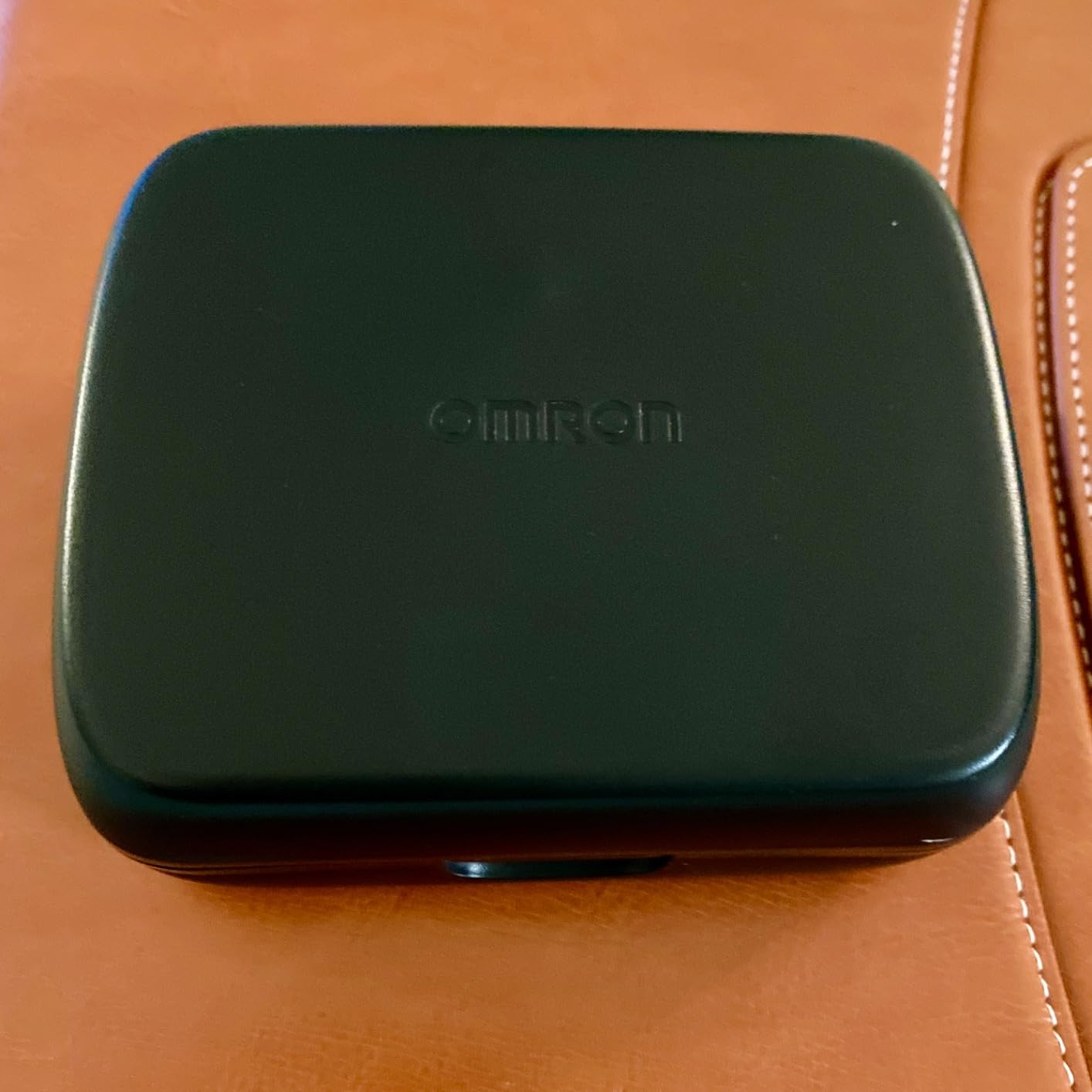
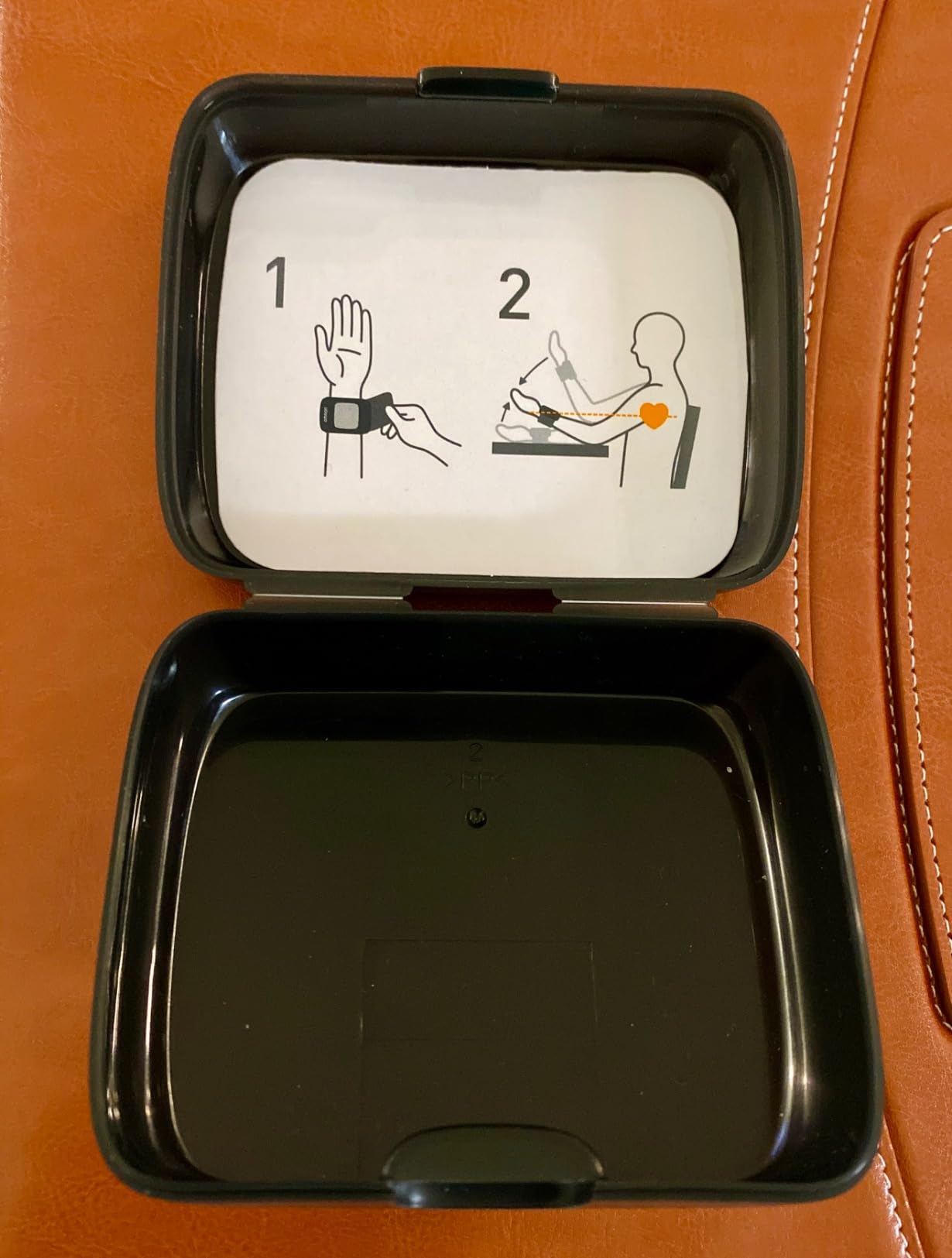
It is also one of the smallest here at 3.17 ounces and 3.58 by 0.52 by 2.49 inches, a genuinely flat profile that slides into a laptop sleeve. The attached cuff fits wrists from 5.3 to 8.5 inches, and a storage case, manual, quick start guide, and two AAA batteries are in the box.
The High Morning Average Indicator is the feature I would keep even without the app. It flags morning readings that run higher than the rest of your day, which is one of the patterns clinicians ask patients to track. Irregular Heart Beat Detection runs during normal measurements rather than as a special mode, so it costs you nothing extra.
Two-user support with 200 readings each is the deepest onboard storage in this group. A shared device between two travelers works properly, with separate logs, which solves a problem most couples hit when they try to share one monitor.
What to check before you pack it
Pair the Bluetooth connection at home before you leave, not at the gate. Pairing difficulty is the single most reported complaint in the 1-star reviews, and it is almost always a first-setup problem rather than a permanent failure. Set up the app, sync a few readings, and confirm the phone is receiving them.
On an international trip, open the app once on hotel wifi and export or confirm your history is visible. Once the readings are synced to your phone, the data is no longer dependent on the device or a local connection.
Where it falls short
This is the most expensive unit in the roundup by a wide margin, and the premium buys data features rather than raw measurement accuracy. If you are a single traveler with a good paper habit, you are paying for storage and an ecosystem you may not open twice.
About 11% of its 13k+ reviews are 1-star, with a portion naming Bluetooth pairing problems, and the 200-reading limit per user means you will be deleting old entries as the trip goes on. The app is where the value lives, so if you dislike phone apps, this is the wrong device.
4. MBUPAI Rechargeable Wrist Monitor: Hard Case, USB Power, Wide Cuff
MBUPAI FDA Cleared Blood Pressure Monitor Wrist BP Machine for Home Use
USB rechargeable
180 readings for 2 users
5.3-7.7 inch cuff
Hard case
Pros
- Rechargeable via USB from a power bank where outlets are scarce
- Hard storage case doubles as a charging dock
- One button operation with a reading in under one minute
- Large LCD plus voice readout suits low vision
- 5.3-7.7 inch cuff is wider than most budget models
Cons
- Reviewers report readings running 5-10 points higher than upper arm cuffs
- Some users report the battery drains faster than earlier production units
- The side ON/OFF switch resets date and time if the unit is switched off
The MBUPAI is the one I would hand to a friend who flies twice a month and does not want to think about batteries. It is USB rechargeable with a 2-3 hour charge time from a notebook or a power bank, and the storage box doubles as a charging dock so the unit and the cable live together in the same object.
At 4.3 stars from 8k+ reviews, it carries the highest average rating among the units here with thousands of reviews behind them. The cuff runs 5.3 to 7.7 inches, wider than the Paramed next to it, and the box includes the monitor, a USB charging cord, a storage case, and an instruction manual.
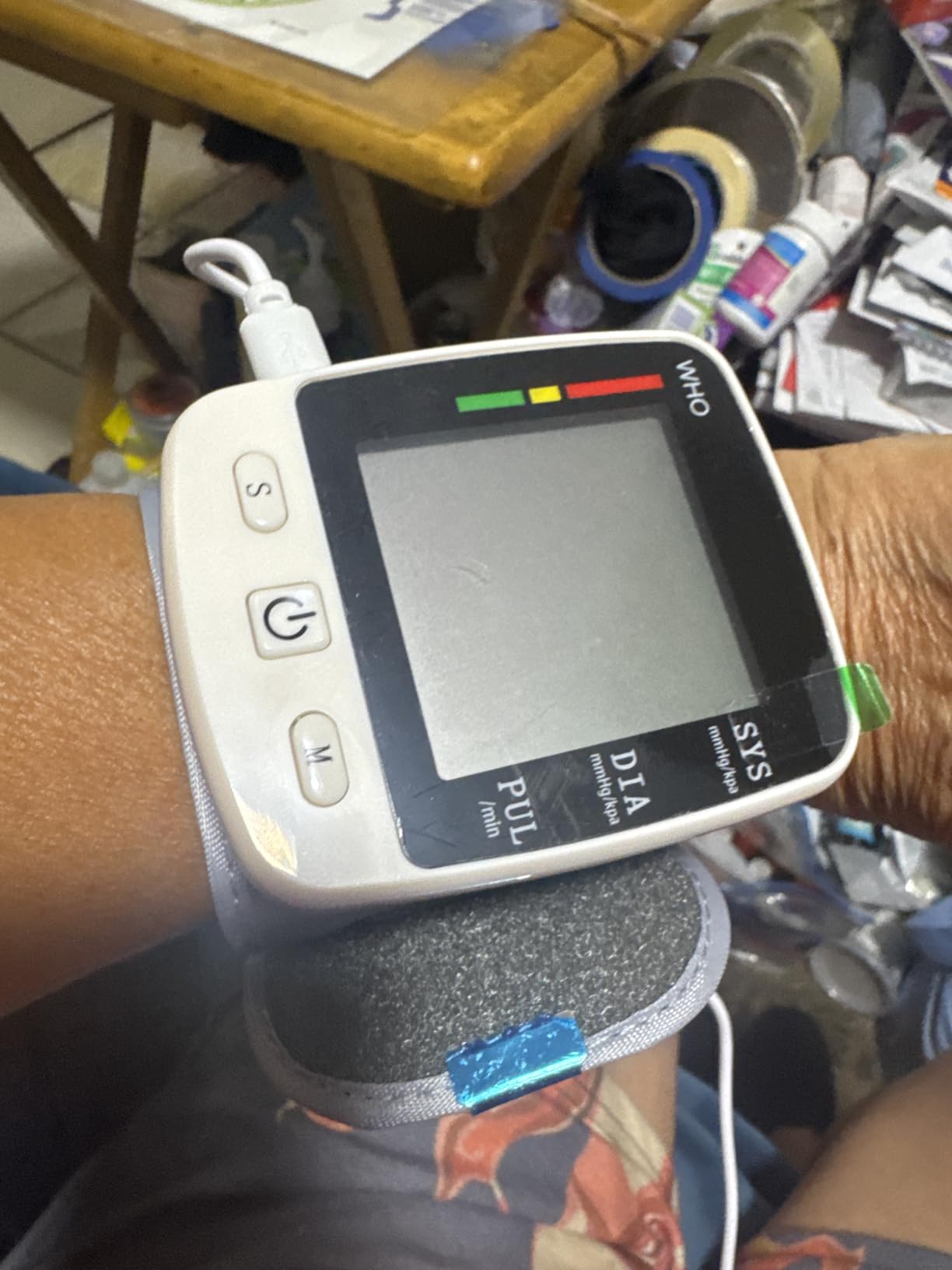
Operation is one button. Sit with your palm up, press once, and the reading appears in under a minute. A large LCD shows the numbers and a spoken readout announces systolic, diastolic, and heart rate, which covers the same low-vision use case as the LotFancy further down but with rechargeable power behind it.
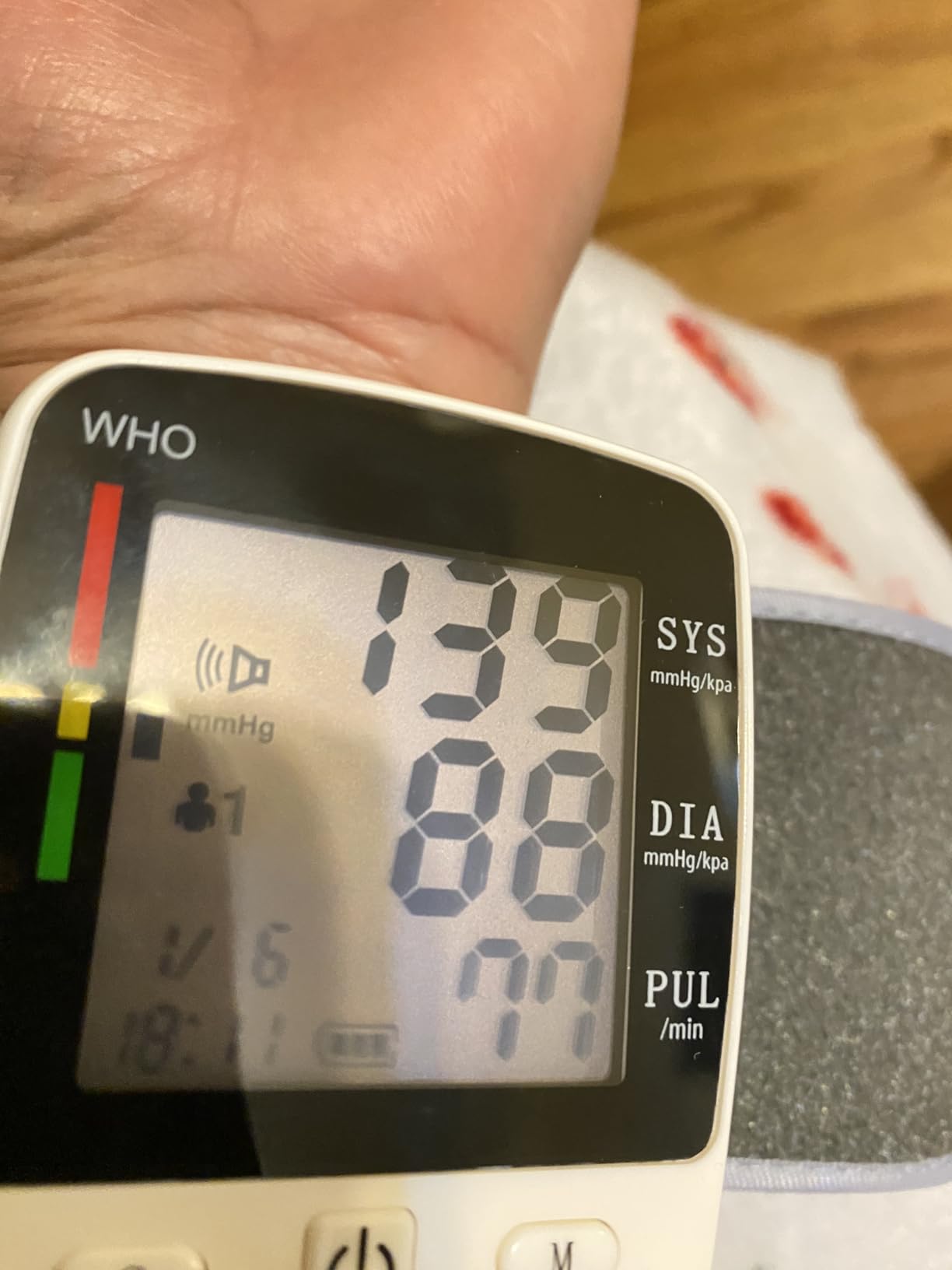
Dual user support stores 90 readings for each of two people, 180 in total, with a hypertension indicator on the display to flag elevated results. A palm-up wearing position is the recommended one, and staying in that position through the cycle is what keeps the number honest.
What to check before you pack it
Never switch the unit off with the side ON/OFF switch mid-trip. Reviewers report that the date and time reset when it is left off, which quietly breaks the timestamp on any reading you take later. Charge with the cable and use the buttons for everything else.
Bring a power bank anyway. A top-up from a laptop is convenient when you have one and impossible when you do not, and this is the only unit here that will accept a charge mid-transit from something other than a wall socket.
Where it falls short
Several reviewers compare it against upper arm monitors and report readings 5 to 10 points higher. That is inside the normal spread for wrist devices measured against a brachial cuff, but it means you should compare trends on this device rather than treat any single number as a clinic measurement.
A handful of users also report the battery draining faster than on earlier production runs of the same model. Top it up whenever you get back to a room with an outlet and you will not have to think about it.
5. Homedics Wrist Monitor: Warranty-Backed and Built for Two
Homedics Blood Pressure Monitor, Automated Wrist Blood Pressure Machine for Home use with Easy One-Touch Operations. Stores up to 120 Readings (60 Readings per 2 Users). Cuff and Storage Case Included
120 readings for 2 users
3-reading averages
5 year warranty
9.59 oz
Pros
- Backed by a 5 year warranty from an established wellness brand
- Irregular heartbeat and excessive motion detection reduce bad readings
- Memory button shows the average of the last three readings
- Storage case and batteries included so it is travel ready
- On-wrist position arrows help first-time users align the cuff
Cons
- No backlight so readings are hard to see in a dark hotel room
- Irregular heartbeat symbol is small and easy to miss
- Several reviewers report the unit aborting mid-measurement and needing retries
- A number of 1-star reviews report units failing within weeks or months
The Homedics is the one I would buy with a five-year horizon in mind. It is the only unit in this group with a stated 5-year warranty attached, and that matters if you are buying one monitor to travel with for years rather than one trip.
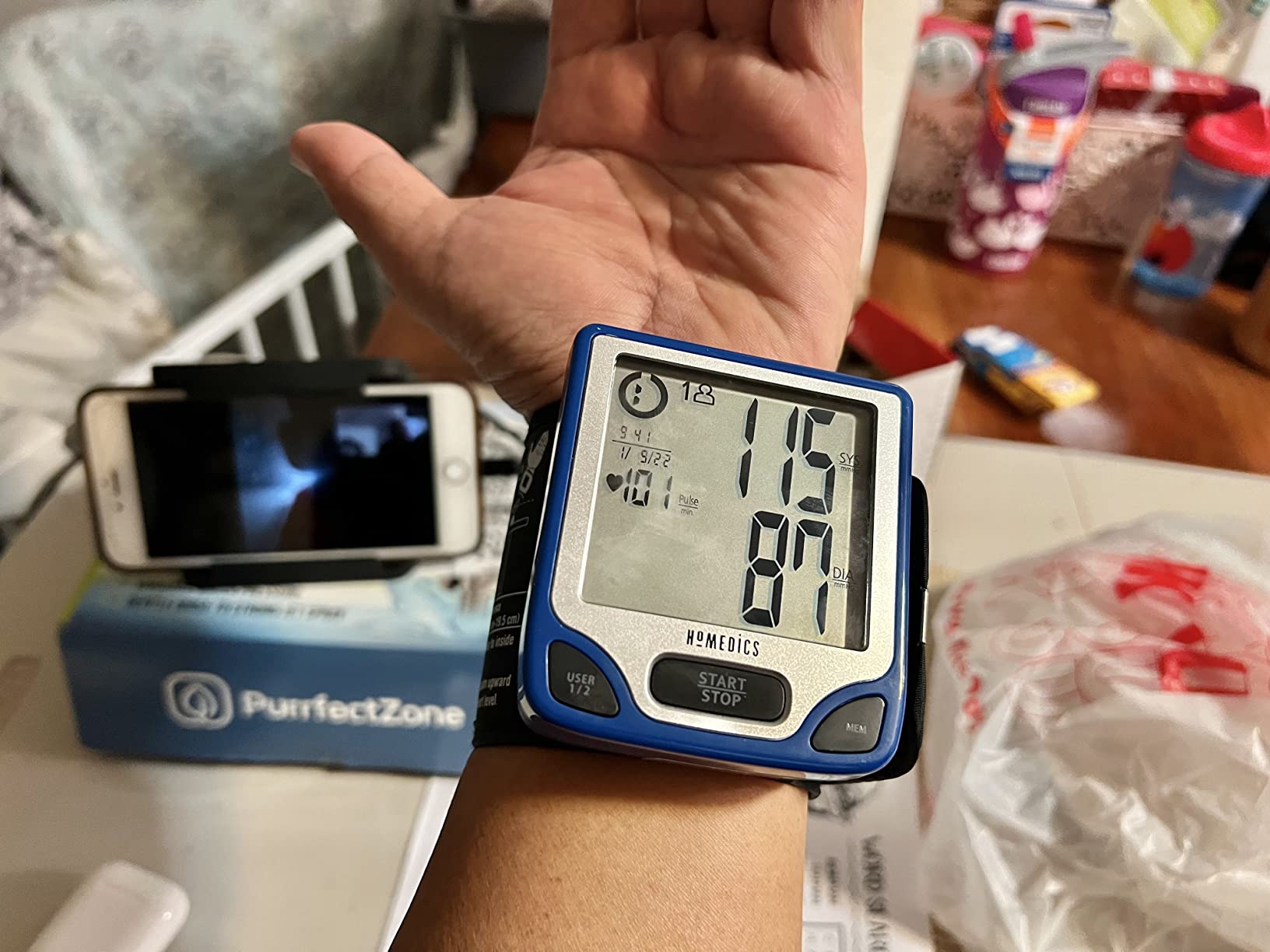
Smart Measure Technology inflates and deflates the cuff automatically to the appropriate level, so there is no pumping and no guessing at an inflation ceiling. One-touch operation with an attached wrist cuff, a storage case, and two AAA 1.5V batteries are all in the box, at 9.59 ounces and 3.07 by 2.72 by 1.12 inches.
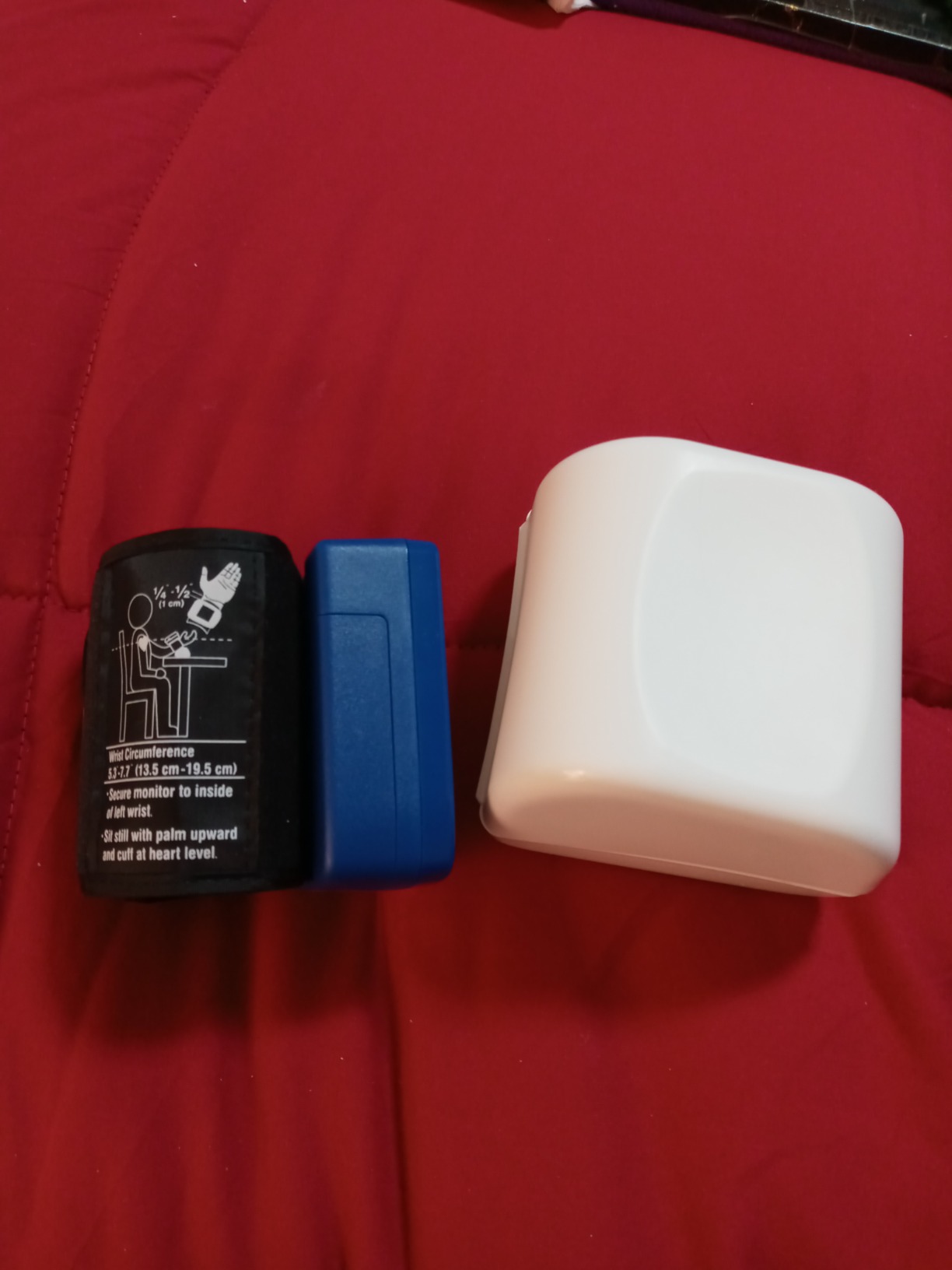
Memory holds 120 readings, 60 for each of two users, and the memory button shows the average of the last three readings. That three-reading average is the most useful single function on this device for travel use, because a single reading in a strange place tells you almost nothing while a three-point average tells you whether you are actually elevated.
Two detection features work together. Irregular heartbeat detection flags an uneven pulse, and excessive body motion detection tells you the reading was compromised by movement rather than by your pressure. A risk category index gives an at-a-glance band, and wrist placement guiding arrows printed on the device help first-time users line the cuff up at heart level.
What to check before you pack it
Bring a small light for nighttime use. The display has no backlight, and dim cabin lighting on an overnight flight is exactly the situation where you will want to read a number. The risk category index and the irregular heartbeat symbol are small, so a phone flashlight is genuinely useful.
Note the motion detection behavior before you worry about a bad result. When it flags motion, the reading is not wrong, it is invalid, and repeating the measurement seated and still is the correct response rather than recording the number.
Where it falls short
Durability is the recurring complaint. A number of 1-star reviews across its 6k+ report devices failing within weeks or months, and several others describe the device aborting mid-measurement and requiring a retry. The warranty is the reason I would still consider it, but be aware you may be exercising it.
The direction text is also unclear about repositioning the cuff after a suspect reading, which is exactly the moment you need clear instructions. At 9.59 ounces it is also the second-heaviest unit here, which slightly undercuts the travel argument.
6. Omron 7 Series Wireless Wrist Monitor: Averaging That Smooths Out Transit
OMRON 7 Series Wireless Wrist Blood Pressure Monitor for Home Use – #1 Doctor & Pharmacist Recommended Brand – Clinically Validated – Connect App
Averages up to 3 readings
90 reading memory
5.3-8.5 inch cuff
3.17 oz
Pros
- Advanced Averaging reduces single-measurement noise which matters in transit
- Hypertension Indicator gives an at-a-glance elevated reading warning
- Clinically validated build from the most recommended brand in the category
- Very light at 3.17 ounces with an attached cuff and case
- App sync with Apple Health and Google Fit
Cons
- 90 reading memory is smaller than the dual-user models in this roundup
- Uses AA batteries which are less common in carry-on kits than AAA
- A segment of 1-star reviews report app connectivity problems
The 7 Series solves a specific travel problem: a single reading in a noisy place is unreliable, and the fix is to average. Advanced Averaging Technology computes the mean of up to three readings taken within a 10-minute period, so the number you record is a filtered figure rather than one sample.
That window is exactly right for a hotel room or a cruise cabin where you have ten minutes between unpacking and going out. You take three readings, the device does the arithmetic, and you log one number that means something.
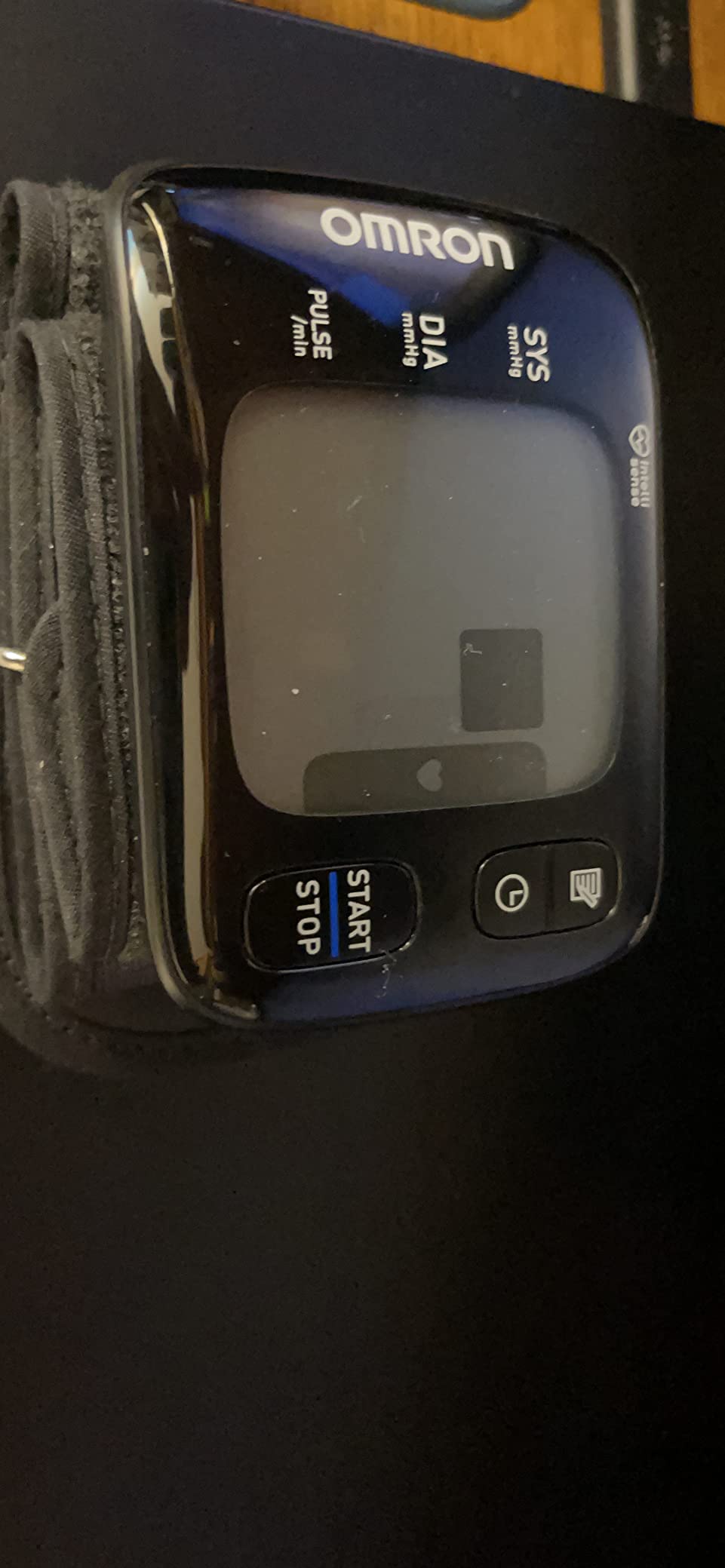
Everything else is familiar Omron territory. The device is clinically validated, weighs 3.17 ounces, and measures 3.58 by 0.52 by 2.49 inches, so it is the same slim footprint as the Gold. The attached cuff fits wrists from 5.3 to 8.5 inches. A storage case, manual, quick start guide, and two AA batteries are included.
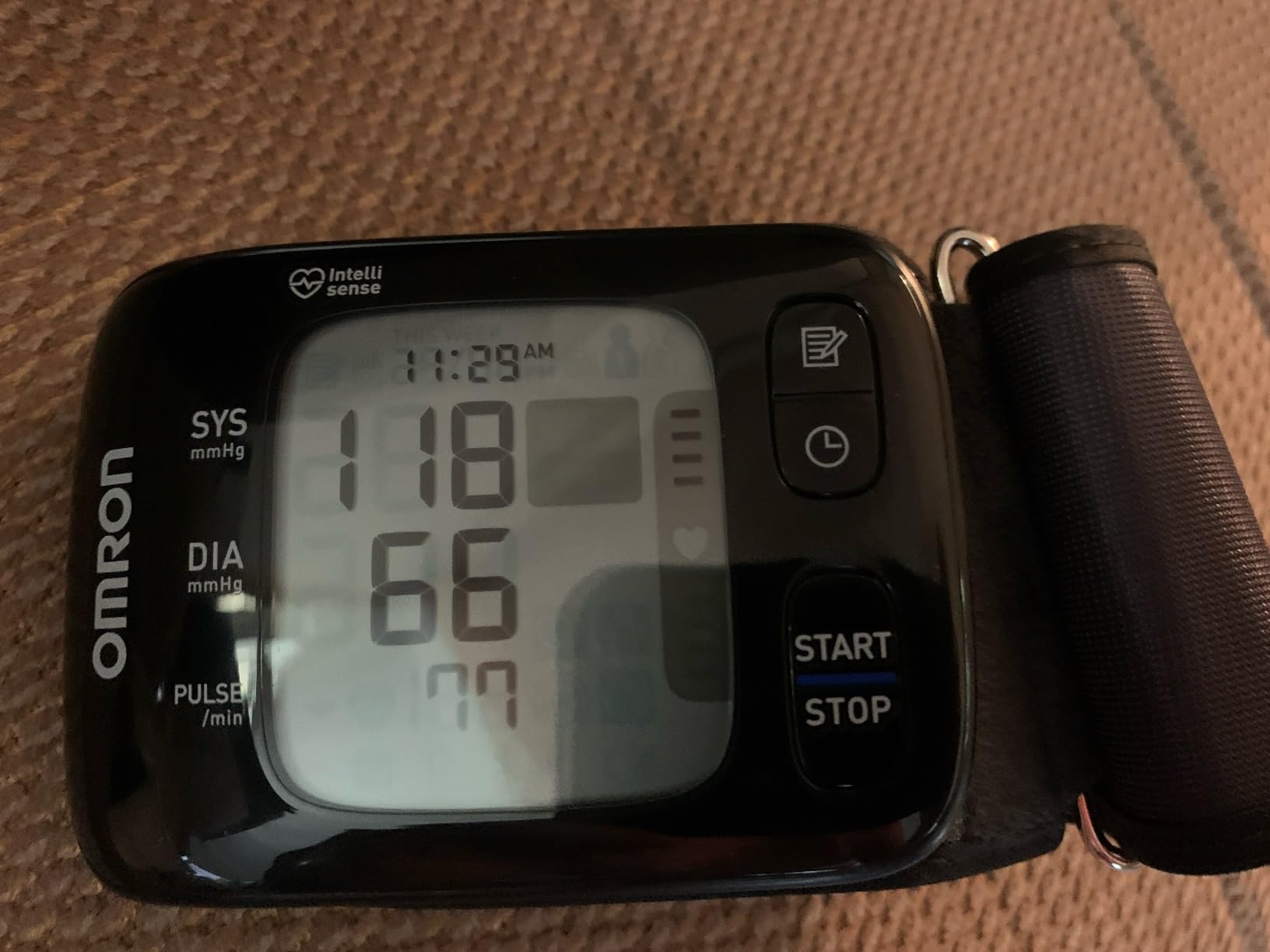
The Hypertension Indicator alerts you when a reading falls into an elevated band, which saves you from doing mental arithmetic on a small screen at 40,000 feet. Bluetooth connects to the OMRON connect app, and readings are compatible with Apple Health and Google Fit.
What to check before you pack it
Read the Hypertension Indicator once before you rely on it. It is a band display, not a diagnosis, and knowing what color means what lets you react to a high morning number without a web search from a hotel room.
Memory holds 90 readings total, which fills up over roughly a month of daily checks. If you are on a long trip, plan to sync to the app early so the device memory does not become the bottleneck. The app holds the history; the device memory is the buffer.
Where it falls short
It uses AA batteries rather than AAA. That is a small thing until you are standing in a shop in another country trying to find the right cell size, since AAA is the far more common size in a travel kit.
It also has no two-user memory at all, so this is a solo traveler’s device. If you share with a partner, either accept a shared log or look at one of the dual-user units instead.
7. Scian Wrist Monitor: The Smallest Backup Unit That Works
SCIAN Wrist Blood Pressure Cuff, Blood Pressure Wrist Cuff with Adjustable Wrist Cuff & Large LCD Display 2 Users 180 Memory for Doctor & Home Use
Dual user 180 memory
4.9-8.1 inch cuff
4 oz
Palm-up one button
Pros
- Extremely small at 2.8 by 2.6 by 1.2 inches and 4 ounces so it packs into a carry-on easily
- Wrist pillow design helps hold a steady position during measurement
- Dual user 180 reading memory is generous
- Verified buyers report testing within about 3% of a calibrated device
- Large LCD display
Cons
- Batteries are not included
- Cuff range of 4.9-8.1 inches is the narrowest here and may not fit larger wrists
- Some reviewers report the unit occasionally fails to produce a reading
- A cluster of 1-star reviews complain of consistently high readings
The Scian at 2.8 by 2.6 by 1.2 inches and 4 ounces is the smallest unit in this group by volume, and its role is different from the others. It is a backup: the thing you buy when you want the reassurance of a second monitor in the bag without adding meaningful weight.
For a two-week trip, buying a lightweight backup and leaving your main device at home for half the days is a reasonable strategy. It also works as a travel companion to your main device when you want a rough cross-check.
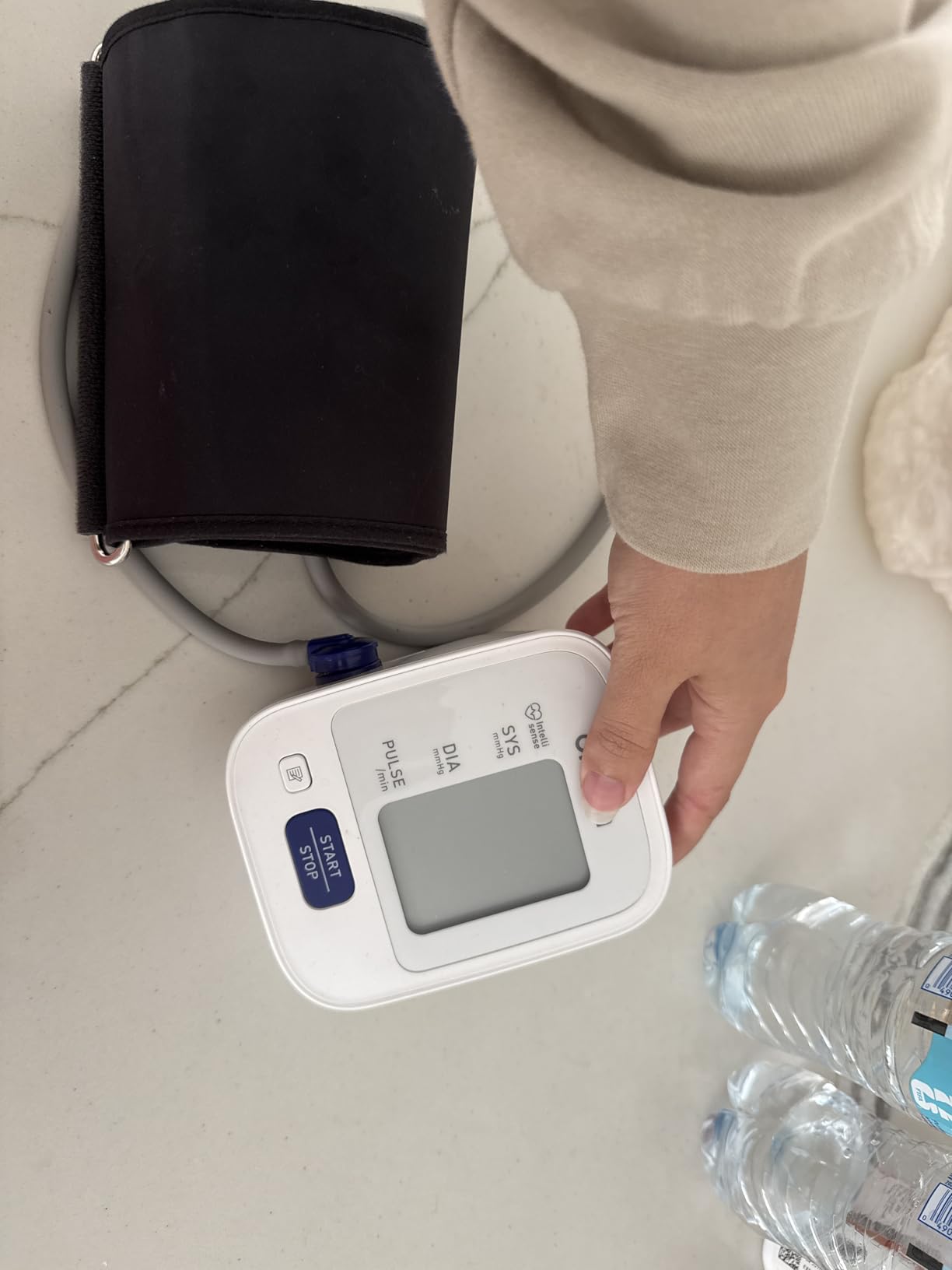
It runs on two AAA batteries, which are not included, so add those to the packing list. Dual user mode stores 90 readings for each of two people, 180 total, which is more memory than several pricier units here. Measurement is automatic and one button, reporting systolic, diastolic, and heart rate.
The wrist pillow design is the differentiator. A small support under the wrist helps the user hold a steadier position through the cycle, which directly addresses the positioning problem that causes most bad wrist readings. A blood pressure classification indication and an irregular heartbeat detector cover the usual alert features.
What to check before you pack it
Put two AAA batteries in the case, not in the device, and swap them at the destination. The cuff fits 4.9 to 8.1 inches, the narrowest range here, so measure your wrist first. If you are above 8.1 inches this unit will not fit you properly and the reading will not be trustworthy.
Use it as a trend tracker rather than a reference device. Verified buyers have reported testing within about 3% of a calibrated medical device, which is encouraging, but a low-cost backup is a good second opinion and a poor sole source.
Where it falls short
A cluster of 1-star reviews among the 1800 complain of consistently high readings, and some users report the unit occasionally failing to produce a result at all. Combined with the narrow cuff range, that is a meaningful caution for anyone with a larger wrist.
It is also the least proven device in this list by review volume, and 1800 reviews is a thin base for a health product. Treat it as a convenience purchase, not a clinical one.
8. HealthSmart Premium Wrist Monitor: It Reads Your Results Aloud
HealthSmart Digital Premium Wrist Blood Pressure Monitor with Cuff That Measures Pulse Heartbeat and High or Low BP, 120 Reading Memory Stores Up to 60 Readings for 2 Users
English or Spanish voice
120 readings for 2 users
5.3-8.5 inch cuff
4 oz
Pros
- Voice readout in English or Spanish is a real accessibility win
- Heart Spot Technology guides wrist placement to improve reliability
- Hard protective case survives being tossed into a bag
- Compact 4 ounce body with 2-user memory and time stamps
- Users report it matched a doctor office reading in spot checks
Cons
- Some users report inconsistent readings between consecutive measurements
- Screen is not backlit so it needs a well-lit space
- Listing mentions 4 AA batteries while the specs state 2 AAA are included
- Requires very still heart-level arm positioning for accurate results
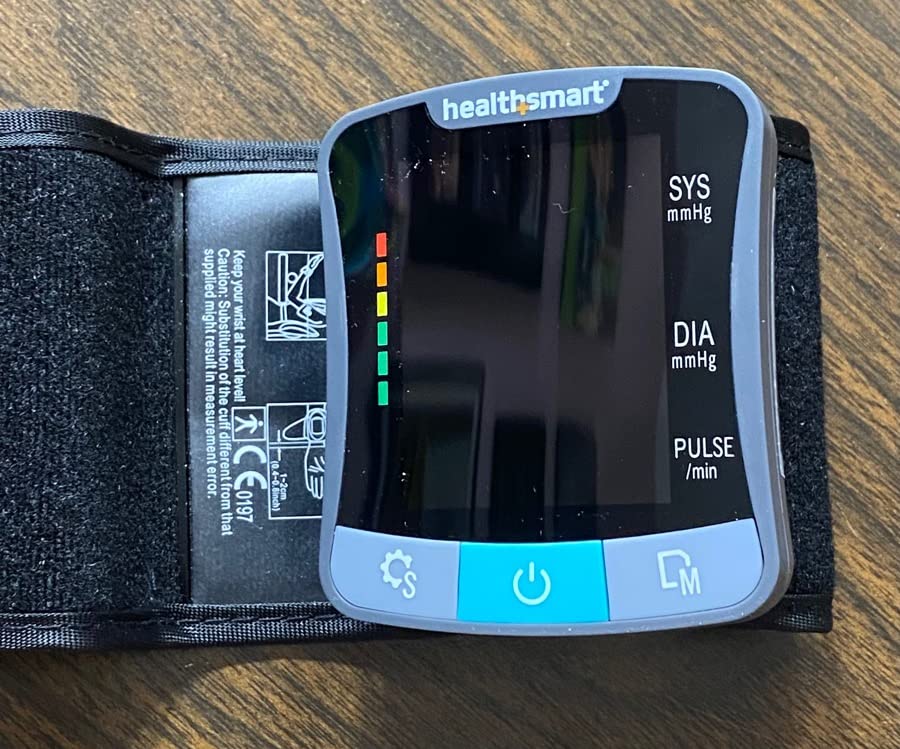
The HealthSmart speaks your numbers in English or Spanish, which makes it the most genuinely accessible pick here. If reading a small seven-segment display is the part of the process that stops you checking at all, an oral readout removes that barrier completely.
At 4 ounces and 3.03 by 2.52 by 1.26 inches it packs easily, and the standard adult wrist cuff covers 5.3 to 8.5 inches, one of the wider ranges in this group. A hard protective case is included, which is the right kind of protection for a bag that gets thrown around.
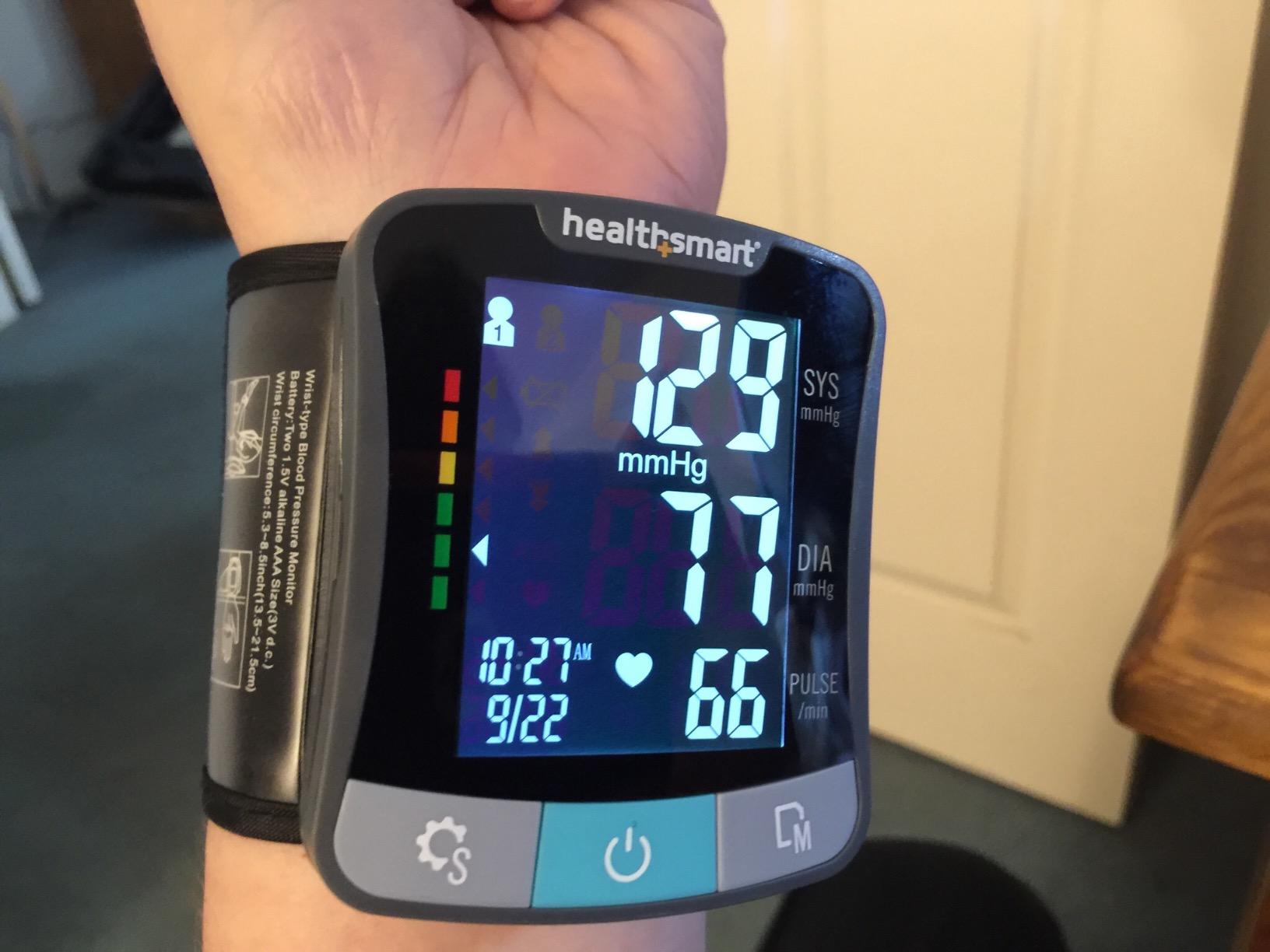
Heart Spot Technology is a positioning aid that helps you place the cuff correctly, paired with a Visual BP Guide for interpretation. Irregular heartbeat detection compares readings against established home-use standards. Storage holds 120 readings across two users with date and time stamps, so two travelers can keep separate logs.
Users report the readings matched a doctor office reading in spot checks, which is the kind of anecdote worth taking seriously because it is the comparison that actually matters. Two AAA batteries are included according to the specification, though the listing text also mentions four AA batteries, so check the box when it arrives.
What to check before you pack it
Confirm the language setting before you leave home and set the volume for a cabin environment. If the accent on the voice readout bothers you, that is a real preference worth settling before you need the reading rather than after.
Expect a fairly still measurement. Heart Spot Technology guides placement, but the device still needs the arm at heart level and the body motionless through the cycle. Find a seat with a back, put the bag on the floor, and let it run.
Where it falls short
Some users report inconsistent readings between consecutive measurements, which is more frustrating than a consistently slightly high result because you cannot tell which reading to believe. Take three and compare.
There is no backlight, so it needs a well-lit space, and it requires very still positioning for good results. Combined, those two points make it more of a at-home-and-hotel device than an airport-counter device.
9. Beurer Bluetooth Smart Wrist Monitor: The Best Positioning Coach, Weakest Sync
Beurer Bluetooth Smart, Wireless & Automatic Wrist Blood Pressure Monitor with Large LCD Display, Irregular Heartbeat Detection, Multi-Users, Syncs Readings to HealthCoach App, 60 Memory Spaces
Resting position indicator
120 memory for 2 users
5.3-7.7 inch cuff
3.39 oz
Pros
- Resting indicator lights up when you are positioned properly before measuring
- Color coded risk indicator makes results readable at a glance
- Slim 0.9 inch profile and 3.39 ounce body pack flat in a laptop bag
- HealthCoach app sync removes manual log keeping
- Irregular heartbeat alarm gives audible confirmation
Cons
- Bluetooth pairing is unreliable for several users
- Multiple reviewers report readings running about 20mmHg above clinic values
- App and setup instructions are poorly organized
- Return friction and manufacturer-only warranty handling are commonly criticized
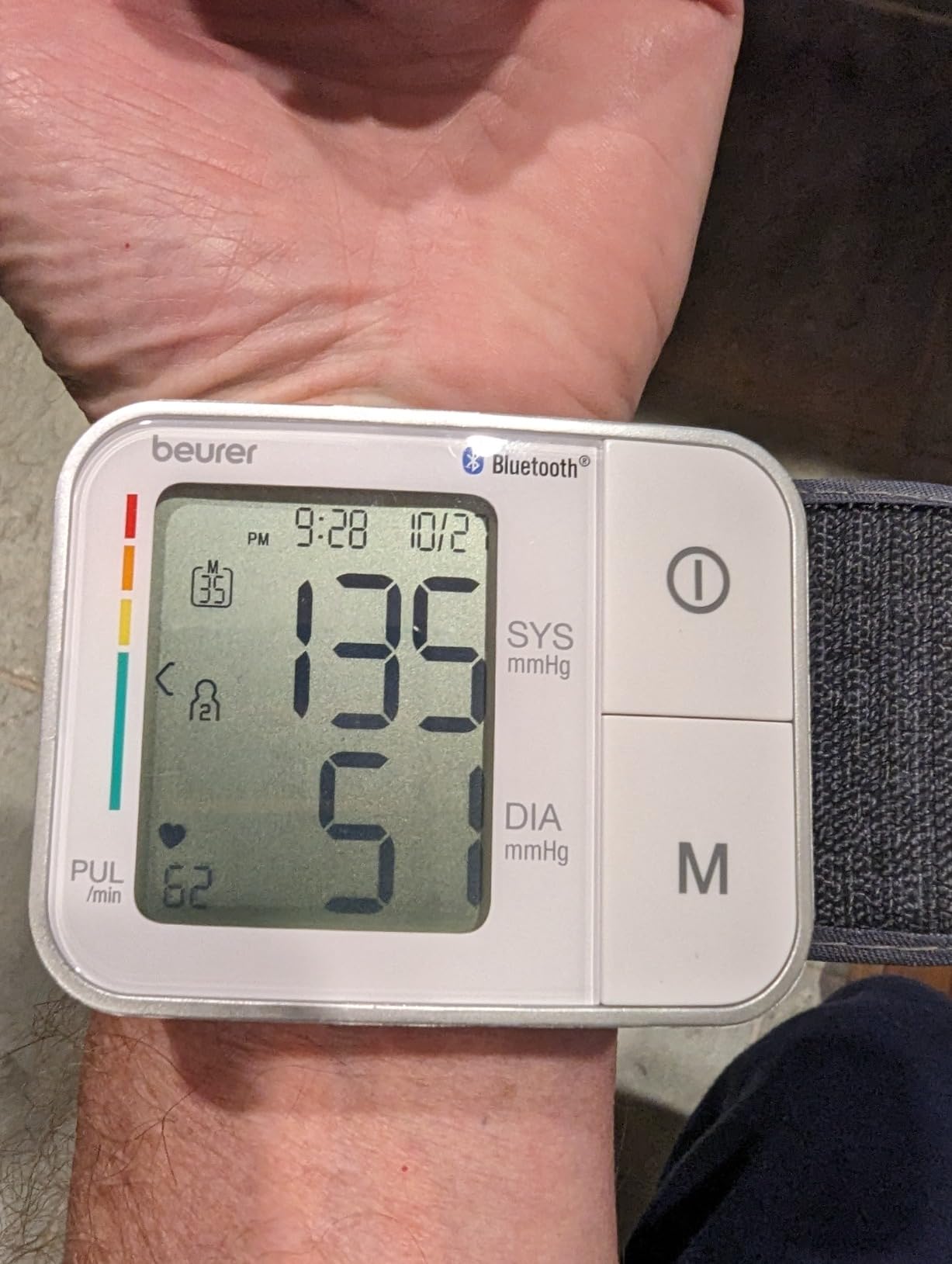
The Beurer has the most useful pre-measurement accuracy aid in this group and the weakest Bluetooth. The resting position indicator lights up when your body is properly positioned before you start a measurement, which directly attacks the single biggest cause of bad wrist readings. If you are new to this, that light is worth a lot.
It is also one of the flattest units here at 2.9 by 2.3 by 0.9 inches and 3.39 ounces, so it takes up almost no space. The adjustable cuff fits 5.3 to 7.7 inches and a plastic storage case is included.
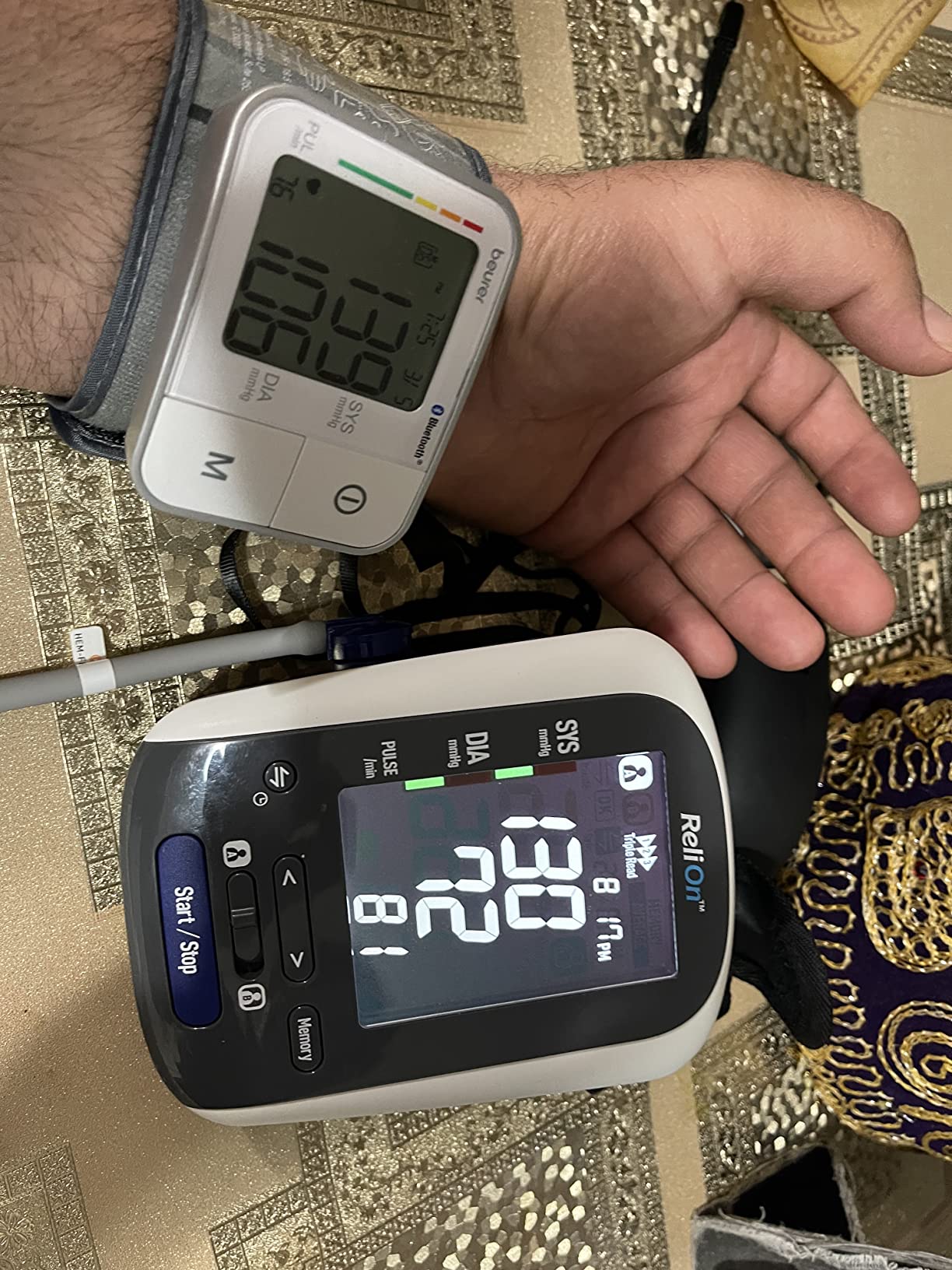
The large LCD carries a color coded risk indicator, so you can read the band without interpreting numbers yourself. The irregular heartbeat monitor includes an audible alarm, and Bluetooth syncs readings to the HealthCoach app. Memory holds 60 readings for each of two users, 120 spaces in total.
Conceptually this is the most thoughtfully engineered device for a beginner. The problem is that the software execution undermines it, and at 4.1 stars from 700+ reviews it is the lowest rated pick in the set.
What to check before you pack it
Pair the Bluetooth at home, before the trip, and expect to do it twice. Several users needed to remove and reinsert the batteries to get a connection, and the setup instructions are poorly organized, so budget an evening rather than five minutes. The plastic storage case is included, which is good given the app setup you will do at home.
Because readings have been reported about 20mmHg above clinic values by multiple users, calibrate this one against a known-good device before you travel. If it runs high at home, you will at least know the offset.
Where it falls short
Bluetooth reliability is the recurring negative, and it is a structural problem for a travel device. An app you cannot sync in a hotel room with no spare phone battery is not much use, and there is no onboard backup beyond 120 memory spaces.
Return friction and manufacturer-only warranty handling are also commonly criticized, which matters if your plan was to buy abroad and return home. For a trip, this is the pick I would think hardest about before buying.
10. LotFancy Wrist Monitor: The Lightest Thing on the List
LotFancy Wrist Blood Pressure Monitor for Home Use with Voice Broadcast, Blood Pressure Machine Adjustable Wrist Cuff 5.3″-8.5″, Automatic BP Cuff 120 Readings 2 User, Large LCD Display, Carrying Case
Voice broadcast
120 readings for 2 users
5.3-8.5 inch cuff
22.68 g
Pros
- Highest average rating in the roundup at 4.4 stars with 76% five-star reviews
- Voice broadcast with adjustable on or off is valuable for low vision
- 5.3-8.5 inch cuff suits a broad spread of wrist sizes
- Lightest weight at 22.68 grams so it is genuinely pocket and pack friendly
- 120 combined readings with date and time stamps for two users
Cons
- Batteries are not included
- Some users report swings of 30 or more between back-to-back readings
- A reviewer reported the included carrying case arrived cracked
- The spoken English has a noticeable accent
At 22.68 grams and 3.11 by 1.14 by 2.51 inches, the LotFancy weighs less than three AA batteries plus the batteries themselves would. If pack weight is the deciding factor, this is the unit. It also has the best rating distribution in the roundup at 4.4 stars, with roughly 76% of reviews at five stars.
Voice broadcast readouts announce systolic, diastolic, and pulse values with an adjustable on or off setting. Two user support holds up to 120 combined readings with date and time stamps, and one-touch fully automatic inflation handles the measurement cycle.
The soft adjustable wrist cuff covers 5.3 to 8.5 inches, the widest range in this group, so it accommodates a broad spread of wrist sizes in a body this small. A carrying case is included and the manufacturer is explicit that it is built for home, office, or travel use.
This is the model to consider if you take the medication you are monitoring in the first place. Access to a check matters most when a dose has been missed or a long travel day has gone badly, and a 22.68 gram device in a pocket is the one you will actually carry.
What to check before you pack it
Two AAA batteries are required and not included. Put a fresh pair in the case rather than in the unit so you are not relying on batteries that have been sitting installed in a drawer for a year.
Listen to the voice readout on a phone speaker before you leave. The English has a noticeable accent according to at least one reviewer, and if that would bother you on a daily basis, the HealthSmart two sections up offers the same feature with a smoother delivery.
Where it falls short
Consistency is the main concern. Some users report swings of 30 or more between back-to-back readings, which is a large enough gap that you should always record more than one number. Treat a single reading from this device as a prompt to measure again, never as a result.
There are also about 12% 1-star ratings in its 668 reviews, with strong accuracy complaints concentrated in a minority, and one reviewer reported the included case arrived cracked. Inspect the case on arrival.
What to Look for in a Travel Wrist Monitor
Beyond the three decisions that matter most, a few features separate a travel monitor from a home monitor that happens to fit in a bag. Here is what we would check, in the order we would check it.
Cuff range against your actual wrist. Measure before you buy. The ranges here run from 4.9 inches to 8.5 inches, and that difference is the difference between a usable monitor and a monitor that gives you a falsely high number every time. A cuff that is too small for your wrist is the most common avoidable error in this whole category.
Power source. Rechargeable wins for trips longer than about a week, especially internationally, because you can top up from a power bank you already carry. Disposable AAA wins for short trips and for anyone who prefers not to deal with a charging cable. There is no universal winner, and one spare set of cells is cheap insurance either way.
Memory, and two-user support. Memory matters more on a trip than at home because you are away from a doctor and away from your scale. Anything above 90 readings per user covers a month of daily checks comfortably, and dual-user memory matters if you are travelling with a partner who also monitors.
Display conditions. A backlit screen is worth real money if you are reading at night, on an overnight flight, or in a dim cabin. Voice readout is the better option if reading small numbers is the barrier, and the Oklar, MBUPAI, LotFancy, and HealthSmart all offer one.
App connectivity. Only worth paying extra for if you will actually open the app. Set up any Bluetooth pairing at home before you leave, because a device that will not sync in an airport is a device that will not sync anywhere.
Irregular heartbeat detection and positioning aids. Irregular heartbeat detection costs almost nothing to include and flags a genuinely useful anomaly. Positioning aids, whether that is the Beurer resting indicator or the HealthSmart Heart Spot, are worth more than most buyers expect because they protect the one measurement error that matters.
If you also split time between training and travel, our roundup of the best blood flow restriction cuffs covers recovery gear that packs the same way.
Are Wrist or Upper Arm Monitors More Accurate?
Upper arm monitors are more accurate. They measure at the brachial artery, which is closer to the heart in the arterial tree and physically larger, so a cuff fits it more evenly. Wrist monitors measure at the radial artery and are extremely sensitive to wrist height. A few degrees of error from heart level can move the systolic number by 10 to 15 points, which is enough to change a reading category.
That said, accuracy and usefulness are different questions. A monitor you can store accurately in transit is worth more than a more precise device you leave at home because it is too awkward to use at 30,000 feet.
Four things close most of the gap:
Hold the wrist at heart level. Rest your forearm on the armrest or on your bag with the palm up, and do not drop your hand to your lap mid-cycle.
Bare skin. A wristwatch, a bracelet, or a thick watch strap between the cuff and your artery adds error. Take the reading without them. If the strap is what you are used to wearing all day, our guide to the best ergonomic keyboards for wrist pain covers setups that reduce the strain that makes you reach for the watch in the first place.
Sit still and wait. Back supported, feet flat, no talking. Five minutes of rest before the first reading makes a measurable difference.
Average two or three readings. Take them a couple of minutes apart and record the average. A single wrist reading is a sample, not a result.
With those four habits, a good wrist monitor tracks your own trends well enough to be useful. It just will not match a clinic device reading for reading.
Why Some Clinicians Prefer Upper Arm Monitors
Clinicians prefer upper arm monitors because they are validated against a standard and they are not technique dependent. A patient can take a bad upper arm reading, but it takes real effort, whereas almost anyone can produce a bad wrist reading by accident. When a doctor asks you to log readings, they are usually asking for numbers that will not move because you shifted your hand.
The practical advice we would give any traveller: bring a wrist monitor for daily checks on the road, and validate it against a clinic device once before you go.
Validation takes ten minutes. Take a reading at the pharmacy or clinic where a validated device is available, then take three with your wrist monitor seated in the same conditions. If they agree within a few points, you have a usable travel tool. If your monitor reads consistently high or low, you now know the offset and can adjust for it.
Bring the written log to your next appointment. Trends across a trip are more useful to a clinician than one reading, and a wrist monitor that has been calibrated gives them something they can work with.
How to Take an Accurate Wrist Reading in Transit
Five steps, and the first two matter more than the device you chose.
1. Rest before you measure. Find a seat with a back, sit with feet flat, and rest for five minutes. A reading taken immediately after walking down a jet bridge is a reading about your walk.
2. Skip caffeine, nicotine, and heavy meals first. A coffee twenty minutes before the reading is one of the most common causes of a false high.
3. Position the wrist at heart level. Palm up, forearm supported, wrist resting at roughly the same height as your heart. Prop your bag on your knee to hold the height if nothing else will do it.
4. Remove watches and bracelets. The cuff needs bare skin over the artery.
5. Stay motionless and repeat. No talking, no crossing legs, no adjusting the cuff once the cycle starts. Wait two minutes and measure again, then record both numbers.
If a reading looks wrong, do not panic and do not react to it alone. Sit still, reposition the wrist to heart level, confirm bare skin, and measure twice more. Three consistent readings mean something different from one outlier, and if three readings agree and are markedly elevated, that is a reason to seek care, not a reason to argue with the device.
Travel Logistics: Carry-On, Batteries, Altitude and Apps
Four practical questions come up every time we look at a wrist monitor for a trip, and none of them are answered on a product page.
Does it go in your carry-on? Every unit in this roundup is small enough to satisfy carry-on limits by a wide margin, with the Beurer at 2.9 by 2.3 by 0.9 inches and the LotFancy at 22.68 grams. Keep it in your personal item rather than checked luggage, both because you may want it during the flight and because a checked bag goes through handling you do not control.
What about batteries? Consumer medical devices in this category are generally permitted in cabin baggage, but the rules differ by country and can change. Spare lithium cells and spare alkaline cells are the items most often flagged, so keep the spares in the retail packaging and check your departure airport’s current guidance before you fly. The practical takeaway is simpler than the regulation: rechargeable devices remove the question entirely, which is why the Oklar and MBUPAI are strong picks for international itineraries.
What does altitude and dehydration do to readings? A long flight dehydrates you and puts you in a dry cabin at reduced oxygen. Both push blood pressure up in many people, and the effect is not a sign your medication has stopped working. A salty airline meal adds sodium on top of that. Expect a travel reading to sit above your home baseline, record it as a travel reading, and compare against your own trend rather than against last Tuesday at home.
Will the app work abroad? Bluetooth pairing happens between the monitor and your phone, not through a cloud service, so the sync usually works in airplane mode. The app store connection may need wifi or a data plan. Sync your readings every few days while you have a connection, because the value of the app is the history, and history you never synced is history you do not have.
Jet lag and medication timing. Crossing time zones disrupts the schedule your medication is built around as much as it disrupts your sleep. If your dosing routine is time-of-day based, keep the monitor with you and check in the first few days after a large time shift, then talk to your clinician about how to phase your doses rather than adjusting them yourself.
How to Validate Any Monitor Against a Clinic Reading
Four steps, and you only need to do it once per device.
1. Get a reference. At a pharmacy, clinic, or appointment where a validated upper arm device is used, note the reading. Ask for the printed or written value and the time it was taken.
2. Match the conditions. Within a short window, seat yourself, rest five minutes, avoid caffeine, and take three wrist readings two minutes apart. Same posture, same arm, same hour of day as the reference if you can manage it.
3. Compare the average to the reference. If your wrist average sits within about 5 points of the clinic reading, you are in good shape. If it runs consistently 10 or more points high, adjust your expectations and tell your clinician about the offset.
4. Repeat at the destination. Do the same three-reading check in your hotel room on arrival. If the numbers agree with your home baseline, the device is behaving. If they have shifted dramatically, the reading may be telling you something real about your health rather than about the device.
Write the validation down with the date. Six months from now, that note is the thing that tells you whether a change in your readings came from you or from a failing cuff.
Frequently Asked Questions
Are wrist or arm BP cuffs more accurate?
Upper arm monitors are more accurate because they measure at the brachial artery, which is larger and closer to the heart in the arterial tree, so the cuff fits evenly. Wrist monitors measure at the radial artery and are highly sensitive to wrist height and movement, which can shift the systolic number by 10 to 15 points. With the wrist held at heart level, bare skin, and an average of two or three readings, a wrist monitor tracks your own trends reliably.
Why don’t doctors like wrist blood pressure monitors?
Most clinicians prefer upper arm monitors because they are validated against a standard and are not technique dependent. Almost anyone can produce a bad wrist reading by accident, so a number from a wrist device carries more uncertainty when a doctor is deciding what to do. That is a reason to validate your wrist monitor against a clinic reading before you rely on it, not a reason to skip monitoring on a trip.
Can a wrist blood pressure cuff be wrong?
Yes, and the two most common causes are positioning and cuff fit. Letting the wrist drop below heart level, talking during the cycle, sitting cross-legged, or measuring over a watch strap all push the systolic number up. A cuff that is too small for your wrist does the same thing permanently. Measuring three times two minutes apart, seated, still, bare-skinned, and at heart level removes most of the error.
How do I know if my blood pressure wrist cuff is accurate?
Validate it once at home and again at your destination. Take a reference reading from a validated upper arm device at a pharmacy or clinic, then take three wrist readings two minutes apart in the same conditions and compare the average. Within about 5 points is good. If it runs consistently 10 or more points high, note the offset and tell your clinician before you change anything.
What is the best rechargeable blood pressure monitor for home use?
For wrist units, the Oklar W1101L is the strongest rechargeable option we reviewed, with a USB Type-C rechargeable cell, 240 readings of dual-user memory, a backlit LED display, and voice broadcast, and it was the highest-reviewed model in this category. The MBUPAI is a close alternative with a hard case that doubles as a charging dock. If you want a full home setup, our guide to the best blood pressure monitors for home use covers the upper arm options.
The Best Wrist Blood Pressure Monitors for Travel in 2026
After working through ten units on pack size, power, cuff range, and how they behave when a reading looks wrong, the Oklar W1101L is the wrist blood pressure monitor for travel that we would put in our bag. It is rechargeable, it measures in 35 seconds, it stores 240 readings across two users, and its backlit display and voice readout handle the conditions you will actually be measuring in.
The Omron Gold Wireless is the pick if your priority is data. Two hundred readings per user, a morning average indicator, and Bluetooth sync into Apple Health and Google Fit give you a history a clinician can use. The MBUPAI is the value route, with USB rechargeable power and a hard case that doubles as a charging dock.
For very small trips, the Paramed kit with its carrying case is the simplest answer, and the LotFancy at 22.68 grams is the one to buy when pack weight decides it. Whichever you pick, validate it against a clinic reading before you go and again when you arrive.
Travel changes your blood pressure more than most people expect. Having a reliable check within reach is the difference between a number you act on and a worry you take home. Last reviewed and updated in 2026.