
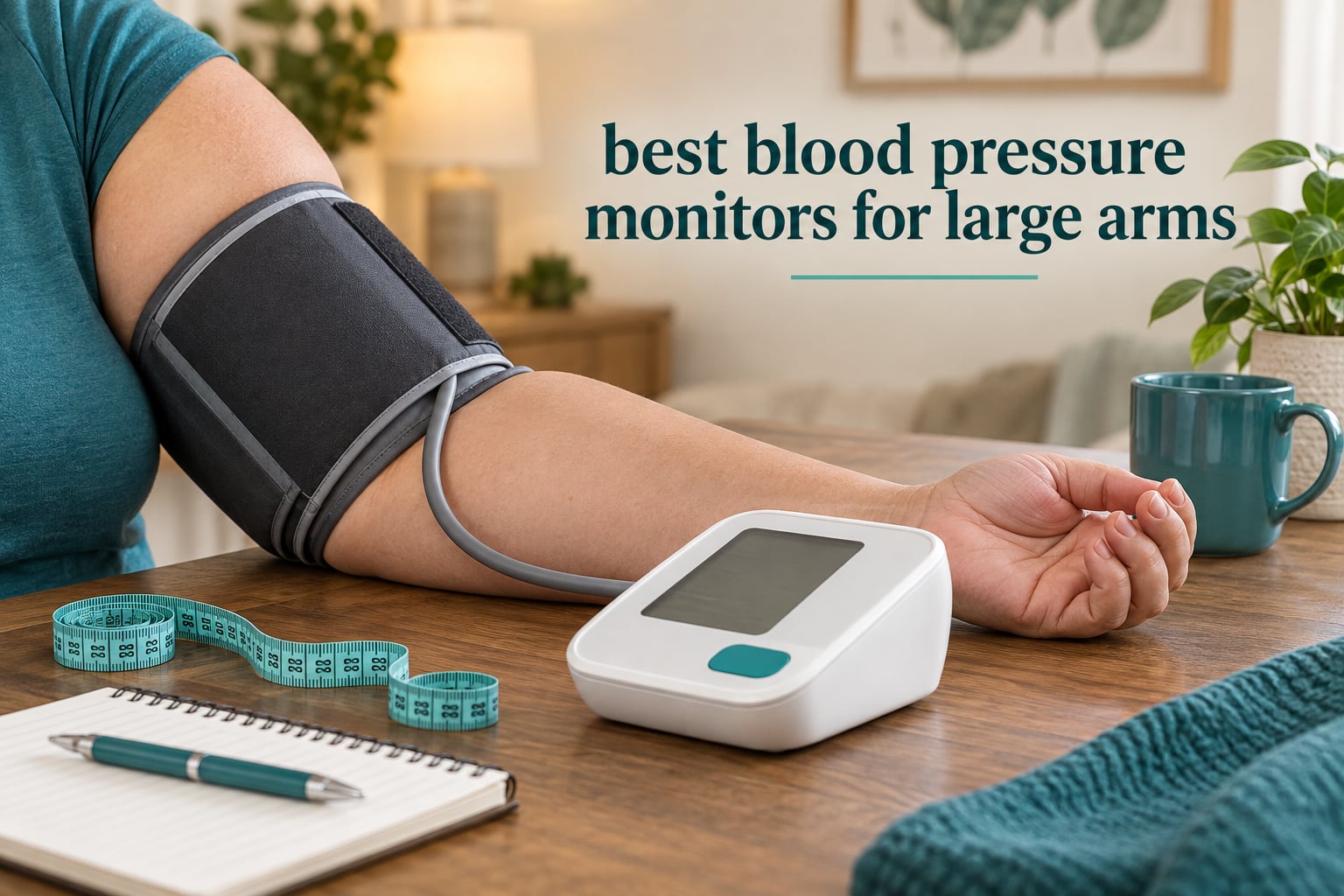
Most home blood pressure monitors ship with a cuff built for a 9-16 inch arm. If yours measures more than that, the cuff either will not open or opens with the bladder barely wrapped around your bicep, and the number on the screen is not your blood pressure. It is your blood pressure plus the pressure the undersized cuff had to add to squeeze the artery shut. The best blood pressure monitors for large arms are simply the ones whose cuff, in the box, is rated past 16 inches.
That is the filter we used, and it is the only one. Across the twelve monitors below, the cuff that actually ships in the box is stated on every card, because that is the detail that decides whether a monitor works for you at all. Anything topping out at 17 inches is labelled large, not XL, and we say so rather than letting the marketing language blur the line. Our best overall pick, the Greater Goods XL Cuff Monitor, includes a cuff rated from 15.7 to 20.5 inches.
Here is how this roundup was built. We compared manufacturer specifications, cuff ranges, power options, memory depth and validation claims, then cross-read thousands of customer reviews for failure patterns. We did not perform clinical accuracy testing ourselves, so we make no accuracy claims on our own authority, and where reviewers report agreement with clinic readings we say exactly that.
One thing we can say plainly: if your arm measures 18 inches, a 9-17 inch cuff is not a compromise, it is a wrong reading waiting to happen.
Medical disclaimer: this guide is for product selection, not diagnosis. Home readings cannot replace a clinician’s assessment, and no monitor should be used to start, stop or change medication on your own. If your readings stay consistently high, if you get readings above 180/120, or if you have chest pain, shortness of breath, severe headache or vision changes, contact your clinician or local emergency services rather than relying on a home device.
Top 3 Picks for Large Arms in 2026

Greater Goods XL Cuff Monitor
- XL cuff 15.7-20.5 in
- Artery alignment guide
- Two-user memory 120 readings
- Bluetooth trend syncing

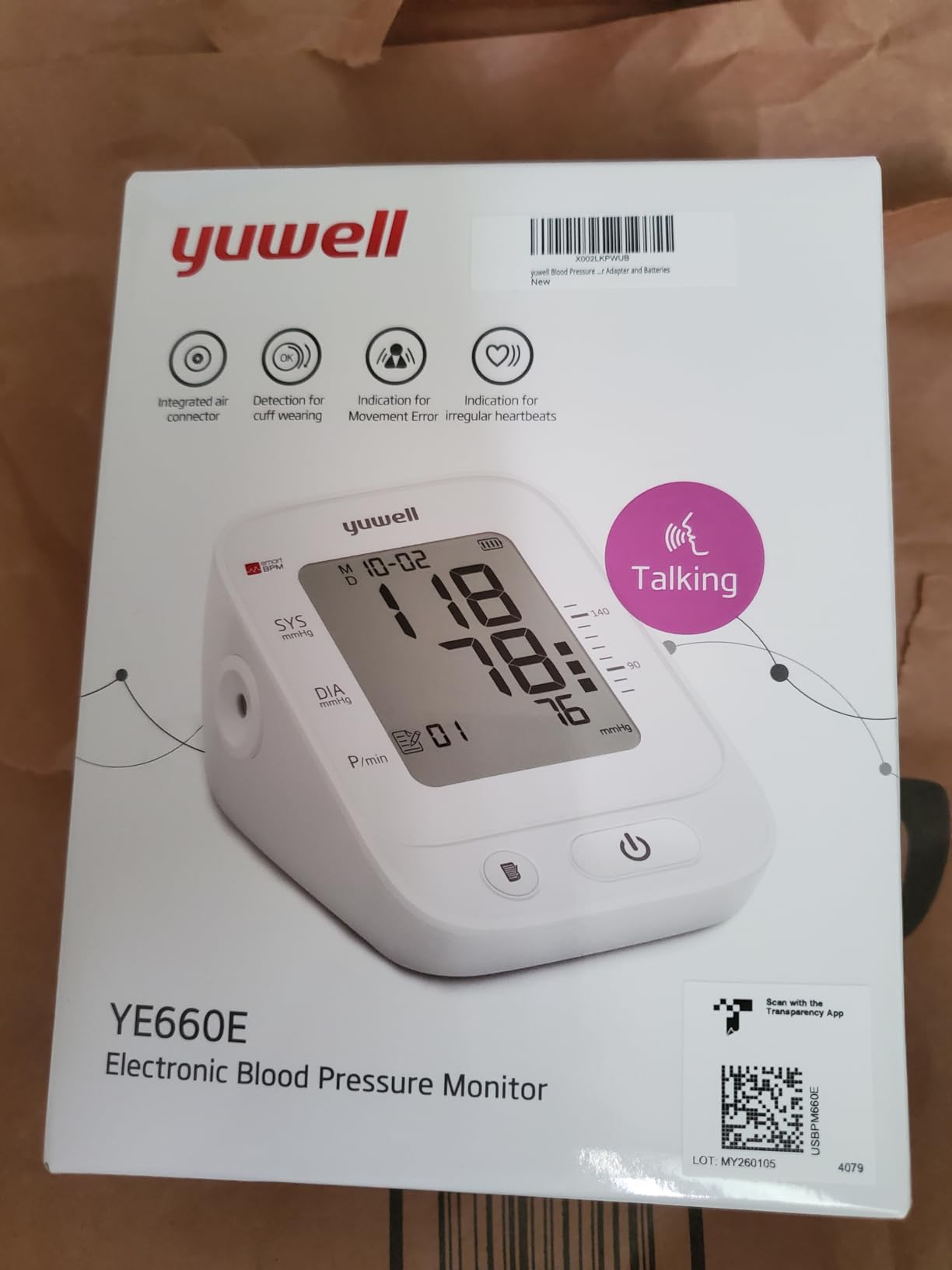
yuwell YE660E Large Cuff
- Cuff 8.7-17.7 in
- Voice broadcast
- 99 readings with 3-reading average
- Meets ESH standard

Vaunn Medical XL Cuff
- Extra large cuff 12.6-20.5 in
- SmartCheck three-measurement routine
- Color backlight range bar
- Dual user plus guest mode
Best Blood Pressure Monitors for Large Arms in 2026: Quick Overview
Fit decides accuracy, so the table below is ordered by the cuff range that actually ships in the box. The first nine entries include a cuff rated to 20.5 inches or beyond. The last three include only a large cuff with a 16.5 to 17.7 inch ceiling, which suits someone who is large rather than very large.
| Product | Specifications | Action |
|---|---|---|
| Greater Goods XL Cuff Monitor |
|
Check Latest Price |
| Vaunn Medical XL Cuff |
|
Check Latest Price |
 AQESO U80B 3-Cuff Monitor AQESO U80B 3-Cuff Monitor |
|
Check Latest Price |
 LIVAROCI XL Cuff Set LIVAROCI XL Cuff Set |
|
Check Latest Price |
 SDUNW Dual Cuff Monitor SDUNW Dual Cuff Monitor |
|
Check Latest Price |
 AQESO Two-Cuff Monitor AQESO Two-Cuff Monitor |
|
Check Latest Price |
 AQESO U80A Bundle AQESO U80A Bundle |
|
Check Latest Price |
 CHANI A02-BE Dual Cuff CHANI A02-BE Dual Cuff |
|
Check Latest Price |
 Andesfit A02-SEB Smart Monitor Andesfit A02-SEB Smart Monitor |
|
Check Latest Price |
| yuwell YE660E Large Cuff |
|
Check Latest Price |
 WAJ 6.4-Inch Display Monitor WAJ 6.4-Inch Display Monitor |
|
Check Latest Price |
 HOLFENRY 510(k) Cleared Monitor HOLFENRY 510(k) Cleared Monitor |
|
Check Latest Price |
1. Greater Goods XL Cuff Monitor – Best Overall, Included Cuff 15.7-20.5 Inches
Greater Goods Blood Pressure Monitor, XL Cuff for Large Arms, 15.7-20.5 in
XL cuff 15.7-20.5 in
120 readings, 2 users
4 AAA batteries
Bluetooth app sync
Pros
- In-box XL cuff rated 15.7-20.5 inches
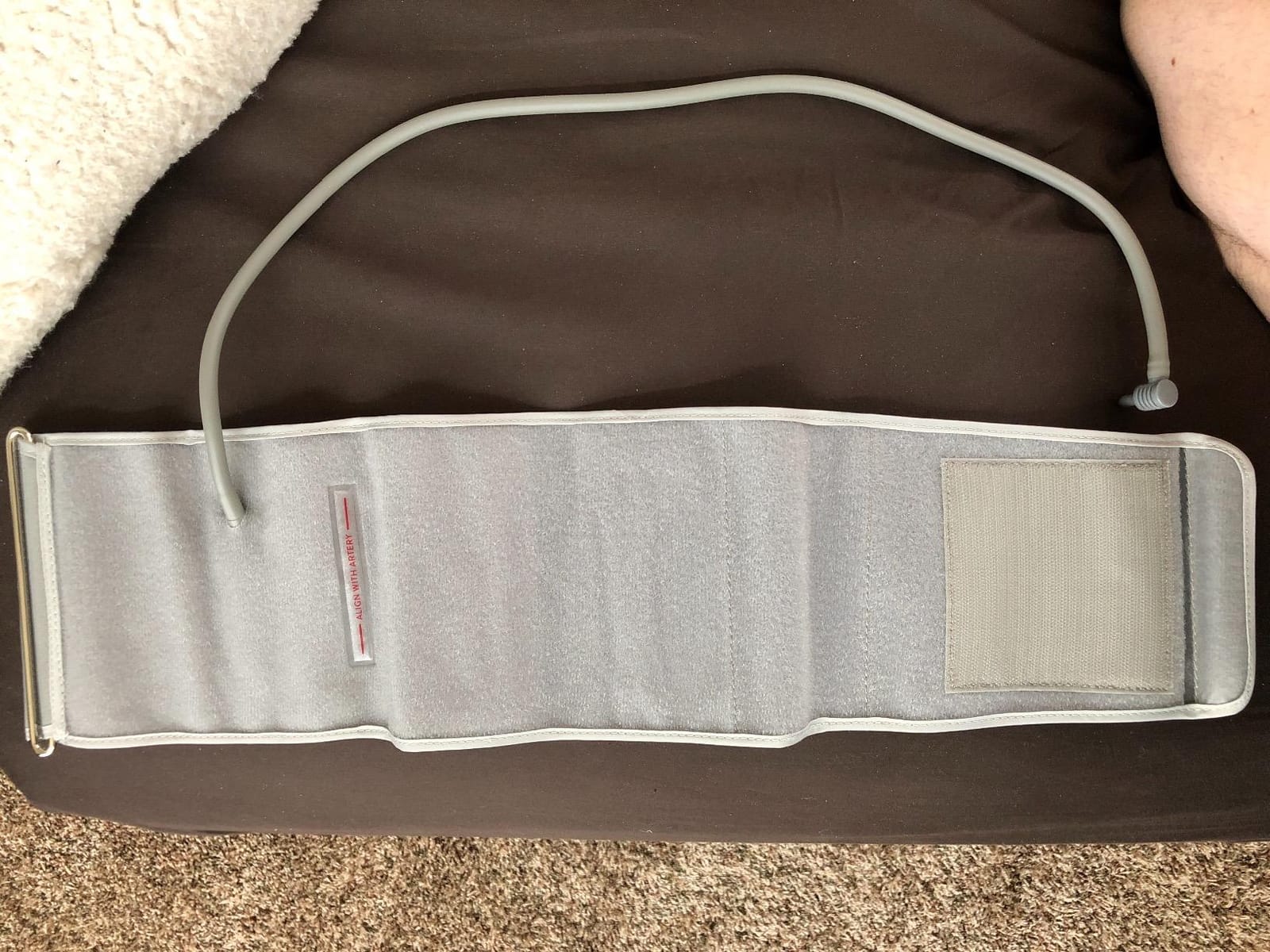
- Artery alignment guide marked on the cuff
- Large backlit display with color-coded range
- Largest review base in this roundup
- Two-user memory with 60 readings each
Cons
- Velcro cuff is awkward to tighten one-handed
- Cuff can feel tight at high readings
- App is thin compared with dedicated BP loggers
The first thing to check on this one is the number most roundups bury: the cuff in the box is rated 15.7 to 20.5 inches, or 40 to 52 centimetres. That is a genuine extra-large range, and it starts below the point where most bariatric cuffs begin, so it also works for a mid-size arm. The monitor body is compact at roughly 5.5 by 5.1 inches and weighs under 10 ounces, which makes it easier to hold steady than a bulky clinical-style unit.
What stands out is that the extra-large cuff is the default, not an upsell. There is an artery alignment guide printed on the cuff, which sounds minor until you have wrapped a cuff ten times on a tapered arm wondering whether the marker is over the artery. Two-user memory stores 60 readings each, and Bluetooth syncs to the Balance Health app for longer trend views.

At more than eleven thousand reviews, this is the most examined large-arm monitor in the roundup, and the pattern in those reviews is consistent. Owners who arrived from a too-small cuff report the step up in fit is obvious on the first reading. The app connection is described as reliable, and long-term owners mention that customer service handled replacements, including cuffs.
The negatives are physical rather than electrical. The wrap-and-velcro cuff is stiff enough that one-handed fastening is a genuine struggle, particularly on the right arm, and users with very high readings report a firm squeeze near the top of inflation. A small number of reviews mention a pump that failed and produced an E1 error code, which is a recurring motif in home monitors generally rather than a fault unique to this design.
Why this cuff works at 18 and 19 inch arms
Because 18 and 19 inches sit in the middle of the 15.7-20.5 inch band rather than at its edge, the bladder has room on both sides of the brachial artery. That is what stops the monitor from over-inflating to compensate, and it is the mechanical difference between a large cuff and an extra-large cuff.
Where it frustrates you day to day
If you take readings one-handed, or you have limited grip strength, the velcro closure is the weak point, and several reviewers describe swapping to a cuff with a metal support bar for that reason. The app is also a trend viewer rather than a full logbook, so if you want to share a structured history with a clinician you will be exporting manually.
2. Vaunn Medical XL Cuff Monitor – Best Rated, Included Cuff 12.6-20.5 Inches
Vaunn Medical Automatic Upper Arm Blood Pressure Monitor, Extra Large Arm Cuff 12.6″ – 20.5″
XL cuff 12.6-20.5 in
SmartCheck 3 measurements
3-color backlight
Dual user plus guest
Pros
- XL cuff reaches 20.5 inches
- Three-measurement SmartCheck routine
- Color-coded backlight reads at a glance
- FSA and HSA eligible
Cons
- SmartCheck makes each session longer
- Only one cuff size is included
- Battery powered with no AC adapter listed
Vaunn’s selling point is the 12.6 to 20.5 inch cuff, which is unusual because it starts so low. Someone with a 13 inch arm and someone with a 20 inch arm can both use the same cuff from the same box, which removes the most common source of household friction: one member on a standard cuff, one member on the large cuff, and the wrong one fitted by accident.
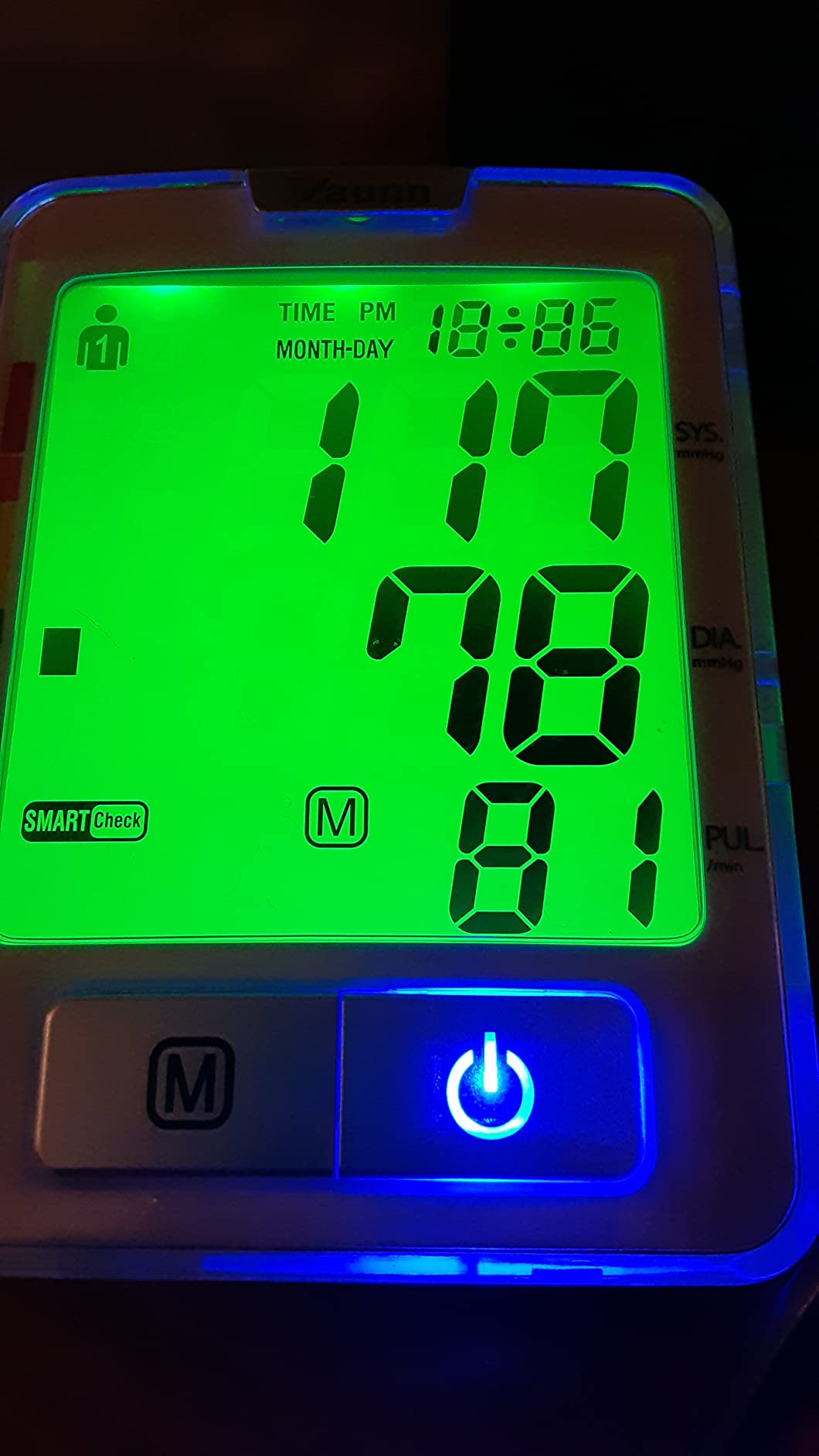
The SmartCheck routine is the other differentiator. Instead of one squeeze, the monitor takes three successive measurements internally, so the reading you see is built on more than a single inflation cycle. GentleRead inflation is designed to slow the squeeze, and the three-colour backlight follows the traffic light convention used in clinical guidelines, so the screen itself tells you whether a number needs attention without you interpreting it.
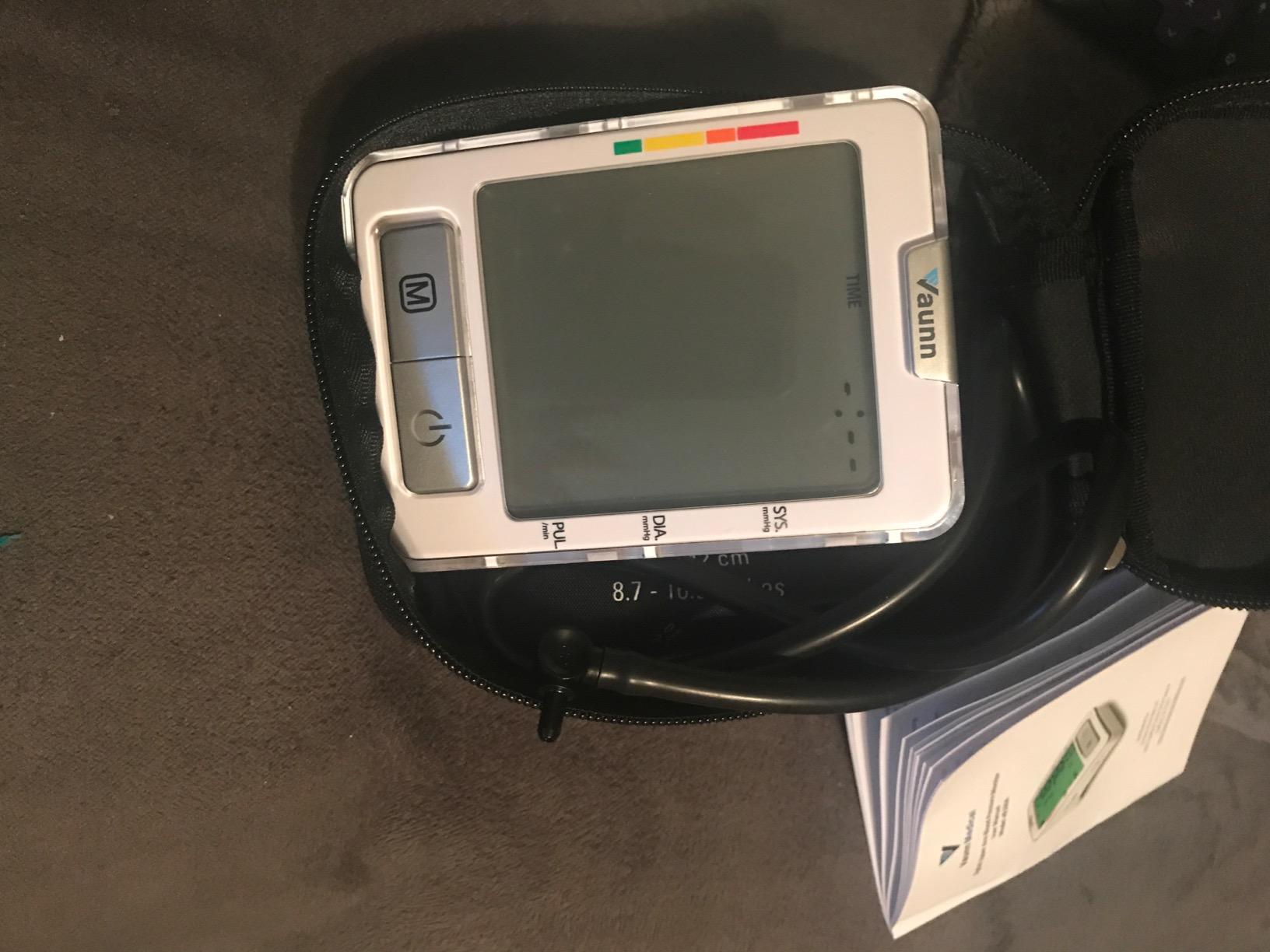
At 4.5 stars across 3762 reviews, this is the highest-rated monitor here, and the review pool is unusually free of a single dominant complaint. Buyers point to the three-measurement process feeling more trustworthy than a one-shot reading, to the cuff fitting comfortably on a bigger arm, and to being able to interpret the coloured display at a glance in a dim room.
The trade-offs are the ordinary ones. Three measurements per session means a longer wait, which matters if you are checking twice daily. Because only one cuff size is included, the dual-user and guest modes assume a second cuff for a second person. It runs on four AA batteries, and no AC adapter is listed.
Why the low 12.6 inch floor is useful
Most extra-large cuffs start around 15 or 16 inches, which makes them useless for a smaller adult in the same home. Starting at 12.6 inches lets this monitor serve a mixed-arm household without anyone buying a second cuff, and it is also FSA and HSA eligible if you use those accounts.
Where the single cuff limits a two-person home
The guest and dual-user modes are genuinely there, but the cuff is one size. If your partner’s arm is well under 12.6 inches or well over 20.5 inches, you still need another cuff, and the guest mode stops being a free feature at that point.
3. AQESO U80B 3-Cuff Monitor – Three Cuffs Covering 7 to 21 Inches
Blood Pressure Machine Upper Arm, 3 Size Cuffs, Small 7″-9″, Medium/Large 9″-17″ and Extra Large XL Cuff 13″-21″, Accurate Automatic Digital BP Cuff Home Use, Large Backlit BP Monitor 3-User 1500 Mem
3 cuffs from 7-21 in
3 users and 1500 slots
4-inch backlit LCD
Batteries or USB-C
Pros
- Cuff span from 7 to 21 inches in one box
- Three cuffs let a whole household share one device
- 4-inch backlit screen with oversized numbers
- 1500 memory slots across three users
Cons
- Battery life drains faster with daily use
- USB cable included but no AC adapter
- Even the XL cuff falls short of the very largest arms
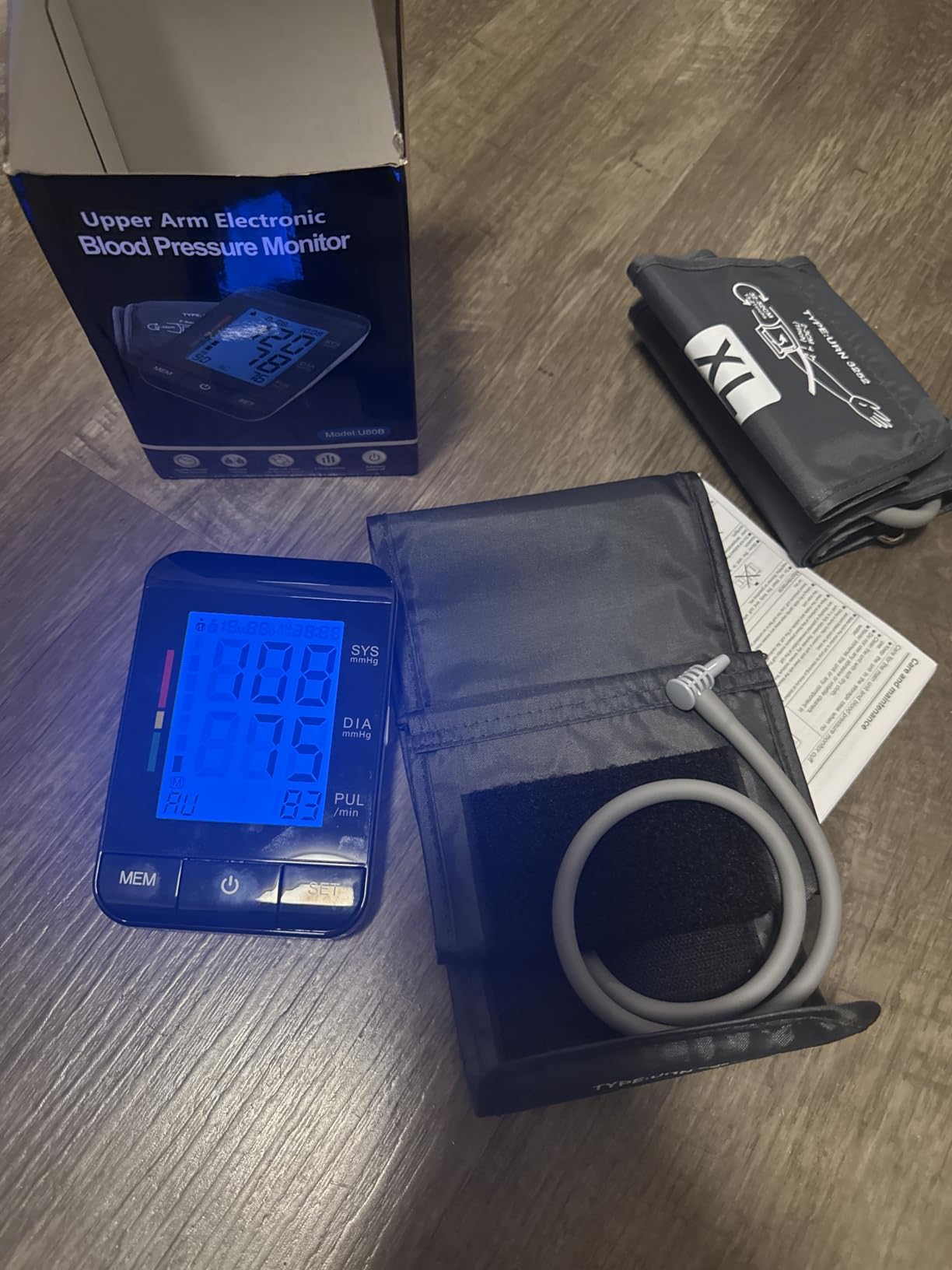
This is the widest coverage in the roundup, and it comes from shipping three cuffs rather than one: a small cuff at 7 to 9 inches, a medium/large cuff at 9 to 17 inches and an extra-large cuff at 13 to 21 inches. Nothing else here spans from a child’s arm to a 21 inch bicep in one box, which makes it the practical answer for a household with genuinely different arm sizes.
The rest of the spec sheet is generous for the money. The screen is a 4-inch backlit LCD with oversized digits, memory runs to 1500 slots across three users, and the manufacturer describes a patented proportional valve system that adjusts the wide-range cuffs rather than relying on fixed stitching. Power is four AAA batteries or a 5V USB Type-C connection, with the cable in the box and the wall adapter not in it.
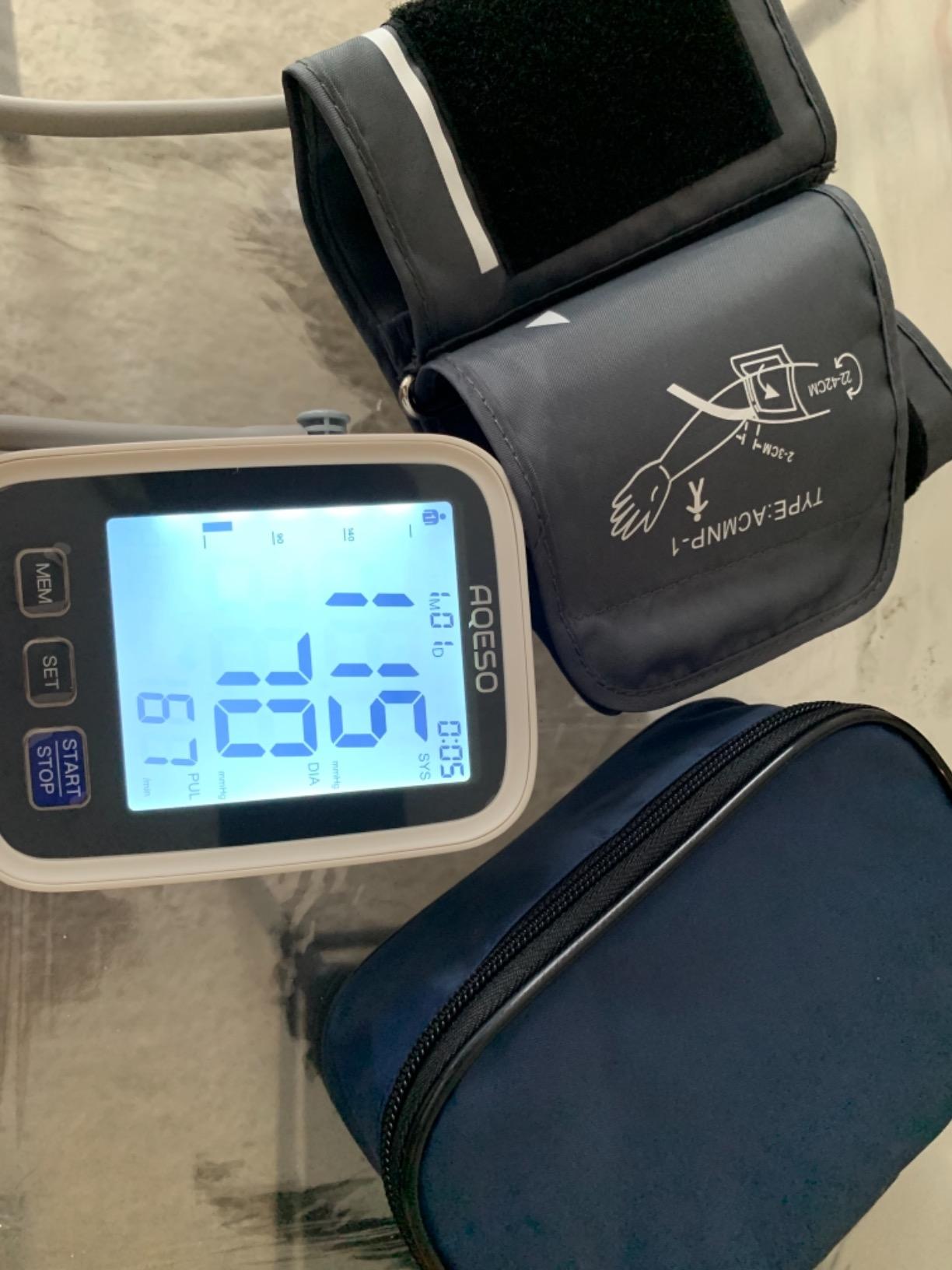
Reviewers who own this one for years describe readings that still match what they see in a clinic, and several specifically mention AQESO customer service replacing units and upsizing cuffs, which is the part of the ownership experience that matters most if your arm is at the edge of a range. The carrying bag is described as sturdy and deformation resistant, which sounds trivial until you are looking for the cuff at 7am.
The complaints are practical. Battery life is the most common, with heavy daily use draining cells faster than buyers expect. The missing AC adapter is a small annoyance. And one honest limitation shows up in the reviews of even this wide a package: the extra-large cuff still does not cover the very largest arms, so if you measure above 21 inches this is not your answer either.
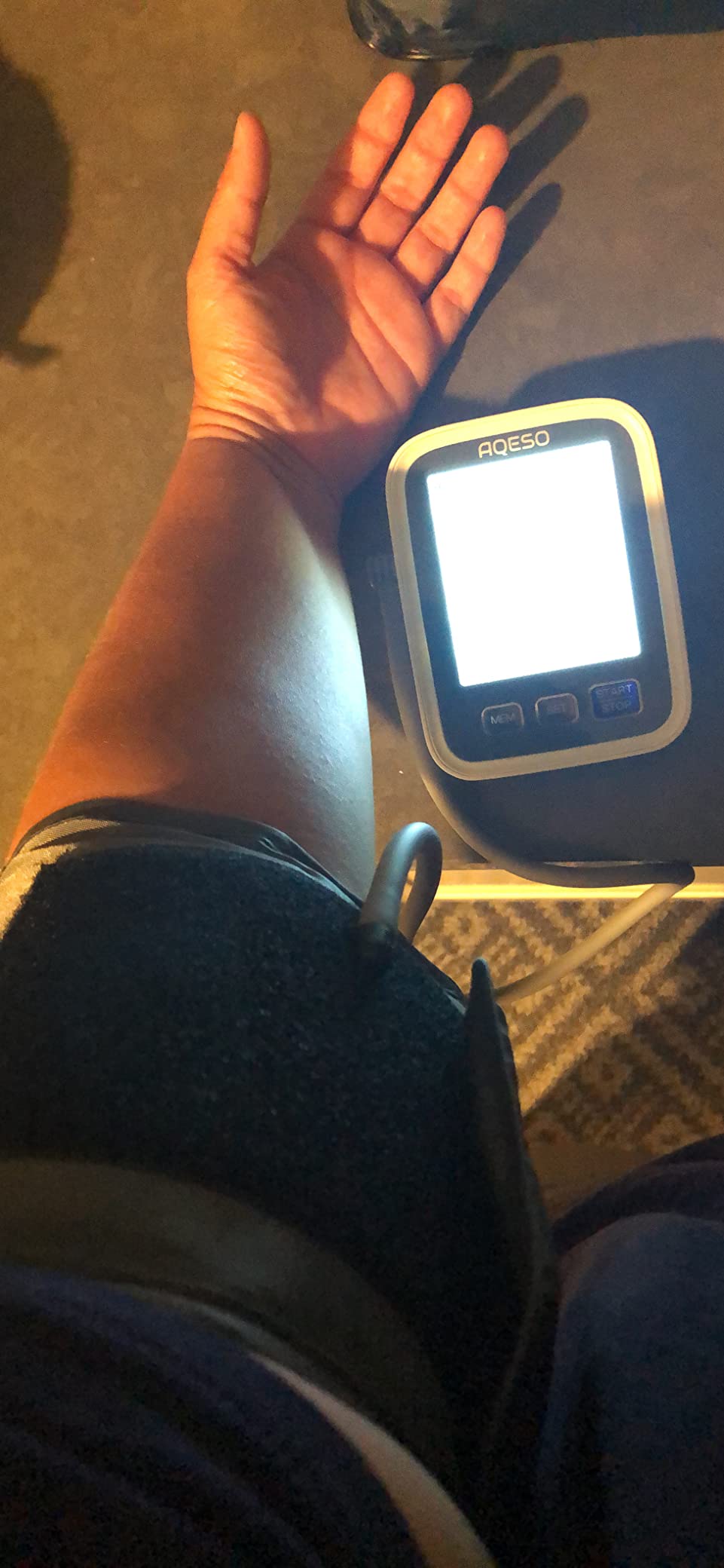
Why three cuffs beats one wide cuff
A single adjustable cuff has to compromise somewhere. Three fixed cuffs let each user get the bladder length that matches their own arm, which is why this package suits a household where a 13 inch arm and a 20 inch arm both need to be measured accurately on the same machine.
Where the 21 inch ceiling shows up
Even the largest cuff here stops at 21 inches. Buyers with arms past that point report the cuff sitting tight without closing properly, and customer service response matters more than the spec sheet at that size.
4. AQESO Two-Cuff Monitor – Cuffs 9-17 and 13-21 Inches, 500 Readings Per User
Blood Pressure Machine Upper Arm, 2 Size Cuffs M/L and XL, Medium/Large 9″-17″ and Extra Large XL 13″-21″, Accurate Automatic Digital BP Monitor, Large Backlit LCD, 2-User 1000 Memories
Cuffs 9-17 in and 13-21 in
2 users, 500 slots each
Backlit LCD
Not rechargeable
Pros
- Two cuff sizes covering 9-21 inches
- 500 readings stored per user
- Backlit LCD with a WHO classification bar
- One-touch automatic measurement
Cons
- Not rechargeable and needs power when on USB
- AC adapter not included for USB operation
Same manufacturer as the three-cuff unit, different compromise. This package ships a medium/large cuff at 9 to 17 inches and an extra-large cuff at 13 to 21 inches, so two people with different arms are properly covered and a small child is not. In exchange you give up the small cuff and the third user profile.
What you gain is memory depth. Five hundred readings per user gives one person a long, dated history, which matters for anyone whose clinician asks to see a month or more of home data before adjusting medication. The screen carries a WHO classification bar alongside the backlit LCD, so readings can be interpreted without a separate chart.
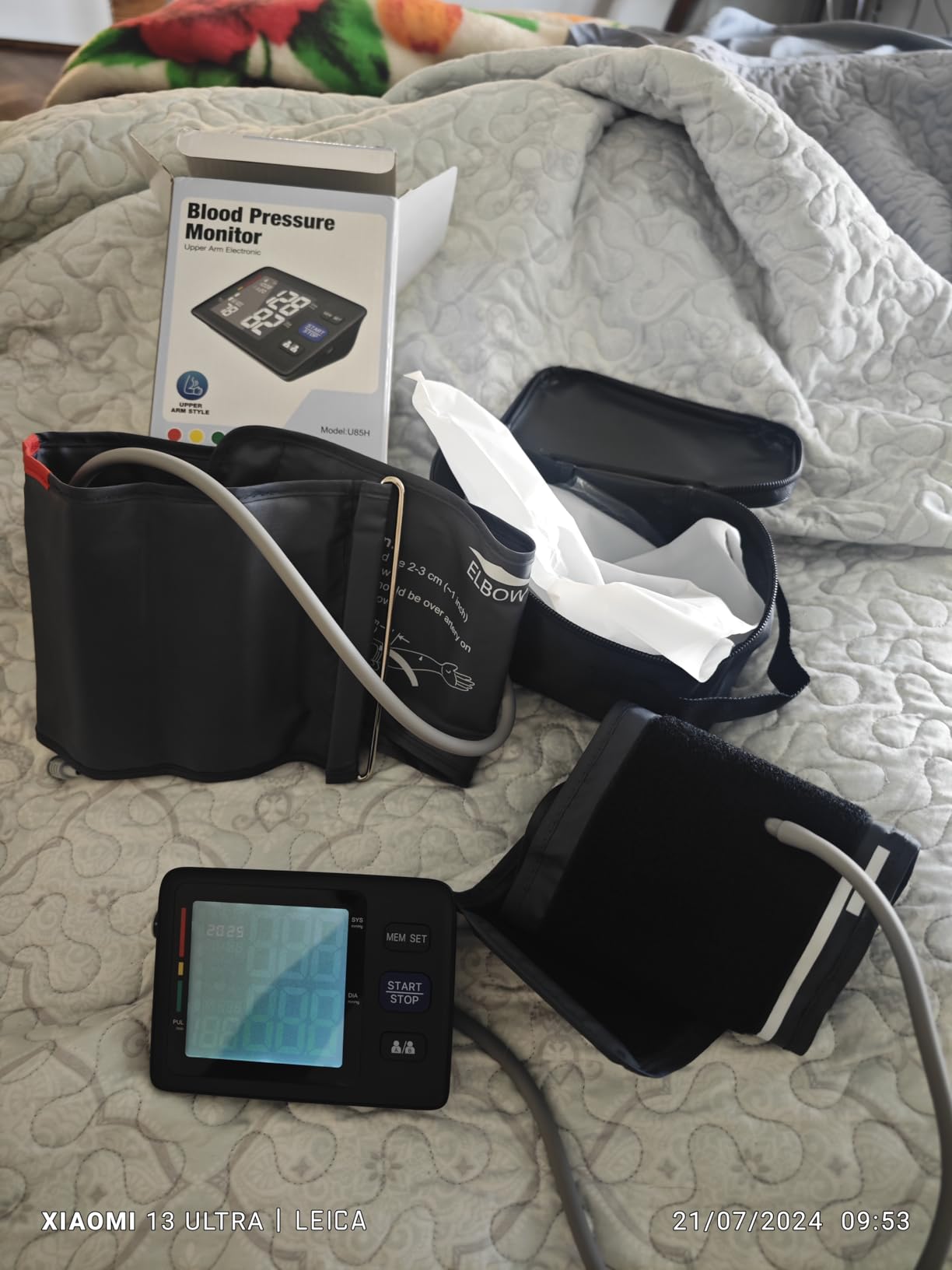
Owners are satisfied with the package as described: two usable cuffs, a display they can read in low light, and enough stored history to show trends. The complaints in reviews are all about power rather than measurement, which is a narrow and fixable problem.
Specifically, the unit is not rechargeable. On batteries it is entirely self-contained, but when you run it over USB it needs a continuous connection, so it is effectively a plug-in monitor in that mode. The AC adapter is not included, so you need a USB port or a wall charger you already own.
Why 500 readings per user changes a clinical conversation
Most home monitors store enough to spot a bad week, not enough to show a slow trend. Several hundred dated readings per person is the point where you can hand a clinician a printout and let the pattern speak, rather than describing one memorable number from last Tuesday.
Where the power arrangement gets annoying
Anyone planning to run this continuously off USB will be disappointed, since it shuts down without a live connection and will not hold a charge. Budget for four AAA batteries as the primary supply and treat USB as a stationary option.
5. LIVAROCI XL Cuff Set – Cuffs 9-17 and 13-21 Inches, Cross-Checked by Clinicians
Blood Pressure Monitor, 9-17” & 13-21” Extra Large Blood Pressure Cuff
Cuffs 9-17 in and 13-21 in
2 users, 199 slots each
Color backlit LED
WHO 3-colour bar
Pros
- Cuff rated to 21 inches
- Color backlit LED display with large fonts
- Accuracy vouched for by a former physician and a critical care RN
- One-button operation with two user profiles
Cons
- No printed manual in the box
- Readings are not stamped with time and date
- Cuff resists one-handed application
The fit story here is a medium/large cuff at 9 to 17 inches plus an extra-large cuff at 13 to 21 inches, with the manufacturer describing faster inflation logic aimed at large arms. The display is a colour-backlit LED in a large font with a three-colour WHO-based indicator, and operation is genuinely one button, with two users and 199 memory slots each.
What stands out in the reviews is unusually specific validation. Buyers describe having readings confirmed by a former physician and by a critical care nurse, which is not the sort of claim you see often on an unbranded housing. The other recurring theme is simply that the XL cuff produces sensible results on very thick upper arms, which is the entire point of this page.
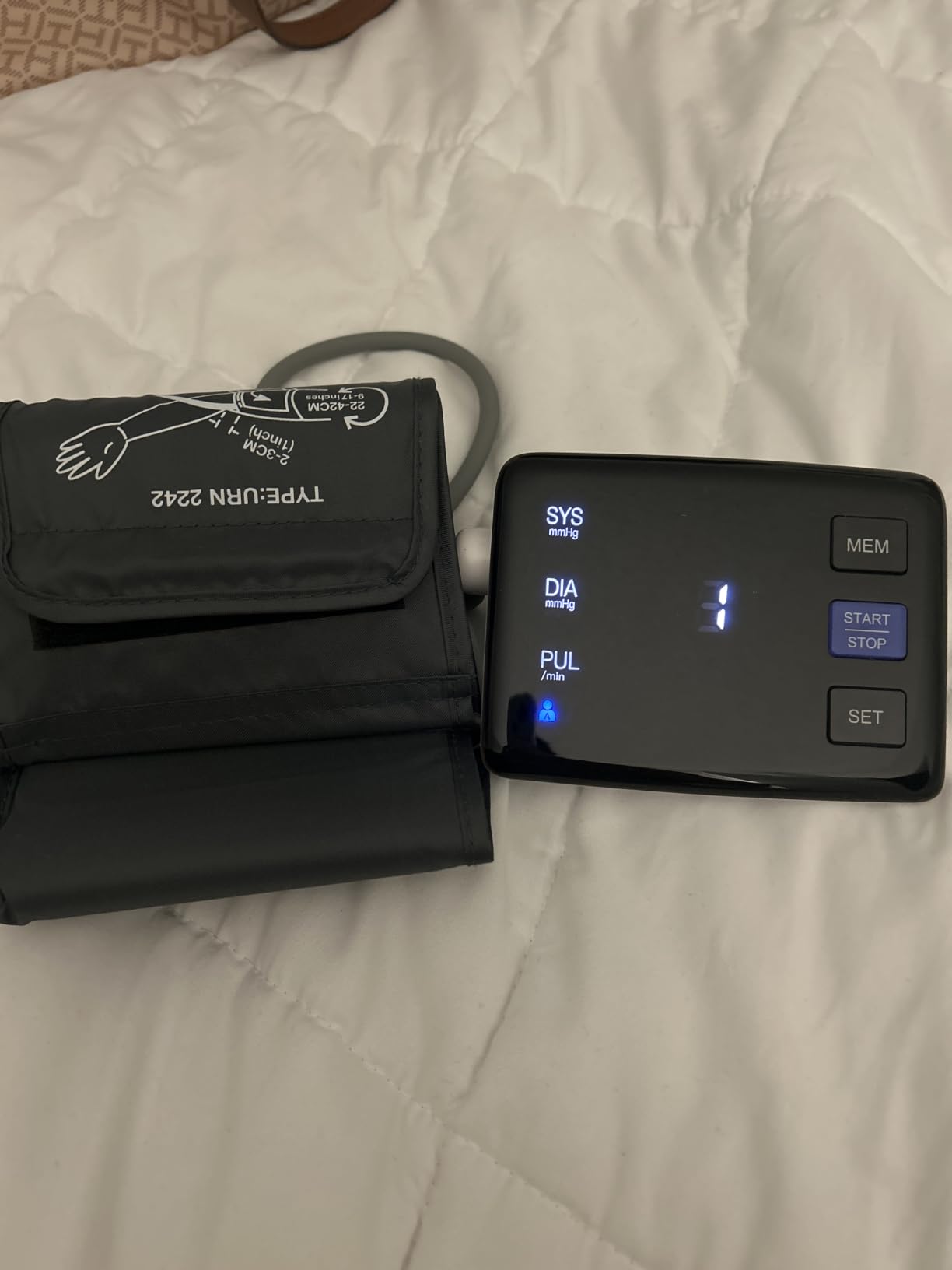
There are real negatives, and they are worth reading before you buy. There is no printed user manual in the box and the online one is hard to locate. Stored readings are not stamped with a time and date, which undercuts the value of 199 slots. The cuff resists one-handed application, and it has to be wrapped firmly but not tightly, which is a fine line.
There is also a durability thread: several reviews mention rapid battery drain, and cuff inflation problems appearing after roughly six months of use. One owner reports the manufacturer resolved a failure with a free replacement, which is a good sign about support but not about the component.
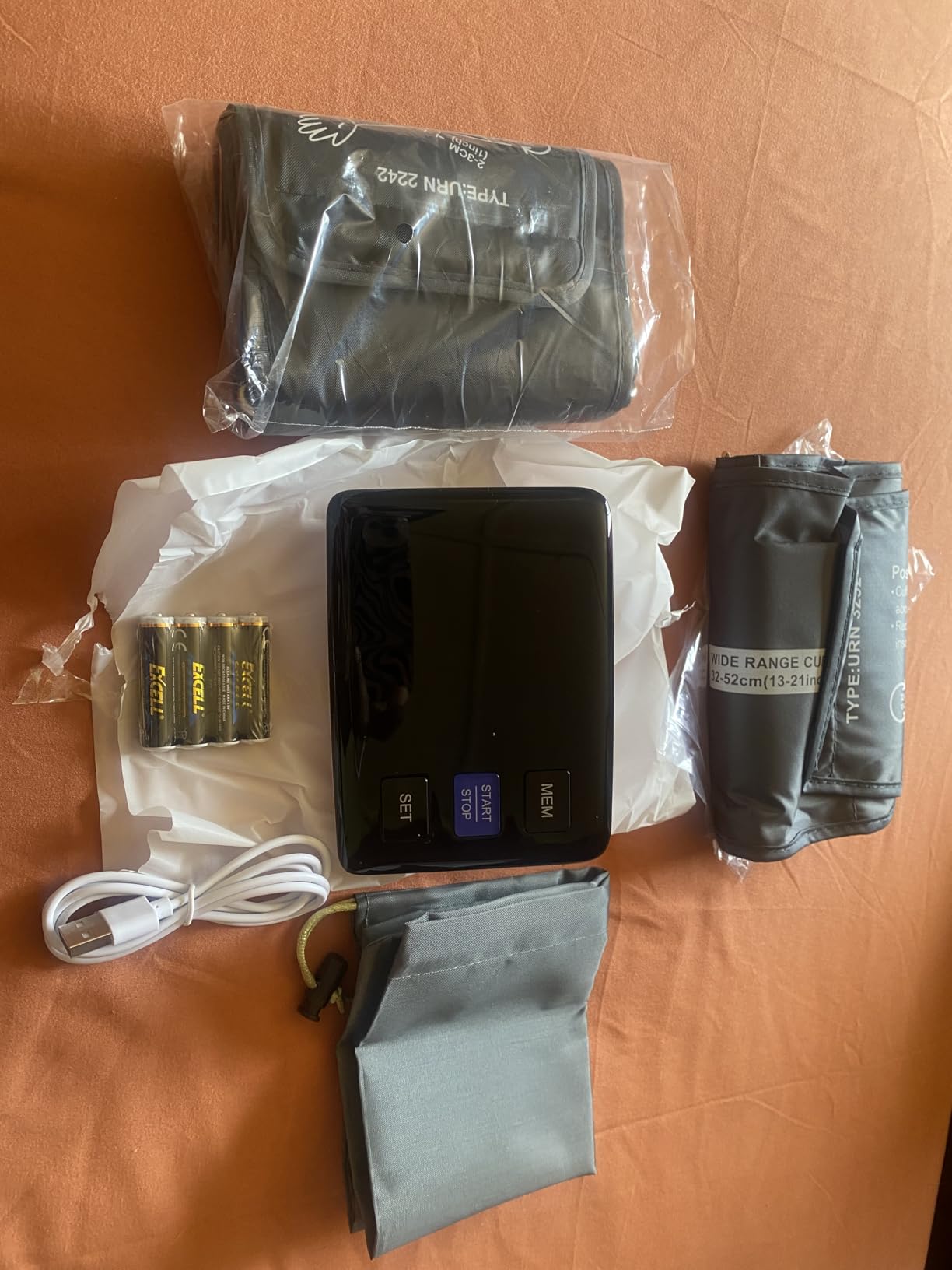
Why the clinician cross-check matters here
Independent confirmation from a medical professional is a stronger trust signal than a manufacturer’s own accuracy percentage, because it is someone with no reason to be positive. For a device in a health category, that kind of review is worth more than an extra app feature.
Where missing timestamps hurt you later
Memory is only useful if you know when each reading happened. Undated entries mean you cannot reconstruct a week, and that is the exact thing a clinician usually asks for, so treat the 199 slots as a rough history rather than a log.
6. SDUNW Dual Cuff Monitor – Quietest Measurement, Cuffs 9-17 and 13-21 Inches
Automatic Upper Arm Blood Pressure Monitor for Home Use with 9-17&13-21 in
Cuffs 9-17 in and 13-21 in
2 users, 90 slots each
30-second inflation
FSA and HSA eligible
Pros
- XL cuff included for very large arms
- Quiet 30-second automated measurement
- 90 readings per user
- Five smart alerts catch bad technique
Cons
- AC adapter not included
- Some accuracy variance reported by buyers
- Shallowest memory of the dual-cuff models here
If you take readings early while someone else is asleep or working from home, this is the one to look at. The manufacturer specifies a 30-second quiet automated inflation, and the air tube is described as 2.95mm thick with anti-pinch cuff material, both of which reduce the noise and the fabric rustle that makes a large cuff obvious to a room.
The alert system is the quiet feature’s companion and is genuinely thoughtful for large arms. It watches cuff wear, movement during measurement, whether a retest is due, irregular heartbeat and low battery, which are the five ways a big cuff on a big arm tends to go wrong quietly rather than loudly. The colour-coded WHO classification is on the display, and the unit is FSA and HSA eligible.
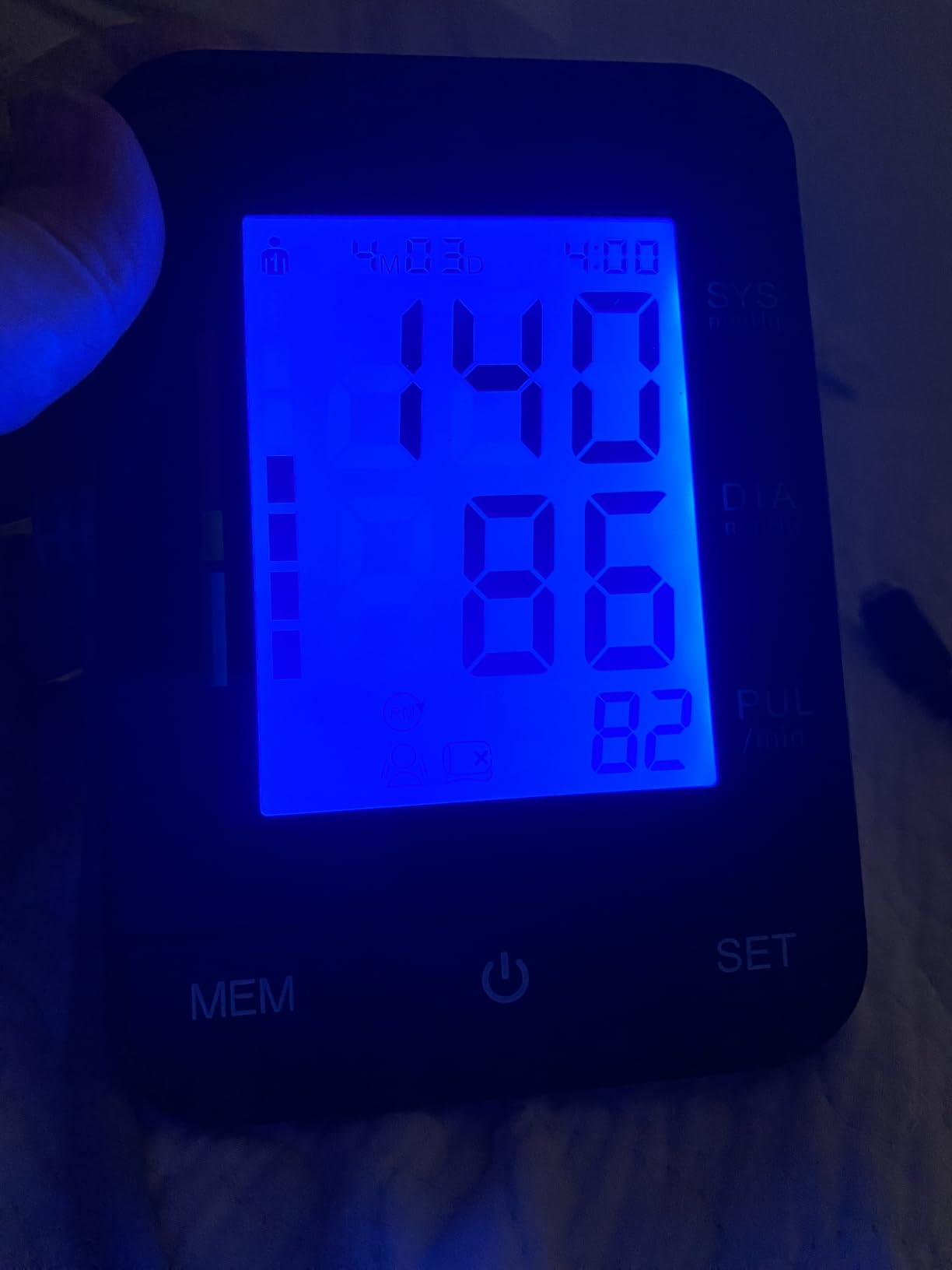
Reviews focus on the pair of cuffs covering slim through extra-large arms, the speed and quietness of the cycle, and a memory bank large enough for two people. Where the rating distribution dips, the complaints are about variance in readings rather than one dominant mechanical fault, which usually points to technique and cuff placement rather than a defective unit.
Ninety readings per user is the shallowest store among the two-cuff models here, so this is a monitor for a household that reads periodically rather than one building a long clinical history. Four AAA batteries are included and power the unit through 199 or more readings; the AC adapter is not included.
Why the movement alert matters more on a large arm
On a heavier arm, you can shift position mid-cycle without noticing, and a shifted arm turns an accurate cuff into a wrong number. An alert that tells you to hold still is more useful here than it would be on a slim forearm.
Where a short memory changes the workflow
With 90 slots per user, a twice-daily routine fills the store in about six weeks and starts overwriting. If your clinician wants a month of history, export or transcribe the numbers before they cycle.
7. Andesfit A02-SEB – Best App Tracking, Cuffs 17 and 21 Inches
Andesfit Upper Arm Blood Pressure Monitor for Home Use 17″ Large & 21″ XL Extra Large Cuff Big arm, Free APP Bluetooth Sync Apple Health Track Google Fit, Large Display Smart BP Machine for Seniors
17 in large and 21 in XL cuffs
6-inch colour LED
199 readings, 2 users
Bluetooth to Apple Health
Pros
- 21-inch XL cuff for the largest arms here
- Bluetooth syncs to Apple Health and Google Fit
- No login or personal account required
- 6-inch colour display with one-touch operation
Cons
- Listing text makes cuff sizing confusing
- USB Type-C is for power only and does not charge
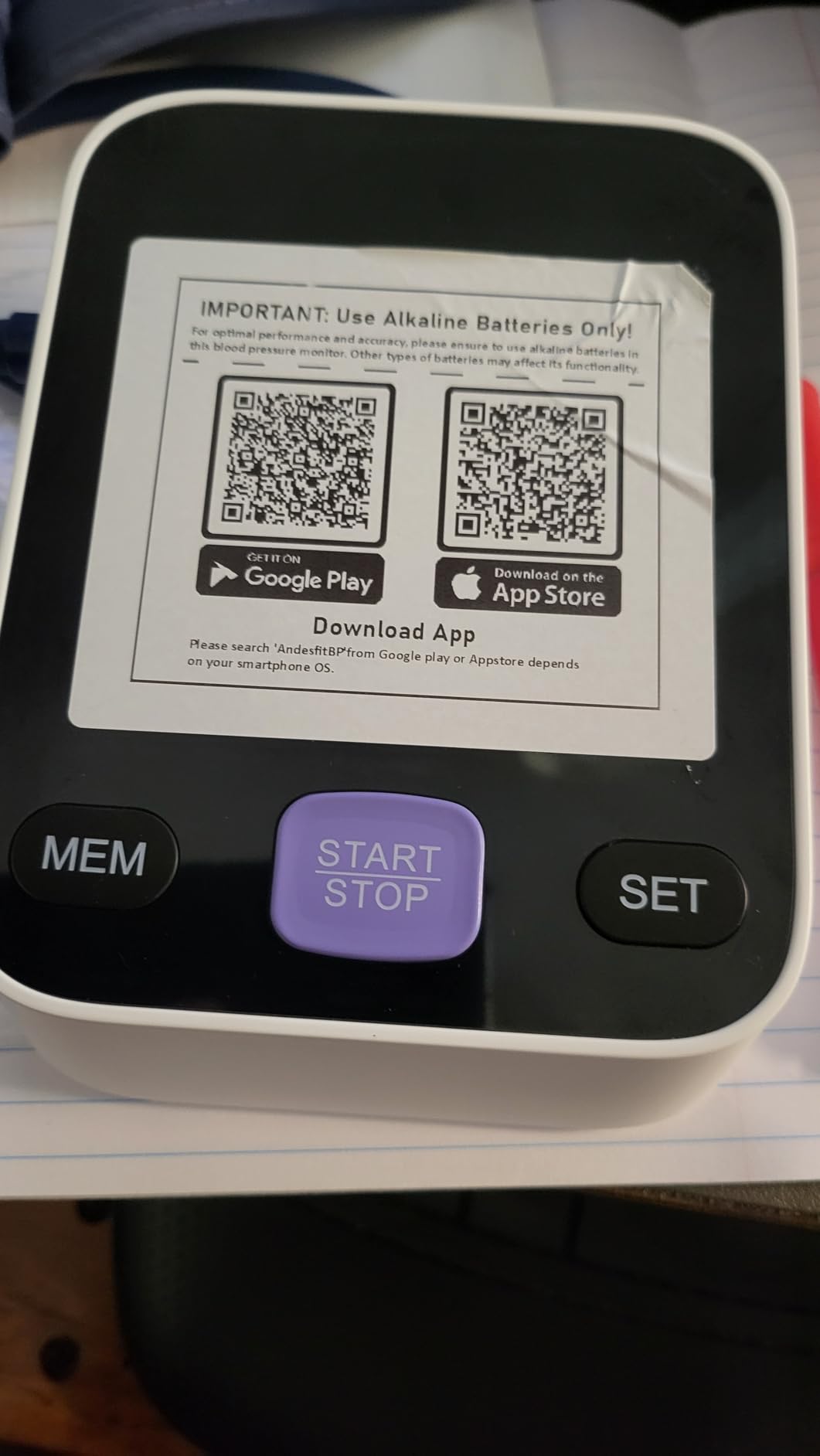
The headline cuff number here is 21 inches, which puts this monitor in the same top band as the 13-21 inch sets, and it comes with a 17 inch large cuff for a second user. What separates it from the other 21 inch models is the app story: Bluetooth sync to Apple Health and Google Fit through a free companion app, with no login required and no personal data requested, and a CSV export for sharing with a clinician.
That no-account design is worth a second look, because privacy anxiety about health apps is a real objection raised repeatedly in patient forums. The display is a 6-inch colour LED operated by touch, and the manufacturer describes the unit as an FDA-cleared upper arm monitor. Two user profiles are stored on the device with 199 readings each.
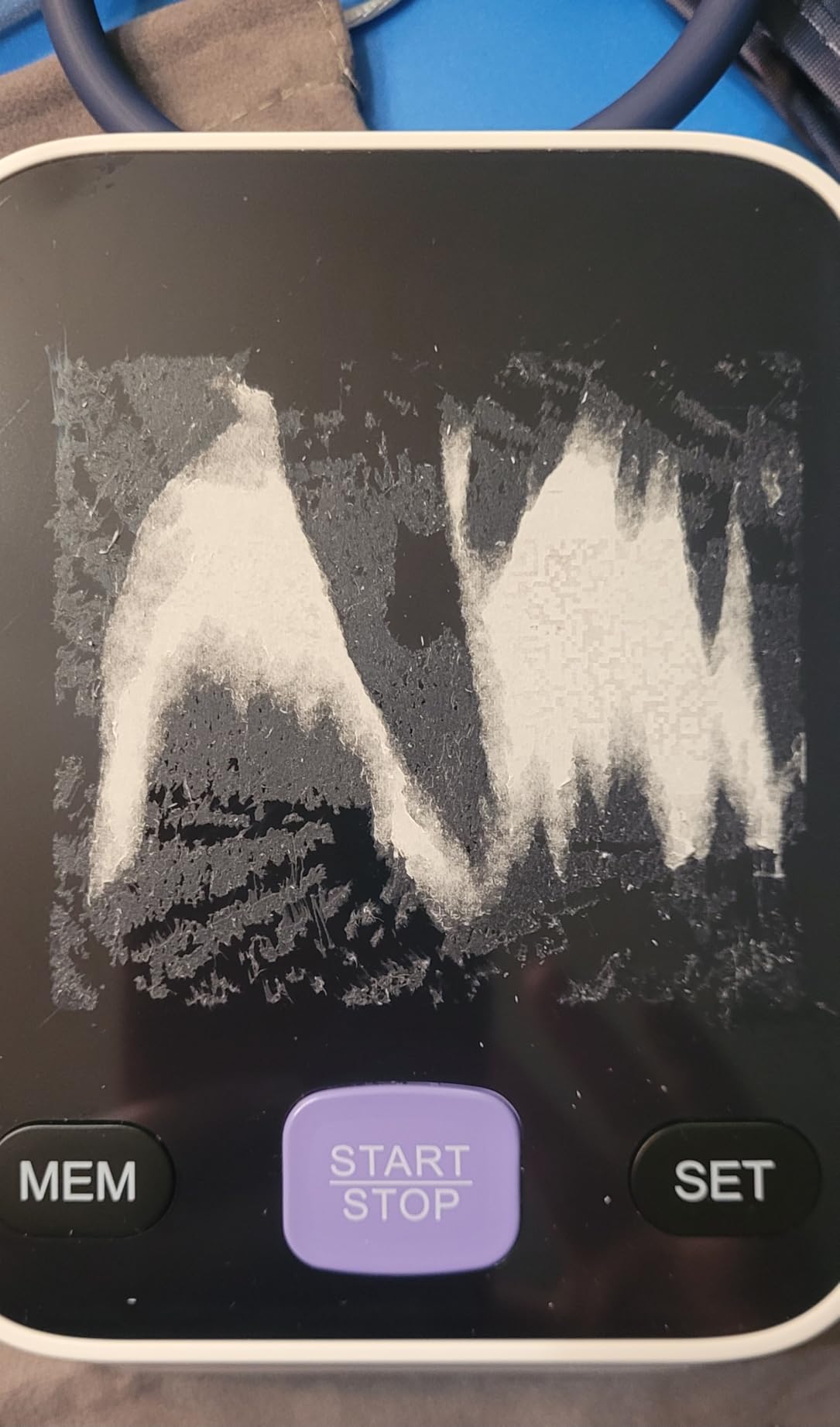
Reviewers like the sheer size of the 21 inch cuff, the simple one-touch flow on a big screen, and being able to see their history in the apps they already use without creating yet another account. The friction points are mundane but real: the listing copy describes 17 inches as the standard cuff, so people are unsure which one is meant for them, and the USB Type-C port is power only.
That second point trips people up. The cable does not charge the unit, and the monitor will not run on USB when the computer or charger is asleep. In practice you are choosing between four AA batteries and a live USB connection, not between battery and rechargeable.
Why no-login app tracking changes the deal
Most health apps want an email address, a password and a cloud account before they show you a number. A monitor that syncs to a platform you already have, and holds your history locally, removes the objection that stops some people tracking at all.
Where the unclear listing copy wastes your time
With two cuffs and wording that calls one of them standard, it is easy to reach for the smaller one. Measure your arm and match it to the printed range on the cuff itself rather than to the product title.
8. AQESO U80A Bundle – Most Complete Box, Cuffs 9-17 and 13-21 Inches
Blood Pressure Monitor for Home Use – 2 Size Cuffs (9″-17″ & 13″-21″), Fits Medium, Large & Extra Large XL Upper Arms, Accurate Digital Automatic BP Machine, 5″ LED Display, 3-User Mode, Model U80A
Cuffs 9-17 in and 13-21 in
5-inch colour LED
3 users, 199 slots each
AAA or USB-C power
Pros
- Two cuff sizes cover medium through extra large
- Clearly labelled 5-inch colour screen
- Three user profiles with 199 slots each
- Carrying case and manual included in the box
Cons
- USB power adapter not included
- Cuff choice requires measuring your arm first
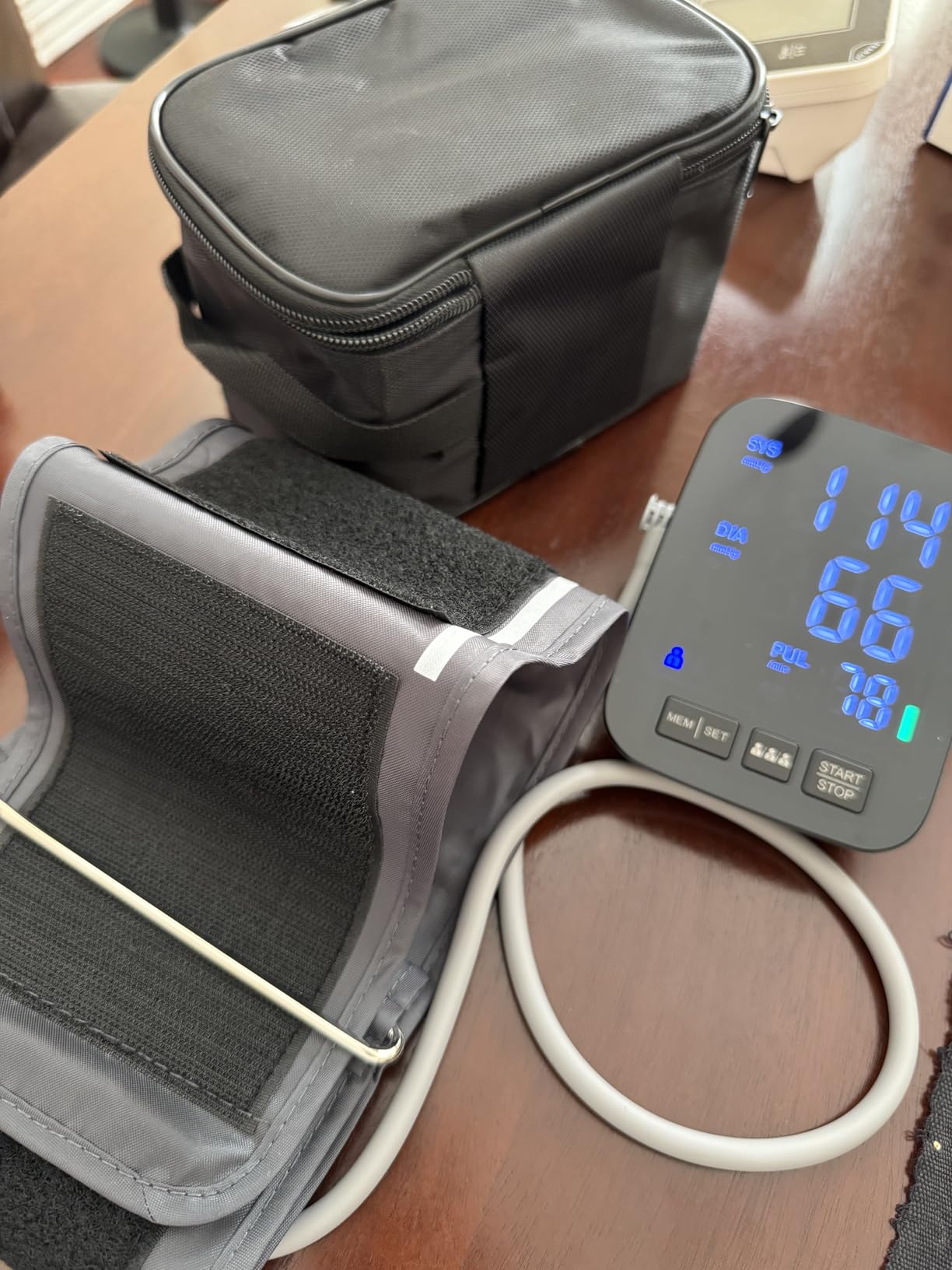
This is the tidiest package on the list. It ships a 9 to 17 inch cuff and a 13 to 21 inch extra-large cuff, a 5-inch colour LED screen with clearly labelled buttons, and three user profiles with 199 memory slots each. The box also contains a carrying case, the batteries, a USB cable and a printed manual, which is more than most competitors assemble.
That last detail matters more than it sounds. One of the two-cuff models reviewed here arrives with no instructions at all, and a monitor that measures 9-17 inches and 13-21 inches really does need a manual telling you which cuff goes on whom. Power is four AAA batteries or Type-C, with the adapter not included.
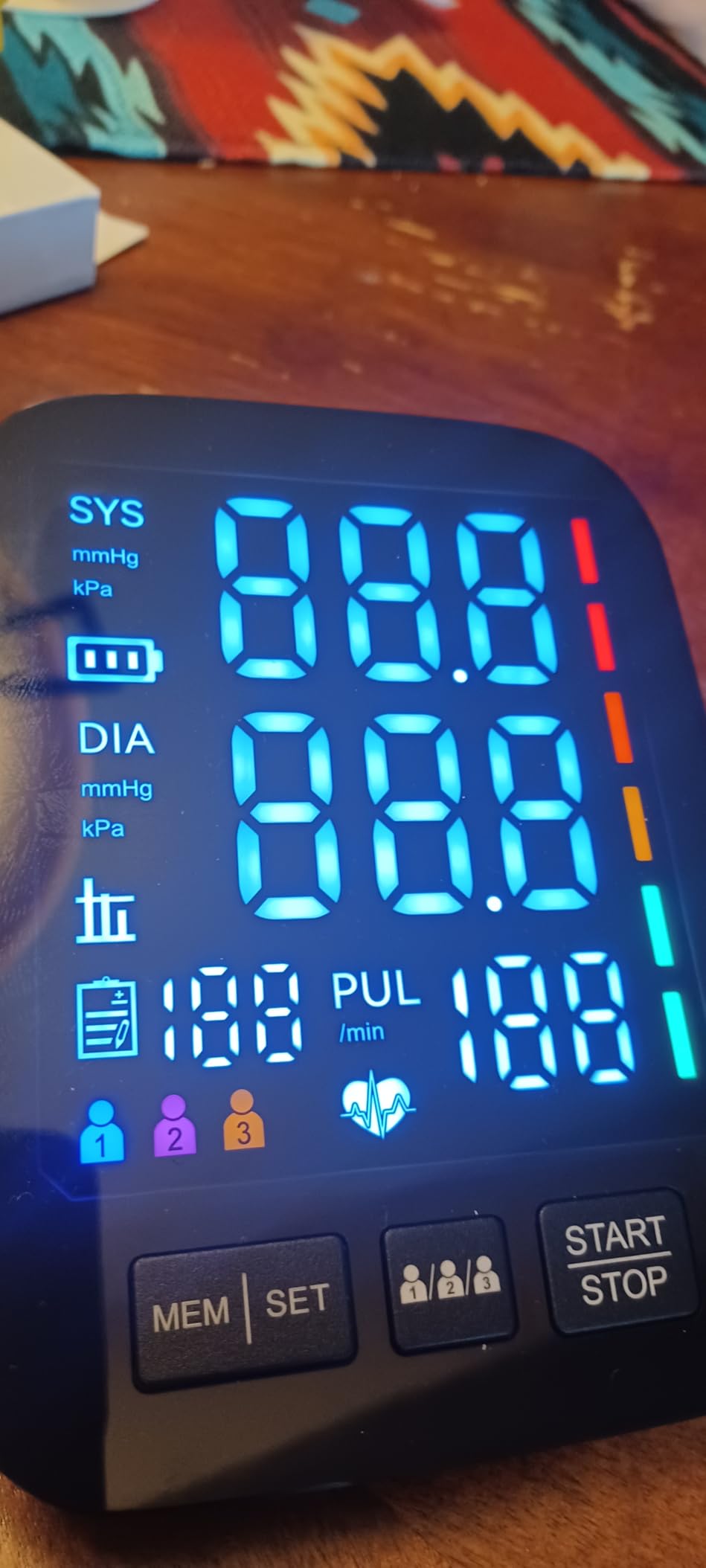
The review base here is small at 100 reviews, so treat the consensus as early rather than settled. What owners do report is dependable readings, a colour display with obvious labelling, and the convenience of two cuff sizes plus three user profiles in a single household. The most common practical note is simply that you need to measure your arm to pick the right cuff.
That advice is the same advice we give for every monitor on this page, but it is worth repeating because the three profiles are the reason people pick this one, and a household that never measures will end up with the wrong cuff on the wrong arm and a reading that looks fine while being wrong.
Why the printed manual is part of the deal
Two cuffs and three user profiles is a more complicated setup than most devices, and the manual is the only thing standing between a new user and a confident first reading. Having it in the box removes a step that sends people to search engines instead.
Where a thin review base leaves you guessing
A hundred reviews is not enough to predict how this unit behaves after two years of daily use, when battery and cuff-inflation complaints are what surface on longer-running monitors. If longevity is the priority, a pick with a much deeper review history is the safer bet.
9. CHANI A02-BE – Three User Profiles With 6-Inch Colour Screen
Automatic Blood Pressure Monitor & 2 Blood Pressure Cuffs (9-17″& 13-21″)
Cuffs 9-17 in and 13-21 in
6-inch colour backlit screen
3 users, 199 slots each
AAA or Type-C
Pros
- Two cuffs including a 13-21 inch XL
- 6-inch HD colour screen with WHO colour bar
- Three user modes with 199 readings each
- Automatic average of the last three readings
Cons
- XL cuff can fail to fully inflate on the largest arms
- Hard to fasten one-handed on a heavy arm
- Fit problems reported by conical-armed users
The CHANI pairs a standard 9 to 17 inch cuff with a 13 to 21 inch extra-large cuff, and pairs both with the most feature-dense display in its class: a 6-inch HD backlit LED colour screen with a three-colour WHO indicator, separate start and memory buttons, and a colour-coded result ring around the reading. Three user modes store up to 199 readings each, and the monitor averages your last three measurements automatically.
At roughly 7 ounces and a body about 3 by 2 inches, it is also one of the more portable monitors here, which suits anyone who travels or wants to store it in a drawer rather than on a counter. The box includes both cuffs, a nylon carry bag, a user manual, a quick operation guide, four AAA batteries and a Type-C cable.
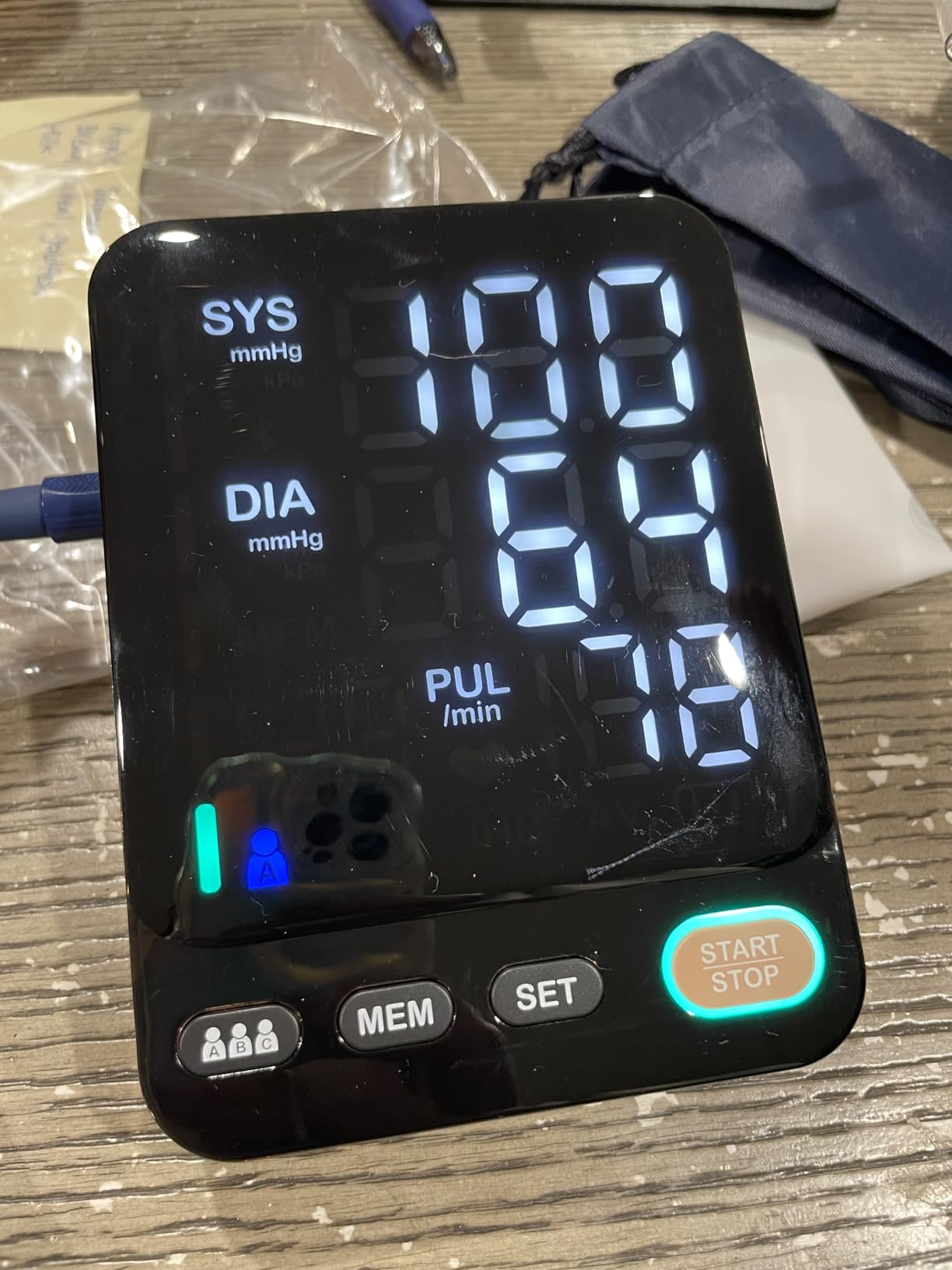
Owners generally find it easy to set up, with readings that match clinical measurements, and they like that the two cuffs serve household members of different sizes. The narrower of the two cuffs is also reported as a good fit for shorter arms, so a family with one small and one very large member is covered.
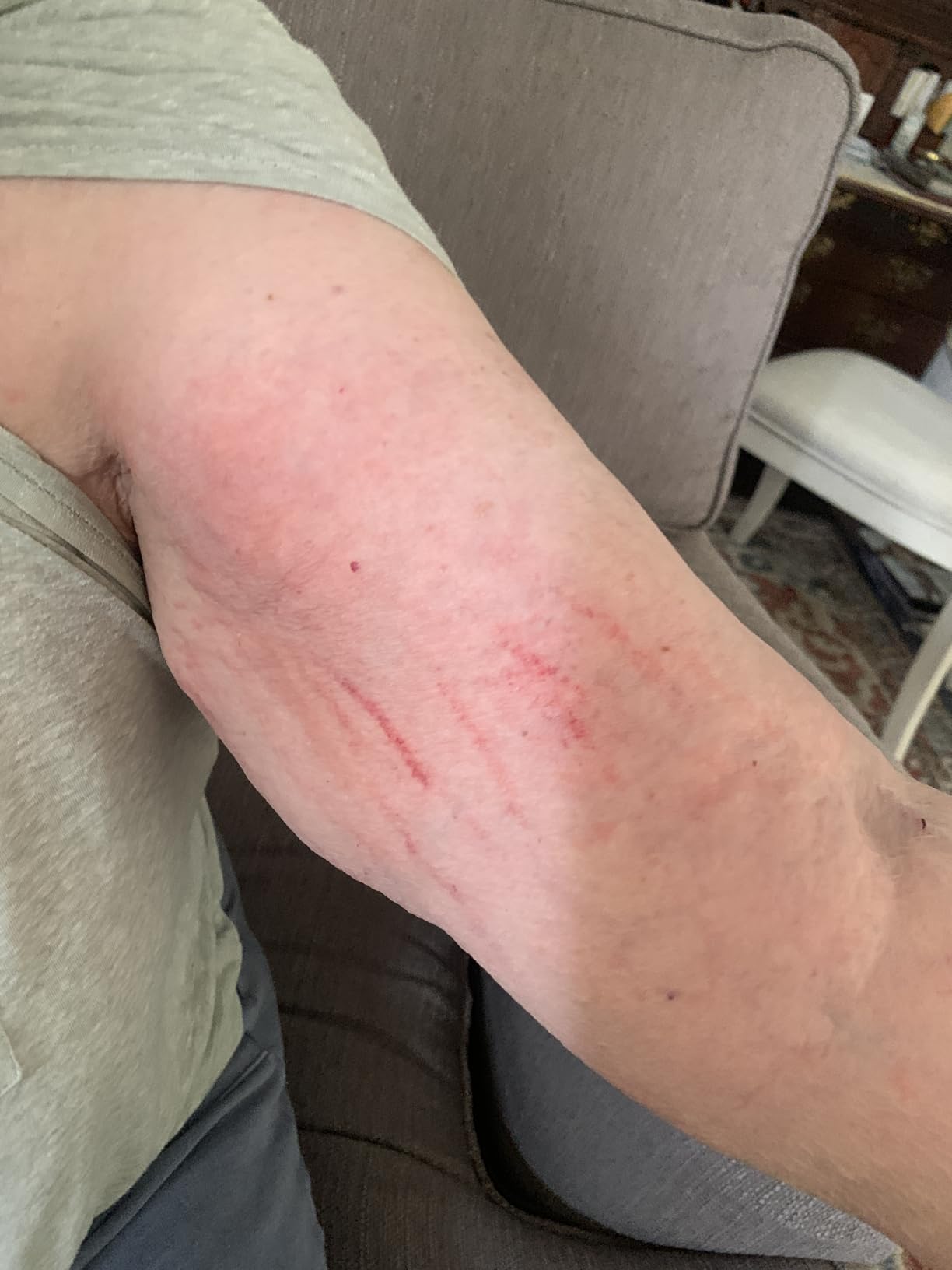
The complaints are consistent and specific enough to weigh. The XL cuff can fail to reach full inflation on the largest arms and returns an error code, and the cuff is hard to attach with one hand when the upper arm is heavy. Users with cone-shaped arms report fit problems even within the stated range, which is a geometry issue rather than a size issue.
Why the automatic three-reading average helps on a large arm
Large arms are where positioning errors creep in, because the cuff sits lower and the arm is easier to lean. Averaging the last three measurements smooths a single bad cycle, so a momentary slip does not become a number you act on.
Where conical arms cause trouble anyway
A cuff can be the correct length and still slip down a tapered arm, which breaks alignment with the brachial artery. If your arm narrows sharply from shoulder to elbow, the fix is a contoured or metal-bar cuff rather than a different size, and that is worth knowing before you buy.
10. yuwell YE660E – Best Value, Included Cuff 8.7-17.7 Inches
yuwell Blood Pressure Monitor, Large Upper Arm Blood Pressure Cuff, Digital Blood Pressure Machine for Home Use, Large Display, Stores 99 Readings, Voice Broadcasting with Power Adapter and Batteries
Cuff 8.7-17.7 in
Voice broadcast
99 readings, 3-reading average
ESH standard
Pros
- Single cuff covering 8.7-17.7 inches
- Meets the ESH standard
- Metal support bar makes one-handed fitting easy
- Voice broadcast for users with limited vision
Cons
- Cuff and tube are long enough to wrap twice
- Voice broadcast cannot be switched off
- Fixed large cuff with no smaller size included
Read the ceiling honestly. The yuwell cuff runs from 8.7 to 17.7 inches, which covers a large arm but stops short of the true extra-large band. It is on this list because the range is unusually wide for a single cuff, it carries a 4.5 rating with more than ten thousand reviews behind it, and that review base is the deepest evidence in the roundup.
Two features make it distinctive. The cuff has a rigid metal support bar, which is why so many users manage to fit it one-handed, and the monitor speaks the measurement and the result diagnosis aloud, which is genuinely useful for anyone with reduced vision. It is also described as meeting the European Society of Hypertension standard, and it stores 99 records with an automatic average of the last three.
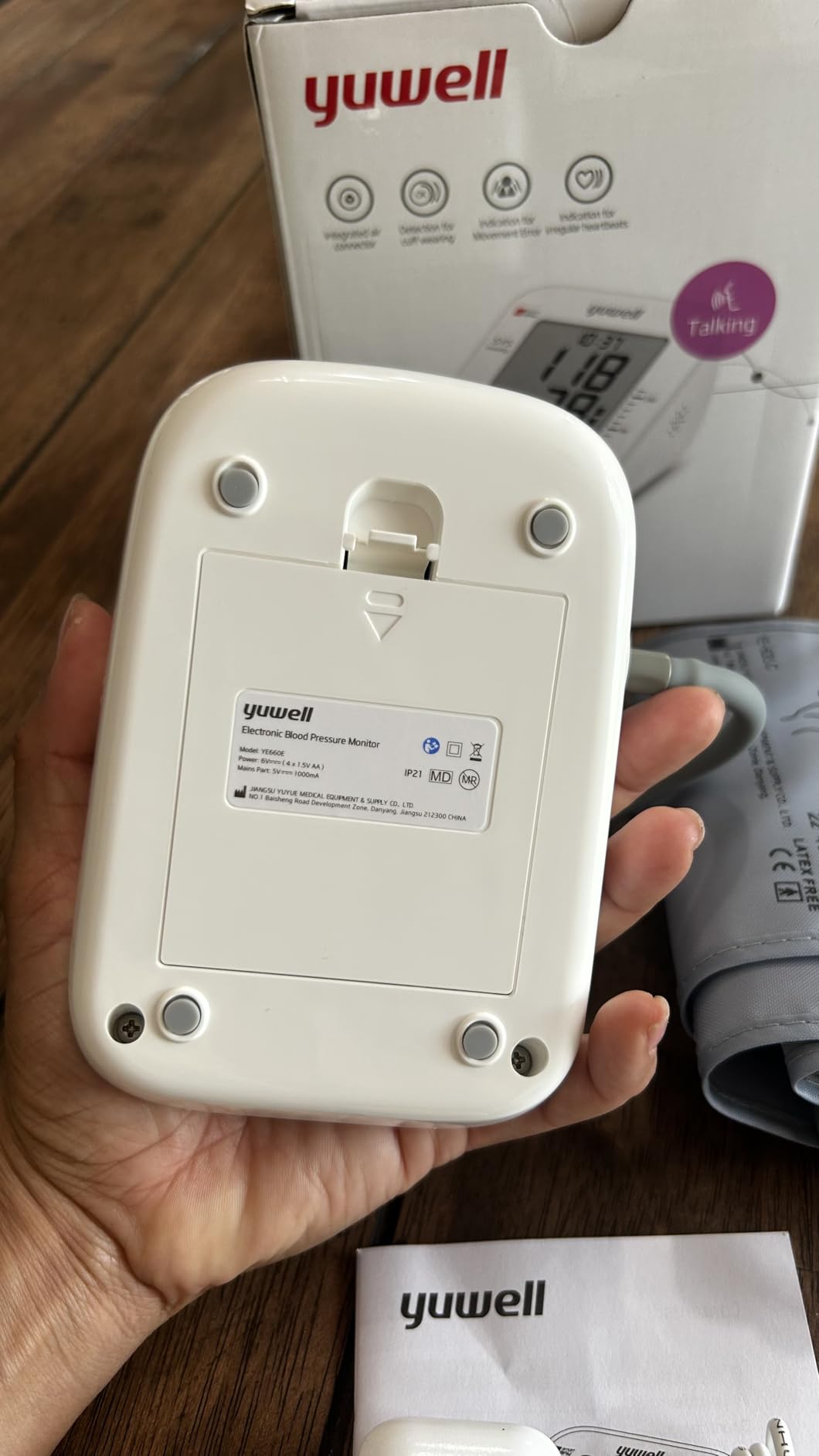
Reviewers consistently report that readings match what they get in a doctor’s office, and the metal-bar cuff is the single most-praised feature across thousands of reviews. The product has been available since 2020, and owners describe it as a long-term purchase rather than a disposable one.
The drawbacks are consistent too. The cuff and connecting tube are long, and some users find the tube wraps around the arm twice, while the short cuff tube and straight-side plug can be awkward to position. And the voice broadcast cannot be disabled, which some people find intrusive in a shared home.
Why the metal support bar matters more than the numbers
On a large arm, a soft wrap-around cuff slides and bunches, and you end up holding it in place with your other hand while trying to stay still. A rigid support bar holds its shape through inflation, which is the difference between a usable self-measurement and a two-person one.
Where 17.7 inches is genuinely not enough
If you measure 18 inches or more, this monitor is out of its range even though it is excellent inside it. The cuff will still fasten, which is the trap, and the resulting reading carries the same inflation penalty as any other undersized cuff.
11. WAJ 6.4-Inch Display Monitor – Best for Low-Vision Readers, Cuff 8.6-16.5 Inches
WAJ Blood Pressure Monitor for Accurate Home Use, Large Cuff 22-42cm, 6.4″ LED, White
6.4-inch backlit LED
Cuff 8.6-16.5 in
2 users, 120 slots each
Batteries or USB-C
Pros
- Cuff rated 8.6 to 16.5 inches
- One-button operation suits seniors
- Two users with 120 readings each
- Automatic three-reading average
Cons
- Cuff stops at 16.5 inches so it is not a true XL
- No app or wireless sync listed
- No voice readout
Be clear about what this is. The WAJ has a cuff rated 8.6 to 16.5 inches, which makes it a large cuff rather than an extra-large one, so if you are shopping specifically for a large arm it is not the monitor you want. What it does have is the biggest screen in this roundup at 6.4 inches of bright LED backlight, and that makes it the pick for anyone whose main barrier is reading the digits.
Operation is a single button, which is the right level of complexity for a senior user or anyone monitoring an older parent. The manufacturer describes a high-sensitivity chip and sensor for repeatable readings, and the memory stores up to 120 readings for each of two users with an automatic three-reading average. Power is four AAA batteries or USB-C, and a two-minute auto shut-off stops the batteries draining overnight.
At 4.5 stars across 1880 reviews, the sentiment is broadly favourable, and the recurring theme is simply that the display is easy to read and the readings are repeatable. The listed weight of just under one-third of an ounce is clearly a listing error rather than a real specification, and it is a reminder to sanity-check spec sheets on any monitor.
Why screen size deserves its own category
A correct reading you cannot read is not a measurement. For low-vision users, or for anyone squinting at a counter in a dim kitchen at 7am, a 6.4-inch backlit panel is worth more than an app, and this is the only unit here where the display is the headline feature.
Why it still belongs on a large-arm page
Because household needs overlap. If the person monitoring you has large arms and the person reading the screen is the one with vision trouble, the 16.5 inch ceiling is exactly the point where the honest answer is that no single monitor here solves both problems without a second cuff.
12. HOLFENRY 510(k) Cleared Monitor – Cleared Class II Device, Included Cuff 9-17 Inches
HOLFENRY Upper Arm Blood Pressure Monitor – FDA 510(k) Cleared Class II, Automatic BP Machine for Home Use with 22-42cm BP Cuff Fits Standard to Large Arms, Large LED Display, 2×99 Memory
FDA 510(k) cleared Class II
Cuff 9-17 in, 22-42 cm
2 users, 90 slots each
Up to 300 readings per battery set
Pros
- FDA 510(k) cleared Class II device
- Adjustable cuff covers 9-17 inches
- Smart averaging of the last three measurements
- Bright oversized LED numbers
Cons
- One nurse reviewer reported inconsistent repeat readings
- Possible opened or used units reported
- USB-C cable may be missing from the box
This is the only monitor in the roundup listed as FDA 510(k) cleared as a Class II device, which is a meaningful distinction in a category where plenty of products simply claim to be medical devices. The cuff is adjustable and covers 9 to 17 inches, or 22 to 42 centimetres, so it is a large cuff with a 17 inch ceiling, not an extra-large one.
The rest is well-judged for the category. The screen is a large LED panel with a three-colour range indicator on a dark background, the unit averages the last three measurements automatically, and it holds 90 readings for each of two users. One set of batteries is rated for up to 300 measurements, and the monitor shuts itself off automatically.
Reviewers mostly describe a bright, easy-to-operate device with a cuff that wraps securely one-handed and a compact footprint that is easy to store. Two threads are worth your attention. A nurse reviewer reported inconsistency between repeated measurements, which is exactly the observation a trained reader would make and a casual buyer would not, and some buyers received units that appeared to have been opened, with prior-use memory data and protective film reapplied.
Why 510(k) clearance is not the same as clinical validation
Clearance means the device demonstrated substantial equivalence to a predicate device for its intended use. It is a regulatory milestone, not a promise that the reading matches your clinic exactly, and it is worth more than nothing and less than a published accuracy protocol.
Where the 17 inch ceiling and the reviews conflict
Two things point the same way. The cuff stops at 17 inches, and the most credible negative review in the pool questions consistency. If your arm is at the top of that range, take several readings over a week and compare the spread before you trust any single number.
How to Measure Your Arm and Pick the Right Cuff Range
Measure before you buy, every time. A tape measure costs almost nothing and the ten seconds it takes decide whether the rest of your experience is accurate or quietly wrong. Here is the sequence we would use, and it matches the protocol that keeps coming up in patient forums.
Step one: flex your arm and find the midpoint between your shoulder and your elbow. Do not measure your bicep while it is pumped.
Step two: relax the arm, hang it straight at your side, and wrap a soft tape around the widest point. Read the number in inches or centimetres and write it down. A reading taken with the elbow bent gives you a smaller number than reality.
Step three: match that number to a cuff whose printed range contains it. Not a cuff that nearly reaches it. If you measure 20.5 inches, you want a cuff rated to 21, not to 20.
Step four: check the range printed on the cuff in the box, not on the product page. Listings describe the maximum a monitor accepts as though it were the standard inclusion, and that single word is where most disappointment originates.
The sizing rule behind all of this is the bladder length and width proportion. A correctly sized cuff has a bladder roughly 80 percent of your arm circumference in length and about 40 percent in width, so it sits over the brachial artery in the middle of the bicep without hanging off either end. That is the mechanical reason a too-small cuff misreads, and it is why a cuff rated to your number is a functional device while an adjacent size is not.
Match your measurement to the in-box cuff ranges on this list: under 12.5 inches is served by the 7 to 9 inch and 8.7 to 9 inch small cuffs; 12.5 to 16.5 inches is covered by the 8.6, 9 to 17 and 12.6 inch options; 16.5 to 20.5 inches needs the 15.7 to 20.5 or 12.6 to 20.5 inch extra-large cuffs; 20.5 to 21 inches is the narrow band served by the 13 to 21 and 17 and 21 inch sets; and above 21 inches nothing on this page fits, which is the subject of its own section below.
Skip generic marketplace cuffs that claim to fit most monitors. That claim is about the connector physically attaching, not about the bladder being the right length for your arm, and patient forums keep describing the same outcome: the tube connects, the reading looks normal, and the number is not trustworthy.
Why a Too-Small Cuff Reads Falsely High
A cuff works by inflating until it stops blood flow through the brachial artery, then deflating while it measures the pressure at that point. If the bladder is too short for your arm, it has to pressurise harder to reach the same point, and the monitor reports that harder pressure as your reading. The error runs in one direction, which is the dangerous part: too small means too high, not too low.
Clinical work on this has put the penalty for an undersized cuff at 10 to 20 mmHg on systolic readings, and it grows as the mismatch does. That is a large enough error to move a person from a normal category into a hypertensive one on paper alone, which is why a too-small cuff is not a minor annoyance. It is a device quietly manufacturing a condition.
Arm size affects the reading in the other direction too, and it is worth separating the two ideas. A large arm does not by itself raise blood pressure, and the trend of research points the opposite way: arm circumference is associated with a lower risk of high blood pressure, partly because larger arms make it harder for arteries to stiffen. The problem is never the arm. The problem is a cuff that was not built for it.
The forum pattern is consistent enough to act on. People whose home numbers ran 20 or more points above their clinic readings, after switching to a properly sized extra-large cuff, often found the two converged almost immediately. That is the fastest self-diagnosis available: if your home reading is high, measure your arm before you do anything else.
If a number looks wrong, work through it in order. Sit quietly for five minutes with feet flat and the arm supported at heart level, check the cuff is on bare skin and correctly aligned over the artery, then take two or three readings a minute or two apart and average them. Compare that average to your last clinic reading. If the gap persists with a correctly sized cuff, that is a conversation for your clinician rather than a device problem.
Cone-Shaped Arms and What to Do Above 21 Inches
Cone-shaped or tapered arms are a geometry problem, not a size problem. A conical arm narrows sharply from shoulder to elbow, so a cylindrical cuff that fastens correctly still slides down during inflation and no longer sits over the brachial artery. The result is a reading that looks plausible and is not. The specific fix is a contoured cuff or one with a rigid metal support bar, which is why the yuwell bar design comes up repeatedly among users with this arm shape.
Above 21 inches, there is no honest recommendation to make from this list, because no in-box cuff here goes further. Three options remain, and the third is the one most pages skip.
First, a thigh cuff rated for upper arms beyond the usual range. These are wide, long and wrap the upper thigh, and they are accurate when fitted and used as the manufacturer directs. They are also harder to position, and the tubing is long enough to be awkward, so treat them as a considered purchase rather than an upgrade.
Second, clinic measurement. For very large arms, an automated pharmacy or clinic cuff sized correctly for you is the reference the home device should be compared against, and it removes the guesswork entirely. If your clinician has measured you with an appropriate cuff before, that number is your baseline.
Third, a validated wrist monitor held at exactly heart height. Wrist monitors avoid the upper-arm size problem altogether, which makes them a genuine option above 21 inches, but the arteries at the wrist are far more sensitive to position, and readings taken below heart level run high. A wrist unit is only as good as your discipline in holding it level, and upper-arm devices remain the reference standard for accuracy.
If your arm is above 21 inches and you cannot get a suitable cuff, that is a reason to discuss home monitoring with your clinician rather than to improvise with a cuff that does not fit. The conversation is short, and it is far more useful than a reading you cannot trust.
What Clinical Validation Terms Actually Mean
Health product pages lean on validation language loosely, so it helps to know which words carry a real test behind them. ISO 81060-2 is the international standard for automated non-invasive blood pressure measurement, covering cuff sizing, positioning and accuracy tolerance in millimetres of mercury. AAMI is the American counterpart, and an AAMI or ANSI/AAMI protocol counts as a recognised independent validation, with ESH-IP as its European equivalent. STRIDE BP maintains public device listings recording which protocol a monitor passed.
FDA clearance is a different kind of statement. A 510(k) clearance means a device demonstrated substantial equivalence to a predicate device for its intended use, and a device can be cleared without appearing on an independent validation listing. Being FDA registered is weaker still, and some listings use the two words loosely. The yuwell on this list is described as meeting the ESH standard, and the HOLFENRY is described as 510(k) cleared Class II; beyond that, the claims here come from manufacturers, not from our own testing.
What none of these replace is technique. Position, rest time, cuff placement and the number of readings you average affect a home result as much as the device does, which is why the guides above spend as much space on protocol as on hardware.
Frequently Asked Questions
What size blood pressure cuff do I need for large arms?
Most adults need a cuff rated to about 9-16 inches. For a larger arm, look for a cuff whose printed range covers your measurement and extends past it by at least an inch. Extra-large cuffs typically start around 15.7 or 16 inches and reach 20.5 to 21 inches. Measure the midpoint of your relaxed upper arm first, then match the number to a cuff range rather than to a brand.
Can BP be high if the cuff is too small?
Yes, and the error always runs in that direction. A cuff that is too short has to inflate harder to stop blood flow through the brachial artery, and the monitor reports that extra pressure as your reading. Clinical work puts the penalty at 10 to 20 mmHg on systolic readings, which is enough to change a category on paper without any change in your health.
How to check blood pressure if arm is too big?
Measure your arm first, then choose one of three routes. Below 21 inches, buy a monitor whose in-box cuff covers your measurement. Between roughly 20.5 and 21 inches, look for a 13-21 or 17 and 21 inch cuff set. Above 21 inches, use a thigh cuff rated for very large arms, have your clinician measure you in clinic, or use a validated wrist monitor held exactly at heart height.
Is there a blood pressure monitor with an XXL cuff available?
Yes, though the term is used loosely by sellers. An XXL cuff in practice means one rated to roughly 21 inches, and the range is printed on the cuff itself. Check that range rather than the product title, because many listings describe the largest cuff a monitor accepts as though it were included. A cuff that fits but is the wrong size still produces a wrong reading.
Does arm size affect blood pressure reading?
Only through the cuff, not on its own. A larger arm is not associated with a higher risk of high blood pressure, and the error comes entirely from using a cuff that is too small for it. That error inflates the reading, so if your home numbers run higher than your clinic numbers and your arm is larger than average, sizing is the first thing to rule out.
What happens if the cuff is too small on a patient’s arm?
The cuff has to inflate to a higher pressure to compress the brachial artery, and the device reports that higher pressure as the blood pressure reading. The cuff may still fasten, which is the trap, so a snug fit is not evidence of a correct fit. Over time, repeatedly inflated readings can lead to unnecessary worry or medication changes that were based on a measurement error.
Does Omron make an XL cuff?
Omron is a common name in this category, but none of the extra-large monitors reviewed here are Omron models, so we cannot confirm a current Omron XL cuff range for you. Check the cuff range printed on your specific monitor and buy the XL cuff from the same manufacturer rather than a generic cuff. A connector that fits is a claim about fastening, not about accuracy.
Final Verdict: Which Blood Pressure Monitor to Buy for Large Arms
Start with the cuff, not the brand. Measure your relaxed upper arm, then buy the monitor whose in-box cuff range covers that number with room to spare, and ignore any listing that describes a cuff you do not receive. For most large arms, that means choosing between a dedicated extra-large single cuff and a two-cuff bundle that also serves a second person.
The Greater Goods XL Cuff Monitor is our top pick, because its 15.7 to 20.5 inch cuff starts low enough to be useful and reaches past 20 inches, and because more than eleven thousand reviews make its long-term behaviour the best documented on this page. If your arm is 20 inches or under and you want one device for one person, that is the sensible buy.
For a household, the AQESO U80B spans 7 to 21 inches across three cuffs and stores 1500 readings, which removes the guesswork of matching cuffs to arms. For a monitor above 21 inches, the honest answer is a thigh cuff, a clinic measurement, or a validated wrist device held at heart height, and if that is your situation, talk to your clinician before buying anything.
Whichever you choose, measure the arm, fit the cuff over bare skin at heart level, rest five minutes, and average two or three readings before you believe the number. Any monitor we recommend will help you with a large arm, and none of them will help you if the cuff is the wrong size or your technique is rushed.
If you are still comparing options for general monitoring rather than fit, our broader guide to monitors with wide coverage covers the rest of the category.