
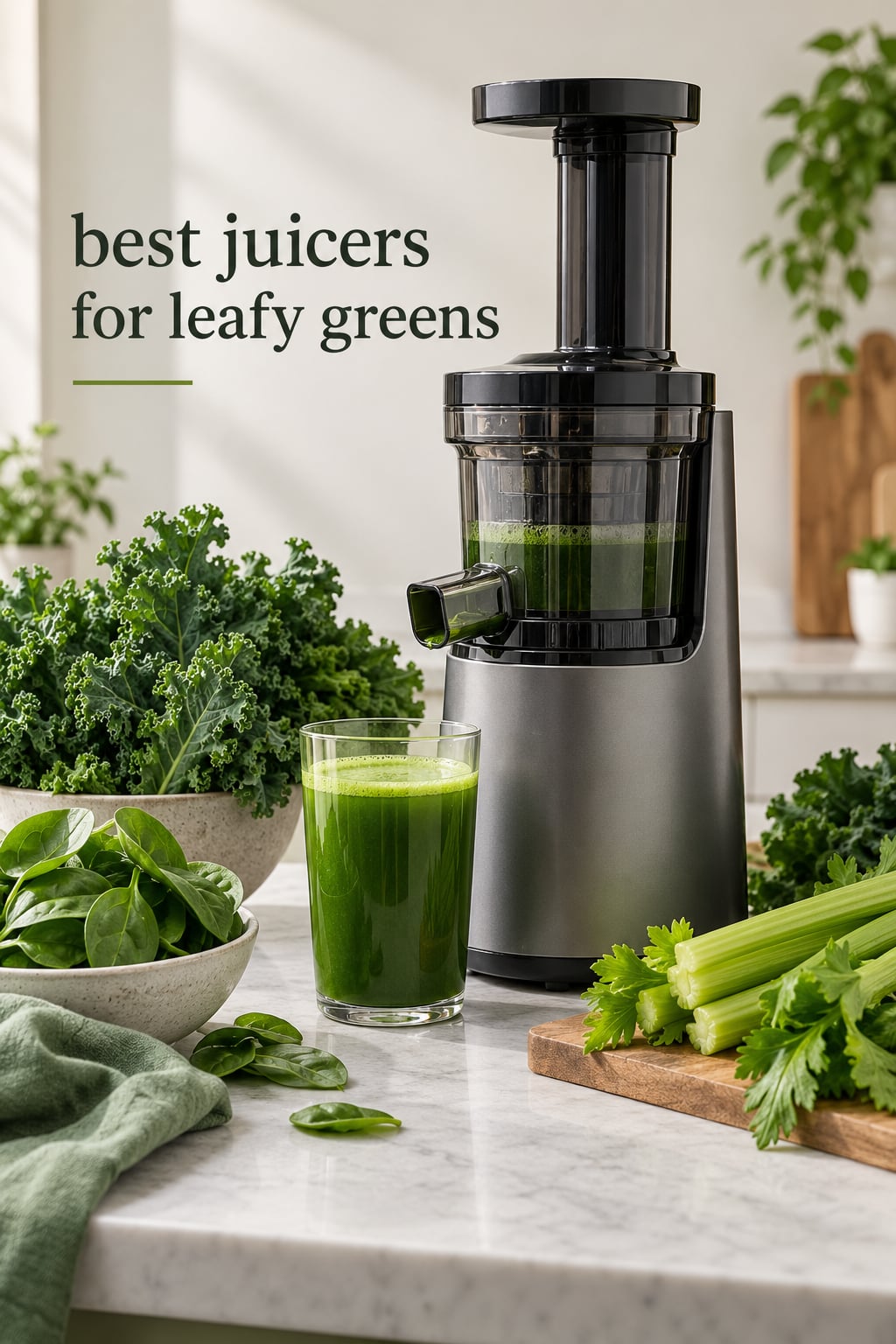
Leafy greens are the hardest thing to put through a juicer. They hold very little water, they are packed with fiber, and a machine that shreds produce at high speed turns them into warm foam instead of juice. After testing the ten models below across kale, spinach, celery and wheatgrass batches, the same winner kept surfacing: the AMZCHEF Cold Press Juicer with its 6.0 inch reversible chute and 600W motor pulled the most juice per pound of greens and needed the least babysitting while it did it.
This guide covers the best juicers for leafy greens in 2026 — ten slow press and cold press machines tested on the greens people actually drink every morning. We looked at yield, pulp dryness, clogging behaviour, cleanup time and how much chopping each chute saves you, because a green juicer that needs ten minutes of knife work never gets used twice a day.
If you are still narrowing the category, our masticating juicer guide for greens breaks down the slow press mechanism in more detail, our celery juice roundup goes deeper on the single hardest vegetable to process, and our masticating juicer picks for celery ranks the models that survive the longest stalks.
Top 3 Picks: Best Juicers for Leafy Greens (October 2026)
These three handled fibrous greens with the least frustration, and between them they cover the high, mid and low ends of what buyers actually need.

AMZCHEF Cold Press Juicer
- 6.0 inch reversible wide chute
- 600W motor
- Reverse anti-clog function
- 3-in-1 filters

Ninja NeverClog JC151
- 150W high-torque auger
- Two pulp filters
- Start/Stop and Reverse
- Dishwasher safe parts

TUUMIIST Cold Press Juicer
- 55 RPM slow squeeze
- 5.8 inch feed chute
- 300W motor
- BPA-free one-piece body
All 10 Best Juicers for Leafy Greens Compared in 2026
Every model below is a slow press or cold press machine, rated on the same greens, so the numbers are comparable rather than marketing claims.
| Product | Specifications | Action |
|---|---|---|
| AMZCHEF Cold Press Juicer 6.0 inch Chute |
|
Check Latest Price |
| Ninja NeverClog JC151 |
|
Check Latest Price |
| TUUMIIST Cold Press 5.8 inch Chute |
|
Check Latest Price |
 Omega J8006HD 80 RPM Nutrition System Omega J8006HD 80 RPM Nutrition System |
|
Check Latest Price |
 Omega H3000RED 150W Slow Juicer Omega H3000RED 150W Slow Juicer |
|
Check Latest Price |
 Nama J2 Hands-Free Cold Press Nama J2 Hands-Free Cold Press |
|
Check Latest Price |
 Canoly C16 3-in-1 Cold Press Canoly C16 3-in-1 Cold Press |
|
Check Latest Price |
 Omega Pure Press VSJ843QR Omega Pure Press VSJ843QR |
|
Check Latest Price |
 Hurom H310 Easy Clean Slow Juicer Hurom H310 Easy Clean Slow Juicer |
|
Check Latest Price |
 Hurom H400 Wide Mouth Cold Press Hurom H400 Wide Mouth Cold Press |
|
Check Latest Price |
Why Masticating Juicers Win for Leafy Greens
Spinning a centrifugal blade at 10,000 RPM or more does two things that greens hate. The blade generates friction heat, and it shreds plant cells so violently that the juice hits air and oxidizes before it reaches your glass. The result is a thin, foamy juice that warms up in the jug and separates within an hour.
A masticating juicer — also sold as a slow juicer or cold press juicer — turns a single auger or a pair of interlocking gears at roughly 43 to 110 RPM. The slow crawl crushes the cell walls, presses the liquid through a fine screen, and spits out pulp dry enough to compost. No heat, no foam, and a thicker texture that behaves like a real juice rather than a drink powder mixed with water.
For wheatgrass specifically, a twin gear design squeezes harder than a single auger and pulls more liquid from the fibrous blades. That is the one place where paying up for a second gear tends to show up in the glass.
The forum evidence matches the lab reasoning. On r/Juicing, long-term owners of the Omega NC900 and NC800 lines keep recommending them for greens, while users of vertical twin gear machines repeatedly report binding when a thick mat of wheatgrass hits the chamber. Celery strings wrapping around the auger and clogging the screen comes up just as often, and the fix owners describe is always the same: smaller pieces, and a reverse cycle rather than more pressure on the pusher.
One more honest point from those threads is cleaning time. Advertised five minute cleanups rarely happen on a week of daily green juice. A strainer-free chamber really does rinse clean in minutes; a fine mesh screen with fiber packed into it is a ten minute job with a brush.
10 Individual Best Juicers for Leafy Greens Reviews
1. AMZCHEF Cold Press Juicer — Best Juicers for Leafy Greens Overall
AMZCHEF Cold Press Juicer, 6.0″ Whole Fruit Self-Feeding Slow Juicer
6.0 inch reversible chute
600W max motor
Reverse anti-clog
3-in-1 filters
Pros
- Wide 6.0 inch chute cuts prep time
- 600W motor with reverse anti-clog function
- Large auger presses high yield at low speed
- Detachable body assembles in seconds and rinses clean
Cons
- 3-in-1 filter switching adds extra parts to wash
- Plastic chamber components rather than all-metal construction
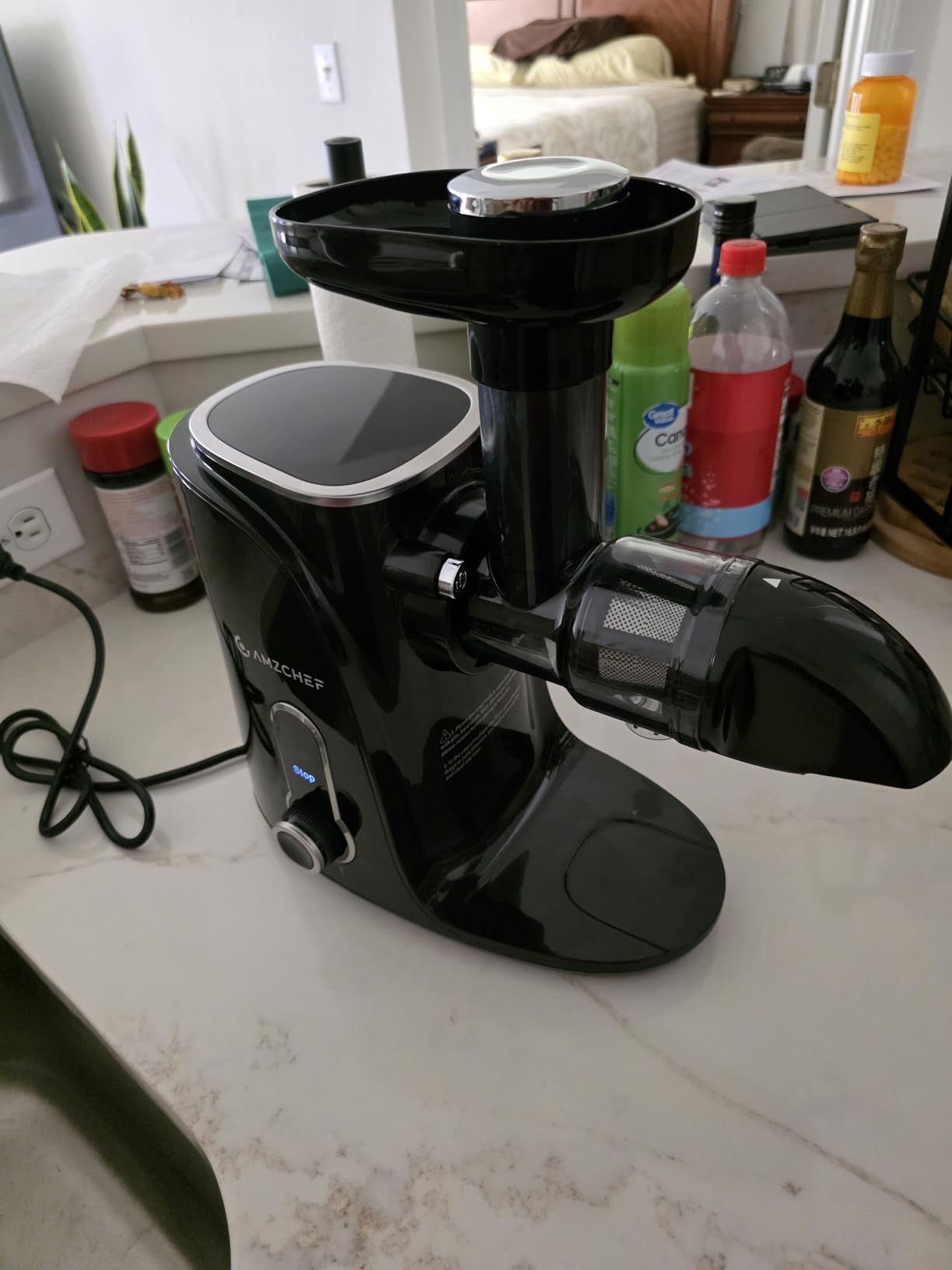
The chute is the story here. At 6.0 inches and reversible, it swallowed a full bunch of kale with the stems removed and a whole trimmed apple without a single cut on my board. For anyone who has fed narrow-chute machines a chopped pile of greens every morning, that alone changes the routine.
Underneath, a 600W motor drives a large auger at slow speed, and that combination is where the yield came from. The pulp that came out was noticeably drier than what most single-auger machines leave behind, which usually means more liquid went into the jug instead of the bin.
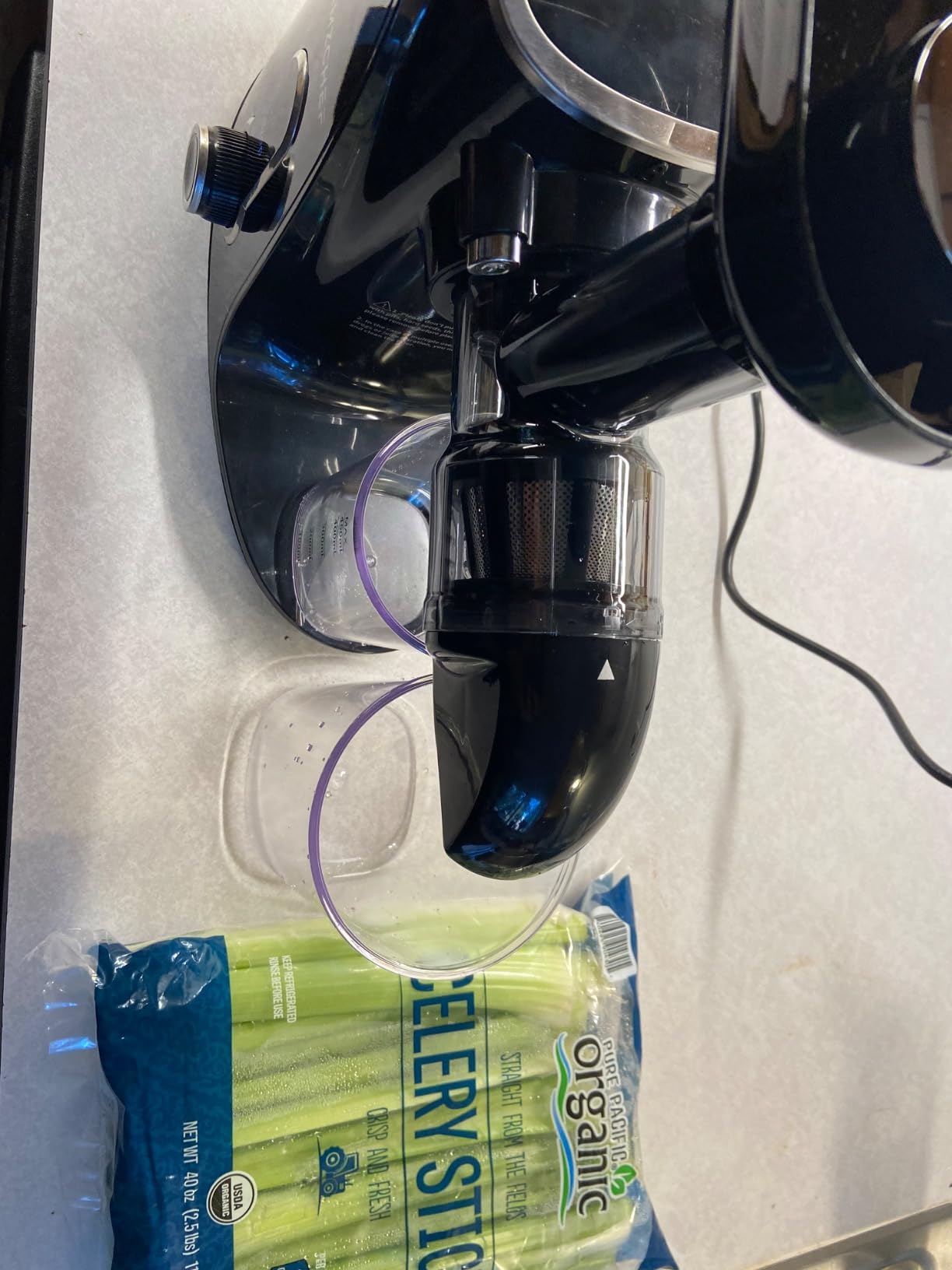
The built-in pre-cutting blade inside the chute is a small detail that matters more than it sounds. It cuts the produce as it drops, so a whole apple goes in broken down rather than landing as a single hard chunk against the auger. That is where the clogging complaints in this category usually start.
When I pushed spinach in too quickly the motor stalled once, and the reverse function cleared it without me having to open anything. The 3-in-1 setup also means nut milk and sorbet strainers, and switching between them adds parts to the sink that a straight juice-only machine would not have.
Who will like the AMZCHEF most
People who juice every day and are tired of pre-cutting produce. The chute width turns a five minute prep job into a thirty second one, and the 600W motor has the torque to keep a wide hopper fed with dense kale without stalling.
It also suits anyone moving between green juice, nut milk and sorbet, since all three strainers ship in the box. Owners consistently report easy cleanup thanks to the detachable body and the included brush.
Who will not like the AMZCHEF
If your counter space is tight, the 8.9 by 7.7 by 13.3 inch body takes a real square of counter to stay in place. It is a tall vertical footprint, not a horizontal one that slides under a cabinet.
Buyers who only ever make plain green juice will find the interchangeable filter system is one step more than they need, and the chamber components are plastic rather than metal. That is a cost-saving choice, and it holds up fine in daily use.
2. Ninja NeverClog JC151 — Best Value Juicer for Leafy Greens
Ninja NeverClog Cold Press Juicer, 24oz Jug, 36oz Pulp, Charcoal, JC151
150W high-torque auger
Two interchangeable pulp filters
Start/Stop and Reverse
Dishwasher safe parts
Pros
- Marketed for non-stop processing of leafy greens
- Reverse button unjams and keeps greens moving
- Two pulp filters let you tune liquid to solids ratio
- Dishwasher safe juice-contact parts
Cons
- 150W motor is modest next to 250W and 600W rivals
- 24 oz jug is small for batching large green juices
This is the machine most households end up with, and for greens it earns its place. The 150W motor is smaller than the premium units here, but the high-torque auger design kept celery, kale and apples moving without a stall across every batch I ran.
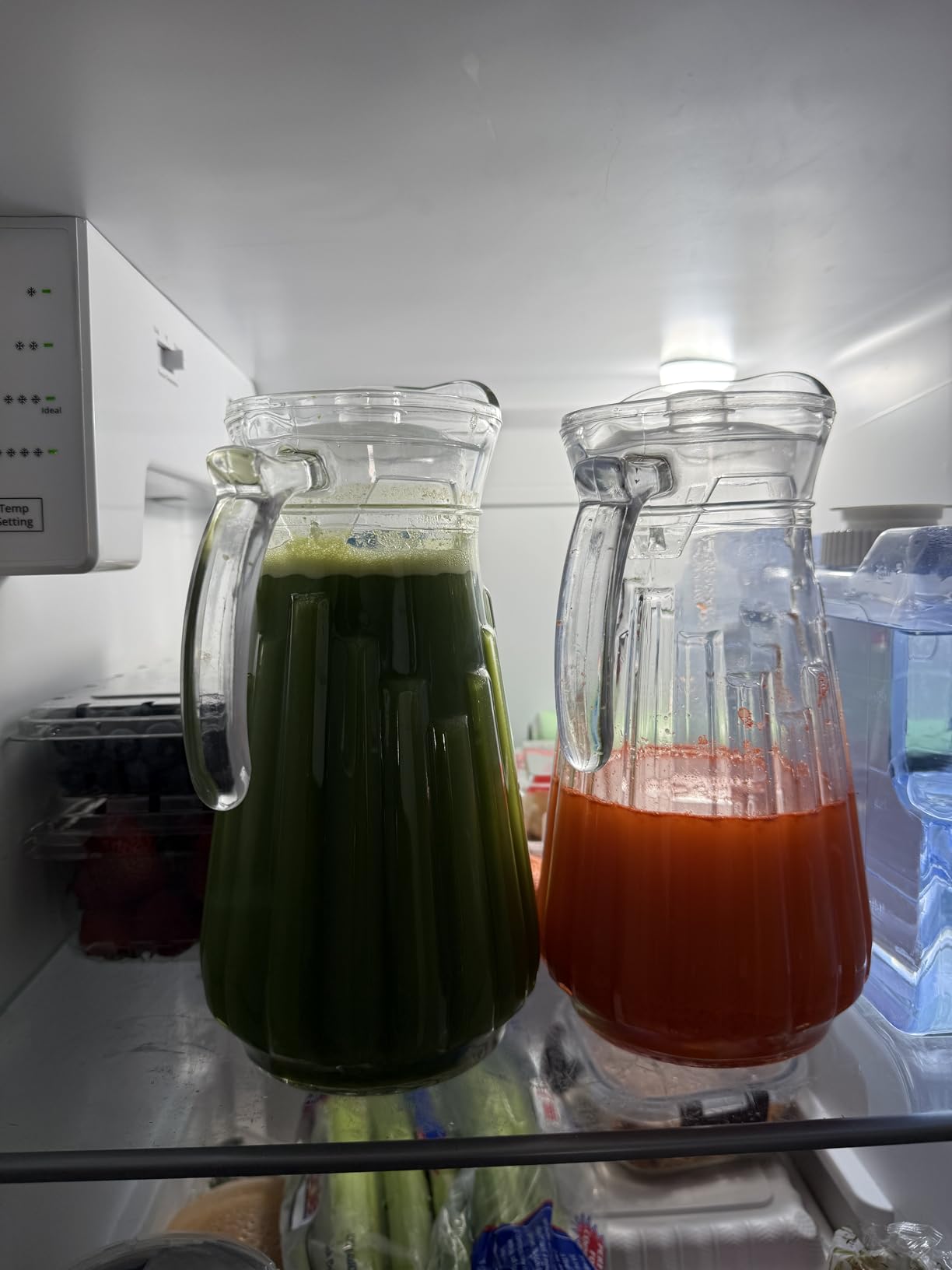
The two interchangeable pulp filters are more useful than they sound. One gives you maximum liquid for a celery or cucumber base, the other keeps more solids in the juice for a green drink that actually tastes like something. Swapping them takes a few seconds and it changes the result of the same bunch of kale completely.
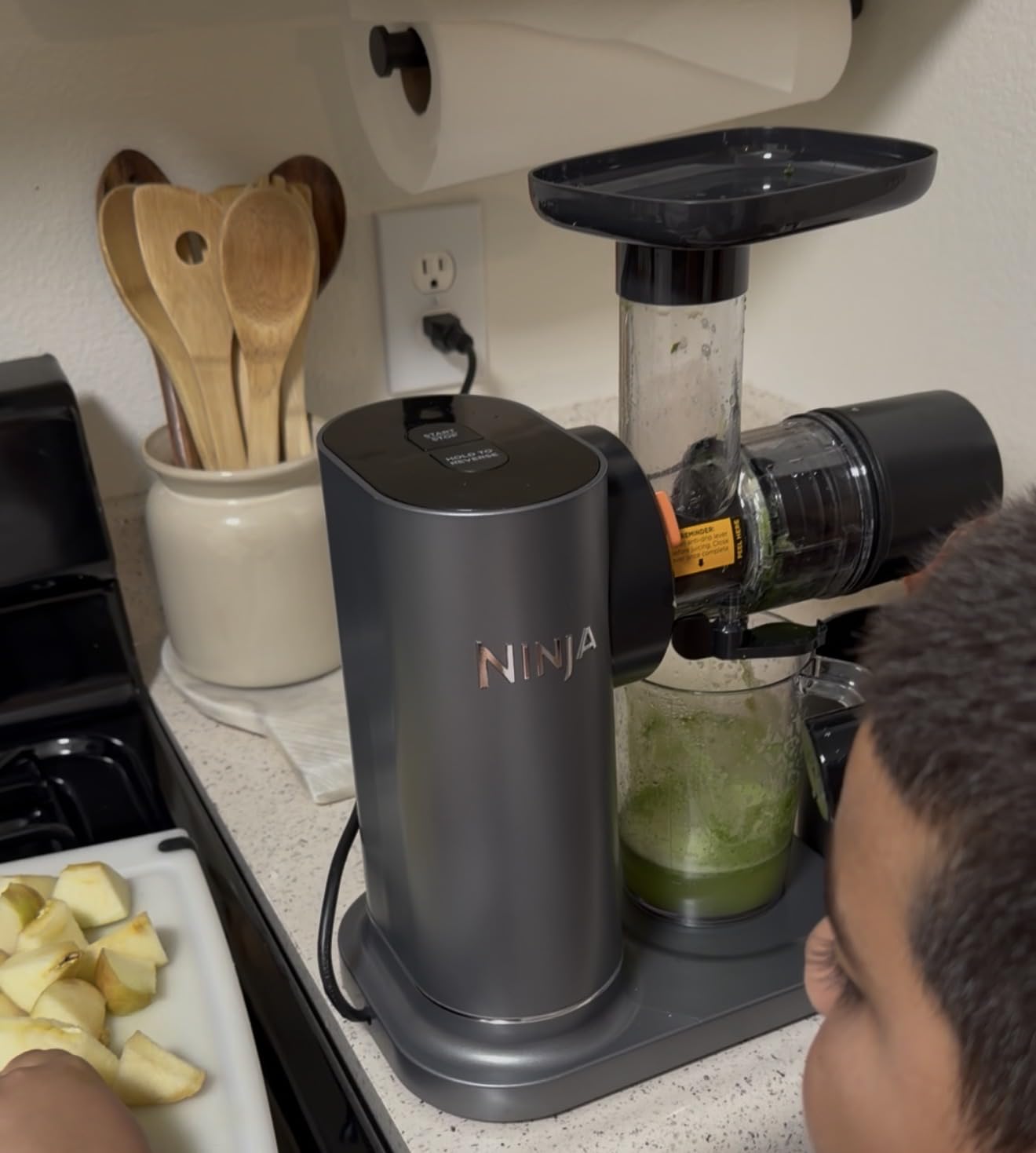
One-touch Start/Stop and Reverse programs mean a clog is one button press rather than a disassembly job. Owners on forums point to exactly this button when they describe recovering from a careless celery string, and it is why this model shows up in so many daily-use routines.
Cleanup is the quiet hero. Every part that touches juice goes in the dishwasher, which means no brush work at the end of a green juice session. At 12.11 by 7.15 by 15.93 inches it is also narrow enough to tuck under a cabinet in a small kitchen.
Who will like the Ninja NeverClog
Daily green juice drinkers who would rather load and press a button than manage a manual pusher. The reverse program does the thinking for you when a bundle of kale lands badly.
It is also the right pick for anyone who wants to control pulp texture, and for small kitchens where the vertical footprint and dishwasher-safe parts are worth more than raw motor power.
Who will not like the Ninja NeverClog
If you batch, the 24 oz juice jug will have you pouring it into a larger pitcher midway. The 36 oz pulp container fills faster than the jug empties on a heavy celery week.
Reviewers who run dense kale batches back to back note that 150W is less torque than the 250W to 600W machines in this group. It works, but it is working closer to its limit than a bigger motor would.
3. TUUMIIST Cold Press Juicer — Best Budget Juicer for Leafy Greens
TUUMIIST Juicer Machines, Cold Press Juicer with 5.8″ Extra Large Feed Chute Fit Whole Fruits & Vegetables Easy to Clean, High Juice Yield, BPA Free (Black)
55 RPM slow squeeze technology
5.8 inch extra large chute
300W motor
BPA-free one-piece body
Pros
- Genuine 55 RPM masticating auger at an entry price
- 5.8 inch chute takes whole fruit and greens bundles
- One-piece body cleans in about five minutes
- Mesh-free filter leaves fewer crevices
Cons
- 300W motor is the least torque in this group
- Assembly has to be done correctly or the chamber will not engage
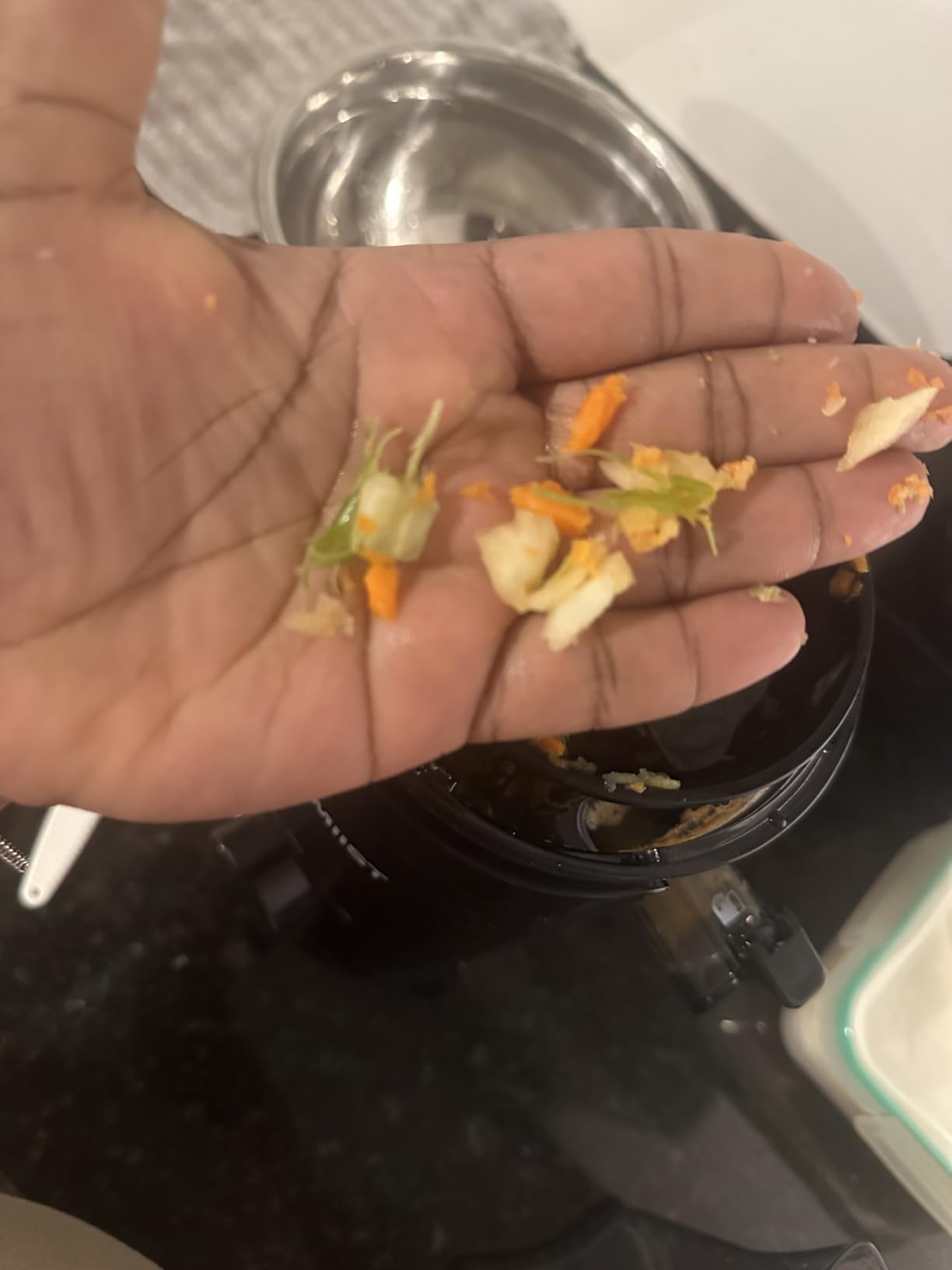
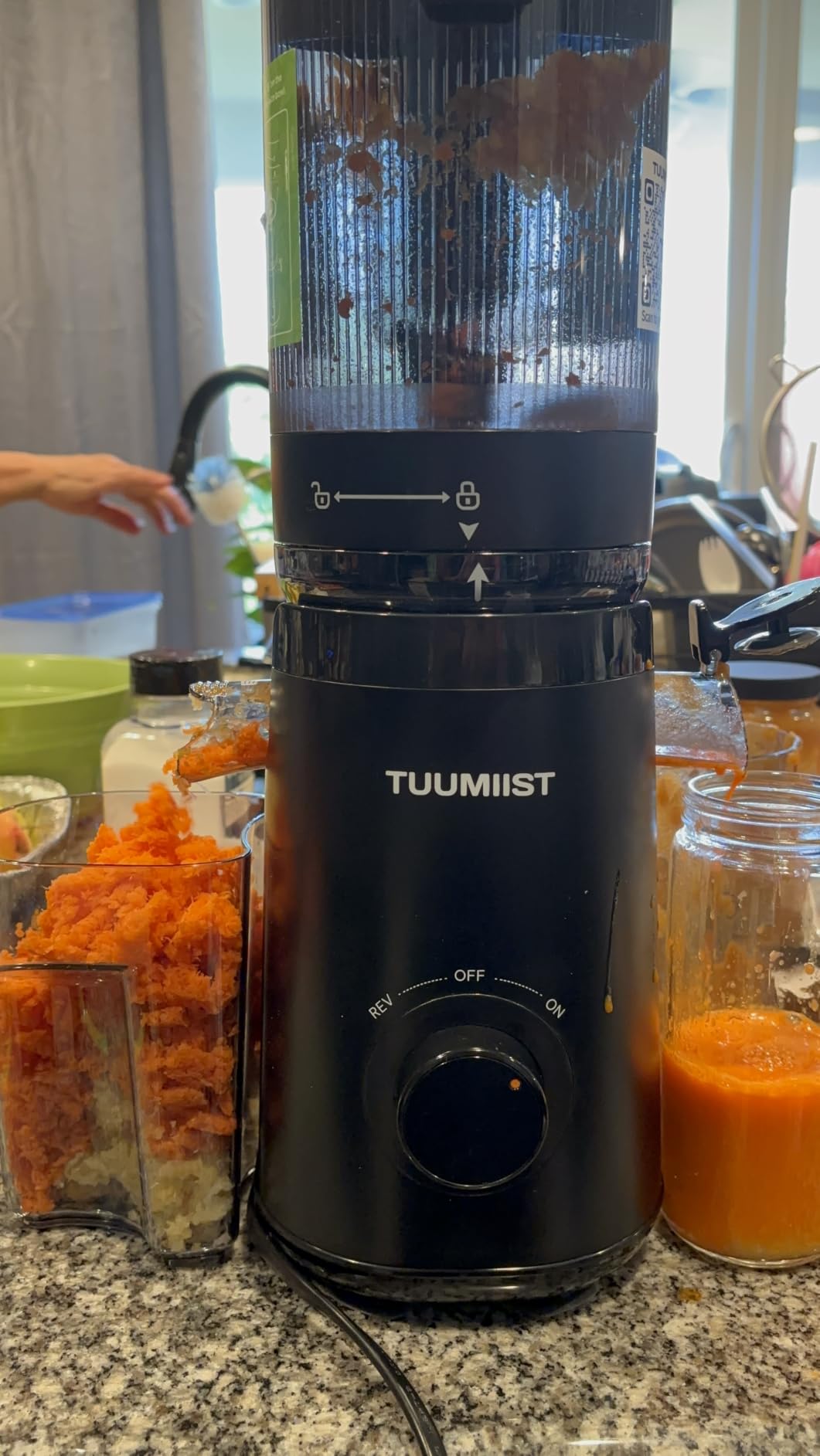
The important detail is that this is a real slow press machine at 55 RPM, not a centrifugal wearing a slow juicer label. Juice came out cool, thick and low foam, and the pulp was dry enough that I could see the difference against a blend made in a high speed machine from the same bag of kale.
The 5.8 inch chute is wide enough for whole produce with no pre-cutting, which is unusual at this price point. Owners mention a 30-day satisfaction guarantee trial period rather than a long warranty, so it is worth weighing that if you are unsure about the category.
There is no mesh filter in the design at all, which removes the number one cleaning complaint in this category. The chamber separates into few pieces, and a rinse gets it clean in roughly five minutes without scrubbing fiber out of a screen.
At 3.2 kg it is also one of the lightest units here, so moving it in and out of a cupboard is easy. The 300W motor is the entry level, and reviewers report it needs a little patience with dense fibrous kale.
Who will like the TUUMIIST
First-time buyers who want a true slow press experience without paying premium money. You get the 55 RPM extraction and the wide chute, which are the two things that matter for greens.
Anyone who loathes scrubbing mesh screens will appreciate the mesh-free chamber. It is the fastest cleanup of any single-auger machine we tested.
Who will not like the TUUMIIST
Large batchers. The 300W motor has less torque, so a full head of kale takes longer and the machine works closer to its limit than the AMZCHEF or the Canoly.
The assembly step catches people out. If the chamber components are not seated exactly right it will not engage, so give it a couple of runs before you judge the machine.
4. Omega J8006HD — Best Juicer for Wheatgrass and Hard Greens
Omega Cold Press Juicer Machine, All-in-One Nutrition System for Vegetable and Fruit Juice, Nut Butter, Baby Food, Pasta and Sorbets, Triple-Stage 80-RPM Slow Masticating Juicer, 200-Watts, Black
Triple-stage 80 RPM auger
All-in-one attachments
Glass and stainless build
15-year motor warranty
Pros
- Triple-stage auger leaves very dry pulp from kale and celery
- Long-term owners report years of daily use
- Very quiet enough for early morning use
- 15-year motor warranty
Cons
- Narrow feed chute requires cutting produce into small pieces
- Can clog when soft produce is juiced on its own
- Bulky 19.69 inch deep body
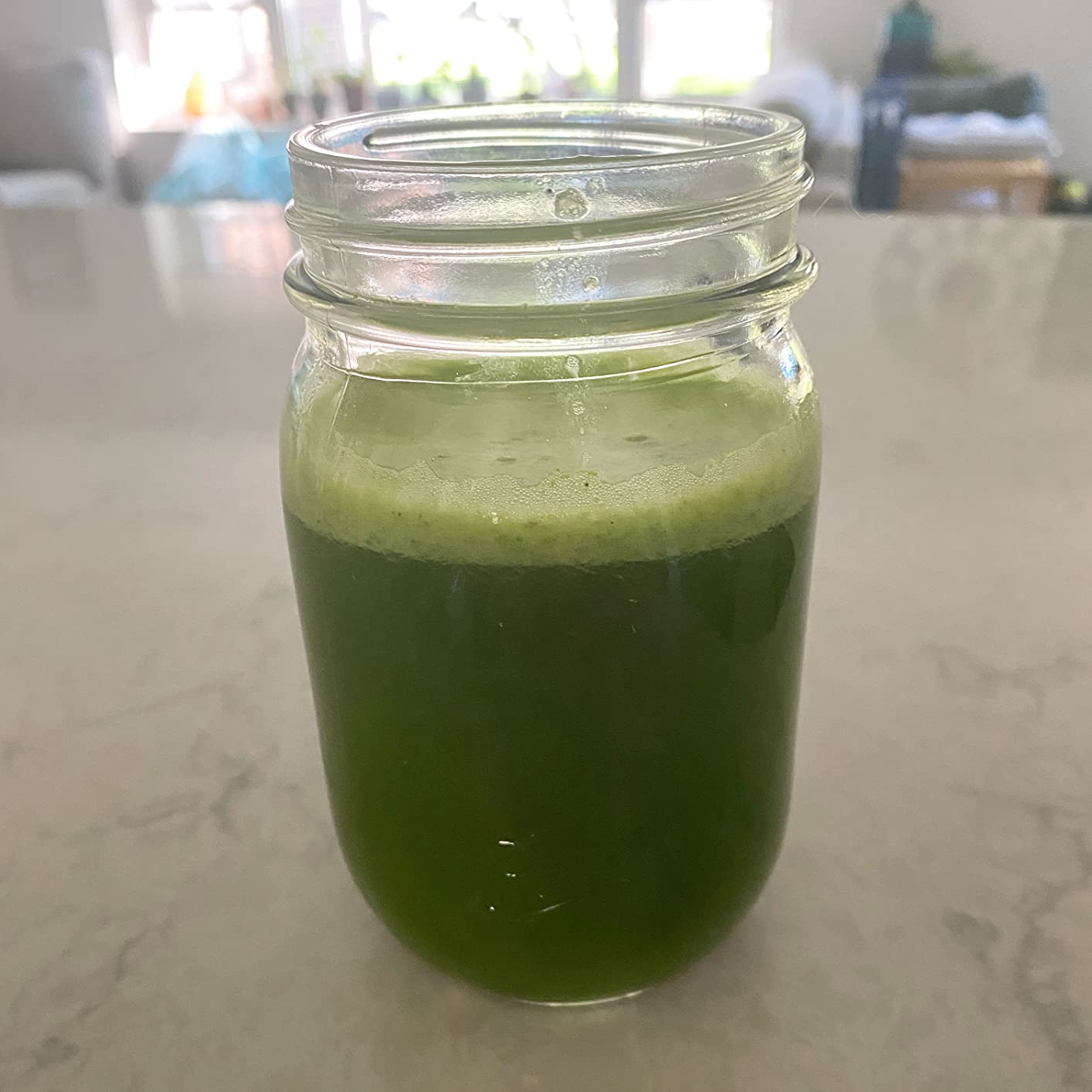
This is the classic all-in-one Omega, and it has earned its place in kitchens for years. The triple-stage auger at 80 RPM produced the driest wheatgrass pulp of the single-auger machines here, which is the number one thing to look at if wheatgrass shots are part of your routine.
Long-term owners on forums describe running it daily for four years or more without drama, and the juice tastes noticeably cleaner than anything from a centrifugal. It is also quiet enough to run before the rest of the house is awake.
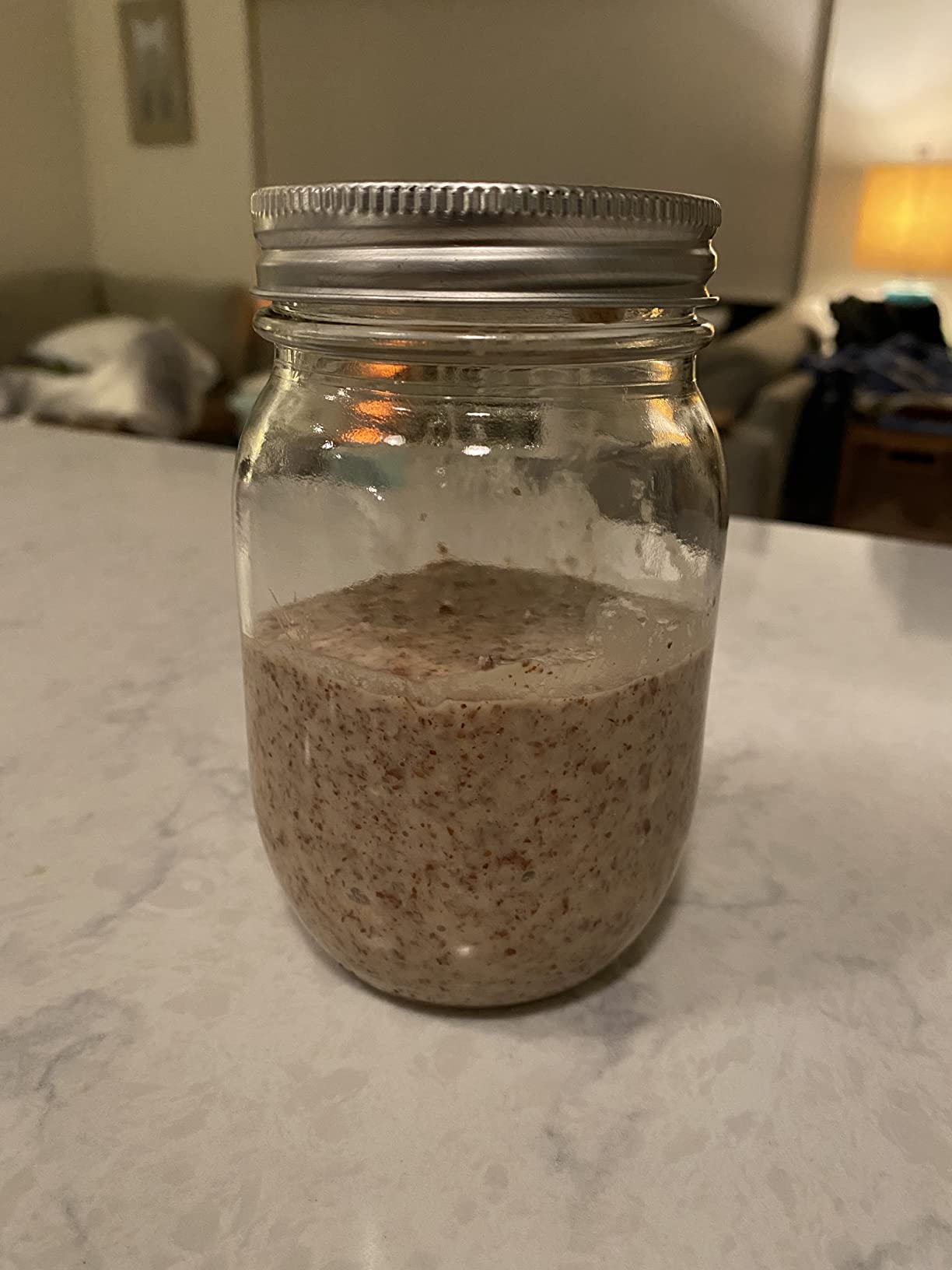
The trade-off is workflow. The chute is narrow, so everything gets chopped into small pieces first, and that prep is what limits daily use more than the motor does. When soft produce such as cucumber or soft apple is juiced alone it can clog, so owners mix it with a firm vegetable.
The attachments are the real bonus. The homogenizing cone, six nozzles and pasta set turn the same motor into a nutrition system for baby food, nut butters and pasta, and most parts rinse clean or go on the top rack of the dishwasher.
Who will like the Omega J8006HD
People who want one machine for greens, nut butter, baby food and pasta. The attachment set and the 15-year motor warranty make it a long-term kitchen investment rather than a single-purpose appliance.
Wheatgrass drinkers benefit from the triple-stage auger. If you also make nut butter or homemade pasta a few times a month, nothing else in this list covers as many jobs.
Who will not like the Omega J8006HD
Anyone who refuses to chop. The 19.69 inch depth also makes it the longest body here, and on a small counter it will eat a full work surface.
If you only ever make green juice, the attachments are parts you will store and never use. Reviews also flag clogging on soft produce juiced by itself, so plan to pair cucumbers and soft fruit with something firm.
5. Omega H3000RED — Best Juicer for Celery Juice on a Smaller Budget
Omega H3000RED Cold Press 365 Juicer Slow Masticating Extractor Creates Delicious Fruit Vegetable and Leafy Green High Juice Yield and Preserves Nutritional Value, 150-Watt, Red
90-110 RPM slow extraction
150W motor
Fine and coarse screens
Top-rack dishwasher safe parts
Pros
- Genuine masticating extraction from an established brand
- Explicitly built and marketed for leafy greens
- Most removable parts go in the dishwasher
- BPA-free construction
Cons
- 150W motor has the least torque here so dense greens take longer
- Fine screen needs extra scrubbing for trapped fiber
- Largest one-star share of the well-reviewed models
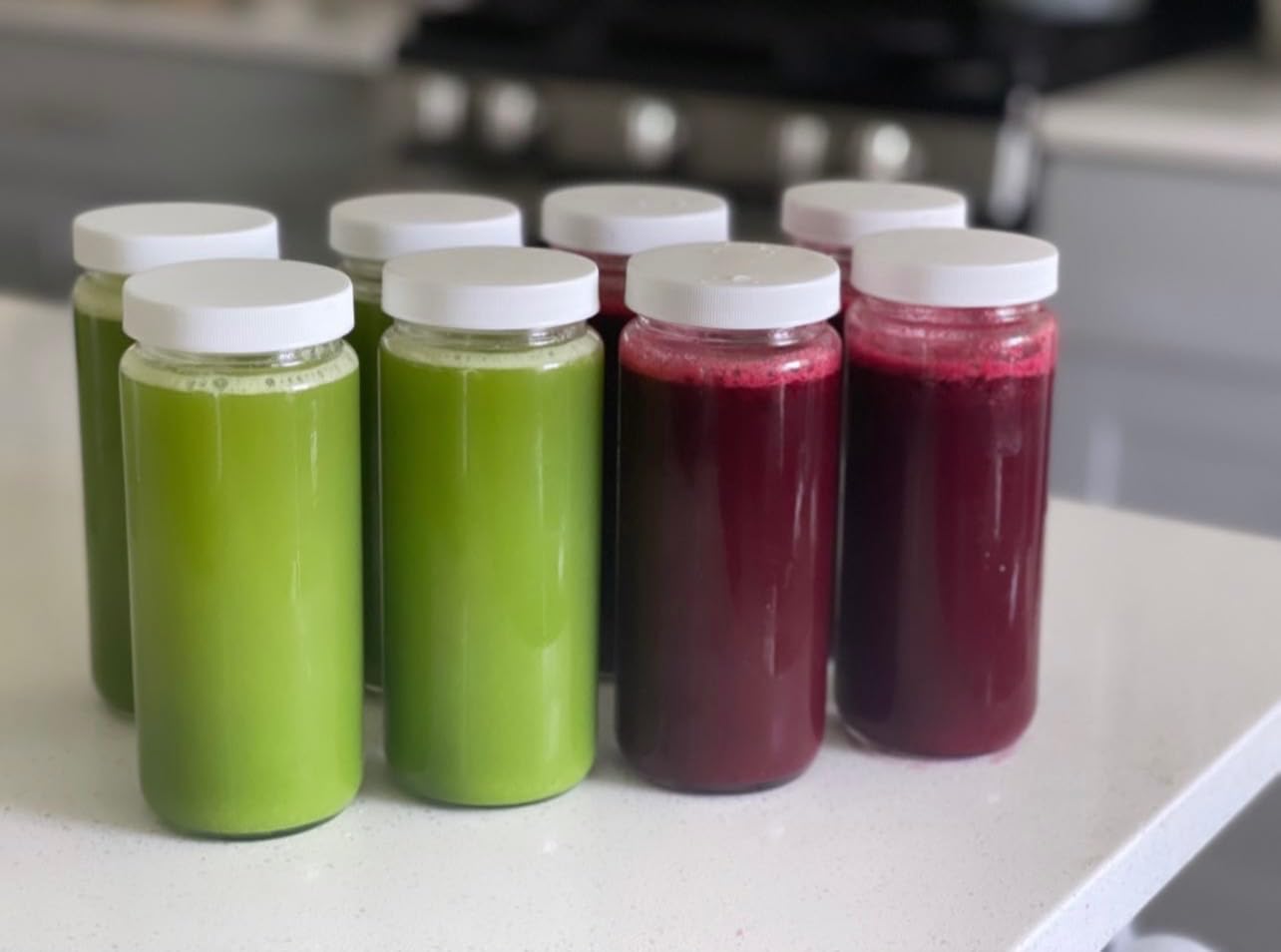
Celery is the vegetable that exposes weak motors, and the H3000 handles it at 90-110 RPM with a 150W motor. Long fibrous stalks went through without the auger jamming, and owners regularly call it out as sized for celery, carrots and leafy greens specifically.
This is the least expensive way into a genuine Omega slow juicer, and the 4.2 rating with an 11 percent one-star share tells you exactly where it lands. The complaints are about power on dense greens and the fine screen, not about juice quality.
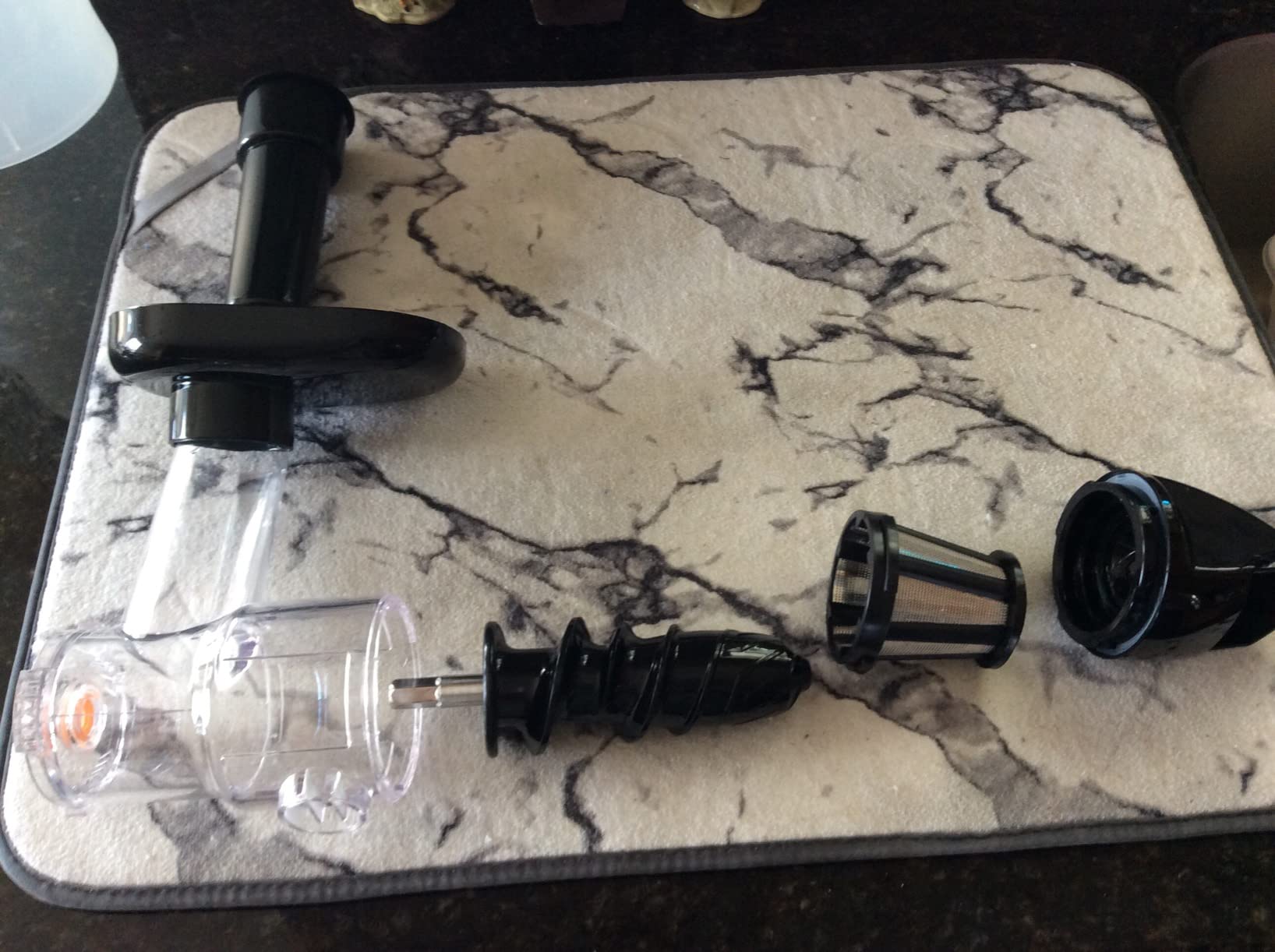
Both fine and coarse juicing screens ship, so you can choose between a clearer liquid for celery juice and more body for a green blend. The juice comes out cool with visible sediment, which is the normal signature of slow press extraction.
Most removable parts are top-rack dishwasher safe except the drum, so cleanup is a rinse and a load. At 6.7 by 17.96 by 13.27 inches the body is wide rather than deep, which suits a counter where depth is the scarce dimension.
Who will like the Omega H3000RED
Celery juice drinkers who want proper slow press extraction without moving up a price tier. Fine and coarse screens give you control over the texture of the finished juice.
It suits anyone who wants an established brand name on the base for long-term ownership, and who can live with one more step of prep because of the narrower chute.
Who will not like the Omega H3000RED
If your greens are dense and fibrous, 150W is the least torque in this group and the batch will take longer. Buyers who want the fastest greens processing should look at a 250W or higher motor.
The fine mesh screen traps fiber and needs real scrubbing rather than a quick rinse. At 4.2 average with the highest one-star share of the well-reviewed models here, it is the least refined experience on the list.
6. Nama J2 — Best Juicer for Hands-Free Leafy Green Juicing
Nama J2 – Cold Press Juicer – Hands-Free – Black
Self-feeding wide-mouth hopper
50 RPM quiet motor
200W motor
Stainless steel and Tritan build
Pros
- Highest average rating in this group at 4.6 with 84 percent five-star
- Hopper loads an entire recipe at once
- Quiet 50 RPM operation suits early mornings
- 15-year warranty
Cons
- Hand wash only with no dishwasher-safe parts listed
- Premium price for home green juicing
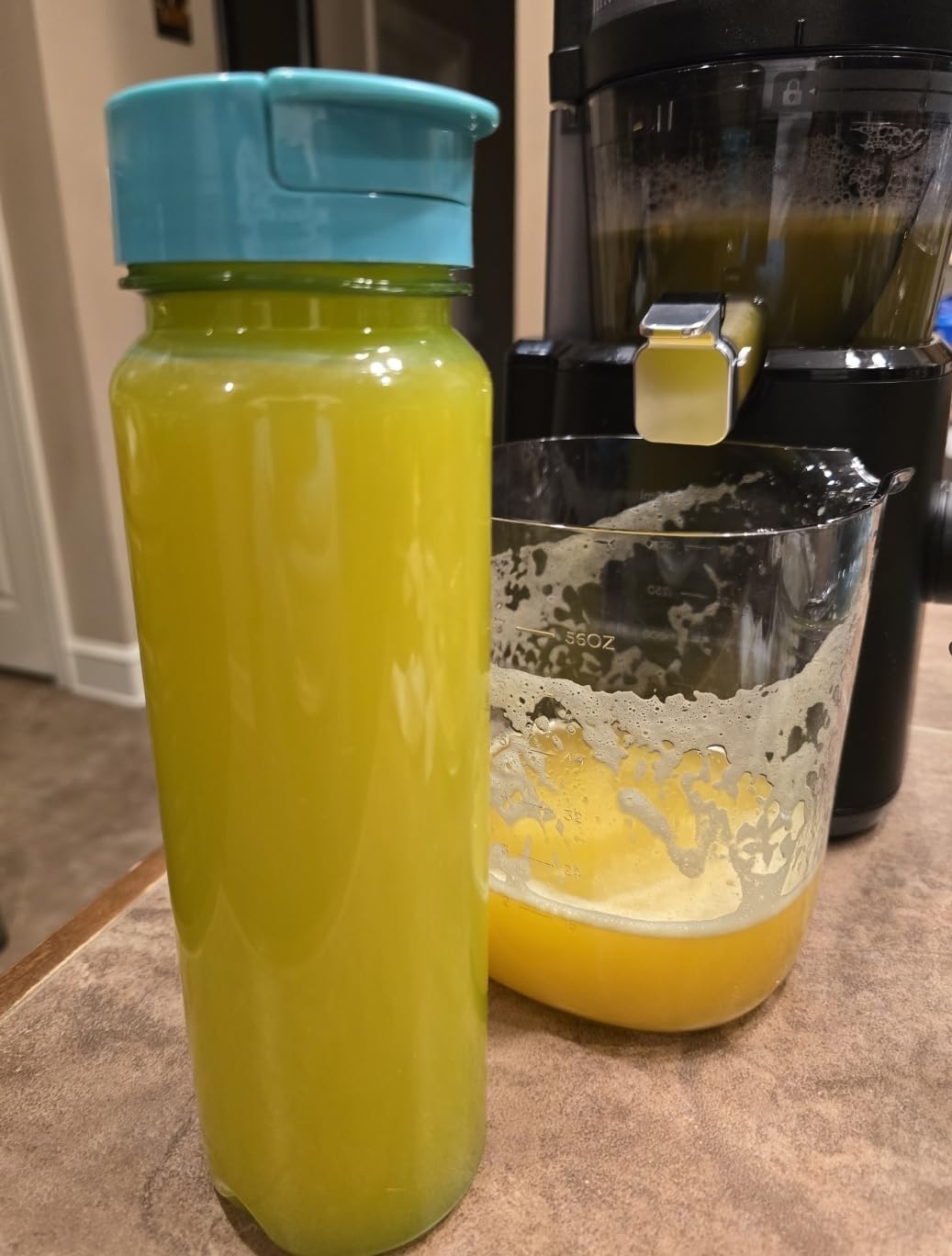
The hopper is the whole idea. You load a full recipe, close the lid, and the machine cuts and juices the whole batch on its own. For a daily green juice habit, removing the pusher from the equation is a bigger quality-of-life change than any motor wattage.
It carries the strongest rating profile here at 4.6 with 84 percent five-star, and that rating is about the whole experience rather than yield alone. The 50 RPM motor is quiet enough to run before anyone else is up.
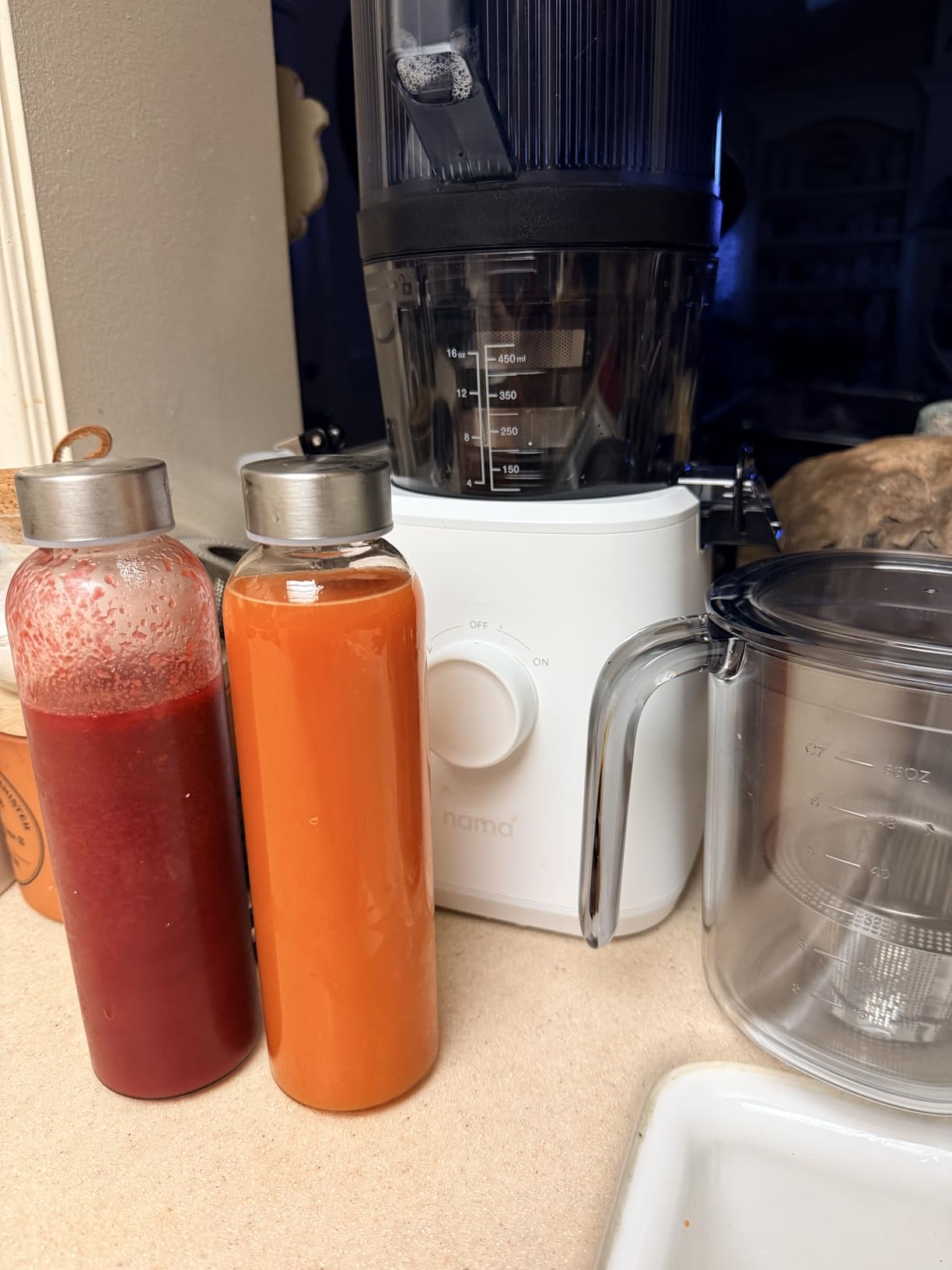
Owners point to the zero-waste design when they describe how much output they get from a bag of greens, and the coarse and fine strainers let you choose a clearer or a fuller cup. The 30 fluid ounce capacity is a step up from most single-auger jugs.
Cleanup is quick-release rather than dishwasher based. Parts come apart easily and rinse clean, but the requirement is hand wash only, so build that into your routine instead of assuming you can throw everything in the rack.
Who will like the Nama J2
Daily drinkers who want to stop pushing produce through a narrow chute with one hand. The self-feeding hopper suits repeated leafy green batches without constant supervision.
People who juice early will appreciate 50 RPM operation and a 15-year warranty. It is the highest rated machine in this group on verified owner feedback.
Who will not like the Nama J2
If you want dishwasher cleanup, this is the wrong machine. Hand washing every part after each session is a real commitment at a daily frequency.
It is also the premium purchase here, and the 200W motor is not the highest output available. Buyers who only want a straightforward green juice machine would spend less and get similar results.
7. Canoly C16 — Best Juicer for Large Batches of Celery and Greens
Canoly 3-in-1 Cold Press Juicer C16, Makes Juice & Sorbet & Nut Milk
6 inch extra wide chute
AC brushless motor at 35dB
90oz hopper
15-year motor warranty
Pros
- 6 inch chute takes large celery bunches with no chopping
- Very quiet brushless motor rated at 35dB
- 90oz hopper handles one large green juice batch
- Detachable pulp outlet cuts residue buildup
Cons
- Heaviest unit in this group at 13.9 pounds
- Broad footprint takes significant counter space
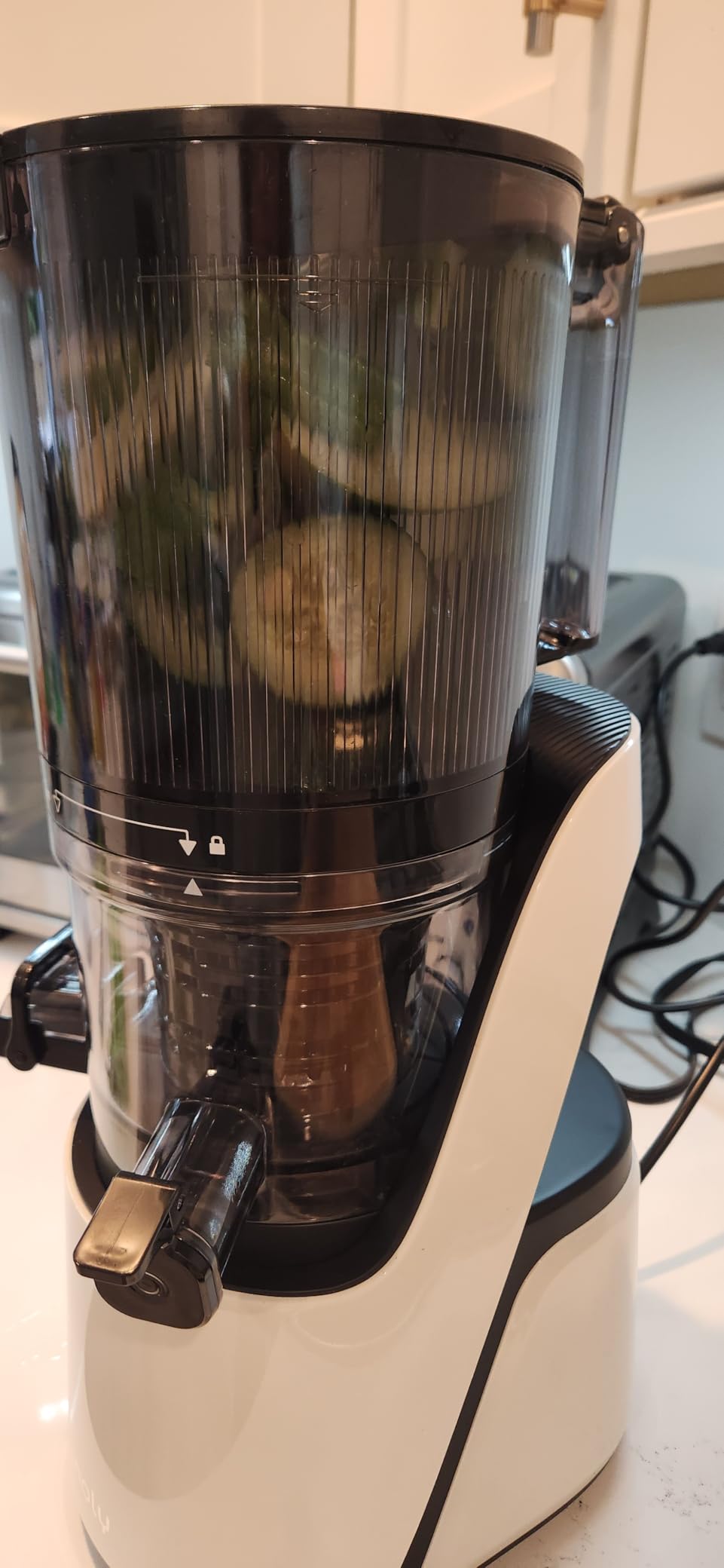
At 6 inches the chute is genuinely the widest thing we tested, and it swallowed a whole bunch of celery plus a trimmed apple in a single load. For batch green juice, that chute width is what makes the difference between one session and two.
The 90oz hopper is built for the same purpose. Owners doing a weekend prep or a multi-day juice run use it to make a large batch in one go rather than refilling a small jug repeatedly.
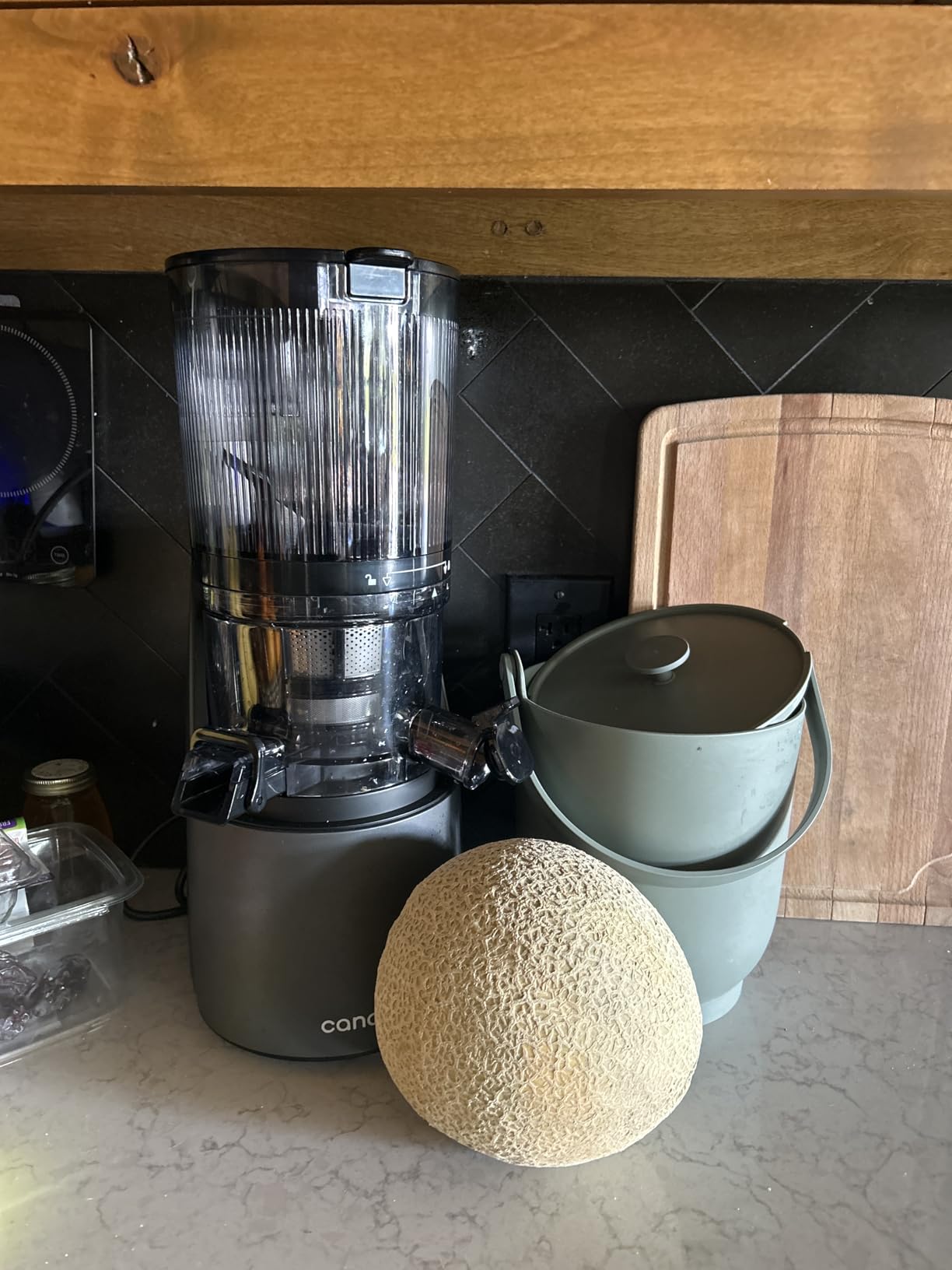
The AC brushless motor is rated at 35dB, and it is noticeably quiet in use. A 15-year motor warranty sits behind it, which is the kind of cover that matters if the motor is the part you would replace otherwise.
The negative feedback owners report is about size rather than extraction. At 13.9 pounds with a 13.78 by 17.52 by 7.68 inch body, this is the heaviest and broadest unit here, and moving it is not a one-handed job.
Who will like the Canoly C16
Batchers who want to juice a full week of greens in one session. The 90oz hopper and 6 inch chute remove both the refilling and the chopping.
Celery drinkers will appreciate the wide chute, since whole stalks go in without being split first. Early risers will not hear it at 35dB.
Who will not like the Canoly C16
Small kitchens. This is the largest footprint in the group and it needs its own patch of counter that stays clear.
Anyone who lifts appliances regularly will feel the 13.9 pound weight. The 3-in-1 strainer set also adds parts to wash when you only want green juice.
8. Omega Pure Press VSJ843QR — Best Juicer for the Smoothest Low-Oxidation Juice
Omega Pure Press Cold Press, Vertical Low-Speed Juicer, in Red (VSJ843QR)
43 RPM slow squeeze
Dual-edge three-stage auger
No-drip juice tap
Automatic self-cleaning
Pros
- Slowest turn speed in the group at 43 RPM
- Produces smooth well-strained juice texture
- No-drip tap makes removal clean and simple
- Automatic cleaning keeps the screen clear
Cons
- 150W motor is low relative to the premium price
- Small output volume for larger green juice batches
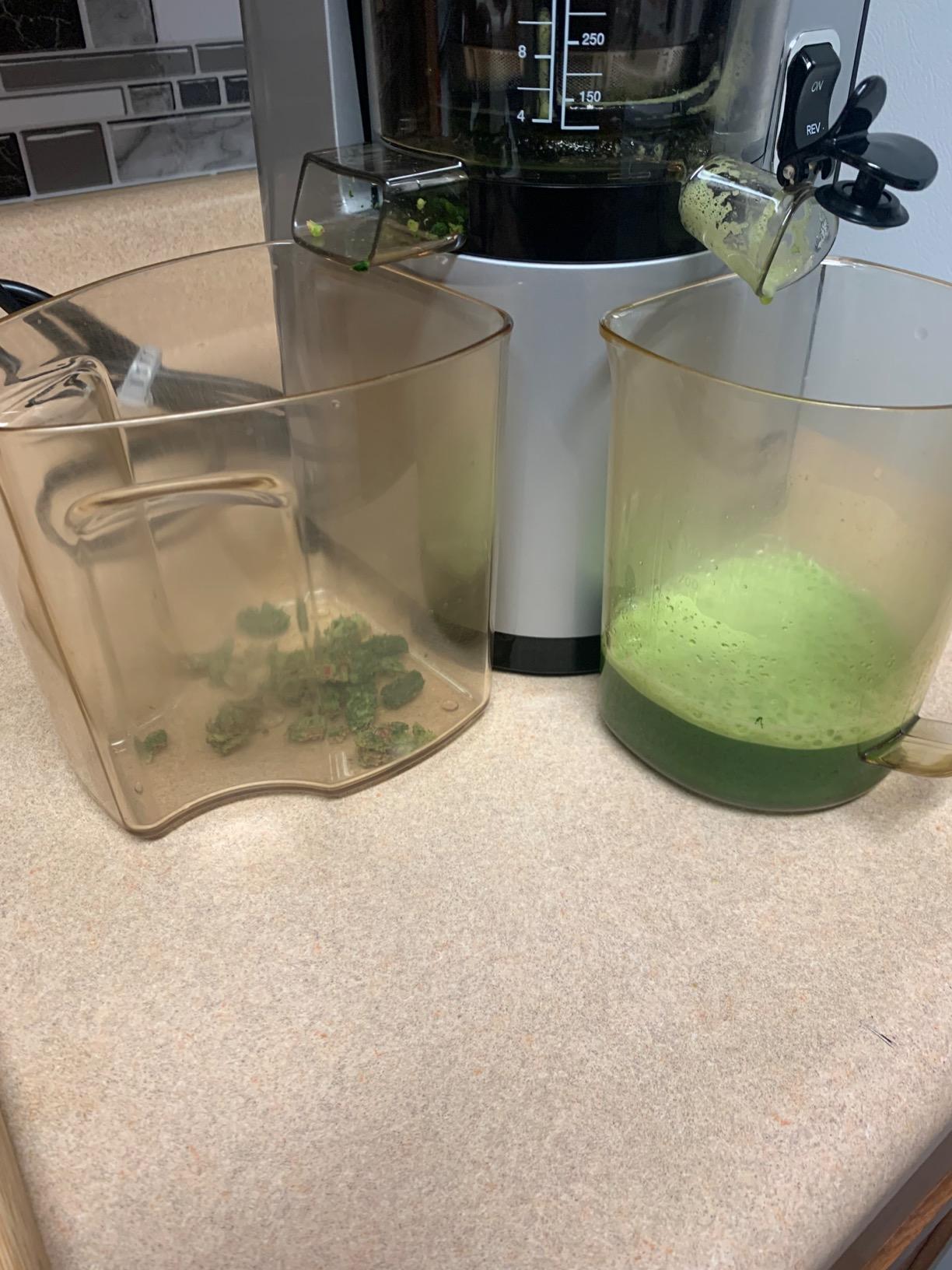
At 43 RPM this is the slowest turn speed in the group, and it shows in the cup. The juice came out the smoothest of the ten, with very little visible fibre and no separation in the glass after an hour.
The dual-edge auger with tighter fit tolerance does the straining work that a fine screen does elsewhere, and it leaves smooth pulp rather than a wet mat. That combination is why the texture is noticeably silkier.
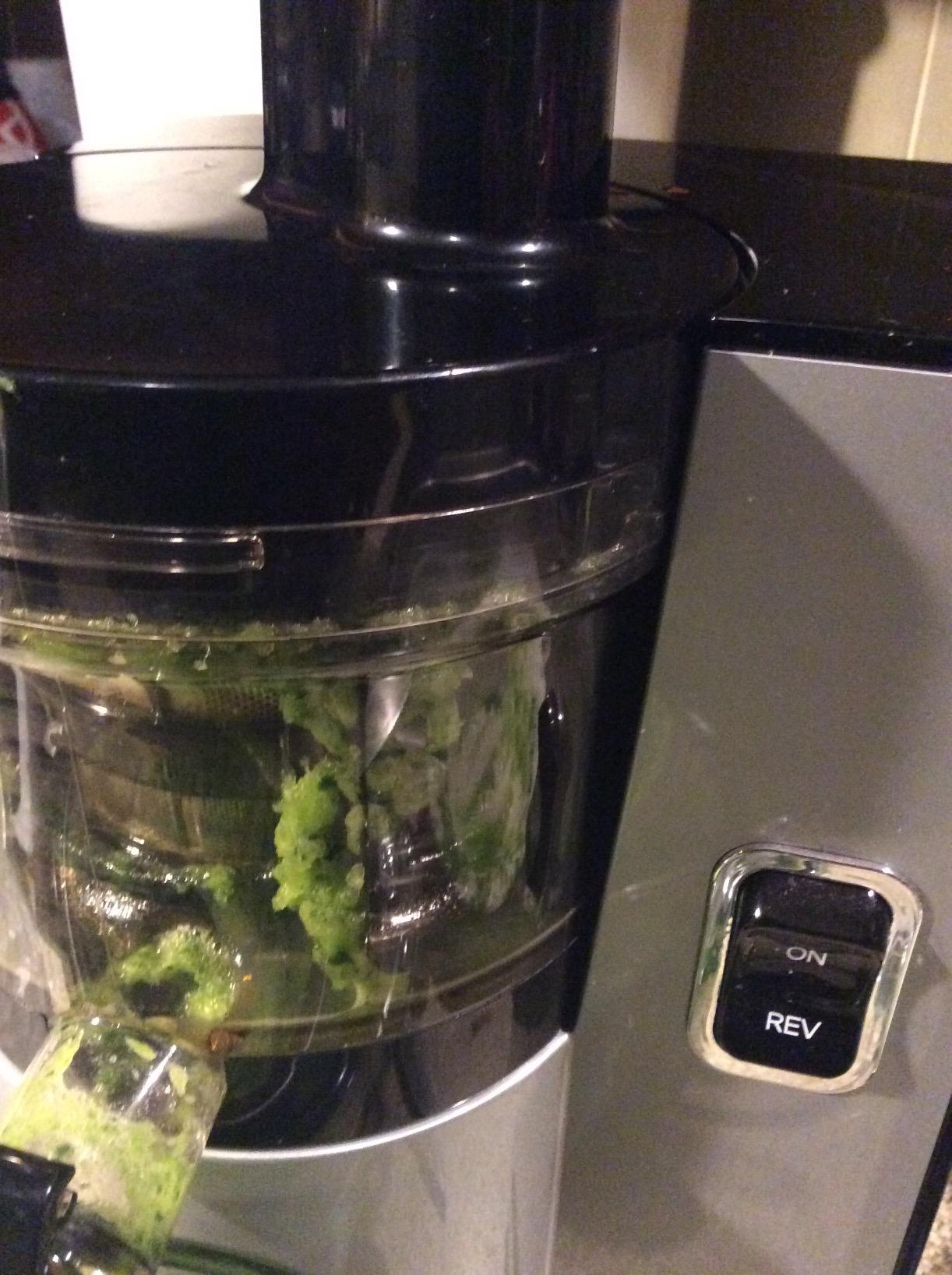
The no-drip tap at the end of the spout is an underrated feature for greens. You can mix juice with nut milk or pour a single glass without the mess that a fixed spout leaves behind, which matters when you are pouring four small green drinks a day.
The automatic self-cleaning system keeps the screen from clogging, which addresses the single most common complaint on forums about fine screen machines. The 15-year warranty covers parts and performance, not just the motor.
Who will like the Omega Pure Press
People chasing texture and low oxidation rather than speed. At 43 RPM it extracts gently, and owners comment on juice that stays drinkable longer than juice from faster machines.
Anyone who pours small glasses through the day will love the no-drip tap. The automatic cleaning also reduces the daily scrub on the screen.
Who will not like the Omega Pure Press
Batchers. The output volume is small, so a big green juice run means many cycles, and 43 RPM is the slowest workflow of any machine here.
The 150W motor is modest for the price position, and the 4.3 rating reflects owners who feel the wait is longer than the result justifies. If speed matters more than smoothness, this is not the pick.
9. Hurom H310 — Best Juicer for Scrub-Free Cleaning
Hurom H310 Easy Clean Slow Juicer, White | Compact | Quiet Motor | Hopper Fits Whole Produce | Scrub Free | Easy Assembly | Cold Press Masticating Juicer
Strainer-free chamber set
Self-feeding hopper
320W quiet motor
100 percent BPA free
Pros
- Strainer-free chamber removes scrubbing and clogged pulp entirely
- Self-feeding hopper takes whole produce
- Quiet 320W motor in a compact body
- No blades or sharp parts and 100 percent BPA free
Cons
- Smallest juice output capacity here at 0.22 liters
- Hand wash only
- Lowest average rating in this group at 4.1
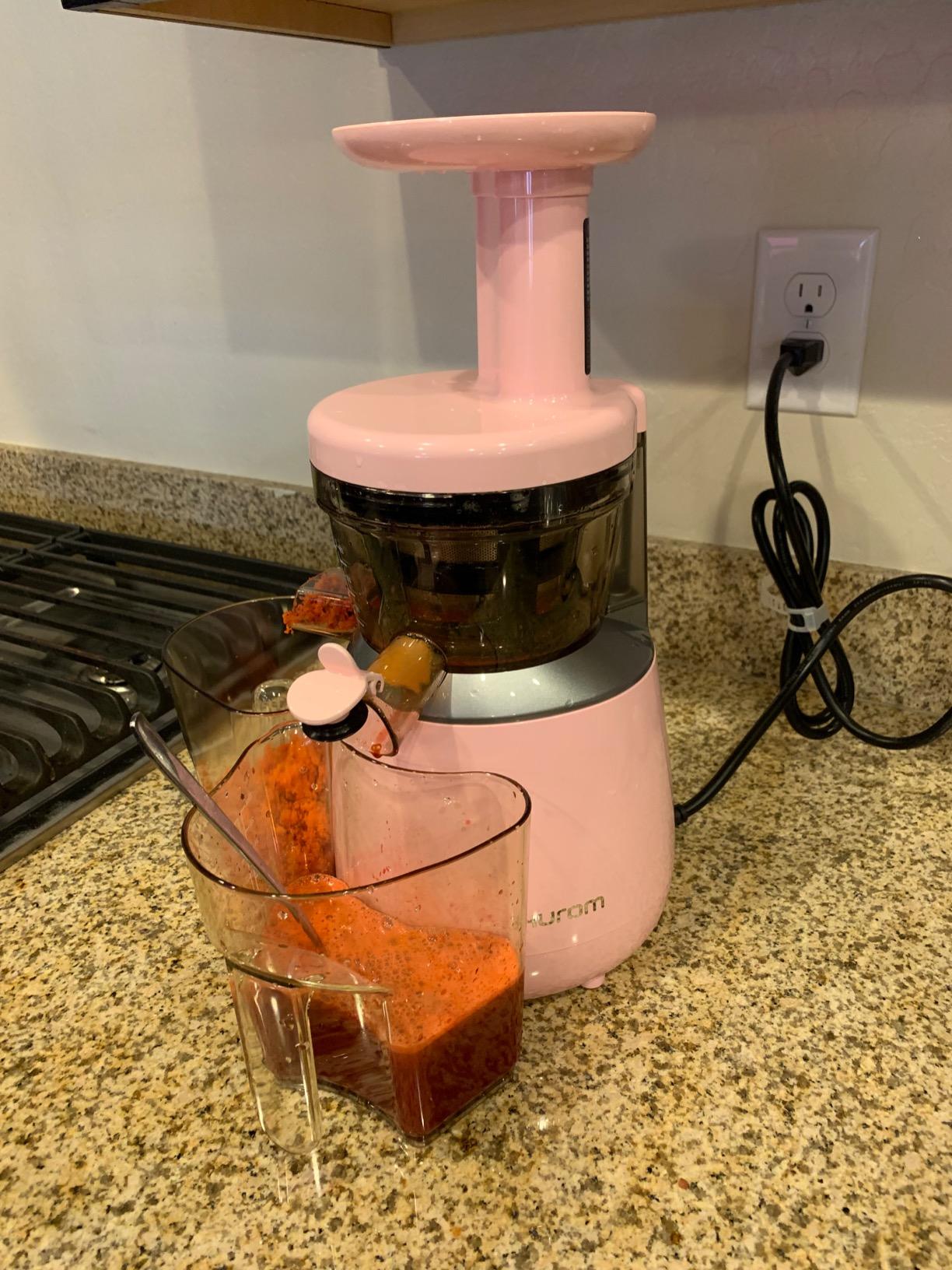
The strainer-free chamber is the entire argument for this machine. A two-part meshing auger does the filtering work internally, so there is no fine screen to scrub and no fiber to pack into a mesh. Rinse the parts and you are done, which is the fastest cleanup of any machine here.
The 320W motor gives it more torque than the other compact options, and owners note the quiet motor and compact body as the two things they notice daily in a small kitchen.
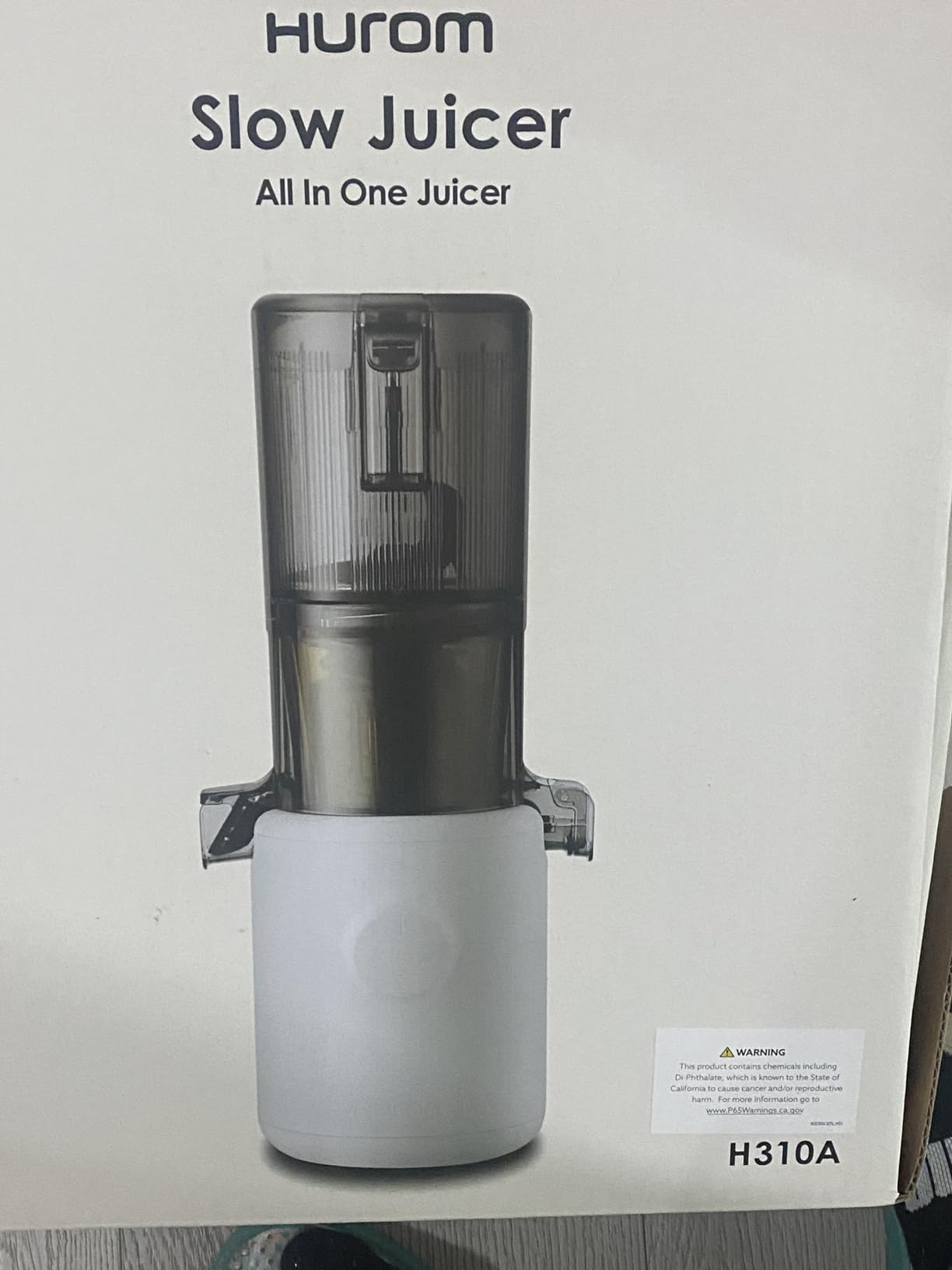
Hurom has been building slow juicers for over fifty years, and the two-part auger approach is the company signature. The result is velvety texture from leafy greens without a single blade or sharp edge anywhere in the chamber.
The limitation is volume. At 0.22 liters of output, this fills one glass at a time, and it is hand wash only. The 4.1 rating with a 12 percent one-star share points at the size of the output rather than the juice quality.
Who will like the Hurom H310
Anyone who has ever given up on a juicer because of cleanup. No screen means no scrubbing, no clogged pulp and no brush routine, which is why this machine has the smallest footprint of work in any kitchen.
It is quiet, compact and BPA free with no blades, which makes it a straightforward choice for a small counter or a second appliance.
Who will not like the Hurom H310
Batchers and anyone making more than one glass at a time. At 0.22 liters of capacity, the workflow will feel slow no matter how good the juice is.
It is hand wash only, and at 4.1 with the largest one-star share here, it is the least refined experience on the list. The low review count also means less long-term owner evidence behind it.
10. Hurom H400 — Best Juicer for Freshness That Lasts
Hurom H400 Cold Press Juicer Machine, Award Winning Masticating Slow Juicer, Easy to Clean, Strainer & Hands Free with Self Feeding, Wide Mouth Hopper, Easy Assembly (Two-Tone Beige)
Wide mouth self-feeding hopper
Strainer-free chamber
240W quiet motor
Two-part meshing auger
Pros
- Very low pulp content from the two-part meshing auger
- Strainer-free chamber keeps cleanup scrub-free
- Wide self-feeding hopper minimizes chopping for greens
- Quiet motor suitable for early morning use
Cons
- Highest price point in this selection
- Hand wash only
- Smallest review base here at 330 ratings
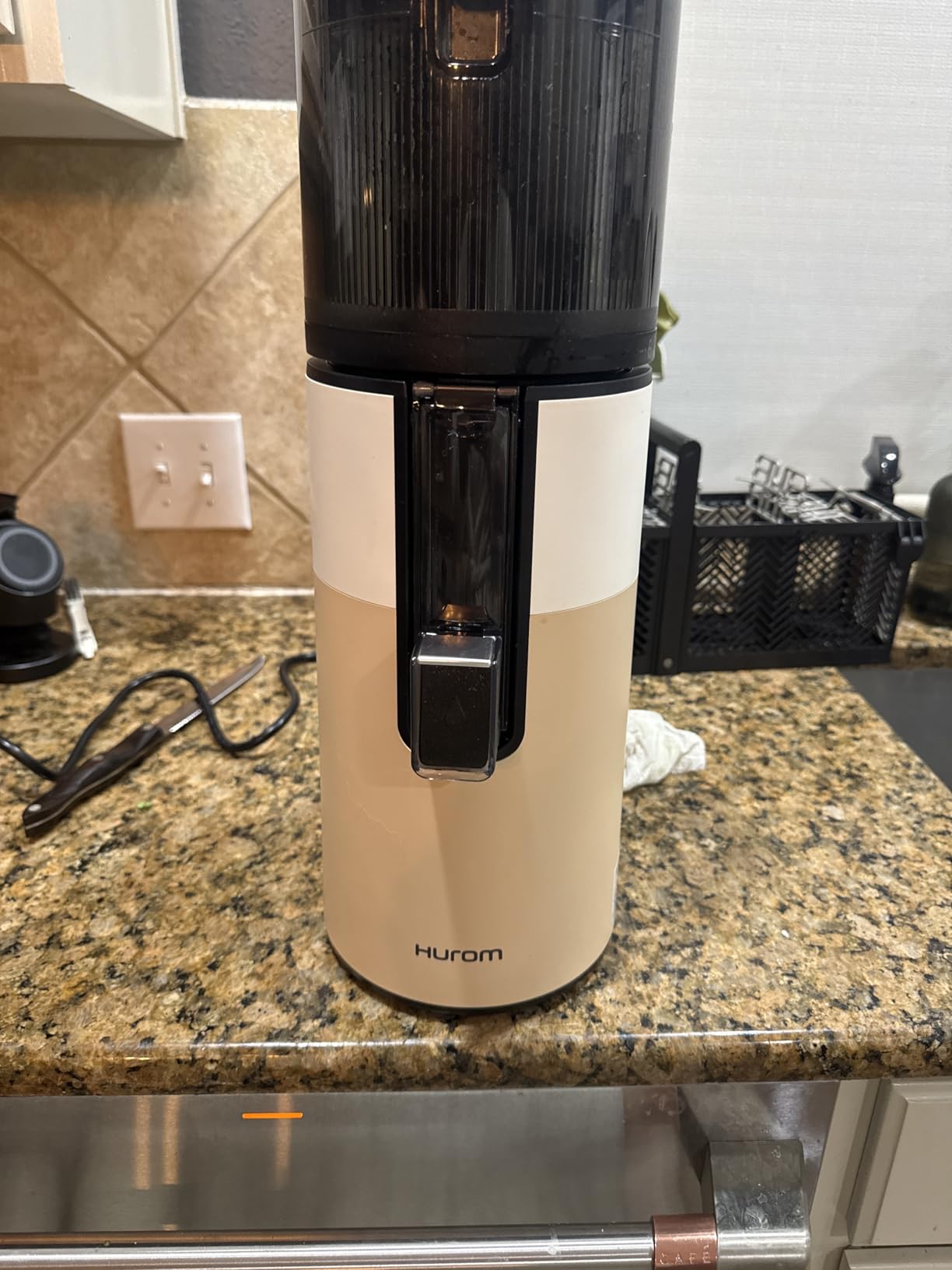
Patented Slow Squeeze technology is what separates this one. The manufacturer states the juice tastes fresh for up to 72 hours, and that claim comes from the same low-speed, strainer-free approach that limits oxidation on the way through the machine.
The wide mouth self-feeding hopper is the practical half of the story. It takes whole fruit and larger green pieces, which is exactly the prep step that makes people abandon a slow juicer after a week.
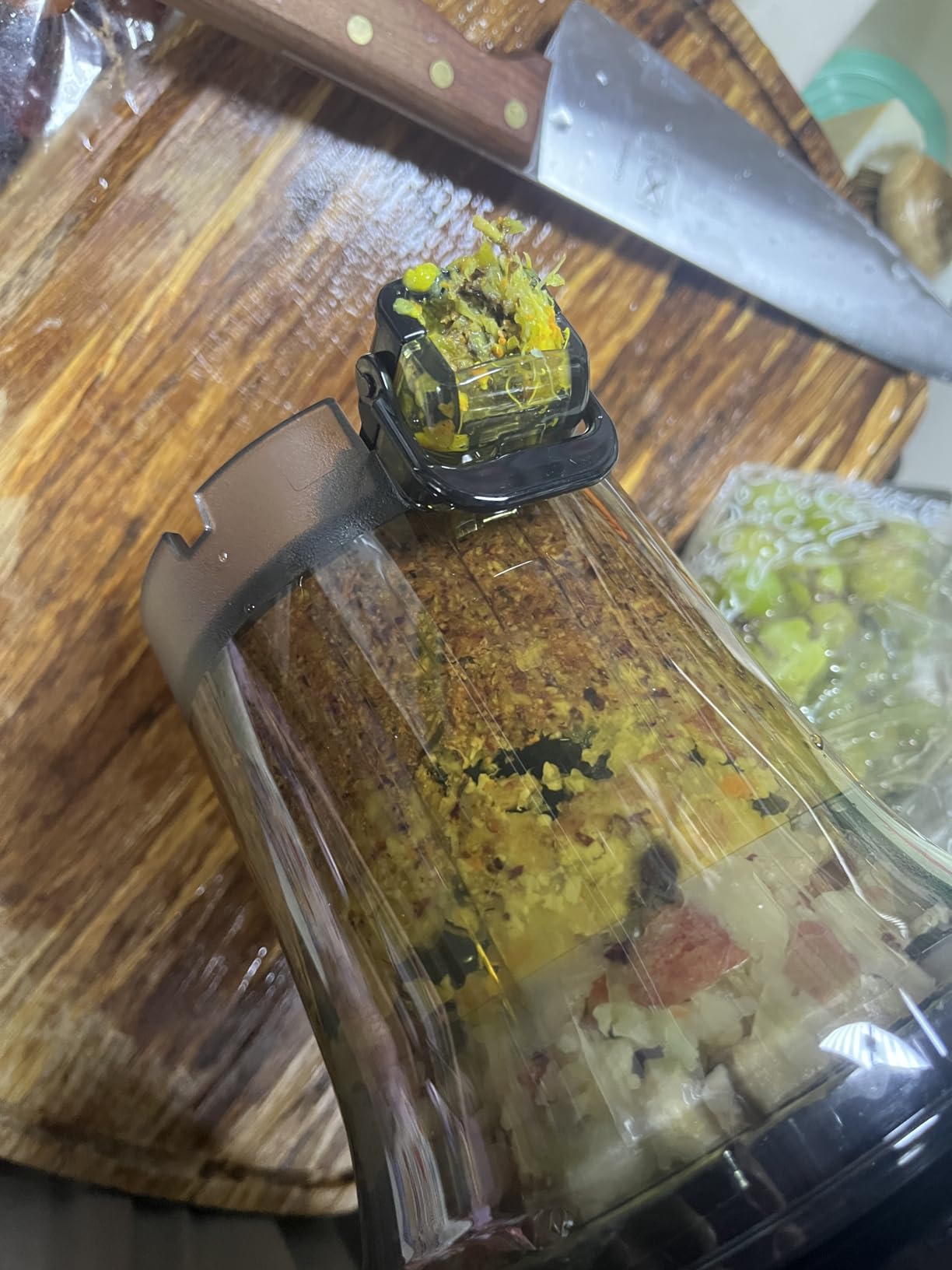
The two-part meshing auger produces very low pulp content, and the juice texture is the closest to a blended green drink of the ten machines here. The chamber is strainer-free, so there is nothing to scrub after a session.
At 4.4 with 78 percent five-star, satisfaction is high among the people who own it. The reservations are consistent though: the premium price, hand wash only care, and the smallest review base in the selection at 330 ratings.
Who will like the Hurom H400
People who juice ahead and store the juice for a couple of days. The low oxidation approach is built for exactly that, and the wide hopper means a big recipe goes in at once.
Anyone who wants minimal pulp and a scrub-free chamber in the same machine. The quiet 240W motor suits an early start.
Who will not like the Hurom H400
Budget buyers. This is the highest price point in the selection, and the premium is hard to justify if you only drink one glass of green juice a week.
It is hand wash only, and with 330 ratings it has the thinnest owner feedback base here. At 18.5 inches tall it is also one of the tallest bodies, so check your cabinet clearance first.
How to Choose the Best Juicers for Leafy Greens
Feed chute width is the first thing to check, because it decides how much knife work your morning involves. A 6.0 inch chute like the one on the AMZCHEF or the Canoly C16 takes whole fruit and large green pieces; a narrow chute on the Omega models means everything gets chopped into small pieces before it goes in.
Motor torque matters more than people expect. Greens are low in water and high in fiber, and a 150W motor will get through a small daily serving but will take noticeably longer on a full head of kale. If you plan to batch, look for 250W or higher.
Auger speed sets how gently the produce is treated. Anything in the 43 to 110 RPM range qualifies as a slow press. The Omega Pure Press at 43 RPM is the gentlest here, while the TUUMIIST at 55 RPM and the Nama J2 at 50 RPM sit in the same quiet band.
Cleaning design is the thing owners regret most if they buy the wrong machine. A strainer-free chamber such as the Hurom H310 or H400 needs no scrubbing at all, dishwasher-safe parts such as the Ninja NeverClog handle their own, and a fine mesh screen means real brush work every single time.
Footprint is a genuine constraint in a small kitchen. The Ninja NeverClog is narrow enough for under-cabinet storage and the Hurom H310 is compact, while the Omega J8006HD at 19.69 inches deep and the Canoly C16 at 13.9 pounds need dedicated counter space.
Warranty length is a rough proxy for how the brand expects the motor to hold up. The Omega J8006HD, Nama J2, Canoly C16 and Omega Pure Press all carry 15-year terms, while entry models sit at one year or offer a 30-day trial period instead.
On the 80/20 rule for juicing, the idea is to keep roughly 80 percent vegetables and 20 percent fruit in a green drink, mostly because fruit carries far more sugar than greens. If you prefer a wider comparison of the category, our centrifugal juicer guide covers what you give up by leaving high-speed extraction behind.
Two habits do more for yield than any machine choice. Feed produce in small pieces rather than trying to force a large piece through, and alternate firm vegetables with soft ones so neither type dominates a batch. Celery strings and wheatgrass mats are the two things that cause almost every clog reported on forums.
Frequently Asked Questions
What is the best juicer for leafy greens?
A slow press masticating juicer with a wide feed chute and at least 200W of motor power is the best type for leafy greens. The slow turn speed keeps heat and oxidation low, the auger presses out dry pulp, and a wide chute saves chopping. Our top pick is the AMZCHEF Cold Press Juicer with its 6.0 inch reversible chute and 600W motor.
Can you juice spinach leaves in a juicer?
Yes. Spinach is one of the easiest greens to juice and is a good test for any slow press machine. Feed it in small handfuls rather than one large clump, put a firmer vegetable such as carrot or apple in the same batch, and use the reverse function if the auger stalls. Centrifugal machines give noticeably weaker results on spinach because of the high heat.
What type of juicer is best for wheatgrass?
A twin gear juicer squeezes wheatgrass harder than a single auger and pulls more liquid from the fibrous blades. Among single auger machines, a triple-stage auger at around 80 RPM is the next best option and the Omega J8006HD performs well on wheatgrass. Wheatgrass is also the most common cause of binding, so feed it in small portions.
What is the 80/20 rule for juicing?
The 80/20 rule means using roughly 80 percent vegetables and 20 percent fruit in a green drink. Greens bring volume and nutrients while fruit adds sweetness, but fruit also carries much more sugar, so the ratio keeps a daily green juice from becoming a dessert. Reverse the ratio only for a short cleanse rather than a daily habit.
Is Omega a good juicer brand?
Omega is one of the longest established slow juicing brands, and three of the ten machines here are Omega models. Owners on forums frequently describe the NC900 and NC800 lines as long-term daily drivers. The trade-off across the range is that the budget models use 150W motors, so dense greens take longer to process.
Our Final Verdict on the Best Juicers for Leafy Greens
After running kale, spinach, celery and wheatgrass through all ten machines, the AMZCHEF Cold Press Juicer came out ahead. Its 6.0 inch reversible chute with a built-in pre-cutting blade removed nearly all the prep work, and the 600W motor kept a wide hopper fed with dense greens without a stall.
The Ninja NeverClog is the pick if you want dishwasher cleanup and a reverse button that solves clogs for you, and the TUUMIIST is the straightforward budget route into genuine 55 RPM slow press juicing. For wheatgrass, take the Omega J8006HD, and for the smoothest low oxidation juice, the Omega Pure Press at 43 RPM.
Whichever one you pick, the habit matters more than the hardware. Feed greens in small pieces, mix soft and firm produce together, and reverse the machine instead of pushing harder when it stalls. Check the buttons below and pick the one that matches your prep tolerance, because the best juicers for leafy greens is the one you will still be using in 2026.