
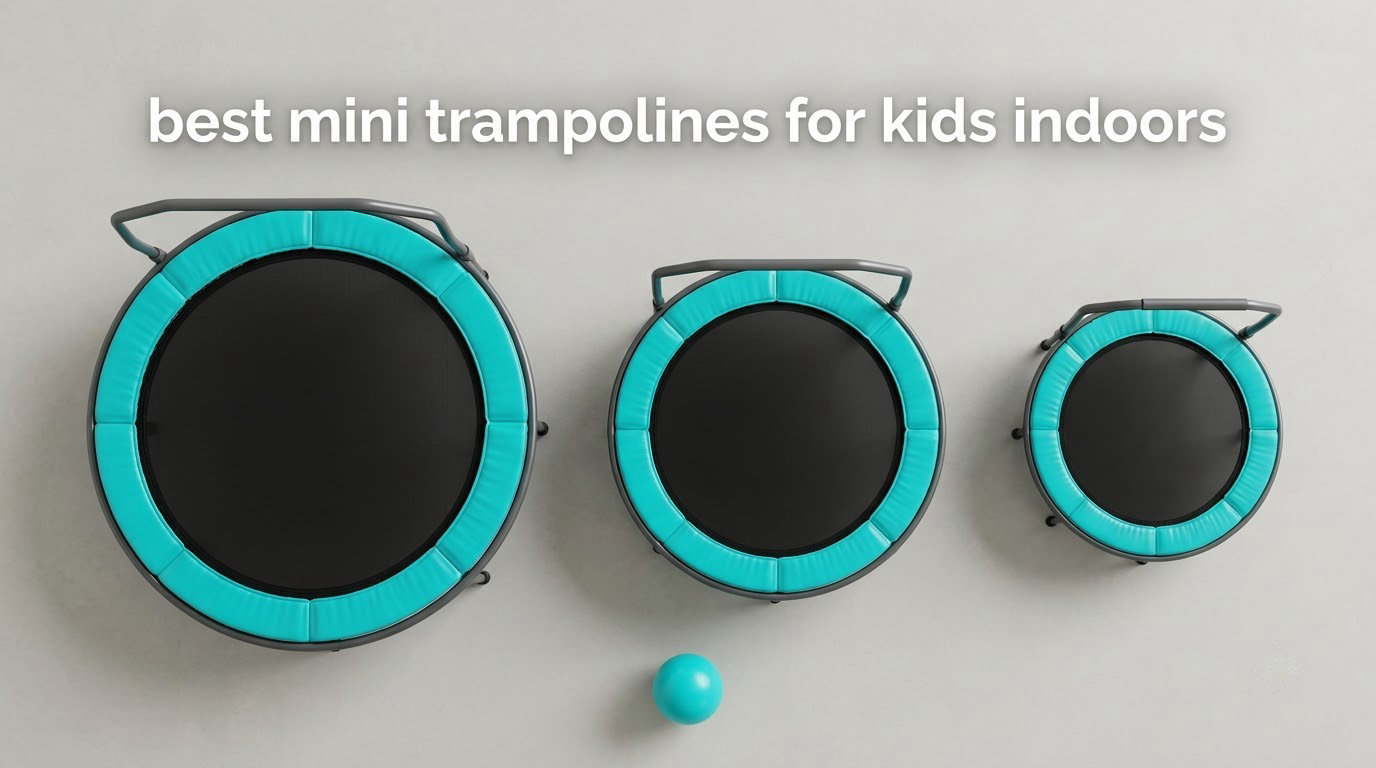
Our answer up front: the best mini trampolines for kids indoors are 36-inch round rebounders with a foam handle bar, a padded spring cover and a weight limit well above your child’s current weight. We put ten of them through their paces across playrooms, basements and shared-floor apartments, and the differences that matter turned out to be noise level, how the surface is held (springs, bungee cord or a springless elastic band) and whether the frame folds away when the bouncing stops.
Every one of the ten is a true indoor model, which narrows the field more than you would think. Outdoor trampolines in the 3-to-4-foot range carry exposed springs, taller frames and a much higher centre of gravity, and the moment you put one of those in a living room the safety conversation changes completely.
What follows is a ranked list of all ten, the numbers that separate them, and the decision rules we used. If your child is under three, read the age routing section first because the handle bar and the weight limit matter more than anything else. If you live above someone, start with the quiet section instead.
Top 3 Picks: Best Mini Trampolines for Kids Indoors (2026)


ATIVAFIT 36 Inch Toddler Trampoline
- Silent elastic band surface
- Oxford cloth mat
- 55 lb limit
- Foam handle
Best Mini Trampolines for Kids Indoors at a Glance (2026)
Frame diameter is not the same as usable jumping surface. In this group every frame measures 36 inches, 38 inches or 3 feet, and the area a child can actually land on is roughly a foot smaller on each side. We list both so you are not disappointed by the mat size on delivery day.
| Product | Specifications | Action |
|---|---|---|
| Little Tikes 3-Foot Trampoline |
|
Check Latest Price |
 SereneLife 36 Inch Foldable Mini Trampoline SereneLife 36 Inch Foldable Mini Trampoline |
|
Check Latest Price |
| BCAN SP1 36 Inch Kids Trampoline |
|
Check Latest Price |
| ATIVAFIT 36 Inch Toddler Trampoline |
|
Check Latest Price |
 SkyBound 36 Inch Indoor Trampoline SkyBound 36 Inch Indoor Trampoline |
|
Check Latest Price |
 BCAN BT1 36 Inch Foldable Trampoline BCAN BT1 36 Inch Foldable Trampoline |
|
Check Latest Price |
 Fisher-Price WonderJump 3-Foot Mini Trampoline Fisher-Price WonderJump 3-Foot Mini Trampoline |
|
Check Latest Price |
 SPORTSOUL Mini Trampoline SPORTSOUL Mini Trampoline |
|
Check Latest Price |
 ANCHEER 38 Inch Toddler Trampoline ANCHEER 38 Inch Toddler Trampoline |
|
Check Latest Price |
 JOY SPOT 36 Inch Foldable Rebounder JOY SPOT 36 Inch Foldable Rebounder |
|
Check Latest Price |
1. Little Tikes 3-Foot Trampoline – the default first trampoline
Little Tikes 3′ Trampoline – (Amazon Exclusive)
36 inch round frame
13 lb unit
55 lb max weight
Ages 3 to 6
Indoor use only
Pros
- Enclosed springs keep feet clear
- Handle bar sits at a natural grip height
- Compact 36 inch footprint
- Quick assembly
Cons
- Blue edge trim lifts over time
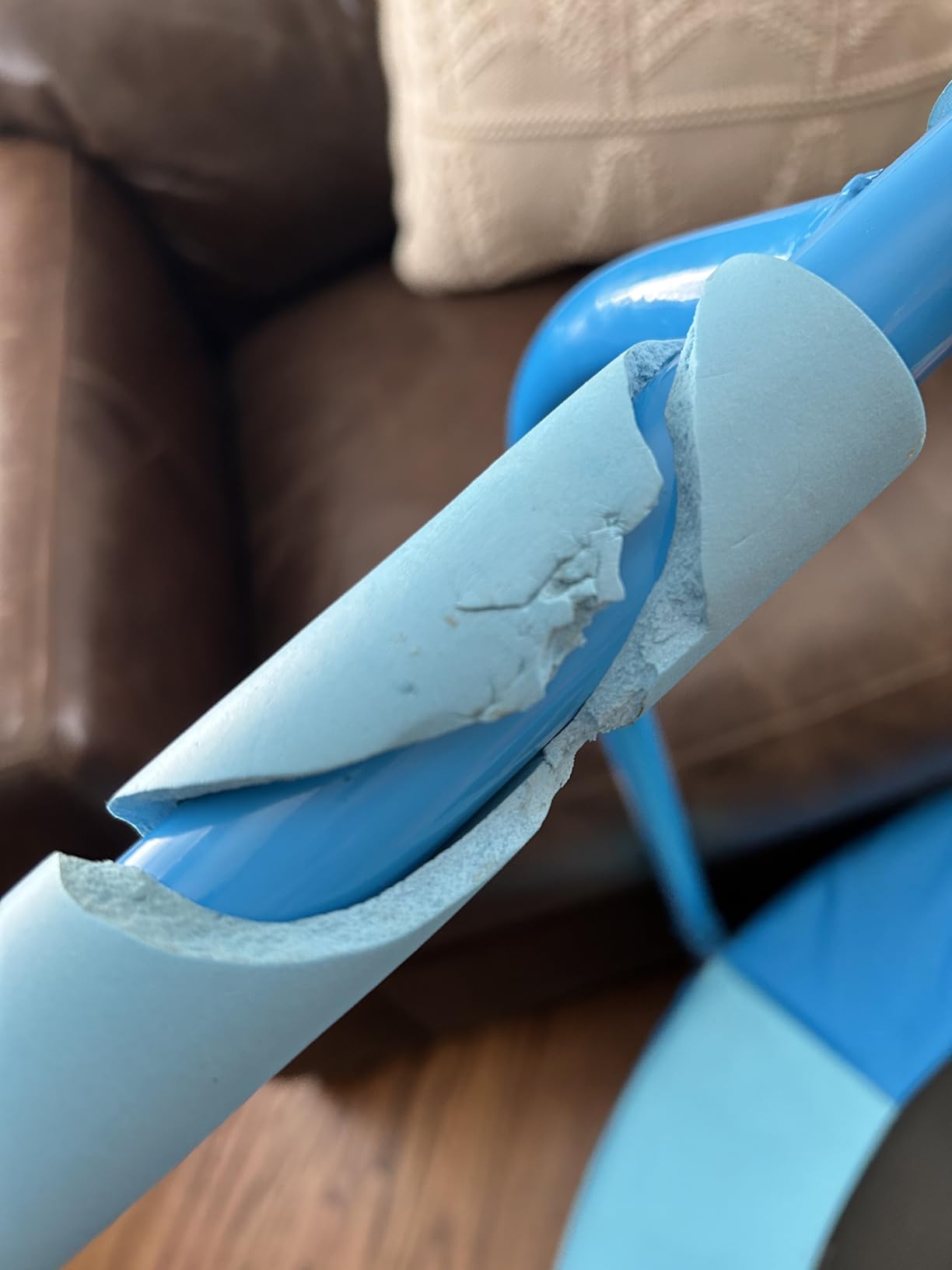
- Handle foam can tear if chewed
- Back legs creep on floor mats
This is the one we keep coming back to. A 4.7 average across 33890 ratings is a volume of owner feedback no other model in the group comes close to, and the pattern in it is remarkably consistent: people bought it as the first trampoline for a three-to-six-year-old and it has held up. The frame is a plastic and metal combination that does not flex noticeably when a 40-pound child lands off-centre.
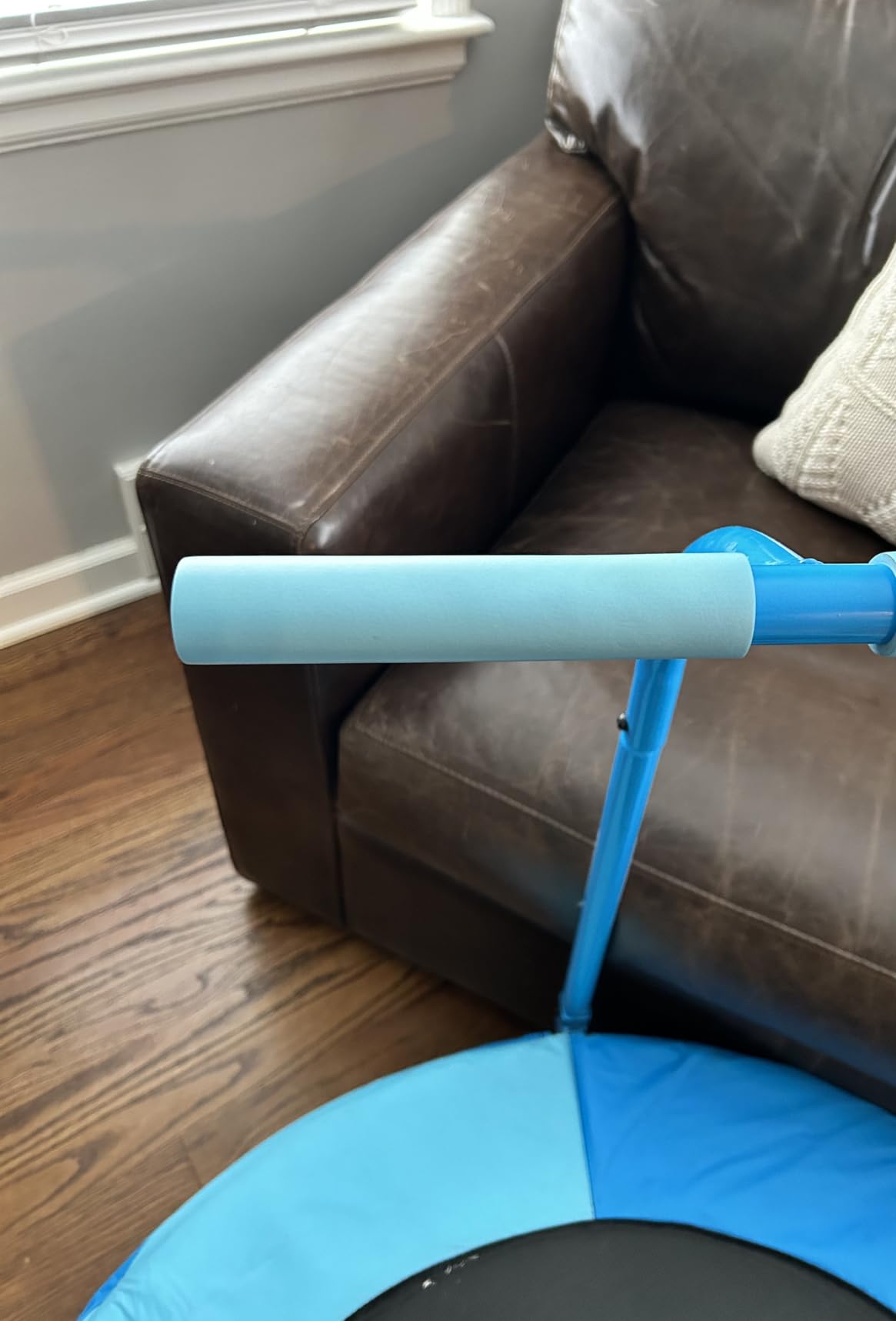
The handle bar is the reason it works for younger children. It runs from the ground to 34 inches and leaves 26.25 inches between the jumping surface and the top of the bar, which is a comfortable grip for a preschooler without getting in the way of the bounce. Because the bar is angled rather than square, a child can hold on for balance and still land flat-footed.
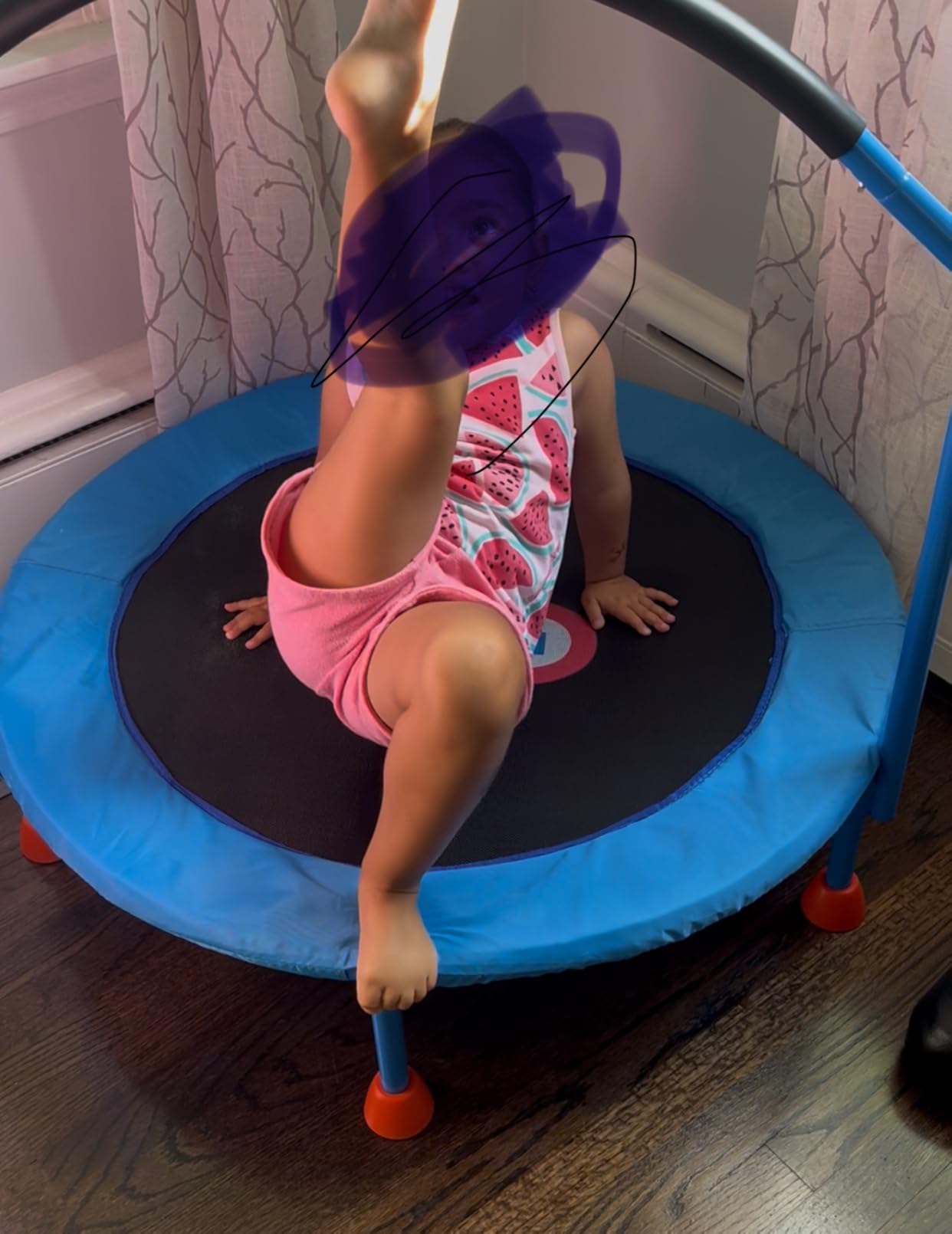
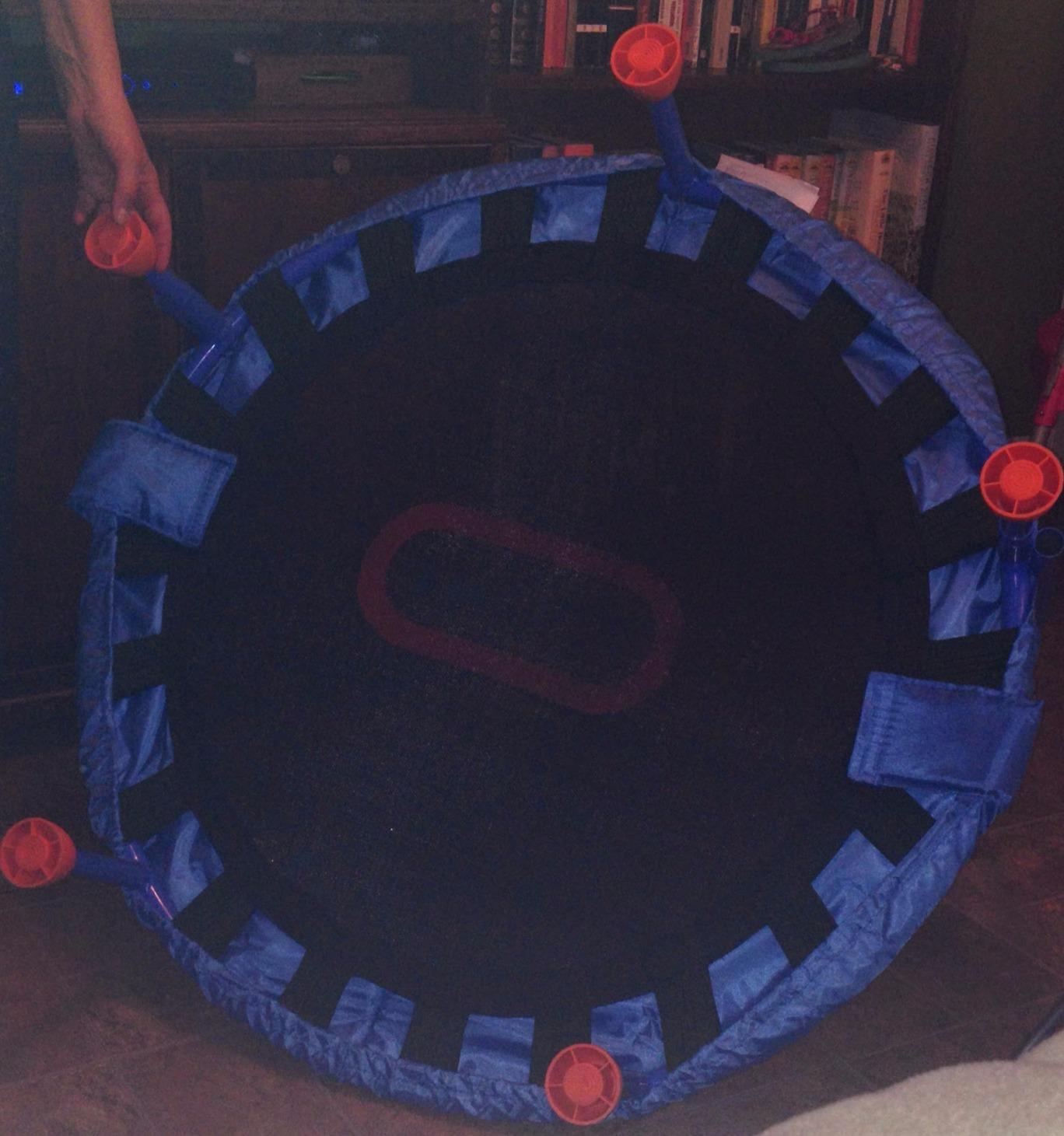
Technically it is the simplest design here. There is no folding mechanism, no enclosure net and no bungee system, just a round frame, a foam pad covering the springs and a fixed handle. That simplicity is also its weakness in a small home, because at 36 inches across with a 33.5 inch height you need roughly a six-foot square of clear floor to use it safely.
Assembly is genuinely quick and the springs are enclosed rather than exposed, so a bare foot landing near the edge stays clear of metal. The two recurring complaints in the reviews are cosmetic rather than structural: the blue trim around the edge loosens and can be refitted, and the foam on the handle bar can be chewed by a teething toddler. Neither affects how it bounces.
What parents should check before the first bounce
Check the child against the 55-pound limit rather than the age label. The listing says ages 3 to 6, but a six-year-old in the 97th percentile can sit above 55 pounds, and reviewers report bottoming out when that happens on a 36-inch frame. The warranty is 90 days against manufacturer defects, which is the shortest in this group, so keep the packaging until you are sure.
Where it does not fit
This is an indoor-only model and it will not fold, so it stays in the room permanently. In a room with a ceiling under 8 feet, an adult joining in, or an upstairs flat where thudding through a coil spring unit matters, a different pick in this list serves you better. It is also the least forgiving of a hard floor, so put a mat under it.
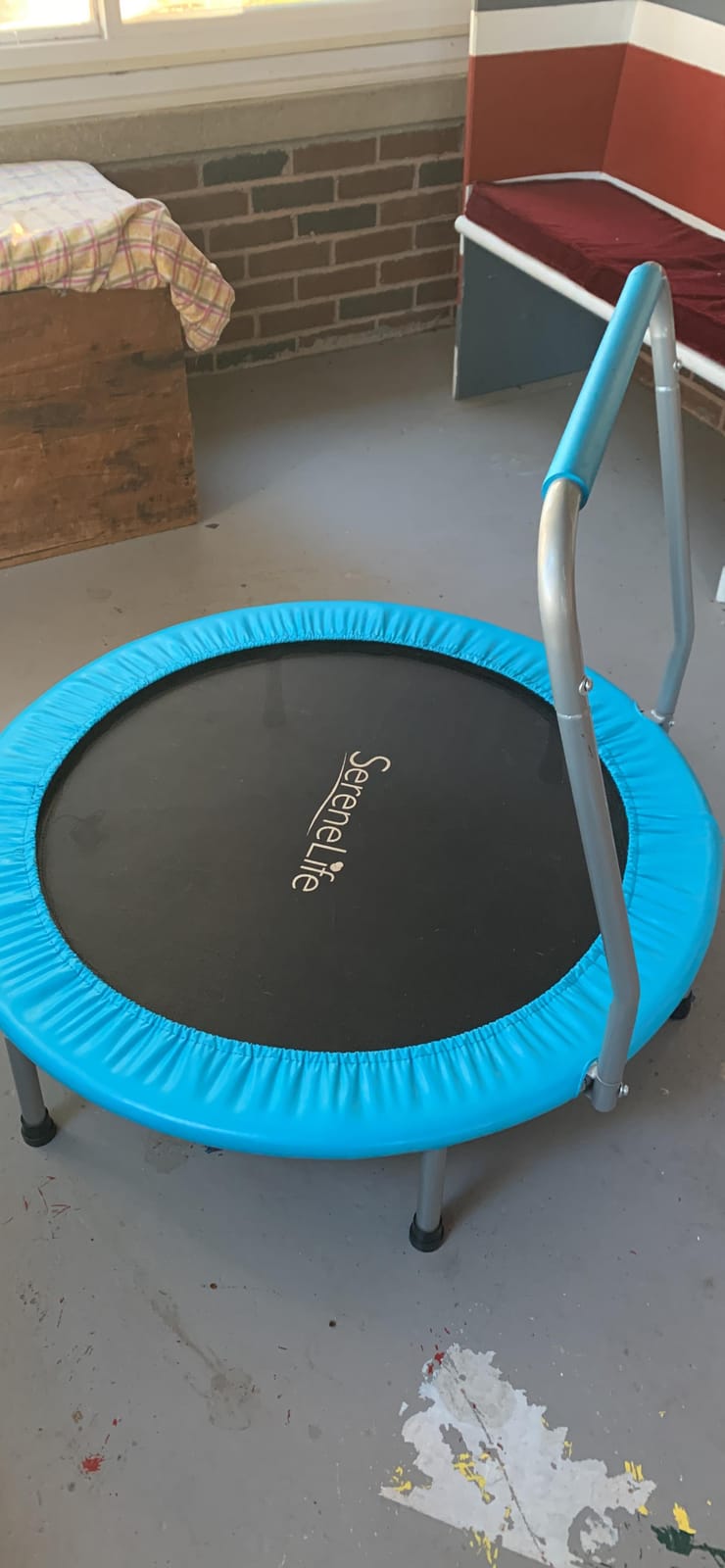
2. SereneLife 36 Inch Foldable Mini Trampoline – the one that stores flat
SereneLife 36″ Mini Foldable Toddler Trampoline with Handle Bar, Rebounder Trampoline for Kids, Indoor/Garden Fitness & Play, Exercise Fun, Supports 220 lbs, Deep Blue
36 inch round frame
18.3 lb unit
220 lb max weight
1 year warranty
Pros
- Folds flat for storage
- Carry bag included
- Foam handle and padded spring covers
- Alloy steel frame
Cons
- Heaviest at over 18 lb to move
- Mixed spring feel for very young children
Buyers of this rebounder mostly describe the same two moments: taking it out of the closet for a rainy afternoon and putting it back before dinner. The foldable frame is the whole reason, and with the free carry bag it also travels, which makes it the most flexible choice in the group for an adult who wants to bounce alongside a child.
The 220-pound maximum weight recommendation is the highest rated capacity paired with a 36-inch handled frame here, and the assembled jumping zone is given explicitly as 36 by 32 inches. The 24-inch foam handlebar plus rubber-tipped legs add the stability a taller child needs when the bounce gets enthusiastic.
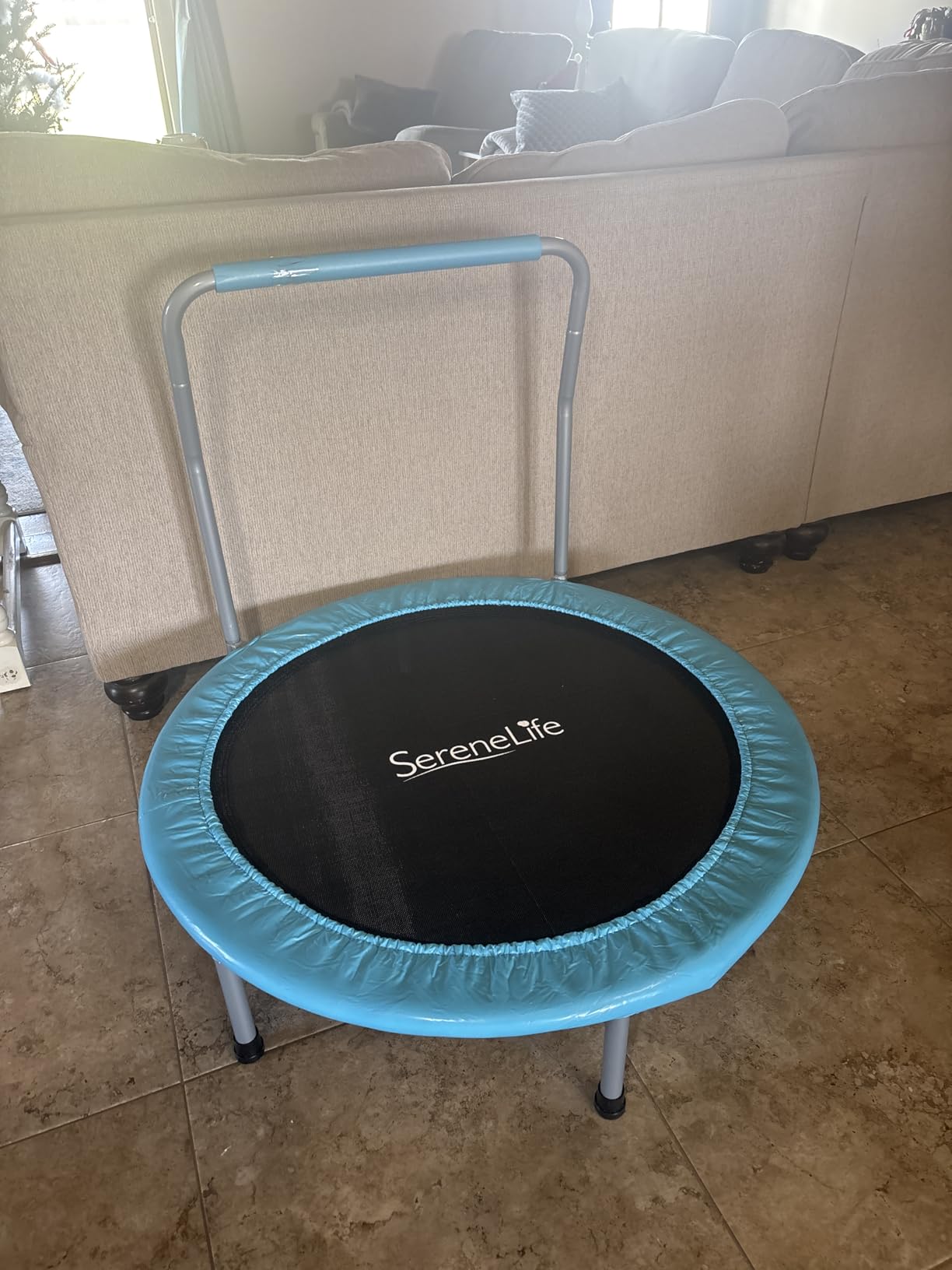
It uses a closed spring system with foam-padded covers over the springs, so there is no exposed metal at the mat edge, and the frame is alloy steel rather than the plastic-and-metal mix used by the toddler-focused models. A 4.5 average from 3228 ratings reflects broad approval with a little friction around spring feel for children who are very young or expect a softer surface.
The tradeoff is weight. At 18.3 pounds it is the heaviest of the ten, and for a one-parent household carrying it between rooms that is a real consideration. Reviewers also note the folded frame is noticeably less stiff than a fixed one, so treat the foldable aspect as a storage feature rather than something to bounce on daily while folded.
Storage and clearance questions worth asking
Measure the closet or under-bed gap before you order. The advertised size is the assembled diameter, not the folded one, and the handle bar does not fold with the frame, so you need room for the bar to sit diagonally. Check that you have a clear band of at least three feet of floor around the mat for a child to land off-centre.
Who should skip it
Skip it if you cannot lift and carry 18 pounds comfortably, or if your child is a sensory seeker who reacts badly to a firm spring rebound. It is also not the quietest option in the list. For an upstairs neighbour, one of the springless models further down handles that better.
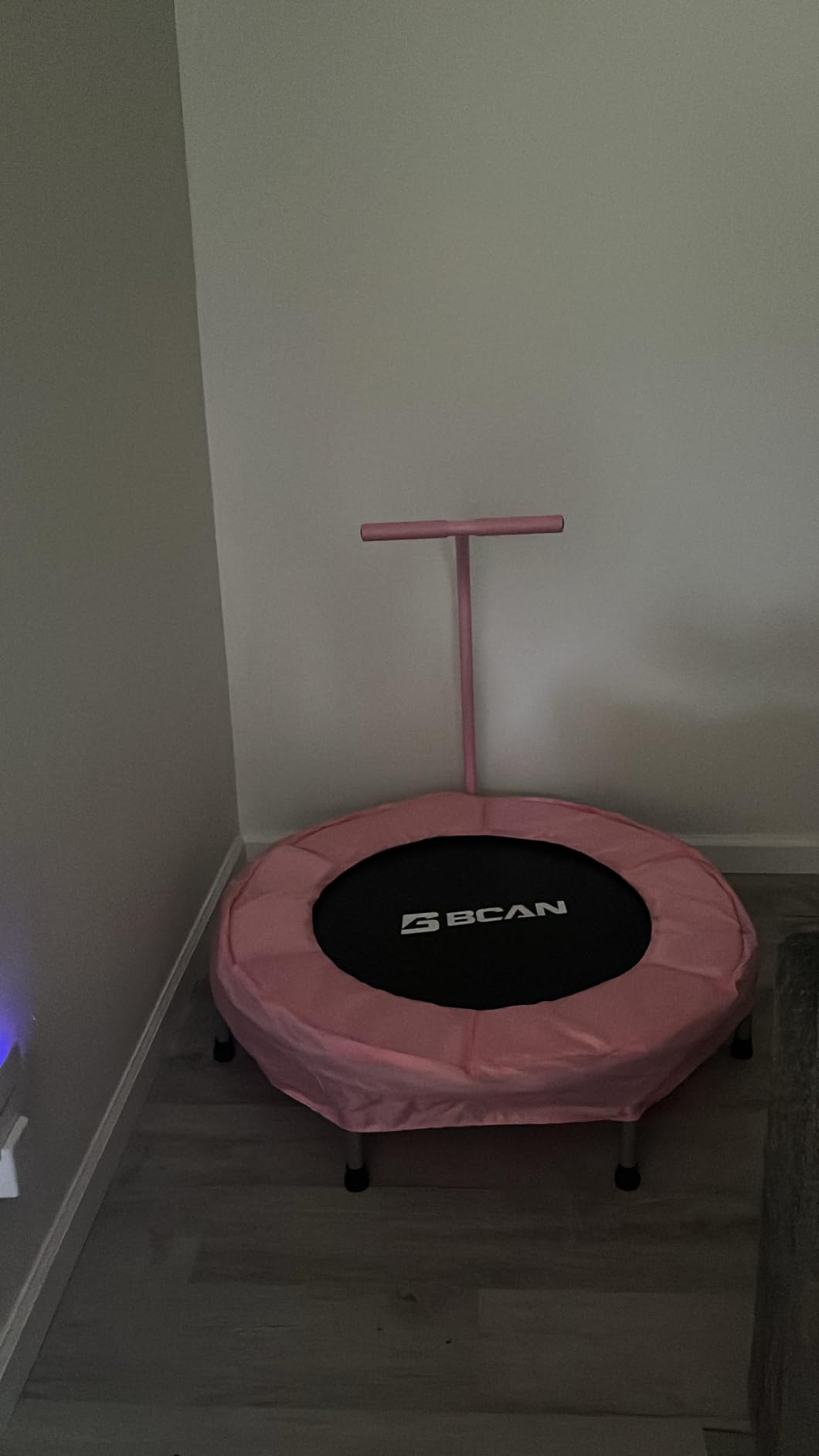
3. BCAN SP1 36 Inch Kids Trampoline – the capacity older children need
BCAN SP1 36” Kids Toddler Trampoline Indoor, Foam Handle | FED Fitness
36 inch round frame
13.7 lb unit
220 lb max weight
ASTM certified
Pros
- Highest capacity on a 36 inch frame
- ASTM certified
- 28 thickened springs
- Six-leg anti-tip base
Cons
- Handlebar centre is not foam covered
- Some reports of loosening screws
- Low weight limit in some configurations
Most handled 36-inch kid trampolines stop at 55 pounds, which means they stop working the moment a child turns five. This one is listed at 220 pounds, so the same frame keeps going from a two-year-old up into the school years and even supports an adult joining in. That single spec is why it ranks this high.
The bounce itself is the gentle, well-damped sort rather than a springy one, and reviewers consistently credit the T-shaped foam handle plus the six-leg base for stopping a small child from tipping when they land near the edge. The enclosed springs and non-slip rubber feet complete a safety package that feels more considered than the price bracket usually allows.
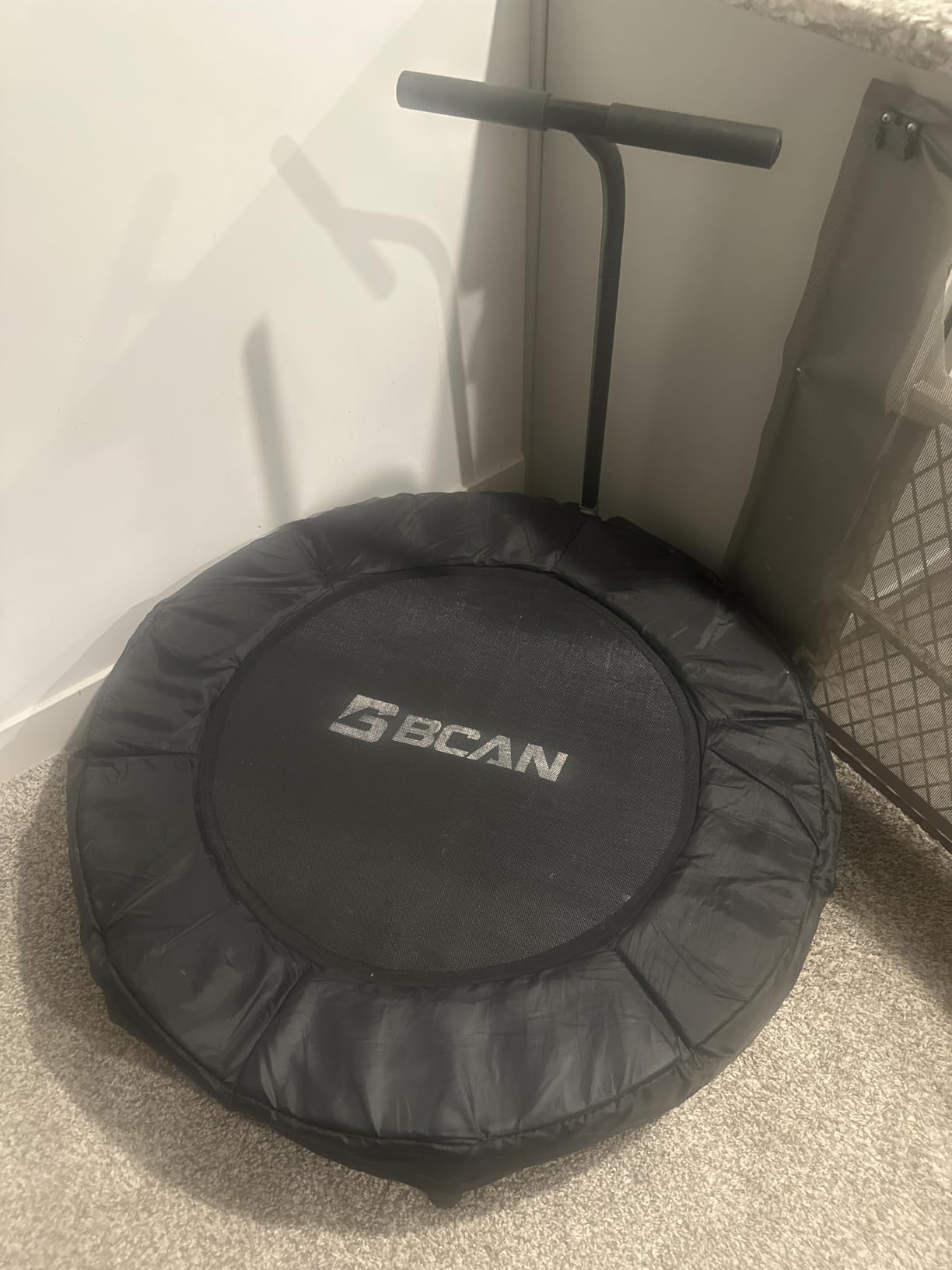
It carries ASTM certification, described as 20 or more safety tests, and the mat is the current upgraded version with higher fabric density, tighter stitching and greater thickness. A denser mat matters indoors because it stays taut, which stops the surface pocket that makes a child bounce lower and lose balance.
Assembly is a five-step build that one person can do, with tools and a video guide in the box, and the frame folds flat so it stores without being fully disassembled every time. The 13.7-pound unit weight is manageable for a single parent, and the folded package measures under 18 by 13 inches.
Watch the handlebar centre and the weight listing
Two things come up repeatedly in the reviews. The middle section of the handle bar is not foam covered, and some parents pad it themselves, so ask yourself whether your child mouths the bar. Separately, some configurations of this model list a much lower maximum user weight, so confirm the 220-pound figure applies to the version being shipped.
Where it falls short
A handful of reviews report screws loosening over time, which matters because the handle height is held by them. Check them every few months if your child bounces hard. It is a fixed spring design, so it is also louder than the springless models and needs a mat underneath on a hard floor.
4. ATIVAFIT 36 Inch Toddler Trampoline – the Best Value bounce in the group
Ativafit 36inch Mini Toddler Trampoline for Kids Ages 1-6 Indoor Outdoor Folding Small Rebounder Trampoline with Foam Handle Safety Padded Cover Fun for Kids
36 inch round frame
23.6 inch height
55 lb max weight
Ages 2 to 6
Pros
- Springless elastic band runs near silent
- Waterproof Oxford mat grips when damp
- One-person assembly
- Indoor and outdoor use
Cons
- 55 lb limit excludes school-age kids
- Surface feels firmer than a spring mat
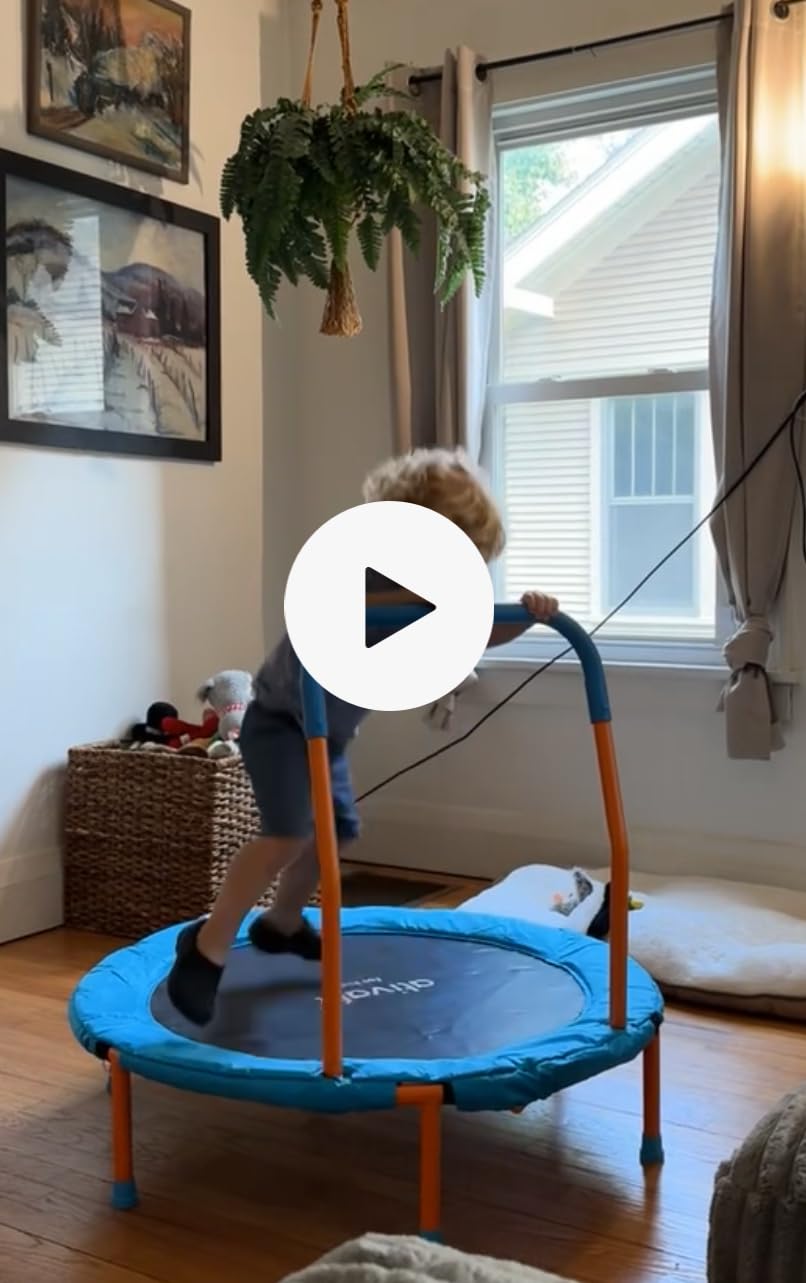
Noise is the number one complaint parents raise about indoor trampolines, and this is the model that answers it most directly. There are no metal coil springs at all. The mat is held by an elastic band system, so what you hear is a soft thump rather than the metallic ring of a spring and frame working together.
A 4.7 average from 841 ratings puts it level with the Little Tikes model on satisfaction, and the reviews point at the same two things: it is quiet, and the mat stays exactly where it is put. That second point is why parents in shared-floor homes like it, because a mat that walks across the floor is a mat that ends up against a wall.
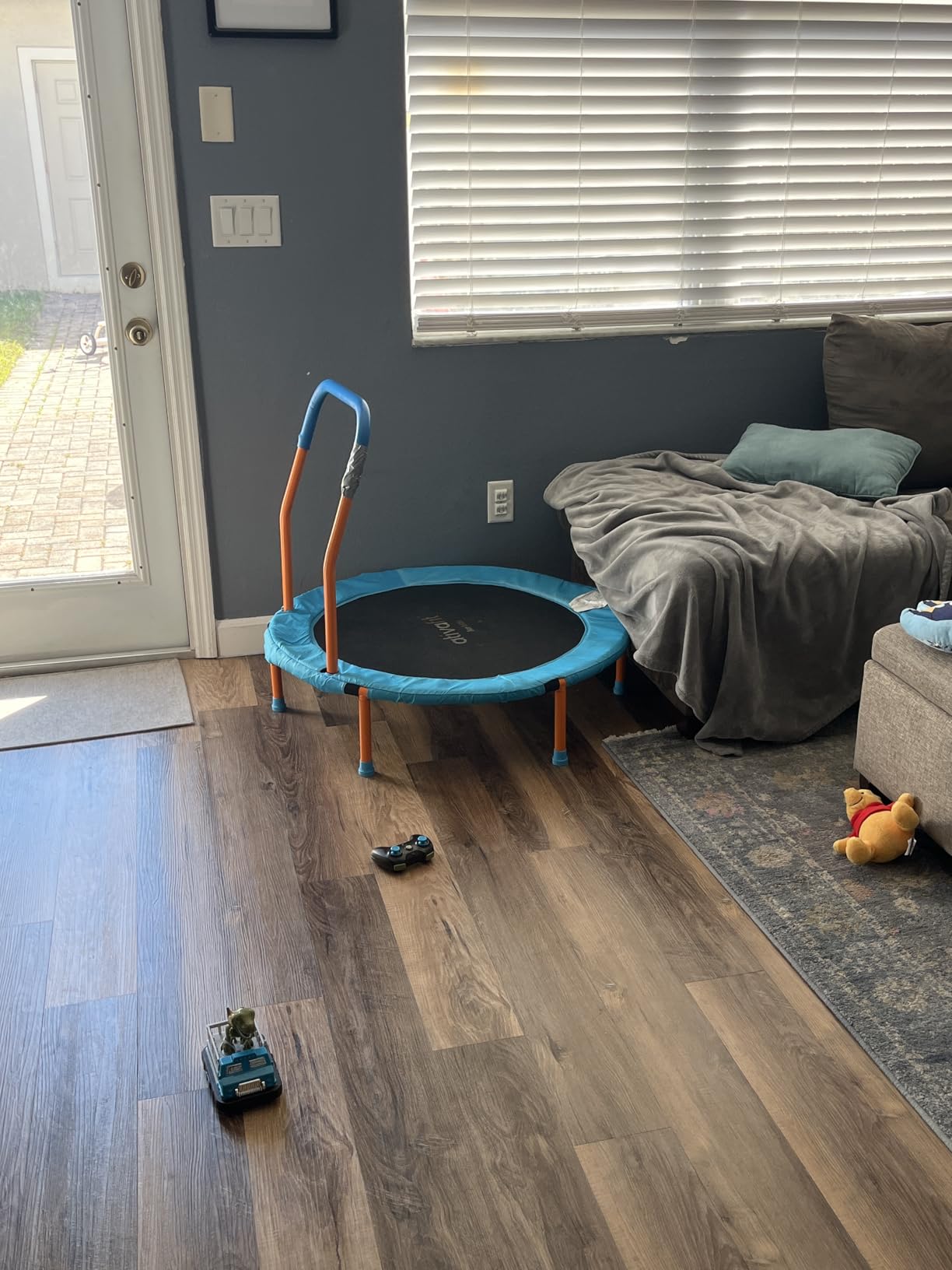
The Oxford cloth mat is tear-resistant, non-slip and waterproof, so it grips even when slightly damp and wipes clean after a sticky-fingered afternoon. The frame is alloy steel on six legs with a safety lock, and the foam handle gives a two-year-old something to hold while the surface stays firm enough to bounce on.
Assembly is a one-person build with all tools included. It works indoors and out, so it doubles as a garden toy in summer, and the frame folds for storage. The 55-pound maximum weight is the constraint to plan around, and the firmer surface is the other.
Why the weight limit matters more than usual here
Because the surface is springless it feels firmer, and a firmer surface sends more of the impact back up through a heavier child. At 55 pounds it is built for ages 2 to 6 as listed, and a child approaching that number may land hard and complain about their knees. If your child is five or older, pick a model with a higher rated capacity.
Best and worst fits
It is the strongest pick for an apartment, a downstairs flat with thin ceilings, or any room where a bouncing noise complaint would be awkward. It is the wrong pick for a sensory-seeking child who needs deep compression, for a larger sibling, or for anyone planning to use it as a workout rebounder.
5. SkyBound 36 Inch Indoor Trampoline – the lowest entry point with a handle
SkyBound 36-Inch Mini Trampoline for Kids Ages 3+, Indoor Toddler Rebounder with Padded Handlebar, 7-Leg Steel Frame, 110 lb Capacity, Rocket
36 inch round frame
14.7 lb unit
110 lb max weight
Ages 3 and up
Pros
- Lifetime warranty on the frame
- 110 lb capacity
- Seven-leg base
- Removable non-scuffing feet
Cons
- Thinnest review base of the group
- Fixed-height foam handle
- Only 36 inch usable frame
This is the value entry point, and the reason it beats cheaper handled models is structural. Seven legs instead of four or five, upgraded 2.0mm steel pipe, 28 springs and a thick PVC safety pad over the spring ring. On a 36-inch frame that is a noticeably more planted trampoline than the price suggests.
It also has the best warranty in this group: a lifetime warranty on the frame with a one-year limited warranty on other materials. A 4.6 average from 386 ratings is solid, and the reviews are consistent about two things, namely that assembly is easy and that the feet are kind to an indoor floor.
The feet are rubber capped, water resistant and removable, and reviewers specifically note that they do not scuff. That detail matters more than it sounds. Most complaints about indoor trampolines and hardwood come down to the rubber feet creeping under hard bouncing, and removable feet let you lift and reposition the frame without dragging it.
At 110 pounds the weight limit sits comfortably above the preschool band and into the early school years, which makes it a better long-term buy than the 55-pound models. The 36-inch frame means the usable mat is closer to 24 inches across, so it is a single-child trampoline rather than a sibling-sharing one.
What the low review count means for you
At 386 ratings this is the thinnest long-term record in the top of the list, so durability claims are based on build spec rather than years of owner feedback. If you keep it beyond a couple of years, check the spring ring and the handle bolts every few months. There is also no folding mechanism, so plan its spot before delivery.
Where it does not work
It uses traditional coil springs, so it is louder than the springless models and better suited to a ground-floor room with a carpeted or matted floor. The handle is a fixed foam-covered bar with no height adjustment, which works well for a three-year-old and stops working as the child grows.
6. BCAN BT1 36 Inch Foldable Trampoline – folds to a quarter of its size
BCAN BT1 36” Toddler Trampoline, ASTM Certified-Foldable Mini Trampolines for Kids Ages 1-6, Adjustable Handle, Safety Pad & Foldable Legs, Baby Trampoline Indoor/Garden, Gift for Boy and Girl, Beige
36 inch round frame
21.5 inch height
Ages 1 to 6
Two-level handle
Pros
- Folds to about a quarter of its size
- Springless and quiet
- Cover stitched inside the mat
- Suction-cup style feet
Cons
- Shifts on hard floors when bounced hard
- One of the costlier foldable models
- Supervision still needed
The folding claim on this one is measured, not vague. It collapses to roughly a quarter of its assembled size, and reviewers who compared it against larger-brand trampolines put the folded depth at about 3.5 inches, which is thin enough to slide behind a couch or under a bed. In a small home that is the difference between owning a trampoline and owning a piece of furniture.
Like the ATIVAFIT model it runs on elastic bands rather than exposed metal springs, and parents call out the removal of pinch points as the main reason they trust it around a one-year-old. The spring cover is stitched to the inside of the mat so a small hand cannot slip underneath it.
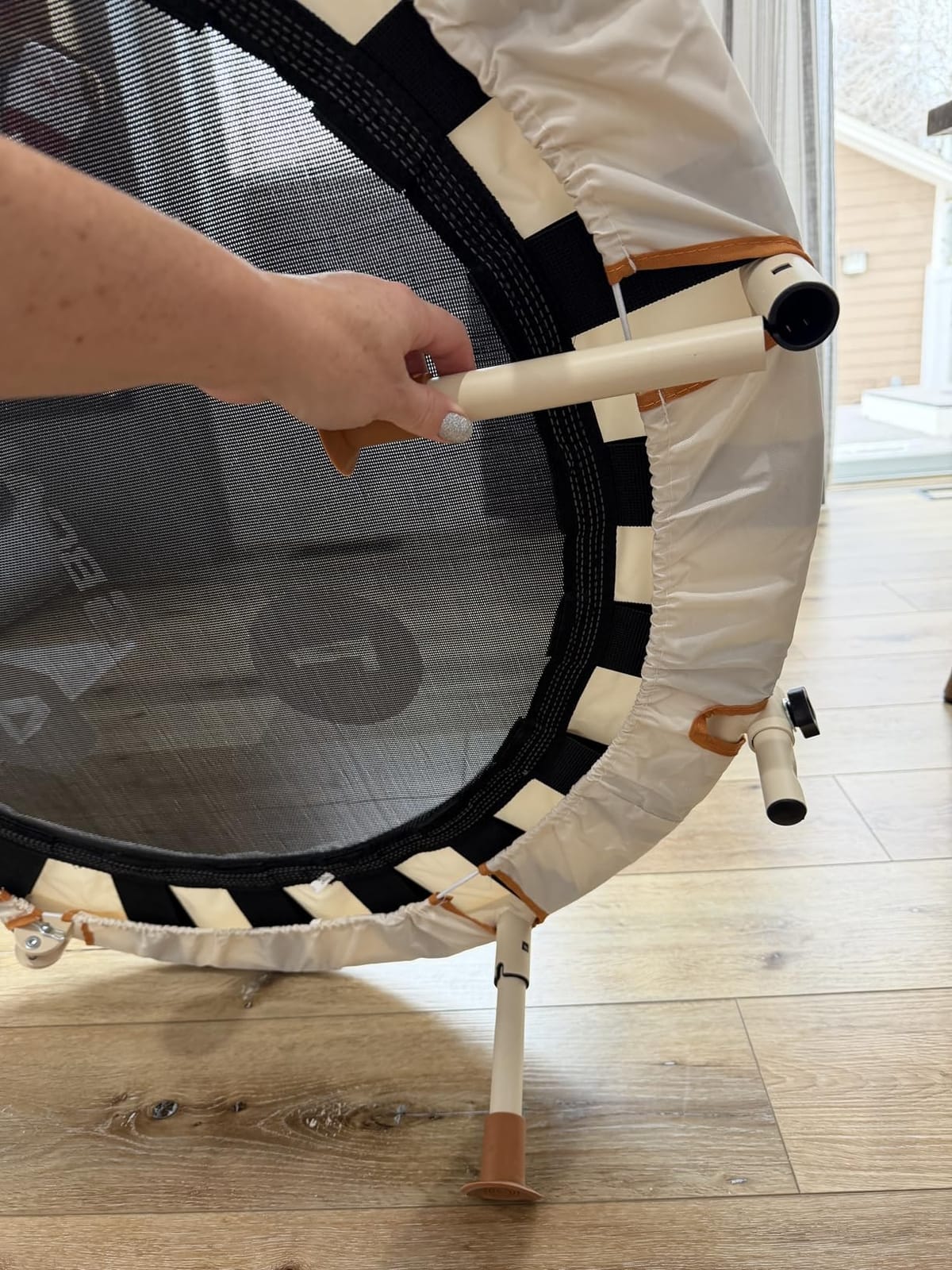
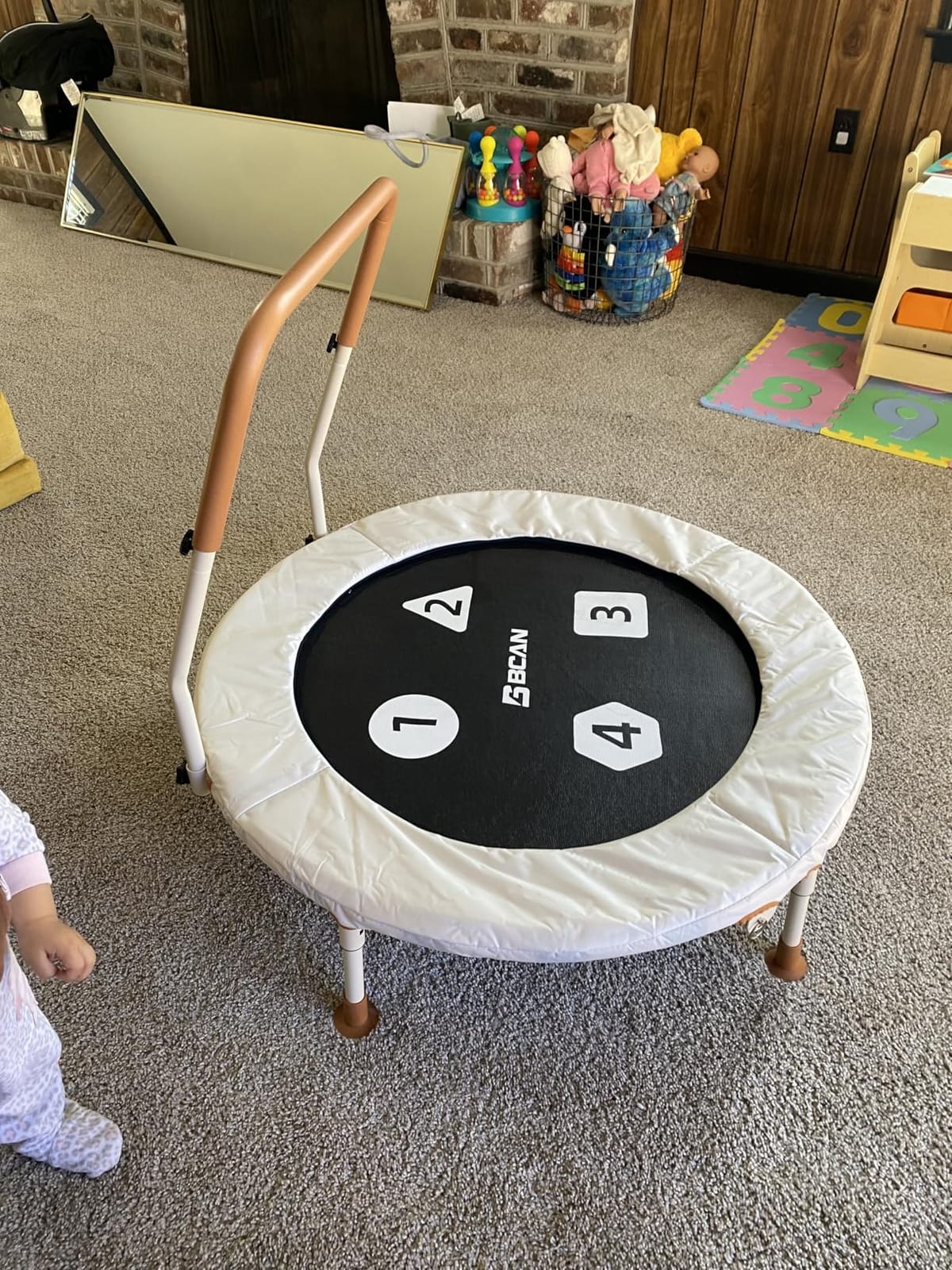
The handle is a thickened foam bar with two height levels, covering ages 1 to 6 as listed, and the anti-tip design uses non-slip rubber legs, inward-curved handles and safety pins. Assembly takes about five minutes with no tools required, and it comes in beige, deep black and pink, with the neutral options chosen deliberately to blend into a living room.
The repeated caution in the reviews is that it can shift slightly on a hard floor during high-energy bouncing. That is the price of a folding frame with suction-cup style feet, and the fix is simple but not optional: put it on a rug or a mat and check its position each time it is set up.
Two-level handle and age range questions
Two levels means a bar height that suits a one-year-old and a four-year-old but nothing in between, so check where your child falls. The listed range of 1 to 6 is optimistic for a tall six-year-old, since no maximum weight figure is published. Treat the age range as a guide and watch for bottoming out as a signal to move up in size.
Who should pass on it
Skip it if your floor is bare hardwood and you are not willing to add a mat, or if the room has to stay clear for other furniture every day. It is also one of the more expensive 36-inch foldable models here, which makes it a hard sell next to a cheaper fixed frame if storage is not your problem.
7. Fisher-Price WonderJump 3-Foot Mini Trampoline – tool-free setup
Fisher-Price Mini Trampoline, WonderJump 36″ Round Bouncer, Multicolor
36 inch round frame
36 inch height
55 lb max weight
Ages 3 and up
Pros
- Tool-free assembly in minutes
- Removable handlebar
- 6 non-slip foot pads
- Powder-coated steel frame
Cons
- 55 lb limit limits it to younger children
- Smallest review base among the rated picks
- 36 inch height needs clearance
This carries the highest average rating in the group at 4.8, with 91 percent five-star ratings in the reviews. The reason is not exotic engineering, it is the setup. There are no screws and no tools, so a parent can have it built and inflated-equivalent, in the sense of assembled, before a toddler loses interest.
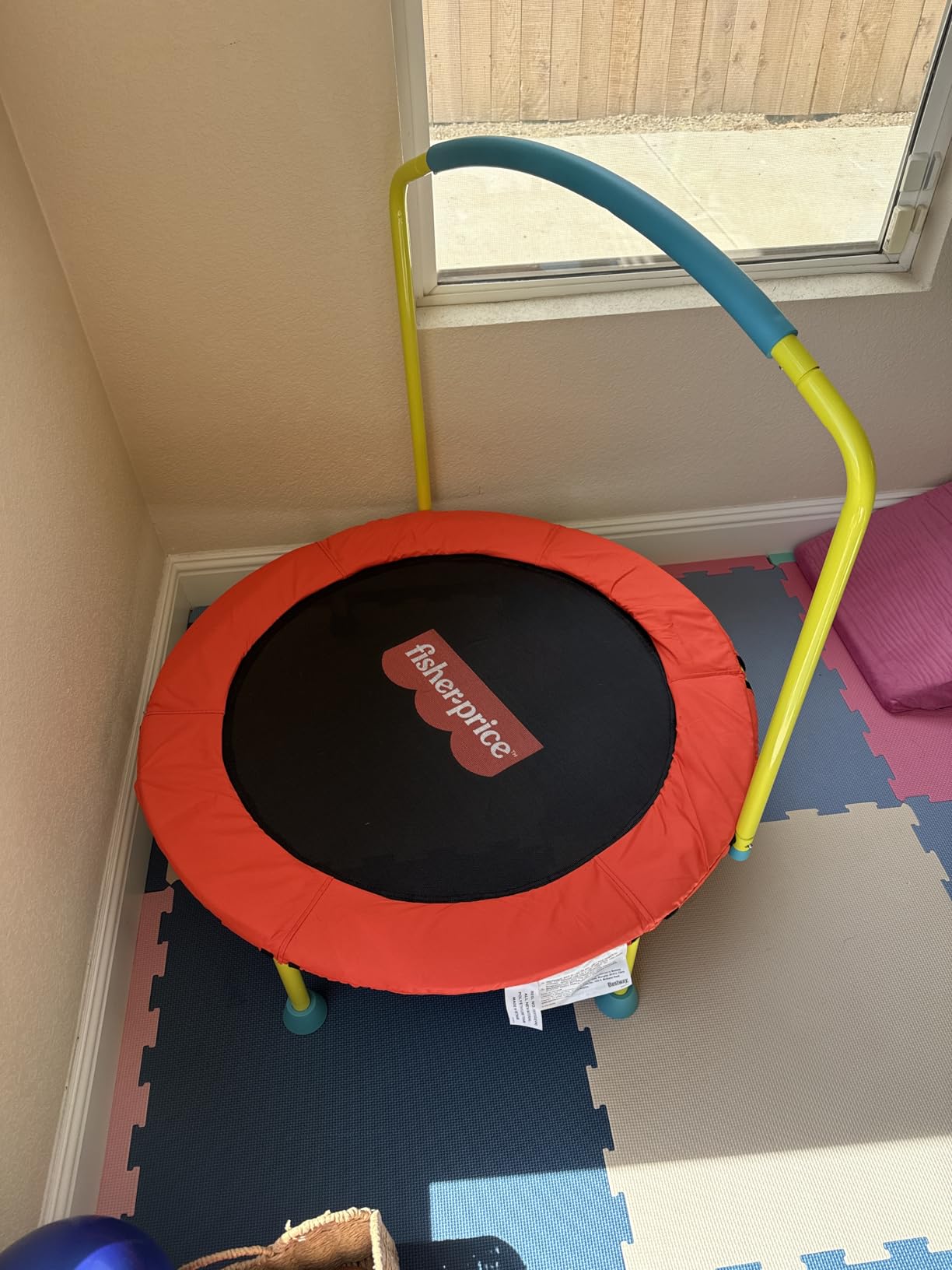
Six non-slip foot pads and a powder-coated steel frame give it stability on a hard floor, and the soft foam grip handlebar is the right height for a preschooler working on balance and coordination. The removable handlebar plus folding frame is the detail that separates it from a fixed 3-foot unit.
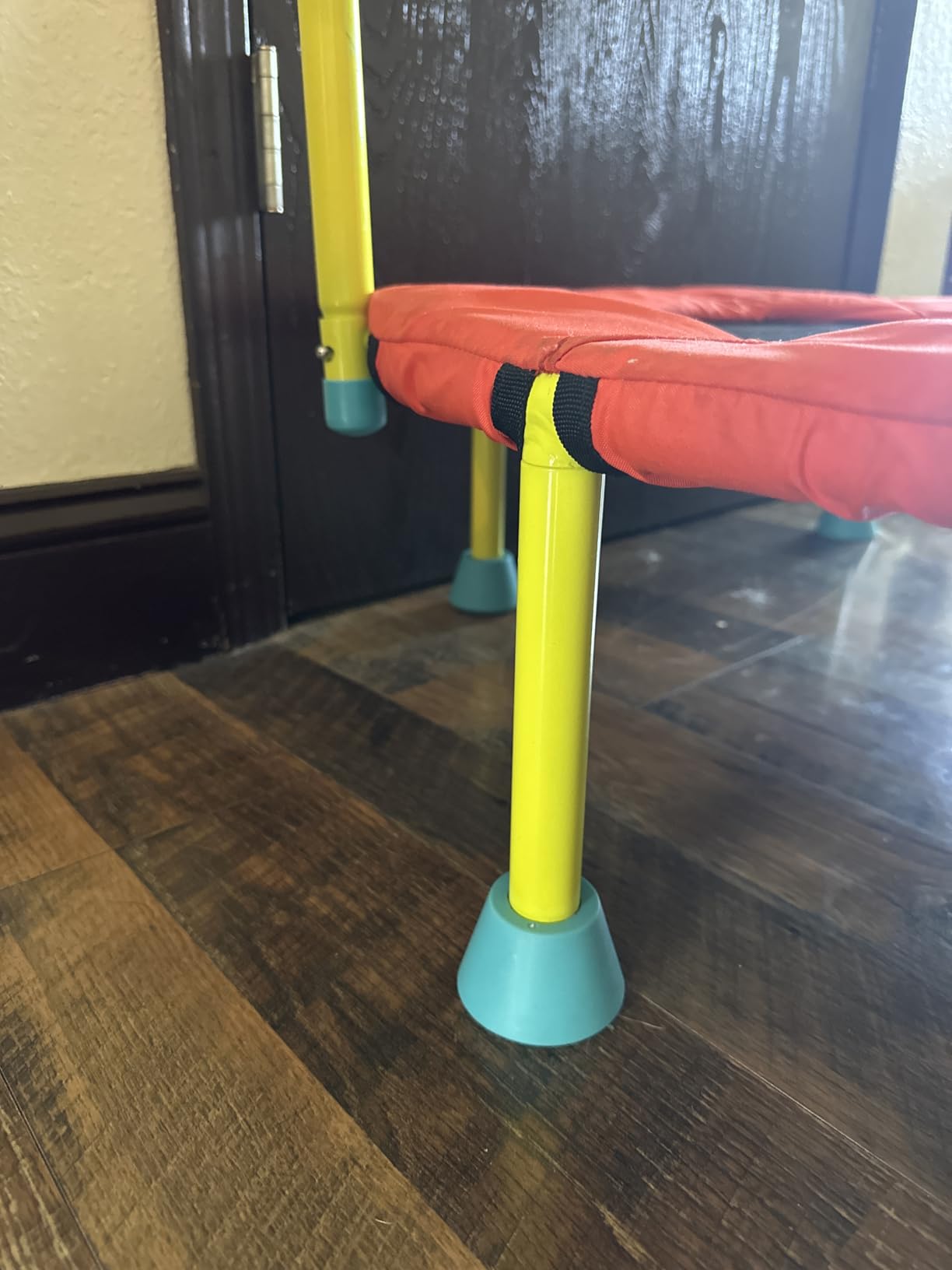
It is listed for ages 3 and up with a 55-pound maximum, which again caps it at the younger preschool band. The brand recognition matters more than it sounds for a first trampoline, because a parent buying a first one is often buying a known name rather than researching ten options.
Note the 36-inch assembled height. That is the tallest profile in this list and it is entirely handle bar, so measure from floor to handle before you commit to a corner. The removable bar solves it in one step if clearance is tight, at the cost of the support feature.
Rating strength versus evidence volume
A 4.8 from 298 ratings is a good score on a small sample, and the newer listing means less long-term data than the models with tens of thousands of reviews. Expect the foam pad and the joint points to be the first things that need attention. Check the handle bar bolts after the first month of daily use.
When a higher rating is not the deciding factor
Skip it if your child is over 55 pounds, if you need a high weight limit to grow into, or if the trampoline will be shared with an older sibling. On balance though, the combination of tool-free setup, a removable handle and a stable six-foot base makes it the smoothest first trampoline for a three-year-old.
8. SPORTSOUL Mini Trampoline – the sturdiest frame at this size
SPORTSOUL Mini Trampoline for Kids 3-6 with Super Safe Foam Handle Bar
36.7 inch round frame
13.4 lb unit
88 lb max weight
Ages 3 to 6
Pros
- 72 springs on a galvanized frame
- 6 legs resist tipping
- No-gap mat stitched 12 ways
- Protective floor feet
Cons
- Instructions call for two adults
- Foam sleeves ship with covers to remove
- Can slide on hard flooring
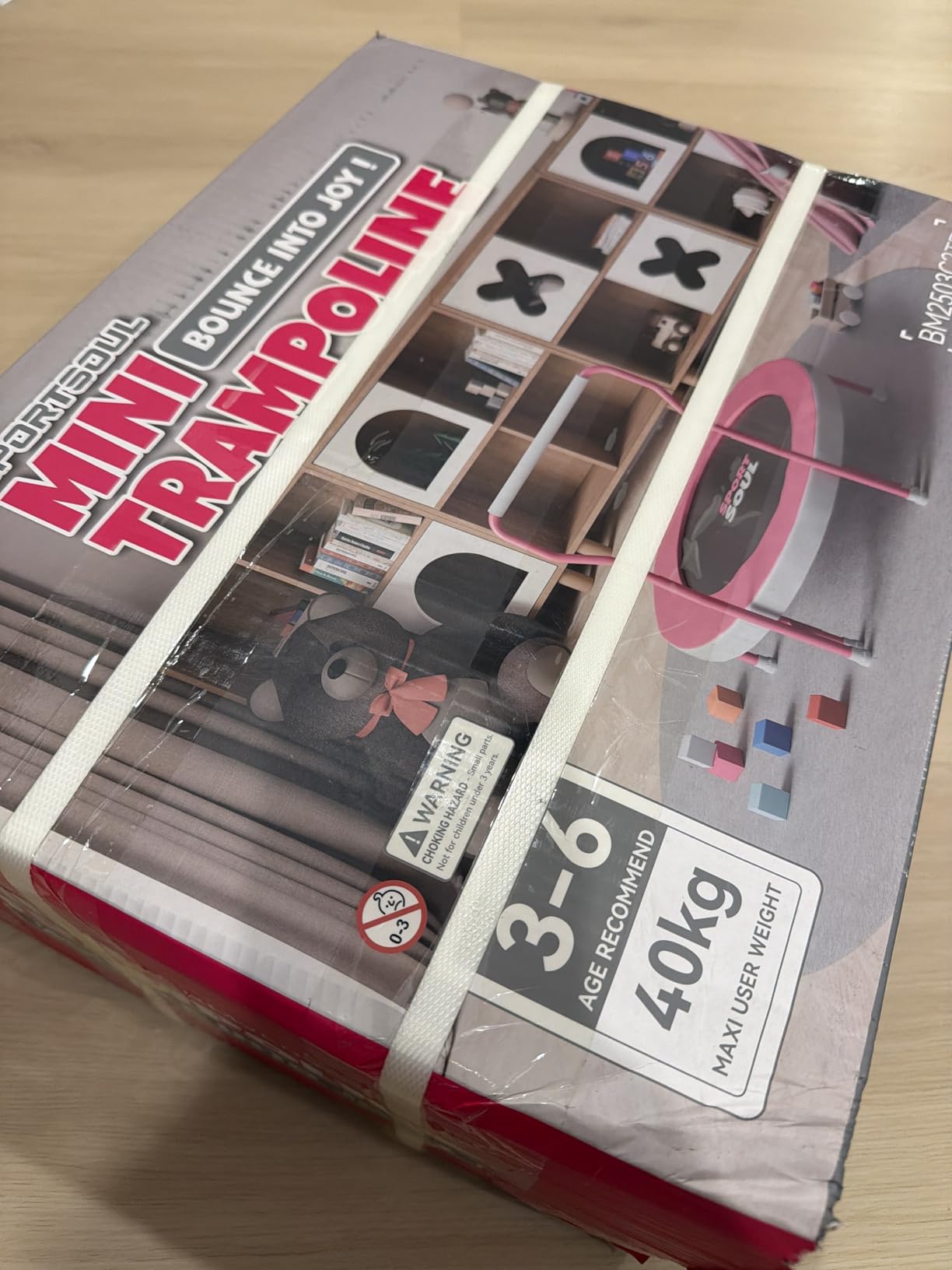
Spring count is the spec that sets this apart. Seventy-two springs on a 36.7-inch frame is far more than the 28 used by most competitors of this size, and the result is a firmer, more responsive rebound that reviewers describe as noticeably more robust than similarly priced mini trampolines.
The mat is a three-layer thickened pad stitched to a polypropylene jump mat with twelve elastic straps and six sewing lines, which is what keeps the surface flat and gap-free. The handle is an NBR non-slip foam bar, soft enough for small hands but tear-resistant, and the six rubber feet are positioned to protect an indoor floor while damping noise.
Tested over 300,000 bounces with an 88-pound maximum, this is built for the 3-to-6 band and stops there. Six galvanized legs and high-tensile springs mean it holds its shape over years of daily bouncing better than a plastic-framed unit, which matters if the trampoline becomes a daily habit rather than a rainy-day toy.
Two practical notes. The instructions call for two people, so plan the assembly accordingly. And the dark grey protective covers on the foam handrails have to be removed after setup, a step several reviewers missed and then wondered about.
Assembly and the sliding floor problem
Reviewers are consistent that it can creep across a hard floor when a child bounces high and fast, and the fix they recommend, putting it on a rug or mat, is the right one. Plan the setup with that in mind rather than treating it as a defect. The two-person build is the other thing to plan for before the box arrives.
Best and worst environments for it
It suits a playroom, a finished basement or a holiday gift for a child aged 3 to 6 who will bounce daily. It is a poor fit for a child over 88 pounds, for a hard-floor apartment where movement is unwelcome, or for anyone who wants the quietest possible surface.
9. ANCHEER 38 Inch Toddler Trampoline – spring-free bungee cords
ANCHEER 38″ Toddler Trampoline for Kids, Foldable Indoor Mini, Foam Handle
38 inch round frame
200 lb max weight
Ages 1 to 6
ASTM certified
Pros
- Bungee cords instead of metal springs
- Suction cup feet grip hard floors
- Adjustable T-shaped foam handle
- Highest capacity at this diameter
Cons
- Lowest average rating in the group
- Thinnest evidence base
- Bungee feel less responsive to some children
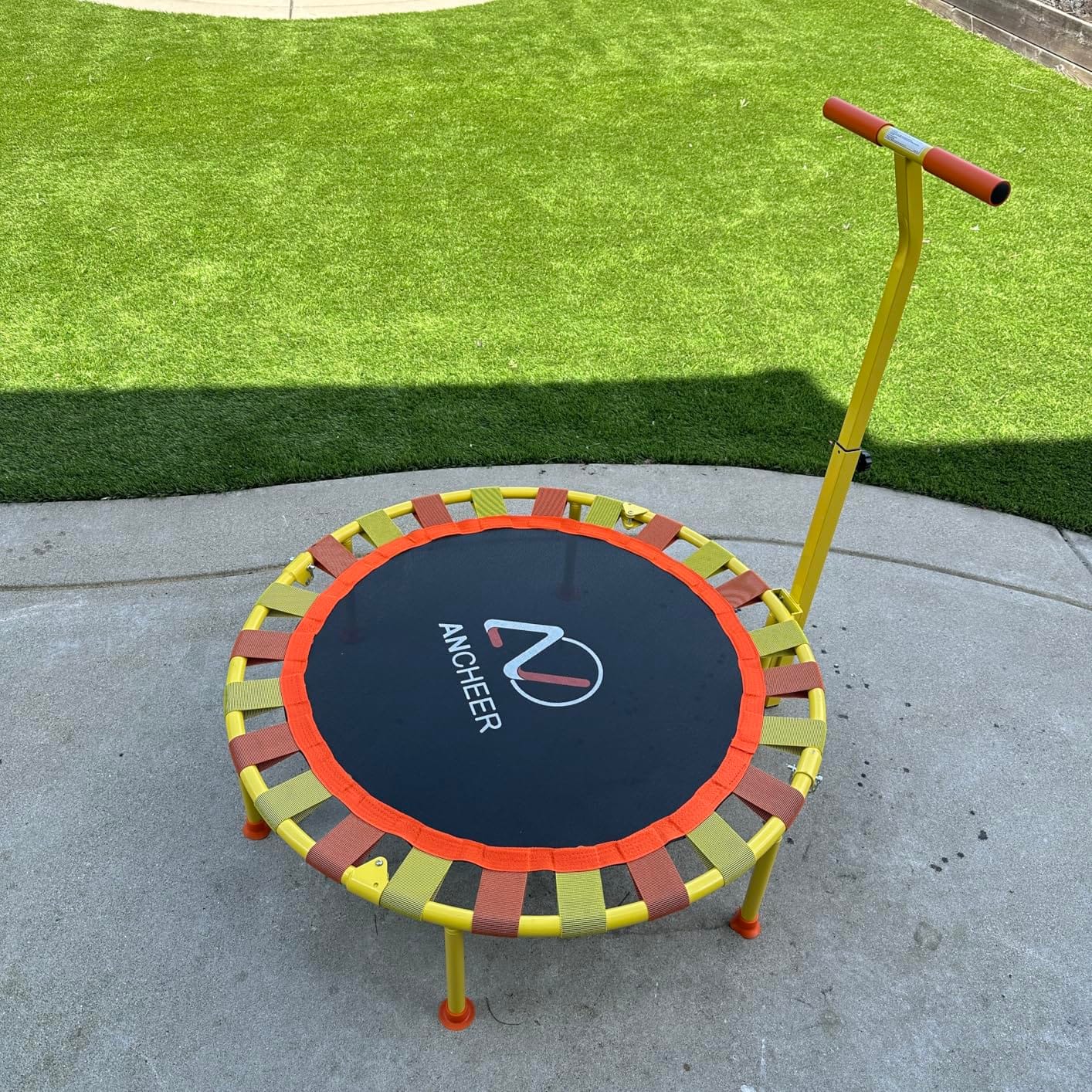
This is the only model here that uses a true bungee cord rebound system, and that single mechanical choice drives everything about it. Bungee cords stretch and recover rather than compressing, so there is no coil to ring, no pinch point at the mat edge and less impact transferred to the frame, which is the quietest arrangement for an indoor room.
It is also the largest frame in the group at 38 inches, with a listed maximum of 200 pounds. That combination is unusual: the widest usable mat here with a capacity that supports an adult joining in, which makes it the most flexible model for a family that wants to share the trampoline rather than hand it over to one child.
The upgraded suction cup feet are aimed squarely at hard indoor floors and are the feature parents mention most. The adjustable T-shaped foam handle is described as growing with the child, the frame is heavy-duty powder-coated steel, and the model is ASTM certified. It arrives mostly assembled, so setup is about ten minutes for one adult.
It folds flat for storage under beds, behind sofas or in a car trunk, and there are seven colour options including several pinks. The 4.4 average from 342 ratings is the lowest score here, and the reviews suggest it is mostly a matter of feel rather than function.
Why the bungee feel is the deciding factor
Some children describe bungee cords as less responsive than coil springs, because the cord gives a little before it returns the energy. If your child prefers a punchy rebound, a spring model will feel better. If your priority is silence and no pinch hazards, the trade is worth it. This is the model to test first if noise is your main constraint.
Limitations to weigh
It has the least proven record in the group, both in rating and in review volume, so we would not build a safety-critical routine around it without checking the cord tension yourself every few months. It is also 38 inches across, so it needs the most floor clearance of any model listed here.
10. JOY SPOT 36 Inch Foldable Rebounder – the lowest handle bar
36-Inch Toddler Trampoline with Foam Handle, 3FT Foldable Mini Rebounder
36 inch round frame
13.8 lb unit
100 lb max weight
Ages 3 to 6
Pros
- Handle bar sits lower than most brands
- Springless and quiet
- Waterproof Oxford mat
- 6-leg anti-tip frame
Cons
- Folding requires removing the bar with a tool
- Handle bolts are awkward to reach
- Thinnest review base in the set
Handle height is the reason this exists, and parents with a short two-year-old are the ones searching for it deliberately. On a fixed 36-inch frame the bar sits lower than the major-brand equivalents, which means a small child can actually reach it and grip it without standing on tiptoes.
Underneath that, the design is a springless elastic band surface with no exposed metal, a non-slip waterproof Oxford mat that grips smooth indoor floors and wipes clean, and a six-leg frame with a safety lock and anti-tip base. It folds flat for storage behind a door, under a bed or in a closet.
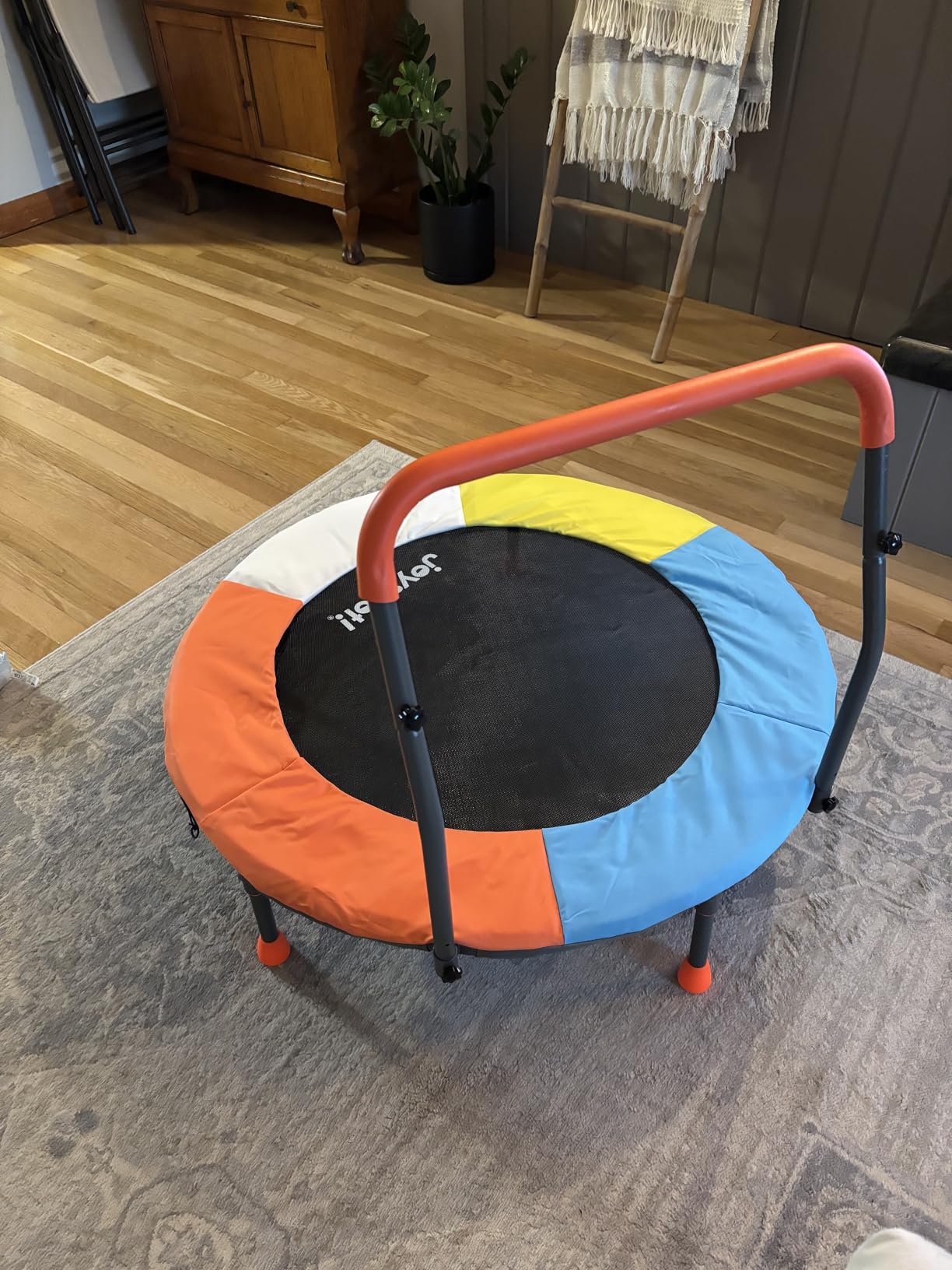
At 13.8 pounds it is one of the lighter frames here, and the listed capacity of 100 pounds carries it past the 55-pound ceiling that limits most handled models, so it grows with a child from about three to six years. A 4.5 average from 107 ratings is a reasonable score, but that is the smallest sample in the entire set.
There is one design flaw worth calling out. Removing the handle bar to fold the trampoline appears to require a tool, and the bolts sit in an awkward position, which is the hardest step of assembly. If your plan depends on folding it away every day, the fold does not deliver that.
Setting expectations on a small review base
With 107 ratings there is simply less long-term data than the other nine models here. We would check the elastic band tension, the six leg joints and the mat stitching more often than we would on a heavily reviewed model. Treat it as a short-term or short-list purchase rather than a five-year investment.
Where it fits and where it does not
It is a good match for a quiet first trampoline for a child between about two and four who needs a lower grip, and for a nursery or small flat where quiet matters. It is the wrong choice if you plan to fold it daily, if you want the deepest evidence base, or if a bigger child will soon be sharing it.
How to Choose an Indoor Mini Trampoline by Age
Start with the two numbers that actually decide the fit: the usable jumping surface and the weight limit. Advertised diameter is measured frame to frame across the springs, so subtract roughly 12 inches to get the mat a child lands on. Every model here is a 36 to 38 inch frame, which puts the real bouncing area at about 24 to 26 inches across. That is a single-child surface, and siblings will need to take turns.
Under three years old, the handle bar is not a nice-to-have. It is the feature that lets a toddler bounce without an adult holding them, and it should be adjustable or correctly sized. The Little Tikes 3-Foot model and the JOY SPOT rebounder both suit this band, with the JOY SPOT offering the lower bar for a short two-year-old.
Between three and six, you are choosing between capacity and noise. A 55-pound limit covers a typical preschooler but catches up with a taller one, so a 100 to 220-pound rating buys you a trampoline that survives the next three years. At that stage most parents shift from the handle-first models to a plain rebounder, and the SereneLife and BCAN SP1 cover that move well.
Seven years and up, an indoor mini trampoline is close to outgrown at this size, and the honest advice is to move to a 44 to 48 inch rebounder. Children who exceed the weight limit bottom out, meaning they hit the mat floor or the frame instead of the springs, and that is the injury mode that shows up in the reviews most often.
The mechanics matter as much as the size. Coil springs give the liveliest bounce and the loudest thump. Bungee cords stretch and recover for a quieter, lower-impact feel with no pinch points. A springless elastic band system, found in the ATIVAFIT, BCAN BT1 and JOY SPOT models, is quietest of all and firmer underfoot. If you live below anyone, start with the quiet list.
Quiet Mini Trampolines for Apartments and Upstairs Neighbours
Yes, you can have a small trampoline in an apartment, provided you pick the right mechanism. The noise comes from three places: the mat slapping the frame, the springs working, and the feet moving on a hard floor. The model choice only fixes the first two.
In quietest-first order, the springless elastic band models come out ahead, so the ATIVAFIT and BCAN BT1 lead this list. The ANCHEER 38-inch bungee cord model is next, because cords do not have a coil to ring. After that come the handled coil spring models, which are perfectly usable in a ground-floor flat but will transmit a thump through a floor joist.
Three things do more for your neighbours than any model. Put a rug or a mat under the frame so the feet do not transmit impact. Set a time limit rather than letting free bouncing run for an hour, because noise complaints are about duration as much as volume. And check whether your building has rules about impact noise in shared hours, which many do.
On the myth that bungee cords shed toxic dust: the claim circulates in adult fitness circles and is not supported by the manufacturer data on any of these models. What does degrade with heavy indoor use is the cord surface itself, so inspect it annually and replace rather than cleaning it. If that worries you, a coil spring model removes the question entirely.
Is an Indoor Mini Trampoline Safe? Rules That Matter
One jumper at a time, every time, regardless of age. This is the rule that removes most reported indoor injuries, and it costs nothing to enforce. Two children on a 24-inch usable mat will collide, and the handle bar does not stop that.
Adult supervision means an adult in the room, not an adult in the house. A three-to-six-year-old can get a foot caught on a spring ring, twist on a landing or go under a handle bar within a couple of minutes of being left alone. Supervised use also means checking that the weight limit still matches your child, because growth is the quiet way these products become unsafe.
Clear the floor around the trampoline, not just under it. Leave roughly three feet of clear space on every side so a child bouncing off-centre has somewhere soft to land, and check the ceiling height against the frame plus the jumper. Overhead light fixtures, ceiling fans and hanging cables are the most common indoor hazard nobody thinks about.
Cover the floor. Rubber feet reduce scuffing but do not eliminate it on bare hardwood, and a rug or a purpose-made mat is the cheapest insurance available. Reviewers on several models here specifically suggest putting the trampoline on a rug after it crept across a hard floor.
When Not to Buy an Indoor Mini Trampoline
Skip it in a room with a low ceiling. These frames are up to 36 inches tall and a child bouncing on top of that can reach a ceiling fan, a light fitting or a smoke detector in a room that feels large on the floor plan.
Skip it if the only available floor is bare hardwood and you are not willing to add a mat. Scuff marks are cosmetic and permanent, and no amount of careful handling prevents them over years of use.
Skip it if you live directly above someone with thin floors and shared quiet hours, unless you are buying specifically a springless or bungee model and accepting a time limit. And skip it if you have no storage for a non-folding frame, because a 36-inch circle in the middle of a playroom gets used less once it becomes furniture.
Finally, be honest about interest. The most common review pattern we saw was heavy use for two weeks and then a return to whatever the child was doing before. A trampoline that gets stored away after a month and brought out on rainy winter days is a good purchase. One that is expected to solve a screen-time problem on its own usually disappoints.
Frequently Asked Questions
What is the best indoor trampoline for children?
The Little Tikes 3-Foot model is the strongest all-round choice for children aged 3 to 6, with a 4.7 average from 33890 ratings, an enclosed spring design and a foam handle bar. For a child under three, or for an apartment where noise matters, the springless elastic band models in this list are the quieter alternative.
Which indoor trampoline is the safest for kids?
Safety comes from three features working together: fully enclosed or covered springs, a foam handle bar for children under six, and a weight limit comfortably above your child’s current weight. The BCAN SP1 combines ASTM certification, enclosed springs, 28 springs and a 220-pound capacity, which is the widest safety margin in this group.
Are indoor trampolines good for kids?
Yes, when sized and supervised correctly. They give children proprioceptive and vestibular input, build balance and coordination, and provide a screen-free way to burn energy in a few square feet of living room. The benefits depend on matching the frame to the child’s age and weight and on an adult being in the room, not in the house.
Is there a difference between a rebounder and a mini trampoline?
A mini trampoline for kids is smaller, has a handle bar and a lower listed weight limit aimed at children. A rebounder is the adult fitness version, usually larger, without a handle, and rated for a much heavier user. The mechanics are the same in both cases, so the real difference is diameter, weight limit and whether a child can safely use it alone.
Which is better, a spring trampoline or a bungee trampoline?
A coil spring trampoline gives a livelier rebound and is the standard choice for a ground-floor room. A bungee cord trampoline stretches and recovers instead of compressing, which is quieter, has no pinch points at the mat edge and is gentler on ankles. For indoors above another household, the bungee or springless option is the better pick.
Can you have a small trampoline in an apartment?
Yes. Choose a springless elastic band or bungee cord model, put a rug or mat underneath, and set a time limit. The quietest options in this list are the ATIVAFIT and BCAN BT1 springless models and the ANCHEER bungee cord model. Also check your building rules on impact noise before the first session.
What is better, spring or springless trampoline?
Springless elastic band surfaces are quieter and remove pinch hazards, but they feel firmer underfoot and need a stronger mat. Coil springs feel livelier and last longer under heavy daily use, but they are louder and need a padded cover. For a toddler on a hard apartment floor, springless wins; for an older child bouncing daily, springs feel better.
Are springless trampolines safer than regular trampolines?
They remove the pinch risk of exposed coil springs, which is a genuine safety gain for small children. They are not safer in every respect, because the firmer surface sends more impact back into a heavier jumper. Choose springless for a small child on a hard floor, and a padded spring model for a heavier child who bounces hard.
For older children moving beyond a 3-foot frame, our mini trampoline guide for adult cardio covers the larger rebounder sizes, and our guide to trampolines with safety enclosures explains how nets change the safety calculation for bigger frames.
Conclusion: The Best Mini Trampolines for Kids Indoors (2026)
After working through all ten, the Little Tikes 3-Foot trampoline remains our pick for the best mini trampolines for kids indoors, on the strength of 33890 ratings and the most consistent owner feedback in the set. If you need it quieter or it has to fold away, the BCAN BT1 and ATIVAFIT springless models are the two we would look at next.
Two variables decide everything else: your child’s age and weight, and how much noise your building tolerates. Match the weight limit with room to spare, count the mechanism as part of the noise decision, and put a mat under the frame. If you are still weighing the wider category, our kids trampoline reviews and small yard trampoline picks cover the outdoor end of the range, and water trampolines for lakes covers summer setups.