
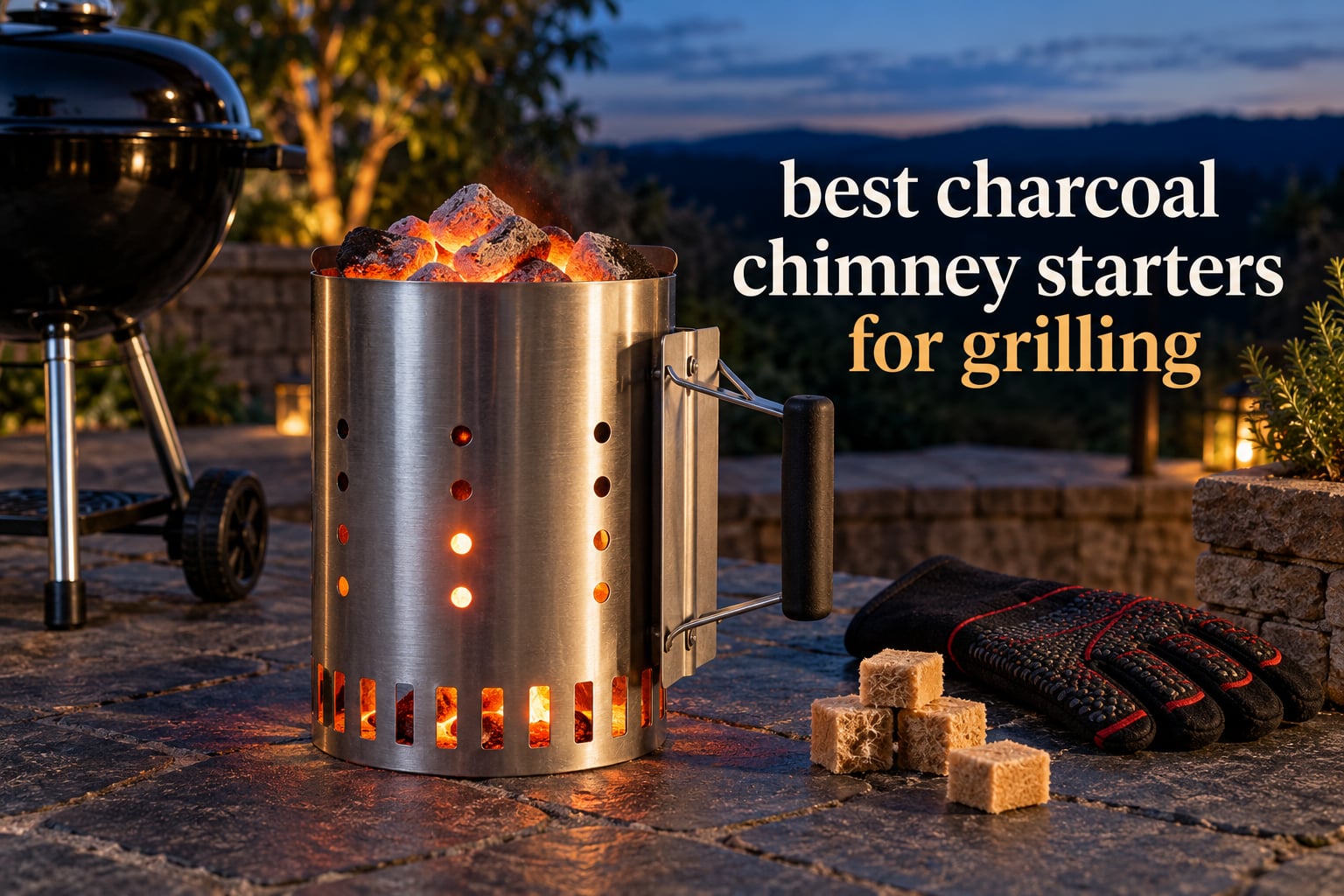
Pouring lighter fluid over a bag of charcoal, waiting, blowing on it, and repeating until dinner slips past 8pm is the part of charcoal grilling most people tolerate rather than enjoy. A charcoal chimney starter removes that entire step. You fill a metal cylinder with coals, put crumpled newspaper or a fire starter cube in the bottom chamber, light it, and let rising heat do the work while you do something else.
After testing these starters side by side across briquettes and lump charcoal, on kettles and portable grills, the Weber Rapidfire Chimney Starter remains the one we keep reaching for. It lights a full load in roughly 10 to 15 minutes, holds a cone-shaped grate that feeds fire from underneath, and has the cleanest pour of any starter we used. That is why it is the best charcoal chimney starter for most people in 2026, even with 40k+ reviews and a dozen credible competitors now circling the category.
This guide covers all 12 starters we tested, including kits that bundle a blower and fire cubes, collapsible stainless models for car camping, and heavy stainless builds aimed at binchotan and hard hardwood lump. We explain which ones suit a 22-inch kettle, which ones fit a small portable grill, and where cheaper models warp or leave a handle too hot to hold. If you are still choosing a grill, start with our charcoal grill buying guide for beginners first, then come back here for the lighting method.
Top 3 Picks for Charcoal Grilling in 2026
Weber Rapidfire Chimney Starter
- Cone-shaped grate
- 10-15 minute lighting
- Side and helper handle
Kingsford Heavy Duty Starter
- Large capacity
- Heat shield handle
- Vented base
- Arrives assembled

Those three cover most situations. The Weber is the default answer for a backyard kettle. The Kingsford does the same job for less money and is the easiest of the group to find in a hardware aisle. The E500 is the one to buy when you want thick steel, a wide stable base, and a box of wood starters already in the chimney kit.
Quick Overview of All 12 Best Charcoal Chimney Starters in 2026
| Product | Specifications | Action |
|---|---|---|
| Weber Rapidfire Chimney Starter |
|
Check Latest Price |
| Kingsford Heavy Duty Charcoal Chimney Starter |
|
Check Latest Price |
 homenote Starter Kit with Blower and Cubes homenote Starter Kit with Blower and Cubes |
|
Check Latest Price |
| E500 Large Charcoal Chimney Starter |
|
Check Latest Price |
 BBQ Dragon Chimney of Insanity XL BBQ Dragon Chimney of Insanity XL |
|
Check Latest Price |
 Camping Moon MT-18 Stainless Starter Camping Moon MT-18 Stainless Starter |
|
Check Latest Price |
 CADARA Charcoal Chimney Starter Set CADARA Charcoal Chimney Starter Set |
|
Check Latest Price |
 Joyagrill Double Enamel Chimney Starter Joyagrill Double Enamel Chimney Starter |
|
Check Latest Price |
 SUNLIFER Stainless Steel Chimney Starter SUNLIFER Stainless Steel Chimney Starter |
|
Check Latest Price |
 Amazon Basics Charcoal Chimney Starter Amazon Basics Charcoal Chimney Starter |
|
Check Latest Price |
 Bincho Grill Stainless Steel Chimney Starter Bincho Grill Stainless Steel Chimney Starter |
|
Check Latest Price |
 onlyfire Heavy Duty Stainless Chimney Starter onlyfire Heavy Duty Stainless Chimney Starter |
|
Check Latest Price |
How We Evaluated Charcoal Chimney Starters
We scored every starter on the same six criteria, in this order: ignition speed, usable capacity, heat protection at the handle, how controlled the pour is, build quality, and how much of a nuisance the thing is to store.
Ignition speed means time from lighting the paper to a full column of coals with grey ash on top. We timed loads of briquettes and lump separately, because lump consistently takes longer and it matters to know which one you are buying for.
Capacity we judged by what the manufacturer claims and whether that claim matched the coal volume the chimney actually held. A stated figure is only useful if the coal fits before you have to compress it by hand, which is where thin or short chimneys fall short.
Heat protection covers the handle, the shield between handle and body, and whether a gloved grip actually works. Almost every starter in this group gets hot. The difference is whether the shield is placed where it blocks the radiant heat you feel through your hand.
Pour control is what separates a good starter from a frustrating one. A wide vent hole and a flat grate let coals leave in a stream. A narrow outlet drops them in a clump. We also paid attention to whether the chimney can be tilted without coals spilling past the handle.
Build quality we judged by steel gauge, seam construction, and coating. Bare and zinc-flashed steel rusts. Painted steel eventually flakes. Uncoated stainless does neither, but costs more and weighs more.
Storage is where collapsible designs earn or lose points. A chimney that folds flat disappears into a trunk. A rigid cylinder lives on a garage shelf and collects moisture on its grate all winter.
1. Weber Rapidfire Chimney Starter: The Best Overall Charcoal Chimney Starter
Weber® Rapidfire Chimney Starter, Standard, Silver
Alloy steel
7.5 in diameter by 13 in
4.8 from 42k+ reviews
Plastic handle
Pros
- Lights a full load in roughly 10-15 minutes
- Cone grate ignites briquettes evenly
- Side handle plus fold-out helper grip
- Aluminized steel holds up to repeated high heat
Cons
- Surface rust on the interior grate over years
- Handle still runs hot when full
- Compact version is small for 50 plus briquettes
This is the starter on our own patio, and it is the one we hand to friends who ask what to buy. Our test load of briquettes went from cold to a fully ashy top layer in roughly 12 minutes with nothing but newspaper in the bottom chamber. No lighter fluid, no blower, no second match.
What makes it work is the cone-shaped grate sitting in the coal chamber. Instead of charcoal sitting flat on a wire screen with air only rising through it, the cone funnels fire toward the center and pulls heat up into the mass of fuel above. It is a small geometry change that produces noticeably more even coals.
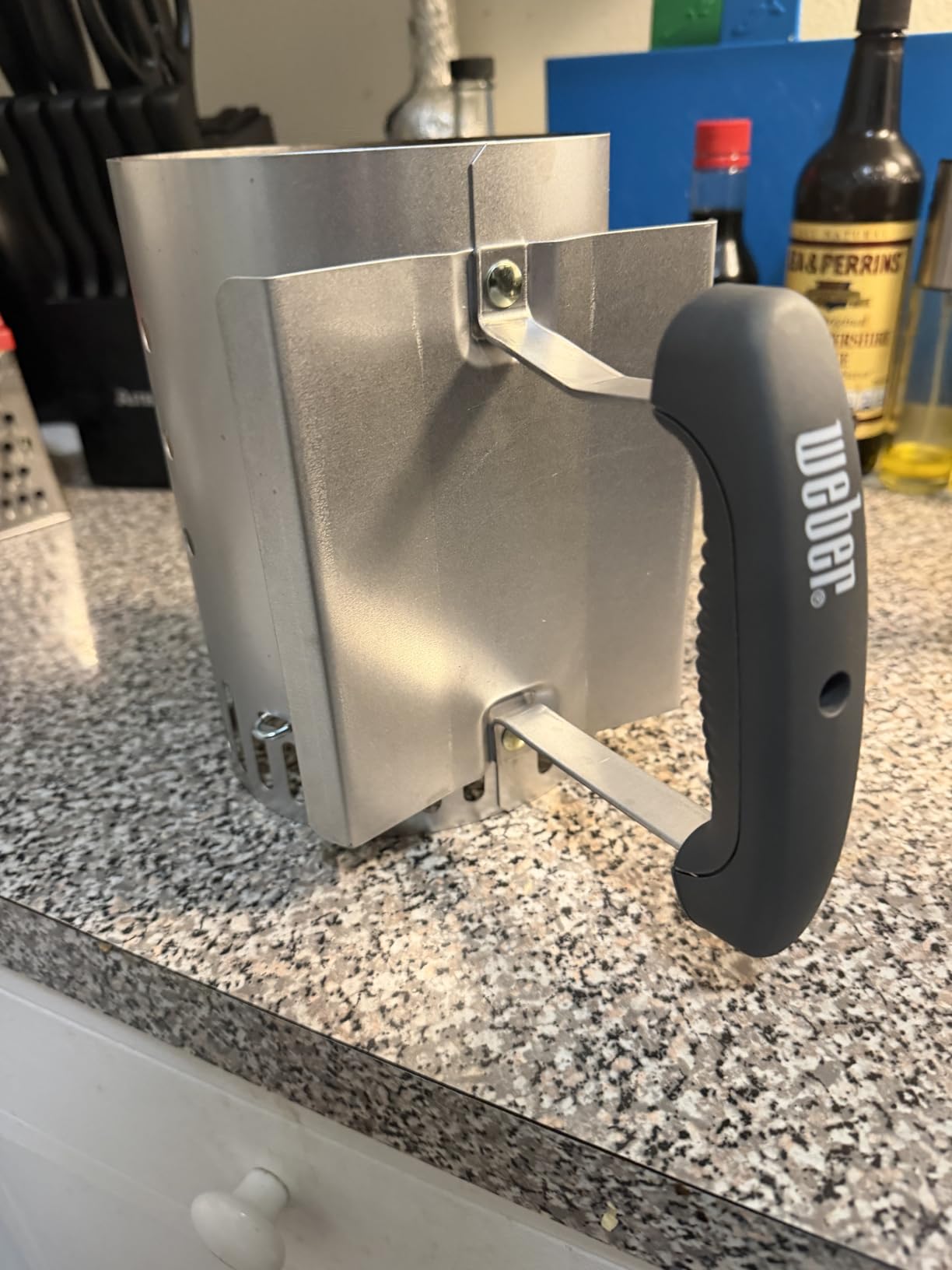
Owners single out the side handle and the fold-out helper grip as the best pouring arrangement we tested. The helper grip changes your grip so you tilt the chimney with two hands instead of levering it against your thigh. That matters when you are pouring into a small kettle and the coals have to land in a specific spot.
Two honest caveats. Surface rust shows up on the interior and bottom grate after a few seasons, particularly if the chimney sits outdoors or takes rain. And the plastic handle still gets hot enough that we wear gloves every time, even though the position of the grip keeps most of that heat off your palm.
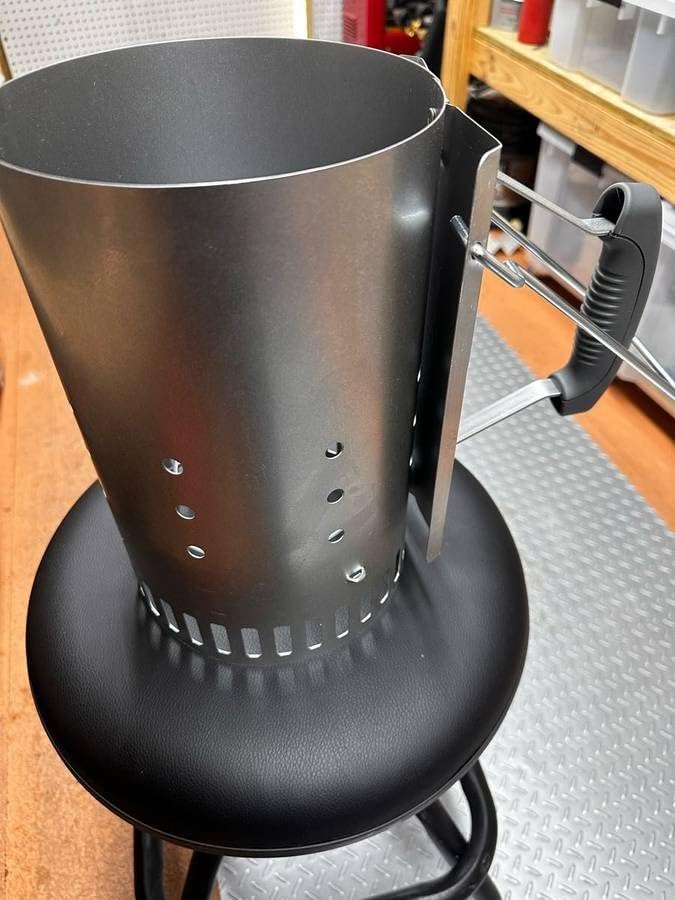
Is the Weber Rapidfire big enough for your grill?
The standard version measures 7.5 inches in diameter by 13 inches high and covers a normal backyard kettle comfortably, roughly 30 to 50 briquettes depending on how tightly you pack them. If you own a 22-inch Weber or a larger offset smoker and cook for a crowd, look at the XL rather than assuming the standard body will do the job in one load.
Owners of the compact version report it is sized for roughly 15 to 33 briquettes. That is the right number for a small kettle or a portable grill, and the wrong number if you are lighting for a full cookout on a big grill. It also dents more easily because the sheet steel is thinner.
Why we still recommend it after testing a dozen alternatives
Nothing in this group combined fast ignition, an even coal bed, and a controlled pour as consistently. Competitors either match its pour and light slower, or light as fast and hand you a spout that dumps coals all at once. It has also proven durable enough that many owners still have one after years of use, with rust rather than structural failure being the typical end point.
If you only buy one starter from this list, buy this one. The 4.8 rating across more than 42k reviews is not a marketing artifact, and that volume of long-term owner feedback is the best evidence available that it holds up outside a showroom.
2. Kingsford Heavy Duty Charcoal Chimney Starter: Best Budget Pick
Kingsford Heavy Duty Charcoal Chimney Starter, Large Capacity
Zinc-coated steel
6.8 by 11.25 by 10.74 in
4.7 from 22k+ reviews
2.18 lb
Pros
- Vented base lights coals evenly
- Heat shield and stay-cool handle
- Large capacity in one load
- Zinc coating resists rust
- Arrives assembled
Cons
- Coating wears and shows rust over years
- Grate dents if dropped
- Handle is adequate rather than insulated
The Kingsford is the answer for anyone who wants the Weber experience without paying for the brand name. It rated 4.7 across more than 22k reviews and sits at the top of the Charcoal Starters category, which tells you how mainstream it has become.
The vented base with circular air vents gives steady upward airflow, and in our runs the briquettes lit evenly with no dead spots in the middle of the column. Arrives assembled, which sounds minor until you are standing in a garage with wet newspaper and a lighter.
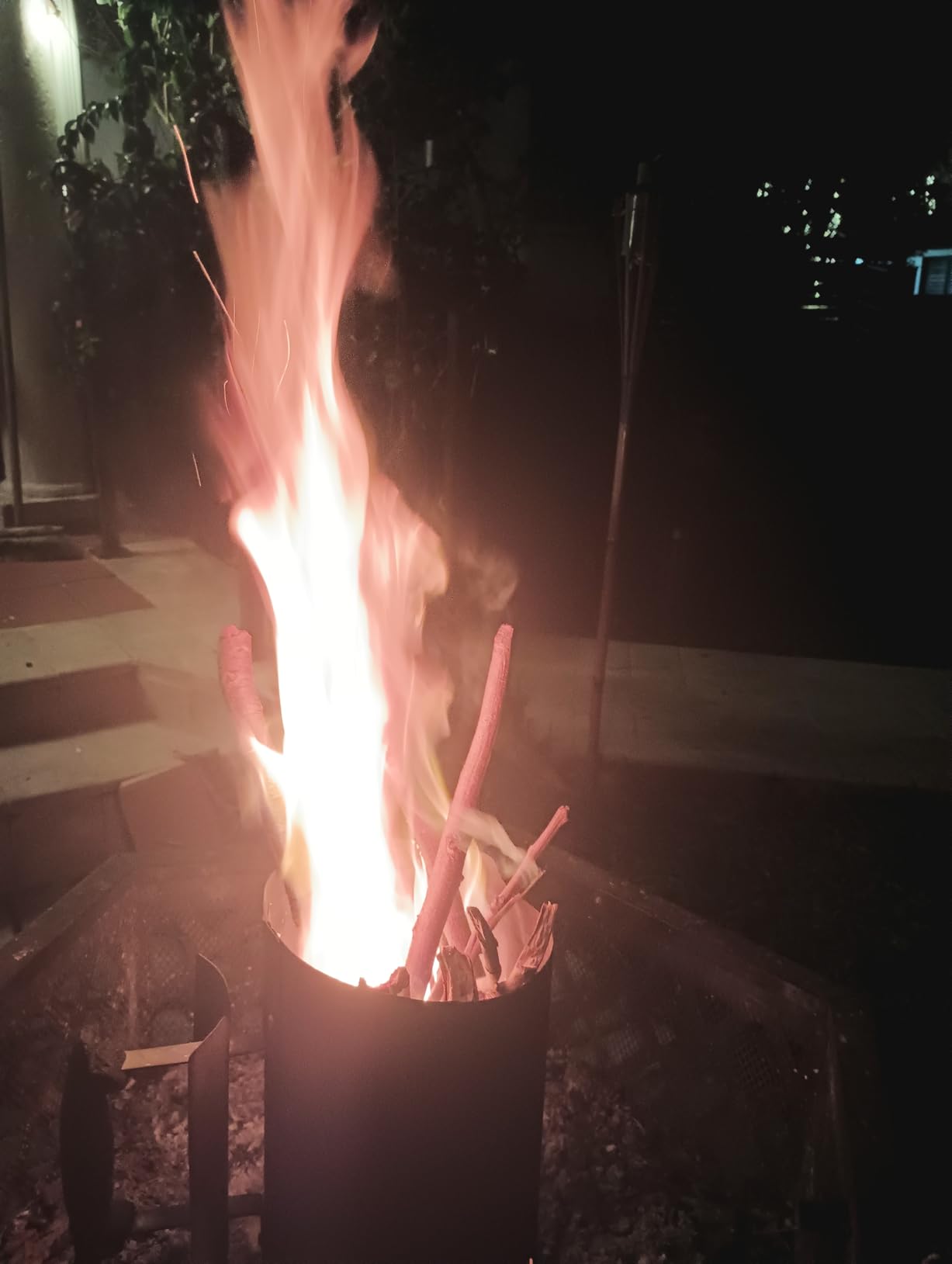
The heat shield and stay-cool handle are the reason we rank it so high for the money. The shield sits between your hand and the body of the chimney, which is where radiant heat comes from. During a pour the grip warms up but stays manageable with bare hands for short trips, which is more than several competitors manage.
The durability limit is the zinc coating. It handles repeated high heat cycles well but eventually wears, and long-term outdoor storage tends to bring surface rust along the lower body. The grate also dents if it lands on gravel or concrete. Neither ruins the starter. Both mean it is a three-season-backyard tool rather than a permanent outdoor fixture.
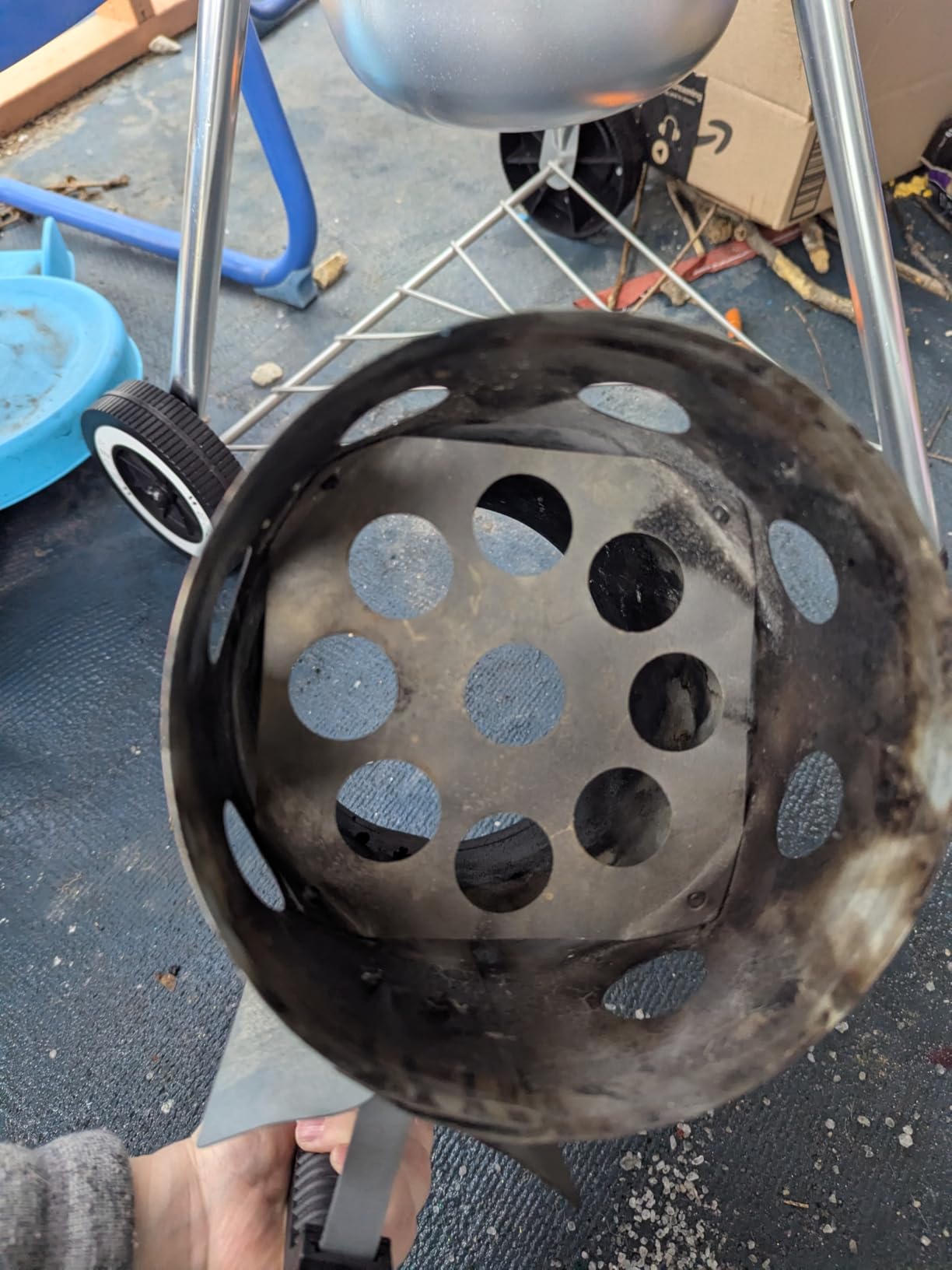
Which is better for a first chimney, the Kingsford or the Weber?
Weber, and here is why. The cone-shaped grate is a real performance difference in how evenly the coals ignite, and the helper grip gives a steadier pour. If you already own a Weber or a similarly sized kettle and grill a few times a month, the Weber will outlast the Kingsford and light more evenly.
The Kingsford wins on the day you buy it. It costs less, it holds a generous load, it needs no assembly, and it is the easiest model here to walk into a store and buy on a Tuesday. For a beginner, a lighter fluid free first cook matters more than a marginally more even coal bed.
What size grill does the Kingsford suit?
The listed dimensions are 6.8 by 11.25 by 10.74 inches, which puts it in the standard full-size category rather than the compact or XL end. Owners report it comfortably handling a family cookout load in one trip, and it pours well into both kettle grills and the charcoal side of a smoker.
If your grill is a small tabletop portable unit, a full-size Kingsford will still work, but you will be lighting a large load and only pouring half of it. For that use case a compact stainless model is the better fit.
3. homenote Charcoal Chimney Starter Kit with Blower and Fire Cubes: Best All-in-One Kit
homenote Charcoal Chimney Starter Kit with Blower and Fire Cubes(11.5×7)
Zinc-plated steel
11.5 by 7 by 7 in
Kit with blower and cubes
4.5 from 3k+ reviews
Pros
- Bundle includes chimney
- blower
- cubes and mitts
- Cubes burn longer than newspaper
- Battery blower speeds ignition
- Chimney holds up well
- Six other appliance uses
Cons
- Included gloves are thin
- Blower plastic cover melted for some owners
- Wooden handle can detach when hot
- Blower housing feels cheap
Most of the complaints on this kit have nothing to do with the chimney. They are about the accessories, and that tells you the core product works. The chimney itself is a straightforward zinc-plated steel body with a wooden handle and a heat shield, measuring 11.5 by 7 by 7 inches.
The wood shaving fire cubes are the reason to buy it. Each one burns approximately 8 to 10 minutes, which is far longer than a sheet of newspaper, and they are made from wood shavings rather than paraffin so they are odorless and tasteless. Nothing carries through to the food.
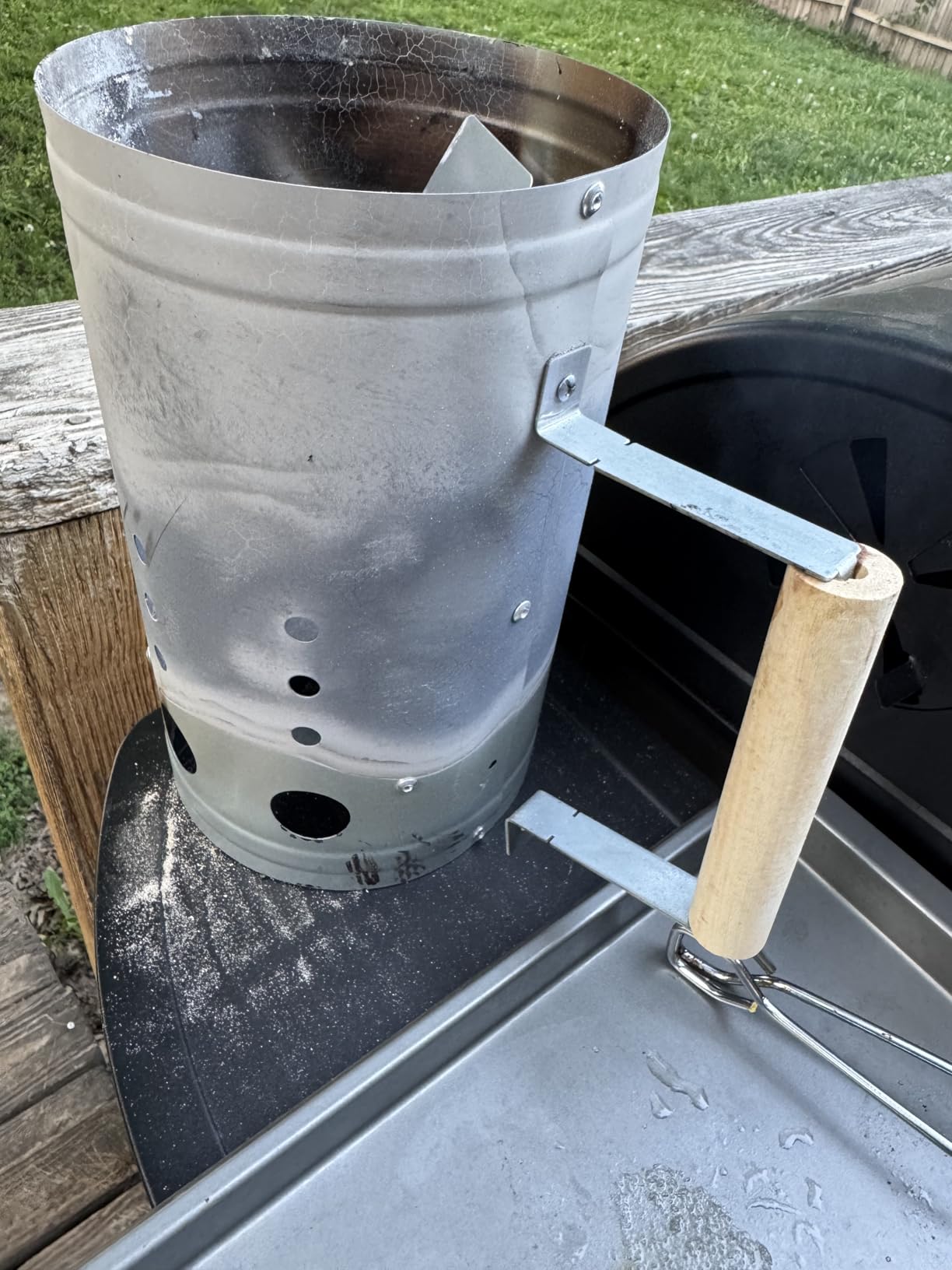
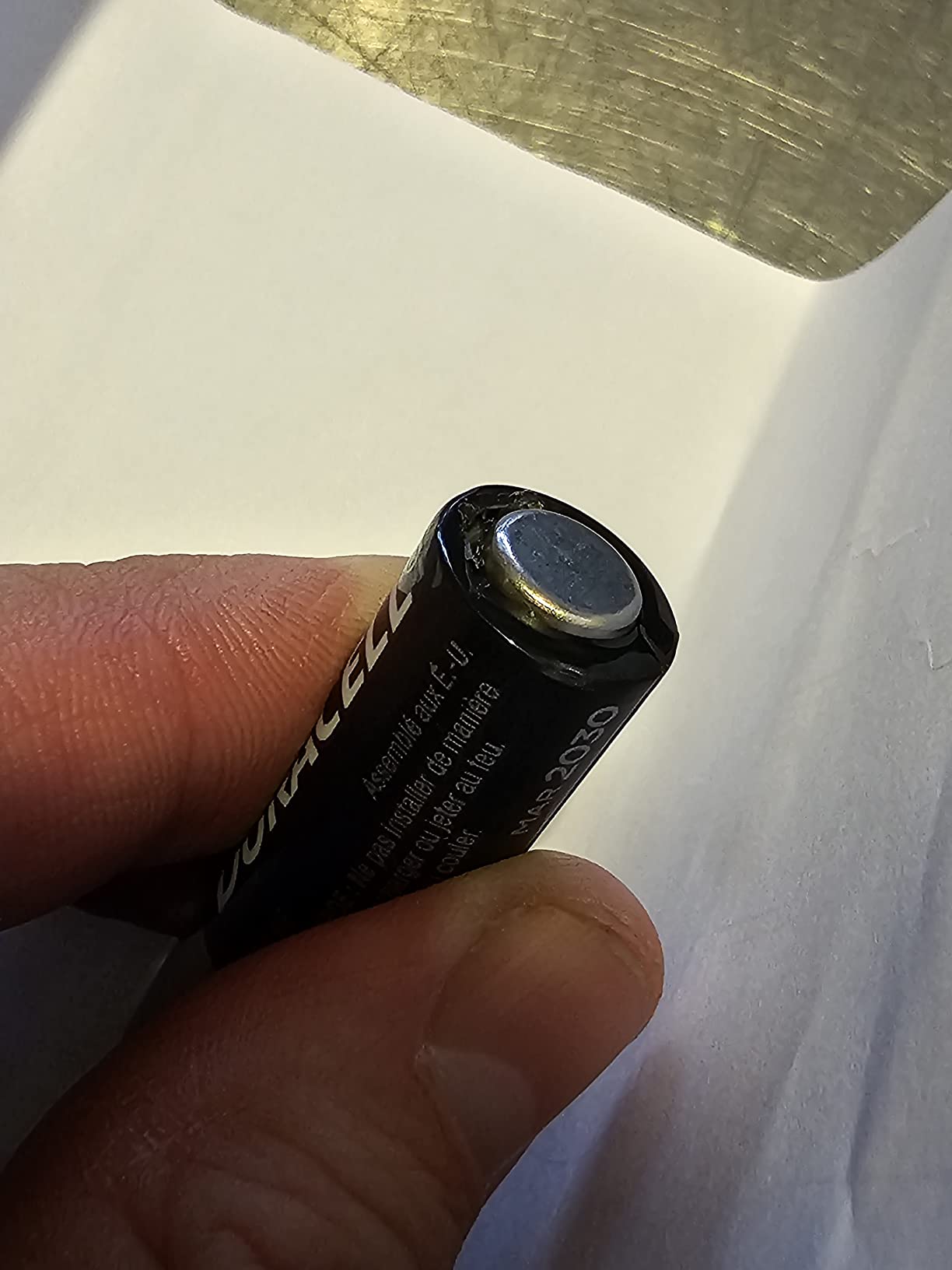
The battery blower feeds air through the coal bed and cuts the wait noticeably on breezy evenings or when you are lighting damp charcoal. It runs on a battery pack, and you have to install it with the polarity correct or it will short. Read the plastic on the compartment before you slot it in.
The failures owners report are real and specific. The included heat resistant mitts are thin enough to be almost useless, and several people saw the blower thin red plastic cover melt and fall away, exposing the electronics. The wooden handle has also detached on some hot lifts. Most owners say replace the gloves and keep everything else.
Is buying a bundled starter kit better than buying a chimney alone?
It depends on what you already own. If you have no fire starters, no blower, and no gloves, this kit gets you everything in one box and the cubes alone solve most relighting problems. If you already keep wax cubes and a decent pair of grilling gloves, you are paying for two accessories you will discard within a season.
The chimney is also one of the more versatile ones here. Owners use it on grills, fireplaces, fire pits, wood stoves, pizza ovens and chimineas, so it earns its space in a garage even when it is not grilling season.
How does a battery blower actually change lighting time?
Convection alone lights a full chimney in 15 to 30 minutes depending on load and weather. A blower forces air into the coal chamber and you get grey ash on top considerably sooner, often inside 10 minutes. The gap widens in wind or damp conditions, which is exactly when you least want to be standing outside waiting.
A hairdryer or a leaf blower does the same job if you already own one. That is why we would not buy a blower purely for this, but the cubes on their own are worth having.
4. E500 Large Charcoal Chimney Starter with 60 Wood Starters: Most Versatile
E500 Large Charcoal Chimney Starter with 60Pcs Charcoal Starter for Grill
Thick galvanized steel
7.5 in diameter by 12 in
4.7 from 1.5k+ reviews
5.81 lb
Pros
- Ignites in about 10-15 minutes with included starters
- Thick steel resists warping and rust
- Wide non-slip base stays stable
- Insulated handle stays comfortable
- 60 pine wood starters included
Cons
- Heaviest of the group at 5.81 lb
- Vent openings can collect ash
- Included starters are thin for a full load
The E500 is the thickest steel in this group and it shows. Where the budget starters flex and dent on a drop, this one sits there. It measures 7.5 inches in diameter by 12 inches high and weighs 5.81 pounds, which is both the reason it feels solid and the reason it never leaves the garage.
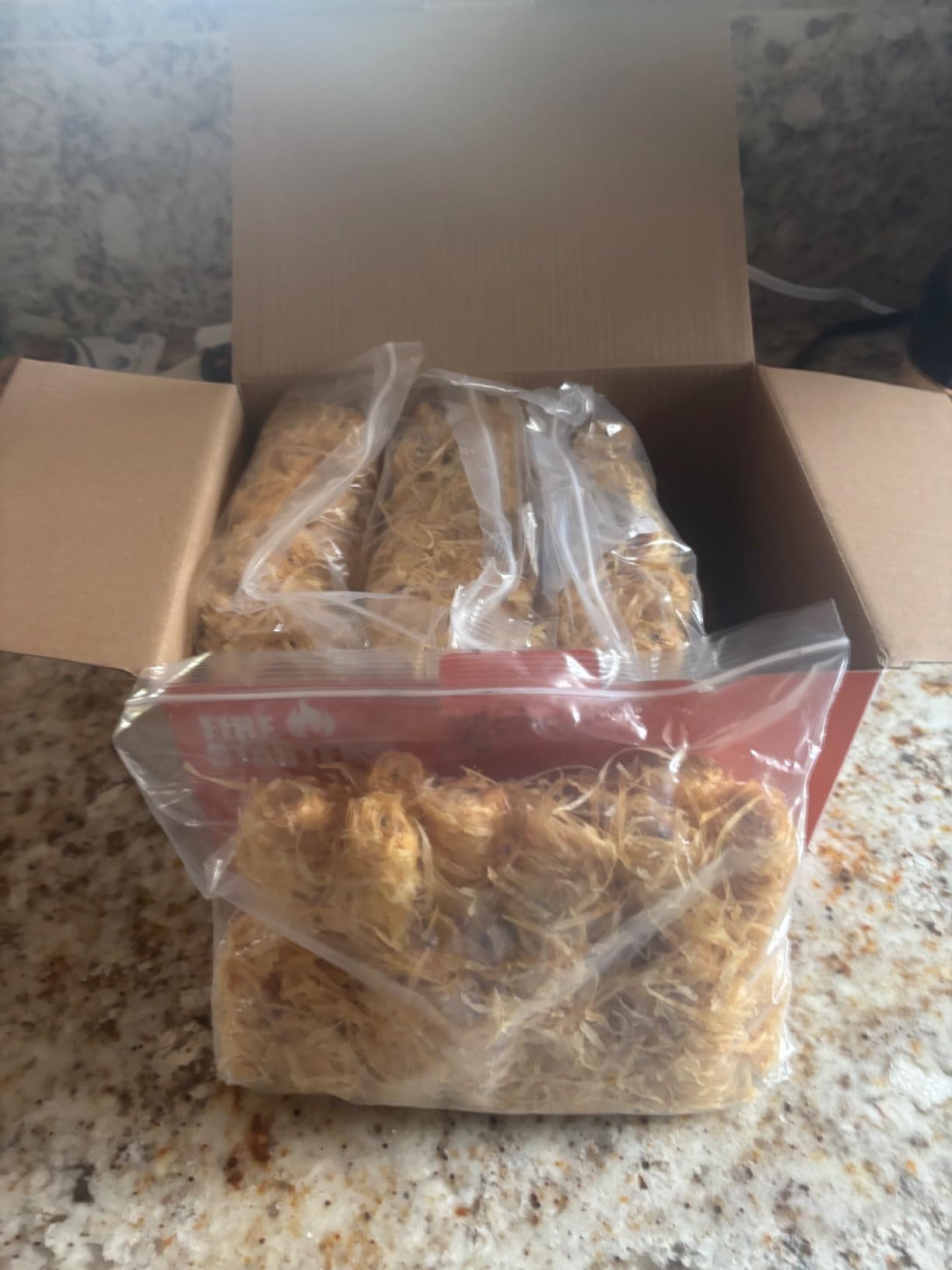
Owners consistently report 10 to 15 minute ignition using the included natural pine wood starters. Sixty of them in the box is a lot, and they cover many sessions without a trip to the store. Ventilated side and bottom openings keep airflow moving through the column.

The wide non-slip base is the detail we appreciate most. Every hot chimney is a tipping risk when you set it down on uneven ground, and a broad base with a grippy footprint removes a real burn hazard that narrow or tall designs carry. The insulated ergonomic handle stays comfortable to hold even mid-pour.
The trade-offs are weight and the vents. At 5.81 pounds this is the heaviest starter we tested, which rules it out for camping and makes it a two-hand carry for anyone with a back issue. Over time the vent openings can restrict airflow or collect ash, so a quick clean between cooks matters.
Is a thicker steel chimney worth paying for?
Yes, if your chimney lives outdoors or you drop things. Galvanized sheet on budget models is thin enough to warp with repeated high-heat cycles, and once a chimney warps the grate no longer sits flat, which hurts airflow and coal evenness. Thicker steel keeps its geometry over years.
No, if you store it in a garage and treat it carefully. Then the main benefit is the wide base and the bag of starters, both of which you can get on a lighter model. Judge it on stability and included fuel, not weight alone.
Will 60 fire starters actually last?
They are enough for many grilling sessions, but owners note they are thin and light. Expect two or three per full load rather than one. Plan on adding a wax cube or two for stubborn lump charcoal, since wood shavings burn steadily and quickly where dense hardwood needs more heat up front.
Hold the chimney on the base, not by the handle, while it is lighting. The handle is where the heat is.
5. BBQ Dragon Chimney of Insanity XL: Best for Large Grills and Smokers
BBQ Dragon Chimney of Insanity XL Charcoal Starter — Field & Stream Best Overall Charcoal Chimney — Largest Charcoal Chimney Available — Ready-to-Cook Coals in About 3 Minutes with BBQ Dragon Fan
Steel construction
XL largest capacity in class
4.5 from 1.3k+ reviews
4.7 lb
Pros
- Elbow plus a fan yields ready coals in about 3 minutes
- Largest capacity available
- Works with a hair dryer or leaf blower
- Reinforced handle and heat shield
- Handles lump and charcoal logs
Cons
- Fast results need a fan that is not included
- Bulky at 4.7 lb
- Oversize for small kettles
Everything about this model is scaled up. It is the XL, the largest charcoal chimney available, at 4.7 pounds, built for big grills, offset smokers and long cooks rather than a Tuesday dinner on a small kettle.
The patented 90 degree airflow elbow is the interesting part. Instead of vents facing straight out, the elbow redirects airflow into the charcoal chamber itself. Paired with a fan, the manufacturer claims ready-to-cook coals in about 3 minutes. That is a real speed difference, not marketing, when the fan is actually blowing.
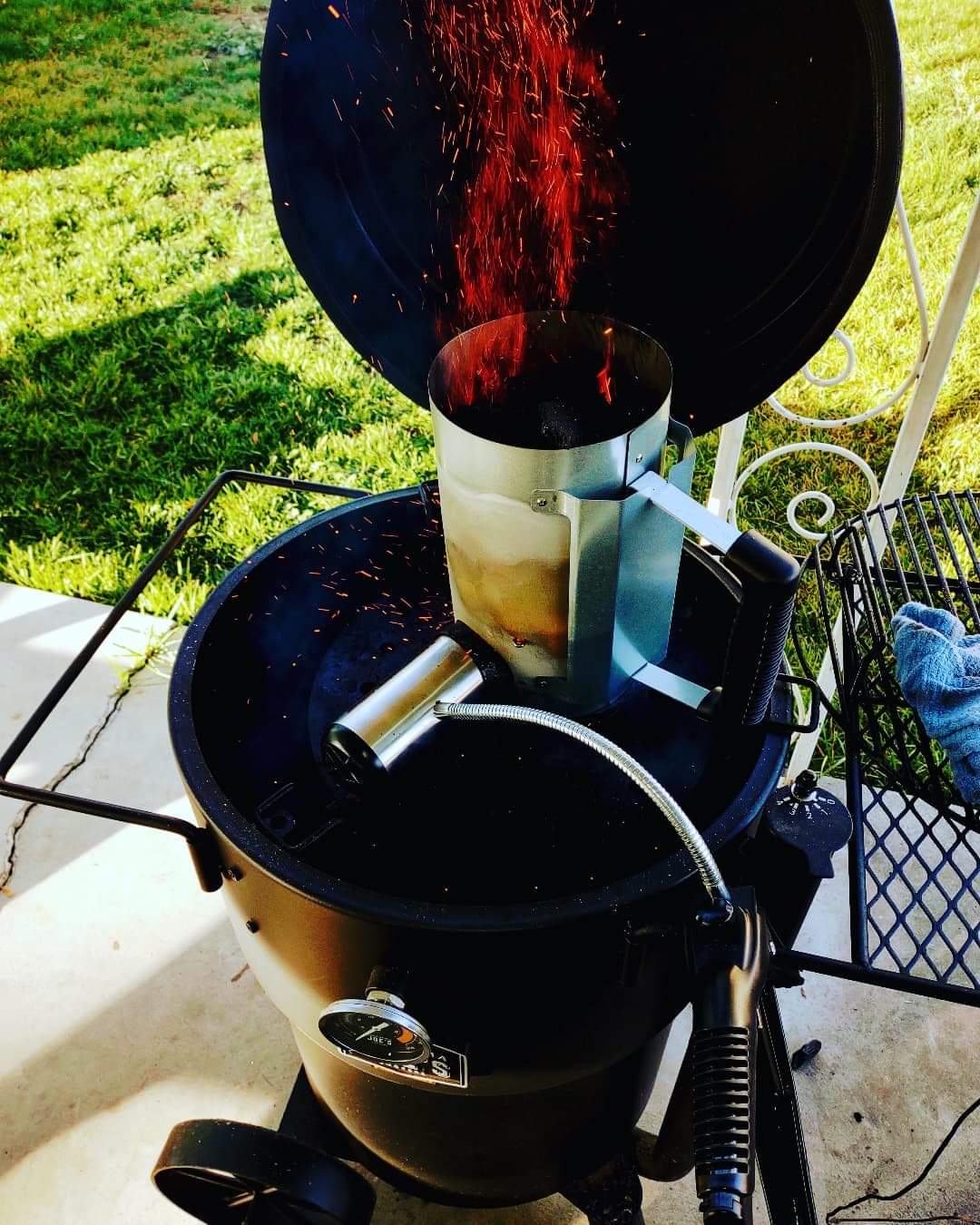
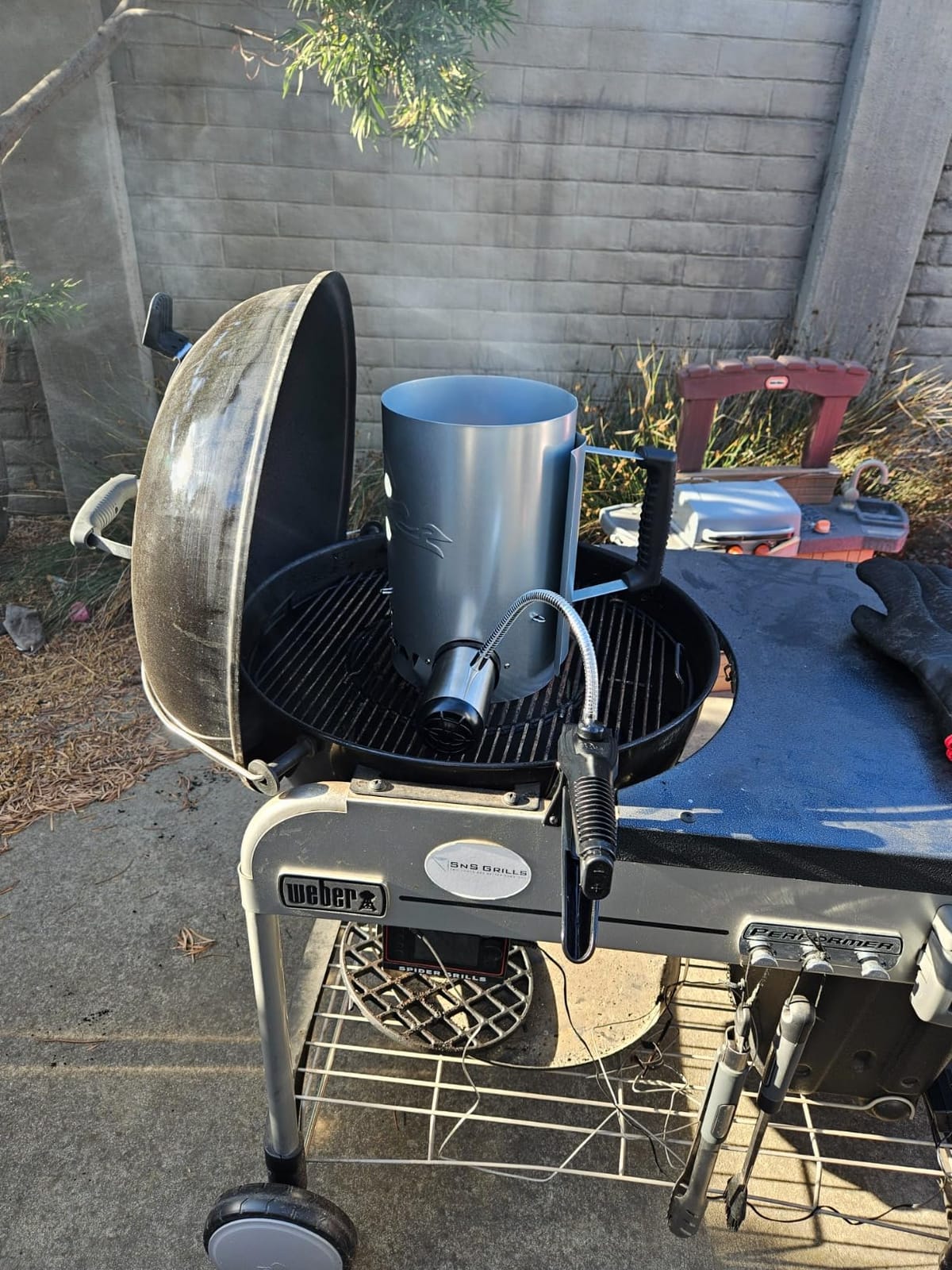
The catch is that no fan is included. It works with a BBQ Dragon fan, a hairdryer, a leaf blower, a shop fan, or your lungs on a calm day. Buyers who already own any of those report a dramatic cut in startup time. Buyers who do not own a fan are using a very large chimney at ordinary speed.
It also handles lump charcoal and charcoal logs well, which makes it the pick here for high heat searing over hardwood. Heavy duty steel with a reinforced handle, a heat shield and laser-cut detailing feels appropriately substantial.
Do you need a fan to make a chimney starter worthwhile?
No. Every chimney in this guide works without forced air. A fan simply compresses a 15 to 20 minute wait into a fraction of that. It is most valuable in wind, in cold weather, and when you are cooking on a schedule rather than for fun.
Before buying a dedicated blower, try a hairdryer on the cool setting or a leaf blower through the top. If you already own one of those, the speed advantage is available to you for the price of a blower’s battery.
Will the Chimney of Insanity XL fit your grill?
It will not fit a 14-inch Smokey Joe or any small tabletop grill. The capacity is the feature, and it comes with a footprint that assumes a full-size kettle or a smoker. Measure your grill before ordering, and check the grate diameter against your cooking grate if you pour through the opening.
For a large offset smoker or a 22-inch kettle cooking for a dozen people, the oversized body is exactly right and lighter options will take two loads.
6. Camping Moon MT-18 Stainless Steel Chimney Starter: Best for Camping
Portable Charcoal Chimney Starter Stainless Steel MT-18
430 stainless steel
Folds flat to 1.2 in thick
4.6 from 232 reviews
3.3 lb
Pros
- Folds flat and cuts trunk space
- Thick stainless body with stout grate
- Zippered carry bag included
- Handles stay cool once coals ash over
Cons
- Rivets and hinges are not stainless and rust
- Hinge pins can work loose
- Sharp edges on some
- Handle spacing is wide
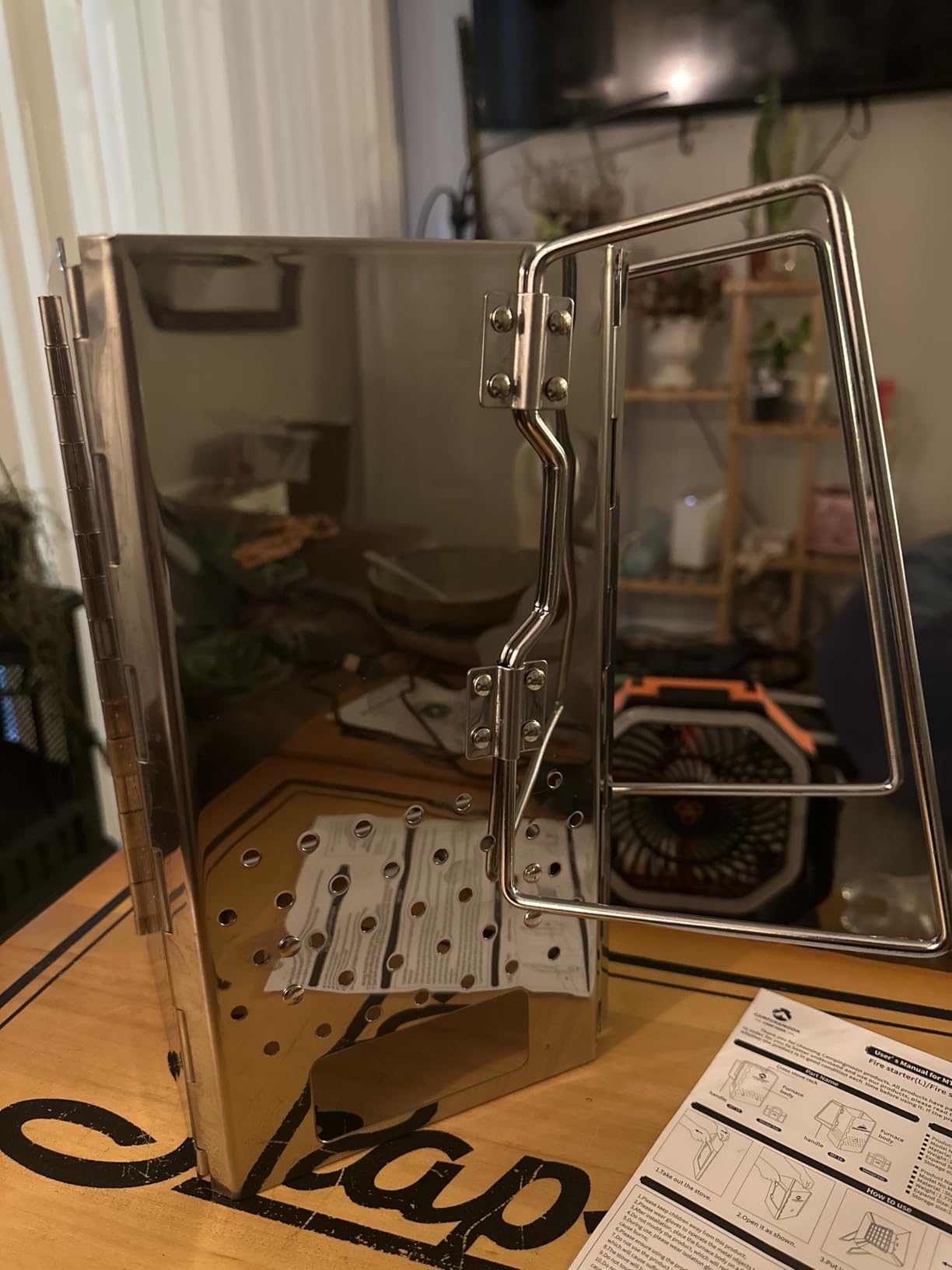
This is the only collapsible design in our group and it changes what you can take camping. In use it measures 6.5 by 6.5 by 11.4 inches. Packed, it is 7.1 by 1.2 by 11.8 inches and slides into the attached zippered bag. A rigid cylinder of the same capacity takes up a slice of the boot you may need for firewood.
The body is 430 stainless steel, and owners describe the grate as stout, comparable in thickness to a Weber. A single sided internal grate speeds assembly so you are not fiddling with parts on a cold morning.
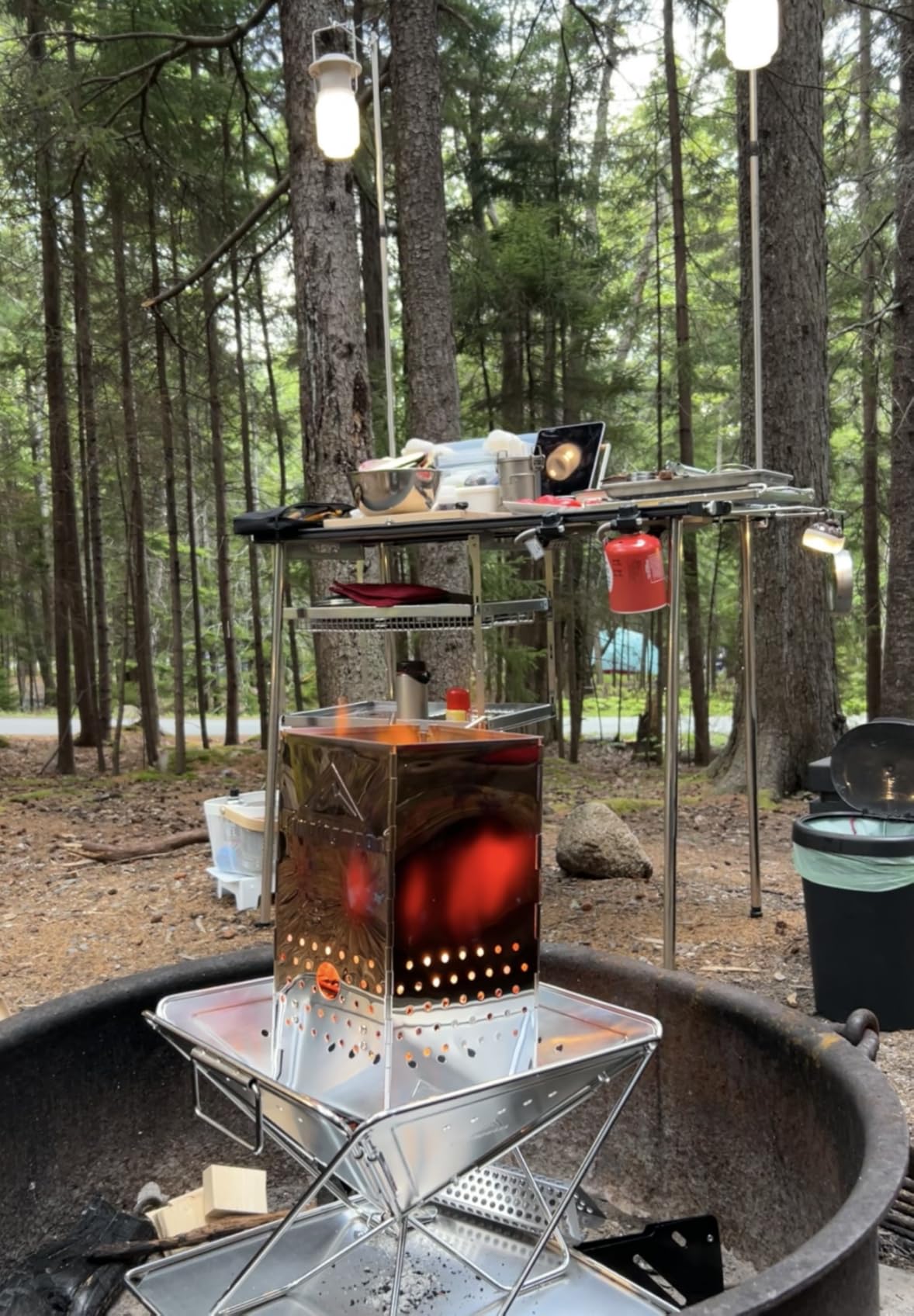
Handles stay cool enough to grip once the coals are ashed over, which is the standard you want on a camping fire. The hinge system is the weak point. Hinge pins can work loose and drop out with repeated folding, and the rivets and hinges are not stainless even though the body is, so they rust first.
Some owners report sharp edges on arrival or a grate that is hard to seat in the retaining clips. Both are finish issues rather than defects, but check them before the first cook.
Do collapsible chimneys stay stable with hot coals?
They can, and the concern is fair. Heat weakens thin folded sheet and the hinge line is the least rigid part of the design. Set the chimney on its wide base on flat, non-combustible ground and never on a folding table. Ours stood fine on a patio slab through several cooks.
If stability under a full load of coals is your top priority, a rigid stainless or galvanized cylinder is the safer choice. The fold-flat design is worth it when trunk space is the constraint, not when you are pouring.
Is stainless steel worth the weight for camping?
At 3.3 pounds, this is heavier than a compact steel model but far lighter than the 5.81 pound E500. What you get in exchange is a body that will not rust in the damp and an absence of paint or zinc coating that can flake near food.
For a car camping or overlanding setup where the chimney lives in the vehicle between trips, the fold-flat profile and stainless body make this the pick. For a cook who leaves a chimney set up on a patio year-round, rigidity wins.
7. CADARA Charcoal Chimney Starter Set with Blower and Glove: Best Value
CADARA Charcoal Chimney Starter Set Charcoal Chimney Lighter Can A 1472℉ Heat Resistant Grill Glove Portable BBQ Fan Air Blower Outdoor Cooking Charcoal Barbecue Holder Accessories
Starter set with blower and glove
Ready in 8-15 minutes
4.5 from 175 reviews
2.7 lb
Pros
- Three pieces in one set
- Lights coals in roughly 8-15 minutes
- No chemical aftertaste or solvent smell
- Layered silicone and aramid glove
- Backed by a 30-day warranty
Cons
- Simplest construction of the set options
- Thin sheet metal flexes when pouring
- Blower and glove are basic
The CADARA set is aimed squarely at a first-time griller who wants everything in one box. You get a charcoal chimney starter, a portable grill air blower, and a heat resistant glove rated to 1472 degrees, and the whole thing does what it promises.
Owners report coals ready to pour in roughly 8 to 15 minutes using crumpled newspaper or light cubes. The listing notes cubes also work in the rain, which matters more often than people expect when a front rolls through mid-cook.
The glove is the accessory worth keeping. It is three layers, food-grade silicone, deyan aramid fiber and polyester cotton, which is a real heat barrier rather than a thin cotton glove. The blower works but it is basic hardware.
What you give up is rigidity. The thin sheet metal body flexes when you tilt it, so hot coals shift inside the chimney during a pour. That makes a slightly less controlled dump than the Weber or the Kingsford. It is the simplest construction of the starter options here, and the honest reason to pick it is cost rather than performance.
Is a budget chimney starter worth buying at all?
Yes, if it gets you off lighter fluid and you cook a few times a month. A thin steel chimney lights charcoal perfectly well. What you will not get is the heft that resists denting, the wide base that resists tipping, and the pour control that comes with a heavier body.
The real question is whether you will still own it in three years. Cheap models sometimes fall apart at the seams or lose their handle fixings within months. If you store it indoors and treat it carefully, a lighter starter is a reasonable first purchase.
Do you need the bundled blower and glove?
The glove, more so. Heat protection at the handle is the single most useful accessory for a chimney starter, and this one is properly constructed rather than token. The blower duplicates any hairdryer or leaf blower you already own.
The 30-day warranty is shorter than most, which is worth factoring in if you are unsure about the build quality. Keep the receipt.
8. Joyagrill Double Enamel Charcoal Chimney Starter: Best Enamel Finish
Joyagrill 6.5″X14.5″ Double enameled Charcoal Chimney Starter with Stainless Steel Heat Shield & Wood Handle Easy Cleaning Charcoal Starter for Grill and Firepit
Alloy steel with wood
6.5 by 14.5 in
4.3 from 170 reviews
2.2 lb
Pros
- Double enamel resists corrosion and warping
- Enamel wipes clean easily
- Wood handle and steel shield stay cooler
- Shovel outlet gives a controlled dump
- Bundles available with gloves and fan
Cons
- Lowest rating here at 4.3 with a 7 percent one-star share
- Enamel chips if quenched or dropped
- Tall narrow body holds less fuel
- Wood handle loosens with heat
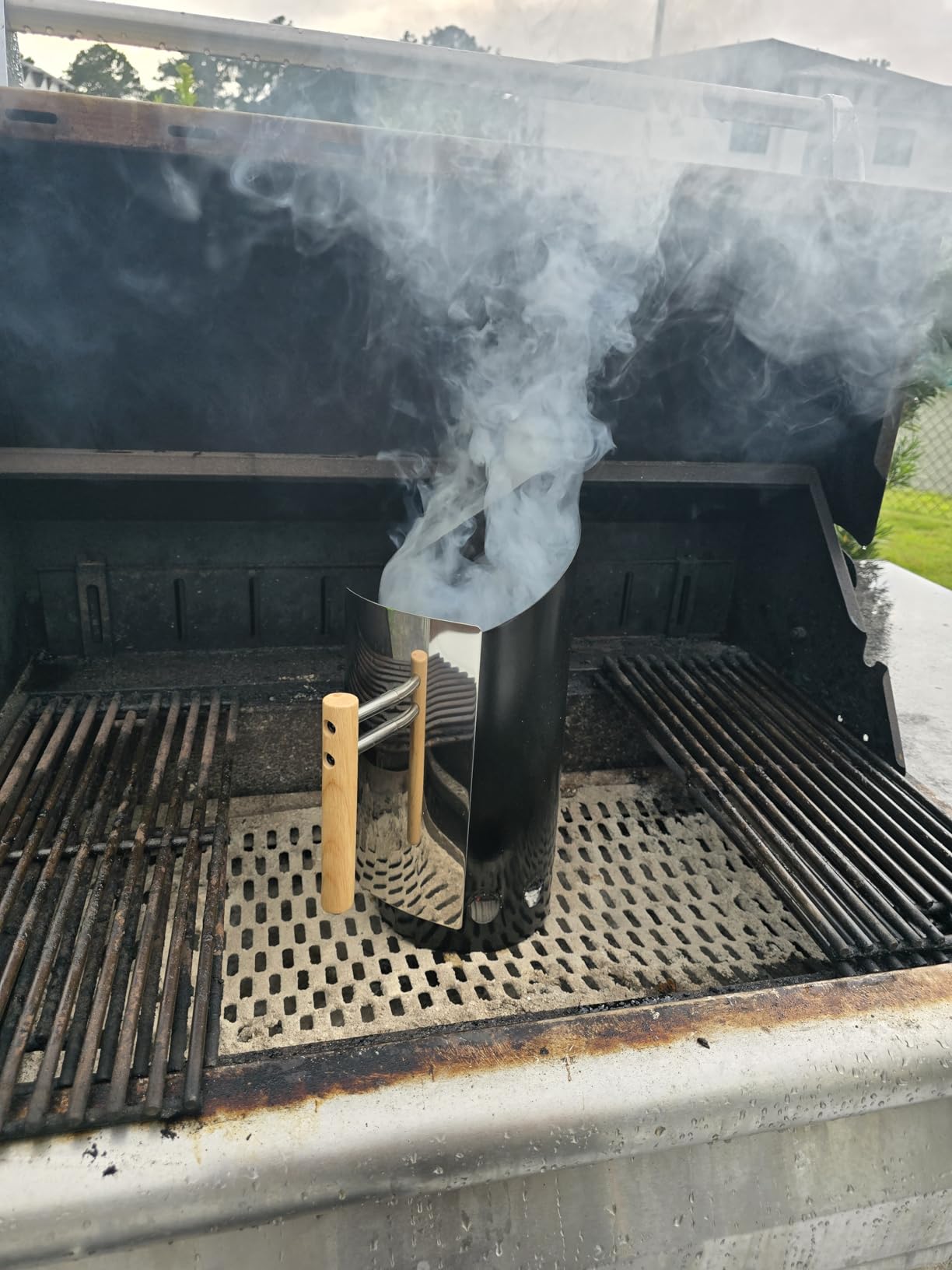
This is the only double enamel chimney in the group, and that finish is the entire argument. Enamel resists corrosion, deformation and thermal shock better than bare or zinc-flashed steel, and you can wipe the surface clean with a damp cloth after a cook instead of scrubbing ash off bare metal.
The heat protection is a two-part system. A stainless steel heat shield sits higher than the inverted outlet to reduce carbon dust splashing onto your hand, and the wood handle sits on top of that. The combination stays cooler than an all-metal handle.
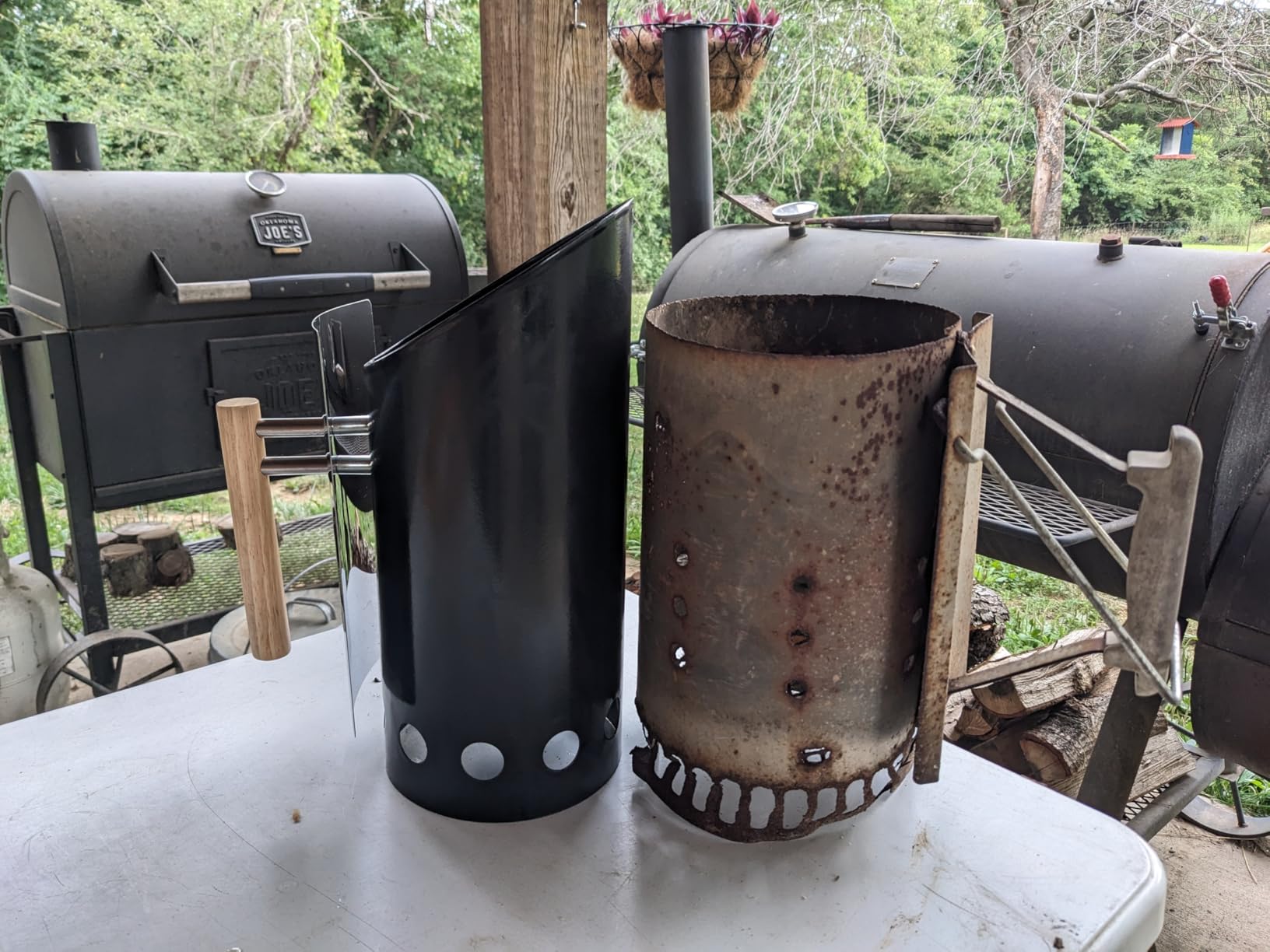
The shovel design outlet gives a more controlled, precise dump than a plain vent hole. Coals leave in a narrower stream, which makes it easier to build a two level fire or a mound under one side of the grate instead of scattering.
Two real limits. The body is 6.5 by 14.5 inches, a tall narrow proportion that holds less fuel than a wide standard chimney, so it takes more loads for the same cook. And enamel is tough but not indestructible, chipping if the chimney is dropped or quenched with water. Cool it naturally.
Is enamel coating better than galvanized steel?
For corrosion and cleaning, yes. Enamel does not rust and wipes clean, which is a real advantage if you store the chimney in a humid garage or want to rinse out ash. Galvanized steel is cheaper and tolerates a knock better because it flexes rather than chipping.
The one thing you cannot do with enamel is thermal shock. The manufacturer is explicit that the chimney should cool naturally and never be quenched with water, because the sudden temperature change cracks the coating. Handle it gently and it will outlast bare steel.
Does a 4.3 rating mean you should skip it?
It is the lowest average rating here, and the one-star share is 7 percent, which is wider than most in this group. Reading the reviews, the negative ones cluster around enamel damage and the narrow capacity rather than a failure to light charcoal. The chimney does its job when treated reasonably.
Pick it if you want the coolest handle and the easiest clean. Skip it if you fill large loads for a big grill, because the tall body means more trips to the grill than a wide standard model.
9. SUNLIFER Stainless Steel Charcoal Chimney Starter: Best for Fast Lighting
SUNLIFER Charcoal Chimney Starter, BBQ Grill Quick Rapid Fire
Stainless steel
10.62 by 6.41 by 6.25 in
4.6 from 86 reviews
2.46 lb
Pros
- Stainless body resists rust
- Base and side vents speed ignition
- Light enough to carry to a portable grill
- Heat shield and extended handle
- 24 natural fire starters included
Cons
- Some arrive missing the handle screw
- Small capacity suits portable grills
- Handle fixing is the weak point
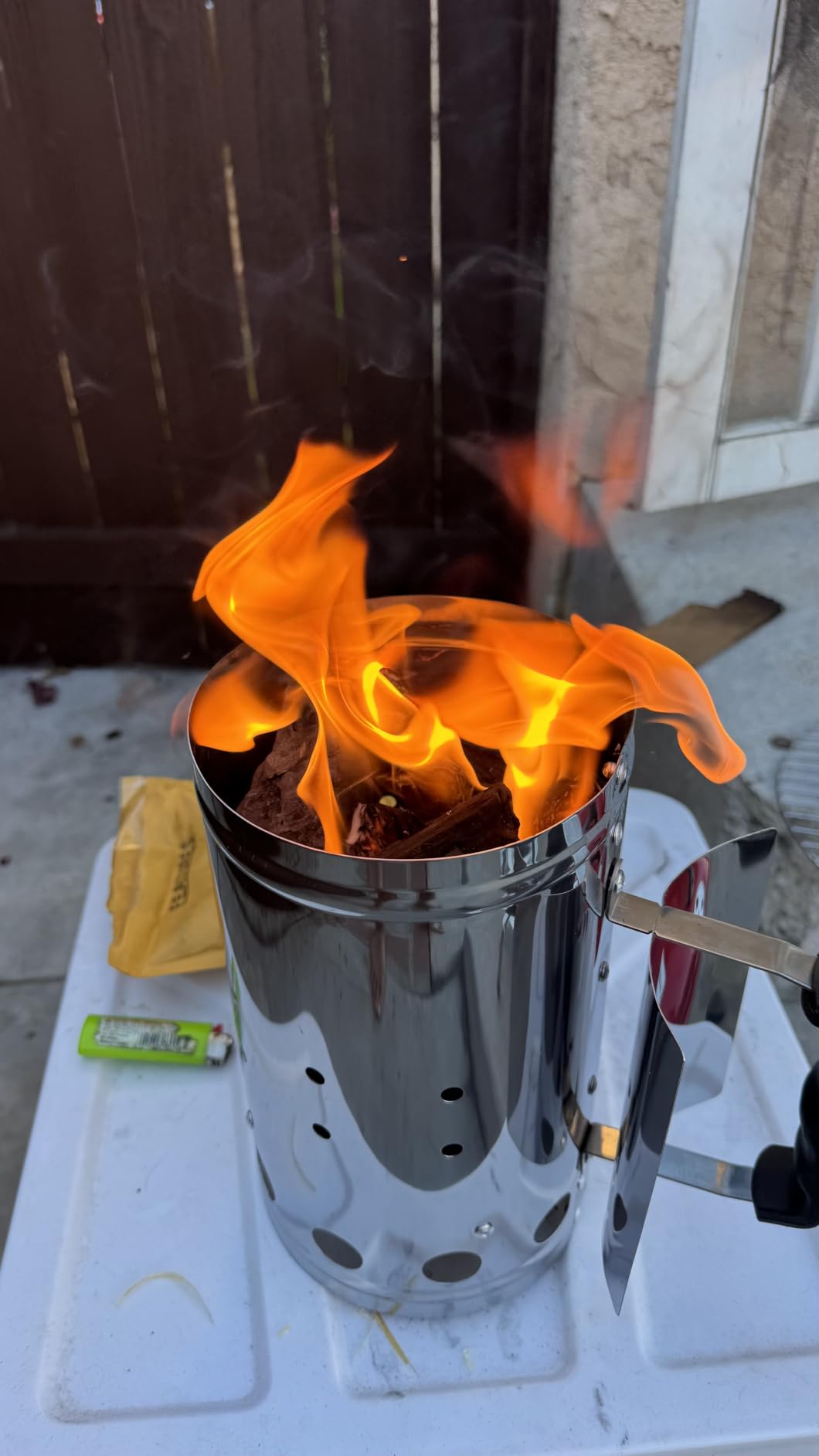
The SUNLIFER is a compact stainless steel starter with a lot of ventilation holes, and the holes are the point. Ports encircle the base and the sides rather than sitting only at the bottom, so air enters from several directions and moves up through the column faster.
The listed claim is even ignition in under 10 minutes, and owners generally support that, particularly with a light load. Twenty-four natural fire starters come in the box, so you are not reaching for newspaper on a windy evening.
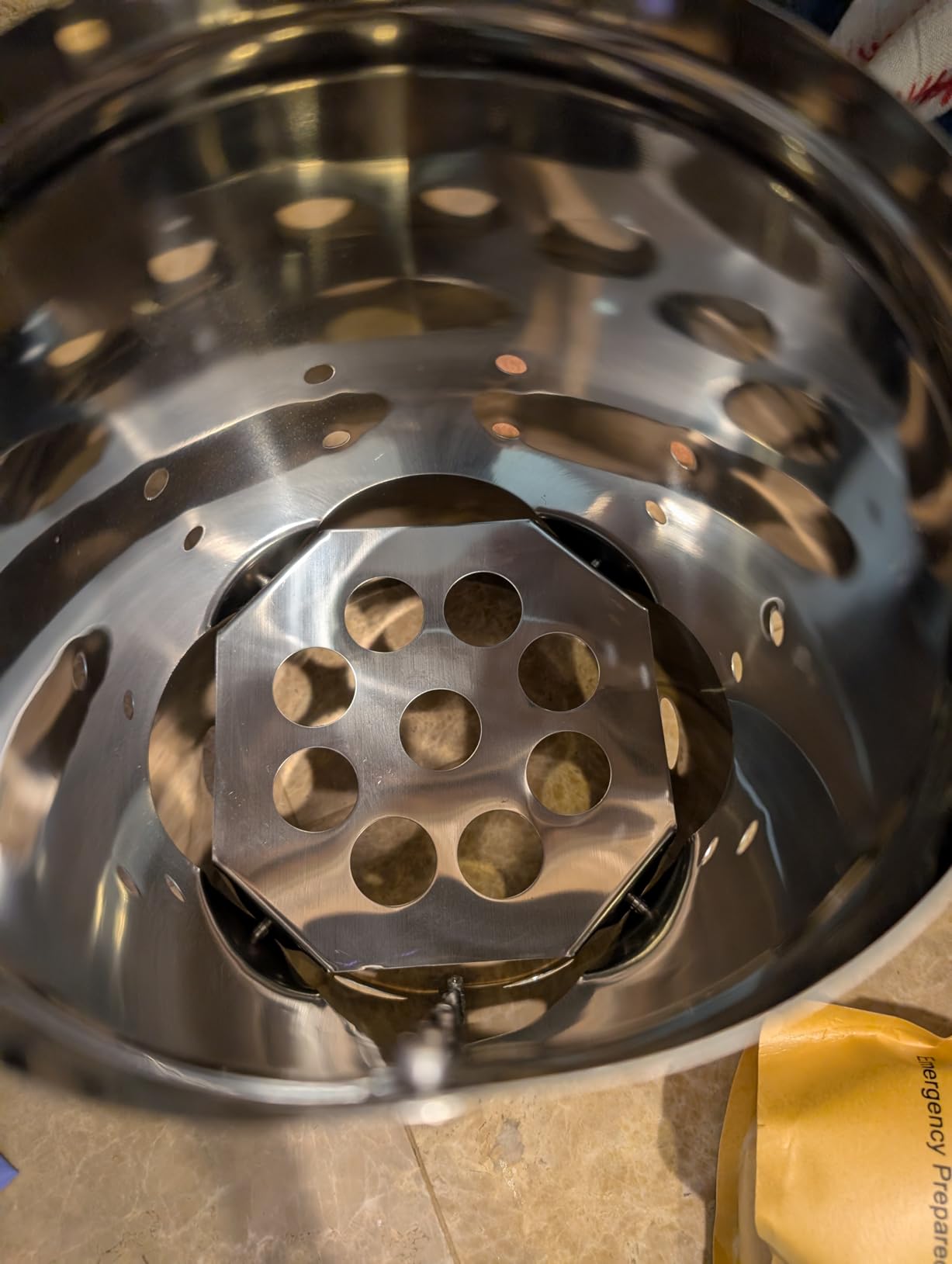
The handle is the standout feature: a 5.31 inch extended grip with a 6.3 by 4.72 inch heat shield. The shield is large relative to the body, which is what keeps radiant heat off your knuckles during a pour. At 2.46 pounds it is light enough to carry to a portable grill at the park.
One specific complaint is worth knowing before you order. Some examples arrive missing the screw that secures the handle at the base, which makes pouring awkward and unstable. Check the hardware on arrival and have a replacement screw ready. The handle attachment point is the weak spot under repeated pouring generally.
Is this chimney big enough for a full size kettle?
The frame measures 10.62 by 6.41 by 6.25 inches, which places it firmly in the compact category. It suits a tabletop grill, a small kettle and a portable setup. For a full size kettle or a smoker you will make two loads rather than one, and two loads means two lighting waits.
If you want a compact starter but need more capacity, the Weber Rapidfire compact version is the comparison point. It holds roughly 15 to 33 briquettes and has a longer review history.
Does a stainless body stop chimneys rusting?
It largely does, provided nothing else is coated. Stainless steel has no zinc layer and no paint, so there is nothing to flake off onto food and nothing that corrodes into orange streaks on the interior. That is the argument for stainless over galvanized in a humid climate or anywhere you store the chimney outside.
Stainless does not fix every durability question. The handle fixing on this model is still the part most likely to give you trouble, because it is a screw holding steel to steel at the hottest point on the tool.
10. Amazon Basics Charcoal Chimney Starter: Best for Full Loads
Amazon Basics Charcoal Chimney Starter for Grills and Barbecues, Galvanized Steel, 6.6 Pound Capacity, Heat-Concentrating Design, Silver, 1-Pack
Galvanized steel
Holds 6.6 pounds
10.8 by 6.7 by 10.8 in
4.4 from 307 reviews
Pros
- No lighter fluid taste
- Generous 6.6 pound load in one cook
- Cylindrical body concentrates heat
- Large vent hole for airflow
- Costs well below branded chimneys
Cons
- Handle not well insulated during a pour
- Full load can take close to 30 minutes
- Galvanized finish discolours early
Capacity is the headline on this one. It holds up to 6.6 pounds of charcoal, briquettes or smoking hardwood, which is enough for one cook on a larger grill rather than two loads. At 10.8 by 6.7 by 10.8 inches it has the volume of a proper full size chimney.
The cylindrical shape concentrates heat rather than letting it escape up the sides, which speeds the coals to grill ready temperature. A large vent hole feeds airflow and doubles as a safe handling point. It works with crumpled paper and standard briquettes with no lighter fluid.
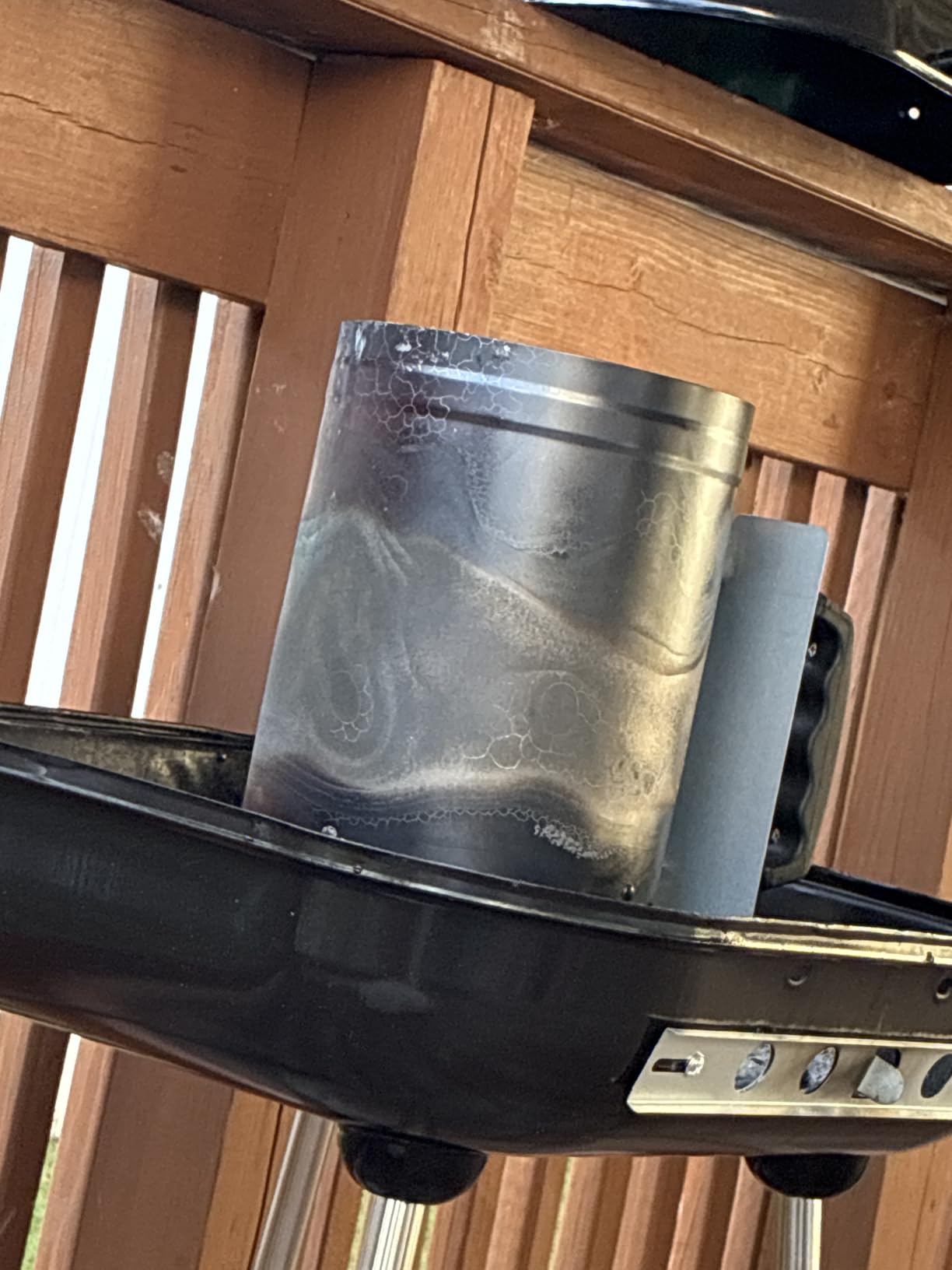
The handle is where the value shows its limit. The insulated cool-touch plastic handle does not stay cool to the touch during a pour, and owners report reaching for a towel. That is a solvable problem but it is a real one at the moment you are lifting a full chimney of glowing coals.
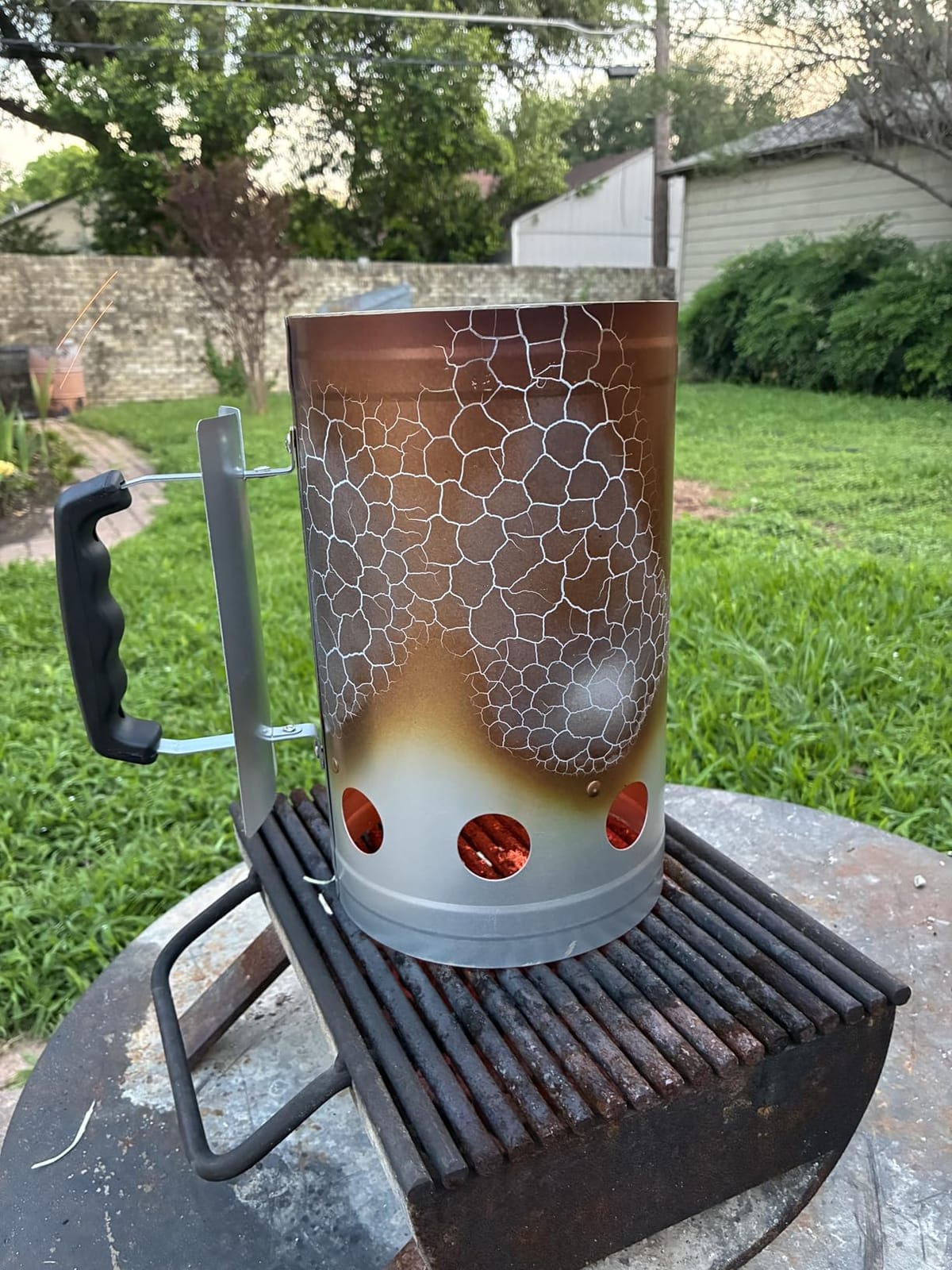
Lighting time is the second expectation to reset. A full 6.6 pound load can take close to half an hour rather than the 10 to 15 minutes some listings imply. Light half loads if you want the fast turnaround. The galvanized finish also shows discoloration and wear from the first cook onward, though it holds up structurally.
Do you really get 6.6 pounds of usable capacity?
That is the manufacturer figure and owners confirm the chimney is genuinely roomy. The caveat is that a maximum load is a full load, and a full load is the slowest to light. If your usual cook is 3 pounds of briquettes, you will finish faster by filling it half way.
The cylindrical form also pours in a tight stream, which makes it easy to build a single level fire or bank coals to one side for indirect cooking.
Is a cheaper chimney starter worse for grilling?
Not in the way most buyers expect. Ignition is chemistry and airflow, and any of these cylinders does it correctly. What you trade away at the lower end is handle heat protection, base stability and the ability to take a knock without denting the grate.
If you cook on a mid size kettle, light half loads, and use grilling gloves for the pour, this is a capable starter. If you cook for large groups or want the tool to last decades, spend up for thicker steel and a real heat shield.
11. The Bincho Grill Stainless Steel Charcoal Chimney Starter: Best for Binchotan and Hard Lump
The Bincho Grill Stainless Steel Charcoal Chimney Starter – Perfect for Binchotan Charcoal, Lump Charcoals, Briquettes, Built for Extreme Heat, Durable Construction, Heat Shield Handle, Large Capacity
Uncoated stainless
7.5 in diameter by 11.75 in
4.5 from 58 reviews
3.5 lb
Pros
- Uncoated solid stainless with no paint or plating
- Built for binchotan and hard lump
- Slanted handle on dual rivets
- Secondary handle for two-handed control
- Fits high heat camping burners
Cons
- Handle still needs gloves
- Not the fastest ignition here
- Higher cost for the same core function
Most chimney starters are designed around briquettes, which ignite easily because of their density and wax binder. Binchotan and hardwood lump are harder, denser and run much hotter. This stainless body is built for exactly that: 7.5 inches in diameter by 11 and three quarter inches tall, uncoated and unplated.
There is no paint and no zinc finish that can peel or burn off. For a chimney that will sit near very hot burning charcoal night after night, that is a real durability argument rather than a spec-sheet nicety.
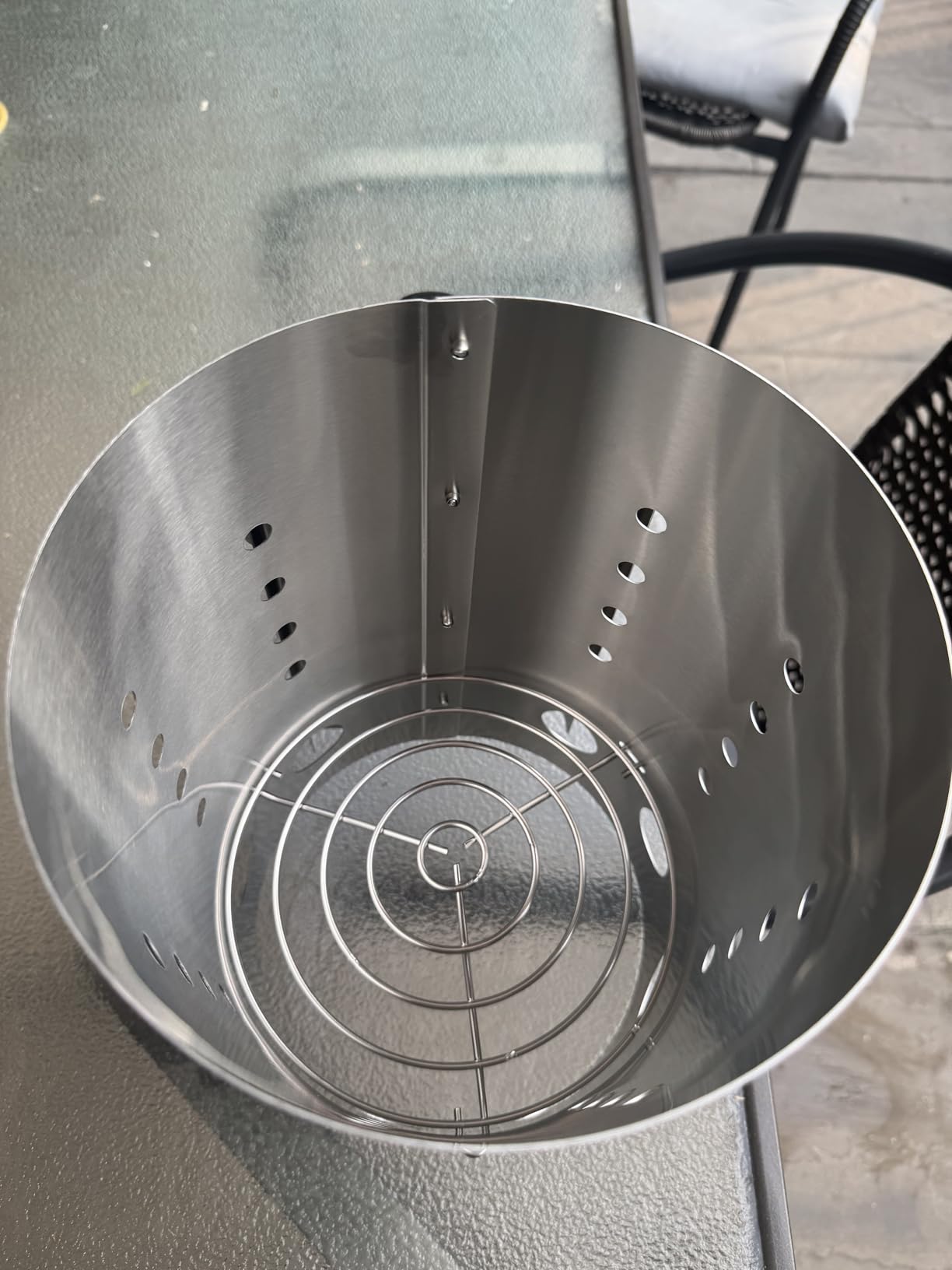
The handle design is the part owners react to most. A slanted handle secured with dual rivets gives both strength and a natural grip angle, and an integrated secondary metal handle gives two-handed control when transferring hot charcoal. Two hands on a full chimney is a meaningful safety upgrade.
Limitations are real. The heat resistant handle still requires gloves. Ignition is not the fastest in this group and depends heavily on the charcoal type, since dense lump resists convection. And some buyers find the premium hard to justify for ordinary briquette cooking.
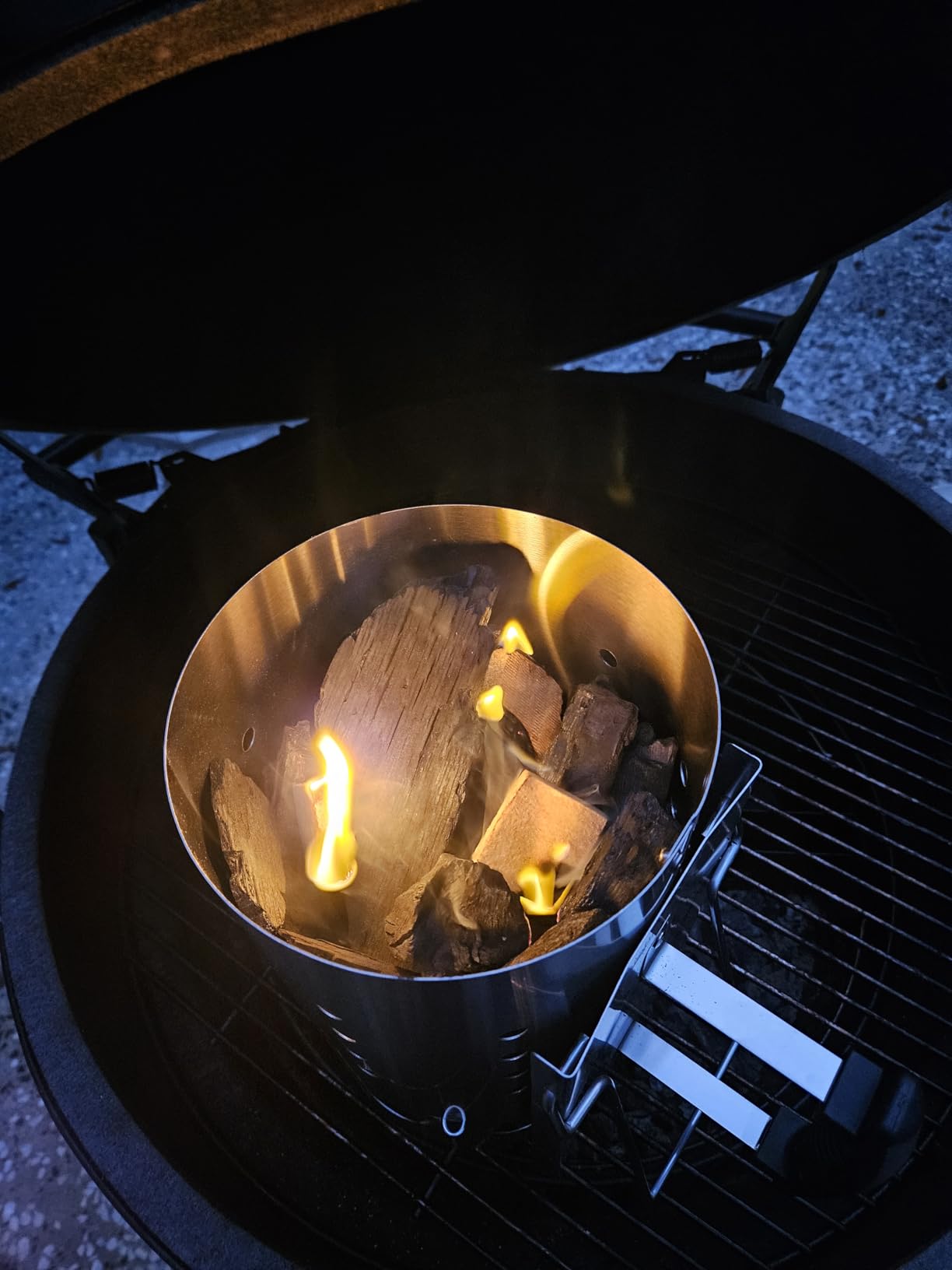
What makes a chimney starter work for binchotan?
Heat tolerance and airflow. Binchotan burns at temperatures that degrade painted or zinc coated steel over time, and it takes longer to reach ignition temperature than briquettes, so you need a body that holds heat without warping. Uncoated stainless keeps its shape and needs no coating to survive.
The size also matters. At 7.5 inches across and nearly 12 inches tall it has enough volume for a dense load without compressing the fuel, and it is sized to fit a high heat camping stove burner if that is your setup.
Is the Bincho Grill starter worth it for standard charcoal?
For briquettes and ordinary lump, it performs perfectly well, you simply pay more for construction you may not need. It also carries a one year manufacturer warranty and a noticeably higher cost than a basic starter doing the same core job.
If you cook binchotan, hardwood or charcoal logs regularly, the uncoated stainless body and two handled pour are worth it. If you fire up a kettle on weekends with supermarket briquettes, a galvanized starter will serve you for a fraction of the outlay.
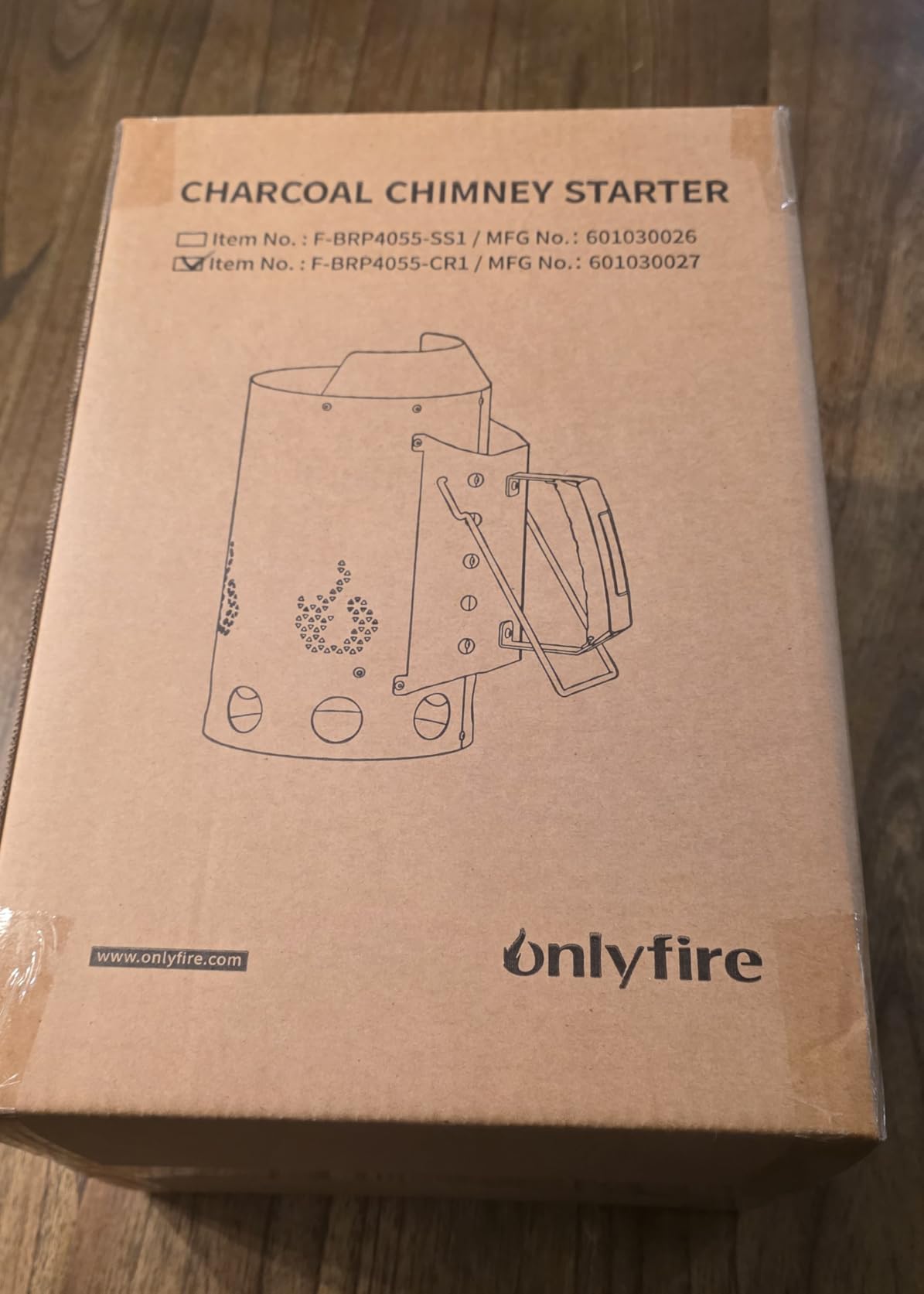
12. onlyfire Heavy Duty Deluxe Stainless Steel Charcoal Chimney Starter: Best Heavy-Duty Build
onlyfire Heavy Duty Deluxe Stainless Steel Charcoal Chimney Starter
Stainless steel
6.5 lb capacity
10.83 by 9.65 by 15.55 in
4.9 from 47 reviews
Pros
- 4.9 rating with no one or two-star reviews
- Dual-handle pour avoids shaking
- 6.5 lb load covers a 22 inch kettle
- Thick heat deflector resists warping
- Hand-welded corrosion-proof seams
Cons
- Heaviest unit here at 4.79 lb
- Highest cost of the starters tested
- Small review base under 50 ratings
This one carries the highest average rating in the group at 4.9, with 88 percent five-star and no one or two-star reviews recorded. The rating distribution is unusually clean, though it comes from fewer than 50 ratings, so treat it as a promising signal rather than a decade of data.
6.5 pounds of capacity is enough to fuel a 22 inch kettle grill or a large smoker in a single load. At 10.83 by 9.65 by 15.55 inches it is a genuinely large tool, sized for feeding a group rather than topping up coals mid-cook.
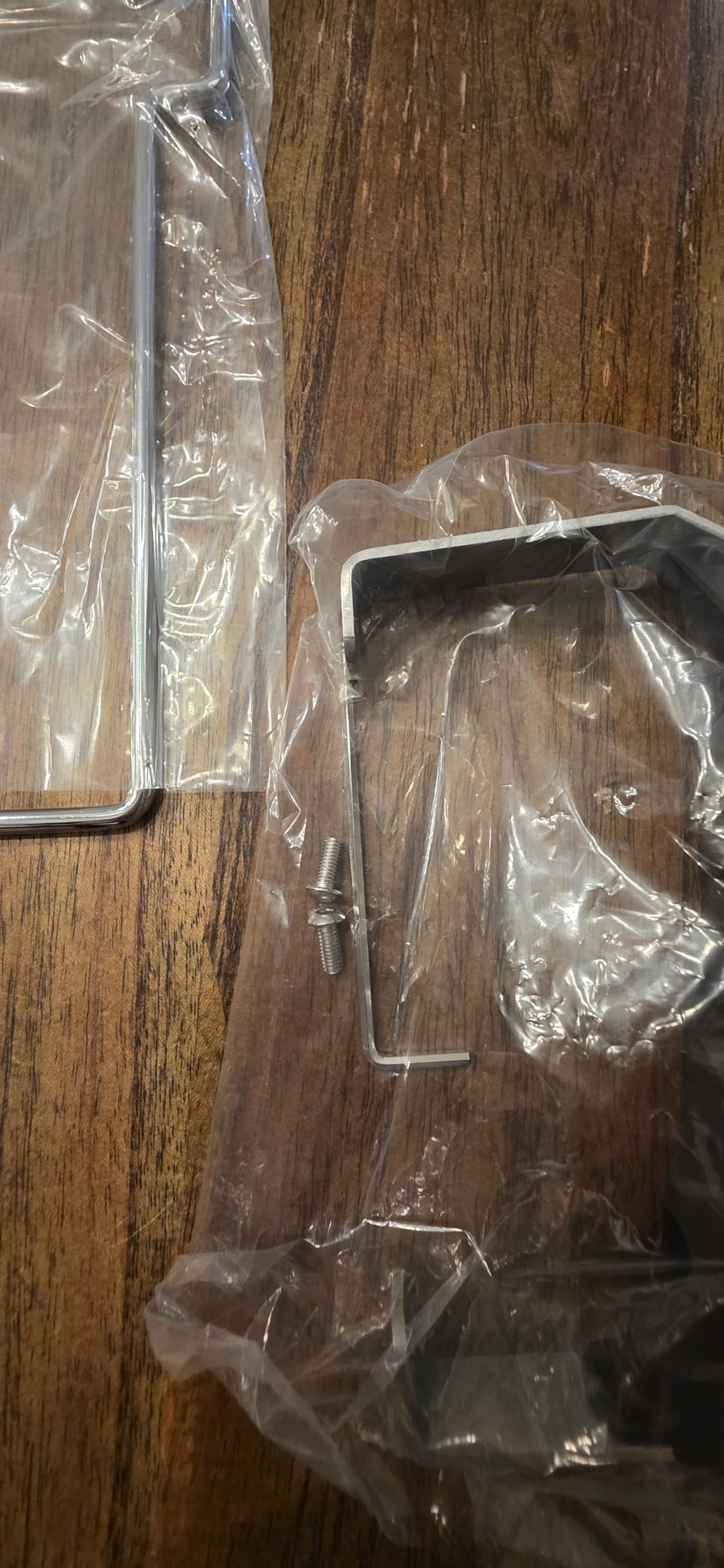
The dual-handle system is what we like most. A main grip sits away from the heat and a side handle acts as a pouring pivot, so you tip rather than shake. Owners describe the result as precise and spill free, which matters when you are trying to keep a two level fire intact.
The reinforced thick smooth heat deflector has no sharp edges and resists warping, and the seams are hand-welded for corrosion resistance. Those are the details you feel after the tenth season rather than on day one.
Is the highest rating enough to make this the top pick?
No, and it is worth being honest about why. A 4.9 average across 47 ratings tells you the people who own it are happy. It does not tell you how it performs after ten years of storage and heating cycles, which is exactly the question for a heavy stainless tool at the top of the price range.
That is why it sits here rather than at the top. The Weber has four times the review volume and a decade of owner feedback behind the same core function. Buy this one if you want the thickest build and the cleanest pour and you cook for a lot of people at once.
When does a heavy-duty stainless chimney pay off?
When you fill it. At 6.5 pounds you light once for a 22 inch kettle or a large smoker instead of making two loads, and a single load means a single waiting period. The hand-welded seams and uncoated body also mean corrosion is not going to end its working life.
Against that, at 4.79 pounds it is the heaviest unit we tested and the most expensive. It is a garage and patio tool. If your cooking happens on a portable grill in a field, the weight is a cost with no benefit.
Charcoal Chimney Starter Buying Guide: What Actually Matters
The differences between these twelve are mostly about capacity, steel, and how much heat reaches your hand. Here is how to weigh those three things for your own grill, followed by the safety and maintenance habits that separate a starter that lasts from one that ends up in a skip.
Match capacity to your grill, not your ambition
Chimney capacities are usually quoted in pounds or in briquette counts, and both are useful only relative to your grill. A compact model covering 15 to 33 briquettes is right for a tabletop grill or a small kettle. A full size model in the 30 to 50 briquette range covers a normal backyard kettle. Anything above 6 pounds of capacity exists for 22 inch kettles and offset smokers.
Buying large is not always better. A chimney bigger than your grill wastes charcoal and time, and the ones with the most capacity tend to be the heaviest and least portable. Buy for the load you actually cook.
Decide between lump charcoal and briquettes first
Briquettes are dense, uniform and loaded with an ignition binder, so they light fast and evenly in almost any chimney. Lump charcoal is lighter, irregular and takes longer. If you cook lump exclusively, prioritise airflow, chimney height and volume over a cone grate, because those are what move heat through irregular fuel.
Some owners also drill extra holes in a chimney they use for lump, and that is a reasonable modification if ventilation is genuinely the bottleneck. Use a metal bit, wear eye protection and clear the swarf afterwards. Owners migrating from briquettes to lump report needing a couple of sessions to work out their own lighting rhythm.
Look at the handle and the heat shield together
The shield matters more than the handle material. A metal handle behind a well placed shield can beat a wood handle with a tiny shield. Look for the shield positioned between the coal chamber and your grip, and check whether the brand recommends gloves, because most of them do.
Feature descriptions that promise a stay-cool handle are worth reading carefully. Reviewers consistently report needing grilling gloves on a full pour even for models advertising cool touch plastic. Treat cool-touch as a comfort feature, not a safety guarantee.
Weigh stainless against galvanized steel
Galvanized or zinc coated steel is the default and it handles heat cycles well for years before showing surface rust. Stainless steel costs more and weighs more but does not rust, does not flake, and survives the extreme heat that binchotan and hardwood lump produce. Painted steel is the option to avoid, since paint eventually bubbles and lifts near a chimney.
Enamel is the fourth option and sits between the two, more corrosion resistant than bare steel and easy to wipe clean, but vulnerable to chipping if dropped or quenched with water.
Rigid steel versus collapsible stainless
Rigid cylinders are more stable under a full load of hot coals and last longer because there are no hinges to loosen. Collapsible designs trade some rigidity for a packed thickness of little over an inch, which is the difference between a chimney living in your car boot and a chimney living on a garage shelf.
Forum users overwhelmingly prefer cylindrical rigid construction for stability and pair collapsible models specifically with camping and overlanding. If you ask us, buy rigid unless packed size is a genuine constraint.
Fire starters: cubes, blocks, newspaper or electric
Newspaper and shredded paper bags work and cost nothing. The most reliable approach combines a base of newspaper with one or two solid starters on top, since one cube burning for 8 to 10 minutes gives convection time to reach the upper chamber. Owners also use wood shaving cubes and paraffin wax cubes, and Tumbleweed bundles come up often in forum threads.
Electric starters exist for people who want to avoid fire entirely. For most cooks the chimney itself is the faster method, so we treat electric starters as an alternative rather than an upgrade. For fireplaces and wood stoves, they have a clearer case.
Handle hot chimneys safely every single time
Every starter in this guide gets hot enough to burn skin. The reliable routine is: wear grilling gloves or a heat resistant glove with aramid or silicone layers, set the chimney on a non-combustible surface, light it well away from anything flammable, and let it cool fully before handling the ash.
Never quench a hot chimney with water, especially the enamel models, where thermal shock cracks the finish. Never leave a lit chimney unattended, and never store a used chimney with ash still inside it, because that ash stays hot far longer than people expect and can smolder for hours.
Cleaning and storage take two minutes
Most owners do nothing more than dump the ash, and for a chimney starter that is largely enough. Tip it out over a metal bin once the coals are cold, wipe the interior with a stiff brush, and knock the grate free of carbon build-up. Enamel models can be wiped with a damp cloth; bare and galvanized steel should be kept dry.
For storage, keep it indoors if you can. Outdoor storage is where surface rust on thin aluminized and zinc coated grates comes from. If it has to live outside, at least stand it upright so water drains through the base rather than sitting in the newspaper chamber, and keep it off bare soil.
Do you actually need a chimney starter?
You do not need one, but it is the fastest repeatable way to get an even coal bed without lighter fluid. The alternative methods are a pile method with a torch, a newspaper and hairdryer approach, or a two level fire with oil and newspaper built directly in the grill. All of them work. None of them produce as even a result or let you walk away during the wait.
Pairing a starter with a grilling island setup or a smart hub from our smart grilling hub guide makes sense if you cook often enough that lighting time is the part you notice most.
Frequently Asked Questions
Which chimney starter is better, the Kingsford or the Weber?
The Weber Rapidfire is better overall. Its cone-shaped grate ignites coals more evenly and its side handle plus fold-out helper grip give a more controlled pour. The Kingsford Heavy Duty costs less, holds a large load, needs no assembly and has a genuinely effective heat shield, so for a first chimney starter it is very hard to argue with. Both rate above 4.7 across tens of thousands of reviews.
How long does charcoal take in a chimney starter?
Expect 10 to 15 minutes for a full load of briquettes using newspaper or a fire starter cube, and 20 to 30 minutes for lump charcoal, which is denser and slower to ignite. A full chimney at maximum capacity takes closer to 30 minutes. Paired with a fan through the airflow vents, some models reach usable coals in about 3 minutes.
How many briquettes fit in a charcoal chimney starter?
A compact model holds roughly 15 to 33 briquettes and suits small kettles and portable grills. A standard full size chimney holds about 30 to 50 briquettes. Larger models quote capacity in pounds, with 6.5 to 6.6 pounds covering a 22 inch kettle or a large smoker in a single load.
Is a charcoal chimney starter better than lighter fluid?
Yes. A chimney uses convection to light charcoal from below, so you get no chemical aftertaste on the food and no risk of over-pouring fluid onto hot coals. It also produces a more even coal bed, takes less attention while it runs, and costs less over a season because you are not buying lighter fluid.
Can you use lump charcoal in a chimney starter?
Yes, and it works well. Lump charcoal simply takes longer to light than briquettes, usually 20 to 30 minutes. Fill it loosely so air can move through the gaps, avoid compressing the fuel, and consider adding a second fire starter cube if the charcoal is dense hardwood or binchotan.
What can I use instead of a chimney starter?
The common alternatives are the torch method on a pile of charcoal, the newspaper and hairdryer method, and building a two level fire directly in the grill with oil and newspaper. DIY starters from egg cartons packed with dryer lint or homemade paraffin cubes are also popular on grilling forums. All work, but a chimney gives the most repeatable even result.
Final Verdict: The Best Charcoal Chimney Starters in 2026
After testing all twelve, the Weber Rapidfire Chimney Starter is still the best charcoal chimney starter for the widest range of cooks in 2026. It lights a full load in 10 to 15 minutes, its cone grate produces the most even coal bed we saw, and the side handle plus helper grip gives the steadiest pour. With a 4.8 rating across more than 42k reviews and a build that outlives the rust, it is the default recommendation.
Buy the Kingsford Heavy Duty if you want the same job done for less money with a large load and no assembly. Buy the E500 if you want the thickest steel, the widest stable base and a box of wood starters included. Add a fan through the vents on any of them and you cut the wait substantially.
Whichever you choose, fill it loosely, put a solid fire starter under the paper, wear gloves for the pour, and let the coals ash over before they go near the food. That is the whole method. Everything else is detail, and we have covered it above.