
Most home cooks do not need a knife block with fifteen slots and a matching block. They need one good 8-inch chef’s knife, a small paring knife, and something for bread. That is the whole kit, and it is why searching for the best chef knives for home cooks under $100 gets confusing so fast: every listing claims forged steel, a lifetime warranty and a 15-degree edge, and half of them are the same thin stamped blade with a different logo on the handle.
I spent several weeks putting twelve of the most-reviewed budget chef’s knives through the same routine: onions, carrots, butternut squash, herbs, a whole chicken breast, and a week of near-daily use in between. The point was not to find the most expensive knife in the bracket. It was to find which ones still feel good after the novelty wears off and the knife is dull, wet, and covered in onion at 6pm on a Tuesday.
This guide covers every one of those twelve, with the specs that actually change how a knife feels in the hand, who each one suits, and where it falls short. All prices on this page move constantly, so use the check buttons to see current listings rather than trusting a number I wrote down weeks ago.
Top 3 Picks: Best Chef Knives for Home Cooks Under $100 (October 2026)

Victorinox Fibrox Pro 8 Inch
- Tapered laser-tested stainless edge
- Non-slip Fibrox Pro handle
- Dishwasher safe
- Lifetime warranty

PAUDIN Chef Knife 8 Inch
- 8 inch high carbon stainless blade
- Ergonomic wood handle
- Hand polished edge
- Gift box included
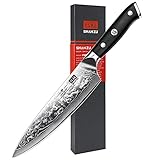
SHAN ZU Damascus Chef Knife
- Genuine 67-layer Damascus
- 62 HRC Japanese steel core
- 15 degree edge
- G10 handle
The Victorinox sits at number one for a simple reason: it has the largest review base in this list by a wide margin, and that review base keeps saying the same thing. It is sharp out of the box, it is light, it does not slip when your hands are wet, and it does not punish you for putting it in the dishwasher. The PAUDIN takes the value slot because it handles every daily task well for the least money here, and the SHAN ZU is the one to buy if you want the thinnest, sharpest edge and you are willing to sharpen it properly.
Quick Overview: Best Chef Knives for Home Cooks Under $100 in 2026
| Product | Specifications | Action |
|---|---|---|
| Victorinox Fibrox Pro 8 Inch |
|
Check Latest Price |
 MOSFiATA 8 Inch Chef Knife MOSFiATA 8 Inch Chef Knife |
|
Check Latest Price |
 imarku 8 Inch Chef Knife imarku 8 Inch Chef Knife |
|
Check Latest Price |
| PAUDIN Chef Knife 8 Inch |
|
Check Latest Price |
 Henckels Classic 8 Inch Chef Knife Henckels Classic 8 Inch Chef Knife |
|
Check Latest Price |
| SHAN ZU Damascus Chef Knife 8 Inch |
|
Check Latest Price |
 Babish 8 Inch Chef Knife Babish 8 Inch Chef Knife |
|
Check Latest Price |
 Dalstrong 8 Inch Gladiator Chef Knife Dalstrong 8 Inch Gladiator Chef Knife |
|
Check Latest Price |
 Mercer Culinary Renaissance 8 Inch Mercer Culinary Renaissance 8 Inch |
|
Check Latest Price |
 Amazon Basics 8 Inch Full Tang Chef Knife Amazon Basics 8 Inch Full Tang Chef Knife |
|
Check Latest Price |
 FAMCUTE 8 Inch Hand Forged Chef Knife FAMCUTE 8 Inch Hand Forged Chef Knife |
|
Check Latest Price |
 Mercer Culinary Millennia 8 Inch Mercer Culinary Millennia 8 Inch |
|
Check Latest Price |
All twelve are legitimate 8-inch chef’s knives that will work daily in a home kitchen. They are not all equally good, and the differences show up in three places: how long the edge lasts between sharpenings, how the handle feels after twenty minutes of prep, and what happens when you drop it on a tile floor. Everything below is built around those three things.
1. Victorinox Fibrox Pro 8 Inch Chef’s Knife – Best Overall
Victorinox Fibrox Pro 8 Inch Chef’s Knife, Dishwasher Safe, Black
Blade: 8 inch stamped stainless
Handle: Fibrox Pro non-slip
Weight: 22.68 g
Warranty: lifetime
Pros
- Sharp out of the box
- Stays grippy with wet hands
- Light enough for long prep sessions
- Dishwasher safe
- Swiss made with lifetime warranty
Cons
- Thin stamped blade needs sharpening sooner
- Blade shows scuff marks from sharpening
- Very light for cooks who like a heavy rock chop
This is the knife that shows up in almost every professional kitchen I have worked in, and the forums agree: r/Cooking threads about first serious knives keep circling back to the Fibrox Pro because it is cheap, replaceable and impossible to ruin. It carries roughly 22.68 g, which is feather-light next to a traditional German chef’s knife, and that lightness is the reason hands stay comfortable through a long session of prep.
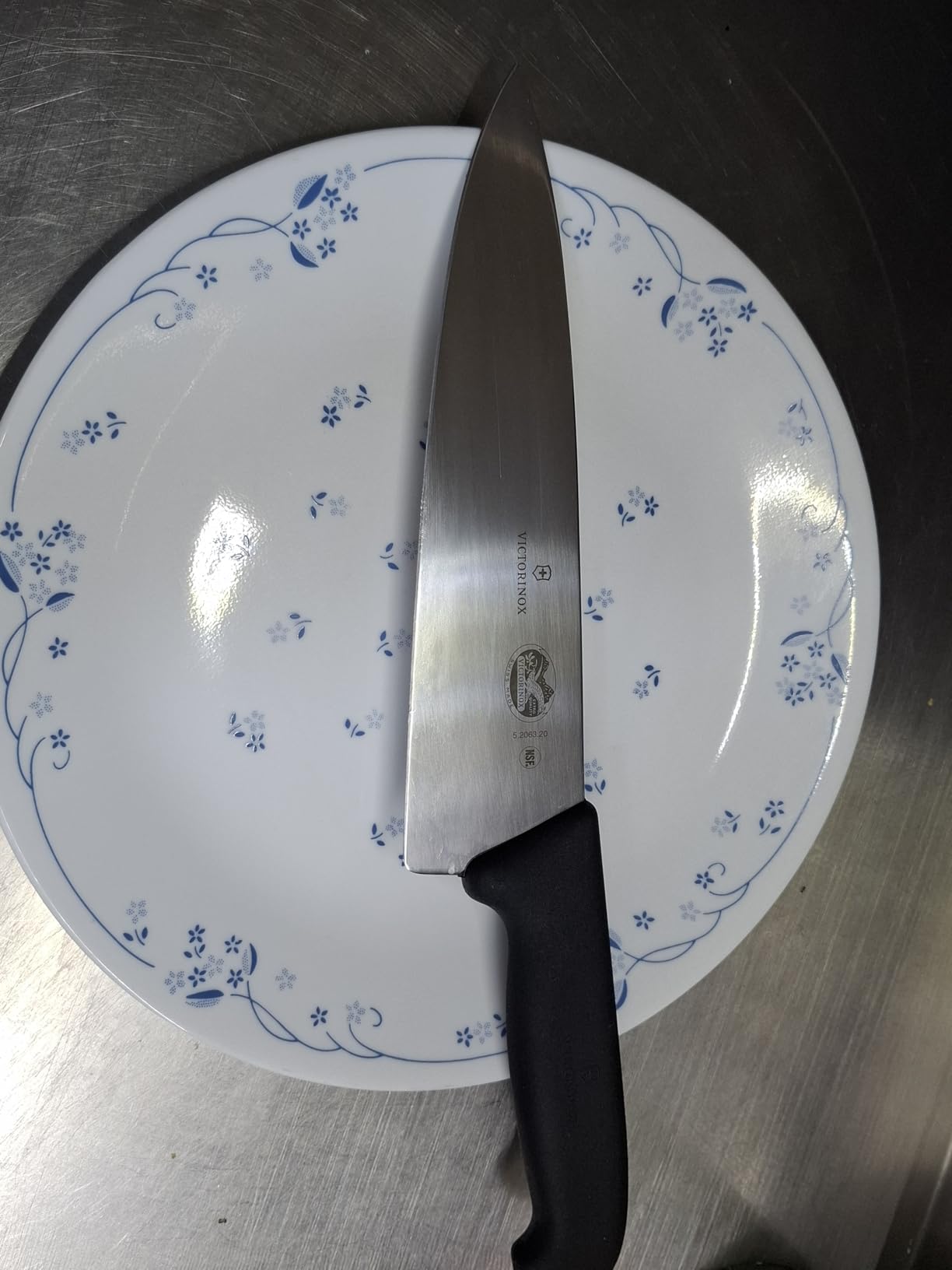
The blade is stamped stainless with a laser-tested tapered edge, and the geometry is doing more work here than the steel. A laser-tested edge is pressed rather than ground, so the two sides meet at a slightly coarser but far more consistent factory angle than most ground blades. That is why it slices a tomato with almost no downward force straight out of the box.
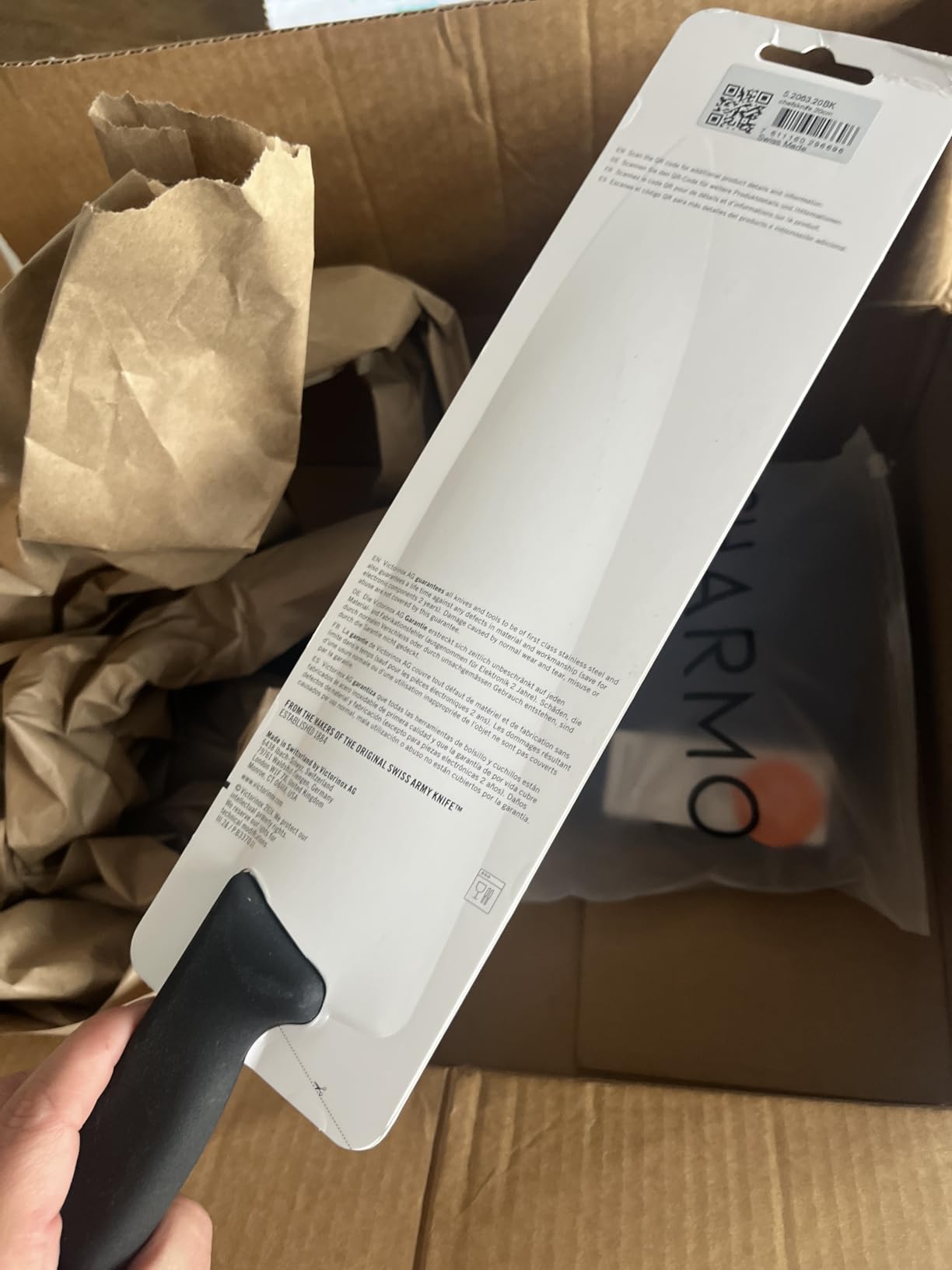
Where it loses points is the thin stamped blade itself. It loses its edge faster than any forged knife in this list, which means a honing rod becomes an essential tool rather than an optional one. Reviewers also mention scuff marks and visible wear lines across the blade face after a few sharpenings, which is cosmetic but does bother some owners.
None of that matters if you want a knife you never have to think about. It goes in the dishwasher, it rinses clean, and it will not develop rust spots even if it sits wet for an hour. The lifetime warranty against manufacturer defects is the quiet reason professionals keep rebuying it.
Who the Victorinox Fibrox Pro suits
This is the pick for anyone cooking four or five nights a week who wants sharpness without ceremony. If your prep is mostly vegetables, herbs, boneless proteins and slicing rather than heavy butchery, the light feel is an advantage rather than a flaw. It is also the safest first serious knife, because a mistake with it is never expensive.
It is a good fit for a rental kitchen or a vacation rental where you want one reliable blade and no care routine. Dishwasher tolerance matters more in those kitchens than anywhere else, and almost nothing else in this bracket offers it alongside a lifetime warranty.
Who should skip it
If you enjoy rock-chopping butternut squash or splitting dense squash with the spine of the blade, this is the wrong knife. At 22.68 g there is not enough mass behind the edge to push through those jobs without leaning on your shoulder. Many cooks who prefer a pinch grip over a full handle grip find the handle a little short for large hands.
Cooks who care about edge retention above all else should look at a forged blade with harder steel. You will sharpen this one more often, and if you are not willing to pick up a honing rod, that extra maintenance is the part of the deal most people underestimate. Our beginner chef knife guide covers this habit-building side in more detail.
2. MOSFiATA 8 Inch Chef’s Knife – Best Gift Ready Pick
MOSFiATA 8″ Super Sharp Professional Chef’s Knife with Finger Guard and Knife Sharpener, German High Carbon Stainless Steel EN1.4116 with Micarta Handle and Gift Box
Blade: 8 inch forged EN1.4116
Handle: triple rivet Micarta
Weight: 7.84 oz
Edge: 16 degrees per side
Pros
- Forged full tang construction
- Sharp out of the box
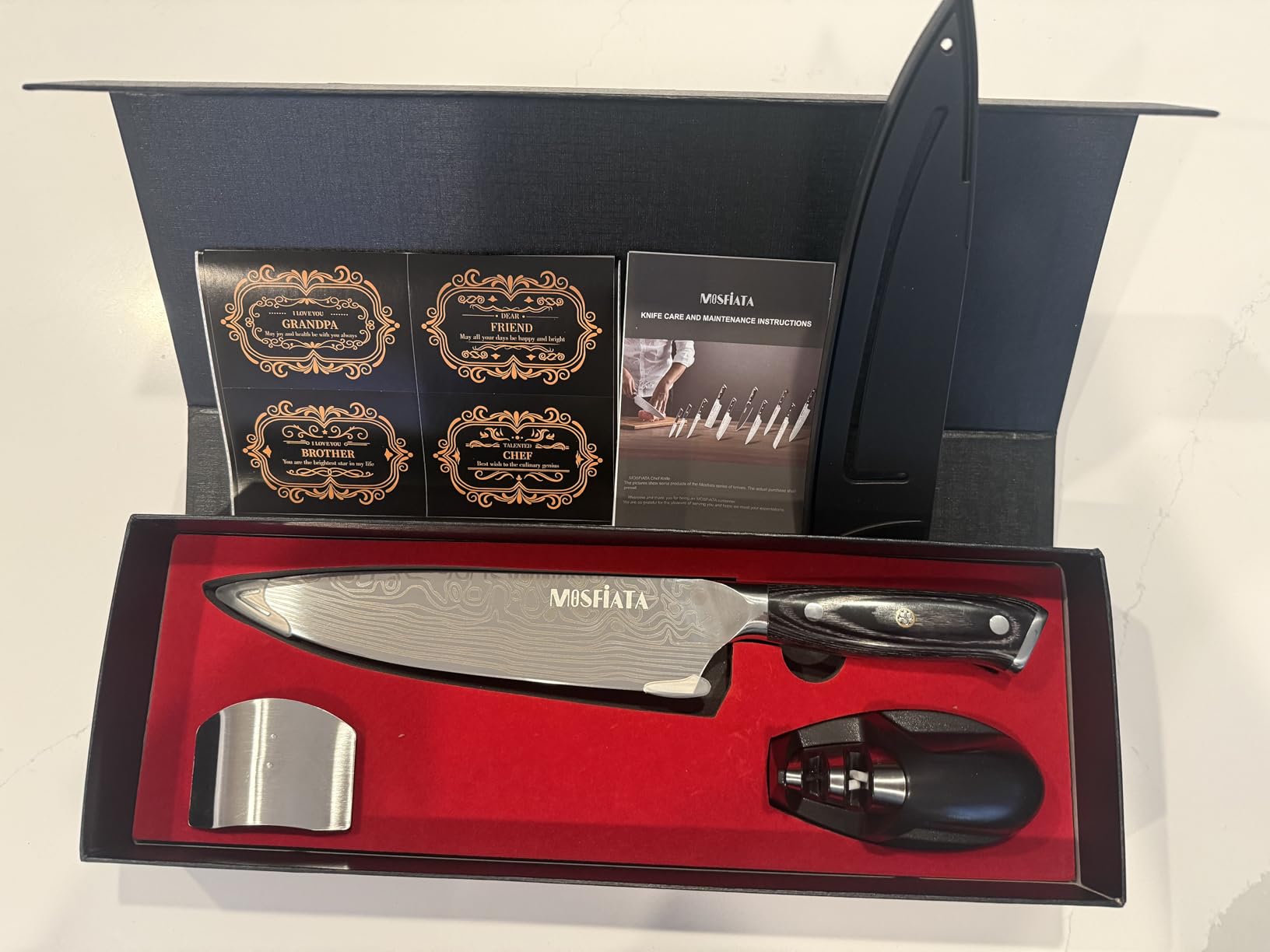
- Gift box with finger guard and blade protector
- Good weight and balance
Cons
- Edge dulls sooner than some forged rivals
- Back end feels heavy to some users
- Bundled sharpener is basic
- Pattern is laser engraved not true Damascus
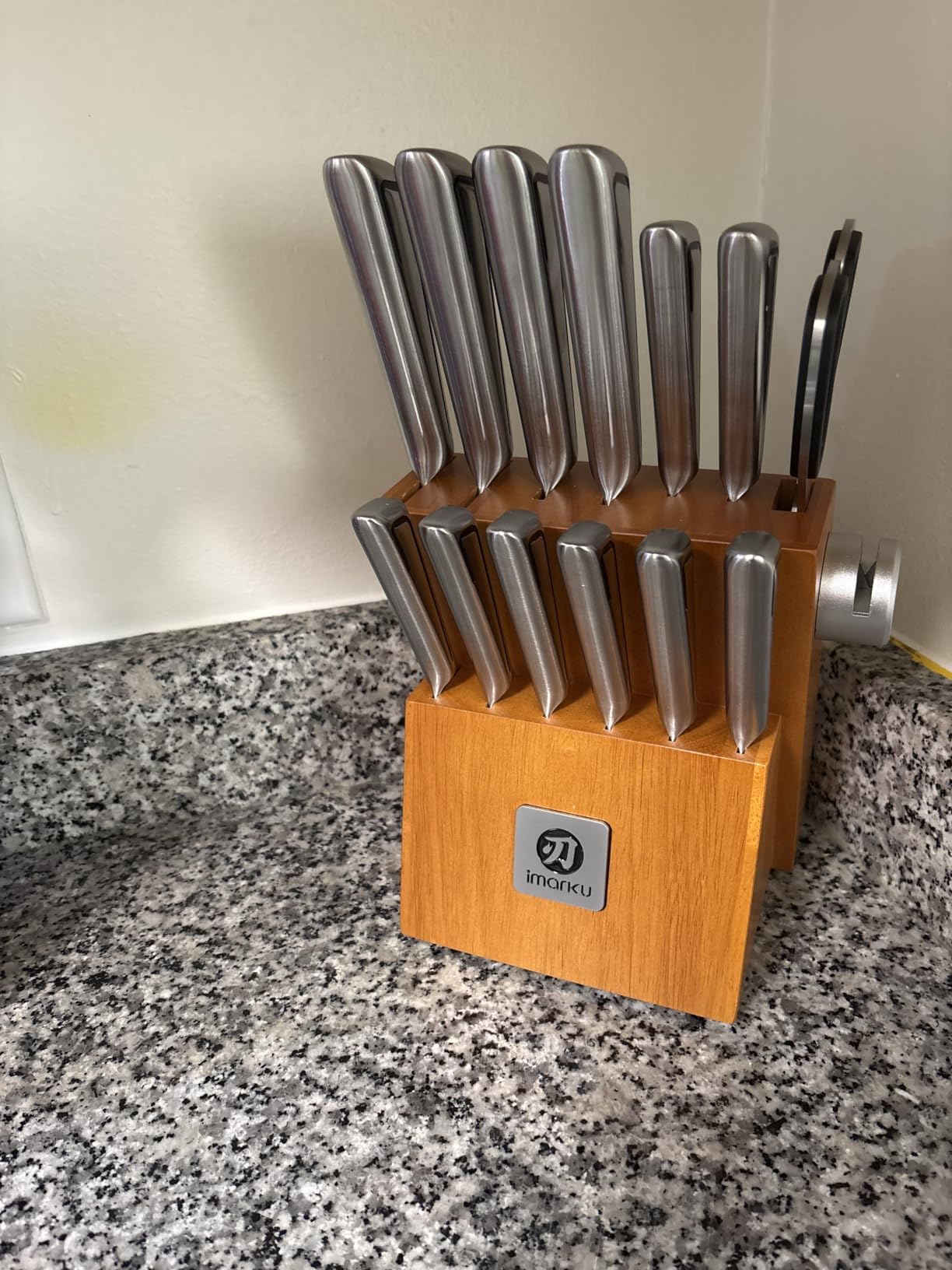
What separates this knife from the rest of the budget pile is the packaging decision. It comes in a gift box with a finger guard, a blade protector and a sharpening tool, which makes it the one I would hand to someone who is moving into their first kitchen. The knife itself is more than capable of backing that up.
The blade is forged German EN1.4116 high carbon stainless with 0.45-0.55% carbon, hand sharpened to 16 degrees per side with a tapered spine-to-edge profile. A forged blade has a spine thick enough to run your fingers along and a thin enough belly to rock through, which is the geometry that makes a rocking motion work for mincing and slicing.
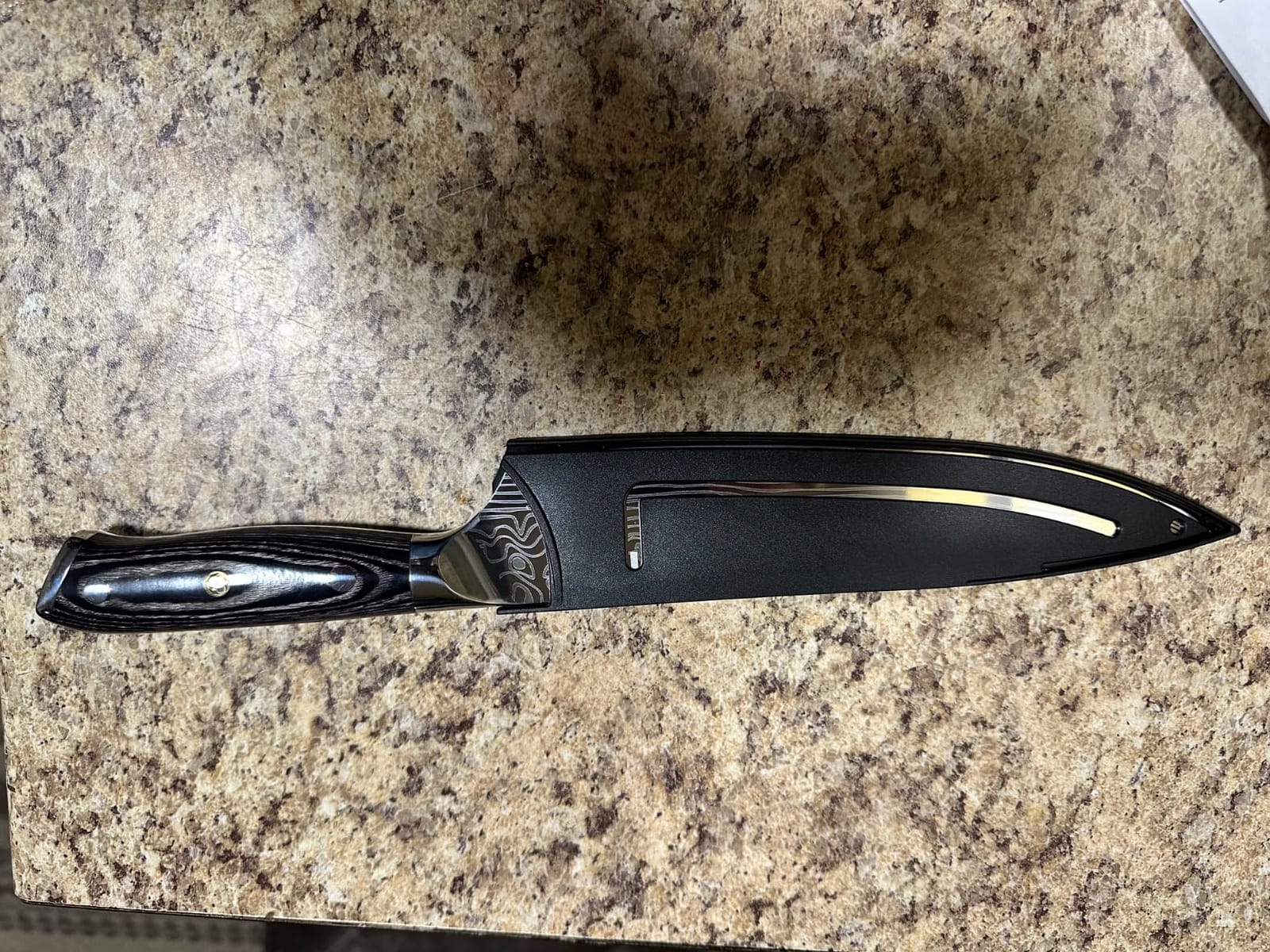
The handle is a triple-riveted Micarta handle on a full tang, and Micarta is a resin laminate that stays stable when wet and does not smell like wood. That combination is genuinely uncommon in this price bracket, where most competitors use hollow plastic handles or plain ABS. The whole knife weighs 7.84 oz, which lands it right in the middle of the range.
The complaints are consistent and narrow. Owners report the edge dulling sooner than they expected, and a few say the back end of the knife feels heavy in the hand during longer prep. The bundled sharpener is serviceable but not something you would keep using long term.
Who the MOSFiATA suits
Buy this one for a housewarming, a wedding or a starter kitchen where the recipient needs a knife that looks like a proper gift and does real work. The full tang and riveted handle read as quality from across the counter, which matters when the person receiving it has no frame of reference for what a good knife feels like.
It also works well for cooks who want the visual drama of a patterned blade without paying for layered steel. The engraved pattern is not true Damascus, but it looks convincing and it does not behave like a Damascus blade that needs precise sharpening angles.
Who should skip it
If you already own a good knife, this is more of an addition than an upgrade, so buy it for someone else. Serious enthusiasts chasing a paper-thin Japanese edge will find 16 degrees per side too conservative for what they want.
Be aware that the full package is where the value sits. If you are comparing purely on cutting performance against a similar-priced forged knife, the gift box is doing a lot of the persuading, and that is fine, but know what you are buying. Our chef knife set guide covers what a block set does and does not give you.
3. imarku 8 Inch Chef Knife – Best Japanese Style Pick
imarku Japanese Chef Knife-Sharp Kitchen Knife 8 Inch, Gift for Mom & Dad
Blade: 8 inch forged high carbon steel
Hardness: HRC 56-58
Handle: Pakkawood
Weight: 6.56 oz
Pros
- Holds an edge through tough jobs
- Pakkawood handle reduces fatigue
- Corrosion resistant with tarnish resistant finish
- Sharp out of the box
Cons
- Edge needs more frequent touch ups than expected
- Blade logo may differ from listing photos
This is a gyutou, the Japanese all-rounder profile, and if you like a flatter, longer blade for push cuts it behaves differently from the German chef’s knives most people picture. The profile is longer and narrower, which makes quick dicing easier and makes rocking less natural. Home cooks who cut a lot of herbs and onions tend to adapt to it within a week.
The steel is high carbon stainless with 0.6-0.75% carbon content and 16-18% chrome, hardened to HRC 56-58. That hardness sits in the sweet spot: hard enough to hold a fine edge through a tough job, soft enough that a dropped knife is more likely to bend than to chip.
The handle is FSC-certified Pakkawood, a layered and resin-stabilised hardwood that does not crack or swell with water. It is a comfortable, slightly warm surface that stays secure when wet, and at 6.56 oz the whole knife is light enough for long prep without the handle becoming a fatigue point.
Owners are largely positive about sharpness and edge retention through meat and bone-adjacent work. The recurring note is that the edge wants more frequent touch ups than the headline rating suggests, and that the blade logo can look different from the listing photo while brands update their marks.
Who the imarku suits
This is the pick if you mostly cook vegetables, fish and herbs and prefer push cutting to rocking. It is also a strong choice as a first Japanese-style knife, because the steel is forgiving enough to be sharpened with a basic rod while still feeling noticeably keener than a stamped European blade.
If you have limited counter space or prefer lighter tools, the weight works in your favour. It is the second-lightest knife here, which makes it easy to use for an entire evening of prep without wrist fatigue.
Who should skip it
Skip it if you break down a lot of bone or hit frozen foods with the blade. The profile is not built for that, and no home knife in this bracket should be. It is also worth skipping if you want the thinnest possible edge, because a higher hardness steel like the SHAN ZU holds a finer edge longer.
Hand washing is the other consideration. Steel at this hardness with a tarnish resistant finish still dislikes the dishwasher’s heat and detergent cycle. A few minutes with hot soapy water protects an edge you paid real money for.
4. PAUDIN Chef Knife 8 Inch – Best Value
PAUDIN Chef Knife, 8 Inch High Carbon Stainless Steel Sharp Kitchen Knife with Ergonomic Handle, Gift Box for Family & Restaurant
Blade: 8 inch high carbon stainless, 2mm
Handle: soft wood
Weight: 6.88 oz
Warranty: 24 months
Pros
- Sharp hand polished blade
- Cuts vegetables fish and meat cleanly
- Ergonomic wood handle balances the blade
- Attractive waved pattern
- Gift box included
Cons
- Wave pattern is decorative not Damascus
- Stamped edge dulls sooner than forged
- Wood handle needs oiling
The PAUDIN is the knife I hand to friends who ask what they should spend on a chef’s knife and clearly do not want to spend much. It does the daily work well, feels balanced in the hand, and costs less than half what the German and Japanese options here do.
The blade is 8 inches of high carbon stainless, 2mm thick, hand polished. At 6.88 oz it is light, and the wood handle is shaped so the weight sits forward enough to make the blade feel like it has momentum on a downward cut, which is what you want when chopping a head of cabbage.
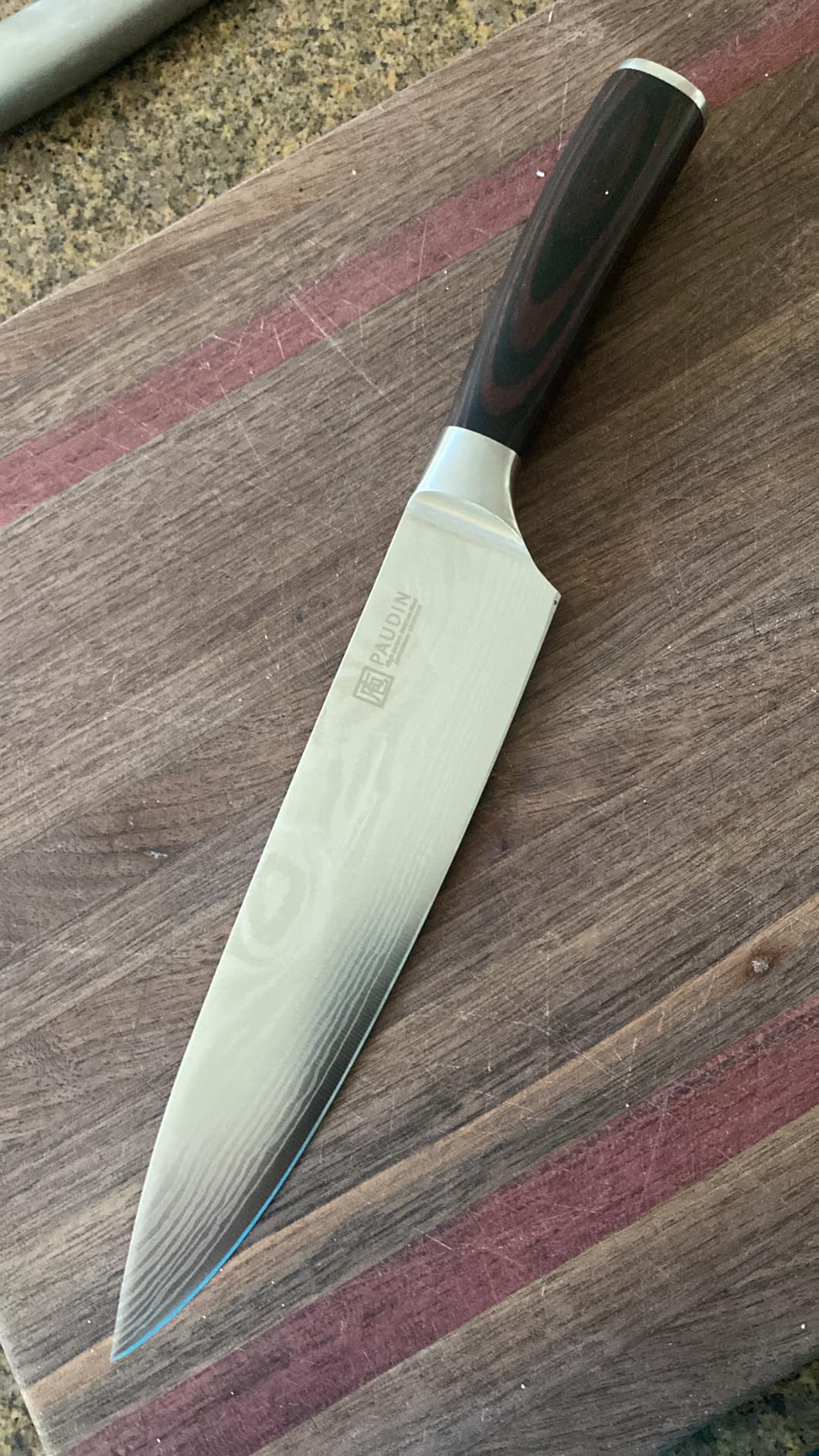
The handle is real wood, which feels warmer and less plasticky than anything else at this level, and it is balanced against a fairly thin blade. Reviewers consistently describe it as sharp out of the box and capable across bread, vegetables, fish, chicken and beef without any single task feeling out of place.
Two honest caveats. The wavy blade pattern is 5Cr15MoV stainless rather than Damascus steel, so treat it as decoration. And because the blade is stamped, the edge needs sharpening more often than any of the forged blades here, which is a fair trade for the lower price.
Who the PAUDIN suits
This is the right pick for a student kitchen, a first apartment, or anyone who cooks a few times a week and wants something that looks respectable enough to leave out on the counter. It also makes a decent housewarming gift because it arrives in a gift box.
If you prep large quantities of vegetables, the weight distribution works in your favour and the wide blade gives you plenty of room for a rock chop. It is a forgiving knife that does not punish an inconsistent technique.
Who should skip it
Do not buy it if you want to own one knife for twenty years and hone it rather than replace it. The stamped edge and the wood handle both need more upkeep: the handle wants periodic oiling, the edge wants a rod every week or so.
The warranty is 24 months, which is the shortest of the branded lifetime warranties in this roundup. That is not a dealbreaker for a knife you will use hard, but it is a signal about how the brand positions itself. If you want a warranty you never think about, read the Henckels section below.
5. Henckels Classic 8 Inch Chef Knife – Best German Tradition Pick
HENCKELS Classic 8-Inch Chef Knife, Razor-Sharp, German Engineered
Blade: 8 inch fully forged stainless
Handle: triple rivet composite
Weight: 4.48 oz
Warranty: lifetime
Pros
- Fully forged construction
- Razor sharp satin finish
- Very light for a German style knife
- Dishwasher safe and rust resistant
- Lifetime warranty
Cons
- Composite handle feels less refined than premium lines
- Light feel suits slicing more than rock chopping
- 8 inch blade is small for large batch prep
Henckels has been making cutlery in Germany since the 1700s, and the Classic line is the most direct expression of that tradition you can buy in this bracket. The blade is fully forged high carbon stainless, which means it is shaped from a single piece of steel rather than stamped and ground, and that difference shows up in how the blade transitions into the handle.
At 4.48 oz it is the second-lightest knife here, which surprises people who assume German knives are heavy. That lightness makes it excellent for slicing and mincing and less ideal for forceful rock chopping through dense squash. The blade is finely honed with a satin finish that resists glare under kitchen lighting.
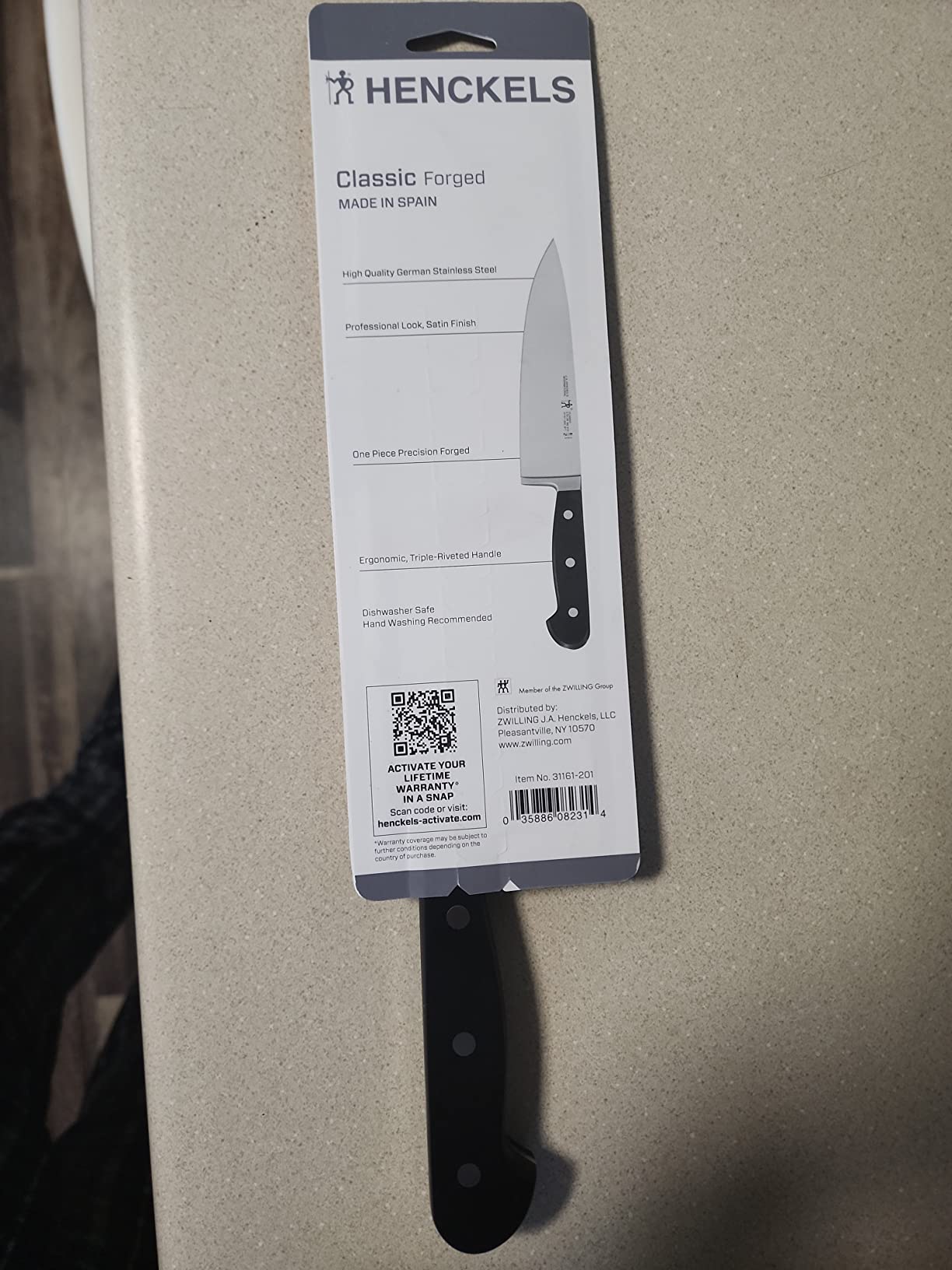
It is dishwasher safe and rust resistant, and the triple rivet handle gives you a secure grip. Reviewers consistently mention how little care it needs, which is the honest advantage over knives that technically demand hand washing and periodic sharpening to stay in good shape.
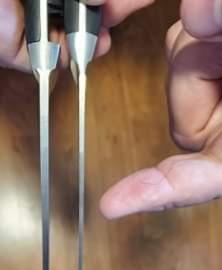
The handle is composite rather than fully forged bolstered block, and reviewers note that this is the main thing separating it from more expensive forged-block German knives. Six and ten inch versions exist separately if the 8 inch feels wrong in your hands.
Who the Henckels Classic suits
Pick it if you want a name that has been making knives for centuries and a lifetime warranty that does not exclude normal use. For a cook who slices a lot of meat, makes sandwiches, and does fine mincing, the light feel and thin blade are a genuine advantage.
It is also the safest choice for anyone hosting or cooking for family, since it can go straight into a dishwasher afterward instead of becoming one more thing to hand wash at the end of a long night.
Who should skip it
Skip it if you want the substantial rock-chopping weight that German and Japanese steel is famous for. Nothing is wrong with this knife, it just optimises for a different kind of cutting than the one most people picture when they hear the brand name.
Enthusiasts moving past their first knife often move past Henckels quickly because the composite handle is the place the money was saved. If edge retention is your top priority and you are comfortable honing, look at the Dalstrong instead.
6. SHAN ZU Chef Knife 8 Inch – Best for a Razor Edge
SHAN ZU Chef Knife 8 Inch Japanese Steel Damascus Kitchen Knife
Core: 10Cr15Mov at 62 HRC
67-layer Damascus
Handle: G10 fiberglass
Edge: 15 degrees
Pros
- Genuine 67-layer Damascus cladding
- Very sharp 15 degree cutting edge
- G10 handle resists moisture
- Top balanced design reduces fatigue
Cons
- Damascus steel needs careful angle control
- Harder 62 HRC steel can chip if abused
- G10 handle feels slick to wood handle fans
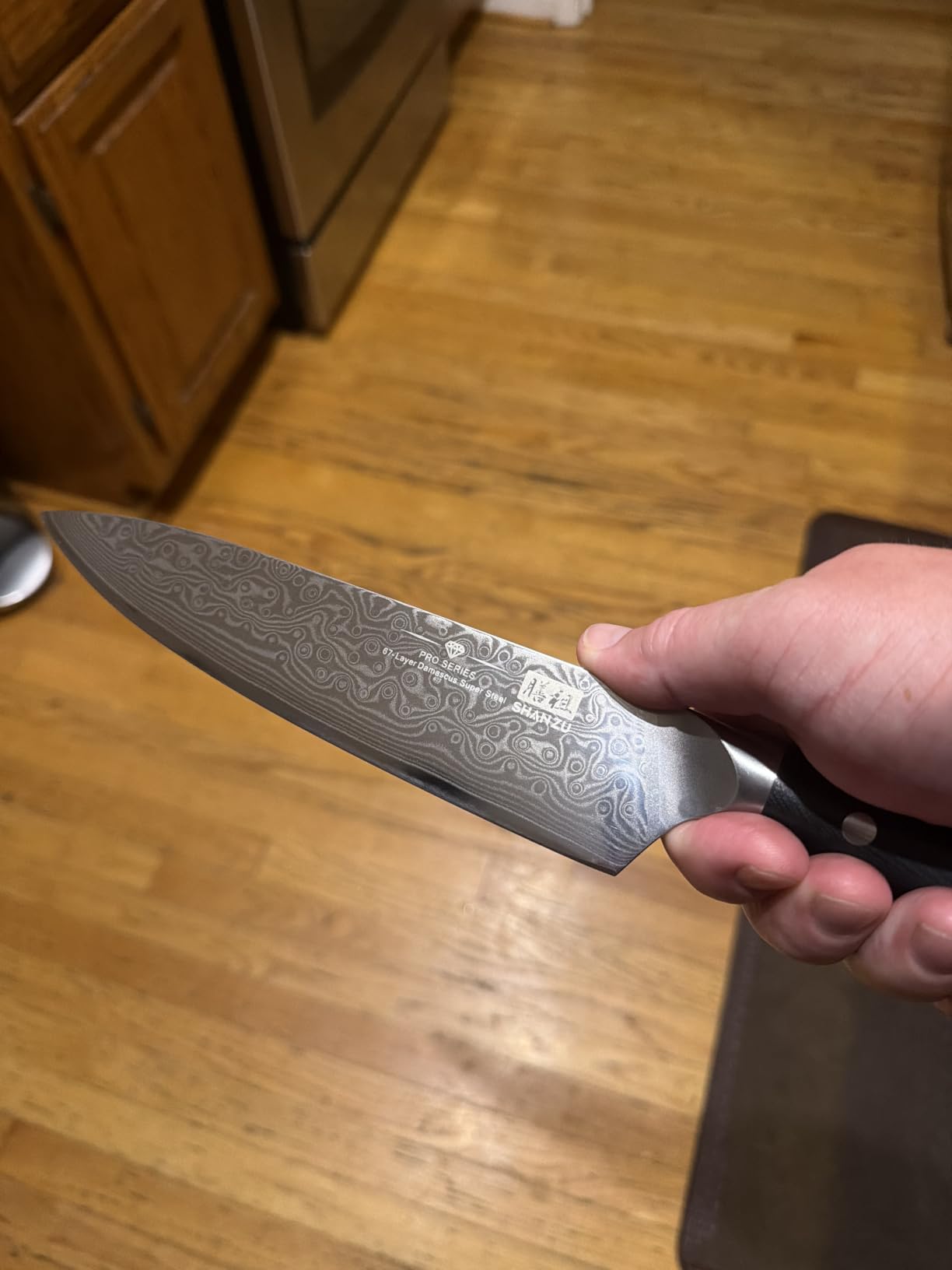
Most knives advertising Damascus at this price have a pattern etched onto a plain stainless blade. This one does not. The construction is genuine, with a 67-layer folded cladding over a 10Cr15Mov Japanese steel core hardened to 62 HRC, and the pattern is a byproduct of the forging rather than a printed decoration.
That core hardness produces the sharpest factory edge in this roundup at 15 degrees. It slices paper, it goes through a tomato with the side of the blade, and it makes a raw onion cry. The blade measures 8 inches, 2.2mm thick and 2.5 inches wide with a 5.3 inch handle.
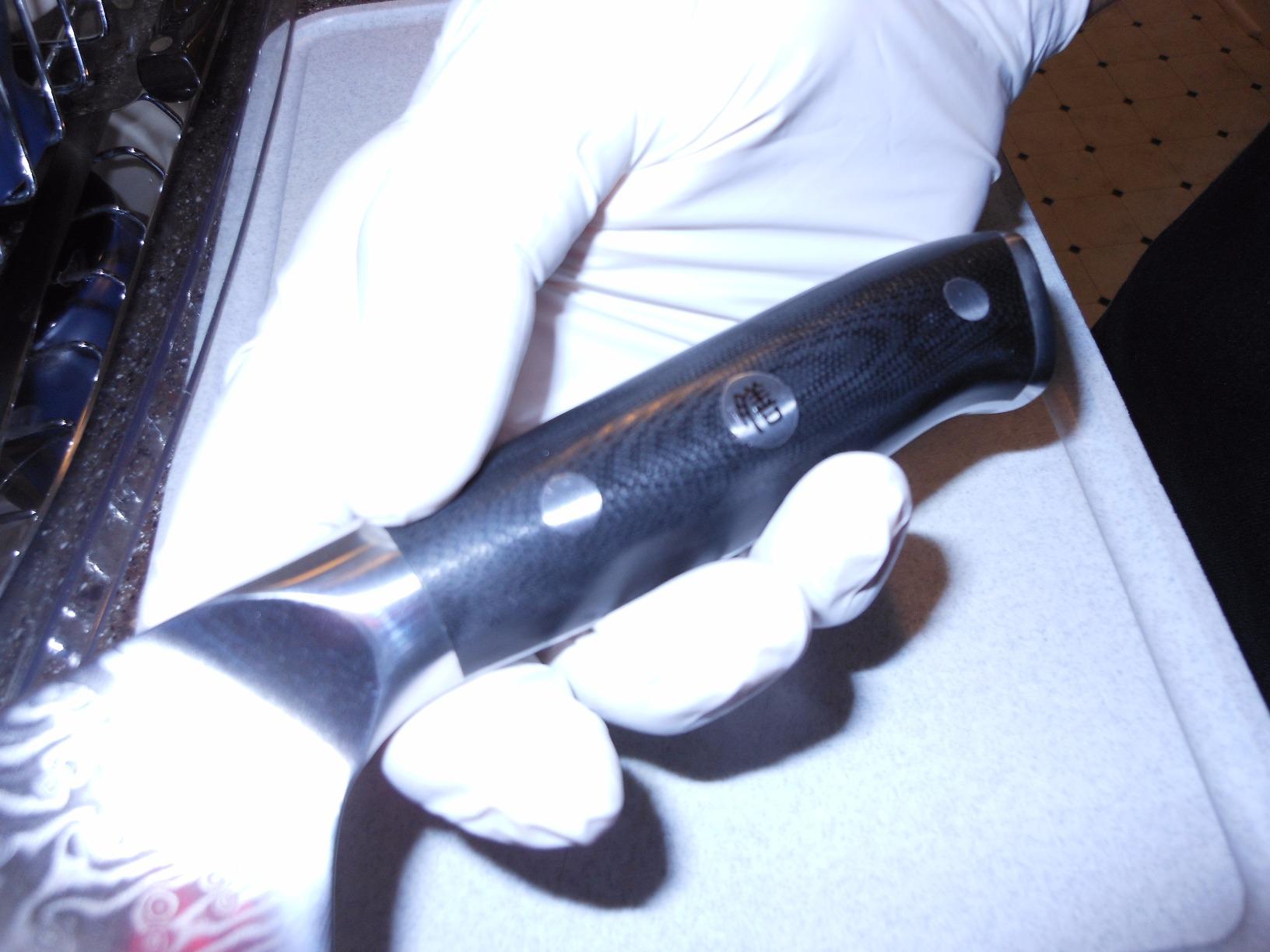
The G10 glass fiber handle is top balanced, which is a real ergonomic choice rather than a styling one. It puts weight near the heel so your hand does not have to work as hard, and G10 is moisture resistant in a way that wood is not. It is also the heaviest handling of the light knives here at 260 g, though most of that sits toward the handle.
The trade-off is steel hardness. At 62 HRC this blade resists rolling but is more likely to chip if you land the edge on a tile floor or cut through a frozen bone. It also demands more care at the sharpening stone to keep performing as well as it did on day one.
Who the SHAN ZU suits
This is the pick for an enthusiast who already knows how to sharpen and wants a knife that feels noticeably keener than anything else in the bracket. If you enjoy the difference between a 15 degree edge and a 20 degree edge, you will feel it immediately on this blade.
It suits cooks who want a visible Damascus pattern without the usual false advertising, and who plan to keep the knife rather than cycle through one. The warranty runs 12 months, which is shorter than the lifetime options here, so treat it as a precision tool rather than a lifetime purchase.
Who should skip it
Do not buy this as a first knife if you have never sharpened anything. Hard steel plus a thin edge plus no technique is how beginners chip a good blade in the first month. Start with a forged European knife and a honing rod, then upgrade.
Cooks who prefer the feel of wood under their fingers also tend to dislike G10 after a few sessions. It is more durable than wood and less tactile, and there is no changing it without changing the knife.
7. Babish 8 Inch Chef Knife – Best Forged Workhorse
Babish 8-Inch Chef Knife – High-Carbon German 1.4116 Steel Kitchen Knife – Professional Cutlery for Precise Slicing and Chopping
Blade: 8 inch forged 1.4116 steel
Handle: full tang ABS
Weight: 320 g
Warranty: varies by seller
Pros
- Forged from a single piece of German 1.4116 steel
- Taper ground and polished for sharpness
- Full tang gives balanced control
- Handle and pakkawood variants available
Cons
- 320 g feels heavy for long prep sessions
- ABS handle is utilitarian
- Hand wash only
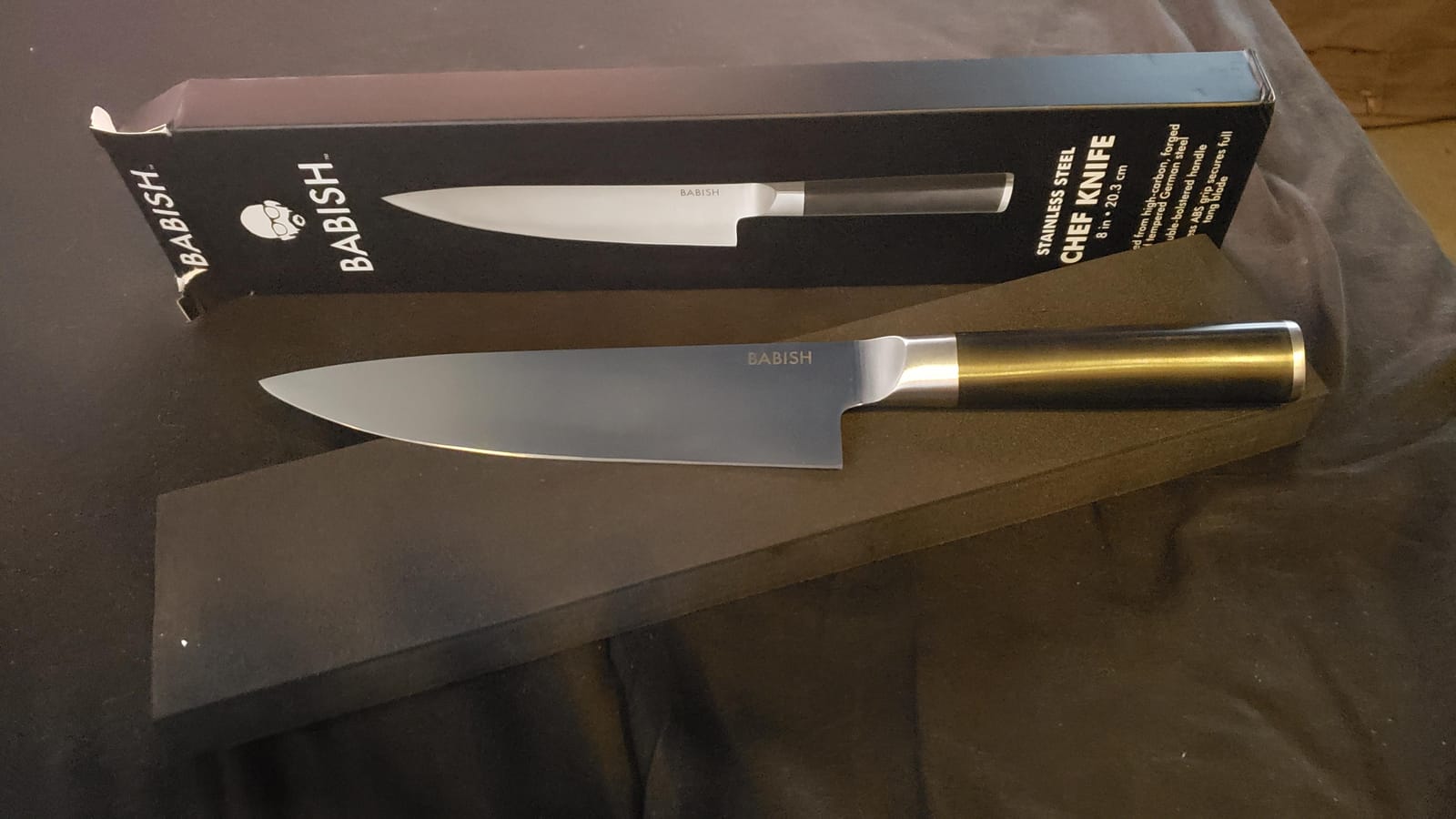
The Babish is what I would call the honest forged knife in this group. It is made from a single piece of high carbon 1.4116 German steel, the same family used by premium German brands, and it is tempered, taper ground and polished before it leaves the factory. Very little of the design is marketing.
At 320 g it is the second-heaviest knife in this roundup and it feels like it. If you have watched a line cook break down a whole case of onions, this is the knife that looks and behaves closest to the tool. The full tang means the steel runs the full length of the handle, which is where most budget knives cut corners.
The profile handles chopping, slicing, dicing and mincing without a weak point, and reviewers consistently describe it as sharp and well balanced rather than merely adequate. There are pakkawood handle variants as well as the stainless steel and black ABS versions, so you can pick the grip you prefer.
The complaints focus on comfort rather than cutting. At 320 g the knife tires some hands during long sessions, and the ABS handle is the most utilitarian-feeling one here, warm only in the sense that it is not cold metal.
Who the Babish suits
Pick it if you chop a lot and you want a knife with real heft behind it for not much money. It is the option here for a cook who learned on a heavy German chef’s knife and finds light blades feel twitchy on dense vegetables.
It also suits anyone who wants the pakkawood handle option, which most budget forged knives in this bracket do not offer. Choosing the wood variant solves the biggest complaint about the ABS version.
Who should skip it
Skip it if you have small hands or if your wrists get tired easily. A 320 g full tang knife is a commitment during a three-hour Sunday cook, and lighter knives like the Victorinox handle that better.
It is hand wash only, and the plain edge wants regular honing. Budget for a honing rod as part of the purchase rather than treating it as an optional accessory.
8. Dalstrong 8 Inch Gladiator Chef Knife – Best Heavy Duty
Dalstrong 8″ Chef Knife – Forged German Steel
Blade: 8 inch forged steel at 56+ HRC
Handle: triple rivet G10
Weight: 8 oz
Edge: 16-18 degrees
Pros
- Full tang forged steel with substantial weight
- Holds an edge well with regular honing
- Tapered blade gives knuckle clearance
- NSF certified for professional kitchens
- Sheath included
Cons
- Heavier feel tires the hand in long sessions
- Large handle is awkward for small hands
- Higher hardness steel wants whetstone sharpening
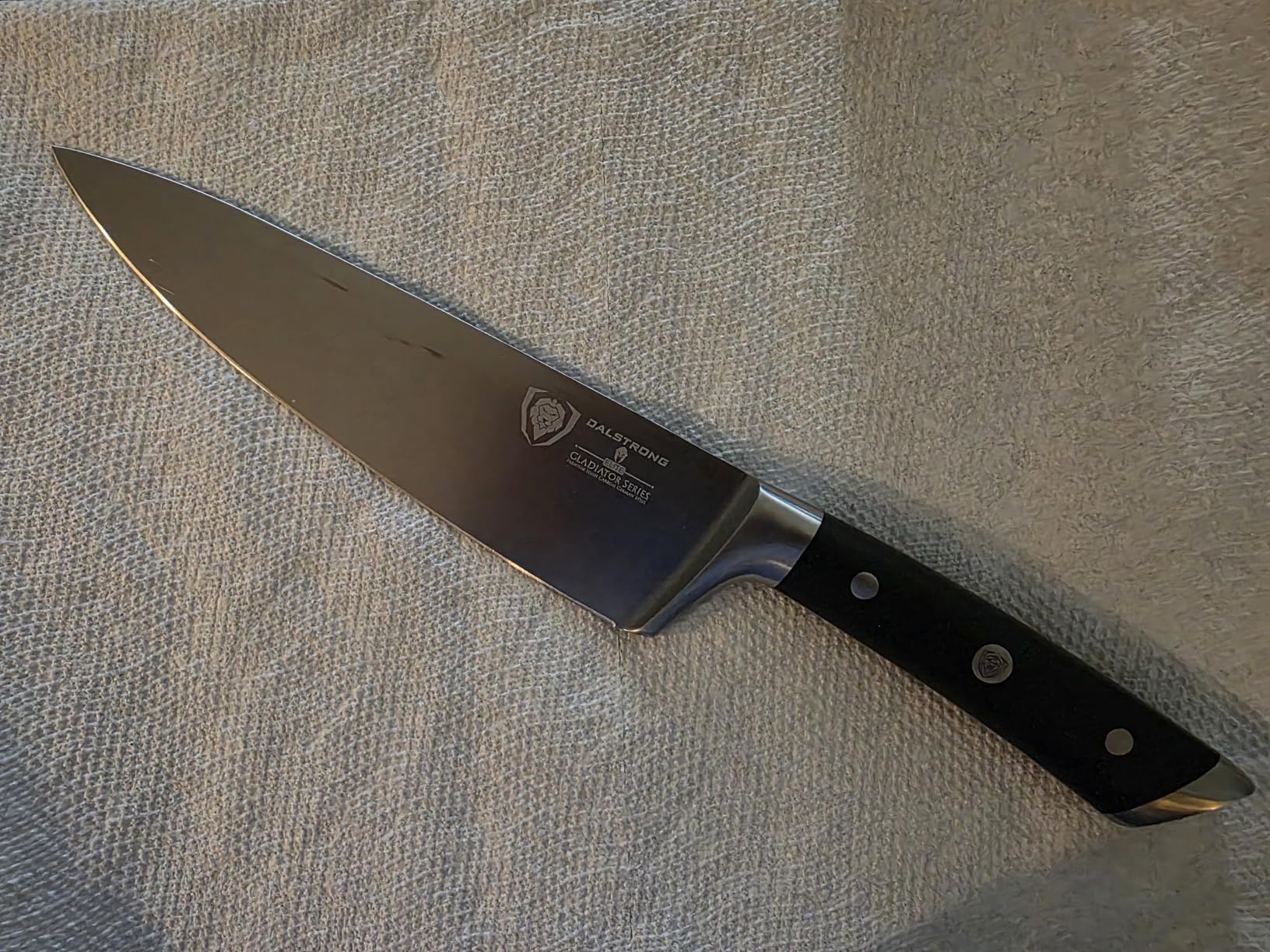
The Dalstrong is the pick when you want a knife that feels like an upgrade from a big-box starter blade and actually is one. Owners describe exactly that step: a full tang, forged high carbon German stainless at 56 plus HRC, and an edge that stays sharp with a steel hone instead of needing a stone every few weeks.
It weighs 8 oz, which is real mass without being a lifting tool. The tapered blade geometry adds knuckle clearance on the board so your guiding hand does not scrape the spine while you work through a large vegetable. That small detail is the difference between chopping for ten minutes and chopping for an hour.
The handle is triple riveted G10 with a hybrid bolster, a design that leaves the tang visible and the handle more rounded than a conventional bolstered German knife. It is NSF certified for professional kitchen use, and it comes with a sheath if you plan to carry it anywhere.
The honest drawback is that the handle is on the large side, and reviewers with smaller hands say so directly. It is also a higher hardness steel, which means occasional whetstone sharpening to keep peak performance rather than living on a rod forever.
Who the Dalstrong suits
This one suits confident choppers with larger hands who want a professional pattern and a sheath for travel or a rental kitchen. It is the most convincing step up in construction quality here without moving into the price band of the Japanese and forged-block German knives.
If you like a slight forward weight for power cuts and do not mind sharpening occasionally, the edge retention rewards you for it. Bring a honing rod into the routine from week one.
Who should skip it
Small-handed cooks should skip it and look at a shorter, lighter blade. A six inch handle wrapped around a smaller palm makes fine slicing work harder than it needs to, and that shows up in your wrists rather than your knife.
Skip it if you want zero maintenance. Between the heavier feel and the sharpening expectations, this is a knife for someone who enjoys the craft side of cooking rather than someone who wants to throw it in a dishwasher at the end of the night.
9. Mercer Culinary Renaissance 8 Inch – Best for Pinch Grip
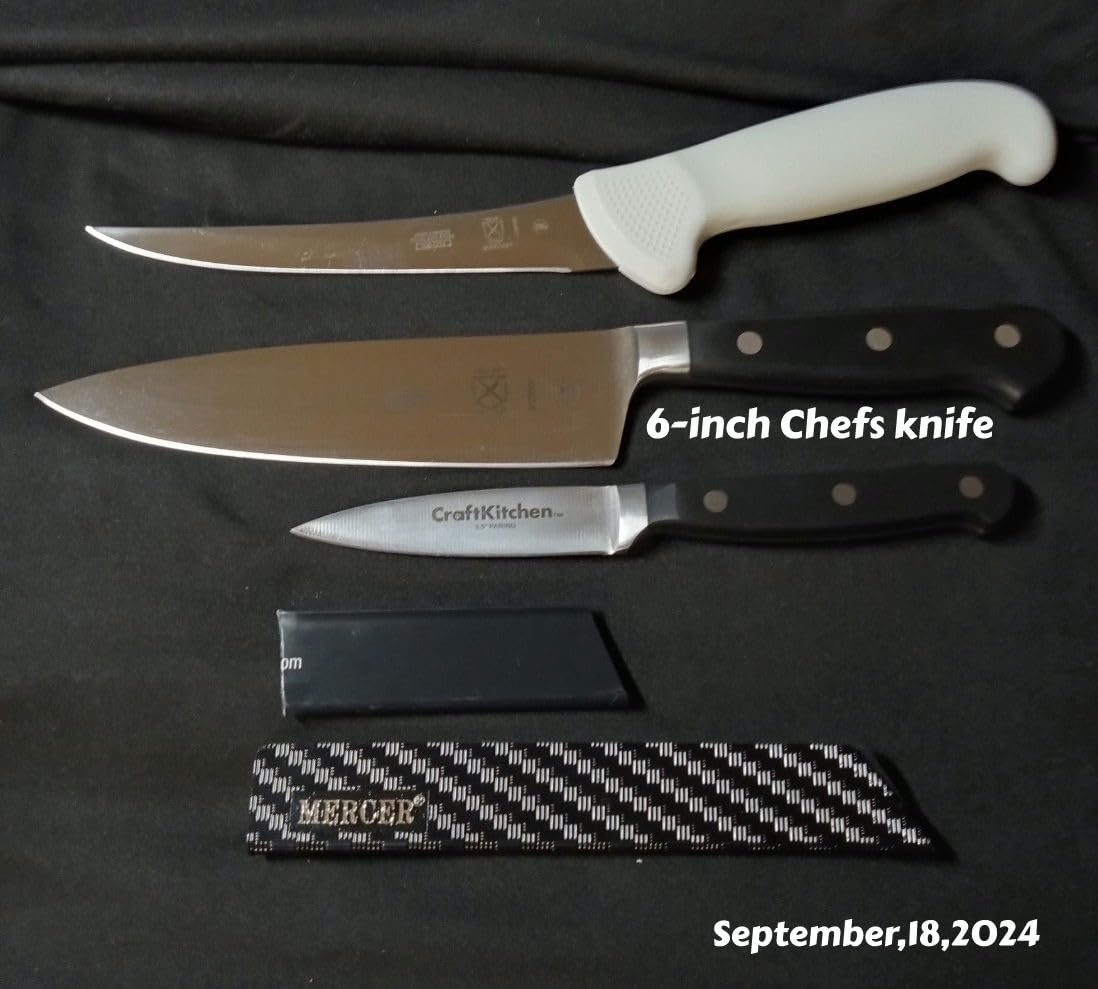
Mercer Culinary M23510 Renaissance, 8-Inch Chef’s Knife
Blade: 8 inch fully forged high carbon
Handle: triple rivet Delrin
Weight: 8.8 oz
Warranty: lifetime
Pros
- Forged steel from the premium German family
- Shortened bolster makes sharpening easy
- Rounded spine suits a pinch grip
- Triple rivet Delrin handle
- Lifetime warranty and US support
Cons
- Some units show cosmetic blemishing or light rust
- 8 inch may be short for large batch prep
- Taller profile does not fit standard block slots
The Renaissance is the knife most culinary school programs and restaurant kitchens reach for, and reviewers on r/BuyItForLife treat it as the standard recommendation for someone moving past starter knives. The blade is fully forged high carbon stainless from the same steel family the premium German brands use.
The shortened bolster is the feature that matters most. Instead of a thick collar of steel where the blade meets the handle, the full flat of the blade is exposed, so you can run a whetstone along the entire length. It is the reason people who learn to sharpen keep this knife rather than trading up.
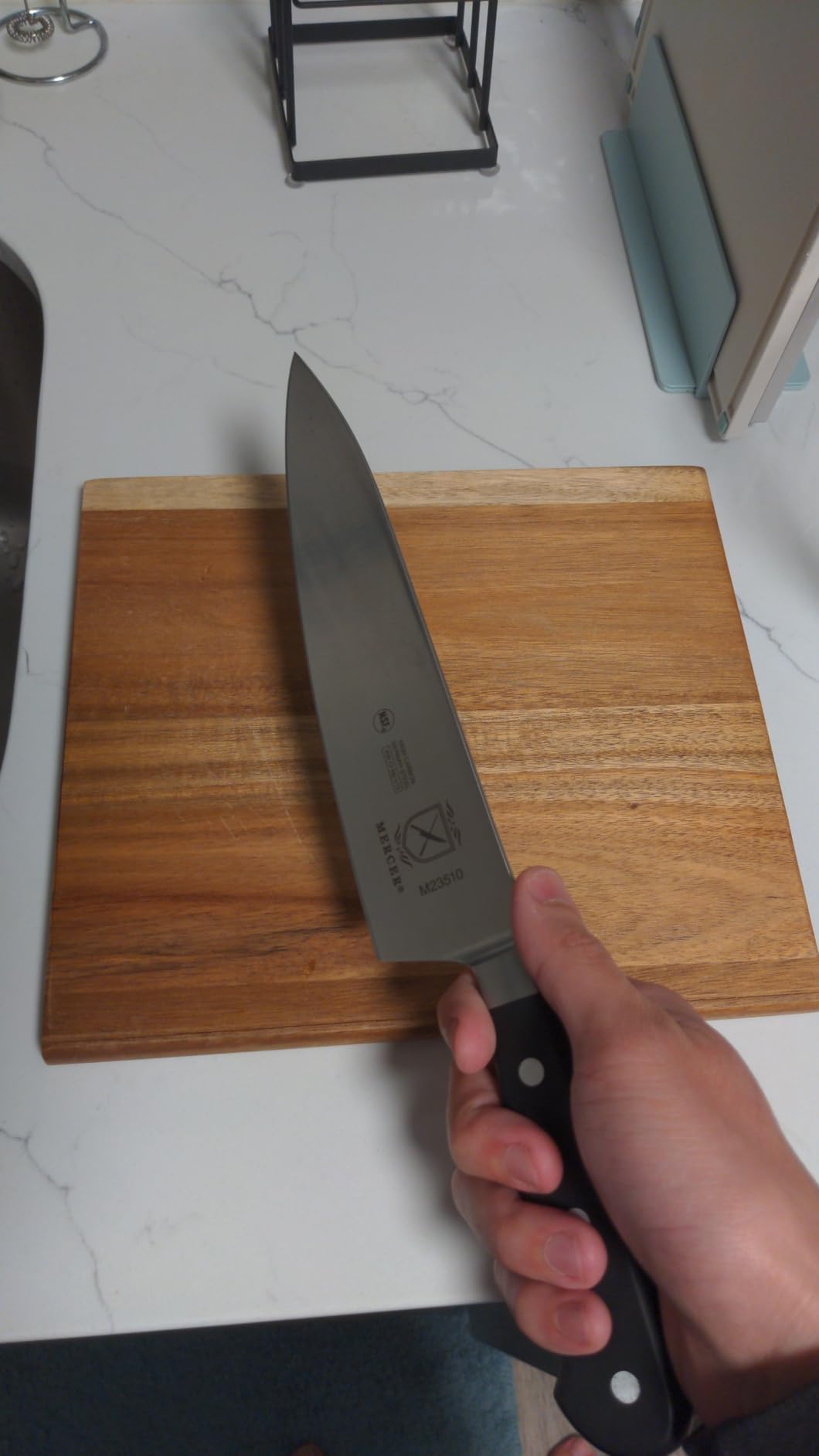
At 8.8 oz it is on the heavier side, and the rounded spine sits comfortably against a pinch grip where a squared spine would dig into your knuckles. The handle is triple riveted Delrin, which stays firm when wet and does not swell like wood.
Quality control is the one real complaint. A small number of owners report cosmetic blemishing or light rust spots on arrival, which is a factory finish issue rather than a steel problem. Check the blade before you start using it and keep it dry when you store it.
Who the Mercer Renaissance suits
Pick it if you plan to own one knife for many years and you are willing to learn a whetstone. The shortened bolster means sharpening stays simple forever, and reviewers specifically report edge retention improving after a proper stone sharpening rather than degrading.
It suits cooks who prefer a pinch grip over a full handle grip, and it is a good fit for culinary students or anyone moving into a shared kitchen where a heavier tool feels normal.
Who should skip it
Skip it if you want a lightweight knife for long evening sessions, or if your counter has a knife block with shallow slots, since the taller blade profile does not fit standard blocks. It wants a magnetic strip or a board-side edge guard instead.
Dishwasher use will dull and nick the edge, so treat the lifetime warranty as assuming hand washing. Our knife set guide for home cooks covers how to store a forged blade so it stays sharp.
10. Amazon Basics 8 Inch Full Tang Chef’s Knife – Budget Pick
Amazon Basics Classic 8-inch Full Tang High Carbon Stainless Steel Chef’s Knife, Multipurpose Kitchen Knife with Three Rivets, Silver
Blade: 8 inch high carbon stainless
Handle: three rivet stainless
Weight: 0.23 kg
Length: 13.28 inches
Pros
- Well balanced with a confident chopping weight
- Sharp out of the box
- Three rivet stainless handle is sturdy
- Satin finish resists stains and pitting
- Semi bolster gives full blade access
Cons
- Cheaper steel needs very frequent sharpening
- Hand wash only
- All metal handle can feel cold or slippery
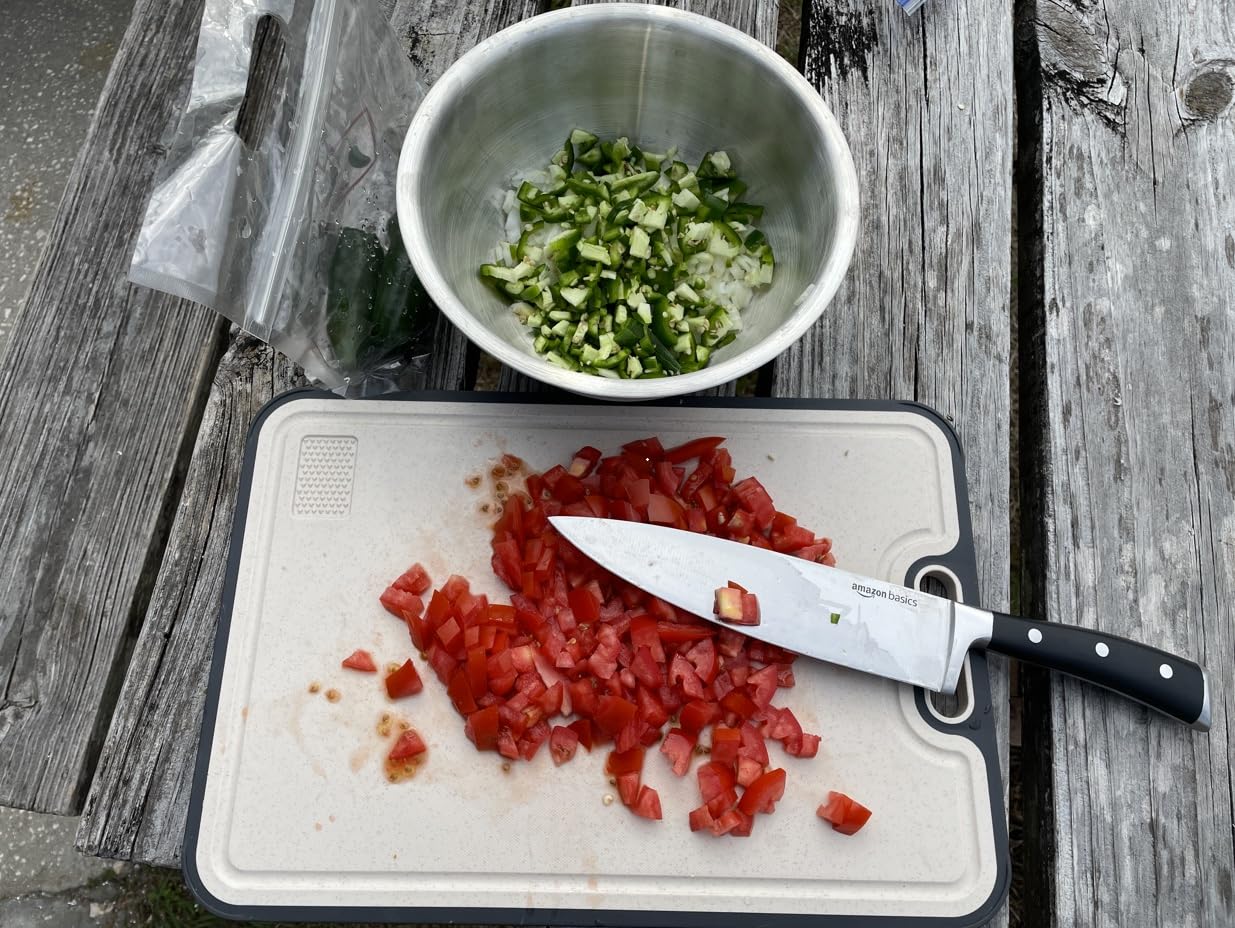
This is the least expensive knife in the roundup and it is also the one with the fewest compromises in construction. The blade is 8 inches of high carbon stainless with a satin finish, forged with a full tang and secured to the handle with three rivets. For the money, that is a real spec sheet rather than a thin stamped blank.
At 0.23 kg it has a solid weight that feels confident for chopping, and the semi bolster design adds forward mass while leaving the full blade accessible when you sharpen. The whole knife measures 13.28 inches long, which sits at the top of the range for an 8 inch blade.
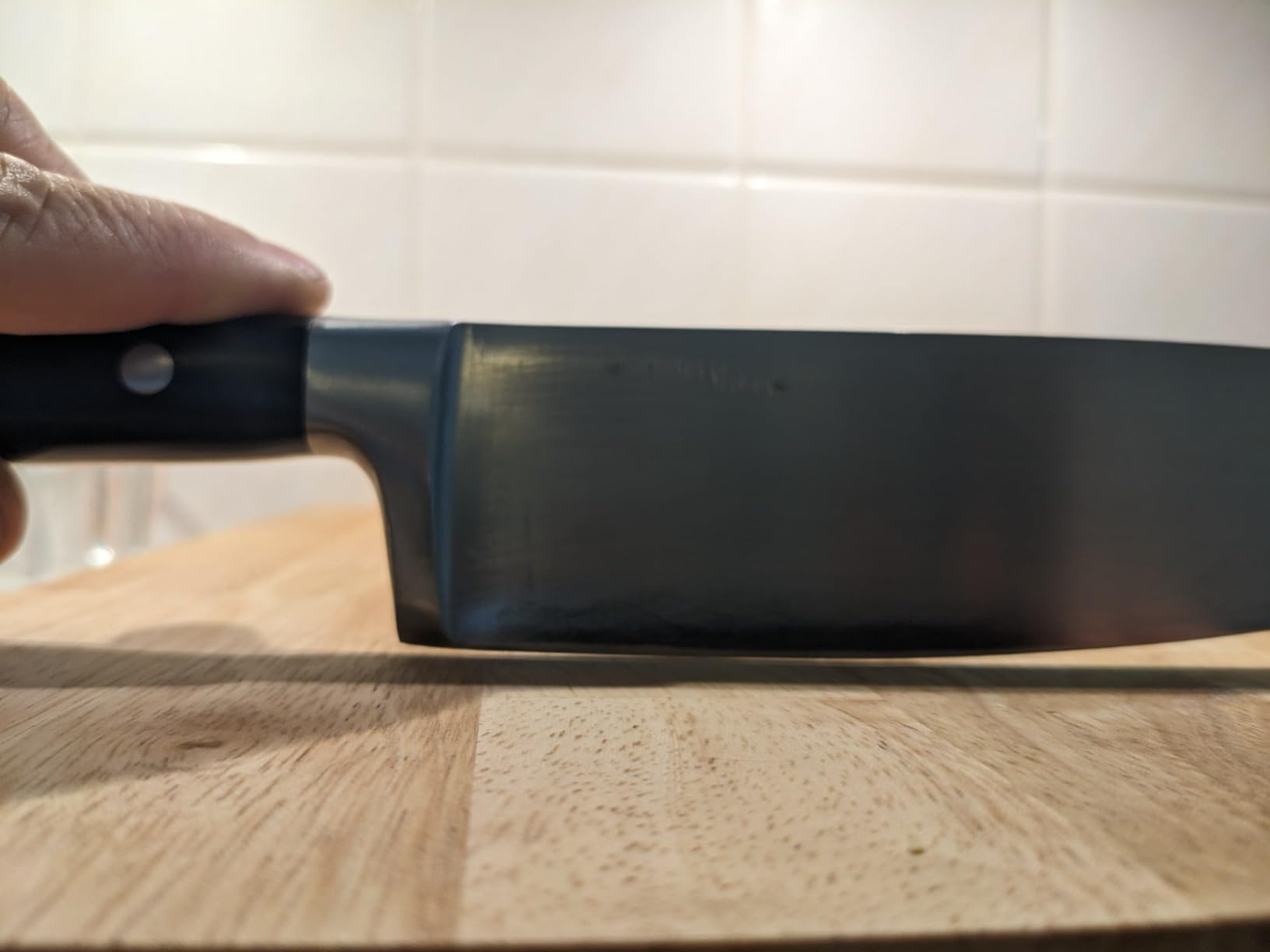
Reviewers consistently describe it as a solid daily driver: sharp, balanced and sturdy. The satin finish is stain, rust and pit resistant, which is useful if you are not disciplined about drying a knife immediately.
The repeated caveat is edge frequency. The steel is the entry-level end of the high carbon range, so it dulls faster and needs more regular honing than the forged blades higher up this page. The all-metal handle is also the least warm of the group and can feel slippery when wet.
Who the Amazon Basics suits
This suits a first kitchen, a dorm, or anyone who wants a genuinely usable chef’s knife without spending enough to feel nervous about it. If the knife gets damaged or lost, replacing it is a low-stakes decision rather than a crisis.
It is also a good backup for a vacation rental or a cabin, where you want a full tang knife you do not have to think about losing. The riveted stainless handle survives being dropped and washed without any special treatment beyond hand washing.
Who should skip it
Skip it if sharpening feels like a chore, because that is the one thing you will have to do more often than with any forged blade here. If you have zero interest in a honing rod, move up to the Henckels or the Mercer Renaissance.
Cooks who care about how a knife feels as much as how it performs should look for a handle with some texture or warmth. Metal against a wet palm is the wrong answer for a lot of hands.
11. FAMCUTE 8 Inch Hand Forged Chef Knife – Best Multi Layer Steel
FAMCÜTE 8″ Japanese Knife, Hand Forged Sharp Chef Knife w/Rosewood Handle
Steel: 5 layer 9Cr18MoV at HRC 62
Handle: rosewood octagonal
Blade: 8 inch, 36.5 cm overall
Pros
- Hand forged 5 layer steel rated up to HRC 62
- Octagonal rosewood handle reduces fatigue
- Good balance and control at any angle
- Vacuum nitrided and electroplated finish
- Sharp out of the box
Cons
- Hard steel needs careful sharpening technique
- Rosewood handle needs hand washing and oiling
- Listing gives no weight specification
The FAMCUTE is the least obvious pick here and the one I would most want a serious cook to notice. Five layers of 9Cr18MoV steel, hand forged, rated up to HRC 62, with a 60 day production process that includes quenching, vacuum nitriding and electroplating. That process list is not filler, nitriding is what buys the corrosion resistance at this hardness.
The handle is the real differentiator. It is an octagonal rosewood handle, which is a traditional Japanese knife shape rather than a modern riveted handle, and it sits differently in the palm. Reviewers like that it supports precise cuts at almost any angle, including the reverse grip used for peeling and shaping.
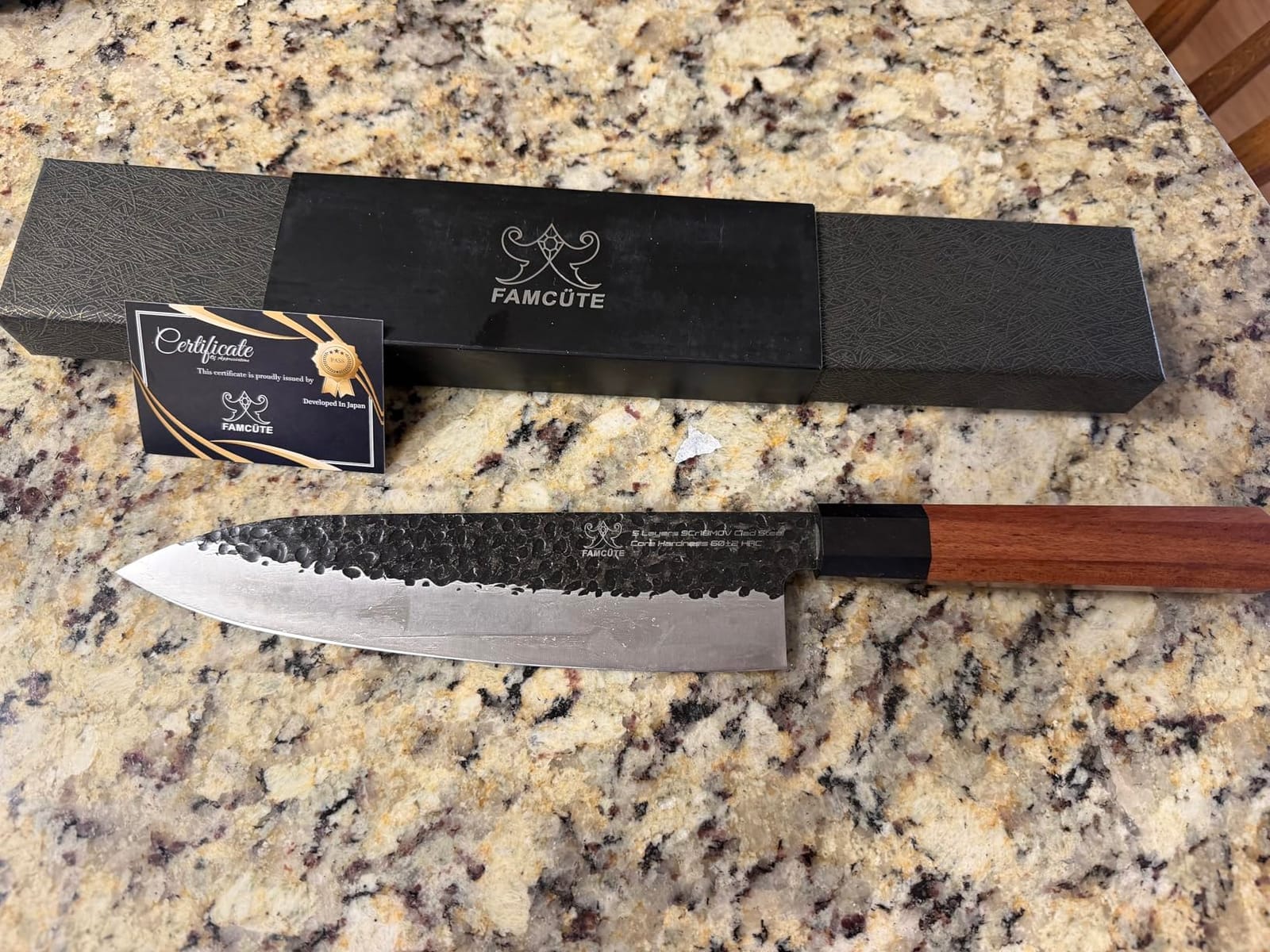
Feedback emphasises confident, precise cuts with less fatigue than expected. The tradeoff mirrors the SHAN ZU, because at HRC 62 the steel wants a proper sharpening technique and will punish careless handling more than a softer stainless blade would.
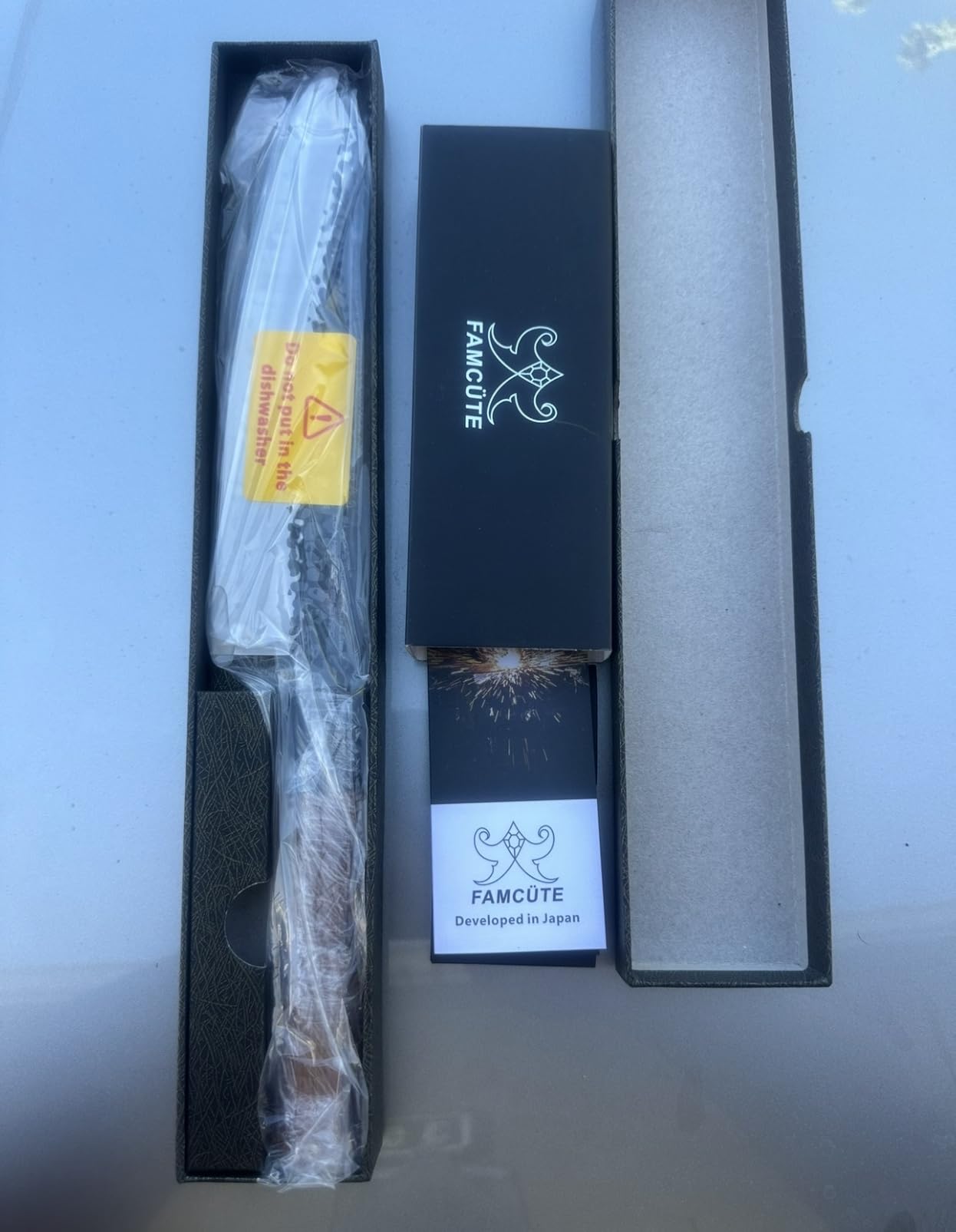
Two practical notes. The rosewood needs hand washing and occasional oiling to keep looking good, and the listing does not state a weight, which makes it hard to predict the feel before it arrives. Overall length is 36.5 cm with an 8 inch blade.
Who the FAMCUTE suits
Pick it if you want a hand-forged multi-layer blade and a wooden handle without stepping up to a full price knife. It is a genuinely different object from the riveted western knives around it, and cooks who like a traditional grip tend to be delighted by it.
It suits precise work, especially peeling, shaping and detailed vegetable prep, and the octagonal handle works well with a pinch grip. There are 7 inch and nakiri variants if you later want to round out a kit.
Who should skip it
Skip it if you need one knife that tolerates being dropped, bashed against a board, or left in a sink. Hard steel and a wooden handle both reward a gentler approach, and that is the opposite of what some busy cooks want.
Because no weight is published, buy it expecting a knife you will need to adjust to rather than one that feels familiar immediately.
12. Mercer Culinary Millennia 8 Inch Chef’s Knife – Best for New Kitchens
Mercer Culinary M22608 Millennia Black Handle, 8-Inch, Chef’s Knife
Blade: 8 inch one piece high carbon
Handle: Santoprene with finger points
Weight: 6.7 oz
Tang: full
Pros
- One piece high carbon Japanese steel
- Textured Santoprene grip stays non slip
- Full tang balance for chopping and mincing
- Light 6.7 oz build reduces fatigue
- Handles garlic crushing and shredding
Cons
- Stamped construction needs more frequent sharpening
- Hand wash only since dishwasher voids warranty
- Santoprene can feel slippery when heavily worn
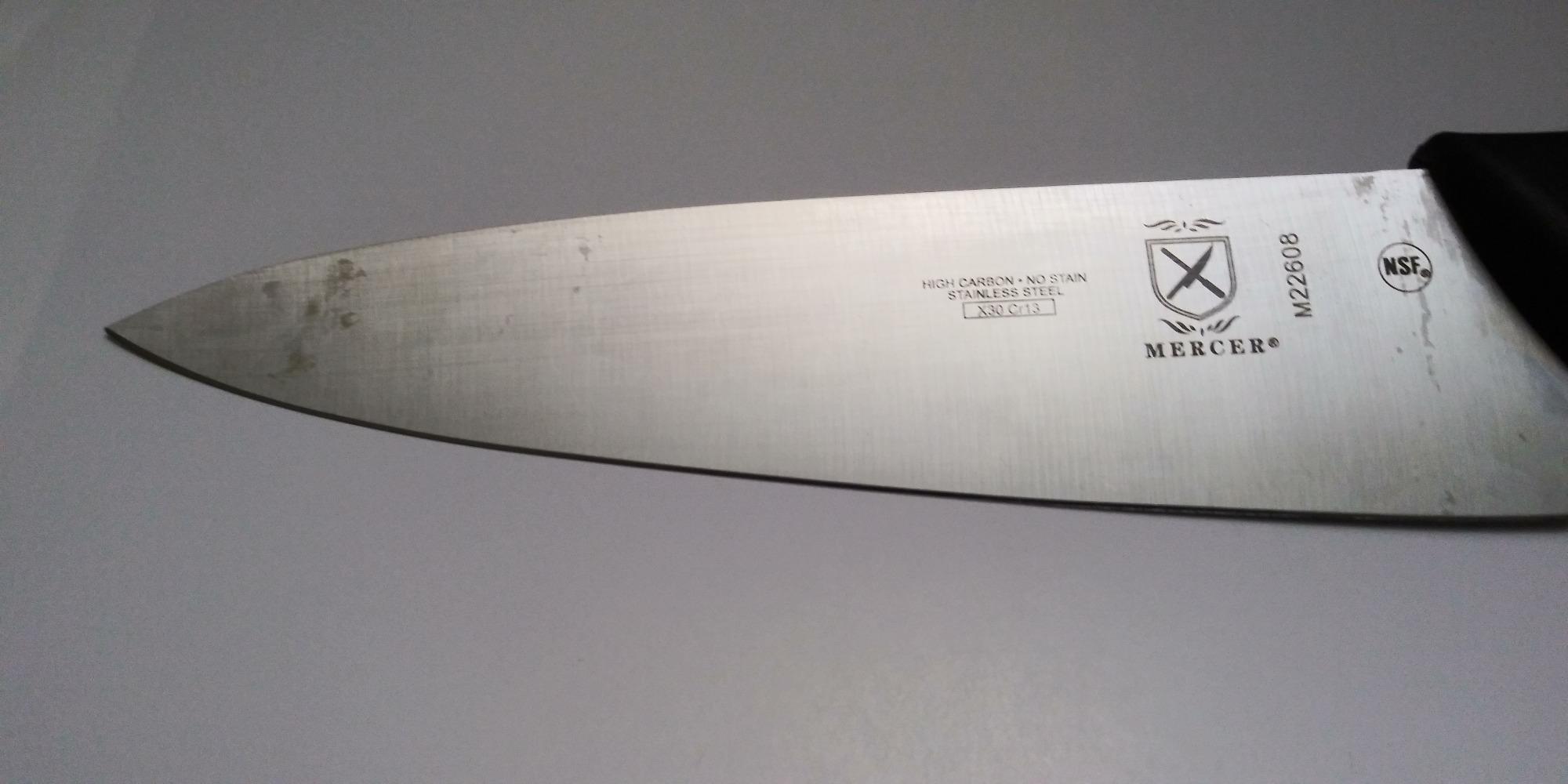
The Millennia is the line that gets handed out in culinary school, and it remains the safest recommendation for someone building a first kitchen from scratch. The blade is one piece of high carbon Japanese stainless, the handle is Santoprene with textured finger points, and the whole thing weighs 6.7 oz.
Those finger points are an old-school ergonomic trick. The soft Santoprene moulds into slightly raised pads under your fingers, so the knife does not slide forward in a wet hand mid-cut. Reviewers single this out as the reason the knife feels secure on a cutting board covered in onion.
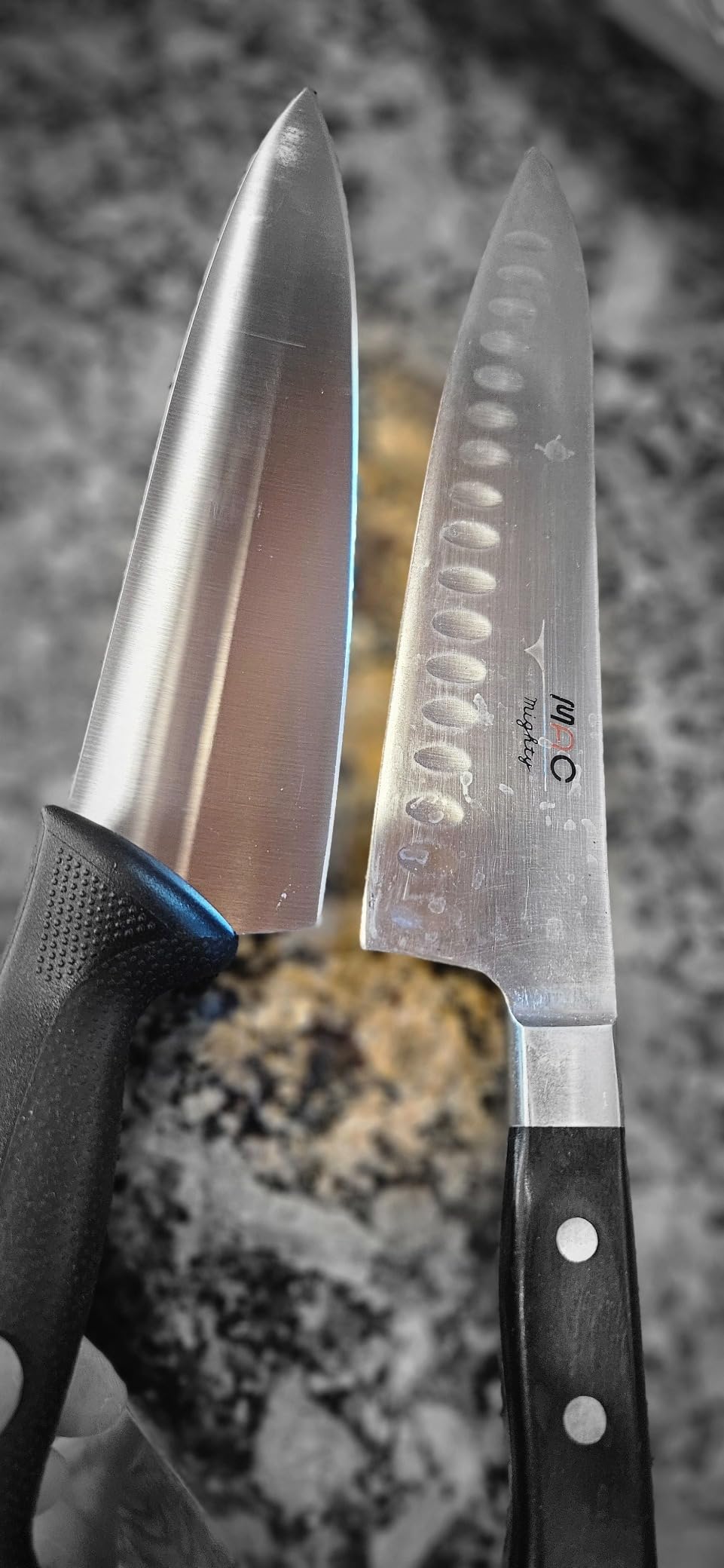
The full tang gives it balance for chopping, mincing and dicing, and reviewers note it handles dicing onions, mincing shallots, chopping herbs, crushing garlic and shredding cabbage without complaint. That is the everyday list, and it is exactly what a home cook actually needs.
The stamped construction means more frequent sharpening than forged rivals, and the warranty explicitly excludes dishwasher use. Hand washing takes ten seconds and protects an edge that would otherwise dull inside a few cycles.
Who the Mercer Millennia suits
This is the pick for a first serious knife, a student kitchen, or anyone who wants the answer that professionals actually use rather than the most fashionable option. At 6.7 oz it is comfortable for long sessions and easy to control.
It also suits cooks who cook with wet hands a lot, because the finger points genuinely improve grip security in a way most budget handles do not.
Who should skip it
Skip it if you want a forged blade that holds an edge for months, or if you want to run the dishwasher. The stamped steel is the trade you make for the low price and the comfortable handle.
After a couple of years of daily use, Santoprene handles can feel slippery where they have worn smooth. If that happens the knife still works perfectly well, it just needs a new grip surface or a mental adjustment. Pair it with the right board rather than a glass one, and you will extend edge life, as we cover in our home cook kitchen gear guides.
How to Choose the Best Chef Knives for Home Cooks Under $100
Steel determines how long the edge lasts and how you maintain it. High carbon stainless is the sweet spot for home cooks: it holds an edge well, resists rust, and does not need oiling. Blades at HRC 56-58 are forgiving and easy to hone, while blades at 62 HRC hold a finer edge and chip more easily if abused.
Forged versus stamped is the second decision. Forged blades are shaped from a single piece of steel, which gives them a continuous spine-to-edge taper, better balance and usually a full tang. Stamped blades are cut from sheet steel, which makes them thinner, lighter and cheaper, and usually means more frequent sharpening.
Full tang means the steel runs the entire length of the handle. Partial tang means it stops partway, and rattail tang means it is a narrow pin between the handle scales. For home cooking, full tang is worth paying for if your budget allows, because it is what keeps a handle from loosening after years of use.
Blade length matters more than most spec sheets suggest. Eight inches is the standard for a reason, and it fits most cutting boards and most home dishwashers. Nine and ten inch blades handle large batches better but are harder to control and do not fit standard knife blocks.
Weight and balance decide whether you enjoy the knife after twenty minutes. Light knives under 150 g reduce fatigue and are easier to control for most home cooks. Heavy knives above 250 g power through dense vegetables and bone-adjacent work but tire smaller hands. The useful number is where the weight sits, not just the total.
Edge angle tells you how the knife feels. Fifteen degree per side produces a keener, slicing-oriented edge that needs more frequent sharpening. Twenty degree is more forgiving, more durable and easier to maintain with a basic rod.
Care habits decide how long any of these last. Hone before every significant prep session with a steel rod, hand wash and dry immediately, store on a magnetic strip or in a block with slots that do not press on the edge, and avoid glass and stone cutting boards. Cut on wood or end-grain boards and a sharp edge stays sharp far longer.
Sets versus individual knives is worth stating plainly. A single great chef’s knife plus a paring knife plus a bread knife beats any block set you can buy in this bracket, and the forums agree on this consistently. The block is storage, not quality, and most sets give you three good knives surrounded by nine mediocre ones.
Warranty is a rough proxy for how a brand expects the knife to be treated. Lifetime warranties from Victorinox, Henckels and Mercer assume hand washing for anything beyond the stamped models. Shorter warranties on harder steel knives usually reflect a narrower promise, not a worse knife.
Frequently Asked Questions
What knives do chefs like?
Professional kitchens lean on a small number of workhorse patterns: an 8 inch chef’s knife for general prep, a paring knife in hand for detail work, and a bread knife for anything with a crust. The brands that show up most often in restaurant and culinary school settings are Victorinox, Mercer and Henckels, because they are easy to replace, easy to sanitize and easy to hand to a new hire.
What are the top 5 best knives?
Across this roundup the five strongest picks are the Victorinox Fibrox Pro for overall reliability, the Henckels Classic 8 inch for German tradition and low maintenance, the Mercer Culinary Renaissance for a forged blade with easy sharpening, the SHAN ZU Damascus for the sharpest factory edge, and the PAUDIN for the best balance of capability and cost. Each one suits a different cook rather than a different budget.
What brand of chef knife does Gordon Ramsay use?
Gordon Ramsay is associated with Global knives, particularly the Global 8 inch chef’s knife with its distinctive all-steel handle and dot pattern. Global knives usually sit above this budget bracket, which is why the shorter Global-style profile and the lighter forged options here are the closest alternatives for home cooks who like that all-metal handle feel.
What is the best affordable knife block set?
Most home cooks are better served by buying one good chef’s knife, one paring knife and one bread knife individually rather than by a block set. Sets in this budget usually include three usable knives and nine pieces of filler, and the good knives inside them are often the same models sold on their own. If you want a set for gifting, choose one with a real honing steel or edge guard included.
Final Verdict: The Best Chef Knives for Home Cooks Under $100
If you buy only one thing from this list, make it the Victorinox Fibrox Pro 8 inch. It has the deepest review base in the bracket, the shortest learning curve, and the least ways to disappoint you, which is the right combination for a knife most people will use every week for years.
Buy the Henckels Classic if you want a forged German blade with a lifetime warranty and dishwasher tolerance. Buy the SHAN ZU if you already know how to sharpen and want the keenest edge available. Buy the PAUDIN if you want a capable knife for the least money, and the Mercer Millennia if this is your first serious knife.
Whatever you choose, add a honing rod and a magnetic strip to the purchase. Those two cheap tools do more for a knife’s useful life than spending twice as much on the blade does, and they are where most of the value in this bracket is hiding.