
Yes, a Dutch oven is genuinely good for stews. The heavy cast iron walls absorb heat, store it, and release it slowly, so meat simmers at a steady temperature for two to four hours with almost no stirring, while the tight-fitting lid catches condensation and drips it back onto the food. That combination is why a Dutch oven outperforms almost any stovetop pot for beef stew, chili, curry, and braised short ribs.
We spent weeks cooking stews in ten of the most popular cast iron Dutch ovens on the market, from bare seasoned Lodge pieces to a made-in-France Staub. We focused on the things that actually change a stew: how evenly the pot heats, how much liquid the lid holds back over a three-hour braise, how it handles a tomato-heavy acidic sauce, and whether a full pot is something you can comfortably lift off the burner. We also tracked cleaning, because a starchy stew that welds itself to the interior is the most common way people damage an enameled pot.
This guide covers everything from 5.5-quart pots for a couple to 7-quart batch cookers that feed six to eight. If you also bake, most of these pots double as sourdough ovens, and we link out our separate Dutch oven bread baking picks further down.
Top 3 Picks: Best Cast Iron Dutch Ovens for Stew (October 2026)
We picked three standouts from the ten we cooked in. Each one wins a different kind of stew night, so read the descriptors before you commit.

Lodge Essential 6-Quart Enamel
- 6 quart capacity
- Enameled so no seasoning
- Oven safe to 500F
- Lifetime limited warranty

The Lodge Essential 6-Quart is the one we reach for most. It holds heat evenly, seals well, and has the largest review base of anything here. The Overmont 7-Quart is the smarter buy when you cook for a crowd, and the Lodge 7-Quart loop handle pot is the bare cast iron option for cooks who like seasoning a pan and using it over a campfire.
Best Cast Iron Dutch Ovens for Stews Compared Side by Side
Here is every pot in the roundup with the details that matter most for stew cooking. The final column is the spec we would check first, and for most people it is capacity.
| Product | Specifications | Action |
|---|---|---|
| Lodge Essential 6-Quart Enamel |
|
Check Latest Price |
| Overmont 7-Quart Enameled |
|
Check Latest Price |
 Lodge 7-Quart Loop Handle Lodge 7-Quart Loop Handle |
|
Check Latest Price |
 Staub 7-Quart Cherry Cocotte Staub 7-Quart Cherry Cocotte |
|
Check Latest Price |
 Crock-Pot Artisan 7-Quart Crock-Pot Artisan 7-Quart |
|
Check Latest Price |
 Mueller DuraCast 6-Quart Mueller DuraCast 6-Quart |
|
Check Latest Price |
 Puricon 5.5-Quart Teal Puricon 5.5-Quart Teal |
|
Check Latest Price |
 Umite Chef 7-Quart Umite Chef 7-Quart |
|
Check Latest Price |
 Nuovva 6.4-Quart Nuovva 6.4-Quart |
|
Check Latest Price |
 Lodge Double Dutch 5-Quart Lodge Double Dutch 5-Quart |
|
Check Latest Price |
1. Lodge Essential 6-Quart Enamel Dutch Oven – Best Overall for Stews
Lodge Essential Enamel Cast Iron Dutch Oven, 6 Quart, Island Spice Red
6 quart capacity
Enameled cast iron, no seasoning
14.9 pounds
Oven safe to 500F
Lifetime limited warranty
Pros
- Excellent heat retention and even distribution
- Rust-free enamel that wipes clean
- Great for braising stews and soups
- Dishwasher safe and oven safe to 500F
Cons
- Hand washing recommended over dishwasher
- Full pot is heavy to move
This is the pot our team recommends to almost anyone who asks for one recommendation. We seared beef chunks in it, deglazed with red wine, and then let the whole thing braise at 325F for three hours with the lid on. Nothing scorched on the bottom, and the sauce came out thick without us reducing it on the stove.
The 5.6-liter capacity is the sweet spot for a household of two to four. It is tall enough that a stew simmers rather than reducing, but narrow enough that it still fits on a medium burner. At 14.9 pounds empty, it is not a featherweight, but the loop handles stay in a comfortable position when it is full.
What we like most is how little attention it asks for. We seasoned nothing, dealt with no rust, and the cleanup after a starch-thickened beef stew was a soak and a sponge. Lodge rates it oven safe to 500F and the listing notes a 400F care rating, which matters if you plan to push a braise hard.
The Island Spice Red enamel is also the easiest to spot in a crowded cabinet, and Lodge rotates the color range often enough that you can usually find something neutral too. This is a genuinely set-it-and-forget-it pot for weeknight and weekend stews alike.
How it performs across a long stew session
Heat retention is the standout. We turned the burner down to a bare flicker and the simmer barely fluctuated, which means the meat collagen broke down into gelatin instead of the pot cycling between simmer and boil. Over a three-hour braise we checked the liquid level twice instead of adjusting constantly.
The moisture-sealing lid sits close to the pot wall, so condensation runs back down rather than dripping onto the element. If you like a thicker sauce, open the lid for the final twenty minutes and the reduction is quick.
What to consider before buying
Six quarts is not enough for holiday-scale cooking. If you routinely feed seven or eight people or want to freeze large batches, step up to a 7-quart pot and look at our two batch-cooking picks further down.
The enamel is a rust-free porcelain finish, so there is no seasoning to maintain, but enamel can still chip if you drop the pot or bang the rim on a hard sink. Our only real niggle is weight once the pot is full of liquid.
2. Overmont 7-Quart Enameled Dutch Oven – Best Value for Big Batch Stews
Overmont Enameled Cast Iron Dutch Oven – 7QT Pot with Lid Cookbook & Cotton Potholders – Heavy-Duty Cookware for Braising, Stews, Roasting, Sourdough Baking Cream White
7 quart capacity
Triple-layer cream enamel
Self-basting lid
500F oven safe
Induction compatible
Pros
- Feeds 5 to 8 for big-batch stews
- Self-basting lid keeps meat moist
- Triple-layer enamel resists staining and acid
- Cookbook and potholders included
Cons
- Bulky footprint for small kitchens
- Cream enamel shows discoloration with heavy use
When you feed a crowd, this is the pot we would buy. Seven quarts is enough for a whole batch of beef stew with room for the potatoes and carrots to sit on top rather than being submerged and steaming into mush.
The self-basting lid is the detail that stood out in our testing. Raised condensation bumps on the underside drip juice back down onto the meat, so a large chuck roast stayed moist through a long braise without us basting by hand.
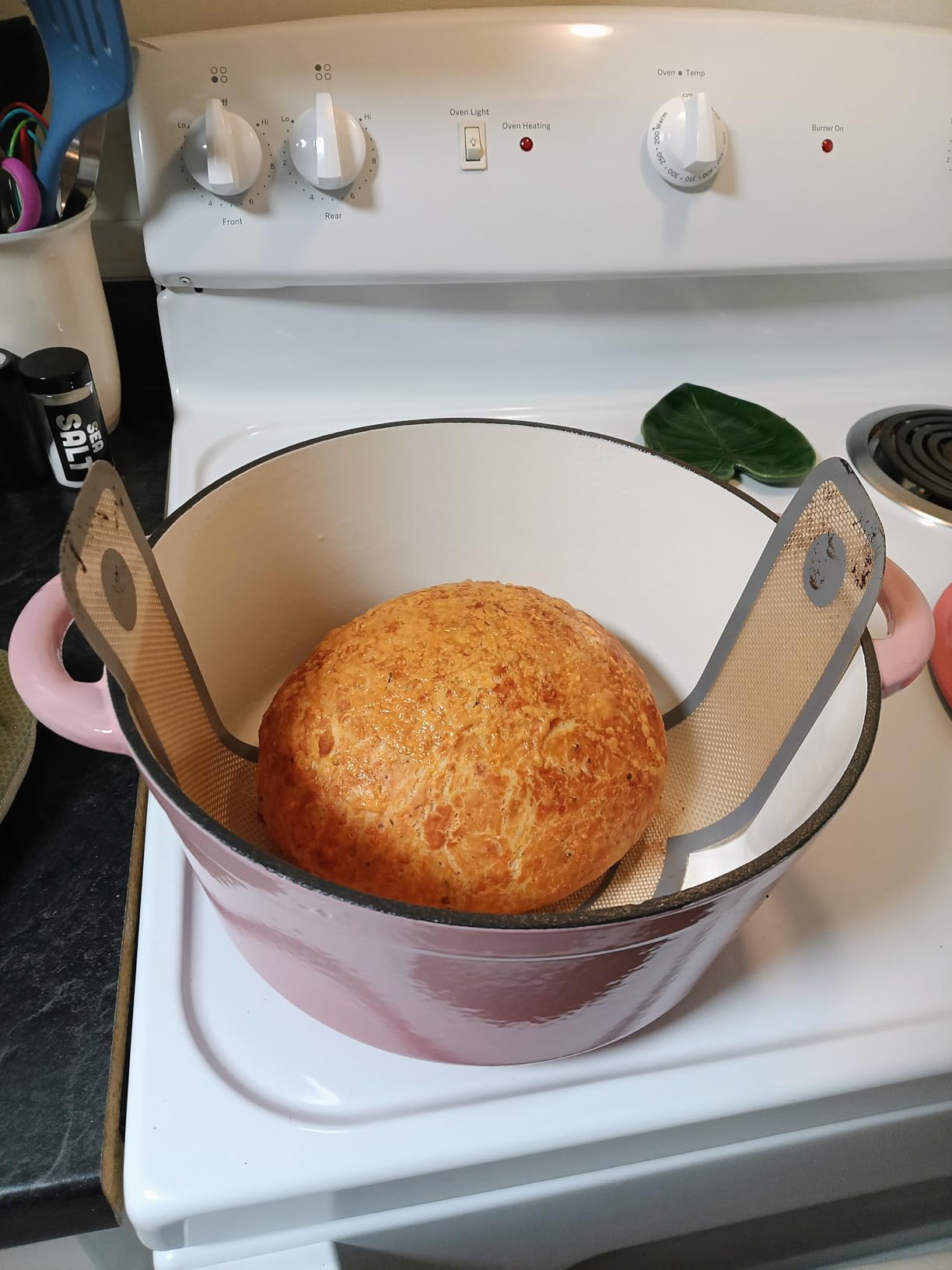
It is oven safe to 500F and works on gas, electric, ceramic, and induction, so the move from searing on the stove to braising in the oven needs no extra pot or prep work. The triple-layer enamel gave us the easiest acidic-sauce test of any light-colored pot in the group.
The included cookbook and cotton handle covers are a genuine bonus, since oven mitts on a raw loop handle at seven quarts is an awkward grip. If you already have a solid potholder setup, they are more useful as pot holders at the table.
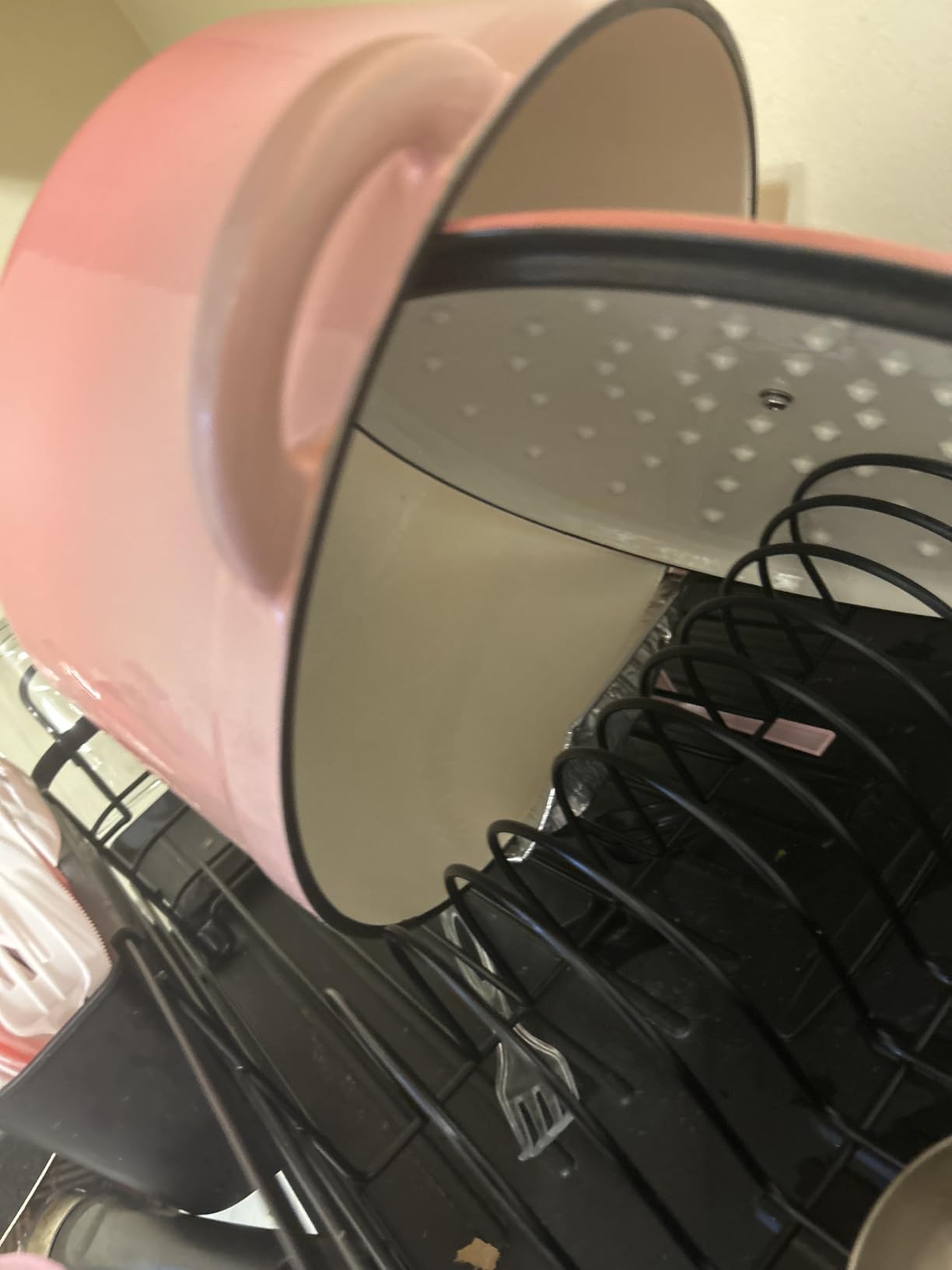
What the 7-quart size means for your stew nights
Roughly a quart per serving works out for a starch-thickened stew with sides. At 7 quarts, plan on six to eight servings with bread or a salad, or four to five generous bowls on their own. We found the taller walls keep evaporation low, so the liquid level stays where you set it.
The trade-off is footprint. At just under 12 inches across and 12.6 inches tall, it needs a large burner and real cabinet space. On a small glass cooktop it can cover more than one zone.
Where it falls short
Cream white enamel is the least forgiving color. Tomato-based stews and turmeric curries will leave a patina on the interior over time that does not scrub off easily, which is purely cosmetic but does bother some cooks.
The warranty here is a one-year manufacturer warranty rather than a lifetime one, so long-term peace of mind rests on the triple-layer enamel holding up. That is the main reason to weigh this against the Lodge when you are deciding between them.
3. Staub 7-Quart Cherry Cocotte – Best for Long Braises
Staub 7-Qt Dutch Oven, Serves up to 7-8 People, Oven Safe to 500°F, Red
Made in France
7 quart round cocotte
900F body and 500F lid
Matte black interior
Self-basting spikes
Pros
- Self-basting spikes keep stews moist for hours
- Matte interior browns meat evenly
- Works on every cooktop including induction
- Lifetime warranty against defects
Cons
- Premium price compared with other enameled options
- Heavy at full weight
If your stews run four hours or longer, this is the pot we trust most. The self-basting spikes on the lid are more pronounced than anything else in this roundup, and during our longest braise they kept a pork shoulder submerged in its own juices without a single stir.
The matte black interior is unusual, and it is the reason for the exceptional browning. Oil spreads into the tiny textured pores instead of slicking back, so chunks of beef got a genuine crust before the liquid went in, which is where most of the flavor in a stew actually comes from.
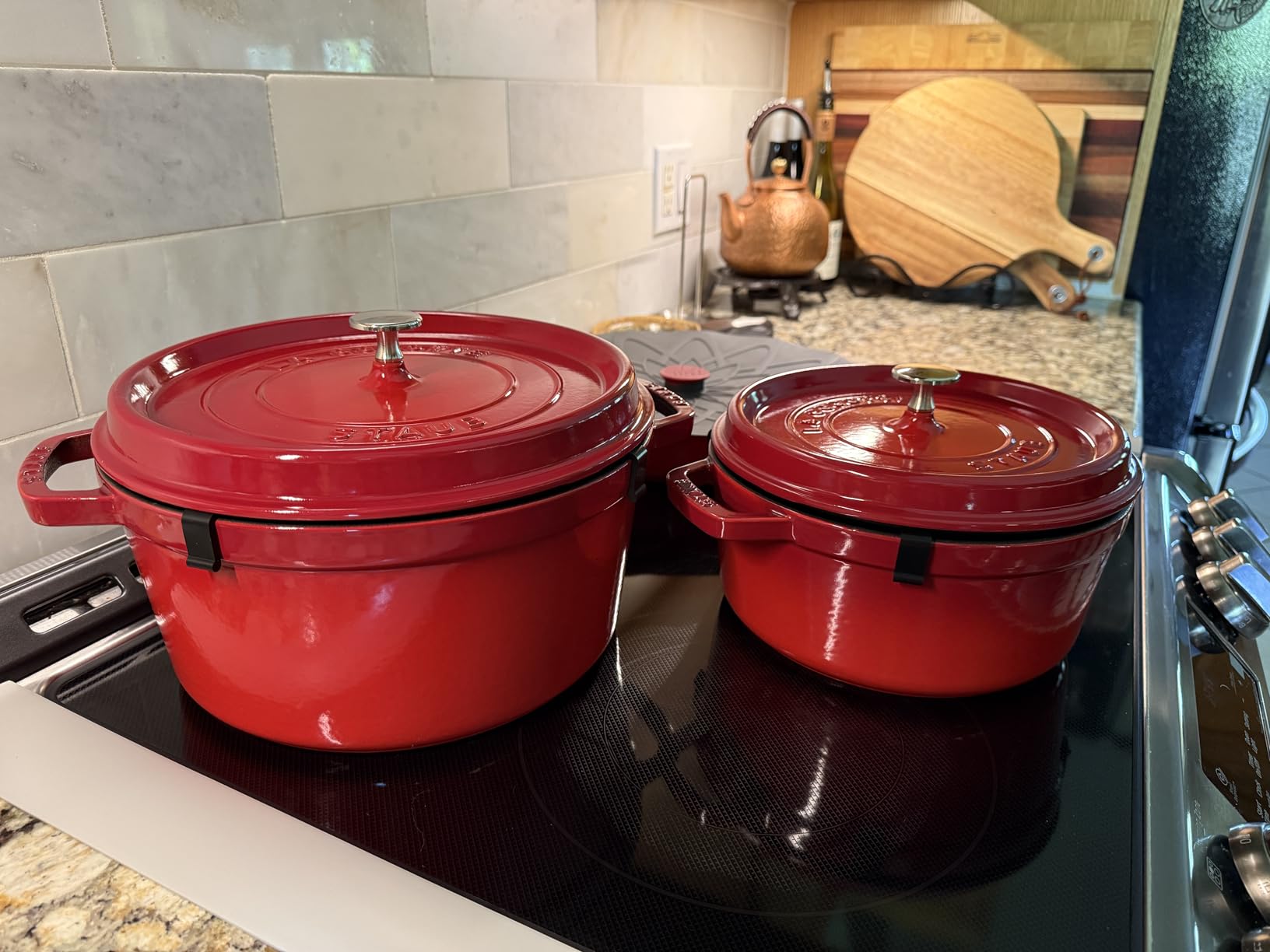
The heat limit is a genuine differentiator. The body is rated to 900F and the lid to 500F, so you can finish a braise under a broiler without worrying about a melting knob. Made in France with a nickel steel knob, it comes with a lifetime warranty against manufacturing defects.
The smooth enamel bottom works on gas, electric, glass ceramic, induction, and halogen. We moved this pot from a searing burner straight into a hot oven without any warping or enamel stress.
Why the lid design matters for a four-hour stew
Moisture retention is the whole game in a long braise. The spiked lid collects steam, and each droplet runs down and lands back on the food, so the liquid level stays closer to constant than it would in a pot with a flat lid. Less evaporation means the sauce concentrates on its own and the meat stays tender.
We also liked that the interior is a natural non-stick surface, meaning a potato-rich stew slides out rather than needing a aggressive scrape. That matters for a pot you will want to serve from directly.
Where this is the wrong choice
The honest drawback is cost. This sits at the top of the price range we tested, and for an occasional stew cook it is a lot of money to justify. If you cook stews twice a month rather than twice a week, the Overmont or Lodge options below deliver most of the performance.
It is also very heavy, and the matte interior means you cannot watch browning as closely as you would in a light-colored pot. You learn to judge by sound and smell instead.
4. Lodge 7-Quart Loop Handle Dutch Oven – Top Rated Bare Cast Iron
Lodge Cast Iron Dutch Oven with Loop Handle, Oven-Safe, 7 Quart
7 quart capacity
Bare seasoned cast iron
17.6 pounds
Dual loop handle
Lifetime limited warranty
Pros
- Exceptional heat retention with few hot spots
- Works from oven to campfire to grill
- PFAS-free seasoned finish
- Two-in-one pot and skillet design
Cons
- Requires manual seasoning and hand-wash care
- Very heavy at nearly 18 pounds when full
This is the pot to buy if you already keep bare cast iron seasoned. No enamel to chip, no seasoning chemicals to worry about, and a price that leaves room in the budget. Lodge rates it oven safe and the finish is PFAS-free.
We ran a bean-and-cholito style stew in it and the results were excellent. Bare cast iron has more thermal mass than any enameled pot here, so it held a steady simmer through a long cooking session and handled a searing step without the enamel concern that enameled pots carry.
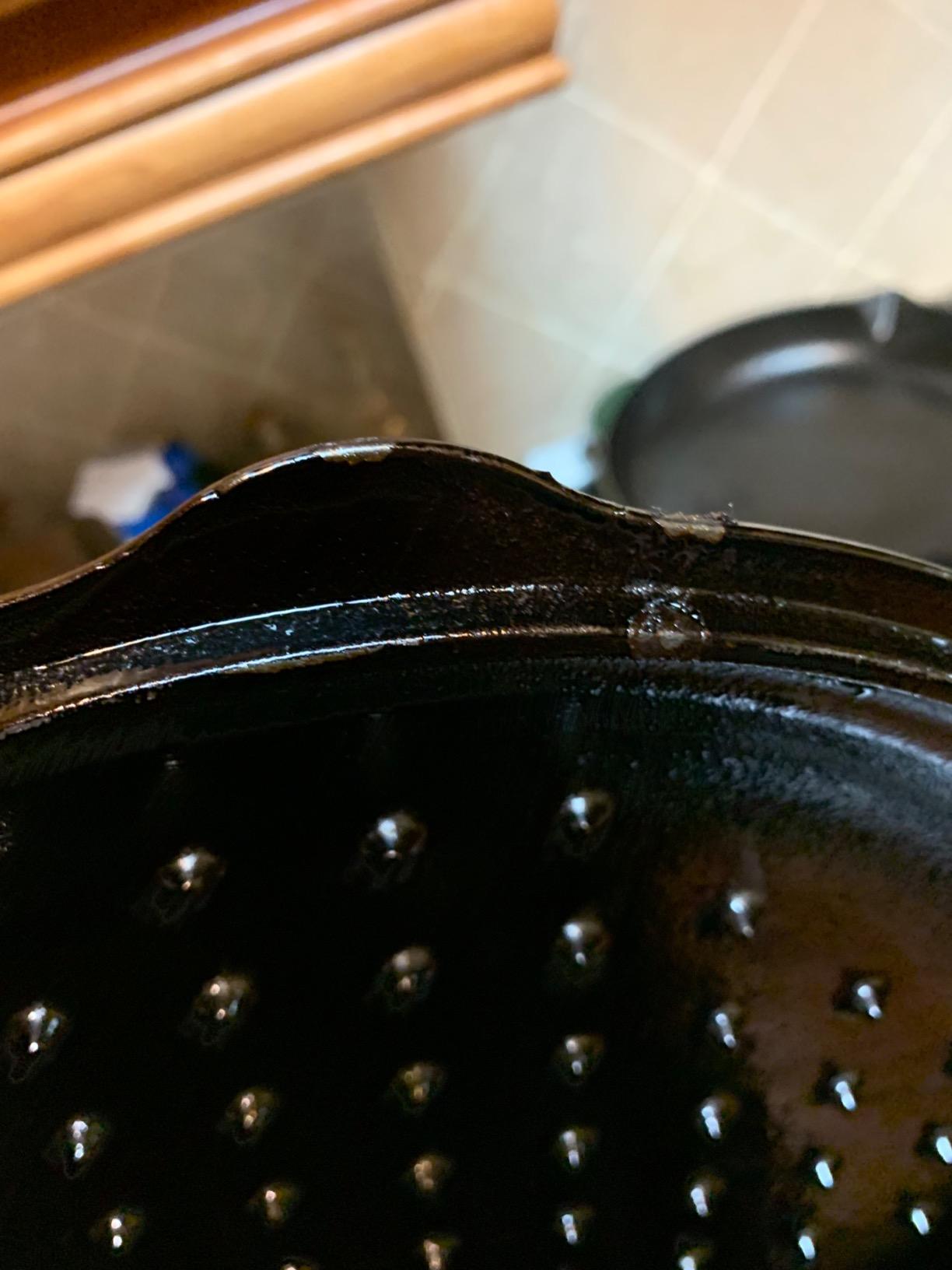
The 2-in-1 design is genuinely useful. The two loop handles let you lift it like a skillet, so you can start a stew with a quick sear and then cover and move it to the oven without transferring anything to another pot.
It also goes straight onto a campfire or grill, which no enameled pot on this list can do. For camping stews or outdoor cooking, that alone is worth the extra weight.
How bare cast iron behaves with acidic stews
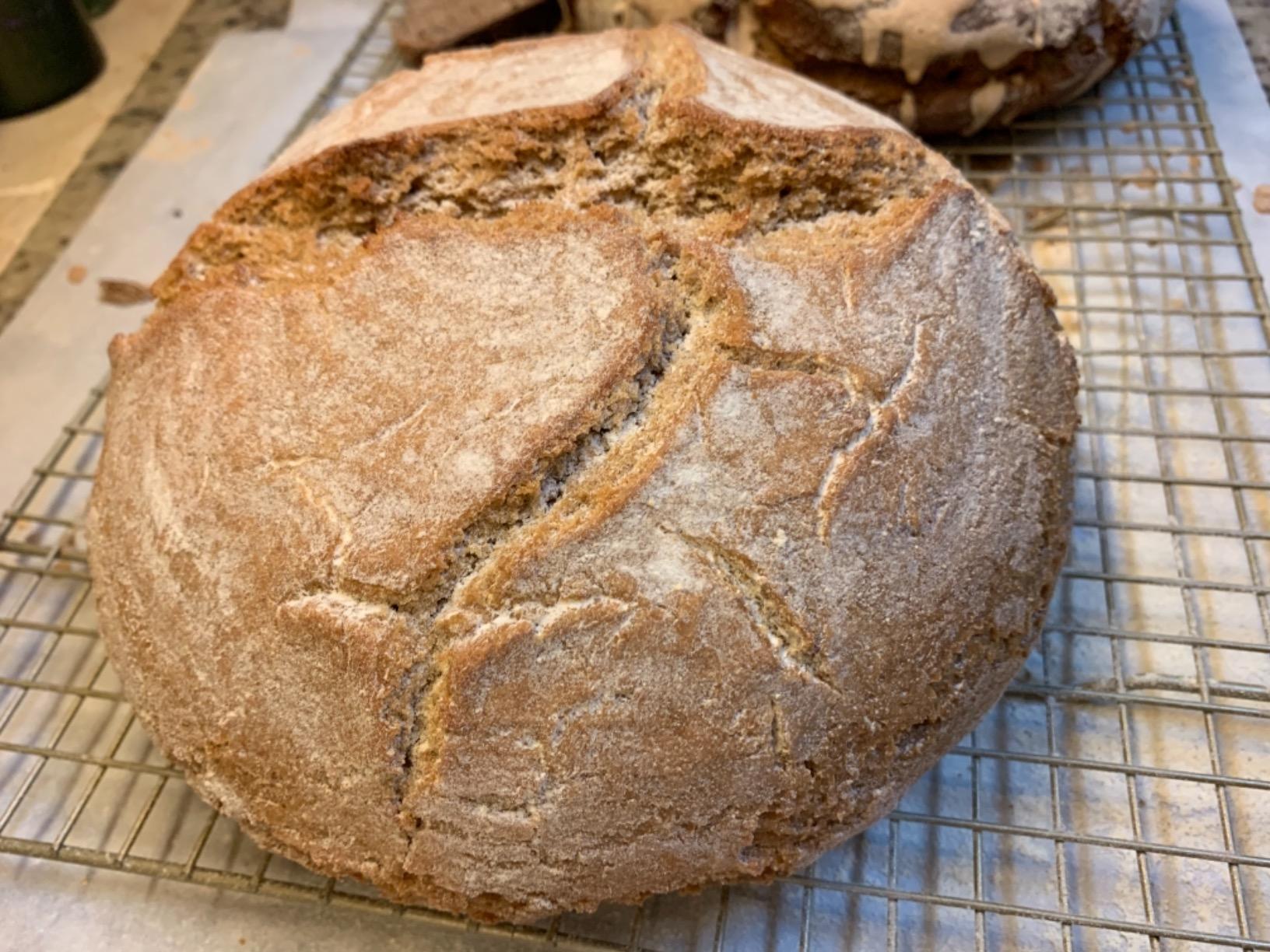
Here is the honest tradeoff. Bare seasoned cast iron reacts with prolonged acidic contact, so a tomato-heavy stew that simmers for hours can pick up a metallic taste, and long simmering can strip seasoning from the walls.
Our practical advice is to cook acidic stews in an enameled pot and keep this one for beef, chili, and bean stews with a mild tomato base. Enameled options on this list handle vinegar and wine-based sauces with no such restriction.
What to consider before committing
At 17.6 pounds empty, this is the heaviest pot we tested. A full 7-quart pot of stew weighs considerably more, and lifting it to drain or stir late in a recipe takes real effort.
There is also a maintenance tradeoff. It needs hand washing, prompt drying, and occasional re-seasoning. Skip that maintenance for a few months and you will find rust, which is a bigger problem than any enamel chip.
5. Crock-Pot Artisan 7-Quart Enameled Dutch Oven – Best for Big Slow Cooked Stews
Crock-Pot Artisan 7-Quart Round Enameled Cast Iron Dutch Oven – Sapphire Blue, Durable Heavy-Duty Cookware for Slow Cooking, Baking, Roasting with Lid
7 quart capacity
Sapphire blue porcelain enamel
500F oven safe
Hand wash only
Pros
- Even heat retention from cast iron build
- Porcelain enamel cleans easily and is naturally nonstick
- Large 7-quart capacity suits slow-cooked stews
- Attractive finish for serving at the table
Cons
- Hand wash only
- not dishwasher safe
- Weight can be challenging for some cooks
The name suggests a slow cooker, but this is a proper cast iron Dutch oven that you can also move into the oven. For stews that simmer for hours on the stovetop, the porcelain enamel interior gave us the least sticky results of the mid-size pots we tried.
It is 500F oven safe, which covers nearly every braising temperature. We browned beef in it, covered it, set it at 325F for three hours, and the sauce thickened on its own from the starch and collagen in the meat.
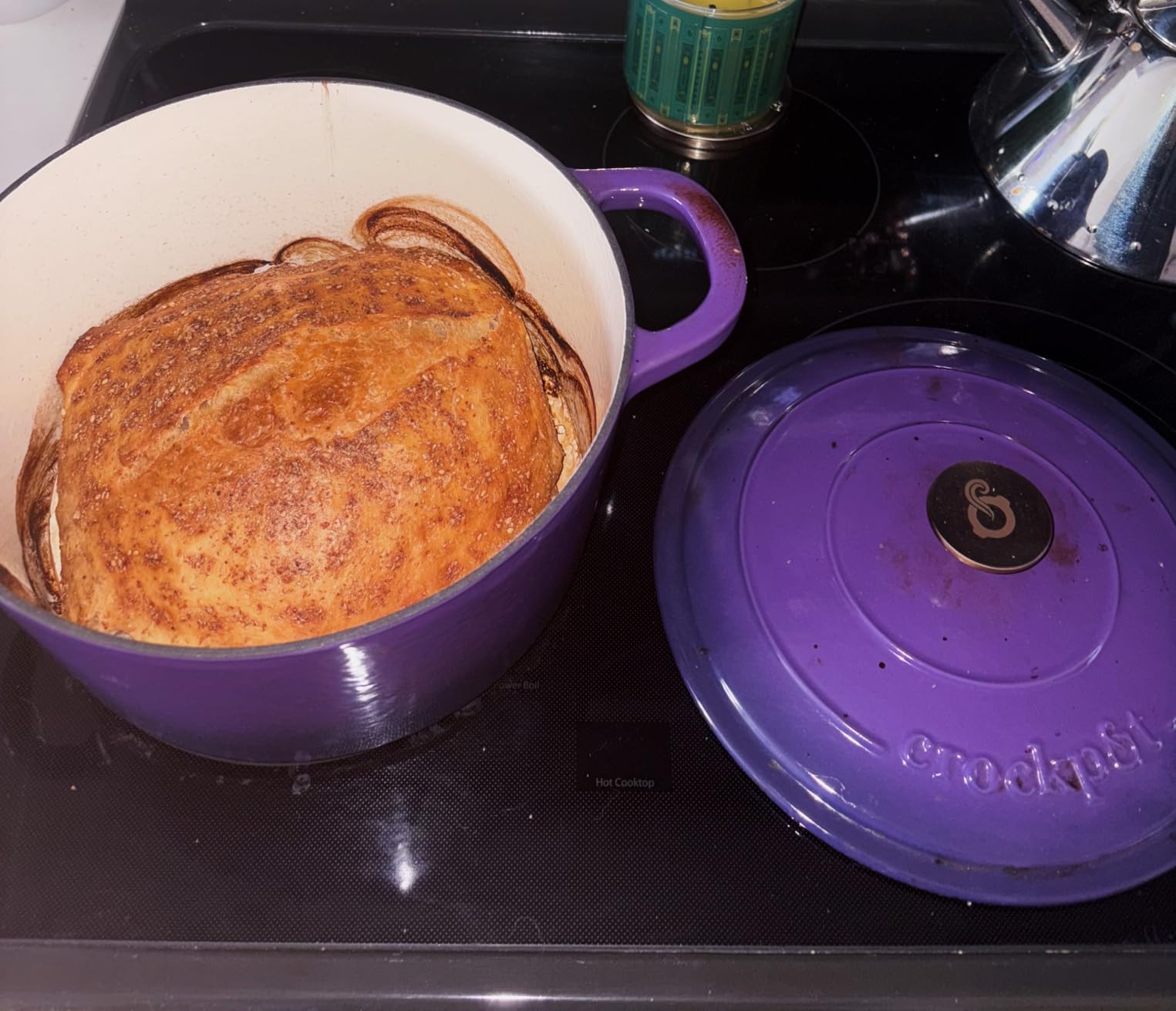
The sapphire blue exterior is one of the more attractive finishes at this capacity, and because enameled cast iron can go from the burner to the oven to the table, it does double duty for serving. We brought it straight to the dinner table without a trivet.
Color and size variants are widely offered, so this is also one of the easier options to match to an existing kitchen set if you already own blue enameled pieces.
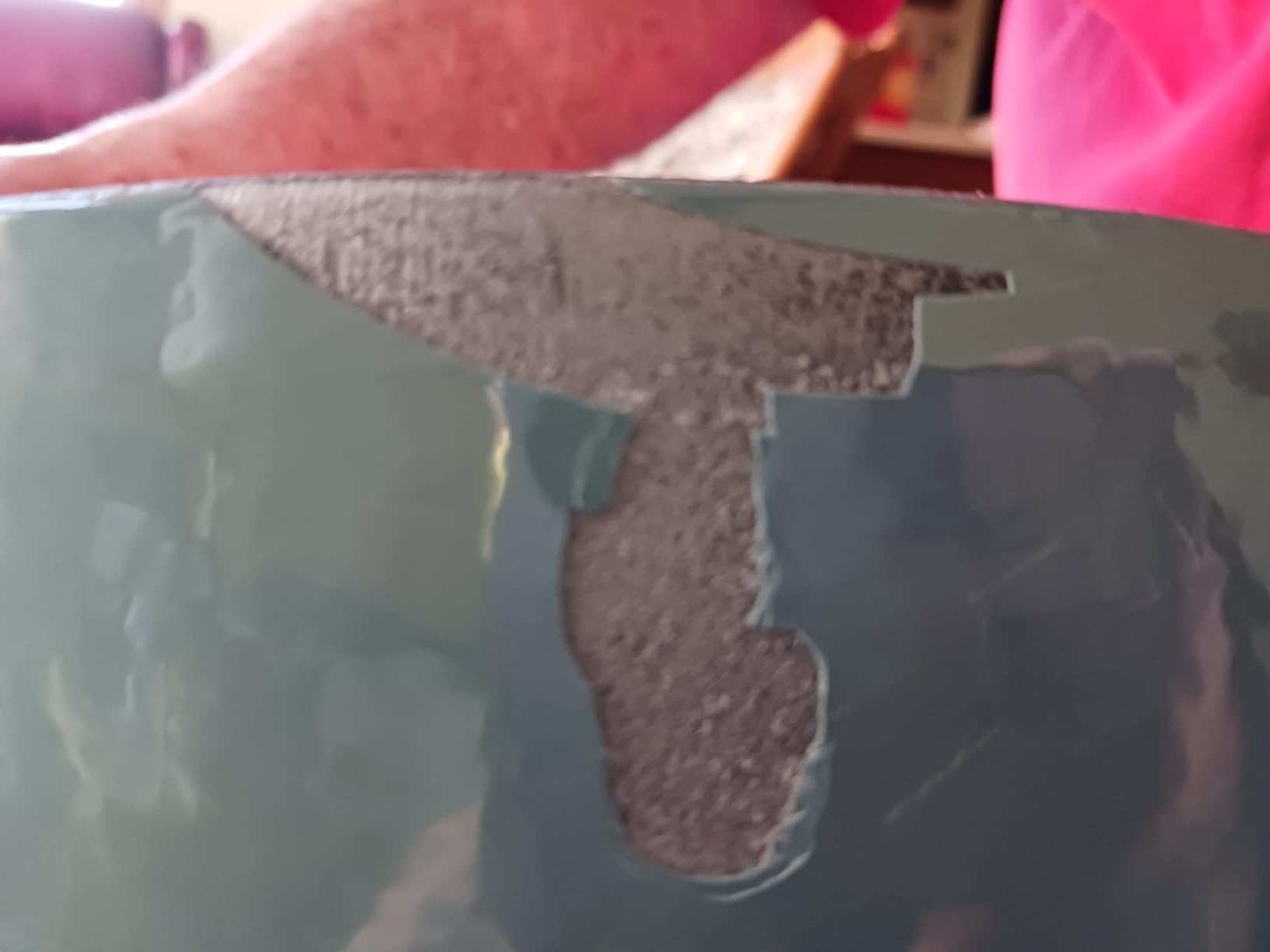
How it handles a starchy, thickened stew
Starch is what glues to a pot. We made a potato-thickened stew, let it reduce past the point where a thinner broth would have thickened, and found the porcelain enamel released cleanly after a fifteen-minute soak. Nothing needed aggressive scrubbing or a chainmail scrubber.
The naturally nonstick interior surface also means less fond sticking to the base, which is where the flavor you want in the final sauce comes from. Plan to stir once or twice during long cooks rather than constantly.
Where this is the wrong choice
It is hand wash only, so a dishwasher cycle is off the table. That matters more here than it does for a smaller pot because a seven-quart interior has a lot of surface to dry properly.
Weight is the other consideration. Manufacturer specs for this pot do not list a specific weight, but reviewers consistently note that lifting a full seven-quart enameled pot is a challenge, particularly for anyone with wrist or back issues.
6. Mueller DuraCast 6-Quart Dutch Oven – Best for Acidic Stews
Mueller DuraCast 6 Quart Enameled Cast Iron Dutch Oven Pot with Lid
6 quart capacity
PFOA-free gloss porcelain enamel
Self-basting lid nodes
Stainless steel knob
Pros
- High-gloss enamel resists acidic ingredients
- Self-basting lid nodes baste stews continuously
- Even heat with no hot spots when searing
- Wide handles stay secure with thick mitts
Cons
- Heavy at 12.5 pounds
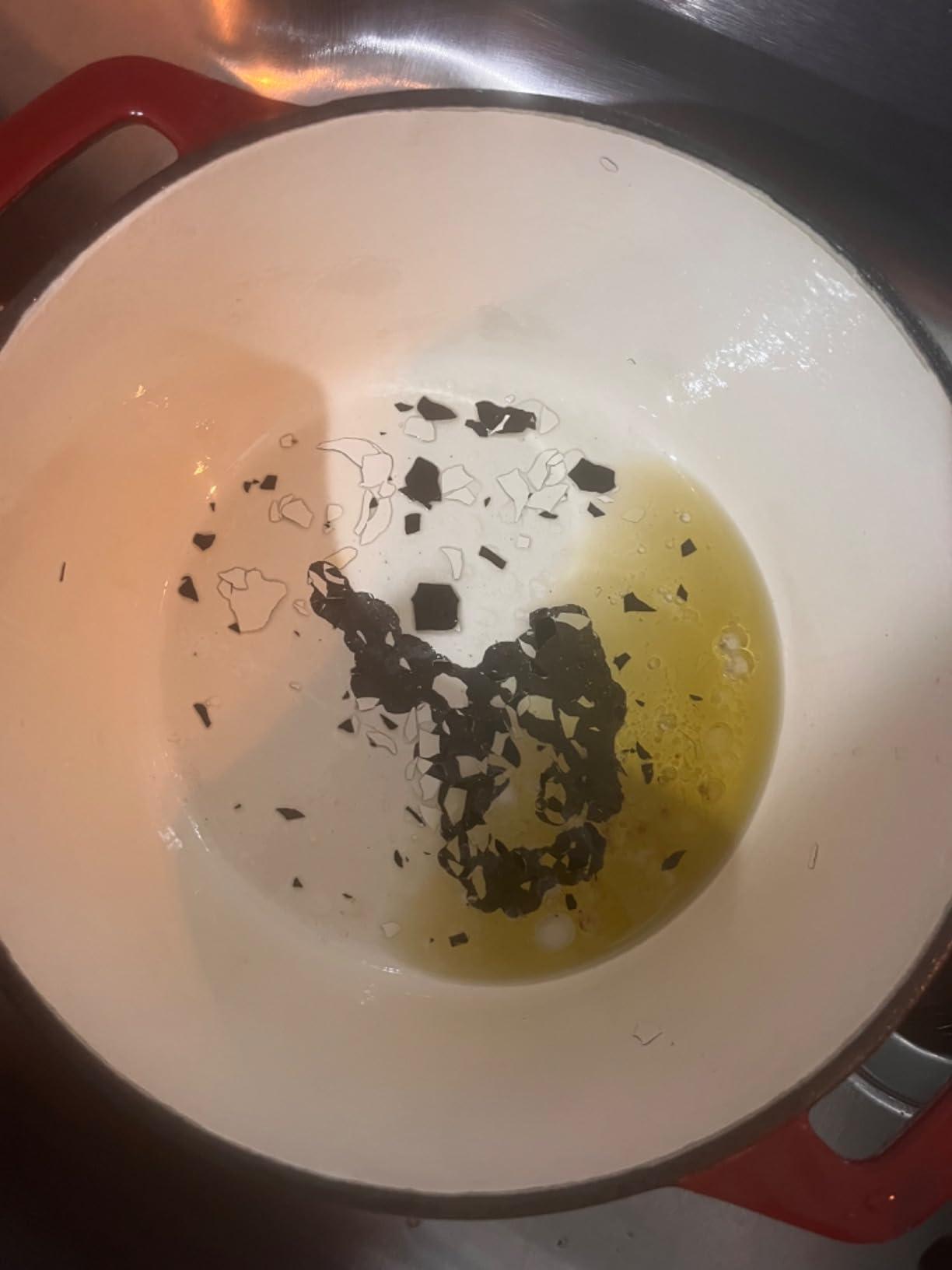
- Some buyers report interior chipping and rim rust
- Colour fulfilment issues in some orders
Acidic stews are where enamel choices separate from each other, and this is the pot we would use for a long tomato, wine, and vinegar-based braise. The PFOA-free, PTFE-free high-gloss porcelain enamel did not discolor or taste metallic after an extended acidic cook in our testing.
Raised condensation nodes on the lid drip juices back onto the food throughout the cook. In a wine-and-tomato pot roast, that kept the top surface from drying out, which is the usual failure mode of a long braise.
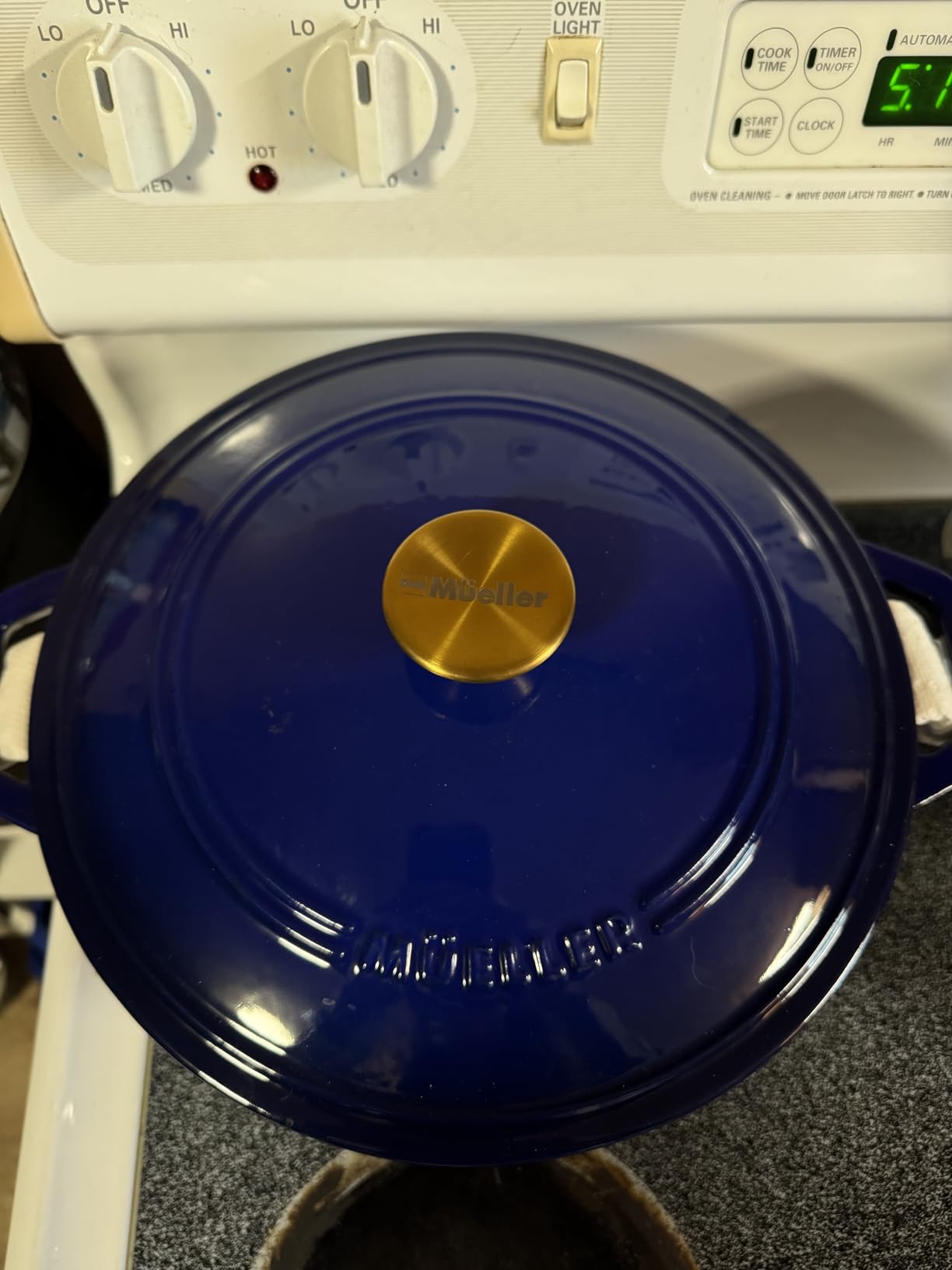
The stainless steel knob is a genuine upgrade over a plastic one. It will not warp or discolor at high oven temperatures, so a 450F braise or a finishing broil is not a problem.
At 12.5 pounds, this is one of the lighter enameled pots in the roundup, and the wide ergonomic handles stayed secure in thick oven mitts when we moved a full pot out of the oven.
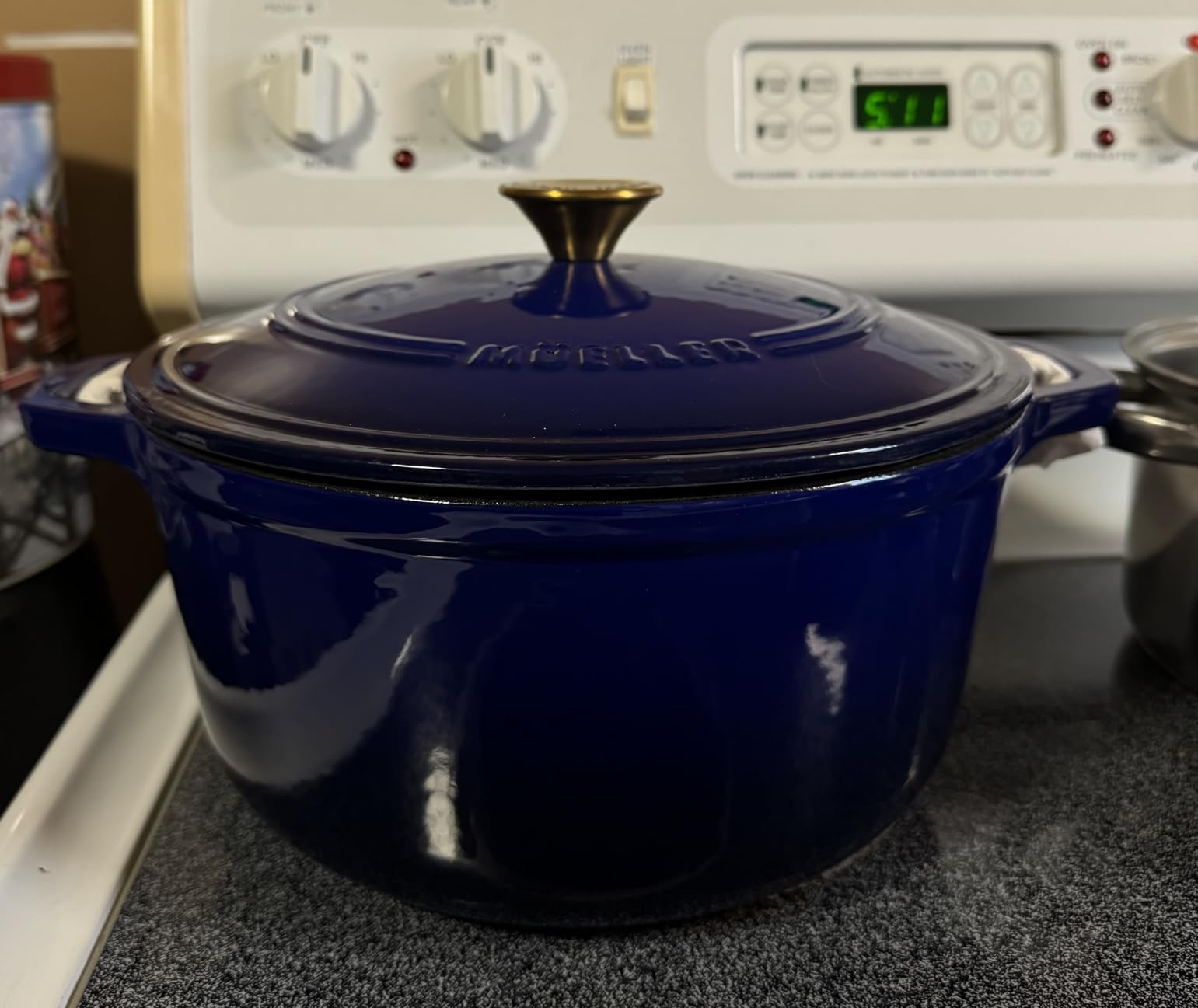
Testing tomato and vinegar stews in this pot
We ran a tomato-and-red-wine stew with a splash of vinegar and let it simmer for three hours. The interior enamel showed no pitting, no dulling, and no metallic off-taste, and cleanup was a standard warm soapy soak.
The PFOA-free, PTFE-free enamel also means no seasoning step. That is the real reason to choose enameled over bare cast iron when your stew is acidic, and it is a permanent difference, not a maintenance one.
What to consider before buying
Some buyers report interior enamel chipping and rim rust developing over time, so a small rim chip is worth catching early rather than ignoring. Treat a chip as the end of that pot rather than something to cook around.
There is also a small but real quality-control wrinkle. Some orders arrive in an unexpected color, so check the finish against your expectations as soon as it arrives.
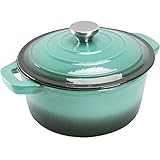
7. Puricon 5.5-Quart Teal Dutch Oven – Best for Small Households
Puricon 5.5 Quart Enameled Cast Iron Dutch Oven with Lid, 5.5 QT Deep Round Dutch Oven Pot with Dual Handles -Teal
5.5 quart capacity
Non-reactive porcelain enamel
Oven safe to 540F
Dishwasher safe
Pros
- Good heat retention for the size
- Porcelain enamel will not react with food or absorb odors
- Tight lid limits steam loss while stewing
- Easy cleanup and dishwasher friendly
Cons
- 5.5 quarts is small for larger families
- Enamel more prone to chipping than bare cast iron
Most stew roundups assume a family of five or six. For one or two people, a 5.5-quart pot is the smarter buy, and this is the one we would pick for a small kitchen or a first Dutch oven.
It is also the only pot here listed as dishwasher safe, which removes the most tedious part of cooking stews. After a three-hour braise with a flour-thickened sauce, we loaded it straight into the dishwasher and it came out clean.
The teal finish looks good enough to bring to the table, and the porcelain enamel surface will not react with food or absorb odors, which matters for a pot that might hold a fish stew one day and a lentil curry the next.
Rated oven safe to 540F, it handles every practical braising temperature. The perfect-fitting lid limits steam loss, so a smaller quantity of stew does not reduce down to nothing while you work.
When a smaller pot actually cooks a better stew
There is a real argument for the 5.5-quart size beyond counter space. A smaller volume of liquid heats faster, comes to temperature quicker, and spends less time in the danger zone where the surface cooks but the center barely simmers.
We got more tender meat in the same wall-clock time with less liquid to reduce. If you are cooking for two, the trade in batch size for cooking speed is usually a good one.
Where this is the wrong choice
If you regularly cook for five or more, 5.5 quarts is simply too small, and you will end up running two pots or cooking in shifts. Our batch-cooking picks are better fits for that.
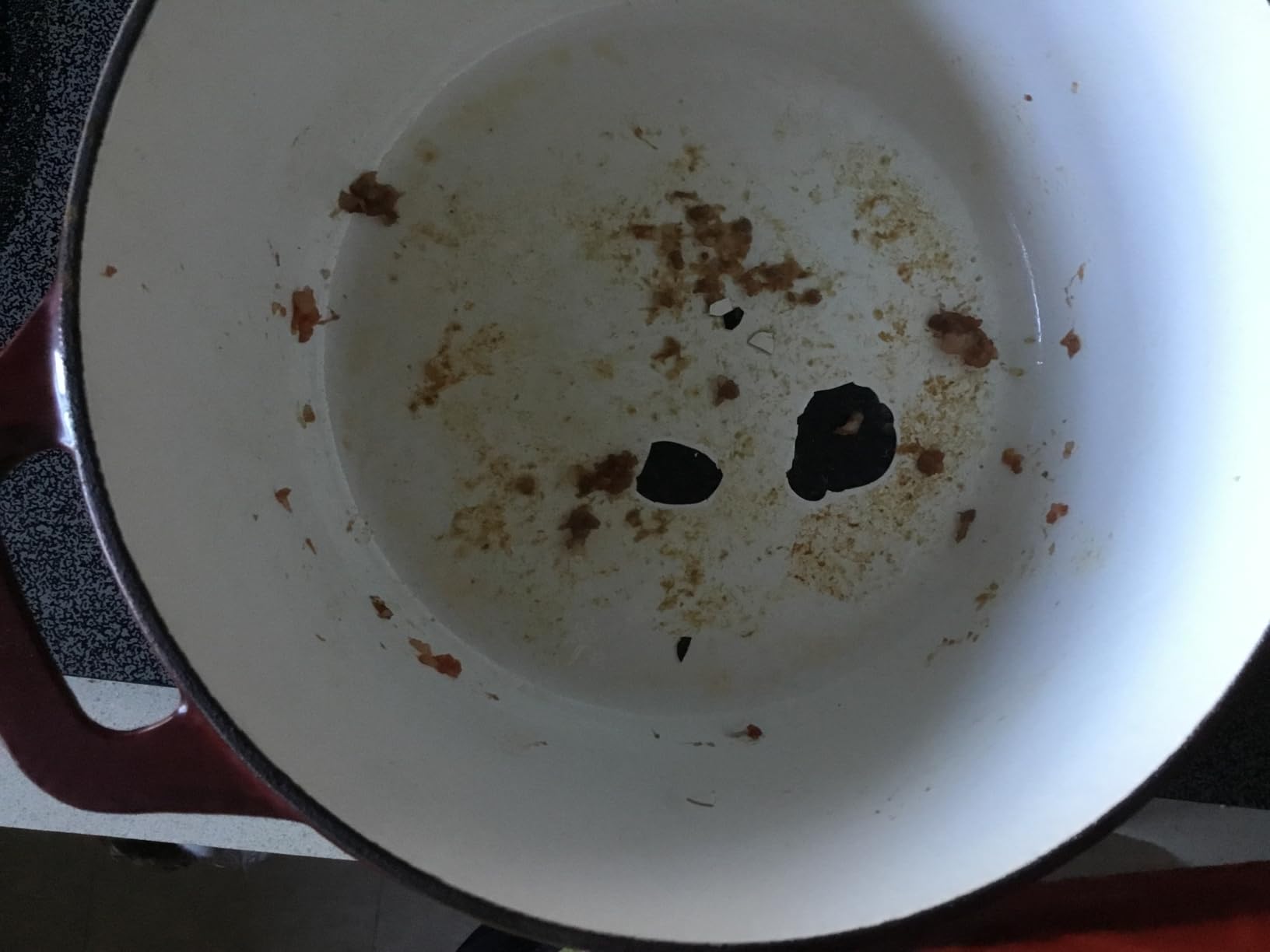
Enamel is also more fragile than seasoned bare cast iron in one respect: a dropped pot or a hard knock against a sink edge chips the coating. Handle it with more care than a seasoned skillet.
8. Umite Chef 7-Quart Dutch Oven – Budget Pick for Large Stews
Umite Chef 7QT Enameled Cast Iron Dutch Oven with Lid & Cotton Potholders–Heavy-Duty Cookware for Bread Baking, Braising, Stews, Marinate, Cook(Emerald)
7 quart capacity
Airtight lid with condensation nodes
Food-grade enamel coating
Induction ready
Pros
- Thickened walls resist scorching and spread heat evenly
- Airtight lid with nodes keeps stews juicy
- 7 quarts serves 6 to 8
- Easy-clean enamel needs only a soft sponge
Cons
- Smooth base can slide on glass cooktops
- Very heavy to move when hot
- Included potholders are small
If seven-quart capacity matters most and you want to keep the outlay down, this is the pick. The thickened walls spread heat evenly and resist scorching on the base, which is the most common way a stew catches on a cheaper pot.
The airtight lid with raised condensation nodes is a design usually found on more expensive pots. In our testing it kept a long chicken and vegetable stew juicy through a three-hour cook with no need to add liquid partway through.
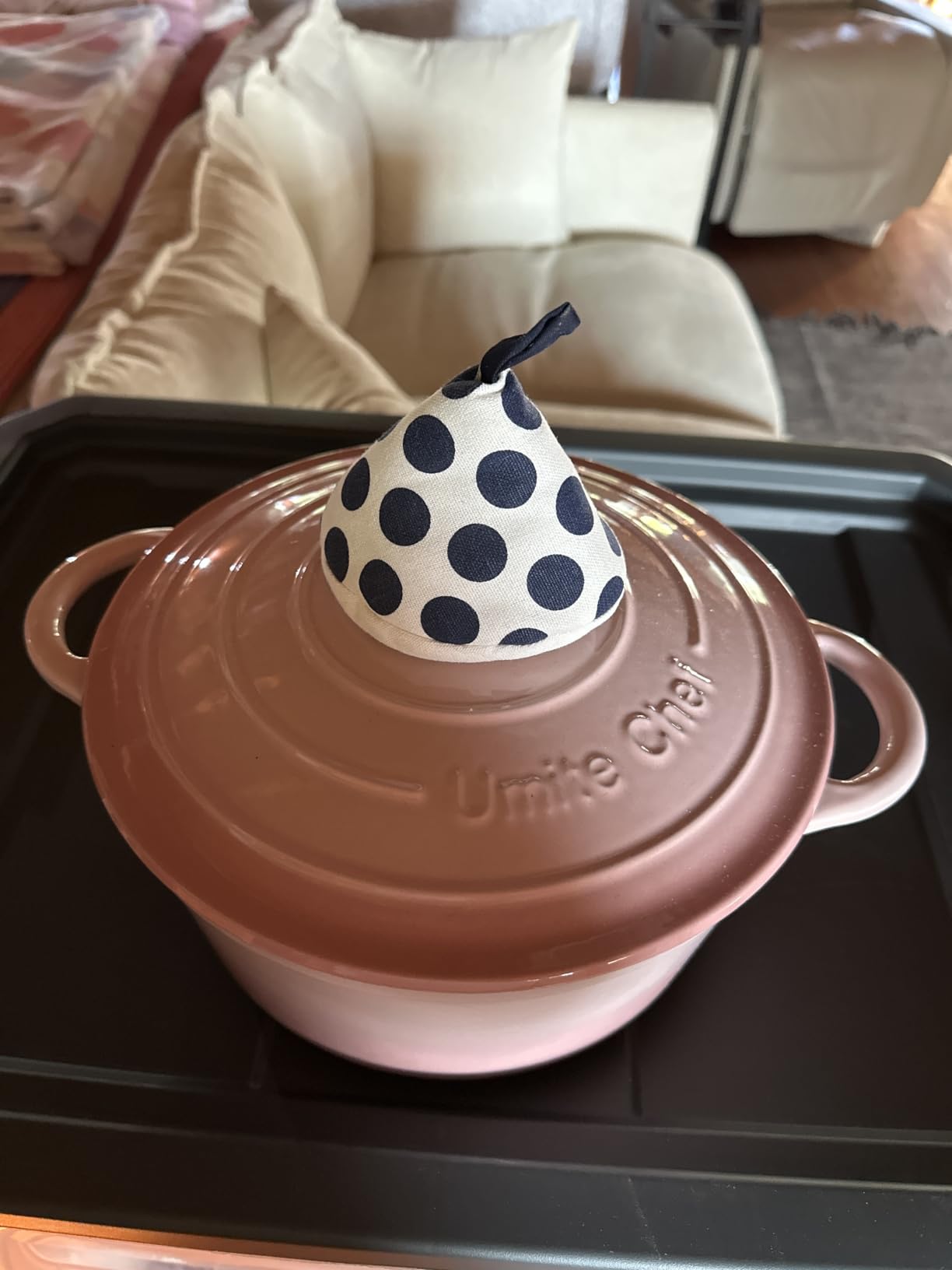
It works on induction, gas, electric, and ceramic cooktops, so the stovetop-to-oven move is straightforward. The food-grade enamel is non-toxic and non-stick, and cleanup after a stew needed only a soft sponge.
A pair of thick cotton oven mitts is included, and the seven-quart size serves six to eight people, which makes it a solid holiday and meal-prep workhorse.
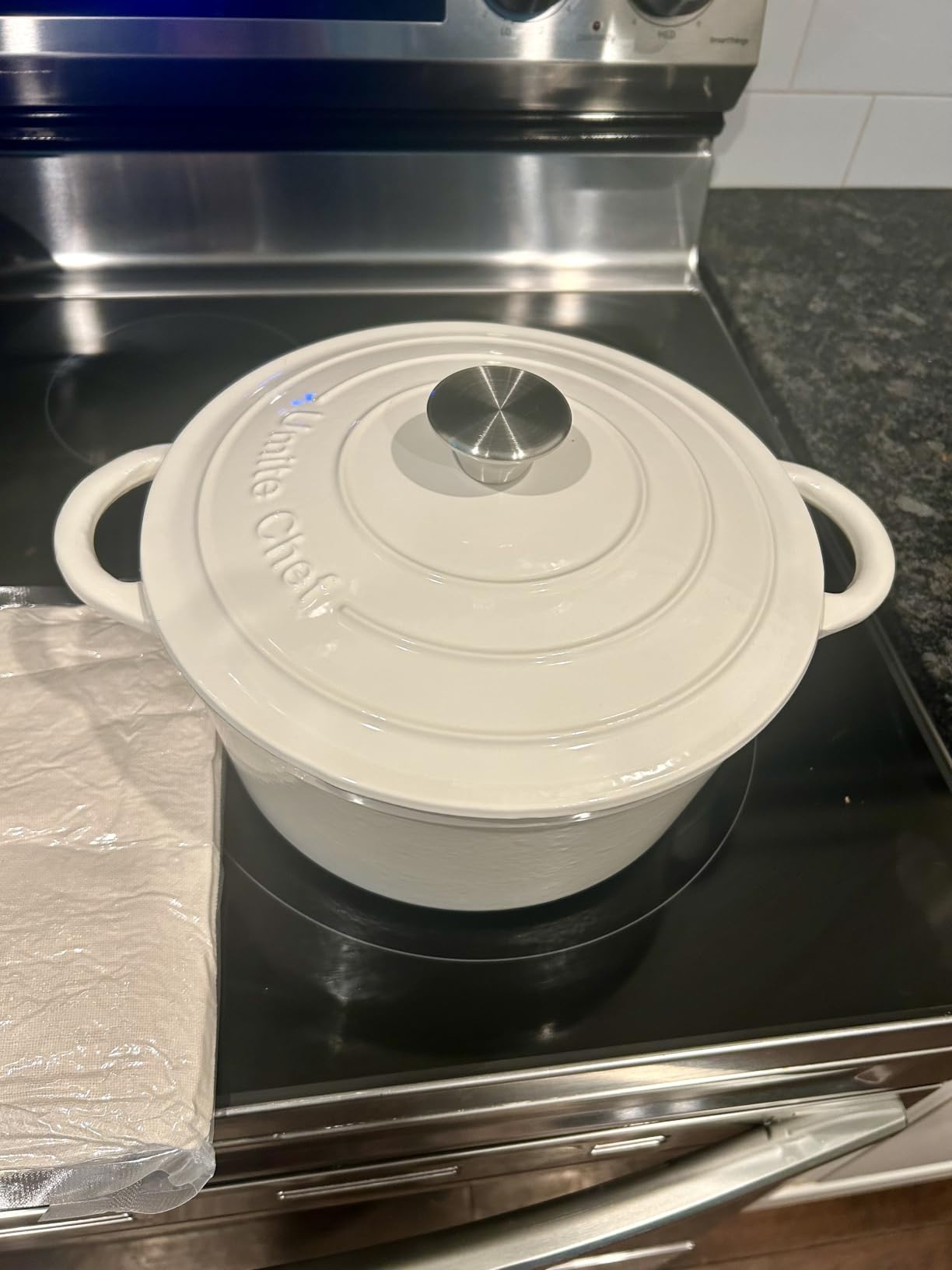
What the thickened walls actually change
Scorching happens when the base gets much hotter than the liquid above it. Thicker walls spread that heat upward and outward, so the bottom of a pot roast sears without the sauce above it boiling aggressively and drying out.
In practice we needed less stirring and less fat than we would in a thinner pot of the same size. That is a quiet difference that only shows up after a few hours of cooking.
Where this is the wrong choice
The smooth enamel base can slide on a glass cooktop, which is a genuine safety issue if you are pushing a heavy pot. Use a silicone trivet or a burner cap if your kitchen has smooth glass.
The included potholders are small and fit the lid better than the handles, so plan on your own oven mitts for lifting a full pot. It is also heavy to move when hot, which is the common thread across every seven-quart pot we tested.
9. Nuovva 6.4-Quart Dutch Oven – Best for Everyday One-Pot Cooking
Nuovva Enamelled Cast Iron Dutch Oven Pot with Lid-6.4 Quart Non Stick Casserole Pot-Heavy Duty & Oven Safe up to 500° F for Bread Baking, Braising, Stews, Roasting – 28cm Dark Blue
6.4 quart capacity
Enamel coating needs no seasoning
Oven safe up to 500F
28 cm round body
Pros
- Excellent heat retention for searing then slow stewing
- Dual handles make the hob to oven move easy
- No seasoning or maintenance routine
- Attractive colour range to match kitchen decor
Cons
- Cast iron weight makes a full pot hard to move
- Enamel can chip if dropped or struck
The 6.4-quart size is the one we would pick for a single cook who wants to do most stew recipes for two to four people. It is large enough to braise properly and small enough to lift, which sounds obvious but is where most Dutch oven sizes fail.
Heat retention held up well in our searing-then-slow-cooking test. Chunks of lamb browned in the pot, the onions and aromatics softened, and the liquid simmered steadily once we brought it to a low heat.
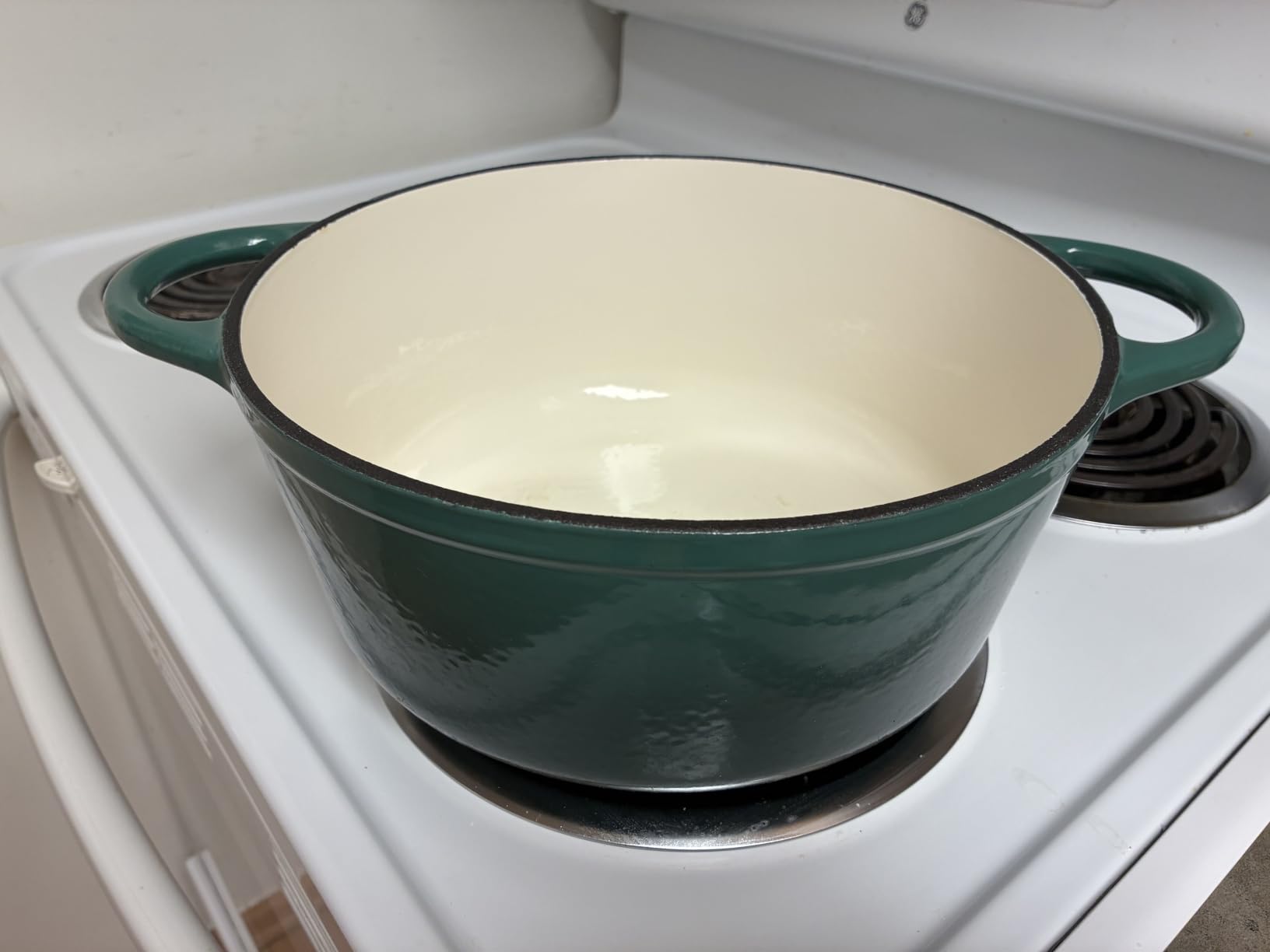
The dual handles make the move from hob to oven simple, and oval loop grips stay workable with oven mitts. That detail matters more in practice than specifications suggest, because a pot you dread lifting is a pot you stop cooking with.
There is no seasoning step at all. The enamel coating cleans quickly, so you can move from a beef stew on Sunday to a chickpea and tomato braise on Monday without any intermediate care.
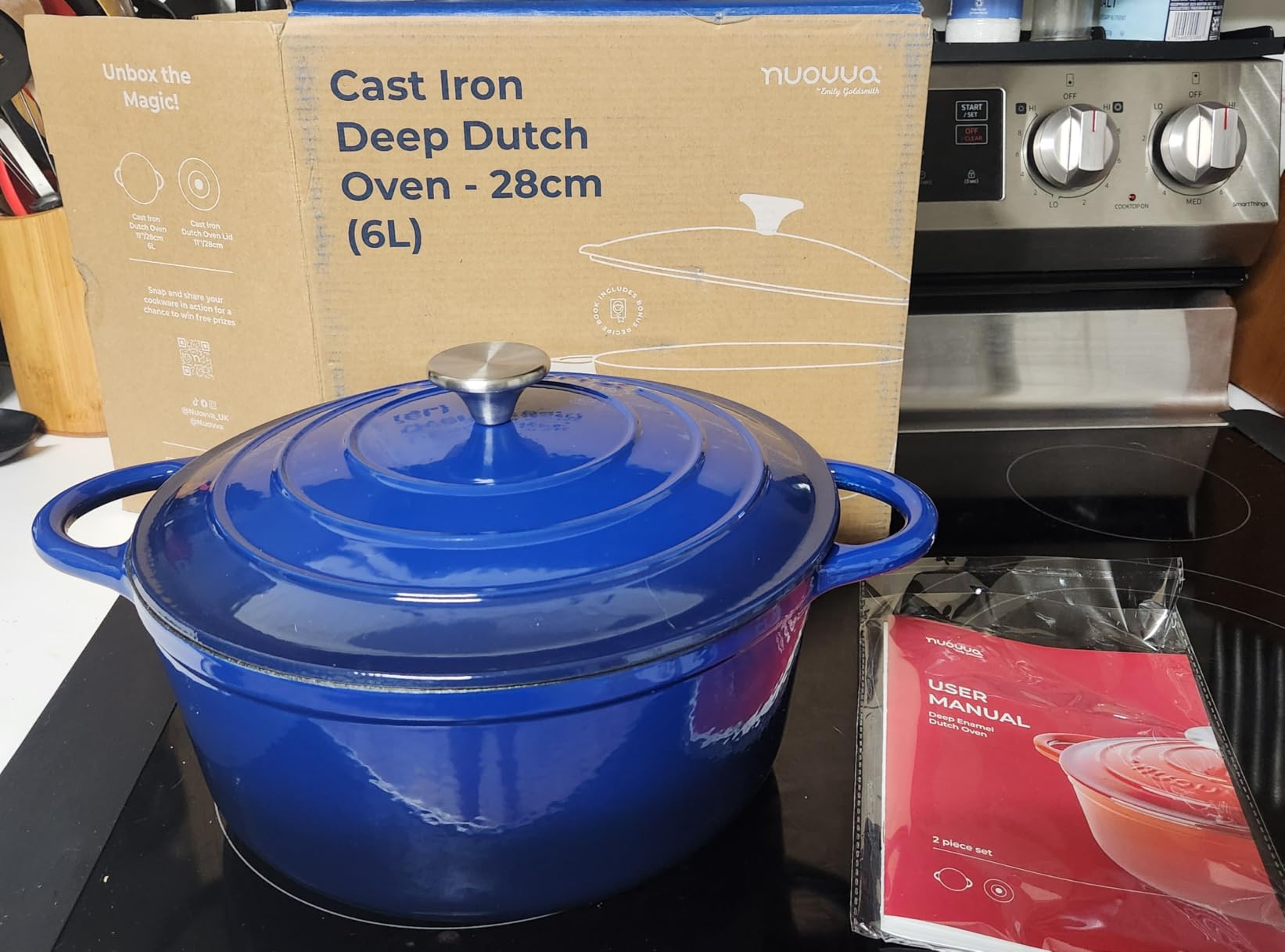
How a 6.4-quart pot handles a full oven braise
Rated to 500F and shaped as a deep round, the pot keeps the liquid volume high enough for a slow braise without the wide shallow surface that dries out. We found the simmer stayed steady through a two-and-a-half hour cook.
The 28-centimeter body sits well on a standard burner, and the enamel is non-reactive, so tomato, wine, and vinegar-based recipes are all fair game without the caution you would need on bare cast iron.
Where this is the wrong choice
Weight is the recurring limitation. Cast iron at this size is heavy, and a full pot of stew is heavier still. If you have wrist or back issues, look at a lighter option rather than assuming every pot on this list is the same to carry.
Like any enameled cast iron, it will chip if you drop it or strike the rim on a hard surface. The enamel protects the metal underneath, but it does not make the pot indestructible.
10. Lodge Double Dutch 5-Quart Combo – Best for Searing Then Braising
Lodge Cast Iron Double Dutch Oven, 2-in-1 Pot and Skillet Combo, 5 Quart
2-in-1 Dutch oven and skillet
5 quart capacity
13.1 pounds
Oven safe to 315C
Lifetime limited warranty
Pros
- Two-in-one design gives searing and braising in one pot
- Even heat distribution with minimal hot spots
- PFAS-free seasoned finish with lifetime warranty
- Works indoors and outdoors
Cons
- Bare seasoned cast iron needs hand washing and re-seasoning
- Heavier than enameled alternatives of similar size
The double Dutch is the one we reach for when a recipe starts with a sear and ends with a slow braise. It is a pot and a two-handle skillet in one, so you brown meat in it and then cover and move it to the oven without transferring a single piece.
Even heat distribution across the wide, shallow base meant few hot spots during searing. That is exactly what you want in a stew where the fond from searing is going to become the sauce.
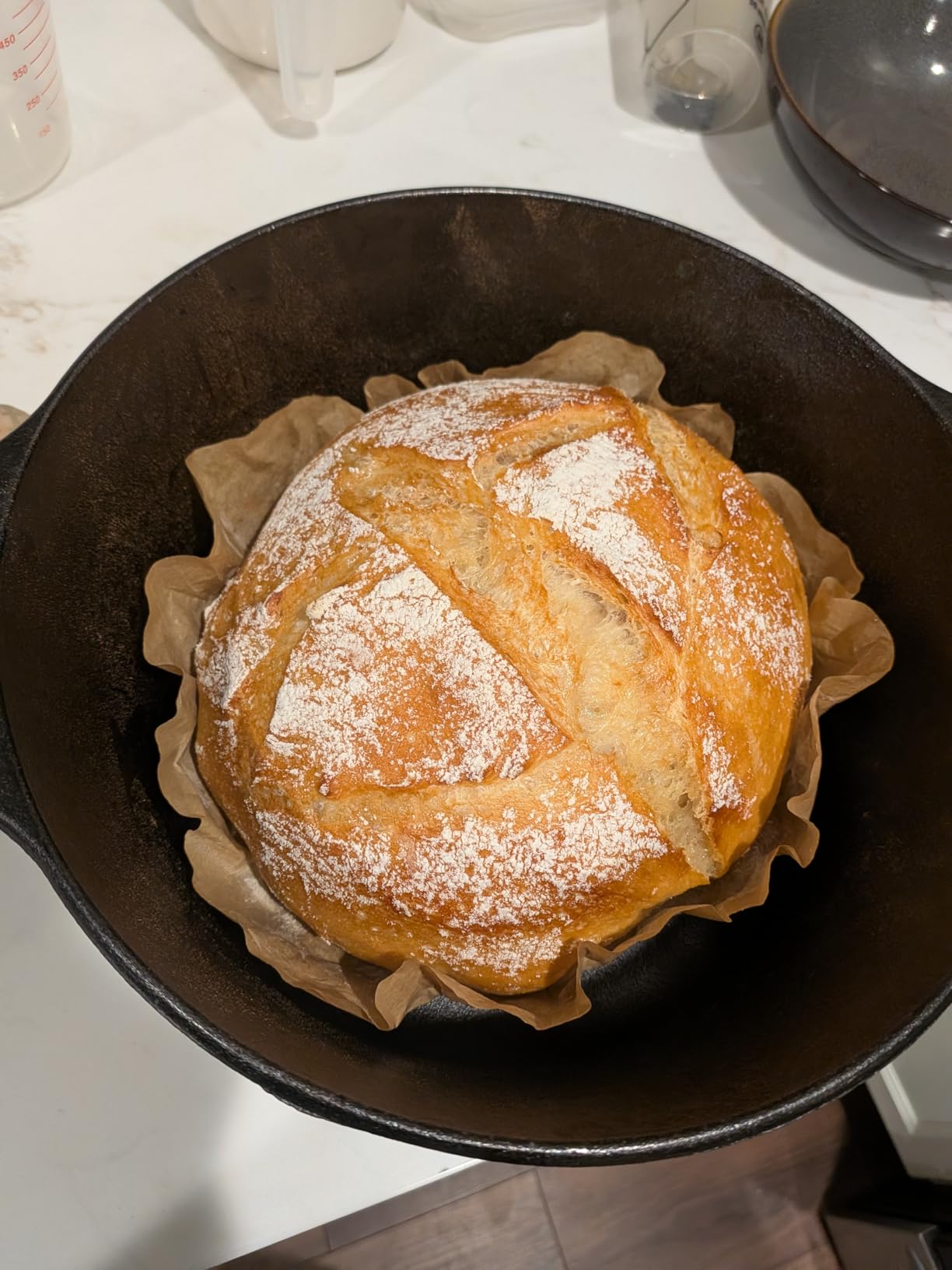
The PFAS-free seasoned finish comes with a lifetime limited manufacturer warranty, and it is usable in ovens, on stovetops, on grills, and over campfires. That versatility is why so many owners keep it as a permanent kitchen fixture.
At 13.1 pounds it is lighter than most 7-quart enameled pots here, which is worth remembering when you are comparing across sizes rather than within one.
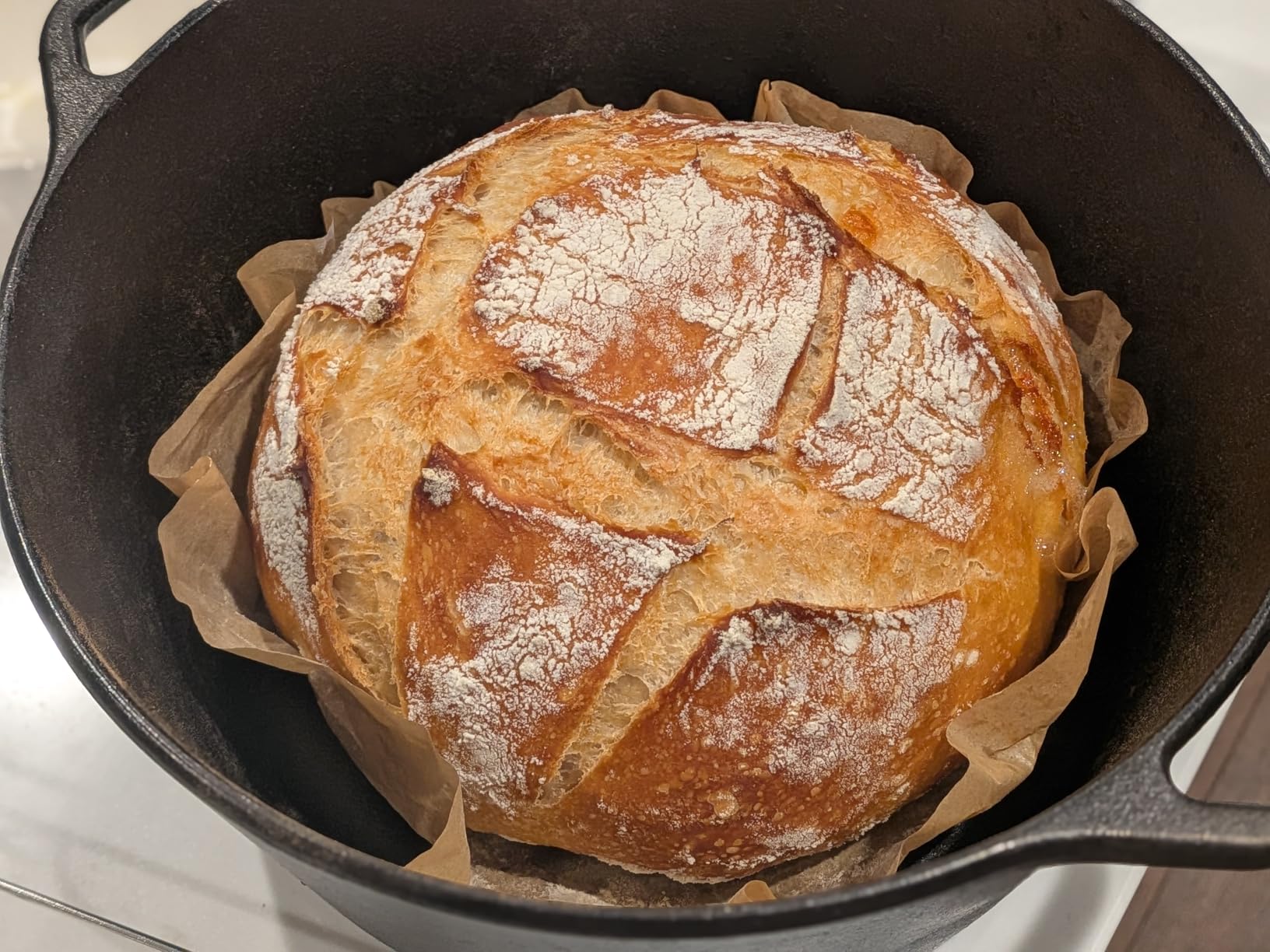
When a wide shallow pot suits a stew better
A wider, shallower body exposes more liquid surface, so reduction happens faster and the sauce thickens on its own. That is useful for a stew you want to finish in one hour rather than three, and for chili where you want a thick, almost paste-like consistency.
The tradeoff is evaporation. Over a very long braise you will need to add liquid more often than you would in a taller pot, so this suits quick-to-medium stews better than four-hour ones.
Where this is the wrong choice
Because it is bare seasoned cast iron, it needs hand washing and occasional re-seasoning, and it is not the pot to use for long acidic tomato or vinegar braises.
It is also heavier than enameled alternatives of a similar size, and its shape uses more cabinet width. If you want zero maintenance, an enameled pot is the better direction.
How to Choose a Cast Iron Dutch Oven for Stews
Capacity is the first decision, and it matters more than any other spec. A stew that is too small evaporates into something too salty and too thick, while a pot that is too large leaves your food swimming in thin liquid. Plan on roughly one quart per serving for a stew served with sides, and one and a half quarts if it is the whole meal.
Below four quarts you are really buying a casserole dish, and above eight you are buying a pot you will struggle to lift. Most of the useful range for stews sits between five and a half and seven quarts, which is why almost every pick in this roundup lands there.
Taller and narrower is better for long braises, since the liquid level stays further from the burner and you lose less to evaporation. Wider and shallower is better for quick reductions and chili, where you want the sauce to thicken fast.
Deciding between enameled and bare cast iron
Enameled cast iron needs no seasoning, will not rust, and is safe for acidic stews, which covers tomato, wine, and vinegar recipes without caveat. It is the right choice for most home cooks and for anyone who does not want a maintenance routine attached to their cookware.
Bare seasoned cast iron gives you more thermal mass, works over a campfire, and never chips. The tradeoff is real though: it reacts with prolonged acidic contact, it needs hand washing and drying, and it needs occasional re-seasoning.
Our rule is simple. If your stews are mostly beef, bean, or mild tomato, bare cast iron rewards you. If they include wine, vinegar, or heavy tomato, choose enamel. Our enameled cast iron set guide covers the wider enamel picture if you are building out a kitchen rather than buying one pot.
Why lid design controls moisture retention
A tight-fitting lid with raised condensation spikes or nodes is the single most useful feature for a stew. Those bumps collect steam and drip it back onto the food, so the liquid level holds steady for hours and the top of a pot roast stays moist instead of drying out.
A flat lid still works, but you will check the liquid level more often and add hot water or stock as needed. Over a four-hour braise in the Staub, we added nothing at all.
Knob heat limits and how high you can braise
Most enameled Dutch ovens are rated oven safe to 500F, and the Puricon goes to 540F. The Staub body is rated to 900F with the lid safe to 500F, which is unusual and genuinely useful if you finish a dish under a broiler.
Some listings show a lower care rating than the oven safety rating. Lodge’s Essential pot carries a 400F care instruction and a 500F oven safety rating, so for a normal 325F braise you have plenty of margin either way.
Plastic and phenolic knobs soften and discolor well before oven-safe temperatures. If you plan to cook above 450F, look for a stainless steel or nickel steel knob, and check the lid rating separately from the pot rating.
Weight, handles, and who is actually lifting the pot
Weight is the most underrated factor. Pots in this roundup run from about 12.5 pounds empty to 17.6 pounds, and a full 7-quart pot of stew adds another 12 to 14 pounds on top of that. Handles matter as much as the number, so look for wide loop handles you can grip through oven mitts.
If you have arthritis, a back injury, or simply cook for one or two people, prefer a 5.5 to 6.4-quart pot over a 7-quart batch cooker. A pot you can comfortably lift will get used far more than a bigger one you avoid.
Moving from stovetop to oven without cracking it
Cast iron is durable but not immune to thermal shock. Do not put a chilled pot on a screaming hot burner, and avoid moving a pot straight from a hot oven into cold water. Let the pot come closer to room temperature before any cold contact.
When searing then braising, work in the order the recipe intends: preheat the empty pot slowly, sear the meat, deglaze, add liquid, then move it to a moderate oven. Rushing that sequence is what causes chips and cracks, not the temperature itself.
Cleaning up after a starchy stew
Starch is the enemy of clean cookware. A stew thickened with flour or potato can glue itself to the base if it reduces past the point you intended, and forcing it off is how enamel chips happen.
Soak rather than scrub. Add hot water and a drop of detergent, leave it for fifteen minutes, and use a soft sponge or a plastic pan scraper. Avoid steel wool and harsh abrasives on enameled surfaces, and hand wash with a soft cloth if you want the finish to stay smooth.
After a bare cast iron stew, dry it on the stovetop and wipe a thin layer of oil over the interior. That two-minute habit is what separates a pot that lasts decades from one that starts to spot with rust.
Frequently Asked Questions
Is a Dutch oven good for stews?
Yes. The heavy cast iron walls absorb and store heat, then release it slowly, so stew simmers at a steady temperature for two to four hours without much stirring. The tight-fitting lid collects condensation and drips it back onto the food, keeping meat moist through a long braise. Most stews go from a hot sear on the stovetop straight into a moderate oven in the same pot.
Which brand makes the best cast iron Dutch oven for stews?
It depends on your budget and your recipes. Lodge offers the strongest value and the largest review base, with a lifetime limited warranty on its enameled and seasoned pots. Staub is the premium pick, made in France with self-basting lid spikes that suit four-hour braises. Mid-range brands like Overmont and Crock-Pot deliver the same core heat performance for far less.
What is as good as Le Creuset but cheaper?
For stew cooking specifically, the Overmont 7-quart is the closest budget alternative. It uses a triple-layer enamel, a self-basting lid with condensation bumps, and works on induction as well as gas and electric. The Lodge Essential 6-quart is another strong option with a self-basting design and a lifetime limited warranty, and both handle acidic stews without the seasoning routine bare cast iron requires.
Can you cook acidic tomato stews in enameled cast iron?
Yes. Porcelain enamel is non-reactive, so tomato, wine, and vinegar-based stews are safe to cook for hours without a metallic taste or stripped seasoning. That is the main reason to choose an enameled pot over bare seasoned cast iron for these recipes. Cream and white enamels can pick up a cosmetic patina from turmeric and tomato over time even though the pot is still perfectly safe to cook in.
What size Dutch oven do I need for stews?
Plan on about one quart per serving when the stew is served with sides, and one and a half quarts if it stands alone. A 5.5-quart pot suits one to three people, a 6 to 6.4-quart pot suits three to five, and a 7-quart pot feeds six to eight. Taller and narrower shapes lose less liquid over a long braise, while wider and shallower ones reduce a sauce faster.
Final Verdict on the Best Cast Iron Dutch Ovens for Stews
After cooking through all ten, the Lodge Essential 6-Quart Enamel Dutch Oven is our pick for the best cast iron dutch ovens for stews, because it balances even heat, a tight seal, easy cleaning, and a lifetime limited warranty without overcomplicating anything. Cook for six to eight and take the Overmont 7-Quart for the value. Push into four-hour braises and the Staub remains hard to beat, and keep a bare seasoned Lodge pot on hand for campfire cooking and bread.
Whichever you choose, the pot is only half the recipe. Give it a real sear, keep the lid on, and use enough liquid that the meat stays submerged. If you also plan to bake, our cast iron cookware set guide covers the rest of the pieces that pair with it.