
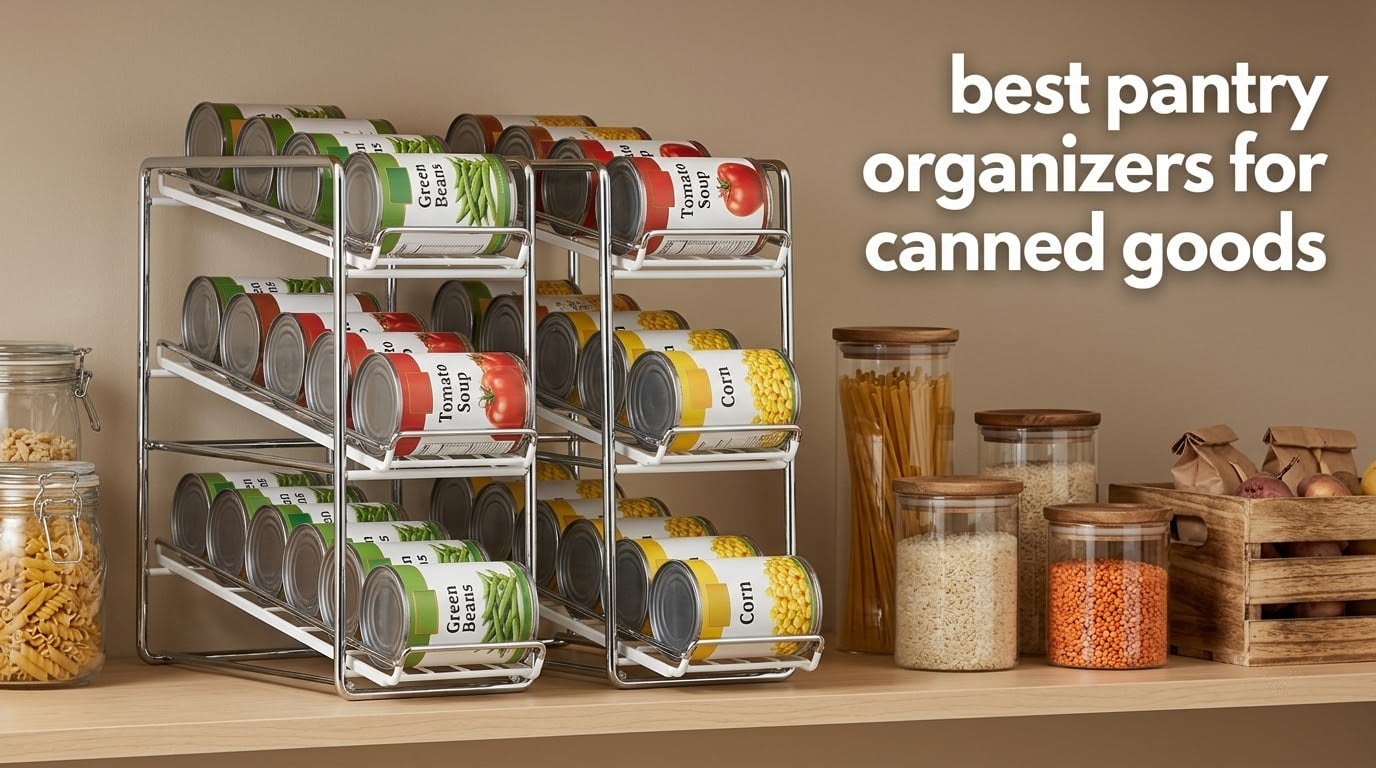
If you have ever pulled six cans out of a pantry shelf and found two more hiding behind them, you already know the problem this guide solves. Cans stacked in rows disappear, and forgotten cans expire while you buy duplicates. The best pantry organizers for canned goods solve that by tilting each shelf slightly backward so the front can rolls forward the moment you take the one in front of it.
We spent weeks loading, unloading, and re-loading twelve can organizers with enough standard cans to test every capacity claim against real shelf space, then read what buyers report after living with each one. Everything below is measured against the same criteria: how many cans it actually holds, whether it fits a normal cabinet, whether it rolls or stays put, and how hard it is to load the back row.
This is a rolling, tiered, and pull-out mix rather than one brand list, because the right answer depends almost entirely on your shelf depth and how many cans you cycle through. For more background on the space itself, start with our small pantry organizer picks and pantry organizer systems guide.
Top 3 Best Pantry Organizers for Canned Goods (October 2026)

Simple Houseware 3-Tier Can Rack
- Holds 36 cans
- Stackable with clips
- 6 movable dividers
- 11.5 in deep

What Are the Best Pantry Organizers for Canned Goods?
The best pantry organizers for canned goods are tiered or gravity-fed racks that hold 24 to 84 cans, tilt each shelf backward, and roll the oldest can to the front so you eat what you bought first. For most kitchens, a 3-tier rolling wire rack is the right starting point: it stacks, takes up about 11.5 inches of depth, and costs less shelf space per can than a flat stack.
Gravity-fed rolling racks tilt 15 to 30 degrees so cans feed forward on their own. Best for daily cooking and first-in first-out rotation. Example: the Simple Houseware 3-tier 36-can rack.
Stackable tiered wire racks use angled shelves and dividers rather than a deep cradle. Best when shelf depth is under 12 inches. Example: the AIYAKA 3-tier organizer at 13.4 inches deep.
Modular wire basket stacks screw together vertically so you can add layers as your reserve grows. Best for 50-plus can households. Example: the Sonyabecca 8-basket system holding 72 cans.
Clear plastic can dispensers hold one or two layers of standard cans with a slanted base. Best for soda, drinks, and narrow refrigerator shelves. Example: the Simple Houseware 2-pack set.
Expandable step shelves widen from 14 to 27 inches and add vertical tiers without can tilting. Best for mixed jars, spices, and shallow cans. Example: the Dial Industries 3-tier shelf.
All 12 Best Pantry Organizers at a Glance
Capacity, footprint, and material for every organizer in the guide, so you can rule out the ones that will not fit your shelf before reading further.
| Product | Specifications | Action |
|---|---|---|
| Simple Houseware 3-Tier Can Rack, 36 cans |
|
Check Latest Price |
 Deco Brothers Stackable Can Rack, 36 cans Deco Brothers Stackable Can Rack, 36 cans |
|
Check Latest Price |
| Simple Houseware Soda Can Organizer, set of 2 |
|
Check Latest Price |
 AIYAKA 3-Tier Can Organizer, 36 cans AIYAKA 3-Tier Can Organizer, 36 cans |
|
Check Latest Price |
 FIFO 54-Can Dispenser Rack FIFO 54-Can Dispenser Rack |
|
Check Latest Price |
 Dial Industries 3-Tier Expandable Shelf Dial Industries 3-Tier Expandable Shelf |
|
Check Latest Price |
 Kitchen Details 3-Tier Can Rack, 36 cans Kitchen Details 3-Tier Can Rack, 36 cans |
|
Check Latest Price |
 JKsmart 2-Pack Wire Can Basket JKsmart 2-Pack Wire Can Basket |
|
Check Latest Price |
 Simple Houseware 2-Tier Rack, 2 pack Simple Houseware 2-Tier Rack, 2 pack |
|
Check Latest Price |
 Sonyabecca 8-Basket Can Stack Sonyabecca 8-Basket Can Stack |
|
Check Latest Price |
 Vrisa 7-Tier Can Organizer, 84 cans Vrisa 7-Tier Can Organizer, 84 cans |
|
Check Latest Price |
 Lyuwanxian 4-Pack Wire Can Basket Lyuwanxian 4-Pack Wire Can Basket |
|
Check Latest Price |
1. Simple Houseware 3-Tier Stackable Can Organizer, 36 cans, Chrome
Simple Houseware 3-Tier Stackable Can Organizer Rack Hold 36 Cans, Chrome
36 can capacity
11.5 in deep x 17 in wide x 13.75 in tall
Chrome-coated metal
6 movable dividers
Pros
- Holds up to 36 cans across 3 tiers
- Stackable with secure plastic clips
- Rolling angled shelves for FIFO access
- 6 adjustable plastic dividers
- Anti-slip rubber feet
- No hardware needed
Cons
- Shelves can be frustrating to snap into place
- Some parts arrive slightly bent
- Wobbles a little when stacked three high and loaded
This is the rack we kept coming back to during testing. At 11.5 inches deep and 17 inches wide, it cleared the standard cabinets in our test kitchen without overhang, and 36 cans went in without forcing a single one. The angled shelves did the work: take the front can, and the one behind it rolls forward into your hand.
Capacity claims usually mean 36 cans arranged three across and four deep on each tier. We got there with standard cans and still had room to widen the dividers. When we tried family-size soup cans, the row tightened up noticeably, so check your largest can first.
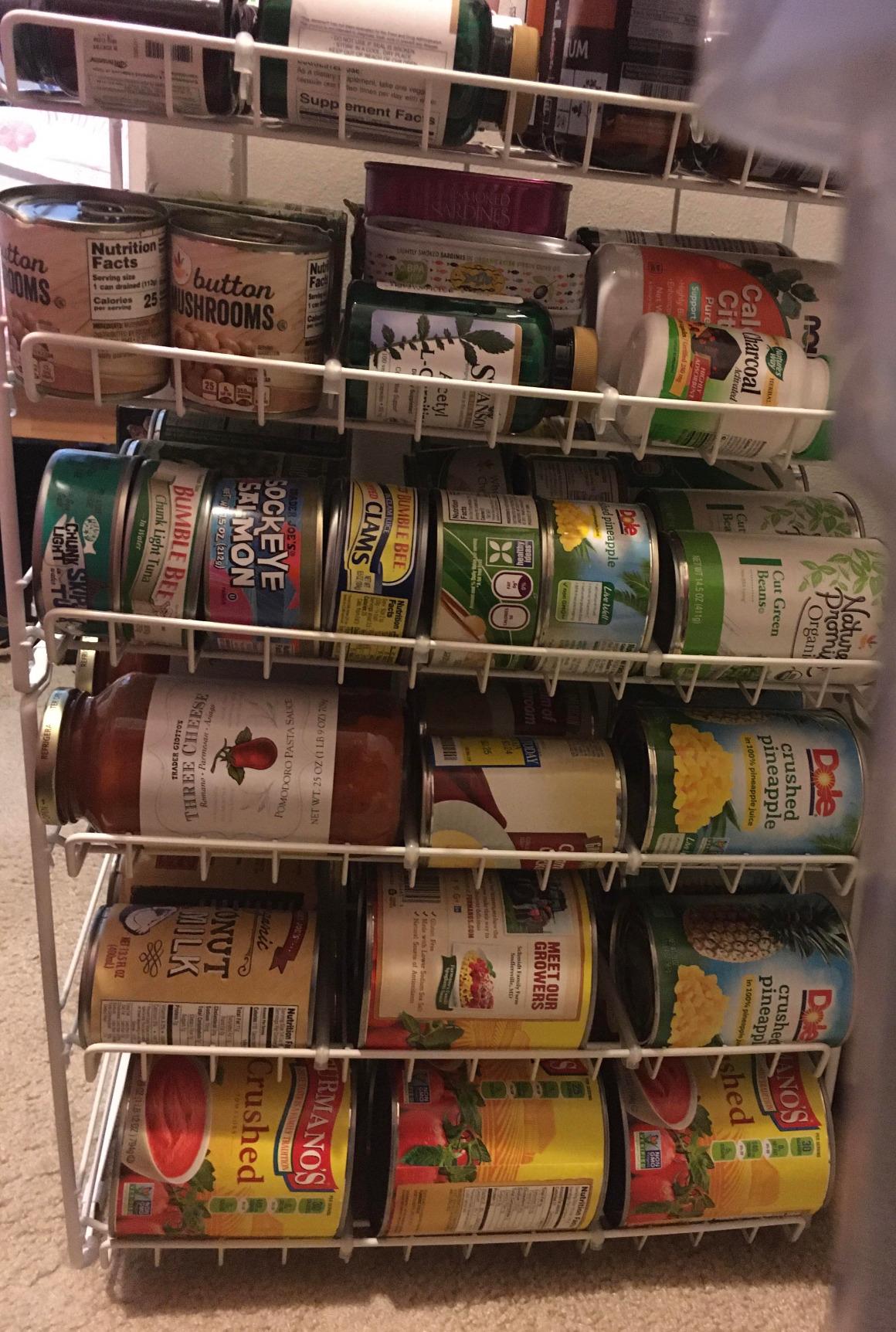
Assembly is the weak spot. The shelves snap into the side frames and the plastic clips lock the tiers together, but it takes patience, and a few frames arrived slightly bent. We would set aside ten minutes rather than assume it is instant.
Stacking is supported by the clips, and the whole footprint stays flat rather than growing in height. Loaded with 36 cans, the upper tier rocks a fraction when you pull hard from the front, so anchor it against a wall if you plan to stack two racks high.
Will it fit your pantry shelf?
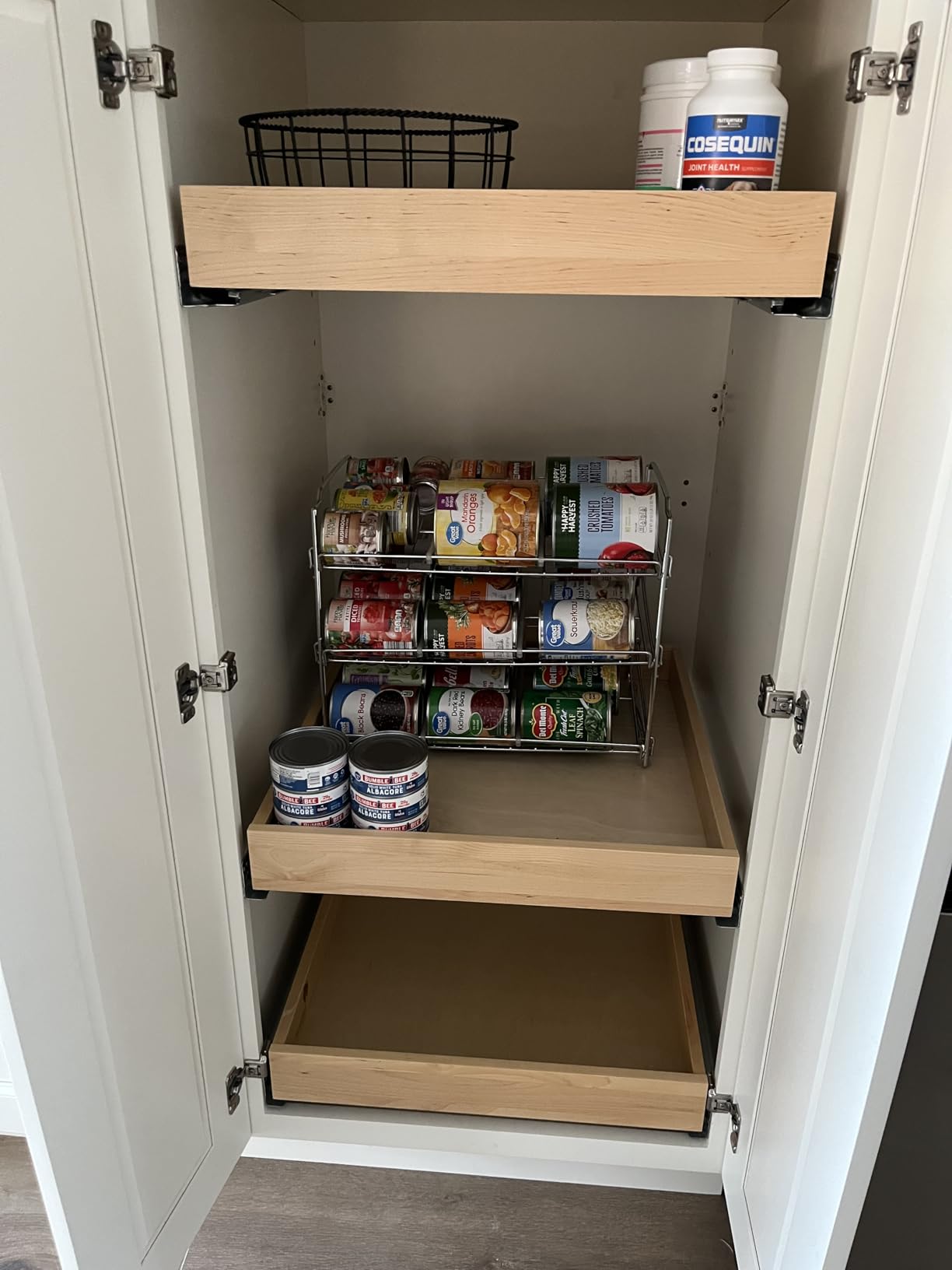
Measure the depth first. Anything deeper than 11.5 inches will overhang a typical 12 to 14 inch cabinet, and buyers on r/organizing repeatedly report overhang as the number one reason these racks disappoint. Measure width too, since 17 inches plus clearance needs a 17.5 inch opening.
The 13.75 inch height is the other number that catches people. A two-unit stack needs close to 26 inches of vertical room, which most lower cabinets cannot provide.
Is it worth buying over a cheaper plastic tier?
For metal build and dividers, yes. Plastic step shelves are cheaper and often narrower, and they hold light jars better than full cans. If your shelf is 10 inches deep or less, a step shelf will serve you better than any rolling rack.
Own it if you cook from cans most days and want the oldest can first. Skip it if you need family-size cans to sit upright or you want zero assembly.
2. Deco Brothers Stackable Can Rack Organizer, 36 cans, Chrome
Deco Brothers Stackable Can Rack Organizer Holds Up to 36 Cans, Chrome
36 can capacity
11.25 in deep x 17.3 in wide x 13.75 in tall
Alloy steel with chrome finish
6 adjustable dividers
Pros
- Holds 36 plus standard cans
- Solid steady alloy steel frame
- Good visibility from the front and sides
- Adjustable columns for odd can sizes
- Stackable
- 1-year warranty
Cons
- Picture-based instructions are hard to follow
- Needs 13.625 in clearance minimum
- Top shelf is awkward to install once the middle is set
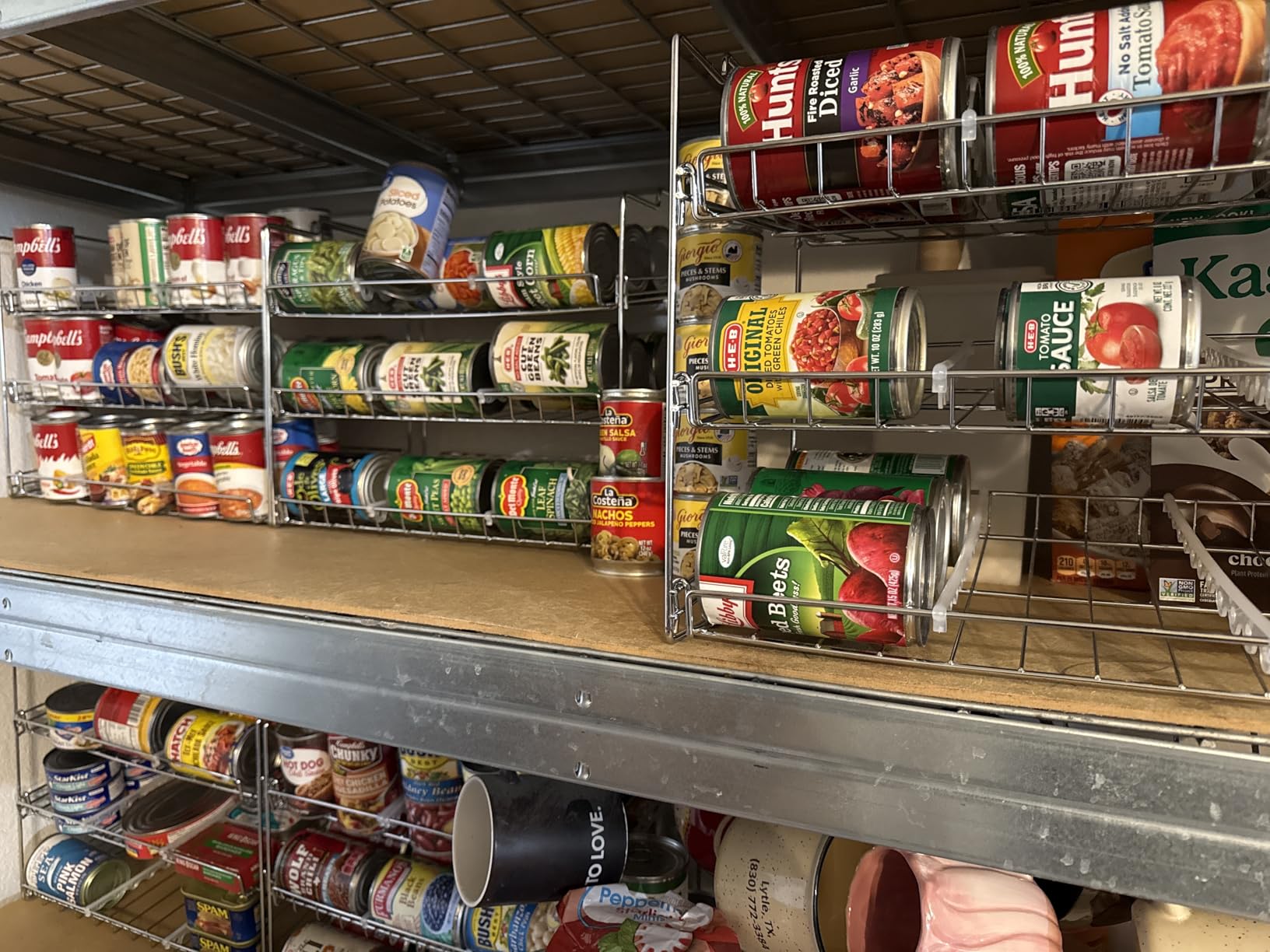
This rack uses the same patented rolling layout as the Simple Houseware model but sits in an alloy steel frame that felt noticeably steadier when we pulled cans from a full upper tier. Depth is 11.25 inches, half an inch shallower, so it clears tight cabinets even more easily.
The adjustable columns let you widen a channel for a #10 family-size can and narrow the rest, which matters if you buy soup in bulk. Six plastic dividers slide into the wire channels and they do let the cans roll forward rather than sit flat.
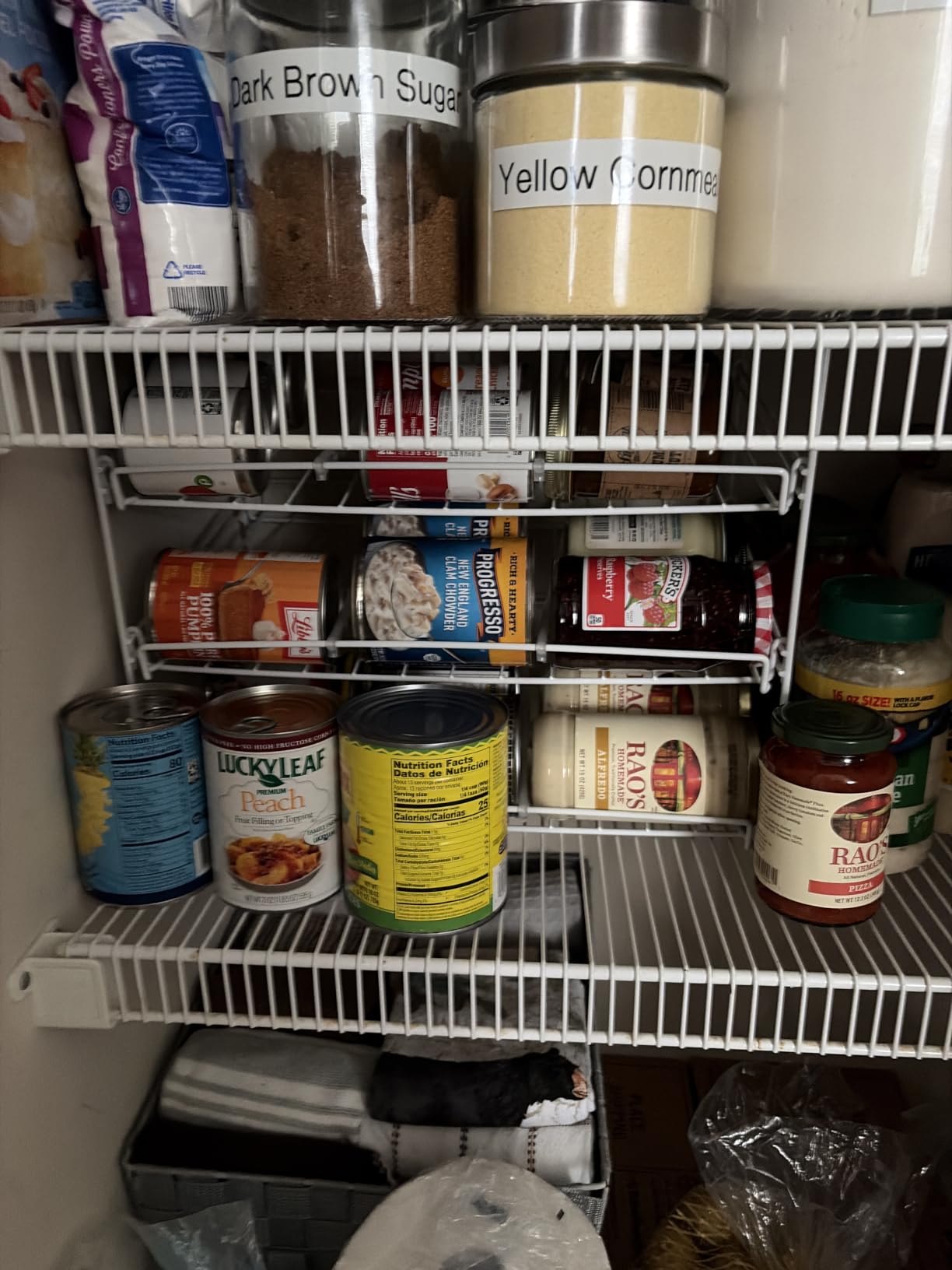
Two things to plan around. First, vertical clearance: buyers report needing 13.625 inches minimum, and 14 inches if you load large cans, which is close to the cabinet opening on many kitchens. Second, assembly order, because fitting the top shelf after the middle tier is in place takes real effort.
You can only load cans from the front, so strict back-to-front loading takes some planning. Write the purchase date on the front can and move the whole row forward as you restock.
Does it fit a standard kitchen cabinet?
Only if your opening is roughly 17.5 inches wide and 14 inches tall or more. The height requirement is what catches most people, and it is the reason this rack does not work in low upper cabinets above a counter.
It sits on the counter or a pantry shelf, so leave floor clearance underneath for the frames to sit flat.
How does it compare with the Simple Houseware 3-tier?
Same capacity and near-identical footprint. This one is heavier steel and carries a 1-year warranty, which is where the extra durability comes from. If both fit your shelf, pick on warranty and whichever instructions you find clearer.
3. Simple Houseware Soda Can Organizer Dispenser, Set of 2
Simple Houseware Soda Can Organizer Dispenser Refrigerator/Pantry, Set of 2
Set of 2 organizers
Fits standard 12 oz cans
14 in long x 5.75 in wide x 3.5 in tall
Clear plastic
Pros
- Fits standard 12 oz cans snugly
- Slanted base rolls cans forward automatically
- U-shaped front with thumb cutout
- Transparent so you see every can
- Works in fridge or pantry
- Wipes clean easily
Cons
- Not stackable and stacking voids the warranty
- Only fits specific can diameters
- Takes real space in a small refrigerator
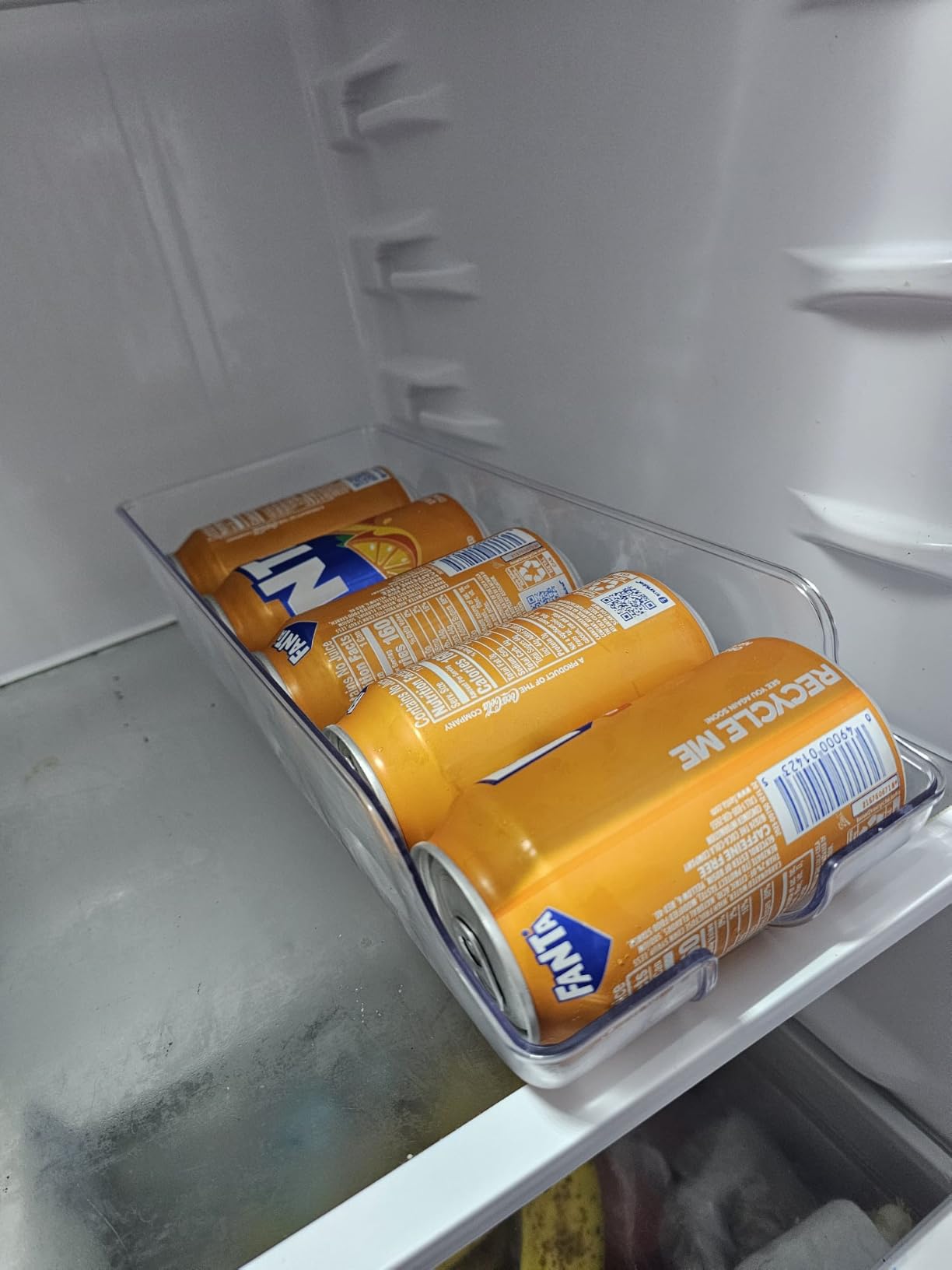
Two rows of cans on a slanted base is the simplest possible version of the rolling idea, and it works. We ran twelve standard cans through each tray and every one rolled forward without a nudge. The thumb cutout on the U-shaped front made grabbing a can genuinely one-handed.
Clear plastic means you can count your drinks without moving anything, which is the entire point in a fridge door or a beverage corner. At 5.75 inches wide, it fits narrow refrigerator shelves that no wire rack would clear.
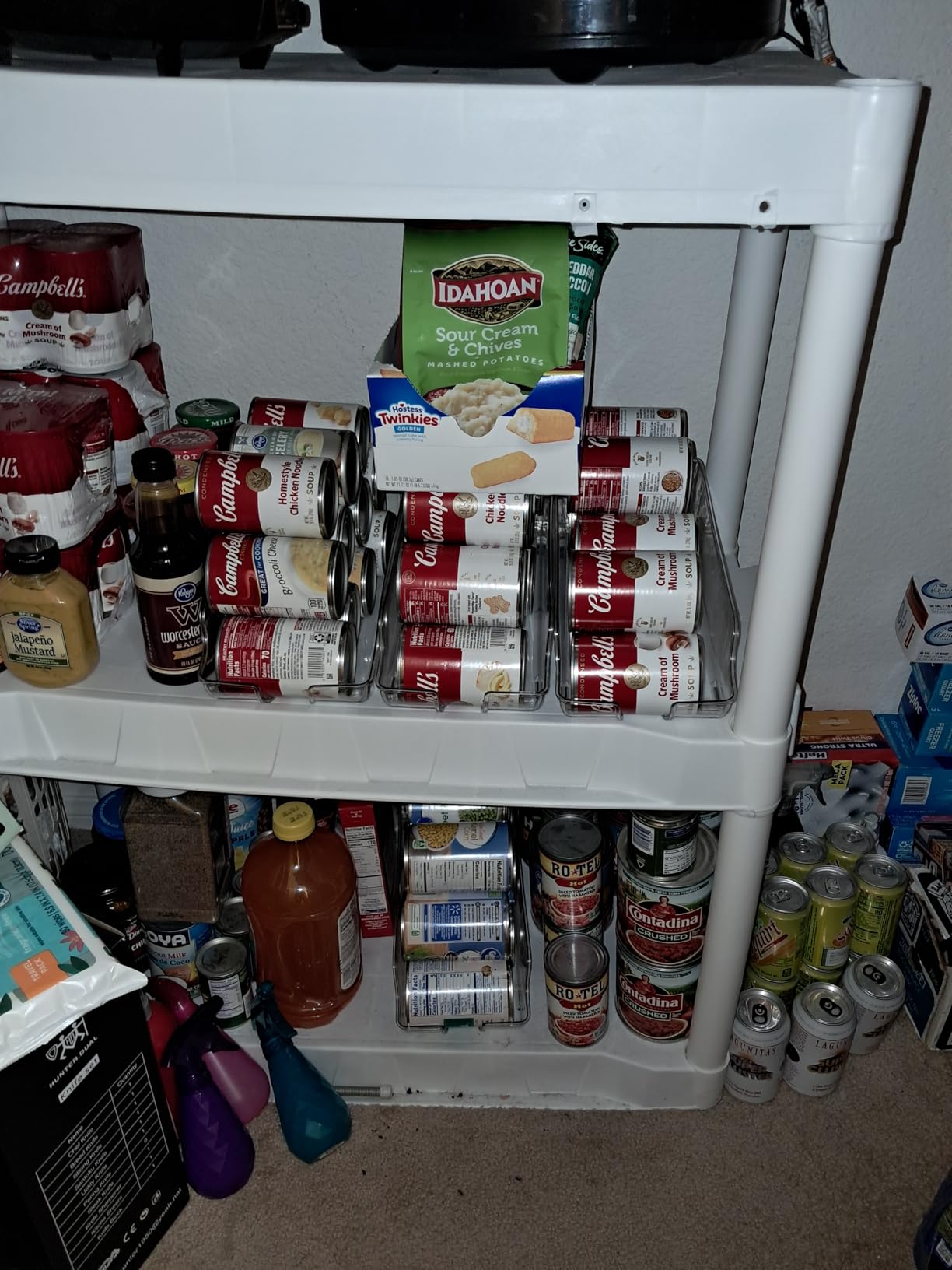
Buy it for soda, sparkling water, or juice. Do not expect it to handle canned soup or vegetables, because the channel is sized for standard beverage diameters and wider cans simply will not sit in it.
The warranty does not cover stacking, and the trays have no legs underneath, so they only work one layer high. Plan on two separate locations rather than one tall stack.
Will this fit your refrigerator?
Check depth first. Each tray is 3.5 inches tall and 5.75 inches wide, so it needs a door shelf at least 6 inches wide. In a small under-counter fridge, the usable width is often the limiting factor.
Because the base is sloped, the tray works best on a flat shelf. On a refrigerator door rack with a lip, the cans can catch at the front edge.
Is a soda dispenser worth it for a food pantry?
Yes, if you keep drinks in the pantry at all, which a lot of households do. It needs no assembly, it is simple enough to set up without reading instructions, and the two-pack gives you a fridge tray and a pantry tray.
4. AIYAKA 3-Tier Can Rack Organizer, 36 cans, Black
AIYAKA Can Rack Organizer,3 Tier Stackable Can Storage Dispenser,Black
36 can capacity
13.4 in deep x 16.6 in wide x 14.8 in tall
30-degree tilt design
Powder-coated metal
Pros
- 30-degree tilt rolls cans forward on their own
- 6 adjustable dividing lines
- Holds up to 36 cans
- Stackable for taller towers
- Allen wrench included in the box
Cons
- Pre-drilled holes sometimes misalign
- Would benefit from one or two more dividers
- Tightens up under heavy loads when stacked
The steepest tilt in the guide at 30 degrees, and you can feel the difference. Cans move forward without any prompting, which makes this the most forgiving rack for anyone who does not want to think about loading order.
Its tradeoff is depth. At 13.4 inches, it is wider than the standard 12 inch cabinet opening and will overhang in a shallow pantry. Users with tight shelves report this clearly, and it is why this rack suits a 14 inch pantry shelf better than a lower cabinet.
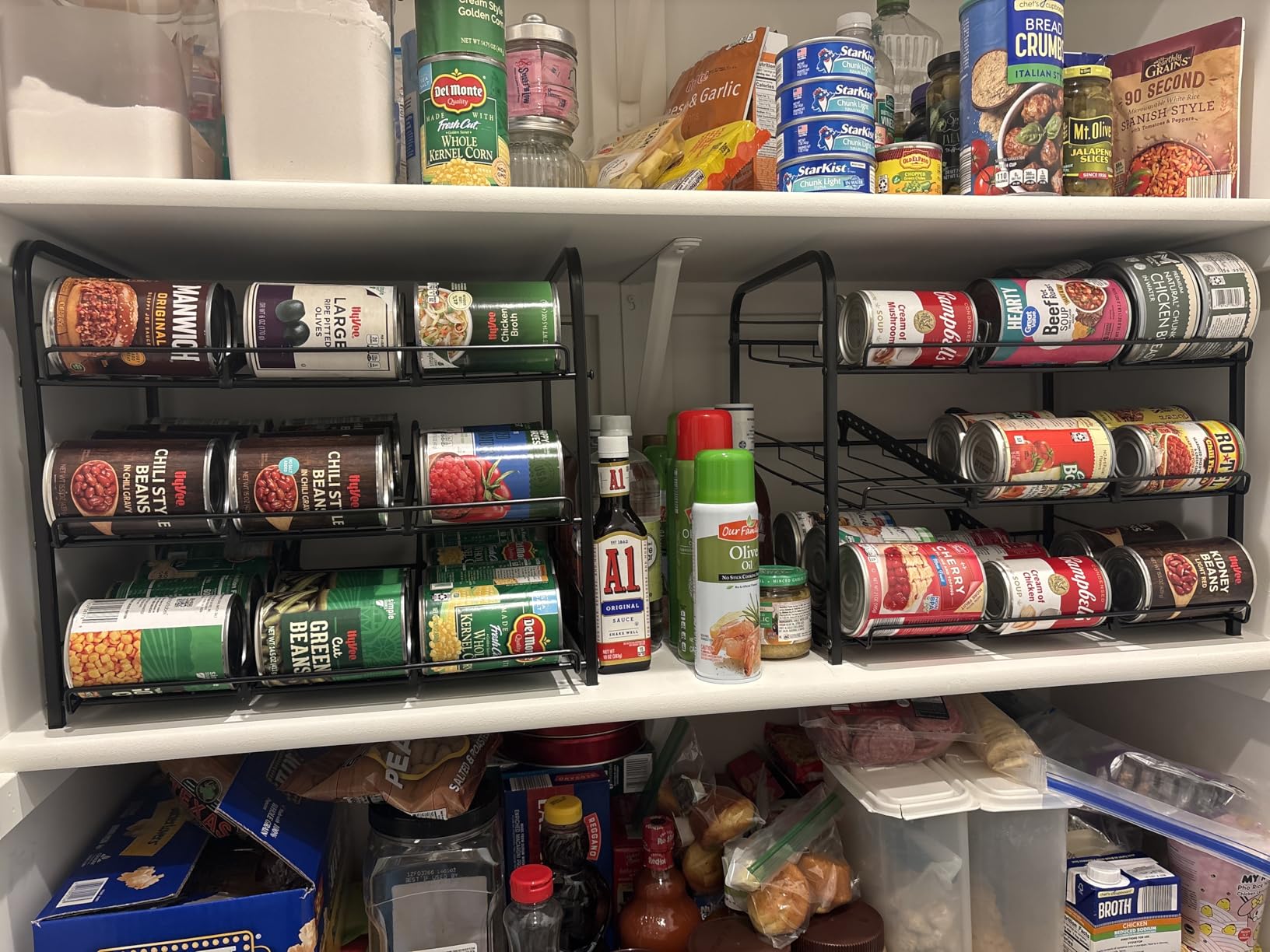
Assembly uses an Allen wrench and side frames, and it takes about ten minutes. Most of the friction we hit came from holes that did not line up cleanly on the first pass, so check alignment before tightening each screw.
Six dividing lines spread across three tiers is about two per tier, which is a little sparse. If you store beans and soup side by side, add dividers from another rack or buy them separately.
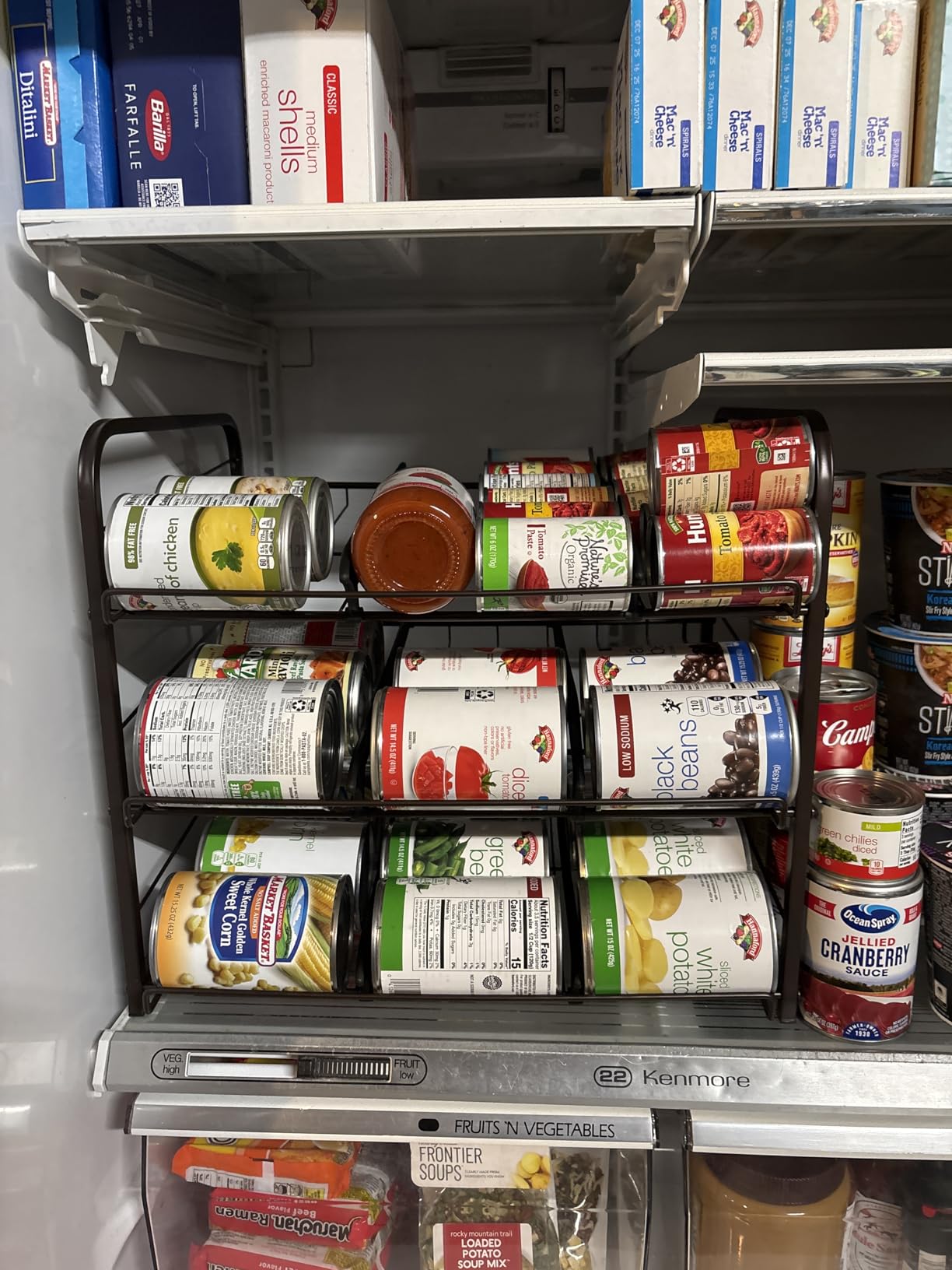
Does the 30-degree tilt stop cans from rolling off?
It keeps them contained in the channel, and the front lip holds the leading can in place. Cans will still shift side to side if the channel is wider than the can, so set dividers snugly for your most common size.
On an angled shelf, heavier cans push back more firmly, which is exactly what you want for first-in first-out order.
Who should skip this rack?
Anyone with a shelf under 13.5 inches deep. The overhang is not a small amount here, and a rack that projects past the shelf edge is unstable the moment you pull from the front.
It is a strong choice for a walk-in pantry, a garage shelf, or a utility cabinet with deeper shelving.
5. FIFO Pantry Storage Organizer Dispenser, 54 cans
FIFO Pantry Storage Organizer Dispenser Rack for Canned Goods/Drinks, 54-Can Capacity
54 can capacity
16 in deep x 16 in wide x 12 in tall
Plastic with dowel installation
Made in USA
Pros
- Patented FIFO layout that actually rotates stock
- Holds up to 54 cans
- Built in the USA
- Easy-fit dowels mount without hardware
- Racks connect to expand capacity
Cons
- Only 2 shelves for the whole 54 cans
- Plastic body feels lighter than metal
- Footprint is 16 in deep so it needs a roomy shelf
This is the most literal answer to food waste in the guide. The can sits in a cradle that tips, so removing the front can drops the next one into the same spot automatically. Nobody can forget the back row because there is no back row.
Two rows of dowel channels mean 54 cans in a 16 inch square footprint. In our testing, cans rolled forward reliably on both shelves, and the plastic surface wiped clean after a spill without any fuss.
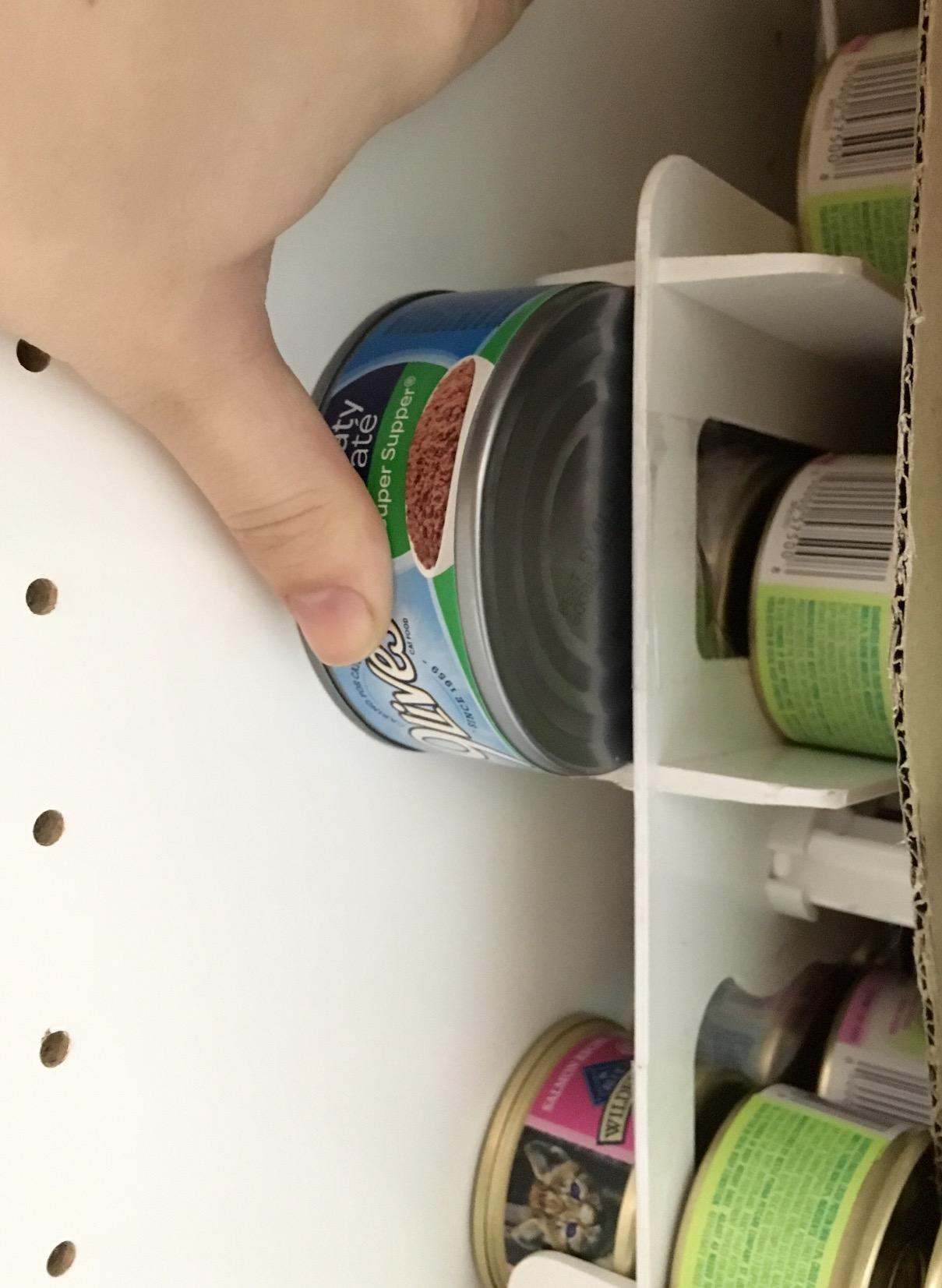
Size is the real constraint. At 16 inches deep, this needs either a pantry shelf or a cabinet with genuine depth, not a 12 inch lower cabinet. It also weighs little enough to slide easily, which is convenient when you want to pull it forward for a full inventory.
Two shelves is the limit. If you want to grow beyond 54 cans, the design connects to another unit, and we would plan for a second purchase rather than assume it expands in place.
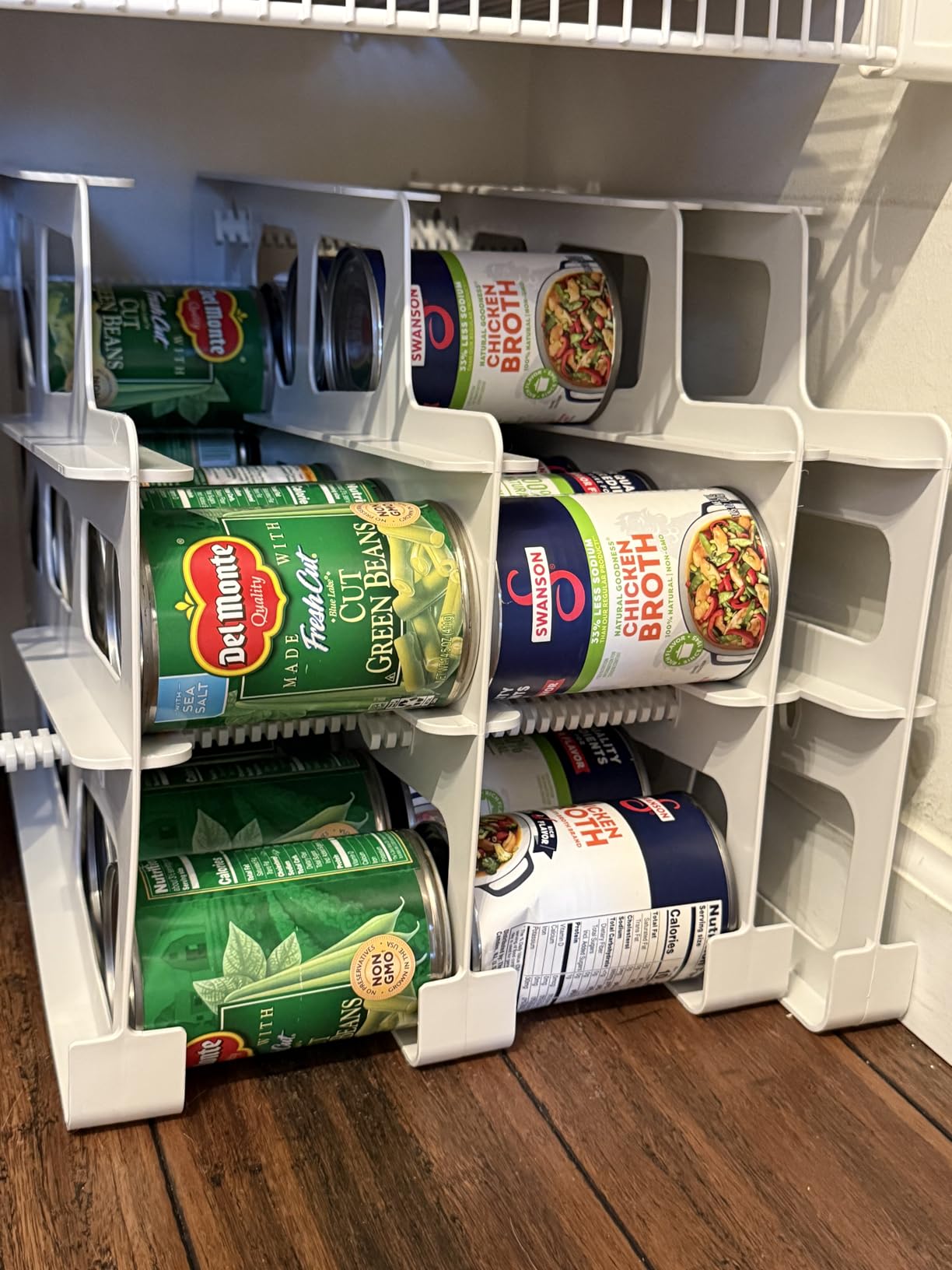
Does FIFO rotation really cut food waste?
It does when you load it correctly. Put the newest can in the back position and the oldest at the front, then replace from the back each time. Users who switched to rotation racks report far fewer cans reaching the back of their shelf.
The system only works if you never skip the front can. If you grab from anywhere, you break the order and the mechanism cannot correct for you.
Is plastic a problem for pantry storage?
Not for dry goods in sealed cans, since the can itself is the food contact surface. Plastic matters more for load rating and longevity, and this unit is rated for 20.5 pounds per shelf, which is comfortable for canned goods.
Wipe with a damp cloth and let it air dry rather than sealing damp plastic against the shelf.
6. Dial Industries 3-Tier Expandable Pantry Shelf Organizer
Dial Industries 3 Tier Expandable Pantry Shelf Organizer, Standard
Expands from 14 to 27 in wide
8.35 in deep
3 stepped tiers
White plastic
Pros
- Expands 14 to 27 inches to match any cabinet
- No assembly at all
- Top shelf is 3 in deep for 16 oz cans
- Lightweight and easy to wipe clean
- Made in USA with 1-year warranty
Cons
- 10 lb weight limit caps how many cans it carries
- Backless design lets items fall if not against a wall
- Expansion joint can stick
This is the odd one out, and that is why it earns a place. It does not roll cans and does not need to. It is a stepped shelf that expands to match the width of your cabinet, which solves the narrow-shelf problem that no rolling rack can.
At 8.35 inches deep it fits shelves where a 12 inch rack would hang over the edge. The top tier is 3 inches deep for standard 16 oz cans, and the two lower tiers step back to 2.38 inches for jars, spices, and bottles.

The 10 pound total weight limit is the honest caveat. Filled entirely with full cans, the lower step will bow or creep at the expansion joint. We used it for half-full cans, jars, and mixers, and it held that load without complaint.
Being backless means it must sit flush against a wall or cabinet back. Pushed out into the middle of a shelf, tall items can tip off the rear edge.
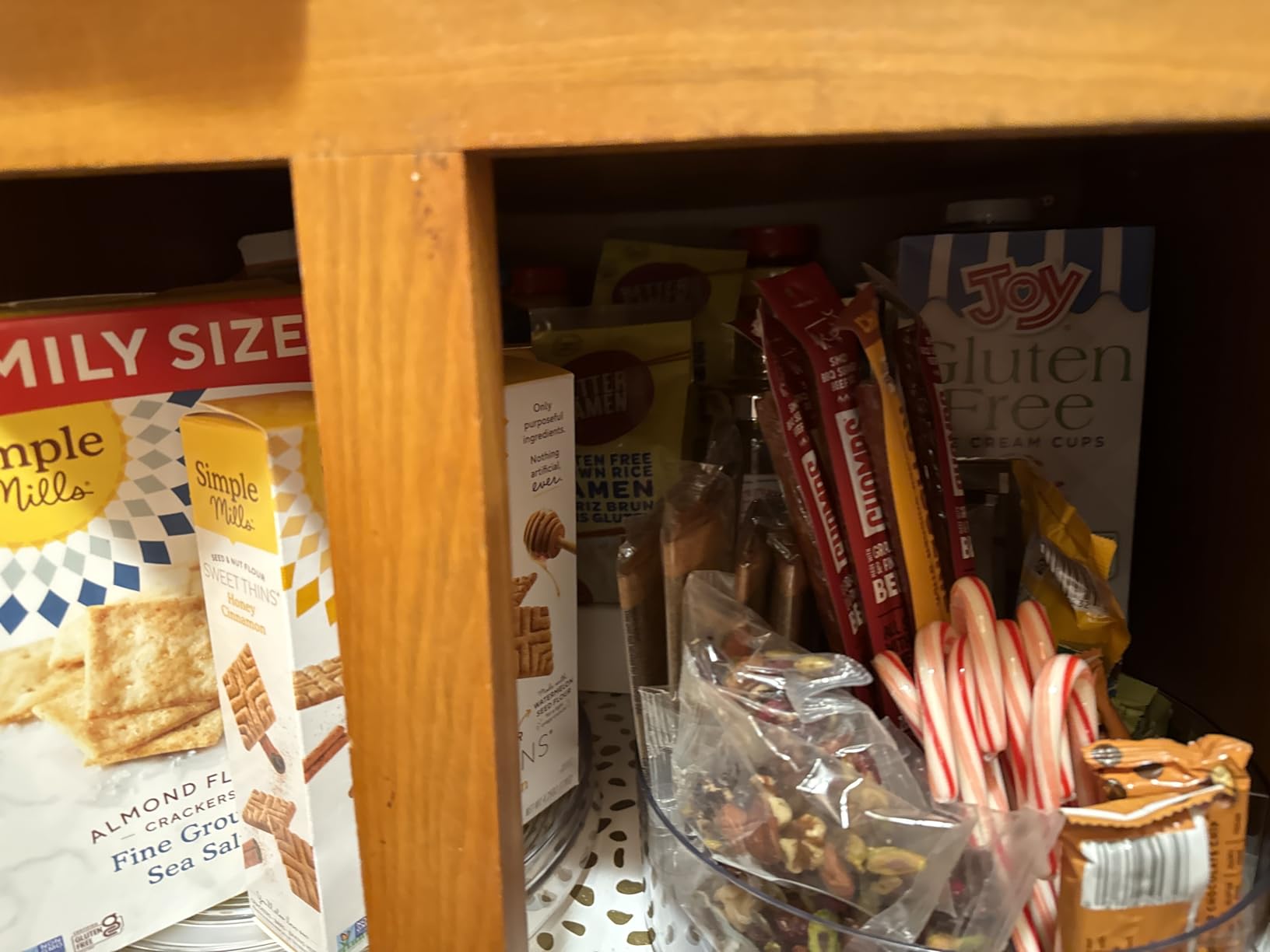
How many cans does a 3-tier expandable shelf hold?
With the top tier loaded with 16 oz cans, you get roughly 10 to 12 per row, so about 30 cans across the three tiers. Compared with a 36 can rolling rack, the count is similar but the cans sit upright and static instead of feeding forward.
If you want first-in first-out rotation, this is the wrong tool. If you want to see everything at once without pulling a front row out, it is excellent.
Is it useful in a small kitchen?
Very. Small kitchens usually have 8 to 10 inch shelves, and this is one of the few organizers here that fits without overhang. If your cabinets are narrow rather than shallow, the adjustable width is what makes it fit.
7. Kitchen Details 3-Tier Can Organizer, 36 cans, Chrome
Kitchen Details 3 Tier Can Organizer | Chrome Steel Canned Food Storage Rack | Holds 36 Cans | Space-Saving Pantry & Cabinet Storage Solution | Easy Access to Canned Goods | Freestanding Design
36 can capacity
14.5 in deep x 11.5 in wide x 11 in tall
Chrome steel, 36 lb shelf rating
Assembles in about a minute
Pros
- Holds 36 cans in a compact 11 in tall footprint
- Open front makes every can visible
- Chrome steel with a 36 lb shelf rating
- Fits on a countertop or a low shelf
- Fast tool-free style assembly
Cons
- Wire edges snag can rims on the way in
- Feels light when fully loaded
- Not adjustable for different can sizes
This is the most countertop-friendly of the metal racks. At 11 inches tall it clears an over-sink cabinet or sits on the counter under a wall cupboard without blocking anything, which is why we rated it for small kitchens.
The open front means every can is visible from standing height, including the middle tier, which the higher racks hide. The frame assembles in about a minute with the wire panels clipping into the frame.

Capacity is real but tight. We fit 36 standard cans, and the moment we added family-size cans the count dropped because two would not sit side by side. The wire channels are fixed width with no dividers to move.
Snagging is the recurring complaint we saw. Can rims catch on the wire lip as you slide them in, which takes practice and occasionally leaves a mark on the pull tab area of the label.
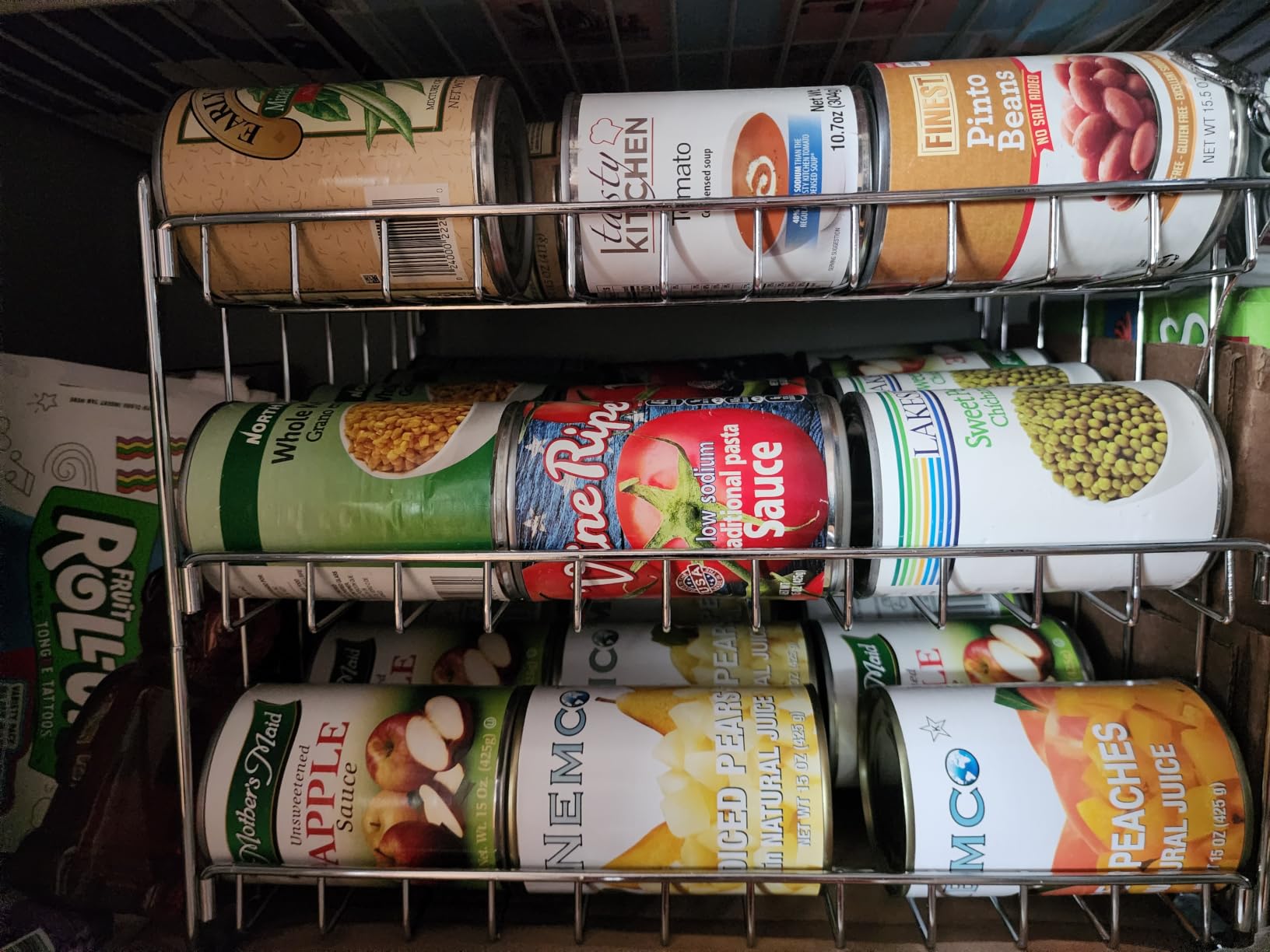
Will it hold full cans without sagging?
The stated shelf rating is 36 pounds, which is well above what 36 cans weigh. What flexes is not the shelf but the whole frame, which can feel light when every row is full and you pull hard from the front.
Keep it on a level surface and push it back against a wall if you use it on a countertop.
Is it good for soda cans?
Yes, and it is one of the few racks here that handles standard 12 oz cans across a full row. The wire spacing suits beverage diameters well, and the open front makes it easy to count what is left.
8. JKsmart 2-Pack Stackable Can Rack with 4 Adjustable Dividers
JKsmart 2 Pack Stackable Can Rack Organizer for Pantry Storage,Can Dispensers with 4 Adjustable Dividers, 2-Tier Metal Wire Basket Beverage Pop Soda Rack for Kitchen Cabinet Pantry, Black
2 pack, 2 tiers each
9.44 in deep x 15.74 in wide x 16.92 in tall
Carbon steel with wall-mount hardware
4 adjustable dividers
Pros
- Use the two baskets stacked or separately
- 4 dividers you can reposition per tier
- Wall-mountable with hardware in the box
- Screws together so the stack stays steady
- Carbon steel build
Cons
- Assembly needs hardware and real effort
- Pre-drilled holes occasionally miss
- Some users add zip ties for extra stacking security
Two 2-tier baskets in one box give you options rather than a fixed configuration. Stacked, they make a 4-tier tower; separated, they become two separate counter racks. We tried both and the flexibility turned out to be the deciding factor.
This is the shallowest metal organizer we covered, at 9.44 inches deep, which is what makes it fit cabinets where the 11.5 inch models overhang. Four dividers spread across the baskets let you set channel width per shelf.
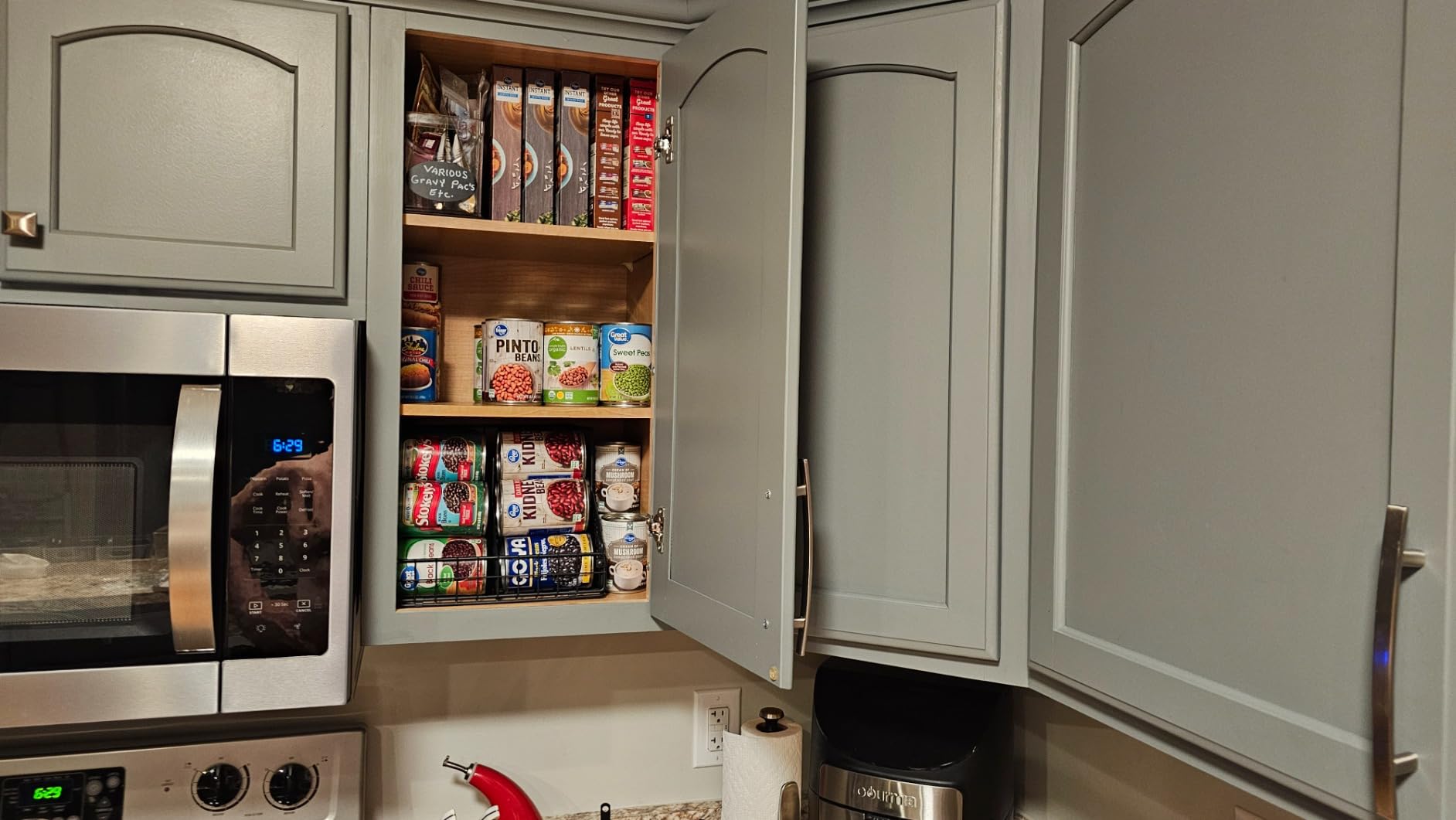
Wall mounting is the sleeper feature. Pre-drilled holes and hardware are included, so in a walk-in pantry you can lift the storage off the floor entirely and keep the lower shelves clear for bulk bins.
Assembly is the trade. It requires hardware, the holes do not always line up perfectly, and a few owners add zip ties to keep the stacked tower from leaning. Budget twenty minutes with a screwdriver.
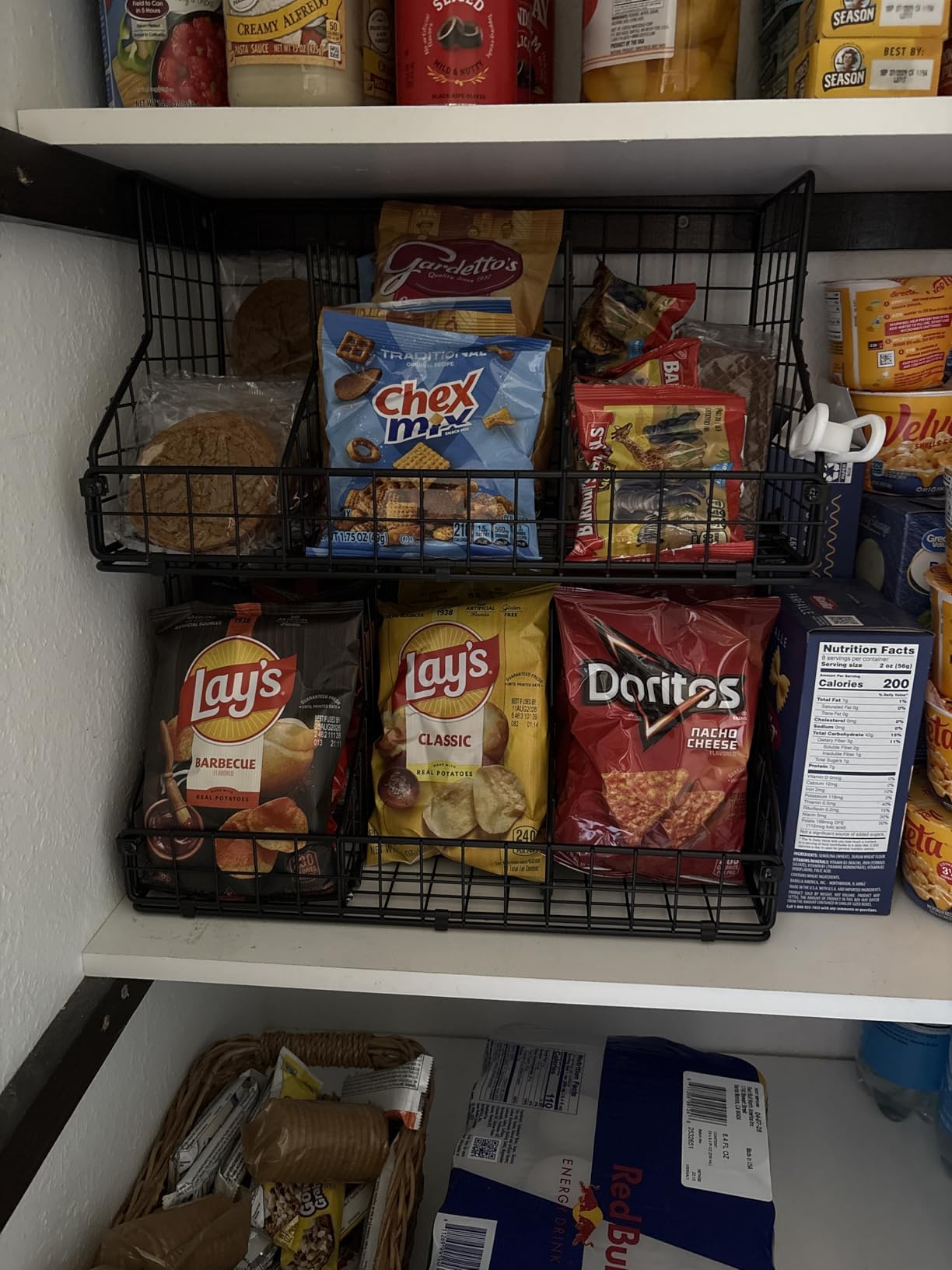
Is it stable when stacked?
Reasonably, once the screws are tight. The baskets screw together at the corners, and that joint carries the weight. If yours still leans, zip ties at the back corners fix it in seconds.
Put the heavier items on the lower baskets. A top basket full of cans on a leaning tower is the scenario that tips.
What else can it hold?
Bottles, snacks, pet food, magazines, and office supplies all fit. Because the depth is under 10 inches, it also works for canned goods stored in a shallow utility closet rather than a kitchen.
9. Simple Houseware 2-Tier Stackable Can Rack, 2 Pack, Silver
Simple Houseware 2 Tier Stackable Can Rack, Silver, 2 Pack
24 cans per rack, 48 total
11.5 in deep x 17 in wide x 11.5 in tall each
Silver metal
8 movable dividers
Pros
- 48 cans of capacity from a 2 pack
- 8 dividers across both racks for mixed sizes
- Stackable with plastic clips
- Tool-free assembly in about 4 minutes
- Anti-slip rubber feet included
Cons
- Rows fit fewer than 3 standard cans across
- Near 12 in depth x 17.5 in wide x 25 in tall needed to stack
- Occasional missing feet or dividers in the box
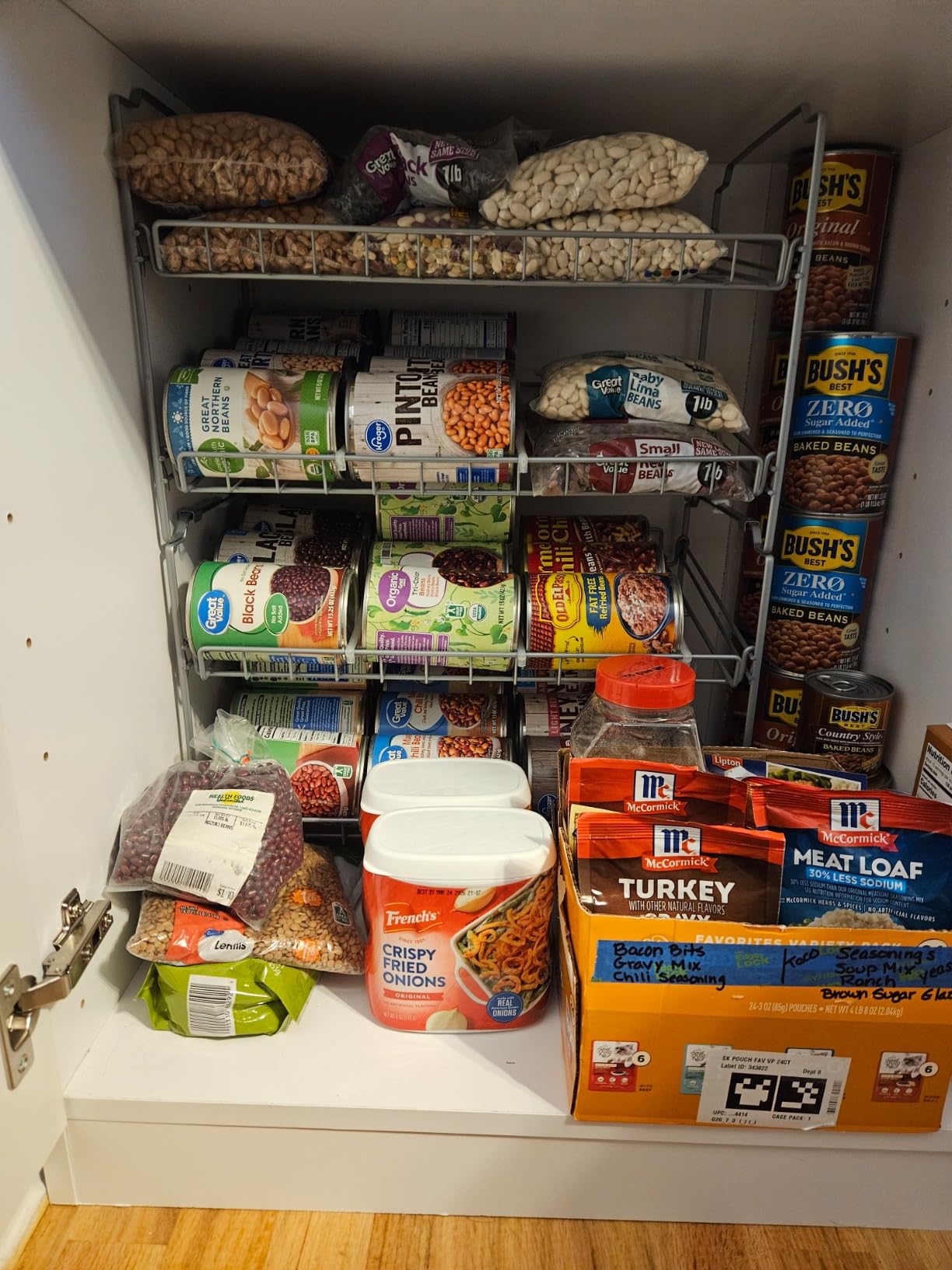
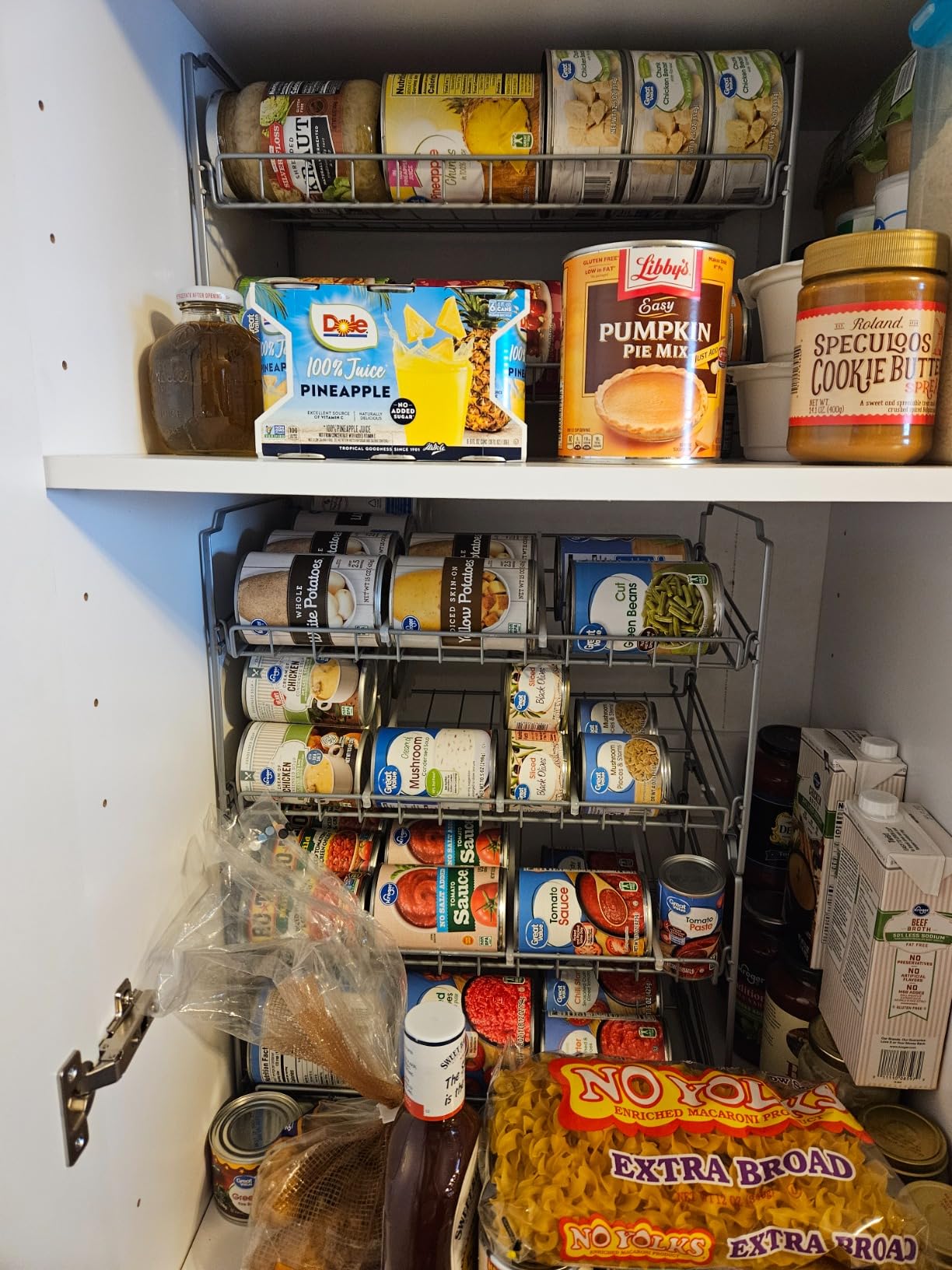
The 2-tier format is a useful middle ground: shorter than a 3-tier rack at 11.5 inches, so it fits under lower cabinets that reject taller models. Two racks give you 48 cans and a spare location for overflow.
Eight dividers is a strong divider count for a two-pack, four per rack. That is enough to dedicate one channel to family-size soup cans and keep the rest sized for standard ones, which is the mixing problem several users describe on r/organizing.
Each row is a little narrow, so getting three standard cans across took a bit of shuffling rather than lining up cleanly. Two or three across is realistic depending on the can.
Stacking both racks needs roughly 12 inches of depth, 17.5 inches of width, and 25 inches of height. If you only have one unit of space, run them side by side instead of stacked.
Do you need dividers for different can sizes?
You do if you mix sizes in one rack. A #300 can and a family-size can in the same channel either wedge or leave a gap where the front can never reaches the back one, which breaks the rolling action.
With dividers set per channel, each size gets its own lane and every can stays reachable.
Is a 2 pack better than two singles?
For most households, yes, because you can place one rack in the pantry and one in a garage or basement, or keep the second as overflow. It also means you can rotate an empty rack onto a counter while you refill the other.
10. Sonyabecca 8-Pack Stackable Can Organizer for Pantry
Sonyabecca 8 Pack Stackable Can Organizer for Pantry Cabinet Food Storage
8 wire baskets, 9 cans each
72 cans when fully stacked
14 in square footprint
Iron wire with 16 screws
Pros
- 72 cans of capacity in one modular system
- Interlocking wire mesh keeps the tower square
- Configure 8 layers or split into two 4-layer units
- Iron wire is heavy duty for the weight
- Each basket is only 6.5 in tall
Cons
- 16 screws to assemble and mis-drilled holes occur
- Must be zip-tied at the back when stacked tall
- Baskets run narrow for some can sizes
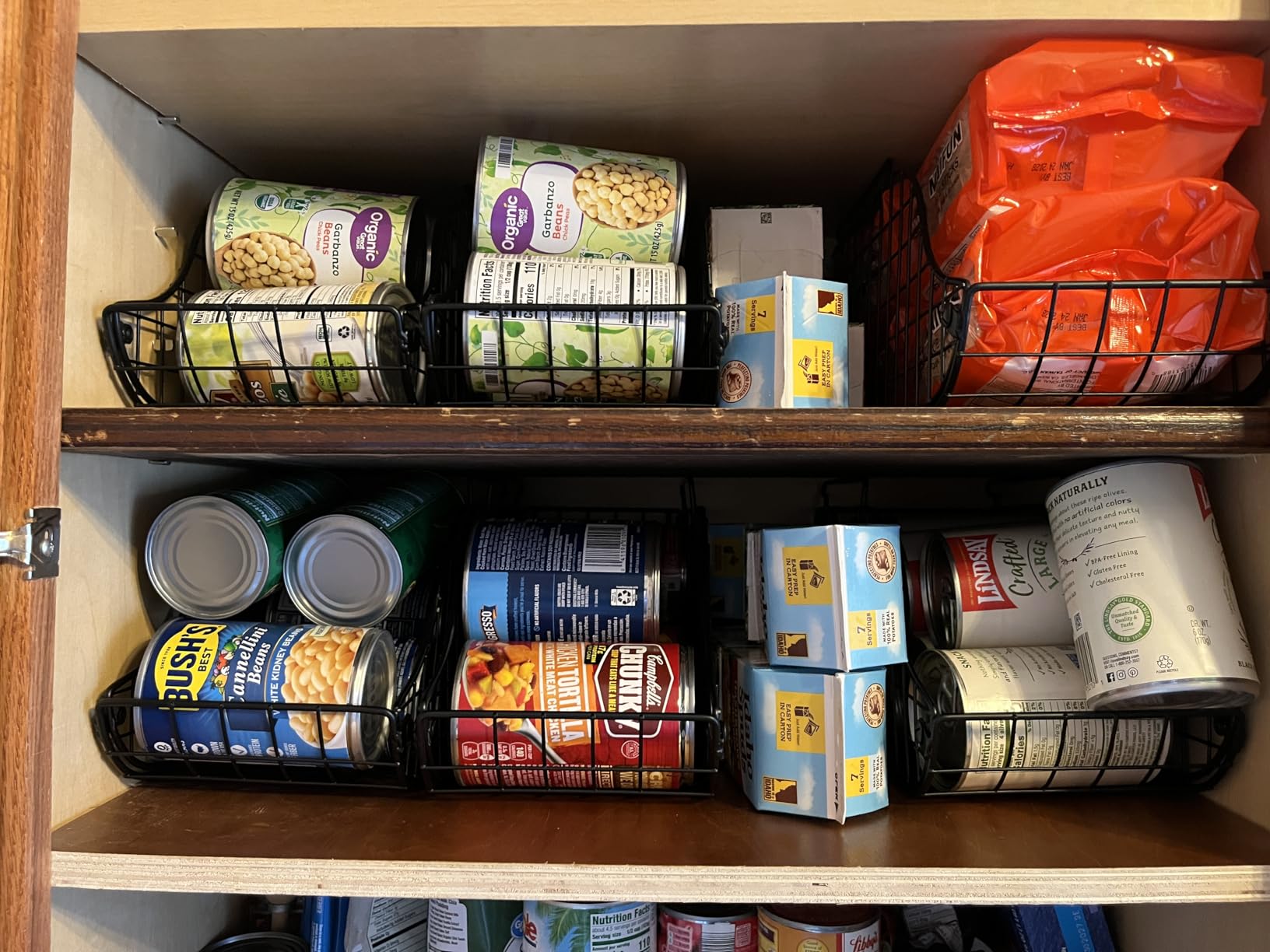
This is a bulk answer. Eight baskets at 9 cans each reach 72 cans in a 14 inch square footprint, which is a far better per-can footprint than any 3-tier model here. Households buying by the case will notice the difference immediately.
Because each basket is only 6.5 inches tall, you can build the tower to whatever height your space allows. Two four-layer racks side by side often fit a pantry better than one eight-layer column.
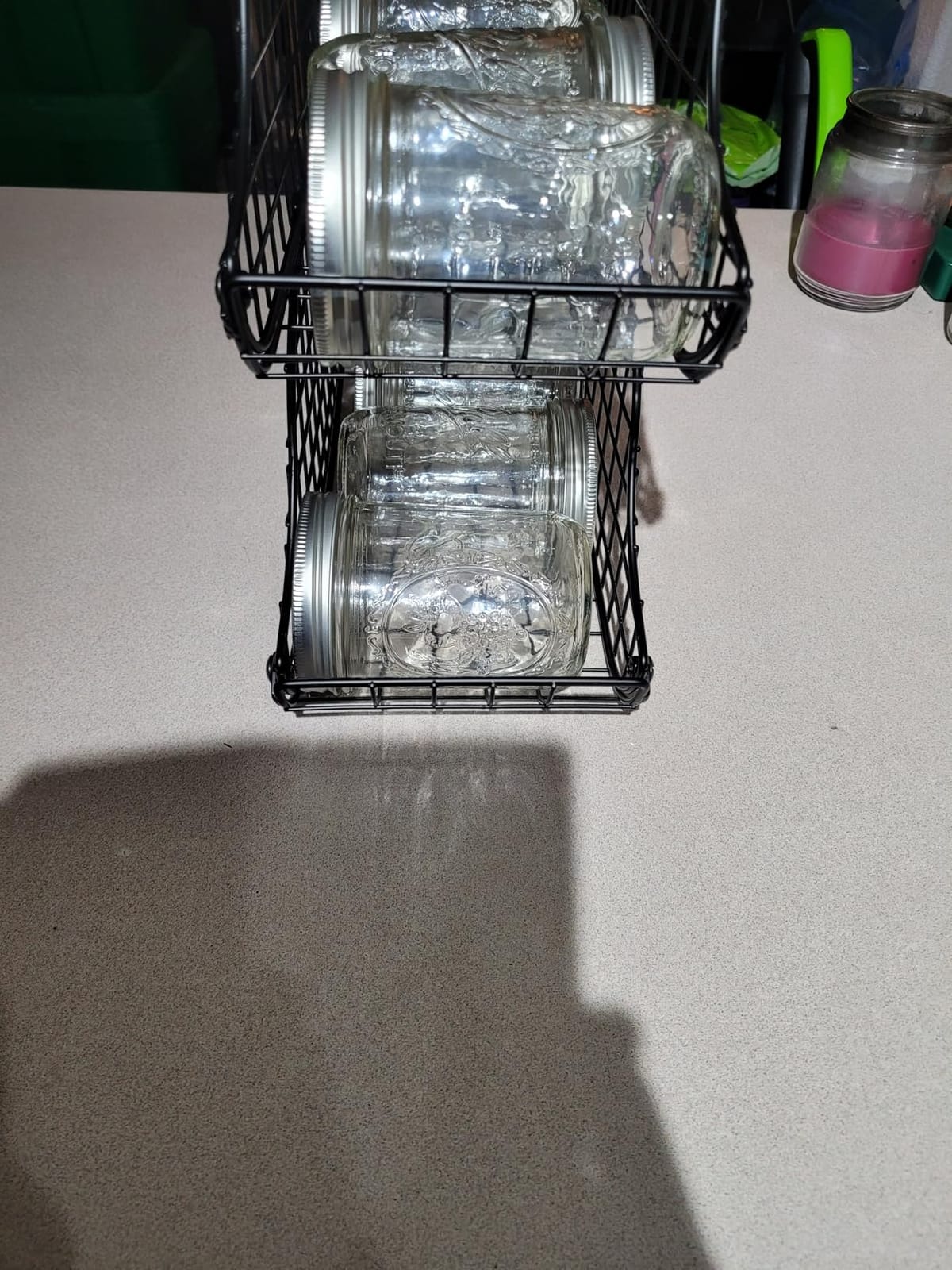
Assembly is the real cost: 16 screws, and some sets arrive with mis-drilled holes that need a workaround. The interlocking mesh does the structural work once the screws are in, so a misaligned hole early on throws off every layer above it.
Reviewers report that a fully stacked tower leans and needs zip ties at the back. Some also add small shims so the cans roll forward instead of stopping mid-channel. If you are not comfortable with a screwdriver, this is not the one.
Is 72 cans worth the assembly time?
For a household that rotates more than about 100 cans a month, yes. The per-can footprint savings show up quickly, and you avoid stacking three separate 36-can racks on one shelf.
For a two-person kitchen with 30 cans in the house, it is overkill and the 3-tier racks are the better buy.
Can it go in the fridge or a countertop?
It works in any of them. Because the baskets are modular, people commonly use two layers on a counter and store the remaining six flat in a closet until needed.
11. Vrisa 7-Tier Can Organizer, 84 cans, Silver
Vrisa Can Organizer for Pantry Soda Can Storage Dispenser Holder, Silver
7 tiers, 12 cans each
84 can capacity
12.44 in deep x 16.87 in wide x 35.35 in tall
15-degree tilt
Pros
- Holds up to 84 cans in one tower
- 15-degree tilt feeds cans forward
- Two dividers per tier for sizing
- Silver electroplated round tubes look clean
- Adjustable feet level it on uneven floors
Cons
- 35 in tall so it needs a walk-in pantry or utility room
- Assembly takes 20+ minutes and often two people
- Shelf height is not adjustable once built
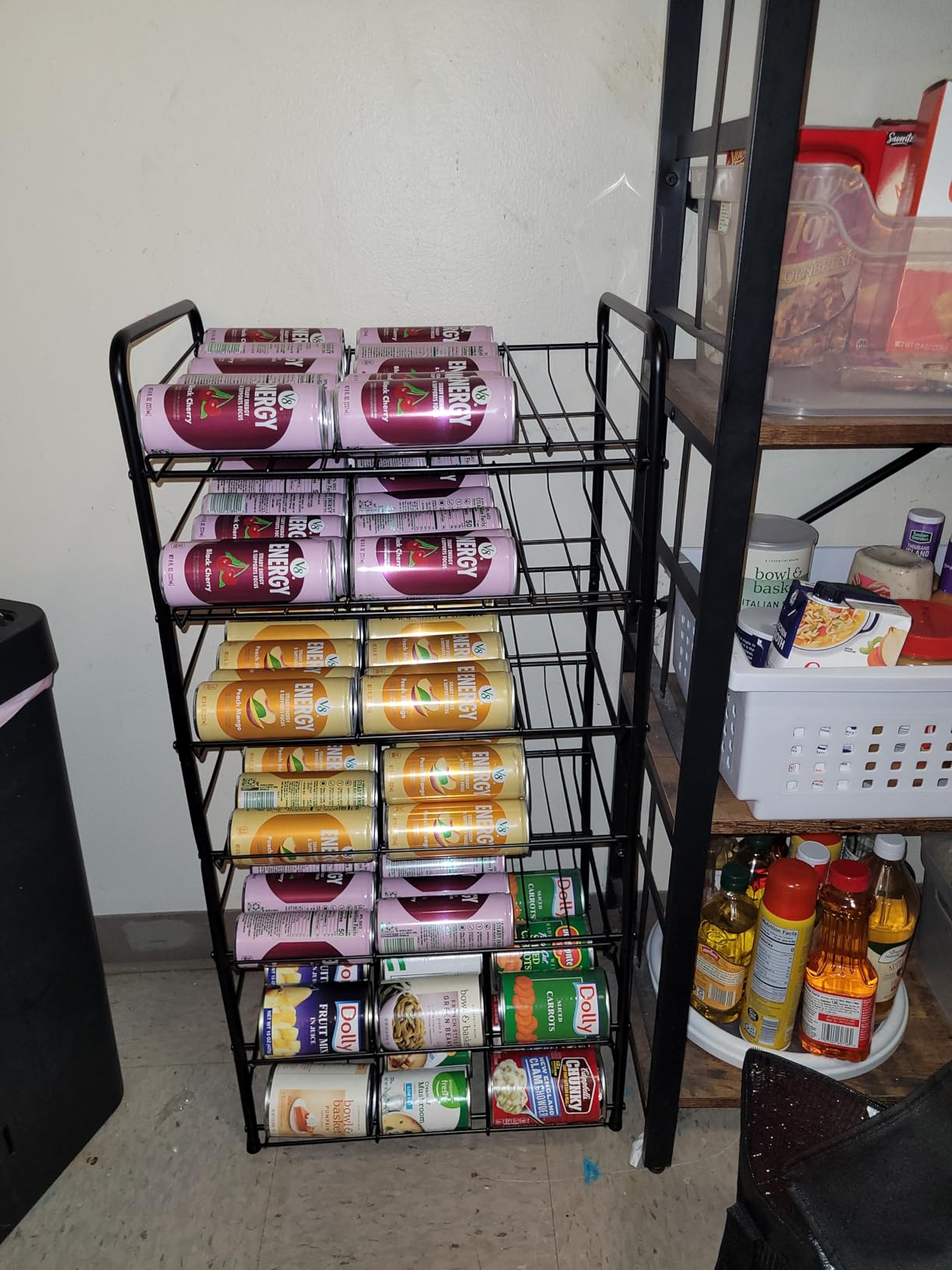
Eighty-four cans in a single column is the highest capacity of the racks we covered, and the 15-degree tilt still moves cans forward without a shove. For a dedicated pantry, basement, or garage shelf, it stores more per shelf footprint than anything else here.
The finish is the nicest of the metal racks here. Silver electroplated round tubes and adjustable leveling feet give it a furniture look rather than a wire-rack look, which matters if the shelf is visible.
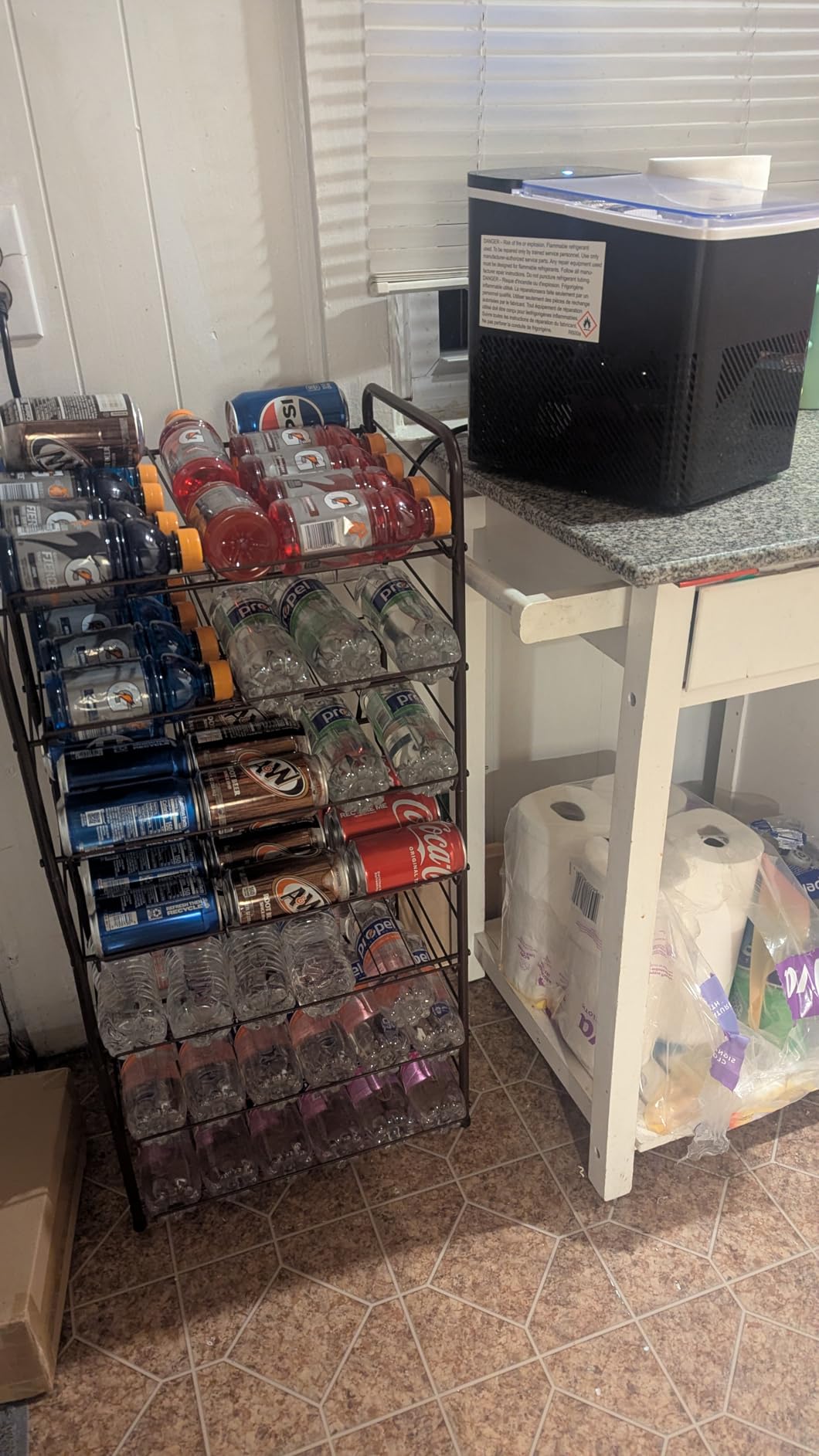
Height is the commitment. At 35.35 inches, this is not a lower cabinet product, and a five-tier version of the same design is the option for lower spaces. Plan the location before you order, not after.
Assembly is the heaviest lift of any pick we covered, with reviewers reporting 20 minutes or more and misaligned holes that can require two people. Set aside an evening and check every screw hole before tightening.
Will it tip over when loaded?
Not in normal use. The feet are adjustable, so on an uneven basement or garage floor you can level it before loading. Once all seven tiers carry full cans the base is well weighted.
Keep the heaviest cans on the bottom two tiers, and do not load a shelf so full that cans rest against the frame and lose their rolling path.
Is 84 cans realistic for an average family?
It works well for families that cook from cans daily or keep a reserve for emergencies. Average households will fill maybe half of it and can add tiers later if the five-tier version runs out of height.
12. Lyuwanxian 4-Pack Stackable Wire Can Basket Organizer
Stackable Soda Can Organizer Stores Up to 72 Cans, 4-Pack Can Storage Organizer for Pantry Shelves, 4-Tier Kitchen Can Holders with 4 Adjustable Dividers, Wire Drink Organizer for Pantry Cabinet Shelf
4 wire baskets, stackable to 4 tiers
11.9 in long x 11.5 in wide x 32.5 in tall stacked
Iron wire
Foldable flat
Pros
- Four baskets that fold flat when not needed
- Screw-together stacking adds real stability
- 4 dividers you can reposition
- Holds more than a case per basket
- Iron wire build for full can weight
Cons
- Screws are occasionally missing from the box
- Middle divider can shift under load
- Assembly is repetitive across four units
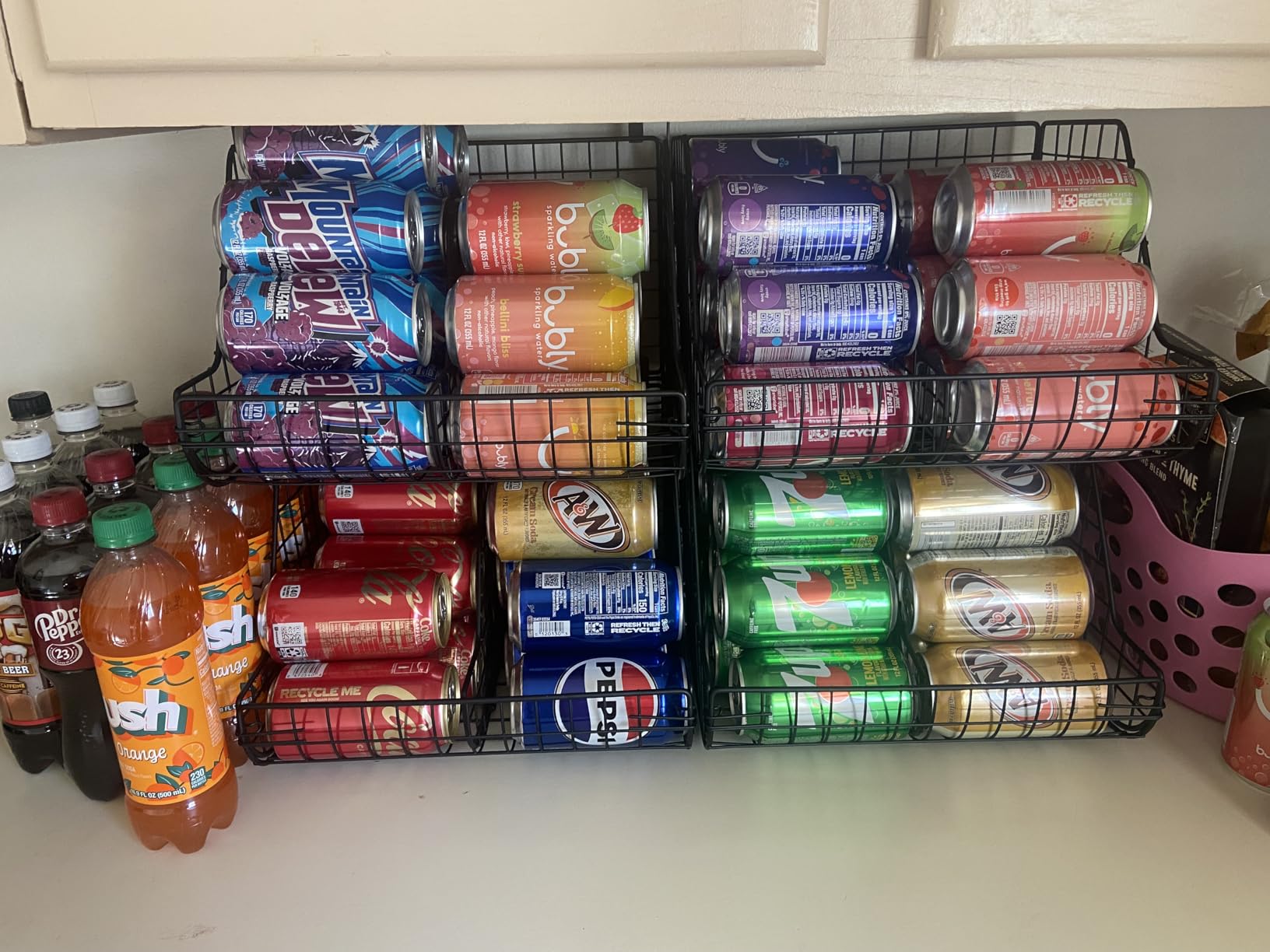
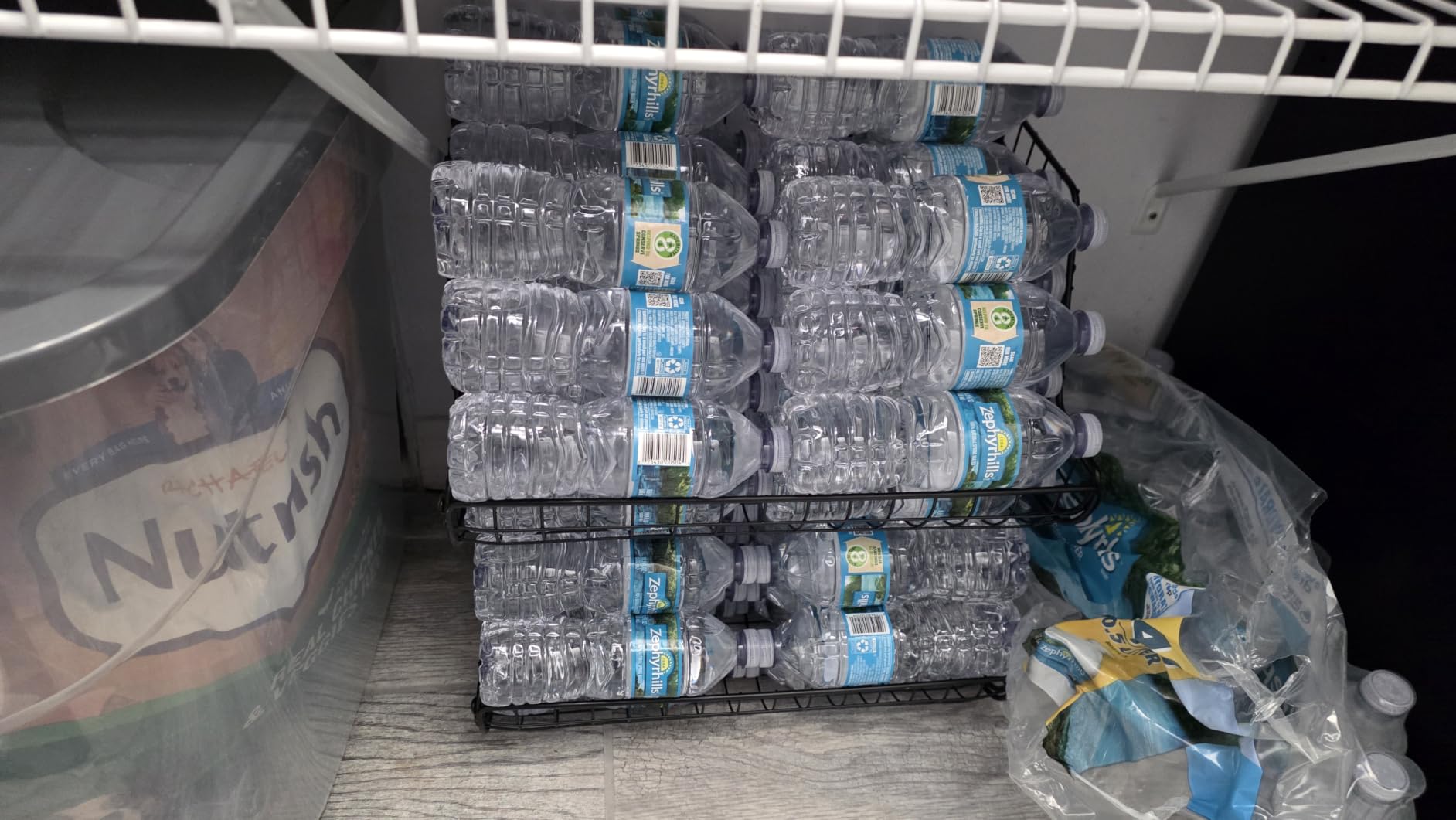
The fold-flat feature is genuinely different from everything else here. When you are not rotating cans, the four baskets collapse and live in a closet, which solves the complaint that organizers eat pantry space permanently.
Screwed together with two screws per basket, the stack holds up well for its height. We put the bulkier cans on the lower tiers and lighter soup above, and nothing shifted during the test period.
Check the box before you start. Some buyers report missing screws, and an unbored screw hole on one basket is the difference between a working tier and a discarded part.
The dividers are the least refined part of this design, and the middle one can slide when you pull cans hard. Set them snugly and check them again after a week of use.
Is it good for soda and drink cans?
Yes. The wire basket spacing suits standard 12 oz cans well, and each basket holds more than a full case, so it works for a bulk beverage corner as comfortably as for soup.
The wide 11.9 inch footprint makes it a better fit for an open pantry shelf than for a narrow cabinet.
How does it compare with the 8-basket system?
This one folds and stacks to 32.5 inches, which is shorter and easier to store away. The 8-basket model holds more per footprint but never folds. If your pantry space changes, the folding version is the safer investment.
How to Organize Canned Goods in Your Pantry
Start by grouping what you actually own. Most households have more standard 15 to 16 oz cans than anything else, a handful of family-size cans, and a few jars mixed in. An organizer built for one size will fight the other two.
Next, count your cans rather than estimating. Pick a shelf and count what is currently on it, then add cans hidden behind the front row. That total is your target capacity, and it tells you whether a 36-can rack is a downgrade or an upgrade.
Load oldest to the back. With any rolling rack, the can you take should be the one with the oldest purchase date, so write dates on the front of cans or keep a phone note and load from the back forward.
Group by how you cook. Vegetables together, beans together, soups together, and a separate shelf or bin for canned fish means you are not digging through 40 cans to find tuna.
Do a quarterly sweep. Pull every can forward once a season, check dates, and remove anything bulging, leaking, rusted through, or dented along a seam. Those cans should not be opened or eaten.
If shelf space is genuinely tight, a rolling cart or pull-out tray can be more useful than another rack. Our pantry shelving unit picks cover the hardware side, and pantry cabinet guides help when the cabinet itself is the problem.
How to Choose the Best Pantry Organizer for Canned Goods (Buying Guide)
Measure before you buy. Three numbers decide everything: shelf depth, shelf width, and the height of the opening above it. Depth under 10 inches rules out most 3-tier rolling racks and points you toward a wire basket or a step shelf. Width under 16 inches rules out the 17 inch models. Record the height too, because the difference between 11 inches and 14 inches decides whether a second tier fits.
Match the can size. Standard cans sit around 2.6 to 3 inches in diameter, and most rolling racks are sized for them. Family-size cans need roughly 3.5 inches of channel width, which is where adjustable dividers matter. Soda and beverage cans are shorter and narrower, and a few organizers here are built specifically for them. If you buy only one type of divider set, buy the adjustable kind.
Do the capacity math. Divide your total can count by the stated capacity and round up to the next rack. A household with 90 cans needs either three 36-can racks or one 84-can tower, and the second option uses less shelf width. Remember that a full 3-tier rack needs about 26 inches of headroom when two units are stacked, so plan the stack before you buy the second one.
Choose the mechanism that matches your habits. Gravity-fed rolling racks reward you for rotating cans because the oldest one surfaces on its own. Step shelves show you everything at once but rely on you remembering the back row. Clear pull-out dispensers are best for drinks and single rows. Pick based on whether you cook daily or store for the month, because a rotation rack in a rarely opened pantry is a rolling rack you never use.
Check weight rating and stability. Metal rolling racks comfortably carry full cans. Plastic step shelves often cap out around 10 pounds total, which limits you to half-full cans. If you plan to stack, confirm that the design uses clips or screws at the joint, and anchor the base against a wall.
Consider assembly honestly. Clip-together racks take ten minutes with no tools. Screw-together systems take twenty to thirty and occasionally arrive with misaligned holes. Wire basket packs with eight or sixteen screws are an evening job. If you dislike assembly, filter toward no-tool designs and accept less capacity per shelf.
Do the no-buy check. Before adding hardware, try a wire shelf laid flat on the shelf, an upside-down magazine rack, or a soda box on its side. Users on r/organizing regularly start with a cheap option and only upgrade once they know how many cans they actually cycle. For cabinet fit questions, our pantry organizer systems guide covers the shelf hardware side of the same problem.
Frequently Asked Questions
What is the best pantry organizer for canned goods?
The best pantry organizer for canned goods is a 3-tier rolling or gravity-fed can rack that holds around 36 cans across roughly 11.5 inches of shelf depth. Each tier tilts slightly backward so removing the front can rolls the next one forward, which keeps older food from being forgotten at the back. Measure your shelf depth first, since models deeper than 12 inches overhang standard cabinets.
What is the best way to organize canned food in my pantry?
Group cans by type, count what you actually own, then choose an organizer that matches both your can sizes and your shelf depth. Load the newest cans at the back of each tilted tier so the oldest can always rolls to the front, and label the front can with its purchase date. Sweep the shelf quarterly and remove anything bulging, leaking, rusted through, or dented along a seam.
How many cans can a tiered can rack hold?
Most 3-tier rack-style can organizers hold about 36 standard cans, or roughly 12 per tier. Larger systems go further: modular wire basket stacks reach 72 cans across eight layers, and tall 7-tier rolling towers hold up to 84 cans. Actual counts drop when you use family-size cans, so check the widest can in your pantry against the stated capacity.
How do I stop cans from rolling around in the pantry?
Use dividers and angled shelves instead of open rows. Rolling racks tilt 15 to 30 degrees so each can rests against the one in front rather than free to tip, and movable plastic dividers stop cans drifting sideways into the next channel. For soda and drinks, a dispenser with a slanted base and a front lip keeps every can in its lane.
What is the best material for a can rack?
Chrome-coated or alloy steel handles full can weight and lasts longest, and it is the right choice for rolling racks and stacked towers. Plastic is lighter, cheaper, and easier to wipe clean, but step-shelf plastic models often carry weight limits around 10 pounds. Clear plastic works well for drinks because visibility matters more than load capacity in a refrigerator door.
What is the best way to store pantry items?
Store canned goods in sealed containers away from heat, moisture, and direct sunlight, with older stock at the front and newer stock behind it. Keep cans in a single row or a tilted rack rather than double-stacked, so you can see every label. Check dates every few months and discard cans that bulge, leak, show surface rust, or have a seam dent.
Conclusion
The Simple Houseware 3-Tier 36-can rack is the best pantry organizer for canned goods for most households, because it holds a real 36 cans in 11.5 inches of depth, stacks with clips, and comes with dividers that handle mixed sizes. Pick the Deco Brothers version if you want a heavier steel frame and a warranty, and the 2-pack rolling set if you want 48 cans without a taller single unit.
Match the rack to the constraint you actually have: shallow shelves point to the expandable step shelf or the shallow wire baskets, deep pantries point to the 54-can rotation dispenser, and bulk households should look at the 72-can and 84-can systems. Measure first, load oldest to the back, and the cans will stop disappearing.