
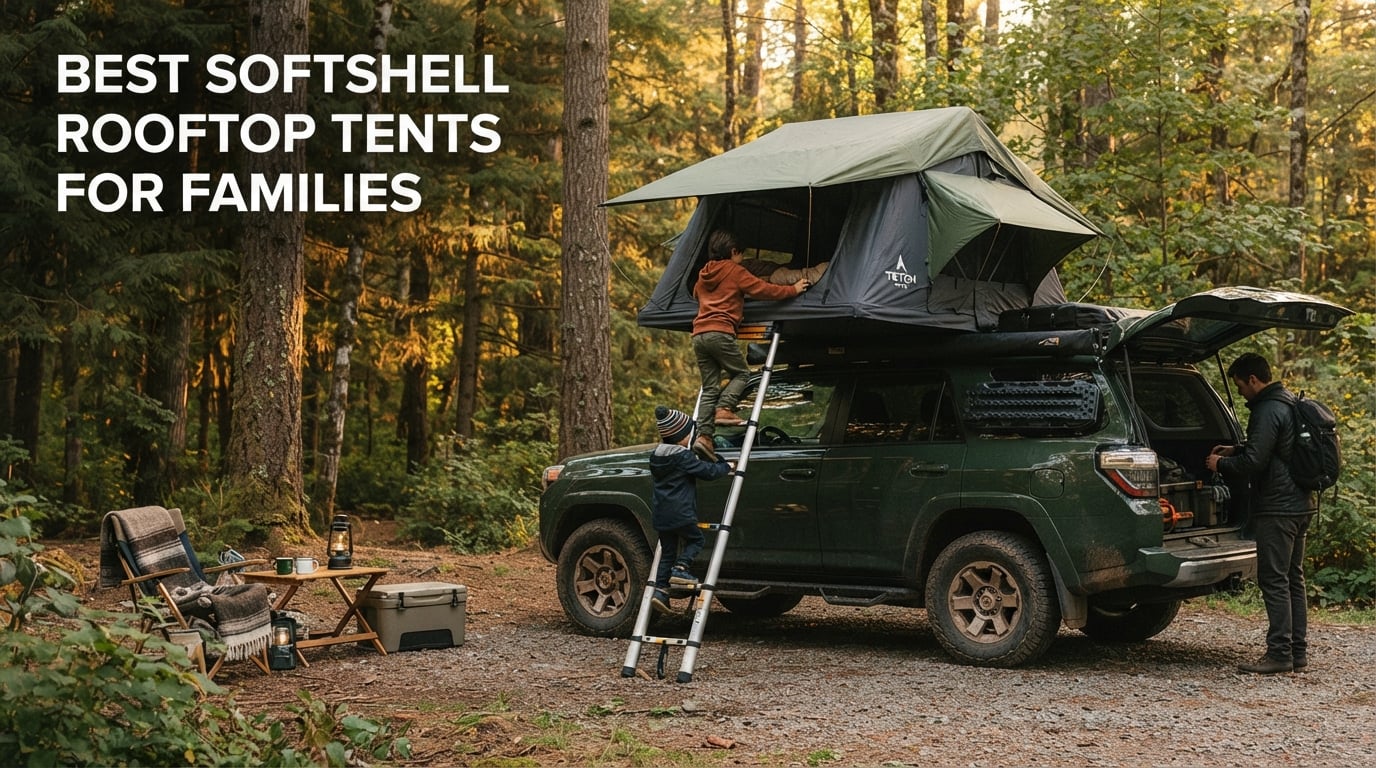
Picking a rooftop tent for a family is harder than picking one for yourself, because the label capacity and the space you actually get on a cold night with three people are very different numbers. We spent weeks reading spec sheets, owner reviews and long-running forum threads on softshell rooftop tents, then matched six of them to real family sleeping layouts.
This is our guide to the best softshell rooftop tents for families in 2026. A softshell rooftop tent is a fold-out fabric shelter that straps to your roof rack and opens from a heavy-duty PVC travel cover into a flat sleeping platform with a rainfly and a telescoping ladder. Most sit in the mid-to-high four figures, and they trade aerodynamic shape for space, weight and price.
Six models make the cut, and only one of them genuinely sleeps four. That is the single most important fact on this page, and it is the reason the ranking is ordered by floor space rather than by rating. We also flag which models have a real owner history behind them and which are carrying a rating built on a single review, because in this niche the review counts are tiny and the marketing is not always accurate.
Last updated in October 2026. We earn from qualifying purchases, and it does not change which tent we rank first.
Before you read further, it helps to know the two categories this guide covers. If you want the full field including hardshell models, our rooftop tent roundup covers every style. If your family vehicle is an SUV or wagon specifically, the SUV rooftop tent picks are the relevant companion read.
Top 3 Picks: Softshell Rooftop Tents for Families in 2026
OVS TMBK 3
- Lightest 3-person build in the group
- All-night waterproof reports
- Included foam mattress


Meedo Apolle TNT L
- Opens in under a minute
- 4.5 inch foam mattress
- Best venting in the group
Best Softshell Rooftop Tents for Families in 2026
| Product | Specifications | Action |
|---|---|---|
| Overland Vehicle Systems TMBK 3 |
|
Check Latest Price |
| Overland Vehicle Systems HD Nomadic 3 |
|
Check Latest Price |
 Tuff Stuff Overland Ranger 65 Tuff Stuff Overland Ranger 65 |
|
Check Latest Price |
 Overland Vehicle Systems HD Nomadic 4 Overland Vehicle Systems HD Nomadic 4 |
|
Check Latest Price |
| Meedo Apolle TNT L |
|
Check Latest Price |
 Tuff Stuff Elite 5-Person with Annex Tuff Stuff Elite 5-Person with Annex |
|
Check Latest Price |
What Is a Softshell Rooftop Tent?
A softshell rooftop tent is a fold-out fabric shelter that mounts to your roof rack, unfolds from a heavy-duty PVC travel cover into a flat sleeping platform, and typically costs in the mid-to-high four figures. The fabric body tensions over extendable bows, a rainfly covers the top, and a telescoping ladder gives you access at night.
The word softshell is the whole distinction. A hardshell rooftop tent is a rigid clamshell that hinges upward and locks, and it looks far sleeker closed. A softshell keeps the same flat folded shape but replaces the rigid lid with fabric, which is why softshells can be wider, longer and cheaper for the same money.
There are three moving parts to understand. The travel cover is the hard PVC or 1000G PVC boot that protects the folded bundle from road grit and highway dust. The bows are the hinged aluminum or fiberglass arms that swing out to hold the platform rigid when the tent is open. The ladder mounts separately, usually to the side of the tent or to your rack, and its angle is what gets you the right entry height.
Two practical consequences follow from that design. First, a softshell adds more aerodynamic drag than a hardshell of the same length, because fabric does not smooth airflow. Second, the softshell platform is heavy, because the base and frame carry everything above your roof. Every unit in this guide weighs between 108 and 194 pounds, and that weight is the single most important number for your vehicle.
Why Families Are Switching to Softshell RTTs
Maximum space is the reason most parents land here. For the money, a softshell gives you a wider and longer floor than a hardshell in the same price bracket, and the four models here run from a 53.5 by 92 inch sleeping area up to a 75 by 122 inch platform.
Budget friendly is the second reason. Hardshell shells from Roofnest, iKamper and Thule cluster at a higher spend for the same interior area, and a family that needs four berths pays that premium twice.
Lighter weight is the third, and it is relative. These softshells are not light in absolute terms, but the TMBK 3 at 108 pounds and the Meedo at 134.5 pounds sit meaningfully below the 194 pound Tuff Stuff Elite, and that gap decides whether a mid-size SUV copes or a truck shrugs.
Breathability is the fourth. Fabric bodies with mesh windows, rainflys and skylights move more air than a sealed hardshell, which matters on a July desert site where a hardshell turns into an oven.
The tradeoffs are real too, and it would be dishonest to skip them. Softshells collect condensation, because warm breath against fabric has nowhere to go. They add drag at highway speed. Their hinges and straps are more failure-prone than a hardshell latch. And the folded bundle is a brick that two people should handle, not one.
On r/rooftoptents the recurring owner consensus is that sleeping above the ground beats sleeping on it, and that most weekend car camping is honestly better served by a large ground tent. Rooftop tents earn their weight on multi-night trips and travel-heavy overlanding routes where a campsite with flat ground is not guaranteed. Our general rooftop tent guide goes deeper on that trade.
1. Overland Vehicle Systems TMBK 3 Review: The Lightest Family Softshell With the Biggest Owner History
Soft Shell Rooftop Tent for SUV & Truck Camping, 3-Person – Overland Vehicle Systems TMBK – Universal Fitment with Rainfly & Ladder
108 lb closed
A-Frame fold-out
53.5 x 92 in sleeping area
2.25 in foam mattress
300 mm rated
Pros
- Lightest unit in the group at 108 pounds
- Owners report staying dry through all-night pouring rain
- Window openings on all four sides plus a top skylight
- Included high-density foam mattress with cotton cover
- Works on racks up to a wide range of crossbars
Cons
- Included foam mattress loses comfort over multi-night trips
- Instructions contain errors and missing content
- No insulation so cold-weather use needs a liner
The TMBK is the model we kept coming back to, because it is the only softshell here with a genuine body of long-term owner feedback behind it. At 151 reviews it is far ahead of anything else in the group, and the complaints repeat consistently enough that we can tell you in advance which ones you will hit.
Owners describe it as light for a rooftop tent, which sounds odd until you put it next to the 183 pound Nomadic 4. The 53.5 by 92 inch sleeping area holds two adults comfortably with a dog, and several reviews specifically praise how roomy it feels for a three-person A-frame once you are inside and zipped down.
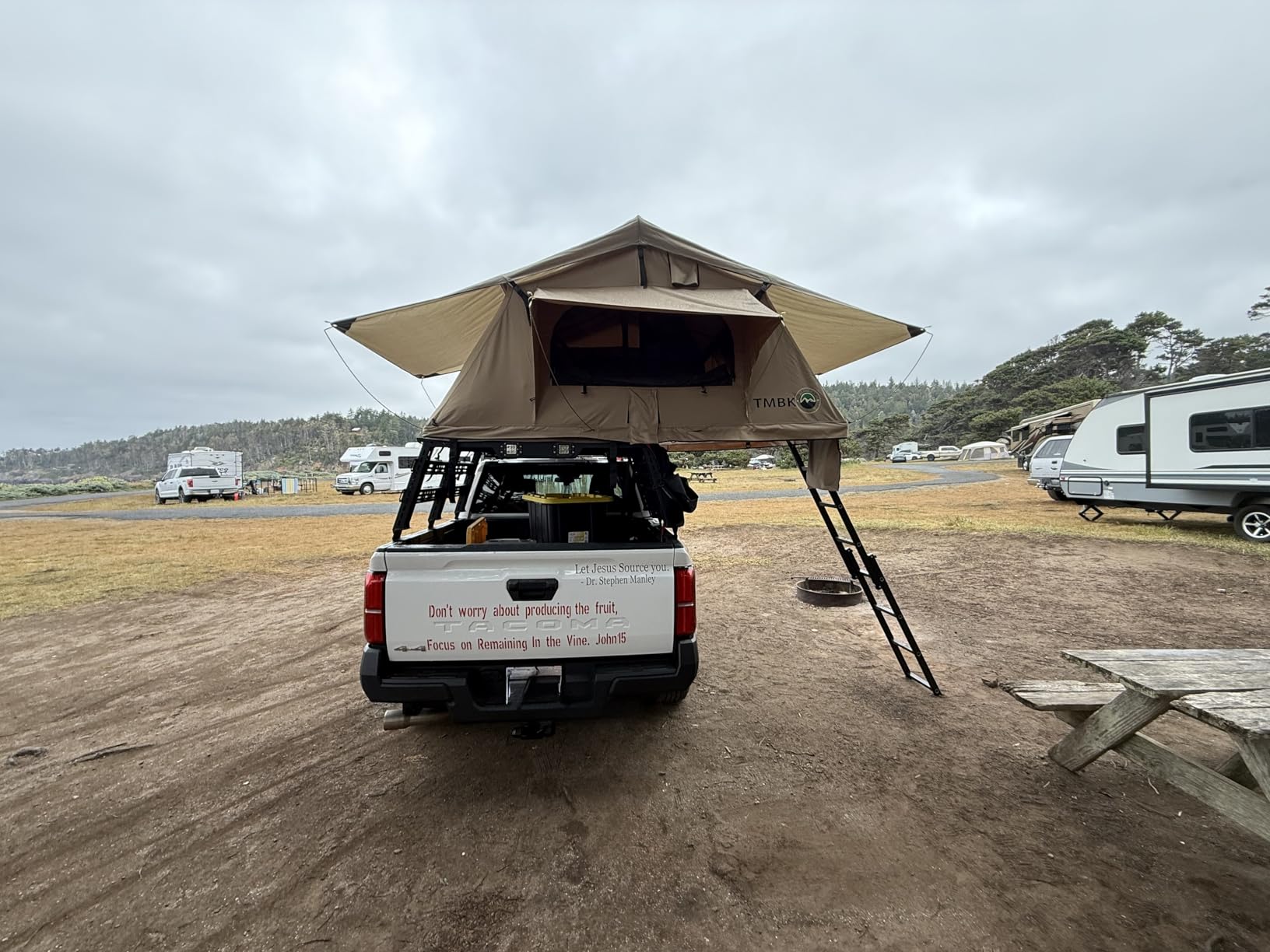
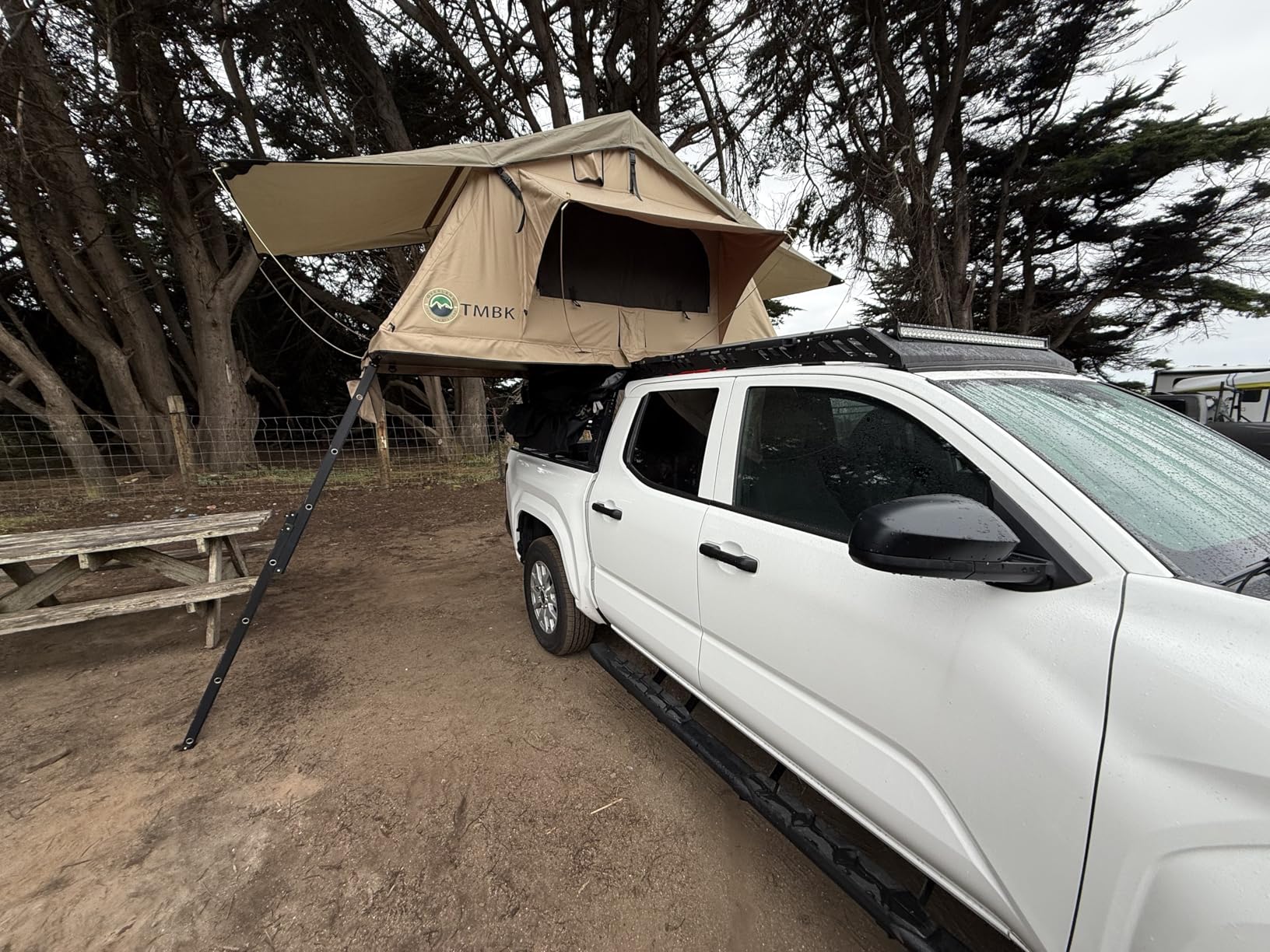
The waterproofing is the surprise. Reviewers report staying dry through all-night pouring rain, and the fabric specification supports that, with a 420D polyester Oxford waterproof rainfly over a tear-resistant poly-cotton ripstop canvas body rated at 300 mm. Ventilation is handled with window openings on all four sides plus a top skylight, which is the arrangement you want in summer heat.
Setup and breakdown are repeatedly described as quick, in the range of five to twenty minutes, and there is no drilling or vehicle modification if you already run a rack. Owners also like the aluminum-plated base and marine grade stainless steel hardware, and the fact that the included foam mattress with cotton cover was better than they expected on the first night.
Here is the honest problem. Over a multi-night trip the included 2.25 inch mattress flattens and stops being comfortable, and the answer almost every owner arrives at is a foam topper. Second, the paperwork is poor, with errors and missing content, so budget extra time for the install. Third, there is no insulation, so this is a three-season tent unless you add a liner.
When the TMBK 3 works for a family
This is the tent for two adults and one or two smaller children, on a mid-size SUV or a wagon with a rated rack, on a spring or autumn trip. The 108 pound weight means you can carry it on a vehicle that other softshells in this guide would overburden, and the 4.4 rating across 151 reviews means the risk of an unknown failure is the lowest here.
Because the sleeping area is 53.5 inches wide, two adults and a small child fit comfortably. Two adults and two older children is tight, and you will feel the walls at 2 am. If your family regularly sleeps four in the tent, step up to the Nomadic 4 instead.
When the TMBK 3 is the wrong buy
Do not buy it as a winter tent. The absence of insulation is a consistent, specific complaint, and condensation under the mattress builds up as soon as more than one person is inside and the temperature drops.
Be cautious about the ladder. Some owners report it feels flimsy and needs extra drilled holes to lock at a proper angle, and some report missing hardware or bolts too short for certain round-tube bed racks. Check your rack tube diameter before the tent arrives, not after.
2. Overland Vehicle Systems HD Nomadic 3 Review: The Extended Platform With a Four Year Warranty
Overland Vehicle Systems HD Nomadic 3 Extended Soft Shell Roof Top Tent – Dark Gray Base with Green Rain Fly & Black 1000G PVC Travel Cover – Black Aluminum Base
165 lb closed
6536 sq in floor area
63 inch wide
40 in peak height
4 year limited warranty
Pros
- Full diamond plate base with marine grade hardware
- 63 inch width is wide for a 3-person tent
- No drilling or vehicle modification to install
- 4 year limited warranty is the longest here
- Bonus pack includes memory foam pillows
Cons
- Heaviest load of the 3-person models at 165 pounds
- Ballistic nylon shell adds drag and fuel penalty
- Single room with limited interior storage
The HD Nomadic 3 is the extended version of the same idea, and the extension is the whole point. Where the TMBK folds out to a 53.5 inch sleeping area, this one opens to a 63 inch wide floor with 6536 square inches of area, which is a meaningfully different room once a mattress and gear are in it.
What stands out on the hardware is the full diamond plate base. That is a metal deck rather than a fabric floor, and it is why the tent is heavy at 165 pounds, but it also means the base will not flex, sag or soak the way a fabric floor can. Owners switching from lighter tents tend to notice that immediately.
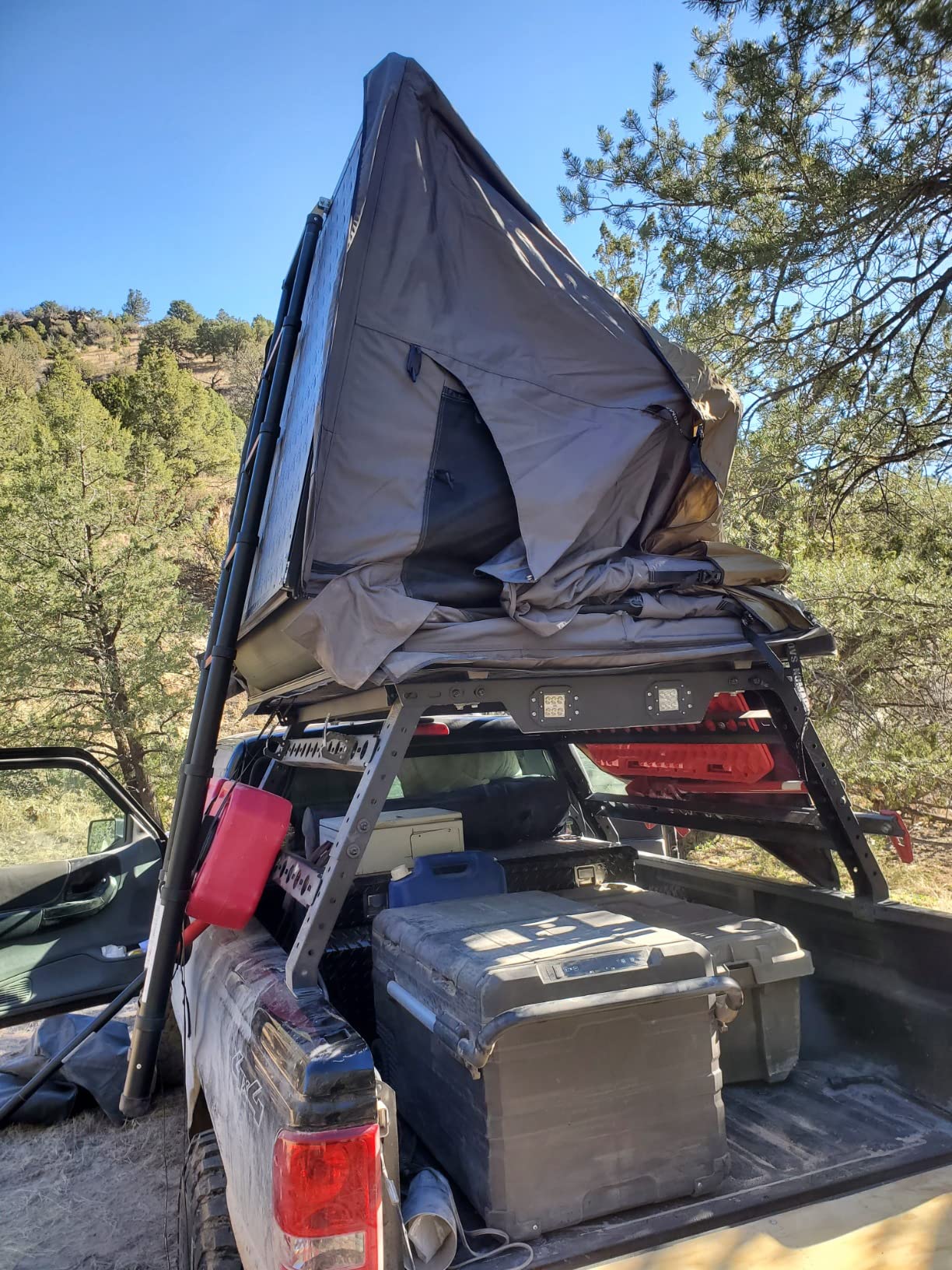
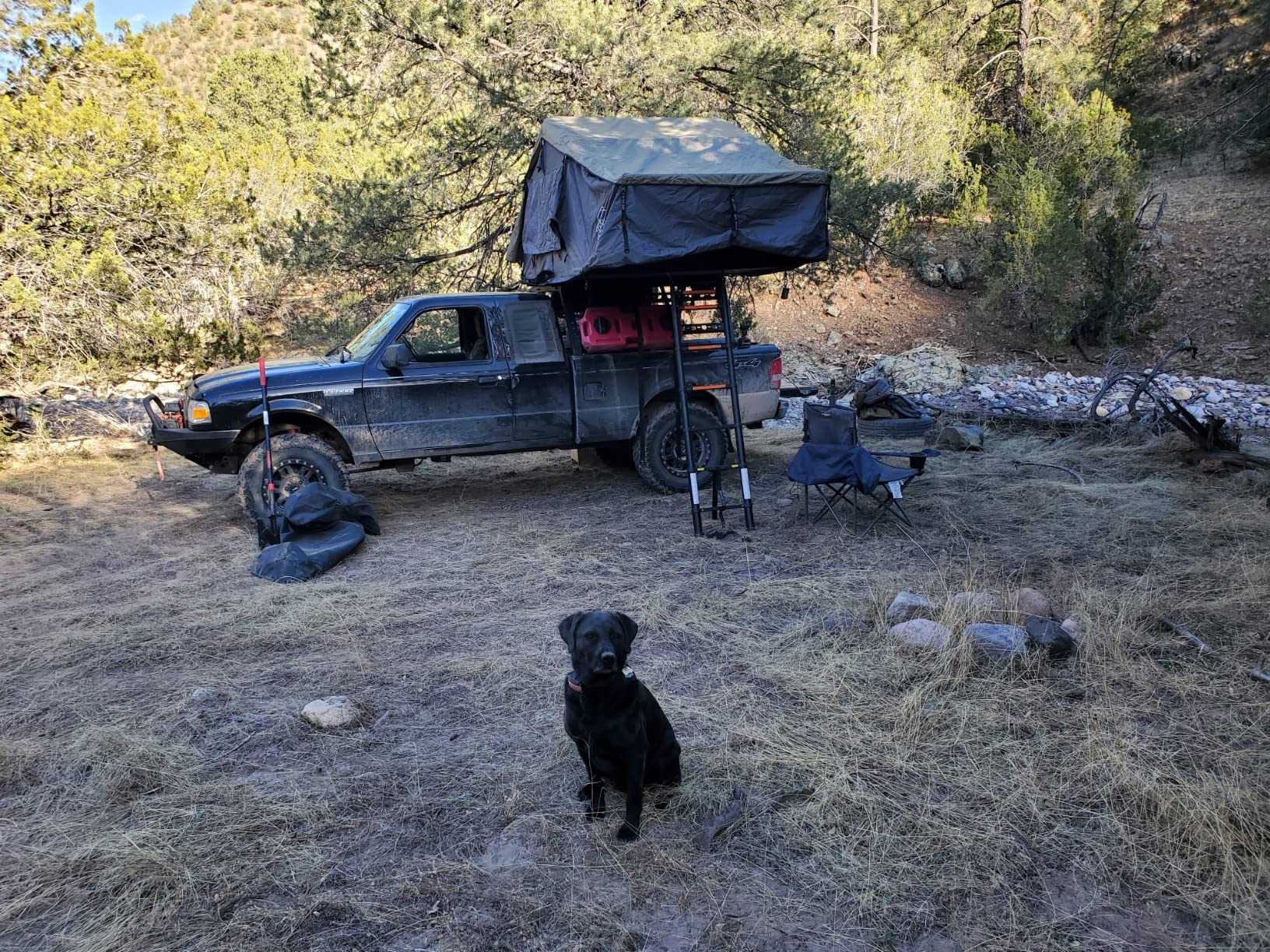
Install is genuinely no-drill if you already have a factory or aftermarket rack, which matters if you plan to take the tent on and off. The listed warranty is a 4 year limited warranty, the longest warranty in this group, and in a category where review counts run to single digits, warranty length is one of the few durability proxies you can actually verify.
Owners like the removable rainfly for hot weather, and the included memory foam pillows and mini broom and dust pan, which is a small but real comfort upgrade on a trip with kids who will track dust into the tent.
The cost of the extension is weight and drag. At 165 pounds it is the heaviest 3-person model here, and the ballistic nylon shell exterior is bulkier to handle than lighter poly-cotton fabric. It is a single room with limited interior storage pockets, so gear for a family of four ends up underfoot unless you bring organizers.
When the HD Nomadic 3 works for a family
Pick this if you are two adults and one child and you want standing-up-side room rather than the absolute minimum. The 63 inch width is the difference between lying with shoulders turned and lying flat, and the metal base is a real upgrade if your kids are not gentle with a sleeping surface.
It is also the right call for longer trips, because the removable rainfly and the 4 year warranty both point at repeated use rather than two nights a season. Confirm your rack can carry 165 pounds plus occupants before you commit.
When the HD Nomadic 3 is the wrong buy
Skip it on a smaller vehicle. The weight penalty is the clearest complaint in the data, and owners consistently cite fuel and handling as the cost of the heavier softshells. On a wagon or a compact SUV with a modest dynamic load rating, this is too much.
Skip it if you plan to run a family of four inside. It is a 3-person floor that is generously sized, not a 4-person floor, and the marketing will not make that distinction for you.
3. Tuff Stuff Overland Ranger 65 Review: The Widest Floor Among Three-Person Tents
Tuff Stuff Overland Ranger TS-RTT-RAN-65 Roof Top Tent; 3 Person; 65″
172 lb closed
65 x 96 in open
65 x 92.5 in mattress
aluminum and fiberglass floor
65 in max height
Pros
- Widest and longest 3-person floor in the group
- Aluminum and fiberglass floor rather than fabric
- Three screened window openings with rods
- Mounting hardware fits crossbars up to 3.25 inches
Cons
- Only one customer review so no long-term owner history
- Manufacturer warranty is 30 days
- 172 pounds is the heaviest 3-person option here
This is the sleeper pick of the roundup if your family is three people who all need elbow room. At 65 by 96 inches open, with a 65 by 92.5 inch mattress, it is physically the widest three-person floor we found, and the floor is aluminum and fiberglass rather than fabric or steel, which is unusual at this level.
Its fabric stack is also more serious than its review count suggests. The body is 280G poly and cotton ripstop, the rainfly is 420D polyester and Oxford with a polyurethane coating, and the tent is marketed as 4 season and windproof. Three window openings with mesh screens and window rods give you real cross-ventilation rather than a single sealed opening.
Mounting hardware and brackets are included, and they fit cross bars up to 3.25 inches, which covers a good range of racks. Bungee cords assist with packing down, which matters more than it sounds when one parent is doing the teardown alone.
Now the caveat, and it is a large one. This listing carries exactly one customer review. The 5.0 rating is a single data point, not a track record, and the manufacturer warranty is 30 days. We are not telling you the tent is bad, we are telling you that you are buying on specification alone and should weight the published materials heavily.
When the Overland Ranger 65 works for a family
It works for a family of three who genuinely need width, or for two adults who sleep with a large dog and want floor to spare. The aluminum and fiberglass floor is a genuine advantage in heat, since it separates the mattress from hot metal and does not absorb condensation the way fabric can.
It is also worth a look if you are converting a truck bed rack, since the included brackets and the 65 inch width suggest a setup that suits a flat bed deck more than a narrow factory roof rail.
When the Overland Ranger 65 is the wrong buy
Skip it if you cannot verify the fitment on your own rack, because with one review there is no owner community to ask. A 30 day warranty also means any long-term failure is on you, and the 172 pound weight is the heaviest of any three-person unit here.
Skip it if you care about a long service life. Nothing in the data suggests a problem, but nothing in the data suggests longevity either, and that is a different risk profile from the tents above it.
4. Overland Vehicle Systems HD Nomadic 4 Review: The Only True Four-Berth Softshell Here
Extended Soft Shell Rooftop Tent, 4-Person – Overland Vehicle Systems HD Nomadic 4 – Grey Body & Green Rainfly
122 x 75 in open
183 lb closed
3 in foam mattress
heat-sealed seams
6 storage pockets
Pros
- Only genuine 4-person footprint in this roundup
- Heat-sealed seams in body and rainfly
- Six storage pockets plus a storage loft and power bank pouch
- 96 inch telescoping ladder with locking strap
- 1000G PVC travel cover
Cons
- Heaviest load in the group at 183 pounds
- Rating is volatile with a wide 1-star cohort
- Supplied mattress reported thinner than advertised
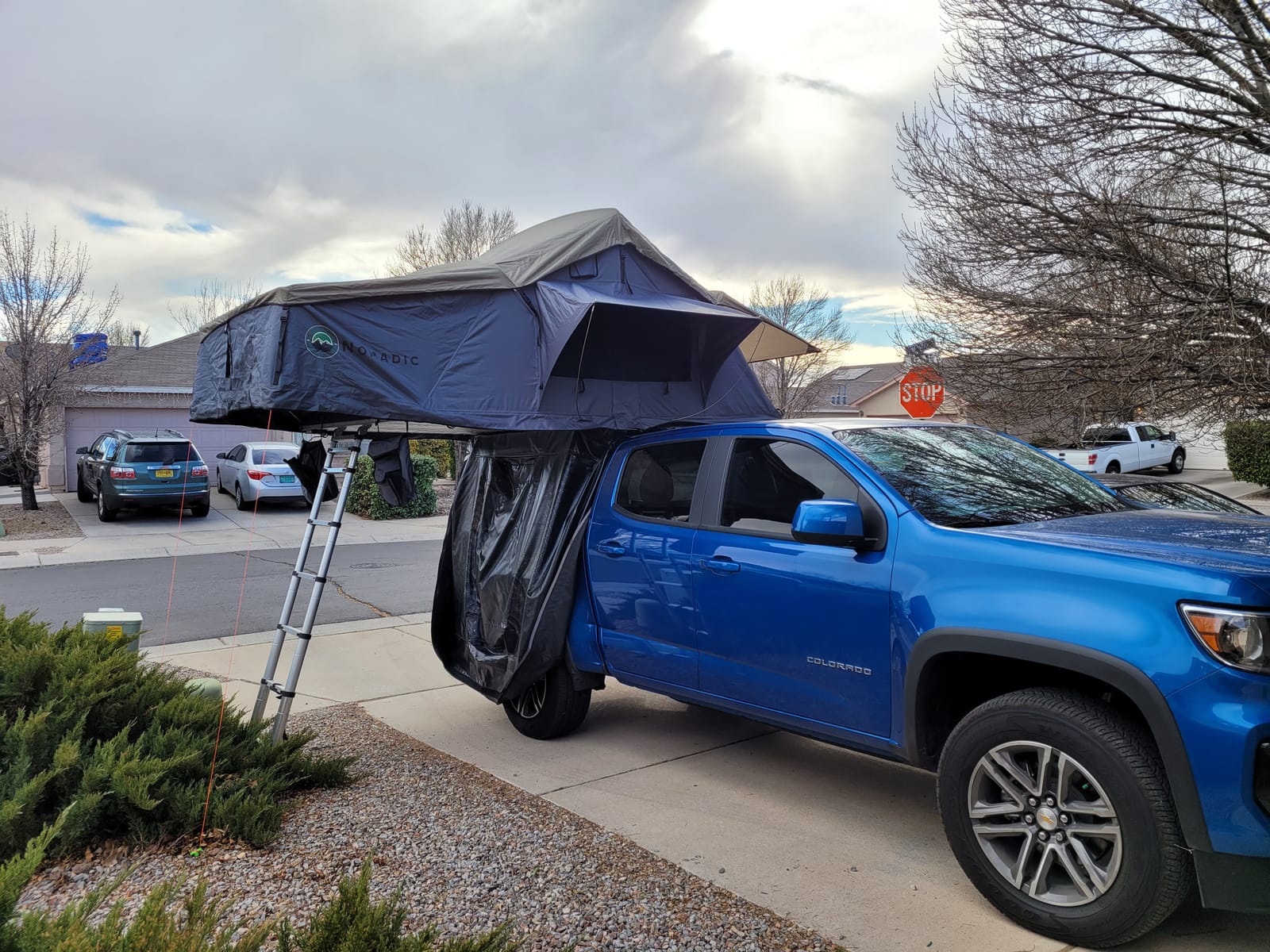
If your family is four, this is the only model in the guide that is designed for it rather than stretched to it. The platform opens to 122 by 75 inches, which is a genuinely different proposition from a 65 by 96 inch three-person floor, and the six built-in storage pockets plus a storage loft solve the problem of gear being underfoot at night.
Weather protection is the best-documented strength. Every seam in both the body and the rainfly is heat sealed, the body is marine grade 600D ripstop polyester cotton canvas, the rainfly is 420D polyester Oxford, and the windows use 110g fade-less gaze. The travel cover is 1000G PVC, and the base is a double insulated one-piece black plated unit with marine grade stainless steel hardware.
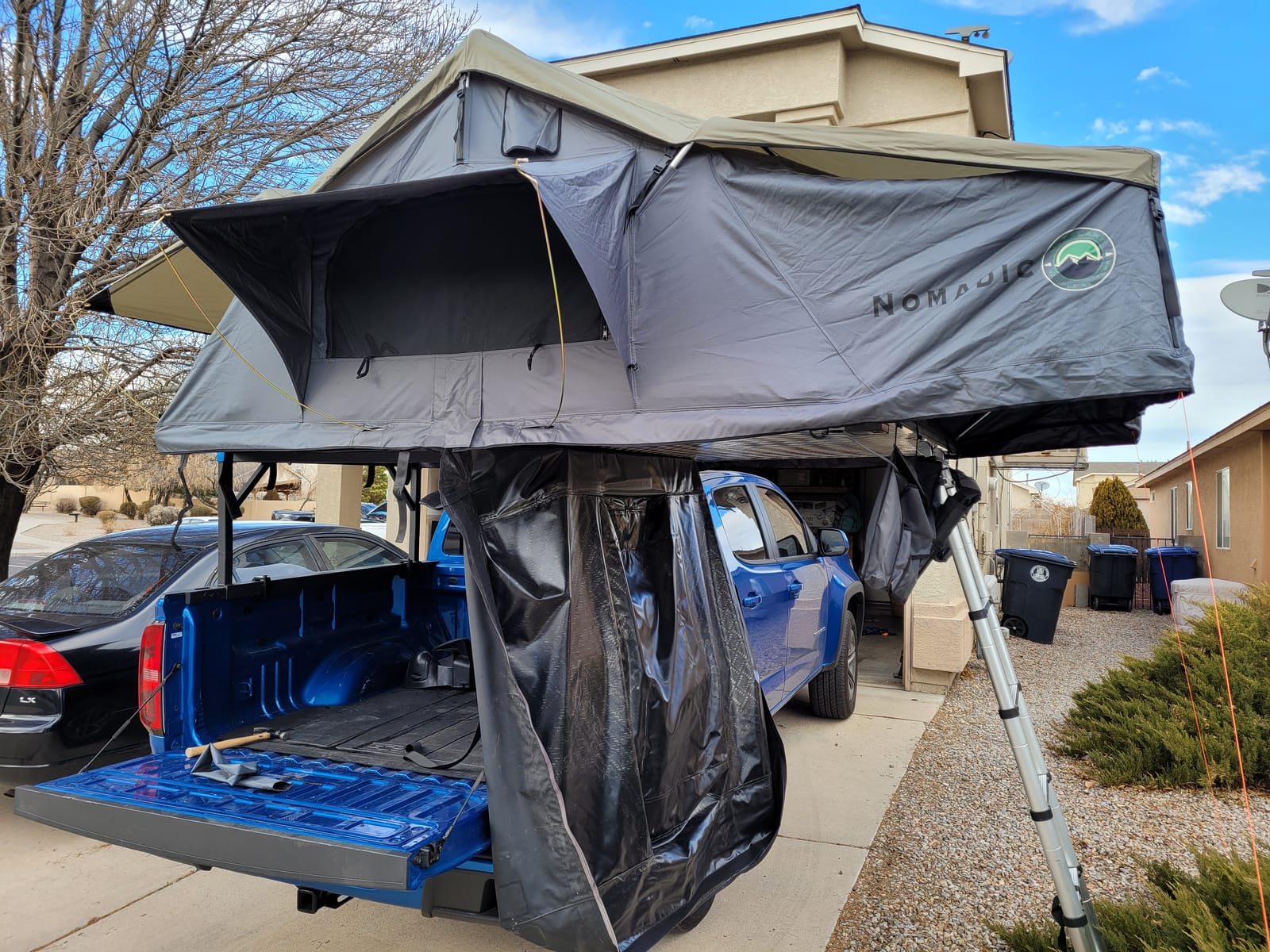
The ladder is the 96 inch heavy duty telescoping aluminum type with a locking strap and quick release steel hinges, which is the longest in the group and the one most likely to reach the ground from a taller rack without extension. The window rod poles have integrated V strength ridges for windy conditions, and the 3 inch high density foam mattress with a quilted cotton cover is the thickest pad any of these tents includes.
Here is why it ranks fourth instead of first, and the reason is honest. The 3.8 average across 8 reviews is volatile, and the distribution includes a large one-star cohort. One buyer reports the supplied mattress is far thinner and lower density than advertised, and describes a long, unresolved support dispute. The mattress can also flatten when stored with gear inside and needs time to recover. Buyers moving from a Smittybilt, by contrast, praise the build, the base and the included accessories.
At 183 pounds it is the heaviest load in the guide, and that has to be weighed against your vehicle’s dynamic rating before anything else.
When the HD Nomadic 4 works for a family
It works for two adults and two children on a vehicle with a rack rated well above this tent’s weight, and it is the only model here where the four-berth claim is honest rather than optimistic. Four seasons of claimed use plus heat-sealed seams also make it the one to consider if you camp in shoulder seasons as well as summer.
The storage loft and six pockets are worth more than they sound. On a four-person trip the difference between a stowed gear bag and gear under a sleeping child is the difference between a workable tent and a frustrating one.
When the HD Nomadic 4 is the wrong buy
Do not put it on a wagon, a sedan or a mid-size SUV without a genuinely heavy rack. Owners on the Subaru Outback forum and similar groups hit roof load ceilings long before the tent itself becomes the issue, and 183 pounds plus four people plus a rack is a lot of dynamic load.
Do not skip the arrival inspection of the mattress. That is the specific failure in the reviews, and it is the one that shows up within a few nights, which gives you time to raise it before you rely on the tent.
5. Meedo Apolle TNT L Review: Fastest Setup and the Best Venting in the Group
Meedo Designs Apolle TNT L, Soft Shell Rooftop Tent, Fits 3 People, Made with Waterproof Material and Bi-Fold Design, Clamshell Army Green Roof top Tent for SUV, Truck, Pickup,Trailer, Ladder Included
134.5 lb closed
86.6 x 48.4 in open
4.5 in foam mattress
opens in under a minute
2.3 m ladder
Pros
- Clamshell design opens and locks in under a minute
- Best ventilation package here with vents
- doors
- windows and skylight
- Thickest included mattress at 4.5 inches
- Quiet lighter fabric than ballistic nylon
Cons
- Only one customer review so thin evidence
- Shortest warranty at 1 year
- 4000 mm and wind figures are manufacturer claims
Setup speed is the thing you will feel every single night, and this is the tent that wins it. The clamshell design pops open and locks into place in under a minute, and the reverse is equally quick. When you have two tired kids and one adult, that difference is worth more than another inch of floor width.
Ventilation is the other headline. There are four side vents at the top of the walls, two large doors, one on each side under a thick rainfly roof, two windows front and back, and a sunroof skylight on top, all with dual-zip openings for screened airflow or full closure. No other tent in this guide has that many openings, and in summer heat it is the difference between sleeping and enduring.
The included 4.5 inch thick high density foam mattress is the thickest of the six, and it arrives with an LED light strip on ceiling velcro, shoe bags, and a full mounting hardware kit including brackets, sliders, acorn nuts, screws and tools. The 2.3 meter telescopic aluminum ladder is included, and the closed size is 59.06 by 43.31 by 10.61 inches, which is a compact bundle for 134.5 pounds.
Be clear-eyed about the evidence. This listing has one customer review. The stated 4000 mm waterproof rating, level 6 and 7 wind resistance, and near-total sun protection are manufacturer claims, not independent test results. The warranty is one year, the shortest of any brand here. And the ladder at 2.3 meters is shorter than the 96 inch ladder on the Nomadic 4, so check it reaches your ground from your rack height.
When the Meedo Apolle works for a family
It works for families who move campsites often, or who camp in hot weather. Under a minute from closed to sleeping is the most realistic feature in this guide for a family with small children, and the opening count handles summer nights far better than a single sealed door.
The 4.5 inch mattress also removes the single most common complaint in this category. Every other tent here needs a topper after a couple of nights; this one may not.
When the Meedo Apolle is the wrong buy
Skip it if you plan to keep the tent for years. A one year warranty with a single review and no owner history is a different bet from a four year warranty with 93 reviews, and the long-term failure modes in this niche are usually fabric, hinge and strap problems that take seasons to appear.
Skip it if your rack sits high. The 2.3 meter ladder may not reach, and a ladder that cannot reach the ground is a ladder nobody will use at 2 am with a sleeping child, which is its own kind of unsafe.
6. Tuff Stuff Elite 5-Person With Annex Review: The Only Softshell That Sleeps Five
Tuff Stuff Elite Overland Roof Top Tent & Annex Room, 5 Person
194 lb closed
79 x 96 in tent, 132 x 79 in annex
2.75 in mattress
Welded 2 in insulated frame
1-2 hour install
Pros
- Only model here that truly sleeps five
- Zip-on annex adds a second room for gear or kids
- Insulated welded aluminum frame retains warmth
- Taped seams with 1000D PVC floor and YKK zippers
- All mounting hardware and tools included
Cons
- Heaviest unit here at 194 pounds
- Install takes 1-2 hours with two people
- One customer review only so no durability history
Five berths, plus an annex room, is a configuration nothing else in this guide offers. The tent itself opens to 79 by 96 inches with a 77 by 96 inch mattress, and the annex opens to 132 by 79 inches, zipped on three sides and slid into the tent base on the fourth. All necessary spikes are included.
The frame is the standout. It is a welded 2 inch aluminum frame with aluminum sheets on the top and bottom, insulated between the joists to keep warm air inside, with 1 inch diameter aluminum poles. Fabric is 280G cotton and poly ripstop, polyurethane impregnated, with taped seams throughout, 420D Oxford coated side walls, a black 1000D PVC waterproof floor with heavy-duty YKK zippers, and no-see-um mosquito mesh with an inner and outer cover for cold and wet weather.
That mesh detail is genuinely family-relevant. A single mesh layer in a cold campsite is a bug screen. A mesh with an inner and outer cover is a wind break, and that changes what you can camp in from May to October.
The costs are considerable and they are not hidden. At 194 pounds this is the heaviest unit in the guide. Installation is listed at approximately 90 minutes, or one to two hours with two people. The ideal mounting height is 76 to 78 inches above the ground, so the ladder can extend and the annex can hang to the ground, which rules out a lot of factory-height racks. The annex also only attaches after the tent is installed, and it adds both size and wind loading.
When the Tuff Stuff Elite works for a family
It works for a family of five who are not splitting up, or for a family of four who want the annex as a gear room, a changing space, or a sheltered spot for a dog. The annex is the single most useful feature in this entire guide for a family with kids, because wet boots, the diaper bag and damp outer layers can all live outside the sleeping area.
It is also the pick for cold-weather shape, since the insulated welded frame and the double-layer no-see-um mesh are the most serious cold-weather specification here. This is still not a winter tent, but it is the closest thing in the guide.
When the Tuff Stuff Elite is the wrong buy
Do not buy it if your mounting height is below 76 inches. The manufacturer states the ideal height plainly, and if you ignore it the ladder will not reach and the annex will not hang properly, which defeats most of the reason to buy this tent.
Do not buy it on a solo install. One to two hours with two people is the stated figure, and a 194 pound unit with an annex is not a one-person evening job.
How Many Berths Do You Actually Need?
Work from the sleeping area in inches, not the number on the box. Two adults typically need about 24 inches of width each, so a 53.5 inch sleeping area fits two adults and a small child. The 63 inch HD Nomadic 3 fits two adults and one child with room to spare. The 75 inch Nomadic 4 is the first model here that fits two adults and two children without negotiation.
Two adults plus an infant is the easiest scenario in this whole guide. A family of four with two older children is the hardest, and only the Nomadic 4 and the Tuff Stuff Elite have the floor area to serve it honestly.
Two adults plus a dog is a common real-world case, and owners repeatedly mention fitting a dog into a three-person softshell. The TMBK gets described as comfortable for two adults and pets specifically. Budget dog space as roughly the footprint of one child, and put the dog at the ladder end where nobody has to climb over it at night.
Length matters more than most buyers think. A child sleeps curled up, a teenager does not, and a 92 inch mattress fits a six-year-old lengthwise but not a twelve-year-old who has to lie straight. If you have teenagers, measure before you buy.
There is a pattern in owner reports worth copying. On Expedition Portal a family of five described running a rooftop tent with an awning plus a double swag ground tent as a base camp, and reported that it worked really well. Four berths on the roof plus ground space beats four berths crammed together, and it is a more realistic answer for a family of five than a single enormous tent.
Dynamic vs Static Roof Load: The Number That Will Ruin Your Trip
Static load is the weight sitting on your roof while the vehicle is parked. Dynamic load is the weight while it is moving, and it is much higher because of vibration, bumps, wind and cornering. Your roof has to survive both, and the dynamic figure is the one that will stop your trip before it starts.
Look for at least 150 pounds of dynamic load rating, and treat that as a floor rather than a target. Every tent in this guide weighs between 108 and 194 pounds before a single person climbs into it. The Nomadic 4 at 183 pounds already sits above a bare 150 pound rating, and owners who quote a rack rating as the gating factor before discussing the tent at all are following the right order of operations.
Find the number on the placard inside your driver’s door jamb, on the driver’s side, on the door frame or the B pillar. It lists total roof load capacity and how many occupants can be carried on the roof, and the occupant figure is the one parents should read first. Some wagons and sedans list very low figures, and a softshell rooftop tent is simply not viable on those vehicles, whatever the listing says.
The second number is the total vehicle weight including passengers, cargo and the rack itself, which you will already find printed in your owner’s manual. If your family of four plus luggage plus a 183 pound tent approaches it, you have an answer before you spend anything.
Third, check the rack’s own rating rather than the vehicle’s. A factory roof rail is usually the weakest link, and a bed rack or a properly rated crossbar system is often higher. Owners running a TrailRax setup at 850 pounds are in a different conversation from someone bolting a tent to a sedan door frame.
Ladder Safety for Families
The climb, not the fall, is what actually causes rooftop tent injuries, and every one of these tents requires a climb every time a family member needs the toilet at night. Four habits fix most of the risk, and none of them require buying an accessory.
First, do the climb test before you buy. Measure the ground-to-first-rung distance on your intended ladder and walk up it in the boots you will actually camp in. One overland builder recommends exactly this, and it is the single cheapest piece of advice in this guide.
Second, check that the ladder reaches the ground. A ladder that stops twenty inches short means someone is jumping the last stretch in the dark, every time. This is why the 2.3 meter ladder on the Meedo matters and why the Tuff Stuff Elite’s 76 to 78 inch mounting height requirement is a real constraint rather than a specification detail.
Third, agree on the night procedure before the first night. Ladder up, three points of contact, no carrying anything in your hands. A family rule of no one climbing the ladder alone after dark is stricter than most adults apply to themselves and it costs nothing.
Fourth, plan the landing zone. Look down before you step off, and clear the area under the ladder of boots, cooler lids, kid gear and the dog bowl. The ground under a rooftop tent is exactly where families leave everything, and that is where a bare foot lands.
On the safety question generally: a tent above your head is a low-profile risk compared with a hardshell directly over an occupant, and Rubicon Owners Forum discussion suggests most owners treat the height itself as less concerning than the climb and the drive. Keep speed sensible with the ladder deployed, and keep a spare ladder in the vehicle, which is a habit several owners describe as essential after losing one.
Softshell vs Hardshell: Which Should a Family Buy?
Buy a softshell if your priority is interior space, weight and cost, which is the case for most families. Buy a hardshell if your priority is aerodynamics at highway speed, instant setup with no fabric to tension, and long-term durability in a rigid shell. Roofnest, iKamper and Thule skew hardshell, and each has genuine strengths.
The honest list of hardshell advantages: lower drag, faster setup, a rigid body that sheds rain and wind without guy lines, and a closed profile that is easier to clean. The honest list of softshell advantages: more interior area for the money, lighter units, more expandability, better ventilation through fabric and mesh, and a much lower entry price for a given family size.
For a family of four specifically, the softshell math usually wins. Hardshell models at that capacity sit well above what the models in this guide cost, and a parent converting a wagon rather than a truck will find the softshell’s lower weight decisive.
Softshells that are genuinely 4 seasons rated exist, including the Tuff Stuff Elite with its insulated welded frame. But softshells generally collect condensation more than hardshells, because fabric breathes less effectively than a rigid shell with engineered vents, and condensation is the most repeated complaint in this category. If you are buying for winter, hardshell or a hybrid is the safer bet.
Common Mistakes Families Make
Cause: buying on the berth number printed on the box. Consequence: a family of four in a 3-person tent spends the night with shoulders against canvas and a child wedged against a wall. Correction: measure the sleeping area in inches and add up adult widths before you choose.
Cause: checking static roof load but not dynamic load. Consequence: a 183 pound tent on a rack rated for parking, not cruising, which is a genuine safety problem. Correction: read the door jamb placard for dynamic rating and the manual for total vehicle weight before buying anything.
Cause: skipping the ramp height and garage clearance check. Consequence: a tent that does not clear a car park barrier, or a platform that sits too high to load. Correction: measure your maximum parking height and your tallest garage door, then measure the tent’s closed profile.
Cause: assuming the included mattress will last the trip. Consequence: three nights in, a 2.25 inch pad has flattened and nobody slept well. Correction: budget for a foam topper, except on the Meedo, which comes with a 4.5 inch pad.
Cause: planning to camp in winter with an unlined softshell. Consequence: condensation under the mattress and a cold, damp sleeping area. Correction: add a liner, or choose a tent with an insulated frame and sealed seams.
Cause: treating a single-review listing like a proven one. Consequence: a 5.0 rating that represents one person, one trip and no long-term history. Correction: weight warranty length and published materials more heavily when review counts are this thin.
Softshell RTT Troubleshooting
Condensation under the mattress: usually warm breath against fabric with no airflow path. Fix it with a cross-ventilated window or skylight during the day, an anti-condensation mat between the mattress and the floor, and by removing stored gear from under the sleeping area overnight.
Water tracking in at a zipper seam: almost always seam tape lifting or a zipper left partly open in rain. Fix it by walking the seams with a seam sealer before the trip and by keeping dual-zip openings fully closed during rain rather than screened only.
Fabric fading or stiffening: UV exposure on a folded poly-cotton body over multiple seasons. Fix it by keeping the tent covered in its travel cover when parked and never storing a wet tent folded.
Mildew smell after a wet pack-down: you folded and stored the tent damp. Fix it by pitching it open for a few hours before packing, and by never zipping the travel cover onto a wet bundle.
Cover flapping or whistling at speed: a loose strap on the travel cover. This is a widely reported owner complaint. Fix it by running the two buckle straps snug and adding no more than a light secondary tie, not tape.
Mattress flat on morning one: foam compressed by a long or heavy sleeper. Fix it with a topper, or by leaving the mattress uncompressed overnight and removing gear from on top of it.
Strap or hinge letting go in wind: the failure mode forum owners report most often in this category. Fix it by re-tensioning every strap before the first gust, and by adding guy lines in exposed sites. Keep the spare hardware kit included with most of these tents.
Campsite Rules and Overhang Etiquette
Some campsites do not allow rooftop tents, and the reason is usually overhang, not safety. A deployed rooftop tent extends two to three feet past your vehicle’s footprint, and in a tight loop that overhang can sit over a neighbouring site, a walkway, a fire lane or a picnic table someone else paid for.
Some sites also charge a second tent fee, because a rooftop tent is treated as a second shelter. Before you drive in, check the specific campground’s rules rather than the chain’s general policy, and ask about overhang clearance at the site type you want.
There is a middle path. Arrive early, pick an end or corner site, and pitch so the tent extends away from the shared side. On a site with a pull-through lane, an angled park can put the tent over your own site rather than your neighbour’s. Keep the annex and any awning inside your own footprint, since that is where disputes start.
You can sleep in a rooftop tent in most national forest land and dispersed areas, but the rules change at state lines, and some states restrict camping on public land outright. Check the land manager rather than assuming.
How to Choose a Family Softshell RTT
Start with the berth math above and end with the door jamb. Everything in between is refinement.
For fabric, look for taped or heat-sealed seams and a stated waterproof rating rather than the word waterproof alone. The heat-sealed seams on the Nomadic 4 and the 1000G PVC floor on the Tuff Stuff Elite are the two strongest weatherproofing stories here.
For the base, a plated aluminum or diamond plate base beats fabric, because it will not soak and it will not flex. Three of these six have plated bases.
For ventilation, count the openings. Four openings plus a skylight will change a July night more than any mattress in this guide.
For the ladder, verify length against your rack height before purchase, and confirm the locking mechanism holds at an angle. Reports of a ladder needing extra drilled holes to lock are common enough to plan for.
For warranty, treat length as a durability proxy. In this category a 4 year limited warranty is a meaningful signal and a 30 day warranty is effectively none.
Finally, price the whole setup, not the tent. The rack, the ladder, a mattress topper and the gear organizers together can approach or exceed the tent cost, and that surprise is the most common complaint families report after purchase. If you already run a crossbar system and a decent ladder, the tent is a smaller share of the spend than the listing implies. If you need a full rack, budget for it before the tent, not after. Our rooftop cargo box guide covers the rack-mounted storage that makes the same platform work harder.
Frequently Asked Questions
Are soft shell roof top tents any good?
Yes, for the right trip. A soft shell roof top tent gives you a full-size mattress off the ground, which is the single biggest comfort upgrade most families notice, and it packs into a bundle you can move in one hand. The tradeoffs are condensation inside fabric, more aerodynamic drag at highway speed, and a weight of 108 to 194 pounds that your roof rack has to support. Families on multi-night trips and overlanding routes get the most out of them.
What is the best family-sized rooftop tent?
For two adults and two children, the Overland Vehicle Systems HD Nomadic 4 is the most honest fit in our roundup because it is the only model here with a true four-person platform, opening to 122 by 75 inches with heat-sealed seams and six built-in storage pockets. For two adults and one or two small children, the lighter TMBK 3 at 108 pounds is the better all-round choice and carries by far the largest owner history.
What is the best rooftop tent for a family?
Match the tent to your family shape rather than to a brand. Three people who need width should look at the Tuff Stuff Overland Ranger 65 with its 65 by 96 inch floor. Four people should look at the Nomadic 4. Five people, or four plus a gear room, should look at the Tuff Stuff Elite with its zip-on annex. In every case, confirm your vehicle’s dynamic roof load rating first.
Do kids sleep safely in a rooftop tent?
They do, and most families find the ground benefits outweigh the risks once you manage the climb. The real hazards are the ladder at night and the drive, not the height. Agree a night rule that nobody climbs alone after dark, make sure the ladder actually reaches the ground from your rack height, keep the landing zone clear, and keep a spare ladder in the vehicle in case the main one is lost or stolen.
Why do campsites not allow roof tents?
Usually because of overhang rather than safety. A deployed rooftop tent extends two to three feet beyond your vehicle, which in a tight loop can sit over a neighbouring site, a walkway or a fire lane. Some sites also charge a second tent fee. Pick an end or corner site, park angled so the tent extends into your own footprint, and check the specific campground’s rules before you drive in.
What are the downsides of using a rooftop tent?
The main ones are weight, drag and condensation. Units in this category weigh between 108 and 194 pounds, which most roof racks are not designed to carry at speed, and the fabric body adds aerodynamic drag a hardshell would not. Condensation is the most common complaint because warm breath against fabric has nowhere to go, and a thin included mattress is the second, which is why a topper is standard advice.
Which Softshell Rooftop Tent Should Your Family Buy?
For most families, the Overland Vehicle Systems TMBK 3 is the answer. At 108 pounds it is the lightest unit here, its 53.5 by 92 inch sleeping area handles two adults and small children, and 151 reviews at 4.4 make it the only model here with a real long-term owner history. Add a foam topper before the second night and plan a liner for anything below summer.
If your family is four, the Nomadic 4 is the only softshell in this guide that genuinely sleeps four, with a 122 by 75 inch platform, heat-sealed seams and the storage to keep gear out from under the bed. It is also the heaviest, so check your door jamb rating before anything else. If your family is five, or you want a gear room, the Tuff Stuff Elite with its annex is the only option, and it needs a 76 to 78 inch mounting height.
For families who move campsites daily or camp in summer heat, the Meedo Apolle TNT L opens in under a minute and vents better than anything else here, though its single review and one year warranty mean you are buying on specification.
Whatever you pick, do the two checks that cost nothing: confirm your dynamic roof load rating and confirm your ladder reaches the ground. Those two numbers decide more family trips than any feature on the spec sheet. For the wider field of rooftop shelter, our family tent guide covers the ground alternative worth comparing against.