
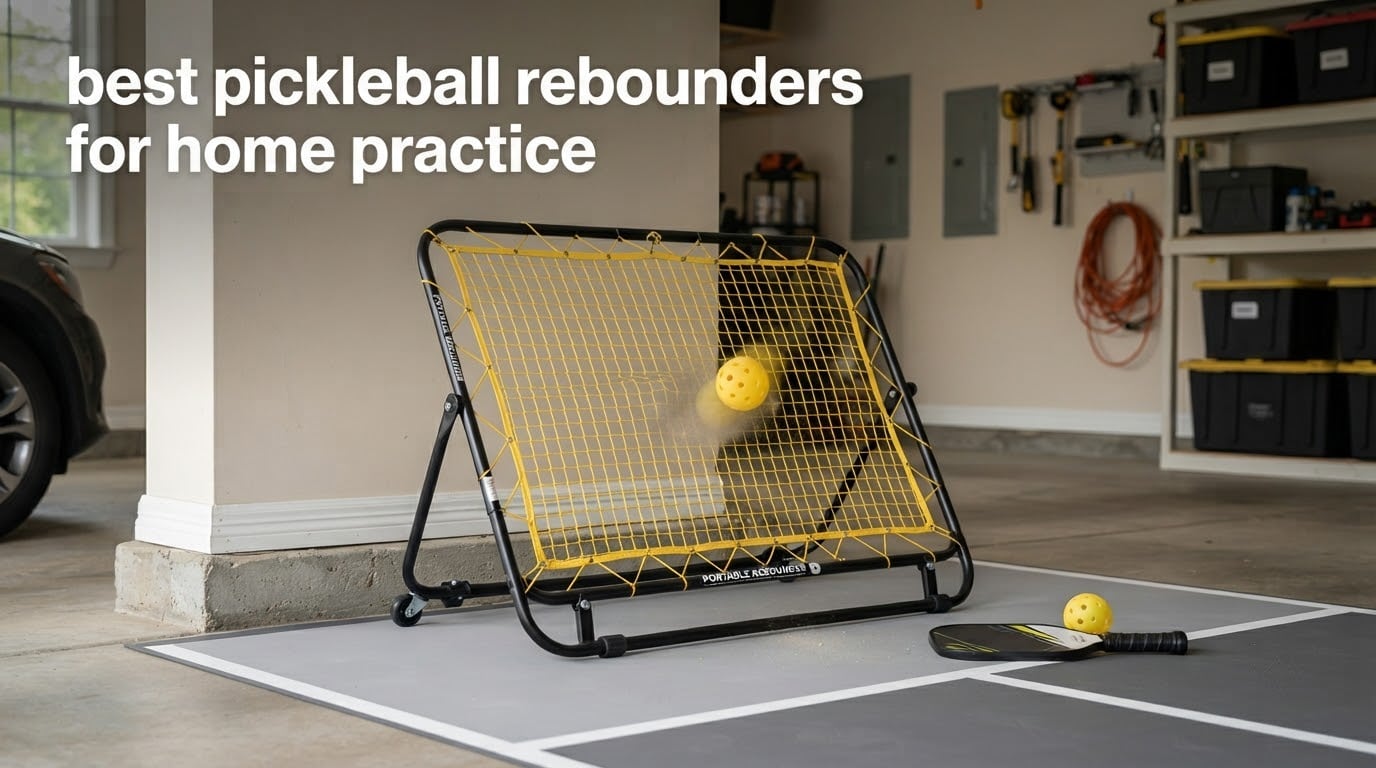
The hardest part of practicing pickleball alone is not where to hit the ball. It is chasing it. On a standard practice net, most of your session disappears into ball retrieval, and what is left is a handful of strokes between long walks.
A pickleball rebounder fixes that. It is a tensioned mesh net or a rigid backboard that returns every ball you hit into it, so a single ball can give you 500 to 1,000 paddle touches in a session instead of roughly 50. That touches-per-minute difference is the whole argument, and it is why rebounders have become a common sight in home gyms and garages.
One caveat up front, because most roundups skip it: a rebounder does not train depth. You get no visual feedback on whether a third-shot drop actually landed in the kitchen, and a board feed feels flatter than a real partner’s ball. What a rebounder genuinely builds is soft hands, reaction speed, and shot repetition, and it does that better than anything else you can set up alone.
We looked at twelve of the best pickleball rebounders for home practice available now, covering tensioned mesh nets, rigid backboards, court-marking pads, and portable mini-nets. Ratings in this category are thin, so we leaned on measured specs, warranty length, and what the reviews actually say about rebound consistency.
Top 3 Picks: Best Pickleball Rebounders for Home Practice in 2026

MerryMove 2-in-1 Rebounder Net
- 2-in-1 rebounder and 6ft mini net
- Fiberglass poles with adjustable bungees
- Target zones for dink and volley drills
- 154 ratings at 4.2

G-SQAURED 6×6 ft 2-in-1 Rebounder
- 2-in-1 rebounder and game net
- 28KG tension ropes on iron frame
- Adjustable rebound angle
- 4.9 average from 33 ratings

SwingIt 4×6 ft Metal-Frame Rebounder
- All-metal frame with wide base
- Kitchen zone and reflex targets
- Waterproof handbag included
- 4.4 average from 91 ratings
Best Pickleball Rebounders in October
| Product | Specifications | Action |
|---|---|---|
| MerryMove 2-in-1 Rebounder Net |
|
Check Latest Price |
| SwingIt 4×6 ft Metal-Frame Rebounder |
|
Check Latest Price |
 Zdgao Two-Size Net Set Zdgao Two-Size Net Set |
|
Check Latest Price |
| G-SQAURED 6×6 ft 2-in-1 Rebounder |
|
Check Latest Price |
 MR Adjustable Height and Angle Rebounder MR Adjustable Height and Angle Rebounder |
|
Check Latest Price |
 KEALEA Court Training Pad KEALEA Court Training Pad |
|
Check Latest Price |
 Franklin Sports 83 Inch Rebounder Franklin Sports 83 Inch Rebounder |
|
Check Latest Price |
 NET PLAYZ Rebounder Training Aid NET PLAYZ Rebounder Training Aid |
|
Check Latest Price |
 A11N SPORTS Rebounder on Wheels A11N SPORTS Rebounder on Wheels |
|
Check Latest Price |
 HamRoRung 9.3 x 7.4 ft Backboard HamRoRung 9.3 x 7.4 ft Backboard |
|
Check Latest Price |
 Oops Pickleball Folding Trainer Oops Pickleball Folding Trainer |
|
Check Latest Price |
 Ksports Multi-Sport Rebounder Ksports Multi-Sport Rebounder |
|
Check Latest Price |
The Four Types of Pickleball Rebounders Explained
Net-style mesh rebounders are the most common type and a good all-round choice for soft-game work. A high-resilience mesh is strung across a frame with bungee tension, and the elasticity of the net returns the ball toward you on a shallow arc. The ball arrives a little slower and less predictable than a real feed, which is exactly what forces you to use a soft grip.
Board-style rebounders use a rigid composite or solid panel instead of mesh. The return is flatter, faster, and far more consistent, so these suit volley and reaction drills rather than dinking. They are also the version most likely to last for years if you hit hard, because there is no fabric to stretch.
Wall and fence backboards are the third type, and they are freestanding frames with a flat net you position against a boundary rather than a self-tensioned return. A 9 by 7 foot backboard gives you groundstroke and serve practice, but it needs anchoring in wind and it cannot simulate a net height on its own.
The fourth type is the court pad, a flat marked mat that draws a realistic non-volley zone on the floor. It returns nothing at all, so it is not a rebounder by function, but pairing one with a rebounder is the single best upgrade to your solo practice. The pickleball paddles for control guide we published pairs well with that setup, because placement drills reward soft hands more than power.
1. MerryMove 2-in-1 Rebounder Net – Best All-Round Solo Trainer
MerryMove 6FT Pickleball Practice Rebounder Net & Mini Pickle Ball Net
6ft wide fiberglass and iron frame
Adjustable bungee tension
5.99 kg
2-in-1 rebounder and mini net
Pros
- Works well in garages and small driveways
- Packs away quickly and is light to carry
- Target zones for kitchen and dink drills
- 154 ratings give it a well-established record
Cons
- Needs very tight net tensioning to return the ball
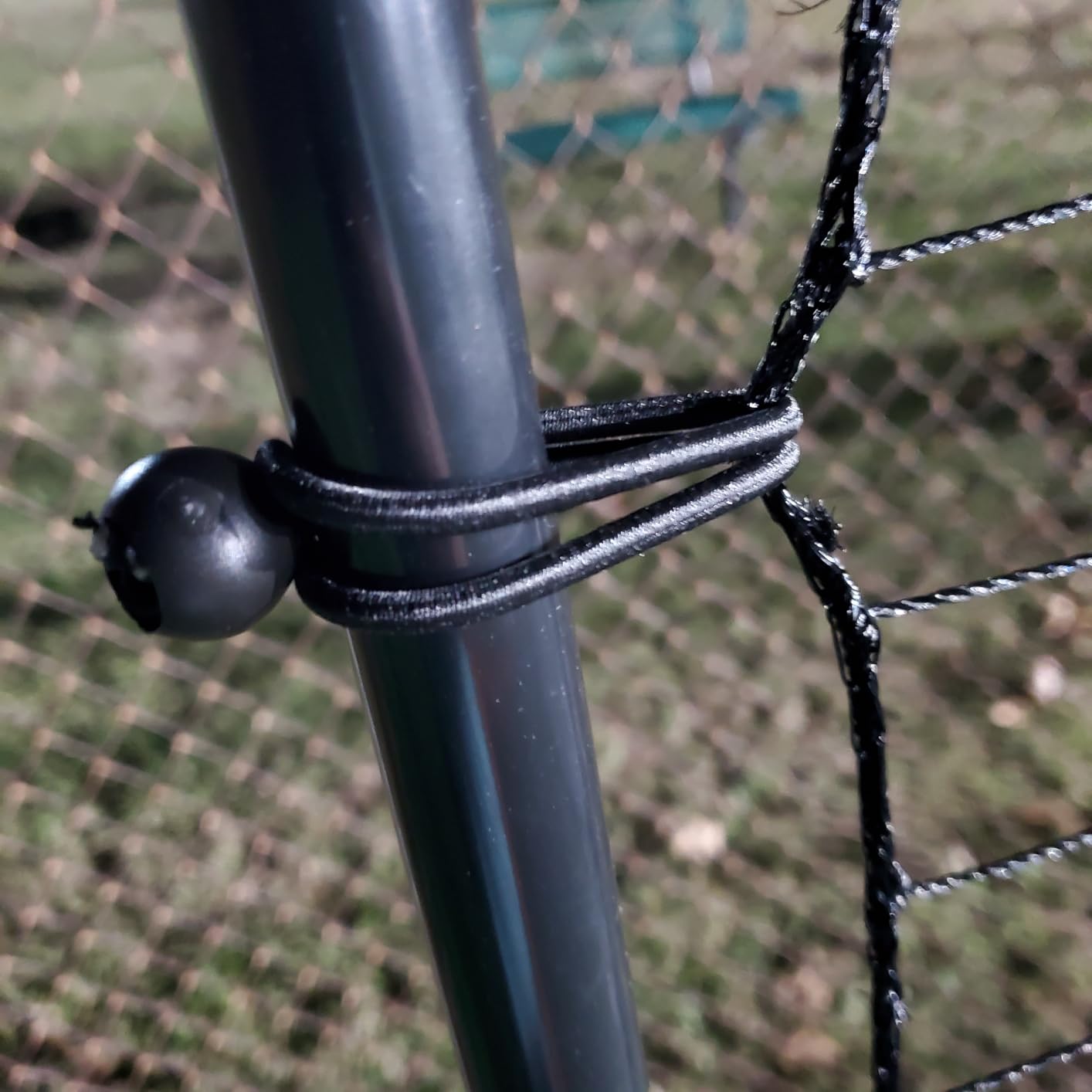
- Bungee cords can be inconsistent in length
- Fiberglass rods have broken for some owners
This is the rebounder we recommend first, and the reason is evidence rather than polish. At 154 ratings it is the second most thoroughly reviewed product in this roundup, which matters a lot in a category where many listings carry fewer than 20 reviews. Reviewers report measurable gains in touch and consistency once the net is properly tensioned.
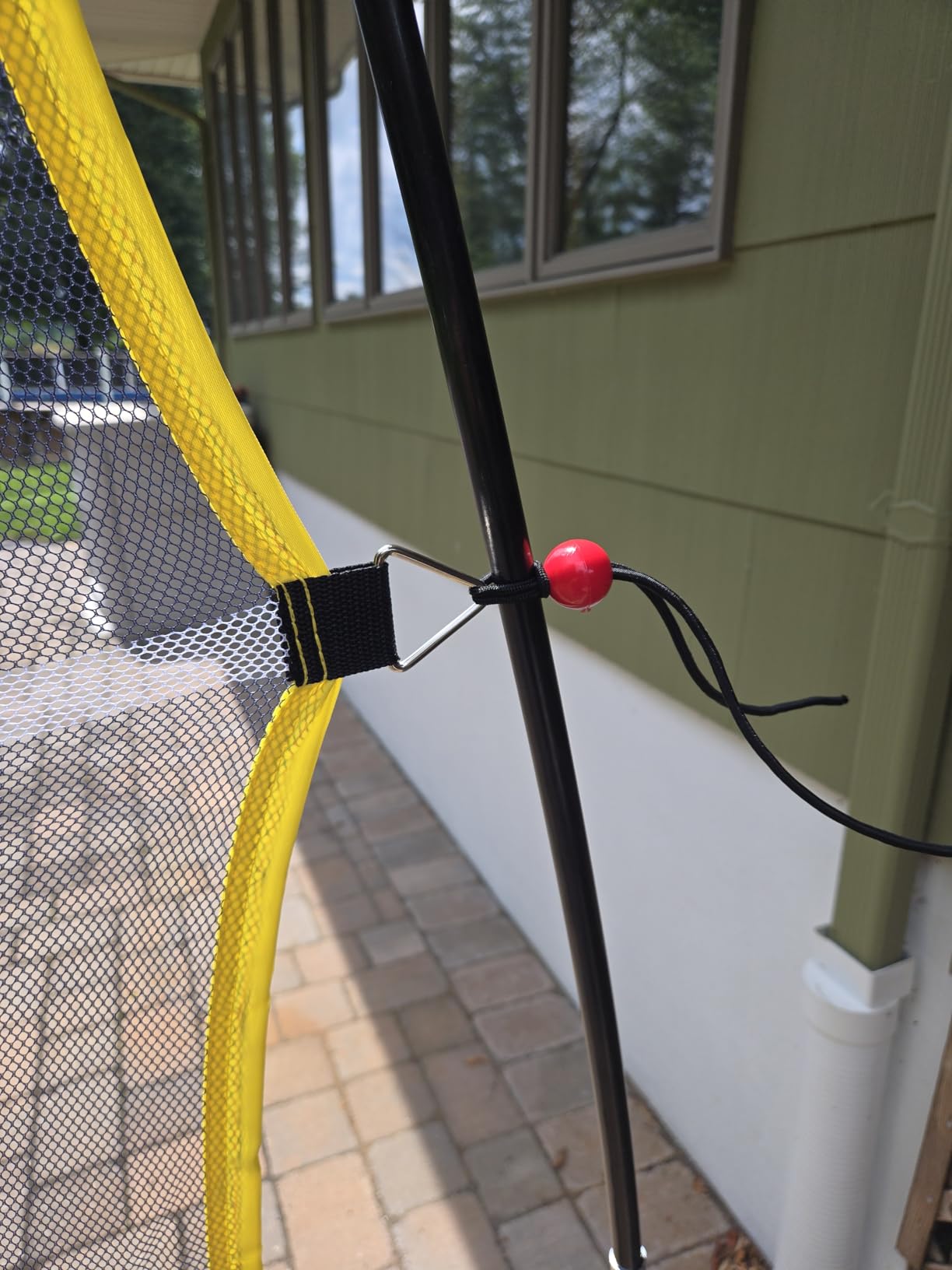
The frame is fiberglass poles in iron, measuring 6ft wide and 6ft high, and it weighs 5.99 kg. That is light enough to carry from a garage to a driveway with one hand, which is the difference between a training aid you use and one that sits in a corner.
What separates this from a bare mini net is the second function. It works as a 2-in-1 unit, so you can switch between a rebounder surface and a straight mini net for casual play with the same frame. Printed target zones give you something to aim at rather than just a surface to survive.
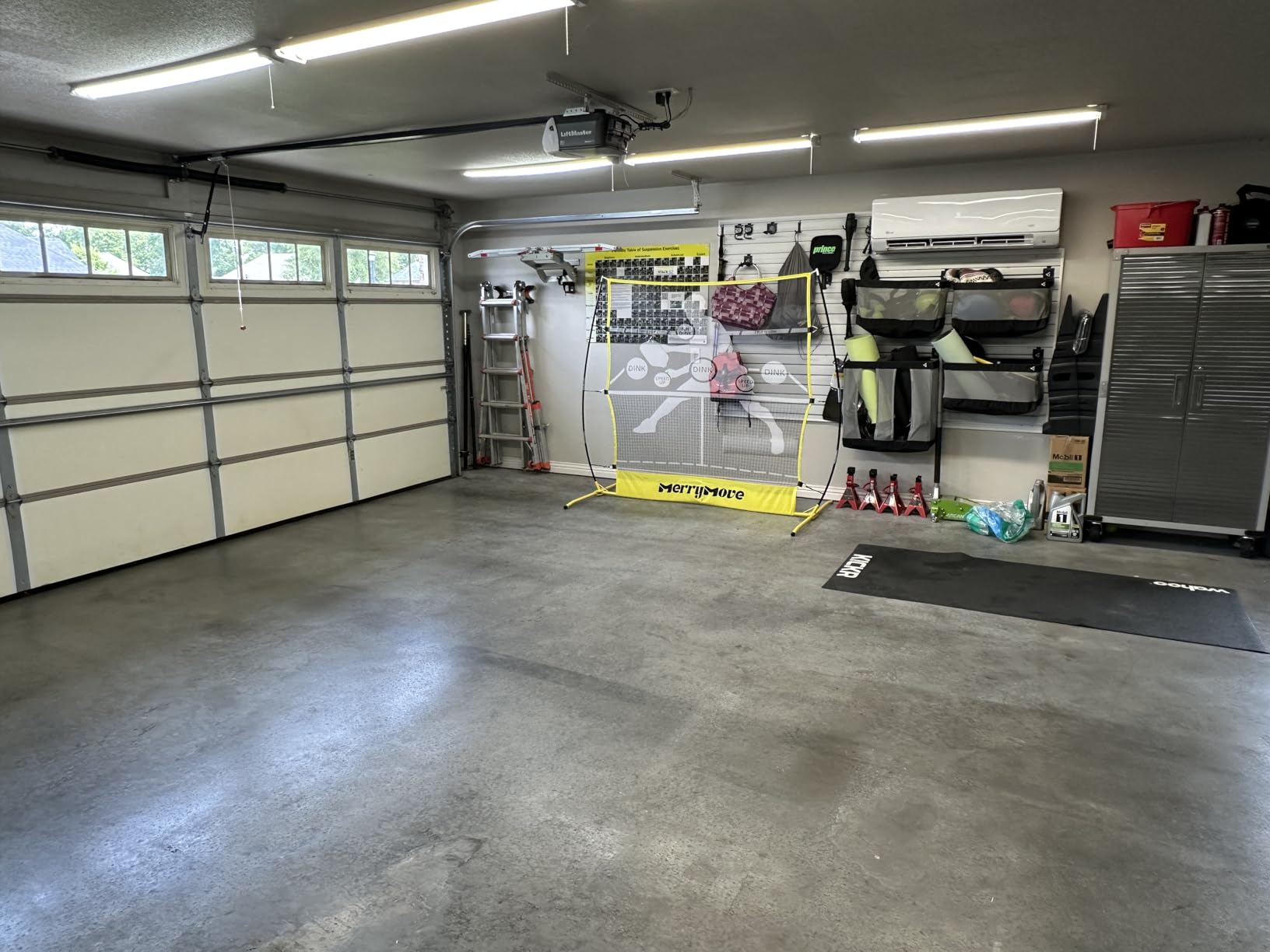
Setup is tool-free and quick, and the whole thing collapses small enough for a closet or a car boot. It is built for outdoor driveway work and indoor garage use, and the frame sits low enough to swing under without a ceiling in the way.
What you get out of it
The best use is repeated soft contact at close range, because a mesh return invites you to block and roll rather than swing. Stand about 8 to 10 feet back and treat every feed as a drop shot you have to meet with a soft hand.
Second best is the target zone work for kitchen control. The printed zones let you aim for a specific spot, and that is a closer approximation of real placement than anything else in a solo session.
Where it falls short
Rebound quality is entirely dependent on how tight the mesh is strung. Out of the box it can catch the ball rather than return it, and you will need to work the bungees evenly across the frame on first setup.
A minority of owners report broken fiberglass rods and slow responses from customer service, and the included bungee cords have shown up in mismatched lengths. The warranty runs three months, which is the shortest here alongside the two 90-day warranties.
2. SwingIt 4×6 ft Metal-Frame Rebounder – Best Value
Mini Pickleball Rebounder Net 4x6FT Training Equipment Aid, Portable Metal Frame Solo Trainer, Portable Solo Practice Dinks Volleys Drills in Quick Setup for Indoor Garage Outdoor Driveway Backyard
4x6 ft all-metal frame
9.3 lb
Adjustable bungees
1 year warranty
Pros
- Sturdy all-metal frame that stays put during fast volleys
- Easy tool-free assembly and movement
- Fits a garage or small yard
- 4.4 average across 91 ratings
Cons
- Net is less stiff than some buyers want
- Some variants lack the listed kitchen line
- Photos overstate how clear the court markings read
An all-metal frame with a wide weighted base is what holds this one steady. At 9.3 pounds it is heavier than the light fiberglass nets but still easy to carry, and the base is what keeps it from walking across a garage floor during a fast volley exchange.
It comes in several size variants, and the 6×6 ft option gives you a much larger hitting surface than the 4×6 ft version shown here. Buyers use the smaller size for solo dinking and doubles warm-ups in a garage or yard.
Reviewers consistently describe it as sturdy and easy to move, and the brand has been responsive enough to correct listing text when buyers pointed out that a kitchen line was missing from some variants. That kind of correction is worth something in a thin-review category.
What you get out of it
This is the one to buy if your space is a garage or a small yard and you want a feed that holds its shape. Metal does not flex the way fiberglass poles do, so the rebound stays consistent over a long session.
Marked kitchen zone lines and reflex target zones make it useful for placement work, though check the variant you receive before relying on the printed lines.
Where it falls short
Rebound power is modest compared with the bigger 6×6 ft steel units, and some buyers find the net less stiff than they expected. If you want maximum pop you need more surface area or heavier tension ropes.
The product photos make the court markings look clearer than they appear in person, and the included waterproof handbag is a nice touch that a lot of competing nets leave out.
3. Zdgao Two-Size Net Set – Best Starter Kit
Zdgao Small Pickleball Net Set – 4FT/10FT Dink Rebounder Net with 2 Paddles
4ft and 10ft nets included
36-72 inch height range
Alloy steel
Tool-free snap assembly
Pros
- 4.8 average from 54 ratings
- Two net sizes in one box
- Takes 3-5 minutes to assemble
- Carry bag plus two paddles and two balls
Cons
- Does not return the ball automatically
- Only a 90-day warranty
- Two nets take more storage room than one
Be clear about what this is: a two-size net set, not a self-returning rebounder. It is in this roundup because the 4ft net is the best inexpensive way to practice close-range dinks, and because the 4.8 average from 54 ratings is among the strongest signals in the group.
You get a 10FT net and a 4FT net, an alloy steel base frame, two wooden paddles, two balls, and a 600D Oxford carry bag. Height adjusts from 36 to 72 inches, so the 10ft net doubles as a regulation-height game net for friends.
Assembly uses snap fasteners and takes three to five minutes with no tools. The powder-coated steel is rust resistant enough for park, beach, and driveway use, which is where owners actually take it.
What you get out of it
Use the 4ft net for kitchen work. At that height it mimics a real dink exchange far better than a full-size net, and you can feed yourself repeatedly while standing almost on top of it.
Because the 10ft net adjusts to 34 inches, you can run proper drills with a partner when one is available. That makes this a good bridge device between solo work and real play.
Where it falls short
It gives you zero ball return, so every ball still needs collecting. If your problem is retrieval fatigue rather than net height, this will not solve it.
The 90-day warranty is among the shortest here, and carrying two nets plus paddles and balls in one bag is a lot to haul to a park on a windy day.
4. G-SQAURED 6×6 ft 2-in-1 Rebounder – Top Rated
G-SQAURED 6×6FT 2-in-1 Pickleball Rebounder & Game Net — Portable Pickleball Net, Adjustable Rebounder Training Net, Heavy-Duty Iron Frame, 28KG Tension Ropes (Backyard & Solo Practice)
72 x 72 inch surface
Alloy steel and nylon
7.04 kg
28KG tension ropes
Pros
- 4.9 average with no ratings below four
- 28KG tension ropes give a noticeably stronger return
- Converts to a game net without tools
- Iron frame stays taut
Cons
- Only 33 ratings on a newer listing
- Heavier than the smaller portable rebounders
- 72 inch square needs a dedicated footprint
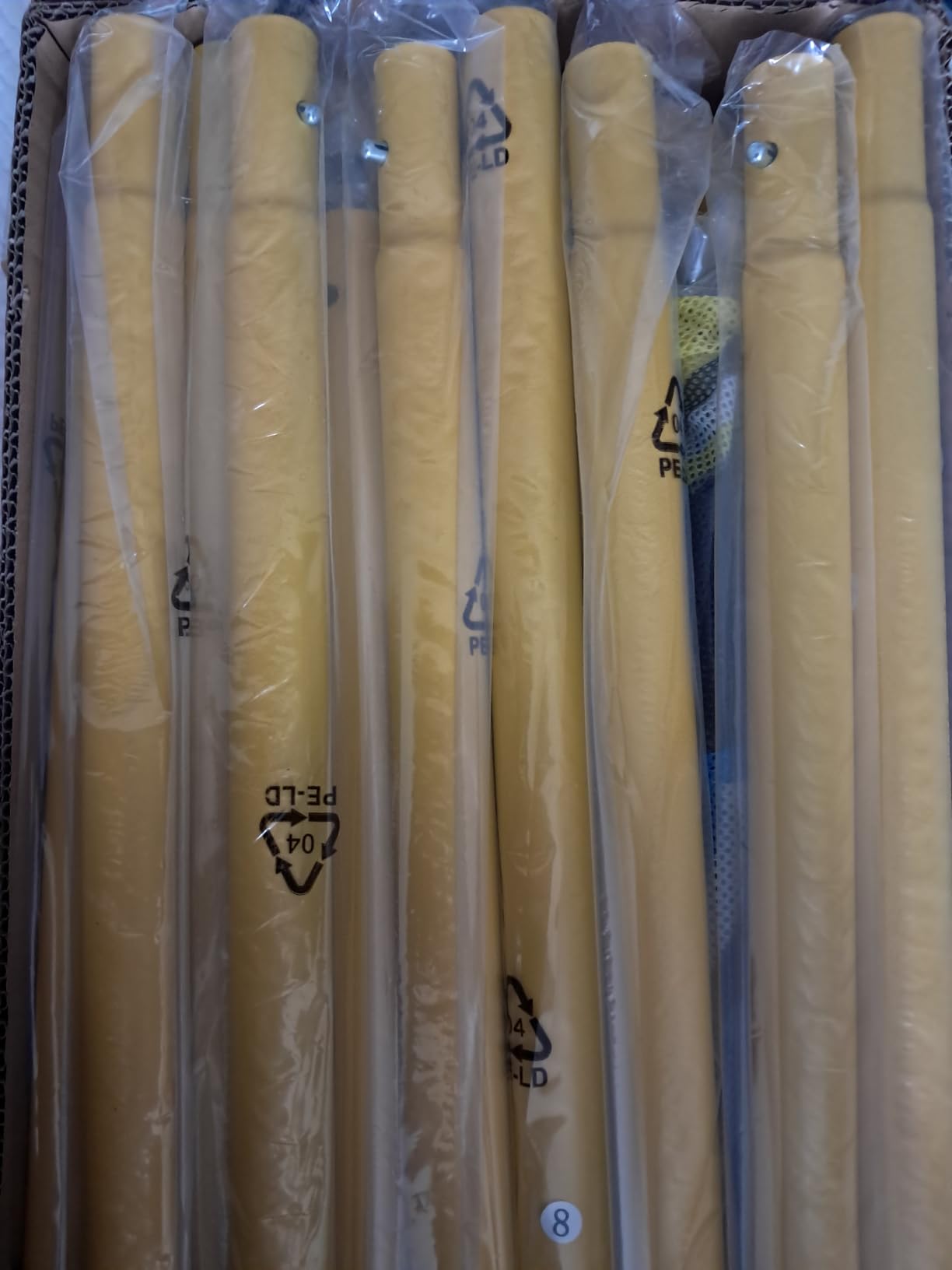
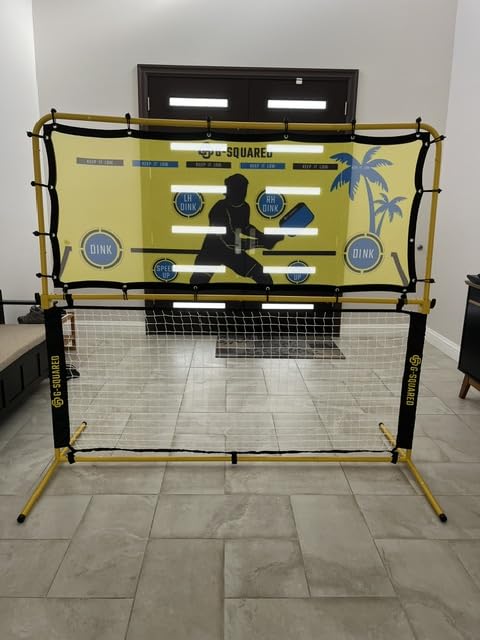
This one rates 4.9 across 33 ratings with nothing below four stars, and the reason is the tension. The mesh is held by elastic ropes rated at 28KG, which is a different feel from a bungee-strung budget net and explains the stronger return.
It is 72 inches by 72 inches, built on a heavy-duty iron and alloy steel frame, and weighs 7.04 kg. Buyers describe the rebound as noticeably stronger than cheaper mesh rebounders, and that is exactly what you want for volley and reaction work.
The second function is the reason it earns a spot higher in this list. A sleeve system lets you switch between rebounder mode and a regulation-height game net in seconds with no tools, so one footprint covers solo training and real rallies.
The upper rebounder angle is adjustable, which is how you control rebound intensity without changing where you stand. Steeper angle for a floating feed, shallower for a driven return.
What you get out of it
This is the one to buy if you want a single feed that works for both the soft game and hard volleys. The strong rebound means you can stand further back and still get a usable ball, which is what makes long sessions possible.
It also folds to standard net height, so converting to a game net for a visiting friend takes seconds rather than a full teardown.
Where it falls short
Thirty-three ratings is a thin base, and it is a newer listing than most others here. The consistency you read in reviews may not survive another year of owner reports.
At 7.04 kg and 72 inches square, it needs a dedicated corner of a garage or yard. It is not a one-person carry-and-drag device, which is the trade for the stronger frame.
5. MR Adjustable Height and Angle Rebounder – Most Adjustment Range
MR 6’x6’ Adjustable Pickleball Rebounder, Height & Angle Adjustable
5 angle positions from 90 to 22 degrees
3 height settings 75 to 90 inches
28 lb package weight
Lifetime warranty
Pros
- Wide angle and height range for varied drills
- Detachable front and back nets work as two rebounders
- Good weight keeps it from shifting
- Also usable for tennis
- badminton and squash
Cons
- Lowest average rating here at 4.0 with 16 percent one-star
- Net can be too loose to return the ball reliably
- Frame can feel wobbly and bolts have gone missing
- 28 pounds is hard to reposition
The specification sheet here is the most adjustable of anything we reviewed: five angle positions from 90 degrees down to 22, and three height settings from 75 to 90 inches. That range lets you run genuinely different drills on one frame, from a floating lob return to a flat drive.
The second structural idea is the detachable dual net. Snap locks let the front and back nets come apart, so you can run it as a combo station or as two separate rebounders facing each other for a true back-and-back exchange.
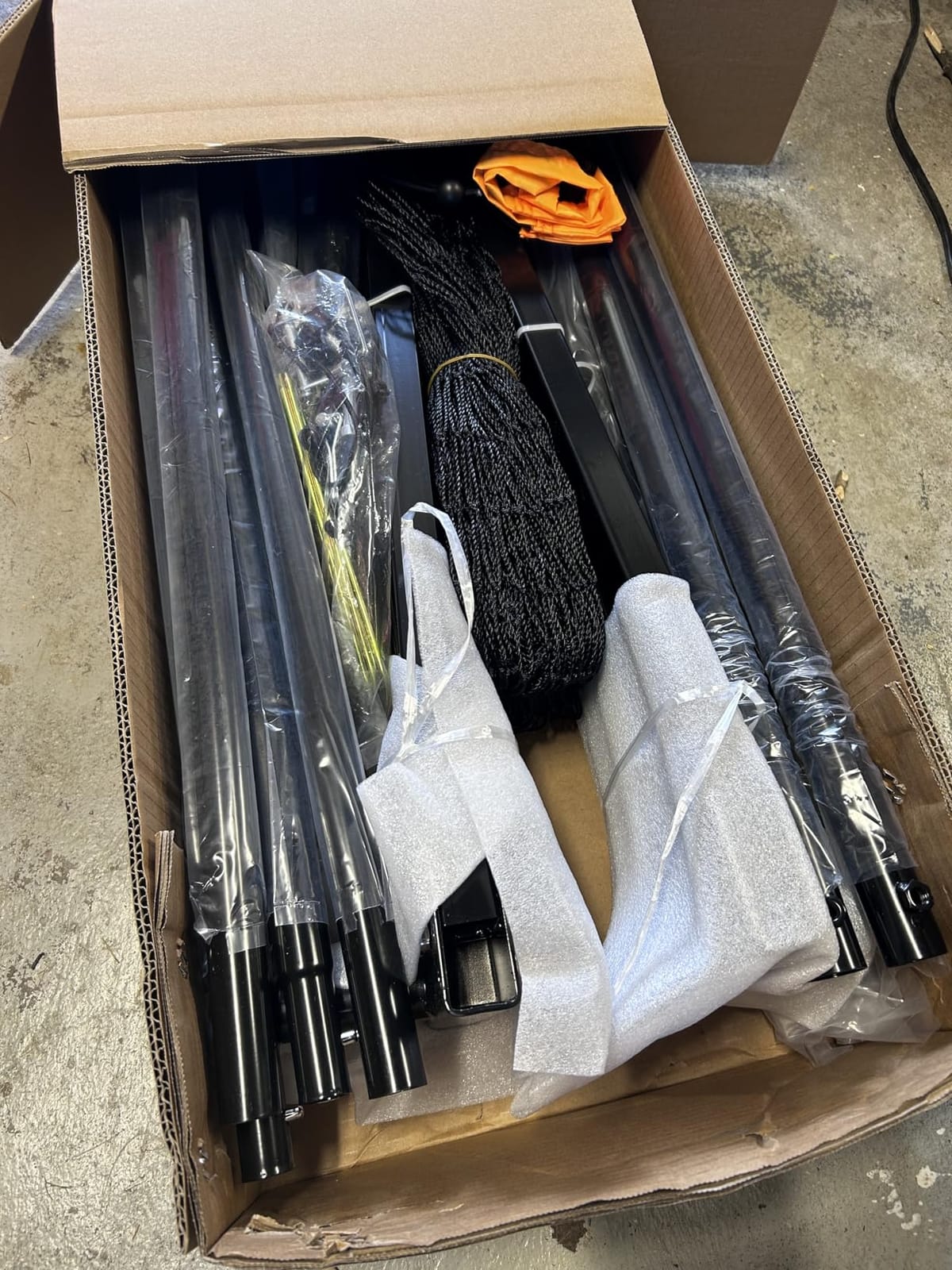
It is one of only a few models here rated for more than pickleball, covering tennis, badminton, and squash training on a powder-coated heavy-gauge steel frame with a high-tension weatherproof PE net. The lifetime warranty is the longest we found.
Feedback is sharply split, and we want to be straight about that. The 4.0 average includes a 16 percent one-star cohort, and the recurring complaint is under-tensioning: the net stretches, the ball dies, and you get a flop instead of a return.
What you get out of it
If you set the tension properly on assembly, the adjustment range is genuinely useful. Moving from a 90 degree angle to a 22 degree angle changes the feed from a high float to a low drive, which is a bigger change than the four-setting frames offer.
The detachable layout is a real advantage for two people. Split the nets, point them at each other, and you have a genuine solo rally loop with no chasing at all.
Where it falls short
Setup generally needs two people and an evenly stretched net, and a few copies have arrived with missing bolts and nuts. Check the frame for wobble before you tension anything.
At 28 pounds this is the heaviest unit in the roundup by a wide margin, and moving it across a room is a genuine chore. If your practice space is a rented room you carry equipment into, that matters.
6. KEALEA Court Training Pad – Best Partner for Kitchen Drills
KEALEA Pickleball Training Pad, Practice Pickleball Dink Skill and Training Aid Equipment for Indoor and Outdoor Training Court
5:3 court proportion pad
Traceless tape and nylon ties
0.84 kg
13.54 x 9.69 inch package
Pros
- Low-cost way to mark a realistic kitchen zone
- Traceless tape leaves no residue
- Reusable and portable between locations
- Light at 0.84 kg
Cons
- Flat pad
- not a returning rebounder
- Only 20 ratings so durability evidence is thin
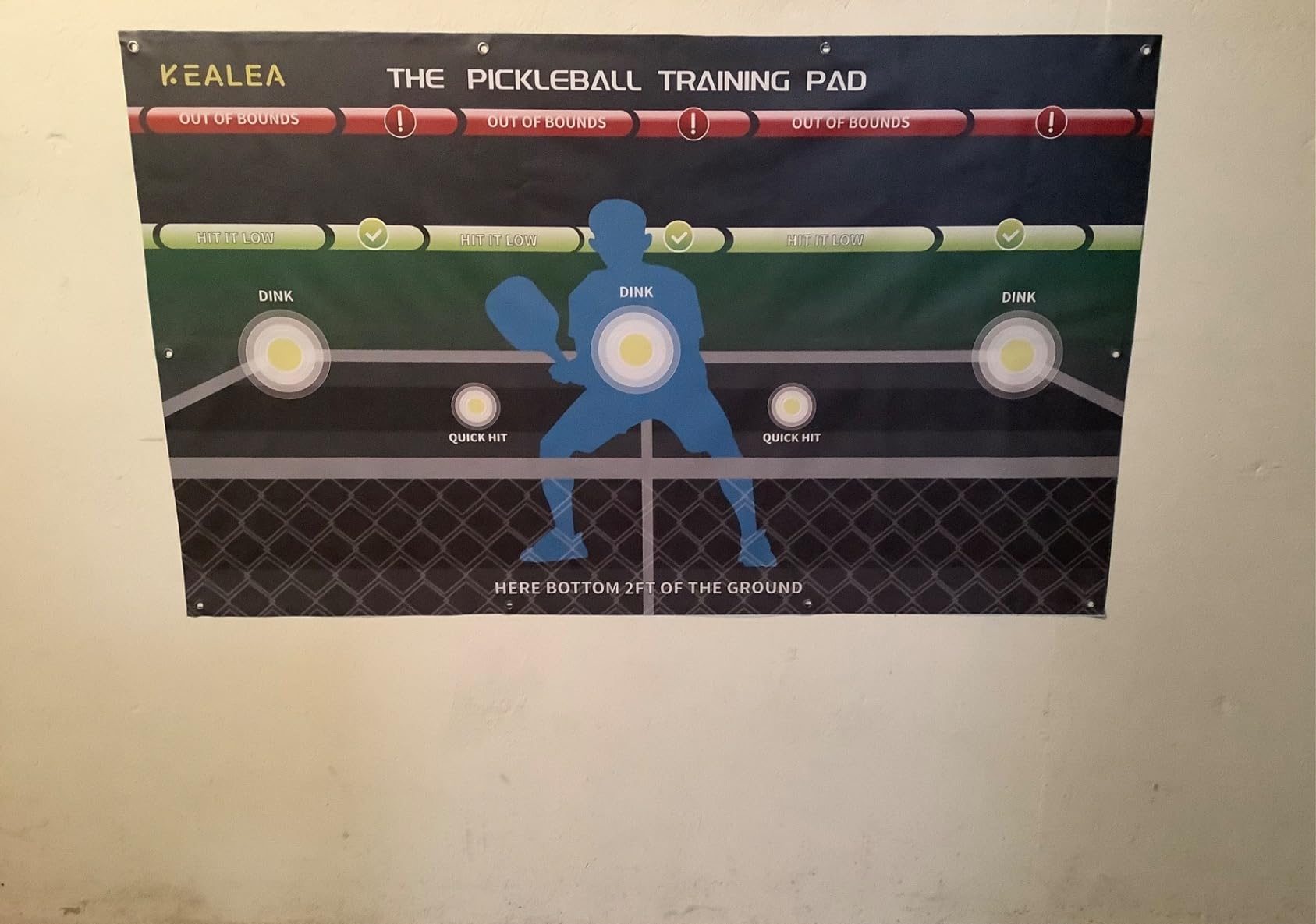
A court pad is not a ball return, so it does not compete with the rebounders on this list. What it does is give your solo practice a real non-volley zone to aim into, which is the one thing a rebounder cannot train on its own.
The pad uses a 5:3 ratio that approximates real court proportions, so the depth you see is meaningful. Buyers use it to practice dinks, placement, and muscle memory, and at 4.4 across 20 ratings the feedback is solidly positive.
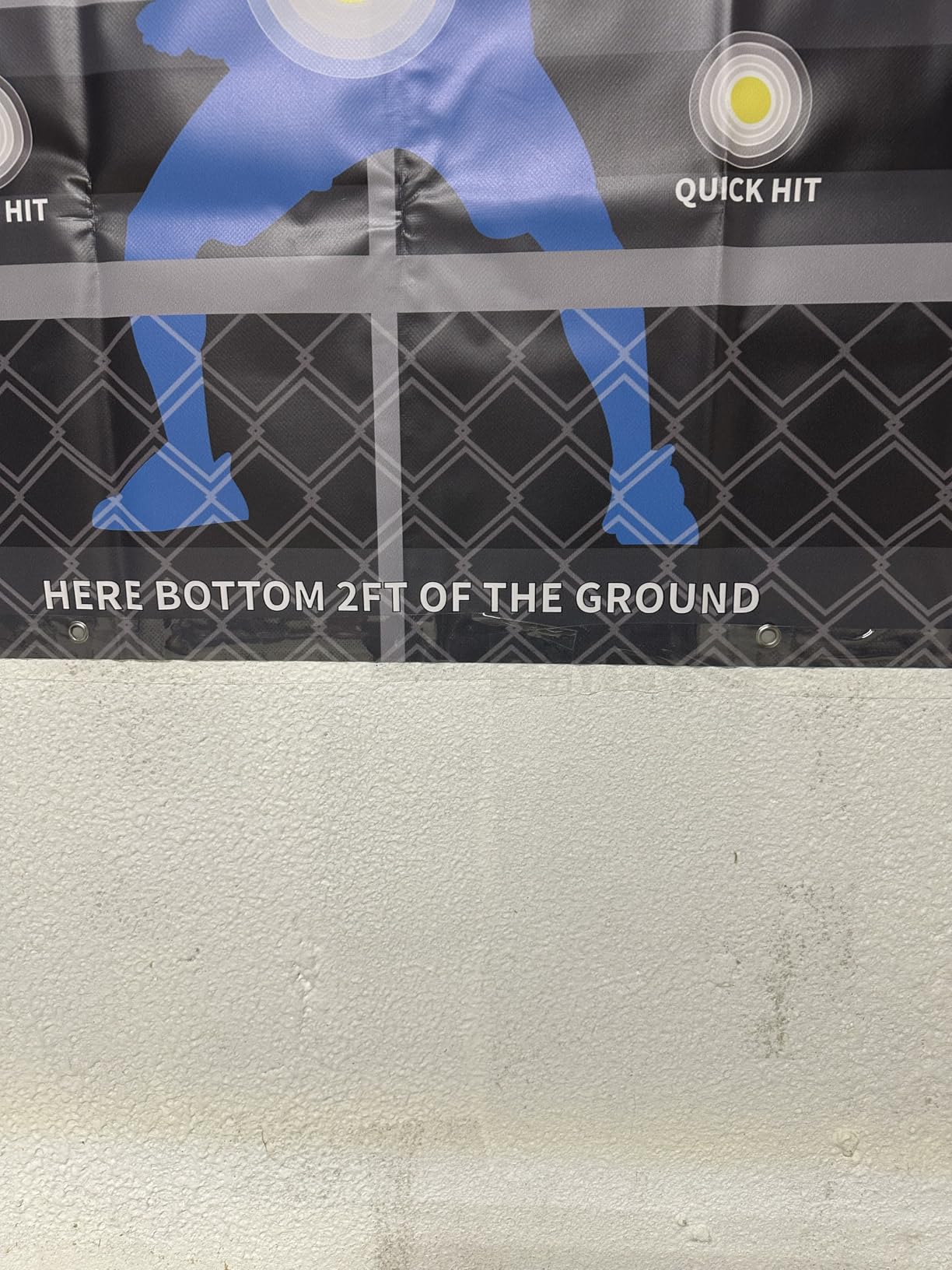
It weighs 0.84 kg and comes with reusable traceless tape for indoor mounting and reusable nylon ties for outdoor mounting. That combination means you can move it from a garage wall to a driveway without buying anything else.
Reviewers specifically call out that the tape leaves no residue on walls or floors, which is the concern that stops most people from marking anything indoors. It is a small feature that removes a real objection.
What you get out of it
Pair it with a net-style rebounder and you get a complete solo kitchen setup: hit the return, aim the drop inside the marked zone, and reset. That is the closest a single person can get to a real soft game without a partner.
It also works as a marked landing zone for third-shot drop practice, which is the one drill a rebounder alone genuinely cannot support.
Where it falls short
There is no return of any kind, so it adds work rather than removing it. On its own it is an aid, not a training device.
With only 20 customer ratings, long-term durability evidence is thin. Expect to replace the tape after heavy use, and check the pad surface for grip loss on a smooth floor.
7. Franklin Sports 83 Inch Rebounder – Best Big-Surface Trainer
Franklin Sports Pickleball Rebounder Practice Training Net – 83 Inch
83 x 83 x 83 inch
Powder-coated steel frame
Polypropylene net
90 day warranty
Pros
- 4.8 average with no ratings below four
- 83 inch surface suits singles or doubles training
- Excellent lively pop that forces soft hands
- Folds nearly flat for storage
- Court markers and center bar aid positioning
Cons
- Most expensive unit we reviewed
- Large footprint that needs dedicated space
- Assembly is slow and tie-heavy with unclear instructions
- Bottom quarter deadens the ball
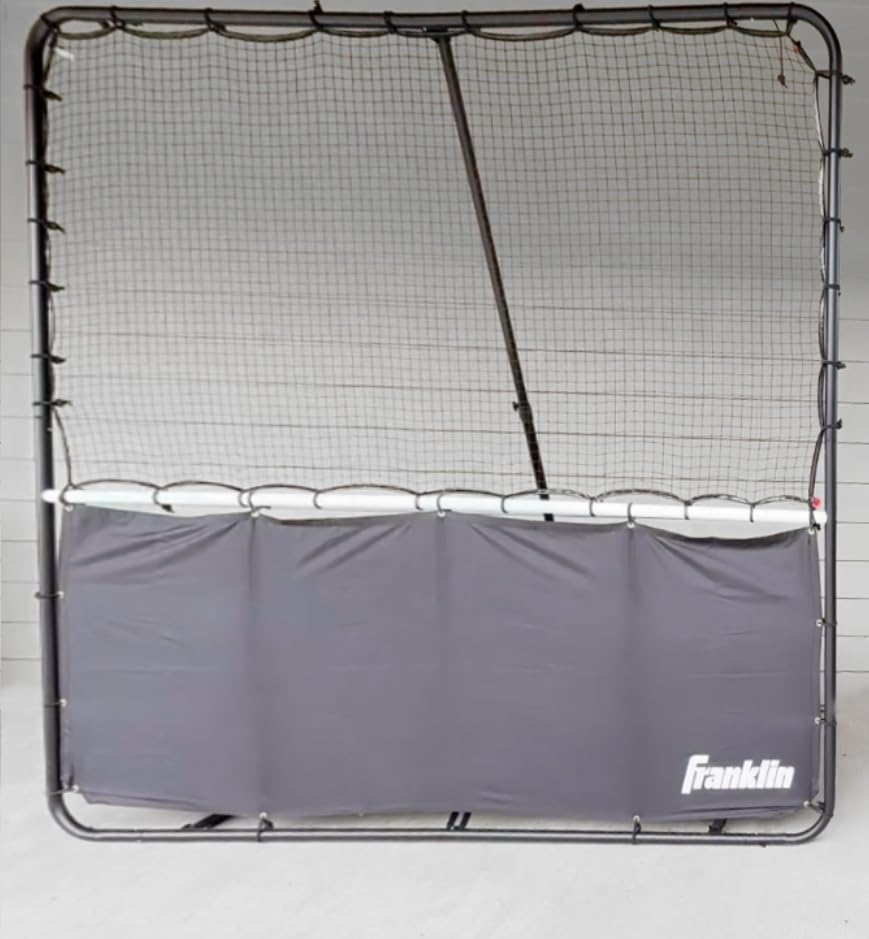
The 83 inch surface gives you a large square panel, and coaches and parents rate it highly for forcing better control and reflexes. It is also a recognizable major sports brand, which matters in a category where many listings are anonymous marketplace brands.
It measures 83 inches in every direction, sits on a powder-coated steel frame with reinforced net edges, and includes two court markers. A white center bar is positioned at official net height, so you get a visible reference for where the ball should cross.
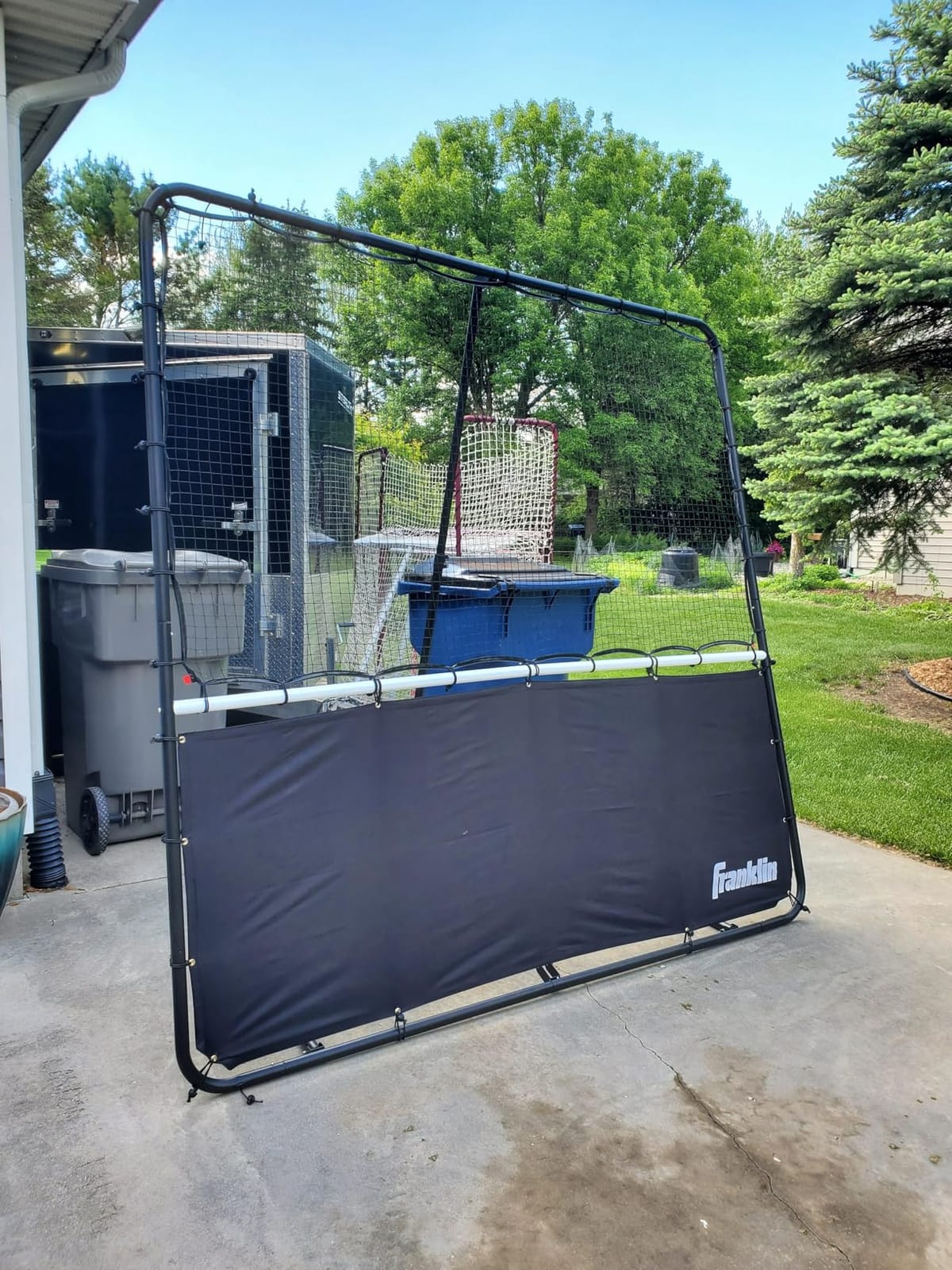
It folds to a slim profile for storage and one person can reposition it, which is unusual for something this large. The box includes the rebounder net and the court markers, and it holds up outdoors in bad weather according to owners.
The rebound itself is the reason it has fans. Buyers describe an excellent lively pop that genuinely demands soft hands, and several mention the surface is big enough for two kids to rally together.
What you get out of it
This is a beginner’s tool as much as an advanced one, because the rebound is stiffer than a natural partner’s. That forces a player who grips too tightly to fail, which is exactly the correction you want.
The included court markers and center bar help new players learn positioning, and the size leaves room for a genuine rally rather than a series of desperate reaches.
Where it falls short
It is among the most expensive items here, and the 90 day limited warranty is among the shortest. The trade-off is real, so buy it only if you have the space.
Assembly is slow and tie-heavy with dozens of bungees and confusing written instructions, and the bottom quarter of the surface deadens the ball rather than returning it. Beginners also need time to handle a rebound this lively.
8. NET PLAYZ Rebounder Training Aid – Best Court-Accurate Markings
Pickleball Rebounder Training Aid, Adjustable Angle Easy Setup & Storage – Perfect Your Forehands Backhands Dinks Volleys Accuracy Coordination Kitchen Control, Designed for Pickleball
72 x 72 inch
Adjustable rebound angle
Metal frame
90 day warranty
Pros
- Marked kitchen zone and non-volley line
- Net height indicator for reference
- Adjustable target webbing for aim practice
- Quick-lock setup and foldable frame
Cons
- Only 15 customer reviews
- 90-day manufacturer warranty
- 16 percent three-star cohort in the ratings
The differentiator here is markings that mirror real court geometry. You get a marked kitchen zone, a non-volley line, a net height indicator, and adjustable target webbing, all on a 72 by 72 inch metal frame.
Adjustable rebound angle with a quick-lock setup means you can change drill intensity without rethreading anything, and the frame folds for compact storage between sessions. Buyers report using it for solo kitchen-control and reflex work in a garage, driveway, or yard.
What holds it back is thin evidence. Fifteen ratings and a 90-day manufacturer warranty is a narrow base of information, and a 16 percent three-star cohort tells you the rebound feel is not universally praised.
What you get out of it
The court accuracy is the reason to choose it over a generic mesh net. When you can see a marked non-volley line and a net height reference, you can check whether your drop actually landed where you intended.
Adjustable target webbing gives you an aiming task rather than a survival task, which turns a repetitive session into a scored one. Track how many of 20 returns you can place inside the target.
Where it falls short
With fifteen ratings there is not enough owner history to judge long-term durability, and the ninety-day warranty gives little protection if the frame or webbing fails early.
Because a meaningful share of buyers rated it middling, the rebound feel is the one thing to test in person if you can. Return policies on this category are shorter than you would like.
9. A11N SPORTS Rebounder on Wheels – Best for Moving Between Spaces
A11N SPORTS Pickleball Rebounder with Adjustable Angles & 360° Wheels – Practice Rebounder for Forehand, Backhand, Dinks, Volleys – Ideal for Indoor Garage or Outdoor Driveway
4 angle settings
Alloy steel frame
360 degree rolling wheels
1 year warranty
Pros
- Wheels let you roll it instead of carrying it
- Four angle settings for varied rebound
- Marked kitchen zone and adjustable target line
- Tool-free interlocking assembly
Cons
- Only 9 customer reviews
- so feedback is still early
- Small sample so long-term durability is unknown
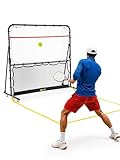
The wheels are the reason this one is different. 360 degree smooth-rolling casters mean you can roll the rebounder from a garage to a driveway to a backyard rather than carrying it, which is a bigger quality-of-life upgrade than the spec sheet suggests.
Underneath it is a reinforced alloy steel frame with a high-tension net, dual support poles, and four angle settings for varying rebound. A marked kitchen zone and adjustable target line support aim practice, and assembly is interlocking and tool-free.
The box includes a court marker, the frame, and the net, with a one-year warranty. Owners rate the stability and rebound consistency highly for forehand, backhand, dink, and volley drills.
What you get out of it
If your practice happens in more than one place, this solves a real problem. Most rebounders in this roundup need two hands and a clear path; this one needs a nudge through a door.
The four angle settings give enough variation for a beginner working on control and an advanced player working on reaction, without the complexity of a five-position frame.
Where it falls short
Nine customer reviews is a small evidence base, so we cannot tell you how the net holds up over a season. The encouraging early feedback is not the same as a settled record.
There are no ratings below four stars, but that is a very small sample. Treat the score as encouraging rather than conclusive, and check the frame tension after the first few sessions.
10. HamRoRung 9.3 x 7.4 ft Backboard – Best for Groundstrokes and Serves
Tennis Players Portable Tennis Rebounder Net, 9.3×7.4 ft Large Area Backboard Net for Backyard/Outdoor Training, Practice Wall for Tennis & Pickleball Training
9.3 x 7.4 ft hitting area
Knotted HDPE mesh
Powder-coated iron frame
Includes sandbags and stakes
Pros
- Large hitting surface for groundstrokes and serves
- Knotted net holds shape and tension over time
- Iron frame plus sandbags and stakes for stability
- Works for tennis
- pickleball and other field sports
Cons
- Multi-sport net rather than a pickleball-specific design
- Needs sandbags or stakes in wind
- Only 9 customer reviews
This is a backboard, not a rebounder, and that distinction matters. You hit a ball into a large flat net and it does not come back toward you, so there is no touches-per-minute payoff. What it gives you instead is a target big enough to practice full groundstrokes and serve placement.
At 9.3 feet wide by 7.4 feet high, it covers more hitting area than any other model here. The net is knotted high-density polyethylene with 3.54 inch square mesh and a 1.45 inch 500D PVC webbing border, on a powder-coated iron frame with triangular end brackets.
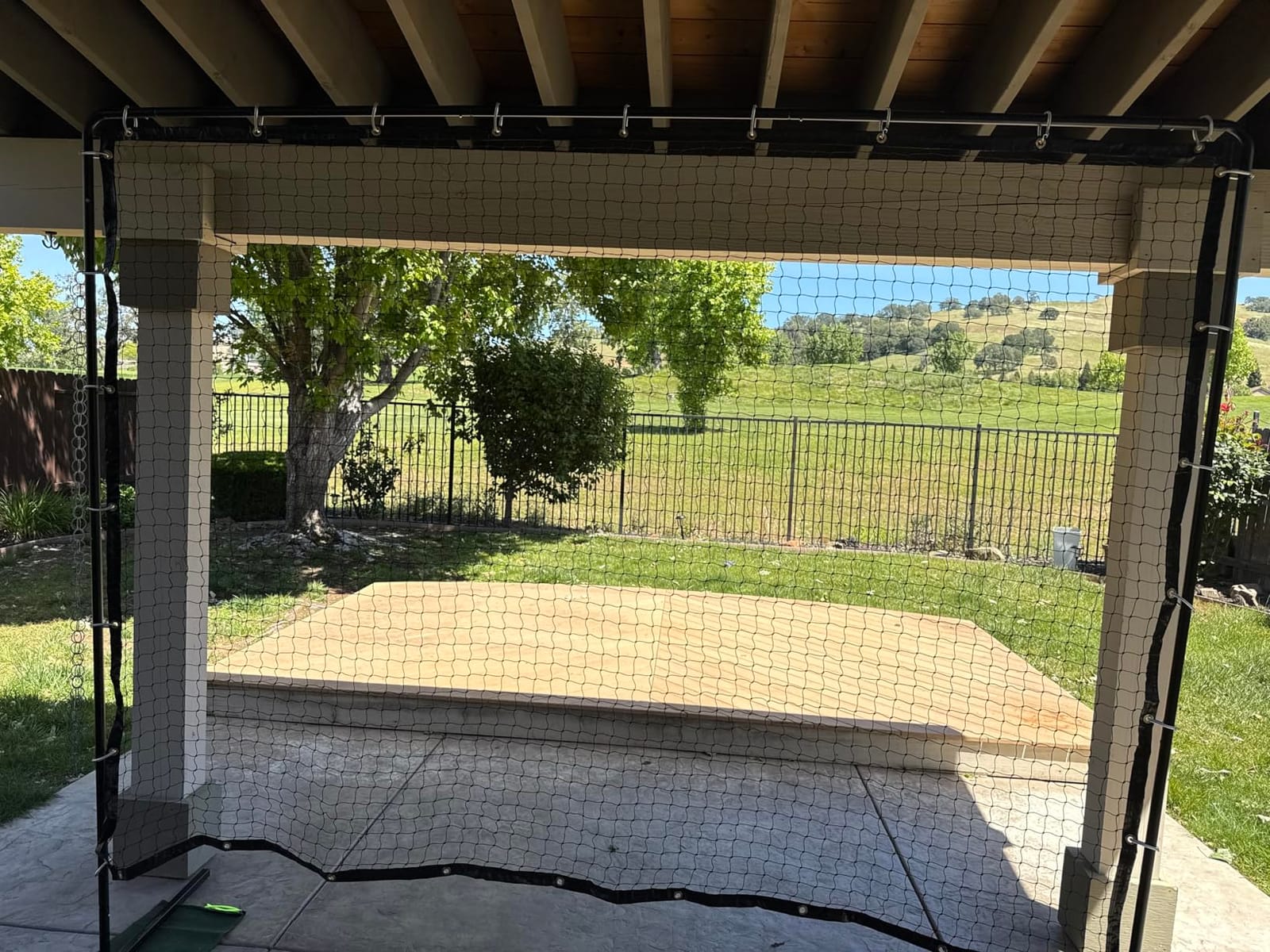
The included hardware matters more here than on any other item: four sandbags, four ground stakes, and a sports carry bag. Without that anchoring, a 9 foot frame in any wind is a sail.
Owners value the surface area and the durable knotted mesh for backyard practice, and the 4.4 average across nine ratings reflects that. It also works for tennis and several other field sports.
What you get out of it
Use it for serve placement and depth work, which a rebounder cannot support. Mark a target zone on the net and aim for it, and the sheer size means you can hit real groundstrokes rather than desperate defensive returns.
Because the mesh is knotted rather than tensioned with bungees, it holds its shape over time in a way that fabric nets do not. For long-term outdoor use that is a real advantage.
Where it falls short
It will not return the ball, so your retrieval problem is completely unsolved. Every session ends in a walk around the yard collecting balls.
It is a general racket-sport backboard rather than a dink-focused pickleball design, and with nine ratings the long-term picture is thin. Budget for the anchoring hardware if you buy it.
11. Oops Pickleball Folding Trainer – Best for the Smallest Spaces
OP Pickleball Practice Trainer Aid, Adjustable Height, Easy to Assemble and Disassemble
Height 28.34 to 49.5 inches
2.8 lb
Iron and plastic
Silicone components
Pros
- Light at 2.8 lb and easy to carry
- Small triangular base footprint
- Height adjusts from 28.34 to 49.5 inches
- Assembles and folds away in about two minutes each
Cons
- Only 4 customer reviews
- the thinnest evidence here
- 33 percent three-star cohort
- Plastic construction is less rigid than a metal frame
This is the one to buy if your problem is space rather than performance. At 2.8 lb it is the lightest unit in the roundup, and with a small triangular base it goes in a closet, under a bed, or in a car boot. Height covers 28.34 to 49.5 inches.
The included components are an iron frame and a triangular base, made with plastic and silicone parts. One person can assemble and disassemble it in about two minutes each way with no tools, which is among the quickest setups we tested.
What the very limited feedback suggests is a convenient, inexpensive trainer suited to multi-ball repetition drills for one or more players. Four ratings is far too small a sample to judge rebound quality or durability.
What you get out of it
Multi-ball repetition is the reason this shape exists. Set it up, feed a handful of balls at it, and drill one shot pattern over and over without any return at all, which suits a beginner working on a single stroke.
Because the base is triangular and small, it works in a hallway, a balcony, or one corner of a room where nothing else fits. Portability is the entire point.
Where it falls short
Four customer reviews is the thinnest evidence base in this roundup, and a 33 percent three-star cohort does not inspire confidence. Budget for possible early replacement.
Plastic construction is less rigid than a metal frame, so it will not give you the steady feed you need for fast-hands reaction training. Treat it as a repetition aid, not a performance tool.
12. Ksports Multi-Sport Rebounder – Most Reviews and Most Versatile
Ksports Tennis Rebounder Net – Multi Racket Sports Trainer for Tennis, Pickleball, Padel, Squash & Racquetball – Quick Assembly, Portable with Carry Bag (Blue, Regular)
41 x 32 x 68 inch frame
Alloy steel with weatherproof PET net
Bungee loop secured
Tool-free setup
Pros
- Largest review base here at 234 ratings for the most settled feedback
- Assembles and disassembles in under 10 minutes
- Works across tennis
- pickleball
- padel
- squash and more
- Optional 6 inch height extensions
- Carry bag included
Cons
- Frame is over 25 pounds so you will move it rarely
- 41 x 32 inch frame gives shorter and less consistent returns than a 6x6 ft unit
- Sized primarily for tennis rather than pickleball dinks
With 234 ratings this is by far the most thoroughly reviewed product in the roundup, and that is why it sits at the bottom of the ranking despite solid fundamentals. You are buying a well-documented 4.2 rather than an unknown 4.9.
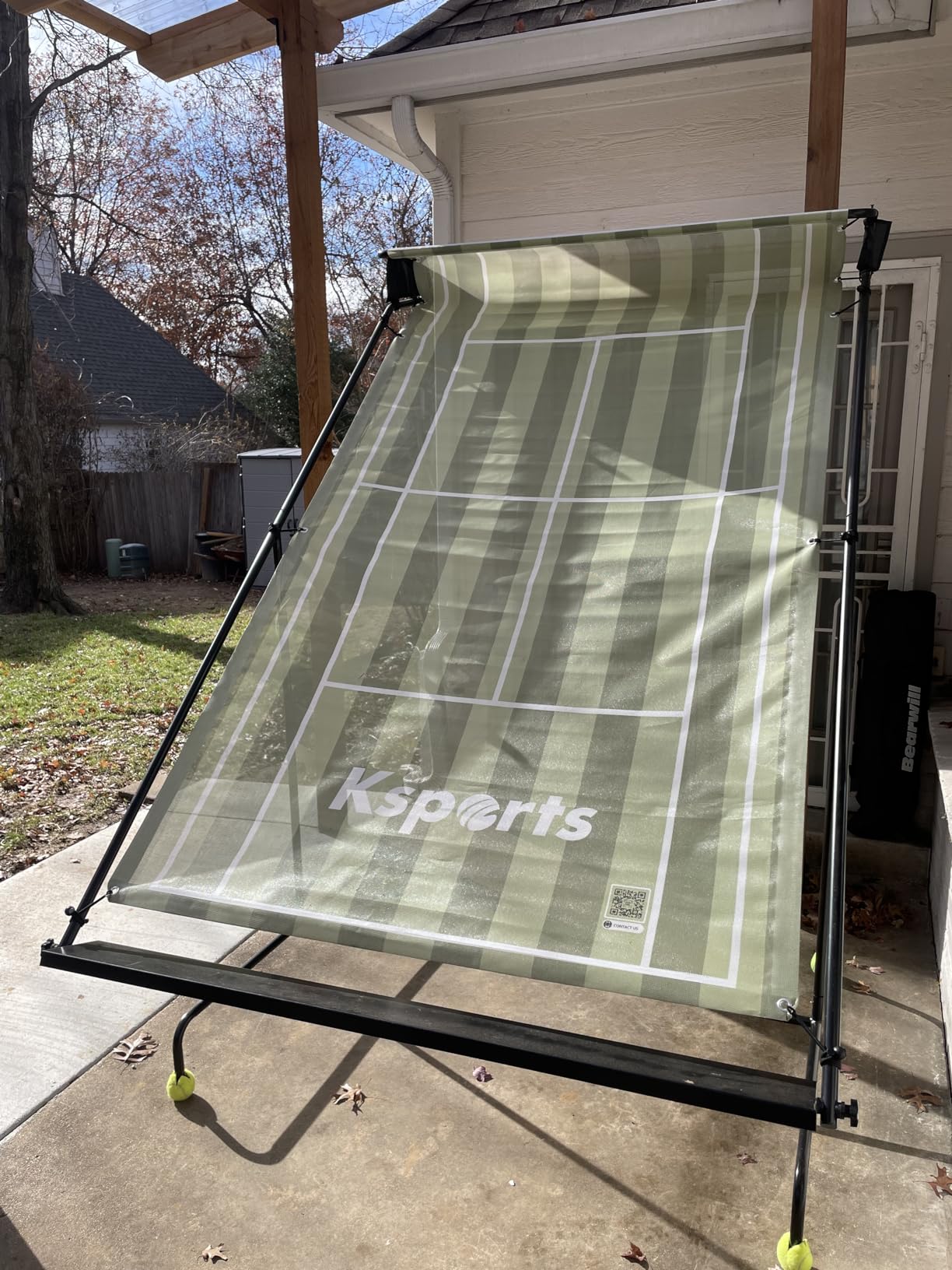
The frame is 41 by 32 by 68 inches in alloy steel, holding weatherproof PET netting secured by bungee loops. Optional six-inch height extensions broaden the shot options, and the whole thing packs into the included 600D Oxford carry bag.
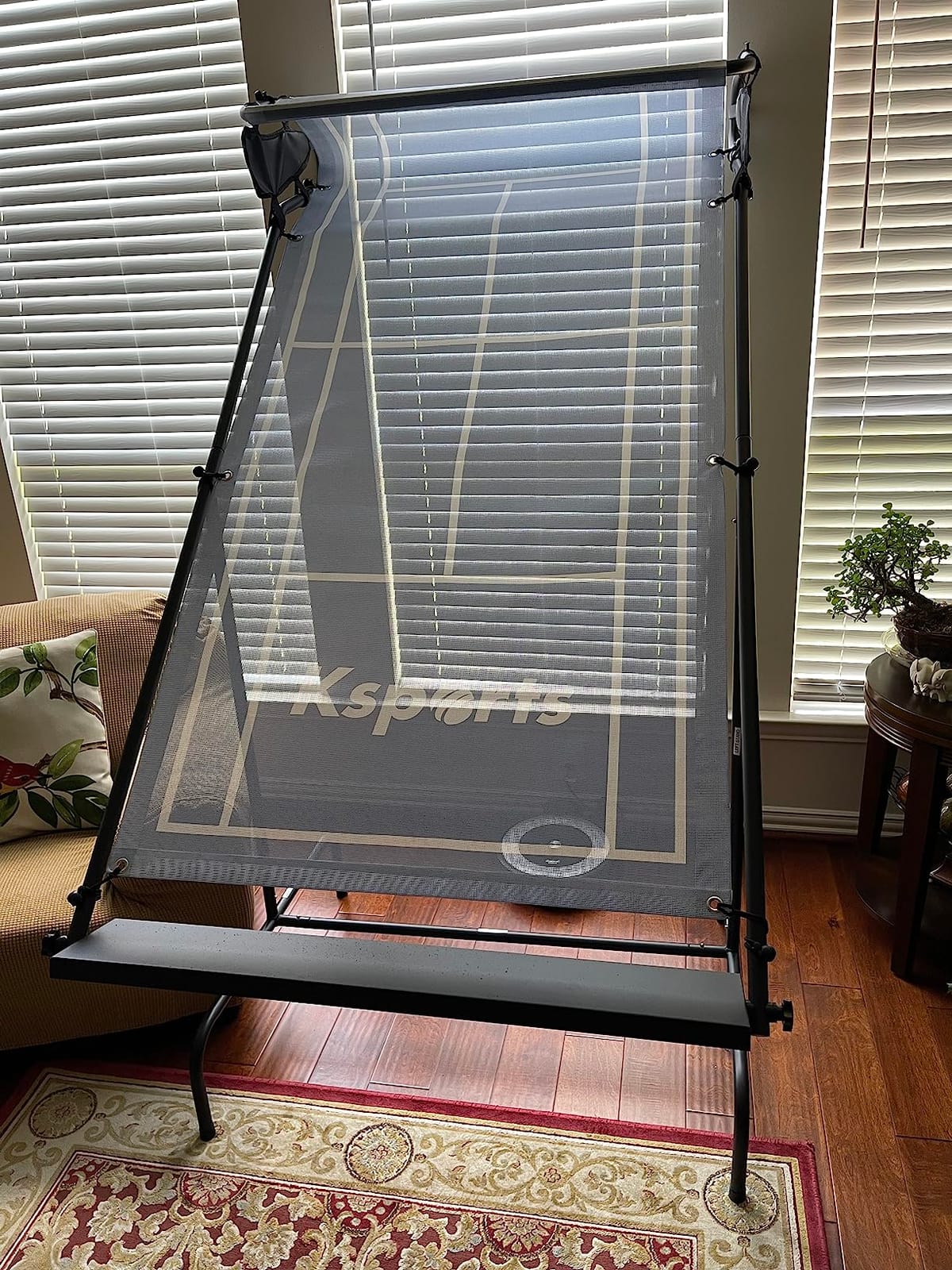
The versatility is real: tennis, pickleball, padel, squash, racquetball, and table tennis. Assembly and disassembly take under ten minutes with no tools, and the standard version needs only six square yards of space.
Buyers report roughly 30 returns per minute in that small footprint, which suits quick solo sessions well. The twelve-month warranty is mid-range for this category.
What you get out of it
For a household where more than one person plays, this is the pragmatic pick. A partner, a teenager, or a visiting friend can all use the same frame, and 30 returns a minute is enough to keep a warm-up sharp.
It also travels. The carry bag and the ten-minute assembly make it practical for tailgating, park sessions, and anyone without a dedicated practice space.
Where it falls short
Seven percent of ratings are one-star, the highest negative share among the most-reviewed items here. Some owners find the return weak or the mesh prone to sagging over time.
The 41 by 32 inch frame is small next to a 6×6 ft rebounder, so returns are shorter and less consistent. It is sized primarily for tennis, and pickleball dink work at the kitchen is not what it was built for.
How to Choose a Pickleball Rebounder for Your Space
Measure before you buy, and measure the standing area, not just the product. A rebounder is a target plus the room in front of it for you plus the room on both sides for lateral movement. Most net-style units here are 4 by 6 to 6 by 6 feet, so allow a 6 to 8 foot radius in front of the frame.
Then pick the surface type. Mesh returns a slower, less predictable ball that suits soft-game and dink work, while a rigid board gives a flat, fast, consistent feed that suits volleys and reaction drills. Beginners should start with mesh, because a board feed punishes a tight grip faster.
Angle adjustability is the third decision. Four settings is plenty for most drills, and the five-position frame here adds range without being essential. What matters more is whether the unit can be tensioned evenly on first setup, since a loose net is the single most common failure.
Floor protection is where indoor users get hurt, financially. If you are on hardwood, laminate, or a finished garage floor, use a mat underneath the frame feet, and check whether the feet are non-marking before you drag anything. Do not pull a steel frame across a hardwood floor to reposition it.
Storage footprint decides whether the aid gets used. Anything under 10 pounds and collapsible you will bring out twice a week, and anything over 25 pounds you will move once. Our putting mats for home practice guide covers the same floor-protection thinking for a different sport.
Noise matters indoors. A mesh rebounder is a soft sound, a steel-framed one is a sharp crack, and a rigid board is loudest of all. If you have downstairs neighbours or a sleeping household, mesh in a garage is the quiet answer.
One more indoor detail that catches people: ceiling clearance. At 83 inches tall you cannot swing a paddle above shoulder height without watching for light fixtures, and ceiling fans are a genuine hazard during a fast volley. Most indoor players keep the frame at dining-table height for exactly this reason.
Finally, use the right ball. Outdoor balls are hard and heavy enough to damage indoor floors and rattle a garage, while 26-hole indoor balls are softer, quieter, and safer in a small space. If you are working strictly indoors, indoor balls are the correct choice.
Rebounder vs. Practice Net vs. Ball Machine
A practice net is for the opponent you do not have. You hit balls over it into open space and walk to collect them, which is why retrieval eats most of the session. It is the right tool when you want to rehearse full groundstrokes and transition play and can tolerate the walking.
A rebounder is for the opponent that never misses. You log hundreds of touches without moving, and every repetition is identical, which is what makes it useful for soft hands, third-shot drop shape, and fast-hands work. It cannot train depth judgment, and that limitation is real.
A ball machine is for feeds you cannot produce yourself: consistent placement, random oscillation, and full-speed drives. It is the premium answer and it solves the depth problem, but it costs considerably more and needs court space to work. Our ball machine buying guide covers that price tier in detail.
The short version: rebounder for repetitions and soft game, practice net for stroke shape with space, ball machine for realistic placement at a higher spend.
How to Practice Pickleball Indoors Without Wrecking Your Space
Start with a soft ball and a low target. Use a 26-hole indoor ball, and set the rebounder angle so the return arrives below net height, roughly in the third to fifth foot in front of you. That turns the first ten minutes into pure control work.
Stand close and set a rep count, not a time. Close to the frame means shorter reaction time, which is the whole point. Try 20 controlled volleys, then step back one foot and do 20 more, and only then move further away.
Add a marked target. Stick a piece of tape on the net or use the printed target zones, then count how many of 20 returns land inside it. Scored drills turn dead repetition into something you can actually improve at.
Then run the drills. The soft reset is 20 gentle pushes at the net height for placement. The wall-volley machine gun is fast, flat volleys from close range for reaction speed. The drop shadow is aiming for the marked kitchen zone. The reset rally is feeding yourself slowly to build rhythm before increasing pace.
Finish every session with two minutes of slow dinks, not fast volleys. Ending on easy contact trains the soft touch you actually use in a game, and it reduces the soreness that makes people stop practising indoors.
Keep the paddle face open and the grip looser than feels natural, and treat every ball as if a partner is returning it. That mental framing is what separates a drill from hitting at an object.
When a Pickleball Rebounder Is Not Worth Buying
Skip it if you have a reliable hitting partner. A partner gives you unpredictable feed, movement, and verbal cues, and no rebounder replicates that. In that case a marked court pad costs far less and improves your placement instead.
Skip it if you already have court access. Free outdoor or club court time gives you depth training, spin reads, and real movement patterns that no rebounder can imitate.
Skip it if your real goal is the third shot. A rebounder cannot tell you whether a drop landed in the kitchen, so the skill you most want to build is the one it trains worst. A pad or a ball machine serves that goal better.
And skip it if you will not use it. The reviews across this category are full of owners who assembled a unit once, watched the mesh sag, and gave up. Ten minutes a week is the minimum that makes any of these worthwhile.
For a different kind of rebounder entirely, our lacrosse rebounder reviews cover the same mechanics for a much more physical sport, and home practice amplifiers solve the equivalent problem for musicians.
Frequently Asked Questions
What is the best pickleball training tool?
For a solo player, a net-style rebounder is the best pickleball training tool you can buy. It returns every ball, so you log 500 to 1,000 paddle touches in a session with one ball instead of roughly 50 on a practice net. A rigid backboard is better if your focus is volleys and reaction speed, and a marked court pad is the best addition for third-shot drop placement. With a regular partner, none of these beat real feed and movement.
How to practice pickleball in your house?
Use a 26-hole indoor ball, a net-style rebounder, and a marked target. Set the rebound angle low so the ball arrives below net height, then work 20 controlled volleys, 20 faster volleys, and 20 placement attempts into a taped target. Keep the paddle face open and stop with two minutes of slow dinks. Watch your ceiling height and lay a mat under the frame feet to protect the floor.
What is the difference between a pickleball rebounder and a practice net?
A practice net is a barrier you hit over. Balls land on the other side and you walk to collect them, so most of a session goes on retrieval. A pickleball rebounder is a target that returns the ball to you, which is why you can take hundreds of touches without moving. A practice net rehearses full groundstrokes and transition play, while a rebounder trains soft hands, repetition, and fast-hands reaction work.
How far should I stand from a pickleball rebounder?
Start about 6 to 8 feet back for reaction work, then move closer as the drill gets easier. A closer position shortens your reaction time and makes every feed harder, which is why standing three feet away is the real test of fast hands. For dink and drop practice, stand roughly 10 feet back so you have room to read the arc and adjust your swing rather than just blocking.
Is a pickleball rebounder worth it?
It is worth it if you have no reliable hitting partner and can commit to ten minutes a week. The touches-per-minute payoff is large, and a mesh rebounder is the most direct way to build soft hands and consistency. It is not worth it if you already have regular court time, because a rebounder cannot train depth judgment or third-shot drop placement, which is where the real gains live.
What size pickleball rebounder do I need?
Choose 4 by 6 feet for a garage or small patio, and 6 by 6 feet or larger if you have a yard or a dedicated corner. Anything over 83 inches square needs a full room and a dedicated storage plan. The single most important number is not the product size but the space in front of it, so measure a 6 to 8 foot radius before you order anything.
Final Verdict for Home Practice in 2026
The MerryMove 2-in-1 Rebounder Net is our pick for the best pickleball rebounders for home practice, because 154 ratings and a portable 5.99 kg frame make it the least risky buy in a category full of thin evidence. It handles a garage, a driveway, and a closet in the same frame, and the target zones give placement work that bare mesh nets do not.
Buy the G-SQAURED 6×6 ft instead if you want a stronger, faster feed and can dedicate a corner to it. Buy the SwingIt 4×6 ft if you want a metal frame and a marked kitchen zone at a modest spend. Add the KEALEA court pad to any of them if third-shot drop placement is your gap.
Whatever you choose, buy it for the repetitions and pair it with real court time for the rest. That combination is what the best pickleball rebounders for home practice are actually good for, and it is more than enough to keep your touch through a winter.