
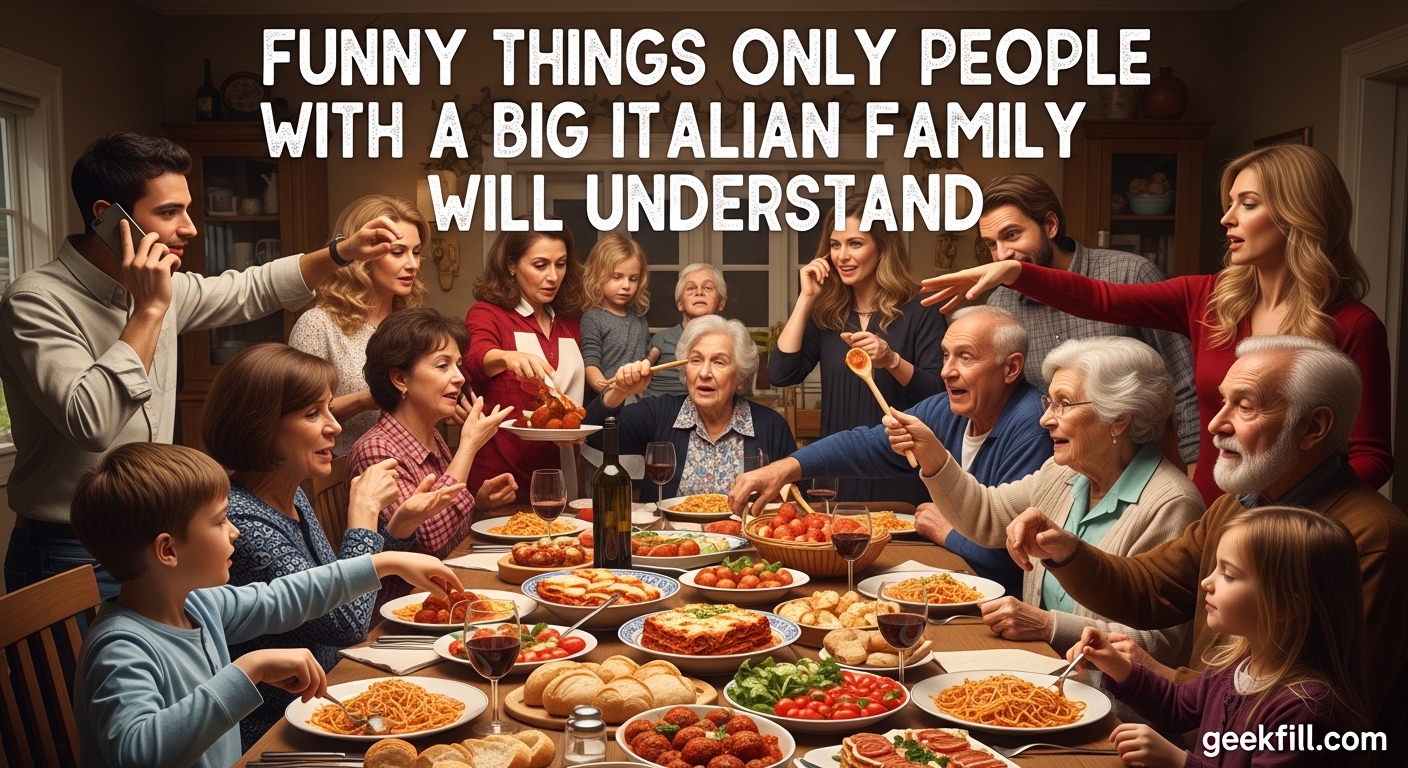
Growing up in a big Italian family is an experience unlike any other. If you were raised in a household where Sunday dinner was sacred, where nonna’s wooden spoon struck fear into your heart, and where talking meant waving your hands wildly, you already know exactly what I mean. These are the funny things only people with a big Italian family will understand.
Whether you’re a first-generation Italian American or your family has been here for generations, these cultural quirks and traditions bind us together. From the way we pronounce “mozzarella” to our unwavering loyalty to family, these experiences define what it means to be Italian. Let me walk you through the 20 moments that will make every Italian American nod and laugh.
Table of Contents
1. The Sacred Sunday Dinner
In a big Italian family, Sunday dinner isn’t just a meal. It’s a weekly religious experience that takes precedence over everything else.
You learned early that you cannot make plans on Sunday. No soccer games, no sleepovers, no exceptions. The sauce starts simmering at dawn, and by 2 PM, the entire extended family descends on nonna’s house like clockwork. Try to skip it, and you’ll face the wrath of every aunt, uncle, and cousin who “just wanted to see you.”
2. The Fear of the Wooden Spoon
Every Italian kid knows the terror of seeing nonna grab her wooden spoon.
It wasn’t just for stirring sauce, though it did that job beautifully. That spoon was also a disciplinary tool, a threat, and sometimes a projectile. The mere sight of nonna reaching for it could stop misbehavior instantly. Even now, as an adult, you might flinch when you see a wooden spoon in someone’s kitchen drawer.
3. Gravy vs. Sauce Debates
If you grew up Italian American, you know this debate has divided families for generations.
Is the red stuff on your pasta called “gravy” or “sauce”? In my family, it’s gravy, and we’ll argue about it passionately with anyone who disagrees. This isn’t just semantics. It’s about heritage, tradition, and regional loyalty. The argument usually ends with someone yelling “Stunad!” and storming out of the kitchen.
4. We’re Not Yelling, We’re Talking
One of the first things you learn about Italian family dynamics is that volume equals passion.
To outsiders, a normal dinner conversation sounds like a heated argument. But that’s just how we communicate. When two Italians talk, hands wave, voices rise, and everyone speaks at once. “NO, I’M NOT YELLING, THIS IS JUST HOW I TALK!” is a phrase you’ve probably shouted more than once.
5. The Cookie Tin Sewing Kit
Every Italian household has that one specific cookie tin.
You know the one. It says “Danish Butter Cookies” on the outside, but when you pop it open expecting sweet treats, you find buttons, thread, needles, and random screws. Nonna has been using that tin for storage since 1987, and no one dares to question it. If you’re lucky, there might be one actual cookie left at the bottom.
6. Hand Gestures Are Essential
Italian communication simply cannot happen without hand movements.
The “finger purse” gesture (pinched fingers held upward) alone can mean “What do you want?” “What are you saying?” or “I can’t believe this.” Try to tell an Italian story without using your hands, and you’ll quickly realize it’s impossible. Your hands talk just as much as your mouth does.
7. The Mafia Question Every Time
Tell someone you’re Italian, and you immediately know what’s coming next.
“Do you know anyone in the mafia?” “Is your family connected?” “Have you seen The Godfather?” These questions stopped being funny around the hundredth time you heard them. Yes, we’ve seen The Godfather. No, we’re not in the mafia. And please don’t do the “fuggedaboutit” voice. It’s exhausting.
8. Pasta Portion Sizes
In an Italian family, there is no such thing as a small portion of pasta.
Nonna will serve you a plate that could feed three people, then ask why you’re not eating more. “You’re so skinny! Mangia!” she’ll insist, even though you haven’t been skinny since 2008. The concept of leftovers doesn’t exist because there’s always room for more when nonna’s cooking.
9. Nonna Knows Best
The grandmother is the undisputed queen of every Italian family.
Nonna’s cooking is the gold standard that no restaurant can match. Her recipes are secret, sacred, and passed down through generations. She knows everything about everyone, and her word is final. When nonna speaks, the entire family listens. Disagreeing with nonna is simply not an option.
10. The Name Confusion
Italian families have a limited pool of names that get recycled constantly.
In one gathering, you might encounter Uncle Tony, Cousin Tony, Little Tony, and Tony from the old neighborhood. Family trees require a flowchart to understand. Conversations about family members require clarification: “Which Uncle Joe? The one from Philly or the one who married Aunt Marie?” It’s a beautiful chaos.
11. Galamad and Mootzadell
Italian Americans have their own special pronunciation of certain words.
Calamari becomes “galamad.” Mozzarella becomes “mootzadell.” Ricotta is “ree-goat.” Prosciutto is “proshoot.” These aren’t mispronunciations, they’re heritage. Try to correct an Italian grandmother on how to say “mozzarella,” and you’ll learn a whole new set of words you didn’t know existed.
12. Seven Courses Minimum
A proper Italian meal is not a single dish. It’s an endurance event.
You start with antipasto, then pasta, then meat, then salad, then cheese, then fruit, then dessert, then coffee. Holidays like Christmas Eve mean the Feast of the Seven Fishes, where you somehow consume seven different seafood dishes in one sitting. By the end, you need to be rolled out of the dining room.
13. Stovetop Coffee Only
Keurig machines and drip coffee makers have no place in an Italian kitchen.
The Bialetti moka pot is the only acceptable way to make coffee. That stovetop percolator produces espresso strong enough to wake the dead. Nonna has been using the same moka pot since 1975, and it makes better coffee than any fancy machine. Morning, afternoon, after dinner, there’s always a fresh pot ready.
14. You Can’t Leave Hungry
Leaving an Italian home without eating something is physically impossible.
“You didn’t eat anything!” they’ll insist, even though you just consumed three plates of pasta. “Take this home with you!” they’ll shout, loading you with enough leftovers to feed you for a week. The thought of someone leaving hungry causes actual physical pain to Italian mothers and grandmothers everywhere.
15. The Religious Icons Everywhere
Walk into any Italian home, and you’ll spot them immediately.
Pictures of Padre Pio hang in the kitchen. Rosaries dangle from rearview mirrors. Crosses adorn every wall. Catholic traditions are woven into daily life, not just Sunday mass. These aren’t decorations. They’re protection, tradition, and faith manifested in physical form throughout the house.
16. Family Business Is Everyone’s Business
Privacy is a foreign concept in Italian families.
Your third cousin twice removed knows about your breakup before you’ve even told your best friend. Family gossip travels at the speed of light through a network of aunts, uncles, and cousins. When something happens to one family member, it happens to everyone. The upside? You always have an army of people in your corner.
17. Cheek Kissing Protocol
Personal space doesn’t exist when greeting Italian family members.
Cheek kissing is mandatory, even with people you’ve just met. One kiss or two? Left cheek first or right? These are questions that have sparked family debates. By the time you’ve greeted everyone at a large gathering, your cheeks are sore from all the kisses, perfume, and aftershave.
18. The Stirring of the Sauce
Sunday gravy requires constant attention and supervision.
Someone must stir the sauce every few minutes to prevent sticking. This job is usually assigned to the youngest capable family member, who must stand at the stove for hours with a wooden spoon. “Don’t let it stick!” is the mantra repeated throughout the day. The sauce demands respect, and it gets it.
19. Mystery Relatives at Every Gathering
Show up to any Italian family event, and you’ll meet people you’ve never seen before.
“This is your cousin’s friend’s uncle from the old neighborhood,” someone will explain. These mystery relatives somehow know everything about your life, your job, and your relationship status. They’ll hug you like family and tell stories about you as a child that you don’t even remember. By the end of the night, they’re family too.
20. Family Above Everything
At the end of the day, Italian family culture boils down to one simple truth.
Family comes before everything else. Before work, before friends, before personal convenience. That loud, chaotic, food-obsessed group of people is your support system, your history, and your future. They know your flaws and love you anyway. They’ll fight with you fiercely and fight for you even harder. That’s the Italian way.
Frequently Asked Questions About Italian Families
What is the Italian quote about family?
The most famous Italian quote about family is ‘La famiglia e tutto,’ which means ‘Family is everything.’ This phrase encapsulates the core value of Italian culture, where family bonds are considered the most important relationships in life. Another common saying is ‘Chi ha famiglia ha tesoro,’ meaning ‘He who has family has treasure.’
What are Italian families known for?
Italian families are known for being close-knit, loud, food-centered, and passionate. They’re famous for Sunday dinner traditions, extended family gatherings, strong grandmother figures (nonnas), expressive hand gestures, and putting family loyalty above everything else. Italian families also maintain strong cultural traditions across generations.
What does the hand gesture mean in Italian?
The famous Italian hand gesture with pinched fingers and thumb (called ‘ma che vuoi’ or ‘finger purse’) generally means ‘What do you want?’ or expresses frustration, disbelief, or confusion. Other common gestures include the ‘chef’s kiss’ for delicious food and pointing to the cheek to request a kiss. Hand gestures are essential to Italian communication.
Why are Italian families so loud?
Italian families aren’t actually arguing when they sound loud, they’re simply passionate. Raised voices indicate enthusiasm, engagement, and emotional investment in the conversation. This communication style reflects the expressive Italian culture where showing emotion is valued. The volume often increases when multiple family members talk simultaneously, which is common at gatherings.
Embracing Your Italian Heritage
Growing up in a big Italian family shaped who we are in ways we might not even realize until we step back and look at it. From the Sunday dinners that anchored our weeks to the nonnas who ruled with wooden spoons and infinite love, these experiences create bonds that last lifetimes. These funny things only people with a big Italian family will understand aren’t just quirks, they’re the threads that weave our heritage together.
Whether you’re currently living these traditions or remembering them fondly, Italian family culture remains one of the most vibrant and loving ways to grow up. The food, the noise, the chaos, the love, it all combines into something uniquely beautiful. Share this with your Italian family members and see which moments make them laugh and nod in recognition. What funny things would you add to this list?