
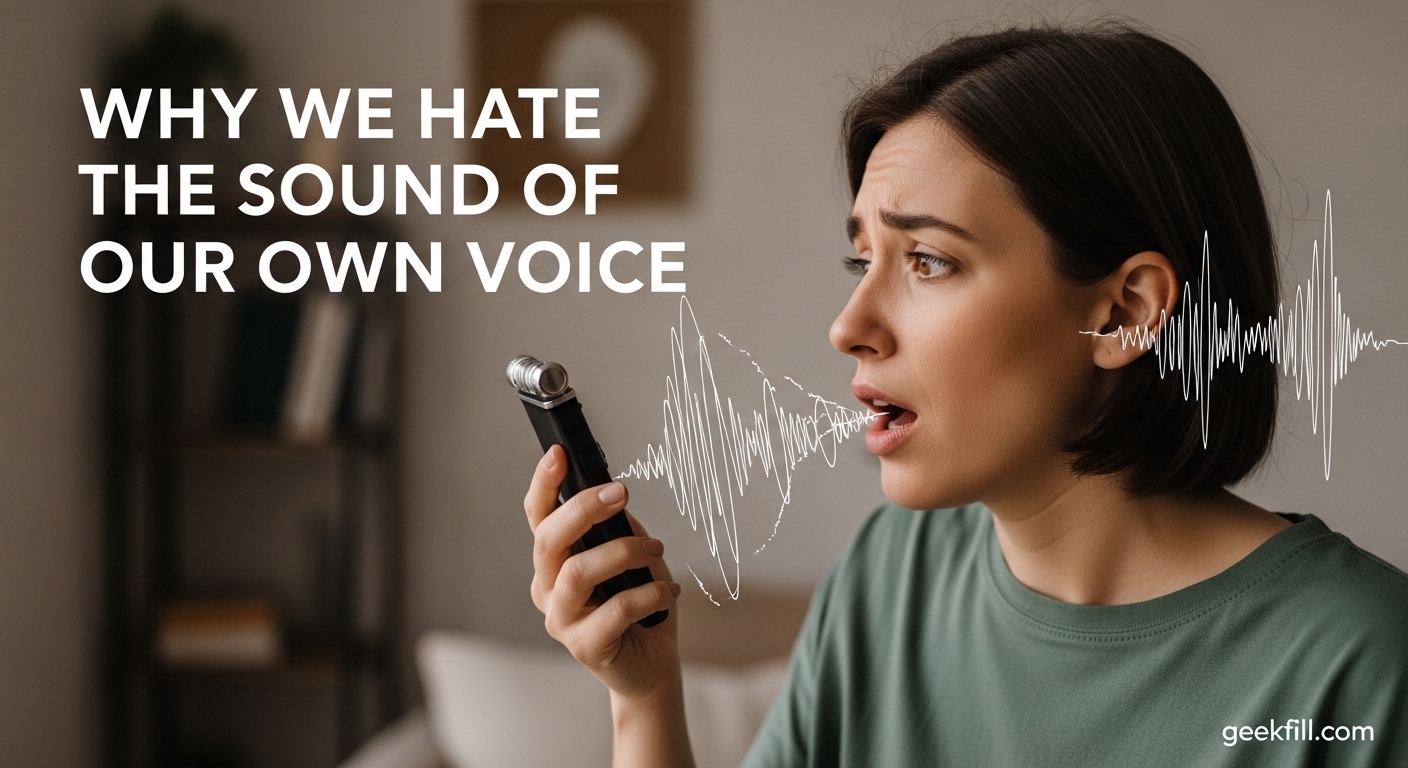
You press play on a voice message you sent to a friend. Ten seconds later, you’re frantically trying to delete it. Your voice sounds so different from what you expected. Higher. Thinner. Almost alien.
This uncomfortable experience has a name: voice confrontation. It’s the psychological phenomenon where hearing recordings of your own voice triggers discomfort, embarrassment, or even physical cringing. Research shows nearly everyone experiences this to some degree, regardless of culture, age, or profession.
In this guide, I’ll explain exactly why we hate the sound of our own voice. You’ll learn about the fascinating science behind bone conduction, the psychological factors at play, and why recorded voices reveal things about us we never knew. Most importantly, you’ll discover why this reaction is completely normal and how to cope with it.
Table of Contents
What Is Voice Confrontation?
Voice confrontation is the term psychologists use to describe the discomfort people feel when hearing their recorded voice. First identified in groundbreaking research by Philip Holzman and Clyde Rousey in 1966 and 1967, this phenomenon represents a specific type of self-confrontation that challenges our internal self-image.
The term “confrontation” is deliberate and meaningful. When you hear your recorded voice, you’re literally confronting an aspect of yourself that exists in the world. This is different from your internal experience. Your voice becomes something external, observable, and open to judgment. For many people, this triggers immediate defensive reactions ranging from mild discomfort to genuine distress.
The Origins of Voice Confrontation Research
Holzman and Rousey’s original studies at the University of Chicago changed how psychologists understand self-perception. They discovered that people reacted defensively to hearing their own voices played back. Subjects showed increased anxiety and discomfort that went beyond simple surprise at the unfamiliar sound.
The researchers realized something deeper was happening. The recorded voice exposed unconscious personality characteristics and emotional states that speakers didn’t realize they were projecting. This discovery led to decades of research exploring how our voices serve as windows into parts of ourselves we normally can’t access.
Why We Hate the Sound of Our Own Voice: The Science of Bone Conduction
The most common explanation for voice confrontation involves how we physically hear sound. When you speak, your voice reaches your ears through two completely different pathways. Understanding this dual pathway system explains why recordings sound so shockingly different from what you expect.
Air Conduction: How Others Hear You
Sound travels through air as pressure waves. When you speak, your vocal cords vibrate and push air through your throat, mouth, and nose. These vibrations create sound waves that travel through the air to other people’s ears.
The sound waves hit the eardrum, causing it to vibrate. These vibrations pass through three tiny bones in the middle ear called the ossicles. The ossicles amplify the vibrations and transmit them to the cochlea, a fluid-filled spiral structure in your inner ear.
Inside the cochlea, hair cells detect these vibrations and convert them into electrical signals. Your brain interprets these signals as sound. This air conduction pathway is how everyone else in the world hears your voice.
Bone Conduction: Your Private Sound System
When you speak, something else happens simultaneously. The vibrations from your vocal cords travel directly through the bones, tissues, and fluids of your head. Your skull, jawbone, and facial bones all vibrate with your voice.
These vibrations bypass the eardrum and middle ear entirely. They travel directly to your cochlea through bone conduction. Your cochlea receives signals from both air conduction and bone conduction simultaneously, creating a combined sound experience that only you can hear.
Bone conduction adds a layer of richness and depth to your voice that air conduction alone cannot provide. Your skull essentially acts as a built-in bass amplifier, emphasizing lower frequencies and making your voice sound deeper and fuller to yourself than to anyone else.
Why Recordings Sound Higher and Thinner
When you hear a recording of your voice, you’re only hearing the air conduction component. The recording captures sound waves traveling through air to the microphone. It completely misses the bone conduction vibrations that you normally experience.
This missing bass explains why recordings sound higher-pitched than you expect. Your brain has spent your entire life expecting to hear that rich, resonant voice with bone conduction enhancement. The recording strips away that warmth and depth, leaving a voice that sounds thinner, brighter, and more nasal than your internal expectation.
Research shows this frequency difference typically ranges from a few semitones to as much as an octave higher than what you hear internally. That’s a dramatic perceptual shift that naturally triggers surprise and discomfort.
The Psychological Factors Behind Voice Confrontation
The acoustic explanation only tells part of the story. Even knowing about bone conduction doesn’t eliminate the discomfort entirely. The psychological aspects of voice confrontation run deeper than simple frequency differences. They tap into fundamental aspects of identity and self-perception.
Cognitive Dissonance and Expectation Violation
Cognitive dissonance occurs when we encounter information that conflicts with our existing beliefs or self-image. Your voice is a fundamental part of your identity. You have an internal expectation of what you sound like based on years of bone-conduction-enhanced hearing.
When a recording violates that expectation, your brain experiences cognitive dissonance. The mismatch between expectation and reality creates psychological discomfort. You literally don’t sound like “you” in your own mind.
This expectation violation happens on multiple levels. The pitch difference is obvious and immediate. But subtler qualities also contribute. The resonance patterns, the way your voice carries in space, even the tiny nuances of pronunciation all differ from your internal model.
Self-Perception and Identity
Your voice serves as a key component of your self-concept. It’s one of the primary ways you express yourself in the world. The disconnect between how you imagine yourself sounding and how you actually sound creates what researchers call vocal self-image discrepancy.
Many people develop elaborate internal narratives about their voices. You might think you sound authoritative, warm, youthful, or sophisticated. The recording challenges these self-perceptions. If you imagined having a deep, resonant speaking voice, hearing a higher-pitched recording feels like a fundamental misalignment with who you believe yourself to be.
Some people feel their recorded voice sounds “childish” or lacks authority. Others worry they sound unpleasant or annoying. These interpretations attach social meaning to the acoustic reality, amplifying the discomfort significantly.
The Cringe Response
The visceral “cringe” many people report has neurological roots. When we encounter something that violates our expectations in a negative way, the brain’s threat detection systems activate. This creates a physical sensation of discomfort that can feel almost painful.
Voice confrontation triggers this response because it combines multiple factors that amplify each other. The acoustic surprise grabs attention immediately. The identity challenge creates psychological threat. The inability to stop the sound or look away intensifies the feeling of being trapped in the experience.
Research participants often describe this as feeling “exposed” or “naked.” The recorded voice reveals something about you that you can’t control or edit in real-time. That loss of control contributes significantly to defensive reactions.
Extra-Linguistic Cues: What Your Voice Reveals
Beyond pitch and tone, recordings expose extra-linguistic cues that you normally cannot perceive. These subtle vocal characteristics communicate information about your personality, emotional state, and psychological traits. Discovering these unconscious signals can feel like meeting a stranger wearing your face.
Personality Traits in Voice
Studies by Silke Paulmann at the University of Essex demonstrate that listeners can accurately detect personality traits from voice alone. Your voice carries markers of extroversion, emotional stability, openness to experience, and other fundamental characteristics.
These vocal markers operate below conscious awareness. You don’t deliberately project them, which means you also don’t deliberately perceive them in yourself. When a recording reveals these traits, you encounter aspects of your personality that normally remain hidden from your own self-knowledge.
This revelation can feel unsettling. You might discover you sound more anxious than you feel, more aggressive than you intend, or more uncertain than you believe yourself to be. These mismatches between internal experience and external expression contribute to voice confrontation.
Emotional States Made Audible
Research from McGill University led by neuroscientist Marc Pell shows that voices convey emotional states with remarkable accuracy. Anxiety, sadness, anger, indecision, and confidence all produce detectable acoustic signatures.
When you hear a recording, you might detect emotional undertones you didn’t realize you were expressing. You could sound more stressed than you felt, more uncertain than you intended, or more irritable than you meant to be. These revelations can create genuine psychological discomfort as you confront emotions you were trying to suppress or ignore.
The disembodied nature of recordings amplifies this effect. Without visual context or the ability to edit in real-time, the emotional content of your voice becomes stark and unavoidable. You hear yourself as others truly hear you, without the protective filters of intention and self-justification.
How Common Is Voice Confrontation?
Voice confrontation is a near-universal human experience. Research consistently shows that the vast majority of people dislike hearing recordings of their own voice. This phenomenon crosses cultural boundaries, age groups, and professional categories.
Bilingual Differences
Interestingly, bilingual individuals often report heightened voice confrontation in their second language. A 2014 study found that people experience stronger discomfort hearing themselves speak in languages they learned later in life.
This heightened reaction may occur because second-language speaking involves more conscious control and less automatic processing. The recorded voice reveals the gap between their internal language model and their actual pronunciation. The self-monitoring required for second-language speaking creates higher expectations that recordings fail to meet.
Gender Differences
Research suggests some gender differences in voice confrontation intensity, though findings remain mixed. Some studies indicate women may experience slightly stronger reactions, potentially due to higher societal pressure regarding voice presentation. However, the effect sizes remain small, and both men and women report significant discomfort.
Voice pitch itself may influence confrontation intensity. People with naturally higher voices sometimes report more discomfort because recordings amplify the contrast between their internal (bone-conducted) perception and the external reality. However, people with deeper voices also experience voice confrontation, suggesting pitch alone doesn’t determine reaction strength.
Professional Impact
Voice confrontation affects professionals across many fields. Singers often report extreme discomfort hearing recordings of their performances despite years of training. Voice actors struggle with this phenomenon regularly. Podcasters, YouTubers, and content creators must confront their recorded voices as part of their jobs.
Professional speakers including politicians, CEOs, and journalists often seek voice coaching specifically to address their discomfort with recorded sound. Even experienced broadcasters sometimes never fully adapt to hearing their recorded voice, though they develop coping strategies that allow them to function professionally.
The fact that professionals across all these categories experience voice confrontation demonstrates its universality. If trained singers and professional voice actors feel this discomfort, everyday people experiencing the same reaction are in excellent company.
Brain Processing: Why Our Own Voice Feels Different
Neuroscience research reveals that brains process our own voices differently from other sounds. This specialized processing creates additional layers to the voice confrontation experience. Understanding how the brain handles self-produced sound explains why voice confrontation feels so fundamentally different from other forms of embarrassment.
When you speak, your brain generates an internal copy of the expected sound called an efference copy. This copy helps the brain distinguish between sounds you create and sounds coming from the external world. Your brain essentially predicts what your voice will sound like before you speak.
Recordings violate this prediction system. The playback sounds like your voice but doesn’t match your brain’s internal efference copy. This creates a perceptual conflict that feels inherently wrong at a neurological level. Your brain detects something that should match its predictions but doesn’t.
Research using functional MRI shows that hearing your own voice activates brain regions associated with self-processing and identity monitoring. These same regions activate when viewing photographs of yourself or reading descriptions of your behavior. The brain treats recorded voice as self-relevant information requiring special attention and evaluation.
This self-relevance explains why voice confrontation feels so personally significant. It’s not just hearing a sound you don’t like. It’s confronting a fundamental component of your identity that doesn’t match your internal model. The brain processes this as important self-knowledge, amplifying the emotional response.
Coping Strategies: Getting Used to Your Recorded Voice
While voice confrontation is normal, you don’t have to suffer indefinitely. Several evidence-based strategies can reduce discomfort and help you develop a healthier relationship with your recorded voice. These approaches work through gradual exposure, cognitive reframing, and acceptance techniques.
Gradual Exposure
The most effective approach involves controlled, repeated exposure to your recorded voice. Start with short clips and gradually increase duration. Many people find that discomfort decreases significantly after 10 to 20 deliberate listening sessions.
The key is maintaining control over the experience. Choose when to listen, where to listen, and how long to listen. This sense of agency counteracts the helpless feeling that amplifies voice confrontation. Some people find it helpful to listen while doing other activities, reducing focused attention on the voice itself.
Reframing Your Perspective
Cognitive reframing involves changing how you interpret the experience of hearing your voice. Instead of focusing on the differences from your internal expectation, try attending to positive qualities. Notice clarity, warmth, expressiveness, or other appealing characteristics.
Remember that others don’t hear the contrast you experience. They have no expectation based on bone conduction. To them, your recorded voice simply sounds like you. The mismatch that feels so dramatic to you is invisible to everyone else.
Voice Training Possibilities
If voice confrontation significantly impacts your life, consider working with a voice coach or speech therapist. These professionals can help you develop vocal techniques that increase satisfaction with your recorded sound. They can also provide reassurance about the normal range of vocal variation.
Some people find that learning to modulate their voice deliberately reduces confrontation. Understanding that your voice is a flexible tool rather than a fixed trait can decrease the psychological stakes of hearing recordings.
Acceptance Strategies
Sometimes the most effective approach involves simple acceptance. Your voice is part of who you are. Like your face or your fingerprints, it uniquely identifies you in the world. Learning to accept this fundamental aspect of yourself can reduce the emotional charge of hearing recordings.
Many people find that their voice confrontation decreases naturally over time as they simply get used to the sound. Regular exposure through voice messages, video calls, and recordings gradually normalizes the experience. The brain adapts, creating a new internal model that includes the recorded sound.
Frequently Asked Questions
Is it normal to hate the sound of my own voice?
Yes, it is completely normal. Research shows the vast majority of people experience voice confrontation when hearing recordings of themselves. This phenomenon crosses all cultures, ages, and professions. Even professional singers and voice actors report discomfort with their recorded voices.
What is it called when you hate the sound of your own voice?
Psychologists call this phenomenon voice confrontation. The term was first used by researchers Philip Holzman and Clyde Rousey in 1966 and 1967 to describe the defensive discomfort people experience when hearing recordings of their own voice.
Why does my voice sound different when recorded?
Your recorded voice lacks the bone conduction component that you normally hear. When you speak, vibrations travel through your skull and facial bones to your inner ear, adding depth and richness. Recordings only capture air conduction, making your voice sound higher and thinner than you expect.
Do others hear my voice the same way I do?
No, others hear your voice more similarly to how it sounds on recordings. They only receive the air conduction component, without the bone conduction vibrations that make your voice sound deeper to yourself. The voice others hear is actually closer to the recording than to your internal perception.
Do singers hate their own voice?
Yes, many singers experience significant voice confrontation despite extensive vocal training. The disconnect between their internal expectation and recorded reality can create professional challenges. However, most professional singers develop coping strategies that allow them to work productively with recorded sound.
Can I change how my voice sounds?
Yes, voice training can modify various aspects of your vocal production. Working with a voice coach or speech therapist can help you develop techniques that create a recorded sound you find more satisfying. However, the fundamental acoustic difference between bone and air conduction cannot be eliminated.
Why do bilinguals hate their voice more?
Research shows bilingual individuals often experience heightened voice confrontation in their second language. This may occur because speaking a second language requires more conscious control and self-monitoring. Recordings reveal gaps between their internal language model and actual pronunciation that don’t exist in their native language.
How do I get over hating my recorded voice?
Gradual, controlled exposure is the most effective approach. Listen to short recordings repeatedly until discomfort decreases. Cognitive reframing helps by focusing on positive vocal qualities rather than the contrast with your internal expectation. Voice coaching provides professional guidance. Acceptance strategies reduce the emotional significance of the experience over time.
Conclusion
The psychology of why we hate the sound of our own voice involves both acoustic and psychological factors. The bone conduction that enriches your internal experience of your voice creates expectations that recordings simply cannot meet. Beyond this acoustic mismatch, recordings expose extra-linguistic cues about your personality and emotional state that normally remain hidden from your conscious awareness.
Voice confrontation is not a flaw or weakness. It represents a normal human response to encountering an external version of something you experience only internally. Your brain processes recorded voice as self-relevant information, making the experience feel personally significant even when the acoustic differences seem objectively small.
Understanding voice confrontation doesn’t eliminate the discomfort entirely. But it does provide reassurance that you’re experiencing a universal phenomenon shared by nearly everyone. The cringe you feel when hearing your voice message is the same cringe felt by professional singers, trained actors, and experienced broadcasters worldwide.
If voice confrontation affects your daily life, the strategies outlined in this guide offer paths toward greater comfort. Gradual exposure, cognitive reframing, and acceptance all help reduce the emotional charge of hearing your recorded voice. With time and practice, many people develop a peaceful coexistence with their recorded voice, accepting it as simply another version of their authentic self.