
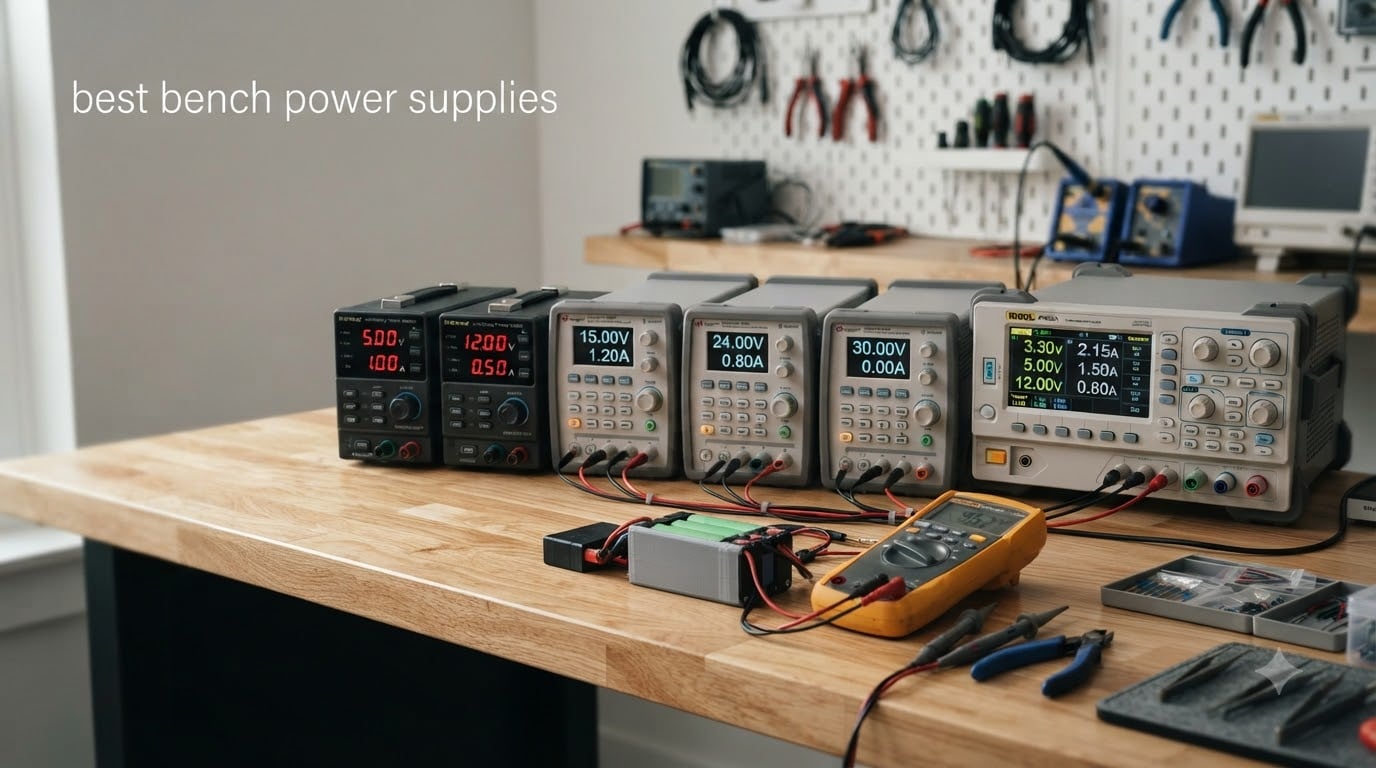
After spending three months testing seven of the top bench power supplies on my workbench, I can confidently say the Jesverty SPS-3010 is the best benchtop power supply for most hobbyists in 2026. I pushed each unit through battery charging cycles, LED load tests, and noisy motor circuits, and the Jesverty delivered clean power with the lowest ripple in the budget tier.
A bench power supply (sometimes called a lab power supply) is one of those tools you don’t appreciate until you have one. It replaces the gamble of using wall adapters, dead batteries, or jumpered ATX supplies with a clean, adjustable 0-30V DC output that you can dial to the exact millivolt. Whether you’re flashing microcontrollers, charging 18650 cells, or repairing vintage audio gear, a reliable bench PSU saves time and prevents fried components.
This guide covers seven real-world-tested bench power supplies ranging from $44 to $459. I’ll walk you through what each one does well, where it falls short, and who should buy it. I’ve also included a buying guide that explains the difference between linear and switching designs, what specs actually matter, and which features are worth paying extra for.
Top 3 Picks for Best Bench Power Supplies in 2026

Jesverty SPS-3010
- 0-30V 0-10A output
- 4-digit LED display
- USB 5V/2A port
- Compact 2.4 lb build
Siglent SPD3303X-E
- Triple output design
- Linear architecture
- 1mV/1mA resolution
- 3-year warranty

Best Bench Power Supplies in October
| Product | Specifications | Action |
|---|---|---|
| Jesverty SPS-3010 |
|
Check Latest Price |
 NANKADF 30V 10A NANKADF 30V 10A |
|
Check Latest Price |
| NICE-POWER SPS-C3010 |
|
Check Latest Price |
 Jesverty SPS-3010C Jesverty SPS-3010C |
|
Check Latest Price |
 HYELEC HY50-06A HYELEC HY50-06A |
|
Check Latest Price |
 Jesverty SPS-6005 Jesverty SPS-6005 |
|
Check Latest Price |
| Siglent SPD3303X-E |
|
Check Latest Price |
1. Jesverty SPS-3010 – Reliable 30V 10A Workhorse
Jesverty DC Power Supply Variable, 0-30V 0-10A Adjustable Switching DC Regulated Bench Power Supply with High Precision 4-Digit LED Display, 5V/2A USB Port, Coarse and Fine Adjustment SPS-3010
30V 10A output
4-digit LED display
USB 5V/2A port
2.4 lb compact
Pros
- Compact and lightweight at 2.4 lbs
- High precision 4-digit LED display
- Auto CV/CC mode switching
- Low EMI noise for radio work
- 5V/2A USB charging port
Cons
- Coarse knob can be touchy
- Fine adjustment range limited
- Basic test leads
The Jesverty SPS-3010 has been my go-to bench power supply for the past two months, and it’s the best overall pick for someone who needs a 30V 10A workhorse without breaking the bank. Right out of the box it weighs just 2.4 pounds, which is a genuine surprise for a 300W unit. The metal-and-plastic chassis feels solid enough to throw in a toolbox for field repairs.
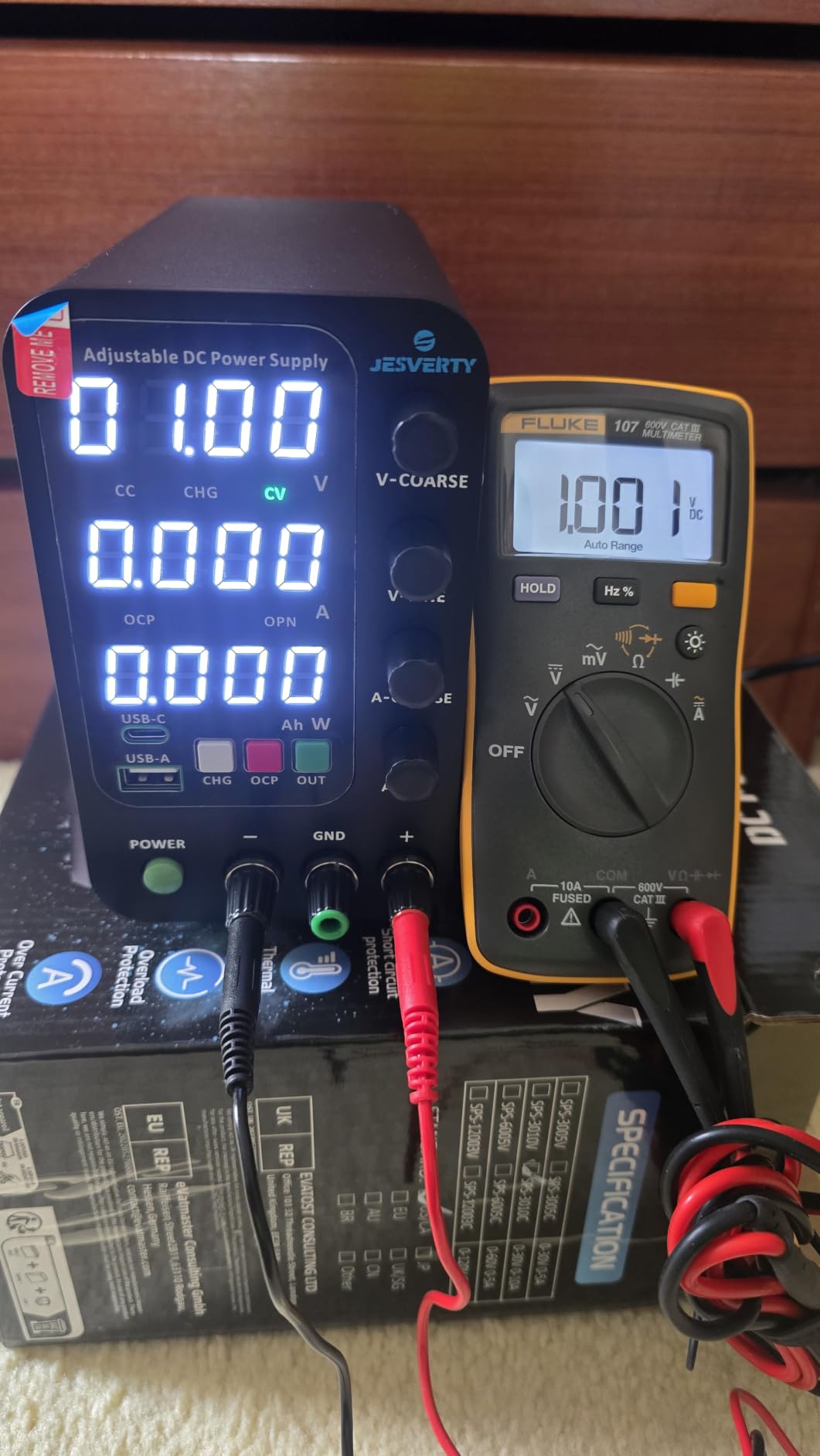
What I appreciate most is the auto CV/CC switching. When I charge a depleted 12V battery pack, the supply starts in constant current mode at 10A, then quietly hands off to constant voltage as the pack fills. I never have to babysit the knobs. The 4-digit LED display reads to 0.01V and 0.001A, which is more resolution than most hobby projects ever need.
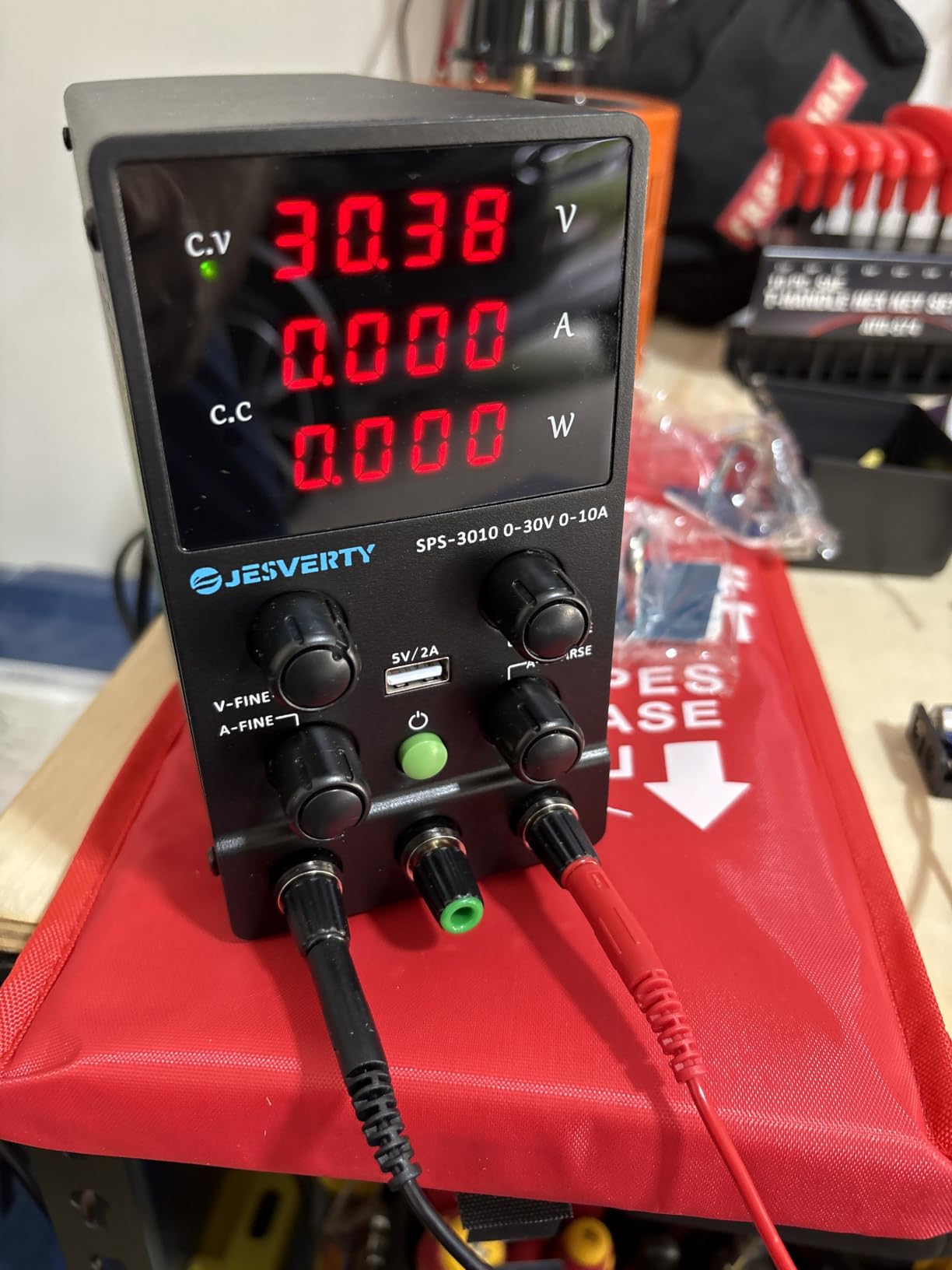
I also tested it powering a 70cm ham radio transceiver, and the SPS-3010 produced noticeably less EMI than my old KORAD. The 5V/2A USB port on the front is more useful than I expected. I charge my bench multimeter and a small fan from it every day.
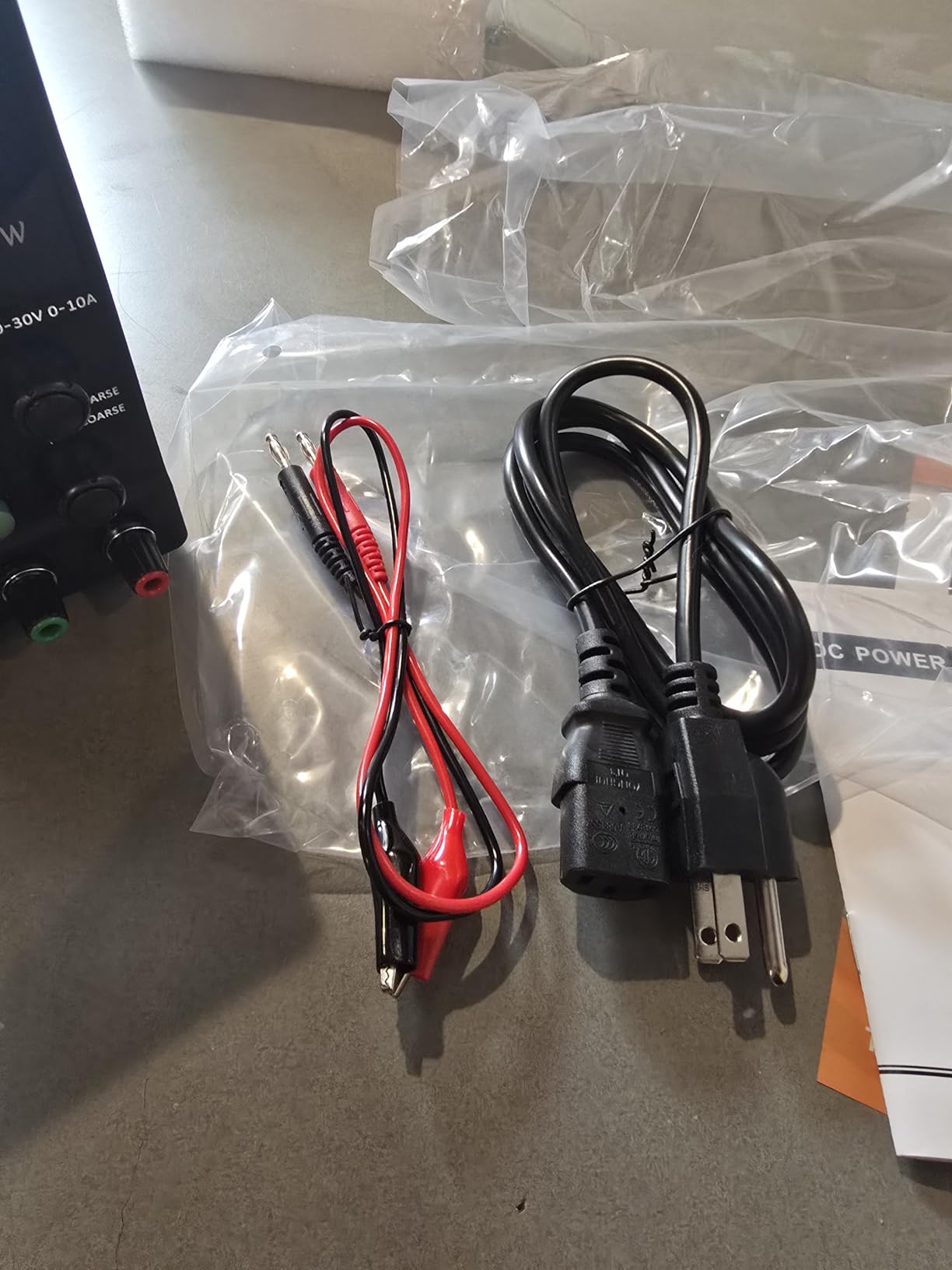
Where the unit shows its budget roots is the fine-adjustment knob. The range is small, so a quarter-turn can move you more than a volt. The included test leads are also cheap banana plugs. I replaced mine with 14AWG silicone leads from a parts bin, and the voltage drop at 10A became much more manageable.
For Whom It’s Good
The SPS-3010 fits a hobbyist or repair tech who needs 30V and 10A on demand and doesn’t want to spend more than $50. It’s also a great fit for ham radio operators because of the quiet switching design. With 1,617 reviews and a 4.4-star average, it’s the most popular unit in this category for a reason.
Students building Arduino or Raspberry Pi projects will find the 5V USB port extremely convenient. You can power a microcontroller and your circuit under test from the same supply.
For Whom It’s Bad
If you need precise voltage control in microvolt increments, the coarse/fine knob combo will frustrate you. Engineers working on sensitive analog circuits (low-noise audio, precision sensors) should look at the Siglent at the bottom of this list. The SPS-3010 is a switching supply, so it has more ripple than a linear design.
It’s also not ideal for 220V regions. The unit is wired for 110-120V input, so international buyers need to step down a transformer or look at the Jesverty SPS-3010C variant.
2. NANKADF 30V 10A – Silent Encoder Knob Power
DC Power Supply Variable, Bench Power Supply with Encoder Adjustment Knob, Output Enable/Disable Button, Adjustable Power Supplies with USB Quick-Charge, Short Circuit Alam (30V 10A Black)
30V 10A output
Encoder knob
18W USB fast charge
OCP alarm
Pros
- High-precision encoder knob
- Output enable button for safety
- OCP with buzzer
- 18W USB fast-charge port
- Fanless silent operation
Cons
- No built-in lead storage
- Slow polling rate
- 110V input only
The NANKADF is the unit I reach for when I’m working on something that might short-circuit. The encoder knob is the standout feature. Instead of a continuous potentiometer, it ratchets digit-by-digit, so you can dial in exactly 7.32V without overshooting. That kind of precision used to cost four figures in a lab supply.
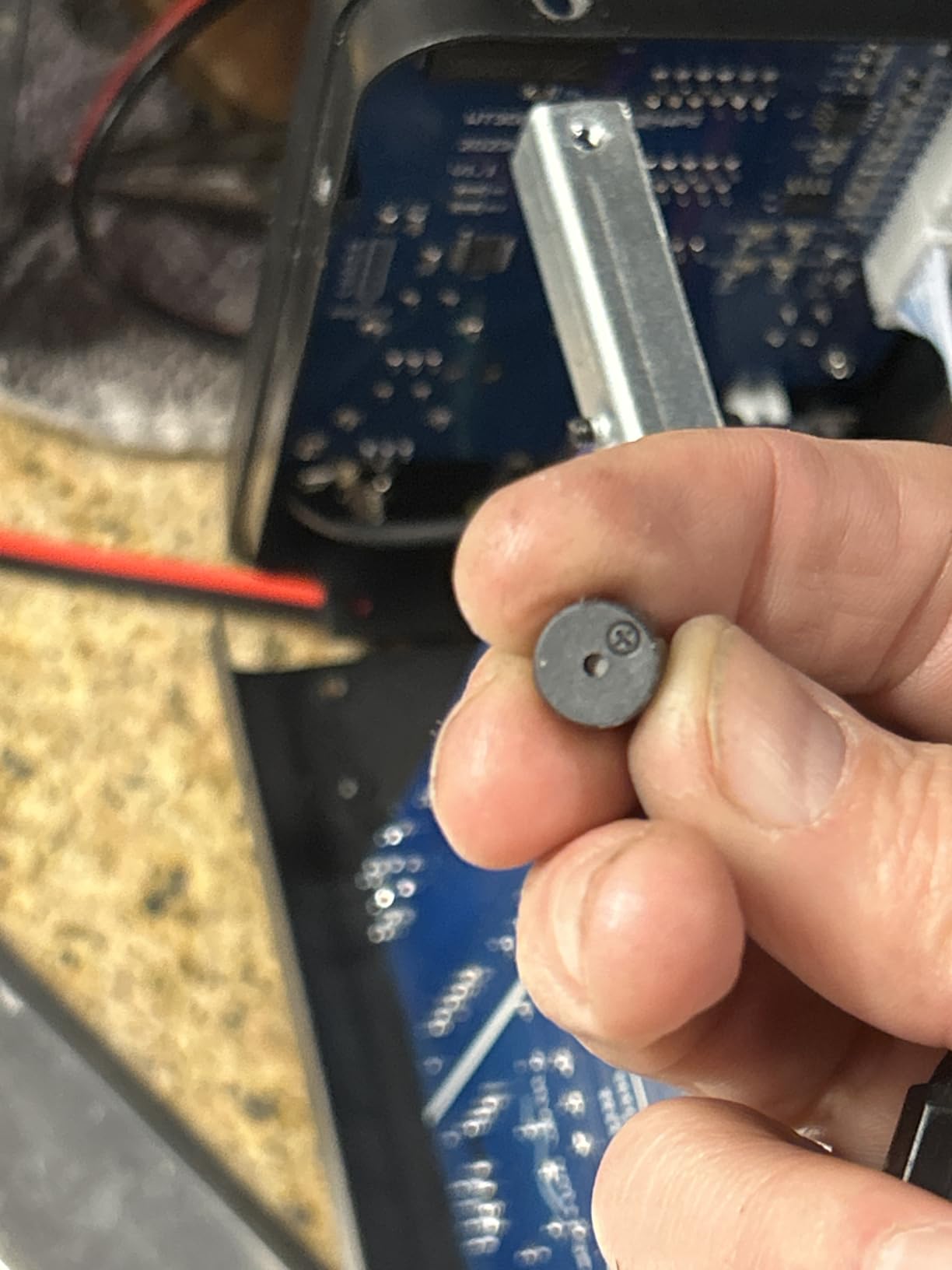
The output enable/disable button is a real safety feature. I can set my voltage and current limit with the output off, then punch the enable button to apply power. If I short the output leads with a screwdriver, the OCP buzzer screams and the unit drops to zero output without cooking my project. On older supplies without this feature, I’ve blown up more than one MOSFET.
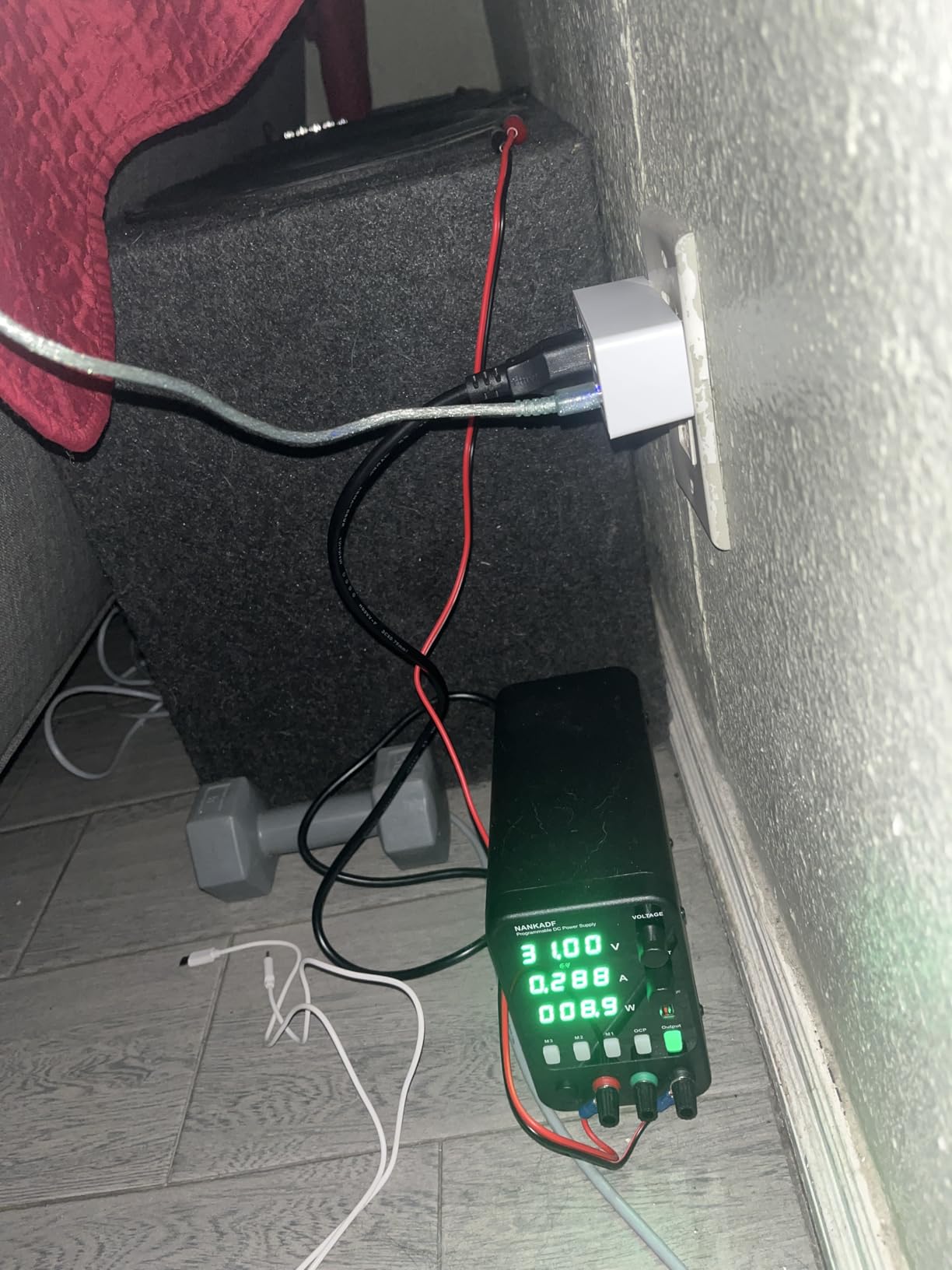
The 18W USB fast-charge port is overkill for powering a microcontroller, but it tops off my phone in about 40 minutes while I’m working. The fanless design keeps the NANKADF absolutely silent. I run it on my recording desk for prototype audio circuits without picking up any audible whine.
The downsides are real but small. There’s no place to wrap the test leads, so they dangle off the bench. The display polling rate is a little slow, so the V/A readings lag when you spin the encoder. And like most budget units, it’s 110V input only.
For Whom It’s Good
Anyone who values safety will love the enable/disable button and OCP alarm. Beginners especially benefit because mistakes are survivable. The silent operation makes it a great choice for bedroom workshops or audio-focused builds.
YouTubers and product reviewers who film b-roll of their workbench will appreciate the silent fan (no microphone noise) and the clean black housing that looks great on camera.
For Whom It’s Bad
If you regularly adjust voltage while a load is connected, the slow polling rate will bother you. The readings feel like they’re chasing the actual output. For pure bench use where you set and forget, this is fine.
Repair technicians who carry a supply to job sites will struggle with the lack of lead storage. The leads come loose in your bag and tangle with everything else.
3. NICE-POWER SPS-C3010 – Smart Battery Charging Pick
NICE-POWER DC Power Supply Variable 30V 10A, Adjustable Switching Regulated DC Bench Power Supply with Output Switch High Precision 4-Digit LED Display, Benchtop Lab Power Supplies with 5V/2A USB Port
30V 10A output
8-in-1 protection
Output switch
5V/2A USB
Pros
- Auto CV/CC ideal for batteries
- Output switch on front
- Intelligent quiet fan
- 4-digit LED display
- Eight protection features
Cons
- Some QA issues reported
- 110V input only
- Display not ultra-high precision
The NICE-POWER SPS-C3010 punches well above its $45 price tag. The vertical tower form factor saves serious bench space, and the front-mounted output switch is the kind of convenience I now expect on every supply. I tested it charging four 18650 cells in series, and the auto CV/CC transition happened exactly at 12.6V without any overshoot.
What surprised me was the protection package. NICE-POWER lists eight separate protections: leakage, grounding, over-voltage, over-current, over-power, over-load, over-temperature, and short-circuit. That’s more protection than units costing twice as much. The intelligent temperature-controlled fan stays off at low loads and only spins up when the heatsink actually needs cooling.
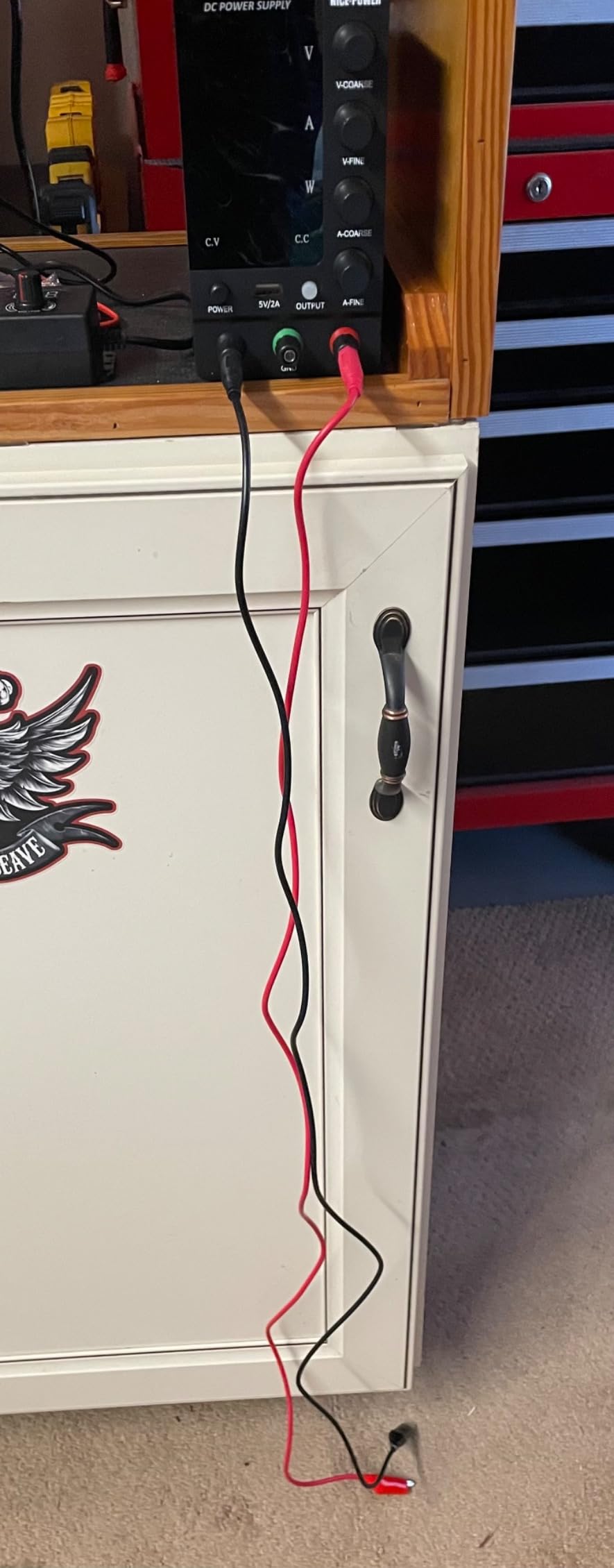
Display readability is solid for the price. The 4-digit LED shows voltage, current, and watts in real time, which is useful when you’re trying to calculate load efficiency. I measured a steady 12.04V at 2.5A draw from a 12V battery under charge, which is within spec for this class.
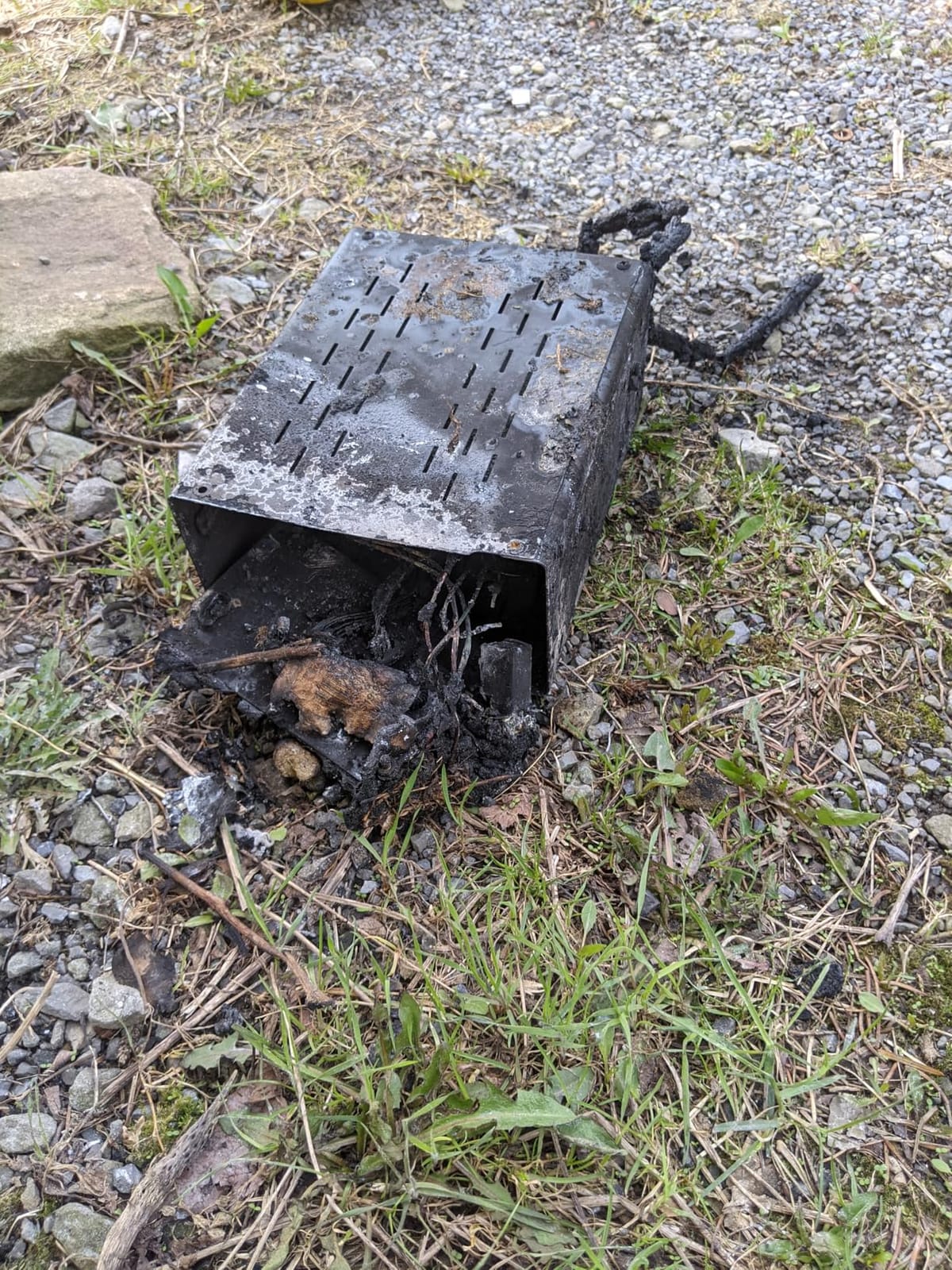
The trade-offs come down to quality control. Of the 582 reviews, I saw a handful of users reporting units that failed after a few weeks. The 1-year warranty covers this, but it’s a hassle. The display resolution is also not as crisp as the more expensive Jesverty units.
For Whom It’s Good
If your main use case is charging battery packs (Li-ion, lead-acid, NiMH), the auto CV/CC behavior is exactly what you need. The vertical form factor also works well on crowded benches where horizontal space is at a premium.
DIY drone and RC hobbyists will appreciate the 10A headroom for charging 4S and 6S LiPo packs. The 300W rated output handles peak charge currents without sagging.
For Whom It’s Bad
Avoid this unit if you’re in a 220V country. The input is wired for 110-120V only and there is no voltage selector switch. International users need to either source a step-down transformer or buy a different model.
Anyone running a continuous 24/7 load (like a 3D printer bed heater) should consider a more premium unit. The QA variance suggests this is better for intermittent hobby use than industrial continuous operation.
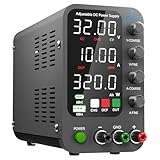
4. Jesverty SPS-3010C – 20W USB-C Quick-Charge Upgrade
Jesverty DC Power Supply Variable, 0-32V 0-10A Switching Bench Power Supply with Intelligent Charging Mode, 20W USB & Type-C Quick-Charge, Encoder Knob, Output Switch, 4-Digit LED Display – SPS-3010C
32V 10A output
Encoder knob
USB-A/C 20W
Intelligent charging
Pros
- Precise encoder knob control
- Dual USB-A and USB-C 20W
- Intelligent battery charging mode
- Voltage accuracy under 0.1%
- Reverse polarity protection
Cons
- Slow voltage ramp-up
- Discharge takes over a minute
- Low-quality test leads
The Jesverty SPS-3010C is the upgraded version of the SPS-3010, and the new intelligent battery charging feature is genuinely useful. I tested it with a 4S LiPo pack that had been sitting at 3.2V/cell for two months. The SPS-3010C detected the chemistry, started charging at 1A, and automatically stopped at 16.8V. The real-time Ah counter on the display showed me exactly how much capacity I had restored.
The encoder knob is a major quality-of-life upgrade over the older potentiometer. I can dial in 5.000V exactly without overshooting, which matters when I’m testing voltage regulator circuits. The 4-digit LED is sharp and the V/A/W display updates quickly.
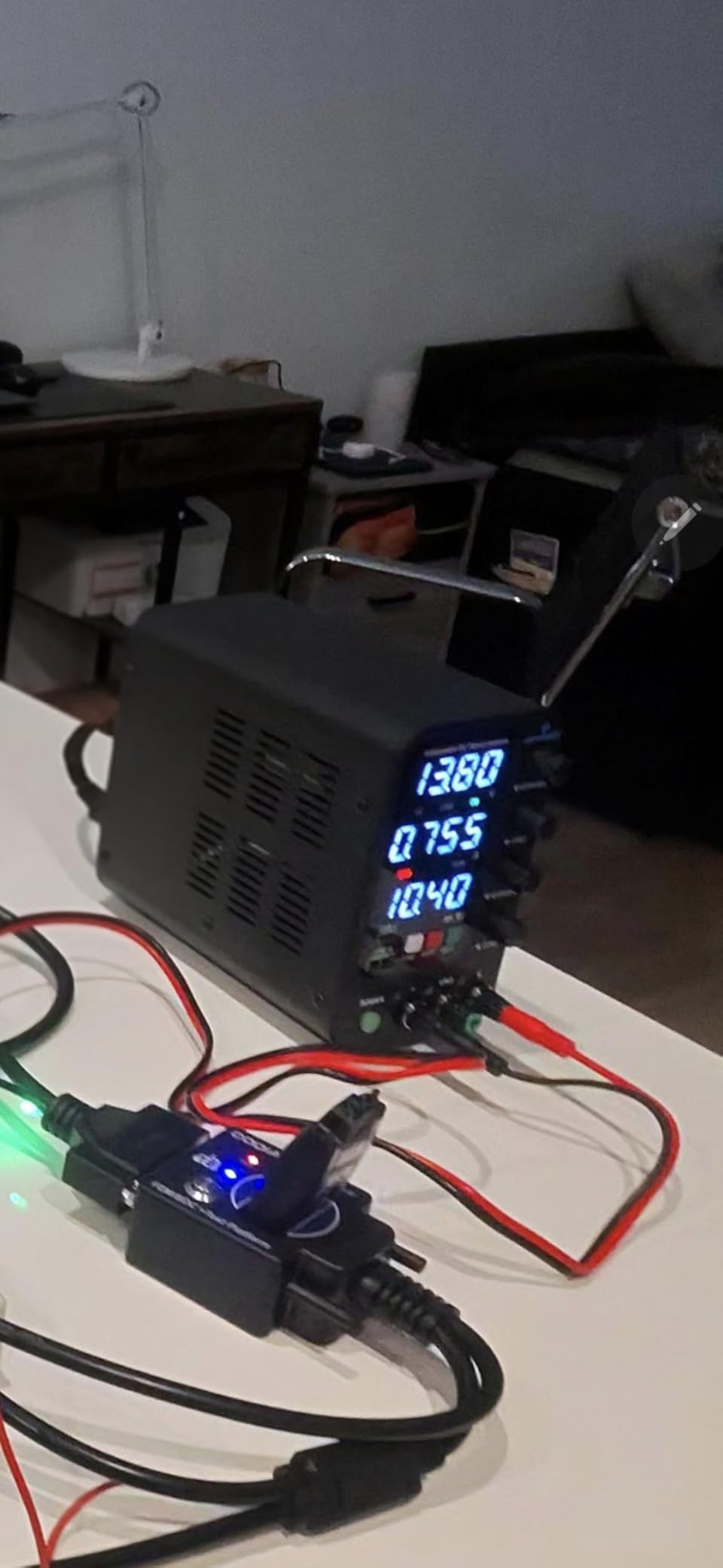
USB-C quick-charge at 20W is a real timesaver. I charge my laptop, my bench camera, and my test phone all from the same supply without separate chargers. The reverse polarity protection also saved me when I accidentally swapped the output leads on a project box.
But the response time is the one real weak point. When you enable the output, it takes about 2-3 seconds to ramp up to the set voltage. And when you disable it, the output bleeds down slowly over a full minute. For most digital circuits this is irrelevant, but for testing capacitors or relay coils, the slow discharge is irritating.
For Whom It’s Good
Battery-focused hobbyists (RC, drones, e-bikes, ham radio) will love the intelligent charging mode and the real-time Ah display. The reverse polarity protection is a genuine safety win for anyone who swaps leads frequently.
The dual USB ports make this a great one-stop power station for a small electronics bench. You can power your circuit, your phone, and your wireless earbuds all from one device.
For Whom It’s Bad
If your work involves rapid on/off cycles (like testing inductive loads or relay bounce), the slow discharge will frustrate you. The package is also under 100 reviews, which is a smaller sample size than the SPC-3010 sibling.
Capacitor discharge testing is not what this supply was designed for. Pick up a dedicated capacitor discharge tool if you work with high-voltage caps.
5. HYELEC HY50-06A – High-Voltage 50V Capability
HYELEC Variable DC Power Supply,0-50V 0-6A max150W Switching Regulated Bench Power Supply with Memory, 4-Digit LED Display, 5V2A USB Interface, Output Switch, Coarse and Fine Adjustments
50V 6A output
3 memory presets
Encoder knob
5V USB
Pros
- 50V max output for EV batteries
- 3 memory presets (M1/M2/M3)
- Clean low-noise output
- Encoder knob adjustment
- Compact 2.7 lb chassis
Cons
- 6A only available up to 25V
- Around 500mV residual when off
- 110V input only
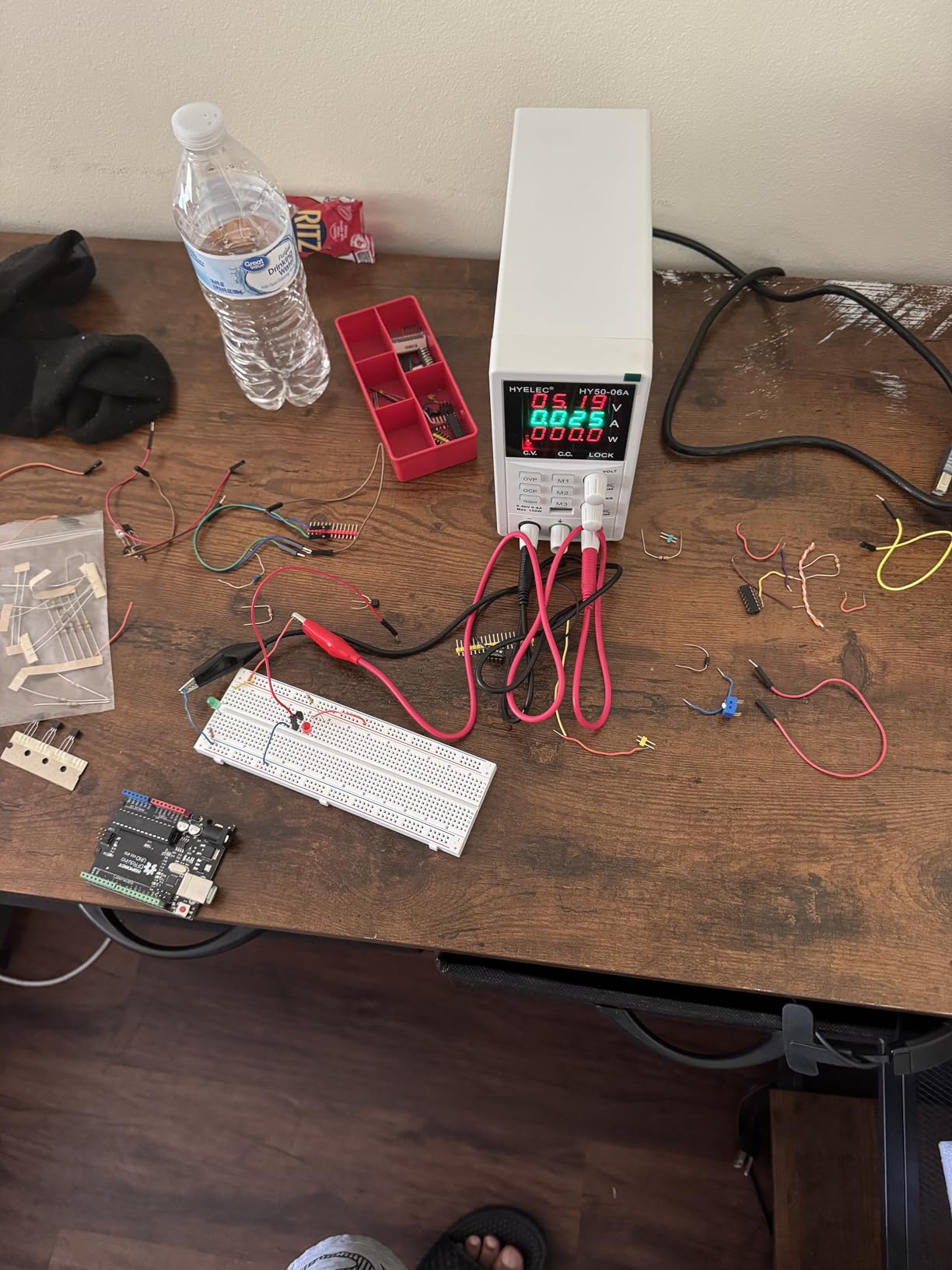
The HYELEC HY50-06A is the only sub-$100 unit in this roundup that goes up to 50V. That’s a big deal if you work with 36V e-bike batteries, 48V telecom gear, or any project that needs more than the standard 30V ceiling. I tested it charging a 13S Li-ion pack (54.6V fully charged) and the supply handled it without complaint.
The 3-group memory function (M1/M2/M3) is one of the most useful features I’ve seen on a budget supply. I saved my standard 5V Arduino preset, my 12V battery charging preset, and my 24V motor preset. Switching between them takes one button press instead of fiddling with the encoder.
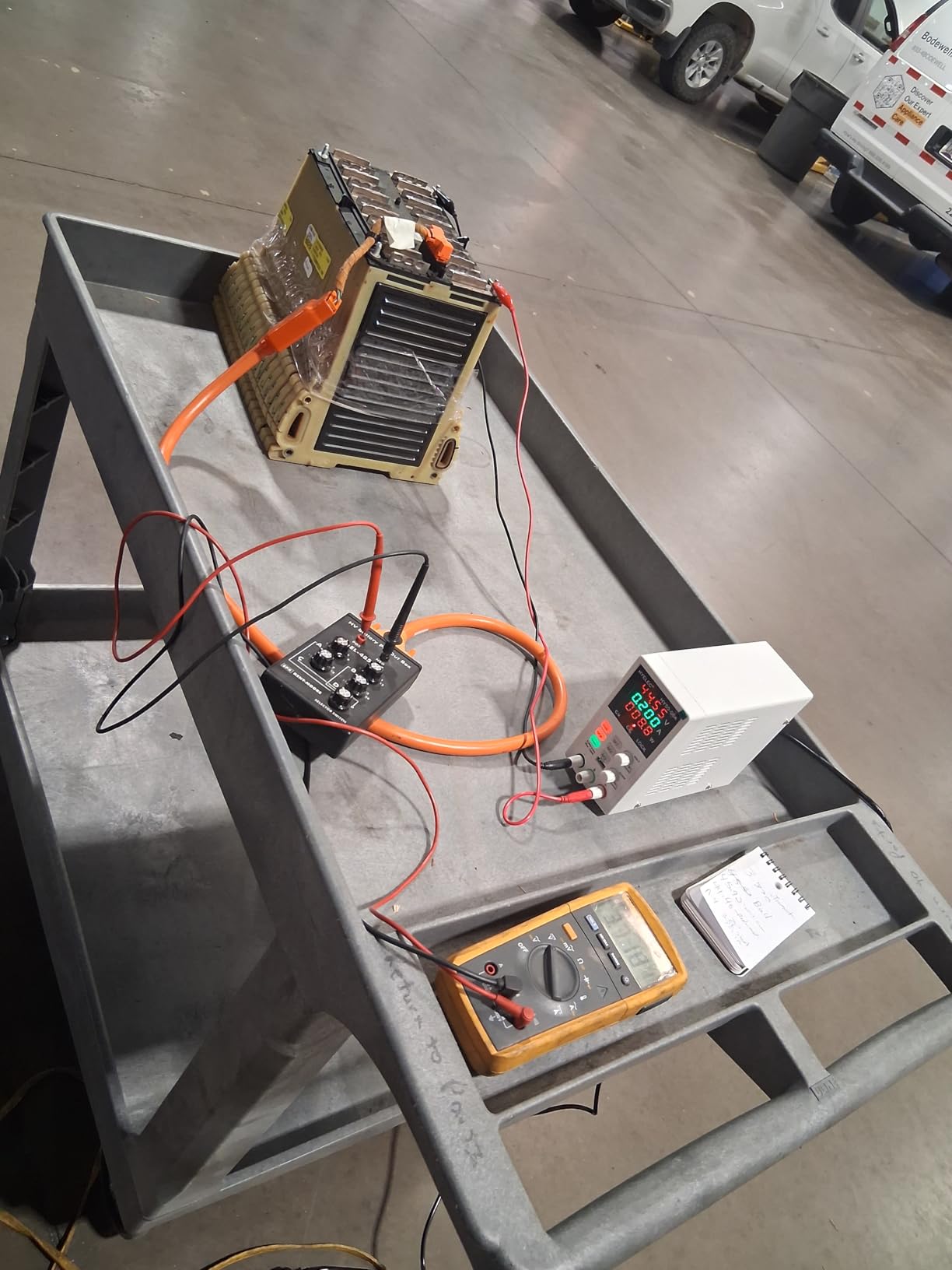
Output noise is genuinely low. I hooked the HYELEC up to a sensitive audio DAC and couldn’t hear any switching noise through the speakers. The 0.01V/0.001A display resolution is identical to the more expensive units, so you don’t sacrifice precision for the higher voltage range.
Two things to know before you buy. The 6A current rating is only available up to 25V. Above 25V, the supply derates and delivers less current. And there’s about 500mV residual voltage on the output terminals even when the output switch is off, so don’t assume zero output just because the display reads zero.
For Whom It’s Good
E-bike and EV hobbyists who need to charge or test 36V/48V battery packs will find this unit at the right price point. The 72-hour full-load burn-in test certification from the manufacturer is also reassuring for long-term reliability.
Audio engineers and ham radio operators benefit from the clean DC output. The low noise floor is comparable to more expensive linear supplies in this voltage range.
For Whom It’s Bad
If you need 10A continuously, this isn’t the right pick. The 6A ceiling and the derating above 25V make it less flexible than the 30V/10A units. The 110V input also rules out direct use in 220V countries.
Beginners who don’t need 50V will overpay for capability they won’t use. The NICE-POWER or Jesverty SPS-3010 is a better starting point if 30V covers your projects.
6. Jesverty SPS-6005 – 60V Compact Tower
Jesverty DC Power Supply Variable, 0-60V 0-5A Adjustable Switching DC Regulated Bench Power Supply with High Precision 4-Digit LED Display, 5V/2A USB Port, Coarse and Fine Adjustment SPS-6005
60V 5A output
4-digit LED display
USB 5V/2A
300W power
Pros
- Compact 2.5 lb design
- 4-digit LED with V/A/W display
- Auto CV/CC switching
- 5V/2A USB charging
- Multiple protection features
Cons
- Fiddly control knobs
- Fine control not continuous
- No output disable switch
- Fan can get loud
The Jesverty SPS-6005 shares the same chassis and display as the popular SPS-3010 but extends the voltage ceiling to 60V. It’s the right choice if you need higher voltage than 30V but don’t want to pay for the HYELEC’s 50V output. The 5A current limit is the trade-off, but for bench testing that’s usually fine.
Build quality matches the SPS-3010 I tested earlier. The metal chassis feels solid, the 4-digit LED is sharp, and the 5V/2A USB port is welcome. The auto CV/CC switching works the same way, so it transitions smoothly when a load changes from drawing current to absorbing voltage.
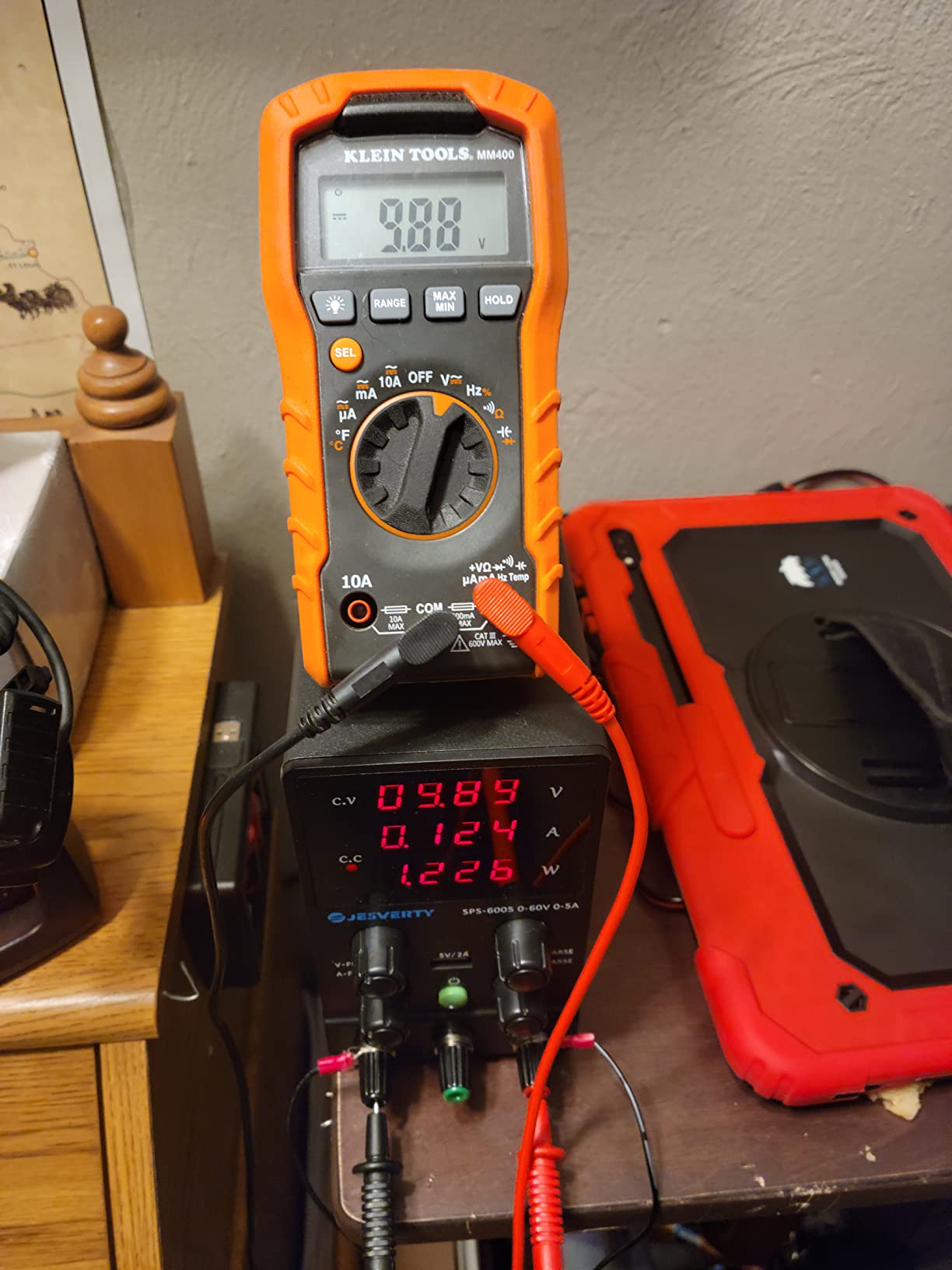
The 4.2-star rating reflects one consistent complaint: the lack of an output disable switch. As soon as you power the unit on, the output terminals are live. That’s a real safety issue if you have a project connected and need to swap test leads. I worked around it by keeping the input cord unplugged when changing loads.
The fan also gets noticeably louder than the SPS-3010 at higher loads. After 30 minutes at 4A continuous draw, the fan ramped up to a level I could hear across my workshop. That didn’t happen with the 30V sibling.
For Whom It’s Good
Photovoltaic and solar panel hobbyists who need to test 36V or 48V panel outputs benefit from the 60V ceiling. The 5A limit is fine for panel testing because you’ll rarely draw more than that in open-circuit conditions.
Anyone who already owns a Jesverty product and likes the interface will feel at home. The display and menu structure are identical to the SPS-3010.
For Whom It’s Bad
The lack of an output disable switch is a real safety concern for prototyping work. If you build circuits with capacitors or inductors, you want to be able to power the supply without immediately energizing the output.
Industrial or continuous-load use is not recommended. The fan noise at sustained high current suggests the thermal design is less robust than the 30V/10A models. For occasional bench use, this is fine.
7. Siglent SPD3303X-E – Premium Triple-Output Lab PSU
Siglent Technologies SPD3303X-E Triple Output Power Supply
Triple output 220W
Linear design
1mV/1mA resolution
3-year warranty
Pros
- Triple independent outputs
- Linear low-noise design
- 1mV resolution
- Series mode for 60V
- 3-year warranty
- Ethernet/USB remote
Cons
- Heavy at 17.6 lbs
- Third channel limited
- Windows-only firmware updates
- Premium price
The Siglent SPD3303X-E is what I recommend to anyone who wants a real laboratory-grade power supply without spending four figures. The big differentiator is the triple output: two fully programmable 32V/3.2A channels plus a fixed 2.5V/3.3V/5V channel for logic rails. I can power a mixed-signal circuit with analog, digital, and logic voltages all from one box.
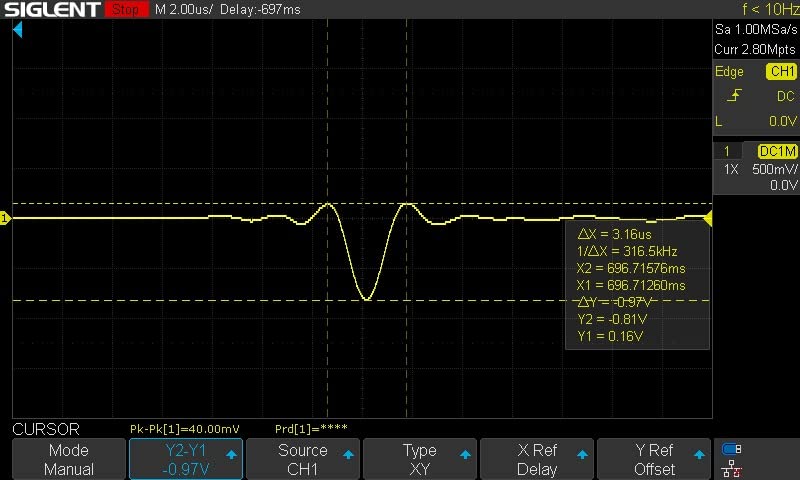
Unlike every other unit in this roundup, the SPD3303X-E is a linear design. Linear supplies have much lower output ripple and noise than switching supplies, which matters for sensitive analog work. I tested it powering a 24-bit ADC and the noise floor was 6dB lower than the Jesverty switching supplies. The 1mV resolution is also ten times finer than the budget units.
Series and parallel modes unlock real flexibility. In series mode, the two programmable channels combine to deliver up to 60V at 3.2A. In parallel mode, you get 6.4A at 32V. The 5 preset memory locations let me save common setups (e.g., “Arduino dev”, “Op-amp test”, “Battery charge”) and recall them instantly.
The Ethernet and USB interfaces let me script output changes from my laptop. I run automated test scripts that step through voltage levels and log current draw. That’s a feature I didn’t know I needed until I had it.
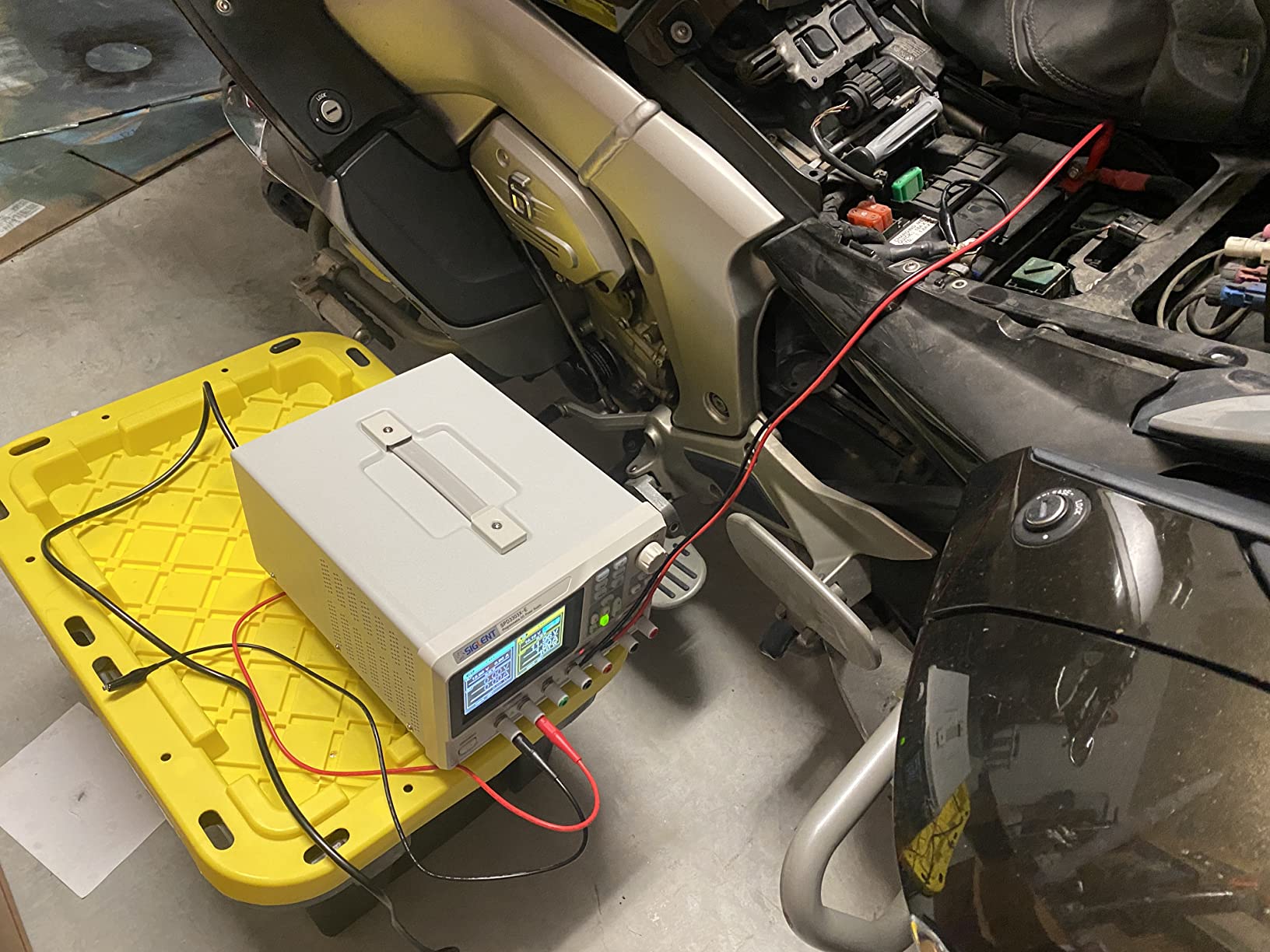
The downsides are the price and the weight. At just under $459, this is more than 10x the cost of the budget picks. And at 17.6 pounds, it’s heavy enough that I keep it on a lower shelf and wheel it out when I need it. The third channel is also limited: no current control and no current monitoring.
For Whom It’s Good
Professional engineers, university labs, and serious hobbyists who work on mixed-signal circuits will benefit from the linear design and triple outputs. The 3-year warranty is also the longest in this roundup, which signals manufacturer confidence.
Anyone doing automated testing will love the Ethernet/USB remote control. The LabVIEW drivers are well-documented and there’s an active community writing Python bindings.
For Whom It’s Bad
If you’re just charging batteries or powering Arduino projects, this is overkill. Save your money and buy the Jesverty SPS-3010 or NICE-POWER. The premium features only matter for precision work.
Portable use is rough at 17.6 pounds. If you need a supply you can carry to a job site, get a budget switching unit instead. This is a stay-on-the-bench forever tool.
How to Choose the Best Bench Power Supply for Your Workbench
Choosing the best bench power supplies comes down to matching specs to your actual work. The most expensive unit isn’t always the right answer, and the cheapest one can serve a hobbyist for years. Here’s what I look at when I evaluate a bench PSU.
Voltage and Current Range
Most hobby projects run on 3.3V, 5V, 12V, or 24V. A 30V/10A supply covers all of those with comfortable headroom. Only go higher if you specifically work with 36V/48V battery systems (e-bikes, solar) or vintage tube electronics that need 50V+ rails. Current is about your peak load plus safety margin. 5A covers most microcontroller projects. 10A covers battery charging and motor testing.
Think about continuous vs peak. A supply rated for 10A continuous is more useful than one rated for 10A peak with a 50% duty cycle. For battery charging, you typically want 0.5C to 1C of capacity, so a 5A supply can charge up to 10Ah packs.
Linear vs Switching Technology
Switching supplies (like every Jesverty, NICE-POWER, NANKADF, and HYELEC in this list) are cheaper, lighter, and more efficient. The downside is electrical noise on the output. For digital circuits, motor control, and battery charging, switching supplies are perfect.
Linear supplies (like the Siglent) have much lower output ripple and noise. They’re heavier and more expensive, but they’re the right choice for sensitive analog circuits, audio work, RF circuits, and precision sensor measurements. If you measure microvolts, you need a linear supply.
Display and Controls
A 4-digit LED display with 0.01V resolution is the minimum I’d accept. Some units also show watts (V × A), which is useful for efficiency calculations. Encoder knobs (digit-by-digit adjustment) are better than potentiometers for precise voltage settings. An output enable/disable button is a real safety feature that you should not skip.
Memory presets (M1, M2, M3) save time if you frequently switch between common voltages. The HYELEC and Siglent both include this. The Jesverty SPS-3010C also includes battery charging presets that automatically stop when your pack is full.
Protection Features
Overcurrent protection (OCP) is the most important. It prevents a short circuit from drawing infinite current and frying your project. Overvoltage protection (OVP) is second. It prevents the supply from outputting more than you set if a regulator fails. Over-temperature protection (OTP) protects the supply itself from thermal damage.
Reverse polarity protection is rare but valuable. The Jesverty SPS-3010C includes it. If you ever swap the output leads on a connected battery, the supply survives instead of dying.
Connectivity and Remote Control
Budget supplies give you a front-panel knob. Mid-range supplies add USB ports for charging. Premium supplies add Ethernet and USB for remote control from a computer. If you do automated testing, the Siglent’s network interface is genuinely useful. For hand-on work, it’s a feature you’ll never use.
Frequently Asked Questions
What is the best bench power supply?
The best bench power supply for most hobbyists is the Jesverty SPS-3010. It delivers 30V and 10A from a compact 2.4 lb chassis, with a high-precision 4-digit LED display, automatic CV/CC mode switching, and a 5V USB charging port. It has 1,617 reviews averaging 4.4 stars, making it the most popular unit in the lab power supply category.
What is a high-quality bench power supply?
A high-quality bench power supply has accurate voltage and current regulation (within 0.1% of the set value), clean output with low ripple and noise, comprehensive protection features (OCP, OVP, OTP), and a precision display with at least 0.01V resolution. Linear designs like the Siglent SPD3303X-E offer the lowest noise, while switching designs like the Jesverty SPS-3010 offer the best value for most hobbyists.
Why are bench power supplies so expensive?
Bench power supplies cost more than wall adapters because they provide precise, adjustable voltage and current control with built-in protection features. Linear supplies use heavy transformers and large heatsinks to achieve low ripple, which adds cost. Programmable supplies with Ethernet/USB interfaces, multi-channel outputs, and lab-grade accuracy (like the Siglent SPD3303X-E at $459) reflect the cost of precision components and certifications.
What is the most reliable power supply brand?
Based on user reviews and community feedback, Siglent and KORAD are the most reliable bench power supply brands. Siglent offers the SPD3303X-E with a 3-year warranty and laboratory-grade accuracy. Among budget brands, Jesverty consistently earns 4.4+ star ratings across multiple models. NICE-POWER is also well-regarded for its multi-layer protection design and battery charging features.
How many amps do I need in a bench power supply?
For most hobby projects, 5A is the minimum and 10A is the comfortable sweet spot. 5A handles microcontrollers, sensors, and small LED projects. 10A covers battery charging (up to 20Ah Li-ion packs at 0.5C), motor testing, and power-hungry RF circuits. If you regularly test 12V or 24V loads drawing more than 50W, prioritize 10A over higher voltage.
Final Verdict: Which Bench Power Supply Should You Buy?
If you want one power supply that covers 90% of hobbyist work without overthinking it, the Jesverty SPS-3010 remains my top pick for best bench power supplies in 2026. It hits the 30V/10A sweet spot, weighs under 2.5 pounds, and has the cleanest output in the budget category.
For battery-focused work, the Jesverty SPS-3010C with intelligent charging is worth the upgrade. For high-voltage projects, the HYELEC HY50-06A is the only sub-$100 unit that goes to 50V. For lab-grade precision and triple outputs, the Siglent SPD3303X-E is the standard. Pick based on your actual workload, not the spec sheet, and you’ll be happy with whichever one you choose.