
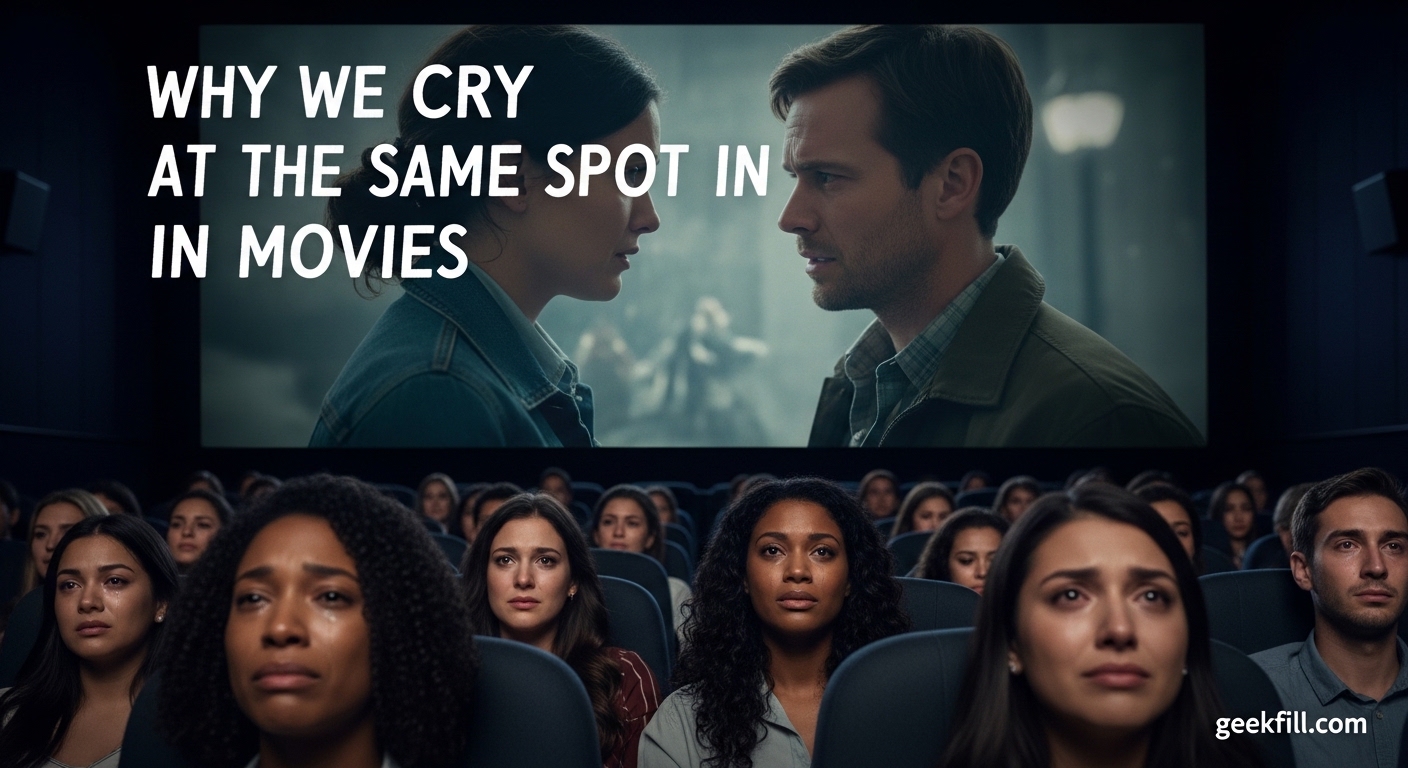
Picture this: a dark theater filled with strangers, and suddenly you hear it. The sniffles start. First one, then another, until half the room is reaching for tissues at the exact same moment. It happened during the opening montage of Up. It happened when Mufasa fell in The Lion King. And it definitely happened at the end of Marley and Me.
We have all been there. Your eyes well up, your throat tightens, and before you know it, tears are streaming down your face over fictional characters who technically do not exist. The truly strange part? You knew it was coming. You knew Simba’s dad was going to die. You knew Marley the dog would eventually pass. Yet you cried anyway.
Here is the surprising reason why we all cry at the same spot in movies: your brain cannot distinguish between fictional emotions and real ones. Mirror neurons and oxytocin create a biological response that makes fiction feel completely real, triggering genuine emotional tears at carefully designed moments. You are not crying at a story. You are crying because your brain believes the experience is actually happening to you.
Table of Contents
The Universal Moment: Why We All Cry at the Same Spot
Filmmakers have spent decades perfecting the art of synchronized tears. The opening sequence of Up remains one of the most devastating ten minutes in cinema history. Why? Because it compresses an entire lifetime of love and loss into a wordless montage that hijacks your empathy systems with surgical precision.
The reason we all cry at the same spot comes down to biology, not coincidence. When Carl looks at Ellie’s adventure book at the end of that sequence, your brain processes that moment identically to how it would process real grief. Neuroscientist Robert Froemke at New York University has studied this phenomenon extensively, demonstrating that our brains respond to fictional emotional cues with the same neural patterns as real-life tragedy.
Filmmakers know this. They build toward these moments with specific pacing, musical cues, and visual storytelling designed to trigger simultaneous emotional responses. The three-minute mark in a Pixar film is not arbitrary. Neither is the death scene placement at the end of act two. These moments are engineered based on understanding how human brains process emotional narratives.
Your Brain Cannot Tell Fiction from Reality
Your brain contains specialized cells called mirror neurons. These remarkable neurons fire both when you perform an action and when you observe someone else performing that action. When you watch a character on screen experience heartbreak, your mirror neurons activate as if you are experiencing that heartbreak yourself.
This is not metaphorical. Research led by neuroeconomist Paul Zak has shown that when we watch emotional scenes, our brains release the same neurochemicals we would experience during actual emotional events. Cortisol rises during stressful scenes. Oxytocin surges during bonding moments. Your amygdala processes the threat or loss exactly as it would process real danger.
The implications are profound. Your brain lacks a “fiction filter” for emotional processing. It does not tag movie experiences as artificial. Instead, it engages in what psychologists call empathic transportation, where you literally lose yourself in the narrative and experience the character’s reality as your own.
Paul Zak’s research, often called the “love hormone” studies, found that even brief emotional narratives can spike oxytocin levels by measurable amounts. In one famous experiment, participants who watched a short video about a father and son showed increased oxytocin and were more likely to donate money to charity afterward. The fictional narrative created real biological changes that influenced real-world behavior.
Oxytocin: The Love Hormone That Makes You Weep
Oxytocin earned its nickname as the love hormone because it surges during bonding moments, from mother-infant contact to romantic embraces. But here is what makes movie crying possible: oxytocin does not distinguish between real human beings and flickering images on a screen.
When you watch a character you have grown to care about face tragedy, your brain pumps out oxytocin exactly as it would for a friend in distress. This creates the physical sensation of genuine emotional pain even though your rational mind knows the character is pixels or ink. The oxytocin response makes fictional relationships feel as meaningful as real ones.
This imperfect tuning of our neurochemistry is actually brilliant from an evolutionary perspective. Humans survived by forming emotional bonds and caring about others in their tribe. The fact that this system responds to stories allowed our ancestors to learn from narratives without experiencing every danger personally. Fiction became a safe training ground for real emotions.
Why We Cry at Movies But Not in Real Life
Many people report an embarrassing paradox: they sob uncontrollably at a dog dying in a movie, but remained dry-eyed at their grandmother’s funeral. This experience is so common that it has spawned countless Reddit threads and therapy discussions. It feels backwards. It feels shameful. But it is completely normal.
Movies create what psychologists call a safe container for emotions. You know the danger is not real, so your defensive walls come down. In real life, your brain is busy managing social appropriateness, processing complex logistics, and protecting you from overwhelming pain. During a movie, those defenses rest, allowing your emotional systems to fully engage.
Research on emotional processing suggests that movies provide something reality often cannot: permission to feel. In daily life, we suppress emotions for social convenience, professional appropriateness, or self-protection. The theater darkness and fictional distance give us license to experience feelings we normally keep locked away.
Additionally, movies compress emotional arcs into efficient packages. Real grief takes months or years. Movie grief takes three minutes with a musical swell. Your brain responds to the concentrated emotional signal more intensely than the slow-burn reality of actual loss. The fictional version is pure emotion without the dulling effects of time and practical concerns.
Crying at Movies Is a Sign of Emotional Strength
For too long, crying has been wrongly labeled as weakness. The reality, backed by extensive psychological research, is the opposite. If you cry at movies, you are probably displaying high emotional intelligence, strong empathy, and healthy emotional processing capacity.
Researcher and professor of psychology at Oklahoma State University, Jennifer Barnes, has argued that crying during films indicates elevated empathic responses and social awareness. Her work demonstrates that movie criers score higher on measures of empathy and emotional intelligence. These are not weaknesses. These are leadership qualities.
Daniel Goleman’s research on emotional intelligence highlights empathy as a core component of emotional competence. The ability to recognize, share, and respond to the emotions of others predicts success in relationships, leadership, and mental health. Your movie tears are evidence that your empathy systems are functioning beautifully.
Men particularly face stigma around crying at films, yet the same biological mechanisms apply regardless of gender. Those tough guys hiding their sniffles during the heroic sacrifice scene are experiencing the same oxytocin and mirror neuron responses as anyone else. Their tears mean their emotional connection systems work properly, not that they are soft.
The Perfect Storm: How Films Engineer Your Tears
Understanding the neuroscience is one thing. Watching filmmakers weaponize it is another. Directors, editors, and composers have developed a playbook for triggering synchronized emotional responses. They create what we might call the perfect storm of tear induction.
Music serves as perhaps the most powerful tool. Film composers understand that minor keys, swelling strings, and specific tempos trigger emotional responses independent of narrative content. Think of the score rising during a climactic moment. Your brain processes that auditory cue as emotional information before your conscious mind even registers what is happening visually.
Timing matters enormously. The average emotional scene builds for 45 to 90 seconds before the release moment. This mirrors how our brains naturally process emotional buildup in real life. Cut too early and the moment feels rushed. Extend too long and the tension dissipates. That sweet spot where everyone reaches for tissues simultaneously is calculated down to the frame.
Visual storytelling amplifies everything. Close-ups on faces trigger stronger mirror neuron responses than wide shots. Slow motion extends emotional moments. Color grading shifts subtly cue your brain to interpret scenes as sad or hopeful. Every element works together to create the synchronized response we all experience.
Pixar Studios has practically perfected this science. Their films undergo extensive emotional testing, with scenes adjusted based on how test audiences respond. When you and everyone in the theater cry at the same moment in Toy Story 3 or Coco, that is not accident. That is the result of understanding human neuroscience and using it to craft emotional experiences.
FAQs
Why do we cry during movies?
We cry during movies because our brain’s mirror neurons simulate the emotions of characters as if they are our own experiences. Combined with oxytocin release that creates genuine emotional bonding, this produces authentic tears even though we know the events are fictional.
Do empaths cry during movies?
Empaths often cry more easily and intensely during movies because they have heightened sensitivity to emotional stimuli. Their mirror neuron systems and empathic responses are typically more active, making fictional narratives feel particularly real and emotionally resonant.
Do emotionally intelligent people cry a lot?
Emotionally intelligent people do tend to cry more readily because they have better access to their emotions and stronger empathic connections. Research shows that crying at movies correlates with higher empathy scores and emotional intelligence measures, indicating healthy emotional processing rather than weakness.
Why do I cry during movies but not in real life?
You cry during movies but not real life because movies provide a safe container for emotions where social defenses drop. Real situations often require emotional management for practical reasons, while fictional narratives give you permission to fully feel without consequences.
Are you an empath if you cry during movies?
Crying during movies suggests empathic tendencies but does not automatically make you an empath. It indicates working mirror neuron systems and emotional responsiveness, which are components of empathy. True empaths typically show heightened emotional responses across many situations, not just during films.
Is crying a sign of emotional intelligence?
Yes, crying is generally a sign of emotional intelligence. It demonstrates emotional awareness, empathy, and the ability to process feelings. Research by psychologists including Daniel Goleman shows that emotional responses to narratives correlate with stronger social awareness and leadership capabilities.
Why do movies affect me so much?
Movies affect you deeply because your brain processes fictional emotions similarly to real ones through mirror neurons and neurochemical responses like oxytocin. Additionally, film techniques including music, editing, and visual storytelling are specifically designed to trigger emotional responses at targeted moments.
Embrace the Tears: What Your Movie Crying Says About You
The next time you find yourself crying at the same spot in a movie as everyone around you, remember what is actually happening. Your brain is not being fooled. It is functioning exactly as evolution designed it to function. Your mirror neurons are creating genuine shared experience. Your oxytocin is bonding you to characters and fellow audience members. Your emotional intelligence is operating at full capacity.
The surprising reason why we all cry at the same spot in movies is ultimately a beautiful testament to human connection. We share tears because we share biology. We respond together because we are wired for empathy. Filmmakers simply found the frequency that resonates with our shared humanity.
So bring the tissues to the theater without shame. Those tears mean your heart works. They mean you can connect deeply with others, even fictional ones. They mean you possess the emotional intelligence that makes us human. The sniffles you hear around you in that darkened theater are the sound of dozens of brains processing the same beautiful truth: we are capable of profound emotional connection, and that is worth crying about.