
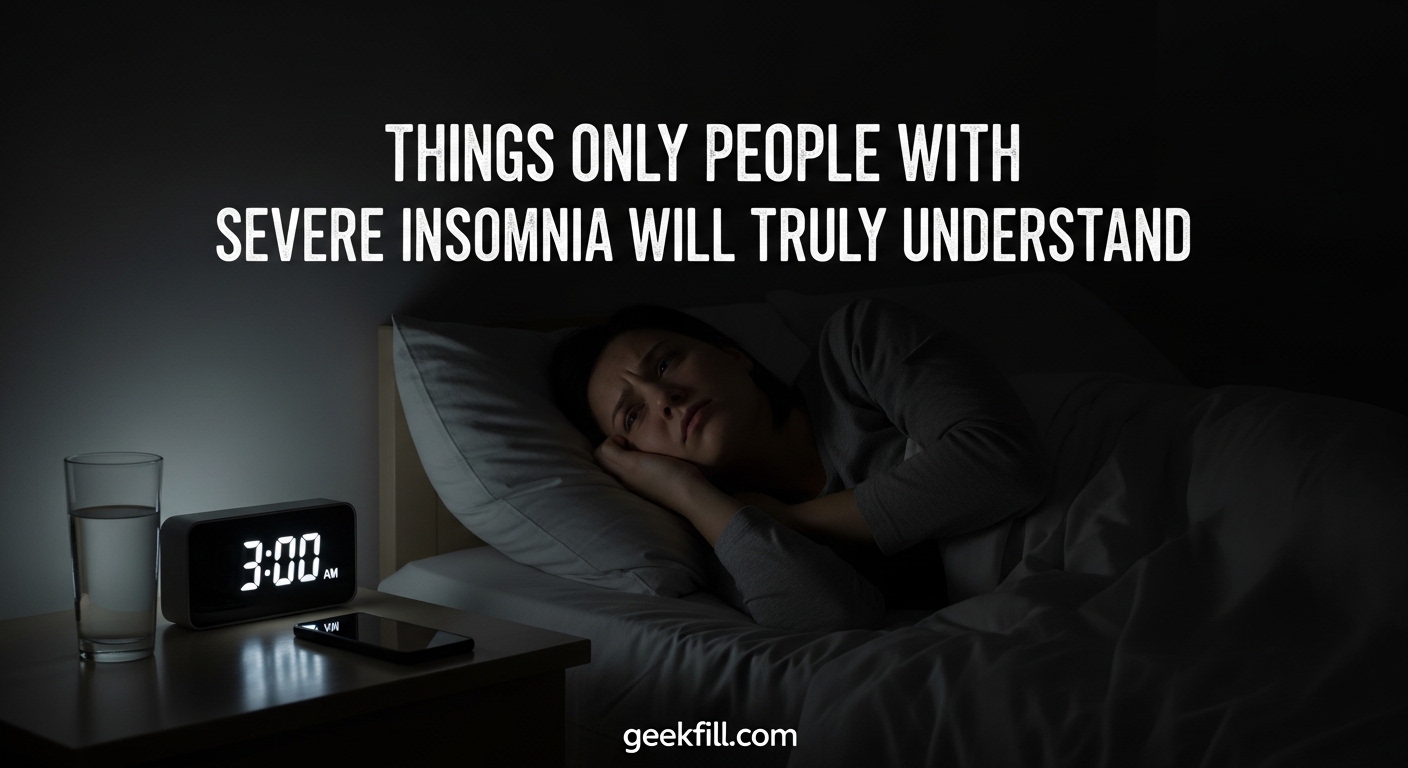
If you have severe insomnia, you already know that “tired” doesn’t even begin to cover it. You know the 3 AM ceiling stare, the mental math of “if I fall asleep right now, I’ll get three hours,” and the crushing realization that your brain has chosen violence against rest once again. This is for you.
According to the NIH, roughly 30% of adults experience short-term insomnia at some point, while about 10% struggle with chronic insomnia that persists for months or years. Severe insomnia isn’t just having trouble falling asleep occasionally. It is a relentless cycle where your mind refuses to power down even when your body is desperate for rest.
The following 20 things only people with severe insomnia will truly understand capture what it actually feels like to live in this exhausting reality. If you see yourself in these words, know that you are not alone, you are not lazy, and your struggle is valid.
Table of Contents
20 Things Only People With Severe Insomnia Will Truly Understand
1. Your Brain Saves Its Best Energy for Bedtime
All day long, you function like a sleep-deprived zombie. Your eyes feel heavy at your desk, you yawn through meetings, and you daydream about your pillow.
The moment your head hits that pillow, suddenly your brain decides it is time to solve every problem you have ever had. That awkward conversation from 2007? Let’s analyze it. Your retirement savings? Time to panic. The meaning of existence? Perfect 2 AM contemplation material.
This is not a coincidence. Insomnia involves hyperarousal, where your nervous system remains stuck in alert mode precisely when you need it to relax.
2. “Tired” Is a Massive Understatement
When people ask if you are tired, you want to laugh and cry simultaneously. Tired is what normal people feel after staying up late to finish a project. What you experience is something closer to existential exhaustion mixed with a wired, jittery feeling that makes no biological sense.
Your body feels like it is running on corrupted batteries. Every movement requires conscious effort. Basic tasks like showering or making breakfast become Olympic-level achievements. Yet somehow, despite this profound physical depletion, sleep remains maddeningly out of reach.
3. The 3 AM Wake-Up Is a Special Kind of Torture
Falling asleep was hard enough, but staying asleep? That is a completely different battle. You wake up at 3 AM for no reason, completely alert, as if someone injected caffeine directly into your bloodstream.
You try all the tricks. You regulate your breathing. You count sheep. You attempt to ignore the fact that you are awake. Nothing works. The clock ticks toward morning while you lie there wondering what you did in a past life to deserve this.
4. You Have Become a Human Calculator
“If I fall asleep in the next twenty minutes, I can still get four hours.” “Okay, three and a half hours.” “Two hours forty-five minutes is still something, right?” You perform these calculations constantly throughout the night.
By 5 AM, you have mentally rescheduled your entire next day around the sleep you are not getting. You have calculated exactly how much coffee you will need, which tasks you can postpone, and whether crying in the office bathroom is socially acceptable.
5. Sleep Anxiety Creates Its Own Vicious Cycle
Here is the cruelest part about severe insomnia. The more you worry about not sleeping, the more awake you become. Your anxiety about insomnia actually causes more insomnia.
You start dreading bedtime hours before it arrives. Your evening routine becomes filled with superstitions and rituals designed to appease the sleep gods. When they fail, the disappointment hits harder each time. This cycle can persist for months or years, wearing down your mental health along with your physical reserves.
6. You Have Watched Everything on Netflix
At 4 AM, your streaming service becomes your only companion. You have burned through every true crime documentary, every comfort show rerun, every obscure foreign film that autoplay suggested.
You know exactly how many episodes you can watch before the sun comes up. You have developed strong opinions about shows you never would have chosen under normal circumstances. Your viewing history looks like the random playlist of someone having an existential crisis, which, to be fair, you basically are.
7. Clock Watching Becomes an Obsessive Ritual
Everyone tells you not to look at the clock. They say it only makes insomnia worse. They are right, and you do it anyway.
You check your phone, your watch, the microwave, any glowing digital display that will tell you exactly how little time remains before morning. Each glance adds another brick to your anxiety wall. You know you should stop, but the compulsion is overwhelming. The numbers glow in your memory even when you close your eyes.
8. You Live in Fear of the Nap Paradox
Your body screams for sleep during the day. Your eyelids droop during afternoon meetings. Your head nods dangerously while reading emails. You need a nap desperately.
But you also know that napping will destroy any chance of sleeping at night. Twenty minutes of afternoon rest could cost you six hours of nighttime struggle. So you fight through the exhaustion, guzzle more caffeine, and hope that tonight will finally be different. Spoiler alert: it usually isn’t.
9. Caffeine Becomes a Necessary Evil
Without coffee, you cannot function at work. With too much coffee, you cannot function at night. You walk this tightrope every single day.
You have tried cutting caffeine entirely, and you were too exhausted to survive. You have tried switching to tea, to decaf, to those adaptogenic mushroom drinks that taste like dirt. Nothing provides the same reliable jolt that gets you through morning meetings. So you accept that your dependency is a symptom management strategy, not a cure.
10. You Look Like a Different Person
Your reflection in the morning mirror shocks you. Dark circles have become permanent features, not temporary blemishes. Your skin has taken on a strange pallor that no amount of concealer can fix.
People comment on how tired you look constantly. They suggest vacations, vitamins, yoga, anything that might restore your appearance. What they do not understand is that your face reflects months or years of accumulated sleep debt. No cosmetic solution can fix what rest would cure.
11. Everyone Has Advice You Have Already Tried
“Have you tried melatonin?” “What about a weighted blanket?” “My cousin uses essential oils and sleeps like a baby.” You have heard every suggestion, and you have tried most of them.
You own enough sleep supplements to open a small pharmacy. You have white noise machines, sleep masks, blackout curtains, and cooling mattress pads. You have done sleep hygiene courses, meditation apps, and breathing exercises. When someone suggests “just try relaxing,” you want to scream. If relaxing were possible, you would have done it years ago.
12. The Financial Cost Is Staggering
Add up everything you have spent trying to sleep. The supplements, the gadgets, the premium app subscriptions, the expensive mattresses, the specialist appointments. For many chronic insomniacs, the total reaches thousands of dollars.
Sleep studies cost hundreds or thousands per night. Prescription sleep medications require ongoing doctor visits. Alternative treatments like acupuncture or cognitive behavioral therapy for insomnia add up quickly. You pay these costs because sleep is essential, but the irony of going broke trying to achieve something that should be free is not lost on you.
13. Relationships Suffer in Ways People Do Not See
Your partner tries to be understanding, but they cannot truly get it. They fall asleep within minutes while you lie awake next to them, resentful and alone. You tiptoe around the bedroom at night, afraid to disturb their peaceful rest.
Social invitations get declined because you are too exhausted to function. Friends think you are flaky or antisocial. Family members take your irritability personally. The isolation compounds the misery, creating a loneliness that insomnia both causes and perpetuates.
14. Work Performance Takes a Major Hit
You used to be sharp, quick, and creative. Now you stare at spreadsheets wondering if you remembered to put on deodorant this morning. Your memory has developed Swiss cheese holes. Your concentration lasts approximately twelve minutes before wandering.
Deadlines loom like threats. Simple tasks require twice the effort they once did. You fear that colleagues are noticing your decline, and you are terrified of being labeled incompetent or lazy. The cognitive impairment from sleep deprivation is real and measurable, yet you push through because you have no other choice.
15. Driving While Sleep-Deprived Is Terrifying
According to the CDC, drowsy driving causes approximately 6,000 fatal crashes annually in the United States. When you have severe insomnia, this statistic lives in your head every time you get behind the wheel.
Your eyes burn on the highway. You catch yourself drifting into other lanes. Microsleeps, those split-second losses of consciousness, become a genuine fear. You have pulled over to nap in parking lots more times than you can count. The responsibility of operating heavy machinery while your brain is barely functioning weighs heavily on you.
16. Sleep Studies Can Feel Humiliating
You finally gather the courage to do a sleep study, hoping for answers. They wire you up like a science experiment, attach electrodes to your scalp, and tell you to sleep naturally in a strange room.
Then they inform you that you slept for twenty minutes total. Or that your sleep efficiency was 40%. Or that you never reached deep sleep at all. The data confirms what you already knew, but hearing it clinically stated feels somehow worse. You are not just tired. You are medically, verifiably broken.
17. Holidays and Bright Mornings Are the Enemy
Society celebrates early risers. Productivity gurus preach about 5 AM mornings. Morning people smugly claim that the early bird gets the worm. You want to throw things at these people.
When you finally do fall asleep at 6 AM, the sun pouring through your windows feels like a personal attack. Blackout curtains help, but they do not block the knowledge that the productive world is already hours into their day while you are just entering rest. The shame compounds the exhaustion.
18. You Are Constantly Judged as Lazy
“If you just tried harder to sleep, you would.” “Have you considered exercising more?” “Maybe you are not tired enough.” These comments come from well-meaning people who fundamentally do not understand that insomnia is not a choice.
You would trade almost anything for the ability to sleep normally. You would give up treats, conveniences, anything to experience what others take for granted. Being called lazy by people who sleep eight hours effortlessly feels like a slap in the face from a universe that has already punished you enough.
19. Your Mind Catalogs Every Failed Remedy
Ambien worked for two weeks then stopped. Unisom left you groggy for days. Melatonin does nothing. CBD helps slightly but unpredictably. Lavender spray smells nice and that is about it.
You maintain a mental database of everything you have tried, complete with efficacy ratings and side effect profiles. You could probably pass a pharmacology exam at this point. The knowledge does not bring sleep, but it does bring a grim sense of expertise in your own misery.
20. Explaining Insomnia to Non-Sufferers Is Impossible
You have given up trying to make people understand. They nod sympathetically when you describe your struggle, but their eyes show they are thinking about their own occasional restless nights. They cannot fathom the difference between that and months of cumulative sleep deprivation.
You have learned to say “I don’t sleep well” instead of “I have severe insomnia” because the latter invites unwanted advice and skepticism. You carry your exhaustion like a secret, visible only to others who share the same invisible burden.
Frequently Asked Questions About Severe Insomnia
What is severe insomnia?
Severe insomnia is a chronic sleep disorder characterized by persistent difficulty falling asleep, staying asleep, or achieving restorative sleep despite having adequate opportunity for rest. It causes significant daytime impairment and distress, affecting work performance, relationships, physical health, and mental well-being.
What is the 3-3-3 rule for insomnia?
The 3-3-3 rule is a grounding technique used to manage anxiety that often accompanies insomnia. When you cannot sleep, name three things you can see, three things you can hear, and three parts of your body you can move. This mindfulness exercise helps interrupt racing thoughts and calm the nervous system enough to potentially return to sleep.
What causes extreme insomnia?
Extreme insomnia can stem from multiple causes including chronic stress, anxiety disorders, depression, medical conditions like chronic pain or sleep apnea, medications, substance use, irregular sleep schedules, and poor sleep environment. In some cases, it develops into a conditioned response where the bed becomes associated with wakefulness rather than sleep.
How do people live with chronic insomnia?
People with chronic insomnia develop extensive coping strategies including strict caffeine management, strategic napping when possible, cognitive behavioral techniques, medical interventions, and lifestyle adjustments. Many learn to function on reduced sleep while managing the physical and mental impacts through careful energy conservation and support systems.
Can you live a long life with insomnia?
Yes, people can live full lives with chronic insomnia, though it requires proper management. While long-term sleep deprivation is associated with health risks including cardiovascular issues and cognitive decline, many chronic insomniacs maintain good health through medical care, stress management, and lifestyle adjustments. Seeking professional help improves both quality of life and health outcomes.
How long does it take to recover from chronic insomnia?
Recovery from chronic insomnia varies significantly by individual and underlying cause. Some people improve within weeks using cognitive behavioral therapy for insomnia (CBT-I), while others may require months or ongoing management. Consistency with sleep hygiene, stress reduction, and medical treatment when needed all influence recovery timelines.
Final Thoughts: You Are Not Alone
If you recognized yourself in these 20 things only people with severe insomnia will truly understand, please hear this clearly. Your struggle is real. You are not lazy, you are not exaggerating, and you are not failing at something that should be simple.
Severe insomnia is a legitimate medical condition that affects millions of people. The NIH statistics confirm what your exhausted body already knows. This is not a character flaw or a choice you are making.
While the path to better sleep can be long and frustrating, there are treatments that help. Cognitive behavioral therapy for insomnia has strong evidence backing. Sleep specialists can identify underlying causes you might not know about. Community support, whether online or in person, reminds you that others share this battle.
Tonight, when you are staring at the ceiling at 3 AM, remember that thousands of others are doing the same thing. We see you. We understand you. And we hope, for all of us, that rest eventually comes.