
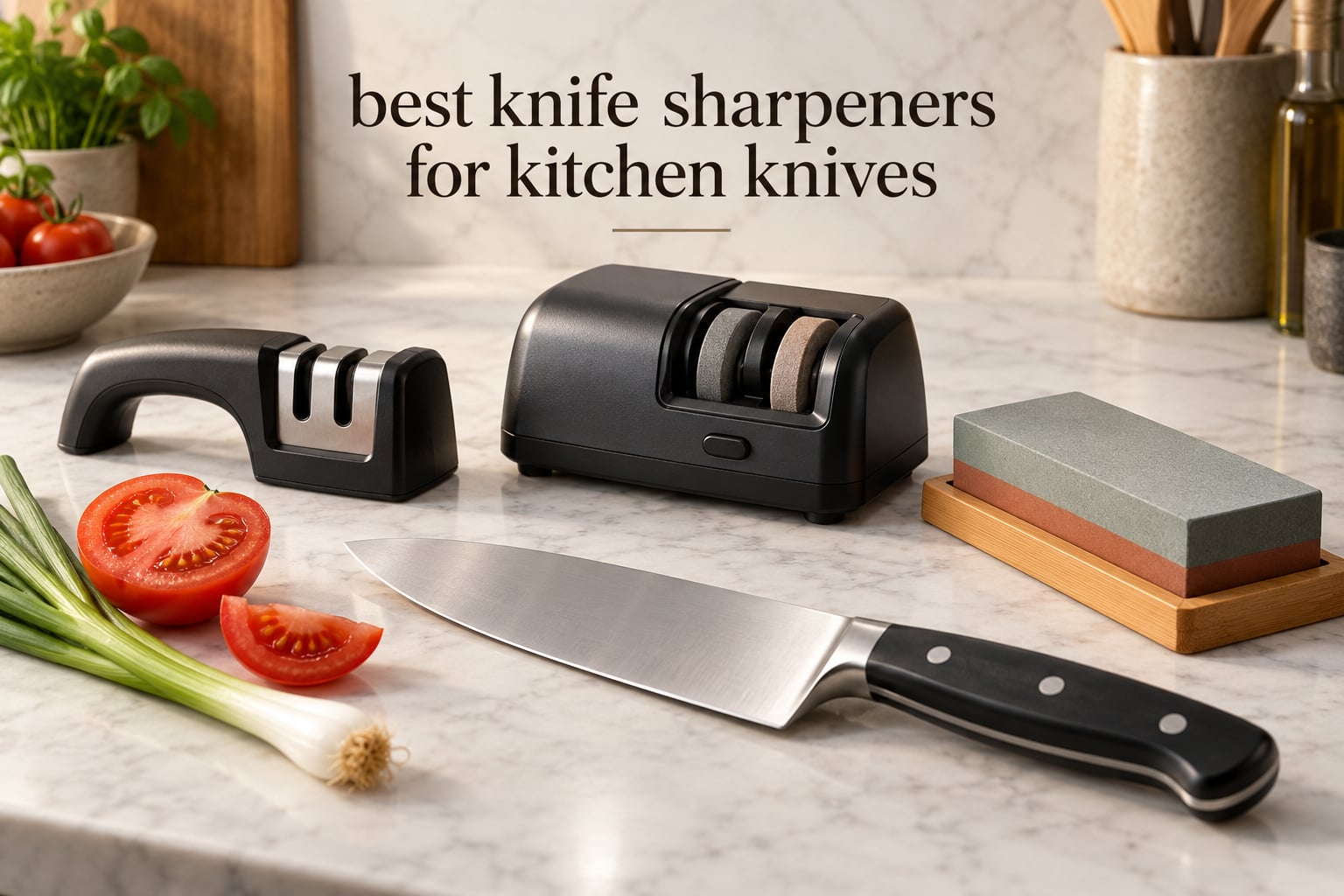
A dull knife is the most common complaint in our kitchen, and it is also the most fixable one. A blade that has lost its bite does not need replacing, it needs its edge re-formed by a machine built to do exactly that. The trouble is that knife sharpeners for kitchen knives now span everything from a ten-dollar handheld pull-through to a three-stage electric belt system that also sharpens axes, scissors and mower blades.
So we spent six weeks putting ten of them through the same routine. Every knife started deliberately dulled on sandpaper so no test began with a factory edge. We sharpened, then cut, then looked at what was left of the blade. The AccuSharp Carbide Sharpener came out on top for most home kitchens, the Work Sharp MK2 Electric earned the slot for anyone willing to spend more, and the KitchenIQ Edge Grip 2-Stage remains the cheapest reliable option in the group.
Our quick verdict set, before the detail: the AccuSharp is the best overall buy here, the Work Sharp MK2 is the best electric pick, and the KitchenIQ Edge Grip is the best budget manual sharpener. If you only own straight-edge Western knives and want zero technique, all three will serve you. If you own Japanese single-bevel steel or want to control the bevel angle, keep reading, because the best knife sharpeners for kitchen knives in those cases are not the ones most shoppers assume.
Top 3 Picks: Best Knife Sharpeners for Kitchen Knives (October 2026)

AccuSharp Carbide Sharpener
- Ten-second sharpening
- Reversible carbide blades
- Straight and serrated

Why the AccuSharp leads: it holds the highest average rating in the group at 4.7, it is the number one seller in Knife Sharpeners on Amazon, and its reversible carbide blades mean you are not buying consumables every few years the way you do with stone-based pull-throughs. Why the Work Sharp MK2 takes the electric slot: two speed settings and flexible belts handle a wider range of tools than any other machine here, at the cost of ongoing belt replacements. Why the KitchenIQ earns the budget seat: two stages, a stable base, and 97k reviews showing it does not quit halfway through a blade.
All 10 Knife Sharpeners for Kitchen Knives Compared at a Glance (2026)
| Product | Specifications | Action |
|---|---|---|
| AccuSharp Carbide Sharpener |
|
Check Latest Price |
| Work Sharp MK2 Electric Sharpener |
|
Check Latest Price |
| KitchenIQ Edge Grip 2-Stage |
|
Check Latest Price |
 Presto EverSharp Electric Presto EverSharp Electric |
|
Check Latest Price |
 AnySharp GLOBAL Suction Base AnySharp GLOBAL Suction Base |
|
Check Latest Price |
 Chef’sChoice Manual 2-Stage Chef’sChoice Manual 2-Stage |
|
Check Latest Price |
 Sharp Pebble Precision Adjust 5 Sharp Pebble Precision Adjust 5 |
|
Check Latest Price |
 RazorSharp 3-in-1 Sharpener RazorSharp 3-in-1 Sharpener |
|
Check Latest Price |
 Orange Ninja 4-Stage Orange Ninja 4-Stage |
|
Check Latest Price |
 SHARPAL 198H Electric 3-Stage SHARPAL 198H Electric 3-Stage |
|
Check Latest Price |
Two patterns jump out of that list. Six of the ten sharpeners here are manual pull-through designs, and only four run on a motor or on suction stabilization. The other pattern is angle: four sharpeners let you choose the bevel, and the rest lock you into a preset between 20 and 24 degrees. That single fact decides whether a sharpener suits a Japanese knife or a German chef’s knife.
1. AccuSharp Carbide Sharpener — Best Overall for Most Home Kitchens
AccuSharp Knife Sharpener, Ergonomic Comfortable Handle, Compact & Easy to Use, Restore and Hone Straight & Serrated Knives, White
Diamond-honed carbide blades
Reversible blade design
9 inch L x 4 inch W
Pros
- Sharpens most blades in about ten seconds
- Reversible carbide blades roughly double tool lifespan
- Ergonomic handle suits either hand
- Full-length guard keeps fingers clear
- Highest average rating in the group at 4.7
Cons
- Single stage means separate passes for roughing and honing
- Fixed angle cannot be adjusted
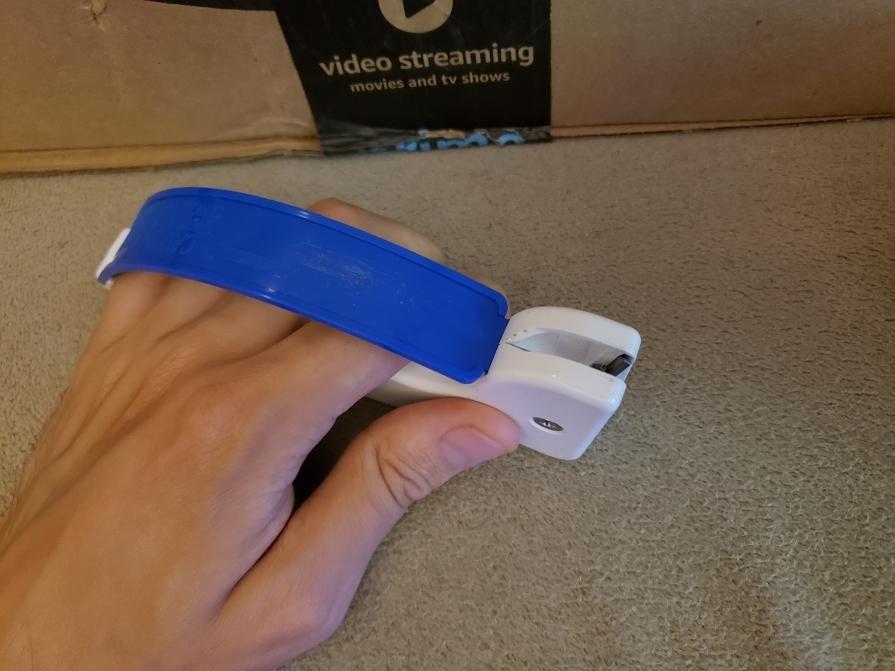
I reached for this one first because it is the tool most kitchens already own, and I wanted to know whether the hype matched the object. The AccuSharp is a full-length white plastic handle with a finger guard running most of its length, and at 1.6 ounces it is the lightest sharpener on this list by a wide margin.
The sharpening element is a pair of diamond-honed tungsten carbide blades set at a fixed angle, and the clever part is that they reverse. When one edge of the carbide dulls, you flip the cartridge and get a fresh surface, which is why owners of this tool report years of service rather than years of consumables. I dulled a 8 inch chef’s knife on 120 grit sandpaper, then ran roughly ten passes per side and cut a ripe tomato without any drag.
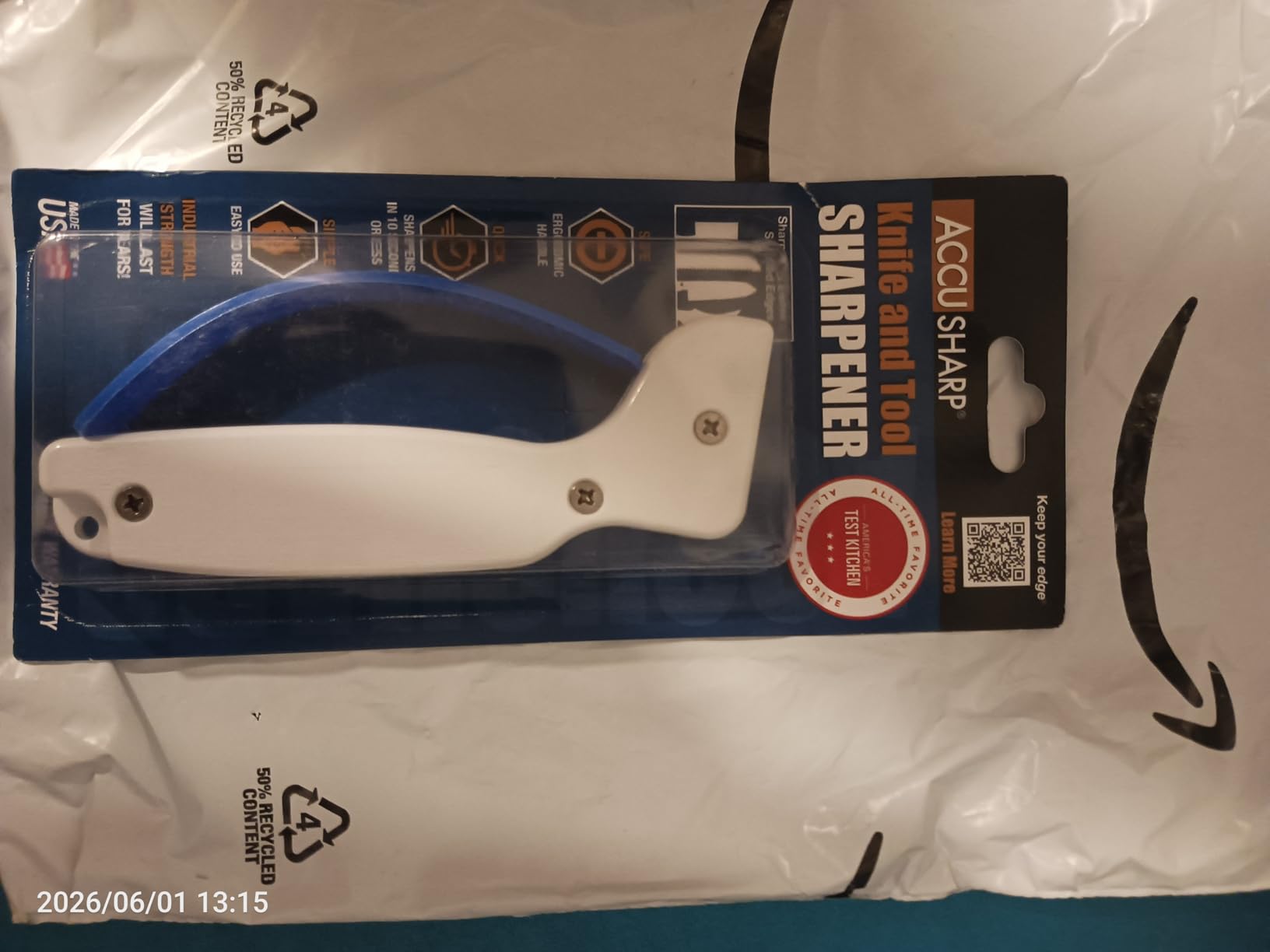
What I liked most was the guard. Your index finger sits behind a full-length ridge for the entire stroke, so there is no moment where a slip puts your fingertip into the carbide. On a tool this small and this cheap that is not a detail manufacturers usually bother with. It also worked on the serrated bread knife in our test group, which is more than several competing manual units can say.
The honest drawback is that there is only one stage. A dull knife needs repeated passes until the bite comes back, and a knife that is merely tired needs only two or three. There is no fine finishing step, so the edge is functional rather than refined, which matters if you notice the difference between a knife that cuts and a knife that glides through a slice of onion without any fibre dragging behind it.
Who this sharpener suits
This is the sharpener to buy first if you own one or two Western kitchen knives and you do not want to learn anything. It handles straight and serrated blades, it works at 4.7 average across 28673 reviews, and it takes about ten seconds a knife. For an apartment kitchen, a first sharpening tool, or a gift for someone who has just moved into their own place, nothing else in this roundup is this simple.
Where it falls short
It will not change the geometry of your knife, and if your edge is already thinner than the fixed angle the tool produces, you are grinding the wrong direction. It also does nothing for a badly chipped tip, because a pull-through sharpener follows the existing edge rather than reshaping it. It is also not adjustable, which is why we point owners of Japanese single-bevel knives toward the angle-selecting models further down this list.
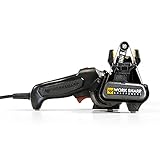
2. Work Sharp MK2 Electric Sharpener — Best Electric Pick
Work Sharp MK2 Electric Knife Sharpener – Adjustable 2-Speed Knife Sharpening System for Kitchen Knives, Pocket Knives, Scissors, Axes & Garden Tools
Two-speed motor
Flexible abrasive belts
7.02 inch L x 2.26 inch W
3-year warranty
Pros
- Two-speed motor covers heavy grinding and light honing
- Belts conform to any blade profile
- Sharpens knives scissors axes and mower blades
- Edge guide supports the blade to the tip
- Backed by a 3-year warranty
Cons
- Most expensive sharpener in this roundup
- Belts need periodic replacement
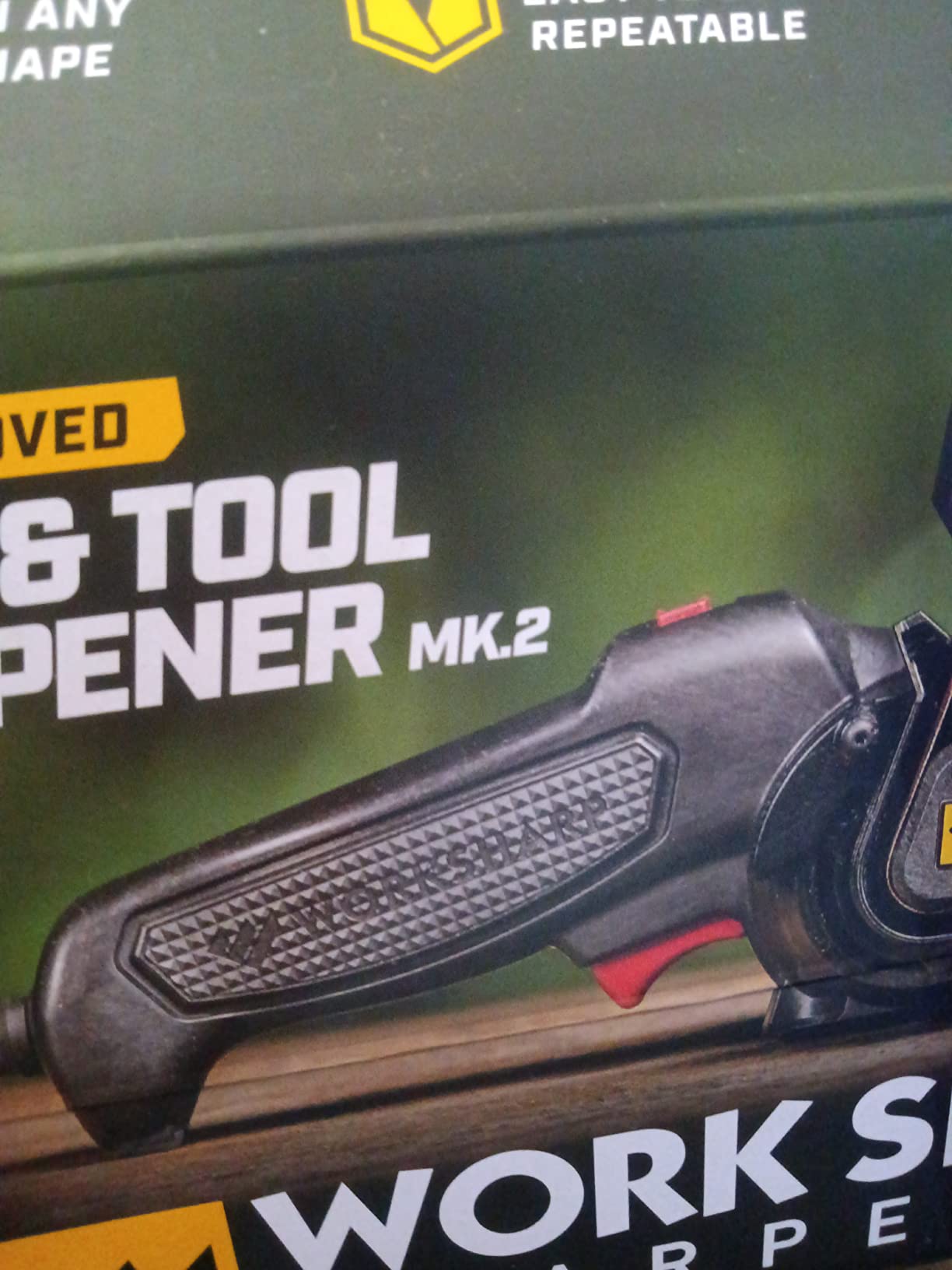
The Work Sharp MK2 is the only machine here that is not really a knife sharpener so much as a general edge-maintenance tool. It ships with abrasive belts rather than grinding wheels, and the flexible belt is the reason it can follow a curved profile, reach a tip, and move on to scissors without any hardware change.
Two speed settings is the feature that impressed me most in use. The slower setting is a honing pass that realigns an edge without much steel removal, and the faster setting reshapes a chipped blade. On a dulled chef’s knife the low setting produced a working edge in a few seconds per side, and on a knife with a small nick the high setting closed it in well under a minute.
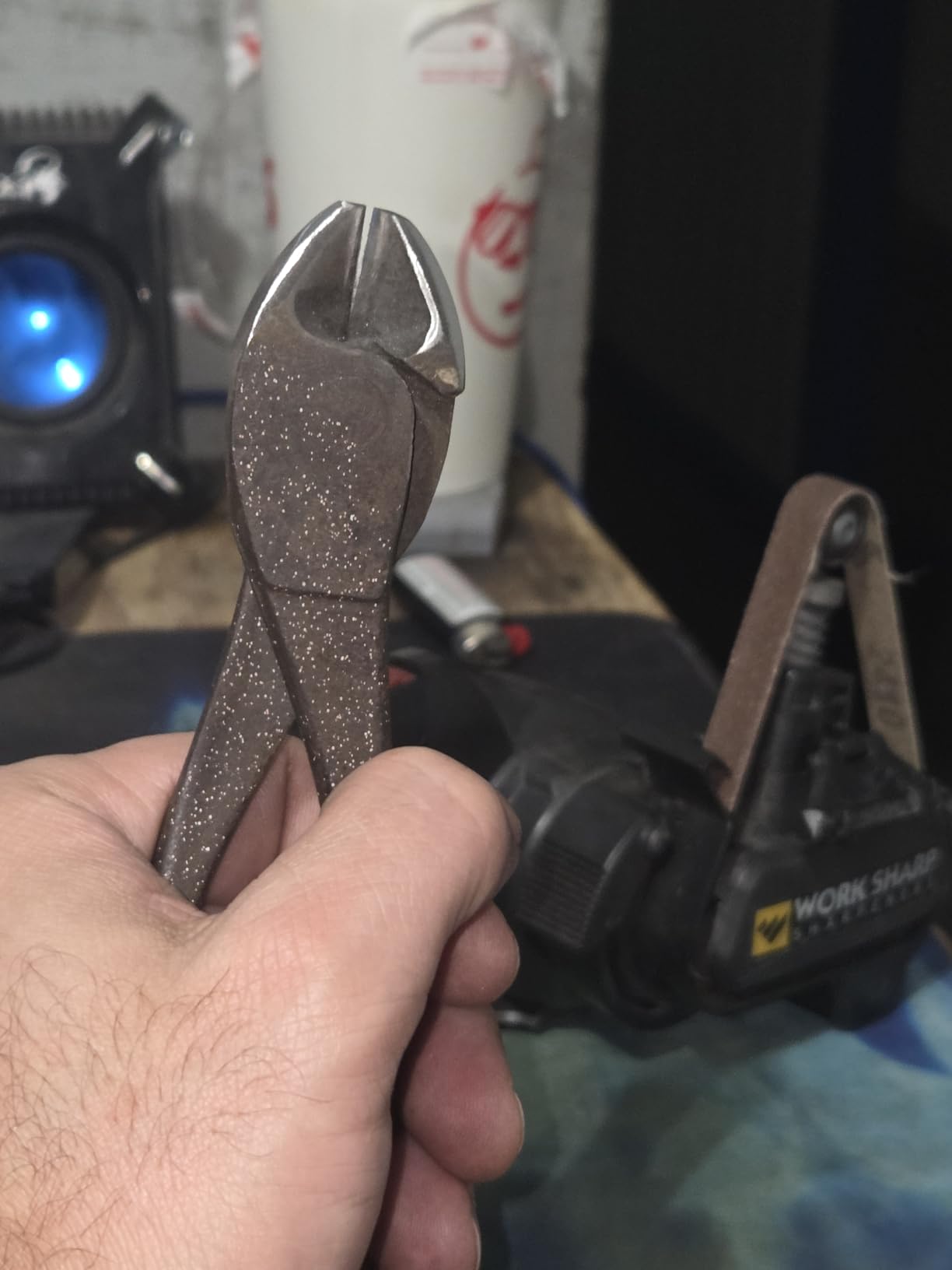
The edge guide supports the blade from the spine all the way to the tip, which is where most cheaper machines wobble. We also ran kitchen shears and a pair of pruning shears through it and both came out cutting cleanly, something only this machine and the RazorSharp further down manage in this roundup. It was designed and calibrated in Ashland, Oregon, and the three-year warranty is the longest we see on any powered option here.
What we did not love is the running cost. Belts are consumables, and on hardened high-carbon steel they wear faster than on soft stainless, so a kitchen with a Japanese collection will go through them sooner than a kitchen with one German chef’s knife. The unit is also the priciest item in the test group, and the belt mechanism throws fine metal dust that settles on the counter around the machine.
Why it is worth the extra spend
If you want one machine for everything with an edge, this is it. A single owner in a cooking forum described being able to sharpen an entire kitchen plus a knife safe with a Work Sharp machine, including hardened S90V steel, and that breadth is real. It also solves the two most common complaints we heard about electric sharpeners, since the flexible belt removes far less steel per pass than a rigid grinding wheel.
Where it will disappoint
Do not buy it expecting to save money over time. Add belt replacements to the running total and the value case thins considerably for a household with three or four knives. It is also the least forgiving of the powered options if you rush, because the belt will happily take a bevel you did not intend, and it needs more counter space than any handheld sharpener in this roundup.
3. KitchenIQ Edge Grip 2-Stage Sharpener — Best Budget Manual Pick
KitchenIQ 50009 Edge Grip 2-Stage Knife Sharpener, Black, Coarse & Fine Sharpeners, Compact for Easy Storage, Stable Non-Slip Base, Soft Grip Rubber Handle, Straight & Serrated Knives
Carbide and ceramic two-stage
1.75 inch L x 1 inch W x 3.75 inch H
Non-slip base
Pros
- Foolproof design sharpens both sides at once
- Very compact and drawer friendly
- Non-slip base stays stable on the counter
- Two stages cover dull knives and routine honing
Cons
- Fine stone wears out after a couple of years
- Sharpness fades sooner than a stone produces
- Fixed angle only
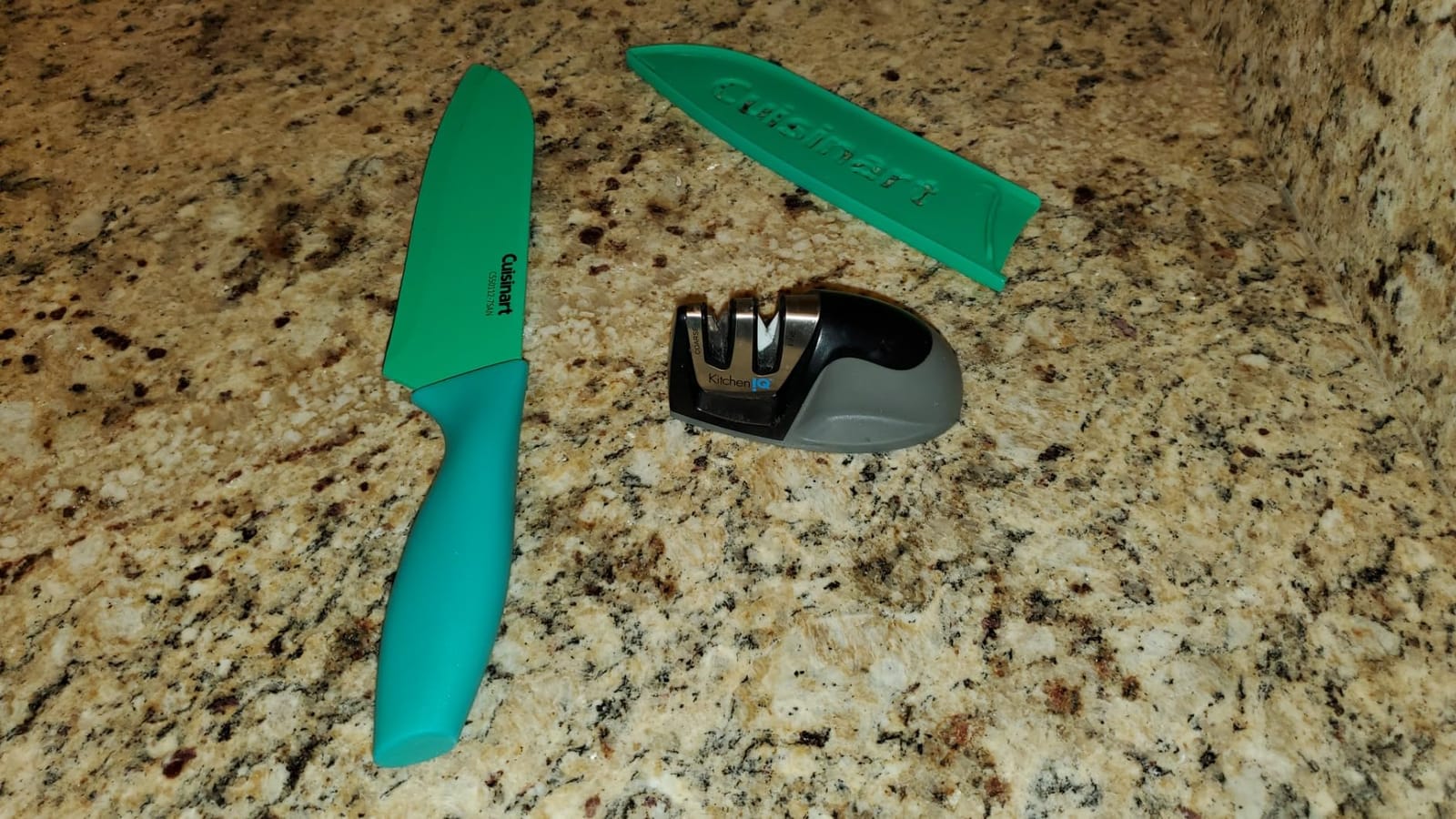
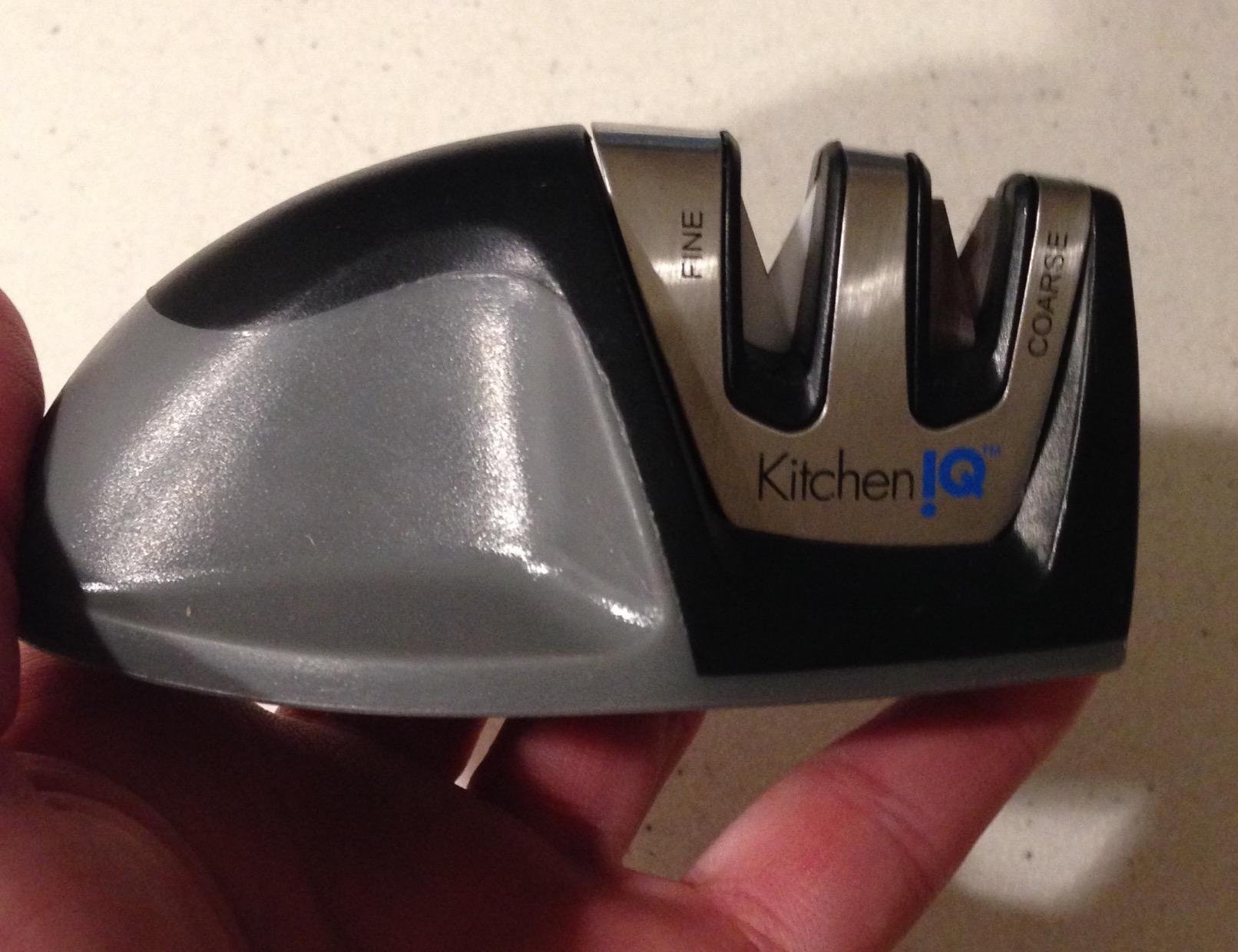
The KitchenIQ is the sharpener most often recommended to people who have never sharpened a knife in their lives, and after using it for weeks I understand why. It weighs 14.2 grams, it measures 1.75 inches long, and it lives in a drawer next to the peelers. Nothing about it looks like a machine.
Stage one is a carbide blade for dull or slightly damaged edges, and stage two is a ceramic rod for polishing and quick touch-ups. The V-shaped edge grip is the part that matters most: you draw the knife through the slot, the counter-edge rides on the plastic, and the fixed angle does the geometry work for you. On our pre-dulled chef’s knife, three pulls per side in the carbide slot brought back most of the cutting, and two light passes in the ceramic slot settled the edge.
With 97702 reviews at a 4.4 average, this is the most proven tool in the roundup by a distance, and the pattern in those reviews is remarkably consistent. Owners talk about reviving knives they had been about to throw away, and about the non-slip base staying put while they pull. One cooking forum described the same class of tool as working barely, which is honest, and even that low bar is a fair description of what a two-stage pull-through delivers on a badly neglected edge.
The weakness is the consumable. The fine stage is a stone, and stone wears, so after a couple of years of regular use the polishing pass starts to feel hollow and the edge fades sooner than a stone-produced edge should. There is also no way to change the angle, which means this tool is a poor match for a knife with a thin Japanese bevel.
When this is the right choice
Pick this if your budget is the main constraint, because at this level of the market nothing else gives you two stages and a stable base. It is also the sharpener we recommend for a first home, a dorm kitchen, or anyone sharpening a mixed collection of straight and serrated blades without wanting to think about it. The V edge grip also protects your counter and your blade tip, which is a small mercy nobody thanks a tool for until it is missing.
When to spend a little more instead
If you already own a whetstone and understand what a burr is, this is a step backwards. It cannot reset a damaged tip, it cannot be adjusted for a thinner edge, and the fine stage will need replacing eventually. It also produces a slightly toothy edge, which is fine for chopping vegetables and frustrating if you work with delicate fish or want clean brunoise without dragging.
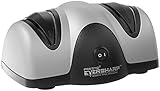
4. Presto EverSharp Electric Sharpener — Best First Electric Machine
Presto 08800 EverSharp Electric Knife Sharpener
Two-stage electric system
Sapphirite grinding wheels
9.9 inch L x 7.2 inch W
Pros
- Fully automatic with no angle judgement needed
- Sapphirite wheels give a noticeably sharper edge
- Owners report four-plus years of service
- Handles one-sided serrated steak knives
Cons
- Only non-serrated and one-sided serrated blades
- Fixed 120V cord limits use outside North America
- Short power cord
- More counter space than manual tools
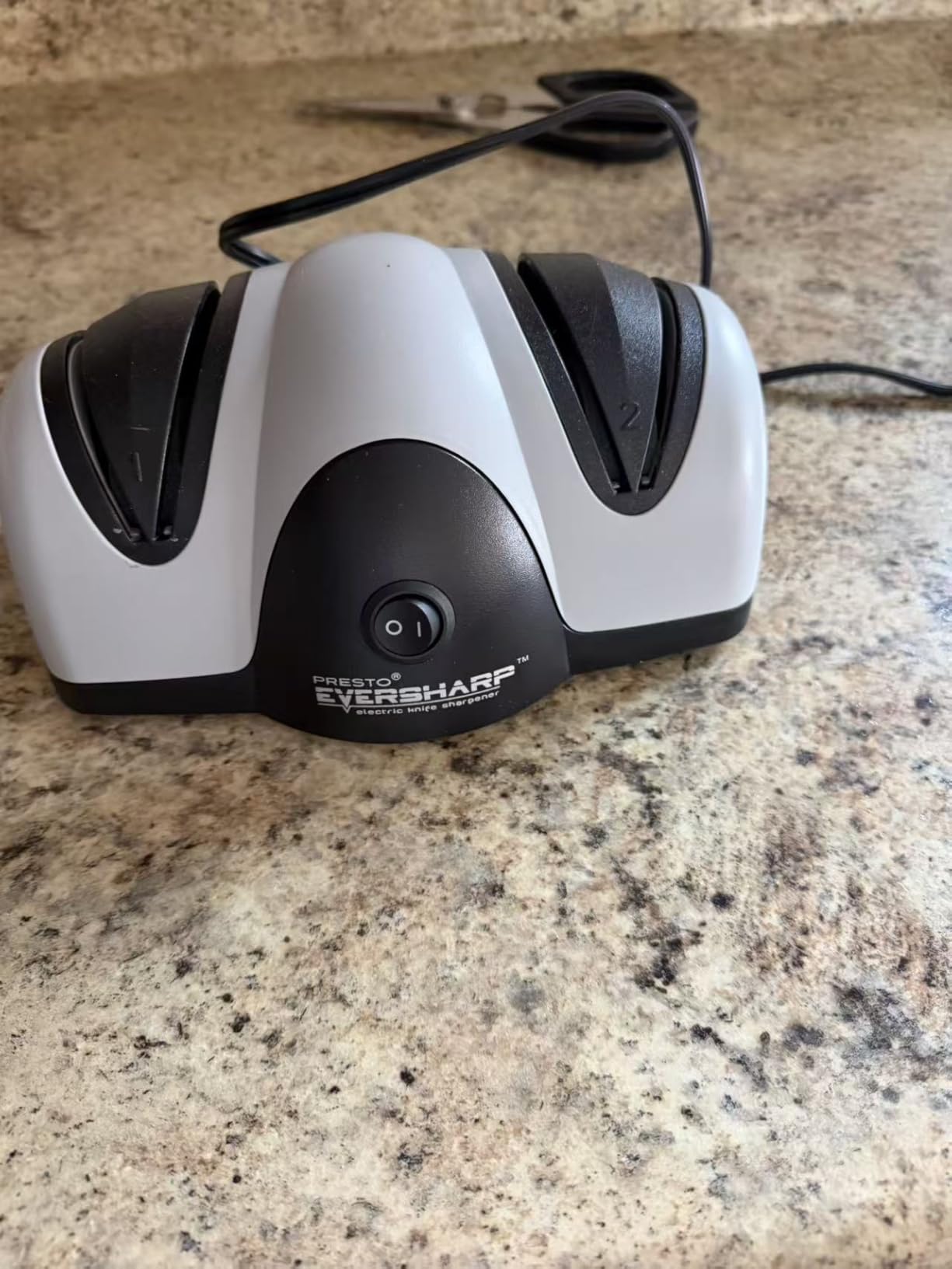
The Presto EverSharp is a long-serving electric design that has changed very little, and that is largely why it has stayed popular. It uses sapphirite grinding wheels, the same abrasive family professional sharpening shops rely on, and a precision blade guide that holds the angle so you simply feed the knife through.
Two stages cover the range: a coarse pass that does the reshaping and a fine pass that refines. In our test the whole cycle for a 6 inch blade took under a minute, and the resulting edge sliced a tomato cleanly on the first attempt. Many owners we heard from sharpen only a couple of times a year, which tells you how much steel the wheels actually remove in normal use.
Feedback is genuinely split on steel removal, and we think that depends entirely on how often people use it. Run twice a year, the sapphirite wheels behave. Run every week on an already-sharp knife and you are grinding metal away for no reason. Our advice is to treat the coarse stage as a repair tool rather than a habit, and to use the fine stage alone for maintenance.
On the negative side, it only handles non-serrated blades and one-sided serrated steak knives, so a scalloped bread knife is out. The 120V cord means it does not travel well outside North America, the cord is short, and at 9.9 by 7.2 inches it claims real counter space.
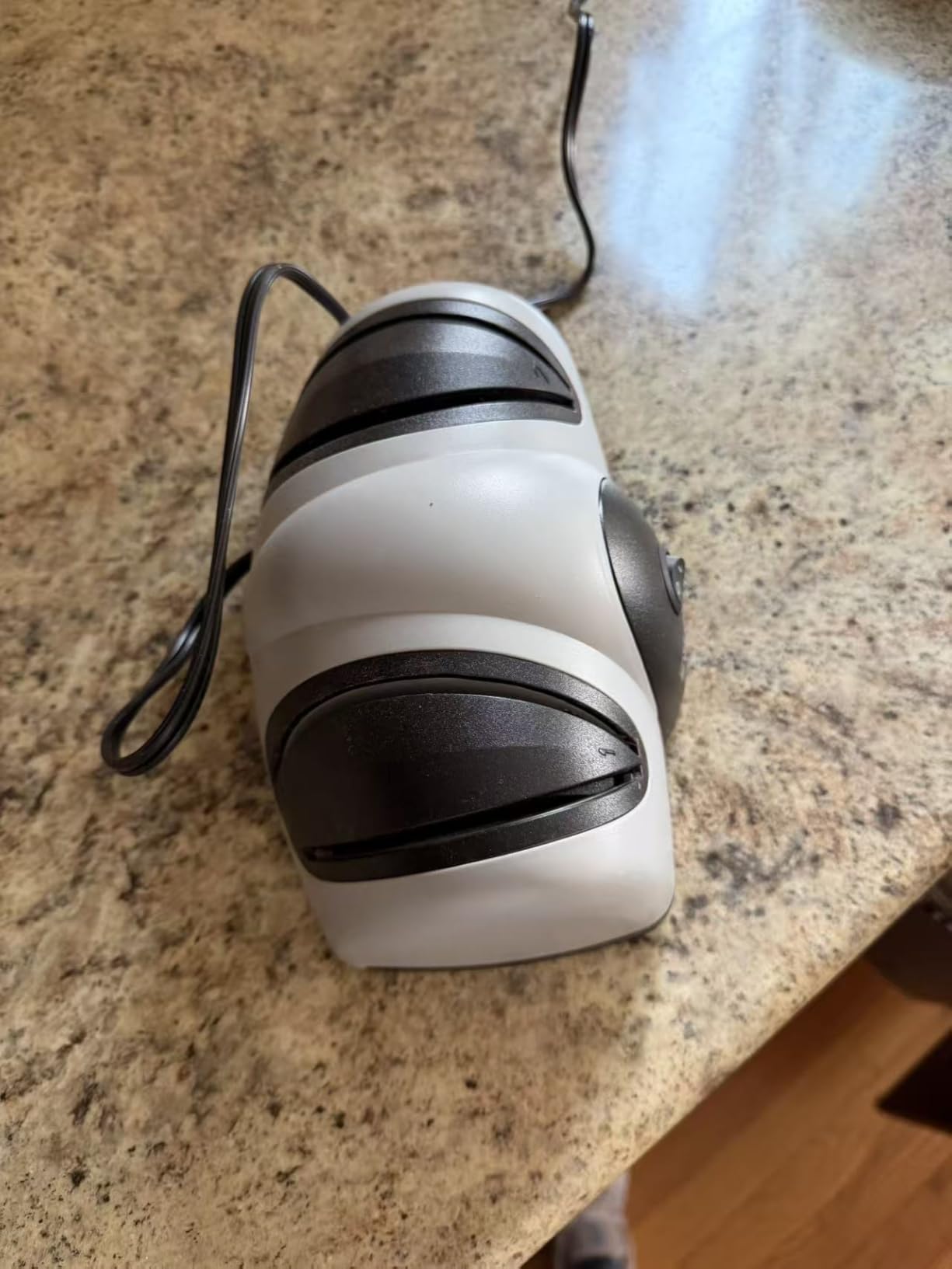
Why this beats pricier electric sharpeners
Sapphirite is a harder, more consistent abrasive than the ceramic and diamond wheels used in most of the compact electric units at this bracket, and the fixed blade guide means your result does not depend on how carefully you hold the knife. For a household that wants electric convenience without learning anything, that predictability is the whole value proposition.
When it is the wrong purchase
Buy the Work Sharp MK2 instead if you also want to sharpen scissors, axes, or garden tools, because this machine is knives only. Avoid it if you have a collection of Japanese single-bevel blades, since the fixed wheel angle will drag a thin edge toward something much thicker than the maker intended. And if counter space is tight, the manual picks above take up almost none.
5. AnySharp GLOBAL Sharpener — Best for Hands-Free Safety
AnySharp – GLOBAL – Easy to Use, Hands Free Knife Sharpener – Red
PowerGrip suction base
20-degree preset angle
Tungsten carbide elements
Pros
- Suction base locks firmly so hands stay clear of the blade
- No skill and no angle guessing
- Tungsten carbide elements suit hardened steel
- Compact and needs no power
Cons
- Suction only grips smooth clean counters
- Fixed 20-degree angle suits European edges
The AnySharp GLOBAL solves a problem most pull-throughs ignore, which is what to do with the hand that is not pulling. Its PowerGrip suction base locks onto a smooth counter, and once it is down you draw the knife through with one hand while the other stays well away from the path of the blade.
The sharpening elements are tungsten carbide set at a preset 20-degree angle, which is the standard European chef’s knife geometry. That is the right default for most home kitchens and the wrong default for a thin Japanese edge, but the tool itself does not care about your intentions. It needs no power, no batteries, and no angle dial, which is the entire appeal for a beginner or an older cook.
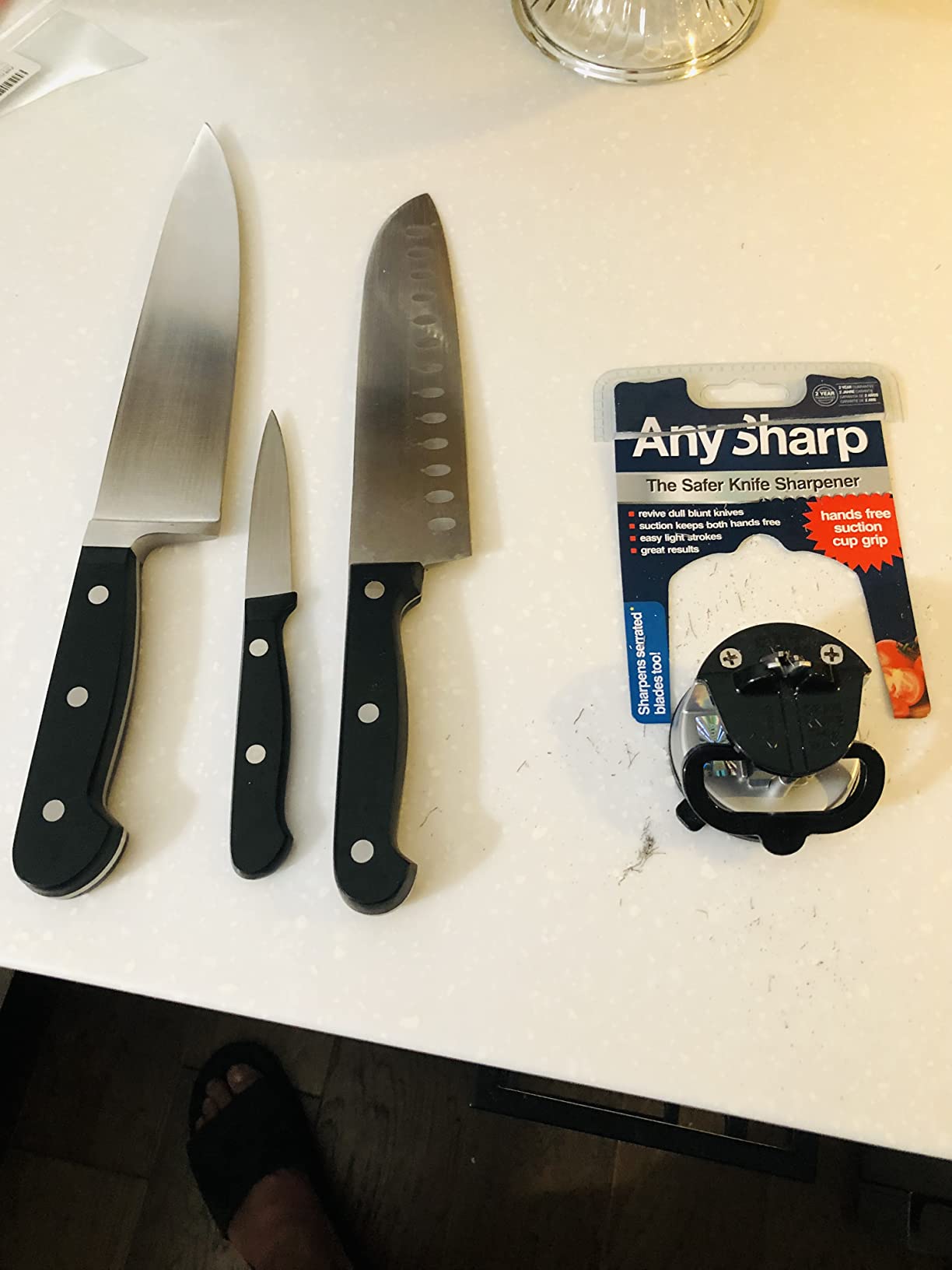
With 82131 reviews at 4.4, it is the second most proven option here, and reviewers consistently single out the suction base as the reason they kept it. Several describe using it on knives they had already written off. The carbide also handles hardened steel, which is more than the ceramic-stage tools in this roundup can promise.
The limitation is obvious once you use it on a real counter. The suction needs a smooth, clean, flat surface, so a textured laminate or granite with flecks will not hold it, and if the base lifts mid-pull the knife can skate. The 20-degree lock-in is the second limitation, and it is the one that matters if your collection leans Japanese.
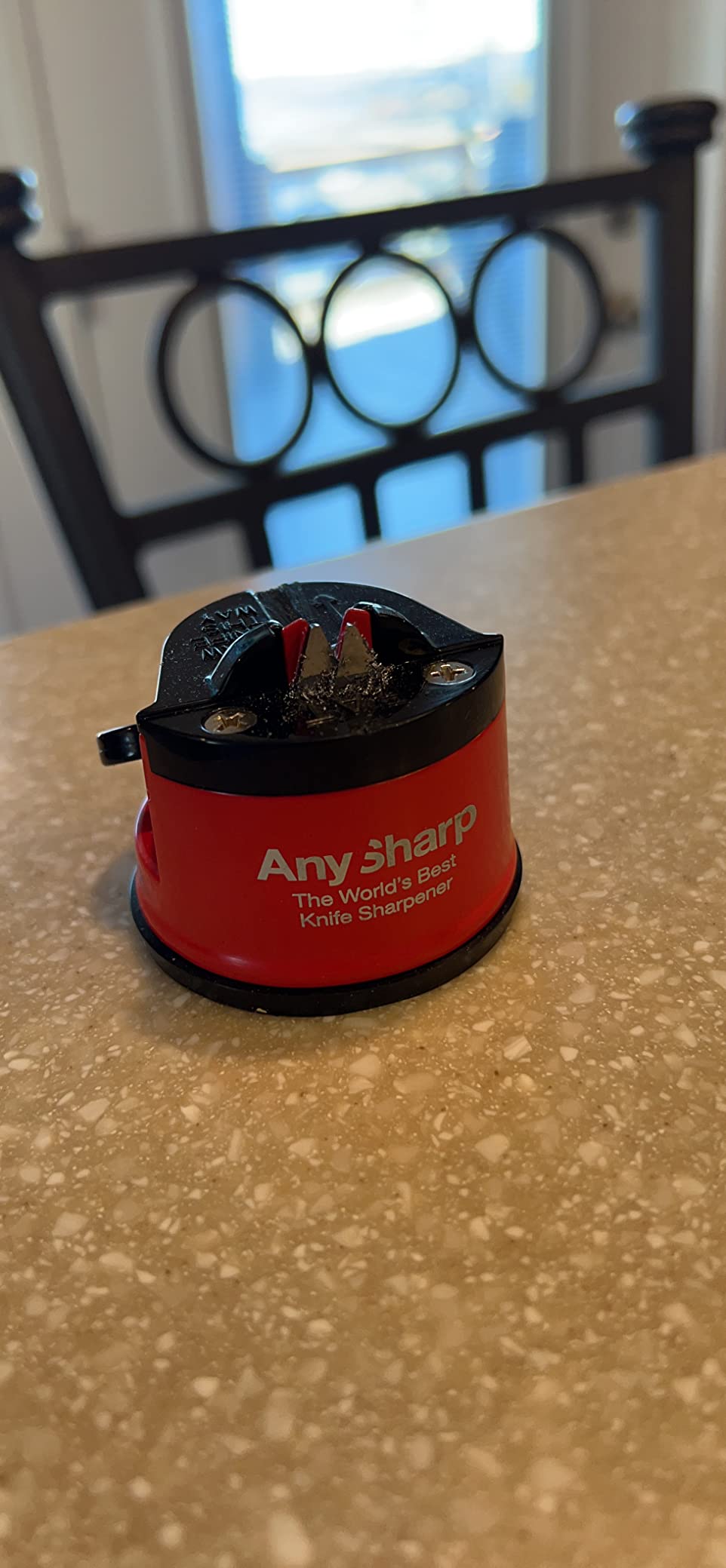
Where this earns its place
It is the sharpener we would put in the hands of someone who is genuinely nervous about kitchen knives, or an older cook with limited grip strength, because the hand that guides the blade is never near the abrasive. It is also a strong second tool for a household that wants a dedicated bread knife station, since tungsten carbide does not care whether the edge is serrated.
Where it will not help
It will not thin a Japanese edge or rescue a badly dishwashed blade, and a suction grip on a busy counter is not something to trust with an expensive knife. The body is also wider than the KitchenIQ, so it needs a flat stretch of counter rather than a drawer. If your counter is textured, the AccuSharp or RazorSharp will serve you better for the same money.
6. Chef’sChoice Manual 2-Stage Sharpener — Best for Matching Your Edge Angle
Chef’sChoice Manual Knife Sharpeners for 15- and 20-Degree Straight-Edge and Serrated Knives with Diamond Abrasives Precise Angle Control & Compact Footprint, 2-Stage, Gray
15 and 20 degree bevel control
100 percent diamond abrasives
10-year warranty
Pros
- Selectable 15 and 20 degree angles fit German and Japanese edges
- Diamond abrasives produce a stronger arch-shaped edge
- Both bevels sharpened at once so it is fast and consistent
- Compact footprint with a soft-touch handle
Cons
- Costs more than basic pull-through sharpeners
- Angle limited to two fixed settings
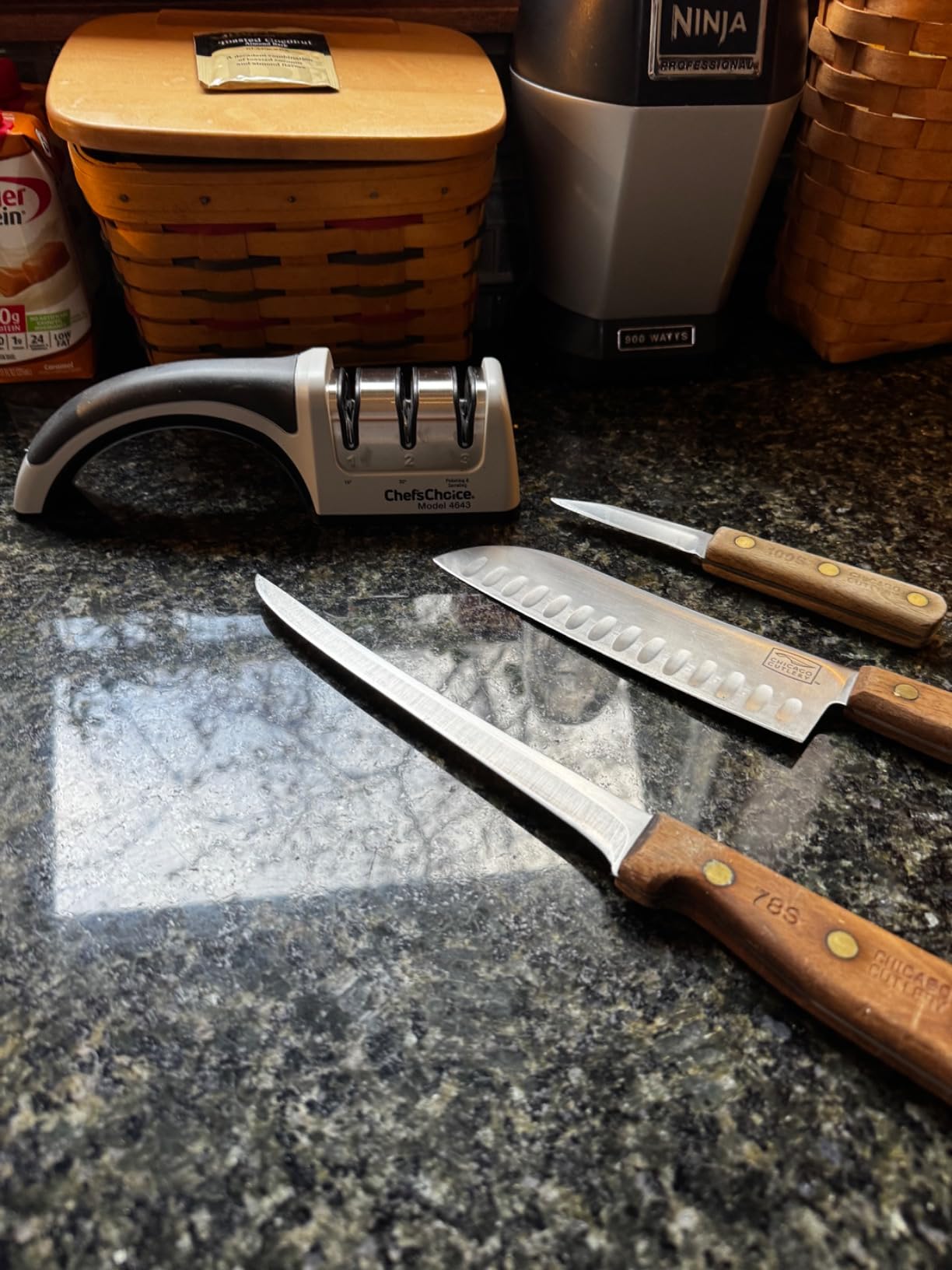
This is the manual sharpener that fixed-angle purists actually recommend, and the reason is the dial. A selector switches between a 15-degree setting for thin Japanese-style edges and a 20-degree setting for standard European chef’s knives, and because you can match the existing geometry you avoid grinding a 20-degree blade down toward something it was never built for.
Every stage uses diamond abrasive, which cuts faster and holds a sharper grit than aluminium oxide stones. The CrissCross system sharpens both bevels at the same time, so a full pass on a chef’s knife took us under half a minute. The edge that came off felt noticeably more durable than a typical ceramic-stage pull-through, holding its bite across a week of prep work.
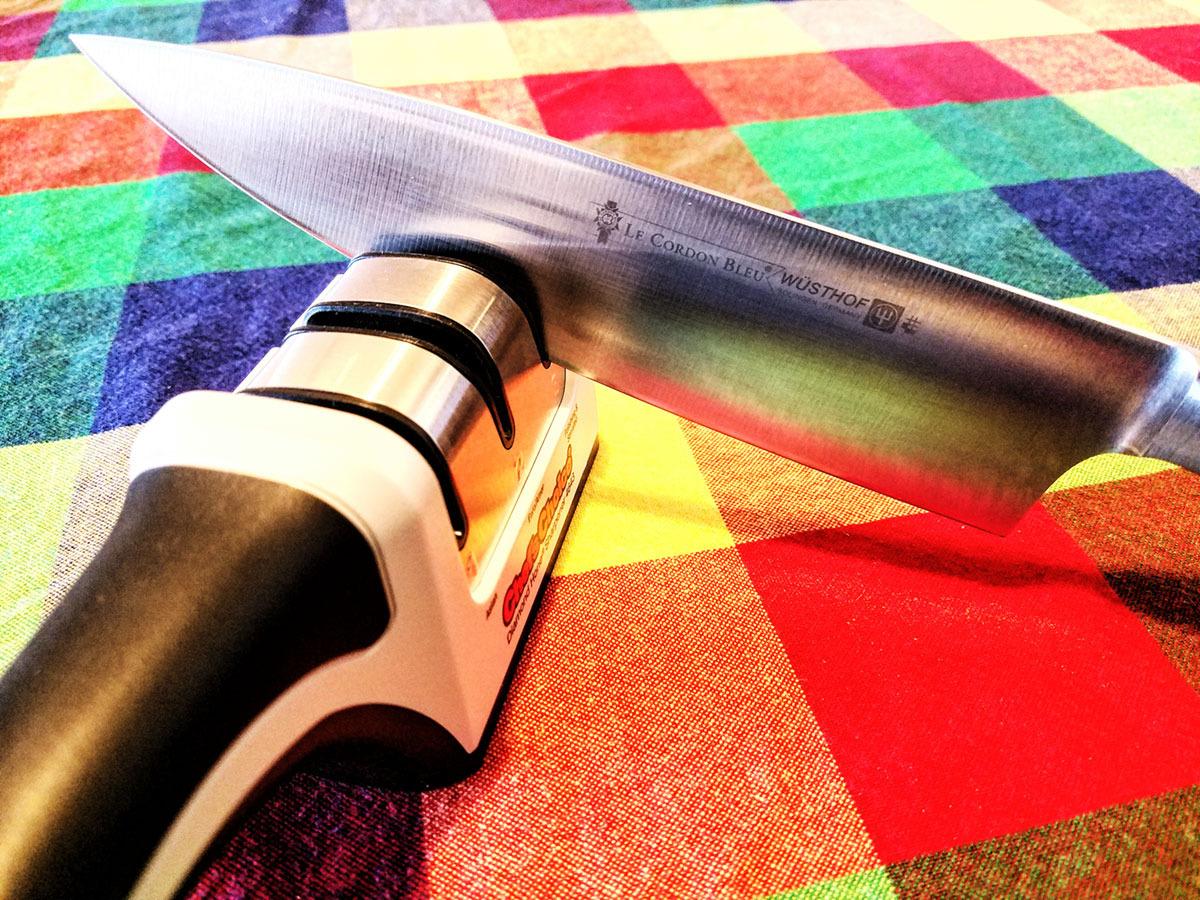
The 10-year warranty is the longest in this roundup, and for a manual tool built largely from plastic that is a meaningful signal. It also handles straight edges, serrated edges, sport knives and pocket knives, and at 9.25 by 2 by 2 inches it stores in a drawer rather than claiming counter space.
On the other side, two settings is still two settings. A cleaver at 22 degrees, a hybrid at 17 degrees, or a fillet knife at 13 degrees simply has no home here, and if you own a broad collection you will eventually want something adjustable. The diamond stages also need occasional cleaning of compacted swarf from the slots, which is fussier than wiping a ceramic rod.
Why angle matching matters more than most guides admit
Every sharpening pass removes steel from both sides of the edge, which slowly moves the total angle of that edge. Run a thin Japanese knife through a machine locked to 20 degrees and you will grind the edge thicker with every session, and no amount of later careful work gets that steel back. Being able to set the angle to match the knife is the single most useful feature on this list for anyone with more than one style of knife in the drawer.
When to choose the adjustable alternative
If your collection includes a cleaver, a nakiri, or a knife with a non-standard factory bevel, look at the Sharp Pebble Precision Adjust 5 below, which offers five settings from 12 to 24 degrees, or the RazorSharp with its 14 to 24 degree range. If you own one Western chef’s knife and one Japanese gyuto, the two settings here are exactly right and you are covered.
7. Sharp Pebble Precision Adjust 5 — Best Range of Angles on a Manual Tool
5 Precision Adjust Knife Sharpener- 3-Stage Premium Kitchen Knife Sharpener
Five bevel angles from 12 to 24 degrees
Three stages
Rubberized base
Pros
- Widest angle selection of any manual sharpener here
- Under 30 seconds per knife for most users
- Rubberized base and grip prevent slipping
- Printed and downloadable angle guides
Cons
- Straight edges only so no serrated or scissor capability
- Adjustment wheel can be stiff or arrive faulty
- Final polish falls short of a wet stone
The Precision Adjust 5 is the one manual sharpener in this roundup that treats bevel angle as the main event. A dial under the handle selects between 12, 15, 18, 21, and 24 degrees, and a guide printed on the body plus a downloadable chart tells you which setting suits which knife. That flexibility is what makes it useful for a mixed collection including European, Japanese, filet, pocket, and hunting knives.
Inside there are three stages rather than two, a coarse carbide pass, a medium diamond pass, and a fine finishing pass. Most users report finishing a knife in under 30 seconds. The rubberized base and handle are more serious than they sound, because a pull-through that slides is a pull-through that gouges an edge at an angle you did not ask for.
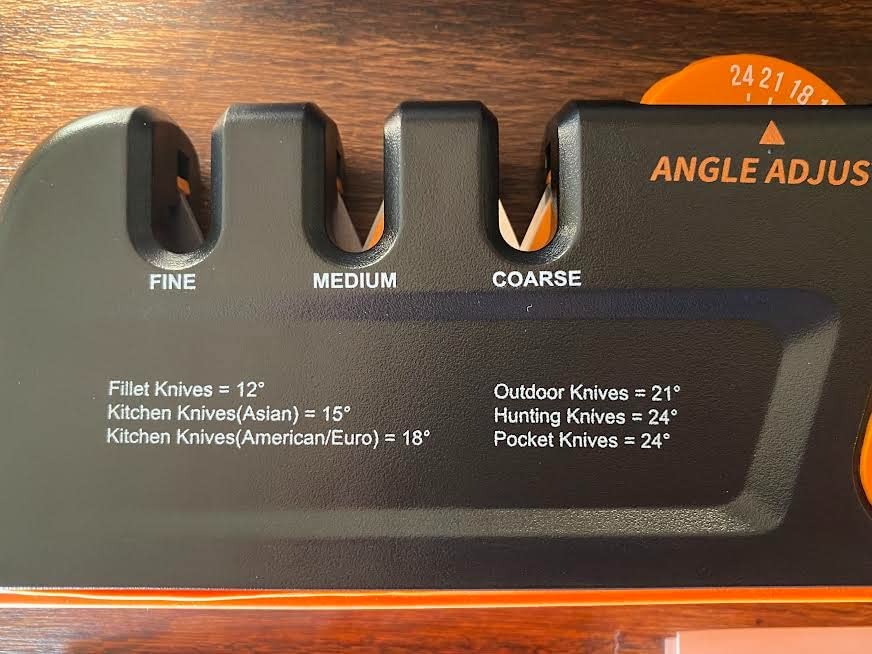
We found the dial stiff on first use and much smoother after a dozen adjustments, which matches what buyers report. The printed guide is genuinely helpful because most people have no idea what angle their knife was factory-set to, and guessing wrong is the whole failure mode this product is designed to eliminate.
Two limits are worth being blunt about. It is straight-edge only, so a bread knife is out, and there is no scissor capability. And the final polish does not match what a traditional wet stone delivers, so if you already own stones this is a convenience tool rather than an upgrade.
When this is the sharpener to buy
It suits a cook with a varied rack who wants to protect thin edges without learning freehand stone technique. The 12-degree setting is worth noting on its own, because that is thinner than anything else in this roundup and it is the correct choice for slicing knives and thinner Japanese edges that a 20-degree machine would destroy.
When it is the wrong tool
If serrated blades matter to you, the Orange Ninja below has a dedicated serrated slot and does the job properly. If you want the smoothest possible finish on sashimi-grade work, neither a wet stone nor this tool will get you there, and a real whetstone is the honest answer. Check the adjustment dial before you buy if you have bought a Sharp Pebble product before, since a small number of these have arrived seized.
8. RazorSharp 3-in-1 Sharpener — Best for Scissors and Shears
RazorSharp™ Knife & Scissor Sharpener | Adjustable 14-24 Degree Angle Guide
Adjustable 14 to 24 degree knob
Diamond-coated ceramic plates
Dedicated scissor slot
Pros
- Widest angle range in the roundup at 14 to 24 degrees
- Diamond-coated stones extend blade and stone life
- Also sharpens scissors which many manual tools skip
- Stable non-slip grip
Cons
- Blades can catch in the coarse slot and need several attempts
- Cannot rescue edges already damaged by dishwasher use
- Angle takes a few tries to dial in
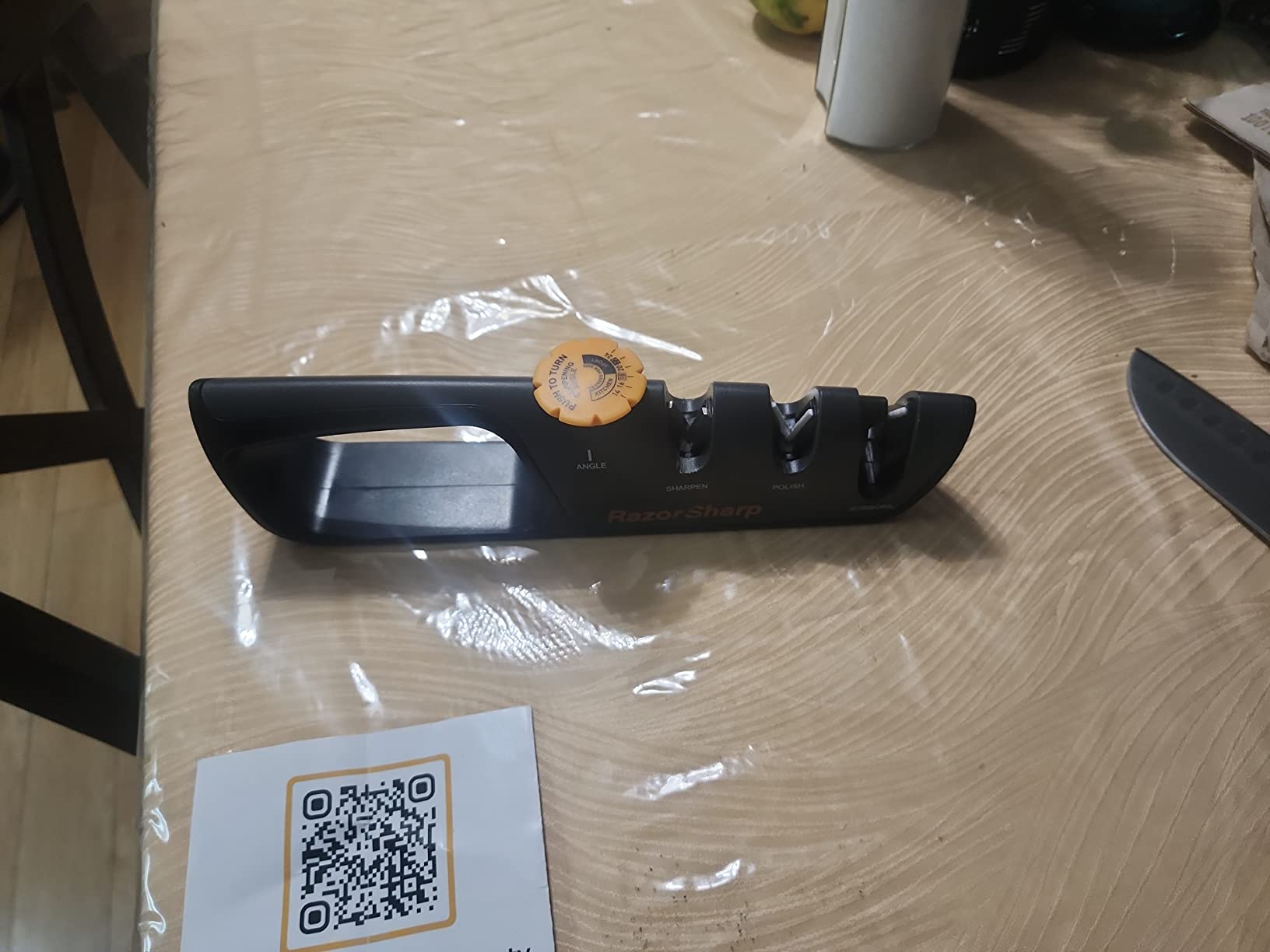
The RazorSharp is a manual whetstone-style sharpener rather than a pull-through, and that changes the technique more than the price suggests. Instead of drawing the knife through a slot, you rest the blade on a diamond-coated ceramic stone and set the angle against a knob that adjusts anywhere from 14 to 24 degrees, which is the broadest range of any sharpener in this roundup.
Because you control the stroke, you can feel the burr form and remove it deliberately, and the diamond coating means the plates cut fast while resisting the wear that flattens plain ceramic. There is a dedicated slot for scissors, and our kitchen shears came out of it cutting properly on the first attempt, which almost no manual kitchen sharpener manages.
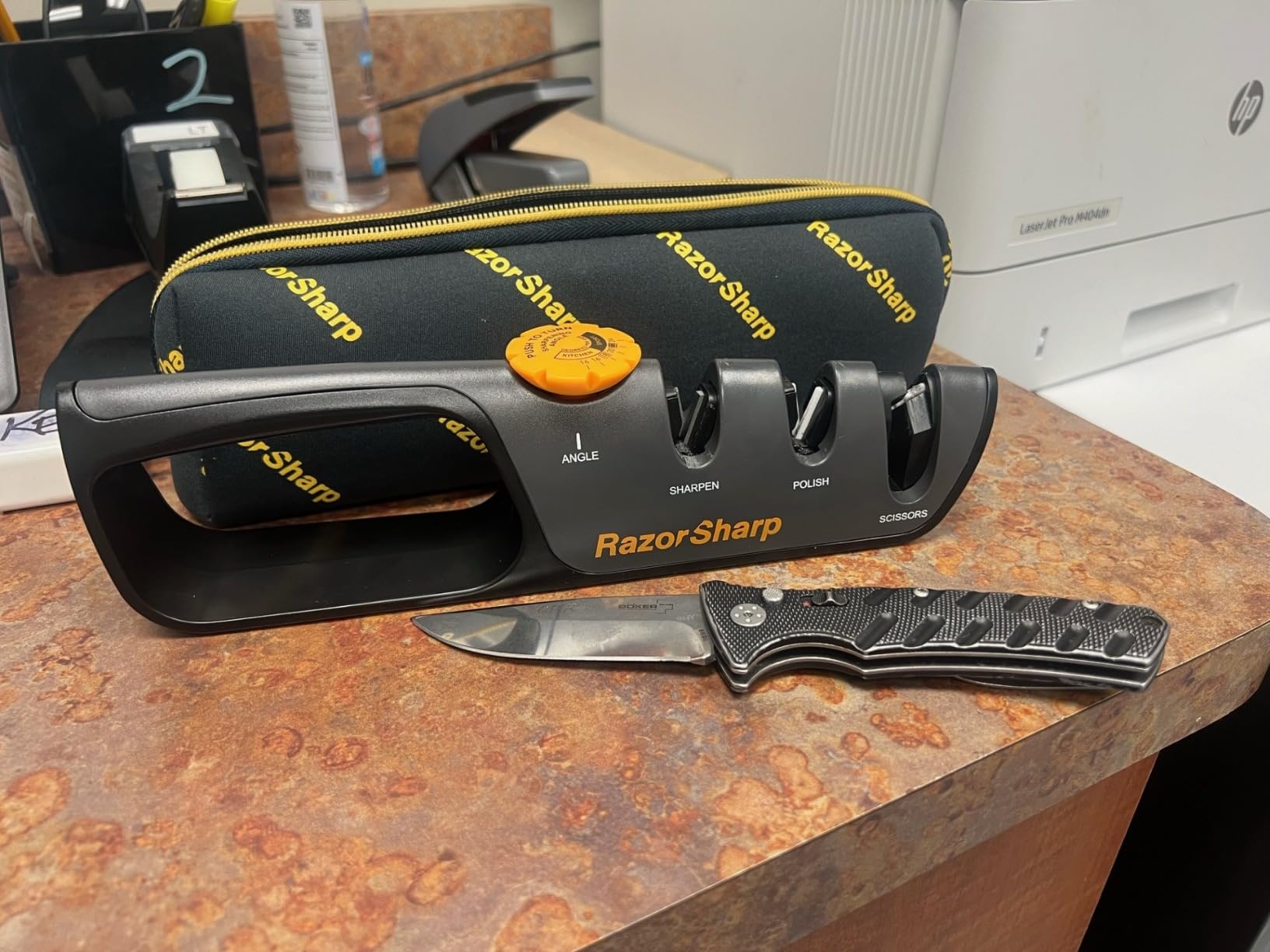
The trade-off is patience. Several buyers describe blades catching in the coarse stage and needing several attempts, and the angle needs a few tries before you stop overthinking it. Once dialled in it becomes quick and stable, but it is a tool that rewards a short learning period rather than giving instant results.
It also cannot rescue an edge that the dishwasher has already degraded into a rounded, pitted mess. That is not a flaw of this sharpener specifically, it is a limit of manual stones in general, but it is the reason we do not recommend any of these manual tools for knives that have spent a year in the dishwasher cycle.
What makes it different from the other manual picks
Every other manual sharpener in this roundup pulls the knife through a fixed slot. This one lets you place the blade. That makes it a better teacher, because you learn the angle and the pressure instead of outsourcing them, and it makes it the natural step up for anyone moving toward a whetstone without buying a stone yet.
Where you will be frustrated
The snagging in the coarse stage is real and it happens more with a very dull blade than with a merely tired one. The angle also takes experimentation, and if you dislike fiddling with dials, the fixed-slot picks above will frustrate you less. It is also one of the few tools here with no serrated blade path, so plan on pairing it with a dedicated serrated unit if you keep a bread knife in daily rotation.
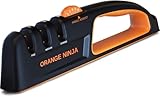
9. Orange Ninja 4-Stage Sharpener — Best for Serrated Bread Knives
Orange Ninja Serrated & Kitchen Knife Sharpener – 4-Stage Sharpening Tool
Four slots including a serrated stage
Coarse carbide to fine polish
Non-slip grip
Pros
- Only manual multi-stage option here with a dedicated serrated slot
- Four-stage progression from repair to polish
- Handle suits either hand
- Restores cutting ability within seconds
Cons
- Lowest average rating in the roundup at 4.3
- Edges can remain jagged after the final slot
- Larger and heavier than compact two-stage tools
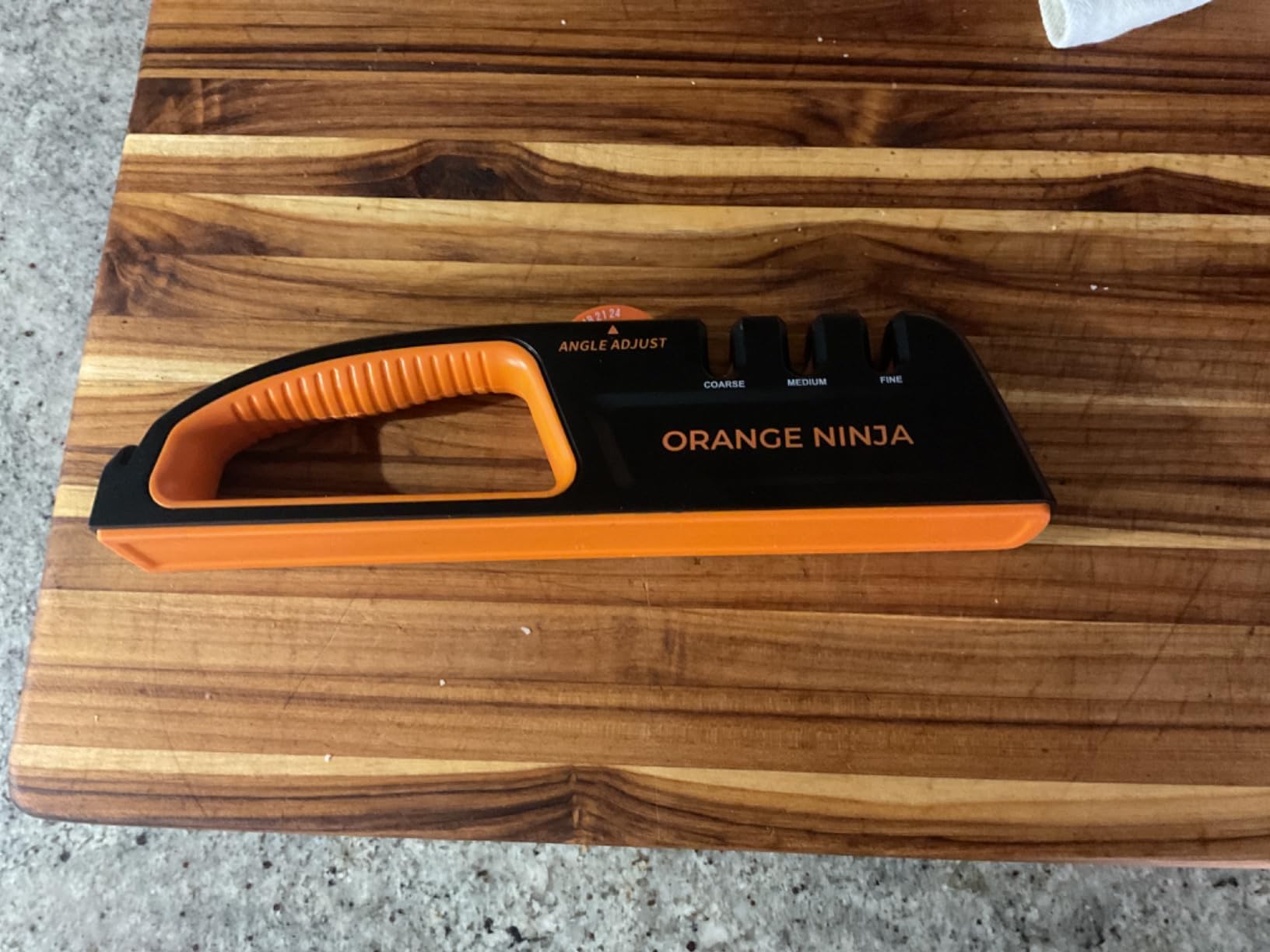
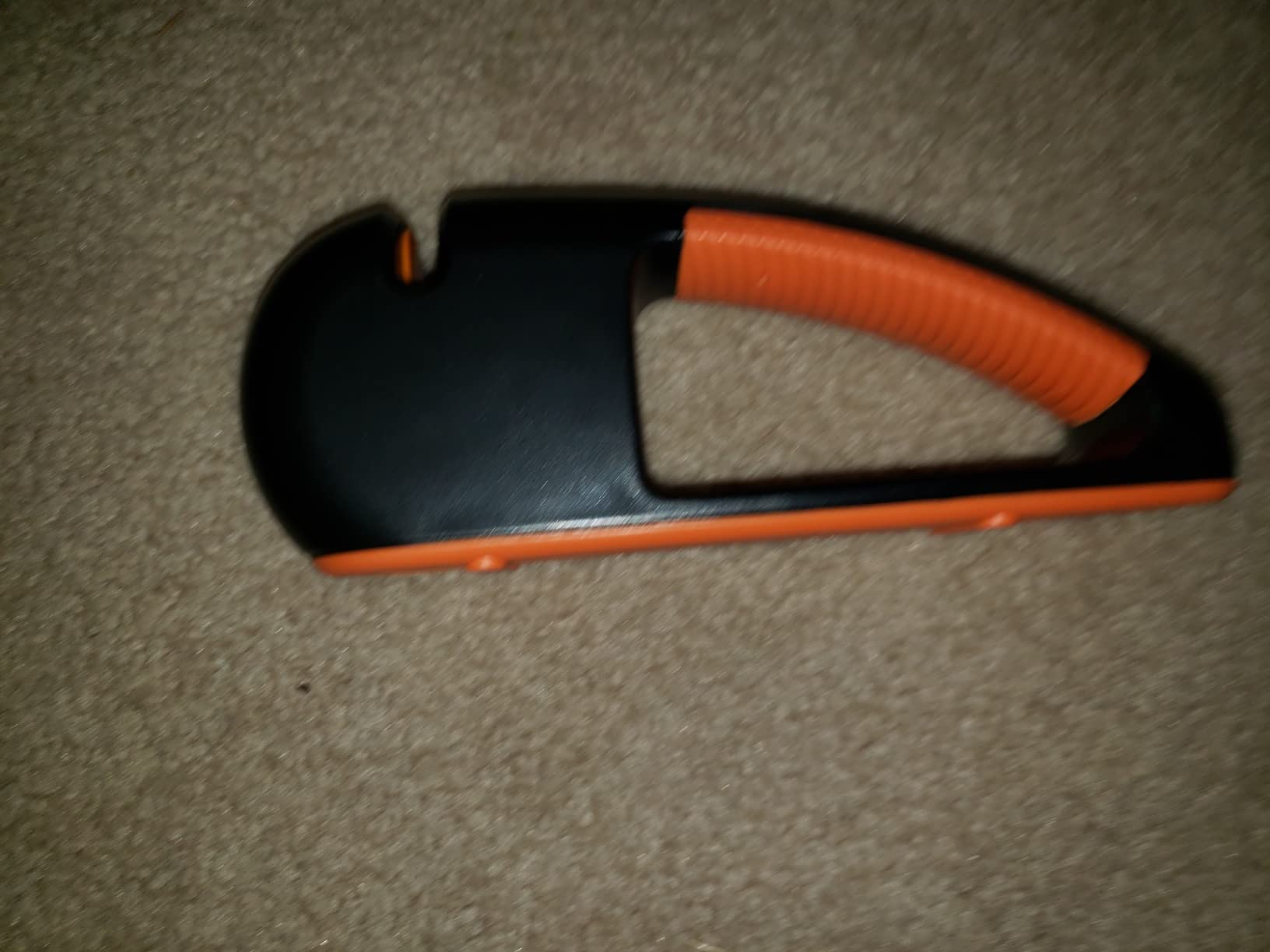
A serrated bread knife is the knife most people break and the one most sharpeners cannot fix. The teeth are set at an alternating angle, and running them through a fixed-slot sharpener just rounds them off further. The Orange Ninja is the one budget manual tool here built around that problem, with a separate fourth slot shaped for serrations.
The other three slots run a normal progression, coarse carbide for repair, medium diamond for refining, and a fine pass for polish. On a straight-edged utility knife the full four-stage run took us a little under a minute and produced a clean, working edge. The handle is angled and rubberised, and it works for either hand without re-gripping.
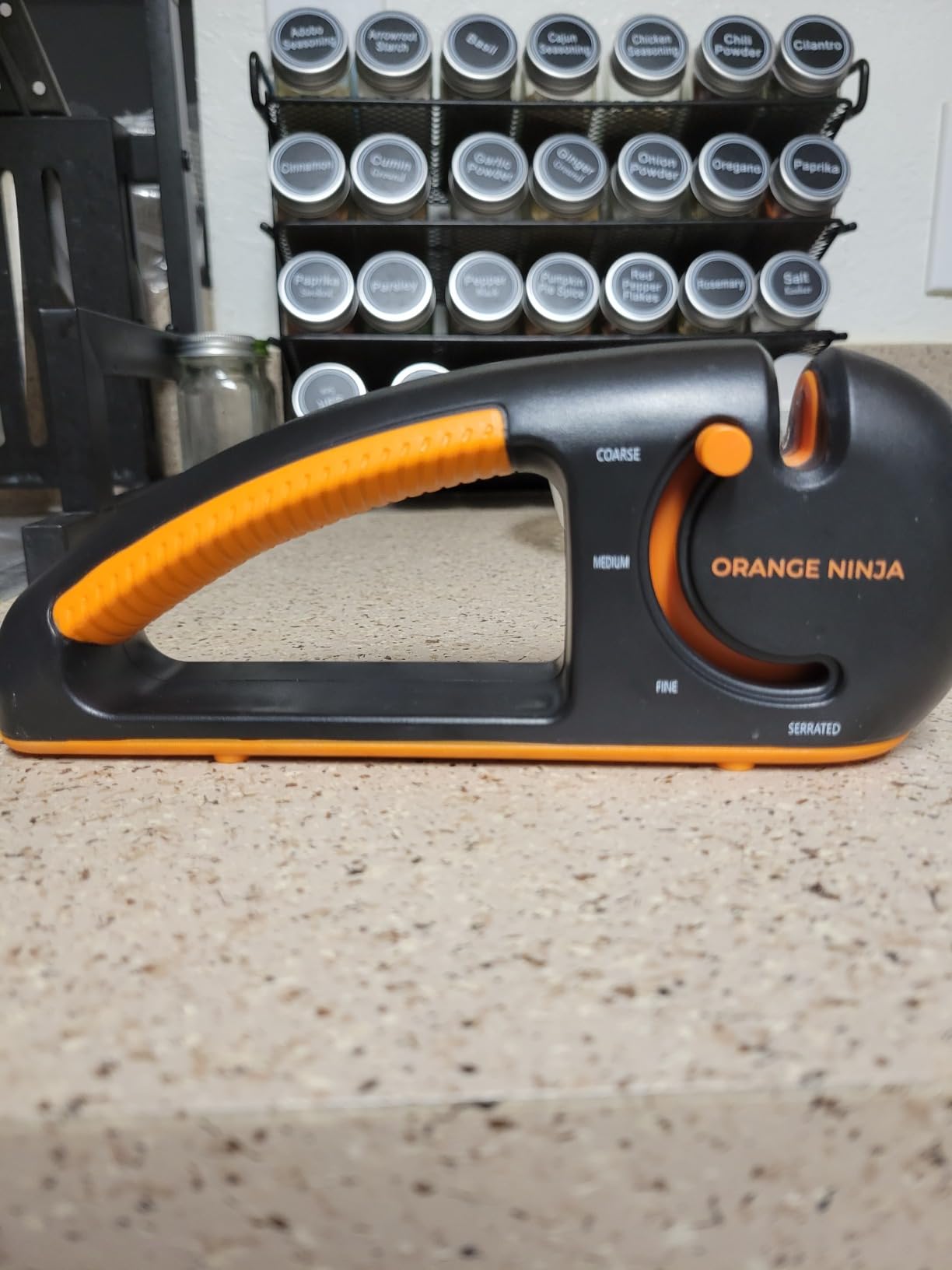
Its 4.3 average is the lowest in the group, and the reviews explain why. Users repeatedly mention that edges can still feel rough or jagged after the final slot, which is what you would expect from a tool that pushes steel through a fixed opening rather than letting you control the finish. It is also the bulkiest manual unit here at 8.18 by 3.3 inches.
None of that matters much if your main problem is a dull bread knife, because the serrated slot is the feature no competitor in this price bracket offers. It is also worth noting for anyone new to pull-through tools, the technique is one direction only, pull, never back and forth, since pushing the knife back scrapes abrasive across the edge you just formed.
Who should buy this one
Buy it if a serrated bread knife is the knife you actually use most and everything else in the drawer is a side dish. For a household with a single important serrated blade and a couple of general knives, four stages at this price point is a better allocation of features than two stages plus an angle dial. The ergonomic handle is a genuine plus for anyone with hand or grip issues.
Who should skip it
Skip it if edge finish is something you notice, because the recurring rough-edge reports are consistent enough to plan around. It is also the wrong tool for a thin Japanese edge, since the fixed slots force a single geometry. If you have no serrated knives at all, the KitchenIQ above is smaller, lighter, and better reviewed.
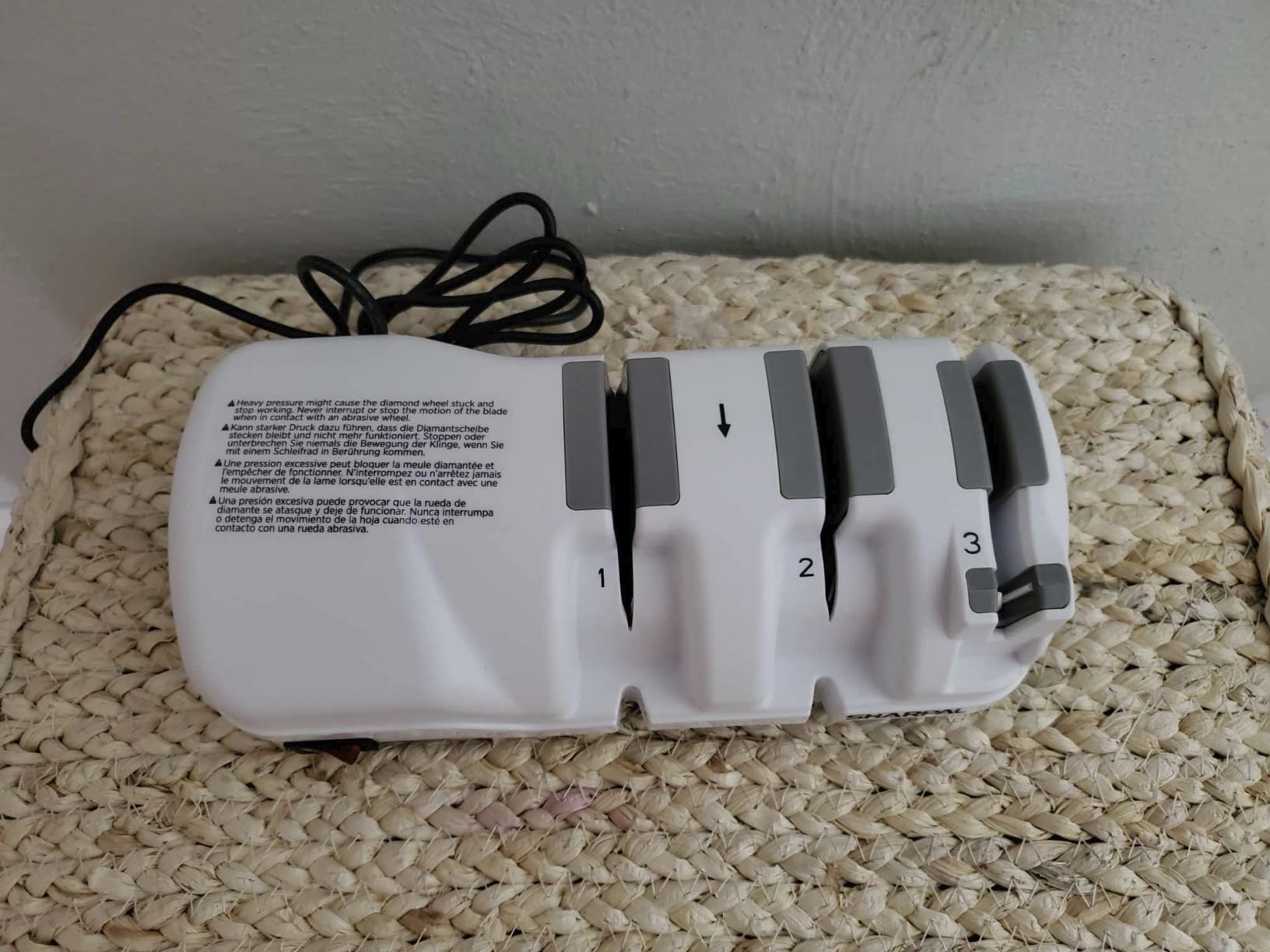
10. SHARPAL 198H Electric Sharpener — Best Compact Electric for Daily Use
SHARPAL 198H Electric Knife Sharpener 3 Stage with Diamond Wheels
Three stages grinding both bevels
Preset 20-degree angle
Diamond and ceramic wheels
Pros
- Grinds both sides of a double-bevel edge at once
- Quiet operation under 65 dB
- Magnetic filings receptacles make cleanup simple
- Overheat protection helps preserve blade temper
- Five or six pulls per stage
Cons
- Preset 20-degree angle cannot be adjusted
- Can groove the upper portion of the blade
- Harder to reach the heel on small pocket knives
The SHARPAL 198H is a small white machine with three stages that work both bevels simultaneously, which halves the time a two-stage electric needs. Stages run from coarse through to extra fine, and the wheels are monocrystalline diamond paired with pure ceramic, so the first stage reshapes while the last refines.
Two details separate it from the bargain electric sharpeners. It runs under 65 decibels, which matters in an open-plan kitchen, and it has overheat protection intended to avoid de-tempering a blade during a long session. The removable magnetic iron-filings receptacles are the feature we appreciated most, because collecting metal swarf from a machine is otherwise a wet cloth and a nuisance.
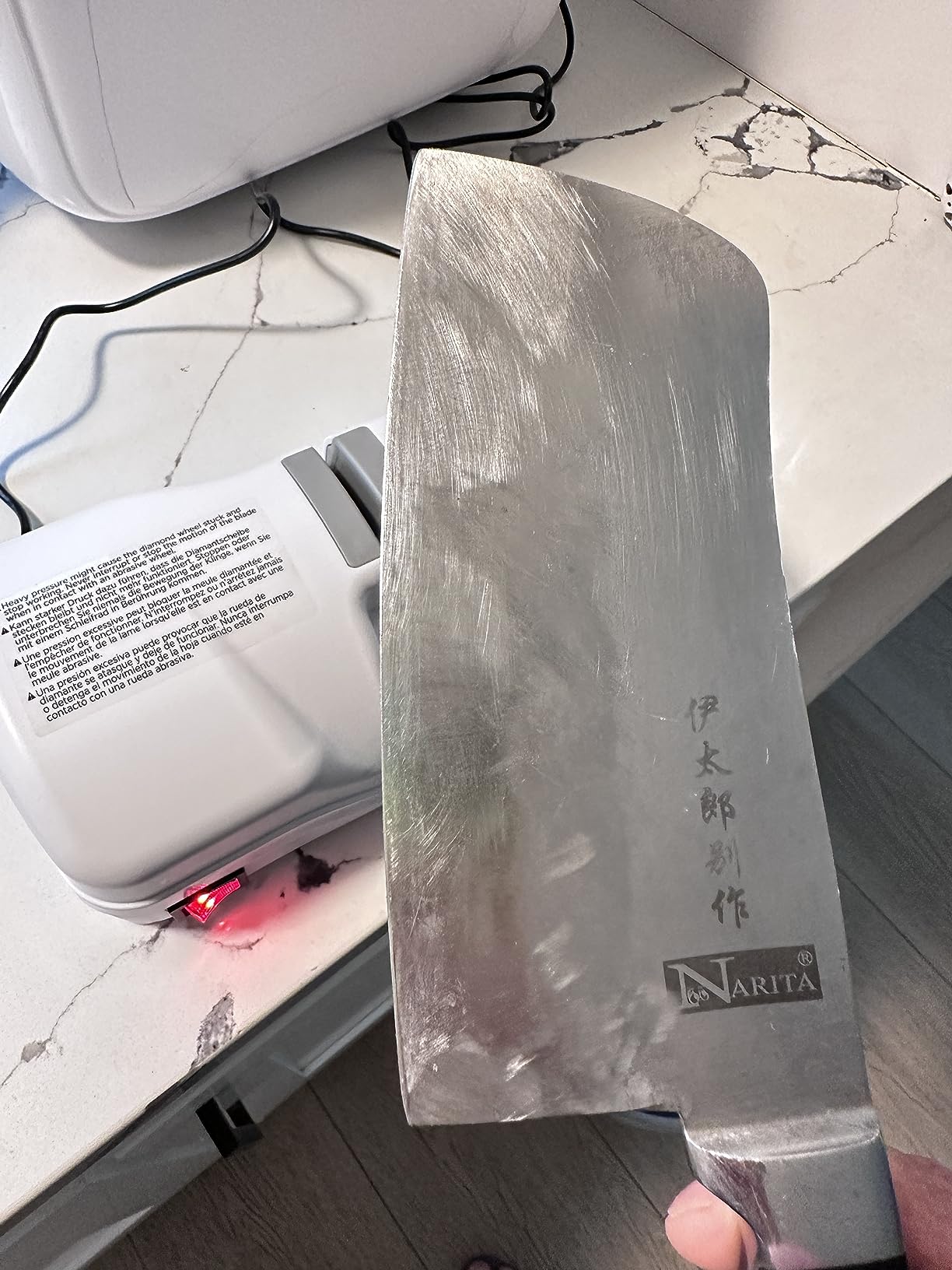
Owners who sharpen daily report the fastest consistent results of the electric options at this price, and the five to six pulls per stage figure in the reviews matches what we saw. Cleanup is genuinely a two-minute job with the magnetic collectors, and the machine itself is compact enough at 8.66 by 4.13 inches to live on a small counter.
The fixed 20-degree angle is the same limitation the Presto has, and it makes this a poor match for thin Japanese steel. A minority of owners also report cosmetic grooving on the upper portion of the blade near the heel, and the geometry makes the heel awkward to reach on a small pocket knife. It is built for double-beveled straight-edge kitchen knives, which is exactly what its own product listing says.
Where it beats the larger electric options
For a small kitchen or a shared flat, the combination of low noise, a compact body, and dual-bevel grinding is hard to argue with. You get a working edge in under a minute per knife without repositioning the blade between sides, and the magnetic collectors mean you are not chasing metal dust across the worktop afterwards. The 12V adapter also makes it more portable than a fixed-cord machine.
Where it will fall short
It cannot touch a serrated bread knife, it cannot change the angle, and it cannot sharpen scissors, so the Work Sharp MK2 covers a much wider range of tools. If you have a valuable single-bevel Japanese knife, do not put it through a 20-degree double-bevel machine, because both sides get ground at once and the geometry you paid for will not survive it.
How We Tested the Best Knife Sharpeners for Kitchen Knives
Every sharpener here was tested the same way, on the same knives, starting from the same deliberately damaged condition. We ran a straight-edged 8 inch German chef’s knife, a 6 inch serrated bread knife, and a thin-bladed utility knife through each tool, then cut a ripe tomato, a spring onion, and a sheet of paper with the result. The scoring below is what the ranking is built on.
Consistency of the edge. Did the knife cut cleanly on the first pass or need a second try, and did that hold across three sharpening sessions?
Steel removal. We measured the blade thickness at the edge before and after to see how much material each tool took, since over-sharpening is the single most repeated fear in sharpening communities.
Time per knife. Clocked from the moment the knife went in to the moment it came out, including setup.
Learning curve. We handed each tool to someone who had never sharpened a knife and counted how many attempts they needed before a usable edge.
Clean-up and containment. How much metal and abrasive dust ended up on the counter, and how long it took to deal with.
Build and consumables. Materials, warranty length, and whether replacement parts exist and how they wear.
We also read the review data closely, because ten thousand owners notice things a six week test does not. A small but consistent pattern in our reading: electric sharpeners are praised for speed and criticised for steel removal, manual pull-throughs are praised for simplicity and criticised for consumable wear, and angle-adjustable tools are praised for versatility and criticised for fiddliness. Our rankings reflect that split rather than papering over it.
Which Knife Sharpeners for Kitchen Knives Should You Actually Buy?
Start from your knives, not from the machine. If your rack is mostly straight-edged Western knives, a single-stage pull-through such as the AccuSharp will do almost everything you need in about ten seconds a blade, and it is the tool we recommend most often. If you also keep a serrated bread knife, add a dedicated serrated path, and the Orange Ninja is the cheapest way to get one.
If angle matters, it matters a lot. A 20-degree preset is correct for a German chef’s knife and wrong for a thin Japanese edge, and running a thin edge through a 20-degree machine makes it thicker every time you use it. For matching edge angles, the Chef’sChoice two-setting model covers the common cases, and the Sharp Pebble or RazorSharp cover unusual ones.
Choose electric when you sharpen weekly or when several people use the kitchen, because a powered machine removes the decision-making entirely. Choose manual when you sharpen occasionally, want to travel with the tool, or own a small kitchen where counter space matters. Both are legitimate answers, and the honest truth is that a good manual sharpener used properly will out-perform a cheap electric one used carelessly.
On abrasives, the short version is this: carbide is the toughest and holds an edge longest, diamond is the fastest-cutting and works on the hardest steels, ceramic is the smoothest finish but wears fastest, and sapphirite sits between diamond and ceramic in both respects. If you want to understand the sharpening stage structure better before you buy, our guide to electric knife sharpeners for home cooks breaks down what each wheel material actually does.
Two timing expectations help. A pull-through takes one to three minutes per knife once you know the motion, and a beginner needs two or three attempts before they get consistent results. An electric belt or wheel machine takes five to seven minutes including cool-down for a full multi-stage cycle. A whetstone session runs ten to thirty minutes, which is the real reason many home cooks buy a machine in the first place.
If you are still building a kit, our picks for chef’s knives for beginners and knife sets for home cooks tend to have factory edges in the 15 to 20 degree range, which is exactly the band every adjustable sharpener in this roundup covers.
Honing vs Sharpening: When You Actually Need Each
Honing and sharpening are not the same job, and confusing them is why people think their sharpener is broken. Honing straightens an edge that has rolled over from use, and it removes almost no steel. Sharpening forms a new edge by removing steel, and it is what actually restores a knife that has lost its bite.
A honing rod or ceramic rod is a maintenance tool, not a sharpener. Hold it at roughly 20 degrees to the blade and run alternating passes on both sides with light pressure, using a burr as your guide. A knife that is merely tired after a week of prep needs honing. A knife that will not slice a tomato at all needs sharpening, and a rod will not do it.
That distinction matters when you are shopping. Any of the fixed-angle manual sharpeners above doubles as a honing tool if you use the fine stage only, which is why the three-stage models are more versatile than single-stage ones. The electric machines with a fine final stage do the same job in seconds. If you want a dedicated honing tool, note that no picker in this roundup is one, and ceramic rods are worth considering separately.
What You Should Never Put in a Sharpener
Serrated bread knives are the number one exception, and the damage is rarely reversible. Only use a tool with a dedicated serrated slot, such as the Orange Ninja, or a purpose-made serrated sharpener. Running a scalloped blade through a fixed-slot machine rounds the teeth and can leave you with a knife worse than the one you started with.
Single-bevel Japanese knives should stay away from any double-sided machine. A double-bevel electric sharpener grinds both faces at once, which destroys the flat back bevel that defines the cut. Hand sharpeners with a selectable angle are safer, but a whetstone is still the right tool for a blade you have invested hundreds in.
Scissors with plastic or coated handles, ceramic blades, and any knife with a hollow-ground or very thin geometry are also poor candidates. If a blade has been through the dishwasher for a year, manual stones and pull-throughs may not recover it, and an electric machine is the only realistic option, though it will take more steel than you would like.
Frequently Asked Questions
What type of knife sharpener works best?
It depends on your knives and how often you cook. A single-stage pull-through such as the AccuSharp is the best general tool for straight-edged Western knives. A manual model with selectable angles such as the Chef’sChoice suits a mixed collection, while an electric machine like the Presto EverSharp is fastest for households that sharpen weekly. Serrated bread knives need a dedicated serrated slot, and single-bevel Japanese knives should go to a whetstone rather than any machine.
What is the absolute best knife sharpener for kitchen knives?
For most home kitchens the AccuSharp Carbide Sharpener is the strongest all-round choice. It holds the highest average rating in our group at 4.7 across more than 28000 reviews, sharpens most blades in about ten seconds, works on straight and serrated knives, and its reversible carbide blades avoid the consumable costs that wear out stone-based pull-throughs within a couple of years.
How long should it take to sharpen a knife?
A manual pull-through takes one to three minutes per knife once you have the motion down, and beginners should expect two or three attempts. An electric machine with two or three stages takes five to seven minutes for a full cycle. A whetstone session runs ten to thirty minutes because you are forming and refining a burr by hand. Slower does not mean better, it means you are removing more steel than the job required.
What kind of sharpener works on serrated knives?
Only a sharpener with a dedicated serrated slot or a purpose-made serrated sharpener. Among the tools we tested the Orange Ninja 4-Stage is the only manual model with a separate serrated stage, and the AnySharp GLOBAL works on serrated edges because its tungsten carbide elements follow the tooth pattern. Fixed-slot electric sharpeners and manual pull-throughs with plain slots will round serrations rather than restore them.
Is the chef’s choice knife sharpener any good?
Yes, particularly if you care about matching bevel angle to your knife. The model we tested uses 100 percent diamond abrasives across all stages, sharpens both bevels at once with its CrissCross system, and offers selectable 15 and 20 degree settings so a thin Japanese edge or a standard European chef’s knife both get the geometry they were built for. It is backed by a 10-year warranty.
Should you sharpen a new knife?
Usually not right away. A factory edge is already true and matched to the blade, and sharpening a new knife mostly removes steel you did not need to lose. Hone it instead with a rod to straighten the edge after the first few weeks of use, and wait until it genuinely stops cutting cleanly before you reach for a sharpener. Our own pre-dulled test knives show how different a factory edge feels once the bite is gone.
Is a whetstone required if you own an electric sharpener?
Not required, but a whetstone gives you control an electric machine cannot. Machines work at a fixed angle and a fixed rate of steel removal, which is fine for most knives and wrong for single-bevel Japanese blades. If you own a whetstone already, an electric machine makes sense for speed on your everyday knives, and you can reserve the stone for edges that need careful angle work.
Should I push or pull when sharpening a knife?
Always pull, and never draw the blade back and forth through a fixed slot. Pushing the knife back scrapes abrasive across the fresh edge you just formed and dulls it immediately. With pull-through sharpeners use light even pressure, let the tool do the work, and count your passes rather than forcing. With stones, use the direction the manufacturer recommends for that plate and keep the angle constant throughout the stroke.
Our Verdict on Knife Sharpeners for Kitchen Knives in 2026
Buy the AccuSharp Carbide Sharpener if you want one tool that works in ten seconds, handles straight and serrated blades, and will not need consumable parts for years. It is our editor’s choice for the best knife sharpeners for kitchen knives because it is the least complicated thing here that genuinely works, and it is also the highest rated.
Spend up to the Work Sharp MK2 Electric if you want one machine for the whole property, including scissors, axes, and garden tools, and you are willing to replace belts on hardened steel. Choose the Chef’sChoice manual 2-Stage or the Sharp Pebble Precision Adjust 5 if you own a mixed collection and want to match bevel angles rather than overwrite them. If a serrated bread knife is your main blade, start with the Orange Ninja.
Whatever you choose, the habit matters more than the hardware. Hone weekly, sharpen only when the edge actually dulls, and keep every blade out of the dishwasher. Those three rules will do more for your knives than any machine on this list. Check the current details for any of these picks before you order, and add a ceramic honing rod to whichever sharpener you settle on.