
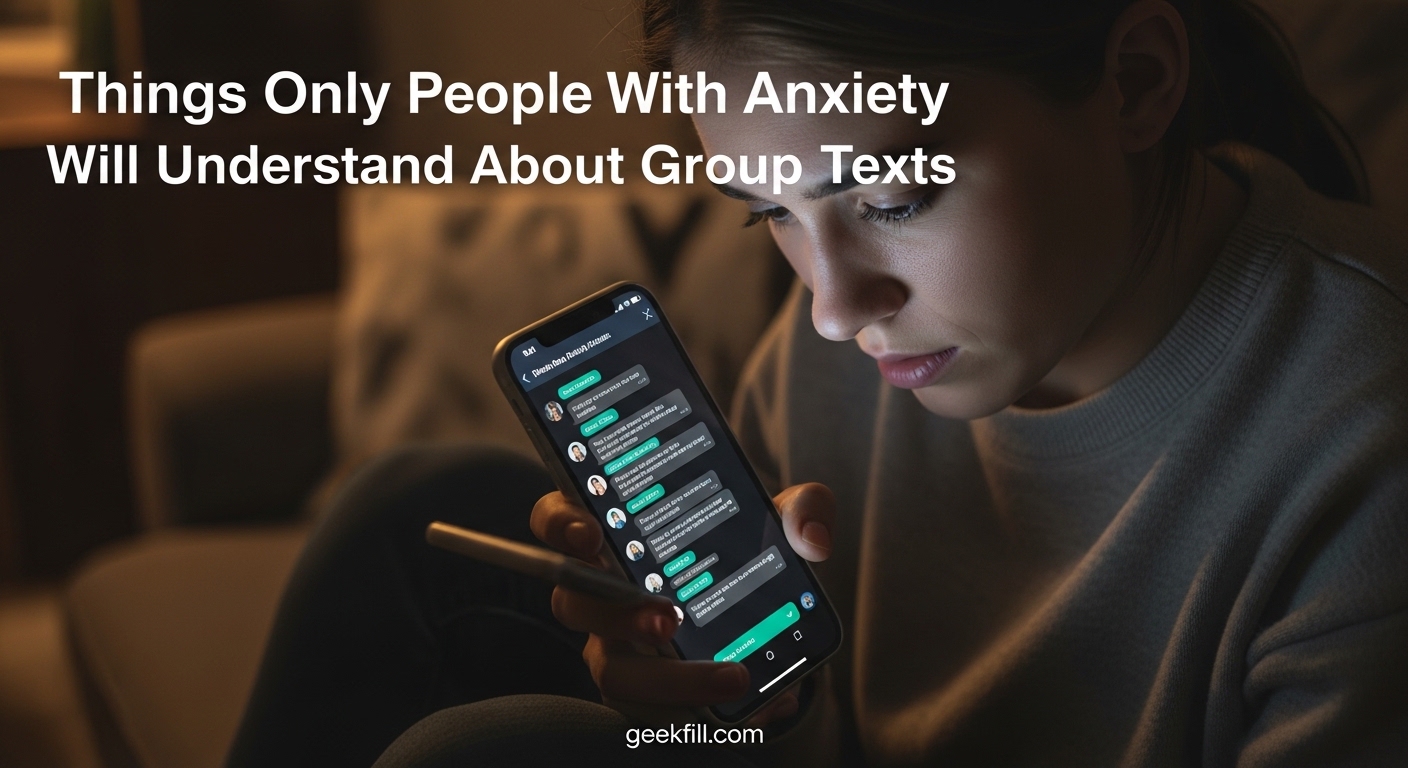
If you have group text anxiety, you already know that group chats are not just casual conversations. They are emotional minefields where every notification feels like a potential threat and every message you send requires the kind of planning usually reserved for diplomatic negotiations.
You are not alone in this. Millions of people experience group chat anxiety that manifests in very real physical and emotional ways. Our team has researched this extensively, and the data shows that texting anxiety affects people across all demographics, from teenagers to professionals in their 50s.
This article explores 10 specific experiences that people with anxiety understand deeply about group texts. These are the moments that make your heart race, your palms sweat, and your mind spin into overthinking mode. By the end, you will feel seen, validated, and hopefully a bit more equipped to handle the digital group dynamics that trigger your anxiety.
Table of Contents
How to Find All Your Group Text Anxiety Triggers (And Why You Need To)
Before diving into the list, it helps to understand what we mean by group text anxiety. This is not just feeling slightly awkward in a chat. It is a specific form of social anxiety that activates your nervous system every time you interact with group messaging platforms.
The physical symptoms are real. Your racing heart, sweaty palms, and that pit in your stomach when you see a notification are genuine stress responses. Your brain is treating group texts like potential threats, which triggers your fight-or-flight response even when you are sitting safely on your couch.
Understanding these triggers is the first step toward managing them. You cannot fix what you do not acknowledge. So as you read through these 10 items, notice which ones resonate most with your experience. Those are your personal anxiety signatures, and recognizing them gives you power over them.
10 Things Only People With Anxiety Will Understand About Group Texts
1. The Heart-Racing Moment You See a Notification
Your phone buzzes. You see the group chat icon appear on your screen. Instantly, your heart is pounding like you just ran a sprint.
This is perhaps the most universal sign of notification anxiety. Before you even read the message, your body has already launched into panic mode. The anticipation of what might be waiting in that chat is enough to trigger genuine physical symptoms of anxiety.
One forum user described it perfectly: “My heart still races when I message in a group chat even though my self-worth has never been better.” This tells us something important. Even people who feel good about themselves overall can still experience these involuntary physical reactions to group texts.
The racing heart, the sweaty palms, the shallow breathing. These are your body’s way of preparing for a perceived threat. Your nervous system cannot tell the difference between a lion chasing you and a group chat notification. Both trigger the same stress hormones.
What makes this particularly frustrating is that the physical response often happens before your rational mind has a chance to assess the situation. You are reacting to a threat that might not even exist. The message could be completely neutral or even positive. But your body has already decided you are in danger.
2. Taking 45 Minutes to Write a Two-Word Reply
“Sounds good.” Two simple words. Should take two seconds to type. But for someone with group text anxiety, this reply requires 45 minutes of careful consideration.
This is the perfectionism trap that texting anxiety creates. You type the message. You delete it. You try a different tone. You add an emoji. You remove the emoji. You wonder if “sounds good” sounds too casual. Maybe “that works for me” is better. Actually, maybe you should just say “okay” with a thumbs up.
Every word choice feels loaded with potential for misinterpretation. You are hyperaware that text lacks tone, facial expressions, and context. Your “sounds good” could be read as enthusiastic agreement or sarcastic resignation. You have no control over how others will interpret your words.
The overthinking spiral gets worse in group settings because you are performing for multiple people at once. In a one-on-one text, you only need to worry about one person’s reaction. In a group chat, you are broadcasting to an audience. Each member might interpret your message differently.
By the time you finally hit send, you have probably rewritten your two-word reply at least a dozen times. And then the second you send it, a new wave of anxiety hits. Did you use the right words? Should you have added more context? The cycle continues.
3. The Conversation Moves On Before You Finish Typing
You see a message in the group chat. You start crafting a thoughtful response. You are being careful with your wording, making sure you strike the right tone. Ten minutes later, you are ready to send. You look up and realize the conversation has completely shifted.
They are now talking about something entirely different. Your carefully composed message about the previous topic no longer makes sense. The moment has passed. Your window of relevance has closed.
This is one of the most frustrating aspects of group text anxiety. Your need to overthink and perfect your response works directly against the fast-paced nature of group messaging. The conversation flows at a speed your anxious brain cannot match.
As one person in our research put it: “It can take me ages to write a reply thanks to overthinking, so by the time I’m ready the conversation has moved on.” This creates a painful paradox. The more anxious you are about saying the right thing, the more likely you are to miss your chance to say anything at all.
Then you face a new decision. Do you send your now-irrelevant message anyway? Do you try to adapt it to the new topic? Or do you just delete it and accept that you have missed this conversational beat? Each option carries its own anxiety.
4. Reading Every Message But Never Responding
You are active in the group chat. You are reading every single message as it comes in. You are completely up to date on the conversation. But nobody would know you are there because you never actually respond.
This is avoidance behavior at work. Your fear of judgment and social pressure keeps you in a perpetual state of lurking. You want to participate. You have things to say. But the risk of saying something wrong feels greater than the reward of being part of the conversation.
Digital group chats create a unique social dynamic where you can be present without being seen. You can maintain your social connection by staying informed without exposing yourself to the risk of public speaking. It feels safer to observe than to participate.
But this safety comes at a cost. The more you avoid responding, the harder it becomes to break the silence. After a while, your lack of participation becomes noticeable. You worry that if you suddenly start responding now, people will wonder where you have been. The longer you wait, the bigger the barrier to entry becomes.
You tell yourself you will respond to the next message. Then the next one. Then the next one. Before you know it, you have read 47 messages and contributed nothing. The chat moves on without you, and you feel both relieved and isolated at the same time.
5. The Spotlight Effect: Feeling Like Everyone’s Watching
You send a message in the group chat. Even though you know it is just text on a screen, you feel like you are standing on a stage under a spotlight. Every member of the group is staring at your message, analyzing it, judging it.
This is the spotlight effect in action. Your brain convinces you that you are the center of attention and that everyone is scrutinizing every word you type. In reality, most people are barely paying attention. They are skimming messages, not analyzing them. But your anxiety tells a different story.
As one forum member shared: “Even in friendly groups, I feel like there’s a spotlight on everything I say no matter how normal it is.” This captures the essence of group chat anxiety. The feeling persists even when you logically know the environment is safe and supportive.
The spotlight effect creates hyperfixation on your own contributions. After you send a message, you cannot stop thinking about it. You keep checking to see if anyone has responded. You analyze the timestamps of other people’s replies. If someone responds quickly, you worry they are being dismissive. If they take a while, you worry they are drafting a criticism.
This constant sense of being watched drains your mental energy. Every message feels like a performance. You are seeking social validation while simultaneously dreading potential negative judgment. The result is a state of perpetual social exhaustion.
6. Analyzing Punctuation Like It’s a Secret Code
Someone in the group chat sends “Okay.” Just that. One word with a period. Your anxiety brain immediately launches into analysis mode. Why the period? Are they mad? Did I say something wrong? A simple “okay” without punctuation would have been fine. But that period feels loaded with passive-aggressive subtext.
This is the misinterpretation problem that makes group text anxiety so exhausting. Text-based communication strips away the vocal tone, facial expressions, and body language that normally help us interpret meaning. Without these cues, your anxious brain fills in the gaps with worst-case scenarios.
You become obsessed with tone indicators that do not actually exist. An exclamation point means enthusiasm or shouting or sarcasm depending on your current anxiety level. A lack of emoji means someone is serious or angry or no longer wants to be friends. Every punctuation choice becomes a potential threat signal.
The overthinking extends to your own messages too. You spend five minutes deciding whether to end your sentence with a period or an exclamation point or nothing at all. You worry that a period makes you sound cold. An exclamation point makes you sound too eager. No punctuation makes you sound like you do not care.
Group chats amplify this problem because multiple people are contributing to the conversation. You are not just decoding one person’s communication style. You are trying to interpret the unique texting patterns of several different people simultaneously. It is like trying to solve multiple puzzles at once while everyone watches.
7. Group Chats With Family Hit Different
Friend group chats are stressful. Work group chats are stressful. But family group chats operate on an entirely different level of anxiety. The combination of love, obligation, history, and generational communication preferences creates a perfect storm of group text anxiety.
Family chats often have their own social hierarchy that everyone implicitly understands but never discusses. The family matriarch or patriarch sends messages that require immediate acknowledgment. Various family members have different expectations about response times. Some relatives send long, detailed updates while others send single-word replies.
The stakes feel higher in family chats because these are your people. You cannot just mute the chat and walk away without emotional consequences. Family ties create an obligation to participate that does not exist in friend or work groups. Ignoring the family chat feels like ignoring your family.
Generational differences in digital communication add another layer of anxiety. Older family members might not understand sarcasm, memes, or informal texting language. Younger members might find formal responses stuffy and distant. Navigating these different communication preferences while trying to be yourself is exhausting.
Then there is the family history factor. Your family knows all your old patterns, mistakes, and growth areas. When you send a message, you are not just communicating information. You are navigating complex family dynamics that have been developing for decades. Every message carries the weight of that history.
8. The Silent Panic of Read Receipts
You send a message in the group chat. You see the little “read” indicator appear. Three people have seen your message. You watch the timestamps. Sarah read it 2 minutes ago. Mike read it 1 minute ago. Jessica just read it 30 seconds ago. None of them have responded yet.
This is read receipt anxiety in its purest form. You know they have seen what you wrote. You know they are probably doing something else. But your anxious brain spins a different narrative. They are ignoring you on purpose. They are talking about your message in a side conversation. They are drafting a response telling you that you said something wrong.
The response time anxiety becomes almost unbearable. Every passing minute without a reply feels like evidence of social rejection. You start doing mental math about how long is too long. If they respond in under 5 minutes, that is normal. If it takes 15 minutes, maybe they are busy. If it takes an hour, you have definitely offended everyone.
Exclusion anxiety kicks in when you see other people active in the chat but not responding to your specific message. They are talking to each other but not to you. Your message sits there, read but unacknowledged, while the conversation flows around it. You feel invisible and exposed at the same time.
The logical part of your brain knows that people have lives. They are at work, or driving, or making dinner, or just not in the mood to text. But anxiety is not logical. It takes the absence of immediate validation and turns it into evidence of social failure.
9. Muting the Chat But Checking It Constantly Anyway
You have muted the group chat notifications because they were causing too much anxiety. The constant buzzing was disrupting your day and your mental health. You made a healthy boundary decision. You should feel relieved.
Instead, you find yourself opening the chat app every 10 minutes to check what you missed. You have eliminated the push notifications but replaced them with a compulsive pulling behavior. The FOMO or fear of missing out is stronger than your desire for peace and quiet.
This is the paradox of managing group text anxiety. You take steps to protect yourself, but your anxiety finds new ways to maintain control. Muting the chat was supposed to give you space. Instead, you are now manually checking more frequently than the notifications ever appeared.
The reassurance seeking drives this behavior. You need to know what is happening even though knowing makes you anxious. You cannot stand the uncertainty of not knowing if someone responded to your message or if the group made plans without you. The anxiety of not knowing feels worse than the anxiety of knowing.
You tell yourself you are just being responsible. You do not want to miss important information. But really, you are trapped in a cycle where the only relief comes from checking, and checking only brings more anxiety. It is a self-perpetuating loop that feels impossible to break.
10. The Pure Relief When Someone Else Says What You Were Thinking
You have been agonizing over whether to express an opinion in the group chat. You have typed and deleted your message three times. You are worried about how it will be received. Then someone else sends almost exactly what you were thinking.
The relief is immediate and overwhelming. You feel validated. You feel seen. Most importantly, you feel off the hook. You do not have to say it anymore. Someone else has carried the social risk for you. You can simply agree with them and still be part of the conversation.
This is the power of belonging cues in group dynamics. When someone else validates your perspective, it signals that your thoughts are acceptable. The social validation reduces your anxiety about expressing yourself. You realize you were not wrong for thinking what you thought. Someone else thinks it too.
For people with inclusion anxiety, these moments are precious. They confirm that you are not an outsider with weird opinions. You are part of the group, and your perspective aligns with others. The shared experience creates a sense of safety that is rare in group text situations.
You respond with a simple “Yes, exactly what I was thinking” and a heart emoji. For once, you do not overthink your response. You do not rewrite it. You do not worry about the punctuation. You feel connected and understood, if only for this one moment.
Frequently Asked Questions
What is the 10-10-10 rule for anxiety?
The 10-10-10 rule is a practical technique for managing anxious thoughts. When you feel anxious about something, ask yourself three questions. How will I feel about this in 10 minutes? How will I feel about this in 10 months? How will I feel about this in 10 years? This perspective shift helps you recognize that most anxiety triggers are temporary. What feels overwhelming right now will likely be forgotten soon. This rule is especially useful for group text anxiety when you are overthinking a message you sent or received.
Why do group texts give me anxiety?
Group texts trigger anxiety for several interconnected reasons. The lack of tone indicators makes it easy to misinterpret messages negatively. Fear of judgment creates pressure to perform perfectly in front of multiple people. Response time expectations create urgency that conflicts with thoughtful communication. The speed of conversation can leave you feeling left behind. FOMO and exclusion fears activate when you see others responding to each other but not to you. These factors combine to create a social environment that feels threatening to an anxious brain. Understanding these triggers is the first step toward managing them.
Is texting anxiety a real thing?
Yes, texting anxiety is absolutely a real and recognized experience. It falls under the broader umbrella of social anxiety and is increasingly common in our digital-first communication landscape. Mental health professionals acknowledge that digital communication creates unique anxiety triggers that did not exist in previous generations. The physical symptoms are real, including racing heart, sweating, and stomach discomfort. The psychological distress is real, affecting your mood and daily functioning. If texting anxiety is interfering with your relationships or well-being, it is worth addressing with a therapist or counselor who can provide coping strategies.
How can I deal with group chat anxiety?
Managing group chat anxiety involves both practical boundaries and cognitive strategies. Turn off read receipts so you are not constantly monitoring who has seen your messages. Use Do Not Disturb mode to batch your chat checking instead of responding to every notification immediately. Set personal rules like only checking group chats at certain times of day. Practice the 10-10-10 rule when you find yourself overthinking. Remember that most people are not analyzing your messages as closely as you think. If group chat anxiety is significantly impacting your life, consider talking to a therapist who specializes in social anxiety or cognitive behavioral therapy. Professional support can provide personalized strategies for your specific anxiety patterns.
You’re Not Alone In This
If you recognized yourself in even a few of these 10 items, please know that you are not alone. Group text anxiety is a shared experience for millions of people. The racing hearts, the overthinking, the relief when someone else says what you were thinking. These are not personal flaws. They are normal responses to a communication format that strips away the social cues our brains rely on.
One of the most important things we learned from our research is that even people with excellent self-worth and strong social skills still experience this anxiety. As one person put it: “Texting is way easier than talking in person but at the same time it’s still nerve wracking.” This captures the paradox perfectly. The digital space is supposed to be easier, and in some ways it is. But it also creates new anxiety triggers that do not exist in face-to-face conversation.
The physical symptoms you experience are real. The mental exhaustion is real. Your feelings are valid, and they deserve attention. If group text anxiety is significantly impacting your life, consider reaching out to a mental health professional. Cognitive behavioral therapy, in particular, has shown excellent results for social anxiety and texting-specific anxiety.
Remember that you have options. You can set boundaries with your device. You can communicate your preferences to your groups. You can choose which conversations deserve your energy and which ones you can observe from a distance. Your relationship with group texts can change as you develop awareness and strategies.
You are not broken. You are not overly sensitive. You are a human navigating a relatively new form of social interaction that your brain is still learning to process. Be patient with yourself. Keep practicing. And know that somewhere out there, someone else is overthinking their punctuation in a group chat just like you are.
If you need immediate support for anxiety, please contact the 988 Suicide and Crisis Lifeline by calling or texting 988. For general mental health resources, visit the Anxiety and Depression Association of America at adaa.org.