
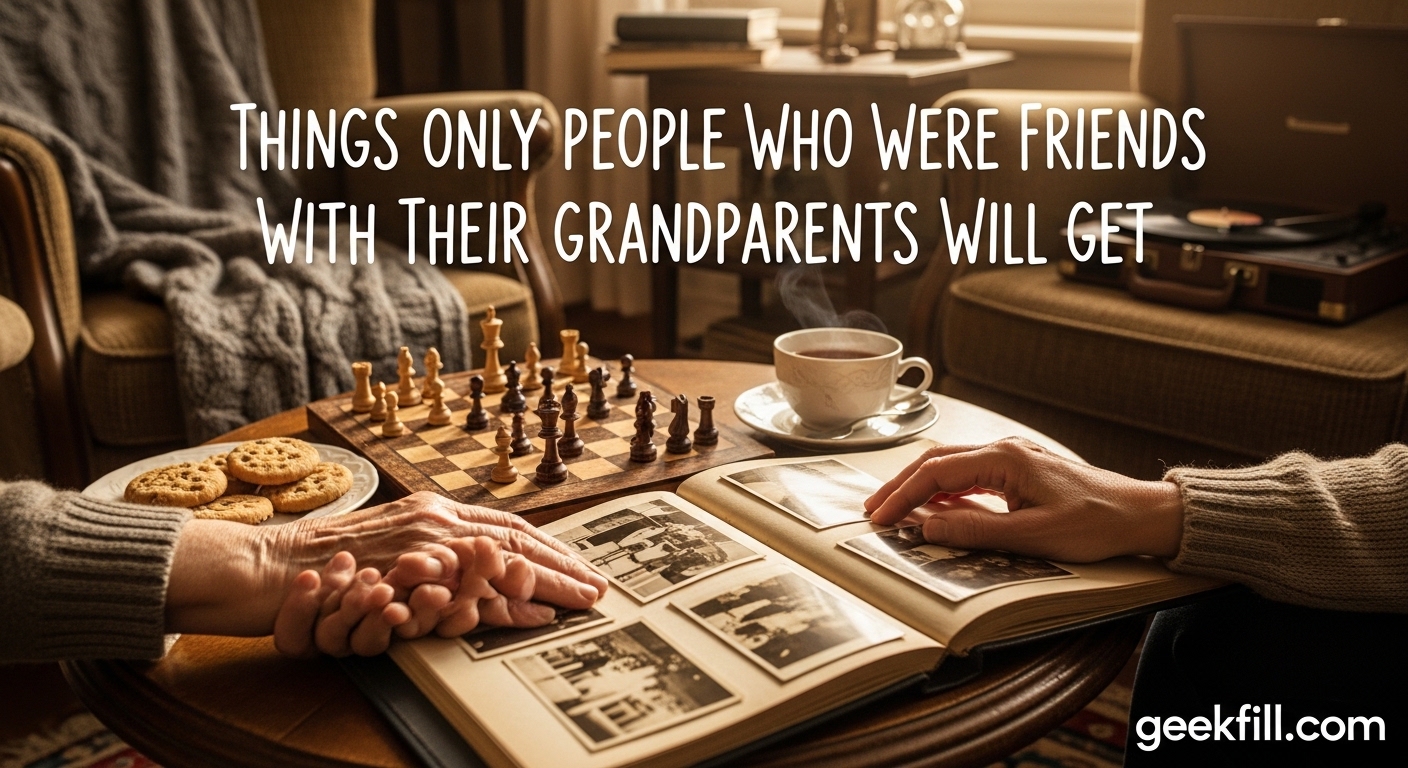
Some houses have a smell you can never forget. For me, it was my grandmother’s kitchen: coffee brewing in the percolator, cinnamon from last night’s dessert still hanging in the air, and something else I could never quite name. Years after she passed, I walked into a bakery and nearly burst into tears. That was it. That was the smell.
If you were friends with your grandparents, you know exactly what I mean. This is not about the obligatory Sunday visits or the presents at holidays. This is about the kind of friendship that shapes who you become. Things only people who were friends with their grandparents will get.
Research backs up what we already feel in our bones. Studies show that grandchildren who had close relationships with their grandparents display higher emotional intelligence, greater resilience during stressful times, and a stronger sense of family identity. But the real magic? It is the collection of small moments that nobody else quite understands.
Table of Contents
15 Things Only People Who Were Friends With Their Grandparents Will Get
1. The Secret Language of Inside Jokes
Every grandparent-grandchild friendship develops its own dialect. The way your grandpa would wink when he said “nice weather we’re having” because that meant you both knew the cookies were ready. The code words for things you were not supposed to mention around parents.
I still catch myself saying phrases my grandmother used, and I am certain nobody else knows why I find them funny. That is the thing about grandparent friendships: they create a private world. You could be in a room full of people and exchange one look with your grandparent that communicated everything.
These inside jokes become part of your permanent vocabulary. Decades later, you will say something and suddenly remember where it came from. It is like carrying a piece of them in your speech patterns forever.
2. The Comfort of Unhurried Time
Parents are busy. They have jobs and bills and a thousand things pulling at their attention. But grandparents? Grandparents had time. Real, actual, unhurried time.
I remember sitting on my grandfather’s porch for hours, watching the world go by. No agenda. No clock watching. Just being. That quality of attention is rare now, and it was precious then. When you were with your grandparents, you were not an interruption or an item on a to-do list. You were the main event.
This slow-paced presence taught me that time does not always need to be filled with productivity. Sometimes the best moments happen in the spaces between activities.
3. The Wisdom That Arrives Decades Later
My grandmother used to tell me that things have a way of working out. I would roll my eyes. What did she know about my very serious teenage problems?
Turns out, she knew plenty. The advice grandparents give often makes no sense when you are young. It sounds simplistic or old-fashioned. Then life happens, and suddenly those words click into place with perfect clarity.
Grandparents have the advantage of perspective. They have lived through wars, recessions, losses, and joys. When they tell you that this too shall pass, they are speaking from experience. You just might not understand that until you are old enough to have some experience of your own.
4. The Magic of Handwritten Letters
In an age of instant messaging, there is something almost sacred about a handwritten letter. My grandmother wrote to me every month when I went away to college. Not emails. Actual letters, in her unmistakable cursive, usually including a five-dollar bill for “coffee and a treat.”
I kept every single one. There is something about holding paper that someone held, reading words they formed with their own hand. It feels intimate in a way that screens never quite replicate. The slant of the letters, the places where the pen pressed harder, the little smudges where they paused to think.
Handwritten letters are time capsules. You can read them years later and hear their voice again.
5. The Kitchen as a Sanctuary
For many of us, the kitchen at grandma’s house was sacred ground. It was where recipes were passed down not through written instructions but through standing side by side, learning the feel of dough and the smell of done.
I learned to make my grandmother’s biscuits by watching her hands, not reading a recipe. “Until it feels right,” she would say. That drove me crazy as a kid who wanted exact measurements. Now I understand. Some things cannot be written down.
The kitchen was also where conversations happened. While kneading bread or peeling potatoes, stories emerged. Confessions felt easier with your hands busy and your grandparent beside you.
6. The Gift of Being Truly Seen
Parents see their children through the lens of responsibility. They worry about grades and behavior and whether you will become a functioning adult. Grandparents see you through the lens of delight.
My grandfather never asked about my grades. He asked about my dreams. He wanted to know what I was reading, what I was thinking, who I was becoming. There was no pressure to perform, no fear of disappointing. Just pure, uncomplicated interest in me as a person.
This kind of unconditional acceptance creates a foundation of security. When someone sees you clearly and loves you anyway, you learn that you are enough exactly as you are.
7. The Stories That Became Your Foundation
Grandparents are living history books. They know where you came from, literally and figuratively. The stories they tell shape your understanding of yourself.
I learned from my grandmother that our family came through Ellis Island with nothing but a suitcase and hope. I learned that my grandfather quit a secure job to start his own business during a recession. These stories of courage and risk-taking became part of my internal narrative.
When you know your family stories, you understand that you are part of something larger than yourself. You carry their strength even when you do not realize it.
8. The Art of Patient Listening
In a world of constant interruption, grandparents were the masters of listening. They did not look at their phones while you talked. They did not rush you to the point or finish your sentences.
I could ramble for twenty minutes about something that happened at school, and my grandmother would listen to every word. She would ask follow-up questions. She remembered names and details from previous conversations. Being heard like that teaches you that your thoughts matter.
Patient listening is becoming a lost art. Those of us who learned it from our grandparents carry a valuable skill that makes us better friends, partners, and parents.
9. The Joy of Simple Pleasures
Grandparents knew how to be entertained without screens. Card games that lasted hours. Puzzles spread across the dining table for days. Walks that had no destination.
I spent countless afternoons playing gin rummy with my grandmother while she made breakfast at 6am. Just the two of us, the quiet morning, and the rhythm of dealing cards. No flashing lights or notifications. Just presence and simple pleasure.
These analog activities taught me that entertainment does not require batteries or WiFi. Sometimes the best moments are the slow ones.
10. The Safety Net of Unconditional Love
No matter what happened, my grandparents were there. Bad grades, broken hearts, stupid mistakes: their love never wavered. That kind of security is a gift that keeps giving throughout your life.
Knowing you have people who will love you even when you mess up creates emotional resilience. It gives you the courage to take risks because you know there is a soft place to land if you fall.
Grandparents often play the role of the unconditional supporter while parents handle the discipline and structure. That balance is crucial for healthy development.
11. The Lessons in Imperfection
Grandparents were not trying to be perfect, and that was refreshing. They let you see them struggle with technology, burn the toast, or forget where they put their glasses. They were human, and they were okay with it.
This modeling of imperfection was liberating. When the adults in your life accept their own flaws, you learn to accept yours too. You do not have to be perfect to be worthy of love.
I watched my grandmother laugh at her own mistakes. She taught me that dignity is not about never failing. It is about how you handle yourself when you do.
12. The Power of Presence Over Presents
Sure, grandparents often spoiled us with treats and small gifts. But the real gift was their presence. They showed up. To recitals and games and just regular Tuesday afternoons.
Research shows that what children remember most is not the things they received but the time they spent. My grandmother’s attendance at my sixth-grade band concert meant more than any toy she could have bought me. I was terrible at the clarinet, but she sat through the whole thing and asked me to play her favorite song again at home.
Presence is the only gift that cannot be wrapped, but it is the one that lasts forever.
13. The Comfort of Familiar Routines
Every grandparent household had its rhythms. Sunday dinner at four. The specific way the couch cushions had to be arranged. The TV shows that played at certain times.
These routines created a sense of safety and predictability. In a world that often felt chaotic, grandma’s house was an island of sameness. You knew what to expect, and that was comforting.
Even now, certain rituals trigger immediate memories. Making tea the way she taught me. Setting the table with the plates she always used. These small acts become ways of keeping them close.
14. The Preview of Graceful Aging
For many of us, grandparents were our first up-close look at aging. And if you were lucky, they showed you that getting older does not mean getting less.
My grandmother became more herself as she aged, not less. She wore bright colors and said what she thought and found joy in small things. She taught me that the later years can be some of the best years.
Watching someone age with humor and dignity takes away some of the fear. You see that life does not end at sixty or seventy or even eighty. It just changes.
15. The Forever Impact on Who You Become
If you are reading this and nodding along, you already know. The grandparent-grandchild friendship does not end when they die. It lives on in how you cook, how you listen, how you love.
I catch myself saying things my grandmother said, cooking things she cooked, valuing what she valued. She is part of me now. Research confirms this: 9 out of 10 adult grandchildren say their grandparents influenced their values and life choices.
The things only people who were friends with their grandparents will get? They become the things that make you who you are.
Frequently Asked Questions
Who is usually the favorite grandchild?
Research suggests that the favorite grandchild is often the firstborn grandchild or the one who shares the most similarities with the grandparent in terms of personality, interests, or even physical resemblance. However, many grandparents would never admit to having favorites and often adjust their interactions based on each child’s unique needs. The ‘favorite’ dynamic often shifts over time as grandchildren grow and develop different relationships.
What are the grandparenting styles in psychology?
Psychologists identify several grandparenting styles: Involved grandparents take active roles in daily care and discipline. Companionate grandparents focus on enjoyment and spoiling while respecting parental authority. Remote grandparents have limited contact due to distance or preference. Influential grandparents provide wisdom and guidance while maintaining boundaries. Each style offers different benefits to grandchildren’s development.
At what age do grandkids lose interest in grandparents?
Interest typically dips during early adolescence (ages 12-15) as teenagers focus on peer relationships and independence. However, this is usually temporary. Many grandchildren report renewed interest in their grandparents during their late teens and twenties, often seeking family history and wisdom. The quality of the early relationship significantly influences whether grandchildren return to that connection later in life.
What do children inherit from their grandparents?
Beyond genetic traits, children inherit family stories, cultural traditions, recipes, values, and perspectives on life. Grandparents pass down practical skills, emotional resilience strategies, and a sense of belonging to something larger than oneself. Research shows grandchildren also inherit their grandparents’ worldviews, political leanings, and approaches to relationships through observation and shared experiences.
How do grandparents influence emotional development?
Grandparents contribute to emotional development by modeling patience, demonstrating unconditional love, and providing a safe space for emotional expression. Studies show grandchildren with close grandparent relationships have higher self-esteem, better stress management skills, and stronger social competence. Grandparents often serve as mentors during difficult times, offering perspective that parents, caught in daily pressures, cannot always provide.
Conclusion
If you made it through this list with tears in your eyes and warmth in your heart, you are one of us. The lucky ones who knew our grandparents as friends, not just relatives. The ones who carry their influence into everything we do.
The things only people who were friends with their grandparents will get are not just memories. They are tools for living. Ways of being in the world that make us better humans. The patience we learned from their listening. The courage we inherited from their stories. The unconditional love that taught us we are worthy.
If your grandparents are still here, call them today. Ask them one more question. Write down one more recipe. Take one more photo. And if they have passed, honor them by living what they taught you. That is how the friendship continues. That is how love outlasts death.