
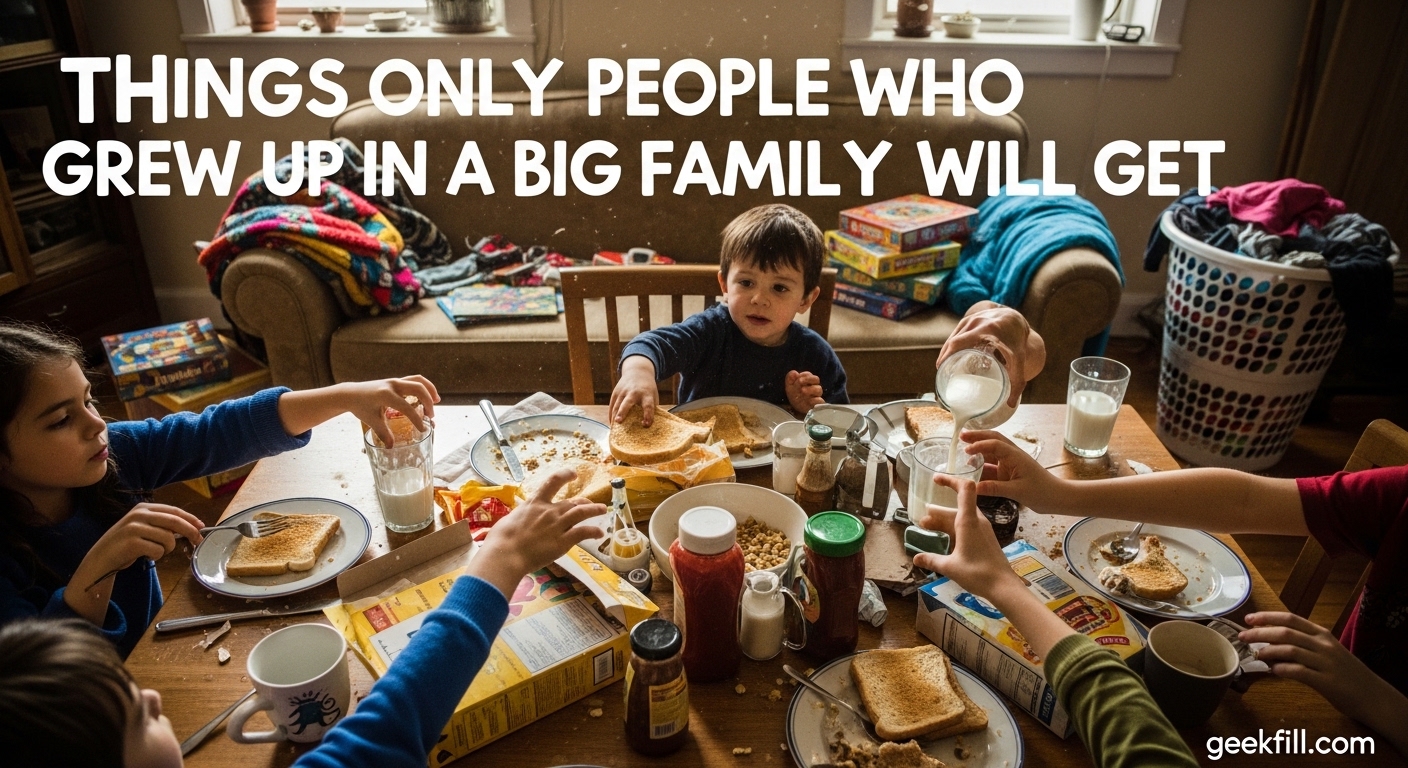
Growing up in a big family is an experience that shapes you in ways you don’t fully understand until you’re standing in the cereal aisle as an adult, instinctively calculating whether there’s enough for everyone. If you were raised alongside multiple siblings in a household that rarely had empty seats at the dinner table, you already know exactly what I mean.
There’s a secret language among those of us who grew up in a big family. A shared understanding of chaos, compromise, and the kind of love that comes with built-in bodyguards and occasional mortal enemies. These are the moments, skills, and slightly traumatic experiences that only people from large families truly understand.
Table of Contents
14 Things Only People Who Grew Up in a Big Family Will Get
1. Being Called by Every Name Except Your Own
Your parents ran through the entire roster of sibling names before landing on yours. You answered to anything remotely close. Sometimes you responded to the dog’s name.
This wasn’t just a quirk. It was daily life. Teachers would call you by your older sibling’s name. Coaches mixed you up with your brother. Relatives at family reunions would grab your shoulder and say, “You’re [insert sibling’s name here], right?”
Over time, you stopped correcting people. You became whoever they needed you to be in that moment, a shape-shifter forged by necessity in a household where individual recognition was a limited resource.
2. The Bathroom is Never Yours Alone
Privacy in the bathroom was a privilege, not a right. Someone was always banging on the door. There was no such thing as a peaceful shower or an uninterrupted mirror session.
You learned to check before you sat. You mastered the art of the lightning-fast shower. The phrase “I’m in here!” became your most frequently used sentence, shouted through locked doors while younger siblings performed drum solos on the other side.
The bathroom became a negotiation zone. Hair products had to be shared. Hot water was a finite resource you competed for like it was liquid gold.
3. Hand-Me-Downs Are Your Entire Wardrobe
New clothes were special occasions, not expectations. You wore your older sibling’s jeans until they were practically transparent. Your winter coat had already survived three childhoods before it reached you.
The arrival of actual new clothing was a notable event. You remember those items with photographic precision. The first shirt that had never been worn by anyone else felt like haute couture.
This reality taught you two things. First, how to be grateful for what you have. Second, how to absolutely dominate a thrift store as an adult because you’ve been trained to see potential in pre-owned items since birth.
4. You Automatically Talk at Volume 11
In a house with constant background noise, being heard required projection. Your normal speaking voice developed at a decibel level that startles people from smaller families.
You didn’t realize you were loud until friends pointed it out. Their parents would wince slightly when you spoke. Restaurant tables near yours would turn to look.
But this skill has unexpected benefits. You can command a room without a microphone. You can make yourself heard in a crowded bar. Public speaking doesn’t terrify you because you’ve been performing for an audience since you could form sentences.
5. Quiet Time is a Mythical Concept
Silence in your childhood home was suspicious. It usually meant someone was doing something they shouldn’t be. The constant hum of activity was your soundtrack.
Someone was always talking. The television was always on. A video game was always beeping. There was never a moment when the house felt empty or still.
As an adult, you find silence slightly uncomfortable. You need background noise to work. The idea of living alone feels foreign because you’ve never experienced true solitude. You grew up in a perpetual state of togetherness that permanently rewired your need for company.
6. You’re Known as ‘So-and-So’s Sibling’
Your individual identity often came second to your family connection. Teachers expected you to be just like your older sister. Coaches compared you to your brother.
This had mixed results. Sometimes you benefited from your sibling’s reputation. Other times, you spent years proving you were different. Breaking out of the shadow took conscious effort and strategic personality development.
The experience taught you resilience. You learned that recognition isn’t given. It’s earned through consistent effort and refusing to be a carbon copy of someone else’s story.
7. Food is a Competitive Sport
Meal times in a big family were essentially Olympic events. The first person to the table got the best pieces of chicken. The slow eater finished last and scraped the serving dish.
You learned to eat quickly without appearing rushed. You developed strategies for securing your favorite foods. You knew exactly how to position yourself at the table for optimal access to the good stuff.
Special treats required protective instincts. If you opened a package of cookies, you either consumed them immediately or accepted that they would vanish within hours. Nothing sacred remained untouched in a house full of siblings with bottomless stomachs.
8. You Became a Master Negotiator
Living with multiple siblings meant constant deal-making. You traded chores for television privileges. You negotiated bathroom schedules like international treaties.
Conflict resolution became second nature. You learned to read emotions quickly. You understood when to push and when to retreat. The survival of your afternoon plans depended on your diplomatic skills.
These abilities translate directly to adult success. Negotiation, compromise, and emotional intelligence aren’t abstract concepts for you. They’re survival skills you practiced daily in the most high-stakes environment imaginable: your own home.
9. Sharing a Room Was Standard, Not Special
Having your own room was a distant dream until high school, if you were lucky. You shared space with siblings who had different sleep schedules, different music tastes, and different definitions of clean.
Personal boundaries were constantly tested. Your stuff became communal property. Your side of the room was theoretical rather than actual. You learned to sleep through lights, noise, and occasional intrusions.
This experience prepared you for roommates, shared apartments, and open office plans. You can work and sleep anywhere because you’ve already survived the ultimate test of adaptive living. Space is just space. You’ve learned to make any corner feel like home.
10. Your Birthday Was Actually Special
In a house where attention was divided among many children, your birthday became the one day you mattered most. The spotlight belonged to you for twenty-four hours.
You chose the dinner menu. You didn’t have to share your cake. Your presents weren’t communal toys. For one brief day, you were the center of the family universe.
This made birthdays more meaningful than they might be for only children. The contrast between regular days and your special day was dramatic. You still feel a little thrill when your birthday arrives because that childhood magic never completely fades.
11. Conflict Was Just Background Noise
Fighting with siblings wasn’t traumatic. It was Tuesday. You argued over everything. Territory, possessions, attention, seating arrangements. Nothing was too small to become a conflict.
But you also learned that conflict doesn’t destroy relationships. You could scream at each other at noon and be allies by dinner. The constant practice of fighting and reconciling taught you that disagreements are temporary.
As an adult, you handle workplace conflict and relationship disagreements with unusual calm. You’ve already survived the most intense emotional training possible. Real-world arguments feel manageable by comparison.
12. You Have Built-in Best Friends and Worst Enemies
Your siblings were your first friends and your fiercest rivals. You plotted against them and protected them with equal intensity. The relationship defied simple categorization.
You knew their secrets and they knew yours. You had enough dirt on each other to destroy lives, but you never used it because you understood the concept of mutually assured destruction instinctively.
This created bonds that run deeper than friendship. Your siblings witnessed your entire development. They know versions of you that no one else ever met. That shared history creates a support system that’s available even when you haven’t spoken in months.
13. You Learned to Laugh at Yourself Early
In a big family, humility isn’t optional. Your siblings roasted you mercilessly. They pointed out your flaws with surgical precision. You learned to develop thick skin or you didn’t survive.
This constant teaching actually built emotional resilience. You stopped taking yourself too seriously. You learned that embarrassment is temporary and that being able to laugh at your own mistakes is a superpower.
As an adult, you handle criticism better than most. You don’t crumble when someone points out a flaw. You’ve been inoculated against shame by years of sibling honesty. Their brutal truthfulness taught you to accept yourself without needing perfection.
14. The Chaos Never Ends, Even When Everyone Grows Up
You might have left the crowded house behind. You might have your own space, your own schedule, your own quiet. But when the family gathers, the chaos returns instantly.
Adult siblings bring their own children, their own partners, their own complications. Family reunions are louder than ever. The dynamics shift but the energy remains familiar. You’re still negotiating, still competing for attention, still known as someone’s sibling.
And somewhere in that noise, there’s comfort. This chaos shaped you. These people know you completely. You grew up in a big family, and that experience will stay with you forever, even when you’re standing alone in the quiet of your own adult life.
FAQs
What are the benefits of growing up in a large family?
Growing up in a large family builds strong negotiation skills, emotional intelligence, resilience, and adaptability. You learn to share, resolve conflicts, and work as a team from an early age. The experience also creates a built-in support system and lifelong bonds with siblings who understand you completely.
How does growing up in a big family affect you?
The experience shapes your personality in lasting ways. You tend to communicate loudly, handle conflict calmly, and adapt easily to crowded environments. You become skilled at reading social situations and negotiating compromises. While you may struggle with solitude and privacy as an adult, you excel at collaboration and maintaining close relationships.
Why the Big Family Experience Matters in 2026
Looking back on growing up in a big family, I see both the challenges and the profound benefits. Yes, there were moments of frustration. Privacy was scarce. Resources were stretched. Attention had to be fought for rather than freely given.
But those difficulties built skills I use every day. Negotiation comes naturally. I can read a room in seconds. Conflict doesn’t intimidate me because I’ve survived the ultimate testing ground. My siblings remain my most trusted allies, even when we drive each other crazy.
If you grew up in a big family, this list probably triggered a flood of memories. The bathroom wars. The food competition. The constant noise. These shared experiences connect us across geography and generation.
And if you didn’t grow up this way, maybe this gives you insight into those loud, chaotic friends who seem to handle social situations with unusual ease. Their skills weren’t learned in classrooms. They were forged in the beautiful, messy reality of life among siblings who became their first and forever friends.